Archive for Mount Victoria Farms

The Bull Who Changed Everything: The Johanna Rag Apple Pabst Story

Every Holstein on Earth traces back to one bull from a Wisconsin farm. Here’s how Johanna Rag Apple Pabst changed dairy genetics forever.

Johanna Rag Apple Pabst during his legendary show career in the mid-1920s, when he dominated Holstein competition across North America. The gentle giant from Hartford, Wisconsin, who went undefeated in 1924 and sold for the record price of ,000 in 1926, became the universal ancestor of every registered Holstein alive today—a genetic legacy that transformed an entire breed and continues to influence dairy farming worldwide nearly a century later.

The Western Union boy pedaled his bicycle through the crisp Quebec morning, telegraph wires humming overhead as spring awakened the countryside around Hudson Heights. When he finally turned up the winding, tree-shaded drive to Mount Victoria Farms, gravel crunching beneath his wheels, he carried fifteen words that would reshape Holstein history forever: “Johanna Rag Apple Pabst sold for $15,000. Congratulations. O.G. Clark.”

Inside the baronial estate overlooking Lake of Two Mountains, Thomas Bassett Macaulay carefully unfolded the telegram, his actuary’s mind already calculating the magnitude of what he’d just accomplished. The Montreal insurance magnate had just made the most expensive bull purchase in Holstein history, but this wasn’t about acquiring another champion. This was about capturing lightning in a bottle—the cornerstone of a vision so scientifically precise and audaciously ambitious that it bordered on the impossible.

What neither Macaulay nor anyone else at that legendary Wisconsin sale could have imagined was that the bull now making his way by rail to Canada carried within his genetic code something far more powerful than mere championship ribbons. Today, nearly a century later, step into any Holstein barn anywhere on Earth—from the rolling hills of Wisconsin to the green pastures of New Zealand, from the polders of Holland to the pampas of Argentina—and you’re witnessing the living legacy of that bull from Hartford, Wisconsin.

Every registered Holstein alive today traces back to Johanna Rag Apple Pabst. Every single one.

The Wisconsin Genesis

Johanna Rag Apple Pabst in his first photograph. The young bull who would become the genetic foundation of every Holstein alive today began his legendary journey on the modest Wisconsin show circuit, where his gentle demeanor and commanding presence first caught the attention of dairy enthusiasts across the Midwest.

Three miles north of Hartford, Wisconsin, winter was loosening its grip on the rolling farmland of Dodge County when change arrived at the Linker place. It was January 1921, and Philip Linker, at sixty-nine, was feeling the weight of nearly seven decades spent working the land. The 173-acre spread he’d built into a respected Holstein operation was gradually passing to younger hands—those of his son-in-law, Herbert Lepien, who’d married Linker’s daughter Della and brought fresh energy to the partnership.

The barn that morning was filled with the familiar sounds of a working dairy—the gentle lowing of cattle, the rhythmic swish of tails, the soft thud of hooves on the floor. But in one box stall, something extraordinary was taking shape. Princess Johanna Rag Apple Pontiac, barely two years old herself and heavy with her first calf, shifted restlessly in the deep straw bedding.

When her labor began, no one could have predicted they were witnessing the birth of a legend.

The calf that slipped into the world on January 24, 1921, was a bull—black and white, sturdy and alert, with eyes that seemed to hold unusual intelligence. In the dim-lit barn, as Herbert Lepien toweled the newborn dry and helped him to his unsteady feet, there was no fanfare, no proclamation of greatness. Just another Holstein calf taking his first breaths on a Wisconsin dairy farm.

But what happened next revealed the true measure of both cow and calf.

Fresh from delivering her son, Princess Johanna Rag Apple Pontiac stepped into the stall for her official test. In that week, as winter winds howled across the Wisconsin countryside, she produced twenty-six pounds of butter equivalent—a staggering performance for any cow, let alone a first-calf heifer. The numbers told a story that every cattleman understood: this young mother possessed something special, and if genetics held true, her bull calf might possess it, too.

Herbert Lepien had made the choices that led to this moment. Six months earlier, he’d hitched up the sleigh and made the fifteen-mile journey through the snow-covered countryside to Fred Pabst’s legendary operation. Pabst Farms was already famous throughout the dairy country, and its red barns and white fences marked it as one of Wisconsin’s premier breeding establishments. Lepien returned with Pabst Korndyke Star—a bull he registered in his own name, marking him as the true architect of what was to come.

The mating of this carefully chosen sire with the daughter of their previous herd bull, Rag Apple Pontiac Polkadot, was no accident. It was the result of careful thought, practical wisdom, and perhaps just a touch of that indefinable instinct that separates good cattlemen from merely competent ones.

Recognition and Destiny

Johanna Rag Apple Pabst as a two-year-old, circa 1923. The young bull who would reshape Holstein genetics worldwide displays the impressive frame and presence that caught Joe Piek's eye on the Linker farm. At this age, he was just beginning to demonstrate the show ring dominance that would make him a legend, but few could have imagined that every Holstein alive today would trace back to this promising Wisconsin calf. (Historical photograph courtesy of Holstein breeding archives)
Johanna Rag Apple Pabst as a two-year-old, circa 1923. The young bull who would reshape Holstein genetics worldwide displays the impressive frame and presence that caught Joe Piek’s eye on the Linker farm. At this age, he was just beginning to demonstrate the show ring dominance that would make him a legend, but few could have imagined that every Holstein alive today would trace back to this promising Wisconsin calf. (Historical photograph courtesy of Holstein breeding archives)

Eight months later, on a warm summer day when the corn stood tall in Wisconsin fields, county agent Milton Button paid a routine visit to the Linker-Lepien operation. Button’s job was to help farmers improve their herds, and his trained eye could spot potential where others saw only another calf. Something clicked when he watched the young bull move across the pasture—the way he carried himself, the width of his chest, the length of his stride.

“That’s a good bull,” Button told Herbert Lepien that day, words that would prove prophetic. “Someone should buy that calf.”

Six miles south of Hartford, Joe Piek was building dreams of his own. His farmhouse perched on a hillside southeast of town, looking out over the rolling countryside toward Holy Hill, the religious shrine that drew pilgrims from across the region. Piek had recently committed himself to Holstein cattle, purchasing fourteen heifer calves at a Fond du Lac sale—youngsters ranging from six weeks to eight months old, costing him anywhere from $60 to $150 each.

Like any beginning breeder worth his salt, Piek knew that his next decision would shape his entire program: selecting a herd sire. Feeling the weight of inexperience, he enlisted Milton Button’s guidance. Together, they canvassed the countryside, inspecting herds and evaluating prospects. When Button recommended the Lepien calf, Piek didn’t hesitate.

The young bull who arrived at Piek Spring Stock Farm that summer stepped into a world where excellence was the goal, and hard work was the only currency that mattered. In the farmhouse kitchen, nine-year-old Anna Piek was already mixing warm milk for calves on cold mornings, learning the rhythms of farm life that would shape her character. She had no way of knowing that one of those calves—the gentle giant following her around the barnyard like an oversized pet—would one day change the world.

Joe Piek had ambitious plans for his young bull. Each fall, he would rent a boxcar, outfit it with two-by-sixes screwed into the walls to secure the cattle, partition off stalls, and install water and feed barrels. This rolling barn would carry his hopes and dreams to county fairs across the upper Midwest, where cattle were judged not just on production records but on the indefinable quality called “type”—the visual embodiment of dairy perfection.

But first, the bull needed seasoning.

The Promise Fulfilled

Johanna Rag Apple Pabst in his prime during the legendary show career that would establish him as the most dominant Holstein bull of his generation. This photograph captures the massive frame and commanding presence that made him virtually unbeatable in the show ring, earning him three consecutive All-American titles from 1923-1925 before his record-breaking sale to Mount Victoria Farms in 1926.

At Walworth County Fair in 1922, as summer heat shimmered over the show rings and the air hung heavy with the scent of cattle and hay, Johanna Rag Apple Pabst made his public debut. Judge A.C. Oosterhuis examined the senior yearling class with the careful attention of a man who understood that his decisions could make or break a breeder’s dreams. When he pointed to the bull from Hartford, placing him first and naming him junior champion, Joe Piek felt the first flutter of vindication.

But the Wisconsin State Fair later that season brought humility. Fifth place in a class of seven—a showing that might have discouraged a lesser man. As Piek led his bull from the ring that day, his jaw set with determination, he turned to Herbert Lepien, whose own bull had placed second and made a declaration that would echo through Holstein history: “This is a good bull. I’ll get him in shape next year, and then I’ll show the boys a thing or two.”

True to his word, Piek transformed his bull into a phenomenon.

The 1923 season saw Johanna Rag Apple Pabst emerge as something unprecedented in Holstein circles. At the Illinois State Fair, as the orchestra played and spectators filled the grandstand, the massive bull from Wisconsin moved into the ring with surprising grace for his size. When the judge’s final decision came—grand champion—the crowd erupted. The same scene played out at the Waterloo Dairy Cattle Congress and the Pacific International Livestock Exposition.

The 1924 season brought something that had never been seen before in the Holstein competition: perfection. Johanna Rag Apple Pabst went undefeated in both class and grand championship competitions. Wisconsin State Fair, Illinois State Fair, Waterloo, the National Dairy Show—all fell before his supremacy like dominoes in a perfectly orchestrated game.

“Too thick in the pants,” his detractors muttered in the barns after the shows, but nobody seemed able to beat him. His consistency was remarkable—not just in winning but in his demeanor. While other bulls of his era were notorious for their unpredictable temperament, requiring skilled handlers and constant vigilance, “Pabst” had become the Piek family pet, as gentle with nine-year-old Anna as he was commanding in the show ring.

The 1925 season brought his third consecutive All-American title, placing him among the immortals of Holstein show history. But by then, whispers were spreading through dairy barns across the Midwest about something even more significant than show ring victories: his daughters were freshening, and their production records were creating sensations of their own.

The Production Promise

Johanna Rag Apple Pabst at twelve years of age in his final photograph, taken shortly before his death in late 1933. While this image captures the gentle giant in his twilight years at Mount Victoria Farms, his daughters across North America were already proving that his greatest legacy lay not in show ring victories, but in the revolutionary genetics he passed to the next generation—consistently producing the coveted four percent butterfat that would transform Holstein breeding forever.

While Johanna Rag Apple Pabst dominated show rings from Wisconsin to Oregon, his first daughters in Joe Piek’s modest herd quietly revolutionized expectations about what a bull could transmit to his offspring. Every daughter that freshened stepped into the test stall, and their performance was extraordinary: they averaged over 18 pounds of butter in seven days as junior two-year-olds, with two exceeding 25 pounds—figures that ranked among the very best of their time.

More significantly, these daughters consistently tested four percent butterfat or better, inheriting the remarkable trait from their grandam. Princess Johanna Rag Apple Pontiac’s own 4.18 percent test had marked her as exceptional, but seeing this trait transmitted so reliably to the next generation was something else entirely. In an era when most Holstein herds struggled to maintain butterfat percentages above 3.5 percent, four percent milk was like finding gold.

This combination of show ring dominance and proven transmitting ability created perfect market conditions. Bulls with such show credentials were rare. Bulls with daughters proving themselves in the test barn were rarer still. Bulls with both were virtually nonexistent.

Word spread through the Holstein community with the efficiency of a telegraph network. In farm kitchens across the dairy belt, breeders pored over Holstein-Friesian World and Farmers Advocate, studying the production reports and showing results that told the story of the bull from Hartford. They understood what they were seeing: a once-in-a-generation animal that could transmit both the visual excellence demanded by show rings and the practical performance required by commercial dairying.

This convergence of attributes caught the attention of a man four hundred miles northeast, whose vision for Holstein breeding was as methodical as it was ambitious.

The Vision of T.B. Macaulay

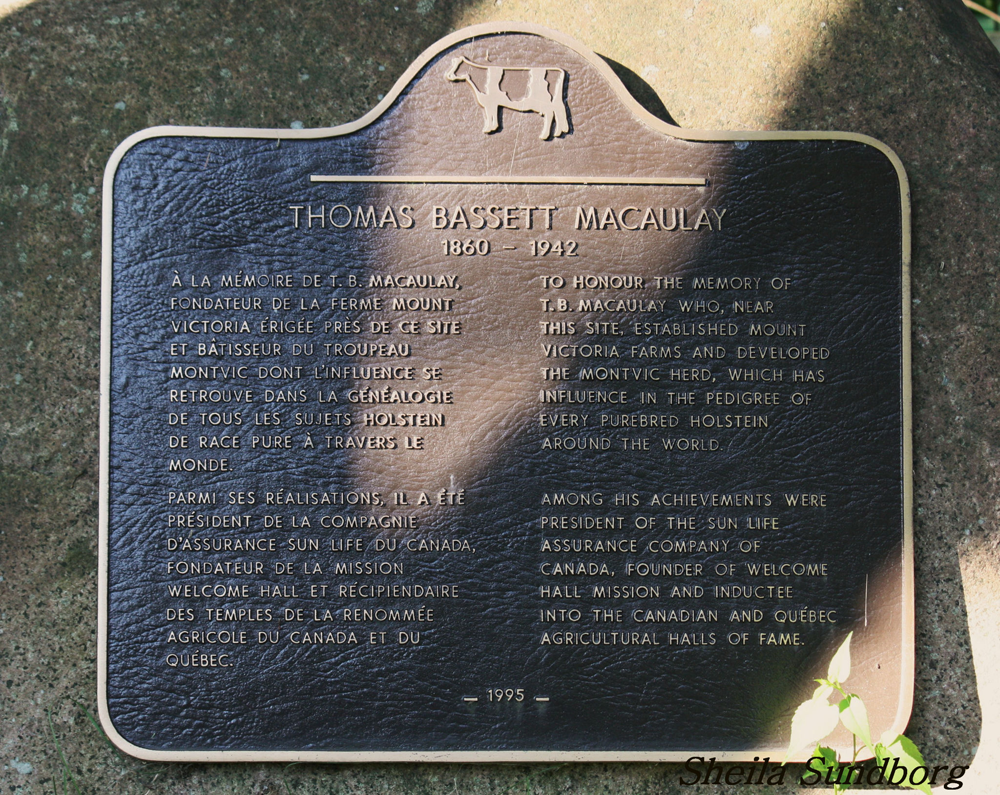
Thomas Bassett Macaulay (1860-1942) - The Montreal insurance magnate and Sun Life Assurance Company president who revolutionized Holstein breeding through scientific precision. Applying his actuarial expertise to genetics, Macaulay established Mount Victoria Farms in Quebec and developed the systematic breeding program that made Johanna Rag Apple Pabst the universal ancestor of all modern Holsteins.
Thomas Bassett Macaulay (1860-1942) – The Montreal insurance magnate and Sun Life Assurance Company president who revolutionized Holstein breeding through scientific precision. Applying his actuarial expertise to genetics, Macaulay established Mount Victoria Farms in Quebec and developed the systematic breeding program that made Johanna Rag Apple Pabst the universal ancestor of all modern Holsteins.

In the quiet evenings at Mount Victoria Farms, Thomas Bassett Macaulay could often be found in his study, lamplight illuminating the pages of Holstein Herd Books and back issues of agricultural publications. The Montreal insurance magnate approached his hobby with the same analytical precision that had made him president of Sun Life Assurance Company—one of North America’s largest financial institutions.

Outside his windows, the Quebec countryside stretched toward Lake of Two Mountains, where his estate’s 400 acres commanded a magnificent view. But Macaulay’s attention was focused on something far more complex than scenic beauty: the intricate mathematics of genetic improvement.

His experiments with corn breeding had opened his eyes to possibilities that most cattle breeders of his era couldn’t imagine. Between 1924 and 1928, Macaulay maintained between 100 and 170 separate corn plots annually, each planted with seed from a single selected ear, each carefully isolated to prevent cross-pollination. His methodical approach, grounded in Mendelian genetics, had convinced him that specific, predictable characteristics could be developed through strategic selection and inbreeding.

If it worked with corn, Macaulay reasoned with the logic of a mathematician, why not with cattle?

His vision was breathtaking in its precision: to develop a Holstein bloodline genetically pure for three crucial traits—superior show type, excellent udders, and a consistent butterfat test of four percent or better. This wasn’t the casual dream of a gentleman farmer; this was a scientifically designed project that would require the same methodical approach that had guided his insurance career.

Macaulay’s search for the perfect bull to anchor this project was exhaustive. In his study, surrounded by breeding charts and production records, he analyzed pedigrees with the precision of an actuary calculating mortality tables. A single, compelling conclusion emerged from months of research: Johanna Rag Apple Pabst possessed the exact combination of attributes his program required.

The bull’s exceptional show record proved his superior type. His high-producing, four percent testing dam suggested he could transmit both production and butterfat content. Most importantly, his own daughters were averaging four percent test under ordinary farm conditions—exactly what Macaulay’s mathematical breeding model required.

The Mission to Wisconsin

Joseph Piek (left) and Herbert Lepien (right), the two Wisconsin dairymen whose decisions shaped Holstein history. Lepien, farming in partnership with his father-in-law Philip Linker, selected Pabst Korndyke Star as herd sire and made the breeding decisions that produced Johanna Rag Apple Pabst. Piek recognized the calf's potential, purchased him at eight months old, developed his legendary show career, and ultimately sold him for the record price of $15,000 at Clark's Holstein Classic in 1926—setting in motion the genetic revolution that would transform the entire Holstein breed.
Joseph Piek (left) and Herbert Lepien (right), the two Wisconsin dairymen whose decisions shaped Holstein history. Lepien, farming in partnership with his father-in-law Philip Linker, selected Pabst Korndyke Star as herd sire and made the breeding decisions that produced Johanna Rag Apple Pabst. Piek recognized the calf’s potential, purchased him at eight months old, developed his legendary show career, and ultimately sold him for the record price of $15,000 at Clark’s Holstein Classic in 1926—setting in motion the genetic revolution that would transform the entire Holstein breed.

Macaulay dispatched Joseph I. Chandler to the modest farmstead near Hartford to evaluate Johanna Rag Apple Pabst firsthand. Chandler, whose business card read “Assistant to The President” at Sun Life, had recently been assigned as farm manager for Mount Victoria despite having no previous experience with Holstein cattle. However, he made up for what he lacked in cattle knowledge in business acumen and the ability to recognize excellence when he saw it.

Chandler’s train pulled into Hartford on a crisp Wisconsin morning, and the short drive to the Piek farm revealed the stark contrast between his urban Montreal background and this rural heartland. At Piek Spring Stock Farm, with its modest farmhouse overlooking the countryside, Chandler found himself face-to-face with the bull whose reputation had traveled over 1,000 miles.

What he discovered exceeded even Macaulay’s optimistic expectations.

Here was the top show bull of the day, barely five years old and fit for many more years of service. His massive frame spoke of masculine power, while his gentle demeanor revealed a temperament ideally suited for handling. But the data convinced Chandler’s business mind: upwards of a dozen daughters averaging four percent test on official work, all under ordinary farm conditions.

The bull’s sire, Pabst Korndyke Star, had already stamped his offspring with both type and productive ability—his first five daughters had created a sensation by averaging an unprecedented 720 pounds of fat as two-year-olds. The genetic mathematics were compelling: superior sire, exceptional dam, proven daughters. Everything aligned with Macaulay’s scientific breeding model.

Convinced beyond any doubt, Chandler hurried back to Montreal with his recommendations, then returned to Wisconsin for Colonel O.G. Clark’s Holstein Classic—the venue Joe Piek had chosen for his bull’s sale.

The Sale That Changed Everything

The stars of the sale that would make history: Colonel O.G. Clark (center) surrounded by the elite cattle that made his 1926 Holstein Classic the most talked-about auction of its era. On the left, Johanna Rag Apple Pabst poses as the All-American 2-year-old he had recently become, flanked by production powerhouses Crestmont Duchess Ormsby and former world champion Queen Bessie Pietertje Ormsby. The right side features Sir Triune Pansy—the yearling bull that expert Ray Arnold called "the nearest thing to perfection" he had ever seen—alongside record-breaking producer Aaggie Waconda 2d and influential sire Sir Bess Ormsby Fobes. At center, the portrait of May Walker Ollie Homestead, U.S. champion butter producer and dam of three All-American winners, presides over this assembly of genetic royalty. This promotional photograph captured the moment when Holstein breeding was about to change forever—when one bull's $15,000 sale price would echo through dairy history and establish a genetic legacy that flows through every Holstein alive today.
The stars of the sale that would make history: Colonel O.G. Clark (center) surrounded by the elite cattle that made his 1926 Holstein Classic the most talked-about auction of its era. On the left, Johanna Rag Apple Pabst poses as the All-American 2-year-old he had recently become, flanked by production powerhouses Crestmont Duchess Ormsby and former world champion Queen Bessie Pietertje Ormsby. The right side features Sir Triune Pansy—the yearling bull that expert Ray Arnold called “the nearest thing to perfection” he had ever seen—alongside record-breaking producer Aaggie Waconda 2d and influential sire Sir Bess Ormsby Fobes. At center, the portrait of May Walker Ollie Homestead, U.S. champion butter producer and dam of three All-American winners, presides over this assembly of genetic royalty. This promotional photograph captured the moment when Holstein breeding was about to change forever—when one bull’s $15,000 sale price would echo through dairy history and establish a genetic legacy that flows through every Holstein alive today.

Colonel O.G. Clark’s Holstein Classic was conceived as more than just an auction—it was the breed’s first major promotional extravaganza, designed to capture national attention and elevate the entire Holstein industry. With 450 head cataloged, it was the largest sale in volume to that time, averaging $391 per head in an era when many good cows sold for less than $200.

Clark himself was a force of nature in the livestock industry. Born in Georgia but headquartered in West Salem, Wisconsin, he possessed what contemporaries called “extraordinary nervous energy and driving power.” His reputation as a man “not afraid to take a chance” made him the perfect impresario for an event of this magnitude.

The sale venue buzzed with excitement as cattlemen gathered from across North America. Gourmet meals accompanied by orchestra music followed each day’s selling, creating an atmosphere reminiscent of a society gathering rather than a farm auction. But everyone understood what they were witnessing: history in the making.

Johanna Rag Apple Pabst had become the sale’s featured attraction, heavily advertised at Clark’s expense. When his moment came, the arena fell silent. The bidding began conservatively but quickly escalated as the significance of the moment became clear. When the hammer finally fell at $15,000, the assembled crowd rose as one, giving three lusty cheers for Canada. It was a record price that wouldn’t be matched until the wartime boom of 1942—equivalent to well over $200,000 in today’s currency.

But perhaps the most revealing moment came afterward, when twelve-year-old Elis Knutson, hired to care for cattle at the sale, overheard an exchange between Colonel Clark and Joe Piek. Ever the shrewd farmer, Piek suggested that Clark should reduce his commission because of the publicity the record price would generate.

Clark’s blunt response cut through any romantic notions about competitive bidding: “Nonsense… on the last five thousand dollars, Chandler and I were the only two bidding.”

Whether entirely accurate or embellished over decades of retelling, the story captures this pivotal moment’s human drama. When Western Union telegraphed the news across North America—”Johanna Rag Apple Pabst sold for $15,000″—it marked more than just a record price. It signaled the beginning of a new era in Holstein breeding.

The Mount Victoria Dynasty

The legacy of Johanna Rag Apple Pabst made manifest in his daughters. This 1936 photograph captures four of his most distinguished offspring, recognized as an All-American get of sire group. From left to right: Montvic Rag Apple Colantha Abbekerk (who would set a world record with 1,263 pounds of fat), Montvic Rag Apple Marion, Montvic Countess Rag Apple, and Montvic Rag Apple Bonheur (dam of the great Montvic Pathfinder). Together, these exceptional females embodied T.B. Macaulay's vision of genetic perfection—superior type, excellent udders, and consistent four percent butterfat production. Their uniformity and quality demonstrated that the bull from Hartford, Wisconsin, had indeed become the cornerstone of a Holstein dynasty that would transform the breed worldwide.
The legacy of Johanna Rag Apple Pabst made manifest in his daughters. This 1936 photograph captures four of his most distinguished offspring, recognized as an All-American get of sire group. From left to right: Montvic Rag Apple Colantha Abbekerk (who would set a world record with 1,263 pounds of fat), Montvic Rag Apple Marion, Montvic Countess Rag Apple, and Montvic Rag Apple Bonheur (dam of the great Montvic Pathfinder). Together, these exceptional females embodied T.B. Macaulay’s vision of genetic perfection—superior type, excellent udders, and consistent four percent butterfat production. Their uniformity and quality demonstrated that the bull from Hartford, Wisconsin, had indeed become the cornerstone of a Holstein dynasty that would transform the breed worldwide.

When the train carrying Johanna Rag Apple Pabst pulled into Hudson Heights station in April 1926, it carried more than just another expensive bull—it carried the future of the Holstein breed. The drive up the winding, tree-shaded road to Mount Victoria Farms took the bull from the railway to an estate unlike anything he’d known in Wisconsin.

Perched on its wooded plateau overlooking Lake of Two Mountains, Mount Victoria commanded a view that had captivated T.B. Macaulay when he first purchased the property in 1899. The elevation itself had been named Mount Victoria in honor of Queen Victoria, and now it would witness the beginning of a genetic revolution.

Macaulay had prepared for this moment with characteristic precision. The bull was housed in a special open-faced, two-story barn explicitly built for him, situated in a small paddock north of the main barnyard. From his quarters, Johanna Rag Apple Pabst could survey the rolling Quebec countryside like a monarch overseeing his domain—a fitting metaphor for what he would become.

The breeding strategy Macaulay implemented was as methodical as his corn experiments. The foundation females he had assembled—primarily of the Posch-Abbekerk strain tracing back to Prince Colanthus Abbekerk—were mated systematically with Johanna Rag Apple Pabst. Each resulting offspring was subjected to rigorous evaluation: production testing, show ring exhibition, classification for type, and strict culling based on predetermined standards.

Around the Mount Victoria cow stable, Macaulay could be seen with his trademark index cards, each containing numbers, flow charts, and diagrams pertaining to individual herd members. His actuarial background had taught him that complex problems required systematic data collection and analysis. He approached genetics like an insurance calculation, seeking to reduce risk by concentrating on proven genetics while tracking every variable that might affect outcomes.

The naming strategy alone revealed the scope of his vision. Offspring were collectively called “Rag Apples,” with individual names typically beginning with “Montvic Rag Apple” followed by a fourth name for specific identification. Before many years had passed, any Holstein breeder hearing “Rag Apple” would correctly assume the reference was to a descendant of Johanna Rag Apple Pabst.

His favorite quote from Beattie captured the philosophy driving this methodical approach: “What cannot art and industry perform, when science plans the progress of their toil.”

The Super Champion”: A 1931 advertisement for Johanna Rag Apple Pabst, the cornerstone sire of Mount Victoria Farms. This legendary bull, purchased for $15,000 in 1926, revolutionized Holstein breeding with his ability to consistently sire daughters with high butterfat percentages and excellent conformation. His influence on the breed was so profound that by the late 20th century, virtually every registered Holstein worldwide carried his blood.

The Super Champion”: A 1931 advertisement for Johanna Rag Apple Pabst, the cornerstone sire of Mount Victoria Farms. This legendary bull, purchased for $15,000 in 1926, revolutionized Holstein breeding with his ability to consistently sire daughters with high butterfat percentages and excellent conformation. His influence on the breed was so profound that by the late 20th century, virtually every registered Holstein worldwide carried his blood.

The Genetics of Greatness

What made Johanna Rag Apple Pabst genetically potent wasn’t an accident—it was the result of deliberate line breeding strategies employed by previous generations of Holstein breeders. His pedigree featured six crosses to the dominant sire Pontiac Korndyke and four crosses to another titan, Hengerveld DeKol. Additionally, he carried two crosses each to King Segis and Friend Hengerveld DeKol Butter Boy.

Approximately thirty-six percent of his genetic inheritance derived directly from these four exceptional sires—a concentration of proven genetics dramatically increased the likelihood that his offspring would inherit and transmit desirable traits. The mating of Pontiac Korndyke with daughters of Hengerveld DeKol was widely regarded as one of the most potent breeding combinations in Holstein history, and Johanna Rag Apple Pabst’s pedigree contained multiple instances of this golden cross.

This intensive line breeding represented the cutting-edge genetics of its era, comparable to today’s genomic selection in its attempt to concentrate superior genes while minimizing undesirable traits. Macaulay understood these principles intuitively, applying the same risk-assessment skills he used in the insurance industry to genetic improvement.

The results exceeded even his ambitious expectations. Daughter after daughter emerged with the combination of traits he sought: superior type, excellent udders, and four percent or better butterfat test. Sons proved equally valuable, with bulls like Montvic Pathfinder, Montvic Chieftain, and dozens of others carrying their sire’s genetic potency to herds across North America.

Mount Victoria’s 1927 Farmer’s Advocate ads showcase their prized bull Johanna Rag Apple Pabst and his offspring, highlighting the farm’s focus on superior genetics and high butterfat production. These ads reflect Thomas B. Macaulay’s ambitious vision to develop a strain of Holsteins consistently testing at 4% butterfat or higher.

Mount Victoria’s 1927 Farmer’s Advocate ads showcase their prized bull Johanna Rag Apple Pabst and his offspring, highlighting the farm’s focus on superior genetics and high butterfat production. These ads reflect Thomas B. Macaulay’s ambitious vision to develop a strain of Holsteins consistently testing at 4% butterfat or higher.

Tragedy and Transformation

Johanna Rag Apple Pabst’s life at Mount Victoria was productive but destined to be brief. After largely withdrawing from show competition following the 1926 season, he focused on the breeding duties defining his legacy. Macaulay couldn’t resist showing him again in 1928 at the Ottawa Winter Fair and Royal Winter Fair, where he added two more grand championships to his record, but his primary purpose was clear: building the herd to match the dream.

The end came suddenly in late 1933. At twelve years of age, while moving in his paddock overlooking the Quebec countryside he’d called home for seven years, the great bull broke his leg at the stifle. The injury was so severe that euthanasia was the only humane option. His death represented not just the loss of a valuable animal but the end of direct access to the genetic material that had been central to Macaulay’s vision.

By then, however, his influence was already spreading far beyond the borders of Mount Victoria. Sons and daughters were establishing themselves in herds across Canada and the United States, each carrying forward the genetic legacy that would eventually transform the entire Holstein breed.

When the Mount Victoria herd was dispersed in 1942, all but two of the 89 lots offered were home-bred descendants of Johanna Rag Apple Pabst. The dispersal, necessitated by Macaulay’s death earlier that year, scattered his progeny across North America like seeds from a rare plant, each with the potential to influence Holstein genetics for generations to come.

The Human Thread

Behind every great bull stands a network of human decisions, insights, and commitments that make greatness possible. Philip Linker’s dedication to quality bulls, even without formal testing programs. Herbert Lepien’s foresight in traveling to Pabst Farms and his eye for a superior sire. Milton Button’s recognition of exceptional potential in an eight-month-old calf.

Joe Piek’s relentless dedication to show ring excellence, his willingness to invest in fitting and travel, and his prophetic words about showing “the boys a thing or two.” His daughter Anna’s childhood memories of feeding a gentle giant who would follow her around the barnyard, never knowing she was caring for a future legend.

Most significantly, T.B. Macaulay’s revolutionary vision is an insurance man’s mathematical approach to genetics combined with unlimited resources and unwavering commitment to specific, measurable goals. His systematic pursuit of the four percent dream, tracked on index cards and guided by actuarial precision, created the foundation for every Holstein breeding program that would follow.

In farm kitchens across dairy country today, when a breeder opens her laptop to study genomic evaluations and plan matings for the next generation, she follows principles Macaulay pioneered with his corn plots and data cards. The tools have evolved—genomic testing has replaced visual appraisal, embryo transfer has expanded breeding possibilities, and artificial insemination has made superior genetics globally accessible—but the fundamental approach remains unchanged: identify the best, concentrate their genetics, measure the results, and build for the future.

The Universal Legacy

Historic Continuity at Mount Victoria: In this 1994 photograph, the legendary Holstein sire Hanoverhill Starbuck stands with Carl Saucier at Mount Victoria Farm in Hudson Heights, Québec—the same hallowed ground where his ancestor Johanna Rag Apple Pabst once resided. At 15 years old and still in active service, Starbuck displays the powerful frame that helped him sire over 200,000 daughters worldwide and distribute 685,000 semen doses across 45 countries. This image captures a profound moment of Holstein breeding continuity, connecting Starbuck’s revolutionary genetic impact with T.B. Macaulay’s pioneering breeding program that began seven decades earlier, symbolizing how generations of thoughtful selection transformed global dairy genetics.

In 1958, when T.B. Macaulay’s memory was honored by the dairy industry of the United States with the hanging of his portrait in the Pioneer Room at the Dairy Shrine Club, it was announced that over ninety percent of Canadian Holsteins were descendants of Mount Victoria breeding. That percentage, remarkable as it seemed then, was only the beginning.

Today, nearly a century after Johanna Rag Apple Pabst stepped off the train at Hudson Heights, the scope of his genetic influence defies comprehension. No registered Holstein exists anywhere on Earth that cannot be traced back to this bull. None. Not in the high-tech dairies of California’s Central Valley. Not in the grass-fed systems of New Zealand. Not in the ancient dairy regions of Europe where the breed originated. Not in the emerging dairy industries of Asia and South America.

This universal genetic dominance represents something unprecedented in livestock breeding—a single individual’s complete transformation of a global breed. In every barn, in every pasture, in every milking parlor where Holstein cattle convert feed to milk, the genetic essence of Johanna Rag Apple Pabst flows through their veins.

Walk into any modern dairy operation, and you’re witnessing the living fulfillment of T.B. Macaulay’s vision. The four percent butterfat that he pursued with such scientific dedication is now routine. The combination of type, udder quality, and production that seemed so ambitious in 1926 has become the baseline from which modern Holstein breeding programs advance toward even greater goals.

The production records that would astound dairymen of the 1920s—30,000 pounds of milk per lactation, 1,200 pounds of butterfat, five percent protein levels—are achieved by cows whose genetic makeup can be traced, line by line, back to that modest barn near Hartford where Princess Johanna Rag Apple Pontiac delivered her first calf on a cold January morning in 1921.

The Eternal Impact

Johanna Rag Apple Pabst, affectionately called 'Old Joe,' stands immortalized as a life-size sculpture on the site of the historic Mount Victoria farm in Hudson Heights, Quebec. Born on January 24, 1921, this legendary sire appears no less than 45 times in Hanoverhill Starbuck's pedigree, cementing his foundational influence on modern Holstein genetics. With 64 Montvic animals also contributing to Starbuck's lineage, 'Old Joe' remains a cornerstone of Canadian dairy breeding history. Pictured here in the summer of 2021, his legacy continues to inspire breeders worldwide.
Johanna Rag Apple Pabst, affectionately called ‘Old Joe,’ stands immortalized as a life-size sculpture on the site of the historic Mount Victoria farm in Hudson Heights, Quebec. Born on January 24, 1921, this legendary sire appears no less than 45 times in Hanoverhill Starbuck’s pedigree, cementing his foundational influence on modern Holstein genetics. With 64 Montvic animals also contributing to Starbuck’s lineage, ‘Old Joe’ remains a cornerstone of Canadian dairy breeding history. Pictured here in the summer of 2021, his legacy continues to inspire breeders worldwide.

In the basement office of a modern dairy farm, a young breeder studies genomic evaluations on her computer screen, making mating decisions with precision that would have amazed even T.B. Macaulay. The technology is revolutionary—SNP chips that read genetic code, computer algorithms that predict production potential, satellite-guided feed delivery systems, and robotic milking equipment that operates around the clock without human intervention.

Yet the fundamental principles that guide her decisions echo directly back to those index cards Macaulay carried around his cow stable: identify superior genetics, concentrate them through strategic breeding, measure the results, and build systematically toward clearly defined goals. The tools have evolved, but the vision remains remarkably consistent.

When she selects a sire for her best cows, she’s applying lessons learned from Johanna Rag Apple Pabst’s daughters. When she culls animals that don’t meet her standards, she’s following Macaulay’s relentless pursuit of genetic improvement. When she invests in genetic testing and superior sires regardless of cost, she’s channeling the same commitment to excellence that led Macaulay to pay $15,000 for a bull in 1926.

The four percent butterfat that dominated Macaulay’s breeding philosophy now seems almost quaint in an era where many Holsteins routinely exceed four and a half percent fat while producing volumes of milk that would have been unimaginable to earlier generations. However, the principle remains unchanged: genetic progress requires vision, commitment, measurement, and the courage to make difficult decisions based on long-term goals rather than short-term convenience.

In farm kitchens from Wisconsin to New Zealand and in breeding offices from Quebec to Queensland, the influence of Johanna Rag Apple Pabst continues. His story is not merely history—it’s the living foundation of modern dairy genetics, the genetic thread that connects every Holstein born today to a remarkable bull who changed everything.

From a modest Wisconsin farm to global genetic dominance, from a record-breaking $15,000 sale to influence worth billions in modern breeding programs, from one man’s scientific vision to an industry that feeds the world, the story of Johanna Rag Apple Pabst reminds us that sometimes the most profound changes begin with the simplest recognition of excellence.

“This is a good bull,” Joe Piek said after that disappointing fifth-place showing at the Wisconsin State Fair in 1922. In barns around the world today, as Holstein calves take their first steps and farmers plan their breeding programs for the next generation, that recognition continues. The genetic heart of Johanna Rag Apple Pabst—his influence on modern dairy production, his role in shaping the breed that feeds the world, his place as the universal ancestor of every Holstein alive today—beats on in every black and white calf born anywhere on Earth.

That’s the true measure of a bull who didn’t just change Holstein breeding—he became Holstein breeding itself, the genetic cornerstone upon which a global industry was built and continues to thrive. In an age of artificial intelligence and gene editing, robotic milking, and precision agriculture, the legacy of a bull born in a simple Wisconsin barn nearly a century ago remains more relevant than ever: once recognized and properly developed, excellence has the power to transform the world.

Every Holstein alive today carries his blood. Every glass of milk, every slice of cheese, every dairy product consumed anywhere on Earth bears his influence. In the end, perhaps that’s the most remarkable aspect of this story—how one exceptional animal, identified by observant farmers and developed by a visionary breeder, became not just a part of Holstein history but the genetic foundation of every Holstein’s future.

The bull who changed everything continues to change everything, one generation at a time, one calf at a time, one farm at a time, his genetic legacy flowing through the veins of the breed that feeds the world.

Key Takeaways

  • Universal Genetic Legacy: Every registered Holstein alive worldwide today traces back to Johanna Rag Apple Pabst—an unprecedented genetic influence in livestock breeding history.
  • Record-Breaking Investment: The $15,000 sale price in 1926 (equivalent to over $200,000 today) demonstrated early recognition of exceptional genetic value and set the stage for modern high-value breeding programs.
  • Scientific Breeding Vision: T.B. Macaulay’s methodical approach to genetics—using data cards, systematic record-keeping, and specific breeding goals—pioneered principles still used in modern genomic selection programs.
  • Show Ring to Production Integration: The bull’s combination of undefeated show ring performance and daughters consistently producing four percent butterfat proved that type and production excellence could be successfully combined.
  • Transformative Power of Strategic Breeding: The story illustrates how identifying exceptional genetics, applying scientific methodology, and maintaining long-term vision can fundamentally transform an entire global industry.

Executive Summary

Johanna Rag Apple Pabst, born on a modest Wisconsin dairy farm in 1921, became the most influential Holstein bull in history through a combination of show ring dominance and exceptional genetic transmitting ability. After going undefeated in 1924 and siring daughters that consistently produced four percent butterfat milk, he was sold for the record price of $15,000 to Canadian insurance magnate T.B. Macaulay in 1926. Macaulay implemented a scientifically precise breeding program at his Mount Victoria Farms, using the bull to develop a Holstein bloodline genetically superior in type, udder quality, and butterfat production. Through strategic line breeding and systematic selection, Johanna Rag Apple Pabst’s offspring spread across North America and eventually worldwide. Nearly a century later, every registered Holstein on Earth traces back to this single bull, representing the complete genetic transformation of an entire breed. His legacy demonstrates how visionary breeding, scientific methodology, and recognition of exceptional genetics can create lasting change that feeds the world.

Learn more:

Join the Revolution!

Join over 30,000 successful dairy professionals who rely on Bullvine Weekly for their competitive edge. Delivered directly to your inbox each week, our exclusive industry insights help you make smarter decisions while saving precious hours every week. Never miss critical updates on milk production trends, breakthrough technologies, and profit-boosting strategies that top producers are already implementing. Subscribe now to transform your dairy operation’s efficiency and profitability—your future success is just one click away.

NewsSubscribe
First
Last
Consent

The Vision of Mount Victoria: T.B. Macaulay’s Holstein Legacy

Discover the legacy of Mount Victoria Farms, where one man’s vision revolutionized Holstein breeding. From unlikely beginnings to global influence, this tale of scientific innovation and relentless pursuit of excellence shaped the future of dairy cattle worldwide—a game-changer in agricultural history.

T.B. Macaulay, who owned Mount Victoria Farm, Hudson Heights, Quebec, founded the Rag Apple bloodline.

Few names resonate as powerfully in the annals of dairy cattle breeding as Mount Victoria Farms. Nestled in the picturesque landscape of Quebec, Canada, this unlikely crucible of genetic innovation would reshape the entire Holstein breed, leaving an indelible mark on dairy farms worldwide. 

In 1899, a 44-year-old insurance executive, Thomas Bassett Macaulay, purchased a 200-acre farm overlooking the Lake of Two Mountains. Little did the world know that this seemingly ordinary land acquisition would be the first step in a revolutionary journey that would span decades and transform an entire industry. 

“Macaulay, armed with a sharp analytical mind from his work in actuarial science, approached cattle breeding with precision and creativity.”

He aimed to create a strain of Holstein cattle that consistently produces milk with high butterfat content while maintaining excellent conformation. What unfolded over the next four decades was nothing short of extraordinary. Through meticulous selection, innovative breeding practices, and an unwavering commitment to his vision, Macaulay and his team at Mount Victoria Farms developed bloodlines that would come to dominate the Holstein breed for generations. 

This is how one man’s passion for genetics, business acumen, and scientific approach created a legacy. This legacy revolutionized dairy farming globally. It’s a tale of perseverance, innovation, and the pursuit of perfection that continues to influence dairy producers today. Prepare to step into Mount Victoria Farms, where one of the most significant breeding experiments in agricultural history took place, forever changing the face of the Holstein breed.  

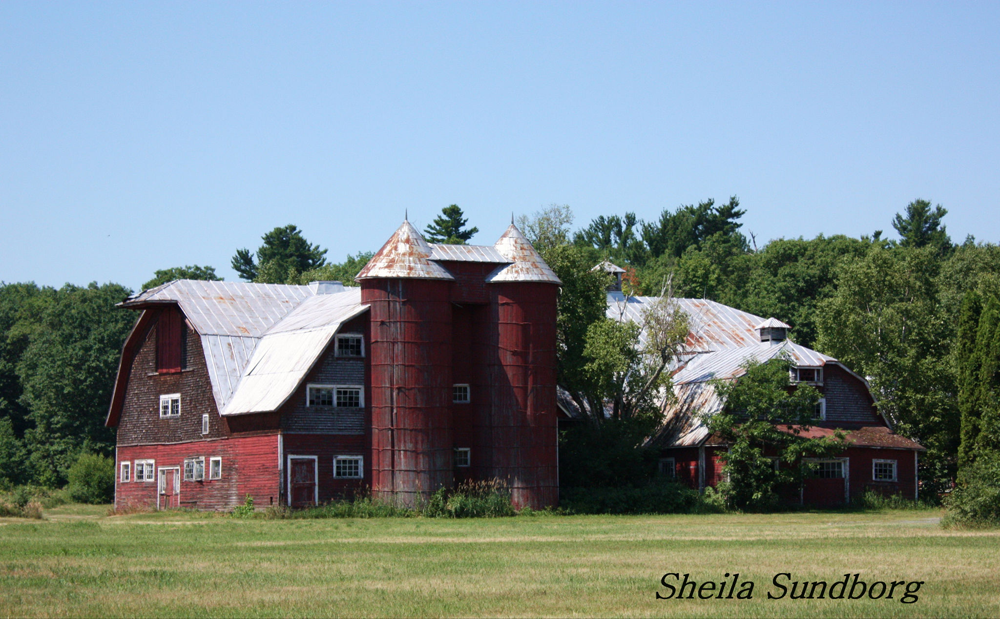
The Mount Victoria Farm, circa 1940: This historic photograph captures the picturesque Mount Victoria Farm in Hudson Heights, Quebec, where Thomas Bassett Macaulay revolutionized Holstein breeding. The farm’s scenic location overlooking the Lake of Two Mountains provided an idyllic setting for Macaulay’s groundbreaking work in developing influential bloodlines that would shape the Holstein breed worldwide for generations to come.

The Unlikely Breeder

In 1899, at 44, Thomas Bassett Macaulay made an unconventional decision that would reshape the future of Holstein breeding. The successful actuary and president of Sun Life Assurance Company purchased a 200-acre farm in Hudson Heights, Quebec, overlooking the picturesque Lake of Two Mountains. This acquisition was far from a retirement plan; it began an extraordinary journey into the world of dairy cattle genetics. 

Macaulay’s farm, which he named Mount Victoria, was initially a sandy plot with poor soil quality, presenting a challenging canvas for his breeding ambitions. Undeterred, he set about improving the land with the same methodical approach he applied to his insurance work. He acquired diverse livestock, including French-Canadian cattle, goats, sheep, and horses. Macaulay’s insatiable curiosity drove these early experiments in animal husbandry, as did his desire to understand the principles of breeding and genetics. 

For 25 years, Macaulay honed his skills and knowledge in animal management while continuing to lead Sun Life to new heights. His unique background in actuarial science provided him with a distinct advantage: the ability to analyze complex data and apply statistical principles to breeding decisions. This analytical approach would later become the cornerstone of his success in Holstein breeding. 

In 1924, at the age of 69, an age when most men were considering retirement, Macaulay embarked on a new adventure: his legacy. He purchased his first Holstein cow, marking the beginning of one of the most influential breeding programs in the breed’s history. This late entry into Holstein breeding, far from being a disadvantage, proved to be Macaulay’s secret weapon. 

Unencumbered by traditional practices and preconceived notions, Macaulay approached Holstein breeding with an outsider’s fresh perspective and a scientist’s rigorous methodology. He meticulously studied breed journals, pedigrees, and production records, applying his actuarial skills to identify the most promising genetic combinations. 

Macaulay’s unique approach quickly set him apart from other breeders. He wasn’t content with following established practices; instead, he sought to revolutionize the breeding process through careful selection, innovative breeding techniques, and a relentless focus on improvement. His goal was clear: to create a strain of Holsteins that consistently produced high butterfat milk while maintaining excellent conformation. 

As word of Macaulay’s innovative methods spread, the dairy farming community watched with curiosity and skepticism. Many doubted that an insurance executive with no formal agricultural training could succeed in the competitive world of Holstein breeding. Little did they know that this unlikely breeder was about to embark on a journey that would forever change the face of the Holstein breed and leave an indelible mark on dairy farming worldwide. 

The Foundation

In the early 1920s, Thomas Bassett Macaulay embarked on a quest to reshape the Holstein breed. Armed with his analytical mind and passion for improvement, he dove deep into dairy cattle genetics. Macaulay spent countless hours reviewing breed journals, studying pedigrees, and analyzing production records. His goal was clear: to create a strain of Holsteins that would consistently produce high butterfat milk while maintaining excellent conformation. 

Macaulay’s research led him to a surprising conclusion. The best Holstein genetics in North America were not found in the established herds of New York or Wisconsin but in the rolling hills of Oxford County, Ontario. With its rich dairy farming tradition, this region had become a hotbed of Holstein innovation. 

In 1924, Macaulay made his first significant move. He attended the dispersal sale of Newton Chambers, a respected Oxford County breeder. He purchased Oakhurst Colantha Abbekerk for $900, the sale’s highest price. This cow would become the foundation of Mount Victoria’s Colantha family and prove a wise investment. 

The following year, Macaulay set his sights on Alfred Hulet’s herd, another Oxford County breeder known for his work with the Posch-Abbekerk bloodlines. At Hulet’s dispersal, Macaulay acquired several key animals, including Dixie Colantha Hartog and Lady Meg Posch. These cows would establish essential families within the Mount Victoria herd. 

JOHANNA RAG APPLE PABST: One of the founding fathers of the Canadian Holstein breed. This legendary bull, purchased by Thomas B. Macaulay for $15,000 in 1926, became the cornerstone of Mount Victoria Farms’ breeding program. His influence was so profound that by the late 20th century, virtually every registered Holstein in the world carried his blood.

However, Macaulay’s most audacious move was yet to come. In 1926, he sent his farm manager, Joe Chandler, to a sale in Wisconsin with instructions to purchase a bull named Johanna Rag Apple Pabst. This bull, already famous for his show ring success and production-siring ability, was the missing piece in Macaulay’s breeding puzzle. 

Chandler hesitated when the bidding reached $15,000 – an astronomical sum for the time. He called Macaulay, who gave the go-ahead to continue bidding. Ultimately, “Old Joe” came to Mount Victoria for $15,000, setting a post-World War I record for a Holstein bull at public auction. 

The acquisition of Johanna Rag Apple Pabst sent shockwaves through the Holstein breeding world. Many questioned Macaulay’s judgment in spending such a sum on a single animal. However, Old Joe would prove to be worth every penny. His daughters consistently produced milk with over 4% butterfat, a highly sought-after trait but challenging to achieve. 

With his foundation animals in place, Macaulay was ready to begin his ambitious breeding program. He had assembled a group of cows with strong production records and excellent conformation and now had a herd sire capable of elevating their offspring to new heights. The stage was set for Mount Victoria Farms to become one of Holstein’s most influential breeding establishments.

The Super Champion”: A 1931 advertisement for Johanna Rag Apple Pabst, the cornerstone sire of Mount Victoria Farms. This legendary bull, purchased for $15,000 in 1926, revolutionized Holstein breeding with his ability to consistently sire daughters with high butterfat percentages and excellent conformation. His influence on the breed was so profound that by the late 20th century, virtually every registered Holstein worldwide carried his blood.

The Macaulay Method

Thomas Bassett Macaulay’s approach to Holstein breeding was nothing short of revolutionary. Drawing on his background as an actuary, Macaulay applied rigorous scientific principles to cattle breeding in an unprecedented way for his time. At the heart of Macaulay’s method was a deep understanding of statistics and probability. Just as he had used mathematical models to predict life expectancy and risk in the insurance industry, Macaulay now applied similar principles to predict and shape the genetic outcomes of his breeding program. 

Macaulay’s breeding strategy was built on four key pillars: 

  1. Systematic Inbreeding and Line Breeding: Macaulay understood its power to concentrate desirable traits, unlike many breeders who feared inbreeding. He carefully planned matings to increase the frequency of genes for high butterfat production and excellent conformation. However, he balanced this with rigorous selection to avoid the pitfalls of inbreeding depression.
  2. Data-Driven Selection: Macaulay instituted a comprehensive milk testing and record-keeping system far ahead of its time. Every cow at Mount Victoria was regularly tested for milk volume and butterfat percentage, and the records were meticulously analyzed to inform breeding decisions.
  3. Focus on Butterfat: When most breeders were focused solely on milk volume, Macaulay set the ambitious goal of developing a strain of Holsteins that would consistently test at 4% butterfat or higher. This foresight would prove invaluable as the dairy industry later shifted towards valuing butterfat content.
  4. Holistic Approach to Breeding: While many breeders focused on production or conformation, Macaulay insisted on simultaneously improving both. He believed genetic progress could only be achieved by selecting all economically important traits.

Macaulay’s office at Mount Victoria was meticulously organized, with walls covered in pedigree charts and production records, showcasing his commitment to a scientific approach. He developed a complex system of index cards for each animal, tracking not just their performance but that of all their relatives. This allowed him to calculate what we now recognize as estimated breeding values for each animal. 

One of Macaulay’s most innovative practices was using “progeny testing,” which was used long before it became standard in the industry. He would hold back promising young bulls and breed them to a select group of cows, carefully observing and evaluating the resulting offspring before deciding whether to use the bull more widely. This patient, data-driven approach starkly contrasted to the more common practice of using bulls based solely on their pedigree or appearance. 

Macaulay also instituted a practice of “contract matings” with other breeders. He would send his best bulls to be used on top cows in different herds, with the agreement that he could buy back any outstanding offspring. This allowed him to expand his genetic base and test his bulls in diverse environments. 

The results of Macaulay’s scientific approach were remarkable. By the late 1930s, the average butterfat test of the Mount Victoria herd was over 4%, when the breed average was closer to 3.5%. Moreover, the herd’s production levels and show ring successes proved that high butterfat could be achieved without sacrificing other essential traits. 

Mount Victoria’s 1927 Farmer’s Advocate ads showcase their prized bull Johanna Rag Apple Pabst and his offspring, highlighting the farm’s focus on superior genetics and high butterfat production. These ads reflect Thomas B. Macaulay’s ambitious vision to develop a strain of Holsteins consistently testing at 4% butterfat or higher.

Although Macaulay’s methods were highly successful, they were not without controversy among traditional breeders. Many criticized his approach as too clinical, arguing that successful breeding required an intuitive “eye for cattle” that couldn’t be reduced to numbers. Others were skeptical of his inbreeding practices. However, as the results spoke for themselves, more and more breeders began adopting Macaulay Method elements. 

In many ways, Thomas Bassett Macaulay laid the foundation for the modern approach to cattle breeding based on genetics. His insistence on data-driven decisions, his understanding of population genetics, and his willingness to challenge conventional wisdom set a new standard for scientific breeding that continues to influence the Holstein industry today.

The Key Players

At the heart of this remarkable breeding program were six exceptional females that came to be known as “The Big Six,” a term coined by William Prescott of Holstein-Friesian World. These cows would form the foundation of Mount Victoria’s success and shape the future of the Holstein breed worldwide.

The story of the “Big Six” cows begins in the early 1920s with Macaulay’s methodical and scientific approach to assembling his herd. Thomas Bassett Macaulay, an insurance executive passionate about cattle breeding, began making his herd then. Macaulay sought the best genetics to build his program. 

The first two “Big Six” members were acquired at the Newton Chambers’ dispersal sale in 1924. Oakhurst Colantha Abbekerk, a daughter of the influential Prince Colanthus Abbekerk, was purchased for $900, the sale’s highest price. This cow would establish the Abbekerk family at Mount Victoria, becoming a five-time Grand Champion, including at the prestigious Royal Winter Fair. At the same sale, Macaulay acquired Ingleside Pietje Posch for $550. This cow had already made a name for herself, placing first in the Junior Yearling class at the 1923 Royal Winter Fair and being part of Ontario’s winning State Herd at the National Dairy Show in Syracuse that same year. Ingleside would find the Pietje family at Mount Victoria. 

The third “Big Six” member came from Alfred Hulet’s 1924 dispersal sale. Dixie Colantha Hartog, born in 1917, was purchased for $700, the highest sale price. Dixie would establish the Hartog family at Mount Victoria and set a Canadian record for milk production for several years. 

The Hulet Estate Sale in 1925 provided two more members of the “Big Six.” Lady Meg Posch, described in the pre-sale promotion as one of the top show prospects of the offering, was acquired for $1,000, the sale’s top price. Bonheur Abbekerk Posch 2nd, born September 23, 1924, was also purchased at this sale. These two cows would become the cornerstones of the Posch and Bonheur families, respectively. 

The final “Big Six” member joined the herd in 1928, when Macaulay made his most audacious purchase yet. At the National Ormsby Sale in Minneapolis, he acquired Triune Papoose Piebe for $11,100. This cow, already famous for her show ring success, would become one of the most distinguished female show winners of all time, claiming All-American honors for six consecutive years. 

Together, these six cows formed the backbone of the Mount Victoria breeding program. Their descendants would dominate show rings and milk production records for decades, with their influence still felt in modern Holstein pedigrees worldwide. The “Big Six” story is a testament to Macaulay’s vision and ability to identify exceptional animals. By bringing together these diverse but complementary bloodlines, he created a herd that would redefine the Holstein breed and leave a lasting legacy in the world of dairy cattle breeding.

Part of the senior section of the Mount Victoria show herd, 1926. Left to right: Countess Amelia Posch, with five first prizes, including 2-year-old in milk class at the Royal; Lady Meg Posch, four firsts, including dry 3-year-old at the Royal; Ingleside Pietje Posch, Reserve Grand Champion once; Oakhurst Colantha Abbekerk, five-time Grand Champion, including at the Royal, and Reserve All-American aged cow; Johanna Rag Apple Pabst, All-American for four consecutive years and six-time Grand Champion, including at the Royal.

The Impact on the Breed

The influence of Mount Victoria Farms on the Holstein breed is a tale of genetic dominance that spans continents and decades. What began as one man’s vision in Quebec, Canada, would go on to reshape dairy cattle populations worldwide in ways that even Thomas Bassett Macaulay could scarcely have imagined.

By the late 1950s, Mount Victoria genetics had already had a staggering impact. An estimated 90% of Canadian Holsteins could trace their lineage to this remarkable herd. But the story doesn’t end there. Today, it’s widely acknowledged that every registered Holstein globally carries Mount Victoria blood, showcasing the profound impact of Macaulay’s breeding program.

The global spread of Mount Victoria genetics occurred through several channels. In the years following World War II, as countries sought to rebuild their agricultural sectors, there was a surge in demand for high-quality Holstein genetics. Mount Victoria descendants, particularly those of the legendary Johanna Rag Apple Pabst, were in high demand.

The impact was profound in Europe. Countries with strong dairy traditions, such as the Netherlands, Germany, and Italy, imported Mount Victoria bloodlines to improve their herds. The result was a marked improvement in milk production and, crucially, butterfat percentages. In the 1960s and 1970s, European breeders reported significant increases in butterfat tests, often attributing this improvement to the influence of Mount Victoria genetics.

South America saw a similar revolution. In countries like Brazil and Argentina, where dairy farming was expanding rapidly, Mount Victoria’s descendants played a key role in establishing high-producing herds. The adaptability of these genetics was particularly noteworthy, as they seemed to thrive even in the diverse climates of South America.

In Australia and New Zealand, where dairy farming is a cornerstone of the agricultural economy, Mount Victoria bloodlines contributed to a new era of productivity. Farmers reported improvements in milk yield and longevity, a trait Macaulay had emphasized in his breeding program.

Even in Asia, where dairy farming was less traditional, Mount Victoria’s influence was felt. As countries like Japan and South Korea developed their dairy industries in the latter half of the 20th century, they often turned to North American genetics, with Mount Victoria descendants prominently featured.

The impact of Mount Victoria breeding went beyond just production traits. The emphasis on strong udder conformation, a hallmark of Macaulay’s breeding philosophy, led to significant improvements in udder health and milking efficiency worldwide. This focus on functional type would prove particularly valuable as the global dairy industry moved towards more intensive production systems.

Perhaps most remarkably, the influence of Mount Victoria genetics has endured. Even in the age of genomic selection and advanced reproductive technologies, the foundational impact of this herd continues to be felt. Top show winners and high-producing cows worldwide often trace their pedigrees back to Mount Victoria multiple times, a testament to the enduring quality of these genetics.

Mount Victoria’s impact on the Holstein breed is not just a story of numbers and percentages. It’s a story of how one breeder’s vision and scientific approach created a genetic legacy that transformed dairy farming, improved farmers’ lives, and contributed worldwide food security. Mount Victoria’s influence stands as a compelling testament to how focused breeding can have profound and enduring impacts, fundamentally shaping the future of a breed.

GET OF MONTVIC PATHFINDER: All-American get of sire, 1941. Left to right: Montvic Duchess Abbekerk, Montvic Bonheur Emily, Montvic Bonheur Pietje B., and Montvic Bonheur Dale.

Global Influence

The impact of Johanna Rag Apple Pabst on the Holstein breed transcends mere statistics or pedigrees. His influence sparked a genetic revolution that reshaped dairy cattle breeding worldwide, leaving an indelible mark on the industry that persists. Born in 1921 on Philip Linker’s farm in Hartford, Wisconsin, “Old Joe,” as he came to be known, was destined for greatness from the start. His sire, Pabst Korndyke Star, and dam, Princess Johanna Rag Apple Pontiac, were both exceptional producers, foreshadowing the genetic potential that lay within their son. 

When Thomas B. Macaulay purchased Johanna Rag Apple Pabst for the then-astronomical sum of $15,000 in 1926, few could have predicted the seismic shift this bull would bring to the dairy world. Macaulay’s vision of creating a strain of Holsteins with consistently high butterfat percentages found its perfect vehicle in Old Joe. 

Significant genetic progress occurred when Johanna Rag Apple Pabst was bred with carefully selected foundation females at Mount Victoria Farms. The resulting progeny, particularly those from the Posch-Abbekerk bloodlines, was phenomenal. These offspring combined the high production and excellent conformation of their sire with the strong dairy characteristics of their dams, creating a new standard for the Holstein breed. 

As news of the exceptional qualities of the Rag Apple descendants spread, breeders from across North America and beyond sought to incorporate this bloodline into their herds. The demand for Rag Apple genetics skyrocketed, with bulls and cows commanding premium prices at sales and auctions. 

In Canada, the combination of Johanna Rag Apple Pabst’s bloodlines with those of another influential sire, King Toitilla Acme, proved particularly potent. This blend of genetics produced animals that excelled in the show ring and the milk parlor, setting new benchmarks for the breed. 

A sire’s greatness is truly tested by the achievements of his descendants over generations. In this regard, Johanna Rag Apple Pabst’s legacy is unparalleled. His sons and grandsons became influential sires in their own right, spreading the Rag Apple influence far and wide. Notable among these were Montvic Rag Apple Abbekerk, Montvic Rag Apple Sovereign, and Montvic Bonheur Rag Apple, each leaving their mark on herds across the continent. 

By the late 20th century, almost every registered Holstein worldwide could be traced back to Johanna Rag Apple Pabst, showcasing his widespread influence. This level of genetic saturation is unprecedented in livestock breeding and speaks to the enduring quality of the traits Old Joe passed on to his descendants. 

The Rag Apple revolution wasn’t confined to North America. As dairy farming modernized globally in the post-World War II era, many countries looked to import superior genetics to improve their local herds. Rag Apple bloodlines became highly sought after, with descendants of Johanna Rag Apple Pabst going to Europe, South America, Japan, and New Zealand. 

Johanna Rag Apple Pabst’s influence can still be seen in dairy barns worldwide nearly a century after his birth. His legacy is a testament to the power of selective breeding and the profound impact that one exceptional animal can have on an entire industry. The Rag Apple bloodline, born from the vision of Thomas B. Macaulay and the genetic potential of Old Joe, remains a cornerstone of modern Holstein breeding. It is a living legacy of a bull that genuinely changed the face of dairy farming forever.

Get of CRESTON GRAND MAJESTY (VG-GM): All-American get of sire, 1958 and 1959, Reserve in 1957, for Christ A. Mayer, Slinger, Wisconsin. Mayers Mistress Dark Anna (EX), at left, was dam of the highly-rated Mayers Dark Leader (GP-ST), a Wis Leader (EX-GM) son proven at Central Ontario Cattle Breeding Assoc., Maple, Ontario, ‘Then four cows, all classified Excellent, were all from Glenafton Rag Apple Ambassador dams. Ambassador was a son of Abegweit Showdown (son of Abegweit Milady) and out of the 1167-Ib. Jasmine Pabst Meg Posch (VG), a Montvic Pabst Rag Apple daughter.

Lessons for Modern Breeders

The story of Mount Victoria Farms and Thomas Bassett Macaulay offers a wealth of inspiration and lessons for today’s dairy breeders. This tale of an insurance executive turned cattle breeder revolutionizing the Holstein industry is a testament to the power of innovation, determination, and scientific thinking in agriculture. 

Vision and Goal-Setting

Macaulay began with a clear, ambitious vision: to create a strain of Holstein cattle that consistently produced milk with 4% butterfat while maintaining excellent conformation. This goal, considered nearly impossible then, guided every decision he made in his breeding program. Modern breeders can learn from Macaulay’s example by setting specific, measurable goals for their herds and aligning all breeding decisions with these objectives. 

Data-Driven Selection 

Macaulay’s background as an actuary gave him a unique perspective on cattle breeding. He meticulously recorded and analyzed data on each animal in his herd, using this information to make informed breeding decisions. His office walls were covered with pedigree charts and production records, and he developed a complex system of index cards to track the performance of each animal and its relatives. 

This data-driven approach allowed Macaulay to identify the most promising animals for his breeding program and make objective decisions about which traits to prioritize. Today’s breeders have access to even more sophisticated genetic analysis tools, but the principle remains the same: objective, data-driven selection is key to consistent genetic progress. 

Scientific Rigor in Breeding 

Macaulay approached breeding with the exactitude and rigor of a seasoned scientist. He was well-versed in the works of Gregor Mendel and applied the principles of genetics to his breeding program. His experiences in corn breeding directly influenced his methods in cattle breeding, demonstrating the application of scientific principles across disciplines. 

One of Macaulay’s most innovative practices was using “progeny testing” long before it became standard in the industry. He would hold back promising young bulls and breed them to a select group of cows, then wait to evaluate the offspring before deciding whether to use the bull more widely. This patient, data-driven approach starkly contrasted with the prevalent practice of selecting bulls based solely on their pedigree or appearance. 

Challenging Conventional Wisdom 

Macaulay’s late entry into Holstein breeding at 69 allowed him to approach the industry with fresh eyes. He wasn’t bound by traditional practices or preconceived notions about how things should be done. This outsider perspective enabled him to challenge conventional wisdom and develop innovative breeding strategies. 

For example, while many breeders of his time feared inbreeding, Macaulay understood its power to concentrate desirable traits when combined with rigorous selection. He carefully planned matings to increase the frequency of genes for high butterfat production and excellent conformation, balancing this with strict culling to avoid the pitfalls of inbreeding depression. 

Patience and Persistence 

Macaulay dedicated nearly two decades to building the Mount Victoria herd into a world-class breeding program. He understood that genetic improvement is a long-term process and was willing to invest the time and resources necessary to achieve his goals. 

Macaulay’s patience extended to his breeding decisions. He was willing to wait to see the results of his choices, often holding onto promising animals for multiple generations to evaluate their genetic potential fully. This long-term perspective allowed him to make sustained genetic progress over time. 

Holistic Approach to Breeding 

While many breeders of his era focused on production or conformation, Macaulay insisted on improving both simultaneously. He believed that genetic progress could only be achieved by selecting all economically important traits. This holistic approach to breeding resulted in animals that excelled in the show ring and the milk parlor, setting a new standard for the breed. 

Mount Victoria Farms’ legacy demonstrates that remarkable animal breeding results can be achieved with vision, scientific rigor, and unwavering dedication. As modern breeders face new challenges, including the need for increased efficiency, improved health traits, and adaptation to changing climates, Thomas Bassett Macaulay’s example continues to offer valuable lessons in innovation, persistence, and the power of applying scientific principles to the art of cattle breeding. 

The Bottom Line

 Thomas Bassett Macaulay stands as a testament to the profound impact one visionary breeder can have on an entire breed. Through careful selection, innovative breeding practices, and an unwavering commitment to improvement, Macaulay created a genetic powerhouse that reshaped the Holstein breed worldwide.

Key points that underscore Mount Victoria’s greatness include: 

  1. The acquisition and strategic use of Johanna Rag Apple Pabst, whose influence became so pervasive that every registered Holstein today carries his blood.
  2. The development of influential cow families like the Bonheurs, Colanthas, and Hartogs produced generation after generation of superior animals.
  3. The creation of breed-defining sires like Montvic Pathfinder, whose descendants dominated show rings and milk production records for decades.
  4. The focus on high butterfat percentages helped redirect the industry’s attention towards producing milk components.
  5. Applying scientific principles to breeding sets a new standard for the industry.

Mount Victoria’s influence exceeded its herd, shaping breeding programs in North America and worldwide. The farm’s dispersal in 1942 scattered these valuable bloodlines, allowing countless other breeders to benefit from Macaulay’s work. Perhaps most importantly, Mount Victoria demonstrated the power of a clear vision, scientific approach, and long-term commitment in achieving remarkable genetic progress. Macaulay’s willingness to challenge conventional wisdom and his patient, data-driven approach to breeding inspire breeders today. 

In the annals of Holstein history, Mount Victoria Farms is one of the most significant breeding establishments. Nearly a century after its founding, its influence is still felt in dairy barns worldwide. Mount Victoria’s story powerfully illustrates how one breeder’s vision and dedication can shape a breed’s future, leaving a legacy that spans generations.

Key Takeaways:

  • Thomas B. Macaulay, an insurance executive, founded Mount Victoria Farms in Quebec in 1899 at age 44.
  • Macaulay began breeding Holsteins 1924 at age 69, applying his analytical skills from actuarial work to cattle breeding.
  • He purchased the influential bull Johanna Rag Apple Pabst in 1926 for $15,000, which became the cornerstone of his breeding program.
  • Macaulay focused on developing a strain of Holsteins with consistently high butterfat (4%+) while maintaining good conformation.
  • He used scientific breeding methods, including line breeding, inbreeding, and rigorous selection.
  • Key foundation cows included the “Big Six”: Oakhurst Colantha Abbekerk, Ingleside Pietje Posch, Dixie Colantha Hartog, Lady Meg Posch, Bonheur Abbekerk Posch 2nd, and Triune Papoose Piebe.
  • Mount Victoria developed influential cow families and sire lines that shaped the Holstein breed globally.
  • By the late 1950s, over 90% of Canadian Holsteins traced back to Mount Victoria breeding.
  • Today, it’s believed every registered Holstein worldwide carries some Mount Victoria blood.
  • Macaulay’s scientific approach to breeding set new standards for the dairy cattle industry.

Summary:

Mount Victoria Farms, founded by Thomas Bassett Macaulay in Quebec, Canada, became one of Holstein’s most influential breeding establishments. Macaulay developed bloodlines that continue to impact the global Holstein population through careful selection, innovative breeding practices, and a focus on high butterfat production. The cornerstone of his breeding program was Johanna Rag Apple Pabst, purchased in 1926, whose descendants dominated show rings and milk production records for decades. Macaulay’s scientific approach to breeding, combining his background as an actuary with genetic principles, led to the creation of influential cow families like the Bonheurs, Colanthas, and Hartogs. The impact of Mount Victoria genetics extended far beyond Canada, shaping breeding programs worldwide. By the late 1950s, over 90% of Canadian Holsteins could trace their lineage back to Mount Victoria, and today, it’s believed that every registered Holstein in the world carries some Mount Victoria blood.

Learn more:

Join the Revolution!

Bullvine Daily is your essential e-zine for staying ahead in the dairy industry. With over 30,000 subscribers, we bring you the week’s top news, helping you manage tasks efficiently. Stay informed about milk production, tech adoption, and more, so you can concentrate on your dairy operations. 

NewsSubscribe
First
Last
Consent

Is Too Much Water Milking Your Profits?

Over the past couple of weeks the Bullvine has published articles about having a breeding plan for your herd. (Read more: Flukes and Pukes – What Happens When You don’t Have a Plan and What’s The Plan?). Examples cited of herds with a breeding plan have included North Florida Holsteins who breeds for production and profitability (Read more:  North Florida Holsteins: Aggressive, Progressive and Profitable and The Truth About Type and Longevity) and Quality Holsteins (Read more: Quality Holsteins – Well-deserved Congratulations and Quality Cattle Look Good Every Day) and Ferme Jacobs (Read more: Ferme Jacobs: Success Is All In The Family!) both of whom breed for type. Today we wish to bring you some thoughts to consider for your breeding plan as it relates to the components in milk. For the vast majority of herds that is the major source of their revenue generation.

mount victoria tb plaque4% Fat

T. B. Macaulay, Mount Victoria Farms (Montvic), (Read more: Mount Victoria Farms: The Art and Science of Great Breeding) ninety years ago had a plan. One component of his plan was 4% butterfat. He built his herd around Johanna Rag Apple Pabst and his 4% fat daughters. The history books do not specifically identify Macaulay’s reason for wanting 4% butterfat except we know that back then Holsteins were considered to be ‘low testers’.

Roy Ormiston, breeder of the world famous Roybrook Farms, developed an excellent herd with the three pillars being high % fat, excellent conformation and high lifetime production.

The importance of fat yield has also been stressed by many leading USA breeders. Over forty years ago Dr. Gene Starkey, the very well respected Wisconsin Dairy Extension Specialist, in his speeches talked about herds where cows averaged over 900 pounds of butterfat per year with only limited reference to the milk yield number for top herds.

When Protein Ruled

Fat took a backseat to show conformation and then to % protein in the later 1970’s and into the 1980’s. The trendy thing was to use a bull the improved % protein but dropped % fat. The thinking was that consumers wanted to exclude fat from their diets but that protein was needed to make cheese. The trend meant the majority of breeders paid only limited attention to % fat and the national Holstein averages for % fat dropped.

How Milk is Sold

On a global basis the majority of milk is sold in a solid and not a liquid state (Read more: “Got Milk” is becoming “Got More” and MILK MARKETING: How “Got Milk?” BECAME “Got Lost”). Milk processors and marketers recognized this and so payment to farmers changed from volume and % fat to become based on the component yields. This is known as MCP, multiple component pricing. Today the pendulum has swung to where butterfat is back in fashion. Thus the quantity of solids a cow produces is important to her ability to generate income.

Milk is sold as a drink often has fat removed by processors. That fat is used to make other products and thus it is a source of revenue, not a cost, for the processor. .

The end result is that breeders are paid for the total fat and protein content in the milk they ship.  And in the future it is entirely possible that breeders will be paid for the specific fats (i.e. conjugated linoleic acid) and proteins (i.e. casein) they ship.

Avoid the Water

In today’s and likely tomorrow’s world having more water than necessary in milk is a cost and not a source of income. These cost factors include:

  • high peak milk yields adds stress on the cow and increased labor and health costs
  • high milk yields magnifies the challenge and cost to getting cows to conceive
  • to achieve higher milk yield adds to cow feed costs for high energy grains
  • cows and their rumens function best when a high percent of the diet is high quality but low cost forages
  • longer milking times to harvest the higher volume of milk adds labor and utility costs
  • on-farm more volume adds to cooling cost and the need for increased storage capacity
  • water removal at the farm is costly
  • extra milk volume adds to transportation cost
  • added volume increases processor cooling costs and storage capacity
  • high volumes adds to environmental costs and the disposal of water at the processing plant

If we could calculate the total for those ten items it might shock us how much money could be saved by having a higher content of fat and protein in milk. It all starts with the milk our cows produce.

Let’s Talk Genetics

At the farm level cows that produce 85 pounds at 4.0% fat and 3.4% protein are generating the same revenue and at less cost to all the partners in the supply chain than cows that produces 100 pounds at 3.4% fat and 2.9% protein. For sire selection this means selecting for fat yield, protein yield, % fat and % protein. Ideally, although not always possible, this means selecting bulls for less milk yield. Today most total merit index formulas (TPI™, LPI, NM$,…etc.) are based on fat and protein yield of a bull’s daughters without regards to the volume of milk they produce. This means that high yield bulls that drop % fat and/or % protein do not ranking near the top on these indexes. A help to breeders when selecting bulls to use.

Top Sires

The following table identifies top total merit bulls for their daughters’ genetic ability to produce fat and protein and have a high % fat and % protein. For bulls to appear in this table they had to be breed improvers for productive life or herd life.

Bulls Ranked by Fat plus Proetin Yields

Bulls Ranked by Fat plus Protein Yields
* USA – pounds / Canada – kilograms
Click on image for enlargement

Supersire tops the list for the ability to sire daughters for fat yield and total fat and protein yield  Jabir is high in all areas including NM$. For breeders wanting higher % fat and % protein should consider AltaIota, AltaRazor, Eloquent, Ahead or Overtime P.

The Bullvine Bottom Line

Much emphasis is currently being placed on cows that are functional and healthy, yet productivity can’t be ignored. Without the ability to generate high levels of revenue from milk sales, it is hard to make a profit from dairy farming. When it comes to production, don’t let low component milk water down your success.


The Dairy Breeders No BS Guide to Genomics


Not sure what all this hype about genomics is all about?

Want to learn what it is and what it means to your breeding program?

Download this free guide.


[related-posts-thumbnails]

Mount Victoria Farms: The Art and Science of Great Breeding

With the recent announcement that the iconic red barns of Mount Victoria Farms on top of Macaulay Hill are to be razed in the next two months to make way for a planned residential subdivision, a monument of Holstein history, unrivaled by any other, will be destroyed.  The invincible blood that pumped through the veins of Thomas Basset Macaulay led to the Mount Victoria herd influencing cattle populations in every land under the sun.  No Holstein exists in this world that is not a descendant of the great Johanna Rag Apple Pabst,  T.B. Macaulay`s foundation sire for Mount Victoria.

mount victoria key shot

To understand how one herd could have such a profound impact on the world of dairy cattle, you first have to understand the man behind the herd.  TB Macaulay, accomplishments would rival those of the late great Peter Heffering (Read more: HANOVER HILL HOLSTEINS: PETER HEFFERING 1931-2012).  Macaulay wasn’t born on a farm.  He wasn’t raised on a farm and, in fact, didn’t own his first Holstein until he was 66.  However, during an 18-year period he would change the Holstein world forever.

mount victoria tb plaque

Macaulay was actually a wealthy insurance executive who got into farming more by chance than by design.  Towards the end of a very successful career he was looking to invest in other areas.  When he discovered the farm he had purchased was more of a sand pile than great cropland, he started purchasing livestock to start building up the soil.  This ultimately led to him buying his first Holstein in 1924, and the start of a very distinct bloodline.  You see Macaulay had very definite ideas on the subject of genetics.  His studies in corn breeding were more advanced than any that had been made at that time.  This all traces back to his insurance career where he was an actuary.  Actuaries are the people who compile and analyze statistics and use them to calculate insurance risks and premiums.  It’s this love of mathematical theory that Macaulay would transpose into his breeding program at Mount Victoria.

Purifying the Bloodline

Inbreeding and line breeding work, when done correctly, because it involves concentrating the exceptional genes of the ancestors in the pedigree.  As Edward Morwick points out in his book The Chosen Breed, “It is essentially a mathematical process and a discipline in which an actuary’s training would stand him in good stead.  Through the lessons learned as an actuary which were cross-applied to the study of genetics, Macaulay became convinced of his ability to develop a strain of Holstein cattle pure for sound type, good udders and four percent test.” There is never ending debate about whether breeding great cattle is an art form or a science?  Macaulay’s favorite saying from Beattie sums it up “What cannot art and industry perform, When science plans the progress of their toil!”

mount victoria door

Macaulay would study the dairy publications of the time to get a better understanding of what bloodlines were transmitting the ideals he was looking for.  Specifically he was looking to breed four percent butterfat with heavy milk production and a high standard of type.

The Big Six

In his research Macaulay identified the Prince Colanthis Abbekerk bloodlines of Oxford County in Ontario to have what he needed and made trips in 1924 and 1925 to purchase the seed stock he needed.  This lead to many purchases highlighted by what was coined by William Prescott of Holstein-Friesian World as “The Big Six”.  They were Oakhurst Colantha Abbekerk, Ingleside Pietje Posh, Dixie Colantha Hartog, Lady Meg Posch and Bonheur Abberkerk Posch 2nd.

The Foundation Sire

He also needed a herd sire.  Searching the Holstein-Friesian World, he found “The One” in Johanna Rag Apple Pabst.  The bull that become the center of Macaulay’s line breeding vision.  A vision that included using all the tools – testing, classifying, showing, culling and advertising would be utilized and outcross sires would be used sparingly when needed.

Johanna Rag Apple Pabst combined with the Mount Victoria foundation cows to create the Rag Apple bloodline.  His progeny from the Posch-Abbekerk cows handpicked from Oxford County would go on to change the Holstein world.

Johanna Rag Apple Pabst sired three All-American Get of Sires and two reserve gets.  51 daughters with 100 completed records averaged 15,753 lbs. milk, 626 lbs. and 4.0% Fat.  Realizing the dream that Macaulay had set out to achieve.

Famous Pabst daughters include:

  • Montvic Rag Apple Colantha Abbekerk (EX-11*)
    The highest producing daughter with a world 3X record of 1,263 lbs of fat
  • Montvic Rag Apple Bonheur (GM)
    A four time All-American
  • Montvic Rag Apple Bonheur Abbekerk (EX)
    Fat production of 1,047 lbs.
  • Montvic Rag Apple Pietje (GM)
    Produced 1,043 lbs. fat, 22,980 lbs milk, 4.54% as a three-year old

Highlights of his sons include:

  • Montvic Rag Apple Paul (Extra)
    Pabst’s only Class Extra son.
  • Montvic Rag Apple Baron
    Sire of Montvic Rag Apple Baron 2nd, foundation sire of the Texal family.
  • Montvic Rag Apple DeKol
    Out of Pauline Dandelion DeKol.  One of Western Canada’s biggest impact sires.  Sired show stock.
  • Montvic Rag Apple Hartog
    A show bull.  Sired Hays Supreme.
  • Montvic Posch Rag Apple.
    Out of Lady Meg Posch.  Tyler Farms Posch Letha,  his daughter, was the dam of Osborndale Ty Vic (EX-GM), sire of Osborndale Ivanhoe (EX-GM)
  • Montvic Pabst Rag Apple
    Lady Meg Posch son.  Daughters provided part of the foundation of the Glenafton herd.
  • Montvic Rag Apple Dandy
    Line bred, a son sired Rosehill Fayne Wayne (EX), three times All-American aged cow.
  • Montvic Chieftain
    Son of Triune Papoose Piebe, and the sire of the Pathfinder, who in 1962 when the All-Time All-American’s where selected all four milking aged females where Pathfinder daughters.

The Bullvine Bottom Line

Mount Victoria has produced eight Class Extra sires.  This is something only surpassed by Hanover Hill and more recently Ferme Gillette.  Unlike the other two, Mount Victoria did not have the aid of embryo transfer or artificial insemination to spread their bloodlines.  One could easily make the case that T.B. Macaulay and his use of mathematics to develop a line bred bloodline was the greatest cattle breeder of all time.  His outstanding collection of Holstein cattle pushed the boundaries of what was considered possible.  Macaulay stretched the limits of what was thought achievable.  All this from an actuary who loved the artful science of animal breeding!

Special thanks to Sheila Sundborg for the great shots.  Read more about Sheila and the great donation she made to the Friends of Andrea Crowe Fundraiser that raised over $83,000 for one of the brightest lights in the dairy industry.

For a full history of the Canadian Holstein breed check out “The Chosen Breed” by Edward Young Morwick and watch for our interview next week with him.

[related-posts-thumbnails]

Send this to a friend