53 years ago, a man bet his career on a red calf everyone else called a defect. He was right

Picture this. It’s October 1972, upstate New York. The sale barn at Hanover Hill Holsteins is packed—the kind of crowd that shows up when they know something historic might happen. That electric tension you only get when serious money is about to change hands.
In the ring stands a six-month-old calf. Vibrant red coat. Good on his feet. And by every measure of conventional wisdom in that era? A genetic liability.
See, for most of the 20th century, red and white on a Holstein wasn’t just unfashionable—it was treated as a defect. Something you culled. Something that barred your animal from the prestigious main herdbook. The industry elite wanted nothing to do with it.
But by 1972, something was shifting. All over the world—especially in Europe—people were looking for Red Holstein blood with good conformation. The market was starved for elite red genetics. And when this particular calf stepped into the ring, breeders recognized they were looking at something the industry had never seen before: a red Telstar son from the iconic Barb family.
So when the auctioneer started climbing past $40,000… then $50,000… the tension in that room was palpable.
Ken Young of American Breeders Service had already blown past his authorized limit. His bosses back in DeForest, Wisconsin, hadn’t signed off on anything close to this. But Young kept his paddle in the air.
$60,000. The gavel fell. World record for a Red & White Holstein. And in that moment, the trajectory of an entire breed pivoted on its axis.
When Young’s superiors demanded an explanation, he reportedly offered a reply that’s echoed through the halls of dairy breeding lore ever since: “It was easier to ask for forgiveness than to ask for permission.”
That calf was Hanover-Hill Triple Threat-Red. And here’s the thing—fifty-three years later, if you’re running red genetics in your herd, if you’ve ever admired Apple-Red or watched a Rubels-Red daughter walk into the ring… you’re looking at his legacy.
The World That Existed Before
To really understand what happened in that sale barn, you’ve got to understand the historical context.
For most of the 20th century, the Red Factor gene wasn’t treated as a variation. It was treated as a mistake. A genetic blemish to be erased. Elite North American breeders had systematically selected against red animals for generations. The main herdbooks slammed their doors shut. And the reasoning became self-reinforcing—because all the best genetics for milk and type were being developed exclusively in Black & White bloodlines, the Red & White population kept falling further behind.
It was a vicious cycle. Red cattle needed access to elite genetics to improve. But elite genetics wanted nothing to do with red cattle.
By the early 1970s, however, European demand was changing the equation. Farmers across Switzerland, France, and Germany were actively seeking red genetics with a modern dairy type. The question that haunted every breeder who loved that red coat was deceptively simple: How do you improve a population when the very best bloodlines refuse to acknowledge you exist?
The answer, it turned out, would come from an unexpected place—not the heartland of North American dairying, but the green valleys of Switzerland.
The Swiss Visionary Who Wouldn’t Take No for an Answer
The story of Triple Threat’s creation starts with a young Swiss agricultural graduate named Jean-Louis Schrago. In 1968, Schrago arrived in North America with a mandate that would’ve seemed absurd to most American breeders: find the world’s best red genetics and bring them back to Europe.
His search led him to Hanover Hill Holsteins in New York—the breeding epicenter managed by the legendary R. Peter Heffering. And Schrago walked right in and made an audacious proposal: breed your finest cow, the iconic matriarch Johns Lucky Barb, to a red-factor bull.
Heffering, pragmatic and focused on the lucrative Black & White market, shut him down flat. “There’s no Red & White market,” he told the young Swiss visitor.
But Schrago wasn’t a man who accepted dismissal easily.
He came back in 1971. This time, he brought a delegation of European farmers with him—visible proof of growing demand. And over lunch, Heffering finally asked the question that would change everything: “Alright then. Who would you recommend?”
Schrago’s answer was specific, unconventional, and—looking back—borderline miraculous: Roybrook Telstar.
Now, Telstar was a titan of the Canadian breed. A superstar celebrated for transmitting refinement, dairy character, and exceptional udders. His daughters were known as “show ring prima donnas.” But here’s what most North American breeders didn’t know: Telstar carried a rare genetic variant called the Black-Red gene—a peculiar trait that caused red-born animals to darken as they matured, a phenomenon that would later become known simply as “Telstar Red.”
Schrago knew. And he wasn’t telling everyone.
The logistics alone were insane. Telstar had been exported to Japan in 1967—at the highest price ever paid by Japanese buyers for a Canadian bull at that time. Schrago located two precious units of semen on the other side of the Pacific and arranged their importation for $2,500. A substantial sum at the time—enough to make most breeders think twice.
Then came his final stroke of genius. Rather than using the aging Johns Lucky Barb herself, he advised Heffering to use her greatest daughter—Tara-Hills Pride Lucky Barb EX-94—a formidable cow in her prime who carried the true recessive red gene.
The genetic math was elegant. Telstar contributes the rare Black-Red gene. The dam contributes the true recessive red gene. Together? Something the breed had never seen: an elite red calf carrying the accumulated genetic wealth of Holstein royalty.
Heffering agreed. The mating was made. And on April 24, 1972, the gamble paid off.
When Schrago heard the news, he drove non-stop from Wisconsin just to see the animal he’d dreamed into existence. He later described the calf as “looking like a small deer”—delicate, alert, unmistakably special.
That deer would prove anything but delicate.
Where the Power Came From
To understand why Triple Threat could stamp his offspring with such consistency—why his prepotency became legendary—you’ve got to look at what collided in his pedigree. This wasn’t just good genetics meeting good genetics. This was the deliberate convergence of the most dominant forces in the Holstein universe.

His sire, Roybrook Telstar EX-Extra, was line-bred to the famous “White Cow” family of F. Roy Ormiston in Brooklin, Ontario. His dam, Roybrook Model Lass EX-15, accumulated lifetime credits of 218,814 pounds of milk and 9,018 pounds of fat—numbers that still command respect today. Telstar’s gift to his offspring was unmistakable: style, dairy character, and udders of exceptional texture. He added what breeders called “silkiness” to the hide. But his most unique contribution was the rare Black-Red gene—the genetic trait that would become the visual trademark of the Triple Threat lineage, causing red-born animals to darken progressively with age.
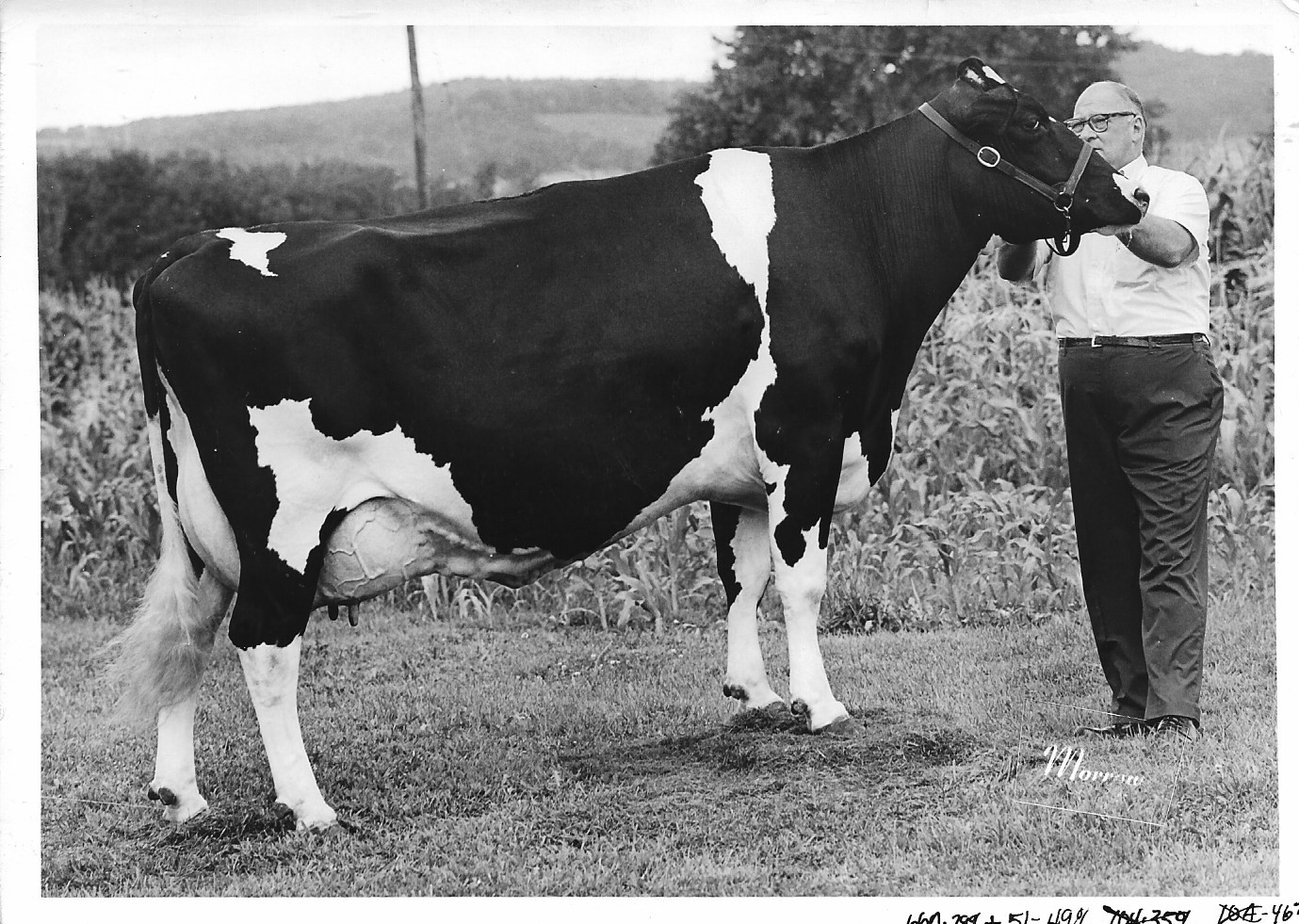
His dam, Tara-Hills Pride Lucky Barb EX-94, was a force of nature in her own right. Sired by the strength specialist Ellbank Admiral Ormsby Pride, she combined power, width, and constitution with refined dairy character. Lifetime production: 147,756 pounds of milk with 6,264 pounds of fat. And her value showed up in the sale ring—at the same 1972 Hanover Hill Sale where her son commanded $60,000, Pride Lucky Barb herself sold for $122,000. World record for a dairy female. Mother and son shattered two global price records in a single afternoon.
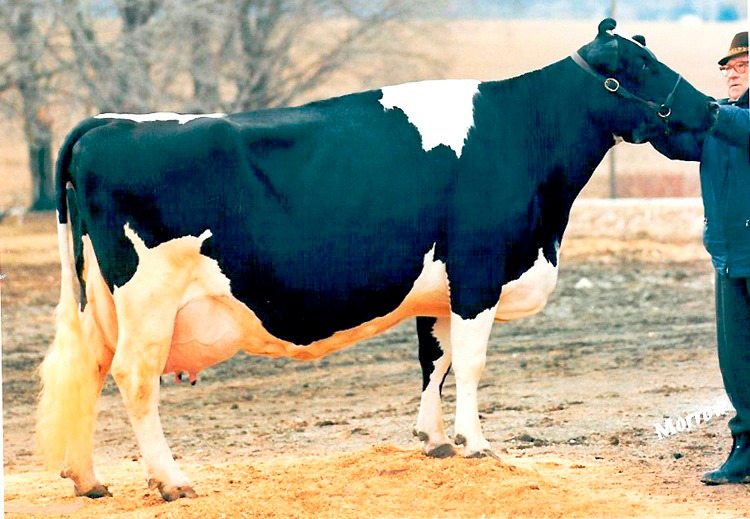
The maternal granddam—Johns Lucky Barb EX-97-4E-GMD-5—was one of the pillars of the Holstein breed. The 1967 All-American aged cow. One of the very first cows in history to achieve EX-97. Her highest record at eight years: 29,052 pounds of milk at 4.7% fat with 1,372 pounds of fat. Lifetime total: 166,311 pounds of milk and 7,582 pounds of fat.
Industry observers called her a “money tree,”—and they weren’t exaggerating. Her progeny consistently shattered price records. Crucially, she was the original source of the red factor in the maternal line—a trait she passed silently down the generations.
Here’s what made the Triple Threat mating so special: it combined two different types of red genes. The rare Black-Red gene from Telstar’s side, and the true recessive red gene from the Barb maternal line. That unique combination gave Triple Threat his special ability to reliably produce red offspring while passing on world-class type and components.
The Chameleon Who Wouldn’t Quit
Triple Threat’s story could’ve ended with that record-breaking sale. Instead, it was only beginning—and the chapters that followed would test his resilience in ways nobody predicted.
True to his Telstar Red genetics, Triple Threat was born a vibrant red—the kind of color that stood out immediately. But within months, something strange began happening. His coat started darkening. You’d visit him one week, and he’d look a shade deeper. By six months, the transformation was visible to anyone paying attention. By nine months, he was almost completely black—often retaining only a few reddish hairs in his ears and the switch of his tail.
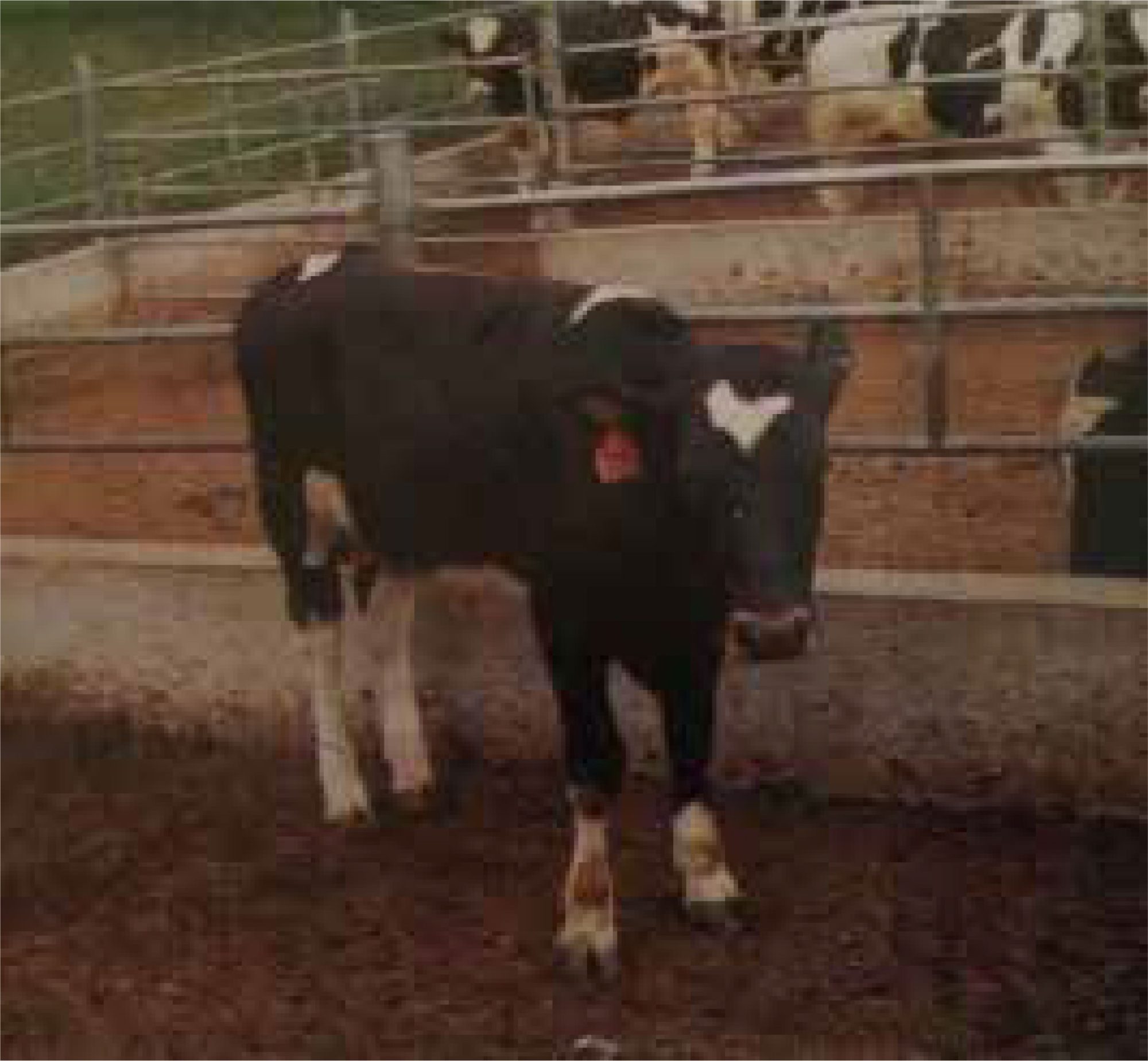
This was the famous “Telstar Red” phenomenon in action—a genetic trait inherited directly from his sire. For breeders unfamiliar with the trait, it caused real confusion. Some questioned whether he could even transmit red genetics at all. But verification came quickly: despite his chameleon appearance, Triple Threat consistently passed the red gene to his offspring. About half of his red-born progeny exhibited the same darkening phenomenon—turning what might’ve been a liability into a recognized trademark.
But it was a later chapter that cemented his legend among breeders who valued toughness as much as type.
According to industry accounts, Triple Threat suffered a significant leg injury in his mature years at ABS. The damage was reportedly permanent and debilitating—serious enough that he became known among breeders as “the three-legged bull.” By conventional measures, an animal in that condition should’ve been retired. Should’ve been done.
He wasn’t done.
His libido remained strong. His seminal quality stayed high. He continued to work, continued to breed, continued to stamp his excellence on thousands of daughters. For breeders, this physical resilience became more than an anecdote. It was living proof of constitutional vigor—a will to live that he passed to his progeny. His daughters became renowned not just for their beauty but for their durability. Long-lasting cows who stayed productive from lactation after lactation.
Whether the “three-legged bull” story is the literal truth or an industry legend grown tall over fifty years, the underlying message resonated: this was a bull—and a bloodline—that refused to quit.
A Threat in Three Dimensions
His name proved prophetic. Hanover-Hill Triple Threat-Red posed a genuine challenge to the competition in three distinct ways—a combination that made him one of the most sought-after sires of his generation.
First, type transformation. At a time when many Red & White cattle lacked the scale and refinement of their Black & White counterparts, Triple Threat injected the elite “Hanover Hill look” into the red population. He consistently sired daughters who were tall, long-necked, angular—animals with mammary systems showing exceptional texture and strong suspensory ligaments. His impact on feet and legs was equally dramatic. Flat bone. Correct set to the hock. Traits that contributed directly to the longevity his daughters became famous for.
One European observer summarized it best: “He probably improved conformation more in one generation than any bull ever used in Europe.”
Second, components. While contemporaries like Round Oak Rag Apple Elevation were chasing sheer milk volume, Triple Threat offered something different. High butterfat percentage—inherited from both sides of his pedigree. In today’s component-heavy pricing environment, we’d call that money in the tank. Back then, it made his daughters highly profitable in markets that paid on solids. And it made him a perfect complement to high-volume bloodlines that often tested lower for fat.
Third—and this is the big one—maternal transmission. Triple Threat was what breeders call a “daughters bull.” He produced great daughters but no legacy sons. That’s not a flaw; it’s a pattern you see when a sire’s maternal line is exceptionally dominant. He was a conduit for one of the breed’s most powerful dynasties—the Barbs. His ability to sire what observers called “outsize brood cows”—noted for correct conformation, style, pretty udders, high butterfat, and longevity—was legendary.
His daughters weren’t merely productive. They were matriarchs capable of founding dynasties.
So he had the genetics. He had the resilience. But the proof? That came through his progeny—both daughters and sons who carried his influence forward in ways nobody anticipated.
The Dynasty That Changed Everything
Here’s where the story gets really interesting—and really relevant to anyone running red genetics today.
The crown jewel of Triple Threat’s legacy? The connection to KHW Regiment Apple-Red EX-96 – “The Million Dollar Cow” and arguably the most influential Red Holstein of the 21st century.

Meadolake Jubilant-RC EX—the vital bridge to the Apple family—and E-D Thor-Red were Triple Threat’s two highest sons. While both were widely used across Canada, the US, and Europe, it was Jubilant who reinforced the classic Triple Threat profile: frame, strength, high components. He sired tens of thousands of daughters, making him one of the most widely used RC sires of his era. But his most important contribution? He carried the red factor forward. One of Jubilant’s significant daughters was Clover-Mist Augy Star EX-94, who became the granddam of Kamps-Hollow Altitude-RC EX-95—the 2009 Red Impact Winner. Altitude produced Advent-Red, Acme-RC, and the famous Apple herself.
That entire Apple family—unparalleled in Red Holstein circles—would never have been red and white if Jubilant hadn’t passed along the red factor. If you’ve used Apple genetics in the last decade, you’re tapping into a lineage that started with that “genetic defect” of a red calf back in 1972.
But the daughters built empires too.

Nandette T.T. Speckle-Red EX-93-DOM was a two-time All-American Red & White in 1981 and 1984—25,290 pounds of milk at 4.7% fat as a four-year-old. Beautiful and productive. Her daughter, Stookey Elm Park Blackrose-ET EX-96, became an All-American in ’92 and ’93, accumulating 149,880 pounds in four lactations while mothering eight Excellent offspring. That line produced Ladino-Park Talent-RC—the world’s only RC millionaire sire. Talent sired Ms Delicious Apple-Red EX-94, who carries double Triple Threat blood and is the dam of Diamondback with over 22,000 daughters.

Tora Triple Threat Lulu EX-96-GMD earned Reserve Grand at the Royal Winter Fair in 1981 and became the dam of Hanover-Hill Inspiration EX-Extra—another millionaire sire used heavily in Black & White populations worldwide. Through Inspiration, Triple Threat’s genetics permeated the mainstream breed, reaching herds that never explicitly sought red genetics.
Hanoverhill TT Roxette-ET EX-94-2E-GMD-DOM introduced the red gene into the legendary Roxy family—widely considered the greatest cow family in Holstein history. The 2012 Red Impact winner, Golden-Oaks Perk Rae-Red, traces back to Roxette—and carries double Triple Threat blood through Jubilant on her dam’s side.
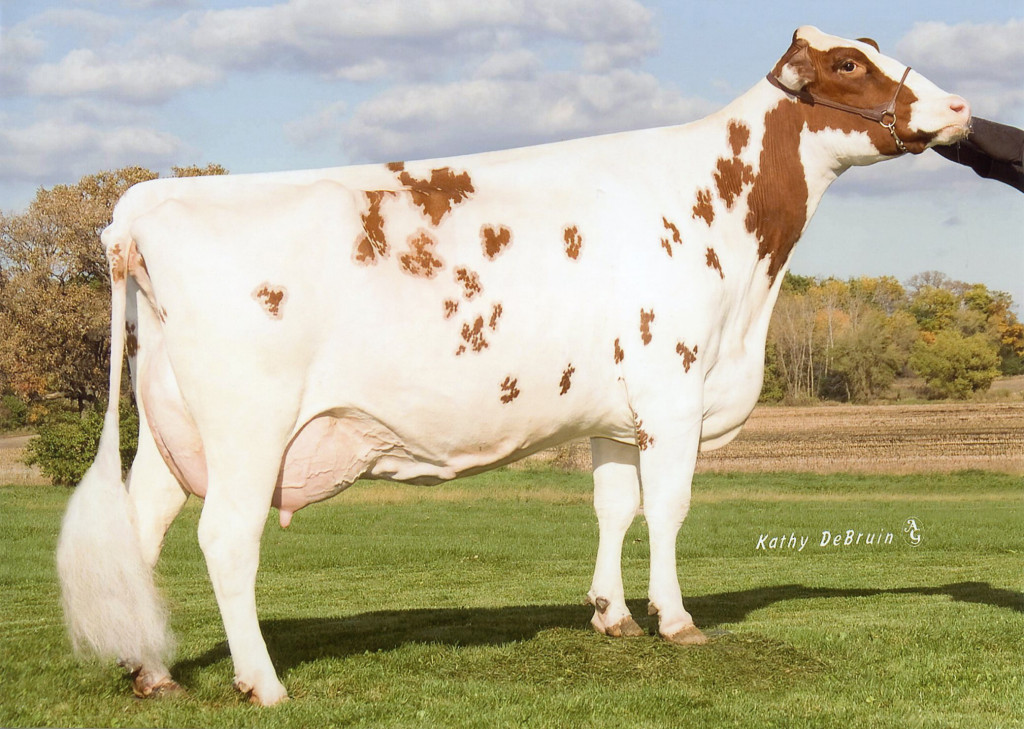
And then there’s Sellcrest T Roseanne-Red EX-93-2E-GMD-DOM—40,340 pounds of milk at 4.7% fat with 1,880 pounds of fat. She shattered the stereotype that Red & White cows couldn’t compete on production. When Holstein International ran its 2012 Red Impact Competition—forty years after Triple Threat’s birth—Roseanne still finished sixth. Four decades of relevance.
The reach extended beyond red breeding. Scientific Debutante Rae EX-92—carrying double Triple Threat blood through both Jubilant and the Roxette line—became the dam of Destry-RC, one of the most influential sires in mainstream Black & White populations. Meanwhile, Lulu’s son Hanover-Hill Inspiration achieved millionaire status and was used heavily across the breed worldwide. Triple Threat’s genetics didn’t just build the Red Holstein—they infiltrated the entire Holstein population.
From New York to the World
The impact wasn’t confined to North America. Triple Threat’s genetics became the primary vehicle for “Holsteinization” across Europe—transforming traditional dual-purpose red breeds into specialized dairy cattle.
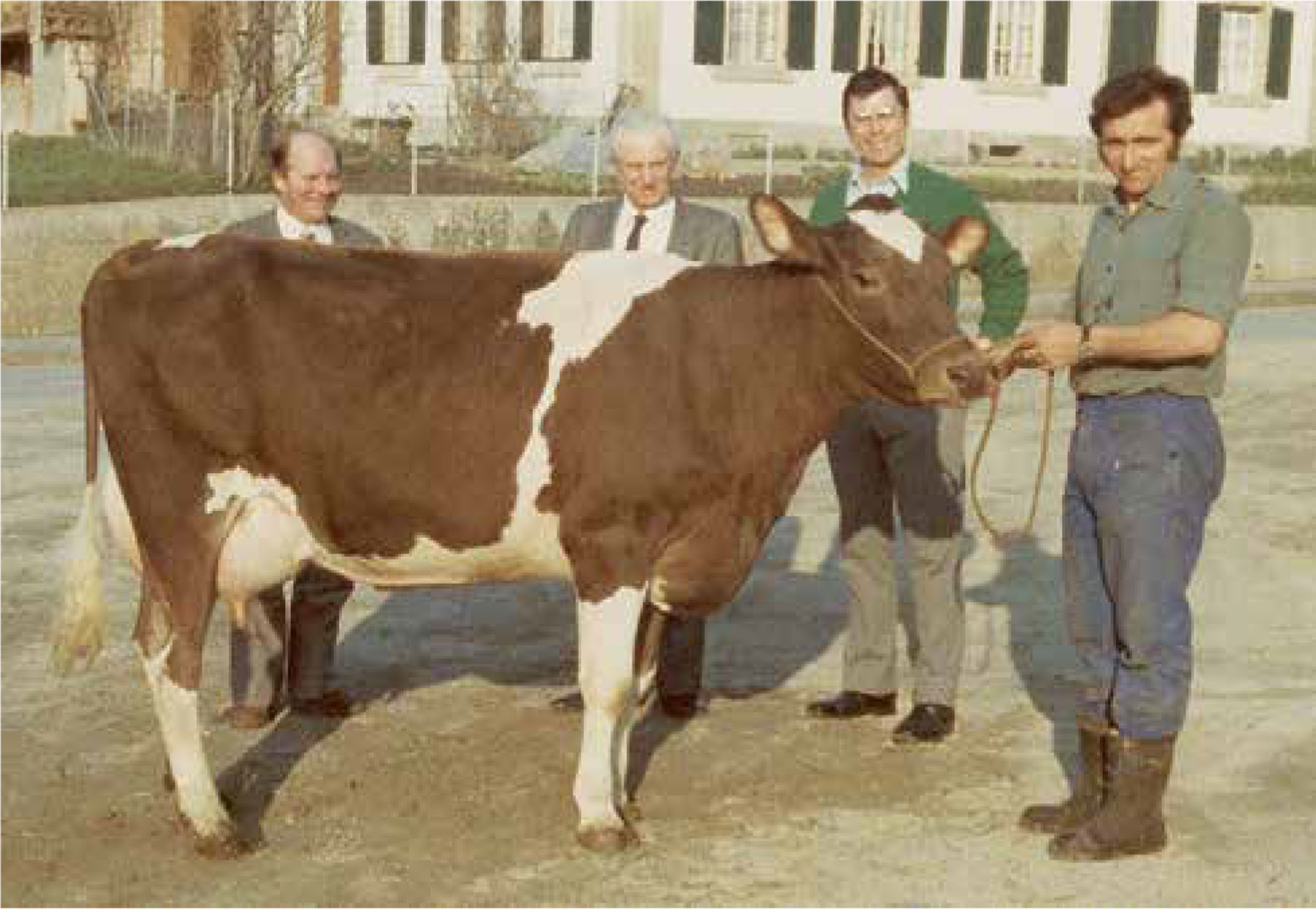
The Swiss daughter Guex Triple Tulippe-Red achieved something almost unprecedented: EX-98. Nearly perfect. When a disease outbreak at the 1979 Paris Agriculture Show infected her and three other Triple Threat daughters with IBR, Swiss authorities—whose country was free of the disease—demanded immediate slaughter upon their return. Three went to the abattoir. But Tulippe’s genetics were considered too precious to lose. Jean-Louis Schrago arranged for her transfer to Holland, where breeder Anton Van Nieuwenhuize saved her. She lived to age 15—a living advertisement across Europe for the durability and elite type of the Triple Threat bloodline.

But the show ring dominance stretched far beyond Switzerland. Hepp-Haven Lisa of Pinehurst EX-96 earned Reserve Grand Champion at World Dairy Expo in 1986—competing against all colors and holding her own on the biggest stage in the industry. In France, he established the Uzes EX-96 and Rolls EX-96 families—both national champions, with Uzes winning not just the red and white division but the overall national championship against Black & White competition. In Germany, his genetics accelerated the evolution of the German Red Pied into the modern Red Holstein.
The list of remarkable Triple Threat daughters scoring EX-96 or higher across three continents is extraordinary. It’s a testament to how consistently he transmitted elite type regardless of where his genetics landed.
Jean-Louis Schrago’s vision, dismissed by Heffering in 1968, had reshaped an entire continent. But the story doesn’t end with history—it’s still being written today.
What This Means for Your Herd in 2025
Walk through Madison during World Dairy Expo or watch the results coming out of the recent National Red & White Show—Golden-Oaks Temptres-Red taking Grand Champion this year—and you’ll see Triple Threat’s fingerprint everywhere. That’s not nostalgia talking—it’s genetics.

Fifty-three years after his birth, his influence isn’t just historical. It’s actively shaping the breed’s future. Modern genomic giants like Hoogerhorst DG OH Rubels-Red carry the Triple Threat bloodline no less than three times in their pedigrees. The Ranger-Red lineage connects directly back. Influential sires like Gywer-RC and Lawn Boy-Red all carry Triple Threat genes. If you’ve been watching the red leaderboards lately, you’re seeing his genetic fingerprint everywhere.
So what’s the lesson here? What should today’s breeders take from Schrago’s vision and Young’s rogue bid?
It’s this: the genetics everyone dismisses today might be the genetics everyone needs tomorrow.
In 1968, Heffering told Schrago there was no market for red cattle. The industry consensus was clear: red was a defect. The smart money said cull those animals and move on. But Schrago saw something different. He saw value where others saw liability. And he was willing to wait—to import semen from Japan, to return year after year, to make the case until the market caught up with his vision.
We’re seeing similar dynamics right now. Breeders banking embryos from A2A2 cows when the premium’s only a nickel. Breeders prioritizing polled genetics when the market hasn’t fully caught up. Breeders maintaining cow families that don’t top the genomic charts but produce consistently year after year—cows that stay in the herd five, six, seven lactations. With feed costs where they are and labor harder to find than ever, that kind of durability isn’t just nice to have; it’s what makes this business sustainable when margins get tight.
Triple Threat proved that patience and conviction, backed by genuine genetic quality, can reshape an entire breed. His daughters weren’t just show winners—they were durable, profitable, long-lasting cows that worked in commercial settings. That combination of type and function, beauty and durability, is exactly what the industry needs now as we balance genomic potential against real-world cow performance.
The Bottom Line
Hanover-Hill Triple Threat-Red was an anomaly who became an archetype. Born from a speculative mating that defied the commercial logic of his time. Purchased for a record price through a rogue bid that could’ve ended Ken Young’s career. Physically compromised for much of his productive life, if the old-timers’ stories are to be believed. Yet he overcame every barrier to reshape an entire breed.
He didn’t merely improve the Red & White cow—he essentially created its modern iteration. By combining the potent Black-Red gene from Telstar with the true recessive red gene and elite type from the Lucky Barb family, he elevated the Red Holstein from a genetic curiosity to a global commercial powerhouse.
His legacy lives in the Speckles and Lulus and Roxettes who dominated their eras. It lives in Tulippe, the Swiss survivor who carried his banner to EX-98. It lives in the Jubilant line that made Apple possible—and in Apple herself, the Million Dollar Cow who would never have been red and white without Triple Threat’s genes flowing through her pedigree. It lives in Destry-RC, carrying his genetics into the mainstream Black & White population. And it lives in breeding programs worldwide, where his genetic fingerprint continues to shape decisions made today.
Every modern Red & White that commands a high price, wins a championship, or tops a genomic index owes a genetic debt to the bull breeders still call “three-legged”—the resilient legend from Hanover Hill.
In the end, Young was right to take the risk. It was easier to ask for forgiveness than to ask for permission. And fifty-three years later, the breed is still thanking him—and Schrago, the Swiss visionary who wouldn’t take no for an answer—for having the courage to see what others couldn’t.
If you’re running red genetics in your herd—or considering adding them—take a minute to trace those pedigrees back. Chances are, you’ll find Triple Threat waiting there. The bull who changed a color. The chameleon who wouldn’t quit. The legend from Hanover Hill who proved that resilience, vision, and elite genetics can rewrite the destiny of an entire breed.
KEY TAKEAWAYS
- The Rogue Bid: Ken Young exceeded his authorization to buy a red calf that the industry dismissed as a defect. His reported justification—”Easier to ask forgiveness than permission”—became breeding lore. That calf built the modern Red Holstein.
- Two Genes, One Revolution: Triple Threat uniquely combined Telstar’s Black-Red gene with the Barb family’s true recessive red. For the first time, elite Black & White genetics could reliably produce red offspring.
- A Daughters Bull: No legacy sons—but his daughters (Speckle, Lulu, Roxette, Roseanne) founded every major Red Holstein dynasty. Apple-Red, Destry-RC, and Rubels-Red all trace back to him.
- Longevity Is the Legacy: His daughters didn’t just win shows—they lasted 5, 6, 7 lactations. In 2025, with labor tight and turnover costly, that durability is worth more than genomic flash.
- The Breeder’s Takeaway: The genetics everyone dismisses today might be the genetics everyone needs tomorrow. Schrago waited three years. Young bet his career. Patience plus conviction can reshape an industry.
 The Sunday Read Dairy Professionals Don’t Skip.
 The Sunday Read Dairy Professionals Don’t Skip.
Every week, thousands of producers, breeders, and industry insiders open Bullvine Weekly for genetics insights, market shifts, and profit strategies they won’t find anywhere else. One email. Five minutes. Smarter decisions all week.