Archive for genomic inbreeding

The $200-Per-Cow Blindspot: What Rising Inbreeding Is Costing You – and What a Decade of Crossbreeding Research Found

New research puts hard numbers on the hidden price tag of genetic progress—and what a 10-year crossbreeding study reveals might change how you think about your next breeding decisions.

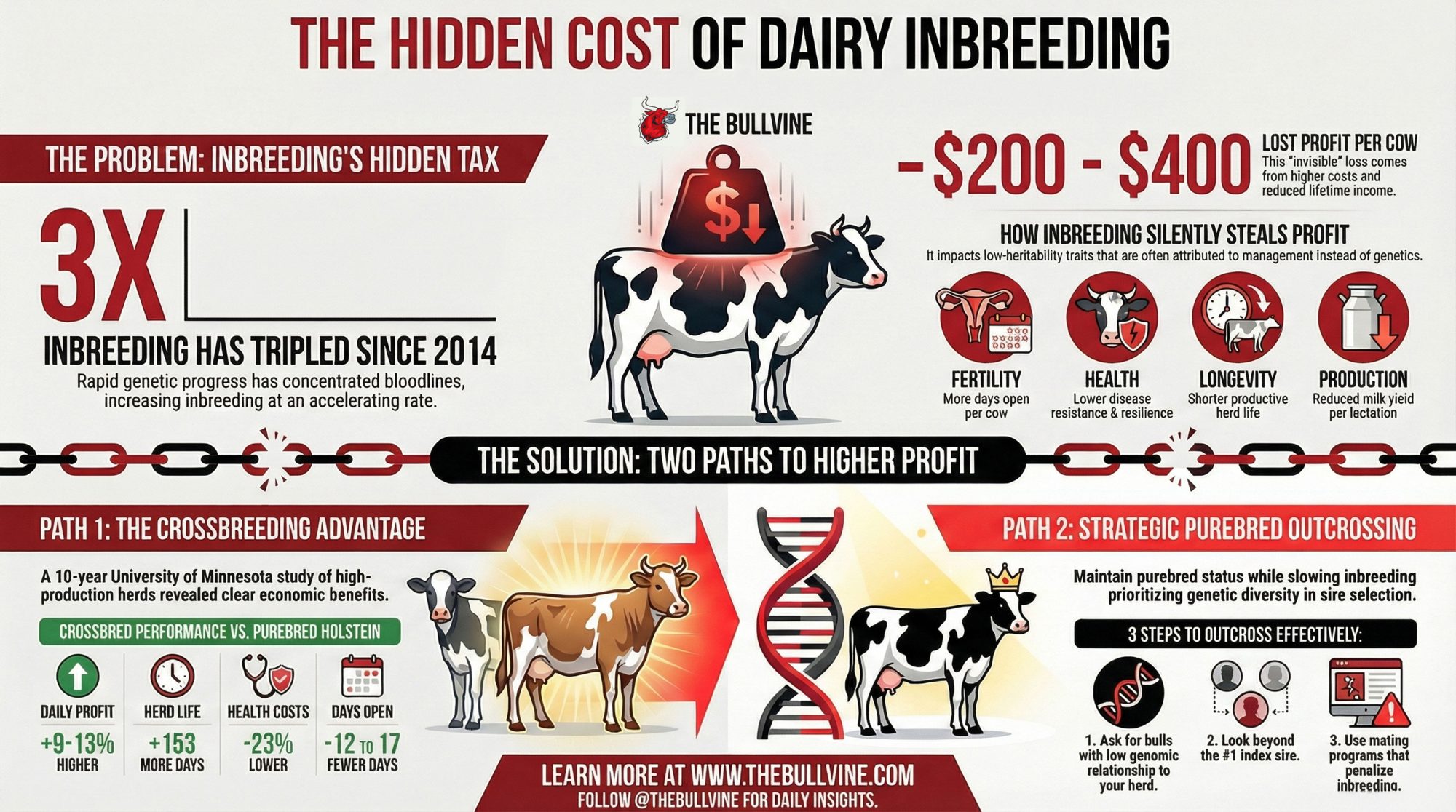
Executive Summary: Inbreeding in Holsteins has tripled since 2014—silently adding an estimated $200-400 per cow in lifetime losses. These costs are not reflected in any report but appear as extra breedings, transition problems, and productive cows culled too soon. A 10-year University of Minnesota study tracked seven high-production herds averaging nearly 30,000 lbs. The finding: crossbred cows made 9-13% more profit per day. Every herd. No exceptions. That doesn’t make crossbreeding right for every operation—but it does change the math. For purebred programs, strategic outcrossing can slow the trend. For those open to alternatives, a decade of data demands attention. Both paths start with understanding what your genetics are actually costing you.
Dairy inbreeding costs

Here’s a number that probably isn’t on your radar: $200 to $400 per cow.

That’s the estimated lifetime profit you may be losing to inbreeding depression—losses that never show up on a breeding report, never get their own line item, and rarely get blamed on genetics. They show up as the cow that took an extra breeding. The calf that didn’t quite thrive. The cow you culled in the third lactation instead of the fifth. Most of us have seen these patterns in our herds without necessarily connecting them to genetics.

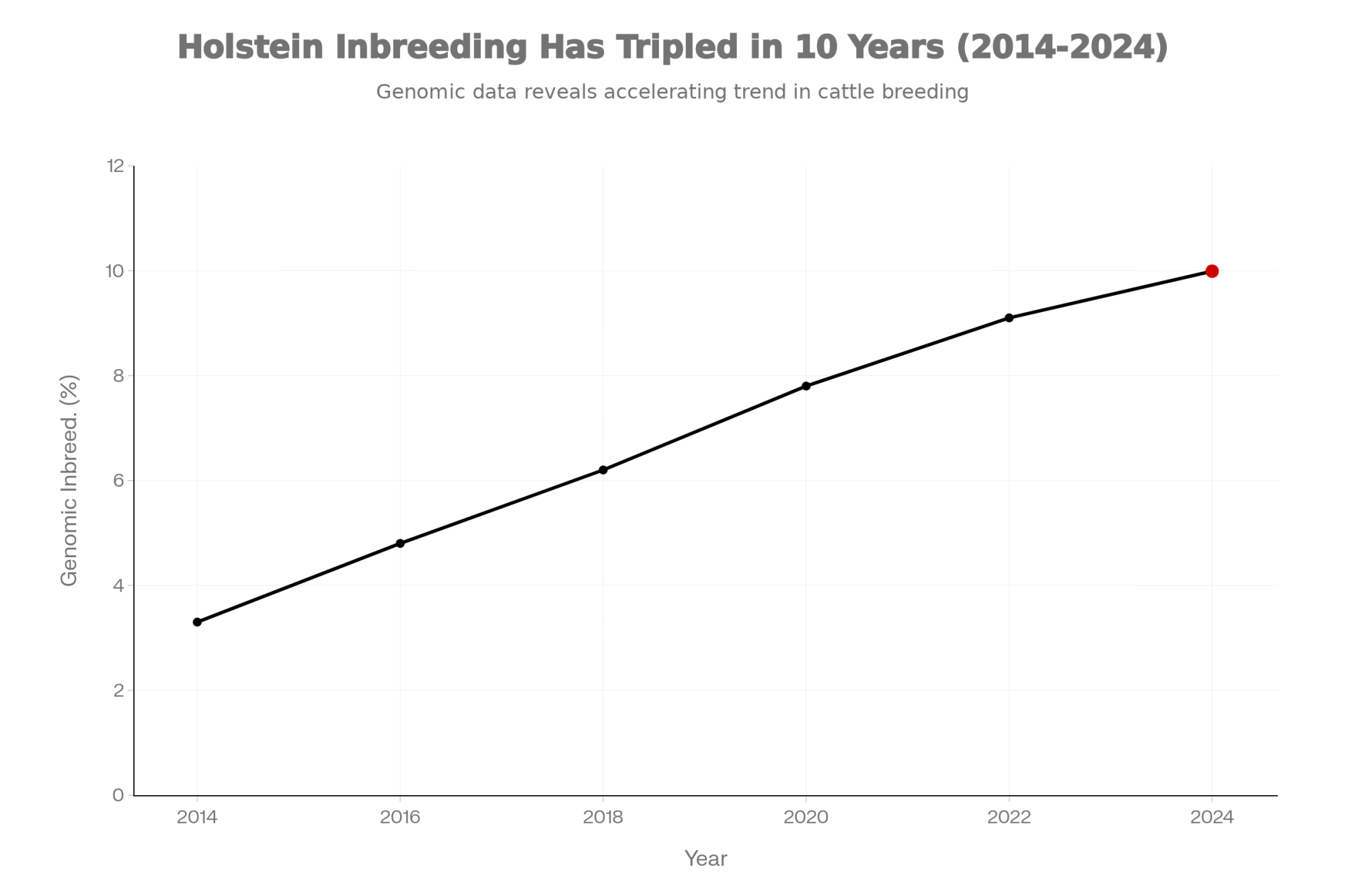
And here’s what makes this worth a closer look: Holstein genomic inbreeding has climbed dramatically over the past decade. The Council on Dairy Cattle Breeding’s trend data shows genomic inbreeding in young Holstein bulls has roughly tripled since 2014, with current averages pushing into the mid-teens percentage-wise. Lactanet Canada’s August 2025 update puts the average for Holstein heifers born in 2024 at 9.99%—nearly double what it was fifteen years ago. John Cole walked through this acceleration in detail at the 2024 Beef Improvement Federation symposium—and honestly, the rate of change caught even some industry veterans off guard.
Now, I want to be clear from the start: genomic selection has been one of the most valuable tools our industry has ever had. The genetic progress over the past decade has been remarkable. But there’s a growing body of research suggesting we need to look at the full picture—both the gains and the costs. And increasingly, producers I talk to are asking a fair question: What’s the net benefit when you account for everything?

Let me walk through what the research actually shows, what’s driving these trends, and what options might make sense for different operations.
What Inbreeding Is Actually Costing You

Let’s start with the economics, because that’s ultimately what matters when you’re making decisions for your operation.
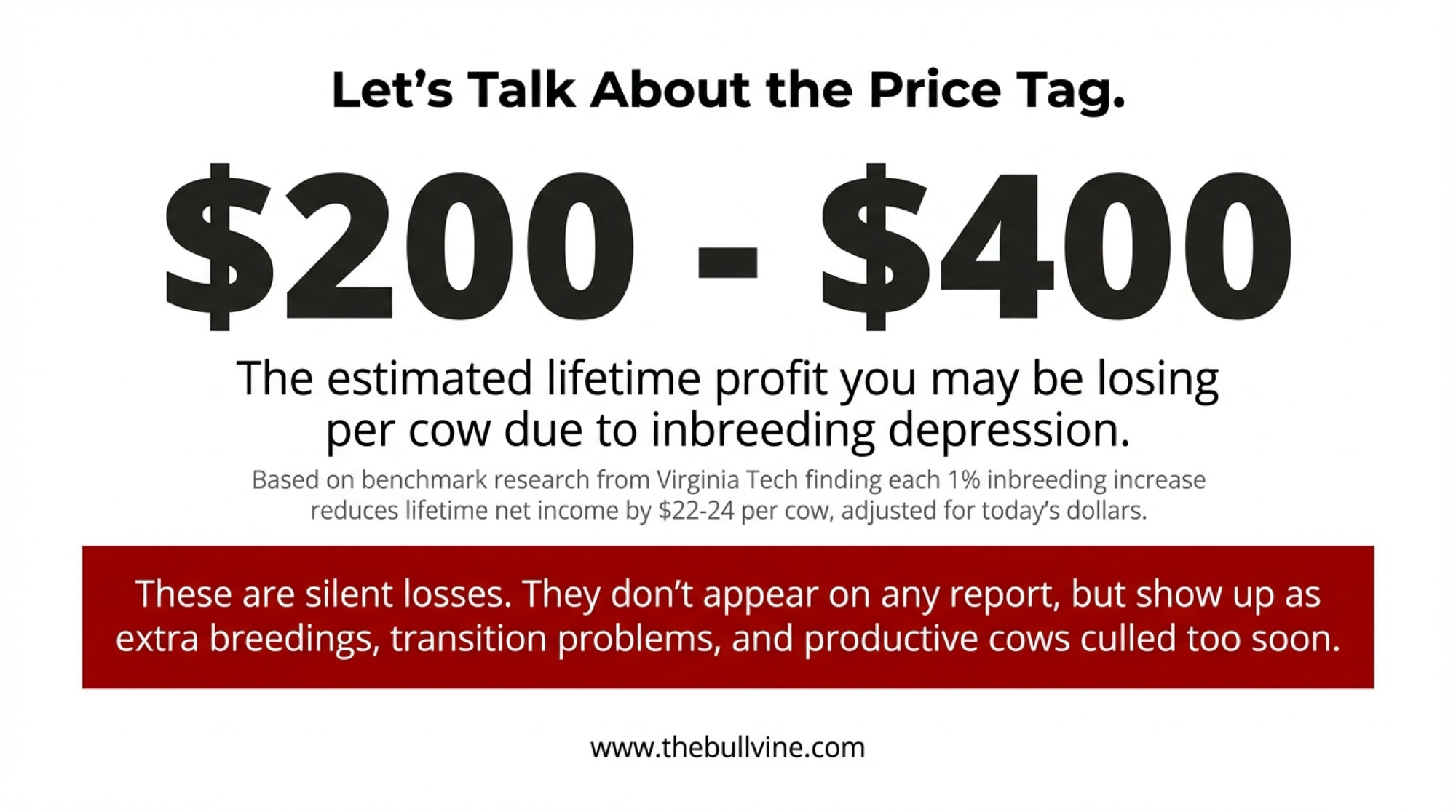
Back in 1999, researchers at Virginia Tech—Cassell, Adamec, and Pearson—published a study in the Journal of Dairy Science that’s still the benchmark for understanding inbreeding costs. They found that each 1% increase in inbreeding reduces lifetime net income by $22-24 per cow, depending on whether you’re selling into fluid or cheese markets.

That study is over two decades old now, and I’ll be upfront about that. The underlying biology hasn’t changed, but dollar values certainly have. A rough inflation adjustment would put that figure somewhere around $40-45 per cow per percentage point in today’s terms—though I should note that’s a back-of-envelope calculation, not a formal research finding. We could really use an updated economic study on this, and I know several universities have been discussing it.

So, when genomic inbreeding rises substantially over a decade You’re potentially looking at $200-450 in lost lifetime profit per cow. For a 200-cow dairy in Wisconsin or a 500-cow operation in California’s Central Valley, that adds up to real money—$40,000 to $90,000 or more in economic impact that’s essentially invisible on your monthly reports.

Inbreeding depression silently steals profit from dairy producers because it is expressed mostly for traits that are not readily noticeable, such as embryo loss, less disease resistance, and shortened survival. That word “silently” is important. These aren’t losses you see on a vet bill or a milk check. They’re distributed across your operation in ways that are genuinely hard to track.

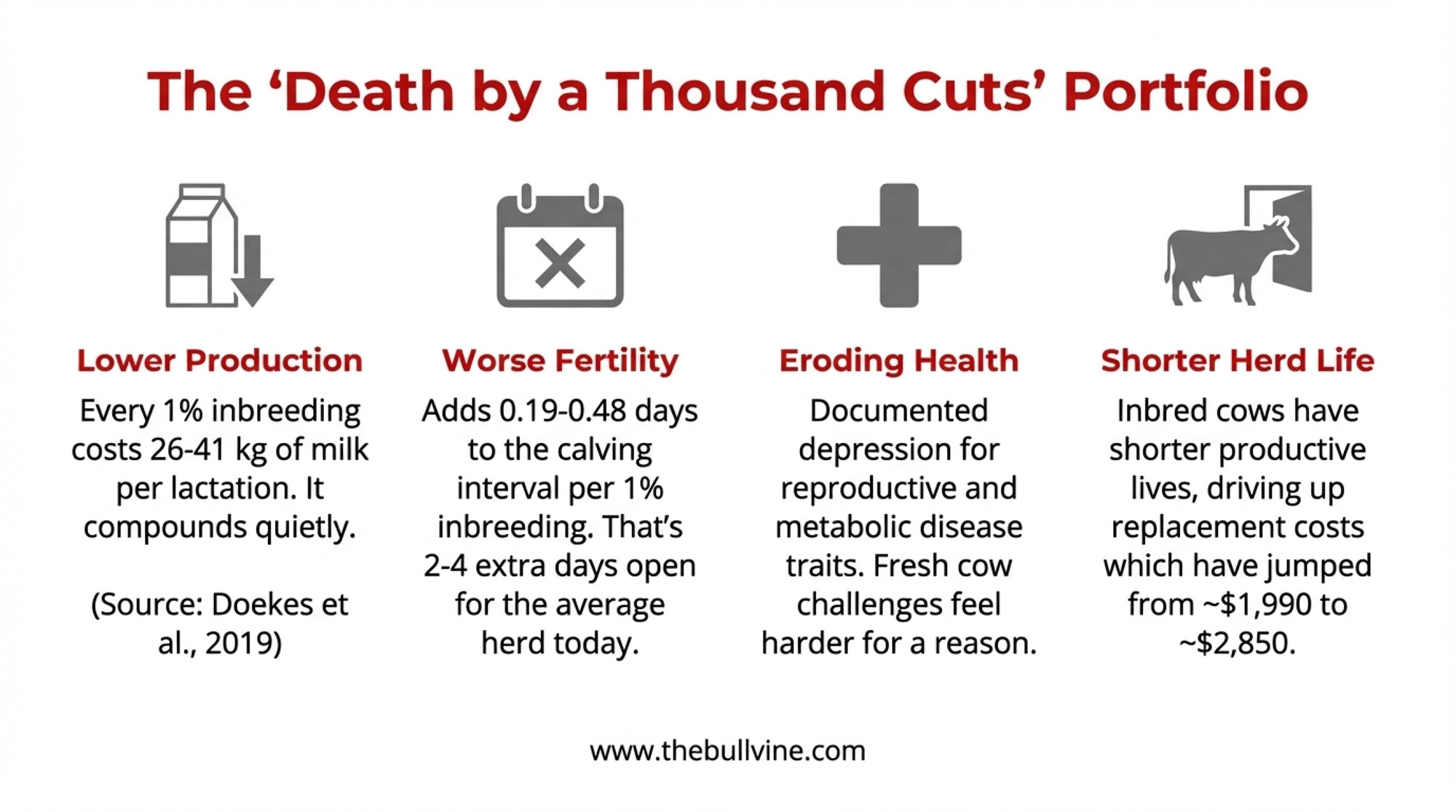
  • Production losses add up quietly. Research published in Genetics Selection Evolution—including detailed work by Doekes and colleagues in the Netherlands—found that every 1% increase in genomic inbreeding costs roughly 26-41 kg of milk per lactation. Doekes specifically documented a 36.3 kg decrease in 305-day milk yield per 1% increase in runs of homozygosity. Not dramatic for any single cow. But across a herd and over multiple lactations? It compounds.
  • Fertility takes a hit, too. That same body of research shows 0.19-0.48 additional days in the calving interval per 1% inbreeding increase. I know—sounds small. But if your herd is averaging 8-10% more inbreeding than a decade ago, that’s potentially 2-4 extra days open per cow. Talk to any reproductive specialist, and they’ll tell you what that costs over time.
  • Health resilience erodes. U.S. research involving hundreds of thousands of Holstein cows has documented significant inbreeding depression for reproductive and metabolic disease traits. The cows aren’t necessarily falling over sick, but they’re not quite as resilient as they could be. Fresh cow challenges. Transition period issues. Mastitis susceptibility. All of these have genetic components that inbreeding can compromise. I’ve had several producers tell me their fresh cow management seems harder than it used to be, and while there are many factors involved, this may be part of the picture.
  • Longevity shortens. Inbred cows tend to have shorter productive lives. And you know what replacement heifers cost these day, prices jumped from around $1,990 to $2,850. Getting four lactations instead of five from each cow changes your economics significantly.

Here’s what I find particularly telling: these are exactly the kinds of traits that don’t show up well on genomic evaluations. They’re low in heritability, hard to measure consistently, and easy to attribute to management rather than genetics.

The Numbers at a Glance

MetricData
Holstein genomic inbreeding trendRoughly tripled since 2014
Current Holstein heifer average (Canada)9.99% for 2024-born animals
Cost per 1% inbreeding$22-24/cow lifetime (1999 dollars)
Potential herd impact (200 cows)$40,000-90,000
Annual rate of increaseApproximately 0.35-0.44% per year

Data from Council on Dairy Cattle Breeding trend reports; Lactanet Canada August 2025; Cassell et al. 1999, Journal of Dairy Science; Doekes et al. 2019, Genetics Selection Evolution

What’s Behind the Trend

So why has inbreeding accelerated so dramatically? Several factors are working together, and here’s what’s worth understanding—each one made sense as an individual decision.

  • Genomic selection changed the timeline. Before genomics, progeny testing meant waiting 5-7 years to know if a bull was actually delivering what his numbers promised. Now we can identify elite genetics essentially at birth. That’s genuinely powerful, and it’s driven tremendous progress. But it also means popular sire lines spread through the population much faster than they used to. Bulls that would have taken a decade to significantly influence breed genetics now achieve similar penetration in 3-4 years. The genetics are better—but they’re also more concentrated.
  • Sexed semen reshaped breeding patterns. The technology has been transformative for heifer inventory management. Data from the UK’s Agriculture and Horticulture Development Board shows sexed semen now accounts for 84% of all dairy semen sales in Great Britain—with Holsteins specifically hitting 88-89% by April 2024. North American adoption continues climbing, too. The economics make sense for individual operations. But here’s the tradeoff: before sexed semen, breeding elite cows with conventional dairy semen produced roughly 50% bull calves, giving AI organizations a large pool of potential sires to evaluate. Today, that pipeline has narrowed considerably.
  • Beef-on-dairy became standard practice. And for good reason—those calves are worth real money, and the quality has improved dramatically. The National Association of Animal Breeders reported that beef semen represented about 31% of total semen sales to dairy operations in 2023, and Farm Bureau data from early 2025 indicates 72% of dairy farms now use beef genetics on at least part of their herd. That’s a rational economic decision for most operations. But combined with sexed semen on your top-end genetics, it means fewer Holstein matings overall. Canadian data from Lactanet shows Holstein-on-Holstein breedings have dropped from the mid-90s percent range to around three-quarters of matings in recent years
  • Industry structure evolved. This one’s worth understanding because it affects sire availability. Lactanet Canada’s analysis shows that between 2014 and 2019, bulls from AI-owned dams increased from 34% to 52% of marketed young bulls. I want to be clear about something: this isn’t a criticism of AI companies. They’re doing what makes business sense—investing in elite genetics and accelerating progress. And they’ve developed real tools to help manage inbreeding. But the concentration does have implications for genetic diversity that are worth being aware of when you’re making breeding decisions.

The Industry Perspective

It’s worth acknowledging that AI organizations aren’t ignoring this issue—far from it. Most major companies now offer mating programs that calculate genomic relationships and help avoid closely related matings. Tools like ABS’s Genetic Management System, Semex’s OptiMate, and similar platforms from other organizations are designed specifically for inbreeding management. These tools work, and they’re more sophisticated than what was available even five years ago.

And the industry has delivered real value. Various analyses suggest genomic selection has generated substantial economic benefit—potentially billions of dollars—through accelerated genetic progress over the past decade. That represents genuine improvement in production, health traits, and efficiency, as shown by milk checks and herd performance.

Here’s where it gets complicated, though. USDA geneticist Paul VanRaden and others have noted the fundamental tension: accepting slower genetic progress to manage inbreeding means potentially watching competitors move faster. For individual operations, using the highest-ranking bulls often makes economic sense regardless of relatedness. But when everyone does that, breed-wide inbreeding accelerates. It’s a classic collective action problem—individual optimization can lead to collective challenges.

Some countries have approached this differently. Nordic breeding programs in Denmark, Sweden, and Finland have historically weighted health, fertility, and longevity more heavily in their selection indexes—and their inbreeding trajectories look different as a result. Now, it’s not a perfect comparison. Different population sizes, different market conditions, different payment systems. But it does suggest that how we design selection indexes has real consequences for genetic diversity over time.

The question isn’t whether genomic selection has been valuable—it clearly has. The question is whether we’re fully accounting for all the costs alongside the benefits, and whether there are adjustments worth considering.

What a Decade of Crossbreeding Data Actually Shows

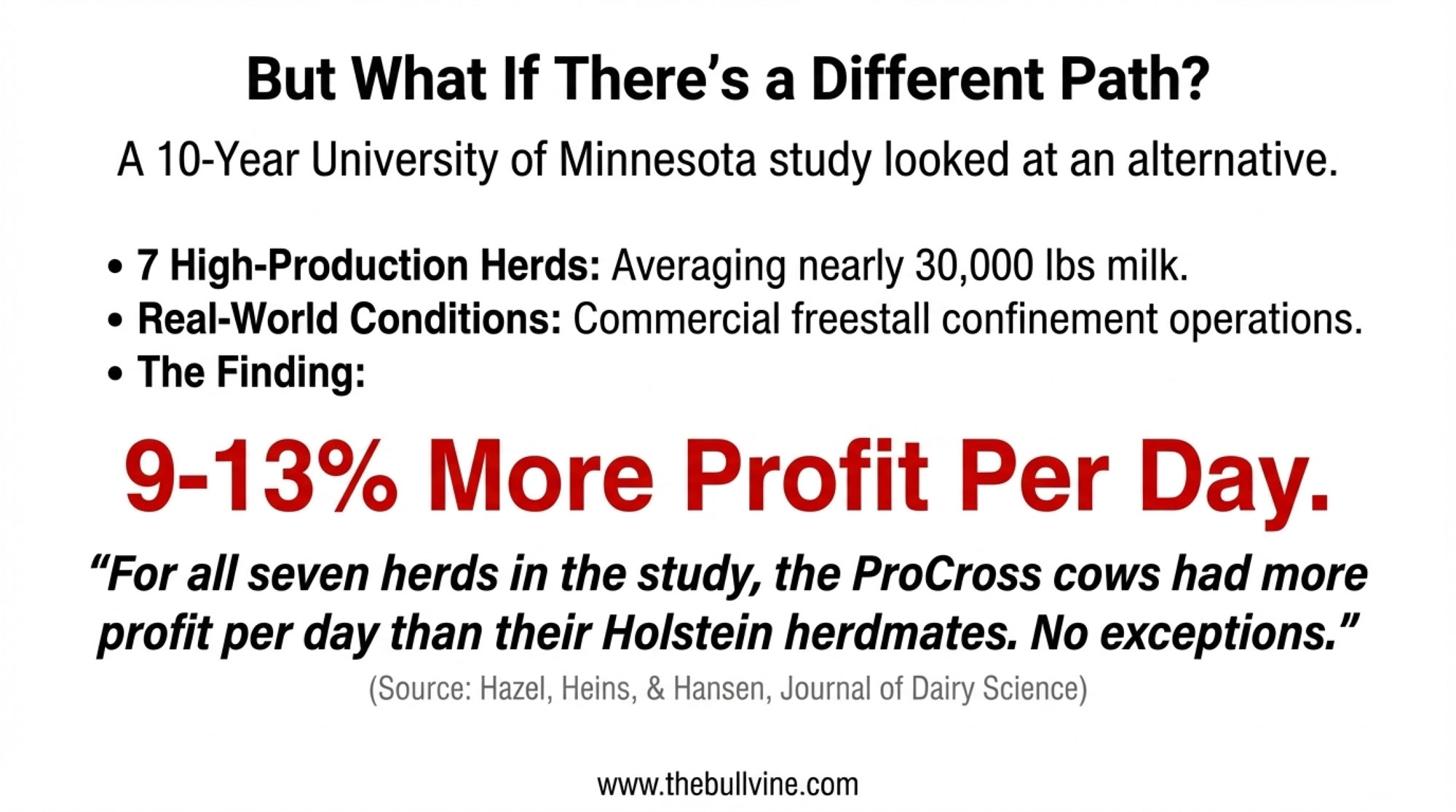
Here’s where the conversation gets really interesting: while most of the industry focused on maximizing genetic indexes in purebred Holsteins, researchers at the University of Minnesota spent 10 years collecting data on an alternative approach.

This wasn’t some small-scale grazing experiment or low-input system. These were seven high-producing herds averaging just under 30,000 lbs milk per cow—freestall confinement operations that would look familiar to commercial dairies across the Upper Midwest and beyond. The kind of herds where management is tight, and expectations are high.

The findings, published by Amy Hazel, Brad Heins, and Les Hansen in the Journal of Dairy Science, got my attention:

“For all seven herds in the study, the ProCross cows had more profit per day than their Holstein herdmates,” the researchers concluded. Not some of the herds. All seven.
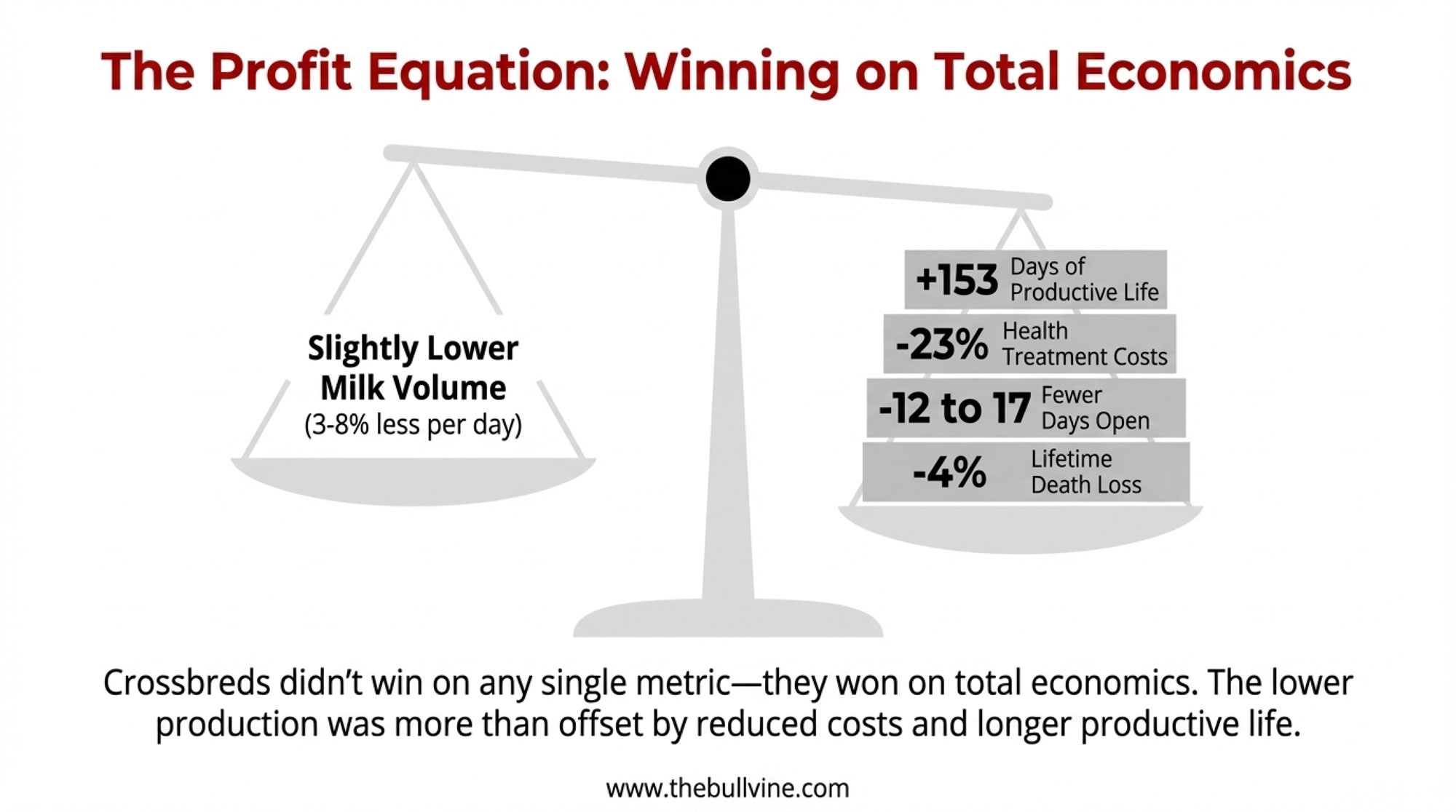
Performance MetricHolstein (Baseline)Crossbred Advantage
Daily ProfitBaseline+9-13% higher
Herd LifeBaseline+153 days
Health Treatment CostsBaseline23% lower
Days OpenBaseline12-17 fewer days
Stillbirth RateBaselineLower
Lifetime Death LossBaseline4% lower

Now, I can hear the question you’re probably asking: “What about production?” Fair point. Crossbred cows in these studies did produce somewhat less milk per day than their purebred Holstein herdmates—typically 3-8% less in early generations, depending on the specific cross and lactation.

But here’s what the data showed: the lower production was more than offset by reduced costs and longer productive life. The crossbreds weren’t winning on any single metric—they were winning on total economics. Lower vet bills, fewer reproductive interventions, and more lactations per cow.

Producer Case Study: Cunningham Dairy, Iowa

Kelly and Christy Cunningham lost their fluid milk market in 2017 and began looking for a cow that would produce high components with a moderate size. Their search led them to the ProCross program. After purchasing cattle from three established ProCross herds through Creative Genetics and beginning their own breeding program, they now keep detailed comparative records on their crossbred and Holstein groups.

Their results:

  • Days open: ProCross cattle are open 22 days less than Holsteins
  • Pregnancy rates: 4-5 percentage points higher than Holsteins
  • Fresh cow health events (ketosis, metritis, DA, milk fever, retained placenta): Half of what they experience with Holsteins
  • Mastitis and pneumonia: More than 50% less than Holsteins
  • Health costs: $0.28/cow/day, lower than Holsteins
  • Dry matter intake: 4-10% less for ProCross cows
  • Components: +0.3% fat and +0.2% protein compared to Holsteins

“We are very pleased with the ProCross cattle,” Kelly says. “We have realized better components, better health, better reproduction, and lower herd turnover rate. As our ProCross herd matures, milk volume and ECM are improving compared to Holsteins.”(Source: Creative Genetics of California / ProCross testimonials)

Performance MetricHolsteinProCrossWinner
Days OpenHigher by 22 daysBaselineProCross
Pregnancy RateLower by 4-5%BaselineProCross
Fresh Cow Health Events2× higherBaselineProCross
Mastitis & Pneumonia2× higherBaselineProCross
Health Cost/Cow/DayHigher by $0.28BaselineProCross
Dry Matter IntakeHigher by 4-10%BaselineProCross

European research published in the Journal of Dairy Science found similar patterns, noting that crossbreds achieved what researchers called a “win-win trade-off” on milk yield and fertility, while purebred Holsteins tended to show opposing trade-offs between the two. You could optimize heavily for one or the other, but getting both simultaneously was harder.

The mechanism behind this is well established in animal breeding: crossbreeding captures heterosis—hybrid vigor—which delivers approximately 5% improvement in production traits and 10-15% improvement in fertility, health, and survival. Those happen to be exactly the traits most affected by inbreeding depression. In a sense, crossbreeding reverses the inbreeding penalty while adding hybrid vigor on top.

Why More Farms Aren’t Crossbreeding

Given those results, you might wonder why rotational dairy crossbreeding remains relatively uncommon. I’ve had this conversation with producers across the country, and the reasons are worth understanding:

  • Index comparisons get complicated. Crossbred animals can’t be directly compared to purebreds on TPI or NM$, making it harder to evaluate genetic merit with the tools most of us rely on. For operations that use indexes as their primary selection framework, this creates genuine uncertainty. How do you track progress generation over generation when you can’t use the same yardstick?
  • Registration doesn’t fit. Breed associations require high purity thresholds—typically 87.5% or higher—for registration. If you’re selling breeding stock or involved in shows, crossbreds don’t work within that system.
  • Semen availability takes more effort. The breeds used in successful crossbreeding programs—Viking Red, Montbéliarde—aren’t as widely distributed through major North American AI organizations. You have to seek them out, work with specialized suppliers, and sometimes pay more for shipping.
  • Cultural factors are real. The dairy industry has deep roots in purebred genetics, and there’s social pressure—whether spoken or not—around breeding decisions.

For commercial operations focused primarily on milk production economics rather than registered genetics or show competition, these barriers may matter less than the profitability data suggests. But they’re real considerations, and I don’t think it’s helpful to dismiss them.

Practical Options for Your Operation
So what does this mean for your breeding decisions? It depends on your goals, your market, and honestly, your appetite for doing something different from your neighbors. Here’s how I’d think through the options:

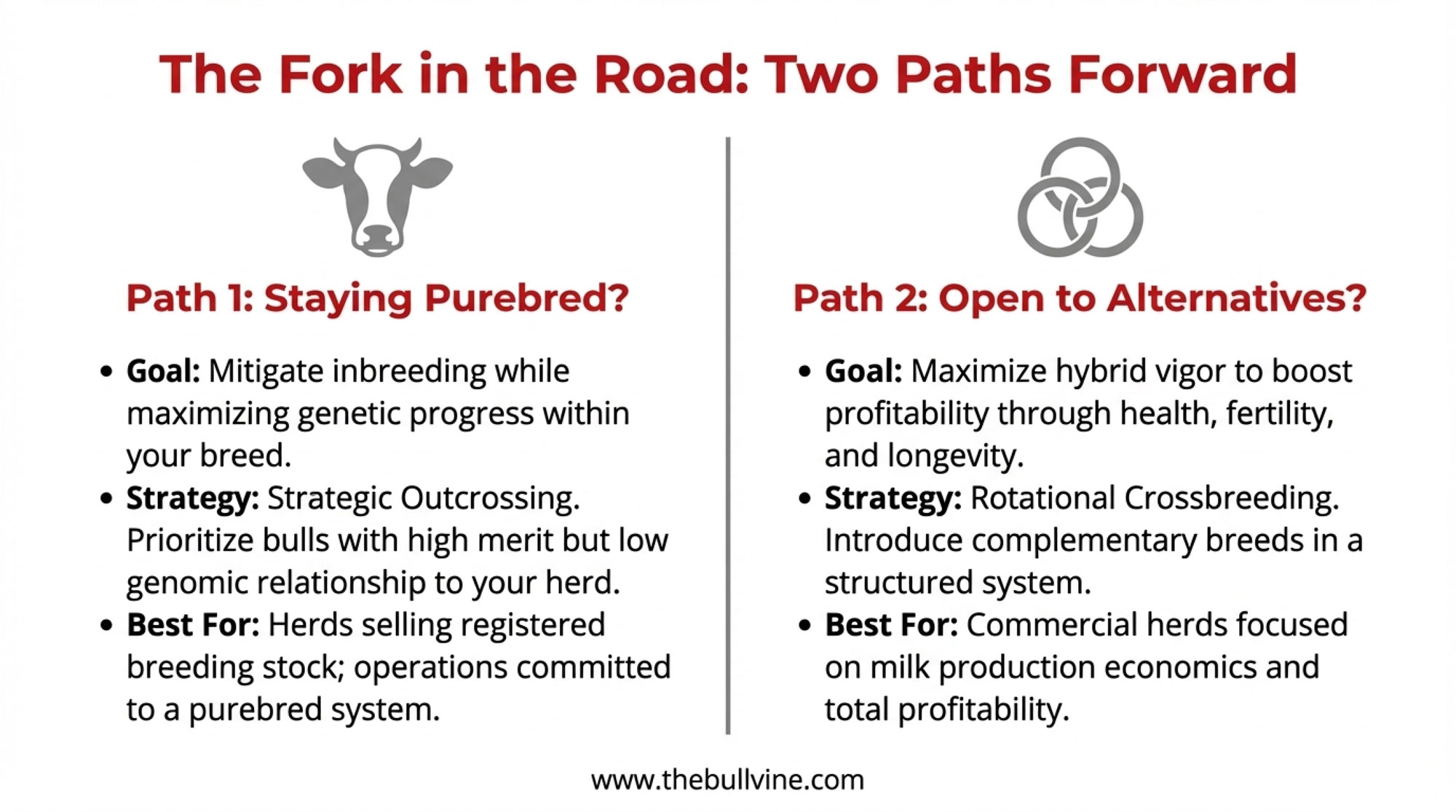
If You’re Staying Purebred

Strategic outcrossing offers a middle path that many operations are exploring. The concept is straightforward: identify bulls with high genetic merit but low genomic relationship to your herd. You’re prioritizing diversity alongside performance rather than just chasing the highest index numbers.

What that looks like in practice:

  • Ask your AI representative for genomic relationship data, not just rankings. Most mating programs can generate this information—you just need to request it specifically.
  • Look at bulls’ pedigrees for underutilized sire lines. Sometimes the second or third-ranked bull is a better fit for your herd’s genetic profile than the top option.
  • Consider international genetics—Nordic, European, and New Zealand—that may be less related to dominant North American bloodlines.
  • Use mating programs that penalize inbreeding, not just maximize index. Most major AI organizations offer this setting, but it’s not always the default.

What about cost? Here’s something worth knowing: outcross bulls aren’t necessarily more expensive than top-ranked conventional options. Pricing depends more on proof of reliability and demand than on relatedness. In many cases, you can find bulls with strong genetic merit and lower relationship to your herd at comparable prices—you just have to ask specifically for that combination. Your AI rep can run the numbers for your situation.

Another option worth considering: use conventional semen on some of your top genetics. Sexed semen makes sense for maximizing heifer production, but using conventional semen on elite cows preserves the option for producing bull calves—potentially valuable if you’re interested in contributing to genetic diversity or selling to AI organizations looking for outcross genetics.

And here’s something important: for herds with high genetic merit that actively sell breeding stock into competitive registered markets, intensive purebred selection may remain the right strategy despite higher inbreeding levels. The premium prices for elite genetics can offset the inbreeding costs, and your market position depends on staying at the leading edge. Know your situation and your numbers.

If You’re Considering Crossbreeding

A measured approach lets you learn without betting the whole operation:

  • Start with 20-30% of your herd. This gives you enough animals to genuinely evaluate performance under your specific conditions—your feed program, your facilities, your management style—without a wholesale transformation. You’ll learn a lot in three years.
  • Choose breeds with research backing. Three-breed rotations using Holstein × Viking Red × Montbéliarde have the strongest long-term data behind them. The UMinn research specifically validated this combination in high-production environments.
  • Plan for the timeline. First crossbred daughters will calve approximately 3 years after initial breeding decisions. This isn’t a quick fix—it’s a strategic shift that requires patience.
  • Focus on commercial females. Crossbreeding strategies work best for cows whose daughters will enter your milking herd rather than the breeding stock market.

Organizations like Creative Genetics and Viking Genetics offer crossbreeding-focused programs and technical support if you want to explore this direction seriously.

Regardless of Which Direction You Go

Track your herd’s genomic inbreeding over time. Request runs of homozygosity (FROH) data from your genomic testing provider—Zoetis, Neogen, whoever you’re working with. Compare your herd average to breed benchmarks, and watch how it trends over generations.

And have a direct conversation with your AI rep. Ask specifically: “What are my outcross options? Which bulls in your lineup would reduce my herd’s average relatedness?” You might be surprised at what’s available when you ask the right questions.

A Few Things I’m Watching

A few developments worth keeping an eye on over the next several years…

  • Effective population size is a metric geneticists use to gauge long-term genetic health. Research published in the Journal of Heredity and elsewhere suggests that when effective population size drops below 50, populations face accelerated genetic drift and loss of rare alleles—genetic variation that can’t be recovered once it’s gone. Various studies estimate Holstein effective population size somewhere between 50 and 100, depending on methodology, which is why researchers are paying closer attention than they were a decade ago.
  • Evaluation systems may evolve. Some European breeding programs have begun incorporating inbreeding penalties into their selection indexes, rewarding bulls that combine high genetic merit with genetic diversity. If North American programs move in this direction—and there’s been discussion about it—that could shift which bulls rise to the top of rankings.
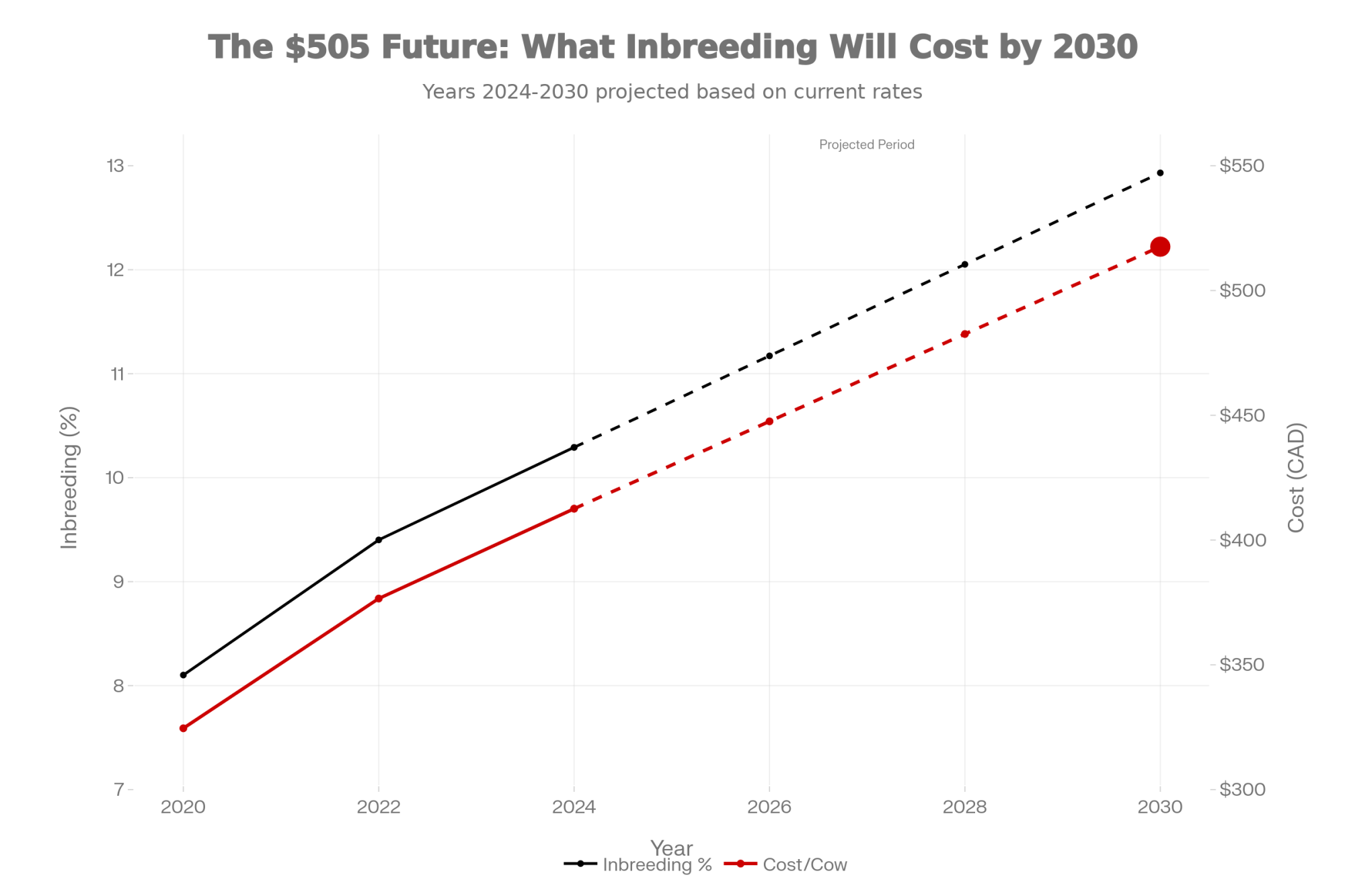
  • The math that keeps me up at night: At current accumulation rates of 0.35-0.44% per year, breed-average inbreeding will add another 2-3.5 percentage points by 2030. That’s $44-158 per cow in additional silent losses—already baked in unless breeding decisions change. The cows being bred this year will be milking through that reality.
Here’s how I think about it: You don’t buy fire insurance because you expect your barn to burn down. But you’re glad you have it if something unexpected happens.

Reader Challenge: What’s Your Herd’s Inbreeding Level?

Here’s something I’d genuinely like to know: What does your herd’s average genomic inbreeding look like?

Pull up your latest genomic herd report—whether it’s from Zoetis, Neogen, or another provider—and find your herd’s average FROH (runs of homozygosity) or genomic inbreeding percentage.

Drop your number in the comments below. No judgment here—we’re all dealing with the same industry trends. But seeing where different operations land could start an interesting conversation about what’s realistic to manage and what strategies are actually working.

If you’ve been actively using outcross sires or implementing crossbreeding, I’d especially like to hear how your numbers compare to where you started.

Not sure where to find this data? Your genomic testing provider can generate a herd inbreeding summary—you just need to ask for it.
Key Takeaways

  • The economics are real, even if they’re hard to see. Research from Virginia Tech found that each 1% increase in inbreeding costs approximately $22-24 per cow in lifetime profit. With breed-average inbreeding up substantially over the past decade—Lactanet Canada now reports 9.99% for 2024-born Holstein heifers—that represents meaningful money. Potentially $200-400 per cow that doesn’t appear on any line item but affects your bottom line.
  • Crossbreeding data is more compelling than many realize. The University of Minnesota’s 10-year study found crossbred cows delivered 9-13% higher daily profit across seven high-producing commercial herds. The advantages came from longer productive life, lower health costs, and better fertility. This was a decade of real data from real operations.
  • You have options within purebred programs. Strategic outcrossing—prioritizing bulls with high merit and low relationship to your herd—can slow inbreeding accumulation while maintaining genetic progress. The tools exist, outcross genetics are often competitively priced, and good AI reps can help you use them.
  • Track what matters to your operation. Request genomic inbreeding data on your herd and watch trends over time. Ask your AI representative specifically about outcross options, not just top rankings.
  • Match your strategy to your goals. Crossbreeding makes most sense for commercial operations focused on milk production economics. If you’re selling registered breeding stock into competitive genetic markets, intensive purebred selection may still be your best path. Neither approach is wrong. They’re optimizing for different outcomes.

The goal isn’t to abandon genomic selection—it’s delivered tremendous value to our industry. But making breeding decisions with full awareness of the trade-offs helps ensure short-term genetic gains don’t come at the expense of long-term herd profitability and resilience.

As with most decisions in dairy farming, the right answer depends on your situation. What’s changed is that we now have more data than ever to inform those decisions. The question is whether we’re willing to look at all of it, not just the parts that confirm what we’re already doing. 

Key research referenced: Cassell, Adamec, and Pearson (1999), Journal of Dairy Science; Hazel, Heins, and Hansen, Journal of Dairy Science (ProCross study); Doekes et al. (2019), Genetics Selection Evolution; Council on Dairy Cattle Breeding trend data; Lactanet Canada August 2025 Inbreeding Update; AHDB sexed semen market reports; American Farm Bureau Market Intel.

Complete references and supporting documentation are available upon request by contacting the editorial team at editor@thebullvine.com.

Learn More

Join the Revolution!

Join over 30,000 successful dairy professionals who rely on Bullvine Weekly for their competitive edge. Delivered directly to your inbox each week, our exclusive industry insights help you make smarter decisions while saving precious hours every week. Never miss critical updates on milk production trends, breakthrough technologies, and profit-boosting strategies that top producers are already implementing. Subscribe now to transform your dairy operation’s efficiency and profitability—your future success is just one click away.

NewsSubscribe
First
Last
Consent

Does Your Breeding Program Fit Your Milk Market?

The same genetics cost one farm $190,000/year and make another farm $57,000. The difference? Market alignment.

Here’s something I’ve been thinking about quite a bit lately. After spending time reviewing proof sheets and talking with dairy farmers from Wisconsin to California, I keep coming back to the same observation: there’s a growing gap between what the catalogs celebrate and what actually drives profitability on individual farms.

Don’t get me wrong—the numbers look impressive. Genetic progress is accelerating. Index values keep climbing. But sit down with producers who’ve been making these decisions for two or three decades, and they’ll share something the marketing materials tend to leave out: genetics that work beautifully on one operation can quietly underperform on another.

What’s interesting here isn’t that some bulls are better than others. It’s that every elite sire represents a specific vision of where dairy is headed—and whether that vision aligns with your milk market, your management approach, and your economic reality is really the question worth exploring.

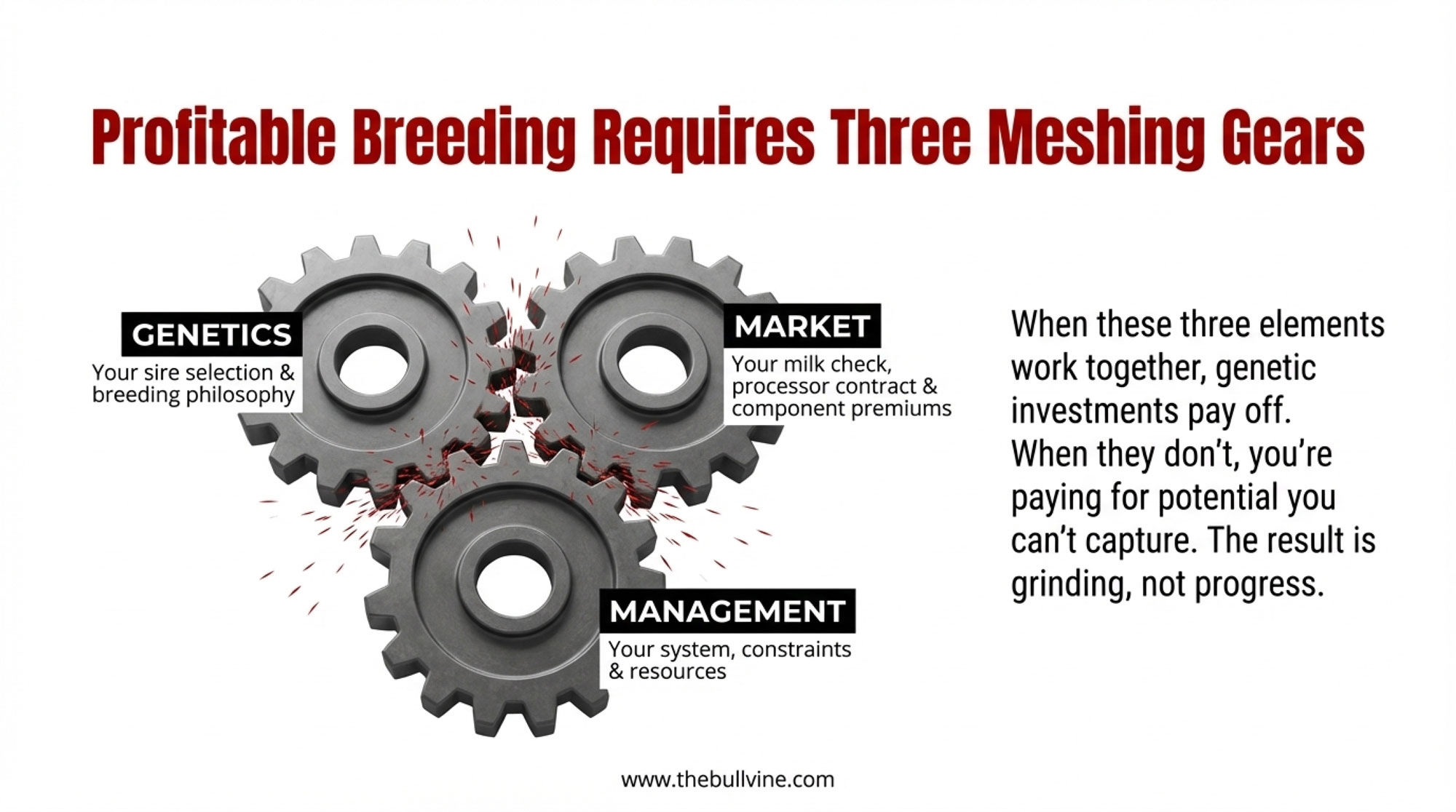
The Three Gears That Must Mesh

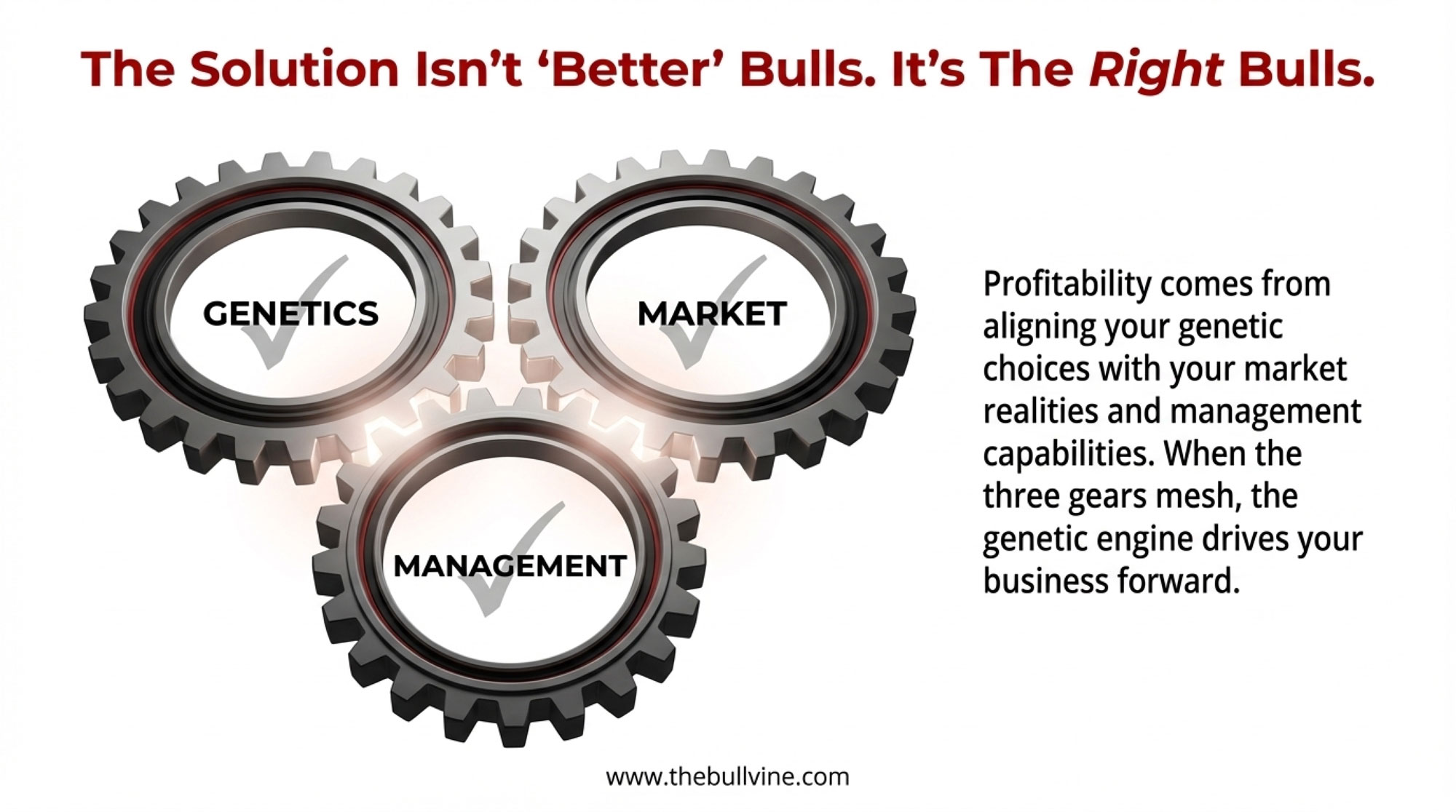
Think of profitable breeding decisions as three interlocking gears: GeneticsMarket, and Management. When these gears mesh smoothly, genetic investments translate into income over feed cost and long-term herd health. When they don’t—when you’re selecting for traits your market doesn’t reward or your management can’t support—you’re essentially paying for genetic potential you can’t capture.

As many of us have seen, that’s how you end up with cows that look great on paper but don’t quite pay their way in your specific system.

The visual is simple enough to sketch on a napkin: three gears touching. Genetics turns Market turns Management. If one gear is spinning in the wrong direction—or sized wrong for the others—you get grinding instead of progress.

Gear Misalignment Example

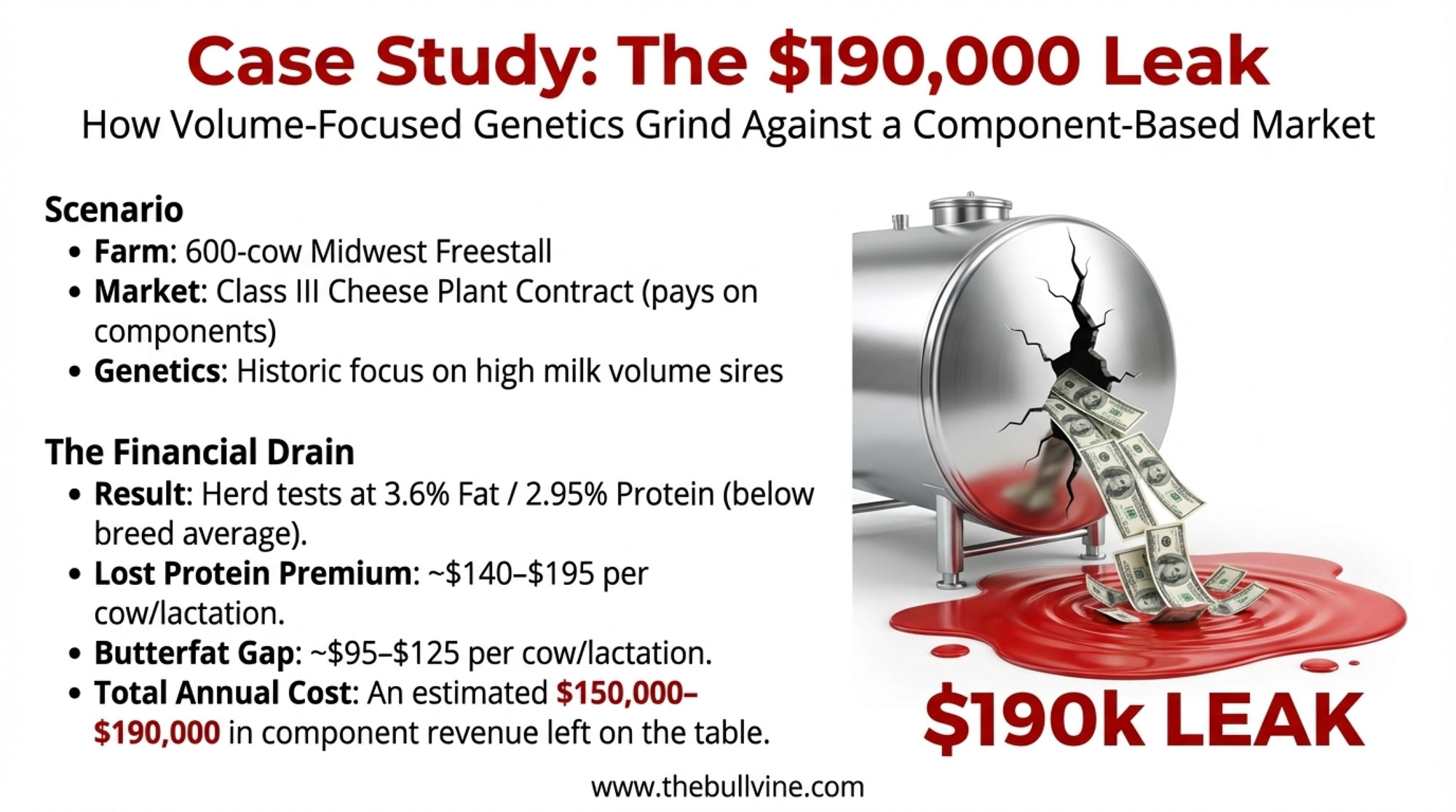
Midwest Freestall — Class III Cheese Plant Contract — Volume-Focused Genetics

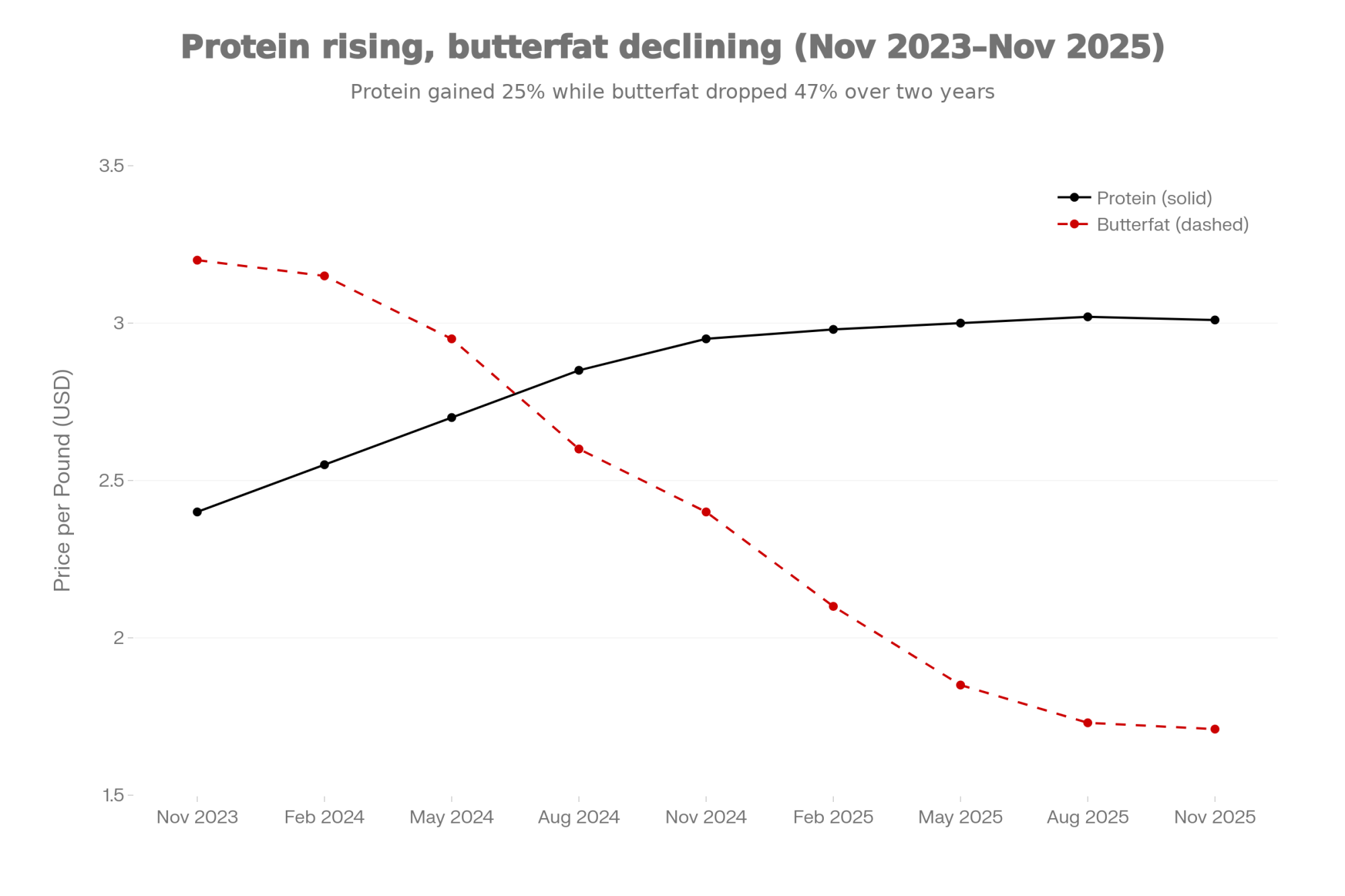
Picture a 600-cow Midwest freestall operation shipping exclusively to a cheese plant on a Class III contract. The processor pays heavily on components—protein especially, since that’s what drives cheese yield. At current prices, protein is worth $3.01 per pound and butterfat $1.71 per pound.

The breeding program, though, has been chasing milk volume for years. High-production sires. Big milk numbers. The tank is full, but the tests are running 3.6% fat and 2.95% protein—below the current Holstein breed average of 4.15% fat and 3.36% protein, according to the Canadian Dairy Information Centre’s 2024 data.

Where money leaks out:

Lost protein premium: At 2.95% protein instead of 3.2–3.3%, this herd leaves roughly $0.75–$0.90 per cwt on the table compared to a component-focused herd at similar production levels. On 60 lbs/cow/day, that’s $140–$195 per cow per lactation in foregone protein revenue alone.

Butterfat gap: The 0.3–0.4% fat test difference adds another $95–$125 per cow per year in missed premiums.

Feed efficiency drag: High-volume, low-component cows often require more DMI per pound of milk solids produced. Using USDA’s NM$ 2025 values, moving that extra water through the system costs feed dollars without generating proportional component revenue.

Estimated annual cost for this 600-cow herd: Approximately $150,000–$190,000 in component revenue the cheese plant would have paid—if the genetics matched the market.

The cows aren’t “bad.” The bulk tank isn’t empty. But the breeding program was optimized for a fluid milk check that no longer exists. The Genetics gear is turning toward volume. The Market gear is turning toward components. They’re grinding against each other instead of working together.

Understanding What You’re Actually Buying

Looking at three sires that represent distinctly different breeding philosophies helps make this concrete.

Denovo 2776 Leeds from ABS is built on a premise that resonates with many operations right now: labor is expensive and increasingly difficult to find, so invest in genetics that reduce calving interventions. His pedigree runs through Sandy-Valley Laker back to the De-Su Frazzled 6984 cow family—the same family that gave us Gateway, Hercules, Ajax, and Skeet, according to ABS pedigree records. With essentially flat components, Leeds isn’t designed to transform your butterfat levels. His value proposition centers on strong calving-ease and a solid productive life from a family known for commercial functionality.

Denovo 6856 Hotshot takes a completely different approach. His pedigree traces through Pine-Tree Shadow to the Bomaz Perfect-P line—part of what ABS describes as “one of the premier cow families of the breed for longevity.” Hotshot isn’t positioned as a production leader. He’s built around health, livability, and keeping cows productive through the transition period and beyond.

Urzokari from Synetics represents yet another direction—explicit optimization for robotic milking systems. Emphasizing teat position, udder balance, and locomotion traits that influence whether cows visit the robot voluntarily or need fetching.

Producers are discovering that none of these bulls represents a universally optimal choice. Each makes excellent sense for some operations and may quietly cost money on others. The question isn’t which bull is “best,” but which breeding philosophy fits your particular three gears.

Where NM$ and TPI Fit—And Where They Don’t

Before we go further, it’s worth talking about how this framework relates to Net Merit and TPI, since that’s how most of us were taught to think about genetics.

The April 2025 NM$ revision—documented in detail by Paul VanRaden and colleagues at USDA’s Animal Genomics and Improvement Laboratory—now places 31.8% emphasis on butterfat13% on protein, and a combined 17.8% on Feed Saved, which includes body weight composite and residual feed intake. The remaining emphasis spreads across productive life, health, fertility, calving, and conformation traits.

Here’s what’s important to understand: NM$ is designed to maximize lifetime profit for an average U.S. Holstein herd selling into average market conditions. It’s a remarkably well-constructed tool for that purpose. Canadian producers working with LPI or Pro$ face similar considerations—different weightings, different assumptions, same fundamental question of whether those assumptions match your operation.

How the Major Indexes Compare

The differences between selection indexes reflect different market realities and breeding priorities:

  • NM$ (U.S.) places heavy emphasis on components—31.8% on butterfat alone in the 2025 revision—reflecting the cheese-heavy U.S. processing sector. Feed efficiency gets significant weight at 17.8% combined.
  • TPI (U.S.) weights production, type, and health traits differently, placing greater emphasis on conformation. Operations selling breeding stock or show cattle often weight TPI more heavily.
  • Pro$ (Canada) incorporates Canadian market conditions and pricing structures. The formula accounts for Canadian component pricing ratios, which—as we’ll see—are shifting significantly.
  • LPI (Canada) takes a different approach to balancing production, durability, and health traits within the Canadian context.

The point isn’t that one index is “right,” and others are wrong. It’s that each embeds assumptions about markets, management, and priorities that may or may not match your operation.

A Global Trend, Not Just a North American One

This isn’t just a North American consideration. Globally, component emphasis is intensifying—and the herds that have been selecting for it are pulling ahead.

In Ireland, milk fat content reached 4.51% and protein hit 3.58% in January 2025, according to the Central Statistics Office—both up from the prior year. New Zealand’s Fonterra bases its milk price calculations on standardized 4.2% fat and 3.4% protein, as documented in the Commerce Commission’s September 2025 review—benchmarks that reflect decades of component-focused breeding in pasture-based systems. And across the EU, butter prices hit record highs in early 2025, reaching €7,422 per metric ton in January according to CLAL data—a 36.5% increase over the same month in 2024. Industry analysts describe the fat premium as becoming “structural, not some temporary blip.”

The takeaway? Market alignment isn’t a U.S. phenomenon. It’s a global reality that’s reshaping which genetics deliver returns, regardless of where you farm.

When “Average” Doesn’t Describe Your Situation

But “average” may not describe your situation. If you’re shipping Class III milk to a cheese plant with strong component premiums, NM$ may actually underweight the traits driving your revenue. If you’re in a fluid market with minimal component pay, the 31.8% butterfat emphasis in NM$ could be steering you toward genetics that don’t match your milk check.

The framework in this article doesn’t replace NM$ or TPI—it complements them by asking: Does this index’s assumptions match my actual market, management, and constraints?

Think of NM$ as an excellent starting filter. But the final selection—especially for your top sires getting heavy use—benefits from the three-gear alignment check.

The Concentration Question Worth Understanding

Looking at this trend at the breed level, something jumps out that doesn’t get nearly enough airtime.

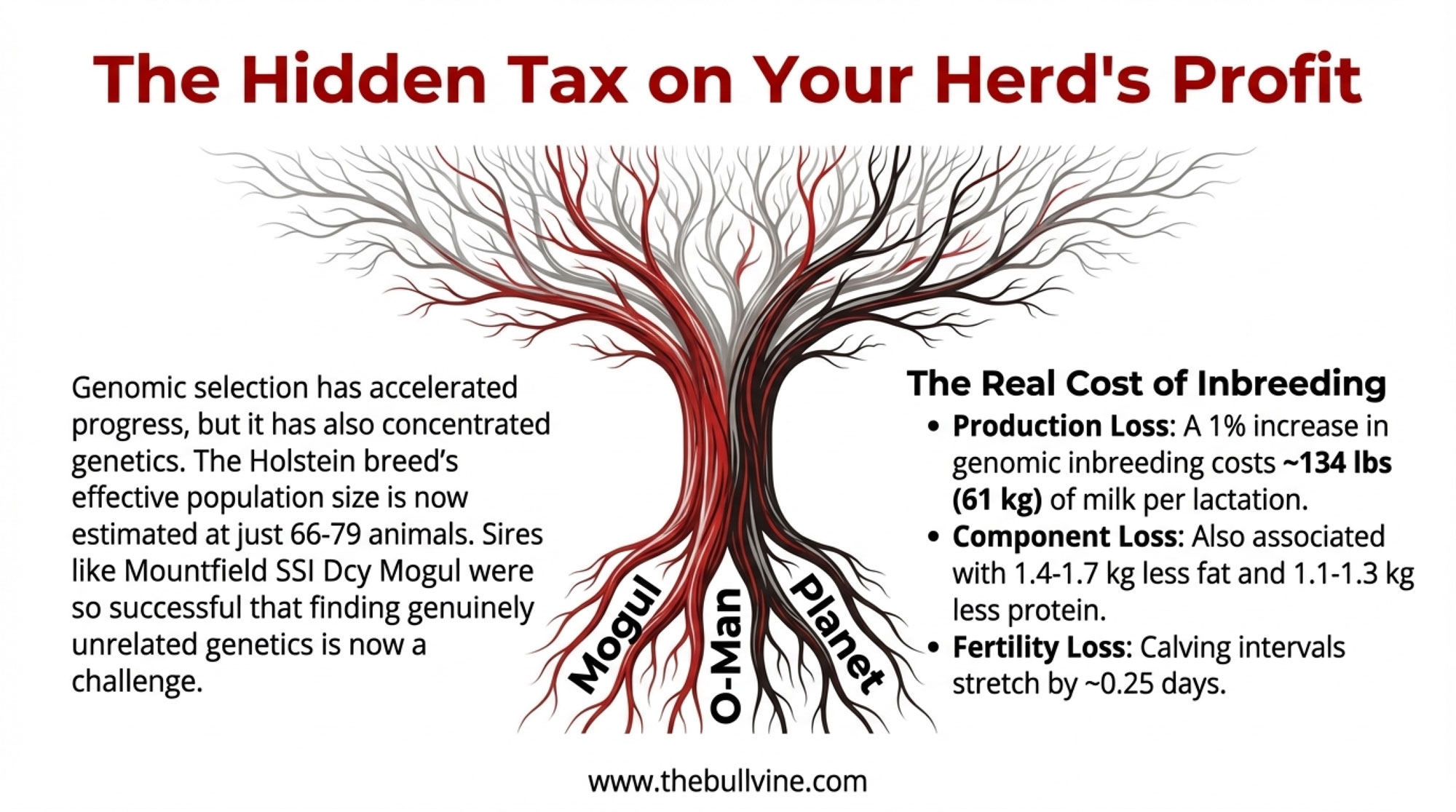
Multiple studies have estimated the effective population size of Holsteins—a measure of genetic diversity based on how animals are actually related—at 66-79 animals, despite millions of Holstein cows walking into parlors around the world. Geneticists generally view an effective population size below 50 as the line where long-term adaptability becomes a serious concern, so we’re not over that cliff—but we’re closer than many would guess.

Dr. Chad Dechow, Associate Professor of Dairy Cattle Genetics at Penn State University, has been writing and speaking about this for years. His work shows that genomic selection—for all its tremendous benefits in accelerating genetic improvement—has also sped up how quickly we concentrate genetics in fewer lines.

Why does this matter for your next semen order?

Because the bulls marketed as “outcrosses” today often trace back to the same handful of influential sires, once you unfold the pedigree far enough. And the economic bite of that concentration isn’t theoretical—it’s been quantified.

The Mogul Example: When Success Creates Its Own Risk

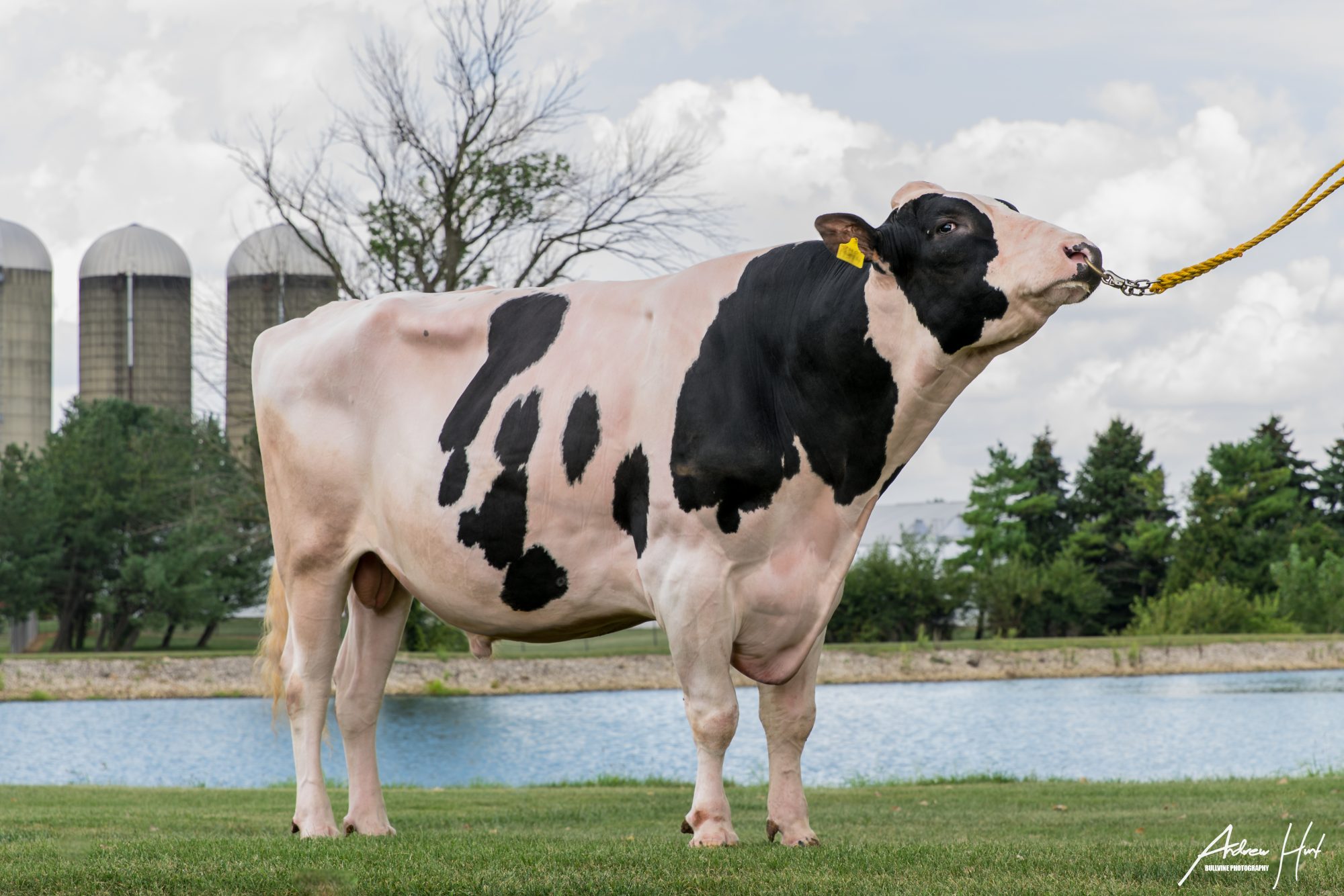
Mountfield SSI Dcy Mogul—the youngest Holstein sire to exceed one million units sold. His daughters delivered. His influence now appears throughout the breed’s pedigree, making genuine outcrosses increasingly difficult to find.

Mountfield SSI Dcy Mogul is one of the most influential Holstein sires in breed history. Select Sires announced in September 2017 that he’d exceeded 1 million units sold at just seven years of age, making him the youngest bull to reach that milestone. His impact as a foundation sire for subsequent generations has been enormous.

That success wasn’t accidental. Mogul daughters delivered. But the sheer scale of his use means his genetics now appear in a substantial percentage of the breed’s pedigrees—often multiple times per animal when you trace back six or seven generations.

The concern isn’t that Mogul was a poor bull. He wasn’t. The concern is that when any sire achieves that level of market penetration, finding genuinely unrelated genetics becomes progressively harder. Research by Doublet and colleagues, published in 2019, documented annual inbreeding rates rising to 0.55% per year in the genomic era—roughly double the rate considered sustainable in the long term.

For individual herds, this means that selecting a “new” high-ranking bull may actually be deepening your connection to Mogul, O-Man, Planet, or Supersire rather than diversifying away from them. Checking kinship data isn’t paranoia—it’s due diligence.

What Inbreeding Actually Costs

Italian research from Ablondi and colleagues, published in the Journal of Animal Science in 2023, found that a 1% increase in genomic inbreeding—specifically measured via runs of homozygosity (FROH), which captures actual stretches of identical DNA—is associated with about 134 pounds (61 kg) less milk over a 305-day lactation, along with lower fat and protein yields.

German work from Mugambe and colleagues in the Journal of Dairy Science in 2024 found similar patterns:

  • 32–41 kg less milk per 1% increase
  • 1.4–1.7 kg less fat
  • 1.1–1.3 kg less protein
  • Calving intervals stretched by roughly a quarter-day per 1% increase

I recently talked with a Wisconsin producer milking about 400 cows who’s been tracking inbreeding and performance for a decade. His take was pretty straightforward: “The daughters are producing more milk than their dams, so the genetic progress is real. But conception rates and feet-and-leg issues have gotten harder to manage. I’m not sure the net gain is as large as the proof sheets suggest.”

The Component Premium Question

The shift toward component-focused genetics has really picked up speed in recent years, especially with the 2025 NM$ revision, which placed 31.8% emphasis on butterfat alone. On paper, that makes a lot of sense given recent price trends. In practice, it depends heavily on where your milk check comes from.

The November 2025 USDA Agricultural Marketing Service announcement showed protein at $3.0143 per pound and butterfat at $1.7061 per pound—a very different picture from a year earlier, when butterfat was over $3.00 a pound. Class III settled at $17.18 per hundredweight. Those relationships move, sometimes dramatically.

Processor Contracts Are Tightening

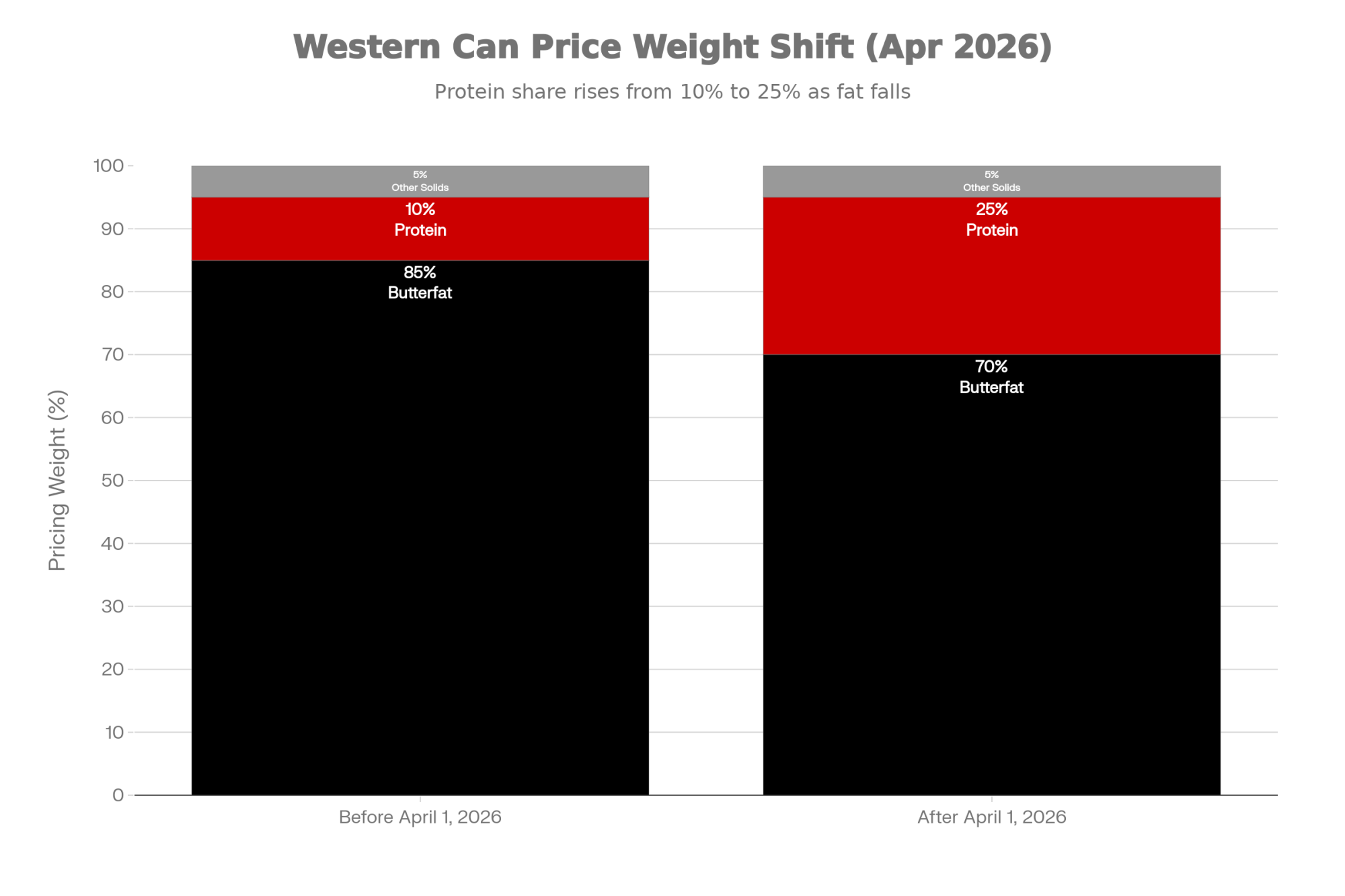
And processor expectations are tightening—that’s something worth paying attention to. Western Canadian provinces—British Columbia, Alberta, Saskatchewan, and Manitoba—announced through the BC Milk Marketing Board a major component pricing ratio shift effective April 1, 2026, moving from 85% butterfat / 10% protein / 5% other solids to 70% butterfat / 25% protein / 5% other solids. That’s a significant rebalancing toward protein that will reward herds already selecting for it and penalize those who aren’t.

In the U.S., the story is similar. New processing capacity often comes with stricter contract requirements. Today’s direct contracts increasingly expect consistent volume, protein tests above 3.2%, and premium somatic cell counts. If your genetics have been drifting away from protein while you’ve been chasing other traits, the next contract renewal window may deliver an unwelcome surprise.

Quick Math Check: What’s Your Component Revenue Share?

Pull your last six milk checks. Add up the component premiums (fat + protein payments above base). Divide by total milk revenue.

  • Above 25%: Component genetics is likely paying well for you. The 2025 NM$ emphasis on butterfat aligns with your market.
  • 15–25%: Mixed picture. Component genetics help, but don’t over-rotate away from production.
  • Below 15%: You may be over-investing in component genetics. Consider whether volume-focused or balanced sires deliver better returns in your specific market.

This 5-minute exercise can save thousands in misaligned genetic decisions.

Red Flag Checklist: 5 Warning Signs Your Genetics Don’t Match Your Market

  1. Your fat or protein test has dropped 0.2%+ over 3 years while selecting high-NM$ bulls. NM$ emphasizes components, so if your tests are declining despite following index rankings, something in your selection isn’t translating to your tank.
  2. Your component revenue share (from the Quick Math Check) is under 20%, but you’re heavily using component-focused sires. You may be paying for genetic potential your market doesn’t reward.
  3. You can’t find a prospective sire with less than 8% relationship to your herd. Genetic concentration has narrowed your options more than you realize—time to seek outcross genetics actively.
  4. Your processor has mentioned tightening component thresholds or premium structures in recent communications. With Western Canadian provinces shifting to 70/25/5 (fat/protein/other) pricing in April 2026 and U.S. processors increasingly requiring 3.2%+ protein for premium contracts, genetic decisions made today need to anticipate tomorrow’s standards.
  5. You’re using beef genetics on more than 40% of your herd but haven’t genomic-tested to identify your true top-tier replacements. With dairy heifer inventories at 20-year lows—2.5 million head as of January 2025, according to HighGround Dairy—the cows you keep replacements from matter more than ever.

If you checked two or more: Your three gears may be grinding. Consider a formal review of your breeding program’s alignment with your current market before your next semen order.

The Feed Efficiency Factor

There’s another dimension to this calculation that’s getting more attention in 2025: feed efficiency. The April 2025 NM$ revision now includes 17.8% combined emphasis on Feed Saved, which incorporates both body weight composite and residual feed intake—a significant increase from previous versions.

Here’s what the research tells us: residual feed intake has moderate heritability, typically estimated between 0.15-0.25 in Holstein populations, making it a meaningful selection target over time. And USDA research used in the NM$ calculations shows that feed costs average about 58% of milk income, broken down into 39% for production costs and 19% for maintenance. That’s not “a big part” of the budget; it’s often the biggest lever you have.

Detailed Per-Cow, Per-Lactation Example

Let’s put real numbers to a side-by-side comparison using November 2025 Class III prices and the economic values from the 2025 NM$ revision.

Scenario: Two cows in the same 500-cow Midwest Class III herd

FactorCow A (Volume-Focused)Cow B (Component-Aligned)
Daily milk62 lbs56 lbs
Fat test3.7%4.2%
Protein test3.0%3.3%
305-day milk18,910 lbs17,080 lbs
305-day fat700 lbs717 lbs
305-day protein567 lbs564 lbs

Revenue calculation (Class III component pricing):

  • Cow A: Fat (700 × $1.71) + Protein (567 × $3.01) + Other solids ≈ $2,904
  • Cow B: Fat (717 × $1.71) + Protein (564 × $3.01) + Other solids ≈ $2,927

Component advantage for Cow B: ~$23/lactation

Feed cost calculation (using USDA’s NM$ 2025 values of $0.13/lb DMI and requirements of 0.10 lbs DMI per pound of milk, 8.0 lbs per pound of fat, and 6.5 lbs per pound of protein):

  • Cow A DMI: (18,910 × 0.10) + (700 × 8.0) + (567 × 6.5) = 11,185 lbs
  • Cow B DMI: (17,080 × 0.10) + (717 × 8.0) + (564 × 6.5) = 10,810 lbs

Feed cost difference: 375 lbs × $0.13 = $49/lactation advantage for Cow B

If Cow B also has 3% better residual feed intake (genetic feed efficiency): Additional savings: ~325 lbs DMI × $0.13 = $42/lactation

Total advantage for component-aligned Cow B in Class III market: $23 (components) + $49 (baseline feed) + $42 (RFI) = ~$114/lactation

Over a 500-cow herd: That’s roughly $57,000/year in additional margin from aligned genetics—not from buying “better” bulls, but from buying bulls that fit the operation’s market and management.

In a fluid market with minimal component premiums, this math reverses. Cow A’s extra 1,830 lbs of milk volume generates more revenue, and the feed efficiency advantage shrinks because you’re not capturing the component value. The same genetics, completely different financial outcome.

What Specialization Actually Costs

Every specialized sire carries trade-offs embedded in his genetic package. The proof sheet highlights the specialization; it doesn’t spell out what you’re giving up.

Leeds’ calving-ease strength comes from specific physical characteristics—smaller, finer skeletal structure, lower birth weight calves, and reduced pelvic dimensions. For operations genuinely struggling with calving difficulty—assisted births over 18–20%—the trade-off often pencils out. For herds where calving assistance is already well-managed, the structural compromise might cost more than the calving-ease saves.

Hotshot’s emphasis on longevity reveals a different dynamic. His moderate milk proof looks more like a genetic ceiling than a starting point. When bred heifers bring $4,000 or more at auction, and raising costs run around $1,700–$2,400 per head, keeping cows in the herd for more lactations makes sense on paper. But if those cows are giving 6–8 lbs/day less than alternatives, whether longevity genetics pay off depends on your culling rate, replacement strategy, and feed costs.

A Northeast grazing operation I spent time with last spring leaned into longevity-focused genetics five years earlier and were genuinely happy with the outcome. “The per-cow production dropped some,” the producer told me, “but with lower replacement costs and better cow health, we’re actually keeping more of what we make.”

Sire TypeIntended BenefitHidden Trade-OffBest FitExpensive Misfit
Calving-Ease (e.g., Leeds)Lower assisted births, reduced labor during calving, fewer injury lossesSmaller frame, reduced mature size, often comes with 6-8 lbs/day lower lifetime productionFirst-calf heifers; herds with assisted calvings >18%; operations with limited labor for calving supervisionWell-managed herds with <10% assisted births; operations where replacement heifers cost $4,000+ and production matters more than calving ease
Longevity-Focused (e.g., Hotshot)Extended productive life, lower replacement costs, better transition cow healthModerate milk proofs often represent genetic ceiling, not starting point; slower genetic progress on production traitsHigh replacement costs ($2,200+ per heifer); grazing operations; herds targeting 3.5+ lactations; limited heifer inventoryOperations with strong cull cow markets; herds breeding beef-on-dairy on bottom 40%; processors paying volume bonuses; low feed costs favoring higher production
Robotic-Optimized (e.g., Urzokari)Improved voluntary robot visits, better teat positioning, reduced fetch timeEmphasis on udder/teat traits may sacrifice component genetics or production potential; value only captured if robots utilized efficientlyRobotic dairies; operations struggling with fetch rates >15%; herds prioritizing labor efficiency over per-cow productionConventional parlor operations; herds with no robot plans; component-paying markets where udder traits matter less than tests

When Realignment Pays Off: A Recovery Story

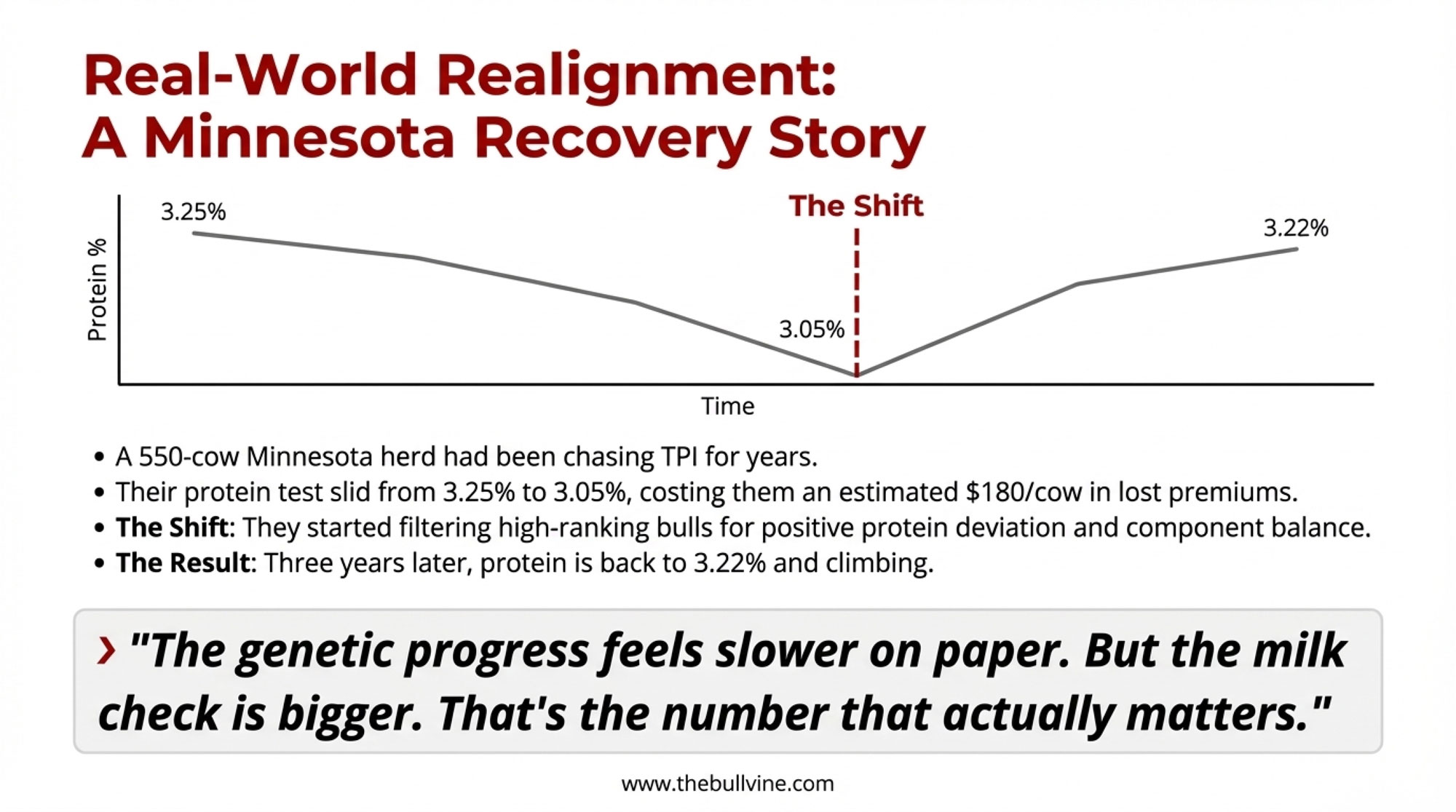
What happens when a producer recognizes the mismatch and corrects course? I talked with a 550-cow operation in central Minnesota that went through exactly that process.

“We’d been chasing TPI for about eight years,” the herd manager explained. “Good bulls, good genomics, no complaints about the genetics themselves. But we were shipping to a cheese plant, and our protein test just kept sliding—went from 3.25% down to 3.05% over that stretch. Meanwhile, the premiums for protein kept going up.”

When they ran the numbers in 2022, they realized they were leaving close to $180 per cow in component revenue on the table annually. “That’s when it clicked. We weren’t using bad genetics. We were using the wrong genetics for our market.”

They shifted their sire selection criteria—still using high-ranking bulls, but filtering hard for positive protein deviation and component balance. Three years later, their protein test is back to 3.22% and climbing.

“The genetic progress feels slower on paper,” he admitted. “But the milk check is bigger. That’s the number that actually matters.”

Regional Considerations

Where you farm changes these calculations more than most proof sheets acknowledge.

In the Southeast and Southwest, producers dealing with persistent heat stress often find that moderate production with stronger health and fertility traits out-earns elite production genetics that struggle through extended summers. In the Upper Midwest and Northeast, grazing-heavy systems face different realities—a cow built for a California dry lot isn’t always the cow you want walking hillsides in Vermont.

The Beef-on-Dairy Connection

The three-gear framework applies to more than just which dairy sires you’re using—it also shapes your beef-on-dairy strategy.

The 2024 NAAB semen sales report shows 7.9 million beef semen units flowing into U.S. dairy operations, representing over 80% of all beef semen sales. Meanwhile, dairy heifer inventories expected to calve dropped to 2.5 million head as of January 2025—the lowest level since USDA began tracking this data, according to HighGround Dairy analysis. CoBank research projects 357,490 fewer dairy heifers for 2025 compared to the prior year, driven largely by beef-on-dairy breeding decisions.

Here’s where the gears mesh—or grind: If you’re using beef genetics on your bottom-tier cows, you’ve already made a three-gear decision. You’re saying those animals don’t fit your Genetics goals (not worth keeping daughters from), don’t justify the Management investment of raising replacements, and the Market for beef calves currently rewards that choice.

But the framework cuts both ways. With heifer supplies this tight, the cows you do keep replacements from matter more than ever. Beef Magazine’s November 2025 report notes that beef-on-dairy cattle now represent 12–15% of all fed slaughter—the crossbreds have become an indispensable part of the beef supply chain. That’s fine, as long as your top-end genetics are truly aligned with your dairy operation’s market and management. Using beef on low-merit cows makes sense; accidentally breeding beef on cows that should be producing your next generation of high-component replacements is a costly mistake that compounds over time.

Finding Genuine Genetic Diversity

While genetic gains have more than doubled in the genomic era, breeding for diversity inside Holsteins now takes real effort.

For Purebred Holstein Operations

Seek out niche Holstein lines. Legacy maternal lines like Hanover-Hill, Landmark, Meteor, Durham, or Elegant, which were prominent 20–30 years ago but don’t dominate today’s rankings, can bring different genetics to the table.

Request genomic kinship data. Most major AI companies can show you how closely a prospective sire is related to your herd’s core cow families. CDCB offers inbreeding tools as well. For operations that haven’t genomic-tested their cows yet, current testing runs around $40–50 per head—a worthwhile investment if you’re serious about managing inbreeding across your herd.

Unfold pedigrees further back. Many so-called outcross sires look different in the first three generations, then converge on Mogul, O-Man, Planet, or Supersire once you get back to generation six or eight.

Consider the National Animal Germplasm Program. USDA’s germplasm program maintains semen and embryos from older, less-represented lines to preserve genetic diversity for long-term breed health.

“I’ve stopped looking at the top 10 TPI list entirely. If a bull doesn’t have positive deviation for protein and decent feet-and-legs, he doesn’t enter my tank, regardless of his rank. The proof sheets tell you what a bull can do genetically. They don’t tell you whether those genetics fit your parlor, your market, or your management. That’s the part you have to figure out yourself.”

— Wisconsin producer, 650-cow operation

A Framework for Matching Genetics to Your Operation

Five Questions Before You Pick a Bull

1. What’s my actual milk market? How much of your check comes from components versus volume?

2. What’s my primary constraint? Is involuntary culling above 25%? Are assisted calvings over 18%? Is production lagging?

3. Does this sire truly address that constraint? If calving isn’t a major issue, calving-ease sires might just be giving away production.

4. How closely is this bull related to my herd? Check genomic kinship or pedigree overlap.

5. What does the five-year math look like? Account for production, components, feed costs, replacements, and health.

The Larger Perspective

When you put all of this together, what’s interesting is how much breeding has shifted from “Which bull is best?” to “Which bull best fits what I’m actually trying to do here?”

The Holsteins that maximize returns on a 3,000-cow California dry lot shipping Class III milk are not the same Holsteins that fit a 200-cow Wisconsin grazing herd shipping mostly fluid milk. Both operations might reasonably use bulls like Leeds or Hotshot—but in very different proportions, for very different reasons, and with very different expectations.

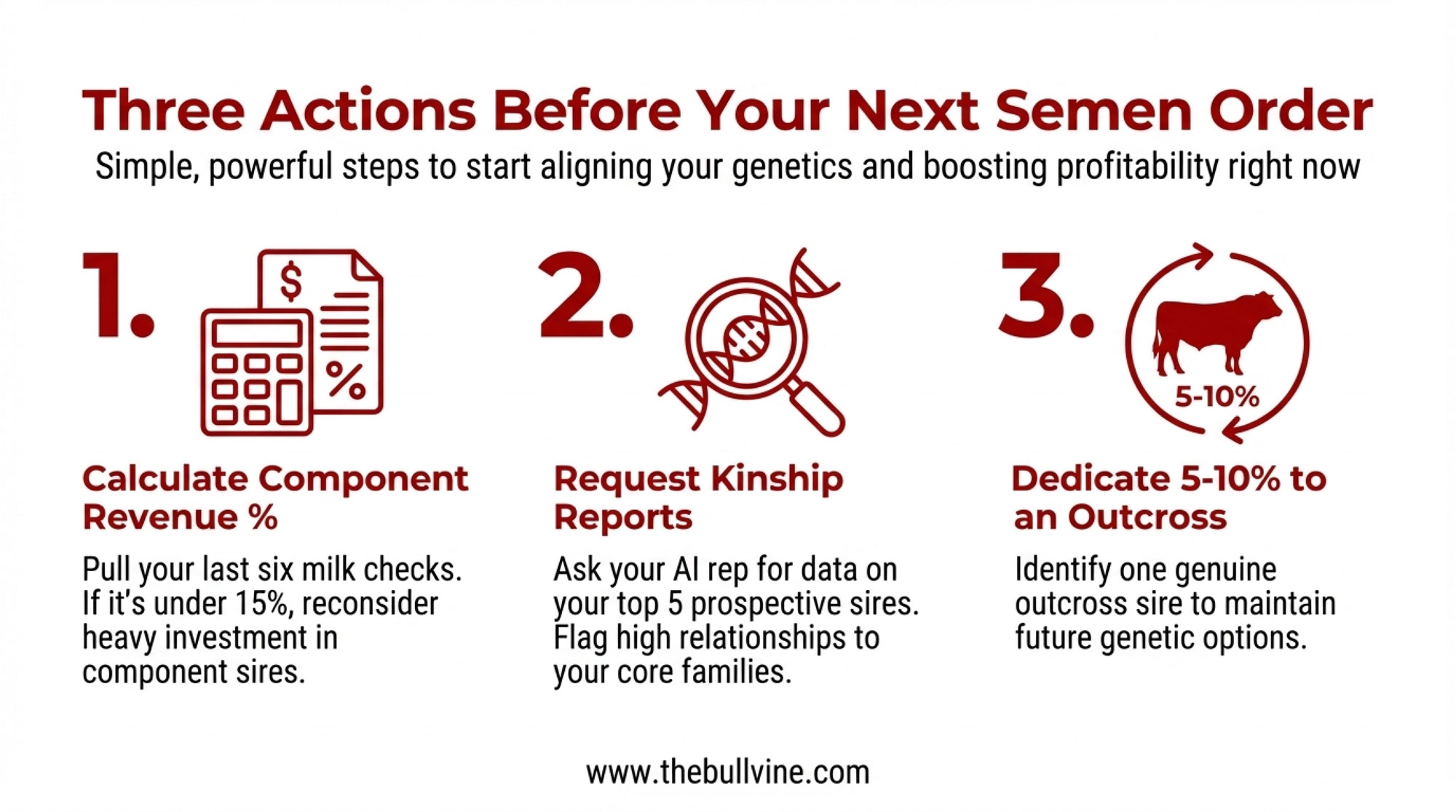
Three Actions Before Your Next Semen Order

  • Calculate your component revenue percentage from your last six milk checks. If it’s under 15%, reconsider heavy use of component-focused sires.
  • Request kinship reports on your top 5 prospective sires from your AI representative. Flag any showing an elevated relationship to your existing cow families or heavy Mogul/O-Man/Planet ancestry.
  • Identify one genuine outcross sire from an underrepresented maternal line for 5–10% of your matings—not to chase diversity for its own sake, but to maintain options as the breed continues to concentrate.

The tools to make smarter, more aligned decisions exist—genomic kinship, feed efficiency data, inbreeding metrics, and diverse sire options. The challenge, and the opportunity, is taking the time to line those tools up with the reality of your own farm.

The Bottom Line

What’s been your experience with specialized genetics? Have calving-ease, longevity-focused, or component-heavy sires delivered the returns their proofs suggested under your conditions? The most useful lessons often come from comparing what the proofs promised with what actually showed up in the bulk tank and the balance sheet.

Key Takeaways

  • Fit beats rank. The same genetics can cost one farm $190,000/year and add $57,000 to another—the difference is market alignment, not genetic quality.
  • Misalignment drains profit quietly. Volume genetics in a cheese market can leave $150,000–$190,000 annually on the table, even when production looks strong.
  • NM$ is designed for the average herd. The 2025 revision puts 31.8% emphasis on butterfat. If your market doesn’t reward components, you’re paying for genetic potential you can’t capture.
  • Inbreeding costs compound. Each 1% increase means ~134 lbs less milk plus weaker fertility—and at 0.55% annually, the breed is accumulating it faster than ever.
  • Before your next semen order: Calculate your component revenue share (5 minutes), request kinship data on prospective sires, and reserve 5–10% of matings for genuine outcrosses.

EXECUTIVE SUMMARY: 

The same genetics can cost one operation $190,000 a year and add $57,000 to another. The difference isn’t genetic quality—it’s market alignment. This article introduces a three-gear framework (Genetics, Market, Management) that helps producers evaluate whether their breeding program actually fits their milk check. Drawing on USDA’s April 2025 NM$ revision and peer-reviewed research, it demonstrates how misaligned genetics can quietly drain profitability even when production looks strong. Practical tools include a 5-minute component revenue analysis, five questions to ask before selecting any sire, and strategies for finding genuine diversity as the breed concentrates. The goal isn’t finding “better” bulls—it’s finding bulls that fit your operation.

Complete references and supporting documentation are available upon request by contacting the editorial team at editor@thebullvine.com.

Learn More

Join the Revolution!

Join over 30,000 successful dairy professionals who rely on Bullvine Weekly for their competitive edge. Delivered directly to your inbox each week, our exclusive industry insights help you make smarter decisions while saving precious hours every week. Never miss critical updates on milk production trends, breakthrough technologies, and profit-boosting strategies that top producers are already implementing. Subscribe now to transform your dairy operation’s efficiency and profitability—your future success is just one click away.

NewsSubscribe
First
Last
Consent

The Silent Genetic Squeeze: Is Holstein Breeding Painting Itself into a Corner?

Holstein inbreeding has tripled in a decade. Discover how hidden genomic risks threaten dairy profits and what you can do to protect your herd’s future.

The relentless pursuit of genetic advancement in Holsteins has created an uncomfortable truth the industry refuses to confront: we’re creating a narrow genetic highway with no exit ramps. While milk production has soared through genomic selection, inbreeding has silently tripled in elite lines over just one decade. This genetic narrowing threatens long-term sustainability and demands immediate action from every stakeholder in the dairy industry – including YOU.

Remarkable genetic progress in Holstein cattle has transformed dairy production, but beneath the celebrated gains lurks a concerning trend that many farmers either don’t notice or choose to ignore. The genomic revolution that accelerated genetic improvement has simultaneously accelerated inbreeding at rates unprecedented in breed history.

You’ve probably heard whispers about this at dairy conferences or read passing references in industry publications. Perhaps you’ve noticed subtle changes in the “modern Holstein” – that increasingly angular, refined animal appearing in show rings and high-ranking genomic lists. But few connect these dots to the underlying genetic squeeze right before our eyes. And why would they? The major AI companies aren’t highlighting this problem in their glossy catalogs, are they?

The Inbreeding Paradox: What the Numbers Tell Us

When did you last scrutinize the inbreeding metrics in your genetic evaluations? If you’re like most producers, you monitor Expected Future Inbreeding (EFI) values when selecting service sires. But here’s the uncomfortable truth: EFI isn’t telling you the whole story – and the organizations supplying your genetics know it.

The divergence between genomic inbreeding levels in Holstein bulls (rising to 15.2%) and the declining number of active AI bulls (down 61%) creates a dangerous genetic bottleneck.

The difference between EFI and genomic inbreeding is like comparing your TMR formulation to what the cow’s sort and consume. One gives you the big picture; the other tells you what’s happening where rubber meets road.

EFI measures a bull’s average relationship to the broader population (currently heifers born in 2020), while genomic inbreeding (F_ROH) directly measures actual homozygosity in an individual’s DNA. This distinction matters tremendously when making mating decisions in your breeding program.

What makes this particularly troubling is that the base population used to calculate EFI is becoming more inbred each year. Between 2015 and 2020, the average EFI of the Holstein base population jumped from 7.5% to 9.4%. This means the genetic “yardstick” we use to measure inbreeding is shrinking, creating the illusion of stability when inbreeding is accelerating. It’s like measuring water depth in a sinking boat – the numbers stay the same while you slowly drown.

DEBUNKED: “If a bull’s EFI is low, he’s an outcross.” This common assumption falls apart under scrutiny. A bull can show a low EFI relative to today’s highly inbred base population yet still be closely related to other elite lines. This creates a false sense of security when making breeding decisions, particularly when using multiple “elite” bulls across your herd that secretly share recent common ancestry.

Contract limitations on elite bulls further distort the picture. When high Net Merit$ sires are restricted to specific breeding programs or available only through exclusive contracts, their genetics eventually enter the broader population through sons and maternal grandsons. By then, a new generation of even more inbred sires dominates the market, continuing a cycle of intensifying homozygosity that isn’t fully captured by EFI values.

Follow the Numbers: A Decade of Genetic Narrowing

The data tells a compelling story of rapidly diminishing genetic diversity. In just one decade (2010-2020), genomic inbreeding in Holstein bulls skyrocketed from approximately 5.7% to 15.2% – a staggering 168% increase.

Meanwhile, active AI bulls declined precipitously, from 2,734 in 2010 to just 1,079 in 2020. That’s a 61% reduction in the available gene pool in just 10 years.

Let’s put this in perspective:

Metric20102020Change
Elite Genomic Sires5.7%15.2%+168%
Active AI bulls2,7341,079-61%
EFI base population7.5%9.4%+25%

You might think, “But genomic selection has dramatically improved our herds. Isn’t this just the price of progress?”

That’s partly true. Genomics allows us to identify elite genetics with unprecedented accuracy and speed. But the unintended consequence is that we’re now selecting from an increasingly narrow pool of animals that share more and more of their ancestry.

Only 75-100 top genomic young bulls enter AI programs annually today, compared to over 1,000 pedigree-selected bulls pre-2010. With three major U.S. cooperatives now controlling over 80% of semen sales, we’re essentially drinking from the same concentrated genetic well – and it’s getting more focused every year. Is anyone asking what happens when that well runs dry?

What’s Driving This Trend?

This genetic bottleneck didn’t happen by accident. Several forces are working together to squeeze our Holstein gene pool:

Genomic selection efficiency

Genomic testing has revolutionized our ability to identify genetic outliers earlier and more accurately. That’s the good news. The flip side? We’re identifying the same families repeatedly because we’re selecting for the same traits using the same algorithms. It’s like using the same filter on your DHIA sheets month after month – you’ll keep identifying the same cows as top performers. As these related animals dominate the rankings, they’re used more intensively, concentrating their genetics in the population.

Restricted access to elite genetics

Have you noticed that the most exciting new bulls often have fine-print limitations? These restrictions aren’t just marketing gimmicks- they fundamentally alter how genes flow through the population. Elite bulls primarily mate with elite cows, creating a separate genetic stream that only gradually filters down to commercial herds, by which time inbreeding has intensified further within the elite nucleus. When did you last have unrestricted access to the industry’s absolute top genomic sires? The answer is likely never.

Industry consolidation

Remember when there were dozens of competitive AI organizations, each with distinct breeding philosophies? Today’s landscape looks vastly different. Stud consolidation means fewer decision-makers directing the genetic future of the breed, often with similar selection objectives driven by identical economic indices like NM$, TPI, and JPI.

The beef-on-dairy effect

The explosive growth of beef-on-dairy breeding, 7.9 million units of beef semen used in dairy herds in 2023, means fewer dairy females contribute to the next generation of purebred Holsteins. This further shrinks the dairy genetic pool, concentrating selection on a smaller nucleus of elite cows bred to elite bulls. It’s like how keeping fewer replacement heifers intensifies selection pressure – except now we’re doing it across the entire breed.

The Real-World Impact on Your Herd

This isn’t just an abstract genetic discussion; inbreeding has tangible effects on your bottom line and day-to-day operation.

The economic impact of inbreeding rises from 10% to 20%, the lifetime profit loss per cow escalates dramatically from $450 to over $3,700, with corresponding declines in production and fertility. *

For every 1% increase in inbreeding:

  • Lifetime milk production decreases by 177-400 pounds
  • First-lactation fat and protein yields drop by about 2 pounds each
  • Productive life shortens by approximately 6 days
  • Calving interval extends by 0.19-0.34 days
  • Net Merit declines by about $23-25

These might seem like small numbers individually, but they compound quickly, much like subclinical milk fever impacts that aren’t obvious day-to-day but erode profitability over time. A cow at 15% inbreeding (now increasingly common) could face production losses of 584-730 kg of milk, extended calving intervals of 5-8.5 days, and lifetime profit reductions of $1,035-1,890 compared to a cow at 5% inbreeding.

However, perhaps the most concerning thing for some breeders is the emerging correlation with linear type traits. While research hasn’t definitively linked inbreeding directly to specific conformational changes, there’s growing evidence that our current selection path is creating a “modern type” characterized by:

  • Decreased strength scores
  • Shallower body depth
  • Higher pin placement

These trends align with recent changes to selection indices. The April 2025 update to the CDCB Net Merit formula explicitly increased emphasis on “smaller stature cattle with more focus on dairy form” while penalizing stature at -$0.45/lb.

What if… we’re selecting a dairy cow that excels on paper but lacks the physical robustness to thrive in real-world conditions? What if the next major disease outbreak targets a genetic pathway we’ve inadvertently narrowed through intense selection?

Is this the robust dairy cow we want for the future? Or are we blindly following economic indices without questioning the long-term consequences? The answer depends on your perspective and breeding goals. Still, the narrowing genetic base means we’re increasingly locking ourselves into a particular type with fewer options to course-correct if needed.

Where Are We Headed? Projecting the Future

If current trends continue unabated, with inbreeding increasing at 0.25-0.44% annually, elite Holstein bulls could reach 18-22% average genomic inbreeding by 2030. The effective population size could drop below 50, which geneticists consider the minimum threshold for maintaining long-term adaptability.

What happens after another decade of accelerating genetic concentration? The risks intensify:

Emerging recessive disorders

As homozygosity increases, so does the probability of expressing harmful recessive genes. Through testing, we’ve managed known haplotypes like HH1-6, CVM, and BLAD, but new, currently unidentified recessives will inevitably emerge as inbreeding intensifies. Without genetic diversity to provide alternative alleles, these conditions could become increasingly difficult to manage, like controlling digital dermatitis when every cow in your herd carries the same susceptibility genes.

Reduced genetic resilience

A narrow genetic base means less capacity to adapt to new challenges, whether emerging diseases, climate shifts affecting heat tolerance, or evolving consumer demands requiring different milk components. The traits we might need in the future could be the ones we’re inadvertently selecting against today. Are we removing the very genes that might help dairy cattle survive in an uncertain climate future?

Diminishing returns on genetic progress

Eventually, we hit what geneticists call the “genetic ceiling”-the point where progress slows or stalls because we’ve exhausted the available genetic variation. The very tools that accelerated our progress could ultimately limit our future options.

The economic impact compounds over time:

Inbreeding LevelMilk Yield Loss (kg)Calving Interval (+days)Lifetime Profit Loss ($)
10%259-4061.9-3.4230-450
15%584-7305.1-8.51,035-1,890
20%1,168-1,46010.2-17.02,300-3,780

Taking Control: Practical Solutions for Your Breeding Program

Despite these concerning trends, you’re not powerless. Here are practical steps you can take to balance genetic progress with maintaining diversity:

ACTION CHECKLIST: 5 STEPS TO MANAGE INBREEDING TODAY

  1. DEMAND genomic inbreeding information (F_ROH) from your genetic provider
  2. IMPLEMENT genomic audits of your replacement heifers
  3. SET a maximum acceptable inbreeding increase per generation (<0.1%)
  4. DESIGNATE 15-20% of matings to true outcross sires
  5. MONITOR linear traits for signs of reduced robustness

Look beyond EFI

When evaluating bulls, don’t just check the EFI value. Demand genomic inbreeding information (F_ROH) from your genetic provider. Some progressive AI companies now include this data, particularly for bulls marketed as “outcross” options. Understanding the homozygosity in your prospective matings gives you a more accurate picture of inbreeding risk.

Implement genomic audits

Consider genomic testing your replacement heifers, not just for selection, but specifically to monitor inbreeding levels. Pay special attention to runs of homozygosity (ROH) greater than 4 Mb, which indicate recent inbreeding that’s particularly concerning. These genomic audits can reveal inbreeding hotspots in your herd that pedigree analysis might miss, like how milk culturing identifies specific pathogens that bulk tank SCC alone doesn’t reveal.

Utilize advanced mating software

Modern mating programs like Select Mating Service (SMS), Optimal Genetic Pathways, and Genetic Audit can optimize for genetic gain and inbreeding control. Set a maximum acceptable inbreeding increase per generation (ideally <0.1%) and let the software help you balance progress with diversity. Tools like MateSel or the CDCB’s Inbreeding Calculator can help identify matings that minimize inbreeding while maximizing genetic gain.

Strategic crossbreeding

Consider structured crossbreeding systems like ProCROSS (Montbeliarde × Viking Red × Holstein) for a portion of your herd. Research consistently shows these systems maintain productivity while improving fertility, reducing calving difficulties, and eliminating inbreeding concerns in the crossbred animals. Dedicating 20% of your matings to well-planned crossbreeding can provide valuable genetic risk management, like diversifying your feed inventory rather than relying on a single forage source.

Seek true outcross genetics

Work with your genetic provider to identify bulls less related to your cow families. Sometimes these aren’t the highest-ranking bulls on popular indices, but they may offer valuable genetic diversity that pays dividends in future generations. Don’t just look at the bull’s inbreeding- examine his relationship to your specific herd’s genetic makeup.

Consider embryos from gene banks

The US National Animal Germplasm Program (NAGP) preserves 98.2% of segregating loci found in Holsteins. Access to this genetic material could provide true outcross options that are increasingly rare in commercial channels. These “genetic time capsules” represent diversity rapidly disappearing from the active population.

The Industry’s Responsibility

Individual farmers can’t solve this challenge alone. The entire dairy genetics industry needs to acknowledge the problem and take collective action:

CDCB reforms

The CDCB should report genomic inbreeding (F_ROH) alongside EFI in evaluations to provide a more complete picture. They could also implement inbreeding caps within selection indices to discourage excessive homozygosity. Making inbreeding more visible in evaluations would bring much-needed transparency to the issue.

Sire diversity quotas

AI studs should maintain genetic diversity by ensuring that 15-20% of their catalogs feature bulls with less than 8% genomic inbreeding and low kinship to the top 100 sires. This provides accessible outcross options to all breeders, not just those with the resources to seek specialty genetics. Why don’t we demand this level of transparency from our genetic suppliers?

Transparent reporting

Breed associations like Holstein Association USA should regularly publish trends in genomic inbreeding, not just in population averages, but specifically in the elite breeding nucleus where future AI sires originate. This data should be publicly available and easily understood, allowing farmers to make informed decisions.

Research incentives

Universities and the USDA-AGIL should prioritize research on optimizing the balance between genetic gain and diversity preservation, including developing selection indices that explicitly value genetic uniqueness. Current economic indices focus almost exclusively on short-term production traits without accounting for the long-term value of genetic diversity.

Education initiatives

Extension services and industry organizations must help farmers understand the full implications of inbreeding and provide practical guidance on managing it effectively. Many producers don’t realize how dramatically inbreeding has increased or how it might affect their operations over the long term.

The Bottom Line

The Holstein breed stands at a genetic crossroads. We’ve made remarkable progress in productivity, but we’re borrowing from the future to pay for today’s genetic gains. The narrowing genetic base, evidenced by skyrocketing inbreeding coefficients and a shrinking bull population, threatens the long-term sustainability and adaptability of the breed we depend on.

As one dairy geneticist bluntly stated, “We’re mining genetic capital faster than replenishing it. The bill will come due in calves born with recessive defects we can’t even name yet.”

You have the power to influence this trajectory, both through individual breeding decisions and by demanding more transparency and commitment to genetic diversity from industry organizations. The Holstein breed has thrived because of its adaptability, ensuring it maintains enough genetic variation to evolve for the next century.

Ask yourself: Are you selecting for the subsequent lactation or breeding for the next generation? Like balancing your ration for immediate milk production versus long-term cow health, your genetic strategy requires thinking beyond immediate results. The answer will determine not just your herd’s future, but the future of the Holstein breed itself.

The time for action is now. Start by examining the true inbreeding levels in your herd. Challenge your genetic provider to supply bulls with verified low genomic inbreeding. Implement mating strategies that actively manage homozygosity. And most importantly, join the conversation about genetic diversity at industry meetings, breed association gatherings, and in discussions with AI representatives.

What will you do differently in your next genetic selection decision? How will you balance your breeding program’s immediate needs with the long-term sustainability of the genetic resources we all share? What’s the ONE change you’ll make to your breeding strategy after reading this?

The time for this conversation isn’t somewhere in the future- it’s now, while we still have genetic diversity to preserve.

Key Takeaways:

  • Elite Holstein genomic inbreeding tripled (5% → 15%) in 10 years, faster than EFI metrics reveal.
  • EFI vs. reality gap: Base population adjustments mask elite subgroup risks, enabling “hidden” homozygosity.
  • Rising inbreeding correlates with -400 lbs milk/1%, +9-day calving intervals, and weaker conformation traits.
  • $1,890+/cow profit loss at 15% inbreeding; 20% levels could double losses by 2030.
  • Solutions: Crossbreeding (ProCROSS), gene banks, and industry-wide sire diversity quotas.

Executive Summary:

Modern Holstein breeding faces a silent crisis: genomic inbreeding in elite lines has surged from 5% to 15% in 10 years, driven by AI consolidation and overreliance on top sires. While industry metrics like Expected Future Inbreeding (EFI) downplay risks, true genomic inbreeding correlates with reduced milk yields, fertility issues, and a concerning “modern type” of weaker, shallower cows. With active AI bulls halved since 2010 and studs controlling 80% of genetics, unchecked trends could slash lifetime profits by $3,700/cow by 2030. The article urges immediate action, from crossbreeding to demanding genomic inbreeding (F_ROH) data, to balance genetic progress with diversity before the breed hits a genetic ceiling.

Learn more:

Join the Revolution!

Join over 30,000 successful dairy professionals who rely on Bullvine Weekly for their competitive edge. Delivered directly to your inbox each week, our exclusive industry insights help you make smarter decisions while saving precious hours every week. Never miss critical updates on milk production trends, breakthrough technologies, and profit-boosting strategies that top producers are already implementing. Subscribe now to transform your dairy operation’s efficiency and profitability—your future success is just one click away.

NewsSubscribe
First
Last
Consent
Send this to a friend