



Archive for feed efficiency optimization

The $200K Dairy Margin Trap: What Cheap Feed Won’t Tell You About 2026

Feed dropped 75¢. Milk dropped $2. That’s not savings—that’s a $200K trap.
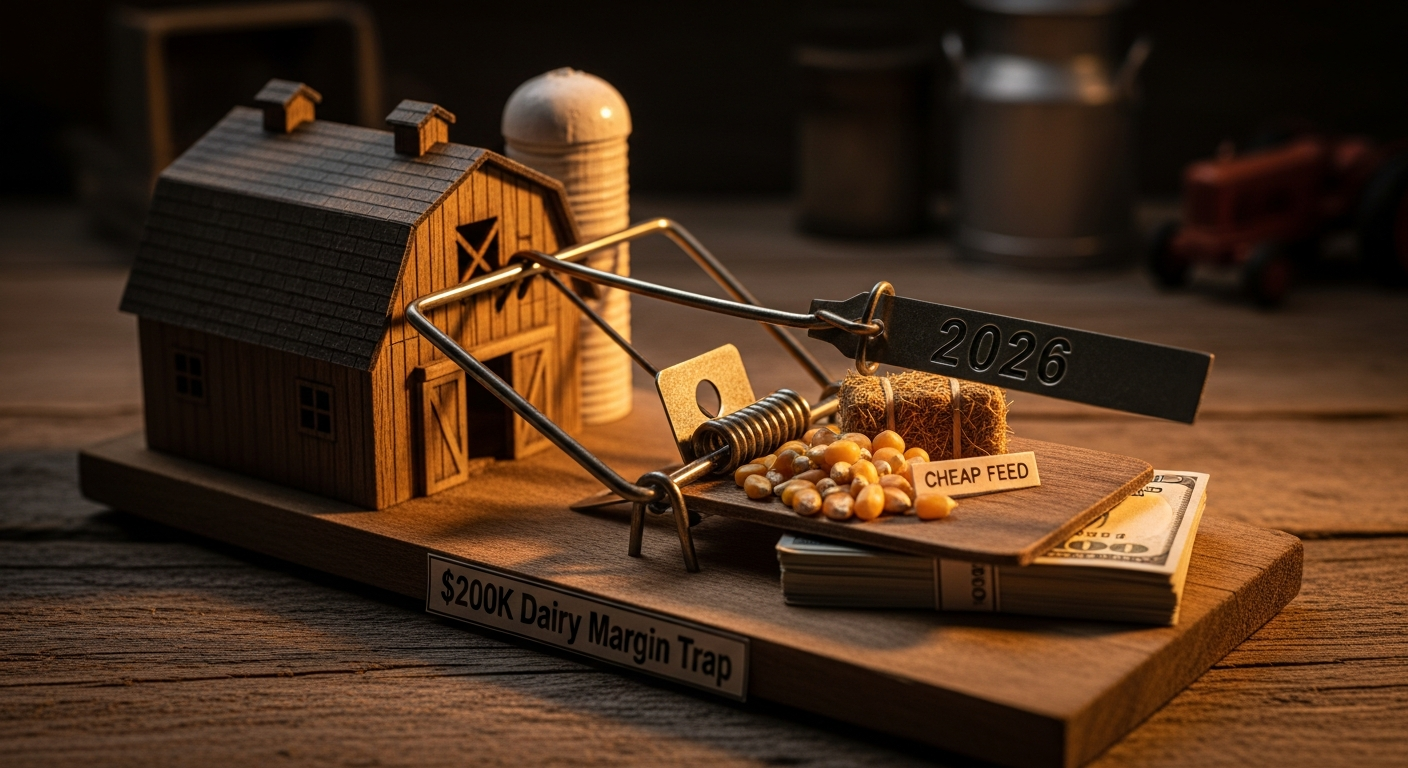
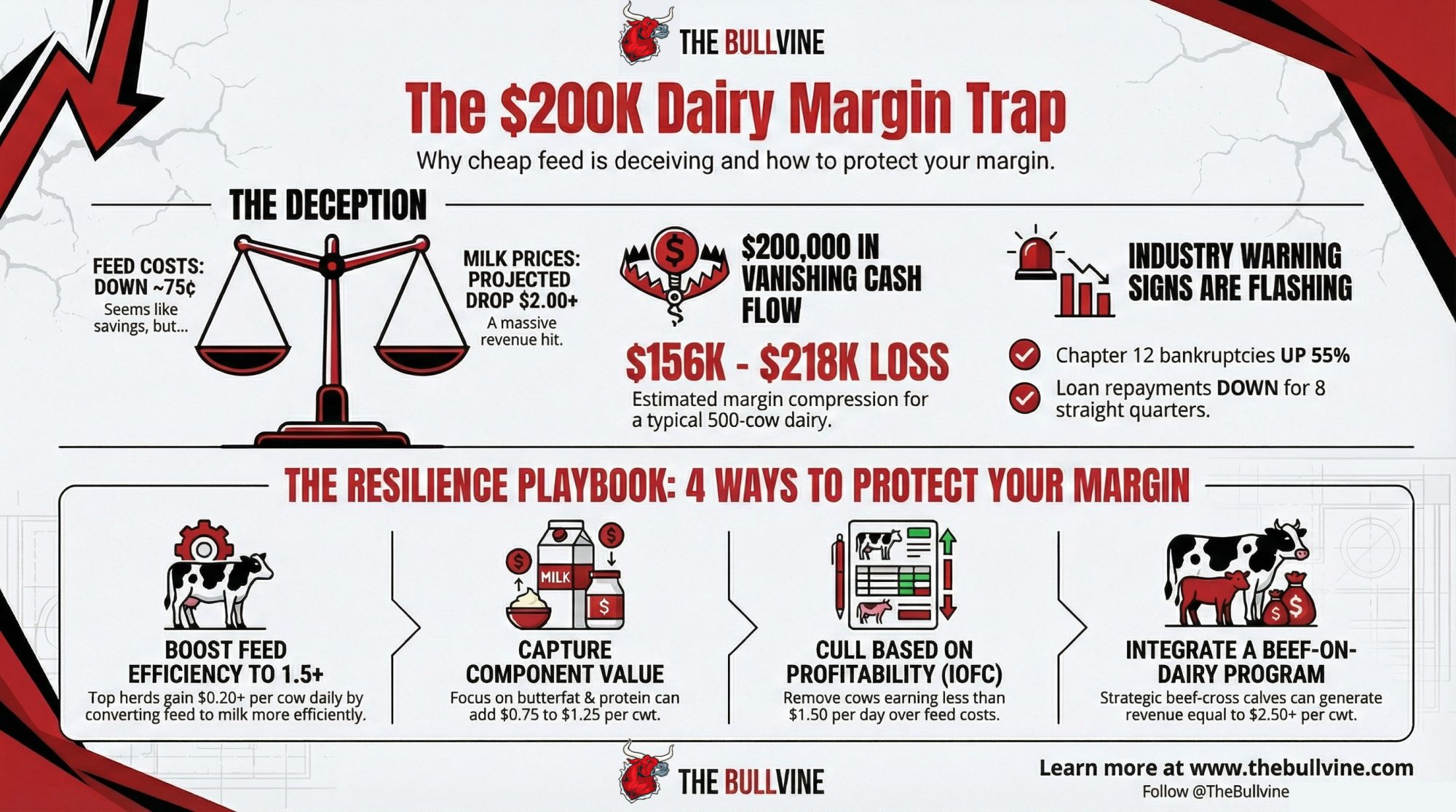
EXECUTIVE SUMMARY: Everyone’s celebrating cheap corn—but the math tells a different story. USDA projects 2026 milk at $19.25/cwt while feed costs have dropped only modestly, creating net margin compression of $1.25-1.75/cwt—that’s $156,000 to $218,000 in lost cash flow for a 500-cow dairy. New Zealand’s lowest-cost producers see what’s coming: they paid down $1.7 billion in debt this year rather than expand. Top U.S. operators are responding with feed efficiency gains, component optimization, IOFC-based culling, and beef-on-dairy programs that can protect $1.50+ per cow daily. With Chapter 12 bankruptcies up 55% and ag lenders reporting eight straight quarters of declining repayment rates, the window for strategic positioning is narrowing. The question isn’t whether margins compress in 2026—it’s whether you’ll position your operation before they do.
You know that feeling when everything looks fine on paper, but something in your gut says otherwise?

It’s the kind of conversation happening at kitchen tables across dairy country right now. The milk check looks okay—maybe even decent by recent standards. Feed costs have come down. The cows are milking well.

And yet something feels off.

That instinct isn’t wrong.

The FAO has been tracking global food prices for decades, and its November numbers tell an interesting story. The overall Food Price Index has dropped for three consecutive months, and the dairy sub-index has declined for five straight months.

New Zealand just posted a 17.8% production surge in their early season, according to their Dairy Companies Association data. U.S. milk output keeps climbing, too.

What’s worth understanding—and this is something many of us tend to underestimate—is the timeline between when these global signals show up and when they hit our milk checks.

Generally speaking, we’re looking at about six to eight months.

So the softening that started this fall? It’s likely showing up in Q2 and Q3 2026 checks.

Mark Stephenson, who spent years as Director of Dairy Policy Analysis at the University of Wisconsin-Madison before his recent retirement, studied these price transmission patterns extensively throughout his career. His research documented this lag across multiple market cycles.

The movement in international powder and butter prices isn’t really a question of whether it affects domestic markets—it’s more about when and how much.

USDA’s November World Agricultural Supply and Demand Estimates projects the all-milk price at $19.25 per hundredweight for 2026. That’s a meaningful change from the $22-24 range that many operations built their budgets around during stronger periods.

So what are the producers who’ve navigated these cycles before actually doing about it?

The Feed Cost Conversation That’s Missing Something

Walk into any farm supply store or dairy meeting right now, and you’ll hear some version of the same reassurance: “At least feed costs are down.”

And that’s true.

Corn is trading around $4.37 per bushel on the Chicago Board of Trade as of early December. Soybean meal is running around $310-$315 per ton. The DMC feed cost calculation is in a favorable territory compared to recent years—no question about that.

But here’s what that conversation often leaves out.

When milk prices were $22.75, and feed costs were about $11.00 per hundredweight, producers captured roughly $11.75 in income over feed costs.

Run the same math with 2026 projections—$19.25 milk and lower feed costs—and that margin still compresses to around $9.00.

Feed improved by maybe seventy-five cents. Milk dropped by more than two dollars.

The net effect is still a $1.25 to $1.75 per hundredweight margin compression for most operations.
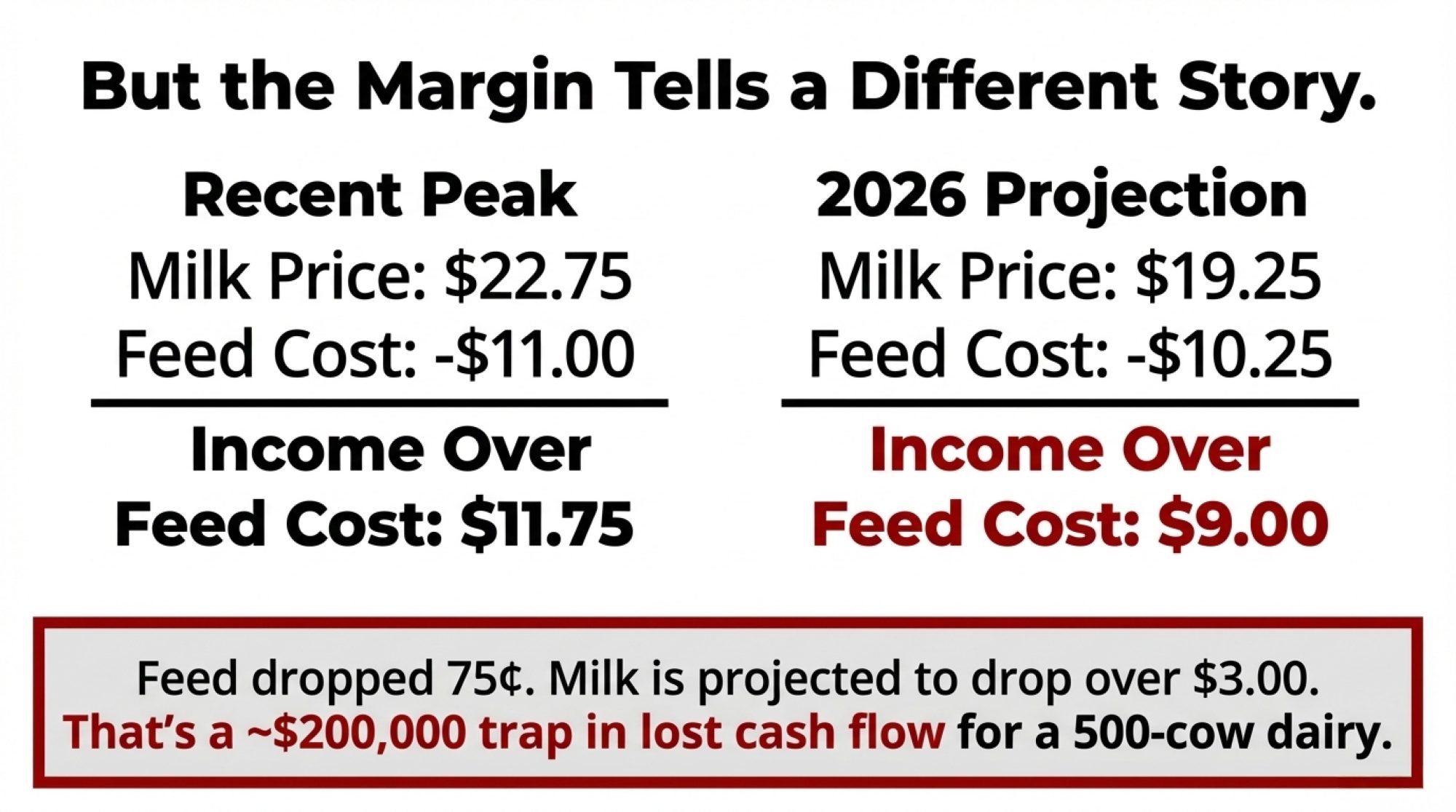
On a 500-cow dairy producing 125,000 hundredweight annually, that’s $156,000 to $218,000 in reduced cash flow. Real money that has to come from somewhere—whether that’s reduced family living, deferred maintenance, or tighter input decisions.

Michael Dykes, who leads the International Dairy Foods Association as their President and CEO, put it well in a recent industry briefing. Lower feed costs are helpful, no question, but they’re best understood as breathing room to make strategic moves—not as a solution to margin pressure.

I recently spoke with an Upper Midwest nutritionist who put it more directly:

“I’ve got producers telling me they’re holding off on decisions because corn is cheap. That’s exactly backwards. Cheap corn is the opportunity to lock in favorable feed contracts and build some cushion—not permission to wait and see what happens.”

The timing matters here.

Producers who lock in Q1 and Q2 2026 feed contracts now, while basis levels remain favorable, capture that advantage regardless of what happens to spot markets later. Those who wait may find the window has closed.

It’s worth running the numbers with your feed supplier at a minimum.

What’s Actually Happening in Export Markets

The China situation deserves more attention than it typically gets in domestic dairy discussions, even for producers who don’t think of themselves as export-dependent.

Why does this matter to all of us? The economics tell the story.

The current reality is pretty stark.

U.S. dairy products face total tariffs of 84 to 125 percent in China following the trade escalation that peaked in April 2025—China’s Ministry of Finance and Reuters covered this extensively at the time.

New Zealand, by contrast, completed their Free Trade Agreement phase-in on January 1, 2024, and now ships dairy to China at zero percent tariff.

The market share shift has been significant.

While exact percentages shift quarter to quarter, the direction is clear: New Zealand has captured the lion’s share of China’s powder imports while U.S. product faces what amounts to a prohibitive tariff wall.

That displaced volume didn’t disappear—it backed up into domestic markets.

Even producers selling exclusively to domestic processors feel this effect, as Mary Ledman at Rabobank has pointed out in her global dairy market analysis. She’s been tracking these patterns as their Global Dairy Strategist for years now.

When export channels close, that milk has to go somewhere. It adds supply pressure that affects everyone, even if indirectly.

The regional effects aren’t uniform, though.

California and Idaho operations—traditionally more export-oriented through Pacific Rim trade—feel this more acutely than Upper Midwest producers whose milk flows primarily into domestic cheese markets.

I spoke with a Wisconsin cheesemaker recently who said his plant’s order book looks fine through mid-2026, but he’s watching West Coast capacity closely because displaced milk eventually tends to find its way east.

What’s particularly noteworthy is how New Zealand producers are responding to their advantageous position.

Despite favorable prices and strong production conditions, Kiwi farmers repaid NZ$1.7 billion in debt in the six months through March 2025 rather than expanding. ANZ Bank and New Zealand’s rural news outlets have been tracking this closely.

When the world’s lowest-cost producers choose balance sheet repair over growth during historically good times… well, it suggests they’re preparing for extended market softness.

That’s a signal worth paying attention to.

Reading the Financial Signals

Several data points help distinguish what’s happening now from typical cyclical patterns.
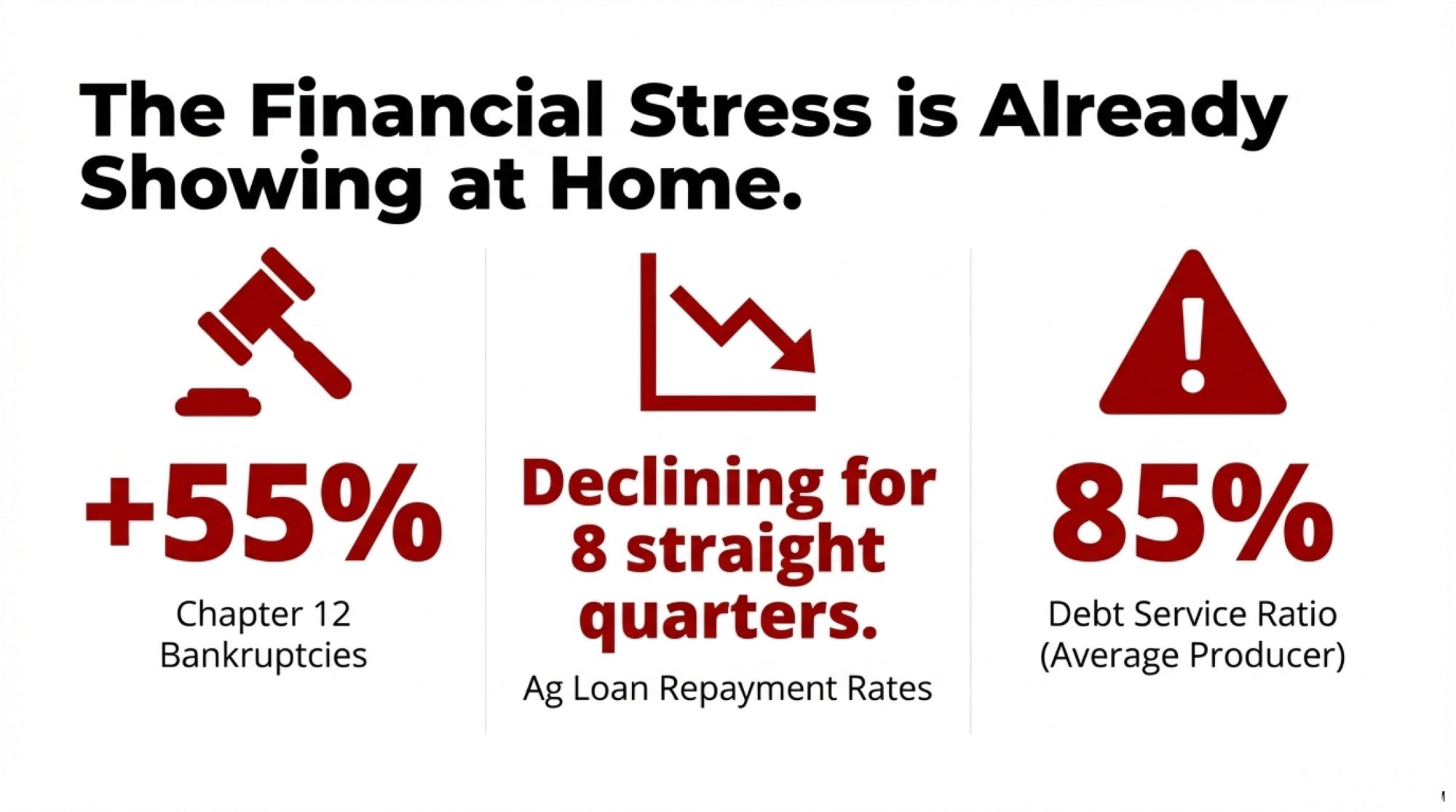
Chapter 12 farm bankruptcy filings—the specialized bankruptcy provision for family farmers—hit 216 cases in 2024, up 55 percent from the prior year. The American Farm Bureau Federation has been tracking federal court records on this, and the first half of 2025 saw additional filings running well ahead of 2024’s pace.

Context matters here. Bankruptcy filings alone don’t tell the whole story—they can reflect access to legal resources, regional legal practices, and individual circumstances as much as broad economic conditions.

But the trend is notable.

Geographic patterns show particular stress in California, Iowa, Michigan, Kansas, and Wisconsin—a mix of traditional dairy regions and areas affected by specific challenges, such as avian influenza and water constraints.

Debt service coverage ratios tell a related story.

Farm Progress recently reported on data from the Minnesota FINBIN farm financial database showing that the average producer had a concerning coverage ratio of around 85 percent in 2024—meaning operations were generating only 85 cents for every dollar of debt service obligation.

The remaining gap has to come from equity drawdown, off-farm income, or loan restructuring.

What concerns many lenders is the compounding effect.

Interest costs have roughly doubled over the past three years as rates have reset. An operation that was comfortable at 3.5 percent interest faces a completely different equation at 7.5 percent—as many of us have experienced firsthand.

The Federal Reserve Bank of Chicago’s Q3 2025 agricultural credit survey found 38 percent of banks reporting lower repayment rates—the eighth consecutive quarter of deterioration. More than two-thirds of lenders expect farmland values to flatten or decline in 2026.

None of this predicts any individual operation’s future—every farm has its own circumstances, strengths, and challenges.

But it does suggest the industry overall is experiencing stress levels that reward careful financial planning over optimistic assumptions.

The Expansion Paradox

One of the more counterintuitive aspects of current markets—and something I find genuinely interesting to think through—is why production keeps growing despite weakening price signals.

The biological reality is that dairy expansion decisions made two to three years ago are just now showing up in production numbers.

Heifers conceived in early 2023 are entering milking strings in late 2025. Facilities that broke ground during strong margins in 2023 and 2024 are now completing and being populated.

Once those commitments are made—once the cows are bred, raised, and the facilities built—the production is essentially locked in.

Debt service creates similar momentum.

Operations carrying expansion loans need to maintain production to meet their obligations. Reducing herd size often costs more than continuing to milk at marginal profitability, especially when the alternative is triggering loan covenant violations.

Christopher Wolf, the E.V. Baker Professor of Agricultural Economics at Cornell, has written thoughtfully about this dynamic. The economics of stopping are often worse than the economics of continuing.

That’s not irrational behavior—it’s responding logically to the debt structure and fixed-cost reality that exist in most operations.

Processing capacity investment adds another layer.

More than $11 billion in new U.S. dairy processing capacity is under construction or recently completed—IDFA released a detailed report in October covering 50-plus projects across 19 states.

That processing investment creates a regional demand pull that can support local expansion even when broader markets are oversupplied. A producer within hauling distance of a new plant in Dodge City or along the I-29 corridor faces different economics than one in a region without recent processing investment.

I’ve been hearing about this regional divide increasingly this season.

In Texas and New Mexico, where several major cheese and powder facilities have opened or expanded, local producers report being actively recruited with multi-year contracts.

Meanwhile, some Northeast producers describe tighter relationships with their cooperatives—fewer premium opportunities and more pressure on base pricing.

Same industry, very different regional realities.

What Successful Producers Are Doing Differently

Conversations with producers navigating current conditions successfully reveal consistent patterns. These aren’t revolutionary changes requiring massive capital—they’re an intensified focus on fundamentals.
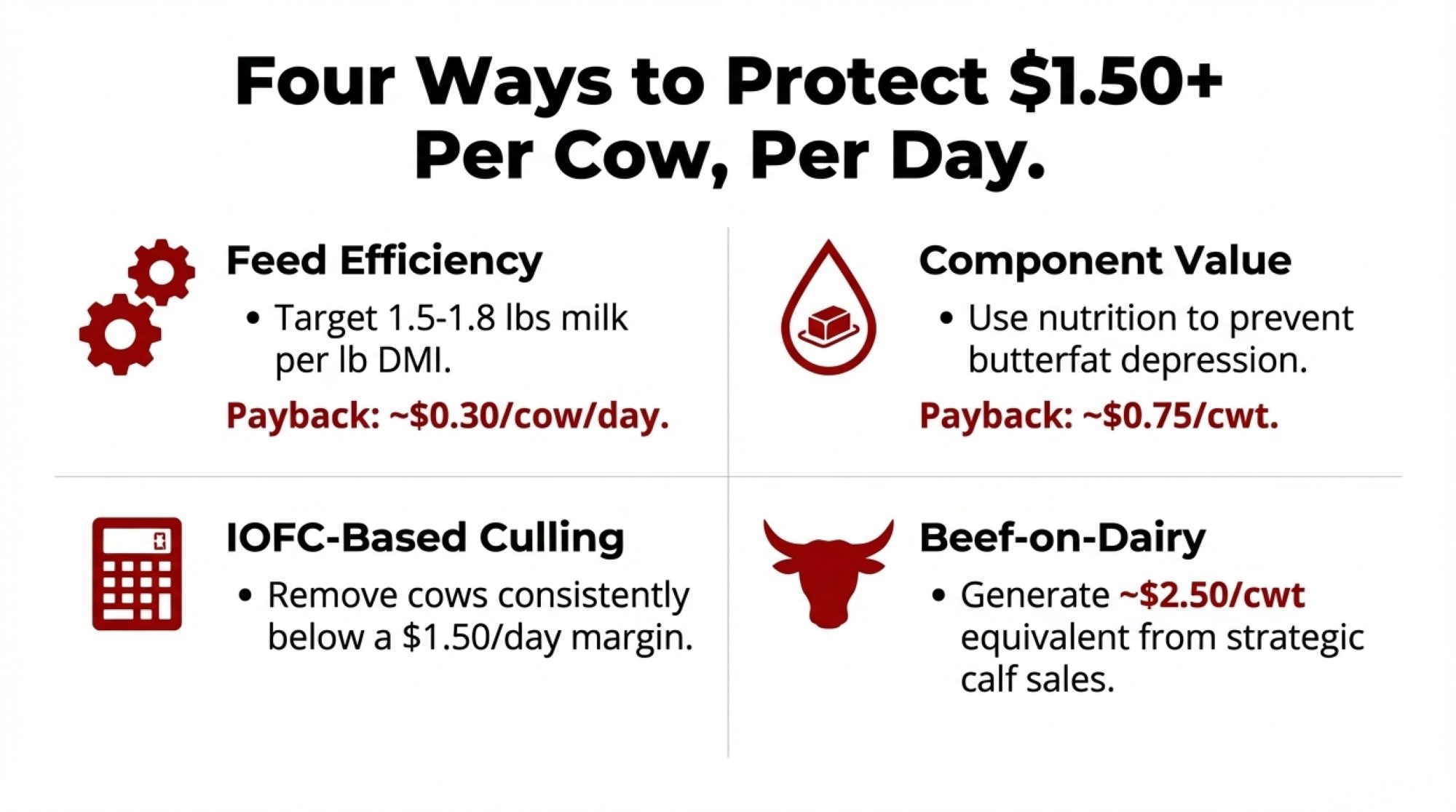
1. Feed Efficiency Optimization

Top-performing herds are achieving feed efficiency ratios of 1.5 to 1.8 pounds of milk per pound of dry matter intake. The industry average sits around 1.4.

The Impact: Each tenth of a point improvement translates to roughly $0.20 to $0.30 per cow/day in margin enhancement.

The Tactic: Weekly NIR analysis on forages (~$15/sample) allows for immediate ration adjustments, rather than guessing between monthly tests.

I recently spoke with a Wisconsin producer who started as a custom heifer raiser before transitioning to his own milking herd. He described implementing weekly NIR testing on every forage load.

“The payback is maybe ten to one in ration accuracy,” he said. “We were basically guessing before.”

Most producers I’ve talked with see measurable results within 45 to 60 days—though individual results vary based on starting point and forage variability.

2. Component Value Capture

Producers focusing on butterfat performance and protein levels report capturing an additional $0.75 to $1.25 per hundredweight compared to volume-focused approaches.

The Tactic: Using rumen-protected choline during transition periods and summer heat stress (~$0.08/cow/day) to prevent butterfat depression.

The genetic piece is a longer-term play—daughters of high-component sires won’t hit the milking string for two-plus years—but the nutritional interventions can show results within a milk test cycle or two.

Worth having a conversation with your nutritionist about current ration fatty acid profiles and where component optimization opportunities might exist for your herd.

3. Strategic Culling Based on IOFC

Rather than culling primarily based on age, reproduction metrics, or production levels, progressive operations calculate income over feed cost for each cow and move out animals that are consistently below $1.50 per cow daily.

The Shift: “A seven-year-old cow giving 60 pounds might look fine on paper,” one herd manager at a 1,200-cow Minnesota dairy told me. “But when you run her actual IOFC with her feed intake and health costs, she’s sometimes underwater. We’re making decisions on math now, not sentiment.”

For operations without individual cow feed intake data (which is most of us), pen-level IOFC calculations still identify which groups are carrying the herd versus dragging it down.

Most herd management software can generate these reports with minimal setup.

4. Beef-on-Dairy Integration

Producers systematically breeding bottom-tier genetics to beef sires report equivalent revenue of $2.50+ per hundredweight from crossbred calf sales.

The Math: A straight Holstein bull calf might bring $150. A beef-cross brings $1,000 or more based on current USDA feeder cattle reports.

The Genetics Play: Use genomic testing or breeding values to identify the bottom 20-30% of your herd’s genetic merit. Breed those animals to proven beef sires with good calving ease scores, and establish buyer relationships before calves hit the ground.

This is where your genomic data becomes a direct revenue driver—not just a breeding tool.

Operations that treat beef-on-dairy as an afterthought leave money on the table compared to those who plan the program strategically.

The Emerging Structure: Two Viable Paths

Looking at where the industry appears headed over the next three to five years, a structural pattern is emerging that’s worth understanding—even if it raises uncomfortable questions.
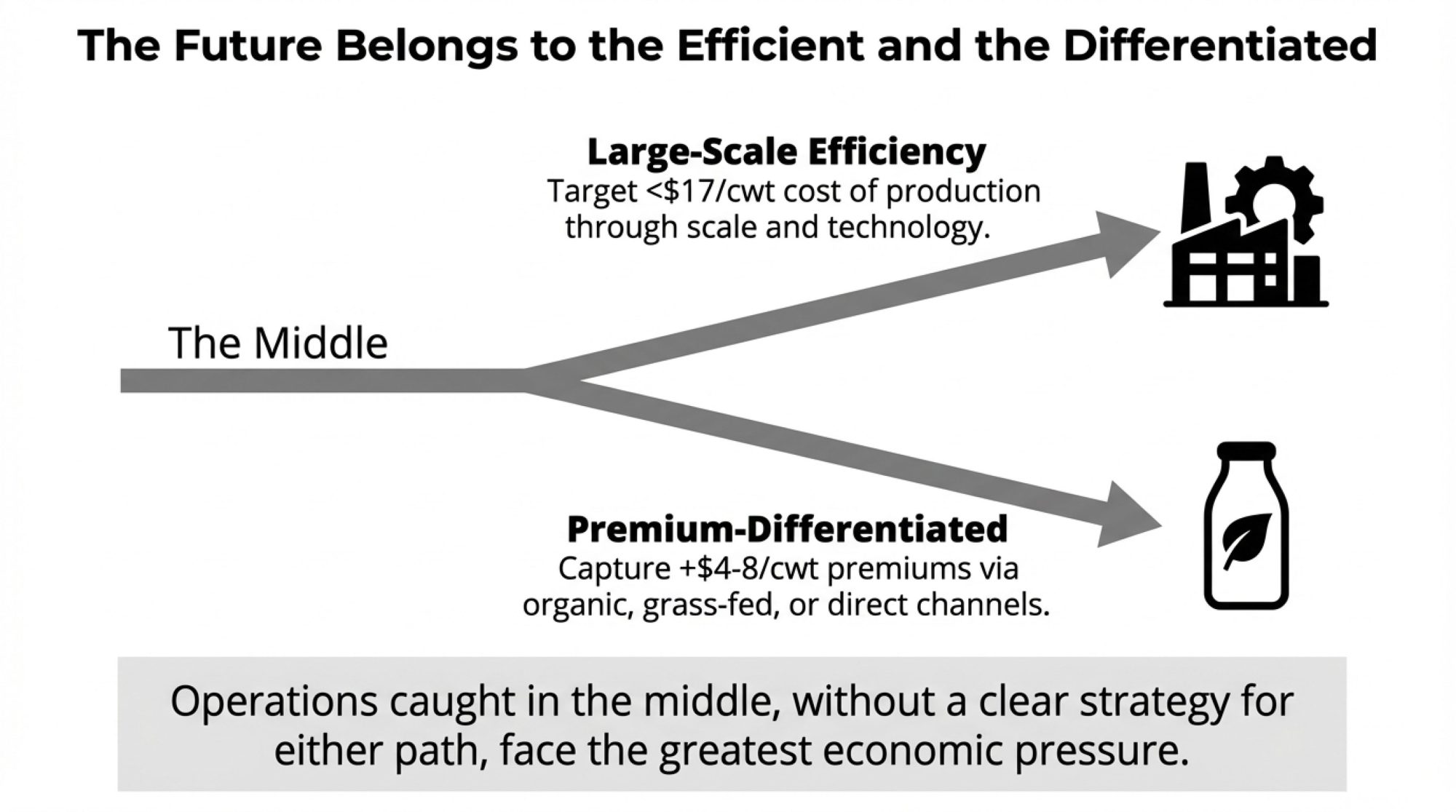
The data increasingly suggests two economically viable models:

Large-scale efficiency operations—generally 1,500 cows and above—achieving production costs in the $14 to $17 per hundredweight range through scale economics, technology adoption, and processing relationships.

USDA’s Economic Research Service cost-of-production data confirms that this scale advantage has widened over the past decade. Many of these operations use dry-lot systems or hybrid facilities to maximize throughput efficiency.

Premium-differentiated operations—typically 50 to 500 cows—capturing $4 to $8 per hundredweight premiums through organic certification, grass-fed positioning, or direct-to-consumer channels.

These require proximity to metro markets and significant transition investment, but create a margin cushion independent of commodity prices.

Operations in the middle face the most challenging economics under the current market structure.

This isn’t a judgment about the value of family-scale dairy farming or the communities these farms anchor. It’s an observation about where the current market structure creates clearer paths forward.

Regional variation matters significantly.

A 300-cow dairy in Vermont with Boston market access faces different options than a similar-sized operation in central Wisconsin without nearby premium channels.

A Framework for Evaluation

For producers working through these questions—and most of us are—several considerations help clarify the path forward.

For operations considering expansion:

  • Is there processing capacity within 200-300 miles actively seeking suppliers?
  • Is replacement heifer availability realistic? National inventory sits at roughly 3.9 million dairy replacement heifers 500 pounds and over—the lowest absolute level since 1978, according to USDA’s January 2025 Cattle report. The heifer-to-cow ratio of 41.9% is the lowest since 1991.
  • Can production costs realistically reach sub-$17 per hundredweight at expanded scale?
  • What do debt service requirements look like at current interest rates, not 2021 rates?

For operations considering premium positioning:

  • Is there a metro market within a reasonable distance with demonstrated premium demand?
  • What’s the realistic timeline? Organic certification alone typically takes three years under USDA National Organic Program rules.
  • Does the land base and climate support pasture-based systems?
  • Is there family interest in direct marketing relationships?

For operations evaluating the current position:

  • What’s the actual debt service coverage ratio at projected 2026 milk prices?
  • When do loans mature, and at what interest rate reset?
  • Has the processor offered multi-year supply contracts?
  • What’s the true breakeven with full cost accounting—including family labor and reasonable return on equity?

These aren’t comfortable questions.

But they’re better asked now than answered by circumstances later.

The Timing Reality

One thread runs through conversations with producers, lenders, and analysts who’ve navigated previous downturns: timing matters more than most people acknowledge.

Producers who assess their position and make strategic decisions during 2025 and early 2026—while milk prices are still serviceable, while cull cow prices remain historically strong—retain meaningfully more options than those who wait.
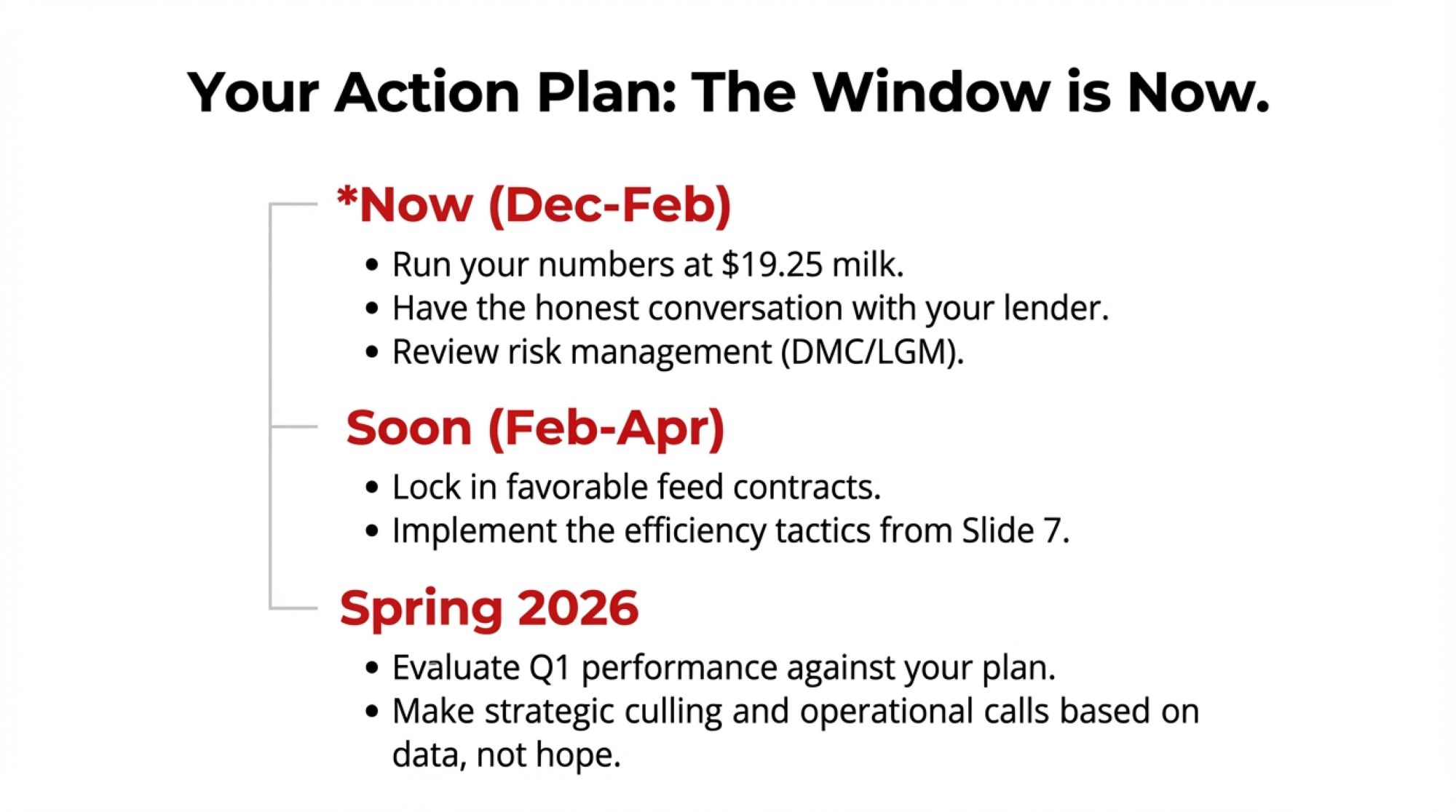
December through February: Run your real numbers. Calculate the actual DSCR at $19.25 milk. Have the honest conversation with your lender—most good lenders appreciate proactive communication.

This is also the window for DMC enrollment decisions. If you haven’t reviewed your coverage levels against projected margins, now’s the time. LGM-Dairy is worth a conversation with your insurance agent, too, especially for operations wanting more flexible coverage options.

February through April: Make feed decisions. Lock contracts if the math works. Implement efficiency improvements that deliver results by summer.

Spring 2026: Evaluate first-quarter performance against projections. Adjust culling strategy based on actual margins. Make the bigger strategic calls with real data rather than hope.

The Bottom Line

The dairy industry has navigated challenging transitions before, and it will again.

The producers who came through previous cycles strongest were generally those who saw conditions clearly, made decisions based on their specific circumstances, and acted while they still had choices.

That window is open now.

The question is what each of us does with it.

The Bullvine provides market analysis and industry perspective for dairy producers worldwide. This article reflects conditions and data available as of early December 2025. Individuals should consult their own financial advisors, lenders, and Extension specialists when making significant business decisions. Every farm’s situation is unique, and the right path forward depends on factors only you and your advisors can fully evaluate.

KEY TAKEAWAYS

  • The Trap: Feed dropped 75¢. Milk dropped $2. That’s not savings—that’s $200K in vanishing cash flow for a 500-cow dairy.
  • The Global Signal: NZ farmers paid down $1.7 billion in debt instead of expanding. The world’s lowest-cost producers expect extended softness.
  • The Warning Signs: Chapter 12 bankruptcies up 55%. Ag loan repayments have been declining for 8 quarters straight. Financial stress is accelerating.
  • What Top Producers Are Doing: Capturing $1.50+/cow/day through feed efficiency, component optimization, IOFC-based culling, and beef-on-dairy integration.
  • The Window Is Now: Cull values are strong. Milk checks are still serviceable. Lenders are still flexible. Make strategic decisions while you still have options.

Complete references and supporting documentation are available upon request by contacting the editorial team at editor@thebullvine.com.

Learn More:

  • The $700 Truth: Your Best Milkers Are Your Worst Investment – Reveals why high-volume cows often lose $3/day in actual margin and demonstrates how to use Residual Feed Intake (RFI) data to identify the true profit-drivers in your herd.
  • The $228,000 Exit Strategy Reshaping Dairy – Uncovers the “Section 1232” tax provision behind the recent surge in Chapter 12 filings, explaining how strategic bankruptcy is helping retiring producers preserve equity rather than losing it in traditional sales.
  • Robot Revolution: Why Smart Dairy Farmers Are Winning – Analyzes the 2025 ROI of automated milking systems beyond simple labor savings, providing a blueprint for the “efficiency-at-scale” model that allows family operations to compete with larger consolidators.

Join the Revolution!

Join over 30,000 successful dairy professionals who rely on Bullvine Weekly for their competitive edge. Delivered directly to your inbox each week, our exclusive industry insights help you make smarter decisions while saving precious hours every week. Never miss critical updates on milk production trends, breakthrough technologies, and profit-boosting strategies that top producers are already implementing. Subscribe now to transform your dairy operation’s efficiency and profitability—your future success is just one click away.

NewsSubscribe
First
Last
Consent

Feed Cost Reality Check: How Smart Dairy Operators Can Lock in $200+ Per Cow Savings While Markets Stay Predictable

Your nutritionist is costing you $200+ per cow annually. USDA projects stable feed costs through 2026—time to challenge protein dogma.

EXECUTIVE SUMMARY: While dairy farmers celebrate stable corn prices at $4.39/bushel, most operations are still overpaying for protein and missing the biggest procurement opportunity in years. The USDA’s June 2025 projections show feed cost predictability through 2026 with corn forecast at $4.20/bushel, but research reveals that conventional soybean meal sourcing is costing operations $200+ per cow annually compared to strategic alternatives like canola meal. Hoard’s Dairyman research demonstrates canola meal delivers 9.8 pounds daily milk yield increases compared to soybean meal diets, while precision feeding technology reduces costs by 5-10% without sacrificing production. The biofuel boom driving soybean crush demand to 2.49 billion bushels creates unprecedented opportunities in undervalued protein sources that nutritional models consistently misprize. Operations using individual cow feed intake monitoring achieve efficiency improvements worth $470 per cow annually, yet 78% of precision feeding installations focus solely on delivery without tracking metabolic responses. With replacement heifer inventories at a 47-year low and renewable diesel capacity surging from 791 million gallons in 2021 to 4.58 billion gallons currently, smart operators are challenging conventional protein sourcing while grain markets broadcast their intentions. Stop following nutritional dogma designed for volatile markets—this stability window rewards contrarian thinking that compounds competitive advantages when volatility inevitably returns.

KEY TAKEAWAYS

  • Challenge the Protein Premium Myth: Canola meal delivers 9.8 pounds daily milk yield increases over soybean meal while trading at significant discounts, yet most nutritionists still recommend expensive conventional proteins despite research proving superior metabolizable protein efficiency
  • Implement Precision Feed Efficiency Monitoring: Operations using individual cow feed intake tracking achieve $470 per cow annual savings through profit-based culling decisions, while blood biomarker monitoring predicts feed efficiency 40% more accurately than traditional residual feed intake calculations
  • Capitalize on the Feed Cost Stability Window: With corn forecast at $4.20/bushel through 2026 and soybean crush demand hitting 2.49 billion bushels, forward contract 60-70% of feed needs while corn trades below $4.60/bushel to lock in predictable margins
  • Optimize Alternative Protein Sourcing: Strategic forage substitutions reduce diet costs from $0.543 to $0.465 per kg dry matter (14.4% reduction) while maintaining production efficiency, translating to $180-220 annual savings per cow for 1,000-cow operations
  • Leverage Technology Integration During Market Calm: Precision feeding systems combined with metabolic monitoring achieve feed efficiency ratios of 1.5-1.8 pounds milk per pound DMI compared to 1.2-1.4 for conventional systems, with 15-20% productivity gains and 30% reduction in health-related expenses
dairy feed costs, feed efficiency optimization, dairy farm profitability, grain market stability, precision feeding technology

Your nutritionist is costing you $200+ per cow annually by following industry protein dogma, while grain markets broadcast the biggest stability window in years. The USDA’s June 2025 projections show corn at $4.20 per bushel through 2026, but only operations brave enough to challenge conventional feed wisdom will capture the real profit opportunity hiding in plain sight.

Why Every Dairy Manager Should Be Moving Fast

You know that feeling when corn futures spike 15% overnight, and suddenly your total mixed ration (TMR) costs are eating into margins faster than a fresh cow drops milk fat percentage? Well, take a breath. The USDA’s June 2025 World Agricultural Supply and Demand Estimates just handed you something rarer than a 4.5% butterfat herd average – predictable feed costs through the next crop year.

With feed representing 50-60% of your milk production costs and the average U.S. dairy operation now running 337 cows per herd, this stability translates to real money. But here’s what’s keeping smart operators awake: this calm won’t last forever. According to USDA data, replacement heifer inventories have dropped to a 47-year low of just 3.91 million head.

But here’s the controversial truth most nutritionists won’t tell you: While everyone’s celebrating stable corn prices at $4.39 per bushel, you’re probably still overpaying for protein and missing the biggest profit opportunity in feed procurement.

Challenging the Protein Premium Myth: What USDA Data Really Shows

Let’s cut through the industry’s most expensive myth first. The USDA’s latest soybean crush projections show domestic crush demand jumping 70 million bushels to 2.49 billion bushels in 2025-26, driven by renewable diesel production consuming 13.9 billion pounds of soybean oil.

Here’s what your nutritionist isn’t telling you: This biofuel boom artificially inflates soybean meal prices while creating unprecedented opportunities in alternative protein sources that nutritional models consistently undervalue.

Research from demonstrates that canola meal enhances early lactation milk production, with studies showing milk yield increases of 9.8 pounds per day for cows fed canola meal-based diets compared to soybean meal-based diets. This gain was accompanied by only a 1.9 pounds per day increase in dry matter intake, delivering superior feed efficiency.

Why this matters now: With corn forecast at $4.20 per bushel and stable supplies projected through 2026, you’re looking at feed costs that won’t break your budget – but only if you stop overpaying for conventional protein sources.

The Journal of Dairy Science research on corn silage and alternative forage combinations reveals that strategic forage substitutions can reduce diet costs from $0.543 to $0.465 per kg dry matter while maintaining production efficiency. That’s a 14.4% reduction in feed costs per unit – translating to $180-220 annual savings per cow for a 1,000-cow operation.

The Feed Efficiency Scandal: Why Your Metrics Are Lying

Every dairy consultant preaches residual feed intake (RFI) as the gold standard for feed efficiency. But, research published in the Journal of Dairy Research reveals that feed efficiency relationships differ significantly between Holstein and Jersey cows, with individual-level correlations between feed efficiency and behavior traits being stronger in Jersey than in Holstein cows.

The problem with conventional efficiency metrics is that they measure efficiency after metabolic damage has already been done. Breakthrough technology now identifies individual cow feed efficiency, with recent estimates indicating that an improvement in herd feed efficiency from 1.55 to 1.75 would equate to savings of $470 per cow per year.

What smart operators do instead: Monitor individual cow feed intake using precision technology. Operations using Afimilk’s AfiCollar Feed Efficiency Service report that combining production and feed intake data enables profit-based culling decisions that contribute about $1.2 million to the bottom line of a 2,500 cow dairy.

Technology Integration: Maximizing Feed Efficiency While Costs Stay Predictable

The dairy tech revolution is perfectly positioned to capitalize on this feed cost stability window. Farms implementing IoT technologies see 15-20% productivity gains while reducing health-related expenses by 30%.

Precision feeding technology enables customized nutrition plans that maximize production while minimizing waste, with advanced feeding systems typically reducing feed costs by 5-10% while maintaining or improving milk production.

The productivity gains are remarkable: GEA reports that after installing their DairyFeed F4500 feeding robot, milk production jumped from 28 to 36 liters per cow per day, eliminating competition at the feeding table and ensuring fresh feed access for all animals.

Global Market Dynamics: Your Geographic Feed Advantage

Not all dairy regions benefit equally from this grain market calm. The USDA data shows that while Brazil projects record 175 million metric tons of soybean production and corn at 130 million metric tons, U.S. operations benefit from stable domestic supply chains.

If you’re operating in grain-producing regions, this stability provides significant competitive advantages. Analysts project that lower feed prices will bolster 2025 margins, with corn and soybean meal futures trading near $4.47 per bushel and $291 per ton, respectively, on the CME.

The global context matters: U.S. corn exports are running at 97.2% of USDA’s forecast, well ahead of the five-year average of 91.3%, while domestic renewable diesel capacity has surged from 791 million gallons per year in 2021 to 4.58 billion gallons currently.

Implementation Strategy: Your 90-Day Action Plan

Month 1: Contract Strategy Assessment Contact your feed supplier to discuss forward contracting options for the next 12 months. With corn forecast at $4.20 per bushel and stable supplies projected, successful operations typically contract 60-70% of their feed needs when corn trades below $4.60 per bushel.

Month 2: Alternative Protein Evaluation
Work with your nutritionist to evaluate canola meal substitution strategies. Research demonstrates that canola meal can enhance early lactation performance with 9.8 pounds per day milk yield increases compared to soybean meal diets.

Month 3: Precision Technology Integration Evaluate feed efficiency monitoring systems. Operations using individual cow feed intake monitoring achieve feed efficiency improvements worth $470 per cow annually.

Risk Management: What Smart Operators Can’t Ignore

Weather remains the ultimate wild card. The USDA projects corn ending stocks of 1.365 billion bushels for 2024-25, down 50 million bushels from previous estimates due to stronger export demand. Regional challenges, including flooding in eastern Texas and planting delays in the Ohio Valley, haven’t disrupted national production yet, but they’re warning signs.

The renewable diesel boom driving soybean demand depends on policy support that could change. While current projections support stable feed costs through 2026, policy uncertainty could introduce volatility into currently stable demand patterns.

The Bottom Line

Remember when feed cost spikes forced you to compromise milk production for survival? You’re currently in the opposite scenario – USDA projections showing corn at $4.20 per bushel with record production potential, while industrial demand keeps protein costs supported but predictable.

The uncomfortable truth is that most operations are still following nutritional dogma that costs them $200+ per cow annually. Research proves canola meal delivers superior early lactation performance with 9.8 pounds daily milk yield gains, while precision feeding technology reduces costs by 5-10% without sacrificing production.

Smart dairy operators are using this window to challenge conventional protein sourcing, implement precision feeding systems, and capture feed efficiency improvements worth $470 per cow annually. 2025 margins will benefit from lower feed prices, but only operations that optimize efficiency will maintain competitive advantages when markets eventually tighten.

Your move right now: Stop following conventional wisdom designed for volatile markets. Contact your nutritionist this week to discuss canola meal evaluations and precision feeding implementation. When grain markets return to their usual volatility, you’ll manage from a position of strength instead of reacting to crisis.

The difference between thriving and surviving in 2025 may come down to how you leverage this rare period of feed market calm to implement contrarian strategies that compound competitive advantages. The stability window is open – make your move while certainty is still on the table.

Learn More:

Join the Revolution!

Join over 30,000 successful dairy professionals who rely on Bullvine Weekly for their competitive edge. Delivered directly to your inbox each week, our exclusive industry insights help you make smarter decisions while saving precious hours every week. Never miss critical updates on milk production trends, breakthrough technologies, and profit-boosting strategies that top producers are already implementing. Subscribe now to transform your dairy operation’s efficiency and profitability—your future success is just one click away.

NewsSubscribe
First
Last
Consent

FEED EFFICIENCY BOMBSHELL: Yeast Additives Expose the Truth About High-Starch Dairy Diets

Research bombshell: Yeast additives increased feed intake by 7.5% and doubled breeding success, while conventional nutritionists kept pushing the wrong solutions.

EXECUTIVE SUMMARY: New research from leading universities demolishes conventional wisdom about high-starch dairy diets, revealing that proper yeast supplementation can dramatically increase feed intake, milk production, and reproductive performance. The March 2025 Purdue University study demonstrated that yeast supplementation boosted intake to 33.2 kg/d (versus just 30.9 kg/d in control groups). University of Wisconsin research documented a remarkable 50% improvement in first-service conception rates. These benefits translate to substantial financial returns, with researchers reporting a 5:1 ROI during heat stress conditions—improvements many nutritionists overlook despite compelling scientific evidence. Progressive dairy operations implementing strategic yeast supplementation are capturing these hidden profits while others continue with conventional approaches that leave thousands in potential earnings untapped.

KEY TAKEAWAYS

  • Dose matters critically: The optimal 10g/day supplementation level yielded substantially better results than both lower (5g) and higher doses, making proper implementation essential.
  • Beyond production: While milk production increases are significant (up to 3.5 kg/cow/day), the reproductive benefits (39% vs. 26% first-service conception) may ultimately deliver even more important financial returns
  • Heat stress solution: During hot weather, yeast supplementation raised rumen pH by 0.34 units, improved feed efficiency by 7.6%, and delivered a documented 5:1 return on investment
  • Implementation factors: Results vary based on existing diet composition, current rumen health status, environmental conditions, and forage quality—with struggling herds often showing the most dramatic improvements
  • Financial impact for 500-cow dairy: The potential for 1,750 additional kg of milk daily combined with improved reproductive performance and feed efficiency represents one of dairy nutrition’s highest-return investments
dairy yeast supplementation, high-starch dairy nutrition, feed efficiency optimization, rumen health improvement, dairy profit maximization

Your nutritionist’s fancy ration software indicates that your high-starch diet maximizes efficiency, but the March 2025 research just released might make you question everything you’ve been told.

While traditional nutritional approaches have been recommending ever-higher starch levels, brand-new research published in the Journal of Dairy Science reveals that those expensive grain-heavy diets could undermine your operation’s profitability without specific yeast additives.

A groundbreaking study published on March 5, 2025, by Dr. Elizabeth Karcher’s team at Purdue University demonstrates that yeast supplementation significantly increased feed intake to 33.2 kg/d compared to 30.9 kg/d in control groups. Bullvine’s investigation exposes why conventional nutritional approaches continue despite mounting evidence that the right balance of starch and fiber digestibility could recover thousands in hidden losses each month.

“The groundbreaking March 2025 study reveals yeast supplementation increased feed intake to 33.2 kg/d versus just 30.9 kg/d in control groups – a difference your nutritionist might be overlooking.”

UNCOVERED: What’s Happening Inside Your High-Starch Cows

Let’s cut through the sales pitch and get to the hard science. When your nutritionist cranks up the starch levels to boost milk production, they set up a complex trade-off in your cows’ digestive systems.

Research from the University of Illinois confirms that high-starch diets can dramatically increase dry matter intake and milk production. However, the same study reveals that these high-starch diets without protection can trigger a cascade of effects in the rumen environment that compromises fiber digestion and increases the risk of subacute ruminal acidosis (SARA). In this condition, rumen pH drops below 5.8, damaging the rumen lining and reducing digestive efficiency.

“High-starch diets without protection can trigger a cascade of effects that compromise fiber digestion and set the stage for subacute ruminal acidosis – silently eroding your herd’s performance while your feed bill climbs.”

THE SHOCKING NUMBERS Feed Companies Don’t Want You To See

The recent March 2025 study published in the Journal of Dairy Science by researchers at Purdue University specifically tested high-concentrate diets containing potassium carbonate. The study found that yeast supplementation significantly increased feed intake compared to control groups, essential oils, and peptides.

This increased intake directly translates to more nutrients available for milk production and represents a clear advantage for operations looking to maximize productivity.

TreatmentFeed Intake (kg/d)Energy-Corrected Milk
Control (K2CO3 buffer)30.9Lower than EO
Yeast (0.06% DDM)33.2Intermediate
Essential Oils (0.02% DDM)30.9-32.1*Greater than control
Peptides (0.16% DDM)30.9-32.1*Intermediate

*Range provided in the study for non-yeast treatments

What’s particularly interesting is how yeast supplementation creates benefits that might not be immediately obvious. While the essential oils treatment showed higher energy-corrected milk, the yeast treatment produced the highest feed intake – suggesting different mechanisms of action that savvy producers could combine for maximum benefit.

THE HIDDEN SOLUTION: Why Current Nutritional Approaches Often Miss Yeast Benefits

While traditional nutritional models often focus primarily on starch and protein levels, many haven’t fully incorporated the latest research on feed additives that could make those nutrients work more effectively.

The proper yeast supplementation might enable more efficient feed resource utilization while delivering superior results.

BREAKTHROUGH RESEARCH: Double Production Gains + Dramatic Reproductive Improvement

The most compelling evidence comes from January 2024 research published in the Journal of Dairy Research showing that supplementation with Saccharomyces cerevisiae yeast probiotic optimizes rumen health, enhances feed digestibility, and significantly improves reproductive performance.

Dr. Carlos Santos and colleagues at the University of Wisconsin found that cows receiving 10g daily of yeast probiotics showed a substantial increase in the average daily yield of energy-corrected milk over control groups by 3.5 kg. The same study found that the success rate from first insemination was significantly higher in yeast-supplemented groups (39%) compared to control groups (26%).

“Cows receiving yeast probiotic showed a 50% increase in first insemination success rates (39% vs. 26%) – a reproductive benefit rarely highlighted when discussing concentrated feeding programs.”

HOW IT WORKS: The Microbiome Connection That Changes Everything

The action happens at the microbial level, where yeast supplements create a more favorable environment for fiber-digesting bacteria.

These specialized microbes function optimally at neutral pH levels and experience substantial inhibition when rumen pH drops below 6.0 – precisely what happens with high-starch diets. By supporting these beneficial bacteria, yeast supplementation maintains digestive efficiency even with challenging high-energy rations.

EFFICIENCY BOOST ALERT: Yeast supplementation improved feed efficiency by 7.6% (+130g energy-corrected milk/kg DMI) in heat stress conditions – potentially adding thousands to your bottom line.

SUMMER PROFIT SECRET: Beat Heat Stress While Your Competitors Struggle

For producers battling summer production drops, yeast supplementation offers a compelling solution that most aren’t fully utilizing.

Under heat stress conditions, yeast supplements have demonstrated a remarkable ability to maintain production when conventional approaches fall short. A 2023 study published in the Journal of Animal Science by Dr. Lance Baumgard’s team at Iowa State University conducted under high heat stress conditions (Temperature-Humidity Index of 81) revealed that specific live yeast supplementation significantly improved rumen conditions and feeding behaviors.

DOCUMENTED BENEFITS: The Research No One Is Talking About

The Iowa State study found that live yeast supplementation:

  • Increased chewing activity
  • Improved rumination behavior
  • Raised rumen pH by 0.34 units on average
  • Reduced the percentage of cows experiencing SARA (rumen pH below 5.8)
  • Decreased inflammation biomarkers in the blood
  • Improved energy-corrected milk by 2 kg/cow/day
  • Boosted feed efficiency by 7.6%

These benefits translate to an estimated 5:1 return on investment for producers, demonstrating why progressive operations have quietly implemented these strategies while others continue struggling with summer slumps.

“Live yeast supplementation during heat stress delivered a 5:1 return on investment while improving energy-corrected milk by 2 kg/cow/day – why aren’t more nutritionists leading with this information?”

Yeast Impact on Dairy Performance in Heat Stress Conditions

ParameterControl (No Yeast)Live Yeast SupplementationImprovement
Rumen pHLower+0.34 pH unitsHealthier rumen
Feed EfficiencyBaseline+7.6%More milk per $
Energy-Corrected MilkBaseline+2 kg/cow/dayHigher production
ROI5:1Strong financial return

The researchers concluded that “improvement in feed efficiency is likely related to improved digestion of fiber, protein, and dry matter, perhaps because of direct effects of the live yeast on rumen microbial metabolism that favored a more stable ruminal environment.”

IMPLEMENTATION BLUEPRINT: 5 Steps To Higher Profits Your Nutritionist Won’t Suggest

So, what should you do with this information? Here’s our straightforward advice based solely on the science, not what will sell more feed:

1. OPTIMIZE YOUR DOSE: More Isn’t Always Better

The January 2024 University of Wisconsin research demonstrated that 10g/day of yeast probiotic increased energy-corrected milk by 3.5 kg over control groups, significantly outperforming the 5g/day treatment. This suggests that dosage matters – more isn’t always better, but underdosing won’t deliver optimal results.

2. PREPARE FOR SUMMER: Heat Stress Protection That Works

For operations in warm climates or heading into summer, implementing yeast supplementation at stress-specific dosages (20×10^9 CFU/cow/day – CFU stands for “colony-forming units,” which measures the number of viable yeast cells) has shown significant benefits for rumen health and milk production under high heat conditions.

3. TRACK HIDDEN BENEFITS: Reproduction Matters More Than You Think

The January 2024 research from Dr. Santos reveals that yeast probiotics significantly improved artificial insemination success rates from 26% to 39% – a benefit rarely discussed but critically important to your bottom line.

4. MATCH YOUR SYSTEM: One Size Doesn’t Fit All

The March 2025 Purdue University research specifically tested live Saccharomyces cerevisiae yeast at 0.06% of dietary dry matter in high-concentrate diets with potassium carbonate buffer, showing significant feed intake improvements. Make sure your supplementation strategy matches your overall feeding approach.

5. MONITOR MULTIPLE METRICS: Look Beyond Basic Production

Don’t just watch milk production. The research shows improved feed efficiency, reduced inflammation markers, and reproductive benefits that all contribute to your operation’s bottom line.

IMPLEMENTATION CONSIDERATIONS: What You Need To Know Before Starting

While the research demonstrates significant benefits from yeast supplementation, successful implementation requires attention to several key factors:

Product Selection Matters

Dr. Michael Hutjens, Professor Emeritus at the University of Illinois, cautions: “Not all yeast products are created equal. Product differences in strain, viability, and concentration can significantly impact results. Work with a nutritionist who understands these differences.”

Results May Vary Based On:

  • Existing diet composition: Higher responses typically occur in higher-starch diets
  • Current rumen health status: Herds already experiencing SARA may show more dramatic improvements
  • Environmental conditions: Heat stress amplifies benefits substantially
  • Forage quality: Poor quality forages often show a more significant response to yeast supplementation

Implementation Timeline

Results from yeast supplementation aren’t always immediate. While some metrics improve within days, full benefits for reproductive performance may take months to manifest. Dr. Hutjens recommends: “Commit to at least 60 days of consistent supplementation before evaluating the full impact.”

THE FINANCIAL TRUTH: What These Numbers Mean For Your Dairy

The scientific evidence is clear: strategic yeast supplementation in properly formulated high-starch diets represents one of the most cost-effective nutritional interventions for modern dairy producers.

The March 2025 Purdue University research demonstrated significant feed intake improvements, while the 2024 University of Wisconsin findings confirmed enhancements in both production efficiency and reproductive performance. The 2023 Iowa State study quantified a 5:1 return on investment during heat stress conditions.

“For a 500-cow dairy, a 3.5 kg/cow/day increase in energy-corrected milk means 1,750 additional kg of milk daily – revenue your operation may be leaving on the table.”

YOUR OPERATION’S POTENTIAL UPSIDE

For a 500-cow dairy, these improvements translate to significant financial returns:

  • Increased energy-corrected milk of 3.5 kg/cow/day potentially means 1,750 additional kg of milk daily
  • Improved first-service conception rates from 26% to 39% mean fewer breeding costs and better days in milk
  • Enhanced feed efficiency by 7.6% means more milk from each dollar spent on feed

Bullvine’s investigation into the research leaves little doubt: the strategic use of yeast additives with properly formulated starch levels represents a significant opportunity for dairy producers to enhance production efficiency and economic sustainability.

By supporting optimal rumen function, these approaches help unlock the full productive potential of modern dairy cows while safeguarding their digestive health and longevity.

The only question remaining is whether current nutritional approaches incorporate these evidence-based strategies or continue with conventional solutions that leave potential profits untapped.

TAKE ACTION NOW: Your Five-Point Yeast Implementation Checklist

Ready to capture these benefits for your operation? Download our free “Yeast Implementation Checklist” at www.thebullvine.com/yeast-checklist to receive:

  1. A step-by-step implementation guide
  2. Dosage calculator based on your herd size and feeding system
  3. Response monitoring templates
  4. Product comparison guide
  5. ROI calculator worksheet

Don’t leave these proven profits on the table while your competition moves ahead!

TECHNICAL TERMS SIDEBAR:

SARA (Subacute Ruminal Acidosis): A condition where rumen pH drops below 5.8 for extended periods, damaging the rumen lining, reducing fiber digestion, and potentially causing inflammation.

CFU (Colony-Forming Units): A measurement of viable yeast cells in a product; higher CFU counts generally indicate higher potency.

Saccharomyces cerevisiae: The specific yeast species most commonly used in dairy supplements, with different strains offering varying benefits.

Energy-Corrected Milk (ECM): A standardized measure of milk that accounts for fat and protein content, allowing for a more accurate comparison of production efficiency.

Learn More:

Join the Revolution!

Join over 30,000 successful dairy professionals who rely on Bullvine Daily for their competitive edge. Delivered directly to your inbox each week, our exclusive industry insights help you make smarter decisions while saving precious hours every week. Never miss critical updates on milk production trends, breakthrough technologies, and profit-boosting strategies that top producers are already implementing. Subscribe now to transform your dairy operation’s efficiency and profitability—your future success is just one click away.

NewsSubscribe
First
Last
Consent

AI in Dairy Nutrition: Navigating Challenges, Seizing Opportunities, and Envisioning the Future

How will AI change dairy nutrition? What are the hurdles and chances we’ll face? See how AI might shape your dairy farm‘s future.

Imagine a world where precision in dairy nutrition isn’t just a goal but a reality. Where artificial intelligence (AI) finely tunes every aspect of your herd’s diet with the accuracy of a skilled artisan. This isn’t a distant dream—AI’s transformative potential in dairy nutrition is on the brink of revolutionizing how we nourish our bovine companions. This article delves into AI’s challenges and opportunities for dairy farmers and professionals. Together, we’ll explore how these advanced tools can optimize feeding practices, enhance milk production, and potentially redefine the industry’s landscape. 

“As we unfold the future of AI and dairy nutrition, the big question isn’t just ‘how will it change our industry?’ but rather ‘are you ready to embrace it?'”

Join us as we navigate this evolving frontier, seeking to understand its complexities and unlock its full potential for your business’s success and sustainability. 

The AI Revolution: Transforming Dairy Nutrition with Innovation and Tradition

The current state of AI in dairy nutrition is a fascinating blend of cutting-edge technology and traditional practices. Automation and data-driven decision-making are revolutionizing dairy farms’ operations. Today, AI applications span various aspects, from feeding systems to health monitoring. 

Consider automated milking systems, which are becoming increasingly common. These systems use AI to monitor and manage cow milking processes without human intervention, offering efficiency gains and reducing manual labor costs. The machines collect data on each cow’s milking patterns and health status, supporting precise nutritional adjustments to improve milk yield and quality. 

Data-driven decision-making is another pivotal area where AI excels. By analyzing extensive datasets—such as weather conditions, feed composition, and animal health metrics—AI tools provide insights to enhance dairy herd management. For instance, predictive analytics can anticipate health issues and adjust feeding plans accordingly, effectively increasing productivity and preventing losses. 

Moreover, AI-powered sensors and IoT devices are now standard on many farms, tracking everything from cow activity to environmental conditions. These intelligent systems help farmers make informed decisions, optimize feed efficiency, and ensure the animals’ well-being. Real-time data analysis helps pinpoint inefficiencies, making AI an indispensable ally in modern dairy farming.

Let’s Not Beat Around the Bush: The Road to AI Integration in Dairy Nutrition 

Let’s not beat around the bush. The road to integrating AI in dairy nutrition isn’t all smooth sailing. It is filled with fascinating possibilities, but it’s equally strewn with hurdles, challenging even the most optimistic adopters. We’ve come to realize that one fundamental challenge is data availability. Without abundant, accurate data, training AI models becomes akin to painting in the dark. Imagine trying to solve a puzzle without all the pieces. Our digital dairies need comprehensive datasets to provide actionable insights that revolutionize nutrition practices. 

Then there’s the cost factor. AI technology isn’t cheap, folks. Those in the trenches know how investments can stretch thin. Implementing AI in dairy farms requires a significant financial outlay, not just for the technology itself but also for the training and support necessary to utilize it effectively. Only those with substantial resources can overcome this financial hurdle, leaving smaller operations wondering if the cost is worth the potential gains. 

But let’s discuss the elephant in the room: resistance to change. We’re dealing with an industry steeped in tradition, where methods passed down through generations are only sometimes surrendered. Convincing farmers to switch from tried-and-true practices to cutting-edge technology can be challenging. It requires demonstrating significant and tangible benefits; it’s about the long game. 

The need for reliable data looms large. AI models thrive on reliable data—the more reliable it is, the better they can perform, predicting and providing insights that drive efficiency and productivity. The task ahead is straightforward: We must address these barriers by investing in data collection technologies, making AI more affordable, and fostering a culture willing to evolve. Isn’t it time we asked ourselves what steps we can take today to prepare for AI tomorrow? 

AI: Crafting the Future of Dairy From Precision to Sustainability

AI holds a promising potential to revolutionize dairy nutrition, primarily through enhanced nutritional precision. Imagine a future where your herd’s dietary needs are fine-tuned with pinpoint accuracy, responding proactively to each cow’s requirements. With AI, what once took weeks of observation can now happen in mere moments, ensuring your herd gets what it needs precisely when it needs it. This potential of AI is not just exciting but also inspiring for the future of dairy farming. 

Moreover, AI can significantly improve herd health. AI systems can detect early signs of health issues by analyzing data from various sources—milk production levels, animal behavior, or environmental factors—allowing timely interventions. This proactive approach reduces the incidence of illness and boosts overall productivity. 

Consider the environmental impact, too. AI-optimizing feeding strategies offer a real opportunity to enhance sustainability. Accurate feed measurement means less waste; each feed component can be sourced for maximum efficiency. This, in turn, contributes to more sustainable farming practices—something the planet desperately needs. By embracing AI, dairy farmers can take a proactive role in promoting sustainability. 

Real-time insights are a game-changer. AI can swiftly analyze vast volumes of data, providing instant feedback. Gone are the days of basing decisions on outdated reports. Instead, AI empowers farmers with up-to-the-second information, enabling them to optimize feeding strategies, adjust rations quickly, and adapt to changing conditions with remarkable agility. 

The dairy industry’s future is bright with the integration of AI. Are you ready to embrace these advances and reinvent your approach to daily nutrition?

Forging Ahead: The Uncharted Territory of AI in Dairy Nutrition

As we peer into the future of AI in dairy nutrition, the landscape is as intriguing as it is uncertain. Imagine, for a moment, dairy operations seamlessly integrating AI-powered technologies, creating a synergy that enhances production and optimizes nutrition. Technological advancements promise to take AI from merely a tool to an indispensable partner in dairy farming, offering a future full of potential and optimism. 

Imagine AI systems that predict nutritional needs and preemptively adjust feed formulations in real-time, responding to individual cows’ fluctuating environmental conditions or health indicators. The potential here is mind-boggling. We could move from one-size-fits-all feeding strategies to hyper-personalized nutrition plans, tailor-made for each cow’s unique genetic makeup and current state of health. 

This evolution means more extensive and diversified dairy operations could become the norm. With AI efficiently managing multiple sites, these expansive operations can maintain high standards across the board. Imagine AI systems conducting virtual site inspections, ensuring compliance and optimal functioning even at operations spanning thousands of acres or multiple time zones. 

Moreover, AI is poised to enhance sustainability within the industry. By analyzing feed efficiency and emissions data, AI could support efforts to reduce dairy farming’s carbon footprint, aligning with global environmental targets. 

The journey to this AI-infused future will be challenging. Still, the potential rewards could redefine the industry for future generations. We’re at the cusp of a revolution where tradition meets innovation, paving the way for a future that’s as sustainable as promising.

The Bottom Line

The journey of AI in dairy nutrition is a merging of innovation with tradition, promising exciting transformations. As we’ve explored, AI paves the way for efficiency, sustainability, and a more refined approach to animal welfare. Yet, we stand at the cusp of this technological integration, aware of the immense possibilities and hurdles in data acquisition and application. The conversation around AI fuses the ambitious future with the grounded realities of today’s dairy industry, and there’s no denying its potential to redefine how we approach dairy farming. 

But what does this mean for you? It’s about contemplating how AI can be woven into your operations. Are you ready to embrace change and drive toward a more sustainable, profitable future? We invite you to ponder this as you consider the steps needed to integrate AI effectively into your workflow. 

Your experiences and insights are invaluable. Please share your thoughts below. How do you see AI changing your day-to-day operations? Have you already taken steps in this direction? Let’s start a dialogue—comment on this article, share it with your network, and join the discussion on the future of AI in dairy nutrition.

Summary:

In the ever-changing world of agriculture, AI integration into dairy nutrition represents challenges and opportunities that promise to redefine the industry. Dairy farmers and professionals stand on the brink of a technological revolution demanding a balance between tradition and innovation. Automation, such as AI-powered milking systems and sensors, offers improved efficiency by providing data-driven decision-making using vast datasets like weather, feed composition, and animal health metrics. Predictive analytics can foresee health issues and tweak feeding plans, boosting productivity and minimizing losses. However, data availability, cost, and resistance to change remain. To overcome these, investments in data technologies, making AI more affordable, and cultivating a culture of adaptation are essential. Embracing AI today can lead to a more efficient and sustainable future for dairy farming.

Key Takeaways:

  • AI is set to revolutionize the dairy industry, although the pace of adoption remains uncertain.
  • Automation and instant feedback are anticipated to impact dairy nutrition significantly.
  • Data is crucial for training AI models to enhance decision-making in nutrition.
  • The future of dairy involves fewer but more extensive and more diversified operations.
  • The industry aims to remain a leader by supporting global producers and consultants with AI advancements.
  • Continued focus on data integration will expedite the development of new AI tools in the dairy sector.

Learn more:

Join the Revolution!

Bullvine Daily is your essential e-zine for staying ahead in the dairy industry. With over 30,000 subscribers, we bring you the week’s top news, helping you manage tasks efficiently. Stay informed about milk production, tech adoption, and more, so you can concentrate on your dairy operations. 

NewsSubscribe
First
Last
Consent

Send this to a friend





