



Archive for dairy processor consolidation

600 Argentine Dairy Families, One New Buyer, Zero Warning: Saputo’s $630M Sell‑Off and Your Processor Contract Risk

Your milk goes to one processor. Overnight, they sell 80% to a stranger. That’s not a what‑if — it’s what 600 Argentine dairy families woke up to today.

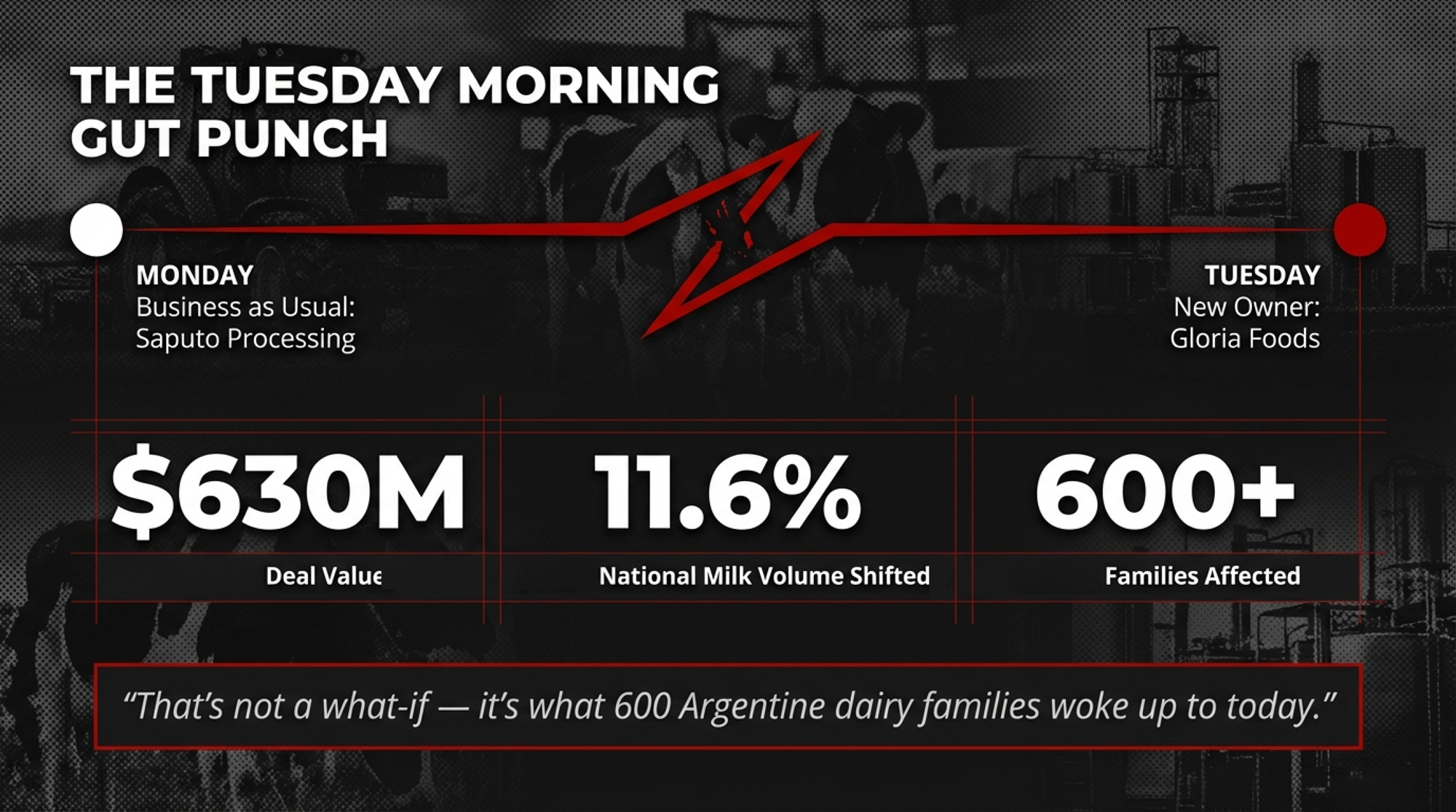
Executive Summary: Saputo is selling 80% of its Argentine dairy division to Peru’s Gloria Foods in a deal that values the business at C$855 million (about US$630 million), while keeping a 20% stake. Overnight, control of Argentina’s largest milk processor — 11.6% of the nation’s industrial milk and collections from more than 600 farms — shifts to a buyer that’s been sued for abusing its power with producers in Chile, fined in Colombia for adding whey to “whole” milk, and accused of monopolistic practices in Peru. Farmers shipping to Saputo’s Rafaela and Tío Pujio plants learned about the deal from a press release instead of a phone call, and they still don’t know if Gloria will keep their contracts, prices, and pickup schedules intact. They’re dealing with that gut punch in a sector where SanCor has just entered creditor protection and co‑ops’ share of Argentina’s milk has collapsed from roughly 34% to about 3%, leaving most producers tied closely to a single processor. Add in Gloria’s aggressive acquisition run and rising debt‑service costs at its Peruvian holding company, and you have a new owner that’s highly motivated to manage margins hard once the ink dries. This article walks you through what’s happening to those 600 Argentine dairy families — and gives you a concrete playbook to check whether your own processor contract would protect you if the company you ship to sold tomorrow without warning.
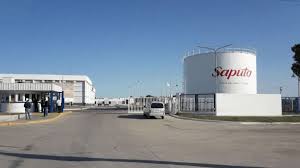
Saputo Inc. announced today that it’s selling 80% of its Argentine dairy division to Gloria Foods — the dairy arm of Peru’s Grupo Gloria — for an enterprise value of C$855 million. That works out to roughly US$630 million, including assumed debt, though Peruvian business media report the equity purchase price closer to US$500 million. Saputo expects net proceeds after tax of approximately C$543 million (US$400 million). The company keeps a 20% minority stake. The deal covers two processing plants, the La Paulina, Ricrem, and Molfino brands, and a milk collection network serving more than 600 dairy farms across Santa Fe and Córdoba provinces, according to Argentine agricultural media, including LA17 and Bichos de Campo.

This is what dairy processor consolidation risk looks like in practice. Those 600 families weren’t part of the conversation — and the company taking over has a record across Latin America that every producer, Argentine or not, ought to understand before this deal closes around mid-2026.

If you read nothing else this month, pair this with our recent piece on the four questions every dairy producer should ask about processor dependency. What’s happening in Argentina right now is a textbook case of what that audit is designed to prevent.
How Saputo Built Argentina’s Top Dairy Operation — Then Walked Away

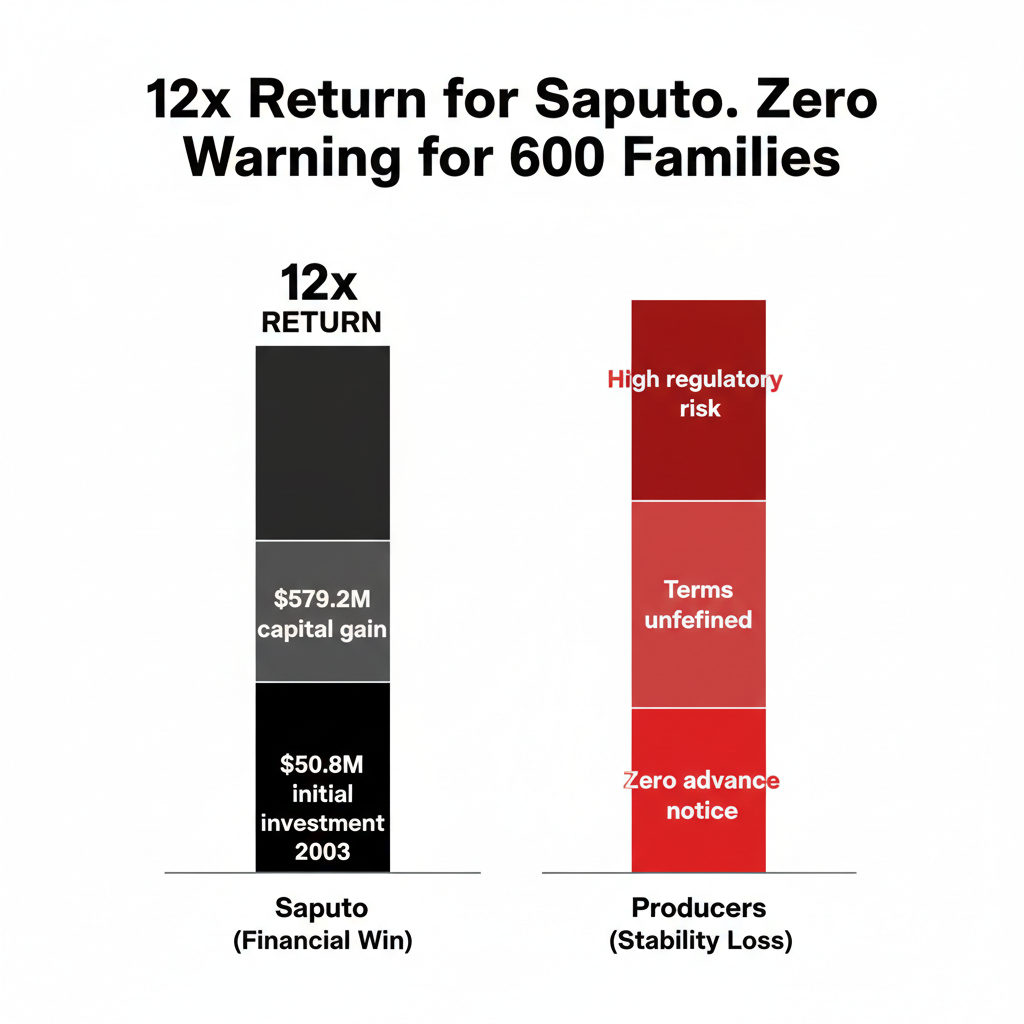
Saputo entered Argentina in November 2003 by acquiring Molfino Hermanos S.A. from Molinos Río de la Plata for US$50.8 million. At the time, Molfino was the country’s third-largest processor — two plants, roughly 850 employees, about US$90 million in annual revenue. Over 23 years, Saputo turned that into the country’s number-one operation.

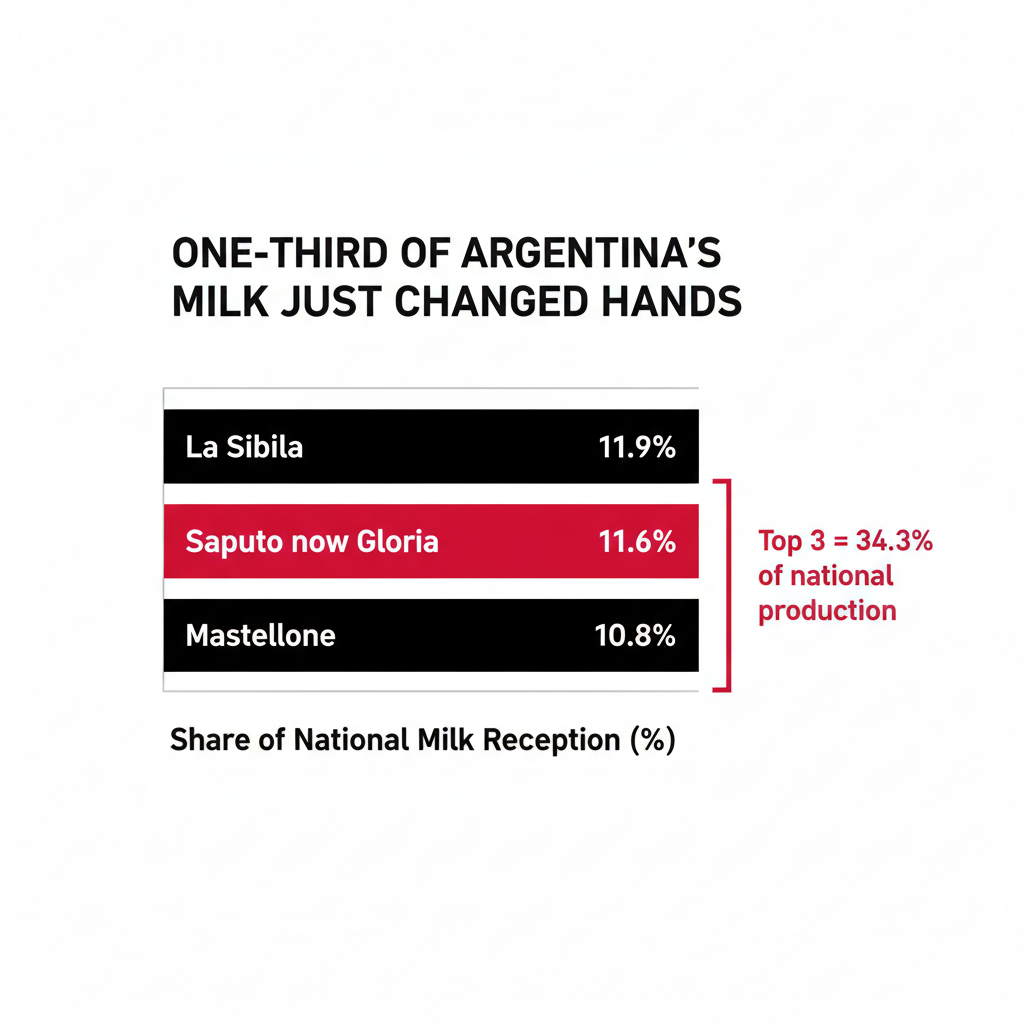
The OCLA 2023/24 industry ranking — based on reported and estimated daily milk reception by industrial processors, published annually — had Saputo processing an average of 3,650,288 liters per day, or 12.5% of national industrial milk volume. By the most recent OCLA 2024/25 ranking (published July 2025), that figure had dropped to 3.53 million liters daily, or 11.6% of the national total. Still number one, ahead of Mastellone (La Serenísima) at 3.15 million liters and 10.8%, but the decline hints at the pressures behind Saputo’s decision to sell. In the last four quarters, the Argentine operation generated approximately C$1.2 billion in revenue — about 7% of Saputo’s consolidated total.
When SanCor — once Argentina’s cooperative giant — entered a deep financial crisis beginning in 2017 (as SanCor put it in its February 2025 court filing), Saputo moved quickly. The company absorbed the freed-up milk supply and routinely offered prices better than competitors’. Producers followed the money. You would have too.

And then SanCor’s story got worse. On February 2, 2025 — just ten days before today’s Gloria announcement — SanCor formally filed for concurso preventivo de acreedores (creditor protection proceedings) at the Commercial Court in Rafaela, Santa Fe, carrying approximately US$400 million in debt. SanCor now processes just 409,163 liters daily, barely 1.4% of national production, down from its peak of 1.2 million. The region’s dairy infrastructure isn’t just shifting; it’s transforming. It’s being completely restructured.

Saputo’s dominance also created structural dependency. The practical effect was that Saputo’s price signals shaped the broader regional market — when the biggest buyer in the milkshed moved, everyone else followed. That arrangement works fine. Right up until the company at the center decides to leave.
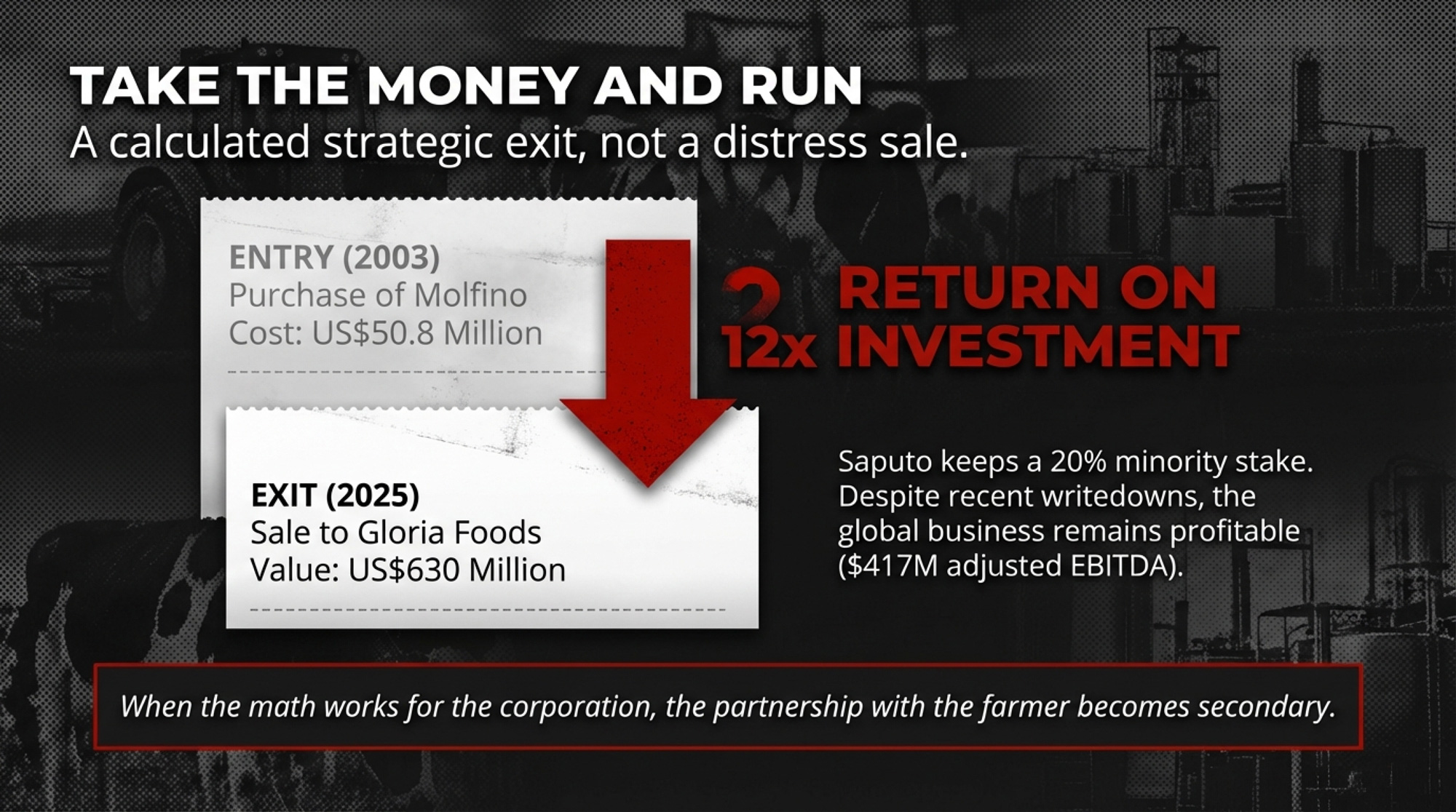
CEO Carl Colizza’s press release language was corporate but clear: “This divestiture enhances our financial flexibility and supports targeted reinvestment in platforms that offer the highest growth opportunities.” Translation: take a roughly 12-fold return on a 23-year investment (US$630M enterprise value on a US$50.8M entry) and redeploy capital somewhere with fewer currency crises.
600 Families, No Advance Notice

Here’s what we know about how this landed on the ground. As of publication — hours after the announcement — there’s been no reported communication from Gloria Foods to Argentine producers. No new contract terms. No timeline for meetings. No word on whether existing payment schedules, quality premiums, or pickup logistics will change. Infocampo described the news as a “sacudón” — a jolt — to the Argentine dairy chain.

Several cooperatives sit squarely in Saputo’s milkshed. Cooperativa Tambera Central Unida in San Guillermo, Santa Fe — managed by Javier Clemente — delivers milk to five processing companies, including Saputo. Clemente has spoken publicly about producer autonomy in the region: “The one who decides where their production goes is the member, because the milk belongs to whoever produces it.” He made those remarks before the Gloria deal was announced. His cooperative is now directly affected, and whether that principle holds when a Peruvian conglomerate replaces a Canadian one is the question nobody can answer yet.

Cooperativa Agrícola Santa Rosa, also near San Guillermo and managed by Martín Guruceaga, works with approximately 60 farms across a 40-kilometer radius. Guruceaga has described the area simply as “una zona tambera” — a dairy zone where the community and the industry are one and the same. UNCOGA, a federation of nine cooperatives spanning central-west Santa Fe and central-east Córdoba, operates across the heart of Saputo’s collection territory.
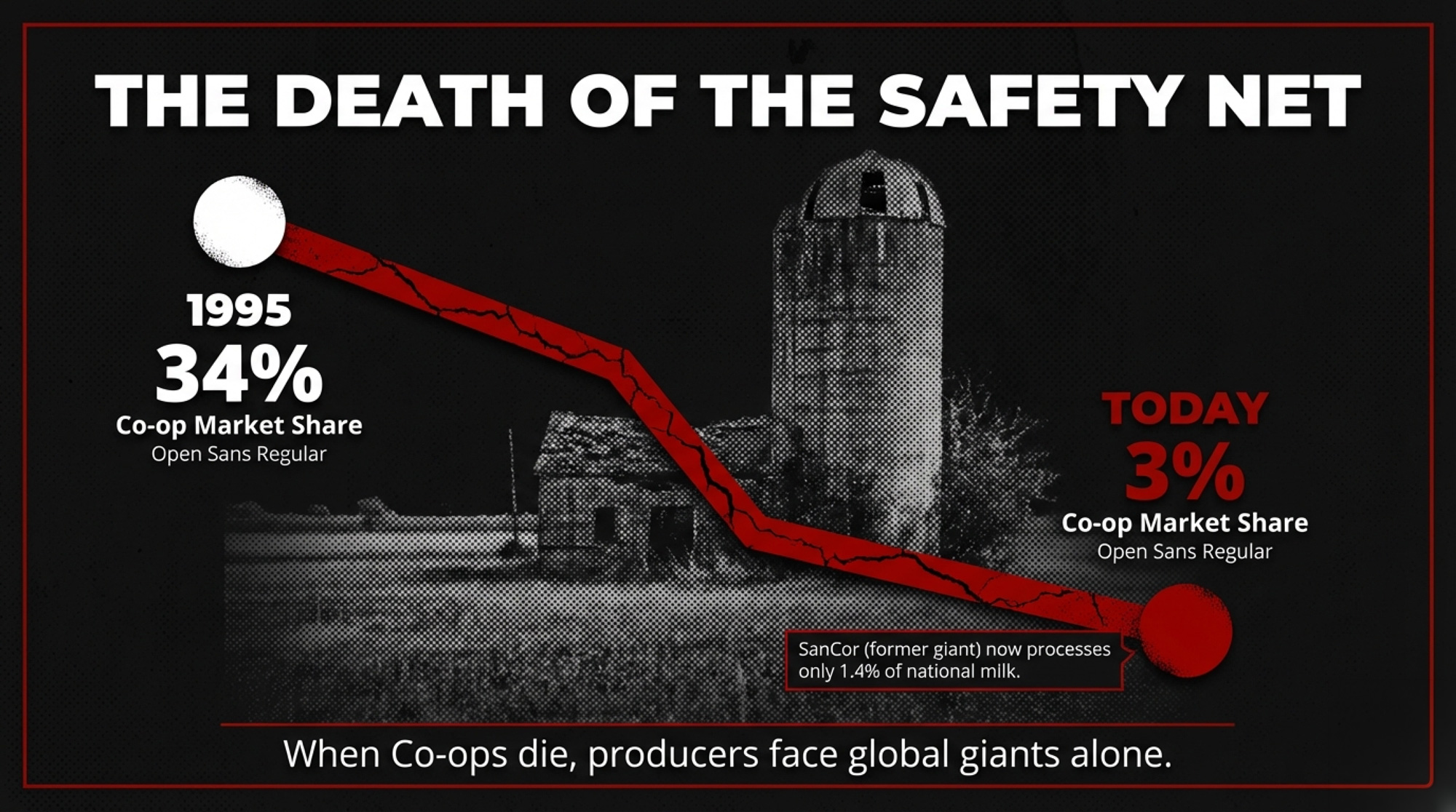
These cooperatives are the closest thing to a collective voice that affected producers have. But the cooperative system itself has been hollowed out. Cooperative share of Argentine milk reception dropped from 34% in 1995 to roughly 3%today, according to the OCLA 2024/25 industry ranking. That means most of those 600-plus farms negotiate individually with their processor. When that processor changes without warning, individual leverage is essentially zero.

“The dairy sector and the country will only grow when the producer grows, because the producer is the one who carries the activity in their blood.” — Daniel Oggero, APLA executive committee, El Litoral, July 2015

Oggero made that statement during a blockade of Saputo’s Rafaela plant by western Santa Fe dairy farmers protesting milk price cuts. Those words land differently today, when the producer’s voice in the transaction was exactly zero.

Why Saputo Sold — And What Gloria’s Track Record Shows

Understanding both sides of this deal matters if you’re trying to figure out what comes next.

Why Saputo left: This isn’t a distressed sale. Through FY26, Saputo’s efficiency program has been delivering: Q1 operating cash flow hit C$317 million (up 66% year-over-year), adjusted EBITDA reached C$417 million (up 12.7%), and the company has been buying back shares aggressively. Saputo reported net losses of C$250 million through the nine months ended December 2024, driven largely by writedowns and hyperinflation accounting adjustments tied to Argentina — but the underlying business is profitable and improving. Saputo chose to leave. That tells you how the company views Argentine risk-reward going forward.
Who Gloria is: Gloria Foods is the dairy platform of Grupo Gloria, a Peruvian conglomerate with more than 7,000 employees across Peru, Chile, Bolivia, Argentina, Colombia, and Ecuador. President Claudio Rodriguez called the Saputo acquisition “a milestone within the strategy of sustained growth in Latin America.” The expansion has been rapid: Soprole in Chile from Fonterra for approximately US$644 million (completed April 2023), Ecuajugos from Nestlé in Ecuador (2024), and now Saputo Argentina.

But that growth has come with a trail of regulatory actions and producer-relations disputes. Not one-offs. A pattern across multiple countries.

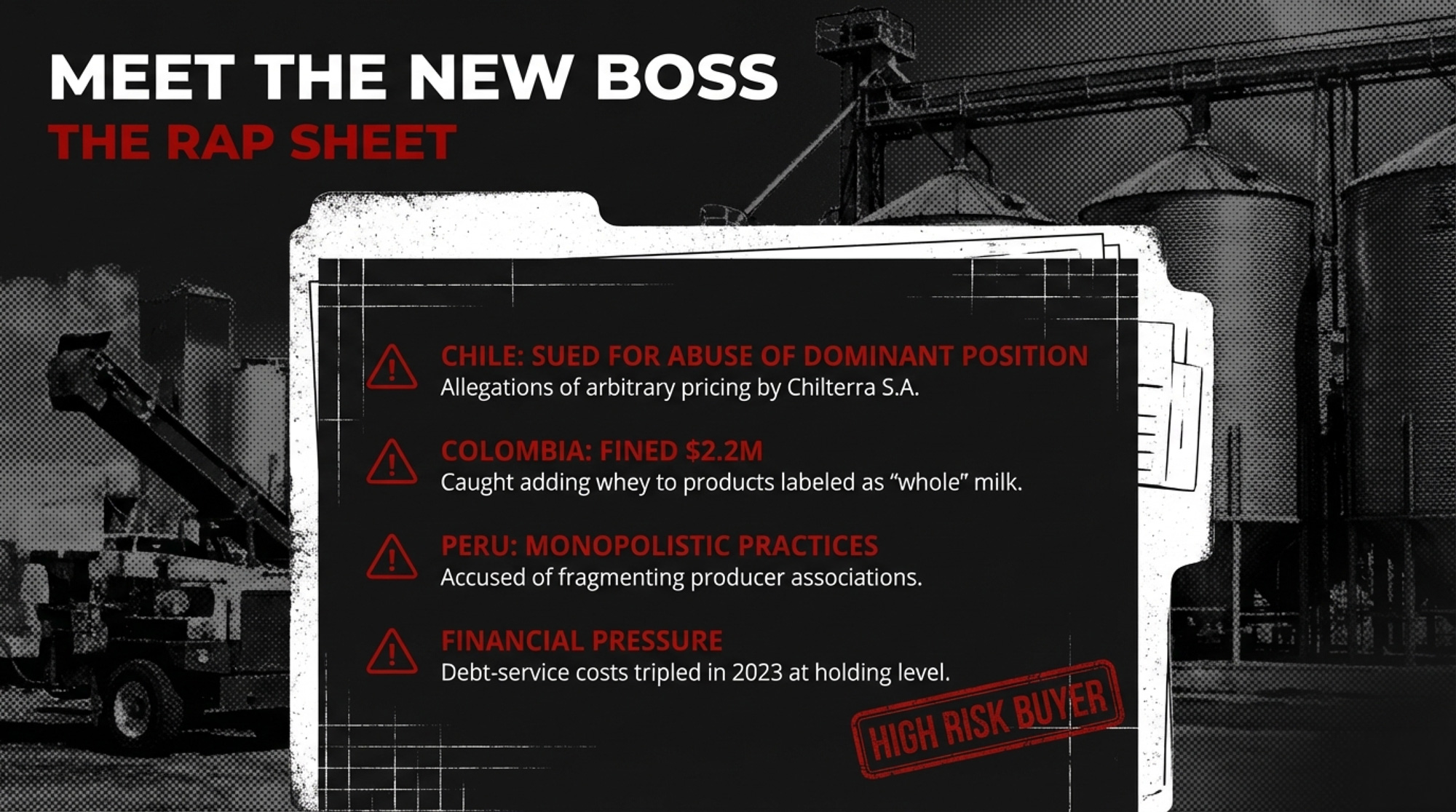
In Peru, former AGALEP (national dairy farmers’ association) president Javier Valera publicly described Gloria’s market behavior as monopolistic. His successor, Nivia Vargas, accused the company of offering infrastructure only to larger-volume farms — deliberately fragmenting producer associations and undermining collective bargaining. Gloria has also fought a Peruvian government decree requiring evaporated milk be made from fresh milk. AGALEP leadership says that regulation underpins demand from an estimated 450,000 Peruvian dairy farmers.

In Chile, Gloria’s subsidiary Prolesur faces a lawsuit admitted by the national competition tribunal (TDLC) on January 30, 2025. Plaintiff Chilterra S.A. alleged abuse of dominant position, specifically that Prolesur imposed “unjustified prices through arbitrary and unverifiable criteria”—a system plaintiff Ricardo Ríos described as designed to create total producer dependence.

In Colombia, the Superintendencia de Industria y Comercio fined Gloria, along with Lactalis, Hacienda San Mateo, and Sabanalac in February 2025 for adding whey protein (lactosuero) to products labeled as whole pasteurized milk. The basis: INVIMA laboratory studies from 2019–2020 detected elevated caseinomacropeptide levels — a marker indicating whey protein had been added to a product labeled as pure milk. Gloria’s penalty was US$2.2 million. The company has appealed.

CountryAction / DisputeYearStatus / Penalty
PeruFormer AGALEP president accused Gloria of monopolistic behavior; producers claim infrastructure access limited to large farms, fragmenting associationsOngoingNo formal penalty; producer relations remain strained
ChileProlesur (Gloria subsidiary) sued for abuse of dominant position—”unjustified prices through arbitrary criteria” designed to create producer dependence2025Lawsuit admitted by TDLC competition tribunal Jan 2025; pending resolution
ColombiaFined for adding whey protein to “whole” milk; INVIMA labs detected elevated caseinomacropeptide (adulteration marker)2025US$2.2 million fine; Gloria appealed
Puerto RicoExited market entirely after regulatory challenges made operations “unworkable”2025–26Complete market withdrawal

Gloria reports investing approximately S/718 million — roughly US$190 million (S/ refers to Peruvian soles) — between 2012 and 2023 in a farmer development program. That figure comes from Gloria itself and hasn’t been independently audited, but the investment claim is on the record. In Puerto Rico, the company exited the market entirely in 2025–2026 after what it described as regulatory challenges that made operations unworkable.

Does any of this predict what happens in Argentina? Not necessarily. Different market, different regulations, different competitive dynamics. But the holding-level financial picture adds context. Holding Alimentario del Perú reported net losses of S/124.9 million (roughly US$33 million) in 2023 and S/62.2 million (~US$16 million) through nine months of 2024, according to Peruvian securities filings. Financial expenses surged from S/123.7 million in 2022 to S/399.5 million in 2023. A company whose debt-service costs tripled in one year is under pressure, even if the core dairy business is profitable.

Nobody’s saying assume the worst. But you’d be wise to ask very specific questions before closing day.

What This Means for Your Operation

This section is about dairy processor risk — and it applies whether you’re milking cows in Córdoba or Ontario or Wisconsin.

Contract ProtectionWhat It DoesArgentine StatusYour Action This Week
Ownership-change clauseRequires new buyer to honor existing contract terms or provides renegotiation windowMissing for most producersPull your supply agreement; search for “assignment,” “change of control,” or “transfer” clauses
Minimum notice periodGuarantees 30–90 days’ written notice before contract termination or major changesMissing for most producersCheck termination section; if absent, negotiate 60-day minimum before any ownership transfer
Payment guaranteeEnsures payment terms (price, schedule, penalties) survive ownership changeUnknown—producers waiting for Gloria communicationVerify whether your agreement specifies payment continuity; if not, add it
Secondary buyer relationshipDiversifies risk by routing 10–30% of production to alternative processorNot common in concentrated marketsIdentify regional cheese makers or co-ops; formalize even small-volume backup contract
Collective bargaining vehicleCooperative or producer association negotiates on behalf of groupExists (UNCOGA, cooperatives) but weakened by 3% co-op market shareJoin or re-engage with local co-op; coordinate questions for new buyer through group
Regulatory review triggerLarge acquisitions require competition-authority approval, sometimes with producer-protection conditionsPending—Argentine CNDC reviewing dealMonitor CNDC decision; if conditions imposed, ensure enforcement mechanisms exist

If you’re in Saputo’s Argentine collection zone: Your contract is the document that matters now. Does it include an ownership-change clause? A minimum notice period? A payment guarantee? If yes, those terms should carry over. If not — or if you don’t have a written agreement at all — you’re negotiating from scratch with a company you’ve never dealt with. Contact your cooperative this week. The latest SIGLEA data (December 2025) shows Argentine farm-gate milk prices averaging AR$476.60 per liter — up only about 8% year-over-year in nominal terms, while costs have continued to rise, putting margins under pressure. Any disruption in payment terms during a processor transition hits harder when margins are already thin.
If you’re a North American Saputo supplier: This looks like an emerging-market exit, not a signal about Saputo’s core North American business. The company is investing in U.S. capacity and showing improving domestic margins. Your situation is structurally different. But the underlying lesson is universal — if your supply agreement doesn’t survive a processor sale, you’re carrying the same risk these Argentine families just discovered. You just haven’t been tested yet.

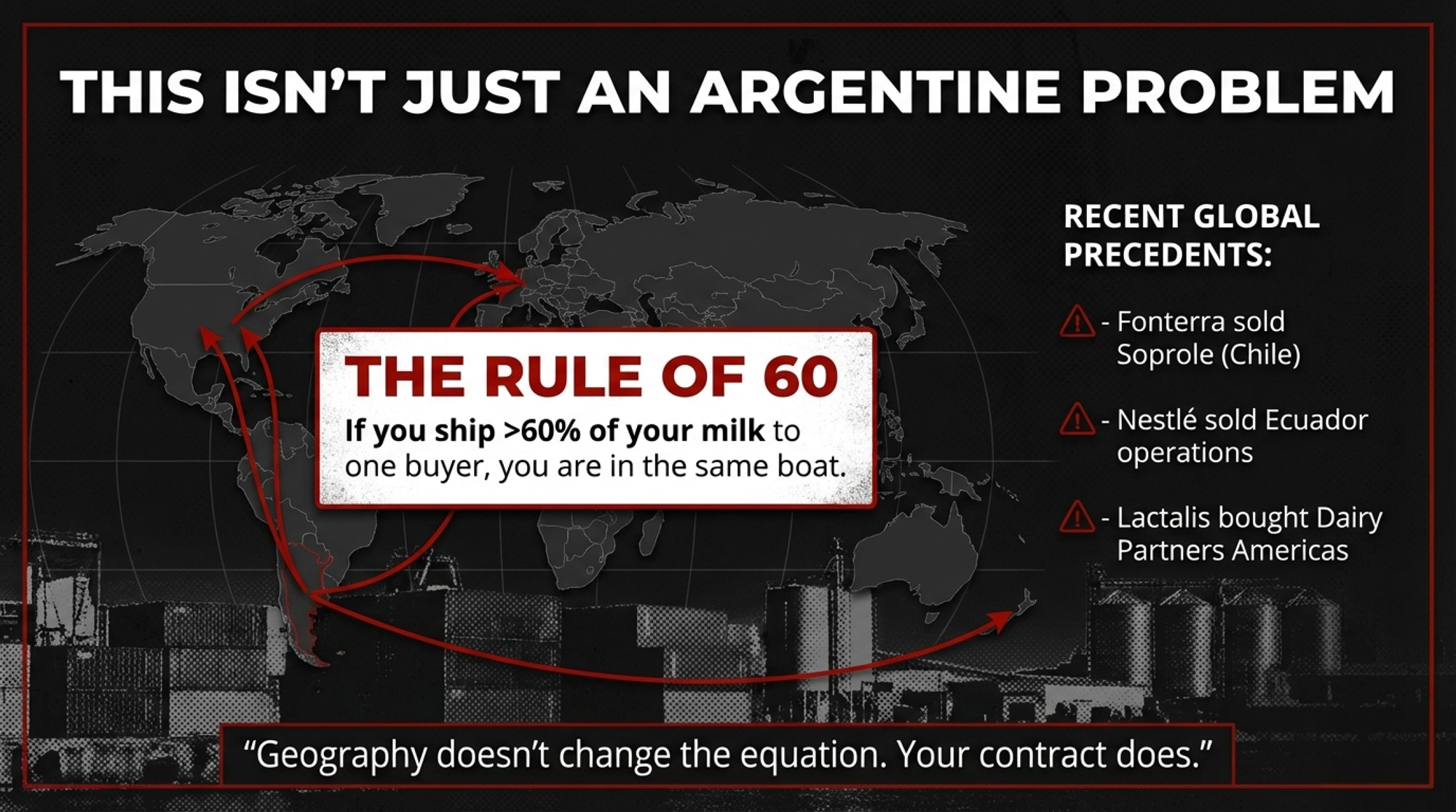
If you sell to any dominant processor, anywhere: Here’s the math that matters. If one company handles more than 60% of your milk and your agreement has no ownership-change clause, you’re structurally identical to those 600 Argentine families. Geography doesn’t change that equation. What changes it is your contract.

The trend behind this deal — processor consolidation reshaping producer relationships globally — isn’t slowing down. In the past three years, Fonterra sold Soprole to Gloria, Nestlé sold Ecuador operations to Gloria, Savencia acquired Williner in Argentina, and Lactalis bought Dairy Partners Americas. Every transaction meant producers discovering, after the fact, that their buyer had changed.

Four Moves Before Closing Day

1. Pull your supply agreement and read it this week. Look for three things: the termination notice period, the ownership-change transfer provision, and the payment guarantee. If any are missing, that’s your negotiating priority before the new owner takes over. Not after.

2. Engage through your cooperative — and accept the trade-off. UNCOGA, Productores Unidos de Rafaela, and the San Guillermo cooperatives are the existing vehicles for collective action. A unified set of questions to Gloria about contracts, payment terms, and collection schedules carries more weight than 600 separate phone calls. Yes, coordinated engagement could be perceived as adversarial before the relationship starts. Move forward anyway. Silence is worse than friction.

3. Explore a second buyer relationship. Around Córdoba and Santa Fe, small and medium cheese makers (PyMEs queseras) have historically offered competitive raw-milk prices. Diversifying even a portion of production reduces concentration risk. The trade-off is real: approaching alternative buyers pre-closing could signal distrust to Gloria, and logistics with smaller processors are more complex. But having options is always the right strategy. And here’s your trigger — if Gloria hasn’t communicated directly with producers within 60 days of closing, that’s your signal to formalize a secondary buyer relationship. Not explore one. Formalize it.

4. Watch Gloria’s first 90 days after closing. Do they communicate directly with producers? Honor existing terms? Provide timeline certainty? Those are positive signals. Prolonged silence — producers still waiting for a phone call weeks after operational control transfers — tells a different story. What Gloria actually does will matter more than anything in a press release.

Three Signals Between Now and Mid-2026

Argentine regulatory review. This deal requires approval from Argentine authorities. At 11.6% of the national industrial milk volume, the competition authority (CNDC) could attach conditions. Any requirements imposed on Gloria regarding producer terms or pricing would be of enormous importance.

Gloria’s outreach to producers. The single most revealing signal. The company knows 600-plus families are waiting. Whether Gloria reaches out proactively or waits for producers to come to them will tell you which version of Gloria is showing up in Argentina.

Payment performance. SIGLEA reported Argentine farm-gate milk prices at AR$476.60 per liter in December 2025 — up only about 8% year-over-year in nominal terms, while production costs have continued climbing, according to OCLA. Gloria’s ability and willingness to maintain competitive pricing after closing will be the metric that matters most to every producer in the collection zone. Everything else is words on paper.

The broader context here — what processor consolidation means for producer survival — was one of the defining themes of 2025 dairy coverage.

Your Processor Risk Checklist

  • Audit your contract this week. No ownership-change clause, no defined termination notice, no payment guarantee means you’re carrying processor risk whether you’re in Córdoba or Ontario, or Wisconsin.
  • Know your single-buyer number. Over 60% of your milk to one processor without contractual protections? You’re in the same structural position as those Argentine families. The difference is timing — you can fix it before the press release drops.
  • Research your processor’s parent company. Financial pressure at the holding level — like debt-service costs tripling in a year — eventually filters down to producer terms. This applies to your processor too.
  • Don’t wait for the phone call. If you’re in Saputo’s Argentine collection zone: contact UNCOGA, your regional cooperative, or APLA (headquartered in Suardi, Santa Fe) this week. Ask collectively about contract continuity, payment schedules, and collection logistics. A coordinated ask is harder to ignore.
  • For North American Saputo suppliers wondering if you’re next: The evidence points to an emerging-market exit driven by Argentine macro conditions, not a systemic pullback. Saputo’s domestic numbers are moving in the right direction. But read your contract. Know what survives a sale.
  • If you know Argentine producers, share this. If you’ve toured dairy operations in Santa Fe or met producers from the Rafaela corridor at genetics events, connect them with this information. The more that circulates, the better everyone’s decisions get.

The Bottom Line

Guruceaga calls his part of Santa Fe “una zona tambera.” A dairy zone. It sounds simple until you sit with what it means: the cows and the community are the same thing. When the processor changes, the community changes with it.

The hardest part of what happened today isn’t the deal. It’s the sequence. A press release in Montreal. A wire story picked up in Lima. A notification on a phone in a milking parlor somewhere between Rafaela and Tío Pujio. And then the question that 600-plus families are asking right now — the same question every producer who depends on a single buyer should be asking before their turn comes:

Does my contract survive this?

If you don’t know the answer, you already know what to do this week.

Key Takeaways

  • Saputo is selling 80% of its Argentine dairy division to Gloria Foods for a C$855 million (≈US$630 million) enterprise value, keeping a 20% minority stake.
  • That puts Argentina’s largest processor — 11.6% of industrial milk and collections from 600‑plus farms — in the hands of a buyer that’s been sued for abuse of dominance in Chile, fined in Colombia over adulterated “whole” milk, and accused of monopolistic behavior in Peru.
  • Farmers supplying Saputo’s Rafaela and Tío Pujio plants learned of the sale from the media, not from their processor, and, as of today, have no firm answer on whether Gloria will honor their current contracts, prices, or pickup schedules.
  • With SanCor in creditor protection and co‑ops’ share of Argentina’s milk shrinking from roughly 34% to about 3%, most producers are now highly dependent on a single buyer when decisions like this drop.
  • If more than 60% of your milk goes to one processor and your contract is silent on ownership changes, you’re carrying the same processor‑risk those 600 Argentine families just discovered — and you should be auditing that agreement this week, before your own “press‑release moment” arrives.

Complete references and supporting documentation are available upon request by contacting the editorial team at editor@thebullvine.com.

Learn More

Join the Revolution!

Join over 30,000 successful dairy professionals who rely on Bullvine Weekly for their competitive edge. Delivered directly to your inbox each week, our exclusive industry insights help you make smarter decisions while saving precious hours every week. Never miss critical updates on milk production trends, breakthrough technologies, and profit-boosting strategies that top producers are already implementing. Subscribe now to transform your dairy operation’s efficiency and profitability—your future success is just one click away.

NewsSubscribe
First
Last
Consent

Why Hormel’s Layoffs Will Cost You $45,000 Per Month (And What to Do in the Next 90 Days)

Strategic exit: Walk away with $1.2M. Wait 18 months: Lose everything. Hormel’s layoffs just started your countdown.

EXECUTIVE SUMMARY: Hormel’s elimination of 250 procurement positions triggers a predictable 12-18 month pattern: processor consolidation, standardized pricing, and $1.50-2.00/cwt in new deductions that destroy farm profitability. With 73% of processing options lost since 2000, most farms now have only 3-4 potential buyers—eliminating negotiating leverage exactly when Farm Bill changes, environmental compliance costs ($75,000-175,000), and heifer shortages (prices hitting $4,800) converge in 2026. Our analysis of Wisconsin and Pennsylvania exits reveals a stark reality: a strategic exit in months 8-10 preserves $1.2 million in family wealth, while waiting until month 18 results in forced liquidation and devastating losses. Of four survival paths—scaling (8% viable), differentiation (15-20% viable), strategic exit, or resilience through low-cost production—only resilience offers hope for mid-sized operations. Your 90-day window to build reserves, create information networks, and secure alternatives started Monday.

Dairy Farm Risk Management

Monday’s announcement from Hormel Foods wasn’t just another corporate headline—it was a warning shot for the entire dairy supply chain. The company is cutting 250 positions, and these aren’t factory floor workers. We’re talking about headquarters and sales staff—the people who typically manage relationships with suppliers like ours.

Now, you might be thinking “that’s Hormel’s problem, not mine.” But here’s what’s interesting—Hormel owns Century Foods International up in Sparta, Wisconsin. That’s a significant dairy ingredient processor that pulls milk and proteins from farms across the Upper Midwest. When a company with $12 billion in annual revenue starts reducing procurement and relationship staff… well, that pressure has to go somewhere, doesn’t it?

What I’ve found is that this pattern keeps showing up across the industry. And understanding it might just help us prepare for what’s coming.

The Bigger Picture We’re All Dealing With

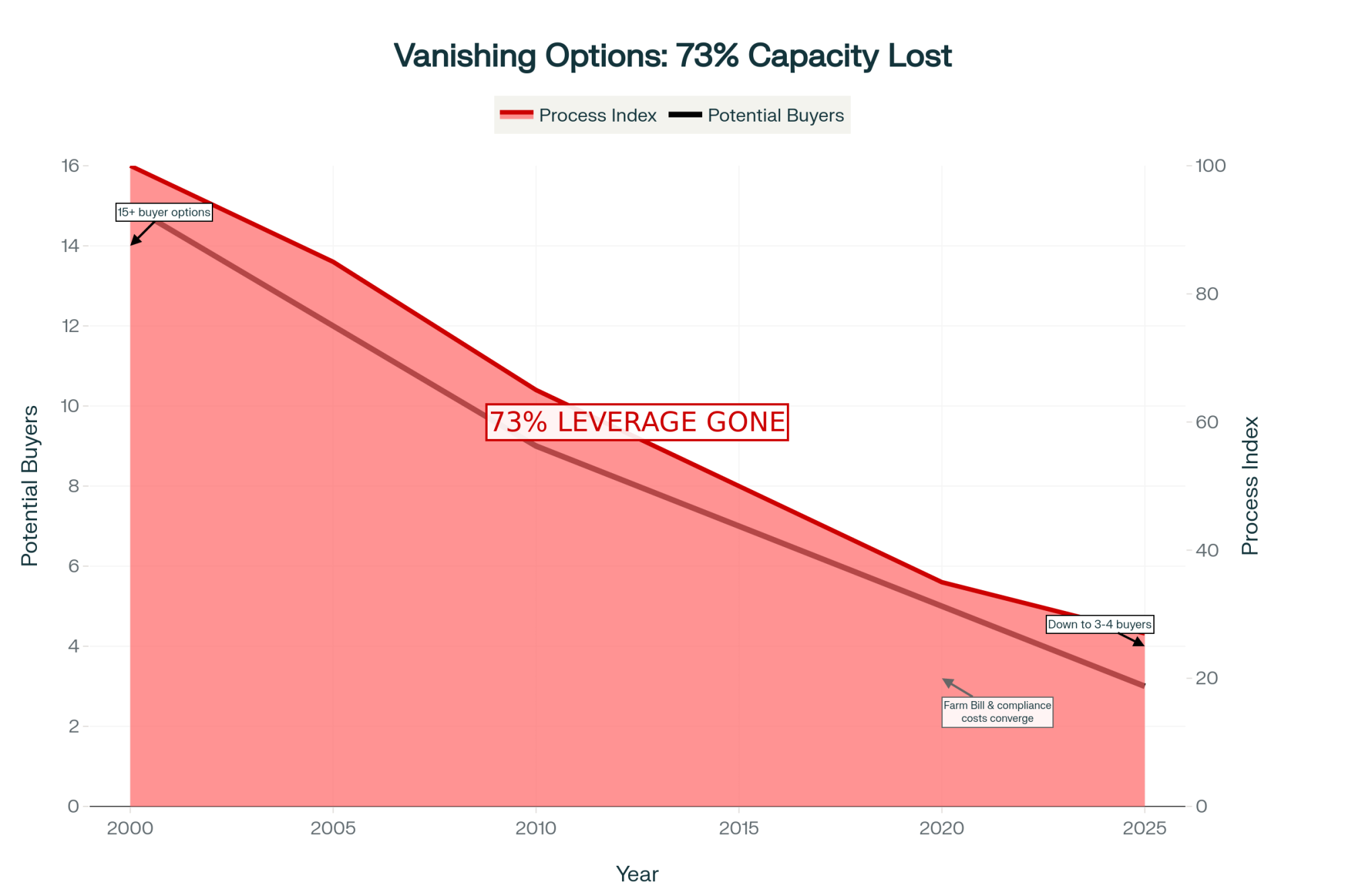
Looking at today’s consolidation, you can see it builds on changes that started decades ago. The data from USDA’s Economic Research Service and the National Milk Producers Federation is pretty sobering—we’ve lost between 65 and 73 percent of regional processing options since 2000.

From 15 Buyers to 3 in 25 Years: USDA Economic Research Service data reveals the consolidation trap—73% of processing options lost since 2000 means most farms now have only 3-4 potential buyers. You used to shop around for better terms. Now processors SET terms, and you take them or dump milk. Hormel’s 250 layoffs accelerate this pattern—fewer relationship managers, standardized contracts, zero flexibility.

Just think about that. Many of us used to have 15 or 20 potential buyers within reasonable hauling distance. Now? Three or four if we’re lucky. In some regions, it’s even tighter.

Take a look at what’s happening across different regions right now. Darigold members—about 250 farms in the Northwest—are paying a $ 4-per-hundredweight assessment. Capital Press reported back in May that $2.50 of that is going toward new plant construction in Pasco, Washington. That’s real money coming right off the milk check.

In the Upper Midwest, Foremost Farms implemented a 90-cent assessment for its patrons in September 2022. Hoard’s Dairyman covered it extensively—they cited the gap between Class III prices and what they’re actually getting for cheese. And Saputo? Food Processing magazine reported in June 2024 that they’re closing six facilities by early 2025, including operations in Wisconsin and California, to “consolidate production and reduce redundancy.”

Here’s what really caught my attention about Hormel’s restructuring. According to their November 4th investor announcement, they’re specifically eliminating corporate strategic and sales positions—these are the folks who maintain relationships with suppliers. They’re spending $20 to $25 million on severance and transition costs. That’s roughly $80,000 to $100,000 per position they’re cutting.

You don’t spend that kind of money unless you’re planning for years of pressure ahead, not just a tough quarter.

Now, it’s worth noting that processors face real challenges too. Retail consolidation means they’re dealing with Walmart, Costco, and Amazon—all of which are squeezing margins. Energy costs are up. Labor’s tight everywhere. These companies aren’t making these cuts lightly. But understanding their pressures doesn’t change what flows down to us.

The Pattern I Keep Seeing

Industry financial advisors tracking processor transitions have identified a consistent pattern that typically unfolds over 12 to 18 months. Let me walk you through what actually happens…

First Few Months: Everything Gets Quieter

Your field rep who used to manage 40 or 50 farms? Now they’re covering 150. Response times stretch from hours to days. Those quarterly visits become phone calls. As many of us have seen, when representatives manage three times as many accounts as before, personalized service just isn’t possible anymore.

Months 2-6: The Standardization Push

This is when you get that letter about “standardized pricing formulas” to ensure “fairness.” Sounds reasonable, right? But what it really means is they’re eliminating those adjustments that recognized your specific situation—your spring flush components, your consistent quality premiums, that understanding that your butterfat always runs high in October.

What’s Your Processor Really Taking? Darigold members in the Pacific Northwest face $4.00/cwt deductions—$45,000 annually for a 180-cow operation split between new plant construction and covering losses. Industry pattern averages $2.00/cwt.

Months 6-9: The Deductions Start

New fees start appearing. Processing assessments. Quality charges. Transportation adjustments. Wisconsin dairy business associations documented accumulated deductions ranging from $1.50 to $2.00 per hundredweight during 2023. For a typical 180-cow operation, that’s $2,500 to $3,300 coming off your monthly milk check.

By Month 12: You Realize Your Options Are Limited

You start looking around for alternatives, but those other processors? They’re managing their own challenges. They’re not actively recruiting. And you need daily pickup—can’t exactly store milk while you shop for a better deal.

Learning From History (Because We’ve Been Here Before)

This isn’t our first rodeo with consolidation. The USDA Economic Research Service’s 2019 report “Consolidation in U.S. Dairy Farming” documented similar patterns during the 1980s farm crisis, and its 2010 analysis covered the impacts of the 2009 financial crisis. Each time, the farms that saw it coming early and adapted survived better.

What’s different this time? The alternatives are scarcer. Back in ’09, you could still find regional processors looking to grow. Today, with interest rates where they are and construction costs through the roof—as Compeer Financial told Brownfield Ag News in October—expansion activity has basically stopped.

Southeast operations face additional challenges, with heat-stress management costs averaging $150 to $200 per cow annually, according to University of Georgia Extension research. Meanwhile, Southwest farms are dealing with ongoing water allocation issues, with Arizona and New Mexico operations seeing water costs rise by 30-40% since 2020, according to state agricultural department data. Each region has its unique pressures, but the consolidation pattern remains consistent.

The Timing Trap: Wisconsin and Pennsylvania farm financial counselors document $1.2 million wealth differences between families who exit strategically at months 8-10 versus those who wait for forced liquidation at month 18+. When Hormel cuts 250 procurement positions, your countdown starts Monday—not when you finally admit you’re trapped.

What Successful Farms Are Doing Right Now

Despite all this, I’m seeing farms navigate these challenges successfully. Their approaches are worth considering.

Building That Financial Cushion

What is the difference between farms with negotiating leverage and those without? Operating reserves. Penn State Extension’s dairy business analysis and the Center for Farm Financial Management both point to the same figure—about 90 days of operating capital makes all the difference.

For a 200-cow operation, that’s roughly $280,000. For 150 cows, about $180,000. I know those numbers sound huge, but here’s what’s working…

Farm financial management research shows that extending equipment replacement cycles by one to two years can generate significant reserve-building capacity. Several Mid-Atlantic operations have successfully banked the difference between equipment payments and increased maintenance costs. After a few years, they’ve built up enough to cover six months of expenses.

Cornell Cooperative Extension has documented that farms directing 5-10% of production to premium direct-market channels accelerate reserve accumulation without disrupting bulk sales. You’re not replacing your regular market—just capturing better margins on a small percentage of it.

Information Networks That Actually Work

You probably know this already, but the coffee shop isn’t where real information sharing happens anymore. Networks of 5 to 8 farms comparing actual numbers—payment timing, deduction patterns, alternative buyer pricing—are documenting surprising disparities.

Farm business management specialists report producer networks discovering pricing gaps of $0.60 to $1.20 per hundredweight between processors for identical milk quality. When these groups approach processors collectively with documentation, they often achieve improvements worth $0.40 to $0.65 per hundredweight.

California producers managing water costs—University of California Cooperative Extension’s 2024 cost studies show averages of $450 to $650 per cow annually in the Central Valley—face additional challenges. But similar information networks help them identify opportunities. The principle’s the same everywhere: shared knowledge beats isolation.

Getting Real Information from Your Processor

Here’s what progressive operations are asking for—and often getting:

Monthly competitive benchmarks showing what processors within 100 miles pay for comparable components. Detailed breakdowns of processing costs at their delivery facility. Inventory levels and 90-day demand projections that might signal adjustments coming.

State Extension services offer tremendous support here. Programs at Michigan State, Cornell, Penn State, UC Davis—they’ve all got dairy business specialists who can help analyze this information. That’s what our tax dollars support, after all.

The Four Strategic Paths: An Honest Assessment

Most advisors focus on three options: scale to 3,500+ cows, differentiate into premium markets, or exit strategically. But I’m seeing a fourth path among farms that consistently stay profitable even when milk drops to $17 or $18…

Path 1: Scaling Up (Works for Maybe 8% of Farms)

Let’s be honest here. Scaling to 3,500+ cows require $21 to $27 million in capital investment, according to current construction costs. You need interest rates that make sense (they don’t right now), heifer availability (scarce and expensive), and processing capacity willing to take your increased volume. If you’re already at 1,500-2,000 cows with strong financials, maybe. Otherwise? This probably isn’t your path.

Path 2: Premium Differentiation (Viable for 15-20%)

Organic, grass-fed, A2—these markets exist, but they’re not magic bullets. Organic premiums have compressed from $7-9 to $3-5 per hundredweight. You need 3-7 years to transition, specific processor relationships, and often geographic advantages. If you’re near urban markets or progressive processors, it’s worth exploring. But it’s not a quick fix.

Path 3: Strategic Exit (Sometimes the Smartest Move)

Wisconsin and Pennsylvania farm financial counselors document $800,000 to $1.2 million differences in family wealth between planned exits at months 8 to 10 versus forced liquidation at month 18 and beyond. There’s no shame in preserving what three generations built rather than losing it all trying to outlast market forces.

Path 4: The Resilience Strategy (The Surprise Option)

These operations have basically flipped the traditional production philosophy. Instead of maximizing output, they’re optimizing for consistent profitability across wide price ranges.

The Profitability Paradox: University of Minnesota and Penn State data reveal resilience farms producing 18,000-19,000 lbs/cow stay profitable at $17 milk while conventional operations bleeding at $22. Feed costs of $7.80/cwt versus $10.50/cwt. Vet bills of $42/cow versus $97/cow. The farms surviving consolidation aren’t maximizing production—they’re optimizing for volatility.

Rethinking Production Economics

University of Minnesota Extension case studies show lower-production systems—18,000 to 19,000 pounds per cow—achieving $3 to $4 per hundredweight cost advantages through reduced inputs. The 2024 Dairy Farm Business Summary shows industry feed costs averaging $10.20 to $11.50 per hundredweight. These systems? They’re at $7.80.

Vet expenses run $42 per cow annually versus the $85 to $110 industry average. They maintain a 22% replacement rate when the industry standard exceeds 33%. They’re producing 25% less milk per cow, yet their cost structure keeps them profitable at $18 milk, while others are bleeding red ink.

Research from Wisconsin’s Center for Integrated Agricultural Systems shows that well-managed grazing operations achieve production costs of $14 to $16 per hundredweight, compared to $18 to $21 for conventional confinement.

Sure, they might average 16,000 to 17,000 pounds per cow. Their facilities might look dated. But at any price above $15.50, they’re making money. When milk hit $23 early this year, they banked serious reserves. When did it dropped to $18? Still profitable.

Penn State Extension’s 2024 analysis shows dairy-beef integration programs generating $150,000 to $200,000 annually. Using sexed semen on top genetics and beef semen on lower performers, these operations accept modest production decreases for substantial supplementary income.

USDA Agricultural Marketing Service reports from October 2025 show beef-cross dairy calves bringing $750 to $950at regional auctions, with strong demand continuing. That’s meaningful diversification without new facilities or expertise.

What these farms understand is that volatility kills more operations than low prices. If you need $22 milk to break even, you’re in trouble 40% of the time. If you can profit at $17, you only struggle during true crashes.

The Critical Next 18 Months

Here’s why the period through spring 2027 matters so much…

First, we’re operating under the second Farm Bill extension, as the Congressional Research Service noted in June. When new Dairy Margin Coverage parameters roll out in spring 2026, farms already under stress might not be able to afford meaningful coverage.

Why 2026 Will Crush Unprepared Farms: The convergence isn’t theoretical. Processor deductions ($36K ongoing), environmental compliance ($75-175K mid-2026), and heifer shortages hitting $4,200-4,800/head (early 2027) create a $261K perfect storm for 200-cow operations. CoBank’s August analysis and state DNR permit timelines confirm—farms building reserves NOW survive. Everyone else liquidates.

Second, environmental compliance intensifies in mid-2026. California’s State Water Resources Control Board’s 2025 dairy regulations estimate compliance costs of $75,000 to $175,000 for facilities that require digesters or advanced nutrient management. Wisconsin’s Department of Natural Resources permit updates require similar investments. That’s hitting right when other pressures are at their peak.

Third—and this one’s flying under the radar—CoBank’s August analysis shows dairy heifer inventories hitting their lowest point in 2026. USDA Agricultural Marketing Service data from July shows current prices at $3,010 per head, up 75% from April 2023. CoBank projects they could reach $4,200 to $4,800 by early 2027.

For a 200-cow operation with typical replacement needs, that’s an extra $100,000 annually. Can you absorb that while everything else is hitting?

Your Action Plan for This Week

Given everything that’s developing, here’s what I’d be thinking about…

Monday-Tuesday: Know Your Position

Pull out your processor contract and read it carefully. Every word. Document your payment patterns over the past year—are checks posting later, even by a day or two? Calculate your actual reserves. Not estimates—real accessible capital.

Wednesday-Thursday: Build Intelligence

Call three alternative processors. Frame it as “2026 planning” rather than jumping ship. Get their pricing, their terms. If your processor has a parent company, check their recent earnings calls. Connect with 5 to 8 operations in your area to exchange information.

Friday: Make Your Decision

Honestly evaluate where you fit. Can you scale? Can you differentiate? Should you build resilience? Or is strategic exit the smartest move for your family?

Questions Worth Asking Your Processor Today

  1. What’s your capacity utilization at our delivery facility?
  2. Can you provide monthly competitive benchmarks against regional processors?
  3. What are your 90-day inventory levels and demand projections?
  4. What specific costs justify any current or planned deductions?
  5. What’s your parent company’s debt-to-asset ratio and credit utilization?

If they won’t answer… well, that tells you something too, doesn’t it?

The Bottom Line

What Hormel’s restructuring really tells us is that financial pressure throughout the food supply chain is accelerating. And that pressure flows downstream. Always has, always will.

We’ve navigated similar transitions before—the 1980s, 2009—though current conditions present unique challenges. The farms that survive won’t necessarily be the biggest or most productive. They’ll be the ones that recognized signals early, built flexibility, demanded transparency, and made tough decisions while they had choices.

This isn’t about giving up on dairy. It’s about adapting to reality. And the reality is that processor consolidation, combined with converging pressures over the next 18 months, will fundamentally reshape American dairy.

Success in this environment doesn’t necessarily correlate with scale or production levels. Operations demonstrating financial flexibility, market intelligence, and strategic clarity position themselves best, regardless of size.

In a market that swings from $17 to $24 per hundredweight, the ability to remain profitable across that range beats maximizing profit at the top. As many successful producers have learned, producing less at lower cost can provide greater security than chasing maximum production.

The question isn’t whether change will continue—it will. The question is whether we’ll approach it prepared, with options built and information gathered, or whether we’ll take whatever’s offered because we have no choice.

Each farm’s situation is unique. There’s no universal solution. But there are universal principles: maintain flexibility, understand your market position, and make strategic decisions while you still have options.

You know, the dairy industry has always rewarded those who adapt thoughtfully to changing conditions. This period demands exactly that kind of thoughtful adaptation. And honestly? I think those of us who prepare now, who build those reserves and networks and alternatives… we’ll navigate this just fine.

The early warning signs are clear. What we do in the next 90 days determines whether we walk out of this transition on our own terms or get forced out when market pressures intensify.

I know which option I’d choose. How about you?

Key Takeaways:

  • Your 90-Day Action List: Read the processor contract, calculate reserves ($280K for 200 cows), call three alternative buyers, form a 5-8 farm network
  • The $1.2 Million Timeline: Strategic exit (months 8-10) = wealth preserved / Forced liquidation (month 18) = devastating losses
  • Surprise Winner: Farms producing 25% LESS milk at $7.80 feed costs beat high-producers losing money at $10.50 feed costs
  • Pattern Recognition: Corporate layoffs → standardized pricing → $2/cwt deductions → trapped farmers (we’ve seen this 3 times)
  • 2026 Convergence: When Farm Bill + $175K compliance + $4,800 heifers hit simultaneously, only prepared farms survive

Complete references and supporting documentation are available upon request by contacting the editorial team at editor@thebullvine.com.

Learn More:

Join the Revolution!

Join over 30,000 successful dairy professionals who rely on Bullvine Weekly for their competitive edge. Delivered directly to your inbox each week, our exclusive industry insights help you make smarter decisions while saving precious hours every week. Never miss critical updates on milk production trends, breakthrough technologies, and profit-boosting strategies that top producers are already implementing. Subscribe now to transform your dairy operation’s efficiency and profitability—your future success is just one click away.

NewsSubscribe
First
Last
Consent

Death By Consolidation: The Silent Killer Decimating Australian Dairy Communities and Your Farm’s Future

Corporate consolidation crushes dairy towns worldwide. 300 jobs lost, communities collapsing – will YOUR farm be next? Fight back now.

EXECUTIVE SUMMARY: The shocking closure of Bega’s Strathmerton cheese plant exposes how processor consolidation devastates rural communities and traps farmers in a cycle of dwindling milk buyers and eroding leverage. With 10 Australian processing facilities shuttered in 18 months and similar trends globally, farmers face fewer options, stricter supply controls, and rising transport costs. The article dismantles corporate excuses for consolidation, highlights cascading impacts on schools and businesses, and offers proven alternatives like farmer-owned cooperatives and specialty processing. A urgent call to action urges producers to diversify markets, invest in value-added ventures, and rebuild community resilience before their region becomes the next casualty.

KEY TAKEAWAYS:

  • Domino Effect: Processor closures collapse schools, businesses, and community identity – 58% enrollment drop at Strathmerton Primary signals rural decay.
  • Farmer Vulnerability: Fewer buyers = less pricing power; 55% of Australian farmers report dissatisfaction amid consolidation-driven margin squeezes.
  • Global Crisis: North America and Europe mirror Australia’s 10-plant closure trend, with 4% annual U.S. dairy farm losses accelerating since 2013.
  • Actionable Solutions: Direct consumer partnerships, on-farm processing, and cooperatives (like Mount Crawford’s 15% price premium model) counter consolidation.
  • Survival Imperative: Farmers must diversify markets now – delaying risks irreversible community and operational collapse.
dairy processor consolidation, impact of factory closures on rural communities, dairy farm market leverage, Bega Group Strathmerton closure, dairy community resilience strategies

Processor consolidation isn’t just a business strategy; it’s a systematic dismantling of dairy’s community infrastructure. While Bega Group calculates $30 million in savings from shuttering their Strathmerton facility, over 300 workers face shattered futures, and farmers lose yet another milk buyer in a rapidly constricting market. This isn’t an isolated incident; it is the blueprint for your dairy community’s future if we don’t fight back.

When Bega Group executives dropped their bombshell announcement on the unsuspecting employees of their Strathmerton cheese factory, they didn’t just terminate jobs- they signed a death warrant for an entire rural community built on generations of dairy tradition. No warning. No rumors. Corporate calculators determined that 300 human lives were worth less than $30 million in annual “operational efficiencies.”

“Everybody’s jaws hit the floor, including middle and upper management. No one seemed to have been aware of it, there’d been no rumors, nothing,” said Maree Hodgson, a 31-year veteran employee.

Let’s call this what it is: the systematic destruction of rural dairy infrastructure masked as “unavoidable business reality.” The question isn’t whether your community could be next- it’s when your local processor will make the same cold calculation.

THE RUTHLESS MATH: HOW DAIRY COMMUNITIES BECAME EXPENDABLE

The corporate calculation that doomed Strathmerton was ruthlessly simple. Bega Group determines it can save $30 million annually by consolidating operations at its Ridge Street facility in New South Wales. Sure, they’ll invest $50 million in upgrades, but that pays for itself in less than two years, and shareholders celebrate while farmers and workers suffer.

Bega CEO Pete Findlay wrapped this devastating decision in the usual corporate doublespeak: “As the business maintains its focus on delivering productivity improvement and growth, we continue to look at opportunities to simplify our operational footprint and invest for the future, ensuring we maintain globally competitive infrastructure.”

Let’s translate that executive boardroom babble into plain English: “We’re closing your plant because bigger facilities make us more money. Your community’s devastation doesn’t appear on our spreadsheets.”

When did we accept that communities built on dairy processing are simply collateral damage in the quest for corporate efficiency? When did we decide that families, schools, and multi-generational knowledge could be casually discarded like expired milk?

THE CORPORATE PERSPECTIVE: WHAT PROCESSORS WOULDN’T ADMIT PUBLICLY

Industry analysts argue that consolidation represents an unavoidable response to global competitive pressures. According to recent dairy industry reports, processors face intense margin pressure from rising labor costs, energy prices, and retail concentration demanding lower wholesale prices. Processors consistently cite economies of scale as essential for competitive international markets.

This perspective deserves acknowledgment, it also deserves scrutiny. When processors crow about “global competitiveness,” they conveniently ignore that their consolidation strategies fuel a vicious cycle: destroying rural communities reduces the local labor pool and milk supply, which further justifies plant closures, making the “competitive necessity” a self-fulfilling prophecy.

BEYOND THE FACTORY GATES: THE CASCADING COMMUNITY COLLAPSE

Corporate consolidators never acknowledge how processing plant closures trigger an unstoppable domino effect that hollows out entire communities. When a major employer disappears, it creates a devastating chain reaction as predictable as declining milk quality in an aging parlor with deferred maintenance.

Education first takes the hit. Strathmerton Primary School Principal Joanne Paton didn’t mince words: “When I first started here, we had 110 children enrolled. And now we’re down to 58.” With each family that relocates, the school loses funding, which means cutting staff, including specialized support personnel like psychologists and speech pathologists, which makes the school less attractive to families considering moving to the area.

Then local businesses wither. Van Bui, who runs Strathmerton’s local bakery with her husband, explained the cruel ripple effect: “If they’re not coming in here anymore, then maybe I’ll lose my business and then maybe we’ll need to close as well.” Each business closure further erodes the community tax base, reducing public services and accelerating the death spiral.

Finally, community identity itself collapses. Dennis Caughey, a lifelong resident, captured what bean counters never measure: “The factory-made Strathmerton.” These processing plants aren’t just employment centers- they’re the heart of community identity, social connection, and shared purpose.

Have you paused lately to consider how many businesses in your town rely directly on your local processing plant’s workforce? What would happen to your school district’s budget if 300 families suddenly disappeared?

THE FALSE PROMISE: WHY REDEPLOYMENT IS CORPORATE FANTASY

Let’s demolish another consolidation myth: the comforting fantasy that employees can “redeploy” to other facilities. Bega’s Pete Findlay offered this hollow hope: workers might find positions at their facilities in Tatura or Bega.

Principal Paton exposed this charade with brutal clarity: “They’re not going to live here and work in Tatura. It’s too far, they’ll be paying petrol prices and the price of living. They’re not going to drive down there every day. They’ll relocate.”

This “redeployment” nonsense is as helpful as promising cows access to fresh pasture but putting the gate a hundred miles away. It’s corporate sleight-of-hand designed to deflect criticism rather than acknowledge the actual human cost of consolidation.

THE FARMER’S STAKE: YOUR MILK CHECK IS NEXT

If you’re thinking, “Tough break for those workers, but my milk checks keep coming,” you’re missing the existential threat processor consolidation poses to your operation. With each facility closure, farmers face:

Fewer buyers, less leverage. Each shuttered plant means one less bidder for your milk. As processors consolidate, the power dynamic shifts dramatically, transforming what was once healthy competition into a near-monopsony where processors dictate terms with ruthless efficiency.

Recent research from Curtin University in Perth found that 55% of surveyed dairy farmers expressed neutral or negative satisfaction with dairy farming, with rising operational costs and unstable milk prices cited as primary concerns. These financial constraints directly impact farmers’ ability to invest in infrastructure, labor, and animal health, creating a downward spiral that consolidation accelerates.

Remember when processors competed for your milk? When was the last time you received multiple competitive offers? Today’s reality is increasingly take-it-or-leave-it pricing with component standards that seem to tighten whenever milk is plentiful.

Stricter supply management. As processing capacity shrinks, pressure increases for farmers to manage supply strictly according to processor demands. This means navigating increasingly complex base-excess pricing models that cap your production regardless of your herd’s genetic potential or feed efficiency.

Data published in The Bullvine shows the brutal math: 50% of U.S. dairy farms have vanished since 2013, and the industry’s consolidation “half-life” is accelerating from 12 years to just 10 years. By 2035, only 12,000 dairies will remain, with a staggering 4% annual closure rate.

Have you noticed how your “production flexibility” now exists only on the downside? Try expanding production by 15% and watch how quickly your “milk partner” invokes supply management penalties.

Higher transportation costs. Processing consolidation inevitably increases hauling distances, creating cascading effects including higher transport costs (often passed back to farmers), increased quality risks from longer transit times, greater vulnerability to weather events, and higher carbon footprints that may trigger regulatory compliance issues.

The bottom line: When processors consolidate, farmers lose options, leverage, and income. Period.

WHAT THIS MEANS FOR YOUR OPERATION

Ask yourself these critical questions:

  1. Buyer vulnerability: How many processors could take your milk tomorrow if your current buyer dropped you?
  2. Price leverage: When did you last successfully negotiate component premiums or quality bonuses?
  3. Hauling costs: How much have your transportation costs increased over the past five years as processing plants close?
  4. Community impact: Would your local schools, businesses, and services survive if your nearest processing plant closed?
  5. Alternative channels: What percentage of your milk could you redirect to alternative markets within 30 days if necessary?

GLOBAL PANDEMIC: THIS ISN’T JUST AUSTRALIA’S PROBLEM

The Strathmerton closure isn’t an isolated incident. Australia has seen 10 processing facilities close in 18 months, while milk production has plummeted to its lowest level in 30 years. Major processors, including Fonterra, Saputo, and Bega, have slashed farmgate milk prices by 15%.

This pattern is repeating across every major dairy region:

North America: The Disappearing Processor

  • Dairy Farmers of America’s acquisition of Dean Foods’ assets following bankruptcy
  • Saputo’s strategic closures across multiple states
  • Agropur’s consolidation of Canadian operations

Research published on Tank Transport reveals that more than 70% of U.S. milk is now produced on farms with at least 500 cows, with consolidation driven mainly by policies aimed at boosting production and expanding export markets. This has had measurable detrimental effects on family-scale farms, with production costs rising faster than milk prices.

Europe: Even Cooperatives Cut and Run

  • Arla Foods is systematically consolidating smaller operations
  • FrieslandCampina is closing multiple plants in the Netherlands and Germany
  • Irish processors consolidating following EU milk quota elimination

Recent data from The Bullvine shows the European Union’s dairy sector facing unmistakable contraction in 2025, with milk deliveries projected at 149.4 million metric tonnes, a 0.2% year-over-year decline signaling deeper structural shifts. This downward pressure stems from regulatory intensification, persistent margin compression, and accelerating herd reduction across member states.

Have you noticed how even farmer-owned cooperatives now make the same ruthless consolidation decisions as corporate processors? When did cooperative boards start prioritizing “operational efficiency” over member impact?

This process is accelerating rapidly, with significant moves toward consolidation in 2024, including the merger (effectively a takeover) of Arrabawn and Tipperary Co-op and the buyout of Kerry Dairy Ireland by Kerry Co-op. These deals fundamentally reshape the processing landscape, with industry leaders explicitly stating there will be fewer processors in the future.

BREAKING THE CYCLE: ALTERNATIVES THE INDUSTRY WOULDN’T TELL YOU ABOUT

The industry wants you to believe processor consolidation is inevitable, unstoppable as gravity. That’s a convenient lie that serves processor interests, not yours. Alternative models exist that balance efficiency with community sustainability:

Value-Added Producer Cooperatives: Taking Control

Producer-controlled processing operations like Organic Valley (CROPP Cooperative) in the United States and Mount Crawford Dairying in Australia demonstrate the viability of farmer-owned processing that prioritizes community stability alongside efficiency.

CASE STUDY: MOUNT CRAWFORD’S FARMER-DRIVEN PROCESSING SUCCESS

When three South Australian dairy families faced increasingly unfavorable contracts from their regional processor in 2018, they boldly decided to control their processing destiny. Pooling resources and securing community investment, they established a small-scale processing facility focusing on premium local cheese and specialty milk products.

Seven years later, Mount Crawford processes milk from 12 local farms, pays a premium 15% above regional farmgate prices, employs 28 community members, and returns consistent 8% dividends to farmer-investors. Their success demonstrates that farmer-controlled processing can create resilient community enterprises while generating superior returns compared to commodity milk markets.

Specialty and Artisanal Processing: Creating New Value

As commodity milk markets consolidate, specialty processing that connects directly with premium-paying consumers offers an alternative path:

  • Operations focusing on distinctive product attributes (organic, grass-fed, A2 beta-casein)
  • Direct consumer relationships that bypass traditional supply chains
  • Brand stories connected to place and sustainable practices

Public-Private Partnerships: Creative Community Solutions

Some regions have pioneered innovative public-private partnerships that maintain processing infrastructure when market forces alone would trigger closure:

  • Local government investment in processing facilities
  • Tax incentives tied to community impact commitments
  • Workforce development programs

Why aren’t dairy associations and industry groups talking about these alternatives? Could the major processors who fund them prefer the consolidation status quo?

SECURING YOUR FUTURE: WHAT YOU MUST DO NOW

Don’t wait for the closure announcement that destroys your marketing options. Take control with these proactive strategies:

Diversify Marketing Channels

Stop betting your entire operation’s future on a single processor. Develop relationships with multiple buyers, including conventional processors with different product mixes, specialty processors, direct-to-consumer channels, and food service buyers. This diversification provides insurance against single-processor decisions that could devastate your operation, like spreading genetic risk across multiple bulls rather than betting your herd’s future on a single sire.

YOUR FIRST STEP THIS WEEK: Identify three food service operations within 50 miles of your farm (restaurants, schools, healthcare facilities) and research their dairy procurement processes. Schedule meetings with food service directors to discuss direct supply relationships, even for a portion of your production. Create a one-page “Farm Story” handout highlighting your herd health practices, milk quality metrics, and community connections to differentiate your operation from anonymous commodity suppliers.

Explore Collective Action

Individual farmers have limited leverage against consolidated processors, but collective action can shift power dynamics. Form marketing groups to negotiate based on volume strength. Consider producer-owned processing initiatives. Advocate collectively for policy changes supporting diversity.

Invest in Value-Added Capabilities

Even small-scale on-farm processing can provide crucial diversification:

  • Farmstead cheese production with Extended Shelf Life (ESL) products
  • Bottled milk for local markets
  • Ice cream and frozen dairy products
  • Cultured products like yogurt and kefir

CASE STUDY: DIRECT MARKETING SUCCESS THROUGH STRATEGIC PARTNERSHIPS

Wisconsin’s mid-sized dairy operation (180 cows) faced diminishing returns from its commodity processor relationship. Rather than expand herd size to chase economies of scale, they invested $120,000 in a small bottling line and focused on developing relationships with five local independent grocery stores.

Starting with just 15% of their production bottled under their brand, they gradually expanded to process 65% of their milk while maintaining their commodity relationship for the remainder. Eliminating the middleman for most of their production increased net revenue by 28% while creating three new on-farm jobs. The key to their success is building strong relationships with retailers who value locally produced dairy products and effectively telling their farm‘s story to consumers willing to pay premium prices for transparency and quality.

Engage in Community Development

Your farm doesn’t exist in isolation- its future is tied directly to community vitality. Participate in local economic development initiatives, school support, community planning, and workforce development. A thriving community creates conditions for sustainable dairy farming, while community decline threatens farm viability regardless of milk price.

Prepare for Market Shocks

Build financial resilience to withstand consolidation-driven market disruptions:

  • Maintain conservative debt-to-asset ratios
  • Build working capital reserves beyond typical operating needs
  • Develop contingency plans for milk marketing disruptions

THE BOTTOM LINE: TIME TO CHOOSE SIDES

The Strathmerton closure reveals a harsh truth: the current processor consolidation trajectory destroys dairy communities worldwide while systematically reducing farmer options and leverage. This isn’t inevitable; it’s a choice we’re allowing to happen through inaction and resignation.

The question isn’t whether processing consolidation will continue; market forces virtually ensure it will. The real question is whether farmers, communities, and forward-thinking processors will create viable alternatives before it’s too late.

Here’s the uncomfortable reality the industry doesn’t want to confront: every time a processing plant closes, dairy’s community infrastructure weakens, and farmer options diminish. Each closure makes the next one easier until entire regions lose viable dairy production capacity.

Research from Curtin University reveals the human toll of this trend: long working hours, economic hardship, and sector consolidation are the main factors fueling farmers’ poor well-being, with 55% of surveyed farmers expressing neutral or negative satisfaction with dairy farming. The financial constraints arising from high input costs and unstable milk prices directly impact farm profitability and farmers’ mental health and well-being.

Will you accept this fate for your community, or help create an alternative future?

The time has come for dairy farmers to stop accepting processor consolidation as inevitable and start demanding-or creating-alternatives that balance operational efficiency with community sustainability. The future of dairy depends on producing milk efficiently and processing it in ways that preserve the communities and countryside where that milk is produced.

What steps will you take this week to reduce your vulnerability to processor consolidation? Will you contact neighboring producers about collective marketing? Research value-added options. Engage with community development organizations?

The Strathmerton workers didn’t get to choose their fate. You still can only if you act before your community becomes another cautionary tale of what happens when we surrender dairy’s future to corporate consolidation spreadsheets.

Learn more:

Join the Revolution!

Join over 30,000 successful dairy professionals who rely on Bullvine Weekly for their competitive edge. Delivered directly to your inbox each week, our exclusive industry insights help you make smarter decisions while saving precious hours every week. Never miss critical updates on milk production trends, breakthrough technologies, and profit-boosting strategies that top producers are already implementing. Subscribe now to transform your dairy operation’s efficiency and profitability—your future success is just one click away.

NewsSubscribe
First
Last
Consent
Send this to a friend





