Archive for dairy feed management

Why the Same Cutting Height Earned One Farm $167,000 and Cost Another $36,000

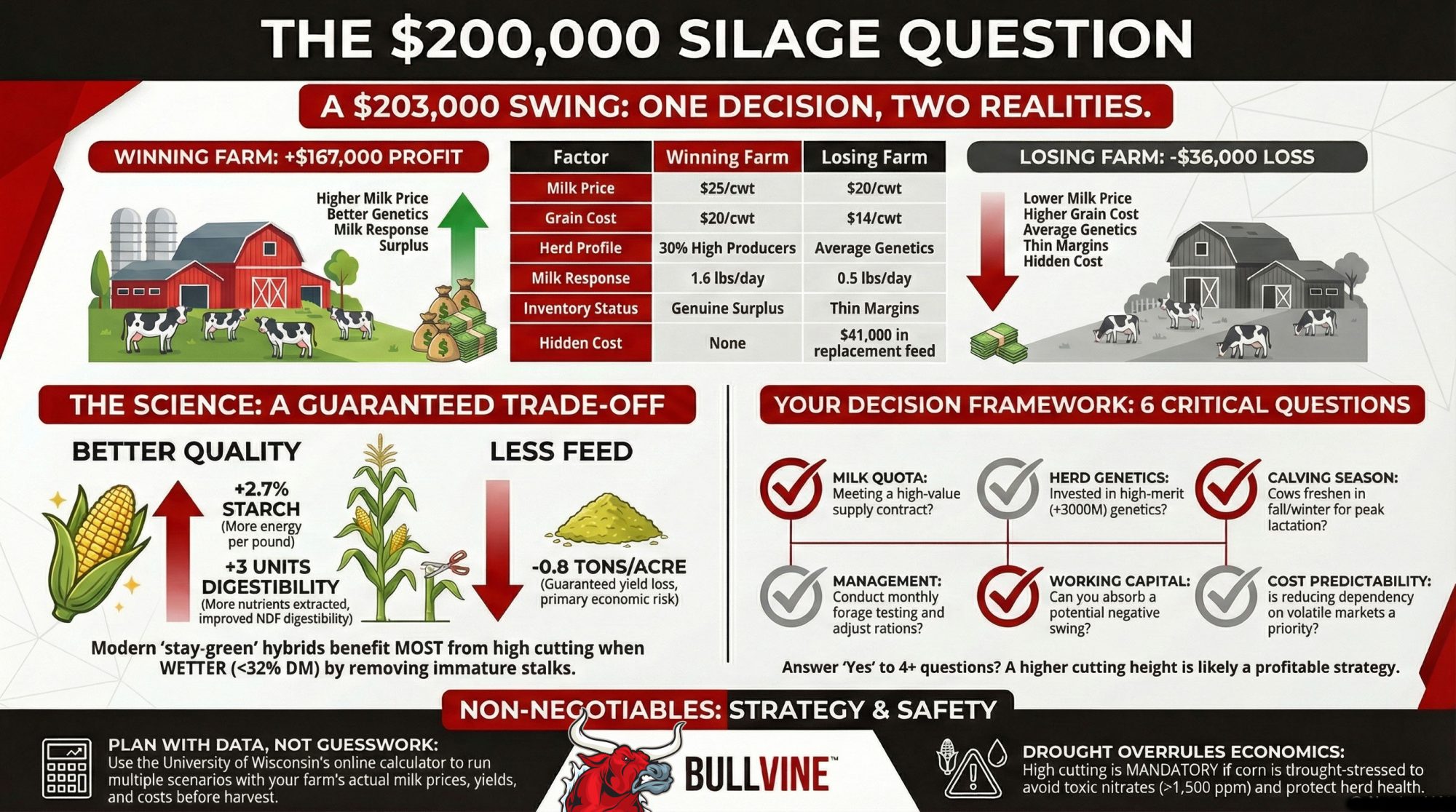
6 inches or 18 inches? Wrong answer costs $36,000. Right answer gains $167,000. Context determines which.

corn silage cutting height

EXECUTIVE SUMMARY: Two neighboring farms made the same cutting height adjustment—one gained $167,000, the other lost $36,000, and new Wisconsin research explains exactly why. A meta-analysis of 35 studies shows that raising corn silage cutting height from 6 to 18 inches consistently increases starch by 2.7% and digestibility by three units, while sacrificing 0.8 tons/acre in yield. But whether this trade-off pays off depends entirely on your context: milk price, grain cost, herd genetics, inventory buffer, and management sophistication determine whether you’re the winner or the loser. Modern stay-green hybrids have completely reversed traditional thinking—immature stalks now hurt starch concentration more than fiber quality, making wetter corn benefit more from high cutting. This guide provides the exact decision framework, economic calculator strategies, and implementation timeline needed to position your farm on the profitable side of this $200,000 swing.

Every August, producers make a mechanical adjustment that swings profitability by six figures. The decision on cutting height has evolved from a simple harvest preference to a complex economic gamble that affects everything from milk production to inventory security.

A new 2024 comprehensive meta-analysis from the University of Wisconsin—Dr. Luiz Ferraretto’s team pulled together 35 studies with over 150 observations—challenges everything we thought we knew about corn maturity and cutting height. When combined with today’s volatile markets, the data is fascinating—and a little scary.

Under the right conditions, adjusting your cutting height could generate an extra $167,000 annually for a 500-cow dairy. But that exact same decision, under different circumstances, could cost you $36,000. Here’s why the context matters more than the setting.

The Science That’s Changing Everything

So Ferraretto’s Wisconsin team discovered something remarkably consistent across all those studies. For every centimeter you raise that cutting height—that’s about 0.4 inches for those of us still thinking in imperial—your corn silage gains 0.09 percentage units of starch and 0.08 units of NDF digestibility. But you’re also losing 0.06 tons per acre in yield. Every single time.

Now, those numbers might sound small, but let’s put this in perspective. When you raise your cutting height from 6 inches to 18 inches—a 30-centimeter increase—here’s what happens:

  • Your starch content jumps from around 28% to 30.7% (that’s a 2.7 percentage point gain)
  • NDF digestibility improves from 55% to 58% (3 units better)
  • NDF content drops from 45% to 42.3% (2.7 points lower)
  • But you’re losing approximately 0.8 tons per acre in yield

The quality improvements are remarkably consistent across different hybrids and growing conditions—that’s what made the research so compelling. The yield loss? That’s guaranteed too. But whether that trade-off makes economic sense… well, that depends entirely on your specific situation.

When Modern Genetics Flip the Script

Here’s where it gets really interesting—and honestly, it caught me off guard when I first saw the data. Those stay-green hybrids that dominate the seed market now? They’ve completely decoupled ear maturity from stalk maturity in ways that flip our conventional wisdom on its head.

The Wisconsin research revealed that wetter corn below 32% dry matter shows the strongest starch response to increased cutting height—we’re talking 0.10 percentage units per centimeter. Meanwhile, drier corn above 37% DM shows greater fiber digestibility (0.12 units per centimeter) but lower starch digestibility.

This contradicts what most of us learned years ago, doesn’t it? But when you think about how stay-green genetics actually work, it makes sense. These hybrids keep stalks green and photosynthesizing while the grain matures normally—it’s like the ear and stalk are running on completely different schedules. So at lower whole-plant moisture, you’ve got these mature ears sitting on relatively immature, high-moisture stalks. The bottom portions haven’t fully lignified yet, which makes them more of a starch-diluting factor than a fiber-quality problem.

What we’re seeing is that those immature stalks hurt you more by watering down starch concentration than by adding indigestible fiber. By the time you hit 37% DM, those stalks have finally lignified, and suddenly the cutting-height benefit shifts from starch concentration to improved fiber digestibility. Complete reversal of traditional thinking.

Two Scenarios, Same Decision, Completely Different Outcomes

Let me share two economic scenarios that really drive home why context matters more than the cutting height itself. These are based on detailed modeling using actual market conditions.

Scenario One: When Things Go Wrong—A $36,000 Loss

Picture a typical 500-cow dairy facing 2024 market conditions: milk at $20/cwt, corn at $3.90/bushel, and what seems like adequate inventory levels. They’ve read the Wisconsin research, seen those quality improvements from high cutting, and decide to chop at 18 inches instead of their usual 6 inches.

On paper, the math looks solid. They’re expecting a realistic 0.5 lbs/day milk response (reasonable for average genetics), worth about $18,250 annually. Grain savings from better forage quality add another $8,600. Against a silage yield loss valued at $10,820, they’re projecting a comfortable $16,000 gain.

But here’s where reality bites. That yield loss leaves them with dangerously thin inventory margins—something that doesn’t become apparent until March. A mold outbreak costs them a week’s silage. Weather delays compound the shortage. By April, they’re scrambling to buy replacement forage at $180/ton—typical spring pricing in the upper Midwest. Production drops 8 lbs/day when silage runs short because cows simply can’t eat enough alternative feeds. When you run all the numbers, it’s a $36,000 net loss from a decision that looked profitable in August.

Scenario Two: When Everything Aligns—$167,000 Additional Profit

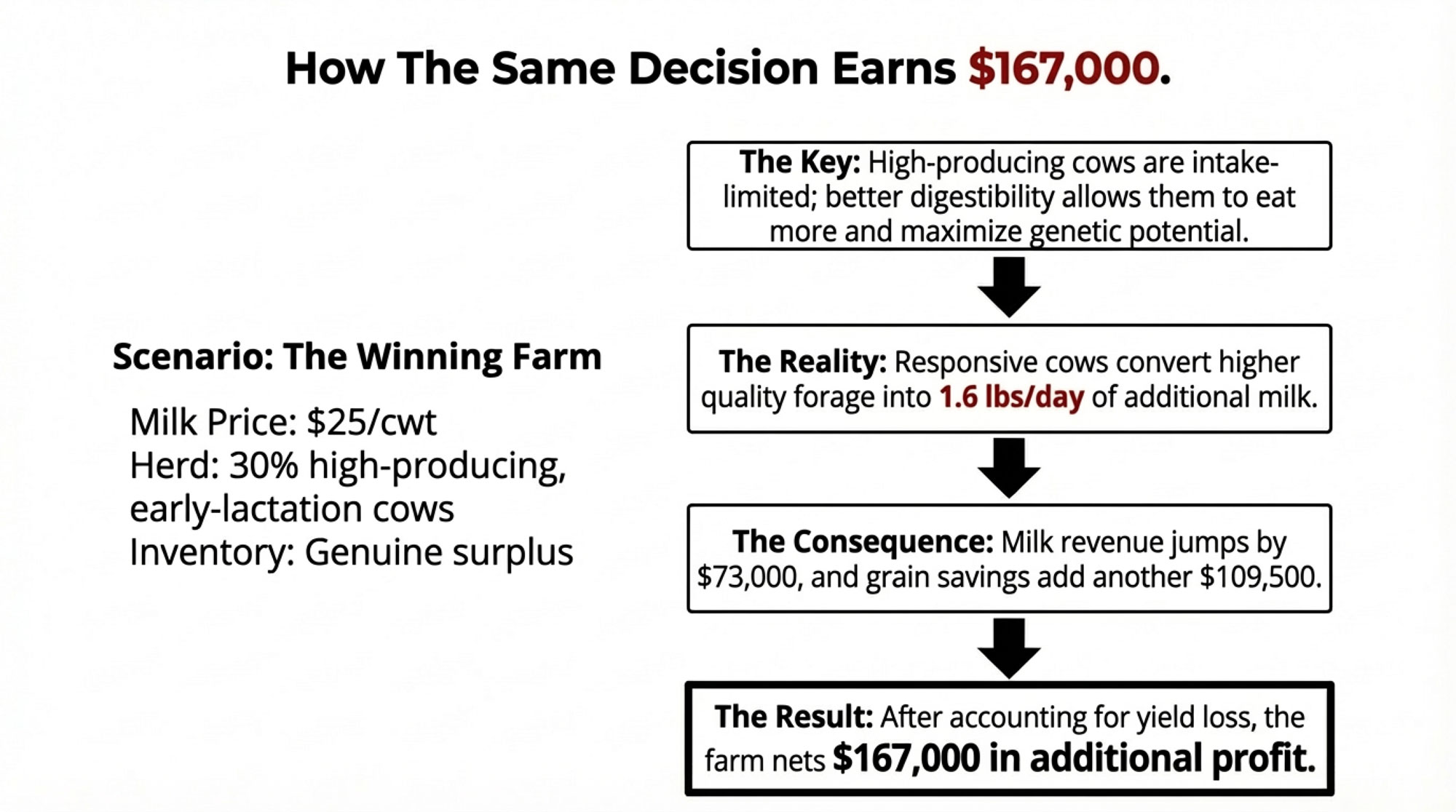
Now consider the same 500-cow size, but under different conditions: milk at $25/cwt (as we saw in 2022-2023), grain at $20/cwt, with about 30% of the herd being high-producing, early-lactation cows averaging 55 lbs/day. This operation has genuine surplus inventory—not just “probably enough” but a real buffer—and excellent ration management with monthly forage testing.

Here’s what makes the difference: Those high producers physically can’t eat enough low-quality forage to maximize their genetic potential. They’re maxed out on intake. Better fiber digestibility from high cutting means lower rumen fill and higher passage rates, allowing more intake. In this scenario, the modeling shows these responsive cows converting the quality improvement into 1.6 lbs/day additional milk—worth $73,000 annually.

At $20/cwt, reducing supplementation by 3 lbs/cow/day saves $109,500. Against a $15,500 silage yield loss, the net result is $167,000 in additional profit. Same decision, completely different outcome.

The Tale of Two Farms: Economic Comparison

FactorLosing FarmWinning Farm
Milk Price$20/cwt$25/cwt
Grain Cost$14/cwt$20/cwt
Herd ProfileAverage genetics30% high producers (55 lbs/day)
Milk Response0.5 lbs/day1.6 lbs/day
Inventory StatusThin marginsGenuine surplus
Spring Shortage$41,000 replacement feedNone
Annual Result-$36,000 loss+$167,000 profit

The Middle Ground: A Practical Framework for Real Decisions

Most operations I work with fall somewhere between these extremes, facing milk prices around $21-22/cwt and moderate conditions where the economics don’t clearly point one direction. For these farms, the Wisconsin research suggests looking beyond pure economics to what I call the six critical tiebreaker questions:

The 6 Tiebreaker Questions

1. Are you meeting milk quota or supply contracts? If you’re under quota, extra milk has real value. But if you’re already flush and dumping or selling at lower prices? There’s zero upside to additional production. This is especially relevant for farms in Federal Order areas with base programs.

2. What are your herd genetics for feed efficiency? Those genomically selected, high-merit cows with +3000M genetics—they respond better to forage quality improvements than average commercial genetics. If you’ve been investing in genetics, you need to feed for it.

3. When do your cows freshen? Fall and winter fresh cows are in peak early lactation when feeding that high-quality silage—exactly when they’re most responsive. Spring calvers? They’ll be mid-to-late lactation by the time new silage is fed. Makes a huge difference.

4. How sophisticated is your forage testing and ration management? Monthly testing and active ration adjustments capture quality gains. If you’re testing once or twice a year, you’re probably missing the optimization window entirely.

5. What’s your working capital situation? Can you absorb an $80,000 swing if things go sideways? Tight margins mean lower risk tolerance—that’s just reality for many operations right now.

6. How important is feed cost predictability? High-cut silage reduces grain dependency, providing more stable feed costs when grain markets are volatile. For farms with locked-in milk contracts, this predictability has real value.

What I’ve found is that farms answering “yes” to four or more of these should lean toward high cutting. Those with two or fewer “yes” answers should favor conventional height. It’s not perfect, but it’s been remarkably consistent in predicting success.

The Wisconsin Calculator: More Strategic Tool Than You Think

The University of Wisconsin’s Corn Silage Cutting Height Calculator has become an essential tool—you can find it at dairy.extension.wisc.edu under their forage resources. But here’s what I’ve learned: it’s not about plugging in numbers once and calling it done.

The strategic farms run three milk price scenarios—conservative at $20, realistic at $22, and optimistic at $25. They test different yield baselines using their worst-case, average, and best-case historical yields. They vary baseline forage quality inputs to see how much improvement actually matters for their specific situation.

What’s really valuable is how the calculator makes the cost-per-ton reality impossible to ignore. When it shows your silage cost rising from 5/ton DM at conventional cutting to 3/ton at high cutting, you have to ask yourself: Do I genuinely believe my herd can convert that quality into enough milk to justify paying an /ton premium? That’s the real question, isn’t it?

Regional Variations Matter More Than You Think

Something I’ve noticed working with farms from California to New York—the optimal strategy varies significantly by region. In the Northeast, where purchased forage is readily available but expensive, inventory buffer matters less than in the upper Midwest, where replacement forage might be 200 miles away. California dairies with year-round production and minimal seasonality in fresh cow patterns face different economics than Pennsylvania operations with strong seasonal calving.

In the Southwest, where corn is often harvested multiple times per year, the risk of inventory shortages is lower, making high-cut strategies more viable. Meanwhile, in areas like Idaho, where transportation costs for replacement feeds are substantial, that 0.8 tons/acre yield loss becomes much more costly to replace if things go wrong.

Implementation Reality: The 60-75% Achievement Factor

Even with perfect planning, field reality introduces complications that the research can’t fully capture. Modern forage harvesters, even good ones, maintain cutting height within plus or minus 2-3 inches at best. That creates quality variation across every field.

Your 250-acre field isn’t flat. You’ve got valleys where the header runs at 13 inches, ridges where it hits 22 inches, all while you’re targeting 18 inches. You end up with four distinct quality profiles in a single harvest. When your forage test shows 29.5% starch instead of the projected 30.7%, that’s not necessarily a management failure—it’s equipment variation meeting field reality.

Given equipment consistency limitations and field variability, farms with basic equipment are likely to capture 60-75% of research-projected benefits, while precision-equipped operations may achieve 80-90%. But we’re talking an additional $15,000-25,000 for that precision equipment. Is capturing that extra 15% worth twenty grand? That depends on your operation’s scale and economics.

When Safety Trumps Everything: The Drought Factor

Drought-stressed corn throws all economic calculations out the window. Ohio State and Penn State Extension research demonstrates that nitrate accumulation in drought-stressed corn can reach 5,524 ppm in the lower third of stalks, compared to just 17 ppm in ears. With livestock safety thresholds at 1,000 ppm NO3-N, high cutting becomes mandatory regardless of economics.

The 2012 Midwest drought provided stark lessons about nitrate risk management. Extension reports from that period show that farms implementing high-cutting strategies and testing for nitrates generally avoided the livestock health issues—including animal deaths and reproductive failures—that affected operations using conventional cutting practices. No amount of saved tonnage is worth risking your herd’s health.

If you’re dealing with drought stress, the protocol is clear: test for nitrates before harvest, chop at 12+ inches minimum if levels exceed 1,500 ppm, and allow 3-4 weeks fermentation before feeding. It’s not about economics at that point—it’s about keeping your cows alive and healthy.

Why Are Seed Companies Silent on Harvest Strategy?

Here’s something that frustrates me, and probably you too: We’re spending $400 per bag on stay-green hybrids without anyone explaining how those genetics should influence harvest decisions six months later. I’ve sat through dozens of seed sales presentations, and they focus on yield, standability, and disease resistance—all important—but remain completely silent on how stay-green characteristics affect cutting-height optimization.

This communication gap means we’re making genetic investments in March that fundamentally alter our harvest economics in August, yet the connection is rarely made explicit. You’d think a simple matrix showing recommended cutting heights and quality responses by hybrid would be standard by now. But I haven’t seen a single major seed company provide this information.

The companies have their reasons, of course. Testing the cutting-height response for each hybrid is expensive. It complicates marketing. And honestly, they see it as a harvest management issue, not a seed selection issue. Fair enough from their perspective, but it leaves us in the dark when we’re trying to make informed decisions.

Critical Decision Timeline for Success

Looking at operations that consistently get this right, timing is absolutely critical. Here’s the timeline that actually works:

March-April (Seed Selection): Identify which hybrids have stay-green genetics. Note any “delayed senescence” or “premium stay-green” traits. Understand that these will respond differently to cutting height.

Late July (Critical Planning Week): Run the Wisconsin Calculator with multiple scenarios. Test drought-stressed fields for nitrates (5-10 plants, lower third). Score yourself on those six tiebreaker questions. Document your cutting height decision per field—in writing.

Early August (Harvest Preparation): Communicate specific targets to your harvest crew. Calibrate equipment, verify header consistency. Plan for that plus-or-minus 2-3 inch variation around the target.

During Harvest: Test first loads immediately for DM and quality. Adjust if quality differs from projections. Document actual versus planned for next year’s reference.

Post-Harvest: If nitrates were elevated, ferment for at least 3-4 weeks. Retest before feeding. Share results with your nutritionist for ration adjustments.

Key Takeaways for Strategic Implementation

What’s become clear from both the research and what we’re seeing in the field is that successful operations aren’t looking for a universal cutting height strategy. They’re the ones asking hard questions in July, testing their assumptions, and adapting their approach to match their specific economic reality.

The economics are incredibly context-dependent. That same cutting height that could generate $167,000 under optimal conditions might cost $36,000 under different circumstances. Your specific combination of milk price, grain cost, herd genetics, inventory situation, and management capability determines the outcome—not the height itself.

Quality improvements are real but not automatically bankable. Lab results consistently show improved starch and digestibility. But whether your cows convert that into milk depends on everything from ration reformulation to rumen microbiome variation to what percentage of your herd is actually in early lactation when you’re feeding that silage.

Variable strategies often work best. Instead of a single height across all fields, the smartest operators I know cut stay-green hybrids higher, conventional hybrids at standard height, and drought-stressed fields at a higher height, regardless of variety. It’s more complex, sure, but it captures value where it exists while avoiding losses where risk is high.

Looking Ahead

The decision on corn silage cutting height has evolved far beyond a simple mechanical adjustment. It’s become this sophisticated economic optimization that requires integrating agronomy, nutrition, economics, and risk management. The farms that recognize this complexity and plan accordingly are capturing significant value. Those that don’t? Well, they’re leaving money—sometimes substantial amounts—in the field.

The Wisconsin research provides the scientific foundation we needed. Their calculator and other economic modeling tools offer practical decision frameworks. But ultimately, each farm has to evaluate their unique situation against volatile markets, uncertain weather, and the biological variability that’s just part of dairy farming.

The $200,000 question isn’t whether to cut high or low. It’s whether you’re making that decision with complete information, at the right time, for your specific operation. In an industry where margins keep tightening and every decision counts, that level of strategic thinking around something as seemingly simple as cutting height might just be the difference between profitability and loss.

What’s interesting is how this all connects back to the bigger picture of precision management in dairy. We’re no longer in an era where one-size-fits-all recommendations work. The profitable farms of tomorrow—probably including yours—will be those that can integrate complex information, make field-specific decisions, and execute with discipline. Even on something as basic as where to set the chopper head.

You know, at the end of the day, it’s about being intentional with every decision. And that’s what separates the operations that thrive from those just trying to survive.

Additional Resources

Wisconsin Corn Silage Cutting Height Calculator: dairy.extension.wisc.edu/articles/corn-silage-cutting-height-calculator-background-and-guide/

Nitrate Testing Guidelines:

  • Ohio State Extension: Nitrate Toxicity in Livestock
  • Penn State Extension: Managing Drought-Stressed Corn Silage

Key Decision Thresholds:

  • Nitrate Safety: <1,000 ppm NO3-N
  • High-Cut Consideration: 4+ “yes” on tiebreaker questions
  • Economic Breakeven: Typically 0.5-1.0 lb/day milk response needed

KEY TAKEAWAYS

  • Same decision, $203,000 difference: Context (milk price, genetics, inventory) determines if you win or lose
  • Quality gains are guaranteed, profits aren’t: 2.7% more starch costs 0.8 tons/acre—the math only works with the right conditions
  • Stay-green genetics changed everything: Wetter corn now benefits MORE from high cutting than dry (opposite of tradition)
  • Winners plan in July, losers react in August: Use Wisconsin’s calculator to model YOUR specific scenario
  • Drought corn = mandatory high cut: Nitrates >1,500 ppm override all economics—it’s about safety

Complete references and supporting documentation are available upon request by contacting the editorial team at editor@thebullvine.com.

Learn More:

Join the Revolution!

Join over 30,000 successful dairy professionals who rely on Bullvine Weekly for their competitive edge. Delivered directly to your inbox each week, our exclusive industry insights help you make smarter decisions while saving precious hours every week. Never miss critical updates on milk production trends, breakthrough technologies, and profit-boosting strategies that top producers are already implementing. Subscribe now to transform your dairy operation’s efficiency and profitability—your future success is just one click away.

NewsSubscribe
First
Last
Consent

China’s Soybean Surge: What Every Dairy Farmer Needs to Lock in Before Feed Costs Spike

Are your feed contracts ready for China’s next move? Learn the #1 step to keep your dairy thriving through 2026’s storm.

EXECUTIVE SUMMARY: China’s record soybean purchases are tightening feed supplies and driving up costs for dairy farmers in 2026. This analysis, backed by USDA and industry data, reveals how the new trade deal is fueling volatility—from rising soybean meal prices to a stronger dollar eroding export competitiveness. Dairy operations willing to act fast—locking in feed contracts, improving ration efficiency, and diversifying protein sources—stand to protect their bottom line. The article lays out a farmer-tested 90-day action plan, with examples and strategies suited for different regions and farm sizes. For many, the next few weeks could determine whether they stay in business, expand, or get squeezed out. With the right moves, surviving the feed storm of 2026 isn’t just possible—it’s within reach.

Dairy Feed Management

You know how it goes—you’re checking feed invoices on a Thursday afternoon when the big news breaks. That’s exactly what many Wisconsin dairy farmers were doing when the November 2025 China trade deal was announced. American agriculture had secured 87 million metric tons of soybean exports over three years, and honestly, the initial reaction from most of us was cautiously optimistic.

But here’s what’s interesting. As producers started running the numbers—and I’ve talked to quite a few over the past week—the optimism began to shift. When China commits to buying 25 million metric tons of our soybeans annually, those are beans leaving the domestic market. And as one producer near Madison put it to me, “Last I checked, my cows don’t eat soybeans in Shanghai.”

What I’ve found is that once you dig into the actual economics, there’s a supply squeeze developing that the celebratory press releases aren’t really highlighting. It’s not that anyone’s trying to hide anything—it’s just that the grain side of the story is getting all the attention.

Understanding the Supply Squeeze

So here’s where the math gets interesting, and why many of us are concerned. According to the latest USDA Economic Research Service data from October, U.S. soybean crushing capacity is already processing about 2.54 billion bushels annually. That’s 59% of our total production right there.

Operation SizeMonthly Soybean Meal Use (tons)Cost at $330/tonCost at $375/tonMonthly Impact
100-cow4.5$1,485$1,688+$203
300-cow13.5$4,455$5,063+$608
500-cow22.5$7,425$8,438+$1,013
1,000-cow45$14,850$16,875+$2,025
2,000-cow90$29,700$33,750+$4,050

Now add China’s commitment—another 918 million bushels of annual demand when you convert those metric tons. Factor in our existing exports to Japan, Mexico, and the EU, plus seed requirements… suddenly we’re operating at nearly 100% utilization with minimal buffer stocks.

Agricultural economists at places like Iowa State have been tracking this, and what they’re pointing out is worth noting: when stocks-to-use ratios drop below 12%, price volatility typically increases significantly. What are the projections for the 2025-26 marketing year? We’re looking at 10.2%. That’s uncomfortably tight by any measure.

Look, I get why grain farmers are celebrating—and they should be. They’ve been getting undercut by Brazilian beans for three years straight. The USDA Foreign Agricultural Service reports show Brazil’s production costs running about $8.67 per bushel compared to our $9.85 here in the States. That’s brutal competition. So yeah, they desperately needed this export market.

But here’s where it gets complicated for those of us in dairy. Current soybean meal futures on the CME were trading around $320-330 per ton in early November. Market analysts—and I’m talking about the conservative ones at places like CoBank—are projecting we could see 12-18% price increases once those export shipments ramp up in the first quarter of 2026.

Soybean meal prices are projected to surge 12-18% by Q2 2026 as China’s record purchases tighten domestic feed markets—hitting $375/ton and squeezing dairy margins across all operations.

For dairy operations where feed accounts for 45-60% of operating expenses —most of us, according to Cornell’s farm business data —we’re talking real money. Not hypothetical impacts—real cash flow consequences.

The Currency Connection Most Farmers Miss

Now, there’s another layer to this that even seasoned dairy producers often overlook. It’s the currency angle, and honestly, it took me a while to fully grasp this myself.

When China buys $9.6 billion worth of soybeans annually, they need U.S. dollars to complete those transactions. Basic economics, right?

But what happens next is where it gets interesting. Federal Reserve data going back decades shows that a 10% increase in agricultural exports typically correlates with a 1-2% appreciation in the dollar’s value against trading partner currencies. Doesn’t sound like much?

Let me give you a real-world example that brought this home for me.

Say you’re part of a cooperative that exports nonfat dry milk to Mexico—which, according to U.S. Dairy Export Council data, is one of our top three dairy export markets. Your product is priced at $1.20 per pound, and a standard container holds 44,000 pounds. At today’s exchange rate of roughly 17 pesos per dollar, that Mexican buyer pays 897,600 pesos.

But if the dollar strengthens by just 1.5%—and that’s conservative given the trade volumes we’re discussing—that same container suddenly costs your Mexican buyer 911,064 pesos. That’s 13,464 pesos more for the exact same product.

The currency connection most farmers miss: a mere 1.5% dollar strengthening adds $13,464 to a container of milk destined for Mexico—your price didn’t change, but suddenly you’re uncompetitive against New Zealand

“You haven’t raised your price. Your co-op hasn’t changed anything. But from the buyer’s perspective, American dairy just got more expensive.”

Meanwhile, New Zealand dairy products? Their dollar typically weakens when global commodity prices rise, making their exports more competitive, not less. It’s a dynamic that puts us at a systematic disadvantage, and it compounds over time.

China’s Actual Dairy Demand: A Reality Check

Here’s what really caught my attention when I dug into the USDA Foreign Agricultural Service’s latest China dairy reports. They’re projecting just 2% growth in dairy imports for 2025. That’s after three consecutive years of declining imports. Two percent.

What’s worth understanding is that China’s government has set explicit targets—47 kilograms of per capita dairy consumption by 2030, up from the current 35 kilograms. But if you read their Five-Year Agricultural Plans carefully — and I’ve been going through these with some industry analysts — they’re planning to meet this demand primarily through domestic production expansion, not imports.

The numbers back this up. China’s raw milk production is forecast to increase by 3-4% in 2025, according to USDA FAS reports. They’re building massive dairy operations—we’re talking 10,000-head facilities—with government subsidies for everything from imported genetics to milking equipment.

And here’s the kicker that nobody wants to talk about: even with these new tariff suspensions, everyone’s celebrating, U.S. dairy products still face a 10% duty in China. Know what New Zealand pays? Zero. They’ve had a free trade agreement since 2008. Australia? Zero percent since 2015. The EU? Various agreements put them at zero or near-zero.

So we’re celebrating market access, where we’re still at a 10% cost disadvantage to our main competitors. That’s… well, that’s something to think about.

Regional Variations and Operational Realities

Now, I should mention that this isn’t hitting everyone equally. The impact really depends on where you are and how you operate.

California’s large-scale operations—I’m talking about those 2,000-plus cow dairies in the Central Valley—they’ve got some advantages here. Many can negotiate directly with soybean crushing plants, bypassing the dealer markup that smaller operations face. They’ve got the storage capacity to buy feed in bulk when prices are favorable. Some are even forward-contracting a full year out.

But in Wisconsin? Pennsylvania? Vermont? The 100-300 cow operations that still make up the backbone of dairy in these states face a different reality. I was talking to a Pennsylvania producer last week who told me he’d called three feed suppliers about locking in prices for next year. One wouldn’t quote him past December. Another wanted a 5% premium for a six-month lock. The third said to call back after Thanksgiving.

What’s fascinating—and concerning—is how this accelerates the consolidation we’ve been seeing for years. USDA National Agricultural Statistics Service data shows that 65% of the nation’s dairy cows now live on farms with 1,000 or more animals. That was 45% just fifteen years ago. When margins get squeezed by feed costs and currency headwinds, it’s the mid-size family operations that typically can’t weather the storm.

For organic and grass-based operations, there’s actually an interesting twist. Those farms feeding minimal grain might find themselves with a competitive advantage as grain-dependent neighbors struggle with feed costs. But even they’re not immune—organic soybean meal runs about double the conventional price, and those markets tend to move in parallel.

And what about seasonal calving operations? They might actually have some flexibility here, being able to time their peak feed needs around market conditions. It’s one of those operational quirks that could become an unexpected advantage.

Practical Steps That Actually Work

So what can we actually do about this? I’ve been collecting strategies from operations that successfully navigated the 2012 drought and the 2018-19 margin squeeze, and there are some consistent patterns.

Lock Your Feed Contracts—But Be Smart About It

The single most impactful decision, according to every successful farmer I’ve spoken with, is locking feed prices for January through June 2026. But here’s the thing—you’ve got maybe 10-15 business days before suppliers adjust their forward pricing to reflect the coming supply squeeze.

A Wisconsin producer I know well locked 70% of her expected soybean meal needs at $332 per ton with a 3% premium. Yeah, it felt expensive paying that $895 extra upfront. But if the meal hits $375 per ton by February—and many nutritionists think it could—she’ll save over $2,000 in six months.

What farmers are finding works best:

  • Lock 60-70% of expected consumption, keeping some flexibility
  • Include alternative proteins in your contracts—canola meal, distillers grains
  • Negotiate volume commitments for better pricing
  • Ask about price protection if markets drop more than 15%

Feed Efficiency: The Research Numbers

Here’s a number that should grab your attention: University of Wisconsin research shows efficient operations achieve 162 pounds of feed per hundredweight of milk produced. Less efficient operations? They’re using 243 pounds. That’s a 33% difference, and it becomes a survival factor when feed costs spike.

Feed Efficiency: Real Farm Results

I know a producer who made some simple changes that improved her feed conversion by 9% over 90 days. Started measuring feed refusals daily—discovered they were wasting 7% of delivered feed. Began testing forages monthly instead of quarterly. Adjusted feeding times to within 30-minute windows. Separated first-lactation heifers from mature cows for targeted feeding.

The result? About $60,000 in annual savings. No new equipment, no capital investment. Just better management of what they already had.

For those running robotic milking systems, there’s an added dimension here. Your feeding strategy is already more individualized, which could be an advantage. But you’ll need to adjust your pellet formulations and potentially recalibrate feeding rates as ingredient costs shift.

Diversify Protein Sources Strategically

What’s working for farmers who are getting ahead of this is a gradual transition, not panic switching. You can’t just swap soybean meal for canola meal overnight and expect the same milk production. But with careful testing and adjustment…

An Idaho producer I’ve been following started incorporating alternative proteins eight weeks ago. They’re now at 15% canola meal, 20% more distillers grains, and they’ve reduced soybean meal from 5.5 to 4.2 pounds per cow per day. Production’s holding steady, components haven’t dropped, and they’re positioned better for when soybean meal prices spike.

The Longer View: Industry Restructuring

Looking beyond the immediate feed cost concerns, this trade deal is accelerating something that’s been happening for years—the fundamental restructuring of American dairy.

Research from Cornell’s agricultural economics department shows that trade policies creating margin pressure don’t just affect current operations. They accelerate the shift from distributed, family-farm dairy to consolidated, industrial-scale production.

The advantages increasingly favor large operations that can negotiate directly with feed suppliers and processors, maintain capital reserves for extended contract positions, achieve superior feed conversion efficiency through dedicated nutritionists and technology, and access sophisticated financial instruments like currency hedging.

For small- and mid-size operations, the path forward requires either exceptional efficiency, niche-market development, or strategic partnerships that provide some of the scale advantages without full consolidation.

I’ve noticed something interesting when talking to younger farmers taking over operations: the successful ones aren’t trying to compete on scale. They’re finding ways to be exceptional at efficiency, developing direct-market relationships to capture more margin, or forming buying cooperatives with neighbors to secure volume pricing on inputs. It’s really adapt or exit.

And heifer raising operations? They’re in an interesting spot. Feed costs hit them too, but they might find opportunities as dairy farms look to reduce capital tied up in youngstock. Could be worth exploring contract raising arrangements if you haven’t already.

Your 90-Day Action Plan

Based on conversations with farmers who’ve successfully navigated previous margin squeezes, here’s what needs to happen:

Next 7-14 Days (Urgent)

Contact feed suppliers about January-June 2026 pricing. Even if you only lock 40-50% of your needs, that’s protection you won’t have if you wait until December. Get quotes from at least three suppliers—prices and terms vary more than you’d expect.

Schedule a sit-down with your nutritionist. Not a phone call—a real working session to develop contingency rations using alternative proteins. Test these on a small group first.

Pull your actual feed conversion numbers. If you don’t know your pounds of feed per hundredweight of milk, you’re flying blind.

Next 30 Days (Important)

Start measuring feed refusals daily. I know, I know—one more thing to track. But farms that do this consistently find 5-10% waste they didn’t know existed.

Test all your forages. Those three-month-old test results? They’re fiction at this point. Forage quality changes, and you’re formulating rations based on fantasy if you’re not testing monthly.

Evaluate storage capacity. Can you take a full semi load instead of partial deliveries? The per-ton savings add up fast.

Next 90 Days (Strategic)

Run the numbers on what happens if feed costs rise 15% and milk prices drop 5%. If that scenario puts you underwater, what changes now? Culling decisions? Expansion plans? Equipment purchases?

Build relationships with alternative suppliers. When primary suppliers run tight, having established relationships with secondaries can be the difference between feeding cows and scrambling.

Document everything you’re doing to improve efficiency. Your banker will want to see this when you discuss operating notes, and processors value suppliers who can demonstrate operational excellence.

The Bottom Line

Agricultural trade policy often involves tradeoffs between sectors. The soybeans leaving for China are soybeans not being crushed domestically for meal. The dollars flowing in for those exports strengthen our currency and make dairy exports less competitive.

None of this means the sky is falling. Farms that recognize these dynamics and position accordingly will navigate successfully—some will even find opportunities in the disruption. But the window for proactive positioning is measured in weeks, not months.

As one successful farmer told me recently, “The difference between the dairies that thrive and those that just survive often comes down to decisions made months before the crisis becomes obvious to everyone.”

The math suggests we’ve got about 90 days to position for what’s coming. The question isn’t whether feed costs will rise and margins will tighten—market dynamics make that increasingly likely. The question is whether your operation will be positioned to handle it.

Your cows will need feed in February regardless. The only variable is whether you’ll be paying $325 per ton because you locked it in November, or $375 because you waited to see what happens.

The clock’s ticking. What’s your move?

Key Takeaways:

  • China’s soybean surge is tightening domestic feed markets—soybean meal spot prices could jump 12-18% by Q2 2026.
  • Locking in feed contracts within the next 2 weeks can shield your dairy from volatile markets and protect 2026 margins.
  • Efficiency wins: improving ration conversion and testing forages monthly can mean $60,000/year in saved feed costs.
  • The producers who adapt now—by diversifying their protein offerings and working closely with nutritionists—will have the best shot at staying profitable through next year.
  • Waiting for certainty isn’t a strategy: farms that act now have more options and a better chance of riding out the feed storm.

Data sources for this article include: USDA Economic Research Service (October 2025), USDA National Agricultural Statistics Service (2025), USDA Foreign Agricultural Service GAIN Reports (October 2025), CME Group futures data (November 2025), Federal Reserve Agricultural Finance Monitor (Q3 2025), CoBank Knowledge Exchange quarterly reports, Cornell Dairy Farm Business Summary (2024), University of Wisconsin-Madison dairy research publications, U.S. Dairy Export Council trade data, and various dairy market analysis reports.

Learn More:

Join the Revolution!

Join over 30,000 successful dairy professionals who rely on Bullvine Weekly for their competitive edge. Delivered directly to your inbox each week, our exclusive industry insights help you make smarter decisions while saving precious hours every week. Never miss critical updates on milk production trends, breakthrough technologies, and profit-boosting strategies that top producers are already implementing. Subscribe now to transform your dairy operation’s efficiency and profitability—your future success is just one click away.

NewsSubscribe
First
Last
Consent

Your Silage Is Lying to You: The $180,000 Annual Loss Most Farms Never Calculate

Your bunker’s hiding a $15K monthly bleed—and the fix costs less than your next vet call 

EXECUTIVE SUMMARY: What farmers are discovering through painful experience this season is that feed variability isn’t just another management challenge—it’s become a $15,000 monthly profit drain that compounds invisibly across their operations. Cornell’s dairy research team documented that weather-damaged forages force cows to consume 2.67 extra pounds of feed daily just to maintain production, while Wisconsin Extension’s October data show that this translates to over $5,000 monthly in direct waste alone for a typical 377-cow dairy. However, what’s truly compelling is that Jake, an organic producer near Middlebury, Vermont, transformed his bottom-third performance into nearly $90,000 in recovered profitability with just $1,100 in strategic investments—primarily a $340 moisture tester and joining Cornell PRO-DAIRY’s discussion group. Dr. Chris Wolf’s economic analysis at Cornell’s Dyson School reveals that farms adapting now with 18-24 month forage inventories experience 30-40% less income volatility during weather events, with some actually turning market disruptions into premium selling opportunities. The convergence of climate unpredictability, tightening margins, and consolidation pressure means farms have roughly 18-24 months to implement these proven strategies before compounding losses create structural challenges. The good news? Every farm we studied that took action—from 285-cow organic operations to 5,000-head Western dairies—recovered their investment within weeks and positioned themselves to thrive rather than just survive.

feed variability cost

So I’m watching Carlos, grab a handful of corn silage during morning feeding last week. Eighteen years of experience, right? He just shakes his head and says quietly, “Feels different.”

You know what’s interesting? That simple observation—when caught early—can save anywhere from $20,000 to $30,000, based on our current industry observations. Problem is, most of us miss these signals for months.

The 2025 growing season has been brutal, hasn’t it? We’ve got drought from Michigan through Ohio. Flooding across Iowa and southern Wisconsin. And what’s sitting in our bunkers isn’t just variable feed anymore—it’s become this profit drain that many farms haven’t fully calculated yet. Industry-wide, we’re talking billions in hidden losses that compound year after year.

Here’s what’s fascinating, though. While some operations are bleeding thousands monthly—we’re talking $5,000, $10,000, sometimes even $15,000—others have actually turned this volatility into a competitive advantage. The difference? Well, it’s not what you’d expect.

At a Glance: What You Need to Know

  • Feed variability costs: Typically $5,000-15,000+ monthly for mid-sized dairies
  • Simple fix: Weekly moisture testing prevents about 80% of losses
  • Best ROI: Discussion groups often deliver 300%+ returns for just $200-600 annually
  • Critical window: You’ve got 18-24 months to adapt before losses start compounding
  • Industry impact: Estimated $2.4 billion annually across U.S. dairy operations

Where Your Money’s Actually Going

Let me walk you through where these losses hide in a typical 377-cow operation, because once you see the full picture, the opportunities become pretty obvious.

When feed efficiency drops just 5% from weather-damaged forages—and Cornell’s dairy folks have been documenting this extensively—your cows need about 2.67 extra pounds of feed daily to maintain that 80-pound production average. We’re talking over 1,000 pounds of wasted feed. Every single day.

At current Midwest feed prices—Wisconsin Extension’s October report has them around eighteen cents per pound dry matter—you’re looking at $5,000-plus monthly just from excess consumption alone.

But here’s where it gets really interesting.

Dr. Randy Shaver from Wisconsin’s dairy science department shared something with me that really resonates: “Most nutritionists formulate assuming 35% dry matter in corn silage. When that silage actually tests at 36% DM due to face exposure, farms systematically overfeed without realizing it.”

Do the math with me here. One percentage point drift equals 580 pounds of annual overfeeding per cow. For 377 cows? That’s several thousand more walking out the door, based on typical silage running anywhere from $45 to $55 per ton these days.

The Cost Cascade Most Farms Don’t See

Loss CategoryMonthly ImpactAnnual Total
Direct feed waste$5,000$60,000
Moisture drift$2,000$24,000
Production loss$4,500$54,000
Health issues$3,500$42,000
Total Impact$15,000+$180,000+

Look at those numbers carefully—what hits you first? It’s the direct feed waste and production losses, right? They account for nearly two-thirds of the total impact. Most farms I visit focus on the health issues, but the silent killers are those daily inefficiencies that just compound month after month.

Penn State’s feed management team found something else worth noting—TMR particle size variation. Most farms operate with an 8% variation without even realizing it. Each percentage point costs somewhere between 0.2 and 0.4 pounds of milk per cow. We’re talking about another 900 pounds of lost production daily, or $4,000 to $5,000 per month, at October’s Class III prices of around $16.80.

Dr. Mike Hutjens from Illinois—he’s been tracking these patterns for decades—puts it pretty bluntly: “Research shows metabolic disorders can increase 15 to 20 percent when feed consistency varies. Add in reproduction hits from energy imbalance, and what seems like a manageable $5,000 problem becomes $15,000 or more in total monthly impact.”

Thing is, these losses don’t show up as “Feed Variability Loss” on your P&L. They hide in slightly higher vet bills, components that drift lower, feed costs that creep up…

Corn Silage Moisture Management: Your First Line of Defense

The Meeting That Changed Everything—let me tell you about something remarkable at a Pennsylvania dairy last spring.

Tom—not his real name, privacy matters—runs 420 cows, and he’d assembled this unusual group around his beat-up office table. His veterinarian is Dr. Sarah Chen. Nutritionist Mike Rodriguez with fifteen years of experience working in Pennsylvania dairies. Jennifer Hayes from Penn State Extension. And Carlos Martinez, his herd manager, who’d never been invited to a meeting like this before.

Tom’s problem? Income-over-feed-cost running $2.80 below his benchmark group. On 420 cows, we’re talking over $400,000 annually, he couldn’t explain. Painful doesn’t even begin to describe it.

Jennifer—she’s facilitated dozens of these through Penn State’s Dairy Excellence program—started with an unusual rule: “Let’s observe this data for fifteen minutes. No talking. No solutions. Just observe.”

The silence was uncomfortable, I must admit. But patterns started emerging.

Mike noticed that milk was holding at 79 pounds, while the butterfat dropped from 3.8% to 3.6%. Dr. Chen spotted MUNs trending from 14.2 to 16.8—that’s classic protein imbalance according to Cornell’s guidelines. The December ration showed 16.5% crude protein. Overfeeding shouldn’t be happening.

Then Carlos, hesitant about speaking up, mentioned: “The corn silage has been feeding different lately. Drier. The cows are sorting more, leaving stems.”

Mike’s response was immediate: “When did you last test moisture, Tom?”

The pause said everything. “September. At harvest.”

This was March.

Mike’s calculator came out. If silage had drifted from 35% to 37% dry matter—and that’s completely normal with an exposed face—they were overfeeding 1.1 pounds DM per cow daily. That’s 462 pounds of daily waste across 420 cows.

“We’re looking at 84 tons annually at $50 per ton—over $4,000 just from corn silage overfeeding,” Mike explained. “Plus, you’re diluting the entire nutrient profile, so Tom’s compensating with extra grain.”

Tom nodded slowly. “Yeah, I added about a pound of high-moisture corn per cow in January when body conditions started slipping.”

The room went quiet as everyone calculated. Extra grain: $12,000-plus annually. Elevated ketosis, Dr. Chen had been treating: another $4,000 to $5,000. Total identified loss from moisture drift alone: over $20,000 annually.

Jennifer’s observation still sticks with me: “Everyone in this room had important pieces, but nobody had the complete picture. This is why collaboration matters.”

“Cows tolerate slightly sub-optimal nutrition better than frequent changes. A ration that’s 95% correct but consistent outperforms theoretical perfection with weekly modifications.” – Dr. Heather Dann, Miner Institute

Success Story Snapshot: Jake’s Transformation Timeline

Month 0 (January): IOFC at $9.80 vs. $11.20 goal | 62 pounds production 
Month 1: Joined Cornell PRO-DAIRY discussion group ($300) 
Month 2: Discovered moisture drift issue, purchased Koster tester ($800) 
Month 3:Implemented weekly moisture testing protocol 
Month 4: Adjusted rations based on actual dry matter 
Month 5:Production recovering to 60 pounds 
Month 6: Production at 61 pounds | IOFC at $10.90 | Ketosis cases: 18→6 
Annual benefit: Nearly $90,000 | 
Total investment: $1,100 | ROI: Over 8,000%

Small Farms Finding Big Solutions Through Smart Collaboration

What’s really encouraging—and I’ll admit, kind of surprising—is how smaller operations are pioneering sophisticated approaches without massive investment.

Take Jake—another name I’ve changed for privacy—organic dairy near Middlebury, Vermont. Third generation, 285 cows. His numbers were unflattering: IOFC dropped from $11.20 to $9.80 per cow per day. Milk slipped from 62 to 58 pounds. You’d think he’s too small for sophisticated management, right?

Wrong. Instead of buying technology, Jake joined Cornell PRO-DAIRY’s discussion group. Cost? Three hundred bucks annually. Jason Karszes, who runs the program as Cornell’s Farm Management Specialist, tells me they have dozens of groups across New York now, with hundreds of farms participating.

“That first benchmarking meeting was humbling,” Jake told me over coffee recently. “We were $2.20 below the group average on IOFC. Do the math—that’s over $200,000 in unrealized annual revenue. I wanted to crawl under the table.”

But here’s where it gets good. Through the group, Jake learned that a neighboring farm had identified moisture drift as the cause of systematic overfeeding. He tested immediately with a Koster tester. Same problem—moisture had shifted from 32% to 35% dry matter.

Six months later? Production recovered to 61 pounds. IOFC hit $10.90. Fresh cow ketosis cases dropped from 18 to 6. Jake’s meticulous records indicate that annual benefits are approaching $90,000, based on a total investment of approximately $1,100.

“We stopped operating in isolation,” Jake explains simply. “Eight farms sharing real numbers, genuine problems, proven solutions. For $300 annually, I basically gained a management team.”

Dairy Feed Efficiency Monitoring: Making Sense of Starch Digestibility

Now, Jake’s success story leads us to another piece of the puzzle—one that gets a bit technical but really matters for your bottom line. Remember that corn silage Carlos noticed was “feeling different”? There’s hard science behind why that observation matters so much.

Dr. Luiz Ferraretto, from the dairy science department at the University of Wisconsin, has been researching this topic for years. Fresh corn silage typically has a starch digestibility of 60-65% when tested using the 7-hour in vitro method. After 240 days of fermentation? That can hit 85 to 90 percent.

“This isn’t minor variation—it’s fundamentally different feed,” as Dr. Ferraretto explained at last year’s Four-State conference in Dubuque.

Research published this year in the Journal of Dairy Science from Wisconsin confirms that this evolution follows predictable patterns. Starch digestibility generally increases by about 2% per month during peak fermentation—that’s between days 21 and 90.

Dr. Bill Weiss from Ohio State, who’s been at this for three decades, shared his framework with me:

“Silage under 21 days old? Avoid it unless you’re desperate—that starch is basically locked up. Days 21 to 90? Test bi-weekly with NIR analysis and adjust when digestibility increases by four percentage points or more. After 90 days? Monthly testing, quarterly adjustments usually work fine. Beyond 180 days? You’re just monitoring for stability at that point.”

What surprises many folks—surprised me too, honestly—is that sometimes patience beats immediate adjustment.

“When silage is 30 to 60 days old and climbing 2% monthly in digestibility, adjusting now means you’re readjusting in two weeks,” explains Dr. Heather Dann from the Miner Institute up in northern New York. “Better to wait until that 90-day plateau for one comprehensive adjustment.”

Fecal starch analysis provides validation; Wisconsin’s feed lab processes thousands of these samples monthly. Above 5% indicates that you have undigested energy walking out the back end. But if that silage is only 60 days old, Dr. Dann suggests patience while fermentation completes its job.

When Your Advisors Won’t Work Together

This might be uncomfortable to discuss, but after numerous conversations this year, it needs to be addressed.

I know a Wisconsin nutritionist—let’s call him Rick—serving 40 dairies. He told his client Mark: “Team meetings produce more talk than action. After 20 years, I understand nutrition, your vet understands health. That’s efficient specialization.”

Three months later? Mark’s IOFC had declined another 40 cents per cow daily despite following Rick’s recommendations precisely.

Dr. Sarah Roche at Guelph has been researching advisor-farmer relationships, and she’s identified some predictable resistance patterns: “Professional identity plays a huge role—collaboration can feel threatening. Business models optimized for volume rather than depth create challenges. Past territorial conflicts teach advisors to maintain boundaries.”

How do you assess whether resistance is fixable? Try this approach:

Ask your advisor: “I’ve been learning about quarterly collaborative meetings between vets and nutritionists. What’s been your experience?”

A constructive response sounds like: “Some work well with proper structure, others lose focus. What outcomes are you seeking?”

A closed response: “Complete waste of time. Never effective.”

Mark ultimately switched nutritionists. His new advisor embraces collaboration, telling me, “Every joint meeting teaches me something valuable. Professional growth requires acknowledging that nutrition expertise, while important, isn’t the only expertise that matters.”

Building for Whatever Comes Next: The 18-24 Month Adaptation Window

Examining operations positioned for long-term success reveals consistent patterns that extend beyond technology.

Dr. Chris Wolf, the agricultural economist at Cornell’s Dyson School, has documented how farms maintaining 18 to 24 month forage inventories experience 30 to 40 percent less income volatility during weather events.

“When drought creates spot market spikes—and we’ve seen regional prices exceed $250 per ton in some areas—farms with deep inventory continue feeding from reserves. Some strategically sell excess at premium prices, turning crisis into opportunity,” his research shows.

They’re also diversifying before they have to. During my recent visit to Dr. Tom Overton’s Cornell research plots, the impacts of PRO-DAIRY’s forage diversity were really evident. Farms reducing corn silage from 60-70% down to 40-50% of forage dry matter while adding small grains, sorghum, and cover crop silages show remarkable stability.

“Multiple crop failures become unlikely when you’ve diversified appropriately. It’s basically portfolio management applied to forage,” Dr. Overton explains.

What’s particularly interesting—counterintuitive even—is deliberate production moderation. These operations target a weight of 85 to 88 pounds, rather than aiming for 95.

Dr. Mike Van Amburgh at Cornell quantified it for me: “Lower peaks, sure, but when forage quality varies 5%, these herds barely notice. Result: $1.50 to $2.00 improved income-over-feed-cost despite producing 7 to 10 pounds less milk daily.”

Different Regions, Different Challenges

While I’ve been emphasizing Pennsylvania and Vermont examples, this challenge looks different depending on where you farm.

Dr. Jennifer Heguy, UC Extension’s Central Valley dairy advisor, deals with completely different issues: “We’re not fighting moisture drift—we’re managing extreme heat impacts on fiber digestibility. Alfalfa that tests 42% NDF in June can reach 48% by September after heat stress.”

Dr. Jim Salfer from Minnesota Extension describes their unique situation: “Transition timing creates our challenge. Switching from old to new crop silage in December coincides with the onset of cold stress. Perfect storm for metabolic issues.”

Dr. Rick Norell at Idaho Extension makes an interesting observation: “Large dairies assume size provides protection, but when you’re feeding 5,000 cows, a 2% efficiency loss becomes massive. Precision becomes more critical as you grow, not less.”

And Dr. Ellen Jordan from Texas A&M AgriLife adds another dimension entirely: “Aflatoxin risk in drought-stressed corn can halt milk shipments immediately. That’s a whole different variability challenge.”

Your Action Plan—Starting This Week

Ready to tackle feed variability? Here’s your prioritized approach based on what’s actually working out there:

This Week

Calculate your actual IOFC using Penn State’s online tools or Wisconsin’s DairyComp app. Compare to regional benchmarks. Dr. Kevin Harvatine at Penn State tells me that simply understanding your position often catalyzes change all by itself.

Within Two Weeks

Invest in moisture testing. The AgraTronix MT-PRO costs approximately $340, the Delmhorst F-2000 is around $395, and the Koster units range from $280 to $ 320. They typically pay for themselves within weeks. Iowa State Extension research confirms weekly moisture testing prevents most variability losses before they compound.

Within 30 Days

Schedule a collaborative meeting with your veterinarian and nutritionist. Dr. Jessica McArt from Cornell’s veterinary college has documented that farms conducting even annual joint advisory meetings show significantly improved problem resolution.

Within 90 Days

Join a peer discussion group. Extension programs operate nationwide, including PRO-DAIRY in New York, UW Dairy Management in Wisconsin, and the Center for Dairy Excellence in Pennsylvania. Annual costs typically range from $200 to $ 600, with documented returns often exceeding 300%.

Quick Wins for Under $500

For immediate impact with minimal investment:

  • Moisture tester ($340): Weekly testing prevents thousands in losses
  • Fecal starch analysis ($15-20/sample): Monthly validation of ration effectiveness
  • Discussion group ($200-600): Immediate access to peer experience
  • Employee training: Teaching feeders to recognize changes costs nothing but prevents everything

The Clock’s Ticking

Dr. Normand St-Pierre, Professor Emeritus at Ohio State, shared something pretty sobering with me recently: “The window for addressing these challenges isn’t infinite. We’re looking at maybe 18 to 24 months before compounding losses create structural challenges.”

Think about it—delaying doesn’t defer costs. It compounds them. A 350-cow dairy losing $5,000 monthly faces more than $60,000 in annual losses. By year three? You’re looking at over $200,000 accumulated, plus deferred maintenance, reduced genetic progress, and good employees leaving for better-managed operations.

USDA Economic Research Service data from their 2024 farm financial report shows that most closures follow years of declining indicators. These operations attended conferences, understood best practices, yet never actually started implementing changes.

The 2025 growing season wasn’t an anomaly, you know. NOAA’s Climate Prediction Center October outlook shows this variability is becoming our new baseline. The question isn’t whether you’ll face feed variability—that’s certain. It’s whether you’ll manage it proactively or just react to it.

That Vermont producer I mentioned? He transformed bottom-third performance into nearly $90,000 in recovered profitability through about $1,100 in strategic investment. The Pennsylvania operation identified over $20,000 in losses during one collaborative meeting. Their success wasn’t extraordinary—they just took action.

The knowledge exists. Extension support operates nationwide. Research validates the economics. The only missing element? Implementation.

Twenty years ago, we could wait for normal to return. Five years from now, based on USDA National Agricultural Statistics Service consolidation trends, only adaptive operations will remain.

The industry isn’t failing—it’s evolving. The divide forms between operations that accept excellence and require different approaches in 2025 and those that are still resisting change.

Your corn silage keeps evolving. Costs keep accumulating. Competitors keep adapting.

So what’s your first step going to be?

KEY TAKEAWAYS:

  • Weekly moisture testing prevents 80% of feed losses: A $340 investment in an AgraTronix MT-PRO or similar tester pays for itself within 2-3 weeks by catching drift before it compounds into thousands in monthly overfeeding—Wisconsin’s feed lab data shows fecal starch above 5% means you’re literally watching profits walk out the back end
  • Discussion groups deliver 300%+ ROI for $200-600 annually: Cornell PRO-DAIRY’s Jason Karszes reports dozens of groups where farms like Jake’s recover $200,000+ in unrealized revenue simply by benchmarking with peers and sharing what’s actually working in their specific regions
  • The 18-24 month adaptation window is real: USDA Economic Research Service’s 2024 data shows farms that delay implementation face compounding losses exceeding $200,000 by year three, plus talent migration to better-managed operations—but those acting now are turning $1,100 investments into $90,000 annual gains
  • Regional challenges require regional solutions: From California’s heat-stressed alfalfa jumping from 42% to 48% NDF to Minnesota’s December silage transitions during cold stress, successful farms are adapting strategies to their specific climate realities rather than following one-size-fits-all approaches
  • Deliberate production moderation beats pushing for peaks: Dr. Mike Van Amburgh’s Cornell research proves farms targeting 85-88 pounds instead of 95 gain $1.50-2.00 better IOFC despite lower production—when forage quality varies 5%, these herds barely notice while high-pushers hemorrhage profits

Complete references and supporting documentation are available upon request by contacting the editorial team at editor@thebullvine.com.

Learn More

Join the Revolution!

Join over 30,000 successful dairy professionals who rely on Bullvine Weekly for their competitive edge. Delivered directly to your inbox each week, our exclusive industry insights help you make smarter decisions while saving precious hours every week. Never miss critical updates on milk production trends, breakthrough technologies, and profit-boosting strategies that top producers are already implementing. Subscribe now to transform your dairy operation’s efficiency and profitability—your future success is just one click away.

NewsSubscribe
First
Last
Consent

Sorghum: The Drought-Tolerant Feed That’s Changing the Dairy Game

Turkish dairy farmers just cut water use 50% without losing a drop of milk—here’s how they did it and why you should care.

EXECUTIVE SUMMARY: Listen, while we’ve been stuck in the same old corn routine, dairy farmers in Turkey figured out something that could save your operation serious money. They switched to sorghum and slashed their water bills in half without touching their milk production. We’re talking about a 12-fold increase in sorghum acres over five years—from 451 acres to over 6,000 acres because the math just works. Nebraska extension research shows dairies replacing just 40% of their corn silage with sorghum are seeing 60% cuts in irrigation costs, and with hay prices swinging 40% month-to-month like they did last year, having a backup plan isn’t optional anymore. Steam-flaking pushes sorghum’s starch digestibility up to 90%, matching corn’s energy output while your water meter runs a lot slower. The Journal of Dairy Science backs this up—same milk volume, better fatty acids, lower input costs. You should seriously consider testing this on 50-100 acres this season.

KEY TAKEAWAYS

  • Cut feed costs 15-25% in drought years while maintaining milk production—Nebraska dairies prove it works with real 60% irrigation savings you can take to the bank.
  • Steam-flaking unlocks 90% starch digestibility from sorghum (vs. 65% unprocessed), giving you corn-level energy with half the water demand—upgrade your processing or find reliable custom work.
  • USDA REAP covers 25% of equipment costs for the $25k-$50k processing upgrades most operations need, making the ROI math work even faster in 2025’s tight margin environment.
  • Brown Midrib (BMR) varieties boost fiber digestibility for high-producing herds while genetic advances eliminate tannin concerns—talk to your extension about locally adapted varieties now.
  • Start small with 50-100 test acres to learn the system before committing major acreage. With carbon credits adding revenue and water costs climbing, this isn’t an experimental endeavor; it’s smart risk management.
sorghum for silage, dairy feed management, drought tolerant forage, reduce feed costs, alternative forage crops

You ever have one of those moments when the well’s running low, the pump bill’s climbing, and you’re staring at thirsty corn that just won’t quit? That’s exactly what hit dairy farmers in Turkey’s Izmir region in 2025. Rainfall was down 27%, and water-saving became the name of the game.

So what’d they do? They turned to sorghum. This tough old forage doesn’t require much water, but it keeps the milk flowing just fine. And they didn’t just plant a few acres—they kicked sorghum up from a few hundred acres to over 6,000 acres in five years. When the corn game’s no longer paying, you gotta adapt.

The Science Backing Sorghum’s Performance

Now, farmers like Zafer Yurt know what’s up because they count every drop of water. Studies published recently in the Journal of Dairy Science say cows on sorghum silage match their milk production compared to corn-fed herds, but get better fatty acids and antioxidants in their milk—good news for milk quality and cheese makers alike.

And about those tannins that make some folks nervous? Turns out, thanks to recent genetic research, we can zero in on low-tannin hybrids by spotting key alleles, which means better protein digestion for the cows and fewer headaches for us. Plus, Brown Midrib (BMR) sorghums take that a step further, cutting lignin and boosting fiber digestibility, a real plus in demanding dairy diets.

But listen, what really flips the switch is processing. Steam-flaking sorghum raises starch digestibility way up, rivaling corn. It’s like unlocking hidden energy if you do it right.

Choosing the Right Sorghum Hybrid for Your Region

What works in one spot might tank in another. Up north in the Midwest, newer fast-maturing hybrids are gaining traction—varieties that hold up in harsh weather and finish before frost hits, which matters in short seasons. Across the Corn Belt, grazers like Grazer and Haygrazer fit the bill just right. In the deep south, Texas A&M’s Sudan King handles the heat, even letting folks get two cuts a year in good conditions.

The top producers I’ve talked to mix and match based on soil moisture, planting sorghum on drier patches and leaving the wetter ground for corn. Tech like GPS-guided planting is becoming a must-have for this.

Gearing Up: The Equipment Investment for Sorghum

No secret that sorghum stalks can be tough on your gear. You may need upgrades—small farms looking at a $25k-$50k range and larger operations possibly paying six figures. That said, the USDA’s REAP grant can reduce the cost by 25%, which helps.

And then there’s your nutritionist—bring them in early. You can’t just swap feeds fast without throwing the rumen out of whack.

The Economic Payoff: Analyzing Sorghum’s ROI

Cost-wise, when water’s pricey, sorghum can trim feed bills by 15 to 25%, depending on your local rates and management practices. But the market swings fast—last year’s hay prices jumped 40% month-to-month—so it’s not a sure thing.

Carbon credits are kicking in, too, but the money varies by where you farm and which programs you qualify for.

Managing the Risks: Nitrates, Prussic Acid, and Tannins

SORGHUM FEEDING RISKS — QUICK GUIDE

  • Nitrates: Safe below 0.12% nitrate nitrogen. Test forage regularly, dilute high nitrate batches, and avoid sudden diet shifts.
  • Prussic Acid: Risk spikes after frost or in young regrowth. Wait 1-2 days before grazing and test the forage.
  • Tannins: Low in modern hybrids, but keep an eye on protein digestibility and adjust rations accordingly.

Nitrate spikes can sneak up during drought, so vigilance is key. Caution is warranted between 0.12% and 0.23% nitrate nitrogen; anything above that requires feeding restrictions.

Prussic acid hazards also demand respect—especially after frost events or on regrowth shoots. Test regularly and delay grazing accordingly.

Thanks to new breeding, tannin issues have largely been resolved; however, ongoing monitoring remains a prudent management strategy.

Case Studies: How Dairies Are Winning with Sorghum

Let’s get real. Nebraska dairies swapping 40% of their corn silage for sorghum hit a 60% cut in irrigation water without losing a drop of milk production—these numbers come from well-documented extension research.

Not far off, Kansas operations growing sorghum on marginal grounds have kept herd performance solid, adapting to drought with resilience.

Down in Texas, dairymen rely on sorghum to hold their production steady through blistering heat waves and tightening water supply.

Getting Started with Sorghum

The first step? Pull out those irrigation bills and figure out your true water cost.

Next, talk to your local extension to get recommendations on the best varieties for your specific climate and soil.

Bring your nutritionist into the conversation early so you can transition your cows smoothly—no rush jobs in feeding.

Start small—50 to 100 acres is enough to learn the ropes and avoid surprises.

And be sure to test your forage regularly. Nitrates, prussic acid, tannins—these matter.

Bottom Line

Drought isn’t waiting for anyone. And neither should you.

Sorghum’s no experimental fad. The science, the economics, the real-world wins—it’s all there showing it’s a weapon in the war against dry seasons and rising feed costs.

When the heat is on and the well runs low, this feed can keep your cows milking and your operation profitable.

So, what’s your next move?

Complete references and supporting documentation are available upon request by contacting the editorial team at editor@thebullvine.com.

Learn More:

  • The $4,000 Heifer: Seven Strategies to Navigate the New Dairy Economy – This strategic overview contextualizes the economic pressure to optimize feed costs. It provides seven actionable strategies for managing high input costs in the current market, making the case for why innovations like sorghum are essential for long-term financial health.
  • Precision Feeding Strategies Every Dairy Farmer Needs to Know – This article offers a tactical deep dive into the operational side of feed management. It details how to implement precision feeding using TMR principles and data analysis, providing a perfect “how-to” guide for producers ready to optimize their new sorghum-based rations.
  • Future-Proof Your Dairy Farm: Tackling the Top 3 Challenges of 2050 – This forward-looking piece places the shift to drought-tolerant crops within the larger context of climate change and sustainability. It explores how innovations in feed, genetics, and technology are crucial for addressing the industry’s biggest future challenges, like methane reduction.

Join the Revolution!

Join over 30,000 successful dairy professionals who rely on Bullvine Weekly for their competitive edge. Delivered directly to your inbox each week, our exclusive industry insights help you make smarter decisions while saving precious hours every week. Never miss critical updates on milk production trends, breakthrough technologies, and profit-boosting strategies that top producers are already implementing. Subscribe now to transform your dairy operation’s efficiency and profitability—your future success is just one click away.

NewsSubscribe
First
Last
Consent

Send this to a friend