
Archive for cow families

The Room Went Quiet. Everyone Left. Then an $8,100 Phone Call Changed Holstein History Forever.

The untold stories of Rudy Missy, Blackrose, and the stockmen who saw what the experts couldn’t

It was early October in Madison, Wisconsin, and World Dairy Expo week had arrived.

For the Genosource team back in Iowa, this year carried extra weight, this year carried extra weight. Ladyrose Caught Your Eye—the Unix daughter they’d acquired immediately after Madison in 2021—had already achieved EX-95, cementing her place among the breed’s elite. Now she was back on the colored shavings, a three-time class winner, an All-American, an All-Canadian, representing a bloodline that had defied the odds for three decades.
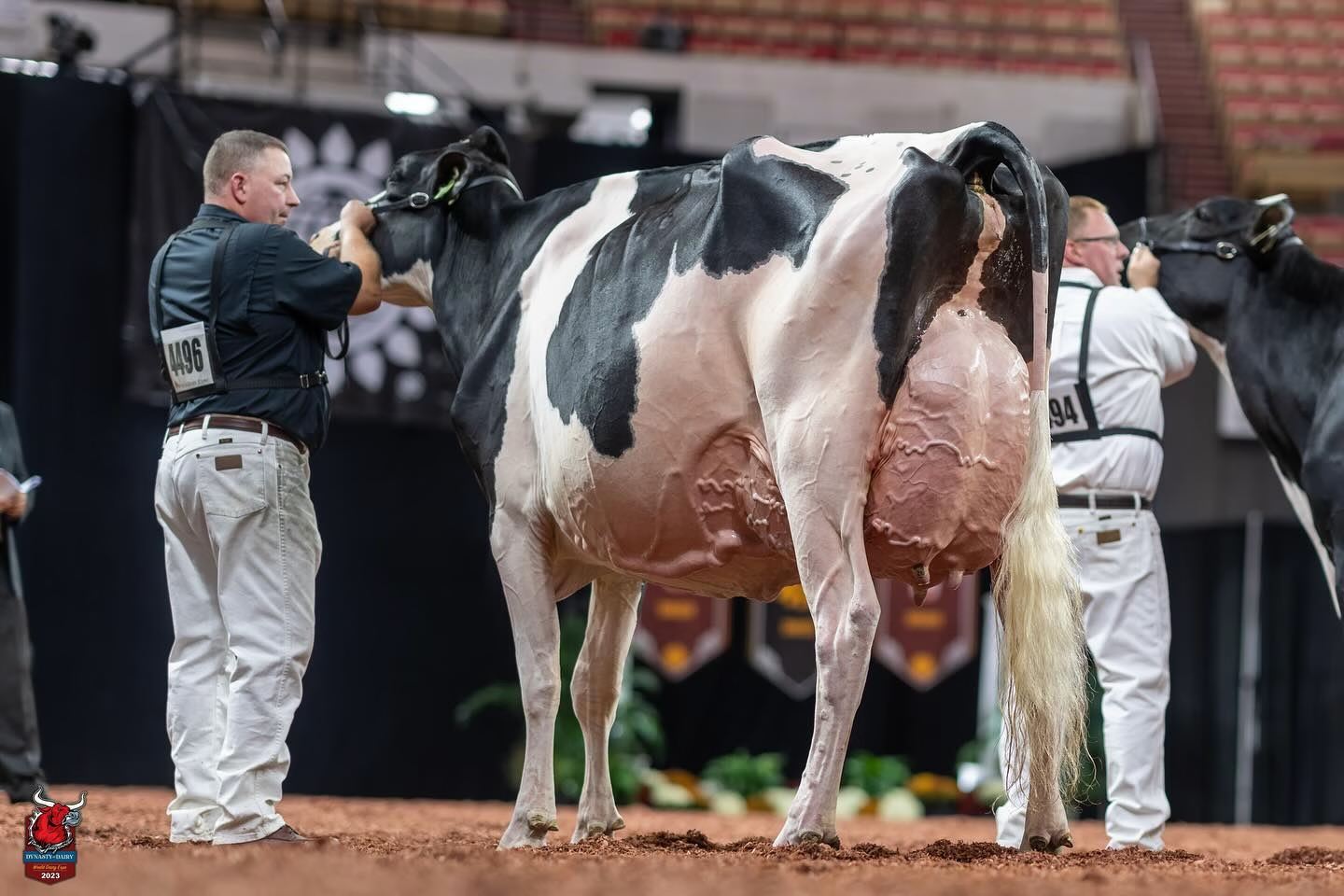
Ladyrose Caught Your Eye on the colored shavings at World Dairy Expo—a three-time class winner whose EX-96 mammary system tells only part of the story. The real story is the three decades of setbacks, second chances, and stubborn belief that put her there.

“She is one of those rare cows that combines cow family, show-winning type, and high genomics,” Tim Rauen of Genosource recalls. Standing in that ring in October, she was living proof.

I’ve covered many Expos over the years I’ve been writing about this industry. But what keeps bringing me back to this cow isn’t the banners or the scores—it’s knowing the decades of setbacks, second chances, and stubborn belief that led to her standing in that ring.

Because here’s what most people watching that week didn’t fully understand: they weren’t just witnessing one cow’s achievement. They were seeing the living proof of stories that began with barn fires, bankruptcy courts, rock stars investing in Holsteins, and phone calls that changed everything.

And those stories—the ones behind the cow in front of them—are what this is really about.

The Call That Changed Everything

Twenty-one years earlier, on a February afternoon in 2003, snow was falling sideways outside the Wisconsin Holstein Convention Sweetheart Sale.

The room was emptying. Experienced breeders—men who had driven through farm country slush and missed morning milking to be there—were already heading for the exits. A five-year-old Holstein named Wesswood-HC Rudy Missy stood in the ring, and the bidding had stalled at a price that felt almost insulting.

Her rump “wasn’t entirely balanced.” That’s what they were saying. And in the unforgiving world of elite cattle auctions, that phrase might as well be a death sentence.

Steve Hayes watched another bidder shake his head and walk away, and felt that familiar mix of disappointment and creeping doubt that every breeder knows—the voice that whispers whether you’ve been fooling yourself all along. This cow he’d helped develop, believed in, poured years into. Was she really going to slip through the cracks like this?

Then the phone rang in the back office.

Matt Steiner’s voice crackled through from Pine-Tree Dairy down in Ohio. The man had never even laid eyes on this cow in person. But something about her—maybe thirty years of studying what makes genetics tick, maybe an instinct honed through decades of disappointment and triumph—told him everything he needed to know.

His $8,100 bid secured what would become the  2014 Global Cow of the Year.
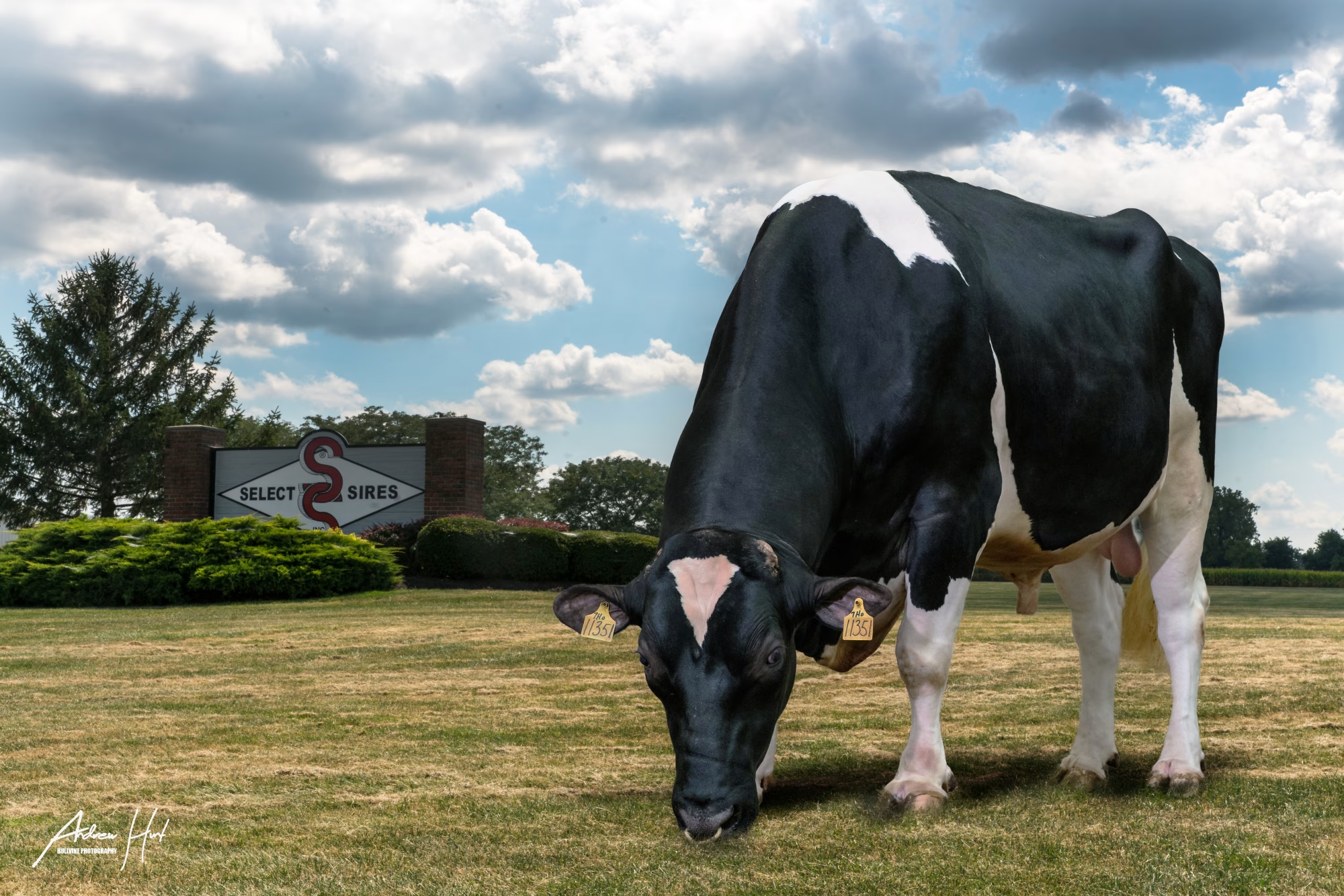
Seagull-Bay Supersire-ET stands proudly at Select Sires, representing the commercial pinnacle of the Wesswood-HC Rudy Missy genetic legacy. From a cow that couldn't attract buyers at $7,000 to a bull achieving millionaire status in AI sales, Supersire embodies how exceptional maternal genetics can reshape an entire industry. His success validates what Matt Steiner saw in that 2003 phone bid—sometimes the most transformative genetics come in

Seagull-Bay Supersire-ET stands proudly at Select Sires, representing the commercial pinnacle of the Wesswood-HC Rudy Missy genetic legacy. From a cow that couldn’t attract buyers at $7,000 to a bull achieving millionaire status in AI sales, Supersire embodies how exceptional maternal genetics can reshape an entire industry. His success validates what Matt Steiner saw in that 2003 phone bid—sometimes the most transformative genetics come in unexpected packages.

I keep thinking about that moment. A roomful of experts walking away from a cow that would reshape the breed, and one man on a phone line three states away who saw what they couldn’t. Today, her descendants include Seagull-Bay Supersire—with over 100,000 daughters worldwide—and Genosource Captain, who held the #1 TPI position for seven consecutive proof runs through December 2024 and remains among the breed’s most influential sires. The genetic value flowing from that single $8,100 phone bid has generated hundreds of millions in semen sales.

But here’s what I keep coming back to when I think about this story. It’s something Steve Wessing, Missy’s original co-breeder, said when reflecting on her journey: “I don’t think she would’ve ever scored EX-92 at our place.”

That’s the kind of honesty you don’t hear often enough—recognizing that cattle reach their potential in different environments, under different management systems. Matt Steiner didn’t just buy a cow that day. He gave her a stage where she could finally perform.

Of course, Steiner didn’t know that’s what he was doing. Nobody did. That certainty only comes later, when you’re telling the story. Living it is different.

The Two Steves: A Friendship Built Across a Fence Line

To understand how Rudy Missy even existed, you have to go back to a different Wisconsin pasture in the early 1990s.

Steve Wessing had started with eighteen registered Holsteins from the Milkstein herd—animals that came with warnings. “There wasn’t a lot of type in that herd,” the industry veterans told him and his wife, Cheryl. And honestly? The experts weren’t wrong. When those first cows got classified, only one scored Very Good: Milkstein Citation Della.

Nothing about Della screamed “genetic goldmine.” She was just a cow that showed up every day, did her job, and kept producing. The kind of cow you don’t think twice about.

But Steve Wessing trusted his eyes over other people’s opinions. And his neighbor, Steve Hayes, was paying attention.

Here’s what I love about this part of the story. Hayes walked past that fence line between their places every morning. He’d pause and study those young cows—the depth through their hearts, how they moved around the feed bunks. That quality you recognize when you see it, even if you can’t quite name it yet.

When Della’s granddaughter Wesswood Elton Mimi came along, both Steves knew they were looking at something special.

“She was a treasure of a cow, very low maintenance, easy to work with,” they’d later recall. “When new feed was delivered, she made sure she had her own place at the front of the line.”

I can picture her so clearly from that description. The kind of cow with personality. The kind you remember long after she’s gone.

Then the fire came.

The Night Everything Almost Ended

Anyone who’s been through it knows that a barn fire is the nightmare that never fully leaves you. The smell of smoke mixing with the panicked bellowing of cattle. The helplessness of watching years of work potentially disappear into the night air. The questions that come later—what could I have done differently, was there something I missed, why us?

Devastating flames tore through the Wisconsin barn one night, and thirteen-year-old Claudette—Mimi’s grandmother, who had already pumped out a quarter million pounds of milk for the Wessings—stood among the smoke and chaos. She survived, thank God. But hip problems from the trauma meant her production career was effectively over. She would have easily hit 300,000 pounds.

Steve Wessing stood in that ash-covered milking parlor afterward, doing the math that nobody wants to do. Adding up what was lost. Subtracting what insurance might cover. Trying to figure out if there was a path forward, or if this was the ending he’d never planned for.

By December 1994, he made the call that went against every farming instinct he had: dispersal sale.

Anyone who’s ever had to let go of something they built knows what that decision costs. It’s not just business. It’s admitting that sometimes the thing you poured yourself into doesn’t get to continue the way you planned. It’s signing the paperwork and then going home to a barn that feels different. Quieter. Wrong.

But then—and this is the part that still gets me—something happened that only happens when people genuinely care about each other.

Steve Hayes had worked out an understanding with his neighbor before the auction: if Hayes bid highest on Mimi, they’d own her together.

Think about that for a moment. A neighbor, watching another neighbor face the unthinkable, steps in instead of standing back. Not to buy cheap—to share the burden. To make sure the genetics survive. To keep his friend connected to something worth saving.

Watching Hayes keep raising his hand as the price climbed past what made most breeders squirm was something those present never forgot. When the gavel fell, two friends from rural Wisconsin suddenly owned what would become one of the most valuable cows in Holstein history.

Neither of them had any clue what they’d just bought.

The Heifer Calf Nobody Expected

When Mimi was bred to Startmore Rudolph—a breeding the AI stud specifically wanted because they expected a bull calf—the two Steves stood in that pasture together, both knowing this decision would either validate their partnership or haunt them for decades.

In 1997, a heifer calf was born: Wesswood-HC Rudy Missy.

At the time, a heifer when you wanted a bull just feels like the universe not cooperating. Again. You do the math on what you were hoping to sell, and you adjust. You move on. It’s only looking back that you can see how the thing that frustrated you became the thing that mattered most.

But that’s cold comfort when you’re standing in the barn wondering what went wrong.

As a cow, though, Missy became what geneticists call a “genetic multiplier”—ultimately producing eighteen sons in AI service and forty-two daughters classified Excellent or Very Good.

What nobody talks about is the waiting. You make a breeding decision, and you won’t really know if it worked for years, sometimes longer. You’re betting a piece of your future on outcomes you can’t see yet. Every one of these breeders lived through stretches where they just had to trust the process and keep showing up—not knowing whether they were building something or wasting their time.

Today, the Steiner family at Pine-Tree Dairy still welcomes Holstein enthusiasts during Ohio Holstein Convention tours. The legacy Matt Steiner’s phone call started continues through his sons, who initially had their doubts about Missy’s curved legs and long teats but learned to trust their father’s eye.

“We acquired her immediately after Madison in 2021,” Tim Rauen of Genosource recalls about Caught Your Eye, another cow woven into this genetic tapestry. “She is one of those rare cows that combines cow family, show-winning type, and high genomics.”

You see the same thing happening, over and over: stockmen seeing what others miss, trusting instinct over auction-day consensus, waiting to find out if they were right.

Breeding Gold from the Ashes of Financial Disaster

While Rudy Missy’s story unfolded in Wisconsin, another drama was playing out that would prove equally consequential—this one born from complete financial collapse.

The 1980s Investor Era had transformed dairy breeding into a playground for tax-bracket-chasing bankers. Section 46 of the Internal Revenue Code allowed wealthy outsiders to write off cattle purchases against their personal income, and prices went absolutely insane. Bulls that should have commanded $50,000 were selling for ten times that.

This was the era when John Lennon of The Beatles invested through George Morgan’s Dreamstreet operation—”threw so much money in the pot that they had to get rid of some of it very quickly,” as industry insiders recalled. Spring Farm Fond Rose, purchased for $56,000 with Lennon’s investment, sold for $250,000 just a few years later. Even rock royalty couldn’t predict which bloodlines would endure—but the money flowing into Holstein genetics signaled something extraordinary was happening in American agriculture.

Jack Stookey was the perfect man for that era—smooth as silk, could charm anyone. He built an empire on other people’s money, snapping up champions and dominating shows.

But bubbles always burst. They always do.

When the IRS started challenging these tax schemes, the money dried up overnight. What followed is hard to tell, even now.

On a Saturday afternoon in winter 1985, Stookey couldn’t pay his hired help, so he instructed them to load a trailer with bull calves destined for slaughter—animals he had previously planned to sell for breeding purposes. Among them were three sons of Continental Scarlet. An AI stud had already spoken for one of the bulls, but Jack couldn’t wait. The bills couldn’t wait.

I think about the hired hands who had to load those calves, knowing what was coming. About Jack making that call because there was no other call to make. About genetics that could have shaped the breed for generations, gone because the bills couldn’t wait another week.

There’s no clean way to tell that story. It’s just loss, compounded.

The Man Who Saw Something in the Wreckage

But where most people saw only the ashes of Stookey’s empire, Louis Prange saw something else entirely.

While everyone else was running from the mess, Prange looked at that barn full of world-class cattle sitting in legal limbo and recognized what nobody else could see. Decades of careful breeding don’t just vanish because someone files for bankruptcy, right? The genetics are still there. The potential is still there.

Prange worked out a deal with the bankruptcy trustee to lease the best cows, flush embryos, and split the proceeds. Among those salvaged genetics was Nandette TT Speckle-Red—the same red-and-white cow that had been dominating shows just years before.

What Prange did next still strikes me as quietly brilliant.

He planned what’s called a “corrective cross”—mating two animals whose strengths perfectly complement each other’s weaknesses. He wanted to breed Speckle to To-Mar Blackstar, a production powerhouse who could pump out incredible milk volumes but needed help on the structural side.

Jack, even in bankruptcy, was still trying to call shots, pushing for different bulls. When it came time to deliver the semen: “My tank ran dry,” he told Prange during that famous phone call.

So Prange went with his gut.

On March 24, 1990, Stookey Elm Park Blackrose came into this world—born in the shadow of bankruptcy court, conceived through a vision of what could be rather than what was.

Of course, standing in that barn in March 1990, nobody knew any of this. Prange had a calf. That’s all. Whether she’d amount to anything—whether any of them would—was still just hope and guesswork. The certainty only comes later, when you’re telling the story. Living it means showing up every day, not knowing if the bet will pay off.

First and Only: The Red Revolution That Changed Everything
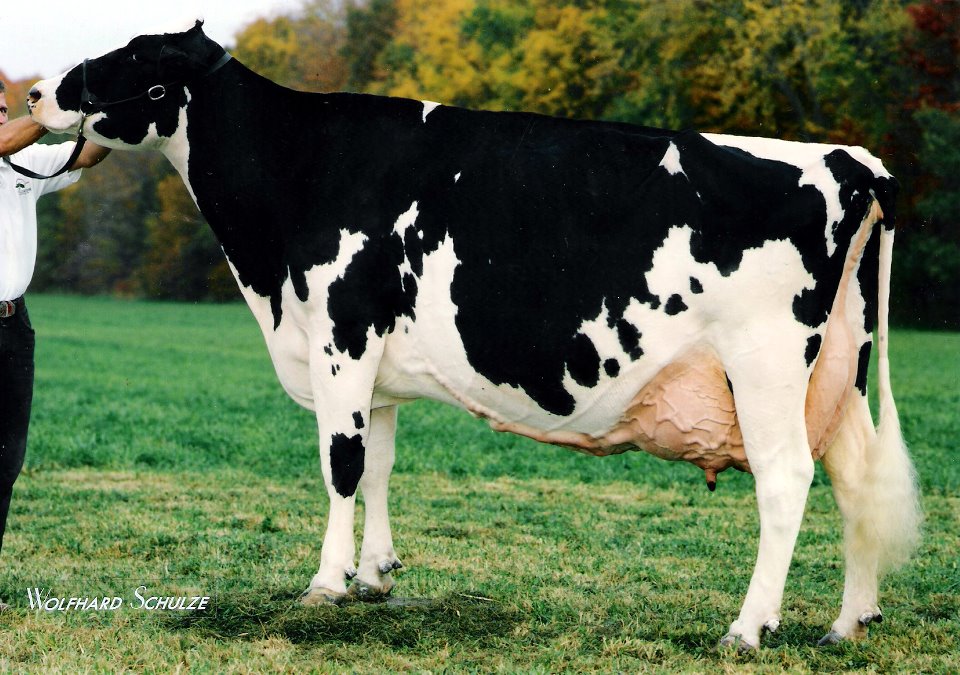
The legendary Stookey Elm Park Blackrose, a cow whose massive frame and amazing udder, captured here, hinted at the genetic revolution she would unleash.

When Blackrose hit the auction block in December 1991, she was just an 18-month-old Blackstar daughter selling for $4,500.

Mark Rueth was fitting cattle at that sale, and he had this feeling about her. He told his buddy Mark VanMersbergen: “This heifer’s got something special. Deep-ribbed, wide-rumped… you just know.”

They partnered with the Schaufs from Indianhead Holsteins on what turned out to be one of the most significant cattle purchases in Holstein history.

Blackrose grew into a massive, commanding presence that dominated wherever she went. Her numbers were off the charts: 42,229 pounds of milk at five years old, with 4.6% butterfat and 3.4% protein. That EX-96 classification put her in conversation with the most structurally perfect cows ever evaluated.

But the real magic was what she produced.

The culmination of a dynasty: Lavender Ruby Redrose-Red (EX-96). In 2005, she achieved the impossible, becoming the first Red & White cow ever named Supreme Champion at World Dairy Expo, proving the enduring magic of the Blackrose line.

Her lineage eventually led to Lavender Ruby Redrose-Red, who in 2005 did something that still stops me when I think about it— first Red & White cow ever named Supreme Champion over all breeds at World Dairy Expo.

First and only. Let me tell you what that moment meant.

For decades, breeders working with red genetics had been told—sometimes subtly, sometimes not—that their cattle were “second tier.” Beautiful, sure. Competitive within their color class, absolutely. But Supreme Champion material? The conventional wisdom said no.

When Redrose-Red stood alone in that Coliseum at the Alliant Energy Center in Madison, above every black and white champion in the building, it wasn’t just a win. It was permission. Permission to finally exhale. To stop defending what they’d chosen to love. To know, just once, that the doubters had been wrong all along.

For people who had spent their careers hearing “not quite good enough,” watching that cow take her place in history meant something that went bone-deep. The kind of vindication you wait a lifetime for and aren’t sure will ever come.

From bankruptcy to the history books in fifteen years.

And now, two decades later, that same bloodline flows through Ladyrose Caught Your Eye—the EX-95 cow who dominated the colored shavings at World Dairy Expo 2024 and proved the dynasty is far from finished.

What the Industry Still Gets Wrong

Here’s the uncomfortable truth that these stories reveal, and it’s something most people in our business don’t want to admit:

We are systematically terrible at recognizing genetic value when it stands right in front of us.

Rudy Missy’s “unbalanced rump” had breeders heading for the exits. Designer Miss sold for $2,100—the lowest price at the legendary 1985 Hanover Hill dispersal—while Brookview Tony Charity commanded $1.45 million at the same sale. Blackrose went for $4,500 at a bankruptcy auction. Even Lennon’s money couldn’t predict which Dreamstreet genetics would endure and which would fade.

Every single one of these so-called “rejects” outperformed the million-dollar sure bets.

The conventional wisdom of their eras dismissed them. The data available couldn’t fully capture what made them special. And yet, stockmen like Matt Steiner, Louis Prange, and the two Steves saw something—felt something—that the catalogs and classification scores couldn’t quantify. (For more on influential maternal lines, see The 7 Most Influential Holstein Brood Cows of the Modern Era.)

Today’s genomic tools are powerful. They tell us more than we’ve ever known. But even now, in December 2025, with all our technology, the fundamental challenge remains the same: the biggest mistake in dairy genetics isn’t buying the wrong cow—it’s walking away from the right one because she doesn’t look perfect on paper.

The Living Proof

As I write this, the legacies of these matriarchs aren’t historical footnotes—they’re actively shaping breeding decisions on farms from Wisconsin to New Zealand.

Genosource Captain—who held the #1 TPI position for seven consecutive proof runs through December 2024 and remains among the breed’s elite sires—traces directly back to Rudy Missy. The cow everyone walked away from at that Wisconsin sale barn is now the grandmother of one of the most influential bulls of his generation.

Ladyrose Caught Your Eye has produced four high-type sons by Lambda—currently one of the breed’s most sought-after sires for type—while continuing to dominate show rings. Her lineage traces directly back to Blackrose, the bankruptcy-born cow that rewrote what was possible for Red Holsteins.

And here’s something that keeps me thinking: Rudy Missy’s great-granddaughter, Ammon-Peachy Shauna-ET, was named 2015 Global Cow of the Year—making grandmother and great-granddaughter back-to-back Global Cow winners. That kind of consistency across generations isn’t luck. It’s something deeper.
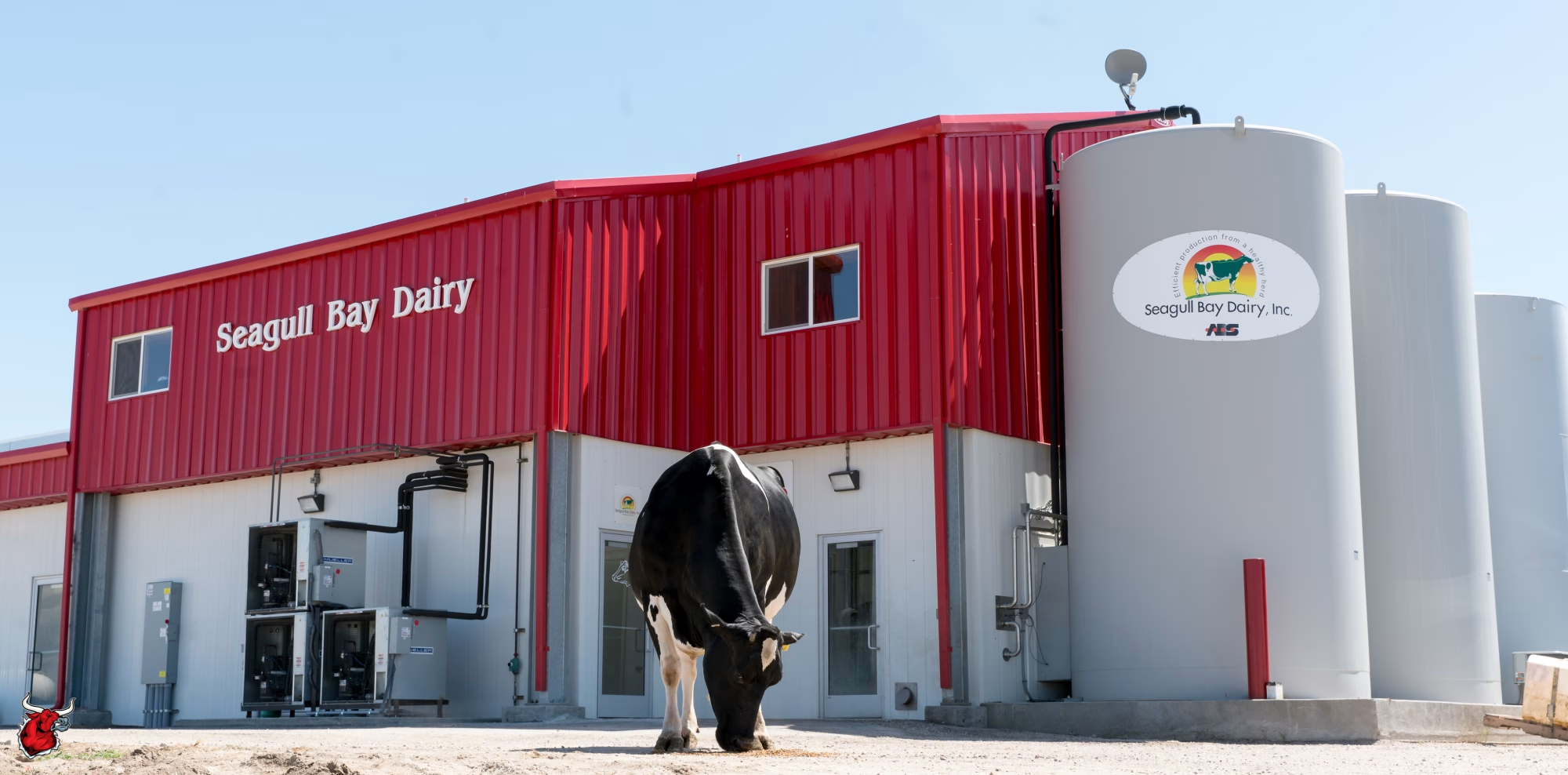
Ammon-Peachy Shauna-ET in front of the milkhouse at Seagull Bay Dairy.

The Steiner family at Pine-Tree Dairy continues hosting tours for Holstein enthusiasts, passing on the philosophy that maternal lines matter more than we ever thought.

I’d be lying if I said these outcomes were inevitable. Good decisions help. But so does timing you can’t control, and breaks that could easily have gone the other way. The two Steves were skilled, but they were also lucky—lucky the fire didn’t take more, lucky Hayes had the cash to bid, lucky that heifer calf had the genetics she had. Skill positions you. Luck decides.

What This Means for All of Us

I’ve spent months with these stories, and what strikes me most isn’t the scale of the achievement—it’s how human the whole thing is.

These aren’t tales of corporate breeding programs with unlimited resources. They’re stories of neighbors becoming partners across fence lines. Of a man betting his career on a phone call to buy a cow he’d never seen. Of someone salvaging genetics from a bankruptcy court when everyone else had given up. Of friendships that turned into dynasties.

What drove all of them forward wasn’t just data or dollars. It was observation, intuition, and the willingness to trust what they saw when everyone else was walking away.

What I don’t want to do is make this sound easy—like all you need is good instincts, and everything works out. For every Rudy Missy, there are cows that didn’t pan out. Partnerships that didn’t survive. Bets that cost people money they couldn’t afford to lose. The stockmen in these stories weren’t right every time. They were right often enough, and they kept going anyway. That’s the part that’s harder to teach.

The lessons these matriarchs leave us are simple to say, harder to live:

  • Trust your eyes over conventional wisdom. Steve Wessing bought cattle that others warned him about. Matt Steiner bid on a cow he’d never seen. Louis Prange invested in genetics that everyone else had abandoned.
  • Build partnerships with people who share your vision. The two Steves created more together than either could have alone. Great genetics need great teams.
  • Focus on transmission, not just individual performance. The cows that built empires weren’t always the flashiest—they were the ones who consistently passed their best traits to the next generation, regardless of the environment.
  • Be patient through adversity. Fires, bankruptcies, dismissive auctions—these setbacks became stepping stones for those who kept going when quitting would have been easier. And quieter. And probably smarter, on paper.

The Question That Matters

The next time you’re at a sale—or walking through your own barn before dawn, studying a heifer that doesn’t quite fit the mold—I hope you’ll think about these stories.

That heifer in the back pen, the one with the slightly off topline your neighbor dismissed last week. Maybe she’s nothing special. Or maybe she’s carrying something you can’t see yet—something that won’t show up for another generation or two.

Somewhere right now, a cow that nobody’s paying attention to is quietly carrying the genetics that will reshape our industry for the next fifty years. The question isn’t whether she exists.

The phone’s ringing. The room’s going quiet. The experts are walking away.

And somewhere in that ring—or in your own barn tomorrow morning—there’s a cow nobody’s fighting for.

Maybe that’s the one.

KEY TAKEAWAYS:

  • $8,100 built a genetic empire. Matt Steiner bought Rudy Missy by phone while experts walked away. She became the 2014 Global Cow of the Year—her descendants are worth hundreds of millions.
  • The cheap cow won. Designer Miss: $2,100. Brookview Tony Charity: $1.45 million. Same 1985 sale. The “reject” outperformed the record-breaker.
  • Friendship outlasts disaster. When fire forced Steve Wessing’s dispersal, his neighbor bid to share the loss—not profit from it. That partnership built a dynasty.
  • Bankruptcy can’t kill great genetics. Louis Prange salvaged Blackrose from court chaos. Fifteen years later: the first and only R&W Supreme Champion in World Dairy Expo history.
  • The cow nobody’s fighting for might be the one. Every empire here started with an animal that the industry dismissed. The next Rudy Missy is in someone’s barn right now. Maybe yours.

Learn More

Join the Revolution!

Join over 30,000 successful dairy professionals who rely on Bullvine Weekly for their competitive edge. Delivered directly to your inbox each week, our exclusive industry insights help you make smarter decisions while saving precious hours every week. Never miss critical updates on milk production trends, breakthrough technologies, and profit-boosting strategies that top producers are already implementing. Subscribe now to transform your dairy operation’s efficiency and profitability—your future success is just one click away.

NewsSubscribe
First
Last
Consent

Larcrest Cosmopolitan: How a Spotted Minnesota Cow Built a Dynasty

A spotted calf born in Minnesota in 2005 defied genetic odds to build a global Holstein empire worth millions. This is her remarkable story.

Larcrest Cosmopolitan, the spotted Picston Shottle daughter whose genetics defied the odds to build a global Holstein empire. Born in September 2005 at Larcrest Holsteins in Minnesota, this remarkable cow achieved #1 GTPI status and became the foundation of one of the most influential bloodlines in modern dairy history, producing 184 registered progeny and earning Gold Medal Dam honors before passing into legend.

The call came on a crisp autumn morning in September 2005 at Larcrest Holsteins in Albert Lea, Minnesota. Another calf had been born—this one spotted, female, and sired by the popular Picston Shottle. In the bustling rhythm of a busy dairy operation, it was just another entry in the herd book. Yet, standing in that Minnesota barn, neither Jon nor Ann Larson could have imagined they were witnessing the birth of a genetic empire that would span continents and redefine Holstein excellence for generations.

Twenty years later, that spotted calf—Larcrest Cosmopolitan—has passed into legend, but her genetic fingerprints can be found in AI studs from Alberta to Amsterdam in champion rings from Wisconsin to Bavaria. Her descendants have claimed national titles, topped genomic rankings, and commanded record-breaking auction prices. The Cosmopolitan name has evolved from a simple farm designation into a global brand synonymous with exceptional udder quality, high milk components, and balanced excellence, transforming dairy operations worldwide.

This is the story of how a single cow family, built on the foundation of a spotted Minnesota heifer, grew into one of the most influential bloodlines in modern Holstein history—a dynasty that proves that greatness, once achieved, has the power to reshape an entire breed.

Against All Odds: The Foundation Story

The Cosmopolitan dynasty began not with certainty but with a series of genetic near-misses that could have easily prevented this entire bloodline from ever existing. Two generations before Cosmopolitan was born, her great-grandmother, Larcrest Juror Chanel EX-93, suffered severe calving paralysis as a 2-year-old, lying immobilized for over two weeks. In most cases, such an ordeal proves fatal. Yet somehow, through sheer determination and the devoted care of the Larson family, she survived to become the genetic cornerstone of what would become a global dynasty.

The next generation brought another brush with genetic extinction. Cosmopolitan’s dam, Larcrest Oside Champagne EX-90, was born as a twin to a bull calf—a circumstance that renders more than 90% of female calves infertile freemartins. The logical decision would have been immediate culling. Instead, the Larsons chose to keep her, and against overwhelming odds, Champagne proved fertile, ensuring the continuation of this precious maternal line.

“We’ve been lucky,” Jon Larson reflects with characteristic humility. “The Juror had calving paralysis as a 2-year-old and was down for 2 weeks. She probably should have died, but somehow, she had the drive and spirit to survive. Then the Outside was a twin with a bull, and for some reason, we kept her, and we were lucky enough that she bred.” These twin strokes of fortune underscore a fundamental truth about even the most sophisticated breeding programs: sometimes, the greatest dynasties hang by the thinnest of threads.

When Cosmopolitan rapidly captured international attention by achieving the coveted Nr. 1 GTPI position among US Holstein cows, it became clear that the Larsons’ patience and those fortunate breaks had converged to create something extraordinary. Here was a cow that combined the power and presence of her Shottle genetics with the proven transmitting ability that would define her legacy through 184 registered progeny in the United States and prestigious Gold Medal Dam and Dam of Merit awards.

The Heart of the Empire: Where Science Meets Passion

Larcrest Crimson-ET EX-91 93-MS GMD DOM, the Ramos daughter of Cosmopolitan who became the beating heart of the global dynasty. Winner of Global Cow of the Year in 2016 and ranked #4 GTPI Female on the Locator List, Crimson's remarkable transmitting ability produced influential AI sires including Calibrate, Camelot, Chavez, Conquest, Casual, and Cyclone. "Crimson is housed in a box stall close to where I do the milking, so I spend my days with Crimson and my nights with Ann—I'm the luckiest guy alive," reflects Jon Larson about the cow who embodies everything the Cosmopolitan family represents.
Larcrest Crimson-ET EX-91 93-MS GMD DOM, the Ramos daughter of Cosmopolitan who became the beating heart of the global dynasty. Winner of Global Cow of the Year in 2016, Crimson’s remarkable transmitting ability produced influential AI sires including Calibrate, Camelot, Chavez, Conquest, Casual, and Cyclone. “Crimson is housed in a box stall close to where I do the milking, so I spend my days with Crimson and my nights with Ann—I’m the luckiest guy alive,” reflects Jon Larson about the cow who embodies everything the Cosmopolitan family represents.

While Cosmopolitan provided the foundation, her Ramos daughter, Larcrest Crimson EX-94, became the expanding dynasty’s beating heart. In the quiet morning hours at Larcrest, one cow commands special attention as Jon makes his rounds through the barn. Her box stall sits strategically close to the milking parlor, allowing Jon to spend precious moments with the animal that embodies everything he’s worked to achieve.

“Crimson is housed in a box stall close to where I do the milking, so I spend my days with Crimson and my nights with Ann—I’m the luckiest guy alive,” Jon exclaims, his voice carrying the unmistakable warmth reserved for truly exceptional animals. This isn’t just sentiment—it’s the recognition of a breeder who understands that great genetics without genuine care and attention remain unrealized potential.

Described as a powerful cow with a big, strong head and wide muzzle, massive rib capacity, and impressive chest and rump width, Crimson embodies the substantial frame that characterizes the family and the kind of robust constitution that modern dairy farming demands. Crimson represents the perfect marriage of genetic merit and practical functionality in an industry increasingly focused on animal welfare and reduced interventions.

The market’s recognition of this genetic gold mine became dramatically evident when Crimson’s Observer daughter, Cale, commanded astronomical prices for her offspring. Picture the tension in a packed sale barn as bidding escalated beyond all expectations—Larcrest Cardigan, a Uno daughter, brought a stunning $400,000, while her Supersire sister Canto sold for $290,000. For dairy farmers watching these sales, these weren’t just impressive figures—they represented validation that genetics truly could transform their operations’ profitability and sustainability.

Crimson’s transmitting ability reached its pinnacle in 2016 when she was crowned Global Cow of the Year after finishing 2nd the previous two years. Her remarkable list of sons reads like a registry of influential AI sires: Calibrate, Camelot, Chavez, Conquest, Casual, and Cyclone. Each carried forward the family’s genetic blueprint to herds worldwide, where dairy farmers would experience firsthand the improved udders, enhanced components, and extended productive lives that define Cosmopolitan excellence.

Building Excellence Through Strategic Partnerships

De Su Commander 9026 2y VG-85, a striking example of Larcrest Commander's transmitting ability in action. Sired by the Mogul son who ranked No. 31 TPI in the US and No. 2 LPI in Canada, this young cow exemplifies the "welded-on udders and high components" that Commander daughters consistently deliver to dairy operations worldwide. Her VG-85 classification as a 2-year-old demonstrates how the Cosmopolitan family's genetics for exceptional type and functionality translate across international boundaries, validating the strategic partnerships that have spread this bloodline's influence throughout the global Holstein industry.
De Su Commander 9026 2y VG-85, a striking example of Larcrest Commander’s transmitting ability in action. Sired by the Mogul son who ranked No. 31 TPI in the US and No. 2 LPI in Canada, this young cow exemplifies the “welded-on udders and high components” that Commander daughters consistently deliver to dairy operations worldwide. Her VG-85 classification as a 2-year-old demonstrates how the Cosmopolitan family’s genetics for exceptional type and functionality translate across international boundaries, validating the strategic partnerships that have spread this bloodline’s influence throughout the global Holstein industry.

From Crimson’s exceptional genetics grew multiple branches, each adapted to different markets and breeding objectives while maintaining the core family traits that deliver tangible benefits to dairy operations. Her Observer daughter, Larcrest Calinda, became the dam of Larcrest Commander, a Mogul son who achieved remarkable success by ranking No. 31 TPI in the US and No. 2 LPI in Canada. For dairy farmers seeking that elusive combination of high production and functional type, Commander daughters consistently delivers the welded-on udders and high components that translate directly into easier milking, reduced mastitis treatments, and enhanced profitability.

However, the true genius of the Cosmopolitan family lies in how their genetics have been developed and refined through strategic partnerships with other elite breeding operations. Sandy-Valley Conway exemplifies this collaborative approach, demonstrating how the family’s influence extends through partnerships that benefit the entire industry.

Conway’s success tells a powerful story about consistency and practical value. Ranked Nr. 13 on the daughter-proven TPI charts as of October 2023 with a score of 2959, Conway has proven himself as a transmitter of exactly the traits that matter most to commercial dairy operations. “Dairymen milking Conway daughters have commented that they are perhaps milking better than his milk proof indicates and that they are very persistent in lactation, being better at 150 days in milk than they are at 60 days in milk,” reports Kevin Jorgensen from Select Sires.

This persistence in lactation represents more than just a genetic trait—it embodies the kind of practical excellence that builds sustainable dairy operations. Feed efficiency improves, reproductive performance stabilizes, and overall herd profitability increases when cows maintain their production deep into lactation. Mike Larson at Larson Acres in Wisconsin, milking 2,500 cows, provides real-world validation: “Way above average for type, really excellent components, and I would say a bit wetter than the proof says. Conway is very consistent in what he does, with moderate size, welded-on udders, and no glaring type deficiencies.”

Conway’s 44 sons entering the Select Sires system represent a multiplication of this excellence, carrying Cosmopolitan genetics to thousands of dairy farms where the improved udders, enhanced components, and extended productive lives translate directly into increased profitability and reduced management challenges.

Global Champions and Local Heroes

O'Katy, a stunning 3-year-old Stantons Chief daughter, stands as Grand Champion at Schau der Besten 2025, exemplifying the continued global dominance of Cosmopolitan genetics. Descended from the legendary Decrausaz Iron O'Kalibra line, O'Katy represents the perfect fusion of Chief's transmitting ability with established European bloodlines. Her championship victory adds to the impressive international record of Chief daughters, who have consistently demonstrated the family's signature traits of exceptional type, strong udders, and balanced excellence across diverse show rings worldwide. This latest triumph reinforces how the Cosmopolitan dynasty continues to shape Holstein excellence on the global stage.
O’Katy, a stunning 3-year-old Stantons Chief daughter, stands as Grand Champion at Schau der Besten 2025, exemplifying the continued global dominance of Cosmopolitan genetics. Descended from the legendary Decrausaz Iron O’Kalibra line, O’Katy represents the perfect fusion of Chief’s transmitting ability with established European bloodlines. Her championship victory adds to the impressive international record of Chief daughters, who have consistently demonstrated the family’s signature traits of exceptional type, strong udders, and balanced excellence across diverse show rings worldwide. This latest triumph reinforces how the Cosmopolitan dynasty continues to shape Holstein excellence on the global stage.

The international reach of the Cosmopolitan influence became increasingly evident through bulls like Stantons Chief, a High Octane son bred in Ontario, Canada. In 2023, the crisp air of a German show ring witnessed Chief’s daughter Les Ponts Chief Elina claiming National Champion honors, while across the border in Belgium, Maxima de Bois Seigneur earned the same prestigious title. Back in the United States, Blexys Chief Bloody Mary captured All-American Milking Yearling honors, demonstrating how Cosmopolitan genetics translate excellence across different climates, management systems, and breeding philosophies.

Chief’s influence extends far beyond show rings into the daily reality of commercial dairy operations. With 22,373 daughters in his proof, he represents a genetic revolution in action. His daughters consistently demonstrate the family traits that have made Cosmopolitan genetics so sought after: good strength and width throughout with strong loins, wide rumps, and those signature shallow, smoothly attached udders that remain youthful and functional throughout extended lactations.

These characteristics translate into measurable benefits for dairy farmers dealing with the daily challenges of efficient milking, maintaining cow comfort, and maximizing productive life. Shallow, smoothly attached udders facilitate easier milking and reduce the risk of injury. Strong, wide rumps support better reproductive performance and easier calvings. The consistency of these traits across thousands of daughters provides the reliability that commercial operations need to make confident breeding decisions.

The Science of Sustainable Progress

At Larcrest Holsteins, the breeding program evolved into a sophisticated operation that masterfully balances cutting-edge technology with time-tested genetic principles—and, most importantly, with the practical needs of modern dairy farming that increasingly prioritizes animal welfare, environmental sustainability, and economic viability.

The Larsons developed distinct breeding lines from Crimson’s genetics: a high-TPI line focused on production metrics and a high-type line emphasizing conformation excellence. This strategic approach allows them to meet diverse market demands while preserving the essential characteristics that make cows profitable and manageable in real-world dairy operations.

“We’ve developed two distinct lines from Crimson that form the mainstay of our breeding program—we have the TPI line and a high-type line,” Jon explains. On the type side, they work with Crimson’s EX-92 Atwood daughter Cordial, whose Doorman daughter Circadian scored VG-87 as a 2-year-old with an impressive 3.5 gPTAT. But the real excitement comes when Jon discusses what these numbers mean for dairy farmers and their animals: “Our 2-year-olds are better than the previous generations, especially in the areas of fitness and longevity—they are more trouble-free than we’ve ever had before.”

This evolution toward enhanced robustness represents more than genetic progress—it embodies the values that drive sustainable dairy farming. When cows require fewer veterinary interventions, maintain better body condition, and extend their productive lives, the benefits cascade through every aspect of farm management. Feed efficiency improves, labor demands decrease, animal welfare increases, and profitability grows. Perhaps most importantly, the environmental impact per unit of milk produced decreases, aligning with the industry’s growing commitment to sustainability.

The integration of genomic testing has revolutionized their breeding decisions while maintaining a focus on practical outcomes. “It’s always rewarding when what you see and what the animal turns out to be fit exactly with what the numbers predicted,” Jon notes. “And that is just as important to us whether we are using it to pick out the high milk heifer from a group of siblings or the high type heifer.” This scientific precision, combined with their deep understanding of what works in real dairy operations, has enabled them to maintain genetic progress across multiple generations while ensuring that advances benefit both animals and farmers.

“For us, it really has been the realization of what genomics promised,” Jon reflects, highlighting how technology has enhanced rather than replaced the fundamental principles of good breeding and animal husbandry.

The International Network of Excellence

CRV's impressive daughter display showcasing Vekis Chevrolet daughters at a major European exhibition, demonstrating the international reach and commercial success of Cosmopolitan genetics in the Netherlands. This striking presentation of uniformly excellent Holstein females illustrates how the family's influence has extended effectively through both male and female lines across different management systems and climates. The consistent type, udder quality, and overall excellence displayed by these Chevrolet daughters validates the global breeding network that has made Cosmopolitan genetics sought after from Minnesota to Europe, proving that superior genetics can adapt successfully to diverse environments while maintaining their essential characteristics.
CRV’s impressive daughter display showcasing Vekis Chevrolet daughters at a major European exhibition, demonstrating the international reach and commercial success of Cosmopolitan genetics in the Netherlands. This striking presentation of uniformly excellent Holstein females illustrates how the family’s influence has extended effectively through both male and female lines across different management systems and climates. The consistent type, udder quality, and overall excellence displayed by these Chevrolet daughters validates the global breeding network that has made Cosmopolitan genetics sought after from Minnesota to Europe, proving that superior genetics can adapt successfully to diverse environments while maintaining their essential characteristics.

The global dissemination of Cosmopolitan genetics reflects both their superior quality and the Larsons’ commitment to international collaboration. “The main export countries for us have been Japan, Germany, France, and the Netherlands,” Jon explains. “We really value our international clients and enjoy working with them.” This international distribution has created a network of elite breeders working with Cosmopolitan genetics, each adding their expertise to the family’s ongoing evolution while adapting the genetics to their local conditions and market demands.

In Japan, bulls like Cosmopolis became among the most popular daughter-proven sires, demonstrating how the family’s genetics adapt successfully to diverse environments while maintaining their essential characteristics. Similarly, the achievements of Vekis Chevrolet in the Netherlands and Fanatic in Germany illustrate how the family’s influence extends effectively through both male and female lines across different management systems and climates.

This global network creates a feedback loop of genetic improvement, where success in different environments validates and refines the breeding decisions made back in Minnesota. Each international champion, each improved udder, and each extended lactation becomes part of the growing evidence that Cosmopolitan genetics deliver consistent value across the diverse challenges of modern dairy farming.

Current Momentum and Future Vision

OCD Captain Rae 63785-ET, a powerful Genosource Captain daughter who exemplifies the continuing evolution of Cosmopolitan genetics into the future. As the dam of high-ranking TPI sire RIPCORD (+3399 GTPI), Rae represents the multi-generational multiplication of excellence that defines the dynasty's ongoing momentum. Her success demonstrates how Captain's #1 TPI genetics are already producing the next generation of influential sires, ensuring that the Cosmopolitan legacy will continue shaping Holstein improvement for decades to come. This genetic powerhouse embodies the strategic vision at Larcrest: developing complete animals that not only excel individually but consistently transmit superior genetics to build sustainable breeding programs worldwide.
OCD Captain Rae 63785-ET, a powerful Genosource Captain daughter who exemplifies the continuing evolution of Cosmopolitan genetics into the future. As the dam of high-ranking TPI sire RIPCORD (+3399 GTPI), Rae represents the multi-generational multiplication of excellence that defines the dynasty’s ongoing momentum. Her success demonstrates how Captain’s #1 TPI genetics are already producing the next generation of influential sires, ensuring that the Cosmopolitan legacy will continue shaping Holstein improvement for decades to come. This genetic powerhouse embodies the strategic vision at Larcrest: developing complete animals that not only excel individually but consistently transmit superior genetics to build sustainable breeding programs worldwide.

Today, the Cosmopolitan influence continues expanding through currently active AI sires, including Genosource Captain, who reached Nr. 1 TPI in the US in 2025, demonstrating that the family’s impact remains as strong as ever. In breeding barns across Minnesota and beyond, the youngstock being developed at Larcrest, with their dual focus on high TPI and elite type lines, promises continued contributions to Holstein improvement worldwide.

Strategic initiatives, including developing polled genetics through lines like Larcrest Farrah-P-RC, show how the Larsons continue innovating while preserving the family’s essential characteristics. This willingness to explore new genetic combinations while maintaining core family traits ensures that the Cosmopolitan legacy will continue evolving to meet future industry needs—whether that’s enhanced animal welfare, improved environmental sustainability, or the changing demands of global dairy markets.

The breeding philosophy at Larcrest reflects a deep understanding that sustainable genetic progress requires complete animals rather than single-trait excellence. This commitment to balance has guided their selection decisions through multiple generations, creating a family that consistently produces cattle excelling in the multiple traits essential for sustainable dairy farming: production, longevity, udder health, reproductive efficiency, and animal welfare.

Legacy Measured in Transformation

Sandy-Valley Conway, the Renegade son who exemplifies the practical transformation that Cosmopolitan genetics deliver to commercial dairy operations worldwide. Ranked Nr. 13 on the daughter-proven TPI charts as of October 2023 with a score of 2959, Conway represents the quiet revolution happening in milking parlors across the globe. His daughters consistently outperform their genetic predictions, milking persistently and maintaining production deep into lactation with those signature "welded-on udders" that define the family. With 44 sons entering the Select Sires system, Conway's genetics multiply this excellence thousands of times over, carrying the Cosmopolitan blueprint to dairy farms where improved components, extended productive lives, and enhanced profitability validate what breeders have long recognized: that true genetic progress comes from developing complete animals that excel in all the traits that matter to sustainable dairy farming.
Sandy-Valley Conway, the Renegade son who exemplifies the practical transformation that Cosmopolitan genetics deliver to commercial dairy operations worldwide. Ranked Nr. 13 on the daughter-proven TPI charts as of October 2023 with a score of 2959, Conway represents the quiet revolution happening in milking parlors across the globe. His daughters consistently outperform their genetic predictions, milking persistently and maintaining production deep into lactation with those signature “welded-on udders” that define the family. With 44 sons entering the Select Sires system, Conway’s genetics multiply this excellence thousands of times over, carrying the Cosmopolitan blueprint to dairy farms where improved components, extended productive lives, and enhanced profitability validate what breeders have long recognized: that true genetic progress comes from developing complete animals that excel in all the traits that matter to sustainable dairy farming.

Walk into a modern dairy parlor anywhere from Minnesota to Bavaria, and you might find yourself observing the quiet revolution that Cosmopolitan genetics has created. Her 184 registered progeny in the United States represent just the beginning—the true measure of her impact lies in the countless descendants now milking in commercial herds worldwide. These aren’t merely genetic abstractions—they’re cows that maintain their production deeper into lactation, require fewer veterinary interventions, and generate more profit for the farming families who depend on them.

Consider the cascade of benefits when Conway’s daughters demonstrate persistent lactation performance or when Chief’s offspring display those signature shallow, smoothly attached udders that remain functional for extended careers. Each improved udder reduces mastitis risk and treatment costs. Each enhanced component percentage increases milk check values. Each extended productive life reduces replacement costs and improves herd efficiency. Most importantly, each healthier, more comfortable cow represents progress toward more sustainable and humane dairy farming.

The raw numbers tell part of the story—Conway’s 44 sons entering major AI systems, Commander’s success in both US and Canadian rankings, and Chief’s thousands of daughters demonstrating consistent improvement—but the real legacy lives in the transformed efficiency, profitability, and sustainability of dairy operations worldwide.

The Enduring Dynasty

Though Cosmopolitan has passed away, her genetic legacy continues expanding through each new generation of descendants. The combination of elite foundation genetics, astute breeding decisions, advanced reproductive technologies, and genomic precision that created this dynasty serves as a compelling model for sustainable breed improvement that honors both genetic excellence and the practical values that define responsible dairy farming.

The Cosmopolitan story ultimately transcends genetics and numbers. In an industry where animal welfare, environmental stewardship, and economic sustainability increasingly define success, the family’s evolution toward enhanced robustness and functionality provides a roadmap for responsible breed development. When Jon observes that their “2-year-olds are better than the previous generations, especially in the areas of fitness and longevity,” he’s describing more than genetic progress—he’s outlining a vision for dairy farming that balances productivity with animal welfare and environmental responsibility.

Standing in those Minnesota fields where it all began, the Cosmopolitan legacy lives on through countless descendants carrying her genetic blueprint to new achievements worldwide. Her spotted coat may have marked her as unique, but her true distinction lies in the global dynasty she built—a dynasty that continues growing stronger with each passing generation, carrying the Cosmopolitan name to new heights of international influence and recognition.

The story continues writing itself in breeding barns from Minnesota to Munich, from Ontario to Osaka, wherever dedicated breeders recognize that true genetic progress comes not from chasing trends but from developing complete animals that excel in all the traits that matter to sustainable dairy farming. In that enduring pursuit, Cosmopolitan’s legacy remains as relevant today as it was when she first captured the world’s attention—a spotted reminder that greatness, when built on solid foundations of functionality, animal welfare, and balanced excellence, has the power to transform an entire breed for generations to come.

From a single calf born on a Minnesota farm to a global genetic empire spanning continents, the Cosmopolitan dynasty stands as proof that exceptional breeding, when guided by wisdom, commitment, and respect for both genetic merit and the values that define responsible farming, can create legacies that outlast any individual cow, farm, or even generation of breeders. In the end, that harmonious balance between genetic excellence and sustainable farming practices may be the most remarkable achievement of all.

Key Takeaways

  • Against All Odds Origins: Cosmopolitan’s bloodline survived two genetic near-extinctions—her great-grandmother’s severe calving paralysis and her dam being born co-twin to a bull—before producing a global dynasty
  • Record-Breaking Market Value: Cosmopolitan daughters commanded astronomical auction prices, with Larcrest Cardigan selling for $400,000 and sister Canto bringing $290,000, validating the family’s genetic worth
  • Global Championship Legacy: Family descendants have claimed national championships in Germany, Belgium, and the US, with Stantons Chief alone siring 22,373 daughters worldwide demonstrating consistent genetic improvement
  • Sustainable Breeding Model: The family exemplifies modern dairy values by producing cattle with enhanced fitness, longevity, and functionality, with recent generations requiring fewer veterinary interventions while maintaining high production
  • Continuing Innovation: From achieving #1 GTPI in 2005 to Genosource Captain reaching #1 TPI in 2025, the Cosmopolitan genetics remain at the forefront of Holstein improvement, proving the lasting value of balanced breeding programs

Executive Summary

Larcrest Cosmopolitan, a spotted Picston Shottle daughter born in September 2005, overcame genetic near-misses in previous generations to become the foundation of one of the most influential Holstein bloodlines in modern history. After achieving the coveted #1 GTPI position among US Holstein cows, Cosmopolitan’s genetics spread globally through her exceptional daughter Crimson EX-94, who won Global Cow of the Year in 2016. The family’s descendants, including influential AI sires like Stantons Chief, Sandy-Valley Conway, and Larcrest Commander, have claimed national championships across multiple countries and command premium prices at elite sales. With genetics exported to Japan, Germany, France, and the Netherlands, the Cosmopolitan family consistently transmits superior udder quality, high milk components, and enhanced longevity. Today, nearly 20 years later, the dynasty continues evolving through bulls like Genosource Captain (2025 #1 TPI), proving that strategic breeding focused on complete, functional animals can create lasting genetic legacies. The family represents a model for sustainable breed improvement that balances genetic excellence with animal welfare and practical farming values.

Learn more:

Join the Revolution!

Join over 30,000 successful dairy professionals who rely on Bullvine Weekly for their competitive edge. Delivered directly to your inbox each week, our exclusive industry insights help you make smarter decisions while saving precious hours every week. Never miss critical updates on milk production trends, breakthrough technologies, and profit-boosting strategies that top producers are already implementing. Subscribe now to transform your dairy operation’s efficiency and profitability—your future success is just one click away.

NewsSubscribe
First
Last
Consent

Honoring Michael Heath: Prestigious Youth Fitting Award Debut at 2024 World Dairy Expo

Learn about the Michael Heath Overall Fitter Award at the 2024 World Dairy Expo. How will this tribute inspire future dairy generations?

Michael Heath, dairy industry figure, dairy community mentor, dairy business impact, fitting ability, sales manager, cattle showman, animal genetics expert, dairy exhibitions, cattle fairs, cow families, exceptional bulls, Michael Heath Overall Fitter Award, legacy in dairy, World Dairy Expo 2024, dairy traditions, community engagement, trust and camaraderie in dairy, aspiring young dairy professionals.

Michael Heath’s sudden death in the spring of 2023 was a profound loss to the dairy community. With his infectious enthusiasm and unwavering dedication, Heath was more than a familiar face at exhibits and fairs; he was a mentor, friend, and irreplaceable member of the dairy community. As we prepare for the 2024 World Dairy Expo, the Michael Heath Overall Fitter Award will be introduced, honoring not just excellence in fitting but also Heath’s unique culture of fellowship and mentoring.

Michael Heath: A Multifaceted Pillar of the Dairy Industry 

Michael Heath’s impact on the dairy business is broad and diverse. His progression through numerous roles—from fitter to sales manager, showman, and judge—established him as a community leader. Heath’s fitting ability was unsurpassed; he could make any animal into a showpiece, a talent both contemporaries and newcomers admired.

As a sales manager, Heath’s keen eye for quality and potential guaranteed that top-tier animals got new homes where they could thrive. His engaging presence at sales events increased engagement, created a feeling of community, and fueled enthusiasm. Heath infused every sale with a sense of potential and excitement, making each transaction seem like a victory for all parties involved.

Heath’s status as a showman was also crucial. His extensive knowledge of cattle and superb showmanship made him a frequent presence in winner’s circles throughout the country and the world. His understanding of animal genetics and pedigrees was famous; he recalled the animals and their ancestors, helping to build cow families and generate exceptional bulls.

Heath’s fair and wise judgments gained him significant recognition as a judge. He had an exceptional capacity to detect potential and quality, ensuring that the best animals were given the credit they deserved. Michael had a knack for making shows exciting to watch. From his creative reasons to his dramatic naming of champions, Michael left memories we will never forget.

Memories That Showcase True Mentorship 

One of my best recollections of Michael Heath is during a cold morning at the Ontario Spring Show. I was a new exhibitor, still learning to fit and present cattle. Michael greeted me with his typical warm grin and a sparkle in his eye, deftly converting a stressful situation into an opportunity. “Let’s see what you’ve got,” he remarked, examining my heifer. His critique was accurate and insightful, but his patience and genuine concern for my growth struck me the most. He made me feel that my efforts were essential to the industry, not just myself.

Another story that springs to memory occurred during the Paris Fair. Michael had a gift for detecting potential champions and focused on a novice exhibitor who had to control a boisterous calf. Instead of going by, he gave courteous, hands-on assistance. By the end of the day, the calf was strolling peacefully, and the young exhibitor had acquired new confidence and admiration for Michael.

These anecdotes glimpse Michael Heath’s profound impact on everyone he met. His ability to inspire and mentor, whether through casual conversation or more focused guidance, was unparalleled. His passing has left a void in the dairy community, but his legacy lives through the countless lives he touched and the traditions he helped establish.

Building Bridges: Michael Heath’s Unifying Influence on the Dairy Community

Heath’s impact on the dairy sector extended well beyond the confines of his farm. His many excursions to cattle exhibitions, fairs, and farms around the nation expanded his knowledge of cattle. They helped him build an unrivaled network of contacts. At national showcases such as Madison, Harrisburg, and Louisville, his appearance was not only expected but highly anticipated. Heath distinguished himself with his ability to memorize pedigrees and those who worked and developed them. This talent enabled him to build long-lasting bonds, making each contact meaningful and effective.

Furthermore, his trips were not only appearances. He made an impact wherever he went with his sharp eye for quality and extensive understanding of cattle genetics. It is hardly an exaggeration to suggest that Heath understood the genealogy of several herds better than some farmers. This astounding recollection was more than a party trick; it demonstrated his devotion and enthusiasm for the profession, as well as his genuine interest in the individuals who work with the animals.

His approachability and genuine interest created trust and camaraderie within the dairy community. Heath spanned industry and age boundaries by being both a friend and a coworker, affecting numerous lives. This personal connection was at the heart of his legacy, which continues to inspire and lead the community long after he died.

The Birth of a Lasting Tribute

Following Michael Heath’s tragic death in March 2023, the dairy community acted quickly to ensure his legacy was carried on. Heath’s friends and family recognized his enormous effect on the business. They chose to build a unique memorial in his honor. Thus, the Michael Heath Overall Fitter Award was created to honor Heath’s spirit of mentoring, devotion, and outstanding ability in cattle fitting.

Presenting this award at the World Dairy Expo is a significant tribute. The Expo is not just a venue; it symbolizes the pinnacle of success and recognition in the dairy industry. Heath’s iconic Bing, Bang, Boom speech, showcasing his top-tier fitter, judge, and mentor abilities, is a testament to this. The award, presented at such a prestigious event, underscores its importance and reflects Heath’s towering status in the industry.

The Michael Heath Overall Fitter Award: Celebrating Excellence and Dedication 

The Michael Heath Overall Fitter Award exemplifies attention to the art of fitting and reflects Heath’s beliefs. This coveted prize will be handed to the best fitter in the event, rewarding their expertise and perseverance. The winner will receive a $1,000 reward, a commemorative plaque, and their name engraved on a permanent award exhibited at the World Dairy Expo headquarters. This permanent memorial commemorates Heath’s legacy and focuses on the young people who exemplify the same enthusiasm and devotion he advocated for his whole life.

A Legacy of Excellence: From 2023’s Triumphs to 2024’s Anticipation 

At the 2023 World Dairy Expo, there was a distinct sense of community and rivalry. Among the numerous highlights, Savannah Crack of Quebec received the Overall Top Fitter Award. This award highlighted her extraordinary abilities and was a moving homage to Michael Heath’s enduring legacy. She was given a $500 prize in Heath’s memory, which elegantly memorialized his commitment to youth and achievement in the dairy sector.

As we approach 2024, the anticipation grows. The Michael Heath Overall Fitter Award promises to be even more critical, with the best fitter earning $1,000, a commemorative plaque, and having their name inscribed on a forever medal. This forthcoming tournament will likely attract keen competitors, each motivated by Heath’s legacy and the chance to make history at the World Dairy Expo.

The Bottom Line

Michael Heath’s effect on the dairy sector was substantial and far-reaching, affecting everyone from seasoned experts to aspiring young people. The Michael Heath Overall Fitter Award is a moving memorial to an irreplaceable friend and a sign of his dedication to excellence and guidance. This honor assures that his enthusiasm, devotion, and generosity are forever woven into the fabric of the dairy community.

As we prepare for the 2024 World Dairy Expo, remember Heath’s principles and endeavor to uphold them through our actions. His legacy is more than just a remembrance; it is a call to emulate the same spirit of friendship and effort that he demonstrated. By doing so, we keep his legacy alive, motivating and elevating future generations in the profession. In a world where heroes are sometimes overlooked, Michael Heath’s legacy reminds us of the lasting power of compassion, competence, and community.

Summary:

In an emotional tribute to a genuinely impactful figure within the dairy industry, the Michael Heath Overall Fitter Award will be awarded for the first time at the 2024 World Dairy Expo fitting contest. This award commemorates Michael Heath, a respected friend, showman, and mentor, whose sudden passing in 2023 left the community seeking ways to honor his legacy. Heath’s contributions ranged from developing prominent cow families to supporting young dairy enthusiasts, making this award a fitting homage. Designed to inspire future generations, the award celebrates excellence and dedication in fitting, embodying the spirit of a man who touched countless lives. Heath’s fitting ability was unsurpassed, transforming any animal into a showpiece, and his deep understanding of genetics and pedigrees built trust and camaraderie within the dairy community. The Michael Heath Overall Fitter Award stands as a moving memorial to his dedication and expertise.

Learn more:

Join the Revolution!

Bullvine Daily is your essential e-zine for staying ahead in the dairy industry. With over 30,000 subscribers, we bring you the week’s top news, helping you manage tasks efficiently. Stay informed about milk production, tech adoption, and more, so you can concentrate on your dairy operations. 

NewsSubscribe
First
Last
Consent

Mapel Wood Farms – Invest in the Best! Forget the Rest!

WHAT’S YOUR MOTTO?

Len Vis, owner of Mapel Wood Farms, says his motto has always been:  “Invest in the best and forget the rest”. It was the driving force behind his first investment in 1991 in Mark Diamonds who became the brood mare of Mapel Wood Farms and it is what led him and his partners to invest in Bombi and Lilac.  “Investing in top cow families never lets you down.  You may not get it this generation or the next generation but those genetics always breed through eventually.” On any measurement scale, records, show ring, progeny or the bottom line these two families represent where Len sees his farm going in the future!

TO THE TOP BABY!

Len points to the dramatic changes happening in the dairy industry not only in the past five years, but in the last year.  He says, “The biggest change is that 90% of people coming to Mapel Wood are interested in heifers.” This was not previously the case when people wanted to look at cows. “I have never flushed so many virgin heifers as I have in the last year and we are getting big money for their embryo’s.”  Knowing what the market wants and providing it for them is another part of aiming for the best!

COMESTAR GOLDWYN LILAC - VG 89

COMESTAR GOLDWYN LILAC - VG 89, Goldwyn x Lila Z GLPI 2753 ALL-ONTARIO SR.2-YR 2008 NOM. ALL-CANADIAN SR.2-YR 2008

YOU’VE GOT TO “DO YOUR HOMEWORK”

In every area of running the Mapel Wood operation, Len relies on getting his homework done right.  This means investing in the right people to work with. He speaks with pride about his full-time employees, Chris Naves and brother Harold Vis and that he can rely on them 100% to keep things running smoothly and sale or show ready every day. Choosing the right investing partners is more homework done right that pays off.  Len says it is important for partners “to have the same philosophy, goals and commitment.” For him it has been a great experience.  “My two best partners have been GenerVations, Dave Eastman, and the O’Connor Brothers, Sean and Kelly.”

DON’T DO ANYTHING ON A WHIM

When you get to the real homework behind success in the cattle business Len is emphatic. “I never go to a sale on a whim.  If I’m in the market I have animals that I’ve got premarked in my catalogue.”  This is only the start of the decision-making process. For him the next thing is conformation. “I look at the ones I’m interested in.  If they don’t make it on conformation, they’re scratched!”  He has the steps clearly prioritized. “Cow families first.  Then sire stack. Then I start doing history on flush history.” Vis says there is nothing worse than buying something that doesn’t flush. You can be sure he always asks the seller about the flush history of the family. He looks at records. He thinks Holstein Canada’s free service is great. “A lot of times you just go on Holstein Canada. If you see 10 daughters from one mating, you know the family flushes.” Homework isn’t finished until he has checked out pictures. “For marketability, I like to see the dam and granddam all pictured.” Having said all that, the real test of getting your homework right is that final decision, to buy or not to buy. Len cautions, “Remember the Calf in the sales ring has to look the part. Conformation is still the most important thing when it comes down to the final bid. If she’s in the ring and you gut says something isn’t exactly right. Pull back. You’ve got to love that calf 100%!”

GEN-I-BEQ SHOTTLE BOMBI VG-89-6YR-CAN 2*, Shottle x Champion x Baler Twine, GLPI +2750

MAPEL WOOD MATH

Success for Len Vis and Mapel Wood Farms means making sure that all the numbers add up! Years of experience have given him some benchmarks for investing.  Investment benchmarks have changed pretty dramatically. “It used to take 1 kilo of quota to buy a good animal.  Today it takes 3 or 4 kilos of quota.” He feels the right animal will pay for your quota.  “When I started out in the business, if the right animal came across I would be willing to sell a kilo of quota to buy her.” He explains, “Your investment can triple in one year. A lot of guys don’t know that. Quota takes forever to pay off but buy into the right cow family you can have it paid off in no time.” That’s MapelWood math.

GENOMICS!  THE NEW MATH!

For better or worse, Genomics is on everybody’s page these days.  “You can’t be in the dairy business without genomics affecting you.” Regardless of all the controversy Len hears and wonders about he says, “Genomics have helped every farmer because hopefully Semex or your semen company is not buying those bulls that don’t have a chance ever to make it.” That’s the good news. He goes on, “Five years ago I did not sense Genomics was going to be this big. I don’t think anybody did.  What studs thought they would be selling young sire semen for $100?”  He knows it is the ongoing debate.  “There are so many different army camps of people… some are all for it …. Some are sitting on the fence waiting to see.” Waiting is not a key part of Len’s goal setting.

ONE STOP TO SHOP

Len’s goal is that people will come to Mapel Wood Farms as the “one stop to shop”.  He aims to be the “Wal-Mart of the cattle investing world.” The aim is to offer the best in several areas. “We want to have high genomic cows and heifers, show cows, red and white genetics, and polled genetics.” Aiming to have the best he is very enthusiastic.  ”Currently we’re buying embryos from Europe and still buying heifers and cows. Just recently we just sold a six year old cow for big money.” It pays to do your homework!

STICK TO THE GAME PLAN

Len is looking forward but he points to his own history. “Diamonds was a good investment but it was three generations later that I realized what a great investment that was. Sometimes when you invest you don’t reap the benefits the next day. That doesn’t mean you just sit and wait.” Obviously Len feels you must have a timeline like he and his partners did with Bombi and Lilac. “Five years ago we had a game plan. Today we are up to 300 head. We have been buying recipients.  We’re constantly flushing.”  From the beginning there was a target. “We are gearing up for a sale in November 2012.  Nothing has been done on a whim. We are going to see the results of our five-year game plan.” 

BOTTOM LINE:  Aim to be the Best!

“When you invest in the best – cow families, embryos, and heifers – your farm will rise to the top.” Len Vis, Mapel Wood Farms. 


Not sure how much to spend on that great 2 year old?

Want to make sure you are investing your money wisely?

Download our Dairy Cow Investment Calculator.

[related-posts-thumbnails]

Send this to a friend