Archive for processor consolidation

The Tyson Shutdown Playbook: How Plant Closures Steal $10,000 From Your Dairy – Every Year

When beef plants close, dairy basis widens. Here is the economic playbook used to squeeze producer margins—and how to protect your operation

EXECUTIVE SUMMARY: Tyson claims ‘unprecedented cattle shortages’ justified closing their Lexington plant—yet cattle inventory is down just 3% and the company paid $2 billion MORE for cattle this year, not less. This closure eliminates 30% of Nebraska’s processing capacity, extracting .5 million annually from producers through wider basis—the gap between futures prices and what farmers actually receive. Dairy farmers are already living this reality: processor consolidation costs the average 1,000-cow dairy ,000-14,000 yearly in reduced cull cow values alone. With four firms controlling 85% of beef processing (up from 25% in 1977), capacity decisions become price controls—no conspiracy required, just strategic plant closures. The same playbook that eliminated 61% of dairy farms over 25 years is now accelerating in beef. This investigation reveals how basis compression works, why consolidation makes it worse, and what producers can do to protect their operations before they become the next casualty.

Dairy cull cow revenue

When Tyson Foods announced the closure of their Lexington, Nebraska, beef processing plant on November 21st—citing “unprecedented cattle shortages”—it sparked conversations across agricultural communities. The facility processes 5,000 head daily, employs 3,000 workers in a town of 10,000, and will shut down by January 2026. That represents roughly 30% of Nebraska’s beef processing capacity disappearing in a single corporate decision. While this is a beef industry headline, the blueprint is identical to the consolidation already squeezing dairy margins—and understanding these mechanics could mean the difference between adapting successfully or becoming another farm closure statistic.

What makes this particularly relevant for dairy operations is how the actual cattle inventory data appears to tell a different story than the corporate narrative suggests. For those of us who’ve watched dairy consolidation over the past decade, these patterns feel remarkably familiar.
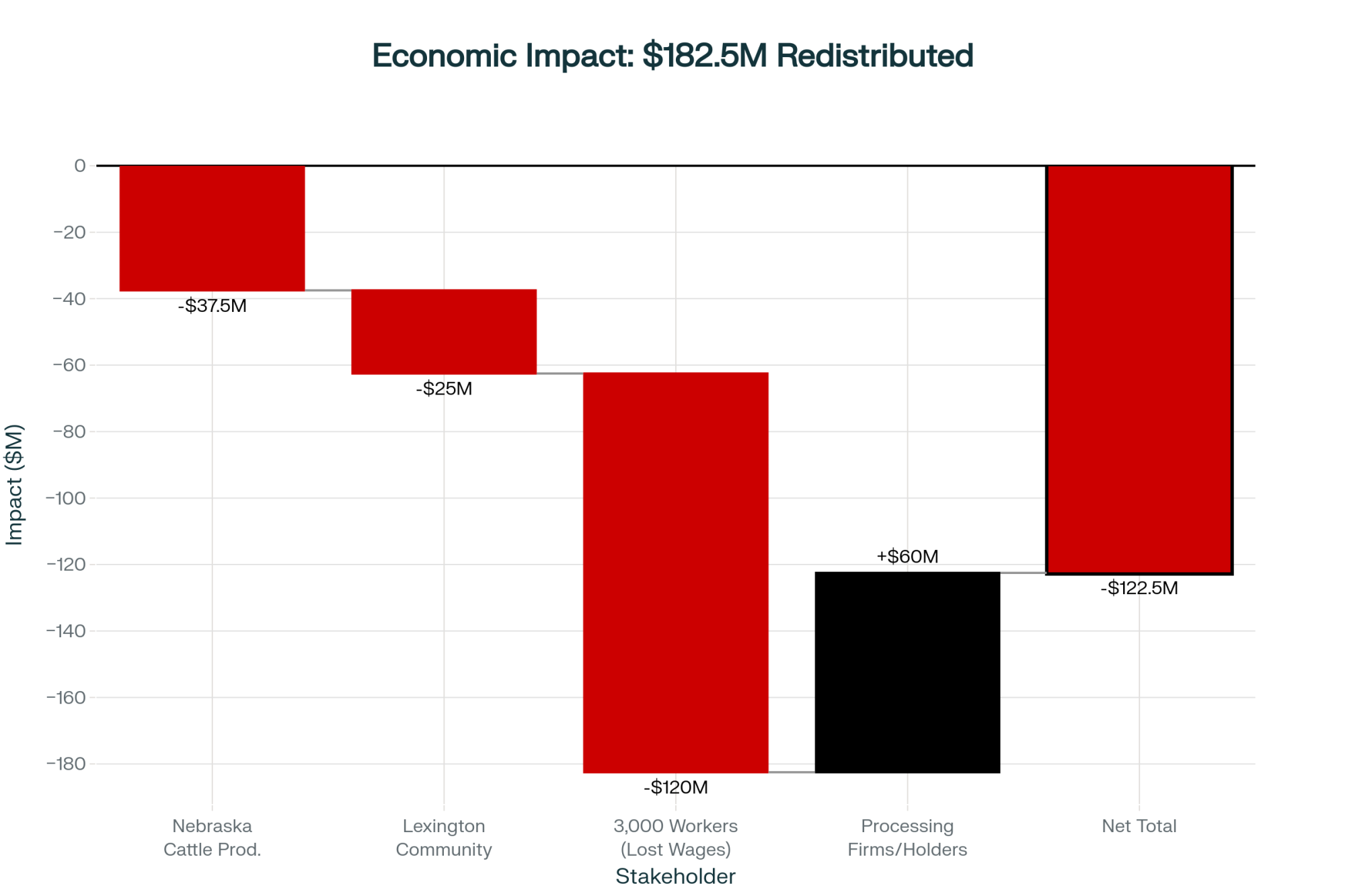
Economic Impact Distribution: When Tyson closes Lexington, $182.5M leaves rural Nebraska—cattle producers lose $37.5M annually in basis compression, the community loses $25M, workers lose $120M in wages. Processing companies and shareholders capture $60M in improved margins

Understanding Basis Pricing: The Mechanism Behind Local Markets

Let me share something that becomes increasingly important as markets consolidate—the concept of “basis” and how it affects what producers actually receive versus what they see on commodity screens.

Basis represents the difference between futures prices—those numbers flashing on Chicago Mercantile Exchange screens—and the actual cash price producers receive at their local market. Think of it as your regional market adjustment. In dairy, we see this same dynamic between Class III futures and mailbox prices, and the parallels are instructive.
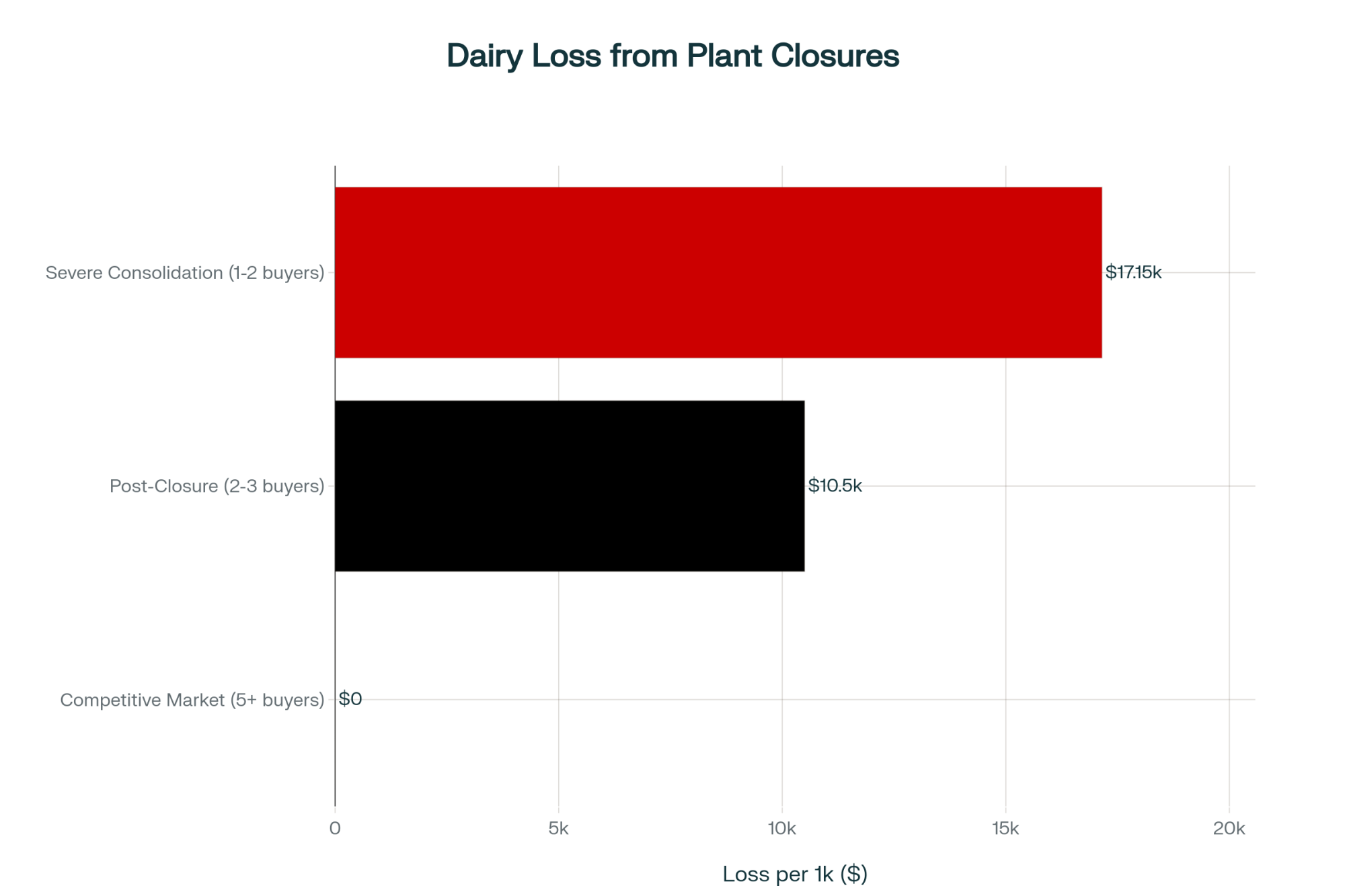
Basis Compression Impact: Plant closures directly translate to lost revenue for dairy producers through wider basis differentials on cull cow sales. A 1,000-cow dairy loses $10,000-$17,000 annually as processing competition evaporates

The agricultural economics team at the University of Nebraska-Lincoln has extensively documented these patterns through its research publications. Their findings show that in competitive markets, feedlot operators typically receive the futures price minus a modest basis adjustment—perhaps 5 to 15 cents per hundredweight — for transportation and regional supply-and-demand factors.

What’s particularly noteworthy is how dramatically this changes when processing capacity leaves a region:

In a competitive market scenario: A feedlot 50 miles from multiple processors might see:

  • Basis of approximately -$0.05/cwt
  • Multiple competitive bids arriving weekly
  • Cash price around $193.95/cwt on a 1,250 lb steer, yielding $2,424

After significant capacity reduction: That same operation now shipping 180+ miles might experience:

  • Transportation costs are adding $33 per head (based on USDA-tracked rates of $5.50 per loaded mile)
  • Basis weakening to -$2.50/cwt or more
  • New cash price dropping to $191.50/cwt, or $2,394 per head

When you calculate that $30 per head difference across the 1.25 million head annually processed at Lexington, Nebraska producers potentially face $37.5 million in reduced annual revenue—not from market fundamentals, but from structural changes in competitive dynamics.

The Cull Cow Connection: What This Means for Your Bottom Line

Here’s something every dairy producer needs to understand about processing capacity: it directly affects your cull cow revenue. For a 1,000-cow dairy culling 35% annually, that’s 350 cull cows heading to market each year. When regional processing capacity shrinks, the basis on those cull cows widens just like it does for fed cattle.

Using current market dynamics, if basis widens by just $2.00/cwt due to reduced processing competition, that represents approximately $10,000 to $14,000 in lost annual cash flow for that 1,000-cow operation (assuming 1,400 lb cull cows at current prices). For many dairies, that’s the difference between profit and break-even—or between staying in business and selling out.

Examining the Supply Narrative: What the Data Actually Shows

The interesting thing about market narratives is how they sometimes diverge from documented data. USDA’s National Agricultural Statistics Service reported Nebraska’s January 2025 cattle inventory at 6.05 million head, down just 3% from the previous year. The state’s cattle-on-feed inventory in September 2025 stood at 2.43 million head, showing remarkable stability through recent reporting periods.

What’s particularly revealing—and this comes from Tyson’s own SEC filings—is that the company reported cattle costs increased by $2 billion in fiscal 2025 compared to the prior year. That pattern typically suggests competitive bidding for supply rather than genuine scarcity.

Dr. Derrell Peel at Oklahoma State University, who’s done extensive work on livestock markets, has observed that when processors simultaneously report supply challenges and increased input costs, it often indicates competitive pressure rather than actual shortage conditions. This aligns with what many market observers have noted.

Tyson’s beef segment reported an adjusted operating loss of $426 million in fiscal 2025, with forward guidance suggesting losses of $400-600 million in fiscal 2026. The closure removes 6,700 head of daily processing capacity from the market when you include reductions at their Amarillo facility—a significant structural change to regional competition.

Learning from Dairy’s Consolidation Journey: Regional Patterns Emerge

The dairy industry’s experience with consolidation offers a valuable perspective on these dynamics—and it’s playing out differently across regions.

Market Concentration Timeline: As processing consolidation accelerated from 25% to 85% control by four firms, dairy farm numbers collapsed by 61%. The correlation isn’t coincidence—it’s cause and effect

When Dean Foods filed for bankruptcy in November 2019, they operated 57 facilities across 19 states—essentially the largest fluid milk processor in America. Dairy Farmers of America’s 2020 acquisition of 44 of those plants for 3 million represented a significant concentration of processing capacity.

The Northeast Experience

Vermont exemplifies how consolidation pressures compound. The November 2025 Class I base price hit $16.75/cwt, down $1.29 from October, despite relatively stable national commodity markets. With 78% of Vermont experiencing severe drought conditions according to U.S. Drought Monitor data, producers face what economists describe as converging pressures—rising feed costs coinciding with price compression from national oversupply.

The Midwest Transformation

Wisconsin’s story shows how quickly landscapes change. Saputo’s recent optimization strategy provides a textbook example. Between 2024 and 2025, they’ve closed facilities in Belmont, Big Stone (South Dakota), Lancaster, Tulare (California), South Gate (California), and Green Bay. Each announcement emphasized “network optimization” and “operational efficiency.”

The Suamico, Wisconsin, closure eliminated 240 positions according to state workforce notifications. What’s particularly significant for smaller operations is that Saputo’s new Franklin, Wisconsin, facility requires 4-5 million pounds of milk daily for efficient operation—volume typically sourced from larger operations rather than traditional family-scale dairies.

Wisconsin has seen three major facility closures in 18 months. For producers in central regions, buyer options have decreased from five to perhaps two or three—a fundamental shift in market structure. International Dairy Foods Association tracking shows $11 billion in new processing capacity announced nationwide, with significant investment flowing to Texas, Idaho, and New Mexico—regions with operational scales different from traditional Midwest dairy.

I recently spoke with a Wisconsin producer milking around 400 cows who shared their experience after the Lancaster closure. Their milk hauling distance jumped from 45 miles to 110 miles, adding roughly 90 cents per hundredweight to their costs—assuming truck availability, which isn’t always guaranteed in tight transportation markets.

The Western Perspective

A California producer I connected with last month offered a different perspective. “We’ve watched consolidation reshape our market for two decades,” she explained. “When you’re down to two buyers for your milk in a 200-mile radius, the conversation changes completely. It’s not negotiation anymore—it’s take it or leave it.”

The progression seems consistent across all regions:

  • Processors announce efficiency-driven network optimization
  • Regional processing options decrease
  • Basis differentials widen as competition diminishes
  • Margin pressure intensifies for producers
  • Scale becomes increasingly critical for survival

USDA Economic Research Service data documents this trajectory in dairy—from approximately 100,000 operations to 39,000 over 25 years, a 61% reduction. American Farm Bureau projections suggest 2,800 dairy operations may exit in 2025 alone, though market conditions could affect these estimates.
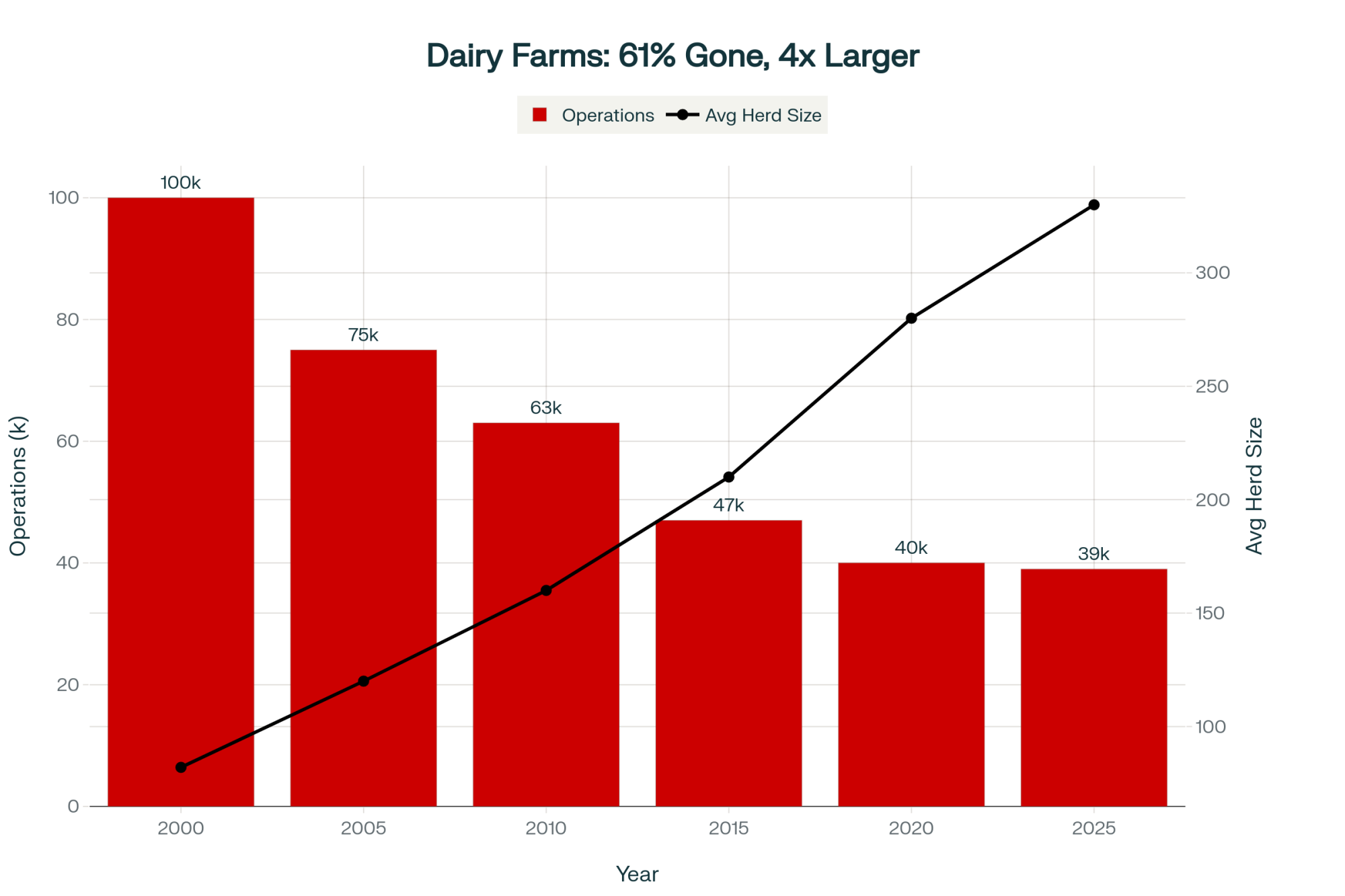
Dairy Consolidation Acceleration: As processor consolidation squeezes margins, operations exit at increasing rates. Survivors must scale dramatically—average herd size jumped from 82 to 330 cows. The 300-cow family dairy that once thrived now barely survives

Understanding Make Allowance Impacts

The June 2025 Federal Milk Marketing Order adjustments increased make allowances in ways that the National Milk Producers Federation analysis suggests will shift approximately $91 million annually from producer revenues to processor margins. University of Wisconsin dairy enterprise budgets indicate a typical 300-cow operation that might have netted $10,000 annually could face $61,000 in losses under current conditions—challenging math for any operation.

The Economics of Community Impact

Rural development researchers have modeled the economic ripple effects of major facility closures, suggesting impacts of around $300 million over time for a community like Lexington—roughly $30,000 per capita in a town of 10,000. This encompasses lost wages, reduced tax revenue, diminished retail activity, and the broader multiplier effects that flow through rural economies.

Make Allowance Revenue Transfer: The June 2025 Federal Order changes shifted $91M annually from producer milk checks to processor margins. A typical 300-cow dairy loses $10,000/year—often the difference between profitability and loss. This isn’t market forces; it’s regulatory capture

Understanding where economic value flows in these transitions helps explain the dynamics:

For processing companies and shareholders: Industry analysis suggests potential margin improvements of $40-80 million annually through strategic capacity management and reduced regional competition. Tyson’s dividend program distributes $353 million annually to shareholders, with share buyback authorizations exceeding $1 billion in fiscal 2025.

For producers: Transportation cost increases alone could reach $42 million annually for cattle previously processed at Lexington. Add basis compression and reduced negotiating leverage, and the economic pressure compounds significantly.

For communities: Property tax revenue losses estimated at $15-25 million annually create budget pressures that affect schools, infrastructure, and essential services—impacts that persist long after the initial closure.

Monitoring Market Consolidation: Warning Signs to Watch

Language That Warrants Attention:

When processors use terms like “network optimization,” “reducing duplicate capacity,” or “investing in next-generation facilities,” it often precedes structural changes. Similarly, phrases about “managing supply challenges” or “consolidating operations” deserve careful consideration.

Market Indicators to Track:

  • Widening gaps between announced prices and actual payments
  • Shifting regional price differentials
  • Increasing hauling distances to remaining processors
  • Investment patterns favoring certain regions over others

Proactive Steps to Consider:

  • Maintain detailed records of basis trends
  • Build information networks with regional producers
  • Request transparency in pricing calculations
  • Preserve operational flexibility where possible

Price Discovery: The Foundation of Fair Markets

One fundamental shift deserves particular attention—the evolution of price discovery mechanisms. Iowa State University research documents that in the 1990s, approximately 80% of fed cattle were traded through transparent cash markets. Today, that figure has dropped to around 20%, with formula contracts dominating transactions.

Why does this matter? When price discovery depends on limited transactions, those prices become both less representative and potentially more influenced by strategic behavior. Academic research shows that as formula contracts grew from 20% to 80% of volume, the packer-to-retail price spread effectively doubled.

Price Discovery Erosion: Cash market trading collapsed from 80% to 20% of cattle transactions. Formula contracts now dominate—but those formulas are based on the thin cash market, creating a self-reinforcing cycle of reduced transparency and price control

Dairy maintains relatively better price transparency through Federal Order reporting, which explains why the June 2025 make allowance changes generated immediate producer response—the impacts were visible and quantifiable. Markets operating primarily through private formula contracts offer less transparency for impact assessment.

Strategic Considerations for Producers

While consolidation trends seem likely to continue, producers have options for navigating these changes:

Near-term Risk Management:

  • Document basis patterns systematically—tracking announced versus actual prices monthly reveals trends that inform decisions
  • Build information networks—comparing experiences with regional producers helps identify systematic patterns versus individual situations
  • Seek pricing transparency—understanding calculation methodologies helps identify where value gets captured
  • Maintain operational flexibility—long-term commitments may limit options during structural market shifts

Longer-term Positioning:

  • Evaluate differentiation opportunities—value-added production or direct marketing can provide alternative revenue streams, though these require different skill sets and market development
  • Strengthen collective representation—producer organizations provide platforms for information sharing and advocacy
  • Engage in policy discussions—market structure issues ultimately require policy responses
  • Assess scale strategically—understanding where your operation fits in evolving market structures informs investment decisions

Essential Questions for Processors:

  1. What methodology determines base pricing, and is the underlying data accessible?
  2. What proportion of supply comes through formula versus cash transactions?
  3. How does pricing compare across similar regional suppliers?
  4. Where are capital investments being directed geographically?
  5. How will any facility changes affect net returns after transportation?

Broader Implications for Agricultural Markets

The Tyson Lexington situation illustrates how market concentration—with four firms controlling 81-85% of beef processing, up from 25% in 1977—fundamentally alters market dynamics. Similar patterns in dairy, with comparable concentration levels, suggest these aren’t isolated incidents but structural trends.

What’s becoming increasingly clear:

  • Processor capacity decisions significantly influence regional pricing dynamics
  • Economic impacts flow predictably from rural communities toward corporate returns
  • Reduced price transparency through formula contract dominance creates structural advantages for processors
  • These patterns appear consistent across protein sectors

What remains less certain:

  • The potential for meaningful antitrust enforcement or policy intervention
  • Timeline and effectiveness of producer collective action
  • Whether technological or market innovations might create alternatives
  • How consumer preferences might influence market structures

Understanding these dynamics isn’t about pessimism—it’s about realistic assessment. Market structures have evolved significantly from previous generations’ experience. Success requires recognizing these changes, adapting strategically, and working collectively where appropriate to maintain competitive markets.

The fundamental question isn’t whether consolidation will continue—current trajectories suggest it likely will. The question becomes how producers can best position themselves within evolving market structures while advocating for policies that preserve competitive dynamics.

What unfolds in Lexington over the coming months may preview developments in other agricultural regions. Producers who understand mechanisms like basis compression, price discovery evolution, and formula contract implications will be better positioned to navigate these changes. Those who don’t may find themselves questioning why returns diminish even as demand appears stable.

Markets evolve. Producers who recognize and adapt to structural changes while maintaining operational excellence will be best positioned for long-term success. And perhaps, with sufficient understanding and collective action, we can influence how these markets develop rather than simply reacting to changes imposed upon us.

INDUSTRY RESOURCES

KEY TAKEAWAYS

  • The $10,000 Question: When processors close regional plants, your cull cow basis widens $2-3/cwt—costing a 1,000-cow dairy $10,000-14,000 annually in lost revenue
  • Decode the Language: “Network optimization” = plant closures coming. “Supply challenges” = margin restoration through consolidation. “Efficiency improvements” = fewer buyers for your milk
  • The Math That Matters: 4 firms control 85% of processing + only 20% cash market trading = they set prices, you take them
  • Your Action Plan: Track basis monthly (the gap between futures and your check), build regional producer networks for price transparency, and avoid long-term contracts during consolidation periods
  • The Pattern Is Clear: The same consolidation that eliminated 61% of dairy farms in 25 years is accelerating—understanding it is your best defense

Complete references and supporting documentation are available upon request by contacting the editorial team at editor@thebullvine.com.

Learn More:

Join the Revolution!

Join over 30,000 successful dairy professionals who rely on Bullvine Weekly for their competitive edge. Delivered directly to your inbox each week, our exclusive industry insights help you make smarter decisions while saving precious hours every week. Never miss critical updates on milk production trends, breakthrough technologies, and profit-boosting strategies that top producers are already implementing. Subscribe now to transform your dairy operation’s efficiency and profitability—your future success is just one click away.
NewsSubscribe
First
Last
Consent

Processor Failed? You Have 72 Hours: The Financial Firewall Every Dairy Farm Needs Now

48% of farms take on debt when processors fail. 11% never recover. The difference? Three months of cash no bank can freeze

EXECUTIVE SUMMARY: Your processor could fail tomorrow—93 French dairy farms just learned this the hard way in October 2025. With 73% of regional dairy processors lost since 2000, today’s consolidated market has transformed processor failure from a minor inconvenience to an existential threat. When it happens, you have exactly 72 hours before bulk tank capacity forces you to dump milk, and nearly half of affected farms will take on debt, while 11% won’t survive at all. Yet farmers who’ve built what we call a “financial firewall”—90 days of accessible reserves (about $280,000 for a 200-cow operation), pre-established processor relationships, and specialized insurance—are actually thriving during these crises, with some negotiating better contracts than before. This comprehensive guide provides your complete risk management playbook: practical strategies to build reserves even on tight margins, early warning signs to watch for, contract clauses that protect you, and the collaborative approaches that multiply individual farmer power. The difference between farms that fail and farms that thrive isn’t luck—it’s preparation.

dairy processor risk

The recent Chavegrand situation in France offers important lessons about processor risk management. Here’s what progressive dairy operations are learning about financial preparedness in an era of consolidation.

Let me share a scenario that’s becoming more common than any of us would like. You’re running a solid operation—maybe 200 milking cows, your SCC consistently under 200,000, butterfat levels holding steady at 3.8 to 4.0. Everything on your end is working like it should. Then the phone rings with news that changes everything: your processor just suspended milk collection.

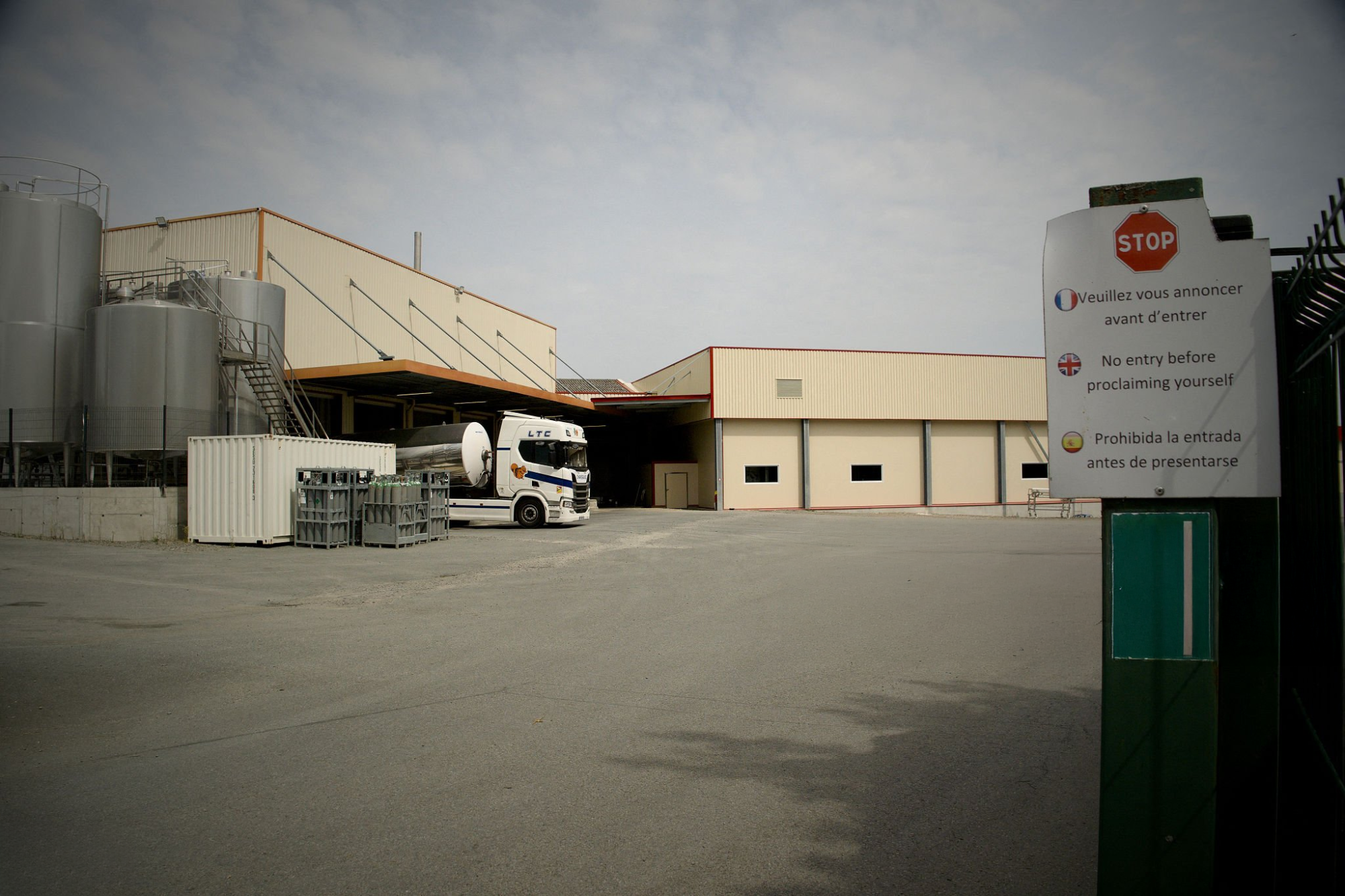
This exact situation hit 93 dairy farms in France’s Creuse region this October. Their processor, Chavegrand, shut down operations after a contamination incident that French health authorities connected to consumer illnesses and deaths. What really catches my attention here—based on the regional farm media coverage—is that these weren’t struggling operations. We’re talking about established, multi-generational farms, the kind that follow protocols and maintain quality standards year after year.

“We’re passengers, not drivers. And consolidation has made that ride a lot riskier than it used to be.”

You know, this whole thing really shows us something we’ve all been dealing with. We can control so much—our breeding programs, our feed quality, fresh cow management, all the production variables we’ve mastered over the years. But when it comes to our processor’s business decisions? That’s where we’re passengers, not drivers. And consolidation has made that ride a lot riskier than it used to be.

That Critical First 72 Hours

Here’s what’s interesting about processor failures—and I’ve been talking with extension folks from Wisconsin and Cornell who’ve been documenting this pattern. When your processor stops picking up milk, you’ve basically got 72 hours before you’re facing some really tough decisions. That’s just the reality of bulk tank capacity on most farms.

The first couple of days, you’re usually okay. Your tank’s filling while you’re working the phone, calling every processor within a reasonable distance. But day three? That’s when things get complicated. Feed deliveries keep coming. Your team needs their paychecks. The bank’s expecting that loan payment. Meanwhile, that milk check you were counting on to cover all this… well, it’s not coming.

I’ve been hearing similar stories from farmers who’ve lived through processor transitions. One Vermont producer I talked with had built up about three months of operating reserves—roughly what it would take for a 150-cow herd, maybe $180,000 or so. “Yeah, it wasn’t easy having that cash sitting in savings earning next to nothing,” he told me. “But when our processor went under, I could take my time finding the right deal instead of jumping at whatever was offered.”

His neighbor—a good farmer, who had been at it for years—didn’t have that cushion. Operating paycheck to paycheck, like many of us do, he had to take what he could get. Ended up being about 30 cents less per hundredweight than what the prepared farmer negotiated. Do the math on that over a year’s production… it’s significant money.

Now I know what you’re thinking—where exactly am I supposed to find that kind of cash to park in savings when we’re already watching every penny? Good point. But what I’ve found is that farmers are getting creative about this. Some are running equipment a year or two longer than planned, banking what they would’ve spent on payments. Others—especially in states where it’s allowed—are developing small direct-sales channels. Not to replace bulk sales, but maybe selling 5% of production at premium prices to build reserves faster.

How the Processing Landscape Has Shifted

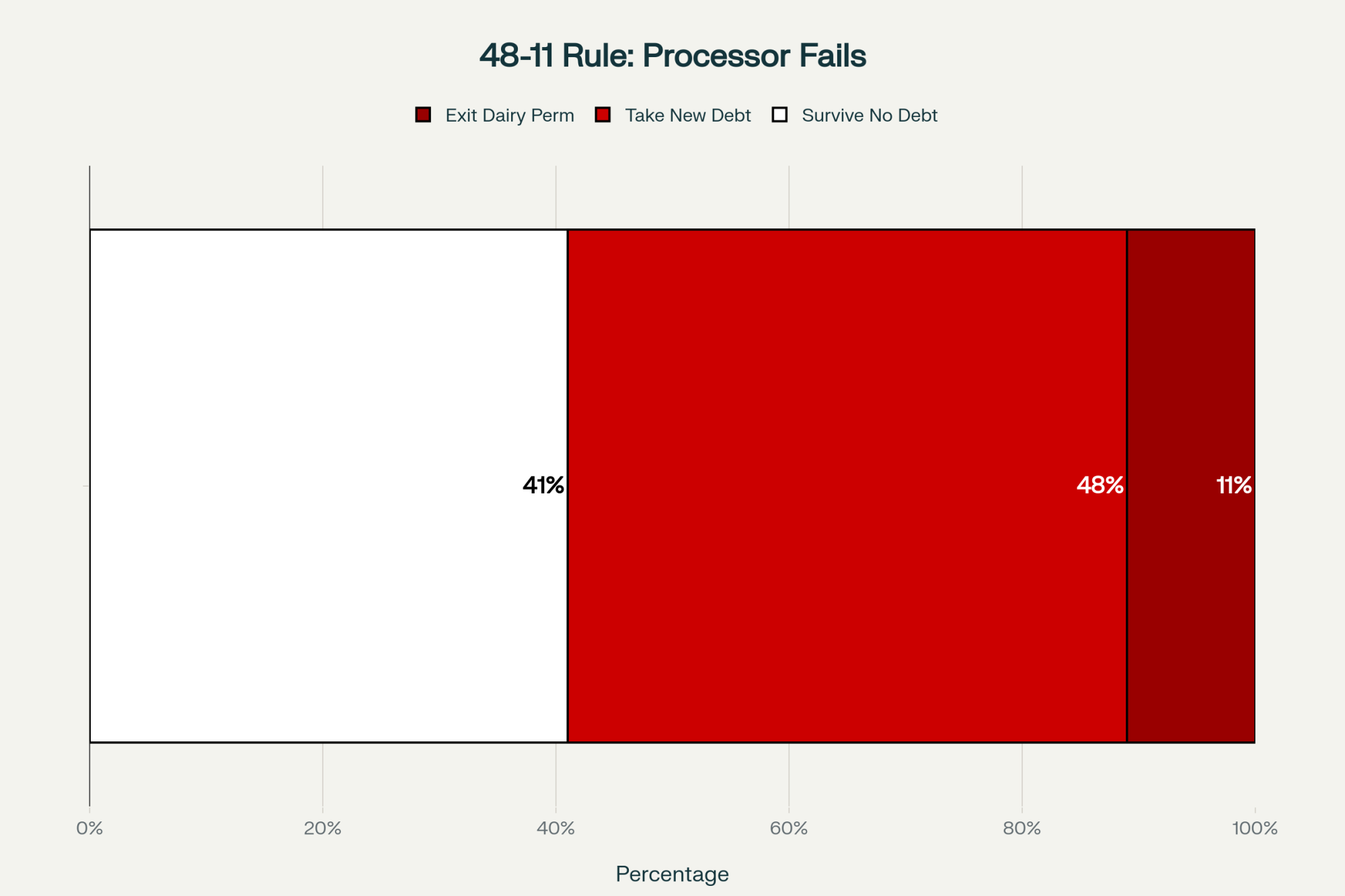
The Brutal Math of Processor Failure: Only 41% of affected farms survive without new debt. Nearly half take on $60,000-$127,000 in emergency borrowing they’ll spend years repaying. And 11%—one in ten—never recover at all. Your preparation determines which group you’re in

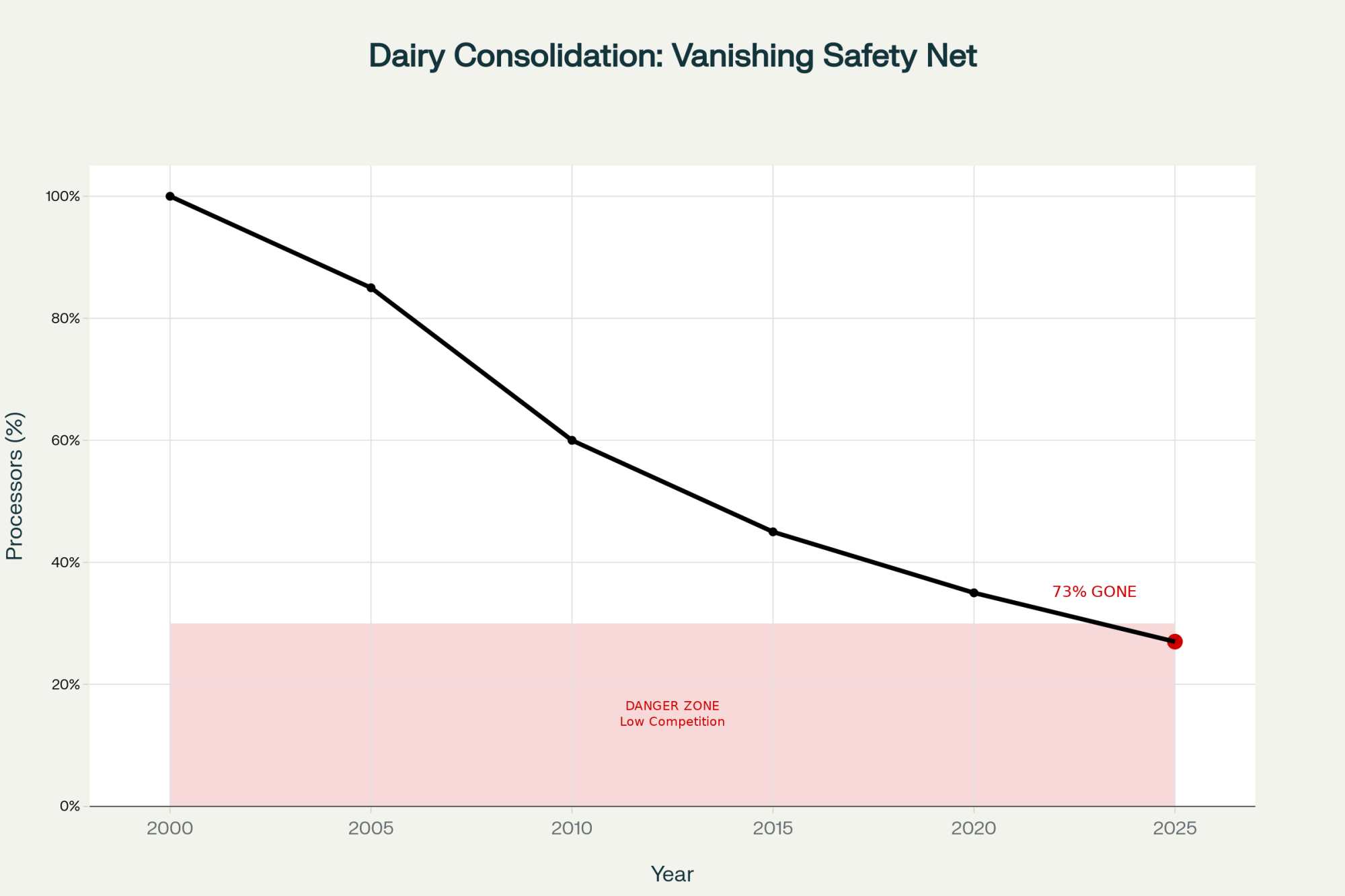
You probably already know this, but it’s worth laying out the numbers. The USDA’s been tracking this, and Rabobank’s latest dairy quarterly from Q3 this year confirms it: we’ve lost somewhere between 65 and 73 percent of our regional processing options since 2000. Where farms used to have 15 or 20 potential buyers within hauling distance, many areas now have three or four real alternatives. And that’s if you’re lucky.

The Consolidation Catastrophe: We’ve lost 73% of regional dairy processors since 2000, turning milk marketing from a competitive marketplace into a take-it-or-leave-it scenario. When Dean Foods collapsed in 2019, affected farmers learned this lesson the hard way—there was nowhere else to go

“Between 36 and 48 percent of affected farms end up taking on new debt just to survive the transition.”

Of course, this varies considerably by region—producers in areas with strong cooperatives or supply management systems face different dynamics than those in purely market-driven regions. Canadian producers under their supply management system, for instance, have guaranteed collection through provincial boards even when individual processors fail. Australian dairy farmers working through their cooperative structures have different risk profiles than independent U.S. producers.

Looking at what’s happening in Europe, organizations like FrieslandCampina and Arla have built systems that give farmers greater protection through cooperative ownership. Not saying that model works everywhere, but it’s interesting to see how different market structures create different risk profiles.

I was talking with a producer from upstate New York recently—she’s running about 400 cows. The way she put it really stuck with me: “When I started, we had choices. Now we work with what’s available.”

This creates what the economists call an unbalanced relationship. We need daily pickup—there’s no flexibility there. But processors? They’re drawing from dozens, sometimes hundreds of farms. If they lose one supplier, it’s manageable. If we lose our processor, that could be the end of the operation.

The data released by USDA’s Economic Research Service in its September 2024 Dairy Outlook, along with what the National Milk Producers Federation has documented in its post-bankruptcy analyses, paint a pretty clear picture. When processors fail, between 36 and 48 percent of affected farms take on new debt just to survive the transition. And about one in ten—sometimes a bit more—doesn’t make it. They exit dairy within 1.5 to 2 years. Those aren’t odds I’d want to face without preparation.

Building Your Financial Safety Net

So what can we actually do about this? After talking with farmers who’ve successfully navigated processor transitions—and some who’ve been through it multiple times—I’m seeing patterns in what works.

Getting Liquid Stays Crucial

The guidance from university extension programs across the Midwest—Wisconsin’s Center for Dairy Profitability, Minnesota’s dairy team, Michigan State’s ag economics folks—is pretty consistent these days: aim for 90 days of accessible operating capital. And when I say accessible, I mean actual money you can get to immediately—not a credit line the bank might freeze when things look uncertain.

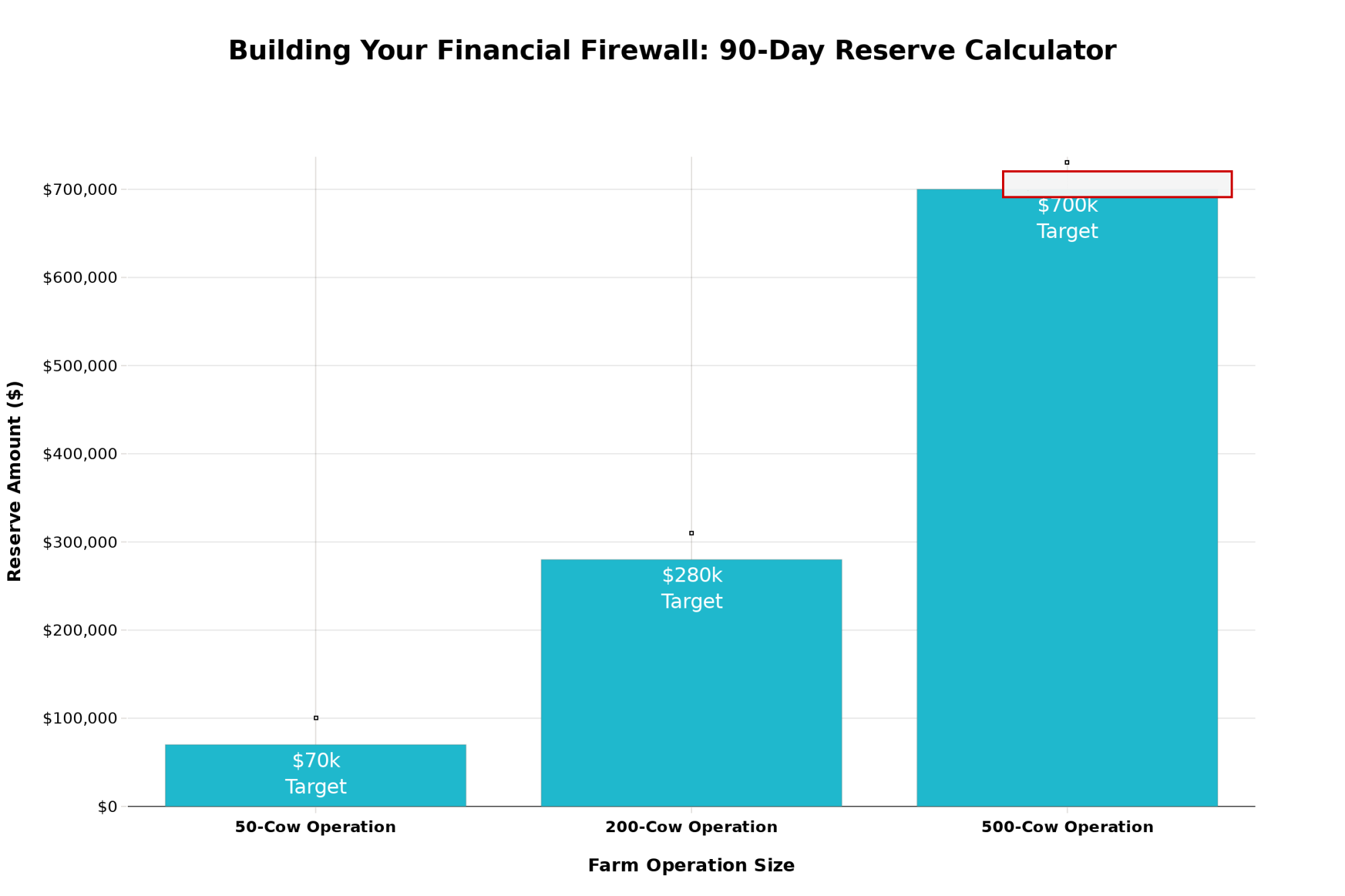
Your Financial Firewall Blueprint: These aren’t aspirational numbers—they’re survival targets. A 200-cow operation needs $280,000 in accessible reserves. Sounds impossible? A Pennsylvania farmer built his by running equipment two years longer and banking the saved payments. The Vermont farmer who weathered processor collapse with reserves? He started with just $500/month five years earlier

“Aim for 90 days of accessible operating capital.”

For a typical 200-cow Wisconsin operation with weekly expenses around $22,000, you’re looking at building toward roughly $280,000 eventually. I realize that sounds overwhelming. But here’s the perspective that changed my thinking: when Dean Foods went under back in 2019, the National Milk Producers Federation documented that farms without reserves lost well over $100,000 in just the first 60 days. Suddenly, that opportunity cost of keeping cash in low-yield accounts doesn’t look so bad.

But let me share something encouraging, too. I know of a central Pennsylvania farm—about 180 cows—that started building reserves after watching neighbors struggle during a processor closure. They set aside just $500 a month initially, gradually increasing as they could. When their processor ran into financial trouble, they had enough cushion to negotiate properly. Ended up actually improving their contract terms because they weren’t desperate. The tools and strategies exist—it’s really just a matter of implementing them before we need them.

Building Relationships Before You Need Them

I’ve seen some California producers do something really smart. They maintain what amounts to a market awareness system—basically keeping tabs on every potential buyer in their region. Who’s got capacity, what they typically pay, quality requirements, payment terms, all of it.

One of these farmers told me how this paid off when his processor cut intake by 20% with barely any notice: “While everyone else was making cold calls to strangers, I was calling people who already knew our operation. Made all the difference in the world.”

This works differently depending on where you farm, naturally. If you’re near a state line, definitely look across the border. Sometimes those Pennsylvania plants pay better than New York ones, even after factoring in the extra hauling. In areas with strong co-ops, understanding potential merger scenarios becomes important. And as we head into winter feeding season with tighter margins, having these relationships already established becomes even more critical.

Getting Smarter with Contracts

Look, we all know individual farmers don’t have much negotiating leverage. Let’s be honest about that. But what I’m hearing from agricultural attorneys who work with dairy contracts—and this aligns with what Penn State’s ag law program and Wisconsin’s dairy contract resources have been recommending—is that you can sometimes get protective language added even when you can’t move the price.

Instead of beating your head against the wall for another 20 cents per hundredweight, try pushing for something like: “Producer may seek alternative buyers without penalty if Processor suspends collection exceeding 72 consecutive hours for reasons unrelated to milk quality.”

Most processors don’t really care about adding this kind of language because they figure it’ll never matter. But if things go sideways, that clause could save your operation.

Recognizing the Warning Signs

Looking back at processor failures—and researchers at Michigan State and Cornell have documented quite a few in their recent dairy industry reports—the warning signs were almost always there months in advance.

The Warning Signs Were Always There: Before Dean Foods filed bankruptcy in 2019, affected producers told Wisconsin Public Radio that payments had been “progressively delayed” for months. Before Grassland restructured in 2017, retail contracts were quietly disappearing. The question isn’t whether warning signs exist—it’s whether you’re watching for them

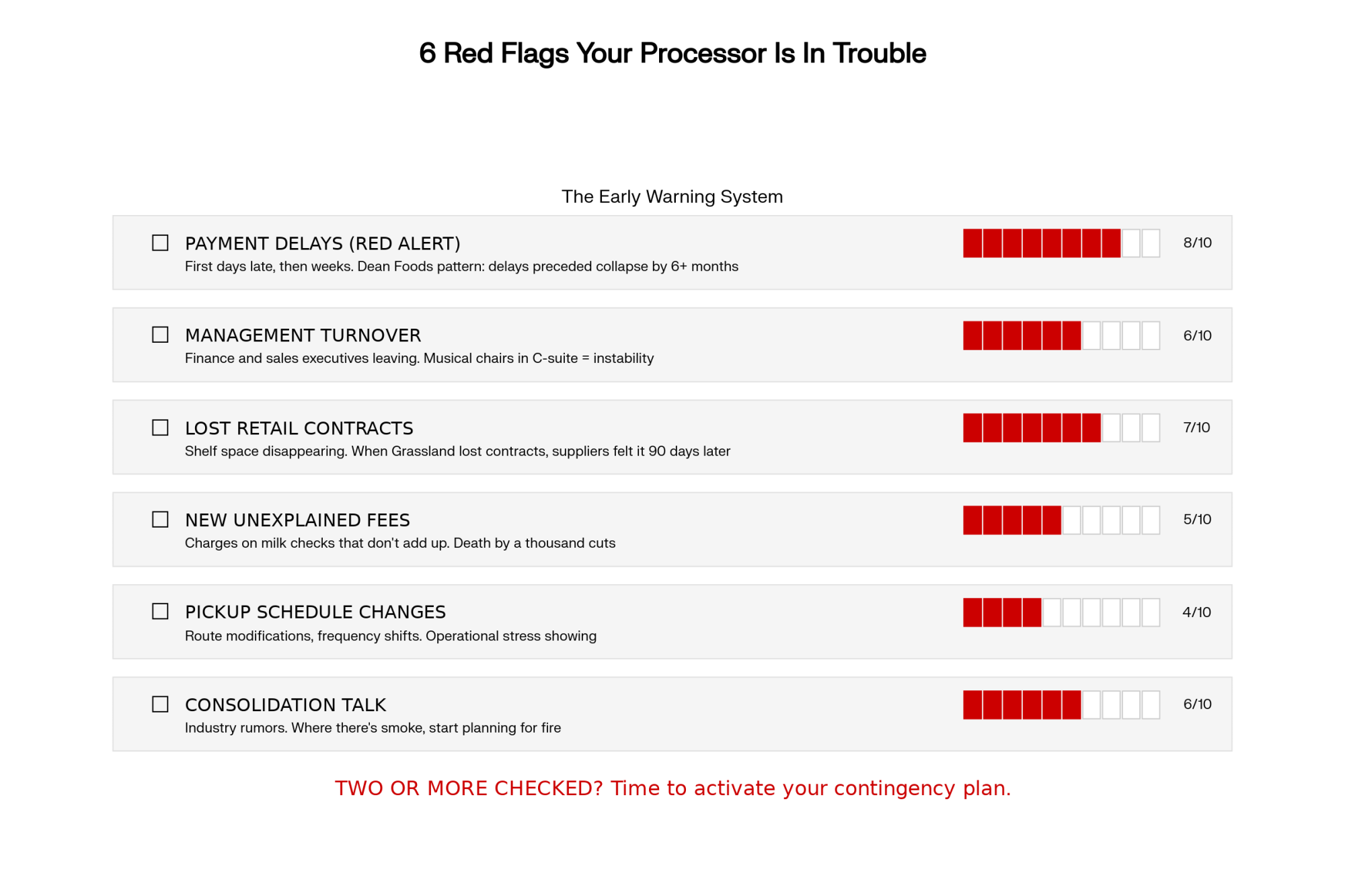
Payment timing is your biggest red flag. When Grassland Dairy restructured its supplier base back in 2017, affected producers told Wisconsin Public Radio that payments had been progressively delayed. First, just a few days, then a week, then requests to “defer” portions.

But there are other indicators too. Management turnover, especially in finance and sales. Lost retail shelf space. New “fees” appearing on milk checks that don’t quite make sense. Unexplained changes to pickup schedules. When you see several of these together, it’s time to dust off those contingency plans.

What’s particularly worth watching is when a processor starts losing major retail contracts or when you hear about consolidation talks. The market’s changing so fast these days that what looks like a stable buyer in January might be in crisis by June.

The Insurance Gap Nobody Talks About

Here’s something that catches a lot of folks off guard: standard farm insurance typically doesn’t cover processor failure or milk buyer bankruptcy. You could have perfect coverage for buildings, equipment, livestock—everything—but if your processor stops picking up milk? That’s usually not covered.

“Farms without reserves lost well over $100,000 in just the first 60 days.”

Specialized coverage is available, though availability varies significantly by state. Business interruption insurance with buyer failure provisions costs about $3,000 to $8,000 annually for mid-sized operations, according to Farm Bureau Financial Services’ current rate guides. Companies like Hartford Steam Boiler, FM Global, and some regional farm mutuals offer these policies, though you’ll find better availability in traditional dairy states like Wisconsin and New York than in newer dairy regions. When you need it, though, it can pay out six figures.

Farm Credit Services has documented several cases in which processors went bankrupt owing farmers $60,000, $70,000, and sometimes more, for multiple weeks of milk. Without accounts receivable insurance, these farmers became unsecured creditors. After legal fees and years of proceedings, they typically recovered less than 20 cents on the dollar. That’s a painful lesson to learn firsthand.

Finding Strength in Numbers

What’s encouraging is seeing producers organize around this challenge. Throughout New England and the Great Lakes states, farmers are forming informal groups to plan for contingencies with processors. Individual farms might ship 15,000 or 20,000 pounds daily—not much leverage there. But get 40 or 50 farms together? Now you’re talking volumes that matter.

These groups also share intelligence. When multiple members spot concerning patterns—such as payment delays, operational changes, or management turnover—everyone can start preparing. It’s the kind of collaboration we need more of.

You know, the Europeans have been doing this for decades through their cooperative structures. The International Dairy Federation’s latest reports show organizations like FrieslandCampina and Arla guarantee milk collection even when individual plants have problems. We’re learning from their model, though our market structure is obviously different.

What You Can Do Starting This Week

If you’re wondering where to begin, here’s what extension specialists from Wisconsin, Cornell, and Penn State are recommending—and it’s pretty practical stuff.

First, figure out your actual daily operating costs. The Farm Financial Standards Council has found that most of us underestimate by 15 to 20 percent, so dig deep. Include everything—feed, labor, utilities, debt service, the whole picture.

Then, honestly assess what cash you could access in 72 hours without selling productive assets. Be realistic here.

Pull out your processor contract. Really read it. What happens if they stop collecting? I’m betting the language heavily favors them.

Over the next month, reach out to other processors in your region. You’re not looking to switch—you’re building relationships, understanding their capacity and needs. Also, review your insurance with specific questions about processor failure coverage and milk buyer bankruptcy protection.

Think about joining or forming a producer group focused on these issues. Set up some system to monitor your processor’s health—payment patterns, industry news, operational changes.

Adapting to Today’s Reality

What those 93 French farms are going through isn’t unique. Industry analysis from Rabobank and the International Dairy Federation shows processor consolidation accelerating everywhere, with the biggest companies now controlling close to 70 percent of global capacity.

I wish I could tell the next generation to just focus on producing quality milk, and everything will work out. Your SCC, butterfat levels, pregnancy rates—all that absolutely still matters. Production excellence remains fundamental.

But in today’s environment, you also need to think about processor stability. Given consolidation trends and the financial pressures in processing that USDA and industry analysts have been documenting, most farms will likely face at least one processor disruption over the next decade. That’s not pessimism—that’s just looking at the patterns.

The good news—and there really is good news here—is that farmers who recognize this shift and prepare accordingly are doing just fine. They’re building reserves, developing relationships, negotiating better contract terms, and securing appropriate insurance. They’re adapting to new market realities, even though nobody sent out a memo saying the rules had changed.

You know, thinking about all this… dairy farming has always involved managing multiple risks. Weather, prices, disease pressure—we’ve dealt with all of it. Processor risk is now part of that mix. It’s not fair that we need to worry about this on top of everything else we manage. But fair doesn’t keep the cows milked or the bills paid.

The operations that’ll thrive over the next decade are those that see this risk clearly and prepare for it. Not because they’re paranoid, but because they’re practical. And if there’s one thing dairy farmers have always been, it’s practical.

We’re all navigating this together, even when it sometimes feels like we’re on our own. Your experiences—both the challenges and the solutions you’ve found—they matter to all of us trying to figure this out.

KEY TAKEAWAYS:

  • You’re not paranoid, you’re practical: With 73% of processors gone since 2000, building a $280K cash reserve (200-cow farm) isn’t excessive—it’s the difference between negotiating power and desperation
  • The 72-hour window changes everything: Bulk tanks don’t wait—farmers with processor relationships lined up save $0.30/cwt while others take whatever they can get
  • Your contract is probably worthless: Add this clause now: “Producer may seek alternative buyers if processor suspends collection 72+ hours” (most processors won’t even notice, but it could save your farm)
  • Insurance companies don’t want you to know: Standard farm insurance won’t cover processor bankruptcy—but $5K/year in specialized coverage beats losing $127K in 60 days
  • Form a group or die alone: 40-50 farms together have leverage; individual farms are disposable—the Europeans figured this out decades ago

Complete references and supporting documentation are available upon request by contacting the editorial team at editor@thebullvine.com.

Learn More:

Join the Revolution!

Join over 30,000 successful dairy professionals who rely on Bullvine Weekly for their competitive edge. Delivered directly to your inbox each week, our exclusive industry insights help you make smarter decisions while saving precious hours every week. Never miss critical updates on milk production trends, breakthrough technologies, and profit-boosting strategies that top producers are already implementing. Subscribe now to transform your dairy operation’s efficiency and profitability—your future success is just one click away.
NewsSubscribe
First
Last
Consent

Processor Power Play: Is Your Milk Check Getting Squeezed?

Processor consolidation is more than an industry headline—it’s a market force actively reshaping your milk check.

EXECUTIVE SUMMARY: Look, I’ve been watching this processor consolidation game for years, and here’s what’s really happening out there. The choice between investor-owned processors and cooperatives isn’t just about who picks up your milk—it’s determining whether you’re leaving $70,000 on the table every year. Penn State economists just confirmed what we’ve been seeing: corporate processors are squeezing producers for $0.75 to $1.20 per hundredweight while co-ops are securing 8-12% price premiums through collective bargaining. That’s not pocket change… for a typical 5-million-pound operation, we’re talking about real money that pays for a lot of feed or covers that equipment loan.The private label boom—now worth $33.7 billion—is forcing quality demands through the roof, but here’s the kicker: co-ops are using their scale to help members meet these standards while corporate processors just pass the costs down to you. With consolidation hitting 85% by 2027, you need to position yourself on the right side of this divide now.

KEY TAKEAWAYS:

  • Contract audit pays immediate dividends: Compare your current pricing against USDA regional benchmarks—most producers discover they’re underpriced by $25K-$50K annually, money that’s sitting right there waiting for better negotiation
  • Co-op membership isn’t just feel-good farming: Average premium of $1.40/cwt translates to $70,000 more revenue for typical operations, plus access to shared technology investments that smaller independents can’t afford
  • Quality consistency = premium money: Farms maintaining 95% delivery reliability and sub-150K somatic cell counts are earning 85¢/cwt bonuses while inconsistent producers get commodity pricing
  • Tech investment becomes non-negotiable: That $45K-$65K automation spend isn’t optional anymore—private label buyers demand 99.7% consistency, and co-ops are helping members finance these upgrades while corporate processors leave you hanging
  • Risk management tools level the playing field: USDA’s Dairy Forward Pricing Program offers $0.50-$0.75/cwt protection that becomes critical when fewer processors control pricing power
dairy profitability, processor consolidation, milk price negotiation, cooperative membership benefits, farm efficiency

You hear a lot about processor consolidation, but here’s what really matters: There are two big players in the game—large investor-owned processors (IOPs) and farmer-owned cooperatives. Sure, both control a lot of milk, but their impact on our paychecks couldn’t be more different.

Processors with deep pockets, the IOPs, have the muscle to drive down the prices they pay us, squeezing margins to fatten their bottom line. Cooperative folks, on the other hand, band together to fight back, leveraging their collective strength to secure better premiums for their members.

From Wisconsin to the Pacific Northwest, it’s the producer-owned cooperatives that are proving most resilient, making those tough structural moves to keep their farmers ahead.

Impact of Processor Choice on Farm Revenue

The Squeeze is on: Why Fewer Players Mean More Pressure

Recent industry reports show giants like the Dairy Farmers of America hauling in billions of pounds of milk annually. These operating processing plants require moving massive volumes daily to stay efficient. That’s scale—necessary, but it also sets the stage for fewer but more powerful players.

And the barriers for new processors? Sky-high. Think of Chobani’s shot at ultra-filtered milk—invested millions, launched big, then pulled out within a few months, citing costs and inflation pressures.

Industry analysts note that modern processing facilities require substantial daily throughput volumes just to break even on equipment costs. When you’re talking millions of pounds daily, only the big players can afford to stay in the game.

Margins. They’re getting squeezed. According to Penn State economists, that pressure is costing producers between $0.75 and $1.20 per hundredweight.

Farmers tied to IOPs often face lengthy, rigid contracts with limited pricing flexibility. Meanwhile, smaller processors and co-ops tend to offer more flexibility—and often pay premiums, sometimes upwards of $2.30 per hundredweight, according to University of Wisconsin researchers.

The rise of private label dairy products is adding new challenges. This $33.7 billion sector is pushing demands for quality and delivery precision ever higher. Farms are investing tech dollars—ranging from $45,000 to $65,000—to keep up with the requirements for automated monitoring.

Dairy processor market share breakdown in 2025

The Co-op Advantage: Using Scale to Fight Back

Cooperatives remain a powerful counterbalance. They’re reinvesting, building processing facilities, and driving earnings up. Top co-ops collectively market 78% of U.S. milk and can typically secure 8–12% price premiums through pooled bargaining power and billions of dollars in annual processing investments, according to industry research.

Farmer feedback consistently shows that cooperatives with strong governance and strategic investment in processing make a tangible difference, especially during times of market pressure.

Here’s a nugget: Consistency is king. Achieving low somatic cell counts, maintaining delivery precision, and producing quality-controlled milk result in premiums. Some contracts award bonuses close to 85 cents per hundredweight for these efforts, according to industry geneticists at Penn State.

Contract FeatureInvestor-Owned ProcessorsCooperativesIndependent Processors
Average Contract Length18 months12 months6 months
Price FlexibilityLowMediumHigh
Premium Above Commodity-$0.75 to -$1.20/cwt+$0.85 to +$1.40/cwt+$2.30/cwt
Quality BonusesStandardEnhanced (85¢/cwt)Variable
Tech SupportLimitedShared investmentsMinimal
Risk ManagementIndividualPooled resourcesIndividual

Your Strategic Playbook: 4 Ways to Protect Your Paycheck

  1. Measure your contract carefully. Compare your pay against USDA regional benchmarks to identify underpricing—many producers leave thousands of dollars on the table annually.
  2. Join a cooperative. Co-op membership often means price premiums averaging $1.40 per hundredweight, which for a 5-million-pound-per-year operation adds up to nearly $70,000 more annually.
  3. Adopt technology. Automated milk monitoring and quality systems, while costly, are increasingly essential to meet buyer demands and secure quality bonuses.
  4. Use risk management tools. Programs like the USDA’s Dairy Forward Pricing Program help buffer volatile market swings and protect your margins.
Quality MetricRequirementInvestment NeededAnnual Bonus Potential
Somatic Cell Count<150,000$25,000-35,000$0.85/cwt
Delivery Consistency95%+ reliability$15,000-25,000$0.50/cwt
Automated Monitoring99.7% accuracy$45,000-65,000$1.20/cwt
Traceability SystemsFull chain visibility$20,000-30,000$0.75/cwt

Bottom line: The milk check pressure is real, and with consolidation forecast to hit 85% by 2027, this trend isn’t slowing down. Those who recognize the tides and act now—through smart contracting, tech adoption, and cooperative strategies—are the ones who will thrive. The path forward requires focus and a proactive stance. What’s your next move going to be?

Complete references and supporting documentation are available upon request by contacting the editorial team at editor@thebullvine.com.

Learn More

  • Mastering Milk Quality: The Three Pillars of Profitable Production – This article offers a tactical blueprint for elevating your milk quality. It demonstrates how to master udder health, milking procedures, and environmental factors to consistently hit the low SCC targets that unlock lucrative processor premiums and boost your bottom line.
  • The Future of Dairy: Navigating the Top 5 Trends of 2025 – Gain a strategic market advantage by understanding the five biggest trends shaping the industry. This analysis reveals how shifts in consumer behavior, sustainability demands, and global trade will impact your long-term profitability beyond just processor consolidation.
  • The Genomic Edge: How Smart Selection Is Breeding a More Profitable Herd – Discover how to future-proof your herd’s profitability through advanced genomics. This piece reveals methods for breeding healthier, more efficient cows that produce higher-quality milk, directly addressing the need for consistency and premium qualification in a competitive market.

Join the Revolution!

Join over 30,000 successful dairy professionals who rely on Bullvine Weekly for their competitive edge. Delivered directly to your inbox each week, our exclusive industry insights help you make smarter decisions while saving precious hours every week. Never miss critical updates on milk production trends, breakthrough technologies, and profit-boosting strategies that top producers are already implementing. Subscribe now to transform your dairy operation’s efficiency and profitability—your future success is just one click away.
NewsSubscribe
First
Last
Consent

Send this to a friend