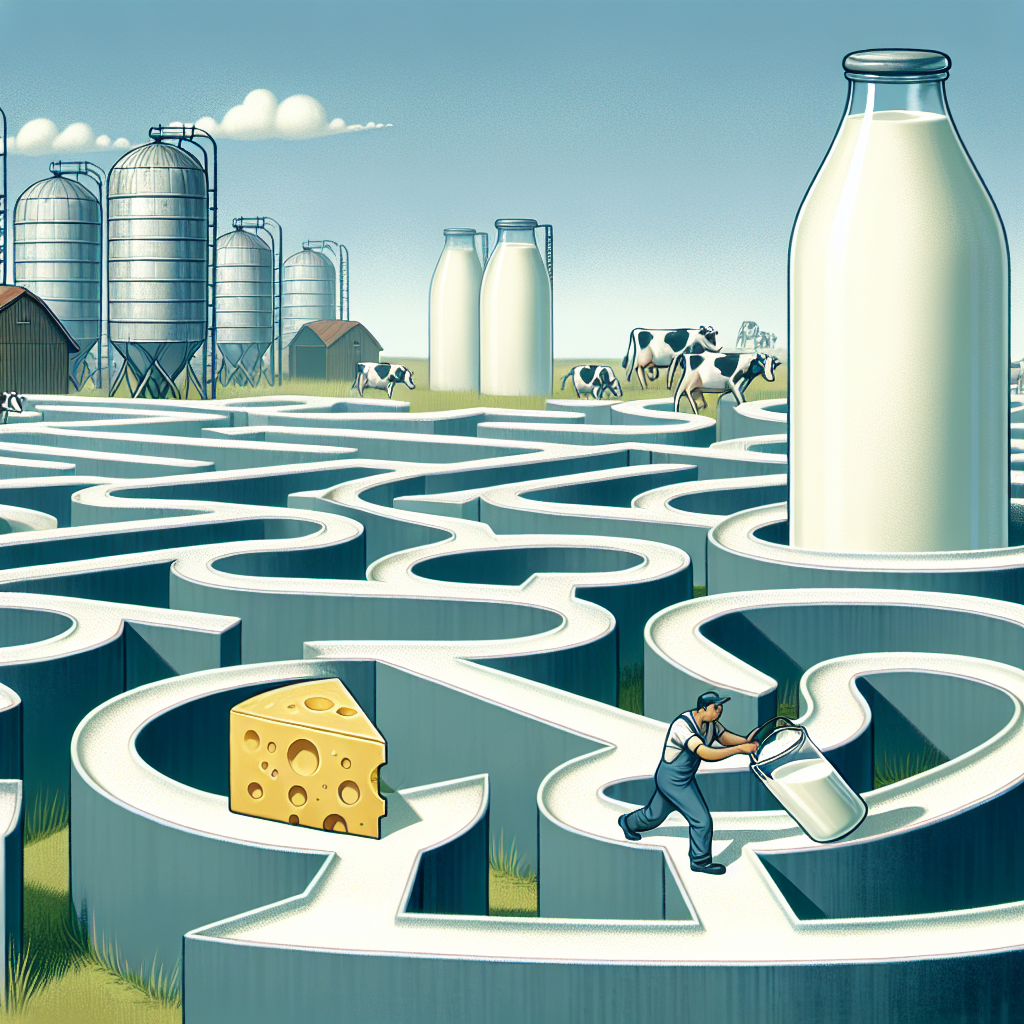
New Zealand just proved everything the dairy industry believes about profitability is wrong. Less milk, higher profits—here’s how they did it.
EXECUTIVE SUMMARY: New Zealand’s 2024-25 dairy season exposed a fundamental flaw in global dairy economics: while most regions chase volume metrics, Kiwi farmers achieved higher profits by focusing on milk component optimization over fluid volume. Despite facing their worst drought in 50 years and experiencing a 0.5% decline in fluid milk collections, New Zealand still managed to increase milk solids production by 0.1% and deliver record payouts exceeding $10.00 per kilogram of milk solids. This success stems from a payment system that prioritizes quality components over quantity, contrasting sharply with volume-obsessed cooperatives elsewhere that prioritize processing efficiency over farmer profitability. The strategic response to drought—early cow drying and quality preservation rather than volume maximization—positioned farms for stronger long-term performance. Export data further validates this approach, with New Zealand achieving 23-26% unit price increases across major dairy categories, proving that component-focused production commands premium pricing in global markets. The article challenges dairy farmers worldwide to question whether their cooperatives’ payment systems serve farmer profitability or processing plant efficiency.
KEY TAKEAWAYS:
- Component optimization beats volume chasing: New Zealand achieved 0.1% growth in milk solids despite 0.5% decline in fluid milk, proving quality focus drives higher profitability than volume metrics
- Payment systems determine farmer success: Cooperative structures that reward components over volume enable farmers to capture $10+ payouts while volume-focused systems limit profitability potential
- Strategic drought response revealed superior thinking: Early cow drying and quality preservation during crisis positioned farms for long-term success rather than short-term volume maximization
- Export premiums validate quality strategy: New Zealand commanded 23-26% unit price increases across dairy categories, demonstrating that component-focused production captures premium global pricing
- Industry conventional wisdom needs challenging: Most dairy cooperatives prioritize processing efficiency over farmer profitability, requiring farmers to demand justification for volume-based payment structures

New Zealand’s dairy sector just shattered every sacred cow of modern dairy economics. While North Island farmers faced their worst drought in 50 years, the industry still managed to grow milk solids and deliver record payouts. The uncomfortable truth? Most of the global dairy industry has been chasing the wrong metrics for decades.
Here’s a question that should make every dairy cooperative board member lose sleep: What if everything you’ve been told about maximizing dairy profitability is wrong?
New Zealand’s 2024-25 season just provided the answer, and it’s not what the volume-obsessed dairy establishment wants to hear.
The Volume Lie That’s Bankrupting Farmers
Let’s start with an uncomfortable fact that exposes the fundamental flaw in how most of the world approaches dairy economics. In April 2025, New Zealand’s fluid milk collections dropped 0.5% year-over-year to 1.46 million metric tons. Traditional dairy wisdom says this should have been a disaster.
Instead, milk solids production increased by 0.1%.
Think about this: Fewer cows, less milk, higher profits. While dairy farmers across North America and Europe continue playing the volume game like they’re competing in some bizarre milk production Olympics, New Zealand producers have been quietly mastering the art of component optimization.
Here’s the brutal reality most cooperatives don’t want you to know: Your payment system is probably designed to maximize processing plant efficiency, not farmer profitability.
Most North American cooperatives still pay primarily on volume, treating component premiums as afterthoughts. It’s like paying a wheat farmer based solely on bushels while ignoring protein content. Yet New Zealand’s component-focused system treats quality as the primary value driver—because that’s what actually determines the value of finished dairy products.
Your co-op leadership might argue that maximizing fluid volume is essential for plant throughput and “efficiencies of scale.” Fair enough, those plants need to run. But the critical question they often sidestep is: whose efficiencies and whose bottom line are truly being prioritized when farmer profitability per unit of solids stagnates while processing costs get optimized?
Ask yourself this: When did your cooperative last explain why they prioritized volume over components? Can they justify it with actual economic data, or are they just protecting their processing costs?
The Strategic Sacrifice That Revealed Everything
Here’s where the story gets really interesting—and uncomfortable for traditional dairy thinking. When drought hit New Zealand’s North Island regions, with official declarations affecting Northland, Waikato, and Taranaki, some farmers described conditions as the worst in 50 years. Dried-up groundwater sources forced early cow drying and once-a-day milking.
What conventional wisdom calls “giving up,” progressive New Zealand farmers recognized as strategic optimization.
These producers made hard decisions that would horrify volume-obsessed managers:
- Preserved cow body condition instead of milking them into poor condition
- Allowed strategic pasture recovery rather than overgrazing drought-stressed paddocks
- Maintained milk quality instead of diluting their tank with poor-quality milk from stressed cows
- Positioned for stronger 2025-26 performance by protecting their most valuable asset
The result? While fluid volumes declined, a strategic focus on quality over quantity meant milk solids production held steady. Then came the relief: NIWA’s April 2025 climate summary confirmed that northern regions received above-normal rainfall. Northland got an average of 400% of expected monthly rainfall, effectively ending drought conditions.
Question for your operation: Are you making management decisions based on next month’s milk check or next year’s profitability? Because there’s a difference, and most farmers are choosing wrong.
The $10+ Payout That Exposes Industry Lies
Let’s talk money—because that’s what pays the bills and services the debt. New Zealand’s 2024-25 season delivered farmgate milk prices that make farmers in other regions look like they’re working for charity:
- Fonterra’s own forecast (updated March 20, 2025): $9.70-$10.30 per kilogram of milk solids
- Dairy Market News estimate: $10.19/kgMS
- Spot milk prices: $11.86/kgMS in late May
- DairyNZ’s official breakeven estimate: $7.51/kgMS
When your breakeven sits around $7.51, and you’re receiving over $10.00, you’re operating with profit margins that most dairy farmers can only dream about.
But here’s the uncomfortable question that should keep every dairy cooperative CEO awake at night: How much of this success comes from New Zealand’s component-focused payment system versus the volume-obsessed models strangling profitability elsewhere?
The harsh truth? Most payment systems are designed to benefit processors, not farmers. When your cooperative pays primarily on volume with token component premiums, they ask you to subsidize their operational efficiency while leaving money on the table.
Export Data That Destroys Commodity Thinking
The April 2025 export numbers from Stats NZ (New Zealand’s official data agency) tell a story that should force every dairy leader to question their strategy:
| Product Category | Volume Change | Value Change | Unit Price Increase |
| Milk Powder | +7.2% | +32% | +23% |
| Milk Fats/Butter | +14.0% | +43% | +26% |
| Cheese | +34.0% | +52% | +14% |
Notice the pattern? In every single category, value growth destroyed volume growth. This isn’t market luck—it’s strategic positioning paying massive dividends.
While other regions compete, such as commodity grain farmers selling into spot markets, New Zealand consistently commands premium prices, like farmers selling specialty crops to high-end restaurants.
Here’s the question your cooperative doesn’t want to answer: If New Zealand can achieve 23-26% unit price increases while growing volume, why is your cooperative still discussing competing on cost?
The Technology Revolution Everyone’s Missing
While the global dairy industry obsesses over robotic milking systems and automated feeding, New Zealand farmers are revolutionizing dairy through something far more powerful: strategic thinking.
Sure, robots can reduce labor by 75%. But New Zealand’s approach suggests the bigger opportunity lies in optimizing what happens before the cow ever sees technology:
- Genetic selection for component production rather than just volume—breeding for higher butterfat and protein percentages that drive actual revenue
- Pasture management for optimal nutrition timing—like timing breeding to match peak grass quality rather than convenience
- Strategic drying decisions based on long-term profitability rather than short-term cash flow
- Feed supplementation focused on component enhancement rather than volume maximization
This represents fundamentally different thinking: Technology serves strategic optimization rather than technology for technology’s sake.
Critical question: Are you buying technology to do the same inefficient things faster or to do fundamentally smarter things? Because most dairy operations are choosing the first option and wondering why their margins aren’t improving.
The Sustainability Scam vs. Real Environmental Strategy
Here’s where most sustainability initiatives reveal themselves as expensive virtue signaling rather than strategic positioning. New Zealand’s approach naturally aligns environmental performance with economic optimization:
- Higher components per unit of milk = lower environmental impact per dollar of revenue
- Pasture-based systems = lower carbon intensity than confinement operations
- Quality-focused breeding = more efficient resource utilization
- Strategic seasonal management = better animal welfare outcomes
New Zealand’s predominantly pasture-based system results in lower emissions intensity per unit of milk than global averages. But more importantly, their component-focused approach means they’re producing more marketable value per unit of environmental impact.
The uncomfortable truth most environmental consultants won’t tell you: The most effective ecological strategies are those that improve profitability, not those that check regulatory boxes.
Ask yourself: Are your sustainability initiatives making your operation more profitable or just expensive compliance theater designed to make activists feel better?
The Input Cost Reality That Changes Everything
Let’s address the elephant in every farm office: input costs are crushing margins everywhere except New Zealand. But here’s why component-focused systems respond differently to cost pressure:
When your payment rewards quality over quantity, input management becomes strategic rather than reactive:
- Feed supplementation targeting components provides better ROI than volume feeding—optimizing for butterfat and protein rather than just gallons
- Genetic selection for efficiency pays dividends across multiple cost categories—cows that convert feed to components more efficiently
- Strategic seasonal management reduces peak input requirements—working with natural cycles rather than fighting them
- Quality premiums provide margin buffers against cost volatility
DairyNZ’s own numbers tell the story: breakeven around $7.51/kgMS with payouts over $10.00/kgMS represents the kind of margin management that provides genuine operational flexibility.
Question for your operation: When feed prices spike, do you panic and cut costs reactively, or do you have systems that maintain profitability through strategic adjustment?
Global Market Volatility: Why Most Strategies Fail
Recent Global Dairy Trade auction results from Fonterra’s official auction platform show volatility that’s becoming standard: Event 380 on May 20, 2025, saw prices declining 0.9%, with whole milk powder down 1.0% and cheddar dropping 9.2%. Yet New Zealand farmgate projections remain strong.
Why? Because their system builds volatility resilience:
- Quality premiums create price stability—like breeding for A2 genetics regardless of commodity prices
- Market diversification reduces single-market risk—multiple buyers competing for your product
- Product mix flexibility—ability to shift between products based on margins
- Strategic contracting—long-term relationships instead of spot market exposure
The key insight most farmers miss: Volatility tolerance increases when your production system can adapt strategically rather than just react to price signals.
Uncomfortable question: Is your operation designed to surf market volatility, or are you just hoping it goes away?
The Labor Challenge That Reveals Strategic Thinking
Here’s how New Zealand approaches labor differently: Instead of using automation to eliminate jobs, they use it to eliminate the worst parts of jobs—early morning milking, repetitive tasks, physical strain.
The result? Higher-quality workers who focus on animal care, breeding decisions, and business management rather than just keeping the system running.
Most operations get this backward: They automate to cut costs rather than improve job quality. Then they wonder why they can’t attract good people who understand the difference between running the herd harder to stand still on income versus optimizing components for sustainable profitability.
Critical question: Are you designing jobs that attract the kind of employees who can help your operation excel, or are you just trying to minimize labor costs?
The China Reality Check: Strategic Dependence or Market Opportunity?
New Zealand’s export success includes some sobering realities about market concentration. Stats NZ data shows China led export growth with an increase of $165 million in April 2025 compared to the previous year, with New Zealand reportedly accounting for 90% of China’s whole milk powder imports.
But here’s what’s encouraging: April 2025 also saw broad-based export growth to multiple markets—USA (+$38 million), Australia (+$22 million), EU (+$19 million), and Japan (+$19 million).
The strategic question other regions should be asking: How do you build the kind of product quality and consistency that allows premium pricing across diverse global markets? New Zealand’s component-focused approach appears to be a key differentiator.
The Bottom Line: Time to Choose Your Future
New Zealand’s 2024-25 season represents more than regional success—it’s a blueprint for profitable dairy farming in an uncertain world. Component optimization, strategic seasonal management, quality premium positioning, and integrated sustainability create advantages that transcend geography.
But here’s the uncomfortable reality most dairy farmers must face: Your current strategies are probably optimized for yesterday’s markets, not tomorrow’s opportunities.
Key Strategic Shifts Every Progressive Operation Must Consider:
- Challenge your payment system: If your cooperative prioritizes volume over components, demand justification with real economic data
- Question traditional metrics: Track butterfat and protein percentages as closely as total production
- Think like a breeder, not a commodity producer: Strategic sacrifices for long-term positioning often outperform reactive volume-chasing
- Build your reputation for quality: Consistent component production creates pricing power
- Optimize systems, not components: Align genetics, nutrition, and management for compound advantages
The Brutal Truth About Industry Conventional Wisdom
Most dairy industry “best practices” are designed to optimize processing plant efficiency, not farm profitability. The sooner you recognize this, the sooner you can start building systems that actually serve your economic interests.
New Zealand proved that in today’s dairy markets, farmers who think differently about what matters will consistently outperform those who do traditional things more efficiently.
The Choice Is Simple
You can continue following industry conventional wisdom—chasing volume metrics, accepting commodity pricing, and hoping technology will somehow fix fundamental strategic problems.
Or you can start asking the hard questions:
- Why does my cooperative pay the way it does?
- What would happen if I optimized for components instead of volume?
- How can I build pricing power instead of accepting commodity rates?
- What strategic advantages am I leaving on the table?
The Kiwi paradox isn’t really a paradox—it’s a roadmap. The question is whether you’re ready to challenge and follow conventional wisdom.
Your Call to Action
This week, schedule a meeting with your cooperative’s management. Ask them to justify their payment system with economic data. Ask why they prioritize volume over components. Ask how their system helps you maximize profitability versus processing plant efficiency.
Then, ask yourself the most important question: Are you running your operation to maximize your cooperative’s efficiency, or are you building a system designed to maximize your profitability?
Because there’s a difference, and New Zealand just showed the world what happens when farmers choose wisely.
The revolution in dairy economics has already begun. The only question is whether you’ll lead it or watch from the sidelines as others capture the premiums you leave on the table.
Learn more:
- Survival Strategy: Navigating Lower Price Projections – Explores how component optimization becomes increasingly critical during market volatility, with practical strategies for different operation types to focus on butterfat and protein enhancement when facing price pressures.
- Unlocking Profitability in Dairy Farming: Secrets to Achieving a $15 Breakeven in 2024 – Provides actionable strategies for reducing production costs and achieving specific breakeven targets, demonstrating how operational efficiency improvements can dramatically impact farm profitability.
- Behind The Numbers of April’s Milk Production Report – Analyzes how component value now trumps volume metrics in U.S. dairy markets, showing that component-adjusted production growth is nearly tripling volume growth, reinforcing the strategic shift toward quality over quantity.
 Join the Revolution!
 Join the Revolution!
Join over 30,000 successful dairy professionals who rely on Bullvine Weekly for their competitive edge. Delivered directly to your inbox each week, our exclusive industry insights help you make smarter decisions while saving precious hours every week. Never miss critical updates on milk production trends, breakthrough technologies, and profit-boosting strategies that top producers are already implementing. Subscribe now to transform your dairy operation’s efficiency and profitability—your future success is just one click away.