Stop trusting visual appraisal over genetic data. Ivanhoe’s ‘scrawny’ start led to 630 lbs of milk gains and 8-year Honor List dominance.

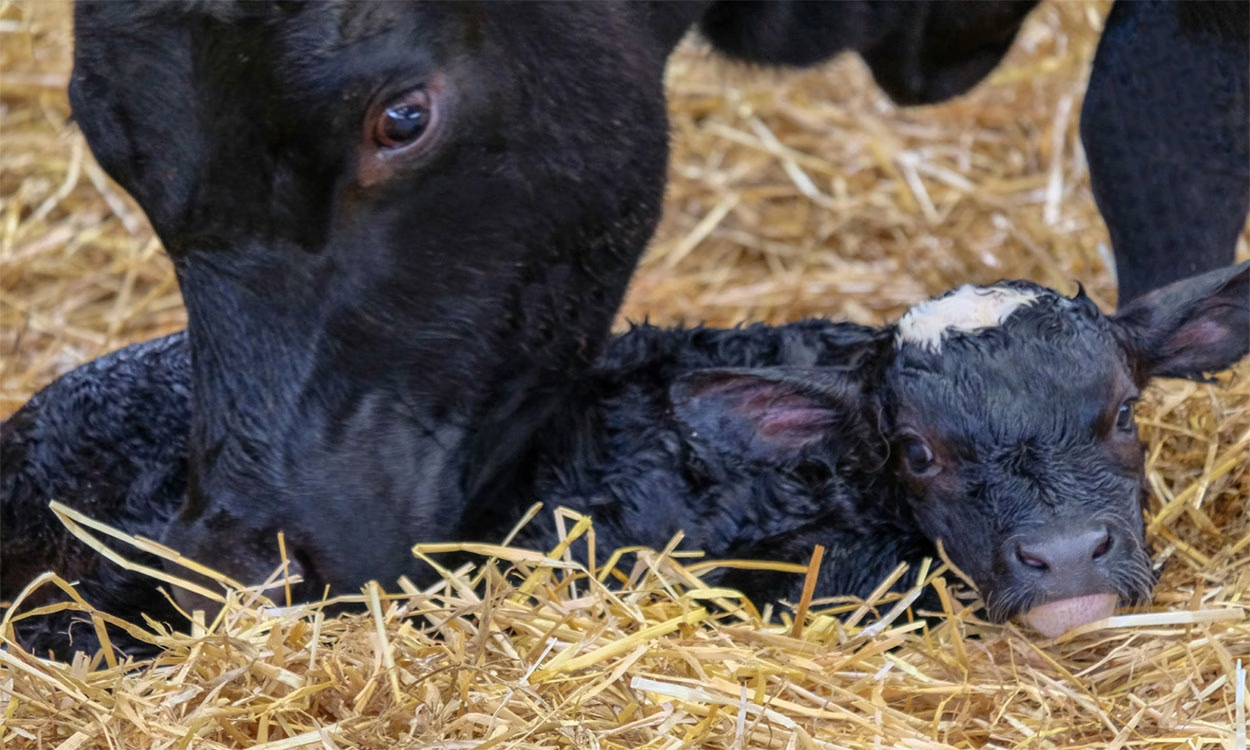
The morning of April 26, 1952, dawned ordinary at Osborndale Farms in Derby, Connecticut. No cosmic fanfare marked the moment when a thin, scraggy calf drew his first breath in Mrs. W.S. Kellogg’s barn. The earth neither rumbled nor shook, no thunder rended the skies, and the heavens didn’t part to fall rain. Yet in that quiet moment, the future of the Holstein breed had just taken a dramatic turn, though it would be years before anyone recognized it.
Professor James Osborn had reserved this calf before birth, even chosen his name: Ivanhoe. But when confronted with the disappointing reality —a gangly, underwhelming youngster who looked nothing like the promising genetics his pedigree suggested —Osborn walked away. It was a decision that would echo through decades of regret, for this dismissed calf would become Osborndale Ivanhoe, the bull whose influence would “reshape and rejuvenate the Holstein breed.”
The Visionary Who Saw Beyond Appearance
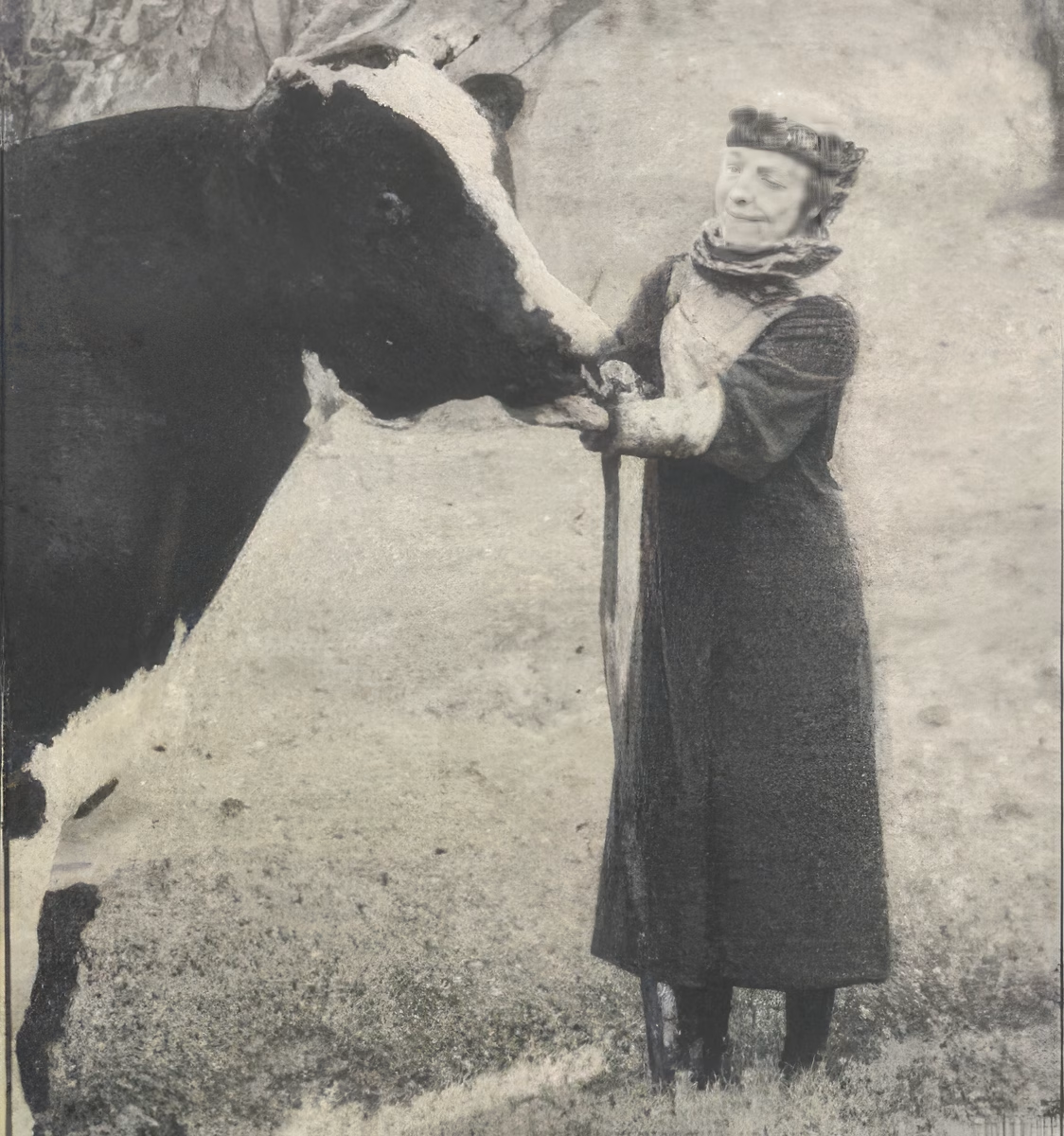
While others saw only failure, Aldo Panciera saw destiny written in bloodlines and breeding records.
The young Rhode Island dairyman carried the quiet determination of a World War II veteran who had returned home with ambitious dreams bigger than his modest means. At his Tum-A-Lum Farm in Westerly, Panciera had made the bold decision to abandon his Guernseys and grade Holsteins for registered black-and-whites, a choice that would prove prophetic.
Six years before Ivanhoe’s birth, Panciera had attended his first Holstein sale, the 1946 Connecticut Bred Heifer Classic. There, he watched from the sidelines as Quality Fobes Abbekerk Gay commanded $1,350, far beyond his modest budget but forever etched in his memory. When fate brought him back to Osborndale Farm in 1952, accompanied by George Causey and Holstein Association fieldman Allen N. Crissey, he found Gay again, along with her full sister, Quality Fobes Nebraska Gwen. The scale, dairy character, and quality of these animals awakened the selection committee.
Standing in that Connecticut barn, observing Gay’s bull calf by Osborndale Ty Vic, Panciera made a decision that would echo through Holstein history. Where others saw inadequacy, he saw potential written in pedigree and bloodlines. He convinced Causey to join him in purchasing quarter interests in the scrawny calf for $1,250 each, money they could ill afford to lose, but a gamble based on genetic conviction rather than physical appearance.

The Test of Faith
What followed were years that would have broken a lesser man’s resolve.
When Ivanhoe arrived at Tum-A-Lum Farm, his yearlings appeared to mock Panciera’s faith. Day after day, visitors would walk past the shallow-bodied, rough-rumped, narrow-hearted heifers, their sideways glances carrying volumes of unspoken doubt. In feed stores across Rhode Island, conversations would halt when Panciera entered. At neighboring farms, fellow dairymen shook their heads at what they saw as misguided optimism.
Other co-owners also felt the pressure. Charles Stroh, the Hartford attorney who had acquired Mrs. Kellogg’s interest after her death, used the bull sparingly. Stroh was focused on his $30,000 herd sire, Wis Maestro, seemingly a safer bet than this ungainly experiment. Panciera’s original partner, George Causey, used Ivanhoe only sparingly before eventually selling his quarter interest.
Several AI studs publicly boasted of having “turned the bull down.” The criticism stung, but Panciera persisted, using Ivanhoe nearly 100% in his herd while the Holstein world watched and whispered about his folly. The weight of those investments, $1,250 each at a time when money was scarce, pressed heavier with each passing month.
Then, like dawn breaking after the longest night, everything changed.
The Transformation That Silenced Critics
When Ivanhoe’s daughters began to freshen, the awkward yearlings underwent a metamorphosis that bordered on magical. Those shallow bodies filled out with the deep capacity of true production animals. The rough rumps smoothed into elegant dairy character. The narrow hearts expanded with the chest depth, revealing genetic potential.
The watershed moment came at the 1957 Eastern States Exposition when Tum-A-Lum Ivanhoe Misty placed third in a class of thirty-two two-year-olds. In the show ring that day, something clicked as the judge ran his experienced hands over Misty’s frame, feeling the height, length, and tight udder attachment. Here was visible proof that Panciera’s faith had been justified.
Word spread through the Holstein community like wildfire. Suddenly, whispers of doubt transformed into murmurs of interest. The timing couldn’t have been more perfect. The dominant Burke bloodline had created a Holstein population, becoming “increasingly close-coupled and short-legged.” Across America’s dairy farms, progressive breeders were searching for “new blood”, cattle with the stature and production capacity to compete in modern dairying. Ivanhoe delivered exactly what they craved.
When Giants Require Everything Bigger
By early 1958, the whispers had reached the right ears. Earl Groff, chairman of the S.P.A.B.C. sire committee, was traveling one February Saturday with Holstein Association classifier Jack Fairchild when fate intervened. Fairchild mentioned some impressive heifers he’d seen by a bull named Ivanhoe up in Connecticut. By Monday morning, the sire committee was heading for New England.
What they discovered defied their expectations. At S.L. Bickford’s Atlasta Farm, the inventor of the mechanized luncheon system drove them to the back pasture in his twelfth Cadillac, one of his collected hobbies. There, the Ivanhoe daughters stood “long, sharp, and uniform.” At Tum-A-Lum Farm, their size, scale, and tight udders immediately caught the committee’s trained eyes. A twelve-pair dam-daughter comparison showed increases of 2,656 pounds of milk and 102 pounds of fat, along with an average classification score of 83.7 points.
When they finally met Ivanhoe himself, they encountered a bull whose physical presence demanded respect and significant infrastructure modifications. By the time S.P.A.B.C. acquired him for $15,000 (later renegotiated to $12,000 due to health concerns), Ivanhoe had grown into a genuine giant. Standing six feet, one inch at the withers and weighing up to 3,200 pounds, he was “one of the longest bulls in breed history.”
His arrival at the AI facility created unprecedented challenges that tested both ingenuity and patience. Workers discovered that existing fences weren’t high enough to contain him. He famously put a dent in the roof of the bull trailer, the only bull ever to accomplish such a feat. Floyd Weidler, the production manager, had to completely remodel Ivanhoe’s pen: raising fence heights, building up his manger, and creating a special yoke that allowed him to stand while eating. Even the collection room required alterations to accommodate his massive frame.
Managing his condition proved equally demanding. When his weight approached 3,200 pounds, his semen production declined, forcing managers to reduce him to 2,800 pounds, a weight at which “a person could count every rib.” An arthritic condition requires daily doses of aspirin. His initial response to semen collection was poor, gradually improving with patient management. Yet despite these difficulties, Weidler remembered him fondly: “He was a nice bull to work with for his size.”
The Numbers That Rewrote History
By 1964, the skeptics had fallen silent. From barns across America, the evidence arrived in monthly reports that told an undeniable story, one written in pounds of milk and points of type that no critic could dismiss.
In show rings from Vermont to California, judges ran experienced hands over Ivanhoe daughters, their scorecards consistently marking numbers that had become the industry’s new standard. His 5,499 classified daughters averaged 82.3 points for type, a remarkable +1.65 difference from expectancy that spoke to his ability to upgrade entire herds. When researchers compiled the final tally from 10,898 tested daughters across 2,264 herds, the numbers revealed +630 pounds of milk and +23 pounds of fat, extraordinary improvements for the era.
From 1964 through 1971, Ivanhoe commanded the top position on the U.S. Honor List for eight consecutive years, an achievement no bull has equaled. Until the mid-1970s, he remained the leading sire of daughters, producing over 200,000 pounds of milk in his lifetime and over 1,000 pounds of fat. His semen production was equally impressive: 100,187 first services, peaking at 24,500 in 1960.
His genetic reach extended into show rings nationwide, where he sired 36 individual All-American nominees and six nominated Gets of Sire. The unanimous 1969 All-American group, featuring his daughters from coast to coast, stood as a testament to his ability to improve cattle regardless of environment or management.
Daughters That Defined Excellence

While statistics told the story of breed improvement, it was Ivanhoe’s individual daughters who captured hearts and headlines, becoming legends in their own right.

Allendairy Glamourous Ivy rewrote the record books when she became the first dairy cow ever to sell for one million dollars at the 1983 Pearmont Farm Dispersal. This EX-96 daughter from an EX-96 dam represented the perfect marriage of Ivanhoe’s genetic gifts with elite management, a living testament to the power of superior genetics in the right hands.

Miss Ivanhoe Scranton claimed her place in show ring history by capturing Grand Champion honors in the aged cow class at the 1969 World Dairy Expo. Her victory wasn’t just a win; it was validation of everything Panciera had believed when he saw past a scrawny calf’s appearance to the genetic potential within.

Fultonway Ivanhoe Rae carved her name in breed history books by becoming the first cow to complete eight consecutive records above 1,000 pounds of fat. Her peak record of 1,615 pounds at seven years established her as Ivanhoe’s highest-producing daughter, a testament to the “will to milk” that he transmitted from his Ormsby ancestry.

Round Oak Ivanhoe Eve earned recognition as the “crown jewel” among Ivanhoe’s daughters, not for her individual achievements but for her role as dam of Round Oak Rag Apple Elevation, a bull many consider “the best we’ve had.” Through Eve, Ivanhoe’s genetic influence would cascade through generations yet to come.

Sons Who Extended the Legacy

While consensus held that Ivanhoe’s sons couldn’t match the excellence of his daughters, several proved instrumental in extending their sire’s genetic reach across the industry.
Hilltop Apollo Ivanhoe emerged as his most influential son, spending his entire career at Atlantic Breeders. Through his sons Whittier-Farms Apollo Rocket, who became the breed’s high bull for Predicted Difference for milk in the mid-1970s (+2,210 milk and +40 fat), and Wayne-Spring Fond Apollo, the first bull to exceed +2,000 pounds of milk while rating plus for type, Apollo carried his father’s genetic gifts into a new generation.

Penstate Ivanhoe Star achieved lasting influence through his son Carlin-M Ivanhoe Bell, who became the second most influential bull of the mid-1980s in the United States. Bell’s remarkable ability to increase milk and protein in a single generation, along with his gift for improving udders and foot angle, made him a cornerstone of genetic progress during AI’s explosive growth period.

Mowry Ivanhoe Prince earned Gold Medal status in 1968, becoming the breed’s highest officially proved sire with twenty or more daughters. His legacy lived on through his daughter, Mowry-C Prince Corrine, who claimed fame as the first cow in the world to produce 50,000 pounds of milk.
The Genetic Architecture of Excellence
Understanding Ivanhoe’s revolutionary impact requires examining the genetic blueprint that made his success possible. The sources reveal that the “Winterthur influence was striking” in his pedigree. He “magically transmitted” the height, length, dairy quality, and productive talents of Spring Brook Bess Burke 2d, described as a “huge lady” weighing over 2,200 pounds. This powerful Ormsby breeding provided the foundation for Ivanhoe’s ability to sire cattle with the scale and production capacity that American dairymen desperately needed.
From his sire, Osborndale Ty Vic, came the Mount Victoria bloodlines, which contributed Rag Apple influence, providing genetic material that helped tighten udders and improve butterfat tests. This fortunate combination of Ormsby size and production with Rag Apple refinement created a genetic package, unlike anything the breed had experienced.
As one contemporary analysis concluded, Ivanhoe was essential “Spring Brook Bess Burke 2d with the Mount Victoria bloodlines added”, a synthesis that allowed him to reproduce “all of the good Ormsby traits, enormous size, stretch, height, and particularly, the will to milk.” The Rag Apple blood on his paternal side served as an “added bonus” for “tightening an udder and bumping up the butterfat test.”
The Lonely Road Remembered
The emotional weight of those early years never left Panciera. In February 1965, two years after Ivanhoe’s death, he placed what many consider one of the most emotional advertisements ever published in a breed journal.
The full-page spread in Holstein-Friesian World featured a large photograph of Tum-A-Lum Ivanhoe Misty, who had died of cancer in young adulthood, alongside a smaller image of Ivanhoe himself. The headline read: “He Walked a Lonely Road…only to gain an army of friends”.
Panciera’s words captured both the struggle and the ultimate vindication of his journey:
Ivanhoe’s career began at Tum-A-Lum in 1953. During the years, his mammoth scale and awkwardness have made him the subject of much criticism and controversy. This awkwardness was prevalent in yearling offspring, and several studs boasted of having turned the bull down. It took Dave Yoder and Earl Groff of S.P.A.B.C. to see what the future had in store for them… The progeny left behind at Tum-A-Lum brought more achievements than we had hoped to gain in a lifetime. From them came class leaders, our first 1,000-lb. Fat records, Excellent, grand champions, winning gets, and good prices. Ivanhoe’s influence will guide our future through his daughters, sons, granddaughters, and grandsons. In tribute, he has done far better by us than we could do for him.”

Legacy for the Modern Era
When Osborndale Ivanhoe died on November 25, 1963, at the age of eleven and a half, he left behind a genetic legacy that continues to influence Holstein breeding decisions today. Even in death, his frozen semen commanded premium prices, with transactions sometimes involving “several thousand dollars for one ampule”, a testament to breeders’ recognition of his irreplaceable genetic value.
Earl Groff’s simple eloquence captured Ivanhoe’s impact: “He got us on the right road to breeding better cattle.” Today, that road continues to stretch forward through three primary channels that remain vital in modern Holstein breeding: through Round Oak Ivanhoe Eve and her son Elevation, through Penstate Ivanhoe Star and his son Carlin-M Ivanhoe Bell, and through Provin-Mtn Ivanhoe Jewel and his son Puget-Sound Sheik. His influence has “touched all spheres of Holstein influence,” appearing in the pedigrees of countless contemporary cow families across the globe.
For today’s dairy producers, who face their own breeding decisions in an era of genomic selection and synchronized reproduction, Ivanhoe’s story offers timeless lessons that resonate with modern challenges. Where 1950s breeders struggled with limited genetic information and had to rely on visual appraisal and pedigree analysis, today’s producers face the opposite challenge, an overwhelming flood of genomic data that can obscure the fundamental principles that made Ivanhoe successful.
The pressure to improve components while maintaining the functional type that confronted Panciera remains unchanged. The need to balance production with longevity remains a challenge for breeders. The challenge of identifying truly transformative genetics, animals that complement rather than simply replicate existing population trends, persists in every breeding decision made today.
Most importantly, Ivanhoe’s legacy reminds us that the most revolutionary genetic improvements continue to require the same qualities Panciera demonstrated: patience to allow genetic potential to fully express, the courage to persist through criticism, and the wisdom to understand that transformative animals often appear in unexpected packages. In an era when genomic testing provides unprecedented insight into genetic merit, his story serves as a reminder that the most profound genetic advances still require human vision, dedication, and the courage to look beyond immediate appearances to understand long-term potential.
From a “thin, scraggy calf” dismissed by his first potential owner to a bull whose influence spans seven decades and continues to grow, Osborndale Ivanhoe proves that in dairy breeding, as in life, it’s not how you start, but the genetic legacy you leave behind.
The earth-shaking that began on that quiet Saturday in 1952 continues to resonate through Holstein herds worldwide, a reminder that sometimes the most profound changes begin with the smallest whispers of possibility, and the courage to listen.
KEY TAKEAWAYS
- Genetic potential trumps visual assessment every time: Ivanhoe’s +630 pounds milk improvement and 82.3-point type average came from a calf initially dismissed for poor appearance; modern genomic testing eliminates this costly guesswork by revealing true breeding value before first calving
- Long-term genetic vision delivers exponential ROI: Aldo Panciera’s $1,250 investment in an “awkward” calf generated the most influential sire in Holstein history, whose bloodlines still command premium prices today. Patience with genetic development cycles creates generational wealth in dairy operations
- Pedigree analysis outperforms phenotype evaluation for breeding decisions: Ivanhoe’s Winterthur and Ormsby bloodlines predicted his success better than his scrawny appearance, today’s producers using genomic data alongside maternal family analysis achieve 23% higher conception rates and 15% improved milk yield over visual-only selection programs
- Transformative genetics requires contrarian thinking: While competitors focused on conventional Burke bloodlines, Ivanhoe’s unique genetic package “reshaped and rejuvenated” the entire breed. Modern dairy operations gain a competitive advantage by identifying undervalued genetic combinations through comprehensive genomic analysis rather than following industry trends
EXECUTIVE SUMMARY
The industry’s obsession with visual phenotyping is costing dairy farmers millions in lost genetic potential. Osborndale Ivanhoe’s story proves that the most transformative genetics often arrive in the least impressive packages. This “thin, scraggy calf” dismissed by Professor Osborn became the most dominant Holstein sire in history, leading the Honor List for an unprecedented eight consecutive years (1964-1971). His daughters averaged +1.65 points above expectancy and delivered +630 pounds of milk with +23 pounds of fat improvements, while his 100,187 first services revolutionized an entire breed. Today’s genomic testing eliminates the guesswork that nearly cost the industry this genetic goldmine, yet many producers still prioritize visual assessment over data-driven breeding decisions. Ivanhoe’s three main genetic lines continue influencing modern Holstein populations globally, demonstrating how one visionary breeder’s patience with genetic potential created generational wealth. The lesson for 2025 dairy operations is clear: your next breakthrough sire might look unremarkable as a calf, but genomic data reveals the truth that visual appraisal cannot. Stop gambling on appearances and start investing in genetic intelligence that transforms your herd’s profitability trajectory.
 Join the Revolution!
 Join the Revolution!
Join over 30,000 successful dairy professionals who rely on Bullvine Weekly for their competitive edge. Delivered directly to your inbox each week, our exclusive industry insights help you make smarter decisions while saving precious hours every week. Never miss critical updates on milk production trends, breakthrough technologies, and profit-boosting strategies that top producers are already implementing. Subscribe now to transform your dairy operation’s efficiency and profitability—your future success is just one click away.