



Archive for Milk production cost

The 90-Second Milking Window That’s Paying $126,000 – and Beating Every Robot

Master the 90-second milking rule that’s earning smart dairies $126,000—no robot needed.

So I was walking the aisles at World Dairy Expo last month, and what really got me was how nearly every booth was pushing some kind of automation as the solution to all our problems.

That same trip, I stopped by a 250-cow operation near Fond du Lac. The milkers were rushing through prep in maybe 45 seconds—when we all know biology needs closer to 90. Meanwhile, the owner’s shopping for robots while potentially leaving $126,000 in annual production sitting right there in the parlor.

What’s interesting is that Cornell just released its 2024 Dairy Farm Business Summary, which backs up something I’ve been noticing for a while now. The gap between farms that are making it and those that aren’t? It’s not really about who has the newest equipment.

The Numbers That Tell the Real Story

Cornell’s latest data is eye-opening. Top farms in New York are running at $15.79 per hundredweight in operating costs. The bottom ones? They’re hitting $22.32.

That’s a $6.35 gap between similar-sized operations with pretty much the same technology.

You’ve got 500 cows producing 25,000 pounds annually? That efficiency gap is worth about $79,000. Not from buying new equipment—just from doing what you’re already doing better.

Brazilian researchers looked at 378 dairy farms adopting precision technology—published their findings in the Animals journal back in 2021. About a large share of adopters reported limited realized benefits, underscoring that adoption alone didn’t guarantee performance gains. But you know what? The farms that just focused on nailing their basic protocols? They saw returns right away without spending anything on new gear.

I’ve been talking with producers out in California lately, and down in Georgia too, and they’re telling me the same story—dropped hundreds of thousands on cooling systems or new facilities before realizing the real problem was inconsistent feeding schedules. Different climate, same underlying issue.

And you know what’s interesting? Even operations in New Zealand—where they’re dealing with completely different grazing systems—are finding the same thing. It’s not about the technology. It’s about the execution.

“Farmers think they’re buying free time. They’re really just buying different obligations.”

Five Questions Before Writing That Technology Check

□ Have we actually put a dollar figure on what our problems are costing us right now?

□ Are we in the top 25% for how well we’re doing what we’re already doing?

□ Is this technology going to help us stand out in the market, or just make us slightly better at commodity production?

□ Do we have people who can actually run this stuff, or are we hoping to find unicorns?

□ Can we hit 15% returns and still have money in the bank for when things go sideways?

Why Those 90 Seconds Matter More Than You Think

You know how crazy it gets during second cutting—everybody’s rushing. But here’s the thing: oxytocin doesn’t wait for us.

UW–Madison tracked 16 farms and found and what he found shouldn’t surprise anyone who’s been around cows. Farms that hit that sweet spot—60 to 90 seconds between first touch and unit attachment—they’re getting 4-6% more milk.

Not from better genetics. Not from fancy supplements. Just from timing it right.

And here’s something else—it matters whether you’re milking Holsteins or Jerseys. Jerseys tend to let down a bit quicker, maybe 10-15 seconds faster on average. But the principle’s the same.

THE GOLDEN WINDOW: Your 90-Second Milking Protocol

What’s all this worth? Well, let me walk you through the math.

On 500 cows averaging 75 pounds daily, even a conservative 5% bump from proper timing gets you about 1,875 extra pounds per day. The current Base Class I price was $18.21/cwt, according to the USDA’s latest market report.

Do the math—that’s about $126,000 a year. From timing. Not technology.

Beyond volume, research shows proper stimulation timing can lift butterfat percentages and lower SCC—quality bonuses most dairies leave on the table.

Penn State Extension has been looking at training on farms, and in most operations they’ve studied, formal training is pretty sparse. Workers are mostly learning from whoever was there before them. It’s like a game of telephone where everybody loses.

What’s worse is that during planting and harvest—protocol drift accelerates when everybody’s pulled in different directions.

Two Roads Diverged in a Dairy Farm

Extension folks across the Midwest have been tracking different approaches to technology adoption, and the patterns they’re seeing are crystal clear. Let me share what they’ve found—these are representative cases, not specific farms, but the numbers are real.

The “All-In” Approach
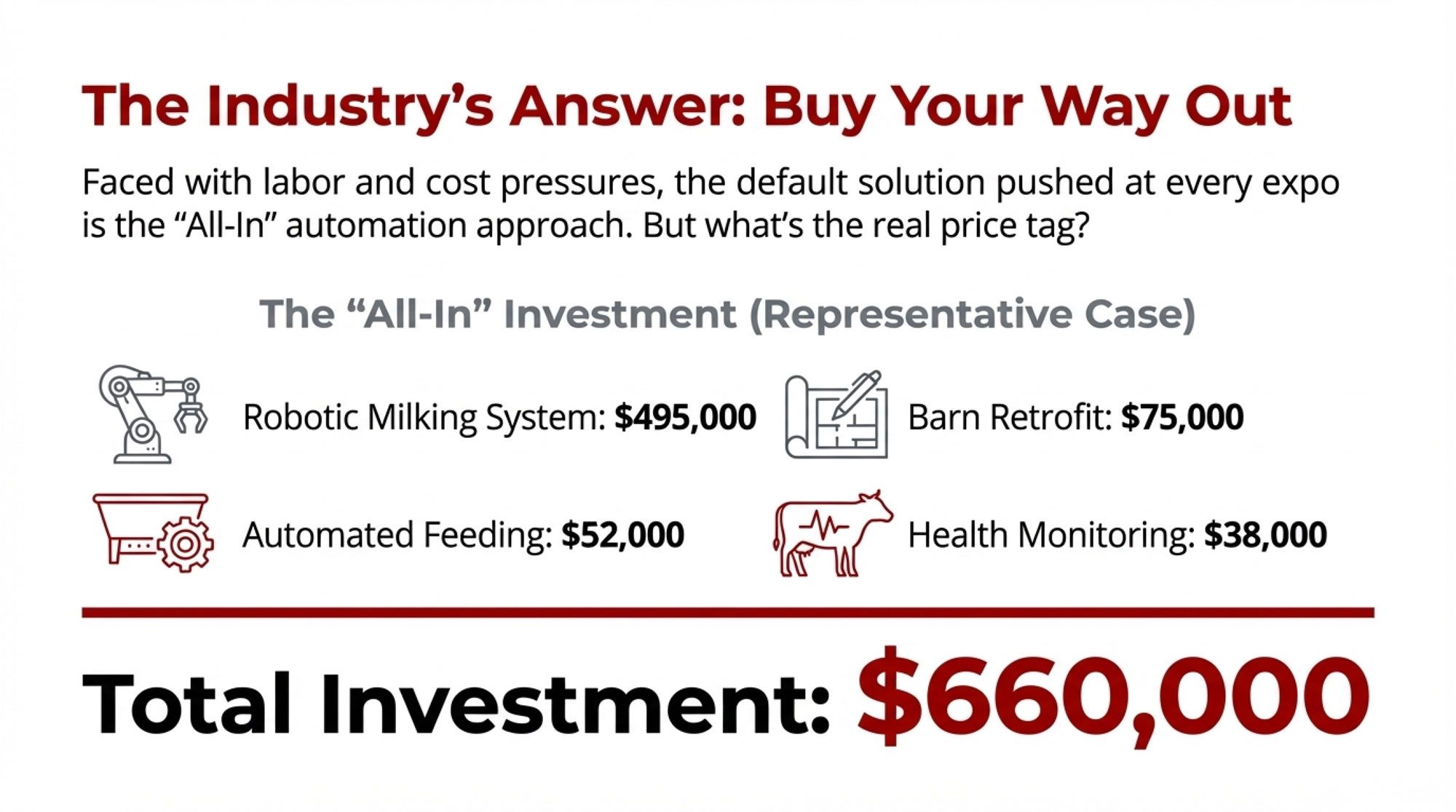
Farms facing typical challenges—about 30% turnover, $21/cwt costs, 220,000 somatic cells—often buy everything. Based on what dealers are charging these days:

  • Robotic system: $495,000
  • Barn retrofit: $75,000
  • Automated feeding: $52,000
  • Health monitoring: $38,000

Total: $660,000

But here’s what Minnesota’s research tracking these systems shows: you don’t eliminate labor—you change it. Instead of paying $15/hour for milkers, you’re paying $25-30/hour for technicians. And good luck finding them.

Production gains? University studies show 2-3% is realistic, not the 7% dealers promise.

Annual debt service: $30,00 to $100,000
Actual benefits: $65,000 to $100,000
Net result: $35,000

The Strategic Route

Now, I’ve seen farms take a different approach. Same problems, but they ask, “What’s actually costing us money?”

Strategic investments based on Extension case studies typically look like this:

  • Heat detection ear tags: $24,000 (fixes quantified reproduction losses)
  • Inline milk testing: $15,000 (enables premium capture)
  • Protocol training: $20,000 (the one nobody talks about)
  • Small pasteurizer: $15,000 (direct sales opportunity)

Total: $74,000
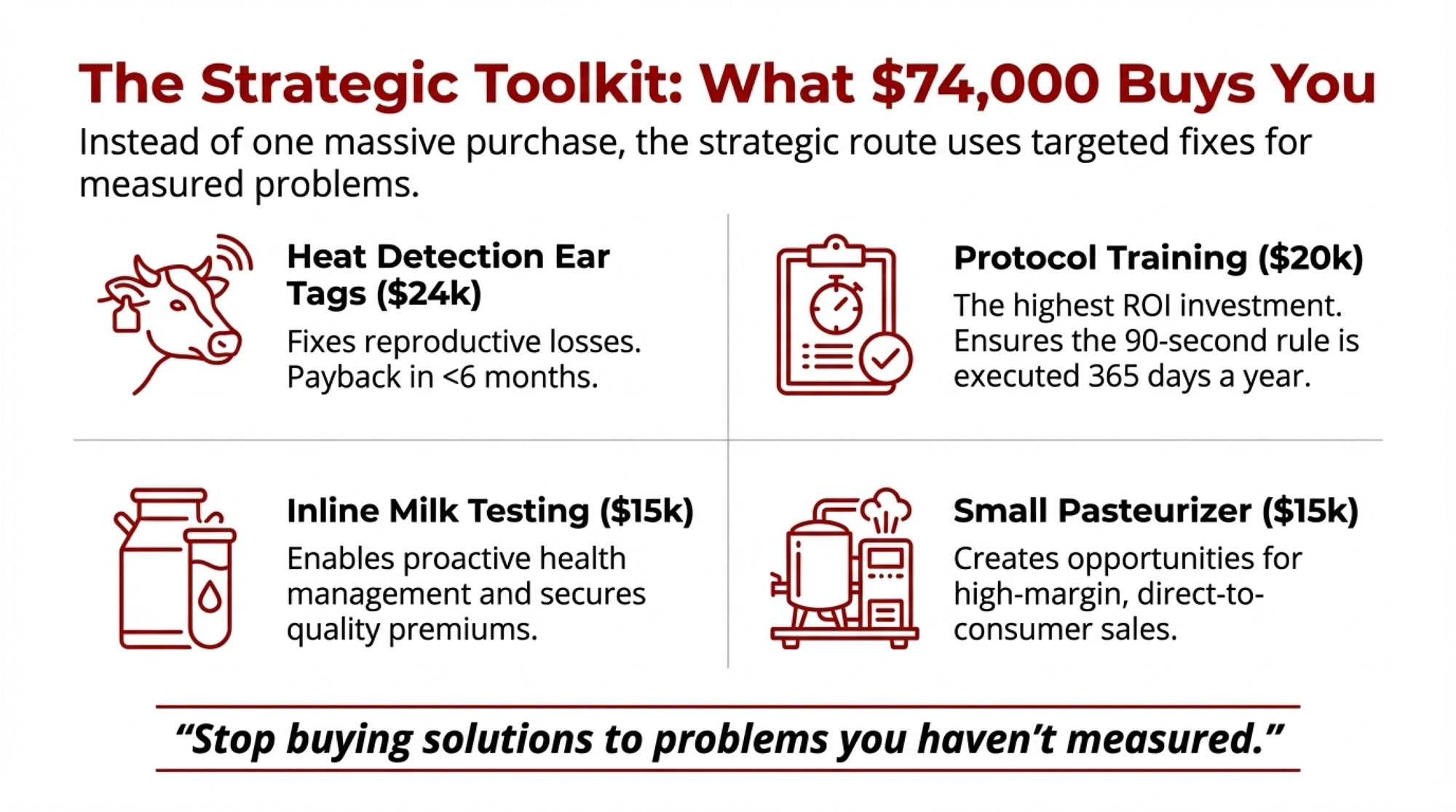
What happens? Based on composite results from university tracking, conception rates jump from mid-40s to low 60s. Training delivers 4-5% more milk. Cornell and UVM data show that organic premiums add $250-$300 per cow. Direct sales can bring $70,000-85,000 from just 15% of production.

“Stop buying solutions to problems you haven’t measured.”

YOUR 4-PHASE IMPLEMENTATION ROADMAP

Phase 1 (Months 1-3): Get Brutally Honest

  • Independent assessment: $5,000-8,000
  • True cost of production analysis
  • Problem quantification in dollars

Phase 2 (Months 4-7): Fix the Basics

  • Training & protocols: $15,000-25,000
  • Expected returns: 1,500% first-year ROI
  • No conference sponsorships, just results

Phase 3 (Months 8-12): Pick Your Lane

  • Top-25% commodity efficiency?
  • Organic/specialty markets?
  • Agritourism opportunities?

Phase 4 (Year 2+): Strategic Technology

  • Only if problems cost more than solutions
  • Only if it enables differentiation
  • Only if you have the workforce
  • Only if a 15% ROI is achievable

ROI COMPARISON: The 300% Difference

Investment ApproachAll-In AutomationStrategic Technology
Total Investment$660,000$74,000
Annual Returns$65,000$200,000-250,000
Net Annual Result$35,000$150,000
ROI9.8%300%

These are representative outcomes based on Extension case studies—your results will vary

What Really Happens to Your Labor

Finnish researchers looked at this back in 2016, and Marcia Endres at Minnesota has been tracking it ever since. Yeah, milking time drops from 5 hours to 2. But you know what shows up instead?

Watching screens. Midnight alarms. Tech support holds. Being on call 24/7.

As Marcia says, “Farmers think they’re buying free time. They’re really just buying different obligations.”

You’re not replacing a $15/hour milker with nothing. You’re replacing them with a $25-30/hour technician—if you can find one who wants to live in rural Wisconsin and answer their phone at 2 AM.

The Canadian Agricultural HR Council says we’ll be 1,000 workers short by 2029, with a third of our current people ready to retire. But robots need fewer people with way more skills. So we’ve got workers who can’t do tech work and tech workers who don’t want to live where the cows are.

Any of us who’ve gotten that 2 AM robot alarm knows what I’m talking about.

Small Doesn’t Mean Dead—It Means Different

USDA tells us we lost 15,221 dairy farms between 2017 and 2022—that’s 39% gone. And when you see big farms running at $17/cwt while small farms face $33/cwt according to the USDA’s Economic Research Service, it looks pretty hopeless for the little guys.

But here’s something interesting—a small minority—maybe 10% based on ERS estimates—are actually making money despite their small size. How?

Three approaches that work:

Elite execution: I know of operations in places like Skagit County, Washington, running under 200 cows at under $18/cwt with 50+ cows per worker. It’s exhausting, but it’s possible.

Finding your niche: Cornell’s 2024 organic dairy tracking shows certified farms pulling $250-300 extra per cow. Vermont’s been watching this for a decade—100-cow organic dairies making money while their conventional neighbors go under.

Down South, producers in Georgia and Florida tell me that being the only dairy for 200 miles creates automatic premiums. Geography becomes an advantage. And operations at 5,000-8,000 cows—not quite mega-scale but bigger than most—they’re finding automation sweet spots that work at their size.

Smart technology: Not robots. Targeted fixes. $25,000 for heat detection to prevent your reproductive disaster. $15,000 on milk quality monitoring to qualify for premiums. Not $665,000 on a robot hoping to fix everything.

Where Do We Go from Here?

So here we are. Milk costs around $20, feed eating 60% of revenues according to Penn State’s 2025 outlook, and they can’t find good help. The temptation to buy your way out is real.

But the farms thriving keep proving the same thing: doing the basics really well beats fancy equipment almost every time.

Most of us have $100,000-plus sitting right there in the parlor. It doesn’t need financing. It doesn’t need a technician from three counties away. It just needs us to do what we already know how to do, consistently.

Looking ahead, some interesting opportunities are developing. Programs like USDA’s Climate-Smart Commodities are paying $20-50 per cow for verified carbon reductions. Processors like Danone, through its “Dairy Farmers of Tomorrow” program, and Nestle, through its Net Zero Roadmap, offer select benefits as well as some offer contracts with $0.50 to $1.00/cwt sustainability premiums—though these are limited and require specific documentation.

These aren’t about technology. They’re about management and documentation—rewarding what good farmers already do.

Your cows don’t care about robots. They care about those 90 seconds before you put the milker on. They care about eating at the same time every day. They care about someone noticing when they’re in heat.

Maybe we should care about the same things.

Because with 39% of farms gone in five years, what separates survivors from statistics isn’t who bought the most technology. It’s who got the basics right first, then used technology strategically to make good even better.

The path forward isn’t in the dealer’s catalog—it’s in doing what we already know works, day after day after day.

That’s not what gets the spotlight at Expo. But when you look at who’s still milking versus who’s having an auction, it’s the story the numbers keep telling.

Key Takeaways:

  • The 90-second milking rule is adding $126,000 a year to smart dairies—no robots required.
  • Farms chasing automation before fixing fundamentals lose money twice—on milk and on debt.
  • Precision routines and trained teams outperform half-million-dollar robots every time.
  • Targeted fixes—heat detection, training, timing—average 300% ROI without new equipment.
  • Dairy’s next winners aren’t high-tech—they’re high-discipline.

Executive Summary:

Dairy’s future isn’t being built by robots—it’s being rebuilt by precision. According to Cornell’s 2024 Dairy Farm Business Summary, top operations outperform neighbors not through automation, but through disciplined execution. The research is clear: a well-timed 90-second milking routine can deliver 4–6% more milk and more than $126,000 in extra revenue annually—without buying a single new machine. Meanwhile, farms chasing automation often trade labor headaches for technical ones while falling behind on fundamentals. Cornell, UW-Madison, and Penn State all point to the same truth: technology multiplies skill—it can’t replace it. In a volatile milk market, the smartest dairies in 2025 aren’t betting on gadgets. They’re doubling down on training, timing, and teamwork that pay real dividends.

Complete references and supporting documentation are available upon request by contacting the editorial team at editor@thebullvine.com.

Learn More:

Join the Revolution!

Join over 30,000 successful dairy professionals who rely on Bullvine Weekly for their competitive edge. Delivered directly to your inbox each week, our exclusive industry insights help you make smarter decisions while saving precious hours every week. Never miss critical updates on milk production trends, breakthrough technologies, and profit-boosting strategies that top producers are already implementing. Subscribe now to transform your dairy operation’s efficiency and profitability—your future success is just one click away.

NewsSubscribe
First
Last
Consent

The Math Doesn’t Lie: Why $16 Billion Can’t Save American Dairy

Disaster Relief Reality: $278 per Cow Recovers Loss—But a $5,600 Annual Gap Proves Dairy’s Deeper Crisis.

Executive Summary: The USDA’s $16 billion Supplemental Disaster Relief Program (SDRP) Stage 2, announced in November 2025, is targeted emergency relief approved by Congress to help producersrecover documented weather-related and natural disaster losses from 2023–2024—including forage quality, dumped milk, and infrastructure impacts—not a general economic support program or market ‘bailout’ for the dairy sector. While these funds are critical for actual disaster recovery, they highlight a deeper divide: the permanent cost-of-production gap between small and mega-dairies—a gap disaster relief cannot and is not designed to resolve.

Dairy Cost Analysis

$16 billion in weather disaster aid is historic relief, but it’s also a wake-up call about the underlying economic wounds that disaster payments alone cannot heal.

Here’s what’s happening right now with the SDRP Stage Two payments from the Farm Service Agency—the ones announced on November 16th. A typical 300-cow Wisconsin operation with documented disaster losses could receive around $83,000. That’s roughly $278 per cow, give or take. Meanwhile, that 2,000-cow dairy out in Idaho? They hit the payment cap at $250,000, which works out to just $125 per cow.

On paper, smaller operations may appear to benefit more from per-cow relief. But these disaster payments, crucial for documented weather-related recovery, are not intended nor able to equalize ongoing production costs or ensure long-term survival in commodity markets.

What SDRP Stage 2 Actually Is: Appropriated by Congress, SDRP Stage 2 is strictly designed to compensate documented weather and natural disaster losses—such as drought-, flood-, smoke-, or freeze-driven impacts on milk, forage, or storage. This is not an open-ended economic aid or safety net for all farms, but targeted disaster coverage accompanying events in 2023 and 2024. Producers seeking specific payment estimates or qualification should review the official USDA checklist and apply through their local FSA office. Official details and eligibility: www.fsa.usda.gov/sdrp.

Understanding the Real Math Behind These Payments

The structural cost disadvantage facing small dairy operations is mathematically insurmountable—no disaster payment can bridge a $23.56/cwt permanent gap when mega-dairies operate at less than half the cost of farms with fewer than 50 cows

You know, I’ve been going through the payment structures with a few neighbors, and it’s easier to see the whole picture when you lay it out in a table:

Farm SizeEst. Relief PaymentPayment CapCost of Production/cwt
300 Cows~$83,000 ($278/cow)$125k-$250k~$25-28
2,000 Cows~$250,000 ($125/cow)$250k (Capped)~$19.14
Small (<50 cows)~$13,900 ($278/cow)$125k~$42.70

What’s really telling here—and the folks at the Center for Dairy Profitability at UW-Madison have been tracking this all year—is that many 300-cow operations in Wisconsin have been running negative margins for months now. So when you get a payment that covers maybe 16 months of those losses… sure, it helps. Absolutely. But it’s not changing the fundamental math we’re all dealing with.

Let’s be brutally honest about what even historic emergency relief can—and can’t—do for long-term economics. The SDRP Stage 2 payments, as outlined by USDA in November, are strictly for compensating weather and disaster losses: milk dumped, forage destroyed, inventory ruined. But once those bills are paid, the day-to-day reality is still a cost structure gap so wide that no single disaster relief check closes it.

USDA Data Reveals Massive Cost of Production Gap

The USDA Economic Research Service published some data in their 2024 cost of production report that… well, it’s eye-opening. You ready for this?

Small operations—we’re talking under 50 cows—are averaging $42.70 per hundredweight in total production costs. The mega-dairies with 2,000-plus cows? They’re down at $19.14 per hundredweight.

That’s a $ 23.56-per-hundredweight permanent disadvantage—over $5,600 per cow annually.

Just… think about that for a minute. When you run those numbers annually—and most of us figure about 240 hundredweight per cow per year—you’re looking at a structural disadvantage that no disaster payment can overcome. Not this one, not the next one.

I was reading through some research from dairy economists at UW-Madison recently, and they make a point that’s hard to argue with: these aren’t inefficiencies that better management can fix. We’re talking structural cost advantages here:

  • Labor utilization—one worker handling 80 cows versus 150 or more
  • Feed purchasing power—buying by the ton versus by the rail car
  • Equipment costs are spread over way more units of production

You can be the best manager in the world with 100 cows—and I know some who are—and still face these disadvantages.

What Different Sized Operations Are Actually Doing

While small farms receive higher per-cow payments ($278 vs. $125), they face an insurmountable $5,600 annual structural cost disadvantage—making these relief funds temporary breathing room, not救ue solutions

I’ve been talking with extension folks across Wisconsin, Pennsylvania, and Idaho lately, trying to get a sense of how farms are actually using these payments. The patterns are pretty revealing—and they vary dramatically by operation size.

Operations Under 200 Cows: Buying Time or Buying Out

Based on what extension educators across Wisconsin are observing, there’s been a notable uptick in farms asking about exit strategies right alongside their SDRP payment applications. It’s particularly noticeable among operations under 150 cows, and honestly, who can blame them?

But here’s what’s encouraging—the ones staying in traditional dairy are getting creative:

  • Direct-to-consumer relationships—farm stores, delivery routes, that kind of thing
  • Organic certification—and those $8-12 per hundredweight premiums that USDA’s Agricultural Marketing Service has been tracking are real
  • On-farm processing—cheese, ice cream, yogurt operations that capture those retail margins

Mid-Size Operations (200-500 Cows): The Efficiency Push

This group’s in a tough spot, you know? They’re too big to pivot to niche markets easily, but not quite large enough for full economies of scale.

What I’m hearing from Farm Credit folks and in extension discussions throughout 2025 is that there’s a strong interest in technology investments among these mid-size operations. They’re using relief funds as the capital they’ve been waiting for:

  • Activity monitors for better reproduction management
  • Automated calf feeders—especially with labor running $15-20 per hour plus benefits, according to National Milk Producers Federation data
  • Parlor upgrades targeting real efficiency gains

Cornell PRO-DAIRY’s analyses have emphasized that these farms need to get below $22 per hundredweight to remain viable in the long term. The smart ones I’ve talked to are using these payments for targeted investments toward that goal. It’s strategic thinking, not panic spending.

Larger Operations (500+ Cows): Environmental and Expansion

The bigger operations? Different game entirely. Many are putting relief funds toward environmental compliance—and honestly, that’s just smart planning. California’s methane reduction requirements are going full force by 2030, and you know other states are watching closely. Better to get ahead of it than scramble later.

The Young Farmer Perspective: Mathematically Impossible Entry

Here’s something that keeps me up at night. The average dairy farmer is 58 years old—that’s from the 2022 USDA Census of Agriculture. The barrier to entry for a 25-year-old today isn’t just hard—it’s mathematically impossible without inheritance or massive leverage.

Federal Reserve Bank of Chicago’s agricultural land value reports from the first three quarters of 2025 show dairy-quality farmland in Wisconsin ranging from approximately $8,000 to $12,000 per acre. Add in livestock, equipment, and facilities—you’re looking at a minimum of $3-5 million for a competitive operation. That’s before you’ve produced a single pound of milk.

“If farms with no debt are struggling, what chance does someone have starting with modern debt loads?”

That’s what a young farmer asked me last week, and I didn’t have a good answer.

Some young farmers are finding creative entry paths, though:

  • Management agreements with retiring farmers—gradual ownership transition
  • Starting with contract heifer raising before moving into milking
  • Intensive grazing systems that need less upfront capital
  • Minority ownership partnerships in established operations

But let’s be honest—these are exceptions, not the rule.

The Mental Health Crisis Nobody’s Measuring

Here’s something that doesn’t show up in any payment calculations but affects every decision we make: the stress factor. Research on farmer mental health—and university extension services have been tracking this closely—consistently shows elevated stress levels among dairy producers. Younger farmers are particularly affected.

Agricultural economists have noted that farmers often make decisions based on stress reduction rather than pure economic considerations. A payment providing 16 months of breathing room might be worth more psychologically than financially. And you know what? That’s completely valid.

Extension agents are reporting increased interest in:

  • Simplified systems that reduce management complexity
  • Seasonal calving to create actual downtime
  • Partnerships that share the management burden
  • Exit strategies that preserve dignity and family relationships

There’s no shame in any of those choices. None whatsoever.

Cross-Border Reality Check: Canadian “Stability” at What Cost?

Can’t really discuss American dairy economics without acknowledging what’s happening north of the border. Canada’s supply management system maintains about 9,000 dairy farms with remarkable stability. They announced 2025 price adjustments to account for inflation, maintaining their cost-of-production pricing formula. No emergency payments needed. No mass exodus from dairy.

But here’s the catch—and Canadian farmers will tell you this immediately—according to Dairy Farmers of Ontario quota exchange data, quota values have been running CAD $25,000 to $30,000 per kilogram of butterfat in recent transactions. That’s essentially a mortgage on your right to produce milk—something we don’t face here in the States.

The tradeoff? Well, predictable margins enable completely different business planning than our volatile commodity markets. Whether that’s “better” is a political debate for another day—probably best saved for when we’re not trying to figure out how to pay next month’s feed bill.

Five Brutal Truths About Making Decisions Right Now

For many farms, the $83,000 weather disaster relief payment—while life-saving after catastrophic losses—only buys about 16 months at current structural margins. When SNOW, drought, or fire is past, cost-of-production gaps remain; that’s why 2,800 operations closed this year, even with relief. For some, these disaster payments are a bridge as much as a recovery grant.

After all this analysis and talking with farmers across multiple states, here’s what seems most relevant if you’re trying to make decisions right now:

1. Know your real position: Calculate your actual cost per hundredweight. The Dairy Profit Monitor tools from Wisconsin, Cornell, and Penn State extension services can help with this. If you’re producing at $35 or more when efficient operations are at $20… that gap won’t close without fundamental changes.

2. Treat relief payments as capital, not income: Strategic improvements compound over time. Operating losses? They just come back next quarter.

3. Set realistic timelines: Give yourself 3-5 years to hit profitability targets. If structural disadvantages—not just bad years—prevent reaching those targets, having an exit strategy isn’t giving up. It’s responsible management.

4. Explore alternative models seriously: Grass-based systems, organic production, on-farm processing, agritourism—these aren’t easy pivots, but they can offer margins that commodity production just can’t match anymore. Cornell’s Dairy Farm Business Summary shows that organic operations often see $3-5 per hundredweight higher margins, though with different risk profiles.

5. Protect your mental health: Farm Aid’s hotline at 1-800-FARM-AID offers confidential support. Many states now have farm-specific mental health programs, too. No operation—and I mean this—is worth destroying your family or your wellbeing.

The Bottom Line: Dairy’s Structural Transformation Is Here

Dairy consolidation accelerates as America loses three farms daily while milk production increases—mega-operations with 2,500+ cows now drive industry growth, rendering the traditional family dairy model economically obsolete

Looking at how these payments land across different operations, it’s clear we’re witnessing a structural transformation, not just another rough patch. Based on consolidation patterns we’ve seen over the past decade, we’re likely to continue seeing fewer but larger farms—the National Milk Producers Federation and various agricultural economists have all been pointing to this trend.

But here’s what’s important, and what often gets missed in these discussions: fewer farms doesn’t automatically mean less opportunity for those who remain or enter strategically. The operations that survive and thrive will be those that either achieve commodity-scale efficiency or successfully differentiate into premium markets. There’s not much room left in the middle, unfortunately.

Success increasingly depends less on production excellence alone and more on strategic positioning.

You can have the best cow care and highest production in the world—and I know farmers who do—but if you’re in the wrong cost structure for your market position, excellence alone won’t save you.

These disaster relief payments offer crucial help after real, often catastrophic losses. But as storms pass and immediate recovery ends, the economic realities for U.S. dairy remain unchanged. Surviving and thriving beyond the next weather event will require structural solutions—relief alone isn’t enough. In an industry where crisis so often drives decision-making, that breathing room might be the most valuable aspect of all.

Because at the end of the day—and we all know this deep down—what matters isn’t whether you get $278 or $125 per cow in relief. What matters is understanding where your operation fits in dairy farming’s evolving structure and making informed decisions based on that reality.

The farms that do that, regardless of size? Those are the ones that’ll still be shipping milk in 2030 and beyond. And I hope yours is one of them.

The Bullvine’s analysis is grounded in publicly available research (USDA ERS, land-grant university economics, and direct extension interviews). All numbers are attributed, and cost estimates are taken directly from federal research. If your real-world experience varies or you have case-study data, we invite you to contribute insights or corrections for future reporting.

Complete references and supporting documentation are available upon request by contacting the editorial team at editor@thebullvine.com.

Key Takeaways:

  • Your True Position: If your operation depends on recurring weather disaster relief but your costs exceed $30/cwt, these programs help you recover from one storm—not from year-over-year competitive losses.
  • Strategic Capital Decision: That $83,000 payment offers three real choices: invest in efficiency tech (if you’re within striking distance of $22/cwt), pivot to premium markets ($8-12/cwt organic premiums), or exit with dignity while equity remains.
  • 16-Month Clock: Most disaster payments cover up to 16 months of losses; use this window for strategic plans, not hoping tough math will disappear.

Learn More:

Join the Revolution!

Join over 30,000 successful dairy professionals who rely on Bullvine Weekly for their competitive edge. Delivered directly to your inbox each week, our exclusive industry insights help you make smarter decisions while saving precious hours every week. Never miss critical updates on milk production trends, breakthrough technologies, and profit-boosting strategies that top producers are already implementing. Subscribe now to transform your dairy operation’s efficiency and profitability—your future success is just one click away.

NewsSubscribe
First
Last
Consent

Send this to a friend





