



Archive for milk powder market

Butterfat Finds a Floor, Powders Keep Sliding: This Week’s Global Dairy Market Recap (Oct 27, 2025)

Milk keeps flowing, but markets aren’t keeping up — here’s why butter still wins while powder takes the hit.

EXECUTIVE SUMMARY: Milk keeps flowing, and that’s both the good and the bad news this week. Global markets are clearly split: butterfat found support, while powders keep sliding under the weight of spring flushes from New Zealand and South America. The GDT fell for a fifth straight time, confirming that buyers remain hesitant despite stronger global GDP signals. European cheese prices softened again, squeezed by heavy milk flows and stiff export competition from the U.S. Meanwhile, domestic U.S. butter and whey showed small but meaningful rebounds, hinting that seasonal demand is still alive. The story heading into Q4 is crucial but straightforward — fats are holding the line, but milk powder markets are testing just how low they can go.

The global dairy market feels a bit like a full bulk tank these days — there’s plenty of volume, but the challenge lies in finding enough demand to keep things moving. As seasonal production swells across the Southern Hemisphere and buyers take a more cautious approach, markets are struggling to find equilibrium. The story this week is one of contrast: fats holding firm, proteins still under pressure, and a tug-of-war between optimism and oversupply.

EEX Futures – Butter Builds Strength

Volume on the European Energy Exchange (EEX) reached 1,730 tonnes last week, spread across butter, skim milk powder, and whey. Butter led the pack, climbing 1.6% to €5,226 for the Oct 25–May 26 strip.

What’s interesting here is how butter continues to defy broader weakness. European cream supplies remain comfortable, but steady retail demand and ongoing export inquiries — particularly for high-fat butter used in industrial formulations — are helping maintain price momentum (EEX, Oct 2025). Skim milk powder (SMP) slipped 0.2% to €2,163, showing that supply comfort and limited tenders are keeping buyers sidelined. Whey, meanwhile, gained 2.0%, settling around €975, driven by active demand for protein fortification in feed and human nutrition sectors.

SGX Futures – Fat Prices Hold Ground

Across the Singapore Exchange (SGX), 13,123 tonnes traded last week — the majority in Whole Milk Powder (WMP), which eased 0.4% to $3,546. SMP crept up 0.2% to $2,591, while Anhydrous Milk Fat (AMF) added 1.0%, finishing at $6,666.

It’s worth noting that AMF’s firm tone isn’t just about premium dairy fats — it’s about diversification. Food manufacturers are migrating toward AMF for better shelf stability and consistency, widening the AMF–butter spread to $376 per tonne. That gap signals stronger demand in processed and export channels versus commodity butter sales.

Butter on SGX slipped 1.4% to $6,420, reflecting the usual shoulder-season slowdown before Q4 holiday orders gain traction. The NZX milk price futures market traded 426 lots (2.56 million kgMS), keeping farm gate projections near $10/kgMS, supported by the weaker New Zealand dollar.

European Quotations – Region by Region Reality

The EU Butter Index dipped €39 (–0.7%) to €5,390, but the national picture tells more of the story. Dutch butter fell sharply (–3.4%), French butter rose 1.2%, and German butter held steady. The SMP Index fell 1.2% to €2,097, weighed by slow export booking and cautious EU buyers. By contrast, whey improved 1.7% to €912, another sign that protein derivatives continue to offer bright spots amid the softness.

Year-over-year, SMP has dropped more than 15%, while butter remains nearly 30% below 2024 levels. The key here is that fats are still profitable to produce, while powder processors are watching their margins shrink (EU Commission Market Observatory).

EEX Cheese Index – A Tough Stretch
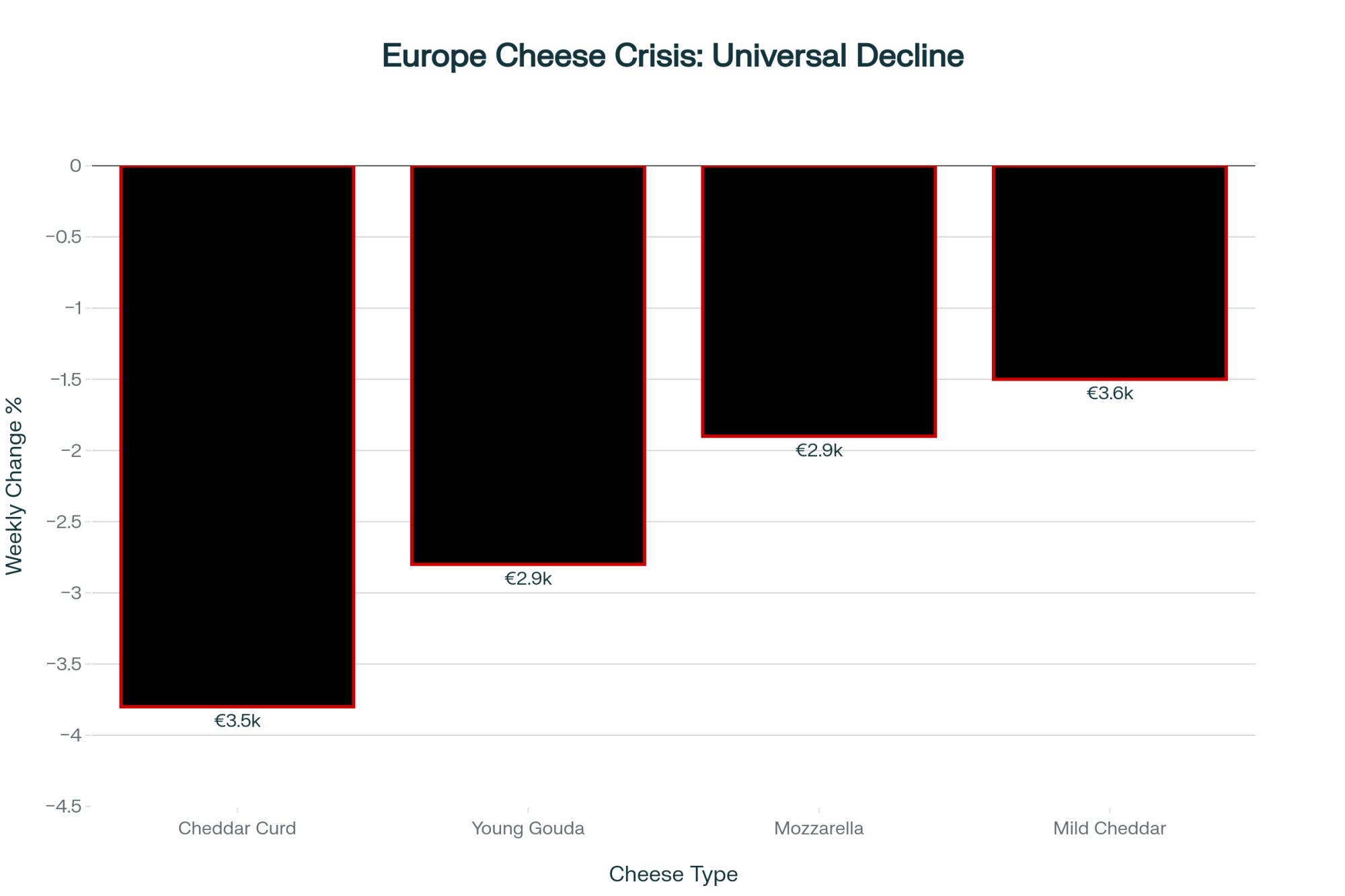
vef

Cheese prices continue to grind lower. Cheddar Curd fell by 3.8% to €3,501Mild Cheddar lost 1.5% to €3,636Young Gouda dropped 2.8% to €2,909, and Mozzarella eased 1.9% to €2,928.

What’s driving this? In short, too much milk, not enough elasticity downstream. European processors have faced strong milk deliveries and limited export momentum, particularly as the U.S. continues to compete aggressively in cheese exports with lower prices and a steadier currency.

GDT Auction – Fifth Consecutive Decline

Fats (Butter & AMF) maintain price stability while powders (WMP & SMP) slide for five consecutive auctions, revealing the fundamental market split: butterfat wins as oversupply crushes powder values

The Global Dairy Trade (GDT) Price Index fell another 1.4% to $3,881, its fifth straight dip — a clear indicator that the global balance between supply and consumption is still correcting.

Whole milk powder dropped 2.4% to $3,610, and skim milk powder declined 1.6% to $2,559. By contrast, AMF rose 1.5% to $7,038, maintaining its premium over butter. Butter fell slightly (–0.8% to $6,662). That persistent AMF premium shows sustained appetite for high-purity fats, particularly in Asian and Middle Eastern markets (GDT Event 390, Oct 2025).

Cheddar and mozzarella prices fell 1.9% and 5.3%, respectively. Volumes sold at the event totaled 40,621 tonnes, down modestly from the previous auction.

Southern Hemisphere – Production Ramps Up

Spring flush delivers production surge across the Southern Hemisphere: Argentina leads with nearly 12% solids growth, New Zealand milk solids jump 3.4%, and Dutch collections rise 6.7%—all combining to flood global markets and pressure powder prices downward

Down south, spring flush is living up to its name. New Zealand’s September milk collection hit 2.67 million tonnes, up 2.5%, while milk solids jumped 3.4% year over year (DCANZ, Oct 2025). A weaker NZD continues to bolster local payouts, and with PKE (palm kernel expeller) imports up 35%, many herds are maintaining condition through the flush.

Argentina’s production rose 9.9% year over year in September, and solids were up 11.7%, driven by improved pasture and feed efficiency under stable weather (OCLA Argentina, Sept 2025). Meanwhile, the Netherlands reported +6.7%milk collections and a stronger butterfat yield, signaling broad European abundance.

These gains are great news for efficiency metrics but apply downward pressure on global dairy pricing, particularly across SMP and WMP.

Trade and Demand – China Sends Mixed Signals

China’s September imports reveal calculated market strategy: massive 65% surge in butter and 41% jump in WMP contrasts sharply with 12.5% drop in SMP, proving buyers are restocking premium fats while avoiding oversupplied powders

China’s September milk-equivalent imports rose 4.7% year over year — but that number hides the nuance. WMP imports surged 41%, a recovery from last year’s depressed base, while SMP fell 12.5% and butter jumped an impressive 64.7% (Chinese Customs Data, Oct 2025).

This suggests that Chinese buyers are being tactical. They’re restocking high-fat categories but remain cautious on large-volume powders. New Zealand exports, up 8.7% y/y, captured much of that growth, though SMP flows remain uneven. Demand is stabilizing—not accelerating yet.

U.S. Markets – Glimmers of Recovery

ProductWeekly ChangeCurrent PriceMarket Signal
Dry Whey$+3.5¢$$\$0.69/\text{lb}$Strong protein
Butter$+0.75¢$$\$1.6025/\text{lb}$Holiday build
Cheddar Blocks$+0.25¢$$\$1.7775/\text{lb}$Moderate food
Nonfat Dry Milk$+\$0.05$$\$1.16/\text{lb}$Steady demand

Domestic dairy markets found small pockets of strength. CME cheddar blocks ticked up 0.25¢ to $1.7775/lbbutter gained 0.75¢ to $1.6025/lb, and nonfat dry milk rose a nickel to $1.16/lbDry whey continued to climb, up 3.5¢ to $0.69/lb, thanks to unflagging demand for high-protein ingredients (USDA Dairy Market News, Oct 2025).

Cream supplies remain ample, butter churns are busy, and foodservice activity is moderate. As one Wisconsin marketing manager put it this week, “We’re not seeing panic buying, but holiday pipeline building is real.” Feed remains a bright spot, with DEC25 corn at $4.28/bu and JAN26 soybeans at $10.62/bu, though both trended higher late in the week.

The Bottom Line

Looking ahead, the key takeaway this week is the growing divide between resilient fats and fragile powders. Butter and AMF continue to attract strong retail and manufacturing interest, offering some price floor protection. But with milk collections swinging higher across the Southern Hemisphere, SMP and WMP are likely to remain under pressure through the year’s end.

Short-term volatility may persist, especially if China’s buying remains uneven. Still, there’s cautious optimism. Farm-level profitability in regions like New Zealand and the Midwest is holding better than last year — proof that leaner operations, feed cost management, and smarter hedging have made this downturn more manageable.

As always, milk will find a home — but the home it finds this season might be one more driven by butterfat than by bulk powder. And that’s a story worth watching as we head toward the new year.

Key Takeaways:

  • Fats are holding firm, powders aren’t. Butter and AMF prices found support, but SMP and WMP remain under pressure from surging milk supply.
  • GDT slipped again (-1.4%), its fifth straight decline — a reminder that buyer confidence isn’t back yet, even as global GDP nudges higher.
  • Europe’s cheese values slid once more, squeezed by full silos, steady milk flows, and competitive U.S. export pricing.
  • Southern Hemisphere production is booming — New Zealand up 2.5%, Argentina nearly 10% higher — ensuring plenty of product but few price rallies.
  • In the U.S., butter and whey are bright spots, lifted by retail holiday demand and strong protein interest.

Complete references and supporting documentation are available upon request by contacting the editorial team at editor@thebullvine.com.

Learn More:

Join the Revolution!

Join over 30,000 successful dairy professionals who rely on Bullvine Weekly for their competitive edge. Delivered directly to your inbox each week, our exclusive industry insights help you make smarter decisions while saving precious hours every week. Never miss critical updates on milk production trends, breakthrough technologies, and profit-boosting strategies that top producers are already implementing. Subscribe now to transform your dairy operation’s efficiency and profitability—your future success is just one click away.

NewsSubscribe
First
Last
Consent

Big Milk Checks and Low Feed Costs: A Profitable Summer for Dairy Producers

Learn how dairy producers are earning big milk checks and benefiting from low feed costs this summer. Will this profitable trend last despite challenges like heifer shortages?

Dairy farmers are reaping substantial milk checks while benefitting from decreased feed prices. This unusual position provides a tremendous opportunity for everyone in the dairy business, including farmers and analysts. The present very favorable economic climate enables dairy producers to expand their businesses. A boom like this typically results in more milk supply and cheaper pricing. Still, problems like heifer scarcity and external factors limit expansion. Understanding how to handle these moments may help dairy producers achieve immediate and long-term success. The dairy sector environment is reshaped by fundamental market factors, such as decreasing feed prices and increased meat income.

Unprecedented Financial Prosperity: Dairy Producers Enjoy Robust Revenue Streams and Low Feed Costs

MonthCorn ($/bushel)Soybeans ($/bushel)Soybean Meal ($/ton)
April4.2011.00325.00
May4.1010.75320.00
June4.0010.50310.00
July3.9010.35307.40

The present financial picture for dairy farmers is powerful. Substantial milk checks and increased money from cattle sales have greatly improved the bottom line. Low feed costs boost financial wealth. Beneficial weather in the maize Belt has caused the USDA to rank 68% of maize and soybeans in outstanding condition, providing dairy farmers an ideal opportunity to lock in feed prices at multi-year lows. This attractive mix of high revenues and minimal inputs opens up untapped opportunities for financial stability and future challenge preparedness.

Converging Challenges: Factors Constraining Dairy Production Growth

The present market dynamics in the dairy business are heavily driven by variables that limit milk production growth. The heifer scarcity is a significant barrier, restricting herd growth and driving prices to $3,300 per head. Higher interest rates hamper dairy investment by increasing financing costs. Hot summer temperatures diminish milk output and impair herd health, necessitating extra attention. Furthermore, avian flu disrupts feed supply systems. Despite reduced feed prices, interruptions due to health problems in associated industries increase unpredictability. These issues, taken together, create a harsh climate for dairy farmers. While they provide good profits, their potential to increase milk output is restricted, limiting oversupply and stabilizing milk prices in the near run.

Soaring Heifer Prices Reflect Unprecedented Demand Amid a Heifer Shortage 

DateLocationAverage Price per HeiferPrice RangeRemarks
Last WeekTurlock Livestock Auction Yard$3,075$2,850 – $3,300Record price range indicating high demand
This WeekPipestone, Minnesota$3,150Top 25 AverageSustained high prices despite limited supply

Heifer prices are skyrocketing, indicating a significant demand for dairy farmers to fill their barns. At the Turlock Livestock Auction Yard’s monthly video auction, Holstein springers recently sold for $2,850 to $3,300 each. Similarly, the top 25 springers averaged $3,150 each in the Pipestone, Minnesota auction. These rates reflect the necessity of securing heifers in the face of scarcity.

Concurrently, cull rates have dropped to record lows. In the week ending July 6, dairy cow slaughter fell to 40,189 head, the lowest level since December 2009 and 20.6% lower than the same week in 2023. This reduction suggests that farmers hold on to cows they could have slaughtered because of high heifer prices and replacement issues.

Consequently, dairy cow numbers are expected to grow, possibly boosting milk production. However, integrating lower-producing cows may decrease the average output per cow, making it challenging to optimize milk quality and efficiency.

Uneven Demand and Supply Dynamics Threaten Dairy Market Stability

CommodityAverage Price (July 2024)Quantity Traded4-Week Trend
Whey$0.50552Up
Cheese Blocks$1.863023Stable
Cheese Barrels$1.898022Stable
Butter$3.114069Up
Non-Fat Dry Milk$1.179510Down

The dairy market’s trajectory is finely balanced between demand and supply dynamics. Despite the present affluence, low demand for dairy products poses a considerable concern. Cheese consumption remains high due to local promotions and increased exports based on previous low pricing. However, it is still being determined if this tendency will continue. While spring’s record exports lowered cheese stocks, this activity is projected to slow, possibly raising inventory levels and increasing prices if fresh demand does not materialize.

Future cheese sales domestically are uncertain. A slowdown may quickly lower prices. The CME spot market shows volatility, with spot Cheddar barrels increasing by 6.25˼ to $1.9125 per pound and Cheddar blocks decreasing by 2.5ͼ to $1.865. These differences highlight cheese demand’s unpredictable nature.

Cheese’s domestic appeal helps to balance the market against shortages. Still, a reduction in demand or underperforming exports might upset this equilibrium. Industry worries are reflected in uneven spot market movements. Elevated pricing and deliberate inventory sell-offs are a balancing act against declining exports and unreliable domestic demand. The dairy industry’s survival depends on managing these uncertainties and reducing risks.

Converging Pressures: Divergent Trends in Whey and Milk Powder Markets Define Dairy Sector’s Future 

The whey industry is increasing due to increased domestic demand, especially for high-protein varieties. This demand has limited dry whey production, raising prices. CME spot whey powder gained by 0.75̼ this week, hitting 51.75̼, its highest level since February. The USDA’s Dairy Market News indicates that supplies are limited, with producers selling out monthly.

In contrast, the milk powder market in the United States has recurrent production deficits and poor export prospects. At the most recent Global Dairy Trade (GDT) auction, prices of skim milk powder (SMP) and whole milk powder fell by 1.1% and 1.6%, respectively. CME spot nonfat dry milk (NDM) initially followed this pattern. Still, it rallied late in the week, closing at $1.1975, up 1.75 percent from the previous Friday.

The effect of these changes is noticeable. Strong domestic demand has reduced whey supply and raised costs. Meanwhile, the milk powder market faces restricted supply and sluggish exports, limiting prospective price increases. These opposing developments show the dairy market’s varied pathways.

Heatwave-Induced Strain: Analyzing the Ripple Effects on Butterfat Levels and Cream Pricing Dynamics

The warmer weather has significantly impacted milk output and butterfat levels. Cream prices rose in the East and West but stayed stable in the Central Region. Butter output has decreased due to the bad weather, particularly in the West. Despite this, butter prices dipped this week due to heavy trade in Chicago. The market’s forecast of stable pricing through October promotes fast sales to prevent storage expenses. The CME spot market saw an astonishing 69 cargoes change hands, the most in over a year. Despite the high costs, buyers remain active, fearing future shortages.

Whey and Cheddar Surge Lifts Class III Futures: Strong Market Dynamics Promise Financial Stability 

The healthy whey and cheddar barrel markets have bolstered 2024 Class III futures. The August contract increased by 28 cents to $19.97 per cwt, while the September and October contracts gained roughly 50 cents, finishing in the mid-$20s. Despite Class IV futures holding high at about $21.50, most contracts lost money. This pricing should cover expenditures and allow for debt repayment or future planning.

Weather-Induced Prosperity: Dairy Producers Benefit from Ideal Crop Conditions Driving Down Feed Costs

The present level of feed prices provides a significant relief for dairy farmers, owing to the healthy condition of the maize and soybean harvests. Favorable weather in the Corn Belt has resulted in extraordinary crop growth, with the USDA rating 68% of corn and soybeans as good to excellent. Cooler-than-normal temperatures have helped maize during its crucial pollination season, resulting in record-high yields. Feed prices have dropped further, with September corn futures reaching $3 and the December contract ending at $4.055 per bushel, a 9 percent decrease from last Friday.

Similarly, increased confidence in soybean supply has pulled November soybean prices down by 30 to $10.355 per bushel, while December soybean meal futures have declined by $6.70 to $307.40 per ton. These patterns enable dairy farmers to lock in feed prices at multi-year lows, allowing them to profit on historically strong dairy margins.

Crafting a Comprehensive Risk Management Strategy for Dairy Producers

Dairy farmers need effective risk management to navigate fluctuating market situations. Locking down feed prices at current lows is an appealing approach. Producers that secure feed contracts today may stabilize input costs, reducing future price concerns and assuring more predictable financial planning. This foresight ensures profitability even if feed markets rise suddenly.

Furthermore, the Dairy Income Protection (DRP) scheme provides a strong safety net, protecting against quarterly milk sales income declines based on pricing and production levels. This protects farmers from market changes and ensures revenue stability. Futures and options also help to control price risk. Hedging future milk sales or feed purchases allows producers to lock in advantageous pricing while reducing market vulnerability. This guarantees that manufacturers may maintain lucrative margins by taking advantage of rising pricing.

Locking low feed costs, participating in the DRP program, and leveraging futures and options contribute to a holistic risk management plan. It enables dairy farmers to control expenses, protect income, and take advantage of favorable market circumstances, resulting in a more predictable and profitable financial future.

The Bottom Line

Dairy farmers face an environment characterized by high milk check income and low feeding expenses. Celebrating their financial success, they also confront a unique set of obstacles and possibilities. High heifer prices, low slaughter rates, and robust demand all point to continued profitability. However, low demand, export uncertainty, and weather changes need a deliberate strategy. Dairy farmers must lock in low feed prices, use risk management techniques such as Dairy Revenue Protection (DRP), and keep alert to market trends. To achieve long-term success, be educated and nimble. Now is the moment to use the economic recovery to increase your farm’s resilience and sustainability.

Key Takeaways:

  • Producers are experiencing significant financial gains, with high milk checks and additional revenue from beef sales.
  • Feed costs are at multi-year lows, providing an opportunity for dairy producers to secure favorable financial terms.
  • Efforts to increase milk production are hampered by a shortage of heifers, along with elevated interest rates, high summer temperatures, and the bird flu.
  • Heifer prices have surged, reflecting heightened demand against a backdrop of scarce supply.
  • Despite reduced cull rates, milk yields may decline as producers hold onto lower-production cows due to heifer shortages.
  • Cheese and whey markets show variable trends, with strong domestic demand driving prices upward, while export volumes appear poised to decrease.
  • The combination of high temperatures and decreased butterfat levels has led to fluctuating butter and cream prices.
  • Class III futures are buoyed by strong whey and Cheddar prices, promising financial stability for dairy producers.
  • Ideal weather conditions in the Corn Belt are contributing to low feed costs, enhancing economic prospects for dairy producers.

Summary:

Dairy farmers are experiencing financial prosperity due to increased milk checks and decreased feed prices, allowing them to expand their businesses and increase milk supply and cheaper pricing. However, problems like heifer scarcity and external factors limit expansion, such as higher interest rates, hot summer temperatures, and avian flu. Heifer scarcity restricts herd growth, driving prices to $3,300 per head. Cull rates have dropped to record lows, and dairy cow slaughter has fallen to 40,189 head, the lowest level since December 2009. Uneven demand and supply dynamics threaten dairy market stability. The dairy industry faces challenges such as increasing domestic demand for high-protein varieties, limited dry whey production, and fluctuating market dynamics. Weather-induced prosperity has provided ideal crop conditions, driving down feed costs. Effective risk management strategies are needed to navigate fluctuating market situations, such as locking down feed prices at current lows and using futures and options to control price risk.

Learn more:

Send this to a friend




