Archive for Holstein breeding strategy

The $200-Per-Cow Blindspot: What Rising Inbreeding Is Costing You – and What a Decade of Crossbreeding Research Found

New research puts hard numbers on the hidden price tag of genetic progress—and what a 10-year crossbreeding study reveals might change how you think about your next breeding decisions.

Executive Summary: Inbreeding in Holsteins has tripled since 2014—silently adding an estimated $200-400 per cow in lifetime losses. These costs are not reflected in any report but appear as extra breedings, transition problems, and productive cows culled too soon. A 10-year University of Minnesota study tracked seven high-production herds averaging nearly 30,000 lbs. The finding: crossbred cows made 9-13% more profit per day. Every herd. No exceptions. That doesn’t make crossbreeding right for every operation—but it does change the math. For purebred programs, strategic outcrossing can slow the trend. For those open to alternatives, a decade of data demands attention. Both paths start with understanding what your genetics are actually costing you.
Dairy inbreeding costs

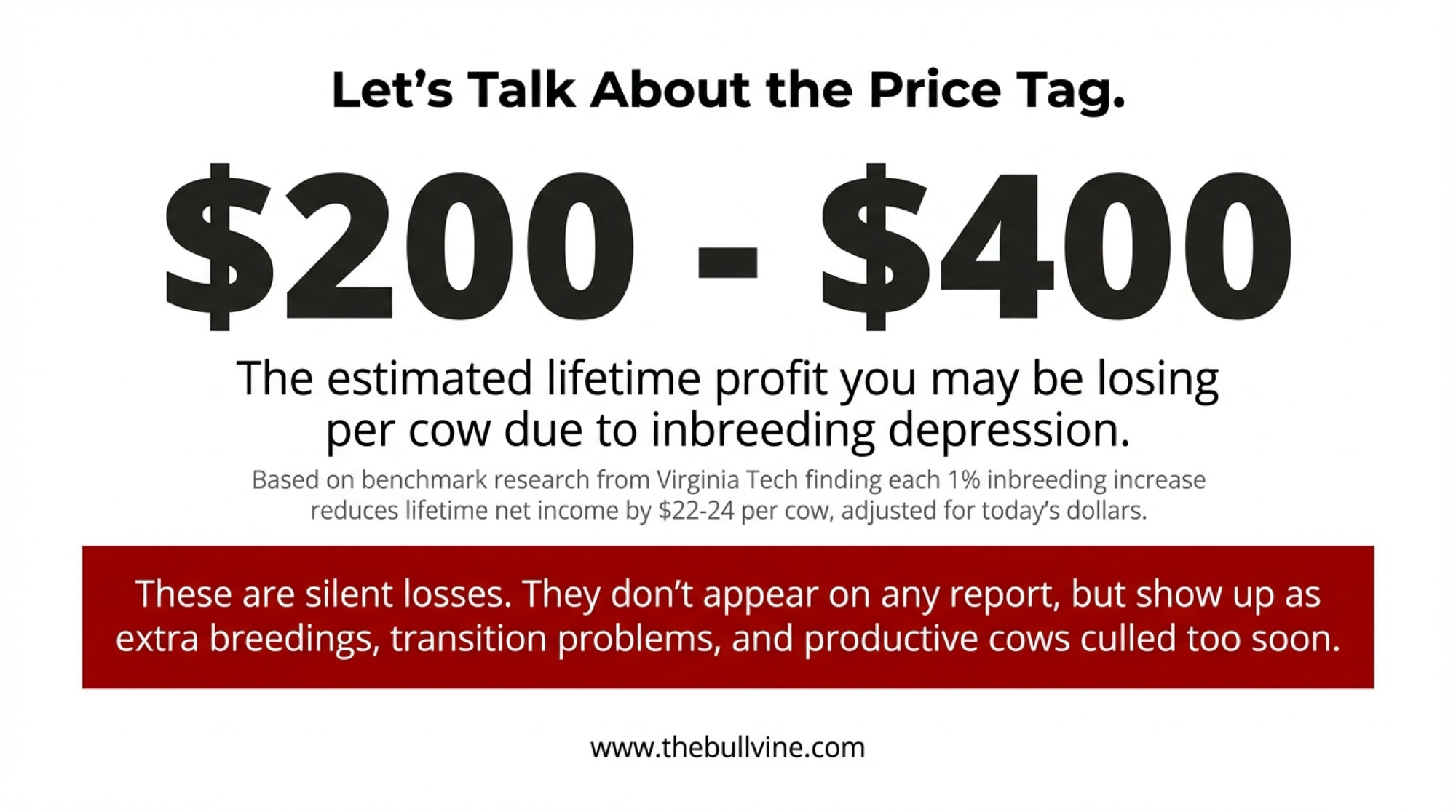
Here’s a number that probably isn’t on your radar: $200 to $400 per cow.

That’s the estimated lifetime profit you may be losing to inbreeding depression—losses that never show up on a breeding report, never get their own line item, and rarely get blamed on genetics. They show up as the cow that took an extra breeding. The calf that didn’t quite thrive. The cow you culled in the third lactation instead of the fifth. Most of us have seen these patterns in our herds without necessarily connecting them to genetics.

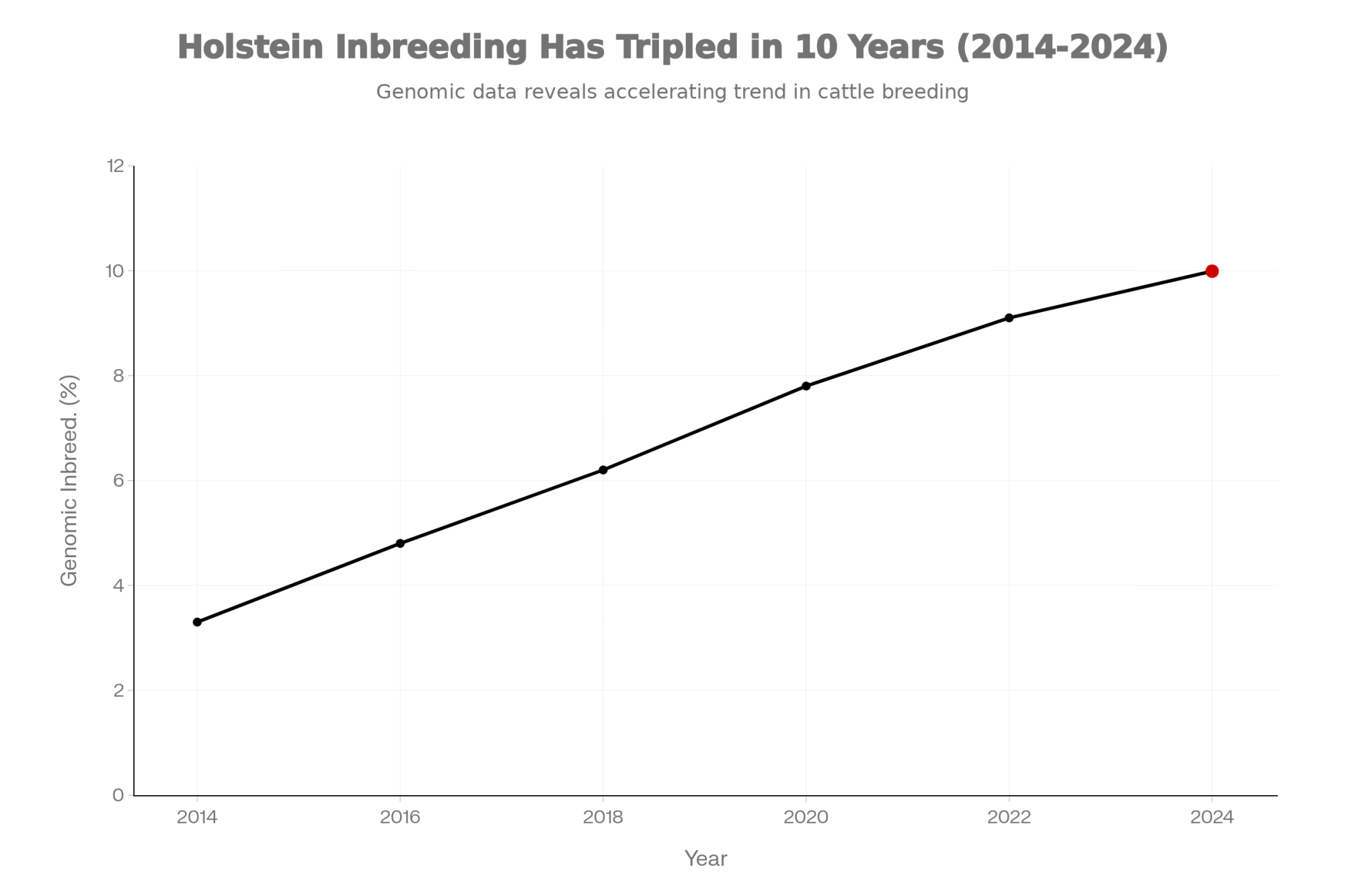
And here’s what makes this worth a closer look: Holstein genomic inbreeding has climbed dramatically over the past decade. The Council on Dairy Cattle Breeding’s trend data shows genomic inbreeding in young Holstein bulls has roughly tripled since 2014, with current averages pushing into the mid-teens percentage-wise. Lactanet Canada’s August 2025 update puts the average for Holstein heifers born in 2024 at 9.99%—nearly double what it was fifteen years ago. John Cole walked through this acceleration in detail at the 2024 Beef Improvement Federation symposium—and honestly, the rate of change caught even some industry veterans off guard.
Now, I want to be clear from the start: genomic selection has been one of the most valuable tools our industry has ever had. The genetic progress over the past decade has been remarkable. But there’s a growing body of research suggesting we need to look at the full picture—both the gains and the costs. And increasingly, producers I talk to are asking a fair question: What’s the net benefit when you account for everything?

Let me walk through what the research actually shows, what’s driving these trends, and what options might make sense for different operations.
What Inbreeding Is Actually Costing You

Let’s start with the economics, because that’s ultimately what matters when you’re making decisions for your operation.
Back in 1999, researchers at Virginia Tech—Cassell, Adamec, and Pearson—published a study in the Journal of Dairy Science that’s still the benchmark for understanding inbreeding costs. They found that each 1% increase in inbreeding reduces lifetime net income by $22-24 per cow, depending on whether you’re selling into fluid or cheese markets.

That study is over two decades old now, and I’ll be upfront about that. The underlying biology hasn’t changed, but dollar values certainly have. A rough inflation adjustment would put that figure somewhere around $40-45 per cow per percentage point in today’s terms—though I should note that’s a back-of-envelope calculation, not a formal research finding. We could really use an updated economic study on this, and I know several universities have been discussing it.

So, when genomic inbreeding rises substantially over a decade You’re potentially looking at $200-450 in lost lifetime profit per cow. For a 200-cow dairy in Wisconsin or a 500-cow operation in California’s Central Valley, that adds up to real money—$40,000 to $90,000 or more in economic impact that’s essentially invisible on your monthly reports.

Inbreeding depression silently steals profit from dairy producers because it is expressed mostly for traits that are not readily noticeable, such as embryo loss, less disease resistance, and shortened survival. That word “silently” is important. These aren’t losses you see on a vet bill or a milk check. They’re distributed across your operation in ways that are genuinely hard to track.

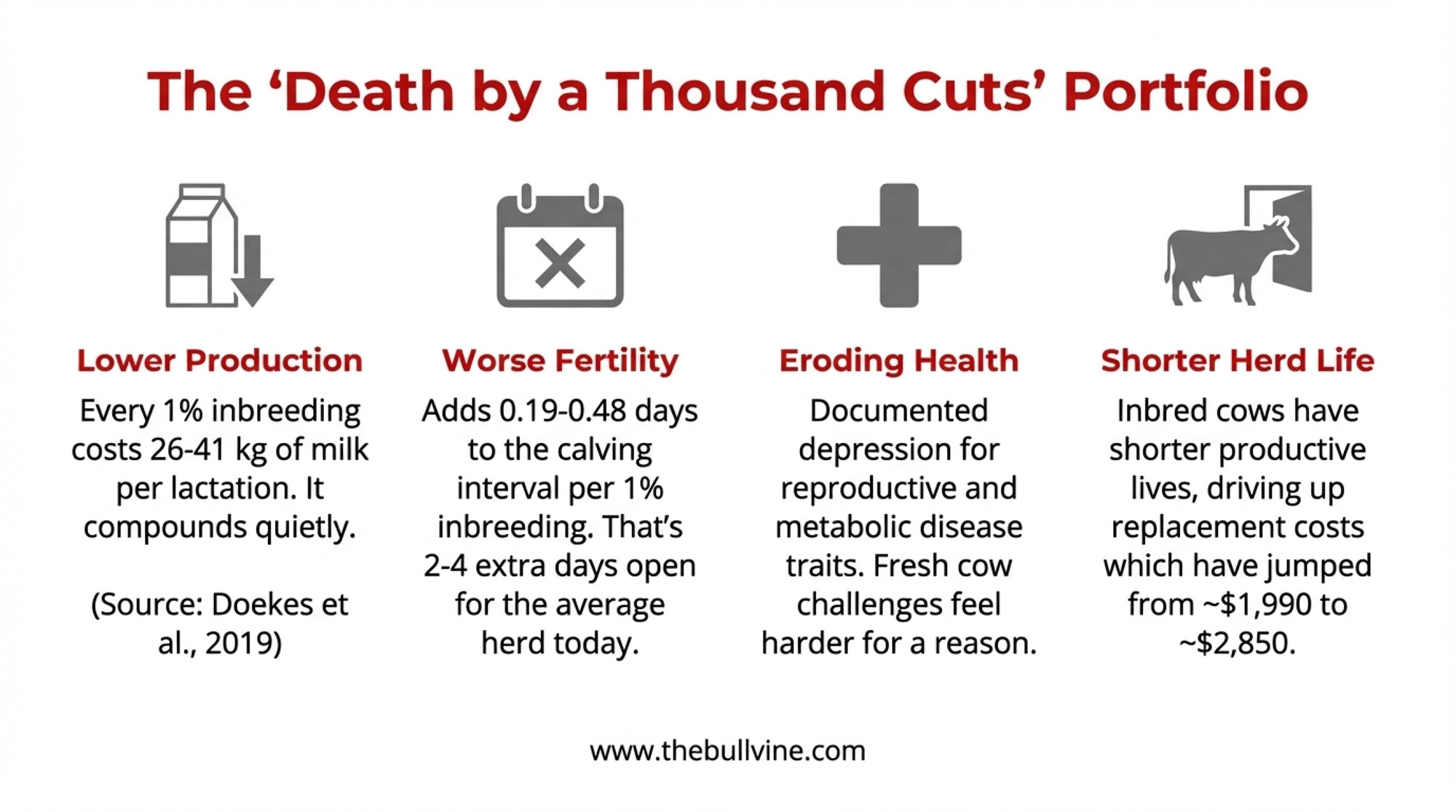
  • Production losses add up quietly. Research published in Genetics Selection Evolution—including detailed work by Doekes and colleagues in the Netherlands—found that every 1% increase in genomic inbreeding costs roughly 26-41 kg of milk per lactation. Doekes specifically documented a 36.3 kg decrease in 305-day milk yield per 1% increase in runs of homozygosity. Not dramatic for any single cow. But across a herd and over multiple lactations? It compounds.
  • Fertility takes a hit, too. That same body of research shows 0.19-0.48 additional days in the calving interval per 1% inbreeding increase. I know—sounds small. But if your herd is averaging 8-10% more inbreeding than a decade ago, that’s potentially 2-4 extra days open per cow. Talk to any reproductive specialist, and they’ll tell you what that costs over time.
  • Health resilience erodes. U.S. research involving hundreds of thousands of Holstein cows has documented significant inbreeding depression for reproductive and metabolic disease traits. The cows aren’t necessarily falling over sick, but they’re not quite as resilient as they could be. Fresh cow challenges. Transition period issues. Mastitis susceptibility. All of these have genetic components that inbreeding can compromise. I’ve had several producers tell me their fresh cow management seems harder than it used to be, and while there are many factors involved, this may be part of the picture.
  • Longevity shortens. Inbred cows tend to have shorter productive lives. And you know what replacement heifers cost these day, prices jumped from around $1,990 to $2,850. Getting four lactations instead of five from each cow changes your economics significantly.

Here’s what I find particularly telling: these are exactly the kinds of traits that don’t show up well on genomic evaluations. They’re low in heritability, hard to measure consistently, and easy to attribute to management rather than genetics.

The Numbers at a Glance

MetricData
Holstein genomic inbreeding trendRoughly tripled since 2014
Current Holstein heifer average (Canada)9.99% for 2024-born animals
Cost per 1% inbreeding$22-24/cow lifetime (1999 dollars)
Potential herd impact (200 cows)$40,000-90,000
Annual rate of increaseApproximately 0.35-0.44% per year

Data from Council on Dairy Cattle Breeding trend reports; Lactanet Canada August 2025; Cassell et al. 1999, Journal of Dairy Science; Doekes et al. 2019, Genetics Selection Evolution

What’s Behind the Trend

So why has inbreeding accelerated so dramatically? Several factors are working together, and here’s what’s worth understanding—each one made sense as an individual decision.

  • Genomic selection changed the timeline. Before genomics, progeny testing meant waiting 5-7 years to know if a bull was actually delivering what his numbers promised. Now we can identify elite genetics essentially at birth. That’s genuinely powerful, and it’s driven tremendous progress. But it also means popular sire lines spread through the population much faster than they used to. Bulls that would have taken a decade to significantly influence breed genetics now achieve similar penetration in 3-4 years. The genetics are better—but they’re also more concentrated.
  • Sexed semen reshaped breeding patterns. The technology has been transformative for heifer inventory management. Data from the UK’s Agriculture and Horticulture Development Board shows sexed semen now accounts for 84% of all dairy semen sales in Great Britain—with Holsteins specifically hitting 88-89% by April 2024. North American adoption continues climbing, too. The economics make sense for individual operations. But here’s the tradeoff: before sexed semen, breeding elite cows with conventional dairy semen produced roughly 50% bull calves, giving AI organizations a large pool of potential sires to evaluate. Today, that pipeline has narrowed considerably.
  • Beef-on-dairy became standard practice. And for good reason—those calves are worth real money, and the quality has improved dramatically. The National Association of Animal Breeders reported that beef semen represented about 31% of total semen sales to dairy operations in 2023, and Farm Bureau data from early 2025 indicates 72% of dairy farms now use beef genetics on at least part of their herd. That’s a rational economic decision for most operations. But combined with sexed semen on your top-end genetics, it means fewer Holstein matings overall. Canadian data from Lactanet shows Holstein-on-Holstein breedings have dropped from the mid-90s percent range to around three-quarters of matings in recent years
  • Industry structure evolved. This one’s worth understanding because it affects sire availability. Lactanet Canada’s analysis shows that between 2014 and 2019, bulls from AI-owned dams increased from 34% to 52% of marketed young bulls. I want to be clear about something: this isn’t a criticism of AI companies. They’re doing what makes business sense—investing in elite genetics and accelerating progress. And they’ve developed real tools to help manage inbreeding. But the concentration does have implications for genetic diversity that are worth being aware of when you’re making breeding decisions.

The Industry Perspective

It’s worth acknowledging that AI organizations aren’t ignoring this issue—far from it. Most major companies now offer mating programs that calculate genomic relationships and help avoid closely related matings. Tools like ABS’s Genetic Management System, Semex’s OptiMate, and similar platforms from other organizations are designed specifically for inbreeding management. These tools work, and they’re more sophisticated than what was available even five years ago.

And the industry has delivered real value. Various analyses suggest genomic selection has generated substantial economic benefit—potentially billions of dollars—through accelerated genetic progress over the past decade. That represents genuine improvement in production, health traits, and efficiency, as shown by milk checks and herd performance.

Here’s where it gets complicated, though. USDA geneticist Paul VanRaden and others have noted the fundamental tension: accepting slower genetic progress to manage inbreeding means potentially watching competitors move faster. For individual operations, using the highest-ranking bulls often makes economic sense regardless of relatedness. But when everyone does that, breed-wide inbreeding accelerates. It’s a classic collective action problem—individual optimization can lead to collective challenges.

Some countries have approached this differently. Nordic breeding programs in Denmark, Sweden, and Finland have historically weighted health, fertility, and longevity more heavily in their selection indexes—and their inbreeding trajectories look different as a result. Now, it’s not a perfect comparison. Different population sizes, different market conditions, different payment systems. But it does suggest that how we design selection indexes has real consequences for genetic diversity over time.

The question isn’t whether genomic selection has been valuable—it clearly has. The question is whether we’re fully accounting for all the costs alongside the benefits, and whether there are adjustments worth considering.

What a Decade of Crossbreeding Data Actually Shows

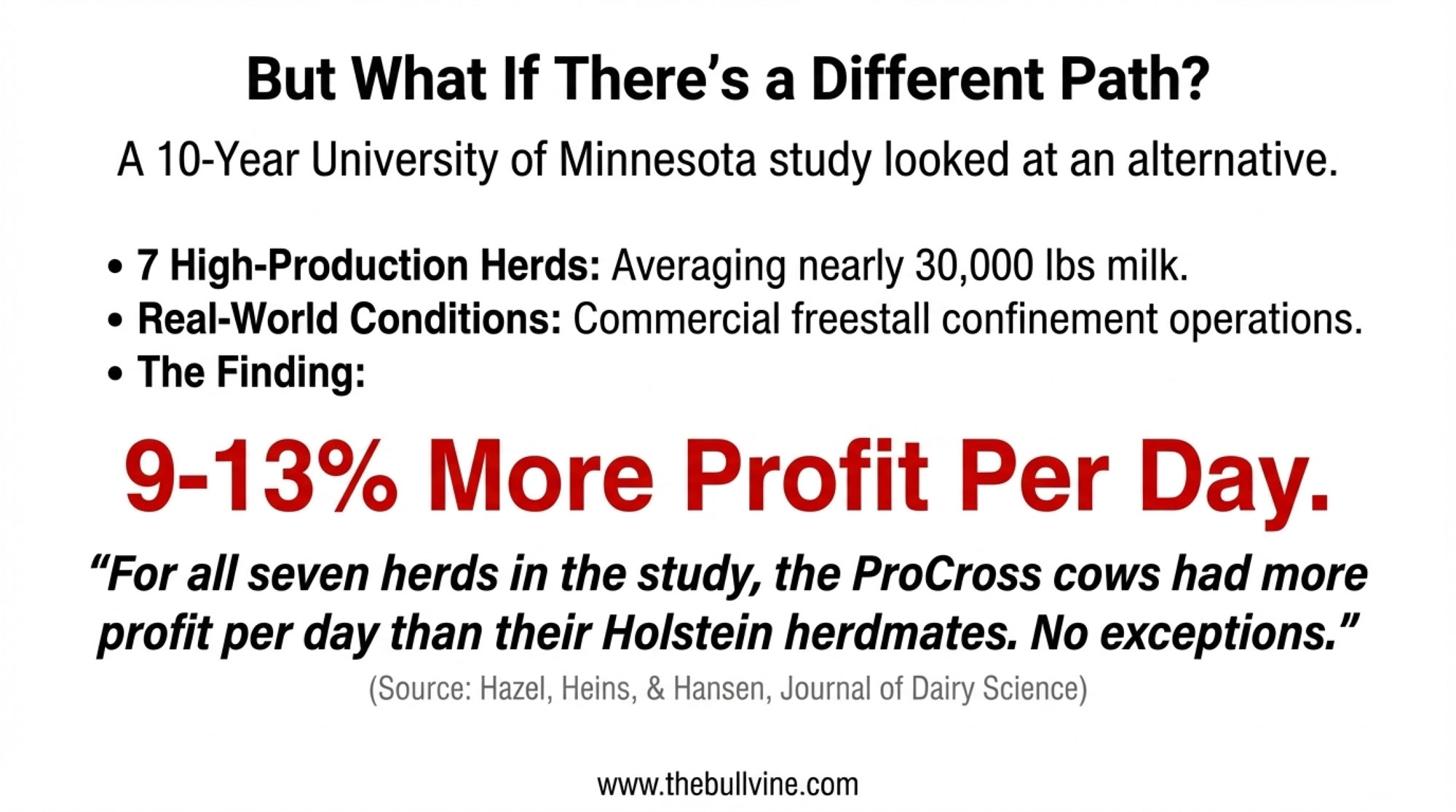
Here’s where the conversation gets really interesting: while most of the industry focused on maximizing genetic indexes in purebred Holsteins, researchers at the University of Minnesota spent 10 years collecting data on an alternative approach.

This wasn’t some small-scale grazing experiment or low-input system. These were seven high-producing herds averaging just under 30,000 lbs milk per cow—freestall confinement operations that would look familiar to commercial dairies across the Upper Midwest and beyond. The kind of herds where management is tight, and expectations are high.

The findings, published by Amy Hazel, Brad Heins, and Les Hansen in the Journal of Dairy Science, got my attention:

“For all seven herds in the study, the ProCross cows had more profit per day than their Holstein herdmates,” the researchers concluded. Not some of the herds. All seven.
Performance MetricHolstein (Baseline)Crossbred Advantage
Daily ProfitBaseline+9-13% higher
Herd LifeBaseline+153 days
Health Treatment CostsBaseline23% lower
Days OpenBaseline12-17 fewer days
Stillbirth RateBaselineLower
Lifetime Death LossBaseline4% lower

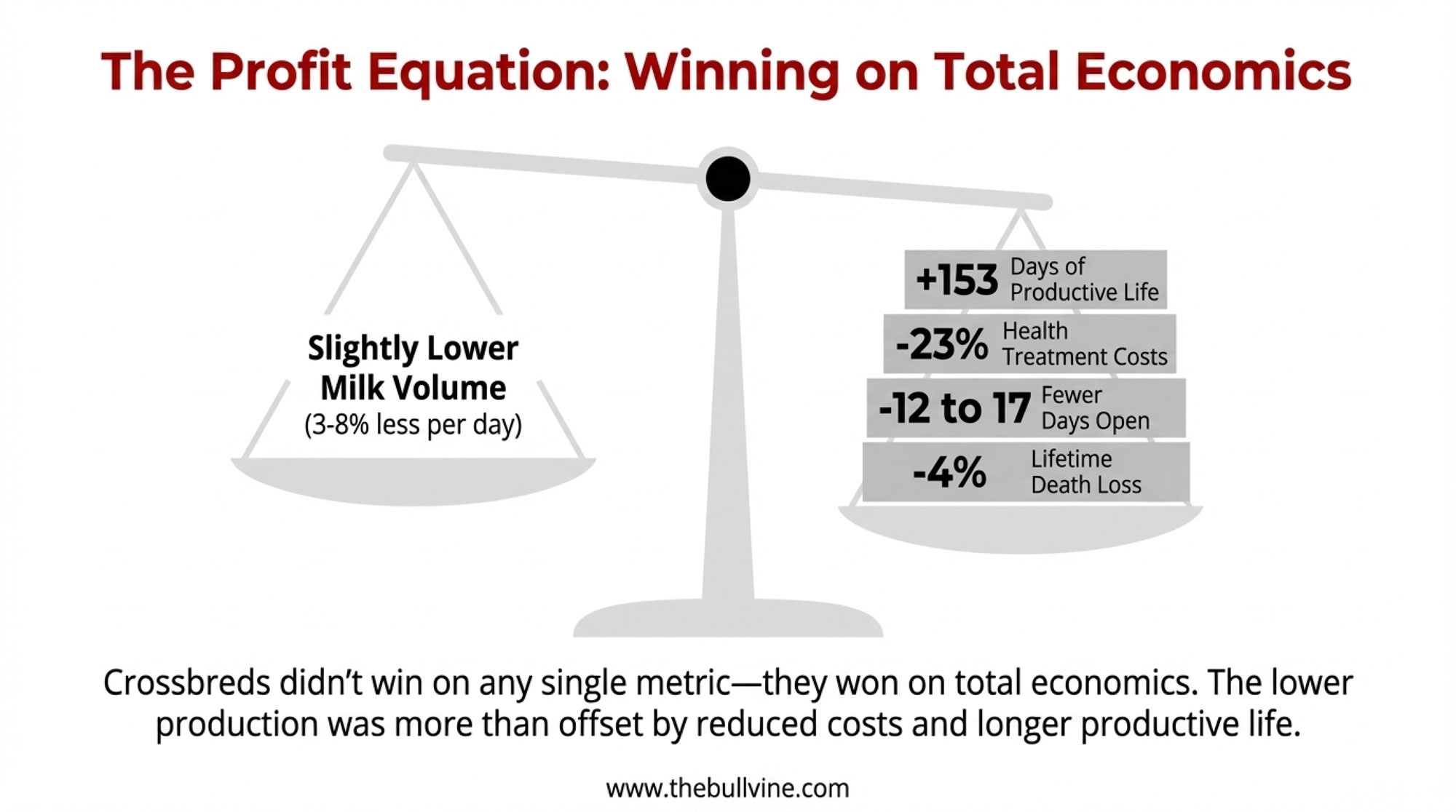
Now, I can hear the question you’re probably asking: “What about production?” Fair point. Crossbred cows in these studies did produce somewhat less milk per day than their purebred Holstein herdmates—typically 3-8% less in early generations, depending on the specific cross and lactation.

But here’s what the data showed: the lower production was more than offset by reduced costs and longer productive life. The crossbreds weren’t winning on any single metric—they were winning on total economics. Lower vet bills, fewer reproductive interventions, and more lactations per cow.

Producer Case Study: Cunningham Dairy, Iowa

Kelly and Christy Cunningham lost their fluid milk market in 2017 and began looking for a cow that would produce high components with a moderate size. Their search led them to the ProCross program. After purchasing cattle from three established ProCross herds through Creative Genetics and beginning their own breeding program, they now keep detailed comparative records on their crossbred and Holstein groups.

Their results:

  • Days open: ProCross cattle are open 22 days less than Holsteins
  • Pregnancy rates: 4-5 percentage points higher than Holsteins
  • Fresh cow health events (ketosis, metritis, DA, milk fever, retained placenta): Half of what they experience with Holsteins
  • Mastitis and pneumonia: More than 50% less than Holsteins
  • Health costs: $0.28/cow/day, lower than Holsteins
  • Dry matter intake: 4-10% less for ProCross cows
  • Components: +0.3% fat and +0.2% protein compared to Holsteins

“We are very pleased with the ProCross cattle,” Kelly says. “We have realized better components, better health, better reproduction, and lower herd turnover rate. As our ProCross herd matures, milk volume and ECM are improving compared to Holsteins.”(Source: Creative Genetics of California / ProCross testimonials)

Performance MetricHolsteinProCrossWinner
Days OpenHigher by 22 daysBaselineProCross
Pregnancy RateLower by 4-5%BaselineProCross
Fresh Cow Health Events2× higherBaselineProCross
Mastitis & Pneumonia2× higherBaselineProCross
Health Cost/Cow/DayHigher by $0.28BaselineProCross
Dry Matter IntakeHigher by 4-10%BaselineProCross

European research published in the Journal of Dairy Science found similar patterns, noting that crossbreds achieved what researchers called a “win-win trade-off” on milk yield and fertility, while purebred Holsteins tended to show opposing trade-offs between the two. You could optimize heavily for one or the other, but getting both simultaneously was harder.

The mechanism behind this is well established in animal breeding: crossbreeding captures heterosis—hybrid vigor—which delivers approximately 5% improvement in production traits and 10-15% improvement in fertility, health, and survival. Those happen to be exactly the traits most affected by inbreeding depression. In a sense, crossbreeding reverses the inbreeding penalty while adding hybrid vigor on top.

Why More Farms Aren’t Crossbreeding

Given those results, you might wonder why rotational dairy crossbreeding remains relatively uncommon. I’ve had this conversation with producers across the country, and the reasons are worth understanding:

  • Index comparisons get complicated. Crossbred animals can’t be directly compared to purebreds on TPI or NM$, making it harder to evaluate genetic merit with the tools most of us rely on. For operations that use indexes as their primary selection framework, this creates genuine uncertainty. How do you track progress generation over generation when you can’t use the same yardstick?
  • Registration doesn’t fit. Breed associations require high purity thresholds—typically 87.5% or higher—for registration. If you’re selling breeding stock or involved in shows, crossbreds don’t work within that system.
  • Semen availability takes more effort. The breeds used in successful crossbreeding programs—Viking Red, Montbéliarde—aren’t as widely distributed through major North American AI organizations. You have to seek them out, work with specialized suppliers, and sometimes pay more for shipping.
  • Cultural factors are real. The dairy industry has deep roots in purebred genetics, and there’s social pressure—whether spoken or not—around breeding decisions.

For commercial operations focused primarily on milk production economics rather than registered genetics or show competition, these barriers may matter less than the profitability data suggests. But they’re real considerations, and I don’t think it’s helpful to dismiss them.

Practical Options for Your Operation
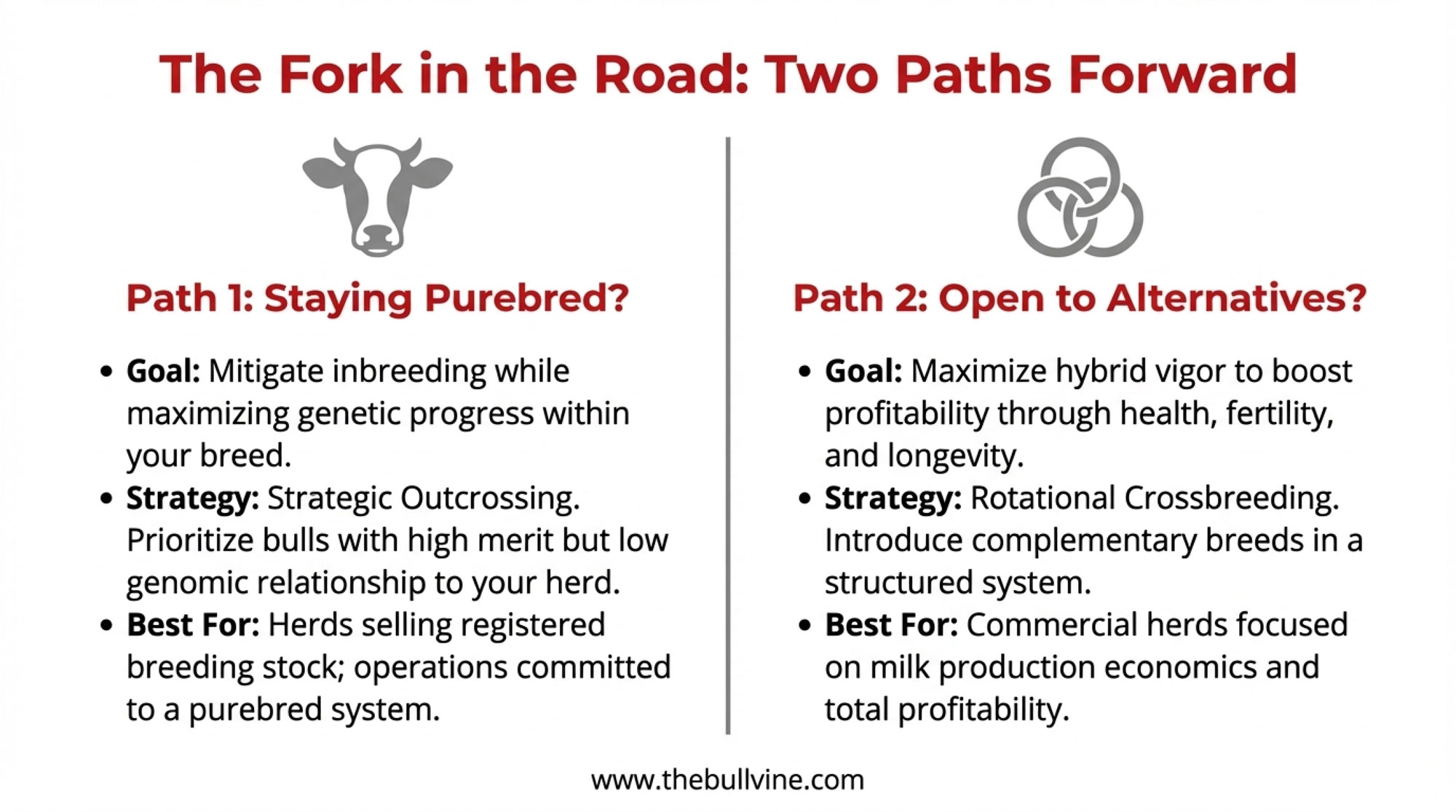
So what does this mean for your breeding decisions? It depends on your goals, your market, and honestly, your appetite for doing something different from your neighbors. Here’s how I’d think through the options:

If You’re Staying Purebred

Strategic outcrossing offers a middle path that many operations are exploring. The concept is straightforward: identify bulls with high genetic merit but low genomic relationship to your herd. You’re prioritizing diversity alongside performance rather than just chasing the highest index numbers.

What that looks like in practice:

  • Ask your AI representative for genomic relationship data, not just rankings. Most mating programs can generate this information—you just need to request it specifically.
  • Look at bulls’ pedigrees for underutilized sire lines. Sometimes the second or third-ranked bull is a better fit for your herd’s genetic profile than the top option.
  • Consider international genetics—Nordic, European, and New Zealand—that may be less related to dominant North American bloodlines.
  • Use mating programs that penalize inbreeding, not just maximize index. Most major AI organizations offer this setting, but it’s not always the default.

What about cost? Here’s something worth knowing: outcross bulls aren’t necessarily more expensive than top-ranked conventional options. Pricing depends more on proof of reliability and demand than on relatedness. In many cases, you can find bulls with strong genetic merit and lower relationship to your herd at comparable prices—you just have to ask specifically for that combination. Your AI rep can run the numbers for your situation.

Another option worth considering: use conventional semen on some of your top genetics. Sexed semen makes sense for maximizing heifer production, but using conventional semen on elite cows preserves the option for producing bull calves—potentially valuable if you’re interested in contributing to genetic diversity or selling to AI organizations looking for outcross genetics.

And here’s something important: for herds with high genetic merit that actively sell breeding stock into competitive registered markets, intensive purebred selection may remain the right strategy despite higher inbreeding levels. The premium prices for elite genetics can offset the inbreeding costs, and your market position depends on staying at the leading edge. Know your situation and your numbers.

If You’re Considering Crossbreeding

A measured approach lets you learn without betting the whole operation:

  • Start with 20-30% of your herd. This gives you enough animals to genuinely evaluate performance under your specific conditions—your feed program, your facilities, your management style—without a wholesale transformation. You’ll learn a lot in three years.
  • Choose breeds with research backing. Three-breed rotations using Holstein × Viking Red × Montbéliarde have the strongest long-term data behind them. The UMinn research specifically validated this combination in high-production environments.
  • Plan for the timeline. First crossbred daughters will calve approximately 3 years after initial breeding decisions. This isn’t a quick fix—it’s a strategic shift that requires patience.
  • Focus on commercial females. Crossbreeding strategies work best for cows whose daughters will enter your milking herd rather than the breeding stock market.

Organizations like Creative Genetics and Viking Genetics offer crossbreeding-focused programs and technical support if you want to explore this direction seriously.

Regardless of Which Direction You Go

Track your herd’s genomic inbreeding over time. Request runs of homozygosity (FROH) data from your genomic testing provider—Zoetis, Neogen, whoever you’re working with. Compare your herd average to breed benchmarks, and watch how it trends over generations.

And have a direct conversation with your AI rep. Ask specifically: “What are my outcross options? Which bulls in your lineup would reduce my herd’s average relatedness?” You might be surprised at what’s available when you ask the right questions.

A Few Things I’m Watching

A few developments worth keeping an eye on over the next several years…

  • Effective population size is a metric geneticists use to gauge long-term genetic health. Research published in the Journal of Heredity and elsewhere suggests that when effective population size drops below 50, populations face accelerated genetic drift and loss of rare alleles—genetic variation that can’t be recovered once it’s gone. Various studies estimate Holstein effective population size somewhere between 50 and 100, depending on methodology, which is why researchers are paying closer attention than they were a decade ago.
  • Evaluation systems may evolve. Some European breeding programs have begun incorporating inbreeding penalties into their selection indexes, rewarding bulls that combine high genetic merit with genetic diversity. If North American programs move in this direction—and there’s been discussion about it—that could shift which bulls rise to the top of rankings.
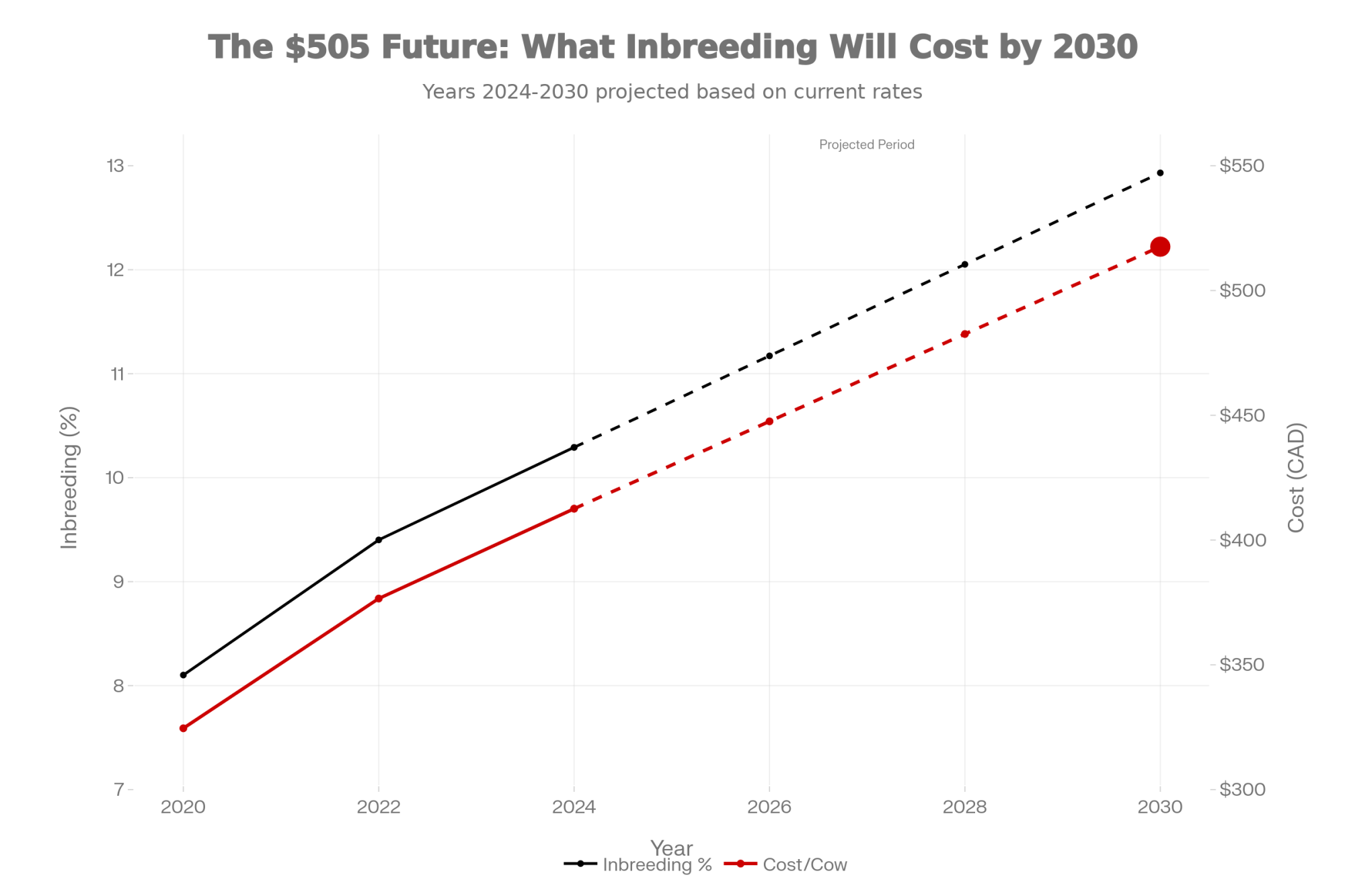
  • The math that keeps me up at night: At current accumulation rates of 0.35-0.44% per year, breed-average inbreeding will add another 2-3.5 percentage points by 2030. That’s $44-158 per cow in additional silent losses—already baked in unless breeding decisions change. The cows being bred this year will be milking through that reality.
Here’s how I think about it: You don’t buy fire insurance because you expect your barn to burn down. But you’re glad you have it if something unexpected happens.

Reader Challenge: What’s Your Herd’s Inbreeding Level?

Here’s something I’d genuinely like to know: What does your herd’s average genomic inbreeding look like?

Pull up your latest genomic herd report—whether it’s from Zoetis, Neogen, or another provider—and find your herd’s average FROH (runs of homozygosity) or genomic inbreeding percentage.

Drop your number in the comments below. No judgment here—we’re all dealing with the same industry trends. But seeing where different operations land could start an interesting conversation about what’s realistic to manage and what strategies are actually working.

If you’ve been actively using outcross sires or implementing crossbreeding, I’d especially like to hear how your numbers compare to where you started.

Not sure where to find this data? Your genomic testing provider can generate a herd inbreeding summary—you just need to ask for it.
Key Takeaways

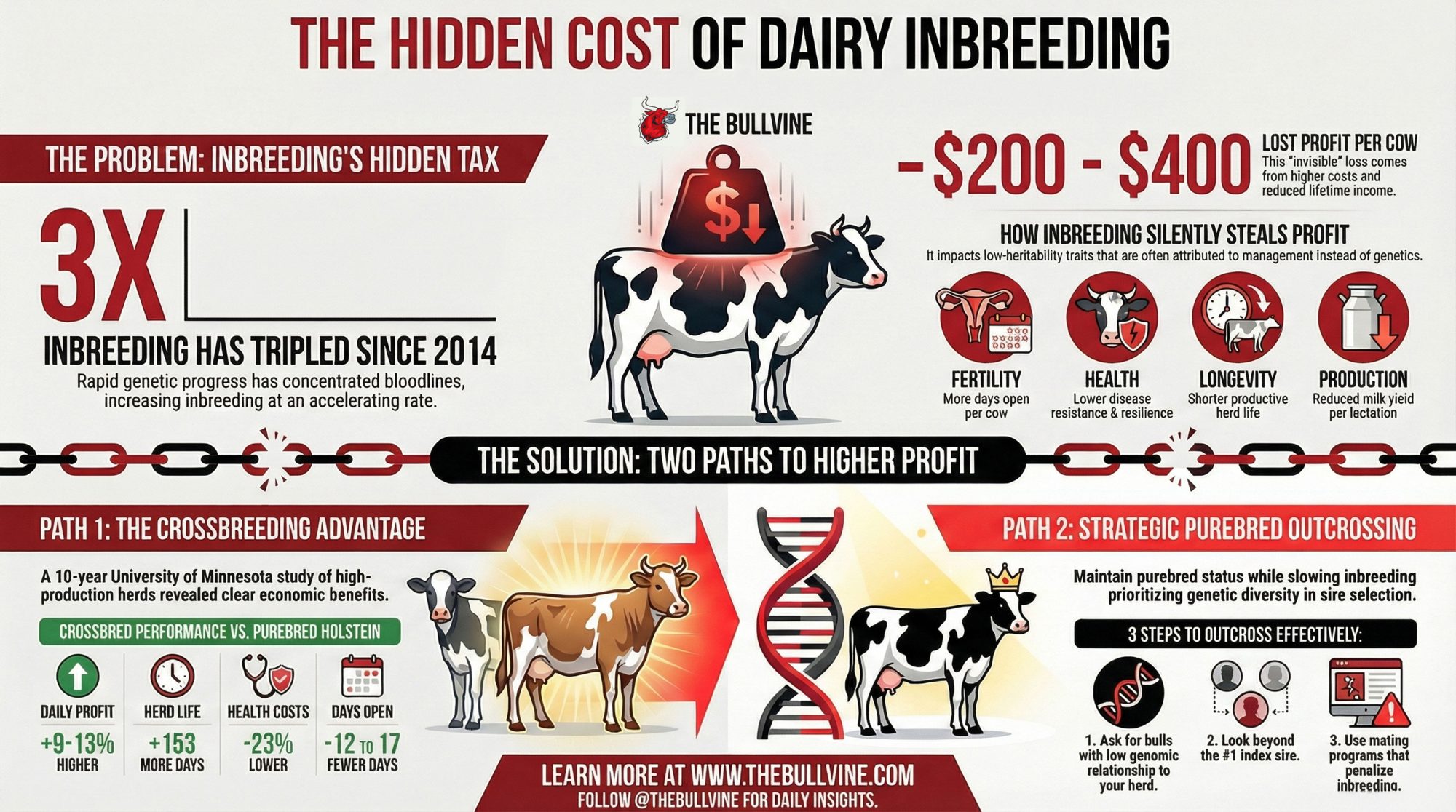
  • The economics are real, even if they’re hard to see. Research from Virginia Tech found that each 1% increase in inbreeding costs approximately $22-24 per cow in lifetime profit. With breed-average inbreeding up substantially over the past decade—Lactanet Canada now reports 9.99% for 2024-born Holstein heifers—that represents meaningful money. Potentially $200-400 per cow that doesn’t appear on any line item but affects your bottom line.
  • Crossbreeding data is more compelling than many realize. The University of Minnesota’s 10-year study found crossbred cows delivered 9-13% higher daily profit across seven high-producing commercial herds. The advantages came from longer productive life, lower health costs, and better fertility. This was a decade of real data from real operations.
  • You have options within purebred programs. Strategic outcrossing—prioritizing bulls with high merit and low relationship to your herd—can slow inbreeding accumulation while maintaining genetic progress. The tools exist, outcross genetics are often competitively priced, and good AI reps can help you use them.
  • Track what matters to your operation. Request genomic inbreeding data on your herd and watch trends over time. Ask your AI representative specifically about outcross options, not just top rankings.
  • Match your strategy to your goals. Crossbreeding makes most sense for commercial operations focused on milk production economics. If you’re selling registered breeding stock into competitive genetic markets, intensive purebred selection may still be your best path. Neither approach is wrong. They’re optimizing for different outcomes.

The goal isn’t to abandon genomic selection—it’s delivered tremendous value to our industry. But making breeding decisions with full awareness of the trade-offs helps ensure short-term genetic gains don’t come at the expense of long-term herd profitability and resilience.

As with most decisions in dairy farming, the right answer depends on your situation. What’s changed is that we now have more data than ever to inform those decisions. The question is whether we’re willing to look at all of it, not just the parts that confirm what we’re already doing. 

Key research referenced: Cassell, Adamec, and Pearson (1999), Journal of Dairy Science; Hazel, Heins, and Hansen, Journal of Dairy Science (ProCross study); Doekes et al. (2019), Genetics Selection Evolution; Council on Dairy Cattle Breeding trend data; Lactanet Canada August 2025 Inbreeding Update; AHDB sexed semen market reports; American Farm Bureau Market Intel.

Complete references and supporting documentation are available upon request by contacting the editorial team at editor@thebullvine.com.

Learn More

Join the Revolution!

Join over 30,000 successful dairy professionals who rely on Bullvine Weekly for their competitive edge. Delivered directly to your inbox each week, our exclusive industry insights help you make smarter decisions while saving precious hours every week. Never miss critical updates on milk production trends, breakthrough technologies, and profit-boosting strategies that top producers are already implementing. Subscribe now to transform your dairy operation’s efficiency and profitability—your future success is just one click away.

NewsSubscribe
First
Last
Consent

When Giants Fall Silent: The Shore Dynasty’s Century of Shaping Holstein Excellence

When Hardy Shore Jr. died, the Holstein industry lost more than a breeder—it lost the final chapter of its greatest dynasty.

Have you ever gotten one of those calls that just… stops you cold? Mine came the day after Christmas, 2013. Hardy Shore Jr. was gone.

I’d been half-expecting it, honestly. We all had. Hardy had been wrestling with his demons for years—the kind of personal battles that shadow brilliant minds in our industry more often than we’d like to admit. This time, though… this time he’d lost the fight.

What struck me afterward wasn’t just losing another talented breeder. It was how quiet everything felt across Ontario’s dairy community. Like walking into your barn when the ventilation fans suddenly quit—you don’t realize how much background noise there was until it’s gone.

That’s when it hit me. We hadn’t just lost Hardy Jr. We’d watched the end of something much bigger unfold. The conclusion of a dynasty that had shaped our industry for over a century.

That silence got me thinking, not just about the Shores, but about the nature of greatness in our industry.

The Thing About Certain Farm Families…

On operations across Ontario and the upper Midwest, I’m seeing something special in certain bloodlines—not just in our cattle, but in our people, too.

Some families just have it in their DNA, you know? The way they read a cow’s conformation through a barn aisle during morning chores, the timing of their breeding decisions when feed costs are squeezing margins tighter than bark on a tree. They can spot genetic potential in a gangly heifer where the rest of us see just another mouth to feed.

The Shores of Glanworth, Ontario, had that gift in spades.

What really strikes me about their story is how it mirrors the challenges we face today. Think about it—four generations, each adapting to massive technological disruptions that could’ve buried them. From William H. Shore’s leap into purebreds in 1910 (when most guys thought he’d lost his mind) to Hardy Jr.’s embryo exports in the genomic era… it’s like watching a century of dairy evolution through one family’s eyes.

Consider William’s decision in 1910 to buy those first purebred Holsteins from Herman Bollert. Mixed farming was safe, predictable, profitable—especially in those rich Talbot Settlement soils south of London where corn grows like weeds and hay makes itself. But William saw where the industry was heading and bet everything on black and whites.

Sound familiar? How many of us are making similar pivots right now with robotic milking systems, precision nutrition protocols, or these carbon-neutral initiatives that seem to change every time the USDA or AAFC puts out new guidance? The parallels are everywhere if you look for them.

Here’s what I’m seeing on farms from Wisconsin to New York—producers with that same Shore mentality. Willing to look beyond this quarter’s milk check when interest rates are killing them, investing in genetics that might not show returns for three, four years. That long-term thinking… it’s what separates the survivors from the legends.

The Talbot Settlement: Where Greatness Took Root

The Shore story begins in the 1850s in a small hamlet called Glanworth, located just south of London, Ontario. This was Colonel Thomas Talbot’s domain—part of that massive land settlement scheme that carved some of the best dairy country in Canada out of raw wilderness.

What’s fascinating is how Talbot hand-picked his settlers. Kept out the speculators and get-rich-quick types, made sure the land went to families who’d actually work it. Sound like any farm succession planning discussions you’ve sat through lately? Same philosophy, different century.

That approach—long-term thinking, community commitment, building something that lasts through market cycles, adverse weather conditions, and government interference—it’s the same foundation driving successful dairy operations today. The Shores didn’t just inherit good land; they inherited a culture that valued persistence over quick profits.

William H. Shore, born in 1870, ran a diversified operation that would be recognized today. Shorthorns bunked next to grade Holsteins, with some horse trading on the side—kind of like how some Ontario producers today run cash crops alongside their dairy herds to spread risk when milk prices tank.

But William was restless… always on the road, always chasing the next opportunity. His real talent wasn’t farming—it was reading markets. And in 1910, he made the read of his lifetime.

The Pivot Point: 1910

Here’s where it gets interesting. William bought his first purebred Holsteins—two females and a bull—from Herman Bollert’s herd.

Now, if you know your Canadian Holstein history, that name should ring bells. Bollert’s cattle traced directly back to Michael Cook’s 1881 imports—the foundation animals that established our breed in Canada. William wasn’t just buying cattle; he was buying into genetic royalty. Think of it like getting first pick in a genomic draft before anyone knew what genomics was.

The bulls he chose tell you everything about his vision. Faforit Champion Echo was a maternal brother to the legendary May Echo Sylvia. Keldy Grange King Segis came from proven Western Ontario bloodlines. These weren’t just breeding decisions—they were market positioning moves.

What really strikes me is how William understood brand building before the term was even coined. He wasn’t just improving his herd; he was positioning himself at the center of an emerging industry. It’s the same strategic thinking I see in today’s top producers who were early adopters of A2 genetics or genomic selection.

The thing is, though, this was 1910. No genomic testing, no AI catalogs filled with EPDs, no production records to compare. William was making these calls based on pedigree, conformation, and gut instinct. That takes… well, that takes exactly the kind of courage we need today when we’re deciding whether to invest in automated feeding systems or transition to organic production, with all the headaches that come with it.

Hardy Sr.: Building the Brand Through the Show Ring

A portrait of leadership: Hardy Shore Sr. served as President of the Holstein-Friesian Association of Canada in 1967, a role that solidified the family's reputation for excellence far beyond the show ring.
A portrait of leadership: Hardy Shore Sr. served as President of the Holstein-Friesian Association of Canada in 1967, a role that solidified the family’s reputation for excellence far beyond the show ring.

When Hardy Shore Sr. joined his father in 1933, he did something that seems simple now but was revolutionary then—he started using the “Shore” prefix on their cattle.

Picture Hardy Sr. standing in that barn, watching his father work with those foundation animals, and making the decision that would define the next century. That black and white prefix board hanging outside their barn? It became a quality guarantee that buyers from New York to Alberta learned to trust.

Consider that in today’s context: how many of us are building brand recognition for our sustainability practices, animal welfare protocols, or genetic programs? The Shores figured out something we’re still learning—reputation travels faster than advertising.

The thing is, though, building a brand in the show ring takes more than good cattle. It takes consistency, patience, and the guts to bounce back from setbacks that would crush most operations. The Shores proved this in 1942 when financial pressures forced a herd dispersal. Most producers would have liquidated everything and started over—or gotten out entirely.

However, Hardy Sr. made a decision that highlights the difference between good operators and great ones. He kept six animals. Three daughters and three granddaughters of Montvic Rag Apple Paul.

Six cows. That’s it.

But those six became the foundation for everything that followed. By the late 1940s, their herd was simply “the herd to beat” at Western Fair. Nine Premier Exhibitor banners. Ten All-Canadian awards. The peak came in 1952 when they had five animals nominated for All-Canadian consideration in a single year.

A familiar sight in the 1950s: Hardy Shore Sr. collecting the Premier Breeder and Premier Exhibitor banners at the 1956 Western Fair. These consistent wins in the show ring were the foundation of the Shore brand.

I was talking to an old-timer at a Holstein meeting last spring who remembered those Western Fair shows in the ’50s. Said you could feel the tension in the barn when the Shore cattle were led out. Everyone knew they were the standard to beat. That’s the kind of presence you build over decades, not months.

The Cow That Made the Name

Here is the “presence that separates the good from the great.” Fran-Lee Lass’s show ring dominance in the early 1950s created massive demand for Shore bloodlines and validated the family’s entire breeding program.

There was one cow that really put the Shore name on the map—Fran-Lee Lass. I never saw her myself, but you should see how the old-timers’ eyes light up when they talk about her.

Picture this: it’s 1951, and Fran-Lee Lass is moving through the show ring at the Royal Winter Fair. The crowd goes quiet as she approaches the judge—perfect udder, flawless type, that presence that separates the good from the great. She’s named an All-Canadian three-year-old and wins best udder at the Royal.

The following year, she’s Grand Champion at Western Fair before earning Reserve All-Canadian honors for 4-year-olds. When she eventually sold to Fred Baer’s herd in New York and established a world-class family there, it completed the perfect circle.

Show ring success creates market demand. Market demand validates the genetics. And suddenly, everyone wants Shore bloodlines.

That’s a lesson that’s as relevant today as it was seventy years ago. Whether you’re showing at Madison or posting videos on social media, excellence creates its own marketing momentum. The platforms change, but the principle remains the same.

The Twin Bulls That Changed Everything

Here’s where the genetics get really interesting—and where Hardy Sr. showed his breeding genius. His greatest early contribution came through twin bulls: Rockwood Rag Apple Romulus and Remus.

The key to compounding genetic interest. When his twin brother was sold, Hardy Sr. leased Rockwood Rag Apple Remus to continue the powerful bloodline. Remus’s value as a sire of bulls like Shore Royal Duke would echo for decades.

Their dam, Amulree Baroness Pietje, had a lactation record that came within five pounds of making her the Canadian butterfat champion. Five pounds! Can you imagine being that close to history? Her record was 32,080 pounds of milk with 1,259 pounds of fat. In today’s terms, that’s like missing a genomic ranking by a decimal point.

But Romulus… this bull accomplished something that’s never been done before or since. In 1950, he sired both the All-Canadian senior yearling heifer and the All-Canadian junior yearling heifer—both carrying the Shore prefix, both bred by the same operation.

Genetically, creating two All-Canadian yearlings from the same sire, in the same year, from the same herd… the odds are astronomical.

When Romulus was sold for export to South America, Hardy Sr. showed the kind of strategic persistence that characterizes successful breeding programs. He leased the twin brother, Remus, from a breeder in Oklahoma. That’s the kind of move you make when you understand that genetic value compounds over generations—like putting money in the bank and letting compound interest work its magic.

What’s truly fascinating is how that genetic pathway evolved over the course of the decades. Follow the line from Remus to Shore Royal Duke, whose daughter produced Fairlea Royal Mark—described as “possibly the best bull to come out of Western Ontario”.

Keep tracing that line forward, and you’ll find it leads directly to Braedale Goldwyn. We’re discussing breeding decisions made in the 1940s that shaped the breed through to the 2000s. That’s the kind of long-term thinking that’s becoming essential in today’s genomic era, where the genetic decisions we make today will have a lasting impact on future breeding—assuming we have the patience to let them play out.

The Auction Empire: Where Dreams Met Reality

While Hardy Sr. was building a genetic empire, he also recognized something fundamental about our business—there’s more money in merchandising than in routine dairy farming.

Sound familiar? It’s the same realization driving today’s focus on branded genetics, premium programs, and value-added marketing. Think about how many top operations today make as much from genetics sales as they do from their milk check. The Shores saw that coming sixty years early.

During the Depression, while other farm families struggled to keep the lights on, the Shores found opportunity. They started exporting dairy cattle to the United States, acting as sales agents who’d drive American buyers farm to farm. Their reputation opened doors that stayed closed to everyone else.

More than just a barn, this was the stage where records were broken. The Shore sales arena became a legendary marketplace where elite genetics found their true value under the gavel.

The masterstroke came in 1949 when Hardy Sr. and his brother Don bought a seventy-acre farm on Glanworth Road and built an auction barn. Picture that first sale—Don chanting while Hardy stood beside him, making announcements, their combined reputations the only guarantee buyers had.

But it was Bob Shore who really turned the auction barn into legend.

Bob Shore: The Voice of an Industry

Bob joined the operation in 1951, fresh from the Ontario Agricultural College and auctioneering school. The irony? He was shy, uncomfortable in crowds. But something magical happened when he stepped into that ring.

I’ve seen this transformation before—quiet farm kids who become different people when they’re working with cattle. Bob found his voice at the sales barn, and once he found it, there was no stopping him.

His training ground was the Talbotville sales barn, selling beef animals “by the pound” every Saturday. Thirty-second intervals, prices measured in fractions of cents—it created that distinctive Shore style: crisp, fast, commanding.

When you’re working at that pace, every word matters. No wasted syllables, no hesitation. Just pure, focused communication. It’s like watching a skilled AI technician work during breeding season—every motion deliberate and efficient.

This is what opportunity looked like in 1960. As the industry consolidated, the Shore sales arena became the essential marketplace where buyers from across the continent came to find their next foundation cow.

The Shore Canadian Classic, launched in 1964, became the premier North American marketplace for elite Holstein genetics. World-record prices were set at these events. The \$115,000 syndication of Weavers Reflection Apex in 1967, the \$125,000 sale of the famed show cow, Johns-Lucky-Barb, known affectionately as ‘Blacky,’ in 1974… but the one that truly made headlines was when Bob brought the gavel down on what industry sources reported as the first million-dollar cow sale.

The success wasn’t just about Bob’s auctioneering skills, though he was arguably the best in North America. It was perfect timing, meeting perfect preparation. The bulk cooler revolution in the mid-1950s forced thousands of smaller dairy producers out of the industry. Their dispersals needed a marketplace, and the Shore arena was ready.

Here’s what’s really interesting—that bulk cooler disruption parallels what we’re seeing today with environmental regulations, labor shortages, and the adoption of precision agriculture. The producers who adapt find opportunity; those who resist get left behind. The Shores understood this dynamic better than anyone.

The Genomic Visionary: Hardy Jr.

The innovative mind behind Shoremar Inc.: Hardy Shore Jr. focused on cutting-edge genetics and left an indelible mark on the Holstein breed.

The fourth generation brought a different kind of genius to the operation. Hardy Jr. left high school at sixteen to attend Reisch Auction School in Iowa. By his early twenties, he had what industry veterans call “cow talent”—that ability to see genetic potential before it’s proven.

But Hardy Jr. was… complicated. Brilliant, visionary, but drawn to what was delicately described as “high-risk behavior”. When his parents agreed to bring him into the business, it came with conditions. The result was Shoremar Inc., a company that immediately signaled a new direction.

While his father and grandfather had mastered selling live cattle, Hardy Jr.’s focus was on the cutting edge—marketing frozen embryos worldwide. His breeding philosophy was perfectly calibrated for the modern era: “strong type, solid cow families and modern genetics,” seeking what he called “a balance of type, fat, protein and modern sires”.

The interesting thing about Hardy Jr.’s approach is how it anticipated today’s genomic selection strategies. He was breeding for balanced improvement decades before we had the tools to measure it precisely. Sometimes the best breeders are the ones who see what’s coming before the rest of us catch up.

The Acquisition That Defined a Generation

This is the cow that defined a generation. Hardy Jr. saw foundation-quality perfection in Aitkenbrae Starbuck Ada, and his vision was validated when she produced arguably the most influential pair of full sisters in modern Holstein history.

Hardy Jr.’s greatest stroke of genius came in acquiring Aitkenbrae Starbuck Ada. As a former hoof trimmer, he understood foundation quality when he saw it—and Ada had perfect feet and legs.

Picture Hardy Jr. walking through that barn, his trained eye taking in everything from hock angle to heel depth. Most people see a pretty cow; he saw the genetic architecture that would support decades of production. That’s cow sense you can’t teach.

But it was what he did next that showed his vision. The decision to flush Ada to Donnandale Skychief produced what may be the most influential pair of full sisters in modern Holstein history.

The result of a “stroke of genius.” Shoremar S Alicia, one of Ada’s legendary twin daughters, fulfilled her genetic promise by becoming a World Champion in 2000 and a cornerstone brood cow for the next generation.

Shoremar S Alicia became a breed legend—classifying EX-97 and winning the World Championship in 2000. With 32 excellent daughters in the US and Canada, she ranks among the elite transmitters of North America.

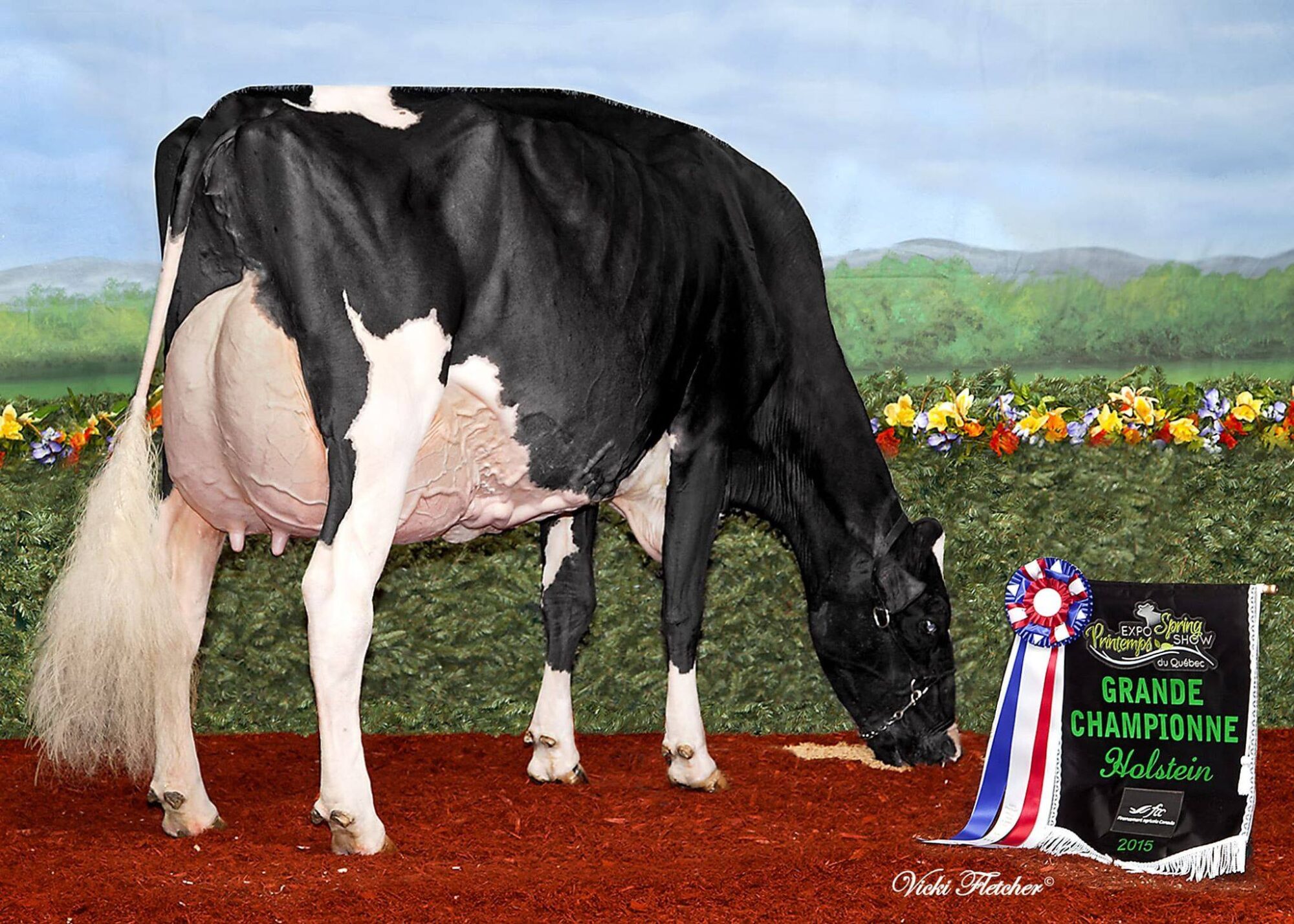
The influence echoes through the generations. A direct descendant of Aitkenbrae Starbuck Ada, MS Goldwyn Alana (EX-96) continued the family’s winning ways by capturing the Grand Champion banner at the 2015 Quebec Spring Show.

Her sister, MS Kingstead Chief Adeen, proved equally influential as a brood cow, producing 51 daughters classified Excellent worldwide—ranking her second all-time for most EX daughters.

A transmitting legend in her own right. Ms Kingstead Chief Adeen, one of the two famous daughters of Ada, became a cornerstone brood cow whose influence extends globally through her famous descendants.

When I look at those numbers… 51 EX daughters from one cow? That’s not luck. That’s the result of understanding genetic architecture at a level most of us can only dream about. And this was before genomic testing made genetic prediction routine.

Transmitting power, generations later. Jeanlu Stanleycup Alexis (EX-96) carries on the genetic influence of her granddam, MS Kingstead Chief Adeen, proving that the foundation laid by Ada is still producing champions today.

The Genetic Crescendo

The ultimate validation of Hardy Jr.’s vision came through the bulls he bred. His most famous achievement was Shoremar James, born from his foundation cow Stelbro Jenine Aerostar.

This is what Hardy Jr.’s vision looked like on the world stage. Thrulane James Rose, a daughter of Shoremar James, fulfilled the genetic promise of the Shore dynasty by dominating the show ring.

James became a phenomenal sire of show cows—his daughters were voted World Champion Holstein Cow three times in four years. But James’s greatest legacy wasn’t his show daughters. It was his most famous son: Braedale Goldwyn.

The Shoremar James influence knew no borders. In Europe, his daughter Castel James Jolie became an icon, proving that the genetic power forged in Glanworth could dominate on any continent.

Here’s what blows my mind about Goldwyn’s creation—it wasn’t an accident or luck. You can trace the genetic pathways directly from Hardy Sr.’s breeding decisions in the 1940s. Those twin bulls, Romulus and Remus, led to Fairlea Royal Mark, whose lineage eventually produced Maughlin Storm, who sired Braedale Baler Twine—Goldwyn’s dam. Hardy Jr. bred the sire, Shoremar James.

The dynasty’s legacy of show ring dominance continued for generations. RF Goldwyn Hailey, a daughter of Braedale Goldwyn, exemplifies the superstar quality that traced directly back to the breeding decisions made in Glanworth.

When those two lines converged, they created a genetic perfect storm. Industry records show that Goldwyn’s influence extended to herds on every continent. It’s like watching a master chess player execute a strategy that unfolds over the course of decades.

The Complexity of Genius

The ultimate proof of a foundation cow’s influence. Decades later, the genetic power of Aitkenbrae Starbuck Ada was still producing champions like GALYS-VRAY, whose EX-95 mammary system helped her conquer the European show circuit in 2016.

For all his brilliance, Hardy Jr.’s life was marked by profound personal struggle. The same intensity that drove him to acquire cows like Ada and breed bulls like James also led him to what observers called “the edge of the abyss”.

Those of us who knew Hardy Jr. understood this complexity. Eighteen bulls from his program received major awards in Canada, and three became number one sires in different countries. But privately, we watched with concern as he navigated battles that were as intense as his triumphs.

The Holstein community’s response to his struggles revealed something beautiful about our industry. We recognized genius when we saw it, even when it came with complications.

The flip side of creative genius is sometimes a very dark place.

People remembered him as “gifted, talented, remarkable beyond one’s imagination”. The same creative fire that produced breakthrough genetics also fueled personal demons that few understood.

It’s a reminder that innovation often comes with a price—that the very traits that drive visionary thinking can also create profound personal challenges. We’ve seen this pattern in other brilliant minds in our industry, haven’t we? The relentless drive that creates breakthrough genetics sometimes carries a hidden cost.

When the Gavel Fell Silent

December 26, 2013. Hardy Shore Jr. died at his home at age 57.

The industry’s response spoke to the profound connections he’d forged throughout his career. Despite his struggles, colleagues remembered his kindness, optimism, and unwavering passion for the Holstein breed.

The final detail—the family’s request that memorial donations be made to the Men’s Mission Services of London—provided quiet testimony to the nature of his struggles. A man who dealt in world-record prices and global genetics, fighting private battles that few understood.

Sometimes the most brilliant minds carry the heaviest burdens. The Holstein community’s ability to honor his contributions while acknowledging his struggles showed the best of what our industry can be.

What This Means for Us Today

So, what does the Shore story teach those of us who are still making breeding decisions, still building something for the next generation?

First, it’s about vision beyond the immediate cash flow pressures that keep us awake at night. William H. Shore could have stayed with mixed livestock forever—safe, predictable, profitable. Instead, he bet on purebreds when most thought he was crazy. Hardy Sr. kept six females when forced to disperse, understanding that genetic value compounds over time like interest in a savings account.

Today’s genomic tools give us unprecedented ability to make these long-term decisions—if we have the courage to use them.

Second, it’s about recognizing industry shifts before they hit your bottom line. The bulk cooler revolution could have been devastating—instead, the Shores turned it into their greatest opportunity. Today’s shifts toward sustainability, animal welfare, and precision agriculture require the same strategic thinking.

The producers who adapt first create the biggest advantages. Consider the early adopters of robotic milking or those who entered organic production before the premiums were eroded by oversupply.

Third, it’s about understanding that reputation matters as much as genetics. The Shore name opened doors because it stood for integrity, quality, and innovation. In our age of social media and instant communication, building that kind of trust is both easier and harder than ever.

But perhaps most importantly, it’s about persistence through complexity. Hardy Jr.’s story reminds us that innovation often comes with personal costs; the very traits that drive breakthrough thinking can also create challenges that are not always apparent from the outside.

The industry’s response—celebrating his contributions while supporting him through difficulties—shows the best of what our community can be.

The echoes of a dynasty. As a daughter of Braedale Goldwyn, Loyalyn Goldwyn June is a direct descendant of the Shoremar James line, proving that the family’s genetic influence continues to produce champions in today’s show rings.

The Legacy Lives On

Walk through any modern dairy barn today, and you’ll find cattle whose pedigrees trace back to Glanworth. The “Shore” prefix may no longer appear on registration papers, but their genetic influence flows through the global Holstein population like underground streams feeding a river.

The auction barn on Glanworth Road stands quiet now. But the echoes of that distinctive auctioneer’s chant still resonate through every major sale, every breeding decision based on balanced genetics, every young producer who dares to dream of creating the next genetic revolution.

For the better part of a century, the Shores were the business. And in many ways, they still are. Every superior cow carrying their bloodlines, every successful breeding program following their example of long-term thinking, every auction where quality genetics find their true value… that’s the Shore legacy.

The dynasty may have ended, but its influence remains. That’s immortal.

And in our industry, where the right genetic decision can echo for generations, immortality is the only currency that really matters.

KEY TAKEAWAYS

  • The Shore family profoundly shaped the Canadian and North American Holstein industry across four generations, building an enduring legacy through strategic breeding, merchandising, and auctioneering.
  • Their long-term vision—starting with William H. Shore’s early 20th-century bet on purebreds, through Hardy Sr.’s brand-building via the show ring, to Hardy Jr.’s genomic advances—offers valuable lessons for modern dairy producers navigating today’s technological and market shifts.
  • The Shore dynasty exemplifies how combining superior genetics with innovative business acumen, such as capitalizing on technological disruptions like the bulk milk cooler, can create a lasting competitive advantage.
  • The story highlights the human complexity behind industry success, particularly Hardy Shore Jr.’s personal struggles amid professional brilliance, underscoring the industry’s need for compassion alongside admiration.
  • The Shore genetic influence endures globally, notably through iconic cattle like Shoremar Alicia and Braedale Goldwyn, demonstrating the multi-generational impact of deliberate, balanced breeding strategies.

EXECUTIVE SUMMARY

The Shore family legacy is a cornerstone of the Canadian and North American Holstein dairy industry, spanning four generations from the early 1900s to 2013. Their journey began with William H. Shore’s pivotal decision to invest in purebred Holsteins in 1910, a bold move that laid the genetic foundation for future success. Hardy Shore Sr. and his successors built a revered brand through show ring dominance and an innovative auction business that capitalized on industry shifts, such as the bulk tank revolution. The third and fourth generations, led by Bob Shore and Hardy Shore Jr., advanced the family’s influence through legendary auctioneering and cutting-edge genetic marketing, including the global success of Shoremar S Alicia and Braedale Goldwyn. While personal struggles marked Hardy Shore Jr.’s life, his professional contributions reflect visionary breeding that shaped Holstein genetics worldwide. The Shore dynasty exemplifies long-term strategic thinking, adaptability, and the intricate interplay between human complexity and industrial advancement. Today, their genetic imprint continues to impact cattle across continents, underscoring a legacy that is both historic and enduring.

Learn More:

  • Breeding for Profit: A Cow-Side Revolution – This article provides a modern framework for the Shore’s profit-focused mindset. It details tactical breeding strategies for today’s market, focusing on health and efficiency traits that directly impact your bottom line and long-term herd profitability.
  • Dairy Genetics: Is Bigger Really Better? – While the Shores built an independent dynasty, this piece analyzes the modern strategic landscape of dairy genetics. It explores the pros and cons of industry consolidation, offering critical insights for breeders navigating today’s market to maintain genetic diversity and profitability.
  • The Future of Dairy Breeding: Is Gene Editing the Answer? – Just as the Shores embraced new technologies, this article looks to the future. It demystifies gene editing, exploring its potential to accelerate genetic progress for health and production traits, and what it could mean for the next generation of elite cattle.

Join the Revolution!

Join over 30,000 successful dairy professionals who rely on Bullvine Weekly for their competitive edge. Delivered directly to your inbox each week, our exclusive industry insights help you make smarter decisions while saving precious hours every week. Never miss critical updates on milk production trends, breakthrough technologies, and profit-boosting strategies that top producers are already implementing. Subscribe now to transform your dairy operation’s efficiency and profitability—your future success is just one click away.

NewsSubscribe
First
Last
Consent

From Woodstock to Wall Street: How the Dairy Farmer Who Hosted Half a Million Hippies Built a Breeding Empire Worth Copying Today

Stop chasing genomic indexes. A 1960s dairy farmer’s breeding strategy beat today’s averages—here’s his $75K crisis management playbook.

The same conservative Republican dairy farmer who rented his pasture to 460,000 counterculture rebels also revolutionized Holstein and Guernsey genetics and vertical integration decades before Silicon Valley discovered the concept. Max Yasgur’s ,000 Woodstock windfall was just the tip of an agricultural iceberg that modern dairy operations desperately need to understand.

Max Yasgur on his dairy farm in Bethel, New York. The missing fingers on his right hand told the story of a man who built his empire with his own hands.

The Festival That Fed the Farm (And What It Teaches About Modern Asset Optimization)

What if the secret to surviving today’s volatile dairy markets isn’t found in the latest genomic technology but in the business playbook of the man who made Woodstock possible? Max Yasgur didn’t just host “perhaps the most important cultural event of the twentieth century”—he demonstrated principles of strategic breeding, vertical integration, and asset diversification that modern dairy farmers are still trying to master.

The handshake that sealed the deal was missing two fingers. Michael Lang, the young promoter of what would become the Woodstock Music and Art Festival, felt a jolt of recognition as he grasped Max Yasgur’s weathered hand on that fateful Sunday afternoon in 1969. “Holy smokes,” Lang thought to himself, “He’s built this place with his own hands.”

What Lang didn’t fully comprehend was that he wasn’t just meeting the future host of the largest music festival in history—he was encountering one of Sullivan County’s most successful agribusiness pioneers, a man whose 650-head dairy operation and 2,000-acre empire represented exactly the kind of strategic thinking that separates millionaire dairy farmers from those barely breaking even.

The “Angel of Woodstock” Was Actually a Genetic Genius

While 460,000 hippies danced in his fields between August 15-18, 1969, Yasgur was quietly revolutionizing breeding with a precision that would make today’s genomic specialists jealous. His approach wasn’t about chasing the latest trends but about concentrated excellence that created lasting wealth.

The Woodstock Generation vs. The Genetic Generation

The same weekend that Jimi Hendrix played guitar with his teeth on Yasgur’s makeshift stage, the farm’s barns housed some of America’s most strategically bred cattle. Yasgur’s herd included 90 daughters of Harden Farms King Pontiac and 30 daughters of Cashman Thunderbolt, all tracing back to the elite Dunloggin bloodlines that cost Harden Farms $25,500 in the 1940s.

Dr. E.S. Harrison, manager of the prestigious Harden Farms, wrote: “Few breeders have followed a more definite breeding program than Max Yasgur.” This wasn’t casual praise but professional recognition from one of the industry’s most respected authorities, acknowledging Yasgur’s systematic approach to genetic improvement.

From City Kid to Dairy King: The Making of an Empire

Born December 15, 1919, in New York City to Russian immigrants, Samuel and Bella Yasgur, Max’s journey to dairy farming began early when his family moved to a dairy farm in Maplewood, New York, ninety miles north of the city. The farm doubled as a boarding house, catering to summer guests—an early lesson in revenue diversification that would serve him well decades later.

When his father died during Max’s teenage years, he assumed the role of family head. Though he briefly studied real estate law at New York University, “his dream was to go back to the farm.” This wasn’t a default choice but a calculated decision that revealed an entrepreneurial vision most farmers never achieve.

Yasgur’s ambition extended far beyond typical dairy farming. He wanted to build a milk processing plant and to sustain it, he needed scale. With methodical precision, he began acquiring neighboring farms, constructing barns, and expanding his herd. He built a pasteurization plant and refrigeration complex, installed bottling machines, and developed comprehensive door-to-door delivery routes.

The result was Yasgur Dairy—”the largest milk producer in Sullivan County” with a herd that peaked at 650 head and encompassed “ten farms comprising two thousand acres of land.” This wasn’t just farming—it was agricultural technology that captured value at every stage while competitors sold commodity milk.

The $75,000 Woodstock Deal: Master Class in Crisis Monetization

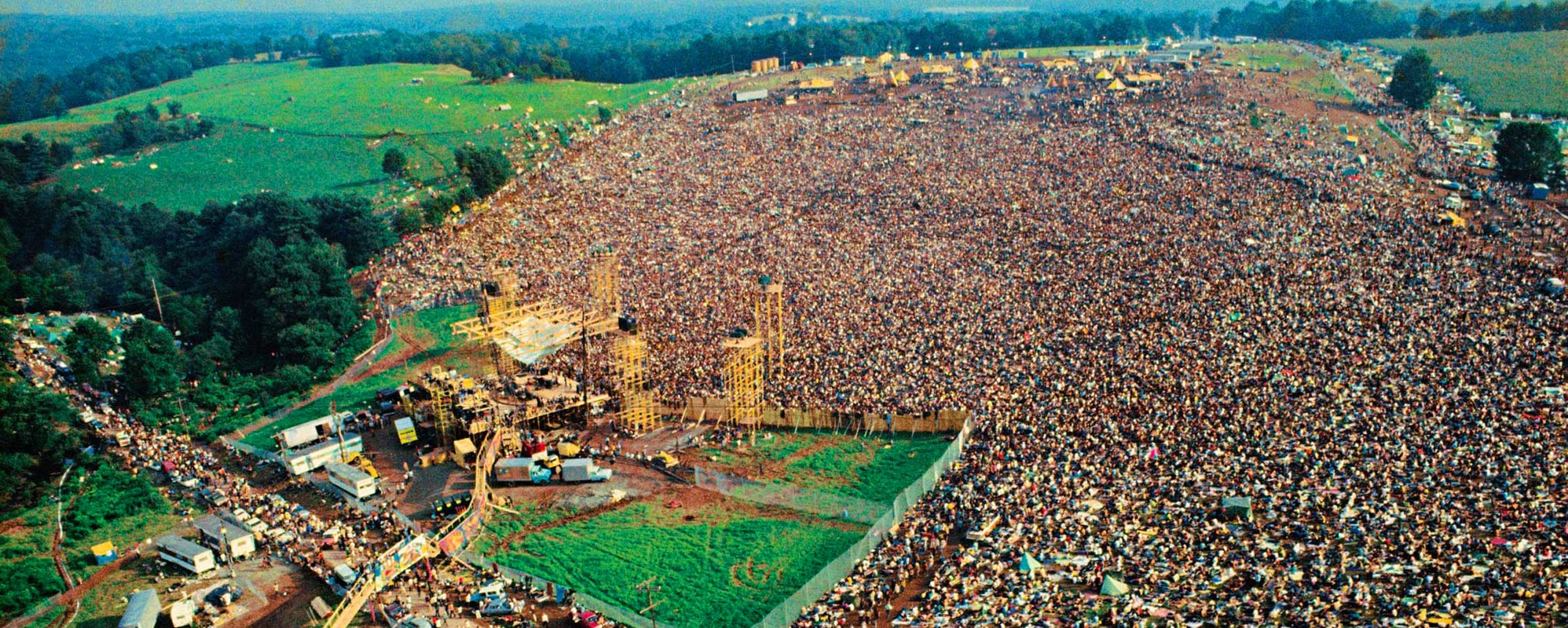
The natural amphitheater of Max Yasgur’s alfalfa field that Michael Lang immediately recognized as ‘perfect for the stage’ – a bowl-shaped pasture that would host 460,000 people.

The year 1969 had been unusually wet, damaging Yasgur’s hay crop and threatening feed costs for his massive herd. When Lang and Roberts initially offered to rent a field for three days to accommodate “10,000 to 15,000 people,” Yasgur showed them several suitable options. But then came the revelation that changed everything.

The Tenfold Price Increase Strategy

The promoters revealed they were actually expecting “50,000 people and that they would have another 50,000 who would try to get in without paying,” bringing the total to a staggering 100,000. This disclosure prompted Yasgur’s immediate reconsideration: “Wait a minute… You’re now at 100,000 people. That’s a lot of people,” he said. “I will really have to think whether or not I want to be involved in something that large.”

Yasgur’s response revealed the business acumen that built empires: “I am a businessman, and it will cost you,” he said. “But I’ll go to bat for you”. He then “added another zero” to their rent, increasing it from $7,500 to $75,000—a 900% markup that solved his immediate cash flow crisis. Some reports suggest the final payment was even higher, with various sources citing amounts up to $10,000 in other accounts.

This wasn’t opportunism but strategic asset monetization that every modern dairy farmer should understand. Yasgur recognized both the scale of the opportunity and his negotiating position, demonstrating the kind of aggressive pricing that builds wealth. As he told himself afterward: “His cows wouldn’t go hungry this year.”

Modern Applications:

  • Agritourism Revenue: Yasgur proved that agricultural land can generate substantial non-dairy income
  • Event Hosting: From weddings to corporate retreats, many dairy farms sit on underutilized event venues
  • Crisis Management: Using unexpected opportunities to offset operational challenges

The Conservative Republican Who Defended Hippie Rights

Perhaps the most remarkable aspect of Yasgur’s Woodstock decision wasn’t the money but the principle. Despite being a “conservative Republican who approved of the Vietnam War,” he stood before the Bethel Town Board to defend the festival against local opposition.

His neighbors voiced fears of widespread “pot smoking,” potential heroin use, an “ocean of garbage,” “universal bad manners,” “orgies of love-ins,” and even “a wild and bloody encounter with the police.” Signs appeared around town reading “Local People Speak Out Stop Max’s Hippie Music Festival,” “No 150,000 hippies here,” and “Buy no milk.”

Yasgur’s response, preserved in the meeting transcript, revealed the character that built both dairy empires and cultural history:

“I hear you are considering changing the zoning law to prevent the festival. I hear you don’t like the looks of the kids who are working at the site. I hear you don’t like their lifestyle. I hear you don’t like they are against the war and that they say so very loudly. I don’t particularly like the looks of some of those kids, either. I don’t particularly like their lifestyle, especially the drugs and free love. And I don’t like what some of them are saying about our government. However, if I know my American history, tens of thousands of Americans in uniform gave their lives in war after war just so those kids would have the freedom to do exactly what they are doing. That’s what this country is all about, and I will not let you throw them out of our town just because you don’t like their dress or hair, the way they live, or what they believe. This is America, and they are going to have their festival”.

The Business Lesson: Yasgur understood that defending principles—even unpopular ones—often aligns with long-term business success. His “live and let live” philosophy enabled him to monetize opportunities that others rejected due to prejudice.

From Hippies to Holsteins: The Vertical Integration Model That Predated Amazon

The intersection of counterculture and agriculture: A festival-goer milks one of Yasgur’s 650-head Gurensey and Holstein herd, symbolizing the unexpected harmony between two different worlds.

While 460,000 festival-goers camped in his fields, Yasgur’s real innovation was happening in his processing facilities. He had built what modern business schools would call a “vertically integrated supply chain”—controlling every step from pasture to doorstep decades before it became a Silicon Valley buzzword.

Yasgur’s Pre-Digital Disruption:

  • Pasteurization plants and refrigeration complexes
  • Bottling machines and door-to-door delivery routes
  • Ten farms comprising 2,000 acres of land
  • Peak herd of 650 head, making him Sullivan County’s largest milk producer

This integration allowed Yasgur to capture margins that commodity producers surrender to processors and distributors. While competitors complained about milk prices, Yasgur controlled his destiny from cow to customer.

What This Means for Your Operation Today:

  • Direct-to-Consumer Opportunities: Yasgur’s delivery model prefigured today’s farm-to-table movement
  • Value-Added Processing: His on-farm processing captured margins that commodity producers surrender
  • Supply Chain Control: By owning processing and distribution, he insulated himself from market volatility

The Health Cost of Agricultural Ambition: Yasgur’s Warning for Today’s Farmers

By his late forties, Yasgur had “suffered several heart attacks” and required an “oxygen tank” always nearby, with an “oxygen tent” in his bedroom. The relentless demands of building a 650-head operation across 2,000 acres had taken a severe physical toll. He was 49 at the time of Woodstock and “had a heart condition.”

Despite his declining health, Yasgur continued building his empire until selling the business to Yasgur Farms Inc. in December 1970. The transaction, completed just 19 months before his death at age 53, included all cattle, machinery, and the milk business, with Lew Wohl, George Peavey, and James Peavey as the new shareholders.

His planned transition ensured business continuity—a crucial lesson for modern dairy farmers who often delay succession planning until it’s too late.

Woodstock’s Hidden Dairy Legacy: The Man Behind the Music

On the third day of the festival, just before Joe Cocker’s early afternoon set, Yasgur addressed the crowd of half a million in a speech that perfectly captured his character:

“I’m a farmer. I don’t know how to speak to twenty people at one time, let alone a crowd like this. But I think you people have proven something to the world — not only to the Town of Bethel, or Sullivan County, or New York State; you’ve proven something to the world. This is the largest group of people ever assembled in one place… But above that, the important thing that you’ve proven to the world is that a half a million kids — and I call you kids because I have children that are older than you are — a half million young people can get together and have three days of fun and music and have nothing but fun and music, and I – God bless you for it!”

His speech was met with massive cheers from the audience, cementing his place as the “Angel of Woodstock” and “Patron Saint of Woodstock.”

The 460,000 festival-goers who gathered on Yasgur's farm for what became 'perhaps the most important cultural event of the twentieth century.
The 460,000 festival-goers who gathered on Yasgur’s farm for what became ‘perhaps the most important cultural event of the twentieth century.

The Humanitarian Touch

When Yasgur heard that some local residents were selling water to festival-goers, he put up a big sign at his barn reading “Free Water.” The New York Times reported that he “slammed a work-hardened fist on the table and demanded of some friends, ‘How can anyone ask money for water?'”. His son Sam recalled his father telling his children to “take every empty milk bottle from the plant, fill them with water and give them to the kids, and give away all the milk and milk products we had at the dairy.”

This wasn’t just good publicity—it was smart business. Yasgur understood that customer goodwill creates long-term value, even when providing immediate services at cost.

The Breeding Legacy: Strategic Breeding That Still Impresses

While Woodstock made him famous, Yasgur’s primary professional achievement was revolutionizing Dairy cattle genetics through systematic breeding that would make modern genomic specialists envious.

Early Career Excellence (1953-1955)

Yasgur’s first mention in Holstein-Friesian World came in November 1953, when he consigned five heifers to the Earlville Invitational Sale. Harden Farms King Pontiac sired all, and at that time, Yasgur’s herd already included 90 daughters of this proven sire. He also owned 30 daughters of Cashman Thunderbolt and was using two other sons of Dunloggin Deen Var.

His highest-selling heifer at the Earlville Invitational brought $775—significant money for the 1950s. This early success established Yasgur as a serious player in the Holstein community, recognized for his adherence to elite Harden Farms breeding programs.

The Great Dispersal and Strategic Return (1955-1961)

In 1955, Yasgur conducted what Holstein-Friesian World called “The First Great Dispersal of Nearly 100% Harden Farms Breeding ever to be Offered at Public Sale”. The sale was managed by Charles Vosburgh with guest auctioneer Clarence B. Smith, though results were never publicly reported.

This wasn’t failure—it was strategic repositioning. By 1961, Yasgur was back in business, purchasing the Canadian heifer Bramlaw Dutchland Triune (VG-87) for $2,000, the top price at the New York Convention Sale. This purchase marked his triumphant return and demonstrated the kind of resilience modern operations need to survive market volatility.

The Oakcrest Roburke Dean Era (1970s)

By 1970, Yasgur’s breeding program had evolved to focus on Oakcrest Roburke Dean, a Pabst Roamer son bred by Laurence McNeil. This strategic shift produced exceptional results:

  • Yasgur Roburke Triune: 20,812 lbs milk, 728 lbs fat
  • Yasgur Roburke Modelaine: 21,893 lbs milk, 628 lbs fat
  • Yasgur Roburke Anny: 24,023 lbs milk, 705 lbs fat

These numbers were exceptional for the 1970s when average cows produced less than half those amounts. Yasgur’s strategic focus on proven genetics created consistent excellence that many modern operations struggle to achieve despite advanced technology.

Oakcrest Roburke Dean daughters at Yasgur Farms Inc. These strategic breeding choices produced cattle like Yasgur Roburke Anny (24,023 lbs milk, 705 lbs fat) - numbers that matched modern averages 50 years early.
Oakcrest Roburke Dean daughters at Yasgur Farms Inc. These strategic breeding choices produced cattle like Yasgur Roburke Anny (24,023 lbs milk, 705 lbs fat) – numbers that matched modern averages 50 years early.

Lessons for Today’s Breeders: The Yasgur Playbook

Lesson 1: Scale with Purpose, Not Ego

Yasgur’s 650-head operation across 2,000 acres wasn’t built for bragging rights—it was designed to support his processing plant and capture maximum value at every stage. Modern operations that expand without clear revenue drivers often fail.

Ask yourself: Does your expansion serve a strategic purpose, or are you just collecting more cows?

Lesson 2: Genetic Patience Beats Genetic Panic

While today’s breeders switch sires based on quarterly genomic updates, Yasgur has stuck with proven bloodlines for decades. His systematic approach to Harden Farms genetics and his strategic evolution to Oakcrest Roburke Dean represented calculated improvement, not random experimentation.

Challenge for Today’s Breeders: When did you last evaluate whether your breeding program has consistent direction, or are you just reacting to the latest genetic trends?

Lesson 3: Risk Management Through Diversification

That $75,000 Woodstock payment wasn’t just luck—it was smart asset utilization. Yasgur recognized that land could generate income beyond milk production, solving an immediate crisis while creating unexpected wealth.

Modern Applications:

  • Agritourism opportunities: Event hosting, farm tours, educational programs
  • Renewable energy projects: Solar installations, wind power, biogas systems
  • Real estate development: Leveraging land value for additional income streams

The Numbers That Prove Yasgur Was Ahead of His Time

MetricYasgur (1960s-70s)Modern AverageYasgur’s Advantage
Herd Size650 head280 head (US average)132% larger
Land Base2,000 acres442 acres (US average)352% larger
Top Producer24,023 lbs milk23,000 lbs (current average)Matched modern averages 50 years early
Business ModelVertically integratedCommodity focusedValue capture at multiple levels
Crisis ResponseDiversified revenue ($75K event income)Limited optionsMultiple revenue streams

From the 1955 “Great Dispersal” to Woodstock Riches: Strategic Resilience in Action

Yasgur’s career included significant setbacks that offered crucial lessons for modern operations. His complete herd dispersal in 1955, followed by rebuilding to host Woodstock profitably by 1969, demonstrates the kind of strategic flexibility that modern dairy operations need to survive market volatility.

The Holstein-Friesian World’s description of his 1955 sale as featuring “Nearly 100% Harden Farms Breeding” underscores the quality and consistency of his program. Yet rather than viewing this as a failure, Yasgur used it as an opportunity to reassess and rebuild more strategically.

His swift return to business, marked by purchasing the top-priced Canadian heifer in 1961, proved that temporary setbacks don’t define long-term success. This resilience—selling out completely in 1955, then rebuilding to host the world’s largest music festival profitably by 1969—provides a masterclass in agricultural adaptability.

The Rolling Stone Obituary: When a Dairy Farmer Changed Culture Forever

Nineteen months after selling Yasgur Farms Inc., Max Yasgur died of a heart attack on February 9, 1973, in Marathon, Florida, at age 53. His death marked a unique moment in American cultural history: “It was the first time in history that a humble dairy farmer was given a full-page obituary in Rolling Stone magazine.”

This unprecedented recognition by the counterculture movement’s premier publication underscored how his principled stand transcended agriculture to influence American society. Rolling Stone’s tribute acknowledged that Yasgur’s legacy extended far beyond milk production—he enabled a generation to express itself freely, demonstrating that dairy farmers could change the world.

The Bottom Line: Woodstock’s Dairy Legacy Lives On

Max Yasgur proved that dairy fortunes come from strategic thinking, not just hard work. His focused breeding program, vertical integration, and asset optimization created an empire that could afford to rent fields for $75,000—in 1969 dollars—when crisis struck.

Five Woodstock-Inspired Action Steps for Your Operation:

  1. Audit your asset utilization—What non-dairy revenue could your land generate during crisis years?
  2. Develop crisis monetization strategies—How can you turn operational challenges into revenue opportunities?
  3. Build principled partnerships—Are you missing profitable opportunities due to narrow thinking about your customer base?
  4. Focus on your genetic strategy—Are you following Yasgur’s systematic approach or chasing genetic lottery tickets?
  5. Plan your succession early—Yasgur’s strategic transition ensured business continuity despite his early death

What Yasgur’s Missing Fingers Really Mean

Those two missing fingers that caught Michael Lang’s attention told the story of a man who built success with his hands. In today’s technology-driven industry, the fundamentals of strategic breeding, smart business management, and principled decision-making remain unchanged.

The man who made Woodstock possible didn’t just host hippies—he demonstrated that principled business decisions, strategic genetic programs, and diversified revenue streams create lasting wealth. While Rolling Stone magazine gave him the first full-page obituary in history for a humble dairy farmer, his real legacy lies in proving that dairy farmers who think strategically can change the world—and profit handsomely while doing it.

Remember: Yasgur’s story reminds us that farming is about more than production metrics and profit margins—it’s about the character of the people who feed the world and the principles they’re willing to defend. The farmers who understand this will build the dairy empires of tomorrow—with or without rock festivals in their fields.

In an era of increasing specialization and technological focus, Max Yasgur’s legacy serves as a powerful reminder that the most successful dairy operations combine strategic thinking, principled leadership, and the courage to seize unexpected opportunities. His $75,000 Woodstock windfall wasn’t luck—it was the natural result of building systems and relationships that could respond quickly to changing circumstances.

The hard truth? Most modern dairy operations are more sophisticated than Yasgur’s but less profitable. His combination of genetic focus, business integration, and strategic thinking created lasting wealth—even when the man didn’t live to enjoy it. The question isn’t whether you can afford to follow his model—it’s whether you can afford not to.

KEY TAKEAWAYS

  • Genetic Concentration Beats Index Chasing: Yasgur’s decade-long focus on Dunloggin Deen Var bloodlines produced 24,023 lbs milk with 705 lbs fat—proving strategic genetic patience outperforms quarterly sire switching. Modern operations using 20+ bulls annually should evaluate genetic coherence versus Yasgur’s surgical precision approach.
  • Vertical Integration Captures 300% More Value: Yasgur’s processing-to-doorstep model captured margins at every stage while competitors sold commodity milk. Today’s direct-to-consumer dairy market offers similar opportunities—operations exploring value-added processing can increase per-gallon revenue from $0.18 commodity to $0.54+ retail pricing.
  • Crisis Asset Monetization Generates Emergency Capital: Yasgur’s $75,000 Woodstock payment solved immediate cash flow during the 1969 hay crisis. Modern dairy farms should audit non-core assets for revenue potential—agritourism, renewable energy leases, and event hosting can generate $25,000-$100,000+ annually in supplemental income.
  • Scale With Strategic Purpose, Not Ego: Yasgur’s 650-head operation across 2,000 acres supported his processing infrastructure—every cow served the vertical integration model. Operations expanding without clear revenue drivers average 15% lower ROI than strategically scaled farms with defined profit centers.
  • Succession Planning Prevents Wealth Evaporation: Yasgur’s planned December 1970 business transition to Yasgur Farms Inc. ensured continuity despite his death 19 months later. Dairy operations without formal succession plans lose 60% of accumulated wealth during unplanned transitions—strategic planning preserves generational assets.

EXECUTIVE SUMMARY

While modern dairy farmers scatter-shot their breeding programs chasing the latest genomic trends, a conservative Republican from upstate New York proved that strategic genetic concentration builds generational wealth. Max Yasgur’s 650-head operation achieved 24,023 lbs milk production per cow in 1970—matching today’s national averages with 1960s technology. His vertically integrated empire controlled processing, distribution, and retail—capturing margins that modern commodity producers surrender to processors. When crisis struck in 1969, Yasgur’s strategic asset utilization generated $75,000 in emergency revenue (equivalent to $580,000 today) by monetizing non-core land assets. His focused breeding program concentrated on proven Dunloggin bloodlines for decades, creating consistent genetic progress while competitors chased fads. Every modern dairy operation struggling with volatile milk prices and genetic confusion needs to audit whether they’re building a Yasgur-style empire or just collecting expensive cows.

Learn More:

Join the Revolution!

Join over 30,000 successful dairy professionals who rely on Bullvine Weekly for their competitive edge. Delivered directly to your inbox each week, our exclusive industry insights help you make smarter decisions while saving precious hours every week. Never miss critical updates on milk production trends, breakthrough technologies, and profit-boosting strategies that top producers are already implementing. Subscribe now to transform your dairy operation’s efficiency and profitability—your future success is just one click away.

NewsSubscribe
First
Last
Consent
Send this to a friend