Archive for fresh cow health

Is Your Fresh Pen Costing You $90,000? The 90-Day Transition Fix for Pregnancy Rate

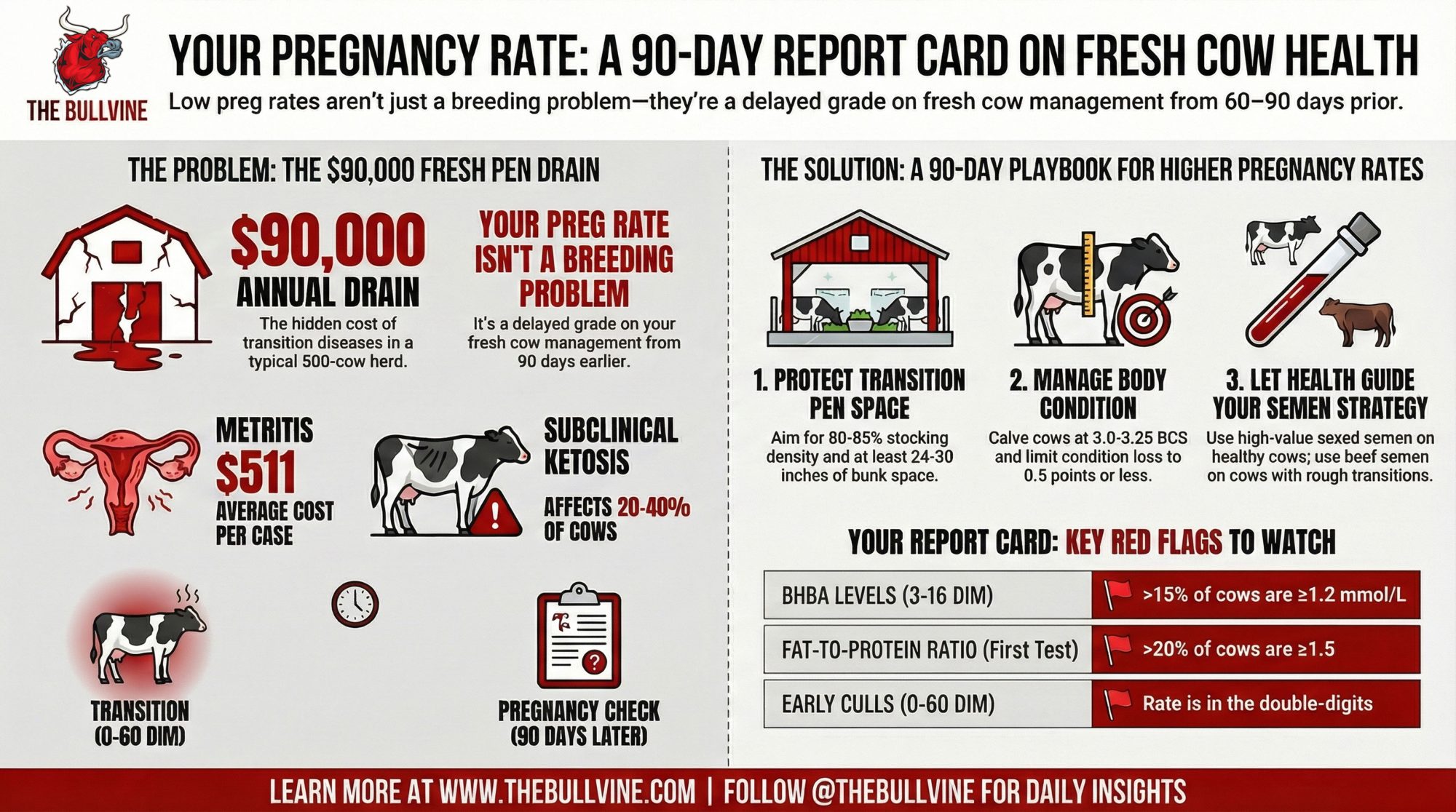
Metritis + SCK can quietly drain US$90,000 from a 500‑cow herd. The fix starts 90 days before you ever thaw a straw.

Executive Summary: Most of us still reach for semen, protocols, or the AI tech when pregnancy rate flattens, but what’s interesting is how often the real damage was done 60–90 days earlier in the fresh pen. A 2023 study on 15,041 Holsteins bred on Double‑Ovsynch found that cows with transition diseases in the first 30 DIM had clearly lower pregnancy per AI and more pregnancies lost by 60 days, even under excellent repro management. At the same time, economic work shows metritis averaging about US$511 per case and subclinical ketosis hitting 20–40% of cows in many herds, together easily stripping around US$90,000 a year from a 500‑cow operation once milk loss, disease, extra days open, and early culls are added up. This article treats pregnancy rate as a “90‑day transition report card” and walks through simple tools—NEFA/BHBA thresholds, fat‑to‑protein ratios, peak curves, and early‑lactation culls—that make that connection visible in your own data. From there, it lays out a clear playbook: a BHBA testing routine you can run on Mondays, realistic stocking and bunk space targets, BCS and F:P benchmarks, and a health‑based plan for where to use sexed dairy semen versus beef‑on‑dairy. Whether you’re in a Wisconsin freestall, a Western dry lot system, a Canadian quota barn, or a seasonal grazing herd, the goal is the same—tighten up fresh cow management so the next three preg checks feel a lot less like a guessing game and a lot more like a controlled business decision.            

When a herd’s pregnancy rate gets stuck in the low‑to‑mid‑20s, the conversation still usually starts in the breeding pen. You know how it goes: semen choices, heat detection, synchronization tweaks, maybe a quiet question about the AI tech. That’s where the problem shows up in your software, so that’s where everyone looks first.

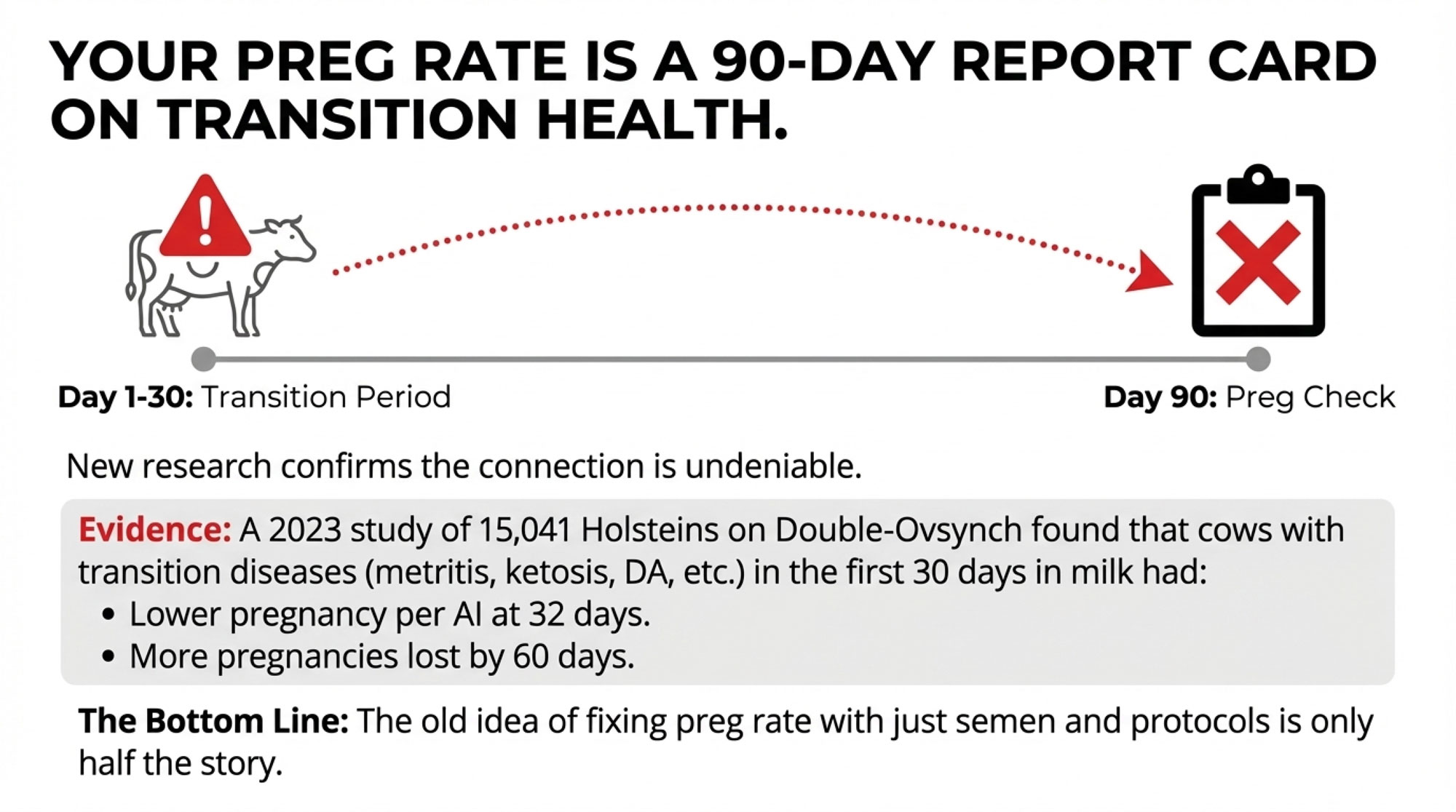
What’s interesting now is that newer work is making a pretty strong case that your pregnancy rate is really grading your fresh cow management from 60 to 90 days earlier, not just what happened on breeding day. A 2023 study in JDS Communications followed 15,041 Holstein cows in a high‑producing German herd where every first service was done on a Double‑Ovsynch program. Cows that had transition problems—milk fever, retained fetal membranes, metritis, ketosis, left displaced abomasum, or mastitis—in the first 30 days in milk had lower pregnancy per AI at 32 days and, in several of those categories, more pregnancies lost by 60 days than cows that stayed healthy, even though they all followed the same repro protocol.

So the old idea that “I’ll fix my preg rate with better semen and tighter protocols” is really only half the story. The other half is, “What were these cows living through in those first few weeks fresh?”

Looking at This Trend: Biology Keeps Pointing Back 90 Days

Let’s walk through the biology the way we’d talk it through over coffee. Once you see the timing inside the cow, this 90‑day connection stops feeling like a theory and starts looking like common sense.

The Egg You Breed Was Built During the Fresh Period

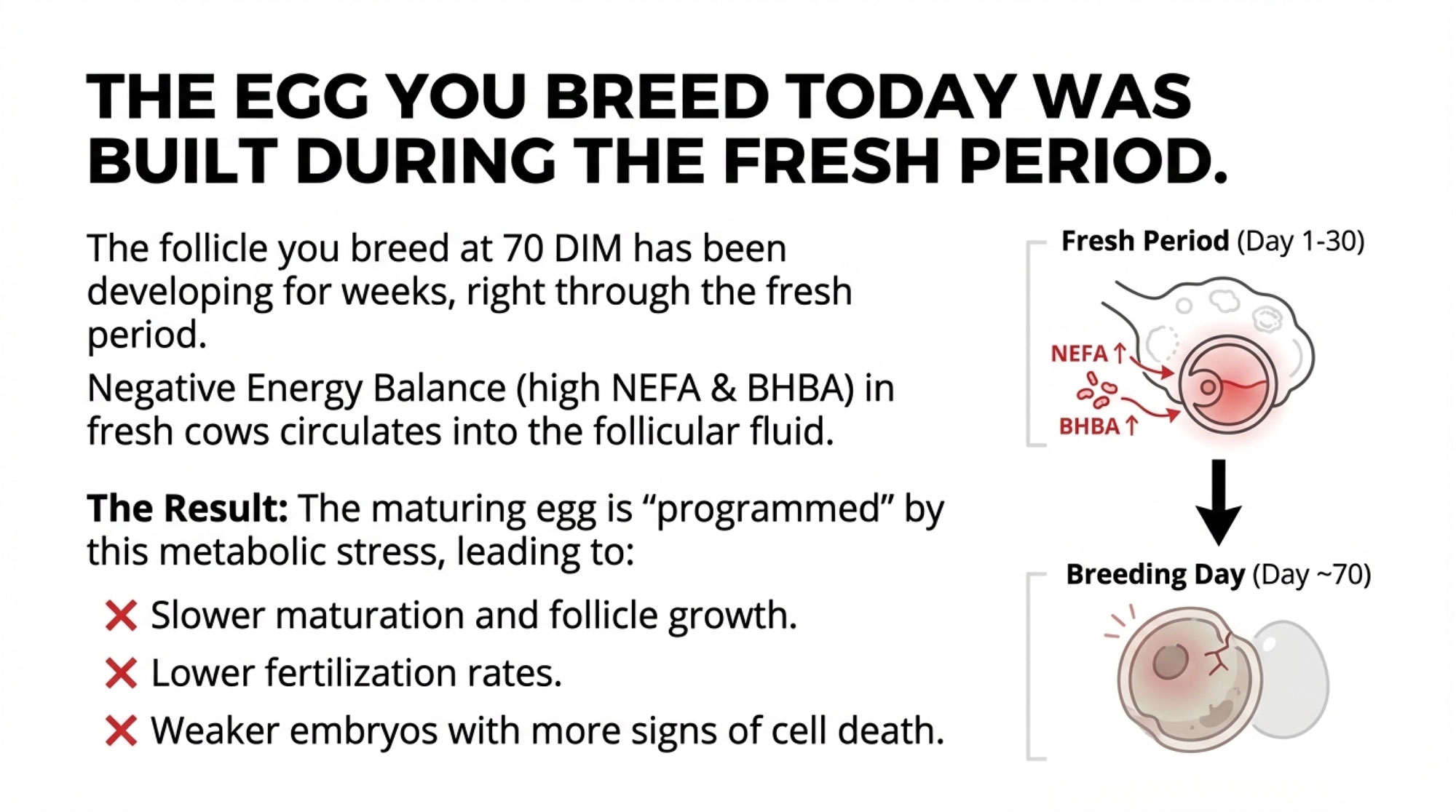
You probably know this already, but we all forget it sometimes: the follicle you breed at 60–80 days in milk didn’t show up last week. It’s been developing for weeks in the ovary. The “high fertility cycle” idea, outlined in a 2020 review, showed that cows that become pregnant around 130 DIM tend to lose less body condition after calving, experience fewer health events, have better fertility at first insemination, and have lower pregnancy loss. That pattern tells us fertility is strongly tied to what happened during the dry period and the early fresh period.

During that stretch, most cows slide into negative energy balance. Milk is ramping up, but dry matter intake hasn’t caught up yet. So the cow pulls more energy from body fat, which pushes non‑esterified fatty acids (NEFA) up in the blood and, if the liver gets overloaded, beta‑hydroxybutyrate (BHBA) as well. Cornell work and follow‑up studies have shown that when too many cows run with high NEFA and BHBA around calving, the herd sees more transition disease and weaker reproductive performance.

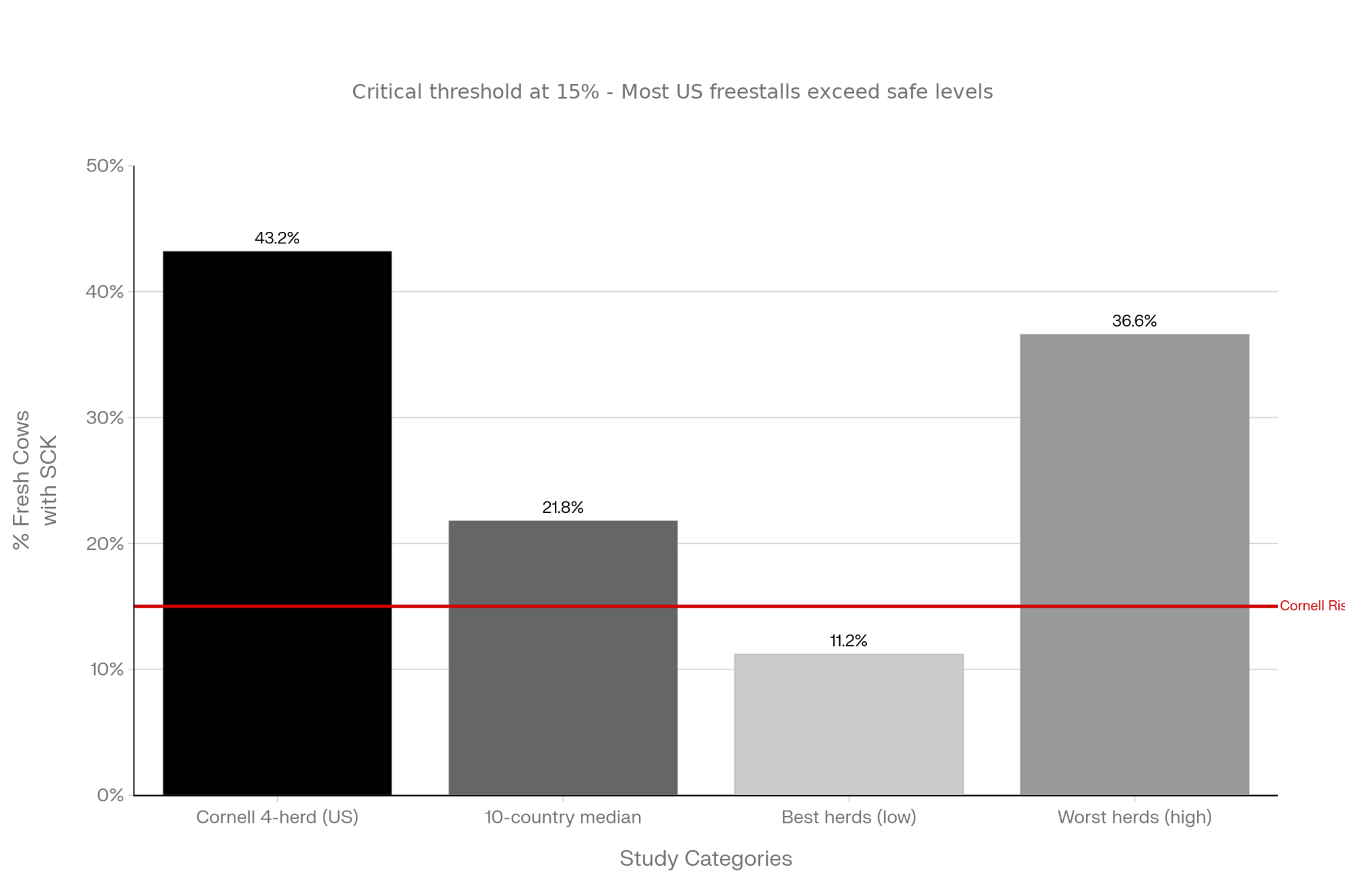
In an epidemiology study many of you will have heard about by now, Jessica McArt, DVM, PhD (Cornell University), and colleagues followed 1,717 cows in four New York and Wisconsin freestall herds. They tested blood BHBA between 3 and 16 days in milk and used 1.2 mmol/L as the cutoff for subclinical ketosis (SCK). In that dataset, 43.2% of cows had at least one BHBA reading at or above 1.2 mmol/L, with risk peaking around day five fresh. A larger study in 10 countries found a median SCK prevalence of 21.8% between 2 and 15 DIM at the same cut point, with herds ranging from 11.2% to 36.6%.

So in many herds, somewhere between one in five and almost half of the fresh cows are running with elevated ketones in that first couple of weeks. That’s a lot of cows quietly working too hard metabolically before we ever talk about breeding.

Now, here’s where it gets uncomfortable biologically. Several studies on negative energy balance and reproduction have shown that elevated NEFA and BHBA don’t just circulate in the blood—they show up in follicular fluid, right where the next oocytes are maturing. Under those conditions, oocytes tend to mature more slowly, fertilization rates are lower, and the embryos that do develop have fewer cells and more signs of stress and cell death in culture. Work examining genetically divergent fertility lines has also shown that cows in deeper negative energy balance after calving can exhibit slower follicle growth and altered ovarian activity compared with cows in better energy status.

In other words, the egg you’re hoping to get pregnant at 70 DIM has already been “programmed” by whatever energy and health storms the cow went through in those first three or four weeks fresh. If she was deep in negative energy balance and battling disease, that egg is starting behind.

The Uterus Doesn’t Forget a Rough Start

Then there’s the uterus, which is often harder to see from the alley. A metritis cow can look “fixed” pretty quickly: smell is gone, discharge looks cleaner, she’s eating again. It’s easy to mentally tick that box and move on.

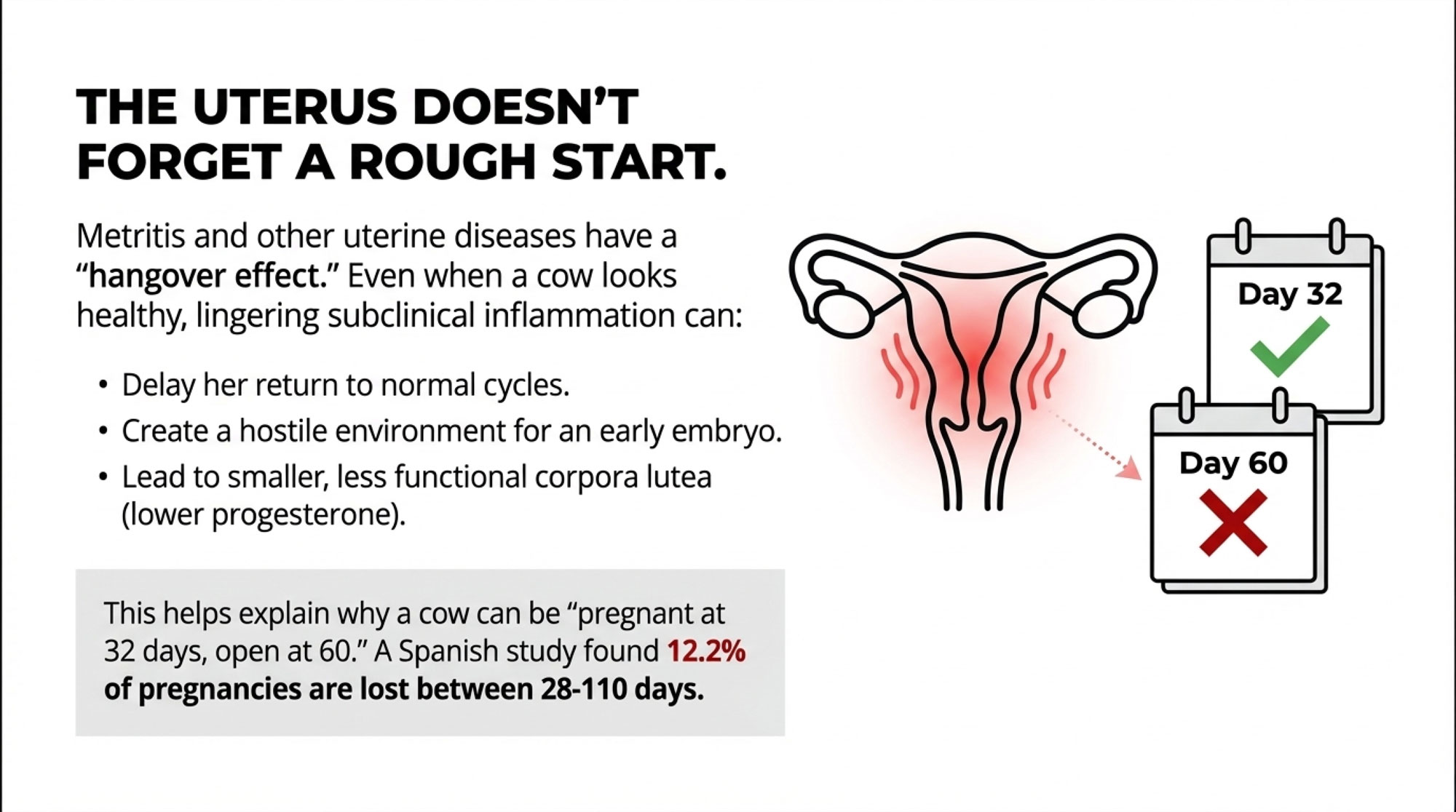
But research and field experience say the uterus remembers that rough start longer than we’d like. A Hoard’s Dairyman article that drew on transition cow research described a “hangover effect” of uterine disease—cows that had metritis or retained fetal membranes early on often had slower uterine involution or subclinical inflammation later, even when they looked normal from a distance. That lingering inflammation can delay the return to normal cycles and make it harder for early pregnancies to survive.

The 2023 Double‑Ovsynch study we started with backs up what a lot of vets see in practice. Cows that had transition health events—retained fetal membranes, metritis, mastitis, ketosis, left displaced abomasum—in the first 30 DIM had lower pregnancy per AI and more pregnancies lost between 32 and 60 days, across first‑, second‑, and older‑lactation cows, despite a very standardized repro program.

Transition Health StatusPregnancy/AI at 32dPregnancy Loss by 60dNet Impact
Healthy (no disease)42.3%8.2%Baseline
Metritis36.1%11.8%-6.2% P/AI, +3.6% loss
Retained placenta37.4%10.9%-4.9% P/AI, +2.7% loss
Ketosis (clinical)34.8%12.4%-7.5% P/AI, +4.2% loss
Displaced abomasum31.2%14.1%-11.1% P/AI, +5.9% loss
Mastitis (0-30 DIM)38.9%9.7%-3.4% P/AI, +1.5% loss

On top of that, work on postpartum inflammatory conditions has shown that cows dealing with disease during this period can develop smaller or less functional corpora lutea and produce less progesterone, which is not the kind of environment a young embryo wants to live in.

A large retrospective study in intensive Holstein herds in Spain estimated that about 12.2% of pregnancies were lost between 28 and 110 days of gestation. Put that next to the transition‑health and hormone data, and it’s not hard to see how a cow can be “pregnant at 32 days, open at 60,” without anything obvious happening in between.

So, between eggs that were built in a high‑NEFA, high‑BHBA environment and a uterus that may still be recovering from a transition “hangover,” biology keeps pointing back to what happens in those first 30 days fresh.

The Big Dollars: Metritis, SCK, and the Quiet Six‑Figure Drag

The biology matters, but at the end of the month, you’re still staring at a milk cheque, a vet bill, and a loan statement. So let’s put some realistic dollars to these transition issues.

Metritis: A US$511 Per‑Cow Problem

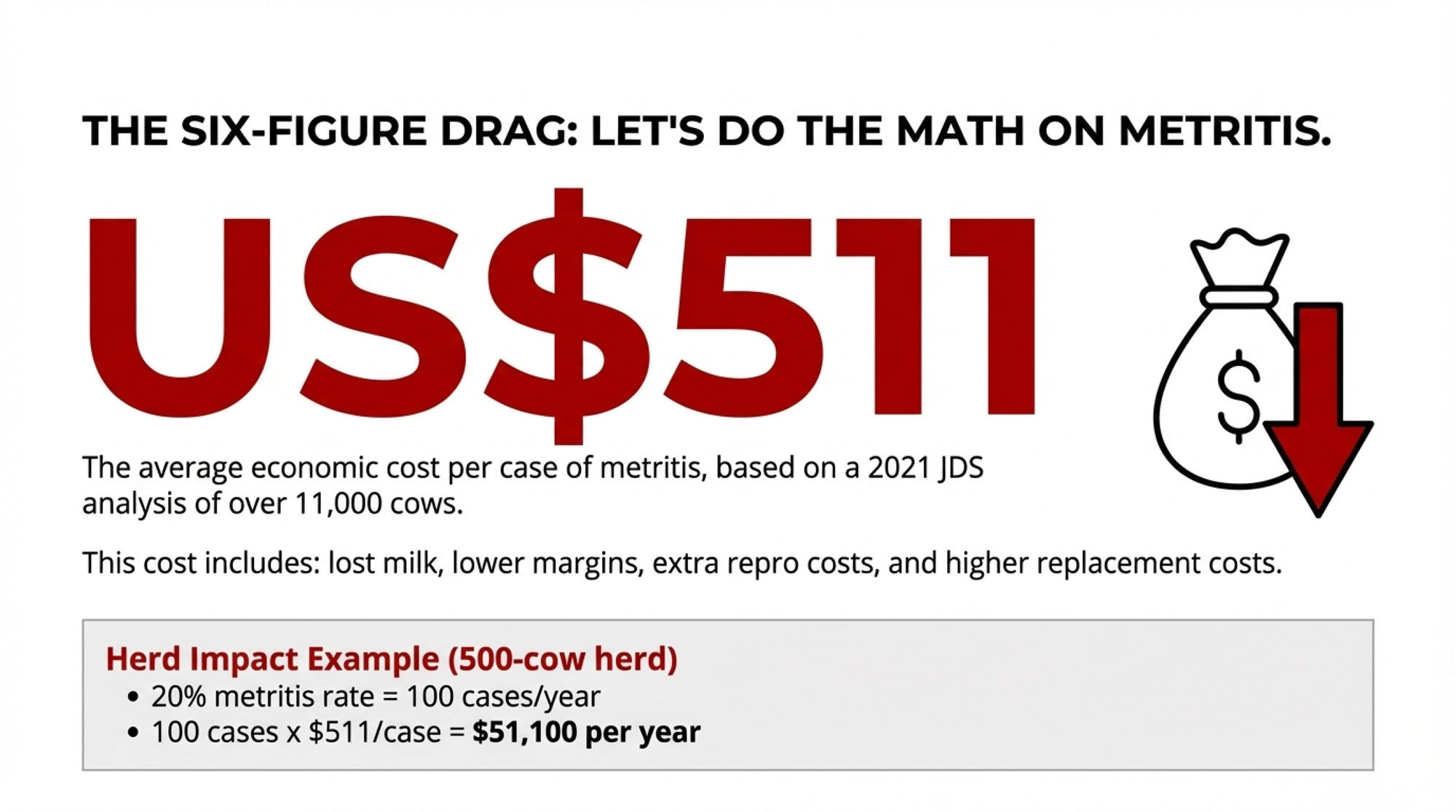
A 2021 paper in the Journal of Dairy Science analyzed 11,733 cows in 16 herds across four U.S. regions and estimated the full economic cost of metritis. Using farm records and simulation, the authors found:

  • Mean cost per case: US$511
  • Median: US$398
  • Simulated mean: US$513, with 95% of scenarios between roughly US$240 and US$884

Those dollars include lost 305‑day milk, lower gross margin per cow, extra reproductive costs, and higher replacement costs because affected cows left the herd sooner. Hoard’s Dairyman, using herd‑level modeling on a large U.S. dairy, landed on metritis costs in the mid‑US$300 range for that specific scenario, which falls within the general range and shows how market conditions and farm structure can tweak the final number.

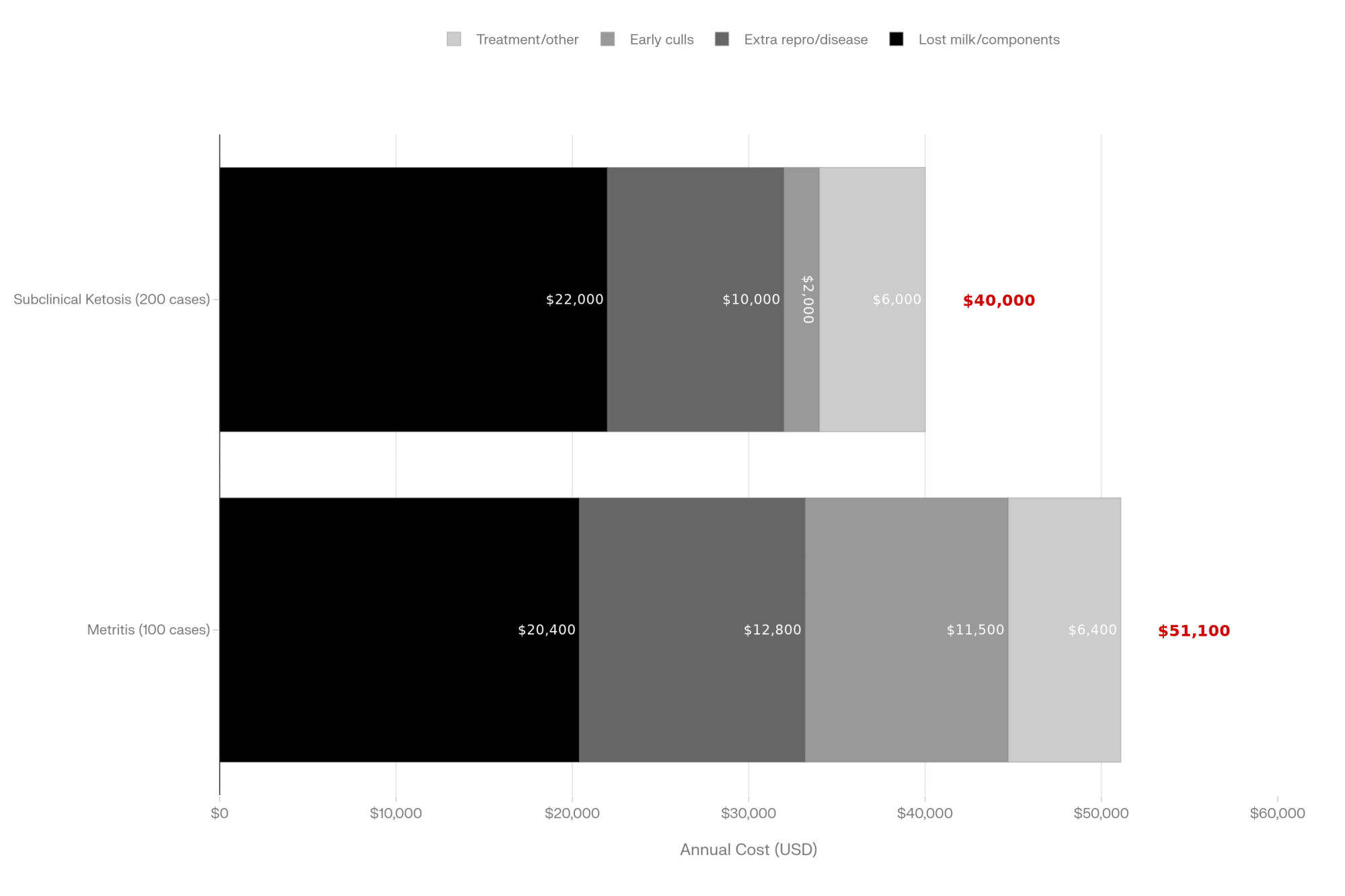
Now take a 500‑cow herd with a 20% metritis rate among fresh cows—a number that wouldn’t shock many vets in freestall herds. That’s roughly 100 cases of metritis per year. At US$511 per case, you’re into about US$51,000 in metritis‑related costs per year. That’s not just one bad month; that’s a steady leak.

Those costs don’t just sit in the “vet” column, either. A sizable chunk of that US$511 is hidden in longer days open, more services per pregnancy, lower milk, and cows that drift out of the herd earlier than they should.

Subclinical Ketosis: Common, Quiet, Costly

Subclinical ketosis doesn’t show up like a twisted stomach or a downer cow, but it quietly hits a lot more animals.

In McArt’s four‑herd study, 43.2% of cows hit SCK—BHBA ≥1.2 mmol/L—at least once between 3 and 16 DIM. In the 10‑country data set, the median herd‑level SCK prevalence was 21.8% between 2 and 15 DIM at the same cut point, with a broad range across herds. Cows with high BHBA were more likely to develop displaced abomasum, clinical ketosis, and metritis, and were more likely to leave the herd earlier.

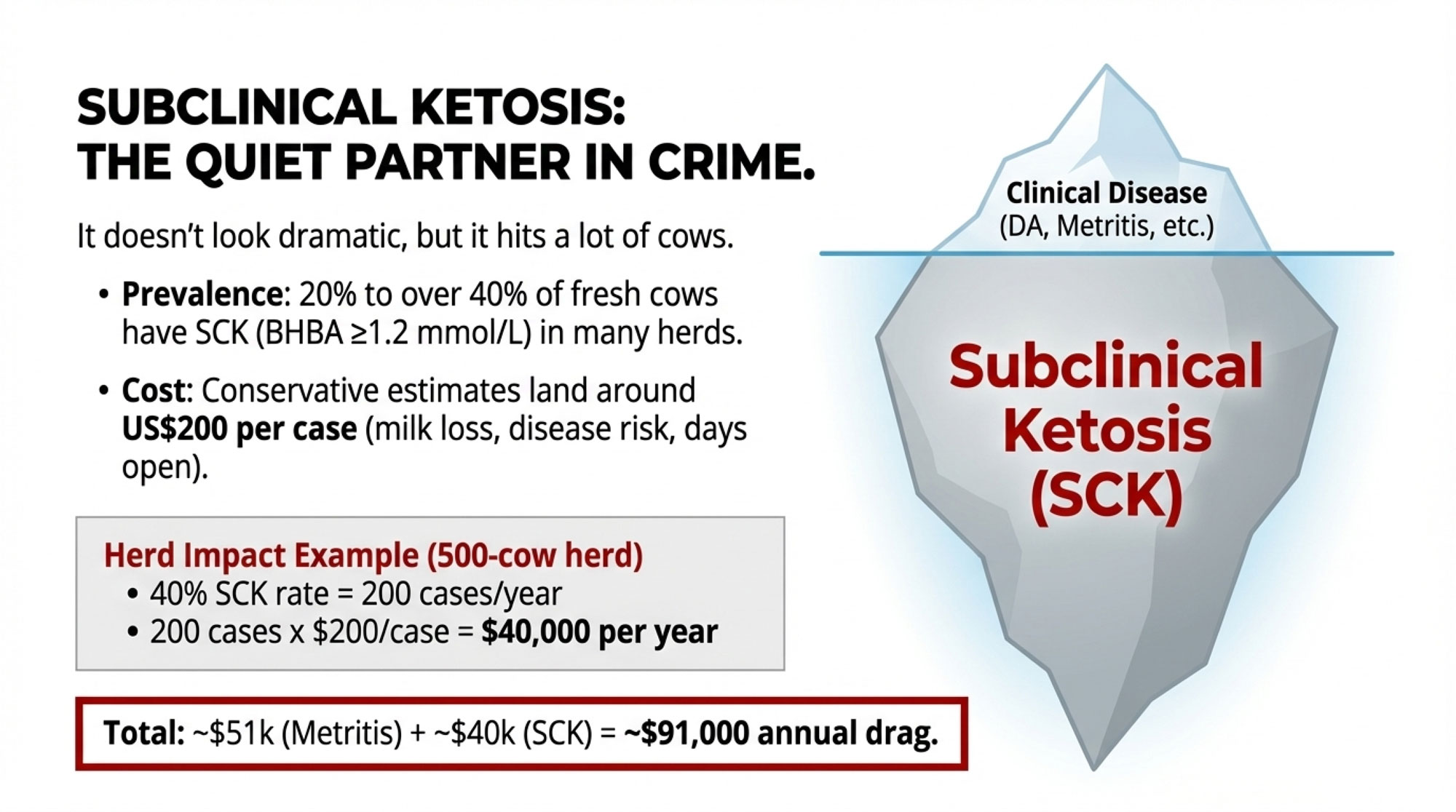
The Subclinical Ketosis Reality: Between 1 in 5 and nearly half of fresh cows run dangerously high ketones. Cornell’s four-herd study found 43.2% SCK prevalence, while even the 10-country median (21.8%) sits well above the 15% risk threshold where reproductive and health problems accelerate

Economic analyses that bundle milk loss, disease risk, extra days open, and culling generally land in the low‑to‑mid hundreds of dollars per SCK case. The exact number depends on milk prices, feed costs, and replacement values, but it’s not pocket change.

So if around 40% of a 500‑cow herd—about 200 cows—experience SCK in early lactation, even a conservative estimate of US$200 per case means you’re looking at about US$40,000 per year in lost opportunity tied to SCK alone. When you stack that next to the metritis math, it’s easy to see how transition disease can quietly push the total into serious money for a 500‑cow operation.

The Hidden $90,000 Drain: How Transition Disease Costs Stack Up in a 500-Cow Herd. Metritis and subclinical ketosis together strip over $91,000 annually from a typical herd—with most costs hidden in lost milk, reproduction failures, and early culls rather than visible vet bills 

In Canadian quota systems, there’s another angle. Canadian Dairy Commission figures show that average butterfat tests on Canadian farms have been creeping up—around 4.3% in 2024—helping reduce structural surplus and improve returns per litre. When fresh cows crash, both milk yield and butterfat performance in early lactation tend to suffer. That means quota isn’t being used as efficiently, and you may be under‑delivering butterfat against the quota you paid a lot of money for. Dairy Global has reported that producers in Eastern Canada continue to battle for relatively small amounts of new quota at high butterfat prices per kilogram, reinforcing how valuable every kilogram of component really is. A fresh cow crash is a component crash—and in a quota system, components are your currency.

So these early diseases aren’t just a health story; they’re a transition‑to‑cheque story.

What Farmers Are Finding: NEFA, BHBA, and That Post‑Calving Crash

So how do you tell whether NEB and transition problems are really a big driver on your farm, beyond the feeling that you’re treating too many fresh cows?

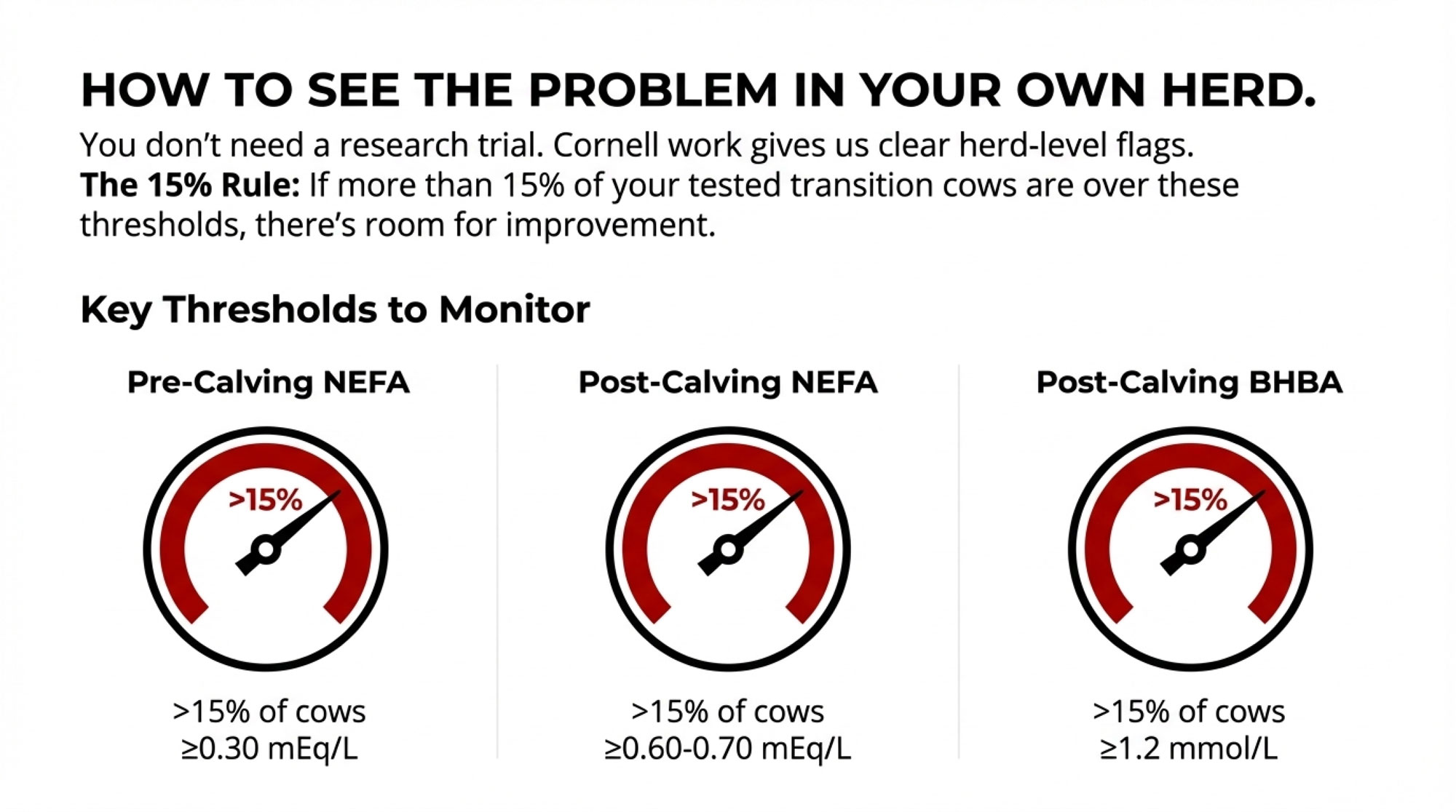
Cornell work has given us some very practical markers. In a series of projects summarized by Tom Overton, PhD (Cornell University), and detailed in work by Ospina and colleagues, three key thresholds emerged when predicting disease and performance:

  • Pre‑calving NEFA: When more than about 15% of close‑up cows tested ≥0.30 mEq/L NEFA in the week before calving, the herd saw a higher risk of displaced abomasum, retained placenta, metritis, and poorer reproduction after calving.
  • Post‑calving NEFA: When more than about 15% of fresh cows had NEFA ≥0.60–0.70 mEq/L in the first two weeks after calving, early‑lactation disease risks and performance losses increased.
  • Post‑calving BHBA: When more than about 15% of cows had BHBA ≥10–12 mg/dL (≈1.0–1.2 mmol/L) in the first couple of weeks, the herd had more DAs, clinical disease, and lower 305‑day mature‑equivalent milk.

Overton and others have translated this into a simple herd‑level rule of thumb: if more than 15% of sampled cows are over those NEFA or BHBA thresholds, there’s likely “room for improvement” in transition energy balance and management.

So, a practical way to use NEFA/BHBA looks like this:

  • A few times a year, pull blood on 12–15 close‑up cows and 12–15 fresh cows with your vet.
  • See what percentage of each group is over those 0.30 / 0.60–0.70 NEFA levels and ~1.0–1.2 mmol/L BHBA equivalents.
  • If that percentage is under about 15%, you’re probably in decent shape. If it’s above 15–20% consistently, it’s a strong signal your transition program is leaving money and pregnancies on the table.

You don’t have to turn your herd into a research trial. A small, well‑chosen sample, taken a few times a year, gives you a pretty honest “weather report” on how tough that transition window really is for your cows.

What Farmers Are Doing: Three Management Levers That Actually Move the Needle

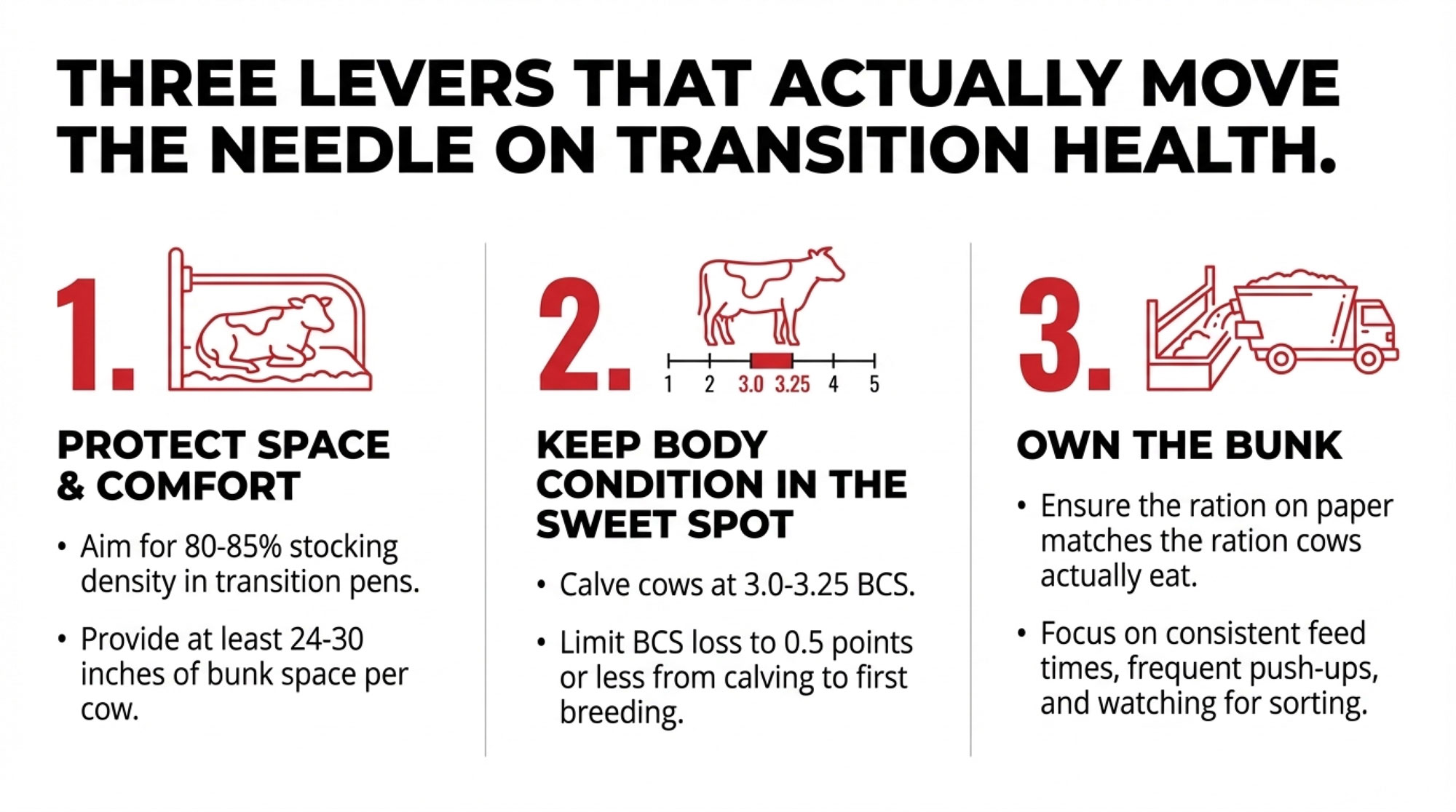
So, where are the herds that are doing well on this 90‑day connection, actually putting their time and money? Across extension meetings, Dairyland Initiative resources, and producer discussions, three levers keep coming up.

1. Protecting Space and Comfort in Transition Pens

Looking at this trend across herds, the first word that comes up is space. The University of Wisconsin’s Dairyland Initiative has been very clear: overstocking freestall pens increases competition at the bunk, reduces lying time, keeps cows on concrete longer, and leads to more lameness and lower milk yield. Those effects are especially problematic in close‑up and fresh pens.

Their recommendations—and those of other researchers—generally look like this:

  • Aim for about 80–85% stocking density in close‑up and fresh pens, not 100–120%.
  • Give at least 24–30 inches of bunk space per cow in these pens to reduce bunk competition.

Penn State Extension has also emphasized that overstocking at the bunk raises risk for SCK, displaced abomasum, and hypocalcemia because lower‑ranking cows end up eating less of the intended ration and at less‑ideal times.

In Wisconsin freestall herds, I’ve noticed that when producers finally protect those transition groups—sometimes at the cost of a tighter late‑lactation pen—fresh cow problems start to ease. Fewer DAs, fewer metritis cases, fewer slow‑starting cows. In Western dry lot systems in California or Idaho, the details change—shade, mud, and feedlane design matter more than stalls—but the principle is the same: if transition cows can’t eat and rest without fighting for it, you’ll pay for it in the breeding pen.

2. Keeping Body Condition in the Sweet Spot

Body condition management isn’t new, but the research has sharpened the targets.

The high fertility cycle paper and postpartum BCS studies suggest that Holsteins do best for health and fertility when they calve around 3.0–3.25 on a 5‑point scale. Cows calving at 3.5 or higher have a higher risk of metabolic problems—SCK, DA, metritis—and more reproductive trouble. On top of that, cows that lose more than about 0.5 BCS points between calving and first breeding tend to have poorer reproductive performance than cows that hold condition or lose only a little.

So a realistic set of targets looks something like:

  • Calve the bulk of the herd at 3.0–3.25 BCS.
  • Keep BCS loss from calving to first breeding to 0.5 points or less whenever possible.

In a lot of Midwest freestall herds, the big improvements came not from exotic feed additives but from tightening late‑lactation diets, grouping over‑conditioned cows more thoughtfully, and making sure transition rations support steady intakes before and after calving.

In Canadian quota herds, it has a direct butterfat angle as well. When fresh cows calve too heavy and crash in condition, you often see depressed butterfat performance right when you’re trying to maximize component yield against quota, this is critical to improving farm margins in a supply‑managed environment.

3. Making Sure the Ration on Paper Matches the Ration at the Bunk

The third lever is deceptively simple: cows don’t eat the ration in the nutritionist’s software, they eat what’s in front of them.

Penn State and other extension teams keep coming back to a few basics that are easy to slip on when days get long:

  • Feed at consistent times so cows know when to expect feed.
  • Push up often enough that there’s always feed in reach, especially for timid cows.
  • Watch refusals and particle size so you catch sorting before it becomes a habit.

Overstocking the feed bunk makes all three much harder, and that’s a big reason why crowded transition pens and higher SCK/DA/metritis risk so often travel together.

In the herds that really excel at fresh cow management, someone clearly “owns the bunk.” That person is watching how the ration looks in the wagon, how it looks in front of the cows, how cows are eating it, and how much is left—and they’re talking regularly with the feeder and nutritionist about what they see.

What I’ve noticed is that when this bunk piece is tight, you feel it everywhere: smoother fresh cow management, more consistent butterfat performance, fewer surprise DAs, and fewer cows that arrive at first service already behind.

Simple Data Tools That Make the 90‑Day Connection Visible

You don’t need a new monitoring system or a consultant parked at your farm to start connecting transition and reproduction. Three data points most herds already have—or can get easily—can take you a long way: early fat‑to‑protein ratio, peak milk patterns, and early cull rates.

Fat‑to‑Protein Ratio: A Metabolic Weather Report

A 2021 paper revisiting the link between fat‑to‑protein ratio (F:P) and energy balance found that early‑lactation F:P ratios of 1.5 or higher tended to reflect deeper negative energy balance—more body weight loss, higher NEFA, and more metabolic strain. That’s consistent with what a lot of nutritionists already treat as a warning sign.

So, practically:

  • If only a small slice of early‑lactation cows have an F:P ≥1.5 on the first test after calving, you’re likely okay.
  • If 20% or more of those cows have F:P ≥1.5 on that first test, it’s a good reason to dig into energy balance and SCK risk.

It won’t diagnose the problem for you, but it tells you there’s likely a problem to solve.

Peak Milk Curves: How Fast and How High

In well‑managed Holstein herds on TMR, mature cows often peak around 60–75 DIM, depending on genetics and ration strategy. When transition disease is common, those peaks tend to be lower and show up later in lactation.

Several studies and field analyses have shown that cows with clean transitions tend to have faster‑rising, higher peaks, while cows that battled SCK, metritis, or DA have flatter, delayed peaks and lower overall production. If your software will let you, plotting separate curves for “healthy through 30 DIM” cows and “at least one transition disease” cows can be an eye‑opening exercise in a herd meeting. In many herds, seeing those two curves side‑by‑side does more to justify investing in transition than any lecture.

Early‑Lactation Culls: When Do Cows Leave?

Most herds track the total cull rate. Fewer herds break out 0–60 DIM removals in a way that gets discussed regularly.

Disease‑costing and herd analyses repeatedly show that early culls are among the most expensive, because you’ve carried that cow through a previous lactation and the dry period and then gotten very little milk out of the current one. Herds with strong transition programs often keep early removals in the low single digits as a percentage of calvings, while herds where transition disease is a bigger issue can see early culls drift into double‑digit percentages.

Once you start tagging early culls with clear reasons and comparing them against fresh cow records and BHBA/NEFA test results, a pattern usually emerges: many of those cows never really recovered from the transition period. It’s a tough conversation, but it’s one of the most useful ones you can have.

What Farmers Are Doing: A BHBA Routine That Fits Real Herds

Subclinical ketosis is one of those areas where a simple routine can give you a lot of control without turning your farm into a research station.

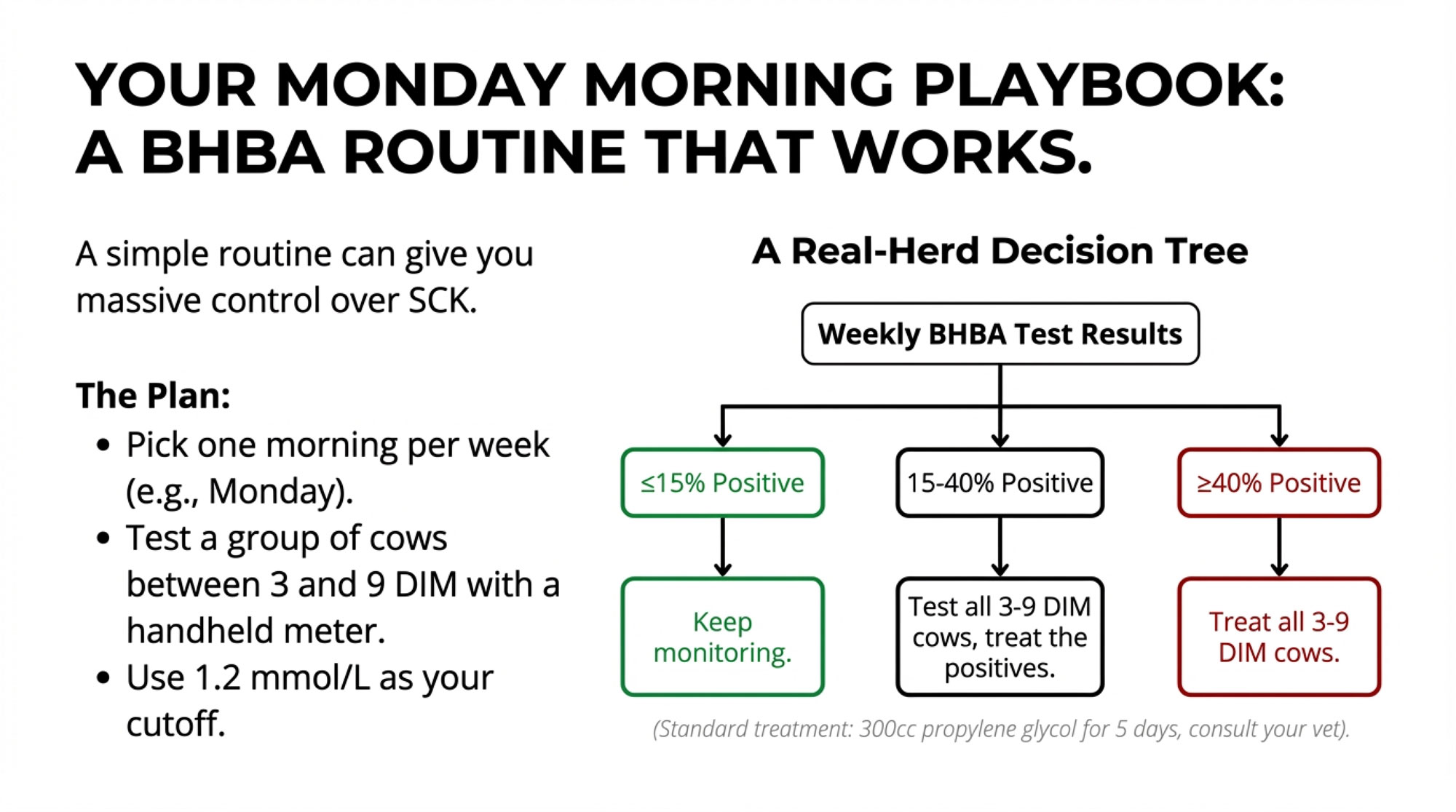
Building on McArt’s SCK work and field protocols shared by practitioners like Jerry Gaska, DVM (Wisconsin), the routine many herds are adopting looks like this:

  • Pick one or two mornings each week.
  • On those days, test a group of cows between 3 and 9 DIM using a validated handheld BHBA meter.
  • Use 1.2 mmol/L as the cutoff for subclinical ketosis—the same line used in Cornell’s epidemiology work and in many extension programs.

Gaska described a Wisconsin farm where they treat their BHBA results like a herd‑level dashboard:

  • If ≤15% of tested cows are at or above 1.2 mmol/L, they just keep monitoring.
  • If 15–40% are positive, they test all cows 3–9 DIM and treat the positives.
  • If ≥40% are positive, they treat every fresh cow in that DIM range.
The Monday-Morning BHBA Dashboard: Turn your weekly testing into a transition health report card. When more than 15% of fresh cows test above 1.2 mmol/L BHBA, Cornell research shows you’ll see more disease, lower milk, and weaker reproduction 60 days later. This simple metric predicts your pregnancy rate before you ever pull the breeding gun

Their standard treatment is 300 cc of propylene glycol once daily for 5 days, which is consistent with recommendations from many vets and extension resources. The goal isn’t to drive SCK to zero—it’s to keep the percentage reasonable and to use that weekly number as an early warning system for when transition is slipping.

If you imagine a 500‑cow herd trimming SCK prevalence from 40% down toward 20% over a season or two, using this type of monitoring and better transition management, and you assume each SCK case costs in the low hundreds of dollars, the potential savings add up quickly. And what farmers are finding is that when that BHBA dashboard number improves, DA numbers, metritis cases, and repro results tend to look better a few months later.

What Farmers Are Finding: Letting Transition Health Steer Semen Use

Now let’s talk about where this transition health story meets some of the hottest decisions on many farms: how to use sexed dairy semen, conventional semen, and beef‑on‑dairy.

Beef‑on‑dairy has moved from “interesting idea” to everyday practice on a lot of operations. Industry reporting and national evaluation data show more herds using sexed dairy semen on a limited top tier and beef semen on lower‑priority cows to capture calf value. At the same time, reproduction leaders like Paul Fricke, PhD (University of Wisconsin–Madison), have been talking about a “reproduction revolution” centered on precision timed‑AI, early pregnancy diagnosis, and targeted use of sexed and beef semen.

What’s encouraging is that more producers are folding transition health into that conversation, not just parity and genetic index.

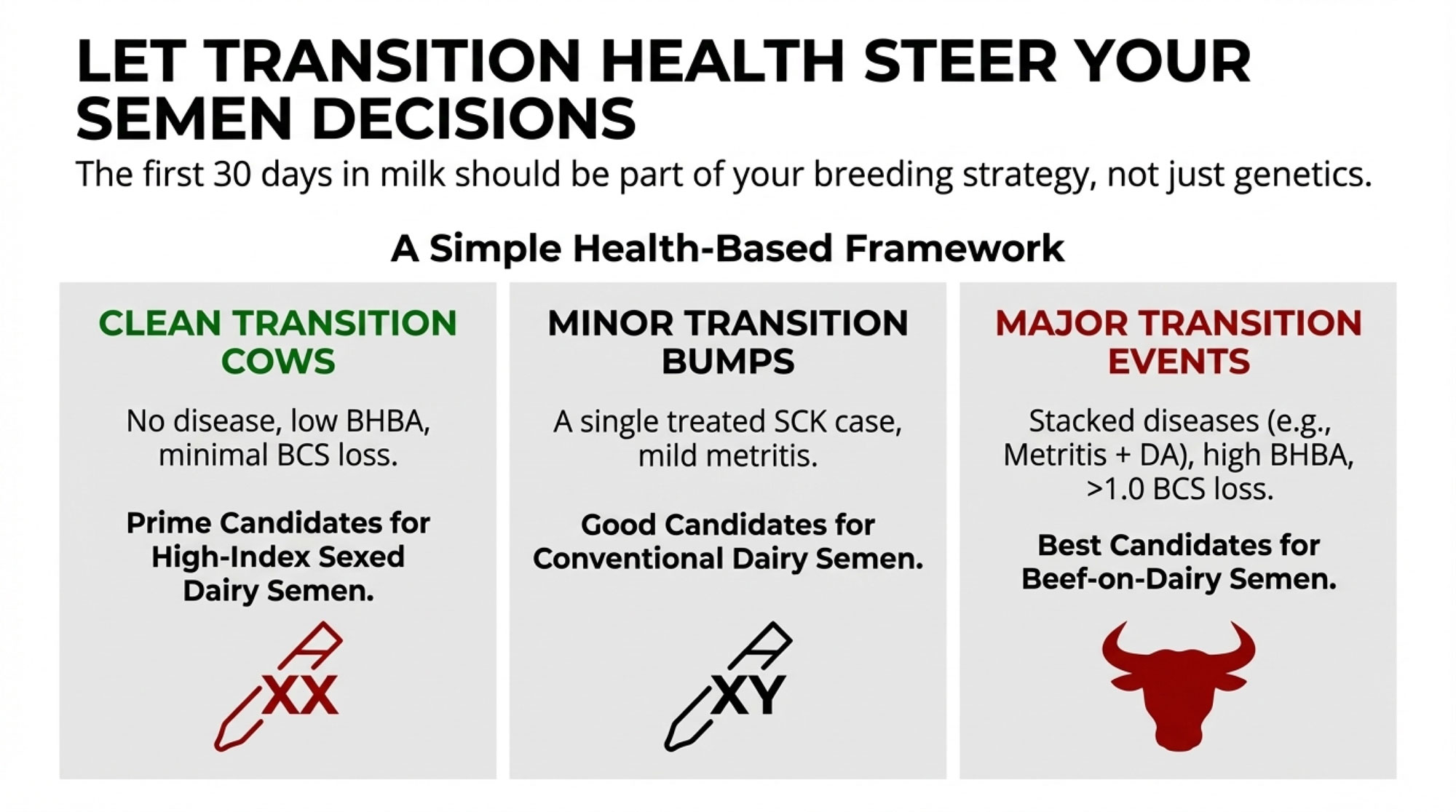
A Simple Health‑Based Semen Strategy You Can Actually Use

Here’s one way to structure it that fits real herds:

1. Clean Transition Cows

These cows:

  • Had no recorded transition disease in the first 30 DIM (no milk fever, metritis, DA, clinical ketosis, retained fetal membranes).
  • Stayed below 1.2 mmol/L BHBA on any early‑lactation testing, if you test.
  • Lost 0.5 BCS points or less from calving to first breeding.
  • Showed a first‑test F:P ratio comfortably under 1.5.

They’re prime candidates for high‑index sexed dairy semen, especially if their genetic merit fits your replacement goals. That’s where you want to invest in future daughters.

2. Minor Transition Bumps

These cows might have:

  • A single BHBA reading just over 1.2 mmol/L that responded to propylene glycol.
  • A mild metritis case that resolved quickly.
  • Slightly more BCS loss than ideal, but nothing dramatic.

They’re often solid cows, just not quite in the “best bets” class. Many herds here lean toward conventional dairy semen, reserving sexed semen for cows that are both genetically strong and biologically set up for success.

3. Major Transition Events

These cows tend to be the ones that:

  • Had metritis and a DA or stacked multiple transition diseases.
  • Showed consistently high BHBA readings or obvious SCK that lingered.
  • Dropped more than a full BCS point between calving and breeding.

A growing number of herds put these cows in the beef‑on‑dairy or “do not breed” category, depending on age, production, and pregnancy status. In Western dry lot systems where beef‑cross calves often have a ready market and good value, managers talk about this as a way to turn a cow with higher reproductive risk into a short‑term calf revenue opportunity instead of betting your future replacements on her.

In Canadian quota herds, where quota additions can be limited and expensive, many producers are using a similar idea: they focus sexed dairy semen on cows that are most likely to be long‑term, high‑component producers under their system, and use beef on cows where the odds of a trouble‑free, high‑butterfat lifetime are lower.

The big shift is that the first 30 days in milk are now part of the semen decision, not just age, production, or genomic index. That’s a very “2020s” way of thinking about reproduction that lines up biology, genetics, and cash flow.

Transition Health TierHealth Markers (0-30 DIM)Semen StrategyWhy This WorksExpected Outcome
Tier 1: Clean Transition– No disease events
– BHBA <1.2 mmol/L
– BCS loss ≤0.5 points
– F:P <1.5
High-index sexed dairy semenHealthy metabolism during follicle development; strong oocyte quality; optimal uterine environmentHigh P/AI (40%+); low preg loss; valuable replacement heifers
Tier 2: Minor Bumps– Single mild SCK event (responded to treatment)
– Mild metritis (quick resolution)
– BCS loss 0.5-0.75 points
Conventional dairy semenModerate metabolic challenge; good recovery; acceptable but not optimal fertilityModerate P/AI (30-38%); acceptable preg loss; solid replacements
Tier 3: Major Events– Metritis + DA
– Multiple disease events
– Persistent high BHBA
– BCS loss >1.0 point
Beef-on-dairy or Do Not BreedSevere metabolic/uterine damage; compromised oocyte quality; high preg loss risk; poor lifetime potentialCapture calf value; avoid wasting high-value dairy genetics on low-fertility cow

Nuances That Matter: Heifers, Pregnancy Loss, and Seasonal Herds

There are a few wrinkles worth mentioning, because not every group of cows—or every system—behaves the same.

One nuance that came out of the Cornell NEFA/BHBA work, and was highlighted in Hoard’s Dairyman, is that heifers and older cows don’t always show the same performance patterns at similar NEFA and BHBA levels. In those data, heifers with higher postpartum NEFA (≥0.60 mEq/L) and BHBA (≥9 mg/dL) sometimes produced more milk than heifers with lower levels, while multiparous cows with NEFA ≥0.70 mEq/L and BHBA ≥10 mg/dL produced less and had more disease. That doesn’t mean high ketones are ever “good,” but it does suggest that if time and budget are tight, focusing your most intensive monitoring on older cows may give you more bang for your buck.

On pregnancy loss, the Spanish Holstein work put numbers around something many of us feel: about 12.2% of pregnancies were lost between 28 and 110 days of gestation in intensive systems. Articles in Hoard’s Dairyman and Dairy Global have described pregnancy loss as a major ongoing puzzle in modern dairies, with uterine health and metabolic stress as key suspects. That’s one more reminder that “pregnant at 32 days” isn’t mission accomplished if the transition period was rough.

Seasonal and block‑calving herds—whether in New Zealand, Ireland, or pasture‑based pockets of North America—live and die by this 90‑day connection even more. Research on grazing herds with different fertility breeding values has shown that cows with better transition metabolism and shorter postpartum anestrus intervals are far more likely to conceive in the first 3–6 weeks of mating, which pushes up six‑week in‑calf rates and tightens the calving spread. When transition management has holes, those herds feel it almost immediately in more late‑calvers and a stretched season. When they improve energy balance, BCS management, and fresh cow monitoring, many see their fertility and calving patterns tighten within a couple of seasons.

The biology doesn’t care if you’re on pasture or TMR, quota or open market—the transition pen is still writing a big chunk of the repro story.

Bringing It Home: Benchmarks and Monday‑Morning Moves

If you’re thinking, “This all makes sense, but where do we start without turning the place upside‑down?”, here are some concrete benchmarks and a realistic plan.

Benchmarks to Check Your Own Herd Against

From the work and examples we’ve talked about, here are some practical “sanity check” targets:

  • BHBA in early lactation:
    If more than 15–20% of sampled cows 3–16 DIM test at or above 1.2 mmol/L, your transition energy balance likely needs work.
  • NEFA pre‑ and postpartum:
    If more than about 15% of close‑up cows have NEFA ≥0.30 mEq/L, or more than 15% of early‑lactation cows have NEFA ≥0.60–0.70 mEq/L postpartum, you’re in a higher‑risk zone for disease and weaker repro.
  • Body condition:
    Calving most Holsteins with BCS 3.0–3.25 and keeping BCS loss from calving to first breeding at ≤0.5 pointssupports better health and fertility.
  • Fat‑to‑protein ratio:
    If roughly 20% or more of early‑lactation cows have an F:P ≥1.5 on their first test after calving, it’s a good sign you should dig into energy balance and SCK.
  • 0–60 DIM culls:
    If early‑lactation culls are creeping into double‑digit percentages of calvings, transition disease is almost certainly playing a major role.

You don’t have to fix every metric at once. The power is in watching them over time and seeing whether changes in your transition program move those numbers in the right direction.

MetricTarget (Green Zone)Acceptable (Yellow Zone)Fix This Now (Red Zone)
BHBA Prevalence (3-16 DIM, ≥1.2 mmol/L)<15% of tested cows15-20% of tested cows>20% of tested cows
Postpartum NEFA (0-14 DIM, ≥0.60 mEq/L)<15% of tested cows15-20% of tested cows>20% of tested cows
Calving BCS & LossCalve at 3.0-3.25; lose ≤0.5 points to 1st breedingCalve at 3.25-3.5; lose 0.5-0.75 pointsCalve at >3.5 or lose >0.75 points
Fat-to-Protein Ratio (1st test postpartum)<20% of cows with F:P ≥1.520-30% of cows with F:P ≥1.5>30% of cows with F:P ≥1.5
Transition Pen Stocking(close-up & fresh)75-85% stocking; 24-30″ bunk/cow85-95% stocking; 22-24″ bunk/cow>95% stocking or <22″ bunk/cow
Early Culls (0-60 DIM)<5% of calvings5-8% of calvings>8% of calvings

A Realistic Plan for the Next Six Months

If you want to put this 90‑day lens to work without overwhelming the team, a simple roadmap could look like this:

  1. Start a BHBA Snapshot.
    Once or twice a week, test a small group of cows 3–9 DIM (maybe 6–8 cows in a 100‑cow herd, 10–15 in a 500‑cow herd) using a handheld meter. Track the percentage at or above 1.2 mmol/L, treat positives with a propylene glycol protocol that your vet is comfortable with, and write that weekly percentage where everyone can see it.
  2. Walk Your Transition Pens with a Tape Measure.
    Count stalls, count cows, and measure bunk space in your close‑up and fresh pens. If you’re regularly at or above 100% stocking or bunk space is under 24 inches per cow, sit down with your nutritionist and vet to talk through options for regrouping, overflow pens, or small facility tweaks that protect those high‑risk groups.
  3. Bring Transition Health Into the Semen Discussion.
    At your next breeding strategy meeting, take along a simple list of fresh cow diseases and BHBA results by cow, plus BCS scores on cows coming up for first service. Sort cows into “clean,” “minor bump,” and “rough transition,” and make deliberate decisions about where sexed dairy semen, conventional semen, and beef‑on‑dairy semen really belong.

The Bottom Line

If there’s one big idea to tuck in your pocket, it’s this: your pregnancy rate isn’t just a breeding‑pen number. It’s a delayed grade on your fresh cow management. The more we treat those first 30 days in milk as the front end of our repro program, not a separate chapter, the more room we give ourselves to improve both the biology and the bottom line.

What’s encouraging is that you don’t need a brand‑new barn or a shiny gadget to get started. Same cows, same buildings, same people—just looked at through a 90‑day lens that connects what happens in the transition pen to what shows up at preg check and, ultimately, on your milk statement. 

Key Takeaways:

  • Pregnancy rate is really a 90‑day transition report card. Cows with metritis, SCK, or DA in the first 30 DIM have lower pregnancy per AI and more pregnancy loss—even on excellent timed‑AI programs. ​
  • The math adds up fast. Metritis costs about US$511/case; SCK hits 20–40% of fresh cows. Together, they can quietly drain around US$90,000 a year from a 500‑cow herd. ​
  • Simple flags make it visible. BHBA ≥1.2 mmol/L in >15–20% of fresh cows, F:P ≥1.5 in >20% on first test, or 0–60 DIM culls in double digits all signal transition trouble. ​
  • Three levers matter most. Protect stocking (80–85%) and bunk space (24–30″) in transition pens; calve cows at BCS 3.0–3.25 and limit loss to ≤0.5 points; make sure the ration at the bunk matches the ration on paper. ​
  • Use transition health to guide semen decisions. Clean‑transition cows are prime for sexed dairy semen; cows with rough transitions often belong in the beef‑on‑dairy column.

Complete references and supporting documentation are available upon request by contacting the editorial team at editor@thebullvine.com.

Learn More

Join the Revolution!

Join over 30,000 successful dairy professionals who rely on Bullvine Weekly for their competitive edge. Delivered directly to your inbox each week, our exclusive industry insights help you make smarter decisions while saving precious hours every week. Never miss critical updates on milk production trends, breakthrough technologies, and profit-boosting strategies that top producers are already implementing. Subscribe now to transform your dairy operation’s efficiency and profitability—your future success is just one click away.
NewsSubscribe
First
Last
Consent

Hackers in the Milk House: Ransomware Is Now a Fresh Cow Problem

The hacker never entered his barn. Never touched a cow. But when ransomware encrypted his robot’s health data, a pregnant cow’s distress went invisible. She died. Cyber risk just hit the transition pen.

Executive Summary: A hacker never touched his cows—but a pregnant one died anyway. When ransomware encrypted a Swiss dairy farmer’s robotic milking system in 2024, the health data that could have flagged her distress went dark. By the time anyone noticed, she and her calf were gone. This is dairy’s new vulnerability: ransomware attacks on agriculture doubled in early 2025, now comprising 53% of cyber threats targeting the food industry. As digital tools increasingly drive fresh cow management, disease detection, and breeding decisions, cyber risk has become a transition pen issue—not just an IT problem. The encouraging news? Protecting your herd doesn’t require an IT department. Here’s a practical six-step framework, the questions to ask your technology partners, and what cooperatives and Congress are doing to help.

You know, a decade ago, the riskiest “system crash” on most dairies was a parlor vacuum pump going down right in the middle of milking. Today—and this has taken a lot of us by surprise—a growing number of those failure points live in software, routers, and cloud accounts.

Here’s what brought this home for me. Back in 2024, a Swiss dairy farmer named Vital Bircher had his robotic milking system encrypted by hackers. They demanded about $10,000 in ransom. The physical robots kept milking—teat cups attaching, vacuums cycling normally—but he suddenly lost access to all the data that actually helps you manage cows. The health alerts, the conductivity readings, the reproduction flags. Without that information, a pregnant cow’s condition deteriorated before anyone caught it. Both she and her calf were lost. CSO Online and several European outlets covered the story, and it’s stuck with me ever since.

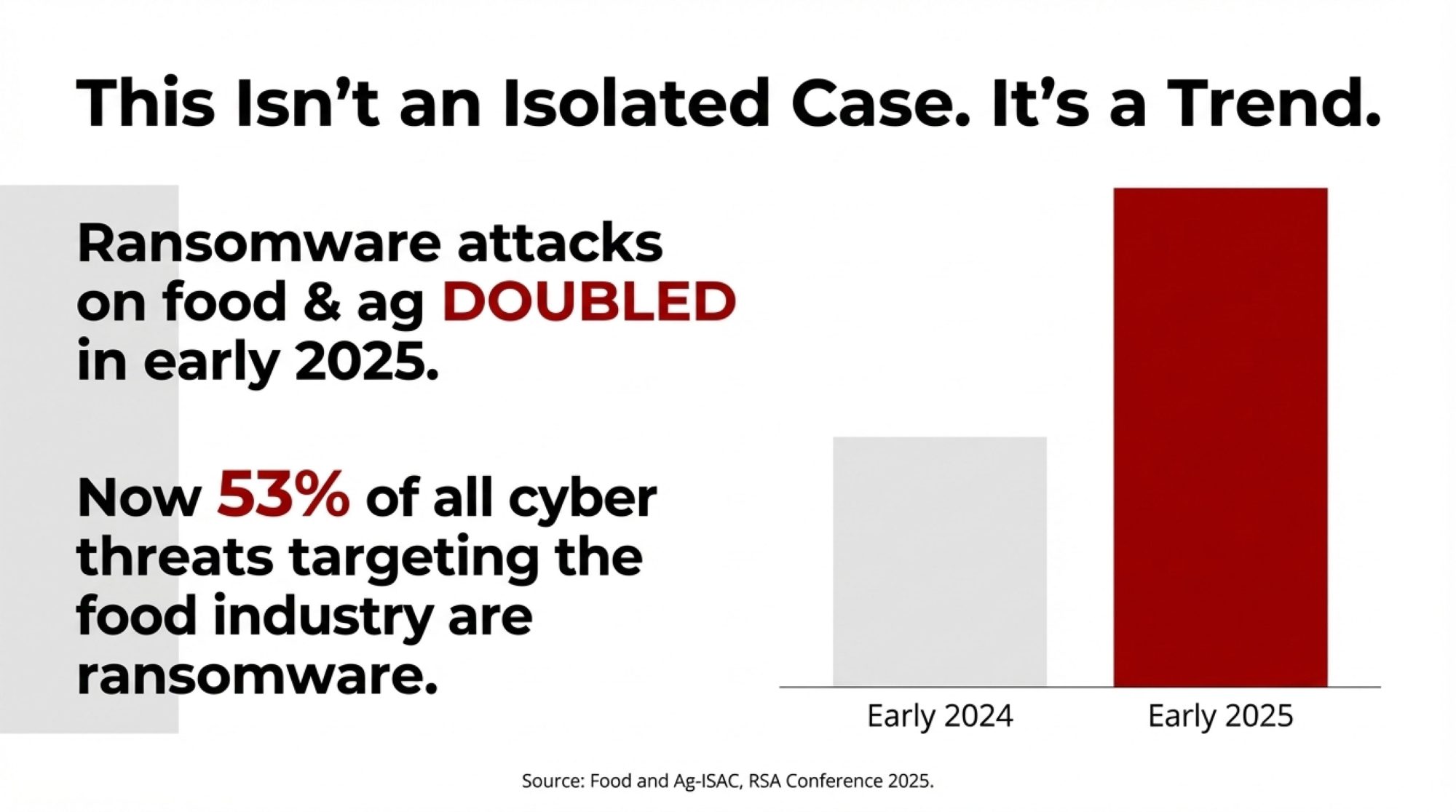
What’s sobering is that this isn’t an isolated incident. Jonathan Braley, director of the Food and Ag-ISAC, reported that ransomware attacks on food and agriculture more than doubled in early 2025 compared to the same period last year—84 incidents in just the first quarter. He presented those findings at the RSA Conference this past spring. Ransomware now accounts for roughly 53% of all cyber actors targeting the food industry.

So here’s what many of us are starting to realize: once your milking, feeding, and herd records move onto networks and into the cloud, dairy farm cybersecurity isn’t just “an IT problem” anymore. It becomes part of herd management, animal welfare, and business continuity.

The Digital Barn Is Already Here

Walk into most progressive operations today—whether that’s a 200-cow freestall in Wisconsin, a large drylot in the Central Valley, a grazing operation in the Pacific Northwest, or a mega-dairy in the Texas Panhandle—and you’ll see it. Robotic milkers, activity collars, sort gates, in-parlor ID, and environmental controllers. At least one computer screen is glowing somewhere in the office. The digital dairy isn’t some future concept. It’s daily life.

A research team published a comprehensive roadmap earlier this year in Frontiers in Big Data—titled “Safeguarding Digital Livestock Farming”—and put dairy right at the center of this transformation. Sensors, automation, and AI are now embedded throughout milking, feeding, and health monitoring on commercial operations worldwide.

The benefits are real, and most of us have seen them firsthand. We’re catching mastitis earlier by monitoring milk conductivity. Activity and rumination data can flag fresh cow problems during that critical transition period—often 24 to 48 hours before you’d see clinical signs with your eyes. There’s solid research on this from Cornell and in journals like Nature Scientific Reports. Labor flexibility has improved with robots handling overnight milkings. Butterfat performance gets better when ration and intake data actually talk to each other.

But here’s the flip side that same Frontiers paper points out: as these systems have come online, the “attack surfaces” have multiplied. Vulnerabilities in barn controllers, herd software, and cloud services can now impact animal care and milk flow as surely as a broken pipeline once did.

The technology and threat curves are rising together. That’s simply the reality we’re operating in now.

When a Cyberattack Actually Reaches the Cows

Let me walk through what happened in Switzerland, because it illustrates how digital problems connect to cow comfort in a very concrete way.

When hackers encrypted Vital Bircher’s robotic milking system, the physical equipment kept running. Teat cups still attached. Vacuums still cycled. But suddenly, he couldn’t see quarter-level milk yield and conductivity, changes in milking duration and flow rate, temperature and milk quality indicators, or health and reproduction flags tied to individual cows.

If you’ve worked with robotic systems—whether Lely, DeLaval, GEA, or others—you know how much you come to rely on that information for daily management decisions. Several controlled studies have shown that milk conductivity, yield deviations, and rumination data can flag subclinical mastitis, ketosis, and other issues a day or two before a cow shows obvious clinical signs. In a fresh cow management context, that head start matters enormously.

What’s worth noting here is that, in Bircher’s case, the cows, the feed, and the barn didn’t change fundamentally. What changed was his ability to see trouble coming. Once that data stream stopped, the margin for error around sick cows and high-value pregnancies narrowed fast.

He didn’t pay the ransom. But his total losses—vet costs, a new computer, the animals—ran around 6,000 Swiss francs. More than the money, though, it shook his confidence in systems he’d built his operation around.

“When you’ve structured your fresh cow protocols around digital data, losing access to that data isn’t just inconvenient—it fundamentally changes how you can care for your animals.”

That’s the part that resonates with a lot of producers. When you’ve built your health monitoring and fresh cow management around digital data, losing access isn’t a minor setback. It changes your entire approach to animal care.

Who’s Actually Paying Attention to Agriculture?

It’s fair to ask: “Am I really on anybody’s radar with 200 cows in a freestall?” The evidence suggests the answer is yes—though the motivations vary quite a bit.

Ransomware operators have definitely noticed agriculture. In 2021, the FBI, CISA, and NSA issued a joint advisory warning that ransomware groups were targeting the food and agriculture sectors. They’d hit two U.S. food and ag organizations with BlackMatter ransomware. Then, in April 2022, the FBI issued another bulletin warning that attackers might time their hits to planting and harvest seasons—when downtime hurts most, and there’s pressure to pay quickly. Brownfield Ag News reported that at least seven grain cooperatives had already suffered ransomware attacks in the fall of 2021.

Since then, we’ve seen plenty of real-world examples. In June 2025, multiple Dairy Farmers of America manufacturing plants got hit with ransomware. The Play ransomware gang later claimed responsibility, and according to reporting in The Record, data from over 4,500 individuals was compromised. DFA worked through recovery—and credit to them for being relatively transparent about what happened—but it showed how a single upstream compromise can ripple through plants, routes, and eventually farm milk checks.

IncidentCategoryCost/Impact
Swiss Farmer (Vital Bircher)Ransom Demanded (unpaid)$10,000
Swiss Farmer (Vital Bircher)Veterinary Costs$2,304
Swiss Farmer (Vital Bircher)New Computer$1,000
Swiss Farmer (Vital Bircher)Lost Animals (cow + calf)$2,696
Swiss Farmer (Vital Bircher)TOTAL OUT-OF-POCKET$6,000
DFA Cooperative AttackPlants DisruptedMultiple facilities
DFA Cooperative AttackIndividuals Compromised4,546 people
DFA Cooperative AttackPayment Processing Delays17 days
DFA Cooperative AttackEstimated Revenue ImpactSystemic – milk checks delayed

Nation-state actors appear to be playing a longer game. This is the part that can feel a bit surreal to discuss at a farm level, but cybersecurity analysts increasingly point out that countries like China, Russia, and North Korea view food and agriculture as strategic infrastructure. A Forbes analysis last fall by Daphne Ewing-Chow noted that the FBI identifies four major threats to agriculture: ransomware attacks, foreign malware, theft of data and intellectual property, and bio-terrorism. FBI Special Agent Gene Kowel was quoted as saying that “foreign entities are actively seeking to destabilize the U.S. agricultural industry.”

For dairy, that could mean interest in genomic data, feeding strategies tied to high components, or disease management approaches. The goal isn’t a quick ransom—it’s gaining competitive advantage by shortcutting years of R&D. From our perspective on the farm, this kind of data theft can be nearly invisible. Whether it’s a significant risk for individual operations or primarily affects larger genetics companies and cooperatives is still being understood.

There’s also an emerging activist angle. Dr. Ali Dehghantanha—he holds the Canada Research Chair in Cybersecurity and Threat Intelligence at the University of Guelph—has been tracking a newer trend. His lab worked on a case involving an Ontario hog operation that was hit with ransomware, but the attackers didn’t want money. They wanted a public confession of animal cruelty. The Western Producer covered the story earlier this year.

As Dr. Dehghantanha put it, “As activists educate themselves on cyberattack techniques, they are becoming a significant, emerging risk in agriculture.” It’s a different motivation than the ransomware gangs, but it’s part of the picture worth being aware of.

Where the Practical Vulnerabilities Are

Most of us don’t have time to become network engineers. So let me walk through the concrete weak spots that keep showing up in farm-focused cybersecurity assessments. These are things you can actually check on your own operation.

Factory-default passwords remain surprisingly common. You know how your router probably came with “admin/admin” as the login? A lot of barn cameras, remote-access modules, and some equipment controllers ship the same way. Those defaults are published in manuals and all over the internet. If nobody ever changes them, automated scanning tools can find and access those devices pretty quickly.

Security assessments consistently identify unchanged default credentials as one of the most common vulnerabilities on farm systems. It’s understandable—we’re focused on the cows, not the router password—but it’s also one of the easiest openings to close.

Everything often runs on one network. On many operations—I’ve seen this pattern from Wisconsin tiestalls to California drylots to Northeast grazing dairies—the setup looks like this: one router from the ISP, a few switches, and everything plugged in together. Robots, office computers, herd software, phones, cameras, tablets. All on the same network.

Security professionals call this “flat networking,” and they consistently flag it as a significant risk. Here’s why it matters: once an attacker gets into any device—say, a poorly protected camera—they can potentially move sideways to more critical systems. Your herd management server. Your robot controls. Your financials.

Firmware updates often get skipped. Just like your phone receives updates, so do routers, controllers, and automation components. Those updates frequently contain security fixes. But on farms, updating firmware often requires a technician visit or carries the risk of breaking something that’s working fine. So a lot of equipment runs older, vulnerable software versions long after fixes are available.

Single passwords often protect critical accounts. Most herd management and financial portals now support multi-factor authentication—that extra code sent to your phone. But as both Hoard’s Dairyman and Dairy Herd Managementhave noted, plenty of producers still rely on just a password. Given how many password databases have been breached over the years, that’s a real exposure worth addressing.

Defense StepCostTime InvestmentImpact LevelProtects Against
1. Change Default Passwords$01 hourHIGHAutomated scans, default exploits
2. Enable Multi-Factor Authentication$02 hoursHIGHStolen password attacks
3. Create Offline Backup System$100-1504 hours setup + monthly backupsCRITICALComplete data loss, ransom pressure
4. Segment Your Networks$500-2,0001 day + IT consultantHIGHLateral movement after breach
5. Train Your Team$0-5002-4 hours annuallyMEDIUM-HIGHPhishing, social engineering
6. Document Incident Response Plan$04 hoursCRITICALChaos during active attack

What’s Actually Working: A Practical Framework

The encouraging news—and there is encouraging news here—is that you don’t need an IT department to improve your farm data security meaningfully. Extension work in Canada, federal guidance from CISA, and sector-specific research all point to a straightforward staged approach that makes a real difference.

Start by taking inventory of your digital barn. This sounds basic, but it matters. Walk the farm and list everything that’s connected to it. Robots, feed systems, herd management computers, environmental controllers, cameras, office machines, and cloud accounts for herd data or milk marketing. For each one, note what it does, who uses it, and whether it touches herd data, financials, or insurance information.

It’s a bit like walking pens for fresh cow checks—you can’t manage what you don’t know is there.

Then close the obvious doors. Several defenses cost little or nothing. Change those default passwords on your router, cameras, and remote-access logins. Use strong, unique passwords—and if a password manager feels like overkill, a written log kept in a locked filing cabinet works fine. It’s far better than using the same password everywhere.

Turn on multi-factor authentication wherever you can. Cloud herd software, email, banking—they almost all support it now. It adds a small step to logging in, but it makes stolen passwords significantly less useful to attackers.

Here’s something simple that security professionals recommend: restart your phones and tablets regularly. It helps get updates applied and clears temporary data where some malware operates. Not a bad habit to pair with morning coffee.

Make sure you can recover offline. When ransomware hits, one of the first things it typically does is look for and encrypt any backups it can reach. That’s why Agriculture and Agri-Food Canada’s cyber security toolkit and programs like CSKA—the Cyber Security Knowledge Alliance—recommend having at least one offline backup. A copy of key data that’s physically disconnected from the network most of the time.

On a 200-cow dairy, a practical routine might look like this: buy an external hard drive—good options run $100 to $150. Once a month, connect it to a trusted office computer and copy critical data, including herd records, breeding and genomic information, ration files, and accounting records. Then disconnect it and store it in a safe, dry place.

If the worst happens, you might lose a few weeks of recent notes. But you won’t lose years of herd history or your entire genetic program.

Consider segmenting your networks. This is where a local IT consultant can really help, but the concept is straightforward. Instead of running everything through one router, you split traffic into separate lanes:

  • Operations network: milking system, feeding controls, environmental controllers
  • Office network: business computers, maybe a dedicated herd management PC
  • Guest network: phones, visitor WiFi, cameras, and less critical devices

Modern small-business routers from companies like Ubiquiti or Cisco can create separate virtual networks, with rules specifying which devices can talk to which. Devices on the guest network can reach the internet, but can’t communicate with your robot controller.

What this accomplishes is similar to what a good pen layout does: it limits how far a problem can spread. If a phone or camera gets compromised, that doesn’t automatically provide a path to your herd management server.

Bring your team into the conversation. Cyber awareness training doesn’t have to mean long courses. Dr. Dehghantanha’s work at Guelph and several farm-focused consulting groups have found that a short, plain-language briefing makes a meaningful difference.

Cover phishing—show examples of suspicious emails that pretend to be from a bank, supplier, or milk buyer asking for login credentials. The key message: don’t click links in unexpected emails. Go directly to the site you already know, or pick up the phone and call. Discuss password practices—no sharing, no sticky notes on the robot room computer. And make sure everyone understands: if something looks weird, say something. Many breaches escalate simply because nobody wanted to raise a concern.

Have a basic plan for when something goes wrong. Just like every farm has a plan for a parlor breakdown or power outage, it’s worth writing down a one-page playbook for suspected cyber incidents. Who gets called first—IT support, equipment dealer, co-op field rep, insurance agent, maybe a law enforcement contact. How to isolate an affected system without shutting down equipment in ways that could harm animals. Where the offline backups are stored and who can authorize a restore.

Think of it like a herd health protocol—you may refine it over time, but having something written down keeps everyone from improvising during a stressful situation.

System CategoryDevice/SystemData at RiskDefault Password Risk
Milking SystemsRobotic milking unitsCow IDs, milking schedules, yield dataHIGH
Milking SystemsParlor identification systemsIndividual cow tracking, timestampsHIGH
Milking SystemsMilk meters & sensorsProduction metrics, quality alertsMEDIUM
Milking SystemsConductivity monitorsMastitis detection, SCC levelsMEDIUM
Herd Health MonitoringActivity/rumination collarsBehavior patterns, health alertsMEDIUM
Herd Health MonitoringHealth monitoring softwareTreatment records, disease historyLOW
Herd Health MonitoringBreeding/reproduction platformsHeat detection, pregnancy status, insemination datesLOW
Herd Health MonitoringGenomic data systemsGenetic profiles, breeding valuesLOW
Barn AutomationAutomated feedersRation formulas, intake patternsHIGH
Barn AutomationEnvironmental controllersTemperature, humidity, barn conditionsHIGH
Barn AutomationSort gates & cow trafficPen assignments, movement logsMEDIUM
Barn AutomationVentilation systemsAir quality, fan controlsHIGH
Business SystemsOffice computersFinancial records, employee dataLOW
Business SystemsCloud herd managementComplete herd history, performance analyticsLOW
Business SystemsFinancial/banking portalsBank accounts, payment informationLOW
Business SystemsMilk marketing platformsMilk prices, shipment schedulesLOW
Network InfrastructureWiFi routersNetwork access, device passwordsCRITICAL
Network InfrastructureSecurity camerasVideo footage, facility surveillanceCRITICAL
Network InfrastructureRemote access modulesVPN credentials, remote loginCRITICAL
Network InfrastructureMobile devices/tabletsEmail, app passwords, two-factor codesMEDIUM

Questions Worth Bringing to Your Vendors and Co-ops

One positive shift I’ve noticed recently is that producers are no longer simply assuming their technology partners have security covered. More farmers are asking direct—but fair—questions of dealers, software providers, and cooperatives.

For equipment dealers and OEMs, questions like these are reasonable to ask:

  • How are passwords and remote access handled on this system? Can factory defaults be changed easily?
  • Does communication between controllers and robots use encryption, or does it travel as plain text on the network?
  • How often do you release security updates, and what’s the process for applying them?
  • If a vulnerability is discovered, how will you notify customers?

For herd management and cloud software providers:

  • Where is my herd data physically stored—what country, what type of data center—and how is it protected?
  • Is multi-factor authentication available for my account?
  • Do you have a documented incident response plan? Will I be notified if my data is accessed inappropriately?

For co-ops, processors, and lenders:

  • Do you offer cybersecurity programs or shared services that member farms can access?
  • Are there minimum security practices you expect from suppliers?
  • Is cyber coverage available as part of broader farm risk insurance, and what does it require?

These aren’t adversarial questions. They’re the same kind of due diligence we already practice around milk quality testing, residue protocols, or animal care standards. Vendors who take security seriously generally welcome the conversation.

How the Broader Industry Is Responding

To be fair, the industry hasn’t been asleep at the wheel here. Several encouraging developments are worth knowing about.

That Frontiers in Big Data roadmap I mentioned earlier was developed by academic, industry, and policy experts specifically to give dairy and poultry clearer guidance on security. Organizations like the Food and Ag-ISAC have grown substantially to help producers and processors share threat information.

What’s particularly interesting is what rural electric cooperatives have accomplished. Through NRECA’s Rural Cooperative Cybersecurity Capabilities program—known as RC3—more than 500 co-ops have built stronger cybersecurity programs by pooling resources. Training, monitoring, and incident response—capabilities no single small utility could afford alone.

Several dairy and crop cooperatives are now studying that model. What might it look like applied to our sector? A regional cooperative could potentially offer shared threat monitoring, collective incident response capabilities, vendor vetting, and centralized training for member farms. Cost might run $50 to $100 per month through the milk check—but the benefit would be access to security resources that no individual 200-cow operation could afford on its own.

On the policy front, Congress introduced the Farm and Food Cybersecurity Act in February 2025, in both the House and the Senate. The legislation aims to give USDA and CISA clearer authority and funding to develop sector-specific guidance. Whether it passes with meaningful resources remains to be seen, but it signals that agriculture has finally gotten the attention of federal cybersecurity agencies.

Bringing It All Together

Looking at everything we’ve covered, the core lessons for most dairy operations come down to a few practical points.

Your digital systems have become as operationally critical as your physical infrastructure. Robotic milkers, activity collars, and herd software are already shaping daily decisions around fresh cow protocols, reproduction timing, and treatment interventions. Protecting those systems is part of protecting the herd.

Most attackers look for easy targets, not sophisticated defenses. The majority of successful attacks in agriculture still exploit basic gaps—default passwords, missing multi-factor authentication, flat networks, and inadequate backups. Addressing those fundamentals won’t make any operation bulletproof, but it creates meaningful separation from operations that haven’t done the work.

A practical dairy farm cybersecurity program can be built through consistent habits rather than massive investments. Know what’s connected on your operation. Improve your password practices and enable MFA where available. Maintain at least one offline backup. Separate barn systems from guest WiFi if feasible. Give your team basic awareness training. Document a simple incident response plan.

None of this requires becoming a full-time IT specialist. It’s the same disciplined approach we already bring to biosecurity protocols or fresh cow management: identify vulnerabilities, apply reasonable controls, review periodically, and work with trusted partners where it makes sense.

What this suggests is that as dairy continues to embrace digital tools for component performance, labor efficiency, and animal care, cyber hygiene will quietly join feed cost management, reproductive programs, and milk quality as one of the background disciplines that distinguish resilient operations from fragile ones.

It’s one more responsibility on an already full plate. But it’s also one of the few areas where a modest investment of time can protect years of breeding progress, operational data, and hard-earned equity.

On today’s digital dairies, that’s work worth prioritizing.

KEY TAKEAWAYS

  • Attacks doubled in 2025: Ransomware incidents in food and agriculture more than doubled this year. 53% of cyber actors targeting the industry now use ransomware
  • Cyber risk hit the transition pen: When hackers encrypted a Swiss farmer’s robot data, health alerts went dark. A pregnant cow’s distress went unseen—she and her calf were lost
  • Attackers exploit basics, not sophistication: Default passwords, flat networks, and missing backups are the doors they walk through. These gaps are fixable
  • Protection costs less than you think: An external drive runs $100-150. Multi-factor authentication is free. Network segmentation pays for itself in risk reduction
  • Three steps to start this week: Change default passwords on routers and cameras. Enable MFA on herd software and banking. Create your first offline backup

Complete references and supporting documentation are available upon request by contacting the editorial team at editor@thebullvine.com.

Learn More:

Join the Revolution!

Join over 30,000 successful dairy professionals who rely on Bullvine Weekly for their competitive edge. Delivered directly to your inbox each week, our exclusive industry insights help you make smarter decisions while saving precious hours every week. Never miss critical updates on milk production trends, breakthrough technologies, and profit-boosting strategies that top producers are already implementing. Subscribe now to transform your dairy operation’s efficiency and profitability—your future success is just one click away.

NewsSubscribe
First
Last
Consent

The $500 Transition Gap: Why Your Neighbor’s Fresh Cows May Outperform Yours by Next Winter

Next winter, one dairy will have fewer sick fresh cows and better margins. Yours or your neighbor’s? The gap starts now.

You know that feeling when you’re doing morning checks and spot a cow that’s just… off? Maybe she’s standing away from the bunk, head low, looking like she’d rather be anywhere else.

We’ve all been there. And we all know what comes next—that cow’s probably about to cost you anywhere from three hundred to a thousand dollars, depending on whether she develops ketosis, metritis, or decides to really complicate your week with multiple problems.

So here’s what’s interesting about the research coming out of Penn State lately. Adrian Barragan and his team over in their veterinary school think they’ve found a better way to prevent these crashes before they happen—and the thing is, they’re not asking you to buy fancy new equipment or send blood samples to a lab every week.

They’re using information most of us already collect.

THE ECONOMICS: Clinical ketosis costs $300-$350 per case in treatment plus 600-800 pounds of lost milk, while metritis runs $300-$500 per case—based on foundational research adjusted for current costs

You probably know the basic economics already, but it’s worth laying out just how expensive transition problems really are. Foundational research by McArt and colleagues, adjusted for current feed and treatment costs, estimates clinical ketosis at $300-$350 per case. And that’s before you count the 600 to 800 pounds of milk you’re typically losing over that lactation.

Metritis? Cornell and other research groups have been tracking this for years. More recent estimates put the true cost at $300 to $500 per case when you factor in treatment, lost production, and downstream fertility impacts.

And here’s the kicker—when a cow gets multiple diseases (and research shows that happens about 35% of the time in that first month), you’re looking at losses that easily top a thousand dollars per cow. Makes you think, doesn’t it?

But—and this is where it gets complicated—the farms that could benefit most from this approach are often the ones that can’t actually implement it. Let me explain what I mean.

Understanding Which Cows Need Help (And When)

What farmers are finding with targeted cow management is that it’s surprisingly straightforward, at least in theory. Barragan’s framework focuses on three windows we’re all managing anyway: dry-off (about 60 days before calving), close-up (those critical two to three weeks before), and calving itself.

At each of these points, there are specific red flags that predict trouble ahead.

Take dry-off, for instance. We all know overconditioned cows are trouble—anyone with a body condition score of 3.75 or higher is asking for metabolic problems. Penn State tracked thousands of cow lactations over several years, and these cows produced about 560 pounds less milk during the first 16 weeks of their next lactation. Plus, they have 10% more health events.

That’s not exactly news to most of us. But having the hard numbers helps justify why we need to manage the condition more carefully.

Here’s another risk factor worth watching: high producers at dry-off. Cows still making 45 pounds or more when you’re trying to dry them off face increased risk of milk leakage and intramammary infections. The combination of high production and high body condition at dry-off? That’s your highest-risk group right there.

And then there’s the somatic cell piece. Pam Ruegg at Michigan State and Noelia Silva del Rio out at UC Davis have both shown that cows over 200,000 cells at dry-off have compromised colostrum quality. Their calves end up with lower antibody levels. These cows will produce about 1,000 fewer pounds of milk over the first 16 weeks, too.

Quick Reference: Targeted Cow Risk Windows

  • Dry-off (60 days before calving): Flag cows with BCS ≥3.75, high production (>45 lbs/day), or SCC >200,000
  • Close-up (21-14 days before): Watch for feed intake drops >30%, pen moves, DCAD balance issues
  • Calving: First-calf heifers, twins, and dystocia cases need immediate targeted protocols

Why Timing Changes Everything in Transition Management

Looking at this from a different angle, we’ve always known intuitively that some cows need more attention than others. Good managers—you know the type—they have that sixth sense about which cows are going to crash.

What’s fascinating here is how precision transition research actually quantifies what we’ve suspected all along. The same cow might need completely different interventions depending on when you catch her.

The anti-inflammatory work is particularly revealing. In peer-reviewed trials, Barragan’s team tested meloxicam at multiple time points. First-calf heifers treated a day or two before expected calving showed remarkable responses—up to 10 to 11 pounds more milk per day over the early lactation period in some trials, though results do vary by herd and individual cow.

A quick regulatory note here: meloxicam use in dairy cattle is considered extra-label in the United States, meaning it requires a valid veterinarian-client-patient relationship and prescription. This isn’t something you can pick up at the farm store—work with your vet if you’re considering this protocol.

Even at the conservative end, we’re talking 450 to over 1,500 pounds of extra milk over 150 days. At current market values averaging around $20 per hundredweight, that’s real money. And what really got my attention—stillbirth rates in these treated heifers dropped by about 20 percentage points in Penn State’s research.

But here’s where it gets interesting. Older cows? They showed a different pattern. They didn’t show the same positive response to prepartum treatment and, in some trials, showed no economic benefit from blanket prepartum protocols. Mike Overton from Elanco has been tracking these protocols on commercial dairies, and he’s finding that the timing question really matters by parity.

So that one-size-fits-all protocol we’ve been using for years? Turns out we need to be smarter about it.

The Reality Check: Making This Work on Real Farms

Let’s have an honest conversation about implementation. Knowing what to do and actually getting it done consistently are two completely different animals, right?

I’ve been tracking operations from Vermont to New Mexico, trying to implement these precision protocols, and here’s where things typically fall apart. First, somebody has to reliably score body condition—every cow, every time. Research from Wisconsin and other land-grant schools shows that when two people score the same cow, they disagree by half a point or more, roughly a third of the time. That’s enough to misclassify a cow completely.

Then you need to track which cows got flagged. Your feed crew needs different TMR specs for different risk groups. The fresh cow team needs to know which protocol applies to whom.

And here’s what nobody talks about at conferences—when José takes a few days off, and Miguel covers his shift, does Miguel know that cow 1847 is on the high-risk protocol? In many cases, probably not.

Marcia Endres at the University of Minnesota has been a leader in precision dairy research for years. What her work consistently shows is that farms with integrated herd management software—where BCS scores, milk weights, and health events flow into a single system—have significantly higher adoption rates for precision protocols than farms that try to manage everything in spreadsheets.

The gap is substantial. That tells you something right there.

The Economics: Traditional vs. Targeted Approaches

KEY FINDING: Field trials show farms implementing targeted transition protocols can achieve $200-$500 net benefit per cow per lactation through reduced disease and improved milk production

Looking at actual implementation data from extension-supported trials, the numbers tell a compelling story.

With traditional blanket treatment, you’re treating every cow the same at dry-off. Costs you about $45 to $60 per cow across your whole herd. Fresh cow disease rates typically run 27 to 35% in the first 60 days (that’s from NAHMS data), and you’re losing 600 to over 1,500 pounds of milk per affected cow.

Now with the targeted approach, you’re identifying high-risk cows at each transition point and customizing what they get. Low-risk cows might only need $15 to $25 worth of attention. High-risk animals receive $65 to $95 in targeted support.

What happens? Disease rates can drop to 18-24% in the critical first 60 days—we’re talking a 25-30% reduction, based on what extension programs are seeing in the field. And you’re recovering 500 to 1,000 pounds of milk per prevented case.

When it all shakes out, farms are seeing net benefits of about $200 to $500 per cow per lactation. But—and Chuck Guard from Cornell’s ambulatory clinic emphasizes this—that’s only if you can execute consistently. Big “if” there.

Why 80% of Farms Can’t Jump on This Yet

Here’s something we need to address head-on. Most of us are running on razor-thin margins right now. USDA’s latest economic outlook shows roughly half of dairy farms are projected to be profitable this year.

The all-milk price averaging around $20 per hundredweight sounds okay until you factor in elevated feed costs and labor shortages, pushing wages up into the double digits from recent years. Suddenly, that margin disappears real quick.

When you’re worried about making December’s feed payment, investing in new management protocols—even ones that pencil out great on paper—feels like a luxury you can’t afford.

There’s also the behavioral economists’ “prevention paradox.” Jennifer Van Os over at Wisconsin has been studying how farmers make decisions, and it’s fascinating. When you prevent ketosis, nothing visible happens. The cow doesn’t get sick. There’s no vet bill. No treatment record. It’s… psychologically unsatisfying, if that makes sense.

But when you miss one, and she crashes? That’s immediate, visible, and it sticks with you.

I heard an illustrative story at a recent producer meeting that captures this perfectly. A Wisconsin dairyman shared anonymously: “We tried targeted dry-off protocols for six months. Caught most of the high-risk cows. But we lost one valuable genomic heifer that we misclassified. That $3,000 loss is what I remember—not the dozen we saved.” Whether that’s one producer’s experience or a composite of many I’ve heard, it reflects a genuine psychological barrier that the research confirms is widespread.

Lessons from Europe’s Regulatory Push

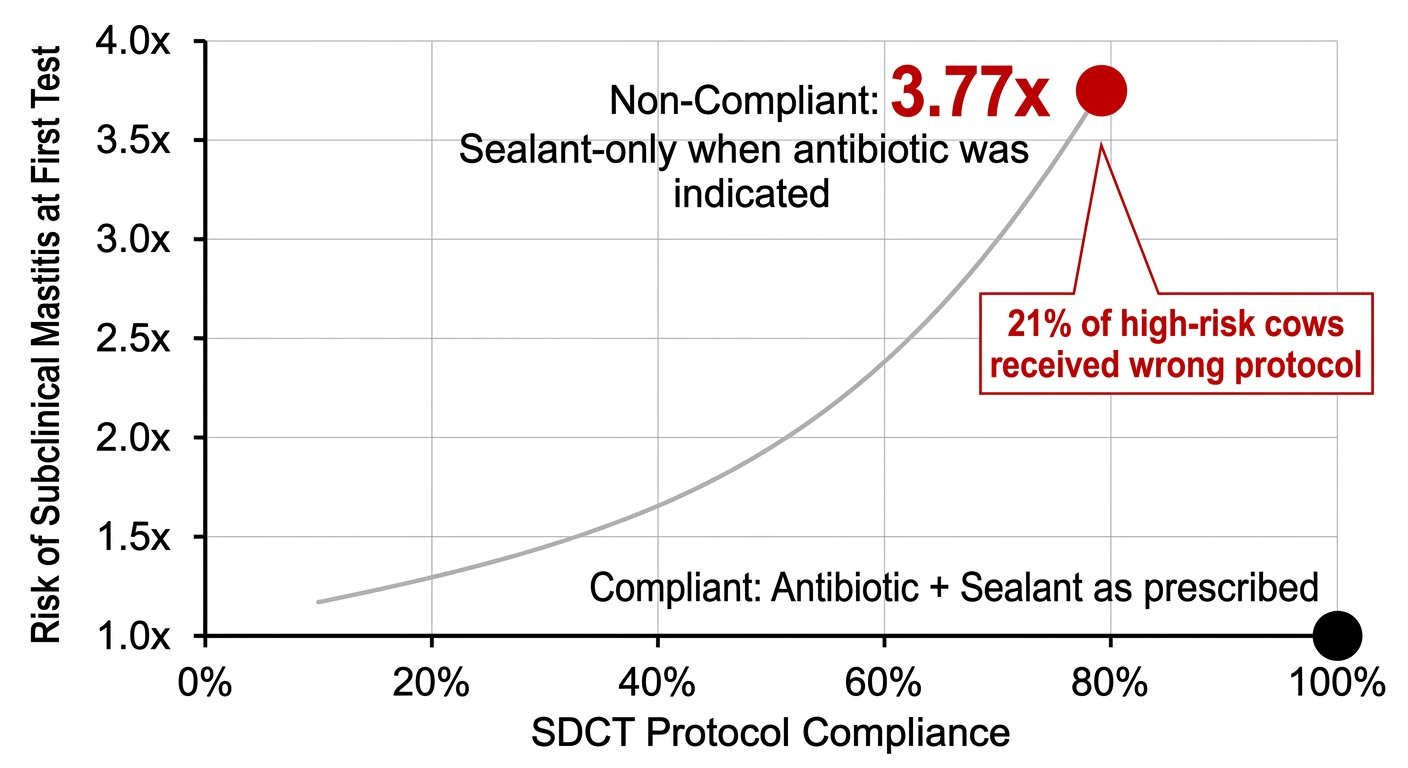
You want to know what actually drives industry-wide change? Europe’s experience with selective dry cow therapy offers a masterclass.

The EU implemented Regulation 2019/6, which banned prophylactic antibiotic use—including blanket dry cow therapy—effective January 28, 2022. That date matters because it forced a complete industry shift.

According to European research, about two-thirds of Italian dairy farms had transitioned to selective protocols by the end of 2022. The Netherlands has become the gold standard, going from relatively low adoption to over 80% in just a few years.

The difference? Farmers changed because they had to.

But here’s what’s encouraging—Volker Krömker from Copenhagen University has been tracking outcomes, and after some initial resistance, Dutch farmers using selective protocols actually saw mastitis rates drop below what they had with blanket treatment. The whole infrastructure adapted: vet schools started requiring SDCT training, milk buyers provided protocol support, and software companies built decision trees right into their platforms.

Meanwhile, U.S. voluntary adoption is sitting at roughly one in four farms. The contrast is pretty striking.

Where Targeted Management Actually Works Today

Despite all the challenges, certain operations are making these protocols work brilliantly. What separates them?

Looking at successful implementations from Maine to California, you see patterns. Scale helps, but it’s not everything. Sure, a 3,000-cow operation in Idaho finds it easier to justify the cost of dedicated transition management software. But I’m also seeing 300-400 cow herds in places like Wayne County, Ohio, succeeding because their co-op provides shared advisory support.

Regional variations matter too. Down in New Mexico and Arizona, where heat stress just compounds everything, producers like Tom Barcellos out in Tulare County tell me precision management becomes even more critical. As he puts it, “When it’s 110°F in July, you can’t afford to guess which cows need extra support.”

In Florida, where the humidity is brutal, a group near Okeechobee adapted the protocols to conduct twice-daily body condition scoring during summer. Over in Texas, some of the larger operations near Stephenville are finding that targeted protocols help offset the stress of their long summers. Up in Vermont, where winter housing gets tight, farms are focusing more on the close-up pen management side of things.

And out in the Pacific Northwest—you know how wet it gets there—the larger dairies near Yakima Valley are finding targeted protocols help manage the stress that mud and moisture put on transition cows. One producer in Sunnyside told me they flag any cow that spent more than 2 weeks in the hospital pen during the last lactation. Those girls automatically get extra attention at dry-off, regardless of other metrics.

What do successful operations have in common? Three things keep coming up: integrated data systems (increasingly using cameras for BCS scoring), strong veterinary partnerships for ongoing tweaks, and what Nigel Cook from Wisconsin calls “implementation discipline”—basically, someone owns the process and reviews outcomes every month without fail.

Implementation Timeline: What to Really Expect

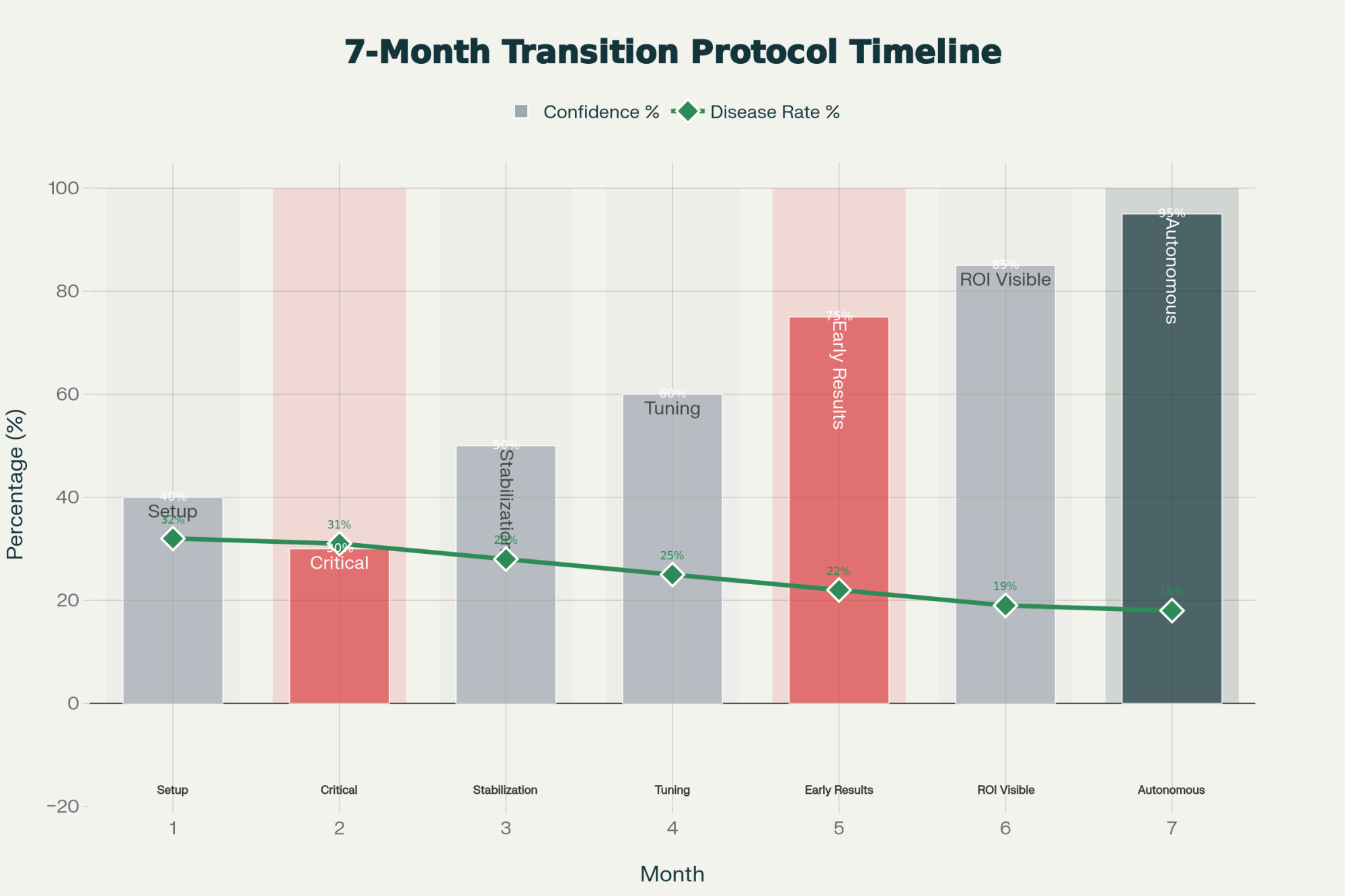
  • Weeks 1-4: Set up protocols, train your team, get baseline numbers
  • Weeks 5-12: Work out the bugs, build staff confidence
  • Months 3-4: Don’t panic—temporary plateau is normal
  • Months 5-6: Positive trends start showing up, fine-tune protocols
  • Month 7+: Full ROI kicks in, system runs itself

Making Targeted Protocols Work on Your Farm

After watching dozens of operations try this, here’s my practical advice if you’re thinking about it.

Start ridiculously simple. Pick ONE intervention for 90 days. I’d suggest dry-off BCS flagging. Now, this next part is my own practical recommendation, not part of any formal research protocol: get yourself an orange livestock marker. Every cow over 3.75 gets an orange stripe on her tailhead. That’s it. Everyone knows orange means “controlled energy dry cow ration.” Simple, cheap, and visible to every person who walks through that pen.

Set realistic expectations. Research on implementation curves suggests the average time to positive ROI is around five to six months. Some farms see a temporary production dip in month two as systems adjust. You need to budget for that.

And here’s crucial—involve your entire team from day one. Not a memo. Not a meeting where half the guys are checking their phones. A hands-on session where your feeders, fresh cow crew, and whoever does dry-off physically walk through the process together. Gustavo Schuenemann from Ohio State found that farms with hands-on training show significantly better compliance with protocols than those using written SOPs alone.

Track only what matters. Pick three things: fresh disease rate (shoot for under 20%), 60-day milk average (watch the trend, not the absolute number), and days to first service (target under 70). Review them monthly. Ignore everything else at first—you’ll drive yourself crazy otherwise.

The Hard Truth About Implementation Readiness

I need to be direct here. If you’re struggling to cover operating expenses, targeted transition management shouldn’t be your priority right now. This approach works best for farms with positive cash flow and at least six months of operating capital in reserve.

It’s one of those cruel ironies—the farms that most need efficiency gains are often least equipped to implement them. Chris Wolf, the ag economist at Cornell, calls this the “productivity trap.” The bottom 40% of farms by profitability are producing at significantly higher cost than the top 40%, but they lack the capital to make improvements that would close that gap.

Critical Limitations to Consider

Let’s be clear—targeted transition management isn’t universally applicable. Genetic differences matter. Jersey herds show different risk thresholds than Holsteins. Kent Weigel’s genomic research at Wisconsin shows cows with high genetic merit for health traits may show less dramatic response to targeted interventions—they’re already more resilient.

Facility design impacts success, too. Farms with two-row freestalls and adequate bunk space see better results than overcrowded three-rows. Peter Krawczel from Tennessee documented that overcrowded facilities—stocking densities in the 110-120% range and above—negate a significant portion of targeted protocol benefits as the stress from overcrowding overwhelms the precision interventions.

And geographic factors can’t be ignored. What works in Wisconsin’s climate needs adjustment for Louisiana’s humidity or Colorado’s altitude. You’ve got to calibrate locally.

What Would Accelerate Industry Adoption

Three things could shift targeted management from “interesting option” to “this is how we do things now.”

First, processor requirements. If the big co-ops like DFA or Land O’Lakes started requiring transition management documentation for quality premiums, adoption would happen overnight. Tillamook’s already doing this with SCC-based dry-off protocols for their suppliers.

Second, cooperative infrastructure. When your co-op provides training, software access, and shared advisory as part of membership, smaller farms can suddenly access the same tools as the big guys. Organic Valley’s vet support program is a good model for this.

Third, federal support. USDA’s got significant funds allocated for precision agriculture through 2027. If they added transition management to their cost-share eligibility, it would substantially lower barriers.

The Bottom Line for Your Dairy

The transition period drives the majority of our health problems. We’ve known this for decades. What targeted cow management offers is a systematic way to identify and prevent these problems before they turn into expensive disasters.

But as we’ve talked about, knowing what to do and being able to do it are vastly different challenges. The science is solid. The economics work. Whether this becomes standard practice really depends on how the industry chooses to support implementation.

My advice? If you’re interested, start small. One protocol. One risk factor. Track your results religiously. And definitely get your vet and nutritionist involved from day one—this isn’t something you figure out alone.

The cows that need help are already in your barn. You walk past them every day. The question is whether you can build a system to identify and support them before each one costs you $500 to $1,000.

Some operations can absolutely do this today. Others need infrastructure development first. Understanding which category you’re in—honestly, without wishful thinking—that might be the most valuable assessment you make this year.

And here’s the thing that keeps me up at night: if you won’t pick one simple flag and execute it for 90 days, your neighbor probably will. In a year from now, one of you will have lower fresh-cow disease, better butterfat levels, and a stronger balance sheet.

Which one do you want to be? 

Key Takeaways:

  • The savings are proven: Farms executing targeted transition protocols cut fresh cow disease rates by 25-30%, saving $200-$500 per cow per lactation—and the gap between early adopters and everyone else is widening
  • Inaction costs more than you think: Ketosis runs $300-$350 per case, metritis $300-$500, and over a third of fresh cows develop multiple problems in their first month
  • Most dairies aren’t ready yet: Roughly 80% of U.S. operations lack integrated herd software or the cash reserves to implement precision protocols consistently—but that’s changing
  • The science scales: European farms mandated to adopt selective dry cow therapy in 2022 now report lower mastitis rates than they had with blanket treatment
  • Start with one thing: Flag cows with BCS ≥3.75 at dry-off, track outcomes for 90 days, and involve your vet—simple execution beats sophisticated plans that never happen

Executive Summary: 

Transition cow crashes are quietly draining dairy profits—ketosis and metritis each cost $300-$500 per case, and over a third of fresh cows develop multiple problems in their first month. Research from Penn State, Cornell, and Wisconsin shows that targeted protocols identifying high-risk cows at dry-off can cut disease rates by 25-30%, saving $200-$500 per cow per lactation. The challenge? Roughly 80% of U.S. dairies lack the integrated data systems or financial reserves to execute these approaches consistently. European farms mandated to adopt selective protocols in 2022 now report lower mastitis rates than they had with blanket treatment—proof that the science works at scale. Successful U.S. operations share three factors: integrated herd software, strong veterinary partnerships, and someone who owns protocol review every month. The realistic starting point is straightforward: flag body condition scores at dry-off and track outcomes for 90 days. By next winter, the gap between farms preventing fresh cow crashes and those still reacting to them will show up clearly on the balance sheet.

Complete references and supporting documentation are available upon request by contacting the editorial team at editor@thebullvine.com.

Learn More:

Join the Revolution!

Join over 30,000 successful dairy professionals who rely on Bullvine Weekly for their competitive edge. Delivered directly to your inbox each week, our exclusive industry insights help you make smarter decisions while saving precious hours every week. Never miss critical updates on milk production trends, breakthrough technologies, and profit-boosting strategies that top producers are already implementing. Subscribe now to transform your dairy operation’s efficiency and profitability—your future success is just one click away.

NewsSubscribe
First
Last
Consent
Send this to a friend