Three floods in one lifetime. When the water rose, Sumas Prairie dairy neighbours filled the road with headlights instead of letting each other face it alone.
Executive Summary: Sumas Prairie dairy farmers have survived three major floods in one lifetime, and the reason they’re still milking isn’t luck—it’s neighbours, headlights, and hard‑won planning. When the 2021 atmospheric river refilled the old Sumas Lake bottom, families like the Meiers and Dykshoorns lost animals, dumped 14 loads of milk, and watched water climb to 3.5 feet in the parlour. In those same days, neighbours filled the road with tractors and trailers, youth scraped mud from parlours, church kitchens cooked for evacuees, and volunteers sandbagged Barrowtown pump station through the night. Out of that chaos came a shared “flood playbook”: know your water lines, move heifers early, protect stalls and feed, invest in pumps and backup power, and keep a written list of who can help and who you’ll help in return. When heavy rains hit again in December 2025, that playbook—and the trust behind it—meant dry stalls, one missed milk load instead of many, and a community that was scared but no longer unprepared. This feature walks dairy readers through that journey so they can see their own roads, barns, and neighbours in the story—and start building their own version of those headlights before the next storm.
I’ll never forget the way Rudi tells the story of that night.
He wasn’t even on Sumas Prairie when the trouble really started. He was off visiting family when his phone began buzzing on the table—radar screenshots, photos of water pushing across the flats near Abbotsford, short messages from neighbours who’d seen more than enough “heavy rain” to know this was different.
By the time he turned into the lane at U&D Meier Dairy #1, his home place didn’t look quite right. There were a few inches of water in the basement. The sump pump was humming but losing the race. Out in the yard, water was creeping across the gravel in that slow, unnerving way that makes you measure it against your boots. You only need to watch it climb once or twice to know you’re in for a long night.
“I’ve been through the floods in 1990, 2021, and now this one,” he says. “Three times. That’s enough for one lifetime.”
Rudi and his twin brother Karl milk 200 cows on the old Sumas Lake bottom east of Abbotsford, British Columbia. It’s beautiful, productive dairy ground—and everyone out there knows it’s also a bowl waiting to be filled if the wrong storm and the wrong river line up.
The first time the “big one” came, in 2021, they were blindsided. This time, as Rudi stood in a yard that was changing by the minute, he tried to convince his wife it wouldn’t be as bad as last time.
“I’m not sure she believed me,” he admits. After what they’d lived through, you can’t blame her.
What they didn’t know yet was that the whole community had been changing too.
The Night the Lake Came Back
The rain that November didn’t feel like an ordinary storm. It felt like it had something to prove.
In 2021, an atmospheric river parked over southern BC and dumped more water on the Fraser Valley than anyone wanted to see again. The Sumas River dike gave way under that pressure, and water found the shape it remembered, pouring back over land that used to be Sumas Lake until it looked like the lake was coming home.
Across the valley, more than a thousand farms were hit. Thousands of hectares went under. Millions of animals were in harm’s way. An estimated 420 dairy cattle died, along with over 600,000 birds and 12,000 hogs, plus roughly 120 beehives. Millions of litres of milk never left the farms that produced it.
On a map, it reads like a disaster report. In a barn, it was one cow, one family, one long, wet night at a time.
Up the road from the Meiers, at B&L Dairy, Matt Dykshoorn had grown up on stories of the 1990 flood. The old barn had stayed dry back then, and for years, people said, “We’ll never see 1990 again.” When they put up a new barn, they set the floor a foot higher than the old one. That felt like smart insurance.
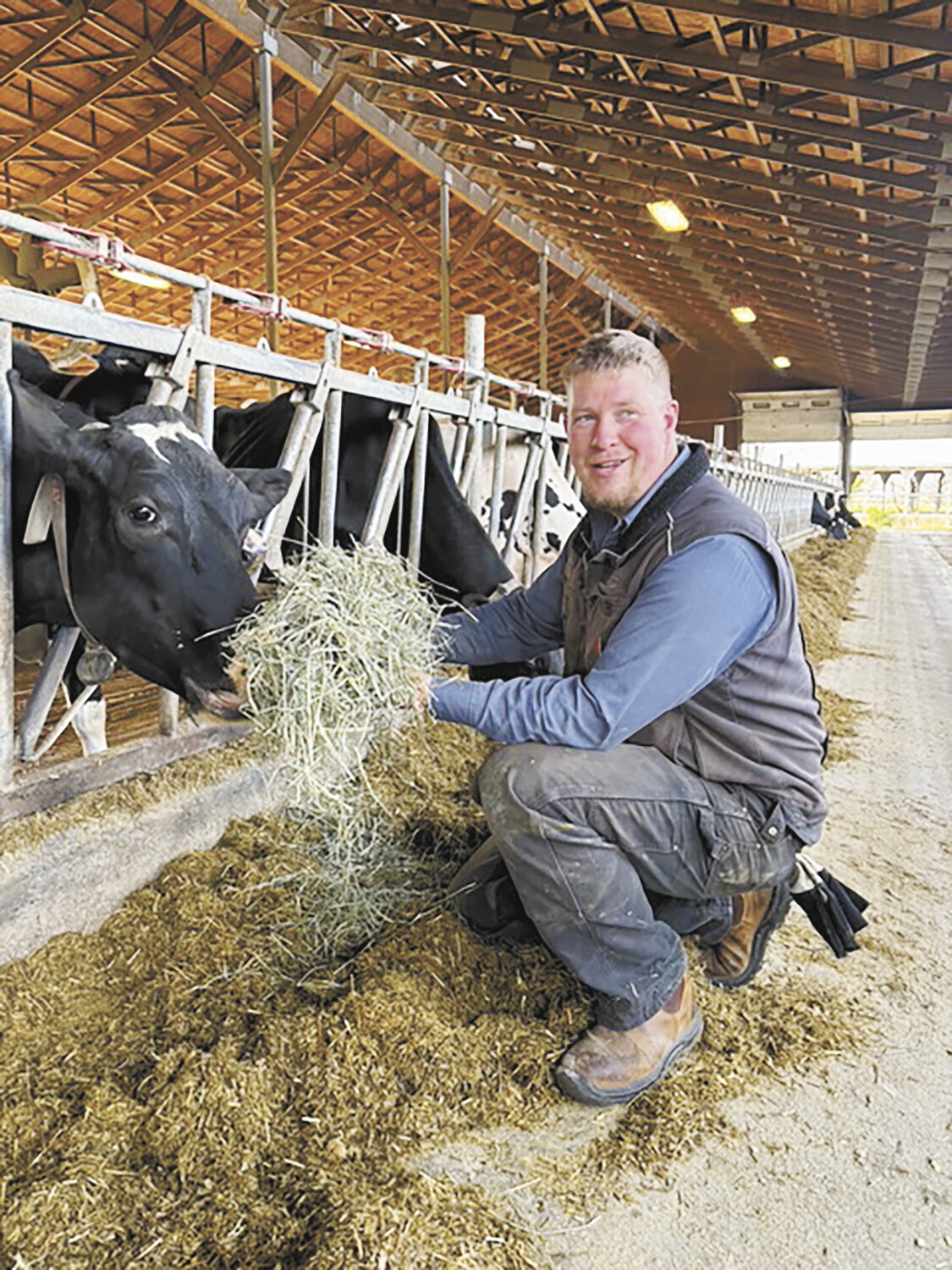
“We underestimated it,” Matt says now. “My newest barn was built a foot higher than my old barn, and the old barn stayed dry in 1990. I was six years old back then, but I grew up hearing, ‘We’re never going to see a 1990 flood again.’ Well, in 2021, the water got three feet higher than in 1990. That just blew everybody’s minds.”
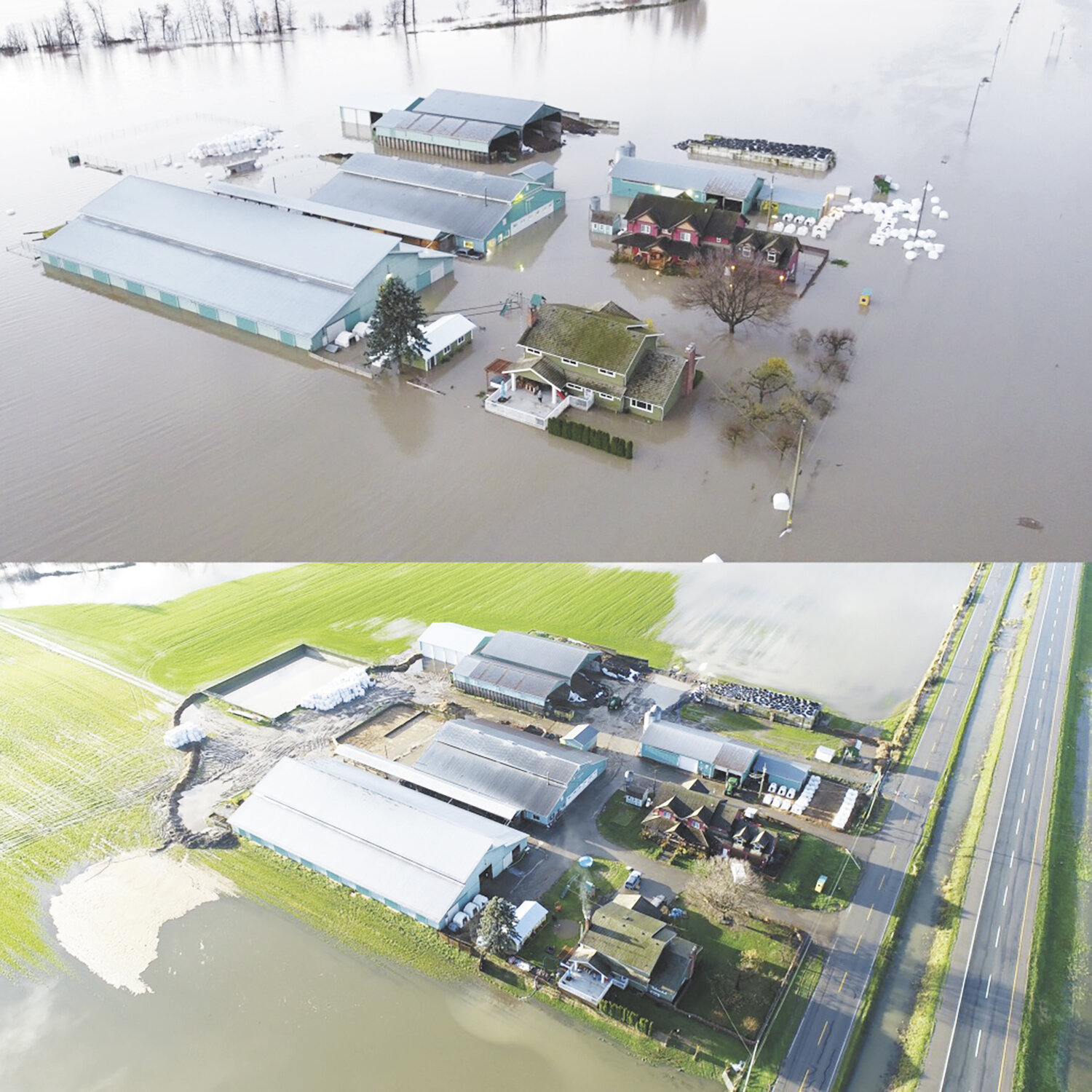
The water didn’t wait for anyone to be ready. It came into the yard, then the barn, then up around the cows’ legs. His roughly 80 milking cows ended up standing in cold water for a day or more. He couldn’t run them through the parlour safely. He pitched hay where he could, just trying to keep them eating. Outside, the road had turned into something closer to a river. There was no way out.
It was one of the hardest stretches he’s ever faced. “By the time the water got into the barns, we were stuck.”
On the Meier farm, the water reached about 3.5 feet in the milking facility, and at its peak, the yard rose 2.5 feet in just 20 minutes. Calf pens and barns wore muddy waterlines like scars long after the flood receded. The family slipped back in when it was safe enough, moving calves and heifers whenever an evacuation route opened and doing whatever they could to keep cows alive and milked where possible.
With tankers cut off by washed‑out roads and plants unable to handle everything, producers were told to dump milk. On the Meier place, that meant watching 14 loads of milk go down the drain. You don’t need the exact number to know what that feels like in your gut.
On top of the emotional hit, everyone knew what that meant: in a matter of days, months of margin and careful bills‑to‑be‑paid planning were washed away along with the milk and the mud.
“This is not just a paycheque for us. We love our animals,” Rudi’s wife said later. “My husband, my brother‑in‑law, and 16‑year‑old son risked their lives to come back to make sure our animals were safe.”
That’s the kind of sentence you say once and remember forever.
And as hard as those days were, what happened on the roads and in the community may be what sticks with people the longest.
The Night the Road Filled with Headlights
Nobody expected the entire concession road to be lined with tractors and trailers that night. It just sort of… happened.
As water rose across Sumas Prairie in 2021, phones started ringing in all the places that weren’t under immediate water yet—drier corners of Abbotsford, farms up in Chilliwack and Agassiz, people who’d seen the forecasts and knew they had equipment and a little bit of elevation.
Nobody formed a committee. Folks just backed up to stock trailers, horse trailers, anything with sides, and started heading toward the farms that were going under.
They ran those roads as long as they safely could. Cows were loaded in the dark and in the rain, often by flashlight and phone light, into trailers that were normally used for taking show strings to town or moving replacements back from pasture. Barns that, a few months earlier, had held show cattle and sale consignments suddenly turned into refugee barns, full of cows from someone else’s string, tags from someone else’s herd.
What moved everyone most wasn’t a single dramatic rescue. It was the sheer volume of ordinary people rolling in with what they had.
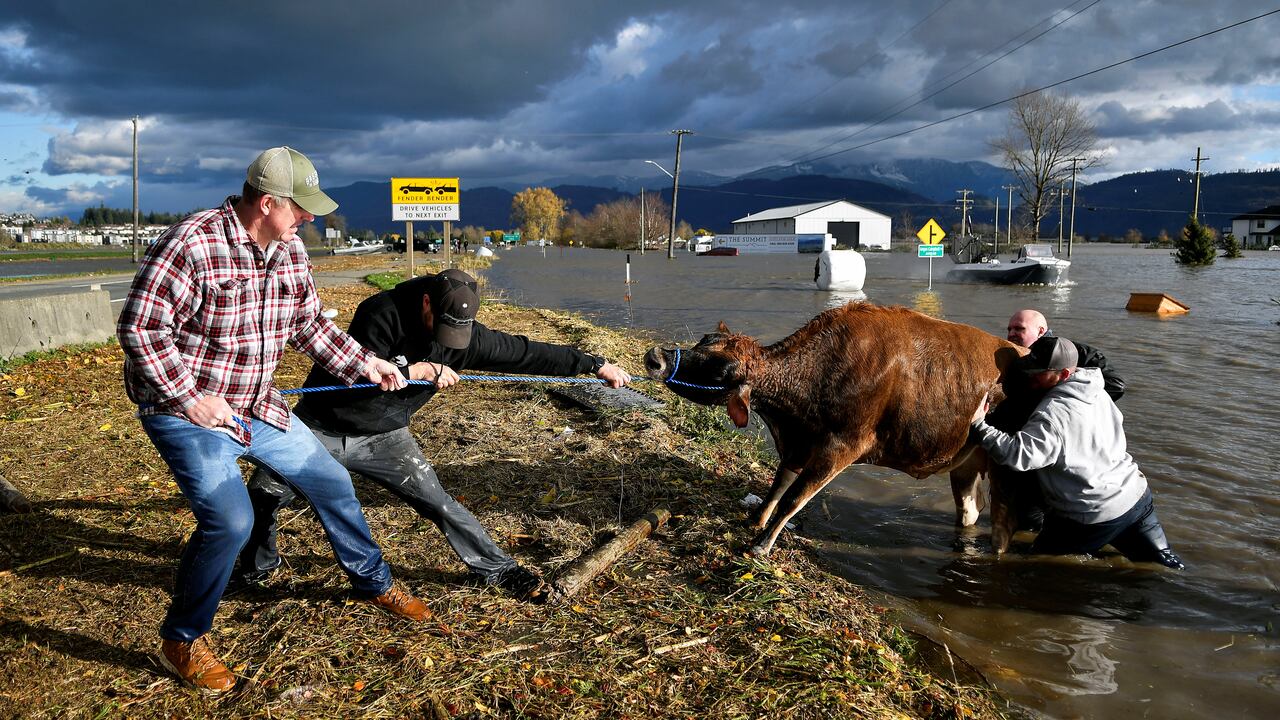
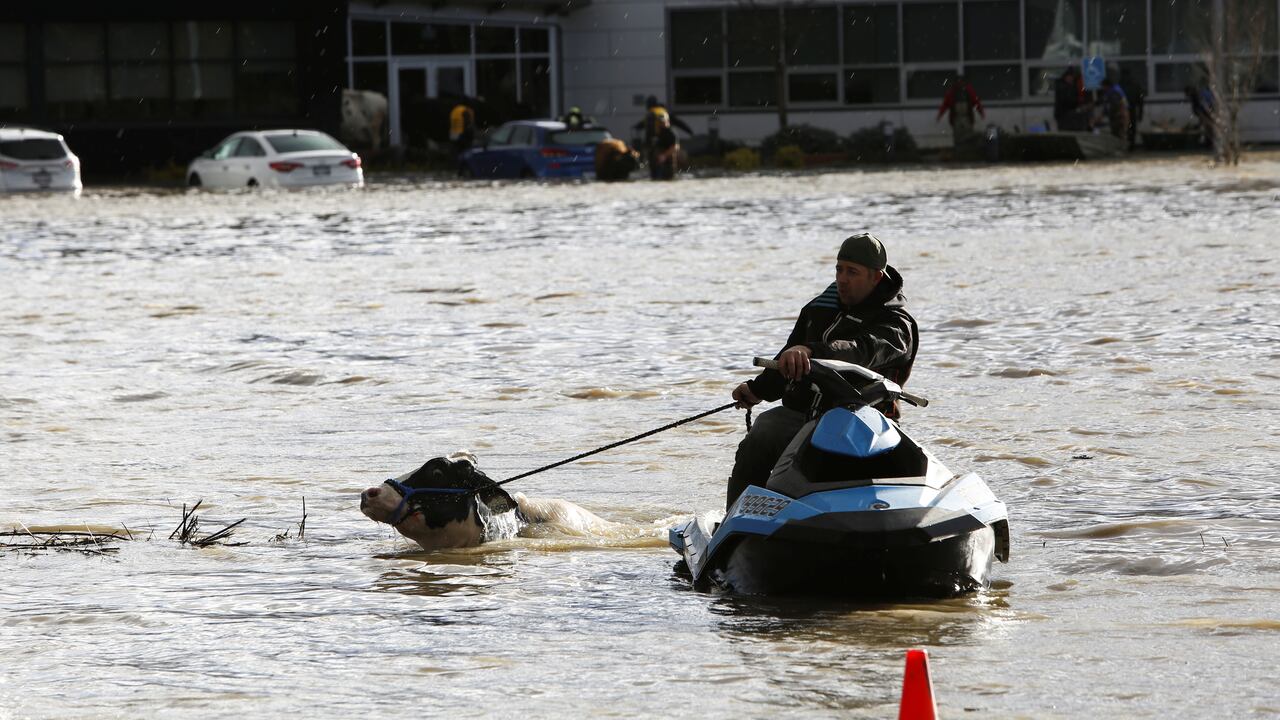
Boats slipped into the story, too. Aluminum fishing boats. Inflatable rafts. Even a kayak or two. People used them to reach houses cut off, to ferry in drinking water and food, and to bring families out when staying was no longer an option.
And then there was Barrowtown.
That pump station, sitting at the edge of Sumas Prairie, is the thin line that keeps the old lake bottom farmable instead of flooded. When the water threatened Barrowtown, people showed up in the bitter wind and rain. You can still picture the scenes: volunteers—farmers, town folks, neighbours from Chilliwack—standing in cold water and passing sandbags hand‑to‑hand under bright work lights, doing everything they could to keep those pumps running.
Nobody was there for a photo op. They were there because if Barrowtown went, a whole lot more barns and houses were going under.
Back on the farms, there were quieter acts of kindness. Farm wives and neighbours setting up impromptu kitchens in community halls and church basements, turning out meals for exhausted families and volunteers. Youth and 4‑H kids were scraping dried mud off parlour floors and out of calf pens once the water went down. Vets working through lists of flooded barns, making hard calls about which cows could be moved, which needed treatment, and how to manage mastitis and hoof problems in animals that had been standing in dirty water.
One vet later said the hardest part wasn’t the medicine. It was looking dairy families in the eye when they were bone‑tired and scared and telling them which cows might not make it through. That takes a different kind of strength.
“The courage it took to ask for help…” one farmer said at a community meeting months later, shaking his head. “That was something. And nobody held it against you.”
That was the moment that changed how a lot of families saw their neighbours. The person you used to just nod to at the feed store became the person you knew would back into your yard at midnight if your barn ever flooded. The barn that once hosted a small show string turned into the barn that helped raise someone else’s cows for a while.
Against all odds, the community showed up. And that’s not something anyone out there will forget.
Standing in the Water, Rethinking Everything
After the water drained off, you could finally see the ground again. That didn’t make the decisions any easier.
Standing in barns that still smelled like river mud, families had to ask themselves some brutal questions. Do we rebuild here, knowing this ground flooded in ’51, in 1990, and now in 2021? Do we walk away from land that’s tied up with family history, quota, and a lifetime of work? If we stay, what has to change?
For a lot of Sumas Prairie dairy families, leaving simply wasn’t on the table. Quota, land prices, and debt meant there wasn’t an obvious “sell and start over” option somewhere else. And even for those who could technically move, the thought of abandoning the cows and fields that had raised their kids and paid their bills weighed heavy.
Some families did make the hard decision to sell or step away after the flood. Those stories matter just as much because they remind all of us that sometimes resilience looks like choosing a different path.
For the Meiers and Dykshoorns and many of their neighbours, resilience meant staying—and reworking what “prepared” looked like.
On B&L Dairy, that newer barn that once felt plenty high suddenly looked different in hindsight. The family’s mental map shifted: they paid attention to which low spots filled first, how fast the laneway disappeared, what the yard looked like right before things went sideways. Those observations turned into rough but real thresholds—lines in their heads where the conversation would change from “watch it” to “move now.”
On the Meier farm, the focus was on pumps, power, and planning. They added pumping capacity. They learned exactly how water found its way toward their basements and parlour and what they could do about it. And they talked more—about what they would do if the same kind of rain came again, who they’d move first, who they’d call, how long they could keep milking if roads were cut.
Those conversations spilled out into community spaces. In the years that followed, Sumas Prairie farmers sat on panels, stood at microphones, and opened their photo albums at places like the Western Canadian Dairy Seminar. They walked other producers through those days with the kind of honesty that doesn’t come easy: missed warnings, fear, milk going down the drain, gratitude, anger, and the stubborn hope that came from watching neighbours show up.
Local leaders—from BC Dairy to municipal officials—stood in those same barns and pump stations, hearing the stories in person. They saw the water lines on the walls and calf pens. They listened to producers describe how fast things changed and where warnings failed. Those visits didn’t fix everything, but they made it harder for anyone to pretend this was just a one‑off event.
Nobody wanted to earn that kind of wisdom. But once they had it, they weren’t going to keep it to themselves.
When the River Rose Again
The next test came sooner than anyone would’ve liked.
Between December 9 and 12, 2025, all the familiar signs started popping up again. Forecasts loaded with heavy rain and flood watches. Reports of the Nooksack pushing high again. Local gauges telling the same story as phones and radar.
This time, the texts to neighbours started earlier.
“You watching the river?”
“How’s your lane?”
“Are we moving heifers today?”
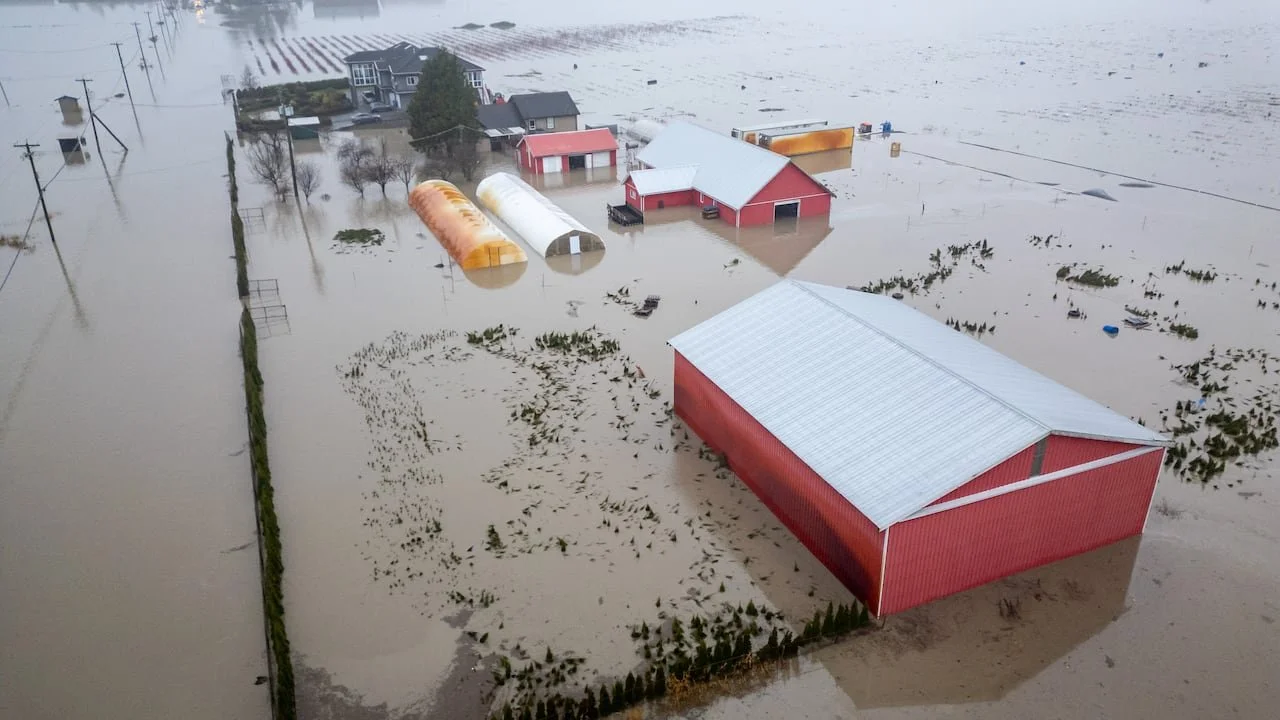
Over just 24 hours, parts of the Fraser Valley saw more than six inches of rain, enough to flood low‑lying fields and re‑awaken every memory of 2021. Once again, water pushed north from the Nooksack. Once again, low‑lying parts of Sumas Prairie found themselves under water or under threat. Evacuation orders and alerts went out. People who’d hoped 2021 was a once‑in‑a‑lifetime event were forced to admit that “once” doesn’t mean much in a changing climate.
But this time, the community wasn’t starting from scratch.
On B&L Dairy, the family didn’t wait for water to be licking at the barn doors. They’d already made mental notes about their “lines”—that culvert that goes under first, that bend in the lane that becomes a problem, that mark on a fencepost that says, “If it hits here, we’re in trouble.” When the water approached those markers, the heifers went to higher ground. It wasn’t a panic move. It was a planned one.
“We’re in one of the more vulnerable areas,” Matt explains. “Our road is fairly low, so we have to make that decision before the water even gets to us. That’s pretty tough. Once you’ve made the decision, you’re committed. It made for a lot of sleepless nights.”
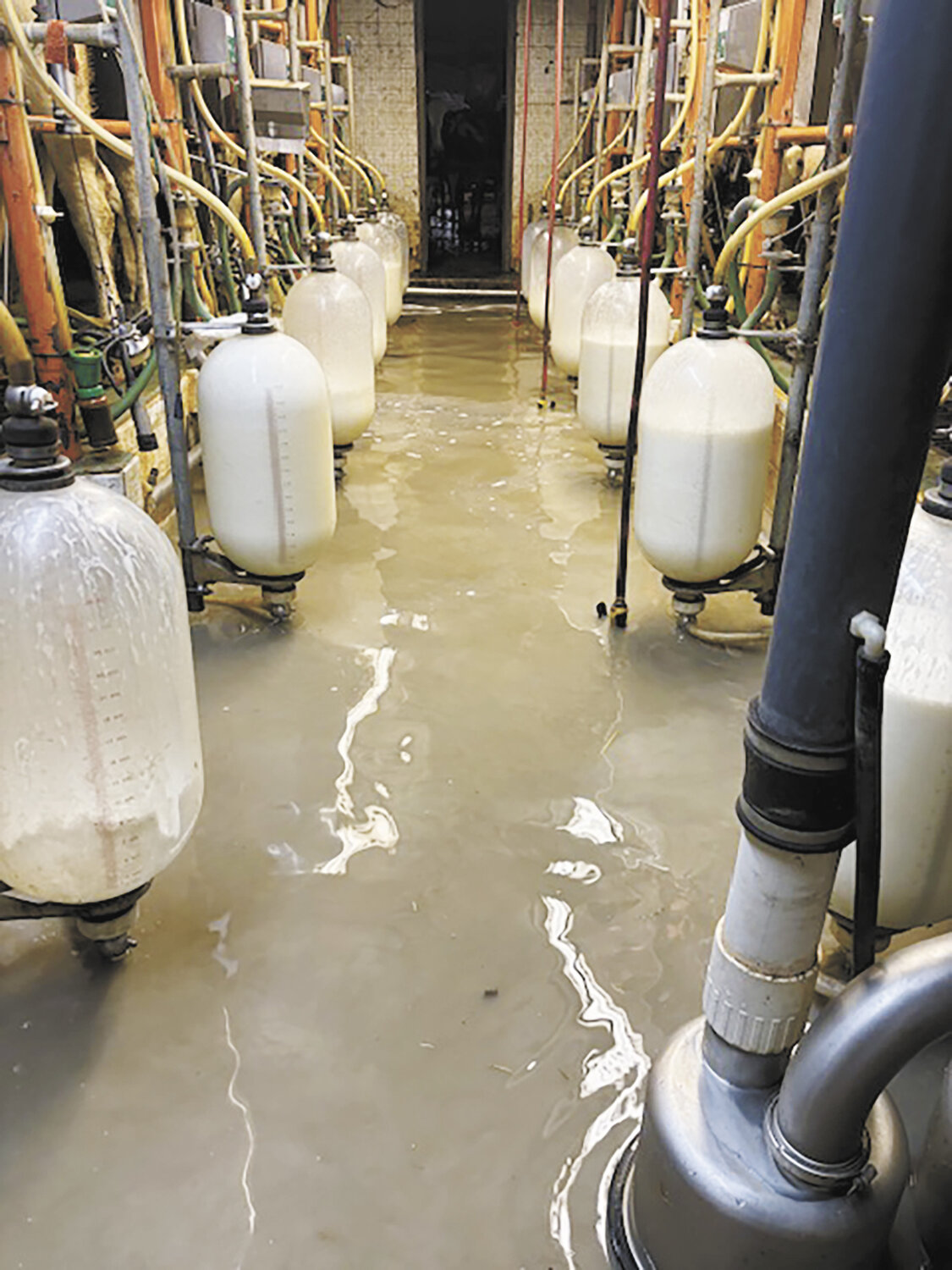
They decided to keep the milk cows at home. The water came into the alleys again, but this time the stalls and feed stayed dry. Cows lay down, got up, ate, and went through a milking routine that, while stressful for the humans, at least gave the herd some sense of normal.
On the Meier farm, the water came from a slightly different direction than in 2021, sneaking up from another part of the yard. But this time, instead of watching the parlour flood helplessly, Rudi and Karl had pumps already in place. They ran multiple gas pumps in the yard and submersible pumps in the basement, basically around the clock for several days.
It wasn’t fun. It wasn’t cheap. But it made a difference. The milking cows stayed dry. And when all was said and done, instead of losing pickup after pickup like they’d done in 2021, they only lost one load of milk in 2025.
Even now, everyone will tell you that a heavy rainfall warning still tightens something inside. The mental load doesn’t just wash away. In quiet moments, some producers will talk about the anxiety that comes with every special weather statement, how it messes with sleep and focus. That’s rural mental health in real time, and it’s as much a part of this story as the sandbags and pumps.
But the 2025 storm showed that what the community learned in 2021 wasn’t lost.
What kept them going in those weeks wasn’t just the cows or the quota. It was the people around them.
What Changed—and What Didn’t
Some of the shifts since that first big flood are easy to see. Others are slower and more frustrating.
On the systems side, the 2021 disaster forced government and agencies to pay attention. Emergency programs rolled out funds to help farms rebuild. Crews spent years cleaning out ditches and channels that had quietly silted in. Backup generators were installed at key pump stations, so a single power cut didn’t spell instant disaster.
And Barrowtown was bolstered by a $76.6 million provincial investment, announced in 2024, to upgrade its capacity and protect Sumas Prairie from future atmospheric rivers while the city waits on slower federal processes.
When the 2025 storm hit, those changes mattered. Pumps were running when needed. Staff knew the risks. Farmers noticed and, in a lot of cases, felt that people behind the scenes were doing what they could.
But there’s also the reality that some of the biggest levers remain stubbornly out of local hands.
Sumas Prairie is still a drained lake bed, and a big share of BC’s dairy production still stands inside that bowl. Down in Washington, the Nooksack River still pushes huge volumes of water through a system where every discussion about gravel or levees involves salmon, tribes, landowners, and higher levels of government. Big cross‑border flood‑management plans exist on paper, but paper doesn’t stop water.
Local dairy leaders and politicians have been frank: while projects inch forward, families keep living with the same risk. There’s relief in seeing work at Barrowtown, but also deep frustration in how long broader protection takes. Every storm season that goes by without a real plan is one more year those families feel like they’re rolling the dice with their barns and herds.
Farmers on Sumas Prairie don’t have the luxury of waiting for meetings and committees. Every fall, they’re betting barns, cows, and quota that the next storm won’t hit their weak spots first.
So the community has done what rural communities often do when big systems move slowly. They’ve focused hard on what they can control inside their own fence lines and around their own kitchen tables—and they’ve kept pressure up on the rest.
When you talk to producers out there about pumps and sandbags, they’ll tell you straight: the cost of extra equipment or higher barn pads isn’t small, but it looks different when you put it beside the price of dumped milk, dead cows, and months of rebuilding. Every farm has to run its own numbers. But nobody on Sumas Prairie thinks preparation is just a “nice to have” anymore.
Raising Cows, Kids, and Community
Most days, if you drove through Sumas Prairie without knowing the history, you’d see a pretty ordinary dairy neighbourhood.
You’d pass family barns with swing sets in the yards and hockey nets leaned against the wall. You’d see kids riding along in cabs, yawning on early‑morning milkings or chattering about 4‑H projects. You’d meet feed reps and vets who know which dog is going to meet them at which laneway and which farmer likes to talk breeding proofs while loading grain.
Those small, daily connections were there long before a single sandbag was filled.
Farmers saw each other at the co‑op meeting, the Holstein club AGM, the local rink, the church, and the school fundraiser. They shared show boxes and clipping gear, and extra straw. They traded help on harvest days and compared notes on SCC and reproduction over coffee.
When the 2021 flood came, all that “ordinary” turned into a lifeline.
People didn’t have to figure out from scratch who might be able to take cows or who owned a decent trailer. They already knew. The same families who helped each other with show calves turned up with trailers for emergency loads. The same barn that had once been “the place that always hosts the club meeting” became the barn that quietly housed other people’s cows for weeks.
Afterward, community life didn’t just bounce back; it deepened.
Youth who’d spent days scraping mud out of parlours began talking differently about what community meant. A 4‑H leader told me about kids who said, “I didn’t know grown‑ups would show up like that for each other.” That kind of comment sticks.
Church kitchens that had cooked for evacuees were ready when other needs cropped up—barn fires, family illnesses, sudden accidents. The same neighbours who’d carried sandbags at Barrowtown showed up to sit in living rooms and hospital waiting rooms months later. The local paper, breed organizations, and dairy newsletters told stories of both devastation and stubborn hope, making sure those experiences weren’t forgotten.
For families like the Meiers and Dykshoorns, the floods also changed how they see their own place in that web. They’re not just recipients of help. By opening their gates and their memories in interviews, in meetings with elected officials, and at seminars, they’re helping other dairy communities think through their own “what if” scenarios before the water shows up.
In a quiet way, the barns that nearly went under have become the barns that help raise better questions, better plans, and maybe, over time, better support systems.
What a Flood Playbook Really Looks Like
If you strip this story down to the studs, what you’re left with is a series of decisions that any dairy operation could face—whether the threat is flood, fire, wind, or ice.
When do we move?
What do we move first?
Who do we call?
What do we wish we’d thought about last month?
Out of three floods in one lifetime, Sumas Prairie has built its own version of a playbook.
They’ve learned to really know their lines. Not just in a general “if it floods, we’re in trouble” kind of way, but in the “when the water hits this culvert or covers that part of the lane, we stop watching and start acting” way. Those visual cues are different on every farm, but writing them down—and agreeing on them as a family—turns panic into a plan.
They’ve learned to move what they can, early. In 2025, heifers and youngstock went to higher ground before the road disappeared. It’s not fun to haul animals home after a near miss, but that’s a much better problem than trying to move them when water’s already at the step and everyone’s exhausted.
They’ve learned how vital it is to protect the milking routine as long as it’s safe. Keeping stalls and feed alleys dry, even if alleys are wet, made a huge difference for cow comfort and health in 2025. It also helped keep milk flowing—literally. Going from 14 dumped loads of milk in 2021 to a single missed load in 2025 is not just luck; it’s planning and hard work.
They’ve seen the value of investing in pumps and power where it counts. It’s not glamorous to spend money on pumps and backup power, but when those tools kept water out of basements and parlours, it was very clear where the return really was. On a bigger scale, seeing backup generators funded and running at Barrowtown took at least one major worry off everyone’s list.
They’ve taken time to map their “who” list. In 2021, much of that list was stored in people’s heads, built up over years of small favours. Afterward, some farms literally made lists: who has a trailer, who has spare hutches, who has a generator, who doesn’t mind a phone call at midnight. It doesn’t have to be formal. It just has to exist before you need it.
And they’ve made a habit of debriefing and writing things down while the memory is still sharp. Sometimes that’s at an event like the Western Canadian Dairy Seminar. Sometimes it’s a simple notebook in the farm office or a meeting in a community hall. Either way, it means the next time a storm hits, they’re not relying only on foggy recollections of “I think the water was about here.”
If your own road is one of the first to flood, the lesson they’d tell you is simple: plan to move before the water ever touches your yard. Use that culvert, that fencepost, that low spot in the lane as your trigger—not your first warning that you’ve waited too long.
None of these things guarantee a happy ending. But they all shift the odds, just a little, in favour of the cows and the people who care for them.
What They’re Paying Forward Now
When you sit with families on Sumas Prairie and really listen, you notice something.
They can list the losses. They can list the costs. They can tell you exactly how many days they went without good sleep. But when they talk about what stuck with them most, it’s the people.
They remember the first headlights they saw on the road that night. The vet’s truck nosing into the lane with someone else’s pickup tucked in behind it, both drivers soaked but ready. The 4‑H kid who came back, day after day, to help clean pens after school. The neighbour who drove in under evacuation orders just to haul calves out when there was a narrow window to do it.
They remember the courage it took to make the call for help in the first place. Pride runs deep in dairy. Admitting you can’t handle something on your own isn’t easy. But in 2021, those calls went out anyway. And just as importantly, nobody made anyone feel small for asking.
Since then, that memory has changed how people think about each other. The person whose cows you hauled during the flood is now the person you think of whenever you’ve got a spare load of silage or a couple of extra hours to help with a project. The young people who saw adults come together like that now carry a different sense of what it means to be part of a rural community.
Those experiences have also pushed some of these farmers into roles they never planned on—talking to reporters, speaking to government committees, sharing their stories at seminars. They aren’t doing it because they enjoy the attention. They’re doing it so that somewhere else, when a different flood or fire or storm hits, another dairy family might be a little less alone and a little more ready.
That’s a harvest of help that keeps on going long after the water leaves.
The Bottom Line
Most of us reading this don’t live on Sumas Prairie. Maybe your land rolls instead of lying flat. Maybe your biggest fear is fire in August, or an ice storm in January, or a wind that takes out hydro lines more often than you’d like.
The details are different. The questions are the same.
Who would you call if something big hit your place tonight?
Who would call you?
What would it take to make those answers a little more certain?
You don’t need a perfect plan to start. You just need a place to talk.
You can start around your own kitchen table or at a local coffee shop after a dairy meeting. Talk about the last time your area had a close call—flooding, fire, or a long power outage. What worked? Where did you feel exposed? What small things could you do now so you’re not making every decision in the middle of the night with a flashlight and a churning stomach?
You can walk your own yard and mark your own lines. Decide ahead of time that if the water in that ditch hits this rock, or if the power’s been out for that many hours, you’re going to move from “wait and see” to “do something,” whether that’s moving heifers, starting a generator, or calling in help. That’s disaster planning for dairy in the most practical, farm‑friendly way.
You can build your own “headlights list.” Write down who has trailers. Who has spare stalls or hutches. Who has equipment that could help. Offer what you can, and let people know you’re willing. That’s how you build the kind of mutual trust that makes it easier to ask for help when you really need it and to show up when someone else does.
You can bring what you see into the rooms where decisions are made—co‑op boards, association meetings, town halls. Share specific examples, not just general worries. Put faces and barns to the word “resilience.” The more real stories decision‑makers hear, the harder it is for them to ignore what’s at stake.
And maybe most importantly, you can share your stories. Not to make yourself the hero. Not to shake a finger at anyone. But so that when the next big storm hits, somewhere else on the map, someone else has a better starting point than “we never thought it would happen here.”
The families on Sumas Prairie didn’t choose three floods in one lifetime. But they did choose what to do with what those floods taught them.
In the end, that’s what shows the true heart of dairy communities. It’s not that bad things don’t happen. It’s that when they do, the barn lights stay on, the road fills with headlights, and people—tired, stubborn, hopeful people—keep showing up for each other, again and again, almost in spite of everything stacked against them.
If that ever happens on your road, the real question isn’t whether the storm will come. It’s who will be there with you when it does—and who already knows they can count on your headlights, too.
Key Takeaways
- Neighbours saved herds, not just infrastructure. Tractor convoys, borrowed trailers, and sandbag lines at Barrowtown kept cows alive and pumps running when dikes and warnings failed.
- Hard-won planning pays off. Meier Dairy cut dumped milk from 14 loads in 2021 to one load in 2025 by defining visual “go lines,” moving heifers early, and investing in pumps and backup power.
- Community isn’t a feeling—it’s what people do for each other. Youth scraping parlours, church kitchens feeding volunteers, vets triaging flooded barns, and neighbours who answer midnight calls.
- Rural mental health is part of resilience. Every heavy rainfall warning still tightens something inside—peer support matters as much as sandbags.
- Build your “headlights list” before the storm. Know who has trailers, who you’d call at 2 a.m., and who already knows they can count on yours.
Continue the Story
- At the Abbotsford dairy farm where 200 cows were killed, life goes on. – Graham Phillips’ story echoes the heartbreak of the Meiers, taking us back to the moment the dike shattered. It’s a raw look at the gut-wrenching decisions made in the water and the small miracles of recovery.
- Flooding in B.C. ‘testing the resilience’ of dairy farmers, says association – This piece deepens the valley-wide perspective, revealing how an entire industry mobilized to move 6,000 cattle. It captures that frantic transition from “can you help?” to “how many can you take?” as the water rose.
- How Pacific Northwest dairy farmers build resilience against extreme weather – Looking toward the future, this analysis examines the shift from survival to long-term endurance. It explores how families across the Pacific Northwest are rewriting their management playbooks to ensure their legacy survives the next big storm.
 Join the Revolution!
 Join the Revolution!
Join over 30,000 successful dairy professionals who rely on Bullvine Weekly for their competitive edge. Delivered directly to your inbox each week, our exclusive industry insights help you make smarter decisions while saving precious hours every week. Never miss critical updates on milk production trends, breakthrough technologies, and profit-boosting strategies that top producers are already implementing. Subscribe now to transform your dairy operation’s efficiency and profitability—your future success is just one click away.