Archive for data-driven decision-making

FrieslandCampina Pays €2.63/100kg Sustainability Bonus – Why Your Milk Check Stays Blank.

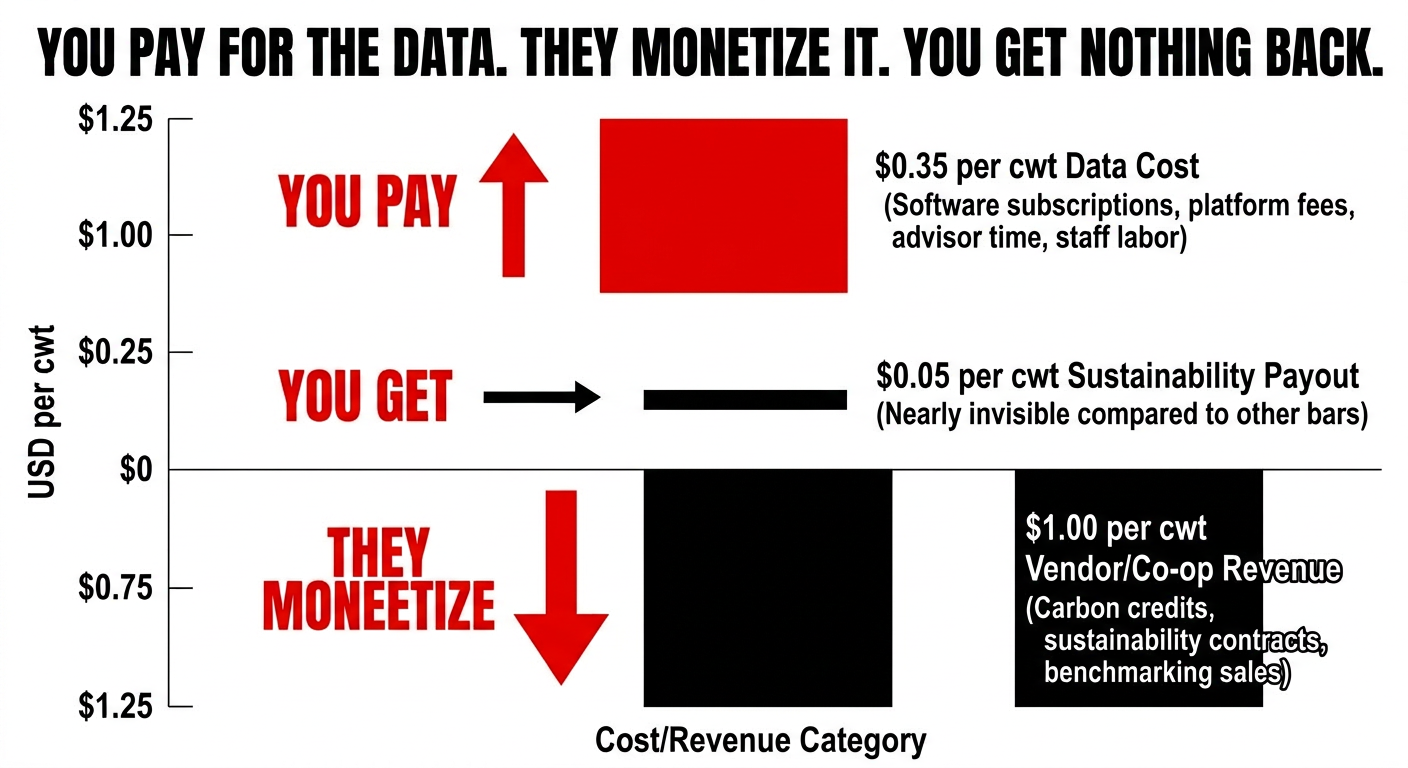
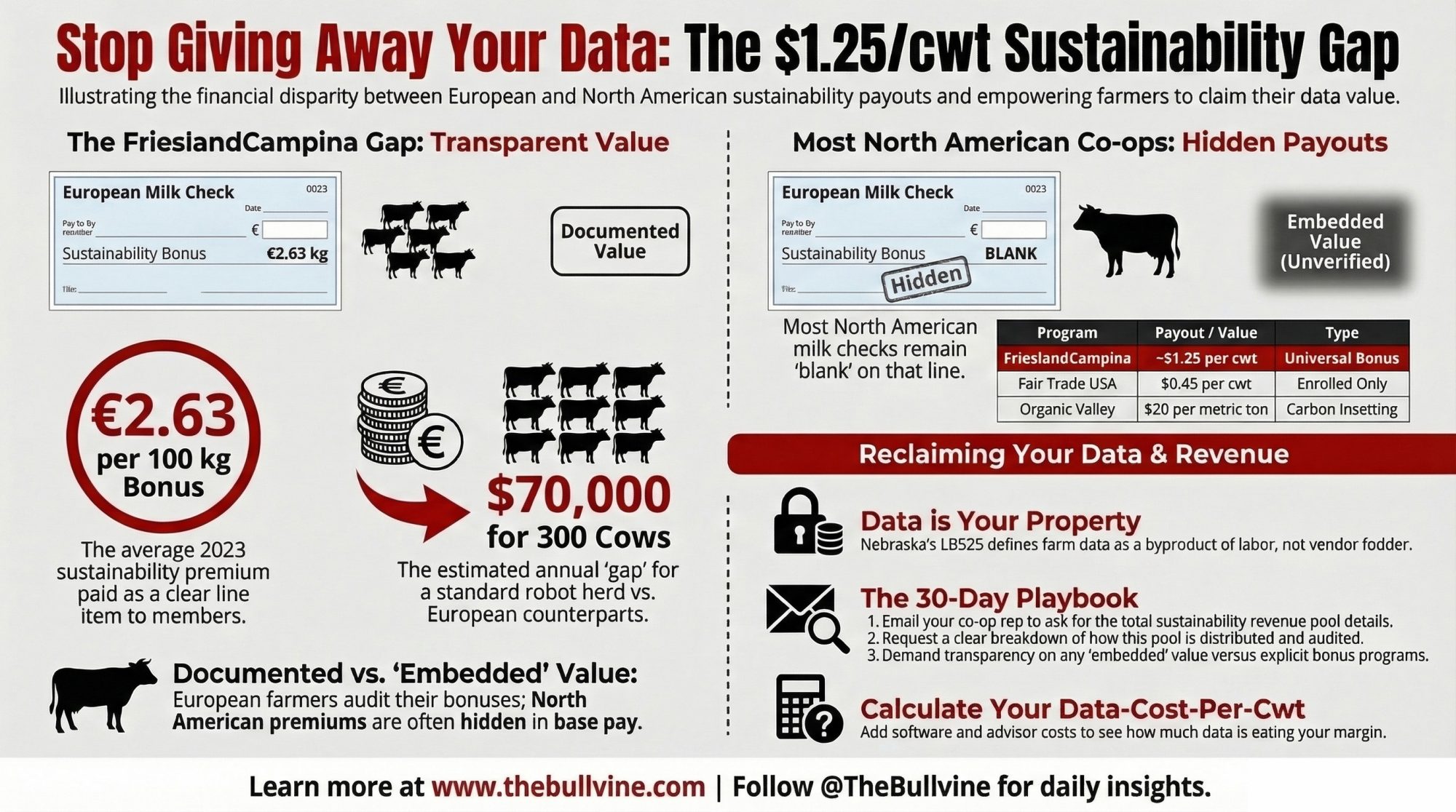
FrieslandCampina paid farmers €245 million in sustainability bonuses last year — €2.63/100 kg (US$1.25/cwt) as a separate line on every milk check. Your co‑op? Blank.

Executive Summary: FrieslandCampina handed back €245 million to its 2023 members in sustainability premiums — €2.63 per 100 kg (US$1.25/cwt) as a line item every farmer could see and bank on. North America’s Fair Trade (45¢/cwt), Truterra ($21M), Organic Valley ($20/ton), and Athian ($18M) deliver real cash — if you enroll, verify, and qualify. No blanket bonus hits every cwt from every farm. A 300‑cow herd under FC’s formula? €65,857 — roughly US$70k you could plug into stalls or payroll. Your data fuels these programs, yet you’re footing the platform bills while co‑ops quietly blend the upside into base pay. Nebraska Gov. Jim Pillen and Sen. Mike Jacobson want LB525 to flip that: farm data is yours, not vendor fodder. Do this now: Calc your “FrieslandCampina gap” (kg shipped ÷ 100 × €2.63), then email your co‑op rep demanding their sustainability revenue details — pool total, per‑cwt payout, exact line item.
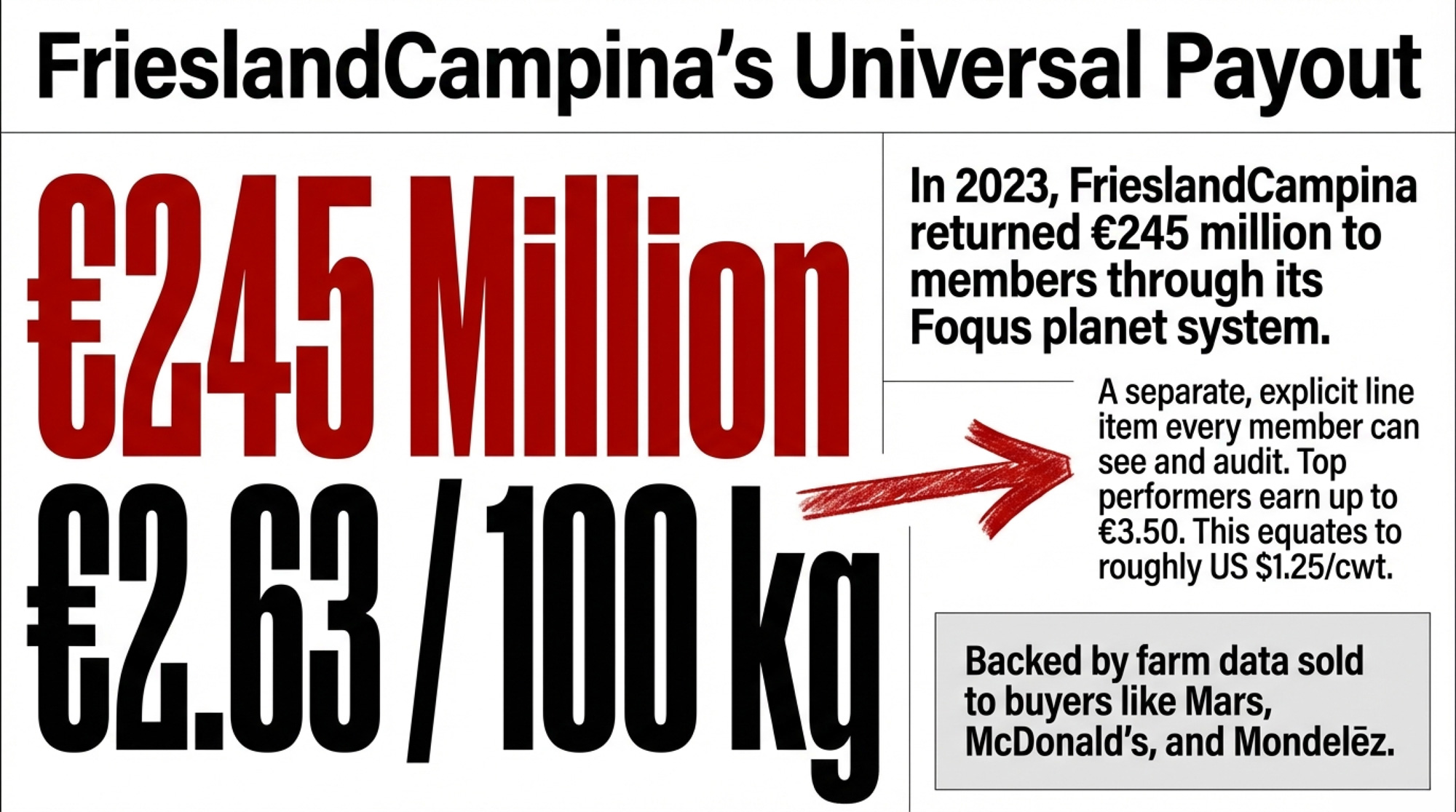
FrieslandCampina reported paying more than €245 million in sustainability premiums to member farms in 2023 — averaging €2.63 per 100 kg of milk, with top performers eligible for up to €3.50 per 100 kg. That’s roughly US$1.25–1.30 per cwt, based on published 2023–24 exchange rates, where €245 million converted to approximately US$263 million, and it appears as a separate sustainability line item that every member can see and audit.
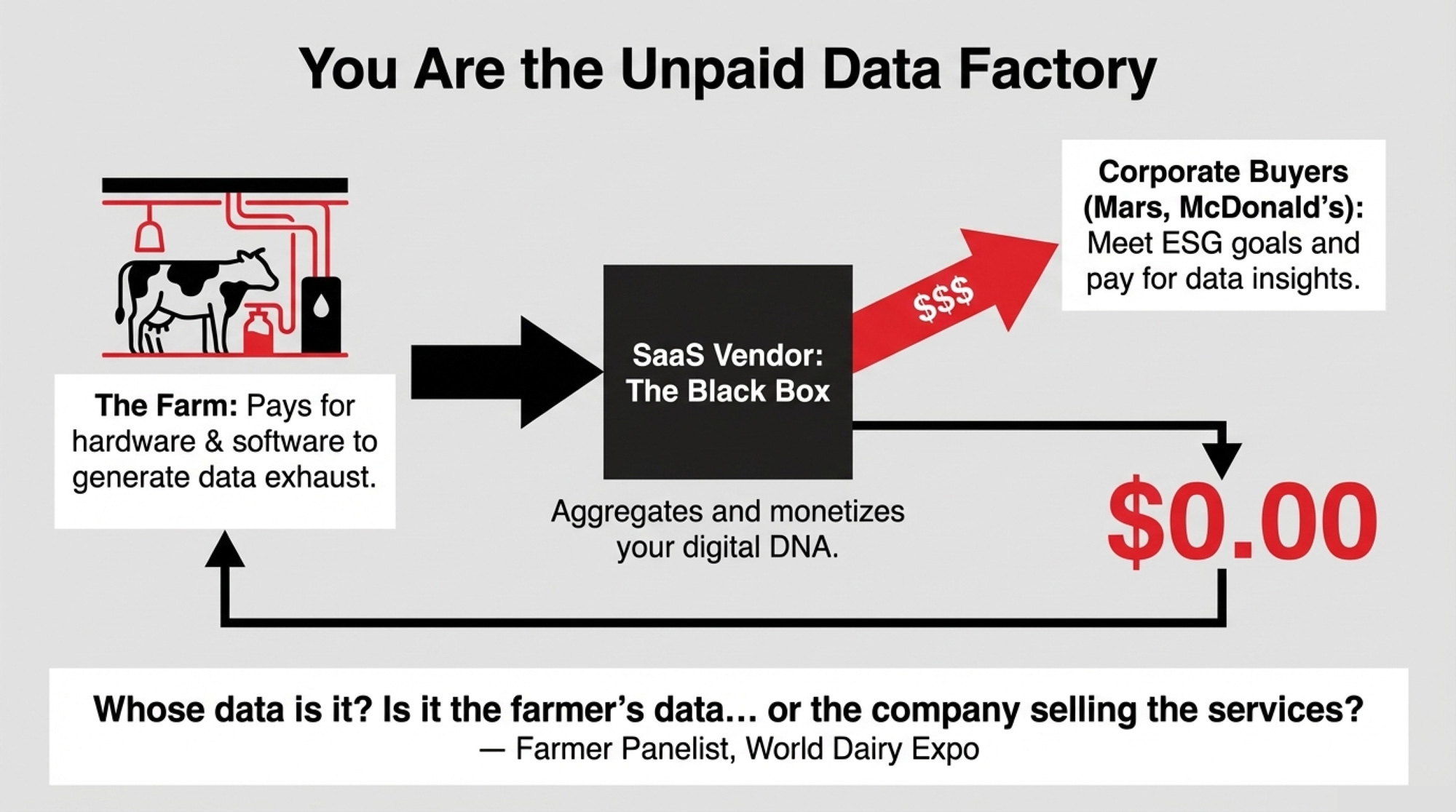
At World Dairy Expo 2025, during a Knowledge Nook seminar on connected data platforms, one of the farmer panelists cut through the tech talk with a blunt question: “Whose data is it? Is it the farmer’s data — the farmer that’s paying for it — or is it the company that’s selling the services?”

That’s the heart of it. If a European co‑op can put a sustainability number on every check with a formula its members can audit, why are so many North American milk checks still blank on that line?

How FrieslandCampina’s Sustainability Premium Formula Actually Works

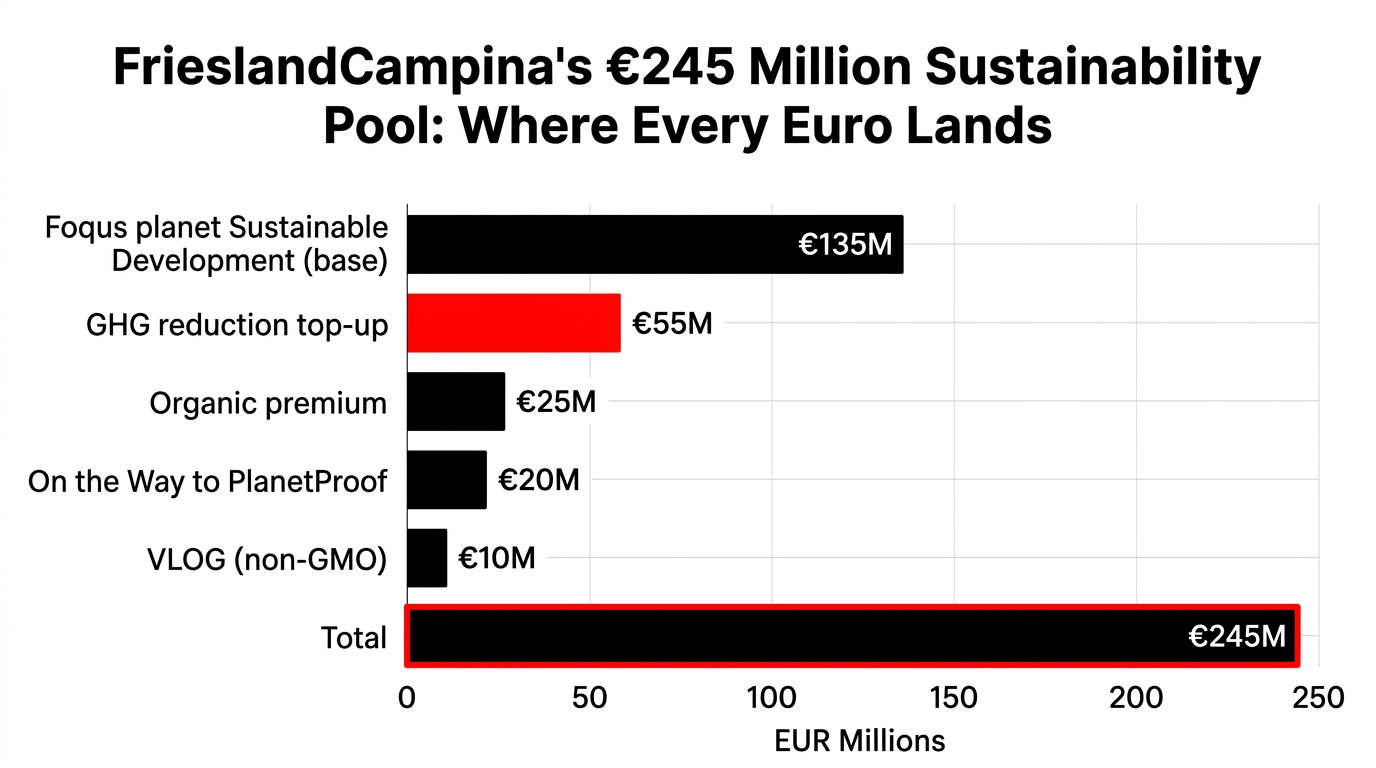
FrieslandCampina is a farmer‑owned co‑op with members in the Netherlands, Belgium, and Germany. In 2023, it channeled more than €245 million back into member pockets through sustainability‑linked premiums.

Here’s how that breaks down:

  • About €190 million came through the Foqus planet Sustainable Development system, which is tied to nine indicators, including greenhouse gas emissions, animal health, and grazing.
  • More than €55 million came through special milk flows like organic, On the Way to PlanetProof, and VLOG.
  • Farms that hit the toughest GHG reduction targets earned bonuses up to €1.50 per 100 kg on top of the base Foqus planet rate, for a maximum of €3.50 per 100 kg.

Members also fund part of this pool themselves. A cooperative deposit of €0.60 per 100 kg — over €56 million in 2023 — is withheld and later allocated based on Foqus planet scores. Net of that deposit, roughly €2.03 per 100 kg in Foqus planet premiums still ends up back on the check — a mix of company and customer sustainability money flowing to farms.

The trade‑off is real: you gain a predictable sustainability formula you can plan around, but you accept more measurement, more reporting, and the upfront cooperative deposit before that money comes back. FC members decided the visibility and the premiums were worth the paperwork.
FrieslandCampina uses farm‑level data to support sustainability contracts with buyers such as Mars, McDonald’s, and Mondelēz, including a pledge with Mondelēz to cut on‑farm GHG emissions by about 14% by 2025 compared with 2019. They’re not just selling milk. They’re selling documented sustainability performance backed by farm data — and they share that value explicitly with the farmers who generated it.

What North American Programs Actually Pay — And How

North America isn’t empty of sustainability payments. But the structures look very different from a universal per‑100 kg premium.
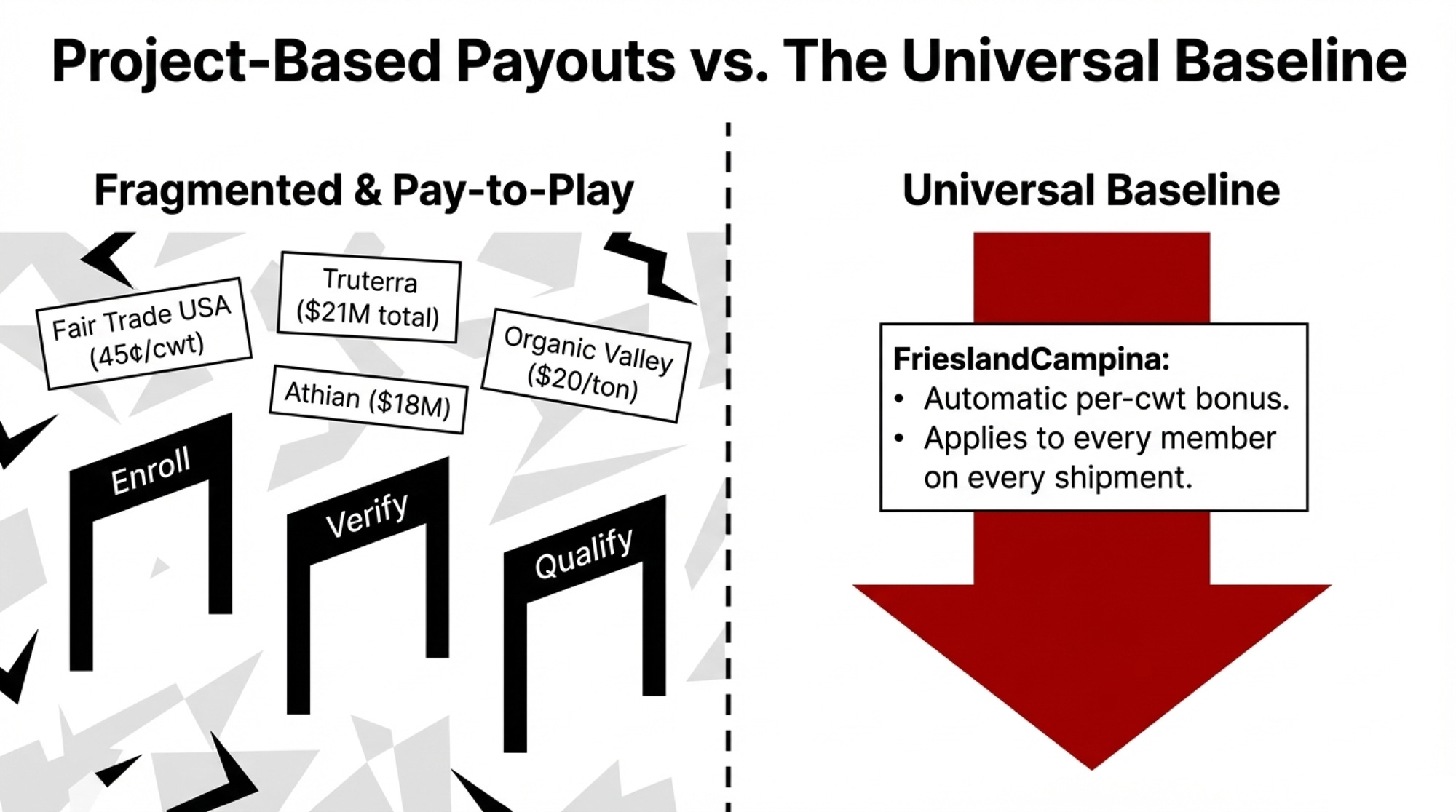
Fair Trade USA — 45¢/cwt for enrolled farms. In 2023, Fair Trade USA launched a dairy certification with Chobani that pays US$0.45 per cwt each month to participating farms, both organic and conventional. It’s real money and a clear line item, but only for producers who go through Fair Trade certification and ship into that specific program.

Truterra/Land O’Lakes — US$21M across three years. Land O’Lakes’ sustainability arm, Truterra, reports paying farmers more than US$21 million to sequester or reduce 1.1 million metric tons of carbon across its first three program years. Payments go to farms that enroll and meet practice and verification rules, not to every member on every cwt.

Organic Valley — US$20/ton insetting. Organic Valley’s Carbon Insetting Program pays member farms US$20 per metric ton of verified on‑farm carbon reduction, using funds from a US$25 million Partnerships for Climate‑Smart Commodities grant. Strong signal — but only for enrolled, verified projects.

Athian — US$18M in livestock carbon credits. Athian’s livestock carbon insetting platform has facilitated about US$18 million in payments to dairy and beef farms since 2024. Dairy Farmers of America bought the first verified livestock carbon credits in early 2024, generated on a Texas dairy after an Elanco protocol reduced nearly 1,150 metric tons of CO₂e.

Those examples matter. They prove that sustainability money isn’t theoretical in North America. But they’re all project‑based: you enroll, you qualify, you get paid. There’s still no equivalent to FrieslandCampina’s published per-100-kg sustainability bonus that automatically applies to every member and appears as a separate line item on every milk check.

Program / Co-opGeographyPayment StructureAmountWho Gets PaidVisibility on Check
FrieslandCampinaNetherlands, Belgium, GermanyUniversal per-100-kg premium€2.63/100 kg (US$1.25/cwt)All membersSeparate line, monthly
Fair Trade USAU.S. (Chobani program)Per-cwt premiumUS$0.45/cwtEnroll onlySeparate line for enrolled farms
Truterra / Land O’LakesU.S.Carbon practice paymentsUS$21M / 3 years poolEnroll + verifyNot disclosed per cwt
Organic ValleyU.S.Carbon insettingUS$20/ton CO₂e reducedEnroll + verifyProject payment, not per-cwt
Athian (DFA purchase)U.S. (multi-state)Carbon credit salesUS$18M facilitatedEnroll + verifyNo standard line item

And meanwhile, a lot of you are paying for the hardware and software that generate the data these programs and your buyers depend on.
What Would €2.63/100 kg Look Like on Your Herd?

Let’s run the barn math, so this isn’t just a European story.

The American Jersey Cattle Association reports that Registered Jerseys averaged 18,400 pounds — roughly 8,346 kg— of actual milk per cow in 2023. At World Dairy Expo’s Knowledge Nook, connected‑data sessions featured producer panels speaking to technology use on herds ranging from a few hundred cows to several thousand. For this analysis, use three realistic herd sizes: about 2,300 cows, 300 cows on robots, and a 260‑cow family operation.

Apply the Jersey average and FrieslandCampina’s € 2.63-per-100-kg sustainability premium.

Step‑by‑step for a 300‑cow herd:

  1. Milk per cow per year: 8,346 kg.
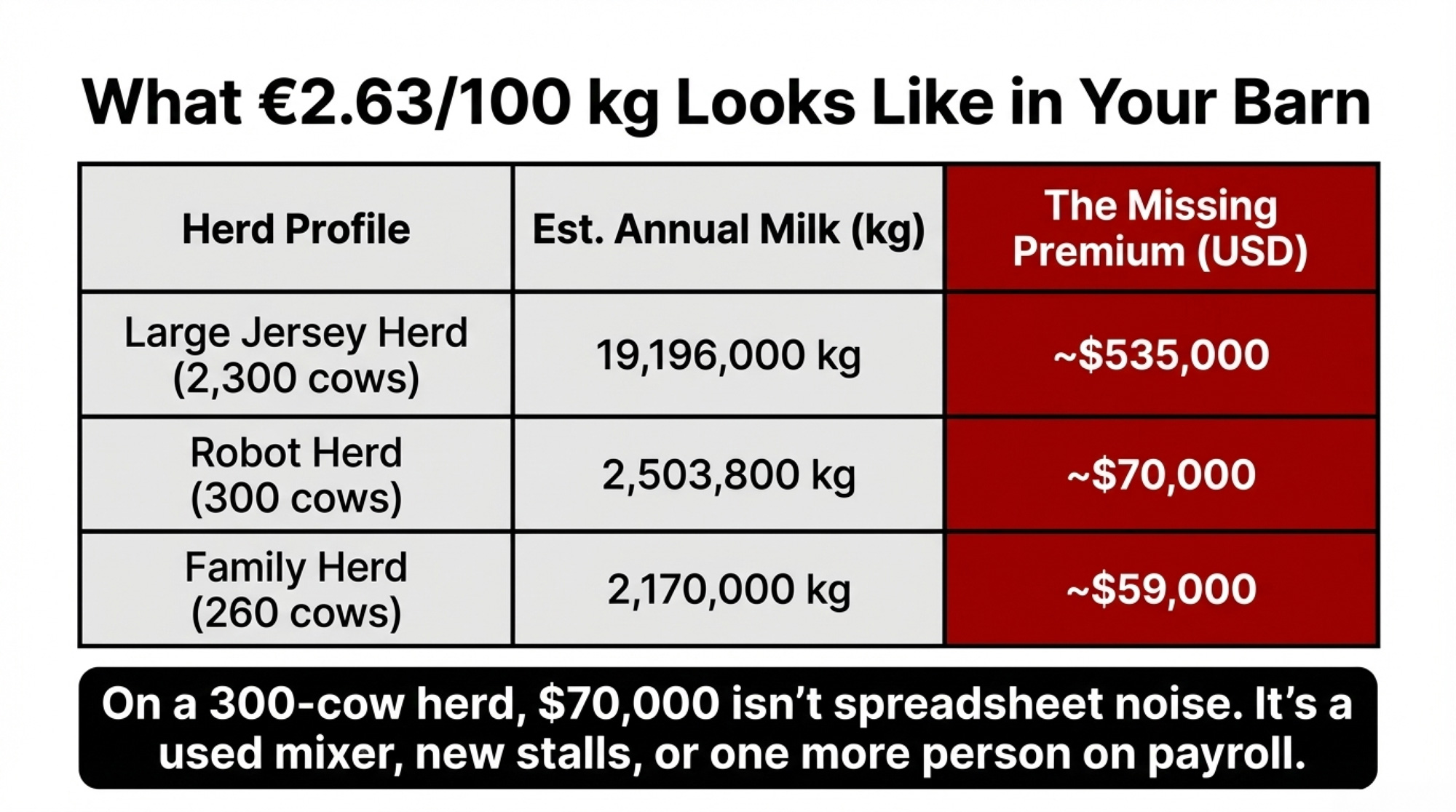
  2. Total herd milk: 8,346 kg × 300 cows = 2,503,800 kg.
  3. Per‑100 kg units: 2,503,800 ÷ 100 = 25,038 units.
  4. Premium: 25,038 × €2.63 ≈ €65,857.
  5. At about US$1.07–1.09 per euro, that’s roughly US$70,000.

Now run it for the other herds — and for yours:
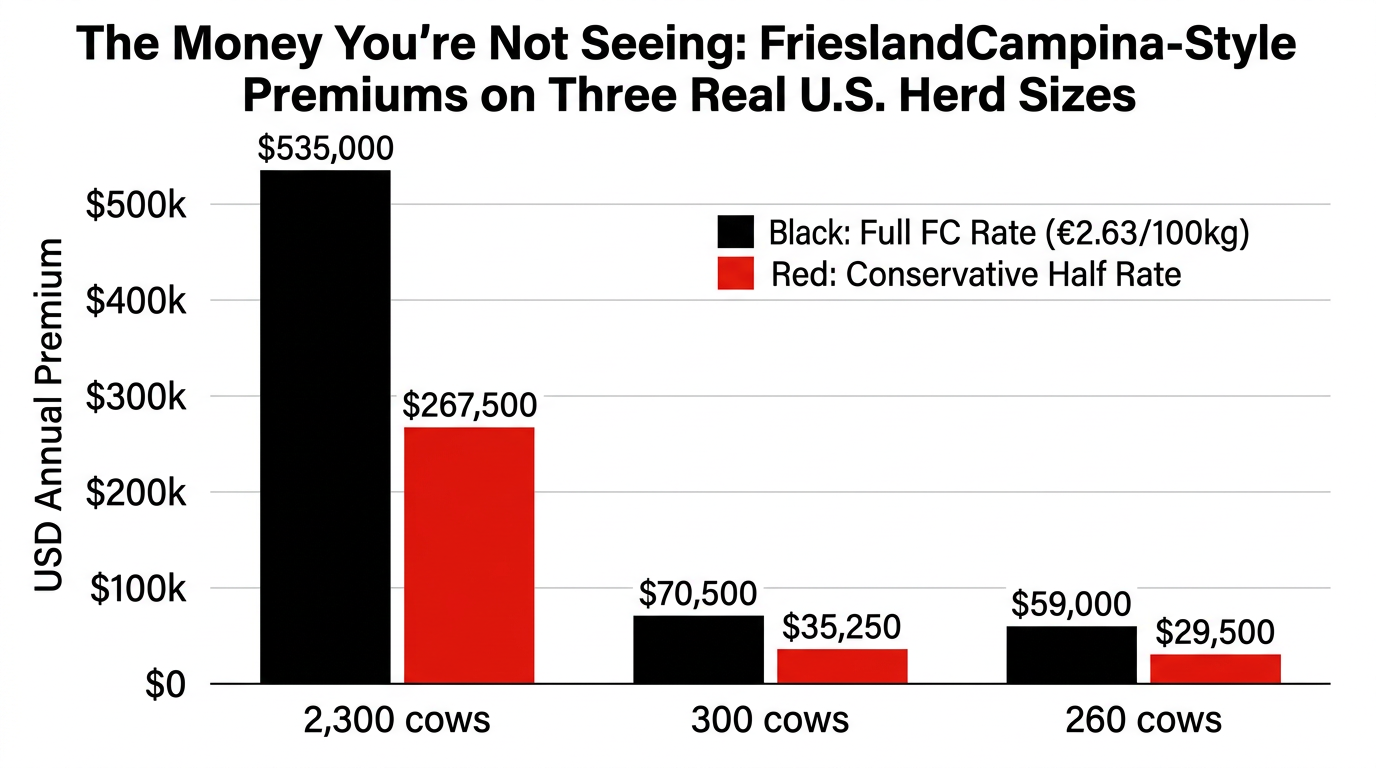
Herd ExampleHerd sizeEst. annual milk (kg)*Premium at €2.63/100 kgUSD equiv. (approx.)Conservative (half rate)
Large Jersey herd2,300 cows19,196,000≈€504,855≈US$530–540,000≈US$265–270,000
300‑cow robot herd300 cows2,503,800≈€65,857≈US$69–72,000≈US$34–36,000
260‑cow family herd260 cows≈2,170,000≈€55–57,000≈US$58–60,000≈US$29–30,000
Your herd_________________________

*Est. Annual milk = herd size × 8,346 kg/cow (2023 AJCA Jersey average). USD values use published 2023–24 exchange ranges where €245m ≈ US$263m (about US$1.07–1.09/euro) and are approximate.

On a 260‑ to 300‑cow herd, US$30–70,000 isn’t spreadsheet noise. That’s a used mixer, new stalls in a problem pen, or one more person on payroll. For a 2,300‑cow operation, a low‑six‑figure sustainability line item changes how you think about capital and debt paydown.

In cwt terms, 8,346 kg is about 184 cwt per cow per year. At €2.63 per 100 kg, you’re looking at roughly US$1.25–1.30 per cwt on the sustainability line. Even a conservative half‑rate — about US$0.60 per cwt — stacks up across a year’s shipments.

You can ballpark your own number in two steps:

  1. Last year’s total kg shipped ÷ 100 × €2.63 = “FrieslandCampina‑style” sustainability premium.
  2. Convert at the current euro rate, then halve it for a conservative benchmark.
Herd DescriptionHerd Size (cows)Annual Milk (kg)Premium at €2.63/100 kg (USD approx.)Conservative Half-Rate (USD)Action
Large Jersey herd2,30019,196,000$535,000$267,500Email co-op: “Where’s my $267k sustainability line?”
300-cow robot herd3002,503,800$70,500$35,250Email co-op: “Where’s my $35k sustainability line?”
260-cow family herd2602,170,000$59,000$29,500Email co-op: “Where’s my $29.5k sustainability line?”
YOUR HERD__________$_____$_____Calc now. Email tonight. Demand details.

You don’t have to be a fan of EU regulation to see what’s missing on your side of the ledger.

Two Data Models: Who Pays, Who Controls, Who Benefits

World Dairy Expo’s Knowledge Nook exists because farms are drowning in data and vendors are lining up with solutions. The hard question is who actually captures the value.

JoinData — farmer data co‑op

JoinData is a non‑profit data cooperative created in 2017 by Agrifirm, CRV, FrieslandCampina, LTO Nederland, and others. It connects more than 16,000 farmers with hundreds of data‑using organizations: processors, slaughterhouses, feed companies, sensor suppliers, accountants.

Farmers use the My JoinData portal to see which companies pull which data, and they can grant or revoke authorizations with a few clicks. Data‑using companies pay transport fees to access the pipe; those fees help fund the platform. Farmers pay a modest annual subscription — about €50 per year — to use the portal and manage permissions.

Companies that want the data write the bigger checks. Farmers keep control over who sees what.

Connected data platforms — data as paid SaaS

Knowledge Nook sessions in recent years have shown how quickly connected‑data offerings are expanding — from UNIFORM‑Agri’s simplified farm data management to DeLaval’s AI‑driven efficiency tools. These systems pull milking, sensors, activity monitoring, and herd management into a single dashboard.

Producers and advisors speaking in these sessions describe real operational wins: catching intake and rumination drops in dry‑cow pens earlier, tracking feed efficiency and daily income over feed cost instead of quarterly, and making ration changes faster when alerts pop up. Dry cows don’t give you daily tank weights — without data streams, some of those problems stay invisible until they cost money.

But the money flow is almost the opposite of JoinData:

  • With JoinData, farmers pay a small flat fee and control authorizations; companies pay to access data through the pipe.
  • With most SaaS platforms, farms pay the subscription; vendors aggregate multi‑farm data and decide how to monetize benchmarks, models, and “insights.”

As The Bullvine documented in “The $30,000 Question: Who Really Owns Your Farm’s Digital DNA?”, at least one Canadian vendor scenario involved a producer being quoted around US$30,000 to export historical data when exiting a robotic milking system. That’s not hypothetical. That’s how “your” data becomes a leverage point when contracts grant vendors broad rights to access and portability.

You’re not just a customer in those models. You’re the unpaid data factory.

Is Nebraska Writing the First Data‑Ownership Line Item for You?

That Knowledge Nook question — “Whose data is it?” — isn’t just a hallway conversation anymore. It’s being written into the proposed law.
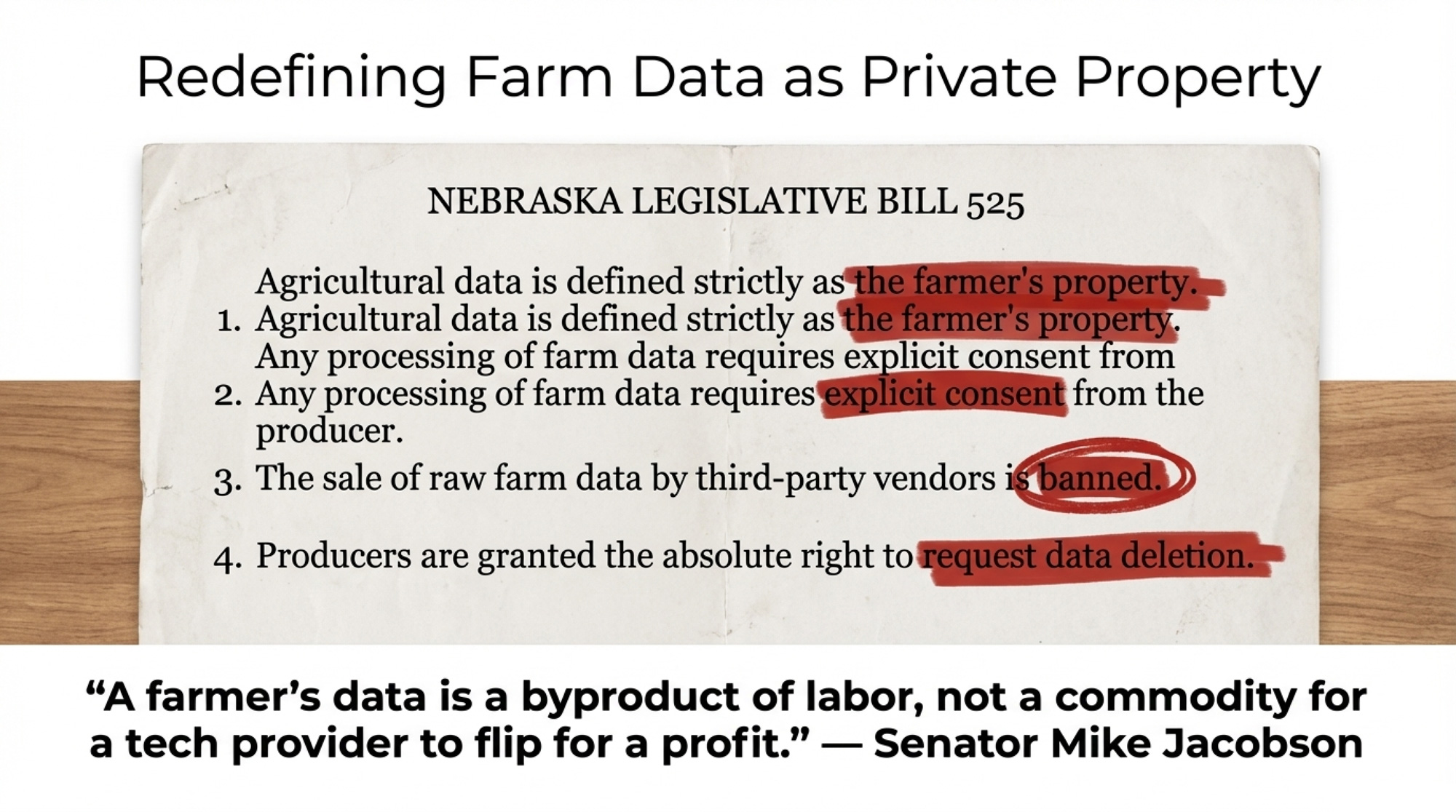
In January 2026, Nebraska Governor Jim Pillen told lawmakers he believes “Nebraska’s family farmers own that data — and we’re going to defend our producers from any misguided entity with other ideas.” Legislative Bill 525, introduced by Senator Mike Jacobson, is the first U.S. bill aimed squarely at agricultural data privacy.

The amended bill would:

  • Recognize agricultural data as the farmer’s property.
  • Require explicit consent before any company processes that data.
  • Ban the sale of raw farm data.
  • Give producers the right to request deletion of their data.

It covers crop yields, livestock metrics, GPS tracking, and financial data tied to the operation. In a February 2026 hearing, Jacobson framed it plainly: “A farmer’s data is a byproduct of labor, not a commodity for a tech provider to flip for a profit.”

Nebraska Farm Bureau’s Bruce Riecker drilled into the practical side: “Who owns the data? Who has the right to use it? How do they have the right to use it? And how do we protect the producers so that it can’t be used against them in some predatory way or malicious way?”

Manufacturers and platform providers are pushing back on the “ownership vs. control” distinction and on what counts as “aggregated” or “derived” data. They’re not wrong to worry about compliance cost and innovation friction. But the direction of travel is clear: at least one state is ready to say, in law, that the numbers coming off your fields and cows belong to you first.

LB525 won’t magically put a sustainability line on your milk check. It does set a precedent: the data that powers sustainability premiums and carbon markets is a byproduct of your labor, not free raw material for somebody else’s recurring‑revenue model. And if co‑op governance reformers are already pushing for transparency on milk check deductions and voting power, data ownership is the next frontier.

The 30/90/365‑Day Playbook for Your Own Milk Check

You can’t rewrite your co‑op’s premium structure tomorrow. You can start treating your data like the asset it actually is.

In the next 30 days

  • Run your “FrieslandCampina gap” once. Take last year’s total kg shipped ÷ 100 × €2.63. Convert at the current euro rate. Halve it if you want a conservative benchmark. That number is what a FrieslandCampina‑style program would mean for a herd your size.
  • Send one email to your board rep or member services. Ask three questions: What was the co‑op’s total sustainability revenue pool last year — including climate‑smart grants, branded premiums, and any carbon credit or insetting sales? What’s the average per‑cwt amount paid through to member farms? Where does it appear on individual member milk checks? FrieslandCampina publishes this data annually for its members. If your co‑op can’t answer, or won’t, that’s your first hard data point.
  • Read your own fine print. Pull your milk supply agreement and any platform contracts. Circle three clauses: who owns the data your systems generate; who has rights to aggregated or anonymized insights; and whether you can export your data in a usable format within 30 days, at no extra cost. If those answers are fuzzy, you’re giving vendors more leverage than you realize.

In the next 90 days

  • Calculate your data‑cost‑per‑cwt. Add up software subscriptions, extra advisor time to get systems talking, and staff time spent feeding data into platforms. Divide by total cwt shipped last year. If that number is a meaningful slice of your net margin and you still can’t find a sustainability line on your check, it’s time to start asking harder questions about who’s benefiting.
  • Compare notes with three neighbors on the same truck. Ask whether they’ve ever seen a sustainability pool figure, know what the co‑op received from climate‑smart or carbon programs, or have any easier time exporting their own data. If nobody can get a clear answer, you’re looking at a structural issue, not a one‑off problem.
Over the next 365 days

  • Push for three structural changes. When contracts or policies come up, push for: a separate sustainability line on your milk check; annual disclosure of total sustainability revenue and per‑cwt pass‑through; and a no‑fee, 30‑day export right for all your data from any co‑op‑mandated system.
  • Watch Nebraska’s LB525 and your own state or provincial capitol. If LB525 passes, expect similar bills to surface elsewhere. If your farm organization has a legislative committee, ask whether agricultural data privacy is on their agenda. If it’s not, that’s a lobbying gap you can push to close.
  • Decide your escalation threshold. If a year from now your data‑cost‑per‑cwt is still high and your co‑op still can’t answer those three questions, it may be time to go beyond polite emails — into organized member coalitions, board elections, and bylaw changes. That’s how other farmer groups have finally forced co‑ops to answer the hard questions.

What This Means for Your Operation

  • If there’s no sustainability line on your check, you’re in a risk position you may not have sized. You’re generating data and paying to manage it, but you have no documented sustainability payout tied to it.
  • North American sustainability money exists — it’s fragmented into specific programs. Fair Trade USA pays US$0.45/cwt to enrolled farms. Truterra has sent US$21 million to participating farmers. Organic Valley pays US$20/ton for verified reductions. Athian has facilitated US$18 million in livestock carbon credits. None of that is a universal per‑cwt formula for all members. That’s the structural gap.
  • Treat data clauses the way you treat basis clauses. Before you sign another hardware or software contract, ask: if you needed to walk away in five years, how much would it cost to take your history with you? If the answer isn’t clear, you’re agreeing to more than just the monthly fee.
  • Use your data‑cost‑per‑cwt as a trigger, not a trivia point. If that number is a meaningful chunk of your net margin and the sustainability line on your check is still blank, the economics deserve scrutiny — and you’re justified in pushing for changes at the co‑op and vendor level.
  • Legislation is catching up to what you’ve felt in your gut. Nebraska’s LB525 says plainly that farm data is a byproduct of your labor, not a vendor’s commodity. Even if you never milk a cow in Nebraska, that logic applies to your operation.
Key Takeaways

  • If your last three milk checks don’t show a sustainability premium line, you’re generating data and paying to manage it without any documented sustainability payout tied to it. The €2.63/100 kg benchmark gives you a concrete number to size that gap.
  • FrieslandCampina and JoinData prove that farmer‑controlled data pipes and published sustainability formulas are workable at scale. “Embedded in the blend” is often a structural choice by your co‑op, not a requirement of the marketplace.
  • Nebraska’s LB525 is the first serious U.S. attempt to say, in law, that your farm’s digital exhaust belongs to you. The same arguments Jacobson is trying to codify show up every time you sign a platform agreement without reading the data clauses.
  • The easiest step you can take this week is to send one email. Ask your co‑op for the total sustainability pool, the per‑cwt pass‑through, and where it shows on the check. Their answer — or their silence — tells you a lot about how your data is being treated.

The Bottom Line

FrieslandCampina’s members know their sustainability number. It’s printed on the check, with a formula they can audit. Next time you open your milk statement, look for yours. If it’s not there, you now know how to calculate what’s missing — and who to ask why.

Complete references and supporting documentation are available upon request by contacting the editorial team at editor@thebullvine.com.

Learn More

The Sunday Read Dairy Professionals Don’t Skip.

Every week, thousands of producers, breeders, and industry insiders open Bullvine Weekly for genetics insights, market shifts, and profit strategies they won’t find anywhere else. One email. Five minutes. Smarter decisions all week.
NewsSubscribe
First
Last
Consent

The Robot Metric Dealers Don’t Emphasize – And Why It Predicts Your Payback

A cow making 85 lbs is costing you money. A cow making 75 lbs is driving profit. Robot economics don’t work like you think.

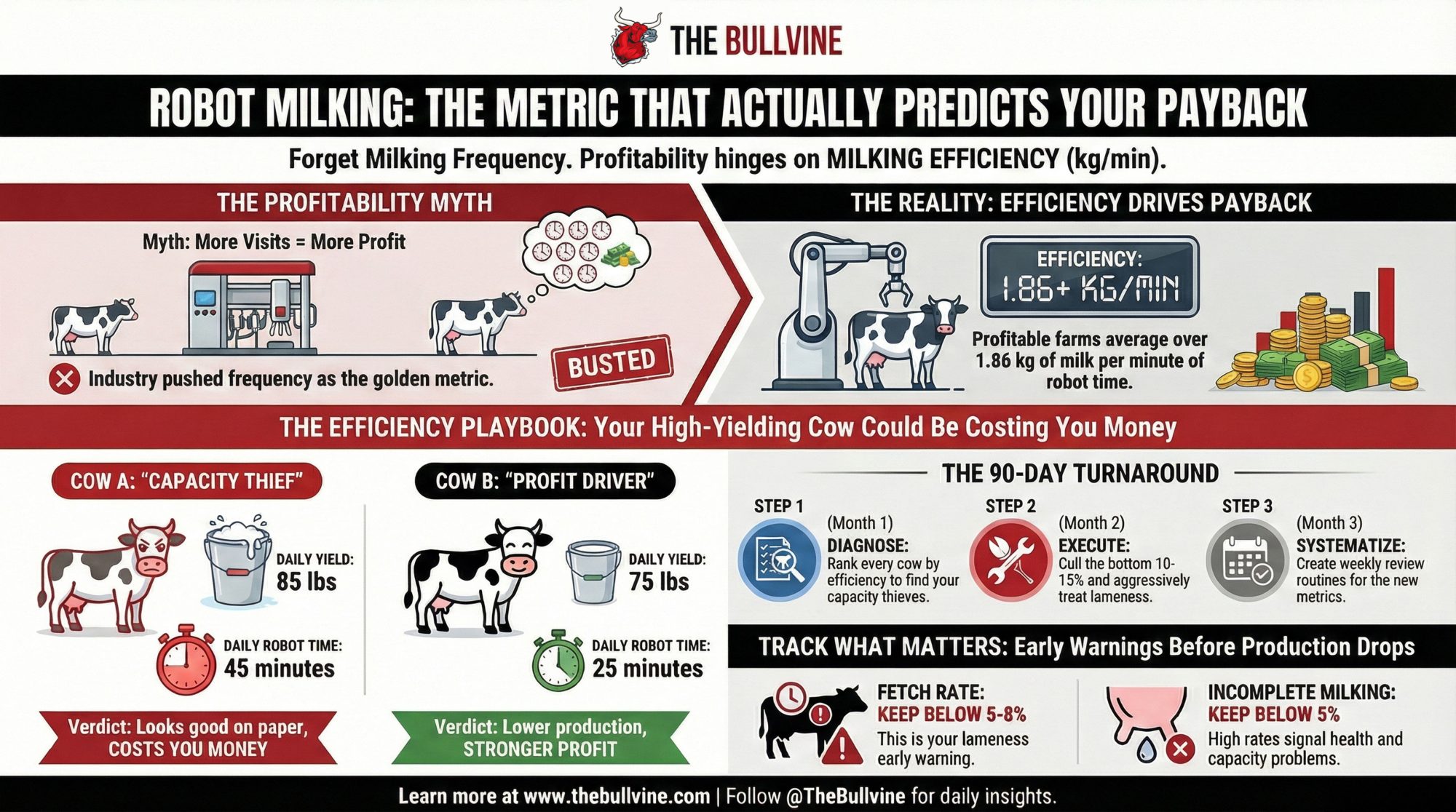
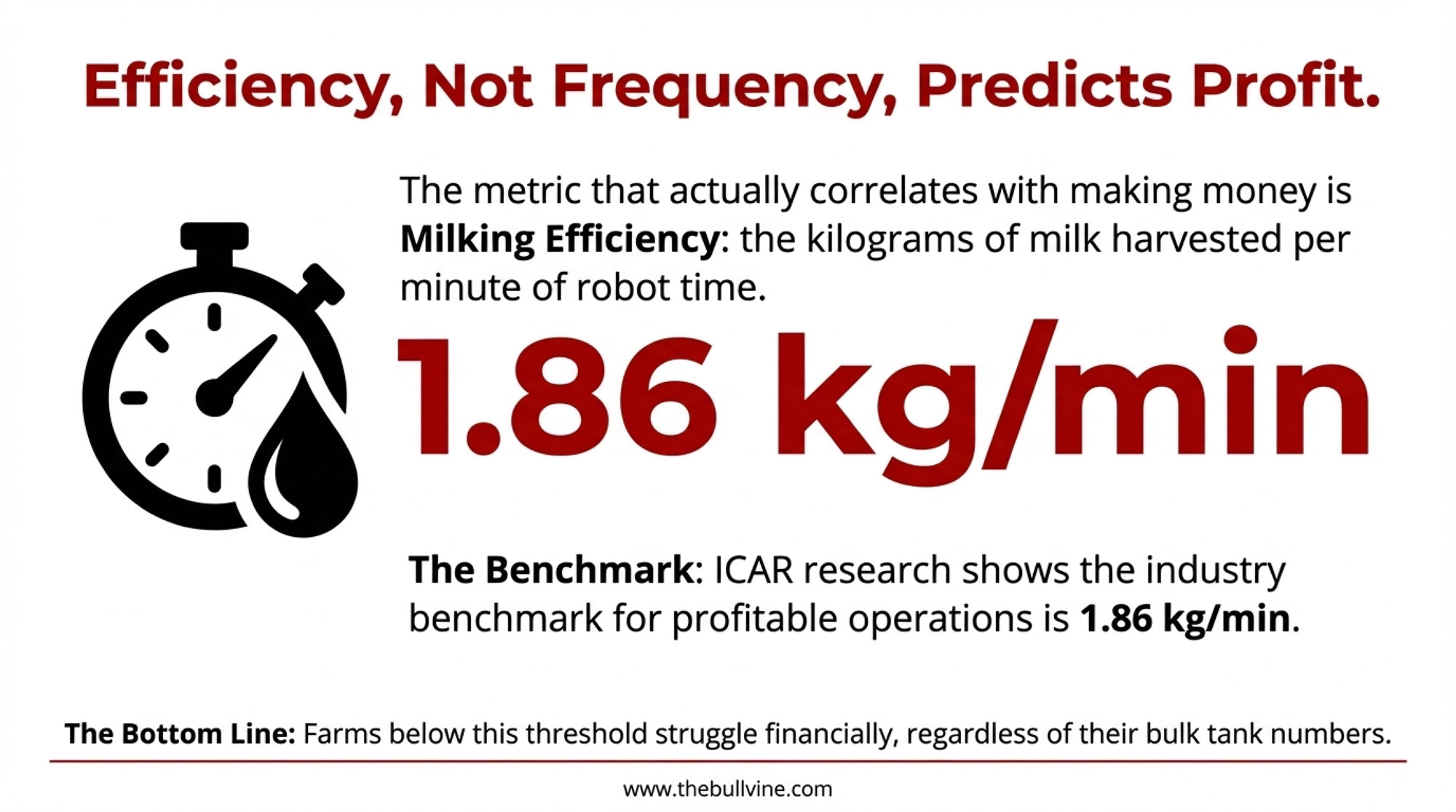
Executive Summary: The metric you were sold on—milking frequency—has surprisingly little to do with whether your robots actually pay off. Six years of industry data points to a different number: efficiency, measured as kilograms of milk per minute of robot time. ICAR research benchmarks profitable operations at 1.86 kg/min, and farms falling short struggle regardless of strong bulk tank numbers. Here’s the uncomfortable math: an 85-lb producer hogging 45 minutes of box time costs you money, while a 75-lb cow with 25-minute turnover drives real profit. This analysis delivers five metrics worth tracking daily, a 90-day turnaround protocol, and an honest framework for determining whether your struggles are management problems you can fix—or structural and economic realities that require harder decisions.

Robotic Milking Efficiency

You know that conversation that happens at coffee shops near dairy country? The one where a producer leans in and says something like, “They told me three to four years to payback. I’m at year six, and I’m still waiting.”

I’ve been hearing variations of this for the past eighteen months. What strikes me isn’t the frustration—that’s understandable when you’ve invested somewhere between $150,000 and $275,000 per unit in technology that hasn’t delivered on the sales projections. What’s interesting is what separates the producers who’ve turned things around from those still treading water.

It comes down to a single insight, and it’s surprisingly counterintuitive: the farms thriving with automation have largely stopped obsessing over milking frequency.

The Sales Pitch vs. The Reality

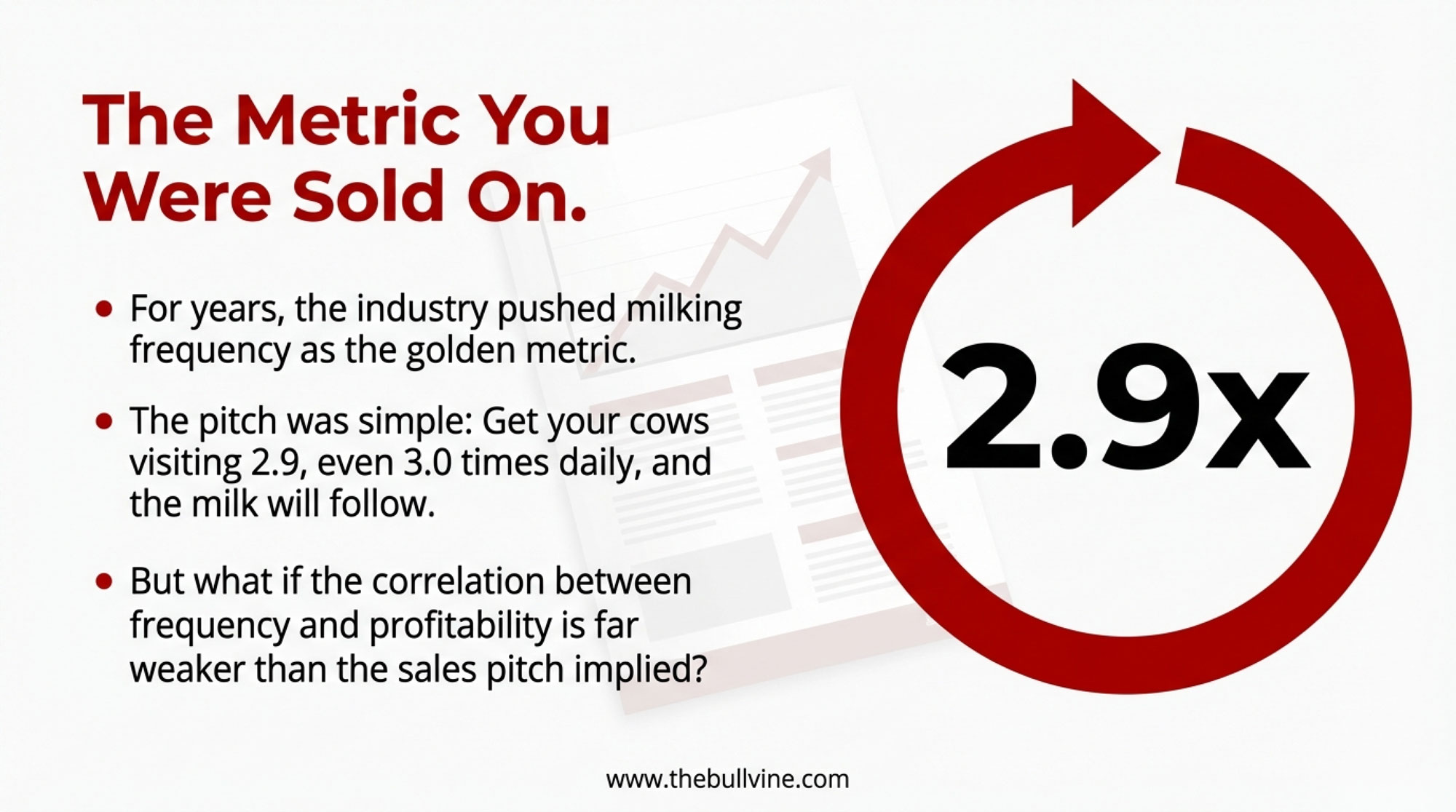
Let’s be direct about this. For years, the robotic milking industry pushed frequency as the golden metric. Get your cows visiting 2.9 times daily. Push for 3.0 if you can manage it. The reasoning seems solid enough—more milkings should translate to more milk.

Here’s what the early sales conversations often missed: the correlation between frequency and profitability is far weaker than the pitch implied.

Efficiency (kg/min)Net margin (USD/cow/day)Frequency (visits/day)
1.20-1.502.9
1.40-0.753.0
1.600.252.8
1.861.502.9
2.002.102.7
2.203.002.8

What actually correlates with making money? Something called milking efficiency—the kilograms of milk harvested per minute of robot time. Dr. Débora Santschi, who directs Lactanet Canada’s R&D team and has been working with dairy data since 2010, has been central to tracking these patterns. Research presented through ICAR’s technical series in Montreal shows that average milking efficiency runs around 1.86 kg milk per minute of box time—but the variation between high and low performers is where fortunes are made or lost.

To be fair, the conversation is evolving. I’ve spoken with several Midwest dealers who now lead with efficiency metrics rather than frequency targets—a welcome shift that suggests the industry is catching up to what producers have learned the hard way. But if you bought your system five or six years ago, you probably got the older playbook.

The bottom line: When consultants work with producers to improve robot economics, frequency is rarely the limiting factor. It’s almost always about capacity utilization.

Think about it. A robotic milking system only has so many minutes of available milking capacity per day. That number doesn’t expand based on how hard you push—it’s the fixed resource that every management decision operates within. Whether you’re running a 120-cow operation in Wisconsin or a 300-cow herd in California, the math is unforgiving.

What Efficient Operations Actually Look Like

I’ve spent time visiting farms in Ontario, Wisconsin, and the Central Valley that have figured this out. The differences are more subtle than you might expect—and they have nothing to do with hitting frequency targets.

Here’s a pattern I’ve seen repeatedly: A mid-sized operation installs robots, focuses intently on increasing frequency, and hits that 2.9 visits per day target within the first year. The bulk tank looks good. But payback doesn’t materialize.

What changes things? Shifting attention to box time—the total minutes each cow spends in the robot per visit.

Once farms start tracking this metric, they discover enormous variation within their herds. Some cows are in and out in five minutes flat. Others are taking 9, 10, sometimes 11 minutes for essentially the same milk yield.

I recently spoke with an Ontario producer who put it this way: they had maybe 15 cows using 20% of their robot capacity while contributing maybe 8% of their milk.

“Once you see that math, you can’t unsee it.”

A Wisconsin producer I visited last fall told me something similar. He’d been chasing 3.0 visits per day for two years before his nutritionist suggested looking at individual cow efficiency. “I had cows I was proud of—good production, no health issues—that were killing my robot economics. That was a hard conversation with myself.”

The University of Wisconsin’s Dairy Brain initiative has been systematically documenting these patterns. Their work integrating AI and real-time sensor data suggests that systematic attention to individual cow efficiency metrics—rather than herd-average frequency—may be among the stronger predictors of robot profitability.

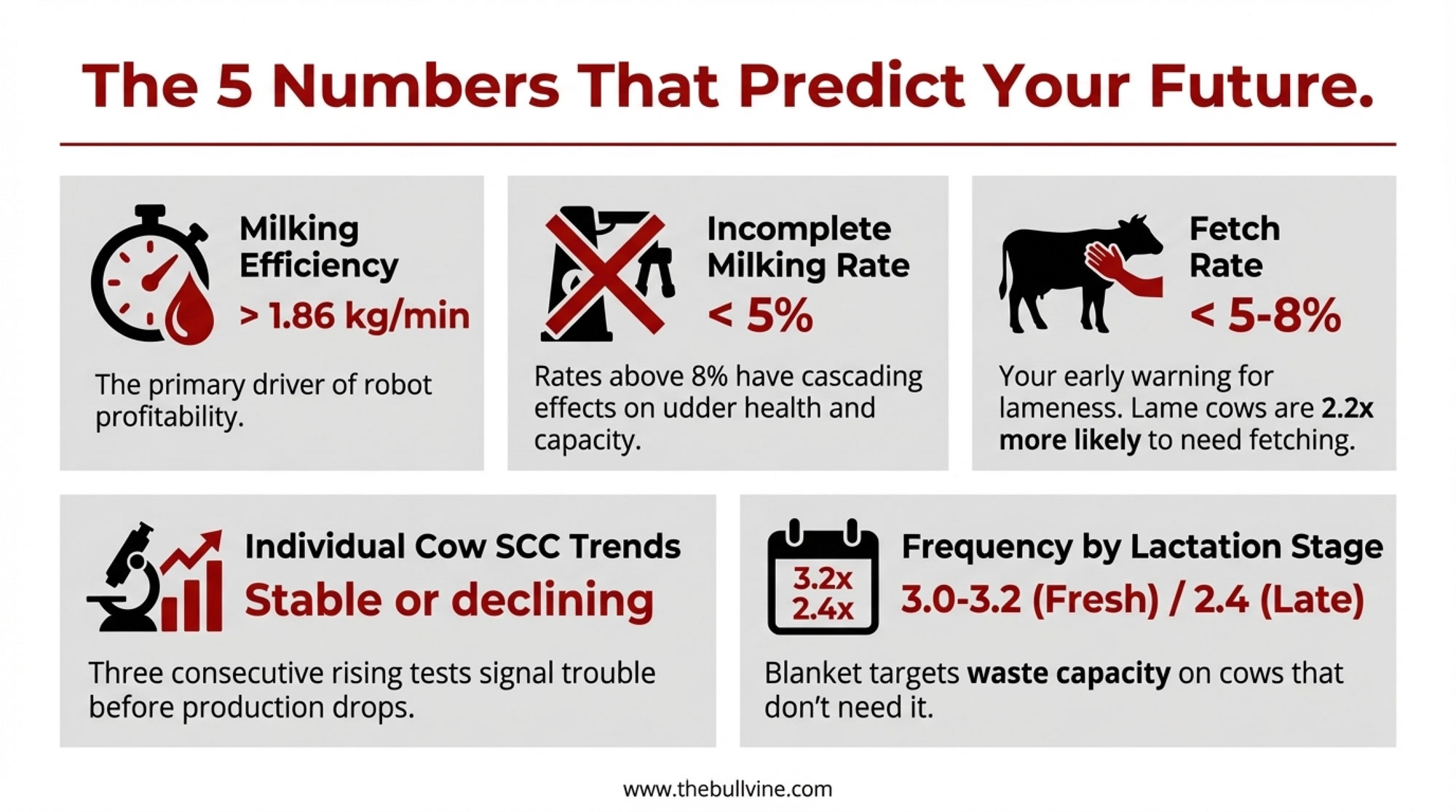
The Five Numbers That Actually Predict Profitability

Dr. Marcia Endres at the University of Minnesota makes a point that cuts through the noise: milk yield tells you what happened yesterday. The metrics that matter tell you what’s about to happen.

Here’s what the most profitable robot farms are watching daily:

MetricTargetWhy It Matters
Milking EfficiencyAbove 1.86 kg/minFarms below this threshold struggle financially regardless of production numbers
Incomplete Milking RateBelow 5%Above 8-10%, cascading effects on udder health and capacity compound rapidly
Fetch RateBelow 5-8%Lame cows are 2.2x more likely to need fetching—this is your lameness early warning
Individual Cow SCC TrendsStable or decliningThree consecutive rising tests signals trouble before production drops
Frequency by Lactation Stage3.0-3.2 (fresh) / 2.4 (late)Blanket targets waste capacity on cows that don’t need it

Key insight on regional economics: Operations in California or the Northeast may need to hit the upper end of efficiency targets to achieve margins similar to those of Midwest producers. Labor costs and milk prices shift the math significantly.

Software note: Lely Horizon, DeLaval HerdNav, and GEA DairyPlan can all generate efficiency reports, but you may need to set up custom calculations to track kg/minute specifically.

The Efficiency Gap: A Tale of Two Cows

This is where robot economics get uncomfortable—and where the biggest opportunities hide.

Traditional culling focuses on production. A cow making 85 pounds daily seems like a keeper. A cow making 75 pounds seems like a candidate for the truck.

Robot economics flip this completely.

MetricCow A: “The Capacity Thief”Cow B: “The Profit Driver”
Daily Yield85 lbs75 lbs
Total Daily Box Time45 minutes25 minutes
Efficiency0.85 kg/min1.36 kg/min
Robot Capacity Used3.1% of daily capacity1.7% of daily capacity
VerdictLooks good on paper, costing you moneyLower production, stronger profit

The math that changes everything: Cow A consumes robot capacity that could support an additional partial cow’s production. Multiply this across your herd’s bottom 10-15% of efficiency performers, and you’re looking at 5-6 additional efficient animals you could be milking.

Research documented in ICAR’s technical series confirms this variation is “very high” across and within lactations. Some animals take twice as long as others for similar yields.

The hard truth: These aren’t sick cows. They’d do fine in a conventional parlor. They’re just not suited for robots—usually due to teat placement, milking speed, genetics, or temperament. Some producers find alternative markets rather than processing them. But keeping them is costing you money every day.

The Hidden Cost of Incomplete Milkings

A failed attachment or mid-milking kickoff doesn’t just cost you that session’s milk. Research from the Swedish University of Agricultural Sciences found effects lasting up to ten days:

  • Elevated SCC for several days following incomplete milking
  • Reduced voluntary returns from stress response
  • Cascading capacity loss as problem cows consume more management time

The annual cost difference between 5% and 15% incomplete rates can reach tens of thousands per robot when you factor in production loss, health effects, and labor.

What the top farms discovered: Stop treating failures as random events. Track them by individual cow—same as you’d track breeding outcomes or health events. Patterns emerge fast. A handful of animals typically cause the majority of incidents.

Common CauseRoot IssueSolution Path
Failed attachmentsTeat placement/udder conformationGenetic selection over time; culling chronic offenders
KickoffsLiner/vacuum issues OR painEquipment check first, then lameness/teat-end evaluation
Early exitsInterval settings mismatchAdjust individual cow permissions

The 90-Day Turnaround Protocol

For farms recognizing they’ve been chasing the wrong metrics, here’s the focused improvement pathway that’s working:

Month 1: Diagnosis

  • Pull historical efficiency data
  • Rank every cow by efficiency ratio
  • Identify your worst capacity thieves
  • Document incomplete milking patterns by individual animal

Month 2: Execution

  • Cull or beef-breed the bottom 10-15% efficiency performers
  • Aggressive lameness intervention (watch fetch rate drop)
  • Adjust milking permissions by lactation stage
  • Address equipment issues causing incomplete milkings

Month 3: Systematization

  • Write protocols that survive staff turnover
  • Establish weekly efficiency review routines
  • Create accountability for the metrics that matter

Realistic expectations: Meaningful efficiency gains within the quarter. Full payback recovery typically takes another 12-18 months of sustained attention. This isn’t a quick fix—but it’s a proven path.

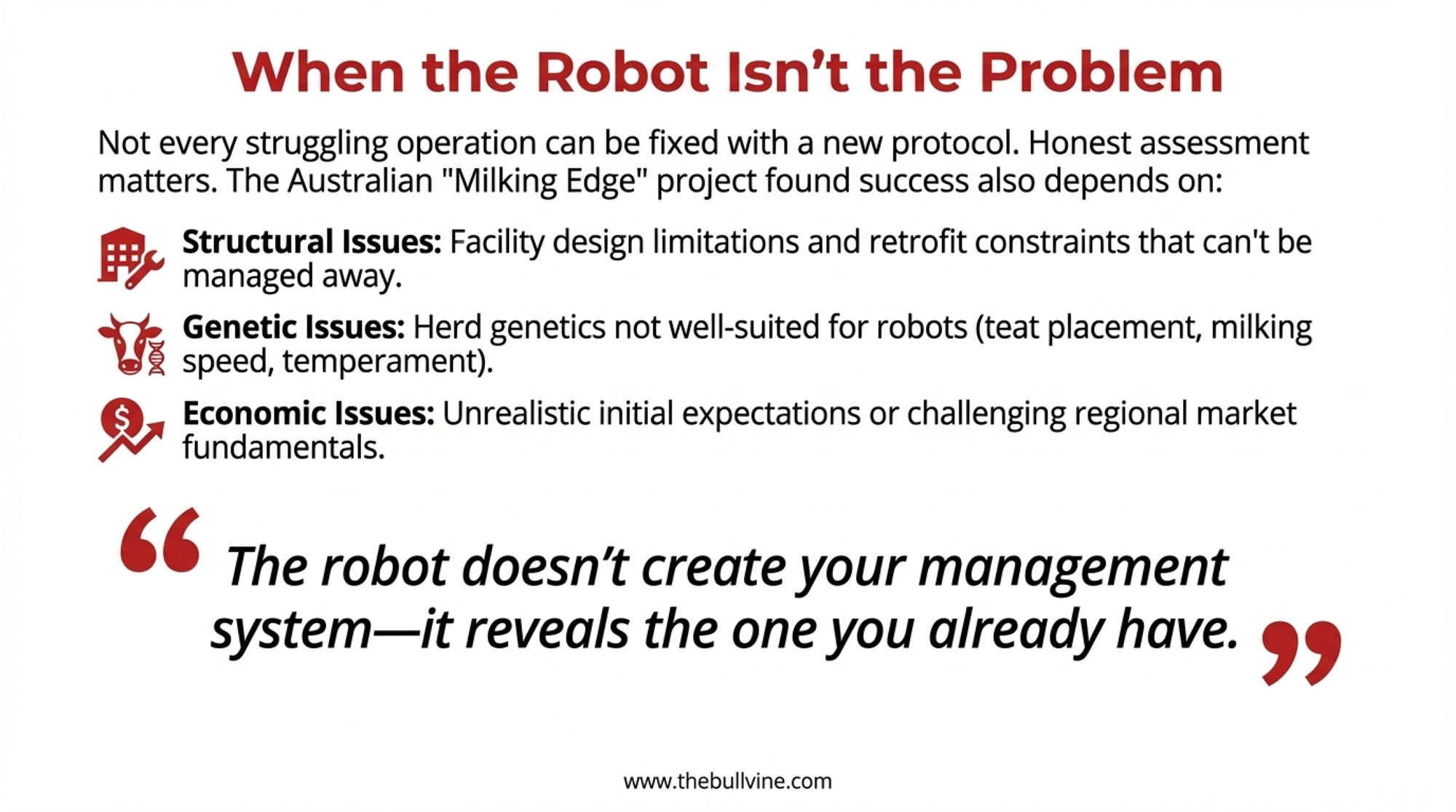
When the Robot Isn’t the Problem

Here’s what doesn’t get discussed enough: not every struggling operation can be fixed solely through management.

The Australian dairy industry’s Milking Edge project—a four-year initiative through NSW Department of Primary Industries—tracked commercial installations and found success depends heavily on factors beyond equipment:

  • Facility design limitations (retrofit constraints that can’t be managed away)
  • Herd genetics (some populations aren’t well-suited for robots)
  • Unrealistic initial expectations set during the sales process
  • Management capacity for data-driven decision making

Equipment failure was rarely the primary cause of struggling operations.

Dairy facility specialists have long observed: the robot doesn’t create your management system—it reveals the one you already have.

For producers underwater for multiple years despite genuine effort, honest assessment matters:

Challenge typeTypical symptomsDiagnostic questionPath forward
ManagementWide cow-to-cow efficiency spread, high fetch & incomplete ratesHave we ever run a focused 90-day efficiency protocol?Tighten protocols, cull bottom 10–15%, own the data
StructuralChronic traffic jams, awkward retrofits, robots boxed in by layoutWould a blank-sheet design ever choose this traffic pattern?Cost out redesign vs. living with permanent bottlenecks
EconomicDecent efficiency but margins still thin or negative year after yearIf this herd were in the Midwest, would it be profitable?Rethink long-term viability and regional strategy

The Industry Is Getting More Honest

The robotic milking conversation is maturing. I’m seeing more nuanced guidance from universities—less “robots will transform your operation” and more practical discussion of which farms are positioned for success.

And credit where it’s due: equipment dealers are increasingly part of this honest conversation. The best ones now discuss efficiency economics before the sale, help producers assess facility fit, and set realistic payback expectations. If your dealer isn’t having these conversations, that tells you something, too.

For producers considering robots:

  • Understand efficiency economics before you buy
  • Evaluate facility design with someone who doesn’t profit from the sale
  • Assess herd genetics: teat placement, milking speed, temperament

For current robot operators:

  • The metrics from your initial training may not be the metrics that matter
  • Efficiency-focused management requires seeing data differently
  • Culling decisions that feel wrong on paper may be right for your robot

For struggling operations:

  • Honest assessment beats hopeful persistence
  • Know whether you’re facing management, structural, or economic challenges
  • The pathway forward depends entirely on which category you’re in

Quick Reference: Robot Success Metrics

MetricTargetRed Flag
Milking Efficiency>1.86 kg/min<1.4 kg/min
Incomplete Rate<5%>10%
Fetch Rate<5%>8%
Fresh Cow Frequency3.0-3.2x/day<2.8x/day
Late Lactation Frequency2.4x/dayForcing higher visits

Key Takeaways:

  • Stop chasing frequency. The metric that actually predicts payback is efficiency—kg of milk per minute of robot time. Farms above 1.86 kg/min profit; those below 1.4 kg/min struggle regardless of bulk tank numbers.
  • Your top producer might be your biggest liability. An 85-lb cow hogging 45 minutes of daily box time bleeds capacity. A 75-lb cow finishing in 25 minutes drives real profit. Robot economics run backward from everything you learned in a parlor.
  • Fetch rate reveals lameness before production drops. Research shows lame cows are 2.2x more likely to need fetching. If you’re retrieving more than 5-8% of your herd daily, you’ve got a systemic problem brewing.
  • The 90-day turnaround protocol: Month 1—rank every cow by efficiency ratio. Month 2—cull your bottom 10-15% and attack lameness aggressively. Month 3—build systems that survive staff turnover.
  • Not every struggle is fixable with management. Structural limitations and regional economics don’t respond to harder work. Honest diagnosis matters: know whether you’re facing a solvable problem or a reality that requires different decisions.

The Bullvine provides independent analysis for dairy producers navigating industry change. This article draws on published research from ICAR, the Swedish University of Agricultural Sciences, the University of Wisconsin, the University of Minnesota, and the NSW Department of Primary Industries, along with producer conversations from 2024-2025. For farm-specific guidance, consult your local extension specialists.

Complete references and supporting documentation are available upon request by contacting the editorial team at editor@thebullvine.com.

Learn More

The Sunday Read Dairy Professionals Don’t Skip.

Every week, thousands of producers, breeders, and industry insiders open Bullvine Weekly for genetics insights, market shifts, and profit strategies they won’t find anywhere else. One email. Five minutes. Smarter decisions all week.
NewsSubscribe
First
Last
Consent

Unlocking the Power of Data: How AI is Revolutionizing Dairy Farming and Why You Should Own Your Data

See how AI transforms dairy farming and why owning your data is key for productivity and informed decisions. Ready?

Data is the new currency of contemporary dairy production. Today’s farmers are gathering more data, ranging from milk productivity and feed efficiency to health measurements and genetic information. Conversations with other dairy experts got me thinking about how important and revolutionary data has become. These talks highlighted a rising interest in using artificial intelligence (AI) to transform raw data into valuable insights.

During one such interaction, a software supplier revealed their newest AI-powered solutions, which would be provided at no additional charge. My immediate response was excitement and skepticism: what’s the catch? This prompted me to look at the more significant implications of AI in agriculture. While AI promises to increase efficiency and simplify processes, it also presents legitimate data ownership and privacy issues.

“Everyone would like to use software that makes data easier to digest or use AI to generate more productivity, and at the same time, no one wants AI coming for their job or their proprietary information.”

In the age of artificial intelligence, dairy farmers have an unparalleled potential to enhance their operations via data-driven decision-making. AI empowers farmers, giving them control over their operations. However, maintaining a balance is critical as we embrace these enhanced technologies. AI might assist in determining the optimal time to inseminate cows, improve feeding patterns, and even identify health concerns before they occur. However, we must stay attentive to who owns the data and how it is utilized. AI has great potential, but it also carries significant risks. As we traverse this scenario, the aim should be precise: producers must control their data to use its potential fully.

Transforming Dairy Farming: AI-Powered Precision for Increased Productivity and Efficiency 

Artificial intelligence (AI) has enormous potential for dairy farming, with solutions to revolutionize the industry. Imagine not having to go through complicated dashboards to figure out what’s essential; instead, AI can alter how data is utilized, inspiring a new way of farming.

One notable use of AI in dairy production is activity monitors and sensors. These gadgets can monitor cow activity in real-time, alerting farmers to anomalies that might suggest health problems or inadequate production circumstances. Farmers may use such technologies to solve issues they might not have discovered otherwise immediately. According to studies, farms utilizing these gadgets enhance output by up to 81%.

Consider the advantages of AI in operational choices. An AI-powered system may evaluate market movements and weather predictions to help choose when to purchase feed. Feeding schedules and compositions may be adjusted to increase milk output depending on each cow’s requirements. This kind of individualized information may save time and money while also increasing the profitability of each gallon of milk.

AI’s timely, context-aware suggestions fit nicely into a farmer’s everyday operations. Instead of depending simply on gut instinct, farmers now get data-driven recommendations, altering decision-making processes. Skepticism is understandable when using new technology, but as many farmers have discovered, the advantages often surpass the early learning curve. By incorporating AI, dairy farming may move from reactive to proactive, resulting in a more efficient and productive sector.

Unlocking Economic Benefits: How AI Transforms Dairy Farming

The economic benefits of AI in dairy farming are substantial. As Purdue University’s research demonstrates, by adopting AI-based technology, dairy farmers can significantly reduce labor expenses. Automating regular chores such as milking, feeding, and health monitoring allows farmers to manage their resources more efficiently.

In terms of productivity, AI raises the bar tremendously. A case study from the University of Minnesota found that farms that used AI-driven management systems had a 15% boost in overall efficiency. When an AI system regularly observes cow behavior and health, it may identify diseases before they become serious, resulting in faster treatments and fewer output interruptions.

Higher milk production is another area where AI demonstrates its benefit. Advanced AI algorithms evaluate data from multiple sensors to improve feeding schedules and nutritional regimens, resulting in healthier cows and increased milk output. Research by the University of Florida discovered that farms utilizing AI-enhanced feeding systems had a 10% increase in milk output.

What’s the bottom line? AI not only modernizes dairy production but also provides significant economic advantages. By lowering costs, increasing productivity, and increasing milk production, AI enables dairy producers to have a more lucrative and sustainable future. This reassurance should instill a sense of security and optimism in the audience.

With technology improving, dairy farming is becoming brighter, more efficient, and kinder to animals. If you haven’t done it yet, maybe it’s time to consider bringing these tech advances to your farm.

Data Ownership: The Bedrock of Trust in AI for Dairy Farming 

Data ownership and utilization are critical concerns for dairy producers. The importance of this issue cannot be overstated, especially when considering the adoption of new AI-powered technologies. Producers must maintain control over their data and its use to build trust in these innovative solutions.

Several software companies have introduced more detailed data usage clauses and practices to address these concerns. For instance, a supplier just guaranteed farmers unequivocally:

“Producers own the data. We shall not use their data unless they explicitly consent to its usage. We feel that we own whatever we’ve produced for data analytics. They have access to such metrics as users.”

This level of openness is a positive step forward. Ensuring farmers maintain ownership of their data and control over its use builds confidence. It promotes more comprehensive use of new technology. After all, it’s more than simply gathering data; it’s about providing producers with insights from that data while protecting their intellectual property.

Finally, the underlying premise is straightforward: producers should own their data. Dairy producers may confidently incorporate AI technologies into their operations since they control how their data is utilized.

Conversational Data: Revolutionizing Dairy Farm Management 

Conversational data marks a fundamental change in how dairy producers use technology. Unlike conventional data systems, which often need human sorting and interpretation, conversational data uses AI to give real-time, simple insights in a natural language format. Consider having a virtual assistant that notifies you when a cow shows early disease indications or recommends the best time to buy feed based on market trends. This is not simply speculative thinking; it is the reality we are rapidly approaching.

The value of conversational data in decision-making cannot be emphasized. For example, with real-time animal health warnings, producers may take quick action to minimize illness escalation and improve overall herd health. Similarly, timely advice to change feeding practices or resource allocations may boost production while lowering expenses. No more gazing over complicated screens; choices may be as simple as speaking with a professional adviser.

However, we have yet quite to get there. One of the most critical difficulties remains the data latency. According to Wisconsin dairyman Mitch Breunig, the latency between data gathering and valuable insights might last months. This latency prevents prompt decision-making, resulting in lost opportunities and inefficiency. AI and data integration breakthroughs will be required to close this gap, allowing for real-time communication.

Ultimately, the idea is to turn raw data into a continuous, informative discussion between farmers and their technology, allowing for educated and timely choices. This transformation might reshape dairy production, making it more responsive, efficient, and lucrative.

Real-Time Data: The Antidote to Dairy Farming’s Frustrating Lag

Consider the instance of Mitch Breunig. During a PDPW conference, he explains a common difficulty in contemporary dairy operations: invaluable data irritating delay. Mitch emphasizes that it is already May as he examines his first-quarter financial statistics from January to March. If he identifies areas for improvement, executing such changes causes a substantial delay. As he progresses through the months, it is not until November, when the third-quarter data is available, that he can determine if his improvements have produced the anticipated effects. 

This backward-looking character of data has a significant influence on decision-making. Even minor, incremental changes on the farm might take months to assess and verify, making agile responses practically impossible. Mitch’s story highlights a systemic issue. The delay generates an inefficient feedback loop, reducing productivity and slowing operational progress. His instance highlights a more significant business issue: the critical need for speedier, more conversational data systems on dairy farms. This would enable real-time decision-making, such as a timely and continuous discussion rather than sporadic and delayed communication.

Real-Time, Conversational Data: The Gateway to Instant, Informed Decisions 

As we look to the future, the potential for data use in dairy production is enormous. Imagine a future in which real-time, conversational data helps producers make quick, educated choices. This data significantly minimizes the time lag that now afflicts the sector. Farmers may obtain actionable information right now instead of waiting months to evaluate and act on data, allowing them to pivot and alter their operations on the spot.

Consider a system that says, “Check the health of cow #302; she’s showing early signs of illness,” or “Today’s conditions are optimal for fertilizing that specific pasture.” These quick, conversational cues can change dairy farm operations by enhancing efficiency and output. By combining artificial intelligence with real-time data analysis, dairy producers can make fast and accurate choices to improve their operations.

However, the foundation of this future is built on trust. Producers must be confident in the data offered by these innovative technologies. Trust is not formed overnight; it is based on consistent, clear, and dependable evidence that has shown its usefulness over time. When producers trust the technology that supports their data, they are more likely to fully embrace new technologies, resulting in a feedback cycle of improved data accuracy and operational success.

The transition to a more data-driven future in dairy farming will be challenging, but the advantages exceed the dangers. Real-time, conversational data may be a game changer, allowing farmers to make more imaginative, timely, and effective choices. As technology advances, so will the ability of data to alter the dairy sector, making it more efficient and ultimately lucrative.

The Bottom Line

The use of AI in dairy production has enormous promise for increasing productivity and efficiency. However, the cornerstone of this change is to keep data ownership firmly in the hands of producers. This article discusses how AI technologies might transform operations by making data conversational and actionable in real time. However, this requires faith in technology providers’ data use practices.

At the core of this debate is the significance of quick, intelligible data transmission that can assist decision-making on the go. This change from historical data to real-time insights will allow farmers and ranchers to make more educated and quicker choices, eventually enhancing operational results.

How can the industry guarantee that technical improvements are accessible and trustworthy for all producers? The solution to this question will determine the future of dairy farming in the AI era.

Key Takeaways:

  • AI-powered tools can offer significant benefits for dairy farming, such as better data management and improved productivity.
  • Producers must be vigilant about their data ownership and ensure their inputs and outputs remain confidential and not used without consent.
  • Good analytics should deliver actionable insights directly, making data more accessible and perceptible.
  • Real-time, conversational data is crucial for timely decision-making in the dairy industry.
  • Current data use on farms often lags, causing delays in implementing necessary changes based on new information.
  • Trusting new technology, such as activity monitors and sensors, can enhance farm management and animal care over time.
  • Producers need systems that provide immediate feedback to maintain a continuous and meaningful conversation with their data.

Summary:

Data usage in dairy farming is rapidly evolving, with AI-driven tools promising new levels of productivity and efficiency. However, as we embrace these advancements, data ownership, and real-time utility issues come to the forefront. Artificial Intelligence (AI) is revolutionizing dairy production by transforming raw data into valuable insights and enhancing operations through data-driven decision-making. Challenges such as data ownership and latency can impact prompt decision-making. Yet, activity monitors and sensors can provide real-time, simple insights, replacing gut instinct with data-driven recommendations that can increase output by up to 81%. The potential for data use in dairy production is enormous, but producers must be confident in the data offered by these innovative technologies. This article explores the critical role of data ownership, the transformative power of AI, and the need for real-time, conversational data to drive immediate, informed decisions on dairy farms

Learn more: 

Join the Revolution!

Bullvine Daily is your essential e-zine for staying ahead in the dairy industry. With over 30,000 subscribers, we bring you the week’s top news, helping you manage tasks efficiently. Stay informed about milk production, tech adoption, and more, so you can concentrate on your dairy operations. 

NewsSubscribe
First
Last
Consent

AI in Dairy Nutrition: Navigating Challenges, Seizing Opportunities, and Envisioning the Future

How will AI change dairy nutrition? What are the hurdles and chances we’ll face? See how AI might shape your dairy farm‘s future.

Imagine a world where precision in dairy nutrition isn’t just a goal but a reality. Where artificial intelligence (AI) finely tunes every aspect of your herd’s diet with the accuracy of a skilled artisan. This isn’t a distant dream—AI’s transformative potential in dairy nutrition is on the brink of revolutionizing how we nourish our bovine companions. This article delves into AI’s challenges and opportunities for dairy farmers and professionals. Together, we’ll explore how these advanced tools can optimize feeding practices, enhance milk production, and potentially redefine the industry’s landscape. 

“As we unfold the future of AI and dairy nutrition, the big question isn’t just ‘how will it change our industry?’ but rather ‘are you ready to embrace it?'”

Join us as we navigate this evolving frontier, seeking to understand its complexities and unlock its full potential for your business’s success and sustainability. 

The AI Revolution: Transforming Dairy Nutrition with Innovation and Tradition

The current state of AI in dairy nutrition is a fascinating blend of cutting-edge technology and traditional practices. Automation and data-driven decision-making are revolutionizing dairy farms’ operations. Today, AI applications span various aspects, from feeding systems to health monitoring. 

Consider automated milking systems, which are becoming increasingly common. These systems use AI to monitor and manage cow milking processes without human intervention, offering efficiency gains and reducing manual labor costs. The machines collect data on each cow’s milking patterns and health status, supporting precise nutritional adjustments to improve milk yield and quality. 

Data-driven decision-making is another pivotal area where AI excels. By analyzing extensive datasets—such as weather conditions, feed composition, and animal health metrics—AI tools provide insights to enhance dairy herd management. For instance, predictive analytics can anticipate health issues and adjust feeding plans accordingly, effectively increasing productivity and preventing losses. 

Moreover, AI-powered sensors and IoT devices are now standard on many farms, tracking everything from cow activity to environmental conditions. These intelligent systems help farmers make informed decisions, optimize feed efficiency, and ensure the animals’ well-being. Real-time data analysis helps pinpoint inefficiencies, making AI an indispensable ally in modern dairy farming.

Let’s Not Beat Around the Bush: The Road to AI Integration in Dairy Nutrition 

Let’s not beat around the bush. The road to integrating AI in dairy nutrition isn’t all smooth sailing. It is filled with fascinating possibilities, but it’s equally strewn with hurdles, challenging even the most optimistic adopters. We’ve come to realize that one fundamental challenge is data availability. Without abundant, accurate data, training AI models becomes akin to painting in the dark. Imagine trying to solve a puzzle without all the pieces. Our digital dairies need comprehensive datasets to provide actionable insights that revolutionize nutrition practices. 

Then there’s the cost factor. AI technology isn’t cheap, folks. Those in the trenches know how investments can stretch thin. Implementing AI in dairy farms requires a significant financial outlay, not just for the technology itself but also for the training and support necessary to utilize it effectively. Only those with substantial resources can overcome this financial hurdle, leaving smaller operations wondering if the cost is worth the potential gains. 

But let’s discuss the elephant in the room: resistance to change. We’re dealing with an industry steeped in tradition, where methods passed down through generations are only sometimes surrendered. Convincing farmers to switch from tried-and-true practices to cutting-edge technology can be challenging. It requires demonstrating significant and tangible benefits; it’s about the long game. 

The need for reliable data looms large. AI models thrive on reliable data—the more reliable it is, the better they can perform, predicting and providing insights that drive efficiency and productivity. The task ahead is straightforward: We must address these barriers by investing in data collection technologies, making AI more affordable, and fostering a culture willing to evolve. Isn’t it time we asked ourselves what steps we can take today to prepare for AI tomorrow? 

AI: Crafting the Future of Dairy From Precision to Sustainability

AI holds a promising potential to revolutionize dairy nutrition, primarily through enhanced nutritional precision. Imagine a future where your herd’s dietary needs are fine-tuned with pinpoint accuracy, responding proactively to each cow’s requirements. With AI, what once took weeks of observation can now happen in mere moments, ensuring your herd gets what it needs precisely when it needs it. This potential of AI is not just exciting but also inspiring for the future of dairy farming. 

Moreover, AI can significantly improve herd health. AI systems can detect early signs of health issues by analyzing data from various sources—milk production levels, animal behavior, or environmental factors—allowing timely interventions. This proactive approach reduces the incidence of illness and boosts overall productivity. 

Consider the environmental impact, too. AI-optimizing feeding strategies offer a real opportunity to enhance sustainability. Accurate feed measurement means less waste; each feed component can be sourced for maximum efficiency. This, in turn, contributes to more sustainable farming practices—something the planet desperately needs. By embracing AI, dairy farmers can take a proactive role in promoting sustainability. 

Real-time insights are a game-changer. AI can swiftly analyze vast volumes of data, providing instant feedback. Gone are the days of basing decisions on outdated reports. Instead, AI empowers farmers with up-to-the-second information, enabling them to optimize feeding strategies, adjust rations quickly, and adapt to changing conditions with remarkable agility. 

The dairy industry’s future is bright with the integration of AI. Are you ready to embrace these advances and reinvent your approach to daily nutrition?

Forging Ahead: The Uncharted Territory of AI in Dairy Nutrition

As we peer into the future of AI in dairy nutrition, the landscape is as intriguing as it is uncertain. Imagine, for a moment, dairy operations seamlessly integrating AI-powered technologies, creating a synergy that enhances production and optimizes nutrition. Technological advancements promise to take AI from merely a tool to an indispensable partner in dairy farming, offering a future full of potential and optimism. 

Imagine AI systems that predict nutritional needs and preemptively adjust feed formulations in real-time, responding to individual cows’ fluctuating environmental conditions or health indicators. The potential here is mind-boggling. We could move from one-size-fits-all feeding strategies to hyper-personalized nutrition plans, tailor-made for each cow’s unique genetic makeup and current state of health. 

This evolution means more extensive and diversified dairy operations could become the norm. With AI efficiently managing multiple sites, these expansive operations can maintain high standards across the board. Imagine AI systems conducting virtual site inspections, ensuring compliance and optimal functioning even at operations spanning thousands of acres or multiple time zones. 

Moreover, AI is poised to enhance sustainability within the industry. By analyzing feed efficiency and emissions data, AI could support efforts to reduce dairy farming’s carbon footprint, aligning with global environmental targets. 

The journey to this AI-infused future will be challenging. Still, the potential rewards could redefine the industry for future generations. We’re at the cusp of a revolution where tradition meets innovation, paving the way for a future that’s as sustainable as promising.

The Bottom Line

The journey of AI in dairy nutrition is a merging of innovation with tradition, promising exciting transformations. As we’ve explored, AI paves the way for efficiency, sustainability, and a more refined approach to animal welfare. Yet, we stand at the cusp of this technological integration, aware of the immense possibilities and hurdles in data acquisition and application. The conversation around AI fuses the ambitious future with the grounded realities of today’s dairy industry, and there’s no denying its potential to redefine how we approach dairy farming. 

But what does this mean for you? It’s about contemplating how AI can be woven into your operations. Are you ready to embrace change and drive toward a more sustainable, profitable future? We invite you to ponder this as you consider the steps needed to integrate AI effectively into your workflow. 

Your experiences and insights are invaluable. Please share your thoughts below. How do you see AI changing your day-to-day operations? Have you already taken steps in this direction? Let’s start a dialogue—comment on this article, share it with your network, and join the discussion on the future of AI in dairy nutrition.

Summary:

In the ever-changing world of agriculture, AI integration into dairy nutrition represents challenges and opportunities that promise to redefine the industry. Dairy farmers and professionals stand on the brink of a technological revolution demanding a balance between tradition and innovation. Automation, such as AI-powered milking systems and sensors, offers improved efficiency by providing data-driven decision-making using vast datasets like weather, feed composition, and animal health metrics. Predictive analytics can foresee health issues and tweak feeding plans, boosting productivity and minimizing losses. However, data availability, cost, and resistance to change remain. To overcome these, investments in data technologies, making AI more affordable, and cultivating a culture of adaptation are essential. Embracing AI today can lead to a more efficient and sustainable future for dairy farming.

Key Takeaways:

  • AI is set to revolutionize the dairy industry, although the pace of adoption remains uncertain.
  • Automation and instant feedback are anticipated to impact dairy nutrition significantly.
  • Data is crucial for training AI models to enhance decision-making in nutrition.
  • The future of dairy involves fewer but more extensive and more diversified operations.
  • The industry aims to remain a leader by supporting global producers and consultants with AI advancements.
  • Continued focus on data integration will expedite the development of new AI tools in the dairy sector.

Learn more:

Join the Revolution!

Bullvine Daily is your essential e-zine for staying ahead in the dairy industry. With over 30,000 subscribers, we bring you the week’s top news, helping you manage tasks efficiently. Stay informed about milk production, tech adoption, and more, so you can concentrate on your dairy operations. 

NewsSubscribe
First
Last
Consent

How to Future-Proof Your Beef x Dairy Program: Strategies for Navigating an Unpredictable Market

Explore effective strategies to fortify your beef x dairy program against market volatility. Gain insights into managing unpredictability to safeguard your dairy farm‘s financial health.

Preparing for an unpredictable future in the dynamic dairy industry transcends mere strategy—it becomes an imperative. To shield a beef x dairy program from the vagaries of the market, one must adopt practices and make informed decisions that ensure sustainability and profitability, regardless of fluctuating conditions and unforeseen challenges. This path demands foresight, adaptability, and an in-depth grasp of the interconnected dairy and beef markets.  

The critical nature of adapting to an unpredictable market must be considered. Dairy farmers must navigate variable milk prices, evolving consumer demands, and economic pressures—all of which influence profitability. By proactively preparing for these fluctuations, farmers can protect their investments and build a resilient business model. This involves reacting to current trends, forecasting future shifts, and adjusting their strategies accordingly.  

The strategies we are about to delve into are not just theoretical concepts, but practical tools that can make a real difference in your beef x dairy operations. They are indispensable in navigating the intricate landscape of the dairy industry and ensuring long-term profitability and sustainability. 

  • Diversification: Mitigating reliance on a singular income stream by exploring varied opportunities within the beef x dairy paradigm.
  • Genetic Selection: Selecting optimal breeds and genetics to enhance beef and dairy outputs.
  • Market Analysis: Regularly assessing market trends to make informed, agile decisions.
  • Risk Management: Utilizing financial instruments and insurance to safeguard against potential setbacks.
  • Sustainable Practices: Embracing eco-friendly methods to fortify long-term sustainability.

“The only way to make sense of change is to plunge into it, move with it, and join the dance.” — Alan Watts.

By embracing these strategies, you are not just preparing for the future, but also equipping your dairy farm to thrive amid uncertainties. These strategies can help you maintain a resilient and profitable operation, even in the face of change.

Understanding Market Fluctuations: The Role of Supply and Demand

Understanding contemporary trends in the beef and dairy sector is paramount. The robust demand for beef-sired dairy cross steers, propelled by a significant reduction in the U.S. beef cattle inventory and consumer predilection for premium beef, has given dairy farms an advantageous position. By producing more beef x dairy calves, dairy farmers seize the opportunity to generate additional revenue from premium market prices. Dairy operations are adapting swiftly to maximize these high-value returns. 

Market unpredictability, however, presents multifaceted challenges. Variations in feeder cattle supply, fluctuating commodity prices—mainly corn—and erratic climatic conditions affecting feed availability and livestock health contribute to this uncertainty. Moreover, global economic shifts and evolving trade policies further complicate the landscape, demanding heightened vigilance and adaptability from dairy farmers. 

The ramifications of market fluctuations on profitability cannot be overstated. While elevated beef-sired dairy cross-steer prices can significantly boost short-term revenue, the inevitable price corrections can strain profitability. However, with the strategic measures we propose, you can mitigate these risks and ensure long-term sustainability. This involves diversifying breeding programs, optimizing feed efficiency, and enhancing direct marketing strategies. Proactive management of these variables is crucial for maintaining resilience amidst economic oscillations.

Strategies to Stabilize Your Beef x Dairy Program

Diversification is paramount in navigating an uncertain future. Elevate the value of your beef x dairy calves by integrating superior genetics and optimized feeding regimens, thereby securing higher market premiums. 

Investigate emerging market opportunities such as niche sectors, including organic or grass-fed beef programs. Adopting innovative tactics like direct-to-consumer sales can significantly boost profitability and market penetration. 

Forge strategic partnerships with feedlots, meat processors, and fellow dairy producers to ensure stability. Collaborative ventures and co-op models are essential for balancing risks and rewards effectively.

Utilizing Technology and Innovation for Better Outcomes

Embracing cutting-edge technology and innovation is paramount for navigating the uncertainties of the beef x dairy marketData-driven decision-making empowers farmers to harness historical and real-time data to forecast trends and refine breeding programs, boosting profitability and operational efficiency. This approach also enhances animal health monitoring. 

Precision farming techniques leveraging GPS and IoT devices offer invaluable insights into feed management and environmental conditions. Such techniques ensure optimal resource usage, minimize waste, and bolster farm sustainability. Precision farming additionally allows for targeted livestock care. 

Investing in automated feeding, milking, and waste management systems can revolutionize dairy farming. Automation reduces labor costs and guarantees consistency, enabling farmers to concentrate on strategic roles and long-term planning.

Mitigating Risks in Your Beef x Dairy Program

Effective risk management is paramount to sustaining a robust beef x dairy program in an unpredictable environment. Dairy farmers must embrace a multifaceted strategy to navigate market fluctuations and ensure operational stability. 

“The ability to foresee and manage risks can make the difference between a thriving operation and one that falters.”

Leveraging hedging strategies is crucial to mitigate against market volatility. Utilizing futures contracts and options empowers farmers to secure favorable prices. 

Implementing contingency plans for unpredictable events, such as natural disasters or sudden market shifts, allows quick adjustments to minimize potential losses. 

Vigilantly monitoring market trends and refining strategies is essential for staying ahead of the curve. Regular data analysis and keeping abreast of industry developments can guide responsive practices. 

  • Deploy hedging strategies.
  • Establish contingency plans.
  • Continuously monitor market trends.

The Bottom Line

In the current beef x dairy market landscape, the pressing demand for calves—catalyzed by industry consolidation and a sharp decline in beef cattle inventory—offers dairy farmers a unique opportunity. However, the ongoing price surge, propelled by the scarcity of feeder cattle and lower corn prices, is ephemeral. Projections of a cyclical peak in fed beef prices within the next three to four years signify imminent market corrections. 

These observations underscore the necessity for dairy farmers to future-proof their operations in a sector where change remains constant, depending solely on presently advantageous conditions without a strategic blueprint, which is fraught with risk. The volatile market demands a comprehensive approach that includes technological innovation, risk mitigation, and sustainable long-term planning. 

We encourage dairy farmers to adopt proactive measures to strengthen their beef x dairy initiatives. Your role in this is crucial. By embracing cutting-edge breeding technologies, instituting robust risk management frameworks, and persistently monitoring market dynamics, you can ensure your enterprises remain resilient and profitable, even in the face of uncertainty. The way forward entails adapting to change and actively crafting a sustainable future for the beef and dairy sector.

Key Takeaways:

In the volatile landscape of the dairy industry, proactive strategies and adaptive practices are paramount for maintaining profitability with beef x dairy programs. Key considerations include: 

  • Consolidation in the dairy industry has increased the desirability of beef x dairy calves due to improved logistics and large batch availability.
  • The U.S. beef cattle inventory reaching a 73-year low has driven cattle buyers to source more from the dairy sector.
  • Current high prices for beef x dairy calves are influenced by limited feeder cattle supply and lower corn prices, both of which are subject to change.
  • A strategic re-evaluation of beef x dairy programs is essential to prepare for a market correction, which is anticipated within the next few years.
  • Implementing stability-focused breeding programs and leveraging cutting-edge technology will be crucial for adapting to future market dynamics.

“Change is the only constant thing in life,” reminds us that dairy farmers must continuously evolve their strategies to navigate the unpredictable future of the beef x dairy market.


Summary: The dairy industry is facing a uncertain future due to increased demand for beef-sired dairy cross steers and a decrease in U.S. beef cattle inventory. To generate revenue, dairy farmers can produce more beef x dairy calves. However, market unpredictability presents challenges like fluctuating commodity prices, erratic climatic conditions, and variations in feeder cattle supply. To mitigate risks and ensure long-term sustainability, dairy farmers can diversify breeding programs, optimize feed efficiency, and enhance direct marketing strategies. Strategic partnerships with feedlots, meat processors, and fellow dairy producers are crucial. Embracing cutting-edge technology and innovation is essential for navigating the beef x dairy market. Data-driven decision-making, precision farming techniques, and automated systems can help farmers forecast trends and refine breeding programs. Effective risk management is crucial for sustaining a robust beef x dairy program in an unpredictable environment.


Download “The Ultimate Dairy Breeders Guide to Beef on Dairy Integration” Now!

Are you eager to discover the benefits of integrating beef genetics into your dairy herd? “The Ultimate Dairy Breeders Guide to Beef on Dairy Integration” is your key to enhancing productivity and profitability.  This guide is explicitly designed for progressive dairy breeders, from choosing the best beef breeds for dairy integration to advanced genetic selection tips. Get practical management practices to elevate your breeding program.  Understand the use of proven beef sires, from selection to offspring performance. Gain actionable insights through expert advice and real-world case studies. Learn about marketing, financial planning, and market assessment to maximize profitability.  Dive into the world of beef-on-dairy integration. Leverage the latest genetic tools and technologies to enhance your livestock quality. By the end of this guide, you’ll make informed decisions, boost farm efficiency, and effectively diversify your business.  Embark on this journey with us and unlock the full potential of your dairy herd with beef-on-dairy integration. Get Started!

Send this to a friend