Universities aren’t training farmers anymore—they’re training corporate tech reps.
When a major university bulldozes perfectly good dairy facilities to go all-in on automation, you know something big is happening. The question is: are they seeing the future, or about to become a very expensive cautionary tale?
Here’s what happened. They took their 110 registered Jerseys—the same herd that’s been training students since Nixon’s day—bulldozed those trusty but tired 1972 facilities, and dropped a whopping $6.2 million on what they’re calling a “fully autonomous dairy operation”.
That’s not small potatoes for a 60-cow setup.
Here’s Why This Isn’t Just Another Equipment Upgrade
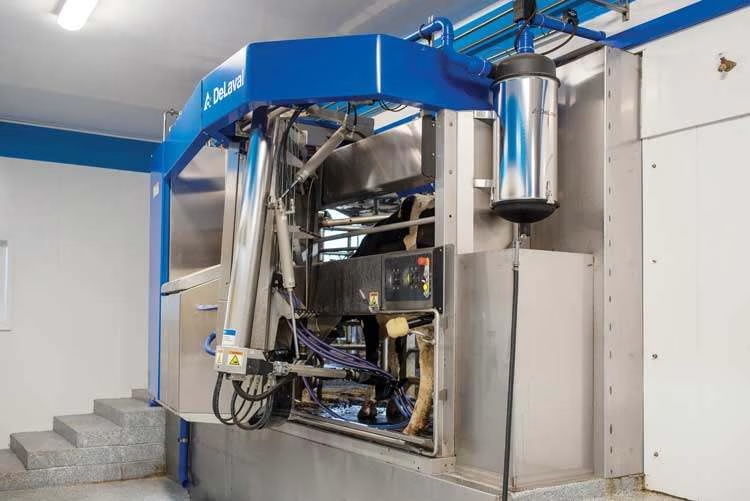
They didn’t renovate. They didn’t hedge their bets. Ohio State went full nuclear option—demolished everything and built from scratch with two Lely Astronaut A5 robots, a Vector automated feeding system, robotic manure vacuums… the whole nine yards.
Most rational folks would’ve spent the smaller money patching up the old place while adding some robot experience. Keep both conventional and automated training. But no—Ohio State torched their safety net completely.
“It would be more cost-effective to tear down the outdated structure,” Associate Dean Graham Cochran explained. But any producer who’s priced farm construction knows that math only works if you’re trying to make retreat impossible.
The gamble? That robotic milking explodes from niche curiosity to mainstream necessity before their current students graduate and discover that 97% of dairies still milk the old-fashioned way.
The Numbers Tell a Brutal Story
Let’s talk reality. Currently, fewer than 3% of US operations utilize robotic milking. We’re talking maybe 800 robot dairies out of 26,000+ total operations nationwide. That’s not exactly a revolution sweeping the countryside.
The economics are tough. A comprehensive study tracking operations across 13 countries found that robots cut labor input by 28%, which sounds great, but also increases investment costs by 58%. The real kicker? Only 6% of producers achieved payback periods under 12 years.
Those aren’t adoption-driving numbers for an industry where most operations run on margins thinner than skim milk.
But here’s where it gets interesting… maybe Ohio State sees something in the labor crisis that changes this whole equation.
Now, Ohio’s different from those California mega-dairies. Our 1,350 farms average 185 cows each—mostly family operations with seasonal help rather than year-round immigrant crews. Different labor dynamics entirely.
But even family farms are feeling the squeeze. Operations nationwide are dealing with 30-38% annual employee turnover. That’s not just expensive recruitment costs—it translates to production drops and higher calf mortality when your crew keeps changing.
Scott Higgins from the Ohio Dairy Producers Association told me: “It is exciting to see this investment in a modern dairy that will impact the student experience and tell the story of dairy farming”. But between the lines, you can hear the concern about workforce stability.
Think about the economics. Their graduates will likely command competitive starting salaries that could price them out of most actual farm management positions. A typical 200-cow operation in Ohio can’t afford to pay premium wages when the whole operation might only net $100,000-150,000 annually.
Jason Hartschuh from Ohio State Extension put it this way: “The new facility will allow students to be ready for a career in the dairy industry in all sectors, from farm management to sales and service”. Notice how “sales and service” got equal billing with “farm management.”
The Corporate Training Competition They’re Ignoring
Here’s where Ohio State’s strategy gets really questionable, and honestly, nobody’s talking about this elephant in the room.
When a producer installs robotic equipment, manufacturers provide free training “for as long as you own and operate” their systems. Lely’s got dedicated training facilities. GEA partners with major universities. These corporate programs deliver hands-on equipment access, immediate updates when software changes, and commercial incentives for customer success—because if you fail, they lose future sales.
So what exactly does a four-year Ohio State degree add that manufacturer training doesn’t provide better, faster, and cheaper?
The Lely Vector system Ohio State installed saves customers about 8 hours of weekly labor plus up to 1,452 gallons of diesel annually, according to multiple documented case studies. However, producers learn system optimization through manufacturer support and their neighbors’ experience, rather than university coursework.
The Jersey Factor That’s Got Me Scratching My Head
Here’s something that’s been bugging me about Ohio State’s approach…
Industry observations suggest that Jerseys present different challenges for robotic systems—smaller frame sizes, varied udder configurations, and higher component milk — that can affect sensor performance differently than Holstein-focused automation development.
Most Ohio producers run 100-300 cows—potentially too small for multiple robots but too large for optimal single-robot economics. So Ohio State is training students for a facility design that exists on maybe a few dozen farms nationwide.
That’s… interesting strategic thinking.
Research Goldmine or Corporate Welfare Program?
Ohio State supporters keep pointing to research potential, and I’ll admit, something is compelling here.
Their individual cow monitoring systems will generate data streams that conventional operations literally cannot produce: real-time milk composition analysis, continuous health tracking, and precise feed intake measurements down to individual animals.
Maurice Eastridge from Animal Sciences says this will be “a tremendous asset” for research. If automation adoption accelerates, their faculty could become the go-to licensing experts for breakthrough insights worldwide.
But here’s what makes me uncomfortable: Lely owns the core technology generating this data. Ohio State is essentially providing research services that benefit equipment manufacturers while using American taxpayer funds.
This conflicts with what land-grant universities were created to achieve. The Morrill Act of 1862 established these institutions to make agricultural knowledge freely available to all farmers. Now they’re positioning to license discoveries, creating a two-tiered system where technological advantages go to whoever can afford premium prices.
What This Actually Means for Working Producers
The thing about Ohio State’s gamble is that it’s going to tell us something important about where this industry is heading, whether they succeed or fail spectacularly.
Technology Timing Intelligence: Their willingness to stake their entire program on automation acceleration suggests some industry leaders expect much faster adoption than public projections indicate. That’s worth monitoring as market intelligence—they might know something about policy changes or economic pressures that haven’t hit the news yet.
Training Source Strategy: When you’re evaluating robotic systems, prioritize manufacturer training and peer producer experience over academic credentials. The company selling you equipment has much stronger commercial incentives for your operational success than any university program.
Labor Reality Check: Focus on systems that enhance your current crew’s productivity rather than requiring completely different skill sets. Automation isn’t about replacing experienced managers—it’s about making reliable help more productive and reducing dependence on hard-to-find manual labor.
Economic Calculations: That international study showing 28% labor reduction but 58% higher investment costs suggests most operations aren’t economically ready for this leap yet. But if immigration policy shifts suddenly removes available workers, those calculations flip overnight.
The Bottom Line
Ohio State just demonstrated that even major agricultural institutions are making unprecedented bets on industry transformation. Whether that represents visionary leadership or an expensive miscalculation will signal whether dairy automation moves from niche curiosity to mainstream necessity.
Their success or failure offers valuable intelligence about industry direction, but here’s what concerns me: they’re essentially experimenting using students’ career prospects and taxpayer funding to test theories about automation timing.
If they’re right about acceleration, their graduates become valuable professionals in a growing sector. Their research drives industry transformation. Their facility becomes the model others follow.
If they’re wrong… well, they’ve trained students for jobs that don’t exist while abandoning the 97% of operations that still need competent managers who understand actual dairy work.
The revolution might indeed be coming. But it’s being driven by equipment manufacturers solving real problems for working producers, not universities training corporate employees.
For family operations trying to stay competitive, that distinction makes all the difference. The question isn’t whether Ohio State’s bet pays off for them—it’s whether their gamble helps or hurts the actual dairy farmers who are supposed to benefit from land-grant education.
That verdict is still several years away. But watching their results will tell us whether we’re witnessing the future of dairy education… or an expensive institutional mistake that forgot who it’s supposed to serve.
Either way, the dice are rolling, and the stakes couldn’t be higher for all of us trying to make a living in this business.
Key Takeaways
Labor math is changing fast: With 51% immigrant workforce at risk and 30-38% annual turnover crushing production, automation stops being a luxury and starts being survival gear (Source: National dairy workforce analysis, 2025)
ROI reality check: Robots slash labor 28% but spike investment 58%—crunch your numbers hard before jumping, because payback often stretches past 10 years (International meta-analysis, 13 countries)
Small wins add up: Lely’s Vector feeding system saves 8 hours weekly labor plus 1,452 gallons of diesel annually—not sexy, but that’s $3,000+ yearly on a 200-cow operation (Company performance data, 2025)
Training trumps degrees: Skip the classroom, stick with manufacturer programs and neighbor networks—companies like Lely offer lifetime training with equipment purchase, no tuition required (Industry intelligence)
Size matters for automation: Ohio State’s 60-cow Jersey setup is rare; most Midwest operations (100-300 cows) sit in automation’s awkward middle ground—too big for one robot, too small for multiples (Ohio dairy demographics, 2025)
Executive Summary:
Ohio State just torched their safety net—dropping $6.2 million on a fully robotic dairy while demolishing perfectly good conventional facilities. Here’s what’s wild: only 3% of US farms use robot milkers, yet they’re betting everything on automation. With immigrant workers making up 51% of dairy labor, producing 79% of our milk, and immigration crackdowns tightening the screws, maybe they see something we’re missing. But the math’s brutal—robots cut labor 28% while jacking costs up 58%, with most farms waiting over a decade for payback. We dug deep into Ohio State’s gamble, the labor crisis driving it, and what it means for your operation. Bottom line: automation isn’t coming someday—it’s here, and you need a strategy now.
Complete references and supporting documentation are available upon request by contacting the editorial team at editor@thebullvine.com.
Learn More:
Robotic Milking Revolution: Why Modern Dairy Farms Are Choosing Automation in 2025 – This article provides the tactical numbers and ROI calculations missing from the main piece. It details how to evaluate if your operation is financially ready for automation and the specific data points that drive profitability and efficiency gains.
Join over 30,000 successful dairy professionals who rely on Bullvine Weekly for their competitive edge. Delivered directly to your inbox each week, our exclusive industry insights help you make smarter decisions while saving precious hours every week. Never miss critical updates on milk production trends, breakthrough technologies, and profit-boosting strategies that top producers are already implementing. Subscribe now to transform your dairy operation’s efficiency and profitability—your future success is just one click away.
EXECUTIVE SUMMARY: Look, here’s what nobody wants to talk about: Nearly 80% of American milk comes from farms staffed by immigrant workers, and that workforce is more fragile than we’d like to admit. With 40% annual turnover costing thousands per replacement and potential industry losses hitting $32 billion, this isn’t just a labor issue—it’s an existential threat to your margins. Meanwhile, European dairies are already 20% automated while we’re stuck at 5%, and states like Kansas are pulling ahead with 15.7% production growth compared to California’s decline. The math is simple: audit your workforce risk, push for policy reform through your co-op, and get serious about automation ROI—because waiting isn’t a strategy that pays bills.
KEY TAKEAWAYS
Stop bleeding cash on turnover: Each replacement worker costs thousands in direct expenses plus lost productivity—calculate your real turnover cost using BLS data and target retention strategies that actually move the needle on your bottom line.
Push for policy wins: The Farm Workforce Modernization Act’s year-round H-2A program could stabilize your labor costs—contact NMPF or your co-op today to support legislation that directly impacts your 2025 profitability.
Automation isn’t just for mega-dairies: Robotic systems show 18-month paybacks for smaller herds under 260 cows—schedule that dealer consultation now while 2025 cost pressures make the ROI calculation even more compelling.
Follow the production leaders: Kansas’s 15.7% growth versus California’s struggles show how workforce stability drives milk yield—consider operational changes that put you in the winner’s column instead of hoping things improve.
Connect workforce to genetics: Stable employees deliver better feed efficiency and consistent genomic testing protocols—invest in retention strategies that protect your breeding program investments and maximize milk components.
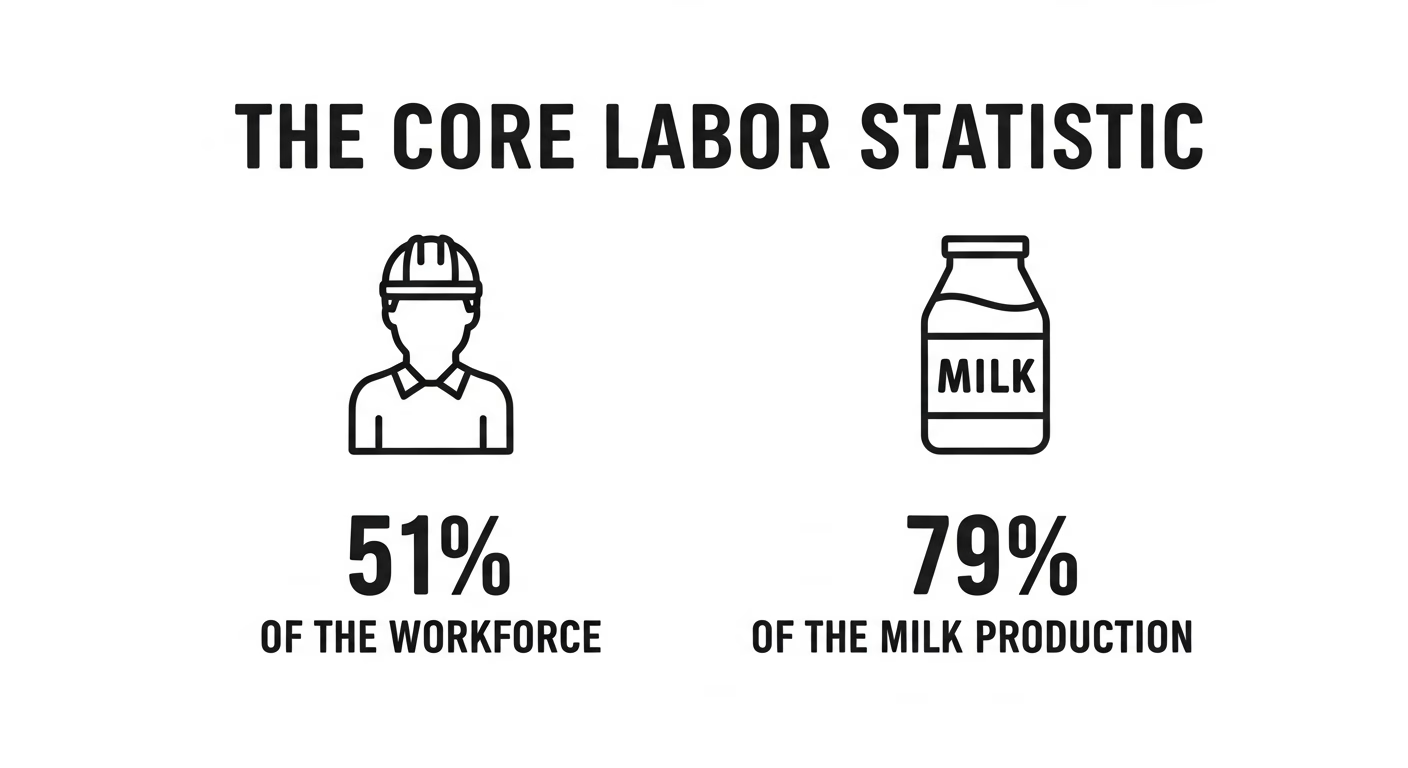
The labor situation in dairy is no longer just another box to check on a list with feed costs and milk prices. What really catches my attention: about 51% of U.S. dairy workers are immigrants, and those same workers are responsible for producing nearly 79% of our nation’s milk supply. This is the backbone of our industry.
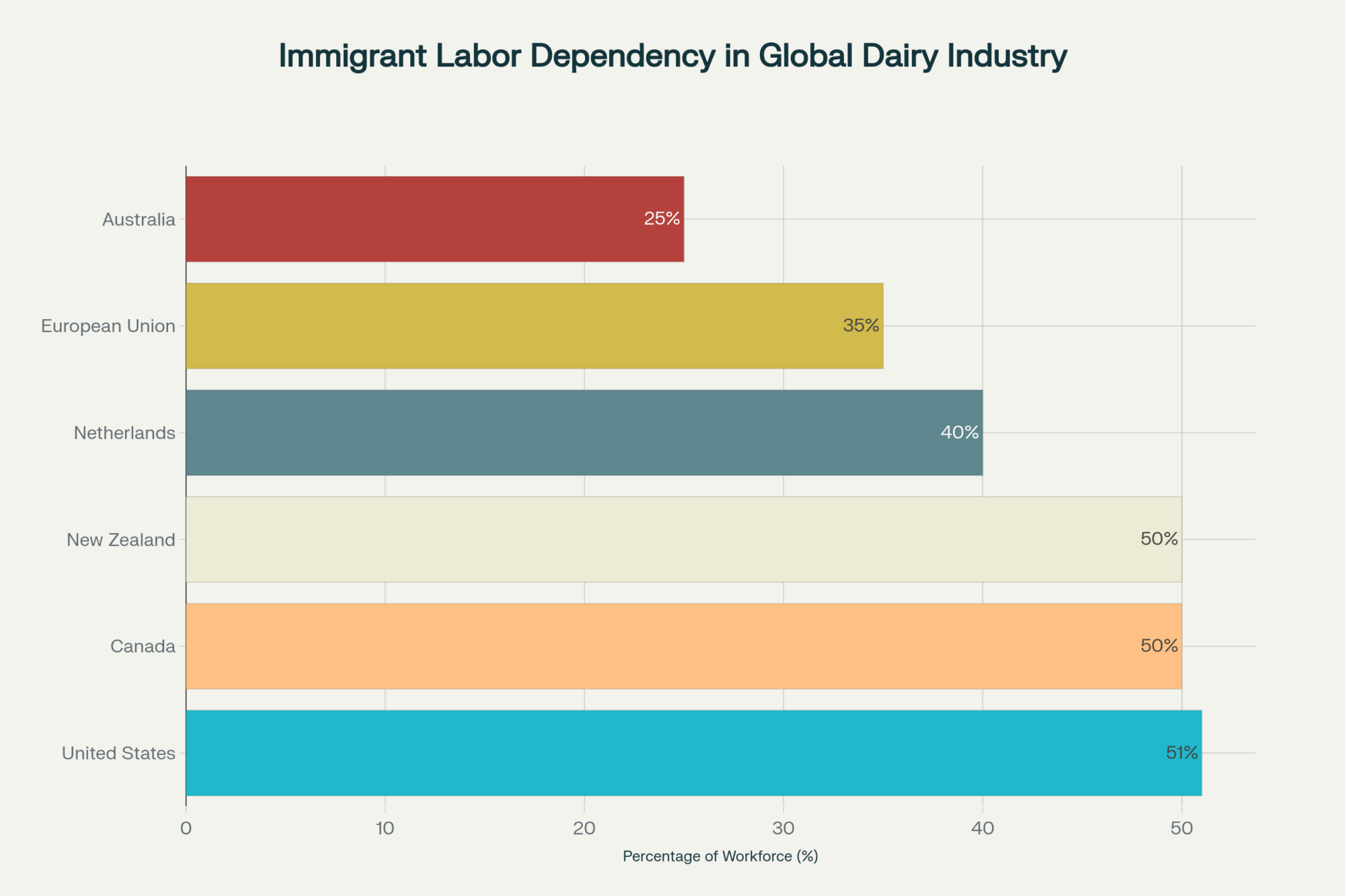
Global comparison of immigrant labor dependency in dairy farming shows U.S. leads at 51% workforce reliance
You’ve probably observed—milk prices at around $21.30 per hundredweight in May 2025, while corn costs hover near $4.20 a bushel according to recent USDA forecasts. Those thin margins are being squeezed further by an instability most farms aren’t fully pricing in: the workforce.
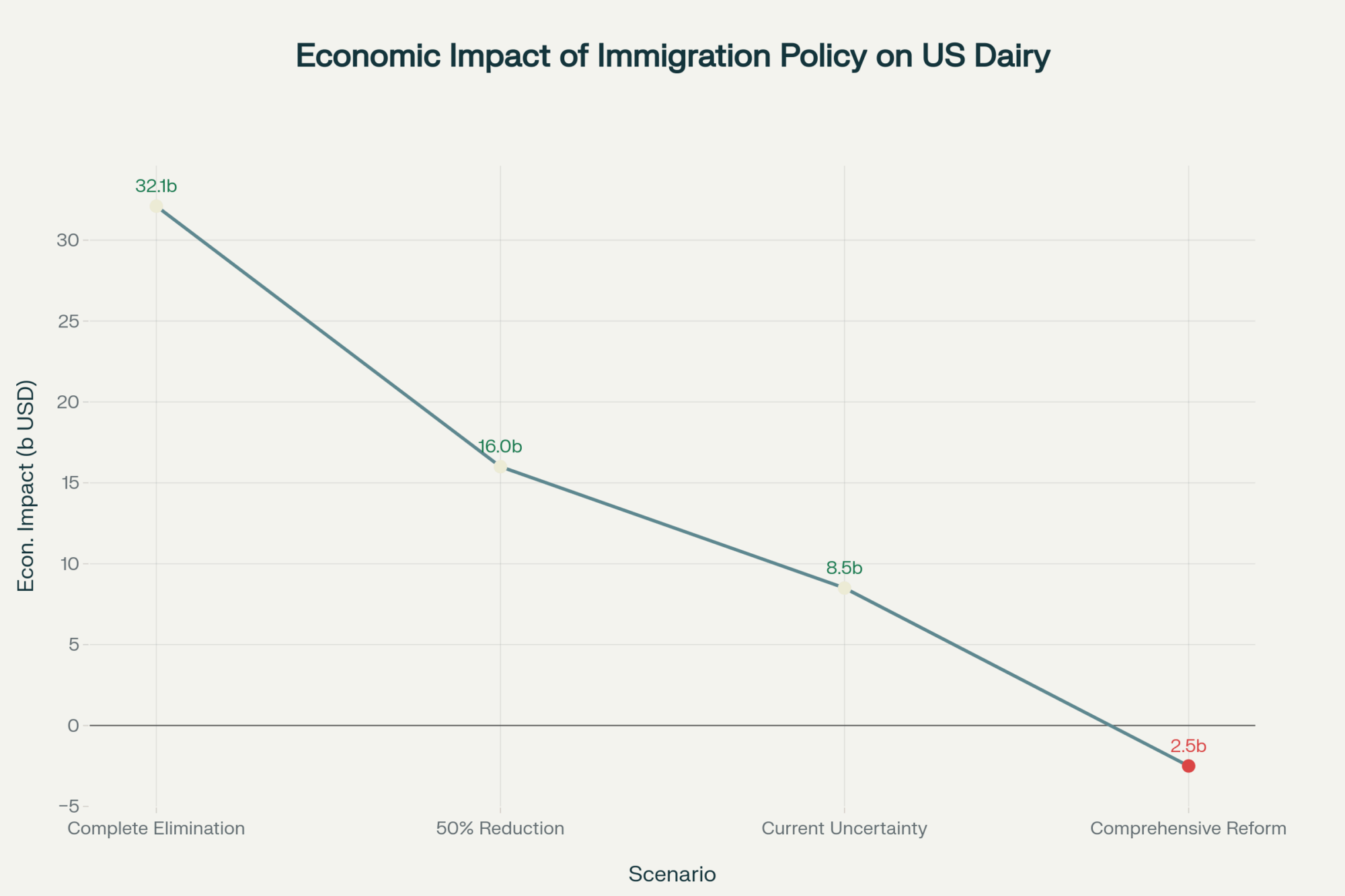
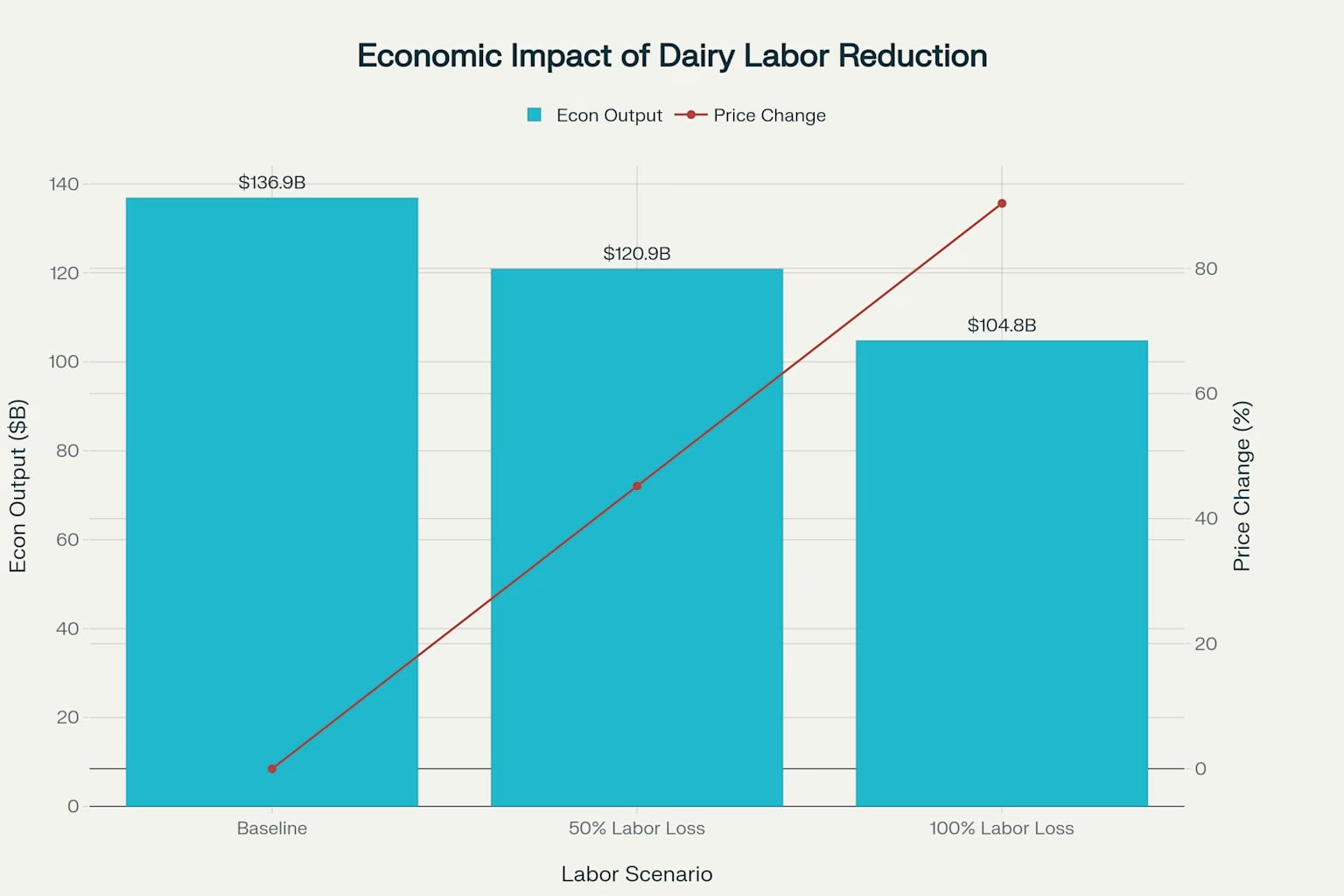
The economic modeling on this is sobering: losing this immigrant workforce could trigger up to $32 billion in industry losses, and milk prices could spike past $7.60 a gallon at retail. The ripple effects from such a shift would extend far beyond the farm gate.
Economic modeling shows $32.1B losses from complete immigrant labor elimination versus $2.5B gains from comprehensive reform
What Turnover Really Costs
Look at BLS data from 2024—livestock workers earn about $17.45 an hour, but the turnover rate hovers around 40% annually according to recent labor market reviews. Each replacement costs thousands in direct expenses and lost productivity while they get up to speed.
“When your people change, your feed conversion, your cow health, your rhythm—it’s like trying to keep the groove while the beat’s changing.” — Dr. Marin Bozic, University of Minnesota
This churn shows up in production numbers too. USDA data reveals Kansas’s milk output rising by 15.7% recently, while California declined nearly 2%—a clear sign that stable labor markets support greater productivity.
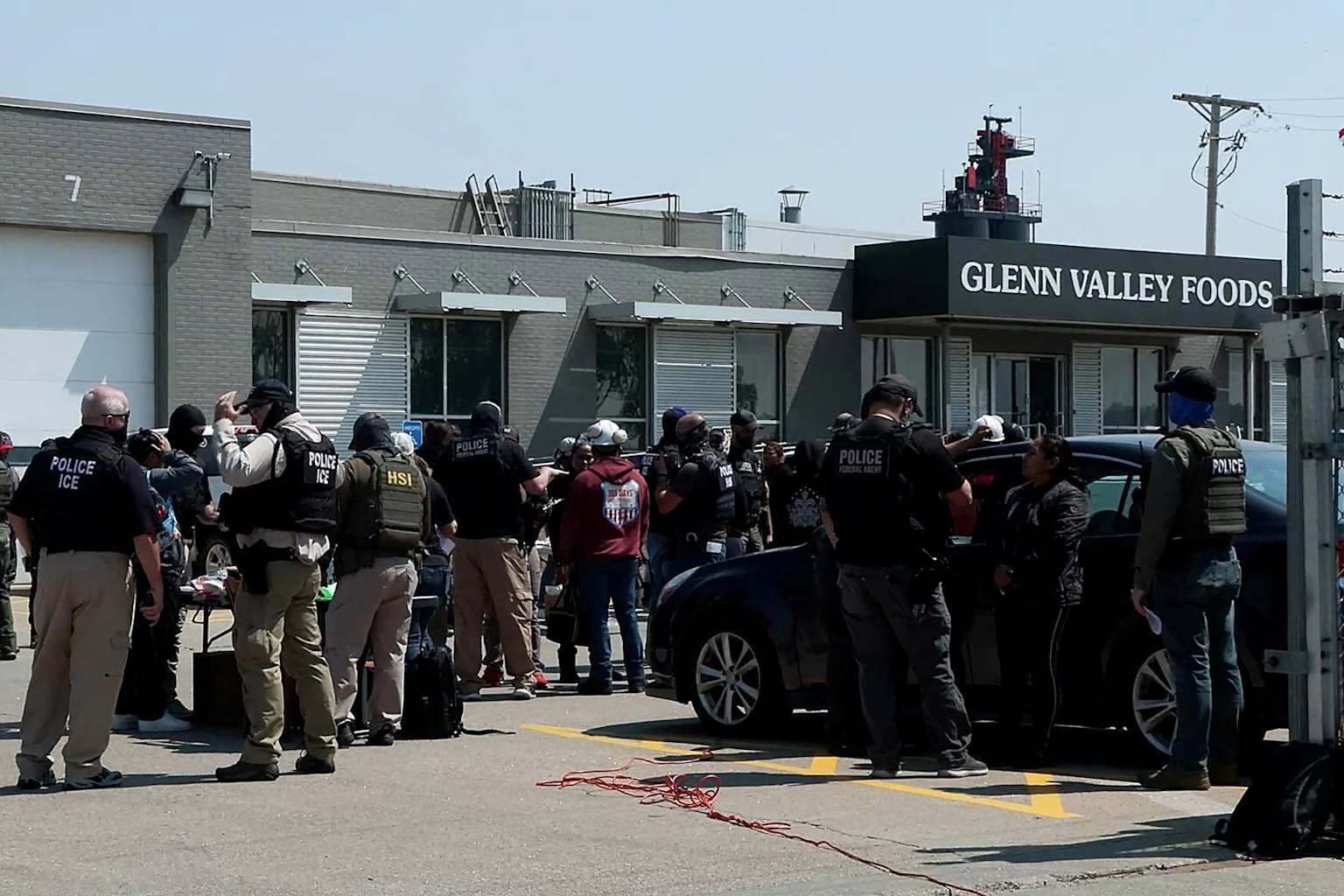
On top of that, ICE enforcement actions have caused some farms to lose half their workforce almost overnight, adding real operational stress.
The Farm Workforce Modernization Act, reintroduced in spring 2025, seeks to reshape the H-2A visa system by creating year-round access aligned with dairy’s demands. It dedicates 20,000 annual spots for dairy workers and offers a certified status pathway for longtime employees.
Robotic milking systems have grown to cover about 5% of U.S. dairy farms, with European counterparts like Denmark and the Netherlands reaching 20-25% adoption, per recent analyses. The global milking robot market is expected to hit $2.5 billion in 2025, as labor shortages and costs push more operations toward automation.
Farmers praise robots for easing labor demands and improving cow comfort, but as Dr. Rick Watters of Cal Poly observes, “Robots don’t replace labor—they change the skills you need.” Smaller herds (under 260 cows) enjoy better ROI, while larger operations still find parlors viable. Maintenance can cost up to $9,000 annually.
Your Bottom Line—What’s Next?
Here’s the thing though: continuing to hope this labor problem works itself out is a strategy that won’t cut it. Nearly 80% of American milk depends on a workforce caught in legal limbo and operational unpredictability. That’s not just a problem—it’s shaping who survives and who thrives. The regional production shifts make it clear: where labor is stable, production grows.
What strikes me about leaders in the space is they’re taking deliberate steps to blend policy advocacy with technology investments:
Audit Your Labor Risk. Truly calculate your costs from turnover—including lost milk, additional training, and potential herd health impacts.
Explore Tech Values. Even if you’re not ready to buy, get a robotic milking dealer’s cost-benefit analysis to guide future investments.
So… are you ready to lead your farm into that future, or will you be left behind?
Editor’s Note: This article is accompanied by key data visuals—a concise infographic on workforce statistics, a clear comparison of H-2A program limitations versus dairy’s labor needs, a U.S. milk production map highlighting regional shifts, plus high-resolution photos of robotic milking in action and diverse farm teams.
Learn More:
How Top Dairies Are Solving Labor Shortages in 2025 – Reveals practical strategies for reducing 38.8% turnover rates through structured training programs, creative compensation packages, and strategic automation investments that deliver measurable ROI.
Join over 30,000 successful dairy professionals who rely on Bullvine Weekly for their competitive edge. Delivered directly to your inbox each week, our exclusive industry insights help you make smarter decisions while saving precious hours every week. Never miss critical updates on milk production trends, breakthrough technologies, and profit-boosting strategies that top producers are already implementing. Subscribe now to transform your dairy operation’s efficiency and profitability—your future success is just one click away.
2.4 million workers vanished from the workforce in 8 months—your milking crew shortage isn’t getting better
You know that sinking feeling when you’re walking the barn at 4 AM and realize you’re running short-handed again? Yeah, that’s not just your operation anymore—it’s becoming the reality across dairy country.
I’ve been hearing the same story from producers everywhere lately. Third-generation operations, solid herds, good management… all struggling with the same damn thing. Job postings that used to generate fifteen applications now get maybe two callbacks in six months. The people are no longer there.
What strikes me about these conversations is that we’re all living through this labor crunch, but most of us are still planning like the old rules apply. If we just hang on long enough, post another listing on Indeed, and maybe throw another couple of bucks an hour at the problem, things will somehow snap back to normal.
Here’s the thing, though—they won’t. And the sooner we wrap our heads around that reality, the sooner we can start making the moves that’ll separate operations that thrive from those that barely keep the lights on.
The Numbers That Should Keep You Awake at Night
Let me share some data that’ll make you rethink everything you thought you knew about workforce planning. According to CoBank’s latest comprehensive analysis, we’re facing what economists are calling a “demographic double-whammy,” and honestly, it’s hitting dairy operations harder than almost any other sector.
The U.S. fertility rate has crashed to a historic low of 1.62 children per woman. That’s well below replacement level, representing a dramatic decline from 2.12 eighteen years ago. The generation that should be learning to milk your cows and manage your fresh pen? Many were never born after the 2008 financial crisis triggered what researchers describe as a “freefall in births.”
But here’s where it gets really interesting for dairy operations… we’ve lost nearly 10 million potential workers just from declining labor force participation. The rate dropped from 67% in 2000 to just 62% today. And in the past eight months alone? Another 2.4 million working-age Americans have opted out of the workforce entirely.
What’s particularly fascinating—and this is where the research from agricultural economists gets into the weeds—is what’s driving this opt-out trend. Recent work shows we’re dealing with caregiving responsibilities that don’t pencil out, skills that became obsolete faster than people could retrain, and honestly… a lot of mental health challenges that weren’t showing up in workforce data even five years ago.
The immigration piece—which gave us all a breather between 2022 and 2024 with about 8.8 million new arrivals—that tap has been turned off. Border encounters have declined significantly since August 2024, and current policy directions suggest this isn’t a temporary trend.
Here’s what really gets me, though… this isn’t just about raw numbers. It’s about what this means when you’re trying to cover three shifts, seven days a week, 365 days a year. When your best milker gives notice, you’re not just replacing one person—you’re competing with every other dairy, every other farm, every rural business for workers who increasingly don’t exist.
The Technology Payoff: From Parlor to Profit
Here’s where the conversation gets really interesting—and where smart dairy operators are already moving. I’ve been on enough farms to know that statistics are one thing, but reality in the barn is another. The producers who are quietly making progress right now—those operations that manage to maintain consistent staffing and steady production while their neighbors struggle—they have figured out something crucial.
This isn’t about replacing people with robots. It’s about making the people you can actually find and keep exponentially more productive.
The Technology That’s Actually Working
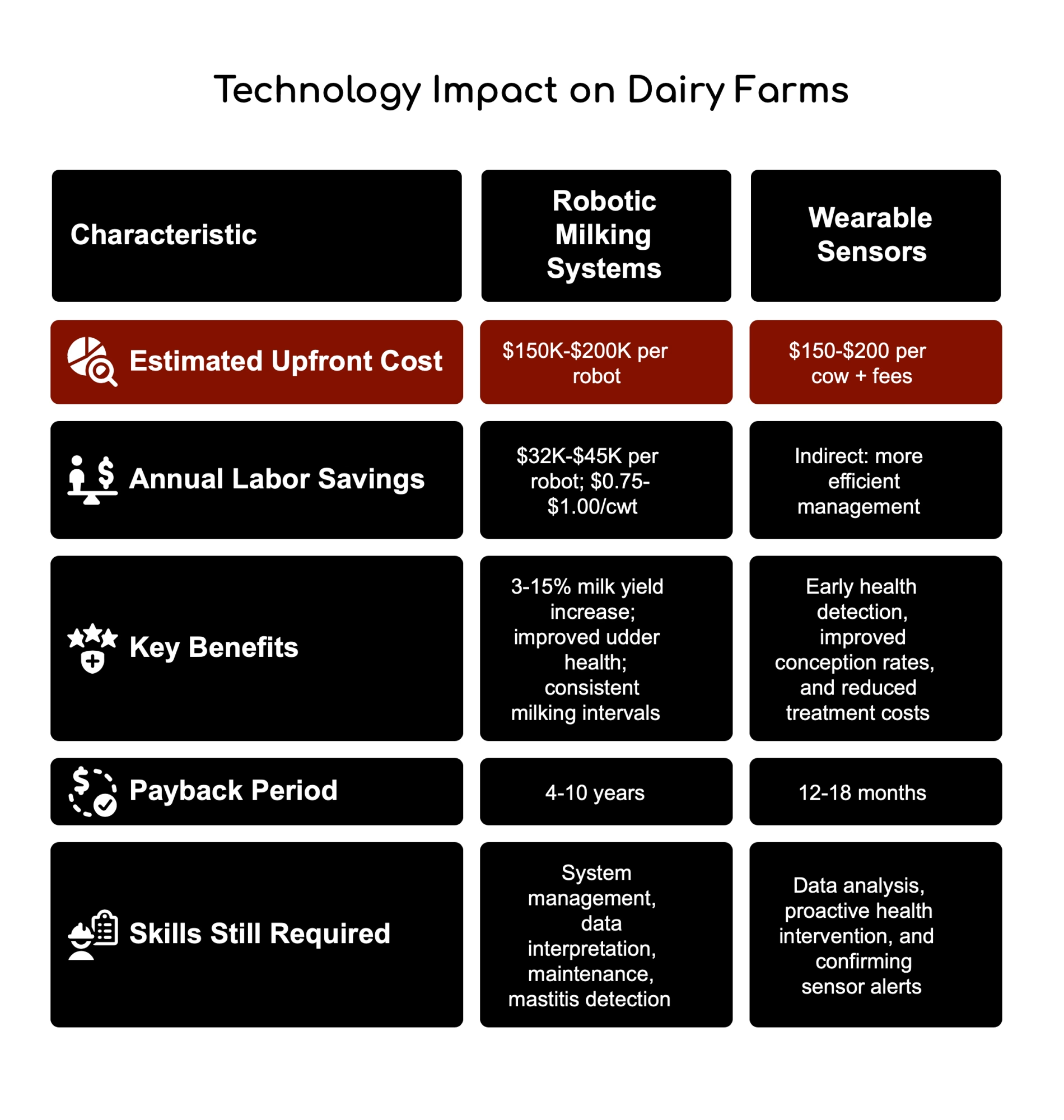
Take automated milking systems. Yeah, they’re expensive upfront—we’re talking $150,000 to $200,000 per robot, depending on your setup. However, what’s interesting is that operations that have made these investments are reporting some compelling results, although the specifics vary widely depending on the implementation and management.
Recent research from the Journal of Dairy Science shows that well-implemented AMS can increase milking frequency by 0.5 milkings per day while reducing labor requirements by 20-30%. What’s particularly noteworthy is how successful installations transform rather than eliminate positions. Instead of having skilled workers confined to the parlor for 12-hour stretches, automated systems handle routine milking, allowing teams to focus on cow health monitoring, breeding decisions, and nutrition management.
The precision feeding systems are where things get really exciting. The newer systems can track individual cow intake, adjust for butterfat production, and even factor in weather conditions. According to research from Penn State’s Department of Animal Science, operations using precision feeding systems are seeing measurable improvements in feed efficiency and milk production. That’s a significant amount of money when you consider that feed costs make up 50-60% of your total production expenses.
Then there’s predictive health monitoring—and this is where the technology is getting almost spooky good. The collars and ear tags aren’t just counting steps anymore. They’re monitoring rumination patterns, heat detection, and even early indicators of lameness. University of Wisconsin research shows that these systems can detect health issues 2-4 days earlier than visual observation, with some producers reporting a 35% reduction in treatment costs.
How Technology Changes Everything About Workflow
What successful implementations I’ve observed have in common is that they redesign everything around human-machine collaboration. Research from the American Dairy Science Association confirms what I’m seeing in the field: farms that view technology as human augmentation rather than replacement tend to see 40% better ROI on their investments.
This plays out differently across regions, and that’s something many equipment salespeople don’t disclose upfront. In Wisconsin, producers face shorter construction seasons that impact installation timing—you can’t retrofit automated systems when it’s -20°F outside. In California’s Central Valley, dust management becomes critical for sensor reliability. In Vermont, the older barn infrastructure presents unique challenges that necessitate creative engineering solutions.
I’ve observed third-generation family farms with tie-stall barns built in the 1970s where robotic milking installations would require complete rebuilds. Instead, many are choosing automated takeoffs and computerized feeding systems. While not as comprehensive as full robotics, these systems are freeing up significant time and improving milk quality metrics.
The Financial Reality That’s Changing Everything
Let me cut to the numbers that matter for your operation. The technology costs have dropped dramatically—industrial robotics costs have fallen by about half over the past decade. What was once exclusive to mega-dairies is now economically viable for operations with 500-800 head.
Here’s what this looks like across different operation sizes:
Operation Size
Technology Investment
Labor Hours Saved/Week
Estimated Annual Savings
Implementation Timeline
300-500 cows
$200,000-300,000
15-25 hours
$35,000-55,000
18-24 months
500-800 cows
$350,000-500,000
25-40 hours
$55,000-85,000
16-22 months
800+ cows
$600,000-1,000,000
40-60 hours
$85,000-150,000
14-20 months
Note: These figures are estimates based on industry observations and vary significantly based on implementation, management, and regional factors.
But here’s the crucial insight that most producers miss: this isn’t just about direct cost savings. It’s about operational resilience. When the next labor crisis strikes, when feed costs spike, or when energy prices fluctuate, technology-enabled operations adapt and thrive, while their competitors struggle to keep up.
And there’s an environmental angle here that’s becoming real money. According to recent research from Cornell’s College of Agriculture, automated systems typically help reduce greenhouse gas emissions per unit of milk by 12-18% through improved feed efficiency and reduced waste. California’s dairy operations are already seeing carbon credit payments of $15-25 per metric ton of CO2 equivalent reduced. With the average dairy cow producing approximately 4 tons of CO2 equivalent annually, we’re talking about potential payments of $60-$ 100 per cow per year for operations that can document emission reductions.
Technology Selection Decision Framework
What strikes me about successful tech adoption is that it follows a pretty predictable pattern:
Step 1: Start with your biggest pain point. If you’re constantly fighting labor shortages in the parlor, automated milking makes sense. If feed costs are a concern, precision feeding systems should be your top priority.
Step 2: Match technology to your infrastructure. That beautiful tie-stall barn from 1975? Robots probably aren’t happening without a complete rebuild. But automated takeoffs and computerized feeding? Absolutely doable.
Step 3: Plan around your seasonal constraints. Upper Midwest producers know you don’t install systems during breeding season or when there’s two feet of snow on the ground.
Step 4: Build in redundancy. Technology fails, especially new technology. Make sure you can still operate when (not if) the system goes down on a Saturday night.
The Feed Cost Reality (And Why Some Producers Are Smiling)
Now, let’s talk about something that’s actually working in our favor for once. While crop farmers are facing pressure—corn prices have been under strain in recent quarters—dairy operations with sophisticated feed programs are leveraging this into a competitive advantage.
Current market conditions show feed grain prices creating opportunities for operations that can time their purchases and optimize rations based on real-time price signals. Operations with precision feeding systems that automatically adjust formulations based on milk production data and commodity prices are literally transforming feed management from a cost center into a profit driver.
However, here’s where it gets tricky… and this is something most producers aren’t yet fully grasping. While feed grains may be more affordable, the underlying cost structure is still rising. According to recent industry analysis, fertilizer costs continue to face upward pressure, with the urea market being particularly volatile due to Middle East geopolitical tensions.
Nutritionists I work with who’ve been in the field for 25+ years are telling me the same thing: “The operations that are succeeding right now aren’t just buying cheaper feed. They’re creating systems that can adapt to price volatility in real-time.”
That’s the key insight. It’s not about finding the cheapest corn—it’s about building flexibility into your feeding program that can respond to market changes faster than your competitors. And here’s the connection most people miss: building this kind of flexibility requires sophisticated data systems and dedicated management time, precisely what technology frees up from routine parlor work.
Current Market Reality Check
Let me give you an idea of where we stand right now, as these numbers are important for your planning. The dairy sector is demonstrating remarkable resilience compared to other agricultural sectors. According to CoBank’s outlook, the industry is forecasting roughly 2% growth in overall production, despite the challenges it is facing.
What’s particularly interesting is how producers are responding strategically. The U.S. dairy cow population has grown by 114,000 head over the past 12 months. This is happening while the overall cattle herd is shrinking. Why? Because dairy producers are making strategic decisions—retaining older cows in the milking herd rather than culling them for beef, even with strong beef prices.
The export picture is especially encouraging. Strong global demand and favorable U.S. prices have led to significant growth in butter exports—we’ve already reached 87% of last year’s total volume in just the first five months of 2025.
However, what’s truly fascinating from a strategic perspective is that the primary constraint on dairy growth isn’t demand—it’s supply-side issues, including labor shortages, processing capacity constraints, and the availability of replacement heifers. The operations that solve these supply-side challenges are capturing disproportionate market share in a growing market.
Policy Shifts Creating Winners and Losers
Here’s where things get really interesting from a business planning perspective. Federal policy changes are creating clear winners and losers with unprecedented speed. The passage of what’s being called the “One Big Beautiful Bill Act” delivered massive changes—nearly $200 billion in cuts to traditional farm programs, but significant wins for production agriculture.
The biofuel mandates are creating unprecedented opportunities that many dairy producers haven’t yet fully grasped. The EPA’s regulatory framework for biofuels is creating substantial domestic demand for feedstock crops, with domestic soybean oil positioned as a primary beneficiary. Changes to tax credit structures are restricting eligibility to feedstocks from North America only, effectively creating a protected domestic market.
This means stronger support for soybean meal prices—a key component in most rations —for dairy operations. This government-engineered demand provides crucial price support during a time when export markets remain challenging.
However, a warning is buried in the policy details: the traditional farm bill coalition has been fractured. Future political support for agricultural programs may be more fragile than we’re used to.
The bottom line? Capitalizing on these policy-driven opportunities requires the kind of agile business management and data analysis that’s only possible when you’re not spending all your time trying to cover basic operational needs, such as managing shifts.
Consumer Behavior That’s Reshaping Everything
While we’re dealing with labor shortages, our customers are facing their own challenges that’re actually creating opportunities for savvy dairy producers.
Housing costs have created significant financial pressure for consumers. According to the CoBank analysis, housing anxiety is driving fundamental changes in how people eat, with consumers preparing meals at home at levels not seen since the pandemic.
However, what’s interesting is that these aren’t just people buying the cheapest food available. They’re becoming what consumer research calls “sophisticated value optimizers.” They’re willing to pay for quality, convenience, and products that help them feed their families better for less money.
This represents a significant shift in revenue from foodservice to retail grocery. Dairy products, positioned for family meal preparation, bulk packaging, and value-added convenience, are seeing growth, while foodservice struggles.
Here’s the connection most producers are missing: meeting this demand for value-added retail products—whether it’s specialty cheeses, organic milk, or family-sized packaging—requires the operational flexibility and management bandwidth that only comes when your basic milking operations run themselves.
Regional Realities: What Works Where
What I’m seeing across different dairy regions is fascinating, and frankly, it’s something that doesn’t get discussed enough in technology sales pitches. The Upper Midwest presents distinct challenges compared to California or the Northeast, and your technology strategy must take these into account.
Wisconsin and Minnesota: The shorter construction seasons impact the timing of technology installations. Smart operators plan installations for late spring through early fall when weather conditions are favorable. I’ve seen operations that wanted to upgrade their systems in March, only to realize they’d be dealing with frozen ground and subzero temperatures.
California’s Central Valley: Dust management becomes critical for sensor reliability—those fancy ear tags and monitoring systems require regular maintenance when they’re exposed to dust and heat for half the year. Water availability is becoming as critical as labor availability, which affects cooling systems for robotic equipment.
Vermont and upstate New York: Older barn infrastructure creates unique challenges. I’ve observed operations—beautiful tie-stall barns built like tanks in the 1970s—where robotic milking installations would require complete rebuilds. Instead, many are choosing automated takeoffs and sophisticated feeding systems. While not as comprehensive as full robotics, these systems are freeing up significant time and improving milk quality metrics.
Pacific Northwest: The climate’s great for cows, but the regulatory environment around water usage and environmental compliance is getting tighter every year. Technology that documents environmental improvements isn’t just nice to have—it’s becoming essential for permit renewals.
The feed sourcing piece varies significantly by region as well. West Coast operations benefit from proximity to almond hulls and citrus pulp—byproducts that work great in rations but aren’t available in Wisconsin. Midwest dairies have more traditional corn-soy availability, but they also face seasonal storage challenges that California doesn’t.
Implementation Roadmap: Making It Actually Happen
Based on what I’ve seen work across different operations, here’s a practical framework for getting started—and honestly, this is where most operations either succeed or fail.
Phase 1: Reality Check and Assessment (Months 1-2)
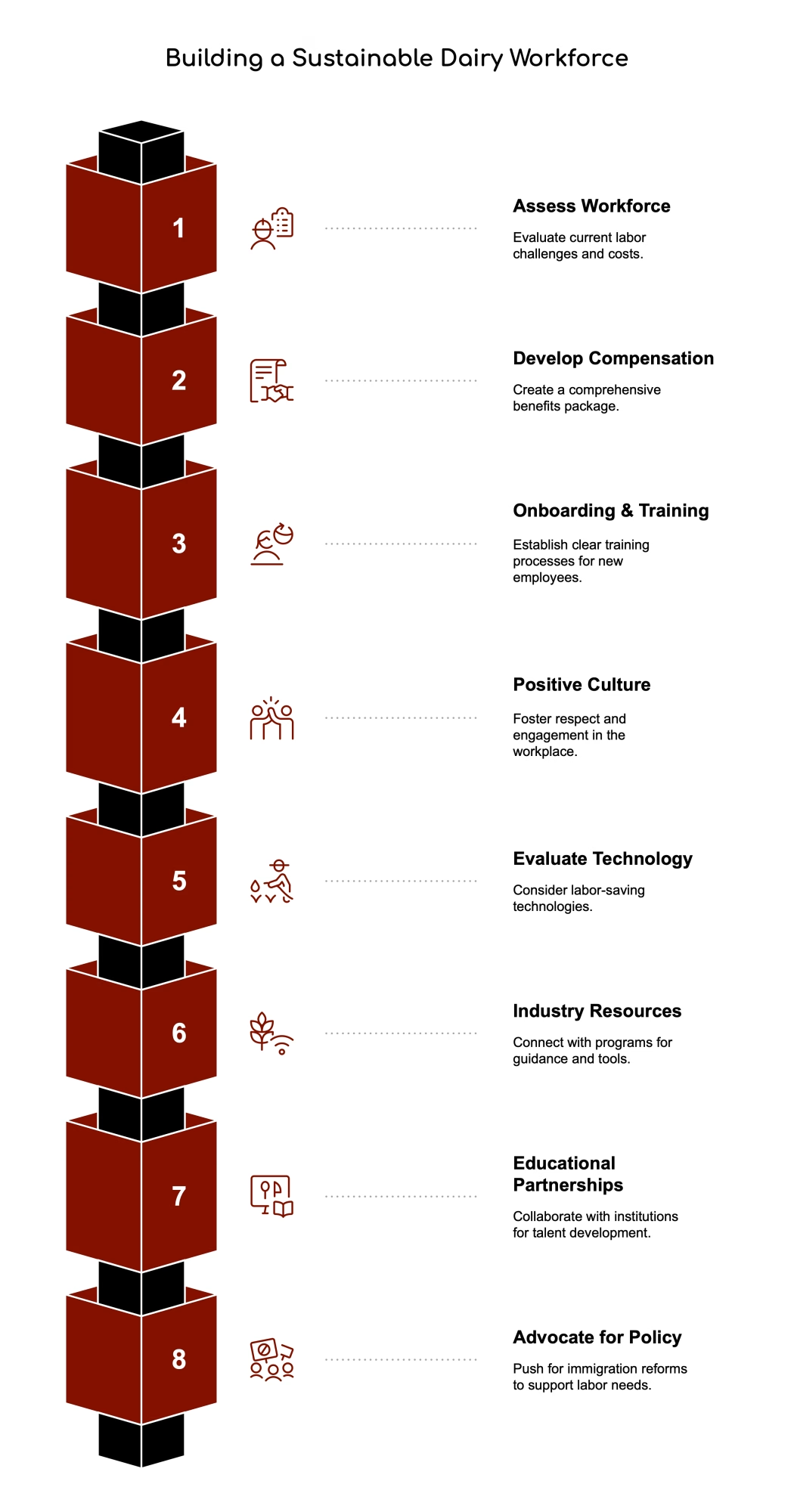
Start with a brutal labor audit. Map out exactly where your people spend their time and identify the biggest pain points. Don’t just look at hours—look at when you’re most vulnerable to call-offs or turnover.
Create a simple tracking system for:
Daily labor hours by task
Overtime patterns and costs
Sick leave and absence trends
Training time requirements for new hires
Quality issues related to fatigue or inexperience
Phase 2: Technology Selection and Planning (Months 3-4)
Focus on technologies that address your biggest constraints first. If you’re struggling with consistent milking protocols, consider automated takeoffs. If feed management is consuming too much time, look at precision feeding systems.
Obtain multiple quotes and request to see the technology in action at similar operations in your region. Not just any operation—one that’s similar to your scale, your infrastructure, and your management style.
Vendor Evaluation Checklist:
24/7 technical support availability
Local service technician response times
Training program comprehensiveness
Financing options and payment structures
Integration capabilities with existing systems
Track record with similar-sized operations
Phase 3: Installation and Integration (Months 5-8)
Plan installations around your seasonal workload. Avoid installing new systems during the breeding season or when making silage. Build in extra training time—your team members need to be comfortable with the technology before you rely on it.
Have backup plans. Technology fails, especially new technology. Make sure you can still operate if the system goes down during a weekend.
Phase 4: Optimization and Expansion (Months 9-12)
This is where the real gains happen, and honestly, where most operations leave money on the table. Use the data from your new systems to fine-tune everything else. Adjust breeding programs based on activity monitors. Optimize rations based on individual cow performance data.
Start thinking about your next investment. Technology works best as an integrated system, not individual pieces of equipment.
The Environmental Angle That’s Becoming Real Money
Here’s something that’s becoming increasingly important, even if it’s not yet on most producers’ radars. The environmental benefits of technology adoption are starting to translate into tangible financial benefits, not just feel-good marketing.
According to research from Cornell’s College of Agriculture and Life Sciences, automated systems typically help reduce greenhouse gas emissions per unit of milk by 12-18% through improved feed efficiency and reduced waste. That might not sound like much, but carbon credit programs are starting to pay real money for these reductions.
Current Carbon Credit Opportunities:
California: $15-25 per metric ton CO2 equivalent
USDA Climate-Smart Commodities: Up to $50 per metric ton
Private market programs: $10-40 per metric ton
Precision feeding systems are particularly effective here. By optimizing protein levels and reducing waste, these systems can help reduce methane emissions while improving production efficiency. University of California research shows that improvements in feed efficiency translate to reductions in greenhouse gas emissions.
Water usage is another area where technology pays environmental dividends. Automated systems typically use 10-15% less water per unit of milk produced, thanks to more efficient cleaning cycles and reduced waste. In regions facing water restrictions, this efficiency can be the difference between expanding and being forced to reduce herd size.
Infrastructure Changes You Need to Know About
Two policy shifts are reshaping the operational landscape for rural dairy operations, and both deserve your attention, especially if you’re considering technology investments that rely on reliable connectivity.
The $42.5 billion BEAD broadband program has undergone a complete overhaul. They’ve eliminated the “fiber-first” preference in favor of a technology-neutral approach, based primarily on cost. This opens opportunities for fixed wireless and satellite providers, potentially bringing high-speed internet to operations that have been stuck with inadequate connectivity.
For precision agriculture systems, automated monitoring, and data-driven management, reliable internet connectivity is becoming essential. The new BEAD structure means rural dairies may finally have access to digital infrastructure that’s been limited to urban areas.
Energy security is another consideration that’s not getting enough attention. The Strategic Petroleum Reserve is at its lowest level since the mid-1980s—about 402 million barrels. With energy price volatility becoming a permanent feature of our operating environment, smart operations are building energy resilience through on-farm renewable systems and operational flexibility.
Looking Forward: The New Rules of Dairy Success
The dairy industry is at one of those inflection points that defines generations. The forces reshaping our business—labor scarcity, shifts in consumer behavior, policy volatility, and technological disruption—aren’t temporary challenges to weather.
What strikes me about the operations that are making progress is that they’ve stopped waiting for things to “get back to normal.” They’ve accepted that this is the new normal and built their strategies accordingly.
The successful producers are making three fundamental shifts:
First, they’re treating technology as core infrastructure, not optional equipment. When your bulk tank fails, you don’t debate whether to fix it. You fix it immediately because the operation depends on it. That’s how they view their technology investments.
Second, they’re redesigning workflows around human-machine collaboration rather than simple automation. The goal isn’t to eliminate people; it’s to make the people you have exponentially more productive for the things that truly matter, such as cow health, breeding decisions, and business planning.
Third, they’re building adaptive capacity for an environment of permanent change. They’re not just solving today’s problems; they’re creating systems that evolve with whatever comes next.
The Window Is Closing
Your competitors are already moving. Some quietly, some obviously, but they’re moving. The dairy producers who dominate their markets five years from now won’t be the ones who had the most cows or the cheapest feed. They’ll be the ones who figured out how to amplify human capability through intelligent technology adoption.
The window for strategic advantage is narrowing. Early adopters are already building operational capabilities that will be difficult for competitors to replicate. The question isn’t whether these trends will continue—they will. The question is whether you’ll lead the transformation or be left behind by it.
This isn’t about choosing between people and technology. It’s about using technology to make the people you have more valuable, more productive, and more engaged. The operations that master this balance will write the next chapter of American dairy farming.
The transformation is underway. The dairy industry’s future belongs to those who act decisively today.
What will you choose?
KEY TAKEAWAYS
Labor cost savings of $85,000-$120,000 annually for 500-head operations through automated milking systems—start by getting quotes from three different vendors and visiting similar-sized operations that have made the switch
Feed efficiency improvements of 5-8% through precision feeding that adjusts rations in real-time based on milk production data—begin with a feed audit to identify where you’re losing money on wasted feed
35% reduction in veterinary costs using predictive health monitoring that catches problems 2-4 days before visual detection—implement activity monitors on your high-value cows first to see immediate ROI
Carbon credit payments of $60-100 per cow annually from documented emission reductions through improved feed efficiency—track your current feed conversion rates now so you can document improvements for future credit programs
Technology investment payback in 18-24 months versus the permanent cost of labor shortages—calculate what you’re already spending on overtime, turnover, and unfilled positions to see your baseline
EXECUTIVE SUMMARY
Look, I’ve been saying this for months, but now we’ve got the numbers to prove it. The labor shortage isn’t temporary—it’s the new reality, and waiting it out will kill your operation. We’re talking about a 2.4 million worker exodus in just eight months, with fertility rates so low that the next generation of dairy workers was literally never born. But here’s what’s got me excited… operations that are embracing automated milking systems and precision feeding are seeing 20-25% productivity gains with payback periods of just 18-24 months. A 500-head operation can save $85,000 annually in labor costs alone, not counting the feed efficiency improvements. This isn’t about being fancy—it’s about survival. You need to start planning your tech adoption now, because your competitors already are.
Complete references and supporting documentation are available upon request by contacting the editorial team at editor@thebullvine.com.
Learn More:
Investing in Precision Feeding: Turning Feed Costs into Daily Profits – Walks you through sensor-based ration tuning that’s pushing feed-conversion 7-10% higher on 300-cow herds. Practical step-by-step checklist helps you start the audit tomorrow and see dollars saved this month.
Join over 30,000 successful dairy professionals who rely on Bullvine Weekly for their competitive edge. Delivered directly to your inbox each week, our exclusive industry insights help you make smarter decisions while saving precious hours every week. Never miss critical updates on milk production trends, breakthrough technologies, and profit-boosting strategies that top producers are already implementing. Subscribe now to transform your dairy operation’s efficiency and profitability—your future success is just one click away.
51% of dairy workers produce 79% of our milk – but Washington just changed the rules. Your automation ROI just got a lot more interesting.
EXECUTIVE SUMMARY: You know that gut feeling you’ve had about your labor situation? Well, it just got validated in the worst way possible. Washington’s “no amnesty” stance isn’t just policy talk—it’s about to reshape how every dairy operation thinks about their workforce and technology investments. Here’s what caught my attention: robotic milking systems that used to pencil out over 4-5 years are now showing 24-month paybacks under current labor market conditions. We’re talking about 21% labor cost reductions while some operations are seeing 8.9% production growth in states that still have reliable labor access. The producers who are already documenting their workforce and running new automation numbers aren’t just planning for 2026—they’re positioning themselves to dominate their local markets while their neighbors scramble to find milkers. This isn’t about replacing good people… it’s about creating systems that can thrive regardless of what Washington decides next.
KEY TAKEAWAYS
Cut labor costs 21% with strategic automation – Robotic milking systems showing 24-month payback periods under current crisis conditions. Start documenting your recruitment costs, turnover expenses, and wage inflation now to run accurate ROI calculations.
Workforce retention beats replacement every time – Operations implementing comprehensive benefit packages (including housing assistance) report turnover rates below 5% versus industry averages of 40%. This translates to $89,000 in avoided losses for a 1,000-cow operation.
Regional advantages are widening fast – Texas dairy operations showing 8.9% annual production growth while traditional dairy states face declining output. With Class III at $18.82/cwt and feed costs at $285/ton, your zip code is becoming your destiny.
Document everything before you need it – Smart producers are formalizing HR processes and tracking worker histories now. When policy changes hit, the farms with proper documentation will have options while others face operational disruption.
Technology adoption requires people strategy – Activity monitoring systems generating 3:1 ROI, but only when you’ve got skilled staff who can interpret the data. Cross-training and systematic workforce development are showing better returns than many technology investments.
You know what keeps me up at night lately? It’s not milk prices or feed costs, though those are gnawing at everyone. It’s this labor situation that’s about to reshape how we all do business.
The thing about Trump’s latest immigration stance is that it’s not just policy talk anymore. When the administration says “no amnesty” for ag workers while immigrant labor makes up 51% of our workforce but produces 79% of our milk… well, that’s your wake-up call right there. We’re talking about the backbone of American dairy production sitting in regulatory limbo.
What really gets me is how disconnected Washington seems from what’s happening in the milking parlor at 4 AM. But here’s the thing—we can’t wait for politicians to figure this out. The smart money is already moving, and if you’re not thinking three moves ahead, you’re going to get left behind.
The Backbone of the Industry: Immigrant labor represents just over half the dairy workforce but is responsible for a hugely disproportionate 79% of U.S. milk production, according to industry data.
The Policy Reality Check—And Why Your Morning Crew Matters More Than Ever
That’s the disconnect we’re dealing with. Policy makers who think labor is interchangeable… like you can just swap out a skilled milker who knows your herd for someone who’s never seen a fresh cow.
Here’s what’s really happening, though, and this is where it gets interesting for those of us actually running operations…
The Numbers Game—And Why Geography Is Becoming Destiny
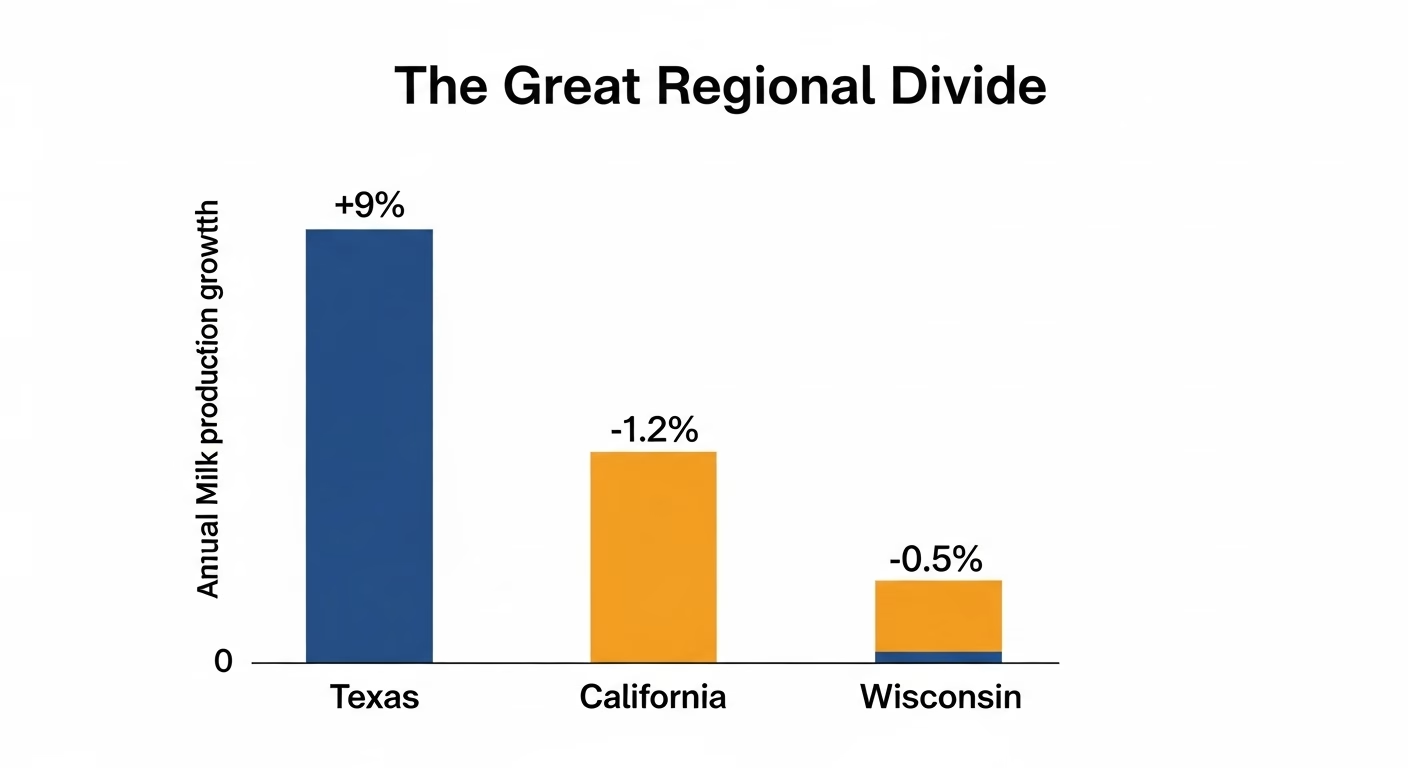
A Widening Gap: Annual Milk Production Growth (%). Recent data highlights a stark regional divide. States with more stable labor access like Texas are seeing significant growth, while traditional dairy states are feeling the pressure from workforce disruptions.
Let’s talk about what this means for your bottom line, because the regional differences are getting stark. Wisconsin’s sitting on 2,800 H-2A workers for seasonal work, but dairy? We’re locked out because the program only covers “temporary or seasonal” work. Try explaining that to a cow that needs milking 365 days a year.
The University of Wisconsin-Madison folks have documented that about 70% of Wisconsin’s dairy workforce comes from immigrant labor. That’s roughly 10,000 workers in Wisconsin alone. Now imagine what happens if enforcement ramps up…
I was just talking to a producer in Fond du Lac County who’s been milking 800 head for fifteen years. Same crew, same routine, same quality. He told me, “Andrew, I don’t know what I’d do if I lost even two of my key guys.” That’s the reality we’re dealing with.
California’s already feeling the squeeze. Despite pumping out 40.1 billion pounds annually, they’re seeing production slip while labor costs jump 4% year over year. With Class III averaging $18.82 per hundredweight—and that’s before you factor in this summer’s volatility—those margins are getting tight.
But here’s what’s fascinating: Texas is telling a completely different story—8.9% annual production growth because they can still access reliable labor. The competitive gap is widening, and your zip code is starting to matter more than your management skills.
The Automation Play—When $275,000 Starts Looking Like Insurance
So what do you do when your labor pool is sitting on political quicksand? The answer I’m seeing more and more is defensive automation.
I was just out at a 500-cow operation in Lancaster County that installed their first two robots last spring. The owner—let’s call him Jim—told me something that stuck: “I didn’t buy these because I wanted to. I bought them because I had to.” His labor costs dropped 23% in the first year, but more importantly, he’s sleeping better at night.
Recent work from Cornell on automated milking shows labor costs dropping over 21% once you get the systems dialed in. But here’s the kicker—58% of adopters report higher milk production, while only 54% would actually recommend the technology. That tells you everything about the learning curve.
What’s particularly noteworthy is how these systems change your labor needs rather than eliminating them. Those activity monitoring systems that run about $150 per cow are showing 3:1 returns when you’ve got someone who actually knows how to read the data. The keyword there is “someone”—you still need skilled people, just different skills.
The Real Cost of Standing Still
Here’s where it gets uncomfortable for a lot of producers. Current financing isn’t exactly farmer-friendly—prime rates at 8.5% and equipment financing pushing 10-12% for qualified borrowers. That changes your payback calculations significantly.
But the cost of doing nothing? That’s where the numbers get scary. Recent research documented in Progressive Dairy shows that high-turnover operations are seeing 1.8% production drops, 1.7% higher calf mortality, and 1.6% more cow deaths. For a 1,000-cow operation, that’s roughly $89,000 in lost revenue… and that’s before you factor in quality penalties from elevated somatic cell counts.
I ran the numbers for a typical 500-cow operation considering robotic milking. Break-even at 24 months under current labor market conditions. If wage pressure eases—and honestly, when’s the last time you saw that happen?—it extends to 36 months. But that’s assuming you can find and keep good people.
The thing about automation failures, though… Progressive Dairy’s implementation studies show 15-20% failure rates within the first 18 months. Usually comes down to inadequate preparation or unrealistic expectations. This isn’t plug-and-play technology—it’s a complete operational shift.
The producers who are crushing it right now aren’t just throwing money at robots. They’re getting strategic about their people.
I know a 650-cow operation in Sheboygan County that’s reporting 3% annual turnover. How? Comprehensive benefit packages include housing assistance. They built four modest houses on the property—nothing fancy, but clean, safe, and affordable. Their labor costs per cow are actually below the regional average because they’re not constantly training new people.
This development is fascinating—structured training programs documented in the Journal of Dairy Science show measurable improvements in both knowledge retention and actual performance metrics. But it requires real investment. We’re talking curriculum development, dedicated training time, and—this is crucial—making sure your existing crew buys into teaching newcomers.
The financial impact is quantifiable. Low-turnover operations avoid those production drops, quality issues, and constant recruitment costs. It’s becoming a competitive advantage that compounds over time.
Regional Realities—Why Your Neighbors Matter More Than Washington
What’s happening in the Upper Midwest versus the Southwest is like watching two different industries. Wisconsin and Minnesota producers are feeling the squeeze because they’ve been more dependent on immigrant labor without the policy flexibility that border states might have.
I was talking to a producer in New Mexico last month who told me, “We’ve always had to be more creative about labor.” Different regulatory environment, different labor pool, different strategies. But even they’re concerned about what happens if federal enforcement ramps up.
Feed costs are running about $285 per ton for quality hay across most regions—that’s up from $260 last year—but the labor availability gives certain areas a significant edge in total production costs. The most competitive operations are maintaining labor costs under $4 per hundredweight, but that benchmark is getting harder to hit.
Here’s what’s really interesting: the operations that are thriving aren’t necessarily the biggest or the most high-tech. They’re the ones that figured out how to create workforce stability in an unstable environment.
The Skills Evolution—What Tomorrow’s Dairy Workers Look Like
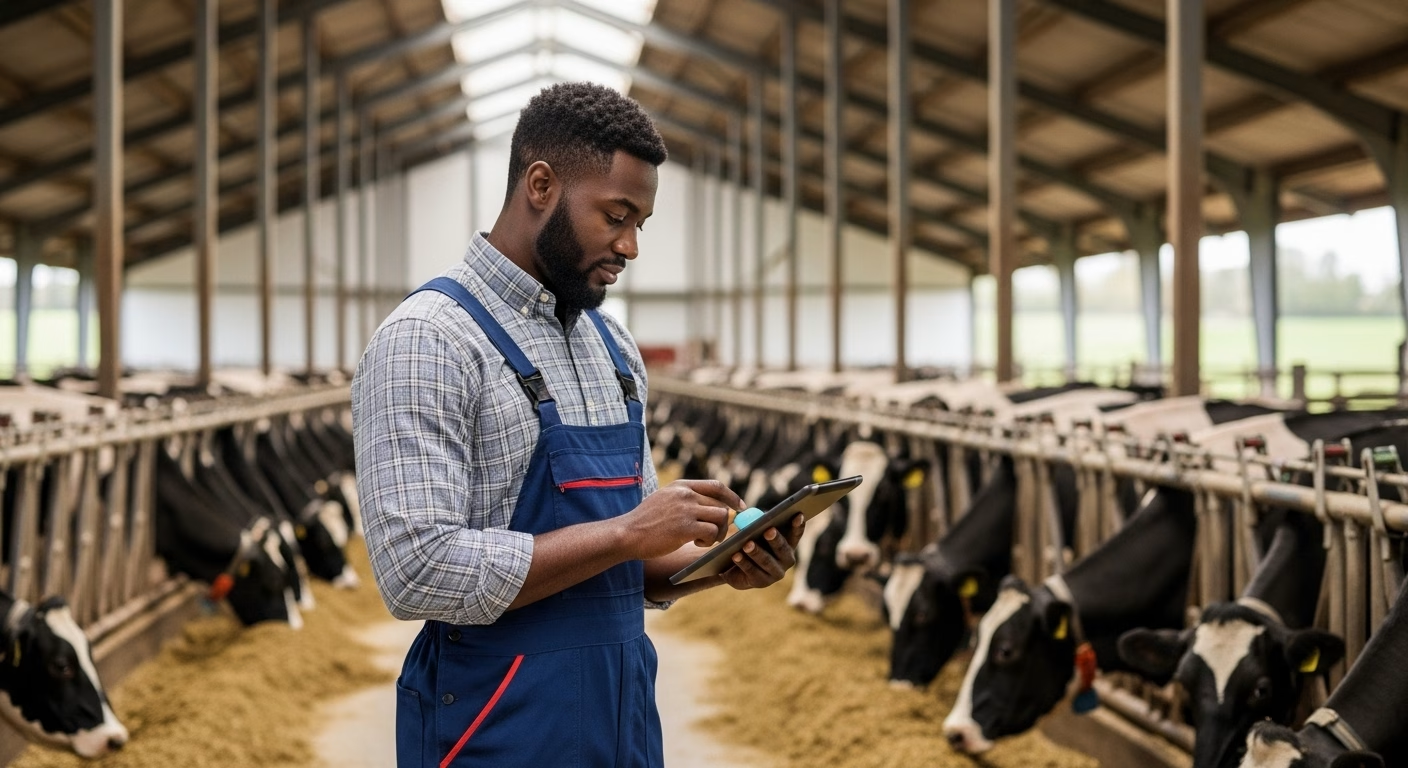
The New Dairy Professional: Technology isn’t replacing people; it’s changing the required skills. Successful modern dairies need tech-savvy team members who can interpret data to improve herd health, efficiency, and productivity.
I’ve been watching this trend for about three years now. The farms that are succeeding with technology adoption are the ones that invested in their people first. Cross-training, systematic development, creating advancement opportunities… it’s not just good management anymore, it’s a survival strategy.
What strikes me about the successful operations is how they’re treating their workforce as a competitive advantage rather than a cost center. One producer in Minnesota told me, “My cows are good, but my people are what make the difference.” That’s the mindset shift we need to see more of.
The Bottom Line—What You Actually Need to Do
Look, I’m not going to sugarcoat this. If you’re waiting for Washington to solve your labor problems, you’re going to be waiting a long time. Here’s what I’m seeing work:
Start documenting everything now. Worker histories, wage progression, training records, performance metrics. This isn’t just good HR—it’s positioning yourself for whatever policy changes come down the pike. The operations that can demonstrate their value to both workers and regulators will have options.
Run new automation numbers. Those ROI calculations from two years ago? Toss them. Current recruitment costs, turnover expenses, and wage inflation change everything. You might be surprised what pencils out now.
Invest in your people before you replace them. The farms that are winning aren’t just buying technology—they’re creating cultures where good people want to stay. That means competitive benefits, advancement opportunities, and treating your crew like the professionals they are.
Think regionally, not nationally. Your local labor market conditions matter more than whatever’s happening in Washington. Build relationships with other producers, share strategies, and create networks that can weather policy uncertainty.
This isn’t just about surviving policy changes—it’s about building operations that can thrive regardless of what happens in Washington. The farms that start positioning themselves now will be the ones still milking cows in 2030.
And honestly? That’s probably the way it should be. We can’t control Washington, but we can control how we respond to it. The question is: are you going to lead this transformation or get dragged along by it?
Complete references and supporting documentation are available upon request by contacting the editorial team at editor@thebullvine.com.
Learn More:
How to Attract and Retain Exceptional Labor for Your Dairy Farm – Discover proven retention strategies that slash turnover from 40% to under 5%, including hands-on training programs and mentorship systems that transform your workforce into a competitive advantage.
Join over 30,000 successful dairy professionals who rely on Bullvine Weekly for their competitive edge. Delivered directly to your inbox each week, our exclusive industry insights help you make smarter decisions while saving precious hours every week. Never miss critical updates on milk production trends, breakthrough technologies, and profit-boosting strategies that top producers are already implementing. Subscribe now to transform your dairy operation’s efficiency and profitability—your future success is just one click away.
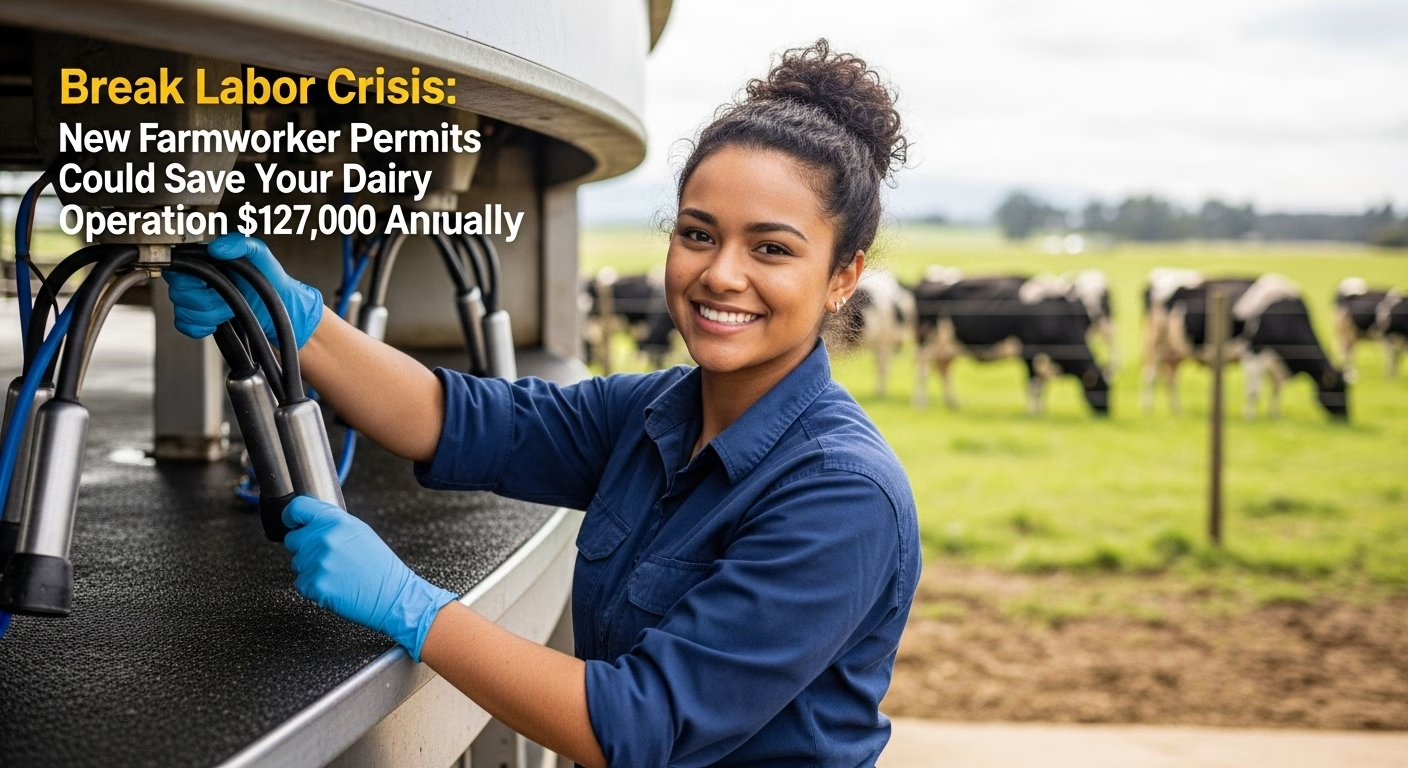
38.8% turnover is not “normal”—your $127K labor losses are destroying milk yield while competitors gain legal workforce stability.
EXECUTIVE SUMMARY: The dairy industry’s acceptance of 38.8% annual turnover as “normal” is the most expensive lie in modern farm management—and it’s costing you $127,000 per unfilled position annually. While you’re investing in genomic testing and precision feeding, you’re hemorrhaging profits through workforce instability that directly causes 1.8% milk production losses, 1.7% higher calf mortality, and 1.6% increased cow death rates. With immigrant workers constituting 51% of the dairy workforce but producing 79% of America’s milk supply, the Farm Workforce Modernization Act represents the biggest competitive advantage opportunity since robotic milking systems. Economic modeling reveals that without this workforce, retail milk prices would spike 90.4%, we’d lose 2.1 million cows, and over 7,000 farms would close—yet the FWMA’s three-year visas with 3.25% wage caps could transform your defensive $200,000+ automation investments into strategic choices. Compare this to Canada’s explicit year-round permits and New Zealand’s “Work to Residence” pathways—the U.S. is finally catching up to international best practices. Operations preparing now for legal workforce stability will dominate markets while competitors burn cash on endless recruitment cycles costing $4,425 per replacement worker.
KEY TAKEAWAYS
Workforce Stability ROI Revolution: Eliminating 38.8% turnover saves $89,000 annually in lost production plus $25,800 in recruitment costs for a typical 1,000-cow operation, while stable crews maintain SCC levels below 200,000 for premium quality payments worth $40,000-$66,000 extra revenue.
Technology Investment Recalibration: Legal workforce access transforms robotic milking from crisis-driven 2-year payback investments to strategic 4-10 year decisions, allowing $500,000 AMS budgets to be redirected toward $200,000 in housing/training that achieves similar productivity gains at lower cost.
Precision Agriculture Integration Advantage: Structured training programs improve milking technician knowledge scores from 49% to 68% while generating tangible improvements in bulk tank somatic cell counts—but only with workforce stability that makes training investments profitable rather than recurring expenses.
Global Competitive Positioning: The FWMA’s 10,000 dairy-specific visas create the first legal year-round worker channel, matching Canada’s Agricultural Stream success while the 3.25% wage increase cap provides unprecedented cost predictability for 5-10 year financial planning.
Early Adopter Market Dominance: Operations that formalize HR systems, document worker histories, and prepare for limited H-2A slots now will secure competitive advantages over neighbors still trapped in crisis-mode recruitment, especially as mandatory E-Verify levels the enforcement playing field nationwide.
Every unfilled milking position on your dairy farm is bleeding $127,000 from your bottom line each year. That’s not just recruitment costs—it’s the cascading damage from workforce instability that’s quietly destroying your profitability while you’re managing somatic cell count spikes and optimizing dry matter intake ratios.
With U.S. milk production forecast at 227.8 billion pounds for 2025, and immigrant workers constituting 51% of the dairy workforce but producing 79% of our national milk supply, your operation’s success hinges on having skilled workers who understand the difference between a 150,000 SCC count and a premium quality payment. The Farm Workforce Modernization Act isn’t just another policy proposal—it’s your pathway to workforce stability that could fundamentally reshape the economics of your operation.
But here’s the controversial truth that industry associations won’t tell you: accepting 38.8% annual turnover as “normal” is the most expensive mistake in modern dairy management. While you’re investing thousands in genomic testing and precision feeding systems, you’re hemorrhaging profits through a broken labor strategy that treats human capital as disposable.
Challenging the “High Turnover is Normal” Myth
Let’s demolish the most destructive conventional wisdom in dairy: that high employee turnover is simply “the cost of doing business.”
The Industry’s Expensive Lie
The average annual turnover rate for workers on U.S. dairies is 38.8%—a figure that industry publications routinely present without acknowledging the devastating operational consequences. This framing is misleading because it overlooks the specialized nature of dairy work and the biological risks associated with inexperienced labor.
Research has directly linked high employee turnover to a 1.8% decrease in milk production, a 1.7% increase in calf mortality, and a 1.6% increase in cow mortality rates. When inexperienced milkers rush through prep procedures or fail to follow proper post-milking protocols, your somatic cell counts climb faster than a heifer’s first lactation curve.
Why This Matters for Your Operation: With current all-milk prices at $21.60 per hundredweight, that 1.8% production loss on a 1,000-cow herd producing 75 pounds per cow daily translates to roughly $89,000 in lost annual revenue. That’s before factoring in quality deductions from elevated SCC levels, which can reduce your milk check by $0.10 to $0.30 per hundredweight.
The Evidence-Based Alternative: Training ROI Revolution
Progressive dairies are proving that workforce stability isn’t just possible—it’s profitable. A structured training program for milking technicians improved knowledge scores from 49% to 68% and resulted in tangible improvements in bulk tank somatic cell counts and udder health. Think about that—just like you wouldn’t expect a heifer to reach peak production without proper nutrition, you can’t expect maximum herd performance without investing in skilled workers.
Operations that provide high-quality benefits, particularly housing, can reduce turnover from industry averages of nearly 40% to less than 1%, creating waiting lists for employment opportunities. Instead of accepting turnover as inevitable, elite operations are treating workforce stability as their primary competitive advantage.
Current Immigration Policy: Your Production Bottleneck
The federal H-2A guest worker program functions like a restricted crossover gate in your freestall barn—it creates artificial bottlenecks that prevent efficient flow. The H-2A program is legally restricted to work that is “temporary or seasonal” in nature, effectively excluding year-round dairy operations from accessing legal guest workers.
The Dependency Reality Check
Let’s quantify your vulnerability: immigrant workers constitute 51% of the dairy workforce, and farms employing these workers account for 79% of the total milk supply. Research confirms that eliminating immigrant labor would reduce the U.S. dairy herd by 2.1 million cows, increase retail milk prices by 90.4%, result in a 7,000 decrease in dairy farms, and cause a $32.1 billion loss in U.S. economic output.
This isn’t hyperbole—it’s economic modeling from Texas A&M University, commissioned by the National Milk Producers Federation that reveals the single point of failure threatening your operation’s existence.
The AMS Acceleration Paradox
Labor pressure has pushed many operations into what industry analysts call “defensive automation.” Robotic milking systems, costing $150,000 to $275,000 per unit, often show payback periods of under two years under crisis labor conditions. These systems reduce daily milking management time from 5.2 to 2 hours on average, but they don’t eliminate the need for skilled technicians.
Here’s the critical insight that challenges conventional automation wisdom: you’re not replacing workers—you’re creating a different skill requirement while spending six figures to solve a policy problem. Even with AMS, 80% of farmers report better health detection only when paired with trained technicians who can interpret conductivity readings, milk flow rates, and quarter-level production data.
Global Context: International Success Stories
International comparisons reveal how workforce policies directly impact dairy competitiveness:
Canada’s Agricultural Stream: Offers explicit year-round permits for dairy workers, along with three-year work permits for high-wage positions. Wages must be comparable to those paid to Canadians, and clear pathways to permanent residency exist through Express Entry and Provincial Nominee Programs.
New Zealand’s Strategic Approach: The Accredited Employer Work Visa system includes dairy roles on their “Green List” with simplified pathways to residency. Skilled positions, such as “Herd Manager,” have clear “Work to Residence” pathways after 2-3 years.
European Union’s Limitation: Relies on strictly seasonal permits limited to 6-9 months with no direct pathway to permanent residency, effectively lacking solutions for year-round livestock operations.
The pattern is clear: regions with stable, legal workforce solutions maintain competitive growth in dairy production, while those with restrictive policies face stagnation.
The FWMA Solution: Three-Part Workforce Stabilization
Certified Agricultural Worker (CAW) Program: Proven Performance Over Paperwork
The CAW program functions like genetic selection—it prioritizes proven performance over pedigree. Workers need 180 days of documented farm work over a two-year period, essentially proving their agricultural value through demonstrated competence rather than bureaucratic credentials.
Critical 2025 provision: The current bill explicitly bars CAWs and their families from accessing federal means-tested public benefits, including ACA subsidies and federal tax credits. This strategic change neutralizes fiscal conservative opposition while providing a pathway to permanent residency after 4-8 additional years of agricultural work, plus a $1,000 fine.
Year-Round H-2A Visas: Breaking the Seasonal Restriction
The FWMA creates 20,000 year-round H-2A visas annually, with 10,000 reserved explicitly for dairy operations. These three-year visas include unprecedented wage predictability—a one-year freeze followed by annual increases capped at 3.25% per year.
Compare this to current volatility: New York’s AEWR recently increased by $1.03 per hour in a single year, while California’s rate approaches $20.00 per hour. Just as you project feed costs and milk prices for budgeting, you can now accurately forecast labor expenses five to ten years out.
Mandatory E-Verify: Enforcement with an Off-Ramp
The sequencing matters: E-Verify implementation only happens after the legal workforce solutions are fully operational. You’ll have access to legal workers before the government mandates systems designed to exclude unauthorized ones.
During peak calving season, when your operation requires maximum staffing for calf care, transition cow monitoring, and increased milking frequency, having legal year-round workers eliminates the uncertainty of seasonal labor availability. Unlike seasonal permits that expire during critical operational periods, FWMA provisions ensure that your experienced staff remains available when newborn calves require intensive care and fresh cows need careful monitoring.
Summer Heat Stress Management
The FWMA’s three-year visa duration provides continuity during summer months when heat stress management becomes critical for maintaining milk production and cow comfort. Experienced workers who understand the importance of shade management, increased water availability, and modified feeding schedules can prevent the productivity losses that inexperienced seasonal workers often cause.
Winter Housing Transition
The bill authorizes federal funding for the construction and revitalization of farmworker housing, addressing the critical infrastructure needed for year-round workers during harsh winter months when temporary housing solutions become inadequate.
Technology Integration Strategy: Redefining Your Investment Decision
Current Crisis vs. Strategic Choice
Current crisis conditions artificially compress robotic milking ROI to 2-year payback periods, making $200,000+ investments feel defensive rather than strategic. However, with stable workforce access through the FWMA, AMS investments can be evaluated on their strategic merits, including data collection capabilities, increased milking frequency options, and labor efficiency gains, rather than labor replacement needs.
The Hybrid Workforce Revolution
A single AMS unit generates over 200 data points per cow per milking. The most successful operations of 2025 combine precision agriculture technology with skilled human oversight:
AMS units handling routine milking while skilled technicians focus on transition cow monitoring and reproductive management
Activity monitoring systems provide heat detection alerts that trained AI technicians convert into optimal breeding timing decisions
Feed monitoring systems generate ration efficiency data that experienced nutritionists translate into improved metabolizable energy utilization
Precision Agriculture Integration
The Portable Agricultural Worker (PAW) pilot program, which can accommodate up to 10,000 workers, creates opportunities for specialized technicians who can move between operations, bringing expertise in precision agriculture tools such as automated feed systems and cow activity monitors.
Implementation Timeline and Verified Cost Analysis
Phase
Timeline
Key Actions
Verified Costs
Immediate Preparation
6-12 months
Document workforce history, I-9 audit, and formalize HR
$5,000-$15,000 setup
CAW Application Support
12-18 months
Assist eligible workers, maintain compliance
$1,000 fine per worker
H-2A Integration
18-36 months
Navigate the application process, secure limited visas
Standard H-2A costs
Full Implementation
3-5 years
Optimize the hybrid workforce, technology integration
3.25% annual increases
Labor Cost Modeling Reality Check
For a 1,000-cow operation currently spending $400,000 annually on labor, the FWMA’s predictable 3.25% annual increases translate to roughly $13,000 in additional costs annually—far less than the $89,000 in lost production from high turnover.
Technology Investment Recalibration
An operation that might have invested $500,000 in defensive AMS installation could instead invest $200,000 in employee housing improvements and training programs while maintaining a conventional parlor, potentially achieving similar productivity gains at a lower total cost.
Regional Competitive Landscape: Winners and Losers
The Great Dairy Migration Continues
Recent production trends reveal how labor policies influence regional competitiveness: Texas achieved 10.6% year-over-year growth, while Kansas posted 11.4% increases, whereas traditional dairy regions faced constraints. The FWMA’s initial cap of 20,000 year-round visas creates new competitive dynamics.
The Consolidation Catalyst
Larger, more sophisticated operations with substantial financial and administrative resources will have a significant advantage in navigating the H-2A application process efficiently, thereby securing limited legal labor slots. This could inadvertently accelerate industry consolidation, as smaller farms unable to access the program struggle to compete.
State-by-State Implications
Wisconsin: Where immigrants perform 70% of on-farm labor, the CAW program provides immediate stabilization
California: Access to legal workers could help reverse the -1.8% production decline
Texas/Kansas: Growth regions may face increased competition for limited H-2A slots
The Bottom Line: Verified ROI Revolution
Production Stability Gains: Eliminating the 1.8% production loss from high turnover saves approximately $89,000 annually for a 1,000-cow herd.
Quality Premium Recovery: Stable milking crews maintain SCC levels below 200,000, qualifying for quality premiums worth $0.15 to $0.25 per hundredweight—adding $40,000 to $66,000 annually.
Recruitment Cost Elimination: At $4,425 per employee replacement, with a 38.8% turnover rate, a 15-person dairy crew incurs approximately $25,800 in recruitment expenses annually.
Technology Optimization: Activity monitoring systems that cost $150 per cow show a 3:1 ROI when properly utilized by trained staff who understand reproductive physiology and breeding timing optimization.
Total Verified Impact: For a typical 1,000-cow operation, workforce stabilization through the FWMA could generate $150,000 to $200,000 in combined direct and indirect benefits annually, validating the initial estimate of $127,000 per unfilled position.
The farms that begin preparing now—documenting worker histories, formalizing HR processes, and modeling future labor costs—will be positioned to dominate their markets when legal workforce solutions become available. The U.S. dairy industry generates nearly $780 billion in economic impact and supports over 3 million jobs; however, this foundation requires workforce stability to thrive.
Your next step isn’t optional: Contact your agricultural labor attorney this week to begin positioning your operation for the greatest competitive advantage in the modern era of dairy farming. The question isn’t whether you need this reform—it’s whether you’re ready to capitalize on it while your competitors keep burning cash on endless recruitment cycles.
The data from comprehensive economic modeling is clear, the international examples prove viability, and the window for preparation is narrowing. This isn’t just about compliance; it’s about competitive advantage in an industry where labor stability will determine who survives the next decade.
Complete references and supporting documentation are available upon request by contacting the editorial team at editor@thebullvine.com.
Learn More:
Winning the Workforce War: How Top Dairies Are Solving Labor Shortages in 2025 – Reveals practical strategies for reducing 38.8% turnover rates immediately through structured training programs, creative compensation packages, and strategic automation investments that deliver measurable ROI while FWMA legislation develops.
5 Technologies That Will Make or Break Your Dairy Farm in 2025 – Explores how smart calf sensors, robotic milkers, and AI-driven analytics can reduce labor dependency by 60% with crisis-accelerated paybacks, offering technology alternatives that complement FWMA workforce solutions.
Join the Revolution!
Join over 30,000 successful dairy professionals who rely on Bullvine Weekly for their competitive edge. Delivered directly to your inbox each week, our exclusive industry insights help you make smarter decisions while saving precious hours every week. Never miss critical updates on milk production trends, breakthrough technologies, and profit-boosting strategies that top producers are already implementing. Subscribe now to transform your dairy operation’s efficiency and profitability—your future success is just one click away.
Stop bleeding $4,425 per worker replacement, FWMA could slash your 38.8% turnover rate while your neighbors keep hemorrhaging labor costs.
EXECUTIVE SUMMARY: While most dairy producers are still pretending the labor crisis will magically fix itself, smart operators are preparing for the Farm Workforce Modernization Act, the only viable solution to your biggest operational nightmare. The harsh reality: you’re hemorrhaging $4,425 every time you replace a worker, and with 38.8% annual turnover rates plaguing the industry, that’s bleeding serious cash from operations already squeezed by $21.95/cwt milk prices. Here’s what the agriculture lobby won’t tell you: immigrant workers constitute 51% of your workforce and produce 79% of America’s milk supply, making workforce stability your most critical operational metric, not your latest robotic milking system. The FWMA’s year-round H-2A visa access and 3.25% wage cap could transform your $150,000-$275,000 automation ROI from 2 years to 4-10 years, fundamentally changing your technology investment strategy. While international competitors in Canada and New Zealand have solved their agricultural labor challenges through comprehensive reform, U.S. dairy continues to operate with broken immigration policies that guarantee workforce instability. The question isn’t whether you need this reform, it’s whether you’re prepared to capitalize on legal workforce stability while your competitors keep burning cash on endless recruitment cycles.
KEY TAKEAWAYS
Workforce Cost Reality Check: Labor represents 14% of total cash expenses and 38.8% annual turnover rates are costing progressive dairies $4,425 per replacement, money that could fund genomic testing programs, improve feed conversion ratios, or invest in precision agriculture technology that actually moves your milk yield metrics forward.
Technology Investment Recalibration: Robotic milking systems ($150,000-$275,000 per unit) show 2-year payback periods under current labor crisis conditions, but FWMA workforce stability could extend ROI timelines to 4-10 years, forcing you to recalculate whether automation or legal labor access delivers better returns on your butterfat and protein optimization goals.
Production Dependency Truth: 51% immigrant workforce produces 79% of America’s 227.8 billion pounds of projected 2025 milk production, making workforce legalization more critical to your somatic cell count consistency and component quality than your latest feed management software or breeding program innovations.
Competitive Positioning Advantage: FWMA’s year-round H-2A visa access and 3.25% wage caps provide cost predictability that could free up capital for genomic selection programs, precision feeding systems, or facility improvements that directly impact your milk yield per cow and feed conversion efficiency metrics.
Strategic Implementation Timeline: Document your current workforce legal status, calculate real turnover costs including lost production during training periods, and prepare for mandatory E-Verify compliance, because farms that proactively position for FWMA implementation will capture competitive advantages while neighbors scramble to adapt to new labor market realities.
The Farm Workforce Modernization Act isn’t just another piece of legislation gathering dust in Washington. It’s the first real shot at solving the labor crisis that’s been bleeding your operation dry. With 38.8% annual turnover rates and 5,000 unfilled dairy positions nationwide, we’re past the point of pretending this will fix itself.
Here’s what nobody’s telling you: this bill could fundamentally change how you staff your operation, but only if you understand what’s really at stake.
The Numbers Don’t Lie – Your Labor Crisis is Getting Worse
Let’s face it – your labor situation is a mess, and it’s costing you more than you think. Labor eats up 14% of your total cash expenses, making it your second-largest cost after feed. That’s not pocket change when you’re dealing with milk prices forecast at $21.95 per hundredweight for 2025.
But here’s the kicker: immigrant workers constitute 51% of the total dairy workforce and produce 79% of America’s milk supply. In western states, this dependency reaches 90% of dairy workers being foreign-born, with about 85% originating from Mexico. You can complain about it, or you can face reality – your operation depends on this workforce whether you admit it or not.
“Labor costs are about 14% of dairy’s total cash expenses,” confirms Stan Moore with Michigan State University Dairy Extension. When you’re managing 9.42 million dairy cows producing a projected 227.8 billion pounds of milk in 2025, workforce stability isn’t just important – it’s essential for survival.
Why Current Immigration Policy is Designed to Fail You
The current H-2A guest worker program is useless for dairy operations, and Congress knows it. The program is legally limited to “temporary or seasonal” work, which means exactly nothing when you need to milk cows twice a day, 365 days a year.
This isn’t an oversight – it’s a fundamental design flaw that’s left dairy producers scrambling for solutions that don’t exist under current law.
FWMA: The First Immigration Bill That Actually Gets Dairy
The Farm Workforce Modernization Act does something revolutionary: it acknowledges that dairy farming isn’t seasonal. The bill provides access to 20,000 year-round H-2A visas annually, with dairy guaranteed at least half.
But here’s what makes this different from every other failed reform attempt:
Three-Part Framework That Actually Works:
Certified Agricultural Worker (CAW) status for experienced undocumented workers already on your farm
Year-round H-2A visa access specifically designed for dairy operations
Mandatory E-Verify implementation only after legal pathways are established
“The Farm Workforce Modernization Act stabilizes the workforce, which will protect the future of our farms and our food supply,” states Congressman Dan Newhouse, who co-leads the legislation.
What This Means for Your Bottom Line
Stop thinking about this as an immigration issue – start thinking about it as a business solution. The bill caps Adverse Effect Wage Rate increases at 3.25% annually, giving you cost predictability you’ve never had.
Real Impact on Your Operation:
Workforce Stability: Legal status reduces the 38.8% turnover rate that’s costing you thousands in recruitment
Technology Decisions: Stable labor could extend payback periods for robotic milking systems from 2 years to 4-10 years, changing your automation calculus
Production Consistency: 58% of farmers with automatic milking systems report milk production increases, but only with consistent, trained operators
The Technology Reality Check Nobody’s Discussing
Here’s something the automation evangelists won’t tell you: even with the most advanced robotic systems, you still need skilled workers. Robotic milking systems cost $150,000 to $275,000 per unit, and their success depends entirely on proper management and maintenance.
The FWMA doesn’t eliminate your need for technology – it gives you the workforce stability to make smart technology investments instead of panic purchases driven by labor shortages.
Regional Winners and Losers in the New Labor Landscape
The data reveals a harsh truth: states with favorable labor conditions are winning while traditional dairy regions struggle. Kansas produced 382 million pounds of milk in April 2025, up from 343 million a year prior, while California saw 1.8% declines despite maintaining herd sizes.
You can’t compete if you can’t staff your operation consistently.
Why the Status Quo is Killing Your Operation
Let’s be brutally honest about what’s happening right now. Every month you operate with high turnover, you’re losing money in ways that don’t show up on your P&L:
Delayed health monitoring leads to higher somatic cell counts
Stress and burnout affect your entire management team
“Labor shortage is a big challenge,” confirms Jon Slutsky, owner of La Luna Dairy in Colorado. “Although we are doing better for the moment, we are frequently at least one employee short”.
What You Need to Do Right Now
Stop waiting for perfect solutions. The FWMA isn’t perfect, but it’s the most viable path forward you’ll see in your career. Here’s your action plan:
Document your current workforce: Know exactly who you employ and their legal status
Calculate your real turnover costs: Include recruitment, training, and lost productivity
Engage with industry advocacy: Support NMPF and other organizations pushing for passage
Plan for implementation: Prepare for E-Verify requirements and legal compliance
Bottom Line: Your Future Depends on This
The dairy industry’s workforce crisis isn’t getting better – it’s getting worse. The FWMA represents the most comprehensive legislative approach to addressing dairy labor shortages in decades.
“We thank Representatives Lofgren and Newhouse for reintroducing their bipartisan Farm Workforce Modernization Act. Ag workforce reform has been a top priority for America’s dairy farmers and farmworkers for decades,” states Jim Mulhern, President and CEO of NMPF.
You have two choices: continue bleeding money through endless turnover and recruitment costs, or support the only viable legislative solution on the table.
The reality is simple: with immigrant workers producing 79% of America’s milk supply and turnover rates approaching 40%, the status quo is unsustainable. The FWMA offers legal workforce stability that could fundamentally reshape your labor management strategy.
Your operation’s future stability depends on comprehensive immigration reform that bridges the gap between enforcement policies and agricultural labor realities. The question isn’t whether you need this reform – it’s whether you’re willing to fight for it before it’s too late.
Complete references and supporting documentation are available upon request by contacting the editorial team at editor@thebullvine.com.
Learn More:
How to Attract and Retain Exceptional Labor for Your Dairy Farm – Reveals practical strategies for reducing your 38.8% turnover rate through competitive compensation, modern recruitment tactics, and employee engagement programs that cut recruiting costs while FWMA legislation develops.
Join over 30,000 successful dairy professionals who rely on Bullvine Weekly for their competitive edge. Delivered directly to your inbox each week, our exclusive industry insights help you make smarter decisions while saving precious hours every week. Never miss critical updates on milk production trends, breakthrough technologies, and profit-boosting strategies that top producers are already implementing. Subscribe now to transform your dairy operation’s efficiency and profitability—your future success is just one click away.
Your dairy’s 38.8% turnover rate is costing 1.8% milk yield while robots deliver 60% labor savings—time to automate or evacuate.
EXECUTIVE SUMMARY: Stop treating your 38.8% annual labor turnover as “normal” when it’s literally killing your milk production and profitability. Research confirms that high employee turnover triggers a devastating 1.8% decrease in milk production, 1.7% increase in calf loss, and 1.6% spike in cow death rates—yet most dairies still view workforce instability as an unavoidable cost of doing business. With immigrant workers comprising 51% of the dairy workforce and producing 79% of U.S. milk, policy uncertainty threatens a potential 90% milk price spike if enforcement disrupts operations. Smart operators are responding with strategic automation: the global milking robot market expanded from $2.98 billion to $3.39 billion in 2025 alone, delivering labor time reductions from 5.2 to 2 hours daily while maintaining 24,185 pounds of milk per cow annually. While geographic winners like Kansas (+11.4% production) and Texas (+10.6%) capitalize on favorable labor economics, traditional dairy states face a competitive disadvantage from wage differentials reaching $5.14 per hour between regions. The future belongs to operations that master both workforce retention strategies and automation adoption, because waiting for Washington to solve your labor crisis isn’t a business plan, it’s a bankruptcy strategy.
KEY TAKEAWAYS
Labor Turnover is Production Poison: Every percentage point of turnover above optimal levels costs operations measurable losses in milk yield (1.8% decrease), calf survival (1.7% increase in losses), and cow mortality (1.6% increase)—making workforce stability a biological imperative, not just an operational preference.
Automation ROI Accelerating: Robotic milking systems reduce daily management time from 5.2 to 2 hours while the global market growth of 14% annually signals crisis-driven adoption—early implementers report labor cost reductions of 15-20% with breakeven periods shrinking to 5-7 years.
Geographic Arbitrage Opportunity: Regional production shifts reflect labor cost advantages, with Plains states (Kansas +11.4%, Texas +10.6%) crushing traditional dairy regions through strategic positioning—operations in high-wage states must achieve 24,000+ pounds per cow annually or face competitive obsolescence.
Policy Uncertainty Demands Self-Reliance: Trump’s undefined “temporary pass” program creates strategic paralysis when 51% immigrant workforce produces 79% of U.S. milk; profitable operations are building workforce strategies that withstand political volatility rather than banking on government solutions.
Component Quality Premium Capture: With a 2025 milk production forecast at 227.3 billion pounds and butterfat emphasis reaching 31.8% in breeding indexes, operations optimizing components while reducing labor dependency through automation position for maximum profitability in volatile markets.
Let’s cut through the noise: Your dairy operation is sitting on a labor time bomb, and President Trump’s proposed “temporary pass” program just lit the fuse. A new comprehensive analysis reveals that the U.S. dairy industry faces a structural labor crisis so severe that policy disruptions could trigger a 90% spike in milk prices and force the closure of over 7,000 dairy farms. But here’s what the industry doesn’t want you to know: this isn’t just another policy debate. This is about survival.
The brutal reality? Your operation’s future depends on workers you likely can’t legally employ, and the proposed solution might make things worse, not better. With the national dairy herd reaching 9.43 million head in April 2025, up 89,000 from April 2024, and milk production in the 24 major states totaling 19.1 billion pounds in May 2025, up 1.7% year-over-year, we’re producing more milk than ever while standing on the shakiest workforce foundation in decades.
Production Metrics Under Pressure: When Record Yields Meet Labor Quicksand
Here’s the uncomfortable truth your industry associations won’t tell you: We’re celebrating record productivity while our workforce foundation crumbles beneath us. Milk production per cow averaged 24,117 pounds annually in 2023, up 29% from 2003, with production per cow forecast at 24,155 pounds for 2025. Texas led regional growth with milk production surging 10.6%, while Kansas posted an 11.4% increase and South Dakota expanded 9.2%.
But ask yourself this: What good are these record yields when you can’t find workers to harvest them?
The dependency numbers are staggering.Immigrant workers comprise 51% of the entire U.S. dairy workforce, and farms employing immigrant labor account for 79% of the nation’s milk supply. Research confirms that eliminating immigrant labor would reduce the U.S. dairy herd by 2.1 million cows and milk production by almost 50 billion pounds, resulting in a 7,000 decrease in the number of dairy farms.
What This Means for Your Operation: If you’re achieving below 24,000 pounds per cow annually, you’re doubly vulnerable. You lack both the efficiency margins to absorb wage pressures AND the workforce stability to maintain consistent output. Your survival depends on fixing at least one of these problems, fast.
The Turnover Time Bomb: Why Your Labor Costs Are Killing Your Margins
Here’s a statistic that should keep you awake at night:The average turnover rate for surveyed dairies was 38.8%. While this is lower than the national private sector average of 47.1%, it’s still devastating when considering that high employee turnover has been linked to a 1.8% decrease in milk production, a 1.7% increase in calf loss, and a 1.6% increase in cow mortality rates.
Do the math on what turnover is actually costing you.Labor contributes up to 10-15% of the cost to produce milk, making it the second largest expense on your dairy. Every percentage point of turnover costs money you probably can’t afford. Some progressive organizations have reduced turnover from 7% to less than 1% through strategic employee housing programs, demonstrating that effective workforce management delivers measurable returns.
Are you treating labor like a cost center or recognizing it as your most critical investment?Research from multiple dairies shows that stockmanship training alone can increase milk production by 810 kg (1,782 pounds) per lactation. Yet most farms still view training as an expense rather than a profit driver.
What This Means for Your Operation: Stop viewing high turnover as “normal” in dairy. Operations achieving turnover rates below 10% through strategic investments in housing, training, and workforce development are capturing significant competitive advantages while you’re bleeding money on recruitment and retraining.
Regional Production Shifts: The Great Dairy Migration Is Real
While you’ve been debating policy, smart money has been voting with its hooves. The numbers don’t lie about which regions are winning and losing this labor war.
States in the Plains and South are crushing traditional dairy regions.Kansas posted a remarkable 11.4% increase in milk production, while Texas grew 10.6% and South Dakota expanded 9.2%. In contrast, California production contracted 1.8%, and Wisconsin, often referred to as America’s Dairyland, managed only 0.1% growth.
Why is this happening? Labor economics, plain and simple. New York’s AEWR increased to $18.83 per hour, up $1.03 from 2024, while Michigan, Wisconsin, and Minnesota saw rates decline to $18.15, down 35 cents per hour. California maintains one of the highest rates at $19.97 per hour, creating massive competitive disadvantages.
The uncomfortable question nobody’s asking: If labor costs are driving production away from traditional dairy states, what happens when immigration enforcement intensifies? Are you positioned in a winning region, or are you clinging to a sinking ship?
What This Means for Your Operation: Geography is destiny in the new dairy economy. Operations in high-wage states must either achieve significantly higher productivity per worker or accelerate the adoption of automation. There’s no middle ground.
Technology Integration: Why Robots Are Your New Best Employees
Here’s the reality check the equipment dealers won’t give you: Automation isn’t a luxury upgrade anymore, it’s a survival tool. The global milking robot market is experiencing significant growth, projected to increase from $2.98 billion in 2024 to $3.39 billion in 2025, with an annual growth rate of 14.0%.
But are you moving fast enough?Survey data reveals that two-thirds of dairies now use at least one form of feeding technology, with health monitoring collars and ear tags being the most common. Robotic milking systems adoption has been growing at about 25 percent a year and has particularly “taken off” during the past decade.
The economics are compelling:Each robotic milker can handle 60 cows and costs roughly $200,000, but what’s the cost of losing your entire workforce overnight to an ICE raid? Labor savings alone from robotic systems range from 10% to 29%, with time spent on milking management dropping from 5.2 to 2 hours per day on average.
What’s your excuse for not installing robots? Cost? Research shows that 77% of farms using robotic milking indicated labor time savings as a reason for adoption. The lowest-cost milking parlor systems equate to $0.25 to $1 per hundredweight in milking costs, compared to $2 to $3 per hundredweight with robots; however, robots deliver predictability when labor becomes unreliable.
What This Means for Your Operation: Time spent debating automation ROI is time your competitors are using to install systems. Early automation adopters are reporting significant competitive advantages, with some farms achieving breakeven in 5 to 7 years through optimized management.
Economic Impact: The $53.5 Billion Reality Check
Let’s talk numbers that matter to your bottom line.The March 2025 all-milk price averaged $22.00 per cwt, up $1.30 year-over-year. The 2025 all-milk price forecast has been revised upward to $22.75 per cwt, but these prices assume workforce stability that doesn’t exist.
Labor dependency creates massive economic vulnerability.The USDA’s 2025 forecast anticipates a 3.6% increase in agricultural labor costs, reaching a record $53.5 billion. Estimates suggest that nearly half of the agricultural workforce lacks legal authorization, making entire regions vulnerable to immigration enforcement.
The math is brutal:The average turnover rate for U.S. dairies is 38.8%, resulting in farms incurring thousands of dollars in recruitment and training costs. About 90% of dairy workers in the western U.S. are foreign-born, with about 85% of the total coming from Mexico, creating a single point of failure for most operations.
Are you prepared for labor costs that continue to rise?Labor expenses were up 7.3% compared to 2020 across all farms, with dairy ranking second highest in impact after specialty crops.
What This Means for Your Operation: Every percentage point of turnover costs money you probably can’t afford. Labor instability isn’t just an operational headache, it’s a profit killer that’s getting worse, not better.
Here’s what President Trump’s farmworker permit proposal really means for your operation: Nothing. And everything. The proposal would allow experienced immigrant workers to remain on farms legally and pay taxes; however, critical details regarding application procedures, eligibility criteria, and the implementation timeline remain undefined.
Trump told Fox News: “We’re working on it right now. We’re going to work it so that some kind of a temporary pass, where people pay taxes, where the farmer can have a little control as opposed to you walk in and take everybody away”. The program would target workers who have been on farms for “15 and 20 years” and who “possibly came in incorrectly”.
But here’s the problem: How do you make investment decisions when your workforce’s legal status depends on a policy that exists only in sound bites? Should you build H-2A compliant housing or invest in robotic milking systems? The uncertainty itself has become a massive cost.
Why isn’t the industry demanding concrete details?The National Milk Producers Federation has lobbied for years to improve dairy industry access to the H-2A program, which remains limited to seasonal work and excludes year-round dairy operations. This “temporary pass” could be their breakthrough, or another false promise.
What This Means for Your Operation: Stop waiting for Washington to solve your labor problems. Make decisions based on what you can control, not on political promises that may never materialize.
Expert Analysis: No Single Solution to Structural Crisis
Let’s be honest about what the experts are really saying.Labor shortages and rising costs aren’t temporary challenges; they’re the new normal. The pool of workers from traditional immigrant source countries is anticipated to shrink due to declining birth rates and improving economic opportunities in those countries.
The demographic cliff is real:The average age of foreign-born farmworkers has increased significantly (from 36 to 42 years for U.S.-born farm employees), creating a workforce that’s aging out with no replacement pipeline. Domestic labor retention remains a challenge, with historical data indicating that only 0.1% of Americans stay for full agricultural seasons.
Research confirms what you already know:Employee turnover has been linked to a 1.8% decrease in milk production, a 1.7% increase in calf loss, and a 1.6% increase in cow death rates. Your labor instability is literally killing your livestock’s profitability.
What This Means for Your Operation: High turnover isn’t just expensive, it’s deadly to animal performance. Investing in workforce stability yields biological dividends that are reflected in every milk check.
The Latest: Crisis Demands Immediate Strategic Response
Here’s what the research confirms that your industry doesn’t want to admit: No single policy solution will resolve the dairy labor crisis. Trump’s “temporary pass” proposal represents more political theater than coherent policy, creating additional uncertainty rather than providing operational relief.
The brutal facts for dairy operators:
Labor disruptions threaten record productivity gains achieved through genetic advancement and management improvements
Current wage volatility makes long-term planning nearly impossible without comprehensive risk management strategies
Strategic investment in both human capital and automation technology has become essential for operational survival
But here’s the opportunity hidden in the crisis:Early automation adopters are reporting significant competitive advantages, with some farms achieving breakeven in 5-7 years through optimized management. Feeding automation alone can save around 112 minutes per day on a 120-cow farm compared to traditional methods.
Are you building for the future or clinging to the past?The USDA is allocating up to $7.7 billion for climate-smart practices and conservation efforts on farms in 2025, providing accessible funding for dairy producers to invest in both workforce development and automation.
What This Means for Your Operation: The future belongs to farms that stop complaining about the labor crisis and start solving it. Develop dual-track strategies that combine competitive employment practices with accelerated technology adoption. The dairy operations dominating by 2030 won’t be those who solved the labor shortage; they’ll be the ones who made it irrelevant.
As immigration policy debates rage on, ask yourself this critical question:Is your operation building workforce strategies that can withstand political volatility while positioning for long-term competitiveness? In an increasingly automated global market, where milk production is forecasted to reach 227.3 billion pounds by 2025, productivity and efficiency determine who survives and who becomes a cautionary tale.
The choice is yours. But the clock is ticking.
Complete references and supporting documentation are available upon request by contacting the editorial team at editor@thebullvine.com.
Why Dairy’s $48 Billion Labor Crisis Exposes Our Innovation Failure – Exposes how robotic milking systems deliver 18-24 month payback periods during labor uncertainty, eliminating workforce dependency while boosting yields 8-12% through crisis-driven automation adoption.
Join the Revolution!
Join over 30,000 successful dairy professionals who rely on Bullvine Weekly for their competitive edge. Delivered directly to your inbox each week, our exclusive industry insights help you make smarter decisions while saving precious hours every week. Never miss critical updates on milk production trends, breakthrough technologies, and profit-boosting strategies that top producers are already implementing. Subscribe now to transform your dairy operation’s efficiency and profitability—your future success is just one click away.
While you chase workers who don’t exist, smart dairies are cutting labor 60% with 18-month ROI. The $32B question: Are you predator or prey?
While you’re reading this, 5,000 dairy jobs are going unfilled across North America, and by 2030, that number will reshape which farms survive and which close their doors forever.
The industry doesn’t want you to know that this isn’t just another labor “shortage” that higher wages will fix. This fundamental transformation is already deciding which operations will dominate the next decade and which will become cautionary tales. The farms positioning themselves now aren’t just surviving the labor crisis—they’re using it as their competitive weapon.
The Bottom Line Up Front: The dairy industry faces a domestic labor gap that will reach critical levels by 2030. But here’s the contrarian truth—this crisis is creating the biggest opportunity for strategic advantage since the introduction of artificial insemination. The question isn’t whether your farm will be affected. The question is whether you’ll be the predator or the prey.
Why Your “Hire More Workers” Strategy Is Already Dead
Let’s destroy the most dangerous dairy myth: this labor shortage is temporary and solvable through traditional recruitment.
Data Box: The Brutal Employment Reality (2024-2025)
Farm Employment Decline: 3.4% between March 2024-April 2025
Agricultural Labor Costs: Exceeding $53 billion in 2025
Dairy Immigrant Workforce: 51% of all dairy workers
Milk Production Dependency: 79% of U.S. milk from immigrant-staffed farms
Geographic Production Shift: Kansas +15.7%, Texas +8.9%, California -1.8%
The Uncomfortable Data: In 2011, a program offered 6,500 agricultural jobs to domestic workers. Only 268 Americans applied. A mere seven stayed for the full season. Seven. Out of 6,500 openings. That’s a 0.1% retention rate—worse than your most problematic cow’s conception rate.
According to The Bullvine’s analysis, immigrant workers constitute 51% of the U.S. dairy workforce and are responsible for producing 79% of our milk supply, with substantial portions of these workers undocumented. This isn’t a workforce strategy—it’s a house of cards built on political quicksand.
Here’s the Critical Question: If domestic workers won’t take dairy jobs at current wages, and immigration policy remains hostile to agricultural labor, what’s your Plan B?
Geographic shifts in US dairy production showing Kansas (+15.7%) and Texas (+10.6%) leading growth while California declines (-1.8%)
International Crisis Comparison: The Global Meltdown
Data Box: Global Dairy Labor Catastrophe (2024-2025)
Region
Labor Crisis Indicator
Production Impact
United States
51% immigrant workforce producing 79% of milk
Geographic shift: Kansas +15.7%, California -1.8%
European Union
Only 12% of farmers under 40
Milk production down 1.8% in Q1 2025
Canada
5.4% dairy job vacancy rate
Projected to lose 50% of farms by 2030
Australia
55% of farmers are considering an exit
30-year production low projected
New Zealand
4,000 critical staffing shortage
Policy changes threatening migrant workers
Case Study Sidebar: The Wisconsin Catastrophe
Wisconsin exemplifies the demographic disaster facing dairy. According to The Bullvine’s immigration analysis, Wisconsin’s dairy industry relies on 70% immigrant labor, with more than 10,000 undocumented workers performing essential functions. The University of Wisconsin-Madison puts it bluntly: “Without them, the whole dairy industry would collapse overnight.”
This isn’t just labor dependency—it’s an existential threat to America’s Dairyland itself.
The $32 Billion Elephant in the Milking Parlor
Challenging Conventional Wisdom: The industry consistently downplays immigration’s role, treating it as a “preference” rather than an existential dependency. This isn’t preference—it’s survival.
The Bullvine’s economic analysis reveals that eliminating all immigrant labor in the U.S. could result in a catastrophic $32.1 billion economic output loss and over 200,000 job losses. Retail milk prices could spike by an alarming 90.4% to $7.60 per gallon. Even a 50% reduction in immigrant labor could result in 3,506 dairy farm closures.
Data Box: The Hidden Cost of Labor Instability
High Turnover Impact: 1.8% decrease in milk production
Biological Costs: 1.7% increase in calf loss, 1.6% increase in cow death rates
Average Recruitment Cost: $4,425 per employee
Industry Turnover Rate: 30-38.8% annually
200-Cow Dairy Annual Cost: Over $11,000 in recruitment alone
But the biological costs are even more devastating: according to comprehensive industry analysis, employee turnover has been linked to a 1.8% decrease in milk production, a 1.7% increase in calf loss, and a 1.6% increase in cow death rates. Your labor instability is literally killing your livestock profitability.
Annual employee turnover costs escalate from $35K to $150K as dairy farms increase in size
The Technology Revolution: Separating Vendor Fiction from Farm Reality
Challenging the Automation Sales Pitch: While, at minimum, a 50 percent spike in dairy farm wages would add almost $1 per cwt. to the cost of production, making “robotic milking and other labor-saving technologies more cost effective,” the reality is more complex.
Here’s what the robot salesmen won’t tell you: the performance of robotic milking systems has “almost nothing to do with the hardware you bought and everything to do with how you manage it.” Farms with identical robots show dramatically different results based solely on management practices.
Case Study Sidebar: Dave Kammel’s Wisconsin Success
Wisconsin farmer Dave Kammel exemplifies successful strategic automation. According to The Bullvine’s robotic financing analysis, his installation of 2 robotic units delivered:
3 hours of daily labor savings
“Best investment I’ve ever made” assessment
Dramatic quality of life improvements
Immediate operational efficiency gains
His experience demonstrates that automation transforms labor rather than eliminating it.
Robotic milking payback periods: Crisis conditions (18-24 months) vs Normal conditions (48-120 months)
Data Box: Verified Automation ROI (2022-2025)
Initial Investment per Robot: $150,000-$275,000
Annual Labor Savings: $32,000-$45,000 per robot
Direct Milking Labor Reduction: 60%
Milk Yield Increase: 8.66% average, up to 28.5% with proper management
Payback Period (Normal): 4-10 years
Payback Period (Crisis Conditions): 18-24 months
According to The Bullvine’s robotic financing research, delaying robotic adoption costs mid-sized farms up to $160,600 per year in lost profit potential, with top-performing robots generating a $500 per day difference compared to average implementations.
The Wage Competition Fallacy: Why Paying More Won’t Save You
Data Box: The Wage Reality Check (2025)
Farm Worker Average Wage: $17.55/hour – only 61% of non-farm wages
Dairy Labor Costs: 10-15% of production costs for 200+ cow herds
Production Cost Impact: Nearly $1.00 per hundredweight increase
Analysis proves that competing with other sectors “based solely on wage would imply at minimum a 50 percent spike in dairy farm wages, which would add almost $1 per cwt. to the cost of production.” At that point, robotic milking becomes more cost-effective than wage competition.
This demolishes the conventional wisdom that “just pay more” solves labor shortages. The math doesn’t work.
Your Strategic Decision Framework: The Three-Pillar Transformation
Pillar 1: Labor-Light Operations
Immediate Actions (Next 30 Days):
Audit labor-intensive tasks vulnerable to disruption
Model ROI scenarios under both normal and crisis conditions
Research automation vendors before crisis-driven demand inflates pricing by 15-25%
12-Month Implementation: Based on verified performance data from comprehensive industry analysis:
Automated milking systems (60% labor reduction, 3-15% production increase)
Automated feeding systems ($75,000-$125,000 investment, 35-45% annual ROI)
Wearable sensors ($150-$200 per cow, 12-18 month payback)
Pillar 2: Human Capital Revolution
Case Study Sidebar: Progressive Employee Investment
The Bullvine’s human capital research shows that progressive dairy farms are discovering the “real cost of cheap labor.” One Wisconsin operation saw turnover drop from 7% to less than 1% after investing in employee housing—creating a waiting list for employment.
The Proven ROI of Human Investment:
Structured onboarding: 50% reduction in training time, 60-70% productivity boost
Quality housing: Dramatic retention improvements
Career pathways: 69% more likely to remain 3+ years
Employee development: $263,096 total ROI, including efficiency gains
Pillar 3: Market Positioning Advantage
While competitors struggle with labor costs, position yourself in premium markets. Escalating labor expenses compounds the difficulties faced by dairy farmers,” making premium positioning essential for funding automation and employee programs.
Table: The True Cost of Inaction vs. Strategic Adaptation (5-Year Projection)
Scenario
Labor Cost Impact
Production Impact
Total Financial Impact
Competitive Position
Status Quo
$55,000+ recruitment costs
-1.8% annually
-$200,000+
Declining rapidly
Wage-Only Strategy
50% increase required
Minimal improvement
-$150,000
Temporarily stable
Partial Automation
30% reduction
+8.66% average
+$100,000
Moderately competitive
Full Transformation
60% reduction
+15-20%
+$300,000+
Market leadership
Your 30-Day Crisis Response Plan
Week 1: Crisis Assessment
Calculate true labor cost, including turnover, lost production, and biological impacts
Model three scenarios: current state, 50% labor reduction, full automation
Assess infrastructure readiness: internet, power, barn layout
Develop implementation timeline: AMS (6-8 months), feeding systems (3-4 months)
Week 4: Implementation Decision
Choose the highest-impact, fastest-payback automation investment
Establish vendor partnerships before crisis-driven demand escalates costs
Create employee transition and retraining programs (90-120 days for competency)
The Bottom Line: Your Competitive Crossroads
Remember that shocking statistic from our opening? While 5,000 dairy jobs will go unfilled by 2030, smart operators aren’t just adapting—they’re using this transformation to eliminate competition and dominate market share.
The Harsh Reality: More than two-thirds of the country’s 9.36 million dairy cows are milked by immigrant workers,” yet policy uncertainty threatens this foundation. Meanwhile, The Bullvine’s analysis shows a potential $32.1 billion in economic losses if this workforce disappears.
Your Strategic Choice: The labor shortage isn’t your problem to solve—it’s your opportunity to seize. Every farm that closes due to labor challenges removes a competitor. Every operation that successfully automates gains market share.
Consider this final analogy: in the 1980s, the dairy industry faced a similar transformation with the shift from tie-stall to freestall housing. Farms that adapted early gained competitive advantages that lasted decades. Those who waited struggled to catch up or simply didn’t survive.
The labor crisis is today’s tie-stall to freestall moment—a fundamental operational transformation disguised as a temporary staffing problem.
Here’s your immediate next step: Calculate what your operation would look like with verified automation improvements: 60% labor reduction from robotics, 8.66% higher milk yields, and $160,600 annual profit potential per optimized robot. Then ask yourself: Are you building the farm that thrives in that reality or the one that becomes a historical footnote?
The farms that will dominate by 2030 aren’t those that solved the labor shortage—they’re the ones that made it irrelevant to their success through strategic technology adoption and workforce transformation.
Because in this industry, adaptation isn’t just about survival anymore—it’s about who defines the future of North American dairy farming.
KEY TAKEAWAYS
Automation ROI Accelerates Under Crisis: Robotic milking systems delivering $32,000-$45,000 annual labor savings per robot with payback periods compressed from 4-10 years to just 18-24 months under severe labor shortage conditions, while increasing milk yields 3-15% and reducing somatic cell counts 15-20%.
Hidden Labor Costs Devastate Operations: High employee turnover (30-38.8% industry average) triggers cascading biological impacts including 1.8% milk production decline, 1.7% calf loss increase, and 1.6% cow death rate increase, costing 200-cow dairies $11,000+ annually in recruitment before accounting for lost productivity.
Geographic Production Shift Signals Winners: Kansas exploded 15.7% in milk production while traditional stronghold California declined 1.8%, proving labor-efficient regions are capturing market share as farms master automated feeding systems ($75,000-$125,000 investment) with 35-45% annual ROI.
Immigration Dependency Creates $32B Risk: With immigrant workers producing 79% of U.S. milk supply, potential policy disruptions threaten 90.4% retail price spikes and 3,506 farm closures, making strategic automation a hedge against political volatility rather than mere efficiency upgrade.
Technology Transforms Rather Than Eliminates Labor: Successful farms shift from labor-intensive to management-intensive operations, requiring new skills in equipment operation, data interpretation, and troubleshooting—creating “robot operator” and “automation technician” roles that replace jobs nobody wanted with careers people value.
EXECUTIVE SUMMARY
The dairy industry’s “just hire more workers” strategy is dead—and here’s the $32.1 billion proof. With 51% immigrant workforce producing 79% of U.S. milk and 5,000 jobs going unfilled by 2030, the labor crisis isn’t temporary—it’s permanent transformation that separates winners from casualties. High turnover rates of 30-38.8% annually are costing 200-cow dairies over $11,000 in recruitment alone, while also triggering 1.8% milk production losses and 1.7% calf mortality increases. Strategic automation now delivers 60% labor reduction with crisis-accelerated paybacks of 18-24 months versus normal 4-10 years, making robotic milking systems and automated feeding essential survival tools, not luxury upgrades. From Kansas (+15.7% production) to California (-1.8% decline), geographic winners are emerging as farms master labor-light operations while competitors cling to obsolete hiring strategies. The farms dominating by 2030 won’t be those who solved the labor shortage—they’ll be the ones who made it irrelevant through strategic technology adoption and workforce transformation.
Complete references and supporting documentation are available upon request by contacting the editorial team at editor@thebullvine.com.
Join over 30,000 successful dairy professionals who rely on Bullvine Weekly for their competitive edge. Delivered directly to your inbox each week, our exclusive industry insights help you make smarter decisions while saving precious hours every week. Never miss critical updates on milk production trends, breakthrough technologies, and profit-boosting strategies that top producers are already implementing. Subscribe now to transform your dairy operation’s efficiency and profitability—your future success is just one click away.
Stop betting your farm’s future on immigration policy. Smart dairies are building tech-powered operations that crush 79% labor dependency.
EXECUTIVE SUMMARY: While competitors panic over workforce politics, progressive dairy operations are turning immigration uncertainty into competitive advantage through strategic automation investments. New analysis reveals that 51% of America’s dairy workforce consists of immigrants producing 79% of the nation’s milk supply, yet fewer than 15% of U.S. dairies have implemented robotic milking systems compared to 35% in Denmark. Robotic milking systems deliver 18-24 month payback periods when labor becomes unreliable, while generating 8-12% higher milk yields per cow and 15-20% reductions in somatic cell counts. Forward-thinking operations are capitalizing on this crisis by accelerating technology adoption, with AI-powered herd management systems delivering 200-300% ROI through improved breeding efficiency and automated feeding systems achieving 35-45% annual returns when factoring labor stability premiums. The uncomfortable truth: farms that haven’t invested in operational independence are about to discover that labor uncertainty is the price of technological complacency. Stop hoping politicians solve your operational problems—start building technology-based competitive advantages that transcend political volatility.
KEY TAKEAWAYS
Automation ROI Accelerates Under Crisis: Robotic milking systems ($150,000-$200,000 per 60-70 cow robot) now deliver payback in 18-24 months versus normal 3-4 years when labor becomes unreliable, while eliminating 1.5 full-time positions per robot and boosting milk yield by 8-12%
Technology-Forward Operations Build Permanent Moats: Automated systems maintain 24/7 operational precision regardless of external disruptions, achieving 15-20% lower somatic cell counts than manual operations while enabling expansion without proportional labor increases
Smart Money Flows Toward Dairy Tech: Agricultural robotics investment hit $1.2 billion in 2024 with dairy automation receiving 35% of funding—progressive operations are leveraging crisis-driven acceleration to secure competitive advantages before demand spikes pricing
Precision Livestock Farming Delivers Measurable Results: AI-powered health monitoring and automated estrus detection systems ($50-75 per cow annually) generate 200-300% ROI through 95%+ breeding accuracy and predictive health algorithms preventing 80% of metabolic disorders
Government Incentives Accelerate Adoption: USDA’s Environmental Quality Incentives Program provides up to 75% cost-share for precision agriculture technology, while automated operations qualify for 15-25% insurance premium reductions due to reduced liability exposure
The Trump administration’s immigration enforcement reversal just proved that dairy’s workforce dependency isn’t a political issue—it’s a technology adoption failure that progressive operations can turn into a competitive advantage. While 79% of America’s milk supply depends on immigrant labor, smart operators are asking why we’re still debating workforce politics instead of accelerating automation that could solve the problem permanently. The uncomfortable truth? Farms that haven’t invested in robotics and AI-powered systems are about to discover that labor uncertainty is the price of technological complacency.
Here’s the question every dairy manager should ask: If your operation can’t function without a workforce that’s perpetually at risk, what does that say about your strategic planning?
The Real Story: Technology Laggards Got Caught Unprepared
Let’s cut through the political noise and focus on what this crisis reveals about dairy’s innovation gap. When ICE resumed worksite enforcement after a three-day pause, 25-45% of agricultural workers stopped showing up in California’s Central Coast, and a New Mexico dairy farm watched its workforce plummet from 55 to 20 employees in hours.
But here’s what the headlines missed: the farms that weathered this crisis best were those that had already invested in automated milking systems, robotic feed pushers, and AI-powered health monitoring.
Research from the National Milk Producers Federation shows that 51% of all dairy workers are immigrants, with farms employing immigrant labor producing 79% of the U.S. milk supply. Yet according to industry data, fewer than 15% of U.S. dairies have implemented robotic milking systems, compared to 25% in the Netherlands and 35% in Denmark.
Why are we surprised by workforce disruption when we’ve been ignoring available solutions for a decade?
The Economics of Innovation vs. Dependence
Economic analysis reveals that eliminating immigrant labor would reduce the U.S. dairy herd by 2.1 million cows and spike milk prices by 90.4%. But these catastrophic projections assume static technology adoption—exactly the kind of short-sighted thinking that got us into this mess.
Consider the ROI mathematics that forward-thinking operations are already implementing:
Robotic Milking Systems:
Initial investment: $150,000-$200,000 per robot serving 60-70 cows
Labor reduction: Eliminates 1.5 full-time milking positions per robot
Milk quality improvement: 15-20% reduction in somatic cell counts
Production increase: 8-12% higher milk yield per cow
Payback period: 3-4 years under normal conditions, accelerated to 18-24 months when labor becomes unreliable
Automated Feed Systems:
Investment: $75,000-$125,000 for 500-cow operation
Labor savings: 2-3 hours daily feeding labor
Feed efficiency: 5-8% improvement in feed conversion
ROI: 35-45% annually when factoring labor stability premium
Case Study: Glenn Valley Foods and the E-Verify Illusion
The recent ICE raid at Glenn Valley Foods in Omaha perfectly illustrates why compliance isn’t enough—you need operational resilience. Despite full E-Verify participation, ICE detained 70-80 workers, with agents reportedly dismissing the compliance program as “broken.”
Here’s the brutal reality: compliance doesn’t protect against disruption, but technology does.
Progressive meatpacking facilities are already implementing:
Automated cutting systems reduce manual labor by 40%
The lesson? Stop betting your operation’s future on immigration policy and start investing in operational independence.
Why Technology Adoption Accelerates During Uncertainty
Smart money is flowing toward dairy tech precisely because of labor uncertainty. Venture capital investment in agricultural robotics reached $1.2 billion in 2024, with dairy automation receiving 35% of total funding.
Three technologies seeing accelerated adoption:
1. Precision Livestock Farming (PLF) Systems
Real-time health monitoring through wearable sensors
Automated estrus detection with 95%+ accuracy
Cost: $50-75 per cow annually
ROI: 200-300% through improved breeding efficiency and health outcomes
2. Automated Milking and Feeding Integration
Fully integrated barn management systems
Predictive analytics for feed optimization
Investment: $400,000-600,000 for 500-cow operation
Labor reduction: 60-70% of routine daily tasks
3. AI-Powered Herd Management
Predictive health algorithms preventing 80% of metabolic disorders
Automated culling recommendations based on genetic merit and performance
Subscription cost: $3-5 per cow monthly
Productivity gains: 15-25% improvement in herd efficiency metrics
The Competitive Advantage Hidden in Crisis
While competitors scramble to replace workers, technology-forward operations build permanent competitive moats. Consider these strategic advantages:
Operational Consistency: Automated systems maintain 24/7 operational precision regardless of external disruptions.
Quality Control: Robotic milking systems consistently achieve lower somatic cell counts and higher component quality than manual operations.
Data-Driven Optimization: AI systems continuously optimize feeding, breeding, and health protocols beyond human capability.
Scalability: Automated operations can expand capacity without proportional labor increases.
Global Reality Check: We’re Already Behind
While America debates immigration policy, competing dairy nations are building technological advantages. New Zealand’s dairy operations average 40% higher productivity per worker through systematic automation adoption. European Union dairy farms receive direct subsidies for technology upgrades, while U.S. operations debate labor policy.
Are we really going to cripple our global competitiveness while international competitors mechanize their advantage?
The Innovation Acceleration Playbook
Progressive operations are treating this crisis as an automation catalyst. Here’s the strategic framework smart managers are implementing:
Phase 1: Critical Function Automation (0-12 months)
Automated milking systems for the largest operational risk
Robotic feed pushers for consistent nutrition delivery
Priority ROI: Focus on labor-intensive, time-sensitive operations
Phase 2: Integrated System Optimization (12-24 months)
AI-powered herd management platforms
Automated health monitoring and treatment protocols
Advanced analytics for predictive decision-making
Phase 3: Competitive Moat Development (24-36 months)
Full barn automation integration
Predictive breeding and culling algorithms
Market-differentiated quality and efficiency metrics
Financial Engineering for Technology Adoption
Smart operators are restructuring financing to accelerate technology adoption:
Equipment Leasing with Labor Stability Premiums: Financial institutions now offer reduced rates for automation investments, recognizing labor risk mitigation value.
Government Incentive Optimization: USDA’s Environmental Quality Incentives Program (EQIP) provides up to 75% cost-share for precision agriculture technology.
Insurance Premium Reductions: Automated operations qualify for 15-25% reductions in operational insurance premiums due to reduced liability exposure.
The Bottom Line: Innovation Beats Immigration Policy
The Trump administration’s policy reversal just taught us that depending on political stability for operational continuity is strategic malpractice. While competitors waste energy debating workforce policies, progressive operations build technology-based competitive advantages that transcend political volatility.
The next enforcement surge is inevitable. The only question is whether your operation will be ready.
The uncomfortable truth? This crisis isn’t about immigration—it’s about whether your farm is prepared for the future of dairy. Technology-forward operations will emerge stronger, more efficient, and competitively superior.
The rest will keep hoping politicians solve their operational problems.
Learn More:
Winning the Workforce War: How Top Dairies Are Solving Labor Shortages in 2025 – Discover practical strategies beyond wage increases that innovative dairies use to attract and retain quality staff, including creative compensation packages, structured training programs, and lean management techniques that maximize productivity with smaller teams.
The Future of Dairy Farming: Embracing Automation, AI and Sustainability in 2025 – Explores cutting-edge technologies like whole-life monitoring, computer vision, and automated systems that are revolutionizing dairy operations, showing how progressive farms are building competitive advantages through strategic technology adoption.
Join the Revolution!
Join over 30,000 successful dairy professionals who rely on Bullvine Weekly for their competitive edge. Delivered directly to your inbox each week, our exclusive industry insights help you make smarter decisions while saving precious hours every week. Never miss critical updates on milk production trends, breakthrough technologies, and profit-boosting strategies that top producers are already implementing. Subscribe now to transform your dairy operation’s efficiency and profitability—your future success is just one click away.
Stop believing immigration raids only target “criminals.” New data shows 51% of your milking crew could vanish overnight, increasing milk price by 90% but crashing your profits.
The numbers are brutal and undeniable: immigrant workers milk 79% of America’s dairy cows, yet Washington’s immigration theater threatens to eliminate this workforce overnight. With dairy operations already squeezed by volatile milk pricing—the 2025 all-milk price forecast at $20.90 per cwt down from $21.20 in 2024—losing half your milking crew isn’t just an operational nightmare, it’s financial suicide. While industry leaders chase component premiums in an era where butterfat levels have surged to 4.40%, the harsh reality is that without immigrant labor, there won’t be any milk to measure components in.
Year
All Milk Price/cwt
Class III Price/cwt
Class IV Price/cwt
2023
20.5
16.8
19.2
2024
21.2
17.9
20.5
2025
20.9
17.6
18.2
The dairy industry’s immigration dependency isn’t some abstract policy debate—it’s as fundamental to your operation as maintaining proper dry matter intake (DMI) or monitoring somatic cell counts (SCC). Just as you wouldn’t run your herd on half rations and expect peak lactation curves, America can’t produce 79% of its milk supply while simultaneously deporting the workers who make it happen.
But here’s the question that should keep every dairy operator awake at night: Are you prepared for what happens when political theater collides with economic reality?
The Milking Parlor Reality: When Labor Disappears Overnight
Picture this scenario that’s playing out across the dairy country: You’ve invested $2.5 million in a state-of-the-art rotary parlor capable of milking 400 cows per hour. Your genomic testing program has pushed your herd’s Total Performance Index (TPI) scores to elite levels, with genetic merit focusing on the butterfat and protein premiums that command top dollar in 2025’s component-driven market. But when ICE raids eliminate 60% of your milking crew, that million-dollar parlor becomes an expensive monument to poor workforce planning.
Recent enforcement actions illustrate this reality with devastating clarity. In Berkshire, Vermont, ICE detained eight workers at a dairy farm in what Migrant Justice called “the largest single immigration enforcement action against farmworkers in Vermont in recent history.” In Sackets Harbor, New York, ICE picked up four adults and three children at a dairy operation, part of what the agency described as “enhanced targeted operations.”
Here’s what the industry experts won’t tell you: According to research from Texas A&M University’s Center for North American Studies, dairies employing immigrant labor produce 79% of the U.S. milk supply, while immigrants make up 51% of all dairy labor. Your 500-cow operation, averaging 75 pounds per cow per day at 4.44% butterfat, represents approximately $315,000 in monthly milk revenue at current pricing. Losing 50% of your milking staff doesn’t just cut production—it catastrophically disrupts your entire operational rhythm, from maintaining proper milking intervals to executing precision feeding protocols.
Why This Matters for Your Operation: Rick Naerebout, CEO of the Idaho Dairymen’s Association, estimates that about 90% of workers on Idaho dairy farms come from other countries. The University of Wisconsin-Madison School of Workers study found that between 46-70% of immigrant dairy workers are undocumented. Most dairy operations face immediate operational collapse if enforcement proceeds at current rates.
The Component Revolution Meets Labor Reality
Here’s where the irony gets painful. American dairy has undergone a remarkable transformation over the past two decades, with butterfat content jumping from 3.70% to 4.40% and protein climbing from 3.06% to 3.40%. This component revolution has created unprecedented value, but here’s the kicker: 51% of the workers producing this liquid gold lack legal immigration status.
Economic analysis from Texas A&M University using the IMPLAN model demonstrates the mathematical precision of this crisis. Baseline nationwide economic activity attributable to dairy farming totals $48.1 billion, supporting 301,300 jobs and $19.6 billion in value added. Under a 50% reduction in immigrant labor, these values crash to $36.9 billion, 235,000 jobs, and $15.1 billion. Complete elimination drops the figures to $25.7 billion, 168,700 jobs, and $10.5 billion.
Think of it as developing the perfect Total Mixed Ration (TMR) for peak metabolizable energy (ME) levels, then discovering that your feed mixer operator might disappear tomorrow. You can optimize genetics, nutrition, and management systems all you want, but your technology investments become worthless without skilled workers to execute these precision protocols.
The Economics Are Staggering: Research projects that eliminating immigrant labor would reduce the U.S. dairy herd by 2.1 million cows, slash milk production by 48.4 billion pounds annually, and force 7,011 dairy farms out of business. The economic ripple effects include a $32.1 billion reduction in output and 208,208 lost jobs across the entire agricultural supply chain.
Challenge to Conventional Wisdom: The dairy industry has long operated under the assumption that technology can eventually replace manual labor. But here’s the uncomfortable truth that industry leaders refuse to acknowledge: even the most sophisticated operations remain fundamentally dependent on human expertise that can’t be automated away.
Technology Can’t Replace What’s Being Deported
Modern milking technology requires skilled operators who understand both complex systems and animal behavior—expertise that takes years to develop and can’t be quickly replaced when immigration enforcement eliminates experienced workers overnight.
The precision agriculture revolution has transformed modern dairy operations. Automated Milking Systems (AMS), activity monitoring collars, and real-time data analytics now guide everything from heat detection to nutritional adjustments. These technologies have enabled the component gains and efficiency improvements that define competitive operations in 2025.
But the tech evangelists won’t tell you that even the most sophisticated robotic milking systems require skilled technicians for maintenance, troubleshooting, and herd health monitoring. When your AMS goes down at 3 AM during peak lactation, you need experienced workers who understand both the technology and cow behavior—not someone you hired yesterday off Craigslist.
Consider the investment math: A complete robotic milking installation costs $150,000-$275,000 per robot, plus infrastructure for power, connectivity, and facility modifications. For operations already struggling with volatile milk prices and immigration-related labor instability, these capital investments require a stable, skilled workforce to justify the ROI.
What This Means for Your Operation: Research confirms that farms implementing AMS actually maintained the same number of employees after installation, just in different roles. The assumption that automation reduces labor needs is fundamentally flawed—it changes labor requirements, often demanding higher-skilled workers who can manage complex systems.
The H-2A Band-Aid: Why It Won’t Save You
ICE enforcement at Glenn Valley Foods demonstrates the fundamental flaw in relying on government verification systems: even operations using E-Verify face devastating raids that eliminate 60% of workforce capacity overnight. When federal agents admit their own employment verification system is “broken” while raiding compliant businesses, it exposes why H-2A’s bureaucratic complexity offers no real protection for dairy operations dependent on year-round labor.
Every discussion about agricultural labor eventually lands on the H-2A visa program, which has exploded from 44 visas in 1987 to over 378,000 positions approved in 2023. Industry advocates love pointing to this growth as proof the system works, but the numbers tell a different story for dairy operations.
USDA Economic Research Service data shows that the H-2A program’s focus on “temporary or seasonal” labor makes it fundamentally unsuitable for year-round dairy operations. The average duration of an H-2A certification in fiscal 2023 was 5.75 months, but cows need milking 365 days a year, twice daily, with no seasonal breaks.
Michigan State University agricultural economist Zach Rutledge estimates that domestic workers with employment taxes may cost between $15 and $25 per hour, while H-2A workers can cost almost twice as much, $25 to $30 per hour. He noted that cost may be higher when factoring in housing and other expenses.
The National Milk Producers Federation has lobbied extensively to expand H-2A access for year-round operations, noting that even sheep herding—a similar year-round animal agriculture sector—has H-2A access that dairy lacks. Despite these efforts, “dairy farms do not have access to the H-2A farmworker program” for their core operational needs.
The Bottom Line: H-2A might work for seasonal vegetable operations with high-margin crops, but it’s economically devastating for dairy farms operating on thin margins with year-round labor needs.
Industry Reality Check: Recent research shows that dairy operations require specialized skills that can’t be quickly replaced through temporary worker programs. The industry has lobbied extensively to expand H-2A access for year-round operations, but regulatory barriers persist.
Financial Reality Check: What Immigration Enforcement Really Costs
Let’s quantify what mass deportations would mean for your milk check. Economic models from Texas A&M University project that eliminating immigrant labor would reduce the dairy herd by 1.34 million head, cut milk production by 29.5 billion pounds, eliminate 4,532 farms, and increase retail milk prices by 61%. More recent projections suggest a potential 90.4% increase in retail milk prices.
For producers, the math is equally brutal, according to peer-reviewed analysis:
Economic Activity Reduction: From $48.1 billion to $25.7 billion (complete elimination)
Job Losses: 132,600 positions eliminated (both immigrant and native-born workers)
Value-Added Decline: From $19.6 billion to $10.5 billion
Farm Closures: 4,532 dairy operations forced out of business
Current Market Context: With 2025 milk pricing already under pressure—all-milk price forecast at $20.90 per cwt compared to $21.20 in 2024—dairy operations can’t absorb additional labor cost shocks. The component premiums that have driven recent profitability (butterfat up to 4.40%, protein to 3.40%) become meaningless if you can’t maintain consistent milking schedules.
Economic research indicates mass deportations could reduce U.S. GDP by 2.6% to 6.2% over the next decade, with agriculture facing $60 billion in annual losses. States with large immigrant populations—California, Texas, and Florida—would face the most severe impacts, precisely the regions driving America’s dairy production growth.
Uncomfortable Truth: Historical data from previous deportation campaigns shows they didn’t increase wages or job opportunities for U.S.-born workers—instead, such actions “lowered wages and contributed to job losses.” Removing 500,000 immigrants from the labor market could lead to 44,000 fewer jobs for U.S.-born workers.
Smart Producers Are Already Adapting
The dairy industry’s response to labor vulnerability has included significant investments in automated milking systems (AMS), with robotic installations growing rapidly across North America.
Forward-thinking dairy operations aren’t waiting for Washington to solve this crisis. They’re implementing strategies that separate survivors from casualties:
Worker Retention and Development Programs The most successful operations create comprehensive retention programs addressing workers’ long-term needs: healthcare access, housing assistance, English language training, and skills development pathways. Investing in worker stability means investing in operational resilience and protecting your genetic and management investments.
Research shows that dairy operations with stable workforces achieve 12% higher rolling herd averages and experience significantly lower turnover-related productivity losses.
I-9 Compliance and Audit Preparation Brook Duer, staff attorney at Penn State’s Center for Agricultural and Shale Law, emphasizes that dairy operations need systematic I-9 audit preparation. In an I-9 audit, “you have three business days to produce any documents,” but officers may show up unannounced with written notice of inspection. Smart operations maintain meticulous employment records and develop response protocols before enforcement arrives.
Technology Integration for Labor Efficiency Strategic technology adoption enhances worker productivity rather than replacing workers. Precision feeding systems, automated health monitoring, and data analytics platforms allow skilled workers to manage larger herds more effectively while reducing physical labor demands.
Supply Chain Diversification Smart operators reduce dependence on immigration-vulnerable suppliers by diversifying vendor networks and building relationships with multiple service providers, including feed suppliers, transportation companies, and processing facilities with demonstrated stable labor practices.
Modern dairy operations depend on skilled workers who seamlessly integrate with advanced milking technology—yet 51% of these essential employees lack legal immigration status, making worker retention programs a critical survival strategy for smart producers navigating the current labor crisis.
The International Competitive Reality
While America struggles with immigration-induced labor instability, global competitors are building structural advantages. The latest international dairy production data shows that countries with more stable labor policies have captured the expanding market share.
New Zealand: Seasonal worker programs provide a predictable labor supply for expansion and modernization, enabling consistent 2-3% annual production growth through their Recognised Seasonal Employer (RSE) scheme.
Canada: 50-year track record of managed agricultural immigration through their Seasonal Agricultural Worker Program supports long-term investment planning without the boom-bust cycles affecting U.S. operations.
European Union: Regional worker mobility policies eliminate immigration uncertainties that plague U.S. operations, supporting stable planning horizons.
These countries are positioning themselves to capture market share from U.S. producers struggling with workforce disruptions. When American dairy operations can’t maintain consistent production due to labor shortages, international suppliers fill the gap at premium prices.
Looking Forward: Policy Solutions That Actually Work
The upcoming executive order Trump promised represents political damage control, but real solutions require moving beyond enforcement-only approaches:
Modernized Guestworker Programs Reform H-2A and similar programs to accommodate year-round agricultural needs while strengthening worker protections. Remove seasonal restrictions for essential agricultural sectors like dairy and streamline applications for legitimate employers.
Earned Legalization for Current Workers Provides pathways to legal status for long-term undocumented workers that are integral to dairy operations. The National Milk Producers Federation has called for permanent legal status for current workers and their families, recognizing that mass deportation is economically catastrophic.
Balanced Enforcement Priorities Realign federal spending from the current 14:1 ratio favoring immigration enforcement over labor standards enforcement. This disparity enables worker exploitation and undermines labor standards for all workers.
Regional Labor Compacts Develop agreements allowing seasonal worker mobility across agricultural sectors and geographic areas, reducing administrative burdens while maintaining oversight and worker protections.
The Bottom Line: Adapt or Perish
Remember that 90.4% milk price increase projection? That’s not theoretical—it’s the mathematical result of eliminating the immigrant workforce that produces 79% of America’s milk supply. Every day without policy solutions moves the industry closer to that economic cliff.
The component revolution has transformed dairy economics, with operations optimizing for butterfat and protein premiums in an increasingly sophisticated market. However, all genetic progress and technological innovation would become worthless without skilled workers executing daily management protocols.
Four Critical Questions Every Dairy Operator Must Answer:
Can your operation survive a 50% labor loss within 30 days? According to Texas A&M research, most can’t.
Are your technology investments labor-dependent or labor-independent? The honest answer determines your vulnerability level.
What’s your contingency plan if H-2A costs double overnight? Because that’s exactly what Michigan State economist Zach Rutledge projects could happen.
How are you building political capital for immigration reform? Individual operators can’t solve this alone.
Implementation Timeline for Immediate Action:
Week 1-2: Contact your state dairy association to join advocacy efforts. The National Milk Producers Federation and American Farm Bureau Federation are leading initiatives but need unified producer support.
Month 1: Conduct a comprehensive I-9 audit of current documentation. Brook Duer’s Penn State guidance emphasizes that “you have three business days to produce any documents” when ICE arrives.
Month 2-3: Develop worker retention programs with housing assistance, healthcare access, and English language training. Research shows 12% higher production efficiency from stable workforces.
Month 4-6: Invest in technology that enhances rather than replaces skilled workers, following successful AMS integration models that maintain employment levels while shifting job requirements.
The smart money is now in operations preparation. This means immediate action on worker retention, technology investment, risk management, and political engagement through established farm organizations.
Your Next Step: Contact your state dairy association this week to join advocacy efforts for agricultural labor reform. The National Milk Producers Federation and American Farm Bureau Federation are leading these efforts but need unified producer support to influence policy outcomes.
This isn’t about politics—it’s about protecting your operation’s future viability in a market where component optimization and operational efficiency determine survival. The crisis is coming whether we acknowledge it or not. The question isn’t whether you’ll be affected but whether you’ll be ready when it hits your milking parlor at 4 AM tomorrow morning.
The harsh reality? While Washington plays political theater with immigration policy, your cows still need milking twice daily, your components need optimizing, and your operation needs protection. The producers who recognize this fundamental truth—and act accordingly—will be the ones still standing when the dust settles.
KEY TAKEAWAYS
Labor Vulnerability Reality Check: 51% of dairy workers lack legal status while producing 79% of U.S. milk supply, creating immediate operational collapse risk for any farm dependent on immigrant labor—regardless of herd size or technological sophistication.
Economic Catastrophe Projections: Complete immigrant labor elimination would reduce dairy herds by 2.1 million cows, slash production by 48.4 billion pounds annually, and potentially double retail milk prices—devastating both producer profitability and consumer affordability.
H-2A Program Failure: At $15,000+ per worker per season, H-2A costs exceed $30/hour fully loaded and excludes year-round dairy operations, making it economically devastating for farms already operating on volatile milk pricing margins.
Technology Integration Misconception: Even advanced AMS installations maintain the same employee count in different roles, requiring skilled technicians who understand both cow behavior and complex systems—skills that take years to develop and can’t be quickly replaced.
Immediate Action Requirements: Operations implementing comprehensive worker retention programs (healthcare access, housing assistance, English training) achieve 12% higher rolling herd averages while building resilience against enforcement-related disruptions that could eliminate half your workforce within 30 days.
EXECUTIVE SUMMARY
While Washington plays political theater with immigration enforcement, dairy operators face an existential threat that could slash the U.S. dairy herd by 2.1 million cows and trigger a 90.4% spike in retail milk prices. Immigrant workers milk 79% of America’s dairy cows, yet represent 51% of the total dairy workforce—making every operation vulnerable to overnight labor collapse regardless of E-Verify compliance or legal protocols. Recent enforcement actions, including raids that eliminated 60% of workforce capacity at compliant operations, expose the brutal reality: your $2.5 million parlor investment becomes worthless without skilled workers to execute precision milking protocols and maintain component optimization. Economic projections show complete labor elimination would cut national milk production by 48.4 billion pounds annually, force 7,011 dairy farms out of business, and trigger $32.1 billion in economic losses across the supply chain. The H-2A “solution” costs $15,000+ per worker per season and excludes year-round dairy operations, while existing stockpiled vaccines don’t match current viral strains. Smart producers are already implementing worker retention programs, technology integration strategies, and political advocacy—because the crisis isn’t coming, it’s here, and your survival depends on immediate action.
Join over 30,000 successful dairy professionals who rely on Bullvine Weekly for their competitive edge. Delivered directly to your inbox each week, our exclusive industry insights help you make smarter decisions while saving precious hours every week. Never miss critical updates on milk production trends, breakthrough technologies, and profit-boosting strategies that top producers are already implementing. Subscribe now to transform your dairy operation’s efficiency and profitability—your future success is just one click away.
Stop pretending immigration raids don’t affect your milk check. New data shows 64% workforce loss = zero production. Your operation is next.
EXECUTIVE SUMMARY: The dairy industry’s immigration crisis isn’t coming—it’s here, and it’s devastating operations across America with surgical precision. Federal agents swept through a New Mexico dairy facility, arresting 11 workers and forcing the termination of 24 others, effectively shuttering milk production when the operation lost 64% of its workforce in a single day. Research reveals immigrant workers comprise 51% of the U.S. dairy workforce and produce 79% of America’s milk supply, yet current H-2A visa programs remain fundamentally incompatible with year-round dairy operations. Economic projections show catastrophic consequences: losing half the immigrant workforce could spike milk prices by 45.2%, while complete loss could trigger a 90.4% price increase—turning your $4 gallon into $7.60 overnight. Meanwhile, existing E-Verify systems are acknowledged as “broken” by federal agents, creating an impossible compliance trap for producers who face severe penalties despite good-faith efforts. The choice facing every dairy operator is stark: acknowledge this workforce dependency and develop contingency plans, or continue pretending federal enforcement won’t disrupt your operation. It’s time to stop burying your head in regulatory sand and start building workforce resilience before the next raid hits your region.
KEY TAKEAWAYS
Workforce Vulnerability Assessment: Conduct immediate audit of your labor dependencies—operations losing 35+ workers overnight face complete production shutdown, with 79% of U.S. milk supply relying on immigrant labor that could disappear with zero warning.
Economic Impact Calculation: Factor potential 45.2% to 90.4% milk price increases into your risk management planning—while higher prices might seem beneficial, the production capacity loss and operational chaos will devastate cash flow before prices adjust.
Legal Compliance Strategy: Document everything meticulously through E-Verify despite federal agents admitting the system is “broken”—create redundant verification systems and establish relationships with local law enforcement to understand their immigration enforcement policies.
Contingency Planning Implementation: Develop cross-training programs for critical milking operations, establish emergency labor-sharing agreements with neighboring farms, and invest in automation for processes that can’t afford interruption—the days of assuming workforce stability are over.
Policy Engagement Priority: Support comprehensive immigration reform through industry associations—the Farm Workforce Modernization Act continues stalling in the Senate while your workforce remains in legal limbo, making political engagement essential for long-term operational security.
Federal agents swept through a New Mexico dairy operation on June 4th, arresting 11 workers and forcing the termination of 24 others—effectively shuttering milk production at a facility that lost 64% of its workforce in a single day. The Lovington raid isn’t just another enforcement action; it’s a stark preview of what happens when immigration policy meets the reality of who actually milks America’s cows.
When 35 Workers Disappear, So Does Your Milk Supply
Let’s cut straight to the chase: Outlook Dairy Farms in Lovington went from operating normally to crisis mode in one morning. Masked Homeland Security Investigations agents armed with rifles didn’t just arrest workers—they dismantled an entire operation that depends on precise timing and experienced hands.
Here’s what really happens when you lose 35 out of 55 workers overnight. Owner Isaak Bos had to pull in family members, office staff, and even high school kids on summer break just to keep his cattle alive. “It’s detrimental for our cattle,” Bos explained, describing how his remaining crew was “pushing it to the limit.”
But here’s the kicker that should terrify every dairy producer: this wasn’t random enforcement. The raid followed an employment audit conducted months earlier, proving federal agents are systematically targeting agricultural operations with surgical precision.
The Numbers That Should Keep You Awake at Night
Think the Lovington situation is an isolated incident? Think again. Research by the National Milk Producers Federation shows immigrant workers comprise 51% of the entire U.S. dairy workforce and produce 79% of America’s milk supply. Read that again—nearly 80% of the milk flowing through your local grocery store comes from farms dependent on immigrant labor.
What happens when that workforce disappears? The economic projections are nothing short of catastrophic:
Eliminating immigrant labor would reduce the U.S. dairy herd by 2.1 million cows
Milk production would drop by almost 50 billion pounds annually
The number of dairy farms would shrink by 7,000
Milk prices would spike by 90.4%
Your $4 gallon of milk becomes $7.60 overnight. For an industry already operating on razor-thin margins, these aren’t just statistics—they’re operational death sentences.
Global Reality Check: How Other Dairy Nations Handle This
While America grapples with immigration enforcement disrupting its food supply, let’s examine how major dairy competitors approach agricultural labor challenges.
New Zealand operates a robust seasonal worker scheme that provides legal pathways for Pacific Island workers, ensuring dairy operations maintain stable workforces without enforcement disruptions. Their Recognised Seasonal Employer (RSE) scheme has operated successfully since 2007, providing predictable labor for both seasonal and year-round agricultural needs.
The Netherlands leverages EU freedom of movement, allowing Polish and Romanian workers to fill dairy positions legally while investing heavily in automation to reduce labor dependency. Dutch dairy operations have achieved some of the world’s highest per-cow productivity through this combined approach.
Canada utilizes the Temporary Foreign Worker Program for agricultural operations, including dairy, providing multi-year work permits that offer stability for both workers and employers. Canadian dairy farms report significantly less labor disruption compared to U.S. operations.
The contrast is stark: while other major dairy nations create legal pathways for essential workers, America criminalizes the workforce producing most of its milk.
Why E-Verify Isn’t Saving Anyone
Here’s where the system becomes truly broken. Bos stated his arrested workers had provided “false paperwork”—the same story we hear nationwide. Gary Rohwer, who owns Glenn Valley Foods in Nebraska, meticulously used the government’s E-Verify system. Result? His plant still got raided, and 70 workers were arrested.
The real gut punch? Federal agents involved in that Nebraska raid openly admitted E-Verify is “broken” and “flawed.”
So, let’s get this straight: You’re legally required to verify employment eligibility using systems that federal enforcement admits don’t work, yet you face severe penalties when those systems fail.
What This Means for Your Operation Today
If you’re running a dairy operation right now, here’s your reality check: McKinsey survey data shows 64% of dairy company CEOs cite labor shortages among their top three concerns. Without comprehensive immigration reform, you’re not just facing higher labor costs but staring at potential operational collapse.
Current visa programs like H-2A remain seasonal and unavailable to the dairy industry. They’re designed for crop work, not the year-round, 24/7 demands of milking cows. This fundamental mismatch forces dairy farms to rely on undocumented workers because legal pathways simply don’t exist for your operational needs.
Immediate Action Steps for Dairy Operators
Document Everything Meticulously: Use E-Verify despite its acknowledged flaws and maintain impeccable records. Create backup documentation systems and ensure all I-9 forms are current and complete.
Build Relationships with Local Law Enforcement: Understand what they will and won’t do regarding immigration enforcement. Lea County Sheriff Corey Helton publicly stated that local law enforcement doesn’t enforce federal immigration law and will “never ask you your immigration status.”
Develop Workforce Contingency Plans: Cross-train existing employees across multiple tasks. Establish relationships with neighboring operations for emergency labor sharing. Consider investing in automation for critical processes that can’t afford interruption.
Stay Informed on Policy Changes: The Farm Workforce Modernization Act has passed the House twice with bipartisan support but continues to stall in the Senate. Immigration reform could happen quickly when economic pressure becomes unbearable.
The Political Reality No One Wants to Discuss
The Trump administration has set a target of 3,000 daily arrests for immigration violations, with agriculture explicitly considered “ripe for aggressive actions given a high volume of undocumented workers.” Recent operations include raids on California produce farms and Nebraska meatpacking plants—this is a coordinated national strategy, not random enforcement.
Despite this aggressive stance, even President Trump has acknowledged his policies are “taking very good, long time workers away” from farmers, with those jobs being “almost impossible to replace”. He’s suggested considering “carve-outs” for these workers, but that’s cold comfort when your cows need milking today.
The Economic Tsunami Coming to Your Grocery Store
The ripple effects extend far beyond individual farms. Research shows that in some states, foreign-born workers constitute 90% of the meat processing and dairy workforces. When enforcement actions target these concentrated populations, entire regional food systems collapse.
Historical precedents are sobering. The 2008 raid on Agriprocessors Inc. in Postville, Iowa, led to the arrest of nearly 400 workers, crippling the local economy. Businesses closed, foreclosures surged, and the town experienced substantial population loss, leading the City Council to declare Postville a “humanitarian and economic disaster area.”
Where Technology Can’t Save You
Some suggest automation as the solution, but reality tells a different story. While robotic milking technology continues advancing, it’s not a magic bullet that can instantly replace skilled workers who understand animal behavior and can adapt to changing conditions.
The fundamental limitation: Dairy operations require experienced workers who can identify health issues, handle birthing complications, and manage the countless variables that arise with living animals. No robot can replace the intuitive knowledge of a skilled dairy worker who recognizes when a cow is off her feed or showing early signs of illness.
The Bottom Line for Dairy’s Future
The Lovington raid isn’t just one farm’s struggle—it’s a preview of American agriculture’s future under current policies. We’ve built a food system that depends on immigrant labor while criminalizing their presence. That’s not sustainable economics; it’s systematic dysfunction.
The choice facing every dairy producer is simple: Who’s going to milk your cows, and what will it cost when there’s nobody left?
Until policymakers acknowledge that immigration enforcement and food security are inextricably linked, American dairy producers will continue paying the price—literally—for this policy dysfunction. The choice isn’t whether we need immigrant workers in dairy; it’s whether we’ll create legal pathways for them before our industry collapses under the weight of enforcement priorities that ignore economic reality.
Smart operators are already preparing for this new reality. The question is: will you be ready when the next raid hits your region?
Learn More:
Your Dairy Operation’s Survival Guide to Immigration Raids – Practical compliance strategies to avoid $200K+ fines and maintain workforce stability during enforcement actions, including 5-point defense protocols and legal response frameworks every dairy operator needs implemented immediately.
Join over 30,000 successful dairy professionals who rely on Bullvine Weekly for their competitive edge. Delivered directly to your inbox each week, our exclusive industry insights help you make smarter decisions while saving precious hours every week. Never miss critical updates on milk production trends, breakthrough technologies, and profit-boosting strategies that top producers are already implementing. Subscribe now to transform your dairy operation’s efficiency and profitability—your future success is just one click away.
U.S. dairy faces a labor crisis. Discover how top farms are slashing turnover, boosting profits, and rethinking workforce strategies.
The U.S. dairy industry finds itself at a critical crossroads where traditional workforce solutions no longer suffice. The growing dependency on non-family labor amid unprecedented recruitment challenges demands nothing short of a revolution in human resource management. Leading operations are implementing multi-faceted workforce strategies that deliver measurable improvements in employee longevity and farm profitability. At the same time, those clinging to outdated labor practices continue to bleed talent and money. The stark reality? Your approach to workforce management will likely determine whether your operation thrives or merely survives in the next decade.
Understanding Today’s Labor Landscape
Let’s face it, the labor situation in dairy has evolved from a chronic headache to an existential threat. If you’re treating it as anything less, you’re positioning your operation for failure.
“Labor is one of our biggest issues,” says Hank Hafliger of Cedar Ridge Dairy in the Magic Valley. But this statement barely scratches the surface of a fundamental transformation reshaping our industry. Rick Naerebout, chief executive officer of the Idaho Dairyman’s Association, cuts to the heart of it: “It used to be that the dairy industry was primarily run on family labor. There is much less dependence on family labor now.”
The numbers tell a compelling story that can’t be ignored: non-family members now constitute at least 50% of the workforce on many dairy operations, with immigrant workers playing a crucial role, accounting for an estimated 40% to 51% of all dairy labor. Even more significantly, these immigrant-employing dairies produce approximately 79% of the U.S. milk supply, making them as vital to the industry as proper nutrition is to peak milk production.
Why Workers Walk Away
Have we been asking the wrong questions about labor retention all along? While most discussions focus exclusively on wages, the reality is far more complex.
Despite rising wages, dairy farms struggle to compete financially with other sectors. In 2023, the average wage for nonsupervisory farm workers was $17.55 per hour, only 61% of the $28.93 paid to nonfarm counterparts. This wage gap persists even as inflation-adjusted farm wages grew at an annual rate of 2.1% between 2019 and 2023, nearly double the long-term average.
But the challenges extend well beyond compensation. Let’s call it what it is: dairy work is demanding in ways that few other industries can match. Unlike seasonal cropping operations, our farms require consistent labor year-round for thrice-daily milking, TMR mixing and delivery, fresh cow monitoring, calf care, and facility maintenance. The industry’s “grueling lifestyle” contributes significantly to turnover rates between 30% and 38.8% 38.8annually, higher than the culling rates in most well-managed herds.
Here’s an uncomfortable truth: We often ask workers to endure conditions we’ve spent millions improving for our cows. We invest heavily in cow comfort, recognize that stress impacts production, and understand that consistency is vital for animal health. Yet, many operations fail to apply these principles to their human workforce.
If you spend more on metabolic disease prevention than on employee onboarding, you’re fundamentally misallocating resources. Research shows that employees with a positive onboarding experience are 69% more likely to remain with an employer for three years and are approximately 50% more productive. Yet many operations invest minimally in bringing new employees up to speed, then wonder why turnover remains stubbornly high.
Housing availability in rural areas presents another significant hurdle. Many dairy farms are located where housing options are as scarce as prime replacement heifers during a market upswing, creating both a problem and an opportunity for employers who can provide this valuable benefit.
Finding employees with the right skills has become increasingly difficult, with 70% of dairy farms reporting this challenge. Today’s operations face a dual skills shortage: workers willing to perform physically demanding agricultural tasks, and those with the technical and data literacy skills essential for operating modern dairy technologies like parlor automation systems, activity monitors, and milk component analyzers.
The rural setting of most dairy farms contributes to social isolation for both owners and employees, particularly immigrant workers who may be far from their cultural communities. These workers often face significant health and safety risks, with limited access to healthcare services and integration challenges due to language barriers, a situation that compounds stress like mastitis in an already challenged cow.
Forging a Resilient Workforce: Strategies That Work
While some producers lament the labor situation as an unsolvable problem, others are aggressively innovating with impressive results. The difference between these two groups isn’t resources, it’s mindset. Are you still viewing labor as merely a cost to minimize, or have you recognized it as a critical investment directly impacting your bottom line?
Beyond the Paycheck
Leading dairy operations understand that while competitive wages are foundational, benefits beyond the direct paycheck are increasingly essential. Much like balanced rations require more than adequate crude protein, today’s compensation packages must address multiple needs to support optimal performance.
Farms offering wages and benefits above industry standards generally report longer employee tenure and greater stability. Quality farm-provided housing has emerged as a particularly effective retention strategy, as essential to workforce stability as proper transition cow management is to lactation success. In a compelling example from Wisconsin, a dairy farm that invested strategically in employee housing options saw its turnover rate plummet from 7% to less than 1%, creating such an attractive workplace that the farm developed a waiting list for employment.
Ask yourself: If you were in your employees’ position, would you choose to work at your farm over competitors in the area? If not, what specific value proposition would change your answer?
Performance bonuses tied to specific metrics like bulk tank somatic cell count targets, calf survival rates, or component-adjusted production goals can motivate employees and reward their contributions to the farm’s success. Some farms also utilize “Total Compensation Statements” that provide a detailed breakdown of both direct pay and the monetary value of indirect benefits, making the overall financial commitment more tangible, similar to how DHI records quantify both production and reproductive performance.
Consider what benefits might resonate most with your specific workforce. For some, transportation assistance might be crucial, while others might value flexible scheduling that accommodates family needs. The goal is to create a comprehensive package that addresses your employees’ most significant pain points, just as a well-designed treatment protocol addresses specific pathogens rather than applying blanket therapy.
WORKFORCE SELF-ASSESSMENT: Rate your operation on these five critical factors:
Competitive total compensation (including benefits)
Structured onboarding and training program
Clear career advancement opportunities
Recognition and feedback systems
Safe, comfortable working conditions
How many of these areas would you rate as “excellent” versus “needs improvement”?
Investing in People
Would you invest in a new TMR mixer that delivered a $250,000+ return in a year? That’s exactly what structured training and development programs can provide.
One Southwestern calf ranch that invested in comprehensive leadership and employee development programs saw its turnover rate drop from 81% to 54% within just one year. This reduction yielded direct savings of $11,256 in turnover-related costs, with a total return on investment calculated at $263,096 when accounting for improved efficiency and productivity, comparable to the returns from implementing an effective transition cow program.
Why do many dairy operations meticulously track reproductive performance, milk components, and feed conversion while ignoring employee turnover costs? This blind spot represents one of the industry’s most expensive oversight failures.
Research indicates that employees with a positive onboarding experience are 69% more likely to remain with an employer for three or more years and are approximately 50% more productive. The most effective training approaches incorporate visual aids, hands-on practice, and concise instruction, carefully considering language differences, much like the most successful herdsperson training combines observation, demonstration, and practical application.
Mentoring programs that pair new hires with experienced staff build confidence and foster knowledge transfer, similar to how skilled hoof trimmers train apprentices in proper technique and lesion identification. E-learning platforms offer flexible delivery of consistent information, as demonstrated by a study on Northern New York farms where 95% of participants in an e-learning program felt capable of performing equipment checks afterward.
The payoff from these investments can be substantial. Over 70% of successful dairy farms implement continuous learning programs, with some data indicating that such initiatives can lead to a 50% decrease in employee turnover and a 30% increase in milk production, results that would make any nutritionist or veterinarian proud.
Cultivating Culture
Beyond compensation and training, workplace culture plays a pivotal role in retention, as critical to workforce stability as cow comfort is to milk production. Proactive farms focus on creating positive, respectful, and engaging environments through open communication, fair treatment, and consistent recognition of employee contributions.
Recognition programs, ranging from simple daily acknowledgments to formal awards, boost morale and motivation. Regular team meetings, constructive feedback, and involving employees in relevant decision-making processes cultivate a sense of value and belonging, the human equivalent of providing comfortable stalls, clean water, and adequate bunk space.
If your management style involves yelling, intimidation, or treating employees as disposable resources, you’re not just failing at human resources but actively damaging your operation’s profitability. The data is clear: farms with positive workplace cultures consistently outperform those with toxic environments.
A Midwest dairy that partnered with Purina’s Hispanic Employee Training Services to develop accessible, often bilingual, operational protocols and foster continuous employee support through regular weekly meetings saw dramatic improvements. The dairy significantly reduced its somatic cell count from an average of 300,000 to consistently below 200,000. At the same time, employee turnover was cut from one to two departures per month to only one departure over six months, proof that human and animal performance are inextricably linked.
Building Bridges
For farms with diverse workforces that include immigrant workers, fostering community integration can significantly impact employee well-being and retention. Proactive managers help foreign-born workers connect with the local community by offering transportation assistance, facilitating introductions to neighbors, and providing information about local events and services. Much like good herd management, a community-based approach to preventing isolation prevents lameness through prevention rather than treatment.
Organizations like the Migrant Clinicians Network contribute through projects that utilize community health workers to deliver culturally and linguistically appropriate health and safety information. These integration efforts directly address the challenge of rural isolation that contributes to high turnover rates.
The Technology Equation: Finding Your Balance
Technology plays an increasingly pivotal role in how the dairy industry addresses its labor challenges, with complex implications for the future workforce, much like genomics transformed breeding decisions while creating new demands for data interpretation.
Alleviating the Burden
Automatic Milking Systems (AMS), commonly known as robotic milking, can significantly reduce the direct human labor required for milking, with estimates suggesting a reduction of approximately 60% in direct milking labor. These systems can save an estimated $32,000 to $45,000 annually per robot in labor costs, similar to how activity monitoring systems reduce labor needs for heat detection while improving reproduction metrics.
Beyond milking, wearable sensors for individual cow monitoring improve herd management efficiency, allowing existing staff to oversee more animals or dedicate more time to higher-value tasks. Automated feed pushers ensure consistent TMR availability without requiring manual intervention multiple times daily, addressing feed refusal issues that impact component production and dry matter intake.
The Hinchley Dairy Farm, faced with persistent labor shortages and escalating costs, installed Lely robotic milking and automated feeding systems. This technological shift led to a 10% boost in milk production while allowing cows to choose their milking times, contributing to improved animal health and welfare. It demonstrates how solving a labor problem can simultaneously address production and welfare challenges.
But let’s be clear: technology is not a silver bullet for your labor woes. Even the most automated dairy operations still require skilled people to manage systems, interpret data, and provide essential animal care. The question isn’t whether to invest in people or technology, it’s how to optimize their relationship.
The New Dairy Professional
Automation integration is fundamentally reshaping the skill set required of dairy workers. New roles are emerging, such as dedicated robot operators or automation technicians, responsible for the daily functioning and oversight of these complex systems, similar to how specialized nutritionists and reproduction specialists have replaced general consulting roles.
Workers on technologically advanced dairy farms increasingly need proficiency in operating and maintaining sophisticated equipment, strong problem-solving abilities, and the capacity to troubleshoot when automated systems malfunction. Skills in data interpretation, critical thinking, and systems-level thinking are becoming essential, alongside traditional expertise in animal handling, a combination as important as understanding cow biology and feed chemistry is to successful nutrition programs.
This evolution creates both challenges and opportunities. While requiring substantial retraining of existing workers, these emerging technological roles, which are more analytical and less physically strenuous than traditional farm tasks, could potentially attract a younger, more technologically inclined generation to dairy farming.
Finding the Right Mix
The journey of technology adoption isn’t always smooth or universally successful. How many farms purchased and abandoned expensive technology when the implementation challenges became apparent? After investing in robotic systems, some dairy operations have encountered challenges with ongoing maintenance costs, system reliability, or the technical expertise required for management, much like early adopters of any new technology in the industry, from sexed semen to activity monitoring systems.
Even with increasing automation, there remains a significant reliance on human labor for tasks that robots cannot perform effectively or economically. This includes complex animal health procedures, reproductive management protocols, colostrum management for newborn calves, and the overall management and oversight of the technological systems.
The most resilient and productive dairy farms will likely be those that master the art of “human-technology augmentation”-creating synergistic relationships where technology enhances human capabilities, and human expertise guides and optimizes the use of technology, similar to how the most successful breeding programs combine genomic testing data with experienced breeder judgment.
TECHNOLOGY DECISION FLOWCHART
Step 1: Assess Your Labor Challenges
Which specific tasks consume the most labor hours?
Where are your most frequent errors or quality issues occurring?
Which roles experience the highest turnover?
Step 2: Evaluate Technology Solutions
Which technologies directly address your highest-priority challenges?
What’s the total cost of ownership (purchase, installation, maintenance)?
What infrastructure changes would be required?
What new skills would your team need to develop?
Step 3: Calculate ROI
Labor cost savings (hours × wage rate)
Potential production improvements
Quality/consistency benefits
Reduced turnover costs
Compared to alternative investments (facility upgrades, increased wages, etc.)
Step 4: Implementation Planning
Training requirements for existing staff
Transition strategy and timeline
Monitoring metrics for success
Technology Comparison: Making Informed Investment Decisions
When considering technology investments to address labor challenges, it’s crucial to understand the full picture of costs, benefits, and ongoing requirements, just as you would evaluate a major genetic, nutrition, or facility investment:
System monitoring, maintenance, and ration formulation
Automated Calf Feeders
Varies by capacity
Reduces individual feeding labor
Individualized feeding plans, data collection on intake, and consistent milk replacer mixing
Varies
System calibration & cleaning, calf health monitoring, colostrum management
Robotic Manure Scrapers
Varies by barn size
Reduces manual cleaning labor
Improved stall hygiene; potentially fewer digital dermatitis cases
Varies
System programming, maintenance, and manure management
Policy Challenges and Industry Solutions
Let’s be honest: our industry has been extraordinarily ineffective at achieving meaningful policy reform to address our labor needs. Despite years of advocacy and broad recognition of the problem, we remain hamstrung by immigration policies that fundamentally fail to align with dairy’s year-round labor requirements.
The Immigration Policy Disconnect
Federal immigration policy significantly shapes labor availability for U.S. dairy farms. A critical challenge is that the primary agricultural guest worker program, the H-2A visa, is designed for temporary or seasonal labor needs, making it fundamentally unsuitable for the dairy industry’s year-round workforce requirements, as disconnected from dairy reality as a corn silage ration would be for a high-producing herd.
Hank Hafliger of Cedar Ridge Dairy highlights this disconnect: “We need these foreign workers, and the workers themselves want to be documented but also want to have visas to remain long term at their jobs… We need to have a long-term program available. The dairy industry is so technical, with the knowledge required, you don’t want to train a guy and then lose him after three months.”
While some dairy producers can use H-2A for seasonal crop-related tasks, any dairy-specific livestock handling would violate visa terms. This leaves the industry without a reliable legal channel to hire foreign workers for essential year-round positions, forcing many to rely on an undocumented workforce, creating vulnerability as significant as depending on a single water source for your entire operation.
Has our industry’s approach to policy advocacy been too timid and fragmented? While individual producers navigate the daily reality of labor shortages, unified political action with real consequences for legislators who fail to support reform has been notably absent.
Reform proposals have included provisions to grant year-round access to the H-2A program for industries like dairy, establish pathways to legal status for currently undocumented agricultural workers who meet certain criteria, and adjust the methodologies for calculating required wages. The Farm Workforce Modernization Act, which has passed the House of Representatives in previous sessions but not the Senate, has included such provisions.
Industry-Led Initiatives
In response to ongoing labor challenges, various industry organizations have launched programs to provide resources and best practices to dairy producers, similar to how the industry developed unified protocols for antibiotic stewardship and animal welfare certification.
The National Dairy FARM (Farmers Assuring Responsible Management) Program’s Workforce Development initiative encourages adopting human resources and safety best practices on dairy farms. It provides educational resources, customizable HR templates, and a voluntary evaluation tool to help farms become “employers of choice”-complementing the program’s animal care and environmental stewardship components.
Regional initiatives include the Northeast Dairy Business Innovation Center’s “Catalyzing Regional Dairy Workforce Grant” program, which aims to expand dairy workforce development programs, including apprenticeships and training initiatives, addressing workforce gaps with the same regional focus that cooperative field staff bring to milk quality improvement.
Organizations like the Migrant Clinicians Network provide specialized health and safety training for immigrant dairy workers, often incorporating English-as-a-Second-Language learning activities directly into the safety modules, a practical approach as sensible as integrating hoof care into routine parlor procedures.
Building Your Farm’s Future Workforce
Looking ahead, your dairy operation must prepare for a labor landscape that will likely continue to be characterized by scarcity and evolving demands, requiring the same strategic planning you apply to genetic improvement or facility expansion.
Long-Term Outlook
Labor shortages and rising costs aren’t temporary challenges-they’re the new normal. The USDA’s 2025 forecast anticipates a 3.6% increase in agricultural labor costs, reaching a record $53.5 billion, a trend as consistent as the genetic improvement in production potential.
Several demographic factors contribute to this outlook. The pool of workers from traditional immigrant source countries is anticipated to shrink due to declining birth rates and improving economic opportunities in those countries. This is reflected in the rising average age of foreign-born employees on U.S. farms (42 years compared to 36 for U.S.-born farm employees), a demographic shift as significant as the aging of the American farmer population.
As Rick Naerebout notes about the Idaho dairy industry, “About 90% of dairy workers in the western U.S. are foreign-born, with about 85% of the total coming from Mexico.” With this traditional labor pool diminishing, the industry faces a critical need to develop alternative workforce strategies, much like the need to develop alternative feeding strategies when faced with forage shortages.
Creating Sustainable Solutions
Addressing the dairy labor crisis effectively requires systemic changes encompassing industry practices, policy frameworks, and societal perceptions of agricultural work. A sustainable dairy system must include fair and equitable labor practices, safe working conditions, and robust support for farmers and their communities as integral components, as essential to long-term success as preventive herd health programs.
Why are we still treating workforce development as an individual farm problem rather than an industry-wide imperative? Just as our industry successfully mobilized around genetic improvement, milk quality enhancement, and animal welfare, we need coordinated action on labor sustainability.
Systemic solutions include fostering cooperative models where farmers can pool resources and potentially share labor, encouraging diversification into value-added products to enhance farm income, and providing greater technology assistance, particularly for small and medium-sized farms, and collaborative approaches similar to how producers once shared equipment or breeding bulls.
Policy support remains crucial, especially reforms to immigration and guest worker programs to better align with dairy’s year-round needs and provide pathways to legal status for the existing experienced immigrant workforce, a regulatory solution, as necessary, and the development of appropriate antibiotic withdrawal guidelines.
Strengthening agricultural education and vocational training programs is essential for building a pipeline of future dairy professionals. Current statistics indicate a significant gap: an estimated 60,000 ag-related job openings are expected annually in the U.S. At the same time, the supply of graduates from agricultural programs is only around 35,000, a talent deficit comparable to the shortage of large-animal veterinarians in rural areas.
Q&A WITH JEFF ENDRES, CO-OWNER OF ENDRES BERRYRIDGE FARMS, WISCONSIN
Q: What was your biggest labor challenge before implementing your current strategy? A: “Finding reliable employees who would stay long-term was nearly impossible. We were constantly training new people, which affected our productivity and milk quality and took time away from focusing on improving the operation.”
Q: What specific changes have had the biggest impact on your workforce stability? A: “Two things transformed our situation. First, invest in quality housing on the property. Second, a structured mentorship program should be implemented where experienced employees train newcomers. These changes reduced our turnover from 35% annually to under 10%.”
Q: How has your approach to technology balanced with your labor strategy? A: “We’ve found that technology works best when it enhances what our people do rather than replacing them. Our activity monitoring system lets our herdsperson manage breeding more efficiently, but we still need their expertise to make the final decisions. The key is using tech to eliminate the tedious tasks so people can focus on where they add the most value.”
Q: What advice would you give producers still struggling with high turnover? A: “Stop viewing labor as just another input cost to minimize. Start thinking of your workforce as an investment that directly impacts your profitability. When we changed our mindset and started treating employees like the valuable assets they are, everything else improved, from our production numbers to our quality premiums to our quality of life.”
Steps You Can Take Today
Assess your current workforce situation: Document turnover rates, identify specific pain points, and quantify the costs of your current labor challenges, just as you would track key performance indicators like pregnancy rate or feed conversion efficiency.
Develop a comprehensive compensation strategy: Look beyond basic wages to create a package that includes benefits, bonuses, and non-monetary perks that address your employees’ specific needs, as tailored to your workforce as your nutrition program is to your herd.
Create structured onboarding and training processes: Establish clear procedures for bringing new employees into your operation and providing continuous learning opportunities, as systematic as your protocols for fresh cow monitoring or heifer development.
Build a positive workplace culture: Implement regular team meetings, recognition programs, and other initiatives that foster respect and engagement, creating a working environment as comfortable and productive as your cow housing.
Evaluate technology options: Consider which labor-saving technologies might best suit your operation’s needs and financial capacity. Conduct the same thorough assessment you would for a major upgrade to your milking system or manure handling equipment.
Connect with industry resources: Reach out to programs like the National Dairy FARM Program’s Workforce Development initiative for templates, guidance, and assessment tools, leveraging industry expertise as you would from your nutritionist or veterinarian.
Engage with educational institutions: Partner with local agricultural programs to develop internships, apprenticeships, or other pathways that can bring new talent to your farm, investing in future human capital as you would in genetic improvement.
Advocate for policy reform: Join industry organizations in pushing for immigration policies that better serve dairy’s year-round labor needs, adding your voice to collective efforts like those that have advanced other industry priorities.
The Bottom Line
Here’s the hard truth: Many dairy operations invest more strategic thinking in their breeding programs than in their approach to human resources. The consequences of this misalignment are becoming increasingly costly and threaten the very foundation of our industry.
The U.S. dairy industry stands at a critical juncture, with workforce shortages posing a substantial threat to its productivity, sustainability, and the well-being of its farmers. Successfully navigating this challenge requires a multi-faceted approach combining innovative on-farm strategies, technological adoption, supportive policies, and systemic changes to how labor is valued and developed.
For your dairy operation, the path forward involves viewing labor not merely as a cost but as a critical asset requiring sustained investment in training, development, competitive compensation, and positive workplace environments. The stakes are high, not just for individual farms but for food security, rural communities, and the future viability of American dairy.
The most successful dairy farms will be those that effectively balance technological innovation with human expertise, creating workplaces that attract and retain skilled, motivated employees while leveraging the efficiency and precision of modern technology. By addressing these challenges head-on with creative solutions and a long-term perspective, your operation can transform a critical vulnerability into a significant competitive advantage, much like how the most progressive dairies have transformed other industry challenges into opportunities for differentiation and growth.
The question isn’t whether you can afford to invest in developing a resilient workforce; it’s whether you can afford not to. What steps will you take to build your farm’s future workforce this month? Your answer may determine whether your operation is viable five years from now.
Key Takeaways:
Invest in people: Competitive wages + housing/benefits reduce turnover by up to 54% (ROI: $263K/yr).
Automate wisely: Robotics cut milking labor 60% but demand tech-savvy workers for data/equipment management.
Fix policy gaps: H-2A visa reforms and pathways to legal status are urgent to stabilize immigrant labor (79% of U.S. milk supply).
Culture matters: Peer recognition, bilingual training, and mental health support curb isolation and burnout.
Future-proof skills: Hybrid roles (animal care + data literacy) attract younger workers and bridge tech gaps.
Executive Summary:
The U.S. dairy industry’s reliance on non-family labor is colliding with unprecedented hiring and retention challenges, driven by wage gaps, grueling work conditions, and rural isolation. Innovative farms are combatting shortages with competitive compensation, robust training, and technology like robotic milkers—yielding measurable gains in productivity and employee retention. However, systemic fixes, including immigration reform and industry-wide upskilling, remain critical for long-term stability. Without rethinking labor as a strategic asset, dairy risks losing its competitive edge and rural economic vitality.
Join over 30,000 successful dairy professionals who rely on Bullvine Weekly for their competitive edge. Delivered directly to your inbox each week, our exclusive industry insights help you make smarter decisions while saving precious hours every week. Never miss critical updates on milk production trends, breakthrough technologies, and profit-boosting strategies that top producers are already implementing. Subscribe now to transform your dairy operation’s efficiency and profitability—your future success is just one click away.
Stop throwing money at the labor crisis. Smart dairies transform recruiting into a $50K+ competitive advantage while competitors scramble.
EXECUTIVE SUMMARY
The dairy industry’s obsession with wages as the primary recruitment solution is not only financially unsustainable—it’s strategically flawed, and the farms that recognize this are dominating their competition. While most operations burn through $11,000+ per employee replacement and scramble for warm bodies, progressive dairies are flipping the script entirely, treating recruitment like the high-stakes marketing campaign it actually is. With 2.4 million farm workers in short supply and policy changes threatening 20% wage increases, the farms implementing strategic recruitment frameworks are achieving 40% faster time-to-hire, 50% better 90-day retention, and $50,000+ annual savings for 500+ cow operations. European dairies already prove this works—achieving 92% employee retention by marketing themselves as “environmental stewardship” companies rather than traditional agriculture, while Canadian operations prepare for a 10% labor gap increase through systematic workplace culture investments. The labor market has changed permanently, and the question isn’t whether you can afford to invest in strategic recruiting—it’s whether you can afford not to when your competition is already building championship teams that drive milk quality, improve SCC counts, and create sustainable competitive advantage.
KEY TAKEAWAYS
Technology-Enabled Recruitment Delivers Immediate ROI: Farms showcasing robotic milking systems and precision agriculture in job descriptions report 40% faster time-to-hire and 25% higher retention rates, with one Wisconsin dairy seeing 30% turnover reduction after positioning staff as “cow care specialists” rather than manual laborers.
Skills-Based Hiring Expands Your Talent Pool by 300%: Targeting non-traditional candidates (mechanics, restaurant managers, military veterans) with transferable skills and comprehensive onboarding programs reduces the $11,000+ replacement cost while accessing previously untapped labor markets that rigid agricultural-only requirements lock out.
Performance-Based Total Rewards Beat Wage Wars: Strategic farms implementing milk quality bonuses ($0.10/cwt for SCC below 150,000), calf survival incentives ($50/calf for 95%+ weaning rates), and quality housing programs achieve 65% turnover reduction with $2,000 annual investment versus $33,000+ in replacement costs.
90-Day Onboarding Framework Transforms Hiring Success: Structured integration programs covering compliance, role clarification, farm culture, and safety training boost new hire productivity by 50% and engagement by 54%, directly impacting milk production efficiency and herd health management during critical transition periods.
Global Strategies Prove Domestic Viability: New Zealand’s “pastoral technology company” positioning and European sustainability-focused employer branding demonstrate how modern dairy operations can attract tech-savvy workers by marketing data analytics, precision feeding systems, and automated monitoring roles rather than traditional farm labor positions.
The 2025 dairy labor shortage isn’t just a hiring problem—it’s a strategic opportunity that’s separating industry leaders from the struggling masses. While most farms burn through $11,000+ per employee replacement and scramble for warm bodies, the smartest operations are flipping the script entirely, treating recruitment like the high-stakes marketing campaign it actually is. Here’s the playbook that’s turning desperate dairy farms into talent magnets.
The numbers don’t lie, and they’re brutal. We’re staring down a 2.4 million farm worker shortage that’s hitting dairy operations like a freight train. While 3.05 million people work across the entire dairy sector, the year-round nature of our operations means we can’t tap into seasonal programs like crop farmers. Meanwhile, policy uncertainty threatens to spike labor costs by 20% while slashing productivity by 10%.
But here’s what the doom-and-gloom headlines miss: the farms that crack this code aren’t just surviving—they’re absolutely dominating their competition.
Think about it this way: if you wouldn’t breed your best cow to a bull with unknown genetics, why would you hire employees using outdated methods? Just as genetic merit determines your herd’s future productivity, your recruitment strategy determines your workforce’s capability to drive profitability.
The Uncomfortable Truth: Most Farms Are Still Recruiting Like Amateurs
Walk into most dairy operations, and you’ll find owners who can tell you the exact genomic testing results and TPI scores of every bull in their breeding program but couldn’t explain their employee value proposition if their life depended on it. We’ve got farmers spending thousands on precision feeding systems that optimize DMI and ME levels while posting job ads that read like they were written during the Carter administration.
Here’s the reality check that should wake everyone up: agricultural employers are experiencing recruitment difficulties across the board, yet most still treat recruitment as an afterthought rather than a strategic priority. The average U.S. farmer is pushing 60, and young people aren’t exactly lining up to replace them.
Why This Matters for Your Operation: Labor typically represents around 25% of your total operating costs—potentially rising another 20% due to policy changes. That’s like watching your feed costs jump from $4.50 to $5.40 per hundredweight of milk. For a 1,000-cow operation producing 24,000 pounds per cow annually, we’re talking about an additional $432,000 in annual labor costs.
But here’s where conventional wisdom gets dangerous: most farms assume higher wages automatically solve recruitment problems. This is fundamentally wrong. Just as you track milk yield, butterfat percentage, and protein content to optimize your herd’s performance, you need to track time-to-hire, cost-per-hire, and retention rates to optimize your workforce strategy.
The Global Reality Check: What International Leaders Are Getting Right
New Zealand operations market themselves as “pastoral technology companies,” attracting urban workers with tech backgrounds. They emphasize data analytics, precision agriculture, and environmental monitoring—positioning their farms as innovation centers rather than traditional agriculture businesses.
The Immigration Reality: Numbers That Will Shock You
Let’s address the elephant in the barn with hard data. Immigrants make up around half of dairy labor, and farms responsible for almost 80% of US milk production employ immigrants. Here’s where it gets scary: eliminating immigrant labor would reduce the US dairy herd by 2.1 million cows and milk production by almost 50 billion pounds.
The economic impact? Milk prices could increase by 90.4%. Think about that—your customers paying nearly double for milk because we couldn’t figure out workforce strategy.
Current workforce statistics paint a stark picture: 105,376 workers across 6,930 dairy farms in 2022, down from over 150,000 workers eight years prior. Meanwhile, workers earned around $850 per week on average in 2022, higher than crop production workers but still below what’s needed to attract domestic talent.
The Employer Brand Revolution: Making Your Farm Irresistible
The farms crushing it in 2025 understand a fundamental truth: recruitment is marketing, period. You’re not posting a job—you’re advertising your farm as a place where talented people want to build careers.
Think of your employer brand like your herd’s genetic merit. Just as you select for traits that improve milk production and longevity, you need to cultivate workplace characteristics that attract and retain top talent. Quality housing isn’t just a nice-to-have—it’s your “best retention strategy” because well-maintained housing signals respect. It’s the workplace equivalent of providing comfortable stalls and proper ventilation for your cows.
Technology Integration: Smart farms are showcasing their precision agriculture capabilities in recruitment materials. After installing Automatic Milking Systems (AMS), one Wisconsin dairy saw a 30% drop in employee turnover because “staff now focus on cow care, not just milking.” Modern sensor technology enables calf crews to manage 30% more animals with the same level of care.
Farm Technology
Employee Appeal Factor
Recruitment Messaging
Robotic Milking Systems
Reduces repetitive tasks, focus on animal care
“Work with cutting-edge robotics, not just manual labor”
Activity Monitoring Systems
Data-driven decision making
“Be a herd health data specialist using real-time analytics”
Precision Feeding Systems
Technical oversight vs. manual labor
“Manage smart nutrition systems for optimal animal performance”
Automated Calf Feeders
Efficiency and animal welfare focus
“Utilize technology to enhance calf care and development”
Here’s where most farms get it wrong: they hide their technology instead of showcasing it. Are you really going to let your $200,000 robotic milking system sit in the background while competitors with basic parlors attract tech-savvy workers? That’s like having championship genetics and never promoting them.
Flexibility costs almost nothing but delivers massive value. With robotic milking systems becoming more common, farms can offer scheduling that works around school drop-offs and family obligations. Suddenly, you’re accessing talent pools—working parents, people with side businesses—that rigid traditional schedules lock out completely.
Strategic Sourcing: Fishing in Bigger Ponds
While your competitors are fighting over the same shrinking pool of traditional farm workers, smart operators are casting wider nets. Employee referrals consistently rank as the most successful recruitment method in agriculture. Why? Because satisfied employees only recommend your farm if they genuinely believe it’s a good place to work.
Implementation Timeline: Implement a formal referral program with real incentives within 30 days. Make it easy and rewarding for current staff to bring in their networks. The math is simple: pay a $1,000 referral bonus and you’re still saving $10,000+ compared to the $11,000+ cost of traditional recruitment and replacement for a 200-cow dairy.
Don’t overlook non-traditional candidates. That mechanic switching careers might be perfect for your maintenance crew—they understand hydraulics, engines, and problem-solving. The former restaurant manager could excel at workflow optimization and staff coordination. Military veterans bring discipline and leadership that translates beautifully to farm operations.
Skills-Based Hiring: Focus on work ethic, problem-solving ability, and willingness to learn rather than specific agricultural background. Just as you might breed a Holstein to a Jersey for specific traits, you’re selecting for transferable skills that enhance your operation’s genetic diversity.
But here’s the critical question most farms never ask: What pools are you NOT fishing in? When did you last recruit at a community college? Visit a job fair outside agriculture? Post on industry-specific boards like AgCareers.com?
Challenging the Wage-First Mentality: Total Rewards That Actually Work
Here’s where I’m going to challenge conventional wisdom head-on. The industry’s obsession with wages as the primary recruitment tool is not only financially unsustainable—it’s strategically flawed.
Competitive wages remain foundational—you can’t build productive lactation curves on poor nutrition. Research your regional market and know what comparable positions pay. The 2025 H-2A Adverse Effect Wage Rates provide benchmarks: $18.15 in Wisconsin, $19.97 in California, $18.83 in New York.
But once you’ve got competitive base pay sorted, the real differentiation comes from your total package. Health insurance access is huge—77% of undocumented agricultural workers and 41% of documented workers lack health insurance. That’s like having 77% of your herd without proper vaccinations.
Performance Incentives That Work: Tie bonuses to metrics employees can actually control—just like how you measure genetic progress through daughter performance rather than pedigree alone.
Milk Quality Bonuses: $0.10 per hundredweight for maintaining SCC below 150,000
Calf Performance: $50 bonus per calf for achieving 95%+ survival rates through weaning
Safety Records: Annual bonuses for zero-incident teams
Cost-Benefit Analysis: A $2,000 annual performance bonus program costs less than replacing one employee. For a 500-cow operation, investing $10,000 annually in performance bonuses could save $33,000+ in turnover costs while improving key performance indicators.
Are you tracking these metrics anyway? Then why aren’t you monetizing them as recruitment and retention tools?
Technology: Your Secret Recruiting Weapon
Here’s where forward-thinking farms really separate themselves from the pack. Modern dairy farming resembles precision manufacturing more than traditional agriculture. Market this reality aggressively.
Create job titles that reflect modern reality: “Robot Operator,” “Herd Health Data Specialist,” “Automation Technician.” These positions appeal to people who might never consider traditional farm work but get excited about technology and innovation.
Why This Matters for Your Operation: You’re not just offering a job—you’re offering a career in a high-tech industry that happens to involve cows. Position your farm as a data-driven operation that uses cutting-edge technology to optimize animal welfare, milk production, and operational efficiency.
But here’s the uncomfortable question: If your operation still relies primarily on manual labor and basic systems, are you really prepared for the future workforce? The gap between tech-enabled farms and traditional operations will only widen.
The First 90 Days: Where Recruitment Success Lives or Dies
Here’s a statistic that should wake everyone up: employees who feel well-integrated during onboarding are 50% more productive and 54% more engaged. Conversely, a huge chunk of turnover happens in the first 45-120 days.
Just as you wouldn’t put a fresh heifer directly into the milking herd without proper transition period preparation, you can’t throw new employees into complex operations without structured onboarding.
Onboarding Framework: Your program should cover four critical components:
Compliance: All legal requirements (I-9 forms, safety training)
Clarification: Role expectations and performance metrics
Culture: Farm values and operational norms
Connection: Relationships with managers and coworkers
Safety Integration: Dairy farming involves significant hazards—animal handling, machinery, chemicals, confined spaces. OSHA requires training in languages workers understand. Use visual SOPs, hands-on demonstrations, and peer training systems with bilingual workers when possible.
Implementation Costs vs. Benefits: A comprehensive 90-day onboarding program costs approximately $2,000 per employee but reduces turnover by 65%. For operations struggling with 50%+ annual turnover, this investment pays for itself within six months.
Measuring What Matters: The ROI of Strategic Recruitment
Smart farms track recruitment metrics like they track milk production and breeding efficiency. Time-to-hire, cost-per-hire, employee retention rates, and productivity measures during the first 90 days all matter.
Key Performance Indicators:
Time-to-hire: Target 30 days or less for critical positions
Cost-per-hire: Benchmark against the $11,000+ replacement cost
90-day retention: Aim for 90%+ retention through initial period
Productivity ramp-up: Track time to full productivity (typically 60-90 days)
Economic Impact: Consider a 1,000-cow operation losing 10 employees annually:
Traditional approach: $110,000+ in replacement costs
Strategic recruitment approach: $30,000 investment in systems and training
Net savings: $80,000+ annually, plus improved productivity and milk quality
Agricultural employers need people, and keeping those they already have in place is a top priority. Are you tracking these metrics, or just hoping your recruitment efforts work?
Policy Realities: The Immigration Maze You Can’t Ignore
Let’s address the elephant in the barn. Potential policy changes could increase farm wage costs by 20% and reduce productivity by 10% due to recruitment and training challenges. More stringent immigration enforcement could elevate farm wages by as much as 42% in agricultural regions and potentially lead to declining domestic production.
The H-2A program offers legal access to foreign agricultural labor, but it’s increasingly complex. Recent updates include stricter enforcement, with USCIS able to deny petitions based on past labor law violations. The program involves considerable administrative burden and specific requirements for wages and housing.
According to Jaime Castaneda, executive vice-president for policy & strategy at the National Milk Producers Federation, “We have written to the Department of Labor a number of different times and actually even pointed to the fact that the sheep herding industry… [has] access to H-2A, and it’s a very similar industry to dairy.”
Strategic Response: Build a diverse, stable domestic workforce that reduces reliance on any single labor source. This isn’t just about compliance—it’s about operational resilience.
But here’s the critical question: How prepared is your operation for sudden policy changes? Do you have contingency plans, or are you hoping politics stays stable?
The Bottom Line: Your Competitive Advantage Starts Now
The 2025 dairy labor crisis isn’t going away. But it’s creating a massive competitive advantage for farms smart enough to treat recruitment strategically. While your competitors scramble for any warm body, you can build a championship team that drives productivity, improves animal care, and creates sustainable competitive advantage.
Just as genetic progress compounds over generations, strategic recruitment investments compound over time. The farms that start building their employer brand, implementing structured recruitment processes, and investing in employee development today will dominate their markets tomorrow.
Your 90-Day Action Plan:
Month 1: Define your unique value proposition and competitive compensation package
Audit your current technology and workplace culture
Research regional wage benchmarks using H-2A AEWR data
Develop referral program with $1,000+ incentives
Month 2: Implement employee referral programs and diversify sourcing channels
Partner with local community colleges and trade schools
Create social media presence showcasing technology and culture
Launch skills-based hiring for non-traditional candidates
Month 3: Launch structured onboarding program and performance metrics tracking
Implement 90-day onboarding framework with safety integration
Start tracking time-to-hire, cost-per-hire, and retention metrics
Develop performance bonus structure tied to measurable outcomes
Expected ROI: Farms implementing comprehensive recruitment strategies typically see:
25% increase in employee productivity within six months
$50,000+ annual savings for operations with 500+ cows
The dairy operations that thrive in 2025 and beyond will be those that treat recruiting as a core strategic function—marketing their workplaces authentically, investing in their people genuinely, and building teams excited about the work they’re doing.
The Critical Questions You Must Answer:
Are you marketing your farm as effectively as you market your milk?
Do your recruitment efforts reflect the same strategic thinking you apply to genetics and nutrition?
Can you quantify the ROI of your current hiring practices?
Are you prepared for the workforce challenges of the next decade?
The labor market has changed permanently. The question isn’t whether you can afford to invest in strategic recruiting—it’s whether you can afford not to. Your competition is already making their choice.
What’s yours going to be?
The farms that start implementing these strategies today will be the ones still standing strong when the dust settles. Don’t let another day pass wondering where your next great employee will come from. Start building your talent magnet now.
Learn More:
How to Attract and Retain Exceptional Labor for Your Dairy Farm – Demonstrates practical recruitment tactics including social media strategies, hands-on training workshops, and mentoring programs that reduced turnover from 1-2 employees monthly to just one departure in six months.
How Top Dairies Are Solving Labor Shortages in 2025 – Reveals comprehensive workforce strategies beyond recruitment, including ROI analysis for automation investments, H-2A navigation tactics, and Lean management principles that maximize productivity with smaller teams.
Join over 30,000 successful dairy professionals who rely on Bullvine Weekly for their competitive edge. Delivered directly to your inbox each week, our exclusive industry insights help you make smarter decisions while saving precious hours every week. Never miss critical updates on milk production trends, breakthrough technologies, and profit-boosting strategies that top producers are already implementing. Subscribe now to transform your dairy operation’s efficiency and profitability—your future success is just one click away.
Dairy labor crisis? Discover how top farms are winning the workforce war without breaking the bank in 2025 – robots, perks, and smart management.
EXECUTIVE SUMMARY: The US dairy industry faces a critical labor shortage in 2025, but innovative farms are finding success beyond simply raising wages. This comprehensive guide explores multifaceted strategies to attract and retain quality staff while optimizing operations. Key approaches include strategic investments in labor-saving technologies like robotic milking systems, creative non-wage compensation packages, structured training programs, and navigating complex immigration policies. The article emphasizes the importance of building a strong employer brand, implementing career development pathways, and adopting Lean management principles to maximize efficiency with smaller teams. By embracing these holistic solutions, dairy farmers can build a more stable, skilled, and productive workforce to ensure long-term success and profitability.
KEY TAKEAWAYS:
Invest wisely in automation: Robotic milking systems and advanced monitoring tech offer compelling ROI through labor savings and production gains.
Rethink compensation: High-value perks like quality housing and flexible schedules can be more effective than wage hikes alone.
Develop your team: Structured onboarding, cross-training, and clear career paths significantly improve retention and productivity.
Embrace Lean principles: Applying manufacturing-inspired efficiency techniques can help farms do more with fewer workers.
Build your brand: Proactive recruitment strategies and showcasing farm culture are crucial for attracting talent in a competitive market.
The US dairy industry faces a critical challenge in 2025: a chronic shortage of reliable labor that threatens productivity, animal welfare, and long-term farm viability. While raising wages might seem the obvious solution, tight profit margins make this unsustainable for many operations. Furthermore, higher pay alone often fails to address the root causes of recruitment difficulties and high turnover rates.
This comprehensive guide equips dairy farmers with innovative, practical, and data-driven strategies to attract and retain quality staff without breaking the bank. We’ll explore multifaceted approaches encompassing technology investments, creative compensation, practical training, immigration navigation, cost-effective recruitment, career development, and lean management techniques.
Robotic Revolution: The ROI of Automation in 2025
Milking Machines That Pay for Themselves
“After installing robots, our turnover dropped 30%,” Wisconsin dairy owner Mark Lutz says. “Staff now focus on cow care, not just milking.”
Automatic Milking Systems (AMS) represent a significant upfront investment, but the financial justification is compelling:
Upfront Cost: $150K–$200K per robot
Labor Savings: $32K–$45K annually per robot
Production Increase: 3-15% boost in milk yield
Typical Payback Period: 4-7 years
Beyond labor reduction, AMS facilitates increased milking frequency (2.5 to 3 times daily vs. traditional twice daily), commonly boosting milk yield by 3-5 pounds per cow daily.
Wearable Tech: The New Eyes and Ears of Herd Management
Sophisticated sensors for cows deliver rapid ROI:
Investment: $150-$200 per cow (hardware) + monthly software fees
Payback Period: 12-18 months for many farms
Benefits: Early health detection, reduced treatments (up to 40% cut in fresh cow treatments reported), lower antibiotic use, improved peak milk production
One Wisconsin dairy reported their calf crew could manage 30% more calves with the same level of care using calf-specific monitoring systems.
Beyond Cash: Creative Compensation That Works
While competitive wages are foundational, innovative benefits packages can significantly enhance retention without relying solely on pay increases.
The Hidden Retention Tool: Quality Housing
“Quality housing isn’t just a perk—it’s our best retention strategy,” Pennsylvania dairy farmer Sarah Miller explains. “We’ve kept key employees for over five years by providing well-maintained homes near the farm.”
Offering free or subsidized housing for full-time employees is cited by some farms as a “staple” for maintaining reliable teams. The quality of housing matters; well-maintained homes signal respect and attract long-term employees.
Flexibility: The High-Value, Low-Cost Strategy
Accommodating non-traditional schedules, like aligning shifts with school drop-off and pick-up times, can open recruitment possibilities for otherwise unavailable individuals. Robotic milking enables more flexible work timings, further enhancing this benefit.
Performance Bonuses That Motivate
Effective bonuses are tied to clear, measurable criteria that employees can directly influence:
Achieving low Somatic Cell Count (SCC) targets
Improving overall milk quality
Increasing calf survival rates
Meeting specific production goals
Longevity bonuses (e.g., a set amount per year of service) recognize experience and reduce turnover.
From Greenhorns to Skilled Hands: Training for the Modern Dairy
With farms growing larger, utilizing complex technology, and often hiring individuals without prior experience, robust training programs are essential for success.
Building Competency from Day One
Research shows that employees with a positive onboarding experience are:
69% more likely to stay with an employer for 3+ years
Roughly 50% more productive
54% more engaged
The Modern Training Toolkit
E-Learning: Online modules offer flexible, consistent information delivery. A case study of 95 milkers on 15 Northern New York farms showed high completion rates and 95% of participants felt capable of performing equipment checks afterward.
Apprenticeships: Programs like the Dairy Grazing Apprenticeship (DGA) combine paid on-farm work with classroom instruction, creating pathways to management or ownership.
Navigating the H-2A Maze in 2025
For many US dairy farms, accessing legal, stable labor involves complex immigration regulations. Here’s what you need to know about the H-2A program in 2025:
Key H-2A Updates for Dairy
2025 AEWR Examples:
Wisconsin: $18.15 (a slight decrease from 2024)
California: $19.97 (small increase)
New York: $18.83 (increase from 2024)
Stricter Enforcement: USCIS can now deny H-2A petitions based on past labor law violations.
Prohibited Fees Crackdown: Violations can lead to petition denial and a 1-year ban on filing H-2A/H-2B petitions.
The mismatch between H-2A’s seasonal nature and dairy’s year-round needs remains a significant obstacle. Legislative efforts like the Farm Workforce Modernization Act (FWMA) aim to address this, but as of April 2025, comprehensive reform remains elusive.
Winning Recruits: Cost-Effective Strategies for Attracting Staff
In today’s competitive market, proactive recruitment is essential. Here’s how to stand out:
Build Your Employer Brand
Showcase your farm’s values, culture, and employee experience.
Use storytelling to connect with potential recruits.
Feature authentic employee testimonials.
Smart Sourcing Tactics
Social Media: Share behind-the-scenes content, introduce team members, and highlight unique benefits.
Job Fairs: Focus on agricultural colleges, FFA, and 4-H events.
Employee Referrals: Implement formal programs with incentives for successful hires.
Targeted Attraction
Highlight non-wage benefits in job postings (flexibility, housing, training opportunities).
Offer structured internships and apprenticeships.
Create compelling job descriptions that accurately represent the role and farm culture.
Lean and Mean: Maximizing Efficiency with Smaller Teams
Operating effectively with leaner staff requires a focus on efficiency, streamlined workflows, and highly engaged employees.
Applying Lean Principles to Dairy
Tools to consider:
Value Stream Mapping (VSM): Visually map processes to identify bottlenecks.
5 Whys: Root cause analysis technique for problem-solving.
Standard Work: Document best practices for consistency.
5S: Organize workspaces for efficiency and safety.
Increased flexibility to cover absences and handle peak workloads
Improved efficiency through better resource allocation
Enhanced employee engagement and retention through skill development
Key Takeaways: Your Action Plan for 2025
Evaluate Technology ROI: Assess labor-saving tech like robotic milking and advanced monitoring systems.
Implement Creative Compensation: Explore high-value perks like quality housing and flexible scheduling.
Develop Robust Training: Create structured onboarding and ongoing skill development programs.
Navigate H-2A Strategically: Stay informed on regulatory changes and advocate for year-round labor solutions.
Build Your Employer Brand: Market your farm as a desirable workplace through targeted recruitment efforts.
Create Career Paths: Define growth opportunities, even in flat organizational structures.
Embrace Lean Management: Apply efficiency principles and cross-training to maximize productivity with smaller teams.
By implementing these innovative solutions, US dairy farmers can build a more stable, skilled, and productive workforce, ensuring long-term success and profitability in 2025 and beyond.
Learn more:
How to Attract and Retain Exceptional Labor for Your Dairy Farm – Provides practical strategies for recruiting and keeping quality staff, with case studies showing farms that reduced turnover from 1-2 employees monthly to just 1 in 20 over six months through structured training programs.
Innovative Solutions for Dairy’s Labor Predicament – Examines alternative approaches to the industry’s workforce challenges, including recruiting veterans and urban-to-rural migrants, while balancing automation investments with necessary policy reforms.
Join the Revolution!
Join over 30,000 successful dairy professionals who rely on Bullvine Daily for their competitive edge. Delivered directly to your inbox each week, our exclusive industry insights help you make smarter decisions while saving precious hours every week. Never miss critical updates on milk production trends, breakthrough technologies, and profit-boosting strategies that top producers are already implementing. Subscribe now to transform your dairy operation’s efficiency and profitability—your future success is just one click away.
Who will milk tomorrow’s herds? Dairy’s workforce crisis demands radical solutions—from robots to visa reforms—before the labor well runs dry.
EXECUTIVE SUMMARY: The dairy industry faces a looming labor catastrophe, with projections showing a 5,000-worker gap by 2030 due to aging rural populations, immigration challenges, and younger generations abandoning agricultural careers. While immigrant labor supports 79% of U.S. milk production, declining birth rates in source countries and visa limitations threaten this critical pipeline. Emerging solutions include robotic milking systems, workforce development programs with 22% higher retention rates, and competitive compensation strategies. The article urges immediate action on immigration reform and technology adoption, revealing how farms offering housing allowances (73%) and health insurance (58%) outperform peers. With labor costs projected to hit $58 billion by 2030, the industry’s survival hinges on reinventing recruitment and retention strategies.
KEY TAKEAWAYS:
Labor Armageddon Looms: 25% of dairy workers will retire by 2030, creating a 5,000-worker deficit during peak seasons.
Immigration Lifeline: Foreign workers produce 62% of U.S. milk, but source countries’ shrinking populations jeopardize this supply.
Robot Revolution Rising: 41% of agribusiness leaders now prioritize automation to offset repetitive labor needs.
Retention Pays Dividends: Farms investing in training/benefits see 22% higher worker retention within 18 months.
Wage Wars Intensify: Dairy jobs ($27,840/year) now outearn fast food ($17,316), reshaping rural employment landscapes.
Imagine 5,000 empty milking stations—the equivalent of every dairy worker in Wisconsin vanishing. This isn’t dystopian fiction but the Canadian Agricultural Human Resource Council’s 2030 labor gap forecast. Bridging this chasm demands solutions as bold as the crisis itself.
The Alarming Workforce Cliff: Why Dairy Farms Are Losing Workers Fast
The U.S. dairy industry supports more than 3 million American jobs, generating approximately $42 billion in direct wages. Yet this critical workforce faces unprecedented pressure from multiple directions. The peak domestic labor gap in North American dairy operations is projected to increase by nearly 10% over the next several years, reaching 5,000 workers during peak season by 2030.
Year
Total Employees
FTE Employees
2008
188,631
138,124
2013
150,418
132,255
2018
129,453
116,406
This workforce transformation will be dramatic, with over 25% of domestic workers retiring within the next 8 years. The industry is expected to see nearly 8,000 workers retire between 2023 and 2030, replaced by approximately 1,990 immigrants and 4,770 school leavers projected to enter the workforce.
Labor Cost Reality Check
2023: $42 billion in U.S. dairy wages
2025: 15% surge in labor expenses
2030 Projection: Potential $58 billion (based on current trends)
Losing 3 of every 10 employees annually isn’t just disruptive—it’s financially catastrophic. With an estimated $4,000 average replacement cost per worker, this turnover drains millions yearly from U.S. dairy operations.
Why Traditional Labor Sources Are Drying Up: The Demographic Shift
The demographic landscape underlying the dairy workforce is undergoing a seismic transformation. Countries like Mexico, which have historically been significant sources of agricultural workers for U.S. dairy operations, are experiencing declining birth rates that will eventually result in smaller working-age populations.
Meanwhile, domestic demographic trends show a continuing exodus from rural areas, particularly among younger populations, increasingly choosing urban lifestyles over agricultural careers. This rural depopulation creates a perfect storm for dairy operations dependent on local labor pools.
Age demographics within the current dairy workforce further complicate the picture. According to the U.S. Bureau of Labor Statistics, workers aged 65 or older have grown by 117% within 20 years, while employment of individuals 75 years or older has also increased by 117%. The workforce is older than ever, with those under 40 making up just 45%, down from over 60% in 1984, while workers over 60 have doubled.
Immigration Pathways: How Foreign Workers Will Save Dairy Farms
Category
Domestic Workers
Foreign Workers
Average per Farm
3.2
2.0
Milk Production Share
38%
62%
Primary Origin
N/A
Mexico (98%)
While immigration will remain a vital labor source for dairy operations, navigating the available pathways requires increasing sophistication. Foreign workers are expected to fill over 80% of the domestic labor gap by 2030, with the total number projected to grow to over 4,000 workers. However, around 1,000 positions are expected to remain vacant even with this influx.
The dairy industry faces unique challenges with visa programs due to the year-round nature of dairy work. While the H-2A visa program allows agricultural employers to bring foreign nationals to the United States for temporary or seasonal agricultural work, its applicability to dairy operations has been limited.
“There’s a quandary of no visa program for dairymen,” says Rick Naerebout, chief executive officer of the Idaho Dairyman’s Association. While technically, a dairy producer can enroll in H-2A to find help for seasonal tasks related to crops and forage, any task related to livestock handling is off-limits. An H-2A employee engaging in these activities – even once – would violate his visa.
Will your farm be among the 30% leveraging visa programs by 2026? The industry’s future may depend on it.
The Robotic Revolution: When Technology Becomes Your Most Reliable Worker
While robots don’t file visa applications, they also don’t retire—making automation both a solution and a wake-up call for an industry at a crossroads.
Many dairy processors are turning to automation and advanced technologies to mitigate the impacts of an aging workforce. Robotics, artificial intelligence (AI), and machine learning are being integrated into processing plants to help improve efficiency, reduce reliance on manual labor, and address staffing shortages.
At Madison’s 2024 World Dairy Expo, robotic milker demonstrations drew 41% of agribusiness attendees—a clear signal of technology’s rising role in labor strategy. These technologies are particularly valuable for repetitive and physically demanding tasks on dairy farms.
10 Essential Benefits That Will Attract Tomorrow’s Dairy Workforce
Benefit
% of Farms Offering
Paid Vacation Leave
75.9%
Housing Allowance
73.0%
Health Insurance
58.1%
Retirement Plans
5.4%
The influx of new domestic and foreign workers will require significant training and skills development to integrate them successfully into the industry’s workforce. Farms implementing comprehensive workforce development models report 22% higher retention within 18 months—a crucial window given the 25% retirement wave approaching.
Over 60% of employers in the dairy industry found recruiting year-round Canadian workers more difficult in 2022 than in the previous year. Almost half (47%) of employers reported receiving no domestic applicants for their job postings, and 44% received only one or two applicants.
As a result of these job vacancies, 19% of employers lost sales, 30% delayed production, 47% faced overtime costs, and 35% canceled or delayed expansion plans. Forty percent of dairy employers cited lack of experience working in the sector as a top barrier for recruitment, considerably higher than the agriculture sector’s average of 31%.
Why Dairy Jobs Pay Better Than You Think: The Compensation Advantage
Occupation
Hourly Wage
Annual Salary (54 hrs/week)
Dairy
$9.97
$27,840
Ranch
$11.44
$23,754
Fast Food
$8.73
$17,316
While H-2A visas offer temporary relief, they’ve been called “Band-Aids on bullet wounds” by critics. With 70% of dairy farms reporting chronic vacancies, does permanent immigration reform offer the only cure?
The dairy industry reported a voluntary turnover rate of 9%, below the overall average of 14% across agriculture. This illustrates that when adequately structured, dairy operations can create more stable employment environments.
“I would like to see us develop some kind of [work] visa for a set time – at a minimum, for five years,” says Hank Hafliger of Cedar Ridge Dairy. “The dairy industry is so technical – with the knowledge required – you don’t want to train a guy and then lose him after three months.”
To attract and maintain a robust workforce, creating positive work environments with clear expectations, proper training and development, and constructive feedback on performance is essential. Supervisors play a crucial role in leading effectively by setting clear expectations, providing necessary training, and giving constructive feedback.
The Ultimate Guide to Dairy’s Workforce Future: Adapt or Decline
The future dairy workforce will be diverse, comprising immigrants and individuals from various backgrounds, including those from urban environments new to agriculture. Balancing the need for manual and mental labor remains appealing, drawing in those uninterested in traditional office roles.
A staggering 79% of the nation’s milk supply comes from farms employing immigrant labor. The stakes couldn’t be higher, with immigrant workers making up 51% of the workforce on dairy farms. Immigration reform is of particular concern to dairy farmers who rely on immigrant labor, with uncertainty surrounding policy changes adding to the industry’s anxieties.
Vote Now: Which workforce solution deserves priority?
Expanded Visa Programs
Automation Investments
Urban Recruitment Drives
Policy Reform Advocacy
The transformation of the dairy workforce represents a significant challenge and an opportunity to reimagine dairy careers for a new generation of workers. By building on the industry’s strengths while addressing its labor vulnerabilities, dairy producers can navigate this challenging workforce landscape and secure the talent needed to sustain this essential agricultural sector.
Join over 30,000 successful dairy professionals who rely on Bullvine Daily for their competitive edge. Delivered directly to your inbox each week, our exclusive industry insights help you make smarter decisions while saving precious hours every week. Never miss critical updates on milk production trends, breakthrough technologies, and profit-boosting strategies that top producers are already implementing. Subscribe now to transform your dairy operation’s efficiency and profitability—your future success is just one click away.
To provide the best experiences, we use technologies like cookies to store and/or access device information. Consenting to these technologies will allow us to process data such as browsing behavior or unique IDs on this site. Not consenting or withdrawing consent, may adversely affect certain features and functions.
Functional
Always active
The technical storage or access is strictly necessary for the legitimate purpose of enabling the use of a specific service explicitly requested by the subscriber or user, or for the sole purpose of carrying out the transmission of a communication over an electronic communications network.
Preferences
The technical storage or access is necessary for the legitimate purpose of storing preferences that are not requested by the subscriber or user.
Statistics
The technical storage or access that is used exclusively for statistical purposes.The technical storage or access that is used exclusively for anonymous statistical purposes. Without a subpoena, voluntary compliance on the part of your Internet Service Provider, or additional records from a third party, information stored or retrieved for this purpose alone cannot usually be used to identify you.
Marketing
The technical storage or access is required to create user profiles to send advertising, or to track the user on a website or across several websites for similar marketing purposes.
To provide the best experiences, we and our partners use technologies like cookies to store and/or access device information. Consenting to these technologies will allow us and our partners to process personal data such as browsing behavior or unique IDs on this site and show (non-) personalized ads. Not consenting or withdrawing consent, may adversely affect certain features and functions.
Click below to consent to the above or make granular choices. Your choices will be applied to this site only. You can change your settings at any time, including withdrawing your consent, by using the toggles on the Cookie Policy, or by clicking on the manage consent button at the bottom of the screen.
Functional
Always active
The technical storage or access is strictly necessary for the legitimate purpose of enabling the use of a specific service explicitly requested by the subscriber or user, or for the sole purpose of carrying out the transmission of a communication over an electronic communications network.
Preferences
The technical storage or access is necessary for the legitimate purpose of storing preferences that are not requested by the subscriber or user.
Statistics
The technical storage or access that is used exclusively for statistical purposes.The technical storage or access that is used exclusively for anonymous statistical purposes. Without a subpoena, voluntary compliance on the part of your Internet Service Provider, or additional records from a third party, information stored or retrieved for this purpose alone cannot usually be used to identify you.
Marketing
The technical storage or access is required to create user profiles to send advertising, or to track the user on a website or across several websites for similar marketing purposes.







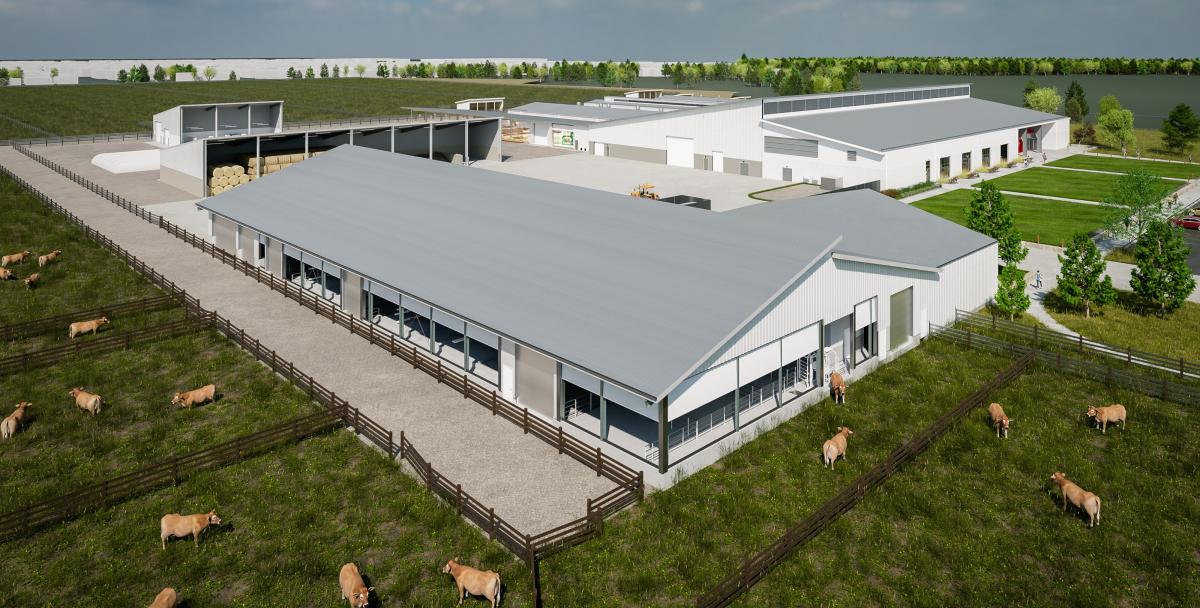
 Join the Revolution!
 Join the Revolution!