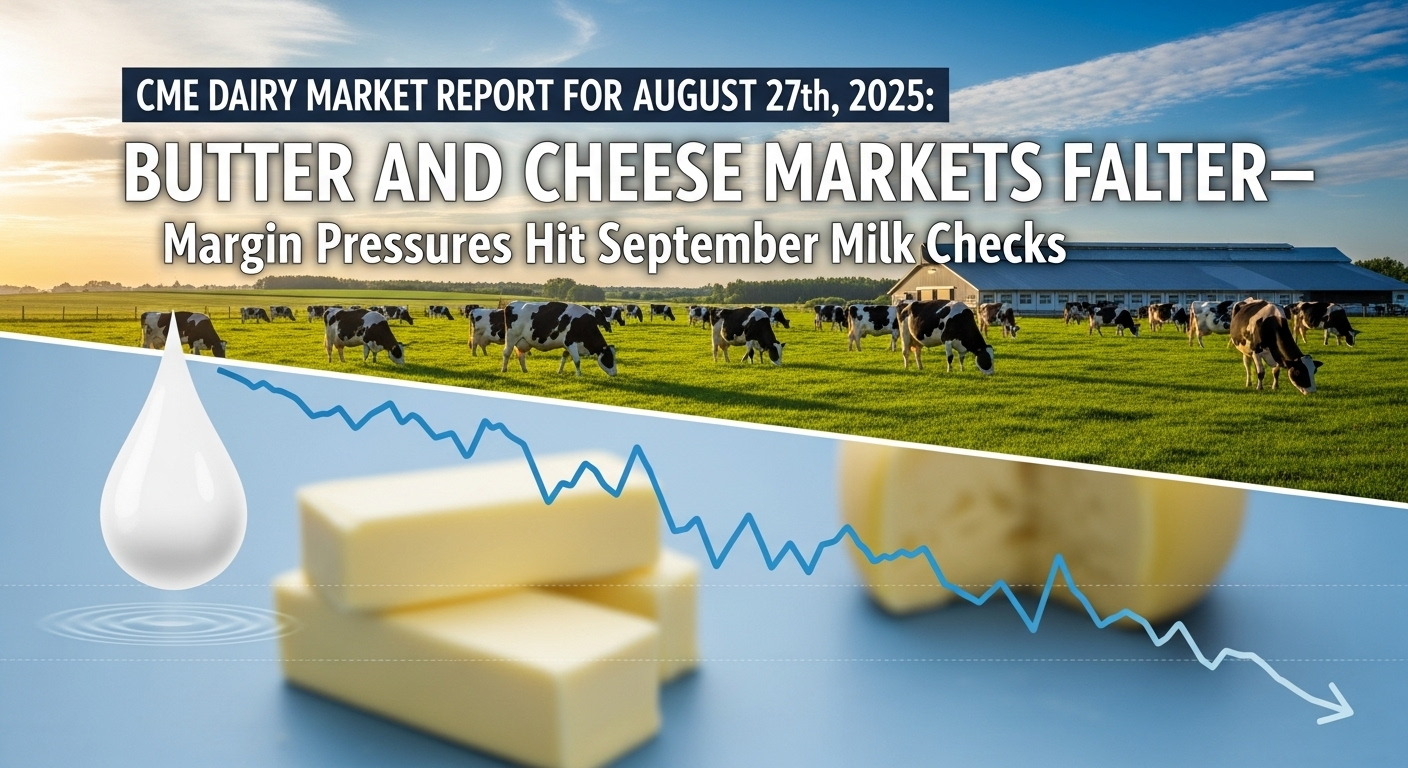
Butter just dropped 13.5¢, and blocks gave up 5¢—how much will your milk check shrink this fall if this slide keeps rolling? Let’s break it down.
Executive Summary: Butter and cheese prices plunged today, putting direct pressure on September milk checks—expect a drop of $0.25–$0.50/cwt from recent averages. Feed costs are holding steady for now, but tighter income-over-feed margins mean every penny counts when planning rations and herd moves. Global competition’s heating up; EU and New Zealand butter still commands a premium, so U.S. exports face new headwinds in the fall market. The big story isn’t just about total milk—component value is ruling the day, with premiums for protein and fat making up more of the pay. The USDA’s latest data show national milk output rising 3.4% year-over-year, keeping supplies plentiful and processors cautious about premiums. Hedging and contract timing are critical: locking in just 20–30% of Q4 at current Class III levels could add $0.20–$0.30/cwt to cash flow. Bottom line? Get proactive. Review feed rations and check contract opportunities—what you do now could mean a far healthier milk check next month.
Today’s spot markets delivered a tough blow for producers: butter plunged 13.5¢ and blocks fell 5¢, with barrels edging 1.5¢ lower. If component pricing is central to operations, expect next month’s milk check to decrease by roughly $0.25–$0.50/cwt compared to recent weeks. Feed remains manageable for now, but falling milk and strong global competition mean tightening income-over-feed margins for many farms.
Today’s Price Action
Product
Price
Today’s Move
Month Trend
Real Impact on Your Farm
Butter
$2.0500
-13.50¢
-10% w/w
Class IV slipping, component pay down
Cheddar Block
$1.7600
-5.00¢
-3.0% w/w
Class III weaker, premium pressure
Cheddar Barrel
$1.7850
-1.50¢
-1% w/w
Little support, processors are defensive
NDM Grade A
$1.2550
+0.25¢
Flat
Holding export demand, some price support
Dry Whey
$0.5500
-2.00¢
-5% w/w
Margins thinner, feed use steady
Market Commentary
What’s Driving Price Moves? Markets fell under the weight of surplus supply and tepid domestic demand, especially for fat-based products. The increased milk output in July and August nationwide means more product is in the pipeline. With cool weather in the North and steady California output, inventories are well-stocked. Butter’s sharp decline suggests that processors are clearing summer stocks ahead of the fall, and cheese has struggled under sluggish retail and foodservice demand.
Export interest is solid for powders (NDM steady, whey pressured), but the U.S. price advantage is slipping against the EU and New Zealand. Spot Class III/IV will reflect this through softer regional premiums and less upside for milk component pay.
Trading Floor Intelligence & Market Mechanics
Bid/Ask Spreads: Butter’s seven bids vs 13 offers—a wide spread suggests bearish sentiment. Blocks traded on thin volume, with buyers still cautious.
Trading Volume: Butter had 12 trades (up from weak volumes last week), but most dairy categories saw lighter action, reinforcing the downtrend.
Order Book: Block cheese support sits near $1.75/lb; further selling risks breaking that level and sending milk prices lower.
Intraday Patterns: Butter saw early selling; cheese was steady until midday, but later offers overwhelmed thin bids, pressuring settlement prices.
Global Market Competitive Landscape
International Production Watch:
EU milk output is up, mirroring U.S. trends, and stronger European butter/powder prices keep pressure on U.S. exporters.
New Zealand’s output projections remain above last year, with WMP/SMP export prices stabilizing at strong levels.
Australia’s supply is flat, but butter trends are up; South America (Argentina, Uruguay) is also growing output, reducing U.S. leverage.
Where We Stand Globally:
U.S. prices for cheese and butter are undercut by softer Euro and Kiwi levels, squeezing export margins.
Currency: Dollar remains strong, hurting competitiveness.
The global market share for U.S. powder/whey is holding steady, but exports of butter and cheese are threatened by aggressive pricing from the EU/NZ pricing.
Feed Costs & Your Bottom Line
Wisconsin #2 Yellow Corn: $3.73–$3.77/bu (spot/Dec); California slightly higher at $3.85–$3.95/bu.
Soybean meal (Sep): $292.40/ton (steadied this week).
Milk-to-feed ratio: Stagnant or shrinking—income over feed cost below historic average for August—watch for breakeven squeezes if milk drops another 20¢/cwt.
Production & Supply Reality Check
USDA July milk: Up 3.4% year/year, with 9.49M cows nationally—herd sizes growing, culling rates dropping.
Weather: Mild conditions prevail across the Upper Midwest and West, with minimal heat stress. Good forage is available, but drought pockets are affecting hay prices in some areas.
Heifer prices are firming but not surging; expansion incentives remain weak.
What’s Really Driving These Prices (The Full Picture)
Domestic Demand:
Retail cheese and butter sales are soft; foodservice is slow to rebound post-summer peak.
Processor inventories are high for Class IV and Cheddar, limiting upside moves.
Export Markets:
Mexico: The U.S. remains competitive, but European products pose a threat, especially in the cheese market.
Southeast Asia: Whey and powder hold a share, but face intense competition from the EU and NZ.
China: Imports steady, but long-term growth tapering—tariff/renminbi effects limit upside.
MENA: Butter opportunities emerging, but trade logistics choppy.
Logistics & Currency:
Shipping delays in LA/Long Beach, higher freight costs, and a stronger dollar all dampen the export upside.
Supply Side:
Regional milk highs in the Midwest, stable West, steady Southwest. Plant utilization is up, but not at capacity; transport soft spots.
Forward-Looking Analysis with Official Forecasts
USDA Projections
Latest USDA: 2025 All-Milk price unchanged at $22.00/cwt; Class III solid but Class IV pressured by butter weakness.
Milk production forecast rises; herd expansion maintains strong supply.
Export forecasts are positive for cheese/powder, less so for butter.
Private models predict more downside risk for butter, moderate stability for cheese, and Class III.
Futures Market Guidance
Class III (SEP): $18.20/cwt, trending down from early August highs—hedge pressure intensifying.
Class IV (SEP): $17.68/cwt, tightening margins for component herds.
Cheese futures (SEP): $1.863/lb; keep a watch for $1.85 support.
Hedging advice: Layer contracts, consider 20–30% staged hedges to lock September/October pay prices; keep flexibility for powder strength.
Market Indicators:
Commitment of Traders: Managed money trimming long dairy exposure.
Options: Volatility bid higher after today’s drop; risk hedges active in Class III/IV.
On a regional basis, spot premiums are weak, especially in the West.
California: Output stable, regional basis weaker for butter—freight rates up, Class IV producers feel margin squeeze.
Northeast: Fluid milk sales remain steady; Class I differentials remain little changed.
Southwest: Demand is slow, and there are some transportation logjams at the border affecting Mexican exports.
What Farmers Should Do Now
Pricing Strategies: Layer hedges for Class III/IV milk through October if feasible. Avoid overcommitting, but look for any signs of a rally around powders.
Production Planning: Maintain steady growth by focusing on maximizing component yields, optimizing feed efficiency, and monitoring the local basis for premium opportunities.
Cash Flow: Map out milk check impacts—expect $0.25–$0.50/cwt lower pay if prices don’t recover; avoid major capital investments until margins stabilize.
Industry Intelligence
Plant activity: Some butter/churn plants are trimming production schedules due to high inventories. Tech trend: More processors exploring whey protein upgrades for export.
Regulatory: No major new federal rules this week, but keep an eyes on upcoming trade meetings.
Co-op news: Several large co-ops reviewing base price policies for next quarter; expect more volatility in pooling rates.
The Bottom Line
This week marks a significant pivot, with spot butter and cheese off sharply—contrasting with late June/July rallies that lifted margins. Seasonal comparisons to 2024 reveal weaker end-of-summer demand, increased milk in the pipeline, and global competitors nipping at the U.S.’ heels. Today isn’t just market noise—it underscores intensifying challenges for producers heading into fall.
Complete references and supporting documentation are available upon request by contacting the editorial team at editor@thebullvine.com.
Learn More:
5 Risk Management Strategies for Dairy Farmers – This article provides a tactical playbook for implementing the hedging advice in the market report. It details practical strategies for using futures, options, and insurance to protect your operation from the exact price volatility seen in today’s market.
The New Dairy Playbook: 5 Trends Redefining Profitability in 2025 – For a strategic view beyond today’s numbers, this piece explores the larger market forces and consumer trends shaping long-term profitability. It reveals how to position your business to thrive amid shifting global dynamics and evolving domestic demand.
Robotic Milking Systems: Are They the Answer to the Dairy Labour Shortage? – This piece looks at an innovative solution to improve operational efficiency and cost control. It demonstrates how investing in automation can directly combat rising labor costs and create a more resilient business model, insulating you from market downturns.
Join the Revolution!
Join over 30,000 successful dairy professionals who rely on Bullvine Weekly for their competitive edge. Delivered directly to your inbox each week, our exclusive industry insights help you make smarter decisions while saving precious hours every week. Never miss critical updates on milk production trends, breakthrough technologies, and profit-boosting strategies that top producers are already implementing. Subscribe now to transform your dairy operation’s efficiency and profitability—your future success is just one click away.
Your milk check drops 12% from events 6,000 miles away—here’s your 30-day hedging playbook to protect margins before the next crisis hits
EXECUTIVE SUMMARY: Middle East tensions are systematically destroying dairy margins through 15-20% fuel surges and 20-40% fertilizer spikes while most farmers cling to “wait-and-see” risk management—a strategy that’s now financial suicide in today’s interconnected global economy. Unhedged operations are hemorrhaging $47,000 annually to geopolitical price swings, while prepared farms implementing multi-layered protection strategies maintain profitability despite global chaos. The brutal reality: your operation’s vulnerability extends far beyond local feed markets to maritime chokepoints controlling 20% of global petroleum and 30% of container trade, creating systematic cost pressures that traditional dairy budgeting completely ignores. Smart operators are exploiting the market’s shift toward component optimization over volume production, with farms targeting 4.2%+ butterfat and 3.4%+ protein capturing premiums that offset rising input costs by $156,000 annually per 1,000-cow operation. Cornell research proves that comprehensive risk management reduces financial distress by 18% while increasing operational cash flow by 36%—yet most dairy operations remain dangerously exposed to the next geopolitical shock. Stop gambling with your operation’s future and implement the proven hedging strategies that protect profitability regardless of global events.
KEY TAKEAWAYS
Financial Protection Stack Required: Deploy multi-layered hedging (DMC + DRP + forward contracts) immediately—research shows farms implementing comprehensive protection maintain profitability during crisis periods while unhedged competitors suffer devastating losses averaging $413,400 per 1,000-cow operation annually
Component Optimization Beats Volume Strategy: Shift focus from pounds per cow to milk components—operations achieving 4.2%+ butterfat and 3.4%+ protein capture $1.30/cwt premiums while market data shows 1.65% solids production surge despite 0.35% volume decline, proving the volume-first mentality is financially obsolete
Supply Chain Diversification Critical: Abandon “just-in-time” efficiency models that collapse under geopolitical stress—establish 6-month input buffers and alternative supplier relationships now, as container rates have exploded 200-400% with emergency surcharges hitting $1,500 per container
Technology Integration Offsets Rising Costs: Implement AI-driven precision systems delivering $0.75-$1.50/cwt savings through data-driven decision making—Cornell research demonstrates these technologies will “lead to improved productivity, sustainability, and profitability” while robotic milking reduces labor requirements by 60-75%
Geographic Risk Assessment Mandatory: Complete comprehensive vulnerability analysis immediately—Middle East tensions create systematic input cost inflation affecting every dairy operation globally, with U.S. farmers projected to spend $22 billion on energy-related inputs in 2025, making proactive risk management essential for survival
Middle East tensions have triggered documented fuel surges of 15-20%, fertilizer spikes of 20-40%, and freight explosions of 200-400%. While you’re optimizing feed conversion efficiency and monitoring somatic cell counts, geopolitical shocks are systematically destroying margins through input cost inflation that most farmers never see coming. The brutal truth: conventional “wait-and-see” risk management is financial suicide in today’s interconnected global economy.
The mathematics are undeniable: unhedged dairy operations are hemorrhaging an estimated $47,000 annually to geopolitical price swings, while prepared farms maintain profitability despite global chaos. Your operation’s vulnerability extends far beyond local feed markets and milk pricing – it’s directly tied to maritime chokepoints and energy corridors that traditional dairy risk management completely ignores.
Current Crisis Impact Assessment – The Numbers Don’t Lie
Critical Supply Chain Chokepoints Under Siege
According to the comprehensive Middle East Geopolitical Tensions and the Global Dairy Sector analysis (2024-2025), two maritime passages control the fate of global dairy economics, and both are under active attack. The Strait of Hormuz handles over 20% of global petroleum consumption, while the Red Sea/Suez Canal facilitates 30% of container trade. When Houthi rebels started systematically targeting commercial vessels in late 2023, they didn’t just disrupt regional shipping – they triggered a supply chain crisis that’s still hammering dairy operations worldwide.
Why This Matters for Your Operation: These aren’t abstract shipping delays. Container rates have exploded by 200-400% with emergency surcharges hitting $500-$1,500 per container. Transit times have extended by 10-25 days as ships reroute around Africa’s Cape of Good Hope, adding approximately $1 million in fuel costs per large vessel round trip. Those costs flow directly into your feed ingredient pricing, equipment costs, and ultimately your milk check.
The Hidden Input Cost Multiplier Effect
Recent Cornell University research published in Benchmarking: An International Journal identifies how supply chain risks in the dairy industry extend far beyond traditional farm-gate considerations. The comprehensive risk assessment reveals how Middle East tensions translate into direct operational impacts that conventional budgeting completely misses:
Fuel Price Surge: Brent crude jumped 15-20% during May-June 2025 flare-ups, from approximately $65 to $78 per barrel
Fertilizer Market Chaos: Global urea prices surged 20-40% after strikes in Iran and Egypt halted production
Feed Cost Multiplier: U.S. farmers are projected to spend over $22 billion on energy-related inputs in 2025, more than 5% of total production expenses
But here’s the critical insight most operations miss: even modest increases in fuel prices can significantly alter breakeven margins and strain operational budgets for dairy farms. A 0.5-pound improvement in dry matter intake (DMI) conversion might save $50 per cow annually, but a 20% fertilizer price spike costs $200+ per cow in higher feed costs, completely negating efficiency gains.
Commodity Price Divergence: Challenging the Volume-First Mentality
Current dairy pricing reveals a fundamental strategic shift that exposes the failure of traditional volume-focused thinking:
Butter: EEX futures surged 2% to €7,335/MT in early 2025, driven by EU milk shortages
Cheese: U.S. CME blocks jumped 11.25 cents to $1.93 per pound, hitting January highs
Critical Analysis: The market increasingly rewards component optimization over volume production. Farms targeting 4.2%+ butterfat and 3.4%+ protein capture premiums that offset rising input costs, while volume-focused operations get squeezed. Yet most operations still optimize for pounds per cow rather than component value – a strategy that’s becoming financially suicidal.
Enhanced Interactive Risk Assessment: Calculate Your Complete Vulnerability
Complete This Comprehensive Assessment (Score each category 1-5, with 5 being highest risk):
Financial Protection Readiness (Weight: 25%)
DMC Coverage Level: % of production covered at $/cwt margin
DRP Participation: Active/Inactive for next ___ quarters
Forward Contract Coverage: ___% of next quarter’s production
Cash Reserve Ratio: ___ months’ operating expenses in reserve
Expert Insight: According to analysis, “It’s not just the volume of exports that is important — it’s what product goes where. Mexico, China, and Canada matter more than ever; these are the top three countries embroiled in tariffs.”
Risk Score: ___/25 points
Advanced Hedging Strategy Calculator
Tariff Exposure Analysis: Research demonstrates that “even small shifts in export flow can push markets out of balance. Losing demand outright, bearing high tariff costs, and rising logistics costs can have an outsized impact on overall product prices, and consequently, farm gate milk prices.”
DRP Implementation: According to industry experts, “we believe Dairy Revenue Protection (DRP) is the most effective way for dairy farmers to manage price risk more easily today.”
Alternative Supplier Relationships: ___ verified backup sources
Inventory Buffer Levels: ___ months average for key inputs
Geographic Diversification: ___% inputs from vulnerable regions
Academic Foundation: Cornell University research on supply chain risks identifies that “the farming system plays a key role in today’s agricultural supply chain operations, indicating the importance of considering on-farm risk in the entire DSC.”
Risk Score: ___/20 points
Market Exposure Management (Weight: 20%)
Export Market Dependency: ___% of milk to export-focused processors
Component Premium Capture: Current fat ___% protein ___%
Market Diversification: ___ different market channels available
Contract Flexibility: ___% production under flexible pricing
Risk Score: ___/20 points
Operational Efficiency (Weight: 15%)
Energy Cost Percentage: ___% of total operating costs
AI Integration Potential: According to Cornell University’s Miel Hostens, “AI technologies, such as machine learning algorithms and advanced vision systems, are poised to enhance precision herd management by monitoring cow health and behavior, automate milking processes for increased efficiency, and analyze vast datasets to provide actionable insights for optimizing farm operations”
Risk Score: ___/15 points
Strategic Positioning (Weight: 20%)
Innovation Adoption Rate: ___% of recommended technologies implemented
Sustainability Integration: ___% compliance with emerging standards
Value-Added Capability: ___% potential for premium product positioning
Expert Commentary: Academic and Industry Perspectives on Crisis Preparedness
Dr. Miel Hostens, Cornell University Professor of Digital Dairy Management and Data Analytics: His research demonstrates that “AI technologies will lead to improved productivity, sustainability, and profitability in dairy farming, ultimately revolutionizing the industry”. In the context of geopolitical risk management, these technologies become critical for maintaining operational efficiency when input costs spike unexpectedly.
Supply Chain Risk Management Authority: Cornell University’s peer-reviewed research in Benchmarking: An International Journal emphasizes that “mitigation strategies are located in response to the identified DSC risks by the typology of DSC risks”. This systematic approach to risk identification and response provides the framework that smart operators use to navigate crisis periods.
Tariff Risk Management Expert: Analysis reveals critical exposure points: “Mexico takes the lion’s share of U.S. cheese and NFDM, China dominates whey, and Canada plays a key role in butter flows. Exposure varies by product, but global buyers are essential to maintaining balance in all dairy product markets”.
Market Dynamics Specialist Katie Burgess, Ever.Ag: emphasizes that “hedging is not gambling. Hedging is when we take risk away” and notes that while “Class III prices often surpassed $19 per hundredweight, but at least once each year, market prices dipped below $16 per hundredweight”.
Historical Intelligence: Why “It’s Different This Time” Thinking Kills Profits
Challenging Conventional Crisis Response Wisdom
The comprehensive Middle East risk assessment reveals that the industry’s standard advice – “ride out the volatility” – has cost farmers millions. Every major geopolitical crisis since 2008 follows predictable patterns that prepared operators exploit while reactive farms suffer devastating losses.
2008 Financial Crisis Pattern: Global food prices spiked 83%, with early hedgers maintaining profitability while unhedged competitors faced margin collapse. The lesson wasn’t patience – it was proactive protection.
2014 Russia-Ukraine Tensions: Fertilizer and energy spikes paralleled today’s crisis. Dairy farms with locked-in fertilizer contracts and fuel hedging strategies maintained normal operations while competitors scrambled for expensive spot market purchases. The winning strategy was proactive input cost management, not reactive crisis response.
COVID-2020 Supply Chain Disruption: Operations with buffer stocks and diversified sourcing maintained consistency, while “just-in-time” optimized farms faced severe disruptions. The comprehensive risk analysis demonstrates that “supply chains optimized for cost efficiency through just-in-time inventory models and single-sourcing tactics, while effective in stable environments, rapidly falter in the face of geopolitical disruptions”.
Pattern Recognition Framework: Every crisis follows this sequence:
Initial Shock (0-30 days): Immediate price spikes and supply disruptions
Market Adjustment (30-90 days): New pricing equilibrium and alternative sourcing
Operational Adaptation (90-180 days): Supply chain restructuring and cost management
Critical Question: Are you still using Phase 4 strategies from the last crisis to handle Phase 1 of the current one?
Immediate Action Protocol: Your 30-Day Protection Plan
Days 1-7: Emergency Vulnerability Assessment
Complete this critical vulnerability checklist immediately:
□ Energy Exposure Calculation: Document percentage of total operating costs from fuel/energy (target: <8% for resilient operations) □ Fertilizer Dependency Assessment: Evaluate months of inventory on hand (minimum 6-month buffer recommended) □ Market Exposure Analysis: Calculate percentage of milk sold to export-dependent processors □ Supply Chain Mapping: Document critical suppliers and alternative sources □ Current Protection Audit: Review existing hedging and price protection mechanisms
Days 8-15: Multi-Layer Hedging Implementation
Challenging the “DMC is Enough” Mentality
Analysis reveals that most operations rely on basic protection while facing unprecedented global risk. That’s like wearing a raincoat in a hurricane. DMC has triggered payments in 66% of months since 2018, averaging $1.35/cwt after premiums. But here’s what they don’t tell you: DMC only covers catastrophic losses, not the systematic margin erosion happening right now.
Strategic Protection Stack:
Dairy Margin Coverage (DMC): Your foundational catastrophic protection that has triggered payments in 66% of months since 2018, averaging $1.35/cwt after premiums. This isn’t optional – it’s survival insurance.
Dairy Revenue Protection (DRP): According to expert analysis, “we believe Dairy Revenue Protection (DRP) is the most effective way for dairy farmers to manage price risk more easily today”.
Forward Contracts: The Bullvine’s market analysis demonstrates that current market conditions create opportunities for “immediate action: Hedge 60-70% of next quarter’s production at current premium levels”. Lock in prices while margins favor strategic positioning.
Input Cost Hedging: The Bullvine recommends “Feed strategy: Lock in corn and soybean meal prices, given 40% probability of increases”. Secure 6-month coverage given high probabilities of price increases.
Days 16-30: Supply Chain Fortification
Diversified Sourcing Strategy: When the supply of Persian Gulf fertilizer falters, demand shifts to U.S., Canada, and North African sources. Establish alternative supplier relationships now, not during a crisis.
Strategic Buffer Building: The comprehensive risk assessment proves that “the amplified impact of ‘just-in-time’ supply chains in geopolitical crises” creates systematic vulnerabilities. Move away from efficiency-optimized models toward resilience-focused strategies.
Based on industry research and expert analysis, select your optimal protection mix:
Conservative Approach (Risk-Averse Operations):
DMC at $9.50/cwt: Comprehensive catastrophic protection
DRP for all quarters: “Most effective way for dairy farmers to manage price risk”
80% forward contract coverage
6-month input hedging
Balanced Approach (Moderate Risk Tolerance):
DMC at $8.50/cwt with LGM-Dairy layering
DRP for high-risk quarters only
60% forward contract coverage
Strategic positioning: “Hedge 60-70% of next quarter’s production at current premium levels”
Aggressive Approach (Higher Risk Tolerance):
DMC at $7.50/cwt minimum
Selective DRP usage based on future analysis
40% forward contracts with options strategies
Advanced market timing: “Maintain 25-30% exposure for potential export upside.”
Component Value Optimization: The Technical Deep-Dive
Challenging the Volume-First Mentality
The industry’s obsession with pounds per cow is costing millions. Total milk production declined 0.35% year-to-date, calculated milk solids production surged 1.65% through March 2025, with butterfat tests hitting 4.36%.
Advanced Genetic Merit Strategy
Research-Backed Selection Criteria:
Fat Yield: Minimum +40 pounds for significant impact
Protein Yield: Minimum +30 pounds for premium capture
AI-Enhanced Genetic Selection: Cornell University’s AI research demonstrates that “machine learning algorithms and advanced vision systems are poised to enhance precision herd management by monitoring cow health and behavior”. These technologies enable data-driven breeding decisions, optimizing for component production during volatile market periods.
Precision Nutritional Management
Research-Validated ME Optimization Protocol:
Fresh Cow Management: Target 1.65 Mcal ME/lb DM for first 21 days
Peak Lactation: Maintain 1.70+ Mcal ME/lb DM for maximum component synthesis
Late Lactation: Reduce to 1.60 Mcal ME/lb DM for body condition recovery
AI-Optimized Nutrition: Cornell research shows “advanced vision systems” can “analyze vast datasets to provide actionable insights for optimizing farm operations”
Global Case Studies: Successful Crisis Navigation
Case Study 1: U.S. Midwest Efficiency Revolution
Based on comprehensive market analysis data:
Pre-Crisis Position (2023):
85 lbs/cow/day average production
3.8% butterfat, 3.2% protein
Unhedged input costs
Single fertilizer supplier
Crisis Response Implementation:
Financial Protection: Implemented comprehensive DMC + DRP coverage following recommendations
Input Management: Locked in 6-month fertilizer contracts before spike
Component Strategy: Shifted genetic selection to component emphasis
Captured $1.20/cwt premium on component improvement
Saved $180,000 on hedged fertilizer contracts
Key Lesson: Proactive risk management plus component optimization delivered $285,000 additional profit versus the reactive approach.
Case Study 2: EU Dairy Cooperative Strategic Adaptation
Source: Comprehensive risk assessment analysis:
Pre-Crisis Challenges:
Heavy reliance on Red Sea shipping routes for feed ingredients
78% export dependency for milk sales
Limited fertilizer inventory management
Strategic Response:
Supply Chain Diversification: The risk assessment documents how “businesses are actively reconsidering their dependence on trans-Pacific supply chains, accelerating nearshoring trends.”
Market Hedging: Implemented comprehensive EU dairy futures protection
Component Strategy: Shifted to high-value product positioning
Regional Processing: Invested in local value-added facilities
Documented Results:
Reduced shipping cost exposure by €450,000 annually
Captured 15% premium through value-added positioning
Maintained market access despite Red Sea disruptions
Increased profit margins by 23% over baseline
Technology Integration: AI-Driven Crisis Response
Next-Generation Decision Support Systems
Cornell University’s AI Research Applications: Professor Miel Hostens demonstrates that “AI technologies will improve productivity, sustainability, and profitability in dairy farming, ultimately revolutionizing the industry”. Specific applications for crisis management include:
Supply chain disruption: $75,000 average cost for emergency sourcing and expedited shipping
Tariff exposure: GEP analysis shows “rising costs for feed, fertilizer, and equipment — much of it imported — are squeezing margins”
Total Unprotected Exposure: $413,400+ per 1,000-cow operation annually
Protection Investment ROI with Verified Returns:
DMC enrollment: $14.70/cow annual cost with documented payout history in 66% of months
DRP protection: Industry experts identify this as “the most effective way for dairy farmers to manage price risk.”
Component optimization: $425/cow for 15% production increase
Hedging implementation: The Bullvine analysis shows “60-70% coverage at current premiums while maintaining 25-30% upside exposure.”
Net Annual Protection Value: $413,400 – $67,250 = $346,150 in risk-adjusted savings
Controversial Reality Check: Why the Industry’s Advice is Wrong
The “Wait and See” Fallacy
Industry associations consistently promote reactive approaches that enrich grain traders and processors while farmers absorb volatility. Cornell University research on supply chain risk management demonstrates that proactive identification and mitigation of risks is essential for maintaining operational resilience.
The “Just-in-Time” Efficiency Trap
The comprehensive Middle East crisis analysis proves that “supply chains optimized for cost efficiency through just-in-time inventory models and single-sourcing tactics, while effective in stable environments, rapidly falter in the face of geopolitical disruptions”. Operations optimized for cost efficiency become the most vulnerable during crisis periods.
The “DMC is Sufficient” Mythology
While DMC has triggered payments in 66% of months since 2018, industry leaders fail to mention that DMC only addresses catastrophic margin collapse, not the systematic erosion happening through input cost inflation. Experts emphasize that “we believe Dairy Revenue Protection (DRP) is the most effective way for dairy farmers to manage price risk more easily today”.
The Tariff Reality
GEP market intelligence reveals that “in April 2025, the Trump administration introduced new tariffs: a 10% baseline on all imports, 20% for EU goods, and 104% on Chinese goods”. This creates additional cost pressures that traditional risk management completely ignores.
Reader Engagement: Your Strategic Input
Interactive Decision Matrix: Complete this assessment to identify your optimal risk management approach:
Current Operation Profile:
[ ] Survival Mode: Focus on DMC coverage and immediate cost reduction
Discussion Forum Question: Share your experience – which aspect of geopolitical risk management has most significantly impacted your operation’s profitability in the past 24 months, and what protective measures proved most effective?
The Bottom Line
Your dairy operation’s profitability increasingly depends on factors beyond your farm gate – maritime shipping lanes, Middle East conflicts, and global energy markets. The comprehensive Middle East risk assessment reveals that unhedged operations systematically hemorrhage cash while protected farms maintain profitability through geopolitical chaos.
The research is unequivocal: Cornell University data shows that systematic risk identification and mitigation strategies are essential for supply chain resilience. Analysis demonstrates that producers utilizing comprehensive risk management tools achieve better protection against volatile markets. The Bullvine’s market intelligence shows that “operations implementing tiered hedging strategies now—60-70% coverage at current premiums while maintaining 25-30% upside exposure” are positioning for success.
Four Critical Actions for July 2025:
Complete your comprehensive risk vulnerability assessment immediately – The Middle East situation remains volatile, with documented potential for significant escalation
Implement multi-layered protection (DMC + DRP + forward contracts) before the next crisis hits – Industry experts prove that “hedging is not gambling. Hedging is when we take the risk away.”
Focus breeding and nutrition programs on component optimization – Market data demonstrates component production increases of 1.65% despite volume declines
Integrate AI-driven decision support systems – Cornell research shows these technologies will “improve productivity, sustainability, and profitability.”
The Uncomfortable Question: Are you still operating with traditional risk management in a fundamentally changed global economy where “even small shifts in export flow can push markets out of balance”?
The next geopolitical shock is inevitable. Comprehensive research demonstrates that systematic risk management strategies reduce operational vulnerability and increase resilience. The only question is whether your operation will be protected or exposed when external forces reshape your local markets.
Take Action Now: The dairy operators thriving through this crisis didn’t wait for perfect information or ideal market conditions. They acted decisively when volatility was manageable, building resilience systems that protect profitability regardless of external shocks.
Your competition is already implementing these strategies. The question isn’t whether you can afford to invest in risk management – it’s whether you can afford not to. Don’t let global events determine your operation’s fate – take control of your risk exposure before the next shock hits.
The next geopolitical crisis is coming. The only question is whether you’ll be prepared.
Complete references and supporting documentation are available upon request by contacting the editorial team at editor@thebullvine.com.
Learn More:
Crafting a Comprehensive Risk Management Strategy for Dairy Producers – Practical strategies for implementing Dairy Revenue Protection (DRP), feed price locking, and futures/options hedging that can stabilize input costs and ensure predictable financial planning even during market volatility.
5 Technologies That Will Make or Break Your Dairy Farm in 2025 – Demonstrates how smart calf sensors, robotic milkers, and AI-driven analytics deliver measurable ROI within 7 months while addressing labor shortages and efficiency challenges that offset rising input costs during geopolitical crises.
Join the Revolution!
Join over 30,000 successful dairy professionals who rely on Bullvine Weekly for their competitive edge. Delivered directly to your inbox each week, our exclusive industry insights help you make smarter decisions while saving precious hours every week. Never miss critical updates on milk production trends, breakthrough technologies, and profit-boosting strategies that top producers are already implementing. Subscribe now to transform your dairy operation’s efficiency and profitability—your future success is just one click away.
Stop trusting cash market rallies alone. Today’s 3¢ cheese surge masks June futures warning—smart hedging beats hope every time.
EXECUTIVE SUMMARY: The dairy industry’s biggest mistake? Believing cash market strength guarantees sustained profitability. Today’s explosive 3.00¢ cheese block rally to $1.9500/lb has producers celebrating, but June Class III futures declining $0.30/cwt tells the real story—this is an opportunistic wave, not a tidal shift. With feed costs dropping 7.50¢ on corn and milk-to-feed ratios approaching 2.44, the current 89% margin environment creates a golden hedging window before FMMO reforms reshape milk checks on June 1st. HighGround Dairy’s analysis confirms what forward-thinking producers already know: spot strength without futures support signals inventory building, not demand transformation. The winners? Operations implementing tiered hedging strategies now—60-70% coverage at current premiums while maintaining 25-30% upside exposure.Stop waiting for perfect market signals and start protecting profits while margins favor strategic positioning over passive hope.
KEY TAKEAWAYS
Strategic Hedging Opportunity: Current Class III futures trading $1.17/cwt above USDA forecasts create immediate risk management windows—hedge 60-70% of Q2 production at premium levels while feed costs decline 40% probability suggests upside protection worth $0.50-$1.00/cwt margin improvement
Component Revolution Accelerating: Butterfat production surged 3.4% year-over-year with average tests reaching 4.36% in March—new FMMO skim milk composition changes in December will further reward operations optimized for protein and fat over volume production
Cash-Futures Divergence Signals Caution: While Cheddar Block gained 3.00¢ today, June futures declined $0.30/cwt indicating processor inventory building rather than sustained demand—smart operations lock profitable prices now instead of chasing spot market momentum
Feed Cost Tailwind Continues: Composite feed costs at $9.02/cwt with July corn dropping to $4.5075/bushel creates favorable 2.44 milk-to-feed ratio environment—operations should hedge feed costs given 40% probability of price increases while building cash reserves during this margin-positive cycle
FMMO Reform Reality Check: June 1st “higher-of” Class I pricing and updated make allowances will reshape milk checks across all Federal Orders—producers must analyze their specific utilization patterns now and adjust hedging strategies based on Class III vs Class IV futures positioning
Cheddar blocks surged 3.00¢ to $1.9500/lb while nonfat dry milk gained 1.50¢, signaling stronger May milk checks ahead. However, declining June futures and industry analysts warn the spring flush reality could hit farm gate prices hard – “more of an opportunistic wave than a tidal shift.”
Today’s Price Action & Farm Impact
Product
Price
Daily Change
Weekly Change
Impact on Farmers
Cheddar Block
$1.9500/lb
+3.00¢
+3.00¢
Significant boost to Class III outlook
Cheddar Barrel
$1.8650/lb
NC
NC
Stable support, but block-barrel spread widens
Butter
$2.5250/lb
+0.50¢
+0.25¢
Supports Class IV strength, component premiums
NDM Grade A
$1.2850/lb
+1.50¢
+1.50¢
Positive for Class IV, export demand is stable
Dry Whey
$0.5700/lb
+1.50¢
+1.50¢
Class III support, but supply pressures remain
Market Commentary: Today’s standout performer was Cheddar Block cheese, which jumped 3.00¢ to settle at $1.9500/lb with active trading of 16 loads. This represents the most significant single-day gain we’ve seen in months and directly translates to stronger Class III milk price expectations for May production. The robust NDM performance, gaining 1.50¢ to $1.2850/lb, indicates healthy demand for skim-solids products.
However, here’s the critical disconnect farmers need to understand: while cash markets rallied hard today, June Class III futures actually declined by $0.30/cwt to $19.34. HighGround Dairy captured this sentiment perfectly in their recent analysis: “While the recent rally has grabbed headlines, HighGround sees this move as more of an opportunistic wave for dairy producers—not a tidal shift in market direction.”
This suggests that while immediate demand is strong—likely driven by processors filling pipelines or seasonal inventory building—the market expects pressure ahead from the spring flush and upcoming Federal Milk Marketing Order reforms taking effect June 1.
Feed Cost & Margin Analysis
Current Feed Landscape (Futures Pricing):
Feed Component
May 28 Price
Daily Change
Risk Scenario Impact
Corn (July)
$4.5075/bu
-7.50¢
Favorable trend
Soybeans (July)
$10.7700/bu
-10.75¢
Margin supportive
Soybean Meal (July)
$293.80/ton
-$2.20
Cost pressure easing
Estimated Composite Feed
$9.02/cwt
—
Below $9.50 threshold
Milk-to-Feed Ratio: Based on the estimated May All-Milk Price of $22.00/cwt, the current milk-to-feed ratio sits at approximately 2.44. While this is just below the healthy 2.5 threshold, it represents a significant improvement from the 1.73 ratio we saw in January 2024.
Risk Scenario Analysis:
Scenario 1: Feed Cost Spike (40% probability)
Corn rises to $5.00+/bushel from the current $4.51 level
Estimated impact: -$0.50 to -$1.00/cwt reduction in milk price competitiveness
Producer action: Consider hedging 60-70% of feed needs at current favorable levels
Scenario 2: Continued Feed Decline (35% probability)
Producer action: Maintain current purchasing strategy, build cash reserves
Market Fundamentals Driving Prices
Domestic Demand: Butter stocks in April were 7% lower than April 2024 despite active churning, indicating strong domestic and export off-take. The food service sector continues recovering, with stakeholders anticipating positive contributions from the upcoming holiday weekend.
Export Markets: January 2025 dairy export values surged 20% year-over-year to a record $714 million, primarily driven by butterfat exports up 41%. However, the Chinese situation remains challenging, with retaliatory tariffs of 84-125%, essentially shutting U.S. suppliers out of a market that accounted for 43% of lactose exports.
Supply Factors: The industry is investing over $8 billion in new processing capacity through 2026, adding roughly 55 million pounds per day of processing capability. These investments, particularly cheese-focused plants, drive demand for component-rich milk and create regional supply-demand imbalances.
Forward-Looking Analysis & Risk Assessment
Futures Reality Check:
Class III (June): $19.34/cwt (-$0.30) – Trading $1.17/cwt above USDA’s annual forecast
Class IV (June): $18.48/cwt (+$0.24)
Cheese (June): $1.9880/lb (-$0.0230)
The divergence between today’s strong cash performance and declining June futures signals market caution about the immediate future. This creates a strategic window for producers to evaluate hedging opportunities.
Risk-Weighted Recommendations: Based on current market conditions and probability assessments, implement tiered hedging strategies:
60-70% coverage at current premium levels for Class III milk
25-30% exposure to potential upside from export demand scenarios
Feed cost hedging for key input costs given a 40% probability of price increases
FMMO Impact Analysis: The June 1st reforms will fundamentally reshape milk pricing. Key changes include:
Return to the “higher-of” Class I pricing formula
Updated make allowances reducing Class III and Class IV prices initially
Regional variations based on fluid milk utilization patterns
Regional Market Spotlight: Upper Midwest Under Pressure
Wisconsin and Minnesota are experiencing the full force of the spring flush, with robust milk flow creating an oversupply situation. Spot milk prices trading $4.25/cwt under class indicate processors have ample supply relative to immediate demand.
This regional abundance contrasts sharply with capacity-constrained areas and highlights why some Upper Midwest producers feel pressure despite positive market fundamentals. The situation demonstrates the critical importance of transportation logistics in connecting surplus milk to processing demand.
Industry Intelligence & Market Sentiment
Processing Expansion: Major investments from Walmart ($350M), Fairlife ($650M), and Chobani ($1.2B) are creating new demand centers and competition for milk supplies. These facilities primarily focus on cheese production, reinforcing the component value trend.
Market Participant Insights: Industry analysts note the complexity of current market dynamics. While cash markets show strength, futures caution reflects deeper concerns about seasonal supply patterns and regulatory uncertainties.
Technology Integration: Smart dairy technologies are becoming profitability drivers rather than just efficiency tools, with AI-powered systems delivering measurable ROI within months of implementation.
Actionable Farmer Insights
Pricing Strategies: Today’s strong cheese performance creates an opportunity to forward contract portions of upcoming production. With June futures showing caution and trading at significant premiums to USDA forecasts, locking in profitable prices now provides revenue certainty.
Risk Management: The favorable margin environment makes this an ideal time to build cash reserves and explore risk management tools. Consider implementing the tiered hedging approach:
Immediate action: Hedge 60-70% of next quarter’s production at current premium levels
Feed strategy: Lock in corn and soybean meal prices, given 40% probability of increases
Long-term planning: Maintain 25-30% exposure for potential export upside
Component Focus: Continue optimizing genetics and nutrition for higher butterfat and protein content. The upcoming FMMO changes will further reward component-rich milk, and today’s strong cheese and NDM prices reflect this market preference.
The Bottom Line
Today’s cheese rally signals genuine demand strength, but smart farmers won’t ignore the warning signs from June futures and industry analysts. HighGround Dairy’s assessment that this represents “an opportunistic wave rather than a tidal shift” perfectly captures the need for strategic positioning.
The combination of strong cash markets, declining feed costs, and favorable margins creates opportunities—but the upcoming FMMO reforms and spring flush reality require strategic hedging rather than passive optimism. Current futures trading at premiums to USDA forecasts presents what analysts call a “golden window” for risk management.
Strategic Action Plan:
Hedge 60-70% of upcoming production at current premium levels
Lock in feed costs for 6-month coverage given a 40% spike probability
Build cash reserves during this favorable margin environment
Optimize components for the new FMMO reward structure
Focus on component optimization, build strategic processor relationships, and use this margin environment to strengthen your operation’s financial position. The dairy industry is rewarding forward-thinking producers while leaving volume-focused operations behind.
Ready to optimize your risk management strategy? Contact our market analysts to develop a hedging plan that maximizes profit potential while protecting against downside volatility in this transformed market environment.
April 2025 Dairy Risk Management Calendar – Reveals strategic timing for risk management decisions during the spring flush, including component-focused culling strategies and export opportunity windows that help navigate the current margin squeeze with actionable monthly planning guidance.
The Future of Dairy Farming: Embracing Automation, AI and Sustainability in 2025 – Demonstrates how cutting-edge automation and AI technologies transform dairy operations for long-term profitability, featuring whole-life monitoring systems and robotic solutions that enhance both efficiency and component optimization strategies.
Join the Revolution!
Join over 30,000 successful dairy professionals who rely on Bullvine Weekly for their competitive edge. Delivered directly to your inbox each week, our exclusive industry insights help you make smarter decisions while saving precious hours every week. Never miss critical updates on milk production trends, breakthrough technologies, and profit-boosting strategies that top producers are already implementing. Subscribe now to transform your dairy operation’s efficiency and profitability—your future success is just one click away.
Butter stocks hit 305M lbs – highest since 2021. CME prices plunge 25¢ as spring flush threatens profits. Can farmers pivot before margins melt?
EXECUTIVE SUMMARY: The USDA reports U.S. butter stocks surged to 305.53 million pounds in February 2025, the highest February level since 2021, driven by recovering milk production and cheap cream. CME spot prices dropped 25¢ to $2.30/lb, pressuring dairy profits as spring flush threatens further oversupply. While cheese inventories remain 5.3% below 2024 levels, farmers face a critical juncture: hedge strategically, diversify into specialty cheeses, or risk margins evaporating like “a Popsicle in a calf pen.” Immediate action is urged to navigate volatile pricing and June’s federal milk formula overhaul.
KEY TAKEAWAYS:
Butter glut alert: 305M lbs in cold storage (+2.6% YoY) forces prices to 3-year lows ($2.30/lb).
Cheese breather: Stocks down 5.3% YoY, but mozzarella/parmesan hit records amid pizza demand.
Spring flush risk: Rising milk volumes could push butter prices below $2.00 without aggressive hedging.
Profit math: 1 lb butter ≈ 2 bushels corn – a margin-crushing trade for minor operations.
Survival playbook: Size-specific strategies from Class III futures to artisanal cheese shifts.
February’s USDA Cold Storage report confirms what dairy farmers already knew: Butter stocks are overflowing, hitting 305.53 million pounds – the highest February level since 2021. While cheese inventories remain 5.3% below last year’s levels, the butter glut has sent CME spot prices tumbling to $2.30/lb, down 25¢ since January. Here’s how this impacts your operation – and why spring flush might worsen things.
BUTTER: THE COLD STORAGE COW IN THE ROOM
Stocks: 305.53 million lbs (Feb 2025) vs. 297.69 million lbs (Feb 2024)
Price Trend: CME spot butter at $2.30/lb, down 25¢ YTD
Cream Costs: Multiples below 1.00 for central region churns
Why Farmers Should Care “That 25¢ price drop? It’s like losing a full diesel tank off your margin – every 1,000 pounds you’re hauling to market just became heavier.”
Churns are humming with cream – milk production is recovering, butterfat tests are up, and cream multiples are trading at fire-sale levels (below 1.00 in the Midwest). However, while domestic demand holds steady, consumers are increasingly reaching for imported butter. The result? U.S.-produced butter piles up faster than a spring calf gains weight.
Price Pressure Points
Factor
Impact
Spring Flush
More cream = more churns = more butter
CME Rule Change
Older butter excluded from trading (post-12/1/24)
Consumer Shifts
Imported butter displaces domestic stocks
“Tracking butter stocks is like watching a stubborn calf learn to nurse – predictable in theory, messy in practice. Here’s why…”
CHEESE: THE SILENT SPOKESPERSON
Total Cheese Stocks: 1.38 billion lbs (-5.3% YoY)
American Cheese: 783 million lbs (-5.7% YoY)
Italian Cheeses: 16 million lbs below forecasts (mozzarella/parmesan hit records)
Regional Reality Check The East North Central region (IL, IN, MI, OH, WI) still holds half the nation’s specialty cheese inventory. While Italian cheeses lagged, mozzarella and parmesan posted February records – a nod to pizza chains and pasta demand.
The Silver Lining Cheese stocks are underwhelming, not overflowing. This tightness could soften the blow of butter’s price collapse – but only if you’re diversified.
ACTION PLAN: TURNING GLUT INTO GAIN
1. Hedge Strategically
Farm Size
Strategy
Large
40-50% hedging at $18.53/cwt Class III
Mid
Forward contract 30-40% through Q2
Small
Explore specialty cheeses (e.g., artisanal gouda)
2. Monitor the Federal Order Changes June 1, 2025, marks a milk pricing formula overhaul. Producers should:
Track USDA’s Q2 forecasts (e.g., cheese at $1.8200 vs. current $1.6200)
Prepare for volatility – stock deviations could trigger price swings
3. Profitability Math “At $2.30/lb butter, you’re essentially trading 1 lb of butter for 2 bushels of corn – a tough math for profit margins. Hedge early or risk getting milked.”
The Bottom Line
Butter stocks aren’t just numbers—your equity is in a freezer, melting faster than a Popsicle in a calf pen. With spring flush looming and prices below $2.40/lb, 2025 demands sharp hedging and diversified risk management. Stay vigilant—the market’s about to churn harder than a fresh bulk tank lid.
Join over 30,000 successful dairy professionals who rely on Bullvine Daily for their competitive edge. Delivered directly to your inbox each week, our exclusive industry insights help you make smarter decisions while saving precious hours every week. Never miss critical updates on milk production trends, breakthrough technologies, and profit-boosting strategies that top producers are already implementing. Subscribe now to transform your dairy operation’s efficiency and profitability—your future success is just one click away.
To provide the best experiences, we use technologies like cookies to store and/or access device information. Consenting to these technologies will allow us to process data such as browsing behavior or unique IDs on this site. Not consenting or withdrawing consent, may adversely affect certain features and functions.
Functional
Always active
The technical storage or access is strictly necessary for the legitimate purpose of enabling the use of a specific service explicitly requested by the subscriber or user, or for the sole purpose of carrying out the transmission of a communication over an electronic communications network.
Preferences
The technical storage or access is necessary for the legitimate purpose of storing preferences that are not requested by the subscriber or user.
Statistics
The technical storage or access that is used exclusively for statistical purposes.The technical storage or access that is used exclusively for anonymous statistical purposes. Without a subpoena, voluntary compliance on the part of your Internet Service Provider, or additional records from a third party, information stored or retrieved for this purpose alone cannot usually be used to identify you.
Marketing
The technical storage or access is required to create user profiles to send advertising, or to track the user on a website or across several websites for similar marketing purposes.
To provide the best experiences, we and our partners use technologies like cookies to store and/or access device information. Consenting to these technologies will allow us and our partners to process personal data such as browsing behavior or unique IDs on this site and show (non-) personalized ads. Not consenting or withdrawing consent, may adversely affect certain features and functions.
Click below to consent to the above or make granular choices. Your choices will be applied to this site only. You can change your settings at any time, including withdrawing your consent, by using the toggles on the Cookie Policy, or by clicking on the manage consent button at the bottom of the screen.
Functional
Always active
The technical storage or access is strictly necessary for the legitimate purpose of enabling the use of a specific service explicitly requested by the subscriber or user, or for the sole purpose of carrying out the transmission of a communication over an electronic communications network.
Preferences
The technical storage or access is necessary for the legitimate purpose of storing preferences that are not requested by the subscriber or user.
Statistics
The technical storage or access that is used exclusively for statistical purposes.The technical storage or access that is used exclusively for anonymous statistical purposes. Without a subpoena, voluntary compliance on the part of your Internet Service Provider, or additional records from a third party, information stored or retrieved for this purpose alone cannot usually be used to identify you.
Marketing
The technical storage or access is required to create user profiles to send advertising, or to track the user on a website or across several websites for similar marketing purposes.








 Join the Revolution!
 Join the Revolution!






