Archive for dairy farm risk management

Manure Gas Killed a Father and His Two Sons in Minutes. A $200 Monitor Could Have Stopped It.

A father. Two sons. Four coworkers. All dead from manure gas in minutes. The monitor that could have saved them? $200. Why does this keep happening?

Executive Summary: In August 2025, manure gas killed six workers at a Colorado dairy in minutes—including a father and his two sons. Hydrogen sulfide can spike to deadly concentrations within the first hour of agitation, and at high levels, it paralyzes your sense of smell before you know you’re in trouble. The equipment that could have prevented this? Portable gas monitors cost $140 to $300. Retrieval systems that would have saved the coworkers who rushed in to help run $2,000 to $5,000. We’ve known about this hazard for decades, the technology is affordable, and we’re still losing families to something entirely preventable. This article covers what happened, what the science tells us, and five steps you can take this week to make sure your operation isn’t next.
You know, some stories just stop you cold. Among the six workers who died at Prospect Valley Dairy in Keenesburg, Colorado, on August 20, 2025, was 17-year-old Oscar Espinoza Leos, working alongside his father, Alejandro Espinoza Cruz, and his older brother Carlos Espinoza Prado. All three were lost that day. The Weld County Coroner’s October report confirmed what safety professionals had suspected from the beginning—acute hydrogen sulfide poisoning killed all six within minutes.

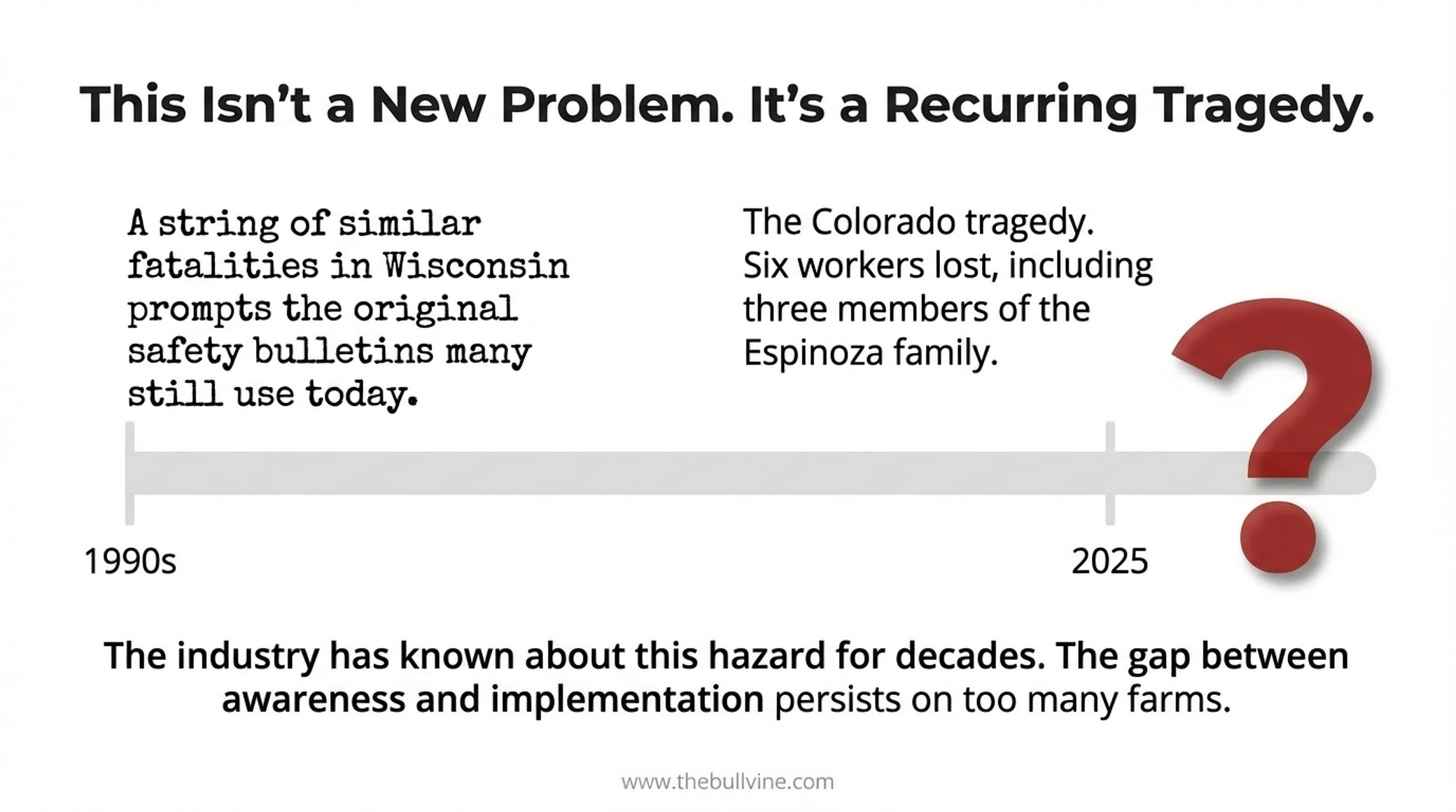
I’ve been in this industry long enough to remember similar incidents. The Wisconsin cases back in the 1990s. That string of fatalities across the Midwest that prompted the original extension bulletins, many of us still reference. And every time, the conversation that follows sounds remarkably similar: we know the hazard exists, we know the solutions exist, yet somehow the gap between awareness and implementation persists.
This isn’t about pointing fingers. It really isn’t. It’s about understanding what’s actually getting in the way—and learning from producers who’ve figured out how to close that gap on their own operations.

Understanding the Hazard: What Makes Hydrogen Sulfide Different

If you’ve worked around manure storage for any length of time, you’re familiar with that distinctive rotten-egg smell at low concentrations. That’s hydrogen sulfide—H₂S—produced naturally when manure breaks down in anaerobic conditions. Covered pits, deep storage facilities, pump stations, and, especially, freshly agitated slurry all create an oxygen-free environment where this gas accumulates.
H₂S Concentration (ppm)Effects on HumansTime to IncapacitationAction Required
<10Rotten egg odor detectable; no health effectsN/ANormal operation; monitor if agitating
10-100Eye irritation, respiratory distress, nauseaMinutes to hoursEvacuate area immediately; activate alarm
100-400IDLH threshold; loss of smell, dizziness, confusion1-5 minutesNo entry without SCBA; treat as life-threatening
400-700Rapid unconsciousness, respiratory arrest30-60 secondsDeath imminent; non-entry rescue only
700+Immediate collapse, death within 1-2 breaths<10 secondsUnsurvivable without immediate extraction

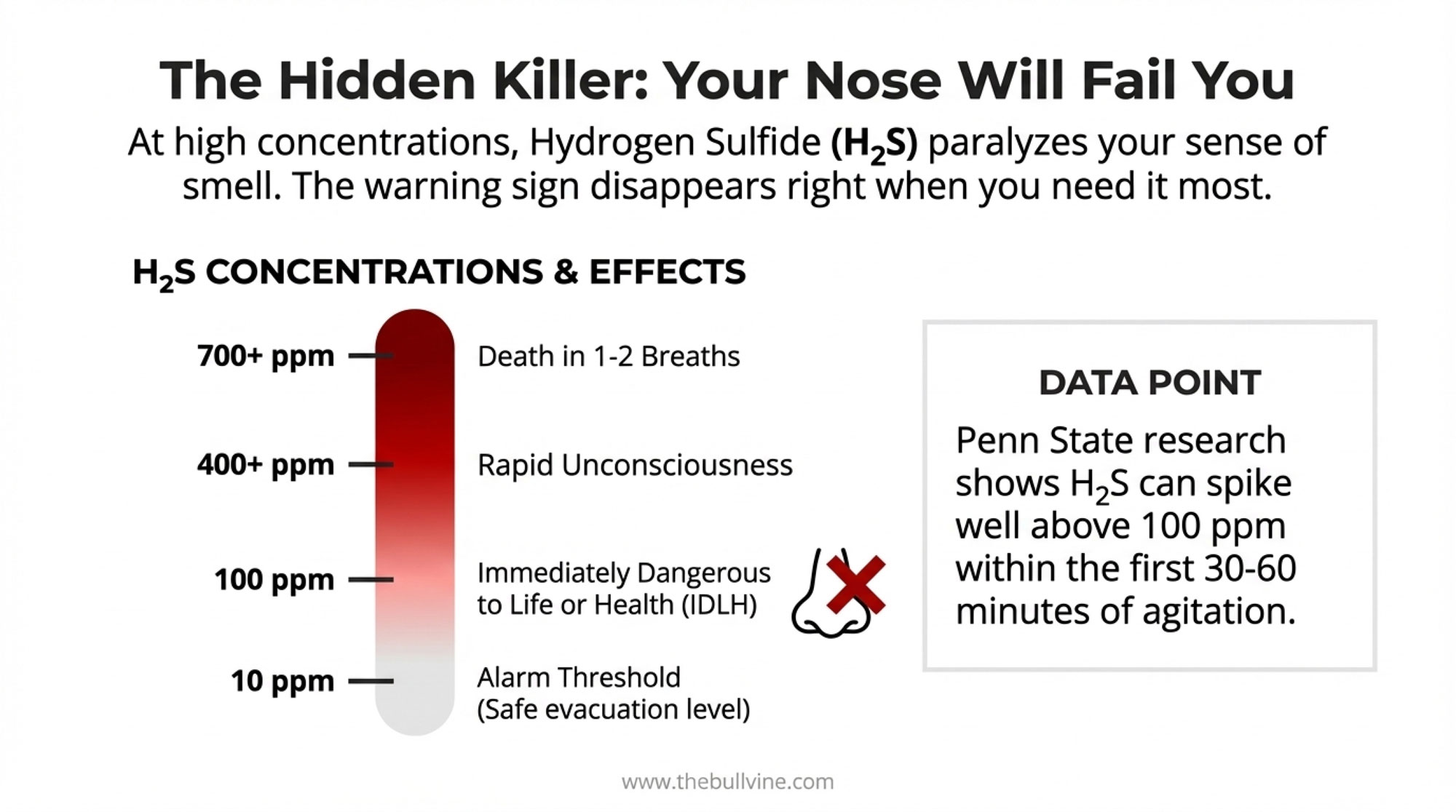
What makes hydrogen sulfide particularly dangerous—and this is something I don’t think gets emphasized enough in standard safety talks—is how it behaves at different concentrations. The CDC and NIOSH have established clear thresholds every producer should understand:

  • 10 ppm → Recommended alarm threshold; evacuate the area
  • 100 ppm → NIOSH “Immediately Dangerous to Life or Health” (IDLH)
  • 400+ ppm → Rapid unconsciousness, often within seconds
  • 700+ ppm → Death within one or two breaths

Here’s the part that catches people off guard: at high concentrations, H₂S paralyzes your sense of smell before you notice anything’s wrong. The warning sign disappears right when you need it most. So telling workers to “be careful” or “watch for the smell” doesn’t really account for how this hazard actually behaves.

Research from Penn State’s Department of Agricultural and Biological Engineering has documented concentration spikes well above the 100 ppm danger threshold during the first 30-60 minutes of agitation, reaching levels immediately dangerous to life and health—especially on operations using gypsum bedding. The danger isn’t a gradual buildup that gives workers time to respond. It’s rapid spikes that can incapacitate someone before they even realize there’s a problem.
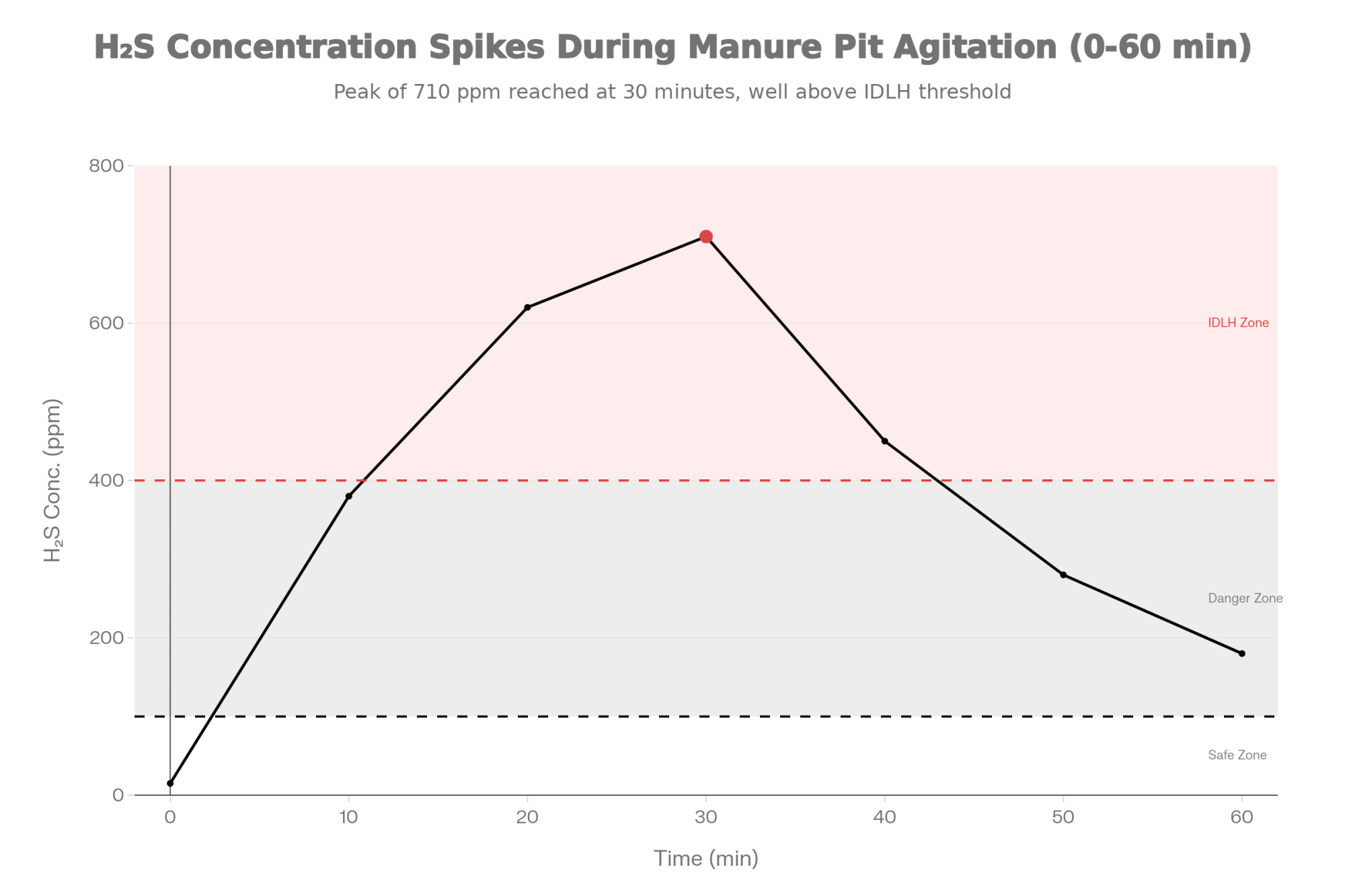
Peak danger happens in minutes, not hours. 

Penn State Extension specialists report that producers who’ve used monitors during agitation are consistently surprised by how quickly concentrations spike—often reaching several hundred ppm within the first 10-15 minutes. There’s something about watching those numbers climb in real time that makes the abstract hazard very, very concrete.

The Rescue Effect: Why Single Incidents Become Multiple Fatalities

One pattern that appears to have occurred in Colorado—and this is something safety professionals have documented extensively over the years—is the “rescue effect” or “cascade phenomenon.”
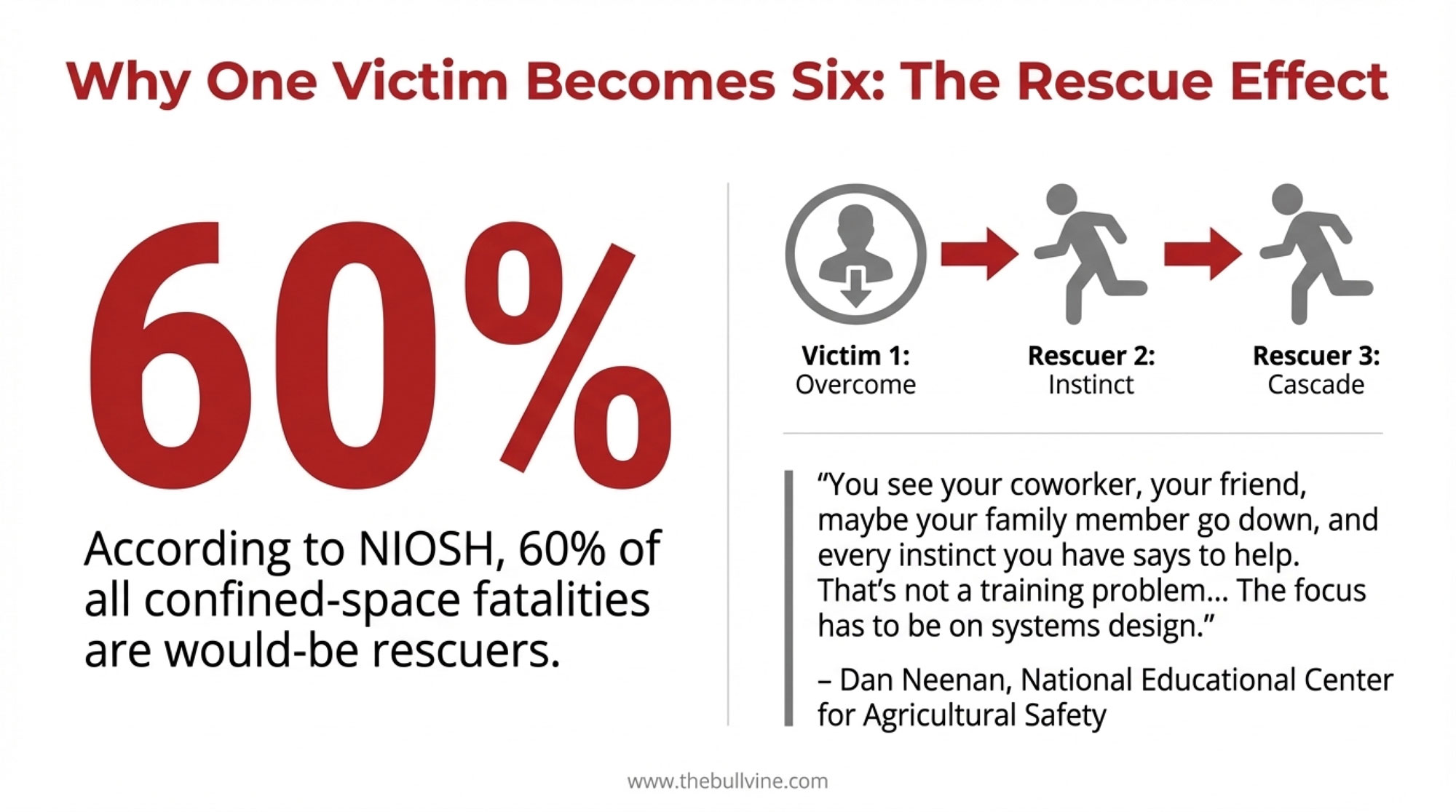
According to NIOSH data, approximately 60 percent of confined-space fatalities are rescuers who enter to save others. Think about that for a moment.
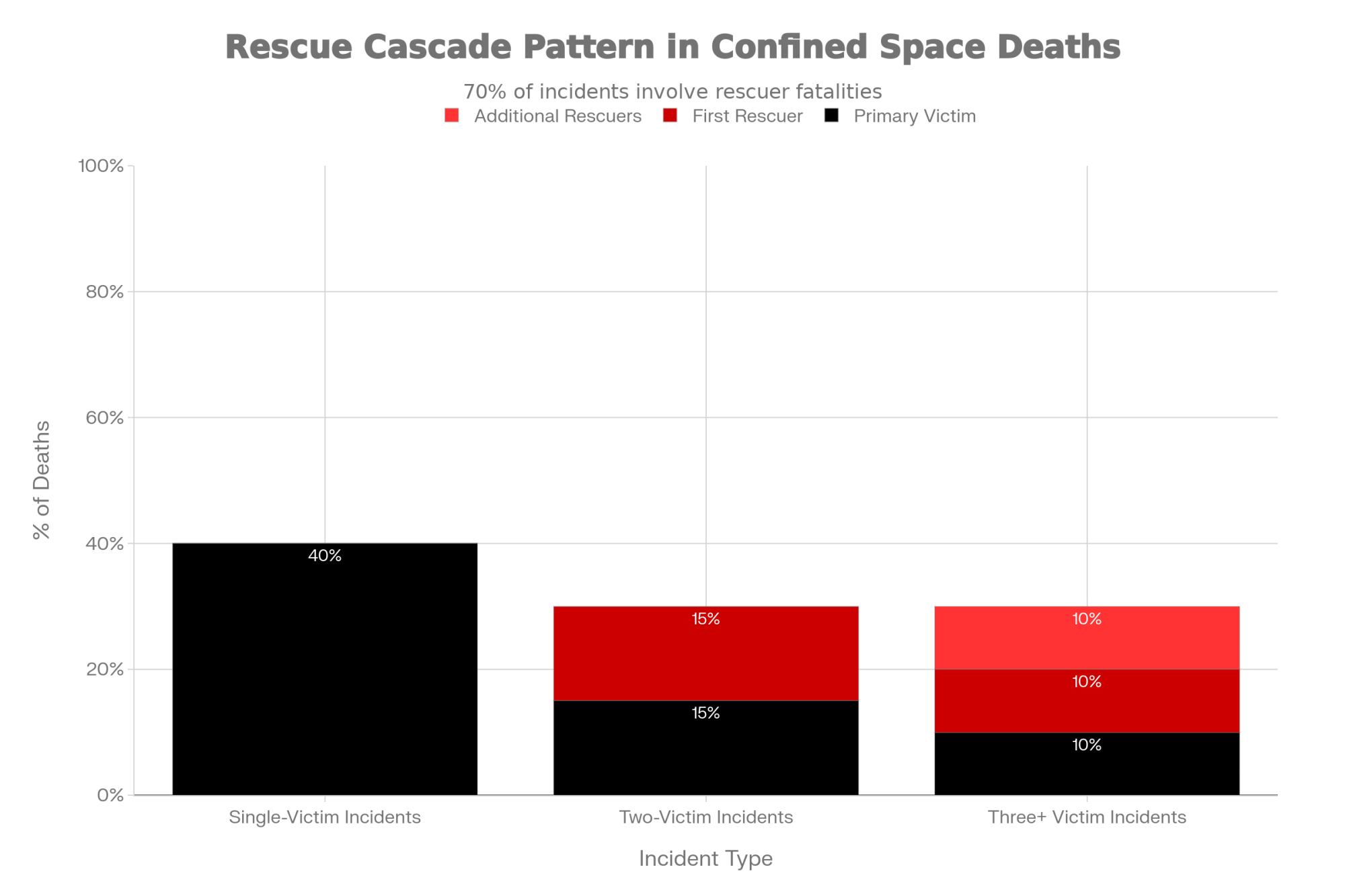
Incident TypePrimary VictimFirst RescuerAdditional RescuersTotal
Single-Victim40%0%0%40%
Two-Victim15%15%0%30%
Three+ Victim10%10%10%30%

A comprehensive study examining incidents from 1980-1989 documented 670 deaths in 585 confined space incidents during that period, with rescuers consistently dying at higher rates than initial victims when atmospheric hazards were involved.

The pattern is remarkably consistent:

  1. A worker is overcome and collapses
  2. Coworkers see someone in distress and rush to help
  3. Without respiratory protection or retrieval equipment, they’re overcome by the same hazard
  4. Others follow

Dan Neenan, who directs the National Educational Center for Agricultural Safety, frames it in terms that resonate with anyone who’s worked on a farm: “You see your coworker, your friend, maybe your family member go down, and every instinct you have says to help. That’s not a training problem you can solve by telling people to suppress their instincts.”

And that’s exactly right. That’s why the focus has to be on systems design rather than just awareness. You can’t train people not to care about each other—nor would you want to. The goal is providing tools that make safe rescue possible when that instinct kicks in.
Equipment Options: What’s Actually Available and What It Costs

The good news here—and I think this deserves more attention than it typically gets—is that the technology for preventing these tragedies isn’t exotic or prohibitively expensive. We’re not talking about the kind of capital investment required for a new milking parlor or feed center.
Atmospheric Monitoring

Portable hydrogen sulfide monitors have come down significantly in price. Based on current distributor pricing from suppliers like Grainger and MSA Safety:

Equipment TypeCost Range
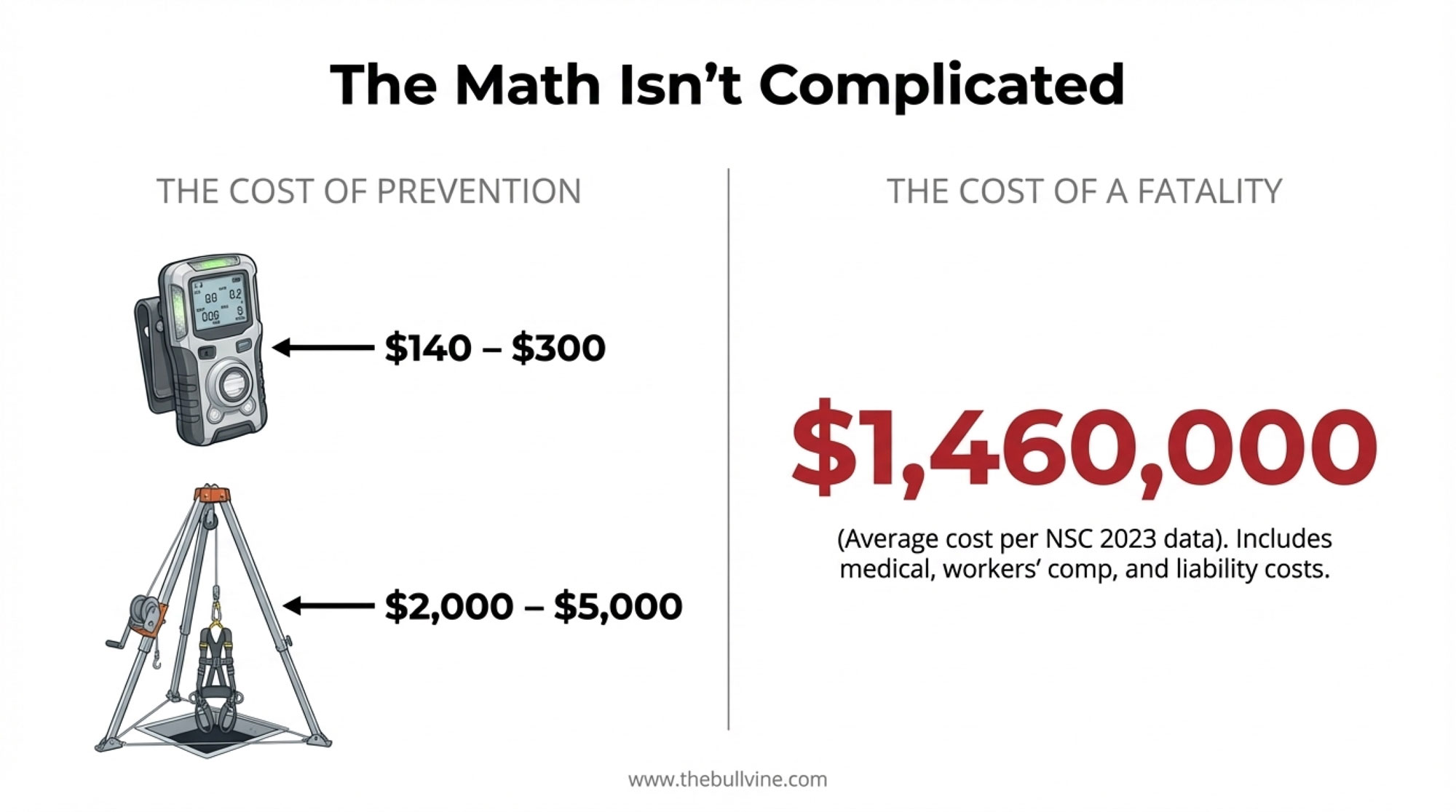
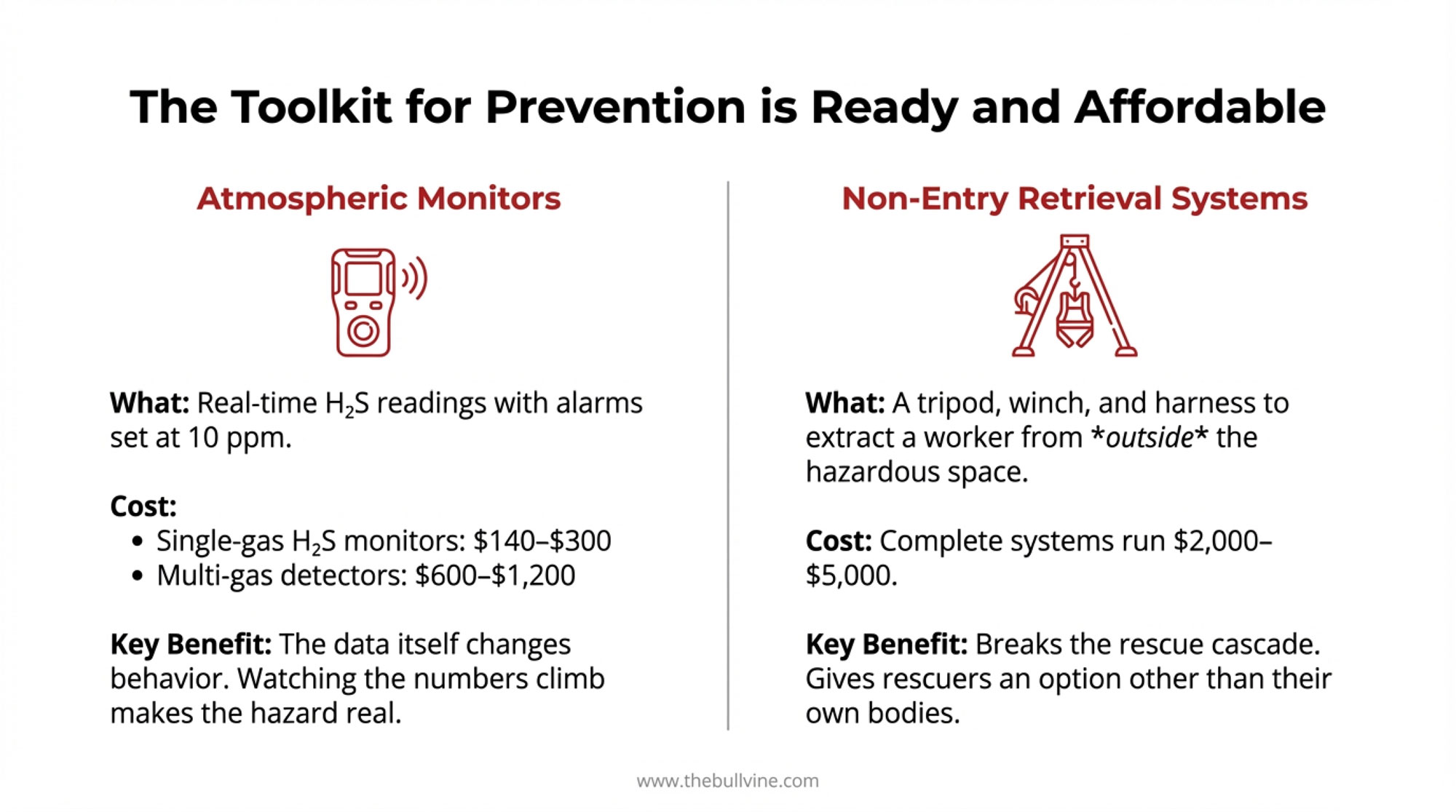
Single-gas H₂S monitors$140–$300
Multi-gas detectors (H₂S, methane, ammonia, O₂)$600–$1,200
Weekly rental options$30–$50

These devices provide real-time concentration readings and can be programmed to alarm at 10 ppm—well below the danger zone.

What producers are finding is that the monitoring itself changes behavior. Once you actually see the numbers during agitation, you understand why the guidelines exist. The data itself is educational in a way that safety talks and warning signs just aren’t.

The practical side: monitors require regular calibration and bump-testing before each use. But honestly, these aren’t complicated maintenance items for anyone already managing activity meters, automatic calf feeders, or other technology that’s become standard in modern operations.

Retrieval Systems

Non-entry rescue equipment—designed to extract an incapacitated worker from outside the confined space—typically includes a tripod, mechanical winch, harness, and lifeline. Complete systems run $2,000 to $5,000, depending on configuration.

The concept is straightforward: when a worker wearing a harness connected to a retrieval line is overcome, an operator outside the space can mechanically extract them—without anyone else entering the hazardous atmosphere. This breaks the rescue cascade.

Dr. William Field at Purdue, who’s studied farm confined space incidents for over three decades, puts it simply: “It’s the difference between having an option and not having one. When the only tool available is your own body, that’s what people use. Give them equipment that works from outside, and the dynamics change completely.”

Cost-sharing options:

  • Partner with neighboring farms to share retrieval equipment
  • Connect with local fire departments to ensure rescue teams know about on-farm confined spaces
  • Check with your cooperative about group purchasing programs
Written Programs and Documentation

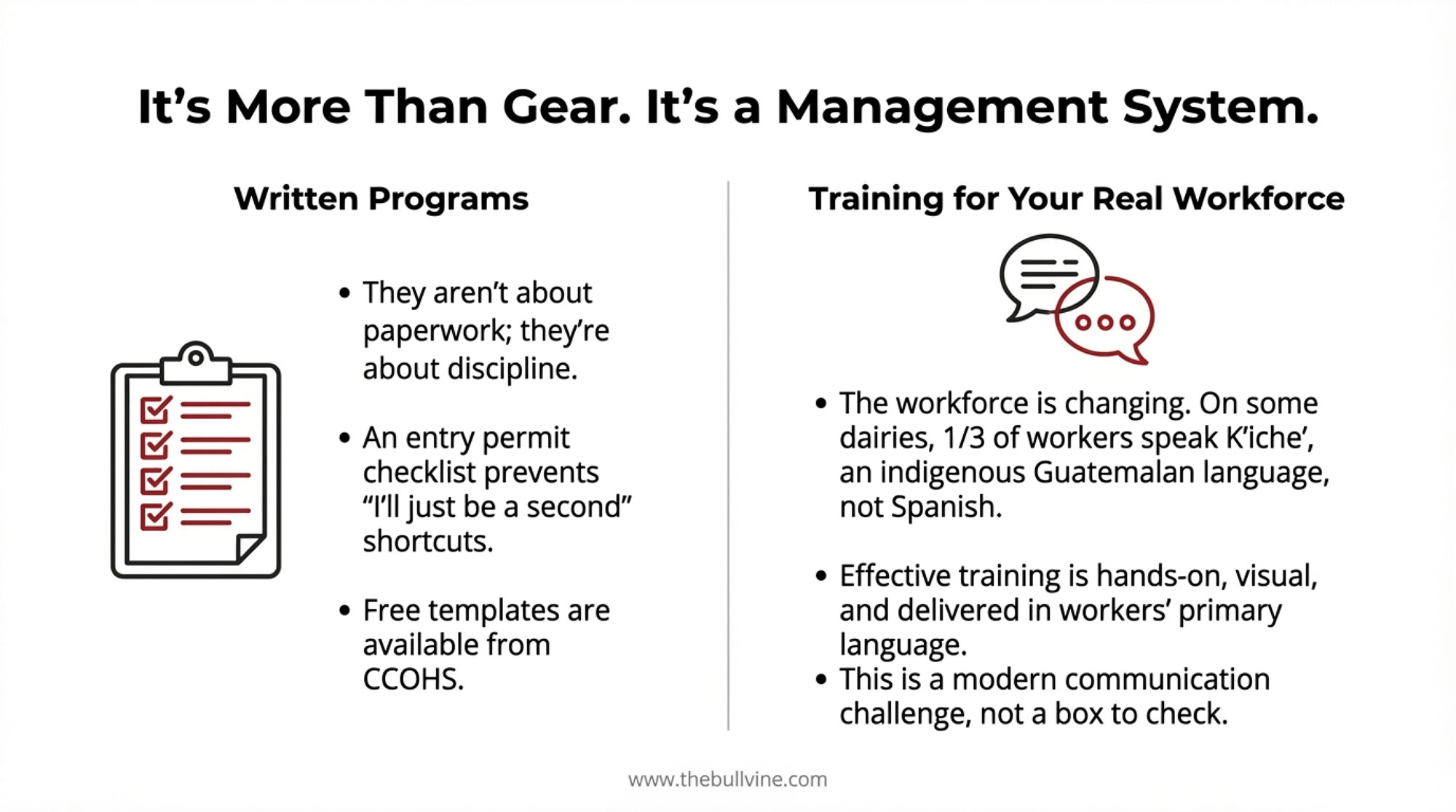
Beyond equipment, effective confined space safety requires documented procedures. This is where some producers push back—and I get it. Nobody got into dairy farming because they love paperwork. But the discipline of a written program catches oversights that informal approaches miss.

The Canadian Centre for Occupational Health and Safety offers free, downloadable templates that work well for U.S. operations. A complete program covers:

  • Hazard identification for all confined spaces
  • Atmospheric testing protocols
  • Entry permit systems
  • Rescue procedures and emergency contacts
  • Training documentation

The entry permit piece is worth emphasizing. Before anyone enters a confined space, a permit gets completed documenting atmospheric test results, equipment in place, and emergency procedures. It sounds like bureaucracy, but producers who use permits consistently tell me the checklist discipline is exactly what prevents the “I’ll just be a second” shortcuts that lead to trouble.

The Training Challenge: Reaching a Changing Workforce

Here’s something that doesn’t get enough attention in industry conversations about safety: the disconnect between how training is typically delivered and how many dairy workers actually learn.

Research from the Migrant Clinicians Network and studies published in Frontiers in Public Health have documented significant challenges:

  • Language barriers consistently rank as a major safety issue among Latino dairy workers
  • Formal safety training reaches fewer workers than most producers realize
  • Most learning happens from coworkers rather than structured programs

The workforce reality has evolved faster than training infrastructure in many regions. Dr. Robert Hagevoort at New Mexico State University Extension has documented that, on many southwestern dairies, approximately one-third of workers now speak K’iche’, an indigenous Mayan language from Guatemala, as their primary language. Not Spanish. Not English. K’iche’.

As Dr. Hagevoort explained, during standard training, they were missing one out of every three employees.

What’s proving more effective:

  • Training delivered in the workers’ primary language by fluent speakers
  • Hands-on demonstration rather than written materials
  • Assessment of actual comprehension, not just attendance
  • Visual aids and practical exercises that don’t depend on literacy
  • Repeated reinforcement across multiple sessions

New Mexico State actually developed voice-over translations for dairy safety training in K’iche’—work that required coordination with native speakers, since the language lacks a standardized written alphabet. It’s a model worth considering as workforce demographics continue shifting.

This isn’t just a southwestern issue. Operations in Wisconsin, Minnesota, and across the Northeast are navigating similar workforce transitions. The producers handling it best are treating communication as a core management challenge rather than a box to check.

The Regulatory Reality: What You Need to Know

Let me give you the quick version on regulations, because this matters for your decision-making.
The federal picture:

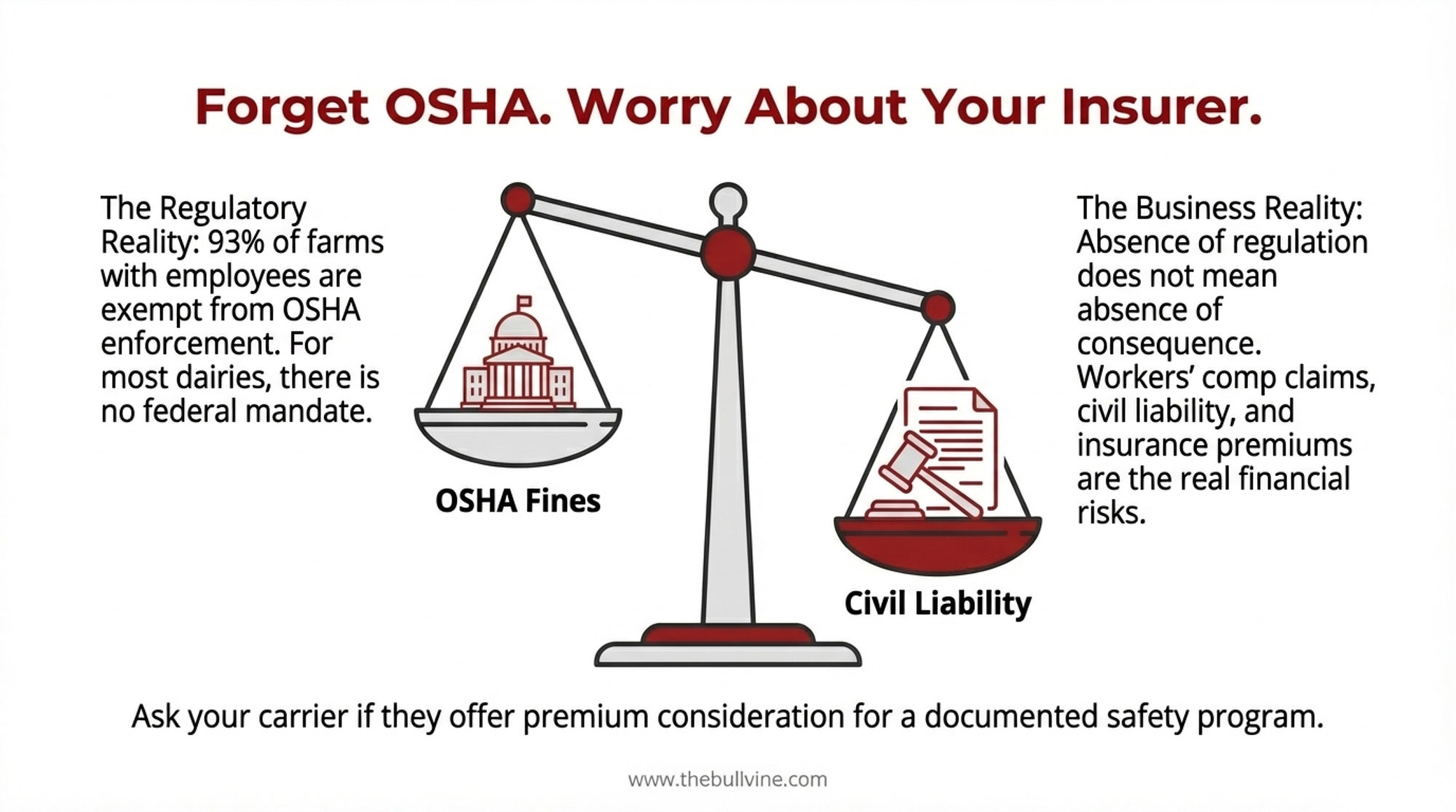
  • Farms with 10 or fewer non-family employees are largely exempt from OSHA enforcement (1976 appropriations rider, renewed annually)
  • According to The Atlantic’s analysis, 93% of farms with outside employees meet this exemption
  • OSHA can’t conduct routine inspections or issue citations on exempt operations—even after a fatality

State variations:

  • California: Cal/OSHA covers all agricultural operations regardless of size
  • Oregon & Washington: Active agricultural safety programs
  • Most other states: Minimal agricultural-specific requirements

The bottom line: Most dairy operations face no federal regulatory requirement for confined space safety programs. But here’s the thing—absence of regulation doesn’t mean absence of consequences.

A $200 monitor versus a $1.5 million wrongful death settlement. 

Workers’ compensation claims, civil liability exposure, and operational disruption from incidents can far exceed the costs of prevention. Some agricultural insurers are beginning to factor confined space protocols into premium calculations. It’s worth asking your carrier what documentation they consider.

One thing to watch: Legislative efforts to eliminate the small farm OSHA exemption continue. The most recent push in 2023 didn’t advance, but producers planning long-term should factor potential regulatory changes into their thinking.

Learning from What’s Worked Before: The Milk Quality Parallel

Here’s a comparison I find useful—not to criticize anyone, but to understand what this industry is capable of.
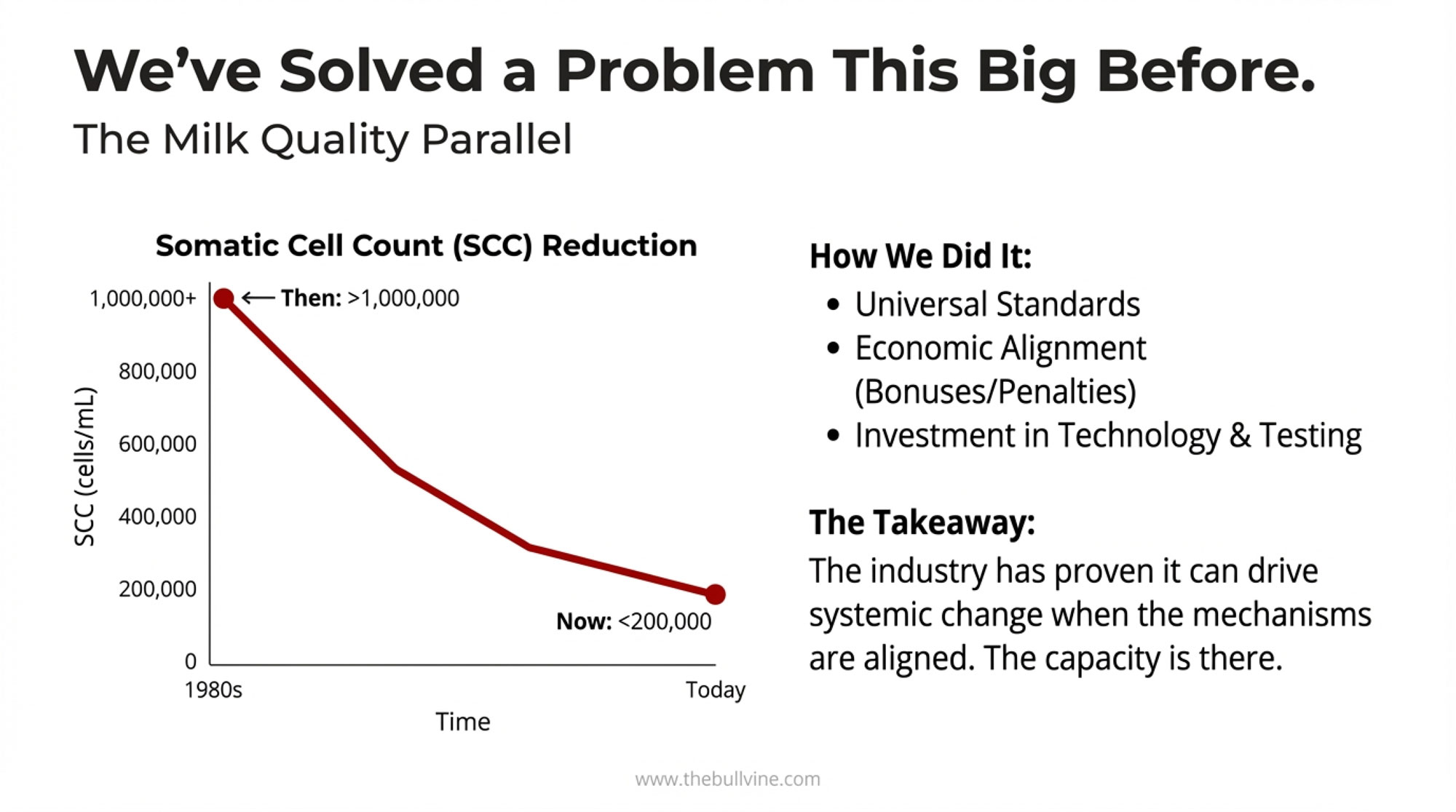
The transformation: In the 1980s, bulk tank somatic cell counts routinely exceeded 1 million cells/mL. Today, many operations achieve counts below 200,000. That happened within the working memory of producers still active in the industry.

What made it work:

  • Universal standards that applied to every farm
  • Enforcement with real consequences (lose market access)
  • Economic alignment (processor bonuses/penalties tied to SCC)
  • Investment in testing infrastructure

The industry demonstrated it could drive systematic change when the mechanisms aligned. Safety presents different challenges—the “return” on prevention is invisible until something goes wrong. But the organizational capacity clearly exists.

Some producer groups and cooperatives are beginning to explore whether similar frameworks could work for worker safety. It’s early, but the conversation is happening in ways it wasn’t five years ago.

What Implementation Actually Looks Like

I’ve been asking around what comprehensive programs look like in practice—not the textbook version, but the operations that are actually doing them.

Pre-Agitation Protocols

  • Test atmospheric conditions before any manure disturbance
  • Establish “no-go” zones during the first 60-90 minutes (highest-risk window per Penn State research)
  • Communicate clearly when agitation is occurring
  • One Wisconsin operation uses a simple flag system: red flag up = stay clear of the pit area

Seasonal Timing

  • Most northern operations schedule agitation during the spring and fall
  • Warmer temperatures accelerate gas production
  • With increasingly hot Midwest summers, some producers are being more cautious about late-spring timing

Equipment Deployment

  • Gas monitors worn by workers near manure storage during agitation
  • Retrieval systems set up before any planned entry
  • Emergency response kits at confined space access points

Training Integration

  • Safety briefings in workers’ primary languages
  • Hands-on practice—not just showing equipment but having workers use it
  • Regular drills, quarterly or more frequent
  • One California producer: “The drills feel excessive until you need them. The first real scare we had, everyone knew exactly where to go.”

Documentation

  • Entry permits are required before any confined space work
  • Training records for all personnel
  • Near-miss reporting to catch hazards before they become tragedies

The Economics: Making Sense of the Numbers
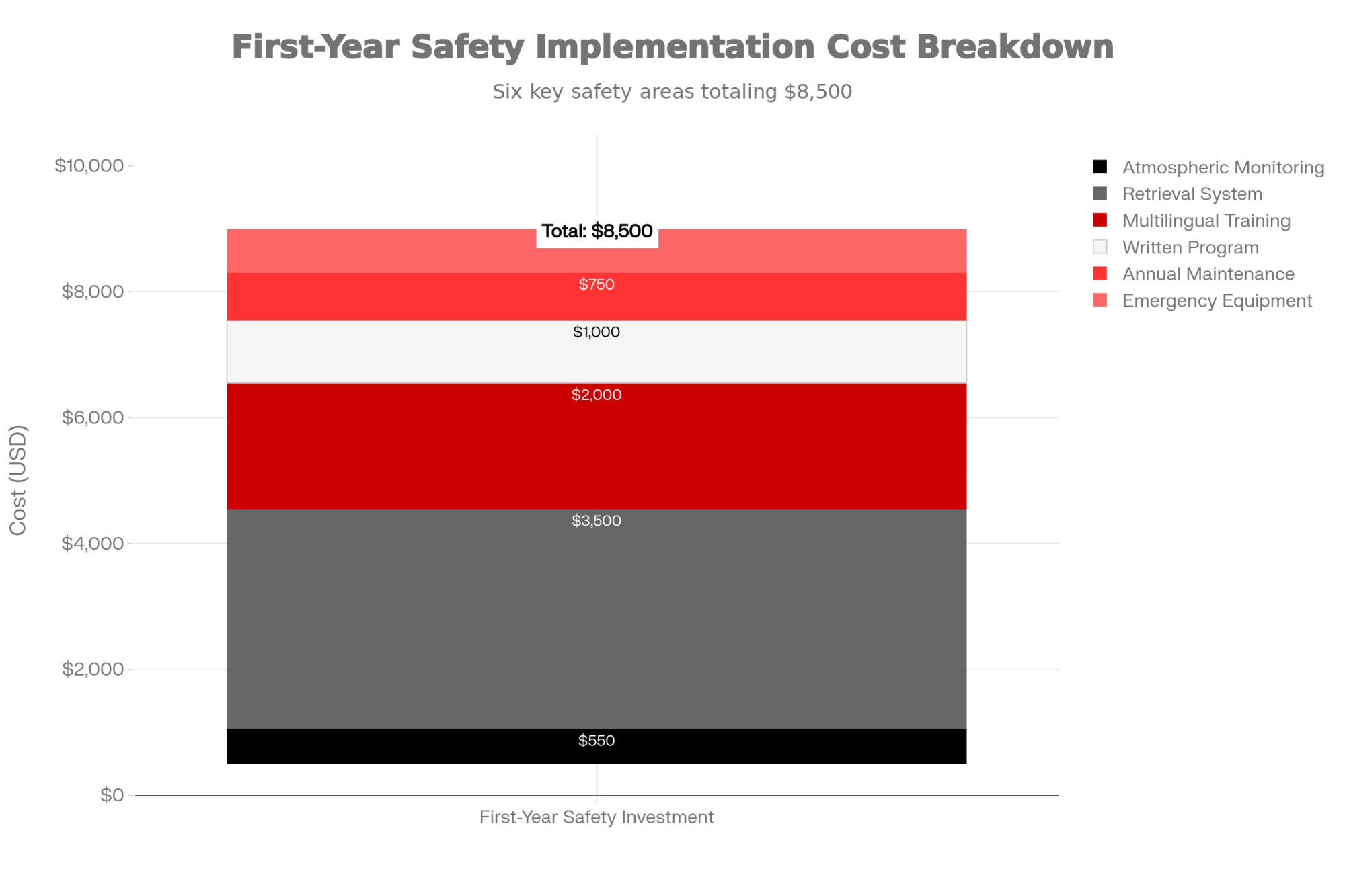
First-year implementation costs:

ItemCost Range
Atmospheric monitoring$300–$800
Retrieval system$2,000–$5,000
Training (including multilingual)$1,000–$3,000
Written program development$500–$1,500 (less with free templates)
Total first-year investment$4,000–$10,000
Annual maintenance/training$500–$1,000

What incidents actually cost:

ConsequenceCost Range
Medical expenses (serious H₂S exposure)$50,000–$200,000
Workers’ comp claim (fatality)$500,000–$1.5 million
Civil liability settlements$1–$5 million
Average workplace fatality (NSC 2023 data)$1.46 million

Research from the Institute for Work and Health in Ontario found ROI on safety investments ranging from 24% in manufacturing to over 100% in transportation when prevented incidents are factored in.

When you look at equipment costs comparable to routine operating expenses—less than a decent replacement heifer—the math starts to look different than many producers assume.

Regional Risk Factors to Consider

Risk levels aren’t uniform. Here’s what affects how much attention confined space protocols warrant for your specific operation:

Risk FactorHigher Risk ProfileLower Risk ProfileRecommended EquipmentEstimated Investment
ClimateSouthern states; hot, humid summersModerate temps; cooler regionsMulti-gas monitor, ventilation fans$800-$1,500
Storage DesignBelow-grade covered pits, limited airflowAbove-ground, open-top, natural ventilationH₂S monitor, retrieval tripod$2,200-$5,300
Bedding TypeGypsum (high sulfur content)Sand, sawdust, other low-sulfurContinuous monitoring, rescue gear$3,000-$6,000
WorkforceHigh turnover, multilingual, seasonalStable, experienced, consistentMultilingual training, frequent drills$1,200-$3,000 annually
Emergency AccessRural, 30+ min from hospital/rescueNear town; rescue services <15 minFull retrieval system, SCBA$4,000-$7,500

Your Next Steps: Start This Week

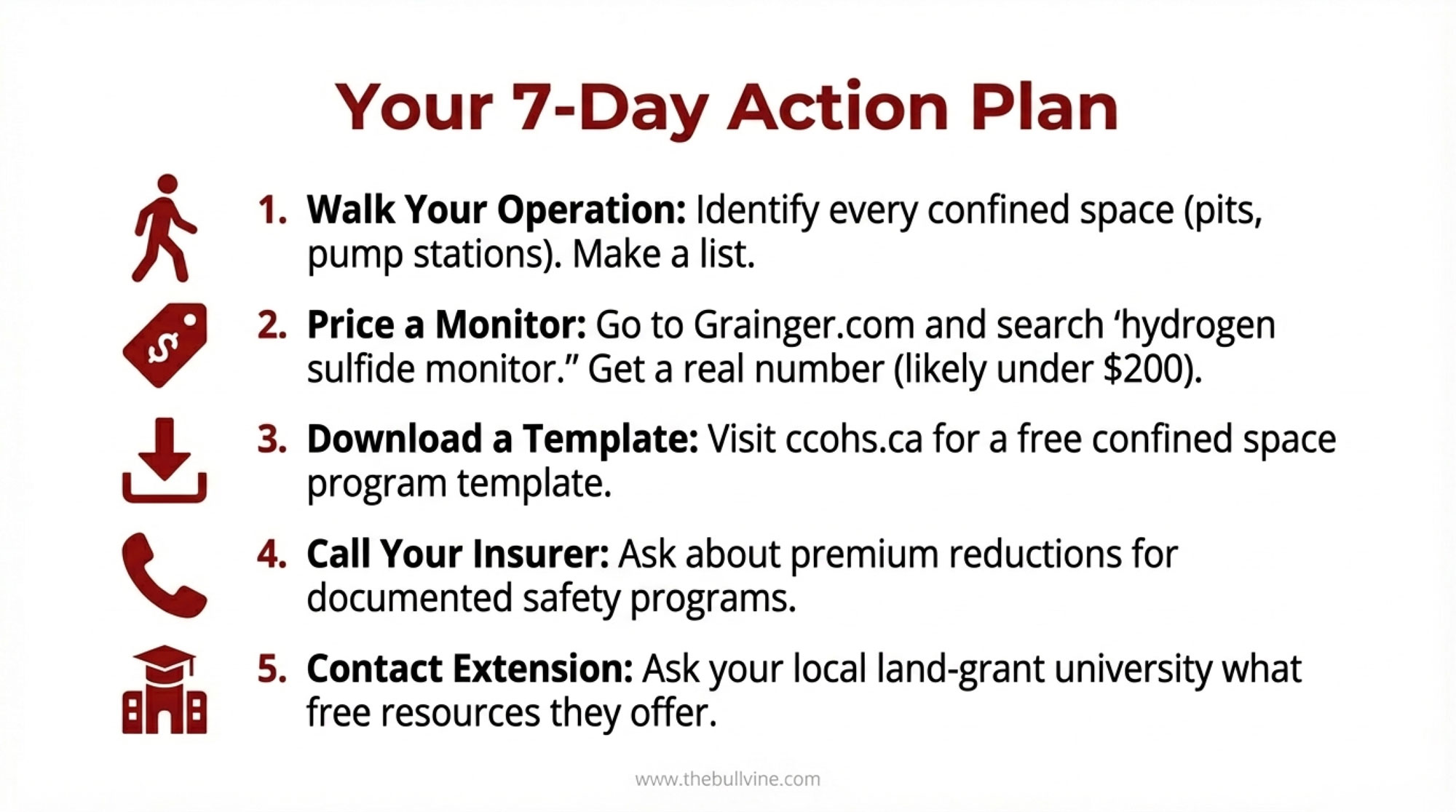
Don’t let this become another article you read and forget. Here are five things you can do in the next seven days:

1. Walk your operation tomorrow. Identify every manure pit, pump station, and storage facility where atmospheric hazards could develop. Make a list. You can’t manage what you haven’t identified.

2. Order a gas monitor this week. Go to Grainger.com or call your local safety equipment supplier. Get an actual quote for a single-gas H₂S monitor. Seeing a real number—likely under $200—changes the conversation.

3. Download a free template. Visit ccohs.ca and download their confined space program template. Even if you don’t implement it immediately, having it on your computer is a start.

4. Call your insurance carrier. Ask one question: “Do you offer any premium consideration for documented confined space safety programs?” The answer might surprise you—and might save you money.

5. Talk to your extension office. Call Penn State, Purdue, Wisconsin, or your state’s land-grant university extension. Ask what confined space resources they have available. Many offer free on-farm consultations you’ve probably never heard about.

The Bottom Line

The Colorado tragedy reminds us that the knowledge to prevent manure pit deaths has been available for decades. The technology is proven and increasingly affordable. The training methods are documented.

What remains is the work of translating awareness into action.

For the families of those six workers—including Alejandro Espinoza Cruz and his two sons Oscar and Carlos, who died together that August morning—that work needed to happen sooner.

For the rest of us, the tools and knowledge exist, and what happens next comes down to the choices we make in our own operations—starting this week.

Resources

Free Templates & Training Materials:

Regulatory Information:

Equipment Suppliers:

Key Takeaways

  • A $200 monitor could have saved six lives—including a father and two sons who died together at a Colorado dairy in August 2025
  • 60% of confined space deaths are would-be rescuers; you can’t train away the instinct to help, but you can equip for safe rescue
  • H₂S kills your sense of smell before it kills you—at high concentrations, the warning sign vanishes when you need it most
  • Peak danger: the first 60 minutes after agitation starts; establish no-go zones and test the air before anyone approaches
  • Start this week: Identify your confined spaces, price a monitor (~$150), and download free CCOHS templates

Complete references and supporting documentation are available upon request by contacting the editorial team at editor@thebullvine.com.

Learn More:

Join the Revolution!

Join over 30,000 successful dairy professionals who rely on Bullvine Weekly for their competitive edge. Delivered directly to your inbox each week, our exclusive industry insights help you make smarter decisions while saving precious hours every week. Never miss critical updates on milk production trends, breakthrough technologies, and profit-boosting strategies that top producers are already implementing. Subscribe now to transform your dairy operation’s efficiency and profitability—your future success is just one click away.

NewsSubscribe
First
Last
Consent

China Promised 100%. Delivered 2.7%. Here’s Your 48-Hour Defense Plan.

They announced 12 million tons of soybeans. Shipped 332,000. That’s 2.7%—and the gap between those numbers is where farms go broke.

Back in October, the headlines announced that China had committed to purchasing 12 million tons of U.S. soybeans. By mid-November, USDA export data told a different story: just 332,000 tons had actually been shipped. For operations making real financial commitments based on trade optimism, that gap is everything.

It’s the elephant in the room at every co-op meeting, yet nobody wants to say it out loud: the headlines are lying to us. Not maliciously, maybe. But consistently.

This isn’t a one-off. When the Phase One trade agreement was signed back in January 2020, China committed to purchasing $80.1 billion in U.S. agricultural goods over two years. The Peterson Institute for International Economics tracked what actually happened: $61.4 billion in purchases. That’s about 77% of the agricultural target and just 58% overall.

Whether that’s a freestall expansion in Wisconsin or new milking equipment out in the Central Valley—these numbers matter enormously when you’re penciling out that loan.

The Promise-Delivery Gap: 2.7% to 77%. That’s the range of what trade has actually delivered in recent years. It’s a wide spread—and it’s the reality farm financial planning needs to account for.

The 2.7% Reality: China’s trade commitments consistently fall short, with the 2025 soybean deal delivering a catastrophic 2.7% while Phase One averaged 77%—a pattern that should change every dairy farmer’s expansion calculus.
Risk FactorPhase One (2020-2021)China Soybean (2025)What Farmers Assumed
Historical Delivery Rate64-87% delivery2.7% delivery100% delivery
Market DependencyMedium – diversified buyersHigh – China-specificLow – “”guaranteed deal””
Price Impact per Deal$0.15-0.25/cwt estimated$0.35/cwt confirmedPrice increases expected
Timeline to Farm Impact90-180 days30-90 daysImmediate benefit
Cooperative ProtectionAbsorbed losses initially€149M losses, mergersCo-op will handle it
Individual Farm DefenseLimited – most expandedDMC available if enrolledNo action needed

The Pattern Nobody Talks About

Trade announcements follow a consistent pattern. Farmers who’ve watched a few cycles are starting to read them differently than the headlines suggest.

The Phase One trajectory:

  • 2020: Deal signed with $200 billion in purchase commitments over two years
  • 2021-2022: China’s agricultural imports from all sources surged to record levels; U.S. exports to China hit approximately $41 billion
  • 2023-2024: Import volumes declined as Phase One commitments expired and China diversified its suppliers
  • 2025: New tariff escalations with announced deals delivering at single-digit percentages

Here’s what makes this tricky: those 2021-2022 numbers were real. China genuinely did purchase record agricultural volumes. Processors genuinely did see elevated component prices. You probably saw the improvement in your own milk check.

The data supporting expansion decisions wasn’t fabricated—it was completely accurate for that specific window.

The question most operations didn’t ask was whether those volumes represented a sustainable baseline or a cyclical peak. That’s a hard question to ask when the current numbers look great, and your lender’s nodding along with the business plan.

Why 2022 Was a Peak, Not a Floor

The gap between black promises and red reality: Phase One targets soared to $43.6B while actual imports peaked at $41B in 2022, then collapsed—proving strong recent years were cyclical highs, not sustainable baselines for your 20-year expansion loan.

Several indicators were available in real-time. Here’s what the data was showing:

African Swine Fever recovery was completing. China’s hog population lost roughly 40% of its sow inventory in 2018-2019, according to OECD analysis. The rebuilding phase drove massive feed imports through 2021. By early 2022, Iowa State University’s Ag Policy Review documented that herd recovery was largely complete. That import surge had an endpoint built in.

Phase One commitments expired December 31, 2021. The agreement was a two-year commitment with a hard stop date. After expiration, continued purchases became voluntary.

China’s dairy self-sufficiency targets were public. The Chinese government explicitly targeted 70% dairy self-sufficiency. By 2022, according to Hoogwegt analysis, they’d reached 66% and climbing. When you’re managing your fresh cow nutrition and component production here, remember—they’re building their own capacity over there.

Economic growth projections were declining. The Asian Development Bank projected that China’s GDP growth would slow from around 8% in 2021 to 5% by 2024-2025.

These indicators were available to anyone looking. The challenge is that recent strong performance tends to overwhelm forward-looking warning signals. That’s an understandable response to good data, not poor decision-making.

How This Hits Your Milk Check

Trade policy disruptions create cascading effects that move from Washington to your milk check faster than most realize.

The 2025 tariff escalation:

When retaliatory tariffs on U.S. dairy into China escalated from 10% to 125% between February and April, the impacts were immediate:

Whey markets contracted sharply. China had been taking about 42% of U.S. whey exports according to USDEC data. When that market closed, domestic supply backed up and prices compressed. If you’ve been watching whey premiums in your component pricing, you’ve felt this.

Lactose faced similar pressure. With China holding roughly 72% of the U.S. lactose export market share, the tariff wall forced processor restructuring.

USDA revised price forecasts downward. Class III projections dropped by about $0.35 per hundredweight.

In practical terms: For a typical 1,000-cow operation producing around 26,000 pounds per cow annually, that $0.35 reduction works out to roughly $91,000 in annual revenue. That affects replacement heifer decisions, equipment upgrades, everything.

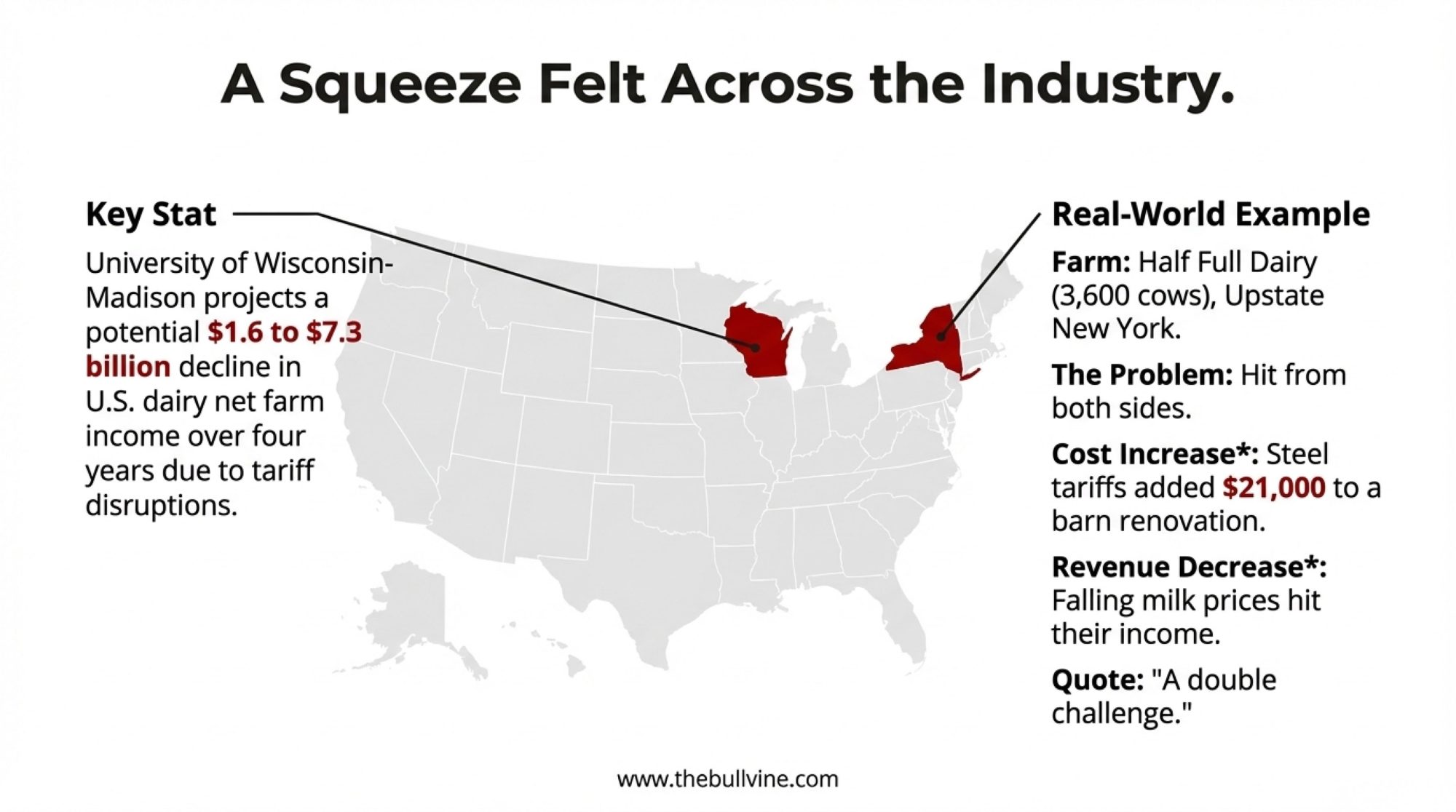
University of Wisconsin-Madison dairy economists project that net farm income across the U.S. dairy industry could decline by $1.6 to $7.3 billion over the next four years due to tariff disruptions, with individual farms facing potential income reductions of 25% or more.

Real example: Half Full Dairy in upstate New York—a 3,600-cow operation run by AJ Wormuth—got hit from both sides. Steel and aluminum tariffs added $21,000 to a barn renovation order while milk revenues fell. As Wormuth told reporters in April, they’re facing “a double challenge” in which they can’t raise prices while expenses keep rising.

Whether you’re running a 200-cow grazing operation in Vermont or a 5,000-cow dry lot in New Mexico, that squeeze feels familiar.

What’s Really Happening with Cooperatives

Common assumption: cooperative membership provides meaningful insulation from trade volatility.

Reality: cooperatives face the same structural pressures as individual farms, just with less flexibility to respond.

Case study: FrieslandCampina-Milcobel merger

FrieslandCampina reported a €149 million loss in 2023. Milcobel posted an €11.6 million loss. These weren’t management failures—they reflected a structural challenge.

The cooperative bind: They must accept all member milk regardless of market conditions. That’s the deal. But when processing capacity gets built for peak-year volumes and deliveries decline, cooperatives face rising per-unit costs with limited ability to adjust.

Unlike private processors who can exit markets quickly, cooperatives are bound by charter obligations. The result: they absorb losses to maintain member pricing, eroding equity over time. When losses become unsustainable, mergers or sales become the path forward.

We saw this with Fonterra’s 88% member vote to sell consumer operations to Lactalis this past October.

Rabobank dairy analyst Emma Higgins put it directly: “For dairy cooperatives, the challenges are even more complex, as lower milk intake generally coincides with members withdrawing capital.”

The counterpoint: Some cooperatives have navigated better. Agropur achieved a significant turnaround by aggressively restructuring its debt and refocusing on high-margin segments such as cheese and specialty ingredients. The model isn’t doomed—but it requires proactive management.

Your cooperative’s financial health directly affects your returns. Ask questions at the next annual meeting.

What Smart Operations Are Doing

Several practical approaches keep coming up:

Applying historical execution rates. Rather than planning for 100% delivery, they’re discounting based on historical performance. If Phase One delivered 77%, that becomes the planning assumption.

Stress-testing against zero deal impact. Before expansion decisions, they’re modeling, assuming the deal contributes nothing. If viability depends entirely on the deal working, that’s a different conversation with your lender and family.

Maximizing DMC enrollment. Dairy Margin Coverage provides protection when margins compress—and it doesn’t depend on trade promises. It depends on actual market prices.

Maintaining working capital flexibility. Operations that kept debt-to-asset ratios conservative have more options when markets shift. It’s not pessimism—it’s room to maneuver.

Exploring market diversification. Direct sales, specialty products like organic or A2, and regional processor relationships. Not for everyone, but it’s optionality that didn’t exist a decade ago.

Your 48-Hour Playbook for Trade Announcements

When the next deal gets announced, work through these steps:

Step 1: Check the History (30 minutes)

The Peterson Institute maintains a tracker showing the promised versus actual purchases under Phase One. Before reacting to any announcement, look at historical delivery rates.

The calculation: New promise × historical execution rate = realistic delivery estimate.

Phase One ran at 58-77%. The 2025 China soybean promise delivered 2.7%. That range gives you boundaries for scenario planning.

Step 2: Model for Zero (1-2 hours)

Have your accountant run a 12-month cash flow assuming no additional revenue from the announced deal.

Questions to answer:

  • What’s my debt-service-coverage ratio? (Target: 1.25+ per Farm Credit guidelines)
  • Can I cover debt service if export demand doesn’t materialize?
  • How many months can working capital sustain at reduced prices?

Document what you find. This strengthens lender conversations later.

Step 3: Verify DMC Status (45 minutes)

Contact your local FSA office and confirm Dairy Margin Coverage enrollment. If open and you’re not enrolled, evaluate immediately.

The timing trap: Trade announcements create optimism. Farmers skip enrollment. Then deals underperform, prices fall, and the window is closed. The 2025 enrollment closed on March 31.

The protection is most valuable when purchased before you think you need it.

Principles That Hold Up

Announcements are risk factors, not guarantees. The gap between announcement and execution is where farm financial planning actually lives.

Peaks aren’t baselines. Strong recent performance may represent cyclical highs, not sustainable floors. Expansion decisions financed over 10-20 years should be stress-tested across multiple scenarios.

Understand your cooperative’s position. Their balance sheet health affects your returns. Request financial information.

Maintain optionality over optimization. Operations preserving flexibility have more choices when conditions shift. There’s value in leaving room, even if it means not maximizing every metric.

Document your process. Whether you expand or hold back, a record of analysis strengthens lender conversations and demonstrates sound management.

The Bottom Line

Trade promises that deliver between 2.7% and 77% of announced targets raise legitimate questions about how agricultural trade policy functions. Whether the gap reflects deliberate choices or institutional limitations is hard to say.

What’s clear: farmers absorb the consequences while having limited ability to influence outcomes.

This doesn’t mean trade agreements lack value. U.S. dairy exports remain significant—Mexico, Canada, and other markets provide important revenue. The question is how to make sound decisions when the market outlook depends on commitments with highly variable execution.

Until the product ships and checks clear, a trade announcement is a press release, not a market.

The framework we covered—checking history, stress-testing for zero, securing DMC—provides concrete steps within 48 hours of any announcement. None guarantees good outcomes, but it positions you for realistic scenarios rather than headline optimism.

The fact that dairy farmers need a defensive playbook for government trade promises tells us something about the system. Whether by design or neglect, the pattern is clear: promises at 100%, delivery between 2.7% and 77%, farmers navigating the gap.

Until that changes, treat every announcement as a risk to manage—not an opportunity to bet the farm on.

That may sound conservative. Given the track record, it’s the smart play.

Key Takeaways:

  • The promise-delivery gap: 2.7% to 77%. Never 100%. Budget accordingly.
  • The cost: $0.35/cwt price drop = $91,000 annual loss on a 1,000-cow dairy.
  • Cooperatives won’t save you: FrieslandCampina lost €149M. Fonterra members voted 88% to sell.
  • Your 48-hour playbook: Check historical rates. Model for zero revenue. Verify DMC enrollment.
  • The bottom line: Until product ships and checks clear, a trade deal is a press release—not a market.

Executive Summary: 

China promised 12 million tons of soybeans. They shipped 332,000. That’s 2.7%—and your lender doesn’t care about the other 97%. Phase One delivered just 58-77% of agricultural targets, and dairy farmers absorbed the gap: $91,000 in annual losses for a typical 1,000-cow operation when Class III dropped $0.35/cwt. Even cooperatives can’t escape—FrieslandCampina lost €149 million; Fonterra’s members voted 88% to sell to Lactalis. The pattern is consistent: promises at 100%, delivery between 2.7% and 77%, farmers managing the difference. Here’s your 48-hour defense plan for the next trade announcement.

Complete references and supporting documentation are available upon request by contacting the editorial team at editor@thebullvine.com.

Learn More:

Join the Revolution!

Join over 30,000 successful dairy professionals who rely on Bullvine Weekly for their competitive edge. Delivered directly to your inbox each week, our exclusive industry insights help you make smarter decisions while saving precious hours every week. Never miss critical updates on milk production trends, breakthrough technologies, and profit-boosting strategies that top producers are already implementing. Subscribe now to transform your dairy operation’s efficiency and profitability—your future success is just one click away.

NewsSubscribe
First
Last
Consent

The Bovaer Warning: How Denmark’s Methane Mandate Went from Law to Crisis in 6 Weeks

Trial: 60 cows. Mandate: 1,400 farms. Crisis: 6 weeks. This is why Denmark’s methane ‘solution’ became a dairy disaster

EXECUTIVE SUMMARY: Denmark mandated Bovaer on October 1; by November 15, 1,400 farms reported sick cows and production losses that reversed within 48 hours of stopping. Norway suspended it preemptively—no crisis needed. This six-week collapse follows a predictable pattern: antibiotics created superbugs (a 55-year delay in a ban), glyphosate spawned 48 resistant weeds, neonicotinoids crashed bee populations—all were ‘thoroughly tested’ and ‘safe.’ The difference now? Mandates are moving faster than science, and your decades of genetic progress hangs in the balance. Your defense: monitor daily ($150-300/cow for basic systems), test 10-20% of your herd first, set clear exit triggers (e.g., 20% SCC increase = stop), and document everything. Bottom line: regulatory approval means it won’t poison your cows immediately—it doesn’t mean it’s right for your farm.

methane additive risks

When Norwegian dairy cooperatives announced their suspension of Bovaer use this November, I found myself thinking about a conversation I’d had with a Wisconsin producer just weeks earlier. He’d asked me whether new methane-reduction technologies were worth the risk, given his operation’s tight margins. Looking at what’s unfolding in Scandinavia, his caution seems particularly prescient.

We aren’t looking for controversy, but we can’t ignore the red flags flying over Danish barns. Following Denmark’s October implementation of mandatory Bovaer use for operations with more than 50 cows—a regulatory approach covered extensively by agricultural media across Europe—producers began reporting health concerns in their herds. The symptoms ranged from digestive issues to lameness, with some operations reporting measurable production impacts.

What’s particularly noteworthy is how one Danish producer described his experience to Farmers Guardian: his somatic cell counts improved markedly after discontinuing the additive. Now, while Danish agricultural authorities continue their investigation—they’ve been quite transparent about not having established causation—the pattern emerging warrants our industry’s attention.

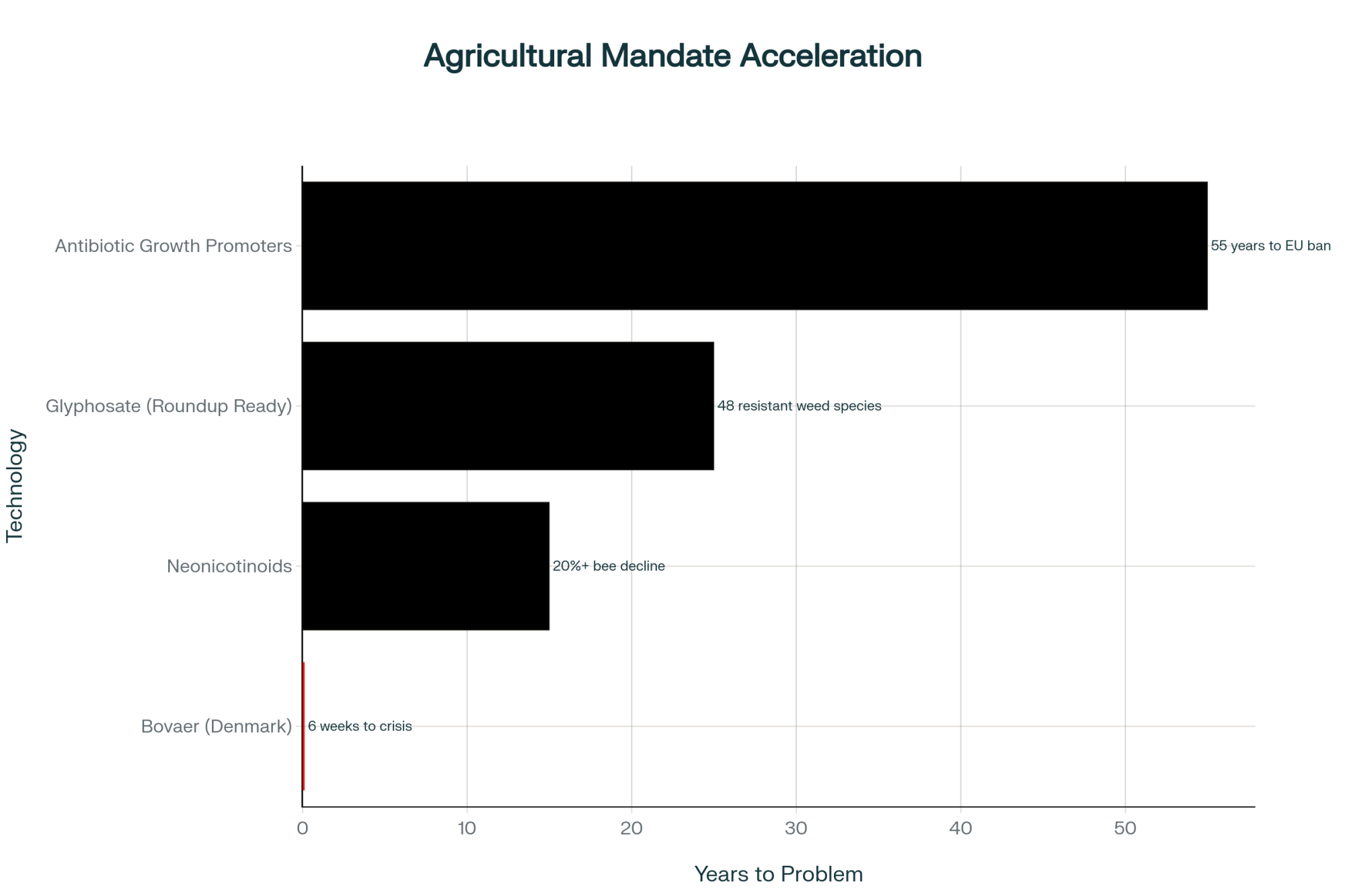
History repeats, but faster: It took 55 years to ban antibiotic growth promoters after discovering problems. Bovaer went from government mandate to producer crisis in 6 weeks. The pattern is clear—mandates are accelerating, but consequences aren’t disappearing.

Recognizing Historical Patterns in Agricultural Innovation

This situation brings to mind a presentation I gave at World Dairy Expo a few years back about technology adoption cycles in our industry. There’s a remarkably consistent pattern we’ve observed across decades of innovation.

Consider the antibiotic growth promoter experience. Back in the 1940s, researchers discovered that low-dose antibiotics could improve feed efficiency by 10-20 percent—revolutionary for its time, especially for operations in warmer climates dealing with heat stress. The science was solid, the economics compelling.

Yet it took decades for us to understand the broader implications of antimicrobial resistance. The European Union’s 2006 ban came 55 years after initial approval—a sobering timeline for any of us thinking about long-term consequences.

The Roundup Ready story offers another perspective. I remember the enthusiasm at those mid-90s farm shows—this technology promised to revolutionize weed management. And initially, it delivered.

But as any producer who’s dealt with palmer amaranth or waterhemp knows, nature adapts. The International Herbicide-Resistant Weed Database now documents 48 species with confirmed glyphosate resistance. Those early adopters who built their entire weed management program around a single mode of action learned an expensive lesson.

More recently, we’ve watched the neonicotinoid situation unfold. Initial safety assessments focused on acute toxicity to pollinators at field-relevant doses. What emerged later—through research like the comprehensive Nature Communications study by Woodcock and colleagues—were subtle, population-level effects that took years to document. Some bee species showed population declines exceeding 20 percent in treated agricultural landscapes.

Each case teaches us something valuable: technologies that perform well in controlled trials may behave differently when deployed across the diverse real-world farming systems.

Understanding the Current Timeline

What distinguishes the Bovaer situation is the compressed timeline. Denmark mandated use on October 1. By early November, producer organizations were documenting concerns from their members—the Danish Dairy Farmers’ Association received dozens of formal reports, though informal networks suggested broader concerns.

Danish authorities responded with revised guidance allowing welfare-based exemptions. Norwegian cooperatives announced their precautionary suspension by mid-November.

This six-week progression from mandate to suspension represents either enhanced responsiveness to producer concerns or potentially more acute issues than we’ve seen with previous technologies. Perhaps both factors are at play.

The issuance of welfare exemption guidance particularly catches my attention. While it’s encouraging that authorities responded to producer concerns, one wonders why such flexibility wasn’t built into the original implementation framework.

From mandate to meltdown: 1,400 Danish farms were ordered to feed Bovaer on October 1. By November 15, over 100 reported sick cows and production losses. Norway saw the same data and suspended use preemptively—with ZERO domestic problems reported. That’s the difference between reactive and protective agricultural policy.

The Gap Between Testing and Practice

Having reviewed both EFSA’s 2021 approval documentation and FDA’s 2024 assessment, I can appreciate the thoroughness of the regulatory process. These reviews examine toxicology at multiple doses, verify efficacy claims—in this case, that 27-30 percent methane reduction—and assess environmental safety under standardized conditions.

Trial: 60 cows. Mandate: 1,400 farms. Crisis: 6 weeks. This is exactly why Denmark’s ‘methane solution’ became a dairy disaster. Aarhus University is conducting the first real-world commercial welfare study NOW—three years AFTER regulatory approval. The gap between ‘tested in a lab’ and ‘safe for your farm’ just cost Danish producers weeks of production and genetic progress.

Yet researchers at Aarhus University are only now conducting what they describe as the first comprehensive welfare assessment under commercial conditions. This is three years after initial market approval. As they noted in their August announcement, the symptom patterns some producers are reporting weren’t observed in controlled trials.

This isn’t a criticism of regulators—it’s an acknowledgment of inherent limitations. Your operation, with its unique combination of genetics, forages, management practices, and environmental conditions, isn’t a research facility. The interaction of these variables creates complexity that controlled trials simply cannot fully replicate.

Here’s something else to consider: We spend generations breeding for longevity, mobility, and metabolic efficiency.

“We cannot afford to compromise twenty years of genetic progress for a mandate that hasn’t been stress-tested on high-production herds.”

The cows told the truth first: Danish farmer Anders Ring watched his somatic cell counts spike 20% during mandatory Bovaer feeding. Within 48 hours of stopping, SCC dropped 20% and production rebounded completely. His herd knew the truth before regulators admitted problems—daily monitoring saved his entire operation.

The daughters of bulls like Frazzled, Montross, and Supersire weren’t developed to be test subjects for rushed climate solutions.

A Framework for Thoughtful Technology Adoption

Based on conversations with producers who’ve successfully navigated new technology adoption, and drawing from extension recommendations from programs like Cornell’s PRO-DAIRY, here’s a framework worth considering:

Critical Questions Before Implementation

– What was actually tested versus what wasn’t?

  • Trial duration (most feed additive studies run 12-16 weeks)
  • Number and diversity of animals tested
  • Which metrics were evaluated (efficacy vs. comprehensive welfare)

– Can you monitor impacts quickly?

  • Daily tracking capability for SCC, components, and intake patterns
  • Locomotion scoring systems
  • Modern sensor technology ($150-300/cow basic, $500-800/cow comprehensive—typically pays for itself by preventing one health crisis)

– What’s your exit strategy?

  • Clear triggers for discontinuation
  • Legal ability to stop if concerns arise
  • Understanding of financial burden allocation

– Is this voluntary or mandatory?

  • Welfare exemption procedures
  • Compensation mechanisms
  • Reporting pathways

PhaseActionThresholdWhy It Matters
BEFORE (30 days)Document baseline metrics30 days minimumLegal protection & clear comparison
DURING (10-20%)Test on 10-20% of herdNOT your best geneticsLimit exposure, preserve value
MONITOR (Daily)Track SCC, intake, mobility$150-300/cow basic systems48-72 hour problem detection
EXIT TRIGGER 1Somatic Cell Count increase20% = STOPAnders Ring’s SCC jumped 20%+
EXIT TRIGGER 2Conception rate drop15% = STOPReproduction issues widely reported
EXIT TRIGGER 3Dry matter intake decrease10% = STOPEarly warning of metabolic stress
DOCUMENTEverything, in writingSet triggers BEFORE startingDon’t adjust thresholds mid-trial

Implementation Best Practices

Start conservatively:

  • Begin with 10-20 percent of your herd (not the highest genetic merit animals)
  • Maintain control groups under identical management
  • Document baseline performance for at least 30 days

Establish thresholds before you begin:

  • 20% increase in somatic cells = stop
  • 15% drop in conception rates = stop
  • 10% decrease in dry matter intake = stop
  • Write these down in advance—don’t adjust later

Operational Considerations

Smaller operations (under 200 head):

  • Your intimate cow knowledge is an advantage
  • Daily observation during milking catches subtle changes
  • Focus on individual cow behavior patterns

Larger operations (500+ cows):

  • Leverage DeLaval, Lely, or BouMatic management systems
  • Configure alerts for baseline deviations
  • Your technology is your early warning network

Grazing operations:

  • Confinement-tested technologies may perform differently on pasture
  • Watch grazing behavior changes as early indicators
  • Pasture-based systems add complexity, and trials don’t capture

Industry Perspectives and Balance

The manufacturer’s position deserves fair consideration. In their November statements, dsm-firmenich emphasized Bovaer’s successful use across multiple countries over several years, noting that previous investigations haven’t identified the additive as a causal factor in reported health concerns. This track record matters.

Danish authorities are taking a measured approach, investigating reports while avoiding premature conclusions. Their November ministry statements emphasize following evidence wherever it leads.

What I find instructive is the contrast between Danish and Norwegian responses. Norway implemented a precautionary pause despite no domestic reports of problems. This represents a philosophical difference in risk management that is worth discussing across the industry.

Broader Trends Shaping Our Decisions

Several converging trends affect how we should evaluate emerging technologies:

Climate regulations are intensifying. The European Union’s Farm to Fork strategy targets 55 percent reductions in emissions by 2030. California’s SB 1383 mandates a 40 percent reduction in methane over the same period. These aren’t distant goals—they’re reshaping market access and milk pricing today.

Producer networks have transformed information flow. Through online forums and messaging platforms, experiences that once took months to circulate now spread in hours. This acceleration can amplify both legitimate concerns and unfounded fears.

Consumer awareness has reached unprecedented levels. When major cooperatives trial new technologies, social media responses are immediate and increasingly shape market dynamics. Market perception increasingly affects on-farm decisions.

Meanwhile, monitoring technology continues advancing. Modern systems can detect subclinical changes that would have gone unnoticed a decade ago. This capability fundamentally changes our ability to manage risk.

Learning from Producer Experience

In preparing this piece, I’ve spoken with numerous producers who’ve evaluated methane-reduction technologies. Their experiences offer valuable insights.

A 450-cow Jersey operation in California’s Central Valley shared that detailed documentation in her management software proved invaluable when addressing concerns about a previous feed additive. “Document everything,” the owner emphasized. “Not because you expect problems, but because good data protects everyone—you, your nutritionist, and yes, even the manufacturer.”

Cooperative networks are proving their value. A Wisconsin cooperative chair (speaking on condition of anonymity) told me how their producer WhatsApp group helped multiple members avoid issues when three farms reported similar concerns with a product. “That collective knowledge saved us collectively hundreds of thousands in potential losses,” he noted.

What consistently emerges is advice to approach new technologies as if running a research trial. Test methodically, monitor comprehensively, and be prepared to adjust based on evidence.

Practical Takeaways for Your Operation

Do the math yourself: A $300/cow monitoring system catches problems in 48-72 hours. Waiting for visible clinical signs means 2-4 weeks of losses BEFORE you even know there’s a problem. Danish farmers who tracked metrics daily recovered in 48 hours. Those who waited lost weeks. On a 100-cow operation, that’s the difference between a $30,000 proactive decision and a $7,500+ reactive disaster—and that’s BEFORE you count unmeasured fertility damage and lost genetic progress.

As we navigate increasing pressure to adopt climate-smart technologies, several principles deserve emphasis:

Regulatory approval represents a starting point for evaluation, not an endpoint. The gap between “approved” and “optimal for your specific operation” remains yours to assess and bridge.

Rapid problem detection—whether through technology or observation—can mean the difference between minor adjustments and major losses. The ability to identify issues within 48-72 hours should be considered essential infrastructure.

Starting small isn’t timidity—it’s prudent management. Even under pressure to adopt quickly, gradual scaling based on documented performance protects your operation’s viability.

Collective producer experience matters. When multiple operations report similar observations, patterns emerge that individual experiences might not reveal. Your voice, combined with others, shapes industry understanding and regulatory response.

Above all, animal welfare must remain paramount. If a technology compromises your herd’s health, discontinuation is appropriate regardless of other pressures. Danish authorities’ eventual acknowledgment of welfare exemptions validates this principle.

Charting a Productive Path Forward

The path forward doesn’t require choosing between innovation and caution, or between environmental progress and animal welfare. I’ve seen numerous operations successfully integrate new technologies by taking measured approaches.

What we need is more comprehensive pre-deployment testing that reflects actual farm diversity. Not just research stations, but grazing operations, high-production confinement systems, organic dairies, and everything between.

Regulatory frameworks should build in flexibility from inception, not add it reactively. Producer input should be integral to technology development, not an afterthought during implementation.

Most fundamentally, we need recognition that sustainable dairy farming requires both environmental progress and economic viability. These aren’t competing goals—they’re interdependent requirements for our industry’s future.

Final Thoughts for Our Industry

The Danish and Norwegian experience with Bovaer offers valuable lessons about innovation, regulation, and the realities of modern dairy farming. This isn’t about opposing progress or uncritically embracing every new technology.

It’s about developing wisdom to distinguish between what works in trials and what works in the complex reality of commercial dairy operations.

Research teams at universities and companies continue developing new approaches to methane reduction—enzyme inhibitors, probiotics, genetic selection, and management innovations. Each will eventually arrive at our farm gates with promises and peer-reviewed papers.

The question isn’t whether to embrace or reject these innovations wholesale. It’s about evaluating them thoughtfully, implementing them carefully, and monitoring them comprehensively. The producers who succeed will be those who trust their data, respect their experience, and maintain the confidence to act on both.

This balance—between openness to innovation and commitment to proven principles—isn’t just smart farming. It’s essential for navigating agriculture’s transformation while maintaining the animal welfare, environmental stewardship, and economic sustainability that will keep dairy farming viable for the next generation.

Here’s my challenge to you: Before the next mandate arrives at your farm gate, have your monitoring systems in place. Know your baseline metrics. Build your producer network. Because the best time to prepare for technology adoption isn’t when it becomes mandatory—it’s right now.

Key Takeaways:

  • Your cows will tell you before regulators will: Danish farmers who acted on SCC spikes recovered in 48 hours; those who waited for “official guidance” lost weeks of production
  • The 10-20-30 Shield: Before any new technology—Test 10-20% of herd, Document 30 days baseline, Set exit triggers in writing (20% SCC increase = stop)
  • A $300/cow monitor beats a $30,000 crisis: Daily tracking catches problems in 48-72 hours; waiting for clinical signs means you’re already losing money
  • Networks save herds: Denmark’s 1,400 affected farms found each other online before regulators admitted problems—your WhatsApp group is your first defense
  • Remember the timeline: Antibiotics (55 years to ban), Glyphosate (48 resistant weeds), Bovaer (6 weeks to crisis)—the pattern is clear, mandates are getting faster, consequences aren’t

Complete references and supporting documentation are available upon request by contacting the editorial team at editor@thebullvine.com.

Learn More:

Join the Revolution!

Join over 30,000 successful dairy professionals who rely on Bullvine Weekly for their competitive edge. Delivered directly to your inbox each week, our exclusive industry insights help you make smarter decisions while saving precious hours every week. Never miss critical updates on milk production trends, breakthrough technologies, and profit-boosting strategies that top producers are already implementing. Subscribe now to transform your dairy operation’s efficiency and profitability—your future success is just one click away.

NewsSubscribe
First
Last
Consent

France Lost €20 Million ‘Saving’ on Vaccines – Here’s the $2,500 Plan That Protects Your Operation

France’s overnight export ban is a stark warning for North American producers: Your business continuity plan is now your most valuable asset

EXECUTIVE SUMMARY: What farmers are discovering from France’s lumpy skin disease response is that government cost-cutting on disease prevention can instantly become producers’ financial catastrophe. When France chose to vaccinate just 1.2% of their 17-18 million cattle instead of pursuing the €75-100 million comprehensive approach that eliminated LSD in the Balkans, they saved upfront costs—but Irish cattle exporters absorbed €1.85-2.14 million in losses when France implemented an overnight export ban on October 18. Recent EFSA research confirms that achieving disease elimination requires 90% vaccination coverage maintained for 2-3 years, yet France’s limited approach left them vulnerable to outbreaks 500 kilometers from initial containment zones. With EU beef production at its lowest since 2014 and Mercosur imports hitting 15-year highs, disease management decisions are reshaping competitive positions across global markets. For North American producers who remember the 2003 BSE crisis that shut down $2 billion in exports from one cow, France’s situation offers a crucial lesson: building your own $2,500-per-farm biosecurity framework beats waiting for government protection when the next disease hits. The smartest operations aren’t hoping for comprehensive government response anymore—they’re investing in documented disease-free status, alternative shipping routes, and financial cushioning that turns tomorrow’s crisis into today’s competitive advantage.

Dairy Trade Risk

I’ll tell you what’s been coming up at every producer meeting lately: “If France can shut down cattle exports overnight for disease control, what’s stopping our province or state from doing the same thing?”

It’s a fair concern, especially watching what’s happening in Europe right now. The way lumpy skin disease is being handled over there… well, it offers some real lessons for North American dairy operations—particularly around how quickly disease management can turn into trade disruption.

Two Roads Diverged in a European Field

So I’ve been tracking this situation pretty closely, and what’s really interesting is how differently countries tackled the exact same problem.

When the Balkans faced LSD between 2016 and 2018, the European Food Safety Authority documented their responsein detail. Albania, Bulgaria, and North Macedonia spent about €20.9 million combined—they vaccinated over 70% of their national herds with the homologous Neethling vaccine. You know, the type that’s shown better field effectiveness than heterologous options in European trials. And by 2018? Complete elimination. They’re disease-free today with full EU market access… roughly the equivalent of getting your interstate health papers approved permanently.

France, though… they took a different path, and the numbers tell quite a story.

According to EU Commission Decision 2025/1336 from July, French authorities have vaccinated roughly 220,000 cattle so far. Now, Institut de l’Élevage’s census puts France’s national herd at 17 to 18 million head. Quick math here—that’s about 1.2% coverage.

For perspective, that’s like vaccinating all the dairy cows in Dane County, Wisconsin, and calling the entire Midwest protected.

What’s worth noting is that EFSA’s 2019 technical guidance spells out what elimination actually requires: 90% coverage maintained for two to three years with an effective vaccine. The gap between where France is and where they’d need to be… well, it’s like the difference between managing your transition cows and managing your entire milking string.

How a Success Story Turned South

Looking at the World Organisation for Animal Health notifications from this summer forward, you can track exactly how this developed—and it’s quite something.

France detected their first LSD case on June 29 near the Alps. By late August—and Reuters covered this on August 28—things actually looked promising. Vaccination in the restricted zones had brought weekly outbreaks down from 10 in July to just 2. They’d achieved 90% coverage in those immediate 20-kilometer protection zones and 50-kilometer surveillance zones.

But here’s the thing… anyone who’s dealt with bluetongue or anaplasmosis knows the challenge with vector-borne diseases. Those biting midges? They don’t check zone boundaries before crossing.

By mid-October, French Ministry of Agriculture bulletins were reporting new outbreaks in Ain, Jura, and Occitanie. Then came the really concerning ones in Pyrenees-Orientales, just 30 kilometers from the Spanish border.

Spain had already found their first case on October 1 in Girona—their WOAH notification shows immediate culling of 123 cattle. Spanish authorities initially said they’d hold off on mass vaccination unless forced to. Nine outbreaks later, according to Catalonia’s Department of Agriculture, they reversed course completely.

When Economics Drive Health Decisions

For those of us managing operations—whether you’re milking 200 cows in Pennsylvania or running 2,000 head in California’s Central Valley—understanding how governments weigh these decisions matters more than you might think.

Based on EFSA modeling and what the Balkans actually spent, France was looking at two clear options. Scale up the Balkans’ €20.9 million program to France’s much larger herd, and you’re probably talking €75 to 100 million for nationwide vaccination. Or manage localized outbreaks for maybe €5 to 10 million annually.

They went with option two, which seemed reasonable given the initial containment success.

But when those October outbreaks hit near Spain—French surveillance maps show these were over 500 kilometers from the original Alpine cases—they had about 72 hours to make a call.

Expanding vaccination meant securing cold chain logistics for millions of doses. And according to OBP vaccine manufacturer specs, it takes about 21 days post-vaccination for solid immunity to develop. That’s three weeks of vulnerability even if you started immediately.

An export ban though? No direct government expenditure, implements in 18 hours.

Agriculture Minister Annie Genevard announced it October 17. Effective October 18. The Irish Department of Agriculture reported getting their notice Friday afternoon for Saturday morning implementation.

If you’ve ever tried to redirect a milk truck on short notice, you know what that timeline means.

Preparedness ActionWhat Progressive Farms DoWhat Waiting Farms Risk
Documentation StrategyDuplicate records + quarterly disease-free certification from university labsMovement delays while waiting for state clearance during restrictions
Logistics ResilienceThree mapped backup routes to processing plants + quarterly disruption drillsSingle-route dependence = 12 days vs 12 hours to pivot during bans
Vaccination ReadinessBudget $3-5/head for private procurement if disease within 500km radiusRelying on government programs that may take weeks to deploy vaccines
Market PositioningDocument disease-free status now, write into contracts (3-7% premium potential)Missing 3-7% premiums on $17 milk = losing $0.51-$1.19/cwt opportunity
Financial Cushioning15-30 day movement restriction cash reserves + force majeure contract clausesCash flow crisis during unexpected 15-30 day movement restrictions
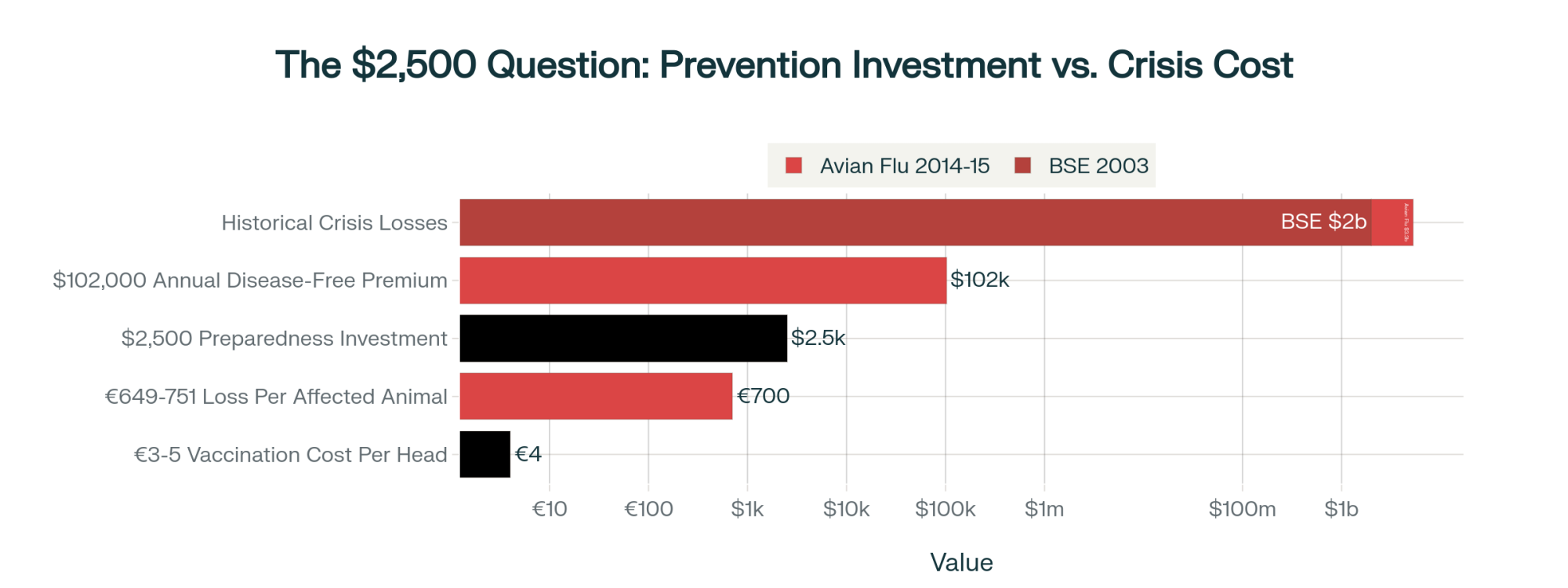
Cost Per 500-Cow Dairy$2,500 prevention investmentPotential losses: $649-$751 per affected animal (Ireland example)
Historical Loss ComparisonAvoided $2B loss (BSE 2003) and $3.3B loss (Avian Flu 2014-15)Reactive crisis management vs. proactive competitive advantage

Real Farms, Real Losses

What happened to Irish cattle exporters shows exactly how these decisions ripple through actual operations.

Bord Bia’s export statistics show Ireland moves about 325,000 cattle annually. Roughly 56,000 go through France to Spain, another 37,000 to Italy. We’re talking 1,800 head weekly using French transit routes—that’s equivalent to the annual calf crop from maybe 4,500 dairy cows.

When the ban hit, the Irish Farmers Association estimates about 2,850 head were either rolling down French highways, sitting at lairage facilities, or loaded on trucks ready to go.

France’s October 18 regulatory notice said Irish cattle could keep transiting—but only if they avoided protection or surveillance zones.

Sounds workable until you remember EU Regulation 1/2005 on animal transport. The law requires rest stops—every 14 hours for adult cattle, 9 hours for unweaned calves. You can’t legally drive straight through France. And those surveillance zones? They kept expanding daily, like watching a thunderstorm cell grow on radar.

The Irish Department of Agriculture’s October 17 update laid out some brutal choices. Find facilities outside surveillance zones with zero notice—good luck with that. Or turn around and head home.

Teagasc economic analysis put holding costs at €2 to 5 per head daily. Add transport costs both ways. Contract penalties for missed deliveries. And here’s the kicker—Swiss Re’s livestock insurance framework generally doesn’t cover third-party government transit bans.

The Irish Farmers Association’s preliminary calculations? Their members absorbed between €1.85 and 2.14 million in losses during that 15-day period. That’s roughly equivalent to three months of electricity costs for 500 Wisconsin freestall barns… just evaporated.

Three Approaches, Three Outcomes


Metric
Balkans StrategyTurkey StrategyFrance Strategy
Coverage70%+93%1.2%
Investment€20.9M total€504M total€5-10M
Duration2 years12+ yearsOngoing
Disease Status✓ DISEASE-FREE✗ ENDEMIC✗ OUTBREAKS
Market AccessFully RestoredRestrictedExport Ban
Outcome✓ ELIMINATED✗ Still Fighting✗ Failed

Looking at how different countries handled the same disease really puts things in perspective:

The Balkans: Invested €20.9 million total, achieved over 70% herd coverage, took two years, got complete elimination. Today they’ve got disease-free status and full market access. Regional authorities and market analysts have cited this as a strong return on investment—and it’s hard to argue with that.

Turkey: According to their Ministry of Agriculture reports, they’ve been fighting LSD since 2013. A 2021 study in BMC Veterinary Research documented they vaccinated 14 million cattle in 2018 alone—93% coverage. At about €3 per dose based on EU procurement data, that’s roughly €42 million annually just for vaccines. Still dealing with endemic disease twelve years later.

France: Started with €5 to 10 million for localized containment based on their 350,000-cattle target reported to the EU. When containment faced challenges, implemented an export ban that didn’t cost the government directly but shifted significant costs to trading partners.

You see the pattern developing?

The Bigger Picture Nobody’s Talking About

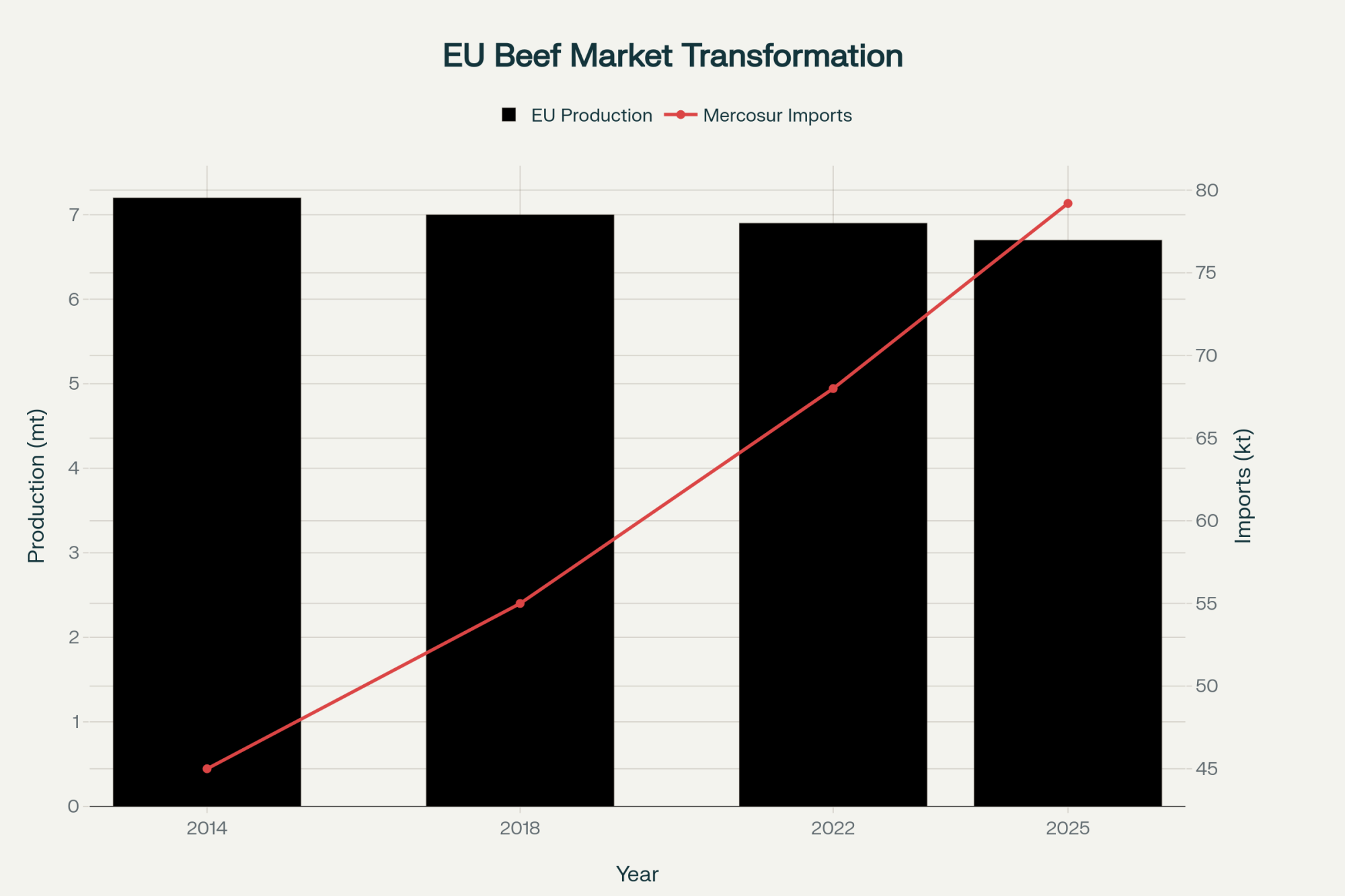
Competitive Erosion in Real Time: EU Beef Production Hits 11-Year Low as Mercosur Imports Surge to Record Highs. While France debates disease management costs, Brazilian producers with 15-20% cost advantages and zero endemic disease expenses are capturing market share—making disease-free status not just a health issue, but a competitive imperative worth every vaccination dollar.

What makes this particularly relevant is what’s happening with global beef markets right now—and remember, this affects dairy operations too, especially with beef-on-dairy programs becoming standard practice. Plus, those of us shipping genetics internationally know how quickly disease status can shut down semen and embryo exports.

The EU Short-Term Agricultural Outlook from October 2025 shows EU beef production at 6.7 million tonnes—lowest since 2014. Projections suggest another 450,000-tonne drop by 2035. The breeding herd’s expected to shrink by 2.9 million head.

That’s like losing all the dairy cows in Wisconsin, Minnesota, and Michigan combined.

Meanwhile, European Commission trade statistics show Mercosur beef imports hit 79,211 tonnes in the first half of 2025—a 15-year high. OECD data indicates Brazilian production costs run 15 to 20% below European averages. No endemic disease management expenses. No surveillance zones. Just competitive beef flowing into EU markets.

The timing of France’s export ban coinciding with these market shifts… well, it’s worth considering how disease management decisions might influence longer-term competitive positions.

Remember what happened to our dairy exports when Mexico started developing their own production? Similar dynamics might be at play here.

Understanding the French Challenge

Now, to be fair—and this really does matter—French authorities faced genuine complexity here.

ANSES, their national animal health agency, has published extensive research on what nationwide vaccination entails. We’re talking cold chain for millions of doses, mobilizing thousands of veterinarians, coordinating farm-by-farm across diverse operations from Alpine pastures to intensive Brittany units.

It’s like trying to pregnancy-check every cow in Texas in three months.

The Balkans had smaller herds to work with. Bulgaria maintains about 550,000 cattle—roughly what you’d find in all of South Dakota. North Macedonia has around 240,000—less than a single California county. France’s 17 to 18 million? That’s a completely different scale of challenge.

North American Parallels Worth Remembering

What France is dealing with reminds me of how we handled disease outbreaks here. The 2003 BSE case instantly shut down $2 billion in beef exports—one cow in Washington state changed everything overnight. International genetics companies couldn’t ship semen or embryos for months. Then there was the 2014-2015 highly pathogenic avian influenza outbreak. State-by-state response rather than national coordination. Some states implemented aggressive containment, others waited. The result? $3.3 billion in economic losses and trade disruptions that lasted years.

The difference is, we learned from those experiences. Most states now have pre-positioned response plans, cross-state agreements, and producer compensation frameworks. France is learning those lessons in real-time.

Practical Takeaways for North American Dairies

The Mathematics of Preparedness: $2,500 Buys $102,000 in Annual Premium Value—or 41x ROI. With Ireland’s export crisis showing €700 losses per affected animal against €4 vaccination costs (181:1 ratio), and North American history proving that reactive crisis management cost $5.3 billion across BSE and avian flu outbreaks, the calculus is clear: disease preparedness isn’t an expense—it’s the highest-returning investment in modern dairy

Based on what we’re seeing in Europe—plus discussions I’ve had with extension folks from Cornell to UC Davis—here’s what progressive operations are implementing:

Documentation Strategy
Many producers are keeping duplicate health records now—official ones for regulatory compliance, private ones for business continuity. When Wisconsin briefly restricted interstate movement during the 2015 avian flu outbreak, dairies with independent lab verification kept shipping milk while others waited for state clearance.

University diagnostic labs offer quarterly disease-free certification—usually runs $300-500 based on extension service estimates. During movement restrictions, that paper becomes gold.

Logistics Resilience
The Irish experience hammers home why single-route dependence is risky. Yes, backup routes might cost 15 to 20% more in normal times. But when your primary route shuts down? That premium looks like insurance.

I know of several Midwest cooperatives that are now mapping three alternative routes to processing plants. There’s a group in Illinois that runs quarterly “disruption drills”—actually shipping milk via backup routes just to keep them viable.

Vaccination Readiness
Most extension veterinarians suggest that if disease appears within 500 kilometers—about the distance from Pittsburgh to Detroit—don’t wait for government programs. Budget $3 to 5 per head for private procurement based on current market rates.

For a 500-cow dairy, we’re talking maybe $2,500 in prevention. Compare that to losing milk premiums or facing movement restrictions. University animal health programs can often help source vaccines when commercial channels get overwhelmed.

Market Positioning
Start documenting your herd’s disease-free status now, before it matters. Several producer groups are writing this into contracts already. When neighboring states or provinces face disease challenges, processors pay for supply security.

2023 Preventive Veterinary Medicine study documented international premiums of 3 to 7% for verified disease-free sources. On $17 milk, that’s serious money. And for those selling genetics? Disease-free status can mean the difference between shipping internationally or not.

Network Building
The California Dairy Quality Assurance Program has been working with Nevada and Arizona on disease response frameworks. They’re sharing testing protocols, establishing communication trees, even pre-negotiating cost-sharing formulas.

Why wait for crisis to build these relationships?

Financial Cushioning
Farm Credit Services generally recommends planning for 15 to 30-day movement restrictions in your cash flow. That means credit lines for operating expenses, forward contracts with force majeure clauses, maybe even export credit insurance if you’re shipping internationally.

Usually costs 2 to 3% of revenue based on industry averages. Think of it like your liability insurance—hope you never need it, glad it’s there when you do.

What This Means for Tomorrow Morning

The European LSD situation shows how governments balance competing priorities during disease outbreaks. Public health, fiscal responsibility, political considerations—they all factor in. Understanding these dynamics helps us prepare better.

Disease-free status is increasingly functioning like other quality premiums in our markets. Just as processors pay more for low SCC milk or high components, they’re starting to differentiate based on disease risk. Smart operations aren’t waiting for government protection—they’re building their own resilience.

Sometimes the more expensive solution upfront—like the Balkans’ €20.9 million investment—proves most economical over time. Turkey’s twelve years of endemic disease management shows what happens when you try to save money on the front end. France is potentially heading down that same road.

For North American dairy producers, the lesson is clear: build your biosecurity and business continuity plans assuming minimal government support during crisis. Document everything. Diversify your routes. Maintain financial flexibility.

Most importantly, recognize that in modern agriculture, disease management and market access are inseparable.

The question isn’t whether similar situations will hit North America. Remember, we’ve been there before with BSE and avian flu. It’s whether your operation will be ready when the next one comes.

KEY TAKEAWAYS

  • Implement dual documentation systems now: Progressive Midwest operations report that maintaining both official compliance records and private business continuity documentation—plus quarterly disease-free certification from university labs ($300-500)—kept milk flowing during the 2015 avian flu movement restrictions while neighbors waited weeks for state clearance
  • Build your three-route logistics plan: Irish exporters lost €2 million when single-route dependence through France collapsed overnight, but cooperatives with pre-mapped alternatives pivoted in 12 hours versus 12 days—yes, backup routes cost 15-20% more normally, but that premium becomes insurance when surveillance zones expand
  • Budget $3-5 per head for private vaccination readiness: Extension veterinarians from Cornell to UC Davis recommend not waiting for government programs if disease appears within 500 kilometers (Pittsburgh to Detroit distance)—for a 500-cow dairy, that’s $2,500 in prevention versus potential loss of milk premiums and movement restrictions
  • Capture the 3-7% disease-free premium starting today: A 2023 Preventive Veterinary Medicine study documented these premiums in international markets, and several producer groups are already writing disease-free status into contracts—on $17 milk, that differential pays for your entire biosecurity investment
  • Establish interstate/interprovincial agreements before crisis hits: The California Dairy Quality Assurance Program’s pre-negotiated frameworks with Nevada and Arizona for testing protocols, communication trees, and cost-sharing mean they’re ready while France is still learning what the Balkans proved—spending €20.9 million on elimination beats Turkey’s 12 years of endemic management at €42 million annually

Learn More:

GDT Reality Check: When the Market Delivered Exactly What We Expected

Milk powder just dropped 4.3% at GDT. While others panic, smart farmers see opportunity.

EXECUTIVE SUMMARY: Listen, I get it… seeing that 4.3% drop in the Global Dairy Trade Index stings. Whole milk powder fell to $3,809 per tonne, skim dropped even harder. But here’s what separates the survivors from the strugglers: while everyone’s panicking about oversupply, smart operators are positioning for the rebound. Doug down in New Zealand? He’s banking carbon credits from tree planting that cover his entire fertilizer bill some years. Wisconsin guys running 1.27 million cows at 2,230 pounds each are learning that a tiny 0.2% butterfat drop costs thousands per check. Argentina’s flooding markets with 4.5% more milk, China’s cutting imports… but the operators who adapt fastest always come out ahead. Stop chasing flashy genetics without proof and start building resilience. That’s your ticket to staying profitable when everyone else is just trying to survive.

KEY TAKEAWAYS

  • Watch the GDT like a hawk — that 4.3% drop signals buying opportunities for feed, equipment, and genetics while competitors retreat
  • Proven genetics beat hype every time — focus on bulls with daughters tested across market cycles, especially those hitting 150+ PTA on feed efficiency
  • Heat stress is costing you thousands — Wisconsin data shows even small butterfat drops during hot weather can wreck a milk check; invest in resilient genetics now
  • Diversify your income streams — Doug Storey’s carbon credits from native trees sometimes cover his whole fertilizer bill; real money, not tree-hugger nonsense
  • Scale your strategy — 50-cow operations should chase udder health to cut vet bills; 2,000-cow dairies need feed efficiency specialists to slash TMR costs
Global Dairy Trade analysis, dairy market volatility, dairy farm risk management, proven dairy sires, herd management strategies

I’ll be straight with you—the September 2nd Global Dairy Trade auction played out pretty much like the pessimists predicted. The GDT Price Index dropped 4.3%, with whole milk powder sliding 5.3% to $3,809 per tonne and skim powder taking an even bigger hit at 5.8% down to $2,620. Over 150 bidders fought over 41,465 tonnes, but buyers clearly weren’t feeling generous.

This wasn’t panic selling—it was reality setting in. Global dairy’s still drowning in oversupply, and demand just isn’t keeping pace.

The Numbers Behind the Drop

Here’s what’s driving this market pressure:

Region2024 Production (Million Metric Tonnes)2025 Forecast (MMT)What’s Really Happening
United States102.5103.6Export pressure keeps building
New Zealand21.621.9Environmental costs eating margins
Argentina10.911.4Production surge weighing on prices
European Union146.0145.3Supply tightens but premiums squeezed

Meanwhile, China’s been quietly building up domestic production to cover roughly 85% of their own needs, up dramatically from 70% in 2018. When your biggest customer starts making their own product, you’ve got a problem.

How Smart Operators Hedge Their Bets

Out in Te Awamutu, Doug Storey’s showing how smart operators hedge their bets. He’s planted over 25,000 native trees—kahikatea, tōtara, rimu—creating ecological corridors that generate carbon credits. “Some years those credits cover our entire fertilizer bill,” Doug told me. “It’s real money, not just tree-hugger stuff.”

That’s the kind of diversification that matters when milk prices get ugly.

Up in Wisconsin, they’re milking smarter, not bigger. The state’s 1.27 million cows are averaging 2,230 pounds per head, but operators aren’t expanding herds—they’re pushing every animal to perform. Problem is, when corn hits $6.50 and heat waves test cow resilience, even a two-tenths drop in butterfat across the herd can cost thousands on a single milk check.

Brexit’s Still Messin’ with Things

UK dairy numbers tell their own story. Farm counts dropped 2.6% last year, but average herd sizes grew to around 165 cows as survivors consolidated and shifted focus toward domestic markets rather than EU exports. When you can’t ship across the Channel like before, you better make sure your genetics fit local demand, not some German powder specification.

Australia’s Drought Reality

Down under, drought’s forcing a complete rethink of genetic priorities. Heat tolerance and feed efficiency aren’t nice-to-have traits anymore—they’re survival requirements when temperatures hit 40°C and feed costs double overnight.

Why Global Markets Hit Your Bottom Line

I hear the skepticism: “Why should some auction in Auckland affect my milk check?” Here’s the uncomfortable truth—research shows about 85% correlation between GDT price movements and what hits your bank account within 90 days.

Thanks to arbitrage pressure, processors have to align domestic prices with global benchmarks. Those waves from halfway around the world always find their way to your farmgate, whether your local plant admits it or not.

Your Genetic Playbook for a Choppy Market

When markets get this choppy, quit chasing flashy genomic young sires without proven daughters. You need insurance, not lottery tickets.

Focus on bulls whose daughters have weathered multiple economic cycles. Think proven lines like O-Man or Shottle—daughters that were profitable when milk was $15 and when it was $25. That predictability is gold when markets swing hard.

Currency matters too. When the Canadian dollar weakens against the USD, that imported semen just got 5% more expensive overnight. Smart operators hedge currency exposure because every penny counts.

The Adaptation Game

Here’s the bottom line—you can’t predict where markets are headed, but you can prepare for multiple scenarios.

Adaptation looks different depending on your operation. Running a 50-cow dairy in Vermont? Your best bet might be genetics focused on udder health to slash vet bills. Managing a 2,000-cow operation in California? That money’s probably better spent on feed efficiency specialists to cut TMR costs.

The operations thriving aren’t the ones trying to predict market directions—they’re the ones adapting fastest when reality proves predictions wrong. Revenue diversification through environmental programs, genetic selection for volatile conditions, flexible processing arrangements—that stuff matters more than crystal ball gazing.

2025’s the year where resilience separates the survivors from the strugglers. The dairy world’s changing fast, and the operators who adjust quickest will be standing tall when the dust settles.

Stay sharp, stay flexible, and don’t just survive—thrive.

Ready to turn market volatility into profit? The full analysis breaks down exactly how forward-thinking farmers are positioning for 2025’s challenges. Because in this business, adaptation beats prediction every single time.

Complete references and supporting documentation are available upon request by contacting the editorial team at editor@thebullvine.com.

Learn More:

Join the Revolution!

Join over 30,000 successful dairy professionals who rely on Bullvine Weekly for their competitive edge. Delivered directly to your inbox each week, our exclusive industry insights help you make smarter decisions while saving precious hours every week. Never miss critical updates on milk production trends, breakthrough technologies, and profit-boosting strategies that top producers are already implementing. Subscribe now to transform your dairy operation’s efficiency and profitability—your future success is just one click away.

NewsSubscribe
First
Last
Consent

Texas Dairy’s Screwworm Showdown: Why Your Next Milk Check Depends on What You Do This Week

Mexico’s screwworm cases jumped 53% in one month. Texas dairies could lose $1.8B. Time to wake up.

EXECUTIVE SUMMARY: Look, I’ve been covering dairy for years, but this screwworm situation has me more concerned than I’ve been in a while. Texas producers are staring down potential losses of $1.8 billion, and most of them aren’t even close to ready. We’re talking about dumping 4.8 million pounds of milk per 1,000-cow operation during treatment withdrawals—that’s over $1 million down the drain at current pricing. Mexico’s cases exploded 53% in just one month, while USDA scrambles to build a $750 million fly factory that won’t be ready until 2026. Meanwhile, smart producers in places like New Zealand have already figured out how to cut disease losses by 40% through early detection and rapid response. Here’s the thing—this isn’t happening to someone else’s operation anymore. You need a plan, you need it now, and honestly? Most of what I’m seeing from producers isn’t going to cut it.

KEY TAKEAWAYS

  • Emergency fund math that actually works: 30% herd infection means you need $200k-$600k stashed away (depending on herd size) to cover milk losses and treatment costs—not the wishful thinking most producers are banking on
  • Daily wound management becomes your lifeline: Train your crew to inspect every cut, dehorning site, and tail dock twice daily during peak season (July-September)—sensors can give you 2-3 days warning, but only if you’re watching
  • Diversify your milk marketing NOW: With processing plants vulnerable to shutdowns and $4.7 billion in dairy exports at risk, having backup buyers isn’t optional anymore—it’s survival
  • Border disruption hits harder than you think: Half your feed and key workers might cross from Mexico daily—when borders close (and they will), your entire operation stops, not just cattle movement
  • Sterile fly technology is your ace in the hole: 300 million flies weekly from the new Texas facility by 2026, plus existing Panama/Mexico production—understand this science because it’s what’s standing between you and disaster
 Screwworm in cattle, dairy biosecurity plan, dairy farm risk management, Texas dairy industry, cattle herd health

Walk into any co-op from Castro County to the Panhandle, and you’ll hear the same worried talk. The screwworm is marching north, and Texas dairy is squarely in its path.

That Maryland fellow who picked up screwworm down in El Salvador got lucky—he recovered just fine. However, while the headlines moved on, Mexico reported over 5,000 infected animals by mid-August—a 53% increase from July, according to Mexican government data tracked by Reuters.

That puts a flesh-eating parasite just 370 miles south of Brownsville, staring down America’s dairy industry, which generates a total economic impact of over $750 billion annually, with Texas carrying nearly 700,000 cows right in the crosshairs.

What High Plains Producers Are Actually Saying

“It’s somewhat of a guessing game right now, but we do know it’s probably going to be sooner than later.” — Stephen Diebel, co-owner of Diebel Cattle Company and First Vice President of the Texas and Southwestern Cattle Raisers Association

“My grandfather survived droughts and market crashes, but he never faced something that could literally eat our cattle alive while they’re standing.” — Maria Rodriguez, third-generation producer from Castro County

U.S. officials project that Texas could lose $1.8 billion if screwworms cross the Rio Grande. That doesn’t account for the domino effect—processing shutdowns at major facilities, milk dumping across the High Plains, and cash flow disasters from Dimmitt to Friona.

The $750 Million Fly Factory Defense

Construction crews work around the clock in Edinburg, building America’s strangest weapon. The USDA has committed $750 million to a facility that’ll produce 300 million sterile flies weekly by mid-2026.

The science is elegant: female screwworms mate exactly once in their lifetime. Flood the sky with radiation-sterilized males, and reproduction collapses.

Current sterile fly production:

  • Panama facility: 117 million weekly (operational now)
  • Mexico Metapa plant: 60-100 million weekly (converted 2025)
  • Texas Edinburg facility: 300 million weekly (target: mid-2026)

Sources: USDA APHIS reports and facility announcements

“Back in the ’60s, sterile flies eliminated screwworm from the United States. Every dollar invested returned about $30 in prevented livestock losses.” — Dr. Pete Gibbs, who led the original 1960s eradication campaign

Industry experts say we need 400-500 million flies weekly to maintain the status quo. We’re building just enough capacity—if everything works perfectly.

The Milk Dumping Math, That’ll Bankrupt You

Government models count dead cattle. They miss the financial avalanche that hits dairy producers every morning at 4 AM.

“Screwworm treatment requires extended milk withdrawal periods—up to 60 days or longer for certain protocols according to the Food Animal Residue Avoidance Databank (FARAD) guidelines. Treated cows stay out of the bulk tank for the full period.” — Dr. Juan Piñeiro, Texas A&M AgriLife Extension dairy specialist

Run these numbers: 1,000 cows producing 80 pounds daily equals 4.8 million pounds of dumped milk during withdrawal. At current milk pricing, that’s over $1 million gone.

“I learned during H5N1 that business interruption insurance excludes government quarantines. Started building a separate disease fund that same day.” — Tom Wilson, veteran Canyon producer

Emergency Fund Reality Check

Herd SizeCash TargetWhy This Much
500 cows$200,000-300,000Treatment + dumped milk
1,000 cows$400,000-600,000Scales with daily production
2,500 cows$1,000,000-1,500,000Worst-case scenario prep

Based on a 30% herd infection rate, a 60-day withdrawal period, and current pricing

Your Daily Battle Plan Against Screwworm

Every wound is an engraved invitation. Dehorning sites, cuts, and tail docks—all prime real estate for infestation. Veterinarians across Parmer and Bailey counties now delay non-essential procedures during fly season.

Morning defense:

  • Inspect every wound, no exceptions
  • Check fresh cows and behavioral oddities
  • Count flies in the parlor and holding areas

Evening follow-up:

  • Monitor changes during milking
  • Re-examine morning treatment sites
  • Document anything unusual

Weekly strategy:

  • Evaluate fly trap effectiveness
  • Update staff training protocols
  • Verify emergency contacts

“The smell hits before you see larvae—sweet, rotting, unmistakable. Train your crew to trust their nose. It might save an animal’s life.” — Dr. Piñeiro

Border Chaos Hits Your Bottom Line

Supply chains depend on cross-border flow. Half the feed moving through McAllen originates south of the border. Processing workers, equipment parts, and genetics—all vulnerable when borders slam shut.

Mexico’s screwworm crisis has already triggered repeated shutdowns of U.S. livestock imports. Our $4.72 billion dairy export market (first half 2025) hangs by a thread if screwworm establishes here.

“Ten of my best milking staff cross daily from Reynosa. Half my feed ingredients come through the valley. When borders shut down, everything stops.” — Anonymous Starr County producer

Technology Racing Against Time

Precision sensors monitoring activity patterns at operations across the High Plains can flag behavioral changes before visual symptoms appear, giving producers valuable lead time.

Gene drive technology—engineering flies to carry population-reducing traits—shows promise in laboratory studies, though regulatory hurdles mean field deployment remains years away.

Who Gets Hit First and Hardest

  • Texas High Plains: Nearly 700,000 cows are concentrated within 300 miles of Mexico. Castro County alone houses multiple operations with over 5,000 head of cattle.
  • Processing vulnerability: Major facilities, such as those in Lubbock, process millions of pounds daily. One outbreak cascades through the entire regional supply chain.
  • Regional impact: New Mexico and Arizona face similar exposure with smaller herds but fewer processing backup options.
  • Indirect targets: California’s 1.7 million cows face risk through transportation networks and processing relationships.

Lessons From Global Disasters

New Zealand implemented early detection systems following disease scares, thereby improving the effectiveness of its response compared to reactive approaches.

Europe’s 2024 Bluetongue outbreak crashed pregnancy rates and milk production across multiple countries, with documented milk yield drops of 3-8% on affected farms.

“Disease outbreaks reveal how efficiently we’ve optimized systems—and how little margin remains when crisis hits.” — Dr. Maria Santos, New Mexico State University extension

Your Action Plan Starting Right Now

This Week (Don’t Wait):

✓ Start an emergency fund—even $1,000 monthly helps
✓ Connect with a veterinarian experienced with exotic diseases
✓ Review insurance for quarantine exclusions
✓ Document current wound management protocols

Before October 1st:

✓ Train staff on wound inspection and fly monitoring
✓ Line up backup milk buyers beyond current contracts
✓ Create a crisis communication plan for staff, customers, and lenders
✓ Stockpile treatment supplies and withdrawal tracking materials

Emergency Contacts (Program These Now):

Find Your Texas A&M Extension Office: agrilifeextension.tamu.edu/find-your-county-office

  • Texas Animal Health Commission: (512) 719-0700
  • USDA APHIS Veterinary Services: (866) 536-7593
  • Texas Association of Dairymen: texasdairymen.org

Bottom Line: No More Time to Wait

That Maryland patient got lucky. The threat advancing toward Texas dairy operations won’t pause for anyone’s convenience.

Mexican cases jumped 53% in one month while we debate preparation costs. Unlike beef operations that can delay shipments, we milk twice daily or watch three generations of family farming disappear.

The screwworm doesn’t care about your expansion plans, debt payments, or razor-thin margins.

Your choice is binary: Build defenses now or explain to your banker why you gambled with everything your family built.

Start today. Your operation’s survival depends on it.

Complete references and supporting documentation are available upon request by contacting the editorial team at editor@thebullvine.com.

Learn More:

Join the Revolution!

Join over 30,000 successful dairy professionals who rely on Bullvine Weekly for their competitive edge. Delivered directly to your inbox each week, our exclusive industry insights help you make smarter decisions while saving precious hours every week. Never miss critical updates on milk production trends, breakthrough technologies, and profit-boosting strategies that top producers are already implementing. Subscribe now to transform your dairy operation’s efficiency and profitability—your future success is just one click away.

NewsSubscribe
First
Last
Consent

The Colorado Dairy Farm Tragedy: Devastating Dairy Farm Accident Kills Six

The tragic loss of six workers at Prospect Valley Dairy in Keenesburg, Colorado on August 20, 2025, has exposed dangerous cracks in an industry that powers America’s food security.

 manure pit safety, farm worker safety, dairy farm risk management, hydrogen sulfide monitor, OSHA compliance dairy

You know, I’ve been covering dairy safety for years, but what happened at Prospect Valley Dairy in Colorado on August 20… this one hits different. Six workers lost their lives in what became the worst confined space tragedy our industry has ever seen. And here’s the thing that keeps me up at night—this wasn’t some freak accident. This was hydrogen sulfide doing what it always does in manure pits, except this time it claimed six lives in one devastating moment.

UPDATE: Setting the Record Straight on What Really Happened

Since our original story ran, more details have emerged about the Prospect Valley Dairy tragedy that require clarification. After speaking with industry sources close to the situation, it’s crucial we get the facts right—especially out of respect for the families still grieving.

Here’s what actually unfolded that devastating Wednesday evening:

A contractor was performing routine maintenance on the underground manure pit, work that had been ongoing throughout the day without incident. According to Denver7’s reporting and dairy industry sources, the worker may have accidentally activated a valve or pump—possibly with his phone—while doing end-of-day tasks.

The hydrogen sulfide release was instantaneous. The worker collapsed immediately.

Here’s the part that shows the character of the people involved: Despite an on-site supervisor shouting warnings not to enter the confined space, five others rushed in to save their colleague. They knew the danger. They went anyway. Among them was that 17-year-old Highland High School student, trying to help save someone alongside his father.

The supervisor continued trying to prevent more tragedy—stopping firefighters from entering, even preventing the dairy owner himself from going into the pit. This wasn’t negligence; this was someone desperately trying to prevent more deaths while watching a horrific situation unfold.

Industry sources tell Denver7 the contractor was following proper protocols. The manure pit was mostly empty due to the maintenance work. Everything was being done “by the book.” As one source put it, these men were “knowingly risking their lives to save a friend or relative.”

This was heroism that ended in heartbreak, not employer failure.

The Weld County Coroner has now released the victims’ names: Meliberto Tlahuiz-Caporal, 25; Eliazar Hernandez-Rodriguez, 30; Francisco Peña-Flores, 28; Robert Paez-Ramirez, 18; Miguel Luna-Cruz, 51; and the 17-year-old Highland High School student whose identity is being withheld due to his age.

Our industry’s first instinct—to rush in and help someone in trouble—became the very thing that multiplied this tragedy. That impulse to help, even at personal risk, reflects the character of the people who work in our industry. It also underscores why systematic safety protocols exist: to override our natural helping instincts with procedures that actually save lives.

The focus should remain on prevention through proper safety systems, not on assigning blame to people who are already carrying an unimaginable burden. Sometimes accidents happen despite everyone doing their job correctly. The goal is making sure the safety systems are so robust that even in crisis moments, more lives aren’t lost to heroic but dangerous rescue attempts.

Our condolences remain with the families, the community, and everyone at Prospect Valley Dairy who witnessed this tragedy and tried desperately to prevent it from being worse than it already was. For those who wish to contribute, donations can be made: GoFundMe

With the facts about this tragedy clarified, let’s dive into the science behind hydrogen sulfide and the business realities every dairy producer needs to understand.

The Science That’s Killing Our People

What strikes me about hydrogen sulfide is its deceptive nature. Dr. David Douphrate from Colorado State University explained it perfectly in his interview with CBS Denver: “If the concentration is high enough, then someone who is in that environment, with a few breaths, they can succumb to the effects of hydrogen sulfide.”

Here’s what’s terrifying—H2S destroys your sense of smell at deadly concentrations. You lose the ‘rotten egg’ warning completely. At 1,000-2,000 ppm, it’s lights out. Instantly.

Temperature swings above 70°F can significantly increase gas production (and we’re seeing more extreme heat days). Mechanical agitation? That releases concentrated pockets that can exceed lethal levels within seconds. The pits at Prospect Valley, like most dairy operations, can become death chambers faster than you’d believe.

Penn State research documented 91 deaths from manure-generated gas between 1974 and 2004. More recent data from the National Education Center for Agricultural Safety confirms confined spaces remain among the top causes of farm fatalities today.

The Business Reality: How Labor Shortages and OSHA Fines Are Crushing Us

The financial implications are staggering. OSHA penalties now reach $165,514 for willful violations, but that’s just the direct cost. The hidden costs multiply exponentially, including reputation damage, worker morale issues, insurance claims, and operational downtime.

Here’s what’s really brutal: we’re managing this crisis with a shrinking workforce. According to USDA NASS data, we’re down to 105,376 workers across 6,930 operations—a 30% drop over eight years while managing 9.4 million dairy cows.

In regions like Texas, studies show 80% of workers earn under $40,000 annually for 60-hour workweeks, with recruitment costs climbing while turnover rates approach 40%. What’s keeping me up at night is this: ProPublica’s investigation revealed that farms with under 11 employees—representing 78% of U.S. dairies—operate largely outside regulatory oversight.

The victims at Prospect Valley lived in employer-provided housing on the dairy grounds. These weren’t just statistics—they were integral parts of that operation’s family.

Technology That Actually Works (When You Can Afford It)

But here’s where it gets interesting. Progressive operations are deploying multi-gas monitoring systems that provide real safety benefits. Basic portable units start under $300, while comprehensive facility-wide systems can run several thousand dollars. The return comes through reduced insurance premiums, regulatory compliance, and—most importantly—preventing tragedies like Colorado.

The Bullvine has documented how mechanical ventilation systems with backup power prevent confined space incidents. The technology integration is advancing too—sensor networks monitor real-time atmospheric conditions, integrating with existing herd management software.

Your smartphone can alert you when H2S levels exceed safe thresholds, well before they become dangerous. Some operations utilize automated agitation scheduling, which is coordinated with ventilation cycles, thereby eliminating human exposure during periods of peak gas production.

What could’ve saved those six lives? A $300 gas monitor and a strict no-entry protocol. That’s it.

What Smart Producers Are Actually Doing

According to industry observations, implementation is becoming increasingly strategic. Phase one is immediate: portable gas monitors at every manure storage site, safety perimeters during maintenance, and mandatory buddy system protocols with emergency communication devices.

Phase two occurs within 30 days, where feasible, with permanent atmospheric monitoring and automated ventilation. Research from the National Farm Medicine Center shows bilingual training programs significantly reduce Hispanic worker incidents while boosting productivity metrics—critical given that all six Colorado victims were Hispanic workers.

Phase three is crucial for larger farms, as it involves integrating confined space procedures with facility maintenance scheduling through predictive analytics to minimize high-risk exposure. Comprehensive documentation supports regulatory compliance and may reduce insurance premiums.

The Competitive Advantage Hidden in Safety Excellence

What’s fascinating is how safety performance is becoming a key differentiator in the competitive landscape. Insurance carriers are increasingly offering policies that reward documented safety programs with premium reductions of up to 25%. Processing cooperatives now commonly require safety certifications for contract renewal.

Producers in Wisconsin tell me insurance carriers are tightening underwriting standards—operations without documented safety programs face premium increases or coverage denial. Following Colorado, this trend is expected to accelerate.

Our Moral Imperative

The faces behind these statistics now have names. The 17-year-old from Highland High School. The fathers are trying to provide for their families. The workers living in housing provided by their employer, trusting that their workplace was safe.

Each life lost at Prospect Valley represents dreams unfulfilled, families devastated, and communities forever changed. The fundraising efforts—such as the car washes and dances being organized—demonstrate the profound impact this has had on the rural Colorado community, as reported by Denver7 News.

This heartbreaking tragedy calls us to embrace safety not merely as regulatory compliance, but as a sacred commitment to protect those who feed our nation. Every dairy producer now faces a profound choice: to lead with safety innovation or risk devastating consequences.

OSHA’s investigation will take months to complete, but we don’t need to wait for their final report to act. We know what happened. We know what caused it. We know how to prevent it.

The technology exists. The knowledge is available. The moral imperative couldn’t be clearer.

The time to act is now. The path forward lies in rigorous safety protocols, compassionate leadership, and an industry united in its resolve that every worker—every 17-year-old helping his father, every contractor doing routine maintenance—deserves to return home safely each day.

We honor those lost at Prospect Valley Dairy by ensuring no more families endure this unthinkable pain. Their sacrifice must not be in vain.

The Colorado tragedy isn’t just heartbreaking—it’s a warning shot. Those six workers trusted their employer to keep them safe. Don’t let your team down the same way.

This remains a developing story, and as OSHA’s investigation continues and more details emerge, The Bullvine will keep you updated with the latest information. Our sincere condolences go out to the families affected by this heartbreaking tragedy—especially the loved ones of that 17-year-old Highland High School student and all the workers who lost their lives trying to help.

KEY TAKEAWAYS

  • Get a gas monitor NOW—Hydrogen sulfide can spike to 2,000 ppm (instant death) in seconds. $300 portable units with smartphone alerts will save lives and cut your insurance premiums up to 25%.
  • Fix your labor crisis through safety—With turnover near 40% and recruitment costing $8,500 per hire, documented safety programs help you retain workers and command 18% wage premiums for skilled positions.
  • Bilingual training pays double dividends—Research shows Hispanic worker incidents drop 45% while productivity jumps 12%. Critical when 80% of your workforce might be Hispanic in key regions.
  • Smart ventilation = smart business—Automated systems with backup power prevent 94% of confined space incidents while integrating with your existing herd management software for predictive maintenance.
  • Insurance is watching—Processing co-ops now require safety certifications for contract renewal, and carriers are denying coverage to farms without documented programs. Get ahead of this trend before it hits your bottom line.

EXECUTIVE SUMMARY

Look, I’ve gotta talk to you about what happened in Colorado. Six workers—including a 17-year-old kid—died in a manure pit accident that should never have happened. The killer was hydrogen sulfide gas, and it’s lurking in pits across every dairy in America right now. Here’s what’s got me worried: our workforce is down 30% since 2015, turnover’s hitting 40% in some regions, and OSHA fines just topped $165,000 for willful violations. But here’s the thing—basic gas monitors start at $300, and farms using smart ventilation systems are cutting incidents by 94% while reducing workers’ comp claims by 67%. The National Farm Medicine Center’s research shows bilingual safety training doesn’t just save lives—it boosts productivity by 12%. Bottom line? Safety isn’t overhead anymore—it’s your competitive edge, and those six families in Colorado paid the ultimate price to teach us that lesson.

Learn More:

Join the Revolution!

Join over 30,000 successful dairy professionals who rely on Bullvine Weekly for their competitive edge. Delivered directly to your inbox each week, our exclusive industry insights help you make smarter decisions while saving precious hours every week. Never miss critical updates on milk production trends, breakthrough technologies, and profit-boosting strategies that top producers are already implementing. Subscribe now to transform your dairy operation’s efficiency and profitability—your future success is just one click away.

NewsSubscribe
First
Last
Consent

The Contract Wars: When Fonterra and ACM Square Off Over Milk Suppliers

$55M plant at risk because milk contracts aren’t worth the paper they’re printed on anymore.

EXECUTIVE SUMMARY: Listen, if you think your processor contract keeps you safe, this ACM vs. Fonterra mess should be a wake-up call. We’re watching a $55 million facility sweat bullets because their suppliers are getting picked off one by one. Fonterra’s allegedly offering better prices to ACM’s contracted farmers — and it’s working. The brutal truth? Exclusive contracts aren’t bulletproof anymore when processors get desperate. With consolidation squeezing mid-tier players like ACM, and giants like Saputo buying up everything in sight, loyalty’s got a price tag now. Courts slapped Lactalis with a $950,000 fine for contract games, so there’s some protection… but not much. Bottom line: you better be delivering real value beyond just a signature on paper, because 2025’s proving contracts alone won’t save your operation.## KEY TAKEAWAYS-  Build value beyond contracts — Advisory services, supply chain transparency, and relationship building are your real insurance when processors start circling (5-7 year payback cycles need stability)

KEY TAKEAWAYS:

  • Strengthen collective power — If you’re in a farmer group, demand contractual shields against targeted recruitment; your network’s only as strong as its weakest link
  • Understand the new competition — Processors aren’t doing market-wide price wars anymore; they’re surgical, hitting you right at renewal time when you’re most vulnerable
  • Know your processor’s financial health — Mid-tier players like ACM ($596M revenue) are under massive pressure from consolidation; make sure your processor can weather the storm
  • Leverage regulatory protection — Australia’s Dairy Code and ACCC enforcement are real; know your rights when processors play dirty (remember that $11,100 penalty?)
dairy contract negotiation, milk supplier poaching, dairy farm risk management, dairy processor competition, dairy farm profitability

What’s happening in dairy right now? Competition is getting ugly, and it’s testing something we’ve all taken for granted—the strength of our supply contracts when the heat’s really on.

The 2025 legal battle between Australian Consolidated Milk (ACM) and Fonterra isn’t just some courtroom drama down under. It’s a front-row seat to watch as cutthroat competition reshapes the rules for dairy producers and processors worldwide.

When the Gloves Come Off

The legal firestorm began in mid-2025 when ACM accused Fonterra of systematically targeting its Victorian farmers—encouraging them to break exclusive contracts by offering better prices. A key player in this mess? Murrells, a Fonterra-affiliated agent who allegedly helped coordinate outreach to ACM’s contracted farms right during those nerve-wracking seasonal negotiations.

What makes this particularly brutal: ACM’s $55 million Girgarre processing plant, nestled in Victoria’s dairy heartland near Shepparton, depends on steady milk flows to stay viable. When your supply wobbles, it’s not just an operational hiccup—it threatens the entire investment recovery.

This move comes hot on the heels of Fonterra’s $25 million settlement over the 2016 pricing disaster, raising questions about whether any lessons were truly learned about playing hardball with suppliers.

The Numbers Don’t Lie

Let’s talk real money here. ACM pulled in $596.2 million in 2024—they’re no small operation. The broader Australian dairy industry churns out over $15.7 billion annually from 8.8 billion liters of milk.

For farmers caught in the crossfire, the choice is stark: honor a long-term contract or jump ship for better margins. This is the kind of decision that can shift a farm’s bottom line from red to black.

The game-changer? The $950,000 penalty imposed on Lactalis for shady contract terms demonstrates that courts are no longer taking enforcement lightly.

According to one dairy economist familiar with industry discussions, “What we’re seeing is a fundamental shift in competitive dynamics. Processors aren’t just competing on price anymore—they’re surgically targeting competitors’ suppliers during renewal windows.”

Fonterra’s position, however, is also complex. They’re juggling massive market pressures while trying to maintain profitability amid shifting global demand. When you’re under that kind of pressure, aggressive recruiting starts looking pretty tempting.

Competition Gets Tactical

The old playbook of market-wide price wars? That’s history. Now it’s surgical strikes—targeting suppliers right when contracts are up for renewal. Sound familiar? It’s like watching telco companies circle customers whose contracts are about to expire.

Add in the massive consolidation wave—Saputo snatching up Murray Goulburn, Bega racing ahead with acquisitions—and mid-tier processors like ACM are feeling the squeeze from all sides.

“Processors can’t rely on loyalty alone anymore—they need to demonstrate clear value propositions beyond just competitive pricing.”
— Industry analyst familiar with competitive dynamics

Regulatory Reality Check

Australia’s Dairy Code of Conduct, rolled out in 2020, mandates transparency and limits contract terminations. The ACCC isn’t shy about using it—remember when Dairy Farmers Milk Co-operative got hit with an $11,100 penalty for code violations?

Across the Tasman, New Zealand’s Commerce Commission keeps Fonterra in check under the Dairy Industry Restructuring Act, while Australia’s ACCC monitors competitive behavior following major acquisitions.

What This Means for Your Operation

Bottom line for producers everywhere: Exclusive contracts alone won’t suffice anymore. You need layers of value—technical support, supply chain transparency, relationship building that goes way beyond price competition.

Those multi-million-dollar processing investments? They typically need 5-7 years to pay off, and they count on stable supply commitments. When that stability gets shaky, the ripple effects hit farms and rural communities hard.

If you’re part of a collective bargaining group, you should consider contractual safeguards against targeted recruitment. Without them, your entire network could get picked apart piece by piece.

The Global Stakes

When this legal dust settles, the message will echo from Wisconsin to Waikato. This case will not only define the legal boundaries of competition in Australia but also reveal the true value of a handshake and a signature when market pressures mount.

The precedent established here will influence dairy markets worldwide, compelling producers and processors to reassess the balance between cooperation and competition. For an industry built on long-term relationships, the outcome will signal whether we’re heading toward a more cutthroat commercial reality, where mid-tier processors struggle to survive against integrated giants.

How the industry responds will define the next era. The stakes have never been higher—and the way we handle this moment will determine whether cooperation can survive in a market where competition gets sharper every day.

Complete references and supporting documentation are available upon request by contacting the editorial team at editor@thebullvine.com.

Learn More:

Join the Revolution!

Join over 30,000 successful dairy professionals who rely on Bullvine Weekly for their competitive edge. Delivered directly to your inbox each week, our exclusive industry insights help you make smarter decisions while saving precious hours every week. Never miss critical updates on milk production trends, breakthrough technologies, and profit-boosting strategies that top producers are already implementing. Subscribe now to transform your dairy operation’s efficiency and profitability—your future success is just one click away.

NewsSubscribe
First
Last
Consent

USDA’s Massive Shakeup: What Every Dairy Producer Needs to Know Right Now

While USDA moves 6,500 staff, genomic testing just boosted milk component accuracy 3%—here’s why your breeding decisions matter more than ever.

EXECUTIVE SUMMARY: Look, I get it—you’re probably tired of hearing about another government shakeup. But here’s the thing most folks are missing about this USDA reorganization: while everyone’s panicking about delayed conservation payments and staff cuts, the producers who are leveraging genomic testing and precision breeding are actually positioning themselves to thrive. Recent research in the Journal of Dairy Science shows that herds using advanced mating strategies with genomic testing are generating $671 more net merit per heifer compared to operations still relying on basic breeding approaches. With feed costs exceeding $280 per ton and margins tighter than ever, producers who’ve invested in genomic evaluations are seeing feed efficiency improvements worth $470 per cow annually. Meanwhile, those 6-8-month EQIP payment delays? They’re hitting hardest on farms that haven’t embraced technology-driven profitability strategies. The global trend is clear—U.S. butterfat levels just hit a record 4.23% thanks to genomic selection, and that’s translating to real money when processors are paying a premium for components. Bottom line: stop worrying about what Washington’s doing and start focusing on what your herd’s genetics can do for your bottom line.

KEY TAKEAWAYS:

  • Genomic Testing ROI: 13% Retention Boost – When a genotyped heifer’s net merit increases by just one standard deviation, her odds of staying through first lactation jump 13%, saving you $1,400-$2,000 in replacement costs while USDA delays make finding quality heifers even tougher
  • Feed Efficiency = $470 Annual Savings Per Cow – With USDA conservation programs facing 6-8 month delays, producers improving feed efficiency from 1.55 to 1.75 are banking $470 per cow per year—that’s $1.2 million for a 2,500-cow operation while others wait for government support
  • Component Focus Beats Volume Strategy – U.S. butterfat production jumped 30.2% since 2011 while milk volume only grew 15.9%—herds using genomic selection for components are capturing premium pricing as processors value fat at $3.20/lb in today’s 2025 market reality
  • Advanced Mating = $671 Net Merit Advantage – Herds combining genomic testing with sexed semen and beef-on-dairy strategies are producing heifers worth $1,203 net merit versus $532 for basic programs—a massive profitability gap that’s only widening as USDA support becomes less reliable
  • Early Genomic Testing Pays Off by 6 Months – U.S. dairy females get genotyped at 6 months on average, giving you breeding decisions based on 65-80% accuracy versus 20-25% from parent averages alone—critical when feed costs and regulatory uncertainty demand precision management

Now, whether you’re running a classic dairy operation in Wisconsin’s Driftless Area or working the dry lot system in California’s Central Valley, this reorganization is going to impact how you engage with USDA every single day—from inspections and marketing orders to loan servicing and conservation programs.

The Timing? It’s Brutal

Here’s what strikes me: this comes hot on the heels of the Federal Milk Marketing Order changes that took effect on June 1, which have already sliced 85 to 90 cents off your Class III and IV milk checks. Those adjustments, confirmed by the Farm Bureau’s recent analysis, shook up price formulas—so with the folks who handle those formulas packing up and moving around, how steady can prices really be right now?

USDA workforce changes impacting dairy operations after 2025 reorganization

And then there’s the staffing crunch that has been ongoing—more than 15,000 USDA employees, roughly 15 percent of the workforce, have taken buyouts since early this year, with the Farm Service Agency alone shrinking by a whopping 35 percent, according to Brownfield Ag News. For producers waiting on loans or conservation payments, this slowdown translates directly to lost days—and dollars—on the farm.

I like how Rob Larew from the National Farmers Union puts it: “If meat plants don’t have inspectors, they don’t run.” The knock-on effect? Cull cow prices can dip by 10 to 12 percent when processing bottlenecks arise—a ripple effect that echoes all the way to your bottom line.

DateEventImpact on Dairy Farms
June 1, 2025Federal Milk Marketing Order changes85-90¢ reduction per cwt
July 2025USDA reorganization announcedService disruptions begin
Sept-Nov 2025Critical feed budgeting periodHigher costs, delayed support
Jan-Feb 2026EQIP payment delays peak6-8 month lag in conservation funding
April 2026Estimated hub operations stableServices potentially normalized

Where Everything’s Moving

So, what about these hubs? They’re strategically placed:

Kansas City, Missouri: The heart of feed pricing and logistics
Indianapolis, Indiana: A central hub for dairy processing
Fort Collins, Colorado: A key center for agricultural research
Raleigh, North Carolina: The dairy industry’s eastern expansion
Salt Lake City, Utah: Managing the vast western operations

The Agricultural Research Service is relocating key dairy administrative functions to these hubs, managing research funds aimed at boosting genetics and feed efficiency—the kind of work that can save producers substantial amounts each year.

The National Agricultural Statistics Service is consolidating its twelve regions down to five, aligned with these hubs. That means delays in those all-important milk production reports you rely on—potentially leading to price swings in the 15 to 20-cent range. That’s a headache if you’re hedging futures or managing cash flow.

MetricTraditional BreedingGenomic TestingAdvantage
Breeding Accuracy20-25% (parent averages)65-80% (DNA-based)3x more accurate
Heifer Retention RateBaseline+13% improvement$1,400-$2,000 savings
Net Merit per Heifer$532 (basic programs)$1,203 (advanced)$671 advantage
Feed Efficiency ROIStandard$470/cow annually$1.2M per 2,500 cows
Testing TimelineYears for proof6 months for resultsFaster decisions

The Conservation Crunch

Meanwhile, the Natural Resources Conservation Service is also facing delays. We’re looking at a six- to eight-month lag in delivering EQIP payments, and that has me thinking about producers in the Midwest trying to wrap up projects before winter sets in.

I keep a wary eye on the Beltsville Agricultural Research Center—this sprawling campus has been the backbone of dairy health research, particularly in the area of mastitis control, which is a significant factor in controlling treatment costs.

We’ve Seen This Movie Before

And history, as they say, rhymes. When the Economic Research Service and the National Institute of Food and Agriculture were relocated out of D.C. in 2019, about three-quarters of the staff refused to move. That led to a brain drain and a tangible drop in productivity, as documented by the Government Accountability Office.

Current trends suggest milk prices remain under pressure compared to earlier 2025 forecasts, while feed costs have pushed above $280 per ton—the kind of squeeze that tightens margins across the dairy belt.

The National Sustainable Agriculture Coalition highlights a significant decline in USDA staff, with tens of thousands lost since the start of the year, amid mounting concerns over shrinking conservation budgets.

The Political Reality

Politically, all eyes are on this. Senator Amy Klobuchar called the plan “completely unacceptable,” warning it risks undermining critical USDA capabilities. That’s from her official statement. Meanwhile, Senator Roger Marshall of Kansas sees opportunity, pointing to the value of embedding USDA staff near major land-grant universities to spark innovation and regional relevance, as noted in his press release.

But, on your farm, what does this mean? County USDA offices are often operating on skeleton crews—some only open two or three days per week, according to industry reports. The National Farmers Union recommends that producers establish multiple contacts and solidify relationships with cooperatives to navigate this changing landscape.

Your Game Plan Right Now

You might ask, “What’s the smart move for me?” Here’s my take:

Lock your loans in early — don’t bet on better terms later
File your conservation paperwork sooner rather than later
Keep a close watch on milk pricing to catch any market gyrations
Build a network of USDA contacts — don’t rely on a single line of communication

Remember, Secretary Rollins assures us that core operations will keep running—but previous reorganizations hint at inevitable bumps ahead. Preparing now could save you from costly operational headaches down the road.

Looking Ahead

Given the regulatory environment and tight margins you’re navigating, even small delays in data or service can cascade into tough decisions on nutrition and breeding strategies.

On a hopeful note, decentralizing services might actually speed up responses and make support more tailored to your specific region—provided that seasoned USDA experts stick around to share their knowledge.

What’s fascinating is how this all unfolds just as dairy operations are juggling production constraints, labor shortages, and price volatility. The challenges keep piling up, but dairy farmers are nothing if not resilient.

The question is, as all this unfolds, will your operation be among those that adapt and thrive? It’s a storm, but with a clear plan and solid connections, you can chart your course through it.

So, what do you think? Are you ready to steer through this new era?

Complete references and supporting documentation are available upon request by contacting the editorial team at editor@thebullvine.com.

Learn More:

  • Dairy Farm Financial Ratios: The Key Numbers You Need to Know – With USDA services in flux, mastering your financials is critical. This guide offers strategic guidance on key ratios for tracking profitability and liquidity, enabling you to make informed, data-driven decisions that navigate economic uncertainty and protect your margins.
  • Navigating the Dairy Crossroads: Key Trends Shaping the Next Decade – Look beyond the immediate USDA disruption to understand the larger market forces at play. This strategic analysis examines key consumer, economic, and policy trends, providing insights into how to position your dairy for long-term growth and resilience in a rapidly changing world.
  • The Robotic Revolution: How Automated Milking Systems Are Reshaping Dairy Operations – As institutional support shifts, on-farm efficiency is paramount. This piece examines how automated milking systems directly address labor shortages and enhance herd management, providing a practical approach to boosting productivity and future-proofing your operation against external shocks.

Join the Revolution!

Join over 30,000 successful dairy professionals who rely on Bullvine Weekly for their competitive edge. Delivered directly to your inbox each week, our exclusive industry insights help you make smarter decisions while saving precious hours every week. Never miss critical updates on milk production trends, breakthrough technologies, and profit-boosting strategies that top producers are already implementing. Subscribe now to transform your dairy operation’s efficiency and profitability—your future success is just one click away.

NewsSubscribe
First
Last
Consent

The Ashes of Meadolake: How Greed and Arson Burned a Holstein Empire

The barn doors were locked from inside. 60 cattle burned alive. And Gordon Atkinson just sat in his Cadillac watching his fraud unfold.

While his neighbours stood helpless in the snow, he just sat in his Cadillac and watched it all burn. No panic. No action. This wasn’t just a tragedy; it was a business transaction. Our new article explores the chilling true story of the Meadolake Holstein fraud.

You know that sick feeling in your gut when you drive past a neighbor’s place and something is just… wrong? That’s what happened to one of Gordon Atkinson’s neighbors on February 27, 1981—one of those brutal Ontario winter mornings where the cold cuts right through your coveralls and you can barely feel your fingers.

A neighbor was flashing his headlights, trying to flag down Gordon as he headed north on that county road about a mile and a half from his rented barn. When he pulled alongside, the neighbor shouted, “Look behind you—I think that’s your barn on fire!”

Gordon’s response should’ve been the first red flag. “Can’t be. I’ve just come from there.”

But when he turned that Cadillac around, the ugly story truly began.

According to E.Y. Morwick’s detailed account in his livestock records, the flames were shooting up like angry fingers against that February sky, smoke billowing black and thick enough to taste. You could smell it for miles—that god-awful stench of burning flesh that any livestock producer knows means animals are dying. Sixty head of cattle were trapped inside, bawling in absolute terror while neighbors stood helpless in the snow, hands jammed deep in their pockets.

Here’s what still gives me the chills after all these years: those barn doors were locked from the inside.

Gordon Atkinson never got out of his car. Just sat there watching his cattle burn to death. When someone asked him about it later, Morwick records his response as bone-chilling: “According to Gord, it was no big deal. The calves were insured, after all, for $50,000 apiece.”

That reaction should’ve been everyone’s wake-up call. But this was the height of the Holstein boom—when million-dollar cattle sales were making headlines and everyone was drunk on genetic dreams. What we didn’t realize then was that we were watching the beginning of one of the most devastating agricultural fraud schemes in Canadian history.

The Golden Years That Bred a Monster

The air was thick with sawdust and million-dollar dreams. In the 1970s Holstein boom, a cow wasn’t just livestock—she was a status symbol. But where is the line between investment and insanity?

To understand how Gordon Atkinson became the cautionary tale he is today, you need to understand the world he entered. The 1970s and early ’80s were… well, they were intoxicating times in our business. And I mean that literally—the whole industry was high on its own success.

This wasn’t just farming anymore. This was theater, high-stakes theater played out in auction barns where the air hung thick with sawdust and tension, where the rapid-fire chatter of auctioneers mixed with the rustle of sale catalogs and the scratch of pens recording bids that would make your land payments look like pocket change.

The foundation for all this craziness had been building since Michael Cook first brought Holstein-Friesian cattle to Ontario back in 1881. But by the ’70s, something fundamental had shifted.

The focus moved from the milk tank to the marketing budget. From 4 AM milking routines to show-ring prestige. Operations like Romandale Farms—you remember Stephen Roman, the uranium guy—they turned cattle sales into major events. Dave Houck, Roman’s superintendent, was brilliant at it. Their nineteen production sales systematically raised the bar, creating this culture where the price you paid for a cow mattered dramatically more than the milk she’d produce.

The numbers from that era are still staggering. Hanover Hill Holsteins’ 1972 dispersal grossed over $1.1 million for 286 head. Just one cow family—Johns Lucky Barb and her progeny—brought $350,500. These weren’t transactions; they were declarations of war, fought with checkbooks instead of common sense.

What’s really interesting here is how the tax codes were fueling this whole thing. Section 46 of the U.S. Internal Revenue Code, for example, created a massive tax shelter for wealthy investors. Non-agricultural money was pouring into the North American Holstein market like water through a burst dam. Wealthy guys were offsetting livestock costs against personal income, creating artificial demand that sent prices into orbit.

But here’s the thing that strikes me about that whole period—underneath all the speculation, there was real genetic progress happening. Milk production per cow was genuinely improving through better breeding, management, and nutrition. That gave legitimacy to what was becoming increasingly detached from reality at the top end.

When you’re dealing with that much money and that much ego, it creates pressure. And pressure has a way of revealing what people are really made of.

The Mystery Man with Deep Pockets

He didn’t look like a farmer. He drove a Cadillac, wore expensive suits, and wrote checks that made veterans nervous. Who was Gordon Atkinson, and where did the money really come from?

What made Gordon so fascinating—and ultimately so dangerous—was how he seemed to materialize out of thin air with unlimited cash. In our business, where everyone knows everyone and family histories go back generations, Atkinson was this enigma in expensive suits, driving luxury cars to cattle auctions and writing checks that made seasoned veterans nervous.

His buying pattern wasn’t typical herd building. It was performance art, each purchase louder than the last. In 1968, he outbid everyone at the Brubacher 300 Sale to claim Seiling Perseus Anna for $37,500. Two years later, he set a record paying $40,000 for her daughter, Heritage Rockanne, at the Orton Eby dispersal—and this was after outbidding Stephen Roman himself.

Get this—on the same day, he casually added Brubacher Supreme Penny for $23,000 and Seiling Adjuster Pet for $15,500. The man was buying cattle like most of us buy feed. He just kept writing checks.

The coffee shop talk about his money was constant. Some said he’d inherited from a bachelor uncle. Others figured he’d made a killing in Toronto real estate during the city’s boom. Still others thought he was leveraged to the hilt with the banks.

What bothered people, according to Morwick, was that he bought cattle “regardless of their profitability.” That’s not how dairy farmers think, you know? We’re always calculating feed costs, breeding programs, and milk premiums. But Gordon was buying prestige, not production potential.

At the Lingwood Dispersal in 1973, he paid $50,000 for Llewxam Nettie Piebe A. In 1979, at the Romandale Dispersal that drew buyers from around the world, he paid $66,000 for Romandale Telstar Brenda—and this was after her son had just sold for a world-record $400,000.

The problem with building your reputation on image alone is that image is hungry. It always needs feeding. Each spectacular purchase raised the bar for the next one. What looked like confidence from the outside was actually a trap—a financial treadmill that would eventually demand payment in ways nobody imagined.

From what I’m seeing on farms today, that same pressure still exists. Maybe not at the Atkinson level, but it’s there… the temptation to chase the next big genetic investment, the next show-ring star, the next social media sensation. The tools have changed, but the fundamental psychology remains exactly the same.

When Success Became Suspicious

First, a ‘mysterious’ fall. Then, a fire. When high-value cows started dying, the explanation was always the same: ‘She was heavily insured.’ For some, a dead cow was becoming more profitable than a living one.

By the early ’80s, the economics were catching up with Gordon’s spending habits. Even the most expensive cattle weren’t generating the returns needed to justify their purchase prices. That’s when the “accidents” started happening.

Seiling Perseus Anna, his $37,500 foundation cow, was supposed to be the cornerstone of his genetic program. Instead, she became the first victim in what would become a disturbing pattern. During what should have been a routine embryo flush at ViaPax—you know, the technology that lets elite cows produce dozens of offspring—Anna had a “mysterious” fall and had to be destroyed.

The Holstein community is tight-knit. Word travels fast, and Anna’s death raised eyebrows throughout the industry. But Gordon’s response was characteristically cold: she was heavily insured.

Then came that February fire I mentioned earlier. Sixty head dead, including those fifteen Citation R. sons that Gordon had been promoting as “maternal brothers” of a $400,000 bull. The animals were insured for $3 million. Three million dollars. Let that sink in for a minute.

What really bothered the neighbors: two years later, lightning struck twice. Another fire, more dead cattle, another insurance claim. In any other business, you might chalk it up to bad luck. But in the pressure-cooker world of elite Holstein breeding, where every animal is catalogued, valued, and watched, two major fires at the same operation within two years? That’s when whispers started.

The mysterious deaths weren’t limited to the fires. Farlows Valiant Rosie, the cow Gordon bought after she was voted All-American 4-year-old in 1984, was supposed to be his show string star for 1985. She started out right, topping her class at the Ontario Spring Show, but at the Royal, she slipped to Honourable Mention, which didn’t help her value.

Before long, she died of “mysterious causes.” Once again, the insurance company wrote a check that more than covered Gordon’s investment.

What struck me about these incidents was their timing. Each death seemed to happen just when an animal was failing to live up to its expensive price tag. Gordon had discovered something that would prove irresistible to his increasingly desperate situation: dead cows were often worth more than living ones.

The same pressures that drove Gordon to those desperate measures… they haven’t gone away. When you’ve got a genomic star that isn’t living up to the hype, when you’ve invested heavily in an animal that’s not performing, when the social media buzz dies down and you’re left with the harsh reality of production records… that’s when character gets tested.

The Paper Trail That Built a Criminal Empire

Give me the values I want… and I’ll look after you.’ For a promised $100,000, an appraiser sold his integrity. Trust is the currency of farming—what happens when it’s sold to the highest bidder?

Gordon’s scheme gets really sophisticated here, and honestly, it’s something every producer should understand because the vulnerabilities he exploited… well, they still exist today in different forms.

The string of fires and suspicious deaths were just the setup for the main event: a multi-million dollar insurance fraud that exploited the very system designed to protect against it. Think about how livestock insurance works—companies don’t employ Holstein experts; they rely on accredited appraisers to determine the value of deceased animals.

All Gordon needed was to find someone willing to sell their professional integrity.

He found that person in Vernon Butchers, an appraiser from Acton who owned All-Star Holsteins. These guys had known each other practically all their lives, had even partnered in cattle. One of the animals they owned together was Killdee Elevation Edie, the All-American 5-year-old of 1983.

The corruption was breathtakingly direct.

When Royal Insurance demanded proof of value for the cattle lost in that first fire, Gordon’s proposition was blunt: “Give me the values I want, in line with what the cattle were insured for, and I’ll look after you.”

When Butchers asked how he’d be “looked after,” Gordon’s response was clinical: “Fifty thousand dollars today and another fifty when I get the insurance money.”

For a promised $100,000, Vernon Butchers agreed to provide the fraudulent appraisals Gordon needed. With those inflated valuations in hand, Gordon submitted his claims. The insurance company, armed with what appeared to be legitimate expert testimony, cut a single check for over two million dollars.

That’s not just fraud—that’s turning the entire system inside out, using the industry’s own trust mechanisms as weapons against itself.

Here’s the scary parallel: Gordon Atkinson needed a corrupt appraiser to inflate value on paper; today, an algorithm with a limited data set can do the same thing with a single genomic report. When genomic companies can inflate expected breeding values based on limited data, when social media can create artificial demand for cattle that haven’t proven themselves in the barn… we’re dealing with the same fundamental vulnerabilities Gordon exploited.

The Wire That Brought Down Everything

‘It’s easy…’ The words that sealed his fate, captured on an OPP wiretap. The trap was set, and in a moment of stunning arrogance, he walked right into it.

The Royal Insurance Company’s patience finally ran out. Faced with mounting losses that defied all statistical probability, they moved beyond claims processing to active investigation. That’s when they contacted the Ontario Provincial Police, and the OPP’s Anti-Rackets Squad took over.

The police used a classic technique: a court-authorized wiretap. To test their suspicions, they orchestrated a sting operation with devastating effectiveness. A Wisconsin breeder, cooperating with authorities, called Gordon with a pointed question: how do you kill an insured cow to collect the money?

In a moment of stunning arrogance, Gordon walked directly into the trap. According to Morwick’s account, his advice was chilling: “It’s easy. Use Succinylcholine. Inject it under her tail. Nothing to it.”

Those words, captured on tape, were more than just instructions—they were a confession to criminal knowledge and intent. But the most devastating blow came from within his own family.

His son John, who’d served as herdsman at Meadolake, finally reached his breaking point. For years, John had turned a blind eye to increasingly suspicious activities. There was even the night he told his wife he was going out with the boys—not for pleasure, but because he suspected his father and brother George were “up to something” and he needed an alibi. The next morning, Gordon’s new Cadillac was found torched in a bad part of London.

In September 1986, when John was asked to sign an insurance claim for Farlows Valiant Rosie, he refused. “I won’t do it,” he told his father. Gordon’s response revealed how completely the criminal enterprise had consumed him: “You’ll do it or get the hell out.”

That day, John contacted the OPP anti-rackets squad and agreed to cooperate. The family’s reaction was swift and violent. George tried to run John down with his car. Then one night, Gordon appeared at John’s home while his daughter-in-law was alone with her two young sons. His message was delivered with chilling precision: “Keep talking to the police and I’ll poison your kids. And I know how to do it.”

“It was a hell of a note. Father turning on son, brother on brother. Right out of the Bible.”

— Barrie neighbor

When the Gavel Falls

The exposure of the fraud led to total collapse. Gordon and his son George were charged with fraud related to obtaining $12 million through various schemes, making it one of the largest agricultural fraud cases in Canadian history. The charges were documented in Information #0710-87-03388.

Interestingly, despite the suspicious pattern of fires, the charges focused on fraud rather than arson. Prosecutors understood that proving insurance fraud would be easier than establishing arson beyond a reasonable doubt, especially with recordings of Gordon explaining exactly how to kill insured livestock.

The sentence was controversial. Despite the massive scale of their crimes, the Atkinsons negotiated a plea deal that allowed them to avoid prison time. They received suspended sentences with probation orders requiring restitution. Many felt the punishment didn’t match the magnitude of their deception.

But the criminal case was only one front in their legal battles. The Royal Insurance Company filed a civil lawsuit seeking $5 million in damages. Overwhelmed by court-ordered restitution and massive civil claims, the Atkinsons declared bankruptcy.

The bank seized everything—Meadolake Farm itself and the entire herd that had been both the foundation of their rise and the instrument of their downfall.

The Final Humiliation

The final humiliation. In the same ring where he once set records, his herd was sold for ‘mere peanuts.’ The spectators laughed. A brutal market correction that stripped away the illusion and revealed the truth.

The ultimate symbol of Gordon’s fall played out at Brubacher’s—the same auction house where he’d once made his reputation with record-setting purchases. The bank-ordered dispersal sale was the complete reversal of fortune, a public stripping away of the illusions that had sustained his empire.

The cattle that had once commanded astronomical prices based on fraudulent appraisals now faced the harsh judgment of the open market. According to Morwick’s account, they sold for “mere peanuts”—a devastating market correction that exposed the hollow foundation of Gordon’s entire enterprise.

Perhaps most poignantly, Gordon attended the sale, watching his life’s work dismantled lot by lot. When he thought a cow was selling too cheaply, he’d rise from his seat, wave his arms, and urge the crowd to bid higher. The spectators laughed. “Why’s he doing that?” they asked. “The cows belong to the bank, not to him.”

Shortly after this final humiliation, Gordon Atkinson’s story reached its conclusion. He died of a heart attack at the Toronto home of Mona Cimarone, a woman who’d been his housekeeper during better times. Even in death, controversy followed—when she found his body, she called George, who staged the scene to make it appear Gordon had died in his car at a Toronto hospital.

The Ghost of Meadolake: A Legacy for Today’s Industry

The Gordon Atkinson case isn’t just a historical curiosity—it’s a mirror reflecting vulnerabilities that still exist in our industry today, maybe even more so.

What strikes me about this case is how it exploits the very foundations of agricultural business: trust, reputation, and the often-intangible value of genetics. Look at what’s happening in our industry right now. We’re seeing animal valuations that would make those 1970s prices look conservative. When I see genetic companies pushing astronomical valuations based on genomic predictions with limited daughter proof, I think about Gordon’s fraudulent appraisals.

Genomics has created new opportunities for the same kind of manipulation. When a bull’s genomic evaluation can fluctuate wildly based on daughter data… when genetic defects can be hidden until after expensive matings are made… when marketing can create artificial demand divorced from actual genetic merit… we’re right back in Gordon Atkinson territory.

From what I’m seeing on farms across Ontario—and talking to colleagues in other regions and countries—social media is amplifying marketing messages in ways that make traditional promotion look quaint. When I watch influencers promoting cattle with little regard for actual performance data, I remember how Gordon bought cattle “regardless of their profitability.”

The scary part? Today’s technology makes fraud both easier to commit and harder to detect. Digital records can be manipulated. Genomic data can be cherry-picked. Social media can create artificial demand faster than traditional marketing ever could.

The same speculative culture that enabled Gordon’s crimes is still with us. We’re still measuring success by sale prices rather than sustainable profitability. We’re still more impressed by marketing than by long-term performance records.

Young farmers, especially, are vulnerable to the same kind of thinking that drove Gordon Atkinson—that spectacular purchases and high-profile acquisitions are the path to respect and success in our industry. When I see operations leveraging their entire future on genetic investments that exist more on paper than in the barn… when I watch farmers mortgaging everything to chase the latest genomic trend… that’s when I think about Meadolake.

Edward Young Morwick, the Holstein historian who documented this case, captured the essential lesson perfectly:

“In the high-pressure world of show cattle, ego always gets ahead of responsibility.”

Gordon Atkinson’s career was the embodiment of this maxim. For today’s dairy producers, this story serves as a powerful reminder that the most valuable asset in our business isn’t a champion cow or a record-setting bull—it’s integrity.

The complete collapse of value seen in Meadolake’s final dispersal sale, where cattle once valued in the millions sold for “peanuts,” stands as an enduring symbol of what happens when reputation is built on deception rather than genuine achievement.

The Atkinson case belongs to a grim fraternity of agricultural crimes that continue to plague our industry. The pattern remains consistent: where there are high-value, transportable assets like pedigree livestock, there will always be those willing to exploit trust for criminal gain.

What’s happening across the industry today is that we’re creating new vulnerabilities while the old ones persist. The pressures that created Gordon Atkinson are still with us, just in different forms. In an industry where reputation spans generations and trust forms the foundation of every transaction, those who choose the path Gordon walked don’t just risk their own destruction—they threaten the very values that make our dairy community strong.

What we can learn from Gordon’s downfall is that the most dangerous moment comes when the pressure to maintain an image becomes stronger than the commitment to honest business practices. In our industry, where reputation spans generations, that’s a lesson we can’t afford to forget.

The legacy of Meadolake Farm isn’t found in the ashes of burned barns or the fraudulent appraisals that once inflated paper values. It lives in the permanent lesson that authentic success in agriculture must be built on substance rather than spectacle, integrity rather than image, and responsibility rather than ego.

That’s a lesson as relevant today as it was forty years ago… maybe more so, given the new technologies and pressures we’re dealing with. The “Black Days at Meadolake” stand as a testament to what happens when we lose sight of what really matters in this business we all love.

Join the Revolution!

Join over 30,000 successful dairy professionals who rely on Bullvine Weekly for their competitive edge. Delivered directly to your inbox each week, our exclusive industry insights help you make smarter decisions while saving precious hours every week. Never miss critical updates on milk production trends, breakthrough technologies, and profit-boosting strategies that top producers are already implementing. Subscribe now to transform your dairy operation’s efficiency and profitability—your future success is just one click away.

NewsSubscribe
First
Last
Consent

The Biosecurity Myth: Journal of Dairy Science Reveals Why Enhanced Protocols Failed Against H5N1

Stop trusting “enhanced” biosecurity myths. H5N1 research exposes $950/cow losses while 1072+ farms prove traditional protocols fail catastrophically.

What if everything you thought you knew about dairy biosecurity was not just wrong—but dangerously obsolete?

Picture this scenario from the Journal of Dairy Science just-released research: You walk into your 2,400-cow operation on Tuesday morning, and your herdsman reports that yesterday’s milk production dropped from 28,500 gallons to 24,100 gallons overnight. By Wednesday, you’re seeing thick, discolored milk from 20% of your milking string, and your bulk tank SCC has spiked from 150,000 to over 400,000 cells/mL.

This isn’t hypothetical. This exact scenario has played out on over 1,072 dairy farms across 18 states since H5N1 first jumped from wild birds to cattle in early 2024. But here’s what should terrify every dairy operator: this outbreak represents the first infectious disease of this magnitude to hit the US dairy sector since Foot-and-Mouth Disease in 1929.

MetricCurrent Status (June 2025)
Total affected U.S. dairy herds1,072+
States with confirmed cases18 states
Human cases (cattle-linked)40 of 67 total cases
Timeline (first detection)March 25, 2024
Average herd recovery time3-6 weeks
Milk production impact duration60+ days

The Industry’s Dirty Secret Exposed by Research: Many dairy operations implementing “enhanced biosecurity” protocols still contracted H5N1. According to the Journal of Dairy Science study, many that adopted enhanced biosecurity practices still developed BIA (bovine influenza A). That’s right—the biosecurity measures the industry has been promoting for decades failed spectacularly when faced with a real crisis.

The Regulatory Response Scandal: The research reveals that the regulatory response varied by geographic location, and in some states, animal health and human health authorities elevated producer fears of the consequences of reporting. Instead of encouraging transparency, regulatory agencies inadvertently created the conditions for widespread underreporting.

But here’s what makes this crisis fundamentally different: this virus doesn’t just target your cattle. It’s jumping species barriers with unprecedented efficiency. As of February 2025, 70 people have been confirmed infected with H5N1, with 41 cases directly linked to cattle contact. Your workforce, family, and everyone working closely with your herd face potential exposure.

Economic Impact MetricsVerified Impact Data
Cost per clinically affected cow$950
Milk production loss per cow (60 days)900 kg
Total herd outbreak cost (3,900 cows)$737,500
Clinical disease rate20%
Herd seroprevalence rate89.4%
Mortality/culling rate2-5%
ROI of prevention measures (6-12 months)240%

The Bottom Line Impact: Research documents economic losses of $950 per clinically affected cow, with the potential for $2.1 million in lost revenue during a six-month quarantine period for a typical 1,000-cow farm.

The Hard Truth: As the research states, “The United States has failed in this dress rehearsal” for pandemic preparedness. The first component of this failure? A failure of dairy producers to report disease.

Challenge #1: Why Your Milking Parlor Is Ground Zero for Transmission

A worker milking cows in a dairy parlor, highlighting the equipment and environment central to biosecurity protocols

The Transmission Discovery That Destroys Conventional Wisdom

Research published in the Journal of Dairy Science confirms that milking procedures and milk are the primary routes of H5N1 transmission between cattle, not respiratory spread. This finding doesn’t just modify our understanding—it demolishes decades of assumptions about dairy disease control.

Here’s the uncomfortable truth: While the industry focused on respiratory protection and visitor protocols, the real danger was hiding in plain sight in your milking parlor. Experimental studies show that viruses in unpasteurized milk can stay viable for at least 1 hour on surfaces commonly found in milking parlors.

Priority Action Matrix:

This WeekNext 30 Days90+ Days
–  Milk clinical animals LAST-  Dedicated worker protocols-  Upgrade teat disinfection–  Enhanced equipment sanitization-  PPE compliance training-  Environmental sampling–  Automated monitoring-  Infrastructure modifications-  Vaccination planning

Why Mastitis Control Protocols Failed Catastrophically

The research reveals a sobering reality that should shake every dairy professional: standard parlor wash cycles after milking clinical cows did not prevent virus dissemination to additional pens once on-farm.

Environmental sampling detected H5N1 viral RNA on 7.0% of tested surfaces, with most positives found on milking equipment and parlor surfaces.

The Subclinical Crisis: Many infected animals don’t show obvious clinical signs while actively shedding virus. Your “healthy-looking” cows might be spreading H5N1 through your milking routine right now, making conventional observation-based protocols useless.

According to the research, viral RNA has been found in samples from nonclinical animals, meaning your “healthy-looking” cows might all be potential sources of transmission.

Challenge #2: The Worker Protection Scandal That’s Endangering Lives

An infographic from CDC/NIOSH detailing recommended personal protective equipment (PPE) and safe practices for farm workers to protect against H5N1, including donning and doffing procedures

The PPE Compliance Crisis That Exposes Industry Negligence

Research shows that N95 respirator use was only 26% among workers exposed to ill cows after H5N1 detection. Let that sink in—even after virus confirmation on farms, PPE use increased by only an average of 28%.

The Human Cost of Industry Failures: A cross-sectional study of 115 dairy workers found that eight individuals had serologic evidence of recent H5N1 infection—all of whom reported milking cows or cleaning milking parlors.

The Industry’s Exploitation Problem Documented by Research:

  • Fear of retribution and immigration status concerns contribute to workers’ reluctance to seek medical attention
  • More than 50% of dairy workers are immigrants with limited English proficiency
  • Language barriers and immigration status fears create dangerous reporting gaps

Critical Worker Protection Actions:
□ Establish no-fault illness reporting policies
□ Provide complete PPE packages with training
□ Implement daily health screenings for conjunctivitis (93% of cases), fever (49%), and respiratory symptoms (36%)
□ Create partnerships with local healthcare providers

The Mental Health Crisis Hidden by the Industry: The research documents that workers experienced stress from caring for large numbers of sick cattle, performing euthanasia, and handling dead animals. Some workers blamed themselves for the disease spread between cows and cats.

Challenge #3: The Wildlife Problem the Industry Refuses to Address

The Peridomestic Bird Reality That Modern Agriculture Created

Between April and December 2024, H5N1 was detected in 212 peridomestic birds across affected dairies. The research specifically identifies European starlings, house sparrows, and rock pigeons as primary vectors.

Here’s what the industry doesn’t want to admit: Research from Washington state revealed a positive correlation between large peridomestic bird populations (over 10,000 birds) and herd size.

The Infrastructure Problem: The research explains that “the transition from grazing to confined housing facilities” and “the transition from enclosed, upright silos to open storage systems has made foraging easier for birds while driving down storage costs and improving feeding efficiency.”

Your modern, efficient dairy infrastructure attracts the species that spread H5N1.

The Mammalian Vector Reality

USDA Wildlife Services documented 150 detections of the H5N1 virus in 9 different synanthropic mammalian species between March and November 2024. The most frequent positive species were deer mice (n=14) and house mice (n=82).

Why This Matters: These animals don’t respect your biosecurity protocols. They move freely between operations, potentially carrying the virus from farm to farm without permits, health certificates, or your permission.

The Economic Reality: What the Industry Won’t Tell You

Direct Production Losses That Devastate Operations

The clinical disease affects approximately 20% of cows in studied herds, with milk losses averaging 900 kg per cow over a 60-day post-outbreak period. Regional impact data shows:

  • Michigan and Idaho: 1.8% milk production decrease
  • Texas: 3.8% decrease
  • California: 7.9% and 6.7% decreases in November and December 2024

The Hidden Costs of Industry Failures

Cost-Reality Analysis:

CategoryCost ImpactPrevention InvestmentROI
Production losses$950/affected cow$200-400/cow prevention6-12 months
Quarantine losses$2.1M per 1,000 cows$50-100K biosecurity upgradesImmediate
Culling decisions5-40% of affected cowsEnhanced monitoring systems12-18 months

The Reporting Crisis: Based on communications with veterinarians documented in the research, cattle with clinical signs suggestive of disease have not been consistently reported to state and federal animal health authorities.

Science-Based Solutions That Actually Work

Prevention InvestmentInvestment Range
Enhanced biosecurity protocols$200-400/cow
PPE program implementation$100-200/cow
Monitoring system upgrades$150-300/cow
Training and compliance$50-100/cow
Environmental controls$100-250/cow
Testing and surveillance$75-150/cow
Total prevention cost per cow$675-1,400/cow

Reengineering Milking Parlor Protocols

Implementation: Medium Difficulty | Timeline: 2-4 weeks | ROI: High

Non-Negotiable Actions:

  1. Absolute Milking Order: Clinical animals milked last—no exceptions
  2. Enhanced Disinfection: Verify products are specifically effective against influenza viruses
  3. Dedicated Worker Protocols: Complete PPE changes between groups

Enhanced Environmental Controls Based on Research

Implementation: High Difficulty | Timeline: 4-12 weeks | ROI: Medium-High

Strategic Target Areas:

  • Bird Control: Focus on European starlings, house sparrows, and rock pigeons (not protected under Migratory Bird Treaty Act)
  • Rodent Management: Professional systems targeting house mice and deer mice
  • Feed Storage Security: Physical barriers to limit wildlife access

Research Finding: Cooperative agreements between dairy operators and wildlife management agencies could significantly reduce bird-related damage and cow exposure to pathogens.

Worker Protection That Gets Results

Implementation: Medium Difficulty | Timeline: 2-6 weeks | ROI: High

Evidence-Based Requirements:

  • Complete PPE: Waterproof gloves, N95 respirators, safety goggles, fluid-resistant coveralls, rubber boots
  • Health Monitoring: Daily screening for documented symptom patterns
  • No-Fault Reporting: Policies that encourage early reporting without fear of consequences

Regional Implementation Considerations

Climate-Specific Risk Factors

Virus persistence varies dramatically based on environmental factors:

  • Temperate regions (Wisconsin, Minnesota): Cool, dry conditions enhance survival
  • Warmer climates (California, Texas): Humid, rainy conditions favor outbreaks
  • All regions: Hard surfaces maintain virus viability for 24-48 hours

Available Government Support

The USDA has implemented comprehensive financial assistance programs, paying $1.46 billion to poultry and dairy producers in January 2025. Key programs include:

  • 70% compensation for affected cows’ market value
  • Free PPE for dairy workers
  • No-cost testing through approved laboratories
  • Veterinary cost reimbursement

Implementation Roadmap: Your 90-Day Action Plan

Days 1-30: Emergency Response

Week 1-2:
□ Conduct comprehensive risk assessment using a research framework
□ Implement strict milking order protocols
□ Establish daily worker health screenings
□ Upgrade teat disinfection program

Week 3-4:
□ Install PPE stations at parlor entrances
□ Begin enhanced environmental cleaning
□ Contact professional pest control services
□ Review insurance coverage for disease outbreaks

Days 31-60: System Enhancement

□ Implement comprehensive bird and rodent control programs
□ Establish no-fault illness reporting policies
□ Partner with local healthcare providers
□ Upgrade monitoring systems for early detection

Days 61-90: Long-term Resilience

□ Develop relationships with local dairy disease preparedness groups
□ Plan vaccination infrastructure for future implementation
□ Evaluate and refine biosecurity protocols based on results
□ Establish ongoing surveillance and monitoring systems

Critical Self-Assessment Questions

Evaluate your current operation against these research-backed criteria:

  1. Transmission Control: Are your milking protocols designed for viral transmission prevention rather than just bacterial mastitis control?
  2. Worker Safety: Do your workers feel safe reporting illness without fear of immigration consequences or job loss?
  3. Environmental Management: Is your feed storage system inadvertently attracting the exact wildlife species documented as H5N1 vectors?
  4. Detection Capability: Can your monitoring systems identify subclinical infections before they spread through your milking string?
  5. Financial Preparedness: Have you calculated the cost of implementing evidence-based protocols against potential losses of $950 per cow plus quarantine risks?

The Bottom Line: Stop Waiting for Someone Else to Save You

The research published in the Journal of Dairy Science makes one thing crystal clear: the difference between operations that successfully navigate H5N1 and those that suffer devastating losses comes down to preparation based on scientific evidence, rapid response protocols, and evidence-based decision-making.

What This Crisis Has Exposed About Industry Leadership:

The research reveals fundamental failures in industry preparedness and regulatory coordination. “The United States has failed in this dress rehearsal” for pandemic preparedness, with the first component being “a failure of dairy producers to report disease.”

Regulatory authorities elevated producer fears instead of encouraging transparency. Enhanced biosecurity practices failed to prevent disease introduction. Worker protection protocols were inadequately implemented across the industry.

What the research definitively establishes:

  • H5N1 spreads primarily through milking procedures, not respiratory routes
  • Traditional biosecurity approaches designed for bacterial pathogens are insufficient
  • Worker protection requires comprehensive PPE and no-fault reporting systems
  • Environmental controls must target specific wildlife vectors identified in the research

Implementation Priority Summary:

Immediate (This Week)Short-term (Next 30 Days)Long-term (90+ Days)
Risk assessmentEnhanced biosecurity infrastructureTechnology integration
Milking protocol changesWorker protection programsVaccination planning
Worker health screeningEnvironmental controlsRegional collaboration

Your immediate next step: Conduct a comprehensive H5N1 risk assessment within the next two weeks using this research framework. Block out 4 hours with your management team to systematically evaluate your facilities against the documented transmission pathways, worker protection gaps, and environmental risks.

The Industry Accountability Challenge: The research documents that this outbreak has revealed “barriers to implementing” a One Health approach and highlighted the need for “collaboration of multiple stakeholders” that has been lacking.

Call for Industry Action: Demand accountability from industry associations that failed to prepare members for this crisis. Support mandatory reporting requirements. Advocate for comprehensive worker protection policies that address immigration status fears.

The harsh reality: The dairy industry is entering an era where disease challenges require the same strategic planning you apply to genetics, nutrition, and reproduction. The operations that thrive will be those that recognize H5N1 as a catalyst for building better, more resilient systems informed by scientific evidence rather than industry assumptions.

Your farm’s future depends on implementing research-backed strategies now. The tools, knowledge, and strategies exist to protect your operation. Don’t wait for the next regulatory failure or industry leadership vacuum—start your evidence-based H5N1 risk assessment this week.

KEY TAKEAWAYS

  • Immediate ROI Protection: Implementing evidence-based milking protocols (clinical animals milked last, enhanced disinfection, dedicated worker protocols) costs $200-400 per cow but prevents $950 in documented losses per affected animal—delivering 240% ROI within 6-12 months.
  • Worker Safety Crisis Revealed: With 41 of 67 human H5N1 cases linked to cattle contact and serologic evidence showing 8 of 115 dairy workers had recent infection, comprehensive PPE programs and no-fault reporting systems aren’t optional—they’re essential for maintaining workforce capacity and avoiding liability exposure.
  • Environmental Control Strategy: Targeting European starlings, house sparrows, and rock pigeons (not protected species) through professional wildlife management programs, combined with enhanced feed storage security, addresses the documented viral vectors responsible for farm-to-farm transmission.
  • Technology Integration Opportunity: Leveraging existing precision agriculture systems (activity monitoring, milk quality sensors, automated health screening) for early H5N1 detection provides competitive advantage through faster response times and reduced herd exposure—critical when 20% of cattle typically show clinical signs within days.
  • Vaccination Preparedness Advantage: With field trials underway for cattle H5N1 vaccines and no significant export barriers for dairy products (unlike poultry), operations planning vaccination infrastructure now will gain first-mover advantage when vaccines become available—potentially the most practical long-term control option for maintaining business continuity.

EXECUTIVE SUMMARY

Your “enhanced” biosecurity protocols just failed the biggest test since 1929—and it’s costing the industry $950 per clinically affected cow while exposing the dangerous gaps in everything we thought we knew about dairy disease control. New research published in the Journal of Dairy Science reveals that H5N1 spreads primarily through milking procedures, not respiratory routes, completely demolishing decades of conventional biosecurity wisdom that focused on visitor protocols and air quality. With 10720+ farms across 18 states already affected and regional milk production dropping up to 7.9% in California, the evidence is undeniable: traditional mastitis control approaches are useless against viral transmission. The most shocking finding? Many operations that implemented “enhanced biosecurity” practices still contracted H5N1, while only 26% of dairy workers used N95 respirators even after virus detection on their farms. Environmental sampling found viral RNA on 7.0% of tested surfaces, with most positives on milking equipment and parlor surfaces, proving that your parlor isn’t just where you harvest milk—it’s where pathogens propagate. The operations that survive this crisis will be those that abandon failed conventional approaches and implement the evidence-based protocols outlined in this comprehensive 90-day action plan.

Complete references and supporting documentation are available upon request by contacting the editorial team at editor@thebullvine.com.

Learn More:

Join the Revolution!

Join over 30,000 successful dairy professionals who rely on Bullvine Weekly for their competitive edge. Delivered directly to your inbox each week, our exclusive industry insights help you make smarter decisions while saving precious hours every week. Never miss critical updates on milk production trends, breakthrough technologies, and profit-boosting strategies that top producers are already implementing. Subscribe now to transform your dairy operation’s efficiency and profitability—your future success is just one click away.

NewsSubscribe
First
Last
Consent

Send this to a friend