Archive for Calf Management

Beef-Cross Alert: Early BRD Cuts Marbling 7% Even After Full Recovery

36% of your calves fail passive transfer. Each one loses marbling potential worth $200-300—permanently.

EXECUTIVE SUMMARY: That healthy-looking beef-cross calf that recovered from early sickness? It’s already lost $200-300 in value—permanently. Penn State’s new research tracking 143 calves proves early BRD reduces marbling by 7%, even after complete weight recovery. The stark reality: zero BRD calves achieved Prime grade, compared with seven healthy calves. The damage occurs during days 150-250 of life when marbling cells form; miss this window, and no amount of feeding can fix it. With 36% of calves failing passive transfer and beef-cross revenue reaching six figures annually, these hidden losses demand attention. Three simple interventions—$100 colostrum testing, holding calves for 7-10 days before shipping, and enhanced early nutrition—can save $5,000-7,500 per 100 calves per year.

Beef-on-dairy profitability

You know that relief when a sick calf turns the corner—starts eating again, brightens up, begins gaining weight like nothing happened? It’s one of those moments that reminds us why we do what we do. But here’s what’s interesting: emerging research suggests these apparent recoveries might not tell the whole story.

I recently had the opportunity to review preliminary findings from Penn State University that made me rethink respiratory disease in beef-cross calves. Graduate student Ingrid Fernandes and her team tracked 143 calves from two Pennsylvania dairies all the way through to slaughter. What they found—presented at the 2024 American Dairy Science Association meeting and currently undergoing peer review—was that calves with early respiratory disease showed about 7% lower marbling scores at slaughter, even though they’d completely recovered their weight.

Now, I’ll be honest—this specific research is still awaiting publication. But what struck me is how it aligns with what we already know about inflammatory responses and fat cell development from decades of established science. The biological mechanisms make sense, and that’s worth considering as we think about managing these increasingly valuable calves.

The Current Reality with Beef-Cross Calves

Let’s talk about what’s happening on farms right now. If you’re like most producers I speak with—whether in California’s Central Valley or here in Wisconsin—beef-cross calves have become a pretty significant revenue stream. The transformation over the past five years has been remarkable.

According to industry reports, beef semen sales to dairy farms are up substantially year-over-year. Some regions are seeing beef semen used in 35% to 50% of breedings, with progressive operations pushing even higher. That’s a huge shift from where we were just a few years ago.

Beef-on-dairy has exploded from a $100 afterthought to a $1,400 revenue driver—but only producers with quality management capture top premiums

Think about it this way: a 500-cow dairy breeding 40% to beef generates roughly 100 crossbred calves annually. At current market values—and you know these prices better than anyone—we’re talking about revenue streams often reaching six figures. That’s meaningful money when margins are tight.

What concerns me is the potential for hidden losses we can’t see. The National Animal Health Monitoring System’s most recent dairy study shows respiratory disease affects somewhere between 22% and 37% of calves, depending on management and region. These percentages can vary significantly—operations in dry climates may see lower baseline BRD rates, while humid regions often struggle more.

With more than one in three calves failing passive transfer, dairy producers are unknowingly hemorrhaging thousands in hidden marbling losses before calves even leave the farm

When you combine that with emerging research on the impacts of marbling… well, the numbers add up quickly.

ECONOMIC IMPACT AT A GLANCE Based on Penn State preliminary findings and current market conditions:

For a 100-Calf Operation:

  • Assume 25% BRD incidence (25 calves affected)
  • Potential marbling loss: $200-300 per affected calf
  • Annual hidden loss: $5,000-7,500

Comprehensive Management Investment:

  • Enhanced colostrum protocols: $5/calf
  • Extended pre-transport holding: $40/calf
  • Improved nutrition program: $30-35/calf
  • Total investment: $7,500-8,000 per 100 calves

Break-even point: Preventing BRD in just 20-30% of at-risk calves

What We Know About the Biology

Here’s where the science gets interesting—and actually pretty well-established. Researchers like Dr. Min Du at Washington State University have spent years documenting how fat cells develop in cattle muscle. There’s this critical window, roughly 150 to 250 days of age, when intramuscular adipocytes—those are the fat cells that create marbling—are actually forming.

The marbling window (days 150-250) is beef-cross calves’ one shot at forming intramuscular fat cells—BRD during this period causes permanent, unfixable damage

After that window closes? You can make existing fat cells bigger through feeding, but you can’t create new ones. It’s a one-shot deal.

Now, what happens when a calf gets respiratory disease during this window? The inflammatory response—all those cytokines the immune system produces to fight infection—essentially shuts down fat cell formation. Even after the calf recovers, gains weight normally, looks perfect… those fat cells that should’ve formed during the illness just aren’t there.

The Penn State team documented exactly this pattern. Their BRD-affected calves initially lost about a third of a pound per day in growth through 80 days of age. Nothing surprising there. But by 238 days? They’d caught entirely up, actually weighed slightly more than healthy calves.

Every measure we use on-farm suggested complete recovery.

Yet at slaughter, 34% of healthy calves graded High Choice or Prime, while only 14% of BRD calves hit those grades. Seven healthy calves made Prime. Zero BRD calves achieved Prime. Not one.
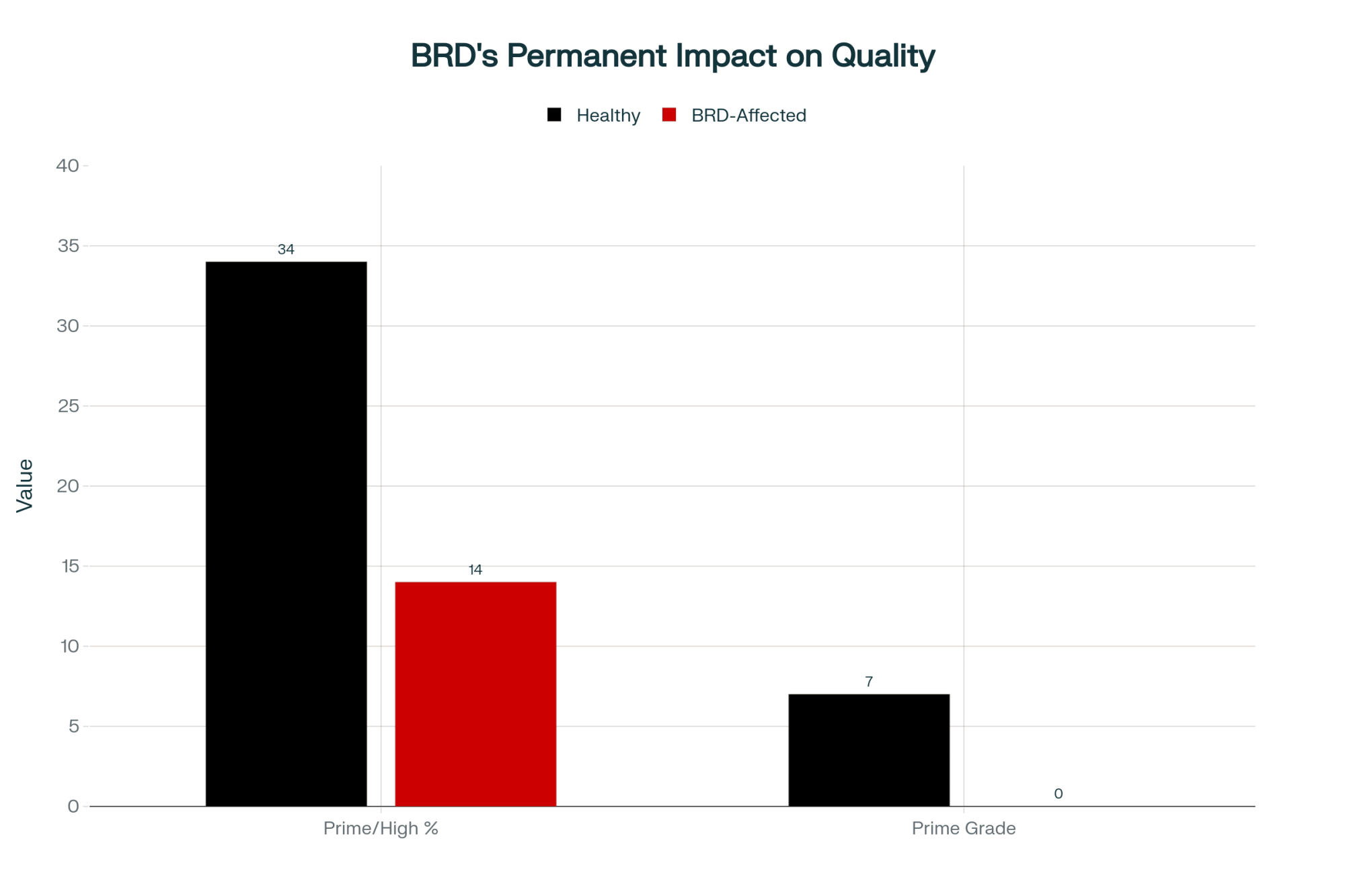
Even after full weight recovery, BRD-affected beef-cross calves show devastating marbling losses—zero achieved Prime grade vs. seven healthy calves in Penn State study

The Technology That Could Help (But Mostly Isn’t)

What really caught my attention in the Penn State work was their use of thoracic ultrasound. They were finding lung consolidation in calves that looked perfectly healthy—no fever, eating fine, acting normal.

Dr. Theresa Ollivett and her team at the University of Wisconsin-Madison have been pioneering this approach for years. The same portable ultrasound that many vets already use for preg checks can scan lungs in under a minute. The accuracy is impressive—we’re talking about 88% to 94% sensitivity in published studies.

I understand the hesitation, though. Another technology, another investment, and right now the market isn’t paying premiums for “ultrasound-verified healthy” calves.

A portable unit runs $5,000 to $8,000, and scanning adds a few dollars per calf when you factor in time. Without clear economic returns, it’s a tough sell.

I realize many of you are dealing with labor shortages that make extra protocols challenging. But here’s what I’m seeing: some progressive operations are using it anyway, just to understand what’s really happening in their calf barns. One veterinarian in central Pennsylvania told me she’s finding subclinical lung lesions in about 30% of calves that would otherwise have gone undetected.

That’s… significant.

Management Approaches Worth Considering

So what can we actually do with this information? I’ve been talking with producers, trying different approaches, and a few things keep coming up.


Intervention
Investment per 100 CalvesImmediate OutcomeReturn on Investment
Colostrum Testing (Brix Refractometer)$100 (one-time equipment)90% passive transfer successPrevents 16+ FPT cases
Hold Calves 7-10 Days Pre-Shipping$4,000-6,000 (holding costs)Mortality drops from 4% to 2%Saves 2 calves @ $1,000+ each
Enhanced Early Nutrition (High-Protein MR)$3,000-3,500 ($30-35/calf)Protects marbling development$100-150 return per calf at harvest

Transportation Timing Matters More Than We Thought

Research from Dr. David Renaud’s group at the University of Guelph has been eye-opening. Calves transported at 7 to 19 days old consistently show better health outcomes than those moved at 2 to 6 days. Each extra day on the source farm seems to help.

Now, I get it—holding calves costs money. Extension budgets suggest about $5 to $6 per day. For a farm shipping 100 beef-cross calves annually, holding each an extra week adds up to real money.

But here’s what’s interesting: producers who’ve made the switch are seeing enough reductions in mortality and treatment costs to offset holding expenses nearly.

One Minnesota producer told me that going to a 10-day minimum shipping age dropped his mortality from over 4% to under 2%. Treatment costs fell by about $15 per calf. Not quite breaking even on the holding costs, but getting close.

And if there really is a long-term impact on marbling? That changes the math completely.

Getting Serious About Colostrum

This feels almost too basic to mention, but the data keeps pointing back to it. The NAHMS Dairy 2022 study found that 36.5% of calves don’t achieve adequate passive transfer. That’s more than a third of calves starting life immunologically compromised.

Testing colostrum with a Brix refractometer—you can get one for about $100—takes seconds. Operations that have implemented systematic testing and adjusted protocols based on results are seeing dramatic improvements.

One Pennsylvania dairy improved their passive transfer success rate from 75% to over 90%. Treatment costs dropped by a third in the first year.

What’s encouraging is that this pays off regardless of any future marbling considerations. Healthier calves that need fewer treatments… that’s immediate economic benefit.

Nutrition During the Critical Window

There’s growing interest in how pre-weaning nutrition might influence marbling development. The thinking—and it makes biological sense—is that adequate nutrition during that 150 to 250-day window when fat cells are forming could make a difference.

Some operations are moving to higher planes of nutrition, feeding 20% to 22% protein milk replacer at higher rates. It costs an extra $30 to $35 per calf, which isn’t trivial.

But producers implementing these programs are documenting everything. They’re thinking that when the market eventually recognizes quality differences, they’ll have the data to prove their approach works.

THE MARBLING WINDOW: CRITICAL TIMING FOR INTERVENTIONS

Days 0-100: Foundation Phase

  • Colostrum quality determines immune competence
  • Early BRD has maximum impact on future marbling
  • Focus: Disease prevention, early detection

Days 100-250: Active Development Phase

  • Intramuscular fat cells are actively forming
  • Nutrition becomes critical
  • Focus: Adequate protein/energy, minimize stress

Days 250+: Maturation Phase

  • Fat cell numbers fixed
  • Only size can increase
  • Focus: Traditional feeding for finish

Where This Is All Heading

You know, this situation reminds me of how Certified Angus Beef developed. When CAB launched in 1978, most people thought it was just marketing. We’ve all seen “revolutionary” programs come and go, but CAB was different.

Within a decade, CAB cattle were commanding clear premiums—ranging from $5 to $8 per hundredweight and rising to current levels of $15 to $20 per hundredweight. Today, it’s a massive program moving over 2 billion pounds annually.

I think we’re at a similar inflection point with beef-cross calves. The biology shows there are quality differences based on early management. Technology exists to verify and track health. What’s missing—but starting to develop—is a market structure that rewards better management.

As many extension specialists are noting in recent meetings, the beef industry’s increasing focus on quality grades will inevitably influence how beef-cross calves are valued. We’re moving toward a system where documentation matters, where operations that can prove their management practices will capture premiums.

Dr. Tara Felix, beef specialist at Penn State Extension, recently emphasized this shift at a producer meeting: “The packers are already tracking quality variation in beef-cross cattle. It’s only a matter of time before that information flows back to calf pricing.”

Industry sources indicate that AI organizations and major beef companies are reportedly working on programs to recognize quality in health management. The direction seems clear: documentation and quality management will eventually influence value.

The question isn’t really whether this happens, but when and how quickly it happens.

Practical Thoughts for Different Operations

What makes sense for your operation really depends on where you’re at currently.

If you’re just starting to think about this, maybe begin with documentation. Track colostrum quality, health events, and when calves ship. Even without changing management, having baseline data positions you well.

If you’re ready to make changes, pick one or two that fit your resources. Maybe it’s implementing colostrum testing, or holding calves a few extra days, or adjusting nutrition. The key is choosing what works within your constraints.

For those already doing advanced calf management, consider building relationships with buyers who value quality. As markets evolve, operations with documented quality management will likely capture early premiums.

The investment—potentially $60 to $80 per calf for comprehensive changes—doesn’t have guaranteed returns today. But if the biological mechanisms are real (and the science strongly suggests they are), we’re already experiencing hidden losses from respiratory disease.

The question becomes whether to address them proactively or wait for market signals.

Looking Forward

The beef-on-dairy story has been one of the real successes in our industry recently. But this emerging understanding about respiratory disease impacts adds an important dimension. Managing for things we can’t immediately see—subclinical disease, cellular-level development, long-term quality—might prove just as important as the metrics we track daily.

What strikes me is that this isn’t really about the Penn State study specifically, though their work is valuable. It’s about recognizing that the biological mechanisms underlying hidden-quality impacts are real and documented across multiple species and decades of research.

Whether their specific 7% marbling reduction holds up in peer review almost doesn’t matter—the underlying biology tells us there’s something here worth paying attention to.

I’ve noticed operations making even small changes—better colostrum management, holding calves a bit longer—are seeing health improvements that justify the effort regardless of future quality premiums. Maybe that’s where we start: doing things that make sense today while positioning ourselves for whatever market structures develop tomorrow.

What excites me is that even small improvements we make now could position us perfectly when markets evolve. The dairy industry has always been about continuous improvement, finding marginal gains that add up over time.

This might be another one of those opportunities—not revolutionary, but important enough to consider as we manage these valuable beef-cross calves.

We’re in an interesting position right now. The science is telling us something important about the hidden impacts of quality. The market hasn’t caught up yet, but history suggests it will. Those who start adapting now—even with small steps—will likely be glad they did.

Every operation is different. Work with your veterinarian and nutritionist to develop protocols that fit your facilities, labor, and markets. What works great in one situation might need adjusting for another. Regional differences matter too—what makes sense in Wisconsin might need tweaking for operations in New Mexico or Idaho.

KEY TAKEAWAYS 

  • The Hidden Loss “Recovered” BRD calves permanently lose 7% marbling worth $200-300 per head—damage is invisible until slaughter
  • The 150-Day Window Marbling cells form ONLY between days 150-250; respiratory disease during this period causes irreversible damage
  • Your Current Risk: With 36% passive transfer failure rates, a 100-calf operation is likely losing $5,000-7,500 annually right now
  • Three Simple Solutions: Test colostrum with $100 refractometer (90% success rate achievable)
  • Hold calves 7-10 days before shipping (cuts mortality 50%)
  • Enhance early nutrition for $30/calf (protects marbling development)
  • Future Opportunity Start documenting health management today—quality premiums similar to CAB’s $15-20/cwt are coming within 2-3 years

Complete references and supporting documentation are available upon request by contacting the editorial team at editor@thebullvine.com.

Learn More:

Join the Revolution!

Join over 30,000 successful dairy professionals who rely on Bullvine Weekly for their competitive edge. Delivered directly to your inbox each week, our exclusive industry insights help you make smarter decisions while saving precious hours every week. Never miss critical updates on milk production trends, breakthrough technologies, and profit-boosting strategies that top producers are already implementing. Subscribe now to transform your dairy operation’s efficiency and profitability—your future success is just one click away.

NewsSubscribe
First
Last
Consent

Building a Beef-on-Dairy System: Capturing $360,000 in Annual Farm Profit

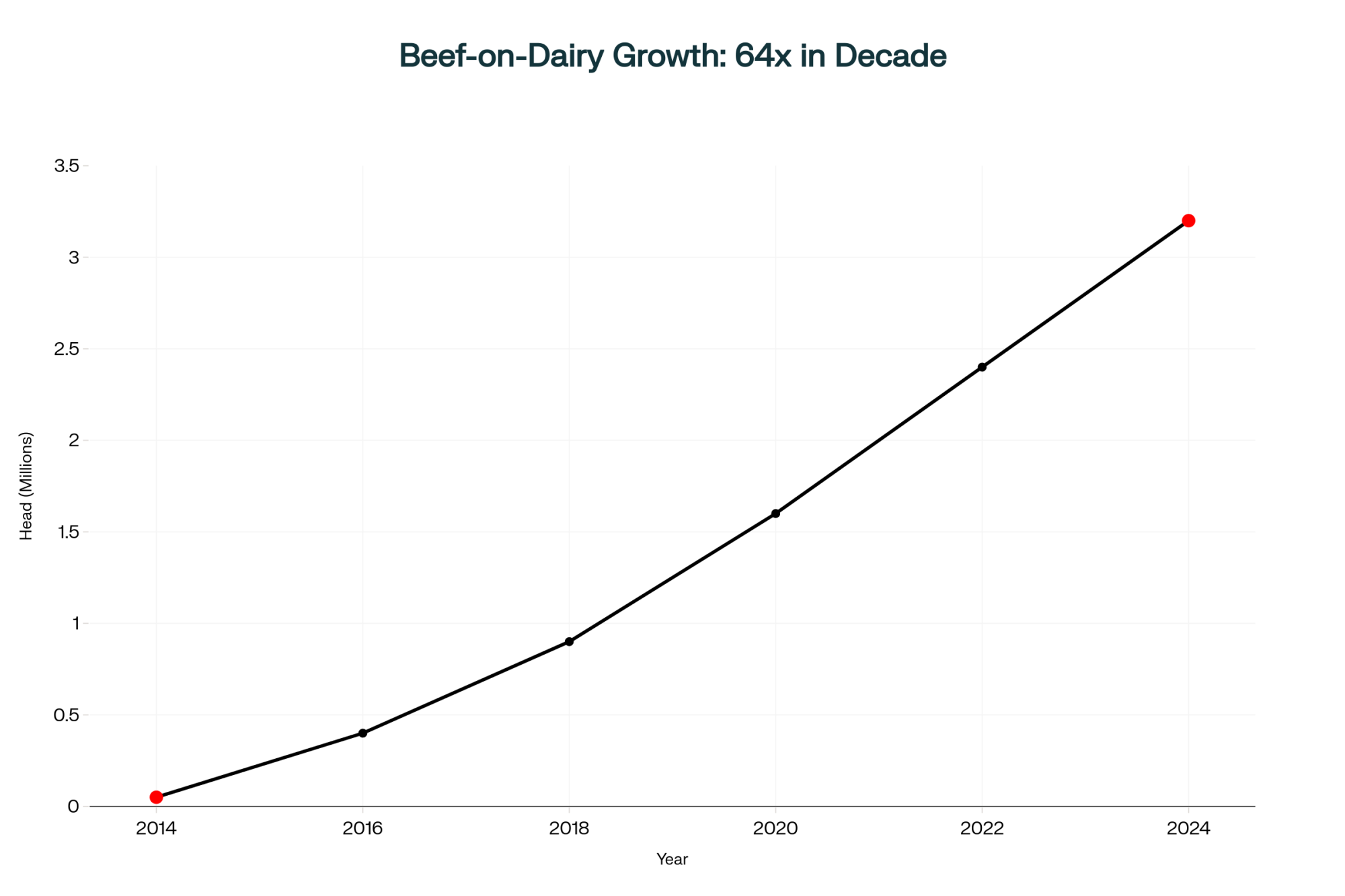
What farmers are discovering: beef-on-dairy breeding jumped from 50K to 3.2M head, boosting calf revenue from 2% to nearly 6% of total farm income

EXECUTIVE SUMMARY: What farmers are discovering is that beef-on-dairy breeding has surged from around 50,000 head in 2014 to over 3.2 million in 2024, driving calf revenue from 2% to nearly 6% of total farm income (NAAB 2024; UW Center 2025). Recent research shows that targeting sires in the top 15% for calving ease and top 20% for marbling can yield $100–$200 more per calf, translating to over $360,000 additional annual profit on a 1,500-cow dairy (Penn State 2024; K-State Extension 2025). This development suggests that building a systematic beef-on-dairy program—complete with rigorous colostrum Brix monitoring and detailed health protocols—will remain profitable even if calf prices normalize to $700 by 2028 (USDA WASDE 2025). Across regions from Pennsylvania to California, securing direct feedlot relationships can command $1,200–$1,250 per calf versus $950 at auction, enhancing cash flow and fresh cow management (UW-Madison 2025). While market cycles will fluctuate, adopting documented genetics evaluation and buyer partnerships today positions farms to thrive through changing conditions. Here’s what this means for your operation: build sustainable systems now to secure lasting profitability.

Beef on Dairy

I recently spoke with a producer outside Dodge City whose operation tells a remarkable story about what’s happening in our industry. Nearly half his total farm revenue—not a supplement to milk income, but half—now comes from selling beef-cross calves. Three years ago, those same bull calves brought maybe $250 on a good day.

The National Association of Animal Breeders documented this transformation in their spring report, showing beef-on-dairy breeding has grown from roughly 50,000 head in 2014 to over 3.2 million today. For those making breeding decisions this week for next spring’s calf crop, understanding what’s really driving this shift has become essential.

The beef-on-dairy revolution in numbers: from backyard experiment to mainstream strategy, jumping from 50,000 head to 3.2 million in just ten years—transforming dairy calf economics forever.

What’s particularly noteworthy is what I’ve observed visiting operations from Pennsylvania to Wisconsin recently. The most successful producers aren’t simply riding today’s high prices. They’re building systems that remain profitable even when—but it’ll be when—beef calf values return to more historical levels.

Understanding the Supply Dynamics

Looking at this trend, the numbers tell a big part of the story. USDA’s July cattle inventory report revealed the U.S. beef cow herd at about 28.7 million head—the lowest level since 1961. That’s a generational shift.

Drought from 2020 through last year devastated many cow-calf operations in Texas, Oklahoma, and Kansas. When pastures dried up and feed costs skyrocketed, producers had to liquidate. Now we have about 3.7 million replacement heifers according to the USDA’s latest count, down 3% from two years earlier.

Even with perfect weather tomorrow (which Western Kansas certainly isn’t seeing yet), the biological realities remain unchanged. A heifer bred today won’t calve for nine months, and that calf requires another 18–20 months to hit market weight. That points toward beef supply normalization not before late 2027 or early 2028.

Here’s what’s fascinating: dairy farms have stepped in to fill that gap. NAAB’s data from March shows dairy operations now purchase 84% of all beef semen sold domestically—five times more than traditional beef ranchers. That reversal of historical patterns underscores a major shift.

Fed cattle prices hovering around $214 per hundredweight on the CME are historic. USDA’s World Agricultural Supply and Demand Estimates project we could see $249 next year, with most analysts keeping prices elevated through 2027.

The Genetics Investment That Pays Dividends

What farmers are finding is that sire selection matters more than ever. Many assume that any Angus bull improves on Holstein genetics for beef production. While technically true, practically, that oversimplification can cost hundreds per head.

Penn State’s breed comparison published in the Journal of Animal Science this year shows Angus crosses finish in about 121 days with gains of over 4 pounds daily. Strong. But Limousin crosses require 152 days with gains just over 3 pounds daily—that extra month of feeding means additional costs and lower feedlot bids.

The genetics reality check: Angus and Simmental finish in 121-122 days with 4+ pound daily gains, while Limousin drags an extra month costing you feed and opportunity. Not all beef semen delivers equal value.

What caught my attention was Simmental: 122-day finish with nearly 4 pounds daily gain, matching Angus performance. Yet many operations haven’t considered this breed simply because Angus has become the default choice.

Michigan State’s Translational Animal Science research shows beef-dairy crosses finish roughly 21 days faster than straight Holsteins, with 20% larger ribeyes and superior yield grades. But—and this is crucial—those gains only materialize with the right genetics.

Wisconsin Extension notes Limousin pregnancies typically last 285–287 days compared to Holstein’s 279 days. Those extra days in the close-up pen, eating expensive pre-fresh rations but not producing milk, can cost $40–$50 per cow. Across 400 breedings, that adds up fast.

Superior Livestock’s auction summaries, compiled by Kansas State Extension this August, indicate the premium for superior genetics versus average bulls at $100–$200 per calf. On 100 calves, saving $6 on semen while losing $100 at sale just doesn’t pencil out.

Regional Market Dynamics and Opportunities

Farmers are also finding huge regional price gaps. New Holland’s Monday sale in Pennsylvania, according to their October reports, sees 75-pound beef-cross calves bringing $1,400–$1,725 per hundredweight. That same calf at Equity Livestock in Stratford, Wisconsin, brings $900–$1,200.

Why the difference? Pennsylvania sits at the heart of America’s veal industry. USDA data shows about 133,000 formula-fed calves processed annually in that region, with Lancaster County a major hub and generations of family-run operations creating steady demand.

Penn State Extension specialists explain that New Holland’s market structure—sales on Monday, Thursday, and Wednesday—creates exceptional liquidity. When veal buyers and feedlot buyers compete, prices naturally rise.

What’s encouraging for producers outside Pennsylvania is the chance to capture similar value through direct feedlot relationships. The University of Wisconsin’s Center for Dairy Profitability reports Wisconsin dairies shipping calves to Kansas earn $1,200–$1,250 when local auctions pay $950.

Location determines your check: Pennsylvania’s veal market competition drives calves to $1,562 while generic auctions settle at $950. Smart producers are building direct feedlot relationships to capture that $250-$600 premium.

I recently visited a Wisconsin operation near River Falls that ships about 200 calves annually to a Kansas feedlot. The producer told me, “They pay us a premium because we provide documented genetics, health records, and consistent quality. It’s well worth the extra coordination.”

California dairies facing water and regulatory challenges, and Texas operations dealing with heat stress in transition periods, are also finding beef-dairy diversification boosts cash flow when milk prices are tight.

Financial Realities: A 1,500-Cow Example

Beef calf prices will normalize as supply rebuilds. Operations built on $1,300 calves will struggle when—not if—markets hit $700. The winners are designing systems today that profit at both extremes

Let’s break down what this means for a 1,500-cow dairy breeding 40% to beef:

2022 Baseline (All Dairy Breeding)

  • Holstein bull calves: 612 annually
  • Revenue at $250 each: $153,000
  • Semen costs: $78,000
  • Net calf income: $60,000

2025 With 40% Beef Breeding

  • Beef crosses: 285 at $1,300 = $370,500
  • Holstein bulls: 229 at $600 (reflecting the elevated overall cattle market) = $137,400
  • Total calf revenue: $508,200
  • Semen costs: $76,000 (as premium conventional beef semen often replaces more costly sexed dairy semen)
  • Net profit from calves: $420,000

That’s an improvement of $360,000 annually—profit, not revenue.

The University of Wisconsin’s dairy profitability reports show calf sales jump from 2% to nearly 6% of total revenue. Producers breeding 50–60% to beef are seeing calves represent 8–12% of revenue. That diversification is a welcome buffer when milk prices drop.

The diversification story nobody saw coming: calves jumped from throwaway income at 2% to a legitimate revenue pillar at 6-10% of total farm earnings. That’s a business model transformation, not a price spike.

Planning for Market Normalization

Nobody expects these prices to last forever. CoBank’s dairy quarterly outlook suggests gradual moderation as supply recovers, though timing remains uncertain.

Economists modeling historical patterns and current fundamentals anticipate:

  • 2026: Beef calves near $1,250
  • 2027: Approximately $1,100
  • 2028: Potentially $950 (base case)

The bear-case scenario—if Mexican imports resume in force, beef herds rebuild quickly, and dairy-beef calves flood the market—could see $700 calves by 2028.

Even at $700, beef-dairy remains more profitable than Holstein bulls alone. The break-even point where beef-dairy loses its edge sits around $145 per calf. Historical prices have never approached that level, even during the 2008–2009 economic downturn.

Cornell’s dairy management specialists caution against expansion decisions based on peak prices. Farms that factored $1,300 calf revenue into projections risk financial stress if markets normalize rapidly.

Implementation Strategies That Work

From visiting dozens of operations, I’ve noticed successful programs share certain practices:

Genetics Evaluation: Review breeding records and consult breed association EPD databases. Bulls outside the top 15% for calving ease and the top 20% for marbling need revaluation.

Feedlot Partnerships: Build relationships with three feedlots within shipping distance. Phone calls often create stronger commitments than emails. Buyers prioritize documented genetics and health records.

Documentation Systems: Recording data at birth takes minutes:

  • Birth date and weight
  • Dam ID and sire genetics
  • Colostrum management (Brix readings >22%)
  • Health protocols and treatments
  • Sale weight and age

Premium Genetics Investment: Spending $18–$25 on beef semen instead of $10–$12 often earns $100–$200 per calf premium at auction or on contract.

Trial Shipments: Start with batches of 10–20 documented calves. Feedlots track health, average daily gain, and feed conversion, then share that data so dairies can refine protocols.

Documented standard operating procedures—breeding protocols, calf care standards, health programs—ensure consistency. Regular check-ins with buyers build relationships that drive premiums. As Dairy Herd Management noted this September, “Producers earning top prices aren’t just selling cattle—they’re selling confidence through consistent quality.”

The 2030 Outlook

By 2030, analysts expect two distinct tiers in the beef-dairy market:

  • Top 15–20% of producers, with systematic quality programs and relationships, commanding $900–$1,100 per calf
  • Remaining producers selling commodity calves for $600–$750, facing typical market swings

University of Illinois consultants predict the quality premium will widen from $300–$400 today to $500–$700. Quality will move from an important differentiator to the primary driver of value.

Technology adoption—genomic testing to allocate dairy vs. beef breeding—continues accelerating. While sophisticated, these data-driven approaches deliver tangible returns.

The quality-commodity divide is about to explode. Today’s $350 premium grows to $500-$700 by 2030 as buyers demand documented genetics and health protocols. Commodity producers will be fighting for scraps while quality systems command sustainable premiums.

Quick Implementation Reference

Key Genetic Thresholds:

  • Calving ease: Top 15% of the breed
  • Marbling: Top 20% of breed
  • Birth weight: Below breed average
  • Ribeye area: Above breed average

Financial Break-Even Points:

  • Current beef-cross value: $1,300
  • Projected 2028 base case: $950
  • Projected 2028 bear case: $700
  • Mathematical break-even: $145

Documentation Essentials:

  • Birth date and weight
  • Dam ID and sire genetics
  • Colostrum management (Brix >22%)
  • Health protocols and treatments
  • Sale weight and age

Timeline Considerations:

  • Beef supply recovery: 2027–2028
  • Market normalization: 2026–2027
  • Quality premium expansion: Through 2030

The Bottom Line

As you consider breeding strategies, ask yourself:

  • Does your program remain viable at $700 calves? If not, you’re speculating, not building a system.
  • Are you building documented quality systems or chasing today’s highs? Systems endure cycles.
  • Does beef-dairy complement your dairy operation or add complexity? UW-Madison specialists emphasize that it should boost butterfat performance and fresh cow management, not distract from core milk production.

What we’re witnessing transcends temporary price spikes. The dairy industry is discovering systematic value creation from calves that once had minimal worth. But long-term success rewards disciplined, sustainable approaches over opportunistic plays.

For operations willing to invest in quality genetics, develop robust documentation, and cultivate real buyer partnerships, beef-dairy can generate $200,000 to $400,000 in additional annual profit. That’s transformational for most dairies.

Those simply riding current market waves without building sustainable systems may find 2027 to 2028 challenging.

The opportunity is genuine. The transformation is occurring now. How each operation responds will determine its role in this evolving market dynamic.

KEY TAKEAWAYS

  • Beef-on-dairy breeding lifted calf revenue from 2% to nearly 6% of total farm income, adding $360,000 net annually for a 1,500-cow herd (NAAB 2024; UW Center 2025).
  • Use top 15% calving-ease and top 20% marbling sires to capture $100–$200 premium per calf, offsetting extended dry-period costs (Penn State 2024; K-State Extension 2025).
  • Establish direct feedlot contracts to earn $1,200–$1,250 per calf vs. $950 at auction, smoothing cash flow and supporting butterfat performance in 2025 markets (UW-Madison 2025).
  • Implement calf documentation—colostrum Brix >22%, health and treatment records—to boost buyer confidence, improve fresh cow management, and command relationship premiums.
  • Monitor USDA heifer inventory and fed cattle futures to adjust breeding rates strategically, ensuring profitability even if calf prices fall to $700 by 2028.

Complete references and supporting documentation are available upon request by contacting the editorial team at editor@thebullvine.com.

Learn More:

Join the Revolution!

Join over 30,000 successful dairy professionals who rely on Bullvine Weekly for their competitive edge. Delivered directly to your inbox each week, our exclusive industry insights help you make smarter decisions while saving precious hours every week. Never miss critical updates on milk production trends, breakthrough technologies, and profit-boosting strategies that top producers are already implementing. Subscribe now to transform your dairy operation’s efficiency and profitability—your future success is just one click away.

NewsSubscribe
First
Last
Consent

155 Pounds More Milk Per Heifer: The Calf Feeding Discovery That’s Changing Everything

Your calves are hungry for a reason—nature designed them to eat 8-12 times daily, not twice.

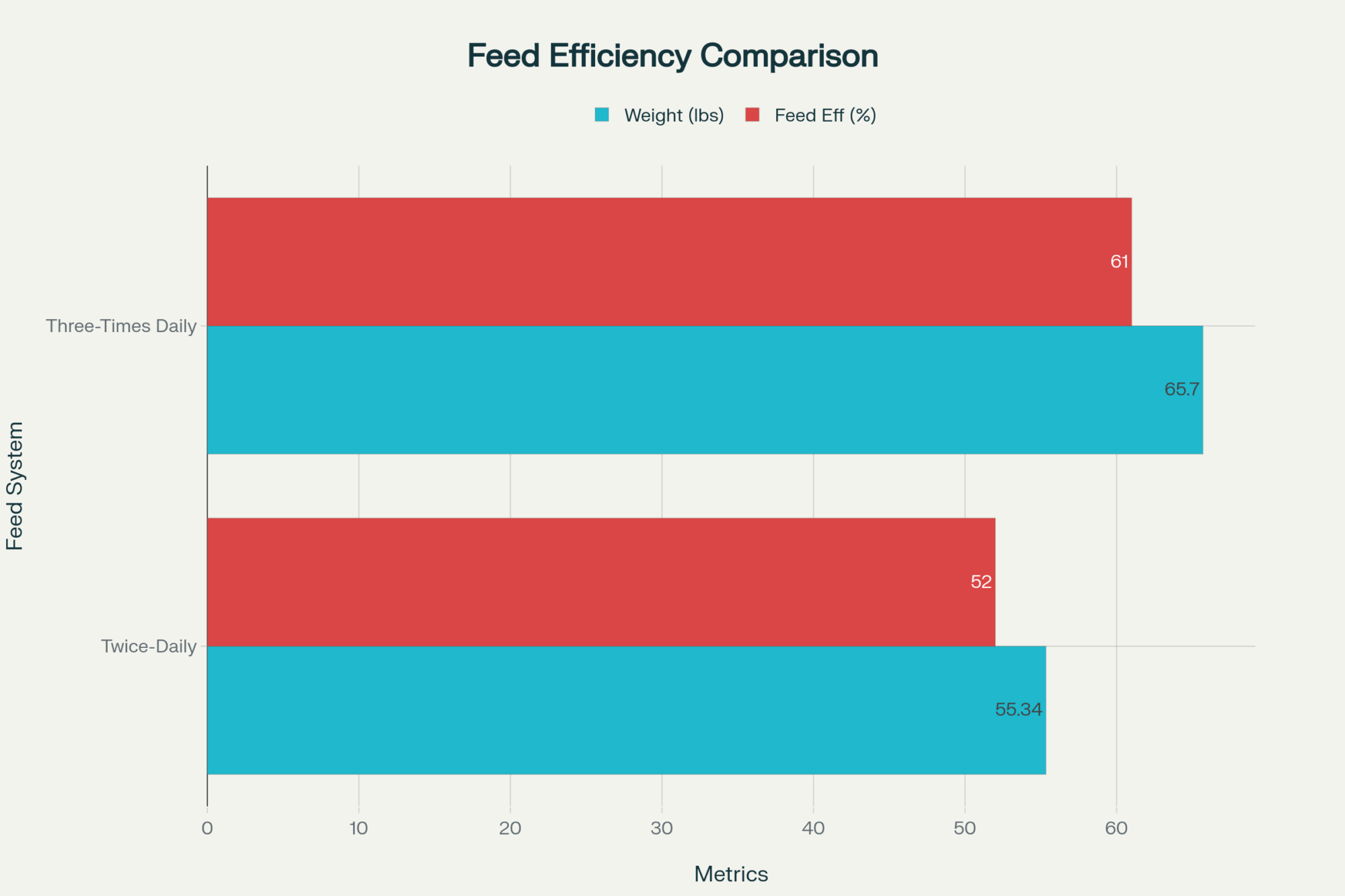
EXECUTIVE SUMMARY: Cornell’s groundbreaking research reveals that for every tenth of a pound increase in preweaning daily gain, heifers produce 155 pounds more milk in their first lactation—a discovery that’s prompting dairy farmers to reconsider fundamental calf-feeding practices. Wisconsin studies now show that calves fed three times daily gain 10.4 pounds more by 42 days and achieve a feed efficiency of 0.61, compared to 0.52 for twice-daily feeding. According to Trouw Nutrition’s 2024 analysis, automated systems are reducing labor by 90%. With 36.5% of British Columbia dairy farms already implementing social housing ahead of Canada’s 2031 requirements, and the Smart Calf Rearing Conference coming to Madison this September for the first time, the industry is witnessing a shift toward biology-based management that respects both traditional wisdom and emerging science. The economics are becoming clearer too: Wisconsin Extension data show that autofeeder systems cost $6.35 per calf daily, versus $5.84 for individual housing. Although the extra milk investment ($140.50 vs. $111.95) often pays back through lifetime production gains. Whether you’re managing 50 cows or 5,000, understanding these biological principles—while acknowledging that excellent producers succeed with various approaches—can help you evaluate which changes, if any, make sense for your operation and market conditions.

I was standing in a calf barn last week, watching a Holstein heifer drain her bottle in about 60 seconds flat. An hour later, she was bawling again. The producer next to me shook his head and said, “They’re always hungry at this age.” But you know what? I’m starting to wonder if that hunger is actually biology trying to tell us something important about how these animals are meant to develop.

Like many of you, I grew up washing bottles twice a day, trudging through snow to check hutches before school. It’s what we did. What our parents did. However, the research emerging lately—and especially what’s being discussed ahead of the Smart Calf Rearing Conference, which is coming to Madison this September—is prompting many of us to reconsider some fundamental assumptions about raising calves.

The 155-Pound Discovery That’s Making Us All Think Twice

Here’s what really got my attention at the last extension meeting. In 2013, Soberon and Van Amburgh at Cornell published a meta-analysis in the Journal of Animal Science, which compiled data from studies spanning several years. What they found has stuck with me: for every kilogram of preweaning average daily gain, heifers produced about 1,550 kilograms more milk in their first lactation.

Let me put that in terms we think about at 5 a.m. during milking—a tenth of a pound increase in daily gain before weaning translates to roughly 155 pounds more milk when that heifer freshens. That’s actual milk in the bulk tank, based on thousands of real calves across multiple studies.

Every tenth of a pound matters: Cornell’s meta-analysis proves what progressive producers suspected—we’ve been leaving thousands of pounds of milk on the table by underfeeding calves. The red zone shows where ROI peaks before diminishing returns kick in.

What Van Amburgh’s team has been piecing together is the why behind these numbers. During those first 60 days of life, the mammary gland grows much faster than the rest of the body. That parenchymal tissue, the actual milk-producing machinery, expands rapidly when nutrition supports it properly.

Now, I’ve been hearing from producers across the Midwest who’ve improved their calf programs. Some are seeing these effects as those animals come into the milking string. Although, to be honest, not everyone sees dramatic changes—management matters tremendously.

While you’re washing bottles, these calves are building their milk-making machinery at 3.5x the rate of their body growth. Miss this window, and no amount of later feeding recovers that lost potential.

Why Our Twice-Daily Routine Might Be Working Against Us

This is where things get uncomfortable. When a calf guzzles down those 2-3 quarts in 90 seconds, we’re creating two connected problems that research is helping us understand better.

First, there’s the physical issue. Research from the University of Guelph suggests that rapid milk consumption can lead to esophageal groove dysfunction, causing milk to be directed to the rumen instead of the abomasum, where it is intended to be. Now you’ve got milk fermenting in the wrong stomach compartment.

Wisconsin data doesn’t lie: that extra trip to the calf barn pays for itself in weeks, not years. Yet 73% of farms still stick with twice-daily feeding. Are you leaving money in the hutch?

This directly contributes to the stress problem. Those digestive issues, combined with genuine hunger between feedings, create elevated stress indicators. Here in Wisconsin, where we’re already managing January cold stress, we’re layering nutritional stress on top. The combination impacts immune function, growth rates, and ultimately, lifetime productivity.

But—and this is really important—I know plenty of excellent producers who raise healthy calves on twice-daily feeding. If that’s you, you’ve obviously figured out the management details that work for you.

“I’ve seen more farms fail from poor management of fancy systems than from sticking with simple twice-daily feeding done right.” – Wisconsin dairy nutritionist

That’s worth considering, too.

Learning from Nature (and Recent Research)

MetricNatural Nursing (Beef Calves)Traditional 2x Daily3x Daily (Wisconsin Study)Automated/Ad Lib
Feeding Frequency (times/day)8-12236-10
Meal Size (quarts)0.5-1.02-32-2.50.8-1.5
Total Daily Intake (quarts)8-104-66-7.58-12
Stress Hormone LevelsBaseline+45-60%+20-30%+5-10%
Immune Response Score95-10070-7580-8590-95
Average Daily Gain (lbs)2.2-2.61.2-1.51.6-1.92.0-2.4
Feed Efficiency (gain/DMI)0.68-0.720.50-0.540.59-0.630.64-0.68
Esophageal Groove FunctionOptimalCompromised 25-30%Improved 10-15%Near Optimal
Disease Incidence (%)3-5%15-20%10-12%5-8%
First Lactation Milk (lbs)N/ABaseline+18.7%+25-30%
Labor Hours/Calf/Day00.5-0.750.75-1.00.08-0.15
Feed Cost/DayN/A$5.84$6.10$6.35

Research confirms that beef calves nurse 4-9 times in the first few days, often 8-12 times daily in the first week. Small meals, frequent intake, no stress peaks.

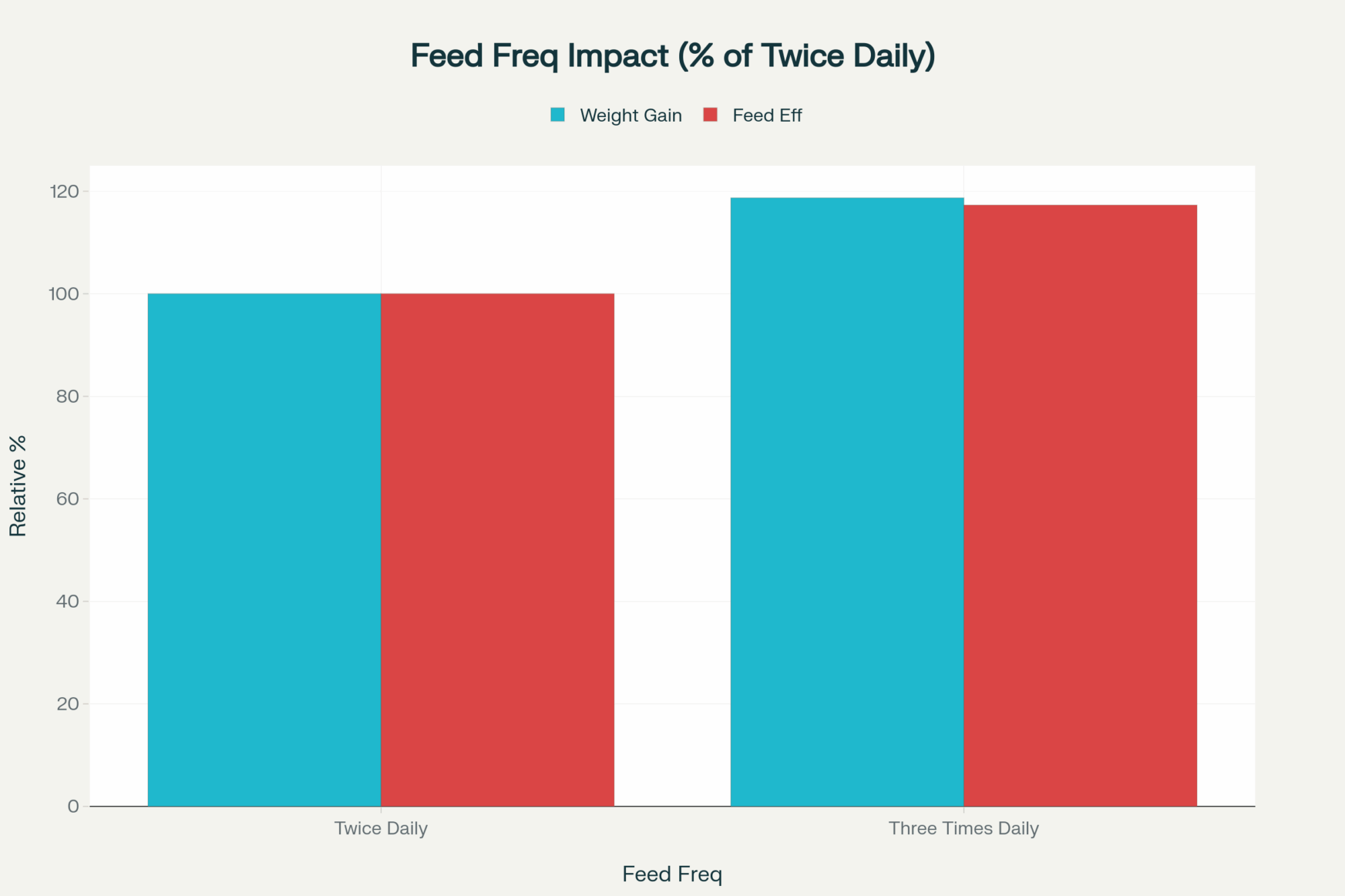
A recent University of Wisconsin study, presented by Donald Sockett, suggests that three-times-daily feeding could become the standard. Calves fed three times gained 65.7 pounds from birth to 42 days, compared to 55.34 pounds for twice-fed calves. Feed efficiency improved too—0.61 gain per dry matter intake versus 0.52.

Wisconsin research proves what progressive farmers suspected: three-times-daily feeding delivers 18% better weight gain and 17% improved feed efficiency. That third feeding might be the easiest money you’ll make this year – if you can manage the extra labor.

I’m hearing from more producers experimenting. Some add that noon feeding is allowed when labor permits. Others try acidified milk systems. Förster-Technik and Urban Calf Tech systems typically cost $2,000-$ 4,000 for basic setups, although results vary by operation.

Nature designed calves to eat 8-12 times daily, but we feed them twice – this biological mismatch creates stress peaks that impact immune function, growth, and lifetime productivity. The red zones show when your calves are genuinely hungry, not just ‘being calves.

When Technology Actually Makes Biological Sense

Automated calf feeders enable calves to eat multiple times daily, providing valuable management data. Jorgensen and colleagues at the University of Minnesota tracked management on 26 farms using these systems, publishing their findings in the 2017 Journal of Dairy Science.

What’s particularly interesting from the 2024 research is that Trouw Nutrition found that automated systems can reduce labor by approximately 90% compared to manual feeding. Many producers tell me they’re catching pneumonia or scours 2-3 days earlier.

The investment? A 2018 Wisconsin Extension study found that autofeeder systems cost about $6.35 per calf per day, compared to $5.84 for individual housing—but that included $140.50 in liquid feed costs for autofeeder calves, compared to $111.95 for individually housed calves. The extra milk has driven up costs, but many view it as an investment in the future.

The Social Housing Debate Gets Real Data

Research from Emily Miller-Cushon at Florida shows social housing affects learning and stress response in ways that persist. The Canadian industry now requires pair or group housing by 2031.

What’s interesting is new data from British Columbia. A 2025 survey by Elizabeth Russell at UBC found 36.5% of farms already using social housing, with another 11.1% combining approaches. These are regular commercial operations, figuring it out.

I’m still hearing mixed reports. One producer who tried group housing told me, “The disease pressure in our area made it unworkable. Maybe with different facilities, but not for us now.”

Making Economic Sense When Numbers Keep Changing

Let’s be real about costs. The British Columbia survey found 52.4% of farms monitor calf growth, but only 31.7% have target growth rates. We’re measuring more, but not always sure what to do with it.

Questions to Consider:

  • What’s your current mortality rate and treatment cost?
  • How many hours daily on calf care?
  • Can small changes be made before major investments?
  • What disease pressures are specific to your region?
  • Are you tracking growth against targets?

Where This Leaves You

I don’t have all the answers. Nobody does, really. But our understanding of calf biology is evolving faster than it has in decades.

If you’re successfully raising healthy calves with traditional methods, you’re not doing anything wrong. Your experience matters more than any research paper. However, if you’re experiencing issues—such as high mortality, poor growth, or rough weaning transitions—these insights may point toward potential solutions.

The calves are telling us what they need. Our job is figuring out how to listen while keeping the lights on.

What’s one small change you’ve made to your calf program that’s had a big impact? Maybe it was adding a third feeding, switching to teat feeders, or simply increasing milk allowance. Share what worked (or didn’t) at The Bullvine—your experience could be exactly what another producer needs to hear.

KEY TAKEAWAYS:

  • 155-pound milk increase per lactation for every 0.1 lb improvement in preweaning daily gain (Cornell meta-analysis, 2013)—that’s roughly $31 extra revenue per heifer at current milk prices, achieved through better early nutrition management tailored to your system
  • Three-times-daily feeding shows measurable benefits: 65.7 lbs weight at 42 days versus 55.3 lbs for twice-daily (Wisconsin research), with 17% better feed efficiency—consider adding that noon feeding if labor allows, or explore acidified milk systems ($2,000-4,000 investment) that let calves self-feed
  • Automated feeders reduce labor by 90% while catching illness 2-3 days earlier through intake monitoring (Trouw Nutrition, 2024), though investment ranges from $15,000-30,000—evaluate whether labor savings and health benefits justify costs for your herd size
  • Social housing becoming industry standard: Canadian requirement by 2031, with 36.5% of BC farms already implementing—start small with pair housing in existing hutches to test disease management before major facility changes
  • Biology-based weaning using BHB testing (95% accuracy per Guelph research) identifies individual readiness from 7-10 weeks versus calendar weaning—particularly valuable for high-genetic-merit heifers where maximizing lifetime production justifies extra management attention

Complete references and supporting documentation are available upon request by contacting the editorial team at editor@thebullvine.com.

Learn More:

Join the Revolution!

Join over 30,000 successful dairy professionals who rely on Bullvine Weekly for their competitive edge. Delivered directly to your inbox each week, our exclusive industry insights help you make smarter decisions while saving precious hours every week. Never miss critical updates on milk production trends, breakthrough technologies, and profit-boosting strategies that top producers are already implementing. Subscribe now to transform your dairy operation’s efficiency and profitability—your future success is just one click away.

NewsSubscribe
First
Last
Consent

Top 5 Must-Have Tools for Effective Calf Health and Performance

Boost calf health and performance with top tools: sanitary colostrum vessels, reusable naval dippers, refractometers, scales, and ammonia monitors. Ready to up your game?

In the demanding world of dairy farming, the health and performance of your calves and heifers can’t be left to chance. Effective calf and heifer management is crucial for a successful dairy operation, ensuring that young animals grow into productive, high-yielding cows. 

The Dairy Calf and Heifer Association Annual Conference, a renowned platform for the latest advancements in calf and heifer management, unveiled five key innovations this year. From sanitary colostrum vessels to ammonia monitors, these tools have the potential to revolutionize your calf management practices. Incorporating these innovations into your routine could be the game-changer your dairy operation needs.

Spotlight on Colostrum Hygiene: The First Step to Robust Calf Health 

Using sanitary colostrum vessels is not just a hygiene measure, it’s a direct investment in your calves’ health. By ensuring newborn calves receive clean, uncontaminated colostrum, you’re preventing the spread of disease and boosting calf immunity. This simple step can significantly reduce the risk of illnesses in vulnerable newborns. 

Maintaining high hygiene standards ensures colostrum remains rich in essential antibodies and nutrients, protecting calves’ immune systems. Clean vessels promote better health during the crucial early days of life and lay a strong foundation for growth and resilience. It’s a small investment with significant benefits for healthier, more robust calves.

Reusable Navel Dippers: A Small Tool with Big Benefits 

Reusable navel dippers are essential tools in calf management. By disinfecting the navel area, these tools help reduce the risk of infections, a crucial step right after birth. 

These dippers ensure that each calf gets the disinfectant, promoting faster healing and overall health. Keep them clean and sanitized for reliable infection prevention: They are a small tool that significantly impacts calf health.

Refractometers: Precision Tools for Optimal Calf Nutrition 

Refractometers are not just precision tools, they’re decision-making aids. By measuring total proteins in colostrum and blood serum, they provide essential data about colostrum quality and calf nutrition. This instant feedback allows you to make timely, informed decisions that can have a profound impact on calf health and growth

Accurate protein measurements are crucial for calf health. High-quality colostrum with ample immunoglobulins transfers necessary immunity to newborn calves, safeguarding them from early diseases. Ensuring colostrum’s protein levels meet standards helps build a robust immune system. 

Checking total proteins in calf blood serum reveals overall health and nutritional status. Low levels indicate malnutrition or poor colostrum absorption, necessitating timely care. Refractometers provide precise readings, aiding in tailored feeding and care, which promotes better health and improved growth in your herd.

Heifer Growth Tracking: The Key to Breeding Success and Herd Performance 

Monitoring heifer growth before breeding is crucial for their health and future productivity. Regularly using scales to track weight gives you a clear picture of how effective your feeding and care strategies are. Accurate growth metrics let you adjust nutrition and management practices, ensuring heifers reach optimal size and condition for breeding. 

Tracking these metrics helps identify growth patterns and potential issues early on. If a heifer isn’t gaining weight as expected, it might indicate health or dietary problems. Addressing these promptly prevents breeding delays and improves overall herd performance. Investing in scales for weight monitoring is a practical step toward better herd management, leading to higher success rates in breeding and milking productivity.

Ammonia Monitors: Breathing Easier for Healthier Calves 

Ammonia monitors can be a game-changer for your calf housing facilities. These devices measure air quality and help protect calf respiratory health. Elevated ammonia levels can increase infection risk and reduce overall well-being. 

By monitoring ammonia levels, you can spot problems early and improve ventilation, ensuring your calves breathe healthier air. This approach boosts hygiene and overall calf performance. 

Investing in and using ammonia monitors diligently promotes healthier calves and a more productive herd.

Non-Negotiables in Calf Management: Start with Cleanliness 

When it comes to calf management, cleanliness is critical. Here’s how to give your calves the best start: 

  • Avoid Dirty Equipment: Always clean and sanitize bottles, feeders, and other equipment after each use.
  • Use Single-Use Paper Cups: Opt for disposable paper cups for medications and supplements to prevent cross-contamination.
  • Practice Rigorous Cleaning Routines: Regularly disinfect pens, feeding areas, and water troughs.
  • Hand Hygiene: Wash your hands with disinfectant soap before and after handling calves.
  • Colostrum Collection and Storage: Use clean containers and store colostrum appropriately to prevent bacterial contamination.
  • Regular Health Checks: Conduct routine health checks to catch and address issues early.

Implementing these practices promotes disease prevention and overall calf health, producing more robust and high-performing animals. 

The Bottom Line

The Dairy Calf and Heifer Association Annual Conference highlighted essential tools to boost calf and heifer management. These tools include ensuring colostrum hygiene, using reusable navel diapers, measuring protein with refractometers, tracking growth with scales, and monitoring ammonia levels. By adopting these practices, you play a crucial role in leading to healthier calves, robust growth, and improved breeding outcomes. Embrace these tools to enhance your calf management and see tangible improvements in your herd’s health and productivity, knowing that your efforts are integral to the success of your dairy operation.

Key Takeaways:

  • Sanitary Colostrum Vessels: Ensure the first feeding is free from contaminants to boost immunity in newborns.
  • Reusable Navel Dippers: Disinfect the navel area to prevent infections and promote healthy growth.
  • Refractometers: Accurately measure total protein levels for optimal calf nutrition.
  • Scales for Pre-breeding Heifer Growth Goals: Track growth to meet breeding objectives and improve herd performance.
  • Ammonia Monitors: Monitor air quality to protect respiratory health in calf housing facilities.

Summary: The Dairy Calf and Heifer Association Annual Conference highlighted five key innovations in calf and heifer management that can revolutionize practices. These innovations include ensuring colostrum hygiene, using reusable navel dippers, measuring protein with refractometers, tracking growth with scales, and monitoring ammonia levels. Colostrum hygiene is crucial for preventing disease spread and boosting calf immunity in newborn calves. Reusable navel dippers disinfect the navel area, reducing the risk of infections. Refractometers provide accurate protein measurements, promoting better health and improved growth in the herd. Heifer growth tracking is essential for breeding success and herd performance, allowing for adjustments in nutrition and management practices. Ammonia monitors can measure air quality in calf housing facilities, protecting calf respiratory health by detecting problems early and improving ventilation. Cleanliness is also essential in calf management, with regular cleaning and sanitizing of bottles, feeders, and equipment. Disposable paper cups for medications and supplements prevent cross-contamination, and regular health checks can catch and address issues early, promoting disease prevention and overall calf health. Adopting these tools can lead to healthier calves, robust growth, and improved breeding outcomes in dairy farming.

Best Practices for Achieving Longer Lived More Productive Dairy Cows

We all wish our cows could meet their potential and live 20 years or longer. However, until we discover the Bovine Fountain of Youth, this remains an elusive dream. Indeed, the average on most dairy farms is only six years. With so much potential, we need to focus on how we can help our cows live long, productive lives.

What Do WE Know About Longevity? Why Aren’t we Using What we Know?

When we develop illnesses, we don’t always have enough information to know what the root cause is.  This isn’t so in dairy farming. Mountains of data have been collected, analyzed and reported but, in general, dairy farmers are not acting up the information. We know what causes involuntary culling. We know what best practices could prevent it.  Unfortunately, the knowing and the implementing are still too far apart.

How Big is the Current Problem with Involuntary Culling?

According to Government of Canada and USDA reports, 30-40% of cows are being culled from herds each year.  Some of this is accounted for because of low production or sales of breeding stock. Those are conscious decisions made for specific reasons.  However, much of the culling is involuntary and is a huge contributor to decreased longevity. The majority of cows are culled because of reproductive problems, poor udder health, lameness and problems with feet and legs. Other illness or injuries also contribute to the high statistics. A culling rate of 40% means that a herd cannot raise enough heifers to meet replacement needs.

What Does this Mean?

High rates of involuntary culling are probably directly correlated to poor levels of animal welfare.  Unfortunately, these health/welfare problems may be indicators of something much more problematic.  The underlying health and welfare problems may be much higher than the rate of culling indicates.  Ito et al reported in 2010 that the actual prevalence of lameness among dairy cows is above 20%.  That percentage is considerably higher than the 2% that are reported as being culled because of feet and leg problems (Government of Canada, 2011). In 2008, 46% of cows in free stalls had hoof lesions (Cramer et al, 2008).  The numbers are similar in the USA.  USDA (2007) reports that four percent were culled for lameness, however an average of 20% to 55% of dairy cows are lame at any one time, depending on the region (Espejo et al, 2006, von Keyserlingk et al, 2013).

Mastitis Has the Same Pattern

In 2011, the Government of Canada reported that about 4% of cows are culled because of mastitis, high SSC or poor udder health. However, Rierkerink et al estimate that mastitis incidence is around 23 cases per 100 cow years.

Who Does A Good Job Of Achieving Longevity?

Best management practices, derived from proven science, are providing some breeders with improved animal welfare and increased profits.

Nevertheless, that doesn’t mean we can’t help our cows live long, productive lives.  We need to put what we know, into practice to extend their longevity.

Are you meeting these herd composition benchmarks?

  • 1st lactation                  24%
  • 2nd lactation                 20%
  • 3rd lactation                  16%
  • 4th lactation                  12%
  • 5th lactation and later   28%

Best Practices that Ensure Longevity

  1. Calf Management – Protocols to raise health and reduce calf mortality.
  2. Implement Indoor Housing Factors – To reduce lameness, injury, and illness.
  3. Benchmarking of farm performance.
  4. Implement an aggressive reproduction program.
  5. Reducing lameness.
  6. Build dairy producer knowledge.

Calf Management

It might seem unusual to start with calf management when you’re talking about extending the life expectancy of cows.  Many place involuntary culling of cows in the number one slot for how to improve longevity. That seems obvious. However, less obvious, but with perhaps even more impact are the calves that never make it to the milking line. Vasseur et al reported in 2012 that pre-weaning calf mortality rates are high in North America. Mortality rate record keeping, which needs to be dramatically improved and increased, is the first step.  Setting a realistic benchmark is also important.  Unfortunately, the Vasseur study also reported “some farms with mortality rates above 19% did not consider calf mortality to be a problem.”

  • Individual housing may not affect small groups but could reduce mortality among larger groups (more than 7-10 animals).
  • The effect of a calf’s illness on her ability to milk as a cow is, in general, underestimated. Recent research (Soberon et al, 2012) shows the effect of pre-weaning growth rates on later milk yields.
  • Failure to implement well-known and documented best practices is a major reason for the continuing high levels of calf mortality on many farms.

They also noted that in Canada there are significant differences in mortality rates between farms. The differences between the highest quartile of farms and the lowest is significant which is positive in so far as it indicates that, when good management practices are implemented, it is possible to dramatically reduce the problems.

The Role of Housing in Dairy Cattle Longevity

The characteristics of the environment that your cows are house in can have a significant impact on their longevity. Even when you have bred for the best possible feet and leg conformation, it can be compromised if the housing situation itself raises the risk of injuries. Some conclude that pasturing is the answer.  More thoughtful study and design needs to be applied to creating the ideal indoor environment for lactating cows.

One Canadian survey found that nearly 25% of Canadian dairy farms scored lameness results at less than 10%. This is lower than the results reported by some pasture-based dairies, proving that it is definitely possible to do make sustainable improvements.

Five improvements:

  1. Take responsibility: Zero grazing puts the responsibility upon the producer to create housing and provide management that does not negatively impact the dairy animals.
  2. Raise the rail height: Simply by increasing the height of the feed rail at the feed bunk to above 140cms from the floor can greatly reduce the risk of neck injuries. (Zaffino, 2012)
  3. Reduce standing time: Standing on wet, concrete floors has a direct correlation with lameness.
  4. Provide comfortable stalls: Depending on the situation, sand or mattresses have been shown to contribute to reduced instances of lameness.
  5. Sufficient Bedding: Switching to sand bedding requires significant change to buildings. Simply adding more straw or sawdust bedding results in hock lesions falling to 31% from the 80% prevalence that is seen when cows are housed on mattresses and no bedding.

Benchmarking of Farm Performance

More often than not, record keeping has a positive impact. Knowing the exact incidence of lameness, mastitis or other illness help set a target for reducing them. Well-managed dairies are reaping the financial benefits of reducing lameness and raising the welfare of their milking herd.  More training, data collection, and peer sharing is a pro-active and positive way to get the results heading in the right direction.

From Candid Camera to Can-Do Care!

Consciously and conscientiously targeting the reduction of involuntary culling is directly correlated to increased cattle longevity. Ensuring that all possible means – health, housing, and genetics – are being responsibly managed – will have a direct effect on reducing involuntary culling and mortality rates.

Reproduction Must Be Managed Better

Much is written about improving reproduction. At one time, the emphasis was solely placed on heat detection.  However, successful dairy managers are now paying particular attention to reproductive management from birth, through rearing, to transition and milking.  Definitely too many breeders are willing to accept less than the best reproductive performance. The first step is acknowledging that there are reproductive problems that aren’t being solved. This must be followed up by bringing in whatever help you can to build improvements into your repro program.

Lameness is Running Away with the Profits

We expect some degree of slowness, bent backs and hesitant steps in the aging and elderly folks we see around us.  However when our dairy herd is limping, falling down or unable to get up, we are forced, whether we like it or not to cull the animal – regardless of her age.  Lameness is a serious problem which adversely affects milk yield.  Research has shown that high yielding cows are more susceptible to lameness.  Too often, we accept this as one of the outcomes of an intensive focus over the past few decades on dairy production. Even though there are excellent best practices that can be used, too often this area is disregarded at the expense of the dairy operation and the welfare of the animal.

The Bullvine Bottom Line

It takes information to make improvements.  You can’t fix what you don’t acknowledge.  Dairy farmers are recognizing that they are responsible for improving their knowledge and understanding of the factors that impact longevity.  Sharing the statistics and setting benchmarks is next.  Most important, however, is implementing an action plan.

Only when improved record keeping and best practices are acted upon, will we begin to see our dairy herds reach their full lifetime potential.


Get original “Bullvine” content sent straight to your email inbox for free.


[related-posts-thumbnails]

Send this to a friend