Archive for beef-on-dairy genetics

The $4/cwt Your Milk Check Is Missing – And What’s Actually Working to Get It Back

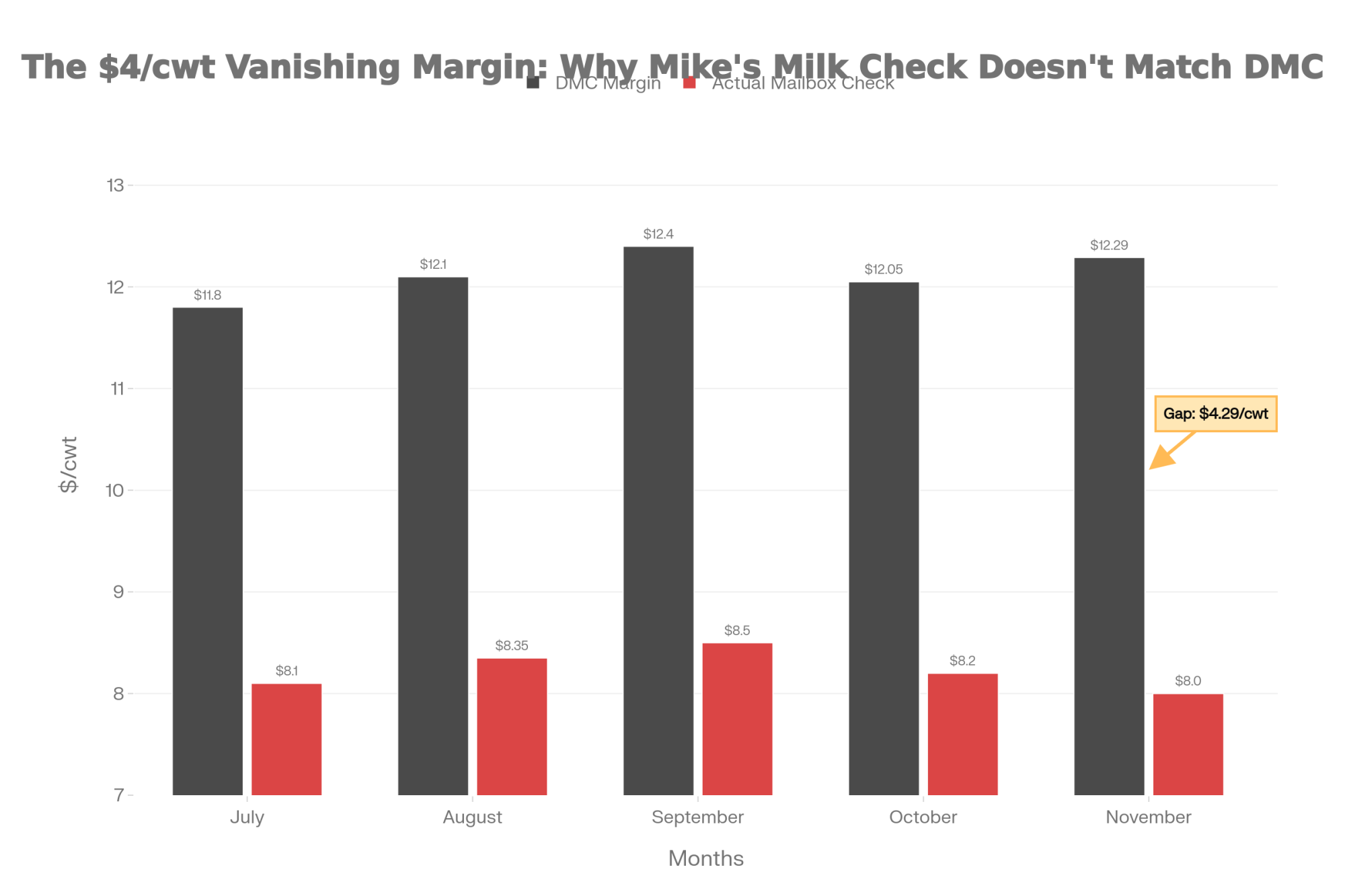
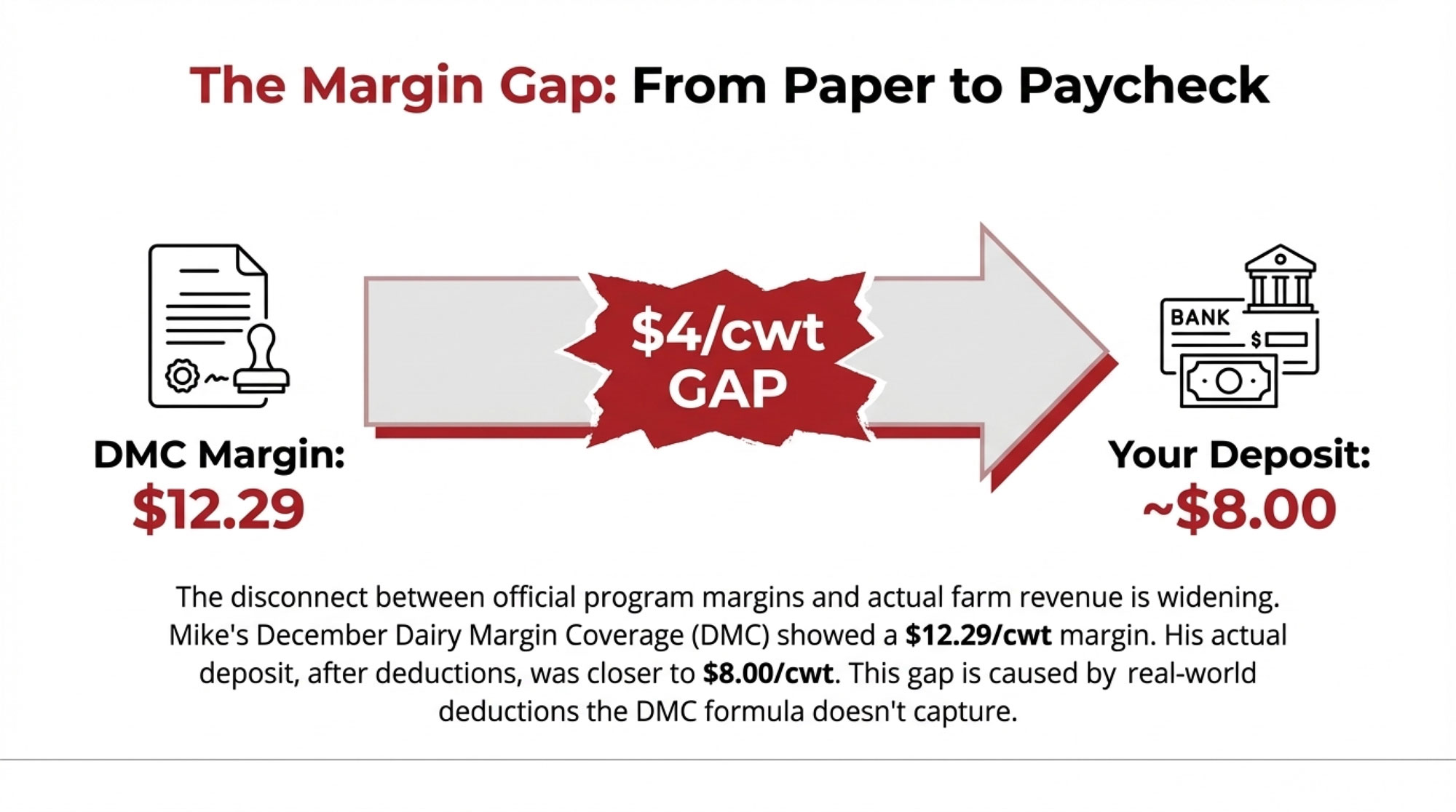
You know that moment—scrolling to the bottom of your milk statement, already doing the math in your head? Mike Boesch’s DMC said $12.29. His deposit said $8.

Executive Summary: Dairy producers everywhere are doing the math twice lately—and they’re not wrong. There’s a $4/cwt gap between what DMC margins show on paper and what’s actually hitting farm accounts. The causes stack up fast: make allowance increases that cost farmers $337 million in just three months, regional price spreads running nearly $7/cwt, and component formula changes that blindsided many operations. Milk keeps flowing despite the pressure—expansion debt doesn’t pause for soft markets, and the lowest heifer inventory since 1978 makes strategic culling nearly impossible. With USDA projecting $18.75/cwt All-Milk prices for 2026, margin relief likely won’t arrive until late 2027. The producers gaining ground are focusing on what they can control: component-focused genetics, beef-on-dairy programs built on smart sire selection, and risk management tools that most operations still aren’t using.
Dairy profitability strategies

You know that feeling when the numbers on paper don’t quite match what’s hitting your bank account? Mike Boesch, who runs a 280-cow operation outside Green Bay, Wisconsin, put it well when we talked last month. He pulled up his December milk statement, scrolled straight to the bottom—like we all do—and there it was. His Dairy Margin Coverage paperwork showed a comfortable $12.29/cwt margin. His actual deposit? After cooperative deductions, component adjustments, and those make allowance changes that kicked in last June, he was looking at something closer to $8/cwt.
“I keep two sets of numbers in my head now. The one the government says I’m making, and the one my checkbook says I’m making. They’re not the same number.” — Mike Boesch, Green Bay, Wisconsin (280 cows)

He’s far from alone in this experience. I’ve been talking with producers from California’s Central Valley to Vermont’s Northeast Kingdom over the past few months, and I keep hearing variations of the same observation. There’s a growing disconnect between what the formulas say margins should be and what’s actually landing in farm accounts. Understanding why that gap exists—and what you can do about it—has become one of the more pressing questions heading into 2026.

The Math That Isn’t Adding Up

YearCorn ($/bu)Soymeal ($/ton)All‑Milk ($/cwt)
20236.5443022.50
20245.1038021.80
20254.0030021.35

Here’s what makes this situation so frustrating for many of us. Feed costs dropped meaningfully through 2025. Corn’s been trading in the low $4s per bushel—USDA’s November World Agricultural Supply and Demand Estimates report projected $4.00 for 2025-26—down considerably from that $6.54 peak we saw in 2023. Soybean meal’s been running in the high $200s to low $300s per ton through fall. For most operations, that translates to real savings on the feed side.
But milk revenue softened faster. USDA National Agricultural Statistics Service data shows September’s All-Milk price came in at $21.35/cwt, with Class III at $18.20. That’s below what many of us were hoping for at this point in the year.

What I’ve found talking to producers and running through numbers with nutritionists and farm business consultants: even with clearly lower feed costs, the decline in milk revenue has offset—and in many cases more than offset—those feed savings. The specifics vary by operation. Your ration, your components, and your cooperative’s pricing structure all matter. But the pattern holds across a lot of different farm types.

Mike’s take stuck with me: “I saved money on feed. But I lost more on milk. The feed savings felt like winning a $20 scratch ticket after your truck got totaled.”

Where Your Money Is Actually Going

So what’s creating that $4/cwt gap between calculated margins and received margins? It comes down to several deductions that the DMC formula doesn’t capture.

The Make Allowance Shift
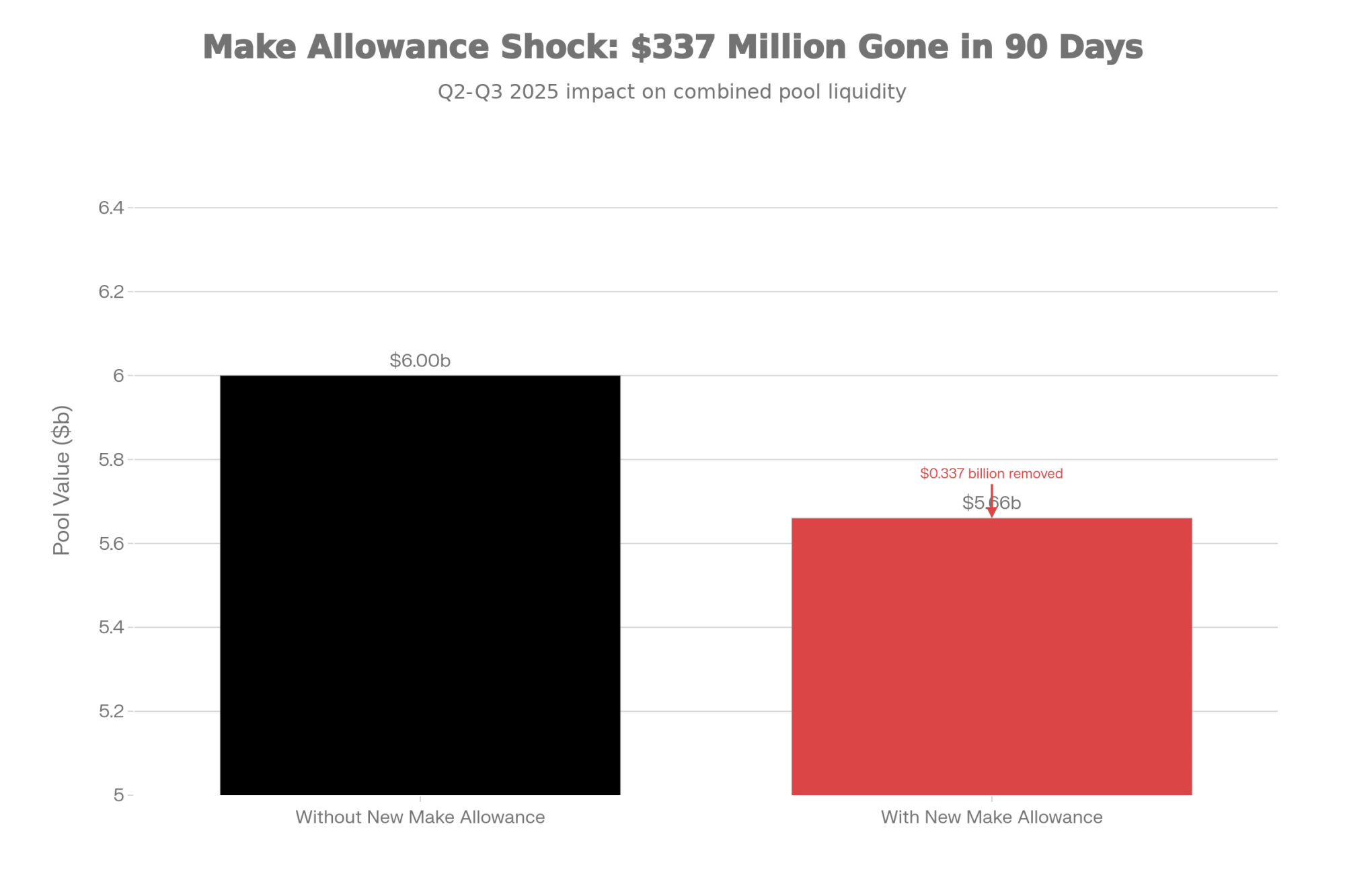
When the Federal Milk Marketing Order updates took effect on June 1, processors received larger deductions for manufacturing costs. American Farm Bureau Federation economist Danny Munch analyzed the impact, and his findings show the higher make allowances reduced farmer checks by roughly $0.85-0.93/cwt across the four main milk classes.
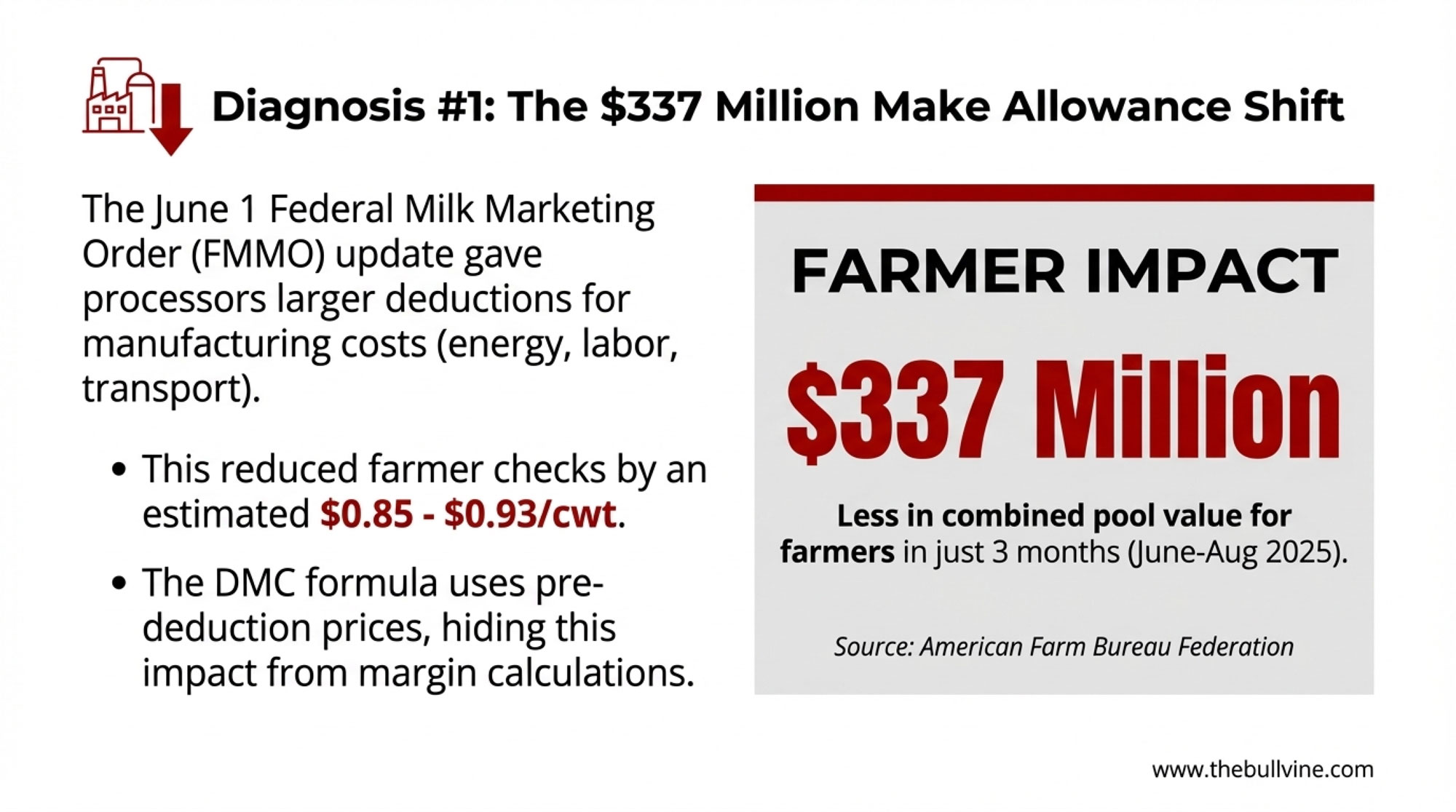
Key Finding: $337 Million Impact

Farm Bureau’s Market Intel analysis found that farmers saw more than $337 million less in combined pool value during the first three months under the new rules—that’s June through August alone.

ScenarioPool Value ($ billions)
Without new make allowance6.00
With new make allowance5.66

Source: American Farm Bureau Federation, September 2025

I talked with a Midwest cooperative field rep who asked to stay anonymous, given how sensitive pricing discussions can be. His perspective added some nuance worth considering: “Nobody wanted to make allowances to go up. But processing costs genuinely increased—energy, labor, transportation. The alternative was plant closures, and that would have helped nobody. It’s a situation where producers and processors both feel squeezed.”

He raises a fair point. The processing sector faced real cost pressures, and there’s a legitimate argument that updated make allowances were overdue. That said, the timing has been difficult for producers already navigating softer milk prices.

What’s worth understanding here is that the DMC formula uses pre-deduction prices. So your calculated margin looks healthy, while your actual check reflects those higher processor allowances.

Regional Pricing Reality

DMC uses national average milk prices, but anyone who’s compared notes with producers in other states knows the spread can be significant.

The Regional Price Gap: Same Month, Different Reality
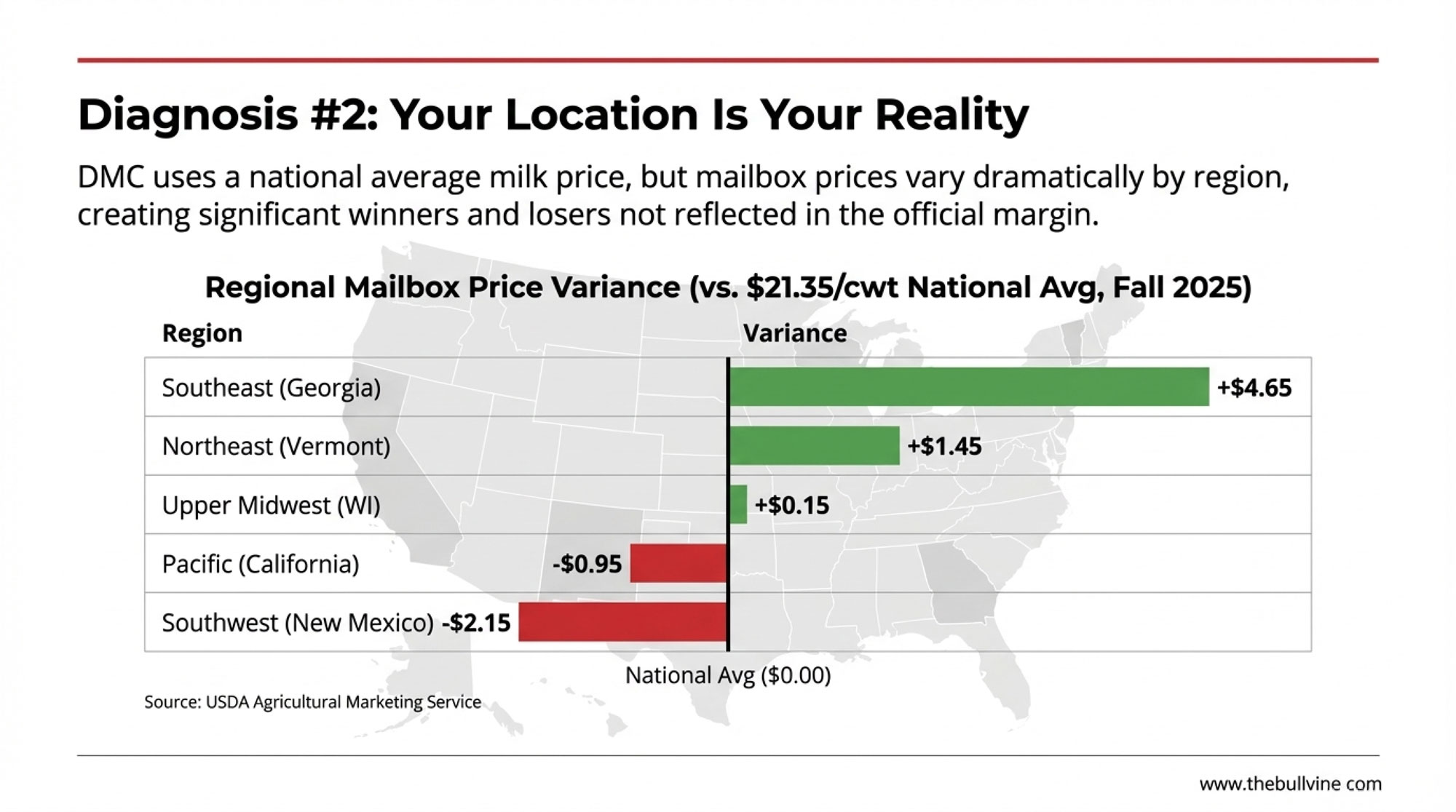
RegionApproximate Mailbox PriceVariance
Southeast (Georgia)~$26.00/cwt+$4.65
Northeast (Vermont)~$22.80/cwt+$1.45
Upper Midwest (Wisconsin)~$21.50/cwt+$0.15
Pacific (California)~$20.40/cwt-$0.95
Southwest (New Mexico)~$19.20/cwt-$2.15

Source: USDA Agricultural Marketing Service Federal Order mailbox prices, Fall 2025

The regional story plays out differently depending on where you’re milking cows. Upper Midwest producers deal with cooperative basis adjustments and seasonal hauling challenges. California’s Central Valley operations face water costs that have fundamentally changed their cost structure—some producers there tell me water now rivals feed as their biggest variable expense. Southwest operations running large dry-lot systems have entirely different economics.

The Component Pricing Shuffle

Here’s one that caught a lot of producers off guard: the June 2025 FMMO changes removed 500-pound barrel cheddar from Class III pricing calculations. Now, only 40-pound block cheddar prices determine protein valuations—the USDA Agricultural Marketing Service confirmed this in their final rule.

Sounds technical, I know. But when barrels were trading higher than blocks—which they were in early summer—that switch affected producer checks. The rationale was to reduce price volatility and better reflect actual cheese market conditions, though the timing meant lower payments for many during that transition period.

Stack all of these together, and you get that $4-5/cwt gap between what DMC says you’re earning and what you’re actually receiving.

The Production Paradox

One thing that keeps coming up in conversations: if margins are this tight, why does milk keep flowing?

USDA NASS data shows national production running 1-4% above year-earlier levels in many recent months. July 2025 came in 3.4% higher than July 2024, totaling 19.6 billion pounds nationally.

At the same time, we’re watching a steady structural decline in dairy farm numbers. USDA has documented this trend for years—thousands of farms exiting nationally over the past decade, with several hundred closing each year just in heavily dairy states like Wisconsin.

Expert Insight: Leonard Polzin, Ph.D. Dairy Economist, University of Wisconsin-Madison Extension

“What we’re seeing is expansion commitments made in 2022-2023 when margins looked completely different. That debt doesn’t care about today’s milk prices. Producers have to keep milking to service those loans.”

There’s also the heifer situation. Replacement heifer inventory has dropped to 3.914 million head—the lowest level since 1978, according to USDA cattle inventory reports and confirmed by Dairy Herd Management coverage. Producers who might otherwise strategically cull their way to a smaller herd can’t easily replace the animals they’d be selling.

And then there’s processing. Since 2023, substantial new cheese processing capacity has come online—much of it financed through long-term USDA Rural Development loans requiring consistent milk intake. Those plants need milk regardless of farmgate prices.

For your operation: the supply response to low prices is likely to be slower than historical patterns suggest. If you’re planning around industry-wide production cuts that are expected to boost prices by late 2026, a longer timeline may be more realistic.

Why the Export Safety Valve Is Stuck

I’ve had producers ask when China might start buying again. Honestly? That valve is essentially closed for the foreseeable future.
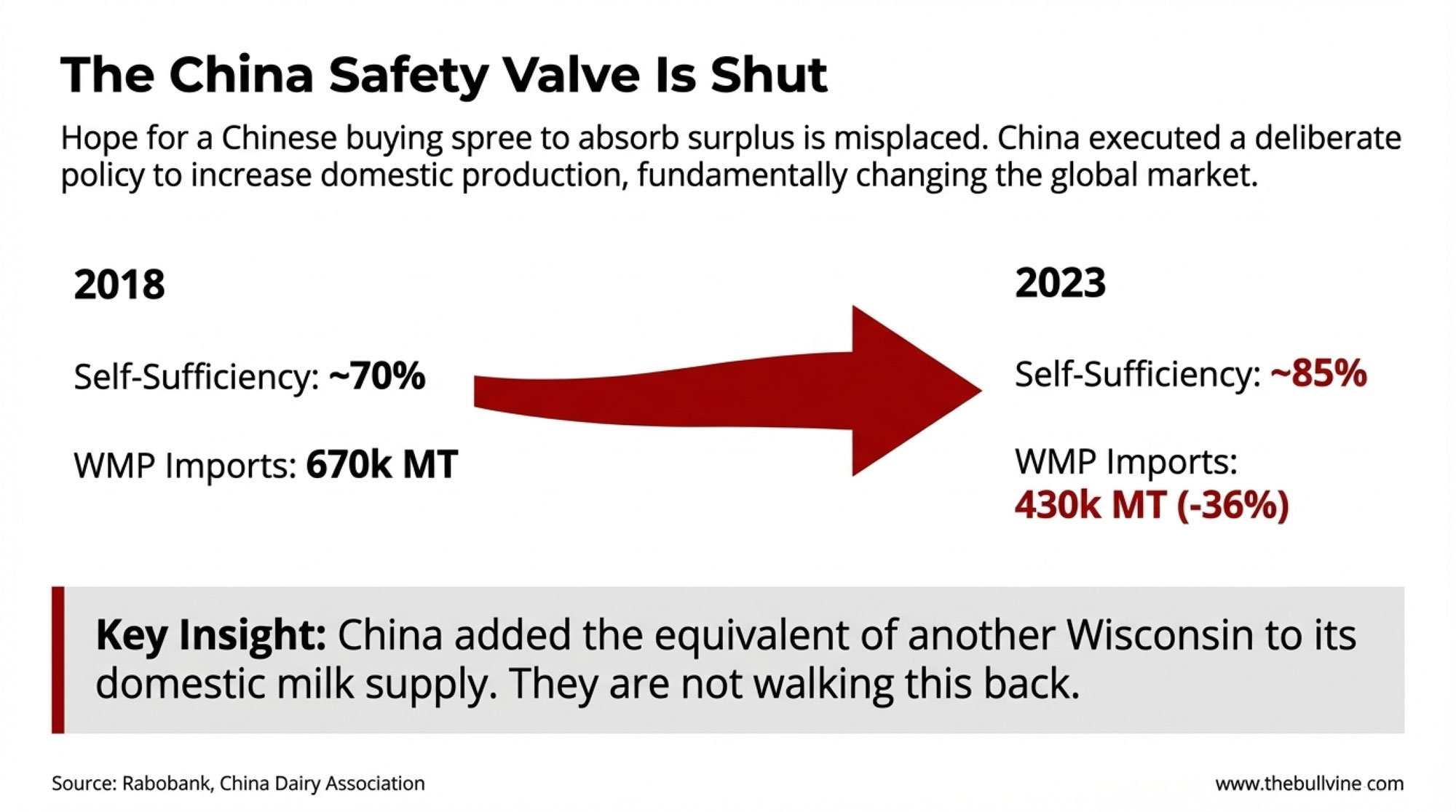
Between 2018 and 2023, China added roughly 10-11 million metric tons of domestic milk production—equivalent to around 24-25 billion pounds. Rabobank senior dairy analyst Mary Ledman noted that’s almost like adding another Wisconsin to their domestic supply. The result? Self-sufficiency jumped from about 70% to 85% during this period.

China’s Dairy Transformation: The Numbers

MetricBefore (2018)After (2023)Change
Self-sufficiency~70%~85%+15 pts
WMP imports670,000 MT/yr avg430,000 MT-36%
Impact on competitors7% of NZ production was displaced

Sources: Rabobank/Brownfield Ag News

This wasn’t market fluctuation—it was deliberate government policy. And they’re not walking it back. In July 2025, China’s Dairy Association announced plans to maintain at least 70% self-sufficiency through 2030.

For U.S. producers, this represents a structural shift. Other markets—Southeast Asia, Mexico, and parts of the Middle East—continue to show growth potential. But that traditional “surplus absorption” mechanism that China provided? It’s significantly smaller than it used to be.

What’s Actually Working: Four Strategies From the Field

Enough about challenges. Let’s talk about what’s actually moving the needle on margins.
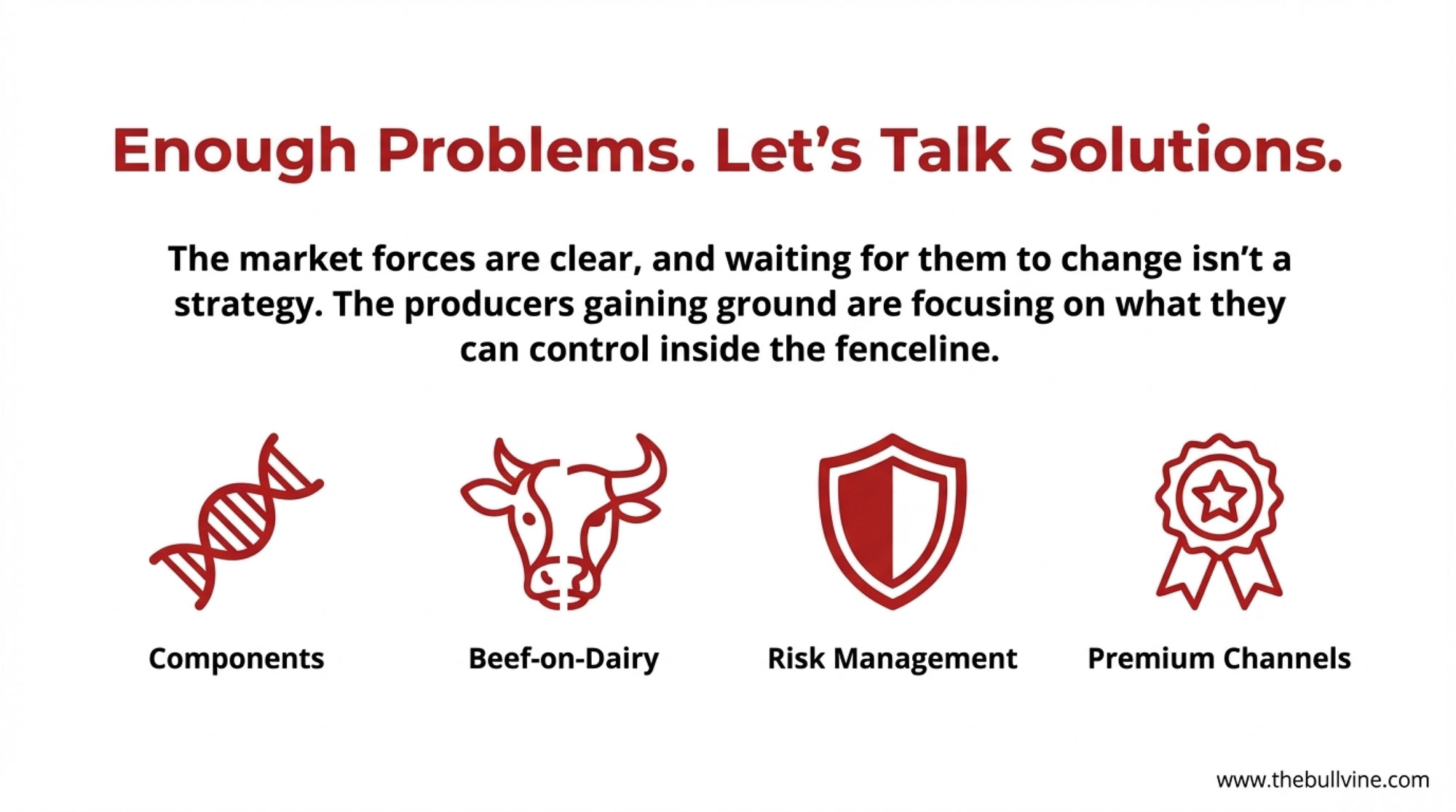
Getting Paid for Components

Sarah Kasper runs a 340-cow operation in central Minnesota that she transitioned to component-focused management three years ago. Her approach: genomic testing on every replacement heifer, sire selection emphasizing butterfat and protein over milk volume, and ration adjustments optimizing for component production rather than peak pounds.
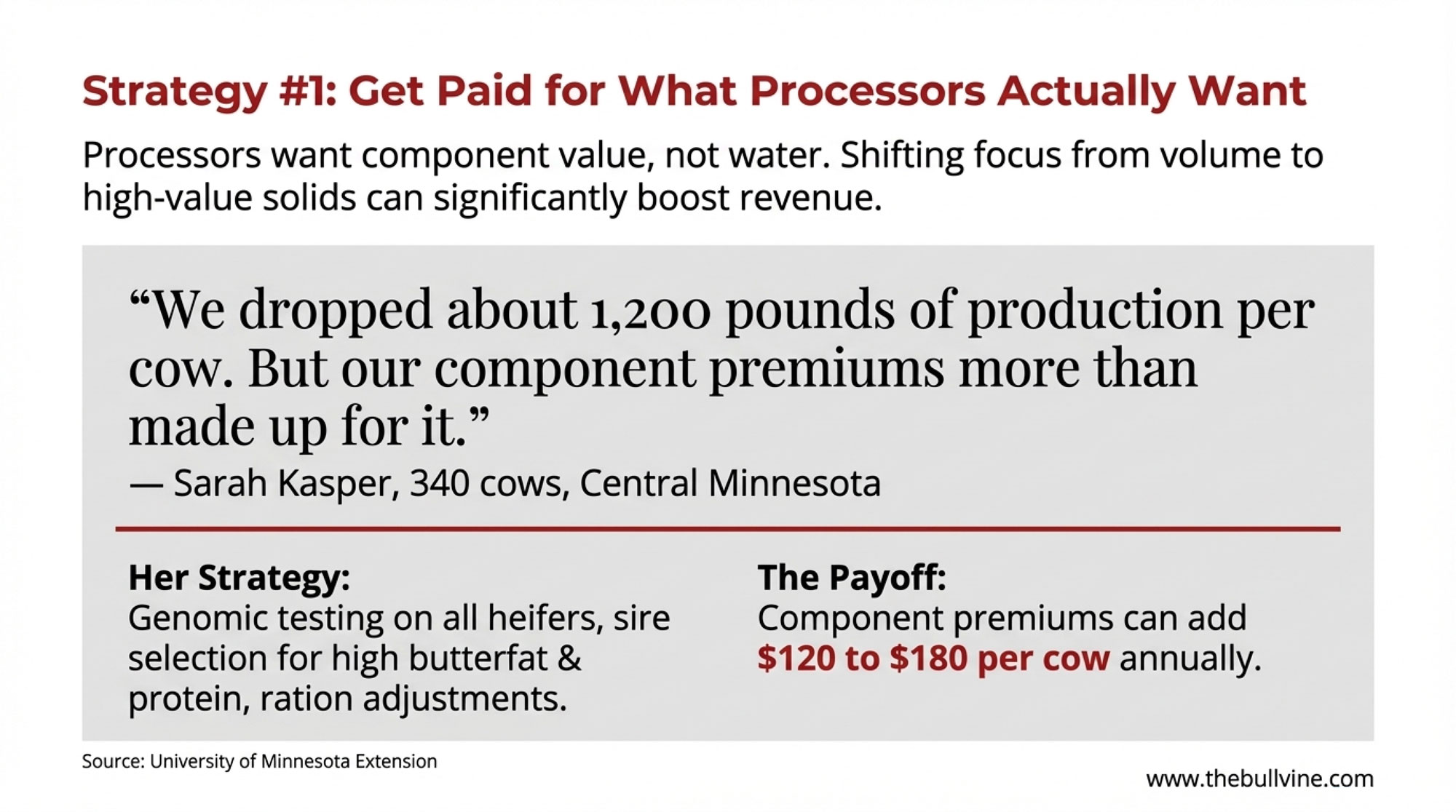
“We dropped about 1,200 pounds of production per cow. But our component premiums more than made up for it. We’re getting paid for what processors actually want.” — Sarah Kasper, Central Minnesota (340 cows)

University of Minnesota Extension dairy economic analyses document component premiums ranging from $120 to $ 180 per cow annually for operations achieving above-average butterfat and protein levels. With genomic testing running $30-50 per animal, the return on investment can be meaningful—especially compounded over multiple generations.

What processors increasingly want is component value, not volume. April 2025 USDA data showed cheese production up 0.9% year-over-year while butter production fell 1.8%—processors are routing high-component milk toward their highest-margin products.

The Beef-on-Dairy Opportunity

This strategy has seen remarkable adoption. CattleFax data reported by Hoard’s Dairyman shows there were about 2.6 million beef-on-dairy calves born in 2022, up from just 410,000 in 2018. CattleFax projects that it could grow to 4-5 million head by 2026.
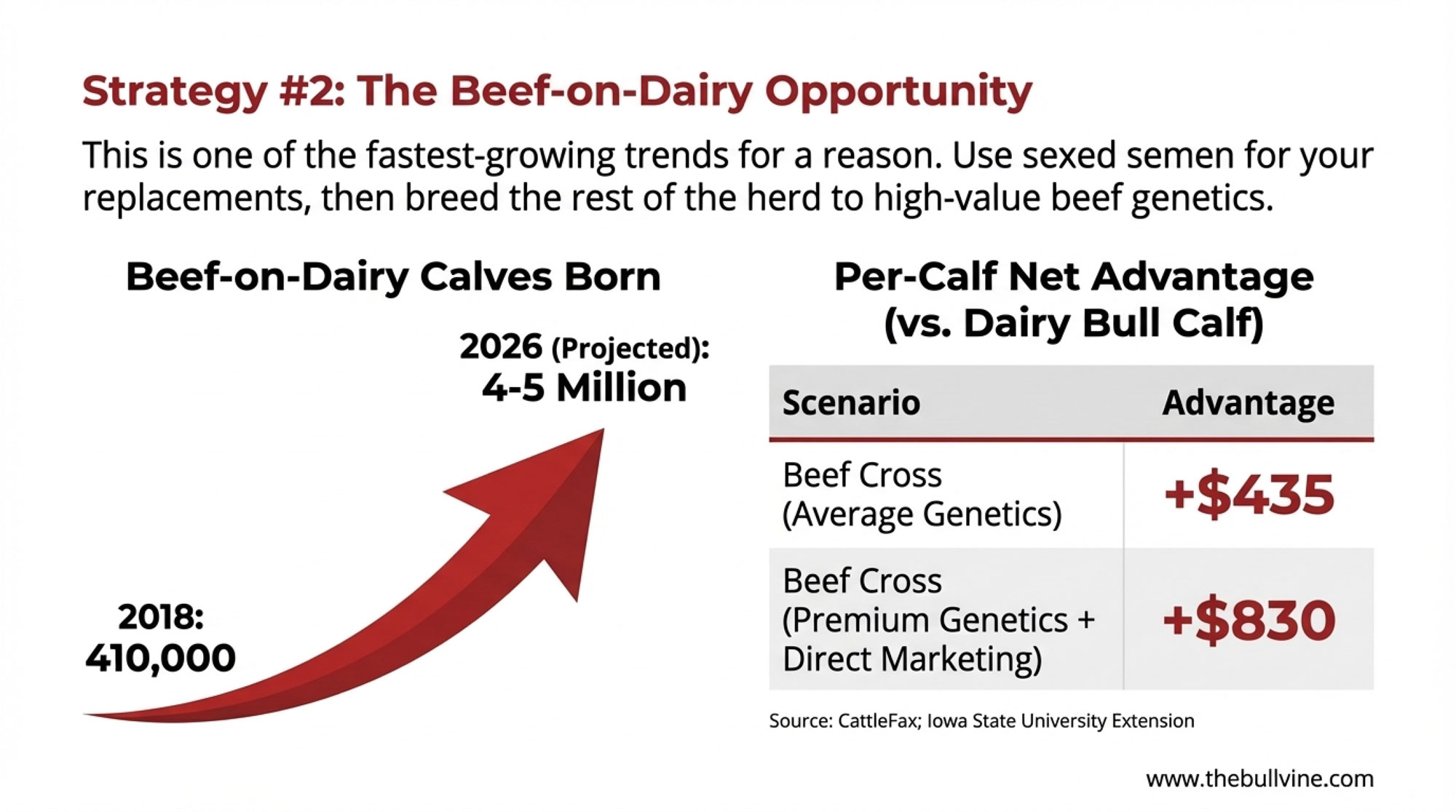
The economics are fairly straightforward. Use sexed dairy semen on your top-performing cows to secure replacements, then breed the remaining 60-70% of your herd to beef genetics. A dairy bull calf might bring $200-400. A well-managed beef cross with the right genetics and colostrum management can fetch $900-1,250 through direct feedlot relationships, according to Iowa State University Extension beef-dairy market reports.

Beef-on-Dairy Economics: Per-Calf Comparison

ScenarioCalf ValueSemen CostNet Advantage
Dairy bull calf$250$8-15Baseline
Beef cross (average genetics)$700$15-25+$435
Beef cross (premium genetics + direct marketing)$1,100$20-35+$830

Note: Values vary significantly by region, genetics quality, and buyer relationships Sources: Iowa State Extension; Hoard’s Dairyman market reports

But here’s where genetics selection really matters—and where I see a lot of operations leaving money on the table.

Research published in the Journal of Dairy Science in 2025 found the average incidence of difficult calving in beef-on-dairy crosses runs around 15%. But breed selection makes a significant difference: data from the Journal of Breeding and Genetics shows Angus-sired calves had only 7% calving difficulty compared to 13% for Limousin when looking at male calves.

Beef Sire Selection: The Calving Ease vs. Carcass Quality Tradeoff

Here’s the tension every producer needs to understand: beef sires selected for ease of calving and short gestation are often antagonistically correlated with carcass weight and conformation, according to research in Translational Animal Science.
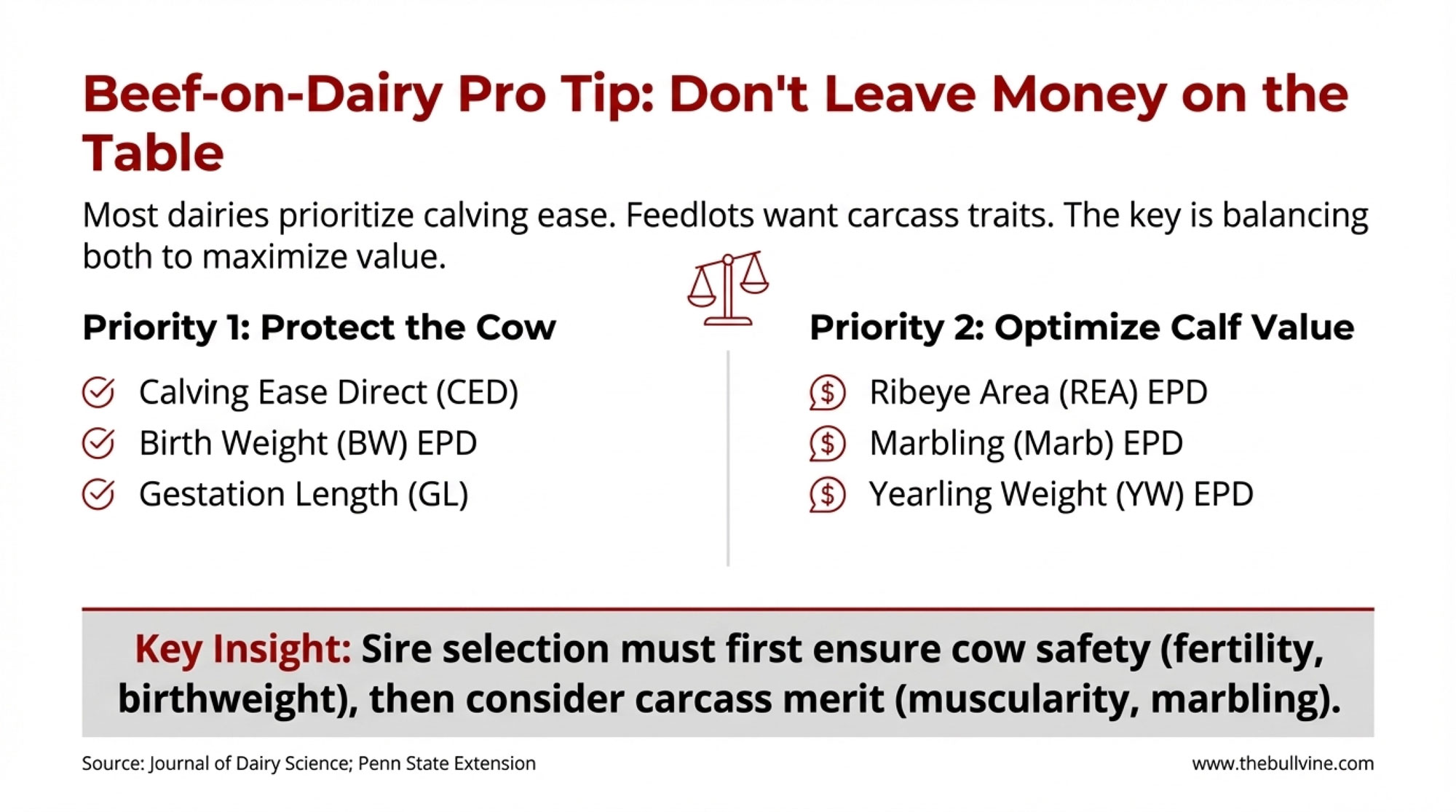
Priority 1 — Protect the Cow:

  • Calving Ease Direct (CED): Select from the top 25% of beef sires
  • Birth Weight EPD: Lower is generally safer for dairy dams
  • Gestation Length: Angus adds ~1 day vs. Holstein; Limousin adds 5 days; Wagyu adds 8 days

Priority 2 — Optimize Calf Value:

  • Frame Size: Moderate-framed bulls generally produce more feed-efficient animals
  • Ribeye Area (REA) EPD: Higher values improve carcass muscling
  • Marbling EPD: Targets quality grade premiums
  • Yearling Weight EPD: Predicts growth performance

Sources: Journal of Dairy Science (2025); Penn State Extension; Michigan State Extension; Translational Animal Science

A Hoard’s Dairyman survey found that most dairies currently prioritize conception rate, calving ease, and cost when selecting beef sires—but feedlot and carcass performance traits aren’t priorities for most farms yet. Michigan State Extension notes this is a missed opportunity: selecting for terminal traits that improve growth rate and increase muscling should be a priority.

The bottom line from peer-reviewed research: sire selection for beef-on-dairy should firstly emphasize acceptable fertility and birthweight because of their influence on cow performance at the dairy; secondarily, carcass merit for both muscularity and marbling should receive consideration.

Tom and Linda Verschoor, who run 1,200 cows near Sioux Center, Iowa, started their beef-on-dairy program in 2022 with this balanced approach. “We figured out we only need about 35% of our herd for replacements,” Tom explained.

They report that in 2024, they generated roughly $185,000 more revenue from beef-cross calves than they would have from traditional dairy bull calves. Results will vary depending on genetics quality, calf care, and buyer relationships. But the opportunity is real for operations set up to capture it.

Actually Using the Risk Management Tools

This is where I see one of the biggest gaps between what’s available and what producers actually use.
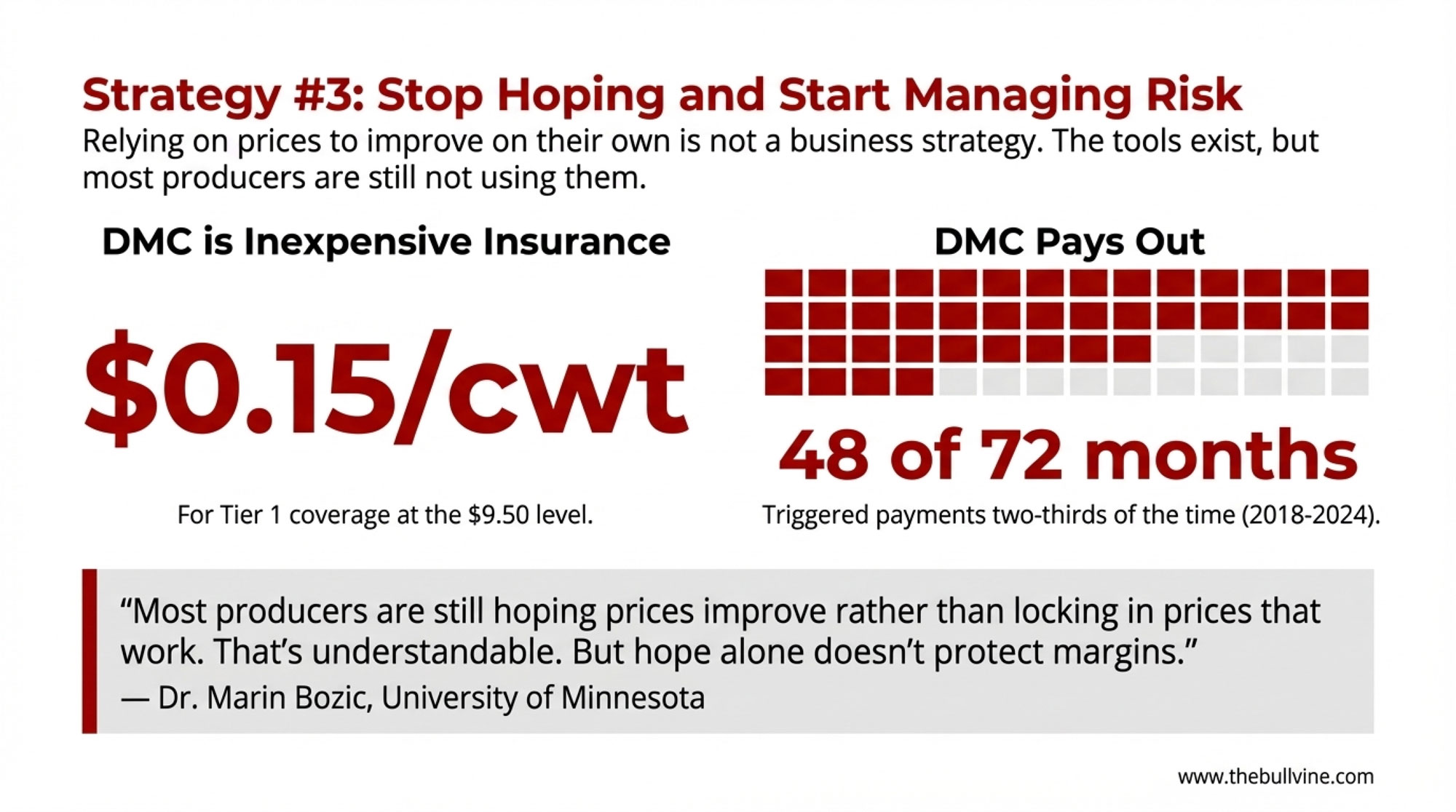
DMC Tier 1 coverage costs $0.15/cwt, with a $9.50/cwt margin protection on the first 5 million pounds. University of Wisconsin-Extension analysis shows that from 2018-2024, DMC triggered payments in 48 of 72 months—about two-thirds of the time. Average net indemnity ran $1.35/cwt during payment months. It’s essentially catastrophic margin insurance at minimal cost.

ScenarioCovered Milk (million lbs/year)Net Avg Indemnity ($/cwt in pay months)Approx. Extra Margin per Year ($)
No DMC enrollment00.000
DMC Tier 1 at $9.50 margin51.3545,000

Beyond DMC, Class III futures and options let you establish price floors. If your break-even is $16/cwt and you can lock $17/cwt through futures, you’ve reduced margin uncertainty—even if it means giving up potential upside.

Expert Insight: Marin Bozic, Ph.D. Dairy Economist, University of Minnesota

Bozic often reminds producers at risk-management meetings that relying on prices to improve on their own simply isn’t really a strategy. Most producers are still hoping prices improve rather than locking in prices that work. That’s understandable. But hope alone doesn’t protect margins.

Finding Premium Channels
The spread between commodity milk and premium markets continues widening:

  • Organic certified: $33-50/cwt depending on region and buyer (USDA National Organic Dairy Report)
  • Grass-fed certified: $36-50/cwt with current supply shortages (Northeast Organic Dairy Producers Alliance)
  • Value-added processing: On-farm yogurt or cheese production can generate meaningful additional margin, though capital requirements are real

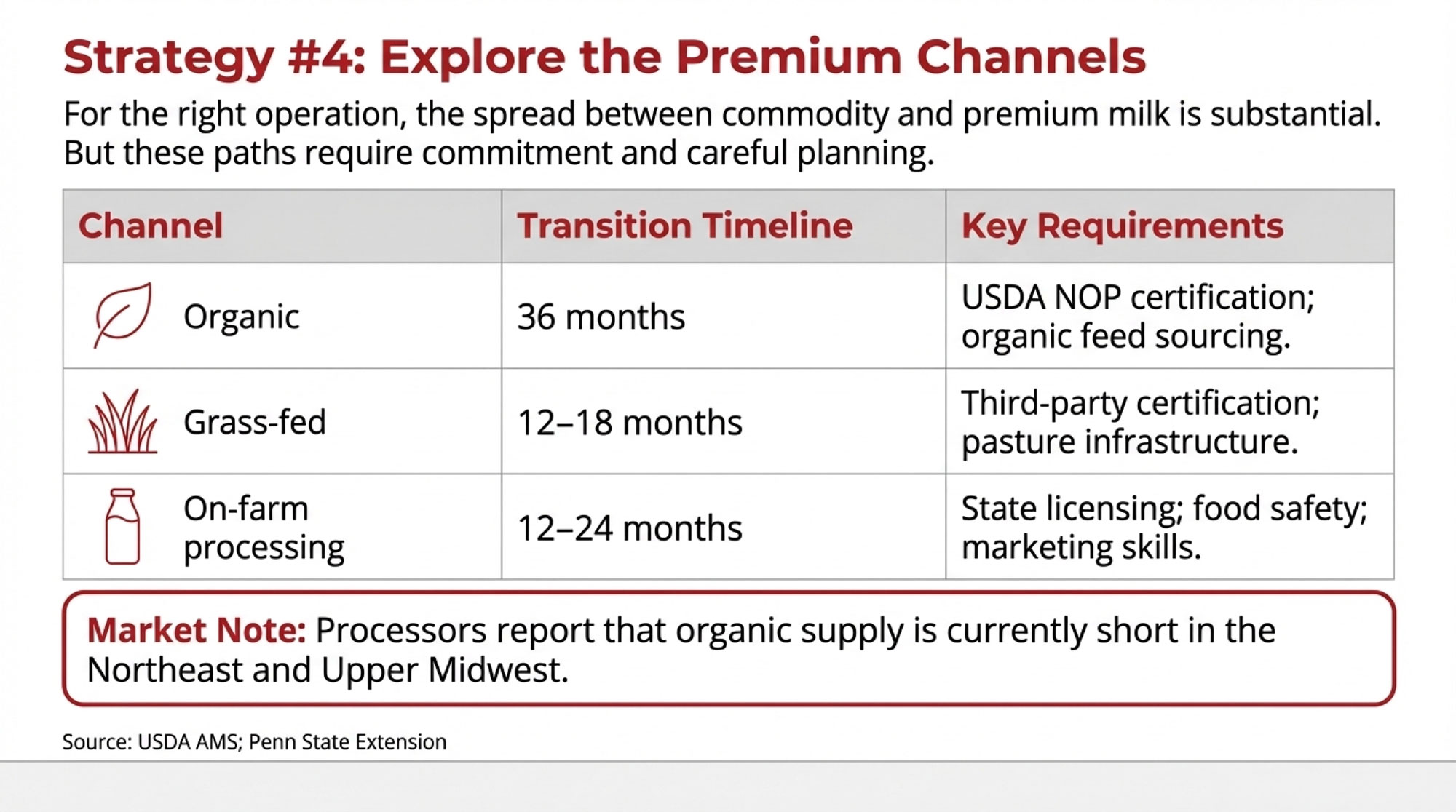
I’m hearing from processors that organic supply is currently short in the Northeast and Upper Midwest—there’s genuine demand if you can make the transition work.

Premium Channel Pathways: What’s Actually Involved

ChannelTransition TimelineKey RequirementsRegional Considerations
Organic36 monthsUSDA NOP certification; organic feed sourcing; no prohibited substancesStrong processor demand in the Northeast, Upper Midwest; fewer options in the Southwest
Grass-fed12-18 monthsThird-party certification (AWA, PCO, or equivalent); pasture infrastructureWorks best with existing grazing infrastructure; limited in western dry lot operations
On-farm processing12-24 monthsState licensing; food safety compliance; marketing/distribution capabilityStrong local food demand helps; it requires entrepreneurial capacity beyond milk production

Sources: USDA Agricultural Marketing Service; Northeast Organic Dairy Producers Alliance; Penn State Extension

The transition timeline matters. Organic requires three years of certified organic land management before you can sell organic milk—and you’ll need reliable organic feed sourcing, which can be challenging and expensive depending on your region. Grass-fed certification moves faster but requires pasture infrastructure that not every operation has. On-farm processing offers the highest margin potential but demands skills well beyond dairy farming.

Whether these channels make sense depends on your land base, labor situation, existing infrastructure, and appetite for marketing complexity. They’re not right for every operation, but for those with the right setup, the premium differential is substantial.

What the Analysts Are Actually Saying About 2026

Let me share what the forecasts show, because realistic timeline expectations matter.

Producer conversations often reference recovery by “late 2026.” The analyst forecasts suggest a more gradual path.

2026 Price Outlook: Key Forecasts

Source2026 All-Milk ForecastAssessment
USDA December WASDE$18.75/cwtDown from $20.40 (Nov)
2025 Actual$21.35/cwtBaseline comparison
Rabobank“Prolonged soft pricing through mid-to-late 2026” 
StoneXProduction slowdown not until Q2-Q3 2026 

Here’s the key difference: analysts are describing prices “bottoming out” in early to mid-2026. That means the decline stabilizes—not that prices bounce back to 2024 levels. Most forecasts suggest meaningful margin recovery is more likely a late-2027 development.

This isn’t cause for panic. Markets are cyclical, and conditions will eventually improve. But it does suggest planning for an extended timeline.

The Conversation Worth Having

For producers with potential successors, this margin environment brings important conversations into focus. University of Illinois Extension notes that less than one in five farm owners has an estate plan in place. The Canadian Bar Association found 88% of farm families lack written succession plans.

Expert Insight: David Kohl, Ph.D. Professor Emeritus, Virginia Tech

Kohl emphasizes that families starting succession talks early navigate transitions more smoothly than those who wait until circumstances force the conversation.

His framework:

  1. Know your actual numbers — true break-even, debt maturity, realistic equity position
  2. Find out what your kids actually want — not what you assume
  3. Lay out options honestly — status quo, restructuring, strategic exit, or succession

You’re not solving everything in one meeting. You’re getting information on the table.

The Bottom Line

“I’m not pretending the math is good right now. But I’ve stopped waiting for someone else to fix it. We enrolled in DMC at the $9.50 level, we’re breeding 60% of our herd to Angus, and we had that kitchen table conversation with our son over Thanksgiving. First real talk about whether he wants this place.”

He paused. “I’d rather know where we stand than keep guessing. At least now we’re making decisions instead of just hoping.” — Mike Boesch

That’s really the choice in front of all of us right now. The margin environment is challenging—that’s just the reality for the foreseeable future. But producers who understand the dynamics, assess their positions honestly, and implement available strategies aren’t just getting through this period; they’re succeeding. Some are building advantages that will serve them well when conditions improve.

The math is difficult. It’s not impossible. The difference comes down to whether you’re making decisions based on information or just waiting to see what happens.

Key Takeaways

  • The $4/cwt gap is real—and it’s not your math. Make allowances, regional spreads, and formula changes explain why your milk check doesn’t match your margins.
  • $337 million left producer pockets in 90 days. June’s make allowance increases pulled that from the pool values before summer ended.
  • Plan for a long haul. USDA projects $18.75/cwt for 2026—a meaningful margin recovery likely won’t show up until late 2027.
  • Don’t count on production cuts to save prices. Expansion debt keeps cows milking, and the lowest heifer inventory since 1978 limits strategic culling.
  • The wins are in the details. Component premiums, smart beef sire selection, and actually enrolling in DMC at $9.50—that’s where producers are finding margin.

Complete references and supporting documentation are available upon request by contacting the editorial team at editor@thebullvine.com.

Learn More:

Join the Revolution!

Join over 30,000 successful dairy professionals who rely on Bullvine Weekly for their competitive edge. Delivered directly to your inbox each week, our exclusive industry insights help you make smarter decisions while saving precious hours every week. Never miss critical updates on milk production trends, breakthrough technologies, and profit-boosting strategies that top producers are already implementing. Subscribe now to transform your dairy operation’s efficiency and profitability—your future success is just one click away.
NewsSubscribe
First
Last
Consent

Your Milk Check Is at the Mercy of a Cheese Shredder: What the Great Lakes Recall Reveals About Dairy’s Broken Supply Chain

Perfect SCC. Elite components. Tight ship. Then a shredder in Ohio failed—and none of it saved your milk check.

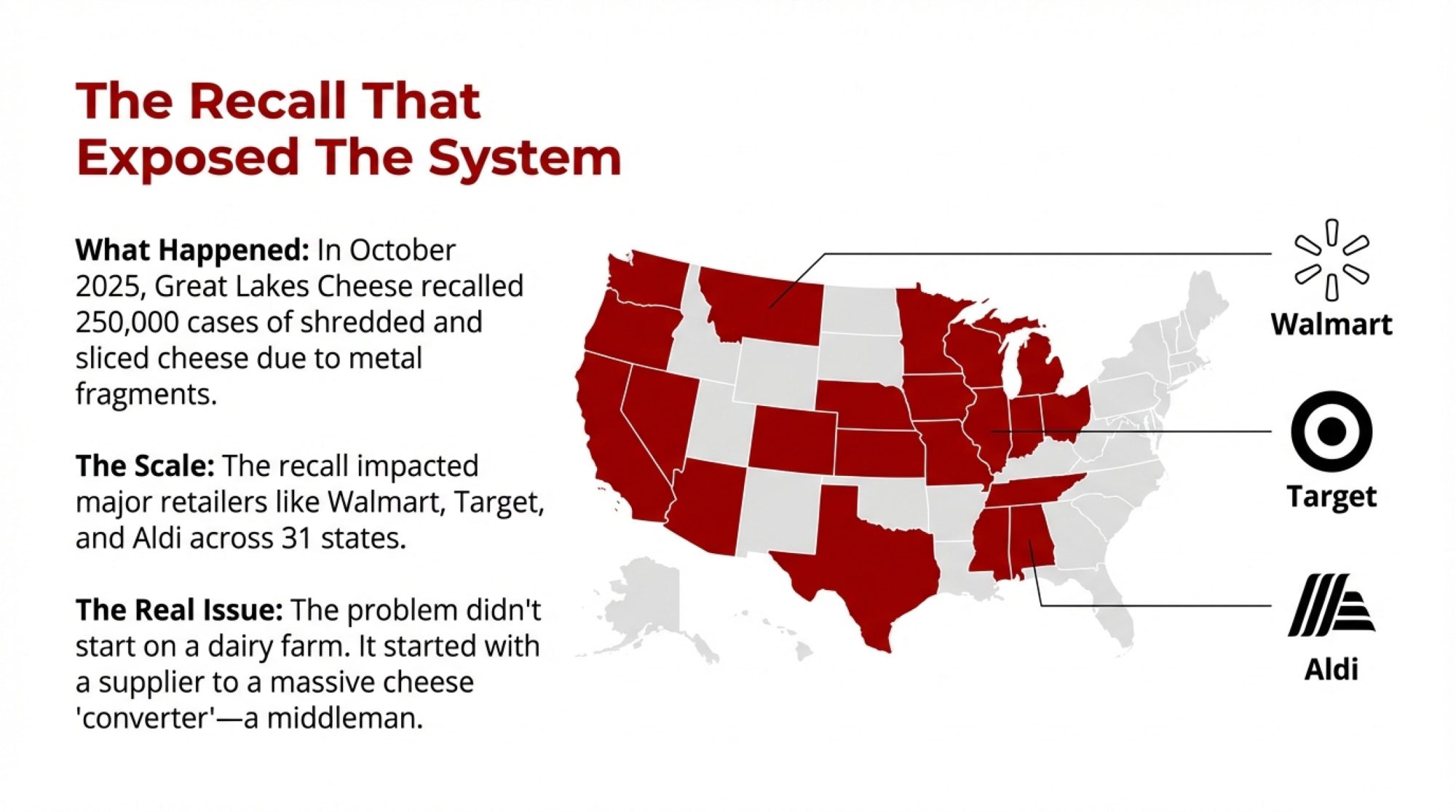
EXECUTIVE SUMMARY: Great Lakes Cheese sneezed in Ohio—and dairy farms across 31 states caught pneumonia. The October 2025 recall of 250,000 cases revealed a brutal truth: in a converter supply chain, when middlemen fail, farms absorb the pain through 5-15% intake cuts regardless of milk quality or management excellence. Your perfect SCC won’t save you from quality failures at companies you’ve never heard of. The strategic response isn’t panic—it’s diversification. Beef-on-dairy with verified genetics now commands $1,000-$1,400 per calf, organic premiums reach $33-$45/cwt in undersupplied markets, and cooperative infrastructure can slash traceability costs by 60-75%. With FSMA 204 extended to July 2028, producers have a runway to reposition—and the farms that thrive will be the ones who stopped waiting for a broken system to protect them.

When a metal fragment in a cheese shredder in Ohio can hit a milk check in Wisconsin, we have a problem. The Great Lakes Cheese recall isn’t just a food safety blip—it’s a warning shot about the fragility of the modern “converter” supply chain. And your farm is the one exposed.

I’ve been having conversations with producers across the Upper Midwest lately, and a pattern keeps emerging. Farmers who had no direct relationship with Great Lakes Cheese are feeling ripple effects. Milk intake adjustments here. Some price volatility there. That unsettling realization that something happening several steps down the supply chain can show up on your bottom line.

Let’s walk through what’s actually going on.

Understanding What Happened

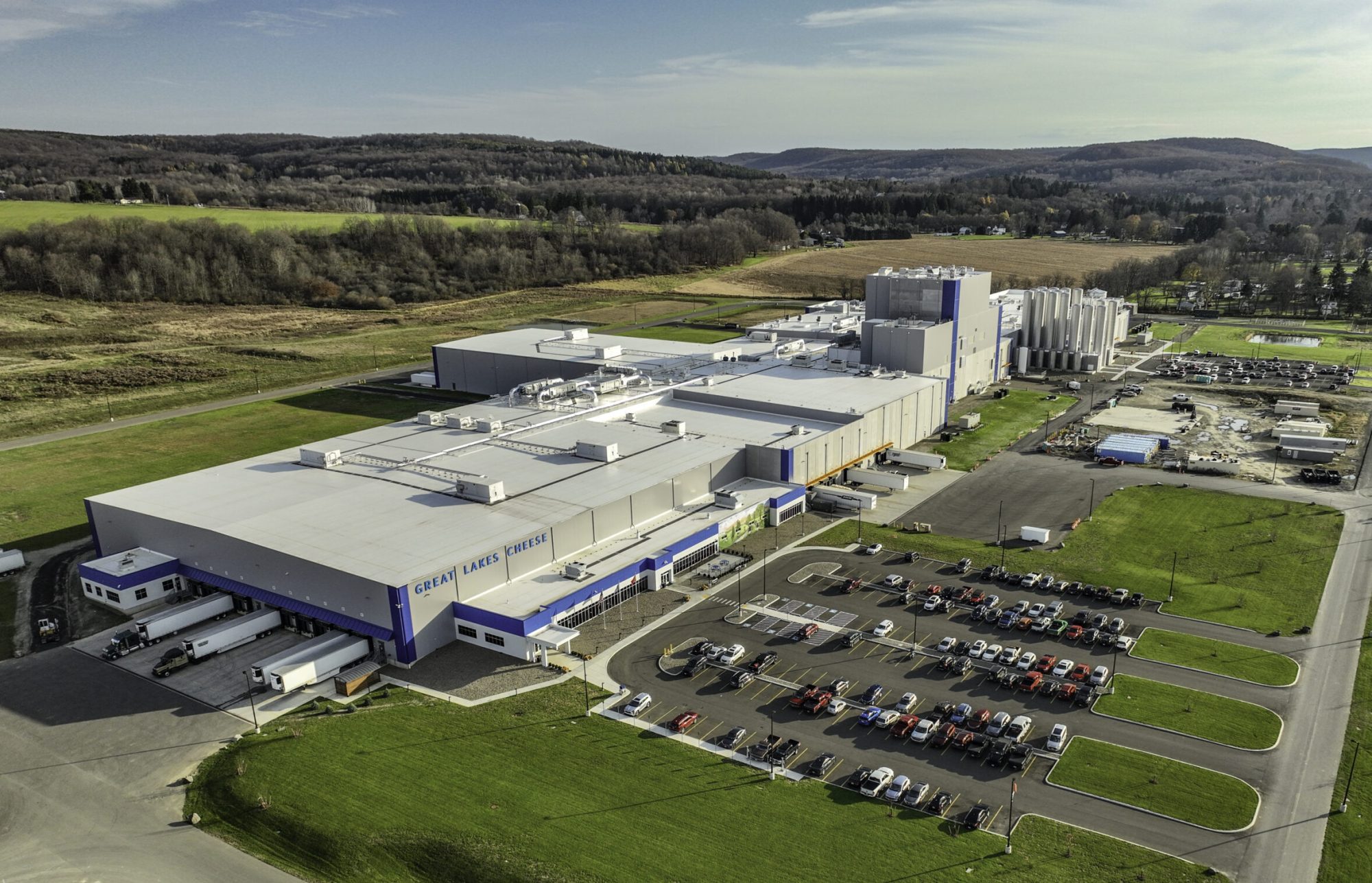
Great Lakes Cheese, headquartered in Hiram, Ohio, ranks among North America’s largest cheese companies. They supply roughly a quarter of all packaged cheese in U.S. retail—brands like Walmart’s Great Value, Target’s Good & Gather, Aldi’s Happy Farms. The company has been expanding steadily, including a major facility in Franklinville, New York, that Governor Hochul announced at $500 million back in 2022. Due to inflation and supply chain challenges, that project ended up costing over $700 million by the time it came online in late 2024, according to reporting from the Olean Star.

The recall itself occurred in early October 2025—the FDA publicly classified it in December—and affected over 250,000 cases of shredded and sliced cheese across 31 states. The issue was traced to metal fragments in the supplier’s raw materials.

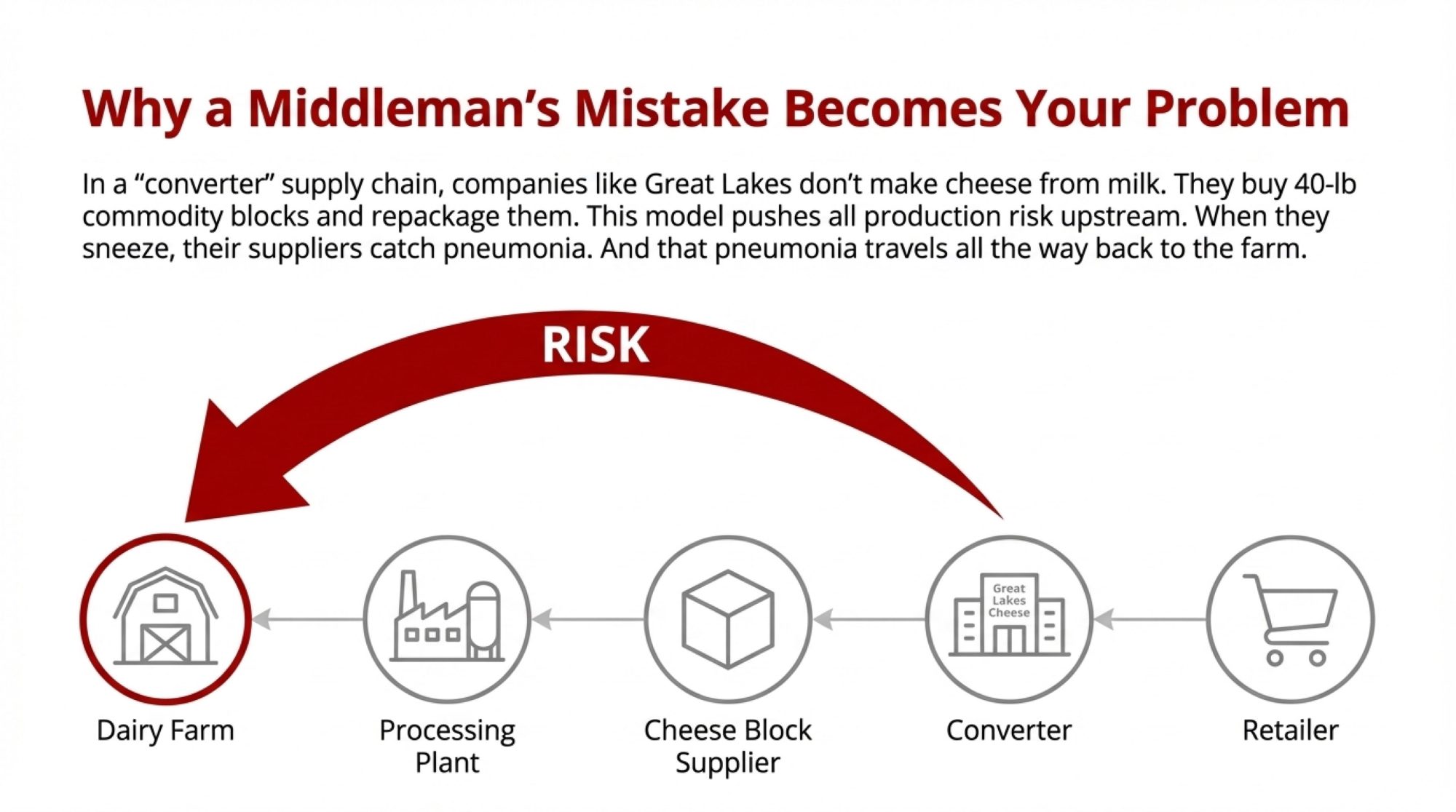
Here’s what you need to understand about how they operate. Great Lakes functions primarily as what the industry calls a “converter.” They’re not manufacturing cheese from milk in most facilities. Instead, they purchase 40-pound commodity cheese blocks from various suppliers, then shred, slice, and package those blocks for retail.

Put bluntly: Great Lakes is essentially a middleman with a massive retail footprint. And when a middleman of that scale has a problem, they don’t absorb the pain—they pass it upstream immediately. Their suppliers get hit. Their suppliers’ suppliers get hit. And eventually, that pressure falls on the farms that produce milk.

Mark Stephenson—Director of Dairy Policy Analysis at the University of Wisconsin-Madison—notes that the converter model allows processors to source globally, optimize costs, and concentrate capital on packaging and retail relationships. From a business perspective, it makes sense. But from a risk perspective? When the Great Lakes sneezes, they don’t catch a cold. Their suppliers catch pneumonia.

When a cheese shredder fails in Ohio, your milk check drops 15%—even if you’re running a spotless operation 500 miles away. This is what “converter supply chain risk” actually looks like when it hits your bank account

How Disruptions Travel Upstream

Three weeks. That’s how long it took for a metal fragment problem in Ohio to wipe out 12% of revenue for farms that never shipped a drop of milk to Great Lakes. Notice the recovery is twice as slow as the crash—welcome to commodity dairy’s asymmetric risk model

This is where things get practical for those of us producing milk. Understanding these mechanics matters because they reveal how interconnected—and sometimes how exposed—farm-level economics really are.

When Great Lakes pulled those 250,000-plus cases from shelves, their immediate demand for incoming cheese blocks dropped. That reduced demand traveled to their commodity cheese suppliers. Those suppliers adjusted milk intake from processing facilities. And those facilities modified contracts with cooperatives and farms.

USDA Agricultural Marketing Service data shows Class III prices at $19.95 per hundredweight for November 2024—historically a decent number. But regional volatility increased in the weeks following the recall announcement, with cooperatives in affected areas reporting intake adjustments ranging from 5% to 15%, depending on their processor relationships.

What does that mean for a working operation? Consider an 1,800-cow dairy producing around 41 million pounds annually. A 12% intake reduction sustained over several months—reports I’m hearing fall in that range—represents roughly $430,000 in displaced revenue at that Class III price.

I recently spoke with a Wisconsin producer navigating exactly this situation. What struck me was his observation that excellent milk quality scores didn’t provide.

“We run a tight ship. But in a commodity system, my SCC numbers don’t protect me from problems three levels down the chain.”

That’s the reality of the converter supply chain. Your operational excellence doesn’t matter when someone else’s quality control failure determines your fate.

The Broader Context: Industry Trends Worth Watching

I’ve been following dairy consolidation for about two decades now, and the current moment feels distinct. Food safety concerns are accelerating trends already underway—traceability requirements, processor consolidation, and shifting leverage in supply relationships.

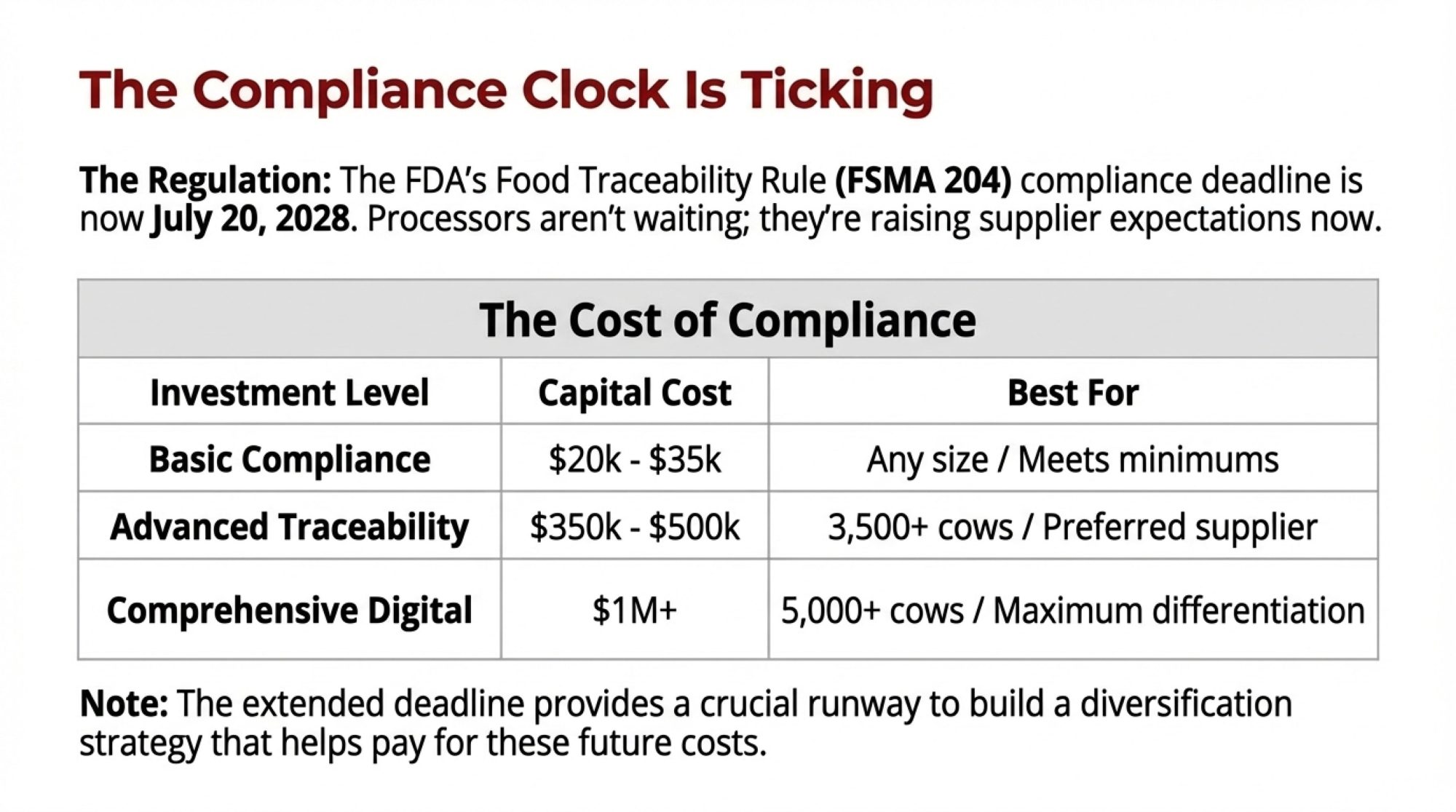
The FDA’s Food Traceability Final Rule (FSMA 204) was originally scheduled for January 2026. FDA has since extended the compliance deadline by 30 months to July 20, 2028—that extension was confirmed earlier this year. Still, processors are already adjusting supplier expectations in anticipation.

What the rule requires, regardless of final timing, is detailed record-keeping at each “Critical Tracking Event” that enables regulators to obtain data within 24 hours. For certain cheeses on the Food Traceability List, this creates real implications for supplier selection.

The consumer dimension reinforces these trends. Label Insight research from 2016 found that 73% of consumers are willing to pay more for products that offer complete transparency in sourcing and ingredients. Subsequent industry tracking has consistently confirmed that demand—if anything, it’s grown stronger, particularly among younger consumers.

What this means practically: processors and retailers are beginning to differentiate suppliers based on traceability capability. Some are offering premiums. Others are simply making it a qualification requirement. Either way, the capital needed to meet these expectations isn’t trivial.

What Traceability Systems Actually Cost

One question I kept encountering was straightforward: what does this actually cost a working dairy? I spent time examining land-grant university extension analyses and talking with operations that have made these investments.

According to the University of Minnesota Extension’s 2024 dairy technology investment analysis—with similar findings from Wisconsin and Cornell dairy programs—the picture breaks down into roughly three tiers:

Traceability Investment by Scale

This is the chart that keeps 800-cow dairy owners awake at night. Too big to ignore traceability requirements, too small to spread fixed costs efficiently. The 500-2000 cow range is where cooperative infrastructure starts making financial sense—or you’re paying $120+ per cow for systems the mega-dairies get at $85
Investment LevelCapital CostWhat It IncludesPremium PotentialScale Threshold
Basic Compliance$20,000–$35,000Tank sensors, basic IoT monitoring, cloud record-keepingMeets minimums; limited premiumAny size
Advanced Traceability$350,000–$500,000Individual animal sensors, RFID, blockchain integration, and real-time monitoringPreferred supplier status; $0.50–$0.75/cwt potential3,500+ cows
Comprehensive Digital$1,000,000+AI health monitoring, automated feeding, full supply chain integrationMaximum differentiation; $1.00+/cwt potential5,000+ cows

Financing makes these numbers more challenging. Agricultural lending rates have been running 7.5-8.5% according to late 2024 Federal Reserve surveys—multi-decade highs. A $500,000 loan at those rates requires annual debt service of $65,000 to $75,000 over 10 years. For a 2,000-cow dairy with typical margins, that’s substantial.

Now, it’s worth noting that some operations view this investment differently—not just as a compliance cost but as an operational improvement that generates returns through better fresh cow management, reduced health costs, and improved efficiency across the transition period and beyond. The calculation isn’t purely about premium capture.

Strategies That Are Working

Here’s where I want to shift from analysis to practical observation, because producers are navigating these pressures in genuinely creative ways. Not every approach fits every operation, but these patterns keep emerging in conversations.

Beef-on-Dairy: Quality Genetics or Don’t Bother

The most accessible opportunity—requiring minimal capital—involves strategic use of beef genetics on dairy herds. This trend has been building for years, but current economics make it particularly compelling.

USDA data from January 2024 shows U.S. beef cow inventory at approximately 28.2 million head—the lowest since 1961. Texas A&M AgriLife has confirmed this represents historically tight supplies, and CoBank analysis suggests meaningful herd rebuilding won’t happen until 2027 at the earliest.

But here’s what I need to emphasize, and it’s something The Bullvine has been beating the drum on for years: random beef bulls don’t cut it. The premium prices everyone talks about? They’re not available to just anyone throwing beef semen at their bottom-tier cows.

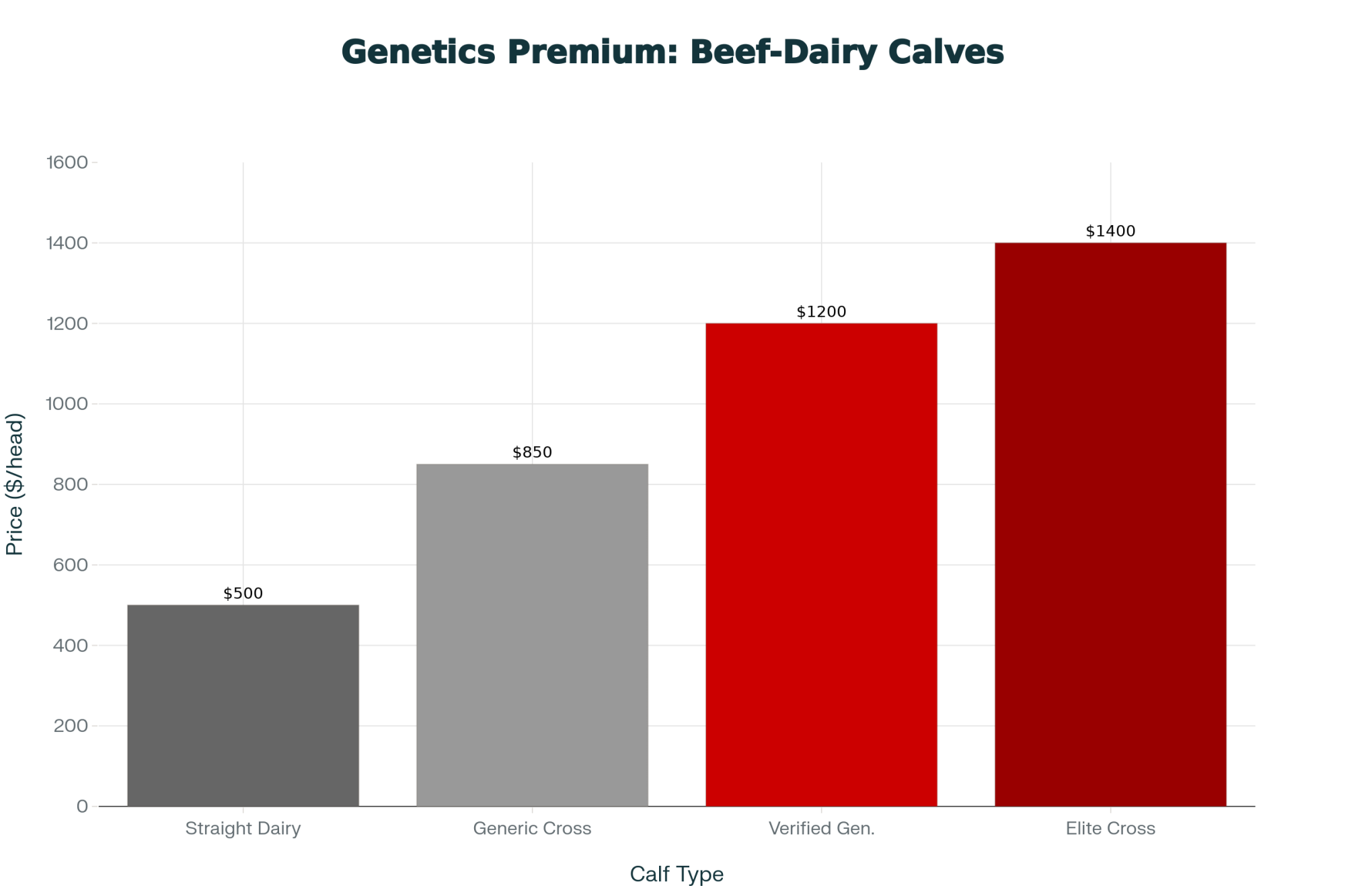
Every dairy farmer hears about beef-on-dairy premiums, but most are leaving $700 per head on the table. The difference between “some random beef semen” and verified genetics with documented EPDs is the gap between a side hustle and a profit center

Straight dairy bull calves now bring $400-$600 per head at many auctions—a dramatic improvement from the $100-$150 common just a few years back. Beef-cross calves from verified, high-quality genetics (proven Angus, Simmental, or Charolais sires with documented carcass data on Holstein dams) command $1,000-$1,400 at auction today—up from $650 averages just three years ago, according to Laurence Williams, dairy-beef cross development lead at Purina. Premium calves from elite sires can reach $1,500 or more at well-managed sales.

The key word there is verified. Feedlots and calf buyers have gotten sophisticated. They know the difference between a calf sired by a proven Angus bull with marbling EPDs in the top 10% versus some random beef semen picked up cheap. The price gap between generic beef-cross calves and those from verified genetics programs can exceed several hundred dollars per head—a difference driven almost entirely by genetic documentation and buyer confidence.

National Association of Animal Breeders data shows beef semen sales to dairy operations stabilized at record levels—approximately 7.9 million units in both 2023 and 2024—following rapid growth between 2017 and 2022. This isn’t temporary. It’s become structural.

I spoke recently with a California producer who’s breeding 45% of his herd to beef genetics—but he’s meticulous about which sires he uses. His observation: “We tried the bargain-bin approach the first year. Got bargain-bin prices. Now we use verified high-accuracy sires with actual carcass data, and the difference in our calf checks is substantial. The genetics investment pays for itself multiple times over.”

Beyond genetics, calf management determines whether you capture premium prices. Operations achieving top dollar have excellent colostrum protocols (within that critical four-hour window), careful processing procedures, and established feedlot relationships. Quality genetics combined with quality management is the formula. One without the other leaves money on the table.

Organic Markets: A Regional Calculation

For operations in certain regions—particularly the Northeast—organic and grass-fed markets remain undersupplied. The Northeast Organic Dairy Producers Alliance continues tracking demand that outpaces regional supply.

Organic cooperative contracts typically pay $33-$45 per hundredweight, according to NODPA’s 2025 reporting, compared to $18-$22 for conventional contracts. The premium is substantial, though it varies considerably by region, volume, and contract terms.

The challenge, of course, is transition. USDA organic certification requires 36 months of organic management before milk qualifies for premium pricing. That’s three years of elevated costs—organic feed runs 40-60% above conventional—without premium capture.

A Vermont producer I spoke with made the transition between 2019 and 2022. Her assessment was candid: “Those middle months were hard. You’re paying organic costs, selling at conventional prices, and hoping the math works on the other side.” It did work for her operation—she’s now receiving over $40/cwt through her cooperative contract. But she emphasized that financial staying power was essential.

Geography matters enormously here. Northeast markets remain undersupplied for organic milk. Midwest and Western markets show more saturation. If you’re considering this path, regional supply-demand dynamics should drive the decision as much as on-farm capabilities.

Other Diversification Pathways

Beyond beef-on-dairy and organic, I’m seeing producers explore several other approaches worth mentioning.

A2 milk programs are gaining traction in some regions, with processors offering premiums typically ranging from $0.50 to $1.50/cwt for herds genetically tested for the A2 beta-casein variant. The investment is primarily in genetic testing ($25-$40 per animal) and, potentially, in culling or breeding decisions over time. It’s not a dramatic premium, but for operations already making genetics decisions, it’s relatively low-friction additional income.

Direct-to-consumer operations—farmstead cheese, on-farm stores, local delivery—offer meaningful margin opportunities for operations within roughly 50 miles of population centers with populations exceeding 100,000. The catch is bandwidth: you’re adding retail management, food safety compliance, and customer relationships to an already demanding operation. Producers who succeed here generally have family members or partners explicitly dedicated to the retail side.

Agritourism components can leverage dairy heritage for smaller operations near tourist corridors or suburban areas. Farm tours, educational programs, and seasonal events won’t replace milk revenue, but they can provide supplemental income while building community connections that support other direct-sales efforts.

None of these represents a universal solution, but they illustrate the range of options available beyond commodity milk production.

Cooperative Infrastructure: An Emerging Model

One development I find encouraging—though it’s still early—is the rise of cooperative approaches to infrastructure investment. The logic is straightforward: if individual 2,000-cow farms can’t justify $500,000 in traceability technology, can ten farms sharing that investment make it viable?

Several farmer groups in Wisconsin and Minnesota are exploring this model. Typical structures involve 8-12 farms forming an LLC or cooperative, pooling capital to fund shared traceability platforms, and, in some cases, shared processing capacity for value-added products.

Early indications suggest per-farm costs can decrease substantially—potentially 60-75%—while still meeting processor requirements. The trade-off is governance complexity. These arrangements require genuine trust, aligned incentives, and careful legal structuring.

A Minnesota producer involved in exploratory discussions put it this way: “You’re giving up some independence. That’s real. But competing individually against 10,000-cow operations for processor contracts has its own costs.”

It’s worth watching how these structures develop. They may represent an important pathway for mid-size operations facing scale disadvantages in technology investment.

on-dairy with verified genetics sits in the sweet spot—minimal capital, 9-month payback, $320/cow annual return. The bottom-right corner (Direct-to-Consumer) looks tempting until you realize you’re now running two businesses

Maintaining Perspective

I want to be thoughtful about framing here. This isn’t a crisis moment requiring panic. Dairy has always been cyclical. Consolidation has proceeded for decades. Many mid-size operations have successfully navigated previous transitions and will do so again.

What does seem genuinely different about the current environment is the convergence of several trends: regulatory requirements for traceability (even with the FSMA extension to mid-2028), consumer expectations for transparency, the capital intensity of compliance, and processor consolidation, which is affecting market leverage.

Dr. Marin Bozic, the dairy economist at the University of Minnesota who advises Edge Dairy Farmer Cooperative and has testified before Congress on milk pricing, captures this well: “The farms that will thrive over the next decade are those making strategic decisions now—not reactive decisions later. That doesn’t mean panic. It means thoughtful positioning.”

The Great Lakes Cheese recall didn’t create these dynamics. But it made them visible in ways worth understanding. When a quality control issue at a supplier you’ve never heard of can affect your milk revenue, it reveals something meaningful about the supply chain’s structure and risk distribution.

Thinking Through Your Situation

Rather than prescribe universal solutions—every operation differs—here’s how these considerations tend to vary by scale:

Smaller operations (under 500 cows): Comprehensive traceability systems rarely pencil out at this scale. Specialty markets—organic, grass-fed, A2, direct-to-consumer—offer more realistic pathways to premium capture. Beef-on-dairy genetics (verified genetics, not bargain semen) can supplement income meaningfully regardless of herd size. The question becomes: where can you differentiate?

Mid-size operations (500-2,000 cows): This is arguably the most challenging position currently. Large enough that specialty market pivots are difficult, but lacking scale for major technology investments to generate positive returns individually. Cooperative approaches to shared infrastructure, combined with beef-on-dairy diversification using verified genetics, represent viable near-term strategies. The extended FSMA timeline—mid-2028—provides runway to explore options.

Larger operations (2,000+ cows): Comprehensive traceability investments become more justifiable as fixed costs spread across greater production. The strategic question shifts: invest in positioning as a preferred supplier to consolidated processors, diversify revenue streams to reduce channel dependence, or both? Many larger operations are pursuing parallel strategies.

Questions Worth Considering

Before committing to any particular direction, some honest self-assessment helps clarify options:

What’s your realistic timeline? Beef-on-dairy generates returns within months. Organic transition requires years. Which matches your financial position and planning horizon?

What’s your regional market reality? Is organic milk undersupplied or saturated in your area? Are established beef-cross calf buyers accessible? What specialty processors operate within a reasonable hauling distance?

Do you have neighbors who are suitable for a cooperative investment? Shared infrastructure approaches require aligned values and compatible operations. Not every neighboring farm makes a good partner.

What does your succession plan suggest? If the next generation isn’t committed to dairy, heavy investment in long-term technology infrastructure deserves careful evaluation.

Where are your operational strengths? Some farms excel at cow comfort and health management—organic or A2 programs might leverage that. Others have strong calf-raising infrastructure that positions them well for beef-on-dairy premiums.

There aren’t universal answers. But asking these questions honestly tends to clarify which paths make sense for specific situations.

The Bottom Line

What I’ve tried to do here is present what I’m observing as clearly as possible—drawing on USDA and FDA data, land-grant university extension analysis, conversations with credentialed economists, and reports from producers navigating these conditions directly.

The Great Lakes Cheese recall was, in one sense, routine—a food safety incident identified and addressed through established procedures. The system functioned as designed.

But the recall also exposed the ugly truth about converter supply chains: the risk flows upstream while the profits flow down. Your milk quality doesn’t protect you. Your operational efficiency doesn’t protect you. Your SCC scores don’t protect you. In a commodity system feeding into consolidated converters, you’re exposed to failures you can’t see coming and can’t prevent.

The encouraging news: farmers have options. Beef-on-dairy genetics—verified, quality genetics—offer immediate revenue diversification with minimal capital requirements. Specialty markets reward quality and management in ways commodity channels don’t. Cooperative structures can distribute infrastructure costs across multiple operations.

None represent a complete solutions. All require evaluation against individual circumstances, regional markets, and operational capabilities. But they represent genuine pathways—ways to build some insulation against a system that otherwise treats your operation as a disposable input.

That positioning—concentrating on factors within your control while clearly understanding those that aren’t—strikes me as exactly the right approach. The producers I talk with who seem most confident about the future share that orientation. They’re not ignoring industry headwinds. They’re just not waiting for those winds to determine their direction.

Key Takeaways:

  • When Great Lakes pulled 250K cases, farms 31 states away lost 5-15% income—even though they never sold to Great Lakes. Your SCC won’t protect you from converter failures.
  • Beef-on-dairy with verified genetics: $1,000-$1,400/calf. Straight dairy: $400-$600. The genetics gap is worth hundreds per head.
  • FSMA 204 extends to July 2028, but processors are moving now. Alternative revenue streams aren’t optional—they’re insurance.

Complete references and supporting documentation are available upon request by contacting the editorial team at editor@thebullvine.com.

Learn More:

Join the Revolution!

Join over 30,000 successful dairy professionals who rely on Bullvine Weekly for their competitive edge. Delivered directly to your inbox each week, our exclusive industry insights help you make smarter decisions while saving precious hours every week. Never miss critical updates on milk production trends, breakthrough technologies, and profit-boosting strategies that top producers are already implementing. Subscribe now to transform your dairy operation’s efficiency and profitability—your future success is just one click away.
NewsSubscribe
First
Last
Consent

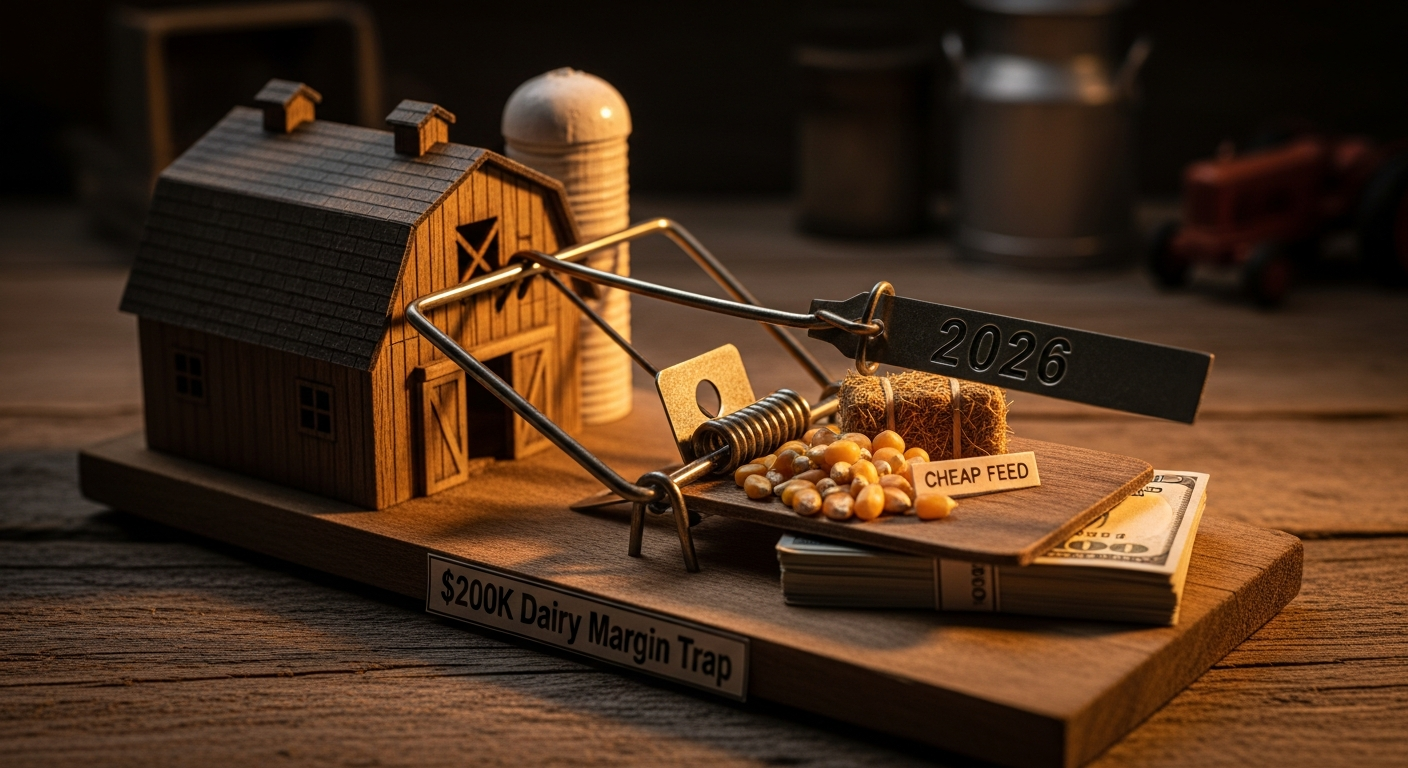
The $200K Dairy Margin Trap: What Cheap Feed Won’t Tell You About 2026

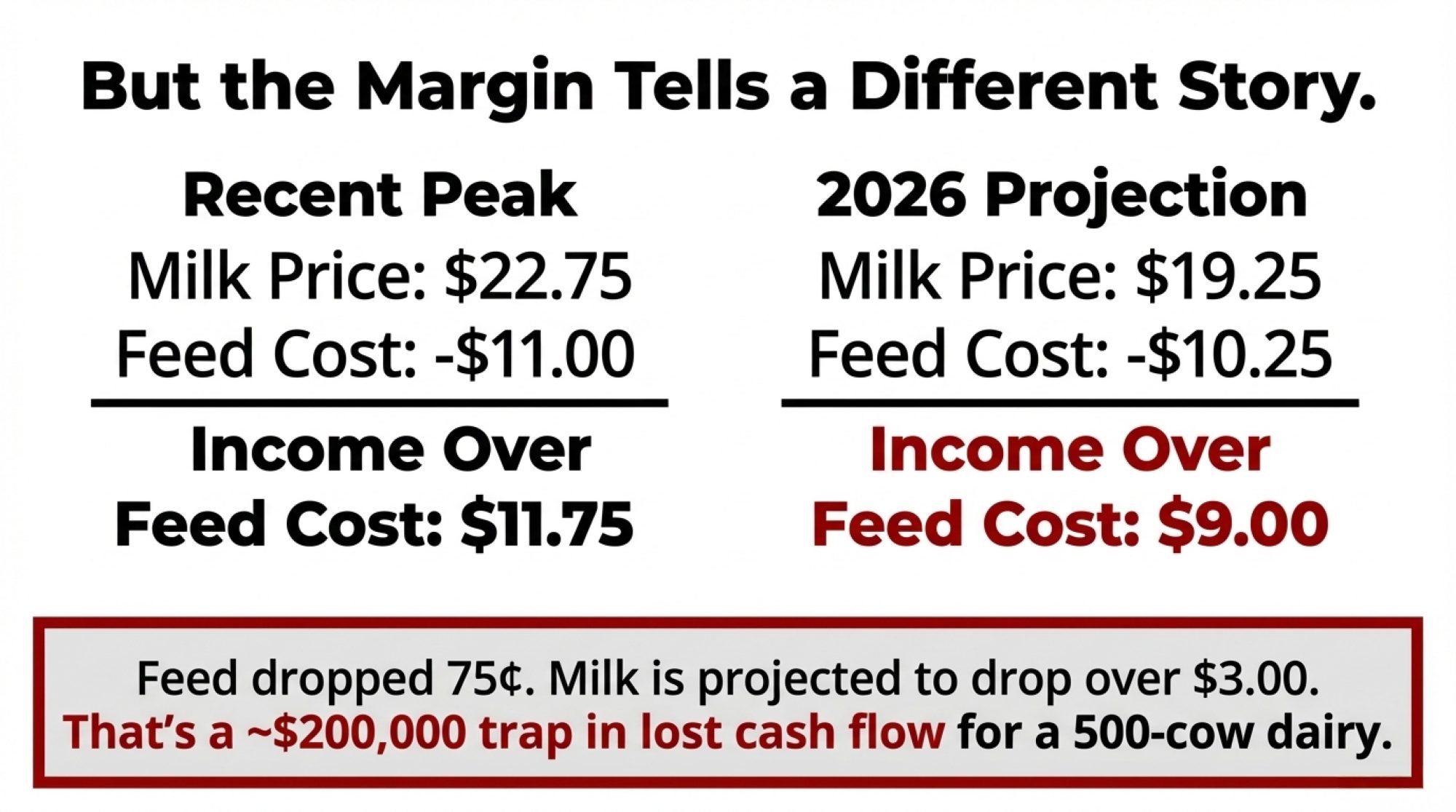
Feed dropped 75¢. Milk dropped $2. That’s not savings—that’s a $200K trap.

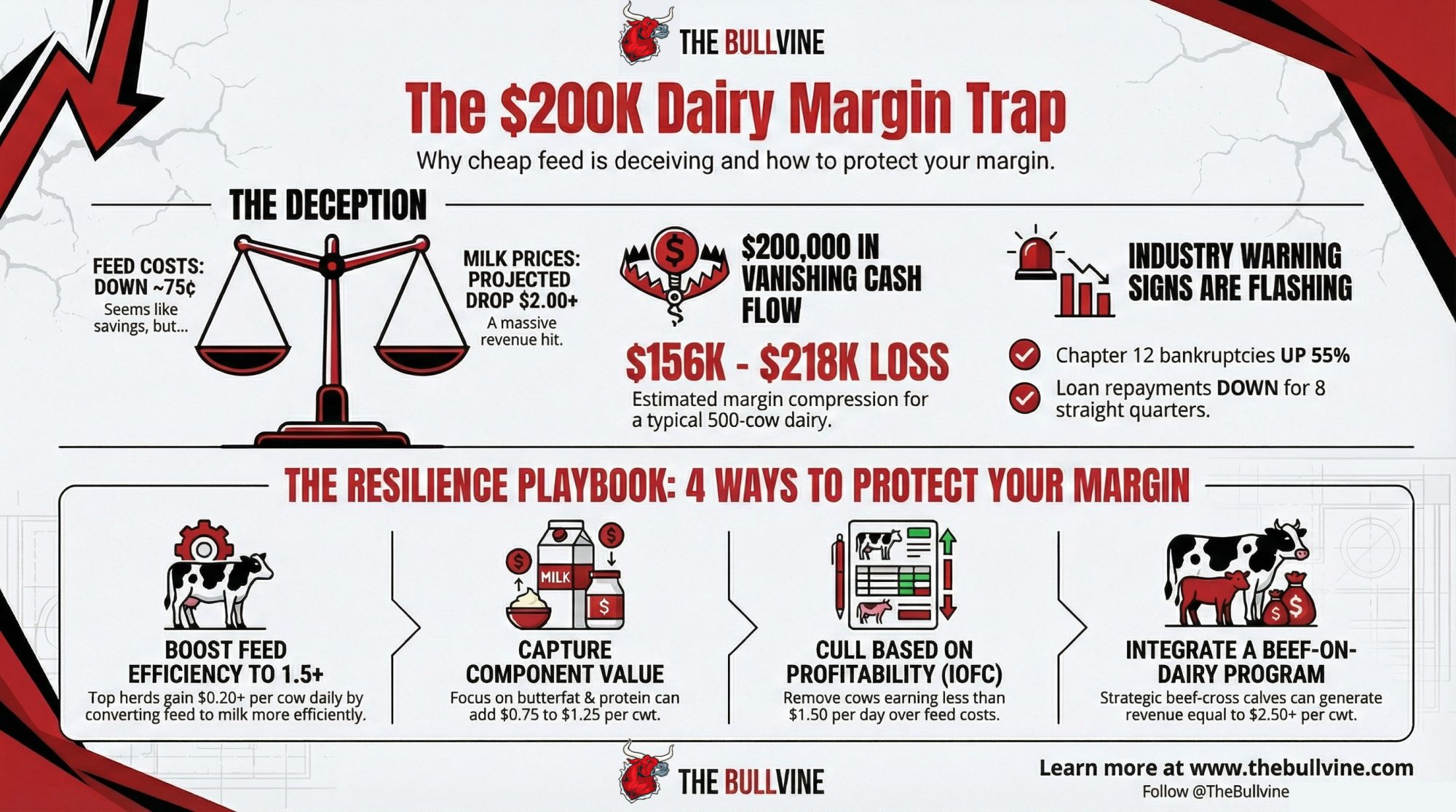
EXECUTIVE SUMMARY: Everyone’s celebrating cheap corn—but the math tells a different story. USDA projects 2026 milk at $19.25/cwt while feed costs have dropped only modestly, creating net margin compression of $1.25-1.75/cwt—that’s $156,000 to $218,000 in lost cash flow for a 500-cow dairy. New Zealand’s lowest-cost producers see what’s coming: they paid down $1.7 billion in debt this year rather than expand. Top U.S. operators are responding with feed efficiency gains, component optimization, IOFC-based culling, and beef-on-dairy programs that can protect $1.50+ per cow daily. With Chapter 12 bankruptcies up 55% and ag lenders reporting eight straight quarters of declining repayment rates, the window for strategic positioning is narrowing. The question isn’t whether margins compress in 2026—it’s whether you’ll position your operation before they do.

You know that feeling when everything looks fine on paper, but something in your gut says otherwise?

It’s the kind of conversation happening at kitchen tables across dairy country right now. The milk check looks okay—maybe even decent by recent standards. Feed costs have come down. The cows are milking well.

And yet something feels off.

That instinct isn’t wrong.

The FAO has been tracking global food prices for decades, and its November numbers tell an interesting story. The overall Food Price Index has dropped for three consecutive months, and the dairy sub-index has declined for five straight months.

New Zealand just posted a 17.8% production surge in their early season, according to their Dairy Companies Association data. U.S. milk output keeps climbing, too.

What’s worth understanding—and this is something many of us tend to underestimate—is the timeline between when these global signals show up and when they hit our milk checks.

Generally speaking, we’re looking at about six to eight months.

So the softening that started this fall? It’s likely showing up in Q2 and Q3 2026 checks.

Mark Stephenson, who spent years as Director of Dairy Policy Analysis at the University of Wisconsin-Madison before his recent retirement, studied these price transmission patterns extensively throughout his career. His research documented this lag across multiple market cycles.

The movement in international powder and butter prices isn’t really a question of whether it affects domestic markets—it’s more about when and how much.

USDA’s November World Agricultural Supply and Demand Estimates projects the all-milk price at $19.25 per hundredweight for 2026. That’s a meaningful change from the $22-24 range that many operations built their budgets around during stronger periods.

So what are the producers who’ve navigated these cycles before actually doing about it?

The Feed Cost Conversation That’s Missing Something

Walk into any farm supply store or dairy meeting right now, and you’ll hear some version of the same reassurance: “At least feed costs are down.”

And that’s true.

Corn is trading around $4.37 per bushel on the Chicago Board of Trade as of early December. Soybean meal is running around $310-$315 per ton. The DMC feed cost calculation is in a favorable territory compared to recent years—no question about that.

But here’s what that conversation often leaves out.

When milk prices were $22.75, and feed costs were about $11.00 per hundredweight, producers captured roughly $11.75 in income over feed costs.

Run the same math with 2026 projections—$19.25 milk and lower feed costs—and that margin still compresses to around $9.00.

Feed improved by maybe seventy-five cents. Milk dropped by more than two dollars.

The net effect is still a $1.25 to $1.75 per hundredweight margin compression for most operations.

On a 500-cow dairy producing 125,000 hundredweight annually, that’s $156,000 to $218,000 in reduced cash flow. Real money that has to come from somewhere—whether that’s reduced family living, deferred maintenance, or tighter input decisions.

Michael Dykes, who leads the International Dairy Foods Association as their President and CEO, put it well in a recent industry briefing. Lower feed costs are helpful, no question, but they’re best understood as breathing room to make strategic moves—not as a solution to margin pressure.

I recently spoke with an Upper Midwest nutritionist who put it more directly:

“I’ve got producers telling me they’re holding off on decisions because corn is cheap. That’s exactly backwards. Cheap corn is the opportunity to lock in favorable feed contracts and build some cushion—not permission to wait and see what happens.”

The timing matters here.

Producers who lock in Q1 and Q2 2026 feed contracts now, while basis levels remain favorable, capture that advantage regardless of what happens to spot markets later. Those who wait may find the window has closed.

It’s worth running the numbers with your feed supplier at a minimum.

What’s Actually Happening in Export Markets

The China situation deserves more attention than it typically gets in domestic dairy discussions, even for producers who don’t think of themselves as export-dependent.

Why does this matter to all of us? The economics tell the story.

The current reality is pretty stark.

U.S. dairy products face total tariffs of 84 to 125 percent in China following the trade escalation that peaked in April 2025—China’s Ministry of Finance and Reuters covered this extensively at the time.

New Zealand, by contrast, completed their Free Trade Agreement phase-in on January 1, 2024, and now ships dairy to China at zero percent tariff.

The market share shift has been significant.

While exact percentages shift quarter to quarter, the direction is clear: New Zealand has captured the lion’s share of China’s powder imports while U.S. product faces what amounts to a prohibitive tariff wall.

That displaced volume didn’t disappear—it backed up into domestic markets.

Even producers selling exclusively to domestic processors feel this effect, as Mary Ledman at Rabobank has pointed out in her global dairy market analysis. She’s been tracking these patterns as their Global Dairy Strategist for years now.

When export channels close, that milk has to go somewhere. It adds supply pressure that affects everyone, even if indirectly.

The regional effects aren’t uniform, though.

California and Idaho operations—traditionally more export-oriented through Pacific Rim trade—feel this more acutely than Upper Midwest producers whose milk flows primarily into domestic cheese markets.

I spoke with a Wisconsin cheesemaker recently who said his plant’s order book looks fine through mid-2026, but he’s watching West Coast capacity closely because displaced milk eventually tends to find its way east.

What’s particularly noteworthy is how New Zealand producers are responding to their advantageous position.

Despite favorable prices and strong production conditions, Kiwi farmers repaid NZ$1.7 billion in debt in the six months through March 2025 rather than expanding. ANZ Bank and New Zealand’s rural news outlets have been tracking this closely.

When the world’s lowest-cost producers choose balance sheet repair over growth during historically good times… well, it suggests they’re preparing for extended market softness.

That’s a signal worth paying attention to.

Reading the Financial Signals

Several data points help distinguish what’s happening now from typical cyclical patterns.

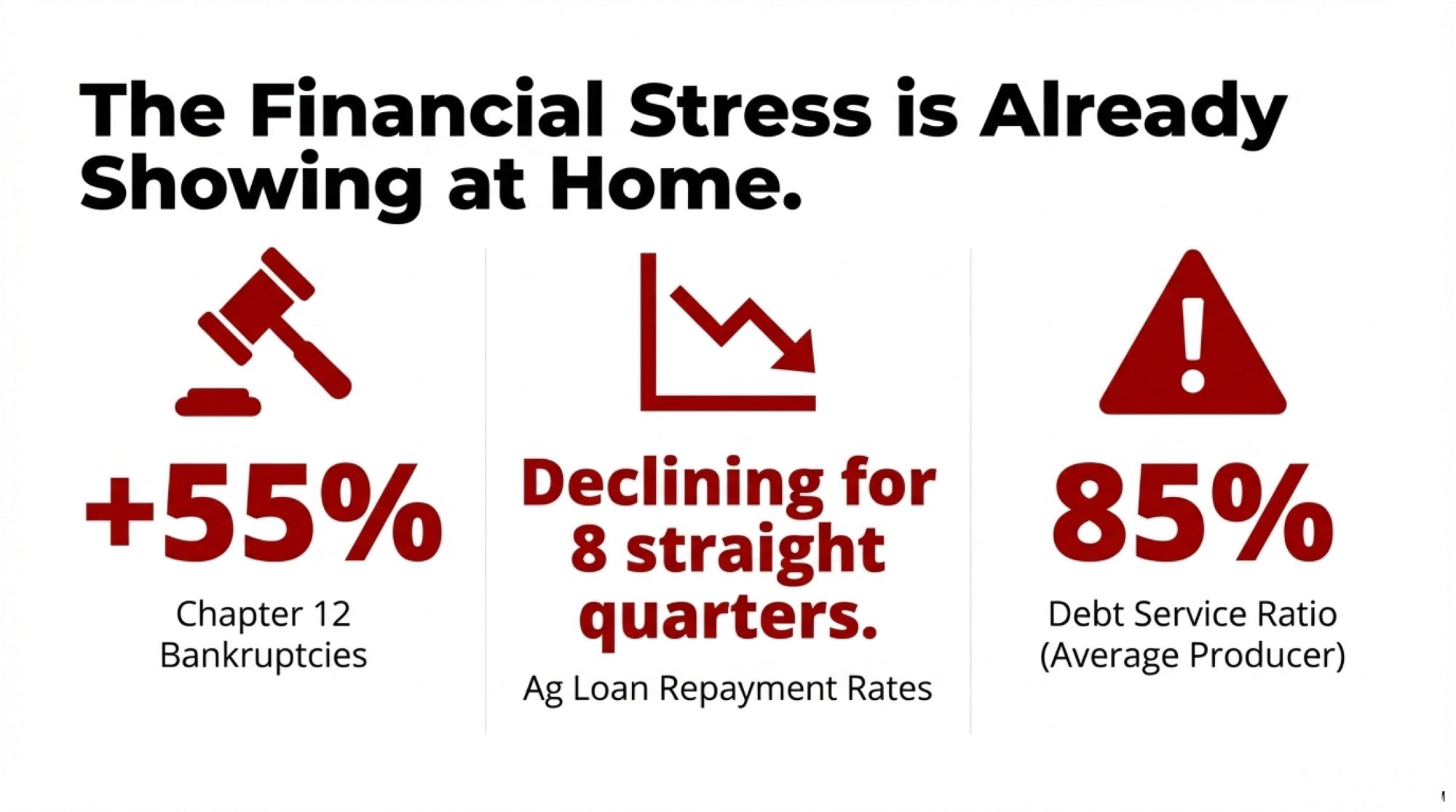
Chapter 12 farm bankruptcy filings—the specialized bankruptcy provision for family farmers—hit 216 cases in 2024, up 55 percent from the prior year. The American Farm Bureau Federation has been tracking federal court records on this, and the first half of 2025 saw additional filings running well ahead of 2024’s pace.

Context matters here. Bankruptcy filings alone don’t tell the whole story—they can reflect access to legal resources, regional legal practices, and individual circumstances as much as broad economic conditions.

But the trend is notable.

Geographic patterns show particular stress in California, Iowa, Michigan, Kansas, and Wisconsin—a mix of traditional dairy regions and areas affected by specific challenges, such as avian influenza and water constraints.

Debt service coverage ratios tell a related story.

Farm Progress recently reported on data from the Minnesota FINBIN farm financial database showing that the average producer had a concerning coverage ratio of around 85 percent in 2024—meaning operations were generating only 85 cents for every dollar of debt service obligation.

The remaining gap has to come from equity drawdown, off-farm income, or loan restructuring.

What concerns many lenders is the compounding effect.

Interest costs have roughly doubled over the past three years as rates have reset. An operation that was comfortable at 3.5 percent interest faces a completely different equation at 7.5 percent—as many of us have experienced firsthand.

The Federal Reserve Bank of Chicago’s Q3 2025 agricultural credit survey found 38 percent of banks reporting lower repayment rates—the eighth consecutive quarter of deterioration. More than two-thirds of lenders expect farmland values to flatten or decline in 2026.

None of this predicts any individual operation’s future—every farm has its own circumstances, strengths, and challenges.

But it does suggest the industry overall is experiencing stress levels that reward careful financial planning over optimistic assumptions.

The Expansion Paradox

One of the more counterintuitive aspects of current markets—and something I find genuinely interesting to think through—is why production keeps growing despite weakening price signals.

The biological reality is that dairy expansion decisions made two to three years ago are just now showing up in production numbers.

Heifers conceived in early 2023 are entering milking strings in late 2025. Facilities that broke ground during strong margins in 2023 and 2024 are now completing and being populated.

Once those commitments are made—once the cows are bred, raised, and the facilities built—the production is essentially locked in.

Debt service creates similar momentum.

Operations carrying expansion loans need to maintain production to meet their obligations. Reducing herd size often costs more than continuing to milk at marginal profitability, especially when the alternative is triggering loan covenant violations.

Christopher Wolf, the E.V. Baker Professor of Agricultural Economics at Cornell, has written thoughtfully about this dynamic. The economics of stopping are often worse than the economics of continuing.

That’s not irrational behavior—it’s responding logically to the debt structure and fixed-cost reality that exist in most operations.

Processing capacity investment adds another layer.

More than $11 billion in new U.S. dairy processing capacity is under construction or recently completed—IDFA released a detailed report in October covering 50-plus projects across 19 states.

That processing investment creates a regional demand pull that can support local expansion even when broader markets are oversupplied. A producer within hauling distance of a new plant in Dodge City or along the I-29 corridor faces different economics than one in a region without recent processing investment.

I’ve been hearing about this regional divide increasingly this season.

In Texas and New Mexico, where several major cheese and powder facilities have opened or expanded, local producers report being actively recruited with multi-year contracts.

Meanwhile, some Northeast producers describe tighter relationships with their cooperatives—fewer premium opportunities and more pressure on base pricing.

Same industry, very different regional realities.

What Successful Producers Are Doing Differently

Conversations with producers navigating current conditions successfully reveal consistent patterns. These aren’t revolutionary changes requiring massive capital—they’re an intensified focus on fundamentals.

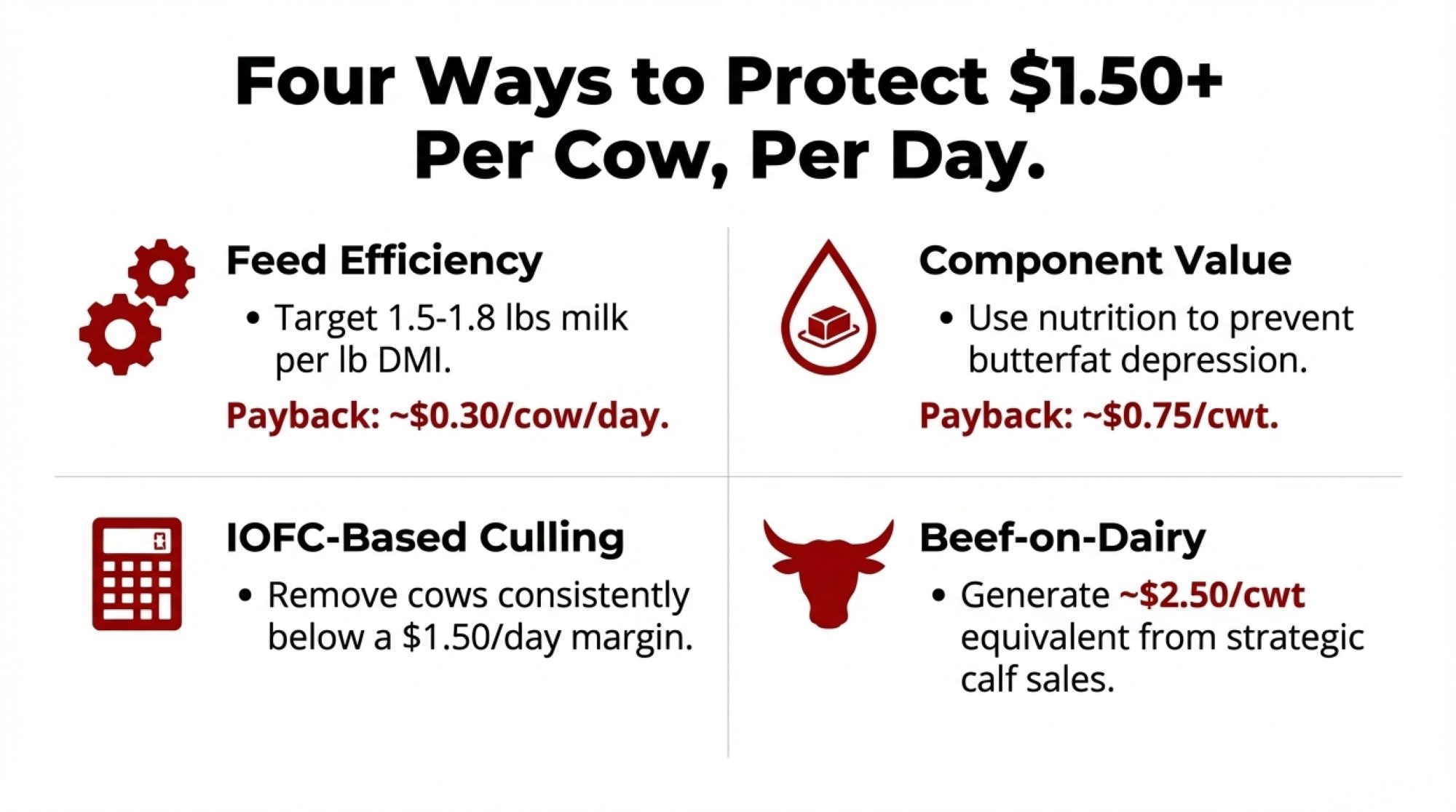
1. Feed Efficiency Optimization

Top-performing herds are achieving feed efficiency ratios of 1.5 to 1.8 pounds of milk per pound of dry matter intake. The industry average sits around 1.4.

The Impact: Each tenth of a point improvement translates to roughly $0.20 to $0.30 per cow/day in margin enhancement.

The Tactic: Weekly NIR analysis on forages (~$15/sample) allows for immediate ration adjustments, rather than guessing between monthly tests.

I recently spoke with a Wisconsin producer who started as a custom heifer raiser before transitioning to his own milking herd. He described implementing weekly NIR testing on every forage load.

“The payback is maybe ten to one in ration accuracy,” he said. “We were basically guessing before.”

Most producers I’ve talked with see measurable results within 45 to 60 days—though individual results vary based on starting point and forage variability.

2. Component Value Capture

Producers focusing on butterfat performance and protein levels report capturing an additional $0.75 to $1.25 per hundredweight compared to volume-focused approaches.

The Tactic: Using rumen-protected choline during transition periods and summer heat stress (~$0.08/cow/day) to prevent butterfat depression.

The genetic piece is a longer-term play—daughters of high-component sires won’t hit the milking string for two-plus years—but the nutritional interventions can show results within a milk test cycle or two.

Worth having a conversation with your nutritionist about current ration fatty acid profiles and where component optimization opportunities might exist for your herd.

3. Strategic Culling Based on IOFC

Rather than culling primarily based on age, reproduction metrics, or production levels, progressive operations calculate income over feed cost for each cow and move out animals that are consistently below $1.50 per cow daily.

The Shift: “A seven-year-old cow giving 60 pounds might look fine on paper,” one herd manager at a 1,200-cow Minnesota dairy told me. “But when you run her actual IOFC with her feed intake and health costs, she’s sometimes underwater. We’re making decisions on math now, not sentiment.”

For operations without individual cow feed intake data (which is most of us), pen-level IOFC calculations still identify which groups are carrying the herd versus dragging it down.

Most herd management software can generate these reports with minimal setup.

4. Beef-on-Dairy Integration

Producers systematically breeding bottom-tier genetics to beef sires report equivalent revenue of $2.50+ per hundredweight from crossbred calf sales.

The Math: A straight Holstein bull calf might bring $150. A beef-cross brings $1,000 or more based on current USDA feeder cattle reports.

The Genetics Play: Use genomic testing or breeding values to identify the bottom 20-30% of your herd’s genetic merit. Breed those animals to proven beef sires with good calving ease scores, and establish buyer relationships before calves hit the ground.

This is where your genomic data becomes a direct revenue driver—not just a breeding tool.

Operations that treat beef-on-dairy as an afterthought leave money on the table compared to those who plan the program strategically.

The Emerging Structure: Two Viable Paths

Looking at where the industry appears headed over the next three to five years, a structural pattern is emerging that’s worth understanding—even if it raises uncomfortable questions.

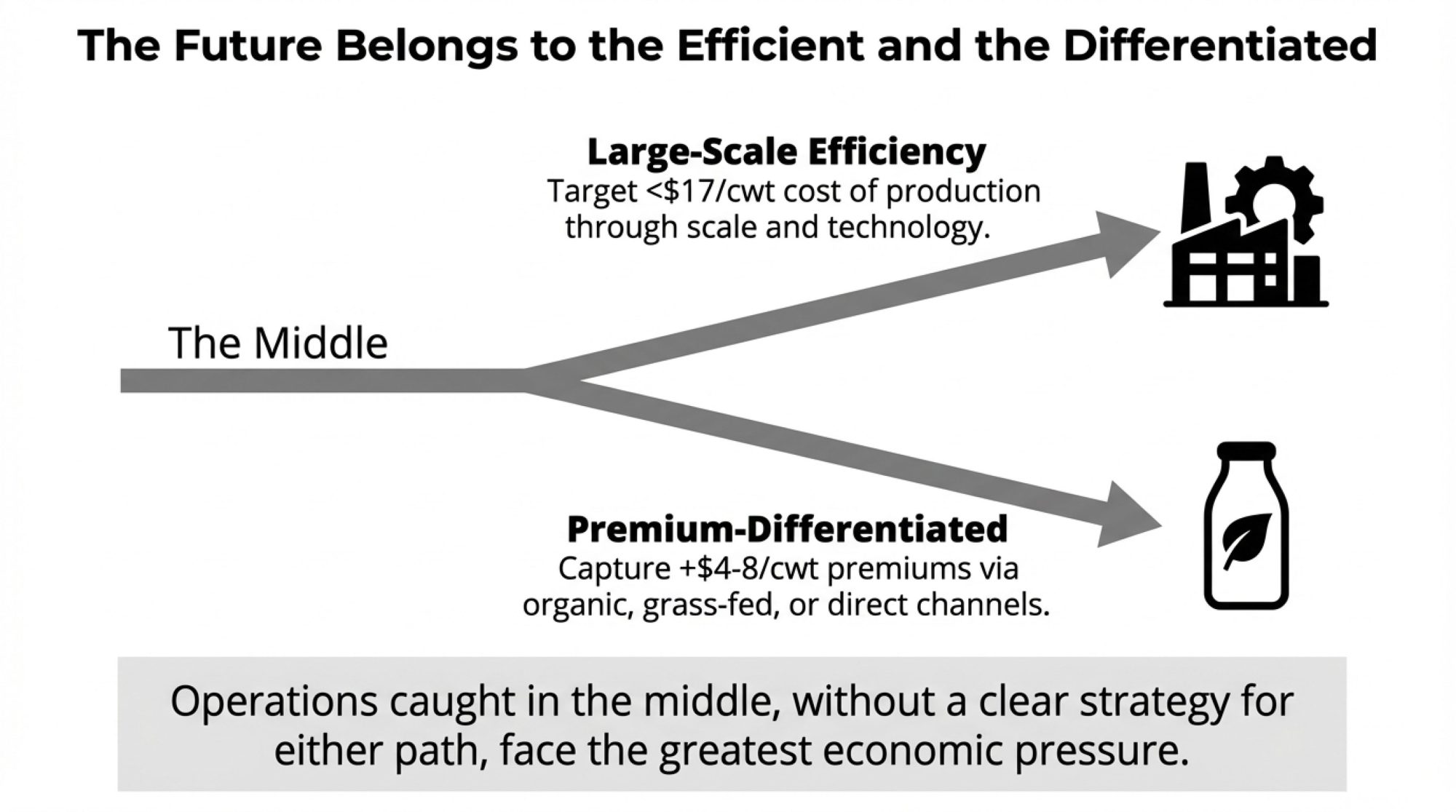
The data increasingly suggests two economically viable models:

Large-scale efficiency operations—generally 1,500 cows and above—achieving production costs in the $14 to $17 per hundredweight range through scale economics, technology adoption, and processing relationships.

USDA’s Economic Research Service cost-of-production data confirms that this scale advantage has widened over the past decade. Many of these operations use dry-lot systems or hybrid facilities to maximize throughput efficiency.

Premium-differentiated operations—typically 50 to 500 cows—capturing $4 to $8 per hundredweight premiums through organic certification, grass-fed positioning, or direct-to-consumer channels.

These require proximity to metro markets and significant transition investment, but create a margin cushion independent of commodity prices.

Operations in the middle face the most challenging economics under the current market structure.

This isn’t a judgment about the value of family-scale dairy farming or the communities these farms anchor. It’s an observation about where the current market structure creates clearer paths forward.

Regional variation matters significantly.

A 300-cow dairy in Vermont with Boston market access faces different options than a similar-sized operation in central Wisconsin without nearby premium channels.

A Framework for Evaluation

For producers working through these questions—and most of us are—several considerations help clarify the path forward.

For operations considering expansion:

  • Is there processing capacity within 200-300 miles actively seeking suppliers?
  • Is replacement heifer availability realistic? National inventory sits at roughly 3.9 million dairy replacement heifers 500 pounds and over—the lowest absolute level since 1978, according to USDA’s January 2025 Cattle report. The heifer-to-cow ratio of 41.9% is the lowest since 1991.
  • Can production costs realistically reach sub-$17 per hundredweight at expanded scale?
  • What do debt service requirements look like at current interest rates, not 2021 rates?

For operations considering premium positioning:

  • Is there a metro market within a reasonable distance with demonstrated premium demand?
  • What’s the realistic timeline? Organic certification alone typically takes three years under USDA National Organic Program rules.
  • Does the land base and climate support pasture-based systems?
  • Is there family interest in direct marketing relationships?

For operations evaluating the current position:

  • What’s the actual debt service coverage ratio at projected 2026 milk prices?
  • When do loans mature, and at what interest rate reset?
  • Has the processor offered multi-year supply contracts?
  • What’s the true breakeven with full cost accounting—including family labor and reasonable return on equity?

These aren’t comfortable questions.

But they’re better asked now than answered by circumstances later.

The Timing Reality

One thread runs through conversations with producers, lenders, and analysts who’ve navigated previous downturns: timing matters more than most people acknowledge.

Producers who assess their position and make strategic decisions during 2025 and early 2026—while milk prices are still serviceable, while cull cow prices remain historically strong—retain meaningfully more options than those who wait.

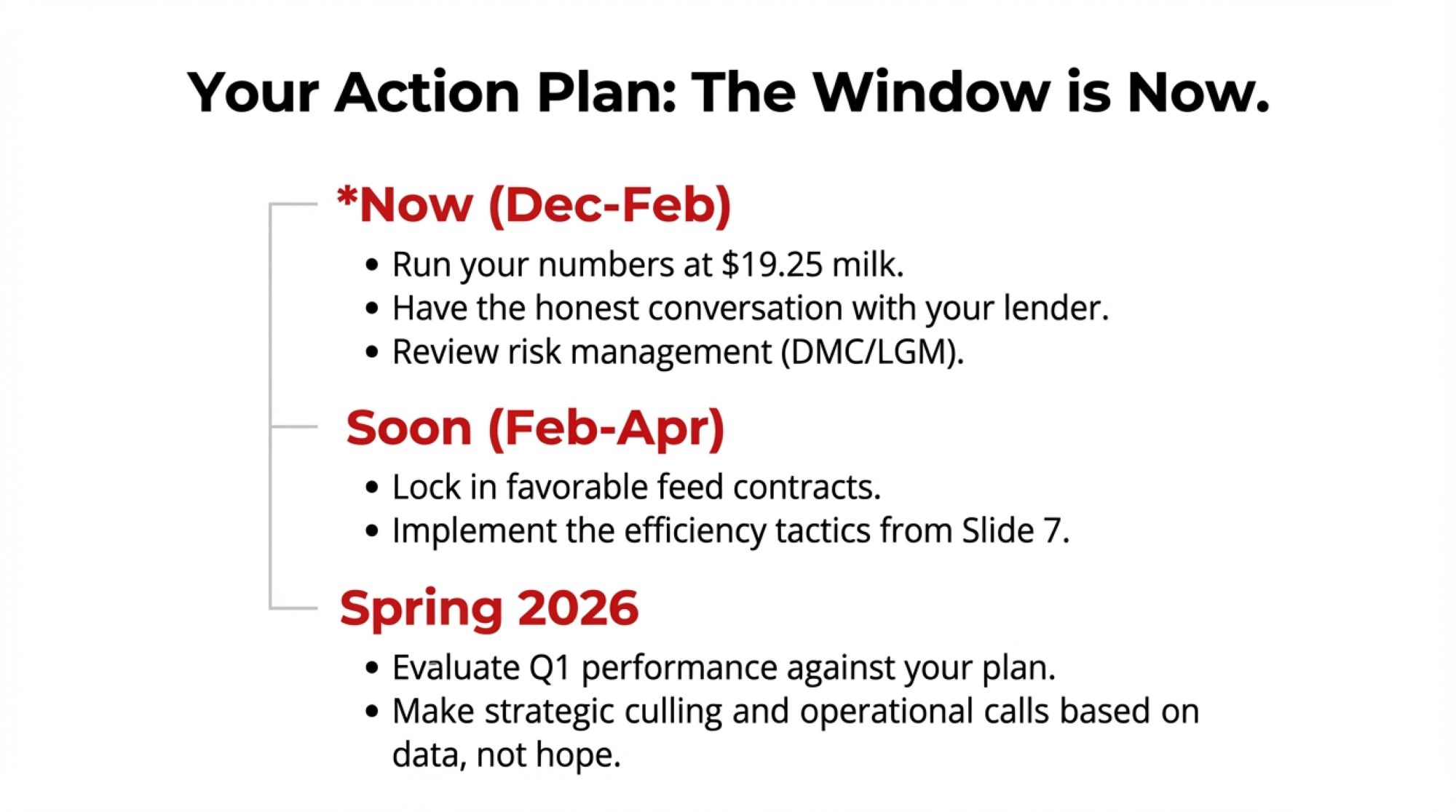
December through February: Run your real numbers. Calculate the actual DSCR at $19.25 milk. Have the honest conversation with your lender—most good lenders appreciate proactive communication.

This is also the window for DMC enrollment decisions. If you haven’t reviewed your coverage levels against projected margins, now’s the time. LGM-Dairy is worth a conversation with your insurance agent, too, especially for operations wanting more flexible coverage options.

February through April: Make feed decisions. Lock contracts if the math works. Implement efficiency improvements that deliver results by summer.

Spring 2026: Evaluate first-quarter performance against projections. Adjust culling strategy based on actual margins. Make the bigger strategic calls with real data rather than hope.

The Bottom Line

The dairy industry has navigated challenging transitions before, and it will again.

The producers who came through previous cycles strongest were generally those who saw conditions clearly, made decisions based on their specific circumstances, and acted while they still had choices.

That window is open now.

The question is what each of us does with it.

The Bullvine provides market analysis and industry perspective for dairy producers worldwide. This article reflects conditions and data available as of early December 2025. Individuals should consult their own financial advisors, lenders, and Extension specialists when making significant business decisions. Every farm’s situation is unique, and the right path forward depends on factors only you and your advisors can fully evaluate.

KEY TAKEAWAYS

  • The Trap: Feed dropped 75¢. Milk dropped $2. That’s not savings—that’s $200K in vanishing cash flow for a 500-cow dairy.
  • The Global Signal: NZ farmers paid down $1.7 billion in debt instead of expanding. The world’s lowest-cost producers expect extended softness.
  • The Warning Signs: Chapter 12 bankruptcies up 55%. Ag loan repayments have been declining for 8 quarters straight. Financial stress is accelerating.
  • What Top Producers Are Doing: Capturing $1.50+/cow/day through feed efficiency, component optimization, IOFC-based culling, and beef-on-dairy integration.
  • The Window Is Now: Cull values are strong. Milk checks are still serviceable. Lenders are still flexible. Make strategic decisions while you still have options.

Complete references and supporting documentation are available upon request by contacting the editorial team at editor@thebullvine.com.

Learn More:

  • The $700 Truth: Your Best Milkers Are Your Worst Investment – Reveals why high-volume cows often lose $3/day in actual margin and demonstrates how to use Residual Feed Intake (RFI) data to identify the true profit-drivers in your herd.
  • The $228,000 Exit Strategy Reshaping Dairy – Uncovers the “Section 1232” tax provision behind the recent surge in Chapter 12 filings, explaining how strategic bankruptcy is helping retiring producers preserve equity rather than losing it in traditional sales.
  • Robot Revolution: Why Smart Dairy Farmers Are Winning – Analyzes the 2025 ROI of automated milking systems beyond simple labor savings, providing a blueprint for the “efficiency-at-scale” model that allows family operations to compete with larger consolidators.

Join the Revolution!

Join over 30,000 successful dairy professionals who rely on Bullvine Weekly for their competitive edge. Delivered directly to your inbox each week, our exclusive industry insights help you make smarter decisions while saving precious hours every week. Never miss critical updates on milk production trends, breakthrough technologies, and profit-boosting strategies that top producers are already implementing. Subscribe now to transform your dairy operation’s efficiency and profitability—your future success is just one click away.

NewsSubscribe
First
Last
Consent

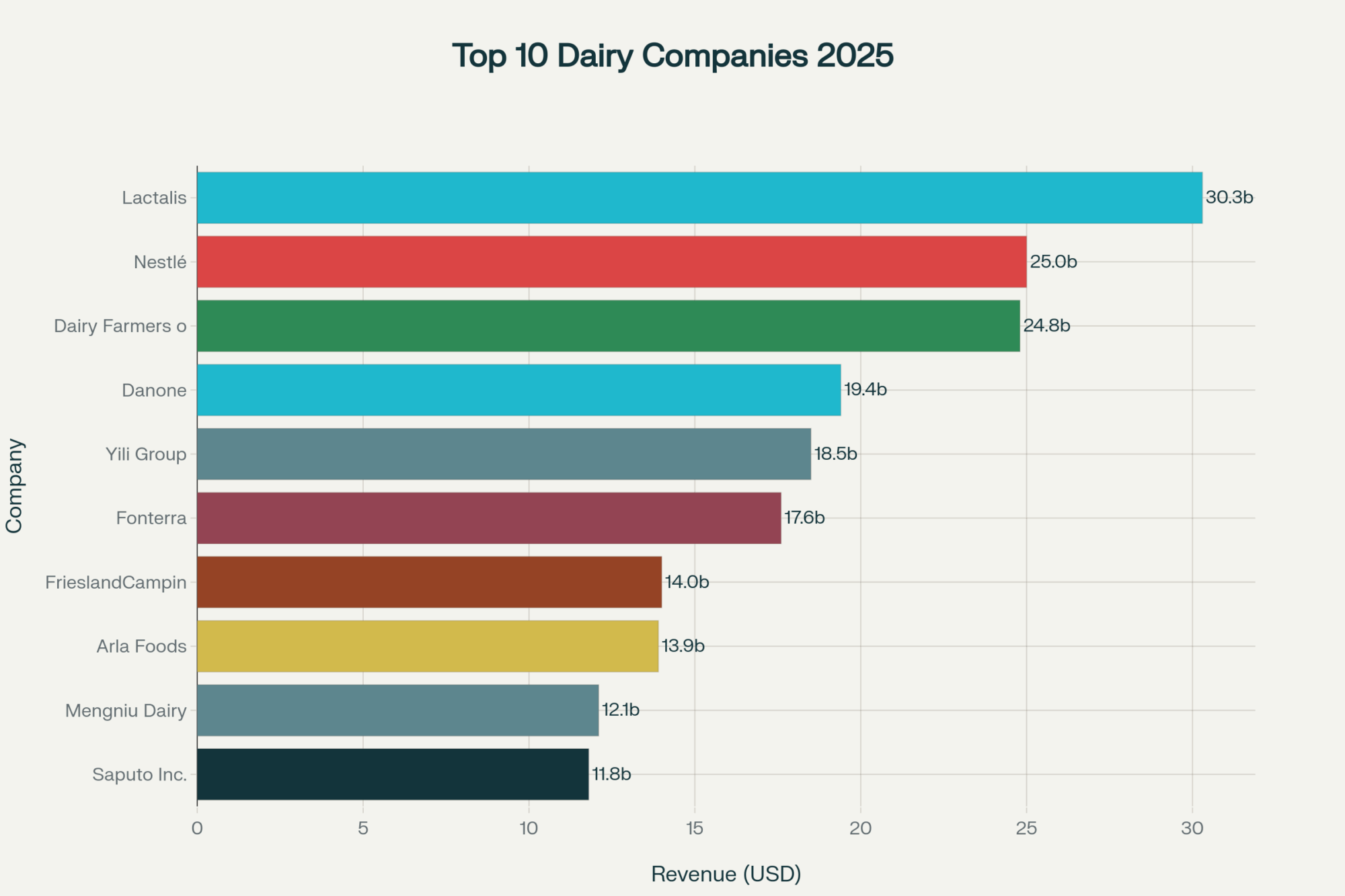
The Dairy Gamechanger: Lactalis Blasts Past $30 Billion – What It Means for Your Farm

Lactalis just hit $30B while everyone else crawled at 0.6% growth—here’s what they know that you don’t about dairy’s new reality.

EXECUTIVE SUMMARY: You know that feeling when you see numbers that just don’t add up? Lactalis blasted past €30 billion while the rest of us limped along at 0.6% growth—and it’s not because they got lucky. The dairy industry’s splitting into winners who adapt fast and everyone else watching from the sidelines. Texas producers added 50,000 cows and jumped 10.6% in milk production, while Wisconsin barely moved the needle at 0.1%. Meanwhile, China’s flipping the script on exports—powder down 9%, whey up 52%—and farmers using beef-on-dairy genetics are padding their bottom line when milk prices stay tight. The University of Wisconsin’s AI systems are reducing feed waste by 15%, with paybacks occurring within eight months. Here’s the deal: if you’re not adjusting your strategy for 2025’s reality, you’re betting against data that’s already proven what works.

KEY TAKEAWAYS

  • AI isn’t hype anymore—it’s profit. University of Wisconsin farms are trimming 15% off feed waste and improving calving intervals by 18%, with some seeing full ROI in under 8 months. Start with smart cameras for health monitoring—they catch issues days before you’d spot them visually.
  • Geographic arbitrage is real money. Texas producers are capitalizing on cheaper feed, lighter regs, and better weather to scale fast while traditional dairy regions struggle. If you can’t move, focus on efficiency gains that compete with their cost advantages.
  • China’s buying habits changed everything for exports. Whey products shot up 52% while powder dropped 9%—processors who adapt to this shift win, those stuck on old models lose. Review your processor’s export portfolio and pursue whey-focused contracts.
  • Beef-on-dairy genetics aren’t just diversification—they’re insurance. Midwest farmers utilizing crossbreeding strategies are generating revenue streams that help buffer tight milk margins. Plan for 18-24 month timelines and proper calf facilities, but the math works when milk prices stay squeezed.
  • Consolidation’s forcing tough choices on governance. The Arla-DMK merger, bundling 12,200 farmers, shows where co-ops are heading—get vocal about transparency and member benefits now, or risk losing your voice in future decisions that affect your operation’s profitability.

You ever get that moment when a number just stops you in your tracks? That’s the feeling I had seeing the latest Rabobank numbers. Lactalis, the French dairy powerhouse, busted through the $30 billion mark, topping over €30.3 billion last year. Meanwhile, the rest of the industry barely moved, limping along at 0.6% growth, down from the solid 8.1% we saw the year before.

Let me tell you how this feels on the ground: those easy money days? They’re gone. Now, it’s about steadying your footing, watching every dime, and squeezing every bit of efficiency out of those fresh cows.

Europe’s Dairy Landscape Is Shifting Like Never Before

Across the Atlantic, things are shaking. Arla and DMK are locking arms, forming a €19 billion cooperative and bundling up over 12,200 farmers under one roof. This isn’t just some PR fluff—this is survival talk in the face of rising costs and tighter rules.

What really hits home is what Kjartan Poulsen, head of the European Milk Board, has to say. He warns that in these mega-mergers, regular farmers risk losing their voice. And if you’ve been in a co-op meeting, you know that voice is critical.

Farmers I know around Europe share that gut feeling—we want the strength of numbers, but not at the cost of losing control around the feed bunk or voting floor.

Midwest Holds the Line, Texas Shows Muscle

Back here in the U.S., Wisconsin barely saw a bump: milk production inched up 0.1% last April, but that’s preliminary USDA data, and charts could shift. Still, farmers like David Trimner at Miltrim Farms are keeping it real, using beef-on-dairy crosses to help balance the ledger.

David straight-up told me, “Beef markets have been a lifeline,” but quickly reminded me it’s not easy managing two types of herds with different needs.

Now, Texas? That’s a whole different story. They posted a 10.6% jump last April with about 50,000 new cows landing on the ground. What’s luring all these farmers? Cheaper feed, a lighter regulatory leash, and weather that lets them ramp up fast without the headaches the corn belt throws at us.

This shift’s not just a footnote—it’s shaking up feed markets and forcing a rethink of processing infrastructure for years to come.

Asia’s Dairy Boom Is No Fad

India’s Amul cooperative is poised to reach $12 billion in revenue by 2026, driven by a booming middle class that is aware of its butterfat content.

China’s market is trickier, though. Imports showed consistent growth through early 2025, with trade experts noting five consecutive months of increases. But taste buds have changed there—whole milk powder’s down 9%, while whey products are up a staggering 52%.

If you’re sending dairy products to China, you’d better be ready to mix up your portfolio.

On-Farm Tech: It’s Not Magic, But It Works

There’s chatter about AI turning profits sky-high, but trust me, the reality’s a bit cooler.

The University of Wisconsin Dairy Brain Project demonstrates measurable improvements in feed efficiency and reproductive performance, with some operations achieving payback in under eight months by identifying issues earlier and adjusting feeds accordingly.

Smart cameras are also becoming must-haves, spotting cows getting sick before you’d know just by looking.

And this tech’s spreading. California dairies using automated feed monitoring report about 12% feed savings (shout out to UC Davis), and New York farms using Cornell’s health tracking catch mastitis earlier.

Sustainability Goals Aren’t Just Talk—But It’s Complex

Eight dairy giants have pledged net-zero emissions by 2050, and the numbers show the progress—U.S. farms cut water use by 30% and land use by 21% per gallon since 2008.

Michigan’s got a growing biogas scene. Projects like Red Arrow Dairy turn manure from about 6,000 cows into energy—processing 200,000 gallons daily.

But this stuff isn’t pie in the sky. Environmental groups are wary, warning about water pollution and calling some digesters “pay-to-pollute” setups.

The takeaway? These projects require substantial budgets and long paybacks (7-12 years), making them best suited for large farms. Smaller outfits are better at focusing on manure management, cover crops, and nutrient recycling.

What Separates the Winners from the Rest?

From where I stand, here’s what’s really moving the needle:

Farmers using beef-on-dairy genetics for extra cash flow… but knowing it’s a long game, and you need the right facilities.

Investing smartly in tech with clear returns—feed efficiency monitors, reproduction tools, health tracking that pays back within 24 months.

Farmers are pushing for transparency and good governance in cooperatives, especially following mergers.

Diversifying markets in specialty products or direct sales, but understanding these channels requires real work and separate expertise.

The industry’s dividing fast—those who scale with savvy, and those left in the dust.

What’s Your Next Move?

Line up the right partners for tech, market access, and regulations. Plan efficiency investments that pay back inside 12 to 18 months. Keep nimble—margins aren’t getting any softer.

Focus on what you can control: feed efficiency, animal health, market timing, and operational excellence. The fundamentals haven’t changed, but the margin for error definitely has.

So, What’s the Bottom Line?

Consolidation’s here. Are you riding that wave or getting swept away?

Winners know their cows, manage feed closely, time their markets like pros, and keep their operations tight—backed by data, not wishful thinking.

This transformation is real and happening on farms like yours. Move fast. Partner smart. And keep your eye on what actually grows your milk check.

Complete references and supporting documentation are available upon request by contacting the editorial team at editor@thebullvine.com.

Learn More:

Join the Revolution!

Join over 30,000 successful dairy professionals who rely on Bullvine Weekly for their competitive edge. Delivered directly to your inbox each week, our exclusive industry insights help you make smarter decisions while saving precious hours every week. Never miss critical updates on milk production trends, breakthrough technologies, and profit-boosting strategies that top producers are already implementing. Subscribe now to transform your dairy operation’s efficiency and profitability—your future success is just one click away.
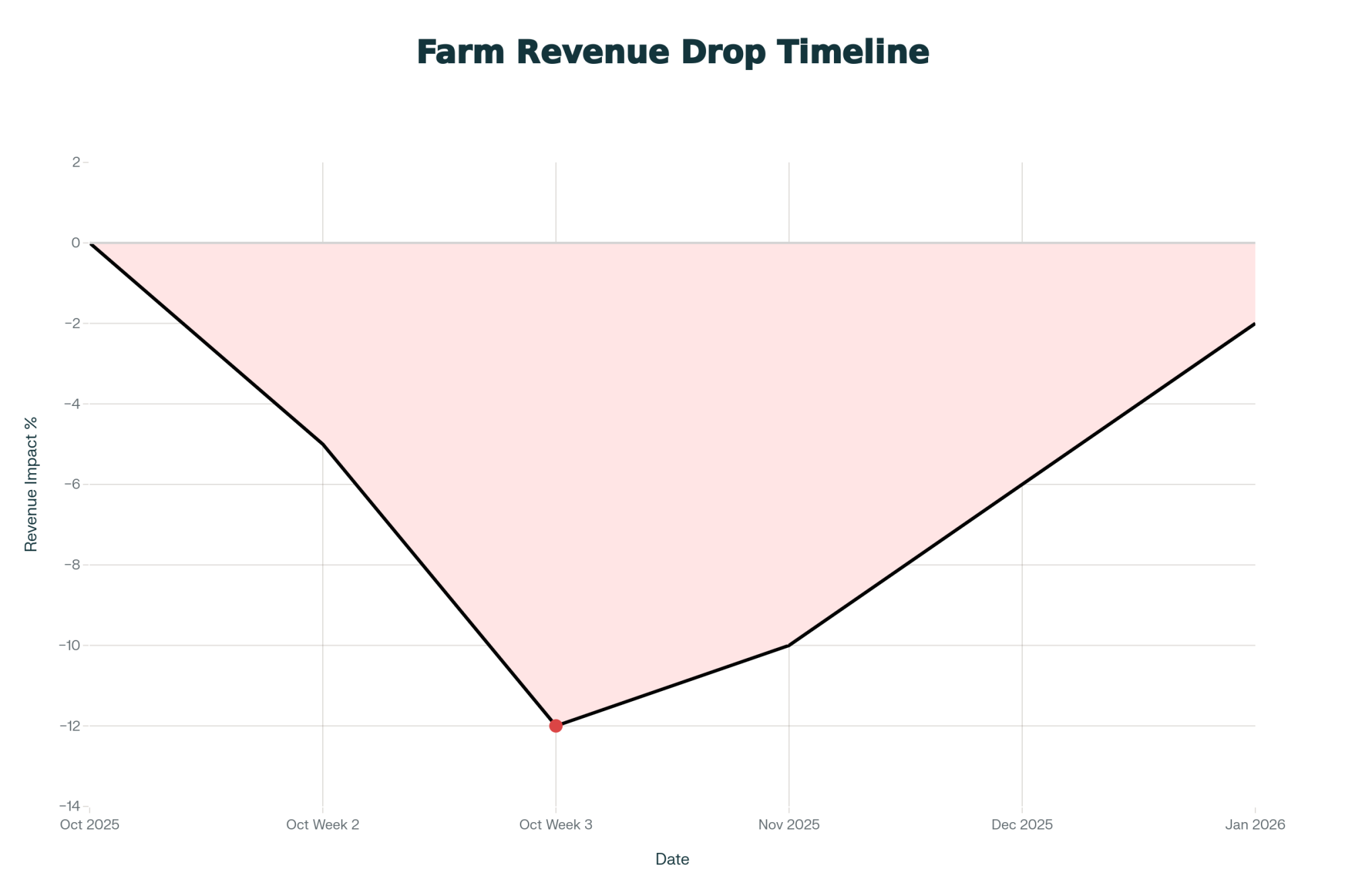
NewsSubscribe
First
Last
Consent
Send this to a friend