Archive for activity monitors

$19.14 Costs vs. $18.95 Milk: Is Your Barn Tech Paying the Difference?

You’re 19¢/cwt underwater on 2026 milk — and still leaving $20,000–$45,000 of dairy tech ROI sitting in the barn. The fix isn’t new gadgets. It’s how you use what you own.

Executive Summary: USDA’s 2026 numbers say it all: $18.95/cwt milk against $19.14/cwt costs leaves most U.S. dairies roughly 19¢/cwt underwater before they do anything about technology. At the same time, The Cow Tech Report shows that foundational tools like electronic ID, ration software, cloud herd management, collars, and sort gates are now in majority adoption in progressive herds, yet vets and consultants estimate that most farms use only 10–50% of those systems’ capabilities. That underutilization shows up in three quiet leaks — collars stuck on heat detection instead of health, herd software as a filing cabinet instead of a task engine, and sort gates that still run on sticky notes. Pulling more value out of existing systems through better alerts, automation, and repro protocols can realistically add about $20,000–$45,000 a year on a 400‑cow herd, especially where fresh‑cow disease and manual sorting are still common. This feature lays out a 30‑day “tech tune‑up” — audit what you own, integrate the systems that should talk, then train people in the language they work in — so those majority‑adoption tools finally show up in your cash flow instead of just your asset list. In a year when Rabobank still expects roughly 2,800 U.S. dairies to close, the real competitive edge may not be new gadgets at all, but how relentlessly you manage the people and processes behind the tech you already own.
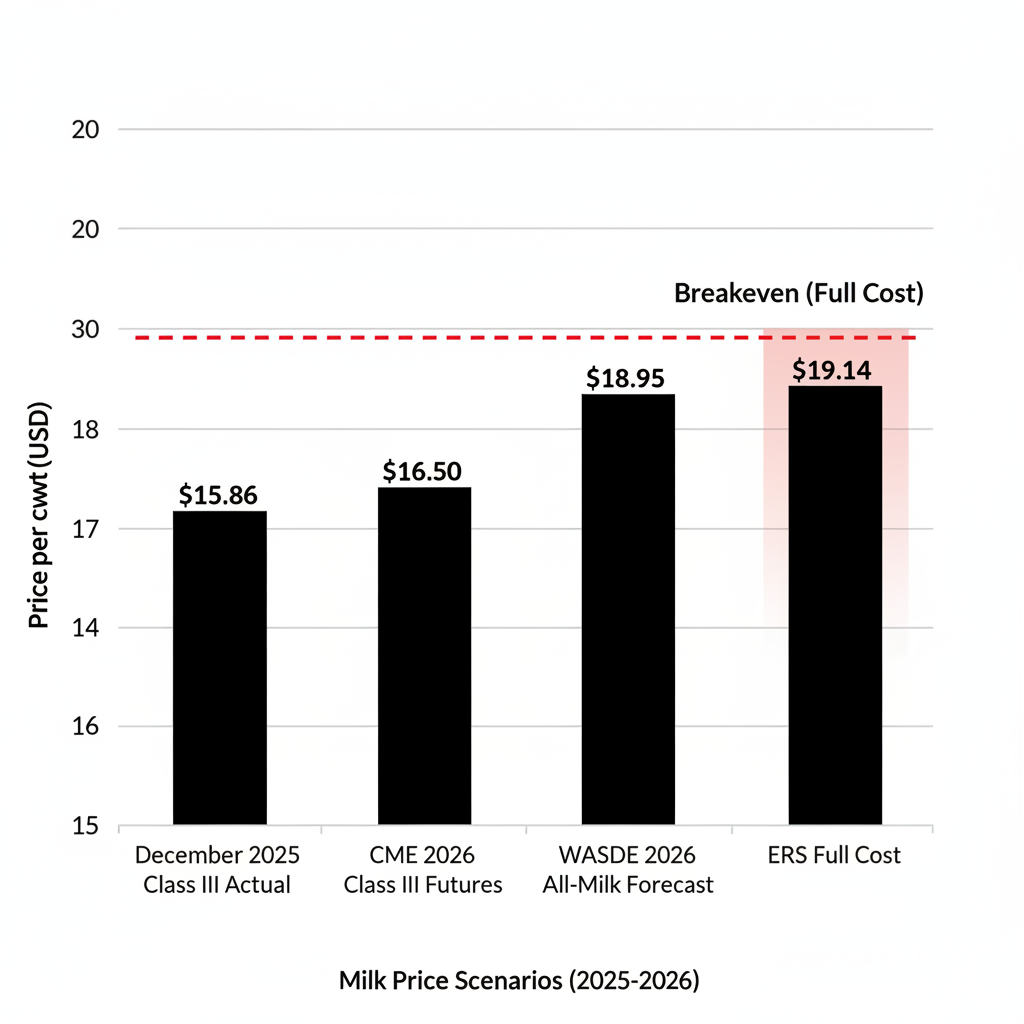
USDA’s February 10 WASDE projects 2026 all-milk at $18.95/cwt. ERS pegs average costs for 2,000-plus cow herds at $19.14/cwt. That’s 19 cents underwater on a full-cost basis before you factor in that December 2025 Class III finished at $15.86/cwt — the lowest since April 2024’s $15.50  — and CME Class III futures for 2026 are stuck in the mid-$16s, with the February WASDE raising the full-year forecast to just $16.65. For a 300-cow herd shipping about 75,000 cwt, the gap between USDA’s all-milk forecast and what Class III futures actually pay represents a $150,000 to $225,000 swing in annual revenue

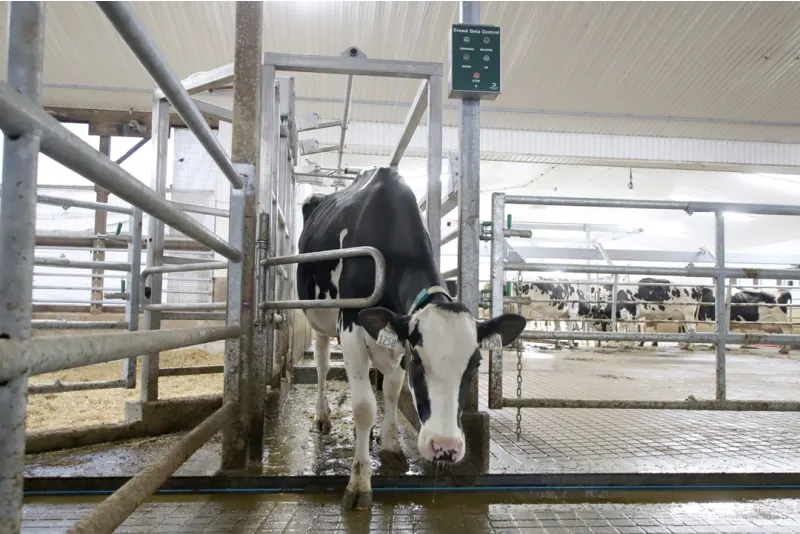
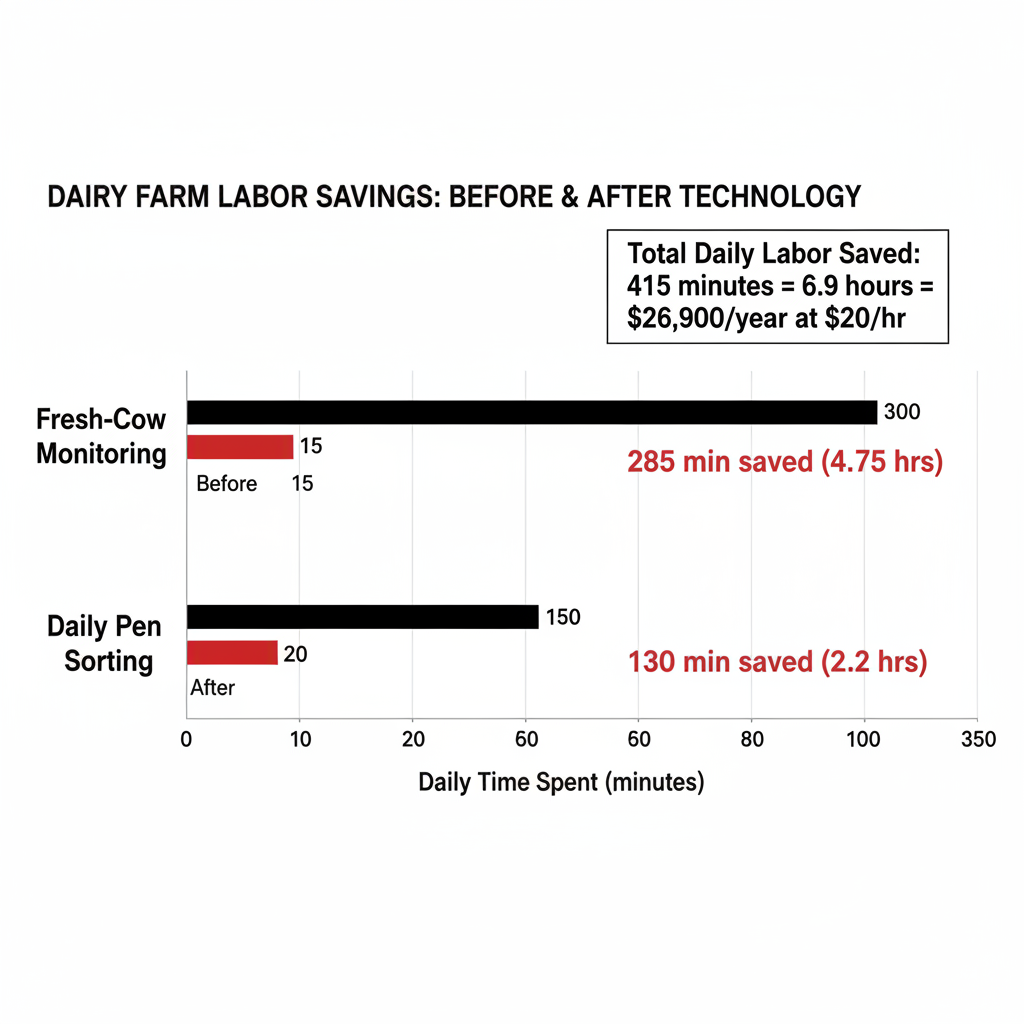
So, where do you find $20,000 to $45,000 you’re not currently capturing? Not from buying new equipment. From actually using what’s already in the barn. Dan Reuter used to spend up to five hours a day locked up with fresh cows at his 850-cow operation in Peosta, Iowa. He had activity collars on every animal — but they were basically expensive heat-detection tags. When he finally turned on the rumination-based fresh-cow reports, his morning check dropped to five or ten minutes, twice a day, at the computer. “I can check fresh cows in the morning in five or 10 minutes and then go work on only the ones that need help versus being in the barns for five hours,” Reuter told a Progressive Dairy roundtable in 2019. That’s seven-year-old data — the technology has only gotten more capable since, which makes his results a conservative baseline, not a ceiling. 
The Adoption Numbers Look Great. The ROI of Dairy Technology Doesn’t Add Up.

USDA’s Economic Research Service published ERR-356 on January 22, 2026, covering five waves of ARMS data from 2000 through 2021 (McFadden and Raff). The adoption picture is strong: 

  • 90%+ of U.S. milk production now comes from farms using individual cow records, nutritionist-designed feed, or reproduction-related technologies 
  • Roughly half of all U.S. milk is produced on farms using computerized feed delivery 
  • Precision dairy technology adoption overall jumped from 24% in 2000 to 46% by 2021
  • Operations using two or more classes of precision technologies show 13% higher dairy net returns than non-adopters, on average — an adjusted treatment effect controlling for selection 

But ERR-356 doesn’t measure depth of use. Two academic studies fill that gap:

  • 2024 Colorado State University study of 266 dairy farm employees found 93.7% said technology made them more efficient — but 31% cited not knowing the language of the technology as their primary barrier to full use (Erickson et al., Translational Animal Science
  • University of Wisconsin–Madison study (Fadul-Pacheco et al., Animals, 2022) found that 14% of temperature and activity sensors and 13% of sort gates are abandoned—not due to hardware failure, but to integration failure.

And The Bullvine’s own April 2025 analysis of dairy tech failures told the same story from the dollar side: 47% of failed implementations were linked to inadequate training (averaging $18,200 in losses per failure) and 39% to poor system integration (averaging $23,500). Over 40% of farmers avoided cloud-based solutions entirely because of compatibility issues. One northern Minnesota producer learned the hard way when air-powered sort gate components failed during a cold snap because they hadn’t been properly winterized — shutting down his entire sorting operation for three days during breeding season. A small detail, but the kind that makes or breaks a six-figure investment. 
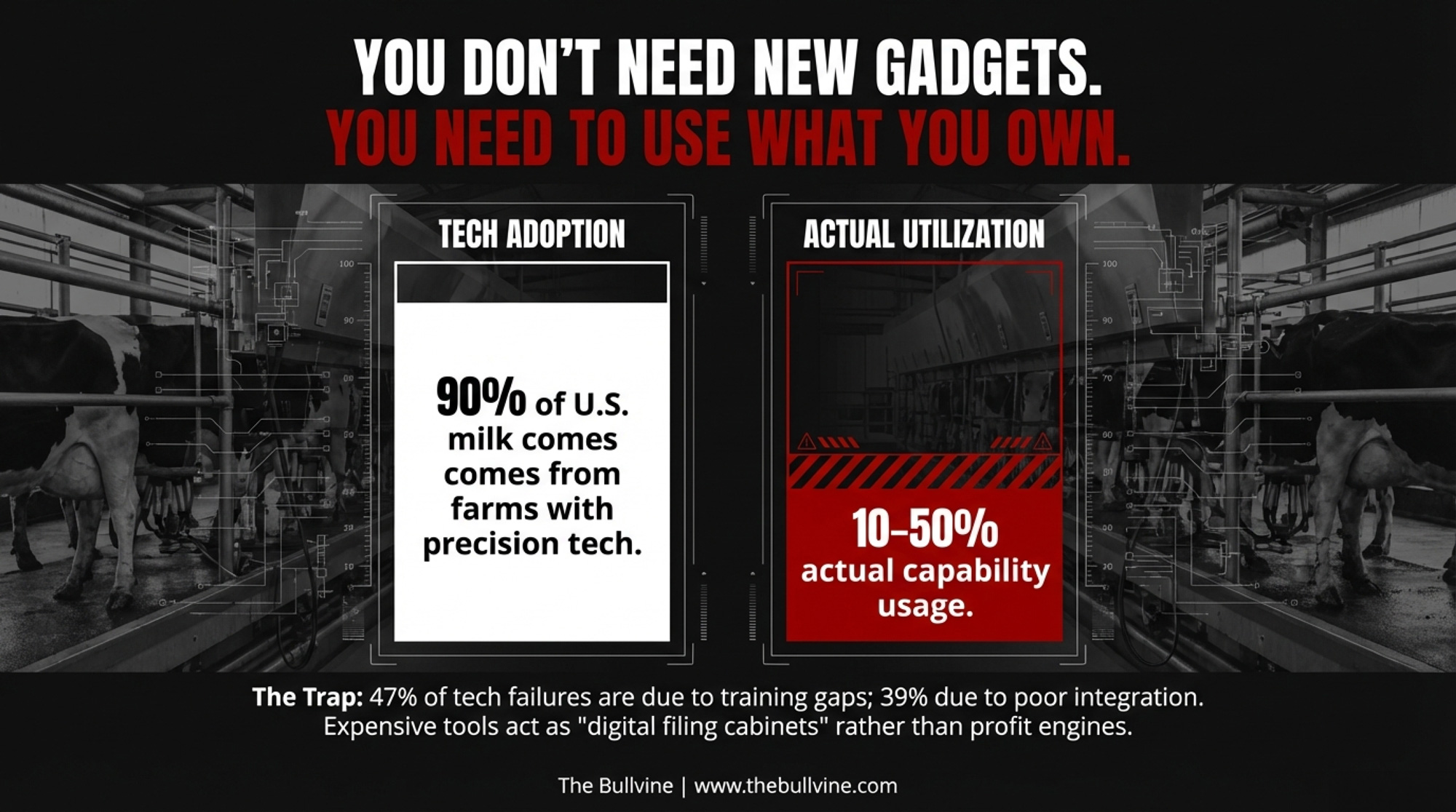
The operations most exposed? Mid-size progressive dairies in the 200- to 2,000-cow range. Large enough to have invested in collars, software, and automation. Rarely staffed with a dedicated integration person. And with Rabobank projecting roughly 2,800 U.S. dairy closures per year through 2027, the margin for wasted capacity no longer exists. 

Technology TypeAdoption RateUnderutilization RatePrimary BarrierAvg. Loss per Failure
Activity/Rumination Collars90%+ of U.S. milk14% abandonedLanguage barrier (31% cite)$18,200
Herd Management Software94% (large ops)Used as “filing cabinet”Poor system integration (39%)$23,500
Automated Sort Gates~50% (progressive herds)13% abandoned“Sticky-note override” common$18,200
Precision Feeding Systems50% of U.S. milk10–50% capability useInadequate training$18,200hnology has only gotten more

Three Profit Leaks Hiding in Plain Sight
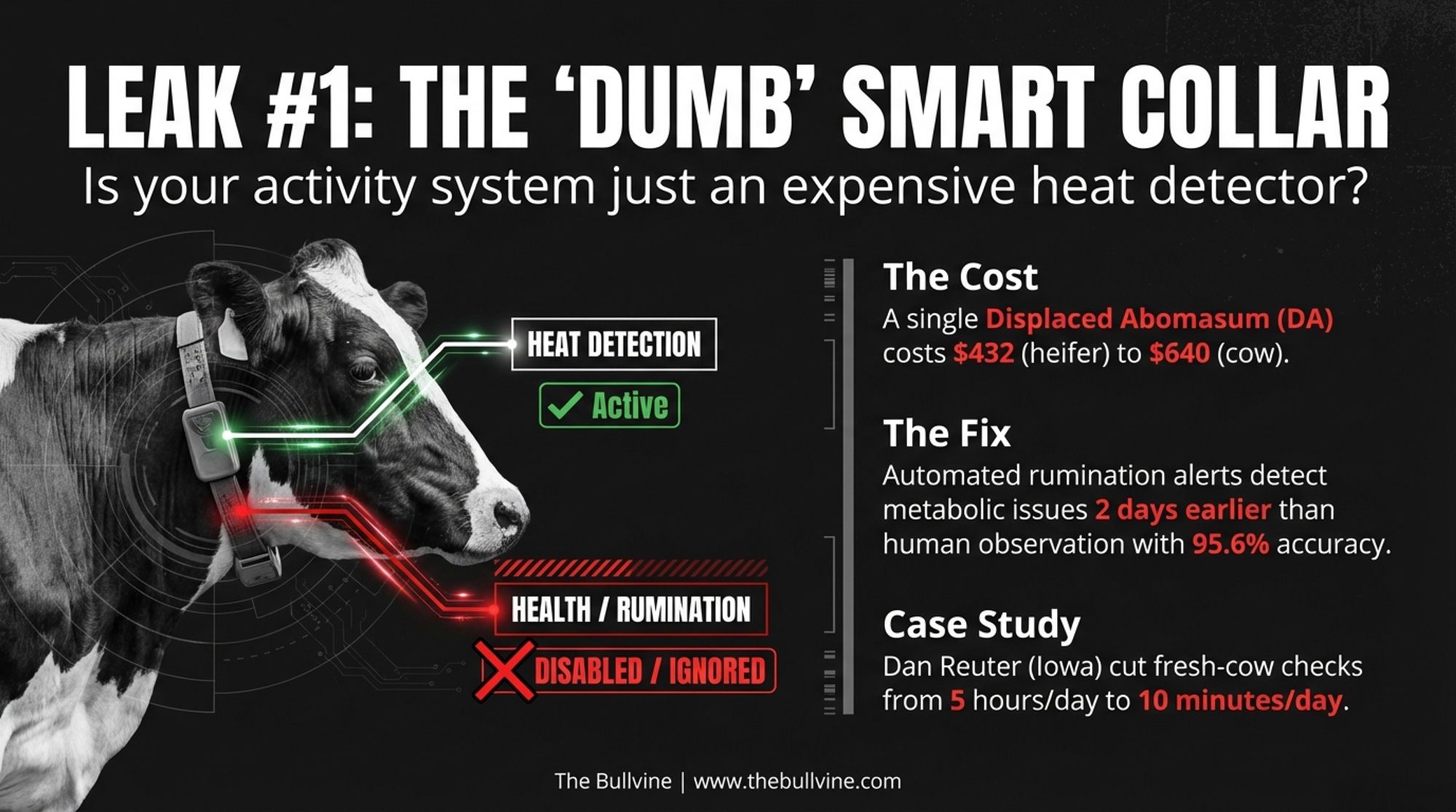
Leak #1: Collars that only detect heats. Modern activity collars track rumination, eating behaviour, and health indices around the clock. On most farms, they function as estrus-detection devices — one of a dozen capabilities. Brian Waymire, dairy manager at a roughly 4,500-cow operation across two dairies in Hanford, California, built daily rumination threshold reports into his fresh-cow protocol. In a 2019 industry roundtable, he reported that fresh-cow treatments dropped by two-thirds. His team eliminated routine temperature-taking entirely in the early post-partum period. Like Reuter’s numbers, that’s 2019 data — treat it as a floor for what’s possible today. 

Cornell University work led by Julio Giordano (published 2022; data from 2013–2014) showed collar-based rumination and activity monitoring detected metabolic and digestive disorders with 95.6% accuracy in the first 80 days in milk, catching problems an average of 2.1 days earlier than skilled farm personnel, with just a 2.4% false-positive rate

The Cost of a Single DA: $432 per heifer, $640 per cow — including treatment, milk loss, reproductive impact, and culling risk (Liang et al., Journal of Dairy Science, 2017). Catching five to ten cases early on a 400-cow herd saves $2,000–$6,000 in direct DA costs alone — and the early-detection benefit extends to ketosis, metritis, and other fresh-cow conditions where intervention costs compound fast. 
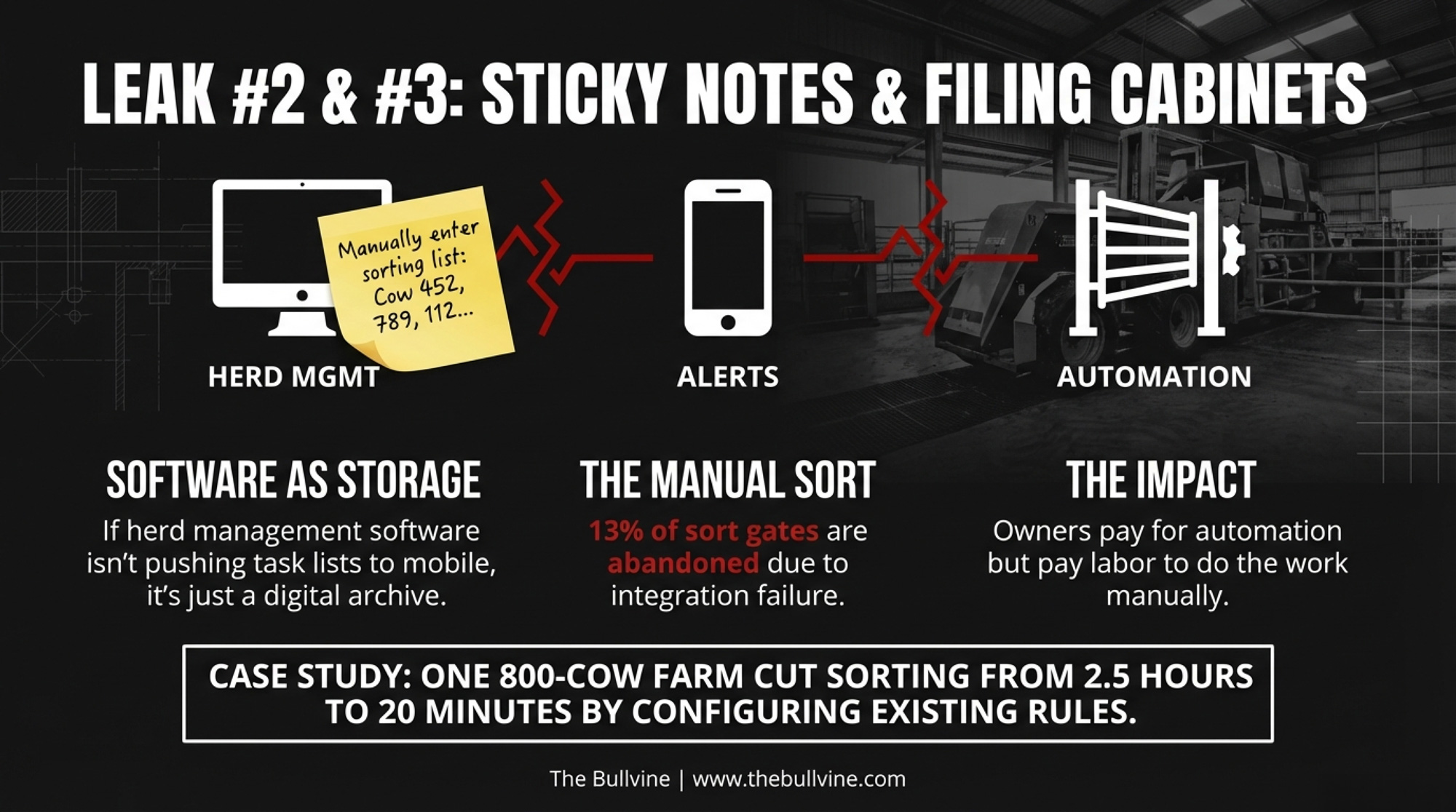
Leak #2: Herd software used as a filing cabinet. USDA’s NAHMS Dairy 2014 study found 94% of large operations(500+ cows) used an on-farm computer record-keeping system. But too many farms treat their software as a digital record book — entering freshenings, breedings, and treatments, then printing an occasional repro summary. Modern platforms generate protocol-based daily task lists, push them to mobile devices, and set threshold alerts for milk drops or SCC spikes. When those features sit dormant, someone’s handwriting reproduces lists on a whiteboard — and cows with early metabolic signals slip through until they’re clinically obvious. 

Leak #3: Sort gates running on sticky notes. An 800-cow operation profiled in The Bullvine’s July 2025 sort gate analysis cut daily sorting from 2.5 hours to roughly 20 minutes by configuring and trusting the automated rules. At a 1,100-cow all-Jersey operation in Melba, Idaho — running automated meters, sort gates, and leg tags since 1999  — the owner described the shift: the gates “freed up time for that employee that was normally in the back of the barn, watching cows and catching cows”. Sort accuracy: 99%. The hardware was already there. The missing piece was integration and confidence. 

📌 The Language Barrier: The Utilization Problem Nobody Talks About

31% of dairy farm employees say not knowing the language of the technology is their biggest barrier. Not the tech itself—the language.

When dashboards and manuals are English-only and your frontline crew speaks Spanish, the system defaults to whichever employee happens to read the interface. If they’re off that day, nobody checks the alerts. And yet 95.6% of those same employees said they felt comfortable using technology. They want to use it. 

Your move: Ask whether your current system’s alerts, task lists, and dashboards exist in your crew’s primary language. Not all vendors offer Spanish-language interfaces yet — so that call may reveal a gap rather than a quick fix. But knowing the gap exists is the first step. A set of laminated bilingual visual checklists for the barn office costs almost nothing.

The Wiring Problem

Vendor ecosystems still don’t talk to each other. That Wisconsin data — 14% abandonment on activity sensors, 13% on sort gates — is largely an integration failure. The Bullvine’s own tech failure analysis found 39% of failed implementations traced back to poor system integration, costing an average of $23,500 per failure. The human becomes the integration layer. Printing lists, matching tag numbers, and standing at the sort lane with a stick. Which is exactly the job the technology was purchased to eliminate. 

Profit LeakCurrent StateActivated StateOpportunity Cost/CowAnnual Cost (400-cow herd)Fix Timeline
Leak #1: CollarsHeat detection onlyRumination alerts, early DA/ketosis detection$5–$15$2,000–$6,000Days 1–10
Leak #2: Herd SoftwareFiling cabinetAutomated task lists, threshold alerts, mobile push$25–$60$10,000–$24,000Days 11–21
Leak #3: Sort GatesSticky-note overrideIntegrated sort rules, sync-drug savings via heat detection$6$2,400Days 22–30
TOTAL$36–$81/cow$14,400–$32,40030 days

ERR-356 found that adopters of precision tech spend less on paid labour, unpaid labour, and veterinary care than non-adopters. But that’s the adopter average. For the farms that installed the tech and then stopped learning it, those savings stay theoretical. 

The 30-Day Tech Tune-Up

You don’t need new capital. You need 30 days and some honesty.
PhaseGoalKey ActionTrade-Off
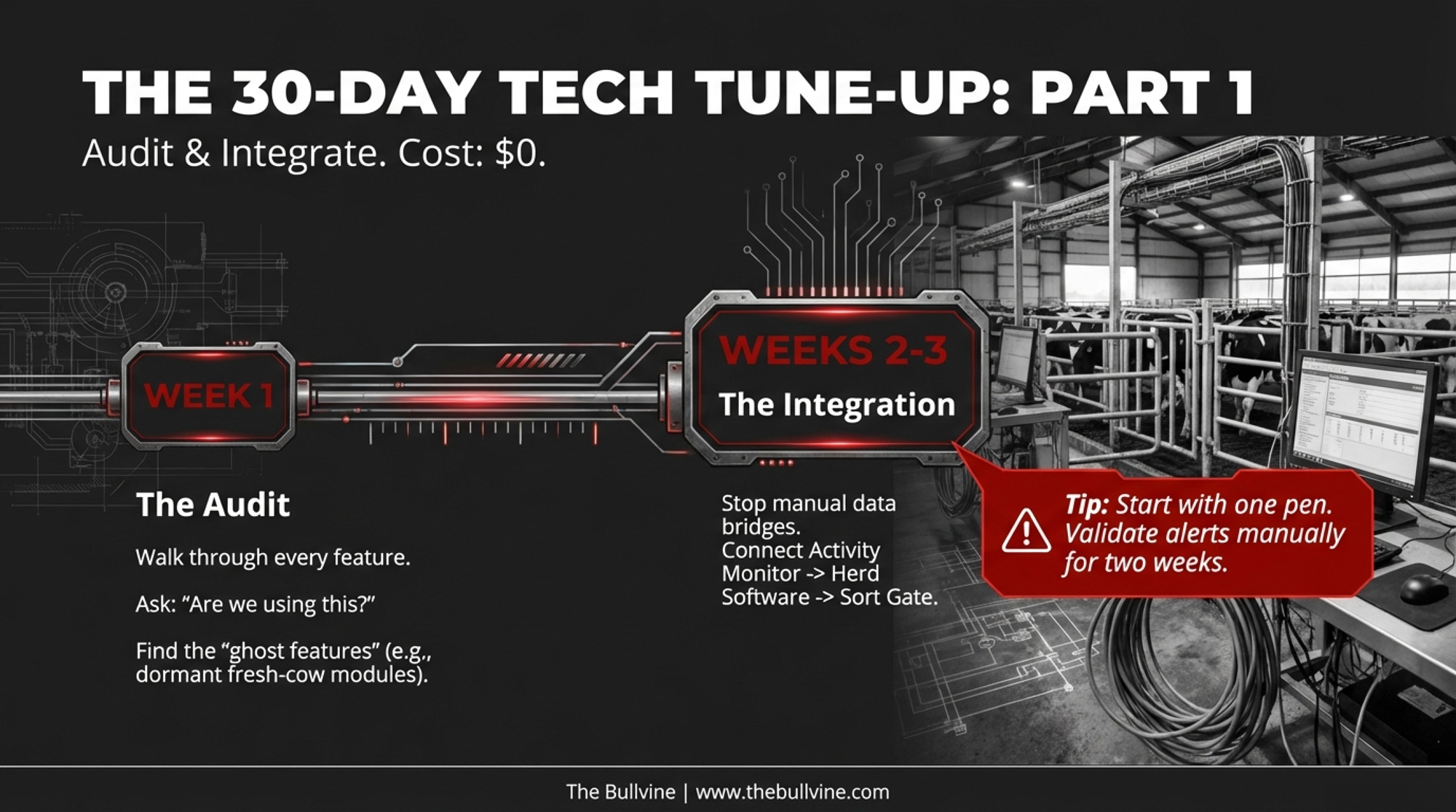
Week 1: AuditFind the “ghost” featuresWalk each system through the daily user and vendor feature lists. For every feature: are we using this? If not, why? Reuter’s dairy discovered its entire fresh-cow health module was dormant.Costs nothing but time and candour.
Weeks 2–3: IntegrateStop the manual data bridgesPick the highest-value link first (e.g., activity monitoring → herd software → sort-gate rules). Get both vendors on the same call. Test with one pen and one sort rule before going farm-wide.If sensor connectivity is spotty, keep a pen-walk backup for two weeks while you validate alert accuracy on your own cows.
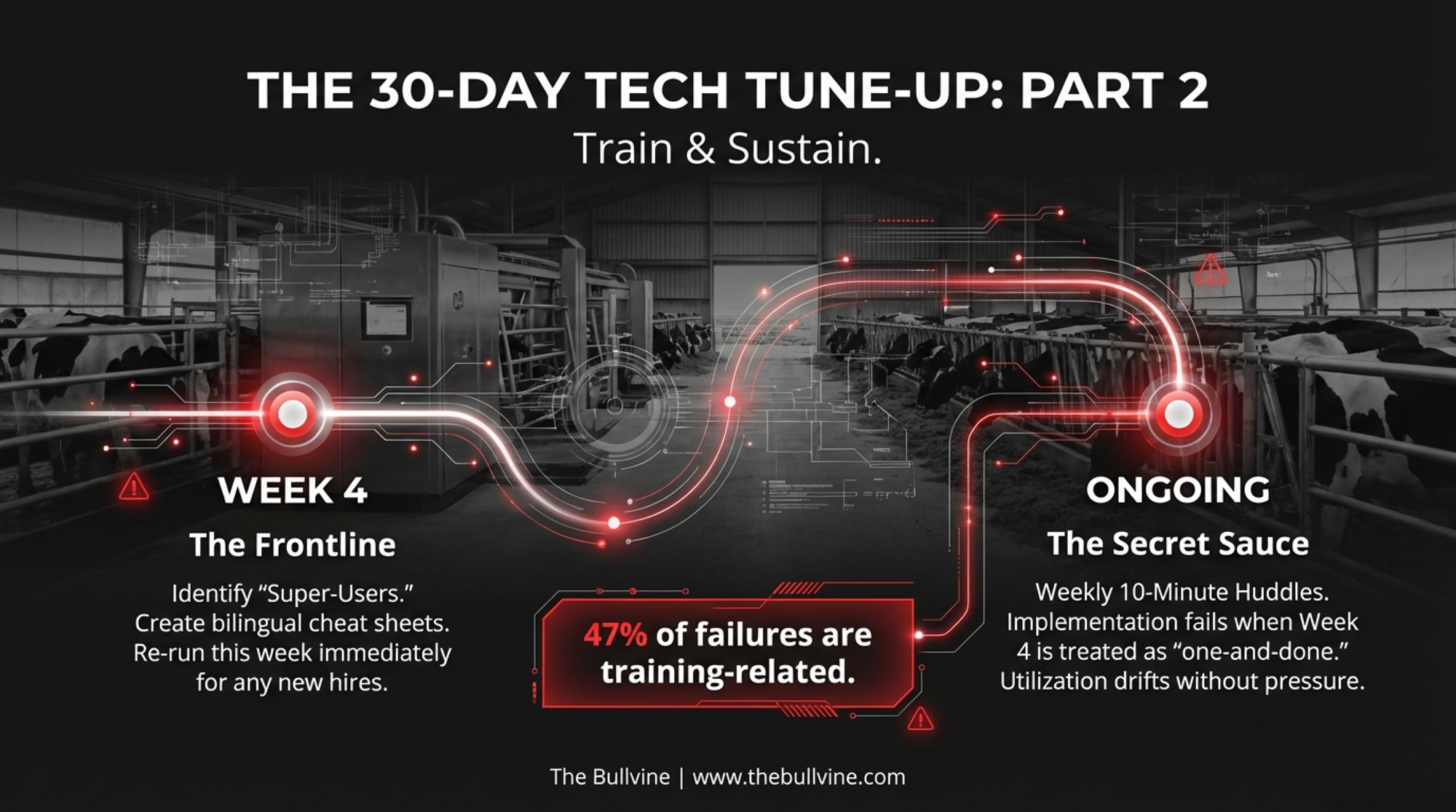
Week 4: TrainEmpower the frontlineCreate bilingual visual “Quick-Start” laminates. Identify 2–3 super-users, train them to proficiency, then have them train peers. Run 10-minute weekly feedback huddles.Demands sustained management attention. If you can’t commit to weekly check-ins for at least eight weeks, utilization drifts right back.

Already tried this and stalled? You’re not alone. That 47% training-failure rate — averaging $18,200 in losses per failed implementation  — suggests the most common breakdown isn’t the technology. It’s attempting integration without sustained weekly follow-up. The tune-up fails when Week 4 gets treated as a one-and-done rather than an ongoing management commitment. If your first attempt died after two weeks, the fix is simpler than you think: restart at Week 4 with the huddle model. Ten minutes a week. That’s what separates the farms that make it stick from the ones that quietly go back to sticky notes. 

The other objection we’ll hear: “I don’t have time to sit on the phone with vendors.” Fair. But if you’re spending 2.5 hours a day on manual sorting that a configured gate could handle in 20 minutes, you’re already spending the time — just on the wrong task.

Where the $20,000–$45,000 Comes From
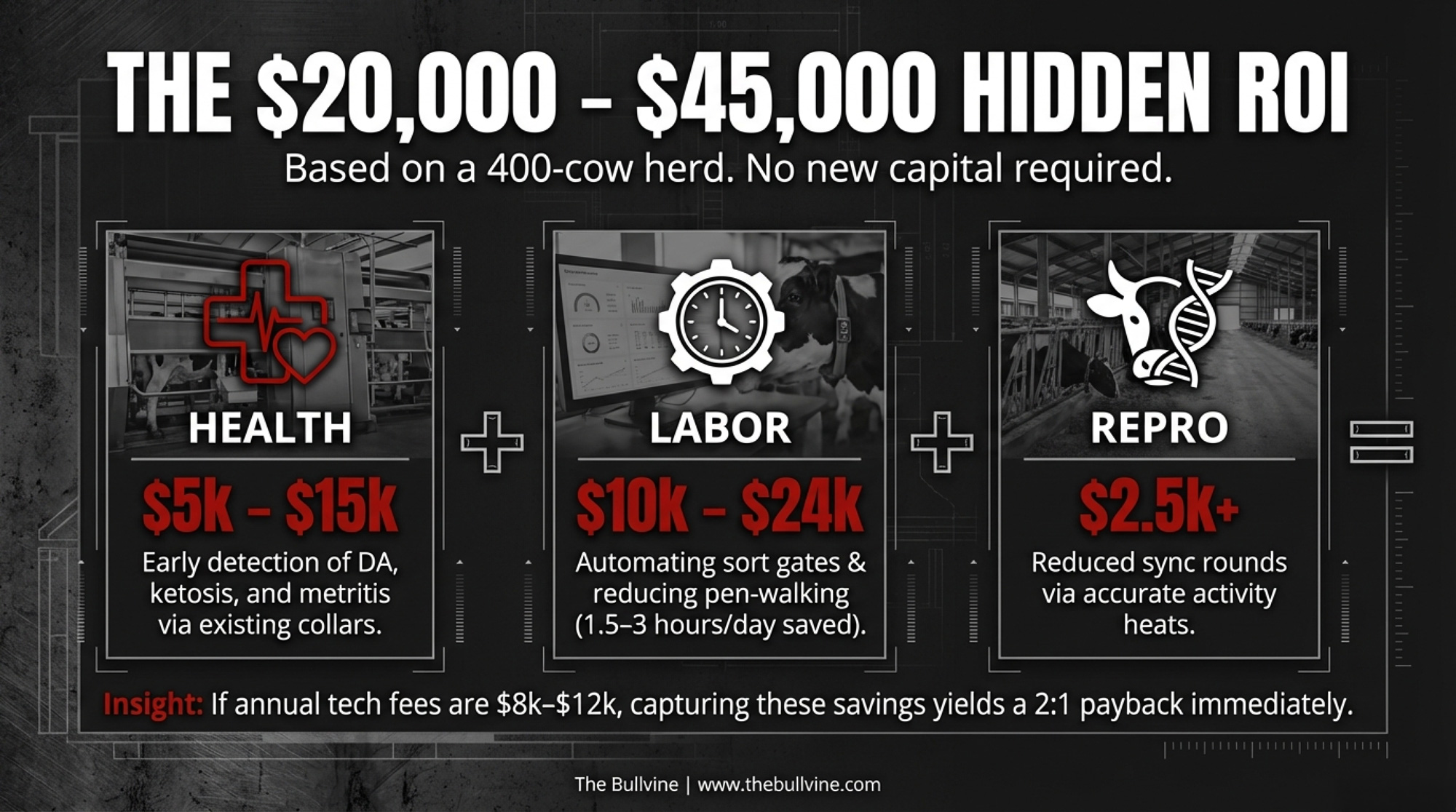
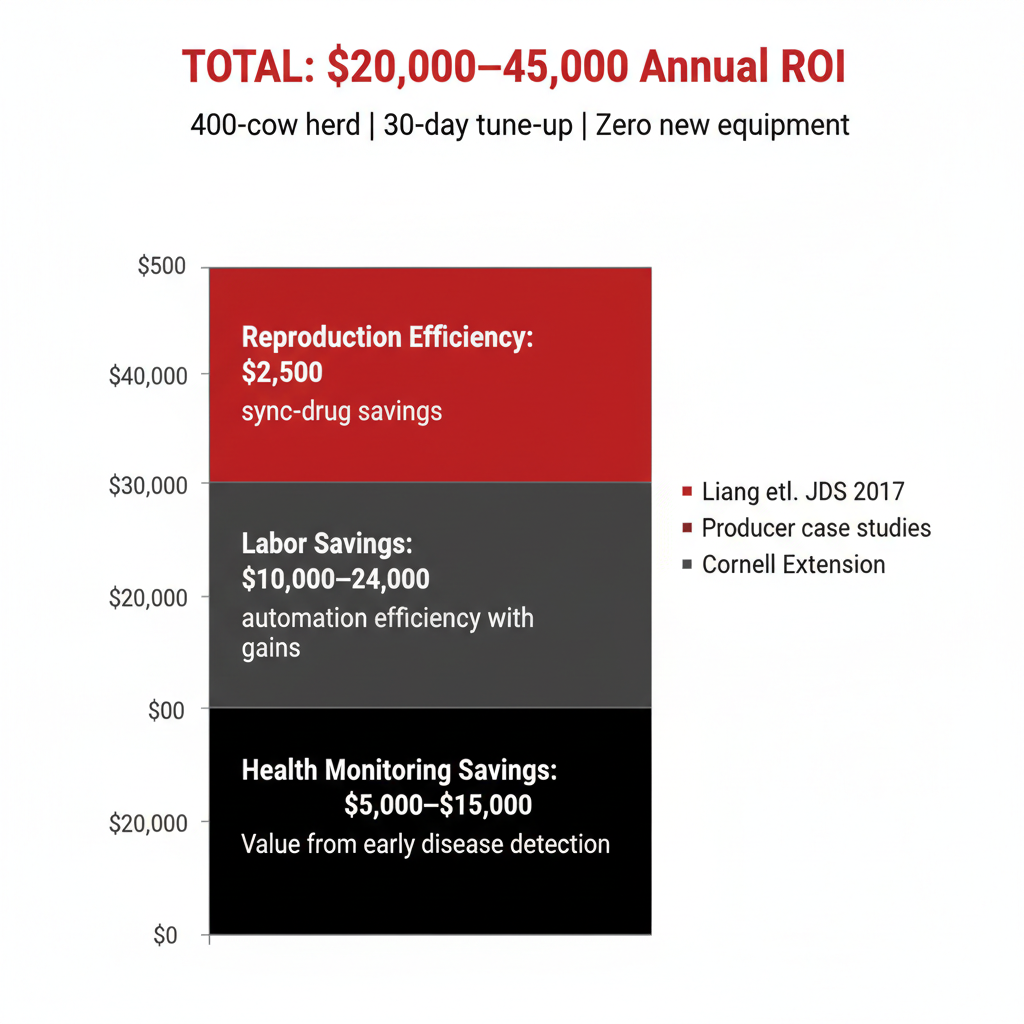
That composite ROI for a 400-cow herd stacks three separately documented levers. These come from different studies on different operations — your herd won’t necessarily realize all three simultaneously. But here’s the math:

  • Health monitoring (early detection of DA, ketosis, metritis): Preventing 5–10 DA cases at $432–$640 each (Liang et al., JDS, 2017) saves $2,000–$6,000 in direct DA costs. Add earlier ketosis and metritis intervention — where Pfrombeck et al. (JDS, 2025) found sensor-assisted monitoring returned €23–€119/cow/year in high-incidence herds (a European research-herd study using a different sensor type — directionally relevant, not a direct comparison)  — and the health component reaches an estimated $5,000–$15,000 on a 400-cow herd with above-average disease incidence. Caveat: Pfrombeck showed returns as low as -€33/cow/year in already-healthy herds. 
  • Labour savings (sort-gate automation + fresh-cow monitoring efficiency): Cutting 1.5–3 hours of daily sorting and pen-walking. At $18–$22/hour, 365 days a year, that’s $10,000–$24,000
  • Reproduction (fewer sync rounds via better heat detection): Cornell Extension estimates a single Ovsynch round at $12.90 per cow. The Bullvine’s own July 2025 sort gate analysis confirmed $12 per head in sync-drug savings when pairing automated sorting with activity monitors to breed 85% of cows off natural heat. On a 400-cow herd where activity-detected heats divert half the herd from one sync round, that’s roughly $2,500

Total range: roughly $20,000–$45,000/year. If your total annual tech subscription and service costs run $8,000–$12,000 across all three systems, even hitting the low end of this range puts you at roughly 2:1 payback or better. Run your own numbers against these three levers.
What This Means for Your Operation

  • 200–500 cows, collars and herd software, no sort gate: Your biggest lever is the collar health-alert module. Turn on rumination-based fresh-cow reports and act on them daily. Impact is largest if your fresh-cow disease rate runs above breed average.
  • 500–1,500 cows, all three systems installed: Integration is your multiplier. Alerts become tasks, tasks become sort commands, and sorted cows are waiting when the vet arrives. The labour savings at this scale are where the top end of the $20K–$45K range lives.
  • Already at 80%+ utilization with a clear bottleneck: That’s when buying new technology makes sense. Run the audit first. If the honest answer is “we’ve activated everything, and we’re still stuck,” a new tool is justified.
  • Labour and language are your primary constraints: Start with the bilingual checklist approach and the super-user training model before touching integration settings.
  • Baseline health is already strong: Be realistic about the ceiling. Pfrombeck’s data showed negative returns in some good-health scenarios. Focus on labour and repro savings instead. 

Key Takeaways

  • Adoption isn’t the bottleneck anymore. Utilization is. USDA shows 46% precision dairy adoption by 2021, with 90%+ of U.S. milk from farms using cow-level production technology. The equipment is in the barn. 
  • The combined ROI of closing the utilization gap could reach $20,000 to $45,000 per year for a 400-cow herd — a composite of three documented levers, not a single study on a single farm.
  • The 30-day tune-up requires no capital. It requires management time, vendor coordination, and — critically — sustained weekly follow-up. Skipping that last part is how 47% of implementations fail. 
  • Before you sign your next technology purchase order, ask your team one question: what features are we not using on the systems we already own?

Signals to Watch

  • Your vendor releases a major software update. New features mean new dormant capabilities. Re-run Week 1 within 30 days.
  • You hire or turn over herd staff. New employees inherit old habits, not full capability. Re-run Week 4 training with every staffing change.
  • Your fresh-cow metrics shift. If DA, metritis, or ketosis rates climb — or pregnancy rate slides — your first question shouldn’t be “what do we buy?” It should be “what stopped getting used?”

The Bottom Line

With Class III closing 2025 at $15.86, all-milk forecast at $18.95, and full costs at $19.14 for the average large herd, there’s no room to leave $20,000 sitting inside systems you’ve already paid for. Rabobank estimates 2,800 farms will close annually through 2027. The ones that make it won’t be the ones with the most gadgets. They’ll be the ones that manage people and processes well enough to squeeze full value from what’s already in the barn. Run your own Week 1 audit this month. What’s the one feature you’re paying for but not using? 

Complete references and supporting documentation are available upon request by contacting the editorial team at editor@thebullvine.com.

Learn More

Join the Revolution!

Join over 30,000 successful dairy professionals who rely on Bullvine Weekly for their competitive edge. Delivered directly to your inbox each week, our exclusive industry insights help you make smarter decisions while saving precious hours every week. Never miss critical updates on milk production trends, breakthrough technologies, and profit-boosting strategies that top producers are already implementing. Subscribe now to transform your dairy operation’s efficiency and profitability—your future success is just one click away.

NewsSubscribe
First
Last
Consent

Dairy Tech ROI: The Questions That Separate $50K Wins from $200K Mistakes

180 cows. The threshold that separates dairy tech wins from expensive regrets. Here’s what actually works on each side—and why infrastructure matters more than equipment.

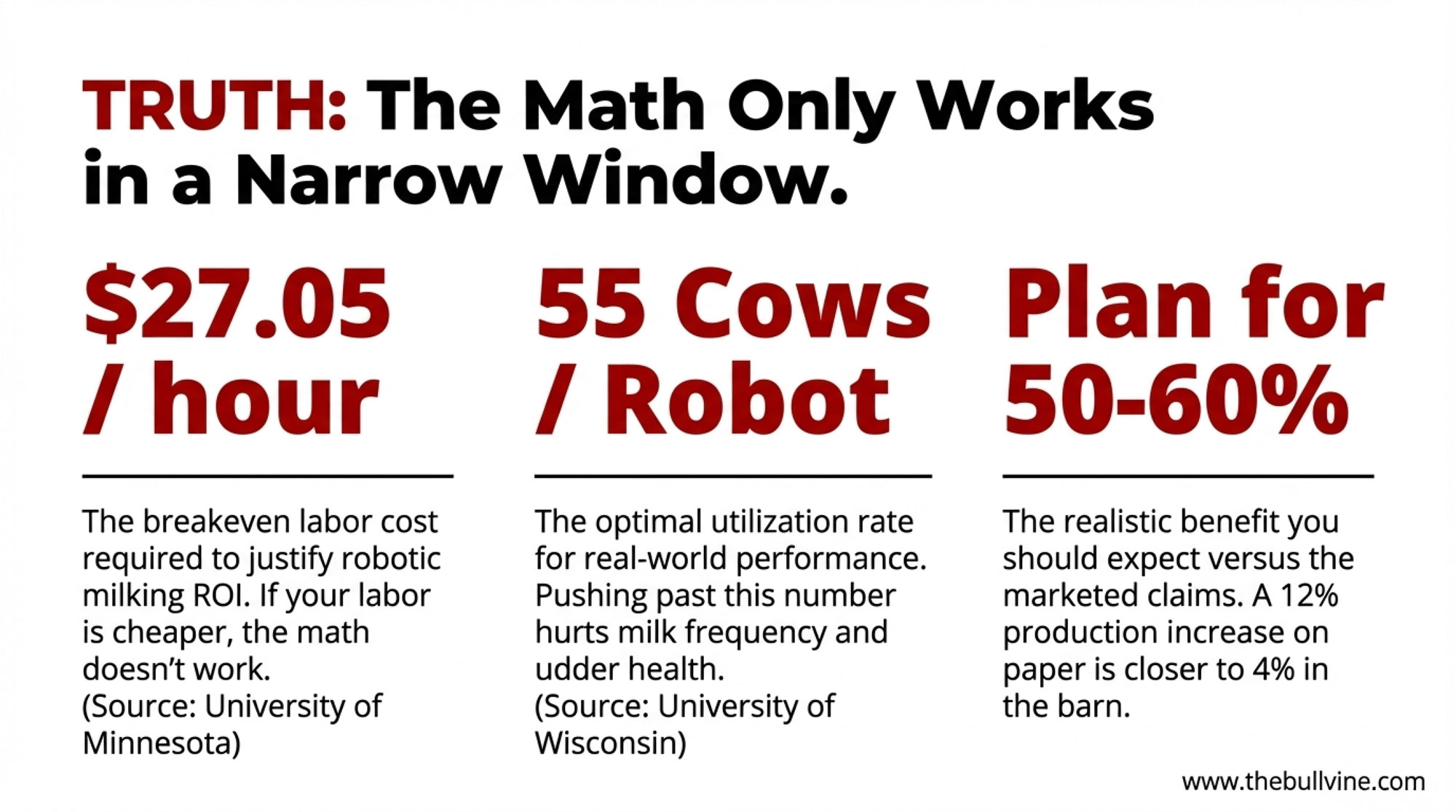
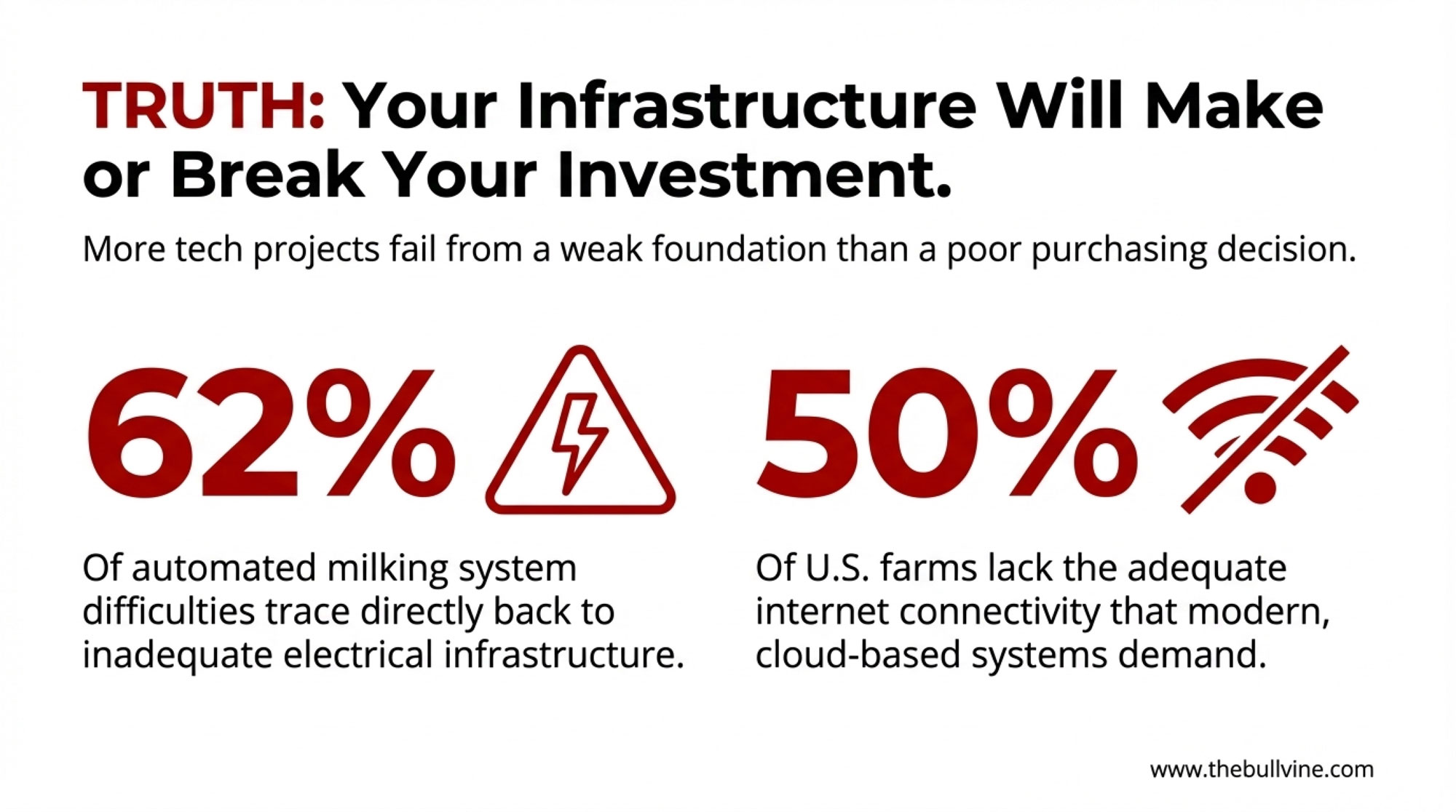
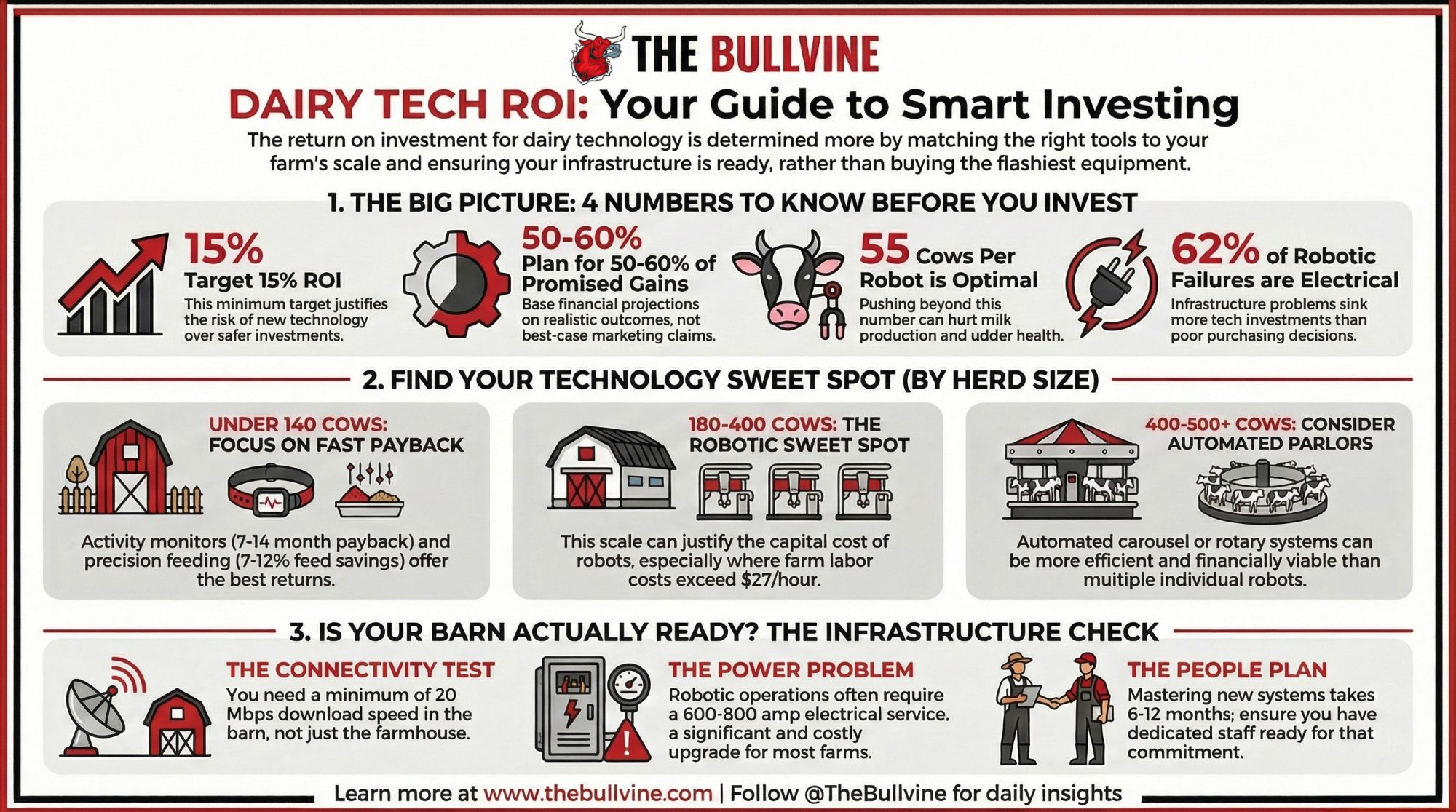
EXECUTIVE SUMMARY: The math on dairy technology is simpler than vendors suggest—and more unforgiving than most producers expect. University of Minnesota research shows robotic milking breaks even only when labor costs reach $27.05 per hour, with optimal utilization at 55 cows per robot, according to the University of Wisconsin’s Dairyland Initiative. That reality puts the automation sweet spot squarely between 180 and 400 cows. Below that threshold, activity monitors (7-14 month payback) and precision feeding (7-12% feed savings) consistently deliver stronger returns than robots that can’t justify their capital cost at smaller scales. But infrastructure failures sink more technology investments than poor purchasing decisions ever will—62% of automated milking difficulties trace to electrical inadequacy, and half of US farms lack the connectivity modern systems demand. The producers winning with technology aren’t buying the flashiest equipment; they’re matching capability to scale, fixing infrastructure first, and planning for 50-60% of marketed benefits rather than trade-show promises.

When Mike Vanbeek installed activity monitors on his Wisconsin dairy, he wasn’t chasing the latest trend. He was solving a specific problem – missed heats were eating into his bottom line, and he knew it. Within months, his 21-day pregnancy rate climbed from 25% to 35%, and he’d cut his synchronization protocol costs by more than half.

That’s a technology success story worth examining. But here’s what makes it interesting: Vanbeek didn’t buy robots. He didn’t automate his milking. He invested in collars and sensors—relatively modest technology that delivered returns he could actually measure against his milk check.

His experience reflects something dairy farmers across North America are discovering as they navigate the flood of precision agriculture tools now available. The question isn’t really “Should I adopt technology?” It’s more nuanced than that: “Which technology fits my operation, my scale, and my specific constraints?”

After Agritechnica 2025 showcased everything from AI-powered weed detection promising 90% herbicide savings to autonomous equipment that seemed lifted from science fiction, that question has become more urgent—and honestly, more complicated—than ever.

The ROI Benchmark That Changes Everything

Let’s start with something practical. Gary Sipiorski, a dairy financial consultant who works with producers across the Midwest, offers a useful framework: compare any technology investment to what you’d earn parking that money in a certificate of deposit. With current CD rates running in the 4-5% range, technology investments should target at least 15% ROI to justify the additional risk and management complexity.

That’s a cold shower for anyone standing in a flashy trade show booth. And it’s where the conversation gets interesting.

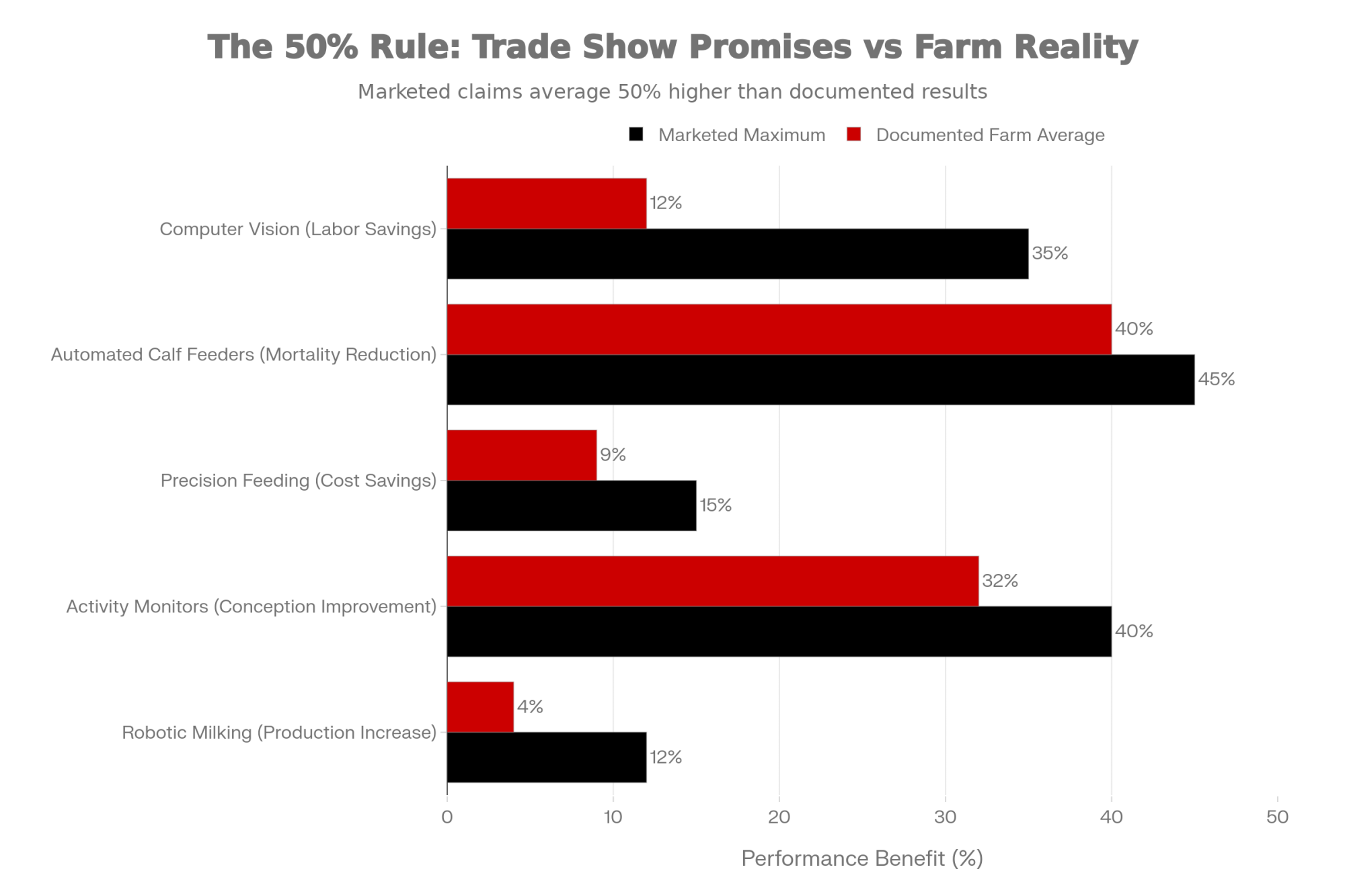
Research on automated milking systems illustrates the challenge nicely. A peer-reviewed study reports that robotic milking has “potential to increase milk production by up to 12%.” By the time that finding works its way through marketing materials, it often becomes “robots increase milk 10-12%.” But the documented average on working farms? Closer to 4%.

This isn’t vendor deception. It reflects how many variables influence outcomes—management practices, facility design, cow genetics, transition period protocols, and even how consistently someone responds to system alerts at 2 AM. The farms hitting those top-end numbers are doing a lot of things right simultaneously. They’ve got their fresh cow management dialed in, their nutritionist is optimizing rations for the system, and they’ve committed the time to really learn the technology.

The takeaway for anyone evaluating technology: trade show projections represent best-case scenarios achieved under optimal conditions. Planning around 50-60% of the marketed benefits yields more realistic financial projections. Not pessimistic—just grounded in what the data actually shows.

Comparison of marketed maximum benefits versus documented average farm performance across five major dairy technology categories, showing the consistent 40-60% reality gap

Where Scale Changes the Math

This is where the research gets genuinely useful for decision-making. University of Wisconsin’s Dairyland Initiative has established a practical guideline that’s reshaping how farmers think about robotic milking: plan for 55 cows per robot for optimal performance.

Vendors might suggest higher numbers—theoretical capacity calculations can make 70 or even 78 cows per robot sound feasible. But cows aren’t machines. They have circadian rhythms. They prefer milking at certain times. Peak voluntary attendance happens around dawn and dusk, with quieter periods in between. Push too many cows through a robot, and milking frequency drops, udder health issues start appearing, and those production gains you were counting on evaporate.

Some producers have learned this the hard way—pushing cow numbers beyond optimal levels, watching bulk tank SCC climb, then scaling back to more manageable ratios. The theoretical capacity on paper doesn’t account for real-world cow behavior.

Finding Your Technology Sweet Spot

Here’s how the scale economics break down based on current research:

Herd SizeOptimal Technology InvestmentTarget ROI TimelinePrimary BarrierCapital Investment Range
Under 140 cowsActivity monitors, precision feeding, automated calf feeders7-14 monthsHigh capital cost per cow; labor savings can’t offset robot investment$10,500 – $35,000
140-180 cowsActivity monitors, precision feeding, computer vision (emerging)12-24 monthsRobot ROI marginal; requires $27+ per hour labor costs to break even$35,000 – $75,000
180-400 cowsRobotic milking systems (3-4 units), activity monitors36-60 monthsElectrical capacity, internet latency, training commitment$600,000 – $1,200,000
400-500+ cowsAutomated parlors, rotary systems with robotic attachments48-72 monthsManagement complexity of multiple individual robot units$1,200,000 – $2,500,000

Under 140 cows: The economics of robotic milking get ugly fast. Fixed costs spread across fewer animals, and while labor savings matter, they can’t offset the capital investment. University of Minnesota research found that breaking even on robots requires paying milking labor around $27.05 per hour. If your labor costs are significantly below that, the math doesn’t work.

180-400 cows: This is the sweet spot. With 3-4 robots, farms can eliminate meaningful labor positions while maintaining efficient robot utilization. Research from Australian operations confirms it—farms that pushed their cow-to-robot ratio toward 70 cows (while still managing cow flow effectively) saw measurable profit improvements.

400-500+ cows: Here’s where it gets counterintuitive. Conventional parlor systems with robotic attachment technology may actually outperform multiple individual robot units. DeLaval’s solution managers acknowledge that automated carousel systems become “financially viable for farms with a minimum of 400-500 cows.”

These thresholds shift based on local labor markets and regional conditions. Operations in California’s Central Valley or across the Northeast, where agricultural wages run higher, and labor availability stays tight, may see robots pencil out at smaller scales. Vermont and New York dairies often face economic conditions different from those in the Upper Midwest. Pacific Northwest producers deal with their own labor dynamics, while Texas and Southwest operations factor heat-stress management differently into the equation.

For Canadian producers, the calculation carries an additional wrinkle. Quota value affects how you think about capital allocation—when quota represents a significant asset on your balance sheet, the decision to invest $600,000 in robots versus additional quota becomes a strategic choice about where your capital works hardest. The labor-savings argument still applies, but it competes with a different set of alternatives than US producers face.

Your specific labor market and regional context matter more than any trade show pitch.

What’s Actually Working for Smaller Herds

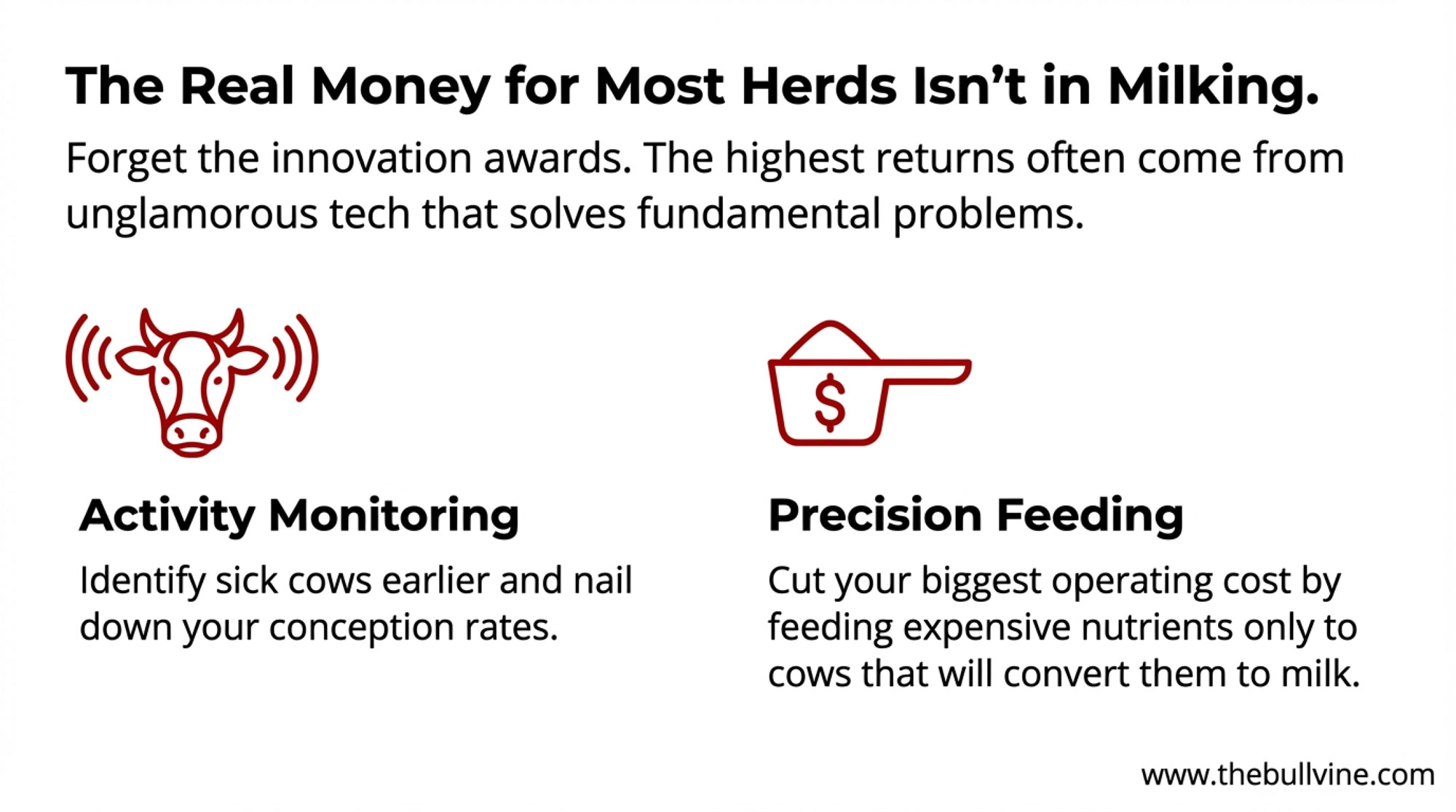
If robots don’t pencil out at your scale, what does? Turns out, quite a bit. And most of it won’t win any innovation awards—which is exactly why it works.

Activity Monitoring: The Quiet Winner

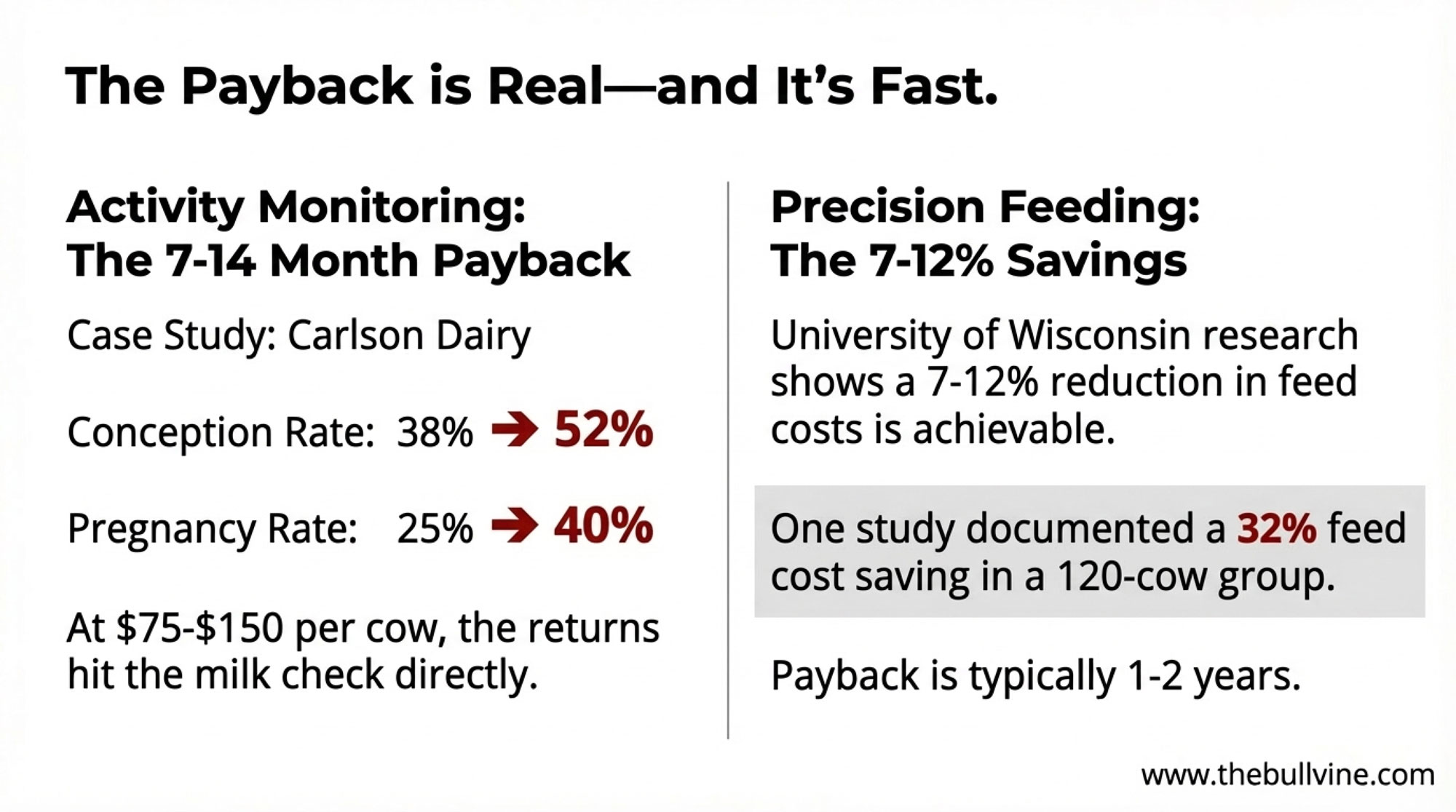
At $75-150 per cow, activity monitors deliver some of the highest returns available to smaller operations. The documented results are consistent: 30-34% improvement in first-service conception rates, meaningful reductions in days open, and earlier illness detection during that critical fresh cow period.

Carlson Dairy’s numbers tell the story. After implementing monitoring, their conception rates rose from 38% to 52%, and pregnancy rates jumped from 25% to 40%. When a single missed heat costs roughly $42 in extended days open—and that compounds across a breeding season—those improvements hit the milk check directly.

Typical payback: 7-14 months. That’s real money, real fast.

Precision Feeding: Where the Real Dollars Hide

Feed represents 50-60% of operating costs on most dairies. Even modest efficiency improvements translate directly to margin—often more directly than technologies that generate more excitement at industry events.

University of Wisconsin research demonstrates what’s possible. Through differentiated concentrate feeding during milking—supplementing high producers with additional concentrates while feeding a more moderate TMR to everyone—farms can achieve 7-12% reductions in feed costs without requiring separate mixer wagons or multiple cow groups.

One study documented a 120-cow group achieving 32% feed cost savings. The principle is simple: feed expensive nutrients to cows that can convert them to milk, not to animals that will deposit them as body condition. We’ve all seen those over-conditioned dry cows heading into calving. This approach prevents that while improving margins.

Payback typically runs one to two years, with returns that continue indefinitely.

Automated Calf Feeders: Investing in Your Future Herd

For operations raising replacement heifers, automated calf feeding offers compelling returns that get overlooked in conversations dominated by milking technology.

The headline number: 40% reduction in calf mortality. But there’s more. These systems detect illness 48 hours before you’d notice visible symptoms during morning chores. With young calves vulnerable to scours and respiratory challenges in their first weeks, catching problems early means the difference between a $50 treatment and a $2,000 dead replacement.

Add 1-2 hours of daily labor savings and improved first-lactation performance from better early nutrition, and the investment typically pays for itself within two years.

One thing worth noting here: if you’re running a beef-on-dairy program with a significant portion of your cows bred to beef sires, the calf feeder ROI calculation shifts. Fewer dairy replacements means fewer calves running through that system, which extends your payback period. It doesn’t kill the investment case, but it changes the math enough that you should run the numbers based on your actual replacement strategy rather than industry averages.

Computer Vision: Promising but Not Proven

You’ll hear buzz about camera-based monitoring as a low-cost alternative to wearable sensors. University research shows a camera setup monitoring a 21-cow pen costs approximately $400 total, compared to $4,200 for wearable sensors covering the same animals.

But let’s be honest about where this technology stands: it’s promising, not proven. The data analysis capabilities are still maturing, accuracy varies significantly across systems, and most commercial offerings aren’t yet delivering the reliability to justify betting your management decisions on them. The technology needs more development before it can match the reliability of proven monitoring systems. Keep watching, but don’t bet your operation on it yet.

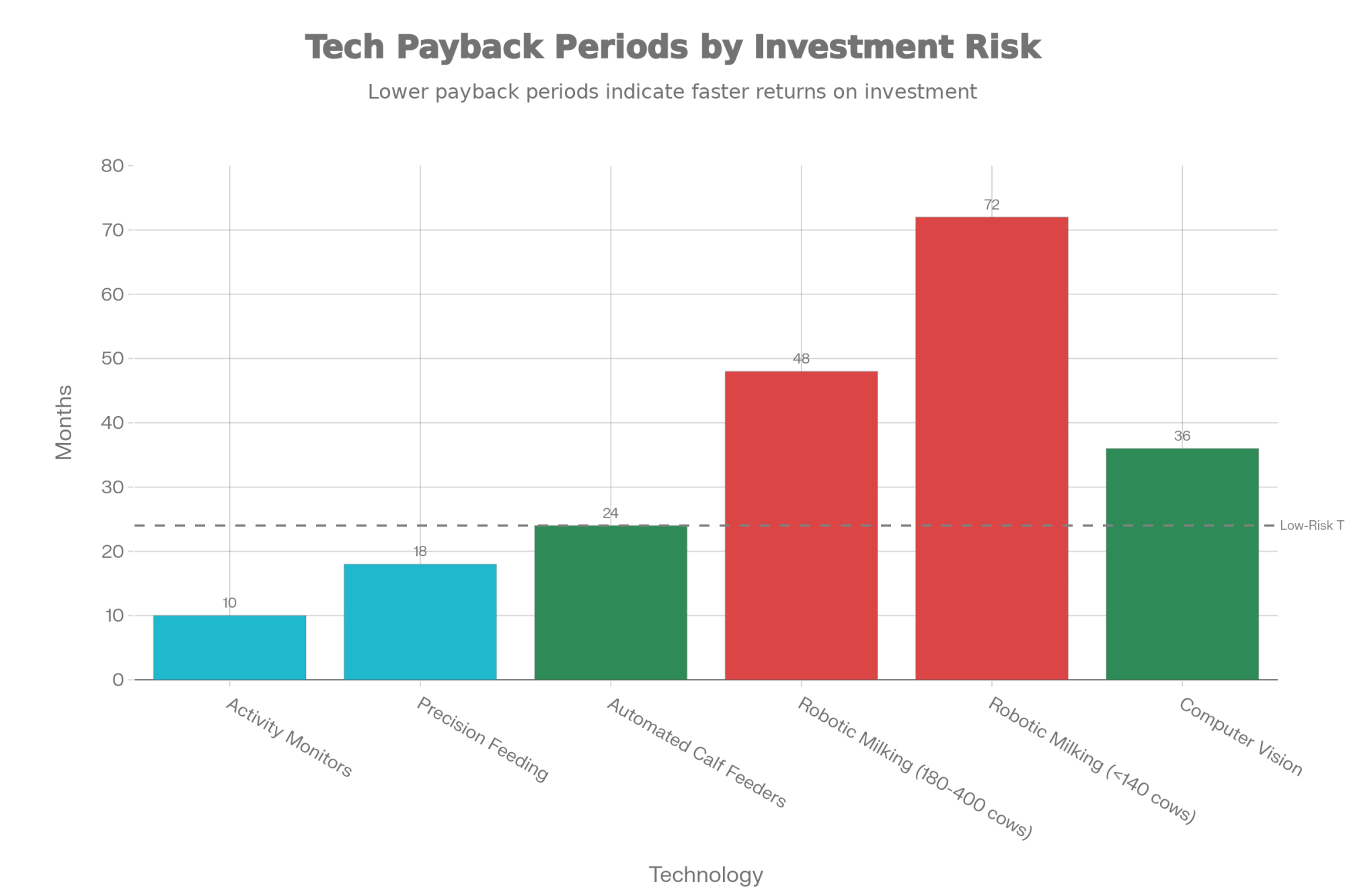
Technology payback periods ranked from shortest to longest, with black columns indicating lower-risk investments (under 24 months) and red columns indicating higher-risk long-term bets

The Infrastructure Reality That Kills Technology Dreams

What trade shows won’t tell you: infrastructure readiness determines success more than the technology itself. I’ve seen promising installations fail not because the equipment was flawed, but because the foundation wasn’t ready.

Connectivity: The Deal-Breaker Nobody Discusses

Lely specifies minimum internet requirements for their robotic systems: 20 Mbps download, 5 Mbps upload, less than 100ms latency, and 99%+ uptime. Those are firm requirements, not suggestions.

The hard truth? Half of you are trying to run 21st-century tech on a dial-up-era backbone. Research indicates that over 50% of US farmers lack adequate internet service on their farms. And the critical issue isn’t your farmhouse connection—it’s connectivity in the barn, often hundreds of feet from your router through metal buildings and concrete walls.

One farmer put it bluntly: “One of the biggest problems I see is issues with rural internet… If you aren’t able to access the data and actually utilize it, then it’s a waste.”

Before signing any contract for cloud-dependent technology, test your internet speed in the barn during peak household usage—evening hours when everyone’s streaming. That’s your real-world number, not the speed test you run at 2 PM.

Electrical Capacity: The 62% Factor

Here’s a stat that should stop you cold: 62% of automated milking system difficulties trace back to inadequate electrical infrastructure. Not software. Not mechanical failures. Power problems.

The consequences play out predictably. Farms that install robots before addressing electrical capacity often spend months chasing intermittent shutdowns and control board errors that nobody can diagnose. When they finally upgrade—typically $15,000-$25,000 for adequate service—the problems disappear almost overnight. That’s an expensive lesson in doing the infrastructure assessment first.

Most farms operate on 400-amp single-phase service. Robotic operations often require a minimum of 600-800 amps. And keep in mind that these requirements intensify during peak demand periods—summer heat events when cooling systems, ventilation, and robots all run simultaneously, or winter months in northern regions when heating elements and lighting add to the load. Get an electrician who understands agricultural loads to assess your capacity before you commit to anything.

Infrastructure CategoryMinimum RequirementAssessment MethodConsequence of Failure
Internet Connectivity20 Mbps download, 5 Mbps upload, <100ms latency, 99%+ uptimeTest speed in barn during peak household usage (7-9 PM)System can’t access cloud data, alerts fail, remote monitoring impossible
Electrical Capacity600-800 amp service (minimum) for robotic systemsProfessional agricultural electrician assessment of total farm load62% of AMS difficulties trace here: intermittent shutdowns, control board failures, months of troubleshooting
Facility Layout55 cows per robot maximum; clear cow traffic flow pathsMap cow movement patterns; measure fetch distancesReduced milking frequency, elevated SCC, production gains evaporate
Technical Personnel2 trained staff members capable of system troubleshootingIdentify backup coverage for vacations, illness, turnoverSystem underutilized, alerts ignored, data not leveraged for decisions
Service SupportCertified technician within 2-hour response radiusMap dealer locations; ask for average response time during peak seasonExtended downtime during breakdowns, milk quality issues, lost production

The Training Gap Nobody Mentions

Vendors typically provide 1-3 days of training for systems that take 6-12 months to master.

One farmer described it honestly: “The robot trainer was here for 3 days… but it took us 6 months to really understand the system.”

Successful adoption requires someone—ideally two people for backup—who can commit to learning the system thoroughly and troubleshooting daily issues. If that person doesn’t exist on your operation, address that before the equipment arrives.

A Framework for Cutting Through Vendor Noise

When evaluating any major technology investment, three questions cut through the sales pitch:

  • On support: How many certified technicians are within two hours of your farm? What are the response times when multiple farms need help simultaneously? Agricultural dealerships report they’d hire three to five mechanics immediately if they could find them. Understanding actual support capacity in your region sets realistic expectations.
  • On true costs: Request itemized quotes including facility modifications, electrical upgrades, installation, and first-year operating costs. The gap between the quoted price and the all-in cost can reach 50% or more. Better to know upfront than discover it during installation.
  • On realistic performance: What percentage of installations achieve the marketed performance? What separates high performers from those that struggle? Any vendor confident in their product can answer this honestly.

For Those Already Invested

Already bought the technology and working to maximize returns? Different conversation, but equally important.

  • First 90 days: Expect a learning curve for you and the cows. Production fluctuations during transition are normal. Watch whether production returns to baseline by day 60-90 and whether system issues decrease over time. Trend lines matter more than daily numbers.
  • Document everything. Production logs, downtime, service calls, and actual labor hours. You can’t manage what you don’t measure—especially with complex technology where multiple variables interact.
  • Focus on controllables. Cow traffic management, feed incentives at the robot, and alert response protocols. These often explain performance gaps between farms running identical equipment. Sometimes it’s not the technology—it’s how you’re managing around it.
  • Get outside eyes. Consultants not affiliated with the vendor can spot bottlenecks you’ve stopped noticing after months of daily involvement.

By six months, you’ll have enough data to know if optimization is working or if it’s time to try something different. Trust what the numbers tell you.

Quick Reference: The Numbers That Matter

Critical BenchmarkNumberDecision Application
Robot viability threshold180 cows minimumBelow this, activity monitors + precision feeding deliver better risk-adjusted returns
Optimal cows per robot55 cowsPush toward 65-70 only with excellent cow traffic; vendor claims of 78 ignore cow behavior
Labor cost breakeven$27.05/hourIf your milking labor costs less, robots won’t generate positive ROI at typical scales
Minimum ROI target15% annuallyTechnology must beat low-risk alternatives (5% CD rate) by 3x to justify complexity and risk
Realistic benefit planning50-60% of marketed claimsVendors quote best-case scenarios; farm averages run half that across all technology categories
Infrastructure failure rate62% of AMS problemsMost difficulties trace to electrical/connectivity, not equipment—audit before purchase
Electrical requirement600-800 amps minimumMost farms operate on 400-amp service; upgrade costs $15K-$25K but prevents months of issues
Internet minimum20 Mbps down / 5 Mbps upTest in barn during peak usage, not farmhouse during off-hours—real-world connectivity matters
Activity monitor payback7-14 monthsFastest proven ROI in dairy technology; $75-$150 per cow consistently delivers
Automated parlor threshold400-500+ cowsAbove this scale, consider automated parlors vs. multiple robot units for reduced complexity

Before your next technology conversation, know these benchmarks:

  • 55 cows per robot — Optimal utilization target (University of Wisconsin)
  • $27.05/hour — Breakeven labor cost for robot ROI (University of Minnesota)
  • 15% ROI — Minimum target to justify technology risk over safer investments
  • 50-60% — Realistic benefit assumption vs. marketed claims
  • 62% — AMS difficulties traced to electrical infrastructure
  • 600-800 amps — Typical electrical requirement for robotic operations
  • 20 Mbps download — Minimum internet for cloud-dependent systems
  • 7-14 months — Typical activity monitor payback period
  • $15,000-$25,000 — Common electrical upgrade cost range

The Bottom Line

The technology landscape in dairy keeps evolving, and the opportunities are real for operations positioned to capture them. But success depends less on buying the most advanced equipment and more on matching the right technology to your scale, infrastructure, and management capacity.

For smaller herds, that usually means activity monitors and precision feeding—technologies that deliver strong returns without massive capital or infrastructure overhaul. For mid-sized operations in that 180-400 cow range, robotic milking can transform profitability—if the foundation supports it. For larger operations, automated parlors might actually outperform multiple robot units while reducing complexity.

The farmers navigating this best share a common approach: they evaluate innovations based on fit rather than flash, and they’re brutally honest about their infrastructure, skills, and scale before signing anything.

As one industry advisor put it: “Think from the farm’s needs backward, rather than picking a technology and projecting it onto the farm.”

So here’s the question you need to answer before your next equipment conversation: Is your barn actually ready for the technology you’re considering, or are you just buying a shiny ornament for an outdated foundation?

The math doesn’t care about your enthusiasm. It only cares whether the numbers work.

Keep in mind that technology economics shift over time as equipment costs change and labor markets evolve. These frameworks should guide your thinking, but revisit the calculations periodically—what didn’t pencil out three years ago might look different today, and vice versa.

Key Takeaways

  • Match technology to scale. Activity monitors and precision feeding often deliver stronger returns for smaller operations than robots. Sometimes the unglamorous stuff pays best.
  • The 180-400 cow range is the robotic sweet spot. Below 140 cows, the math rarely works. Above 500, automated parlors deserve serious consideration.
  • Infrastructure comes first. Test barn internet, assess electrical capacity, identify dedicated personnel—before signing anything. Expensive technology on inadequate infrastructure is a recipe for frustration.
  • Plan around 50-60% of the marketed benefits and target 15% ROI to justify the risk.
  • Already invested? The first 90 days are a learning curve. By six months, trust what the data tells you—not what you hoped would happen.

We’d love to hear how these frameworks apply to your operation. Share your technology experiences—successes and struggles alike—in the comments below or reach out directly. Your real-world insights help the entire dairy community make better decisions.  Which of these numbers surprised you most? Or better yet, which one have you proven wrong on your own farm?

Complete references and supporting documentation are available upon request by contacting the editorial team at editor@thebullvine.com.

Learn More

Join the Revolution!

Join over 30,000 successful dairy professionals who rely on Bullvine Weekly for their competitive edge. Delivered directly to your inbox each week, our exclusive industry insights help you make smarter decisions while saving precious hours every week. Never miss critical updates on milk production trends, breakthrough technologies, and profit-boosting strategies that top producers are already implementing. Subscribe now to transform your dairy operation’s efficiency and profitability—your future success is just one click away.

NewsSubscribe
First
Last
Consent

Mastering Estrus Detection and Insemination Timing for Better Conception Rates

Boost your farm’s success by mastering estrus detection and insemination timing. Ready to enhance your herd’s productivity?

Summary: Understanding the intricacies of the estrus cycle is paramount for dairy farmers aiming to optimize herd productivity. With technological advancements aiding accurate heat detection, pinpointing the ideal 12-hour window for artificial insemination becomes feasible, thereby enhancing conception rates and calving intervals. The cows’ estrus cycle is divided into stages: proestrus, estrus, metestrus, and diestrus. Accurate identification of these stages is essential for effective artificial insemination, as it corresponds with the cow’s normal ovulation rhythm. Strategies such as double insemination further boost success rates, but these efforts must be supported by investments in reliable detection methods, thorough record-keeping, comprehensive staff training, and regular monitoring of results. Various technologies, such as activity monitors, pedometers, and hormone testing kits, can improve estrus identification. Ultimately, cow comfort and nutrition are crucial in effective estrus detection and overall reproductive success.

  • Understanding the estrus cycle stages is essential for optimal herd productivity.
  • Technological advancements improve heat detection, ensuring timely artificial insemination.
  • Targeting the 12-hour window post-standing heat enhances conception rates and calving intervals.
  • Double insemination strategies can improve success but require robust detection and monitoring systems.
  • Investing in technology like activity monitors, pedometers, and hormone testing kits is beneficial.
  • Maintaining cow comfort and proper nutrition significantly impacts estrus detection and reproductive success.
estrus detection, insemination timing, dairy farms, estrus cycle, proestrus, estrus, metestrus, diestrus, artificial insemination, ovulation rhythm, heat detection systems, records, employees, conception rates, technologies, activity monitors, pedometers, hormone testing kits, personal requirements, budget, resources, ideal insemination period, standing heat, natural ovulation cycle, implementation tips, reliable heat detection methods, staff training, cow comfort, nutrition, stress, bedding, weather, estrus symptoms, profitability

Are you frustrated with your dairy farm’s poor conception rates? Imagine the potential for increasing your herd’s output with a few clever modifications. This post will examine how understanding estrus detection and insemination timing may boost your dairy farm’s performance, giving you a reason to be optimistic. Are you ready to understand the secrets of the most significant dairy producers? Accurate estrus diagnosis and proper insemination timing are essential abilities that may alter your dairy business, resulting in higher conception rates, fewer repeat inseminations, and shorter calving intervals.

The 21-Day Journey of the Estrus Cycle: Understanding Each Stage for Maximum Herd Productivity.

This knowledge will empower you to make informed decisions for your farm. Understanding the estrus cycle in dairy cows is a fascinating journey and a key to maximizing your herd’s productivity. This 21-day trip, separated into four unique stages, is a roadmap to increasing herd fertility and production.

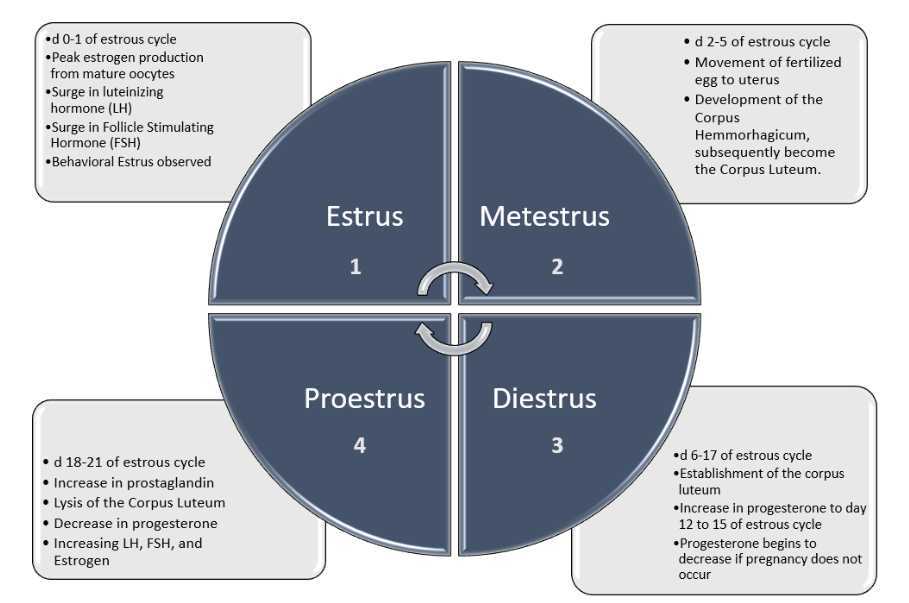
  • Proestrus: This early phase prepares for the impending estrus phase. During proestrus, the cow’s body prepares for ovulation. Hormonal changes cause follicle growth, preparing for the next estrus period. Missing this phase could lead to a missed opportunity for insemination and a delay in the cow’s reproductive cycle. 
  • Estrus: Known as “heat,” this is the cycle’s highlight. Estrus is when a cow is sexually receptive and ovulation is approaching. Accurate identification of this phase is critical for effective artificial insemination. Identifying the commencement of standing heat and timing insemination around 12 hours later corresponds precisely with the cow’s normal ovulation rhythm, increasing conception rates.
  • Metestrus: Metestrus is the stage after estrus at which ovulation occurs. The cow may show indications of estrus, but the primary emphasis is on corpus luteum development in the ovaries, which prepares for possible pregnancy.
  • Diestrus: The last phase is the longest, during which the corpus luteum produces progesterone to preserve a prospective pregnancy. The cycle is restarted if conception fails and the cow enters proestrus again.

Focusing on estrus identification is more important than ever, given to technology breakthroughs that may dramatically improve your herd’s reproductive performance. Investing in effective heat detection systems, keeping thorough records, educating your employees, and monitoring conception rates assures optimum time for insemination and, as a result, increased output for your dairy company. This technological support should give you confidence in your breeding decisions.

Harnessing Technology for Precision: Making Every Insemination Count 

In today’s technologically advanced world, several technologies are available to improve estrus identification, guaranteeing that you never miss the vital window for insemination.

  • Activity Monitors: These revolutionary sensors monitor cow movement and behavior to detect elevated activity levels indicating estrus. The advantages of activity monitors include automatic and continuous monitoring, which enables early and precise estrus identification. However, the initial expenditure might be significant, and technological difficulties may occur that need frequent maintenance and upgrades.
  • Pedometers: Like activity monitors, pedometers measure the number of steps a cow takes, with higher step counts frequently indicating estrus. The advantages of pedometers are their low cost and simplicity of integration into current herd management systems. Conversely, they may not be as exact as activity monitors. They sometimes provide false positives owing to increased movement from other sources.
  • Hormone Testing Kits: These tests use hormone levels in milk or blood to determine estrus stages. The key benefit is their excellent accuracy in identifying hormonal changes associated with estrus. However, they need manual sampling, which may be time-consuming, with the additional expense of disposable testing supplies.

Each instrument has advantages and disadvantages, so consider your requirements, budget, and resources when selecting the best estrus detection equipment for your farm.

Mastering the Timing: Why Inseminate 12 Hours After Standing Heat?

Understanding the ideal insemination period is critical for increasing herd output. The optimal period to inseminate is roughly 12 hours following the commencement of standing heat, which coincides with the cow’s natural ovulation cycle.  This precision in timing leads to several significant benefits: 

  • Increased conception rates
  • Fewer repeat inseminations
  • Improved calving intervals

Double Insemination: A Strategy to Boost Conception Rates 

Let’s look at the double insemination approach. Double insemination means inseminating a cow twice during the same estrus cycle to increase conception rates. This strategy has the potential to transform the way you breed your cows.

Implementation Tips: 

  • Invest in Reliable Heat Detection Methods: Accurate timing is the cornerstone of double insemination, which requires reliable heat sensing. Consider employing activity trackers or other modern technology.
  • Maintain Detailed Records: Keep meticulous records on each cow’s estrus cycle to help find trends and improve insemination schedules.
  • Ensure Staff Training: Properly trained personnel are essential for successfully executing double insemination. Ensure that your staff knows both the methodology and the time requirements.
  • Monitor Conception Rates: Assess your insemination success rates regularly to fine-tune techniques and enhance results.

Practical Tips for Dairy Producers 

As a dairy farmer, you understand that accuracy is essential for increasing output and profitability. 

Here are some practical tips to help you stay ahead: 

  • Reliable Heat Detection Methods
  • Use heat-detecting devices such as activity monitors, tail paint, or even trained observation. These technologies may considerably increase the accuracy of determining when your cows are in heat.
  • Record Keeping
  • Maintain accurate data on each cow’s estrus cycle and insemination history. This data is quite helpful in finding trends and optimizing insemination time.
  • Staff Training
  • Ensure your personnel is adequately taught to recognize estrus indicators and use detection techniques successfully. Knowledgeable personnel may significantly increase conception rates and minimize the need for repeated inseminations.

Cow Comfort and Nutrition: The Unsung Heroes of Estrus Detection

It is critical to emphasize the importance of cow comfort and nutrition in maximizing estrus detection and enhancing conception rates. Imagine functioning at your peak while anxious and undernourished; cows endure comparable obstacles. Stress, whether caused by overpopulation, poor bedding, or harsh weather, may drastically reduce the expression of estrus symptoms, making identification more difficult and unreliable. As a result, the timing and efficacy of artificial insemination are affected.

Poor nutrition exacerbates these difficulties. A cow without needed nutrition is unlikely to display crucial estrus activities, and even if she does, her fertility may be jeopardized. Nutritional deficits may cause irregular periods, delayed ovulation, and lower reproductive efficiency. Well-fed and contented cows exhibit more apparent indications of estrus and have more excellent conception rates.

Investing in cow comfort and a healthy diet is not just a compassionate activity but also a strategic one. Cows’ reproductive systems work better when comfortable and well-nourished, which coincides wonderfully with your estrus detection attempts. Ensure that your herd’s habitat is relaxed and healthy, and you should see considerable gains in estrus detection accuracy and successful inseminations.

The Bottom Line

Understanding estrus detection and insemination timing is a game changer for dairy farms. Understanding the estrus cycle, investing in technology, and educating your personnel may all help your herd’s conception rates.

Are you ready to take your dairy farm to the next level? Begin adopting these methods immediately and watch your success skyrocket. Successful insemination leads to increased productivity and profitability for your farm.

Learn more:

How to Master Hormonal Changes with Automated Reproduction Tools for Higher Conception Rates

Boost your dairy herd’s success by mastering hormonal changes and timing insemination. Discover how automated tools can enhance your herd’s conception rates. Ready to optimize?

Summary:  Are you ready to revolutionize your dairy farm‘s reproduction rates? You can unlock extraordinary conception rates by mastering your cow’s hormonal changes and timing insemination correctly. Understanding the hormonal cycles of estrogen and progesterone is crucial for optimizing dairy cow reproduction. Traditional fertility monitoring can be time-consuming and labor-intensive, often resulting in reduced fertility. Automated systems, including activity monitors and hormone testing kits, generate real-time data, empowering you to make educated decisions and focus on other vital farm activities. Embracing automation lays the groundwork for future success. Scalable and user-friendly technologies, like mobile apps with real-time updates, are essential. Continuous monitoring and quick adjustments ensure high conception rates, leading to unprecedented reproductive success.

  • Mastering hormonal changes and timing insemination correctly is crucial for high conception rates.
  • Traditional fertility monitoring methods can be time-consuming and less effective.
  • Automated systems provide real-time data to make informed reproductive decisions.
  • Embracing automation helps focus on other vital farm activities.
  • Scalable and user-friendly technologies, like mobile apps, are essential for success.
  • Continuous monitoring and quick adjustments lead to sustained high conception rates.
studio opnamen portret fam buijs

Do you want to improve your dairy herd’s reproductive success dramatically? The key is understanding and managing your cows’ hormonal shifts and determining the best times for insemination. Timing insemination exactly with these hormonal signals improves your chances of successful conception. Automated reproduction systems are meant to monitor and understand your cows’ hormonal signals, directing you to the optimal time for insemination. These technologies allow you to make educated choices based on real-time data, boosting your herd’s reproductive performance.

Understanding Hormonal Changes 

While challenging, understanding the complexities of hormonal cycles in dairy cows is crucial for optimizing reproduction. Let’s break it down into estrogen and progesterone, as this knowledge can significantly improve your herd’s reproductive success.

Estrogen: As a cow’s estrus cycle starts, her estrogen levels increase, indicating ovulation. When estrogen levels are elevated, cows exhibit heat-related behaviors such as mounting, increased activity, and vocalization.

Progesterone levels rise after ovulation. This hormone prepares the uterine lining for pregnancy and suppresses following estrus cycles, enabling embryos to implant and thrive.

Understanding these cycles is just the beginning. Timing insemination with these hormonal shifts is critical for achieving high conception rates, and missing this window results in reduced fertility and longer calving intervals, which affects your bottom line.

Automated systems are crucial in timing insemination to coincide with a cow’s peak fertility, typically 12 to 24 hours after estrus begins. This significantly boosts reproductive efficiency, and these technologies can assist in accurately detecting these instances.

Adopting technology such as heat detection devices and hormone tracking eliminates guessing, putting you ahead of the competition. This technology alters reproductive management.

Traditional Methods for Monitoring Cow Fertility Come with a Host of Challenges 

Traditional techniques for assessing cow fertility can bring a plethora of complications. Manual observation and record-keeping may be very time-consuming. Walking the pastures, looking for indications of heat, and methodically taking notes is challenging, particularly when you have a large herd to manage.

This method is not only labor-intensive but also very susceptible to human mistakes. A little moment of attention or an ignored signal might result in missing the cow’s most productive phase. The accuracy needed to detect minute changes in behavior or physical signs is difficult to maintain consistently, resulting in lost chances for optimum insemination. The relief from this manual labor that automated systems provide can make you feel liberated and less burdened.

Traditional monitoring systems’ inefficiencies and inconsistencies can be frustrating and costly. However, adopting modern, automated solutions can make a significant impact. They provide sharper insights and help you achieve the ideal insemination time with significantly less trouble. This is a game-changer for reproductive management.

Dive into the Future of Herd Reproduction: Embrace Automation and Boost Your Conception Rates! 

Automated reproduction techniques provide a new opportunity for dairy farmers looking to improve herd fertility and output. These technological marvels generate abundant data, allowing you to make educated choices based on real-time insights and trends.

Activity monitors are one of the cornerstone technologies. These gadgets are often connected to cows to monitor their movements. Increased activity usually indicates the start of estrus, providing a reliable predictor for insemination.

Then we have rumination collars. These gadgets monitor cows’ chewing behavior, another helpful indicator of their reproductive state. Changes in rumination habits may indicate hormonal alterations, allowing for more exact timing of insemination.

Finally, hormone testing kits can detect particular hormone levels in body fluids, allowing for a direct and reliable evaluation of reproductive health. These tools may determine the most effective insemination time when paired with activity and rumination data.

Implementing these automated methods eliminates most of the guessing. It improves your potential to achieve higher conception rates, increasing herd growth and production.

No More Guessing Games: Automate Your Herd’s Fertility Monitoring! 

Consider this: no more guessing games about your herd’s fertility. Automated reproduction technologies provide real-time data from your barn, constantly updating you on each cow’s hormonal fluctuations. This technology does more than save you time; it completely alters your organization.

What’s the key benefit? Immediate insights. Imagine getting notified the minute a cow reaches peak fertility. Automated systems use accurate sensors and algorithms, significantly reducing the number of humans necessary for monitoring. This lets you concentrate on other essential parts of your dairy farm while ensuring your cows are inseminated at the optimal time.

These tools provide unparalleled precision. Traditional techniques often allow for errors, while automated systems record and evaluate every data point methodically. This degree of precision translates directly into increased conception rates, which are critical for any profitable dairy farm. The precision of these automated systems can make you feel reassured and confident in your herd’s reproductive management.

Take the example of a 400-head dairy in Wisconsin. After using automated monitoring techniques, they recorded a 15% rise in their herd’s conception rates within the first year. This was not a coincidence; their real-time data enabled them to make fast, educated choices regarding insemination.

Another great example comes from a 2000-head dairy in Idaho, where integrating this technology decreased labor expenses by 20%. The time formerly spent on manual monitoring is now being used to improve other production areas, making the farm more productive.

Embracing automation in reproductive monitoring is about more than simply keeping up with the trends; it’s about laying the groundwork for your farm’s future success. You are preparing your herd for unprecedented reproductive success using real-time data and accuracy. The potential for increased profitability can make you feel optimistic and motivated about the future of your dairy farm.

Ready to Bring Your Dairy Farm into the 21st Century? 

Ready to move your dairy farm into the twenty-first Century? Integrating automated reproduction techniques may dramatically improve your herd’s fertility management, but you must approach it carefully.

First, examine the expense. While the first expenditure may seem high, consider the long-term advantages of improved conception rates and lower labor expenses. Look for scalable technologies enabling you to begin small and grow as you succeed.

Another important consideration is the simplicity of usage. Choose products with user-friendly interfaces that your employees can rapidly learn and utilize. Some systems have mobile applications which provide real-time updates and notifications to your phone or tablet. This streamlines operations and keeps you updated even when you’re not on the farm.

Ensure compatibility with your current farm management systems. The new tools should work smoothly with your herd management software, removing the need for manual data input and lowering mistake rates. Look for systems with APIs or other integration possibilities.

When deciding on the correct instruments, talk with experts and study evaluations from other dairy producers. Attend industry conferences and webinars to see the tools used and ask questions about their performance and dependability. Choosing a provider with outstanding customer service and training resources is also critical.

Speaking of training, ensure your employees are adequately trained to utilize these technologies efficiently. Provide hands-on training and build user-friendly reference manuals. Encourage an open discussion where employees may ask questions and exchange opinions, ensuring everyone feels secure using the new technology.

By carefully integrating automated reproduction techniques, you may improve your herd’s fertility management and produce a more efficient and productive dairy enterprise.

Unlocking High Conception Rates: The Art of Decoding Automated Reproduction Data 

Maximizing conception rates requires a rigorous approach to comprehending and using data from automated reproduction equipment. The challenge is deciphering the data supplied by these technologies and converting raw data into meaningful insights.

First, acquaint yourself with the various sorts of data acquired. Automated instruments collect data on a cow’s activity level, body temperature, and hormone variations, all contributing to the mystery of her reproductive state. Look for increases in activity and temperature, which are generally suggestive of estrus. Hormone-monitoring instruments, including progesterone sensors, immediately indicate that a cow has entered heat.

Strategies to Interpret Data: 

  • Identify Patterns: Review activity and temperature graphs regularly. Patterns or sudden changes often indicate cows entering estrus.
  • Use Thresholds: Set specific thresholds for activity and temperature that, when crossed, trigger alerts for potential estrus.
  • Correlate Data Points: Combine hormonal data with activity and temperature to confirm a cow’s reproductive status.

Once you’ve spotted a cow in heat, you must act quickly. Proper insemination timing increases the odds of conception. According to research, insemination should occur between 12 and 24 hours following the first indications of estrus.

Continuous Monitoring and Adjustments: 

To sustain high conception rates, continuous monitoring and changes are required. Thresholds are continuously updated depending on herd performance data. If conception rates fall, reconsider data interpretations and adapt your efforts. Automated tools benefit from real-time monitoring, allowing quick reactions to changes.

Automated reproduction technologies may significantly improve your breeding program. By successfully evaluating the data and making educated choices, you may increase conception rates and, as a result, the herd’s productivity.

Common Misconceptions About Automated Reproduction Tools 

Many farmers need to be more suspicious about the efficacy and dependability of automated reproduction methods. They typically hear complaints like “These systems are too complicated” or “Automation can’t replace years of hands-on experience.” Let us confront these misunderstandings straight on.

Myth 1: Automation is complicated to implement.

Unlike common assumptions, new automated reproduction technologies are intended to be user-friendly. Lvendahl and Chagunda (2010) found that these technologies help ease monitoring by providing intuitive interfaces and actionable findings. Manufacturers provide training and assistance to help you and your team use these technologies effectively, minimizing learning curves.

Myth 2: Automation cannot match the subtleties of human observation.

While conventional approaches need a sharp eye and years of training, automated solutions use potent algorithms and data analytics to identify minor hormone changes and behavioral indicators. Madureira et al. (2015) found that automated fertility monitoring technologies provide more accurate results than manual techniques.

Myth 3: Automated Systems are not reliable.

Reliability is a significant problem, yet evidence indicates otherwise. According to Denis-Robichaud et al. (2016), automated reproduction farms have much higher conception rates owing to real-time data warnings. These devices reduce human error and guarantee that insemination takes place at the appropriate period.

Myth 4: The technology must be more expensive to justify the investment.

The initial investment prices may seem hefty, but evaluating the long-term advantages and savings is critical. According to Santos et al. (2009), farms using this technology saw decreased labor expenses, fewer veterinary treatments, and improved herd fertility, eventually covering the original investment.

Evidence-Based Benefits

The evidence speaks for itself. Studies have frequently shown the benefits of automated reproduction techniques. Burnett et al. (2015) found that farms adopting these techniques had better overall herd health and output. Aungier et al. (2012) also found that real-time monitoring dramatically minimizes lost heat and open days, increasing farm profitability.

Implementing automated reproduction technology may transform how you manage your herd’s fertility, resulting in increased efficiency, accuracy, and peace of mind. Step into the future of dairy farming and enjoy the benefits of improved reproductive management!

Unlock the Hidden Goldmine: How Higher Conception Rates Secure Your Dairy Farm’s Financial Future 

Higher fertility is more than simply keeping your herd healthy; it also ensures the financial viability of your dairy enterprise. Improved conception rates may significantly boost your farm’s profitability. Here’s how

  1. Increased Milk Production: Cows that conceive more efficiently and at the right time are often healthier and more productive—a timely calving cycle results in more consistent milk yields. Over time, this may significantly increase total milk output, resulting in a more steady and profitable revenue stream.
  2. Better Herd Genetics: Enhancing reproductive performance increases calves’ quantity and your herd’s genetic quality. High conception rates enable you to selectively breed for desired characteristics such as increased milk output, illness resistance, and general health. This genetic improvement improves the long-term sustainability and efficiency of your herd.
  3. Increased Profitability: Having more excellent conception rates in your cows lowers the expenditures associated with repeated inseminations, extended calving intervals, and the upkeep of nonproductive cows. Automating reproductive equipment reduces personnel expenses and time spent on fertility monitoring. These cost reductions and more excellent milk output result in better farm profitability.

Higher conception rates are essential for a successful dairy farm. Innovative automated reproduction techniques can keep your herd fertile and economically thriving.

The Bottom Line

Bringing your dairy farm to optimum reproductive efficiency requires more than just hard labor; it also requires thinking more strategically about the resources at your disposal. You may transform your herd’s reproductive performance by intensely studying your cow’s hormonal changes and carefully scheduling inseminations, along with cutting-edge automated monitoring technology. Embracing these adjustments might be the difference between a failing and flourishing organization. So, what are your next steps in upgrading your farm? Will you leap into the future and allow technology to lead you to improved reproductive outcomes?

Learn more:

Once or twice? When to Inseminate Your Dairy Cattle for Maximum Milk Yield

Boost your herd’s productivity with top insemination tips. Are you timing it right? Discover expert advice to maximize milk yield!

Summary: Struggling with choosing the right insemination practices to maximize your herd’s reproductive efficiency? This comprehensive guide breaks down the complexities of the estrous cycle, optimal timing, and advanced detection technologies to help you make informed decisions. Dive into the debate of single versus double insemination with factual evidence and expert insights tailored specifically for dairy farmers. Discover actionable tips and strategies to boost your herd’s fertility and overall productivity. 

  • Efficient estrus detection is crucial for increasing reproductive efficiency and profitability in dairy herds.
  • Timing of insemination significantly impacts fertilization rates; cows should be inseminated based on their estrous behavior.
  • Advanced estrus detection technologies can enhance accuracy and ease of identifying optimal insemination times.
  • Single mid-morning insemination often yields the best conception rates when estrus behavior is observed the same morning or previous evening.
  • The debate of single versus double insemination requires consideration of your herd’s specific reproductive goals and estrus synchronization protocols.

Have you ever wondered whether your neighbors have a secret that boosts their herd’s milk production? The truth is, enhancing your insemination techniques might be the golden ticket. Ensuring you reach the sweet spot for insemination time is more than just a ‘nice-to-have’; it’s a potential game-changer that could significantly boost milk output and herd health. This post will examine why time is crucial for dairy cow insemination. We will look at the science behind optimum insemination timing, discuss practical recommendations, and provide you with all the information you need to make an educated choice. This tutorial seeks to simplify reproductive science by explaining the estrous cycle and providing concrete techniques that may be used immediately. The time of insemination substantially influences pregnancy rates, milk supply, and overall herd productivity. Mastering this feature may result in more efficient operations and healthier livestock. So, are you prepared to transform your ‘good enough’ herd into a well-oiled, high-yielding milk-producing machine? Let us get started.

Navigating the Estrous Cycle for Maximum Herd Efficiency 

Understanding the estrous cycle in dairy cattle is important; it’s essential for effective herd management and insemination tactics. The estrous cycle typically lasts around 21 days, but it may vary from 18 to 24 days (University of Wisconsin-Madison, Estrous Cycle in Dairy Cattle). This knowledge will make you a more informed and knowledgeable dairy farmer, better equipped to manage your herd’s reproductive health. 

The cycle can be divided into four primary phases: 

  1. Proestrus: This phase lasts approximately 3 to 4 days. During proestrus, ovary follicles develop, leading to increased estrogen levels. Dairy cattle might exhibit behavioral and physical changes, including increased activity and vocalization.
  2. Estrus: Also known as “heat,” this phase is crucial for breeding and lasts about 12 to 18 hours. Cows in estrus are receptive to mating and may show overt signs such as standing to be mounted restlessness or clear mucus discharge from the vulva (Stevenson et al., 2006).
  3. Metestrus: Following estrus, metestrus lasts around 3 to 5 days. During this period, the corpus luteum starts to develop, and progesterone levels rise, leading to the cessation of estrus behaviors.
  4. Diestrus: This phase lasts about 12 to 15 days. It is characterized by high progesterone levels, which prepare the uterus for a possible pregnancy. If the cow is not pregnant, the cycle will reset as prostaglandin F2α causes luteolysis of the corpus luteum, marking the beginning of proestrus again.

Recognizing indications of estrus is crucial for timely insemination. Several studies have shown that monitoring changes such as mounting behavior and mucus discharge can significantly enhance insemination success rates (Moreira et al., 2001; Vasconcelos et al., 1999).

Finally, knowing and adequately monitoring the estrous cycle may lead to better herd fertility management and shorter calving intervals, which are crucial for a dairy operation’s economic survival. This knowledge empowers you to take control of your herd’s reproductive health and manage it more effectively, ensuring a more profitable dairy operation.

Timing is Everything! 

Research shows that optimal insemination time is crucial for increasing conception rates in dairy cows. A study from the Journal of Dairy Science found that inseminating cows 12-24 hours following the beginning of estrus leads to the most excellent conception rates. This conclusion is consistent with previous research, such as Moreira et al. (2001), which recommends insemination within this window to attain peak fertility.

Estrus SignOptimal Insemination TimeNotes
First observed standing heat6-12 hours laterHigher conception rates are noted when insemination occurs within this window.
Clear mucus discharge24-32 hours laterMucus discharge is a reliable indicator of estrus onset.
Reduced feed intake20-28 hours laterBehavioral changes such as reduced intake can signal the onset of estrus.

Furthermore, Vasconcelos et al. (1999) found that insemination more than 24 hours after the commencement of estrus dramatically reduces conception rates. This critical window capitalizes on the peak reproductive time by ensuring sperm presence corresponds with ovulation. Adhering to this time improves herd fertility, resulting in higher reproductive success and increased milk supply.

Furthermore, Stevenson et al. (2006) emphasize the need for proper estrus monitoring. Their results show that estrus detection paired with timely insemination increases the likelihood of pregnancy. New technology, such as electronic monitoring devices, may help identify the start of estrus more accurately, allowing for timely insemination.

Integrating insemination procedures with evidence-based research is beneficial and crucial for improving conception rates, herd productivity, and profitability. Leveraging this information can help dairy farmers manage their herds more effectively and efficiently.

Unlocking the Power of Advanced Estrus Detection Technologies 

Introducing cutting-edge methods for detecting estrus has significantly advanced modern dairy production. Activity monitors and progesterone tests are at the vanguard of this change, ushering in a new era of reproductive care. These new instruments improve the detection process and the accuracy of insemination time, boosting the chances of a successful pregnancy.

  • Activity Monitors: These gadgets, often worn as collars or anklets, continually monitor cow movement and activity levels. The Journal of Dairy Science reports that increased activity among dairy cows is a reliable predictor of estrus. Farmers may use these activity patterns to pinpoint the best times for insemination accurately. This real-time monitoring system eliminates dependence on eye observations, typically subject to human mistakes, enhancing herd management efficiency.
  • Progesterone tests are another effective weapon in a dairy farmer’s armory. This test analyzes the amount of progesterone in a cow’s milk or blood, giving immediate information on her reproductive state. Low progesterone levels usually herald the start of estrus. Numerous research published in the Journal of Dairy Science has shown that progesterone testing may significantly improve the time of insemination. The accuracy provided by this biochemical method guarantees that cows are inseminated at the most fertile part of their estrous cycle, increasing pregnancy rates.

Integrating these modern tools into your herd management procedures allows you to optimize insemination time and increase overall reproductive performance. The combination of activity monitors and progesterone testing considerably reduces guessing in estrus identification, resulting in more excellent conception rates and, eventually, a more profitable dairy enterprise.

Single vs. Double Insemination: Which option best suits your herd’s reproductive goals? 

Dairy producers often consider whether to use single or double insemination techniques. Let’s examine the benefits and drawbacks of each strategy so you can make an educated choice for your herd.

  • Single Insemination: One significant advantage of single insemination is its simplicity, requiring less effort and resources. Farmers may also prevent the stress and pain that extra handling may give their cows. However, imagine that the time of AI (Artificial Insemination) is not entirely synced with ovulation. This approach may miss some conception chances, decreasing overall rates, especially in herds with varied estrous cycles. Timed AI methods may achieve acceptable conception rates, but proper timing is critical for improving reproductive efficiency. Failure to do so may result in lost breeding chances and worse fertility results. (Resource Link).
  • Double Insemination: Double insemination has the potential for increased conception rates. Research by the University of Florida discovered that multiple insemination may increase conception rates by up to 10%. This may be especially useful in herds when estrous diagnosis is difficult, giving a safety net to ensure cows are bred at the best time. While double insemination requires extra resources and work, the benefits of improved reproductive success may exceed the costs. For herds with substantial variability in estrus observation, the benefits of multiple insemination may outweigh the costs.

Understanding the balance between efficacy and practicality is critical when deciding whether to inseminate once or twice daily. The American Dairy Science Association acknowledges that AI’s timing and frequency significantly impact conception rates and subsequent milk output.

AspectSingle InseminationDouble Insemination
CostLower initial cost as only one AI procedure is required (source).Additional AI procedures result in higher costs, but the potential for increased conception rates offsets this (source).
Labor intensityLess labor-intensive with only one AI procedure. Ideal for farmers with limited time (source).It is more labor-intensive as it requires precise timing and additional handling.
Conception RateConception rates can vary but are generally lower compared to double insemination.Studies show a 10% increase in conception rates compared to single insemination (source).
Animal StressReduced stress on the animal due to fewer handling and procedures.Increased stress due to multiple handling sessions in a short period.
Monitoring and DetectionIt requires efficient heat detection to optimize timing and is usually more straightforward.Advanced heat detection techniques and technologies are required to ensure optimal timing (source).

According to research, although once-daily insemination may have slightly lower accuracy timing than twice-daily techniques, it maintains optimal conception rates with appropriate estrus detection procedures. It enables farmers to concentrate on other herd management tasks, lowering operating stress.

Twice-daily insemination may improve conception rates by bringing them closer to the ideal fertilization window. This is especially useful in more enormous herds when individual estrus symptoms might be readily ignored. However, higher frequencies raise labor and material expenses.

Successful conception has a favorable correlation with milk production. Cows that conceive at ideal timeframes have higher milk output since more extended open periods may contribute to protracted lactation curves and metabolic stress. Poorly timed insemination may increase open periods, reducing milk supply and herd health.

The decision between once or twice daily insemination is based on your farm’s demands, resources, and the efficacy of estrus detection techniques. While twice-daily insemination may increase conception rates, it is more labor-intensive and costly. Once-daily insemination is simple but needs exact estrus detection. Balancing these parameters may result in greater reproductive success, herd health, and milk output.

The Bottom Line

Determining the best insemination procedures for your herd requires a detailed grasp of estrous timing and the use of technical breakthroughs. Accurate estrus identification and current techniques dramatically improve reproductive success, whether using single or double insemination. Integrated tactics combining precise timing, improved detecting technology, and targeted insemination procedures are critical for increasing production. Improving reproductive methods is crucial for long-term, successful dairy farming, contributing to the evolution of industry best practices. Adopting sophisticated approaches and constantly fine-tuning your approach is essential for overcoming challenges—stay aware and adaptive with proactive measures and embrace the path to optimum herd fertility.

Learn more:

Minnesota Dairy Giant: Discover the Secrets Behind Milking 9,500 Cows Daily

Uncover the secret methods behind a Minnesota dairy farm‘s daily milking of 9,500 cows. Want to know how they do it? Discover the intricacies of large-scale dairy farming.

Summary: Louriston Dairy, a US dairy herd with 9,500 cows, has integrated advanced milking systems and herd management procedures to increase productivity and output. The farm has exceeded the 9,000-cow threshold, demonstrating efficient operations and intelligent expansion. Modern genetic methods, wearable technologies, and robotic milking devices are used to manage the large herd. The farm also provides unmatched veterinary care, with a specialized team supervising the cows’ health. Regular check-ups, vaccines, and treatments are part of the routine to reduce health risks and keep the cows in shape. Advanced diagnostic instruments are used to diagnose and treat any concerns, reducing downtime and loss of production associated with cattle ailments. This Minnesota dairy farm symbolizes innovation and sustainability, demonstrating how large-scale agriculture can coexist with environmental management and community development.

  • Massive Scale: With an impressive 9,500 cows, this dairy farm manages one of the largest herds in the U.S., exemplifying industrial-scale agriculture.
  • Technological Integration: Utilizing cutting-edge technologies, including automated milking systems and advanced herd management software, to optimize productivity and animal welfare.
  • Sustainability Leadership: Pioneering sustainable farming practices such as efficient manure management, renewable energy utilization, and water conservation strategies.
  • Economic Impact: Significant contributions to the local economy through job creation, local sourcing, and community engagement initiatives.
  • Health and Productivity: Maintaining exceptional animal health and productivity through rigorous veterinary care, nutrition programs, and environmental controls.
  • Continuous Innovation: Committed to ongoing innovation and expansion, setting new benchmarks in the dairy industry.

Have you ever considered what it takes to run one of the largest dairy herds in the United States? Meet  Louriston Dairy is operated by Riverview LLP, a Minnesota-based firm. The massive Minnesota facility, which houses an impressive 9,500 cows, is more than simply a farm; it showcases contemporary dairy farming ingenuity and efficiency. This dairy powerhouse in America’s heartland supplies an essential supply of milk and dairy products while contributing significantly to the local economy. In a day when the agricultural sector confronts several difficulties, ranging from climate change to shifting market demands, knowing the operations of such a large herd provides essential insights for sustainable and economically viable farming techniques.

  • Profile Farm: Louriston Dairy is part of a fast-growing network of giant farms built and operated by Riverview LLP, a Minnesota-based firm.
  • Location: Murdoch, approximately 175 km west of Minneapolis in the US.
  • Run by: Riverview was started in 1995 by brothers Gary and Brad Fehr and their father Lloyd.
  • Cow herd: 9,500 cows, crosses between Jersey and Holstein cows.
  • Feed: Cows are fed corn silage, soybeans, and alfalfa silage/hay, as well as concentrate with minerals and vitamins.

A Dairy Giant’s Journey of Innovation and Sustainability! 

This massive dairy farm in Minnesota covers a remarkable amount of land, demonstrating its importance in the business. Beginning as a small enterprise, the farm expanded enormously over many decades. It now has an astounding herd of 9,500 cows, making it one of the region’s largest dairy farms.

Throughout its existence, the farm has always valued innovation and sustainability. The seamless integration of sophisticated milking systems and effective herd management procedures has significantly increased productivity and output. The farm’s automated milking equipment, which substantially improves milk output and animal comfort, shows these technical improvements.

One of the farm’s significant accomplishments is exceeding the 9,000-cow threshold, demonstrating its efficient operations and intelligent expansion. The farm has also received recognition for its extraordinary contributions to the local economy and the dairy sector. Numerous agricultural organizations have also recognized its commitment to sustainable farming practices.

The farm’s position as a premier dairy enterprise in Minnesota results from its size and its unwavering dedication to quality, continual innovation, and scalable expansion plans. With a solid infrastructure to handle its large herd, the farm represents the epitome of contemporary dairy production, inspiring others in the industry.

Mastering the Mammoth Task

Managing a herd of 9,500 cows is challenging. Combining cutting-edge technology, planned breeding plans, and attentive health monitoring is necessary to maintain the animals’ well-being and production. The farm’s breeding plans are painstakingly planned, often using modern genetic methods to choose desired features like milk output, illness resistance, and general health. This selective breeding strives to improve the quality and amount of milk produced, ensuring that each generation of cows matches the farm’s high requirements.

Health monitoring is another critical aspect of maintaining such a large herd. The farm uses cutting-edge health management systems, including wearable technologies like cow collars and activity monitors. These sensors monitor various health parameters, including activity levels, feeding habits, and reproductive status, giving farmers real-time information that aids in the early diagnosis of diseases and overall herd health management. Furthermore, robotic milking devices improve efficiency and ensure each cow is milked according to its physiology, enhancing animal comfort and welfare. This use of advanced technology not only improves productivity but also demonstrates the farm’s commitment to ethical farming practices. 

The farm provides unmatched veterinary care, with a specialized veterinarian team supervising the cows’ health. Regular veterinarian check-ups, vaccines, and treatments are part of the routine to reduce health risks and keep the cows in shape. Advanced diagnostic instruments are used to promptly diagnose and treat any concerns, decreasing the downtime and loss of production associated with cattle ailments. These technologies and procedures demonstrate the farm’s dedication to keeping a healthy, productive herd while pushing the frontiers of contemporary dairy production. 

The High-Tech Symphony of Minnesota’s Largest Dairy Farm 

The milking procedure at one of Minnesota’s most prominent dairy farms is a triumph of contemporary agricultural technology and meticulous planning. At the center of this enterprise is a cutting-edge rotational milking parlor that can handle up to 100 cows at once. This parlor showcases the farm’s modern approach to dairy farming and impresses the audience with its use of cutting-edge technology.

Each cow is milked three times daily, according to a strict timetable designed to maximize milk output and animal health. The procedure starts with automatic gates that guide the cows into the rotary parlor, divided into separate stalls. Advanced sensors and RFID tags on each cow provide real-time data, allowing for more tailored treatment and monitoring.

The collected milk is instantaneously evaluated for quality parameters such as fat and protein content, and the results are sent to a central system for further examination. This real-time analysis facilitates educated food modifications and overall herd management choices. According to the National Dairy Council, high-tech management practices like these have contributed to a remarkable increase in milk production, with the average cow in the US producing more than 23,000 pounds of milk per year, a significant increase over previous decades (National Dairy Council, 2021).

This farm’s attention to harnessing sophisticated technology and creative techniques improves efficiency and emphasizes its unwavering commitment to sustainability and animal care. It is a delicate combination of history and innovation that ensures high-quality milk production while laying the road for the future development of the dairy industry, reassuring consumers about the ethical practices in the dairy industry.

In an Era of Environmental Awakening, This Minnesota Dairy Farm Sets a Gold Standard in Sustainable Practices 

In an era of environmental awakening, this Minnesota dairy farm sets a gold standard in sustainable practices. Their dedication to stewardship is visible in all aspects of farm life. Waste management is methodically managed using an innovative manure management system, assuring effective disposal and turning waste into valuable resources. Using anaerobic digesters, the farm converts waste into biogas, a sustainable energy source that fuels many activities. The Environmental Protection Agency (EPA) estimates that such systems may cut greenhouse gas emissions by up to 50% (EPA, 2021), contributing significantly to the fight against climate change. This commitment to sustainability benefits the environment and the local community, providing a model for responsible and efficient farming practices.

Water conservation is another critical component of their sustainability approach. The farm uses cutting-edge irrigation technologies to reduce water use while increasing agricultural production. Computer-controlled systems continuously monitor soil moisture levels, ensuring water is delivered only when necessary. This precision agricultural strategy has resulted in a surprising 30% decrease in water use.

Renewable energy projects highlight their commitment to environmental sustainability. Installing solar panels on large barn roofs uses the sun’s power to supply much of the farm’s energy requirements. Solar systems minimize the farm’s carbon footprint and provide long-term cost benefits, proving that environmental responsibility and economic efficiency coexist.

By integrating these new approaches, the Minnesota dairy farm improves operating efficiency and contributes favorably to the overall environmental landscape. Their efforts demonstrate how innovative techniques in the dairy business may lead to sustainable and profitable farming.

From Innovation to Community Enrichment: How One Minnesota Dairy Farm Shapes Local Economies and Lives

This massive dairy farm in Minnesota serves as a symbol of innovation and sustainability. It has a significant beneficial influence on the surrounding community. The farm contributes significantly to the local economy by offering several work possibilities. Employing over 200 full-time employees, the farm is a significant employment center, offering secure and well-paying jobs that help numerous families in the community.

Furthermore, the relationship between the farm and local businesses is critical to the area’s economic viability. From feed mills to veterinary services, local suppliers profit significantly from the farm’s steady demand for their goods and services, providing a mutually beneficial partnership that supports economic stability and development. According to the American Dairy Association, dairy farms contribute more than $20 billion annually to Minnesota’s economy, demonstrating their critical role in community nourishment and success (Midwest Dairy).

The farm’s dedication to community engagement is similarly strong. They are intensely involved in the local community. The farm collaborates with schools and educational institutions to provide useful agricultural education programs and farm visits to bridge the urban-rural gap and educate future generations on the value of agriculture. They are enthusiastic participants in local charities and sponsorships, including county fairs and youth livestock exhibitions, strengthening community relationships and highlighting local culture and tradition.

Partnerships with groups like local food banks demonstrate the farm’s commitment to social responsibility. By regularly contributing milk and dairy products, the farm guarantees that healthy food reaches needy people, which is essential in addressing neighborhood food insecurity. This multimodal approach to community participation enhances the local social fabric. It shows the farm’s mission of giving back to the community.

Wrangling 9,500 Cows: An Extreme Test of Innovation, Health, and Strategy! 

Managing a herd of 9,500 cows is no small accomplishment; it presents unique problems that need creative solutions. Disease control is an essential consideration in such a large-scale operation. The farm has a sophisticated herd health monitoring system with RFID technology and computerized health tracking. This technique allows for early sickness identification, which dramatically reduces disease transmission and severity. Regular veterinarian check-ups and vaccines provide additional protection, maintaining the herd’s health and productivity.

Labor shortages are another issue, particularly in remote locations where hiring trained labor may be difficult. The farm has used automation and sophisticated robotics in the milking and feeding processes to address this. Not only does this minimize the need for physical work, but it also improves efficiency and accuracy in everyday operations. Furthermore, thorough training programs have been implemented to upskill local workers, providing them with career advancement options and encouraging them to continue in the business.

Market swings provide yet another critical danger. By expanding their product options beyond conventional milk production to include cheese, yogurt, and other dairy products, the farm may protect itself against variable milk prices. Furthermore, they have invested in cutting-edge processing facilities to assure product quality and improve shelf life, increasing market competitiveness. Strategic collaborations with local and international distributors have also been formed to help stabilize revenue sources.

These preemptive methods show the farm’s dedication to resilience. They ensure that operations run smoothly despite the unavoidable obstacles of maintaining one of Minnesota’s most enormous herds. They have set the standard for what contemporary dairy farming can do with technology, strategic planning, and community investment.

Into the Future: A Minnesota Dairy Farm on the Verge of Unprecedented Expansion and Innovation 

The Minnesota dairy farm is set for further expansion and innovation. The farm’s management intends to increase its herd size, perhaps reaching 9,500 cows. This expansion will coincide with investments in cutting-edge technologies, such as enhanced data analytics, to maximize milk output and herd health.

Innovation is fundamental to the farm’s future strategy. Plans are to use robotic milking systems to improve efficiency and animal welfare. These technologies promise to boost milk output and enable more exact monitoring of cow health, resulting in early diagnosis of possible problems and reduced animal discomfort.

Environmental sustainability remains a significant element. The farm is looking at new ways to decrease carbon impact, including installing renewable energy sources like solar panels and anaerobic digesters. These steps seek to convert trash into energy, demonstrating the farm’s dedication to environmentally responsible operations.

Furthermore, the farm aims to become a focus for community interaction and education. Plans include creating an educational center where local schoolchildren and tourists may learn about current dairy farming methods and the value of sustainable agriculture. This campaign seeks to bridge the divide between urban and rural populations by encouraging better knowledge and respect for the dairy sector.

This Minnesota dairy farm is unhappy with preserving its existing success but constantly looks for new ways to innovate and expand. With a clear strategy for development, technological innovation, and ecological practices, this dairy behemoth’s future seems bright.

The Bottom Line

As we’ve followed the incredible tale of this massive Minnesota dairy farm, it’s evident that their commitment to innovation and sustainability puts them at the forefront of the dairy business. Their sheer size, efficiency, cutting-edge technology, and environmental practices established a standard many in the industry strive to meet. This Minnesota dairy behemoth is a beacon of production and a genuine pioneer in demonstrating how large-scale agriculture can coexist with environmental management and community development. Their experience demonstrates the transforming potential of innovation and strategic thinking in agriculture. It provides a model worth investigating for people curious about how contemporary dairy methods might combine efficiency, sustainability, and community.

Learn more:

Send this to a friend