Archive for Dairy Cattle Classification

Ed Bos Picked the Same Traits for 50 Years. A Million-Cow Study Just Proved He Was Right — by $2,678 Per Cow.

Before your next semen order, read this: the traits adding $2,678 per cow aren’t the ones on the show posters.
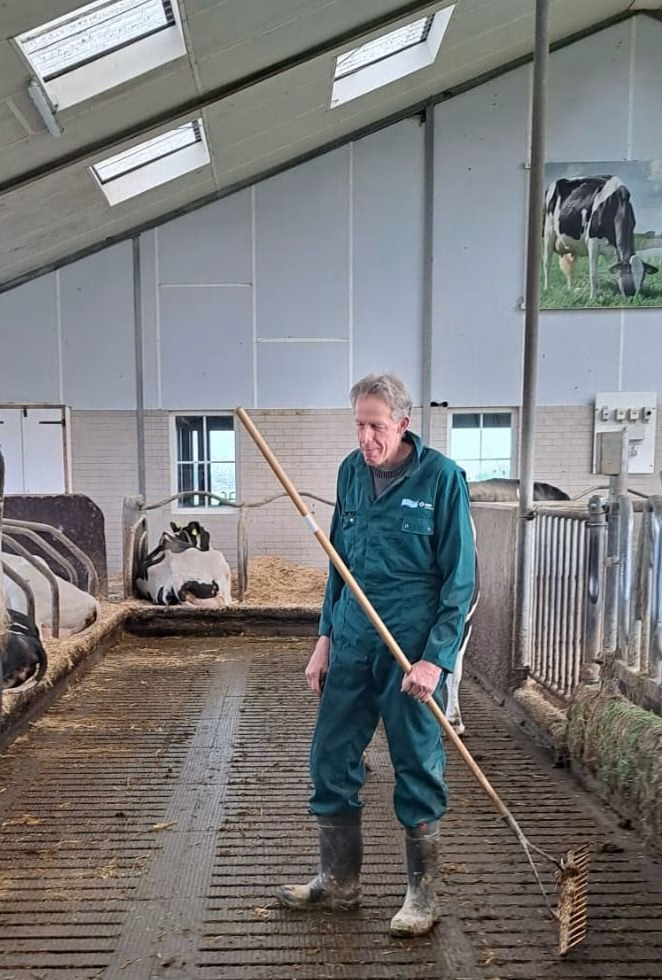
Even “on vacation,” Ed Bos reaches for a broom. The breeder behind 415 Excellent Holsteins and three Master Breeder shields at Bosdale Farms in Cambridge, Ontario, is pitching in at Bons Holsteins in Ottoland, Netherlands — the operation of Nico Bons, who trained under Ed as an 18-year-old in 1994 and has since bred 127 homebred Excellents and won the 2022 European Championship at Cremona. The mentorship started with clean barns. Three decades later, it still does. (Read more about Ed’s influence on Nico)

Ed Bos has been picking bulls the same way since he was a teenager at Bosdale Farms in Cambridge, Ontario: udders, feet, legs, and rumps. Not stature. Not dairy character. The rest of the industry spent fifty years rewarding tall, sharp cows — 415 Excellent-classified Holsteins and three Holstein Canada Master Breeder shields later, nobody’s calling it stubbornness anymore.

“We have always believed that breeding for a well-balanced high-type cow achieves the highest profitability,” the Bos family says. “An excellent cow is a good benchmark for longevity. We see our profitability per cow being maximized with cows that continue to keep themselves in the herd.” (Read more: Bosdale Farms: The Legacy Behind Canada’s Most Excellent Cows)
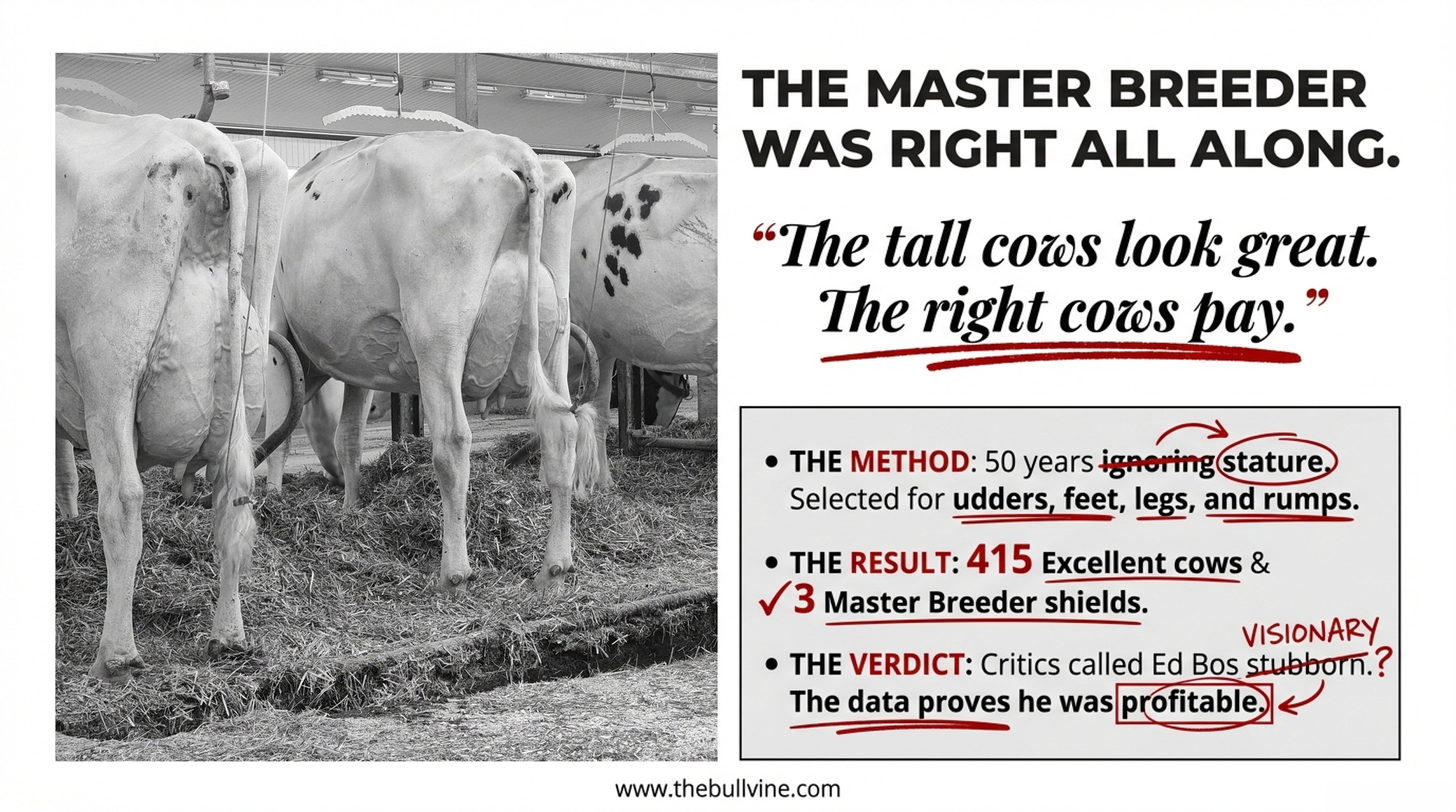
Then Dr. Jeffrey Bewley’s team at Holstein Association USA matched classification records against lifetime production data for over one million cows. The functional traits Ed Bos built his herd on — the ones that don’t win Grand Champions — turned out to be worth $2,678 per cow in lifetime revenue. The tall cows look great. The right cows pay.

What Did a Million Cows Actually Reveal?

Bewley brought a bias to the research — and he’s been honest about it. He figured conformation probably wouldn’t matter as much as breeders believed. Type traits felt to be softer than genomic predictions and production data.

His team — Lindsey Worden, Daren Sheffield, and Bewley — presented “A Million Reasons Why Conformation Matters” at the 16th Western Dairy Management Conference in March 2023, with the full report published at holsteinusa.com/typematters. They split over one million U.S. Holsteins spanning nearly 20 years into quartiles by first-lactation final score. Top quartile (82–89) versus bottom quartile (76 and below).
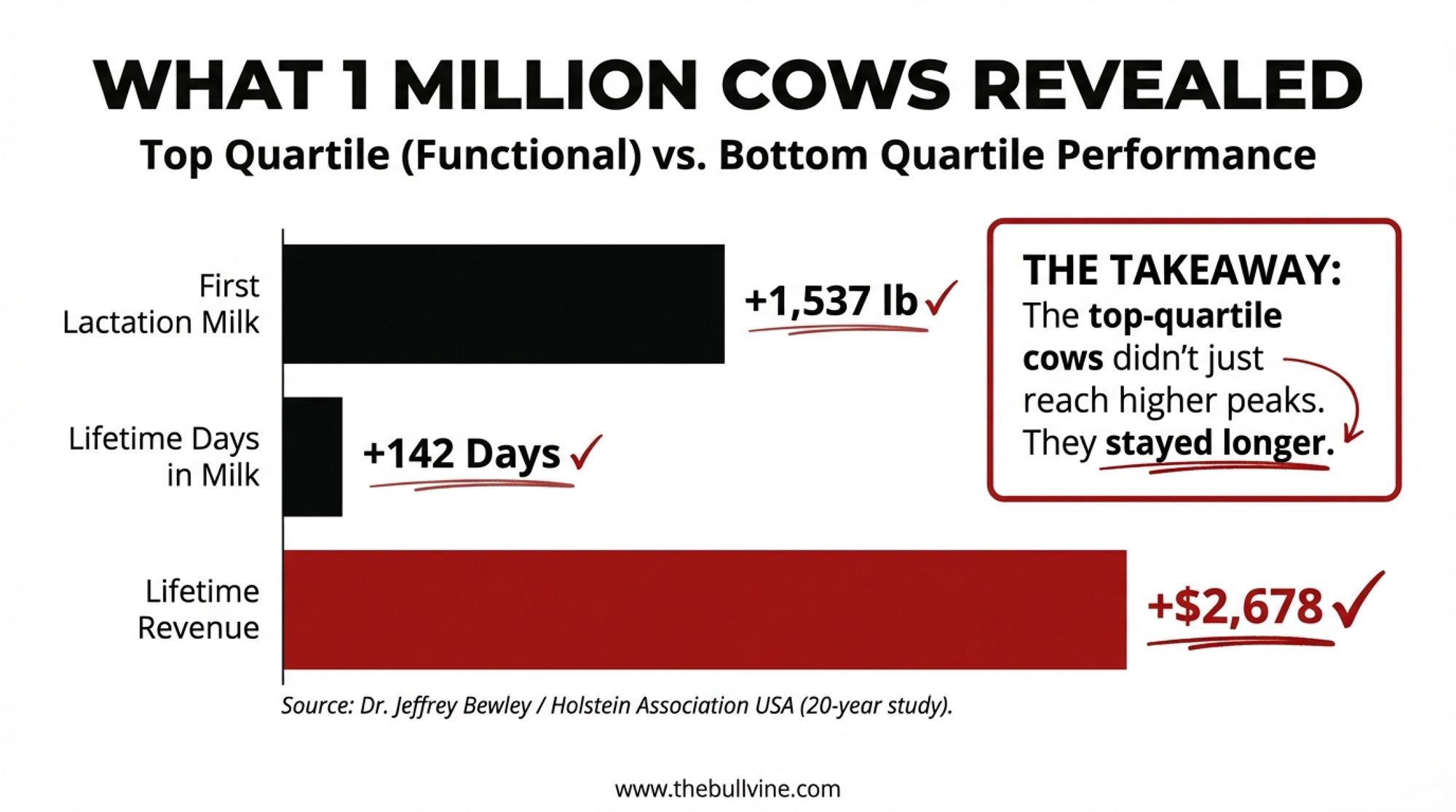
The gaps weren’t subtle:

  • 1,537 lb more first-lactation 305-day energy-corrected milk
  • 13,389 lb more lifetime ECM — approximately $2,678 in gross milk revenue per cow, using Holstein USA’s long-term milk price of $20/cwt
  • 142 more lifetime days in milk — nearly five extra months producing

The top-quartile cows didn’t reach higher peaks. They stayed longer. And the linear traits that kept them milking — udders and feet-and-legs — weren’t the traits that make classifiers or show judges stop and stare. They’re the ones Ed Bos has been quietly selecting for since the early 1970s.

Which Traits Keep Cows in the Herd — and Which Push Them Out?

If you’ve pulled your culling records and wondered why some of your highest-scored heifers don’t make it to third lactation, the answer is probably hiding in which traits earned those scores.

Trait CategoryKeeps Cows in the HerdPushes Them Out Early
Udder DepthShallow, well-attached (genetic correlation +0.31 with longevity)Deep, “floor-hugging” udders
Fore AttachmentStrong, tight fore attachmentWeak or loose fore attachments
Frame & Body DepthIntermediate frame / moderate body depthDeep-bodied, heavy-framed cows (correlation −0.15)
Rear UdderHigh rear udder heightLow rear udder height (worst when paired with angularity)
Feet & LegsStrong heel depth (top contributor to Pro$ in Alcantara 2022 study)Shallow heels / flat feet
CombinationWide chest + shallow udder + strong heelsDeep body + weak fore udder + angular (p < 0.0001)

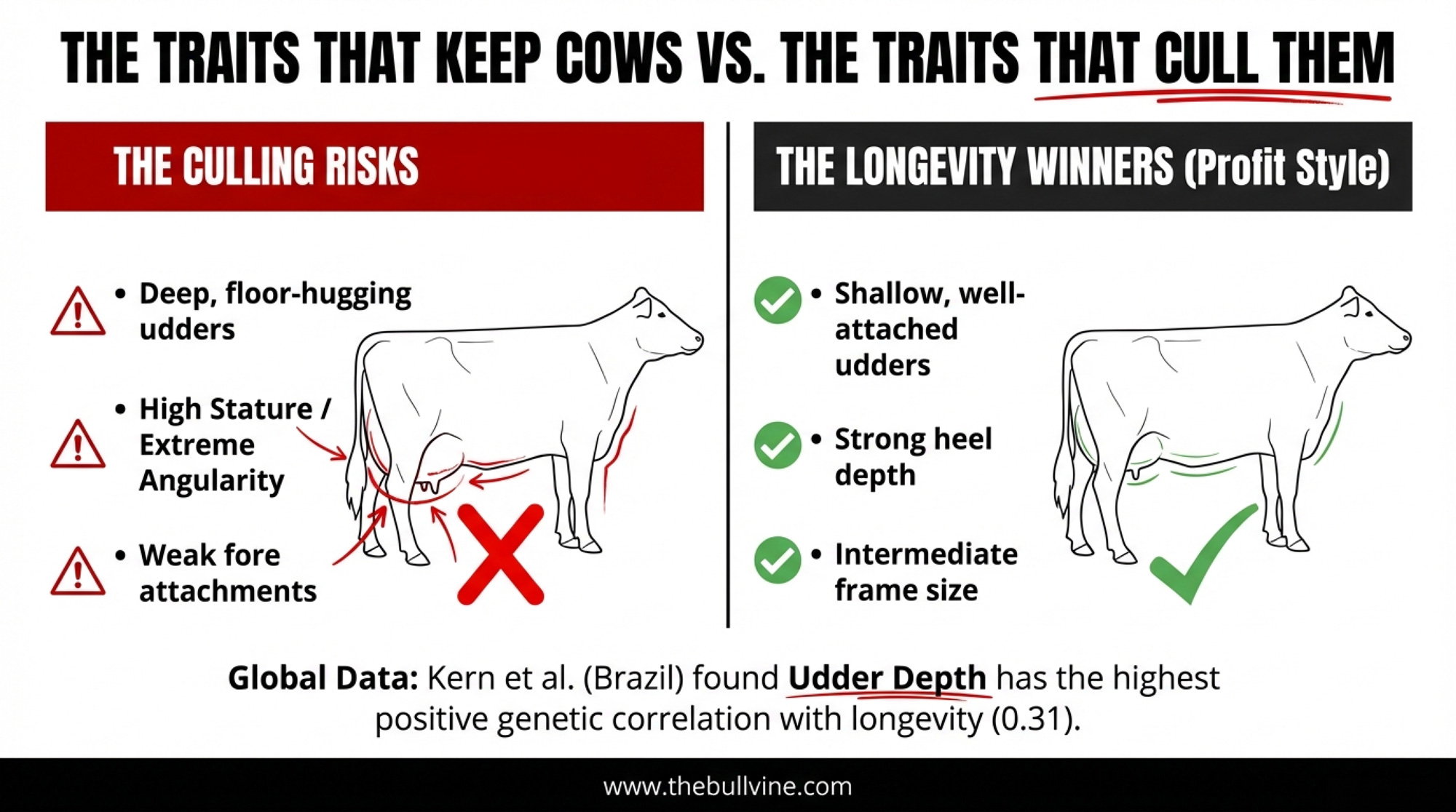
This isn’t a single study from a single country. Kern et al. (2015) studied Brazilian Holsteins born from 1990 to 2008. Setati et al. (2004) analyzed 34,201 cows in Southern Africa. Török et al. (2021) tracked 17,717 Hungarian Holstein-Friesians. The udder-trait findings held across all three:
The Longevity WinnersThe Culling Risks
Shallow, well-attached udder depthDeep, “floor-hugging” udders
Strong, tight fore attachmentWeak or loose fore attachments
Intermediate frame / moderate body depthDeep-bodied, heavy-framed cows
High rear udderLow rear udder height
Strong heel depthShallow heels / flat feet

Sources: Kern et al. (2015), Scientia Agricola; Setati et al. (2004), Tropical Animal Health and Production; Török et al. (2021), Animals.

Kern’s data is particularly telling: udder depth showed the highest positive genetic correlation with longevity at 0.31. Direct selection for longevity is painfully slow — heritability sits at just 0.05–0.07.

But udder depth is more heritable (0.23–0.26), measurable in first lactation, and provides a backdoor to longevity that direct selection can’t deliver efficiently.

Setati’s Southern African data reinforced the picture: genetic correlations between longevity and udder traits ranged from 0.22 to 0.48. The only notable negative correlations were with body depth (−0.15) and fore teat length (−0.07).

Török’s Hungarian data added the combination dimension. Three trait pairings showed the strongest effects on longevity (all at p < 0.0001): wide-chested, deep-bodied cows had the highest culling risk; weak fore udders paired with deep udders were the worst mammary combination; and very angular cows with low rear udder height showed the poorest survival.

When extreme angularity met a low rear udder, the result was worse than either trait alone predicted.

Brazil, Southern Africa, and Hungary. Same answer. The cow that stays isn’t the tallest — she’s the one with the best mammary and the strongest foundation.

THE STATURE TRAP: Why Your UDC Score May Be Lying to You

Here’s the part that doesn’t fit on a breed association poster.
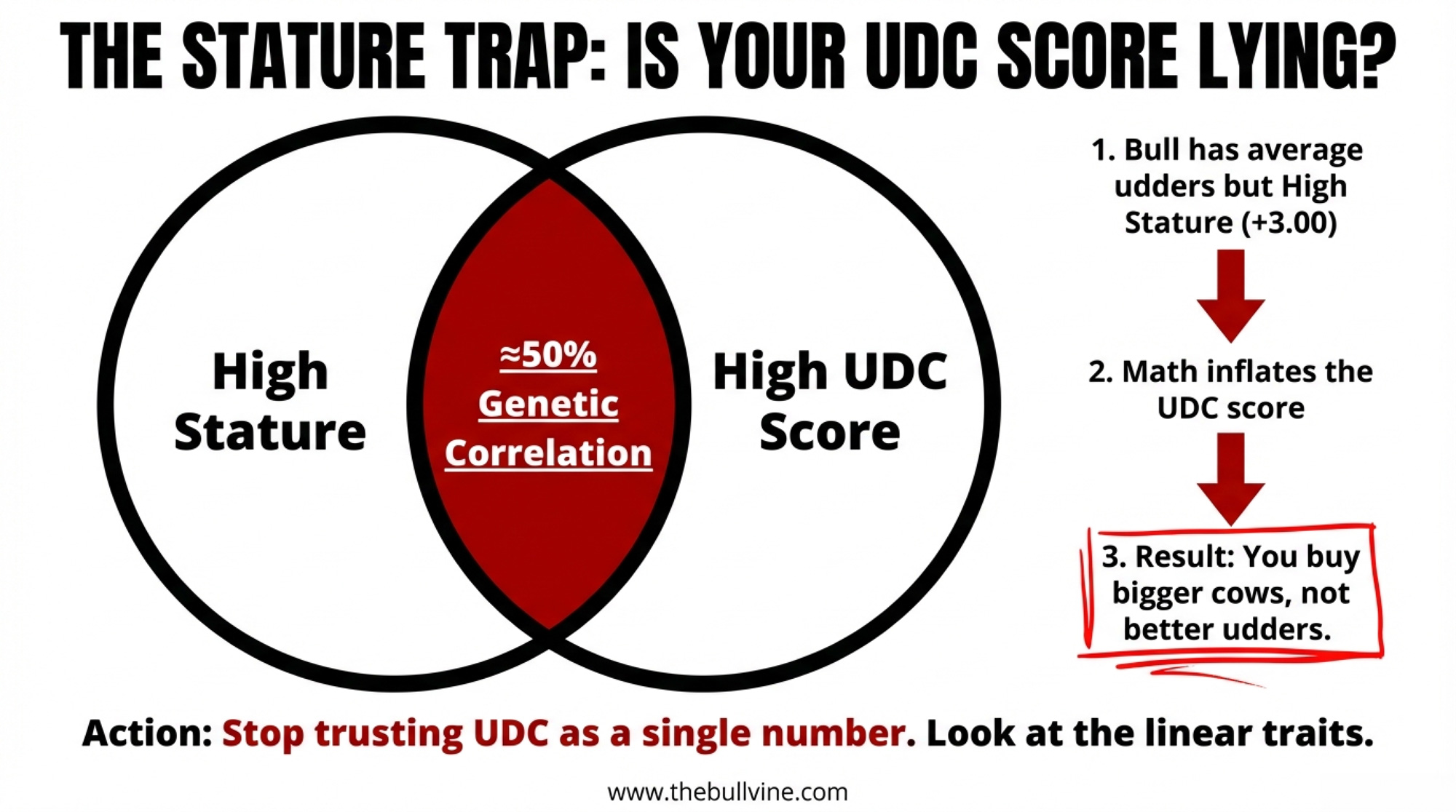
There’s a roughly 50% genetic correlation between stature and udder composite. If a bull is +3.00 for Stature, his UDC is likely inflated by the math, not necessarily by better-attached udders.

His daughters might score well for UDC simply because they’re tall, not because their mammary systems are functionally superior.

Nate Zwald demonstrated this at the 130th National Holstein Convention in St. Charles, Illinois, in 2015, when he served as general manager of Alta Genetics’ U.S. division. “It shouldn’t take a tall cow to have a good udder or feet and legs,” Zwald told the audience. “The correlation is still too high.”

Take three hypothetical sires — identical for production and health but differing by one point each on overall type, feet-and-legs, and udders. Their TPI rankings? Approximately 4th, 100th, and 1,000th.

The top-ranked bull didn’t necessarily sire better-uddered daughters — he sired taller daughters, and the correlation pushed his composites up.

“We think we are selecting for better UDC and FLC, but the unintended effect is that we are also making bigger cows,” Zwald said.

Holstein USA has tried to address this — the UDC formula includes a negative weighting for stature (−0.20) to offset the correlation partially. And in December 2024, they updated the stature linear scale from 51″–61″ to 55″–65″ to better reflect the current population.

Those fixes reduce the distortion. They don’t eliminate a 50% genetic correlation.

The fix on your end: Stop trusting UDC as a single number. Pull it apart. Look at udder depth, fore attachment, and rear attachment height individually. A bull with moderate stature and genuinely strong udder depth will keep daughters in your herd longer than a tall bull whose UDC is propped up by frame.

The Dairy Character Problem Nobody Wants to Name

And then there’s dairy character — the trait that’s quietly doing its own damage.
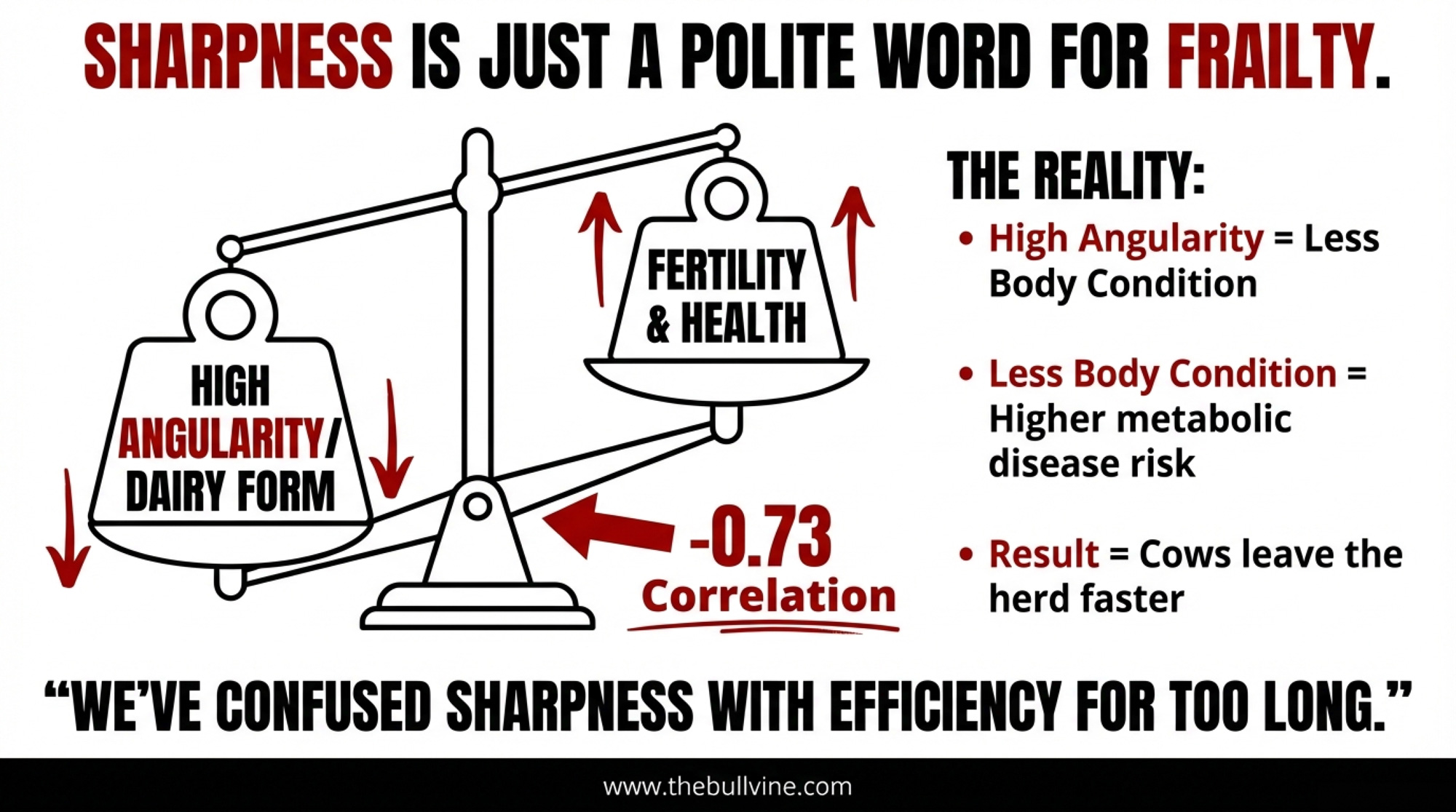
We’ve confused “sharpness” with “efficiency” for too long. Dechow et al. (2003, Journal of Dairy Science) documented a −0.73 genetic correlation between Body Condition Score and Dairy Form in first-lactation Holsteins. That’s not a mild tendency. Cows that score high for angular dairy character are genetically predisposed to carry less body condition, which elevates metabolic disease risk and hammers fertility.

The industry is starting to catch on. Kevin Jorgensen, senior Holstein sire analyst at Select Sires, shared in early 2025: “We’ve been focusing on moderating stature for over a decade, and there’s definitely a huge demand in the market for shorter cows.” Emily Bosch of Holstein Association USA acknowledged the shift: “We have also seen trends in the show ring start to align more towards selecting cattle that can be productive in real-world environments, including an increased emphasis on cows of more moderate stature.”

The April 2025 NM$ revision made it official. Body weight composite now carries a −11% emphasis — an active penalty on cow size. The show-ring cow and the commercially profitable cow have been diverging for years. The indexes finally say so out loud.

So when someone tells you a sharp, angular heifer “has great dairy character,” ask the follow-up: Does she have the body condition to transition well, or did we just breed a cow who looks the part but can’t hold flesh when she needs it most?

Does Body Depth Actually Drag Down Profit?
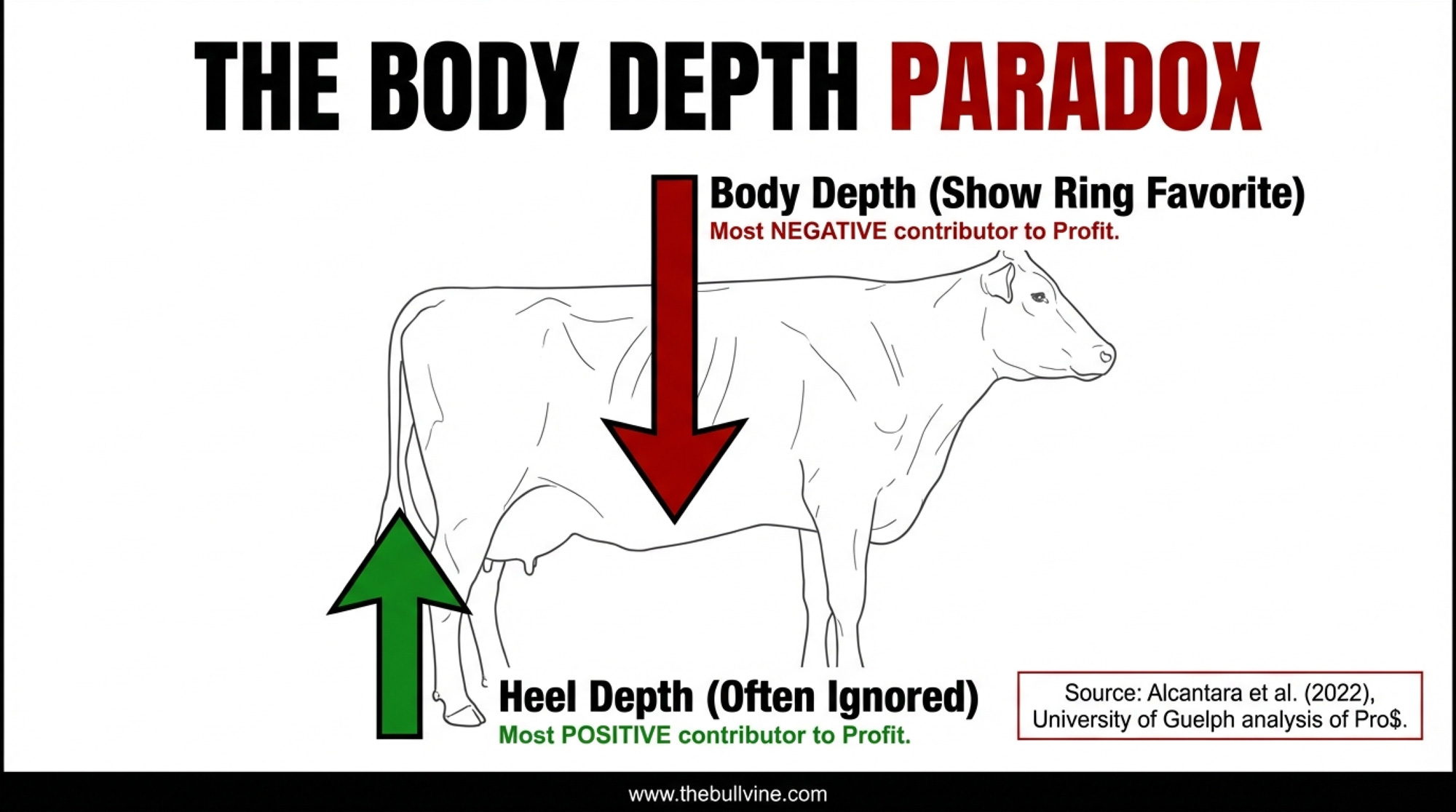
Alcantara et al. (2022) at the University of Guelph put the economics in black and white. They analyzed 9,351 proven Holstein bulls in the Canadian Journal of Animal Science:

  • Body depth = the most negative conformation contributor to Pro$
  • Heel depth = the most positive conformation contributor to Pro$
  • The model explained 72.5% of the variance in Pro$

The two conformation traits that move Canada’s profit index the most push it in opposite directions. Body depth — the trait the show ring rewards — is a drag on profit. Heel depth — the trait nobody talks about at ringside — is a profit driver.

Can You See This on Real Farms?
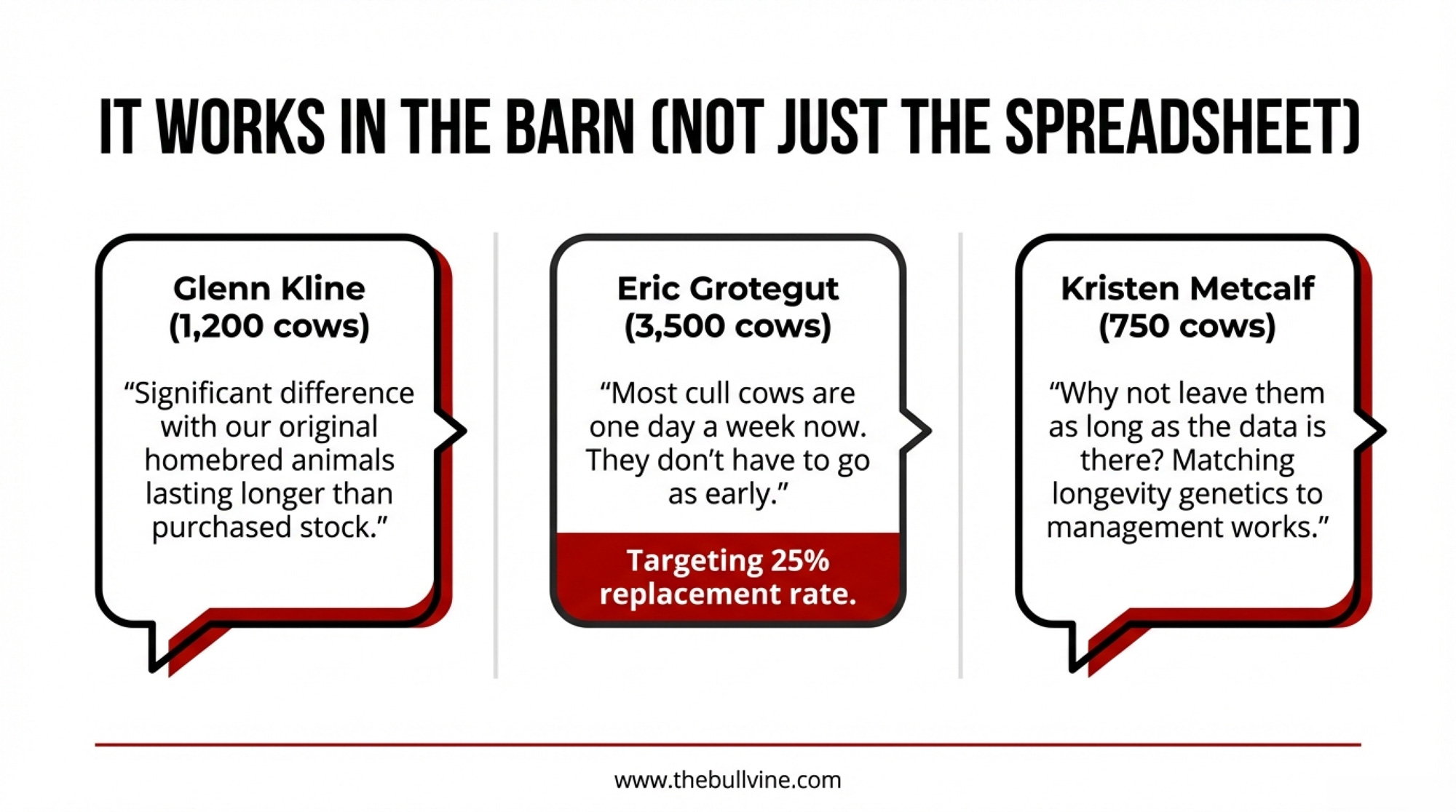
Last fall’s CDCB Industry Meeting at World Dairy Expo drew nearly 600 attendees in person and online. At the October 1, 2025, panel “Cows Can Live Longer — Are We Letting Them? ” three producers brought the receipts:

Glenn Kline — Y Run Farms, Troy, Pennsylvania — 1,200 cows. His family started genomic testing in 2011, and Kline credits that as the single farm change that most impacted longevity. When the farm expanded three years ago and bought outside animals, the homebred vs. purchased gap was impossible to ignore: “Boy, that’s made a huge difference in our herd. We did expand here three years ago, and we had to buy some animals in. There was really a significant difference with our original animals lasting longer.”

Eric Grotegut — Grotegut Dairy, Newton, Wisconsin — 3,500 cows. Named IDFA and Dairy Herd Managementmagazine’s 2025 Innovative Dairy Farmer of the Year, he’s targeting a 25% replacement rate. “Fifteen to 25 years ago, it seemed like I was selling cows every day; lameness, mastitis, and pneumonia… there was something all the time. Now, most cull cows are one day a week. They don’t have to go [as early].”

Kristen Metcalf — Glacier Edge Dairy, Milton, Wisconsin — approximately 750 cows, predominantly registered Jerseys. The Metcalfs built the farm from scratch in 2017, starting with 300 Jerseys and doubling the herd after completing a barn expansion in October 2023. Metcalf stresses matching longevity genetics to each farm’s management: “We have different dairy farms, we have different preferences, and we have these great new technologies and tools that let us filter for the traits we want. Why not leave them as long as the data is there?”

Three different operations — 750 to 3,500 cows, Jerseys and Holsteins, Pennsylvania and Wisconsin. None of them talked about stature. All of them talked about functional traits and management.

The Replacement Math That Makes This Urgent

The cost of getting longevity wrong has never been higher.

Lactanet mapped the “lifetime profit curve” for the typical Canadian Holstein. According to Allison Fleming and Brian Van Doormaal, the average Holstein reached breakeven — complete repayment of all costs incurred from birth — at 40 months of age, typically during her second lactation. Every lactation after that is where the money stacks.

Pro$ data makes the sire-selection piece concrete. Relative to daughters of middle-ranked sires, 7.4% more daughters of top Pro$ sires stayed in the herd for six years, while 6.0% fewer daughters of bottom Pro$ sires made it that far.

Among surviving daughters, the top group generated an extra $1,300 in accumulated profit compared to the average. The bottom group earned $1,200 less. A $2,500 swing — top to bottom — from one generation of sire decisions.

And replacement costs? In Wisconsin, dairy replacement prices jumped sharply from October 2023 to October 2024, moving from $1,990 to $2,850, according to USDA data. By July 2025, USDA’s Agricultural Prices data tracked by CoBank showed the national average had climbed to $3,010 per head — a 164% jump from the April 2019 low of $1,140.

Top dairy heifers in California and Minnesota auction barns were bringing upward of $4,000. Penn State Extension’s heifer cost analysis (2016–2021 FINBIN data) found average rearing costs of $1,709 per head for Midwest farms and $2,034 for Pennsylvania farms, with a range of $1,411 to $2,301 depending on efficiency.

The Barn Math: What Half a Lactation Is Worth
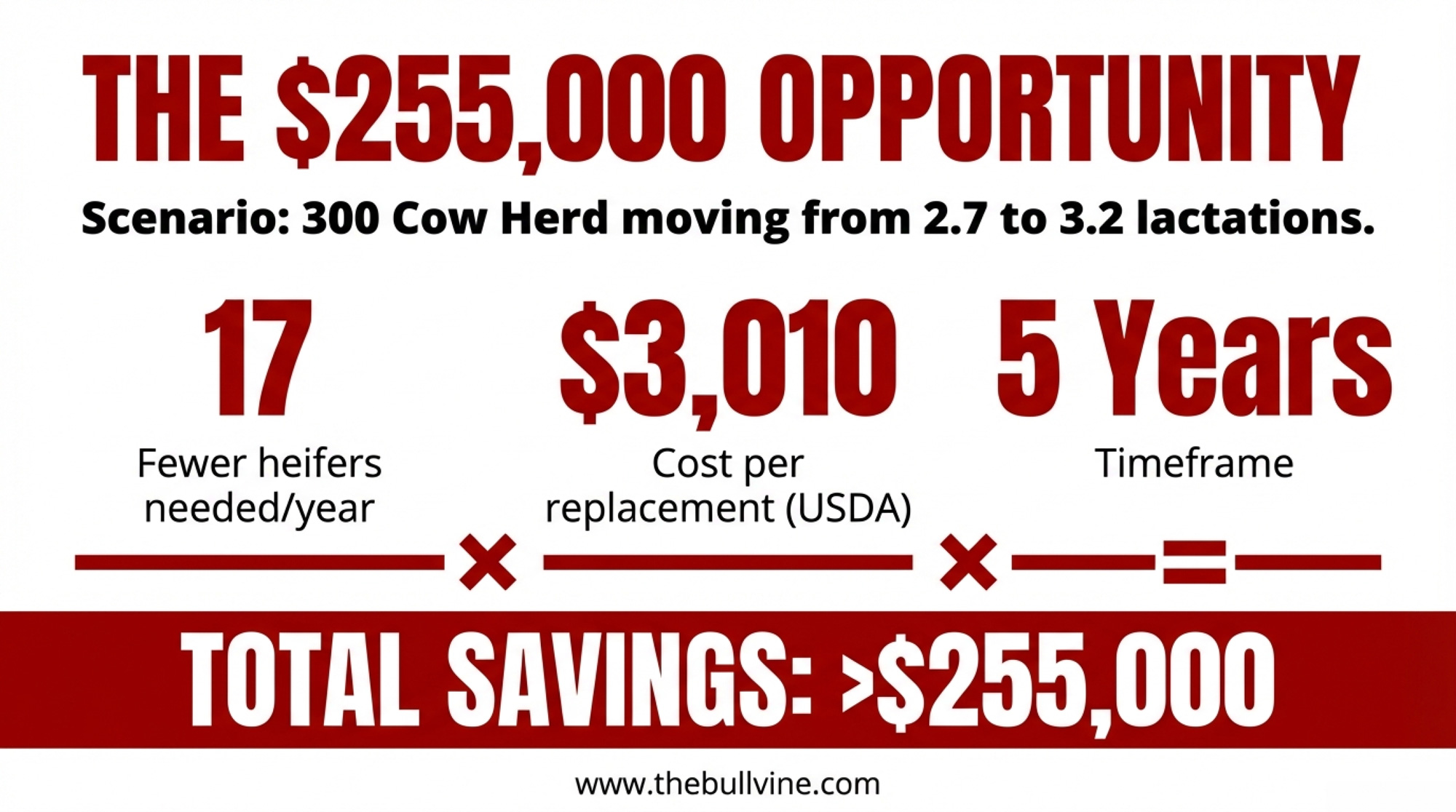
MetricBeforeAfterDifference
Herd size300 cows300 cows
Average lactations2.73.2 (+0.5)
Annual replacements needed~111 head~94 head~17 fewer/year
5-year replacement savings (at $3,010/head, per USDA July 2025)>$255,000
Extra mature-cow milk revenueAdditional — not counted above

That’s roughly 17 fewer heifers to buy or raise every year. Over five years, approximately 85 fewer replacements. At $3,010 per head, you’re looking at more than $255,000 in avoided replacement purchases — and that doesn’t touch the extra milk revenue from cows producing in their higher-yielding third and fourth lactations.

Grotegut’s 25% replacement target is exactly this math in action.

The Dutch show what a national commitment to longevity looks like at scale. In CRV’s 2022–2023 milk recording statistics, culled Dutch herdbook cows averaged 38,327 kg (84,500 lb) of lifetime milk with a lifespan of 2,255 days— both record highs.

Can a VG-87 Cow Outproduce an EX-90?

The Holstein USA study didn’t say type doesn’t matter — it said the opposite. Functional conformation is directly tied to lifetime production. Classification works.

But the industry has a stature addiction. Two cows can both classify VG-85 and have completely different longevity prospects, depending on whether their points came from udder depth and strong attachments or from stature and angularity.

Your classification summary tells you the final score. It doesn’t tell you where the score came from — and for longevity, the source matters more than the total.

The major indexes have been shifting in this direction. The April 2025 NM$ revision boosted Feed Saved to 17.8% of total emphasis and increased fat to 31.8%. Canada’s Pro$ was designed from the start to maximize daughter profit to six years of age. Lactanet incorporated feed efficiency into LPI and Pro$ in December 2022.

The indexes aren’t perfectly aligned with the research yet — stature’s pull on composites persists — but the trajectory is clear.

Ed Bos’s approach to the semen tank is blunt: “I always use the best bulls available. The cheapest money you can invest is buying good semen.” But he’s particular about which bulls. “We will rarely use a bull that does not have a daughter proof. It takes many generations to build up a good breeding cow family, and too much is sacrificed by using a lower reliability bull.”

It’s a conservative approach. Genomic young sires offer faster genetic gain at lower cost. But Bosdale’s 415 Excellent cows and three Master Breeder shields suggest that patience pays off for herds building multi-generational cow familieslike the Portrait and Barbie lines.

If speed of genetic gain is your priority, genomics is the play. If you’re building a cow family where every generation needs to hold up, the Bos approach makes sense.

What This Means for Your Operation
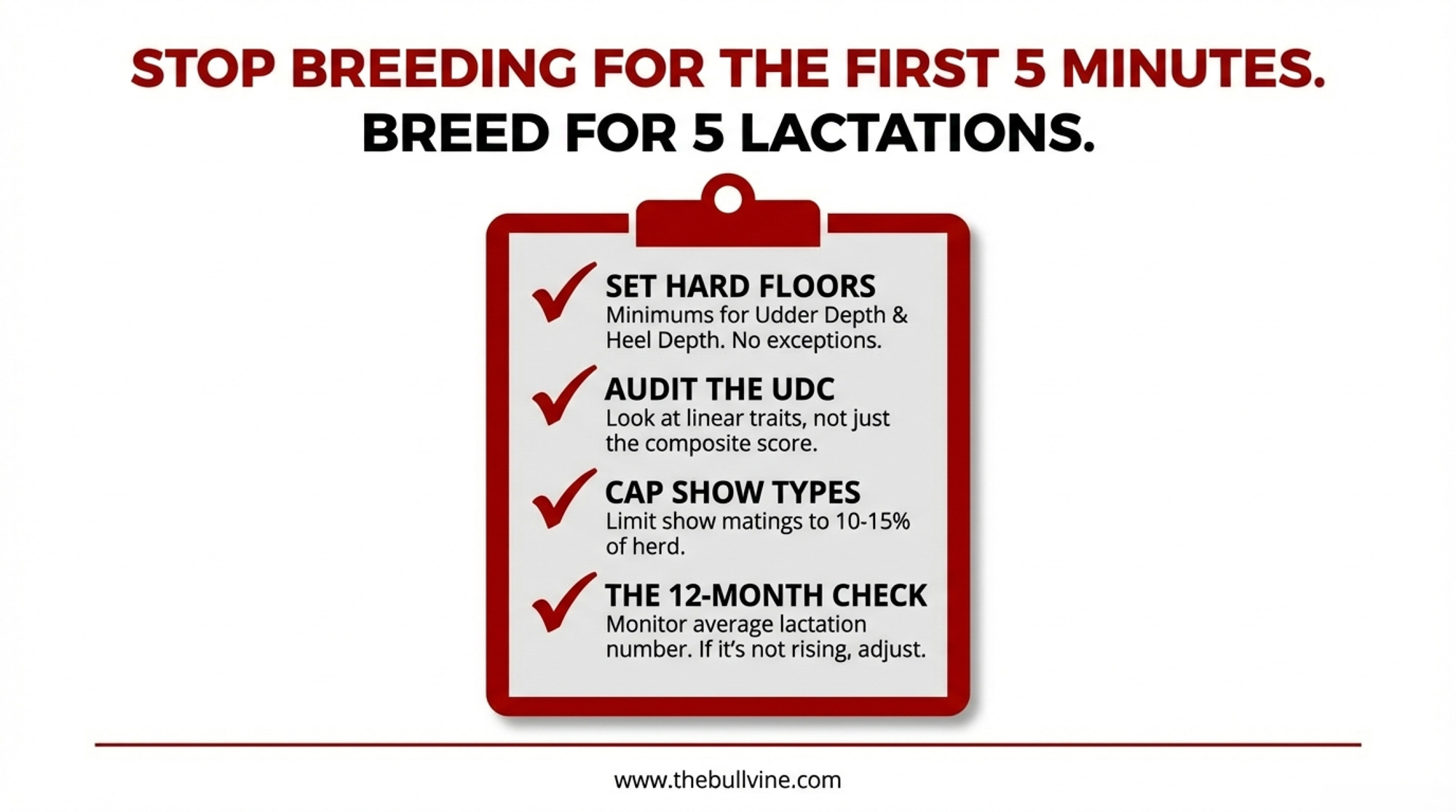
  • Set functional floors on every sire order — and don’t waive them. Before your next breeding cycle, establish minimums for udder depth, fore attachment, heel depth, and productive life. Don’t break them for stature or dairy character, no matter how good the index looks. The trade-off is real: pulling apart composites adds complexity to sire selection. Most of us use UDC precisely because it simplifies things. But simplicity that masks functional weakness isn’t simplicity — it’s a blind spot.
  • If you sell breeding stock, run both lenses. You may need some show-type sires for marketable females — but even those bulls should carry acceptable udder depth, fore attachment, and PL above 3.0. Limit that portion to 10–15% of matings and resist the drift toward letting it take over.
  • If you’re building cow families, Bosdale’s 50-year record was built on udders, feet, legs, and rumps — not stature. Genomic testing can accelerate that timeline. Kline’s Y Run Farms has seen it since 2011.
  • Your 30-day action: Pull your most recent classification summary this week. Identify where your UDC and FLC averages are really coming from — stature inflation or genuine functional quality. Set minimum thresholds on your next sire order based on what you find.
  • Your 90-day check: Compare your new sire shortlist to last year’s. Did your average udder depth and heel depth PTAs actually move — or did you talk yourself back into stature?
  • Your 12-month audit: Compare your herd’s average lactation number this time next year. Did it move? If not, revisit your sire thresholds and ask whether the traits you’re selecting for are the ones that should disqualify bulls from your shortlist.

Key Takeaways

  • If your UDC looks great but cows leave early, stature is masking weak udders and feet. Start reading the linear traits first.
  • If your herd averages under 3.0 lactations, adding just half a lactation can be worth >$255,000 over five years on 300 cows.
  • If you’re still chasing body depth in sire proofs, you’re paying for it twice — once in Pro$ and again in replacement costs.
  • If you want banners and cows that last, cap show-type matings at 10–15% and put hard floors under udder depth, heel depth, and PL.

The Bottom Line

Ed Bos didn’t need a million-cow study to tell him what a profitable cow looks like — he just needed to look at who was still in the barn at age ten. The data has caught up to the master breeders. The question for the rest of us: Are we breeding cows for the first five minutes in the show ring, or for the five lactations that actually pay the bills?

Complete references and supporting documentation are available upon request by contacting the editorial team at editor@thebullvine.com.

Learn More

The Sunday Read Dairy Professionals Don’t Skip.

Every week, thousands of producers, breeders, and industry insiders open Bullvine Weekly for genetics insights, market shifts, and profit strategies they won’t find anywhere else. One email. Five minutes. Smarter decisions all week.

NewsSubscribe
First
Last
Consent

Ideal Rump Structure – Does It Actually Matter?

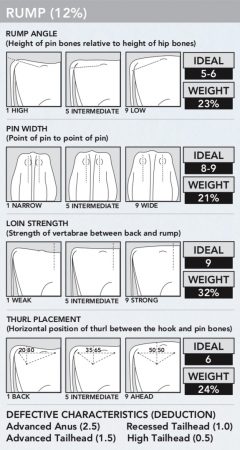
Classifiers and show judges evaluate and compare cow body parts for their structure according to the breed conformation scorecard and breed ideals. Yet, yield and profit focused breeders and A.I. are now selecting based on the proven science of the functionality of body parts. This Bullvine article addresses the documented facts on Holstein cows’ rumps. Which rump traits need to be left behind? Which rump related trait indexes need to be used in over ninety percent of dairy herds when selecting and mating sires?

Source: Holstein Canada

What Do Breed Ideal Rumps Look Like?

Both US and Canadian Holstein Breeds describe the ideal rumps as being long, wide, pins slightly lower than hips, neither anus or tailhead recessed, freedom from coarseness, etc. … so as to have rumps that facilitate easier calvings and that assist with improved cow fertility, healthy recovery after calving and increased cow longevity. 

But do those descriptions hold up, when it comes to what happens in the field?

Additionally, which is the correct emphasis on the rump – US at 5 point out of 100 or Canada at 12 points? In the showring it is the author’s observation that judges often place more than 20 points on the rump when giving reasons for their class placings.

The Evolution of Holstein Rumps

Very old cow pictures often show cows that were very, even extremely, sloped from hips to pins. Somewhat like what we see in today’s native wild deer populations.

By the early to mid-twentieth century the desired rump was wide, pins level with hips and tail heads between the pin bones on cows of about 53” – 55” in stature.

Then it was decided that Holstein cows needed to be taller. Much taller by the 1980’s. This tallness and the popular bloodlines seem to have brought with them narrower animals, narrower rumps or smaller pelvis openings and more difficult birthing. An added negative was that breeders wanted larger calves, feeling that larger birth size lead to larger mature animals. In fact, that is not universally the case.

Thank goodness reason is winning out for moderated stature and what size healthy calves need to be.

What Do Results Say About Today’s Ideal Rumps?

Published Canadian (CDN) genetic correlations provide information on rump traits that dairy breeders need to be aware of. These results are based on 4,182 Holstein sires proven between 2003 and 2018.

The genetic correlations to longevity (Herd Life) by the classified traits are: rump angle (0.12), pin width (-0.08), loin strength (0.04), thurl placement (0.18) and overall rump (0.15).

The genetic correlations to fertility (Daughter Fertility) by classified traits are: rump angle (0.04), pin width (-0.06), loin strength (-0.10), thurl placement (0.06) and overall rump (-0.01).

Remember that the breed societies say the ideal rumps lead to improved longevity and fertility – but with those low correlations it just isn’t so.

The conclusion this author draws is that the rump traits, as captured by the type classification programs, do not contribute positively to either longevity or fertility in Canadian Holsteins. Correlations using US data do not appear to be available on the www.

How Important Are Rumps?

How often in a cow’s lifetime can rump structure be a limiting factor?

Consider a cow that first calves at 23 months and completes four lactations and is removed from the herd at 75 months of age. Put on a functioning basis, this means she calves on four days (0.002% of her days), walks on her feet and legs for 2280 days (100% of her days), milks for 1430 days (62.7% of her days) and is dry for 150 days (6.5% of her days).

Draw your own conclusions. However for this author rump structure ranks far far behind feet and legs (foot structure, rear-legs-rear-view, flex of hock and mobility) and mammary system (depth, cleft, teat placement and attachments) when it comes to deserving attention when selecting sires to be used in herds that focus on profitably producing milk solids.

What Really Counts in Rumps?

Rumps that function best allow for quick, easy births, fast recovery of the mother and a healthy calf with minimal stress. For the dam side of this, it is best measured by farmer supplied measurements on her calving ease – Daughter Calving Ease (USA) and Daughter Calving Ability (CAN). For the calf side of this the sire’s calving ease is important – Calving Ease (USA) and Calving Ability (CAN). In the USA, CA$’s are published for animals which combines information on both calving ease and stillbirths.

The Canadian correlations for proven sires, for the study referred to above, are as follows: for longevity (Herd Life) with sire calving ability (0.25) and daughter calving ability (0.43); and for fertility (Daughter Fertility) with sire calving ability (0.14) and daughter calving ability (0.40).

By a considerable amount (2x to 10x) daughter calving ability is a superior index to all the classified rump traits in predicting longevity and fertility in Canadian Holsteins. Although farm captured data does not exist for calf health at one week of age, it is likely that daughter calving ability is at least moderately correlated to calf health and wellbeing.

Why the Fixation with Rumps?

The short answer may have two parts:

1) Tradition – when other more accurate measures were not available, then visual observation of the exterior was the best tool available; and

2) Sight line and proximity – breeders’, classifiers’ and show judges’ eyes, when viewed from the rear of an animal, are at the same level at the rump.

Take Home Messages

  1. Daughter Calving Ease (DCE or DCA) is the best predictor that currently exists for the best rumps.
  2. Holsteins are improving for Daughter Calving Ease, but breeders will be well rewarded for continuing to use sires that are rated above average for CA$, DCE or DCA.
  3. The bull Oman was a great help for the Holstein breed being able to reduce calving difficulties.
  4. AI. organizations publish CE’s and DCE’s for their sires and most no longer sample or market sires that leave calves that are born with difficulty.
  5. Sire rump type indexes are not good predictors of daughter calving ease.

The Bullvine Bottom Line

Current Holstein breed ideals and standards for rump structure and the emphasis placed on rumps in the type classification programs are only of quite limited value for most herds. Outside rump appearance bears little value in predicting calving ease, longevity and fertility.

Conformation evaluations need to include the functioning of the body part and not simply the appearance. Rumps could be a good place for breeds to start in revamping their type classification programs in order to remain relevant to tomorrow dairy farmers’ needs.


Get original “Bullvine” content sent straight to your email inbox for free.


[related-posts-thumbnails]


Does The Current Conformation Evaluation System Work for Commercial Breeders?

Go to a commercial dairy cattle sales barn, anywhere in the world, if you want to get the low down on what successful milk producers want in the physical traits of the cows that they bid on.

At one time, you would have heard that udders were #1. However, with conformation progress, udders have been significantly improved and have been lifted to hock level in mature cows. It is likely that feet and legs are now #1 when it comes to selection. But do these breeders have good information on which to select for mobility?

Do Breeds Care about Commercial?

That’s a fair question. Do Holstein breed organizations care about what commercial dairy people want the conformation of their cows to be? The answer is, “Apparently; they don’t care!”, as proven by the fact that stature, height at shoulder, depth of rear rib and excessive angularity get an extra reward by type classification programs the world over.  This state of affairs is not surprising since type classification programs around the world have been modeled after the US and Canadian systems, where marketing often far outranks animal improvement in the use made of the information.

Other breeds may not be as obsessed with these ‘pretty’ traits, but they still want them.

Holstein US has acknowledged that there are strong positive correlations between stature and final class and stature and udder composite but, so far, it is an acknowledgment, not a plan to change. Why is that? Could it be that tradition overrules what the cows of the future need to be?

In Canada, Holstein Canada type classifies all the dairy breeds, so the other breeds will get the Holstein goal of tall cows, by proximity, if for no other reason.

I leave the final answer to The Bullvine readers to say if breeds really do care about the conformation of cows in commercial dairy breeders’ herds.

Commercial Dairy Breeders’ Needs

The Bullvine addressed this question in the article, Are You Breeding For The Correct Conformation To Produce The Greatest Lifetime Profit? From our discussion with the three breeders in preparing that article the take home message on conformation we got was:

  • The current ideal cows for breeds are not their ideal cow for conformation
  • Stature is a detriment, not an asset
  • Udders need to be what robots can milk
  • With cows milked 3x (or even 4-5x in robots) udders don’t need to be large
  • Mobility and no maintenance, not feet & leg structure, is what is needed

The Bullvine has produced other related articles on ideal commercial cow conformation including She Ain’t Pretty She Just Milks That Way and What’s Needed In Type Beyond Udders, Feet, And Legs?

So, if breed type classification programs are not concerned about serving the commercial dairy breeders when it comes to conformation evaluation what alternatives are there?

What Alternatives Are There?

Here are some alternatives to using the current type classification programs available to commercial dairy breeders:

  1. Stop classifying
  2. Stop breeding for conformation
  3. Ask breeds to immediately change the programs
  4. Ask breeds to initiate a program that only collects descriptive/linear traits on key traits
  5. Only use the information that A.I. or other companies collect for conformation

Do any of these work for you?

A.I. Caught in the Middle

At one time, some A.I. companies collected their own conformation information, and they published the breeding tendencies of their bulls.

However, for approximately forty years A.I. companies have supported and used the results from the type classification programs to select young bulls and promote their sires’ daughters.

Unfortunately, the kicker is that high PTAT or CONF are not correlated with high lifetime yields in milk producing herds.  A.I.’s are therefore caught. They use information that their primary customers do not see the benefit of having.  

This trend is also seen in the new wellness traits introduced by Zoeits.  For many commercial breeders the current CDCB official evaluations that included parentage, production, reproduction, health and type data was not accurately predicting the actual lifetime profitability of their animals.  Zoetis used on farm data that was not typically used or accepted by CDCB to introduce mastitis, lameness, metritis, retained placenta, displaced abomasum, and ketosis traits.  (Read more: The Complete Guide to Understanding Zoetis’ New Wellness Traits – CLARIFIDE® Plus and Can you breed a healthier cow?

What about Electronic Imaging?

Today with new exciting and very useful technology coming out almost monthly, why not consider something for electronically capturing animal conformation at the farm level. Surely, it’s possible.

I can see it now! A camera in the milking parlor or milking stall that snaps multiple pictures or records a video of animals. The images are uploaded to a data base where special software does the analysis. In parlors, it would probably work best in exit lanes where cows could be funneled through in single file. With single box robots, it could be done just after the cow is prepped.

“Not possible” some would say. Electronic imaging works in every other industry so, why couldn’t it work for cattle conformation evaluation? Of course, there will be naysayers, but there are always those people in the world. If it is not breed ‘approved’ so what? If it does the job to help with animal improvement, nothing else is needed.

The newest generic software in this area is very versatile, and it learns quickly. The software initially uses experts to give it “lessons,” but then it begins to build on those lessons. For this, a cow’s ID would be linked to her performance, and health data and a database would soon be created to connect the dots between “physical” traits and performance and/or health data. Some software is already in development in this area (i.e. lameness), but there are other great possibilities for the future.

By the way, this type of a system was talked about twenty years ago by breeds, but it was nixed as it presented the possibility of eliminating or redefining classifiers’ jobs. Breed organizations were not prepared to accept that technology could replace human judgment.  Politics won out over cost, service and animal improvement. Today I feel that more consideration needs to be given to the opportunity for more accurately capturing data and enhancing assessments using traits information from all traits, not just conformation traits.

What Evaluations would be Possible?

The list could, in time, be long but to start with here are a few:

  • Udder depth and udder cleft
  • Teat length and teat placement
  • Udder attachments
  • Feet, Pasterns, and Legs
  • Mobility (video or series of pictures)
  • Thurl location, Slope of Rump,
  • Stature, Body width, and depth

What else could happen?

In time, such an automated system would be able to decide how best to evaluate and combine the data captured. If we limited that data to only certain traits we would not get the advantage of artificial intelligence from the software and imaging system. The equipment could take 1000 images on each pass and then scrutinize them to match body parts up to performance and health traits.  A trained machine would be very quick, accurate and cost effective.

Commercial breeders would have more data than they ever imagined possible. Furthermore, a common software and data system could be used worldwide so that dairy cattle improvement organizations could easily share data. Organizations could focus on providing breeders with accurate information and avoid the expense of harmonization.

It could even go further. Going beyond only cows to doing heifers could be helpful for all non-mammary traits, as well as to monitor structural development. The data could even be used on young calves to match genomic data.

Who Would Do This?

To start with, it would take some venture capital for research and development. After that, it could be any interested party, independently or in collaboration with others. In short, it would be individuals or organizations that saw a benefit to having accurate, unbiased conformation evaluations for genetic indexing and animal mating purposes.

It could be an add-on to services offered by milk recording, breed organizations, A.I. companies, milking equipment companies or animal health companies. Perhaps it could even be a company like Google.

The Bullvine Bottom Line

Breeders need relevant and accurate evaluations and indexes for making the best possible mating decisions for their herds. Much of the current information for conformation supplied by breed type classification programs is not suited to the needs of commercial dairy cattle breeders. Alternative means for evaluating and capturing cow and heifer conformation data needs to be given serious consideration.


Get original “Bullvine” content sent straight to your email inbox for free.


[related-posts-thumbnails]

Two New EX-94 Cows at Oakfield Corners Dairy


15235496_1797210850547264_3205687970440296094_o1

PENLOW GEOGRAPHY GOLDWYN Now EX-94

Oakfield Corners Dairy shares the following classification highlights including two new EX-94 cows  DUCKETT-SA BRAXTN FRISCO-ET and PENLOW GEOGRAPHY GOLDWYN

         
EX-94 EEEEE DUCKETT-SA BRAXTN FRISCO-ET   Braxton X EX-97 Frosty
EX-94 EEEEE BELLA-ROSA GW SARA-ET   Goldwyn X EX Linjet X EX-95 Spendide Spirit
EX-94 EEEEE PENLOW GEOGRAPHY GOLDWYN   Goldwyn X EX Dragoon X VG Clyde
EX-93-2E EEVEE PENN-GATE DENISON FINAE   Denison X EX Gibson X EX-94 Finely
EX-93-2E EEEEE OAKFIELD REALITY HARMONY-ET   Reality X VG Advent X EX-96 Hazel
EX-92 EEEEE CRAIGCREST RUBIES RACHELLE-ET   Goldwyn X EX Dundee X EX Carlton
EX-91-2E EEEEE OCD SANCHEZ ESTHER-ET   Sanchez X VG Dundee Esmeralda X EX-93 Emarald
EX-90 VEVVE OAKFIELD ATW BITTERSWEET-ET   Atwood X EX-92 Outside Brynn X EX-92 Storm Bailey X EX Brooke
EX-90 VEVVE KEVETTA RDBRST LUCIOUS-RED   Redburst X EX Reality X EX Advent
EX-90 EEEVE BUTZ-HILL MAGICAL MISSY-ET +2390 McCutchen X VG Man-O-Man X VG Dolman X 2E-95 Gold Missy
EX-90 EEVVE OCD LAVANGUARD TOOTSIE-ET   Lavanguard X EX Advent X EX-97 Tamara
EX-90 EEVVE LARCREST COLOGNE-ET +2272 Epic X EX-92 Crimson X VG Cosmopolitan
EX-90 EEVVV OCD DAMION SARA RAE   Damion X VG Talent X EX Linjet
VG-88 EEVVV OAKFIELD GW ATWOOD DAISY-ET   Atwood X EX Dundee X EX Durham X EX Juror
VG-88 +VVVE OCD MOGUL JENNA FISCHER-ET +2445 Mogul X EX Goldwyn Fame X EX Durham
VG-87 VVVVV OAKFIELD ATWOOD BRAYDEN-ET   Atwood X EX-92 Outside Brynn X EX-92 Storm Bailey X EX Brooke
VG-87 VVVVV OCD ABSOLUTE LIBERTY-RED-ET   Absolute X EX Advent Lyndi X EX Form Laura
VG-87 VV++V HOVDEN OCD SPRINKLE-ET   Sid X 2E-94 Sara
VG-87 VVVVV OAKFIELD ATWOOD DIVO-ET   Atwood X EX-94 Durham Dawn X EX Luke Rapture X EX Raven
VG-87 VVVVV OCD GOLD CHIP ELLIE-ET   Gold Chip X EX Terrason X EX-95 Electra
VG-86 VVV+V OCD MAGNUS FOREVER YOUNG-ET +2295 Magnus X EX Goldwyn Fame X EX Durham
VG-85 VV++V OAKFIELD-BRO AT FLAYVOR-ET   Atwood X EX Storm Flirt X EX-95 Finesse
VG-85 VV+GV OCD HALOGEN FANTASY-ET +2393 Halogen X VG Mogul Free Willy X EX Fame
VG-85 +VG+V OCD HALOGEN MS FRISCO-ET +2425 Halogen X VG Mogul Fuji X EX Fame
VG-85 V+G+V OCD JACKMAN BARBIE-ET +2277 Jackman X VG Observer X VG Shottle
VG-85 VV++V OCD MACK HAVEN GARNER-ET +2382 Mack X VG Snowman X VG Planet Aloha
VG-85 VVV+V OAKFIELD MCCUT BLUEPRINT-ET   McCutchen X EX-92 Outside Brynn X EX-92 Storm Bailey X EX Brooke
VG-85 VV++V WCD-ZBW SUPERSIRE LOVEY-ET +2504 Supersire X EX Goldwyn X VG Shottle
VG-85 VV++V HMM DAY AVERY-ET +2378 Day X GP Observer X VG Shottle
VG-85 VV++V MISS OCD MAYFIELD DULCE-ET +2406 Mayfield X EX-93 Danica X VG Elegant
GP-83 VG-MS OCD KINGBOY 3685-ET +2489 Kingboy X VG SSI Uno 6442 X VG Colby Taya
GP-83 VG-MS OCD KINGBOY 3123-ET +2379 Kingboy X GP Uno X VG Digger
GP-83 VG-MS OAKFIELD BW MS SALLY-RED-ET   Barbwire X 2E-94 Sharmaine
GP-83 VG-MS OCD BRADNICK CHIP-ET   Bradnick X VG Goldwyn X EX-94 Chanel
GP-83 VG-MS OCD MONTROSS 3205-ET +2397 Montross X EX Freddie X VG JetStream
GP-83 VG-MS OCD MIDNIGHT FAME 2675-ET +2494 Midnight X VG J Fischer X EX Fame
GP-83 VG-MS OCD MIDNIGHT FARIS-ET +2566 Midnight X VG J Fischer X EX Fame
GP-83 VG-MS OAKFIELD ATWOOD BEIJING-ET +2006 Atwood X EX-92 Outside Brynn X EX-92 Storm Bailey X EX Brooke
GP-82 VG-MS OCD KINGBOY 3144-ET +2545 Kingboy X EX Uno Rae X VG Robust
GP-82 VG-MS OCD KINGBOY 3118-ET +2419 Kingboy X GP Uno X VG Digger
GP-81 VG-MS HOVDEN OCD SID SADIE-ET   Sid X 2E-94 Sara
GP-81 VG-MS OAKFIELD DEFEND LITIGATE-ET +2478 Defender X VG Epic X VG Observer
GP-80 VG-MS OCD MONTROSS AMBER 3548-ET +2423 Montross X VG Uno X VG Planet Aloha


Terrific Classifications from Tramilda Holsteins

Tramilda Holsteins, the Troy Yoder family from Montezuma, GA recently classified and would like to share the following results:

  • Tramilda Atwood May  EX-91 3y
    Atwood x Donacin Durham Marme EX-94
  • Tramilda Atwood Renita  EX-91 4y
    Atwood from the Roxys
  • Pencroft-Ammon G Chiffon  EX-90  92-MS
    Believed to be Gold Chips first EX daughter!!
  • Tramilda Atwood Iris  EX-90
    Atwood x 12 Generations VG or EX
  • Tramilda Observer Lynn  VG-88
    Observer x Tramilda Socrates Lil Lynn VG-88
  • Groffdale Atwood Reececup  VG-88
    Atwood from 14 generations EX

2-year-Olds….

  • Cottoncrest Dempsey Amy  VG-87  91-MS
    Dempsey from the Adeen Family
  • Ms Tara GC Tahiti  VG-86 VG-MS (Jr 2 fresh 2 weeks)
    Gold Chip x Werrcroft Goldwyn Tara EX-94
  • Ms Boyana Uno Brinley  VG-86  87-MS
    Uno from the Barbie Family
  • Ms Brocade Uno Brie  VG-86 VG-MS
    Uno x Regancrest G Brocade EX-92
  • R-E-W SL Chardonay  VG-86 87-MS
    Super Large Gr Dtr of Chassity
  • Sandy-Valley McCutchen Betsy  VG-86 87-MS
    McCutchen from Barbie Family
  • Dymentholm Sunview Selma  VG-85 86-MS
    *RC Epic x Des-Y-Gen Planet Silk EX-90
  • Ms Dreary Destiny  VG-85 86-MS
    *RC Alchemy x Ronelee Boliver Dreary VG-86
  • Navs-SG Syrah  VG-85
    Supersonic x Goldie Sanchez Chardonay EX-93
  • Ms Emily Emarion  VG-85
    Supersire x Tramilda-N Baxter Emily VG-86
  • Ri-Val-Re Petrone Abiga  VG-85 86-MS
    Petrone x Ri-Val-Re Goldwyn Nadine VG-87
  • Butlerview Daddy Shene  VG-85 VG-MS
    O Daddy from the Adeen Family
  • Tramilda Goldwyn Marme VG-85
    Goldwyn x Donacin Durham Marme EX-94
  • Tramilda Highway Lynn  VG-85 86-MS
    Highway x Tramilda Socrates Lil Lynn VG-88
  • Tramilda Gold Chip Maria  VG-85 86-MS
    Gold Chip x VG Laramee x EX-94 Durham
  • Tramilda Magnus Ritz  VG-85 VG-MS
    Magnus x VG-86 Atwood
  • Nisly-Gen Abslt Desire-Red  VG-85 86-MS
    Absolute from Dellia Family
  • Royal-Vista Armitage Emi VG-85 86-MS
    Armitage from 10 generations VG or EX

Does Classifying Excellent Mean Profitable? Now? In the Future?

During this past week many of my Facebook friends have been debating on whether a third generation Excellent cow with good milk production should she be used as an ET recipient or should she be bred to produce her own calf (Discussion Part 1Part 2).  The debate started when one friend shared the picture of his Excellent cow with her latest calf – an IVF heifer from young highly rated genomically evaluated parents. Opinions weighed in from all points of view, each participant stating emphatically why their position was the one that was most correct. The majority said that, if it were their cow, they would breed her to produce her own calf. Well as I see it – that should depend on your herd’s genetic plan and how you define profitable.

Tradition Is Shifting

For quite some time, Excellent cows were few and far between. In Canada 0.2% were Excellent and in the USA it was about 1.0% Excellent.  Because of scarcity, daughters from Excellent cows would bring a very good price in leading sales. Sons, if by the right sire, were often of interest to A.I. for entry into young sire proving programs. Therefore if you owned an Excellent cow you owned a revenue generator.

Forty years ago the focus in breeding was the long lived Excellent cow with good lifetime milk production. Then the focus shifted to first or second lactation high scoring (minimum VG85), high producing and high indexing cows from respected cow families. With genomic evaluations coming on the breeding scene, high genomically evaluated heifers, three to twelve months of age, are now the sought after group. This change in focus to a 65+% reliable high indexing heifers has created a divide in breeder thinking and breeding goals.  (Read more: Is Type Classification Still Important? And Is Good Plus Good Enough?)

Take Your Pick

Today some breeders long for a return to the days when Excellent or 1st prize at a major show was all you needed to know about a cow. Other breeders are uncertain as to what they should be breeding for. Others simply state that they want cows that are less prone to being culled than in the past. Others have incorporated production and type genomic evaluations into their breeding programs. And still others are thinking in terms of using total selection indexes that put significant emphasis on health, immunity, fertility, labor efficiency and feed efficiency.  (Read more: The Truth About Type and Longevity and RF Goldwyn Hailey: Cash Cow or Cash Hog?)

Reality Check

The fact is that we now live in a new era for dairy cattle breeding.

Let’s look at some 2014 realities for Holstein breeders that did not exist in 2000:

There is no going back to former times!

Looking Forward

Type and also milk production will receive less attention in the breeding of dairy cows in the future because breeders have already made significant progress for those traits. Specific proteins, fats and solids in milk will be what consumers want in the milk products that they include in their diets.  Producers will breed for a herd of cows that return the most profit (Read more: She Ain’t Pretty – She Just Milks That Way). And yes, cows will be polled (Read more: From the Sidelines to the Headlines, Polled is Going Mainline!, Polled Dairy Genetics: The Cold Hard Facts and The 24 Polled Bulls Every Breeder Should Be Using To Accelerate the Genetic Gain in Their Herd). Excellent cows will not be a singular focus.  Perhaps I should qualify that statement. The Excellent cows of the past will not be sought after. It could well be that breeders will redefine what is required for a cow to be classified as Excellent.

Dr. Paul VanRaden, USDA-AIPL, has laid out the challenge for breeders in the future. He identified that today the best animal has a Net Merit of $1009 but knowing what we currently know about the genome, the best animal could have a Net Merit of $7515. (Read more: The Genetic “SUPER COW” – Myth vs Reality)

The Bullvine Bottom Line

Technological advancements make breeding more profitable Holsteins a reality for future breeders. Conformational correctness will be only a fraction of what we need to know about a cow relative to profitability. For the breeder of the cow in the Facebook discussion, profitability included milk in the tank while producing a calf of high genetic worth. Excellent did not matter. We cannot ignore the realities relative to consumer demands, business management and genetic improvement. If we ignore them, we do so at our own peril.


Get original “Bullvine” content sent straight to your email inbox for free.


[related-posts-thumbnails]

Classify More, Spend Less!

Holstein CanadaHolstein Canada is pleased to announce a new volume discount program for classification services available as of March 1, 2014. The program follows in line with both the Strategic Plan and Holstein Canada’s commitment to ensuring efficiencies at the lowest cost.
“Holstein Canada is pleased to bring, for the very first time, Volume Discounts to the Classification program,” says Dr. Bethany Muir, Classification & Field Services Manager. “After careful consideration of various options, we feel this program will benefit all clients that participate in the service. The first major benefit will be to retain large herds that were at risk of leaving the program. Secondly, if we are able to keep these larger herds on the program, then all clients have the advantage of continuing to pay the already low cost of $11 per animal classified. Holstein Canada is committed to showing value of the Program and promoting how Classification can improve your bottom line!”

The volume discounts promote the concept – “the more animals classified PER VISIT, the more discount you will receive!” If the number of classifications exceeds 25 (up to 50), a 15% discount will be applied to the number of animals classified beyond 25. If the number of classifications exceeds 50 (up to 75), a 20% discount will be applied to the number of animals classified beyond 25. Lastly, if the number of classifications exceeds 75, a 25% discount will be applied to the number of animals classified beyond 25. The cost of the first 25 animals classified per visit is the same for ALL customers.

All fees will remain the same; the herd fee is $75 per visit, with an additional $100 added to any visit conducted on the Mid-Round, the price per animal classification remains $11; no changes to applicable Branch or Breed levies; and no changes to AI incentives. The discount is applied to the classification animal fees charged for the number of classifications exceeding 25.

While adjusting to new herd size reality, Holstein Canada remains focused on offering classification services at the lowest possible price while maintaining the highest possible value. For more information on the classification volume discount program, contact Holstein Canada’s Classification and Field Services department.

The Truth About Type and Longevity

For years there has been  debate about whether show type is relevant to the commercial producer.  But more recently the deeper question is coming up that asks  if type itself in any form matters anymore.

This issue was further highlighted by our extremely popular interview with Don Bennink (Read more: North Florida Holsteins: Aggressive, Progressive and Profitable!!) where he made the following comments:

“Don feels that the current philosophy of the Holstein Association is very contrary to (profitability).”  He gives three main targets that he seeks out as profitable.  “High production with health traits and feed efficiency are our bywords.  The present classification and type evaluation system are 180 degrees away from cattle that pay the bills.  Bigger, taller, sharper doesn’t cut it.  The latest correlation of final type score with stature is .77.  Worse yet, the correlation of udder composite with stature is .59.  That means if you breed 100% for udder composite, you will increase stature at more than half the rate that you would if you bred for stature alone.”  There is only one conclusion for this dairy farmer.  “The current 88 and 89 point 2 year olds are dysfunctional for the guy making milk for a living.”

Don also highlights:

“With the current correlation of .59 between udder composite and stature, it is not unusual to see the same udder scored good on a short or medium sized heifer that is very good on a tall heifer.  No study including the ones done by Holstein show any real correlation of foot and leg composite with foot health or herd life.  Bulls with +3.00 and +4.00 type proofs have daughters that are too big and too sharp for commercial dairymen.  For this reason gTPI or TPI are essentially ignored in bull or female selection.  Net Merit $ has some value.”

The question really becomes why do we evaluate type?

The ultimate reason for evaluating type is to predict longevity.  In the Canadian LPI formula type is actually called durability.  In the US TPITM formula type elements are used to calculate longevity.  But then I ask why are we creating a composite index of other elements to help predict longevity when we actually have the data in Herd Life (CDN) and Productive Life (US)?  This makes me ask  what is the more accurate  index? An index we have created based on evaluation of many subjective parts? Or is it more accurate when derived from the actual herd data on  longevity? That data would  show exactly how long a bull’s daughters last in a herd.

When you look at the current top twenty Productive Life sires over 95% reliability in the US, you notice that only 2 sires have a PTAT over 2 points (DE-SU OBSERVER and SILDAHL JETT AIR) and as a group they average 0.65 for PTAT.  Even more alarming is that as a group they average 0.86 for UDC and 1.02 for F&L composite, two traits that are typically key in predicting longevity.   On the other hand, relating directly to longevity they all have relatively high net merit scores,  low somatic cell scores and, for the most part, are calving ease sires.   Why the disconnect?

NameLbs. MilkPLSCSCENM$PTATUDCF&L CTPI
DE-SU OBSERVER-ET16027.22.7667922.73.020.892332
HONEYCREST BOMBAY NIFTY-ET2367.22.627553-0.46-0.130.971810
POTTERS-FIELD KP LOOT-ET10047.22.6876500.081.71-0.241954
KELLERCREST BRET LANDSCAPE817.12.3685060.651.271.161838
WHITMAN O MAN AWESOME ANDY2026.92.5557540.32-0.171.212063
ZIMMERVIEW BRITT VARSITY-ET4106.82.6266680.71-0.471.552013
CLEAR-ECHO NIFTY TWIST-ET9426.82.628748-0.32-0.421.172039
KED OUTSIDE JEEVES-ET3556.82.83105151.370.971.741913
ENSENADA TABOO PLANET-ET22166.72.9867211.931.44-0.472176
GOLDEN-OAKS GUTHRIE-ET10786.72.786535-1.15-1.240.361728
DALE-PRIDE MANFRED ALFIE5196.62.966461-0.63-0.36-0.011702
LAESCHWAY JET BOWSER 2-ETN2006.52.8474551.622.031.831940
ELKENDALE DIE-CAST-ET-8726.52.7263700.681.851.991718
LAESCHWAY JET BOWSER-ET2006.52.8474551.622.031.831940
BADGER-BLUFF FANNY FREDDIE12366.42.757791.571.62.872292
CABHI AUSTIN POTTER-ET1516.42.8165200.050.410.021766
CABHI MOOSE-ET456.42.6463730.180.31.111625
SILDAHL JETT AIR-ET11186.32.6466442.882.262.912168
SPRING-RUN CAMDEN-676.22.9174330.571.790.61762
KERNDT MAXIE GOLDSTAR-ET1996.22.576449-1.28-0.61-0.961631

The Canadian story is not that much different.  When you look at the top 35 sires with CDN proofs, only 3 sires (CRACKHOLM FEVER, TRAMILDA-N ESCALADE and SILDAHL JETT AIR-ET) are over 10 for Conformation and all have relatively low SCS. In fact NORZ-HILL FORM WIZARD who is tied for the top proven Herd Life sire in Canada is -3 for conformation, -4 for feet and legs and -10 for dairy strength.  And as a group the sires average only +3 for conformation, +4 for Mammary System, +3 for Feet and Legs and -2 for dairy strength.

NameLPIMilkConfMSF&LDSHLSCS
CRACKHOLM FEVER279762015131371172.63
NORZ-HILL FORM WIZARD-ET1914521-30-4-101172.57
TRAMILDA-N ESCALADE-ET25956931371261152.69
RAMOS2396201354-41152.52
DUDOC BACCULUM1630-52709-1-101152.95
SILDAHL JETT AIR-ET2824129212101171142.64
BADGER-BLUFF FANNY FREDDIE29851717585-51132.74
WESSELCREST BAXTER ASHER2487-11999871132.64
KEYSTONE POTTER1933110014-1-41132.91
BOSS IRON ET1925-72066141132.74
RUBIS LOTUS1908-51499141132.79
JOHNIE FRANCIS1754-561-2-1-3-41132.59
BARKA FETICHE1009-1793-14-11-14-131132.47
GEN-I-BEQ ALTABUZZER2748141764801122.82
HEATHERSTONE-V MCGUIRE-ET25701417911851122.67
MICHERET INFRAROUGE25217107811-11122.66
DUDOC RADIUS2518134442601122.67
RALMA CARRIBEAN-ET250175663731122.74
SANDY-VALLEY DEPUTY-ET2424801565-31122.37
HASS-ACRES BRAVEHEART222563957411122.68
KED OUTSIDE JEEVES-ET2216580443-21122.99
SHAWNEE ALTASTRATOS-ET22091867105-41122.51
DESLACS DUSTER21341598811-21122.83
MARKWELL DUCKETT-ET2094117378-91122.71
KLASSIC BILLBOARD20336181-10-21122.68
WHITTAIL-VALLEY COOPER-ET2015461234-71122.61
BONACCUEIL LORD195469603-2-41122.64
FLEURY LOTION18839630-13-61123.11
GRASSHILL CAREW1824-12-4-1-3-41122.68
CEDARWAL TAIT1816-985040-61122.55
CANCO ARMAGEDDON1664254-8-10-7-31122.73
JACOBS EMAIL1642-1179-6-2-4-121122.65
HILLCROFT MAJESTIC1396-95242221122.61
CLAYNOOK GARNET1319-431-5-5-4-31122.89
HENKESEEN NIGHTSTORM1238-1215-2-13-41122.78

I have always been a big proponent for type classification (Read more: Is Type Classification Still Important? and Tom Byers: “That’s Classified!”).  My father ran the Canadian system for many years.  But I now find myself asking “Are we missing the mark?”

The Bullvine Bottom Line

For years I have heard commercial producers tell me that they don’t care as much about type and that it’s the seed stock breeders that are putting all the emphasis on type.  The thing is, as Don points out, “the function of a seed stock producer is to produce the animal that is the most profitable for the commercial dairyman.”   If that is the  case are we as seed stock producers missing the mark by emphasizing type sires?  In today’s free agent bull market, it is more profitable to have a sire that sells well in the commercial market than just in the pedigree market.   Should we work to have the correlation between PTAT /Conformation with Herd Life/Productive Life as high as possible, as that is the whole point in evaluating type traits?


Get original “Bullvine” content sent straight to your email inbox for free.


[related-posts-thumbnails]

Over-Scored and Over-Rated – Are we helping or hurting the dairy cattle classification system?

It seems that daily there is a new EX-95 cow somewhere in the world, or a VG-89-2yr that will never see the light of day.  While in many cases these cows deserve the recognition they receive, it also seems at times that cows are getting over scored.  However, there comes a point where the animal needs to be worthy of the score, as many breeders have expressed to us here at The Bullvine, they are getting tired of watching cows get over scored.

Over the years I have seen cows get over scored for many reasons.  The most prevalent among them have been:

  • Dispersal
    I see it often.  A breeder who has been a long-standing member of the dairy industry is selling out (typically because the next generation does not have the same passion in relation to the reward), and they decide to sell their Master Breeder herd.  Just before the sale they have a dispersal special classification.  During that time, there are reliably a few animals that get an extra point or two.  I am not trying to say this is totally a bad thing, as I do believe these long established breeders do deserve some level of recognition.  I just get concerned when I see cows that should be 92 to 93 points at best being bumped to 95 points.  When you put these animals beside other 95-point animals you will typically find significant difference in how they resemble the breed ideal.
  • Show Results
    Just because a 2-year-old won the local county show, or a cow was All-Canadian does not mean they deserve the maximum score.  There is a difference between what shines in the show ring and what should be the 89-point 2 year old in the classification system.  I have seen cows that could not even content at the Royal or Madison go 89 points that, when you break them down, should be no higher than 87 points.  Nevertheless, since she won some show, and someone got in the classifiers’ ear this does happen.
  • High Value Animals
    This is the worst one I have seen by far and the one that has the greatest impact on the breed and breed improvement.  It happens when a cow that should really be 83 points (at best) as a 2 year old gets classified 85 points, because she is one of the top index animals in the world.  Now I am sure they will get an amazing photo, but how much can you trust that?  (Read more: Dairy Marketing Code of Conduct) This is the greatest disservice the classification program can do.  These animals will now have their genetics marketed around the world. The perception of high conformation will have a greater impact than all the other biased factors combined.  Makes me think – Is Good Plus Good Enough?

All these headaches with cows being over scored reminds me of the many conversations I have had with my father, Murray Hunt, (he ran the Canadian classification program for many years) and Tom Byers, currently in charge of the classification program (Read more: Tom Byers: “That’s Classified!”).  Tom would point out to me that as a percentage there is actually just the same proportion of cows going to the extremes as their ever was.  It’s since there is more dairy cattle being classified and the power of the internet that we are seeing more of these animals. (Read more:   The Anti-Social Farmer: On The Verge of Extinction) Then Murray will add that we need classifiers to use the full range of the system in order to ensure the best results.  You see the wider the spread in scores the greater the difference in the resulting genetic evaluations.  Instead of being afraid to use the extreme scores, classifiers should actually use it more.  Both for the 89 point 2 year olds, as well as the 65-point ones.

The greater the range the more accurately the genetic evaluation system is able to identify those sires that can breed your extremes.  I think as an industry we do ourselves a disservice by having mainly a 17-point range (75-92) in final score.  In order to truly identify top animals we need to be able to spread them out as much as possible, so that we can pick the best from the rest.  It’s when we stick to the middle that we actually do the most damage to the genetic evaluation system.  When all animals are so closely scored that those animals that do sire the good ones do not rise to the top.  It’s also why classifiers should slap on the Fair-65 classification more often.  Remember classification is relative and dynamic.  A cow that might have been an 89 point 2-year-old 10 years ago might be lucky to go 85 to 87 points today.  It’s not about comparing to the past, but rather identifying the current outliers in the breed. Hence why we need to use the full range of the system.  To accurately identify the true outliers.

Now both Tom and dad would point out to me, how can you stand in a breeders barn and put a score of 65 on one of his cows and ever expect to be back there again to classify.  And I understand that. Trust me years of dad telling me stories about going into different herds and how breeders reacted to certain situations would make a great book. The bigger issues is that there is a perception challenge with using the full spectrum.  Many breeders do not want to be pay money to be told their cow is ugly. But I ask you, why do you classify in the first place?  Is it not to advance the genetics and management of your herd?  Then why do you not let the system work to it’s maximum potential?

The Bullvine Bottom Line

Type Classification has two main purposes, marketing and breed improvement.  From the marketing standpoint I can understand the benefit of over scoring some cows from time to time.  The part that worries me more is when classifiers don’t use the full range as often as possible.  Not just in overall score, but especially in the scoring of each trait as well.  The more often classifiers use the extremes the greater the breed’s rate of advancement will be.  This will help the genetic evaluation system truly identify those sires that are the best for type.  After all isn’t that why we keep score in the first place?


Get original “Bullvine” content sent straight to your email inbox for free.


[related-posts-thumbnails]

Is Type Classification Still Important?

There are many changes going on in the dairy industry these days. Producers must try to understand what programs are worth still participating in and what ones to drop. At the Bullvine we have had some producers ask, “Should I still classify my cows?” To that we say a resounding, “YES!”  The following article explains why.

First, I would be remiss if I did not disclose that my father ran the Type Classification program here in Canada for 18 years, before it passed into the very capable hands of Jay Shannon and Tom Byers. I was raised understanding type classification and how the system works.  From when Dad and the late Dalton Hodgins first started playing with the handheld units to when it was time to update the True Type Model, you could say that classification was bred into me.   For me to even have to consider whether the program has merit is a very challenging situation.  But when a breeder from California asked me the other day, “Why should I still type classify?”  this caused me to stop and think about that, as I didn’t have an instant answer for him.  So, in typical Bullvine fashion, I did some more thinking about it, a little bit of research and here is what I came up with.

Why Type Classify if you Genomic Test All Your Females?

Tom Byers said it best, in our interview a year ago. “Classification will be the conformation verification of our Genomic selected sires.” (Read more: Tom Byers – “That’s classified”).  Genomics is not a perfect science and, in order to improve the accuracy of the genomic predictions, we need a larger data set.  That means we need more daughters classified by these new genomic sires so that the geneticists can compare the genomic predictions of these sires to the actual performance of their daughters. Only then can the geneticists improve the formulations so their predictions become more accurate.  Currently you can feel about 95% confident that a sire will come within 10% of their genomic prediction. With more information, that rate of confidence will increase while the range will decrease.

It’s also important to understand how these sires work in your herd.  I cannot tell you the number of times I have seen some sires work wonders in some herds and totally fail in others. While the sire’s proof may average out over all herds, that does not mean he or his blood lines will work well in yours.  That is why you still need programs like type classification and milk recording to validate that what you see on paper (genomic tests) is what you actually get in reality.

Why Classification is More Important than Ever When Marketing Your Cattle

It used to be that when a fresh 2 year old went Very Good many breeders wanted to see her picture to see if she really was a VG 2 year old.  Often times it was felt that maybe that animal got a gift and maybe would have only been a GP84 in a different herd.  Nowadays, with the state of dairy cattle photo ethics the way it is, I actually jump back to the classification to see if the picture really resembles the animal.

When I look at the picture and the heifer looks VG87+ but yet she is only classified VG85, I wonder why.  Often I notice that animal may only be a 2 or 3 for loin strength, yet in her picture with all the “hair” added she looks closer to a 9.  This causes a drastic change to the general appearance of the animal and greatly misrepresents her rump.  That is why now, more than ever, I look at the full classification breakdown in order to get a better understanding of just what the animal looks like.

Another area I often notice is size and stature.  With so many pictures having the original background removed and often the leadsperson as well, it is hard to get an accurate reference for the exact size of the animal.  When the photographer or graphic designer is adding in the new background, they are doing so by what makes the animal look the best.  While this is considered acceptable by today’s standards, it can greatly misrepresent the size and stature of the animal. (Read more: Has Photo Enhancement Gone Too Far?).

Another area where it is impossible to get an accurate read is heel depth and angularity.  Because these animals are being cropped out of their original images, often they lose some of the depth of heal in the picture as well as their necks get accidentally cleaned up.  While I do not think most photographers do so intentionally, the programs they are using combined with photographer’s Photoshop skills often cause some of these parts to be cropped, leaving a shallower foot and a cleaner head and neck.  It is for these reasons we have recently started the Dairy Cattle Marketer’s Code of Ethics (Read more: Introducing The Dairy Marketing Code of Conduct) in order to help re-establish credibility in dairy cattle photographs.

The Bullvine Bottom Line

There is no question that the industry is changing at a very rapid rate.  For some it`s not changing fast enough. For others, it seems too fast.  While all programs need to evolve to meet the needs of the modern dairy producer, there is no question that a dynamic Type Classification program has its place.  Since genomics is not a perfect science, and some dairy cattle photographs do not tell the full story, type classification remains the one constant for identifying the strengths and weaknesses of the individual, so that we can correctively mate to help the next generation function best in the different environments we ask her to work in. This combination of science and cow sense is what will lead us into a very prosperous future.


Get original “Bullvine” content sent straight to your email inbox for free.


[related-posts-thumbnails]

Cow Mobility: One Step Forward or Two Steps Back?

The udder may be a cow’s most prized physical asset, but her feet and legs literally provide the support for everything she does. How many situations with problem cows boil down to problems with their feet and legs?

In most herds foot care and hoof trimming are considered to be a very necessary event and, therefore, an expense that cannot be avoided. With this absolute in mind, we tend to march on breeding, feeding and managing cows without taking the time to consider ways to stop merely treating the symptoms we`re stuck with. Solving the problem before it becomes a health or management problem could completely avoid starting our animals off on the wrong foot. The Bullvine invites you to consider the genetics of feet and legs with us to stimulate a breeding solution for these issues.

The Heels of a Dilemma

In milk recorded herds, culling cows for feet and leg problems is #1 on the list of conformation culling reasons. In the past, udder breakdown was once the leader. However breeders have placed sufficient emphasis on improving udders that we are now to the stage where milk producers are saying they do not need to select bulls for udder traits except to avoid ones that are too deep.  It’s encouraging to know that with focus and time identified problems can be solved.

Although removal of horns may be the current hot button for people concerned about the welfare of animals, and therefore breeders are selecting for polled, there are numerous reports predicting that lame cows will be the next and much larger target.

Certainly, there are no dairypersons who are saying that feet and legs are good enough that genetic improvement for feet and legs is not needed.

Locomotion is Costing Us an Arm and a Leg

Reports show that for a cow with one temporary sore foot it reduces her annual profit by at least $100.  So what is the cost of a cow with foot construction that requires trimming 3-5 times per year, medication, less milk production, milk withdrawal, extended calving interval and premature culling? Feet and leg problems could be costing some herds $300 per cow per year.  On a one hundred cow herd that is $30,000 less profit. Significant by anyone’s standard.

A Vet Looks at the Genetics of Lameness

Gordon Atkins, DVM and a member of Holstein Canada’s Type Classification Advisory Committee, was a speaker at the recent annual meeting of the Wisconsin Holstein Association. He is not prepared to accept the fact that feet and leg heritabilities are as low as they currently appear to be.  Additionally, he shared some interesting facts about feet and legs:

  • Lameness is 88% a rear foot situation
  • That leaves only 12% for it being a front feet and leg problem
  • The outside rear claws bear the brunt of the lameness issue
  • The fact is that the rear outside claw grows faster because it is growing tissue in response to the greater pressure it endures while walking
  • Thin cows have a higher incidence of lameness
  • Thin cows mobilized fat from their bodies including the fat from the foot pad or digital cushion within the base of the heel structure. This results in less protection for the foot and heel.
  • The foot’s fatty pad can be replaced as the cow regains body condition but over time scar tissue will form when adequate fat is not present in the pads

Dr Atkins went on to highlight

  • His very telling statement followed, that being, “we need to evaluate feet and legs better”


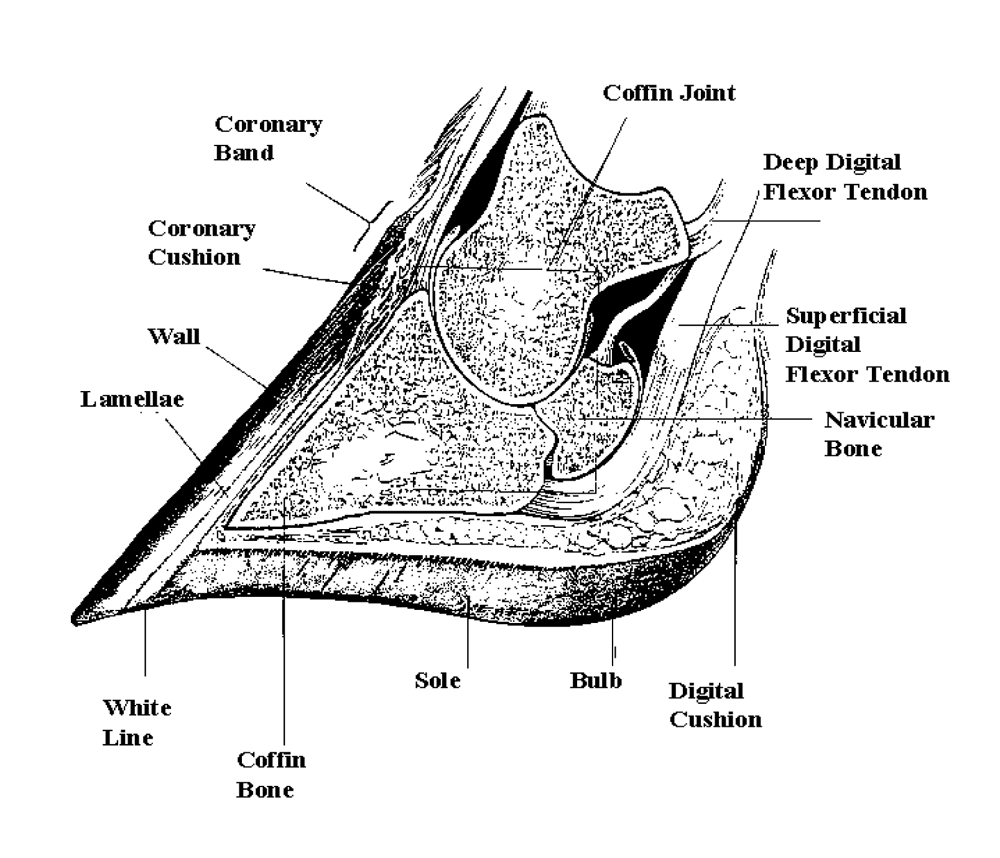
Diagram – cross section of the foot

Diagram – Cross Section of a Bovine Foot

Let`s Go Toe to Toe with the Facts Only Please

Let’s summarize:

  • Dairy cattle have a genetic problem relative to feet and legs especially for animals not allowed to get off cement or to exercise
  • It is rear feet that are the major portion of the problem with respect to lameness

The Achilles Heel for Classifiers

The classification system scores numerous traits but there are factors in the area of feet and legs that are beyond their control.  Foot angle is not a good trait to measure because it is so variable due to foot trimming. Cattle owners have feet trimmed before classification so type classifiers do not see the animals in their natural state.  Classifiers do the best they can, given the circumstances. Add to this the fact that classifiers do not see every cow walking. Since the ability to walk is what is most important, classifiers again are at a distinct disadvantage.

Estimating heritability using classification data shows these percentages:

  • 30% for bone quality (moderate)
  • 24% for rear legs side view (moderate)
  • 13% for rear legs rear view (low)
  • 11% for foot angle (low)
  • 8% for heel depth (low)

Yes the report card is in – we need to improve the evaluation feet and legs especially for rear feet and rear legs rear view. Genetically we have bred for thin cows and thus less fat in the foot pad. The only place we collect feet and leg data for genetic purposes is in the type classification programs and there the classifier, as mentioned, is at a disadvantage. What’s left that breeds, classifiers, people doing the genetic evaluations and breeders can do?

Getting a Toehold on the Solution

A collective approach is needed:

  1. We must admit that we have a problem and that we need to find a solution to more accurately knowing the genetics of feet and legs.
  2. The problem is not limited to one country and it is more prevalent in cattle not allowed to walk on natural surfaces.
  3. Resources (people and money) must be allocated to investigation and research.

Some suggestions the Bullvine has heard on ideas to consider include:

  • observe or measure the females over their lifetime
  • evaluate the feet on calves at weaning
  • evaluate the feet on heifers at first breeding
  • measure the feet on first lactation females on their first milk recording test day (before they are trimmed)
  • compare sire’s daughter feet and legs on confined versus pastured daughters
  • compare the genomic profiles of cow families that are both desirable and undesirable for feet (and legs)

It is encouraging to see that there is one hoof trimmers’ guild that has public support for a study to collect pedigree information at the time of trimming, to complete a report of the condition of the feet before trimming and then to have the data analyzed. That could be a start.

In the Interim… Feet Forward

Research takes time and cows are bred every day, in the mean time, breeders must use the information currently available from sire indexes or proofs. It is strongly recommended that sires be highly ranked for Net Merit, TPI or LPI and higher than 1.5 FLC or +7 Feet & Legs. A recent addition to the information to consider on bulls is their Body Condition Scoring index. Bulls whose daughters do not get as thin during lactation should not drain all the fat from their foot pads.  (Some Bullvine recommended sires to use can be found at From Fantasy To Reality – Top Sires To Address Herd Culling Problems)

The Bullvine Bottom Line- “Stop “Digging in Our Heels”

What is needed is an international approach to studying dairy cattle feet, much like the approach being taken to studying feed efficiency.  Hopefully a way will be found to move feet research in dairy cattle to the DNA level. If the industry collectively has the will, there will be a way. All we need now is a champion to take the first step.


Get original “Bullvine” content sent straight to your email inbox for free.


[related-posts-thumbnails]

Classification Highlights from Sandy Valley!

SANDY-VALLEY BOLT SHEILA now EX-92
Sandy-Valley Farms, Scandinavia, Wisconsin,  classified March 11th with the following results:
  • SANDY-VALLEY BOLT SHEILA EX-92 95 FL EX-MS @ 6-0
    (Bolton x 87 Forbidden x 89 BWM x 87 Rudolph x Tesk Della)
    Sheila is the dam of Planet Sapphire VG-87-2YR, who has 2 sons in the top 50 GTPI bulls and granddaughters up to over 2600G
  • SANDY-VALLEY JETSTR TAVI EX-92 93-MS @ 4-7
    (Jetstream x 92 Manager x 91 Finley x 88 Convincer x 93 Terry Tory)
  • SANDY-VALLEY BOLTO TASHA EX-91 92-MS @ 4-5
    (Bolton x EX Juror Ford x 87 Rudolph x EX Tesk Della)
  • SANDY-VALLEY STO ALANDRA EX-91 @ 4-4
    (Stol Joc x EX Shottle Aloshi x 87 Champion x 92 BWM)
  • SANDY-VALLEY MAC SHELBY EX-91 @ 5-5
    (Mac x 88 Shottle x EX Finley x 92 Rudolph Missy)
  • SANDY-VALLEY SANDY DAISY VG-88 EX-MS @ 3-10
    (Sandy x Shottle Dalashi 94 x Champion Dellia EX-91 x Patron Debbie Jo 92)
  • WINTERLANCE STOL JOC MIA VG-88 EX-MS @ 4-5)
    (Stol Joc x VG Goldwyn x 88 Outside x Ravens)
  • SANDY-VALLEY DRCY SHAMAY *TY VG-87 VG-MS @ 2-7
    (Dorcy x 88 Shottle x EX Finley x 92 Rudolph Missy)
  • LARCREST CAKE VG-86 86-MS @ 2-8
    (+2398G Super x Shottle Cosmopolitan 87 x Outside Champagne EX)
  • SANDY-VALLEY SUPER BEYLA VG-86 VG-MS @ 2-10
    (Super x Shottle Brynna 91 x Durham Barbie 92)
  • SANDY-VALLEY SUPER BITSY VG-85 86-MS @ 2-6
    (+221G Super x Ramos Brylliant 86 x Shottle Brynna 91)
  • SANDY-VALLEY FRD SHERYNN VG-85 VG-MS @ 2-6
    (Freddie x 88 Shottle x EX Finley x 92 Rudolph Missy)
  • SANDY-VALLEY FREDDI GIFT GP-83 VG-MS @ 2-5
    (+2218G Freddie x Planet Gobea 87 x Shottle Goldy 87
  • SANDY-VALLEY NIAGR AGNES GP-83 VG-MS @ 2-5
    (Niagra x 83 Roumare x 86 Potter x 89 BWM)

Read more about Sandy-Valley in our recent interview with them

Kara-Kesh Holsteins Classification Results

Redman Rally-Red  now EX-91 2E @ 7-01 (Nominated All-American R&W Aged Cow 2012)

Redman Rally-Red now EX-91 2E @ 7-01 (Nominated All-American R&W Aged Cow 2012)

Ryan, Karen, Curtis & Evelyn Griffin of Thief River Falls, MN are excited to share the following results from their Holstein classification! They report that it was -10 degrees outside and even -26 two days before, but things were much warmer inside the barn as their exciting day resulted in new herd totals of 4 EX, 5 VG (all 1st lact) and 2 GP (all Red or *RC)!  They are very excited as their BAA is sure to go up from 110.1 in 2012!

Highlights Included:

  • Redman Rally-Red  now EX-91 2E @ 7-01 (Nominated All-American R&W Aged Cow 2012)
  • Advent Sara-Red now EX-92 2E @ 7-06 (Res. Grand Champion, National R&W Convention Show 2011)
  • Redliner Sugar-Red  permanent EX-90 @ 5-06 (dry Redliner x Advent Sara)
  • Goldwyn Silhouette *RC  EX 90 @ 3-08 (2nd Lact. Goldwyn x Advent Sara)
  • Contender Shawna-Red VG-87 EX-MS @ 2-08 (Contender x All-American Nominee Redliner Shania x All-American Nominee Advent Sheena)
  • Contender Laurel-Red VG-86 @ 2-10 (Res. All-MN R&W Jr. 2-Year-Old 2012)
  • Debonair Josefina-Red VG-85 (Debonair x EX Rubens x Redmarker Jena)

Quality Goldwyn Flansco now EX-95-6Y

Quality Goldwyn Flansco

Quality Goldwyn Flansco now EX-95-6Y (CAN). 1st 3rd Generation EX-95 or higher CDN cow. Read more about Flansco and her breeders –https://www.thebullvine.com/breeder-profiles/quality-holsteins-well-deserved-congratulations/

Exciting new classification results from Sandy-Valley!

SANDY-VALLEY OUTSIDE ARA now EX-93

SANDY-VALLEY OUTSIDE ARA now EX-93

Sandy-Valley Farms, classified recently with the following results:

  • SANDY-VALLEY OUTSIDE ARA EX-93, EX-MS @ 8-00
    [Outside x VG89 BWM x VG87 Rudolph Tatum]
  • SANDY-VALLEY RAMOS BRYSK EX-91, EX-MS@ 5-02
    [Ramos x EX-91 Shottle Brynna x EX92 Durham Barbie]
  • SANDY-VALLEY LB SHILOH-P EX91, EX-MS @4-05
    [Lawn Boy x VG89 Sept Storm x EX93 Terry Tory]
  • SANDY-VALLEY MAC LYDIA VG88, EX-MS @ 4-08
    [Mac x Ex90 Lynch x EX92 Mathie]
  • SANDY-VALLEY MANO BRYDAN VG-88, VG-MS @ 2-08
    [MOM X EX-91 Shottle Brynna x EX92 Durham Barbie]
  • LARCREST CINNAMON VG-87, VG-MS @ 5-01
    [Ramos x EX90 Oside Champagne x EX94 Juror]
  • SANDY-VALLEY PLANET TRESS VG-87, VG-MS @ 3-08
    [Planet x EX91 Laudan x VG87 BWM]
  • SANDY-VALLEY DRCY SHAMAY VG-86, VG-MS @ 2-03
    [Dorcy x VG-87 Shottle x EX-90 Finley]
  • SANDY-VALLEY SUPER BRAYVA VG-85, VG-MS @2-02
    [Super x VG86 Ramos x EX91 Shottle Brynna]
  • LARCREST CAKE VG-85, VG-MS @ 2-04
    [Super x VG-87 Shottle Cosmopolitan]

Visit their website for the latest photos and genomic results

Incredible Classification Results for Breeze Hill Holsteins

A total of 4 new Excellents & 13 Excellents with Multiple “E”s

Earning Multiple “E”s

  • Ploegsway Gibson Electric – EX-94-5E-11Y (CAN)
  • Breeze Hill I T Rae – EX-93-3E-7Y (CAN)
  • Moneden Terrason Carmen – EX-93-5E-9Y (CAN)
  • Cavendish Ionic Zoe – EX-93-3E-8Y (CAN)
  • Holywell Progress Risingstar – EX-92-7E-11Y (CAN)
  • Breeze Hill Derry Soleil – EX-92-5E-9Y (CAN)
  • Breeze Hill Lheros Amanda – EX-90-3E-6Y (CAN)
  • Priority Dundee Lolli Pop – EX-90-3E-6Y (CAN)
  • Vioris Windstar Mix – EX-90-3E-8Y (CAN)
  • Breeze Hill Adition Carly – EX-90-2E-6Y (CAN)
  • Breeze Hill Metro Sally – EX-90-2E-6Y (CAN)
  • Breeze Hill Terrason Seven Up – EX-90-2E-6Y (CAN)
  • Mallettdale Champion Delta – EX-90-2E-6Y (CAN)

First Time Excellents

  • Breeze Hill Fortune Daytona – EX-91-4Y (CAN)
  • Bashlee Decker Delight – EX-90-4Y (CAN)
  • Breeze Hill Carisma Sobriety – EX-90-5Y (CAN)
  • Regan-ALH B Evanna-ET – EX-90-4Y (CAN

Cookiecutter Holsteins Classification Results

Cookiecutter Holsteins of Hudson Falls, NY recently had an outstanding classification with daughters and full sisters to Cookiecutter Gld Holler-ET VG-88 DOM.

  • Cookiecutter Sht Hollerwood was raised to EX-90  (Shottle x VG-88 Goldwyn Holler back to EX-95 Dellia)
  • Cookiecutter MOM Halo was raised to VG-88 EX-MS (Man Oman x VG-88 Goldwyn Holler back to EX-95 Dellia)
  • Cookiecutter MM Hallmark went VG-86 87-MS (Man Oman x VG-88 Goldwyn Holler back to EX-95 Dellia)
  • Full sisters to Holler
    • Cookiecutter Goldwyn Hackney is now EX-91 EX-MS
    • Cookiecutter Goldwyn Horizon is now 2E-91
    • Cookiecutter Goldwyn Heather is now 2E-92 EX-MS

Irwindale Leduc Macy is now EX-95-4E at 12 Years

Irwindale Leduc Macy is now EX-95-4E-12 Years

Irwindale Leduc Macy is now EX-95-4E-12 Years

Irwindale Leduc Macy is now EX-95-4E-12 Years (CAN) as of yesterday 10/19/12

Born: 09/03/00
Sire: Lystel Leduc-ET
Dam: Irwindale Encore Mandy-ET
EX-90-5Y (USA)
2nd Dam: Irwindale Counselor Marsha
EX-93-3E (USA)
3rd Dam: Edele-C Edele Mark Marie
VG-87-5Y (USA)
4th Dam: Willview Juniper Milly
EX-90-6Y (USA)

Owned by: RockyMountain Holsteins
Cochrane, Alberta, Canada
http://rockymountainholsteins.com/
&
Continental Holsteins
Leduc, Alberta, Canada

Bred by: Steven Irwin/Irwindale Holsteins
Beason, Illinois, USA

Macy has a long string of achievements:

2009
Res. Grand Champion – Calgary Spring
2nd Place Mature-Cow – Calgary Spring
1st Place Mature-Cow – Red Deer
1st Place Mature Cow – Westerner Champ.
HM. All-West – Mature-Cow

2008
1st Place Mature-Cow – Calgary Spring
All-West – Mature-Cow

2007
Res. Grand Champion – Westerner Champ.
1st Place Mature-Cow – Westerner Champ.
All-West – Mature-Cow

2006
Res. Grand Champion – Calgary Spring
Grand Champion – Westerner Champ.
1st Place 5-Year-Old – Westerner Champ.
1st Place 5-Year-Old – Saskatoon Expo
1st Place 5-Year-Old – Calgary Spring
Nom. All-Canadian 5-Year-Old

2005
1st Place 4-Year-Old – Royal Winter Fair
Grand Champion – Westerner Champ.
1st Place 4-Year-Old – Westerner Champ.
All-Canadian – 4-Year-Old

2004
Grand Champion – AB Dairy Congress
1st Place Sr. 3-Year-Old – AB Dairy Congress
Intermediate Champ. – Westerner Champ.
1st Place Sr. 3-Year-Old – Westerner Champ.

2003
1st Place Sr. 2-Year-Old – Royal Winter Fair
All-Canadian – Sr. 2-Year-Old
1st Place Sr. 2-Year-Old – Westerner Champ

APPLEVUE GOLDWYN GINA – Canada’s Newest 95 point cow

APPLEVUE GOLDWYN GINA - Canada's Newest 95 point cow

APPLEVUE GOLDWYN GINA – Canada’s Newest 95 point cow

Applevue Goldwyn Gina is Canada’s newest EX-95-2E Point Holstein as of 09/26/12. Gina becomes the 8th Canadian Holstein to score EX-95 in 2012 and the 6th Braedale Goldwyn daughter to earn and retain a 95-point designation in Canada.

Born: 01/06/2006
Age at Classification: 6-Years/4th Lactation
Previous Score: EX-94-2E-5Y
Sire: Braedale Goldwyn
Dam: VG-86 (CAN)
2nd Dam: VG-87 (CAN)
3rd Dam: VG-85 (CAN)

Show Record:
NOM. ALL-QUEBEC 4-YR 2010
RES.GRAND LOTBINIERE 2012,2009
1ST MATURE COW LOTBINIERE 2012
1ST SR.3-YR LOTBINIERE 2009

Owned by: Ferme Rolandale Enr., St-Flavien, Québec, Canada http://www.rolandale.com/
Breeder: Applevue Farm, Brampton, Ontario, Canada

For a complete list of Canadian Holsteins that have earned & retained the EX-95 designation, go to… http://www.dairycowdaily.com/Excellent-95-Point-Canadian-Holsteins-By-Name.html

2011 RAWF Ayshire Junior Champion – Rosayre BB Flip – Fresh and already VG-88-2yr

Rosayre BB Flip  VG-88-2yr

Rosayre BB Flip VG-88-2yr

Rosayre BB Flip – VG-88 @ 2-03 (CAN) and last year’s Royal Agricultural Winter Fair Jr. Champion is this year’s Eastern Ontario/Western Quebec Show’s Supreme Champion as a Jr. 2-Year-Old

Luck-E Dundee Jenna New 95 Pointer at Milksource

LUCK-E DUNDEE JENNAThe Holstein breed welcomes yet another 95 point cow into its ranks.  Luck-E Dundee Jenna, owned by Milksource Genetics of Kaukauna is the newest EX 95 point cow in the breed.  Bred by the Engels of Hampshire, IL, Jenna is a well-know showring contender, having been nominated All-American and All-Canadian as a 4 Year Old in 2010.  In addition, Jenna was named the All-Wisconsin Aged Cow earlier this summer the Wisconsin Championship Show, as well as winning the Aged Cow Class at the 2012 Midwest Spring National.  Jenna won the 5 Year Old class at the Midwest Spring National Show in 2011, as well.  Jenna is a Regancrest Dundee daughter of an EX 91 Leduc, with the second dam being an EX Inspiration daughter.  Congratulations to Milksource on Jenna’s continuing achievements.
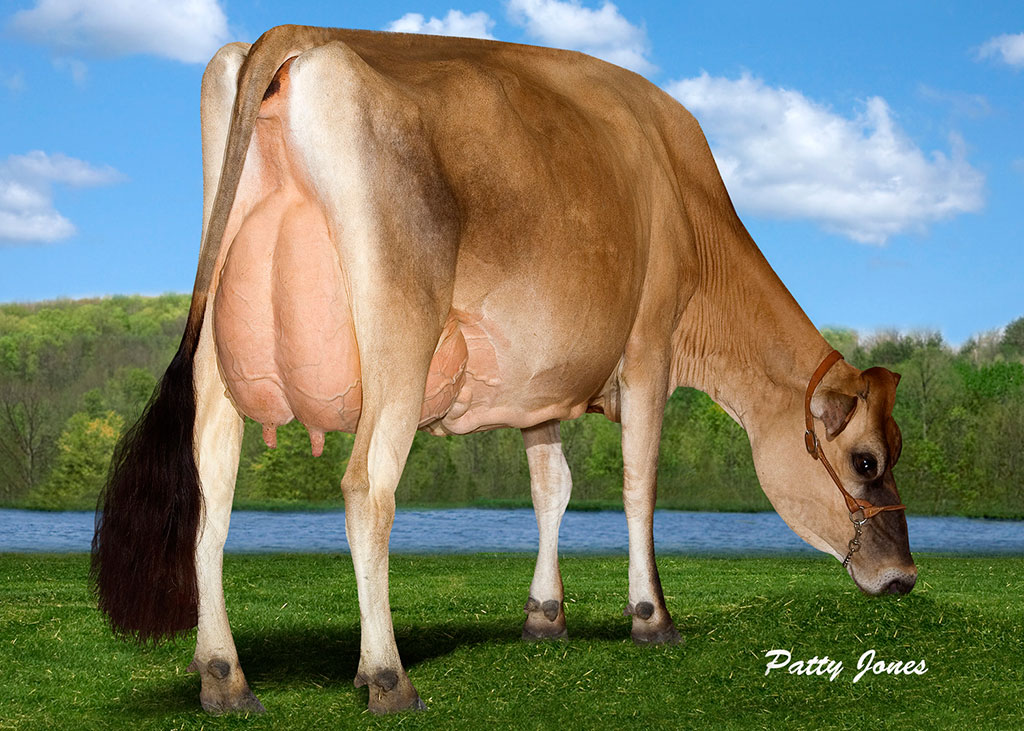
A New EX 95 Jersey “Impacts” RJF!

 RJF Belle's Impact Robert & April Jarrell and family of  RJF Jerseys in Corbyville, ON are thrilled to announce that RJF Belles Impact has joined the league of EX 95Jerseys at 5 years of age!  Impact, who also has been scored 2E, is an Iatola daughter of RJF Remake Belle SUP-EX 92-5E.

In addition to Impact, other classification highlights include:
  • RJF Iatola Sadie EX 94 at 4 Years (Iatola x Piedmont Jonathans Sally EX 90 2E)
  • RJF Jade Gem EX 93 3E as an Aged Cow (Jade x RJF First Prize Georgette EX 92 6E
  • RJF Whistler Treasure EX 91 2E as an Aged Cow (Bonnyburn Ali Whistler x RJF Barber Teresa SUP EX 90 8E)
  • RJF Ressurection Bombshell EX 91 at 4 Years (Ressurection x RJF Remake Becky SUP EX 96 6E)
  • RJF Remake Belleflower EX 90 4E as an Aged Cow (Remake x RJF Star Barb)
  • Big Trouble EX 90 as an Aged Cow (RJF Big Show x RJF Premonition Tiffany EX 90 2E)
  • RJF Iatola Rascal EX 90 at 4 Years (Iatola x RJF Remake Rattle EX 90 4E)
  • RJF Iatola Cinnamon EX 90 at 4 Years (Iatola x Huronia Imp Christie EX 90 3E)
  • RJF Bella’s Jewel VG 89 as a Senior 3 Year Old (Jade x RJF Centurion Bella EX 93 2E)
  • RJF Rocket Laker VG 88 as an Aged Cow (OF Barber Rocket x Pine Creek Respect Lori)
  • RJF Big Rebound VG 86 as a Junior 3 Year Old (RJF Big Show x RJF Just Wait Raven EX 91)
  • RJF Comerica Cherish VG 86 as a Senior 2 Year Old (Comerica x Huronia Imp Christie EX 90 3E)
  • RJF Belmont Taffy VG 85 as a Junior 2 Year Old (Belmont x RJF Whistler Treasure EX 91 3E)
  • RJF Belles Freedom VG 85 as a Junior 3 Year Old (Sunset Canyon Futurity x RJF Remake Belle SUP EX 92 5E)
  • RJF Iatola Chanel GP 83 as a Junior 2 Year Old (Iatola x Huronia Imp Christie EX 90 3E
Holstein:
  • RJF Jet Daffney VG 86 as a Senior 2 Year Old

Is Good Plus Good Enough?

For years GP-84-2YR was the kiss of death when it came to marketing and selling genetics.  However, along comes genomics and it seems that GP is good enough.  Nevertheless, the question it has me asking is “Is Good Plus Good Enough?”

I can still remember when Summershade Icebreak Luke, was the #1 LPI cow in Canada.  The problem was she was scored GP-83-2YR.  The A.I. companies where not sure if they should even sample bulls from her and how would they convince their members to use them in their young sire programs.  Then came along Summershade Igniter and Summershade Inquirer and A.I. companies took the chance.  While hindsight is 20/20, maybe they should have passed.  On the female side, Icebreak had 34 daughters classified and only 7 of them going VG.  We ourselves had one of those daughters Summershade Icemarti.  While she did score VG, it was not until her 2nd lactation, long past her peak marketing time.  In the past, we have purchased many daughters out of GP 83 and 84 two year olds, expecting them to go VG before our purchase calved in.  It has proven to be a risky move, but one that could have paid off big time.  On the male side Icebreak had six sons enter A.I. service but none where ever returned to service.

On the flip side, I can also remember when we first purchased into the Braedale Gypsy Grand family and many people around us had concerns about her GP-83-2YR dam.  While there was a very good reason why Moonriver never went VG, we still found ourselves having to explain things many times.  Then along came Second Cut, Baler Twine, Freelance and Goodluck and we found that changed everything.

As we all know genomics has changed the name of the game, and we now see A.I. companies sampling high genomic sires irrelevant of their score or the score of their dam.  With that in mind, I decided to take a look at the current high index dams that are NOT scored VG.  The following is what I found.

The Story in the US

In the US, there are three GP cows on the Top 25 GTPI Cows List (GP-83-or Higher).  Leading the way is BEN-AKERS PLANET LUISE26-ET, she the #3 GTPI cow and the #1 NM cow scored over 83 points.  While Luise is from the Ricecrest Luke Lisa family and has solid type numbers, her genomic values for type are actually lower than her parent average and yet she still has a son at Alta Genetics, Ben-Akers AltaRazzle.  Joining Luise on the top GTPI list at #18 is SURE-VIEW MP PLANET LEXI.  Lexi is from the M&M-Pond-Hill Leadman Luba family and is scored GP-83-2YR.  Similar to Luise, Lexi has high genomic values compared to her parent average but yet again has conformation scores that just meet expectations.  Unlike Luise, it appears to this point that Lexi does not have any sons currently in A.I..  The third member of the list is SULLY PLANET MANITOBA , this GP-83-2YR is out of the great brood cow, Sully Shottle May the former #1 GTPI and GLPI cow of the breed.  Of course May is believed to have more offspring genomic tested over 2200 & 2300 GPTI than any other cow in the breed.  Unlike the other two GP 2yr olds on the top list, Manitoba has outstanding type numbers and her genomic values are actually higher than her parent average.  It’s these outstanding values that have her with at least three sons currently in A.I., SULLY HART MERIDIAN-ET and SULLY HART MUNICH-ET at Semex, and SULLY ALTABRANDON-ET at Alta Genetics.

The Canadian Story

Much like the US list the #3 spot on the Canadian List is held by a GP-83-2YR, Benner Planet Jakova-ET.  Being a Planet from a Goldwyn, Jakova has strong parent average for type and has strong genomic values as well.  Coming from the Benner Luke Jean family, Jokava has yet to put a son into A.I.. Joining Jokova on the list is Delaberge Planet Lulu.  However, on April 25th Lulu was raised to VG-85-2YR, 244 days fresh.  Lulu comes from the Bryhill Lindy Lilly family and already has a son at Semex, DONNANDALE LUMI.  The third member on the list is Alexerin Oman 993. Of interesting note about 993 is that there are no VG dams anywhere in her pedigree, she has mostly production sires and yet her parent average for conformation is five and her genomic value is a six.  Not surprisingly, 993 does not have any sons currently in A.I.  The last member on the list is Calbrett Planet Empress.  Much like Lulu, Empress has since been moved to VG-86-2YR later in lactation.  Empress is from the WABASH-WAY EVETT dam of the popular genomic sire Genervations Eclipse and the same family as Epic and Highway.  Given the strong maternal pedigree, Empress has PA of +10 for conformation and actually exceeds that with a +12 for her direct genomic value.  Given her increase in score and strong maternal pedigree it is just a matter of time before she has sons in A.I..

The Bullvine Bottom Line

While GP-84-2YR use to be the kiss of death for many marketing and genetic programs, genomics has changed the game.  With genomics, we are seeing many GP 83 or 84 cattle used as dams that would have never been touched before.  While many will increase in score later in life, many do not, and yet that does not seem to be as big a factor.  Many A.I. companies and breeders are more concerned about their genomic values than that of their actual classification score.


Not sure how much to spend on that great 2 year old?
Want to make sure you are investing your money wisely?
Download our Dairy Cow Investment Calculator.


[related-posts-thumbnails]

TOM BYERS: “THAT’S CLASSIFIED!”

Tom Byers, who is in charge of classification for Holstein Canada knows a lot about the differences in cattle. “The show ring cow, with the emphasis on red carpet style is more the extreme. This is exactly what she should be. When you see her at the Royal in that ring every Holstein breeder in Canada wants to own her whether he thinks he’s commercial or not . Good breeders know that. They appreciate a good cow, show ring or barn.” Having said that, Tom points out that the Canadian classification system does not reward extremes.  He goes on to point out where they are similar. “There are two things that make the show cow and the cow in barn the same, when it comes to being judged or classified. Those two things are the two most important traits – udders and feet and legs.”

Tom Byers - Ferme GilletteUDDERLY EXCELLENT

Byers has classified many amazing cows but, when it comes to udders, he tells about one cow that got him excited. “It was at Ferme Gillette and it was the old Smurf cow who is the new World Champion for Lifetime production. We were walking past her stall when I asked Louis, ‘What is that cow classified?’ He gave her a pat on the rump and she immediately got up. Faster than some two year olds I might add. When I saw that udder and felt the texture I could have stretched it from Ferme Gillette to the Parliament Buildings in Ottawa and it would have sprung right back. Looking at her spring of fore and rear rib, I knew I had to make her EX.” Classification doesn’t reward extremes but Byers can sure describe them!

ARE YOU CLASSIFICATION READY?

Tom doesn’t really think it is necessary to have cows ready for the previously mentioned red carpet when the classifier comes. “The simple answer is ‘No!’ it’s not necessary.  But I do think it makes a difference to the Holstein member. A self satisfaction if you will. Classifiers always appreciate good housekeeping.” Having said that, he goes on, “If you mean getting up in the middle of the night to have their udders full and most times over full to present to the classifier, I would just like to quote an old colleague and mentor of mine, Don Aylsworth “Feed the cow and the udder will fill itself.” Classified information indeed!

Future of Dairy Cattle ClassificationFACING FORWARD WITH CLASSIFICATION

Dedicated to his career and the members he serves, Byers takes his customary positive approach to the future. “I think we will continue to evolve our program to meet the needs of the dairy producer. Classification is without a doubt a very important animal welfare program and by identifying the strengths and weaknesses of the individual, we can corrective mate to help the next generation take care of herself in the different environments we ask her to work in. We have always combined science and cow sense as we have made changes.”

 OH CANADA! GENOMICS IS THE NEW BUZZ WORD

Byers feels that “Classification will be the conformation verification of our Genomic selected sires.” He is justifiably proud of the dairy industry, “We must always remember that the world comes to Canada for its cow.  If Genomics can enhance our accuracy of genetic selection that will be a bonus! Our cow in Canada has never been better than she is today.  She is calving from 22 to 25 months of age. For the first time her udder is 5 inches above her hock and she wants to milk 40 plus liters.” That’s “Oh Canada” as sung by classifier Byers.

BULLVINE BOTTOM LINE

Tom Byers feels it has been his privilege to represent Canada domestically and internationally and to build lasting memories with his colleagues and Holstein Breeders.

“IT’S ALL ABOUT TRUST” Tom Byers

[related-posts-thumbnails]

Send this to a friend