Archive for reduce feed costs

Ditching Robot Pellets: How Smart Farms Save $36,000 and Improve Milk Components

Plot twist: Your cows visit robots for the TMR behind them, not the pellets. This mistake costs $100K/year.

Executive Summary: What if the dairy industry has been wrong about robot pellets for 25 years? Growing evidence from 75+ farms across Wisconsin and Ontario shows that eliminating pellets entirely saves $36,000-46,000 annually while improving butterfat by 0.3-0.4%—with no long-term production loss. University research from Saskatchewan, Wisconsin, and Guelph confirms these pioneers’ discovery: cows visit robots to access fresh TMR beyond them, not for the pellets, making that $100,000 annual expense unnecessary. But here’s the reality check: success requires guided-flow infrastructure (not free-flow), premium forage quality, dedicated management, and the financial capacity to weather 10-15% production drops during a difficult 16-24 month transition. This revolution isn’t for everyone—operations with fewer than 200 cows or limited finances should proceed cautiously. What makes this story remarkable isn’t just the economics; it’s proof that some of agriculture’s most expensive assumptions have never been properly questioned.
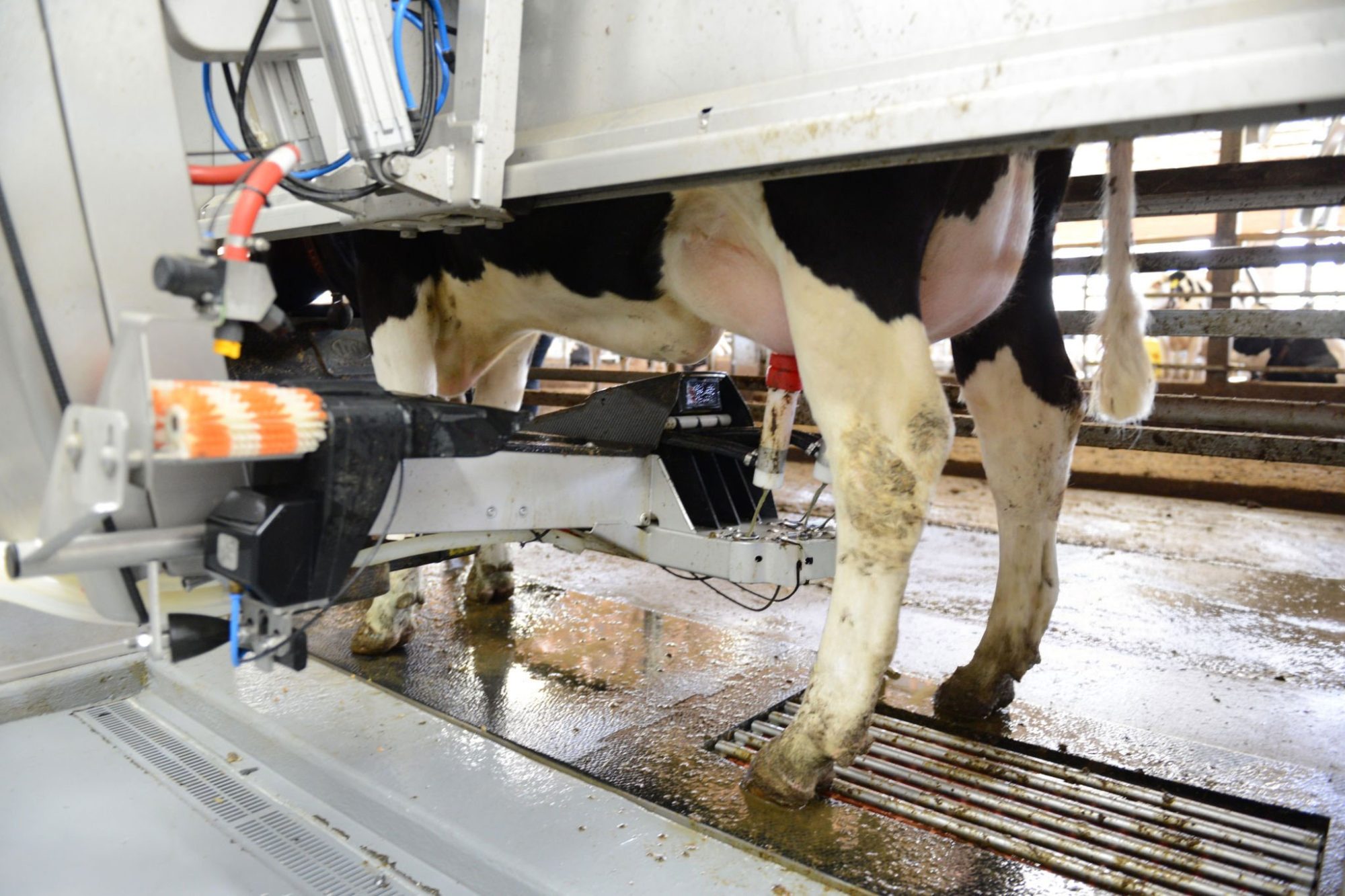
You know, for more than two decades, those of us investing in robotic milking systems have accepted one fundamental truth: feeding pellets to the robot is essential to motivate voluntary cow visits. Equipment manufacturers designed for it. Nutritionists built entire programs around it. We all budgeted for it without question. But here’s what’s interesting—what if this core assumption, built into thousands of robotic dairy operations worldwide, turned out to be optional?

That’s exactly what a growing number of progressive dairy farmers are discovering. By eliminating feed pellets entirely from their robotic milking systems, operations from California to Wisconsin are reporting annual savings of $36,000–$46,000 per 200 cows, improved milk components, and simplified management—all while maintaining or even increasing production. Their success is backed by recent research from leading universities and represents a fundamental rethinking of how robotic dairy systems can operate.

What fascinates me most is that this isn’t just about cutting feed costs. It’s about what happens when farmers question inherited practices and discover that some of our industry’s most accepted truths might actually be holding us back.
The Discovery That Started It All

Matt Strickland, who operates Double Creek Dairy near Merced, California, didn’t set out to revolutionize robotic milking. With 500 cows and eight DeLaval VMS V300 robots, he was simply observing his herd with fresh eyes—something we could all probably benefit from doing more often.

Working alongside herd adviser Kelli Hutchings—whose Wyoming ranching background brought a completely different perspective to dairy operations—Strickland noticed something that challenged everything the industry had told him. The cows weren’t particularly excited about the robot feed. What they really wanted was to reach the feedbunk on the other side. The robot wasn’t the destination; it was more like a toll booth on the highway to fresh TMR.

“I didn’t invest in robots to feed my cows,” Strickland explains. “I got the robots to milk my cows.”

Now, that might sound obvious, but think about how much infrastructure and cost we’ve built around the opposite assumption. Over approximately two years, Strickland’s operation gradually reduced and eventually eliminated pellets from all eight robots. The results? Well, they defied everything we thought we knew:

  • No significant change in robot visits
  • No increase in incomplete milkings
  • Milk production actually increased
  • Butterfat improved by 0.3–0.4%

Today, only seven cows in Strickland’s 500-head operation still receive pellets—individual animals with specific needs that justify the cost. That’s a pretty remarkable shift from where they started.

What the Research Actually Shows

Here’s where it gets really interesting from a scientific perspective. Strickland’s experience isn’t some outlier or lucky break. Recent research from multiple institutions validates what these pioneering farmers are discovering in practice.

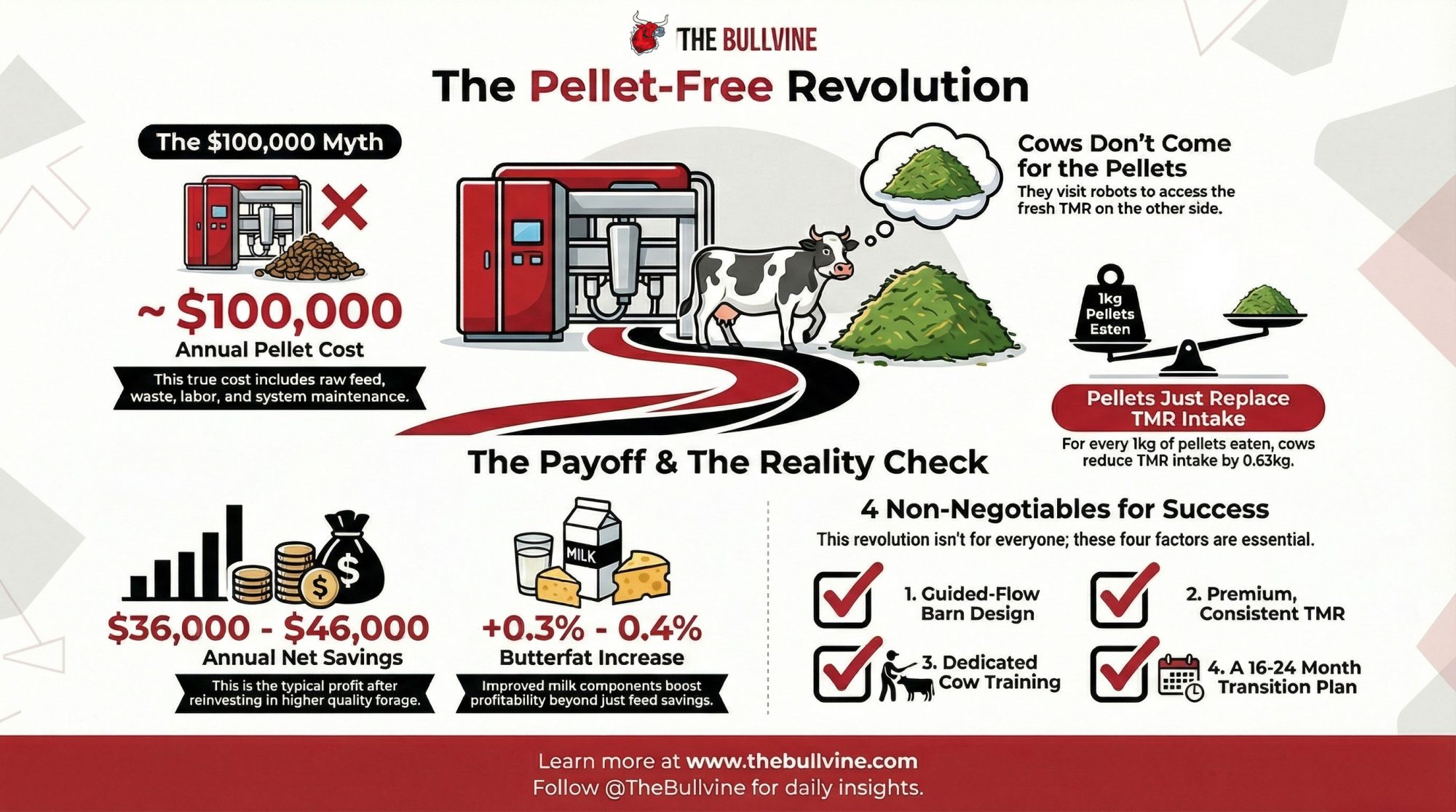
The University of Saskatchewan team, led by PhD student Sophia Cattleya Dondé working under Dr. Greg Penner at their Rayner Dairy Research and Teaching Facility, revealed something that should make us all pause. Changing pellet starch concentration—whether 24% or 34%—had essentially zero effect on milk production or voluntary visits. Even more eye-opening: when cows consumed additional pellets, they weren’t adding to their total intake. For every 1 kg increase in pellet intake, cows reduced their partial mixed ration intake by 0.63 kg on average. They were just swapping one feed source for another.

University of Wisconsin Extension research found something equally surprising—farms offering higher grain amounts in the robot actually produced less milk. Separate research from the University of Guelph examining Canadian farms found that feed push-up frequency correlated with higher production, with each additional five push-ups per day increasing milk yield by 0.77 lbs per cow.

It’s worth noting that the Wisconsin study also found free-traffic barns produced more milk than guided-flow barns overall, though higher pellet feeding wasn’t necessarily associated with more milk—potentially because farms feeding high pellet amounts in free-traffic systems were often compensating for poorer forage quality.

And then there’s the Vita Plus survey of 32 Upper Midwest herds from 2018 that really caught my attention. The biggest surprise? Pellet cost and composition had no effect on income over feed cost. In fact—and this is where it gets counterintuitive—farms feeding simple, low-cost pellets like corn gluten feed or basic shelled corn were more profitable than those using premium formulations.

An Important Note on Adoption

It’s worth emphasizing that pellet-free robotic milking is still an emerging practice, not yet an industry standard. While 75+ farms across Wisconsin and Ontario have successfully made this transition, and the research supports the concept, this represents early adoption rather than widespread acceptance. The equipment manufacturers continue to include pellet systems as standard, most nutritionists still recommend pellets, and the vast majority of robotic operations worldwide continue using them. What we’re seeing is growing evidence that pellets may be optional for well-managed guided-flow operations, but each farm needs to carefully evaluate whether this approach fits their specific situation. This isn’t a universal recommendation—it’s an opportunity for certain operations to consider.

Understanding the Economics: Where the Money Really Goes

Let’s talk dollars and cents, because that’s what keeps us all in business. The financial case for pellet-free operations extends far beyond just the obvious feed savings.

When you really dig into what a typical 200-cow robotic operation spends on pellet infrastructure, the numbers are eye-opening:

Annual Pellet System Costs:

  • Raw pellet costs (10 lbs/cow/day at $250/ton): $91,250
  • Inventory management labor: $2,500–$4,000
  • Feed table programming and updates: $1,500–$2,500
  • Feed waste and shrink (3–5%): $3,600–$5,400
  • Rodent control (attracted by stray pellets): $1,200–$2,000
  • System maintenance and calibration: $1,500–$2,500
  • TOTAL ACTUAL COST: $101,000–$109,000

Now, when farms eliminate pellets, they’re not simply pocketing all these savings—that would be too easy, right? Successful transitions require reinvestment:

Required Reinvestments:

  • Higher-quality forage: $800–$1,200 annually
  • Increased feed push-up labor (1–2 additional hours daily): $8,760
  • Enhanced monitoring systems: $2,000–$5,000
  • Potential infrastructure adjustments (gate modifications if needed): $0–$15,000

NET ECONOMIC BENEFIT: $18,000–$39,000 annually, plus an additional $10,400 from butterfat improvements of 0.2–0.4%. That’s real money we’re talking about.

Regional Success Patterns: Where It’s Taking Hold

The real numbers manufacturers won’t show: Pellet-free farms outproduce traditional robot barns—both in yield and milk components.

What I’ve found particularly interesting is how adoption patterns vary by region. We’re seeing the strongest uptake in Wisconsin’s central dairy corridor—about 45 farms as of late 2024—Southern Ontario around the Woodstock area with roughly 30 operations, and isolated pockets in Quebec.

Jay Heeg’s operation near Colby, Wisconsin, provides a compelling example of regional success. Heeg Brothers Dairy currently milks 1,050 cows in their conventional parlor and 450 in a new robot barn that opened in December 2023. From day one—and this is the key part—that robot barn has operated completely pellet-free using a guided-flow design.

Wisconsin/Ontario host 75 of 103 pellet-free farms—regional clustering drives change, not marketing.

The performance comparison really tells the story. Their robot barn with no pellets produces 98 lbs per cow per day, versus about 94 lbs in the parlor. Butterfat runs 4.5% in the robot barn. Somatic cell count? Lower in the robot barn, too.

“The cows have been performing well,” Heeg reports. “Once they’re trained, they do better without you out there in the pen.”

You know what’s notable? In these regions where multiple farms have adopted pellet-free systems, it’s becoming normalized. Once three or four neighbors prove it works, the regional skepticism evaporates pretty quickly. California remains more isolated—Strickland is still somewhat of a lone pioneer there—but Wisconsin and Ontario are seeing cluster effects.

The Reality Check: Not Every Farm Should Try This

Let me be really clear about something that doesn’t always get discussed openly. I recently spoke with a 120-cow operation in Vermont that wisely decided against attempting pellet-free after honestly assessing their situation. They had a free-flow barn, variable forage quality, and limited capital reserves. Smart decision to wait.

Not every operation is positioned to succeed with pellet-free systems. Through analyzing successful transitions and, honestly, some notable failures, four non-negotiable factors emerge.

First, you absolutely need guided traffic flow. Free-flow barns, where cows have unrestricted access to all areas, typically require pellets to maintain voluntary visits. Research from Michigan State and Cornell consistently backs this up. Guided-flow systems with pre-selection gates naturally direct cow traffic through the robot, making pellets less critical for motivation.

Second, when pellets disappear, your TMR becomes everything. And I mean everything. Successful operations maintain forage with greater than 65% NDF digestibility (test this, don’t guess), consistent moisture content with no more than 2% variation, excellent fermentation quality with pH below 3.8 and minimal heating, and fresh feed delivery timed to stimulate activity—usually 2–3 AM and 2–3 PM works best.

Third, fresh cows and heifers require dedicated training. We’re talking about bringing them through the robot manually 3 times daily for a minimum of 3–6 days. That’s approximately 18 hours of labor per fresh cow during the initial training period. It’s a front-loaded investment that pays dividends later.

And fourth, the transition requires 16–24 months of focused attention. You’ll see temporary production dips, increased fetch labor, and need systematic problem-solving skills. Farms attempting quick transitions or lacking dedicated oversight consistently fail. I’ve seen it happen multiple times—the farm that thinks they can “ease into it” over a month usually gives up by week six.

Navigating the Transition: What Really Happens

The transition to pellet-free isn’t a simple switch—it’s a carefully managed process that requires patience and, frankly, some courage during the tough weeks.

In weeks 1–2, you’ll see an immediate 10–15% production drop as cows adjust. This is normal, not a sign of failure. Keep reminding yourself of that at 4 AM when you’re questioning everything.

Weeks 3–8 are what I call the valley of despair. Fetch labor intensifies. Production remains 8–12% below baseline. You’ll have mornings when 30 cows refuse the robot, and you’re wondering what you’ve done.

But then weeks 9–16 arrive. Gradual recovery begins. Rumen function stabilizes—you can actually see this in the manure consistency. Behavioral adaptation completes, and milk components start improving.

By months 4–6, production returns to baseline or slightly higher, with improved components. The economic benefits become visible. You can actually breathe again.

Here’s the critical insight from those who’ve been through it: Most farms that fail give up during weeks 6–8 when the challenges feel overwhelming, but the benefits haven’t materialized. Understanding this as a normal phase—not a crisis—is essential for success.

Risk Mitigation: Your Exit Strategies

Something the research doesn’t always cover, but farmers need to know—what if you need to reverse course?

If production drops by more than 20% by week 8, you can reintroduce pellets at 50% of the original amount, stabilize for 2 weeks, then reassess. Several farms have successfully used this “pause and reset” approach.

Another option is to keep your fresh cows and first-lactation heifers on pellets while transitioning only mature cows. This reduces risk while you learn what works for your specific situation.

Some northern operations have found success going pellet-free during the grazing season, when TMR quality is highest, then reintroducing minimal pellets during the winter months, when forage quality varies more.

Industry Response: Reading Between the Lines

The equipment and feed industries are navigating this trend carefully, and their responses tell us a lot about where it might go.

DeLaval has published technical documents on no-feed practices and featured pellet-free farms at World Dairy Expo 2025. But here’s what’s telling—they continue to include pellet delivery systems as standard on new installations, positioning no-feed as a “specialist application” for sophisticated operators. That’s strategic positioning, not wholehearted endorsement.

Feed companies are quietly diversifying. I’ve noticed more pushing of liquid feed supplements and “alternative robot feeds” in the past year. Smart nutritionists are repositioning as “whole-system optimization” experts rather than pellet specialists. They see the writing on the wall.

Current adoption patterns and market response suggest pellet-free systems may remain in the 5–15% range for specialized operations in the near term, though exact industry projections remain speculative. The measured response from manufacturers and feed companies indicates they’re hedging their bets rather than embracing wholesale change.

Self-Assessment: Is Your Operation Ready?

Success FactorMust Have (Red Flag if Missing)Warning Signs (Proceed with Caution)Deal Breaker (Wait Until Fixed)Your Score (✓)
Traffic Flow SystemGuided-flow with pre-selection gatesFree-flow barn designFree-flow without modification options
Forage Quality (NDF Digestibility)>65% NDF digestibility60-65% NDF digestibility<60% NDF digestibility
TMR Moisture Consistency<2% variation2-3% variation>3% variation
Fresh Cow Training Capacity3 manual passes daily for 3-6 daysLimited labor (2 passes daily)Cannot commit to training
Financial Reserves$50K-$70K buffer (200 cows)$30K-$50K buffer<$30K reserves
Herd Size>200 cows OR strong finances120-200 cows with tight margins<120 cows with debt
Management Time Available3-4 hours daily during transition2-3 hours daily available<2 hours daily available
Nutritionist SupportAligned and supportiveNeutral or uncertainActively opposed

Before you even think about attempting a pellet-free transition, honestly evaluate your readiness. And I mean honestly—not optimistically.

For your facility, do you have guided-flow traffic with properly sized commitment pens at 6–7 cows per robot? Can cows move from the robot to the feedbunk without bottlenecks? Are your gates reliable and well-maintained?

Looking at your forage program, can you maintain consistent TMR quality with no more than 2% dry matter variation? Do you have covered storage and quality testing protocols? Is your forage digestibility consistently above 65% NDF?

And for management capacity—this is crucial—can you dedicate 3–4 hours a day to training during the transition? Do you have financial reserves to absorb $50,000–$70,000 in transition losses for a 200-cow herd? Are your nutritionist and veterinarian aligned and supportive?

Score yourself honestly on each dimension. Operations with strong capabilities across all areas are excellent candidates. Those with multiple weaknesses should address fundamental issues before attempting this transition.

Looking Beyond Pellets: What This Really Means

This pellet-free movement reveals something bigger than operational optimization. It demonstrates how entire industries can build complex systems around assumptions that never get questioned.

Think about it—this pattern of inherited practices becoming unquestioned truth likely exists in other areas of dairy management we haven’t even examined yet. Three-times-daily feeding schedules—is it really necessary? Complex genetic selection protocols—how much complexity actually adds value? Traditional parlor labor models—could workflow redesign cut labor 30%? Precision feeding systems—does the complexity justify the cost?

The farms that will thrive in the coming decades won’t be those perfecting existing systems. They’ll be those willing to ask uncomfortable questions about fundamental assumptions.

Key Takeaways for Your Operation

For operations considering pellet-free transitions, here’s what matters most.

First, assess your readiness honestly. This works brilliantly for farms with guided-flow barns, strong forage programs, and management capacity to weather transition challenges. It fails predictably for operations lacking these foundations.

Second, budget for the transition period. Expect 8–12 weeks of production losses totaling $50,000–$70,000 for a 200-cow operation. If you can’t absorb this without financial stress, wait until you can.

Third, connect with others who’ve done it. Reach out to producers in Wisconsin’s central corridor or Southern Ontario who’ve successfully transitioned. Their practical insights are invaluable. The Dairy Farmers of Wisconsin maintains a peer network list, and several Ontario producer groups facilitate farm visits.

Fourth, consider your regional context. If other farms in your area have successfully transitioned, you’ll face less skepticism from advisers and find more peer support. Being the regional pioneer is significantly harder.

And fifth, think generationally. Young farmers building new operations should seriously consider guided-flow, pellet-free designs from the start. It’s much easier than retrofitting later.

For specific guidance and support, the University of Wisconsin-Madison Extension offers robotic milking workshops quarterly. Contact Dr. Francisco Peñagaricano and his team. The University of Saskatchewan provides research updates through its Rayner Dairy facility, led by Dr. Greg Penner’s team. Cornell PRO-DAIRY maintains an AMS discussion group for Northeast producers. And the Ontario Ministry of Agriculture hosts pellet-free transition webinars through their Dairy Team.

What’s encouraging is that the pellet-free revolution isn’t really about pellets. It’s about recognizing that dairy innovation comes from farmers willing to test assumptions, not from equipment manufacturers or feed companies protecting existing business models.

As one Wisconsin dairy extension specialist told me recently: “The most valuable skill for the next generation of dairy farmers isn’t optimizing current systems—it’s questioning whether those systems are actually optimal.”

That questioning mindset, more than any specific practice or technology, will determine which operations thrive in an evolving dairy landscape where labor is scarce, margins are tight, and consumer preferences keep shifting.

The farms making these transitions today aren’t just saving money on pellets. They’re developing the adaptive capacity that will serve them regardless of what challenge comes next. And in an industry facing constant change, that capability might be worth more than any amount of feed savings.

Sometimes seeing it work on a neighbor’s farm is worth more than all the research papers combined. And that’s exactly what’s starting to happen across Wisconsin and Ontario—one successful transition at a time.

Have you tried reducing the number of pellets in your robot herd? What’s been your experience—success, challenges, or somewhere in between? Tell us in the comments below.

Complete references and supporting documentation are available upon request by contacting the editorial team at editor@thebullvine.com.

Learn More:

Join the Revolution!

Join over 30,000 successful dairy professionals who rely on Bullvine Weekly for their competitive edge. Delivered directly to your inbox each week, our exclusive industry insights help you make smarter decisions while saving precious hours every week. Never miss critical updates on milk production trends, breakthrough technologies, and profit-boosting strategies that top producers are already implementing. Subscribe now to transform your dairy operation’s efficiency and profitability—your future success is just one click away.

NewsSubscribe
First
Last
Consent

The $570 Feed Waste Wake-Up Call: Stop Bleeding Margin at the Feed Bunk

Feed waste’s eating $570 out of every cow you own—how much are you leaving in the alley every season?

EXECUTIVE SUMMARY: So, here’s the real story, neighbor. Most dairies bleed margin at the bunk, losing up to $570 per cow every single year—and it’s not just a “bad day” problem. Extension folks say waste hits $1.40–$1.60 per cow, per day. Stack that across 250 head… you’re looking at $140,000 flying out the door just from spoiled silage and feed refusals. Doesn’t matter if you’ve got 80 Holsteins or 500 Jerseys—weather and storage make or break your numbers. Technologies like automated feeders can reduce waste by 38% and cut labor hours in half. And those rumination collars? They catch sick cows two days before your eyes will—saving thousands in vet bills, not to mention milk lost. Farmers in the Netherlands, Brazil, and even India are utilizing precision rations and mobile apps, achieving a payback period of 18 months or less. The kicker? Top herds focus on feeding smarter, not adding cows. That’s what drives margins in today’s market—especially with feed prices climbing in 2025.
You oughta run a shrink check on your own bunk this month. It’s the best money-saving step you’ll take all year.

KEY TAKEAWAYS:

  • Feed waste isn’t just spilled hay—it’s $500–$650 lost per cow, year in, year out. Run your own daily shrink test.
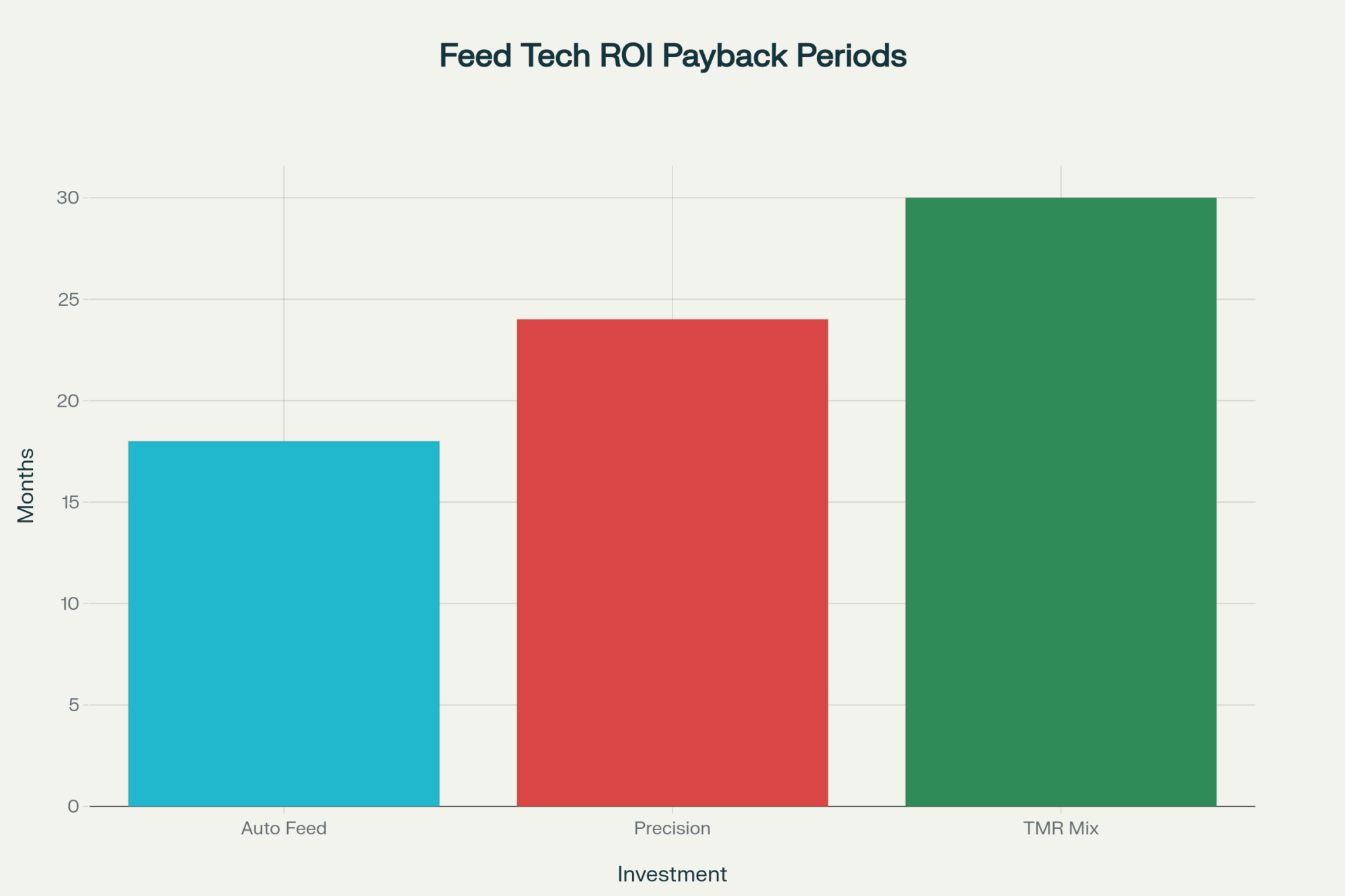
  • Automated feeding systems, such as Triomatic, slash waste by up to 38%, with tech payback often achieved within two years. Don’t just feed more—feed smarter.
  • On-farm rumination sensors catch illness 1–2 days earlier than the naked eye, trimming vet bills and boosting milk flow. Ask your nutritionist for options.
  • Global dairy leaders—from Dutch to Brazilian herds—are scaling rapidly with precision feeding, not herd size. That’s what’s moving ROI in 2025.
  • Want to plug the leak? Start by tracking refusals and shrink. Call your extension—get a feed waste worksheet. The profit’s waiting in your alley, not your next cow purchase.

Let me tell you, if you’re still thinking “more cows, more milk, more margin,” you’re playing last year’s game. Give this new approach a real shot, and watch your dairy pencil look a whole lot fatter.

Step into any 240-cow barn in Central Wisconsin in March—slush up to your ankles—and you’ll see feed push-offs stacking up like cordwood. In north Fond du Lac, a local nutritionist recently told me, “You’re shoveling away the price of a new headgate every month.” Stories like that, echoing recent farm visits from the Upper Midwest, pretty much sum up what’s biting into real dairy margins. Nearly every conversation comes back to shrinkage and refusal. As Luiz Ferraretto and Randy Shaver noted in a University of Kentucky Extension analysis, lost pounds at the bunk are a universal challenge for U.S. dairies.

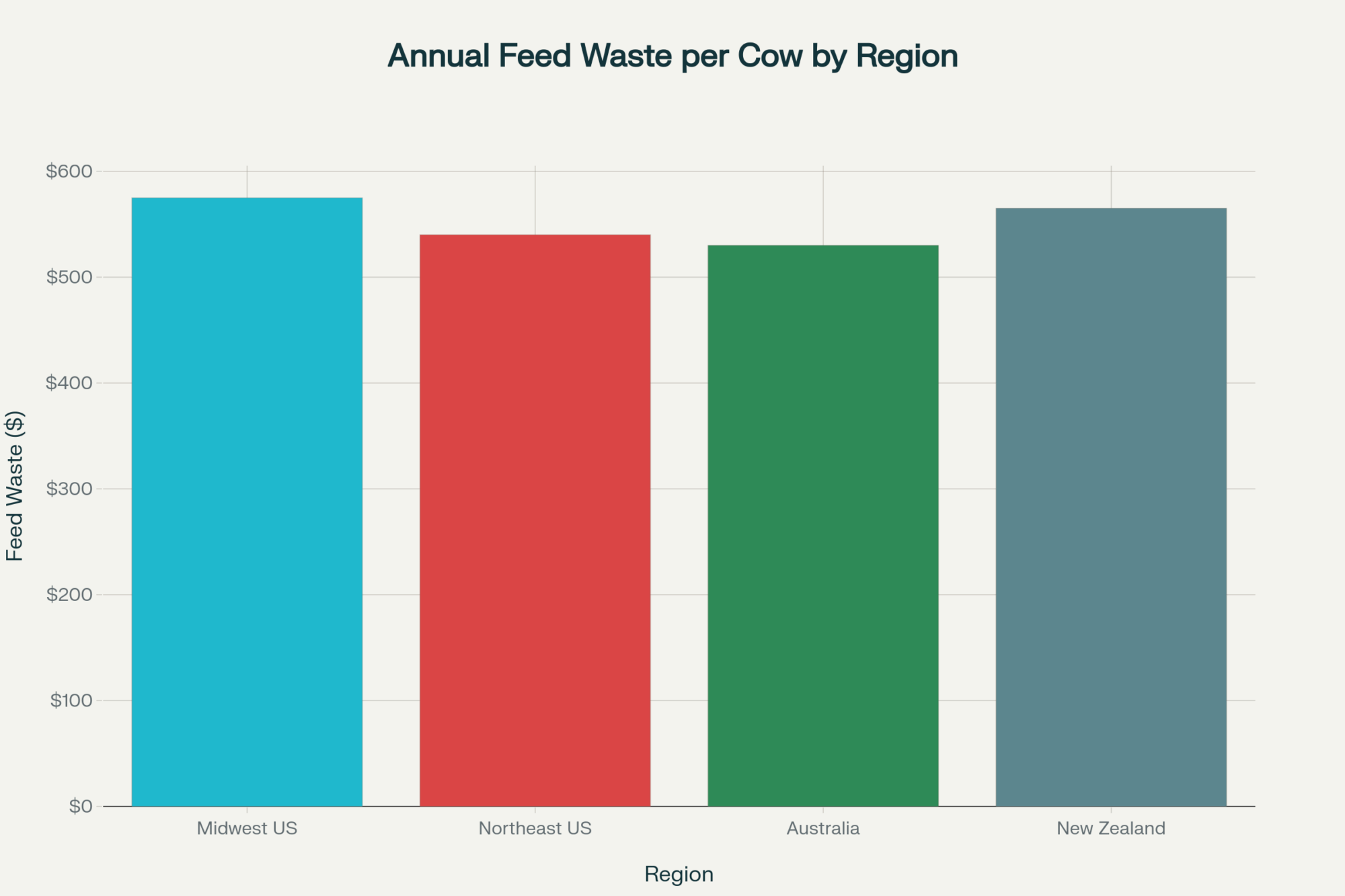
Extension analyses from Kentucky and Wisconsin peg the real cost of feed waste at $1.40 to $1.60 per cow, per day—between $500 and $650 per cow over the year, with peaks much higher on the worst days. Do the math: at an average of $1.55 per day, that’s the $570-per-cow problem that hits your bottom line every single year. Run your own workbook and see if it shakes out differently, but for most, that’s real money lost.

Why “More Cows” Doesn’t Fix Feed Waste

If you’ve ever argued the “bigger is better” side at the co-op table, you’ve probably heard the comeback: “If you’re behind on feed management, more cows just means a bigger hole.” Big herds with the right gear can sometimes get shrink below average, especially in those elite Indiana and Idaho TMR setups. Most average farms—especially with roughage in bunker silos and unpredictable weather—fall into the same trap. Putting on 50 head before you plug the waste is like topping up a worn-out tire before patching the hole.

As Dr. Randy Shaver of UW-Madison often emphasizes, a typical scale doesn’t guarantee typical intake. He often states, “A producer might be delivering 50 pounds of dry matter to the bunk, but the cows are only consuming 42. That 8-pound gap is where your profit disappears, and it shows up directly in the milk check.” His findings in Wisconsin align with what I’ve seen in upstate New York TMR barns the same week.

Break down those on-farm records—from Michigan’s sand-bedded freestalls losing 8% to Ohio’s drive-over pile herds at 15%—and you’ll see weather, bunk, and storage make or break you.

According to Penn State Extension, $0.50 per cow daily in classic shrink is common, but with energy and protein factored in, annual losses climb to $500–$650 per cow. A typical 250-cow herd in the Midwest can lose the feed equivalent of an entire semi-load of corn silage every year, enough to buy a new used skid-steer.

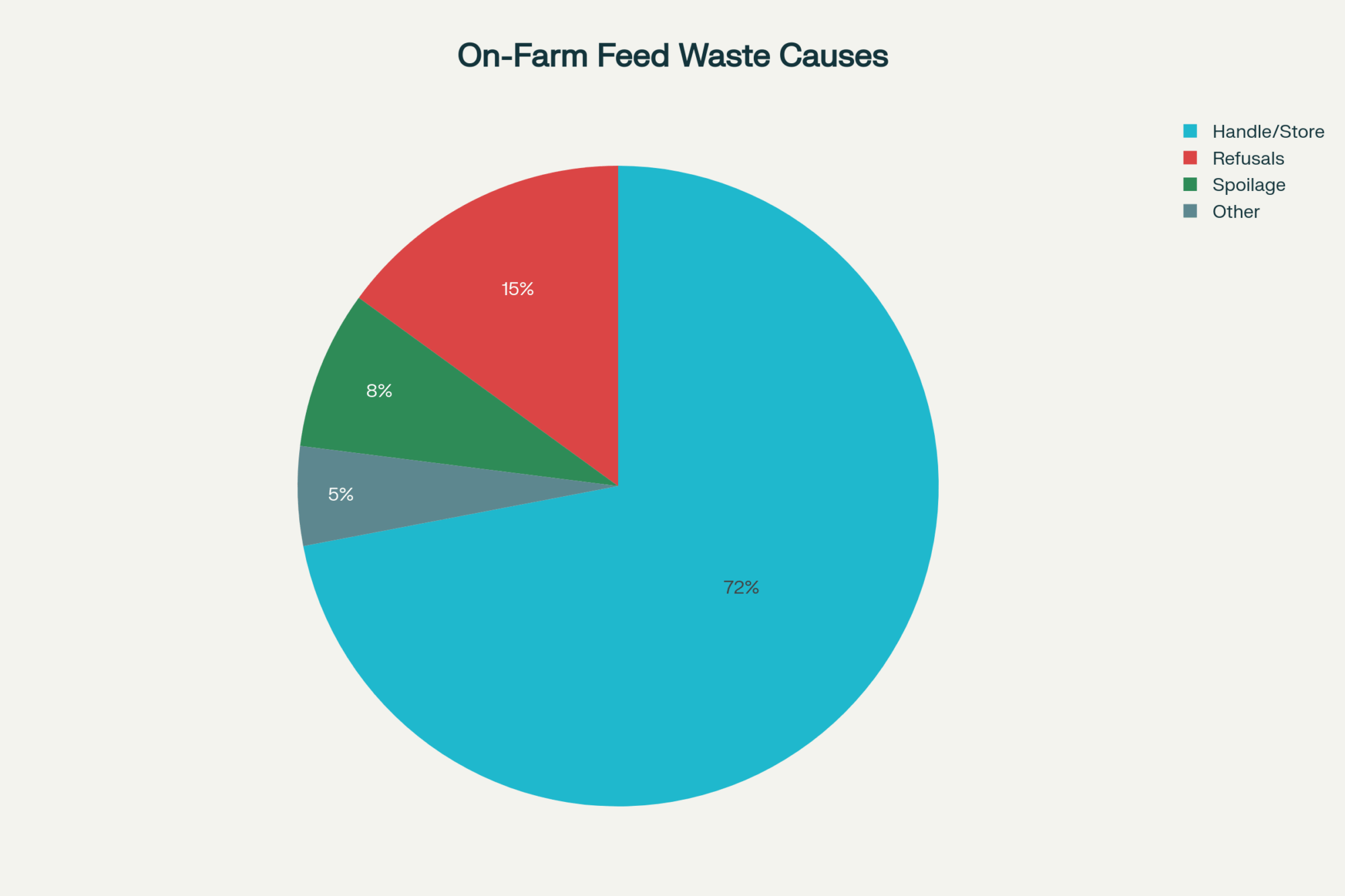
Looking overseas, the Australian Dairy Sector Food Waste Action Plan reports the industry loses over 700,000 metric tons of feed a year, with almost three-quarters of that occurring on farms rather than at the processor. DairyNZ’s numbers remind us that weather and region always matter.

How Tech Actually Delivers (And When It Doesn’t)

Forget the flashy dealer flyers—real farms want results. Here’s what’s moving the margin where it counts:

  • Case Study: The Kruidhof family near Ommen, Netherlands—85 Holsteins—installed a Triomatic T30 feeding system, switched to six-times-per-day feeding, and cut waste by 38% while dropping labor needs by more than half. Their payback landed just shy of 18 months on a €95,000 investment. European extension trials back up these results, but U.S. herds still have to account for local dealer support, herd size, and that critical Midwest labor reality.
  • Feeder Reliability: Lely units, now common from Sheboygan to Saskatchewan, achieve an uptime of upwards of 98%, and 60% of issues are resolved remotely before the wrenches are even taken out. As a Dodge County producer shared last month, “Fast dealer response counts for more than horsepower.”
  • Cow Health Sensors: Rumination collars and eartags ($200–$250 a head) are game-changers for early illness detection. Studies by Gygax in Switzerland and Cornell’s Schirmann show these sensors can catch health problems a full one to two days earlier than visual signs, saving $2,000 or more each time they avert a health crisis.

Who’s Adopting? And What’s Holding Us Back?

U.S. adoption of full precision monitoring sits at just 12%, while Dutch herds are near 44%. Extension co-ops and lending groups here in the Midwest are making progress, but the whole team has to buy in—from feeders to family. The last Wisconsin Dairy Farm Business Summary found that cautious technology adopters logged a 15–25% ROI, with a payback period of two to three years—as long as staff were trained and support remained responsive.

Feeding Smarter—Not Just Adding Cows

Rather than adding cows, top herds focus on feeding smarter. Virginia Tech’s Self-Learning Dairy research showed individualized rationing puts $0.32 to $0.60 per cow per day back into your operation. That’s $100–$220 per cow per year, not counting earlier health catches. Dairy Business Association benchmarks from Wisconsin have shown a $250–$350 per cow per year profit increase from simply reducing shrinkage.

So what’s it mean for your own place? Run a feed trial. Track refusals for a month, batch by batch. The math you get might surprise you—and your accountant.

Are Environmental Gains Really Paying Off?

Precision feeding isn’t just for environmental headlines. According to the Journal of Environmental Quality, targeted protein feeding reduces nitrogen losses by 11–19%. Local extension data confirms Corn Belt and New York herds have matched or exceeded these savings with precision-driven TMR management. Reviews in Frontiers in Vet Science say certain feed additives can cut emissions by up to 22%. UC Davis life-cycle studies found precision feeding can reduce manure output by 14%.

Thinking about carbon credits? The USDA and NSAC report pilot farm payments of $6–$15 per tonne for CO2 reductions, but costs for paperwork and verification can run $3,000–$5,000 per year. New Zealand’s ETS market moves from NZ$30–$70/tonne depending on policy and feed prices, so buyers need to watch the rules before banking on returns.

Local Roadblocks and Financing

In Ontario, DFO and Farm Credit Canada negotiate annually with local banks—sometimes it’s a few thousand dollars upfront, while in other years, terms flip quickly. Always call your local office for up-to-date packages. In the U.S., the NRCS EQIP program can cover $50,000–$200,000 for feeding system upgrades, provided your plan fits the conservation and efficiency slots.

Brazil & India: Dairy Competition Goes Global

Across the globe, Brazil’s EMBRAPA notes over 500 new automated herds are built each year, integrating feeding tech from the start. NDDB’s digital push in India gives 150,000 herds smartphone ration calculators, with small farms seeing 15–19% better yields. International Dairy Federation researchers say it now takes less than two years from install to payback—compared to the decade-old five-year slog.

Bullvine Bottom Line: Local Data, Real Dollars

Feed waste isn’t an abstract table; it’s dollars left in the alley and pounds unmilked. Smart nutrition and management—backed by both hard data and local extension trials—pay off for farms that check, measure, and adapt. No matter the size, track your shrink, weigh refusals, and call the service crew before you trust a sales pitch.

Because in this business, size won’t hide waste. Only sharp feeding and tight records move the margin.

Complete references and supporting documentation are available upon request by contacting the editorial team at editor@thebullvine.com.

Learn More:

Join the Revolution!

Join over 30,000 successful dairy professionals who rely on Bullvine Weekly for their competitive edge. Delivered directly to your inbox each week, our exclusive industry insights help you make smarter decisions while saving precious hours every week. Never miss critical updates on milk production trends, breakthrough technologies, and profit-boosting strategies that top producers are already implementing. Subscribe now to transform your dairy operation’s efficiency and profitability—your future success is just one click away.
NewsSubscribe
First
Last
Consent

Sorghum: The Drought-Tolerant Feed That’s Changing the Dairy Game

Turkish dairy farmers just cut water use 50% without losing a drop of milk—here’s how they did it and why you should care.

EXECUTIVE SUMMARY: Listen, while we’ve been stuck in the same old corn routine, dairy farmers in Turkey figured out something that could save your operation serious money. They switched to sorghum and slashed their water bills in half without touching their milk production. We’re talking about a 12-fold increase in sorghum acres over five years—from 451 acres to over 6,000 acres because the math just works. Nebraska extension research shows dairies replacing just 40% of their corn silage with sorghum are seeing 60% cuts in irrigation costs, and with hay prices swinging 40% month-to-month like they did last year, having a backup plan isn’t optional anymore. Steam-flaking pushes sorghum’s starch digestibility up to 90%, matching corn’s energy output while your water meter runs a lot slower. The Journal of Dairy Science backs this up—same milk volume, better fatty acids, lower input costs. You should seriously consider testing this on 50-100 acres this season.

KEY TAKEAWAYS

  • Cut feed costs 15-25% in drought years while maintaining milk production—Nebraska dairies prove it works with real 60% irrigation savings you can take to the bank.
  • Steam-flaking unlocks 90% starch digestibility from sorghum (vs. 65% unprocessed), giving you corn-level energy with half the water demand—upgrade your processing or find reliable custom work.
  • USDA REAP covers 25% of equipment costs for the $25k-$50k processing upgrades most operations need, making the ROI math work even faster in 2025’s tight margin environment.
  • Brown Midrib (BMR) varieties boost fiber digestibility for high-producing herds while genetic advances eliminate tannin concerns—talk to your extension about locally adapted varieties now.
  • Start small with 50-100 test acres to learn the system before committing major acreage. With carbon credits adding revenue and water costs climbing, this isn’t an experimental endeavor; it’s smart risk management.
sorghum for silage, dairy feed management, drought tolerant forage, reduce feed costs, alternative forage crops

You ever have one of those moments when the well’s running low, the pump bill’s climbing, and you’re staring at thirsty corn that just won’t quit? That’s exactly what hit dairy farmers in Turkey’s Izmir region in 2025. Rainfall was down 27%, and water-saving became the name of the game.

So what’d they do? They turned to sorghum. This tough old forage doesn’t require much water, but it keeps the milk flowing just fine. And they didn’t just plant a few acres—they kicked sorghum up from a few hundred acres to over 6,000 acres in five years. When the corn game’s no longer paying, you gotta adapt.

The Science Backing Sorghum’s Performance

Now, farmers like Zafer Yurt know what’s up because they count every drop of water. Studies published recently in the Journal of Dairy Science say cows on sorghum silage match their milk production compared to corn-fed herds, but get better fatty acids and antioxidants in their milk—good news for milk quality and cheese makers alike.

And about those tannins that make some folks nervous? Turns out, thanks to recent genetic research, we can zero in on low-tannin hybrids by spotting key alleles, which means better protein digestion for the cows and fewer headaches for us. Plus, Brown Midrib (BMR) sorghums take that a step further, cutting lignin and boosting fiber digestibility, a real plus in demanding dairy diets.

But listen, what really flips the switch is processing. Steam-flaking sorghum raises starch digestibility way up, rivaling corn. It’s like unlocking hidden energy if you do it right.

Choosing the Right Sorghum Hybrid for Your Region

What works in one spot might tank in another. Up north in the Midwest, newer fast-maturing hybrids are gaining traction—varieties that hold up in harsh weather and finish before frost hits, which matters in short seasons. Across the Corn Belt, grazers like Grazer and Haygrazer fit the bill just right. In the deep south, Texas A&M’s Sudan King handles the heat, even letting folks get two cuts a year in good conditions.

The top producers I’ve talked to mix and match based on soil moisture, planting sorghum on drier patches and leaving the wetter ground for corn. Tech like GPS-guided planting is becoming a must-have for this.

Gearing Up: The Equipment Investment for Sorghum

No secret that sorghum stalks can be tough on your gear. You may need upgrades—small farms looking at a $25k-$50k range and larger operations possibly paying six figures. That said, the USDA’s REAP grant can reduce the cost by 25%, which helps.

And then there’s your nutritionist—bring them in early. You can’t just swap feeds fast without throwing the rumen out of whack.

The Economic Payoff: Analyzing Sorghum’s ROI

Cost-wise, when water’s pricey, sorghum can trim feed bills by 15 to 25%, depending on your local rates and management practices. But the market swings fast—last year’s hay prices jumped 40% month-to-month—so it’s not a sure thing.

Carbon credits are kicking in, too, but the money varies by where you farm and which programs you qualify for.

Managing the Risks: Nitrates, Prussic Acid, and Tannins

SORGHUM FEEDING RISKS — QUICK GUIDE

  • Nitrates: Safe below 0.12% nitrate nitrogen. Test forage regularly, dilute high nitrate batches, and avoid sudden diet shifts.
  • Prussic Acid: Risk spikes after frost or in young regrowth. Wait 1-2 days before grazing and test the forage.
  • Tannins: Low in modern hybrids, but keep an eye on protein digestibility and adjust rations accordingly.

Nitrate spikes can sneak up during drought, so vigilance is key. Caution is warranted between 0.12% and 0.23% nitrate nitrogen; anything above that requires feeding restrictions.

Prussic acid hazards also demand respect—especially after frost events or on regrowth shoots. Test regularly and delay grazing accordingly.

Thanks to new breeding, tannin issues have largely been resolved; however, ongoing monitoring remains a prudent management strategy.

Case Studies: How Dairies Are Winning with Sorghum

Let’s get real. Nebraska dairies swapping 40% of their corn silage for sorghum hit a 60% cut in irrigation water without losing a drop of milk production—these numbers come from well-documented extension research.

Not far off, Kansas operations growing sorghum on marginal grounds have kept herd performance solid, adapting to drought with resilience.

Down in Texas, dairymen rely on sorghum to hold their production steady through blistering heat waves and tightening water supply.

Getting Started with Sorghum

The first step? Pull out those irrigation bills and figure out your true water cost.

Next, talk to your local extension to get recommendations on the best varieties for your specific climate and soil.

Bring your nutritionist into the conversation early so you can transition your cows smoothly—no rush jobs in feeding.

Start small—50 to 100 acres is enough to learn the ropes and avoid surprises.

And be sure to test your forage regularly. Nitrates, prussic acid, tannins—these matter.

Bottom Line

Drought isn’t waiting for anyone. And neither should you.

Sorghum’s no experimental fad. The science, the economics, the real-world wins—it’s all there showing it’s a weapon in the war against dry seasons and rising feed costs.

When the heat is on and the well runs low, this feed can keep your cows milking and your operation profitable.

So, what’s your next move?

Complete references and supporting documentation are available upon request by contacting the editorial team at editor@thebullvine.com.

Learn More:

  • The $4,000 Heifer: Seven Strategies to Navigate the New Dairy Economy – This strategic overview contextualizes the economic pressure to optimize feed costs. It provides seven actionable strategies for managing high input costs in the current market, making the case for why innovations like sorghum are essential for long-term financial health.
  • Precision Feeding Strategies Every Dairy Farmer Needs to Know – This article offers a tactical deep dive into the operational side of feed management. It details how to implement precision feeding using TMR principles and data analysis, providing a perfect “how-to” guide for producers ready to optimize their new sorghum-based rations.
  • Future-Proof Your Dairy Farm: Tackling the Top 3 Challenges of 2050 – This forward-looking piece places the shift to drought-tolerant crops within the larger context of climate change and sustainability. It explores how innovations in feed, genetics, and technology are crucial for addressing the industry’s biggest future challenges, like methane reduction.

Join the Revolution!

Join over 30,000 successful dairy professionals who rely on Bullvine Weekly for their competitive edge. Delivered directly to your inbox each week, our exclusive industry insights help you make smarter decisions while saving precious hours every week. Never miss critical updates on milk production trends, breakthrough technologies, and profit-boosting strategies that top producers are already implementing. Subscribe now to transform your dairy operation’s efficiency and profitability—your future success is just one click away.
NewsSubscribe
First
Last
Consent

UK Dairy’s Lupin Bet: Are the Profits Real in 2025?

UK farms cut feed costs £750/month with lupin protein—no drop in milk yield. That’s real money, not hype.

EXECUTIVE SUMMARY: Here’s what caught my attention: lupin protein is quietly revolutionizing UK dairy feed economics while everyone’s still arguing about soya prices. Recent trials show you can swap 50% of your soya protein for lupin and actually save over £750 monthly on a 250-cow operation—without touching milk yield or butterfat levels. The nitrogen fixation alone cuts fertilizer costs by up to 300kg N/ha, which is money straight back in your pocket. Global markets are already shifting toward homegrown proteins, so you’re ahead of the curve here. Your nutritionist’s probably already aware of the buzz, but most producers are still missing out on this opportunity. Don’t be one of them.

KEY TAKEAWAYS:

  • Cut feed expenses fast: Replace 50% of soya protein with lupin and bank £750+ monthly savings on 250-cow herds. Contact your seed supplier this week—2025 contracts are filling up quickly.
  • Maintain steady production while reducing fertilizer bills: Lupin’s natural nitrogen fixation saves up to 300kg N/ha without affecting milk yield or components. Now is the perfect time to reassess your rotation strategy.
  • Avoid costly downtime: Ensure your mill grinds lupin into 4-8 fragments, not powder or whole seeds. A quick conversation with your miller can prevent expensive blockages.
  • Test the waters now: Start with 15-20% lupin in your fresh cow rations this month. Track performance for 30 days, then decide if you want to scale up before autumn contracts lock in.
  • Play the long game: Early adopters report 2-3 year payback periods, but with volatile soya markets and tightening sustainability rules, this hedge makes sense for progressive operations.
 lupin for dairy, reduce feed costs, homegrown protein, soya alternative, UK dairy farming

The conversation around feed has changed rapidly this year. Just last month, producers started swapping “Amazon soya headaches” for “Did you see those Soya UK lupin contract numbers?”

That’s no small chatter—DEFRA’s Sustainable Lupin project, together with Newcastle University and Soya UK, is pushing lupin from research plots into real farm feed contracts. For the first time in decades, UK dairy farmers are seriously weighing a local protein alternative. (Read more at UK Agri-Tech Centre)

Real Farms, Real Numbers

Cutting through the noise: Recent UK and international feeding trials have demonstrated that replacing up to 50% of soybean meal with properly processed lupin can maintain steady milk yields and reduce feed costs. The Journal of Dairy Science confirms that there is no negative impact on milk components at these levels.

According to PGRO’s 2025 contract analysis, white lupin gross margins exceed £500/ha on suitable soils—specifically low-alkaloid sweet white lupin varieties like Dieta or Celina, which are safe and palatable for dairy cattle—a figure around 60% better than field beans in similar settings.

Let’s do a quick calculation:

  • Soya meal price: £450/tonne
  • Lupin meal price: £380/tonne
  • Herd size: 250 cows
  • Protein supplement per head: 4 kg

By substituting 50% of the soya with lupin, a 250-cow herd could save over £750 monthly on feed costs. Run your own numbers, but the potential is clear.

Here’s the practical nugget, though: feed mills warn lupin seeds must be ground to 4-8 pieces, as whole or pulverized seeds can cause clogs, risking downtime and feed waste.

Practical takeaway: Discuss grind specifications with your mill operator now to prevent costly blockages with lupin.

Why Margin Matters—and Getting It Right

AHDB feeding trials confirm that substituting up to 50% of lupin has no negative impact on milk volume or butterfat. Beyond that, Belgian data show that milk yield can dip and fat levels fluctuate due to amino acid imbalances—lupin’s naturally lower in methionine and lysine compared to soy, making careful ration balancing critical. Consult your nutritionist early. (Details from Dellait, 2021)

Yara UK’s field trials demonstrated the nitrogen fixation benefit—up to 300 kg N/ha fixed with good management—resulting in real fertilizer cost savings, not just speculation.

The UK’s lupin crop remains modest, at approximately 4,200 hectares (2% of the country’s protein crops). Scaling production remains a hurdle. Early adopters with contracts report paybacks within 2-3 years, depending on herd size, yields, and feed prices, according to PGRO.

Practical takeaway: Familiarize yourself with your local lupin acreage and consult with your seed supplier to discuss availability and pricing.

What to Watch Out For

Some Midlands dairy businesses have reported delays in seed delivery and contract adjustments. Double-check your contract terms, delivery schedules, and mill to ensure accuracy and capacity.

One Leicestershire producer noted, “The biggest hurdle wasn’t growing it, it was communication with the feed mill. They’d never handled it before. My advice: get your nutritionist, miller, and agronomist on a three-way call before you sign anything.”

Sustainability benefits vary by region. Research in Frontiers in Sustainable Food Systems (2024) highlights that more greenhouse gas reductions can be achieved with lupin in southern England compared to higher northern soils, where establishment is more challenging.

Practical takeaway: Consider your region’s soil and climate when planning rotations and implementing sustainable practices.

The Future for Lupin in UK Dairies

On dairies milking 180-400 cows with modern mixers, lupin is moving from trials to routine feedstuff. Proper contracts, weed control, and milling unlock its profit potential.

This feed flexibility guards against price swings and import issues that can hammer margins.

Practical takeaway: Initiate discussions with suppliers and advisors about incorporating lupin into next season’s feed.

The Bottom Line

Ignore hype about “revolutionary proteins.” Do your homework, test thoroughly, and ensure your mill can handle lupin.

Within six months, you may be explaining how lupin reduces feed costs without sacrificing production—if you plan correctly and work with trusted advisors.

For freestall farms milking 200+ cows, this transition is achievable but not automatic. Every farm is unique—use science and trials to find your best fit.

Complete references and supporting documentation are available upon request by contacting the editorial team at editor@thebullvine.com.

Learn More:

  • The TMR Audit: The 15 Minute Feed Efficiency Walk-Through – This tactical guide provides a step-by-step process for evaluating your entire feeding system. It reveals practical methods for identifying feed waste and improving TMR consistency, ensuring you maximize the return on every ingredient, including new ones like lupin.
  • Dairy Feed Costs: Sky-High But How Do We Tame the Beast? – Explore the broader market forces driving high feed costs and discover strategic approaches to mitigate price volatility. This article provides a high-level economic perspective, reinforcing the financial logic behind incorporating cost-effective, homegrown proteins into your long-term strategy.
  • Precision Feeding: The Key To Unlocking Your Herd’s Genetic Potential? – Look beyond the ingredients to the technology that delivers them. This piece explores how precision feeding systems optimize nutrient delivery, complementing the use of alternative proteins by ensuring maximum efficiency and unlocking greater herd potential and profitability.

Join the Revolution!

Join over 30,000 successful dairy professionals who rely on Bullvine Weekly for their competitive edge. Delivered directly to your inbox each week, our exclusive industry insights help you make smarter decisions while saving precious hours every week. Never miss critical updates on milk production trends, breakthrough technologies, and profit-boosting strategies that top producers are already implementing. Subscribe now to transform your dairy operation’s efficiency and profitability—your future success is just one click away.

NewsSubscribe
First
Last
Consent

Your Nutritionist Calculates the Ration. But Who Calculates Your Real Profit?

Whoa! Feed errors cost you $1,200+ per cow yearly—that’s serious cash walking out your barn door. Time for real talk.

You know that feeling when you’re walking past the feed bunk on a busy Tuesday morning, watching the TMR get pushed up, and something just doesn’t sit right? Like there’s money walking out the door that never shows up on your milk check?

Well, here’s the uncomfortable truth nobody wants to talk about at the co-op meetings: if you’re calculating feed costs the way most dairies do, you’re probably underestimating your true costs by more than $3.50 per hundredweight.

Think about that for a minute. On a 200-cow dairy averaging 85 pounds per cow daily, that’s over $50,000 annually, that’s just… gone. Not stolen, not lost to market volatility—just miscalculated into thin air while you’re focused on everything else.

I’ve been digging into this across operations from Wisconsin to California, and what I’m seeing is pretty sobering. These aren’t isolated bookkeeping errors we’re talking about. They’re systematic blind spots that have become so commonplace that most producers don’t even realize they’re happening.

Here’s what really gets me fired up about this: The market volatility we’ve all been living through has made these calculation errors absolutely brutal. Income Over Feed Cost swung a staggering $12.05 per hundredweight from the depths of 2023 to early 2024—and farms flying blind with bad baseline numbers got hammered twice as hard.

The Thing About Feed Costs That Keeps Me Up at Night

Feed is the ultimate financial lever on your operation. Period. We’re talking about 50-60% of your total production costs in most systems, sometimes exceeding 70%. When you’re looking at numbers like Illinois farms reporting nearly $3,000 per cow annually on feed, even small calculation errors get magnified fast.

What strikes me about visiting different operations is how the same fundamental mistakes keep showing up, regardless of herd size or management philosophy. It’s as if we’ve collectively agreed to overlook basic economic principles when it comes to the largest expense line on our balance sheets.

Here’s the brutal math: when feed represents 60% of your costs, a 5% calculation error doesn’t just ding your margins—it can wipe out your entire profit for the year. I’ve seen operations that looked profitable on paper discover they’d been operating at a loss once we corrected their feed costing methodology.

The “As-Fed” Trap That’s Killing Your Numbers

Let me paint you a picture I see way too often. You’ve got two trucks of corn silage arriving, both quoted at $60 per ton as-fed. Your first instinct? They’re the same deal.

Wrong.

The first load tests were at 30% dry matter, the second at 40%. When you run the actual numbers on a dry matter basis, that first load is costing you $200 per ton of nutrients, while the second is $150. That’s not a rounding error—that’s a 33% difference in value sitting right there in plain sight.

Yet I still walk onto farms where buying decisions are made on as-fed weights. New Mexico State Extension puts it bluntly: “The water component contains no nutrients,” yet we continue to pay for it as if it did.

This is especially painful when you’re dealing with wet byproducts or variable-moisture silages. I was on a farm in central Wisconsin where they were consistently overpaying for wet distillers grains because nobody was converting to a dry matter basis. Once we fixed that calculation method, they saved over $15,000 in the first four months.

Your “Free” Forage Isn’t Free (And You Know it)

Here’s where even experienced producers trip themselves up: treating homegrown forage as if it were free or pricing it at last year’s production costs. Look, I get the psychology. You grew it, chopped it, stored it—it feels like it shouldn’t cost anything extra to feed it.

But economically? Every ton of silage going into those bunks is a ton you’re not selling. The USDA Economic Research Service prices homegrown feeds at current market values for exactly this reason. That “free” corn silage has a very real opportunity cost.

I was working with a farm in southern Minnesota where the owner was convinced his dairy was highly profitable. Milk production appeared to be good, the cows were healthy, and the cash flow seemed positive. Then we repriced his homegrown feeds at market rates and discovered his crop enterprise was essentially subsidizing a marginally profitable dairy operation.

Without accurate costing, he couldn’t make informed decisions about land use, expansion, or even whether he should be in the dairy business at all. That’s not just bad accounting—that’s strategic blindness.

The Invisible Herd Costing You Big

Now here’s where even sharp managers stumble: calculating feed costs only for the milking string while completely ignoring dry cows and replacement heifers.

This is huge. Industry analysis reveals that this omission underestimates true feed costs by approximately 38%. You’re looking at a $3.16 per hundredweight error just from calculation scope alone.

Think about the math here—if you’ve got 200 milking cows, you’re probably feeding another 40-50 dry cows and maybe 180-200 replacement animals of various ages. All eating, none producing milk that hits your bulk tank. Factor that into your cost per hundredweight, and suddenly those feed costs look very different.

I see this error constantly, even from operations that are sophisticated in other areas. They’ll invest in genomic testing and precision breeding, but calculate feed costs as if it were 1985. The disconnect is jarring.

Feed Shrink: The Silent Profit Killer Nobody Talks About

Let’s dive into something that doesn’t get nearly enough attention—shrink. That’s the feed you paid for that never actually reaches a cow’s mouth.

Research from Hubbard Feeds indicates an average shrinkage of 5.42% for purchased feeds, with losses reaching 8.06% for commodities in open storage. However, what really concerns me is that I’ve documented shrink rates exceeding 12% on farms with inadequate storage and handling protocols.

I visited a 1,000-cow operation that tracked its shrink losses and found it was losing $5,733 over just 47 days. That’s nearly $45,000 annually vanishing into thin air—or more accurately, into bird bellies and blowing away with the wind.

The economics are staggering. Move from an open commodity shed to proper enclosed storage, and you’re looking at potential savings of $135,000+ annually for a 1,000-cow dairy. Often, that saves enough to pay for the new building through feed cost reduction alone.

However, what really bothers me about shrinkage it’s not just volume loss. You’re losing the lightest, most nutrient-dense particles first. The expensive stuff. So you pay twice: once for the lost feed, again through the imbalanced ration that’s left behind.

When Good Metrics Go Bad: The Feed Efficiency Trap

Even when costs are calculated correctly, they can be applied wrong, leading to terrible management decisions. I frequently observe this with feed efficiency metrics.

The classic mistake? Using average feed conversion rates to predict responses from additional feeding. The biologically correct metric is the marginal response—what you actually get from that next increment of feed.

I worked with a producer who was convinced that adding two pounds of concentrate would generate six additional pounds of milk based on his average conversion rate. Reality? He obtained perhaps two extra pounds of milk, which increased the marginal feed rate to three times his average rate. Instead of the profitable margin he calculated, he was barely breaking even.

Some operations push this even further, chasing feed efficiency numbers in isolation without considering the economic implications. I’ve seen cows pushed so hard they start milking off their backs—sacrificing body condition and future fertility for short-term efficiency gains.

The Real Cost: Adding It All Up

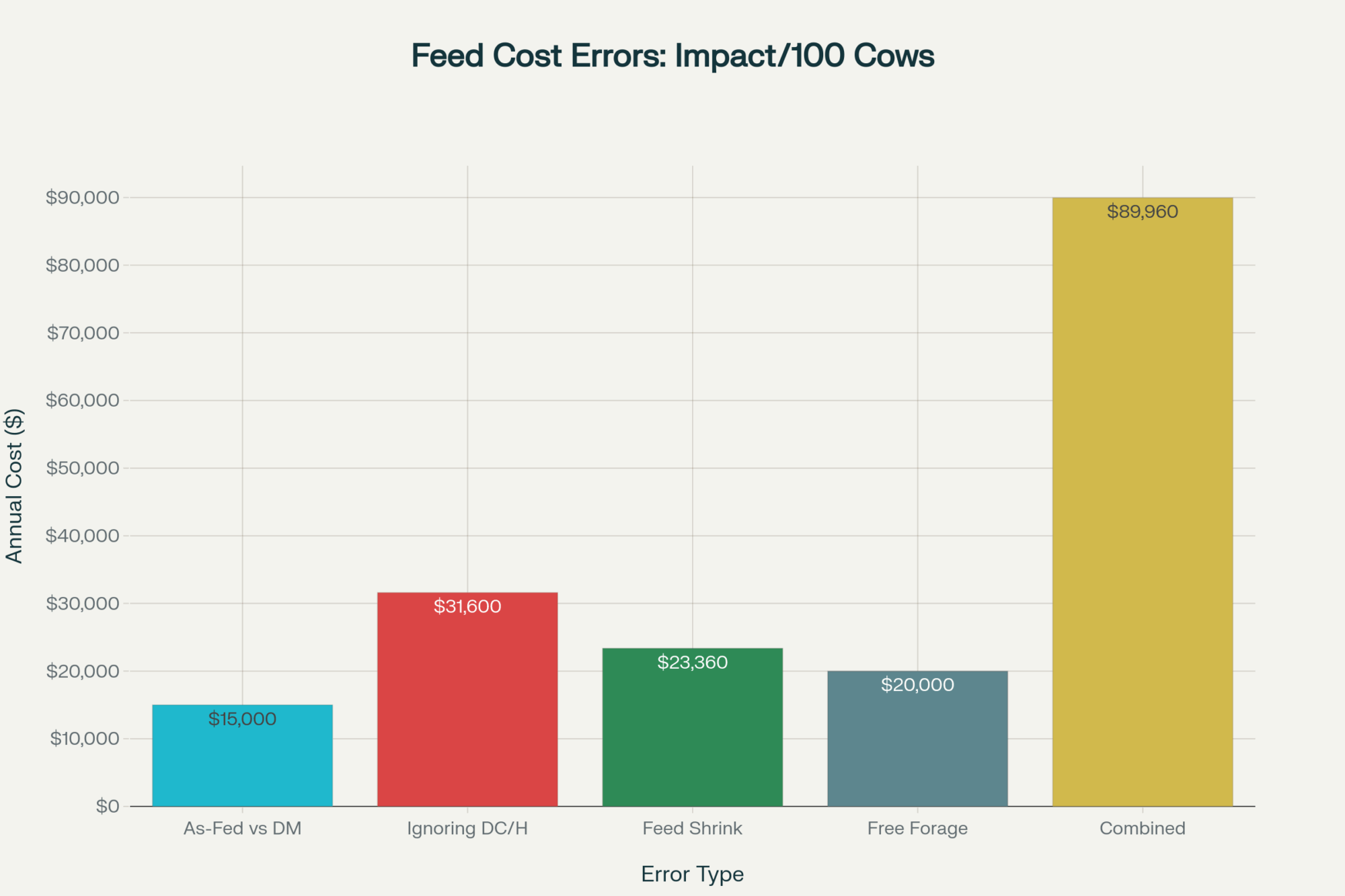
When you combine all these errors—as-fed pricing, “free” forage, incomplete herd costing, unaccounted shrink—you could be miscalculating costs by $1,200+ per cow annually.

Hidden Feed Cost Calculation Errors: Annual Impact per 100 Cows

On a 200-cow dairy, that’s a quarter-million-dollar blind spot. But here’s the opportunity: every one of these errors is fixable.

I’ve documented case studies where correcting these calculation methods delivered dramatic returns:

Technology: The Great Divide

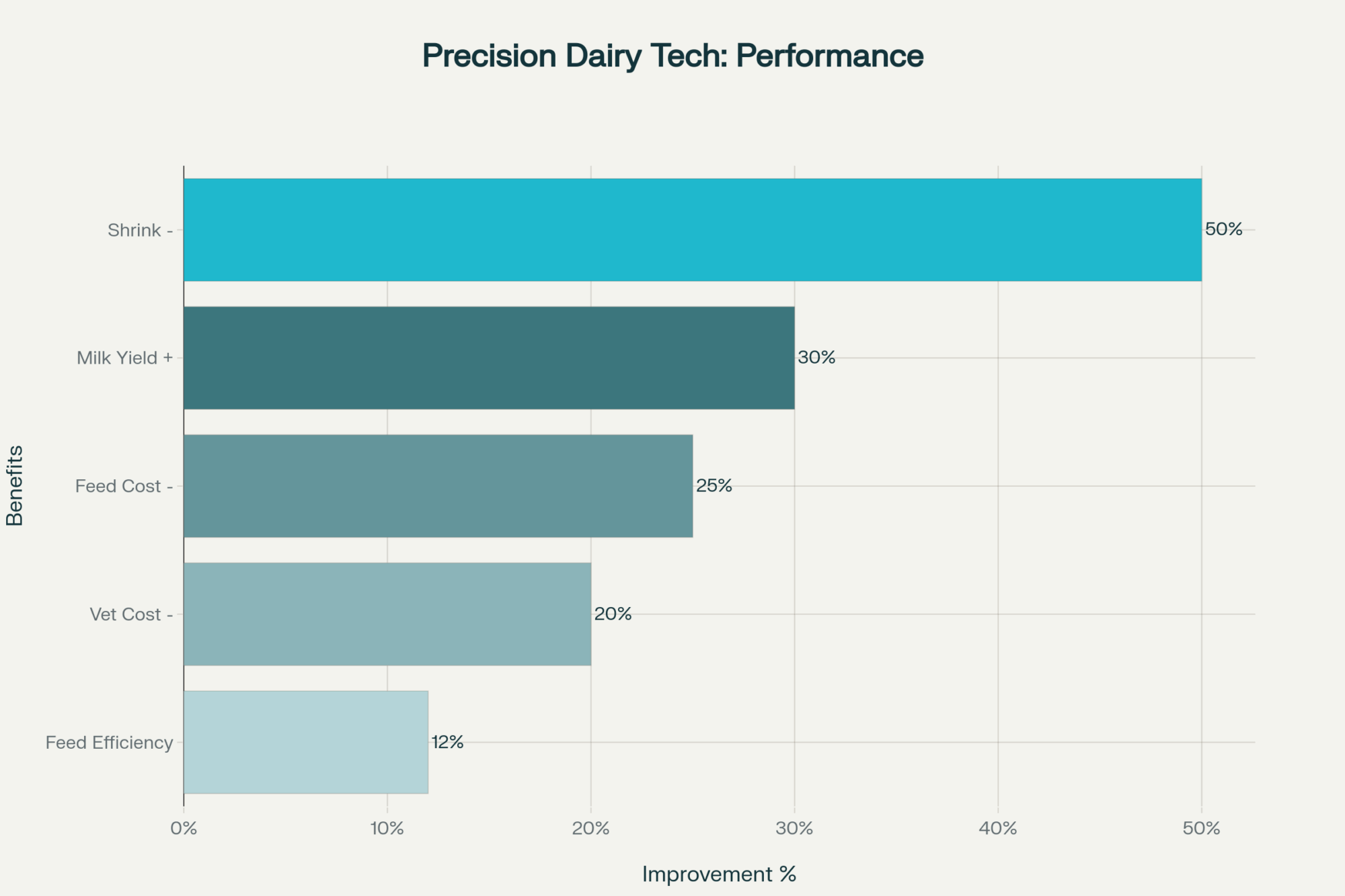
What’s particularly striking is how the adoption of technology is creating two distinct dairy industries. Progressive operations are implementing AI-driven feed optimization, real-time monitoring systems, and precision feeding platforms to enhance efficiency.

Precision Dairy Technology: Documented Performance Improvements

Research shows these systems deliver 7-12% reductions in feed costs while actually improving production. One study I reviewed found that AI-driven feed optimization could save $31 per cow annually by fine-tuning diets with precision that is impossible for humans to achieve.

However, here’s the problem: this technology isn’t inexpensive, and it requires expertise that many smaller operations lack. We’re seeing a widening gap where larger farms capture these efficiencies while smaller operations compete with higher cost structures.

This isn’t just about efficiency anymore—it’s about survival. Farms that get feed costing right have accurate baselines for risk management, better decision-making data, and a foundation for sustainable profitability.

The Global Context We Can’t Ignore

While we’ve been focused on domestic markets, global trends are reshaping feed costs that most U.S. producers aren’t tracking closely enough.

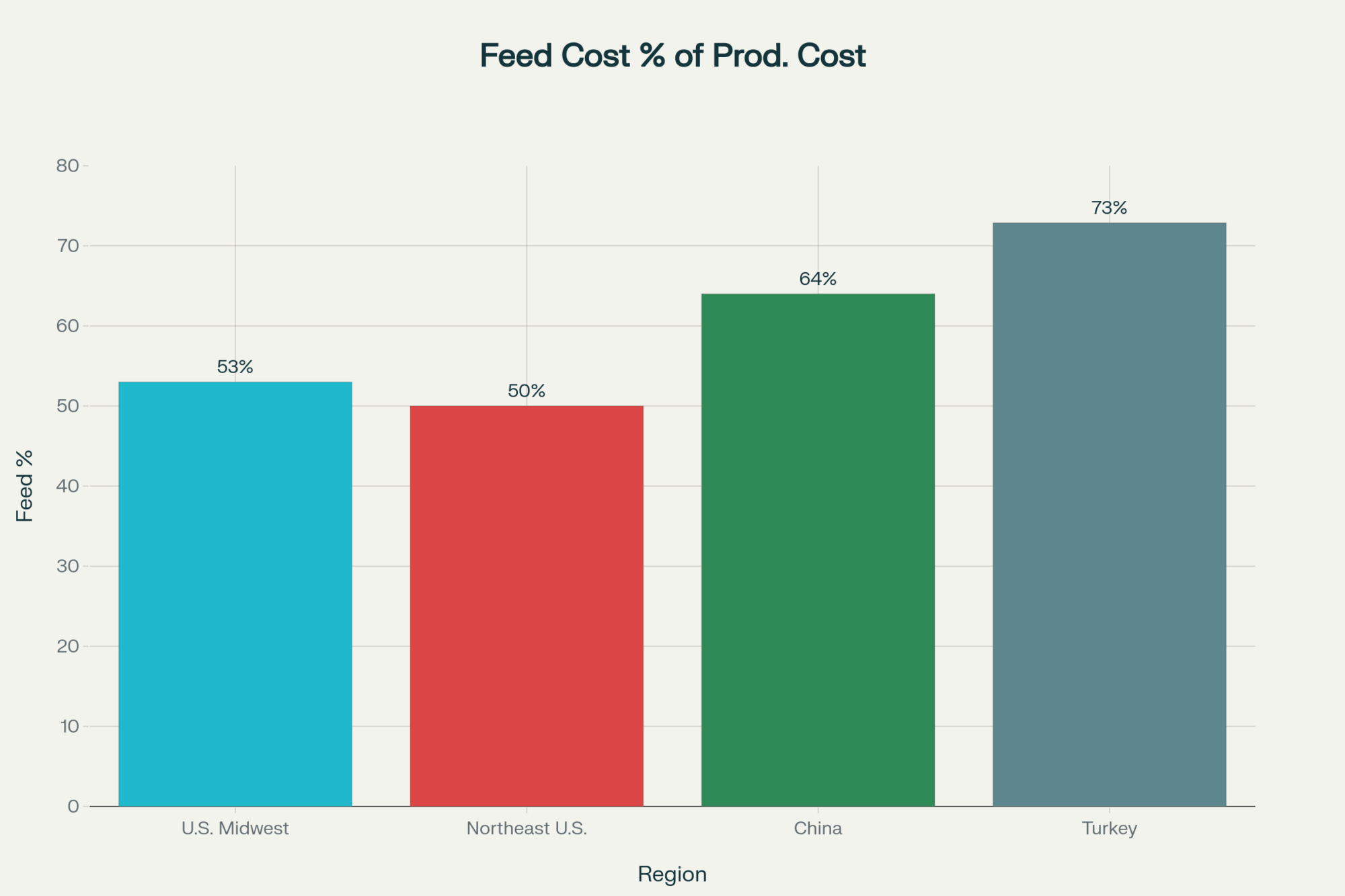
China’s dairy expansion is fundamentally altering global feed demand. With feed representing 64% of production costs in Chinese systems, their procurement strategies are affecting commodity prices worldwide.

Comparison of feed cost percentage of total production costs among four regions

European producers are facing environmental regulations that are driving diverse approaches to feed efficiency and waste management. Their focus on precision feeding and nutrient management isn’t just about costs—it’s about compliance with increasingly strict environmental standards.

These global pressures are coming to North America. We’re already seeing early discussions about carbon pricing and environmental compliance that could dramatically affect feed sourcing and cost structures.

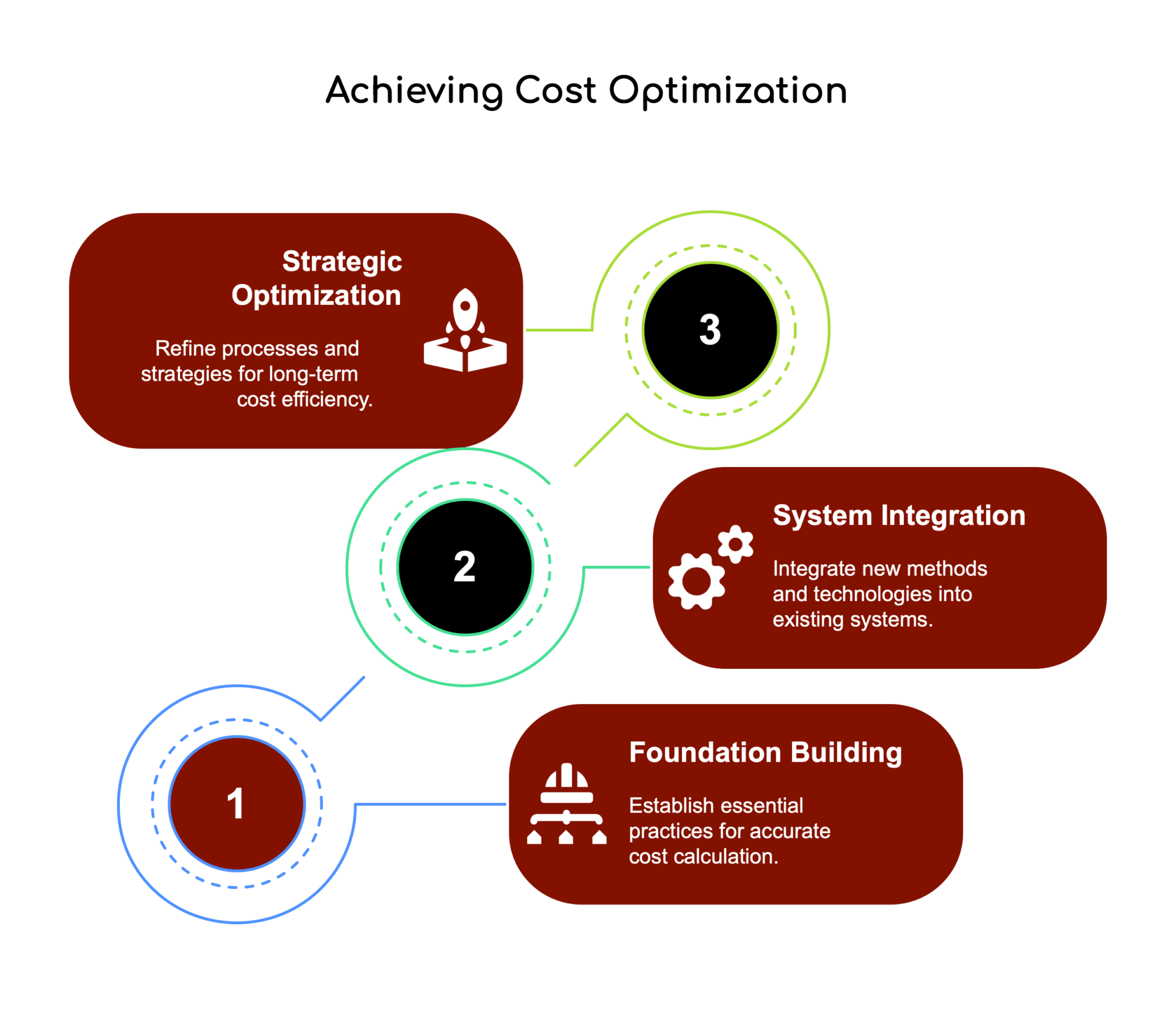
Your 90-Day Implementation Roadmap

Based on what I’ve seen work across different operations, here’s a practical approach to fixing these calculation errors:

Days 1-30: Foundation Building

  • Audit your current method: Calculate feed costs using only lactating cows, then recalculate including the entire herd plus shrink adjustments
  • Implement dry matter testing: Start testing all forages and wet byproducts weekly
  • Price homegrown feeds at market rates: Use current commodity prices, not historical production costs
  • Measure actual shrink: Start simple—track deliveries versus consumption

Days 31-60: System Integration

  • Switch to comprehensive costing: Include all animals and shrink in your cost per hundredweight calculations
  • Benchmark against industry standards: Compare your numbers to University of Minnesota FINBIN data showing average feed costs of $10.38 per hundredweight
  • Evaluate technology needs: Assess whether your scale justifies feed management software
  • Train your team: Ensure everyone understands the new calculation methods

Days 61-90: Strategic Optimization

  • Implement precision feeding: Consider nutritional grouping if herd size warrants it
  • Assess infrastructure needs: Calculate ROI for feed center improvements
  • Develop risk management strategies: Use accurate cost baselines for forward contracting and insurance decisions
  • Create monitoring protocols: Establish regular reviews and adjustment procedures

The Uncomfortable Questions

Here are the questions every dairy producer needs to ask themselves:

When was the last time your feed cost calculations were really audited? Not just checked for arithmetic, but examined for methodology, scope, and assumptions?

Are you making major business decisions based on incomplete cost data? Expansion plans, equipment purchases, land acquisitions—all depend on accurate profitability calculations.

How do your feed costs compare to industry benchmarks? University of Minnesota FINBIN data indicate an average feed cost of $10.38 per hundredweight. If you’re significantly higher, these calculation errors may be the reason.

What Progressive Operations Are Doing Differently

The operations that are thriving in this volatile environment share some common characteristics:

They treat feed costing like genetic evaluation—data-driven, regularly updated, and fundamental to every major decision.

They invest in accurate measurement systems—whether that’s precision feeding technology, improved storage infrastructure, or just better protocols for tracking shrink.

They understand the difference between cost and value—focusing on Income Over Feed Cost rather than just minimizing feed expenses.

They benchmark religiously—knowing exactly where they stand relative to industry standards and top performers.

Looking Ahead: Industry Disruption

The dairy industry is heading toward a fundamental split. Operations that master precision cost management will capture increasing market share, while those stuck with outdated methods will find themselves squeezed out during market downturns.

This isn’t just about technology adoption—it’s about management philosophy. The old approach of “close enough” cost calculations worked when margins were wider and markets were more stable. Today’s environment demands precision.

Climate change is adding another layer of complexity. Variable weather patterns are affecting forage quality and availability, making accurate costing even more critical for risk management.

Regulatory pressure is increasing. Environmental compliance will likely require more detailed tracking of feed efficiency and waste, making sophisticated cost management systems essential for regulatory reporting.

The Bottom Line Reality Check

This isn’t just about better accounting—it’s about survival in an industry where margins are thin and volatility is the norm. Farms that get feed costing right have accurate baselines for risk management, better decision-making data, and the foundation for sustainable profitability.

The ones that don’t? They’re the operations getting squeezed out when markets turn tough, often without understanding why their seemingly profitable enterprises suddenly can’t pay the bills.

Here’s my challenge to you: Calculate your feed costs using the comprehensive method I’ve outlined. Include the entire herd, account for shrink, price everything on a dry matter basis, and value homegrown feeds at market rates. Then compare that number to what you’ve been using for business decisions.

I’m willing to bet the difference will shock you. More importantly, it will give you the accurate baseline needed to build a truly resilient operation in an increasingly challenging industry.

The question isn’t whether you can afford to make these changes—it’s whether you can afford not to. Because while you’re debating the value of precision cost management, your more sophisticated competitors are already capturing the profits you’re leaving on the table.

Your Turn

What’s been your experience with feed cost accuracy? Have you caught any of these calculation errors on your operation? More importantly, what’s holding back widespread adoption of more precise methods?

Drop your thoughts in the comments below. This is exactly the kind of discussion that moves the industry forward—and helps all of us avoid the costly mistakes that are quietly bankrupting operations across North America.

The data is clear, the methods are proven, and the technology exists to fix these problems. The only question left is: will you be among the operations that act decisively on this information, or will you let market forces decide for you?

KEY TAKEAWAYS:

  • Pocket $444 per cow annually by switching to nutritional grouping—separate your high producers from your low producers and watch feed efficiency skyrocket while costs plummet.
  • Slash feed shrink losses from 8% to 3% through better storage and handling—one farm saved over $100,000 yearly just by upgrading their feed center design. That’s real ROI.
  • Boost cost accuracy by 40% by switching to dry matter basis and including your entire herd (yes, those dry cows and heifers count too!)—no more profitability illusions.
  • Leverage AI-powered feed management to squeeze out 3-5% efficiency gains—in today’s volatile market, that margin improvement could be the difference between thriving and just surviving.
  • Use your accurate baseline for smart risk management—when you know your true breakeven, tools like Dairy Revenue Protection and forward contracting actually work instead of just burning cash.

EXECUTIVE SUMMARY:

Here’s the deal—most dairy operations are underestimating their true feed costs by over $1,200 per cow every single year. That’s not pocket change… that’s mortgage payment money. The culprits? Simple stuff like using as-fed weights instead of dry matter, treating homegrown forage as “free,” and forgetting to count dry cows and heifers in your calculations. With feed representing 50-60% of your total costs and recent market swings pushing Income Over Feed Cost by a jaw-dropping $12+ per hundredweight, you can’t afford sloppy math anymore. Sure, your genomic testing and milk yields look great on paper, but if your feed cost foundation is shaky, your profitability might be pure illusion. The farms that get this right aren’t just saving money—they’re building bulletproof businesses that can weather the extreme volatility we’re seeing in 2025. Bottom line: fix your feed calculations now, or watch your competitors pull ahead while you’re wondering where the profit went.

Sources & Further Reading:

This analysis represents a synthesis of industry observations and research. Individual results may vary based on specific operational factors, market conditions, and implementation approaches.

Join the Revolution!

Join over 30,000 successful dairy professionals who rely on Bullvine Weekly for their competitive edge. Delivered directly to your inbox each week, our exclusive industry insights help you make smarter decisions while saving precious hours every week. Never miss critical updates on milk production trends, breakthrough technologies, and profit-boosting strategies that top producers are already implementing. Subscribe now to transform your dairy operation’s efficiency and profitability—your future success is just one click away.

NewsSubscribe
First
Last
Consent
Send this to a friend