Archive for milk production economics

Why 88% of Fonterra Farmers Just Voted to Sell Their Brands for 12 Cents on the Dollar

$320K today or $3.7M over 10 years? When your bank’s calling and debt’s at 7%, that’s not really a choice. 88% of farmers agreed.

Executive Summary: Yesterday’s 88.47% vote to sell Fonterra’s brands for $4.22 billion was mathematical destiny: farmers trading $3.7M in future value for $320K in immediate debt relief. With 75% of recipients sending payouts straight to banks, this wasn’t a strategy—it was survival. The predictable outcome followed 13 years of structural changes: tradeable shares (2012), flexible shareholding (2021), and production-weighted voting that gave debt-heavy large farms control. The same pattern—debt pressure, governance changes, asset sales—is unfolding from Arla-DMK to DFA. As Keith Woodford warns: ‘The best time to protect your cooperative is when you don’t desperately need to.’ For farmers whose cooperatives show warning signs (debt-funded growth, executive pay spikes, voting reforms), Fonterra’s story isn’t distant news—it’s your preview unless you organize now.”

Picture this familiar scene: you’re in the milking parlor at 5:30 AM, checking your phone between rotations while the cows move through their routine. That’s exactly where many Fonterra farmers found themselves yesterday morning, October 31st, absorbing the news.

The vote had closed—88.47% of shareholders approved selling Anchor, Mainland, and Kāpiti to French dairy company Lactalis for NZ$4.22 billion.

What makes this particularly noteworthy isn’t just the sale itself. It’s what this decision reveals about how dairy cooperatives are evolving to meet modern challenges—something we’re seeing from California’s Central Valley to the Netherlands’ dairy regions.

Fonterra’s voting approval rates climbed from 66.45% to 88.47% over 13 years—not because farmers gained enthusiasm, but because debt left them no choice. Each governance “reform” tightened the noose

Transaction Overview:

  • Sale price: NZ$4.22 billion (approximately US$2.42 billion)
  • Shareholder approval: 88.47% on October 30, 2025
  • Capital distribution: NZ$3.2 billion returning to shareholders
  • Per-farm benefit: NZ$320,000 average (ASB Bank analysis suggests closer to $392,000)
  • Brands transferred: Anchor, Mainland, Kāpiti, plus various licensing agreements
  • Recent performance: Consumer division achieving 103% quarter-on-quarter profit growth

Key Financial Metrics:

  • NZ dairy sector debt: NZ$64 billion (RBNZ, 2024)
  • Average interest on NZ$500,000 at 7%: NZ$35,000 annually
  • Consumer division quarterly profit: NZ$319 million (103% increase YoY)
  • Voting progression: 66.45% (2012) → 85.16% (2021) → 88.47% (2025)

Financial Realities Driving Change

Looking at BakerAg’s October survey of 164 Fonterra suppliers, the findings align with what we’re hearing across dairy regions globally. Three-quarters plan to use their capital distribution primarily for debt reduction.

Farmers traded $3.7 million in projected 10-year brand value for $320K immediate cash—a 91% discount driven by 7% interest rates they couldn’t afford to ignore

The average farm expects to send about 72%—roughly NZ$230,400—straight to debt servicing.

Keith Woodford, who spent three decades as a Lincoln University professor tracking New Zealand dairy economics, puts it simply:

“The debt servicing relief is what drove this vote. When you’re paying 7% interest on half a million in debt, that’s $35,000 annually just in interest. The ability to cut that in half changes your whole operation’s viability.”

This resonates with Wisconsin operations facing similar pressures. Immediate financial relief often takes precedence over longer-term considerations—not because producers lack vision, but because survival math is unforgiving.

What’s interesting here is the performance of these consumer brands. Fonterra’s May financial report shows NZ$319 million in quarterly operating profit—up 103% year-over-year.

These weren’t struggling assets. They were growing rapidly.

But when you need capital today, tomorrow’s potential becomes someone else’s opportunity.

Miles Hurrell, Fonterra’s CEO since 2018, emphasized during the August announcement that this lets them focus on ingredients and foodservice—their core strengths. The consumer business generated NZ$5.4 billion in revenue, but accounted for less than 7% of total milk solids. We’re hearing the same efficiency argument in European cooperatives, too.

How Voting Power Actually Works

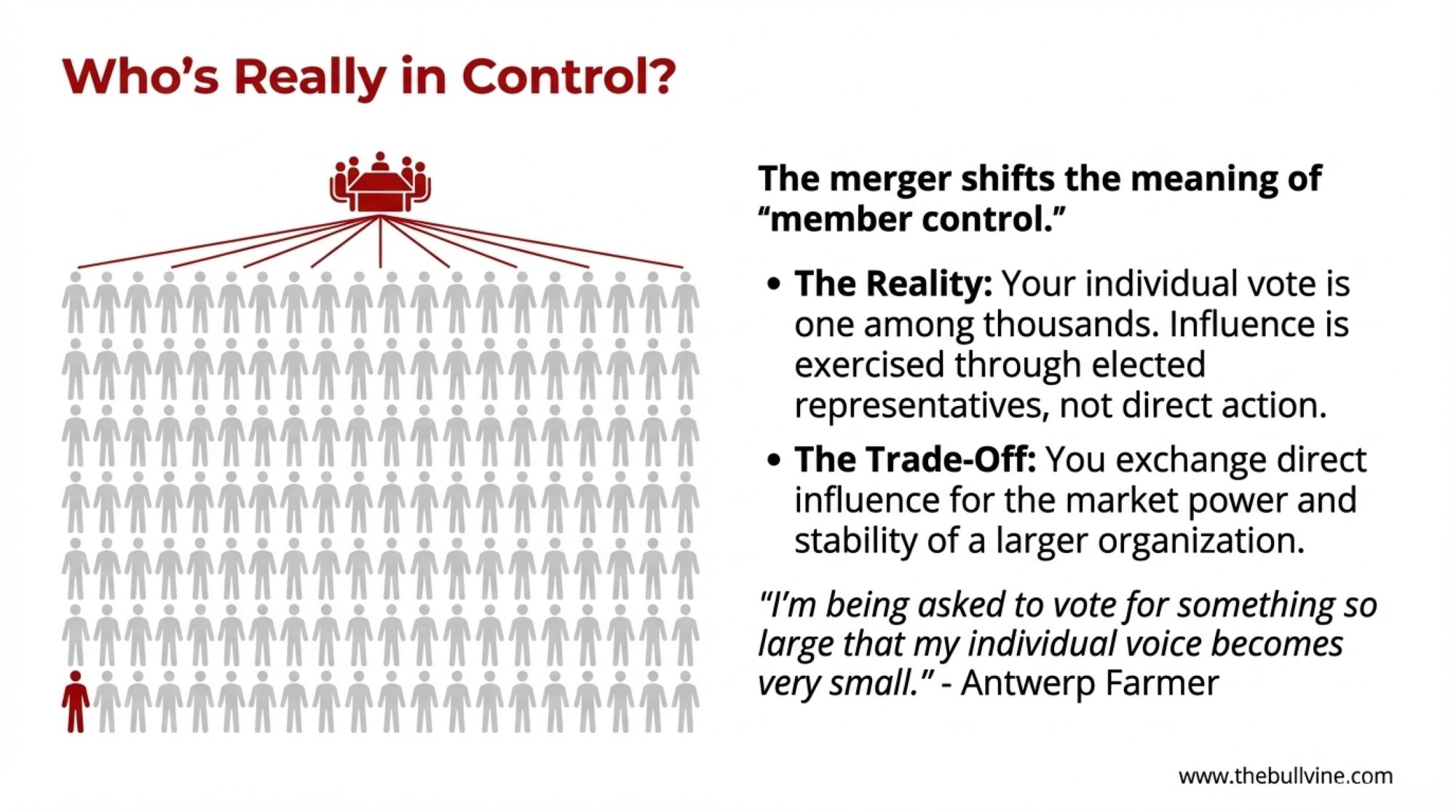
Here’s something that surprises many outside observers. Fonterra doesn’t use one-member-one-vote like smaller Midwest cooperatives.

They have production-weighted voting—one vote per 1,000 kilograms of milk solids, backed by paid shares.

DairyNZ’s 2023-24 statistics show the average New Zealand herd runs about 441 cows producing 393 kg of milk solids each. Do the math: that’s roughly 173,000 kg MS annually, giving that farm 173 votes.

Large Canterbury farms wield 2.27x the voting power of average operations and receive 3x the capital—meaning the most indebted farms controlled the sale that was supposed to save everyone

But a 1,000-cow Canterbury operation? They’re producing 393,000 kg MS—that’s 393 votes, more than double.

Peter McBride, Fonterra’s Chairman, calls this outcome a clear mandate showing farmer control. Technically true, though it highlights how voting structure shapes outcomes.

ASB Bank’s analysis shows the payout distribution mirrors this structure:

  • Smaller operations (100,000-150,000 kg MS): $150,000-$230,000
  • Large Canterbury farms (350,000+ kg MS): $700,000 or more

The Path That Led Here

Understanding yesterday requires examining the past decade’s progression.

2012: Trading Among Farmers

TAF addressed redemption risk—the potential crisis if many farmers exited simultaneously. It passed with 66.45% approval on June 25, 2012, though about a third opposed or abstained.

Dutch cooperative expert Onno van Bekkum warned TAF would separate ownership from control in fundamental ways. Opposition leader Lachlan McKenzie called it “morally wrong” in media interviews.

But the board proceeded, creating tradeable shares and opening the Fonterra Shareholders’ Fund to outside investors.

2021: Flexible Shareholding

In December 2021, 85.16% approval was granted for shareholding, increasing from 33% to 400% of production requirements.

Fonterra’s August 2024 report shows the results:

  • 1,422 farms now exceed 120% of the standard shareholding
  • 552 hold minimal 33% positions

John Shewan, chairing the Shareholders’ Fund, called it a mixed blessing, noting a 20% decline in unit value during consultation.

2025: The Pattern Emerges

Notice the progression: 66.45%, then 85.16%, now 88.47%.

That’s not growing enthusiasm—it’s something else. Maybe changing demographics. Maybe mounting pressure.

Keith Woodford observes that each restructure makes the next more likely:

“Once you start down this path, reversal becomes increasingly difficult.”

Global Patterns Worth Watching

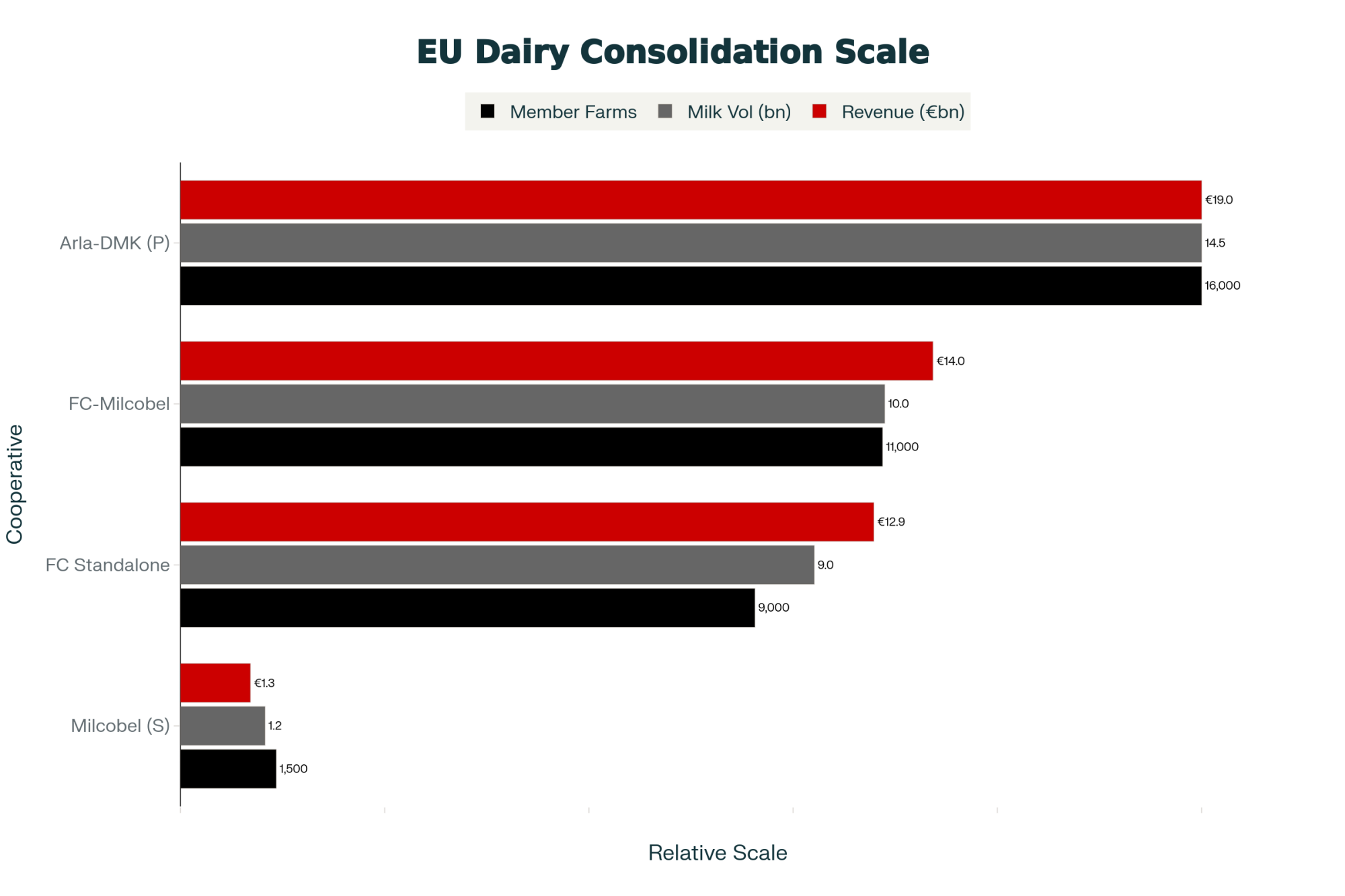
Fonterra’s not alone here. The June announcement of Arla and DMK merging into a €19 billion entity sparked similar discussions.

Kjartan Poulsen, an Arla member who also heads the European Milk Board, stated bluntly in October:

“Co-operatives have ceased to be the representatives of producers’ interests they claim to be on paper.”

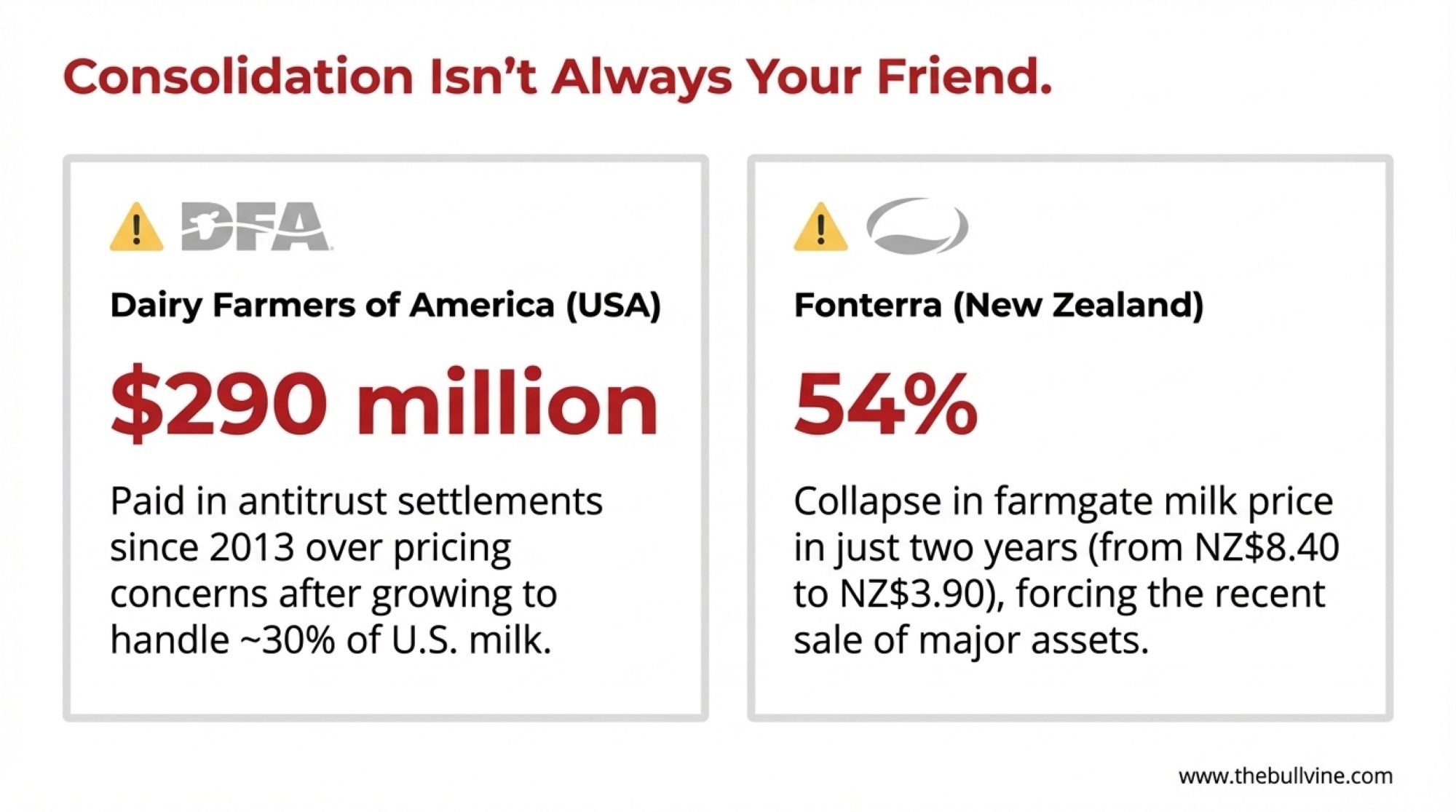
In North America, DFA acquired 44 Dean Foods facilities after the 2020 bankruptcy, becoming both the largest milk producer and processor.

The subsequent class action by Food Lion and Maryland and Virginia Milk Producers alleges this creates dynamics that “compel cooperatives and independent dairy farmers to either join DFA or cease to exist.”

Common threads emerge:

  • Rising debt
  • Efficiency pressures
  • Governance structures increasingly resembling corporate models

The Compensation Question

CEO Miles Hurrell’s $8.32M compensation package dwarfs the $150K average farmer return by 55.5x—raising questions about whose interests drive ‘cooperative’ decisions

The New Zealand Herald reported in October 2024 that Fonterra’s CEO compensation hit NZ$8.32 million. Base salary runs about NZ$1.95 million, with incentives tied to Return on Capital Employed and share price performance.

Here’s where it gets interesting. Improving ROCE by selling capital-intensive assets—even profitable ones—can trigger bonuses, regardless of the long-term impact on members.

It’s what academics call a principal-agent problem: decision-makers’ incentives potentially diverging from those they represent.

This pattern extends beyond Fonterra. Cooperative executive packages increasingly mirror corporate structures, raising questions about alignment.

Current Debt Reality

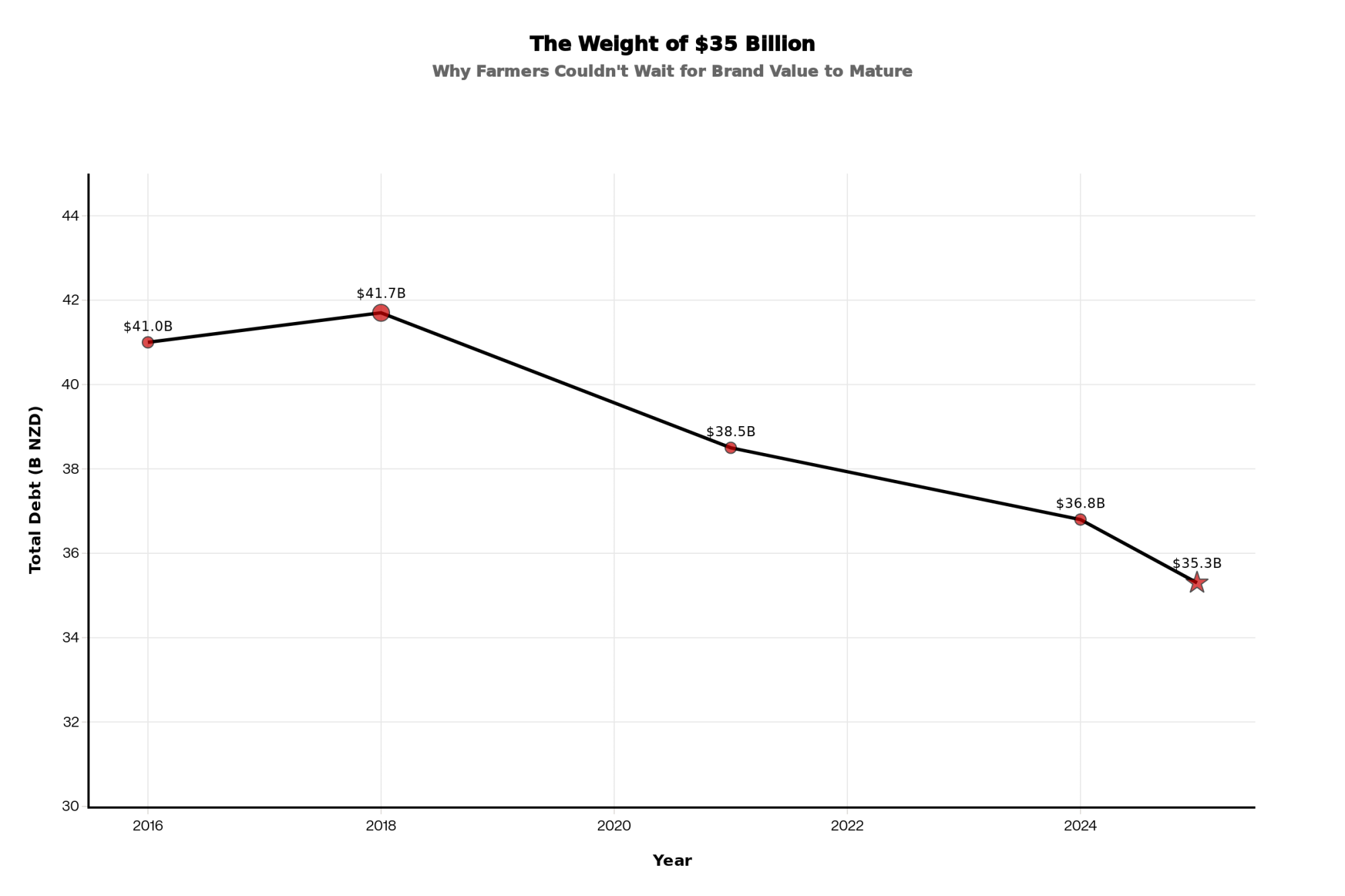
NZ dairy debt peaked at $41.7B in 2018 and dropped to $35.3B by 2025—progress, yes, but at 7% interest, that remaining $35B still costs the sector $2.47 billion annually

Reserve Bank of New Zealand data shows dairy sector debt at NZ$64 billion. DairyNZ’s 2023-24 survey found that debt-to-asset ratios increased by 1.8 percentage points last season, reversing the progress in deleveraging.

Input costs compound this. Consider a typical Waikato farm with NZ$500,000 in debt at 7%—that’s $35,000 in annual interest.

When offered $320,000 to cut that burden by two-thirds, philosophical debates about cooperative principles take a back seat.

Producers consistently report they’re not selling eagerly. They’re protecting against scenarios where consecutive tough seasons force a complete exit. That capital buffer might determine whether the next generation continues farming.

Supply Agreement Details

The Lactalis deal includes two key contracts:

  1. 10-year Raw Milk Supply Agreement: Up to 350 million liters annually, plus 200 million more at premium pricing
  2. Global Supply Agreement: Three years initially for ingredients, auto-renewing unless terminated with 36 months’ notice

Miles Hurrell notes that Lactalis becomes a cornerstone customer.

Winston Peters, New Zealand’s Deputy Prime Minister with a farming background, sees it differently. His October 7 letter warns:

“After three years, Lactalis gains flexibility on milk sourcing for these brands—potentially diluting with alternatives.”

Fonterra clarifies that the 36-month notice effectively guarantees a minimum of 6 years. Still, Peters’ point about long-term leverage resonates with farmers remembering past processor consolidations.

Practical Insights for Producers

Drawing from Fonterra’s experience, several patterns merit attention:

Warning Signals

  • Debt-financed growth rather than retained earnings
  • Executive compensation outpacing member returns
  • Share trading or ownership flexibility proposals
  • External strategic reviews
  • Rising approval rates on successive changes

The intervention window closes quickly. Once voting concentrates and pressure intensifies, changing course becomes exponentially harder.

Breaking the Isolation

BakerAg’s survey revealed widespread isolation among farmers with reservations. Many assumed neighbors supported the proposal, creating silence that reinforces itself.

Research consistently shows that producers with strong peer networks resist short-term pressures more effectively when evaluating strategic choices.

Action Steps

Near-term:

  • Talk with neighbors about governance—you’d be surprised how many share your concerns
  • Understand your voting system
  • Seek compensation transparency
  • Track debt trajectories

Medium-term:

  • Strengthen balance sheets for voting independence
  • Consider board service or supporting aligned candidates
  • Advocate for appropriate approval thresholds
  • Build communication networks

Long-term:

  • Diversify market relationships
  • Educate the next generation on cooperative principles
  • Document experiences for future members

Looking Forward

The Fonterra vote illuminates tensions between immediate needs and long-term positioning that define modern dairy economics. That 88.47% likely reflects not enthusiasm but recognition of limited alternatives.

The generational dimension adds complexity. Families who built these brands face wrenching decisions, trading legacy for relief. Yet when survival’s uncertain, strategic control becomes secondary.

For cooperatives not facing acute pressure, Fonterra offers valuable lessons. Decisions about capital structure, voting, and debt create compounding path dependencies.

Keith Woodford’s wisdom bears repeating:

“The best time to protect your cooperative is when you don’t desperately need to. Once you’re in crisis, options narrow dramatically.”

As farmers await capital distributions, the industry watches. Emmanuel Besnier, Chairman of Lactalis, highlighted in August his company’s strengthened positioning across Oceania, Southeast Asia, and Middle Eastern markets.

Lactalis now controls brands developed by New Zealand farmers over generations.

For global dairy producers, the implications are clear: cooperative structures remain viable but require active protection. Forces favoring consolidation—debt, scale requirements, global competition—aren’t abating.

What’s encouraging is the quality of current discussions. Producers worldwide are sharing experiences, analyzing outcomes, and considering alternatives. This collective learning might help some organizations navigate challenges more successfully.

The critical question: Will cooperative members recognize patterns early enough to maintain meaningful options?

Fonterra’s experience suggests that once certain changes occur, reversal becomes exceptionally difficult.

The conversation continues, shaped by each cooperative’s circumstances, member priorities, and market position. What remains constant is the need for engaged, informed membership making deliberate choices—before circumstances make those choices for them.

KEY TAKEAWAYS:

  • Debt math is brutal: Farmers knowingly traded $3.7M in future value for $320K today because $35K annual interest payments can’t wait for tomorrow’s profits
  • Large farms control your fate: Production-weighted voting gives a 1,000-cow operation (393 votes) more than double the power of an average farm (173 votes)—and they vote their debt, not your interests
  • The timeline is always 13 years: Tradeable shares (Year 1) → Flexible ownership (Year 9) → Asset sales (Year 13)—once step one passes, the rest becomes mathematical inevitability
  • Watch executive pay like a hawk: When your co-op CEO makes NZ$8.32M while average farmers net $150K, those aren’t cooperative incentives—they’re corporate ones
  • You have exactly ONE intervention point: Between your first governance “modernization” proposal and passing it—after that, you’re not protecting your cooperative, you’re negotiating its sale terms

Complete references and supporting documentation are available upon request by contacting the editorial team at editor@thebullvine.com.

Learn More:

  • The Real Cost of Producing Milk and Why It Matters Now More Than Ever – This tactical guide provides a framework for mastering your farm’s true cost of production. It reveals methods for gaining financial clarity to combat the exact debt pressures highlighted in the Fonterra vote, empowering you to strengthen your operation’s financial resilience.
  • The Future of Dairy Farming: Navigating the Next Decade of Change – This strategic analysis unpacks the market forces, consumer trends, and policy shifts shaping the industry’s next decade. It provides essential context for the Fonterra vote, demonstrating how to anticipate future challenges and strategically position your operation for long-term survival.
  • AI in the Parlor: How Artificial Intelligence is Redefining Dairy Herd Management – This piece explores how adopting cutting-edge technology can create a competitive advantage. It demonstrates how AI-driven herd management directly boosts efficiency and profitability, providing a powerful internal solution for building the financial strength needed to resist external market pressures.

Join the Revolution!

Join over 30,000 successful dairy professionals who rely on Bullvine Weekly for their competitive edge. Delivered directly to your inbox each week, our exclusive industry insights help you make smarter decisions while saving precious hours every week. Never miss critical updates on milk production trends, breakthrough technologies, and profit-boosting strategies that top producers are already implementing. Subscribe now to transform your dairy operation’s efficiency and profitability—your future success is just one click away.

NewsSubscribe
First
Last
Consent

Why Ireland’s “Clean Water” Won’t Save Its Dairy Industry

Could losing the nitrates derogation mean losing your farm? Here’s what Irish data reveals.

EXECUTIVE SUMMARY: Look, we’ve been digging into what’s happening in Ireland, and honestly? It should scare the hell out of every dairy producer. Despite a solid 10% drop in river nitrogen levels, Irish dairy is staring down a €1.5 billion loss because Brussels won’t budge on their nitrates derogation (EPA, Teagasc & IFA, 2025). We’re talking 22% herd cuts and 18% production drops — that translates to tens of thousands in lost income per farm annually when you factor in the debt loads most operations are carrying (USDA, 2025). Here’s the kicker: EU regulators don’t care about progress — they want full compliance, period, following strict legal precedent from 2018 (ECJ). Technology like the Lely Sphere can cut ammonia by 70%, but you’re looking at 7-10 year paybacks while premium prices keep shrinking (Lely, USDA 2025). The bottom line? Better environmental numbers won’t save your operation — you need to act now, make the tough calls, and completely rethink your dairy strategy.

KEY TAKEAWAYS

  • 22% herd losses and 18% production cuts are hitting Irish farms hard — run your debt coverage numbers with your lender this week, not next month (Teagasc & IFA 2025)
  • Nitrogen dropped 10% nationally, but regulators still said “no deal” — track your local environmental rules because compliance means full compliance, not improvement (EPA 2025, EU Commission 2025)
  • Lely Sphere tech slashes ammonia by ~70% but costs €200K+ with long paybacks — consider pooling resources with neighbors to cut per-cow costs and share the financial load (Lely 2025, Dutch RAV certification)
  • Sustainability premiums are crashing from 40% to 25% in US markets — don’t bet your farm’s future on premium pricing that’s disappearing fast (USDA 2025)
  • Early movers and consolidation are your best defense against regulatory pressure — waiting puts you at a massive disadvantage when the regulatory hammer falls (Industry analysis 2024-25)
dairy farm profitability, milk production economics, nitrogen derogation, farm efficiency, European dairy

Here’s the deal: the Irish EPA reported a 10% drop in river nitrogen levels across hundreds of monitoring spots in 2024 (EPA, 2025). Sounds like good news, right? Well — regulators don’t see it that way. They need those nitrate levels not just to drop, but to fall below strict limits. If that doesn’t happen, don’t expect to keep your regulatory wiggle room (European Commission, 2025).

Ireland’s dairy sector has leaned on its nitrates derogation for years — essentially a flex from the EU letting farms keep going despite environmental challenges. Now, Teagasc and the Irish Farmers’ Association are ringing alarm bells, estimating the cost of losing that derogation at nearly €1.5 billion over ten years due to shrinking herds and production cuts (Teagasc & IFA, 2025).

What’s striking? This isn’t just Ireland’s problem. If you’re farming even a few thousand miles away, this story hits home.

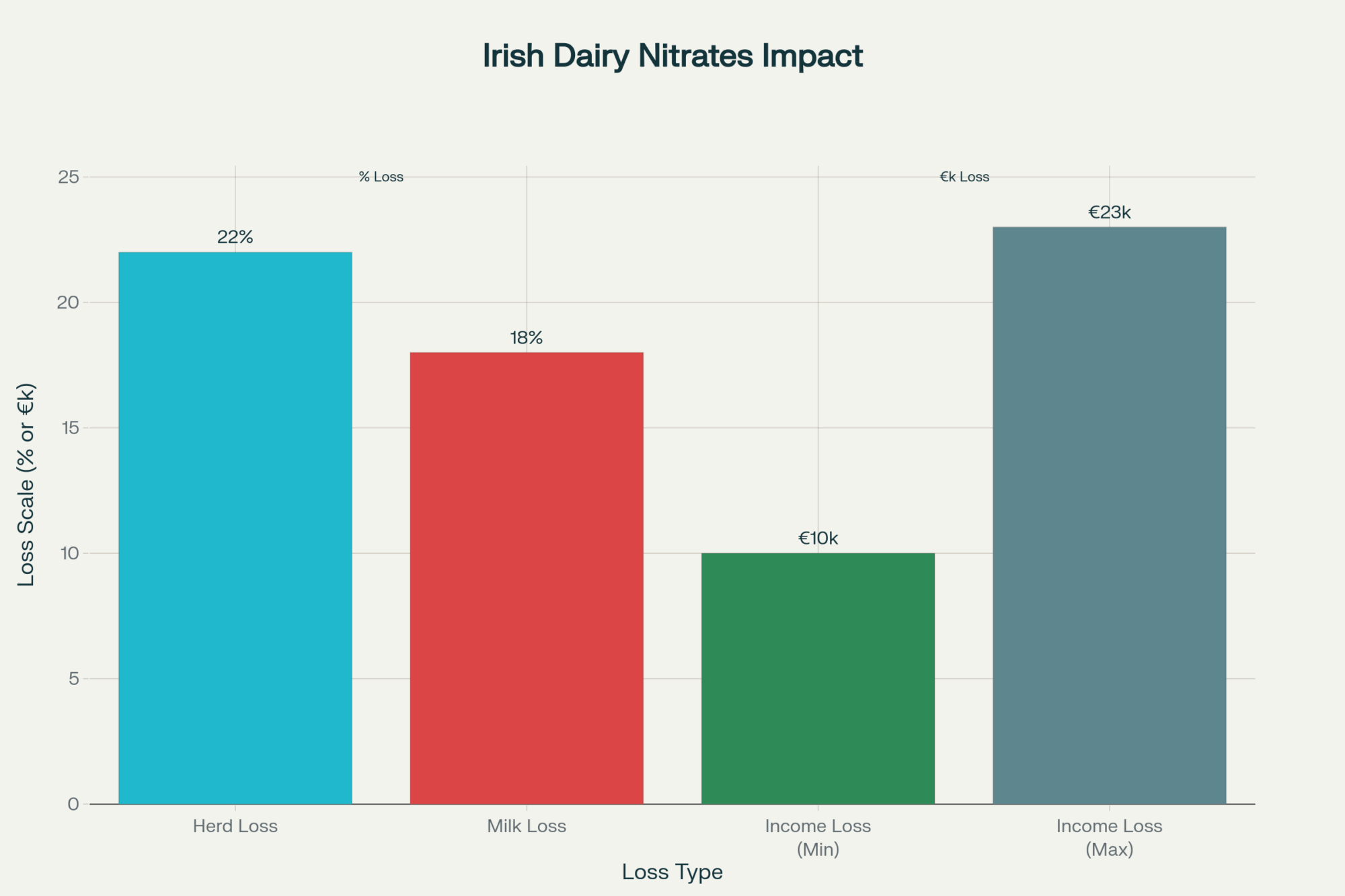
Projected Impact of Nitrates Derogation Loss on Irish Dairy Farms (Teagasc & IFA, 2025)

The Harsh Reality of Enforcement

The EU courts have made it clear that economic arguments don’t get you out of environmental responsibilities — a 2018 ruling nailed this down hard (ECJ, 2018). Ireland stands alone, fighting to keep its exemption. Brussels, though? They’ve said an unapologetic “no” to extensions (European Commission, 2025).

Yes, water quality is improving, but too many spots remain over the safe limits — regulators aren’t budging on that (EPA, 2025). This is the EU’s “better safe than sorry” approach in action.

Your Own Farm? Heads Up

Wisconsin farmers are already feeling it — feed costs are creating significant margin pressure, with corn and soybean meal prices elevated according to recent USDA commodity reports (Wisconsin Extension, 2025). Ontario’s supply management system provides a false sense of comfort, but quota values face pressure from potential production restrictions, with current market pricing variable according to reports from the Dairy Farmers of Ontario (Ontario Ministry of Agriculture, 2025).

Out West, California’s methane rules mean producers need to stay on their toes, as compliance deadlines rapidly approach (California ARB, 2025).

It’s a global squeeze.

Crunch Those Numbers

The economists at Teagasc and the IFA paint a dire scenario if the derogation is revoked: a roughly 22% reduction in herd size and an 18% decline in milk production (Teagasc & IFA, 2025). That translates to a haircut on farm income from €10,000 up to €23,000 a year (Teagasc & IFA, 2025; Irish Farmers’ Association, 2025).

Scaling Irish impact data suggests potential income reductions of $13,800 to $31,700 in Wisconsin, and CAD $14,900 to $34,400 in Ontario, though farm-specific analysis with local economists is essential for accurate projections (USDA & Ontario Extension, 2025). Don’t take these as gospel—get your own financial advisors involved.

Agricultural debt loads continue rising across farm sectors, with recent reports indicating increased financial pressure on leveraged operations, making this scenario even less forgiving (USDA, 2025).

Tech Is Great. But It Ain’t Cheap

That Lely Sphere system everyone’s talking about? It cuts ammonia emissions by around 70% — impressive stuff (Lely, 2025). But sticker shock is real. Initial price tags plus installation easily top €200,000, and ROI estimates vary widely based on farm size, existing infrastructure, and local incentive programs — individual financial analysis is essential before investment decisions (Industry reports, 2022-2025).

Factor in carbon credits, premium milk pricing (currently about €0.5 to €2.5 per 100kg, but shrinking), and fertilizer savings, and you might shorten payback periods — assuming everything aligns just right (Market reports, 2023-2025).

Thing is, those premiums are shrinking fast — the early adopters lapped them up, now the rest are fighting over crumbs (USDA, 2025).

Compression of Sustainability Premium Prices in Dairy Markets (USDA Data)

Premium Prices Aren’t Forever

Take the US organic milk market — premiums have shrunk from 40% back in 2010 to roughly 25% now (USDA, 2025). Ireland’s sustainability premiums are following the same descent (Irish Dairy Board, 2025).

So, What’s to Do?

Look around your operation — and be brutally honest about your books. Can you handle a 20-25% income sucker punch? Talk that out with your lender specifically.

Your local extension agents aren’t just there to hand out brochures — they have access to data, subsidies, and advice that could help you navigate this mess.

And please, think about pooling resources. Group tech buys, shared services — spreading those costs can be the difference between survival and folding.

But beware: if you’re late to adopt, you might not get the returns you hope for.

Niche markets help, but there’s no silver bullet — not every farm fits those molds.

What Could’ve Been Done, And Didn’t

Everyone misses hindsight, but the window from 2015 to 2020 was golden. Early adoption, consolidation, and conversations with regulators — all could have softened the blow.

We didn’t do those things. We dug in, hoping things wouldn’t change. Spoiler: they did.

Your Takeaway

This isn’t some far-off story — it’s happening now. Don’t rely on better water data alone; regulatory frameworks react to law and politics more than tech improvements.

You need to act. Adapt, band together, or plan your exit. The farmers who weather the coming storm won’t be those resisting change — they’ll be those embracing it from the get-go.

Complete references and supporting documentation are available upon request by contacting the editorial team at editor@thebullvine.com.

Learn More:

Join the Revolution!

Join over 30,000 successful dairy professionals who rely on Bullvine Weekly for their competitive edge. Delivered directly to your inbox each week, our exclusive industry insights help you make smarter decisions while saving precious hours every week. Never miss critical updates on milk production trends, breakthrough technologies, and profit-boosting strategies that top producers are already implementing. Subscribe now to transform your dairy operation’s efficiency and profitability—your future success is just one click away.

NewsSubscribe
First
Last
Consent

SNAP Cuts Target $267 Billion: Here’s What Dairy Farmers Aren’t Being Told

Stop ignoring SNAP policy threats. Congressional cuts targeting 41.7M consumers could slash dairy demand 1%—here’s your 18-month survival plan.

EXECUTIVE SUMMARY: Most dairy farmers are completely unprepared for the policy bomb that’s about to detonate their customer base—and it’s not coming from overseas competition or plant-based alternatives. Congressional proposals to slash $267 billion from SNAP over the next decade represent a 28% benefit cut affecting 41.7 million Americans who currently drive significant dairy purchases. Industry economists project this policy shift could eliminate approximately 1% of total U.S. dairy demand, translating to billions in lost revenue when the sector already faces margin compression from elevated feed costs averaging $4.63/bushel for corn. While Europe’s dairy herd contracts to 19.2 million cows—the lowest in decades—and China maintains 34-125% tariffs on U.S. exports, domestic demand destruction from SNAP cuts forces more milk into volatile export markets already saturated with trade tensions. The farms still operating profitably in 2030 will be those that start diversifying into value-added products, optimizing feed conversion ratios through precision agriculture, and lobbying state governments now—not after the policy damage is done. Smart producers have exactly 18 months to prepare for the largest domestic demand disruption since the Great Depression, and the strategic decisions you make today will determine whether your operation thrives or merely survives this policy-driven market upheaval.

KEY TAKEAWAYS

  • Immediate Revenue Protection Strategy: Diversify 20-30% of production into value-added products (specialty cheeses, organic lines) commanding 15-25% price premiums over commodity milk, with projected ROI of 25-35% within 24 months to offset SNAP-driven demand reduction.
  • Technology-Driven Efficiency Optimization: Deploy precision agriculture and sensor technology to improve feed conversion ratios by 10-15%, reducing operational costs while maximizing milk yield per cow as domestic purchasing power declines among 12.6% of the U.S. population receiving SNAP benefits.
  • Export Market Diversification Imperative: Reduce dependence on top three export markets (currently 51% of $8.2 billion in annual exports) through Southeast Asia expansion, requiring $100,000-500,000 investment but essential as domestic SNAP cuts force additional milk into already volatile global commodity channels.
  • State-Level Political Engagement: Actively lobby state legislatures to absorb federal SNAP cost shifts, as states with strong dairy advocacy (Wisconsin, California, Idaho) may maintain benefit levels while others implement aggressive cuts, creating fragmented regional demand patterns requiring localized strategic responses.
  • Risk Management Program Optimization: Update Dairy Margin Coverage production history calculations and leverage existing programs to maximize benefits during projected margin compression, as all-milk prices face downward pressure from reduced domestic consumption despite current forecasts of $21.60/cwt.
SNAP cuts dairy, dairy demand policy, dairy farm profitability, milk production economics, dairy market trends

The House Agriculture Committee just dropped a $267 billion bomb on dairy demand, and most farmers have no clue what’s coming. We’re talking about a 28% SNAP benefit cut that could eliminate 1% of total U.S. dairy consumption—and frankly, that’s just the beginning of this policy disaster.

I’ve been analyzing dairy markets for decades, and I’ve never seen a policy change that could potentially be devastating and fly under the radar like this. While you’re worrying about feed costs and milk prices, Congress is quietly preparing to gut the purchasing power of 41.7 million Americans who buy your products every single day.

Here’s the brutal truth nobody’s talking about: this isn’t just another budget cut. It’s a systematic dismantling of domestic dairy demand that could fundamentally reshape how your operation competes globally.

The Numbers Don’t Lie—And They’re Terrifying

The House Agriculture Committee’s “One Big Beautiful Bill Act” isn’t just targeting welfare—it’s targeting your customer base. SNAP currently serves 41.7 million Americans, representing 12.6% of the entire U.S. population. These households spend roughly 40 cents of every food dollar on basic staples, including milk, cheese, and dairy products.

Here’s what should keep you awake at night: A 28% benefit reduction translates to approximately 1% reduction in overall dairy demand. Sounds small? Think again.

When emergency allotments expired in March 2023, we got a preview of coming attractions. SNAP benefits dropped 8.5% year-over-year, triggering an immediate 8.4% fall in grocery purchase rates and an 8.4% increase in food insufficiency. But here’s the kicker—dairy was one of the few categories that actually saw increased shopping trips among SNAP recipients, up 70 basis points.

Why does this matter? It proves that low-income families consider dairy essential. They’ll cut other foods first, but milk eventually becomes unaffordable when you slash daily benefits from $6.20 to $4.80 per person.

The Global Domino Effect Nobody Saw Coming

Here’s where this gets really ugly. The U.S. dairy industry isn’t just fighting domestic headwinds—we’re about to flood already volatile export markets with products we can’t sell at home.

U.S. dairy exports hit $8.2 billion across 114 countries in 2024, with 16% of total milk production shipped overseas. But get this: 86% of lactose, 75% of nonfat dry milk, and 70% of whey production are already export-dependent.

The strategic nightmare: Reduced domestic demand forces more raw milk into powder production for export markets already under siege. China’s slapping 34-125% tariffs on our dairy, while Canada maintains protectionist barriers despite USMCA commitments. Meanwhile, Mexico imported $2.47 billion worth of U.S. dairy in 2024, making it our top export partner.

What Smart Operators Need to Know Right Now

The State-by-State Wild Card

Here’s what the policy wonks aren’t telling you: Starting January 2028, states will cover 5-25% of SNAP benefit costs depending on their administrative error rates. Georgia alone faces a potential $812 million burden if its error rate exceeds 10%—money that simply doesn’t exist.

States with strong dairy lobbying (Wisconsin, California, Idaho) might absorb federal cost shifts to protect local industries. Others will slash benefits aggressively, creating a patchwork of regional demand destruction that makes national planning impossible.

The Economic Multiplier Effect You’re Missing

Let’s face it—most farmers don’t understand how SNAP actually drives rural economies. The USDA’s Economic Research Service found that every $1 billion issued in federal SNAP benefits generates a $1.54 billion increase in U.S. GDP and supports 13,560 jobs. That’s not welfare math—that’s agricultural economics.

“There was a $1 billion increase in SNAP during the economic slowdown, and this boosted GDP by about $1.54 billion and close to 14,000 jobs,” explains Emily Engelhard, vice president of research for Feeding America. “And then a big portion of those were actually jobs in agriculture.”

The EU Advantage We’re About to Waste

While we’re shooting ourselves in the foot with domestic policy, Europe’s dairy herd collapsed to 19.2 million cows by December 2024—the lowest level in decades due to soaring costs and environmental regulations. This global supply tightening should theoretically benefit U.S. producers through reduced competition.

But here’s the problem: Domestic SNAP cuts could negate this competitive advantage by forcing additional U.S. milk into saturated global commodity markets. We’re literally turning a strategic opportunity into a margin-crushing oversupply crisis.

New Zealand continues stable growth with 3.1% seasonal production increases while investing heavily in sustainability to capture premium segments. They’re playing chess while we’re playing checkers.

Industry Response: Fighting the Wrong Battle

The dairy lobby is pushing the Dairy Nutrition Incentive Program Act of 2025, proposing dollar-for-dollar SNAP matches for milk, cheese, and yogurt purchases. Introduced by Senators Amy Klobuchar, Roger Marshall, and Representatives Jim Costa and Nick Langworthy, it’s smart politics—reframing dairy as essential nutrition rather than optional consumption.

But here’s what nobody’s asking: Why are we so dependent on government-subsidized demand in the first place? The proposed changes expose dairy’s dangerous over-reliance on policy-driven consumption patterns rather than genuine market demand.

This bipartisan initiative recognizes that 90% of Americans don’t meet federal dietary guidelines for dairy intake. The program builds on successful Healthy Fluid Milk Incentive projects, showing dollar-for-dollar matches actually work to boost consumption.

The Technology Integration Imperative

Here’s the reality check: farms that survive this demand shock will already deploy precision agriculture to optimize operations. You can’t control SNAP policy but you can control feed conversion ratios, milk component optimization, and operational efficiency.

USDA reduced 2025 milk production forecasts to 226.9 billion pounds, showing tighter supplies than expected. Smart operations are implementing activity monitoring systems and sensor technology to maximize milk yield per cow while controlling variable costs as margins compress.

What This Means for Your Operation: A 90-Day Action Plan

Week 1-2: Immediate Assessment

  • Calculate your operation’s SNAP exposure by analyzing local demographics
  • Review current risk management programs, especially Dairy Margin Coverage
  • Update production history calculations to maximize program benefits
  • Cost: $500-1,500 for consultant analysis

Month 1: Strategic Positioning

  • Diversify into value-added products (specialty cheeses, organic lines) that command 15-25% price premiums over commodity milk
  • Strengthen export market development beyond Mexico-Canada-China concentration
  • Investment range: $50,000-250,000 for processing upgrades
  • ROI timeline: 18-24 months

Month 2-3: Political Engagement

  • Join state dairy associations lobbying for SNAP funding maintenance
  • Support the Dairy Nutrition Incentive Program Act through industry channels
  • Time investment: 10-15 hours monthly for effective advocacy

Interactive Planning Tool: Which strategy fits your operation best?

  • Poll Question 1: Is your farm’s primary market within 50 miles of major urban centers with high SNAP usage?
  • Poll Question 2: What percentage of your revenue comes from fluid milk vs. value-added products?
  • Scenario Builder: Input your herd size, local SNAP demographics, and current product mix to calculate potential revenue impact

State-by-State Risk Assessment

High-Risk States (likely to implement aggressive SNAP cuts):

  • Georgia: $812 million potential burden
  • Florida, Texas, Arizona: Limited dairy lobbying power
  • Action: Accelerate export market development, direct-to-consumer sales

Moderate-Risk States:

  • Pennsylvania, Ohio, North Carolina: Mixed agricultural influence
  • Action: Diversify product portfolio, strengthen regional processing partnerships

Lower-Risk States:

  • Wisconsin, California, Idaho: Strong dairy political influence
  • Action: Advocate for state-funded dairy incentive programs

The Bottom Line: Your 18-Month Survival Strategy

Congressional SNAP cuts aren’t theoretical—they’re moving through budget reconciliation that bypasses Senate filibuster rules. You have exactly 18 months to prepare for the largest domestic demand disruption since the Great Depression.

Strategic imperatives for survival:

  1. Product Diversification (Months 1-6): Transition 20-30% of production to value-added products commanding premium prices independent of commodity volatility. Target ROI: 25-35% within 24 months.
  2. Export Market Development (Months 3-12): Reduce dependence on top three export markets (currently 51% of exports) through Southeast Asia expansion. Investment: $100,000-500,000 for market development.
  3. Technology Implementation (Months 1-18): Deploy precision agriculture and data analytics to optimize operational efficiency. Expected improvement: 10-15% feed conversion ratio optimization.
  4. Political Engagement (Ongoing): Maintain active state-level lobbying to protect SNAP funding. Monthly investment: 15-20 hours, $2,000-5,000 in association dues and advocacy contributions.

Implementation Timeline:

  • Q1 2025: Complete risk assessment, begin product diversification planning
  • Q2 2025: Implement technology upgrades, initiate export market development
  • Q3 2025: Launch value-added product lines, intensify political advocacy
  • Q4 2025: Evaluate initial results, prepare for 2026 policy implementation

The industry that adapts fastest to policy-driven demand destruction will emerge strongest. The question isn’t whether SNAP cuts will impact your bottom line—it’s whether you’ll be ready when 41.7 million customers suddenly have 28% less money to spend on your products.

Interactive Challenge: Share your SNAP preparedness strategy in the comments. Are you diversifying products, optimizing technology, or focusing on export markets? Vote in our strategy poll and see how your approach compares to other progressive dairy operations.

Final Reality Check: The farms still operating profitably in 2030 will see this crisis coming and adapt before their competitors even realize what hit them. Don’t say nobody warned you.

Complete references and supporting documentation are available upon request by contacting the editorial team at editor@thebullvine.com.

Learn More:

Join the Revolution!

Join over 30,000 successful dairy professionals who rely on Bullvine Weekly for their competitive edge. Delivered directly to your inbox each week, our exclusive industry insights help you make smarter decisions while saving precious hours every week. Never miss critical updates on milk production trends, breakthrough technologies, and profit-boosting strategies that top producers are already implementing. Subscribe now to transform your dairy operation’s efficiency and profitability—your future success is just one click away.

NewsSubscribe
First
Last
Consent

The Great Dairy Migration: How Regional Economics Are Reshaping America’s Milk Map

Kansas milk production surges 15.7% while traditional dairy states bleed $178,000 annually per 1,000-cow operation. Your location is killing profits.

Here’s an industry secret that the National Milk Producers Federation and state dairy associations don’t want you to discover: While they’ve been selling you the romantic notion of “traditional dairy heritage,” the brutal mathematics of regional profitability just exposed a $12.70 per hundredweight chasm between winners and losers. California posted net returns of +$5.42 per cwt while Michigan bled -$7.28 per cwt—that’s $178,000 annually, vanishing from a 1,000-cow operation before you even consider the compounding effects over decades.

But here’s what should terrify every dairy professional reading this: The same industry publications that celebrate “family dairy heritage” systematically ignore the geographic revolution reshaping American milk production. While you’ve been optimizing feed conversion ratios to squeeze out marginal gains, entire regions have been constructing cost advantages that are so devastating they make your on-farm improvements look like rearranging deck chairs on the Titanic.

The uncomfortable question that the Wisconsin Dairy Alliance and Pennsylvania Dairy Promotion Program won’t address: Why are their organizations still promoting expansion in regions where the fundamental economics guarantee failure? May 2025 production data reveals Kansas exploding with 15.7% growth while traditional strongholds like California declined 1.8%. Yet where’s the honest discussion from these legacy dairy organizations about what this geographic disruption really means for your operation’s survival?

This isn’t about preserving dairy nostalgia—it’s about confronting an industry establishment that profits from keeping you anchored to inefficient locations while smart money floods toward regions with systematic competitive advantages.

Why This Global Realignment Matters for Your Operation

The national average cost per hundredweight hit $23.60 in 2024, delivering a modest $1.42 per cwt net return. But this aggregate figure masks a regional profitability crisis that should force every serious dairy professional to question everything they’ve been told about optimal dairy geography. Feed costs alone represent 48% of total production costs globally, while labor expenses are projected to reach a staggering $53.5 billion in 2025—a 9.5% surge since 2023.

Regional cost differentials aren’t statistical curiosities—they’re the difference between building wealth and bleeding equity. When transportation costs alone increased 21% in one year, from 51 cents to 62 cents per cwt, operations shipping milk beyond 50 miles effectively pay a “hidden tax” of 35-93 cents per cwt. For a 1,000-cow operation, this transportation burden can exceed $164,000 annually in completely avoidable expenses.

Global Context That Changes Everything: While U.S. producers fight over shrinking margins, EU milk production is forecasted to decline by 0.2% to 149.4 million metric tons in 2025, primarily due to environmental regulations. This creates massive export opportunities for strategically positioned U.S. operations, as the U.S. exports nearly one-fifth of its dairy components, with Mexico, Canada, and China accounting for about 40% of total U.S. dairy export value. However, trade volatility, such as China’s 84% tariff on whey exports, demonstrates how quickly global competitive advantages can shift.

The Scale Economics Truth That Demolishes Industry Mythology

Let’s destroy the most dangerous myth perpetuated by the American Dairy Association and other heritage organizations: that efficient small-scale operations can compete with modern economies of scale.

USDA Economic Research Service data exposes a truth so stark it should end every debate about farm size strategy: the average total cost per 100 pounds of milk is $42.70 for herds under 50 cows versus $19.14 for farms with 2,000+ cows. That $23.56 per cwt differential creates an $83,220 annual viability gap for a 500-cow operation—before considering any regional cost factors.

This isn’t a gradual trend—it’s an economic death sentence for mid-size operations clinging to outdated scale assumptions.

Herd Size CategoryAverage Total Cost per 100 lbsCompetitive Reality
Under 50 cows$42.70 per cwtFinancial death spiral
2,000+ cows$19.14 per cwtCompetitive baseline
Cost Differential$23.56 per cwt$83,220 annual gap for 500-cow operation

Here’s the question that should keep every traditional dairy organization board member awake tonight: If your members’ operations aren’t positioned to achieve this scale advantage, how long can they survive while competitors capture $23.56 per cwt systematic advantages through sheer operational size?

Regional Profitability: The Net Return Reality That Exposes Everything

Regional dairy profitability varies dramatically across states, with California leading at +$5.42/cwt while Michigan faces -$7.28/cwt losses

The dairy industry’s regional cheerleading organizations have been masking a profitability bloodbath that demands an immediate strategic response.

While the national narrative celebrates dairy’s return to profitability, state-level data reveals a severe geographic divide that should force every producer to recalculate their location strategy immediately.

State2024 Net Returns per cwtAnnual Impact (1,000-cow operation)
California+$5.42+$76,000 profit advantage
Iowa+$1.40+$19,600 profit advantage
Kentucky+$1.13+$15,820 profit advantage
Wisconsin-$0.04-$560 loss
New York-$1.46-$20,440 annual loss
Indiana-$4.60-$64,400 annual loss
Pennsylvania-$7.06-$98,840 annual loss
Michigan-$7.28-$101,920 annual loss

The brutal mathematics: A Michigan operation starts yearly at $12.70 per cwt behind California—that’s $178,000 annually before considering any management differences. Over a typical 20-year facility depreciation period, this location disadvantage compounds to $3.56 million in lost competitive advantage.

Why This Matters for Your Operation: These aren’t temporary market fluctuations—they represent structural cost disadvantages that compound annually. Pennsylvania and Michigan operations suffered consistent losses even as the national average improved, indicating that their fundamental cost structures are systematically uncompetitive while traditional dairy organizations in these states continue promoting local expansion.

Labor Economics: The 25% Cost Category That’s Bankrupting Traditional Regions

Here’s an industry reality that the United Farm Workers and state agricultural labor organizations desperately want to obscure: regional labor regulations are creating massive competitive gaps that are driving the geographic realignment we’re witnessing.

Labor costs represent approximately 25% of total dairy farm operating expenses nationally, but regulatory variations create systematic advantages that dwarf any efficiency improvement you can achieve through management. Labor expenses are projected to explode to $53.5 billion in 2025, representing a 9.5% surge since 2023.

RegionAverage Hourly Wage (2025)Regulatory Burden Reality
National Average$19.52Baseline comparison
Wisconsin$18.34 (range: $11.40-$23.54)Moderate regulatory environment
California$17.93 (range: $11.15-$23.01)Devastating regulatory overhead
New York$15.50-$17.00 minimumEscalating regulatory costs

But wage rates tell only a fraction of the story. California’s agricultural labor regulations create layers of hidden costs that make wage comparisons irrelevant. Starting January 2025, California operations must compensate workers for rest periods, provide three days of paid sick leave for employees working 30+ days annually, and pay overtime for work exceeding 8 hours daily or 40 hours weekly.

The Automation Imperative

Strategic automation can reduce annual labor costs per cow from $375 to $165—a 56% reduction that achieves payback in under two years during labor shortages. Robotic milking systems, requiring $200,000-$300,000 per unit investment, offer 7-year payback periods compared to over 15 years for conventional parlor upgrades while boosting production by 15-20%.

But here’s the infrastructure reality that regional development organizations won’t admit: The Midwest and Northeast support automation adoption better due to established electrical infrastructure and equipment dealer proximity. Emerging dairy regions like Texas and Kansas often lack the necessary infrastructure to support advanced automation systems.

Why This Matters for Your Operation: If your expansion region can’t support the automation essential for competitive labor costs, you’re not capturing regional advantages—you’re creating hidden operational disadvantages that compound over decades.

Feed Economics: Global Market Forces Reshaping Regional Competition

Feed expenses represent over 40% of total operating costs nationally, but global feed costs surged 19% on average from 2019 to 2024, with feed accounting for at least 48% of total production costs in major dairy regions.

2025 Feed Price Projections:

  • Corn: $4.20-$4.39 per bushel
  • Soybean Meal: $300-$310 per ton
  • Alfalfa Hay: $170-$180 per ton
RegionCorn ($/bushel)Alfalfa Hay ($/ton)Hidden Cost Reality
Wisconsin$4.4$160Competitive feed access
New York$3.8$226$66/ton alfalfa penalty
IowaMarket rates$105Superior alfalfa advantage
CaliforniaMarket rates$251$146/ton alfalfa penalty vs. Iowa

The Critical Insight: New York’s apparent corn advantage evaporates when alfalfa costs $66 per ton more than Iowa. For a 1,000-cow operation consuming 8-10 tons of alfalfa daily, this difference costs $192,000-$240,000 annually in feed expenses alone.

Global Feed Market Disruption: While U.S. producers struggle with regional variations, international feed market volatility creates additional competitive pressures. Global feed costs rising 19% from 2019-2024 reflect broader commodity market disruption affecting all major dairy regions, including China, Australia, and Argentina. Strategic U.S. producers can leverage this global supply chain disruption by positioning near domestic feed production centers and processing infrastructure.

Advanced Feed Efficiency Technology

Precision feeding systems and AI-driven ration optimization can cut feed costs by 5-10% while maintaining or improving production. Advanced strategies focusing on overall feed efficiency can save up to $470 per cow annually.

Why This Matters for Your Operation: Feed logistics optimization requires systematic analysis of total delivered costs rather than commodity price comparisons like optimizing dry matter intake for peak lactation cows. Regional processing proximity increasingly determines profitability more than on-farm efficiency alone.

Water and Utilities: The Infrastructure Crisis Traditional Regions Won’t Address

Here’s a cost category that exposes traditional dairy regions’ long-term viability crisis: water and utility access.

California’s Water Cost Reality:

  • Application fees: $5,000-$811,000 based on acre-feet per year
  • Annual permit fees: $350 plus $0.12 per acre-foot over 10 acre-feet
  • Water quality fees for CAFOs increased 5.3-5.5% in 2024-25

Compare this to Idaho’s water right rentals increasing from $23 to $33 per acre-foot in 2025—a difference exceeding $50,000 annually for large operations.

Regional Utility Cost Variations:

  • Natural Gas: West (-6%), South (-4%), Northeast (+1%), Midwest (+11%)
  • Electricity: U.S. average residential price projected +2% to 16.8 cents per kWh

That Midwest natural gas increase of 11% hammers traditional dairy regions during winter heating months, while California’s renewable energy transition creates compounding cost pressures.

Technology Integration: The Survival Imperative Reshaping Regional Competitiveness

Let’s confront the conservative dairy establishment’s technology adoption crisis with unforgiving ROI data.

Modern dairy technology adoption has evolved from optional enhancement to survival-critical requirement. The dairy industry’s historically conservative approach to automation is now proving to be a competitive death sentence for operations lacking strategic vision.

TechnologyInvestmentROI PerformanceStrategic Reality
Robotic Milking Systems$200,000-$300,0007-year payback, 15-20% production increaseSurvival-critical
Automated MonitoringVariable$32,611 annual ROI, $668,000 added revenueImmediate advantage
Precision FeedingVariable$137 per cow annual profit, 18% waste reductionEfficiency multiplier

The Geographic Technology Divide

Regional infrastructure determines implementation feasibility more than most producers realize. The Midwest and Northeast support automation adoption better due to the proximity of established electrical infrastructure and equipment dealers.

The uncomfortable reality: Despite rapid growth, emerging dairy regions like Texas and Kansas often lack the necessary infrastructure to support advanced automation systems. This creates hidden implementation costs that must be factored into expansion decisions.

Global Technology Adoption Context: While U.S. dairy technology adoption lags behind precision agriculture sectors, international competitors are rapidly implementing Industry 4.0 frameworks combining robotics, AI, IoT, and big data as main enablers. Despite production constraints, European operations maintain technological superiority that U.S. producers must match to compete in global export markets.

Capital Investment and the Federal Tax Cliff

MetricConventional ParlorRobotic Milking System
Initial Investment$150,000$200,000-$300,000
Annual Labor Savings$0$210 per cow
Milk Production Increase0%15-20%
Payback Period (Years)15+7
Annual ROI after Payback$-$160,600

Here’s a policy disaster that will reshape investment decisions through 2027: the systematic destruction of equipment depreciation benefits.

New Facility Construction Costs (2025):

  • Robotic Milking Facilities: $14,000-$15,000 per stall
  • Individual Robotic Systems: $200,000-$300,000 per unit
  • Freestall Barns: $3,000-$3,500 per stall
Bonus depreciation benefits are rapidly phasing out, reducing tax deductions for dairy equipment purchases by $200,000 since 2022

The Tax Policy Destruction Timeline: Bonus depreciation dropped to 60% in 2025, reaching 0% by 2027. A $500,000 robotic milker purchased in 2025 yields only a $300,000 deduction compared to the full $500,000 in 2022.

Federal Estate Tax Cliff: The federal estate tax exemption drops by 50% to approximately $7 million per individual on January 1, 2026. For family operations with significant land holdings, this could force asset sales to cover potential 40% taxes on values exceeding the lowered exemption.

Global Export Opportunities: The Competitive Advantage Traditional Regions Are Missing

Here’s the strategic context that state dairy organizations systematically ignore: global production constraints create export opportunities that efficient U.S. operations can capture.

International Market Disruption:

  • EU milk production is forecasted to decline by 0.2% to 149.4 million metric tons in 2025 due to environmental regulations
  • The U.S. exports nearly one-fifth of dairy components, primarily non-fat solids
  • Mexico, Canada, and China account for about 40% of total U.S. dairy export value

However, trade volatility introduces strategic risks: China’s 84% tariff on whey exports demonstrates how quickly global competitive advantages can shift. However, skim-solids basis exports remained strong, with high global prices for butter and Cheddar cheese supporting higher fat-basis exports in 2024.

Why This Matters: Efficiently positioned U.S. operations with superior cost structures and modern technology can capture market share from constrained international competitors. Regional positioning near modern processing infrastructure becomes critical for export market access and compliance with quality standards.

Strategic Decision Framework: Your 90-Day Emergency Response Plan

The data reveals systematic regional advantages that demand immediate strategic response, not gradual adaptation.

Week 1-2: Regional Cost Crisis Assessment

  • Calculate current per-cwt costs across all major categories using USDA cost estimation methodologies
  • Identify the three most promising expansion regions based on processing proximity and regulatory environment
  • Quantify transportation costs using the 21% increase benchmark in hauling charges

Week 3-4: Technology Survival Assessment

  • Evaluate automation ROI using verified performance data: 7-year payback for robotic systems
  • Calculate remaining bonus depreciation benefits for 2025 equipment purchases (60% current rate)
  • Assess regional infrastructure capability for technology integration

Week 5-8: Financial Reality Modeling

  • Project 20-year net present value for current location versus expansion alternatives
  • Factor estate tax implications of the 2026 exemption reduction (50% decrease)
  • Model technology adoption urgency before tax incentive elimination

Week 9-12: Strategic Implementation

  • Develop implementation roadmap for identified opportunities
  • Secure financing commitments before tax cliff impacts
  • Establish processor relationships in competitively positioned regions

ROI Calculation Reality: A $5 per cwt regional advantage translates to $70,000 annually for a 1,000-cow operation. Over 20 years, that will result in a competitive advantage of $1.4 million before considering the compound effects of reinvestment.

The Bottom Line: Your Geographic Destiny Is Being Decided Right Now

Remember that explosive Kansas production increase of 15.7% we opened with? That wasn’t market randomness—it was the visible result of systematic regional advantages that strategic producers recognized and leveraged while traditional dairy organizations kept their members anchored to failing conventional thinking.

The three unavoidable truths this analysis exposes:

First, regional cost advantages compound faster than any on-farm efficiency improvement you can achieve. While you’re optimizing conception rates to improve reproductive efficiency, entire regions are constructing $5+ per cwt structural advantages that dwarf individual farm improvements. The national average cost per cwt of $23.60 masks regional variations that create $178,000 annual profit swings for 1,000-cow operations.

Second, the technology adoption timeline has collapsed beyond most producers’ adaptation capacity. Labor costs represent 25% of total dairy farm operating expenses and are projected to reach $53.5 billion in 2025, making automation adoption survival-critical rather than optional. Strategic automation can reduce annual labor costs per cow from $375 to $165—a 56% reduction that pays for itself in under two years.

Third, global market disruption creates permanent strategic windows that reward the prepared. EU production decline of 0.2% to 149.4 million metric tons creates export opportunities for strategically positioned U.S. operations. The federal estate tax exemption drops by 50% on January 1, 2026, while bonus depreciation continues to be eliminated through 2027. Regional processing infrastructure investments are creating permanent competitive advantages for strategically positioned operations.

Your Emergency Action Imperative:

Create a spreadsheet comparing your current location against three promising expansion regions across all cost categories—labor, land, feed, utilities, taxes, and regulatory compliance. Calculate the per-cwt differential for each category and multiply by your annual production to quantify the real dollar impact using USDA cost estimation methodologies.

Scale economies dramatically reduce dairy production costs, with large farms enjoying a $23.56/cwt advantage over small operations

Here’s your final challenge to every traditional dairy organization promoting “local heritage”: If current USDA data shows herds under 50 cows costing $42.70 per cwt versus $19.14 for 2,000+ cow operations, and regional variations create additional $12+ per cwt differentials, how can they ethically continue promoting expansion in systematically disadvantaged regions while competitors capture advantages that compound for decades?

The great dairy migration is accelerating based on verifiable economic reality, not heritage nostalgia. Your analysis will reveal whether you’re positioned for profitable growth or anchored to increasingly expensive geography that traditional dairy organizations won’t honestly discuss. The producers who dominate the next decade won’t be those perfecting yesterday’s systems in yesterday’s locations. They’ll be the ones who recognize that regional competitive advantages determine long-term viability more than any single management practice.

Don’t let industry romanticism about dairy heritage blind you to economic reality. The numbers don’t care about your grandfather’s legacy—they only reward profitable positioning. Make sure your next strategic decision aligns with mathematical truth rather than geographic sentiment that costs $178,000 annually.

The dairy industry’s geographic realignment is rewriting regional competitiveness rules based on documented cost structures and production shifts. Position yourself to profit from this transformation rather than become a footnote in someone else’s success story.

KEY TAKEAWAYS

  • Scale Economics Reality Check: USDA data proves operations under 50 cows face $23.56 per cwt cost disadvantage versus 2,000+ cow facilities—that’s $83,220 annually for 500-cow operations, making strategic expansion survival-critical rather than optional growth
  • Geographic Profit Destruction: Traditional dairy strongholds like Michigan (-$7.28 per cwt) and Pennsylvania (-$7.06 per cwt) create systematic competitive disadvantages totaling $178,000 annually for 1,000-cow operations compared to California’s +$5.42 per cwt returns
  • Automation Investment Urgency: Strategic automation reduces annual labor costs per cow from $375 to $165 (56% reduction), with robotic milking systems offering 7-year payback versus 15+ years for conventional parlors, plus 15-20% production increases
  • Tax Policy Cliff Crisis: Bonus depreciation drops to 60% in 2025 and reaches 0% by 2027, while federal estate tax exemption cuts by 50% January 1, 2026—a $500,000 robotic milker yields only $300,000 deduction in 2025 versus full $500,000 in 2022
  • Transportation Cost Hidden Tax: Milk hauling charges increased 21% annually (51¢ to 62¢ per cwt), creating 35-93¢ per cwt “hidden tax” for operations shipping beyond 50 miles—strategic processor proximity now determines profitability more than feed conversion efficiency

EXECUTIVE SUMMARY

The dairy industry’s most sacred assumption—that traditional dairy states offer optimal production environments—just got demolished by USDA data revealing a devastating $12.70 per hundredweight profitability chasm between regions. While Wisconsin Dairy Alliance and Pennsylvania Dairy Promotion Program continue promoting local expansion, California operations post +$5.42 per cwt net returns while Michigan bleeds -$7.28 per cwt—creating $178,000 annual profit swings for 1,000-cow operations. Scale economics data exposes an even more brutal reality: herds under 50 cows cost $42.70 per cwt versus $19.14 for 2,000+ cow operations, representing an $83,220 annual viability gap for mid-size producers. With labor costs exploding to $53.5 billion in 2025 (9.5% increase) and transportation expenses jumping 21% annually, strategic regional positioning now trumps on-farm efficiency improvements. Global market disruption—including EU production declining 0.2% due to environmental regulations—creates massive export opportunities for strategically positioned U.S. operations with superior cost structures. The federal estate tax exemption drops 50% on January 1, 2026, while bonus depreciation phases out through 2027, creating urgent strategic windows for expansion decisions. Calculate your current location’s per-cwt disadvantage immediately—your geographic destiny is being decided right now, not when market pressure forces reactive decisions.

Complete references and supporting documentation are available upon request by contacting the editorial team at editor@thebullvine.com.

Learn More:

Join the Revolution!

Join over 30,000 successful dairy professionals who rely on Bullvine Weekly for their competitive edge. Delivered directly to your inbox each week, our exclusive industry insights help you make smarter decisions while saving precious hours every week. Never miss critical updates on milk production trends, breakthrough technologies, and profit-boosting strategies that top producers are already implementing. Subscribe now to transform your dairy operation’s efficiency and profitability—your future success is just one click away.

NewsSubscribe
First
Last
Consent
Send this to a friend