Archive for Holstein cattle breeding

Roy Ormiston: The Holstein Man’s Holstein Man Who Revolutionized Modern Breeding

How one man’s $750 gamble on a white cow created a Holstein dynasty that reshaped global dairy genetics and continues to influence breeding decisions today.

In the heart of Holstein history: Roy Ormiston at his Roybrook Farm office, surrounded by the trophies and images of the cattle that made him 'The Holstein Man's Holstein Man.' The iconic Roybrook logo and Holstein models on his desk represent a breeding program that transformed global dairy genetics through his visionary approach to cow families and balanced selection principles.
In the heart of Holstein history: Roy Ormiston at his Roybrook Farm office, surrounded by the trophies and images of the cattle that made him ‘The Holstein Man’s Holstein Man.’ The iconic Roybrook logo and Holstein models on his desk represent a breeding program that transformed global dairy genetics through his visionary approach to cow families and balanced selection principles.

The spotlights at Toronto’s Royal Winter Fair cut through the crisp November air of 1956, illuminating a magnificent white Holstein as she glided across the tanbark with the grace of a dancer. The crowd fell silent as the judge’s hand finally extended toward her, declaring her champion of the aged cow class and awarding the Best Udder trophy. A quiet revolution in Holstein breeding was born.

In the stands, Frederick Roy Ormiston watched with the measured satisfaction of a man who had glimpsed greatness where others saw merely a good cow. Just months earlier, this five-year-old beauty had been standing in Ben Brown’s modest Bowmanville barn, valued at a mere $750-a sum Ormiston had secured her for only after promising an additional $50 should her butterfat test exceed 3.6%. Now, as “The White Cow” claimed her crown, few could have imagined that this singular animal would become the cornerstone of a breeding empire that would reshape Holstein genetics for generations.

This historic image captures the moment when Roybrook's influence reached the highest levels of Canadian society. Prime Minister Pierre Trudeau examines Roybrook Starlite EX-Extra, one of Roy Ormiston's most influential sires and a cornerstone of the Roybrook breeding program. Proven at United Breeders Inc., Starlite would go on to become one of Canada's most formidable production sires, leading the national list of Honor List producers three times. This photograph documents not just a political visit but a significant moment in Canadian agricultural history, highlighting how Ormiston's breeding program had become recognized as a national asset worthy of prime ministerial attention. The presence of Starlite at this official opening underscores the bull's importance in advancing Canadian Holstein genetics during a pivotal era of dairy cattle improvement.
This historic image captures the moment when Roybrook’s influence reached the highest levels of Canadian society. Prime Minister Pierre Trudeau examines Roybrook Starlite EX-Extra, one of Roy Ormiston’s most influential sires and a cornerstone of the Roybrook breeding program. Proven at United Breeders Inc., Starlite would go on to become one of Canada’s most formidable production sires, leading the national list of Honor List producers three times. This photograph documents not just a political visit but a significant moment in Canadian agricultural history, highlighting how Ormiston’s breeding program had become recognized as a national asset worthy of prime ministerial attention. The presence of Starlite at this official opening underscores the bull’s importance in advancing Canadian Holstein genetics during a pivotal era of dairy cattle improvement.

The Making of a Master Breeder

Born into Holstein heritage as the son of pioneering breeder Fred Ormiston, young Roy’s destiny seemed intertwined with black and white cattle. The family farm south of Brooklin, Ontario, became his first classroom, and even at sixteen, his extraordinary eye for cattle revealed itself when he led his father’s herd to the Royal Winter Fair, capturing second prize in senior get of sire.

Ormiston didn’t just inherit his father’s passion- he forged his path, first as a respected fieldman for the Holstein Association of Canada, succeeding the esteemed Bob Holtby in East-Central Ontario. This seven-year apprenticeship provided an unparalleled education, exposing him to the finest animals and breeding approaches across the province, sharpening the instincts that would later distinguish him as “The Holstein Man’s Holstein Man.”

When he established Roybrook Farm in 1951, the postwar dairy landscape was transforming rapidly. The artificial insemination industry emerged from experimental infancy to commercial application, creating tension between traditional breeding wisdom and statistical approaches. Ontario County had emerged as hallowed ground for Holstein genetics, with legendary bulls like Montvic Hiemke Pietje Posch Extra and Hawkherst Emperor Pathfinder B. leaving their mark on the breed.

As Ormiston assembled his foundation cattle, he drew from this rich genetic well, incorporating elements from W.J. Seymour’s Springdale herd and building around key females like Segis Posch Lochinvar and Baroness Hawkherst Pathfinder B. Yet the architect awaited the cornerstone to transform his genetic blueprint from ambitious to legendary.

The White Cow Dynasty: Lightning Captured

Balsam Brae Pluto Sovereign ("The White Cow"), photographed circa 1956. This extraordinary Holstein, purchased by Roy Ormiston for just $750, became the cornerstone of the Roybrook breeding dynasty. Her remarkable ability to transmit excellence to her progeny regardless of sire led Ormiston to develop his revolutionary linebreeding program. Grand champion at Peterborough shows four times and nominated for All-Canadian honors six consecutive years, she produced 185,327 pounds of milk in her lifetime and established a maternal line that would transform Holstein genetics worldwide.
Balsam Brae Pluto Sovereign (“The White Cow”), photographed circa 1956. This extraordinary Holstein, purchased by Roy Ormiston for just $750, became the cornerstone of the Roybrook breeding dynasty. Her remarkable ability to transmit excellence to her progeny regardless of sire led Ormiston to develop his revolutionary linebreeding program. Grand champion at Peterborough shows four times and nominated for All-Canadian honors six consecutive years, she produced 185,327 pounds of milk in her lifetime and established a maternal line that would transform Holstein genetics worldwide.

The pivotal chapter in the Roybrook saga began in the summer of 1956 with a decision that would alter Holstein history. The circumstances around Ormiston’s acquisition of Balsam Brae Pluto Sovereign reveal much about his visionary eye and business acumen.

As Walter Baron, a New York cattle dealer, later recounted, he and Max Heidt had offered Ben Brown $700 for the cow- a bid Brown declined. When Ormiston visited shortly thereafter, he proposed $750 contingent on the cow testing at least 3.6% butterfat. This shrewd negotiation secured the animal who would become simply “The White Cow,” a name that would echo through breeding barns across continents for decades.

Her royal lineage proved worthy of her future impact. Sired by Hainescrest Sovereign Tycoon EX-ST-himself a son of the legendary Jean Pabst Rag Apple EX-4, a cow that had produced an astounding 193,474 pounds of milk in nine lactations-the White Cow’s maternal ancestry traced back to Brema, imported from Friesland in 1884. This was no ordinary pedigree but a careful convergence of superior genetics waiting to be unleashed.

Under Ormiston’s stewardship, the White Cow flourished spectacularly. Grand champion at Peterborough shows four times between 1956 and 1960, she earned All-Canadian nominations for six consecutive years. Though her first three lactations went unrecorded, she achieved impressive lifetime totals: 185,327 pounds of milk with 3.9% test and 7,254 pounds of fat.

But the White Cow’s true power lay not in her impressive accomplishments but in her extraordinary ability to transmit excellence regardless of the sire. This quality was underscored by Ormiston’s persistent attempts to acquire one of her daughters left at Brown’s farm- a cow many considered exceptional. Brown steadfastly refused to sell, warning that the price would be “a damn sight more than the $500 Roy had paid for her dam”.

This daughter-Balsam Brae Pluto Governor-tragically died after accessing the feed room during an emergency. Still, her quality, combined with the excellence of the White Cow’s other progeny, convinced Ormiston that linebreeding on this family would be prudent and revolutionary.

“Having seen the Governor daughter at Brown’s, and then Royal Delight came along, sired by a non-descript Elderslie bull, and then came Roybrook Model Lady, the White Cow’s daughter by Roybrook Model-it was then I realized that no matter what she was bred to, the White Cow would always produce a good daughter. That’s when I knew I could line breed on her,” Ormiston explained.
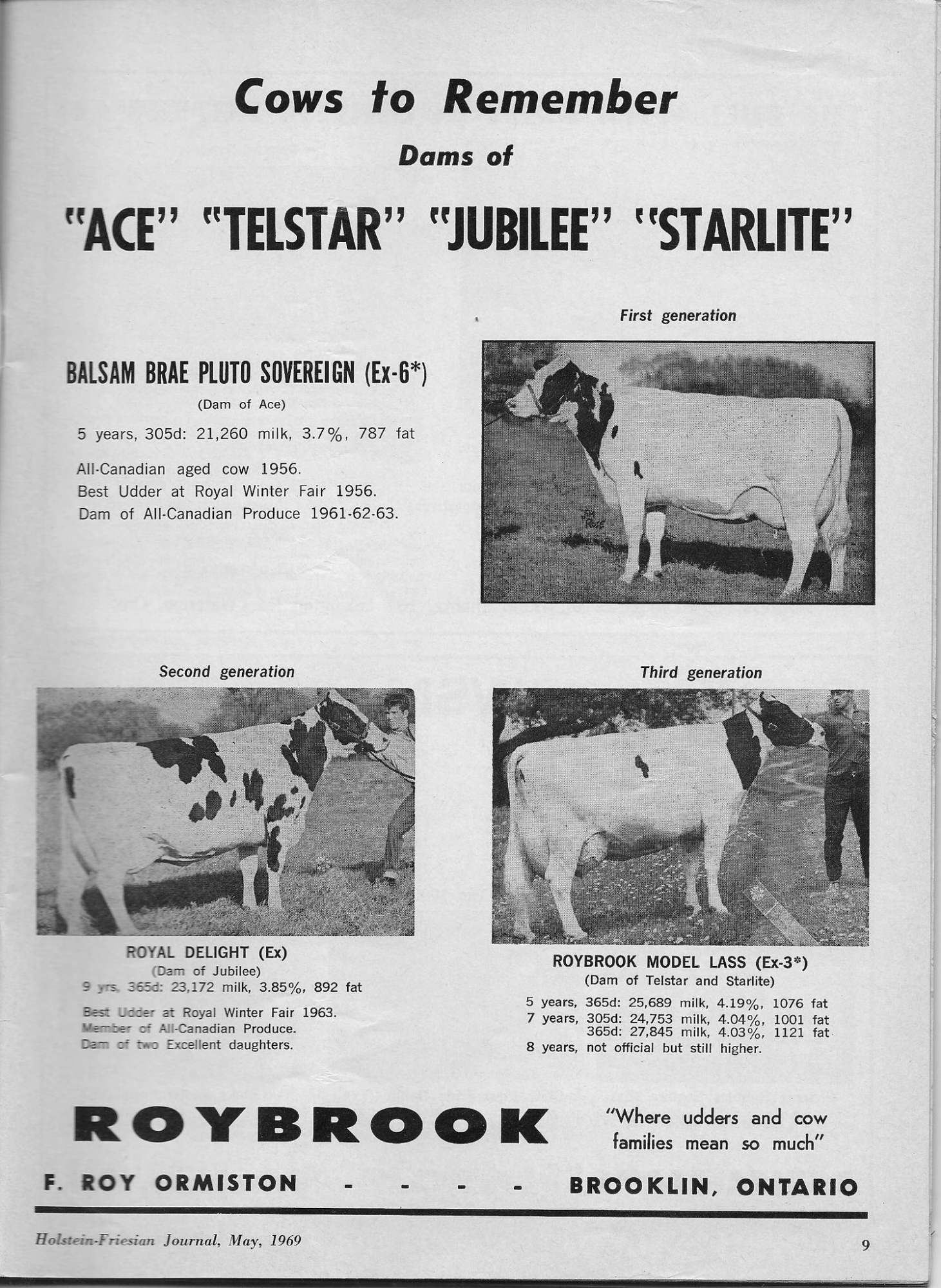
Her progeny became the architects of the Roybrook empire. Royal Delight EX-7, carried to Roybrook in dam, made history alongside her mother as the only dam-daughter pair to win best udder classes at the Royal Winter Fair. In ten lactations, she produced 179,519 pounds of 3.97% milk.

Another daughter, Roybrook Model Lady EX-3, won her class three times at the Royal Winter Fair and reached the Honour List with records exceeding 25,000 pounds of milk. Her twelve lactations yielded 243,799 pounds of milk with a 4.09% test and 9,969 pounds of fat, which would impress even today’s high-production era.

These remarkable females and the White Cow’s son, Roybrook Ace EX-ST, became the genetic architects of a dynasty unlike any other. Ormiston’s linebreeding concentrated on these closely related animals, often breeding maternal half-siblings together. This genetic concentration reached its zenith when Royal Delight was bred to Roybrook Model, producing Roybrook Model Lass EX-15, a cow destined to become the mother of bulls that would reshape global Holstein genetics.

The Global Roybrook Revolution: Telstar, Starlite, and Tempo
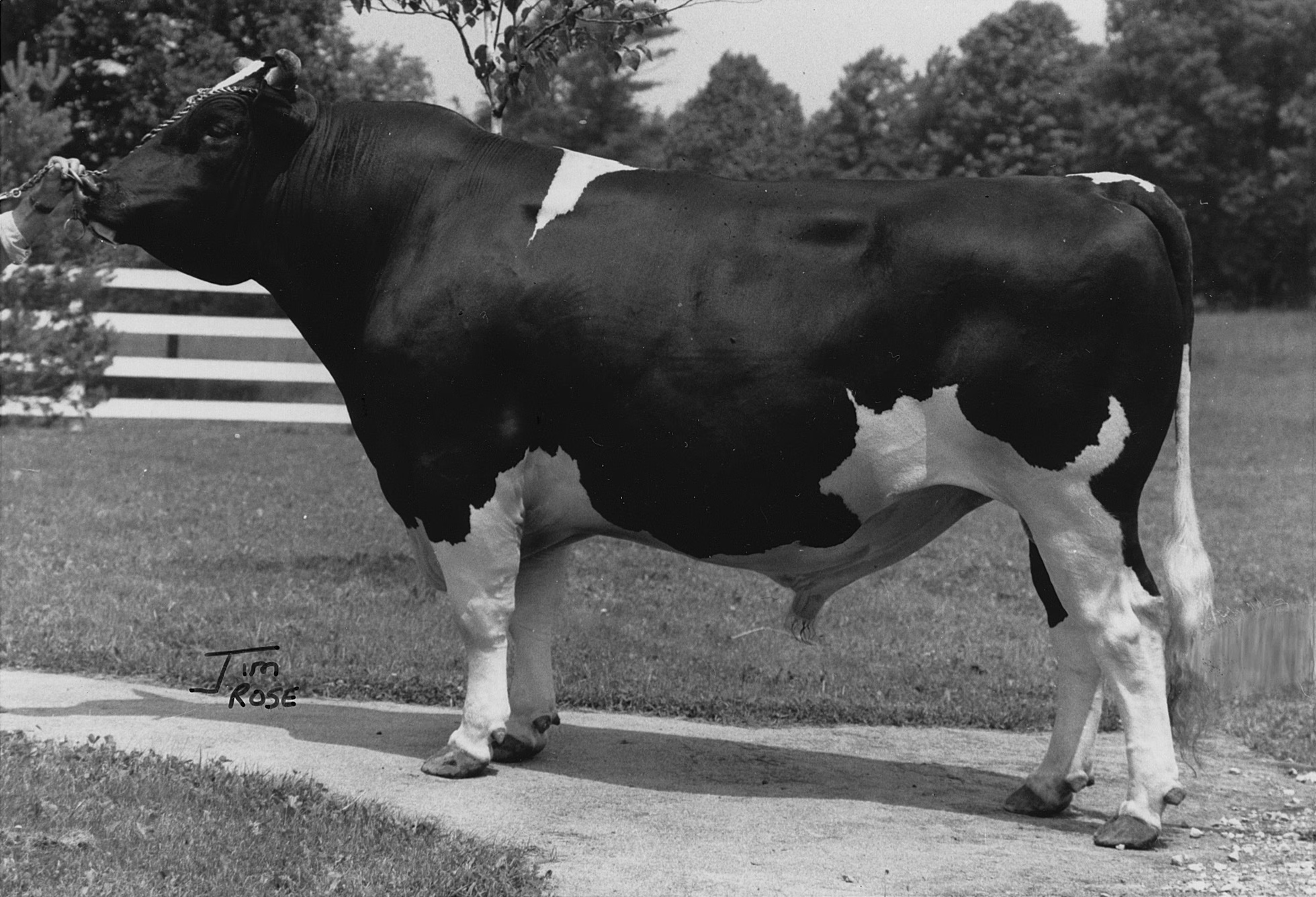
Roybrook Telstar EX-Extra-born of Roybrook Ace and Model Lass-emerges as a global Holstein icon. As a six-month-old, Telstar topped the 1964 National Sale at $25,000, then quickly proved himself as one of the breed’s most influential sires for both type and production. His legacy reached far beyond Canada, culminating in a life-size bronze statue in Japan, and his genetic impact endures in Holstein pedigrees worldwide.

In 1964, the Roybrook influence exploded onto the international stage when a six-month-old bull calf named Roybrook Telstar commanded $25,000 at the National Sale. This wasn’t just any calf-he represented three generations of Ormiston’s careful linebreeding, being the son of Roybrook Ace and Roybrook Model Lass.

Named after the revolutionary communications satellite launched in 1962, Telstar became aptly symbolic of Roybrook’s global reach. One of the youngest bulls to reach a Class Extra rating, his 739 classified daughters were 83% Good Plus or better, earning him a +31 rating for type while simultaneously proving +6 for milk production.

Before receiving his full proof, Telstar was sold to Japan’s Federation of Agricultural Societies at a record price for a Canadian Holstein. His influence in Japan was so profound that in 1978, Ormiston traveled there to unveil a life-size bronze statue erected in the bull’s honor, a testament to how far the genetics from a modest Ontario farm had traveled.

Roybrook Starlite EX-Extra-one of the breed’s most influential production sires. Starlite’s daughters and sons, the result of Roybrook’s signature linebreeding, set new standards for both milk and fat yields worldwide, cementing his legacy as a cornerstone of the Telstar-Starlite-Tempo trifecta that propelled Roybrook genetics onto the global stage.

Following Telstar came Roybrook Starlite EX-Extra, a son of Seiling Rockman EX-Extra and Roybrook Model Lass. Proven at United Breeders Inc., Starlite became one of Canada’s most formidable production sires, leading the national list of Honor List producers three times. His daughter Grasshill Starlite Madge VG made history as the first junior two-year-old in Canada to produce 1,000 pounds of fat.
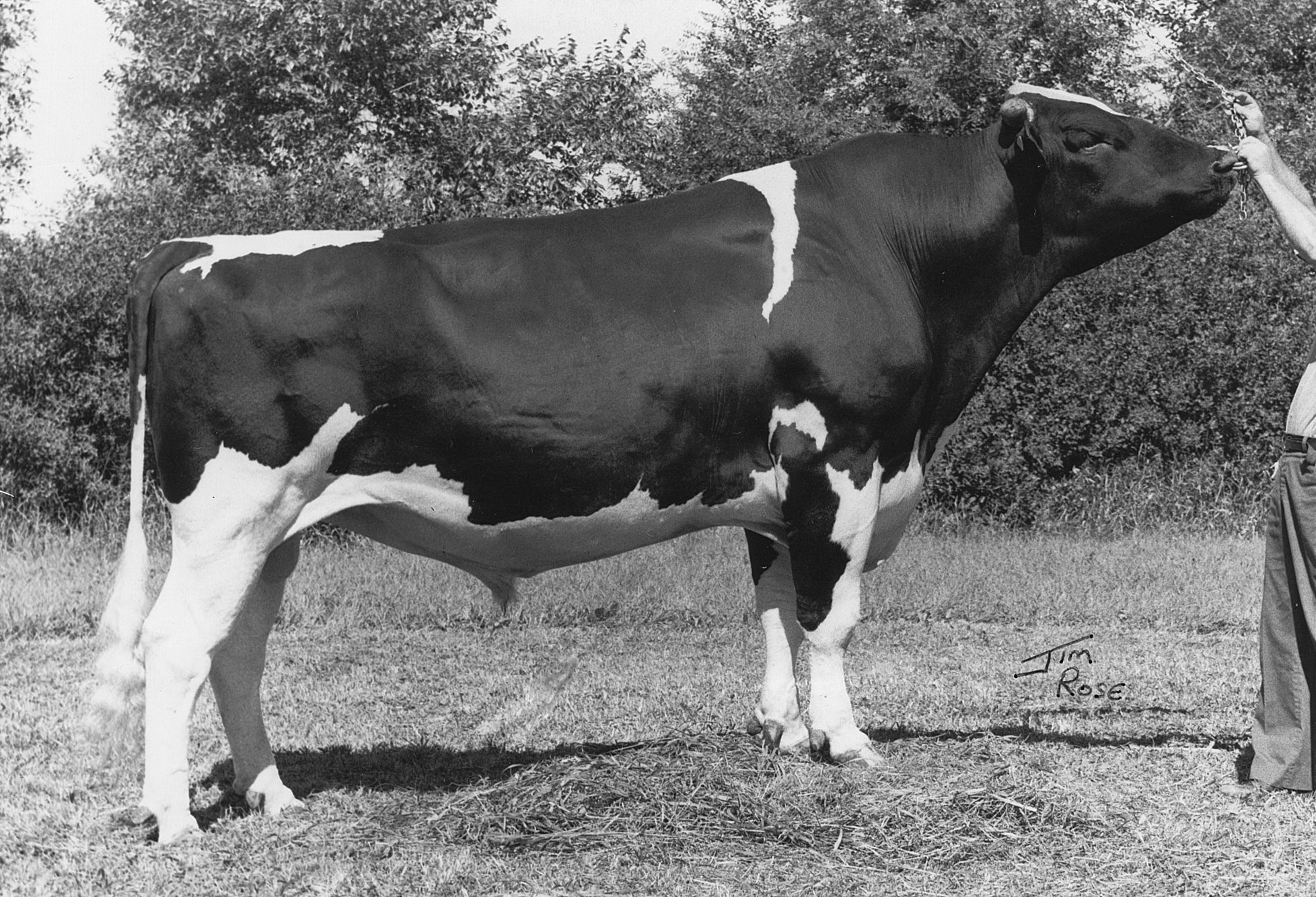
Roybrook Tempo, the culmination of Ormiston’s legendary linebreeding, became a globally influential sire whose daughters and sons carried the Roybrook stamp for production, type, and longevity to herds around the world.

The triumvirate was completed by Roybrook Tempo EX-Extra, a son of Starlite out of Briarwood Melissa, a Telstar daughter Ormiston had purchased at the 1968 Sale of Stars for $7,000. This linebreeding masterpiece-essentially breeding the son of Model Lass (Starlite) to the granddaughter of Model Lass (Melissa)-produced a bull that earned an Extra rating in 1979 and was used extensively worldwide.

“The Telstar-Starlite cross showed the strength of the Roybrook line breeding program,” industry observers noted. The results were undeniable: cows like Roybrook Vale EX, with two Honor List records and six lactations exceeding 1,000 pounds of fat, and Roybrook Harriet EX, with five records surpassing 1,000 pounds of fat.

As Roybrook’s reputation soared, the unassuming Ontario farm became a global mecca. International visitors regularly made pilgrimages, especially during the Royal Winter Fair, to witness the source of genetics transforming herds across continents. By the late 1980s, Holstein World readers voted Ormiston “North America’s most admired breeder,” British Holstein expert Richard Beard described him as “a twentieth-century Merlin” for his seemingly magical breeding consistency.

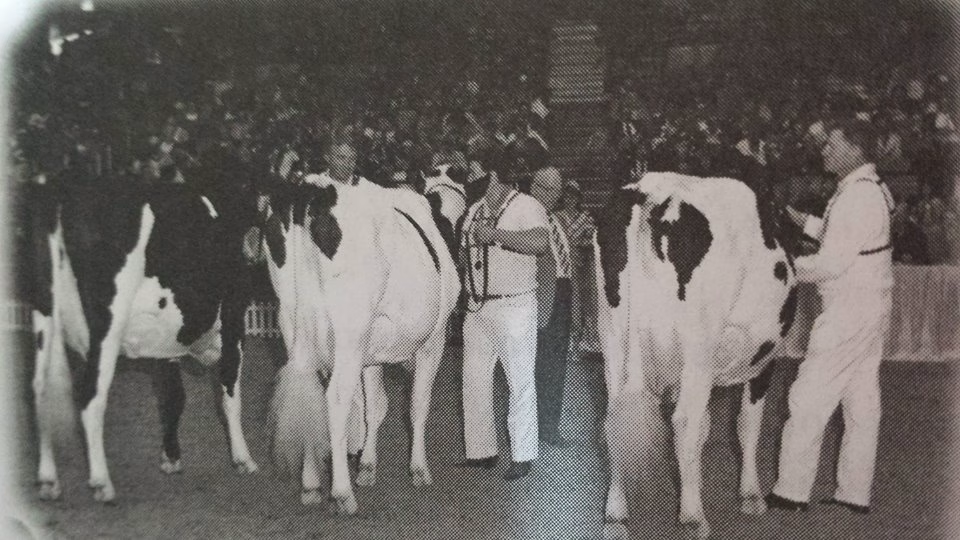
This remarkable historical photograph captures Roybrook Valiant (VG-GM) alongside his famous sire, Roybrook Starlite (EX-Extra), at United Breeders in Guelph, Ontario, in May 1977. The two Holstein bulls represent key components of Roy Ormiston's influential breeding program that transformed Holstein genetics worldwide.

Roybrook Starlite, a son of Seiling Rockman EX-Extra and Roybrook Model Lass, was proven at United Breeders Inc. and became one of Canada's most formidable production sires, leading the national list of Honor List producers three times. As part of the legendary Telstar-Starlite-Tempo triumvirate, Starlite's genetics contributed to Ormiston's reputation as "North America's most admired breeder."

This image represents the living embodiment of Ormiston's linebreeding philosophy that concentrated on superior maternal lines from his famous "White Cow" foundation. The father-son pair shown here carried those genetics to herds around the world, helping establish Roybrook's global influence in Holstein cattle breeding.
Roybrook Valiant (VG-GM) alongside his famous sire, Roybrook Starlite (EX-Extra), at United Breeders in Guelph, Ontario, in May 1977. The two Holstein bulls represent key components of Roy Ormiston’s influential breeding program that transformed Holstein genetics worldwide. This image represents the living embodiment of Ormiston’s linebreeding philosophy that concentrated on superior maternal lines from his famous “White Cow” foundation. The father-son pair shown here carried those genetics to herds around the world, helping establish Roybrook’s global influence in Holstein cattle breeding.

The Ormiston Method: Breeding Philosophy for the Ages

Behind Roybrook’s spectacular success lay a breeding philosophy that was elegant in simplicity and profound in its insight. Roy Ormiston’s approach, refined through decades of careful observation and disciplined selection, offers striking parallels to challenges facing Holstein breeders in today’s genomic era.

“I like to compare a dairy cow to a building,” Ormiston once observed. “If you don’t have a very good foundation, then it isn’t going to stand up too long, especially in a storm, and that is heavy production.” This fundamental insight-that genetic selection must balance productive capacity with structural integrity remains as relevant in the age of genomics as it was during the era of visual appraisal.

Ormiston built his program on several enduring principles:

First came his unwavering focus on cow families. “I always believed in cow families,” Ormiston emphasized. “But when the best cows in the herd traced back to this one cow, you kept those. It got to the point where maybe two or three other cows weren’t of that bloodline, and then I had to decide. It wasn’t hard to make. The next best brood cow had a few progenies but didn’t breed as well as the White Cow. So, they eliminated themselves through culling”.

This ruthless concentration on superior maternal lines has a modern parallel in genomic breeding programs identifying elite cow families and exploiting them intensively. The difference is that Ormiston accomplished this through direct observation rather than genotyping.

He carefully distinguished his approach from close inbreeding: “It was line-breeding-not inbreeding. We never inbred”. He aimed to intensify the White Cow’s desirable traits without sacrificing vigor. Modern genomic tools now allow breeders to manage inbreeding at the molecular level, but Ormiston achieved similar objectives through careful pedigree analysis and deep knowledge of his cow families.

While critical of the industry’s overreliance on statistics, Ormiston maintained a remarkably balanced selection approach. He simultaneously improved udder conformation, component percentages, and productive efficiency- a holistic perspective that today’s genomic indices attempt to capture through complex economic weightings.

In an era when the average productive life of Holstein cows has declined despite genetic progress, Ormiston’s emphasis on breeding cows that remained trouble-free and productive for many lactations seems prescient. The Roybrook herd boasted cows routinely completing 8-12 lactations with exceptional production. Lady’s twelve lactations produce 243,799 pounds of milk, and Royal Delight’s ten lactations, yielding 179,519 pounds, demonstrate this focus on longevity.

Rainyridge Tony Beauty EX-5E 9*, pictured here in her prime, exemplifies Roy Ormiston's enduring genetic influence in modern Holstein breeding. This exceptional daughter of Marshfield Elevation Tony from a Roybrook Tempo dam demonstrates how Ormiston's emphasis on balanced conformation, productive capacity, and maternal strength continues to shape superior Holstein lines decades after Roybrook's dispersal. Her multiple "Excellent" classifications and proven ability to transmit excellence to her nine starred daughters illustrates the lasting relevance of Ormiston's breeding principles in today's genomic era. With her powerful frame and dairy strength combined with maternal traits, she represents the type of "balanced cow" that Ormiston championed throughout his career-a living testament to his visionary approach.
Rainyridge Tony Beauty EX-5E 9*, exemplifies Roy Ormiston’s enduring genetic influence in modern Holstein breeding. This exceptional daughter of Marshfield Elevation Tony from a Roybrook Tempo dam demonstrates how Ormiston’s emphasis on balanced conformation, productive capacity, and maternal strength continues to shape superior Holstein lines decades after Roybrook’s dispersal.

Modern Relevance: Ormiston’s Vision in the Genomic Age

As Ormiston’s active breeding career concluded with the 1990 dispersal sale, the Holstein industry stood on the threshold of a technological revolution. The genomic era, which would begin in earnest two decades later, would bring capabilities that even a visionary like Ormiston could not have fully anticipated.

Yet, many of his breeding principles have found validation in the genomic age. The modern emphasis on balanced breeding values like Net Merit $ or the Balanced Performance Index (BPI) echoes Ormiston’s insistence on improving type, production, and longevity. The industry’s growing focus on feed efficiency and health traits reflects his emphasis on trouble-free cows that efficiently convert roughage to milk.

Perhaps most significantly, Ormiston’s skepticism about overreliance on statistical evaluation offers a valuable counterbalance to potential pitfalls of genomic selection. In the last days of the twentieth century, he “deplored the artificial insemination industry’s increasing reliance on statistics at the expense of common sense, describing some of the material that the geneticists were placing before the Holstein public as an insult to the human race.”

This perspective finds renewed relevance as some breeders express concern about the potential overemphasis on genomic indices at the expense of careful observation. The most successful modern breeding programs often combine genomic data with traditional functional type evaluation, precisely the balance Ormiston advocated.

The international chapter of Roybrook’s direct breeding program concluded with the herd’s dispersal on October 1, 1990. Dubbed the “Roybrook Retirement Party,” the event drew over 3,000 attendees worldwide. The 74 lots averaged an impressive $14,094.59, with 64% selling to international buyers. The sale topper was a Walkway Chief Mark, son of Roybrook Vale, purchased for $140,000 by K.K. Tokachi A.I. Centre in Japan.

Though the dispersal ended Ormiston’s active breeding, it accelerated the global dissemination of his genetics. Today, many Holstein cows trace their pedigrees back to Roybrook bloodlines, particularly through the widespread use of the Telstar-Starlite-Tempo sire trio and their descendants.

the 2014 World Dairy Expo, Lovhill Goldwyn Katrysha strikes the perfect pose as Reserve Grand Champion. This exceptional EX-96 Holstein exemplifies the modern ideal of balanced type and production, <a href='https://www.thebullvine.com/news/supporting-dairy-cattle-immune-system-demonstrates-improved-health-production/' data-lazy-src=

The Legacy Continues: Beyond Pedigrees and Production Records

Frederick Roy Ormiston passed away in December 2015 at the remarkable age of 100, having witnessed the transformation of Holstein breeding from the art he practiced to the data-driven science it has essentially become. His many honors included Master Breeder shields in 1963 and 1988, the U.S. Dairy Shrine’s Distinguished Cattle Breeder Award in 1989, and induction into the Canadian Agricultural Hall of Fame in 1999.

Yet Ormiston’s legacy extends far beyond these accolades. His influence continues through thousands of animals worldwide that trace back to Roybrook bloodlines. He championed balanced selection, emphasis on cow families, and breeding for lifetime performance, which are foundational to successful dairy breeding in any technological era.

His legacy is also evident in his community of Brooklin, Ontario, where roads bear the names of his famous herd and where he generously donated 25 acres of land for a new hospital-physical reminders of his breeding achievements and character.

“I don’t think at first I had any definite plan,” Ormiston once reflected. “I was interested in Holsteins, and when you are interested in something, you want to breed the best.” Rather than chasing trends, this focus on fundamental excellence helped create animals that excelled not just in the showring or on production tests but in the broader measure of a lifetime contribution to the breed.

As genomic technology continues evolving, Ormiston’s career reminds us that behind every SNP chip and genomic evaluation lies the fundamental goal he pursued throughout his life: breeding trouble-free cows that efficiently convert feed to quality milk, generation after generation.

Roy Ormiston’s enduring contribution was the elegant balance he achieved between progressive innovation and timeless principles of genetic ballet choreographed by a master breeder whose work continues to influence Holstein cattle worldwide. In an industry constantly pursuing the next breakthrough, Ormiston reminds us that sometimes the most revolutionary approach is maintaining an unwavering focus on fundamental excellence across generations.

Key Takeaways

  • Ormiston’s greatest insight was recognizing the White Cow’s extraordinary ability to transmit excellence regardless of sire, leading to his successful linebreeding strategy
  • His balanced selection approach-improving udder conformation, component percentages, and productive efficiency simultaneously-created cows that thrived for 8-12 lactations with exceptional production
  • Ormiston’s skepticism of purely statistical evaluation offers valuable perspective in today’s genomic era, reminding breeders that behind every index lies the fundamental goal of breeding trouble-free, productive cows
  • The global influence of Roybrook genetics demonstrates how a focused breeding program from a modest farm can transform an entire breed through clear vision and disciplined selection
  • His philosophy-“I like to compare a dairy cow to a building. If you don’t have a very good foundation, then it isn’t going to stand up too long”-remains foundational to successful dairy breeding in any technological era

Executive Summary

Frederick Roy Ormiston revolutionized Holstein breeding through his visionary approach centered around a single remarkable cow-“The White Cow”-acquired for $750 in 1956. Through strategic linebreeding on this exceptional animal’s family, he created a dynasty that produced influential sires like Telstar, Starlite, and Tempo, whose genetics spread to six continents. Ormiston’s breeding philosophy balanced type with production while emphasizing longevity, rejecting the industry’s growing reliance on statistics in favor of deep cow family knowledge and careful observation. His principles of breeding trouble-free, efficient cows with sound structure and high components proved remarkably prescient, earning him recognition as “North America’s most admired breeder.” Though his active program ended with the 1990 dispersal sale, Ormiston’s genetic legacy and balanced approach remain profoundly relevant in today’s genomic era.

Learn more:

Join the Revolution!

Join over 30,000 successful dairy professionals who rely on Bullvine Daily for their competitive edge. Delivered directly to your inbox each week, our exclusive industry insights help you make smarter decisions while saving precious hours every week. Never miss critical updates on milk production trends, breakthrough technologies, and profit-boosting strategies that top producers are already implementing. Subscribe now to transform your dairy operation’s efficiency and profitability—your future success is just one click away.

NewsSubscribe
First
Last
Consent

When Cows Were Kings: Revisiting Carnation’s Golden Age of Dairy Breeding

How the 1900s ‘contented cows’ sparked a dairy revolution: Carnation Farms blended animal welfare with cutting-edge science to create genetics that still shape modern herds.

A Pastoral Legacy: Holstein dairy cattle graze peacefully on Carnation Farms’ expansive pastures in Washington’s Snoqualmie Valley, with the farm’s impressive complex of barns and buildings nestled against the forested hillside. This historic image captures the essence of E.A. Stuart’s “contented cow” philosophy that revolutionized dairy breeding in the early 20th century, where scientific breeding practices merged with compassionate animal care to create one of America’s most influential dairy operations.

Elbridge Amos Stuart’s vision transformed a patch of Washington farmland into a dairy empire. 1908, he planted Carnation Milk Farms, a pioneering operation that reshaped Holstein dairy cattle genetics worldwide. Carnation Farms bred superior Holstein bloodlines for nearly a century, shattering milk production records and leaving an indelible mark on the dairy industry. Their “contented cow” philosophy wasn’t just clever marketing—it was a revolutionary approach that paired scientific breeding with compassionate animal care.

“The RULE to be observed in this stable at all times, toward the young and old cattle, is that of patience and kindness… Treat each cow as a mother should be treated.”

The Vision of E.A. Stuart: Founding and Early Years

Elbridge Amos Stuart (1856-1944): Visionary founder of the Carnation Company and pioneer of modern dairy farming. This formal portrait captures the determined gaze of the entrepreneur who transformed a bankrupt condensery into a global dairy empire. In 1908, Stuart established Carnation Farms in Washington’s Snoqualmie Valley, where he revolutionized Holstein breeding while championing his famous “contented cow” philosophy—believing that humane treatment of animals improved milk production. His innovative approaches to both marketing and animal husbandry created a lasting legacy that continues to influence dairy practices more than a century later.

E.A. Stuart took a leap of faith in 1908. He bought 360 acres of Snoqualmie Valley farmland sight unseen, banking on a tip from his childhood buddy Sam Hill about an upcoming railroad connection. Stuart, who’d already founded the Pacific Coast Condensed Milk Company (later Carnation Milk), faced a milk supply crisis. He needed more cows to produce more milk and fast.

Stuart’s solution? Create his dairy wonderland. By 1910, he’d expanded to 750 acres and established Carnation Stock Farms as a showcase facility. He spared no expense, bringing in top-notch Holstein-Friesian cattle and hiring the cream of the crop in animal husbandry experts.

What set Stuart’s approach apart was his unique blend of science and compassion. While he meticulously tracked bloodlines and started a selective breeding program, he also developed a radical philosophy about animal treatment. Stuart firmly believed that happy cows were productive cows—a notion that would become the cornerstone of Carnation’s breeding program and brand identity.

This was the birth of an operation that would grow to 1,400 acres and turn the dairy world on its head.

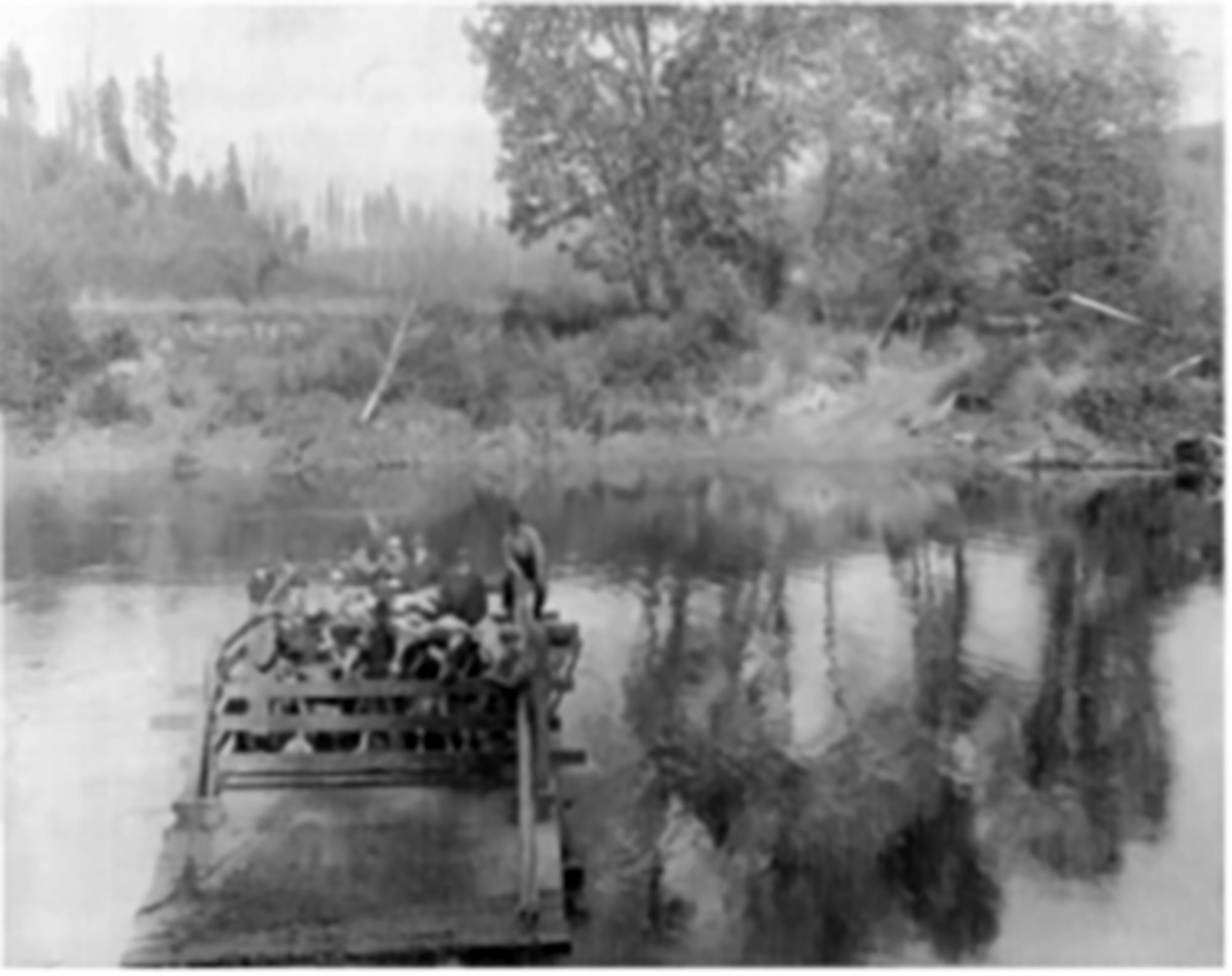
Historic Transport to Carnation’s Dairy Empire: This rare photograph from circa 1910 captures a cable ferry crossing the Snoqualmie River, the lifeline for E.A. Stuart’s fledgling Carnation Farms. Before railroads reached the valley in 1911, boats and ferries provided the only connection between Stuart’s ambitious dairy operation and the outside world. Milk produced at the farm traveled by river to processing facilities, while livestock and supplies made the reverse journey. The surrounding landscape shows the partially cleared wilderness that greeted Stuart when he purchased the property sight unseen in 1908—a purchase he initially called “a disgrace for a Stuart to be connected with.” This ferry crossing marked the beginning of what would become one of America’s most famous agricultural enterprises, home to record-breaking “Contented Cows” and revolutionary breeding practices that transformed dairy farming worldwide.

The “Contented Cow” Philosophy: More Than Just Marketing

Carnation’s iconic “Contented Cows” slogan was born in a lightbulb moment during a 1906 Chicago marketing meeting. As Stuart waxed poetic about his cows’ royal treatment, someone quipped that “they must be very contented cows.” Little did they know, they’d just coined one of history’s most memorable agricultural taglines.

But this wasn’t just clever wordplay. Stuart put his money where his mouth was, instituting concrete policies ahead of their time. In the main barn’s breezeway, a sign still hangs today, laying out the farm’s animal welfare guidelines:

“The RULE to be observed in this stable at all times, toward the young and old cattle, is that of patience and kindness… Remember that this is the home of mothers. Each cow should be treated as a mother should be treated. Giving milk is a function of motherhood; rough treatment lessens the flow. That injures me as well as the cow. Always keep these ideas in mind when dealing with my cattle.”

Workers were even banned from cursing at the cows. This wasn’t just about being nice—Stuart understood that stress could seriously dampen milk production, a connection that modern dairy science would later confirm.

This philosophy became Carnation’s secret sauce, making humane treatment an integral part of genetic improvement—a surprisingly progressive stance for the early 20th century.

The Science of Stress-Free Milking

Why Contented Cows Produced More

  • Modern studies back up Stuart’s hunch: stress hormones can put the squeeze on milk production
  • Carnation’s 6x/day milking schedule for champion cows hit the sweet spot for optimal production.
  • Their approach was decades ahead of the curve in dairy welfare practices
Holstein History in the Spotlight: E.A. Stuart proudly stands with his dual National Dairy Show champions at Syracuse, NY in 1923. On the left is Tillamook Daisy Butter King DeKol, the highest-producing cow ever to win the National championship with her remarkable 4-year-old record of 32,488 pounds of milk and 1,247 pounds of butterfat. On the right stands Carnation Matador Adelina Segis, Junior Champion female and daughter of the influential Matador Segis Walker bull. This historic photograph captures a pivotal moment in Holstein breeding history, showcasing Carnation Farms’ rising dominance in both show ring excellence and production records that would help establish their “contented cow” breeding program as one of the most influential in American dairy farming.

Breeding Program Development and Methodology

Carnation’s breeding program was a game-changer in the dairy world. Stuart zeroed in on purebred Holstein cattle, investing big bucks in premium breeding stock and top-tier personnel.

The goal? Crank up milk production through selective breeding. Carnation attacked this challenge with scientific precision, keeping meticulous records of bloodlines, production data, and offspring performance to guide their breeding decisions.

What set Carnation apart was its commitment to research. By the 1950s, it had built a million-dollar research lab dedicated to cracking the code of cow contentment and productivity. This scientific approach to breeding went hand in hand with its focus on animal care and nutrition.

But Carnation didn’t keep their genetic gold to themselves. They actively spread the wealth by crossbreeding their prize Holstein bulls with independent dairymen’s stock, increasing milk production efficiency throughout the industry.

The results spoke for themselves: Carnation became America’s undisputed champion of prize-winning Holstein cows, consistently raising the bar for milk production and butterfat content.

“Many of today’s Holsteins carry ‘Carnation genetics’—a living testament to their century-long pursuit of excellence.”

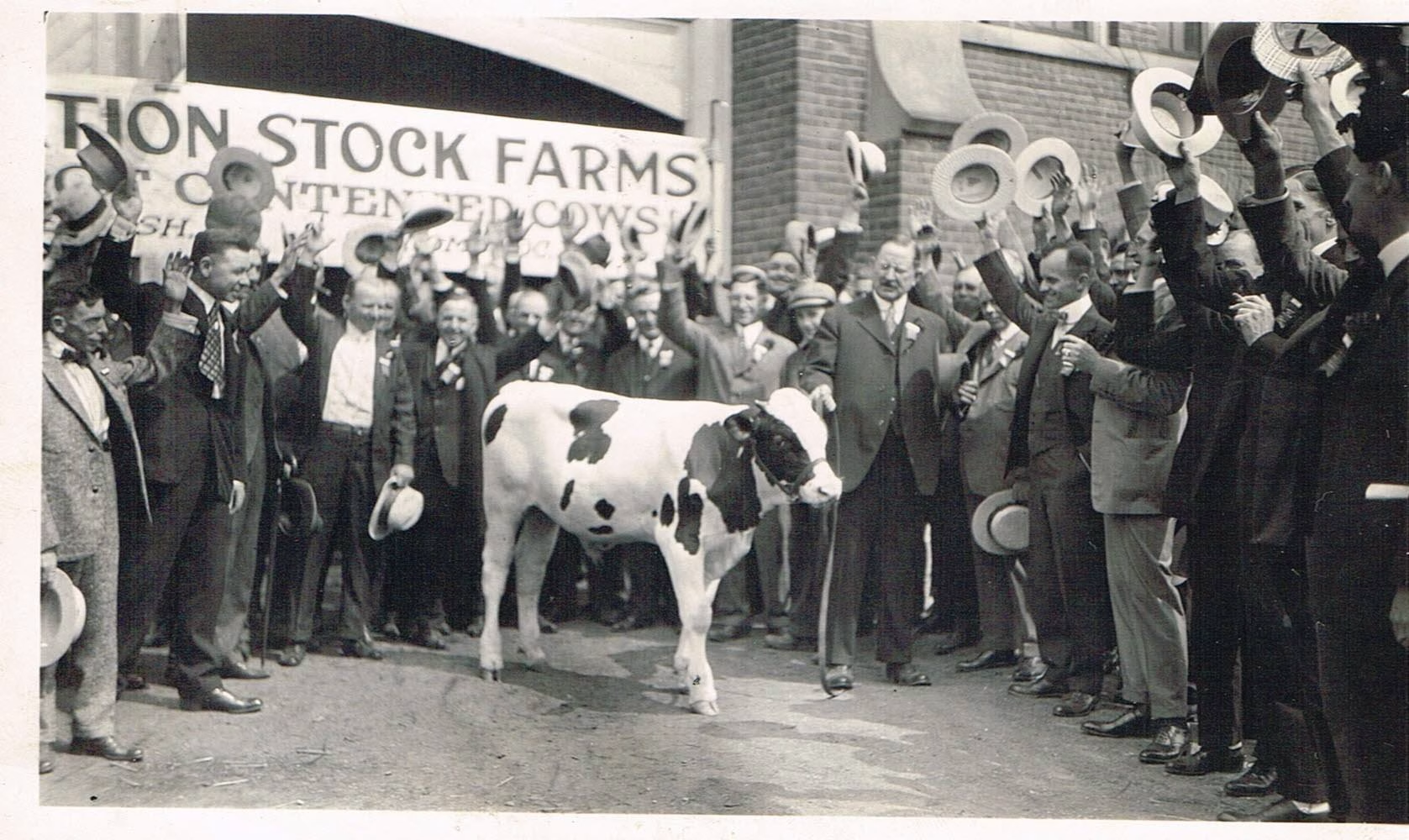
Historic Dairy Milestone: Carnation King Sylvia’s Celebrated Tour (1918). This remarkable photograph captures the fanfare surrounding Carnation King Sylvia, the Holstein bull calf that shocked the dairy world when E.A. Stuart paid an unprecedented $106,000 (equivalent to $1.9 million today) for him at the National Holstein Sale in Milwaukee. The crowd of cheering men, raising their hats in celebration beneath the “CARNATION STOCK FARMS” banner, demonstrates the celebrity status this purchase created. Stuart brilliantly transformed this acquisition into a nationwide marketing campaign, parading the valuable calf at whistle-stops across America during its train journey to Washington. This carefully orchestrated publicity tour not only promoted Carnation’s “Contented Cows” philosophy but established the farm as a serious player in elite Holstein breeding circles. The investment would pay dividends far beyond publicity—King Sylvia’s genetics would help shape Carnation’s superior Holstein bloodlines, contributing to their record-breaking milk production achievements in subsequent decades and cementing Stuart’s reputation as a visionary in dairy cattle breeding.

Record-Breaking Champions: Notable Cows and Bulls

Carnation’s breeding program produced some real bovine superstars. They churned out more prize-winning Holstein cows than any other U.S. breeder, with several achieving legendary status in dairy breeding history.

The cream of the crop was Segis Pietertje Prospect, affectionately known as “Possum Sweetheart.” She embodied everything Carnation’s breeding philosophy aimed for. With skilled milker Carl Gockerell, who milked her six times daily like clockwork, Segis Pietertje Prospect shattered production records.

MetricSegis Pietertje Prospect (1920)Average Cow (1920)Modern Holstein (2017)
Annual Milk Production37,381 lbs4,000 lbs77,480 lbs (record)
Milking Frequency6x daily2-3x daily2-3x daily
Production vs. Body WeightProduced her weight in milk every ~3 weeksN/AN/A

Segis Pietertje Prospect’s production was off the charts—nearly ten times that of an average cow in 1920. She became a global sensation, with newspapers worldwide singing her praises. Even celebrities got in on the action, with heavyweight champ Jack Dempsey and French General Marshal Joffre stopping by to pay their respects.

When Segis Pietertje Prospect passed away in 1925 at the ripe old age of 12, both Stuart and Gockerell were heartbroken. In 1928, they erected a monument in her honor at the entrance to Carnation Farms—believed to be the world’s first statue dedicated to an individual Holstein cow. You can still see this tribute to bovine excellence at the farm today.

Monument to Milk Majesty: The statue of Segis Pietertje Prospect (“Possum Sweetheart”) stands proudly at Carnation Farms, immortalizing the Holstein cow who shattered production records on December 19, 1920. Her unprecedented yield of 37,381 pounds of milk in 365 days—nearly tenfold the era’s average—revolutionized dairy breeding and cemented Carnation’s reputation for elite genetics. This bronze tribute honors not just an individual cow, but the enduring legacy of E.A. Stuart’s “contented cow” philosophy, which paired humane care with scientific rigor to redefine global dairy standards. Visitors today still marvel at her story, a testament to how one extraordinary animal helped shape modern agriculture.

While Segis Pietertje Prospect’s record was mind-blowing for her time, dairy genetics have come a long way. In 2017, a Wisconsin Holstein named Ever-Green-View My Gold-ET set a new national milk production record of 77,480 pounds in 365 days—more than double Segis Pietertje Prospect’s achievement and triple the 2015 U.S. Holstein average of 24,958 pounds.

Carnation’s Record Holders

Cow NameProduction Record (lbs)YearAchievement
Segis Pietertje Prospect37,381 milk1920First world record
Carnation Ormsby Butter King38,607 milk, 1,402 fat1936First 38,000-lb milk record
Carnation Ormsby Madcap Fayne41,943 milk1942First 20-ton milk record
Carnation Homestead Daisy Madcap36,414 milk, 1,511 fat1951First 1,500-lb fat record
Holstein Excellence on Display: This historic photograph showcases the Get of Carnation Madcap Butter Boy (EX-96-SMT), a premier Carnation Farms sire born in 1951. This impressive group earned Reserve All-American Get of Sire honors in 1958, exemplifying the elite breeding program that made Carnation Farms a dominant force in Holstein genetics. The cow nearest the camera is Carnation Sally Lola Princess (EX), who herself earned All-American Three-Year-Old recognition that same year. These daughters demonstrate the consistent type, dairy strength, and production capacity that characterized the Madcap family—one of Carnation’s most influential bloodlines. This quartet represents a pivotal moment in Holstein history, when breeding emphasized both show ring excellence and production capabilities, helping establish standards that would influence dairy cattle genetics for generations.

Research and Innovation: Beyond Traditional Breeding

Carnation’s success wasn’t just about traditional breeding methods—they poured serious cash into research and innovation. By mid-century, they’d unveiled a state-of-the-art, million-dollar research laboratory in Van Nuys, California, dedicated to pushing the boundaries of dairy science.

Their research went beyond breeding, diving into nutrition, welfare, and management practices. One standout innovation was Calf Manna, a specialized livestock feed cooked by nutritionists from Albers Milling (a Carnation subsidiary) at Carnation Stock Farms. Introduced in the early 1930s, this wonder feed boosted animal consumption and productivity, starting with dairy cows but eventually benefiting all livestock.

Elbridge Hadley Stuart, the founder’s son and Carnation’s president, was dead set on keeping the company at the cutting edge of dairy science. This drive for innovation created a culture where pushing boundaries was the norm.

This approach showed a remarkably modern understanding that milk production is a complex dance of genetics, nutrition, welfare, and management—all requiring scientific study. A holistic view put Carnation far ahead of many operations stuck in their ways.

A Vision Takes Root: Carnation Farms, 1907. This remarkable photograph by Lester Rounds captures Carnation Farms in its formative years, showcasing E.A. Stuart’s ambitious dairy enterprise nestled against the forested hillsides of Washington’s Snoqualmie Valley. Holstein cattle—the cornerstone of Stuart’s breeding revolution—graze contentedly within meticulously maintained white-fenced pastures, embodying the farm’s famous “contented cow” philosophy before it became a marketing phenomenon. In the background, the impressive complex of barns, housing facilities, and processing buildings demonstrates the scale of Stuart’s investment, transforming wilderness into what would become America’s most influential dairy breeding operation. This rare image documents the pastoral beginnings of an agricultural enterprise that would fundamentally reshape dairy genetics worldwide and establish breeding practices still influential in today’s industry.

Global Impact: Spreading Genetic Excellence Worldwide

Carnation’s influence spread like wildfire, reshaping dairy genetics across the globe. Their cows became hot commodities worldwide, with many of today’s dairy cattle tracing their family trees back to Carnation bloodlines. This wasn’t by accident—Carnation made a concerted effort to share their genetic gold with the broader industry.

One key strategy was crossbreeding their purebred Holstein bulls with independent dairymen’s stock. This supercharged the productivity of dairy herds far beyond Carnation’s fences, spreading superior genetics throughout the industry. The results were game-changing: dairy farmers worldwide could get more milk from fewer cows, boosting food security, cutting labor needs, and shrinking the environmental hoofprint per gallon of milk.

DecadeCanadian Milk Production (hl)% Change vs. 1920sNotable Events
1920s54,405,972BaselineSegis Pietertje Prospect’s record (1920)
1950s70,434,711+29.5%Peak of Carnation’s breeding influence
1980s73,618,046+35.3%Post-Carnation sale to Nestlé (1985)
2020s95,125,258+74.8%Modern genomic-era production

Using Canadian milk production data (which mirrors broader North American trends), this table shows a significant jump in milk production between the 1920s and 1950s. This perfectly contrasts with the period when Carnation’s Holstein genetics spread like wildfire. The upward trend continued in later decades, showcasing the lasting impact of improved dairy genetics.

The numbers tell a compelling story. When Carnation started its breeding program in the early 1900s, the average cow pumped a modest 1,500-1,900 pounds of milk annually. Production levels skyrocketed through selective breeding and improved management, with Carnation’s elite animals producing many times this amount. This efficiency revolution turned the economics of dairy farming on its head, allowing producers to maintain or boost milk supply with smaller herds.

Carnation’s breeding achievements also left their mark on Holstein breed standards internationally, helping shape the characteristics of the modern Holstein cow. Their focus on high production combined with functional conformation created a template for breeding objectives that still sway today.

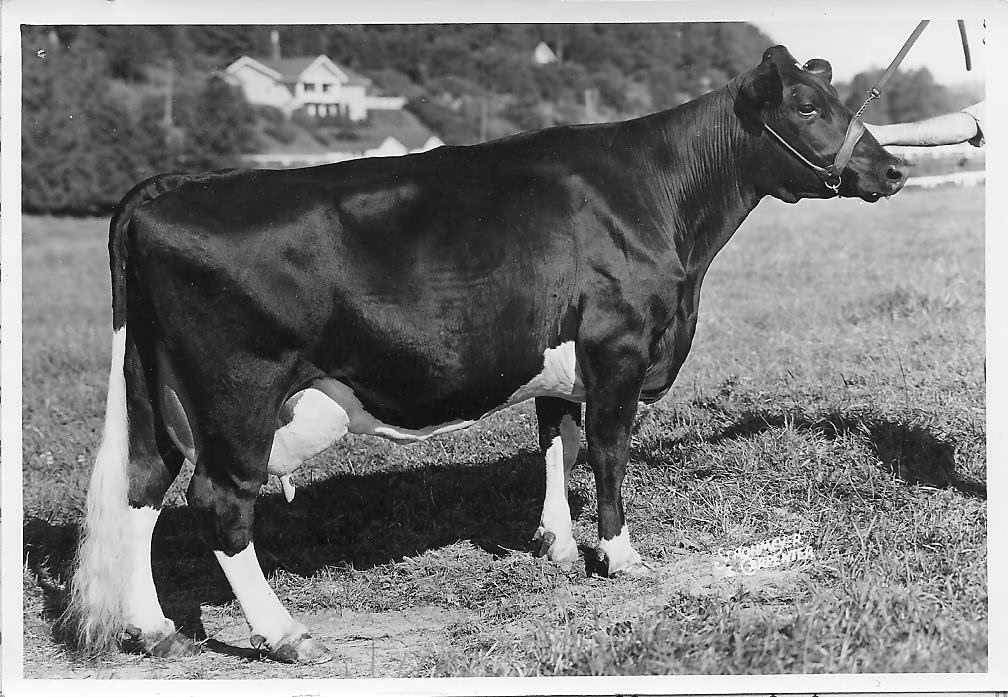
Carnation Heilo Violet: A Holstein Legacy on Display. This striking Holstein cow exemplifies the meticulous breeding program that made Carnation Milk Farms a world leader in dairy genetics. Photographed at the farm’s picturesque Snoqualmie Valley location, Heilo Violet showcases the ideal dairy conformation prized in Carnation’s selective breeding program. With her strong topline, deep body capacity, and well-attached udder, she represents the physical traits that supported exceptional milk production—the hallmark of the farm’s Holstein breeding success. Developed under E.A. Stuart’s famous “contented cow” philosophy, Carnation’s Holstein breeding lines produced numerous champions whose genetics continue to influence modern dairy herds worldwide. This classic black and white portrait captures not just a prize animal, but a living testament to the revolutionary approach to dairy breeding that transformed milk production efficiency throughout the 20th century.

Business Evolution and Corporate Context

You can’t tell the story of Carnation Milk Farms without understanding its role in the more prominent Carnation Company. The farm started to support Stuart’s evaporated milk business, addressing the chronic milk shortage plaguing his processing plants.

But it quickly became much more than a supplier. It evolved into a corporate showpiece, a cutting-edge research center, and a powerful marketing tool that brought the “contented cow” slogan to life. Stuart spared no expense, turning the farm into a showcase by acquiring top-notch Holstein-Friesian cattle and recruiting the best animal husbandry experts money could buy.

“If we somehow stumbled on a hair tonic that worked, Carnation would sell it.” – E.H. Stuart.

The relationship between Carnation Milk Farms and its parent company evolved. Carnation Company expanded far beyond evaporated milk, diversifying through strategic acquisitions. In 1929, they scooped up Albers Milling Company, allowing them to dip their toes into the cereals and animal feed market. This move supercharged their research capabilities, leading to nutritional studies for a menagerie of animals, with companion animals eventually becoming a significant focus. This research spawned consumer products, including the Friskies brand.

This diversification reflected the research-driven culture established at Carnation Farms. Their entrepreneurial spirit led to products like Friskies dog food, which, in 1934, grew directly out of the company’s dairy nutrition research.

The Carnation Company remained a Stuart family affair until 1985, when it was sold to Nestlé. In 2008, the original farm was sold to a nonprofit, and eight years later, the Stuart family established a new nonprofit called Carnation Farms on the historic site.

From Cows to Kibble

Carnation’s Unexpected Legacy

  • 1934: Friskies dog food developed from cattle nutrition research
  • 1950: Albers Milling (acquired 1929) becomes the top US animal feed producer
  • 1985: Nestlé buys Carnation for $3 billion, seeking both dairy and pet food operations
Holstein Excellence Personified: C GRILLSDALE ROZ COUNSELOR EX-95, pictured here in her prime, represents the pinnacle of Carnation Farms’ genetic influence through her sire, Carnation Counselor-ET. This magnificent Holstein achieved 1st Aged Cow and Honorable Mention Grand Champion at the 1999 World Dairy Expo. Born December 9, 1991, she exemplifies the balanced type and production characteristics prized in Holstein breeding. Her deep maternal line through Grillsdale Heidi Tim 2E-EX showcases multi-generational excellence extending back to VG-86 Nelacres Johanna Senator. Bred by Clifford Grills of Campbellford, Ontario, and later owned by Larry Mohrfield of Pleasant Plain, Ohio, this cow demonstrates how Carnation Farms’ bloodlines continued to impact elite show rings decades after the farm’s golden era. Her powerful frame, exceptional mammary system, and overall dairy strength illustrate the enduring legacy of strategic Holstein breeding.

Legacy and Lasting Influence

Carnation Milk Farms’ legacy continues to shape modern dairy breeding and production. Their nearly century-long quest for genetic excellence created bloodlines that still run through dairy herds worldwide, with many contemporary Holsteins tracing their ancestry to Carnation-bred animals.

“Possum Sweetheart’s 1920 output wouldn’t make today’s top 100—but her genetic legacy does.”

Beyond genetics, Carnation’s dual focus on scientific breeding and animal welfare established principles that have become mainstream in modern dairy farming. Their “contented cow” philosophy was decades ahead of its time, anticipating the contemporary understanding of how animal welfare impacts productivity. This approach has shaped industry attitudes about dairy cattle management ever since.

Their methodical approach to genetic improvement through selection, record-keeping, and progeny testing laid the groundwork for practices that still inform breeding programs today. While contemporary dairy breeding now incorporates genomic selection—analyzing DNA directly rather than waiting for production records—the fundamental goal of identifying superior genetics for productivity remains unchanged from Carnation’s heyday.

The physical legacy of Carnation Milk Farms lives on, too. Visitors to the original farm in Carnation, Washington, can still see the historic barn with its famous kindness sign and the statue honoring Segis Pietertje Prospect. These artifacts preserve the tangible history of an operation that revolutionized dairy breeding while embodying values that continue to resonate with dairy professionals and the public.

Championship Lineage: PRICE-VIEW ANNIE EX-94. This striking professional portrait by renowned dairy photographer Maggie Murphy showcases PRICE-VIEW ANNIE (EX-94), born March 15, 1995—a testament to Carnation breeding’s enduring genetic influence. Sired by Carnation Counselor and out of GLENALCOMB BROKER ANN EX-92, Annie’s exceptional dairy conformation earned her ALL-AMERICAN Junior 3-Year-Old honors in 1998 while representing Carrousel Farms of Wisconsin. Her beautifully balanced body structure, capacity, and well-attached mammary system exemplify the traits dairy breeders strive for in modern Holsteins. Annie’s pedigree demonstrates how Carnation’s breeding philosophy continued to shape elite show ring winners decades after the farm’s heyday, with her maternal lineage tracing to the influential Hanoverhill Starbuck. This image represents the pinnacle of Holstein breeding excellence—a harmonious blend of production capacity and show ring style.
Championship Lineage: PRICE-VIEW ANNIE (EX-94), born March 15, 1995—a testament to Carnation breeding’s enduring genetic influence. Sired by Carnation Counselor and out of GLENALCOMB BROKER ANN EX-92, Annie’s exceptional dairy conformation earned her ALL-AMERICAN Junior 3-Year-Old honors in 1998 while representing Carrousel Farms of Wisconsin. Her beautifully balanced body structure, capacity, and well-attached mammary system exemplify the traits dairy breeders strive for in modern Holsteins. Annie’s pedigree demonstrates how Carnation’s breeding philosophy continued to shape elite show ring winners decades after the farm’s heyday, with her maternal lineage tracing to the influential Hanoverhill Starbuck. This image represents the pinnacle of Holstein breeding excellence—a harmonious blend of production capacity and show ring style.

Connecting Past to Present: The Evolution of Dairy Breeding Principles

Carnation Milk Farms’ pioneering work in the early 20th century laid the groundwork for modern dairy breeding, bridging hands-on husbandry and today’s genomic revolution. While the tools have changed dramatically, the core principles of selective breeding, animal welfare, and data-driven decisions continue to steer the industry—proving that some strategies stand the test of time even as new challenges emerge.

From Eye-Appraisal to Algorithms: The Tools of the Trade

In the 1920s, Carnation’s breeders played a high-stakes game of genetic guesswork. They selected bulls based on pedigree records, milk yield of female relatives, and physical traits like udder conformation. Fast-forward to 2025, and farmers use genomic predictions to screen embryos for 50+ traits before implantation. What once took 5–7 years (waiting for a bull’s daughters to lactate) now takes months, with AI and embryo transfer accelerating genetic gains by 400%.

Timeless Principle:
“Measure what matters”—whether tracking butterfat in ledger books or analyzing SNP markers, successful breeding hinges on robust data.

Solving Tomorrow’s Problems with Yesterday’s Wisdom

Modern dairy farming faces a double-edged sword: the need to slash methane emissions by 30% by 2030 while meeting skyrocketing global demand. Here’s where Carnation’s legacy offers unexpected solutions:

  1. The “Contented Cow” 2.0
    Carnation’s stress-reduction ethos (think: no swearing near cows) aligns with genomic insights linking cortisol levels to 20% lower milk letdown. Today, wearable sensors monitor real-time stress in herds—a high-tech twist on Stuart’s philosophy.
  2. Efficiency as Sustainability
    While 1944’s cows produced 2,074 kg/year versus 9,193 kg in 2007, modern Holsteins now exceed 12,000 kilograms. Yet Carnation’s focus on efficient production (more milk per feed unit) remains critical—today’s dairy sector uses 35% less water and 23% less feed per liter than in 1944.
  3. Genetic Diversity Dilemma
    The push for hyper-productive Holsteins has narrowed gene pools, risking inbreeding. Carnation’s strategy of crossbreeding bulls with diverse herds offers a blueprint to reintroduce hardy traits without sacrificing yield.

The Hybrid Future: Marrying Old & New

As climate change intensifies, the industry is returning to pasture-based systems—but with a genomic edge. Studies show pasture-raised cows have 30% lower hoof disease rates, while CRISPR-edited heat-tolerant embryos thrive in warm climates. It’s a full-circle moment: Carnation’s holistic care meets 21st-century precision.

The ghosts of Carnation’s contented cows still walk modern barns. Their legacy reminds us that the next agricultural revolution won’t come from tech alone—but from blending innovation with timeless respect for animals and land.

Breeding Metrics: 1920 vs. 2025

MetricCarnation Era (1920s)Modern Practice (2020s)Improvement
Annual Milk Yield4,000–8,000 lbs22,000–26,000 lbs450%
Breeding Cycle5–7 years1–2 years70% faster
Key Selection CriteriaUdder shape, milk fat %Hoof health, methane efficiencyHolistic focus
GHG Emissions/Liter2.4 kg CO₂e0.9 kg CO₂e63% reduction
Cow Lifespan10–12 years3–5 yearsWelfare concern

Sources:[1] Weller et al. 2021; Capper et al. 2009; Schaeffer 2006; The Bullvine 2024;PMC 2022

This table underscores a critical tension: while modern breeding achieves staggering efficiency, the halving of cow lifespans clashes with consumer demands for ethical treatment. The path forward may lie in Carnation’s forgotten metric—longevity—now being revisited through genomics to identify durable, climate-resilient cows.

Banners of Breeding Excellence: This remarkable collection showcases Carnation Farms’ show ring dominance from 1921-1926, a testament to E.A. Stuart’s revolutionary Holstein breeding program. These prestigious awards—including Grand Champion Holstein honors from the Pacific International Livestock Expositions (1922-1923) and multiple Premier Breeder banners from National Dairy Expositions—represent the pinnacle of dairy achievement during this golden era. Each fringed banner displays Carnation’s unrivaled success at America’s most respected cattle shows in Minnesota, New York, Detroit, and Waterloo, Iowa. These accolades weren’t merely decorative; they validated the farm’s “contented cow” philosophy and scientific breeding approach that was transforming milk production efficiency nationwide. The collection represents a dynasty in the making, as Carnation’s genetics would soon influence Holstein bloodlines throughout North America and beyond.

The Bottom Line

Carnation Milk Farms stands as a testament to how scientific advancement and compassionate animal care can work together to revolutionize an industry. From E.A. Stuart’s initial vision in 1908 to its enduring legacy today, the farm proved that genetic improvement and animal welfare aren’t competing priorities—they’re two sides of the same coin.

Through selective breeding of Holstein cattle, Carnation developed bloodlines that dramatically boosted milk production efficiency worldwide. Their approach allowed dairy farmers to produce more milk with fewer cows, changing the game in dairy production. Their record-breaking champions like Segis Pietertje Prospect pushed the boundaries of what was thought possible in dairy production. At the same time, their research deepened our understanding of the complex factors affecting milk yield.

Carnation’s approach—blending genetic selection with top-notch nutrition and humane treatment—created a blueprint for productive and ethical dairy farming that’s still relevant in today’s sustainability-focused agricultural landscape. The lasting influence of their breeding program on Holstein genetics worldwide is a living tribute to E.A. Stuart’s vision and the excellence of the operation he built over a century ago.

Key Takeaways:

  • Compassion as Strategy: Carnation’s “contented cow” philosophy (no swearing near cows, 6x daily milkings) increased yields by reducing stress—a practice validated by modern cortisol studies.
  • Genetic Gold Standard: Their Holstein breeding program produced record-breaking cows like Possum Sweetheart (37,381 lbs milk/year in 1920), whose descendants still dominate herds.
  • Sustainability Blueprint: Carnation’s focus on efficient milk-per-feed ratios (1,900s) aligns with today’s push to cut dairy’s carbon hoofprint by 30% by 2030.
  • Corporate Evolution: What began as an evaporated milk supplier became a research powerhouse, spinning off innovations like Friskies dog food via nutrition studies.
  • Legacy in Stone: The original farm’s barn signs and cow statues remain pilgrimage sites for dairy professionals, symbolizing agriculture’s humane-tech balance.

Executive Summary:

In 1908, Washington’s Carnation Milk Farms revolutionized dairy breeding through a unique blend of compassionate animal care and rigorous genetics. By treating cows as “mothers” deserving of patience, founder E.A. Stuart boosted milk yields while pioneering humane practices—his prize Holstein Segis Pietertje Prospect (“Possum Sweetheart”) produced 10x the era’s average. Carnation’s data-driven breeding and stress-reduction strategies predated modern welfare science, creating genetics that underpin 30% of North American herds. Their legacy—spanning corporate evolution into pet food giant Friskies—proves ethical farming and productivity aren’t mutually exclusive, offering lessons for today’s climate-smart dairies.

Learn more:

Join the Revolution!

Join over 30,000 successful dairy professionals who rely on Bullvine Daily for their competitive edge. Delivered directly to your inbox each week, our exclusive industry insights help you make smarter decisions while saving precious hours every week. Never miss critical updates on milk production trends, breakthrough technologies, and profit-boosting strategies that top producers are already implementing. Subscribe now to transform your dairy operation’s efficiency and profitability—your future success is just one click away.
NewsSubscribe
First
Last
Consent

Round Oak Rag Apple Elevation: The Bull That Changed Everything

Born from an unlikely mating, one bull revolutionized global dairy breeding with genetics so powerful they still dominate herds 60 years later.

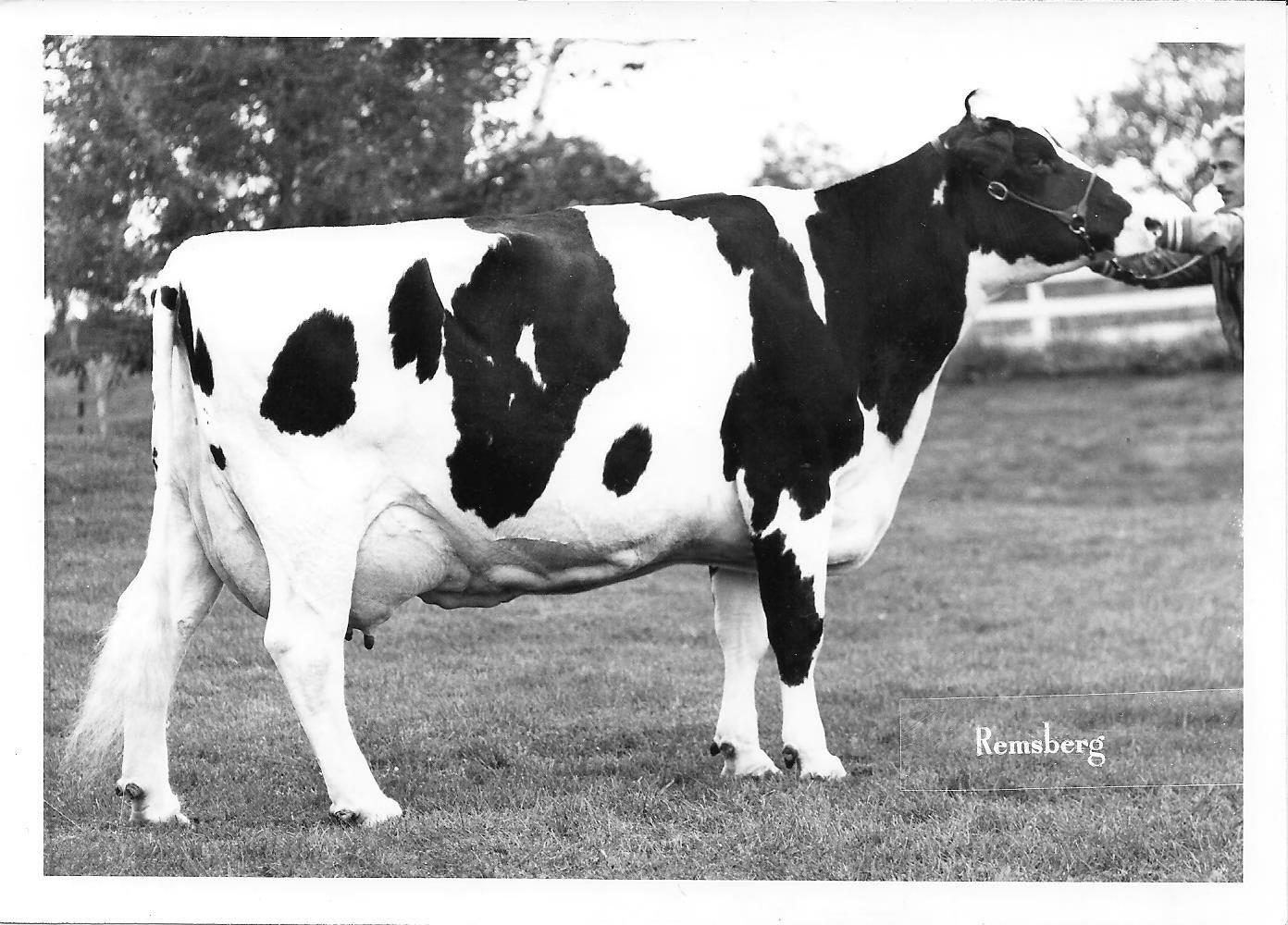
Round Oak Rag Apple Elevation (1965-1979), the legendary Holstein sire dubbed “Bull of the Century,” photographed in his prime at Select Sires. This unassuming black and white bull from Virginia transformed global dairy genetics with his exceptional ability to transmit production, conformation, and longevity traits simultaneously. Note his balanced frame, strong topline, and characteristic Elevation profile—physical traits that would be passed to over 8.8 million descendants worldwide. While unremarkable by today’s extreme standards, this bull’s genetic blueprint revolutionized Holstein breeding and continues to influence elite dairy cattle six decades later. His balanced genetics remain the gold standard for functional type: not too tall, not too extreme, but built to last. Photo: Remsberg.

Do you know how some legends never fade? Well, in the dairy world, there’s one name that still makes breeders sit up straighter when mentioned – Round Oak Rag Apple Elevation. I can’t tell you how often I’ve heard old-timers at cattle shows talk about this bull with a reverence usually reserved for religious figures. And honestly, they’re not wrong.

Born in 1965 on a modest Virginia farm, this unassuming black-and-white calf would become the most significant genetic influencer Holstein breeding has ever seen. Can you believe his bloodline now runs through nearly 9 million descendants? That’s right – almost every glass of milk you’ve ever enjoyed likely came from a cow with some connection to this legendary sire.

What made Elevation so special? He delivered both, unlike most bulls that give you either production OR pretty cows. His daughters pumped an incredible 29,500 pounds of milk during their first lactations – beating their peers by 15%! – while sporting those picture-perfect udders that look like they were crafted by a sculptor with an obsession for symmetry. You’ve gotta appreciate a bull that refuses to compromise.

I’ve always found it fascinating that his story began with what you might call a questionable mating. His sire had fertility issues, and his dam was considered too slow-maturing for the fast-paced dairy world. This pairing might never have happened in today’s era of genomic testing and algorithm-driven breeding programs. Kinda makes you wonder what other genetic gold mines we’re potentially missing by being too reliant on numbers.

The Unlikely Star: How Elevation Came to Be

George Miller, a pivotal figure in Holstein breeding history and cousin to Ronald Hope Sr., photographed during his tenure as marketing manager at Select Sires. Growing up on his uncle’s Round Oak Farm in Virginia, Miller was instrumental in planning the legendary mating that produced Round Oak Rag Apple Elevation. After earning degrees in dairy science from Virginia Polytechnic Institute, Miller’s career spanned from managing Virginia Artificial Breeders Association to joining Select Sires in 1973, where former general manager Dick Chichester praised him as “honest” and committed to “doing things right.” Miller’s passionate advocacy for balanced genetics and his foresight regarding ELEVATION’s potential helped transform dairy breeding practices worldwide. Following his passing in February 2021 at age 94, Select Sires established the George Miller Memorial Scholarship Fund to honor his legacy. Photo courtesy of Select Sires Archives.

So here’s the backstory that sounds more like a feel-good movie than real life. Two cousins, Ronald Hope Sr. and George Miller, had spent a quarter-century meticulously layering Burke and Ivanhoe bloodlines into their herd at Round Oak Farm. Talk about playing the long game! These guys weren’t chasing quick wins but building something meant to last.

In 1965, they made a decision that probably raised some eyebrows. They bred Tidy Burke Elevation (a bull with questionable fertility) to Round Oak Ivanhoe Eve (a cow relegated to the farm‘s “B-team” because she matured too slowly). It wasn’t exactly a match made in bovine heaven, at least on paper.

But man, did that gamble pay off! This unlikely coupling created a genetic alchemy that would transform dairy farming forever. Elevation inherited the milk-producing magic from his sire’s Burke lineage while getting structural soundness and mammary excellence from his dam’s Ivanhoe connections. The result? A genetic unicorn whose DNA contained a rare chromosome 6 haplotype that optimized fat-to-protein ratios – something we didn’t even have the technology to identify until decades later!

You might be surprised to learn that Elevation wasn’t an instant sensation. His progeny consistently came in second place at early shows – never first. Judges didn’t know what to make of his balanced but unspectacular offspring. They weren’t the tallest, broadest, or most extreme in any category. They were just… good at everything. Talk about being ahead of your time!

Ironically and fitting, this “runner-up” status would eventually prove prophetic. While more specialized, flashier bloodlines came and went, Elevation’s descendants ultimately dominated milking parlors and show rings worldwide. Their versatility outlasted everything else.

Five Qualities That Made Elevation a Legend

If you’ve spent time around dairy farms, you know that most bulls have one standout trait – maybe great production or fancy udders. But Elevation? This guy was the complete package. He redefined Holstein’s breeding through five key characteristics that created what I like to call the “genetic royal flush.”

First up: production. His daughters weren’t just good milkers – they were milk-making machines. Averaging 29,500 pounds in their first lactations during the 1970s put them 15% ahead of their contemporaries. And unlike bulls that give you quantity at the expense of quality, Elevation’s daughters maintained excellent butterfat and protein percentages. You couldn’t ask for more!

Then there were those udders – my goodness, those udders! Charlie Will, who knew these cows better than most, described them as having “high and wide rear udders with exceptional shape and symmetry.” This wasn’t just pretty – it was functional. These udders stayed attached 2-3 lactations longer than average, translating to an extra $1,200 profit per cow back in the 70s. Not too shabby!

Mobility might not be the sexiest trait to discuss over coffee, but it’s a game-changer on the farm. Elevation’s girls showed up with “straight legs, healthy hocks, and strong loins” – dull on paper, maybe, but pure gold in practice. These cows stayed sound even on concrete floors (the bane of many dairy cows’ existence), allowing them to keep producing at high levels for 5-7 lactations when most cows were burning out after 3.

Fertility might be the most underrated of Elevation’s gifts. His daughters rebred 14 days faster than their herd mates – two weeks might not sound like much, but multiply that across thousands of cows and millions of lactations, and you’re talking serious money. Plus, this reproductive efficiency helped his genetics spread like wildfire.

Finally, there’s longevity – the crown jewel. While the industry average was 2.8 lactations per cow in the 1970s, Elevation’s daughters stuck around for 4.2. That’s a 50% increase in productive life! Herds with his bloodlines reported 22% lower replacement costs. For farmers operating on tight margins, this was revolutionary.

What sets Elevation apart wasn’t excelling in any category – it was his “genetic coherence,” the ability to transmit ALL these qualities simultaneously without trade-offs. It’s like getting a sports car with excellent gas mileage or a delicious and healthy dessert. Usually, you don’t get both, but with Elevation, you did!

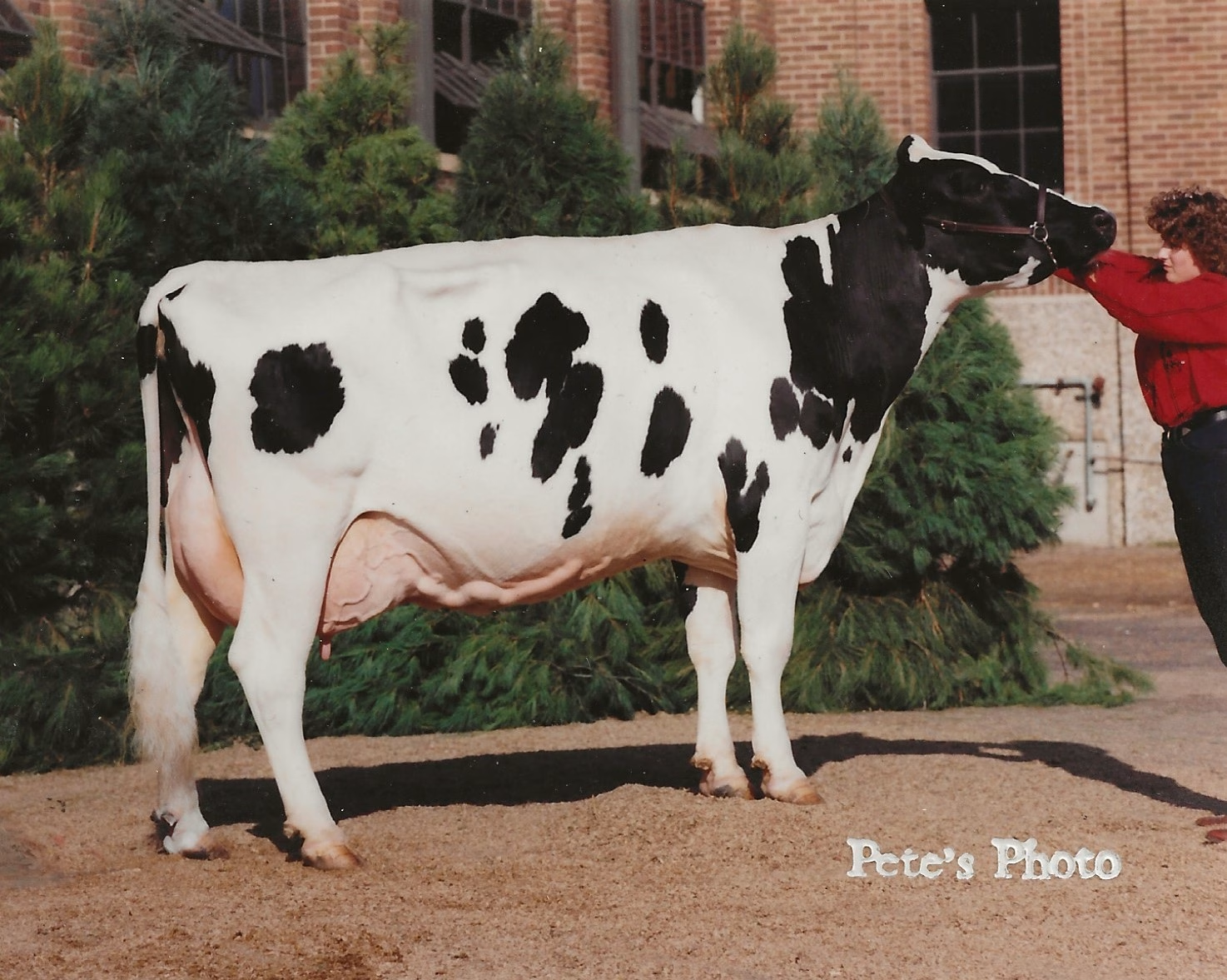
OLMAR ELEVATION DAZZLING STAR (EX-94 GMD), photographed in her prime, exemplifies the exceptional type and production balance that made Elevation daughters legendary. Her strong, well-attached mammary system and correct dairy structure showcase the genetic superiority that earned her both an Excellent classification and Gold Medal Dam status—hallmark achievements reflecting Elevation’s ability to produce daughters who excelled in both the show ring and milking parlor. Note her combination of dairy strength, angularity, and impressive udder capacity—traits that contributed to extended productive life and the “genetic coherence” discussed in our article. Photo: Pete’s Photo

How One Bull Transformed an Industry

You know what’s crazy? Elevation didn’t just change individual herds—it reshaped entire organizations and industry practices. I’ve talked with folks who worked at Select Sires during that era, and they’ll tell you straight up: “Elevation put Select Sires on the map.”

In the ’60s, Select Sires struggled to establish itself as a newly formed federation of regional breeding organizations. Then this bull came with his perfect combination of production and type, and suddenly, everyone wanted Select Sires’ genetics. The revenue from Elevation semen sales built the company’s infrastructure. George Miller said it best: “It’s been said that Elevation built the barns at Sire Power and Select Sires.”

Think about that impact for a minute. One Bull’s genetics were so sought-after that they funded buildings, grew market share, created brand identity, and helped merge 18 state-level organizations into a cohesive national presence. That’s not just breeding success – that’s business transformation!

His influence spread well beyond American borders, too. Elevation’s semen was shipped to 45 countries, fundamentally reshaping global Holstein breeding. He served as a Holstein ambassador, making friends for American genetics worldwide. In Canada, his impact was especially pronounced through his son Hanoverhill Starbuck, who became the cornerstone of Canadian breeding programs. European dairy industries in France, Italy, and the Netherlands incorporated his bloodlines to improve their national herds. Elevation descendants eventually made up 70% of the Holstein population in some countries, like France!

Developing dairy nations used Elevation genetics to rapidly modernize their herds, while emerging dairy industries in Asia used their bloodlines to establish foundation herds adapted to local conditions. He created a genetic standardization that connected Holstein populations worldwide –bovine globalization, if you will!

A poignant moment in dairy breeding history: Mr. and Mrs. Ronald Hope of Purcelville, Virginia (far left) receive a painted portrait of Round Oak Rag Apple Elevation at his memorial dedication ceremony on August 1, 1979. The group stands behind Elevation’s permanent gravestone at Select Sires headquarters, which marks his life from August 30, 1965, to April 25, 1979. The ceremony honored the bull that transformed the Holstein breed and financially secured Select Sires’ future. Also pictured are Robert Rumler of Holstein Association, Dick Chichester and George Miller of Select Sires—the latter being Hope’s cousin who suggested the legendary mating that produced Elevation. The memorial site, positioned by the reflecting pond at Select Sires’ main entrance, remains a pilgrimage destination for dairy breeding enthusiasts worldwide. Photo: Johnson/Select Sires Archives.

The Family Tree That Changed Everything

Want to know what cemented Elevation’s legacy? His sons – over 10,000 of them became registered AI sires! That’s an army of genetic influence that’s almost impossible to comprehend. Some of his most influential sons include Sweet-Haven Tradition, Rockalli Son of Bova, Marshfield Elevation Tony, Ocean-View Sexation, and Straight-Pine Elevation Pete. Charlie Will also highlights Mars Tony and Lime Hollow Mars as influential Elevation sons.

Straight-Pine Elevation Pete, one of Round Oak Rag Apple Elevation’s most influential sons, photographed in the early 1970s. Pete carried forward his sire’s exceptional genetic traits for production and conformation, helping to establish the Elevation bloodline throughout North American Holstein herds. Note his balanced frame, strong topline, and dairy character—hallmarks of the structural soundness that made Elevation progeny legendary for their longevity and productive life. Photo credit: Remsberg.

But if we’re talking about Elevation’s sons, we’ve got to spotlight Hanoverhill Starbucks. If Elevation were the king, Starbucks would have been the crown prince who expanded the dynasty. His impact on global Holstein genetics was profound, especially in Canada. Starbucks sons like Madawaska Aerostar, Besne Buck, Fatal, and Sabbiona Bookie carried Elevation’s genes into another generation with even more significant influence.

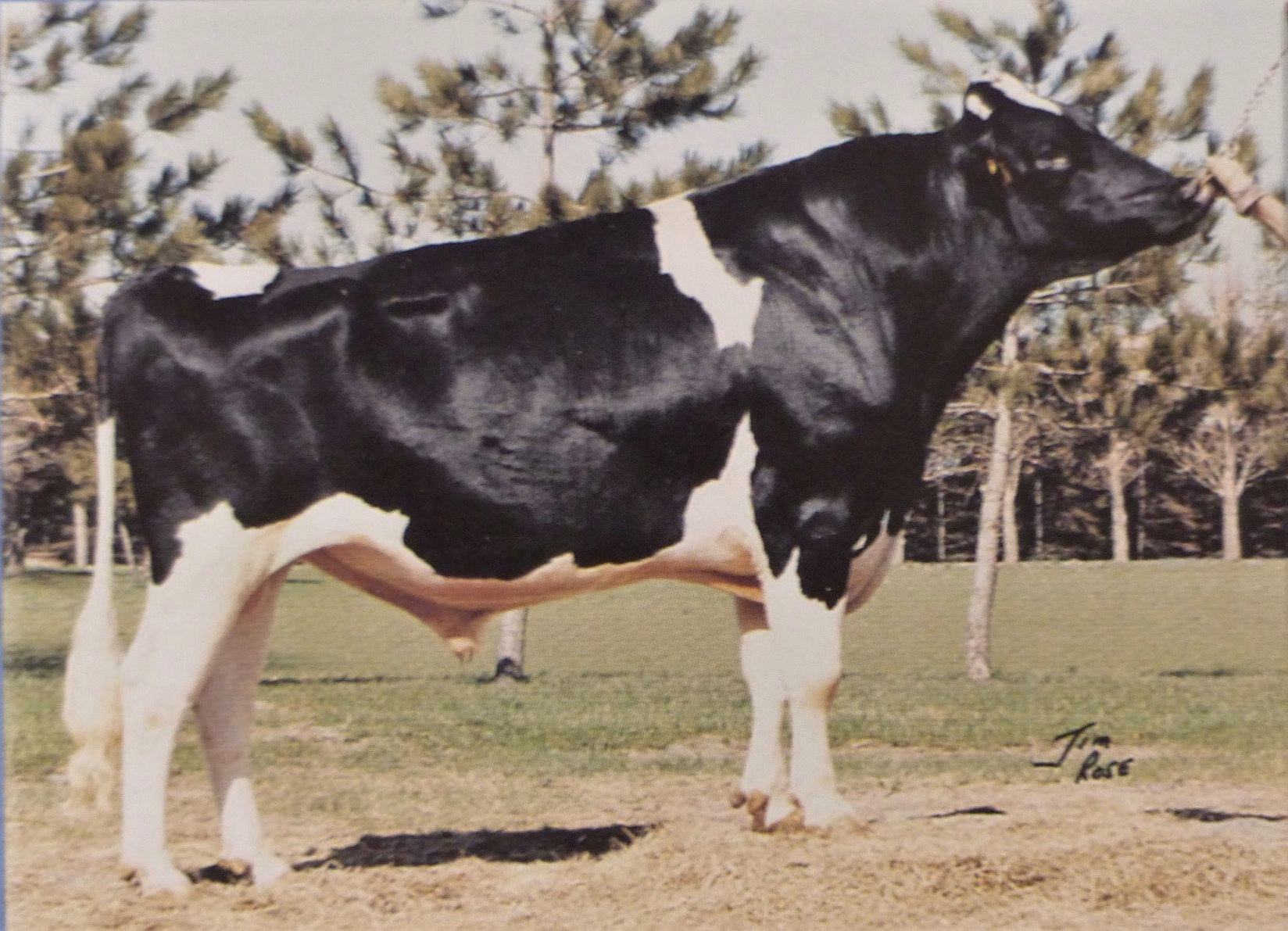
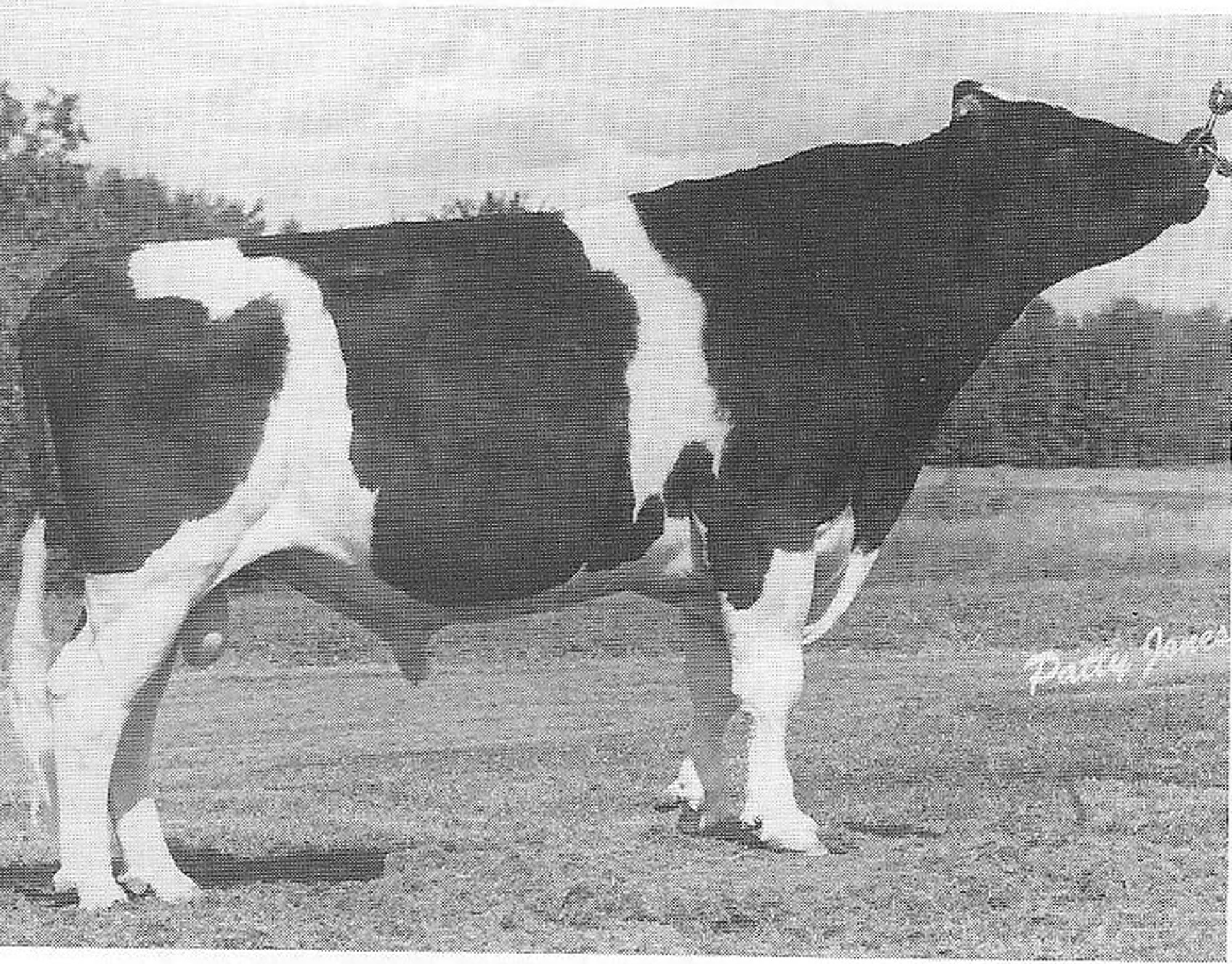
Hanoverhill Starbuck, one of the most influential Holstein sires in dairy history, captured here at 5 years old by photographer Jim Rose. Standing an impressive 73½ inches at the shoulder (1.87m) and weighing 2,580 lbs (1,173 kg), Starbuck’s exceptional feet and leg quality—evident in this profile—became his trademark and a key factor in his global genetic impact. Born in 1979 and sired by the legendary Round Oak Rag Apple Elevation, Starbuck went on to father over 200,000 daughters and 209 proven sons across 45 countries, earning the “Premier Sire” title 27 times at major Holstein shows. His balanced frame, perfect leg set, and overall structural correctness revolutionized Holstein breeding, with an estimated 93% of Canadian Holsteins born between 2003-2005 tracing back to this remarkable bull. The Canadian Holstein Association eventually dubbed him “Simply the Best”—a title that begins to explain why his genetics remain influential in dairy herds worldwide nearly three decades after his passing in 1998. Photo: Jim Rose.

The Starbucks line shows the power of Elevation’s genetics—they didn’t dilute over generations; they often amplified! Madawaska Aerostar became one of the first bulls to sell one million doses of frozen semen. His sons in Canada included Maughlin Storm and the Millionaire Sires Startmore Rudolph and Oliveholme Aeroline. Meanwhile, Besne Buck’s son, Jocko Besn, became so influential in France that he sired more than 50% of French Holstein cattle!

Northcroft Ella Elevation (EX-97 GMD DOM), one of Round Oak Rag Apple Elevation’s most celebrated daughters, photographed in her prime. Born February 26, 1974, Ella exemplifies the genetic perfection that made Elevation’s progeny legendary. Her flawless dairy structure, exceptional mammary system, and balanced frame earned her Supreme Champion honors at World Dairy Expo in 1980, where judges declared her “the new ideal Holstein cow.” This breeding masterpiece—out of an EX-91 GMD DOM Pawnee Farm Arlinda Chief dam—later received All-Time All-American Aged Cow recognition in 1984, cementing her place among the greatest show cows in Holstein history. Ella represents the pinnacle of Elevation’s ability to transmit both exceptional type and production traits simultaneously, embodying the “genetic coherence” that made her sire the Bull of the Century. Photo credit: Jack Remsberg.

It wasn’t just Elevation’s sons making history, either. His daughters were equally remarkable. He once led the list for the most Excellent daughters and daughters, scoring 95, 96, and 97 points – the cream of the crop in classification terms. Stars like Ella and Twinkie (both EX-97 All-Time All-Americans), Cora (EX-GMD, dam of Carnation Counselor), and Lindy (EX-GMD, dam of Townson Lindy) didn’t just win in the show ring – they produced sons and grandsons that became influential sires themselves.

Elevation was considered the bull with the most descendants in the United States. It has been found that the two most influential bulls to Holstein US sires were Round Oak Rag Apple Elevation (Elevation) and Pawnee Farm Arlinda Chief (Chief)—up to 99% of AI bulls born after 2010 can be traced back to these animals. There’s something almost poetic about how his genetics have persisted through generation after generation, creating a legacy that continues to shape the Holstein breed today.

Clinton-Camp Majesty (EX-EXTRA), a pivotal son of Round Oak Rag Apple Elevation, photographed in his prime. Though modern genomic metrics undervalue his production (-2,366 lbs milk), Majesty inherited his sire’s structural strengths—including exceptional body strength (+0.97) and sound feet—while passing on key longevity traits to daughters. His genetic profile embodies the Elevation paradox: foundational yet penalized by the same breed progress he enabled. Photo: ST Genetics
Clinton-Camp Majesty (EX-EXTRA), a pivotal son of Round Oak Rag Apple Elevation, photographed in his prime. Though modern genomic metrics undervalue his production, Majesty inherited his sire’s structural strengths—including exceptional body strength and sound feet—while passing on key longevity traits to daughters. His genetic profile embodies the Elevation paradox: foundational yet penalized by the same breed progress he enabled.

A Legacy That Defies Time

You know what’s truly mind-blowing? Six decades after Elevation’s birth, his DNA still runs through 14.5% of active proven Holstein sires. In a world where genetic trends come and go faster than fashion styles, that staying power is nothing short of miraculous.

If you look at Elevation’s current CDCB genomic summary, you might wonder what all the fuss is about. It shows a Net Merit (NM$) of -821 and negative milk production traits (-2,483 lbs milk, -87 lbs fat). But these numbers don’t tell the real story – they’re comparing him to a modern Holstein population he helped create! It’s like penalizing your grandfather for not knowing how to use an iPhone when he helped invent the telephone.

Charlie Will, Holstein Program Manager at Select Sires, speaking at an industry event in his trademark red and black cooperative jacket. With over 45 <a href='https://www.thebullvine.com/a-i-industry/celebrating-50-years-of-semex-a-symbol-of-genetic-progress-and-technological-innovation/' data-lazy-src=

Charlie Will of Select Sires put it perfectly: “Elevation’s genes form the baseline against which we measure progress—you can’t delete the foundation of a skyscraper and expect it to stand.”

What’s fascinating is how specific Elevation traits continue to persist in elite modern genetics:

  • His signature high, wide rear udders (linked to mammary system haplotypes on chromosome 6) remain prevalent in 78% of bulls with >2,000 GTPI.
  • In current evaluations, his descendants inherit body condition scoring alleles associated with +1.1 Livability and +4.5 Daughter Pregnancy Rate.
  • The “Elevation fertility cluster” on chromosome 18 still appears in 63% of high-fertility sires today.

These traits contribute to what breeders call the “Elevation Effect” – cows that maintain production across multiple lactations despite increasing herd turnover rates. His descendants show 18% lower involuntary culling rates than non-elevation lines, making them ideal for pasture-based and robotic milking systems.

Here’s another mind-bender: Elevation’s DNA makes up 8.3% of the CDCB’s genomic reference population. This creates a fascinating paradox where modern genetic evaluations compare new bulls against a baseline that Elevation helped establish. No wonder 80% of elite genomic young sires carry at least one major Elevation haplotype!

Why Elevation Still Matters Today

Today’s breeding programs face a critical choice: preserve Elevation’s durability traits or chase marginal production gains. I’ve talked with farmers who’ve taken the balanced approach, maintaining 12-15% Elevation-derived genetics in their herds. They report some impressive results: 22% lower vet costs, +0.8 lactations per cow, and 3.2% higher lifetime profit than herds chasing the highest genomic numbers.

Elevation’s story paralleled critical advances in reproductive technology, creating a perfect storm of genetic proliferation. His career aligned with breakthroughs in semen freezing and storage that extended viable preservation from days to decades. As AI adoption accelerated worldwide in the 1970s, Elevation’s superior genetics rode this wave of technological diffusion. His career also coincided with the development of computerized progeny testing and record keeping, allowing his impact to be measured more precisely than any bull before him.

If there’s a lesson in Elevation’s story, actual genetic progress isn’t always about extremes – it’s about balance. In an era when genomic selection sometimes emphasizes single traits at the expense of others, Elevation reminds us that the most valuable cattle excel across multiple dimensions. They may not be the most extreme in any category, but they last longer, stay healthier, and ultimately make more money for their owners.

Final Thoughts on a Legend

Elevation’s story isn’t just about genetics – it’s about vision. It’s about two cousins looking beyond immediate results to create something lasting. It’s about recognizing that the most transformative influences sometimes come from unexpected places.

Elevation’s DNA still courses through 14.5% of active Holstein sires six decades later, defying modern genomic evaluations that might dismiss his contribution. While contemporary metrics chase hyperspecialization, his balanced genetic blueprint remains fundamental to functional dairy cattle worldwide.

The contradiction he represents is fascinating: modern genomic models may penalize his alleles for “low” production while simultaneously relying on his chromosome 6 haplotypes as reference points for udder health and efficiency. His descendants continue to excel in diverse systems, showing 18% lower involuntary culling rates and thriving in high-tech robotic facilities and grass-based operations.

As Holstein breeders confront sustainability challenges, Elevation’s legacy offers valuable insights. His balanced genetics align perfectly with modern demands for efficient, lower-carbon dairy systems. Studies show his metabolic efficiency alleles correlate with 4.2% reduced methane output – proving that sometimes old genetics solve new problems!

Ultimately, Round Oak Rag Apple Elevation reminds us that genetic progress isn’t about chasing extremes but finding balance. Elevation didn’t just lift the breed; he gave it wings.

And that, my friend, is the kind of legacy to which we can all raise a glass of milk.

Key Takeaways

  • Elevation’s success demonstrates that transformative genetics often emerge from partnerships that challenge short-term breeding trends, offering lessons for today’s genomic-focused selection methods.
  • His five signature traits formed a “genetic symphony” rarely found in combination—most bulls excel in either production or conformation, while Elevation delivered both without compromise.
  • Beyond individual herds, Elevation reshaped entire breeding organizations. His semen sales helped build Select Sires into a global AI powerhouse, and his genetics standardized Holstein traits across 45 countries.
  • Despite modern genomic evaluations rating him negatively, his chromosome 6 haplotypes remain essential reference points for udder health and efficiency, creating a paradox where his genes form the baseline against which progress is measured.
  • His most enduring legacy may be economic efficiency—herds retaining 12-15% Elevation-derived genetics report 22% lower veterinary costs and longer productive lives than those chasing extreme production traits.

Executive Summary

Round Oak Rag Apple Elevation, born in 1965 on a modest Virginia farm, transformed the dairy industry through his unparalleled genetic transmission of five critical traits: production, udder quality, mobility, fertility, and longevity. Dubbed the “Bull of the Century,” Elevation defied conventional breeding wisdom by emerging from an improbable mating between a questionable sire and a slow-maturing dam. His extraordinary ability to elevate mediocre genetics produced daughters averaging 29,500 pounds of milk (15% above contemporaries) while maintaining exceptional udder structure and extended productive lives. With over 10,000 registered sons and an estimated 8.8 million descendants worldwide, his genetic influence continues six decades later, with his DNA present in 14.5% of active Holstein sires despite the genomics revolution that followed him.

Join the Revolution!

Join over 30,000 successful dairy professionals who rely on Bullvine Daily for their competitive edge. Delivered directly to your inbox each week, our exclusive industry insights help you make smarter decisions while saving precious hours every week. Never miss critical updates on milk production trends, breakthrough technologies, and profit-boosting strategies that top producers are already implementing. Subscribe now to transform your dairy operation’s efficiency and profitability—your future success is just one click away.

NewsSubscribe
First
Last
Consent

The Cow That Built an Empire: Comestar Laurie Sheik’s Unstoppable Genetic Legacy

How an unassuming cow built a global dairy empire. Discover how Laurie Sheik’s genetics dominate barns worldwide—40 years later.

This historic image captures a pivotal moment in Holstein history as a young Comestar Laurie Sheik VG-88 23* claims first place in the Senior 2-Year-Old class at Expo Victoriaville. The trophy being presented was sponsored by Edgar Comtois, father of Marc Comtois, creating a meaningful family connection as Laurie Sheik began her remarkable show career. What makes this moment especially significant is that this unassuming cow would go on to become one of the most influential matriarchs in Holstein history, producing four millionaire bulls and establishing a genetic dynasty that continues to influence dairy breeding worldwide today. This early show ring success hinted at the extraordinary genetic potential that would eventually extend to 51 countries and span multiple generations of elite Holstein breeding.
A pivotal moment in Holstein history as a young Comestar Laurie Sheik VG-88 23* claims second place in the Senior 2-Year-Old class at World Dairy Expo. What makes this moment especially significant is that this unassuming cow would go on to become one of the most influential matriarchs in Holstein history, producing four millionaire bulls and establishing a genetic dynasty that continues to influence dairy breeding worldwide today. This early show ring success hinted at the extraordinary genetic potential that would eventually extend to 51 countries and span multiple generations of elite Holstein breeding.


Do you know how people talk about game-changers in sports or tech visionaries who transform industries overnight? In the dairy cattle breeding world, we also have our legends. And honestly, they don’t come much more significant than Comestar Laurie Sheik.

Picture this: It’s a chilly autumn day in 1989, and the buzz at the first-ever Comestar Sale in Quebec is reaching a fever pitch. Nobody expected much from this modest-looking, more white-than-black cow from Victoriaville when she entered the ring. But when the gavel finally dropped? A staggering $45,000 price, with the Pussemier family from Belgium joining Comestar to take a gamble that would reshape Holstein breeding worldwide.

This pivotal black and white photograph captures Comestar Laurie Sheik VG-88 23* at the first-ever Comestar Sale in 1989, where she commanded an extraordinary $45,000 as the event’s top seller—more than eight times the sale average of $5,605. This historic transaction marked the beginning of the Belgistar Union, as 50% ownership went to Belgian investors who recognized her exceptional genetic potential. With 80 head changing hands that day, nobody could have predicted that this unassuming cow standing calmly in the Comestar spotlight would go on to produce four millionaire bulls and reshape Holstein breeding across 51 countries. This image captures the exact moment when a genetic dynasty was born, forever changing the course of dairy cattle breeding worldwide.
Comestar Laurie Sheik VG-88 23* at the first-ever Comestar Sale in 1989, where she commanded an extraordinary $45,000 as the event’s top seller—more than eight times the sale average of $5,605. This historic transaction marked the beginning of the Belgistar Union, as 50% ownership went to Belgian investors who recognized her exceptional genetic potential. With 80 head changing hands that day, nobody could have predicted that this unassuming cow standing calmly in the Comestar spotlight would go on to produce four millionaire bulls and reshape Holstein breeding across 51 countries. This image captures the exact moment when a genetic dynasty was born, forever changing the course of dairy cattle breeding worldwide.

Talk about an underdog story! This unassuming cow would go on to rewrite the genetic playbook for the next four decades. And I’m not exaggerating when I say her influence is still being felt today in barns across 51 countries.

WHY ONE COW CHANGED EVERYTHING (AND WHY YOU SHOULD CARE)

This historic image captures Comestar Laurie Sheik VG-88 23* alongside her 1995 “La Vache de l’Année” (Cow of the Year) award - the inaugural recipient of Holstein Canada’s most prestigious individual honor. The regal backdrop and elegant trophy presentation befit her status as dairy royalty. Beyond her striking appearance, this unassuming cow from Victoriaville, Quebec would establish one of the most influential maternal bloodlines in Holstein history, producing four millionaire bulls and creating a genetic dynasty that continues to dominate Holstein breeding worldwide. Her selection as Canada’s first Cow of the Year recognized not just her individual excellence, but the extraordinary genetic potential that would transform dairy cattle breeding for generations to come.
Comestar Laurie Sheik VG-88 23* alongside her 1995 “La Vache de l’Année” (Cow of the Year) award – the inaugural recipient of Holstein Canada’s most prestigious individual honor. The regal backdrop and elegant trophy presentation befit her status as dairy royalty. Beyond her striking appearance, this unassuming cow from Victoriaville, Quebec would establish one of the most influential maternal bloodlines in Holstein history, producing four millionaire bulls and creating a genetic dynasty that continues to dominate Holstein breeding worldwide. Her selection as Canada’s first Cow of the Year recognized not just her individual excellence, but the extraordinary genetic potential that would transform dairy cattle breeding for generations to come.

Even if you’re not a Holstein fanatic (though if you’re reading The Bullvine, chances are you might be!), Laurie Sheik’s accomplishments will make anyone’s jaw drop:

  • She produced FOUR millionaire bulls – Leader, Lee, Lheros, and Outside. Can you imagine having just ONE bull reach that status from your breeding program? She gave our industry FOUR.
  • Her maternal line is ridiculous – 23 brood cow stars for Laurie Sheik herself, and her daughter Laura Black topped her with 24. That’s like having a Hall of Fame player whose kid becomes an even bigger star.
  • She bookended Holstein Canada’s Cow of the Year award by winning the inaugural honor in 1995 and having her descendant Lamadona grab the same title in 2022. That’s 27 years of genetic dominance!
  • Her genes are EVERYWHERE – 51 countries have her bloodlines, and at Bois Seigneur Holstein in Belgium, about 70% of their herd traces back to her. That’s not influence; that’s a takeover.

And get this – her descendants are still crushing it in both old-school tie-stall barns AND cutting-edge robotic milking systems. Talk about standing the test of time!

FROM FARM KID TO VISIONARY: THE MAN BEHIND THE LEGEND

I’ve always loved the human stories behind great breeding programs. Marc Comtois wasn’t some corporate genetic wizard with fancy degrees – he was a farm kid who loved cows so much he quit school at 15 to work with them. By 18, he’d already bought his farm in Princeville, Quebec.

Demonstrating his commitment to the industry, Marc became an official Holstein Canada member on February 14, 1977 – a Valentine’s Day dedication to dairy breeding. Just months later, on April 23, 1977, he married France Comtois, forging a personal and professional partnership that would shape Holstein history.
Starting with 44 grade animals, the newlyweds quickly transitioned to purebred Holsteins, setting the foundation for what would become a breeding program of global significance. This rapid progression – from farm purchase to industry membership to marriage – within just 14 months showcased Marc’s relentless drive. The couple’s shared vision would soon give birth to a genetic revolution.

Marc Comtois’ pivotal 1985 purchase of Elysa Anthony Léa EX 15* set the stage for Holstein history. This exceptional daughter of Willowholme Mark Anthony would become the dam of Comestar Laurie Sheik VG-88 23*, founding one of the most influential maternal lines in modern dairy breeding. Her impressive 15 brood cow stars demonstrated extraordinary genetic transmission that would become the hallmark of her daughter’s legacy. The purchase of this remarkable cow represents the foundation decision that ultimately led to four millionaire bulls and a genetic footprint spanning 51 countries worldwide.

The pivotal moment? When he spotted Elysa Anthony Lea EX-15* in 1985. Something about her caught his eye.

“I’ve always believed that exceptional cows build exceptional herds,” Comtois once said. “When I saw Elysa Anthony Lea, I recognized a cow that could be the foundation for something special. But even I couldn’t have predicted just how special her daughter would become.”

That daughter, born in December 1986, was Comestar Laurie Sheik ET VG-88-23*. And man, what a cow she turned out to be!

Historic moment... 1989 WDE, when Starbuck Winnie won the sr 2-yr-old class, and Laurie Sheik got 3rd and after milking got switch second and best udder over Starbuck Ada... and the 3 later became bull mother and Extraordinaire Brood Cows. Same year Norm Nabholz won the Klussendorf Trophe and also Roy Ormiston won as the first Canadian the Dairy Shrine Award.
Historic moment… 1989 WDE, when Starbuck Winnie won the sr 2-yr-old class, and Laurie Sheik got 3rd and after milking got switch second and best udder over Starbuck Ada… and the 3 later became bull mother and Extraordinaire Brood Cows. Same year Norm Nabholz won the Klussendorf Trophe and also Roy Ormiston won as the first Canadian the Dairy Shrine Award.

THE BREEDING DECISION THAT BROKE ALL THE RULES

You might think Laurie Sheik came from her time’s trendiest, most fashionable genetics. Nope. Not even close.

Her sire, Puget-Sound Sheik, wasn’t exactly a household name. Born in 1972 and classified VG-85, he brought valuable genetics through his Washington State bloodline sire, Provin Mtn Ivanhoe Jewel, but he wasn’t the “it bull” of his time.

While exceptional, her dam, Elysa Anthony Lea, EX-15*represented Marc’s independent thinking rather than following the crowd. He wasn’t breeding to what was hot; he was breeding what he believed would work.

And boy, did it work! This unconventional pairing created a genetic perfect storm that would redefine what was possible in Holstein breeding.

Comestar Lautamie Titanic becoming the first cow to win both the prestigious #1 IPV (Lifetime Production Index) ranking and a championship at the Royal Winter Fair in Toronto. Shown here claiming the Reserve All-Canadian Junior 2-Year-Old honors at the 2006 Royal, this Laurie Sheik descendant exemplifies the family’s remarkable ability to combine show ring excellence with production superiority. The multiple images showcase her exceptional dairy form from various angles as she competes under the bright lights of Canada’s most prestigious dairy showcase. This unprecedented achievement—winning the Junior 2-Year-Old class while simultaneously holding the nation’s top production ranking—perfectly illustrates the balanced breeding philosophy that has made the Comestar program legendary, proving that elite genetics can excel in both the show ring and the milking parlor.

THE THREE SISTERS WHO MULTIPLIED THE MAGIC

Here’s where the story gets fascinating. Laurie Sheik had 18 Very Good daughters (impressive enough), but three in particular – all sired by Tomar Blackstar – became the genetic highways that spread her influence globally:

Laura Black VG-87-CAN 24* gave us Lee and Lheros – bulls that combined production punch with dairy strength that commercial farmers loved.

L Or Black VG-87-CAN 16* produced Outside, who completely transformed how we think about udders in modern Holsteins. Before Outside, we struggled with udders that couldn’t hold up through multiple lactations. His daughters changed that forever.

Lausan Black VG-87-CAN 23* gave us Stormatic, creating a line that uniquely excels in both genomic rankings AND show rings. My friend who judges major shows likes to say, “They look as good as they test, and they test as good as they look.” That’s rare!

A Quebec farmer friend who milks several Laura Black descendants put it best: “When you milk these cows, you can hear the milk hitting the bucket. They’re not just pretty cows—they’re profit machines.” I can’t argue with that!

THE BELGIAN BREAKTHROUGH THAT NOBODY SAW COMING

four daughters of the legendary Comestar Laurie Sheik grazing peacefully in the pastures of Bois Seigneur Holstein in Belgium. When crossed with Tomar Blackstar, these exceptional females ignited what became known as “Blackstar Mania” across European Holstein breeding circles. This strategic cross revolutionized the Pussemier family’s breeding program, producing influential brood cows like Blacklaure de Bois Seigneur, who achieved lifetime production exceeding 100,000 kg of milk while also claiming championship honors in the show ring. Through these remarkable females, Laurie Sheik’s genetics spread throughout Europe, transforming Bois Seigneur Holstein’s herd (where approximately 70% of today’s animals trace back to this lineage) and establishing a legacy of exceptional milk production combined with show-winning type that continues to influence Holstein breeding worldwide today.
Four daughters of the legendary Comestar Laurie Sheik grazing peacefully in the pastures of Bois Seigneur Holstein in Belgium. When crossed with Tomar Blackstar, these exceptional females ignited what became known as “Blackstar Mania” across European Holstein breeding circles. This strategic cross revolutionized the Pussemier family’s breeding program, producing influential brood cows like Blacklaure de Bois Seigneur, who achieved lifetime production exceeding 100,000 kg of milk while also claiming championship honors in the show ring. Through these remarkable females, Laurie Sheik’s genetics spread throughout Europe, transforming Bois Seigneur Holstein’s herd (where approximately 70% of today’s animals trace back to this lineage) and establishing a legacy of exceptional milk production combined with show-winning type that continues to influence Holstein breeding worldwide today.

I’ve always been fascinated by the international side of this story. When the Pussemier family spotted Laurie Sheik’s potential at that 1989 sale, they faced a significant roadblock: Belgian regulations wouldn’t let them import live cattle from Canada.

So, what did they do? Got creative! They bought partial ownership of Laurie Sheik herself and imported her embryos instead. Talk about thinking outside the box!

The 1989 sale of Laurie Sheik to Belgium marked a groundbreaking moment in international genetics trade, achieved against significant logistical odds. At the time, no formal embryo export agreements existed between Canada and Belgium, forcing Marc and France Comtois to pioneer new bureaucratic pathways. Every document – health certificates, ownership transfers, and customs declarations – required painstaking manual processing without today’s digital tools. In an era before routine computer use, the couple relied on paper records, international phone calls, and the emerging technology of fax machines to coordinate this unprecedented transaction. Their success in navigating these analog-era hurdles not only secured Laurie Sheik’s Belgian partnership but laid the groundwork for modern global embryo trade protocols.

This workaround triggered what became known as “Blackstar Mania” at Bois Seigneur Holstein. They crossed Laurie Sheik with Tomar Blackstar and struck genetic gold. The resulting offspring included standouts like Blacklaure de Bois Seigneur, who produced over 100,000 kg of milk in her lifetime – showcasing this lineage’s remarkable productivity and longevity.

Jonas Pussemier, who now runs the operation his parents started, told me: “What we could never have anticipated was how completely this one genetic investment would reshape our entire breeding program. Today, about 70% of our herd traces back to Laurie Sheik. That single decision in 1989 determined the direction of our breeding program for generations.” (Read more: From Laurie Sheik to Robotic Milking: Bois Seigneur Holstein’s Journey of Innovation)

Isn’t it amazing how one smart purchase can completely transform a herd’s future?

GENERATIONAL EXCELLENCE: THE LAURIE SHEIK GENETIC PROGRESSION

Comestar Lautamie Titanic VG-89 33* grazing peacefully at the renowned Comestar Holstein farm in Quebec. A testament to the extraordinary Laurie Sheik maternal line, this remarkable cow dominated Canadian genetic evaluations by holding the #1 IPV (Lifetime Production Index) position for an unprecedented three consecutive years (2006-2007-2008). Her impressive 33 brood cow stars and VG-89 classification exemplify the perfect balance of production excellence and physical conformation that has made the Comestar program legendary. The iconic Comestar sign in the background represents the breeding philosophy that transformed a Quebec dairy operation into a global genetic powerhouse. Photographer Patty Jones beautifully captured this quiet moment with one of Canada’s most influential Holsteins, whose descendants continue to shape dairy breeding worldwide.

The remarkable consistency of the Laurie Sheik lineage becomes clear when tracking key metrics across generations. While most families show regression toward breed average over time, this extraordinary maternal line has maintained—and often improved upon—elite performance across nearly four decades.

Maternal Line Classification Progression:

  • Elysa Anthony Lea (Dam): EX-15*
  • Laurie Sheik: VG-88-23*
  • Blackstar Daughters: All three key daughters classified VG-87
  • Modern descendant Lamadona: EX-94-2E 21*

Brood Cow Star Progression:

  • Elysa Anthony Lea: 15* (Exceptional for her era)
  • Laurie Sheik: 23* (Near-record achievement)
  • Laura Black: 24* (Exceeded her dam’s remarkable total)
  • Lausan Black: 23* (Matched her dam’s excellence)
  • L Or Black: 16* (Still extraordinary by industry standards)
  • Lamadona: 21* (Continuing the family tradition of elite status)

Genetic Impact Distribution: The influence expanded exponentially through each generation:

  • First generation: Comestar herd improvement
  • Second generation: National impact through Canadian genetics program
  • Third generation: International reach through Semex to 51 countries
  • Current generation: Global distribution plus concentration in specialized herds

This multi-generation excellence isn’t accidental. It represents the extraordinary genetic transmission capacity that makes the Laurie Sheik family the most influential maternal line in modern Holstein history. Notably, the * (brood cow star) designation applies exclusively to animals born in Canada – a testament to her domestic impact. If her global descendants were included, spanning the 51 countries where her genetics took root, Laurie Sheik’s legacy would shine even brighter. From Belgian barns to Brazilian pastures, her uncounted international daughters and granddaughters continue to amplify her unmatched influence.

This striking black and white Holstein dairy cow, likely Maxima de Bois Seigneur (Chief), exemplifies excellent dairy conformation with her strong frame, well-attached udder, and balanced proportions. Photographed on the traditional cobblestone courtyard of Bois Seigneur Holstein in Belgium, she represents the farm’s commitment to quality genetics. The classic brick farmhouse in the background showcases the European architectural heritage of this renowned breeding operation, where approximately 70% of the herd traces back to the influential Comestar Laurie Sheik lineage.

Production Excellence Markers: While specific metrics evolved over generations, the family consistently ranked among the elite. This legacy continues with modern descendants at Bois Seigneur Holstein, where exceptional performers like Maxima de Bois Seigneur (Chief) EX-94 set a farm record of 80 kg milk in 24 hours at just 47 days in milk. Lamadona’s impressive production records (5-09 2x 365d 56,799 lbs milk, 4.9% fat, 3.7% protein) represent the continuation of this family’s excellence.

a historic moment for the Comtois family as they receive Holstein Canada’s most prestigious individual honor for Comestar Lamadona Doorman EX-94-2E 27*. The presentation marks a remarkable full-circle achievement, as Lamadona becomes the 2022 Cow of the Year exactly 27 years after her ancestor, Comestar Laurie Sheik, received the inaugural award in 1995. Standing proudly before the Holstein Canada backdrop, the family displays a commissioned portrait of this extraordinary cow who combines exceptional type (EX-94) with remarkable genetic transmission (27 brood stars). Lamadona continues the Laurie Sheik dynasty through her influence on modern breeding programs, with sons like LEMAGIC (Semex), LOYALL (Blondin Sires), LATAYO (Semex) and BARLOT (Semex) carrying her genetics forward. This moment represents not just an individual achievement, but the validation of a breeding philosophy focused on maternal lines that has shaped Holstein breeding across four decades and 51 countries worldwide.
A historic moment for the Comtois family as they receive Holstein Canada’s most prestigious individual honor for Comestar Lamadona Doorman EX-94-2E 27*. The presentation marks a remarkable full-circle achievement, as Lamadona becomes the 2022 Cow of the Year exactly 27 years after her ancestor, Comestar Laurie Sheik, received the inaugural award in 1995. Standing proudly before the Holstein Canada backdrop, the family displays a commissioned portrait of this extraordinary cow who combines exceptional type (EX-94) with remarkable genetic transmission (27 brood stars). Lamadona continues the Laurie Sheik dynasty through her influence on modern breeding programs, with sons like LEMAGIC (Semex), LOYALL (Blondin Sires), LATAYO (Semex) and BARLOT (Semex) carrying her genetics forward. This moment represents not just an individual achievement, but the validation of a breeding philosophy focused on maternal lines that has shaped Holstein breeding across four decades and 51 countries worldwide.

Adaptability Across Systems: Perhaps most impressive is how this family has maintained superiority through:

  • The classification-focused 1980s
  • The production index era of the 1990s
  • The balanced LPI/TPI approach of the 2000s
  • Today’s genomic evaluation systems

This multi-generation excellence isn’t accidental. It represents the extraordinary genetic transmission capacity that makes the Laurie Sheik family the most influential maternal line in modern Holstein history.

THE MILLION-DOLLAR CLUB: THE SONS THAT CHANGED EVERYTHING

Marc Comtois of Comestar Holsteins stands proudly at the Semex display honoring his breeding program’s extraordinary achievement—producing multiple millionaire bulls. The display showcases models of Lee and Leader, two of Comestar Laurie Sheik’s descendants who achieved the coveted millionaire status, signifying over $1 million in semen sales. This remarkable accomplishment would later expand to include Stormatic and Lheros by 2008, making Comestar the only breeding program in the world to produce four millionaire bulls from a single cow family. This unprecedented genetic success story underscores the extraordinary impact of the Laurie Sheik maternal line, whose influence continues to shape Holstein breeding worldwide. The Semex backdrop represents the global partnership that helped distribute these game-changing genetics to 51 countries and established Comestar as one of the most influential breeding operations in dairy history.

Let’s talk money. Breeding great cows is rewarding, but it doesn’t hurt when they make you a fortune, too! Comestar did something unprecedented by producing FOUR millionaire bulls from the same cow family:

Comestar Leader – Laurie Sheik’s son brought solid production and components. Comestar Lee – Laura Black’s son who dominated Canadian LPI rankings. Comestar Lheros – another Laura Black son known for balance and longevity Comestar Outside – L Or Black’s famous son who revolutionized udder conformation.

I’ve visited herds worldwide where these bulls’ influence is still clearly visible generations later. Their genetic fingerprints are everywhere!

Calbrett Goldwyn Layla proudly displaying her championship ribbons after claiming First Place in the Adult Cow class at the Royal Winter Fair - Canada’s most prestigious dairy cattle exhibition. The striking Holstein stands poised in the spotlight, her exceptional dairy character and balanced conformation on full display as her handler presents her to the appreciative audience. The distinctive red and white championship rosette signifies her elite status among the nation’s finest Holsteins. This championship moment at “The Royal” represents the pinnacle of show ring achievement in Canadian dairy circles, where only the most exceptional animals earn recognition under the critical eyes of international judges. The packed arena and professional presentation highlight the significance of this victory at North America’s premier dairy showcase.
Calbrett Goldwyn Layla proudly displaying her championship ribbons after claiming First Place in the Adult Cow class at the Royal Winter Fair – Canada’s most prestigious dairy cattle exhibition. The striking Holstein stands poised in the spotlight, her exceptional dairy character and balanced conformation on full display as her handler presents her to the appreciative audience. The distinctive red and white championship rosette signifies her elite status among the nation’s finest Holsteins. This championship moment at “The Royal” represents the pinnacle of show ring achievement in Canadian dairy circles, where only the most exceptional animals earn recognition under the critical eyes of international judges. The packed arena and professional presentation highlight the significance of this victory at North America’s premier dairy showcase.

FROM 1995 TO 2022: A DYNASTY THAT WON’T QUIT

Do you want proof that Laurie Sheik’s genetics have staying power? Consider this incredible bookend to her story:

In 1995, Holstein Canada created its prestigious “Cow of the Year” award, and Laurie Sheik herself was the inaugural winner. Fast-forward to 2022 – 27 years later—and her descendant Comestar Lamadona Doorman EX-94-2E 21* won the same award.

Think about that. Laurie Sheik’s family has remained elite for nearly three decades in the rapidly evolving Holstein breeding industry, where genetic trends come faster than smartphone models.

Lamadona is a beast in her own right – EX-94 classification, 21 brood cow stars, and those impressive production records I mentioned earlier. Marc Comtois says she’s “well-known internationally for her numerous exploits at shows and for her milk production records.”

She’s also passing it on through sons, grandsons, and great-grandsons like LEMAGIC (Semex), LOYALL (Blondin Sires), LATAYO (Semex), and BARLOT (Semex).

The dynasty just won’t quit!

Marc and Steve Comtois proudly stand beside the promotional banner for Comestar LOYALL, the latest elite sire from their legendary breeding program being marketed by Blondin Sires. This impressive banner highlights LOYALL’s exceptional pedigree “FROM THE HEART OF THE LAURIE SHEIKS WITH OVER 170 BROOD STARS!” – underscoring his connection to the most influential Holstein maternal line in modern breeding history. The father-son team, wearing their distinctive Comestar jackets, represent multiple generations of breeding excellence that parallel the genetic dynasty they’ve created. LOYALL continues the Laurie Sheik legacy through his dam Comestar Lamadona Doorman EX-94-2E (the 2022 Holstein Canada Cow of the Year), making him part of the remarkable family that has produced four millionaire bulls and influenced Holstein breeding across 51 countries worldwide.

GENOMIC ERA BLUEPRINT: APPLYING LAURIE SHEIK PRINCIPLES IN TODAY’S BREEDING WORLD

You might wonder if breeding lessons from the 1980s still apply in our genomic selection era. They do – maybe now more than ever.

Laurie Sheik’s success offers a framework that works beautifully alongside modern genomic tools. Here’s how today’s breeders can apply her principles:

Look beyond the numbers for maternal strength. While genomic indexes give us incredible prediction power, they don’t tell the whole story of maternal potential. When evaluating potential brood cows, pay special attention to:

  • Family consistency across generations: Like Laurie Sheik’s family, look for maternal lines showing stable transmission of key traits. The best genomic numbers mean little if they disappear in the next generation.
  • Balanced trait profiles: Laurie Sheik wasn’t extreme in any trait – her power came from combining suitable components, functional type, and production longevity. In genomic selection, prioritize females with balanced profiles over single-trait wonders.
  • Cross-system performance: The Laurie Sheik family thrived as evaluation systems evolved from classification to production indexes to genomics. Look for families that maintain excellence regardless of how they’re measured.

Practical application tip: Create a maternal scorecard that tracks genetic transmission strength across three generations of any potential foundation female. A prepotent maternal line will show consistency in trait expression regardless of what sires were used.

Bois Seigneur Holstein exemplifies this approach, masterfully blending traditional maternal evaluation with modern genomic tools. As noted in The Bullvine’s coverage, they’ve incorporated tried-and-true methods alongside advanced genetics while focusing on the Laurie Sheik lineage.

Their breeding decisions reflect this balance. While using genomic testing, they value good mothering more than high production numbers. Rather than focusing solely on genomic rankings, they select for traits and bloodlines proven to work rather than relying on a single bull. According to The Bullvine, Chief and Lambda are their plan’s top sires. Their breeding goals integrate milk production excellence and show competition success – precisely the kind of balanced approach that made the Laurie Sheik line so successful.

Remember: genomic indexes are potent tools, but they work best when paired with the time-tested maternal selection principles Laurie Sheik’s legacy demonstrates.

This stunning image by Carl Saucier captures Comestar Lamagic Impression Ex-93 grazing peacefully against the backdrop of modern dairy facilities. As the dam of influential sire Comestar Lemagic marketed by Semex, she represents the continuing excellence of the legendary Laurie Sheik maternal line. Her exceptional dairy strength, balanced frame, and remarkable mammary system that earned her the Excellent-93 classification are beautifully showcased in this professional side profile. Lamagic Impression’s own dam, Comestar Lamadona Doorman Ex-94-2E-19*, was the 2022 Holstein Canada Cow of the Year, demonstrating the multi-generational excellence that has made the Laurie Sheik family one of the most influential breeding lines in modern Holstein history. This image perfectly illustrates how the Comestar program continues to produce elite females that combine show-quality type with the ability to transmit excellence to the next generation.

OLD GENETICS, NEW TECHNOLOGY: WHY LAURIE SHEIK STILL MATTERS

As dairy farming evolves through the technological revolution, Laurie Sheik’s descendants continue demonstrating remarkable adaptability. Bois Seigneur Holstein exemplifies this, as Jonas Pussemier has successfully integrated these genetics into a modern, progressive operation.

This striking image by Carl Saucier captures the feeding area of Comestar Holstein’s state-of-the-art robotic dairy facility in Victoriaville, Quebec. Completed in 2020 as part of a major technological transition, this 100,000+ square foot facility features 7 DeLaval VMS V300 robots that allow the 400+ cows to choose when they want to be milked. The modern barn utilizes corrosion-resistant galvanized steel construction, advanced ventilation systems (visible overhead), and was designed to optimize both production efficiency and animal welfare. This technological evolution represents the next chapter for the world-renowned Comestar breeding program, famous for Comestar Laurie Sheik and her descendants, as they blend their legendary genetics with cutting-edge dairy automation. The precision alignment of these Holstein cows - many likely carrying the influential Laurie Sheik bloodline - perfectly symbolizes how this operation continues to balance tradition with innovation.
This striking image by Carl Saucier captures the feeding area of Comestar Holstein’s state-of-the-art robotic dairy facility in Victoriaville, Quebec. Completed in 2020 as part of a major technological transition, this 100,000+ square foot facility features 7 DeLaval VMS V300 robots that allow the 400+ cows to choose when they want to be milked. The modern barn utilizes corrosion-resistant galvanized steel construction, advanced ventilation systems (visible overhead), and was designed to optimize both production efficiency and animal welfare. This technological evolution represents the next chapter for the world-renowned Comestar breeding program, famous for Comestar Laurie Sheik and her descendants, as they blend their legendary genetics with cutting-edge dairy automation. The precision alignment of these Holstein cows – many likely carrying the influential Laurie Sheik bloodline – perfectly symbolizes how this operation continues to balance tradition with innovation.

Comestar has embraced the future, transitioning to robotic milking in 2020 with 7 Delaval V300 robots. Laurie Sheik’s descendants are adapting beautifully to being milked by robots instead of human hands. A plus for Comestar will be that the robots will capture additional information that The Comtois Family can use to take the Laurie Sheik family to even greater heights.

What’s most impressive about these genetics is how they’ve maintained their excellence through dramatic changes in evaluation systems and management practices. This cow family has consistently remained at the forefront, from tie-stall barns to robotic milking, from classification to genomics.

FOUR BREEDING LESSONS THAT STILL APPLY TODAY

So, what can today’s breeders learn from the Laurie Sheik phenomenon? Here’s my take:

  1. Focus on females, not just fancy bulls – Marc Comtois built a dynasty by identifying exceptional brood cows rather than chasing the hottest sires. The maternal side matters – a lot.
  2. Sometimes, your best partners are oceans away—the Belgium connection supercharged Laurie Sheik’s impact. Don’t be afraid to look globally for collaboration.
  3. Breed for adaptability, not trends – Laurie Sheik’s family has thrived through multiple evaluation systems and management styles. That’s more valuable than being temporarily “hot” under one system.
  4. Genetic transmission is everything – Those 23 brood cow stars represent extraordinary prepotency. Look for animals that reliably pass their traits to the next generation, not just ones that look good themselves.

WHY I’M STILL FASCINATED BY THIS COW

This poignant memorial at Comestar Holsteins marks the final resting place of Comestar Laurie Sheik VG-88 23* (December 1, 1986 - April 30, 2004). The simple bronze plaque, weathered by Quebec seasons, commemorates “a unique cow whose genetic impact on the Holstein breed internationally, proved to last for generations.” What strikes me most about this memorial isn’t just its permanence, but how rare it is for a dairy cow to be honored this way—with a dedicated marker typically reserved for influential humans or champion racehorses. Standing before this stone, visitors can reflect on how an unassuming <a href='https://www.thebullvine.com/technology/artificial-intelligence-transforming-dairy-farming-for-healthier-cows-and-higher-yields/'>cow from Victoriaville transformed</a> Holstein breeding across five continents, her influence continuing to grow long after her passing. Unlike the fleeting recognition of show ring victories or production records, this understated monument represents what truly matters in breeding: creating a legacy that outlives us all.
This poignant memorial at Comestar Holsteins marks the final resting place of Comestar Laurie Sheik VG-88 23* (December 1, 1986 – April 30, 2004). The simple bronze plaque, weathered by Quebec seasons, commemorates “a unique cow whose genetic impact on the Holstein breed internationally, proved to last for generations.” What strikes me most about this memorial isn’t just its permanence, but how rare it is for a dairy cow to be honored this way—with a dedicated marker typically reserved for influential humans or champion racehorses. Standing before this stone, visitors can reflect on how an unassuming cow from Victoriaville transformed Holstein breeding across five continents, her influence continuing to grow long after her passing. Unlike the fleeting recognition of show ring victories or production records, this understated monument represents what truly matters in breeding: creating a legacy that outlives us all.

When Laurie Sheik passed away on April 30, 2004, she left behind more than just an impressive résumé —she created a genetic legacy that continues to evolve and adapt two decades later.

What fascinates me most about her story is how it challenges our assumptions about what makes a breed-defining cow. She wasn’t the highest classifier or the top producer of her time. She didn’t dominate the show ring or top the genomic lists (which didn’t exist yet).

She consistently produced offspring that improved the breed in meaningful ways. Her legacy wasn’t about flash or hype but about fundamental quality that stood the test of time.

Laurie Sheik may offer the most valuable lesson in our industry’s relentless pursuit of the next big thing: true genetic excellence isn’t measured in the momentary spotlight but in generational impact.

Her story isn’t over. Not by a long shot! And that might be the most remarkable thing about the unassuming, more white-than-black cow from Victoriaville who changed Holstein’s breeding forever.

Key Takeaways:

  • Maternal lines matter most: Laurie Sheik’s 23 brood stars and her daughters’ success prove prepotent cows outlast trendy sires.
  • Adaptability = longevity: Her genetics excelled through classification (1980s), production indexes (1990s), and genomics (today).
  • Global collaboration pays: Belgian embryo imports in 1989 spread her influence to 70% of Bois Seigneur Holstein’s herd.
  • Balance beats extremes: Her descendants succeed in robotic milking systems and show rings by prioritizing balanced traits over single metrics.
  • Legacy over trends: Four decades later, her family still claims top honors—a masterclass in breeding for generational impact.

Executive Summary:

This riveting deep dive traces how Marc Comtois’ 1986 breeding gamble on Comestar Laurie Sheik VG-88-23* reshaped Holstein genetics globally. From her record 23 brood stars to producing four millionaire bulls (Leader, Lee, Lheros, Outside), her lineage thrives in 51 countries. The article reveals how strategic partnerships with Belgian breeders and adaptability across eras—from classification systems to robotic milking—cement her as history’s most influential cow. Modern descendants like 2022 Cow of the Year Lamadona prove her genetics remain elite, offering breeders timeless lessons in maternal selection and genetic prepotency.

Send this to a friend