Archive for high oleic soybeans

Rethinking Dairy Feed: Michigan Farmers Turn High Oleic Soybeans into High Butterfat Profits.

“We saw butterfat jump in three days.” How Michigan farmers and MSU science turned soybeans into dairy profits.

EXECUTIVE SUMMARY: A simple feed change in Michigan is making big waves across the U.S. dairy industry. At Preston Farms, feeding high oleic soybeans—developed with support from Michigan State University (MSU)—boosted butterfat from 4.4% to 4.8% in under a week, while replacing costly palm fats and protein meals with a locally grown crop. The shift, based on extensive research by Dr. Adam Lock, saved the farm hundreds of thousands in inputs and lifted overall profits to more than $1 million per year. Early adopters are proving that this innovation doesn’t just add points of fat—it builds feed independence and sustainability into dairy rations. And as universities and producers nationwide study the results, one thing is clear: sometimes the next big leap for dairy is just a smarter way to feed the cows.

High Oleic Dairy Feed

Sometimes the biggest dairy innovations don’t come from a lab or a boardroom—they start right in the feed bunk. That’s what’s happening at Preston Farms in Quincy, Michigan, where a simple change to the ration is improving butterfat performance, cutting feed costs, and rewriting the farm’s milk check.

Brian Preston didn’t set out to pioneer something revolutionary. But his decision to feed high-oleic soybeans, a crop once bred for frying oil rather than feed, has become one of the most quietly disruptive stories in dairying today.

From University Research to On-Farm Success

This breakthrough isn’t luck. It’s the product of years of research at Michigan State University (MSU) led by Dr. Adam Lock, Professor of Dairy Nutrition, whose focus has long been on how different fats affect rumen function and milk composition.

“We didn’t increase the fat level in the ration,” Lock explains. “We changed the kind of fat—and that changed everything.”

It’s Not Magic—It’s Biochemistry: Conventional soybeans trigger a biochemical cascade that blocks milk fat synthesis through trans-10 CLA formation. High oleic soybeans bypass the problem entirely—oleic acid moves straight through the rumen to the mammary gland. Same fat amount, completely different metabolic pathway.

Traditional soybeans are loaded with linoleic acid, a polyunsaturated fat known to interfere with rumen microbes and cause milk fat depression. High oleic soybeans, however, reverse that chemical balance. They contain 75–80% oleic acid and under 10% linoleic acid, according to USDA and Pioneer® data (2024). That single change stabilizes rumen fermentation and boosts acetate, an essential precursor to milk fat synthesis.

The Chemistry That Changes Everything: High oleic soybeans flip the fatty acid profile from 63% problematic linoleic acid to 75% beneficial oleic acid—a complete reversal that protects rumen function and boosts butterfat. This isn’t incremental improvement; it’s biochemical transformation.

The result? Cows can handle higher inclusion without the digestive disruption that once scared off nutritionists from pushing soy-based feeds too hard.

For Lock, the findings weren’t theoretical—they were replicated across multiple MSU feeding trials, later published in the Journal of Dairy Science (2023). And in Preston’s case, it worked exactly as the data suggested.

How Fast Did It Work? Try 72 Hours

In 2024, Preston planted 400 acres of Pioneer® Plenish® high oleic soybeans and began feeding them roasted—about 8 pounds per cow per day—in place of purchased soybean meal, canola meal, and expensive palm-based fats.

Within three days, milk tests came back with an unexpected jump: butterfat up from 4.4% to 4.8%, with milk protein slightly higher too.

Faster Than You Think: Butterfat jumped from 4.4% to 4.8% in just 72 hours—so fast Preston thought the lab made a mistake. The response stays consistent because oleic acid bypasses rumen hydrogenation. No lag time. No adaptation period. Just immediate biochemical efficiency.

“I honestly thought there was a lab error,” Preston laughs. “But it happened again the next week. The cows handled it so well, we kept it in full-time.”

Lock says that kind of immediate response makes sense because oleic acid bypasses much of the rumen’s hydrogenation process, entering the bloodstream faster as an energy source for milk synthesis. Cows use it directly—no lag time, no rumen stress.

That faster conversion means farms see the payoff quickly. As any producer knows, immediate improvements in component yield help confidence spread far faster than any spreadsheet could.

The Economics: Turning Fat into Feed Efficiency

When you quantify it, the economic implications are eye-opening.

Every 0.1 increase in butterfat adds roughly $0.20 per cwt when butterfat sells near $3.23/lb (USDA Agricultural Marketing Service, October 2025). Preston’s 0.4-point jump produced about $1 per cow per day, adding roughly $380,000 annually in butterfat premiums across his 1,000-cow herd.

Then came the ingredient savings.

Tack on feed savings—achieved by replacing high-cost supplements like palm-derived fats and purchased proteinswith roasted soybeans grown right on the farm—and the total improvement exceeded $1 million annually.

The Math That Matters: Preston Farms turned 400 acres of high oleic soybeans into over $1 million in annual gains—$380K from higher butterfat, $320K in feed cost savings, and $300K from improved efficiency. It’s rare to find a ration change that pays on both ends. This one does.

“It’s rare to find a single ration change that pays on both ends,” Preston says. “Usually you’re spending to gain production, or cutting cost and losing quality. This time, the cows—and the feed bill—both lined up.”

The Economics Work for Every Herd Size

Size Doesn’t Matter—Consistency Does: The economics scale perfectly from $36,500 for a 100-cow herd to $730,000 for 2,000 cows. Every single cow adds $365/year. No economies of scale required, no threshold to cross—just consistent, predictable, bankable per-head gains.

Why Michigan Is Ahead of the Curve

Michigan’s adoption of this feeding system stems largely from timing and teamwork.

Dr. Lock’s program at MSU, supported by the Michigan Alliance for Animal Agriculture (M-AAA), has spent over a decade translating lipid metabolism science into field-tested protocols. That partnership between the university and producer accelerated on-farm implementation and helped local nutritionists understand how to balance rations for these new soybeans.

“Michigan farmers had years of data before they took the plunge,” Lock says. “That’s what builds trust.”

In contrast, neighboring Wisconsin—the second-largest milk producer in the U.S.—has moved more cautiously. Nutritionists there often wait for validation from the University of Wisconsin-Madison Dairy Science Department, which is currently planning its first high oleic feeding trials for 2026.

It’s understandable. As Lock puts it, “Dairy nutritionists are trained to be risk-averse. When you’ve got millions of pounds of milk at stake, you confirm every feed trend before you move.”

The GMO Conversation: What Farmers Should Know

One of the first questions producers ask is whether the GMO status of these soybeans affects milk markets. The short answer: no.

Under the USDA’s National Bioengineered Food Disclosure Standard (2016), milk or meat from animals fed genetically modified feed is not considered genetically modified because the feed’s DNA does not transfer into milk or meat. After almost a decade of data, no studies—including those conducted by the FDA—have found detectable transference from feed to product.

For non-GMO or organic dairies, the alternative is the Soyleic® variety, developed at the University of Missouri, which achieves nearly identical oleic acid levels through conventional plant breeding. Those beans have done particularly well in identity-preserved markets, though they yield about 5–10% less per acre.

Long-term, both versions show strong potential for dairies seeking greater feed self-sufficiency.

How Many Farms Are Doing This?

METRICCURRENT STATUSOPPORTUNITY/NEEDEDTHE GAP
Dairy Cows on HOS Diet<1% (75,000 cows)20% (1.8M cows)1.725M cow opportunity
Nutritionists Recommending20% (160/800)80% for mass adoption480 nutritionists needed
Roasting Infrastructure~75 units1,500+ units1,425+ units required

Nationally, adoption remains low — about 70,000 to 80,000 cows on high oleic soybean diets, according to MSU Extension estimates (2025). That’s less than 1% of the total U.S. dairy herd.

The bottleneck isn’t supply — seed production can easily scale — but rather processing. On-farm roasting is still critical for unlocking feed value, and each roaster typically serves about 1,000 cows daily. Expanding adoption to even 20% of U.S. cows would require more than 1,500 new roasting units.

Some co-ops, especially across the Midwest, are exploring shared roasting programs in which individual farms deliver beans for contract processing.

There’s also a knowledge gap. Only about 20% of the nation’s 800 dairy nutritionists actively recommend high oleic soybean feeding programs (Great Lakes Dairy Nutrition Conference Survey, 2025). Many say they’re waiting for state-level replication trials before updating formulations.

It’s the same cycle seen with bypass proteins in the 1990s—slow at first, then exponential once the local data confirms early wins.

What Cows and Numbers Are Saying So Far

After a full year of feeding high-oleic soybeans, Preston’s herd metrics are stable. Milk yield remains consistent. Reproductive performance—often the first red flag for new fats—has held steady.

Lock’s ongoing work at MSU mirrors those findings, showing no significant difference in ketosis, displaced abomasum, or other metabolic measures compared with control groups. The focus now shifts to multi-year monitoring.

“We’re confident in the short-term biology,” Lock says. “Now it’s about proving sustainability year after year.”

For producers, that’s comforting. As most know, herd-level consistency decides whether an innovation stays or fades.

Practical Starting Points

For producers curious about testing the concept, the learning curve is short and management-friendly:

  • Start small: Try 50–100 acres and dedicate one group of cows for trial feeding.
  • Roast right: Keep roasting temps between 280–300°F for optimal protein availability.
  • Track diligently: Monitor butterfat, dry matter intake, and conception rates over multiple months.
  • Work closely with nutritionists: Fine-tune diets to prevent unbalanced fat inclusion.
  • Run the ROI: Compare component-based milk revenue with any feed cost shifts.

Early adopters like Preston insist on treating the transition as a management system, not a silver bullet. “We made sure every change was measurable,” he says. “Then we let the data drive whether we stayed with it.”

What’s Interesting About This Development

Three things stand out. First, it highlights how small biological improvements can have huge economic consequenceswhen component pricing drives profitability. Second, it reconnects modern dairying with something age-old: growing and processing one’s own feed to reduce dependency on volatile markets. And third, it demonstrates how collaboration between land-grant universities and farmers creates innovation grounded in real-world application, not lab theory.

“We’ve had feed additives come and go,” Preston says. “This one is different—it’s ours to grow, feed, and control.”

The Bottom Line

For all the advanced technology shaping the dairy world today, sometimes innovation looks as familiar as a roasted soybean.

High oleic feeding strategies may not transform the industry overnight, but evidence from Michigan’s early adopters shows real, sustained improvements in butterfat performance, feed efficiency, and economic stability. The concept works because it fits seamlessly into existing farm systems—it’s scalable, measurable, and backed by solid science.

If the next several years of data across Wisconsin, New York, and beyond confirm what MSU has already seen, this may very well be the next “quiet revolution” in feed efficiency.

As one producer joked after hearing Preston’s story: “The cows might be the best university research partners we’ve ever had.”

Key Takeaways

  • A quiet revolution in cow nutrition is underway: high oleic soybeans are raising butterfat and replacing expensive palm fats in dairy rations.
  • Preston Farms and MSU researchers demonstrated the impact—a 0.4-point increase in fat and more than $1 million in annual gains from feed efficiency and component premiums.
  • Dr. Adam Lock’s studies confirm that oleic-rich fats improve rumen stability and milk components more quickly than traditional rations.
  • Nationwide growth depends on expanding roasting infrastructure, education, and replicable regional trials.
  • For forward-thinking producers, this strategy offers a real-world, on-farm route to feed self-sufficiency, profitability, and sustainable dairy progress.

Complete references and supporting documentation are available upon request by contacting the editorial team at editor@thebullvine.com.

Learn More:

Join the Revolution!

Join over 30,000 successful dairy professionals who rely on Bullvine Weekly for their competitive edge. Delivered directly to your inbox each week, our exclusive industry insights help you make smarter decisions while saving precious hours every week. Never miss critical updates on milk production trends, breakthrough technologies, and profit-boosting strategies that top producers are already implementing. Subscribe now to transform your dairy operation’s efficiency and profitability—your future success is just one click away.

NewsSubscribe
First
Last
Consent

Your 0.77 Ratio Is Wrong: The $67,500 Component Fix That Can’t Wait Until 2028

When butterfat premiums turned to penalties, we created an $8 billion problem nobody saw coming

EXECUTIVE SUMMARY: What farmers are discovering right now is that a decade of breeding for maximum butterfat has created a fundamental mismatch with processor needs—our national average of 0.77 protein-to-fat ratio falls short of the 0.80 that cheese plants require for efficient production. According to CoBank’s September analysis and USDA data, this $300 difference translates to $800-$ 1,200 daily in standardization costs for mid-sized plants, expenses that eventually flow back to producer milk checks. The timing couldn’t be worse, with $8 billion in new cheese capacity coming online through 2028, all designed for balanced milk production that we’re not meeting. Research from Penn State and Michigan State shows that high-oleic soybeans can help rebalance components while actually improving feed efficiency, saving operations $50-70 per hundredweight. Smart producers are already repositioning—shifting genetics toward protein (bulls with +60 PTA protein, under 1.25:1 fat-to-protein ratios), implementing proven nutritional strategies, and protecting themselves with risk management tools that could save a 200-cow operation $67,500 when Class III drops just $3. Here’s what this means for your operation: the genetics decisions you make this month lock in production patterns through 2028, making immediate action not just advisable but essential for survival in tomorrow’s component-focused market.

dairy profitability, component imbalance, protein-to-fat ratio, dairy genetic selection, high oleic soybeans, milk component prices, dairy risk management

You know what’s fascinating about dairy markets right now? We’re watching butter trade at $1.65 while cheese sits at $1.7375 on the CME, and that inversion tells you everything about where we’ve ended up. For those of us who’ve been in this business long enough to remember when butterfat was gold, this feels like watching the world turn upside down.

I’ve been tracking these markets for about twenty years, and this pattern we’re seeing—three months into it now as of October—isn’t just unusual. It’s the market trying to tell us something we probably don’t want to hear: we got too good at producing butterfat, and now we’re all paying for it.

Here’s what really strikes me. We spent the last decade building this incredible genetic and nutritional system to maximize butterfat production. Every decision made sense at the time. Every bull selection, every ration adjustment, every breeding choice followed the economics perfectly. And yet somehow, all those right decisions added up to a wrong outcome.

What That 0.77 Number Really Means for Your Operation

Here’s the thing about protein-to-fat ratios that has transitioned from textbook concepts to real-world problems. Your cheese plant—and let’s be honest, with USDA data showing 90% of our milk going to manufacturing, that’s probably where yours ends up—they run best with milk at about a 0.80 ratio. Cornell’s Dave Barbano figured this out decades ago, and it’s held true ever since.

What really caught my attention is this CoBank analysis from September—Corey Geiger put together a report called “Soaring demand for dairy foods fueled a US butterfat boom,” and buried in there is our current national average: 0.77, according to the USDA’s latest statistics. Now, three hundred doesn’t sound like much, right? But the impact on operations is huge.

I was visiting with some folks at a major cheese plant in Green Bay last week. They’re spending—get this—$800 to $1,200 every single day just standardizing milk. Either they’re skimming off cream that nobody really wants right now, or they’re adding milk protein concentrate, which is running $3.50 to $4.50 per pound, according to the latest USDA Dairy Market News reports.

Consider that for a mid-sized plant processing 100,000 pounds daily… you’re looking at $300,000 to $440,000 a year in extra costs. And where do you think that money eventually comes from? Yes, it finds its way back to our milk checks; it just takes about six months to work through the system. As one Wisconsin cheese maker explained to me, “We’re not asking for miracles, just milk we can efficiently turn into cheese without bleeding money on standardization.”

What’s really eye-opening—and the plant folks explained this while we watched tankers unloading—is that when they produce mozzarella, they need to increase protein from our current average of 3.23% (according to USDA NASS September data) to about 3.5% for optimal yields. That’s 300 pounds of MPC-80 for every 100,000 pounds of milk. At today’s prices? Over a thousand bucks daily.

How Sound Individual Decisions Created This Collective Challenge

Examining Federal Order pricing from 2015 through last year, butterfat consistently commanded premiums over protein in eight out of nine years. Of course, we bred for fat! I mean, when you see a Select Sires bull with +80 pounds of butterfat PTA and fat paying nearly three dollars… that’s just following the money.

Kent Weigel from the University of Wisconsin’s dairy science department gave this fascinating presentation at the Dairy Cattle Reproduction Council meeting in April. The genetic progress we’ve made is remarkable—maybe too remarkable. Here’s the challenge: those bulls everyone was using in 2020 and ’21 when fat prices were golden? Their daughters are just entering the milking string now. And that April base change from USDA’s Animal Genomics and Improvement Laboratory, rolling back fat values by 45 pounds—that’s the biggest adjustment I can remember. It’s basically the industry saying, “okay, we might’ve overdone this a bit.”

CoBank’s analysis suggests we could see butterfat approaching 5% within ten years if trends continue. Now, that’s on the high end of projections, but even if we hit 4.6% or 4.7%, and protein reaches 3.4%, well, that’s potentially a 0.68 ratio. Here’s what every breeder needs to understand: bulls you pick today won’t have daughters really producing until 2028, maybe ’29.

I know a producer near Eau Claire who has been maintaining balanced components throughout this whole process—3.85% fat, 3.20% protein, utilizing diverse genetics. “Everyone thought I was leaving money on the table, breeding for balance,” he told me. “Now my milk’s exactly what processors want, and I’m getting premiums while others are scrambling.”

According to reports from Wisconsin’s Dairy Business Association, several operations in the Central Valley, California, began shifting toward protein-focused genetics three years ago, anticipating these market changes. These producers saw the new cheese plants coming online and adjusted early. Now they’re shipping exactly what processors like Hilmar want, while others are still catching up.

Learning from Our Northern Neighbors

Alright, so comparing us to Canada usually starts some heated discussions, but stay with me here. According to the Ontario Dairy Farmers’ quota exchange, they’re paying between $24,000 and $26,000 per cow just for the right to produce. Sounds crazy, doesn’t it?

But here’s what’s worth considering. Statistics Canada’s 2024 farm survey (released this March) shows their average dairy operation clearing $246,000 Canadian, and through the Canadian Dairy Commission’s cost-of-production formula, they know their milk price twelve months out. Pretty nice for planning, right?

What I find really interesting is how they handle components. When the solids-non-fat to butterfat ratio deviates outside its target range of 2.0 to 2.3, payment adjustments occur within one to two months, as per CDC policy. No waiting, no hoping. You make unbalanced milk, you see it in your check. Simple as that.

I know a producer near Guelph who put it this way: “Sure, we pay a lot for quota, but I can make five-year plans knowing prices won’t swing 30% in six months.” Now, I’m not saying we should go to supply management—that ship sailed long ago. But watching our neighbors have that stability, while Cornell’s preliminary October data suggests we might go from $24 to $19 per gallon of milk, does make you think.

The key takeaway here is the importance of consistency and rapid feedback. But before we all rush toward quick fixes, trying to achieve that consistency, let me share what can go wrong when you try to force component changes too fast.

Why Quick Component Fixes Can Be Financially Devastating

I’ve had several nutritionists call lately, asking about using a diet to reduce milk fat quickly. And look, I understand the temptation with these component prices.

But let me share what the research actually shows. Lance Baumgard’s team at Iowa State has published extensively on this in the Journal of Dairy Science over the past few years. When you drop forage NDF below 22% and increase starch to shift fermentation, you will indeed drop fat. You’ll also wreck rumen function.

There’s this study from Bonfatti’s group in Italy (published in JDS this year)—really sobering stuff. Farms with about 33% of cows showing diet-induced milk fat depression didn’t just lose out on components. Energy-corrected milk tanked, dry matter intake dropped by 15 to 20 percent, and then health problems started to cascade.

A respected dairyman I know in Cortland County tried this aggressive approach in 2023. Skilled operator with 30 years of experience in the industry. Four months later? Lameness everywhere, conception rates down twelve points, vet bills through the roof. He calculated over $400 per cow in losses trying to save a total of maybe $50,000 on components. “Expensive lesson,” as he put it to me.

Greg Penner, from the University of Saskatchewan, has been documenting the costs of subacute ruminal acidosis to our industry—we’re talking $500 million to $1 billion annually across North America, according to his latest estimates. That’s real money lost to poor rumen health.

High Oleic Soybeans: A Solution That Actually Works

Now here’s something encouraging that doesn’t involve destroying your cows’ rumens. Kevin Harvatine at Penn State has been publishing some compelling work on high-oleic soybeans in the Journal of Dairy Science over the last few years.

Regular soybeans are about 52-55% linoleic acid—that’s a polyunsaturated fat that basically overwhelms your rumen bugs. When they can’t process it fast enough, they shift metabolic pathways and start making compounds that shut down fat synthesis in the udder. High oleic varieties flip that—they’re 70-80% oleic acid, which is monounsaturated. The rumen handles it just fine.

Penn State’s recent work (Lopes and colleagues published in JDS this year) shows a 0.2-point bump in milkfat, plus a 17% reduction in those problematic trans fats. However, what really caught my attention was Adam Lock’s research at Michigan State, also featured in JDS this year. They saw 10 pounds more milk when feeding these beans at about 16% of the diet, and—here’s the kicker—cows ate 8 kilos less dry matter. That’s efficiency you can take to the bank.

I recently visited a producer in Pennsylvania who has been using these for about eighteen months. Started at 5 pounds per cow, now he’s up to 7.5. Bought a used roaster for around $65,000, figures he’s saving about $125 per cow annually between better components and feed efficiency. Now, your situation might be different—California folks have those water costs, Texas operations deal with heat stress, Upper Midwest producers with heavy corn silage programs might see different responses—but for many of us, this could really work.

Northeast producers using seasonal grazing systems may need to adjust feeding rates seasonally—one Vermont producer I know reduces it to 4 pounds during peak pasture season and then increases it to 7 pounds in winter. Small operations under 100 cows can access custom roasting through cooperatives in many regions. I’m still trying to determine the optimal approach for organic operations, but early reports from a few farms in New York are promising.

The key is roasting them right. You want the PDI—protein dispersibility index—to be between 9 and 11. Lower values indicate that you’ve damaged the protein; higher values indicate that you haven’t removed the antinutritional components. Worth testing when you’re getting started.

Yeah, they cost more—about 10-15 cents per pound premium according to USDA grain market reports. So at 7 pounds daily, that’s 70 cents to $1.05 extra per cow. However, when you factor in cutting palm fat, reducing some bypass protein, and that efficiency gain, most individuals tracking their results are saving $ 0.50 to $0.70 per hundredweight overall, according to University of Illinois Extension data.

Three Things You Can Do This Month

I spent a couple of days at World Dairy Expo last week, and the same three strategies kept coming up from producers who are making this work.

First—and this is crucial—fix your genetics now. Every month you wait is another group of heifers that’ll be milking the wrong stuff in 2028. Look for bulls with a protein PTA of over 60 pounds, but keep the fat-to-protein ratio under 1.25:1. The AI companies all have this information readily available through their selection programs.

Here’s something Gerd Bittante’s group at the University of Padova just published (in JDS this year)—those DGAT1 genotypes matter. The K version favors fat, the A version favors protein. If you’ve been using only K/K bulls, consider mixing in some A/A or A/K genetics. It’s about balance.

Second, get some high oleic beans lined up. Don’t wait for next year’s crop prices to settle. The research shows benefits kick in within about three weeks. If you’re a smaller operation, consider a custom roaster. Alternatively, if you’re milking 500-plus cows, consider investing in your own equipment.

Third—and I know nobody wants to spend money when things are tight—but get some risk protection. The USDA’s Dairy Revenue Protection program, forward contracts, and something. We’re seeing $5-6 swings month-to-month on Class III, according to CME data. A 200-cow operation protecting half their milk at $21? If we drop to $18, that’s $67,500 saved. That’s not gambling, that’s just smart business at this point.

The Processing Expansion Nobody’s Talking About

Here’s what should have everyone’s attention. The USDA’s Economic Research Service September report states that $8 billion in new cheese capacity is expected to come online through 2028. These aren’t little artisan shops—these are massive, automated plants designed for milk with 0.80 protein-to-fat ratios.

What happens when plants built for balanced milk get our 0.75-0.77 ratio milk? I see three possibilities, and none are great for us.

Plants might pay big premiums for balanced milk—Hilmar Cheese in California’s already offering an extra fifty cents per hundredweight, according to their October producer letter for high-protein, low-fat milk. That creates two classes of producers.

Or processors invest millions in more standardization equipment, costs that eventually come back to us.

Or—and the USDA Foreign Agricultural Service September data shows this is already happening with MPC imports up 40% year-over-year—they just bring in more protein from overseas.

The timing’s terrible. Heifers freshening today were conceived when fat was king. We won’t see genetically balanced cows in large numbers until 2028 or 2029. That’s a big gap. Time will tell if the industry can bridge it without major disruption, but I’m not optimistic.

Why Export Markets Won’t Save Us

People often suggest exports will save us, but that thinking ignores the grim reality of international price disparity. Here’s what the data actually shows.

The USDA’s Foreign Agricultural Service October data show that we’re selling butter internationally at $2.48 per kilogram. EU’s getting $3.56, New Zealand’s at $3.42. We’re essentially offering a dollar-plus discount per pound. Yeah, butter exports are up 150% year-to-date through September, but that’s because we’re desperate and everyone knows it.

Traders in Chicago tell me this export valve could close quickly if global supplies tighten or the dollar strengthens. And then what? The USDA NASS reports a cold storage capacity of approximately 300 million pounds. We’re already at 280 million as of September. If storage fills and exports cease, butter prices could drop significantly below current levels.

For perspective, Brendan Haley at Dalhousie University documented that Canada disposed of approximately 300 million liters between 2020 and 2023, exceeding quotas. We might face similar choices, just through price signals rather than regulations.

Building Operations That Can Handle Whatever Comes

What I’m realizing—and this has taken me a while to really grasp—is that chasing maximum anything is probably a trap. Albert De Vries at the University of Florida ran these simulations (published in JDS this year) showing farms breeding for extremes face about 40% more income volatility than balanced operations.

The folks doing well aren’t necessarily those with the highest components or the most production. They’re maintaining a sustainable target of approximately 3.85% fat and 3.20% protein, using diverse genetics, incorporating innovations like high-oleic beans, and focusing on income over feed cost rather than gross components.

There’s an important concept that the University of Illinois Extension consistently emphasizes: the pounds of energy-corrected milk per pound of feed matter are more significant than the percentages. Their data shows that cows weighing 90 pounds at 3.8% fat often outperform those weighing 85 pounds at 4.2% fat, in terms of profitability. We often become so focused on percentages that we forget about efficiency. I’ve noticed that operations that track feed efficiency closely tend to weather these component price swings better than those that chase maximum yields.

The Uncomfortable Truth We’re All Facing

Take a step back and consider the entire situation. Every farm that bred for maximum butterfat based on 2015-2023 prices made completely rational decisions. And yet collectively, we’ve created this market challenge.

We had amazing tools—genomic selection that has doubled genetic progress, according to the USDA’s Animal Genomics and Improvement Laboratory, sophisticated nutrition programs, and efficient processing. What we lacked were feedback mechanisms connecting individual decisions to system needs.

I know several Ontario producers, and yeah, they pay huge quota costs. But as one told me, “We can’t chase maximums, so we focus on consistency.” With that $246,000 average net income from Statistics Canada and stability, there’s something to consider.

Where We Go from Here: Your Action Plan

This protein premium—$2.71 versus $2.19 for fat in recent Federal Order pricing—it won’t last forever. History suggests maybe five to seven years. Smart money’s positioning for 2027-2030, when those new cheese plants really need milk, but not betting everything on extreme protein either.

What works is balance. Breed for 0.78-0.82 ratios. Feed for health and efficiency, not maximum components. And protect yourself against volatility that is now a natural part of the business.

The hard reality is, in a system where genetics takes years to change but prices shift monthly, complete freedom to optimize might actually be freedom to undermine our own markets. Canadian producers traded some freedom for stability, and looking at projected milk prices… stability has value.

You can learn this now—that balance beats extremes, that yesterday’s optimization creates tomorrow’s problems—or learn it the hard way. But decide soon. Every breeding decision you delay locks in 2028 production patterns.

Here’s your immediate action plan: This week, pull your sire lineup and shift toward protein balance. Next week, please call about high-oleic soybean sourcing. Before the month’s end, get risk management coverage on at least 30% of your production. These are no longer suggestions—they’re survival strategies.

That’s the paradox, isn’t it? We’re always fighting the last war, breeding for the last shortage, creating the next surplus. Perhaps it’s time to think more long-term about what actually creates sustainable value. Drive around and count the “For Sale” signs if you want to see where the old way’s taking us.

The operations that’ll thrive aren’t those with perfect timing or maximum components. They’re the ones who understand that in complex systems like dairy, sustainable balance often beats extreme optimization. And that might be the most valuable lesson from this whole butterfat situation—one worth considering as we make decisions affecting production years ahead.

The choice is yours. Make it count. 

KEY TAKEAWAYS

  • Immediate genetics shift pays off: Switch to bulls with protein PTA over +60 pounds and fat-to-protein ratios under 1.25:1 this breeding season—daughters entering production in 2028 will match what processors need, capturing premiums like Hilmar’s current $1.50/cwt for balanced milk
  • High oleic soybeans deliver triple benefits: Feed 7 pounds daily (roasted to 9-11 PDI) to achieve 0.2% milkfat increase, 10 pounds more milk, and 8 kg less DMI according to Penn State and Michigan State research—netting $50-70/cwt savings after accounting for 70¢-$1.05 daily premium cost
  • Risk management becomes a survival tool: Protect at least 30% of production through Dairy Revenue Protection or forward contracts before the month’s end—with $5-6 monthly Class III swings, a 200-cow operation saves $67,500 when prices drop from $21 to $18
  • Regional adaptations matter: California operations facing water costs might see different high-oleic economics, Vermont graziers should adjust from 4 pounds in summer to 7 in winter, and operations under 100 cows can access custom roasting through cooperatives
  • Component balance beats maximums: Target 0.78-0.82 protein-to-fat ratios rather than chasing extremes—University of Florida simulations show balanced operations face 40% less income volatility than those breeding for maximum single traits

Complete references and supporting documentation are available upon request by contacting the editorial team at editor@thebullvine.com.

Learn More:

Join the Revolution!

Join over 30,000 successful dairy professionals who rely on Bullvine Weekly for their competitive edge. Delivered directly to your inbox each week, our exclusive industry insights help you make smarter decisions while saving precious hours every week. Never miss critical updates on milk production trends, breakthrough technologies, and profit-boosting strategies that top producers are already implementing. Subscribe now to transform your dairy operation’s efficiency and profitability—your future success is just one click away.

NewsSubscribe
First
Last
Consent

Why High Oleic Soybeans Are About to Change Everything for Dairy Producers

Michigan State just proved 10+ lb milk yield bumps from high oleic soybeans—without expensive roasting gear. Game changer for feed efficiency.

EXECUTIVE SUMMARY: Look, I’ve been tracking feed technologies for years, but this high oleic soybean story? It’s different. Michigan State’s research proves you can get 3.5 to 10+ pound milk increases without breaking the bank on roasting equipment—just grind the beans properly and you’re golden. We’re talking about 75% oleic acid content that lets you feed up to 6 pounds per cow daily compared to the 3-4 pound ceiling with conventional soybeans, and the feed conversion improvements alone can trim costs while boosting production. The economics are compelling too—operations are seeing potential impacts of $50,000+ annually just from better efficiency and reduced need for expensive fat supplements. What really gets me excited is how this technology has moved from university research to real-world application faster than anything I’ve seen in dairy nutrition. Global adoption is exploding because the science actually works on commercial farms, not just in research trials. Honestly, if you’re not at least testing this technology in 2025, you’re missing a genuine competitive advantage.

KEY TAKEAWAYS

  • 10.2 lb ECM boost with roasted beans, 3.5 lb with raw – Start with raw ground beans (quarters or eighths) through your existing roller mill to test response before investing in roasting equipment—current tight margins make this low-risk entry point essential.
  • Feed up to 6 lbs/cow daily without milk fat depression – Replace expensive palm fat supplements and reduce canola inclusion rates by properly sourcing high oleic varieties with 75% oleic acid content—producers report $0.75-$1.00/cow savings immediately.
  • Supply chain premium running $1.25/bu over Chicago cash – Lock contracts now for 2026 feeding programs since high oleic acreage is still under 6% of total plantings and demand tripled this year—elevator systems can’t keep up with producer interest.
  • Feed efficiency gains of 1.70 vs 1.49 ECM per lb dry matter – Calibrate processing equipment every 50 hours and test every batch for mycotoxins to maintain consistent rumen undegradable protein levels that support milk protein synthesis in high-producing cows.
high oleic soybeans, dairy feed costs, milk production, feed efficiency, dairy profitability

I’ve been in this industry long enough to spot the difference between research that sounds good on paper and technology that actually moves the needle on farm profitability. High oleic soybeans? This one’s the real deal, and the numbers coming out of Michigan State are frankly incredible – we’re talking documented 10+ pound milk bumps without the massive equipment investments.

The Reality Check Every Producer Needs Right Now

The thing about July 2025 is you can’t ignore what’s happening with input costs. I was just talking to a producer in Wisconsin last week, and honestly? The margin squeeze is real. Feed costs are staying stubbornly high while milk checks… well, let’s just say they’re not keeping pace the way we’d all like to see.

What really gets me is how expensive money has become again. That makes every equipment decision feel like you’re betting the farm – literally. Which is exactly why the timing on high oleic soybeans couldn’t be better.

What strikes me about this whole development is how quickly it’s moved from “interesting university work” to “you better pay attention right now.” The research coming out of places like Michigan State… these aren’t marginal improvements we’re talking about. This is game-changing stuff.

What Dr. Adam Lock’s Team Actually Discovered

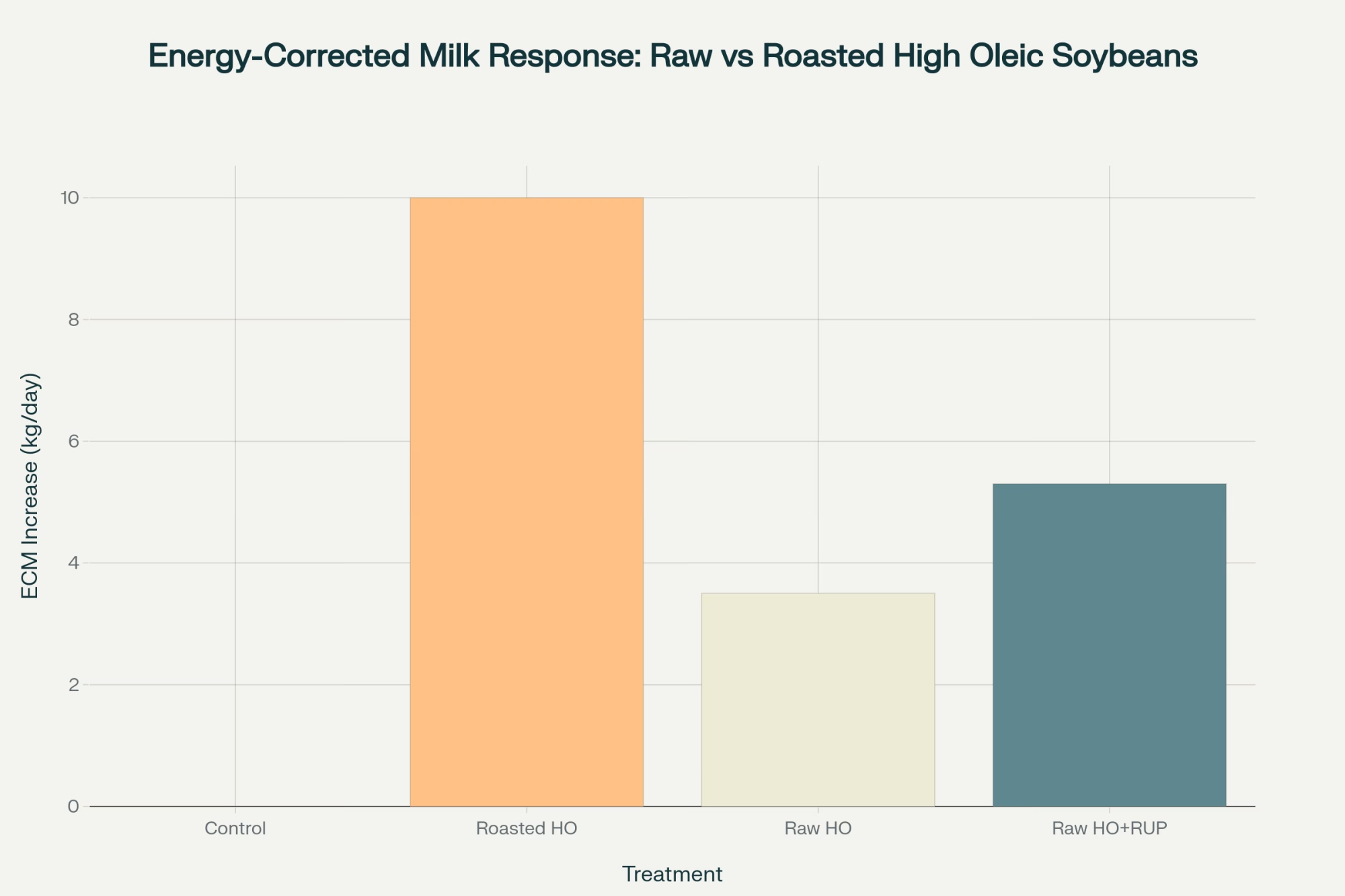
Energy-corrected milk response comparison between raw and roasted high oleic soybeans shows roasted beans deliver significantly higher production benefits in dairy cattle

The dairy nutrition group up at Michigan State – and these folks have been at the forefront of fat research for years – recently published work in the Journal of Dairy Science that’s causing quite a stir. Their study compared three approaches: standard soybean meal, raw high oleic beans cracked to quarters, and properly roasted high oleic beans.

Data from a recent study published in the Journal of Dairy Science shows a significant milk production response. While roasted high oleic soybeans delivered a 10.2 lb increase, even raw, ground beans provided a 3.5 lb boost over the control diet.

The production response data? It caught my attention immediately. According to their published research, the roasted beans delivered 93.4 pounds of energy-corrected milk per day compared to 83.2 pounds from the soybean meal control. That’s a 10.2-pound jump that any producer would notice in their bulk tank.

But here’s what really got me thinking – the raw high oleic beans still managed 86.7 pounds. That’s a 3.5-pound increase just from grinding them properly. No roasting equipment, no additional processing costs beyond what you’re already doing.

What’s particularly noteworthy is the feed conversion story. Cows eating the roasted beans were converting at 1.70 ECM per pound of dry matter compared to 1.49 for the control group. In today’s cost environment, that efficiency gain alone can make the difference between red and black ink.

The Science Behind Why This Works

Here’s where it gets fascinating from a rumen nutrition standpoint. Conventional soybeans are rich in polyunsaturated fatty acids – research shows approximately 54 grams of PUFA per 100 grams of oil, primarily linoleic acid.

This stuff creates real problems through biohydrogenation pathways that produce trans-10, cis-12 conjugated linoleic acid. Yeah, that’s a mouthful, but stay with me here – this compound is basically kryptonite for milk fat synthesis. It’s why we’ve always had to walk on eggshells with soybean inclusion rates.

High oleic varieties flip this whole equation. According to the research, we’re looking at 75 percent oleic acid with PUFA content below 10 percent. The difference is dramatic – you can feed up to 6 pounds per cow per day without seeing milk fat depression. Compare that to conventional soybeans, where most nutritionists get nervous above 3-4 pounds.

Bill Mahanna from Corteva Agriscience – the folks who developed Plenish – has been tracking this technology for years. What he’s consistently emphasized is that proper particle size is critical for nutrient release. Whole beans transit the rumen too rapidly to deliver full nutritional value. He’s absolutely right about the grinding requirement.

The Processing Question That’s Keeping Nutritionists Up at Night

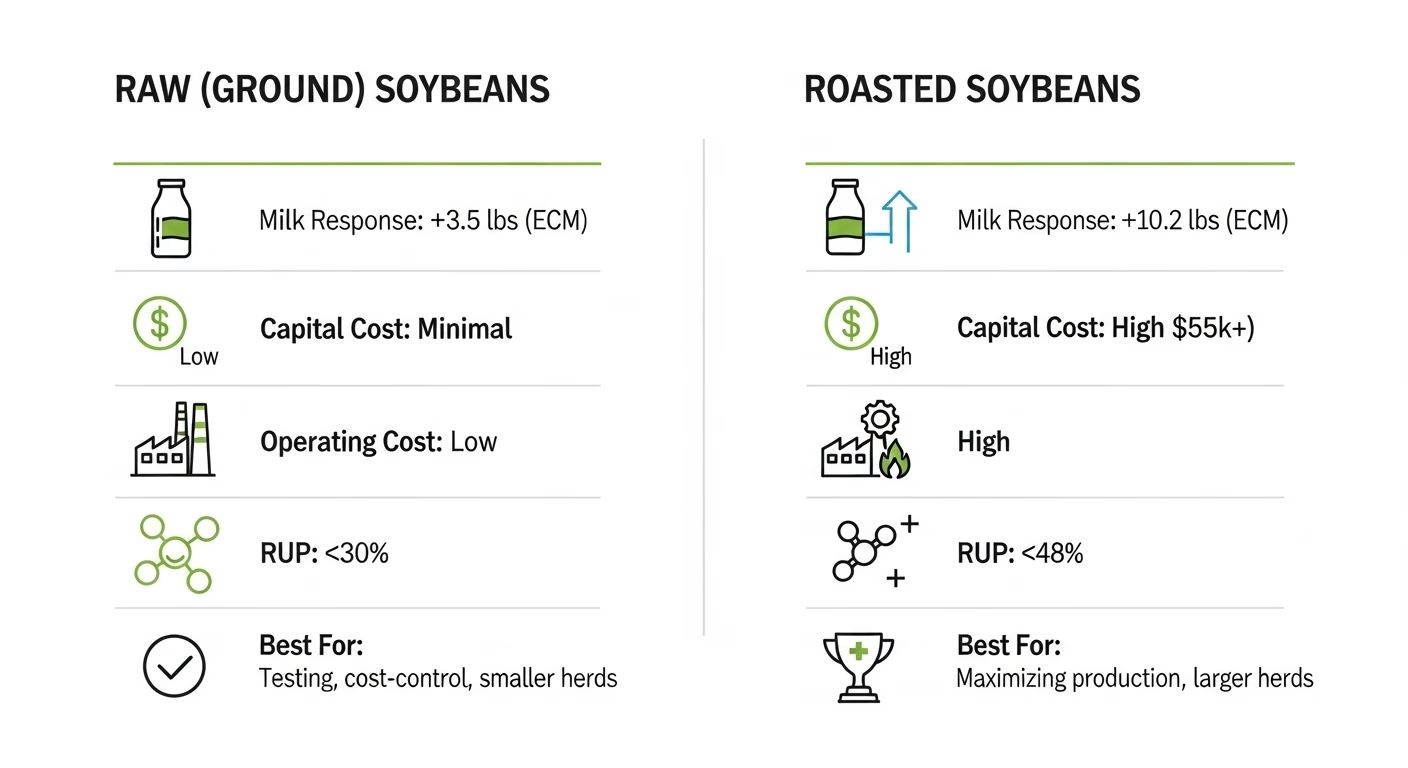
The decision to roast depends on herd size, capital, and production goals. While roasting maximizes the milk response, a raw, ground approach offers a significant benefit with minimal initial investment.

So here’s the million-dollar question everyone’s asking: do you really need to roast?

The Roasting Route

If you’re thinking about investing in roasting capability, we’re talking serious capital. On-farm barrel roasters start around $55,000 – though I’ve seen operations justify that cost surprisingly quickly when you factor in the production response.

Custom roasting services are running $38-50 per ton plus freight. Not cheap, but depending on your situation and scale, it might make sense. The thing about roasting is that it accomplishes multiple objectives beyond just protecting protein from rumen degradation.

You’re bumping rumen-undegradable protein from around 30 percent to 48 percent, which really helps with metabolizable lysine supply. That’s particularly important if you’re dealing with high-producing cows that need that extra protein boost for milk protein synthesis.

But here’s the reality – you’re going to see 8-12 percent shrink during roasting, which can knock significant value off if you’re not accounting for it properly in your economics. And with current financing costs? The payback calculations get interesting real quick.

The Raw Processing Option That’s Gaining Traction

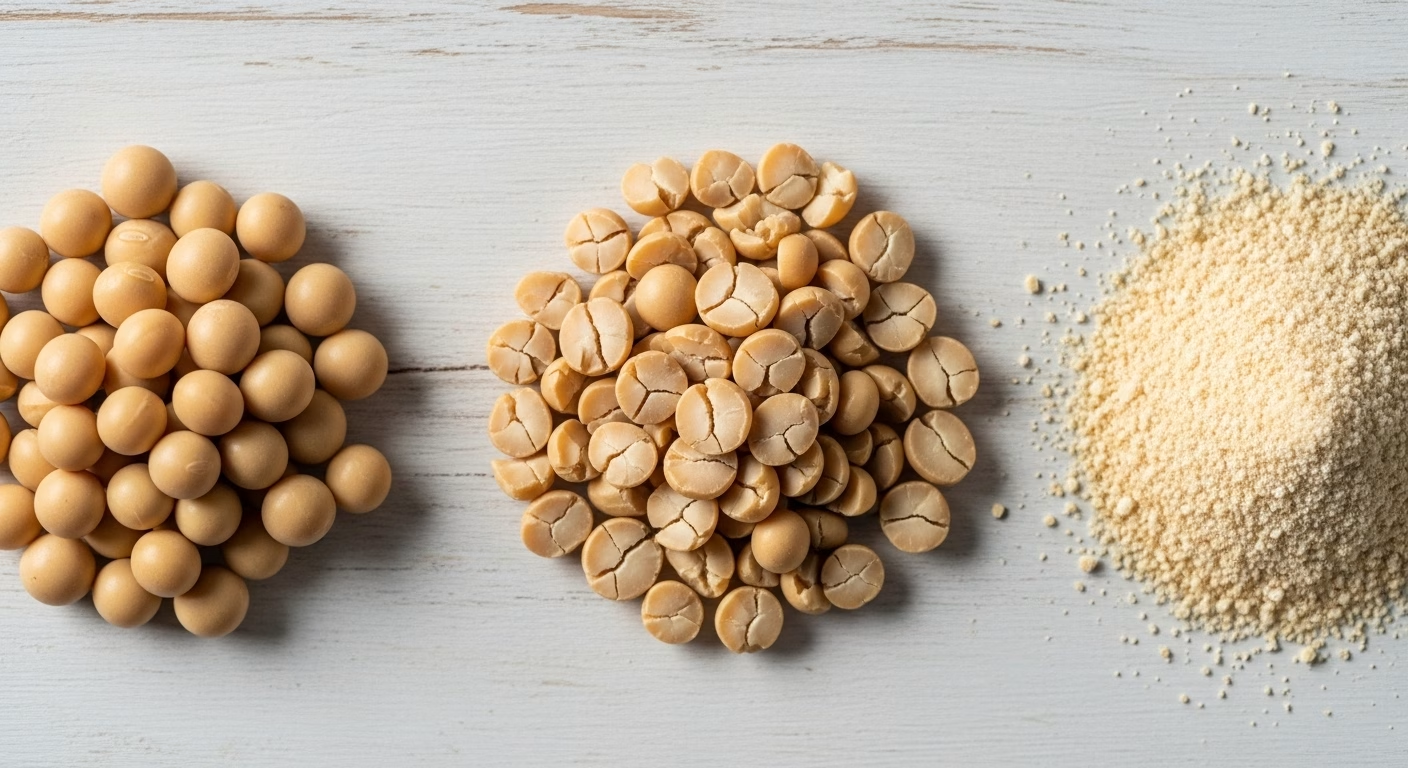
Proper particle size is critical for nutrient release in the rumen. Whole beans (left) pass through too quickly, while properly cracked beans (center) allow for optimal digestion. Over-grinding (right) can be counterproductive.

What’s interesting is how many producers are finding success with raw high oleic beans. Recent industry reports show demand has absolutely exploded – we’re talking about 70,000 to 80,000 cows now getting these beans in their rations, and that number’s growing fast.

The key is getting that particle size right. You need to fracture those beans into quarters or eighths. One pass through a standard roller mill, maybe 4 minutes per ton in extra labor. That’s literally it.

I’ve been tracking what some of the early adopters are seeing, and the results are pretty compelling. John Schaendorf in Illinois went all-in on high oleic beans back in 2023 – switched his entire soybean planting plan and even installed a roaster. He’s feeding 7.5 pounds of dry matter and seeing $0.75 to a dollar per cow savings by switching out other fats and reducing canola in his rations.

Real-World Results That Are Hard to Ignore

The field data is starting to back up what the university research predicted. Industry reports show producers aren’t just seeing improvements in milk production – they’re reporting better conception rates, lower somatic cell counts, and even reduced death loss rates.

What’s particularly encouraging is the scale of adoption we’re seeing. Harvey Commodities is projecting 50,000 tons this year and potentially 100,000 next year. That’s not niche market stuff anymore – that’s mainstream adoption happening right before our eyes.

The commodity brokers are taking notice, too. Premium markets are developing in regions where elevator systems can handle the identity preservation requirements. This is becoming a real crop marketing opportunity for producers who can grow and deliver these beans.

The Pitfalls That Can Trip You Up

Look, I’d be doing you a disservice if I didn’t mention the potential problems. Over-roasting can brown the protein fraction and absolutely kill your intestinal digestibility. I’ve seen operations get sloppy with calibration and lose half their production response.

Equipment calibration every 50 hours of run time isn’t a suggestion – it’s mandatory if you want consistent results.

Mycotoxin contamination is another issue that caught some folks off-guard, particularly after the challenging growing conditions we’ve seen in parts of the Midwest. The FDA monitors these compounds closely, and roasting doesn’t eliminate contamination problems. You absolutely need to test every new batch.

The supply chain piece is probably my biggest long-term concern. High oleic acreage is still a relatively small percentage of total U.S. soybean plantings. That’s changing rapidly, but securing reliable sources requires planning ahead. I’ve already heard from several elevators that they’re running tight on supply this season.

Making the Economics Work

Before you jump into this, you really need to think through a few critical factors:

Can you source high oleic beans at a basis that protects your margin? Current premiums are running about $1.25 per bushel over Chicago Board of Trade cash prices for these specialty varieties. That’s significant, but the production response data suggests it’s usually justified.

Do you have the throughput to make processing economical? Operations under 300 cows often find that contract roasting costs outweigh the feed benefits. Grinding tends to be more favorable for smaller operations.

What’s your cash flow situation looking like? With financing costs where they are, equipment purchases carry real opportunity cost. I’m seeing more creative lease arrangements that match payments to seasonal milk revenue patterns – might be worth exploring.

What This Means for Your Operation

Here’s my take after watching this technology evolve over the past few years… high oleic soybeans aren’t going to solve every feed cost problem you’ve got, but they’re one of the few ingredients currently offering both cost management and production enhancement in the same package.

The production benefits are real and repeatable. Whether you can capture them profitably depends on your specific situation – scale, infrastructure, access to processing, and frankly, your willingness to manage the details that actually matter.

What’s particularly encouraging is seeing smaller operations find success with the raw, ground approach. You don’t need a $55,000 roaster to benefit from this technology. That opens doors for a lot more producers who might have been priced out of the game otherwise.

The Bottom Line

If you’re running a dairy operation in 2025, here’s what you need to know:

The production response is documented and real – we’re talking 3.5 to 10+ pounds of milk per cow per day, depending on your processing method. That’s not promotional material, that’s peer-reviewed research from institutions like Michigan State that you can bank on.

You’ve got processing flexibility that didn’t exist before. Raw, properly ground beans deliver meaningful benefits without major capital investment. Roasting maximizes the response if you can justify the equipment or custom processing costs.

Market timing actually favors adoption right now. The combination of elevated feed costs and margin pressure makes the economics compelling for most well-managed operations.

Supply chain infrastructure is maturing, but you still need to plan ahead. Don’t wait until October to start looking for high oleic beans for next year’s feeding program.

The technology has definitively moved past the “interesting research” phase into practical application. Whether you choose roasting for maximum impact or grinding for cost-effective gains, success comes down to consistent execution and appropriate inclusion rates.

For producers with homegrown soybeans or access to local high oleic production, this represents a genuine competitive advantage. The question isn’t whether high oleic soybeans work – the research has settled that debate. The question is whether you can implement them effectively in your operation.

And honestly? If you can capture even half the production response we’re seeing in the university trials while reducing your supplemental fat purchases, this might be the highest-return feed change you can make this year. The research has proven what’s possible. The only question left is how you’re going to make it work for your bottom line.

Complete references and supporting documentation are available upon request by contacting the editorial team at editor@thebullvine.com.

Learn More:

Join the Revolution!

Join over 30,000 successful dairy professionals who rely on Bullvine Weekly for their competitive edge. Delivered directly to your inbox each week, our exclusive industry insights help you make smarter decisions while saving precious hours every week. Never miss critical updates on milk production trends, breakthrough technologies, and profit-boosting strategies that top producers are already implementing. Subscribe now to transform your dairy operation’s efficiency and profitability—your future success is just one click away.

NewsSubscribe
First
Last
Consent

Revolutionary Feed Strategy Transforms Dairy Economics: High Oleic Soybeans Deliver 30% Higher Butterfat Yields While Slashing Feed Costs

Stop paying $2,000/ton for imported fat supplements when your own fields could boost milk yield 10+ lbs/cow while slashing feed costs by $1.00/day

EXECUTIVE SUMMARY: The dairy industry’s addiction to expensive imported fat supplements represents one of our most costly blind spots – but high oleic soybeans are rewriting the economics of milk production entirely. University research confirms that producers switching from conventional feeding strategies see milk fat yield increases of 0.2-0.25 lbs per cow daily, translating to $33,000+ annual profit gains for 500-cow operations. While rumen-protected fats exceed $2,000 per ton, roasted high oleic soybeans deliver superior results at just $520 per ton – plus they provide 40-50% bypass protein that expensive supplements can’t match. Michigan State University’s latest 2025 research shows these “homegrown” strategies can boost total milk production by up to 10 pounds per cow when properly implemented. With global demand tripling in the past year and market projections exceeding $880 million by 2030, early adopters are capturing competitive advantages that late adopters will struggle to match. The revolution isn’t coming – it’s here, and every day you delay evaluation costs your operation potential profit that competitors are already banking.

KEY TAKEAWAYS

  • Replace Expensive Supplements with Homegrown Strategy: Producers report saving $0.70-$1.00 per cow daily by replacing purchased rumen-protected fats and bypass proteins with roasted high oleic soybeans – that’s $255,000+ annually for a 1,000-cow operation while simultaneously boosting butterfat percentages by 0.17-0.41 points.
  • Unlock Dual-Purpose Nutrition for Maximum ROI: High oleic soybeans deliver both rumen-friendly fat (75-80% oleic acid vs. 54% problematic linoleic acid in conventional soy) AND high-quality bypass protein (40-50% RUP), effectively replacing two expensive ingredient categories with one cost-controlled solution.
  • Capitalize on Explosive Market Momentum Before Competition: Demand for roasted high oleic meal has tripled in 2025, representing 70,000+ cows with tonnage projected to double – positioning early adopters to secure supply chains and processing infrastructure before widespread adoption drives up costs.
  • Leverage Processing Technology for Maximum Component Response: Proper roasting at 290-315°F unlocks the full nutritional value, with Michigan producers reporting milk production increases up to 10 pounds per cow when high oleic soybeans replace conventional fat supplements in optimized rations.
  • Build Supply Chain Resilience Against Global Volatility: Identity-preserved high oleic soybeans offer domestic alternatives to imported palm-based supplements, reducing exposure to global commodity price swings while supporting sustainable feeding strategies that align with consumer demands for traceable, environmentally responsible dairy products.
dairy nutrition, high oleic soybeans, feed cost reduction, butterfat yield, dairy profitability

Are you still paying premium prices for imported palm-based fat supplements when your own fields could be growing a superior alternative? While most dairy operations continue to spend money on expensive rumen-protected fats that often exceed $2,000 per ton, progressive producers are discovering that the solution to higher milk components and feed cost control has been hiding in plain sight – right in their soybean fields.

Here’s the uncomfortable truth the conventional dairy nutrition establishment doesn’t want you to hear: the traditional approach of feeding expensive, imported fat supplements represents one of the industry’s most costly blind spots. High oleic soybeans aren’t just another feed ingredient – they’re a precision-engineered solution that’s rewriting the economics of milk production and proving that the biggest gains often come from questioning the smallest assumptions.

The numbers are staggering and verified by multiple independent sources. U.S. milk production continues its upward trajectory, with recent data showing consistent year-over-year increases. Most remarkably, average butterfat levels reached a historic high of 4.23% nationally in 2024, marking the highest levels since the 1940s. However, what makes this story compelling for every dairy operation is that while the industry celebrates these component gains, producers using high-oleic soybeans are seeing profit increases of $0.15 to over $1.00 per cow per day, translating to more than $33,000 in additional annual income for a 500-cow operation.

Challenging the Sacred Cow: Why Expensive Fat Supplements Are Yesterday’s Strategy

When did we accept that achieving higher milk fat required dependency on volatile global commodity markets? The conventional dairy nutrition playbook has trained us to reach for expensive, often imported supplements the moment we want to boost energy density. Rumen-protected fats typically exceed $2,000 per ton, with many products based on palm fatty acid distillates that introduce both price volatility and supply chain risk.

However, peer-reviewed research from the Journal of Dairy Science is systematically dismantling this expensive paradigm. A landmark economic analysis published in 2024 synthesized results from five separate feeding trials and concluded that substituting just 5% of ration dry matter with whole high-oleic soybeans increases Milk Income Less Feed Costs (MILFC) by up to $0.27 per cow per day.

Think of it like this: we’ve been buying premium gasoline when we could be refining our own high-octane fuel right on the farm. High oleic soybeans represent a complete reprogramming of how we approach fat and protein nutrition, offering what expensive supplements promise but rarely deliver – consistent results without the premium price tag.

The Science That Changes Everything: Verified Performance Data

The breakthrough isn’t just in economics – it’s in fundamental rumen chemistry. Conventional soybeans contain 52-55% linoleic acid, a polyunsaturated fatty acid that’s toxic to beneficial rumen microbes and triggers milk fat depression. High oleic varieties flip this script entirely, containing 75-80% oleic acid with linoleic acid reduced to less than 10%.

Penn State University research demonstrates the dramatic impact: cows fed high-oleic soybeans show decreased concentrations of trans-10 18:1 in their milk, the key biomarker associated with milk fat depression. The result? Consistent milk fat increases of 0.17 percentage points and milk fat yield improvements of 0.2 pounds per cow per day.

But here’s where it gets revolutionary: Michigan State University’s latest research shows that roasted high oleic soybeans can improve milk production by up to 10 pounds per cow when used to replace other fat supplements. That’s not just component improvement – that’s total production enhancement.

Why This Matters for Your Operation: The Processing Revolution

Here’s where most operations stumble: they focus on the soybeans but ignore the processing piece that unlocks their full value. Properly roasted high-oleic soybeans deliver 40-50% rumen-undegradable protein (RUP), directly supporting milk protein synthesis while providing a superior fat profile.

The processing requirements aren’t optional – they’re critical for success. According to Ohio State University Extension research, “the temperature for roasting should be 290°F to 315°F, with soybeans needing to be steeped for 30 minutes or longer.” This processing requirement has created opportunities for on-farm roasting operations and third-party processing services.

Processing costs range from $25 to $ 35 per ton for roasting, but the identity-preserved system requirements create opportunities for on-farm processing operations and specialized service providers.

Precision Agriculture Integration: Maximizing Technology Investments

Modern dairy operations investing in Automated Milking Systems (AMS) and precision agriculture technologies are well-positioned to capture the benefits of high-oleic soybeans. The improved energy balance resulting from better fat digestibility helps maintain consistent dry matter intake patterns, which activity monitoring systems rely on for accurate health alerts and reproductive management.

Think of high oleic soybeans as the premium fuel for your high-performance dairy engine – just as your AMS systems optimize milking efficiency, high oleic soybeans optimize rumen efficiency, creating synergistic effects that compound your technology investments.

For operations utilizing component testing technology, the enhanced fatty acid profiles in milk from cows fed high-oleic soybeans position farms for potential future premium markets. Research consistently shows milk with significantly higher oleic acid concentrations and 17% lower specific trans fatty acids compared to conventional feeding programs.

Implementation Strategy: Your 90-Day Roadmap to Profitability

Ready to move beyond expensive supplements to a homegrown strategy? The transition requires systematic planning, but the pathway is well-established through university research and producer experience.

Phase 1: Economic Analysis (Weeks 1-2)

  • Week 1: Calculate current expenditure on purchased fats and bypass proteins
  • Week 2: Model potential savings using verified benchmarks: roasted high oleic soybeans at approximately $520/ton versus rumen-protected fats often exceeding $2,000/ton
  • Factor in the dual-purpose value: you’re replacing both fat and protein supplements simultaneously

Phase 2: Supply Chain Assessment (Weeks 3-6)

  • Week 3-4: Evaluate local high oleic soybean availability and contracting options
  • Week 5-6: Consider on-farm roasting versus third-party processing: equipment investments typically pay back within 2-3 years for operations over 1,000 cows
  • Account for identity-preserved handling requirements: this isn’t commodity soybean management

Phase 3: Pilot Implementation (Months 2-3)

  • Month 2: Start with 5-7.5 pounds of roasted high oleic soybeans per cow per day
  • Month 3: Monitor verified performance indicators: expect a 0.2-0.25 lb/day increase in milk fat yield and potential total milk increases up to 10 pounds per cow
  • Ongoing: Track body condition scores: improved energy balance often manifests as better BCS maintenance

Seasonal Considerations: Maximizing Year-Round Benefits

Timing your high-oleic soybean adoption strategy to coincide with seasonal farm operations can significantly enhance your success. Spring implementation (March-May) allows for pilot testing before peak lactation periods, while fall adoption (September-November) positions operations to capture premium winter butterfat markets when dairy product demand typically peaks.

For crop producers, contracting decisions should align with planting windows. High-oleic soybean contracts are typically finalized by February or March for spring planting, ensuring that identity-preserved logistics are established before harvest. Processing infrastructure investments are most efficiently implemented during off-season periods (November-February) when roasting equipment installation won’t disrupt daily feeding routines.

Winter feeding programs, particularly those that benefit from high oleic supplementation, are particularly beneficial because the improved energy density helps maintain milk production during periods of reduced pasture availability and increased maintenance energy requirements in cold weather.

Global Market Reality: What International Data Reveals

The high oleic soybean market is experiencing explosive growth that’s reshaping agricultural economics. Recent market analysis values the global high-oleic soybean industry, with projections showing a substantial 10.7% compound annual growth rate, driven by dual demand from the food and feed sectors.

The demand drivers are crystal clear. Industry reports indicate that customers seeking roasted high-oleic meal have tripled in the past year, representing an estimated 70,000 to 80,000 cows.  Looking ahead, demand projections are expected to reach upwards of 50,000 tons this year and potentially 100,000 tons next year.

Globally, the United States dominates adoption, benefiting from established identity-preserved infrastructure and strong demand for the dairy industry. Canada represents an emerging opportunity with the 2022 approval of Alinova, Canada’s first conventionally bred high-oleic soybean variety, which is strategically important because its non-GMO status grants access to premium export markets, such as the European Union.

Implementation Economics: Breaking Down the Real-World Numbers

Are you tracking your true cost per pound of supplemental fat, including transportation, storage, and opportunity costs? Most operations aren’t, which explains why the economics of high oleic soybeans often surprise even experienced nutritionists.

Research calculations indicate that replacing supplemental fat and protein with high-oleic beans could save dairies $0.50 to $0.70 per hundredweight.  For perspective, that’s $0.525 million annually for a 2,000-cow operation – enough to justify significant investments in processing and storage infrastructure.

Real-world validation comes from Michigan producer John Schaendorf, who installed an on-farm roaster and feeds 7.5 pounds of roasted high-oleic soybeans, thereby eliminating both supplemental fat and canola meal from his ration. His cost reduction? $0.75 to $1.00 per cow per day.

Dennis Underwood from Central New York reports even more dramatic savings: $0.70 per cow per day by replacing purchased “bag fat and bypass protein” with roasted high-oleic soybeans, with potential savings reaching $1.00 per cow daily if all requirements are grown on-farm.

Addressing the Controversies: Evidence-Based Assessment

Let’s address the sustainability claims under scrutiny. The most compelling sustainability argument centers on replacing imported palm fat, which has been widely linked to deforestation concerns. However, like any major agricultural crop, soybean production has its own environmental footprint due to land use, fertilizer, and pesticide inputs.

A more honest assessment: High-oleic soybeans represent a significant relative improvement compared to imported alternatives and a strategic step toward more resilient domestic supply chains. The U.S. soybean industry has made significant sustainability progress over the past four decades, reducing energy use, soil erosion, and greenhouse gas emissions per bushel of soybeans produced.

The cost-benefit equation requires context. Cornell University research indicates that substantial milk fat responses are most likely in herds already experiencing some degree of milk fat depression or at high risk of it. For high-performing herds with optimized rumen environments, the primary benefit may shift from large component boosts to direct feed cost savings.

Future Market Implications: Reading the Tea Leaves

What happens when 20% or 30% of U.S. dairy operations adopt high oleic soybeans? The 2024 Journal of Dairy Science economic analysis modeled this exact scenario. Their conclusion: while widespread adoption would lower aggregate butterfat prices slightly, the market-level effect doesn’t offset positive farm-level profitability gains.

Translation: early adopters win bigger, but even late adopters still benefit. The economic advantage persists because the technology improves overall efficiency, not just component yields.

Consider the infrastructure investments already accelerating: demand for roasted high oleic meal has tripled in the past year, with tonnage projected to double. That’s the kind of exponential growth curve that transforms entire industries.

The next strategic frontier will likely be the development of value-added, consumer-facing milk markets that explicitly reward producers for enhanced fatty acid profiles. Research consistently shows that milk from cows fed high oleic soybeans contains significantly higher oleic acid concentrations and 17% lower specific trans fatty acids.

The Bottom Line: Your Competitive Advantage Awaits

The evidence is overwhelming and independently verified: high oleic soybeans represent a genuine revolution in dairy nutrition, not just another evolutionary step. Multiple peer-reviewed studies confirm consistent improvements in milk fat, dual-purpose nutrition benefits, and economic advantages ranging from moderate to exceptional.

Here’s what separates successful operations from the rest: they recognize that the biggest competitive advantages often come from optimizing existing resources rather than completely reinventing systems. High oleic soybeans exemplify this strategic optimization – leveraging proven science to extract more value from familiar ingredients while building resilience against market volatility.

The market momentum is undeniable: demand is described as “booming,” infrastructure is expanding rapidly, and processing technology is becoming increasingly accessible. Most importantly, early adopters are capturing benefits while building operational advantages that compound over time.

But here’s the uncomfortable question every dairy operator must answer: if your competitors are already implementing strategies that deliver $33,000+ annual profit increases per 500 cows, how long can you afford to maintain the status quo?

Your 7-Day Action Plan: From Information to Implementation

Your next steps are crystal clear and time-sensitive:

Days 1-2: Contact your nutritionist immediately and request a farm-specific economic analysis that models high-oleic soybeans in your current ration. Ask them to calculate potential savings from replacing current fat and protein supplements using current market data, factor in your local supply options, and provide a 12-month profit projection based on verified university research.

Days 3-4: Research local high oleic soybean suppliers and processing options. Schedule visits to operations already using on-farm roasting systems to evaluate equipment needs and processing quality control.

Days 5-7: Develop your implementation timeline, targeting a fall 2025 adoption, with timing that allows for pilot testing before the winter’s peak component demand periods. Calculate equipment financing options if considering on-farm processing.

Schedule this analysis by July 15th to position your operation for fall implementation. This analysis costs nothing but could reveal your operation’s pathway to dramatically improved profitability.

In an industry where margins determine survival, can you afford not to investigate a technology that’s adding $100+ per cow annually to the bottom line?

The revolution isn’t coming – it’s here. The only question is whether your operation will lead it or be left behind by it.

Take action now. Your future profitability depends on the decisions you make this week.

Complete references and supporting documentation are available upon request by contacting the editorial team at editor@thebullvine.com.

Learn More:

Join the Revolution!

Join over 30,000 successful dairy professionals who rely on Bullvine Weekly for their competitive edge. Delivered directly to your inbox each week, our exclusive industry insights help you make smarter decisions while saving precious hours every week. Never miss critical updates on milk production trends, breakthrough technologies, and profit-boosting strategies that top producers are already implementing. Subscribe now to transform your dairy operation’s efficiency and profitability—your future success is just one click away.

NewsSubscribe
First
Last
Consent
Send this to a friend