



Archive for feed shrink reduction

Why Smart Dairies Are Spending MORE on Feed at $4.20 Corn (And Banking $100K Extra)

Feed costs dropped 30% but farms lose more money—the 35% cost share shift changes everything

EXECUTIVE SUMMARY: What farmers are discovering right now challenges everything we thought we knew about feed economics—operations spending more strategically on feed at $4.20 corn are generating $100,000 to $110,000 in additional annual revenue per 100 cows, according to Wisconsin Extension’s 2025 profitability analysis. The math has fundamentally shifted: feed now represents just 35-40% of total production costs (down from the historical 50%), while labor costs have jumped 15-20% since 2020, and replacement heifers have doubled to $3,000-4,000 per head based on USDA market data. Cornell PRO-DAIRY’s benchmarking reveals that farms tracking Return on Feed Cost rather than minimizing feed expense are capturing an extra $3 for every additional 50 cents invested in quality nutrition. Geographic disparities are widening, too—Midwest operations maintain positive margins while California and Northeast dairies face $45-60 per hundredweight structural disadvantages from freight, water, and regulatory costs. Penn State Extension research shows another opportunity most miss: reducing feed shrink from 15-18% to 8-10% through systematic inventory management returns $150-200 per cow annually. The path forward isn’t about spending less on feed—it’s about investing strategically in nutrition, measurement, and multi-layered risk protection that positions your operation for the new economic reality.

Dairy Profitability Strategy

Feed costs dropped 30%, yet most dairy operations are bleeding cash harder than when corn hit $7. Here’s what’s really happening—and what the profitable few are doing differently.

There’s an interesting disconnect this October. Corn futures on the Chicago Board of Trade sit at $4.13 a bushel—down from over $6 last year. USDA’s Agricultural Marketing Service reports soybean meal in the $270s. Dairy Margin Coverage formulas suggest margins above $11 per hundredweight.

By all traditional measures, this should be a boom time.

Yet producers from Wisconsin to California report rising operating loans and shrinking working capital. They’re asking why lower feed costs aren’t boosting profitability the way they used to.

Understanding the New Cost Structure

Looking at this trend, it’s clear that feed no longer dominates expenses. Wisconsin Extension’s 2025 analysis shows feed now accounts for just 35–40% of total production costs, down from the historical 50% benchmark.

That shift has big implications:

  • Labor Costs have jumped 15–20% since 2020, with Midwest wages near $19.50/hour (USDA NASS).
  • Replacement Heifers now run $3,000–4,000 apiece, more than double past norms (USDA AMS).
  • Machinery Costs are up 25% over three years (Association of Equipment Manufacturers).
  • Insurance Premiums climbed 18–25% with shrinking coverage (Farm Bureau data).

When feed is only a third of your costs and these other expenses are escalating, grain-price relief alone can’t solve profitability challenges.

The 35% Cost Share Shift: Feed costs dropped 30% but now represent just 37.5% of total expenses (down from 50%), while labor jumped to 18% and replacement heifers doubled to 14% of costs. This fundamental restructuring explains why lower corn prices haven’t translated to farm profitability

A Different Way to Measure Success

The 50-Cent Decision Worth $100,000: Cornell PRO-DAIRY benchmarking reveals farms tracking Return on Feed Cost capture an extra $3 for every additional 50 cents invested in quality nutrition. Operation B spends just 50¢ more per cow daily but generates $100,000 additional annual revenue per 100 cows—proving strategic feeding beats cheap feeding

What I’ve found is that top-performing dairies track Return on Feed Cost (ROFC) rather than just feed cost per cow. Extension case studies from the Midwest illustrate this:

MetricOperation AOperation B
Feed cost per cow daily$5.40$5.90
Milk production per cow62 lbs73 lbs
Income per feed dollar$14.00$16–17
Annual difference (100 cows)Baseline+$100,000

That extra 50 cents spent can return nearly $3—a powerful insight backed by Cornell PRO-DAIRY’s 2025 benchmarking.

Rethinking Protein Sourcing

While everyone watches corn, a quieter opportunity lies in protein markets. Research from the University of Saskatchewan shows that canola meal delivers digestible protein on par with soybean meal (18.2% vs. 18.6%) and a superior amino-acid profile.

UC Davis Extension reports larger herds blending canola meal with distillers grains, saving $10,000–15,000 monthlyand often gaining 1.5–2 lbs of milk per cow daily after the transition period.

  • Lysine, histidine, and threonine availability increases by 20g, 13g, and 24g, respectively (Canadian Journal of Animal Science).
  • Canada supplies 75% of U.S. canola meal, so price volatility is possible (USDA FAS).
  • Southern Extension data shows small-herd cooperatives saving $8–12 per ton by pooling purchases.

It’s worth noting that smaller dairies without bulk-buying power can still capture these gains by teaming up locally.

The Hidden Drain on Profitability

Here’s something that might surprise you: feed shrink. Penn State Extension’s 2024 research indicates farms lose 15–18% of purchased feed to spoilage, storage losses, mixing errors, and waste.

Implementing:

  • Weekly dry matter tests
  • Monthly inventory reconciliations
  • Quarterly mixer-wagon audits

can cut shrink to 8–10%, saving $150–200 per cow annually on a 200-cow operation after investing $3,000–4,000 in equipment and labor (Michigan State Extension).

Regional Realities and Their Impact

Geography’s structural cost differences are widening, according to USDA ERS and state Extension studies:

  • Midwest operations maintain margins of $1–2 per cwt
  • California dairies often lose $50–60 per cwt
  • Northeast farms typically lose $45–55 per cwt

Key drivers include:

  • Freight addons of $0.60–0.75/bu for Midwest corn (USDA).
  • Water costs of $1.00–1.50/cwt in California (UC Cooperative Extension).
  • Hay priced $90–100/ton above Midwest markets (USDA).
  • Labor regulations adding 20–25% to payroll (state employment data).

Yet some operations adapt—organic premiums of $8–10/cwt and grass-fed verification adding $5–6/cwt can offset structural disadvantages.

The Evolving Industry Structure

The 2022 Census of Agriculture shows a clear trend:

  • 39% of dairy farms closed between 2017 and 2022 (USDA Census).
  • Milk production rose 4% despite fewer farms.
  • 66% of production now comes from operations with 1,000+ cows, up from 57%.

Farm Credit Mid-America’s 2024–25 analysis finds dairies investing $25,000–40,000 annually in professional services—nutrition consulting, risk management, quality control—often generate $150,000–250,000 in additional value.

Evaluating Nutrition Advisory Services

Nutrition advice bundled with feed purchases often seems “free,” but Ohio State research warns of structural conflicts when advisors represent feed companies.

Extension analyses estimate 200-cow operations face $60,000–90,000 in annual opportunity costs from:

  • Limited ingredient options
  • Protein over-feeding
  • Missed contracting windows
  • Lack of ROFC tracking

Independent consulting costs $10,000–15,000/year yet often returns 4–6 times that through optimized rations (Professional Dairy Producers benchmarking).

Building Comprehensive Risk Protection

Recent volatility shows one layer of protection isn’t enough. University of Illinois farmdoc analysis and Risk Management Agency data recommend:

Layer 1: DMC at $9.50 coverage (~$0.15/cwt)
Layer 2: Dairy Revenue Protection covering 40–60% (cost $0.30–0.40/cwt)
Layer 3: Forward Feed Contracts for 60–70% of needs (saves $0.20–0.40/bu corn, $15–25/ton protein)
Layer 4: CME Micro-Futures (investment $8,000–10,000 quarterly protects $30,000–50,000)
Layer 5: Cash Reserves to cover 60–90 days of feed

Total cost: $60,000–80,000 annually for 300–500 cows, with protected value reaching $200,000–250,000 in volatile years.

Five Common Patterns Among Profitable Operations

What producers are discovering is that successful dairies consistently:

  • Prioritize ROFC over raw cost cutting—worth $50–80 per cow.
  • Measure everything—weekly tests, monthly inventories, and daily refusals yield $60,000–130,000 returns.
  • Invest in expertise—$10,000–15,000 consulting generating 4–6x returns.
  • Layer protection—diversified risk tools guard $200,000+ in potential losses.
  • Act decisively—delays in contracting or enrollment can cost $20,000–30,000 annually.

These aren’t secrets—they’re documented best practices. The challenge is moving from knowledge to action.

Your 90-Day Action Plan

Opportunities are time-sensitive. Over the next 90 days:

☐ Lock Feed Contracts (Nov–Dec 2025) at $4.05–4.20/bu for Q1–Q2 2026 (grain quotes vary by region).
☐ Enroll in Dairy Revenue Protection (Jan 2026) for Q2–Q3 coverage.
☐ Finalize Planting Decisions (Feb 2026) to lock forage costs through fall 2027.

Each month’s delay can cost $5,000–7,000 in missed optimization. Three months equals $15,000–21,000 plus $20,000–30,000 in lost harvest pricing.

Moving Forward

This isn’t a temporary market glitch. It reflects structural shifts in dairy economics:

  • Feed’s cost share has shrunk.
  • Labor, equipment, and regulatory expenses have soared.
  • Geography drives growing cost disparities.
  • Professional management is essential.

The tools and expertise to succeed exist—forward contracts, risk programs, independent advisors, and measurement systems. Success today isn’t about working harder—it’s about working differently.

What I’ve found is that the most resilient operations out-think challenges instead of simply out-working them. The path forward exists. The question is whether we’ll take it.

KEY TAKEAWAYS

  • Shift focus to Return on Feed Cost (ROFC): Operations generating $16-17 in milk revenue per feed dollar versus $14 are banking an extra $100,000 annually per 100 cows—that 50-cent strategic investment in better nutrition returns nearly $3, making quality more profitable than cheap
  • Attack the 15-18% feed shrink hiding in plain sight: Weekly dry matter testing, monthly inventory reconciliations, and quarterly mixer audits can cut losses to 8-10%, saving $150-200 per cow annually with just $3,000-4,000 invested in measurement systems
  • Build five-layer risk protection now: Combine DMC foundation coverage, Dairy Revenue Protection for 40-60% of production, forward contracts locking 60-70% of feed needs, CME micro-futures, and 60-90 days cash reserves—total cost of $60,000-80,000 protects against $200,000+ in potential losses
  • Act on the 90-day window: Lock November-December feed contracts at $4.05-4.20 before March’s typical $4.45+ pricing, enroll in January’s DRP for Q2-Q3 coverage, and finalize February planting decisions that lock forage costs through fall 2027
  • Recognize regional realities and adapt accordingly: If you’re facing California’s $50-60/cwt disadvantage or the Northeast’s $45-55/cwt structural costs, consider organic premiums ($8-10/cwt), grass-fed verification ($5-6/cwt), or value-added processing to offset geography’s impact on profitability

Complete references and supporting documentation are available upon request by contacting the editorial team at editor@thebullvine.com.

Learn More:

Join the Revolution!

Join over 30,000 successful dairy professionals who rely on Bullvine Weekly for their competitive edge. Delivered directly to your inbox each week, our exclusive industry insights help you make smarter decisions while saving precious hours every week. Never miss critical updates on milk production trends, breakthrough technologies, and profit-boosting strategies that top producers are already implementing. Subscribe now to transform your dairy operation’s efficiency and profitability—your future success is just one click away.

NewsSubscribe
First
Last
Consent

Feed Center Revolution: Why Your Current Design Is Costing Your Dairy Six Figures Annually

Is your feed center silently bleeding profits? Discover how strategic design could save your dairy six figures annually by slashing feed shrink.

EXECUTIVE SUMMARY: Feed centers represent a critical control point for dairy farm profitability, with feed accounting for 50-60% of total expenses. Strategic feed center design can dramatically reduce shrink by 4-12%, potentially saving operations over $100,000 monthly through better protection from weather elements and improved handling efficiency. The ideal design addresses traffic flow patterns, properly sized ingredient bays, strategically positioned mixing areas, and effective dust management systems. By implementing either batch box or direct loading systems, producers can enhance labor efficiency while improving ration consistency. Forward-thinking operations are adopting enclosed facilities with innovative dust collection systems, automation technologies, and layouts that optimize workflow while minimizing both environmental impact and biosecurity risks.

KEY TAKEAWAYS

  • Reduce Feed Shrink Through Protection: Indoor feed centers can slash shrink from 8% to 2-4%, representing potential annual savings of $135,000 for a 1,000-cow dairy with $7.50/cow/day feed costs.
  • Strategic Traffic Flow Creates Efficiency: Design traffic patterns that minimize congestion, reduce equipment wear, and enhance safety through either entry/exit systems or pull-through designs that eliminate risky backing maneuvers.
  • Design for Long-Term Value, Not Initial Cost: While enclosed facilities require higher upfront investment, the ROI from reduced shrink often pays back construction costs within three years while continuing to deliver returns indefinitely.
  • Implement the FEEDS Principle: Successful feed centers incorporate Flexibility (adaptable to changing needs), Economy (total cost approach), Ease of operation (simple, intuitive systems), Dependability (reliable equipment), and Safety (integrated risk management).
  • Measure Performance to Drive Improvement: Establish key metrics for feed shrink, loading accuracy, and labor efficiency, then implement systems to track these indicators and identify opportunities for continuous optimization.
Feed center design, feed shrink reduction, dairy profitability, TMR mixing systems, automated feed systems

Forget genetics and breeding values for a minute. While you’re obsessing over genomics and parlor efficiency, that outdated feed center is silently bleeding your operation dry to thousands per month. With feed accounting for more than half of production costs, forward-thinking dairies are discovering that strategic feed center design can slash shrink by 4-12%, dramatically cut labor costs, and unlock six-figure annual returns straight to your bottom line.

The $100,000+ Monthly Money Pit You’re Ignoring

When was the last time you honestly calculated what your feed center is costing you? I’m talking about the invisible daily losses that never appear on your milk check, not just the construction payment or equipment depreciation.

Here’s the wake-up call: One Midwest dairy with 4,500 cows reduced their shrink from 6.5% to just 2.01% by implementing better feed center design and management. The monthly savings? $110,907. That’s over $1.3 million annually, which was previously vanishing into thin air, bird bellies, or blowing away with the wind.

“I know now that what we’re buying is being fed or staying in the building,” one producer explained after implementing an indoor feed center. “If it’s dust, it will settle. It’s still cow feed and not becoming bird feed.”

Let’s be brutally honest—how many operations today still use commodity storage designed in the 1980s to feed 2025’s high-performance genetics?

Joe Harner from Kansas State University notes that while “normal” shrinkage for feed in commodity buildings with three-sided bays hovers around 8%, a realistic target in enclosed facilities is just 2-4%. This difference becomes especially significant when you consider that wind at 25 mph increases feed losses 125 times compared to wind blowing less than five mph.

Let’s put this in perspective: If you’re milking 1,000 cows at $7.50 per cow per day in feed costs, that’s $2.7 million in annual feed costs. Reducing shrinkage from 8% to 3% saves you $135,000 annually.

That’s not pocket change—it’s the difference between struggling to meet cash flow and turning a profit during tight margin periods.

Traffic Flow: The Most Overlooked Profit-Killer in Feed Center Design

When designing feed centers, traffic flow isn’t just about convenience—dollars and cents are as critical as your stall dimensions or milking routine.

Every unnecessary minute your payloader operator spends maneuvering around obstacles or waiting for delivery trucks adds labor costs, increases equipment wear, and reduces the time that employees could spend on other productive tasks.

To limit congestion, you need adequate space for vehicles to travel, turn around, and deliver efficiently. A recommended turning diameter of 130-150 feet accommodates semi-trucks without creating bottlenecks.

Are your delivery drivers constantly jockeying for position, or does your feed center flow like a well-designed milking parlor?

The Two Traffic Systems That Work (While Everything Else Fails)

Progressive producers implement one of two traffic patterns:

  1. The Entry/Exit System: Some producers prefer having semi-trucks enter and exit simultaneously. This requires ample turning space but minimizes traffic crossing patterns—think of it like a single-return parlor where cows enter and exit through the same side.
  2. The Pull-Through System: Others design vehicles to pull through without backing into commodity bays. This eliminates risky backing maneuvers and speeds up deliveries—like how a drive-through parlor flows more efficiently than a herringbone where cows must back out.

One innovative dairy implemented a drive-over commodity bridge—a first-of-its-kind installation revolutionizing delivery efficiency. This design allows delivery trucks to pull over storage bays and unload without repositioning repeatedly.

“Truck drivers like it because they don’t have to keep moving their truck forward to unload,” notes one driver. “They pull over the top of a bay and sit to unload.”

Is your current feed center design forcing trucks into dangerous backing maneuvers? Is your payloader operator spending half the day playing traffic cop instead of mixing feed?

If so, you’re burning money every time you pay for those rations your nutritionist formulated that never make it to the bunk.

Storage Solutions Showdown: What’s Costing You Less (Hint: It’s Not What Most Feed Center Builders Will Tell You)

Regarding feed storage, the sticker price is just the beginning—like comparing the initial cost of sand bedding versus manure solids without calculating the long-term impacts on somatic cell count and lameness.

The true cost includes shrinkage, labor efficiency, and maintenance over time. Let’s break down the real economics that most feed center designers won’t tell you:

Upright Bins:

  • Best for: Dry, free-flowing ingredients (protein meals, minerals, bypass fat)
  • Initial Cost: Moderate to High ($200-$500+/ton)
  • Typical Shrink: 2-5%
  • Labor Efficiency: High (potential automation)
  • Key Advantages: Excellent protection from elements, efficient automation potential, small footprint
  • Main Drawbacks: Higher upfront cost, limited capacity for some ingredients, potential bridging issues

Commodity Sheds:

  • Best for: Bulk commodities (cottonseed, gluten feed, DDGs, soyhulls)
  • Initial Cost: Low-Moderate ($150-$300+/ton)
  • Typical Shrink: 5-10%+ (open-front), 3-6% (fully enclosed)
  • Labor Efficiency: Medium (requires loaders)
  • Key Advantages: Flexibility for various ingredients, handles large deliveries
  • Main Drawbacks: Higher shrink in open designs, requires significant floor space

Silos (Bunkers/Bags):

  • Best for: Silage, high-moisture corn
  • Initial Cost: Variable (low for bags, high for towers)
  • Typical Shrink: 5-20% (management dependent)
  • Labor Efficiency: Low (labor-intensive face management)
  • Key Advantages: Effective preservation of fermented feeds, large capacity
  • Main Drawbacks: Management-intensive, variable shrink based on practices

What’s the real cost of that “budget-friendly” open-front commodity shed when you factor in feed shrink?

Most equipment dealers won’t tell you that a “budget-friendly” open-front commodity shed might save you $50,000 in construction costs compared to a fully enclosed facility—but it could cost you $100,000+ annually in increased shrink.

That’s like saving money on a cheaper milking system only to lose ten times more through slower throughput and increased mastitis.

FARMER SPOTLIGHT: PAYING FOR A BUILDING WITH FEED SAVINGS

Mike Brouk, a dairy specialist at Kansas State University, works with one producer who reduced shrink enough to pay back their building costs on a four-sided commodity shed in just three years. “In an enclosed system,” Brouk notes, “shrink can be reduced to just 2%.” The producer initially questioned the additional expense but now considers it one of their best investment decisions, as the structure continues to deliver returns long after paying for itself.

Are We Still Building Feed Centers Like It’s 1995?

Indoor feeding centers are becoming increasingly popular in the Upper Midwest, with producers reporting 4% to 12% shrink reduction simply by protecting ingredients from harsh weather.

Properly designed ingredient bays must be large enough to hold several deliveries of commodities (typically 24-32 feet wide and 30-40 feet deep). This prevents overloading bays into the aisle and allows for proper ingredient rotation—just as critical as managing your inventory of pharmaceuticals in the vet room.

Smart producers also set up grain systems near the bays to grind corn or soybeans directly into them, reducing double-handling and minimizing losses. It’s the feed center equivalent of the step-saver parlor—every unnecessary movement costs you money.

The Dust Factor: More Than Just an Annoyance (It’s Your Profit Vanishing into Thin Air)

As ingredients are moved around, dust creates potential safety hazards while representing literal money floating away—much like those fine particles you see in the air when mixing TMR are the most nutritionally dense portion of your ration, containing proteins, vitamins, and minerals your nutritionist formulated, but your cows never consumed.

Beyond safety, dust represents nutrients you paid for but aren’t reaching your cows. It can also reduce feed palatability and contribute to respiratory issues in cattle and workers—much like the ammonia in a poorly ventilated free stall barn impacts herd health and employee retention.

What if you could recover those nutrients instead of watching them blow away?

Why Are Top Producers Capturing Dust While You’re Letting It Blow Away?

Forward-thinking operations are implementing creative dust management systems. One dairy’s feed center includes a plenum—a small horizontal opening running the entire building length. Fans on one side draw air across the indoor feed pad through the plenum, ventilating the barn and clearing the air of fines.

The brilliant part? The design causes dust to settle in a collection area rather than escaping through the fans. The operation then tests this recovered material for nutrient value. It reincorporates it into rations—turning waste into usable feed, like how modern dairies reclaim sand through separation systems.

This isn’t just about environmental compliance—it’s about recovering valuable nutrients. The Occupational Safety and Health Administration (OSHA) and the National Fire Protection Association require facility operators to control dust in the workplace. But beyond compliance, a comprehensive dust control system delivers economic benefits by capturing what you’ve already paid for.

A comprehensive dust control system should include:

  • Proper airflow through the entire facility
  • Correctly sized fans
  • Explosion and fire protection measures
  • Good dust containment
  • Adequate filter area

Is your current feed center treating dust as an inevitable nuisance rather than a recoverable resource and a serious safety concern? That’s like ignoring leaky air lines in your parlor—both represent wasted resources and avoidable costs.

Mixing Centers: Two Approaches That Deliver (And Why Most Operations Choose Wrong)

The mixing area is where your nutritionist’s carefully formulated ration either becomes a reality—or gets compromised. This area typically needs to be at one end of the feed center or on the side, functioning much like the heart of your dairy operation, just as the parlor functions as the kidneys.

Most successful operations keep premix batches and forages closer to the mixing end while positioning commodity ingredients at the opposite end where delivery trucks access the facility. This arrangement optimizes flow and minimizes congestion, just as you’d separate your fresh cow pen from your far-off dry cows for different management needs.

Two approaches are proving particularly effective (while most operations compromise with neither):

  1. The Batch Box System

Hydraulically controlled side-dump boxes allow payloader operators to add ingredients to the box while the feeder is out delivering feed. This enhances employee efficiency, as the feeder can return and dump the pre-weighed contents into the mixer.

“We wanted to get better ration consistency for the cows,” explains one producer who implemented batch boxes. “Before, we were loading straight into a mixer wagon. The wagon would be bouncing around, so the scale couldn’t get an accurate read. It could trick a feeder who was loading feed.”

Just as you’d never tolerate variable milking procedures between shifts impacting your component tests, why accept inconsistent TMR mixing that impacts butterfat, protein, and, ultimately, your milk check?

  • The Direct Loading System

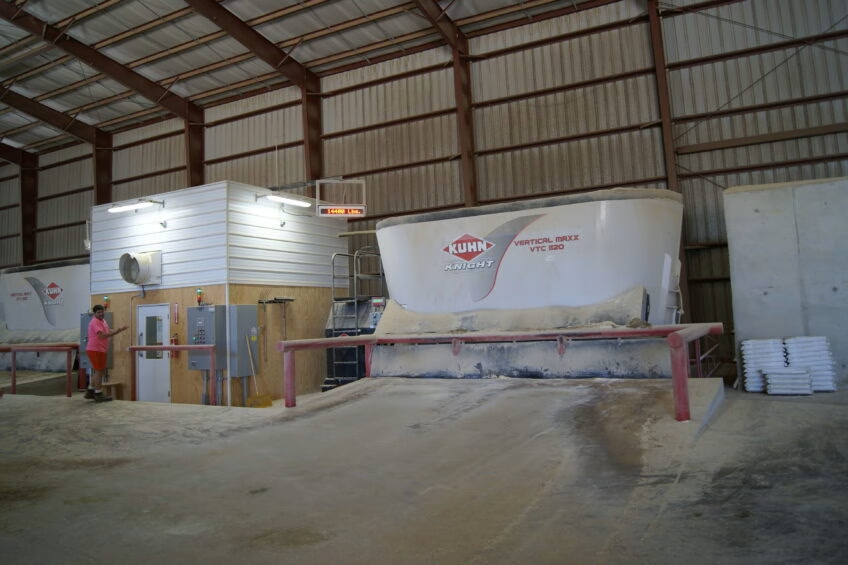
Another option is to position the mixer at the end of the feed center for direct loading. The mixer is typically recessed below floor level to help with offloading accuracy and provide better visibility for the operator—much like how a parallel parlor pit offers better visibility of udders compared to a flat barn arrangement.

Some farms automate commodity ingredients from overhead bins to reduce payloader hours. These ingredients go directly into the batch box or mixer, along with forages added by a payloader, creating the perfect sync between automation and manual labor.

One operation that implemented these improvements reported dramatic efficiency gains: “We used to need eight employees and four mixer wagons running 24-7 to feed all our dairy animals. Now it only takes two mixer wagons, three feeders, and nine hours to feed.”

That’s like cutting milking time from 8 hours to 3 hours while maintaining the same cow numbers—a game-changing improvement in labor efficiency when every dairy is struggling to find qualified workers.

The Automation Revolution: While You’re Still Loading by Hand, Your Competition Is Automating

As labor availability becomes more challenging and the benefits of precision feeding increase, automated feeding systems are gaining popularity in progressive dairy operations—moving from “nice to have” to “need to have” status, much like robotic milking systems have in regions with severe labor shortages.

Companies including GEA, Lely, AMS Galaxy, and Trioliet now offer robotic feeding systems that mix and deliver feed to cow groups multiple times daily without constant human oversight.

Are you still treating your feed center like it’s the 1990s while your competitors embrace 2025 technology?

These systems typically consist of:

  • A mixing and feeding robot (MFR)
  • A feed ingredient storage and mixing area (feed kitchen)
  • A programmed route from the feed center to the pens

By delivering smaller amounts of feed more frequently throughout the day and night, these systems keep feed fresher and help prevent sorting and overconsumption by cows, supporting proper rumen pH and digestive function. Depending on the farm layout, a single MFR can typically handle between 500-700 cows.

Even without full robotic implementation, partial automation delivers significant benefits:

  • Reduced labor requirements in a tight farm labor market
  • Improved accuracy in ration formulation, improving component tests
  • Consistent mixing times eliminating variation between shifts
  • Better inventory management, cutting carrying costs
  • Detailed data collection supporting your nutritionist’s decisions

Jeff Salfer, University of Minnesota Extension dairy educator, points out that “feed costs account for nearly 40% to 50% of the total operating budget.” Even if you saved just $0.10 per day per cow on a 2,000-cow dairy through improved automation, that would lead to savings of $73,000 annually.

Feed management software can monitor key metrics like ingredient usage, shrink, mixing times, and ration accuracy—providing valuable data for optimization like how your DairyComp or PCDart system tracks milk production metrics.

The FEEDS Principle: What Elite Dairy Producers Know (That Average Producers Don’t)

When designing a feed center, industry experts recommend thinking of “FEEDS”—an acronym for five essential principles that separate top-performing dairies from those struggling to maintain cash flow:

Flexibility A sound system allows for easy changes in feeding practices or rations. Avoid getting locked into a system that permits only one feeding approach. Planning for expansion is critical, as is providing alternative methods to keep feeding even when components are out of service.

Economy This isn’t about being cheap—it’s about implementing the lowest-cost combination of components that delivers effective performance with minimal wastage. Take a total cost of ownership approach, considering long-term operational expenses alongside initial investment. This is like how the cheapest used TMR mixer is rarely the most economical when repair costs exceed the payment on a new one.

Ease of Operation The steps and machinery required to feed should be convenient and straightforward. A good test: “How easy is it to explain how to feed my cows to someone else?” Simple, intuitive systems reduce training time and minimize errors—crucial in an industry where turnover and training opportunities are limited.

Dependability As mechanization increases so does the potential for breakdown and repair costs. Simplicity is key in system development. Equipment reliability directly impacts feed delivery consistency—a critical factor in maintaining animal health and production. Missing even one feeding due to equipment failure can drop production by 5-10 pounds per cow, which may never fully recover in that lactation.

Safety: A well-designed system keeps hazards and risks to a minimum. Work injuries result in lost productivity, emotional trauma, and unplanned costs. Safety considerations must be integrated into every design aspect, particularly in an environment where heavy equipment, livestock, and time pressure create inherent risks.

The Bottom Line: Is Your Feed Center a Profit Center or a Money Pit?

Your feed center isn’t just infrastructure—it’s a crucial control point for your dairy’s profitability, as important to your operation’s success as your milking facility or reproduction program. The strategies outlined here aren’t theoretical—they’re being implemented by forward-thinking producers right now, with documented results showing six and even seven-figure annual returns.

When was the last time you critically evaluated your feed center’s true cost to your operation? Are you still accepting “normal” levels of feed shrink that the industry accepted decades ago?

When planning your next feed center upgrade or evaluating your current setup, focus on these key principles:

  1. Think Systems, Not Components: Recognize the feed center as interconnected. Choices regarding storage methods, mixing technology, and automation affect one another, just as your milking system, cooling equipment, and cow flow are interconnected parts of your milk harvest strategy.
  2. Plan Proactively: Address not only current needs but anticipate future growth. Design for flexibility and scalability, like how top producers build free stall barns with expansion in mind rather than maximizing current space.
  3. Calculate Total Cost of Ownership: Evaluate investments based on long-term value, not just initial price. Consider lifetime operational costs- labor, energy, maintenance, and potential feed losses—the same way you’d evaluate robotic milkers against parlor systems.
  4. Optimize Layout for Flow: Design for efficient workflow, minimizing travel time and energy use while maximizing safety. This is like optimizing cow traffic patterns to reduce walking distance and social stress.
  5. Build in Compliance: Integrate safety, biosecurity, and environmental protection into the core design rather than addressing them later.
  6. Measure to Manage: Incorporate systems for monitoring key performance indicators to drive continuous improvement, treating your feed center metrics as important as your milk production and reproduction records.

FEED SHRINK SELF-ASSESSMENT CHECKLIST

  • Are your commodity bays protected from wind and precipitation?
  • Do you have accurate scales for receiving and loading?
  • Is your facility designed for easy first-in, first-out ingredient rotation?
  • Have you calculated your actual shrink percentage by ingredient?
  • Do you track load accuracy and mixer consistency?
  • Is traffic flow optimized to minimize handling and travel distance?
  • Do you have systems to capture feed dust rather than lose it?
  • Are your operators trained on proper loading techniques?
  • Have you evaluated automation options for your highest-cost ingredients?
  • Do you regularly maintain and calibrate scales and mixing equipment?

The most successful dairies treat their feed centers as strategic assets worthy of careful planning and investment—not just places to store expensive ingredients until they’re fed.

What’s your next move? Start by calculating your current shrink rate and estimating its cost. Challenge those “normal” industry benchmarks that too many producers accept without question. Then, consider how strategic improvements in your feed center design might affect your butterfat test, component premiums, and overall Income Over Feed Cost. The numbers often tell a compelling story that decides to upgrade the obvious.

Dr. Mike Brouk of Kansas State University puts it bluntly: “A 500-cow dairy with an annual feed cost of $7.50 per cow per day could potentially gain $50,000 or more each year, reducing shrink by just 4%.” Compare that to milk production: capturing the same $50,000 from milk price alone would require an additional 32 cents per cwt for the year or squeezing out another 1.61 pounds of milk per cow per day.

With feed accounting for 50-60% of your total expenses, your feed center provides the foundation for economic success or failure. Is yours built to support your herd’s genetic potential, or is it the bottleneck preventing you from hitting those 25,000-pound herd averages and maximal component premiums?

The time has come to stop accepting outdated feed center designs as “good enough” and demanding the same feed handling innovation that we’ve embraced in genetics, reproduction, and milk harvesting. Your bottom line depends on it.

Learn more:

Join the Revolution!

Join over 30,000 successful dairy professionals who rely on Bullvine Daily for their competitive edge. Delivered directly to your inbox each week, our exclusive industry insights help you make smarter decisions while saving precious hours every week. Never miss critical updates on milk production trends, breakthrough technologies, and profit-boosting strategies that top producers are already implementing. Subscribe now to transform your dairy operation’s efficiency and profitability—your future success is just one click away.

NewsSubscribe
First
Last
Consent

Send this to a friend



