Archive for Farm succession planning

The $228,000 Exit Strategy Reshaping Dairy: Inside the 55% Surge in Strategic Bankruptcies

Dairy farmers found a way to keep $228K that would go to the IRS. It’s legal, it’s smart, and bankruptcies are up 55%. Here’s how.

EXECUTIVE SUMMARY: Dairy farmers have discovered that filing bankruptcy can net them $228,000 more than selling their farms outright—and 259 operations did precisely that in the past year, driving a 55% surge in Chapter 12 filings. The catalyst is Section 1232, a 2017 tax provision that treats capital gains as dischargeable debt, turning a $285,600 IRS bill into just $57,120 for a typical Wisconsin farm sale. These aren’t failures but strategic exits by producers facing 8% interest rates and margins squeezed to breakeven who see no point grinding through more unprofitable years. While this tax-advantaged bankruptcy helps retiring farmers preserve decades of equity building, it’s fundamentally reshaping the industry. Young farmers without inherited land face nearly insurmountable entry barriers, and production is rapidly consolidating in states like Texas, where operations compete on efficiency rather than land appreciation. The result: bankruptcy has become a financial planning tool as strategic as any breeding decision or ration formulation.

Strategic Farm Bankruptcy

You know, when the University of Arkansas Extension released their recent data showing 259 dairy farms filed for Chapter 12 bankruptcy between April 2024 and March 2025—that’s a 55% jump from the previous year—most of us in the industry took notice. But here’s what’s really interesting: the more I dig into these numbers, the more I’m seeing something unexpected happening out there.

Many of these filings don’t look like the desperate collapses we’ve seen before. Not at all. What we’re actually witnessing is strategic financial planning, and it all ties back to a 2017 tax law change that most of us didn’t pay much attention to when it passed.

Now, let me be clear about something important: these aren’t wealthy farmers gaming the system. Most of these operations are facing real financial pressure—margins have been squeezed to breakeven or worse for many producers. When you combine operating loan rates jumping from 3% to nearly 8% (Federal Reserve Bank of Chicago data), input costs that never came back down after their spike, and milk prices that the USDA reports are back at 2018-2019 levels, a lot of operations are genuinely struggling. The difference is that Section 1232 gives them a strategic exit option that preserves more value than grinding it out for another few unprofitable years would.

“I’ve milked cows for 35 years. I’m not failing—I’m choosing the smartest path forward for my family with the rules as they exist. If that means using bankruptcy court to maximize our retirement after decades of 4 a.m. milkings, I’m at peace with that decision.” — Wisconsin dairy farmer preparing for strategic Chapter 12 filing.

Follow the data-driven rise in strategic dairy bankruptcies that reframes exit planning as financial optimization FY2023-FY2025. This visual doesn’t just inform—it electrifies: bankruptcy isn’t defeat, it’s savvy planning!

What’s Actually Happening with These Numbers

So let me share what I’ve been learning about the current situation. You probably know this already, but today’s economic are fundamentally different from previous downturns. Back in 2019, when USDA’s Economic Research Service documented 599 Chapter 12 filings nationally, we all understood what was happening—milk prices had absolutely tanked, and those trade wars were killing our export markets. It was straightforward and brutal.

Today? Well, it’s more nuanced. Ryan Loy from the University of Arkansas’s Division of Agriculture puts it well—commodity prices have basically returned to those 2018-2019 levels, yet our input costs…they never came back down. Fertilizer, feed, diesel—they’re all still elevated, and we’re all feeling that squeeze.

But here’s what’s really changed the game for a lot of operations: interest rates. The Federal Reserve Bank of Chicago’s agricultural finance data shows operating loan rates essentially doubled between 2021 and 2023. We went from around 3% to nearly 8% by mid-2025.

And if you’re like many producers who expanded with variable-rate financing when money was cheap…well, you know exactly what that means for your monthly payments.

The regional patterns we’re seeing are worth noting too:

  • First quarter 2025 brought us 88 Chapter 12 filings nationally—that’s nearly double Q1 2024’s 45 filings
  • Arkansas went from 4 filings in 2023 to 25 in 2025—that’s quite a shift
  • Michigan moved from zero in 2023 to 12 in 2024
  • Wisconsin, as many of you know, lost another 400 operations in 2024, bringing them down to 5,348 licensed herds

Understanding Section 1232 and Why It Matters

Now, here’s where things get particularly interesting—and if you haven’t heard about this yet, you’ll want to pay attention even if bankruptcy’s the last thing on your mind.

Remember the Supreme Court’s Hall v. United States case back in 2012? Lynwood and Brenda Hall sold their farm for $960,000 during bankruptcy, triggered about $29,000 in capital gains taxes, and the court basically said, “you’ve got to pay that in full before we’ll approve your reorganization plan.” It made Chapter 12 pretty much useless for anyone with appreciated land.

Well, Senator Chuck Grassley from Iowa—he’s been a friend to agriculture for years—pushed through the Family Farmer Bankruptcy Clarification Act in October 2017. This added Section 1232 to the bankruptcy code, and honestly, it’s a game-changer.

Dr. Kristine Tidgren, who runs Iowa State’s Center for Agricultural Law and Taxation, explained this really well in her 2020 analysis. Unlike Chapter 11 bankruptcies, where you’d have to pay capital gains in full, Chapter 12 now treats those tax obligations as general unsecured debt. That means they can potentially be discharged—either partially or sometimes entirely—through your reorganization plan.

Let’s Walk Through the Math Together

So here’s a real-world scenario using Wisconsin farmland values from the USDA’s August 2025 data. Say you’re a producer who purchased 200 acres in 2005 for $2,000 an acre—pretty typical for that time. According to the Wisconsin Realtors Association, that same ground’s worth about $8,000 an acre today.

Traditional Sale (Outside Bankruptcy):

ItemAmount
Sale proceeds$1,600,000
Capital gain$1,200,000
Federal capital gains tax (20%)$240,000
Net investment income tax (3.8%)$45,600
Total tax to IRS$285,600
Net proceeds after tax$1,314,400

Strategic Chapter 12 Filing with Section 1232:

ItemAmount
Sale proceeds$1,600,000
Tax becomes unsecured debt$285,600
Payment to unsecured creditors (20%)$57,120
Tax savings$228,480
Net proceeds$1,542,880

See how Section 1232 flips the tax equation for dairy producers: from IRS bill to retirement nest egg—making Chapter 12 a strategic tool. This isn’t just about bankruptcy—this is smarter farm succession!


Scenario
Sale ProceedsTotal Tax PaidNet ProceedsStrategic Tax Savings
Traditional Sale$1,600,000$285,600$1,314,400$0
Chapter 12 w/ Section 1232$1,600,000$57,120$1,542,880$228,480

Now, that’s real money. And when you’re looking at those numbers…it makes you think differently about what bankruptcy means, doesn’t it?

The Wisconsin Story: It’s Not What Most People Think

Mike Vincent, the ag economist at UW-Madison’s Extension, shared something with me that really stuck: “The biggest issue we’re facing is that the farmers are retiring.”

And you know what? The data backs him up completely.

In 2020, UW-Madison and USDA NASS conducted the Dairy Farm Transition Survey. What they found was eye-opening—17% of Wisconsin dairy farms said they wouldn’t be milking within five years.

For smaller operations — those with under 100 cows — the number jumped to 22%. And here’s the kicker: only 40% of Wisconsin dairy farmers had identified someone to take over the operation.

So when Mike says he’s not surprised by these closure numbers, he’s got a point. Many of these aren’t panic exits at all. They’re planned transitions that just happen to coincide with bankruptcy provisions that make Chapter 12 filing financially smart.

I was talking with a producer up in Shawano County recently—been milking for 35 years, profitable most years, but his kids aren’t interested in taking over. His land’s worth four times what he paid for it. He asked me straight up: “Why would I leave $200,000 on the table for the IRS when I could use that for my retirement?”

And honestly? I couldn’t give him a good reason not to consider it.

Who Benefits and Who Doesn’t—The Regional Differences

What’s fascinating is how differently this plays out across regions. According to USDA NASS’s August 2025 land value data, if you’re farming in Iowa, where land’s averaging $10,200 an acre, or Illinois at $9,850, or certain parts of Wisconsin ranging from $6,800 to $18,500…well, you’ve got options that other producers don’t.

The National Agricultural Law Center’s been tracking filing patterns, and they’re seeing it’s mostly farmers over 60 planning retirement, operations needing to downsize—maybe from 300 cows to 150 or 200—and family farms where the next generation just isn’t interested in continuing.

But here’s the thing: if you’re running a modern operation in Texas or New Mexico, where most producers lease their ground—Texas A&M AgriLife Extension reports the average operation there leases about 70% of their cropland—this doesn’t help you at all. Same story if you bought land recently, or if you’re in a state like New Mexico where USDA data shows land’s only worth about $725 an acre.

A Texas producer I know who’s managing 2,100 cows near Amarillo put it pretty bluntly: “We compete on production efficiency, not land equity. This Section 1232 stuff means nothing to us.” And she’s absolutely right—it’s a completely different business model.

Now, in the Northeast, it’s another story entirely. Vermont and New York operations often sit on land that’s appreciated significantly due to development pressure, but they also face some of the highest production costs in the country.

A producer from St. Albans, Vermont, told me recently that while his land’s worth more than ever, the combination of labor costs and environmental regulations means he’s still weighing whether strategic bankruptcy makes sense compared to a traditional sale.

A Young Farmer’s Perspective

I recently connected with Jake Martinez, a 29-year-old who started a 180-cow operation in central Minnesota in 2022. His take on all this was eye-opening.

“I’m watching neighbors who’ve been farming for 40 years walk away with tax-free gains while I’m trying to scrape together enough for a down payment on 80 acres,” Jake told me. “Don’t get me wrong—they earned it. But for someone like me trying to build something from scratch? The entry barriers just keep getting higher.”

Jake’s financing his expansion through custom heifer raising and a small on-farm cheese operation. “I can’t compete on land acquisition,” he explained. “So I’ve got to find other ways to build equity. Direct marketing, value-added production—that’s where young farmers like me have to look for opportunities.”

His perspective highlights something important: while Section 1232 helps retiring farmers maximize their exit value, it’s creating an even wider gap for the next generation trying to get started.

How Word Is Spreading Through the Industry

What’s really accelerated this trend is the education happening through agricultural networks. The National Agricultural Law Center at the University of Arkansas reported in its FY2024 annual report that it hosted 16 webinars attended by over 2,400 people. Sessions on agricultural bankruptcy and debt management are drawing standing-room-only crowds at farm conferences these days.

Joe Peiffer, who runs Ag & Business Legal Strategies in Iowa—he grew up on a Delaware County dairy farm himself—has been particularly vocal about this. He makes a good point: “The producers who are decisive and adapt to changing conditions have the best opportunity to remain viable.”

There’s also Russell Morgan, an agricultural consultant in Arkansas, who’s been working with Chapter 12 trustee Renee Williams to educate Mid-South farmers. I heard their April 2025 webinar drew a huge crowd—dairy and row crop producers all trying to understand their options.

What the Lenders Are Thinking

Now, you might wonder what lenders think about all this. Bob Mikell from AgSouth Farm Credit shared some interesting thoughts at the recent Mid-South Agricultural and Environmental Law Conference.

He basically said they’d rather see a farmer successfully reorganize through Chapter 12 than lose everything in foreclosure. If Section 1232 helps someone right-size their operation and keep farming, he sees that as better for everyone involved.

That’s not universal, of course. Some commercial banks aren’t thrilled about strategic Chapter 12 filings by solvent borrowers. But the Farm Credit System—they hold about 47% of total farm real estate debt according to USDA’s Economic Research Service—seems to be taking a pretty pragmatic approach to the whole thing.

Looking North: How Canada Does Things Differently

It’s worth comparing our situation to what’s happening in Canada, because it really highlights the trade-offs we’re dealing with. Statistics Canada shows Canadian dairy farms maintain debt-to-asset ratios around 0.191—that’s about half what we typically see in comparable U.S. operations. Bankruptcies? They’re basically non-existent up there.

While we’re dealing with volatility and needing various support programs, their supply management system provides built-in stability. But—and this is a big but—that stability comes at a cost. Canadian Dairy Commission data from November 2024 shows quota costs running CAD $24,000 to $58,000 per cow’s worth of production capacity. A typical 100-cow operation needs $3-5 million just in quota before they buy their first animal. And consumers? They’re paying CAD $1.07 per liter for milk.

Meanwhile, we’ve got the freedom to expand and chase export markets. U.S. Dairy Export Council data shows we hit $8.22 billion in exports in 2024. But with that freedom comes the volatility that’s driving these bankruptcy patterns we’re seeing.


Country/Region
Entry BarrierProducer Age (avg)Bankruptcy IncidenceMilk Price (USD/L)Export RatioKey Challenge
Canada (Quota)$30,000/cow quota55+Rare$0.80-1.10<10%High startup cost
USA (Free Market)$400,000+ down60+Up 55% (2024)$0.40-0.6015%+Volatility, consolidation
Texas/Idaho (Efficiency)Leased land, $250K+ equity50-58Low, not equity-driven$0.40-0.5520%+Scale, tech adoption

The Personal Side of These Decisions

I think it’s important to acknowledge something here: not everyone’s comfortable with strategic bankruptcy, even when the math makes perfect sense.

A producer from Fond du Lac County recently told me that his grandfather would “roll over in his grave” if he filed for bankruptcy, regardless of the circumstances. “In his day, you paid your debts, period.” That sentiment’s real, and it matters in our communities.

At the same time, Jamie Dreher from Downey Brand LLP made a good point at the Western Water, Ag, and Environmental Law Conference this past June. Congress designed Section 1232 specifically to help farmers transition without getting crushed by tax obligations. Using a tool that was created for your exact situation? There’s no shame in that.

It’s a deeply personal decision. There’s no right answer that works for everyone’s values and circumstances.

Where This Is All Heading

Looking ahead, several trends are becoming pretty clear. Dr. Ani Katchova at Ohio State’s Department of Agricultural, Environmental, and Development Economics thinks that by 2030, strategic bankruptcy planning might become just another standard option we discuss in farm transition planning, right alongside traditional succession strategies.

We’re likely to see continued geographic consolidation. States with high land values will keep seeing farms exit through tax-advantaged bankruptcy, with that land flowing to the remaining large operations.

Meanwhile, production’s going to keep concentrating in states like Texas and Idaho, where operations focus on efficiency rather than land equity. USDA data shows Texas already surpassed Idaho as the number three milk-producing state in 2025—they’ve grown 190% since 2001.

For young farmers trying to get started? It’s getting tougher. Iowa State’s Beginning Farmer Center reports that the traditional path—building wealth through dairy excellence over 20-30 years—is becoming nearly impossible in high-land-value regions.

Practical Thoughts for Producers

If you’re weighing your options, here’s what I’d suggest thinking about.

First, really understand your complete financial picture. Not just your cash flow, but your land equity position too. The Federal Reserve has some good agricultural finance calculators that can help you see how interest rate changes affect your debt service.

And honestly consider whether downsizing might actually strengthen your operation’s viability.

Get professional advice early—and I mean early, not when you’re in crisis mode. Find agricultural financial advisors who understand Chapter 12 provisions. IRS Publication 225 has farmer-specific guidance that’s worth reading regardless of what you decide.

Consider all your restructuring options:

  • Traditional refinancing might work
  • Maybe partial asset sales make sense
  • Strategic Chapter 12 filing could be right if your situation aligns
  • Or planned succession—even if it’s not to the family—might be the answer

And recognize that the landscape has fundamentally shifted. Higher interest rates have changed the game. Strategic downsizing isn’t failure—it’s adaptation. If you’ve been farming for decades and you’re ready to retire, that’s an achievement, not a defeat.

For younger farmers and those looking to expand, the playbook’s different. In regions where land values are not appreciating, excellence in milk production remains your primary path. Think about lease-based expansion models that don’t tie up all your capital in land. Look at emerging dairy regions where entry costs are still manageable.

You’ve got to plan for different wealth-building strategies now. Land appreciation might not provide what it did for previous generations. Consider diversifying income streams beyond traditional dairy production. Value-added processing, direct marketing—these might be where your opportunities are.

The Bottom Line

What we’re discovering about Chapter 12 bankruptcy reflects broader changes in American agriculture that we’re all navigating together. That provision Congress passed in 2017 to help struggling farmers? It’s evolved into something more complex—a financial planning tool that rewards strategic thinking about asset management as much as farming excellence.

Is that good or bad? Honestly, it depends on your perspective. For farmers who’ve built substantial equity over decades, Section 1232 provides a path to capture that value as they transition out. For communities, it can mean orderly succession instead of crisis liquidation.

But it also highlights some uncomfortable truths about modern dairy economics. When tax-advantaged bankruptcy can be more profitable than continuing to milk…when land ownership matters more than production efficiency…well, we’ve got to ask ourselves some fundamental questions about where the industry’s headed.

The 55% surge in Chapter 12 bankruptcies isn’t simply a crisis or a loophole. It’s farmers adapting to new economic realities with the tools available. Understanding these tools—how they work, what they mean, when they make sense—that’s going to be essential for anyone navigating dairy’s evolving landscape.

As that Wisconsin producer preparing for a strategic Chapter 12 filing told me: “I’ve milked cows for 35 years. I’m not failing—I’m choosing the smartest path forward for my family with the rules as they exist. If that means using bankruptcy court to maximize our retirement after decades of 4 a.m. milkings, I’m at peace with that decision.”

That sentiment—practical, unsentimental, focused on optimal outcomes—pretty much captures how American dairy farmers are approaching this transformation. The old stigmas about bankruptcy? They’re fading. What’s replacing them is a new pragmatism where strategic financial planning matters as much as picking the right bull for your breeding program or getting your ration formulation dialed in.

For better or worse, that’s the new reality we’re dealing with. And understanding it? That might just be the difference between thriving and merely surviving in the years ahead.

KEY TAKEAWAYS:

  • The $228,000 Opportunity: Section 1232 transforms Chapter 12 bankruptcy into a tax-saving tool—farmers selling 200 acres can keep $1.54M versus $1.31M in traditional sales by discharging capital gains taxes as unsecured debt
  • Strategic, Not Crisis: The 55% bankruptcy surge represents planned exits by farmers facing 8% interest rates and compressed margins, not business failures—these are profitable operations choosing smart transitions
  • Winners and Losers: Benefits farmers 60+ with appreciated land in high-value states (Iowa: $10,200/acre); offers nothing for lease-based operations or young farmers trying to enter
  • Timing Is Everything: This strategy requires filing bankruptcy BEFORE selling land—farmers should consult specialized ag attorneys early, not wait for a crisis
  • Industry Transformation: This trend accelerates dairy’s shift from land-wealth to operational efficiency, with production consolidating in states like Texas, where success depends on milk per cow, not land appreciation

Editor’s Note: This article draws on interviews with dairy producers across Wisconsin, Arkansas, Iowa, Texas, Minnesota, and the Northeast conducted between September and October 2025. Some producers requested anonymity to discuss sensitive financial matters candidly.

Complete references and supporting documentation are available upon request by contacting the editorial team at editor@thebullvine.com.

Learn More:

  • The Ultimate Guide to Dairy Farm Succession Planning – While the main article explores bankruptcy as a final exit strategy, this guide provides a proactive roadmap for a successful farm transition. It details strategies for communication, financial structuring, and legal planning to preserve the family legacy and business continuity.
  • Decoding Dairy’s Crystal Ball: Top 5 Economic Trends Producers Must Watch – This strategic analysis dives deep into the market forces—like interest rates and input costs—driving the financial pressures mentioned in the main article. It provides critical context for anticipating market shifts and positioning your operation for long-term resilience.
  • Beyond the Bulk Tank: How Value-Added Dairy Is Creating Bulletproof Businesses – For producers seeking alternatives to the land-equity model, this article reveals how to build a more resilient business through direct marketing and on-farm processing. It offers a tangible path for young farmers to build equity and insulate their profits from commodity volatility.

Join the Revolution!

Join over 30,000 successful dairy professionals who rely on Bullvine Weekly for their competitive edge. Delivered directly to your inbox each week, our exclusive industry insights help you make smarter decisions while saving precious hours every week. Never miss critical updates on milk production trends, breakthrough technologies, and profit-boosting strategies that top producers are already implementing. Subscribe now to transform your dairy operation’s efficiency and profitability—your future success is just one click away.

NewsSubscribe
First
Last
Consent

The 20-Million-Ton Question: Why 2026 Will Determine Whether Your Dairy Thrives, Scales, or Strategically Exits

Dean Foods: Gone. Borden: Gone. Your local processor: Probably next. What every dairy farmer needs to know about 2026

EXECUTIVE SUMMARY: While Santiago’s dairy leaders celebrate a coming 20-million-ton shortage, 83.5% of farm kids are walking away from free operations—and the math explains why. Operating costs rising 3% annually, sustainability compliance accelerating ensus of Agriculture came out in5% yearly, but milk prices growing just 1% means that a $900,000 net income becomes a $540,000 net income within a decade. Add $54,750 for methane additives, processor consolidation, and operations requiring 1,260 cows just to reach the median scale, and the structural disadvantages are clear. Dean Foods and Borden’s bankruptcies preview the consolidation ahead in the processor industry, leaving producers with fewer buyers and less negotiating power. The next 24 months will determine whether you scale big, pivot to premium, or preserve wealth through a strategic exit—because waiting costs thousands in annual retirement income.

Future of Dairy Farming

You know that feeling when milk prices hit $22.60 per hundredweight and everyone starts talking expansion?

Let’s talk about what really came out of Santiago this week.

The International Dairy Federation is holding its World Dairy Summit this week—the first time in South America in 123 years—which is noteworthy, and the projections deserve a closer look. They’re talking about a 20-30 million ton global demand gap by 2035. IDF President Gilles Froment kept emphasizing “authentic collaboration” during his keynote, and that’s all well and good, but here’s what’s interesting…

When you examine these numbers alongside what’s actually happening on farms—I’ve been talking with producers from Vermont to California—some patterns emerge that suggest certain operations are going to capture value while others might struggle. These deserve a closer look.

And it’s not necessarily about who’s the better farmer.

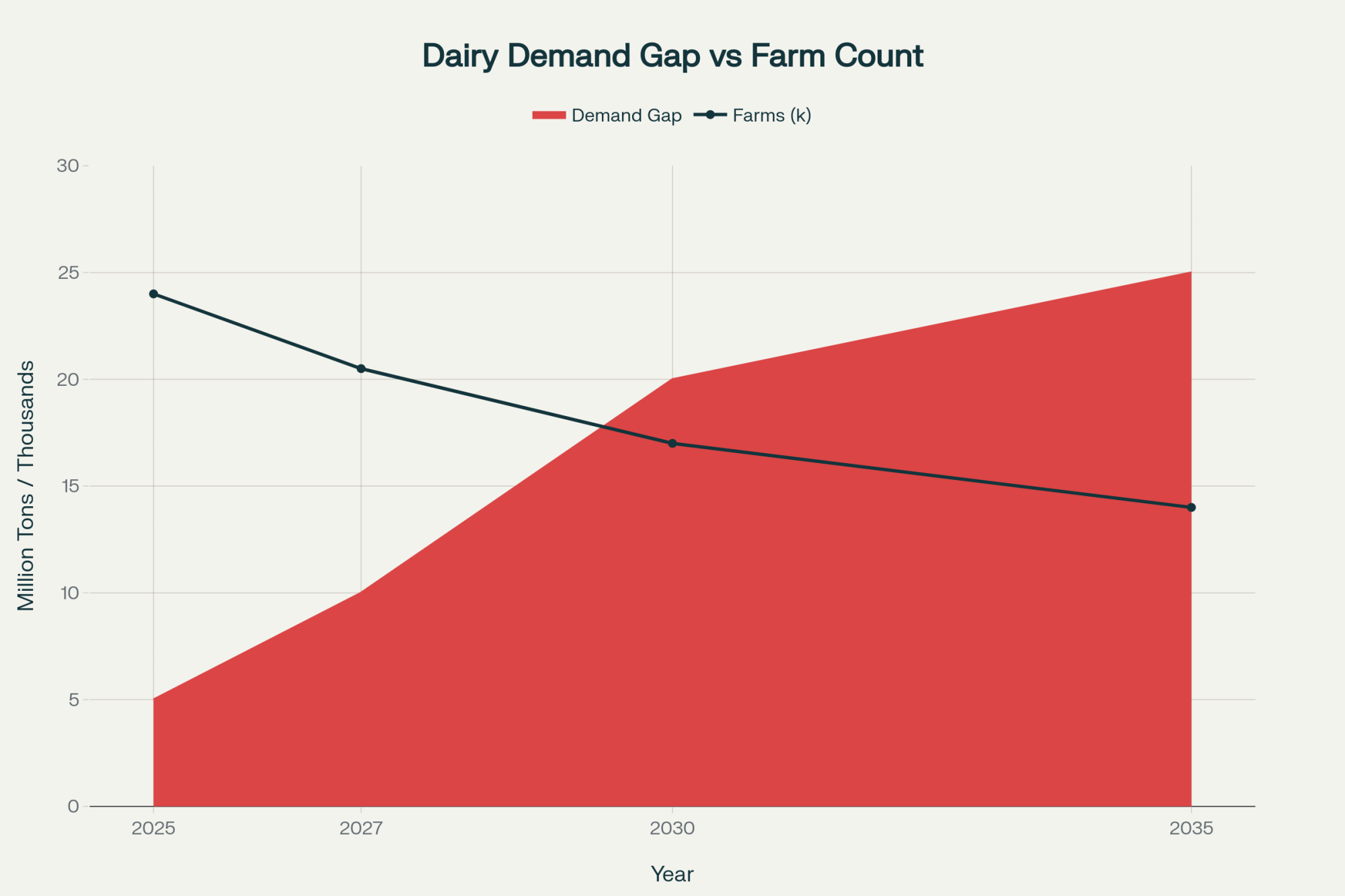
Santiago’s celebrating a 25-million-ton shortage by 2035. But here’s what they’re not saying: only 14,000 U.S. farms will be left to capture that opportunity.

The Demand Gap: Real Opportunity or Something Else?

So this 20-30 million ton shortage everyone’s excited about—IDF’s analysis backs it up, USDA shows 11% consumption growth through 2030, and yeah, the demand’s real.

But here’s the thing: where’s the production going to come from?

Current production reality:

  • U.S. milk production: growing at just 0.9% annually (you’ve probably seen the NASS reports)
  • Europe: basically flat (Brussels keeps confirming this)
  • New Zealand: hitting environmental limits (their Ministry’s been pretty clear about that)

Even with the USDA predicting a milk price of $22.60, with room to grow, who actually benefits here isn’t as straightforward as you’d think.

Consider what DFA’s been doing. They marketed 65.5 billion pounds in 2021—that’s about 29% of all U.S. milk according to their annual reports. When you control processing, ingredients, export channels… you’re capturing value at every step.

Meanwhile, if you’re an independent producer shipping to whoever takes your milk that week, it’s a different game entirely.

And here’s something that really caught my attention: the Class III versus Class IV spread is $2.86 right now—widest we’ve seen since 2011 according to AMS data.

You know what that means? If you’re shipping to cheese plants in Wisconsin, you’re banking thousands more monthlythan your cousin in California selling to butter-powder operations. Same cows, same feed quality, same parlor management… but processor relationships determine who’s making money.

That’s not exactly what they teach in dairy science programs, is it?

Sustainability Costs: The Bill’s Coming Due

The Paris Declaration on Dairy Sustainability—signed by 53 countries, representing 46% of global production—changed the conversation from “wouldn’t it be nice” to “here’s your compliance timeline.”

And the costs… well, let me walk you through what producers are actually facing.

Bovaer methane additives: DSM’s been transparent about pricing at about $0.30 per cow per day. For 500 cows, that’s $54,750 annually. Just for the additive, nothing else.

Thinking about digesters? European Joint Research Centre research puts installation between €250,000-€275,000, and here’s what nobody mentions—you need about 35-40 kilowatt hours per kilogram of nitrogen for processing, which means solar panels or you’re burning through your savings on electricity.

Ben & Jerry’s ran this pilot with seven Vermont farms—the smallest had 60 cows, the biggest just under 1,000. They got 16% emissions reduction, which sounds great until you realize the company paid for everything. Staff time, equipment upgrades, robotic feed pushers… their published report basically says farmers can’t afford this without support.

At least they’re honest about it.

Now, California’s doing something interesting. Their dairy methane program—the Air Resources Board tracks this closely—has achieved impressive results:

  • 5 million tons of CO₂ equivalent are reduced annually
  • $522 million in private investment since 2022
  • $9 per ton cost-effectiveness (beats other climate tech by 10-60 times)

But here’s why it works: programs like the Low Carbon Fuel Standard create actual revenue from methane reduction. You’re not just spending money; you’re making it.

Most states? They don’t have anything close. I’ve been talking with producers in Ohio, Texas, Iowa, and even Wisconsin, outside the renewable natural gas corridor. They’re staring at these costs with no revenue offset.

And California’s got its own challenges—SGMA water compliance is brutal. Some producers I know are converting to solar at a rate of $800-$ 1,200 per acre annually. Beats volatile feed margins when water’s scarce, though.

Consolidation: The Numbers Tell the Story

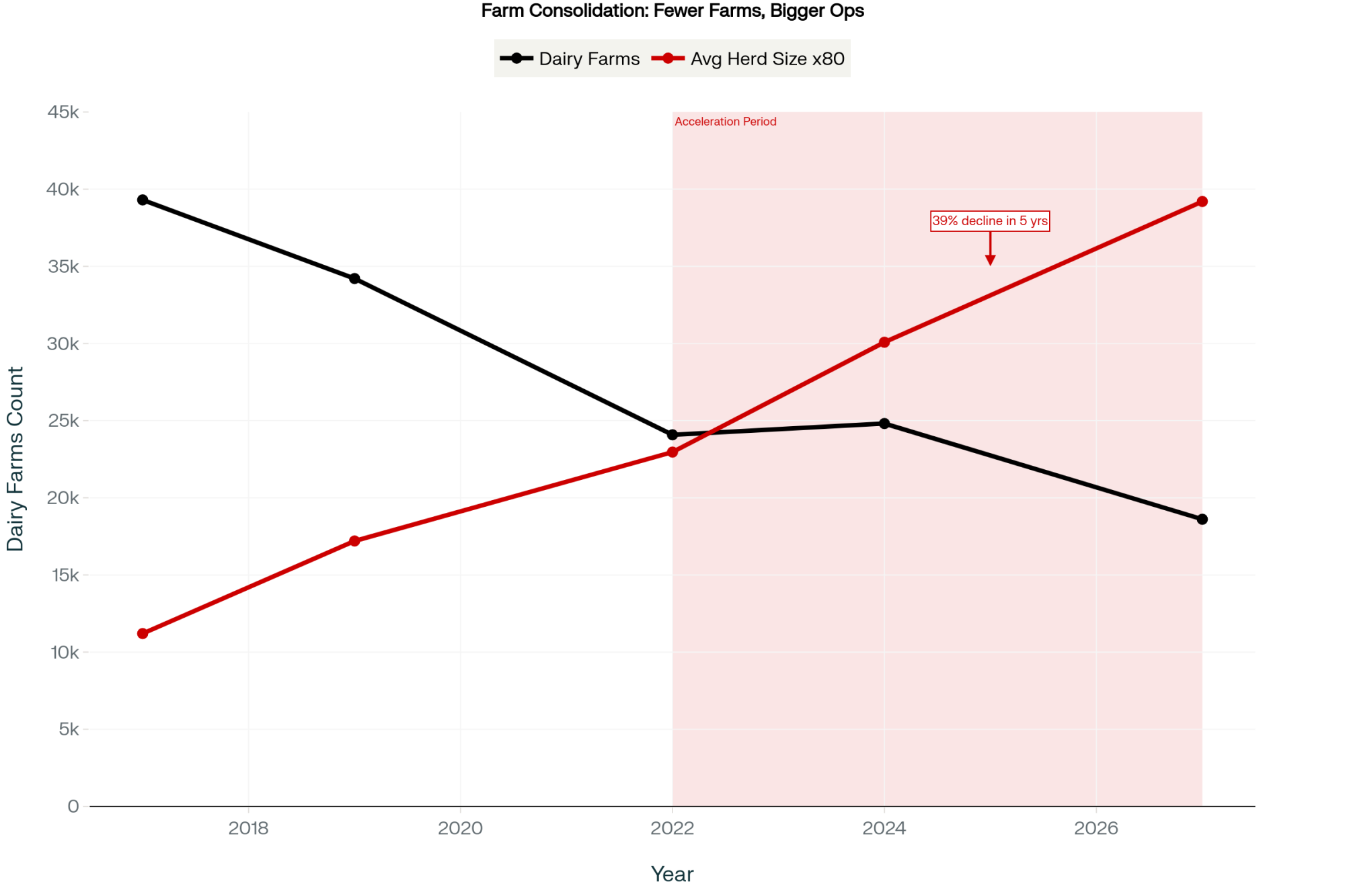
USDA’s Census of Agriculture came out in February, and the numbers are sobering.

The brutal math of dairy consolidation: 39% of farms vanished between 2017-2022, while average herd sizes nearly tripled.

The stark reality:

  • 2022: 24,013 dairy operations (down 39% from 2017)
  • Since 2012: 50% of farms have gone in a decade
  • Rabobank projection: Another 20-25% decline by 2027

But here’s what really tells the story—look at where the milk’s coming from according to USDA’s Economic Research Service:

Operations over 1,000 cows:

  • Now: Control 65% of the herd
  • 1997: Just 17%

Farms under 100 cows:

  • Now: 7% of production
  • 1997: 39%

Midpoint herd size:

  • 2021: 1,260 cows
  • 2000: 180 cows
The math doesn’t care about your family legacy
Herd SizeCost/cwtProfit at $22.60
100-199$23.06-$0.46
500$20.25$2.35
1,000$18.50$4.10
2,500+$13.06$9.54

And it’s not just about bulk feed purchases or spreading fixed costs, as many of us have seen. What I’m finding—especially visiting Wisconsin operations lately—is revenue diversification that smaller farms struggle to match.

These bigger operations are breeding 60% or more of their herds to Angus bulls. With beef crosses bringing $800-1,200 versus maybe $150 for dairy bulls, a 2,900-cow operation can generate millions extra annually just from calves.

Add in what they’re doing with:

  • Genetics sales internationally
  • Digester partnerships (companies like Vanguard Renewables)
  • Commercial grain operations on thousands of acres

It’s a completely different business model, honestly.

A 600-cow operation—and I know plenty of excellent managers at that scale—generally can’t tap those revenue streams. You don’t have the volume for direct feedlot contracts, digesters don’t pencil out, and international genetics buyers aren’t calling.

It’s not about management quality; it’s structural advantages that kick in above certain thresholds.

Why the Next Generation’s Walking Away

While 69% of farmers expect their kids to take over, only 16.5% of transitions actually succeed—and 71% haven’t even identified a successor.

Here’s a statistic that keeps me up at night: University of Minnesota Extension found that while 69% of farmers expectto pass the farm to their children, actual succession success is only 16.5%.

That 83.5% failure rate? It’s not because kids are soft or don’t appreciate farming. It’s math.

I’ve been helping young couples run the numbers using Wisconsin’s Farm Financial Standards—proper analysis, not back-of-the-envelope stuff.

Take a typical scenario:

  • 25-year-old with an ag degree
  • Parents running 500 cows
  • Normal debt loads
  • Year one: Maybe $900,000 net with current prices

Sounds good, right?

But factor in reality based on historical trends:

  • Operating costs: Rising 3% annually (that’s the 10-year average)
  • Sustainability compliance: Accelerating 5% yearly (as regulations tighten)
  • Milk prices: Maybe 1% growth if you’re lucky (20-year data shows this)

By year 10, That net income could drop 40% or more.

And that’s while working 60-70 hour weeks—you know how it is during calving season—carrying complete liability for over a million in debt.

Their college friends?

  • Ag lenders: Starting $58,000, reaching $90,000 within a decade (Bureau of Labor Statistics data)
  • Herd managers: $80,000-120,000 (based on industry surveys)
  • Benefits: Home for dinner, actual vacation time, no debt liability

Student loans make it worse—National Young Farmers Coalition says 38% of young farmers carry an average debt of $35,660. As folks at USDA’s Beginning Farmer Program keep pointing out, you’re already in debt before you even think about taking over the farm.

The math often doesn’t work. And honestly? Can you blame them for choosing differently?

Your Four Critical Decisions—Quick Reference

Decision 1: Can premium markets work for you? (6 months to figure out)

  • Within 100 miles of metropolitan markets with strong demographics
  • Need 50%+ equity to weather transition losses
  • Someone who actually wants to do marketing, not just milk cows
  • Reality: Losses years 1-3, break even 4-6, profit after year 7 (every transition study shows this)

Decision 2: Can you scale to 1,500+ cows? (12 months to secure financing)

  • Need $3-4.5 million capital (that’s current construction costs)
  • Current profits should exceed $400/cow for lender confidence
  • Debt under 30% of assets for favorable terms
  • Reality: $175,000-292,000 annual debt service at current rates

Decision 3: Are You Preserving or Bleeding Equity? (3 months to assess honestly)

  • Delaying exit while losing money costs thousands in retirement income
  • Declining working capital = converting equity to expenses
  • Continue only if genuinely cash flow positive

Decision 4: If exiting, how do you maximize value? (12-18 months to execute)

  • Best: Sell to expanding neighbor (92-98% value recovery)
  • Good: Liquidate herd, keep land for rent (85-90%)
  • OK: Convert to heifer raising (40-50% income reduction)
  • Fast: Complete auction (60-80% recovery)

Processors: The Other Consolidation Story

Dean Foods collapsed. Borden’s bankrupt. In the Upper Midwest, 90% of your milk goes to just two buyers—DFA or Prairie Farms.

The processor landscape changed dramatically with recent bankruptcies, as you probably know:

Dean Foods (November 2019)

  • Over $1 billion in long-term debt, according to bankruptcy filings
  • Combined revenues over $12 billion—just gone

Borden Dairy (January 2020)

  • Followed Dean into bankruptcy
  • Couldn’t compete with integrated processors

When Walmart built their Fort Wayne plant in 2018 and Kroger expanded private label… that was game over for traditional processor margins, honestly.

After Dean collapsed, DFA bought 44 facilities for $433 million—the DOJ tracked all this. Now, many upper Midwest producers basically have two buyers: DFA and Prairie Farms.

That’s not exactly competitive price discovery, is it?

What Europe’s showing us about what’s next:

  • Arla-DMK merger: Creates €19 billion giant
  • FrieslandCampina-Milcobel: Combines €14 billion
  • DMK’s reality: €24.6 million profit but negative €54.8 million cash flow in their FY2024 report

They’re burning reserves despite making operational profit. Their CEO’s been blunt with members: milk production’s declining, and they need scale to survive.

What’s this mean for us? Fewer buyers, less negotiating leverage, more dependence on whoever’s left standing.

And if you think that leads to better milk prices… well, I’ve got a bridge to sell you.

The Talk Every Farm Family Needs to Have

Here’s the conversation I’ve been coaching families through—and it needs real numbers, not hopes:

“Listen, we’ve got three realistic paths given where the industry’s heading.

Path one—go premium. Organic, processing, direct sales. That’s serious money upfront, losses for years according to every university study, and you’d basically be running a food company. Farmers markets every Saturday, Instagram all the time, dealing with customer complaints. That sound like the life you want?

Path two—scale up big. We’re talking millions in debt, managing 20+ employees, becoming a CEO instead of a farmer. HR headaches, safety meetings, and managing managers instead of cows. You ready for that?

Path three—we sell while we’ve got equity. You pursue your career without our debt. We preserve retirement funds. You can still work in dairy—plenty of good jobs—just not owning the risk.

What actually fits your vision for the next 40 years?”

When kids see real numbers, Iowa State’s research suggests that about 75% choose path three. They become nutritionists, agronomists, equipment specialists. Good careers using farm knowledge without the burden of ownership.

And given the economics? It’s often the smart choice.

What’s Actually Working Out There

Now, it’s not all challenges—I’m seeing some operations successfully thread the needle.

New York producers integrating processing are doing something interesting. Making specialty cheese and butter for NYC markets—one operation I visited is selling butter for $12 per pound in Manhattan. That vertical integration changes everything.

California cooperatives where smaller farms banded together before consolidation forced them, are now receiving premiums. Clover Sonoma’s a good example—27 farms averaging 350 cows each, all within 100 miles of their plant. They control their story and receive premium prices.

Vermont innovation through programs like AgSpark, is worth noting. Individually, a 400-cow farm can’t justify a digester. But three farms together? Now you’re talking viable scale. That’s real collaboration, not the “take whatever price we offer” kind.

Plains states are finding niches too. Custom heifer operations serving multiple dairies, spreading costs. Grazing dairies in Missouri are finding grass-fed markets that actually pay premiums.

Mid-Atlantic producers are leveraging proximity. Pennsylvania’s farmstead cheese operations are growing—being close to Philadelphia and Pittsburgh matters. Maryland producers supplying Baltimore and D.C. with local milk get decent premiums despite high land costs.

Even in the Southeast, despite cooling costs running $180-$ 200 per cow annually, I know operations that maximize component premiums. When your butterfat’s at 4.2% and protein is at 3.4%, you’re getting paid. It’s about finding what works for your situation.

Looking Ahead: The Industry Will Survive, But Will You?

The industry will absolutely meet that 20-30 million ton demand gap. Sustainability goals will be achieved. Global production will modernize.

But the structure doing it? Nothing like today’s.

Operations under 1,000 cows without premium markets, face increasingly challenging economics. Sustainability costs are rising, processor options are shrinking, and the next generation is making rational career choices.

It’s not about farming quality—it’s about structural realities nobody wants to discuss at industry meetings.

Those positioned to scale or differentiate have real opportunities, but execution has to be nearly perfect. I’ve seen too many half-hearted organic transitions fail. Expansions without multiple revenue streams just create bigger debt.

You need a complete strategy, not just hope.

The next 24 months look critical based on what I’m seeing. Processor consolidation’s accelerating—Rabobank says 2026 could see major shifts. Asset values may decline as more operations exit. Waiting usually means fewer options at lower values.

The Bottom Line: Your Choice to Make

Santiago’s summit revealed an industry transforming whether we’re ready or not.

The question isn’t if you’ll be affected—it’s whether you’ll choose your position or let circumstances choose for you.

Understanding these dynamics isn’t pessimistic—it’s getting clear-eyed about making wealth-preserving decisions while you still have options. I’ve watched too many good operators wait too long, hoping for better prices or magical policy changes that never came.

What gets me is all the knowledge we’re losing. Generations of understanding specific fields, managing fresh cow transitions, getting the most from local forages… when a farm exits, that expertise often goes too.

But here’s what’s encouraging—that knowledge can transform into new roles. Some of the best herd managers I know are former owners who sold at the right time. They’re managing thousands of cows, earning well, and home for dinner.

The knowledge continues, just in different structures.

Your action steps:

  • Talk with your lender—really talk, not just renew notes
  • Run honest numbers using proper methodology (Wisconsin’s Farm Financial Standards work well)
  • Visit operations succeeding in different models
  • Make decisions based on facts, not tradition or guilt

This transformation isn’t about good farms versus bad farms. It’s about structural changes favoring certain models over others.

Understanding that—and positioning accordingly—separates those who’ll thrive from those just trying to survive.

The next 24 months will likely determine the structure of American dairy for the next generation. Make sure you’re actively choosing your place, not just watching it happen.

We’ve been through big changes before, right? Hand milking to pipelines. Family labor to hired help. Local cream stations to global markets. This is another turn of that wheel—probably the biggest many of us have seen.

The question is: are you steering, or just hanging on?

Because at the end of the day, this industry needs people who understand cows, who know how to produce quality milk, who can manage the biology and complexity of dairy farming. That need won’t go away.

But how that knowledge gets applied, in what structures, at what scale—that’s what’s changing.

Your operation has value. Your knowledge has value. Your family’s future has value.

The key is making sure you’re the one determining how to best preserve and deploy that value, not having it determined for you by circumstances beyond your control.

That’s what Santiago really taught us—not that change is coming, but that we need to be intentional about our place in it.

Complete references and supporting documentation are available upon request by contacting the editorial team at editor@thebullvine.com.

Learn More:

Join the Revolution!

Join over 30,000 successful dairy professionals who rely on Bullvine Weekly for their competitive edge. Delivered directly to your inbox each week, our exclusive industry insights help you make smarter decisions while saving precious hours every week. Never miss critical updates on milk production trends, breakthrough technologies, and profit-boosting strategies that top producers are already implementing. Subscribe now to transform your dairy operation’s efficiency and profitability—your future success is just one click away.

NewsSubscribe
First
Last
Consent

How Australian Dairy Farmers Killed a Wealth Tax (And Why You’re Next)

Oct 12: Australian dairy defeats wealth tax. Nov 2025: OECD targets North America. The playbook that wins? Right here.

EXECUTIVE SUMMARY: Australian dairy farmers just showed you exactly how to beat the wealth tax that’s coming for your farm. When their government tried forcing farmers to pay taxes on unrealized gains—$30,000 cash for paper profits they hadn’t sold—farmers didn’t just protest and hope. They invested $250,000 in professional campaign infrastructure, united 3,500 farms with 13,000 small businesses, and utilized the Treasury’s own data to demonstrate that the policy would harm family operations. After two years of strategic pressure, they achieved complete victory on October 12, 2025. With the OECD coordinating similar taxes globally and U.S. estate tax exemptions dropping from $14 million to $7 million in 2026, you may have only 18 months to build a similar defense. The blueprint’s right here—the question is whether you’ll use it before it’s too late.

Agricultural Wealth Tax

As we head into winter, it’s worth taking a look back at what Australian farmers accomplished over the past few weeks. You know how it is when you’re knee-deep in managing feed costs—which, depending on where you are and what quality you’re buying, can run anywhere from $350 to well over $450 per ton according to recent USDA reports—and trying to keep butterfat levels steady through these weather swings. The last thing on your mind is tracking tax policy from the other side of the world.

But here’s what’s interesting: Australian dairy farmers just forced their government to completely reverse a wealth tax that would’ve made farm succession planning nearly impossible. They achieved this victory on October 12, with Treasurer Jim Chalmers standing there repeating how “the prime minister and I agreed” on the changes—political speak for “I got overruled and I’m not happy about it.”

What I’ve found really compelling about this whole situation is how their approach could work just as well here in Wisconsin, or Ontario, or California. Because let’s be honest… the challenges we’re all facing with succession planning aren’t that different. And with discussions about eliminating the stepped-up basis heating up in Washington, the timing couldn’t be more relevant.

Understanding the Fight Down Under

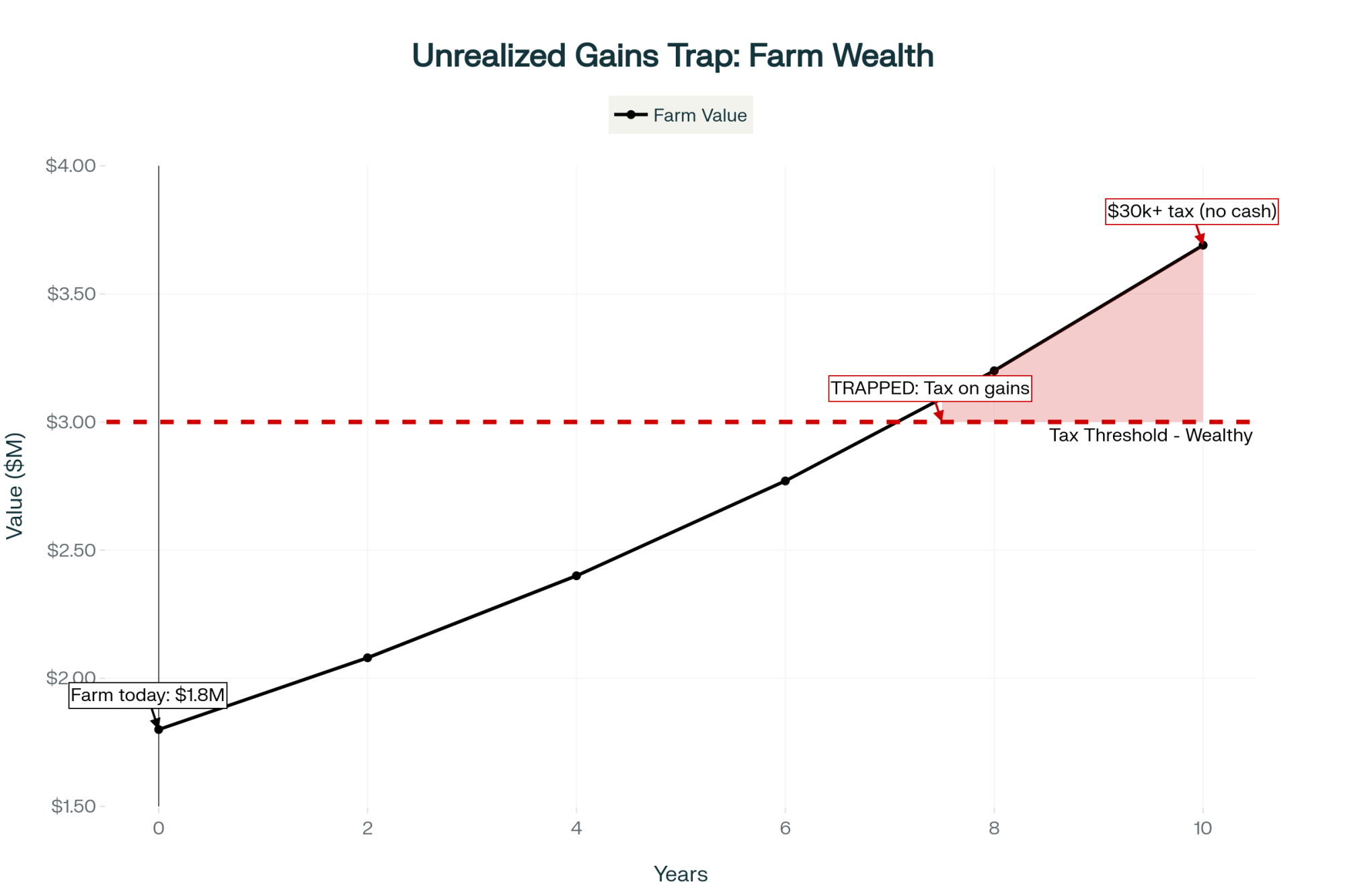
At 7-8% annual appreciation—normal for ag land—a $1.8M farm crosses the $3M ‘wealth’ threshold in just 8 years through paper gains alone. Result? You’re paying $30,000+ in taxes on money you never made, forcing asset sales to cover bills on wealth that only exists on paper. That’s the trap

So here’s the deal. In 2024, the Australian Treasury proposed a measure they considered reasonable: increasing taxes on retirement accounts (known as superannuation funds) from 15% to 30% for those exceeding $3 million Australian dollars. They sold it as only affecting the wealthiest 0.5% of people. Sounds familiar, right?

But as many of us have learned the hard way, the devil’s always hiding in those details. This tax would’ve hit unrealized gains. Think about that for a minute… If your farmland goes up in value—just on paper, nothing sold—you’d owe taxes on that increase even though you’ve got zero extra cash in your pocket.

Let me paint you a picture. Say you’ve got 500 acres in your retirement structure worth about $3.8 million. Urban sprawl has increased nearby property values by 10% this year. Under what they proposed, you’d suddenly owe around $30,000 in taxes on that $300,000 paper gain. The National Farmers’ Federation ran these exact numbers in their modeling, and it’s sobering stuff.

Where’s that cash coming from when you’re already managing tight margins? You and I both know the answer—you’d have to sell something. Equipment. Land. Maybe part of that herd you’ve spent years building.

KEY AUSTRALIAN VICTORY STATISTICS:

  • 3,500 farm retirement funds are immediately affected
  • 14,000 additional farms at risk through appreciation
  • 6.7% of affected funds lacked liquidity to pay without asset sales
  • 2-year sustained campaign from proposal to reversal

What’s particularly concerning is what Ben Bennett from Australian Dairy Farmers pointed out after the reversal—this would’ve forced farmers to liquidate productive assets just to pay taxes on gains they hadn’t realized. The University of Adelaide’s agricultural economists collaborated with the SMSF Association, utilizing Tax Office data, and confirmed the numbers above.

And here’s where it gets really sneaky… the threshold wasn’t indexed to inflation. Rural Bank’s farmland reports—carefully tracked by them—show that agricultural land has been appreciating at a rate of 7 to 8% annually over the past couple of decades. With those numbers, a farm worth $1.8 million today would cross the $3 million threshold in about a decade, simply through normal market movement. That’s not farmers getting wealthy. That’s a trap being set.

Now, I should mention that from the Treasury’s perspective, they were seeking revenue to fund other programs and viewed large retirement accounts as under-taxed wealth. But the fundamental problem was they didn’t understand—or didn’t care—about the difference between liquid financial assets and productive agricultural land. Whether you’re running a sole proprietorship or an incorporated business, the impact would’ve been devastating.

How They Built a Winning Strategy

What Australian farmers did differently from what we typically see is worth paying attention to. You know the usual playbook—angry press releases, tractors at the capitol, emotional testimony. Gets headlines for a week, then everyone goes back to milking, and the government just proceeds anyway.

The Aussies took a completely different path, and honestly, it’s brilliant.

Taking Time to Build the Case

First thing they did? Nothing public for 48 hours. I know that sounds counterintuitive—your gut says fight back immediately. But they used that time to build something more powerful than outrage.

During those two days, the National Farmers’ Federation got university economists from places like the University of Adelaide analyzing the real impacts. They pulled Australian Taxation Office data showing that there were approximately 610,000 self-managed super funds in the country. They identified specific technical problems—unrealized gains taxation and no inflation indexing—rather than simply calling it unfair.

When they finally went public, they didn’t lead with emotion. They presented hard data from their work with ASF Audits and university researchers: “Initial analysis shows 3,500 agricultural funds immediately affected, with 17,000 at risk based on historical appreciation.”

The difference that makes… it’s huge. One approach gets dismissed as farmers complaining about everything. The other forces the government to respond to specific numbers, they can’t just wave them away.

Coalition Building That Changed Everything

Within a week—and this is where it gets really smart—they’d expanded way beyond farming. They brought in small business groups representing hundreds of thousands of operations, family business associations covering most Australian enterprises, and retirement fund administrators speaking for all fund holders nationally.

Now you might be thinking, why does this matter when we’re dealing with fresh cow management and keeping somatic cell counts in check? Here’s why: suddenly, it wasn’t just farmers fighting. The SMSF Association’s analysis revealed that 13,000 small businesses with commercial property were facing the same problem.

Think about the politics there… When it’s just us complaining, politicians can write that off as rural districts they might not need anyway. But when the plumber in suburban Sydney and the restaurant owner in Brisbane are facing the same issue? That changes everything.

Matthew Addison from the Council of Small Business Organizations said it perfectly after they won—the government had to listen to the concerns of the entire small business community about taxing unrealized gains.

Leveraging Government’s Own Data

What really impressed me was how they used the government’s own data against them. Instead of presenting estimates Treasury could dismiss as biased, they worked with independent firms like ASF Audits, which handles compliance for thousands of funds, to analyze actual tax records and project impacts nationally.

They had university validation, independent auditor confirmation, and Class Limited—a major fund administrator—all reaching the same conclusions using government baseline data. The class found that approximately 6.7% of the affected funds lacked sufficient liquid assets to cover their expenses without selling property.

When you’ve got that many independent sources saying the same thing using government numbers, Treasury can’t dismiss it as “industry special pleading.”

Sustaining Pressure Without Burning Out

You know how these fights usually go. Strong start, lots of energy… but after a few months, everyone needs to get back to farming. The volunteers burn out, donations dry up, and the government just waits you out. As many of us have seen with previous battles, that’s where things fall apart.

The Australians addressed this issue with a professional campaign infrastructure.

Professional Staff Made All the Difference

The National Farmers’ Federation employs full-time people whose actual job is managing these multi-year campaigns. Not lobbyists having lunch with legislators. Not policy people writing papers. Campaign managers who wake up thinking about coalition coordination and maintaining pressure. You can see this in their “United Advocacy, Stronger Outcomes” roadmap and their annual reports.

When this tax got proposed, they didn’t scramble to figure out who’d run things. They activated what was already in place—committees with real authority to make decisions, budgets already approved through membership dues, and professional staff who kept things moving even when farmers were deep in calving season or dealing with heat stress affecting production.

Strategic Escalation at Key Moments

The campaign ran nearly two years, but here’s what’s smart—they didn’t try to maintain crisis-level intensity the whole time. NFF President David Jochinke discussed this in various forums, noting that they escalated strategically. Senate hearings in November 2024. Budget prep in early 2025. Right before the May 2025 federal election, when politicians get nervous.

Between those peaks, professional staff kept things coordinated, allowing farmers to focus on their operations. It’s like managing your breeding program—you don’t check every cow daily, but you never completely drop the protocol either.

The Admission That Changed Everything

Here’s the turning point: During Senate Economics Committee hearings, sustained pressure forced Treasury officials to admit something devastating. They hadn’t actually modeled how many agricultural businesses would be affected. The transcripts are public—they literally admitted they proposed this massive change without analyzing who’d be hurt.

Once that information was released and the farm coalition filled the gap with detailed evidence from groups like GrainGrowers and the University of Adelaide, the policy became politically toxic. How do you defend something when your own Treasury admits they didn’t study the impact?

Why This Matters for North American Dairy

Four major dairy nations hit with identical wealth taxes within 24 months—245,000+ farms targeted. The two with professional advocacy infrastructure (Australia, Canada) won complete reversals. The two without (UK, USA) face ongoing battles with no victory in sight. Pattern recognition time: build infrastructure NOW or lose farms later

So why should you care about Australian tax battles when you’re dealing with milk prices, managing components, trying to keep things running in this economy?

Because what’s happening isn’t random. Look at the pattern:

Canada attempted to increase capital gains inclusion from 50% to 66.7% on farms in April 2024. After massive pushback led by the Canadian Federation of Agriculture, they reversed it in March 2025. The UK has just eliminated agricultural property relief in its October Budget—protests by the National Farmers Union are still ongoing. Here in the US, we’re looking at estate tax exemptions potentially dropping from approximately $14 million to around $7 million when the Tax Cuts and Jobs Act provisions expire in 2026, according to projections from the Congressional Budget Office. And that’s before we even consider current congressional discussions about eliminating the stepped-up basis for inherited assets.

What I’ve found looking into this is these aren’t coincidental. The OECD has been publishing reports since 2020, calling agricultural land “undertaxed.” The G20 finance ministers met in Brazil last November to discuss coordinated wealth taxation. Agricultural land is explicitly on their radar.

Building Our Defense Now

OrganizationAnnual BudgetRecommended (10-15%)vs Australian Benchmark
Nat’l Milk Producers$13M$1.3M-$2.0M5-8x Australian
Midwest Dairy$25M$2.5M-$3.8M10-15x Australian
Dairy Farmers Canada$9M CAD$900K-$1.4M3.6-5.6x Australian
TOTAL$47M+$4.7M-$7.2M19-29x winning benchmark

What struck me about the Australian win is that they had everything in place before the crisis hit. Their committees, professional staff, coalition relationships—all ready to go.

Most North American dairy organizations… we’re not there yet. Consider the National Milk Producers Federation, which has a $13 million budget, as shown in its Form 990s, or Dairy Farmers of Canada, with a budget of approximately $9 million Canadian. They certainly have government relations personnel. But campaign managers who can sustain multi-year fights? That’s rare.

Building this capability means:

Professional staff whose job is coordinating campaigns, not just maintaining relationships. That’s about $150,000 annually for someone with real experience.

Committees that can actually make decisions without waiting for quarterly board meetings. When the Treasury announces something on Friday afternoon—and they love Friday afternoons—you need to respond on Monday morning.

Real partnerships already in place with groups like the National Federation of Independent Business and their 600,000 members, and the Farm Bureau with 6 million member families.

Current data ready to go. Operations by congressional district using USDA Census numbers. Estate values from Federal Reserve ag finance reports.

The Critical First 72 Hours

If Treasury announced an unrealized gains tax tomorrow morning—and given revenue pressures, it could happen—what happens in the next 72 hours would largely determine whether you win or lose.

Here’s what works: Don’t issue emotional statements right away. Secure your resources—the Australians spent approximately $250,000 in their first 90 days—and hire independent economists to analyze the impacts. Gather baseline data from USDA, reach out to coalition partners with actual phone calls, and draft messaging about specific policy flaws. Hold a real coordination meeting with assigned responsibilities, then release preliminary data by congressional district.

Practical Steps for Today

Whether you’re milking 50 cows in Vermont or running 5,000 head in New Mexico dry lots, there are things worth doing now.

For Your Own Operation

Document your succession structure now. What’s your operation worth according to your lender’s recent appraisal? What’s your tax exposure under different scenarios? How much actual liquidity do you have—real cash you can access, not equity in cattle or equipment?

When challenges come—and based on OECD coordination, they will—specific numbers carry weight. Being able to say “according to our CPA, we face $247,000 in tax liability with $31,000 in liquid assets, forcing sale of productive acreage” makes it real for policymakers.

For Our Organizations

The gap between Australian success and typical North American outcomes isn’t passion—it’s infrastructure. Professional campaign management differs from government relations.

Yes, that means real investment. Considering groups like Midwest Dairy, with a $25 million budget, we’re talking about 10-15% of the budget going towards this capability. Sounds like a lot until you consider the asset values at risk across our industry.

Working Together Internationally

What’s happening globally through OECD frameworks and G20 coordination requires similar coordination in response. When Australian farmers can cite Canadian reversals and we can reference Australian successes, it shows these aren’t isolated issues but recognized challenges with proven solutions.

The Bottom Line

Here’s what Australian dairy farmers proved: You can defeat even Treasury-backed proposals with the right approach. Not through protests that make the news once. Not through emotional appeals. However, through professional campaigns that utilize the government’s own data to highlight problems, while building coalitions that make the political cost too high.

The principle they defended—that productive agricultural assets shouldn’t be taxed until actually sold—that’s fundamental to farm succession everywhere. When governments tax unrealized appreciation, they’re not just extracting revenue. They’re forcing the liquidation of productive capacity that feeds nations.

Given the developments through international coordination, revenue pressures, and ongoing discussions, we can expect similar proposals within 18 months in North America.

Australian farmers invested in capability before their crisis. When Division 296 emerged, they activated existing systems rather than scrambling to do so. The result protected thousands of family operations from devastating tax changes.

That’s the lesson—not that Australian farmers are tougher, but that they invested in organizational capability to win before they needed it. They made that choice when things were calm, not in panic mode.

The blueprint exists, and it’s been proven effective. Whether North American dairy follows that model or continues with traditional approaches will likely determine how we navigate the succession planning challenges ahead. And looking at what’s developing globally through OECD and G20 frameworks… our clock’s already ticking.

What I’ve found is that those who prepare systematically tend to succeed. Those who react emotionally usually struggle. The Australians just showed us which path leads to victory. Now it’s up to us to decide which way we’re going.

KEY TAKEAWAYS

  • Build before the battle: Australian farmers had professional campaign infrastructure ready BEFORE the tax hit—scrambling after Treasury announces means you’ve already lost
  • $250K beats $30K tax bills: Investing in professional campaign management (1% of major dairy org budgets) protected 17,000 farms from forced asset sales
  • Government data is your weapon: Proving 6.7% of farms lacked liquidity using Treasury’s own numbers worked; emotional “save family farms” appeals failed
  • Small businesses are your secret army: 13,000 affected plumbers and restaurant owners made suburban politicians care about a “rural” issue
  • 18 months until impact: With U.S. estate exemptions dropping 50% in 2026 and OECD coordinating globally, your window to build defense is closing fast

Complete references and supporting documentation are available upon request by contacting the editorial team at editor@thebullvine.com.

Learn More:

Join the Revolution!

Join over 30,000 successful dairy professionals who rely on Bullvine Weekly for their competitive edge. Delivered directly to your inbox each week, our exclusive industry insights help you make smarter decisions while saving precious hours every week. Never miss critical updates on milk production trends, breakthrough technologies, and profit-boosting strategies that top producers are already implementing. Subscribe now to transform your dairy operation’s efficiency and profitability—your future success is just one click away.

NewsSubscribe
First
Last
Consent

Farm Succession: Kicking the Hornet’s Nest?

Do you freak out when you hear the words farm succession? Do your palms sweat and does your heart pound when you look toward the future?  Do you self-medicate with Tums and an entire quart of Chocolate Ice Cream? Family farm succession has the potential to be not just a nightmare but a nightmare that can result in serious anxiety, fights, financial loss, betrayal, and even litigation. The Bullvine article, “Farm Succession: Which Exit is Yours?” looked at this subject and started a considerable buzz. Today we consider how much sting this subject holds for today’s families.

ARE YOU READY TO KICK THE HORNET’S NEST?

Many times the decisions on how to hand down a family farm gets completely stopped at the very first questions. Which child will ultimately take over? How do you fairly divide the dairy operation when one child works day-to-day in the business and others do not? Can you maintain good family relationships with the entire brood while working closely with just one or two? Can children achieve healthy independent lives while each side has TMI (too much information) about each other’s personal lives and wallets?

FIVE STINGERS THAT YOU WANT TO AVOID

Having identified that farm succession can be a hornet’s nest of complications, there is still the opportunity to manage through it without getting stung.  Here are potential stingers to avoid.

  1. STINGER #1:  “Show Me the Money”
    A family business can be a great thing, but being saddled with debt or the need to fix a mismanaged situation can be tough for those inheriting dairy operation. It is important to get a good handle on what is the real value a buyer might pay you for your business today. Both the current and the future generation need to close the gap between that number and what one side needs for retirement (realistically) and what the other side needs (realistically) to move forward.  With those numbers known (and accepted) then you have plenty of time to work on ways to build transferrable value in the dairy operation before selling it.
  2. STINGER #2: “You Have the Right to Remain Silent”
    In most families everybody feels that their voice is a given right in all matters affecting one or more family members. Sibling rivalry, bothersome brothers and the ongoing beat of sister acts is only slightly less harmful than that ever popular pastime of pitting Mom against Dad.  Regardless of the source any squabbling based on the emotional immaturity and family role playing is an immediate red flag warning that succession plans are heading for trouble. As little children we often fight back when faced with something we don’t want to do with that never effective shout “You’re Not the Boss of Me!” Then and now it merely signifies that time wasn’t taken to groom all the individuals for the job at hand. Anything said in the heat of emotion expresses far more about the shouter’s maturity level than it does about their target of wrath. Emphatic is good. A spirited discussion can be extremely productive. But if a dialogue can’t happen in a spirit of productivity, you’re better off to hold off until you’re sure that it can. Unfortunately after the first confrontation the tendency is to hold off too long!
  3. STINGER #3: “Hands-On and Hands-Out?”
    This is where potential hurt raises ugly welts. In family dairy operations there are children who expect to own the business and parents who expect to retire. Unfortunately neither position in a well-run business comes with these entitlements. They must be worked for. Having said that, there is an entire legal and financial industry set up for the purpose of transferring farms as a “gift” to children.  Now that is a huge mistake that brings with it too many stings to cover in one article.  Simply stated a family business needs “buy in” from all parties.  As well a successful business needs “work” input from all parties. As an owner of a family business, do you have rules, both financial and work, in place that your children have to follow if they join the business?  Do you have rules for lessened work load and responsibilities for those leaving?  “I am your child” or “I am the parent” is the worst possible justification. Much better is an actual record of the revenue or new revenue streams being produced or improved.  In other words, everyone involved in the succession should be able to point to what they bring to the table that will allow the dairy operation to continue successfully.
  4. STINGER #4: “You OWE Me More than This!”
    No matter when someone shouts this classic argument, it leaves little doubt that the negotiations are in trouble. Children raised on dairy farms who inherit the business can think that they are entitled to exactly the wealth and lifestyle their parents currently have. In the worst case scenarios they don’t even do the most basic math: If the farm is inherited by more than one child, by definition they will 50% or less of what Mom and Dad have. Unrealistic expectations can be powerful enough to destroy good farm operations that could otherwise continue or be sold at a decent price.
  5. STINGER #5: You Can’t Handle This!”
    Dairy farmers must decide: Does the family serve the business, or does the business serve the family? If parents take the attitude that blood is thicker than ability when choosing a successor, chances are the business won’t be around long enough to serve anybody. Even in successful family farms, it’s tough to leave entrenched emotional patterns in the parking lot.

Old attitudes and arguments surface. Parents may feel strange consulting with their children as equals. Kids fret that their bosses during childhood are still their bosses in the workplace

Different viewpoints can clash. If added to that there is perceived lack of respect or a tendency not to take (new) ideas seriously.  The roles and power struggle have to flex to meet the needs of the business.

THREE BUZZ CUTS YOU NEVER WANT TO BE PART OF

As much as we might hope to get through farm succession discussions painlessly, it is probably unlikely that you are so well prepared that it will happen that way.  Regardless, you must still keep a sharp eye for three particular dangers that could completely derail both the succession plan and your family. These are the Buzz Cuts that are both harmful and hurtful.

  • BUZZ CUT #1: The Prince Charles Syndrome.
    Parents who treat succession plans like living wills—to be carried out only in the case of death or incapacitation—undercut  their offspring’s authority, stifle their opportunities to lead, and provoke justifiable resentment. “I will die in harness” is a declaration that makes the next generation cringe. It doesn’t matter if the work is getting done.  This divine rule will definitely prevent the next generation from developing skills that move the farm  forward. It completely cuts off the opportunity for younger family to leave their personal mark on the business that nevertheless will consume their entire working life. Self-esteem is a two way farm lane.
  • BUZZ CUT #2: Stay, stray or Grow?
    While it is valuable to learn the dairy operation from the ground up, being forever kept in low level jobs builds zero credibility with farming peers and customers. Regardless of the business you are in it is valuable to test your mettle where reviews, compensation, and feedback are not colored by family relationships. By the time succession happens you need to have the confidence and experience that is needed. Returning from outside work experiences brings the maturity and perspective gained during time away and helps all sides to appreciate each other’s strengths.
  • BUZZ CUT #3:  The LONG HAUL or THE BIG HOLE?
    The major goal for succession is the determination of the viability of the dairy business for the next generation… out 20 plus years. Assumptions that were prudent in planning and forecast when previous generations took over the farm are now mostly irrelevant. Unfortunately, most of those in the farm succession consulting professions such as accountants, financial planners and attorneys get stuck in the tools of legal and financial succession. Far too many family members and their advisers assume “perpetual farm viability”  and start their plans from the erroneous assumption that the next generation can simply assume business viability for another 20 years. Just because you are related and recognize that family farms require dedication to “the long haul” it still doesn’t mean that you must accept a “big hole” simply because you are the next one in line.

THE BULLVINE BOTTOM LINE

It is far better for everyone to determine with all the tools available whether or not there is a window of opportunity for the dairy operation or whether it has already closed. Regardless of what your dairy operation is buzzing about always try to keep it positive. A dysfunctional family farm can “sting like hell” but when a dairy succession works “everything and everyone hums right along”.

Get original “Bullvine” content sent straight to your email inbox for free.


[related-posts-thumbnails]


Farm Succession: Which Exit Is Yours?

Handing down the family farm is not a simple event like hosting a twilight meeting or an occasional herd reduction sale.  No.  Farm succession is a journey that happens over time. Putting that time in, sooner rather than later, is an investment that could not only save your dairy farm legacy but your family relationships as well.

A Head Start Now Prevents Heart Break Later!

Unfortunately passing on the farm business is not something you can practice like training calves, improving milking procedures or modifying your feeding program.  Most of us will be involved in this hand-off only twice – and at that — it will be from opposite sides of the bargaining table: coming in and going out! While each position provides a learning experience, it isn’t likely something you will do often enough to become good at it. In fact, each trip to this turning point loads each of us down with baggage which may or may not have an effect on whether the farm moves from “A” to “B” without upsets.

Having said that, we could all sit around the living room and discuss grapevine tales of the horrors, nightmares (and occasional successes) of families who have tried handing off their dairy business to the next in line.  The reason we don’t have as many successes to bandy about is because the very fact that the successes were probably handled seamlessly makes them less of a community talking point.

The passion for dairy farming can start at a young age, but with out a good succession plan, that passion can quickly be lost.

The passion for dairy farming can start at a young age, but with out a good succession plan, that passion can quickly be lost.

Un-Spoken EQUALS Un-Successful

It only makes sense that something a family has felt passionate about doing for more than two generations is going to be a passionate issue when it comes to discussing successful succession. It’s the successful part that is the crunch. When you look at the timeline of a dairy farmer – he or she quite often will have invested forty or more years in the business.  A gold watch and a farewell dinner aren’t going to cut it, when it’s time to make changes at the top. Long before the fond farewells the family has to talk – not only about who’s in charge and when — but about expectations for income both pre and post “retirement” and the realistic sustainability of the dairy operation.  Get talking.  And use the word retirement often. I can’t imagine any dairy farmer who ever accepts full retirement.  While some of the perks (travel, hobbies) beckon, they never really see themselves retired!  And therein lies the rub!

Dairy Farming is a Living Legacy

If you were the one who taught your offspring how to properly hook on the milking machine, along with a thousand other chores that they struggled with at first, you may be reluctant to get out of the driver’s seat for this young upstart.  But that’s exactly what you have to plan for.  If you’re going to be that one dairy farmer in ten that sees grandchildren take over your farm, you’ve got to be able to step aside and let the next generation learn – and fail — and learn some more! Don’t leave the planning until it’s too late to meet the needs of those depending on the business. (Read more: What’s the plan?, Flukes and Pukes – What Happens When You Don’t Have a Plan and Are you a hobby farmer or a dairy business?) When it comes to expectations about your dairy farm legacy both sides have to be open and up front about what they’re hoping and dreaming about.  If you assume that one generation will just fall into place — as it did in the past — you’re setting yourself up for that ass-of-you-and-me situation.

IMG_2237

In order for your legacy to continue you need to feed that passion, and good succession plan can help you do that.

LATE Expectations!

You can’t just decide one afternoon that you’re ready to quit dairying. If you’re lucky, any decisions about farm succession will not be forced upon you by illness, financial pressures or any of the numerous dysfunctions that introduce cracks into the apparently firm foundations of the family farm business. We all recognize that maintenance is key whether it’s farm buildings, fields or dairy cattle … but we live in denial when it comes to realistic assessments of physical ability, revenue streams and long-term financial planning.

Start Early to Celebrate the Strengths of Your Particular Family

For years you have both benefited from the economies of scale and shared passion that are more beneficial than each family member owning their own operation.  After all, that’s one of the reasons you’re in this situation to begin with.  Likewise, there are all the benefits of the dairy lifestyle that have made your family memories rich.  Favourite cattle, records achieved, shared work ethic and the ups and downs of a business affected by the vagaries of weather, markets and politics. And you can’t overlook the benefits of being your own boss, or the boss’s kid, 24-7! Seriously.  The time to plan for the future is before you NEED to!

IMG_1225

Who’s The Boss?

The most familiar cog in the wheel of farm turnover happens when those at the front aren’t ready for change.  Speaking personally, I will always be of sound mind and body and therefore planning ahead is redundant in my particular situation.  Of course, there are those who are quite convinced that they are the only ones who could run their particular dairy operation. Making all the decisions, doesn’t prepare you or your successor for the future. No wonder our “kids” (even though they too are middle-aged) are considering mandatory retirement as an option.  Our fear is that these upstarts aren’t willing to put in the 70 hour workweeks that we did. “Our heels are dug in.”  “Our minds are made up.”  “Don’t try to confuse us with facts!” It’s hard to tell which generation is talking isn’t it?

Share the Health BEFORE You Siphon the Wealth

There are two occasions in the business lifetime of a dairy operation that are challenging. The first is at setting up and the second is when it’s time to transition down.  Unfortunately, when it comes to farm succession these two often contrary events are happening simultaneously for those involved.  It stands to reason that these changes and the acceptance of them can be difficult. Both sides perceive the other as suddenly unreasonable. Too few families looked ahead while they are in the smooth middle years where everything was chugging along and made plans for ways to keep the farm providing the lifestyle to which everybody had become accustomed or at least comfortable with.

IMG_2189

The Time to Get “Buy In” Is BEFORE You Have to “Sell Out”!

Even more frustrating is the situation, becoming more familiar today, where the dairy farm is not at its highest performance level.  Financial constraints may be throwing the entire future of the operation into question and here comes one or more family members looking for a deserved break. Advance planning would provide a way to get money out of the dairy operation without causing cash flow problems. The goal should be to use a combination of methods, insurance, wages and share purchases to name a few, to provide for those who are transitioning out, without creating a huge debt load for the next generation.  The goal is for the family to continue to embrace the future in a way that is achievable and sustainable.

It's never too early to start your succession plan.

It’s never too early to start your succession plan.

The Bullvine Bottom Line – Don’t Leave Trust in the Dust

At the end of the day, the family is more important than the money.  If everyone involved keeps their eyes on maintaining the relationships, everything else will fall into place.  There are many advisors, consultants and financial planners that can assist you. Their help is valuable but getting them up to speed is another challenge in an already challenging situation. All in all, when it comes to planning your dairy legacy you can always recognize success. A successful succession plan saves THE FARM AND THE FAMILY!

Get original “Bullvine” content sent straight to your email inbox for free.


[related-posts-thumbnails]

Send this to a friend