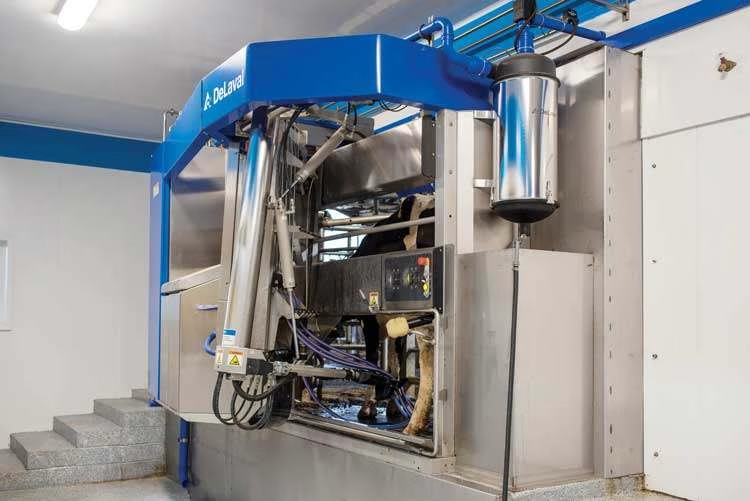
Argentina now ships dairy products to over 80 countries, despite labor costs ranging from $ 4 to $8 per hour. We’re paying $20-25/hr. Something’s gotta give.
EXECUTIVE SUMMARY: You know that feeling when you realize everyone else figured out something you missed? That’s what’s happening with South American dairy right now. While we’re fighting $25/hour labor and massive cooling bills, Argentina’s running 150-200 cow herds at $4-8/hour labor costs, and Chile’s hitting record production with GPS-guided grazing. The numbers don’t lie—their feed costs about 50% of what we pay, land rent is $200-400/hectare versus our $1,000-2,000, and they’re shipping to 80+ countries because their cost structure allows them to compete anywhere. Uruguay exports 65% of its milk, despite being smaller than most countries, demonstrating that efficiency often outweighs size. After Argentina’s production dropped 22% early this year, they’re bouncing back through exports, while we’re still fighting the same old cost pressures. Here’s the thing—their tech adoption is smart, not expensive, and it’s working with their natural advantages instead of against them. Maybe it’s time we stopped thinking bigger is always better and started thinking smarter.
KEY TAKEAWAYS
Labor advantage that changes everything: Argentine dairy workers cost $4-8/hour while ours run $20-25/hour—that’s a $30,000+ annual savings per worker that goes straight to your bottom line. Start benchmarking your labor costs per cow against these numbers.
Feed costs are cut in half through pasture optimization: South American operations spend $1.50-$2.00 per day per cow on feed, versus our $4-$5 per day average—GPS-guided rotational grazing and extended seasons make the difference. Calculate what a 40-50% feed cost reduction would mean for your operation.
Technology that fits your system, not fights it: Automated gates and pasture sensors are paying back in 12-18 months without forcing system overhauls—Chilean producers are proving precision ag works for grass-based operations. Evaluate tech investments that enhance your natural advantages instead of replacing them.
Export diversification fosters market stability: Argentina reached 80+ countries in 2023, whereas we’re often limited to 2-3 buyers—their cost structure provides pricing flexibility that we can’t match. Start monitoring global milk flows through USDA FAS reports to understand your competitive position.
Climate advantages worth $100-300/cow/year: Natural cooling eliminates massive infrastructure costs while 7-8 month grazing seasons reduce purchased feed dependence—these aren’t temporary benefits, they’re permanent structural advantages. Assess your climate-related costs and identify where efficiency improvements could be beneficial.
I just wrapped up a call with a buddy who tracks global milk flows for a living. “Argentina’s now shipping dairy to over 80 countries,” he told me. “And their growth isn’t slowing.”
That caught me off guard. While we’re busy watching Wisconsin weather and New Zealand production reports, something massive is happening down south.
Argentina: From Crisis to Competition
Out in the Pampas—Argentina’s dairy heartland—most operations run 150-200 cows, rotating paddocks every 28-35 days. Those cows are producing 20-24 liters of milk daily during peak lactation.
The real story? Cost structure. Land and labor run a fraction of what we pay up north.
The turnaround has been dramatic. Following severe droughts and economic pressures, which led to a nearly 22% decline in milk production from January to February 2024 compared to the same period in the previous year, the industry is relying on exports for recovery.
A key catalyst was the removal of export tariffs (retenciones) on dairy products. This policy, initially implemented by the previous government, was made permanent by President Javier Milei’s administration in late 2023, signaling a major shift toward promoting exports.
According to export data monitored by OCLA, around 60% of dairy products, mainly milk powders, were destined for export in 2023—not the entire milk volume.
Juan Diaz of El Rosario Farm near Santa Fe notes, “Opening up export routes has transformed our cash flow and outlook.”
Chile: Where Precision Meets Pasture
Chile’s dairy production is concentrated in Los Ríos and Los Lagos, contributing 83.6% of the national milk output. Average farm sizes range between 120 and 150 head.
Despite periodic droughts, these regions produced approximately 2.23 billion liters of milk in 2023.
Dairy tech advisors in the Temuco region observe that the most competitive producers are those blending technology—including GPS-guided pasture management and automated water systems—with a deep respect for their pasture-based heritage.
Uruguay: Small But Mighty Dairy Exporter
Uruguay, home to less than 4 million people, exports about 65% of its dairy production. Herd sizes commonly range from 120 to 160 cows.
Export volumes increased by roughly 10% in 2023, despite price volatility.
A producer near Montevideo, Lucia, points out, “Our steady climate and reliable supply are major drivers behind buyer loyalty.”
South America’s Unbeatable Cost Structure
USDA data highlights a stark contrast: Labor costs in Argentina average $4-$8 per hour, while in the US, they average $20-$25. Likewise, feed costs for pasture-based systems are typically half the price of those for confinement systems.
Cost Category
Pasture-Based (S. America)
Confinement (US/EU)
Labor Cost
$4-$8/hr
$20-$25/hr
Feed Cost
$1.50-$2.00/day per cow
$4.00-$5.00/day
Land Rent
$200-$400/ha
$1,000-$2,000/ha
Cooling Costs
Minimal
$100-$300/year/cow
These savings add up fast, helping producers maintain stronger margins.
Tech That Works with Your System
Technology is no longer confined to large-scale dairy operations. Automated gates, pasture sensors, and robotic milkers are well-suited for pasture-focused operations.
Ana Gómez, a veterinary technician and farm manager in Uruguay, said, “We installed automated waterers last season. It helped reduce labor without changing how we run our farm.”
Shift in Global Markets
Argentina expanded exports to over 80 countries in 2023, diversifying product lines and markets.
Chile’s growing domestic production is actively displacing imports worth millions annually.
Uruguay reported a 10% growth in dairy exports in 2023, expanding reach into Africa and Asia.
Watch the Risks
While Argentina’s 2023 tariff reforms under President Milei have boosted exports, currency swings and political volatility remain concerns.
Infrastructure issues, including inadequate transportation and cold storage systems, also hinder growth and market access.
What You Can Do Next
Understand your full cost structure, especially feed, labor, and climate-related costs.
Monitor global market flow and emerging buyer preferences.
Evaluate technology that complements your production system, not forces it.
Plan for currency, political, and environmental risks.
The global dairy market is shifting, and South America’s rise demands your attention.
The fundamentals of global dairy are shifting under our feet. South America’s structural advantages in cost and climate aren’t a temporary trend—they represent a new competitive reality. Smart operators aren’t just watching this change; they’re analyzing their own operations against it. The question isn’t if this will affect your business, but how you’ll prepare for it.
Complete references and supporting documentation are available upon request by contacting the editorial team at editor@thebullvine.com.
Learn More:
Why 70-Hour Weeks Are Killing Your Dairy Profits – This article provides tactical strategies to optimize labor efficiency. It uses data to prove that working smarter, not harder, is the key to profitability, directly complementing the main article’s focus on South America’s labor cost advantage.
5 Technologies That Will Make or Break Your Dairy Farm in 2025 – This forward-looking article explores the innovative tools available to compete. It demonstrates how to leverage precision technology, from sensors to feeding systems, to boost efficiency and close the competitive gap with lower-cost regions.
The Sunday Read Dairy Professionals Don’t Skip.
Every week, thousands of producers, breeders, and industry insiders open Bullvine Weekly for genetics insights, market shifts, and profit strategies they won’t find anywhere else. One email. Five minutes. Smarter decisions all week.
Your poultry neighbor spends 2% on labor. You spend 25%. Here’s why that gap is about to kill traditional dairies.
You know that gut punch feeling when you’re heading out for morning milking and catch sight of your neighbor’s broiler barns? Dead quiet at 5 AM. Twenty-five thousand birds are getting fed, watered, and climate-controlled automatically while he’s probably still in bed with his second cup of coffee.
I’ve been walking through dairy operations across the heartland for thirty years now, and what really gets me about this moment we’re living through… It’s how dramatically the competitive landscape has shifted, while most of us had our heads down, just trying to get through another day. While you were scrambling to cover for another weekend no-show, your poultry and swine neighbors essentially engineered their way around the entire labor nightmare.
Here’s what keeps me up at night—and should keep you up too.
The latest data from Cornell shows that dairy operations are losing 20-30% of their production budget to labor costs. Meanwhile, those automated broiler houses down the road? They’re operating with labor costs that barely register on the spreadsheet—somewhere between 1.6%-2.4% of total expenses. Your pig farming neighbors aren’t much different, with labor costs running at around 9%.
Do the math on a million-pound operation. We’re talking about a $150,000+ annual disadvantage before you even factor in the headaches of finding reliable help who will show up on Christmas morning.
Labor cost as percentage of total production costs in Poultry, Swine, and Dairy sectors
But here’s the kicker that really frustrates me… Recent research from Cornell shows that dairy farms embracing automation are cutting their labor costs by over 21%. Some operations are seeing savings approaching 29%. Yet only about 5% of U.S. dairies use robotic milking systems.
The real stunner? Those automated farms produce 45% of our nation’s milk supply.
The consolidation everyone’s complaining about at every farm meeting? This labor-automation gap is what’s driving it. And it’s accelerating faster than most producers realize.
The Thing About Automation… Each Sector Found Its Own Sweet Spot
What strikes me about what’s happening across livestock right now is that it’s not just technology adoption. It’s a fundamental reshuffling of who stays viable and who gets priced out. Each sector found its own route through this maze, and honestly, some of the strategies were pretty brilliant.
Take poultry—those massive integrators like Tyson and Perdue basically told their contract growers, “Here’s exactly what equipment you’ll install, here’s how you’ll run it, and here’s how we’ll pay for it.” When you control everything from the hatchery to the processing plant, you can mandate technology across thousands of operations practically overnight.
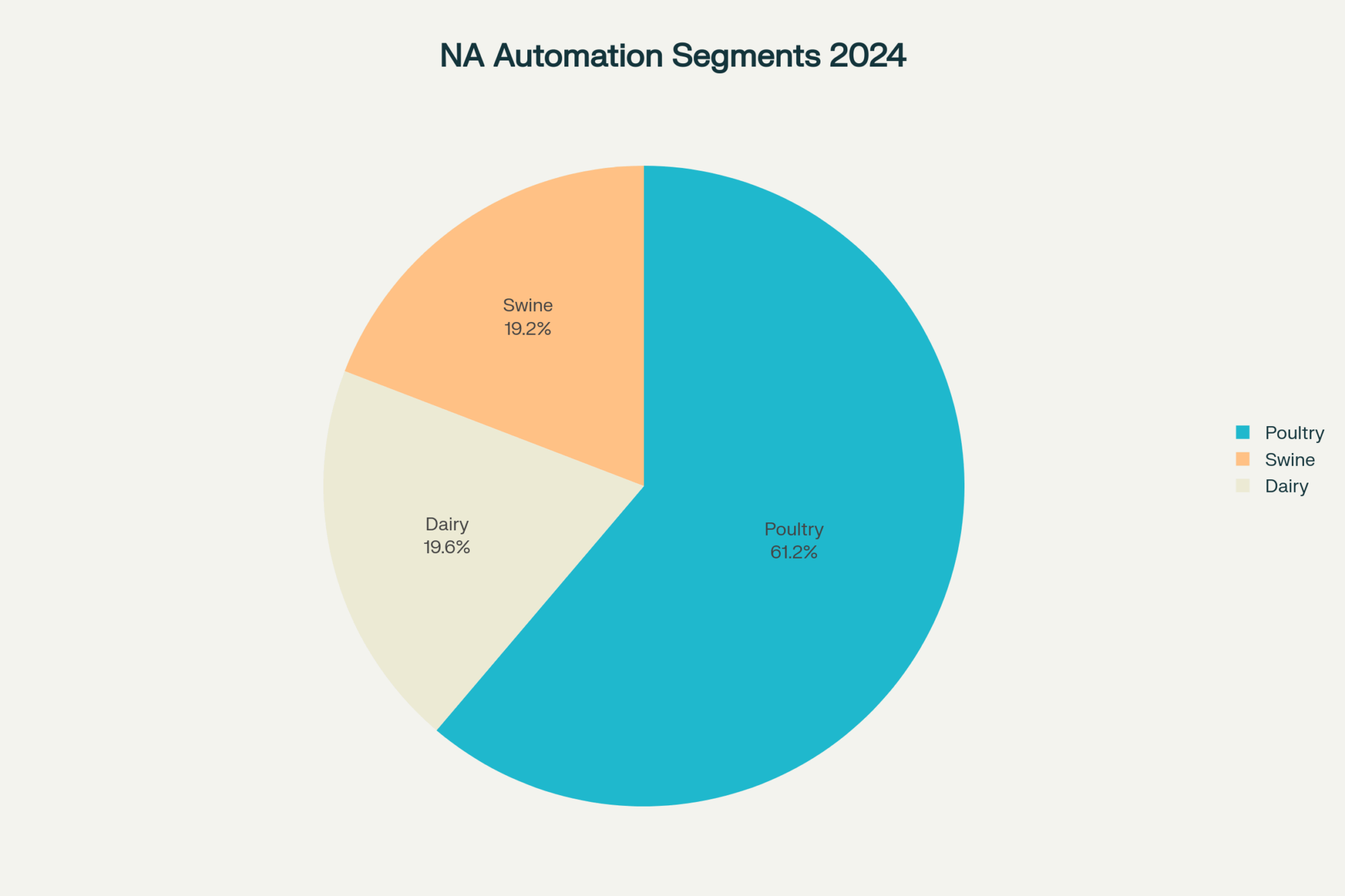
It’s like having a benevolent dictator who happens to love robots… and it created a $2 billion North American automation market faster than most of us could blink.
Market size distribution of automation segments in North America for 2024
This gave equipment manufacturers something dairy has never had: guaranteed demand. They knew they had customers lined up around the block, so they invested heavily in comprehensive, integrated systems. Walk into a modern commercial broiler house today, and you’ll see climate control that adjusts automatically based on outside weather, bird age, and humidity levels. Feed delivery systems that measure rations down to the gram. Manure handling that runs on preset schedules.
The result? While you’re running three shifts to milk 1,200 cows, that broiler complex produces 25,000 market-ready birds with less than one full-time employee per house.
Now, here’s what’s particularly fascinating about swine… they found their automation catalyst in the most unlikely place—animal welfare pressure. As California’s Proposition 12 and EU regulations prompted producers to move away from gestation stalls, they faced a significant management challenge. How do you feed sows individually when they’re housed in groups?
Anyone who’s dealt with aggressive sows at feeding time knows this isn’t some theoretical problem.
Electronic Sow Feeders became the solution. These systems use RFID ear tags to recognize individual sows and dispense customized rations based on body condition and gestation stage. The global ESF market hit $1.31 billion in 2024, with projections showing it’ll reach $2.72 billion by 2032.
There’s this case study that really drove it home for me… International operations installing ESF systems are seeing dramatic workforce reductions while boosting production. One operation cut their workforce from 25 employees to just 10, while increasing output from 25 to 28 weaned piglets per sow annually.
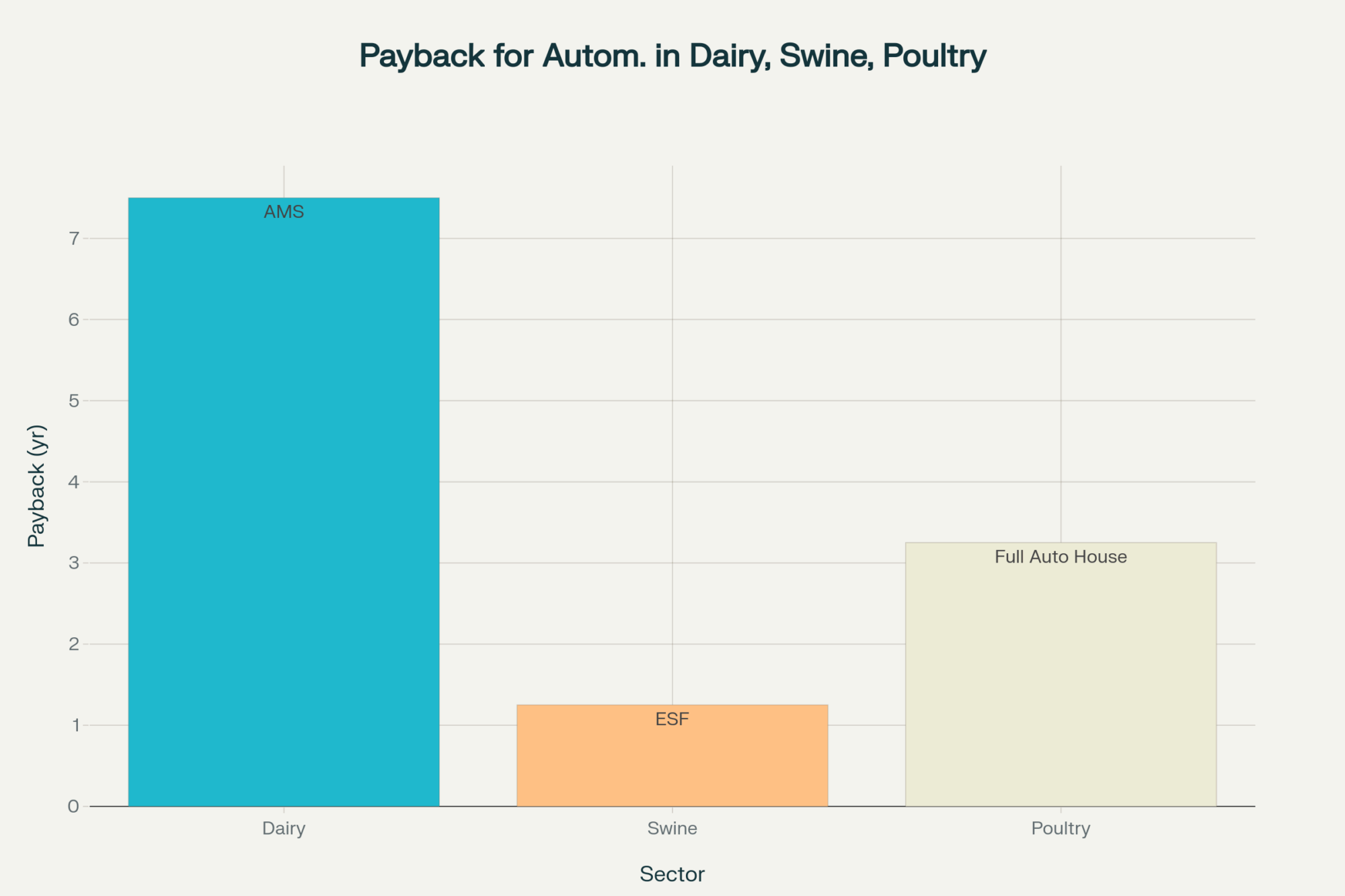
Comparison of ROI and payback periods for key automation technologies in dairy, swine, and poultry sectors (2025 est.)
Those aren’t projections from some sales brochure. That’s real-world results.
Quick Assessment: Where Does Your Operation Stand?
Before we dive deeper, take a moment to assess your current situation honestly:
Labor Dependency Check:
How many times in the past six months have you had to milk alone because someone didn’t show up?
What percentage of your herd management decisions are delayed because you can’t find reliable help?
Are you currently paying over $18/hour for weekend milking coverage?
Technology Readiness Indicators:
Do you have consistent internet connectivity in your barn?
Can you access and interpret basic production data digitally?
Have you visited an automated operation of a similar size in the past year?
Financial Position Reality:
Can you access over $ 200,000 in capital for automation investment?
Are your current labor costs exceeding $4.00 per hundredweight?
Is your debt-to-asset ratio below 30%?
If you answered “yes” to most of these questions, you’re in the automation consideration zone. If not, we’ll discuss your options as well.
What’s Really Going on with Farm Labor (And Why It’s Getting Worse Fast)
This labor situation we’re all dealing with… it’s unlike anything I’ve seen in thirty years of working with producers. And I’m not just talking about the usual gripes about finding good help. The fundamentals have shifted in ways that make automation less of a nice-to-have upgrade and more of a survival strategy.
The Workforce Is Aging Out—Fast
The agricultural workforce is aging out, and we’re not replacing them. According to recent USDA demographic data, the average age of foreign-born farmworkers has increased significantly between 2006 and 2022. That’s not a trend—that’s falling off a cliff.
Meanwhile, immigrant workers make up 51% of the labor on U.S. dairy farms. These farms produce 79% of our nation’s milk supply. Some industry specialists I talk with think the dependency might be even higher—maybe 60% of total production relies on immigrant labor.
Think about that for a minute. More than half our milk supply depends on workers who… well, let’s be honest about the regulatory challenges they face.
The H-2A Program Dead End
However, here’s the regulatory nightmare that really gets under everyone’s skin: the H-2A guest worker program that crop farmers use. It’s legally inaccessible for year-round operations, such as dairy. The program is statutorily designed for “temporary or seasonal” work.
Perfect if you need harvest crews for three months. Completely useless if you need milkers 365 days a year.
It’s like having a fire department that only works weekdays. Doesn’t make sense, but that’s where we are.
This forces dairy into an impossible position: compete for domestic workers who often won’t do the work (and honestly, who can blame them for not wanting to work weekends and holidays?), or rely on a workforce that immigration enforcement can disrupt overnight.
Your automated competitors have largely engineered around this structural flaw in federal policy.
I was speaking with producers in California’s Central Valley last month—dairy wages have reached $22 per hour in some areas, with mandatory overtime requirements. In Wisconsin, I’m seeing $18-20 becoming the norm, especially if you want reliable weekend coverage. At those wage rates, automation payback periods collapse to 3-4 years instead of the traditional 7-10 year projections.
But what really concerns me… what happens when you simply can’t find workers at any price?
That’s not hypothetical anymore. I know of operations in the Central Valley that have had ‘Help Wanted’ signs up for eight months. Eight months. They’re not being picky—they literally cannot find people willing to do the work.
Regional Reality Check: What I’m Seeing Across Different Areas
The labor situation isn’t uniform across dairy regions, and that’s creating some interesting competitive dynamics.
California’s Central Valley: Labor costs are exceeding $ 22 per hour, but large-scale operations can still justify automation investments. The smaller 200-500 cow dairies? They’re getting squeezed hard.
Wisconsin’s Traditional Dairyland: Still seeing some family labor, but the next generation often has other opportunities. Operations that cannot transition to automation are being sold to neighbors who can.
Idaho’s Growth Corridor: New operations are being built with automation from day one. It’s becoming the baseline expectation, not an upgrade.
Texas Expansion Areas: Interesting mix—some massive automated facilities, others still trying to compete on low-cost labor. The automated ones are winning.
Northeast Pressures: Higher land costs, stricter environmental regulations, and premium labor markets are forcing faster automation adoption than anywhere else.
What’s really interesting is how this plays out differently depending on your region’s feed costs, energy prices, and local labor markets. A robotic milking system that pencils out beautifully in Vermont might struggle in parts of Texas where labor is still more readily available.
Here’s What Automation Actually Delivers (And the Numbers Don’t Lie)
Recent research from Cornell on large AMS operations revealed results that genuinely surprised even me. Farms adopting robotic milking systems saw average labor cost reductions of 21% or more, with some operations reporting savings of up to 29%.
But labor savings are just the entry fee. The real money comes from secondary benefits that compound over time.
Let me put some concrete numbers on this production boost everyone talks about. On a 500-cow herd averaging 70 pounds per day, a 7% production increase from more frequent milking generates 2,450 additional pounds daily. At current milk prices of around $22.00 per hundredweight—and everyone knows those prices fluctuate, but let’s use today’s numbers—that’s $490 in extra revenue every single day.
That’s $178,850 annually. That’s not small change. That’s new equipment money.
What’s particularly interesting is that 58% of farms adopting AMS report higher milk production, largely because robotic systems enable more frequent milking. When you transition from twice-daily conventional milking to a voluntary system where fresh cows might get milked 3+ times daily, you’re looking at production increases of 5-10% pretty consistently.
Now, the feed efficiency piece varies more by management, but automated feeding systems deliver TMR consistency that manual mixing simply can’t match. I’ve seen 1,000-cow operations save $50,000 annually simply by achieving better mixing precision and reducing waste. Even small efficiency improvements generate massive returns when you’re talking about large herds.
However, here’s where modern systems really shine—and this is something I’m seeing everywhere now—they transform you from a reactive to a proactive management approach. Health sensors that monitor for mastitis or lameness have the fastest ROI of any dairy tech at just 2.1 years, according to multiple extension studies.
Think about it. One prevented case of mastitis saves $300-$ 500 in treatment costs and lost production. Early lameness detection can save over $1,000 per cow when you factor in treatment, extended lactation impacts, and replacement costs.
As one Wisconsin producer told me after installing his first robots, “It wasn’t just about the labor savings. It was about finally being able to attend my son’s football games on a Friday night.”
The numbers add up fast when you’re managing 500+ animals. But there’s this quality of life component that spreadsheets don’t capture.
Technology Decision Tree: Finding Your Starting Point
Here’s a practical framework I use when talking with producers about where to begin:
If you’re milking 150-300 cows: Start with automated identification and health monitoring systems ($25,000-$40,000 range). These deliver quick paybacks and help you become comfortable with data management before making bigger investments.
If you’re in the 300-600 cow range: Consider partial automation—maybe start with automated feed pushers and sort gates while evaluating AMS for your next facility expansion.
If you have more than 600 cows, you’re likely already considering comprehensive automation. The question becomes integration strategy, not whether to automate.
If you’re planning new construction, Design around automation from day one. Retrofitting is always more expensive and less efficient than purpose-built facilities.
The key insight I’ve learned over the years is that You Shouldn’t try to automate everything at once. Start with your biggest pain point, prove the concept, and then expand systematically.
The Management Reality Nobody Wants to Talk About
This might surprise you, but management quality dramatically affects automation returns. I’ve seen identical AMS technology deliver wildly different results depending on who’s running the operation.
Data from dairy farms using robotic milking reveals a performance gap that’s honestly startling: the top 25% of farms achieve 4,200 pounds of milk per robot daily, while the bottom 25% manage only 2,900 pounds. That’s a 42% difference in output from identical hardware.
The difference isn’t the technology. It’s management practices—optimizing cow flow patterns, interpreting data proactively, and maintaining system efficiency standards. I’ve watched DeLaval units perform like champions on one farm and struggle on another down the road, purely because of management differences.
This reality underscores a crucial point that equipment dealers often overlook: automation isn’t a “plug-and-play” solution that compensates for poor management. Rather, it’s a powerful amplifier of whatever management capabilities you already have.
A skilled manager can leverage the technology to achieve new efficiency levels, while someone less prepared may struggle to achieve positive ROI, given the high capital and maintenance requirements.
The lesson? If you’re considering automation, invest in your management skills first. Learn to interpret data streams, optimize workflows, and monitor system performance metrics. The hardware is just the beginning.
What Separates the Top Performers
I’ve spent time on farms in that top 25% performance category, and here’s what they do differently:
Data Discipline: They check robot performance metrics every morning, not just when something breaks. Weekly performance reviews are standard.
Cow Flow Optimization: They understand that robot efficiency depends on consistent cow traffic patterns. Poor barn layout kills robot utilization.
Preventive Maintenance: They follow the manufacturer’s service schedules religiously and maintain detailed logs.
Staff Training: All staff members who work with the system receive proper training, not just the farm manager. This is huge.
Continuous Improvement: They continually tweak settings, monitor results, and make incremental improvements.
The bottom performers? They install the system and hope it runs itself. Spoiler alert: it doesn’t.
Where Dairy Stands Today—The Great Divide
The automation split is creating what I call a two-tier dairy industry, and the gap is accelerating faster than most people realize. I’ve watched this develop over the past five years, and it’s getting dramatic.
While only 13% of dairy farms utilize computerized milking systems—and that includes everything from robotic milkers to advanced parlor data systems, not just robots—these operations account for 45% of U.S. milk production. The largest operations, those running 2,500 cows or more, are the only farm-size category that’s actually growing in numbers.
What the Leaders Are Banking On
Here’s what these operations are achieving that smaller farms simply can’t match:
They’re running 100-120 cows per full-time equivalent, compared to the industry average of 50-60. They have integrated data systems enabling precision management decisions. They’ve got automated health monitoring, preventing costly treatments before they become expensive problems.
But here’s what’s interesting… it’s not just about size anymore. I’m seeing 400-cow operations outcompeting 1,000-cow dairies that haven’t embraced technology. Efficiency per cow is becoming more important than raw scale.
The Mid-Size Squeeze Gets Tighter
The brutal reality for mid-size operations? Too small to justify massive AMS investments, too large to survive on family labor alone.
These farms—typically ranging from 100 to 499 cows—face an existential squeeze between rising labor costs and their inability to match the efficiency of automated competitors.
Census data tells a stark story. Dairy farms in that 100-499 cow category took a major hit between 2017 and 2022. They’re being squeezed between large, automated operations above and small, family-owned farms below.
But mid-size operations can compete with the right automation strategy. I worked with a 500-cow operation in Wisconsin last year that invested $380,000 in two AMS units, along with automated feed pushers. Their annual labor savings are $85,000, achieved through the elimination of 3.2 full-time positions at $20 per hour.
Break-even projection: 4.5 years, with additional benefits in milk quality scores and automated health monitoring.
The key insight? You don’t need to automate everything at once. Start with the highest-impact investments and build systematically based on your operation’s specific bottlenecks.
Regional Success Stories:
Let me share some specific examples that illustrate different approaches:
Vermont Family Farm (320 cows): Installed two Lely robots in 2023. Went from working 70-hour weeks to having time for their kids’ school activities. Production increased by 8%, while labor costs decreased by 23%.
Texas Partnership (1,200 cows): Built new facility with six robots from day one. Managing 200 cows per full-time employee. Targeting 90,000 pounds per cow annually.
Wisconsin Cooperative (450 cows): Started with automated ID and health monitoring, added robotic feed pushers, now planning AMS installation for 2026. Methodical approach, proving each step.
California Corporate (2,800 cows): Full automation including robotic milking, feeding, and manure handling. Benchmarking at 105,000 pounds per cow with 1.2 full-time employees per 100 cows.
Each operation found their own path, but they all share common characteristics: management commitment to learning new systems, willingness to invest in training, and realistic expectations about implementation timelines.
What’s Coming Down the Pipeline – And It’s Not Science Fiction
Based on what I’m seeing in the field and hearing from equipment manufacturers, we’re headed toward a fundamentally different industry structure by 2035.
The global milking robot market is projected to grow from $3.39 billion in 2024 to $6.03 billion by 2029, with a compound annual growth rate (CAGR) of 15.4%. That kind of growth creates momentum that’s hard to stop.
Technology costs will decline through volume production—we’re already seeing this with health sensors and basic automation components. Management expertise will spread through producer networks and extension programs. Supply chain advantages will increasingly favor operations with consistent, traceable production data.
Here’s the stark reality… operations that delay automation past 2028 may find themselves permanently locked out of competitive markets. That’s not hyperbole—that’s mathematics when you factor in the compounding effects of efficiency gains over time.
The Technology Pipeline Isn’t Wishful Thinking
The next-generation systems currently in beta testing include AI-powered health prediction using multiple sensor inputs (three companies are currently field-testing this), robotic feed mixing and delivery systems (prototypes are running in Wisconsin and California), automated calf raising with individual feeding protocols, and supply chain integration for complete traceability.
However, what excites me most… unlike the early days of AMS, when you had to build everything from scratch, these new systems are designed to integrate with existing infrastructure. That opens up automation opportunities for farms that couldn’t justify a complete facility rebuild.
Emerging Technologies Worth Watching:
AI-Powered Predictive Health: Systems that can predict mastitis 48-72 hours before clinical symptoms appear. One prototype in Iowa claims an 87% accuracy rate.
Robotic Calf Feeders: Automated milk and starter feeding with individual growth monitoring. Early trials showed 15% improvement in weaning weights.
Drone Monitoring: Daily herd health checks using thermal imaging and behavior analysis. Still early, but fascinating potential.
Voice-Activated Management: Systems you can query about specific cows or production metrics using natural language. Sounds gimmicky, but surprisingly practical in field conditions.
The key insight? These aren’t replacing human judgment—they’re amplifying it. The successful farms of 2030 will be those that learn to work with these tools, not against them.
Your Decision Framework—Where Do You Really Stand?
The path forward depends entirely on your operation’s current position and resources. Here’s how successful producers I work with are thinking through this decision—and it’s not always about having the biggest checkbook.
Be Brutally Honest About Financial Readiness
First, financial readiness. You need debt-to-asset ratios below 30%, consistent positive cash flow for at least three years, access to $ 200,000 or more in investment capital (whether in cash or credit), and, most importantly, management capability for learning new systems.
Current labor costs exceeding $4.00 per hundredweight are a red flag. Difficulty finding qualified workers—when was your last successful hire that lasted more than six months?
However, I’ve noticed something interesting… some of the most successful automation adoptions I’ve seen weren’t necessarily those with the most financial resources. They were the ones with the clearest understanding of their current inefficiencies and the strongest commitment to learning new systems.
Different Strategies for Different Farm Sizes
For 200-400 cow operations, I typically recommend starting with health sensors and automated identification systems, with an investment range of $25,000-$ 50,000. Add automated feed pushing and sorting gates next. Only then evaluate AMS adoption after proving you can manage the data and workflow complexity.
Target: 15-20% labor cost reduction in Year 1.
For 400-800 cow operations, The strategy shifts. Implement comprehensive herd management software first—this is your foundation. Install 2-3 AMS units with integrated health monitoring as the centerpiece. Automate feeding and manure handling simultaneously to capture system synergies.
Target: 25-30% labor cost reduction within three years.
Operations with more than 800 cows: You should design new facilities around automated workflows from day one. Integrate all systems through a common data platform; avoid cobbling together different vendors whenever possible. Implement predictive analytics for proactive management decisions.
Target: match industry leaders at 100+ cows per full-time equivalent.
Automation Readiness Checklist
Before you write any checks, work through this assessment honestly:
Technical Infrastructure:
Do you have reliable high-speed internet in your barns?
Can your electrical system handle additional automated equipment?
Is your barn layout compatible with robotic systems, or would you need major modifications?
Management Readiness:
Are you comfortable using smartphones and computers for farm management?
Do you currently track and analyze production data on a regular basis?
Can you commit time to learning new systems and training staff?
Financial Position:
Can you access capital without jeopardizing farm financial stability?
Do you have a cash flow cushion for the transition period?
Have you calculated realistic payback periods based on your specific situation?
Operational Fit:
Does your current herd health and fertility performance justify investing in automation?
Are your facilities and cow flow patterns compatible with automated systems?
Do you have backup plans for system downtime?
If you can’t honestly answer “yes” to most of these questions, focus on getting ready before investing in major automation.
Your 90-Day Action Plan
Here’s the strategic approach I recommend to producers who are serious about making this transition:
Days 1-30: Assessment and Education Phase
Complete an honest assessment of current labor costs, efficiency metrics, and management capabilities. But don’t just look at spreadsheets—actually time your current processes. How long does milking really take? What’s your actual labor cost per hundredweight?
Visit three automated operations similar to yours, not bigger operations that might not be relevant to your situation. Ask about the real challenges, not just the benefits. What would they do differently? What surprised them about the transition?
Get concrete ROI projections from at least two equipment providers. Make sure they’re using your actual numbers, not industry averages.
Days 31-60: Decision and Planning Phase
Secure financing pre-approval if moving forward. This isn’t just about the equipment cost—factor in facility modifications, installation, training, and the cash flow required for the transition period.
Select a technology partner based on service capability, not just equipment price. The cheapest system often ends up being the most expensive when you factor in downtime and poor support.
Begin management training on data interpretation and system optimization. Many equipment providers offer online courses—start now, not after installation.
Days 61-90: Implementation Preparation
Finalize the installation timeline in coordination with seasonal demands. Don’t install robots during your busy season or when you’re short-staffed for other reasons.
Prepare staff for workflow changes—this is often overlooked but critical. Resistance to change kills more automation projects than equipment failures.
Establish baseline metrics for measuring improvement post-installation. If you don’t know where you started, you can’t prove where you ended up.
Common Mistakes to Avoid
From watching dozens of automation implementations, here are the mistakes that kill ROI:
Underestimating the learning curve: Plan for 6-12 months to fully optimize any new system. Budget for this transition period.
Skimping on training: Every person who interacts with the system requires proper training, not just the farm manager.
Poor vendor selection: The cheapest equipment often comes with the most expensive service problems.
Facility compromises: Trying to retrofit systems into poorly designed facilities. Sometimes you need to build properly first.
Unrealistic expectations: Automation amplifies good management but won’t fix fundamental problems.
The successful implementations I’ve seen all share one characteristic: realistic expectations combined with commitment to mastering the new systems.
The Final Reality
After thirty years in this business, I’ve never seen competitive gaps develop this fast or this decisively. At 20-30% of production costs, labor represents your largest controllable expense after feed. Every day you delay automation, competitors bank efficiency advantages that compound over time.
The technology has matured beyond the early-adopter phase. Financing options have expanded with the introduction of USDA programs and equipment leasing. Competitive pressure has reached a critical threshold, where automation transitions from optional to essential for long-term viability.
The automation divide isn’t just about technology—it’s reshaping who survives and who thrives in the dairy farming industry. Non-adopters, particularly small- to mid-sized farms, will face an existential squeeze between rising labor costs and the efficiency advantages of automated competitors. For these operations, the future is stark: automate, find a niche market, or exit the industry.
The producers who’ll succeed are those who view automation as a strategic investment in long-term competitiveness, not just a labor replacement tool. They understand that the real value isn’t in the robots themselves—it’s in the data, efficiency, and management capabilities these systems enable.
That quote from the Wisconsin producer about finally being able to attend his son’s football games is a powerful reminder that automation’s value isn’t just financial—it’s deeply personal. It’s about regaining time, balance, and the ability to live life on your own terms amid the relentless demands of modern dairy farming. The freedom to choose when you work, rather than being enslaved by the twice-daily milking schedule, represents a quality of life transformation that no spreadsheet can fully capture.
The choice is binary at this point: invest in automation now while you can still finance and implement it strategically, or face the inevitable squeeze when circumstances force your hand. The window for strategic decision-making is closing faster than most people realize.
In ten years, will you be the one sleeping in while your robots handle the 4 AM milking? Or will you still be the one driving past automated operations, wondering what might have been?
The technology is here. The financing is available. The competitive pressure is real. Choose wisely, and choose soon.
Questions for Your Next Producer Meeting:
How do your current labor costs per hundredweight compare to these benchmarks? What would a 20% reduction in labor costs mean for your operation’s profitability and growth potential? If reliable labor becomes unavailable at any price, what’s your backup plan?
KEY TAKEAWAYS
Labor efficiency doubles with AMS implementation – Automated farms achieve 100-120 cows per FTE compared to 50-60 conventional, translating to direct savings of $1.06-$1.36 per cwt. Start by calculating your current labor cost per hundredweight—if it’s above $4.00, automation pays for itself in 3-4 years at today’s wage rates.
Health sensors deliver fastest ROI in the barn – Average payback of just 2.1 years by catching mastitis and lameness early, saving $300-1,000 per prevented case. Begin with automated ID and monitoring systems ($25,000-40,000 range) to get comfortable with data management before bigger investments.
Feed efficiency gains compound rapidly at scale – Automated feeding systems reduce waste by 25% while improving TMR consistency, generating $50,000+ annual savings on 1,000-cow operations. Install robotic feed pushers first—they have a 2.1-year payback and integrate easily with existing systems.
Production increases of 5-10% are standard with robotic milking – 58% of AMS adopters report higher milk yields due to more frequent voluntary milking. On a 500-cow herd averaging 70 lbs/day, that’s an extra $178,850 annually at current milk prices—enough to justify the technology investment alone.
The competitive gap widens daily in 2025 – Operations delaying automation past 2028 risk permanent lockout from competitive markets as efficiency advantages compound. If you’re planning new construction, design around automation from day one—retrofitting costs 40% more and delivers inferior results.
EXECUTIVE SUMMARY
Look, I’ve been walking dairy operations for thirty years, and I’ve never seen anything like what’s happening right now. The automation divide isn’t just changing the game—it’s completely rewriting who survives in dairy farming. Here’s the brutal math: while you’re bleeding 20-30% of your budget on labor costs, automated poultry operations run at 1.6-2.4%. That’s a $150,000+ annual disadvantage on a million-pound operation before you even factor in the headache of finding reliable weekend help. Cornell’s latest research shows farms embracing robotic milking are cutting labor costs by over 21%, with some seeing savings approaching 29%. Meanwhile, those automated operations are managing 100-120 cows per full-time employee versus your 50-60. The kicker? Only 5% of US dairies use robotic systems, but they’re producing 45% of our nation’s milk supply. The window for strategic automation decisions is closing fast—and honestly, you can’t afford to wait much longer.
Complete references and supporting documentation are available upon request by contacting the editorial team at editor@thebullvine.com.
5 Technologies That Will Make or Break Your Dairy Farm in 2025 – Identifies emerging smart technologies delivering 40% mortality reduction and 20% yield increases, with specific ROI timelines and implementation priorities for competitive advantage.
The Sunday Read Dairy Professionals Don’t Skip.
Every week, thousands of producers, breeders, and industry insiders open Bullvine Weekly for genetics insights, market shifts, and profit strategies they won’t find anywhere else. One email. Five minutes. Smarter decisions all week.
While you chase workers who don’t exist, smart dairies are cutting labor 60% with 18-month ROI. The $32B question: Are you predator or prey?
While you’re reading this, 5,000 dairy jobs are going unfilled across North America, and by 2030, that number will reshape which farms survive and which close their doors forever.
The industry doesn’t want you to know that this isn’t just another labor “shortage” that higher wages will fix. This fundamental transformation is already deciding which operations will dominate the next decade and which will become cautionary tales. The farms positioning themselves now aren’t just surviving the labor crisis—they’re using it as their competitive weapon.
The Bottom Line Up Front: The dairy industry faces a domestic labor gap that will reach critical levels by 2030. But here’s the contrarian truth—this crisis is creating the biggest opportunity for strategic advantage since the introduction of artificial insemination. The question isn’t whether your farm will be affected. The question is whether you’ll be the predator or the prey.
Why Your “Hire More Workers” Strategy Is Already Dead
Let’s destroy the most dangerous dairy myth: this labor shortage is temporary and solvable through traditional recruitment.
Data Box: The Brutal Employment Reality (2024-2025)
Farm Employment Decline: 3.4% between March 2024-April 2025
Agricultural Labor Costs: Exceeding $53 billion in 2025
Dairy Immigrant Workforce: 51% of all dairy workers
Milk Production Dependency: 79% of U.S. milk from immigrant-staffed farms
Geographic Production Shift: Kansas +15.7%, Texas +8.9%, California -1.8%
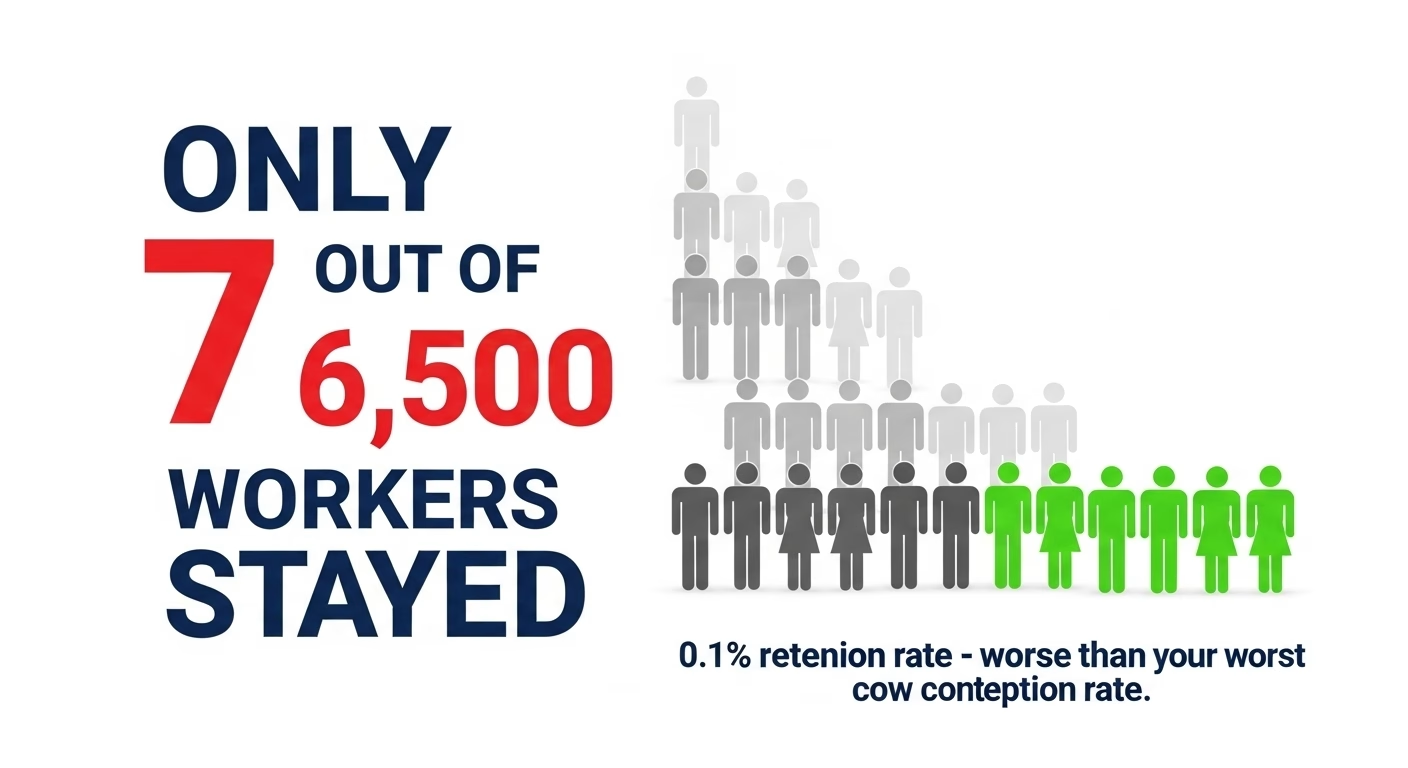
The Uncomfortable Data: In 2011, a program offered 6,500 agricultural jobs to domestic workers. Only 268 Americans applied. A mere seven stayed for the full season. Seven. Out of 6,500 openings. That’s a 0.1% retention rate—worse than your most problematic cow’s conception rate.
According to The Bullvine’s analysis, immigrant workers constitute 51% of the U.S. dairy workforce and are responsible for producing 79% of our milk supply, with substantial portions of these workers undocumented. This isn’t a workforce strategy—it’s a house of cards built on political quicksand.
Here’s the Critical Question: If domestic workers won’t take dairy jobs at current wages, and immigration policy remains hostile to agricultural labor, what’s your Plan B?
Geographic shifts in US dairy production showing Kansas (+15.7%) and Texas (+10.6%) leading growth while California declines (-1.8%)
International Crisis Comparison: The Global Meltdown
Data Box: Global Dairy Labor Catastrophe (2024-2025)
Region
Labor Crisis Indicator
Production Impact
United States
51% immigrant workforce producing 79% of milk
Geographic shift: Kansas +15.7%, California -1.8%
European Union
Only 12% of farmers under 40
Milk production down 1.8% in Q1 2025
Canada
5.4% dairy job vacancy rate
Projected to lose 50% of farms by 2030
Australia
55% of farmers are considering an exit
30-year production low projected
New Zealand
4,000 critical staffing shortage
Policy changes threatening migrant workers
Case Study Sidebar: The Wisconsin Catastrophe
Wisconsin exemplifies the demographic disaster facing dairy. According to The Bullvine’s immigration analysis, Wisconsin’s dairy industry relies on 70% immigrant labor, with more than 10,000 undocumented workers performing essential functions. The University of Wisconsin-Madison puts it bluntly: “Without them, the whole dairy industry would collapse overnight.”
This isn’t just labor dependency—it’s an existential threat to America’s Dairyland itself.
The $32 Billion Elephant in the Milking Parlor
Challenging Conventional Wisdom: The industry consistently downplays immigration’s role, treating it as a “preference” rather than an existential dependency. This isn’t preference—it’s survival.
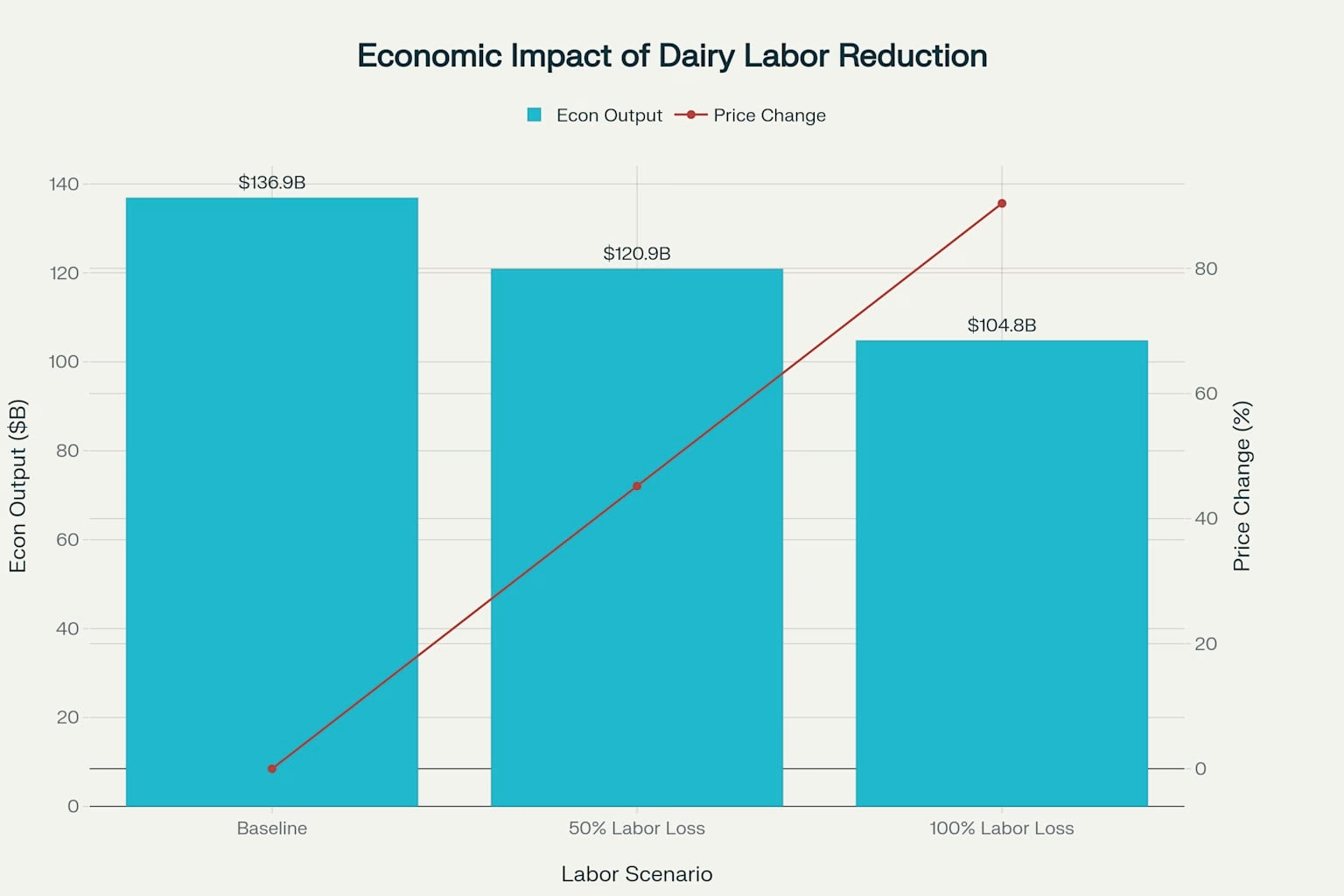
The Bullvine’s economic analysis reveals that eliminating all immigrant labor in the U.S. could result in a catastrophic $32.1 billion economic output loss and over 200,000 job losses. Retail milk prices could spike by an alarming 90.4% to $7.60 per gallon. Even a 50% reduction in immigrant labor could result in 3,506 dairy farm closures.
Data Box: The Hidden Cost of Labor Instability
High Turnover Impact: 1.8% decrease in milk production
Biological Costs: 1.7% increase in calf loss, 1.6% increase in cow death rates
Average Recruitment Cost: $4,425 per employee
Industry Turnover Rate: 30-38.8% annually
200-Cow Dairy Annual Cost: Over $11,000 in recruitment alone
But the biological costs are even more devastating: according to comprehensive industry analysis, employee turnover has been linked to a 1.8% decrease in milk production, a 1.7% increase in calf loss, and a 1.6% increase in cow death rates. Your labor instability is literally killing your livestock profitability.
Annual employee turnover costs escalate from $35K to $150K as dairy farms increase in size
The Technology Revolution: Separating Vendor Fiction from Farm Reality
Challenging the Automation Sales Pitch: While, at minimum, a 50 percent spike in dairy farm wages would add almost $1 per cwt. to the cost of production, making “robotic milking and other labor-saving technologies more cost effective,” the reality is more complex.
Here’s what the robot salesmen won’t tell you: the performance of robotic milking systems has “almost nothing to do with the hardware you bought and everything to do with how you manage it.” Farms with identical robots show dramatically different results based solely on management practices.
Case Study Sidebar: Dave Kammel’s Wisconsin Success
Wisconsin farmer Dave Kammel exemplifies successful strategic automation. According to The Bullvine’s robotic financing analysis, his installation of 2 robotic units delivered:
3 hours of daily labor savings
“Best investment I’ve ever made” assessment
Dramatic quality of life improvements
Immediate operational efficiency gains
His experience demonstrates that automation transforms labor rather than eliminating it.
Robotic milking payback periods: Crisis conditions (18-24 months) vs Normal conditions (48-120 months)
Data Box: Verified Automation ROI (2022-2025)
Initial Investment per Robot: $150,000-$275,000
Annual Labor Savings: $32,000-$45,000 per robot
Direct Milking Labor Reduction: 60%
Milk Yield Increase: 8.66% average, up to 28.5% with proper management
Payback Period (Normal): 4-10 years
Payback Period (Crisis Conditions): 18-24 months
According to The Bullvine’s robotic financing research, delaying robotic adoption costs mid-sized farms up to $160,600 per year in lost profit potential, with top-performing robots generating a $500 per day difference compared to average implementations.
The Wage Competition Fallacy: Why Paying More Won’t Save You
Data Box: The Wage Reality Check (2025)
Farm Worker Average Wage: $17.55/hour – only 61% of non-farm wages
Dairy Labor Costs: 10-15% of production costs for 200+ cow herds
Production Cost Impact: Nearly $1.00 per hundredweight increase
Analysis proves that competing with other sectors “based solely on wage would imply at minimum a 50 percent spike in dairy farm wages, which would add almost $1 per cwt. to the cost of production.” At that point, robotic milking becomes more cost-effective than wage competition.
This demolishes the conventional wisdom that “just pay more” solves labor shortages. The math doesn’t work.
Your Strategic Decision Framework: The Three-Pillar Transformation
Pillar 1: Labor-Light Operations
Immediate Actions (Next 30 Days):
Audit labor-intensive tasks vulnerable to disruption
Model ROI scenarios under both normal and crisis conditions
Research automation vendors before crisis-driven demand inflates pricing by 15-25%
12-Month Implementation: Based on verified performance data from comprehensive industry analysis:
Automated milking systems (60% labor reduction, 3-15% production increase)
Automated feeding systems ($75,000-$125,000 investment, 35-45% annual ROI)
Wearable sensors ($150-$200 per cow, 12-18 month payback)
Pillar 2: Human Capital Revolution
Case Study Sidebar: Progressive Employee Investment
The Bullvine’s human capital research shows that progressive dairy farms are discovering the “real cost of cheap labor.” One Wisconsin operation saw turnover drop from 7% to less than 1% after investing in employee housing—creating a waiting list for employment.
The Proven ROI of Human Investment:
Structured onboarding: 50% reduction in training time, 60-70% productivity boost
Quality housing: Dramatic retention improvements
Career pathways: 69% more likely to remain 3+ years
Employee development: $263,096 total ROI, including efficiency gains
Pillar 3: Market Positioning Advantage
While competitors struggle with labor costs, position yourself in premium markets. Escalating labor expenses compounds the difficulties faced by dairy farmers,” making premium positioning essential for funding automation and employee programs.
Table: The True Cost of Inaction vs. Strategic Adaptation (5-Year Projection)
Scenario
Labor Cost Impact
Production Impact
Total Financial Impact
Competitive Position
Status Quo
$55,000+ recruitment costs
-1.8% annually
-$200,000+
Declining rapidly
Wage-Only Strategy
50% increase required
Minimal improvement
-$150,000
Temporarily stable
Partial Automation
30% reduction
+8.66% average
+$100,000
Moderately competitive
Full Transformation
60% reduction
+15-20%
+$300,000+
Market leadership
Your 30-Day Crisis Response Plan
Week 1: Crisis Assessment
Calculate true labor cost, including turnover, lost production, and biological impacts
Model three scenarios: current state, 50% labor reduction, full automation
Assess infrastructure readiness: internet, power, barn layout
Develop implementation timeline: AMS (6-8 months), feeding systems (3-4 months)
Week 4: Implementation Decision
Choose the highest-impact, fastest-payback automation investment
Establish vendor partnerships before crisis-driven demand escalates costs
Create employee transition and retraining programs (90-120 days for competency)
The Bottom Line: Your Competitive Crossroads
Remember that shocking statistic from our opening? While 5,000 dairy jobs will go unfilled by 2030, smart operators aren’t just adapting—they’re using this transformation to eliminate competition and dominate market share.
The Harsh Reality: More than two-thirds of the country’s 9.36 million dairy cows are milked by immigrant workers,” yet policy uncertainty threatens this foundation. Meanwhile, The Bullvine’s analysis shows a potential $32.1 billion in economic losses if this workforce disappears.
Your Strategic Choice: The labor shortage isn’t your problem to solve—it’s your opportunity to seize. Every farm that closes due to labor challenges removes a competitor. Every operation that successfully automates gains market share.
Consider this final analogy: in the 1980s, the dairy industry faced a similar transformation with the shift from tie-stall to freestall housing. Farms that adapted early gained competitive advantages that lasted decades. Those who waited struggled to catch up or simply didn’t survive.
The labor crisis is today’s tie-stall to freestall moment—a fundamental operational transformation disguised as a temporary staffing problem.
Here’s your immediate next step: Calculate what your operation would look like with verified automation improvements: 60% labor reduction from robotics, 8.66% higher milk yields, and $160,600 annual profit potential per optimized robot. Then ask yourself: Are you building the farm that thrives in that reality or the one that becomes a historical footnote?
The farms that will dominate by 2030 aren’t those that solved the labor shortage—they’re the ones that made it irrelevant to their success through strategic technology adoption and workforce transformation.
Because in this industry, adaptation isn’t just about survival anymore—it’s about who defines the future of North American dairy farming.
KEY TAKEAWAYS
Automation ROI Accelerates Under Crisis: Robotic milking systems delivering $32,000-$45,000 annual labor savings per robot with payback periods compressed from 4-10 years to just 18-24 months under severe labor shortage conditions, while increasing milk yields 3-15% and reducing somatic cell counts 15-20%.
Hidden Labor Costs Devastate Operations: High employee turnover (30-38.8% industry average) triggers cascading biological impacts including 1.8% milk production decline, 1.7% calf loss increase, and 1.6% cow death rate increase, costing 200-cow dairies $11,000+ annually in recruitment before accounting for lost productivity.
Geographic Production Shift Signals Winners: Kansas exploded 15.7% in milk production while traditional stronghold California declined 1.8%, proving labor-efficient regions are capturing market share as farms master automated feeding systems ($75,000-$125,000 investment) with 35-45% annual ROI.
Immigration Dependency Creates $32B Risk: With immigrant workers producing 79% of U.S. milk supply, potential policy disruptions threaten 90.4% retail price spikes and 3,506 farm closures, making strategic automation a hedge against political volatility rather than mere efficiency upgrade.
Technology Transforms Rather Than Eliminates Labor: Successful farms shift from labor-intensive to management-intensive operations, requiring new skills in equipment operation, data interpretation, and troubleshooting—creating “robot operator” and “automation technician” roles that replace jobs nobody wanted with careers people value.
EXECUTIVE SUMMARY
The dairy industry’s “just hire more workers” strategy is dead—and here’s the $32.1 billion proof. With 51% immigrant workforce producing 79% of U.S. milk and 5,000 jobs going unfilled by 2030, the labor crisis isn’t temporary—it’s permanent transformation that separates winners from casualties. High turnover rates of 30-38.8% annually are costing 200-cow dairies over $11,000 in recruitment alone, while also triggering 1.8% milk production losses and 1.7% calf mortality increases. Strategic automation now delivers 60% labor reduction with crisis-accelerated paybacks of 18-24 months versus normal 4-10 years, making robotic milking systems and automated feeding essential survival tools, not luxury upgrades. From Kansas (+15.7% production) to California (-1.8% decline), geographic winners are emerging as farms master labor-light operations while competitors cling to obsolete hiring strategies. The farms dominating by 2030 won’t be those who solved the labor shortage—they’ll be the ones who made it irrelevant through strategic technology adoption and workforce transformation.
Complete references and supporting documentation are available upon request by contacting the editorial team at editor@thebullvine.com.
Every week, thousands of producers, breeders, and industry insiders open Bullvine Weekly for genetics insights, market shifts, and profit strategies they won’t find anywhere else. One email. Five minutes. Smarter decisions all week.
Stop believing immigration raids only target “criminals.” New data shows 51% of your milking crew could vanish overnight, increasing milk price by 90% but crashing your profits.
The numbers are brutal and undeniable: immigrant workers milk 79% of America’s dairy cows, yet Washington’s immigration theater threatens to eliminate this workforce overnight. With dairy operations already squeezed by volatile milk pricing—the 2025 all-milk price forecast at $20.90 per cwt down from $21.20 in 2024—losing half your milking crew isn’t just an operational nightmare, it’s financial suicide. While industry leaders chase component premiums in an era where butterfat levels have surged to 4.40%, the harsh reality is that without immigrant labor, there won’t be any milk to measure components in.
Year
All Milk Price/cwt
Class III Price/cwt
Class IV Price/cwt
2023
20.5
16.8
19.2
2024
21.2
17.9
20.5
2025
20.9
17.6
18.2
The dairy industry’s immigration dependency isn’t some abstract policy debate—it’s as fundamental to your operation as maintaining proper dry matter intake (DMI) or monitoring somatic cell counts (SCC). Just as you wouldn’t run your herd on half rations and expect peak lactation curves, America can’t produce 79% of its milk supply while simultaneously deporting the workers who make it happen.
But here’s the question that should keep every dairy operator awake at night: Are you prepared for what happens when political theater collides with economic reality?
The Milking Parlor Reality: When Labor Disappears Overnight
Picture this scenario that’s playing out across the dairy country: You’ve invested $2.5 million in a state-of-the-art rotary parlor capable of milking 400 cows per hour. Your genomic testing program has pushed your herd’s Total Performance Index (TPI) scores to elite levels, with genetic merit focusing on the butterfat and protein premiums that command top dollar in 2025’s component-driven market. But when ICE raids eliminate 60% of your milking crew, that million-dollar parlor becomes an expensive monument to poor workforce planning.
Recent enforcement actions illustrate this reality with devastating clarity. In Berkshire, Vermont, ICE detained eight workers at a dairy farm in what Migrant Justice called “the largest single immigration enforcement action against farmworkers in Vermont in recent history.” In Sackets Harbor, New York, ICE picked up four adults and three children at a dairy operation, part of what the agency described as “enhanced targeted operations.”
Here’s what the industry experts won’t tell you: According to research from Texas A&M University’s Center for North American Studies, dairies employing immigrant labor produce 79% of the U.S. milk supply, while immigrants make up 51% of all dairy labor. Your 500-cow operation, averaging 75 pounds per cow per day at 4.44% butterfat, represents approximately $315,000 in monthly milk revenue at current pricing. Losing 50% of your milking staff doesn’t just cut production—it catastrophically disrupts your entire operational rhythm, from maintaining proper milking intervals to executing precision feeding protocols.
Why This Matters for Your Operation: Rick Naerebout, CEO of the Idaho Dairymen’s Association, estimates that about 90% of workers on Idaho dairy farms come from other countries. The University of Wisconsin-Madison School of Workers study found that between 46-70% of immigrant dairy workers are undocumented. Most dairy operations face immediate operational collapse if enforcement proceeds at current rates.
The Component Revolution Meets Labor Reality
Here’s where the irony gets painful. American dairy has undergone a remarkable transformation over the past two decades, with butterfat content jumping from 3.70% to 4.40% and protein climbing from 3.06% to 3.40%. This component revolution has created unprecedented value, but here’s the kicker: 51% of the workers producing this liquid gold lack legal immigration status.
Economic analysis from Texas A&M University using the IMPLAN model demonstrates the mathematical precision of this crisis. Baseline nationwide economic activity attributable to dairy farming totals $48.1 billion, supporting 301,300 jobs and $19.6 billion in value added. Under a 50% reduction in immigrant labor, these values crash to $36.9 billion, 235,000 jobs, and $15.1 billion. Complete elimination drops the figures to $25.7 billion, 168,700 jobs, and $10.5 billion.
Think of it as developing the perfect Total Mixed Ration (TMR) for peak metabolizable energy (ME) levels, then discovering that your feed mixer operator might disappear tomorrow. You can optimize genetics, nutrition, and management systems all you want, but your technology investments become worthless without skilled workers to execute these precision protocols.
The Economics Are Staggering: Research projects that eliminating immigrant labor would reduce the U.S. dairy herd by 2.1 million cows, slash milk production by 48.4 billion pounds annually, and force 7,011 dairy farms out of business. The economic ripple effects include a $32.1 billion reduction in output and 208,208 lost jobs across the entire agricultural supply chain.
Challenge to Conventional Wisdom: The dairy industry has long operated under the assumption that technology can eventually replace manual labor. But here’s the uncomfortable truth that industry leaders refuse to acknowledge: even the most sophisticated operations remain fundamentally dependent on human expertise that can’t be automated away.
Technology Can’t Replace What’s Being Deported
Modern milking technology requires skilled operators who understand both complex systems and animal behavior—expertise that takes years to develop and can’t be quickly replaced when immigration enforcement eliminates experienced workers overnight.
The precision agriculture revolution has transformed modern dairy operations. Automated Milking Systems (AMS), activity monitoring collars, and real-time data analytics now guide everything from heat detection to nutritional adjustments. These technologies have enabled the component gains and efficiency improvements that define competitive operations in 2025.
But the tech evangelists won’t tell you that even the most sophisticated robotic milking systems require skilled technicians for maintenance, troubleshooting, and herd health monitoring. When your AMS goes down at 3 AM during peak lactation, you need experienced workers who understand both the technology and cow behavior—not someone you hired yesterday off Craigslist.
Consider the investment math: A complete robotic milking installation costs $150,000-$275,000 per robot, plus infrastructure for power, connectivity, and facility modifications. For operations already struggling with volatile milk prices and immigration-related labor instability, these capital investments require a stable, skilled workforce to justify the ROI.
What This Means for Your Operation: Research confirms that farms implementing AMS actually maintained the same number of employees after installation, just in different roles. The assumption that automation reduces labor needs is fundamentally flawed—it changes labor requirements, often demanding higher-skilled workers who can manage complex systems.
The H-2A Band-Aid: Why It Won’t Save You
ICE enforcement at Glenn Valley Foods demonstrates the fundamental flaw in relying on government verification systems: even operations using E-Verify face devastating raids that eliminate 60% of workforce capacity overnight. When federal agents admit their own employment verification system is “broken” while raiding compliant businesses, it exposes why H-2A’s bureaucratic complexity offers no real protection for dairy operations dependent on year-round labor.
Every discussion about agricultural labor eventually lands on the H-2A visa program, which has exploded from 44 visas in 1987 to over 378,000 positions approved in 2023. Industry advocates love pointing to this growth as proof the system works, but the numbers tell a different story for dairy operations.
USDA Economic Research Service data shows that the H-2A program’s focus on “temporary or seasonal” labor makes it fundamentally unsuitable for year-round dairy operations. The average duration of an H-2A certification in fiscal 2023 was 5.75 months, but cows need milking 365 days a year, twice daily, with no seasonal breaks.
Michigan State University agricultural economist Zach Rutledge estimates that domestic workers with employment taxes may cost between $15 and $25 per hour, while H-2A workers can cost almost twice as much, $25 to $30 per hour. He noted that cost may be higher when factoring in housing and other expenses.
The National Milk Producers Federation has lobbied extensively to expand H-2A access for year-round operations, noting that even sheep herding—a similar year-round animal agriculture sector—has H-2A access that dairy lacks. Despite these efforts, “dairy farms do not have access to the H-2A farmworker program” for their core operational needs.
The Bottom Line: H-2A might work for seasonal vegetable operations with high-margin crops, but it’s economically devastating for dairy farms operating on thin margins with year-round labor needs.
Industry Reality Check: Recent research shows that dairy operations require specialized skills that can’t be quickly replaced through temporary worker programs. The industry has lobbied extensively to expand H-2A access for year-round operations, but regulatory barriers persist.
Financial Reality Check: What Immigration Enforcement Really Costs
Let’s quantify what mass deportations would mean for your milk check. Economic models from Texas A&M University project that eliminating immigrant labor would reduce the dairy herd by 1.34 million head, cut milk production by 29.5 billion pounds, eliminate 4,532 farms, and increase retail milk prices by 61%. More recent projections suggest a potential 90.4% increase in retail milk prices.
For producers, the math is equally brutal, according to peer-reviewed analysis:
Economic Activity Reduction: From $48.1 billion to $25.7 billion (complete elimination)
Job Losses: 132,600 positions eliminated (both immigrant and native-born workers)
Value-Added Decline: From $19.6 billion to $10.5 billion
Farm Closures: 4,532 dairy operations forced out of business
Current Market Context: With 2025 milk pricing already under pressure—all-milk price forecast at $20.90 per cwt compared to $21.20 in 2024—dairy operations can’t absorb additional labor cost shocks. The component premiums that have driven recent profitability (butterfat up to 4.40%, protein to 3.40%) become meaningless if you can’t maintain consistent milking schedules.
Economic research indicates mass deportations could reduce U.S. GDP by 2.6% to 6.2% over the next decade, with agriculture facing $60 billion in annual losses. States with large immigrant populations—California, Texas, and Florida—would face the most severe impacts, precisely the regions driving America’s dairy production growth.
Uncomfortable Truth: Historical data from previous deportation campaigns shows they didn’t increase wages or job opportunities for U.S.-born workers—instead, such actions “lowered wages and contributed to job losses.” Removing 500,000 immigrants from the labor market could lead to 44,000 fewer jobs for U.S.-born workers.
Smart Producers Are Already Adapting
The dairy industry’s response to labor vulnerability has included significant investments in automated milking systems (AMS), with robotic installations growing rapidly across North America.
Forward-thinking dairy operations aren’t waiting for Washington to solve this crisis. They’re implementing strategies that separate survivors from casualties:
Worker Retention and Development Programs The most successful operations create comprehensive retention programs addressing workers’ long-term needs: healthcare access, housing assistance, English language training, and skills development pathways. Investing in worker stability means investing in operational resilience and protecting your genetic and management investments.
Research shows that dairy operations with stable workforces achieve 12% higher rolling herd averages and experience significantly lower turnover-related productivity losses.
I-9 Compliance and Audit Preparation Brook Duer, staff attorney at Penn State’s Center for Agricultural and Shale Law, emphasizes that dairy operations need systematic I-9 audit preparation. In an I-9 audit, “you have three business days to produce any documents,” but officers may show up unannounced with written notice of inspection. Smart operations maintain meticulous employment records and develop response protocols before enforcement arrives.
Technology Integration for Labor Efficiency Strategic technology adoption enhances worker productivity rather than replacing workers. Precision feeding systems, automated health monitoring, and data analytics platforms allow skilled workers to manage larger herds more effectively while reducing physical labor demands.
Supply Chain Diversification Smart operators reduce dependence on immigration-vulnerable suppliers by diversifying vendor networks and building relationships with multiple service providers, including feed suppliers, transportation companies, and processing facilities with demonstrated stable labor practices.
Modern dairy operations depend on skilled workers who seamlessly integrate with advanced milking technology—yet 51% of these essential employees lack legal immigration status, making worker retention programs a critical survival strategy for smart producers navigating the current labor crisis.
The International Competitive Reality
While America struggles with immigration-induced labor instability, global competitors are building structural advantages. The latest international dairy production data shows that countries with more stable labor policies have captured the expanding market share.
New Zealand: Seasonal worker programs provide a predictable labor supply for expansion and modernization, enabling consistent 2-3% annual production growth through their Recognised Seasonal Employer (RSE) scheme.
Canada: 50-year track record of managed agricultural immigration through their Seasonal Agricultural Worker Program supports long-term investment planning without the boom-bust cycles affecting U.S. operations.
European Union: Regional worker mobility policies eliminate immigration uncertainties that plague U.S. operations, supporting stable planning horizons.
These countries are positioning themselves to capture market share from U.S. producers struggling with workforce disruptions. When American dairy operations can’t maintain consistent production due to labor shortages, international suppliers fill the gap at premium prices.
Looking Forward: Policy Solutions That Actually Work
The upcoming executive order Trump promised represents political damage control, but real solutions require moving beyond enforcement-only approaches:
Modernized Guestworker Programs Reform H-2A and similar programs to accommodate year-round agricultural needs while strengthening worker protections. Remove seasonal restrictions for essential agricultural sectors like dairy and streamline applications for legitimate employers.
Earned Legalization for Current Workers Provides pathways to legal status for long-term undocumented workers that are integral to dairy operations. The National Milk Producers Federation has called for permanent legal status for current workers and their families, recognizing that mass deportation is economically catastrophic.
Balanced Enforcement Priorities Realign federal spending from the current 14:1 ratio favoring immigration enforcement over labor standards enforcement. This disparity enables worker exploitation and undermines labor standards for all workers.
Regional Labor Compacts Develop agreements allowing seasonal worker mobility across agricultural sectors and geographic areas, reducing administrative burdens while maintaining oversight and worker protections.
The Bottom Line: Adapt or Perish
Remember that 90.4% milk price increase projection? That’s not theoretical—it’s the mathematical result of eliminating the immigrant workforce that produces 79% of America’s milk supply. Every day without policy solutions moves the industry closer to that economic cliff.
The component revolution has transformed dairy economics, with operations optimizing for butterfat and protein premiums in an increasingly sophisticated market. However, all genetic progress and technological innovation would become worthless without skilled workers executing daily management protocols.
Four Critical Questions Every Dairy Operator Must Answer:
Can your operation survive a 50% labor loss within 30 days? According to Texas A&M research, most can’t.
Are your technology investments labor-dependent or labor-independent? The honest answer determines your vulnerability level.
What’s your contingency plan if H-2A costs double overnight? Because that’s exactly what Michigan State economist Zach Rutledge projects could happen.
How are you building political capital for immigration reform? Individual operators can’t solve this alone.
Implementation Timeline for Immediate Action:
Week 1-2: Contact your state dairy association to join advocacy efforts. The National Milk Producers Federation and American Farm Bureau Federation are leading initiatives but need unified producer support.
Month 1: Conduct a comprehensive I-9 audit of current documentation. Brook Duer’s Penn State guidance emphasizes that “you have three business days to produce any documents” when ICE arrives.
Month 2-3: Develop worker retention programs with housing assistance, healthcare access, and English language training. Research shows 12% higher production efficiency from stable workforces.
Month 4-6: Invest in technology that enhances rather than replaces skilled workers, following successful AMS integration models that maintain employment levels while shifting job requirements.
The smart money is now in operations preparation. This means immediate action on worker retention, technology investment, risk management, and political engagement through established farm organizations.
Your Next Step: Contact your state dairy association this week to join advocacy efforts for agricultural labor reform. The National Milk Producers Federation and American Farm Bureau Federation are leading these efforts but need unified producer support to influence policy outcomes.
This isn’t about politics—it’s about protecting your operation’s future viability in a market where component optimization and operational efficiency determine survival. The crisis is coming whether we acknowledge it or not. The question isn’t whether you’ll be affected but whether you’ll be ready when it hits your milking parlor at 4 AM tomorrow morning.
The harsh reality? While Washington plays political theater with immigration policy, your cows still need milking twice daily, your components need optimizing, and your operation needs protection. The producers who recognize this fundamental truth—and act accordingly—will be the ones still standing when the dust settles.
KEY TAKEAWAYS
Labor Vulnerability Reality Check: 51% of dairy workers lack legal status while producing 79% of U.S. milk supply, creating immediate operational collapse risk for any farm dependent on immigrant labor—regardless of herd size or technological sophistication.
Economic Catastrophe Projections: Complete immigrant labor elimination would reduce dairy herds by 2.1 million cows, slash production by 48.4 billion pounds annually, and potentially double retail milk prices—devastating both producer profitability and consumer affordability.
H-2A Program Failure: At $15,000+ per worker per season, H-2A costs exceed $30/hour fully loaded and excludes year-round dairy operations, making it economically devastating for farms already operating on volatile milk pricing margins.
Technology Integration Misconception: Even advanced AMS installations maintain the same employee count in different roles, requiring skilled technicians who understand both cow behavior and complex systems—skills that take years to develop and can’t be quickly replaced.
Immediate Action Requirements: Operations implementing comprehensive worker retention programs (healthcare access, housing assistance, English training) achieve 12% higher rolling herd averages while building resilience against enforcement-related disruptions that could eliminate half your workforce within 30 days.
EXECUTIVE SUMMARY
While Washington plays political theater with immigration enforcement, dairy operators face an existential threat that could slash the U.S. dairy herd by 2.1 million cows and trigger a 90.4% spike in retail milk prices. Immigrant workers milk 79% of America’s dairy cows, yet represent 51% of the total dairy workforce—making every operation vulnerable to overnight labor collapse regardless of E-Verify compliance or legal protocols. Recent enforcement actions, including raids that eliminated 60% of workforce capacity at compliant operations, expose the brutal reality: your $2.5 million parlor investment becomes worthless without skilled workers to execute precision milking protocols and maintain component optimization. Economic projections show complete labor elimination would cut national milk production by 48.4 billion pounds annually, force 7,011 dairy farms out of business, and trigger $32.1 billion in economic losses across the supply chain. The H-2A “solution” costs $15,000+ per worker per season and excludes year-round dairy operations, while existing stockpiled vaccines don’t match current viral strains. Smart producers are already implementing worker retention programs, technology integration strategies, and political advocacy—because the crisis isn’t coming, it’s here, and your survival depends on immediate action.
Every week, thousands of producers, breeders, and industry insiders open Bullvine Weekly for genetics insights, market shifts, and profit strategies they won’t find anywhere else. One email. Five minutes. Smarter decisions all week.
Stop pretending immigration raids don’t affect your milk check. New data shows 64% workforce loss = zero production. Your operation is next.
EXECUTIVE SUMMARY: The dairy industry’s immigration crisis isn’t coming—it’s here, and it’s devastating operations across America with surgical precision. Federal agents swept through a New Mexico dairy facility, arresting 11 workers and forcing the termination of 24 others, effectively shuttering milk production when the operation lost 64% of its workforce in a single day. Research reveals immigrant workers comprise 51% of the U.S. dairy workforce and produce 79% of America’s milk supply, yet current H-2A visa programs remain fundamentally incompatible with year-round dairy operations. Economic projections show catastrophic consequences: losing half the immigrant workforce could spike milk prices by 45.2%, while complete loss could trigger a 90.4% price increase—turning your $4 gallon into $7.60 overnight. Meanwhile, existing E-Verify systems are acknowledged as “broken” by federal agents, creating an impossible compliance trap for producers who face severe penalties despite good-faith efforts. The choice facing every dairy operator is stark: acknowledge this workforce dependency and develop contingency plans, or continue pretending federal enforcement won’t disrupt your operation. It’s time to stop burying your head in regulatory sand and start building workforce resilience before the next raid hits your region.
KEY TAKEAWAYS
Workforce Vulnerability Assessment: Conduct immediate audit of your labor dependencies—operations losing 35+ workers overnight face complete production shutdown, with 79% of U.S. milk supply relying on immigrant labor that could disappear with zero warning.
Economic Impact Calculation: Factor potential 45.2% to 90.4% milk price increases into your risk management planning—while higher prices might seem beneficial, the production capacity loss and operational chaos will devastate cash flow before prices adjust.
Legal Compliance Strategy: Document everything meticulously through E-Verify despite federal agents admitting the system is “broken”—create redundant verification systems and establish relationships with local law enforcement to understand their immigration enforcement policies.
Contingency Planning Implementation: Develop cross-training programs for critical milking operations, establish emergency labor-sharing agreements with neighboring farms, and invest in automation for processes that can’t afford interruption—the days of assuming workforce stability are over.
Policy Engagement Priority: Support comprehensive immigration reform through industry associations—the Farm Workforce Modernization Act continues stalling in the Senate while your workforce remains in legal limbo, making political engagement essential for long-term operational security.
Federal agents swept through a New Mexico dairy operation on June 4th, arresting 11 workers and forcing the termination of 24 others—effectively shuttering milk production at a facility that lost 64% of its workforce in a single day. The Lovington raid isn’t just another enforcement action; it’s a stark preview of what happens when immigration policy meets the reality of who actually milks America’s cows.
When 35 Workers Disappear, So Does Your Milk Supply
Let’s cut straight to the chase: Outlook Dairy Farms in Lovington went from operating normally to crisis mode in one morning. Masked Homeland Security Investigations agents armed with rifles didn’t just arrest workers—they dismantled an entire operation that depends on precise timing and experienced hands.
Here’s what really happens when you lose 35 out of 55 workers overnight. Owner Isaak Bos had to pull in family members, office staff, and even high school kids on summer break just to keep his cattle alive. “It’s detrimental for our cattle,” Bos explained, describing how his remaining crew was “pushing it to the limit.”
But here’s the kicker that should terrify every dairy producer: this wasn’t random enforcement. The raid followed an employment audit conducted months earlier, proving federal agents are systematically targeting agricultural operations with surgical precision.
The Numbers That Should Keep You Awake at Night
Think the Lovington situation is an isolated incident? Think again. Research by the National Milk Producers Federation shows immigrant workers comprise 51% of the entire U.S. dairy workforce and produce 79% of America’s milk supply. Read that again—nearly 80% of the milk flowing through your local grocery store comes from farms dependent on immigrant labor.
What happens when that workforce disappears? The economic projections are nothing short of catastrophic:
Eliminating immigrant labor would reduce the U.S. dairy herd by 2.1 million cows
Milk production would drop by almost 50 billion pounds annually
The number of dairy farms would shrink by 7,000
Milk prices would spike by 90.4%
Your $4 gallon of milk becomes $7.60 overnight. For an industry already operating on razor-thin margins, these aren’t just statistics—they’re operational death sentences.
Global Reality Check: How Other Dairy Nations Handle This
While America grapples with immigration enforcement disrupting its food supply, let’s examine how major dairy competitors approach agricultural labor challenges.
New Zealand operates a robust seasonal worker scheme that provides legal pathways for Pacific Island workers, ensuring dairy operations maintain stable workforces without enforcement disruptions. Their Recognised Seasonal Employer (RSE) scheme has operated successfully since 2007, providing predictable labor for both seasonal and year-round agricultural needs.
The Netherlands leverages EU freedom of movement, allowing Polish and Romanian workers to fill dairy positions legally while investing heavily in automation to reduce labor dependency. Dutch dairy operations have achieved some of the world’s highest per-cow productivity through this combined approach.
Canada utilizes the Temporary Foreign Worker Program for agricultural operations, including dairy, providing multi-year work permits that offer stability for both workers and employers. Canadian dairy farms report significantly less labor disruption compared to U.S. operations.
The contrast is stark: while other major dairy nations create legal pathways for essential workers, America criminalizes the workforce producing most of its milk.
Why E-Verify Isn’t Saving Anyone
Here’s where the system becomes truly broken. Bos stated his arrested workers had provided “false paperwork”—the same story we hear nationwide. Gary Rohwer, who owns Glenn Valley Foods in Nebraska, meticulously used the government’s E-Verify system. Result? His plant still got raided, and 70 workers were arrested.
The real gut punch? Federal agents involved in that Nebraska raid openly admitted E-Verify is “broken” and “flawed.”
So, let’s get this straight: You’re legally required to verify employment eligibility using systems that federal enforcement admits don’t work, yet you face severe penalties when those systems fail.
What This Means for Your Operation Today
If you’re running a dairy operation right now, here’s your reality check: McKinsey survey data shows 64% of dairy company CEOs cite labor shortages among their top three concerns. Without comprehensive immigration reform, you’re not just facing higher labor costs but staring at potential operational collapse.
Current visa programs like H-2A remain seasonal and unavailable to the dairy industry. They’re designed for crop work, not the year-round, 24/7 demands of milking cows. This fundamental mismatch forces dairy farms to rely on undocumented workers because legal pathways simply don’t exist for your operational needs.
Immediate Action Steps for Dairy Operators
Document Everything Meticulously: Use E-Verify despite its acknowledged flaws and maintain impeccable records. Create backup documentation systems and ensure all I-9 forms are current and complete.
Build Relationships with Local Law Enforcement: Understand what they will and won’t do regarding immigration enforcement. Lea County Sheriff Corey Helton publicly stated that local law enforcement doesn’t enforce federal immigration law and will “never ask you your immigration status.”
Develop Workforce Contingency Plans: Cross-train existing employees across multiple tasks. Establish relationships with neighboring operations for emergency labor sharing. Consider investing in automation for critical processes that can’t afford interruption.
Stay Informed on Policy Changes: The Farm Workforce Modernization Act has passed the House twice with bipartisan support but continues to stall in the Senate. Immigration reform could happen quickly when economic pressure becomes unbearable.
The Political Reality No One Wants to Discuss
The Trump administration has set a target of 3,000 daily arrests for immigration violations, with agriculture explicitly considered “ripe for aggressive actions given a high volume of undocumented workers.” Recent operations include raids on California produce farms and Nebraska meatpacking plants—this is a coordinated national strategy, not random enforcement.
Despite this aggressive stance, even President Trump has acknowledged his policies are “taking very good, long time workers away” from farmers, with those jobs being “almost impossible to replace”. He’s suggested considering “carve-outs” for these workers, but that’s cold comfort when your cows need milking today.
The Economic Tsunami Coming to Your Grocery Store
The ripple effects extend far beyond individual farms. Research shows that in some states, foreign-born workers constitute 90% of the meat processing and dairy workforces. When enforcement actions target these concentrated populations, entire regional food systems collapse.
Historical precedents are sobering. The 2008 raid on Agriprocessors Inc. in Postville, Iowa, led to the arrest of nearly 400 workers, crippling the local economy. Businesses closed, foreclosures surged, and the town experienced substantial population loss, leading the City Council to declare Postville a “humanitarian and economic disaster area.”
Where Technology Can’t Save You
Some suggest automation as the solution, but reality tells a different story. While robotic milking technology continues advancing, it’s not a magic bullet that can instantly replace skilled workers who understand animal behavior and can adapt to changing conditions.
The fundamental limitation: Dairy operations require experienced workers who can identify health issues, handle birthing complications, and manage the countless variables that arise with living animals. No robot can replace the intuitive knowledge of a skilled dairy worker who recognizes when a cow is off her feed or showing early signs of illness.
The Bottom Line for Dairy’s Future
The Lovington raid isn’t just one farm’s struggle—it’s a preview of American agriculture’s future under current policies. We’ve built a food system that depends on immigrant labor while criminalizing their presence. That’s not sustainable economics; it’s systematic dysfunction.
The choice facing every dairy producer is simple: Who’s going to milk your cows, and what will it cost when there’s nobody left?
Until policymakers acknowledge that immigration enforcement and food security are inextricably linked, American dairy producers will continue paying the price—literally—for this policy dysfunction. The choice isn’t whether we need immigrant workers in dairy; it’s whether we’ll create legal pathways for them before our industry collapses under the weight of enforcement priorities that ignore economic reality.
Smart operators are already preparing for this new reality. The question is: will you be ready when the next raid hits your region?
Learn More:
Your Dairy Operation’s Survival Guide to Immigration Raids – Practical compliance strategies to avoid $200K+ fines and maintain workforce stability during enforcement actions, including 5-point defense protocols and legal response frameworks every dairy operator needs implemented immediately.
Every week, thousands of producers, breeders, and industry insiders open Bullvine Weekly for genetics insights, market shifts, and profit strategies they won’t find anywhere else. One email. Five minutes. Smarter decisions all week.
To provide the best experiences, we use technologies like cookies to store and/or access device information. Consenting to these technologies will allow us to process data such as browsing behavior or unique IDs on this site. Not consenting or withdrawing consent, may adversely affect certain features and functions.
Functional
Always active
The technical storage or access is strictly necessary for the legitimate purpose of enabling the use of a specific service explicitly requested by the subscriber or user, or for the sole purpose of carrying out the transmission of a communication over an electronic communications network.
Preferences
The technical storage or access is necessary for the legitimate purpose of storing preferences that are not requested by the subscriber or user.
Statistics
The technical storage or access that is used exclusively for statistical purposes.The technical storage or access that is used exclusively for anonymous statistical purposes. Without a subpoena, voluntary compliance on the part of your Internet Service Provider, or additional records from a third party, information stored or retrieved for this purpose alone cannot usually be used to identify you.
Marketing
The technical storage or access is required to create user profiles to send advertising, or to track the user on a website or across several websites for similar marketing purposes.
To provide the best experiences, we and our partners use technologies like cookies to store and/or access device information. Consenting to these technologies will allow us and our partners to process personal data such as browsing behavior or unique IDs on this site and show (non-) personalized ads. Not consenting or withdrawing consent, may adversely affect certain features and functions.
Click below to consent to the above or make granular choices. Your choices will be applied to this site only. You can change your settings at any time, including withdrawing your consent, by using the toggles on the Cookie Policy, or by clicking on the manage consent button at the bottom of the screen.
Functional
Always active
The technical storage or access is strictly necessary for the legitimate purpose of enabling the use of a specific service explicitly requested by the subscriber or user, or for the sole purpose of carrying out the transmission of a communication over an electronic communications network.
Preferences
The technical storage or access is necessary for the legitimate purpose of storing preferences that are not requested by the subscriber or user.
Statistics
The technical storage or access that is used exclusively for statistical purposes.The technical storage or access that is used exclusively for anonymous statistical purposes. Without a subpoena, voluntary compliance on the part of your Internet Service Provider, or additional records from a third party, information stored or retrieved for this purpose alone cannot usually be used to identify you.
Marketing
The technical storage or access is required to create user profiles to send advertising, or to track the user on a website or across several websites for similar marketing purposes.







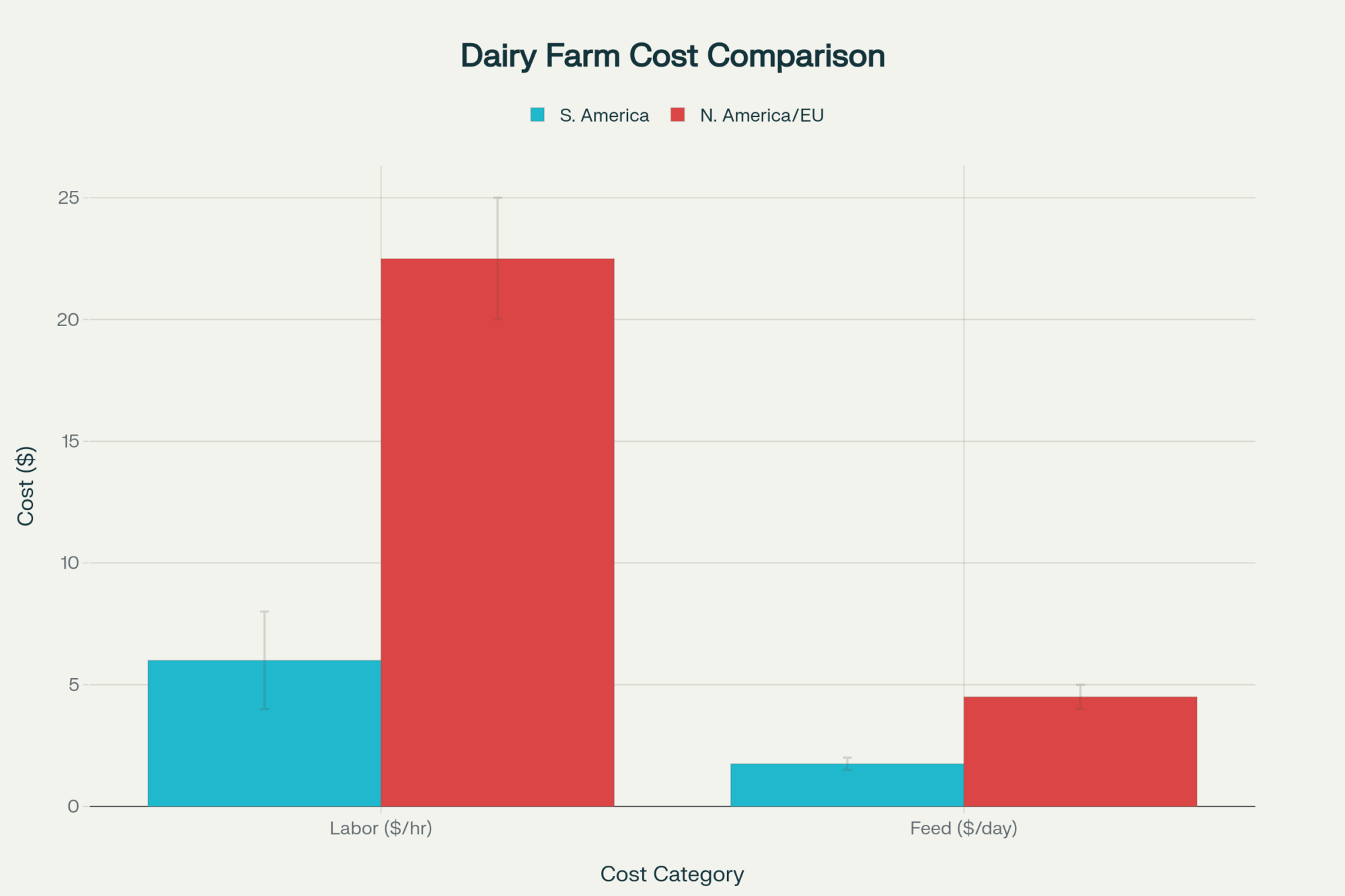

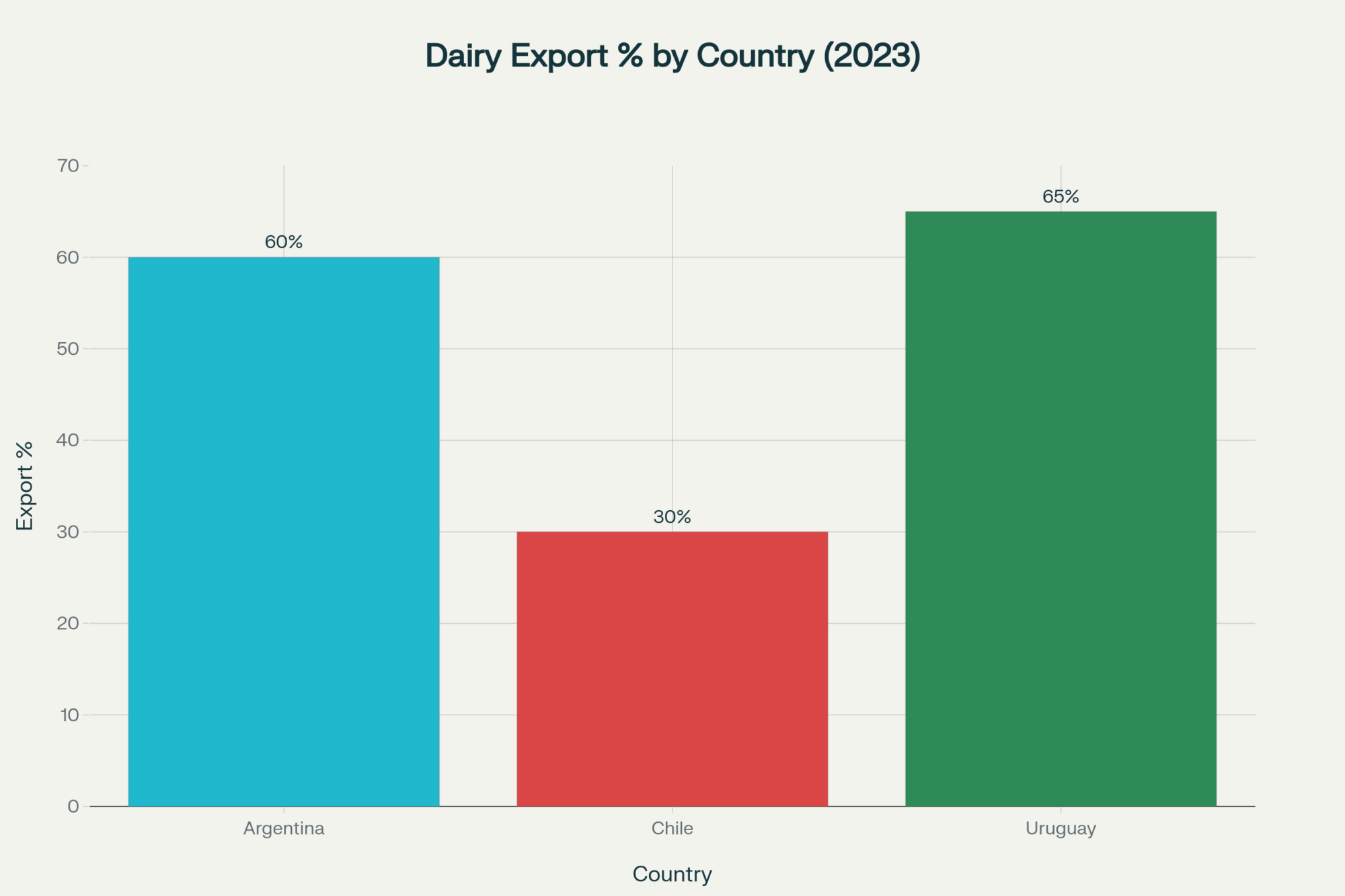
 The Sunday Read Dairy Professionals Don’t Skip.
 The Sunday Read Dairy Professionals Don’t Skip.