



Archive for farm financial health

The $16,600 DMC Farm Bill “Win” vs a 0.9x DSCR: The 2026 Decision for 400‑Cow Herds

Your 400‑cow herd can “win” $16,600 on DMC in 2026 and still sit at 0.9x DSCR the minute your banker deletes those dollars from the cash‑flow.

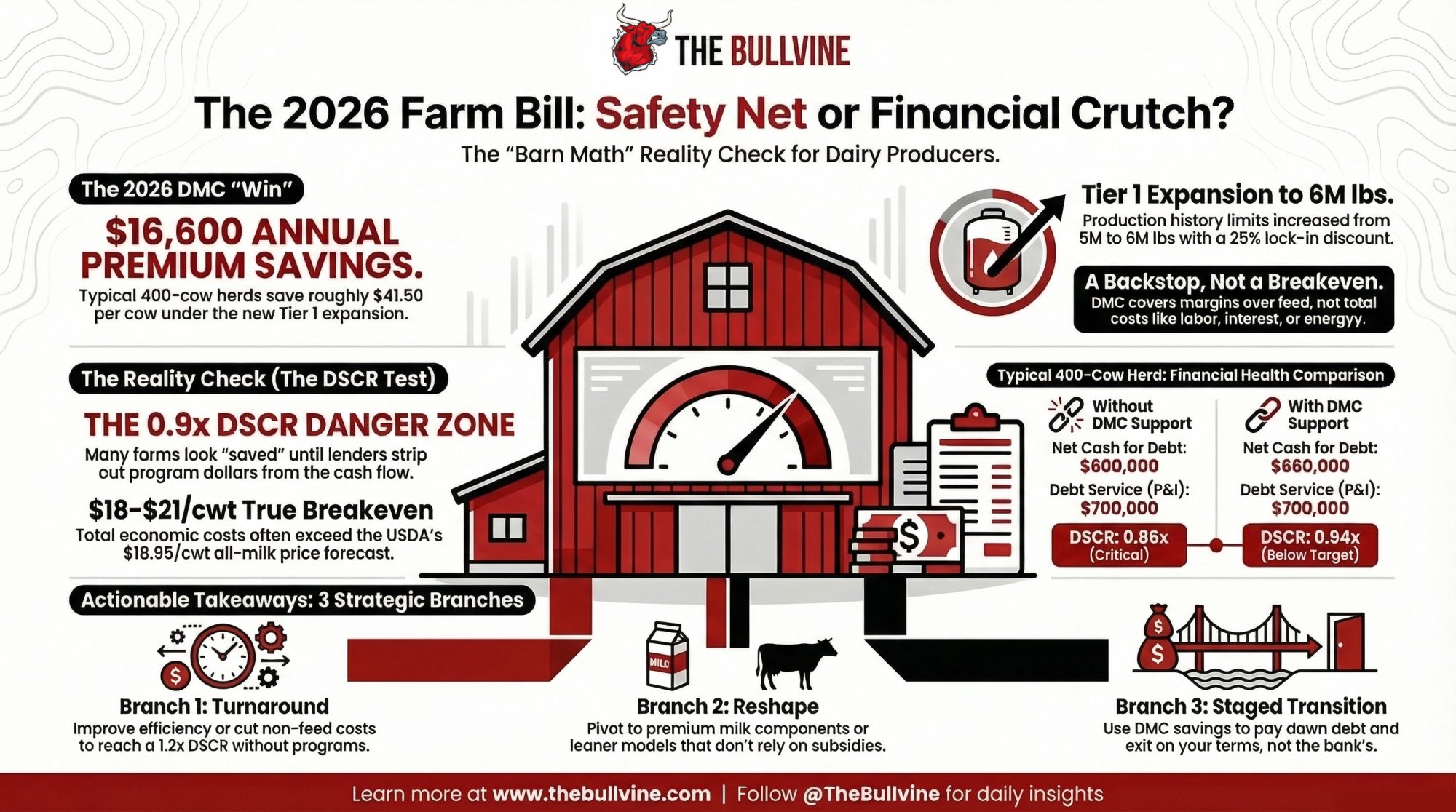
Executive Summary: In 2026, a typical 400‑cow U.S. herd can save about $16,600 in DMC premiums on 6 million pounds — roughly $41.50 per cow — and still sit at 0.9x debt‑service coverage once the banker removes DMC and other program dollars from the cash‑flow. The piece shows the barn math step‑by‑step: $1.66/cwt DMC premium savings, $18.95/cwt all‑milk outlook, and $18–21/cwt true breakeven costs that leave many mid‑size herds below the 1.15–1.25x DSCR comfort band lenders want. It argues that when DSCR clears only 1.0–1.1x with DMC included, DMC has shifted from a safety net to a crutch for a business model that doesn’t pencil. From there, it outlines three realistic branches for 300–500‑cow herds: a turnaround to get “no‑program” DSCR above 1.2x, a reshape into a leaner or premium model, or a staged transition that uses DMC, FSA, and EQIP to protect equity and control timing instead of waiting for the bank to decide. The article also shows which farm‑bill tools actually move your cheque, showing where FSA loan limit increases, EQIP/methane funding, DNIP, and school milk changes genuinely move your milk cheque” or “your margins. It closes with a simple test every operator can run over the next 30 days: calculate DSCR with and without DMC, and ask whether your lender would continue financing the version that stands on its own.
2026 Farm Bill Trap

A lot of 400‑cow U.S. dairies look “saved” by the 2026 farm bill on paper. Strip out DMC and other program dollars, and some of those same farms are sitting at about 0.9x debt‑service coverage — not generating enough cash to cover principal and interest on their own.

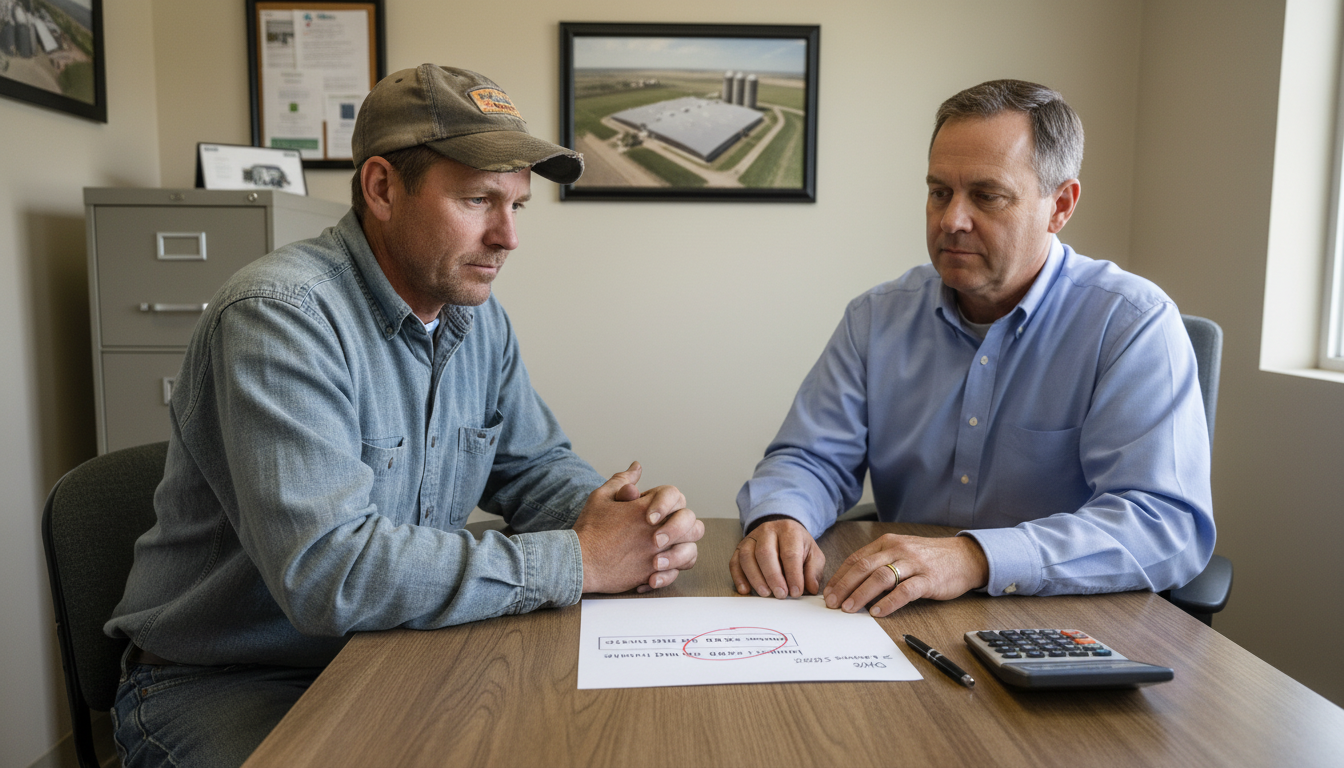
That’s exactly where a composite 400‑cow freestall operator we’ll call ‘Mark’ lands in 2026. His freestall saves roughly $16,600 a year on Dairy Margin Coverage premiums thanks to the new Tier 1 expansion — about $41.50 per cow. Early‑2026 Extension analysis suggests several months of $1‑plus/cwt DMC indemnities on covered milk if margins track the 2019–2023 pattern at the kitchen table, that looks like protection.
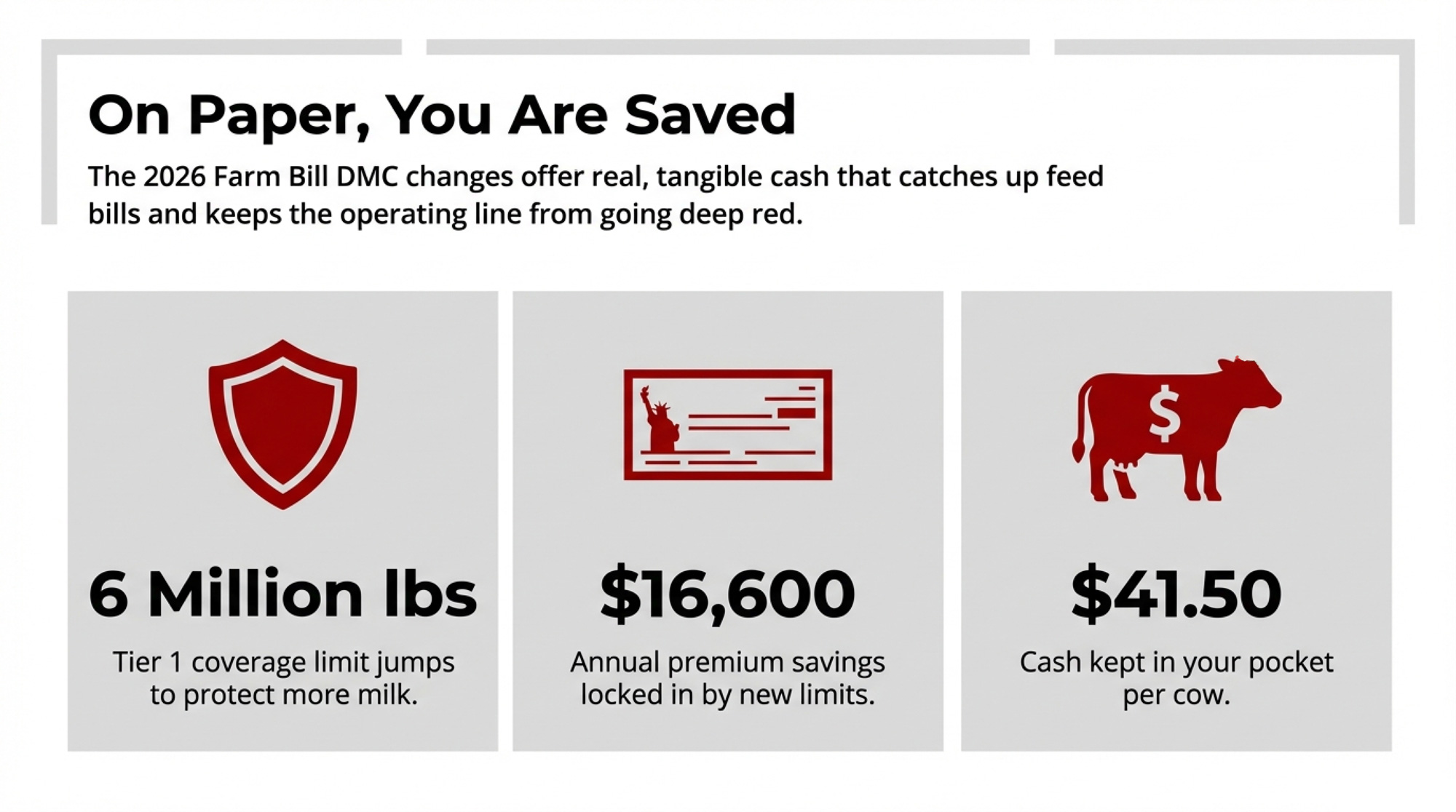
Across the lender’s desk, once his banker, Julie, pulls DMC and other program dollars out of the cash flow, the number is simple: around 0.9x DSCR. Without government support, the cash flow doesn’t fully cover annual debt service.

All numbers and policy tools in this piece refer to U.S. non‑quota herds operating under federal programs (DMC, FSA, EQIP, DNIP).

Composite scenario built from producer and lender patterns, Extension data, and ag‑lending benchmarks — not a single real named farm.

“The Farm Bill Saved Us”… Or Did It?

Mark looks a lot like many mid‑size family dairies in 2026. He milks 400 cows, ships about 11 million lbs/year — roughly 110,000 cwt. Two capital projects sit behind him: a parlour upgrade and manure system work, both financed when rates were low and now reset to higher levels. His labour mix mirrors the broader industry — a 2015 Texas A&M/National Milk Producers Federation study estimated immigrant workers account for roughly 51% of U.S. dairy labour and produce close to 79% of the nation’s milk.

On the policy side, he’s done everything right in the new farm‑bill world:

  • Maxed Tier 1 DMC at $9.50/cwt on the expanded 6 million lbs production history limit, after USDA raised Tier 1 from 5 to 6 million pounds and allowed history updates to each farm’s highest year from 2021–2023.
  • Locked in the six‑year DMC commitment with a 25% premium discount on Tier 1 premiums from 2026 to 2031.
  • Layered revenue protection on part of his milk to catch the downside that the DMC formula doesn’t see.

On paper, that’s a safety‑net success story. The deeper math tells a different story.

DMC history between 2019 and 2023 shows the margin trigger paying indemnities in roughly half the months at $9.50 Tier 1 coverage, per Farm Bureau and Extension DMC analyses. But in months where the official DMC margin sat near $12/cwt, many farms were still unprofitable once non‑feed costs were layered in. USDA ERS 2021 ARMS data puts the full economic cost of production at roughly $20.54/cwt for 500–999‑cow U.S. herds and $19.14/cwt for herds of 1,000+. Multi‑state Extension work — including UW–Madison benchmarks for mid‑size Wisconsin dairies — lands full costs around $18–19/cwt.

For Mark, the picture snaps into focus:

  • A realistic, fully loaded breakeven in the high‑teens to low‑$20s/cwt.
  • A DMC margin trigger that calls the farm “covered” as long as income over standardized national feed costsstays above $9.50/cwt — with no view of labour, interest, energy, or family draw.

The comfortable story in a lot of 2026 farm‑bill coverage: “With the new DMC and FSA tools, mid‑size dairies are finally protected.”

The minute Mark’s scenario hits a DSCR calculator, that story flips.

What Does the 2026 DMC Expansion Really Do for a 400‑Cow Herd?

Four changes matter most for a herd like Mark’s:

  • Tier 1 coverage jumps to 6 million lbs of production history, up from 5 million.
  • Production history can be updated to the farm’s highest annual marketings from 2021, 2022, or 2023.
  • six‑year lock‑in offers a 25% discount on Tier 1 premiums if you enroll in the same coverage from 2026 to 2031.
  • Tier 1 premiums for $9.50 coverage: $0.15/cwt (before the lock‑in discount).

The Premium Math: Where $16,600 Comes From

Swap in your own production numbers:

  • Extra milk moving from Tier 2 to Tier 1: 1,000,000 lbs (the new 6M minus the old 5M cap).
  • Old Tier 2 premium at $8.00 coverage (comparable risk level): $1.81/cwt.
  • New Tier 1 premium at $9.50 coverage: $0.15/cwt.
  • Per‑cwt savings: $1.81 − $0.15 = $1.66/cwt.
  • Annual premium savings: 10,000 cwt × $1.66 = $16,600/year.
  • Per cow: $16,600 ÷ 400 = $41.50/cow/year.

That’s money you keep whether DMC pays a dime in indemnities. If 2026 margins track the 2019–2023 pattern, total indemnities could add tens of thousands more, depending on how long margins remain below the $9.50 trigger.
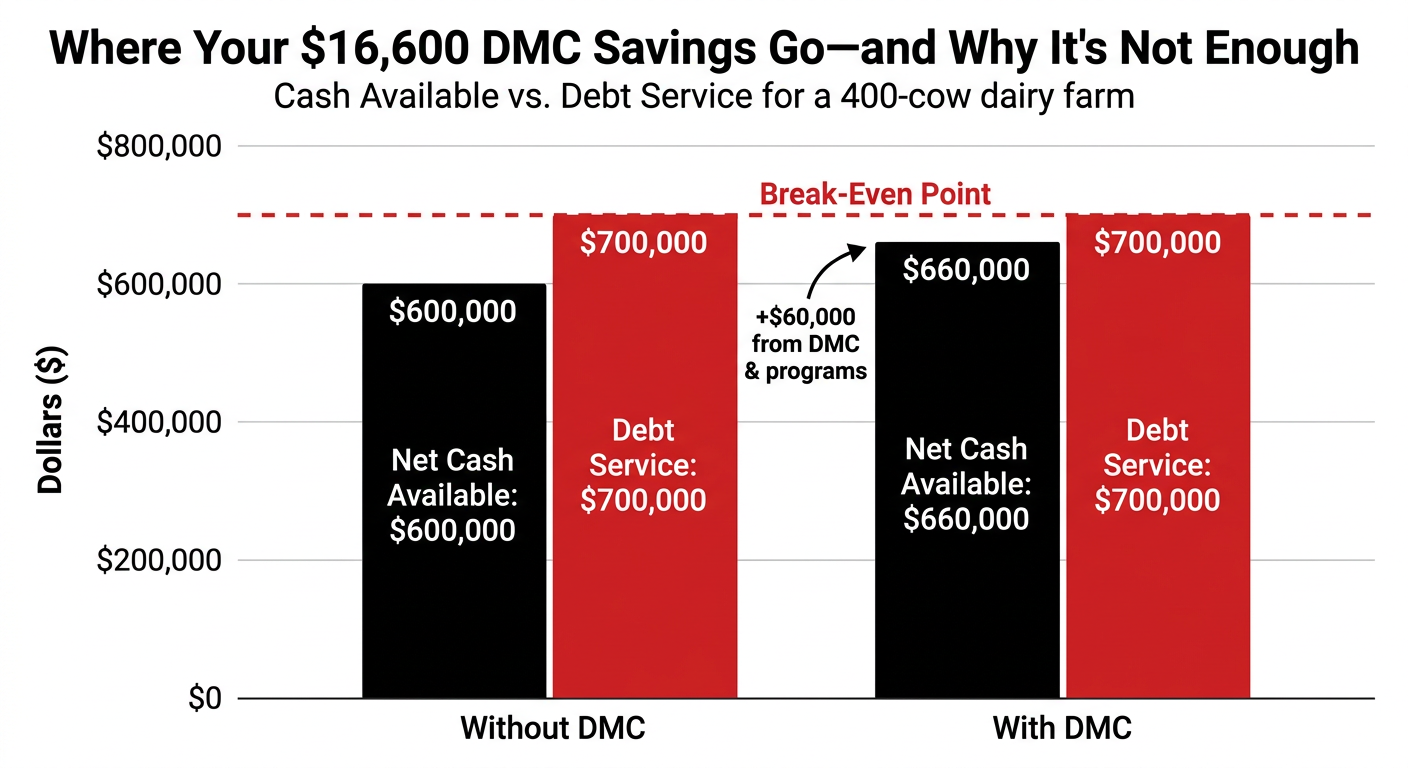
Real cash. The kind that catches up feed bills and keeps the operating line from going deep red.

But the catch is what DMC pays on. It’s the margin over the standardized feed, not the full cost of production. Farm Bureau’s March 2026 analysis calls it a “vital backstop showing its limits” for exactly this reason — it never sees the gap between a $9.50 margin and a $20‑plus all‑in cost on many farms.

So when Julie runs 2026 projections on Mark’s herd, she does it two ways:

  1. With DMC and other program income in the numerator.
  2. Without any program income at all.

That’s where the 0.9x shows up.

What Does a 0.9x DSCR Really Mean for a 400‑Cow Herd?

Here’s the barn math a lot of 400‑cow producers and their lenders are walking through right now.
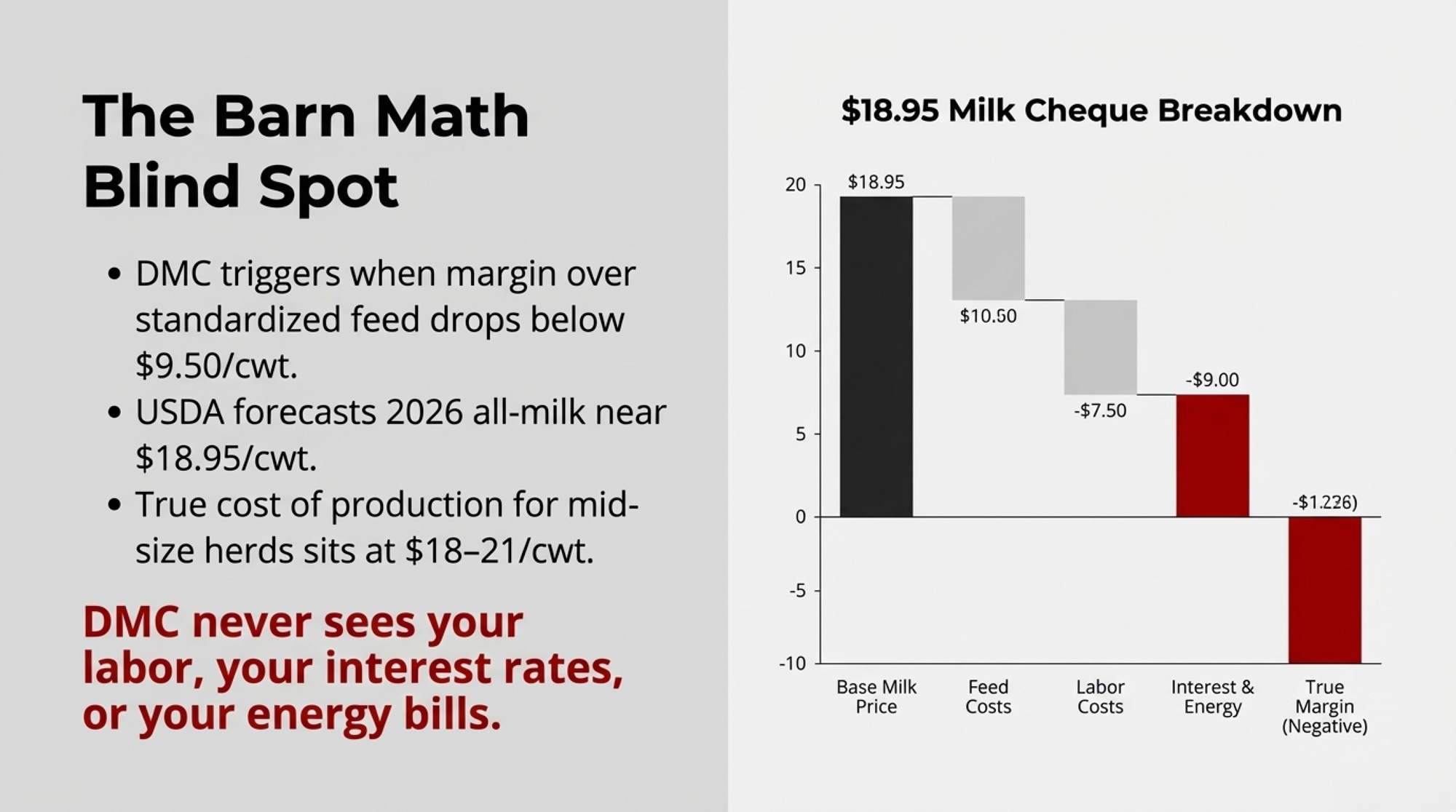
Assumptions (national outlooks + farm‑level benchmarks):

  • Herd: 400 milking cows, ~27,500 lbs/cow/year → 11 million lbs, or 110,000 cwt.
  • Milk price scenario: USDA’s February 2026 WASDE puts the annual all‑milk forecast near $18.95/cwt. Once basis and component adjustments hit the cheque, the realized price can land several dollars lower.
  • Full cost of production: $18–21/cwt depending on herd size, efficiency, and region (USDA ERS 2021 ARMS; UW Extension mid‑size Wisconsin benchmarks).
  • Annual debt service: In this composite, Mark carries $600,000–900,000 in annual P&I — roughly $1,500–2,250 per cow. That’s not a national average; it’s a realistic range from lender examples and recent mid‑size capital projects.

For DSCR, lenders go back to basics:

(Milk and other income − cash expenses) ÷ annual principal and interest.

The Lender’s Circle

Julie slides the printout across the desk and circles two numbers:
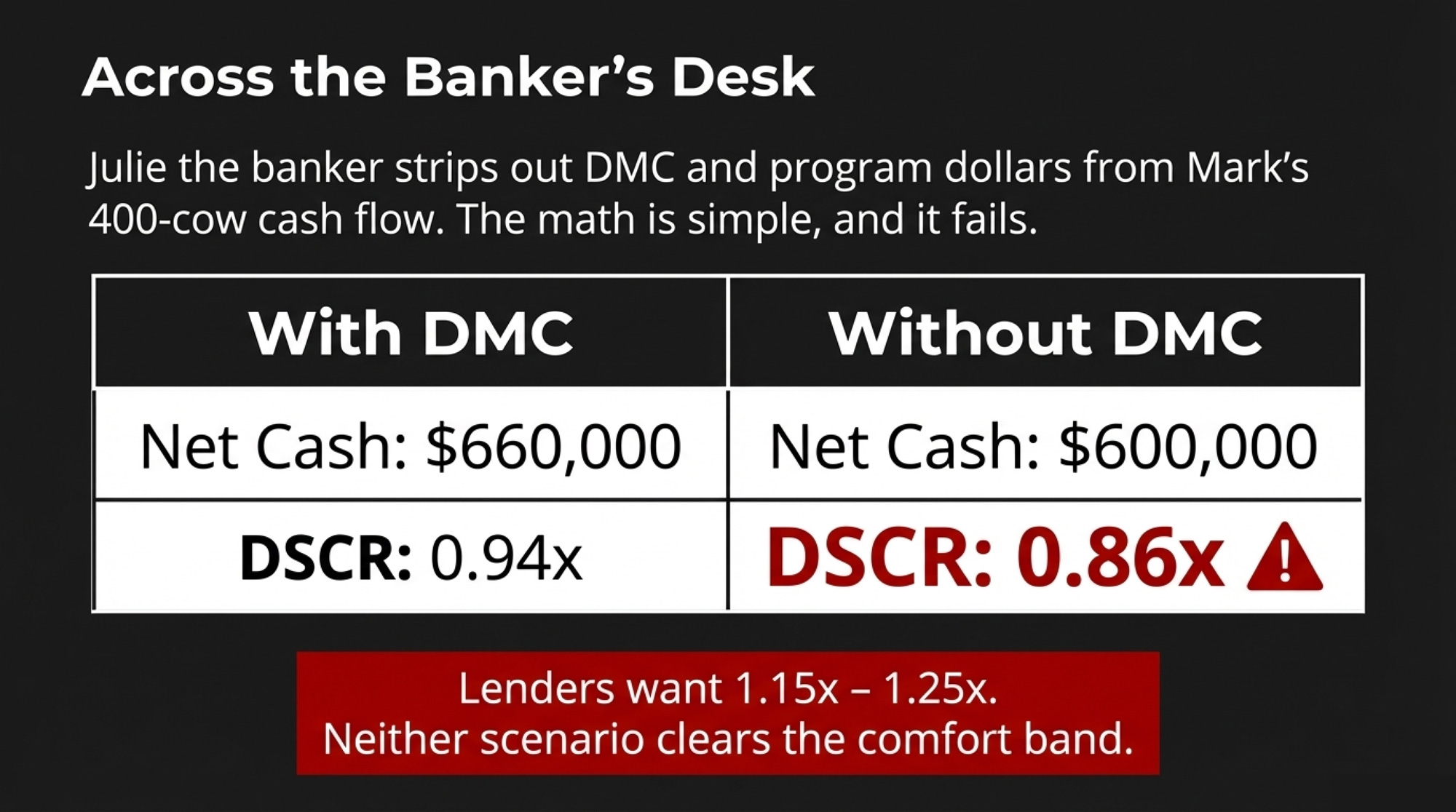
MetricWithout DMC & ProgramsWith DMC & Programs
Annual Milk Sales (110,000 cwt @ $18.95/cwt)$2,084,500$2,084,500
DMC Premium Savings$0$16,600
Other Cash Expenses$1,484,500$1,484,500
Net Cash Available for Debt Service$600,000$660,000
Annual Debt Service (P&I)$700,000$700,000
DSCR0.86x0.94x
Lender Comfort Zone1.15–1.25x1.15–1.25x

Adjust a few assumptions — slightly higher net cash, slightly lower debt service — and you can push the “with DMC” number just north of 1.1x. Without DMC, it sags back toward 0.9x.

Most ag‑lenders treat a DSCR of roughly 1.15–1.25x as their comfort zone. Anything under 1.0x signals cash‑flow that can’t service its own debt without outside help.

Neither number in that table clears the band. One looks less alarming.

The Turn: Is DMC Your Backstop or Your Business Model?

That question is Mark’s turn, and for a lot of 300–500‑cow operations, reading the same headlines.

The comfortable narrative has sounded like this: DMC is stronger and cheaper. FSA operating and ownership loan limits are higher. Conservation and methane dollars are flowing. Farm Credit and the American Bankers Association have pushed for FSA to raise guaranteed operating loan limits toward $3 million, arguing lenders need those levels to keep financing modern farms.

For a dairy with a solid DSCR, that’s true — higher guaranteed limits unlock better terms and responsible restructures. For a 0.9x herd like Mark’s, the math goes another way:
If your bankable DSCR only works when program dollars are in the numerator, DMC has drifted from being a backstop to a core revenue stream.

Rolling the operating line for another year isn’t risk management at that point. It’s a timing decision on when — and how — the operation changes or exits.

Three Branches — None Start with “Hope DMC Keeps Paying”

Once the math is on paper, most 400‑cow herds in this band end up with three branches.
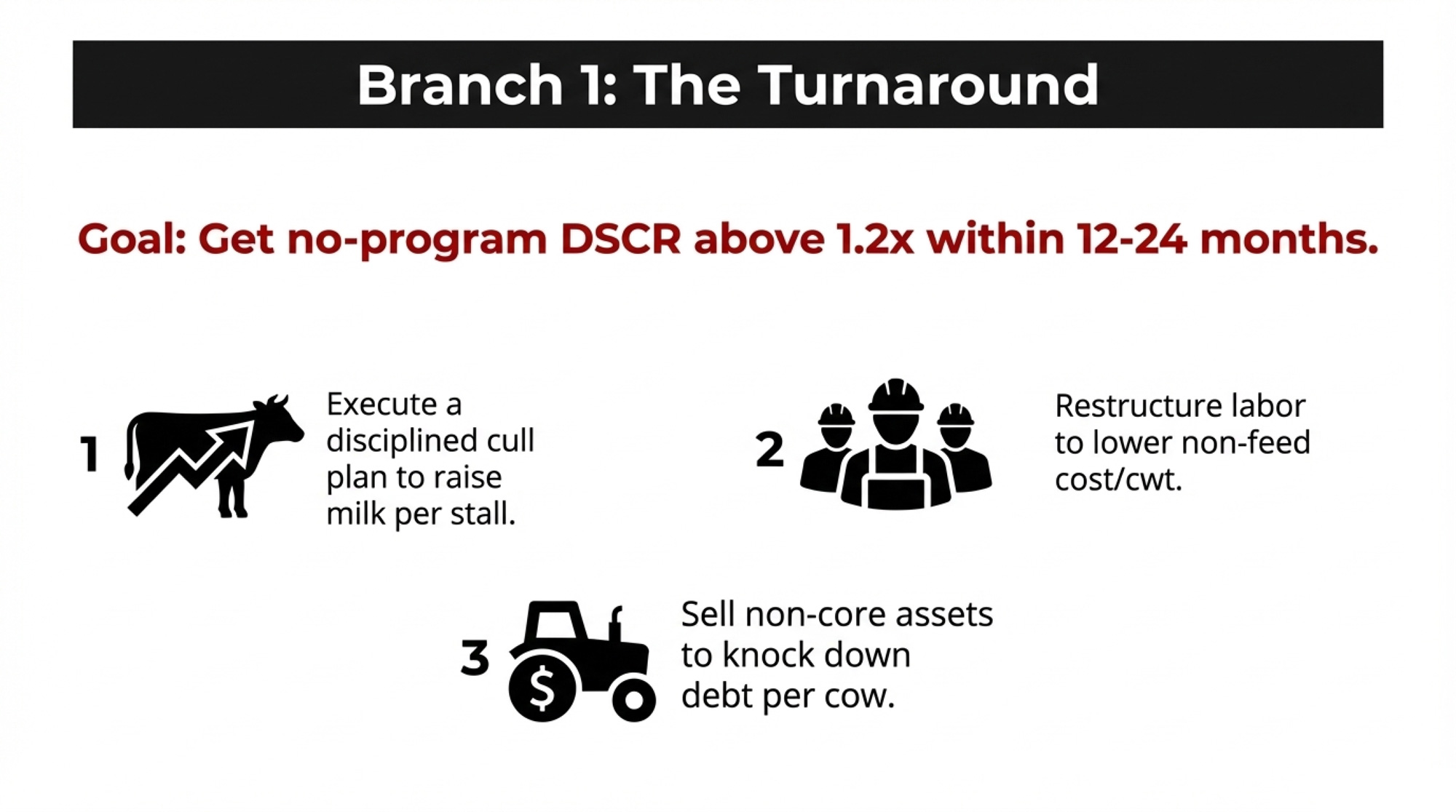
Branch 1: Turnaround — Get DSCR Above 1.2x Without Programs

Mark’s in this lane if “no‑program” DSCR can realistically climb to ≥1.2x within 12–24 months through specific moves: a disciplined cull plan that raises milk per stall; a concrete labour change that lowers non‑feed cost/cwt; selling non‑core assets to knock down debt per cow. In that world, DMC works as designed — a floor under feed‑margin risk, not a permanent revenue line.
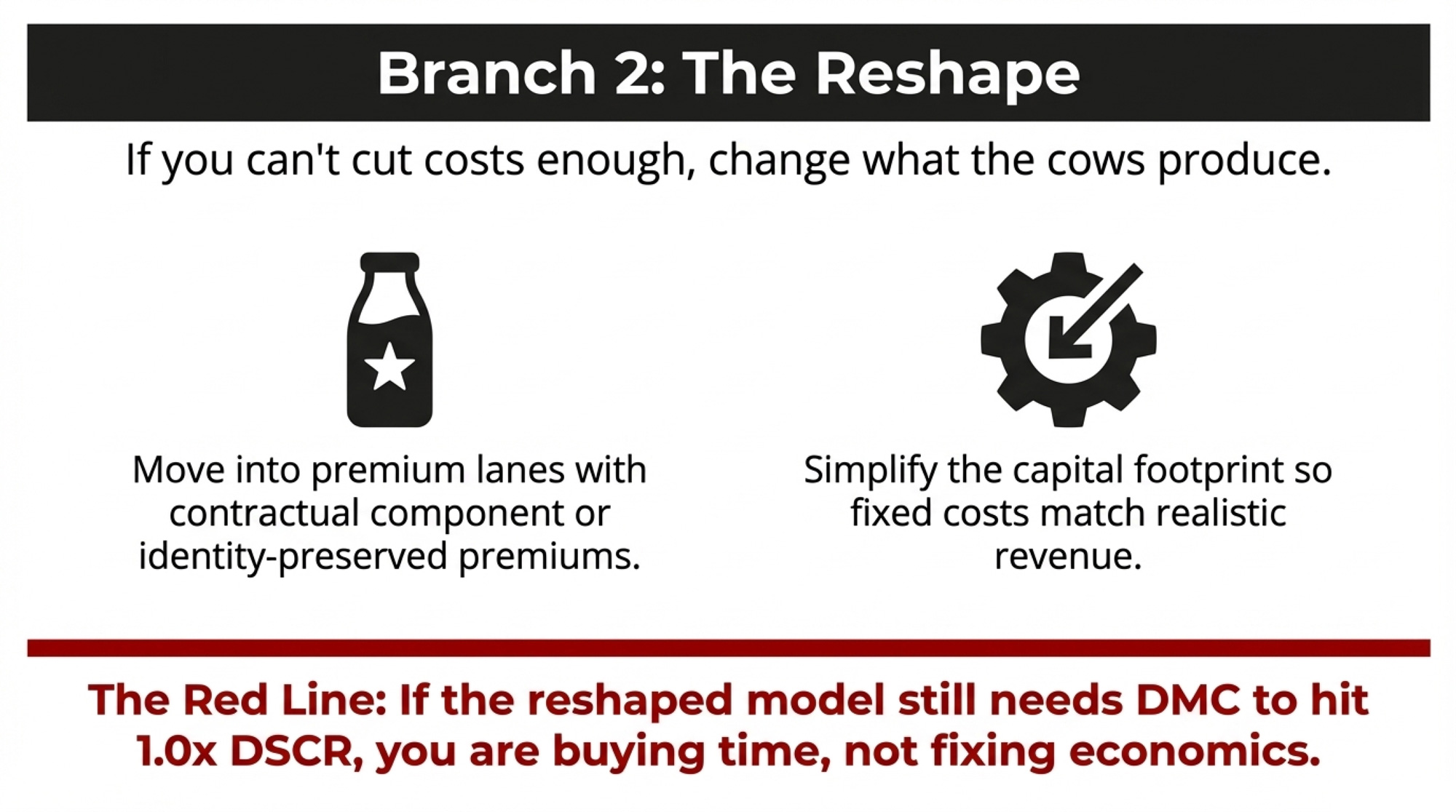
Branch 2: Reshape — Change What the Cows Produce

If Mark can’t get there on cost cuts alone, he may still change the model: move into a premium lane with documented, contractual component or identity‑preserved premiums that actually show up on the cheque; simplify the capital footprint so fixed costs match realistic revenue.

The red line stays put: if the reshaped model still needs DMC to get DSCR to 1.0x, that usually looks more like buying time than fixing core economics.
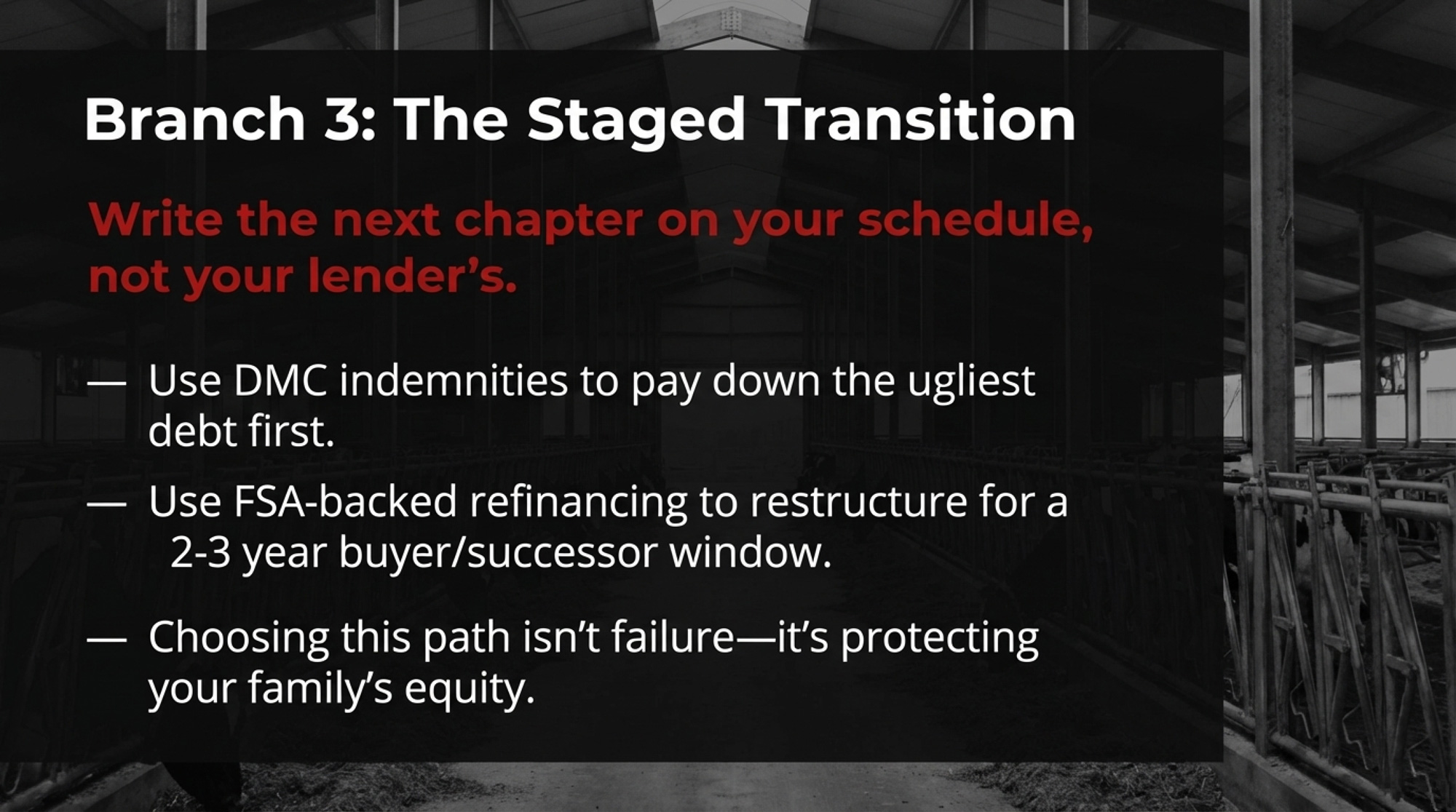
Branch 3: Use the Tools to Stage a Stronger Exit

The hardest conclusion. For many families — Mark’s included — this isn’t spreadsheet math. It’s a barn your grandfather built, and it’s where your kids learned to drive a skid steer.

But the farm‑bill tools aren’t about keeping a struggling model alive indefinitely. They’re about choosing the timing, the terms, and the shape of what comes next on your schedule, not your lender’s:

  • Use DMC indemnities and premium savings to pay down the ugliest debt first.
  • Use FSA‑backed refinancing to restructure into a form that works for a buyer, successor, or landlord in a 2–3 year window.
  • Consider EQIP/energy projects only if they raise resale or lease value without adding obligations the next operator won’t want.

Choosing this path isn’t failure. It means you’re writing the next chapter, not waiting for the bank to write it for you.

What This Means for Your Operation

If you’re in the 300–500‑cow band and this feels uncomfortably close:

  • Within 30 days, run the “no‑program” DSCR test. Bring your last 12 months of milk cheques, a full cost‑of‑production breakdown (including labour at replacement cost), and your P&I schedule. Calculate DSCR with and without DMC. If it’s below 1.0x without programs, you’re looking at a business‑model question, not just a rough year.
  • Use the next 90 days to decide which branch you’re really on. If no combination of realistic cost cuts and genuine premiums gets DSCR to ≥1.2x without programs, you’re in “reshape or transition” territory. Better to name that now than let the bank name it in 18 months.
  • Treat DMC as protection, not entitlement. Max out Tier 1 and lock in the six‑year discount. Then ask: “Does this business stand on its own if DMC pays nothing for two years?”
  • Handle FSA like a scalpel, not a shovel. Model what happens to DSCR if you only restructure existing debtversus if you add new principal. If a new loan doesn’t improve your no‑program DSCR, it’s not expansion money — it’s extra risk.
  • Pick EQIP and energy projects that move cost per cwt. Plate coolers, VFDs, targeted manure improvements — cost‑share can cover 50–75% on smaller projects in some states. Full‑scale digesters mostly belong to herds with thousands of cows and corporate advisory teams. If a project doesn’t clearly lower $/cwt or raise asset value within three years, it’s probably not your project.
  • Build your risk plan around your own cheque. DNIP and school whole‑milk rules are demand‑side tailwinds. Most of those program dollars flow through retailers and processors first, touching your milk cheque only indirectly.
  • Make labour your first policy response. Immigration isn’t fixed in this farm bill, but it’ll decide more 400‑cow futures than any DMC tweak. Hang on to your core crew and keep compliance tight.
Farm Bill ToolDirect Impact on Your ChequeAction for 400-Cow Herds
DMC Tier 1 expansion$41.50/cow/year premium savings✅ Max out immediately. Lock in 6-year discount.
DMC indemnities (when triggered)$15–30/cow (varies by margin)✅ Enroll at $9.50 coverage. Don’t count on it as income.
FSA operating loan limit increasesIndirect (better terms if DSCR ≥1.2x)⚠️ Use to restructure, not to add debt if sub-1.0x DSCR.
EQIP cost-share (plate coolers, VFDs)$5–15/cow (one-time savings on projects)✅ Take it if project lowers $/cwt within 3 years.
DNIP & school milk programs$0 direct (flows through processors)❌ Demand-side tailwind. Doesn’t change your cheque in 2026.
Full-scale anaerobic digesters$50–200/cow (only for 1,000+ cow herds)❌ Skip. Needs corporate advisory team, not 400-cow scale.
Methane funding (small projects)$8–20/cow (manure improvements)⚠️ Consider if resale value increases. Not for survival cash.

Key Takeaways

  • If your DSCR sits below 1.0x without DMC, you’re past a rough‑year problem. You’re looking at a business‑model question the 2026 farm bill can’t fix on its own.
  • DMC’s ~$16,600 in premium savings ($41.50/cow) and likely 2026 indemnities are real — but they’re a backstop on margin over feed, not on total cost per cwt. Use them to buy time for decisions, not as a permanent source of income.
  • Higher FSA loan limits only win if they lower your no‑program DSCR or make a future sale/transfer cleaner. If they increase total debt on a sub‑1.0x operation, they accelerate an exit.
  • Choosing to transition isn’t choosing to fail. If no credible scenario gets your no‑program DSCR above 1.0x, the farm‑bill tools let you control timing, protect your family’s equity, and hand over something cleaner than a foreclosure.
The Bottom Line

At the end of a meeting like this, Julie slides the printout back across the desk and circles the two DSCR numbers. One with DMC, one without.

If DMC went away tomorrow and 2026 milk stayed near the USDA’s $18.95/cwt all‑milk forecast, what would your own DSCR be — and would your bank still lend into that model?

Complete references and supporting documentation are available upon request by contacting the editorial team at editor@thebullvine.com.

Learn More

The Sunday Read Dairy Professionals Don’t Skip.

Every week, thousands of producers, breeders, and industry insiders open Bullvine Weekly for genetics insights, market shifts, and profit strategies they won’t find anywhere else. One email. Five minutes. Smarter decisions all week.

NewsSubscribe
First
Last
Consent

315 Chapter 12 Filings, 46% Surge: Kooser Farms Filed Again – and the 3 Numbers That Tell You How Close You Are.

Kooser Farms has filed for Chapter 12 protection twice in the past 6 years. Before you say ‘that’ll never be us,’ grab your balance sheet and check three numbers.

Executive Summary: Chapter 12 farm bankruptcies jumped to 315 cases in 2025 — a 46% surge that’s the bill for margins that broke 18 months ago, not last month’s milk price. Kooser Farms in Pennsylvania, which sold its dairy herd and switched to crops after a 2019 filing, is now back in Chapter 12, and their public case file shows exactly how rising rates, stubborn input costs, and weather turned “Plan B” into a second restructuring. Using that story as the anchor, the piece walks through how Chapter 12 really works for farm families: court‑forced cramdowns on over‑secured loans, seasonal payment schedules, and tax rules like Section 1232 that can erase six‑figure IRS bills. It puts honest numbers on the odds of success, comparing national surveys that show about 60% of confirmed plans reach discharge with Missouri data that show only 38.1% do, so you see the tool’s power and its limits. Then it hands you a simple three‑number diagnostic — debt‑to‑asset ratio, real breakeven per cwt including unpaid family labor, and months of cash on hand — with clear thresholds for “caution,” “danger,” and “call an attorney this week.” The message is blunt but practical: if two of those three have been in the red for a year or more, Chapter 12 isn’t a scary headline about somebody else, it’s an option you should understand while you still have equity and choices.

Farm Chapter 12 Bankruptcy

On October 2, 2025, Kooser Farms LLC filed Chapter 12 bankruptcy in the Western District of Pennsylvania — Case #25-22656. It was the second filing in six years for this Mill Run operation in Fayette County’s Laurel Highlands. Liabilities between $1 million and $10 million. Assets between $100,001 and $1 million. 

The filings don’t point to mismanagement. They point to structural economics—and to an enterprise pivot that carries a warning for every dairy producer considering jumping ship.

According to attorney Daniel White of Calaiaro Valencik in Pittsburgh, Kooser Farms sold its “extensive herd of dairy cattle” during its first bankruptcy in August 2019 and converted to row crops. White told the Pittsburgh Business Timesthe logic was straightforward: the farm had shifted from “receiving monthly payments from milk sales” to a crop operation that “yields produce annually, necessitating a payment schedule that aligns with this larger yearly income rather than monthly disbursements”. But the timing complicates that narrative — weeks after that first filing, the Pittsburgh Post-Gazette reported on Kooser Farms in a story on Fayette County dairy operations whose diversification ambitions depended on broadband access that rural Mill Run couldn’t reliably provide. The pivot to crops came after. 

And the crops didn’t cooperate. White told PBT that adverse weather made it “challenging to achieve the expected yields”. WPXI reported the Koosers “had a difficult time getting the yield anticipated” across multiple seasons. The restructuring plan from the first bankruptcy took Chief Bankruptcy Judge Gregory L. Taddonio over four years to confirm — he didn’t sign off until October 11, 2023 — and the case was dismissed on May 10, 2024. 

On February 9, 2026, Judge Taddonio confirmed Kooser Farms’ second restructuring plan. That’s two court-approved plans in three years. Whether the second one holds depends on weather, crop prices, and whether the restructured payment schedule actually fits the income stream this time. The structural risk hasn’t changed: Kooser Farms traded a monthly milk check for an annual crop harvest, and annual income concentrates all your risk into a single harvest window. 

Kooser Farms is one of 315 Chapter 12 filings in 2025 — a 46% increase over 2024, according to the American Farm Bureau Federation’s February 2026 analysis of U.S. Courts data. 

315 Families — and the Dairy States Are Lighting Up

Not all 315 filings are dairy. Arkansas’s 33 cases — the most of any state, more than double 2024 — were overwhelmingly rice, with producers losing over $200 per acre even after supplemental assistance. Georgia followed with 27 filings, up 145%. But look at the dairy-heavy states, and the pattern sharpens fast. 

State2025 Filings% Change vs. 2024Primary Commodity
Arkansas33+100%+Rice, row crops
Georgia27+145%Row crops
Iowa18+220%Dairy, pork, row crops
California17SteadyDairy, specialty
Missouri16+167%Dairy, row crops
Wisconsin16~700%Dairy
Minnesota13+300%Dairy, row crops
Pennsylvania~10+160%Dairy

Wisconsin logged 16 filings — a roughly 700% increase off a base of just two the year before. The AFBF reported that “principal row crop losses combined with weakening dairy, hog and poultry markets” drove double-digit filings in Iowa (18, up 220%), Minnesota (13, up 300%), and Missouri (16, up 167%). Pennsylvania climbed 160%. California held steady at 17 filings — tied for fourth-highest nationally —, but Fresno bankruptcy attorney Peter Fear told AgAlert he’s now seeing “new Chapter 7 filings by dairies,” cases where there’s “just no way to make it work financially”. Chapter 12 doesn’t even capture those. 

These numbers sit inside the structural forces that have already eliminated 76% of Wisconsin’s dairy herds — and the filing spike is a lagging confirmation that the consolidation thesis isn’t theoretical.

After bottoming at 139 filings in 2023 — the lowest since Chapter 12 became permanent in 2005  — farm bankruptcies surged 55% in 2024 and another 46% in 2025. Linda Coco, a law professor at the University of the Pacific’s McGeorge School of Law who studies farm bankruptcy, put it simply: “Upticks in Chapter 12 filings’ usually indicate ‘something’s really, really wrong.'” 

The Credit Line Is Stretching

The AFBF’s analysis, authored by economist Samantha Ayoub, was blunt: “A fourth consecutive year of expected declines in farm income will continue to strain agriculture, placing further reliance on credit options that are growing thin”. USDA projects total farm sector debt will hit a record $624.7 billion in 2026, up 5.2% year over year. 

In the fourth quarter of 2025, the volume of new farm operating loans rose nearly 40% from the year-prior quarter, according to the Kansas City Fed. For the full year, the average operating loan was 30% larger in inflation-adjusted terms, with average maturities 3 months longer than in 2024. For machinery and equipment loans specifically, average maturity hit the highest level since 2021. That’s the sound of lenders giving farmers more time because the cash isn’t there to pay faster. 

And here’s the part that confuses people: milk prices in 2025 looked okay. Not great, but not terrible. USDA’s February 2026 Farm Sector Income Forecast projects dairy cash receipts will fall $6.2 billion — a 12.8% decline — to $42.5 billion in 2026 as prices retreat from recent strength. So why are families filing when the milk check looked survivable?

Because bankruptcy is a lagging indicator — often 18 months or more behind the margin squeeze that triggered it.

YearChapter 12 FilingsMilk Price ($/cwt)
2023139$20.50
2024215$21.80
2025315$22.40
2026 (proj.)?$19.75

Why Do Filings Spike When Milk Prices Look Decent?

The cost squeeze of late 2023 and 2024 didn’t kill operations in real time. It bled them — through working capital, stretched operating lines, deferred maintenance, and rolled-over payments. The filings showing up now are the bill for margins that broke a year and a half ago. We laid out the brutal math of consolidation and margin pressure earlier — these filings are that math playing out in courtrooms.

Interest rates hit first. Federal Reserve hikes pushed farm loan rates to 16-year highs by Q4 2023. According to USDA data and the AFBF’s January 2024 Market Intel analysis, interest expenses jumped about 43% in 2023, rising by roughly $10.3 billion. With record farm debt projected at $624.7 billion in 2026, interest expenses will remain near those historic highs. The Bullvine’s December 2025 analysis of the rate repricing crisis hitting mid-size dairies laid out the damage on a representative 400-cow operation carrying $4.5 million in debt: real estate notes resetting from 3.5% to 7.5%, equipment debt jumping from 4% to 7%, operating lines surging from 3% to 8% — adding $120,000 in annual debt service, or roughly $1.30/cwt, before a single operational change. One 380-cow Wisconsin dairyman profiled in that reporting saw his breakeven jump from $17.50 to $19.20/cwt from a single repricing letter. “My costs went up $110,000 from a single letter,” he said, “and there’s nothing I can do with the cows to fix it”. 

Loan TypeBefore Repricing (2022)After Repricing (2024)Increase
Real estate ($3M)$105,000 @ 3.5%$225,000 @ 7.5%+$120,000
Equipment ($1M)$40,000 @ 4.0%$70,000 @ 7.0%+$30,000
Operating line ($500K)$15,000 @ 3.0%$40,000 @ 8.0%+$25,000
Total Annual Debt Service$160,000$335,000+$175,000
Per Cwt Impact (135,000 cwt/year)+$1.30/cwt

Every other input ratcheted the floor higher. According to USDA data compiled by Investigate Midwest (October 2025), total farm labor costs have risen nearly 50% since 2020. Seed expenses are up 18%. Fuel and oil up 32%. Fertilizer up 37%. These aren’t temporary spikes. They’re the new baseline every breakeven calculation has to absorb. For Kooser Farms, every one of these cost escalations compounded on a debt structure already stretched from the 2019 restructuring — a plan that took four years to confirm and survived barely six months after dismissal.

The lag works like this: In year one, the family burns through working capital. Year two, they stretch the operating line and defer maintenance. By year three, the lender’s patience thins, the balance sheet shows the accumulated damage, and the Chapter 12 conversation happens. Peter Fear confirmed the timeline: “This is not something that happened in the last 90 days. This is something that has been happening for several years”. 

What Attorneys Are Seeing Right Now

Joe Peiffer has watched this cycle for 44 years. He grew up on a Delaware County, Iowa dairy farm, lived through the 1980s farm crisis, and built his practice — Ag & Business Legal Strategies — to serve families in financial distress. What he saw in late summer 2025 broke the usual pattern. 

“In the last week of August to the first week of September, we signed up five new farm clients,” Peiffer told American Farmland Owner in December 2025. “Most of them are crop farmers… and in every case, they’re in dire situations.” Normally, distressed farmers don’t show up until November, after harvest. These came three months early.

One client was, in Peiffer’s words, “upside down, two to one. Assets worth a little over $7 million, liabilities north of $16 million.” And then: “That’s one of the worst I’ve seen, and I’ve been at this 44 years.”

His son and associate attorney, Austin Peiffer, put the broader picture even more starkly: “We can’t write a cash flow that shows a profit this year. We haven’t seen that for any of our farm clients.”

Here’s the barn math that makes those quotes land. Take an operation carrying $2.4 million in total debt against $5.5 million in assets — a debt-to-asset ratio of 43.6%. Yellow zone, not red. Now add 18 months of margins running $2/cwt below true breakeven on a herd shipping 7,000 cwt per year. That’s $14,000 in uncovered annual losses, funded by the operating line. Within two years, the ratio has crept toward 50%, working capital has thinned to almost nothing, and the next loan renewal conversation changes tone completely.

What Does Two Out of Three Red Mean for Your Operation?

Three numbers. You can calculate all of them tonight with your most recent balance sheet and last three milk statements:

Metric🟢 Green Zone🟡 Yellow Zone🔴 Red Zone
Debt-to-Asset RatioBelow 40%40% – 60%Above 60%
Real Breakeven vs. Milk CheckBreakeven below milk priceBreakeven at or near milk priceBreakeven above $24/cwt against sub-$22 milk
Cash Reserves6+ months3 – 6 monthsUnder 3 months

Debt-to-asset ratio. Total liabilities divided by total assets — use market values, not book. Under 40% gives you room. Between 40% and 60%, your lender is already watching closely — these are thresholds commonly used in ag lending to gauge financial health. Above 60%, restructuring conversations should be happening. Above 80%, call an agricultural attorney this week.

Real breakeven per cwt. This is the one that trips people up. Your breakeven needs to include every cash cost — feed, hired labor, vet, utilities, repairs, hauling — plus depreciation at replacement cost, debt service, and a charge for unpaid family labor at $18–$22/hour. If your family puts in 3,000 combined unpaid hours per year, that’s $54,000–$66,000 you’re probably not counting. There’s a reason management intensity matters more than scale — Cornell data shows well-managed 150-cow dairies outearning sloppy 500-cow operations by $100,000. 

Cornell’s 2023 Dairy Farm Business Summary — 127 New York farms — averaged $23.36/cwt total cost of production, including owner labor and equity charges. Herds under 500 cows averaged $26.03/cwt. Herds of 500–1,049 came in at $24.98/cwt. And those are DFBS participants — farms that volunteer to be benchmarked, which tend to be better-managed than the overall population. Your real number might be higher. If your breakeven sits above $24/cwt and your milk check averages below $22, the gap is structural. Not seasonal. 

Cash reserves in months. Add up cash, savings, and unused operating line. Divide by monthly total obligations — all loan payments, operating costs, and family living draw. Six months or more means you can absorb a hit and choose your next move. Three to six is tight. Under three months, any single disruption cascades fast.

If two of those three have been red for more than a year, Chapter 12 isn’t hypothetical for you. It’s a tool you need to understand before the window to use it narrows.

Chapter 12 Is a Tool — But Not a Free Pass

The mechanism that quietly saves the most operations — and causes the most confusion — is cramdown. In plain terms, the court can force your lender to accept less than you owe on a loan, based on what the collateral is actually worth today.

Say you owe $400,000 on an equipment loan. The collateral — your chopper and tractor — is worth $250,000 on today’s used market. Outside bankruptcy, the lender is secured for the full $400k. Inside Chapter 12, the court splits that claim: $250,000 stays secured and gets paid back at a court-approved rate over time. The remaining $150,000 flips to unsecured status, landing in the same pool as old feed bills and unpaid vet invoices. Whatever isn’t paid through your plan’s disposable income by discharge gets wiped.

Your original payment on that $400k note at 8% over 7 years: roughly $6,234/month. After a cramdown — $250k secured at 6% over 15 years — the payment drops to about $2,110/month. That’s about $49,500 a year back into your cash flow from restructuring a single loan.

ScenarioMonthly PaymentAnnual Payment
Before Cramdown ($400K loan, 8%, 7 years)$6,234$74,808
After Cramdown ($250K secured, 6%, 15 years)$2,110$25,320
Savings−$4,124/month−$49,488/year

The judge can confirm this plan over the lender’s objection. Chapter 12 is the only bankruptcy chapter where the debtor proposes the plan, and no creditor vote is required for confirmation. That’s leverage you don’t have anywhere else. Chapter 12 also allows seasonal payment structures — payments timed to when income actually arrives — and Section 1232 tax treatment that can convert capital gains on asset sales within bankruptcy into dischargeable unsecured debt. We covered in depth earlier how Section 1232 changes the calculus for farm families considering Chapter 12 — the short version is that a $285,600 IRS bill on a typical Wisconsin farm sale can drop to $57,120 in Chapter 12, saving the family $228,480. 

To qualify, total debts can’t exceed $12,562,250 — the current ceiling per U.S. Courts, reflecting the April 2025 triennial adjustment  — at least 50% must arise from farming operations, and you need “regular annual income,” which includes milk checks, crop sales, and government payments. But the AFBF flagged a catch that matters: if most of your household income comes from off-farm employment, you may not qualify for Chapter 12 at all, which means “many families may face the even more difficult decision to sell land, limit production or close their farm altogether”. 

So, How Many Chapter 12 Plans Actually Make It?

Most ag publications will tell you Chapter 12 “saves farms.” And it can. But the completion data tells a more complicated story—and how you read it depends on which dataset you trust.

The Association of Chapter 12 Trustees surveyed members covering approximately 15% of all national Chapter 12 cases filed from 2011 to 2013. The completion rate for confirmed plans: 53.5% in 2011, 62.2% in 2012, and 63.9% in 2013, averaging 59.4%. A follow-up survey in 2019, covering 33 trustees, produced a nearly identical average: 59.6%. The AFBF noted that Chapter 12 typically has “the highest percentage of successfully completed cases of the reorganization chapters” — far above Chapter 11’s completion rate of roughly 15% or less. 

That’s the national picture. The state-level picture can look very different.

David Warfield, an attorney in Thompson Coburn’s Financial Restructuring practice, analyzed all 168 Chapter 12 cases filed in Missouri between 2000 and 2020. Only 64 — or 38.1% — reached full discharge, meaning the debtor completed the entire repayment plan and emerged on the other side. Of the 135 plans confirmed by a judge, 28 remained pending as of the study’s March 2022 data cutoff. Among the 107 confirmed cases that had fully closed, 43 defaulted and were dismissed or converted to Chapter 7 — a post-confirmation failure rate of 40.1%. Warfield compared Missouri’s outcomes to nationwide data from the Executive Office of the U.S. Trustee covering fiscal years 2009–2014, which showed a 41.9% discharge rate. 

Data SourceCompleted/DischargedDismissed/Converted/Pending
National Trustee Surveys (2011–2019)59.6%40.4%
Missouri 20-Year Study (2000–2020)38.1%61.9%

So the honest range: somewhere between 38% and 60%, depending on the dataset, the time period, and the state. The AFBF makes a fair point that not every dismissal is a failure — some cases end in a negotiated outcome that works for both the farmer and the creditors, but gets counted as a “non-completion” in the stats. 

But here’s what matters for your decision: somewhere between 4 and 6 out of every 10 families who file Chapter 12 and have a plan confirmed will make it all the way through. The rest won’t. Chapter 12 is a real tool with real power — cramdown alone can reduce your annual debt service by tens of thousands of dollars. It’s also a three-to-five-year commitment with a meaningful failure rate even after confirmation. Go in with your eyes open.

Kooser Farms sits on both sides of that ledger. Their first plan took four years to confirm and failed within six months. Their second plan was confirmed on February 9, 2026. Whether it holds is an open question — and the structural risk of annual crop income versus the monthly milk check they gave up hasn’t changed. 

The Conversation That Doesn’t Happen

The math is only half of what lands at that kitchen table.

Farmers die by suicide at significantly elevated rates. The commonly cited figure — 3.5 times the general population — comes from CDC analyses of farming occupations, though the specific multiplier varies by study, region, and time period. Illinois Agriculture Director Jerry Costello stated the 3.5× figure in late 2025. While the exact ratio depends on which dataset you use, the direction isn’t in dispute: farming is among the highest-risk occupations for suicide in the United States. Financial distress is one of the strongest predictors.

And the culture of “tough it out” — the same grit that gets you through calving at 3 a.m. — becomes a liability when it keeps someone from picking up the phone. We’ve written before about how financial stress and isolation compound each other on family farms — that piece is a playbook for what neighbours can do when they see the barn lights burning late.

If you or someone you know is in that space right now, write these down:

  • 988 Suicide & Crisis Lifeline — dial 988, 24/7. Confidential.
  • Farm Aid Hotline — 1-800-FARM-AID (1-800-327-6243). Farm-savvy people who understand debt, foreclosure, and the weight of it.
  • Crisis Text Line — text HOME to 741741.
  • AFBF Farm State of Mind — fb.org/land/fsom for state-by-state counseling directories.

Making that call is the same kind of stewardship we’ve been talking about with Chapter 12 — acting while you still can.

Four Paths — and Why the First One Starts Tonight

Every one of the 315 families who filed in 2025 landed on some version of these paths. Where you go depends on your three numbers.

Path 1: Run the diagnostic and get ahead of it. This is your 30-day action. Calculate your three numbers this week. Write them on paper — not in your head, on paper. Show them to someone outside the family: your accountant, Extension agent, or lender. If two of three are yellow or red, book a consultation with an agricultural attorney experienced in Chapter 12. That first meeting commits you to nothing. It gives you information while choices still exist.

Path 2: Strategic Chapter 12 filing while equity remains. This works when debt-to-asset is in the 55–70% range, you have three or more months of cash, and the operation can pencil after restructuring. Cramdown, seasonal payments, and Section 1232 are powerful tools — but only if the underlying business works at realistic prices and honest production costs. The data is a gut check — nationally, about six in ten confirmed plans reach completion, but in some states, the number drops closer to four in ten. Filing creates a public court record, requires strict compliance for three to five years, and incurs legal fees well into five figures. Filing early isn’t a defeat. It’s not a guarantee, either. 

Path 3: Restructure without court. If your lender relationship is strong and your situation reads more yellow than red, out-of-court refinancing — extending terms, selling non-core assets, renegotiating rates — may bridge the gap. The risk: these fixes often treat symptoms without addressing structural margin problems, and they consume the equity and time you’d need if Chapter 12 becomes necessary later. The long-term consolidation trajectory projects U.S. dairy farms shrinking from roughly 25,000 herds today to 15,000–16,000 by 2035  — restructuring without fixing the structural problem just delays your position on that curve. 

Path 4: Planned exit with equity intact. For some families, the honest answer is that the operation won’t pencil out at any reasonable scale—or that the next generation has already chosen a different life. Exiting on your terms while equity still exists preserves assets for whatever comes next. A planned exit at 55% debt-to-asset looks nothing like a forced liquidation at 85%.

And the Kooser record carries a specific caution for Paths 3 and 4: pivoting to a completely different enterprise — crops, beef, agritourism — isn’t an exit from financial risk. It’s a swap. Kooser Farms traded a monthly milk check for an annual crop harvest, and when weather destroyed that harvest across multiple seasons, the debt caught up faster the second time. A September 2019 Post-Gazette report documented the farm’s ambitions for diversification. Six years later, the operation is in a courtroom for the second time, having diversified entirely away from dairy. 

Key Takeaways

  • If your debt-to-asset ratio is above 60%, your real breakeven exceeds your milk check, and you have less than three months of cash, two of three red flags for 12 months or more mean it’s time to understand Chapter 12 before you need it. Use the diagnostic table above.
  • If you’ve been covering the gap between income and true costs with working capital or a stretched operating line since 2023–2024, the filing clock is already ticking — those 315 families didn’t get in trouble last month. 
  • Compare your total cost — including unpaid family hours at $18–22/hr — to Cornell’s $26.03/cwt for herds under 500 cows. If you’re above it and your milk check sits below $22, the gap is structural. 
  • Nationally, about 60% of confirmed Chapter 12 plans reach completion; in Missouri’s 20-year dataset, it’s 38.1%. The tool works. Not every time. 
  • If most of your household income is off-farm, Chapter 12 may not be available to you, which makes running the diagnostic even more urgent. 
  • If the conversation at your kitchen table has shifted from “how do we make this work” to something darker, 988and 1-800-FARM-AID are confidential, farm-literate, and available right now.
  • Thinking about pivoting out of dairy? The Kooser record is public. Swapping enterprises swaps risks. Monthly milk checks are frustrating. Annual crop income is a cliff.

The Bottom Line

Pull your last three milk statements and your most recent balance sheet tonight. Calculate your debt-to-asset ratio. Run your real breakeven — including the hours your spouse works that you’ve never assigned a dollar figure. Count your months of cash.

Write those three numbers down. If you don’t like what you see, a call to an ag attorney this week gives you information. The call 18 months from now costs everything.

On February 9, Judge Taddonio confirmed Kooser Farms’ second restructuring plan. Whether it holds is an open question — the plan still has to survive three to five years of execution in an agricultural economy that has already broken it once. The structural risk hasn’t changed: Kooser Farms left dairy for crops, traded a monthly check for an annual harvest, and faces the same weather-dependent income risk that contributed to the first plan’s failure. In 60 days, The Bullvine will report on whether the early milestones are holding. This is The Filing — a new series tracking named Chapter 12 cases from petition to resolution. Courts are public record. The outcomes deserve to be, too.

Complete references and supporting documentation are available upon request by contacting the editorial team at editor@thebullvine.com.

Learn More

The Sunday Read Dairy Professionals Don’t Skip.

Every week, thousands of producers, breeders, and industry insiders open Bullvine Weekly for genetics insights, market shifts, and profit strategies they won’t find anywhere else. One email. Five minutes. Smarter decisions all week.

NewsSubscribe
First
Last
Consent
Send this to a friend




