With heifers costing $3,000+ each, can you afford to ignore fertility gaps that smart dairies are closing?
EXECUTIVE SUMMARY: Here’s what we’re seeing across progressive operations: heifer fertility represents one of the most underutilized profit drivers in modern dairy management. Recent comprehensive analyses show national heifer conception rates averaging 55-60%, while first-lactation cows achieve 44% conception — a performance gap that’s costing operations real money (Journal of Dairy Science, 2023; DHI, 2023). With replacement costs now pushing $3,000 per head in many regions, even modest improvements in heifer pregnancy rates deliver substantial ROI (DHI, 2023). We’re finding that regional factors — from brutal Midwest winters to Southern heat stress — dramatically influence reproductive success, making location-specific strategies essential rather than optional (PMC, 2017). The operations that are getting ahead are those that integrate proven technologies, such as CowScout monitoring, into daily workflows, reporting measurable gains in pregnancy rates while reducing hormone dependency. Bottom line: the data points to heifer fertility management as a competitive differentiator that forward-thinking producers can’t afford to overlook in 2025.
KEY TAKEAWAYS
Target the conception gap: We’re tracking operations that’ve moved heifer conception from the 55% national average toward 60%+ through systematic protocol improvements, directly impacting genetic progress and reducing replacement needs (Journal of Dairy Science, 2023).
Adapt regionally, win locally: Southern dairies leveraging heifers’ heat stress resilience and Midwest operations optimizing winter nutrition programs are seeing measurable fertility improvements compared to one-size-fits-all approaches (PMC, 2017).
Make technology work for you: Farms integrating activity monitoring like CowScout collars into daily breeding decisions report pregnancy rate improvements of 15-20% alongside reduced hormone costs — but only when data drives real management changes.
Weight-based breeding wins: Operations following Michigan State’s 55% mature weight breeding guideline combined with monthly monitoring are hitting breeding targets more consistently while adapting to seasonal feed quality variations (MSU Extension, 2024).
Think long-term ROI: With replacement costs at $3,000+ per heifer, improving conception rates by even five percentage points translates to fewer culls, better genetic retention, and stronger cash flow — especially critical as we head into an increasingly competitive 2025 market environment.
The thing about heifer fertility… it’s often the quiet contender in dairy herd management. Most eyes stay glued to butterfat percentages and fresh cow health — and yeah, those transition cows are absolutely critical — but what about those future workhorses standing in the dry lot? Those heifers represent the genetic foundation for where your entire operation goes next.
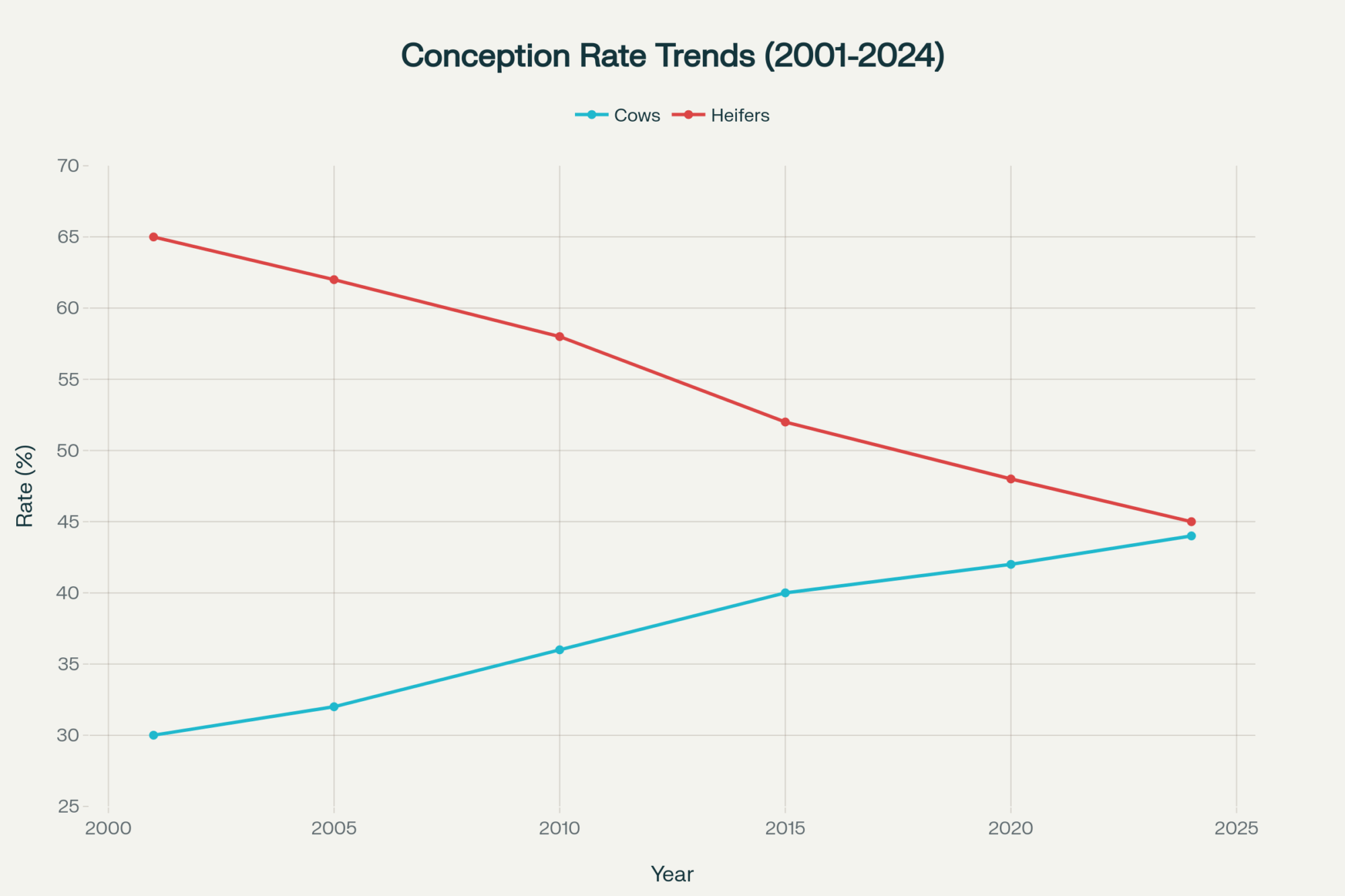
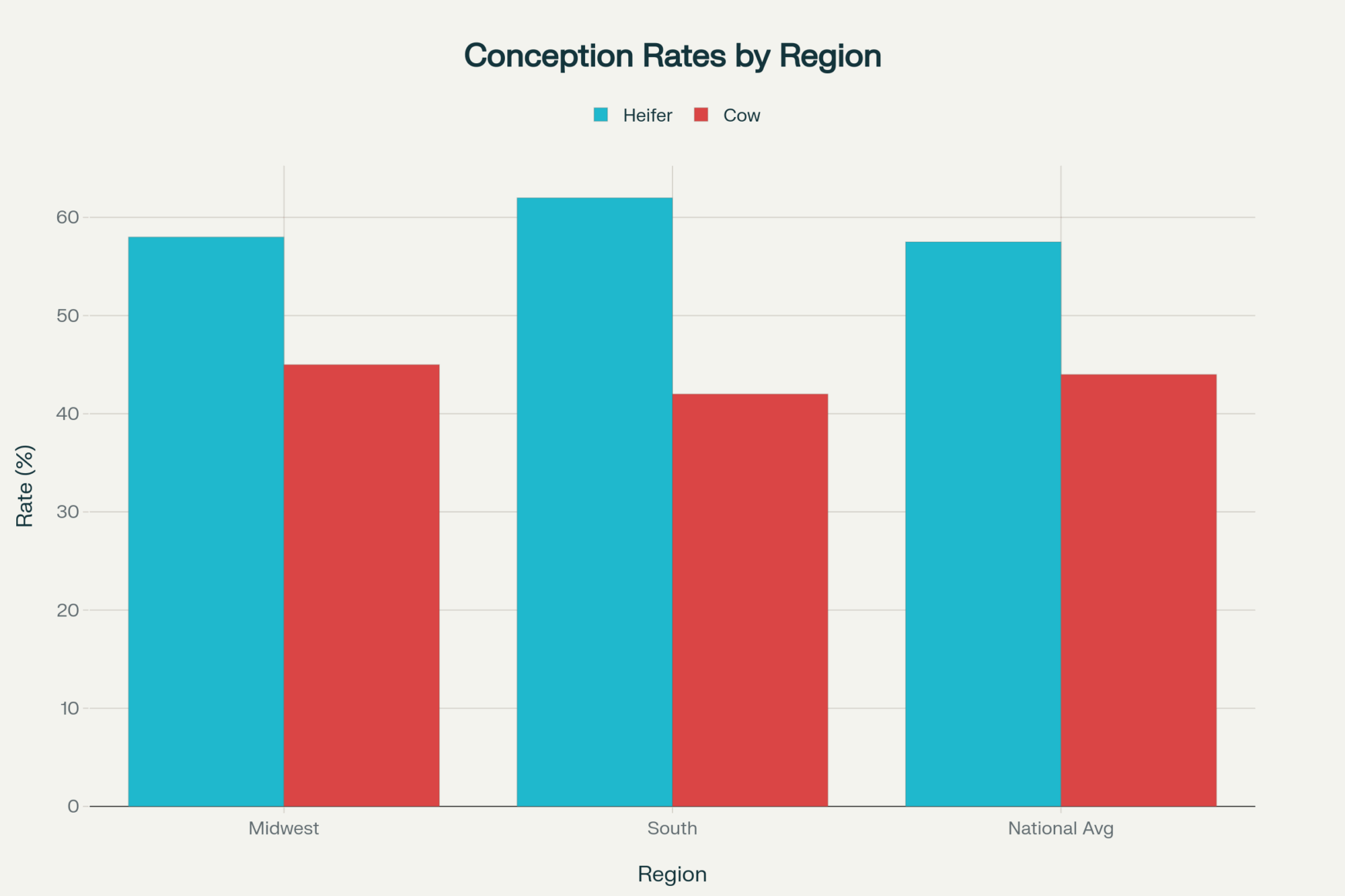
According to comprehensive analyses published in the Journal of Dairy Science covering over one million Holstein cows, national heifer conception rates currently average between 55-60% (Journal of Dairy Science, 2023). For comparison, Dairy Herd Improvement reports show first-lactation cows now reaching conception rates near 44% (DHI, 2023). That performance gap? It’s a pile of untapped opportunity sitting right there.
Regional Heifer Fertility Management: Winters That Test vs Summers That Sizzle
Managing heifers in Wisconsin or Michigan? You know exactly what it’s like trying to hit growth and breeding targets through snow drifts and short grazing seasons. Industry practitioners consistently emphasize how critical winter preparation becomes for spring breeding success.
Comparison of Heifer and First-Lactation Cow Conception Rates by Region, highlighting fertility performance differences crucial for targeted reproductive management strategies in 2025
Flip to the South, and heat becomes the challenge. Studies published in PubMed Central demonstrate that heifers weather heat stress considerably better than their mature counterparts (PMC, 2017). This physiological advantage means Southern dairies have more flexibility during summer breeding windows but need strategies tuned to the heat’s relentless rhythm.
Economic Realities and Smart Growth Targets
Replacement heifers now command prices pushing toward $3,000 in many regions, according to Dairy Herd Improvement and Canadian Cow-Calf production analyses (DHI, 2023; Canadian Network, 2024). Sure, some estimates get tossed around about delayed breeding costing thousands more, but those numbers lack precision — costs vary dramatically based on individual farm management.
Trend in Average Replacement Heifer Costs from 2022 to 2024, illustrating rising economic pressures on dairy operations
Michigan State Extension research recommends breeding heifers once they reach approximately 55% of their mature body weight, targeting 85% by calving (MSU Extension, 2024). These evidence-based benchmarks help producers adjust for fluctuating feed quality and seasonal management challenges.
Heifer Breeding Technology: When It Actually Works
CowScout collars being used across Vermont dairies remind us that technology alone isn’t the magic answer, but when integrated with sharp management practices, it creates measurable impact. These operations report improved pregnancy rates and reduced hormone interventions through real-time activity and heat cycle monitoring, which is embedded in daily breeding workflows.
Strategic Dairy Heifer Breeding Protocols
Look to Germany for disciplined excellence. Systematic adherence to synchronization protocols results in heifer conception rates hitting approximately 64%. The takeaway? Precise timing and disciplined protocol management separate winning operations from struggling ones.
Growth Monitoring Fundamentals
Simple, routine weigh-ins continue proving their worth. Operations implementing monthly weight assessments report catching development issues early, enabling targeted nutritional adjustments that dramatically improve reproductive outcomes. No-frills approaches often deliver outsized results.
What This Means for Your Operation
There’s no silver bullet here, but the pathway to enhanced heifer fertility runs through systematic measurement, consistent protocol execution, region-specific tactical adjustments, and seamless technology integration where it adds value.
If you want genetic progress advancing and profit margins expanding, don’t let heifer fertility management slide into background priorities. These future production stars deserve focused, strategic attention.
Ask yourself: Are your heifers receiving management intensity proportional to their value in your operation?
Because if they’re not, you’re likely passing up substantial returns while your competition gains ground.
Complete references and supporting documentation are available upon request by contacting the editorial team at editor@thebullvine.com.
Learn More:
The $4,000 Heifer: Seven Strategies to Navigate the New Dairy Economy – This article provides a strategic look at the unprecedented rise in heifer prices in 2025. It reveals actionable strategies for balancing the high cost of buying replacements against the economics of raising your own, offering a critical financial perspective not covered in the main article.
Bovine Repro – Today and Tomorrow – Delve deeper into the tactical, on-farm implementation of advanced reproductive technologies. This piece complements the main article by offering practical insights on reproductive scoring, synchronization protocols, and the real-world application of progesterone monitoring to drive measurable fertility improvements.
The Future of Dairy: Lessons from World Dairy Expo 2025 Winners – This article provides a forward-looking perspective on the dairy industry. It explores the innovative strategies and technologies (including genomic testing and sexed semen) used by top-performing farms in 2025 to improve herd genetics and manage heifer programs for long-term profitability.
Join the Revolution!
Join over 30,000 successful dairy professionals who rely on Bullvine Weekly for their competitive edge. Delivered directly to your inbox each week, our exclusive industry insights help you make smarter decisions while saving precious hours every week. Never miss critical updates on milk production trends, breakthrough technologies, and profit-boosting strategies that top producers are already implementing. Subscribe now to transform your dairy operation’s efficiency and profitability—your future success is just one click away.
Healthy cows ≠ are the best replacements. Discover the $1,200 paradox reshaping heifer selection with heat-stressed dams and genomic breakthroughs.
EXECUTIVE SUMMARY: Record prices for dairy-beef calves demand more brilliant replacement heifer strategies. New research reveals daughters of first-lactation cows and heat-stressed dams outperform traditional picks, challenging conventional culling wisdom. With genomic tools and updated genetic evaluations, producers must balance beef-on-dairy profits against long-term herd potential. Key factors like maternal age, dry-period cooling, and breed-specific responses now dictate ROI, as heat stress costs U.S. dairies $245M annually. This analysis provides actionable tools—including an ROI calculator and audit checklist—to optimize replacement programs amid 2025’s genetic base changes.
KEY TAKEAWAYS:
Health Paradox: Offspring from dams with pregnancy health challenges show 10% greater disease resilience than those from “healthy” cows
Multi-Gen Impact: Heat-stressed dry cows reduce milk yield by 5 lbs/day across three generations of offspring
ROI Shift: First-lactation dam focus + genomic testing can cut replacement costs by $1.87/cwt
2025 Essentials: New CDCB genetic weights demand updated selection criteria to avoid $147K losses in 500-cow herds
Action Now: Implement the 5-minute audit checklist to align with heat stress maps and beef-on-dairy market shifts
The current dairy landscape presents producers with both challenges and opportunities regarding replacement heifer decisions. With record prices for dairy-beef crossbred calves and rising costs for quality replacements, today’s dairy farmers need to be more strategic than ever about which heifers they develop and which they market. The following analysis examines the latest research and expert recommendations for making critical investment decisions that directly impact herd genetics, production efficiency, and your bottom line.
The Economics of Replacement Decisions
The dairy industry is experiencing a notable shift in heifer management strategies, primarily driven by economic forces. Record prices for dairy-beef crossbred calves have made using beef genetics on lower-ranking dairy females increasingly attractive, creating a valuable cash flow opportunity. This trend has gained significant momentum across the country.
This market reality requires producers to think more carefully about which females will become the mothers of the next generation of replacement heifers. The decision is no longer just about producing enough replacements but ensuring they are genetically superior and worth the investment to raise them to first lactation.
The Financial Stakes
The financial aspects of replacement decisions extend beyond simply meeting inventory needs. With the exceptional market value of steers and heifers in the current climate, dairy producers must carefully evaluate the economic impact of their replacement strategies. Each heifer retained for breeding represents the direct costs of raising her to production age and the opportunity cost of not selling her into a favorable market.
According to a 2024 study by CanFax, the cost of raising replacement heifers varies significantly across farms. Low-cost producers spend an average of $866 per heifer, while high-cost producers invest up to $1,028. This difference in development costs can lead to dramatically different payback periods. Low-cost producers may see their investment recovered in as little as 5 years, while high-cost producers might struggle to recoup their investment within the heifer’s productive lifespan.
Any delay past 24 months in age at first calving will add an additional $2.50 or more per day to the cost of raising replacements and require more heifers to meet the herd’s replacement needs. This economic reality has pushed producers to become more disciplined in their selection process, focusing on identifying and developing only those heifers that truly represent genetic advancement for their herds.
The Science-Based Selection Process
Creating an effective replacement strategy begins with a systematic evaluation of potential dams and the resulting heifer calves. This multifaceted approach combines genetic assessment with critical health and developmental factors.
Genetic Ranking as the Foundation
The cornerstone of any successful replacement program is a comprehensive genetic ranking of the herd. This crucial step identifies which cows should become the mothers of future replacements. Modern dairy producers have access to sophisticated genomic tools that can predict with increasing accuracy which females will contribute the most valuable genetic traits to the next generation.
A 2025 study in New Zealand demonstrated the power of genomic selection (GS) in identifying superior cows. Implementing GS and using sex-selected semen on top-ranked cows led to significant genetic gains. The Balanced Performance Index (BPI) of heifers increased from 136 to 184 between 2021 and 2023, corresponding to a financial gain of NZD 17.53 per animal per year. The study projects that in 2026, the BPI could reach 384, resulting in a potential economic gain of NZD 72.96 per animal.
The benefits of genomic selection for replacement heifers are substantial, especially when more heifers are available than needed. Research shows that genomic selection is beneficial in most scenarios for current genotyping prices, provided at least two more heifers are available than needed.
Critical Health Factors Beyond Genetics
While genetics provides the foundation, health factors significantly impact a heifer’s development and future productivity. Even heifers with excellent genetic potential will be limited if they don’t receive adequate and timely colostrum. This first nutritional milestone establishes immune function that will influence health throughout the animal’s life.
Respiratory health is another critical factor in selection decisions. Heifers with recurring respiratory problems typically show compromised performance throughout their lives, making them prime candidates for strategic marketing rather than retention as replacements.
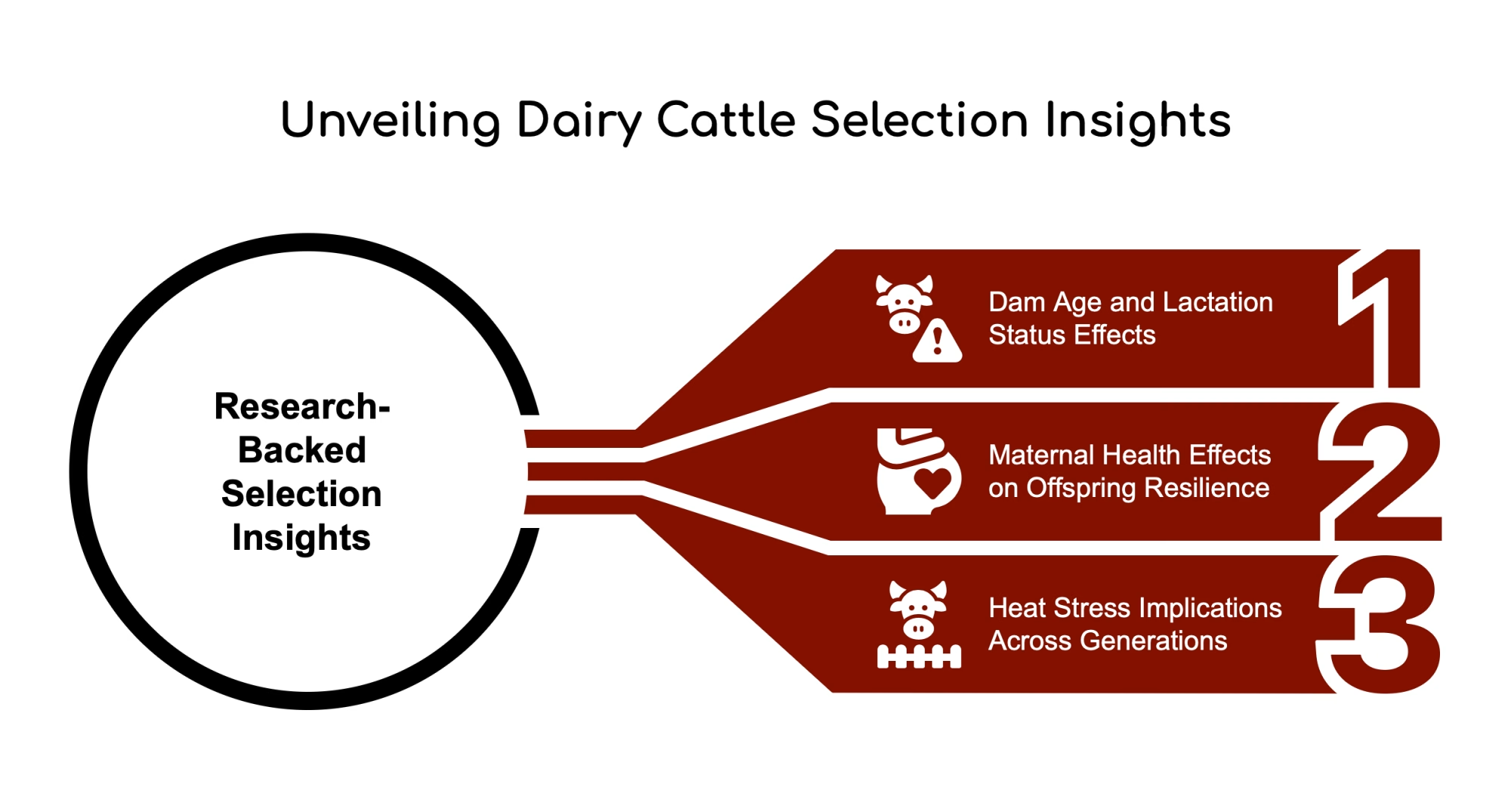
Research-Backed Selection Insights
Recent research studies provide valuable guidance for making more informed replacement decisions. These findings offer evidence-based criteria that go beyond traditional selection approaches.
Dam Age and Lactation Status Effects
A 2021 New Zealand study revealed that daughters of older dams (at least 9 years old) produced less milk than those from younger cows. This finding aligns with the understanding that genetic progress continues generation by generation, making younger animals genetically superior to older ones in most herds.
Perhaps more surprisingly, a 2020 University of Florida study found significant advantages for daughters of first-lactation (primiparous) cows. These advantages included lower death loss rates during the heifer rearing period, earlier pregnancy, reduced pregnancy loss (about 5% less), earlier calving, and lower incidence of clinical diseases during first lactation.
Maternal Health Effects on Offspring Resilience
The same University of Florida study produced a counterintuitive finding regarding maternal health during pregnancy. Daughters of cows that experienced clinical diseases during pregnancy showed greater resilience to health challenges as heifers and first-lactation cows. These offspring experienced a lower incidence of clinical disease than daughters of healthy cows, with researchers theorizing that altered uterine conditions during pregnancy may have enhanced these animals’ ability to withstand health challenges later in life.
This research suggests that replacements from first-lactation cows and from older cows that experienced health challenges during pregnancy may be preferable to those from healthy, older cows.
Heat Stress Implications Across Generations
Heat stress during the dry period has significant and lasting consequences across generations. Research from the University of Florida revealed that daughters of heat-stressed dry cows produced approximately 5 pounds less milk per day, on average, during their first three lactations compared to heifers from properly cooled dams. Even more remarkably, this production deficit extended to granddaughters of heat-stressed cows.
This trans-generational effect suggests that heifers born to cows that experienced significant heat stress during their dry periods should be considered candidates for culling when inventory adjustments are needed. The long-term production impact makes these animals less valuable as replacements despite what might otherwise be favorable genetics.
A 2025 study from the University of Illinois Urbana-Champaign confirms that heat stress leads to a 1% annual decline in milk yield across U.S. dairy farms. This translates to approximately 1.4 billion pounds of milk lost over five years, amounting to roughly $245 million in revenue losses. Smaller farms with fewer than 100 cows experience the most significant impact, losing an average of 1.6% of their annual milk yield.
Modern Approaches to Heifer Development
Beyond selection criteria, how heifers are developed significantly impacts their future productivity and the return on investment they provide.
Targeted Growth and Body Condition Management
Research on heifer development emphasizes targeting optimal growth rates. Studies have demonstrated that increasing nutrient intake in pre-weaned calves increases lactation milk yield. Calves fed for more significant pre-weaned average daily gain (ADG) were twice as likely to have greater milk yield in the first lactation. For every one pound of pre-weaning ADG, the first lactation cow milk yield increased by 1,550 pounds.
First, lactation cows who weighed 94% of the herd’s mature body weight at 30 days in milk (DIM) produced 11 to 12 pounds more milk per cow per day than lighter first lactation cows weighing 75% of the herd’s mature body weight. This is particularly significant considering that first-lactation cows account for 38-40% of the milking herd, and many cows complete three or fewer lactations.
Age Considerations in Breeding Decisions
Age remains a significant factor in breeding success. Older heifers typically reach puberty earlier, increasing their likelihood of experiencing multiple estrus cycles before the breeding season begins. These additional cycles improve first-service conception rates and lifetime productivity.
Numerous studies recommend the optimal age at first calving (AFC) is 22-25 months. When sorting through replacement candidates, age should be considered alongside genetic merit and health history as part of a comprehensive evaluation.
Strategic Implementation for Today’s Dairy Operations
Implementing these research findings requires a systematic approach tailored to individual farm goals and market conditions.
Setting Clear Herd Replacement Targets
The foundation of effective replacement management is establishing clear targets for the number of new animals needed to maintain an ideal herd inventory. This calculation must account for voluntary and involuntary culling rates while considering genetic advancement goals. With these targets in mind, producers can more strategically allocate beef and dairy genetics across the herd.
Balancing Beef-on-Dairy Opportunities
The beef-on-dairy trend continues to gain momentum, with producers becoming increasingly sophisticated in their approach. This thoughtfulness includes selecting beef sires based on specific market demands and regional expectations.
The financial benefits of beef-on-dairy breeding have been significant, with producers generally satisfied with the premiums received for crossbred calves. However, there’s growing recognition that maintaining these premiums requires attention to beef industry expectations regarding carcass quality and consistency.
Aligning with 2025 Genetic Evaluation Changes
The April 2025 genetic base change will significantly impact producers’ evaluation of potential replacements. According to the Council on Dairy Cattle Breeding (CDCB), the Holstein base will roll back 51 pounds for butterfat and 36 pounds for protein. This represents a dramatic acceleration compared to earlier periods—in 2015, the Holstein base rolled back just 17 pounds for butterfat and 12 pounds for protein.
These changes reflect current market conditions and production economics. Producers who maintain rigid selection thresholds without adapting to these changes risk significant economic losses—potentially up to $147,000 over five years for a 500-cow herd. Additionally, excessive inbreeding due to narrow selection criteria costs approximately $23 per cow yearly for each 1% increase in relatedness.
Breed-Specific Considerations
Research from the University of Wisconsin demonstrates that Holstein and Jersey breeds respond differently to maternal factors. While heat stress reduces milk production in both breeds, Jerseys show approximately 15% less production loss than Holsteins under similar conditions. However, Jersey offspring from first-lactation dams show a more pronounced advantage (7% higher lifetime production) than Holstein counterparts (4% advantage).
A 2024 study comparing Holstein and Jersey breeds found that Jersey cows produced milk with significantly higher fat content (23.85% higher), protein content (26.03% higher), and casein content (26.32% higher) compared to Holstein cows. However, Holstein cows produced a higher volume of milk, with an average daily production of 34.52 kg compared to 24.78 kilograms of Jersey cows.
Real-World Success: Willow Creek Dairy
Wisconsin’s Willow Creek Dairy implemented these research-based selection strategies in 2021, reducing its replacement inventory by 22% while maintaining production levels. Owner Mark Jensen reports: “By focusing on daughters from first-lactation cows and implementing aggressive heat abatement for our dry cows, we’ve seen a $1.87 per hundredweight improvement in our production costs. The genomic testing investment pays for itself many times over.”
Challenging Convention: The Health Paradox
While conventional wisdom suggests that healthy dams produce the best replacements, recent research challenges this assumption. Dr. Sarah Thompson, a leading dairy geneticist, argues, “Our studies show that offspring from cows that experienced health challenges during pregnancy often display enhanced resilience to various stressors throughout their lives. This ‘health paradox’ forces us to reconsider traditional culling criteria.”
However, a prominent veterinarian, Dr. John Anderson, cautions, “While the data on offspring resilience is intriguing, we must balance this against the dam’s immediate welfare and production concerns. Healthy cows remain crucial for overall herd performance and longevity.”
The Bottom Line
The economics of replacement heifer investment have never been more complex or consequential for dairy operations. Today’s market realities—including record prices for replacements and dairy-beef crossbreds—demand a more strategic and data-driven approach to heifer selection and development.
While genetic ranking remains the foundation of replacement decisions, research increasingly demonstrates the importance of factors beyond genetics. Maternal age, lactation number, health during pregnancy, and environmental conditions like heat stress significantly impact a heifer’s future productivity and value as a replacement.
For dairy producers navigating these decisions, the goal should be to create a balanced strategy that maintains genetic progress while capitalizing on alternative market opportunities. By implementing the selection criteria and management practices outlined in this analysis, producers can ensure they’re investing in replacement heifers that genuinely represent value for their operations, both genetically and economically.
Why This Matters For Your Operation
With first-lactation cows representing nearly 40% of your milking herd and many animals completing three or fewer lactations, the quality of your replacement program directly impacts half your herd’s productive life. The decisions you make today about which heifers to develop will shape your operation’s genetic progress, production efficiency, and profitability for years to come.
As we approach the 2025 genetic base change, now is the time to audit your replacement selection criteria and adapt your strategies to align with changing economic realities and genetic evaluations. The most successful operations will be those that balance genetic advancement with market opportunities, using evidence-based selection criteria to identify valuable replacements while capitalizing on strong markets for animals that don’t meet increasingly stringent selection standards.
5-Minute Replacement Program Audit Checklist
To help you quickly assess and improve your current replacement program, use this 5-minute audit checklist:
Genetic Evaluation: □ Are you using genomic testing to identify top genetic merit heifers? □ Have you updated your selection criteria to align with the 2025 genetic base changes?
Health and Development: □ Do you have protocols to ensure adequate colostrum intake for all calves? □ Are you tracking and addressing recurring respiratory issues in your heifers?
Growth Targets: □ Are your heifers reaching 94% of mature body weight by 30 days in milk? □ Is your average age at first calving between 22-25 months?
Heat Stress Mitigation: □ Do you have effective cooling systems in place for dry cows? □ Are you considering the heat stress history of dams when selecting replacements?
Economic Analysis: □ Have you calculated your actual cost of raising replacements recently? □ Are you regularly evaluating the opportunity cost of retaining vs. selling heifers?
By regularly reviewing and updating your replacement program using this checklist, you can ensure that your strategy remains aligned with the dairy industry’s latest research and economic realities.
Are you eager to discover the benefits of integrating beef genetics into your dairy herd? “The Ultimate Dairy Breeders Guide to Beef on Dairy Integration” is your key to enhancing productivity and profitability. This guide is explicitly designed for progressive dairy breeders, from choosing the best beef breeds for dairy integration to advanced genetic selection tips. Get practical management practices to elevate your breeding program. Understand the use of proven beef sires, from selection to offspring performance. Gain actionable insights through expert advice and real-world case studies. Learn about marketing, financial planning, and market assessment to maximize profitability. Dive into the world of beef-on-dairy integration. Leverage the latest genetic tools and technologies to enhance your livestock quality. By the end of this guide, you’ll make informed decisions, boost farm efficiency, and effectively diversify your business. Embark on this journey with us and unlock the full potential of your dairy herd with beef-on-dairy integration. Get Started!
Join over 30,000 successful dairy professionals who rely on Bullvine Daily for their competitive edge. Delivered directly to your inbox each week, our exclusive industry insights help you make smarter decisions while saving precious hours every week. Never miss critical updates on milk production trends, breakthrough technologies, and profit-boosting strategies that top producers are already implementing. Subscribe now to transform your dairy operation’s efficiency and profitability—your future success is just one click away.
To provide the best experiences, we use technologies like cookies to store and/or access device information. Consenting to these technologies will allow us to process data such as browsing behavior or unique IDs on this site. Not consenting or withdrawing consent, may adversely affect certain features and functions.
Functional
Always active
The technical storage or access is strictly necessary for the legitimate purpose of enabling the use of a specific service explicitly requested by the subscriber or user, or for the sole purpose of carrying out the transmission of a communication over an electronic communications network.
Preferences
The technical storage or access is necessary for the legitimate purpose of storing preferences that are not requested by the subscriber or user.
Statistics
The technical storage or access that is used exclusively for statistical purposes.The technical storage or access that is used exclusively for anonymous statistical purposes. Without a subpoena, voluntary compliance on the part of your Internet Service Provider, or additional records from a third party, information stored or retrieved for this purpose alone cannot usually be used to identify you.
Marketing
The technical storage or access is required to create user profiles to send advertising, or to track the user on a website or across several websites for similar marketing purposes.
To provide the best experiences, we and our partners use technologies like cookies to store and/or access device information. Consenting to these technologies will allow us and our partners to process personal data such as browsing behavior or unique IDs on this site and show (non-) personalized ads. Not consenting or withdrawing consent, may adversely affect certain features and functions.
Click below to consent to the above or make granular choices. Your choices will be applied to this site only. You can change your settings at any time, including withdrawing your consent, by using the toggles on the Cookie Policy, or by clicking on the manage consent button at the bottom of the screen.
Functional
Always active
The technical storage or access is strictly necessary for the legitimate purpose of enabling the use of a specific service explicitly requested by the subscriber or user, or for the sole purpose of carrying out the transmission of a communication over an electronic communications network.
Preferences
The technical storage or access is necessary for the legitimate purpose of storing preferences that are not requested by the subscriber or user.
Statistics
The technical storage or access that is used exclusively for statistical purposes.The technical storage or access that is used exclusively for anonymous statistical purposes. Without a subpoena, voluntary compliance on the part of your Internet Service Provider, or additional records from a third party, information stored or retrieved for this purpose alone cannot usually be used to identify you.
Marketing
The technical storage or access is required to create user profiles to send advertising, or to track the user on a website or across several websites for similar marketing purposes.











 Join the Revolution!
 Join the Revolution!