
Archive for dairy farm transition

The $228,000 Exit Strategy Reshaping Dairy: Inside the 55% Surge in Strategic Bankruptcies

Dairy farmers found a way to keep $228K that would go to the IRS. It’s legal, it’s smart, and bankruptcies are up 55%. Here’s how.

EXECUTIVE SUMMARY: Dairy farmers have discovered that filing bankruptcy can net them $228,000 more than selling their farms outright—and 259 operations did precisely that in the past year, driving a 55% surge in Chapter 12 filings. The catalyst is Section 1232, a 2017 tax provision that treats capital gains as dischargeable debt, turning a $285,600 IRS bill into just $57,120 for a typical Wisconsin farm sale. These aren’t failures but strategic exits by producers facing 8% interest rates and margins squeezed to breakeven who see no point grinding through more unprofitable years. While this tax-advantaged bankruptcy helps retiring farmers preserve decades of equity building, it’s fundamentally reshaping the industry. Young farmers without inherited land face nearly insurmountable entry barriers, and production is rapidly consolidating in states like Texas, where operations compete on efficiency rather than land appreciation. The result: bankruptcy has become a financial planning tool as strategic as any breeding decision or ration formulation.

Strategic Farm Bankruptcy

You know, when the University of Arkansas Extension released their recent data showing 259 dairy farms filed for Chapter 12 bankruptcy between April 2024 and March 2025—that’s a 55% jump from the previous year—most of us in the industry took notice. But here’s what’s really interesting: the more I dig into these numbers, the more I’m seeing something unexpected happening out there.

Many of these filings don’t look like the desperate collapses we’ve seen before. Not at all. What we’re actually witnessing is strategic financial planning, and it all ties back to a 2017 tax law change that most of us didn’t pay much attention to when it passed.

Now, let me be clear about something important: these aren’t wealthy farmers gaming the system. Most of these operations are facing real financial pressure—margins have been squeezed to breakeven or worse for many producers. When you combine operating loan rates jumping from 3% to nearly 8% (Federal Reserve Bank of Chicago data), input costs that never came back down after their spike, and milk prices that the USDA reports are back at 2018-2019 levels, a lot of operations are genuinely struggling. The difference is that Section 1232 gives them a strategic exit option that preserves more value than grinding it out for another few unprofitable years would.

“I’ve milked cows for 35 years. I’m not failing—I’m choosing the smartest path forward for my family with the rules as they exist. If that means using bankruptcy court to maximize our retirement after decades of 4 a.m. milkings, I’m at peace with that decision.” — Wisconsin dairy farmer preparing for strategic Chapter 12 filing.

Follow the data-driven rise in strategic dairy bankruptcies that reframes exit planning as financial optimization FY2023-FY2025. This visual doesn’t just inform—it electrifies: bankruptcy isn’t defeat, it’s savvy planning!

What’s Actually Happening with These Numbers

So let me share what I’ve been learning about the current situation. You probably know this already, but today’s economic are fundamentally different from previous downturns. Back in 2019, when USDA’s Economic Research Service documented 599 Chapter 12 filings nationally, we all understood what was happening—milk prices had absolutely tanked, and those trade wars were killing our export markets. It was straightforward and brutal.

Today? Well, it’s more nuanced. Ryan Loy from the University of Arkansas’s Division of Agriculture puts it well—commodity prices have basically returned to those 2018-2019 levels, yet our input costs…they never came back down. Fertilizer, feed, diesel—they’re all still elevated, and we’re all feeling that squeeze.

But here’s what’s really changed the game for a lot of operations: interest rates. The Federal Reserve Bank of Chicago’s agricultural finance data shows operating loan rates essentially doubled between 2021 and 2023. We went from around 3% to nearly 8% by mid-2025.

And if you’re like many producers who expanded with variable-rate financing when money was cheap…well, you know exactly what that means for your monthly payments.

The regional patterns we’re seeing are worth noting too:

  • First quarter 2025 brought us 88 Chapter 12 filings nationally—that’s nearly double Q1 2024’s 45 filings
  • Arkansas went from 4 filings in 2023 to 25 in 2025—that’s quite a shift
  • Michigan moved from zero in 2023 to 12 in 2024
  • Wisconsin, as many of you know, lost another 400 operations in 2024, bringing them down to 5,348 licensed herds

Understanding Section 1232 and Why It Matters

Now, here’s where things get particularly interesting—and if you haven’t heard about this yet, you’ll want to pay attention even if bankruptcy’s the last thing on your mind.

Remember the Supreme Court’s Hall v. United States case back in 2012? Lynwood and Brenda Hall sold their farm for $960,000 during bankruptcy, triggered about $29,000 in capital gains taxes, and the court basically said, “you’ve got to pay that in full before we’ll approve your reorganization plan.” It made Chapter 12 pretty much useless for anyone with appreciated land.

Well, Senator Chuck Grassley from Iowa—he’s been a friend to agriculture for years—pushed through the Family Farmer Bankruptcy Clarification Act in October 2017. This added Section 1232 to the bankruptcy code, and honestly, it’s a game-changer.

Dr. Kristine Tidgren, who runs Iowa State’s Center for Agricultural Law and Taxation, explained this really well in her 2020 analysis. Unlike Chapter 11 bankruptcies, where you’d have to pay capital gains in full, Chapter 12 now treats those tax obligations as general unsecured debt. That means they can potentially be discharged—either partially or sometimes entirely—through your reorganization plan.

Let’s Walk Through the Math Together

So here’s a real-world scenario using Wisconsin farmland values from the USDA’s August 2025 data. Say you’re a producer who purchased 200 acres in 2005 for $2,000 an acre—pretty typical for that time. According to the Wisconsin Realtors Association, that same ground’s worth about $8,000 an acre today.

Traditional Sale (Outside Bankruptcy):

ItemAmount
Sale proceeds$1,600,000
Capital gain$1,200,000
Federal capital gains tax (20%)$240,000
Net investment income tax (3.8%)$45,600
Total tax to IRS$285,600
Net proceeds after tax$1,314,400

Strategic Chapter 12 Filing with Section 1232:

ItemAmount
Sale proceeds$1,600,000
Tax becomes unsecured debt$285,600
Payment to unsecured creditors (20%)$57,120
Tax savings$228,480
Net proceeds$1,542,880

See how Section 1232 flips the tax equation for dairy producers: from IRS bill to retirement nest egg—making Chapter 12 a strategic tool. This isn’t just about bankruptcy—this is smarter farm succession!


Scenario
Sale ProceedsTotal Tax PaidNet ProceedsStrategic Tax Savings
Traditional Sale$1,600,000$285,600$1,314,400$0
Chapter 12 w/ Section 1232$1,600,000$57,120$1,542,880$228,480

Now, that’s real money. And when you’re looking at those numbers…it makes you think differently about what bankruptcy means, doesn’t it?

The Wisconsin Story: It’s Not What Most People Think

Mike Vincent, the ag economist at UW-Madison’s Extension, shared something with me that really stuck: “The biggest issue we’re facing is that the farmers are retiring.”

And you know what? The data backs him up completely.

In 2020, UW-Madison and USDA NASS conducted the Dairy Farm Transition Survey. What they found was eye-opening—17% of Wisconsin dairy farms said they wouldn’t be milking within five years.

For smaller operations — those with under 100 cows — the number jumped to 22%. And here’s the kicker: only 40% of Wisconsin dairy farmers had identified someone to take over the operation.

So when Mike says he’s not surprised by these closure numbers, he’s got a point. Many of these aren’t panic exits at all. They’re planned transitions that just happen to coincide with bankruptcy provisions that make Chapter 12 filing financially smart.

I was talking with a producer up in Shawano County recently—been milking for 35 years, profitable most years, but his kids aren’t interested in taking over. His land’s worth four times what he paid for it. He asked me straight up: “Why would I leave $200,000 on the table for the IRS when I could use that for my retirement?”

And honestly? I couldn’t give him a good reason not to consider it.

Who Benefits and Who Doesn’t—The Regional Differences

What’s fascinating is how differently this plays out across regions. According to USDA NASS’s August 2025 land value data, if you’re farming in Iowa, where land’s averaging $10,200 an acre, or Illinois at $9,850, or certain parts of Wisconsin ranging from $6,800 to $18,500…well, you’ve got options that other producers don’t.

The National Agricultural Law Center’s been tracking filing patterns, and they’re seeing it’s mostly farmers over 60 planning retirement, operations needing to downsize—maybe from 300 cows to 150 or 200—and family farms where the next generation just isn’t interested in continuing.

But here’s the thing: if you’re running a modern operation in Texas or New Mexico, where most producers lease their ground—Texas A&M AgriLife Extension reports the average operation there leases about 70% of their cropland—this doesn’t help you at all. Same story if you bought land recently, or if you’re in a state like New Mexico where USDA data shows land’s only worth about $725 an acre.

A Texas producer I know who’s managing 2,100 cows near Amarillo put it pretty bluntly: “We compete on production efficiency, not land equity. This Section 1232 stuff means nothing to us.” And she’s absolutely right—it’s a completely different business model.

Now, in the Northeast, it’s another story entirely. Vermont and New York operations often sit on land that’s appreciated significantly due to development pressure, but they also face some of the highest production costs in the country.

A producer from St. Albans, Vermont, told me recently that while his land’s worth more than ever, the combination of labor costs and environmental regulations means he’s still weighing whether strategic bankruptcy makes sense compared to a traditional sale.

A Young Farmer’s Perspective

I recently connected with Jake Martinez, a 29-year-old who started a 180-cow operation in central Minnesota in 2022. His take on all this was eye-opening.

“I’m watching neighbors who’ve been farming for 40 years walk away with tax-free gains while I’m trying to scrape together enough for a down payment on 80 acres,” Jake told me. “Don’t get me wrong—they earned it. But for someone like me trying to build something from scratch? The entry barriers just keep getting higher.”

Jake’s financing his expansion through custom heifer raising and a small on-farm cheese operation. “I can’t compete on land acquisition,” he explained. “So I’ve got to find other ways to build equity. Direct marketing, value-added production—that’s where young farmers like me have to look for opportunities.”

His perspective highlights something important: while Section 1232 helps retiring farmers maximize their exit value, it’s creating an even wider gap for the next generation trying to get started.

How Word Is Spreading Through the Industry

What’s really accelerated this trend is the education happening through agricultural networks. The National Agricultural Law Center at the University of Arkansas reported in its FY2024 annual report that it hosted 16 webinars attended by over 2,400 people. Sessions on agricultural bankruptcy and debt management are drawing standing-room-only crowds at farm conferences these days.

Joe Peiffer, who runs Ag & Business Legal Strategies in Iowa—he grew up on a Delaware County dairy farm himself—has been particularly vocal about this. He makes a good point: “The producers who are decisive and adapt to changing conditions have the best opportunity to remain viable.”

There’s also Russell Morgan, an agricultural consultant in Arkansas, who’s been working with Chapter 12 trustee Renee Williams to educate Mid-South farmers. I heard their April 2025 webinar drew a huge crowd—dairy and row crop producers all trying to understand their options.

What the Lenders Are Thinking

Now, you might wonder what lenders think about all this. Bob Mikell from AgSouth Farm Credit shared some interesting thoughts at the recent Mid-South Agricultural and Environmental Law Conference.

He basically said they’d rather see a farmer successfully reorganize through Chapter 12 than lose everything in foreclosure. If Section 1232 helps someone right-size their operation and keep farming, he sees that as better for everyone involved.

That’s not universal, of course. Some commercial banks aren’t thrilled about strategic Chapter 12 filings by solvent borrowers. But the Farm Credit System—they hold about 47% of total farm real estate debt according to USDA’s Economic Research Service—seems to be taking a pretty pragmatic approach to the whole thing.

Looking North: How Canada Does Things Differently

It’s worth comparing our situation to what’s happening in Canada, because it really highlights the trade-offs we’re dealing with. Statistics Canada shows Canadian dairy farms maintain debt-to-asset ratios around 0.191—that’s about half what we typically see in comparable U.S. operations. Bankruptcies? They’re basically non-existent up there.

While we’re dealing with volatility and needing various support programs, their supply management system provides built-in stability. But—and this is a big but—that stability comes at a cost. Canadian Dairy Commission data from November 2024 shows quota costs running CAD $24,000 to $58,000 per cow’s worth of production capacity. A typical 100-cow operation needs $3-5 million just in quota before they buy their first animal. And consumers? They’re paying CAD $1.07 per liter for milk.

Meanwhile, we’ve got the freedom to expand and chase export markets. U.S. Dairy Export Council data shows we hit $8.22 billion in exports in 2024. But with that freedom comes the volatility that’s driving these bankruptcy patterns we’re seeing.


Country/Region
Entry BarrierProducer Age (avg)Bankruptcy IncidenceMilk Price (USD/L)Export RatioKey Challenge
Canada (Quota)$30,000/cow quota55+Rare$0.80-1.10<10%High startup cost
USA (Free Market)$400,000+ down60+Up 55% (2024)$0.40-0.6015%+Volatility, consolidation
Texas/Idaho (Efficiency)Leased land, $250K+ equity50-58Low, not equity-driven$0.40-0.5520%+Scale, tech adoption

The Personal Side of These Decisions

I think it’s important to acknowledge something here: not everyone’s comfortable with strategic bankruptcy, even when the math makes perfect sense.

A producer from Fond du Lac County recently told me that his grandfather would “roll over in his grave” if he filed for bankruptcy, regardless of the circumstances. “In his day, you paid your debts, period.” That sentiment’s real, and it matters in our communities.

At the same time, Jamie Dreher from Downey Brand LLP made a good point at the Western Water, Ag, and Environmental Law Conference this past June. Congress designed Section 1232 specifically to help farmers transition without getting crushed by tax obligations. Using a tool that was created for your exact situation? There’s no shame in that.

It’s a deeply personal decision. There’s no right answer that works for everyone’s values and circumstances.

Where This Is All Heading

Looking ahead, several trends are becoming pretty clear. Dr. Ani Katchova at Ohio State’s Department of Agricultural, Environmental, and Development Economics thinks that by 2030, strategic bankruptcy planning might become just another standard option we discuss in farm transition planning, right alongside traditional succession strategies.

We’re likely to see continued geographic consolidation. States with high land values will keep seeing farms exit through tax-advantaged bankruptcy, with that land flowing to the remaining large operations.

Meanwhile, production’s going to keep concentrating in states like Texas and Idaho, where operations focus on efficiency rather than land equity. USDA data shows Texas already surpassed Idaho as the number three milk-producing state in 2025—they’ve grown 190% since 2001.

For young farmers trying to get started? It’s getting tougher. Iowa State’s Beginning Farmer Center reports that the traditional path—building wealth through dairy excellence over 20-30 years—is becoming nearly impossible in high-land-value regions.

Practical Thoughts for Producers

If you’re weighing your options, here’s what I’d suggest thinking about.

First, really understand your complete financial picture. Not just your cash flow, but your land equity position too. The Federal Reserve has some good agricultural finance calculators that can help you see how interest rate changes affect your debt service.

And honestly consider whether downsizing might actually strengthen your operation’s viability.

Get professional advice early—and I mean early, not when you’re in crisis mode. Find agricultural financial advisors who understand Chapter 12 provisions. IRS Publication 225 has farmer-specific guidance that’s worth reading regardless of what you decide.

Consider all your restructuring options:

  • Traditional refinancing might work
  • Maybe partial asset sales make sense
  • Strategic Chapter 12 filing could be right if your situation aligns
  • Or planned succession—even if it’s not to the family—might be the answer

And recognize that the landscape has fundamentally shifted. Higher interest rates have changed the game. Strategic downsizing isn’t failure—it’s adaptation. If you’ve been farming for decades and you’re ready to retire, that’s an achievement, not a defeat.

For younger farmers and those looking to expand, the playbook’s different. In regions where land values are not appreciating, excellence in milk production remains your primary path. Think about lease-based expansion models that don’t tie up all your capital in land. Look at emerging dairy regions where entry costs are still manageable.

You’ve got to plan for different wealth-building strategies now. Land appreciation might not provide what it did for previous generations. Consider diversifying income streams beyond traditional dairy production. Value-added processing, direct marketing—these might be where your opportunities are.

The Bottom Line

What we’re discovering about Chapter 12 bankruptcy reflects broader changes in American agriculture that we’re all navigating together. That provision Congress passed in 2017 to help struggling farmers? It’s evolved into something more complex—a financial planning tool that rewards strategic thinking about asset management as much as farming excellence.

Is that good or bad? Honestly, it depends on your perspective. For farmers who’ve built substantial equity over decades, Section 1232 provides a path to capture that value as they transition out. For communities, it can mean orderly succession instead of crisis liquidation.

But it also highlights some uncomfortable truths about modern dairy economics. When tax-advantaged bankruptcy can be more profitable than continuing to milk…when land ownership matters more than production efficiency…well, we’ve got to ask ourselves some fundamental questions about where the industry’s headed.

The 55% surge in Chapter 12 bankruptcies isn’t simply a crisis or a loophole. It’s farmers adapting to new economic realities with the tools available. Understanding these tools—how they work, what they mean, when they make sense—that’s going to be essential for anyone navigating dairy’s evolving landscape.

As that Wisconsin producer preparing for a strategic Chapter 12 filing told me: “I’ve milked cows for 35 years. I’m not failing—I’m choosing the smartest path forward for my family with the rules as they exist. If that means using bankruptcy court to maximize our retirement after decades of 4 a.m. milkings, I’m at peace with that decision.”

That sentiment—practical, unsentimental, focused on optimal outcomes—pretty much captures how American dairy farmers are approaching this transformation. The old stigmas about bankruptcy? They’re fading. What’s replacing them is a new pragmatism where strategic financial planning matters as much as picking the right bull for your breeding program or getting your ration formulation dialed in.

For better or worse, that’s the new reality we’re dealing with. And understanding it? That might just be the difference between thriving and merely surviving in the years ahead.

KEY TAKEAWAYS:

  • The $228,000 Opportunity: Section 1232 transforms Chapter 12 bankruptcy into a tax-saving tool—farmers selling 200 acres can keep $1.54M versus $1.31M in traditional sales by discharging capital gains taxes as unsecured debt
  • Strategic, Not Crisis: The 55% bankruptcy surge represents planned exits by farmers facing 8% interest rates and compressed margins, not business failures—these are profitable operations choosing smart transitions
  • Winners and Losers: Benefits farmers 60+ with appreciated land in high-value states (Iowa: $10,200/acre); offers nothing for lease-based operations or young farmers trying to enter
  • Timing Is Everything: This strategy requires filing bankruptcy BEFORE selling land—farmers should consult specialized ag attorneys early, not wait for a crisis
  • Industry Transformation: This trend accelerates dairy’s shift from land-wealth to operational efficiency, with production consolidating in states like Texas, where success depends on milk per cow, not land appreciation

Editor’s Note: This article draws on interviews with dairy producers across Wisconsin, Arkansas, Iowa, Texas, Minnesota, and the Northeast conducted between September and October 2025. Some producers requested anonymity to discuss sensitive financial matters candidly.

Complete references and supporting documentation are available upon request by contacting the editorial team at editor@thebullvine.com.

Learn More:

  • The Ultimate Guide to Dairy Farm Succession Planning – While the main article explores bankruptcy as a final exit strategy, this guide provides a proactive roadmap for a successful farm transition. It details strategies for communication, financial structuring, and legal planning to preserve the family legacy and business continuity.
  • Decoding Dairy’s Crystal Ball: Top 5 Economic Trends Producers Must Watch – This strategic analysis dives deep into the market forces—like interest rates and input costs—driving the financial pressures mentioned in the main article. It provides critical context for anticipating market shifts and positioning your operation for long-term resilience.
  • Beyond the Bulk Tank: How Value-Added Dairy Is Creating Bulletproof Businesses – For producers seeking alternatives to the land-equity model, this article reveals how to build a more resilient business through direct marketing and on-farm processing. It offers a tangible path for young farmers to build equity and insulate their profits from commodity volatility.

Join the Revolution!

Join over 30,000 successful dairy professionals who rely on Bullvine Weekly for their competitive edge. Delivered directly to your inbox each week, our exclusive industry insights help you make smarter decisions while saving precious hours every week. Never miss critical updates on milk production trends, breakthrough technologies, and profit-boosting strategies that top producers are already implementing. Subscribe now to transform your dairy operation’s efficiency and profitability—your future success is just one click away.

NewsSubscribe
First
Last
Consent

BEEF-ON-DAIRY REVOLUTION: Former Dairy Farmers Finding Gold in the Beef Market Corporate Giants Overlooked

While mega-dairies grabbed headlines, small farmers quietly hijacked beef genetics – creating a stealth revolution corporate giants never saw coming.

The dairy establishment missed it completely. While industry leaders were busy building mega-dairies and multinational processing plants, America’s dairy farmers quietly changed the genetic foundation of their industry. In just five years, beef-on-dairy has exploded to 7.9 million semen units annually – now breathing down the neck of gender-selected dairy semen as the dominant breeding choice in U.S. dairy herds. This isn’t just a breeding trend; it’s an agricultural insurgency creating an unexpected lifeline for the family farms that industry consolidation was supposed to eliminate.

BREEDING BOMBSHELL: 7.9 Million Reasons Small Farmers Are Winning

The scale of this transformation is undeniable. According to the National Association of Animal Breeders (NAAB), domestic beef semen sales hit a new high of 9.4 million in 2023, marking the sixth year of record sales. Of those, 7.9 million units were used in dairy herds – up nearly 1 million from the previous year.

“In just five years, beef-on-dairy has exploded from a niche practice to 7.9 million semen units annually – representing a fundamental shift in how America’s dairy farmers approach breeding decisions.”

This represents a complete reshaping of dairy breeding practices.

Semen Category2023 Units (millions)Market PositionTrend
Gender-Selected Dairy8.4#1 PositionStable leader
Beef-on-Dairy7.9#2 Position↑ 1 million units from previous year
Conventional Dairy7.0#3 PositionDeclining
Heterospermic Beef*1.8 (1.3 domestic)#2 Among beef breedsEmerging category

*Second largest ‘breed’ of beef semen sold, following only Angus

Gender-selected dairy semen now leads with 8.4 million units, followed closely by beef-on-dairy at 7.9 million units, with conventional dairy semen falling to third place at 7 million units. Less than a decade ago, in 2015, the all-time high for beef semen sales was just 2.5 million units.

Perhaps most telling is the emergence of heterospermic beef products – a mixture of multiple sires in a single straw – which has become the second largest “breed” of beef semen sold at 1.8 million units (with 1.3 million domestic sales), trailing only Angus. This innovative approach allows producers to maximize genetic diversity while maintaining the beef-on-dairy advantage.

FROM PARLOR TO PROFIT: The Edenfield Family’s Successful Transition

Logan Edenfield knows firsthand the challenges and opportunities of transitioning from dairy to beef. He grew up on a 50-cow dairy operation in Ohio that successfully made the switch to beef production. Edenfield now shares his expertise with Equity Livestock in Stratford.

“Farmers exiting dairy and going into beef must change their thinking,” Edenfield explains. His family’s approach focused on strategic breeding decisions that maximized calf value while creating a clear timeline for the transition. “Those still milking cows and looking to retire should breed everything to an Angus bull, which will result in black-hided calves that tend to be worth the most,” he advises. “Then, you automatically have put a date on when you won’t have replacement heifers. It gives you a deadline and, in the meantime, gets you more value out of the calves you are selling.”

The Edenfield family discovered that timing is everything. “Sell those calves at 3 to 5 days of age to reap the most benefit,” Logan recommends based on his family’s experience. This approach minimizes input costs while capitalizing on the significant price premium for beef-cross calves. While conventional Holstein bull calves might bring just $60 at the market, black beef-cross calves from Holstein dams can command $100 to $300 – a value proposition transforming his family’s operation during the transition period.

SMALL FARM REVENGE: Outflanking Corporate Giants With Crossbred Efficiency

The performance metrics of beef-on-dairy crosses create the perfect foundation for former dairy farmers to establish profitable, small-scale finishing operations. Texas Tech University research confirms that the average daily gain and feed-to-gain ratio of crossbreds is significantly better than that of Holsteins and is similar to that of conventional beef cattle.

For small-scale producers, these efficiency gains translate directly to profitability. Crossbred finishing times are about 20% faster than Holsteins, which means these animals produce the same beef in a shorter timeframe and on less total feed. This efficiency creates the perfect scenario for former dairy farmers with limited facilities and labor.

“Crossbred finishing times that are about 20% faster than Holsteins create the perfect scenario for former dairy farmers with limited facilities and labor – delivering the same beef in less time with lower input costs.”

What makes these crossbreds particularly suited for minor operations is their temperament. Having been bottle-raised in the dairy system, beef-on-dairy calves are typically docile and easy to handle – eliminating the need for extensive handling facilities or specialized equipment. For retired farmers or those balancing off-farm employment with farming, this management reality is dramatically different from conventional beef production.

ECONOMIC REALITY CHECK: The Numbers Behind The Transition

Understanding the financial implications is essential for dairy farmers considering a transition to beef production. A comparative analysis of continuing dairy production versus transitioning to beef-on-dairy reveals compelling differences:

FactorStaying in DairyTransitioning to Beef-on-Dairy
Initial InvestmentOngoing facility upgrades ($500-1,500 per stall)Minimal conversion costs ($100-300 per head capacity)
Labor Requirements40-60 hours/week (50-cow herd)10-15 hours/week (same facilities)
Return TimelineImmediate but thin margins12-18 months to first finished cattle
Profit Margin Potential$1.50-$2.50/cwt milk$300-$600/head (direct marketed)

According to farm financial consultants at Cornell PRO-DAIRY program, transitioning dairy facilities to beef production typically requires minimal investment when existing infrastructure is utilized. Their analysis suggests that the decreased labor requirements alone can make the transition attractive for farmers nearing retirement or seeking off-farm employment.

The University of Wisconsin Center for Dairy Profitability notes that while dairy provides immediate cash flow, beef production offers significantly reduced stress levels and labor flexibility that many former dairy farmers find equally valuable. Their research indicates that the lower input costs and facilities investment required for beef production can deliver higher returns on assets, particularly for small-scale operations that develop direct marketing channels.

EXTENSION EXPERTISE: What The Specialists Are Saying

The growing interest in beef-on-dairy has caught the attention of agricultural extension services. Ryan Sterry, UW-Extension agriculture agent for St. Croix County, has observed the trend firsthand. “It’s getting to be a more popular topic for us,” Sterry notes, pointing to increasing attendance at workshops titled “So You Want to Raise Beef?” in dairy-heavy regions.

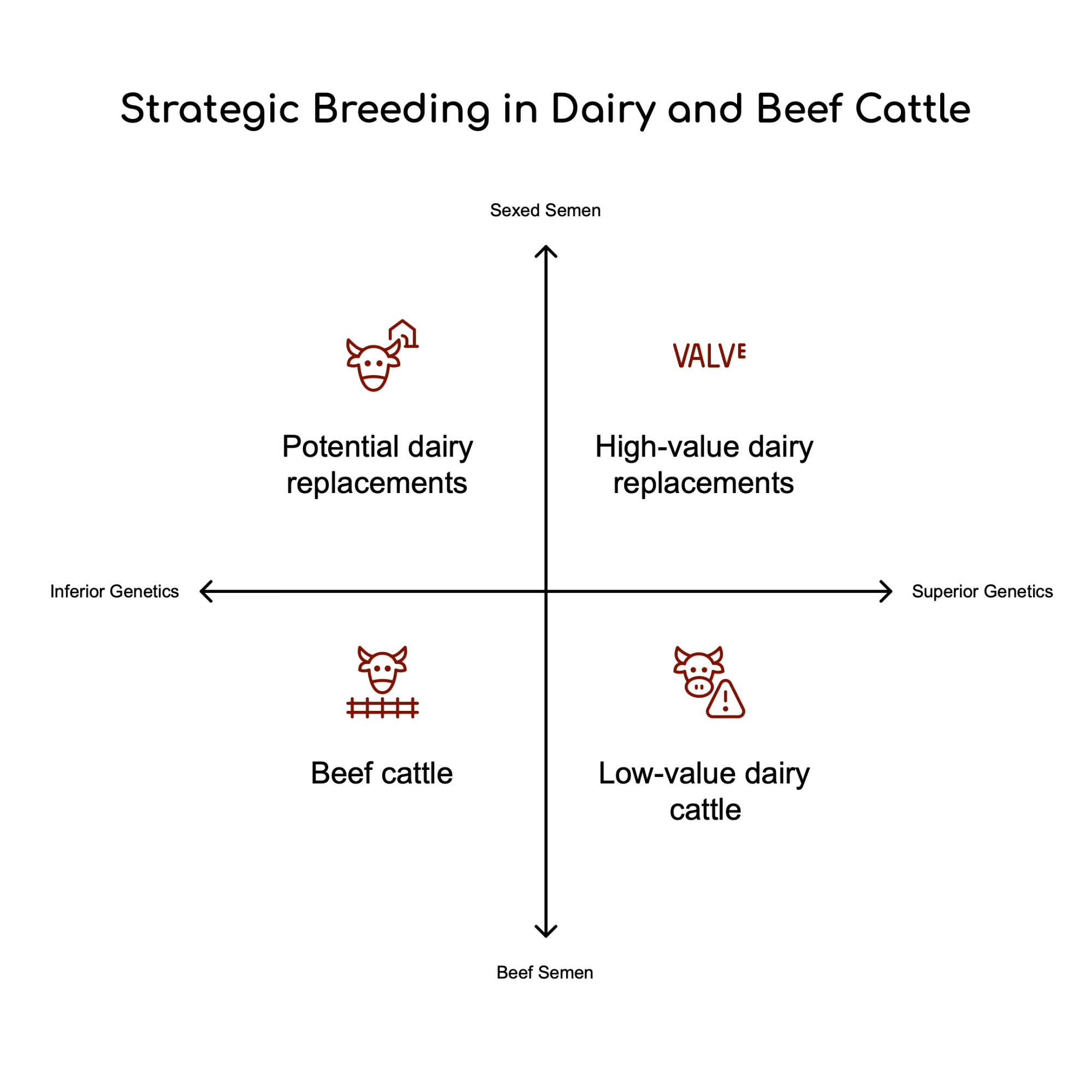
Scott Ellevold of NorthStar Select Sires, who also raises beef cattle north of New Richmond, has witnessed this shift from the genetic supplier side. “Not only are more people breeding their whole herd over to beef as they exit dairy altogether, but many dairy farmers are breeding their best cows with sexed semen to increase their odds of getting heifer calves that will grow into replacement animals and their lower-end cows to beef bulls,” Ellevold explains.

This strategic approach – using genomic testing to identify superior heifers for dairy replacements while applying beef semen to genetically inferior animals – maximizes the value of each pregnancy. It contradicts traditional advice but accelerates genetic progress by ensuring only top genomic animals produce dairy replacements.

PROFIT PIPELINE: How Small Producers Cut Out Middlemen

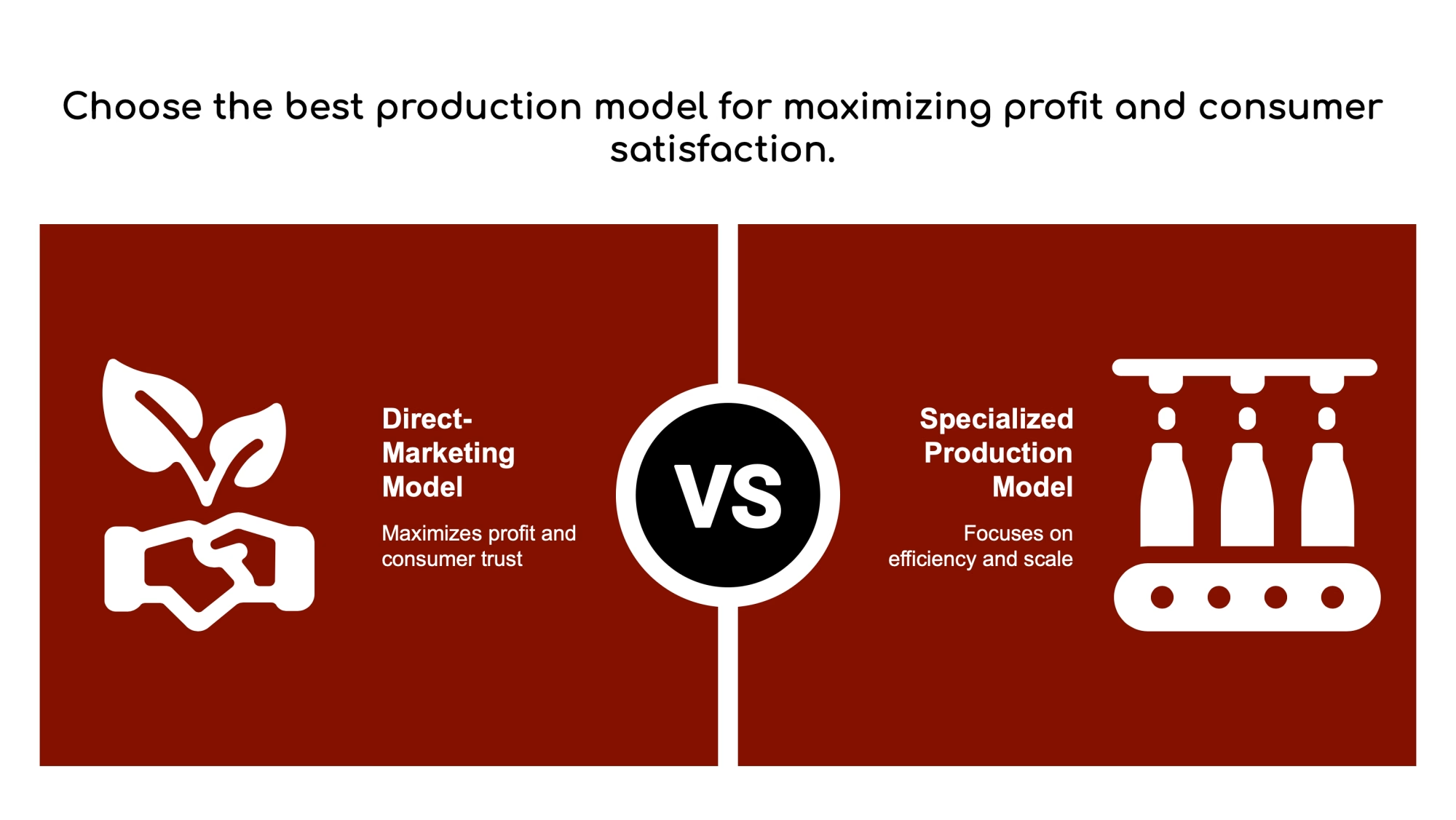
While large industry players chase incremental efficiency improvements, former dairy farmers around urban centers sell beef directly to consumers at premiums that would make a corporate accountant’s head spin. These producers aren’t competing on efficiency but on story, transparency, and relationship.

The direct-marketing model typically involves consumers purchasing a whole, half, or quarter animal, which is then processed at a small local slaughterhouse. This approach eliminates multiple intermediaries, allowing producers to capture a significantly higher percentage of the end consumer dollar while delivering what consumers increasingly demand: knowing exactly how their food was raised.

This vertical integration model – from calf to consumer – represents the antithesis of the industry’s push toward specialized, fragmented production models. Family farmers are discovering they can generate higher margins with fewer animals by controlling more of the value chain.

REGIONAL OPPORTUNITIES: Location Matters In The Beef-on-Dairy Game

The beef-on-dairy opportunity isn’t distributed equally across all regions. According to data from the USDA’s Economic Research Service and the Niche Meat Processor Assistance Network, certain areas offer distinct advantages for farmers pursuing this transition:

Northeast & Mid-Atlantic

These regions benefit from the country’s highest concentration of small USDA-inspected processors, with New York, Pennsylvania, and Vermont leading in facilities per capita. Additionally, the Northeast features densely populated urban areas with high consumer incomes and strong interest in local food, creating premium direct marketing opportunities. According to Cornell Cooperative Extension research, direct-marketed beef commands 15-30% higher prices in this region than conventional channels.

Upper Midwest

Wisconsin, Minnesota, and Michigan combine strong processing infrastructure with dairy farming expertise. The University of Wisconsin Center for Dairy Profitability highlights that these states have maintained more small to mid-sized slaughter facilities than other regions. The Wisconsin Farmers Union notes that the cultural heritage of meat processing in these areas creates infrastructure and consumer awareness advantages for small-scale beef producers.

Challenges in Other Regions

Western and Plains states face significant processing bottlenecks, with USDA data showing fewer small-scale processors per cattle producer. According to University of Georgia research, Southern states generally have lower direct marketing premiums, though urban markets like Atlanta, Nashville, and Charlotte buck this trend with strong local food movements.

PREMIUM ADVANTAGE: The Quality Edge Big Beef Can’t Match

Initial research by Texas Tech University indicates hybrid cattle produce more and higher-quality beef products without impacting milk production efficiency compared to purebred dairy calves. This quality advantage creates a compelling narrative for direct marketing: premium eating experiences from small-scale, locally raised animals.

Lisa Pederson, North Dakota State University beef quality assurance specialist, notes that “dairy steers are well known for their ability to produce the highest quality grades of beef (Prime and High Choice).” This quality potential gives former dairy farmers a significant marketing advantage when positioning their beef-on-dairy crosses in premium direct markets.

These aren’t just marketing claims – beef-on-dairy crosses deliver superior meat quality in critical consumer metrics. The research shows these crossbreds appear to inherit their Holstein ancestors’ marbling capability but finish faster, creating the perfect foundation for premium marketing messages that small producers can leverage in direct-to-consumer channels.

DAVID VS. GOLIATH: The Economic Numbers Don’t Lie

For former dairy farmers, the economics present a stark contrast to conventional commodity production:

Production ModelAdvantagesEconomic Impact
Conventional CommodityScale efficiencyThin margins, high volume required
Beef-on-Dairy Direct20% faster finishing
Lower capital requirements
Premium direct marketing
Higher margins
Viable at smaller scale
Control of value chain

When marketed directly to consumers, these producers can capture premiums that commodity channels cannot match. This approach transforms a marginal enterprise in conventional marketing channels into a highly profitable specialty business.

CORPORATE SCRAMBLE: Industry Giants Playing Catch-Up

The remarkable success of this grassroots movement hasn’t gone unnoticed forever. Industry giants scramble to understand and capitalize on what small producers have already discovered. Cargill has launched a three-year “Dairy Beef Accelerator” program in collaboration with industry partners, including Nestlé, to research the benefits of cattle crossbreeding.

Initial research from this corporate-led initiative confirms what small producers already know: “beef on dairy” calves exhibit greater feed efficiency, which lowers greenhouse gas emissions while producing more and higher-quality beef products.

“Achieving the most from the valuable resources used in beef production is a key part of Cargill’s BeefUp Sustainability initiative,” notes the company – an implicit acknowledgment that this model represents a fundamental shift in how beef production can be structured.

The question is whether small producers can establish their market position before corporate interests attempt to scale and commoditize the approach.

“While corporate agriculture spent decades telling small farmers to ‘get big or get out,’ those same farmers discovered a market opportunity that big players missed entirely – and now industry giants are scrambling to understand what small producers already know.”

NAVIGATING REAL CHALLENGES: Beyond The Hype

Despite its promise, this model faces several significant challenges that farmers must address:

1. Processing Access Bottleneck

Small-scale beef producers face a critical infrastructure challenge: limited access to USDA-inspected slaughter facilities. The consolidation of meat processing has left many rural areas without local plants capable of handling direct-to-consumer orders. This bottleneck can create scheduling delays of 6-12 months at some facilities, making consistent supply difficult for producers selling directly to consumers.

2. Residue Management Requires Vigilance

Lisa Pederson of North Dakota State University warns that residue management requires particular attention when transitioning dairy animals to beef production. “Dairy cows had a residue violation rate nine times higher than beef cows,” she notes, highlighting that about 20% of violating dairy carcasses tested positive for more than one product residue. Former dairy farmers must implement strict withdrawal protocols and maintain meticulous records to avoid costly violations.

3. Market Saturation Concerns

As more dairy operations adopt beef-on-dairy breeding strategies, the market could become saturated with crossbred animals. This potential oversupply could erode the price advantage enjoyed by beef-cross calves, which Edenfield noted was $100-300 versus just $60 for straight Holstein calves. Producers entering this space must develop marketing strategies differentiating their product beyond simply being a beef-dairy cross.

4. Consumer Price Sensitivity

While direct marketing offers premium prices, consumer willingness to pay these premiums may fluctuate with economic conditions. Direct marketers must constantly demonstrate value through quality, storytelling, and relationship-building to maintain price points that make their business model viable. This requires marketing skills and customer service that differ significantly from conventional dairy production.

5. Capital Requirements For Transition

Adapting existing dairy facilities for beef finishing often requires capital investments at a time when many existing dairy farmers face financial constraints. Strategic phasing of the transition and carefully selecting which modifications to prioritize are essential for managing this challenge.

SUSTAINABILITY DOUBLE WIN: Economic and Environmental Gains

Recent research on beef-on-dairy systems reveals a compelling sustainability story beyond economics. A 2024 case study published in Semantic Scholar titled “Beef on dairy: A case study of sustainable animal protein production” highlights how these production systems provide both economic sustainability for producers and environmental benefits for society.

“Human society has evolved over thousands of years, but in the last 35 years, we have gained access to multiple advanced technologies that can change how animal protein is produced,” the researchers note. “For the producers of animal protein, it is the economic sustainability of the farmer producers. For the consumers of animal proteins, it is the production of that protein in a manner that derives in a highly nutritious product produced in an environmentally friendly system.”

This dual sustainability – supporting farmer livelihoods while improving environmental performance – creates a powerful narrative for positioning beef-on-dairy products in today’s values-driven marketplace.

THE TIME IS NOW: Your Roadmap to Beef-on-Dairy Success

The beef-on-dairy revolution is happening with or without you. For former dairy farmers or those considering an exit from dairy production, the window of opportunity won’t remain open indefinitely. Here’s how to determine if this path is right for your operation and how to get started:

Action Steps for Dairy Farmers:

  • Contact your regional extension office about beef production workshops – University extension services across dairy states are responding to increased interest with targeted education programs
  • Research local processing options and their waitlists – Secure processing access before investing in finishing facilities by contacting USDA-inspected processors in your area
  • Consider genomic testing to identify lowest-merit dairy animals – Strategically apply beef semen to animals with lower genetic merit for dairy traits.
  • Connect with direct marketing networks in your region – Resources like the National Farmers Market Directory can help identify local marketing opportunities.
  • Investigate USDA Value-Added Producer Grants – These programs fund farmers transitioning to value-added enterprises like direct-marketed beef.

Questions to Ask Before You Start:

  1. Processing Access: Are USDA-inspected facilities available within a reasonable distance?
  2. Market Potential: Is there sufficient local demand for direct-marketed beef?
  3. Facility Adaptability: How easily can existing dairy facilities be adapted for beef production?
  4. Cash Flow Bridge: Can you manage the transition period before beef income begins?
  5. Marketing Skills: Do you have the skills or partnerships needed for direct marketing?

The rise of beef-on-dairy represents more than just a profitable niche – it’s a potential pathway to resurrect thousands of small family farms pushed out of dairy production by consolidation. While industry giants fixate on massive production systems, the humble crossbred steer quietly creates an alternative path that leverages America’s former dairy farmers’ knowledge, facilities, and grit.

The question isn’t whether this model works – the data clearly shows it does. The question is whether enough former dairy farmers will seize the opportunity before corporate interests attempt to scale and commoditize the approach. For those who do, it represents perhaps the most promising pathway to resurrect small-scale livestock production in an era of relentless consolidation – and reclaim their place in an industry that once left them behind.

Key Takeaways

  • Strategic breeding decisions create clear transition paths – breeding lower-genetic-merit dairy animals to beef bulls captures immediate calf value premiums ($100-300 vs $60 for Holstein bulls) while establishing a timeline for a complete transition out of dairy.
  • Regional advantages matter. The Northeast and Upper Midwest regions offer superior processing infrastructure and stronger direct-marketing opportunities, with processing access being the critical factor in a successful transition.
  • Minimal investment, maximum leverage – Existing dairy facilities can be adapted for beef production at 1/5 the cost of new construction, with labor requirements reduced from 40-60 hours weekly to just 10-15 hours for comparable herd sizes.
  • Docility creates management advantages – Beef-on-dairy crosses retain the temperament of bottle-raised dairy calves, eliminating the need for specialized handling equipment while providing quality grades that frequently reach Prime and High Choice.
  • Direct marketing captures the premium – By selling directly to consumers through whole, half, or quarter animal purchases, former dairy farmers can maintain viable margins on smaller herds while telling a compelling local food story.

Executive Summary

America’s dairy farmers have orchestrated a remarkable shift in breeding practices, with beef-on-dairy semen usage skyrocketing to 7.9 million units annually and becoming the second most common breeding choice in U.S. dairy herds. This transition offers former dairy farmers a unique opportunity to leverage existing facilities and expertise with minimal modifications while benefiting from crossbreds that finish 20% faster than purebred Holsteins and produce higher-quality beef. By selling directly to consumers, small producers can capture premium prices that commodity channels cannot match, particularly in regions with strong processing infrastructure like the Northeast and Upper Midwest. The economic advantages are compelling – reduced labor requirements, lower capital investment, and potentially higher margins than conventional dairy – but the window of opportunity may narrow as corporate interests catch up to what small farmers discovered first. For dairy farmers considering exit strategies or diversification, beef-on-dairy represents a proven pathway to resurrect small family farms pushed aside by industry consolidation.


Download “The Ultimate Dairy Breeders Guide to Beef on Dairy Integration” Now!

Are you eager to discover the benefits of integrating beef genetics into your dairy herd? “The Ultimate Dairy Breeders Guide to Beef on Dairy Integration” is your key to enhancing productivity and profitability.  This guide is explicitly designed for progressive dairy breeders, from choosing the best beef breeds for dairy integration to advanced genetic selection tips. Get practical management practices to elevate your breeding program.  Understand the use of proven beef sires, from selection to offspring performance. Gain actionable insights through expert advice and real-world case studies. Learn about marketing, financial planning, and market assessment to maximize profitability.  Dive into the world of beef-on-dairy integration. Leverage the latest genetic tools and technologies to enhance your livestock quality. By the end of this guide, you’ll make informed decisions, boost farm efficiency, and effectively diversify your business.  Embark on this journey with us and unlock the full potential of your dairy herd with beef-on-dairy integration. Get Started!

Learn More

Join the Revolution!

Join over 30,000 successful dairy professionals who rely on Bullvine Daily for their competitive edge. Delivered directly to your inbox each week, our exclusive industry insights help you make smarter decisions while saving precious hours every week. Never miss critical updates on milk production trends, breakthrough technologies, and profit-boosting strategies that top producers are already implementing. Subscribe now to transform your dairy operation’s efficiency and profitability—your future success is just one click away.

NewsSubscribe
First
Last
Consent

Send this to a friend