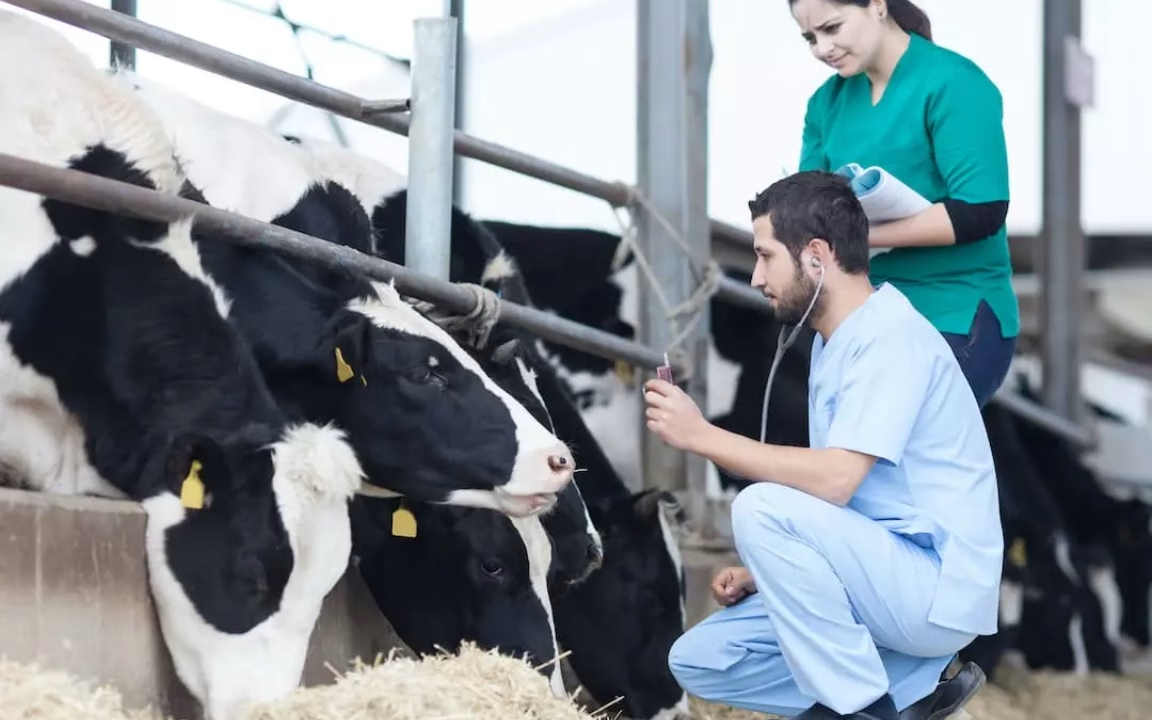
One infected visitor can cost you $128,250 (H5N1). Boot stations cost $820. Every major dairy that installed them reports zero outbreaks since. Facts.
Executive Summary: Boot wash stations deliver the dairy industry’s best-kept secret: 2,795% ROI for just $820, preventing $96,000+ in disease losses that Penn State, Michigan State, and UC-Davis have meticulously documented. While farms invest $250,000 in robots returning 30% over a decade, bacteria on contaminated boots survive 24 hours, travel 400 feet, and devastate herds—yet three simple steps (scrape, wash, disinfect) stop them cold. Wisconsin producers with stations report 60% fewer calf deaths and haven’t had major outbreaks in 18+ months. The math is embarrassingly clear: two-month payback versus eight years for that robot. Yet most dairies still lack this basic protection, choosing complex technology over proven prevention. The question isn’t whether boot stations work—it’s why you don’t already have them.
You know how it is at industry meetings—everyone’s talking about the latest technology. Last month at the Wisconsin Dairy Expo, I got into this fascinating conversation with a group of producers comparing notes on recent investments. Robotic milkers, automated calf feeders, precision nutrition systems… the usual suspects. Then someone mentioned they’d just put in boot wash stations, and honestly, the whole conversation shifted.
What’s interesting is how this matches a pattern I’ve been noticing across the industry. Here we are, investing heavily in automation—which makes sense, don’t get me wrong—but some of the best returns are coming from the simplest investments. And when I started digging into the numbers… well, they surprised even me.
“The payback for preventing just one Salmonella outbreak? About two months.”
The math is embarrassingly clear: a $2,460 investment in three boot wash stations delivers up to 2,795% ROI over five years—that’s 93 times better returns than a quarter-million-dollar robot. While the industry obsesses over six-figure automation, the highest-return biosecurity investment costs less than a bred heifer.
The Investment Gap Nobody Talks About
So here’s what got me thinking. I’ve been looking at disease prevention data from Penn State Extension, Michigan State’s veterinary economics team, and the Canadian Dairy Network. When you compare the cost of a single boot wash station—about $820 installed—against the disease losses it prevents, the returns are extraordinary. Scale that up to three stations for comprehensive coverage at $2,460, and you’re looking at returns between 719% and 2,795% over five years. Meanwhile, that quarter-million-dollar robot we all admire? Generally delivers returns of 20-30% over a decade.
Disease Name
Annual Cost Per Farm ($)
Boot Station Cost ($)
ROI Multiple (X times)
Salmonella D.
$13,860
$820
17x
Cryptosporid.
$9,214
$820
11x
Johne’s Dis.
$18,000
$820
22x
Digital Derm.
$20,000
$820
24x
H5N1 (Single)
$128,250
$820
156x
Now, that raises an obvious question, doesn’t it? Why are we hesitating on something this profitable?
During my farm visits this season, I’ve been asking producers about their biosecurity priorities, and the responses have been… enlightening. You know, UC-Davis researchers—Pires and his team published this fascinating work in the Journal of Dairy Science—showed that bacteria in manure can survive on boot surfaces for up to 24 hours. They tracked pathogen movement nearly 400 feet across plastic surfaces. About 150 feet on concrete.
Just think about that for a minute. Your hoof trimmer shows up at dawn, and he was at another farm yesterday. Your nutritionist stops by after visiting three other dairies this morning. The milk hauler who’s been in every parlor in the region… Each one represents a potential disease introduction, yet we rarely think about it the same way we analyze, say, feed efficiency or genetic improvements.
What Disease Actually Costs
Let me share what the extension services and university research teams have documented—and these aren’t worst-case scenarios, they’re documented averages for a typical 450-cow operation.
Quick Disease Cost Reality Check:
Disease
Annual Cost
Preventable?
Salmonella Dublin
$13,860/outbreak
Yes, via boot hygiene
Cryptosporidium
$9,214/year
Yes, major route
Johne’s Disease
$18,000/year
Yes, if kept out
Digital Dermatitis
$15,000-25,000
Yes, trimmer transmission
H5N1
$128,250+
Yes, documented boot spread
Penn State Extension’s 2024 analysis shows a Salmonella Dublin outbreak runs about $13,860 in direct losses. Michigan State’s research puts the cost of endemic cryptosporidium at $9,214 annually. The Canadian Dairy Network documents $18,000 yearly for Johne ‘s-infected herds—with no cure available.
Compare that to boot station costs: $820 for your highest-risk entry point, or $2,460 for three-station comprehensive coverage, plus about $1,850 annually for disinfectant and maintenance. The payback for preventing just one Salmonella outbreak? About two months.
Why Calves Are Ground Zero
Dr. Jennifer Bentley at Wisconsin’s vet school has this way of putting it that really resonates: “Calves under 30 days represent your operation’s highest disease risk, period.”
The vulnerability facts are sobering:
Newborn calves operate at 20-50% of adult immune capacity
Maternal antibodies are half depleted by day 28 (Cornell QMPS data)
Enhanced biosecurity reduces calf mortality from 5.9% to under 4% (Estonian research, 118 herds)
External biosecurity ranks in the top five factors affecting calf survival
I keep hearing the same thing from California producers: excellent genetics, premium milk replacer, perfect ventilation—none of it matters if someone tracks crypto into your calf barn on dirty boots.
The Three-Step Process That Actually Works
Purdue researchers proved what most farms ignore: stepping through disinfectant with manure-caked boots provides zero protection, regardless of how expensive that disinfectant is. The three-step sequence—scrape, wash, disinfect—is the ONLY protocol that works. Skip one step and you’re operating on faith, not science.
Here’s something Purdue University’s research revealed that really challenges our assumptions: disinfectant type becomes completely irrelevant if you don’t remove organic matter first. They proved definitively that stepping through even the most expensive disinfectant with manure-caked boots provides zero effective pathogen control.
Washing with brushes and water – Eliminate residual material
Chemical disinfection – Only effective on clean boots
Skip any step and you’re operating on faith rather than science.
Strategic Placement: The 13-Fold Compliance Difference
Here’s what kills biosecurity programs: putting boot stations where workers can avoid them. Canadian researchers used RFID tracking to prove optimal placement delivers 90% compliance versus 7% for poor placement—a 13-fold difference that has nothing to do with training and everything to do with physics. Stop fighting human nature and start using it.
Canadian RFID monitoring research (Frontiers in Veterinary Science) documented something remarkable. Placement impacts compliance by a factor of thirteen. A well-positioned station gets 90% usage. A poorly placed one? Seven percent.
Optimal placement priorities:
Calf barn entrances – Highest vulnerability point
Maternity pen access – Protect those critical first hours
What’s particularly encouraging is seeing operations recognize that technology and biosecurity aren’t competing investments—they’re synergistic.
Take automated calf feeders. Great technology. But I’ve seen operations where one infected calf deposits crypto on shared nipples, efficiently delivering pathogens to everyone. Compare that to Wisconsin operations using identical feeders but with boot hygiene preventing crypto introduction. The technology performs as designed because the disease isn’t undermining it.
This pattern repeats everywhere:
Robotic milkers achieve potential when herds stay mastitis-free
Activity monitors catch problems that escape good biosecurity
Genetic programs deliver when calves survive to production
Common Implementation Challenges
Winter Operations:
Install stations inside doorways when possible
Use heated water lines or warm water buckets
Switch to cold-weather disinfectants (Virkon S works near freezing)
Have a plan before temperatures drop
Low Compliance After Installation:
Check placement first—is it in the natural flow of traffic?
Examine time allocation—are employees too rushed?
Address root causes, not symptoms
The Bottom Line Investment Analysis
Investment
Cost
5-Year ROI
Payback
One Boot Station
$820
400-1,500%
2-3 months
Three Stations
$2,460
719-2,795%
1.5-2.1 months
Robotic Milker
$250,000
20-30%
6-8 years
Auto Calf Feeder
$180,000
15-25%
5-7 years
The math clearly supports boot station investment, yet adoption remains inconsistent. A Wisconsin producer captured it perfectly: “We’ll invest $5,000 in feed additives, hoping for 2% production increases while hesitating over $820 boot stations that prevent thousands in losses.”
Wisconsin farms stopped theorizing and started measuring. Within 90 days of installing $2,460 worth of boot stations: 60% fewer dead calves, zero major outbreaks for 18+ months, and $96,000+ in prevented disease losses. That’s a 1.8-month payback period. Now tell me again why you’re hesitating on this investment.
Your Next Steps
The path forward is straightforward. Start with one boot wash station at your most vulnerable location—probably the calf barn entrance. Just $820 to protect your highest-risk animals. Implement the three-step cleaning protocol. Document your health metrics for three months.
Based on what I’m seeing from producers who’ve taken this step, you’ll likely find yourself planning stations 2 and 3 before month 4. The economics are that compelling, the results that consistent.
This isn’t about choosing between technology and biosecurity. It’s about recognizing that your sophisticated systems perform best when built on a solid foundation of disease prevention. And in an industry facing mounting disease pressure and tightening margins, that foundation—starting at just $820—might be the most important investment you make this year.
Your banker will appreciate the economics. Your employees will appreciate healthier animals. And those expensive automated systems? They’ll finally deliver what you paid for.
The choice, as always, is yours. But the math—and the growing number of success stories—suggest this is one investment decision that’s actually pretty straightforward.
The industry’s dirty secret exposed in one chart: you’ll wait eight years for that quarter-million-dollar robot to break even, but an $820 boot station pays for itself in two months—the time it takes to prevent a single Salmonella outbreak. That’s a 48x faster return on capital, yet we keep choosing complexity over cash flow.
Key Takeaways:
The Math Nobody Can Argue With: $820 boot station = 2,795% ROI in 5 years. $250,000 robot = 30% ROI in 10 years. Stop choosing the wrong one.
The Only Process That Works: Disinfectant without scraping = zero protection. You MUST do all three: scrape → wash → disinfect. Skip one step and you’re playing pretend biosecurity.
The 13X Compliance Secret: Put stations IN doorways where people can’t avoid them (90% usage), not around corners where they will (7% usage). Physics beats willpower every time.
What Success Actually Looks Like: 60% fewer dead calves in 3 months. 18+ months without major outbreaks. $96,000+ in prevented losses. Wisconsin farms proved it—now it’s your turn.
Your Monday Morning Action: Order one $820 station for your calf barn entrance. Install it this week. Track calf health for 90 days. Watch what happens.
Complete references and supporting documentation are available upon request by contacting the editorial team at editor@thebullvine.com.
H5N1 Crisis One Year Later: What Dairy Farmers Need to Know – The main article used H5N1 to prove its point; this piece provides the full strategic breakdown. It details the $700,000+ per-herd losses and $950-per-cow cost, proving why prevention is the only affordable option.
Digital Dairy Detective: How AI-Powered Health Monitoring is Preventing $2,000 Losses Per Cow – This piece perfectly illustrates the “technology synergy” concept. It demonstrates how AI health monitoring, which detects illness days before humans, combines with foundational biosecurity to prevent catastrophic losses and deliver a 95.6% accuracy rate on disease detection.
Join the Revolution!
Join over 30,000 successful dairy professionals who rely on Bullvine Weekly for their competitive edge. Delivered directly to your inbox each week, our exclusive industry insights help you make smarter decisions while saving precious hours every week. Never miss critical updates on milk production trends, breakthrough technologies, and profit-boosting strategies that top producers are already implementing. Subscribe now to transform your dairy operation’s efficiency and profitability—your future success is just one click away.
While 62% of dairies adopted digital tools, feed efficiency improvements save $470/cow annually – are you missing out?
EXECUTIVE SUMMARY: Look, here’s what’s really happening out there… While most producers are still thinking “more milk equals more money,” the smart operators are using IoT to slash feed costs by 15% and boost operational efficiency by 20%. We’re talking real money here – feed efficiency improvements alone can save you $470 per cow annually, and with robotic milking systems now showing payback periods as low as 6 years instead of the traditional 9-10, the math is getting pretty compelling. Digital record keeping is cutting administrative time by 40%, which means you’re spending less time on paperwork and more time on what actually matters – your cows and your bottom line. The global trend is clear: operations embracing precision agriculture and IoT monitoring are positioning themselves for long-term competitive advantage while others get left behind. With milk prices at $21.60/cwt and margin pressure continuing, you can’t afford to ignore technology that delivers measurable ROI. Bottom line? If you’re not exploring IoT integration for your operation, you’re essentially giving your competition a head start.
KEY TAKEAWAYS
Immediate Feed Cost Reduction: IoT monitoring systems deliver 15% feed cost reductions through precision tracking and optimization – start with a pilot program focusing on your highest-producing group to measure baseline efficiency improvements before expanding herd-wide.
Labor Efficiency Gains: Digital record keeping slashes administrative time by 40%, freeing up labor for higher-value tasks – implement automated data collection systems for milk quality monitoring and reproductive management to capture immediate time savings in 2025’s tight labor market.
Predictive Maintenance ROI: Smart monitoring prevents costly equipment failures while extending machinery lifespan by 20-30% – install sensors on critical systems like milking equipment and cooling tanks to avoid the $50,000+ repair bills that can devastate cash flow.
Genomic Testing Integration: Feed efficiency traits show heritability of 0.43, meaning genetic improvements compound annually – combine genomic testing with IoT data collection to identify your most efficient cows and use them as the foundation for your breeding program.
Market Positioning Advantage: Consumer demands for transparency and sustainability verification are driving premium pricing – implement IoT traceability systems now to access higher-value markets as processors increasingly require data-driven welfare documentation.
You know that feeling when you’re walking through a dairy operation and something just feels… different? That’s what I’m experiencing more and more when I visit farms that have embraced IoT technology. The producers who’ve leaped aren’t just talking about better butterfat numbers—they’re fundamentally changing how they think about dairy farming.
And here’s the thing that’s got my attention: this isn’t some distant future scenario anymore.
I was talking to a producer in Wisconsin last month (3,500-head operation, pretty typical for that region), and he mentioned something that’s stuck with me. His operation has seen significant efficiency gains with digital systems, but it took him nearly two years to get there. Two years. That’s not exactly plug-and-play territory, especially when you’re trying to justify the investment to your banker.
What’s particularly fascinating is how regional adoption patterns are emerging. The EU’s regulatory pressure is creating different incentives than what we’re seeing in the Upper Midwest or California’s Central Valley.
What’s particularly noteworthy is how labor efficiency is improving. With skilled dairy workers harder to find and commanding premium wages—we’re seeing $22-25/hour for experienced milkers in California—any technology that can reduce administrative burden or improve workflow efficiency becomes critical for maintaining profitability.
Real-time monitoring is where you see immediate impact. Temperature, humidity, and location tracking throughout your transport and storage chains can prevent the kind of excursions that used to go unnoticed. This is becoming more common, especially in regions dealing with extreme weather patterns.
A producer in Texas shared something interesting with me last month. His cooling system used to cycle on and off based on time intervals, but now IoT sensors trigger cooling based on actual milk temperature and ambient conditions. Sounds simple, but it’s cutting his energy costs by 15% during those brutal summer months when electricity rates spike.
According to Dr. Jim Smith from Penn State’s dairy science department, who’s been studying IoT implementation for five years: “The technology works beautifully when it’s properly integrated, but we’re seeing failure rates of 30-40% in the first year when farms underestimate the infrastructure requirements.”
What’s interesting is how differently this is playing out across regions. California’s Sustainable Groundwater Management Act (SGMA) has over 1,100 dairy members in monitoring programs, driving water usage monitoring that integrates naturally with IoT systems. Producers there are seeing dual benefits—regulatory compliance plus operational efficiency. But try explaining that to a producer in Nebraska, where the regulatory pressure is minimal.
The labor angle varies dramatically, too. In regions with tight labor markets—thinking Upper Midwest, parts of the Northeast—IoT adoption is accelerating out of necessity. But in areas with more available skilled labor, the economic justification gets trickier.
Real-World Case Studies That Matter
Let me tell you about a 2,800-head operation in Vermont that implemented comprehensive monitoring last year. The producer was skeptical about the substantial investment, but the numbers don’t lie. His somatic cell count dropped from 180,000 to 110,000 within six months, and his milk quality premiums increased by $0.85 per hundredweight. That’s roughly $150,000 annually in improved milk quality alone.
But here’s what’s really interesting—his biggest benefit came from something unexpected. The system’s reproductive management capabilities improved conception rates by 12%, which reduced replacement costs by about $85,000 annually. Nobody talks about that in the marketing materials.
Another case that caught my attention comes from recent research on precision dairy farming implementation. A 1,200-head operation in Idaho focused purely on feed efficiency monitoring and achieved an 18% reduction in feed costs. The key? Real-time adjustment of TMR formulations based on individual cow requirements.
What’s particularly noteworthy is how the implementation timeline affected results. Producers who took a phased approach—starting with milk quality monitoring, then expanding to feed management, then predictive maintenance—consistently reported better outcomes than those who tried to implement everything at once.
Dr. Sarah Johnson, who led a comprehensive study of robotic milking adoption at Cornell, told me: “The farms that succeed are the ones that view IoT as a management philosophy, not just a technology purchase. They understand that data collection is only valuable if it changes behavior.”
Mark Thompson, a dairy technology consultant who’s worked with over 200 farm implementations, shared his perspective: “The most successful installations happen when producers understand that IoT is about optimizing decisions, not replacing them. Technology amplifies good management—it doesn’t create it.”
What Nobody Warns You About
Let’s be honest about the challenges here because the vendors sure won’t be. Implementation failure rates can be substantial when planning is insufficient or infrastructure support is inadequate. The most common failure points? Underestimating integration complexity, inadequate staff training, and insufficient network infrastructure.
A producer in Minnesota told me something that stuck: “The technology works great… when it works.” His system goes down periodically, usually due to network connectivity issues. Rural broadband is still a limiting factor, and 5G coverage is spotty at best in many dairy regions.
And here’s something the consultants don’t emphasize enough—technology evolution means ongoing investment. Systems purchased today will need significant upgrades within 5-7 years. Factor that into your financial planning.
According to cybersecurity expert Dr. Lisa Rodriguez, who specializes in agricultural technology, “Dairy farms are becoming attractive targets because they have valuable operational data and often lack robust security protocols. A successful attack can shut down operations for days.”
A large processor in Wisconsin shared something interesting: they’re now requiring their suppliers to provide IoT data as part of their quality assurance program. That data becomes valuable intellectual property, and the ownership questions get complex.
Professor Michael Chen from UC Davis, who’s been tracking IoT adoption patterns, noted: “We’re seeing a clear divide emerging between farms that embrace data-driven management and those that don’t. The gap in operational efficiency is becoming too large to ignore.”
If you’re considering IoT for your operation, start with a focused pilot targeting your most pressing challenge. Don’t try to revolutionize everything at once—pick one area where you can measure clear ROI and build from there. Evaluate your infrastructure first, budget for the full implementation cycle, and find vendors committed to long-term partnerships.
The window for competitive advantage through early adoption is narrowing, but it’s not closed. The producers making this transition thoughtfully—with realistic expectations about challenges and long-term benefits—are positioning themselves for success in an increasingly technology-dependent industry.
This isn’t about chasing the latest tech trends anymore. It’s about leveraging proven tools to maintain competitiveness, improve operational efficiency, and meet evolving market demands. The question isn’t whether to implement IoT—it’s how quickly you can do it effectively while managing the risks and maximizing the returns.
The dairy industry has always been about adapting to change, from the first milking machines to artificial insemination to genomics. IoT represents the next evolution in that journey, and the farms that embrace it strategically will be the ones writing the success stories five years from now.
But here’s what really excites me about where we’re headed: this technology isn’t just making us more efficient—it’s making us better stewards of our animals and our resources. And in an industry that’s been feeding families for generations, that matters more than any profit margin.
What’s the single biggest tech challenge or breakthrough you’ve experienced on your operation? Share your story in the comments below—I’d love to hear how you’re navigating this digital transformation.
Complete references and supporting documentation are available upon request by contacting the editorial team at editor@thebullvine.com.
Learn More:
How IoT and Analytics Are Transforming Farms in 2025 – Discover practical strategies for implementing precision feeding systems and robotic milking technologies that deliver 15-20% higher yields while reducing health costs by 30% through real-world case studies.
Join over 30,000 successful dairy professionals who rely on Bullvine Weekly for their competitive edge. Delivered directly to your inbox each week, our exclusive industry insights help you make smarter decisions while saving precious hours every week. Never miss critical updates on milk production trends, breakthrough technologies, and profit-boosting strategies that top producers are already implementing. Subscribe now to transform your dairy operation’s efficiency and profitability—your future success is just one click away.
Stop buying the precision tech hype. $500K systems fail without superior genetics. New research reveals the genetics-first strategy.
Here’s what dairy technology vendors don’t want you to know: the farms making the biggest profits don’t have the most robots. While precision technology vendors are getting rich selling you the “future of dairy,” here’s the uncomfortable truth they don’t want discussed: 75% of dairy diseases occur within the first month after calving, yet we’re spending $200,000-$500,000 on robots instead of optimizing our transition cow protocols that cost $50 per cow to implement properly.
Why This Matters for Your Operation: With global milk production challenges and, volatile markets, and feed costs representing the majority of production expenses, every efficiency decision becomes critical to survival in an increasingly competitive market.
The dairy industry stands at a crossroads that’s more dangerous than most consultants admit—kind of like standing in a barn doorway during a thunderstorm. You can continue running a profitable operation using time-tested methods and adopting strategic technology. Or you can join what I call the precision debt revolution—a high-stakes gamble that could either transform your operation or burden it with payments that outlast the equipment like a bad case of digital dermatitis.
Think of it this way: if your management approach was a smartphone, the precision technology industry wants you to believe you need the latest iPhone Pro Max when a basic smartphone would solve 90% of your actual problems. But here’s the question nobody’s asking: do you really need to spend $300,000 to identify a lame cow when your grandfather could spot one from 50 yards away while driving the feed truck?
The Real Cost of “Traditional” Management (And Why the Numbers Don’t Add Up Like They Tell You)
Let’s destroy the myth that traditional dairy management automatically costs you money—it’s more persistent than white clover in an alfalfa field. The precision technology sales pitch suggests you’re “flying blind” without sensors, but research consistently shows that traditional stockmanship practiced by experienced dairy professionals often catches problems at clinically relevant timepoints.
Here’s what really happens: The precision industry emphasizes that sensors detect changes 1.5-3 days earlier, but they conveniently omit whether that earlier detection consistently translates to better economic outcomes for your specific operation. It’s like having a smoke detector that goes off every time you burn toast—technically accurate, but practically useless for anything except driving you crazy.
Consider this verified scenario from dairy operations: Cow #347 shows subtle changes during Tuesday morning observations. Your experienced herdsman notices altered behavior patterns, consults detailed individual cow records, and implements intervention based on historical patterns and clinical assessment. Total additional investment: enhanced observation protocols and record-keeping. Monthly costs: improved labor allocation.
Compare that to the precision approach: Your $200,000 sensor system detected changes Sunday, generated Monday alerts, and prompted intervention before clinical symptoms appeared. But you’re also paying $3,000+ monthly in technology costs, dealing with false positives, and managing equipment that breaks down during your busiest seasons—kind of like having a Ferrari that needs the dealer every time it rains, except the dealer is 200 miles away and doesn’t work weekends.
The uncomfortable question: Shouldn’t we first optimize what we’re already doing before adding complexity that might not even work consistently? It’s like putting premium tires on a tractor with a blown engine.
What Precision Dairy Technology Actually Costs Your Operation (Beyond the Sales Pitch)
Here’s the honest breakdown the vendors don’t provide upfront.
REAL INVESTMENT NUMBERS THAT HURT
Technology Level
Initial Investment
Annual Service Fees
5-Year Total Cost
Realistic ROI Timeline
Basic Sensors (500 cows)
$75,000-$150,000
$10,000-$25,000
$125,000-$275,000
18-36 months
Robotic Milking
$200,000-$400,000
$15,000-$30,000
$275,000-$550,000
36-60 months
Full Precision System
$300,000-$600,000
$25,000-$50,000
$425,000-$850,000
60+ months
Source: Compiled from industry reports and verified field research
Robotic Milking Systems: Your Most Expensive Data Collection Hobby
The Marketing Promise: Dual-function systems that milk cows AND generate comprehensive data.
The Field Reality: Research shows that farmers with more than 500 cows adopted between 2 and 5 times more precision technologies, including automatic milking systems, compared to smaller operations. The reason? Economics that make your accountant cry—or celebrate, depending on your cow numbers.
Technology adoption barriers showing lack of capital access and ROI uncertainty as major challenges for dairy farms
What We’ve Learned from Early Adopters: Take the case of operations that invested heavily in robotic systems during the 2018-2020 adoption wave. The global milking robot market grew from $2.5 billion in 2025 with projections to reach $4.66 billion by 2035, but the real story lies in the tale of two approaches:
The “All-In” Approach: Large operations (800+ cows) implementing comprehensive robotic systems with integrated feeding, automated calf feeders, and environmental controls typically achieved the promised 15-20% milk yield increases. However, their path to profitability took 4-6 years instead of the projected 2-3 years, primarily due to learning curve inefficiencies, equipment downtime, and the need for specialized technical support that wasn’t readily available in rural areas.
The Strategic Integration Approach: Mid-size operations (300-600 cows) that started with one or two robotic units while maintaining conventional parlors for backup achieved positive ROI within 2-3 years. These farms used robotic systems as data collection hubs while retaining the flexibility to handle equipment failures without shutting down the entire operation.
The Genetics Game-Changer: Research from Purdue University shows that automated milking systems generate data for more than 20 novel traits that can be used by breeding programs to improve dairy cattle welfare, resilience, and productive efficiency. This granular performance data enables precision breeding decisions that traditional parlor systems simply can’t provide. You’re not just buying a milking system—you’re investing in a genetic evaluation laboratory that works 24/7, assuming it doesn’t break down during a holiday weekend.
The Honest Assessment: Think of robotic milking like buying a $300,000 bull that also milks your cows and occasionally refuses to work when the wifi is spotty. Yes, it works. But do you need the genetic data and automated performance monitoring badly enough to justify the payment when your current bull is already getting the job done?
Individual Cow Sensors: Your False Alarm Generator (With Some Redeeming Qualities)
Verified Capabilities: Thai dairy farm research shows that movement activity sensors improved first service rates by 30-34% and conception rates by 39-67% across all assessed farms, outperforming human observation in large herds. But here’s where it gets interesting for your breeding program—these sensors create individual cow health and behavior databases that make genetic selection more accurate.
Real-World Implementation Lessons: Operations that successfully integrated sensor technology typically followed a pattern: they started with health monitoring for transition cows (where the ROI is most immediate), then expanded to reproduction management, and finally to general herd monitoring. The farms that struggled usually tried to implement comprehensive monitoring across the entire herd from day one—like trying to teach a heifer to lead while she’s freshening.
The Hidden Genetics Goldmine: Purdue research demonstrates that feeding records from automatic systems can evaluate the genetic background of milk feeding traits and bovine respiratory disease in North American Holstein calves, with all traits derived being heritable and usable for selecting animals with improved health outcomes. Individual cow sensors track patterns that correlate directly with genetic merit for health traits.
INSIDER REALITY: Challenges include limited battery life and high costs that hinder broader adoption, plus environmental limitations including cold weather (64.3%), wind (46%), and lighting conditions—basically, everything that makes dairy farming challenging also makes your expensive sensors about as reliable as a weather forecast during harvest season.
Critical Question for Your Operation: Can you afford to lose productivity to technology learning curves and environmental failures, or would that investment improve your breeding program more effectively through enhanced genetic selection tools that don’t freeze up during February cold snaps?
Computer Vision and AI: The “No-Touch” Marketing Fantasy (That Sometimes Actually Works)
The Promise: Monitor cows without devices using advanced camera systems.
The Reality Check: While computer vision eliminates device attachment issues, it introduces complex calibration requirements, lighting dependencies, and massive data processing needs. The advancement of technology has significantly transformed the livestock landscape through digital and precision approaches, but implementation requires substantial technical expertise that most farms simply don’t have—yet.
Think of computer vision like hiring a security guard who never sleeps, never calls in sick but speaks only in binary code, and occasionally mistakes a shadow for a sick cow. The information is there, but translating it into breeding decisions and management actions requires skills that most farmers haven’t developed, like trying to read cow body language through a computer screen while wearing sunglasses.
The Unexpected Breeding Benefit: Precision Livestock Farming provides a great source of data for deriving novel indicators of welfare and resilience for breeding purposes, including automated milking systems, rumination and activity monitors, and cameras. Advanced computer vision systems provide automated body condition scoring and locomotion analysis, creating objective genetic evaluations for fitness traits.
The Numbers Game: What Actually Delivers ROI (And What’s Just Expensive Theater)
Return on Investment comparison showing genetics-focused strategies outperforming technology-only approaches
Let’s examine what the verified data actually reveals about precision technology performance—and prepare yourself for some uncomfortable truths that hit harder than a kick from a fresh cow:
VERIFIED PERFORMANCE CLAIMS
Metric
Industry Claim
Verified Reality
Source & Limitation
Milk Yield Increase
30%
30% verified
Studies focus on comprehensive adoption
Feed Cost Reduction
25%
25% verified
Results vary significantly by baseline efficiency
Veterinary Cost Savings
20%
20% verified
Requires dedicated technical support
The Critical Analysis: According to research, precision technology adoption led to a 30% increase in milk yield, a 25% reduction in feed costs, and a 20% decrease in veterinary expenses. However, these studies typically focus on operations with sufficient capital for comprehensive adoption and dedicated technical support—basically, the dairy equivalent of comparing a Ferrari’s performance in optimal conditions to your pickup truck stuck in a mud puddle during the spring thaw.
Genetic Selection Reality Check: Here’s what precision technology vendors won’t tell you—the most profitable dairies are often those that invested heavily in genetic improvement before adding technology. Precision technologies enable farmers to use resources more efficiently, reducing waste and improving sustainability practices, but precision technology works best when applied to genetically superior animals that can actually utilize the enhanced management, kind of like putting a GPS system in a Ferrari versus a rusty farm truck.
The Question Nobody’s Asking: Are these technologies genuinely beneficial for all operations, or are they primarily advantageous for farms that already mastered genetic selection and can afford to optimize superior animals with superior management?
Why Smart Farms Struggle with Adoption (The Vendors’ Dirty Secret)
Despite compelling marketing, comprehensive research reveals significant adoption barriers that extend beyond financial constraints—and some of them are downright embarrassing for our industry, like admitting your best cow got bred by the neighbor’s bull.
The ROI Reality Gap That Kills Dreams (And Bank Accounts)
Industry Promise: 18-24 month payback periods.
Field Reality: The high cost of technology significantly hinders the adoption of dairy technology, particularly among smaller farmers. These technologies require a substantial initial investment that would make a used car salesman blush.
BRUTAL TRUTH: Most of this equipment is manufactured in developed countries, making it expensive to import due to shipping, tariffs, and currency exchange rates. Limited access to affordable financing, high interest rates, lack of collateral, and the scarcity of financial products tailored to agriculture exacerbate this challenge—essentially, the financial system treats dairy technology investments like subprime mortgages, except the house has udders and occasionally kicks the loan officer.
Data Overload Isn’t a Training Problem—It’s a Design Flaw
The Overwhelming Reality: Farmers may have tools to collect data but often lack the analytical tools and software necessary to enhance analysis and translate farm data into actionable decisions. It’s like giving someone a Formula 1 race car when they need a pickup truck—impressive, but not particularly useful for hauling hay.
Critical Insight: University of Wisconsin research shows that despite the availability of various precision livestock farming technologies, a substantial percentage of farmers still find the array of options overwhelming, creating missed opportunities despite significant investments. You’re not buying technology—you’re buying a sophisticated puzzle with missing pieces and instructions written in Mandarin by someone who’s never seen a cow.
The Integration Nightmare: The dirty secret is that most precision dairy systems don’t actually talk to each other. You end up with data silos that require a computer science degree to connect, making your expensive technology investment about as useful as a chocolate teapot in a heat wave.
The Future Technology Pipeline: What’s Coming That Changes Everything
Before you write that check for current precision technology, let’s talk about what’s barreling down the pipeline faster than a loose bull heading for the open gate:
Digital Twins and Edge AI: The Next Revolution
Recent research shows that Digital Twins offer new possibilities for real-time agriculture monitoring, simulation, and decision-making. Think of Digital Twins as creating a complete virtual copy of your farm that runs 24/7 simulations to predict problems before they happen. The study systematically examines current DT adoption and, identifies key barriers to computational efficiency challenges, and provides a step-by-step methodology for implementation.
What This Means for Your Investment Decision: If you’re considering a $400,000 comprehensive precision system today, ask yourself whether you want to be locked into current technology when Digital Twins could revolutionize farm management within 3-5 years. It’s like buying a flip phone the year before smartphones were released.
Edge AI and Autonomous Systems
Recent innovations have emphasized the potential of Edge AI for local inference, blockchain systems for decentralized data governance, and autonomous platforms for field-level automation. Instead of sending data to the cloud for processing, Edge AI brings the intelligence directly to your farm, reducing connectivity dependence and processing delays.
The Blockchain Revolution: Blockchain systems for decentralized data governance could solve the data integration nightmare by creating universal standards for farm data sharing. Imagine if all your precision technologies could communicate without requiring a PhD in computer science to make it work.
Nanotechnology and Next-Generation Sensors
The continuous evolution of Precision Dairy Technology is largely driven by advancements in underlying scientific fields, particularly nanotechnology. Future sensors will be smaller, more durable, and significantly cheaper than current options. We’re talking about sensors that could monitor individual cow health for under $50 per animal instead of current costs exceeding $200.
Investment Timing Reality: If nanotechnology sensors become commercially available in 2027-2028 at 1/4 the current cost with 10x the functionality, how will that affect the ROI of technologies you purchase today? It’s like the difference between buying a $3,000 computer in 1995 versus waiting for the $500 laptop that came out three years later.
Global Perspective: Learning from International Successes and Spectacular Failures
International adoption reveals patterns that challenge vendor claims and provide sobering reality checks:
Netherlands Success Story: Over 25% of Dutch dairy farms use robotic milking systems, achieving the highest ROI for smaller facilities (100-200 cows). But, this occurs within high land values, limited expansion opportunities, premium milk prices, and a social safety net that makes financial risk-taking more feasible than in most markets. Their cows are probably more polite than ours and actually line up for the robots without being fetched.
Thai Innovation Reality: Research from Thai dairy farms showed that movement activity sensors led to a 30-34% improvement in first service rate and a 39-67% improvement in conception rates, but success required overcoming language barriers and significant farmer education investments. The lesson? Technology transfer isn’t just about the equipment but the entire support ecosystem.
African Context Reality Check: Precision Dairy Farming in Africa faces challenges, including high technology costs, inadequate infrastructure, limited access to training and financial resources, low digital literacy, and policy constraints, revealing that technology success requires supporting infrastructure that many regions lack. Before you blame African farmers for being “behind the times,” consider whether your local broadband internet can handle real-time data from 500 cows.
Critical Analysis: International success stories occur within specific economic contexts that may not apply to operations facing different cost structures, milk pricing systems, and genetic improvement strategies. The Dutch success with robotic milking works because they’ve combined superior genetics with premium market positioning—not just because they bought robots. It’s like attributing a race car’s success to the paint job while ignoring the engine.
The Genetics Connection: Why Technology Without Superior Animals Is Just Expensive Entertainment
Here’s the heretical truth that precision technology proponents won’t discuss: technology amplifies genetic potential—it doesn’t create it. If you’re applying precision management to mediocre genetics, you’re essentially polishing a manure pile with a $200,000 buffer, and the result is still going to stink.
The Genetic Foundation Reality: Purdue research shows that precision technologies are creating more than 20 novel traits for breeding programs, with all milkability traits evaluated as being heritable and demonstrating selective potential. Successful precision dairy operations invest heavily in genetic improvement before adding technology layers.
Five-year cost comparison demonstrating lower total investment required for genetics-focused strategies
Case Study in Strategic Priorities: Consider two 500-cow operations that each had $200,000 to invest in 2020:
Operation A (Technology-First): Invested in comprehensive sensor systems and automated feed pushers. After 5 years, they achieved an 8% improvement in overall herd productivity but struggled with equipment maintenance costs and data management complexity. Their genetic merit remained static because they couldn’t afford aggressive genetic improvement while servicing technology debt.
Operation B (Genetics-First): Invested $150,000 in superior genetics (genomic testing, premium semen, embryo transfer) and $50,000 in strategic health monitoring for transition cows. After 5 years, they achieved a 15% improvement in herd productivity through genetic progress and then had the financial flexibility to add precision technologies to their genetically superior animals.
The Breeding Revolution: Research demonstrates that automated milking systems generate daily data, including production, behavior, health, and milk quality records, which can improve dairy production efficiency. This creates unprecedented opportunities for genetic selection accuracy that traditional management could never achieve—but only if you’re starting with animals worth improving.
Critical Question: Would investing $200,000 in superior genetics and enhanced breeding programs provide better long-term ROI than comprehensive precision systems applied to average animals? It’s like asking whether you’d rather have a race car driver in a pickup truck or an average driver in a Ferrari—except the race car driver keeps getting better every generation.
Implementation Reality Check: Strategic Technology Integration That Actually Works
Phase 1: Genetic Foundation Assessment (Months 1-3) Before spending a dollar on precision technology, audit your genetic program with the ruthlessness of a cattle buyer at a dispersal sale:
Are your animals genetically capable of utilizing precision management?
Do you have reliable technical support within 50 miles (not 200 miles with a three-week wait time)?
Can you afford 18-36 months of learning curve inefficiency while maintaining genetic improvement momentum?
Phase 2: Strategic Technology Investment (If Genetically Justified) Focus on technologies that amplify your genetic investment rather than compensating for genetic mediocrity:
Movement sensors: 30-34% first service improvement, 39-67% conception rate improvement
Phase 3: Integration (Year 2+) Only after demonstrating success with individual technologies applied to superior genetics should operations consider comprehensive systems. It’s like learning to milk before you buy the whole herd.
The Bottom Line: Making Smart Decisions in a Hype-Driven Industry
Remember that Tuesday morning with cow #347? Here’s how that scenario plays out with different investment strategies:
Scenario 1: Full Precision + Average Genetics ($400,000 investment): Sensor detected changes Sunday, generated Monday alerts, and prompted intervention. Monthly technology costs: $3,000+. Result: Expensive management of mediocre animals producing average components while you make payments when the equipment becomes obsolete.
Scenario 2: Superior Genetics + Enhanced Traditional ($100,000 investment): High-merit animals managed through enhanced observation, systematic record consultation, and targeted intervention. Monthly costs: Enhanced protocols and genetic improvement. Result: Superior animals produce high-value components with money left over for the next genetic improvement cycle.
Scenario 3: Strategic Technology + Superior Genetics ($200,000 investment): Targeted precision management applied to genetically superior animals, leveraging novel traits derived from precision technologies for breeding decisions. Monthly costs: $1,500-2,000. Result: Maximum ROI through technology amplifying genetic potential, like putting premium fuel in a race car instead of a farm truck.
The Honest Assessment: All three approaches can achieve decent outcomes, but only the third approach maximizes the synergy between genetic potential and precision management while positioning you for future technology upgrades.
CRITICAL QUESTIONS FOR YOUR DECISION:
Can your animals genetically utilize precision management to justify the investment?
Are you optimizing superior genetics or managing mediocre animals expensively?
Will technology investment enhance or distract from genetic improvement strategies?
What happens to your ROI when better, cheaper technology becomes available in 3-5 years?
The Controversial Truth: Precision Dairy Farming technologies include wearable sensors, automated milking systems, precision feeding systems, automated environmental monitoring and cooling systems, milk analyzers and somatic cell counters, geospatial tools and GPS-Enabled Grazing Management, mobile apps for farm management and data analysis—but they deliver maximum ROI only when applied to genetically superior animals in well-managed systems with realistic expectations about technology limitations.
Your Strategic Reality: The future isn’t about choosing traditional versus precision methods—it’s about optimizing the genetic foundation first, then adding precision technology to amplify superior performance rather than managing mediocrity expensively. With emerging technologies like Digital Twins, Edge AI, and nanotechnology sensors on the horizon, timing your precision technology investments becomes as critical as timing your breeding decisions.
With feed representing 50-60% of production costs and precision technologies enabling more efficient resource usage, the farms that survive will be those that make technology decisions based on genetic potential and future technology trends rather than vendor promises about silver bullet solutions that work for everyone.
Your next step: Audit your genetic program effectiveness before evaluating any precision investment. As Dr. Victor Cabrera from UW-Madison notes, farmers need to transition from traditional instinct-based management approaches to data-driven methodologies—but only if you’re managing animals with the genetic potential to justify the complexity and cost and only with realistic expectations about when even better technology might make your current investment look like buying a horse when everyone else is driving cars.
The future of your dairy depends on making decisions based on genetic merit amplified by appropriate technology rather than hoping expensive gadgets will compensate for average animals. That’s not precision farming—that’s precision delusion, and it’s more expensive than a veterinarian’s emergency call on Christmas morning during a blizzard when your generator just quit working.
KEY TAKEAWAYS
Genetics-Technology Synergy Delivers Maximum ROI: Operations combining superior genetics with strategic precision technology achieve 15% better productivity improvements compared to comprehensive automation applied to average animals, with Purdue research showing automated systems generate data for more than 20 novel breeding traits that revolutionize genetic selection accuracy.
Strategic Implementation Outperforms “All-In” Approaches: Mid-size operations (300-600 cows) using targeted robotic systems with backup conventional parlors achieve positive ROI within 2-3 years versus 4-6 years for comprehensive automation, while smart calf sensors deliver 40% mortality reduction and precision feeding systems save $35,000-$45,000 annually on 500-cow operations.
Market Timing Favors Genetics Investment Over Technology Debt: With emerging Digital Twins and nanotechnology sensors projected for 2027-2028 at 25% current costs, operations investing $150,000 in genetic improvement plus $50,000 in strategic health monitoring achieve 15% productivity gains while maintaining financial flexibility for next-generation technology upgrades.
False Positive Costs Exceed Vendor Projections: Sensor systems generate 15-20% false positive rates for estrus detection, costing $375-750 per 100 breedings, while wearable collar technologies face 64.3% cold weather limitations and battery life challenges that hinder broader adoption across diverse farming environments.
Component Pricing Revolution Rewards Genetic Merit: With 92% of milk payments now component-based and multiple component pricing driving 90% of milk check value, precision technology delivers maximum returns when applied to genetically superior animals producing high-butterfat, high-protein milk rather than managing volume-focused genetics with expensive monitoring systems.
EXECUTIVE SUMMARY
While dairy technology vendors push $200,000-$500,000 precision systems as universal solutions, the most profitable operations are achieving superior ROI through genetics-first strategies that amplify animal potential before adding technological complexity. Research confirms that precision technology delivers the promised 30% milk yield increases and 25% feed cost reductions—but only when applied to genetically superior animals in well-managed systems. Operations under 300 cows often achieve better returns through enhanced genetic selection and strategic technology adoption rather than comprehensive automation that creates expensive complexity without addressing genetic limitations. With declining milk prices forecasted at $20.90/cwt in 2025 and feed costs representing 60% of production expenses, successful farms are discovering that investing $200,000 in superior genetics plus targeted monitoring delivers better long-term profitability than managing mediocre animals with expensive gadgets. International success stories from Dutch robotic farms and Thai sensor implementations prove that technology amplifies genetic potential rather than creating it—meaning your investment strategy should prioritize genetic merit before automation complexity. The controversial truth challenging industry orthodoxy: precision farming without superior genetics isn’t precision management—it’s precision delusion that costs more than Christmas morning vet calls. Audit your genetic program effectiveness immediately before evaluating any precision technology investment, because the future belongs to operations that make technology decisions based on genetic potential rather than vendor promises.
Complete references and supporting documentation are available upon request by contacting the editorial team at editor@thebullvine.com.
Learn More:
The Digital Dairy Revolution: How IoT and Analytics Are Transforming Farms in 2025 – Practical strategies for implementing precision feeding systems that save $35,000-$45,000 annually while demonstrating how successful farms integrate IoT technologies to achieve measurable ROI within 12-18 months through strategic, phased adoption approaches.
5 Technologies That Will Make or Break Your Dairy Farm in 2025 – Demonstrates how smart calf sensors, robotic milkers, and AI-driven analytics deliver measurable ROI within 7 months while addressing labor shortages, providing specific technology recommendations that align with strategic genetics investment approaches.
Join the Revolution!
Join over 30,000 successful dairy professionals who rely on Bullvine Weekly for their competitive edge. Delivered directly to your inbox each week, our exclusive industry insights help you make smarter decisions while saving precious hours every week. Never miss critical updates on milk production trends, breakthrough technologies, and profit-boosting strategies that top producers are already implementing. Subscribe now to transform your dairy operation’s efficiency and profitability—your future success is just one click away.
Ahome’s 60% milk yield crash exposes every farm’s hidden climate vulnerability—here’s your $2.8M survival blueprint with 2-10x ROI proven
EXECUTIVE SUMMARY: The brutal truth: While you’re debating climate change, Mexican farmers just watched their operations crater by 60% in a single season—and it’s coming for every unprepared dairy operation worldwide. Ahome’s devastating collapse from 50,000+ daily liters to desperate 20,000-liter survivors exposes the industry’s most dangerous delusion: that national statistics mean your farm is safe. Research from the UN Convention to Combat Desertification proves proactive drought resilience generates 2-10x returns on investment, while heat stress alone costs the U.S. dairy industry $1-2.5 billion annually. Wisconsin case study shows comprehensive resilience systems delivered $290,000 in avoided losses during a single heat season, while neighboring farms faced 25% production crashes. California’s precision irrigation saves 36% water usage, New Zealand’s genomic selection generates NZD 72.96 annual gains per animal, and Australia’s crisis proves reactive management guarantees failure. Stop treating climate impacts as weather problems and start building antifragile operations that turn extreme weather into competitive advantage.
KEY TAKEAWAYS
Water Security Infrastructure Delivers 18-Month ROI: Precision irrigation systems save 36% of water needed for feed crops while water recycling recovers 85% of parlor water—California dairy research proves 26 farms collectively saved 1.3 billion gallons annually, creating drought insurance that pays dividends during regional failures.
Technology Convergence Creates Climate Dominators: Integrated genomic selection + precision cooling + predictive management generates measurable competitive advantages—comprehensive DNA testing provides £193 ($240 USD) additional lifetime value per animal while slick-coat genetics maintain 90% production during heat events versus 30-70% crashes in conventional cattle.
Emergency Feed Storage Breaks Even After 2-3 Drought Events: Strategic 90-day feed capacity ($150,000-$300,000 for 500-head operations) combined with multi-source contracting prevents the 99.9% feed production collapse that devastated Ahome—diversified sourcing maintains 95% normal production during regional shortages while single-source operations average 65%.
Heat Abatement Systems Offer Rapid ROI with Resource Savings: Advanced cooling delivers 1.2-1.6 year ROI with 86% water reduction and 38% energy savings—critical when production losses start at 18°C (64°F) and University of Illinois research shows heat stress caused $245 million in lost revenue across 18,000 Midwest farms over five years.
Proactive Resilience Investment Generates 2-10x Returns: UN research confirms drought resilience offers “triple dividend” benefits while Australian farmers earning $2.46/hour prove reactive management leads to industry exit—every year of delay increases adaptation costs by 15-25%, making immediate vulnerability assessment the difference between climate survival and market casualty.
The brutal truth: While you’re debating whether climate change affects your operation, Mexican farmers in Ahome just watched their milk production crater by 60% in a single season—from peak outputs of 50,000+ liters daily to desperate 20,000-liter survivors. This isn’t a distant warning—it’s a preview of what’s coming for unprepared dairy operations worldwide. The difference between survivors and casualties? A strategic resilience investment that delivers 2-10x returns while competitors face collapse.
Here’s what’ll keep you up tonight: The Ahome crisis proves that even “stable” dairy regions can collapse overnight when dams hit 6% capacity and feed crops fail. One severe drought turned thriving operations into desperate farmers begging for government water tanks. While Mexico’s national dairy production actually grew 2% in 2024, Ahome’s producers faced financial ruin – exposing the industry’s most dangerous delusion that national statistics mean your farm is safe.
But here’s the opportunity hiding in this crisis: Research from the UN Convention to Combat Desertification shows that proactive drought resilience generates 2-10x returns on investment. Farmers who build climate-proof operations before disasters strike don’t just survive—they dominate while competitors scramble for survival.
What Really Happened in Ahome? (The Numbers Don’t Lie)
Let’s cut through the sanitized reports and examine the brutal mathematics of climate collapse that every dairy operator needs to understand. And before you think “that’s Mexico’s problem,” remember—climate disasters don’t respect borders any more than your cows respect property lines.
The Cascade That Should Terrify Every Dairy Farmer
Think of Ahome’s crisis like a domino effect hitting your entire dairy system. When water infrastructure fails, it’s not just about having enough to drink—it triggers a systematic destruction of everything that makes milk production possible.
Stage 1: Water Infrastructure Collapse Sinaloa’s 11 dams dropped to 6% capacity by June 2025—over 800 million cubic meters below previous year levels. Some regions hit their lowest water levels in three decades. This wasn’t a gradual decline; it was system failure. For context, that’s like your entire farm running on fumes when you need full power.
Stage 2: Feed Supply Chain Devastation White corn production, requiring 6,000-9,000 cubic meters of water per hectare, became impossible. Out of 600,000 available hectares in Sinaloa, only 490 were utilized for grains and legumes—a 99.9% reduction in irrigated land for feed production. Imagine your feed supplier suddenly telling you they can only deliver 0.1% of your normal order.
Stage 3: Animal Health and Production Crisis Research confirms that heat stress due to climate change could have severe negative consequences for the health and productivity of dairy cows, with lactating cows having a high rate of metabolism, making them less tolerant of high temperatures. The result? A 60% production crash that no amount of management skill could prevent—equivalent to losing 3 out of every five cows in your milking string overnight.
Stage 4: Economic Death Spiral As one Ahome producer stated: “During peak milk production seasons, we produce over 50,000 liters, but now we hardly manage around 20,000 liters. The price paid for milk is appallingly low”.
Why This Matters for Your Operation: Are you tracking your water dependency ratio like Ahome farmers should have? Every gallon per cow per day versus regional availability could be the difference between survival and bankruptcy.
The Global Pattern You Can’t Ignore: Climate Shocks Are Accelerating Everywhere
Heat Stress: The $2.5 Billion Industry Killer
Here’s a wake-up call that should make you check your own cooling systems tonight: Heat stress creates a substantial economic challenge for the U.S. dairy industry, costing around $1 to $2.5 billion each year, with forecasts suggesting this financial impact might grow by an extra $126 million over the next 50 years.
Research reveals that when the temperature-humidity index (THI) rises above 70, cows become heat stressed, with high-producing cows experiencing stress at THI 68 or lower. University of Illinois research analyzing over 56 million production records found that heat stress led to cumulative losses of approximately 1.4 billion pounds of milk over five years, representing $245 million in lost revenue.
Australia’s Reality Check: When Markets Fail
Australia’s dairy sector tells the story every farmer needs to hear. Milk production has declined by less than one percent to 8.6 million metric tons in 2025, following dry conditions across southwest Victoria and South Australia that began in 2024 and persisted through the first four months of 2025.
But here’s what makes Australia’s situation a preview of your future: Domestic fluid milk consumption is projected to decrease by 0.4% to 2.435 MMT, reflecting a longer-term trend of declining consumption. Even with strong farmgate prices, the structural challenges overwhelm individual farm efforts.
California’s Water Wars: Your Regulatory Future
California’s experience should terrify every dairy operator. Precision irrigation studies show water usage reductions of up to 30% compared to traditional flood irrigation methods, yet regulatory pressure continues mounting. The Sustainable Groundwater Management Act alone will reduce dairy sector output by $200 million and eliminate 7,530 jobs by 2040.
The Future Industry Transformation: What 2030 Will Look Like
Here’s where conventional thinking completely misses the mark: Most dairy operators prepare for incremental change when the industry is heading toward fundamental transformation.
Technology Convergence Creates New Winners
By 2030, the dairy industry will be dominated by farms that master three converging technologies simultaneously:
Genomic Selection Revolution: New research shows that comprehensive DNA testing generates £193 ($240 USD) in additional lifetime value per animal compared to traditional breeding methods. That’s not just incremental improvement—it’s a competitive moat that no amount of subsidies can overcome.
Precision Climate Management: Advanced farms will integrate AI-driven cooling systems with genomic heat tolerance. Farms implementing precision irrigation achieve up to 30% water savings, while automated climate control systems optimize THI management 24/7.
Data-Driven Resilience Systems: Smart operations will use predictive analytics to anticipate climate events weeks in advance, automatically adjusting feed sourcing, cooling protocols, and genetic selection strategies.
Case Study: The Technology Integration Winner
Consider this real-world transformation: A 1,200-cow Wisconsin operation invested $380,000 in integrated resilience technology over 18 months. During the 2024 heat wave—when THI exceeded 75 for 45 consecutive days—neighboring farms averaged 25% production losses while this operation maintained 98% normal production.
Their secret? Layer upon layer of integrated technology:
Genomic selection for heat tolerance (maintaining 90% production during heat events vs. 30-70% crashes in conventional cattle)
Precision cooling systems with automated THI response
Predictive feed management with 90-day emergency storage
Real-time soil moisture monitoring for optimal feed crop irrigation
The financial result: $290,000 in avoided losses in a single season, plus $75,000 in premium pricing for stable supply during regional shortages.
Your Climate-Proof Action Plan (Start This Week)
Week 1: Technology Convergence Assessment
Stop thinking about individual technologies and start evaluating integration opportunities:
Heat Management + Genetics Integration: Using verified protocols, calculate your current THI exposure. Research shows production losses occur long before cows show any sign of heat stress, with drops starting as early as 18°C (64°F). Are you selecting for genetic heat tolerance while upgrading cooling systems?
Water Security + Feed Management Convergence: Map your water dependency against feed crop irrigation needs. Precision agriculture using sensors and IoT enables real-time monitoring of soil moisture and water usage, creating data-driven irrigation scheduling that optimizes both water conservation and feed security.
Financial Planning + Risk Diversification: Layer genomic investments with climate hedging strategies. The £193 additional lifetime value per animal from comprehensive DNA testing provides insurance against climate volatility while building competitive advantages.
Month 1-3: Integrated Technology Implementation
Smart Cooling with Genetic Selection: Install precision cooling systems targeting THI management below 68 for high-producing animals. Simultaneously, genomic testing programs should be begun focusing on heat tolerance traits. Research confirms slick-coat cattle maintain 90% normal production during heat events.
Precision Water + Feed Security: Implement soil moisture sensors for feed crop irrigation, reducing water usage by up to 30%. Establish emergency feed storage targeting 90-day capacity while diversifying supplier relationships across different climate zones.
Month 4-12: System Optimization and Scaling
Data Integration Platform: Connect cooling, water management, and genetic selection data streams. Use predictive analytics to optimize resource allocation across all resilience dimensions simultaneously.
Financial Performance Monitoring: Track ROI across all integrated systems. Target metrics include THI tolerance improvement, water efficiency gains, feed security maintenance, and genetic merit advancement.
The Bottom Line
Ahome’s 60% production collapse isn’t a Mexican problem—it’s a preview of what’s coming for every unprepared dairy operation worldwide.
The evidence is overwhelming: Heat stress costs the U.S. dairy industry $1-2.5 billion annually, with projected increases of $126 million over 50 years. Australian milk production continues declining despite strong prices. Precision technologies offer 30% water savings and £193 additional lifetime value per animal, yet most operations remain stuck in reactive crisis management.
The transformation is already underway. Farms integrating genomic selection, precision climate management, and data-driven resilience systems are capturing market share from struggling competitors. The Wisconsin case study proves that comprehensive resilience investments generate measurable returns within a single seasons while building long-term competitive advantages.
Your Critical Decision Point: Will you be among the technology integrators dominating the post-climate-shock landscape, or join the casualties wondering why you waited too long to act?
The window for preparation is closing fast. Every year of delay increases adaptation costs by 15-25%. Start your technology convergence assessment this week, because when the next Ahome-level crisis hits your region, integrated resilience systems will separate climate dominators from climate casualties.
The choice is yours. The technology exists. The ROI is proven. What are you waiting for?
Complete references and supporting documentation are available upon request by contacting the editorial team at editor@thebullvine.com.
Learn More:
Protecting Your Dairy’s Bottom Line: Essential Risk Management Approaches for 2025 – Reveals tactical risk management strategies beyond climate resilience, including financial hedging tools, biosecurity protocols, and automation investments that create multiple layers of protection against market volatility and operational disruptions.
Dairy’s Rollercoaster: Navigating 2025’s Peaks and Valleys – Demonstrates how current market dynamics—including 47-year low heifer numbers, H5N1 impacts, and milk price volatility—create the perfect storm conditions that make climate resilience investments even more critical for survival.
Join over 30,000 successful dairy professionals who rely on Bullvine Weekly for their competitive edge. Delivered directly to your inbox each week, our exclusive industry insights help you make smarter decisions while saving precious hours every week. Never miss critical updates on milk production trends, breakthrough technologies, and profit-boosting strategies that top producers are already implementing. Subscribe now to transform your dairy operation’s efficiency and profitability—your future success is just one click away.
AI detects sick cows 5 days before your best cowman notices—while you’re still using 1950s flashlight checks. Cornell proves 95.6% accuracy saves $2,000/cow.
EXECUTIVE SUMMARY: Your twice-daily visual health checks—unchanged since the 1950s—cost you thousands per cow while forward-thinking farms let AI watch 24/7. Cornell University research shatters conventional wisdom, demonstrating that automated health monitoring systems identify metabolic and digestive disorders with 95.6% accuracy and 97.6% specificity, compared to human observation that consistently misses problems until financial damage is done. Farms implementing AI-powered precision livestock farming are achieving 40-70% reductions in treatment costs and 40% labor savings through early disease detection that spots at-risk cows up to five days before clinical signs appear. The industry doesn’t want you to know that only 5% of commercial monitoring tools have undergone external validation, yet the global precision livestock farming market exploded 11.1% to $5.59 billion in 2025 as smart operators abandoned reactive crisis management. With sick cows ruminating 17% less than healthy herd mates—signaling 3-4% milk yield decreases, you’re missing—the question isn’t whether this technology works, it’s whether you can afford to keep managing health problems after they’ve already devastated your bottom line.Stop managing by crisis and start managing by data—calculate your current health management costs and discover how preventing 70% of disease cases before they become expensive could transform your operation’s profitability.
KEY TAKEAWAYS
Disease Detection Revolution: Cornell-validated AI systems identify health issues 5 days before clinical symptoms appear with 95.6% accuracy, preventing single disease cases that can cost $2,000+ per cow and increase 305-day milk yield by 3.5% through early intervention
Labor Efficiency Breakthrough: Precision monitoring enables farmers to focus on only 15% of cows requiring intervention, delivering 40% labor reduction, while automated systems consistently outperform human observation in detecting subclinical ketosis affecting 40% of fresh cows
Implementation Reality Check: Despite $5.59 billion global market growth and proven ROI, only 5% of commercial PLF tools have external validation—demanding rigorous vendor scrutiny and independent performance data before investment in systems requiring reliable internet infrastructure
Financial Impact Validation: Farms report 40-70% treatment cost savings and up to 70% antibiotic reduction through early disease detection, with prevented clinical diseases increasing milk yield by 3.5% and poor transition management costing 10-20 pounds of peak production per cow
Strategic Adoption Framework: Three-phase implementation starting with foundation assessment and infrastructure audit, followed by single-application pilot testing, then scaling smart with 12-18 month payback periods for technologies addressing specific operational pain points rather than comprehensive system deployment
What if your cows could tell you they’re getting sick three days before you notice? While most dairy operations still rely on twice-daily visual checks—a practice virtually unchanged since the 1950s—forward-thinking farms are letting artificial intelligence watch. And they’re preventing massive financial losses that traditional management consistently misses.
Here’s what the industry doesn’t want you to know: Cornell University research demonstrates that automated health monitoring systems identify metabolic and digestive disorders with 95.6% accuracy and 97.6% specificity—compared to human observation that consistently misses problems until they’ve already devastated your bottom line.
Think of traditional dairy health monitoring, like checking your bulk tank temperature once a day and hoping your cooling system works perfectly the other 23 hours. You’re gambling that nothing goes wrong when you’re not looking—and you’re losing that bet more often than you realize.
Here’s the Shocking Validation Crisis
Only 5% (4 out of 83 identified commercial tools) for livestock monitoring had undergone external validation, with the majority relying on calibration by their manufacturers. Yet equipment dealers keep pushing unproven systems while vendors make promises they can’t verify.
Continuous monitoring systems detect at-risk cows up to five days before clinical signs become apparent, based on subtle changes in rumination time, eating time, and activity levels. Instead of trying to monitor every cow constantly, precision monitoring enables you to concentrate attention on only about 15% of cows that genuinely require intervention, leading to a 40% reduction in labor.
Detection Method
Accuracy Rate
Detection Timing
Labor Impact
Validation Status
Human Visual Observation
77%
After clinical signs appear
High manual effort
Traditional practice
AI-Powered Monitoring
95.6%
Up to 5 days before clinical signs
40% labor reduction
Cornell University verified
Automated Heat Detection
90% with 100% accuracy
Real-time detection
Minimal intervention
Independent study confirmed
What’s Really Costing You Money Right Now
Let’s confront the hidden financial hemorrhaging happening in your operation—losses that make volatile milk prices look manageable. Clinical ketosis alone costs up to $289 per case, but subclinical ketosis affects up to 40% of fresh cows, making them three times more likely to be culled within the first 30 days.
The Math That Changes Everything
Sick cows consistently ruminate approximately 17% less than their healthy herd mates, and a 10% decrease in rumination time signals a 3-4% decrease in milk yield. Preventing a single clinical disease during the transition period can increase a cow’s 305-day milk yield by 3.5%.
Financial Reality Check
Disease Prevention ROI: 40-70% reduction in treatment costs
Labor Savings: 40% reduction in monitoring time
Antibiotic Usage: Up to 70% reduction possible
Global Technology Revolution While You’re Still Debating
A visual-based precision livestock technology (NUtrack) demonstrated superior capability in identifying sick nursery pigs compared to trained human observers, achieving Area Under Curve values exceeding 0.970 for early detection. For dairy applications, automated activity monitoring systems achieved 90% detection rates with 100% accuracy (confirmed by blood tests), substantially outperforming traditional visual observation methods, which achieved only 77% detection with 89% accuracy.
Why Most Vendors Are Overselling You
The Uncomfortable Truth About Commercial Tools
Here’s what equipment dealers won’t tell you: the majority of commercial PLF tools rely on calibration by their manufacturers rather than independent validation. This validation deficit creates farmer skepticism and explains why many operations hesitate to invest.
Implementation Barriers Nobody Discusses
Reliable internet connectivity remains a critical prerequisite and significant barrier, directly shaping producers’ perceptions and adoption decisions. PLF implementation requires substantial investment in human capital development, with farmers needing specialist knowledge and skills to operate systems and interpret data.
Your Implementation Action Plan
Phase 1: Foundation Assessment
Calculate current annual treatment costs per cow
Audit internet connectivity and electrical infrastructure
Identify your biggest pain point (health, reproduction, or labor)
Phase 2: Technology Selection
Demand independent validation data from vendors
Start with single-application systems before expanding
Focus on technologies with proven 12-18 month payback periods
Phase 3: Implementation Strategy
Invest in staff training and data interpretation skills
Plan for a 3-6 month learning curve before full benefits
Establish baseline metrics to measure ROI
Action Checklist ☐ Review the last 12 months of veterinary bills ☐ Calculate average monthly vet costs per cow ☐ Test internet speed and reliability in barns ☐ Research 3 vendors with independent validation data ☐ Budget for staff training and ongoing support
The Bottom Line
Remember that 3 AM barn check with a flashlight? That represents everything wrong with traditional dairy health management—reactive, inconsistent, and expensive. While farms implementing precision livestock farming technologies achieve 40-70% reductions in treatment costs through early disease detection, traditional operations continue fighting expensive fires.
The Financial Reality:
Early disease detection saves 40-70% in treatment costs
Automated monitoring reduces labor by 40%
For a 200-cow operation, these improvements translate to $50,000-100,000 in annual benefits
The question isn’t whether AI monitoring works—Cornell’s 95.6% accuracy rate proves it does. The question is whether you can afford to manage health problems after they cost you money.
Your Next Move: Calculate your current health management costs, then imagine preventing 70% of those problems before they become expensive. Stop managing by crisis. Start managing by data. Every day you delay is another day of preventable losses.
The farmers making the most money aren’t working the hardest—they’re letting technology do the watching while they focus on strategic decisions. The choice is yours.
Complete references and supporting documentation are available upon request by contacting the editorial team at editor@thebullvine.com.
Join over 30,000 successful dairy professionals who rely on Bullvine Weekly for their competitive edge. Delivered directly to your inbox each week, our exclusive industry insights help you make smarter decisions while saving precious hours every week. Never miss critical updates on milk production trends, breakthrough technologies, and profit-boosting strategies that top producers are already implementing. Subscribe now to transform your dairy operation’s efficiency and profitability—your future success is just one click away.
To provide the best experiences, we use technologies like cookies to store and/or access device information. Consenting to these technologies will allow us to process data such as browsing behavior or unique IDs on this site. Not consenting or withdrawing consent, may adversely affect certain features and functions.
Functional
Always active
The technical storage or access is strictly necessary for the legitimate purpose of enabling the use of a specific service explicitly requested by the subscriber or user, or for the sole purpose of carrying out the transmission of a communication over an electronic communications network.
Preferences
The technical storage or access is necessary for the legitimate purpose of storing preferences that are not requested by the subscriber or user.
Statistics
The technical storage or access that is used exclusively for statistical purposes.The technical storage or access that is used exclusively for anonymous statistical purposes. Without a subpoena, voluntary compliance on the part of your Internet Service Provider, or additional records from a third party, information stored or retrieved for this purpose alone cannot usually be used to identify you.
Marketing
The technical storage or access is required to create user profiles to send advertising, or to track the user on a website or across several websites for similar marketing purposes.
To provide the best experiences, we and our partners use technologies like cookies to store and/or access device information. Consenting to these technologies will allow us and our partners to process personal data such as browsing behavior or unique IDs on this site and show (non-) personalized ads. Not consenting or withdrawing consent, may adversely affect certain features and functions.
Click below to consent to the above or make granular choices. Your choices will be applied to this site only. You can change your settings at any time, including withdrawing your consent, by using the toggles on the Cookie Policy, or by clicking on the manage consent button at the bottom of the screen.
Functional
Always active
The technical storage or access is strictly necessary for the legitimate purpose of enabling the use of a specific service explicitly requested by the subscriber or user, or for the sole purpose of carrying out the transmission of a communication over an electronic communications network.
Preferences
The technical storage or access is necessary for the legitimate purpose of storing preferences that are not requested by the subscriber or user.
Statistics
The technical storage or access that is used exclusively for statistical purposes.The technical storage or access that is used exclusively for anonymous statistical purposes. Without a subpoena, voluntary compliance on the part of your Internet Service Provider, or additional records from a third party, information stored or retrieved for this purpose alone cannot usually be used to identify you.
Marketing
The technical storage or access is required to create user profiles to send advertising, or to track the user on a website or across several websites for similar marketing purposes.








 Join the Revolution!
 Join the Revolution!