Archive for dairy farm cash flow

8 Straight GDT Declines. The Genetic Culling and Cash Strategies That Separate 2026 Survivors.

Raising mediocre genetics into an $18 market is a $3,000 mistake walking on four legs. 8 GDT declines say it’s time to cull harder.

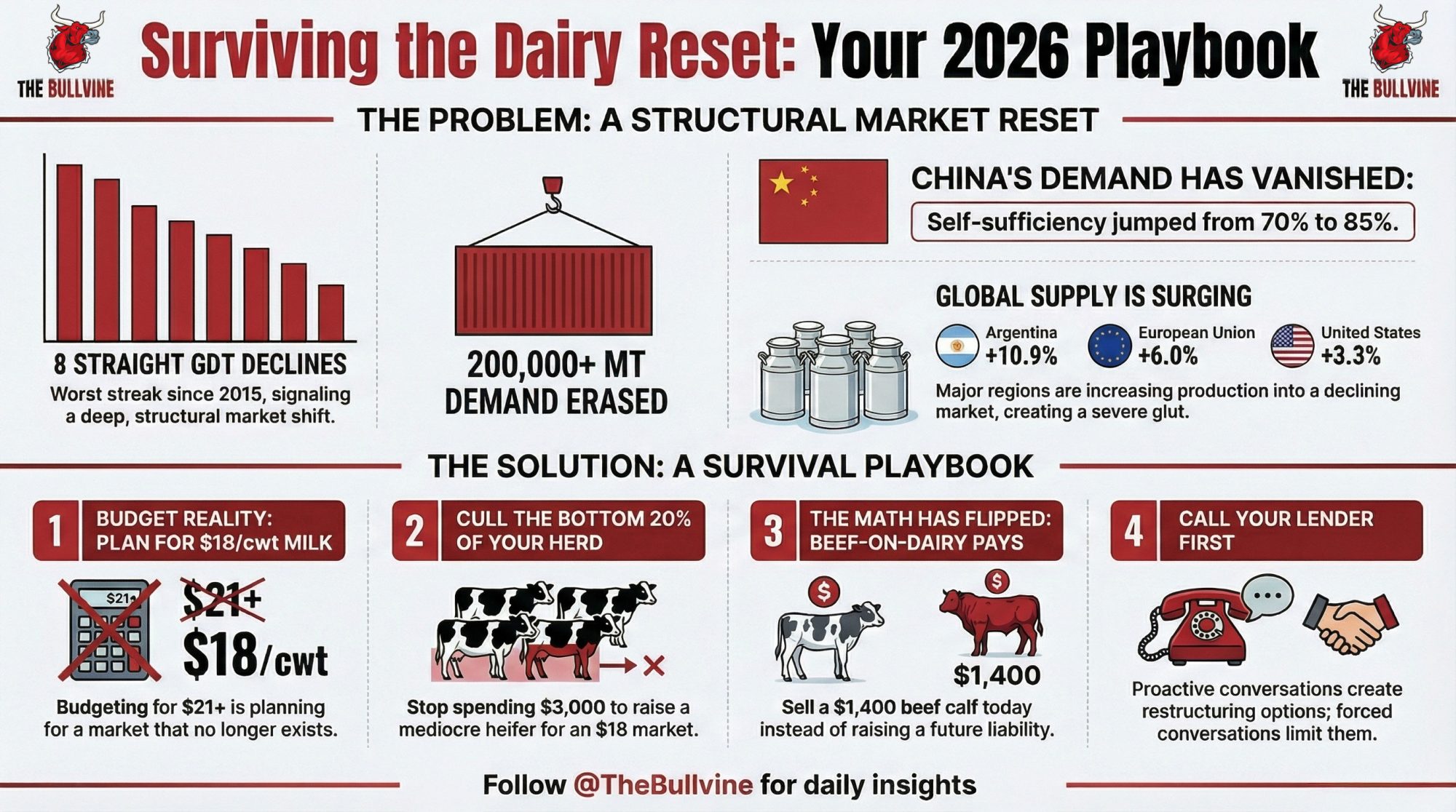
EXECUTIVE SUMMARY: Eight straight GDT declines—the worst streak since 2015—isn’t a cycle. It’s a structural reset. China’s self-sufficiency jumped from 70% to 85%, erasing 200,000+ metric tons of annual demand that isn’t returning. Production keeps accelerating everywhere: the US up 3.3%, the EU up 6%, Argentina up 10.9%. For operations still budgeting $21 milk, the math turns brutal fast—at $18/cwt, working capital burns in months, not years. The response demands ruthless clarity: cull the bottom 20% of your genetics, sell $1,000-1,400 beef-on-dairy calves instead of raising $3,000 replacement heifers, lock in price protection, and call your lender before covenants force the conversation. The dairies thriving in 2027 won’t be those that waited for recovery—they’ll be those that used 2026 to make the hard calls their competitors avoided.

Something shifted in global dairy markets this fall. Those of us watching the twice-monthly Global Dairy Trade auctions could sense it building, but the numbers from Event 393 on December 2nd brought it into sharp focus.

The damage in one auction:

  • GDT Price Index: Down 4.3%
  • Butter: Down 12.4% (the hardest hit)
  • Whole Milk Powder: Down 2.4%
  • Average price: US$3,507/MT (lowest in nearly two years)
  • Streak: Eight consecutive declines—worst since 2015
Butter prices collapsed 12.4% at Event 393. Anhydrous milk fat fell 9.8%. These aren’t modest corrections—they’re demand destruction in fat products. Meanwhile cheddar climbed 7.2% and lactose 4.2%. Message: high-fat commodity products are vulnerable in this market. Component strategy must shift toward cheese and protein, away from butter margin dependency.

For producers mapping out Q1 and Q2 of 2026—whether you’re managing a 200-cow operation in Vermont, running 3,000 head in the Central Valley, or navigating the unique economics of Southeast pasture-based systems—these results raise questions that deserve careful thought.

Is this a cyclical correction that resolves in a few months? Or does it reflect something more structural?

Here’s my read: eight consecutive declines with this breadth across product categories suggests supply-demand fundamentals that may take longer to rebalance than we’d like. That’s not cause for panic, but it is a reason for strategic action. The operations that navigate the next 12-18 months successfully will be those that understand what’s driving this weakness—and position accordingly.

The Supply Picture: Everyone’s Running Hot

The basic dynamic is pretty clear once you lay it out. Global milk production across major exporting regions is growing faster than demand can absorb. USDA Foreign Agricultural Service data and Rabobank’s quarterly analysis both point to this imbalance persisting through at least mid-2026.

Everyone’s running hot. Argentina’s milk production surged 10.9% in Q1 2025. The EU is up 6%. The US 3.3%. The problem? Demand isn’t returning. When all suppliers produce simultaneously into shrinking demand, there’s only one outcome: prices collapse.

What makes this period particularly concerning is the breadth. It’s not one region running hot while others moderate. Everyone’s pushing milk at the same time:

RegionGrowth RateSource
New ZealandSeason-to-date up 3.0%Fonterra November Update
United StatesAugust production up 3.3% (24 major states)USDA Milk Production Report
European UnionSeptember deliveries up 6.0%AHDB Market Analysis
ArgentinaQ1 2025 up 10.9%USDA Attaché Reports

Fonterra has already raised their collection forecast from 1,525 million kgMS to 1,545 million kgMS. The US herd continues expanding even as futures soften. You know how it goes—once you’ve invested in facilities, genetics, and labor, the economic pull favors keeping stalls occupied.

“This cycle, we’re seeing production accelerate into declining prices. That pattern—when it persists—typically indicates a longer adjustment period ahead.”

The China Shift: This Isn’t Cyclical

No factor shapes the global dairy trade outlook quite like China’s changing import patterns. For nearly a decade, China served as the primary growth engine for dairy exports worldwide. What’s shifted there helps explain everything we’re seeing at GDT.

China’s government-backed self-sufficiency push worked. From 70% to 85% domestic production in five years. Translation: 200,000+ metric tons of annual demand that exported countries will never see again. This isn’t a market cycle. It’s geopolitics as food security policy.

The key numbers:

  • Self-sufficiency: Climbed from ~70% (2020-2021) to ~85% (2025) per USDA and Rabobank estimates
  • WMP imports: Dropped from 845,000 MT at peak to ~430,000 MT by 2023
  • Missing demand: 200,000-240,000 MT annually that isn’t coming back soon

Rabobank’s Mary Ledman, its global dairy strategist, framed it clearly: China moved from about 70% self-sufficiency to roughly 85%, and that shift cascades through global trade flows. When China’s import demand contracts, it affects pricing for exporters worldwide.

What this means: Business planning built around a rapid return to peak Chinese imports probably warrants reconsideration. Beijing invested heavily in domestic processing capacity as a food security priority. Some analysts believe import demand could stabilize if domestic production growth slows—but for planning purposes, assuming reduced Chinese appetite persists seems prudent.

Where’s the Milk Going?

With China absorbing less, displaced volume is finding alternative homes—but at a cost:

Secondary markets are absorbing volume. The Middle East, Southeast Asia, and parts of Latin America have increased purchases at competitive pricing. But these markets are smaller and more price-sensitive. They take the milk—just at prices that drag everything down.

Product mix is shifting. EU processors are directing more milk toward cheese and whey rather than powder. This doesn’t eliminate surplus; it redistributes pressure across product streams.

Inventories are building. US nonfat dry milk stocks have grown through 2025, according to USDA Dairy Products data. The milk is moving, but it’s backing up. That overhang suppresses spot prices until stocks normalize.

Farm-Level Math: Where It Gets Real

For individual operations—particularly those carrying debt from recent expansions—extended margin compression creates genuine planning challenges.

Fonterra’s adjustment illustrates how GDT weakness hits farmgate: They narrowed their 2025/26 price range from NZ$9.00–$11.00/kgMS to NZ$9.00–$10.00/kgMS. For a farmer supplying 200,000 kgMS, that 50-cent midpoint reduction means roughly NZ$100,000 less this season.

US operations face a similar arithmetic:

  • 500-cow dairy producing 25,000 lbs/cow annually
  • Each $1/cwt change = approximately $125,000 in gross revenue impact

I recently spoke with a producer running about 450 cows in east-central Wisconsin—debt-to-asset ratio around 47%, which isn’t unusual for operations that expanded during 2021-2022. At $22/cwt, modest positive cash flow. At $18-19/cwt, he’s projecting monthly shortfalls of $35,000-45,000. Working capital covers roughly three months at that burn rate.

His approach? Running all projections at $18 now, not $21.

“I’d rather be surprised by better prices than caught short by worse ones.”

The timeline pressure: Working capital reserves on many operations cover 2-4 months of shortfalls. When those deplete, operating lines of credit come at higher rates—what was 6-7% might now cost 10-11%, further pressuring cash flow.

Practical Responses That Are Working

Across regions, proactive producers are responding with concrete adjustments. The specifics vary—feed costs differ between California and Wisconsin, Southeast operations face different heat-stress economics, and Northeast producers navigate distinct cooperative structures—but certain approaches work broadly.

Get Brutally Honest on Cash Flow

Run projections at $18.00/cwt, not $21-22. Answer these questions candidly:

  • What’s the monthly cash flow at current prices through Q2 2026?
  • How many months can you sustain negative cash flow before exhausting working capital?
  • At what price does the operation return to breakeven?

Operations projecting shortfalls above $30,000-50,000/month should initiate lender conversations now—before covenant pressures force them.

Lock In Some Protection

Forward contracting and hedging deserve fresh attention:

  • Forward contract 30-50% of near-term production through co-ops or direct processor contracts
  • Put options on Class III or Class IV milk for downside floors with upside participation
  • Dairy Margin Coverage enrollment at coverage levels matching your debt structure

Options protection typically costs $0.20-0.40/cwt. That’s insurance math—worth evaluating against your exposure.

Strategic Cost Management

Ration optimization remains the biggest lever. Maximize the number of components per pound of dry matter intake. With butterfat and protein premiums available through many marketing arrangements, component-focused feeding can partially offset lower base prices. Transition cow nutrition and fresh cow management remain areas where investment pays returns—you probably know this, but it bears repeating during tight margins.

Forward purchase feed ingredients at current favorable levels for 6-12 months.

Capital discipline—defer projects that don’t show clear payback within 12 months at $18/cwt.

Ruthless Heifer Inventory Calibration

This is where genetics strategy meets financial survival.

Stop raising the bottom 20% of your genetics. Move from 110% of replacement needs to strictly 100%. Use beef-on-dairy crosses on everything that isn’t top-tier. In a market like this, raising a mediocre heifer is a luxury you cannot afford.

Downturns are the time to concentrate genetic investment. Focus sexed semen only on your elite animals. Let beef sires cover the rest. The operations that emerge strongest from price cycles are typically those that used the pressure to accelerate genetic progress—not those that kept feeding average genetics because “we’ve always raised our own replacements.”

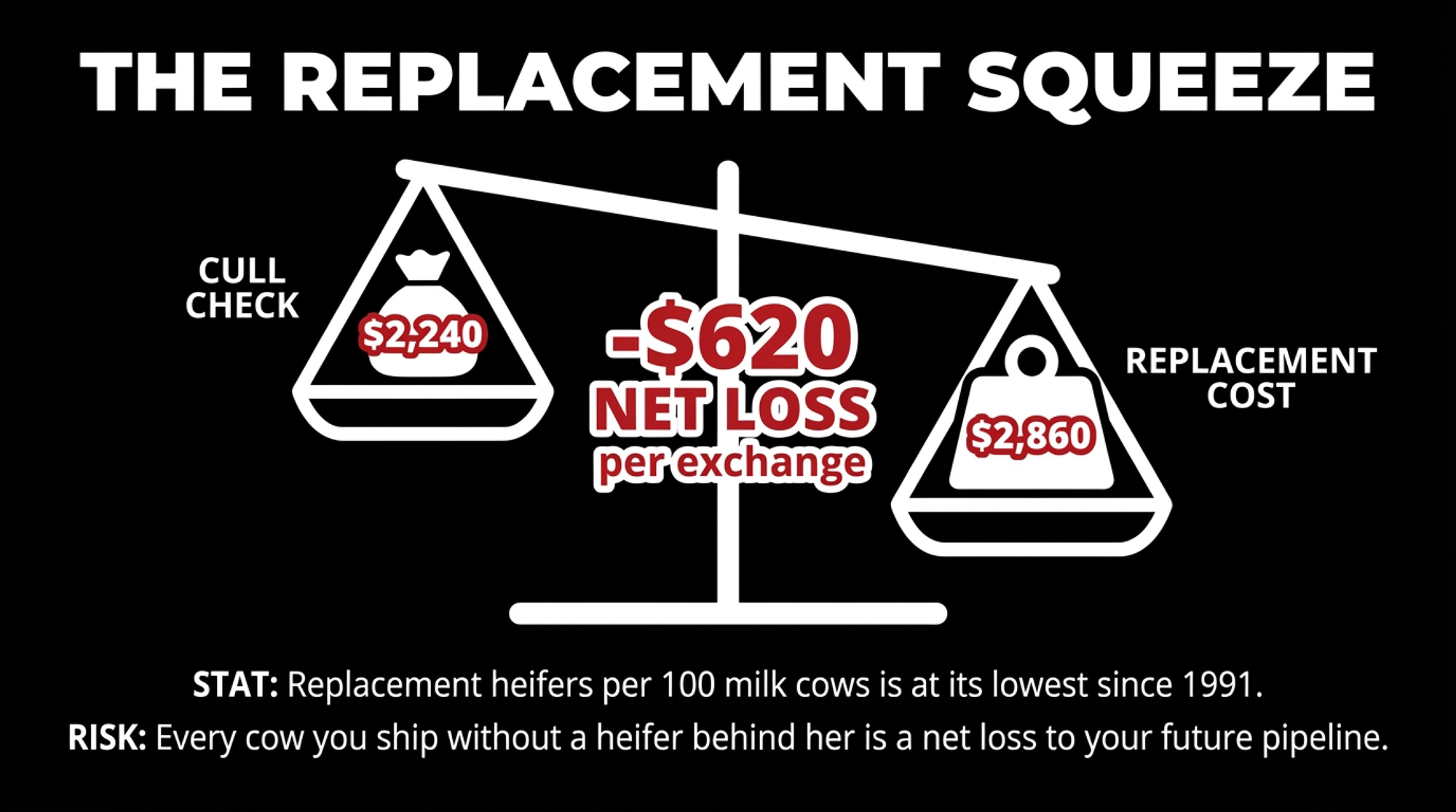
Here’s what’s interesting about the economics right now. Dairy beef has become a meaningful revenue stream—according to Hoard’s Dairyman, dairy-beef crosses now represent 15-20% of national beef production. That $1,000-1,400 dairy-beef calf you’re selling at a few days old is worth far more than a replacement heifer you’ll spend $2,500-3,000 raising only to freshen into an $18 milk market. The math has completely flipped from where it was just a few years ago, when those calves were bringing $350-400.

Early Lender Engagement

For operations where projections suggest restructuring may be needed, earlier conversations produce better outcomes. Options farmers are exploring:

  • Extending term debt amortization (10 → 15 years) to reduce annual payments
  • Converting operating lines to term debt for covenant breathing room
  • Adjusting payment timing to align with milk check cycles
  • Providing additional collateral for better terms

Lenders prefer restructuring to foreclosure. But that preference is strongest when borrowers approach proactively—not when they’re already in technical default.

The Coordination Reality

Could coordinated production cuts accelerate rebalancing? Probably not.

US antitrust law restricts coordination on production or pricing. Cooperative structures require accepting all member milk. And even if one region cut output, others would expand to capture the opportunity—Argentina’s 10.9% Q1 surgeshows how fast capacity elsewhere fills gaps.

Historical precedent: During 2014-2016, US milk production actually grew despite severely compressed margins. Recovery came when demand improved—not from coordinated supply reduction. The survivors managed through individually: maintaining reserves, restructuring early, achieving efficiencies their neighbors didn’t.

Market rebalancing will occur through aggregated individual responses to economic pressure. That places the burden on each operation to assess its own position and act accordingly.

How the Next 18 Months Might Unfold

Here’s one informed perspective—not prediction:

Through Q1 2026: Current dynamics persist. Production growth continues despite weak prices, China maintains a reduced import posture, and inventories stay elevated. GDT likely stays below $3,500/MT, potentially testing $3,200-3,300.

By mid-2026: Margin compression forces more decisive responses. Some operations exit through individual financial pressure. Others restructure and emerge leaner. Consolidation accelerates.

Late 2026 into 2027: If sufficient capacity adjusts, supply comes into better balance. Prices recover—though likely to equilibrium levels reflecting China’s structurally lower imports and more consolidated global production.

The operations positioned well for 2027 won’t necessarily be the largest. They’ll be those that assessed their situations honestly now, made difficult decisions while options remained, and configured for a market that differs from 2021-2022.

The Bottom Line

This market weakness is structural, not cyclical. Eight consecutive GDT declines, plus China’s sustained import reduction, create headwinds that won’t resolve quickly.

Run your numbers at $18/cwt. Operations showing significant monthly negative cash flow face decisions within 6-12 months.

Talk to lenders before you have to. Proactive conversations yield better outcomes than forced ones.

Concentrate your genetic investment. Stop subsidizing mediocre genetics with expensive heifer development. Use beef-on-dairy aggressively—at $1,000+ per calf, the economics have never been better.

Protect some downside. Evaluate forward contracting and options based on your specific debt exposure.

Early action preserves options. Delayed response narrows them.

These are genuine challenges—and ones the industry has navigated before. The operations thriving when conditions improve will be those making informed decisions now: understanding what market signals indicate, assessing their position realistically, and acting while choices remain.

Your local extension dairy specialists and farm business management educators can provide perspective tailored to your specific circumstances. Run your numbers, have the conversations, and position your operation for whatever comes next.

We’ll continue tracking these developments. In the meantime—sharpen your pencil, sharpen your genetics, and sharpen your strategy.

Key Takeaways 

  • Stop waiting for recovery. China’s at 85% self-sufficient. That 200,000+ MT of vanished demand isn’t returning. This is the market now.
  • Budget at $18. Today. At $21, you’re planning for a market that no longer exists. Run your numbers at $18 and see if your runway is months—or weeks.
  • Cull the bottom 20%. Ruthlessly. A $1,400 beef calf at 3 days old beats a $3,000 heifer raised to freshen into $18 milk. That math has permanently flipped.
  • Call your lender this week. Proactive conversations get restructuring options. Forced conversations get whatever terms are left.
  • The 2027 winners are being decided now. They won’t be the biggest operations—they’ll be the ones that culled harder, budgeted tighter, and moved while competitors waited.

Complete references and supporting documentation are available upon request by contacting the editorial team at editor@thebullvine.com.

Learn More:

Join the Revolution!

Join over 30,000 successful dairy professionals who rely on Bullvine Weekly for their competitive edge. Delivered directly to your inbox each week, our exclusive industry insights help you make smarter decisions while saving precious hours every week. Never miss critical updates on milk production trends, breakthrough technologies, and profit-boosting strategies that top producers are already implementing. Subscribe now to transform your dairy operation’s efficiency and profitability—your future success is just one click away.

NewsSubscribe
First
Last
Consent

No Milk Check for 17 Days: The $72,000 Firewall Every Dairy Needs Now

No milk check for 17 days cost 200+ farms their operations—here’s the $72K firewall that saved the rest

EXECUTIVE SUMMARY: What farmers are discovering through recent cooperative payment disruptions is that operational survival now depends on financial firewalls most never thought they’d need. The FBI’s Internet Crime Complaint Center documented a 38% increase in agricultural cyberattacks during 2024, with cooperatives controlling billions in milk payments becoming prime targets. When ransomware encrypts their financial servers, even processed milk can’t generate payments for weeks. Pennsylvania producers who maintained $72,000 in segregated reserves (roughly 30 days operating expenses for a 750-cow dairy) weathered 17-day payment delays while unprepared neighbors faced equipment loan defaults and, in some cases, foreclosure. Farm Credit advisors are now seeing a pattern where operations have just 72 hours before critical payment decisions cascade into long-term compromises. Yet, simple preparations—such as network segmentation costing $3,500, triple documentation systems taking three minutes per load, and establishing alternative buyer relationships over coffee—are proving the difference between disruption and disaster. Looking forward, with the top four cooperatives now controlling 41% of U.S. milk marketing according to GAO analysis, this concentration of risk isn’t reversing, making farm-level resilience strategies essential for any operation serious about surviving the next inevitable breach.

Cooperative payment disruptions are teaching dairy farmers valuable lessons about cash flow management and operational security. Here’s what producers across the country are discovering—and how they’re adapting to protect their operations.

I recently spoke with a Wisconsin producer who described a moment many of us can relate to—checking the cooperative’s member portal for the third straight day, still offline. Standing in her milking parlor, she was running numbers that just wouldn’t balance.

Picture this reality: Five hundred cows producing 45,000 pounds daily. Payroll is due Friday at $18,500. The feed delivery on Thursday requires $22,000. Bank note auto-debiting on Monday for $8,400. Cash on hand? Just $14,200.

“When payment certainty disappears, your entire operation shifts into a different gear,” she explained. And that’s exactly what we’re seeing across the industry right now.

The accounts shared throughout this discussion reflect genuine experiences from multiple operations nationwide. While we’ve protected individual privacy by adjusting names and specific details, the operational and financial realities remain accurate.

What’s particularly interesting is how recent cooperative security incidents have become catalysts for change. The FBI’s Internet Crime Complaint Center (IC3) 2024 Annual Report indicates that agricultural infrastructure attacks increased by 38% year-over-year, with cooperatives emerging as prime targets. When ransomware hits these systems, it can encrypt the cooperative’s financial servers and payment databases, making it impossible to access member account data or execute ACH transfers to farms. So even though your milk was picked up and processed, the cooperative literally can’t send your payment because their entire financial system is locked behind encrypted files. When a major cooperative processing a huge chunk of the national milk supply experiences this type of disruption, affected producers often find themselves with limited immediate alternatives.

How Dairy Cooperative Cybersecurity Changed the Game

You probably recall when regional cooperatives were a common sight. Smaller operations, sure—but if one had problems, you had options within reasonable hauling distance.

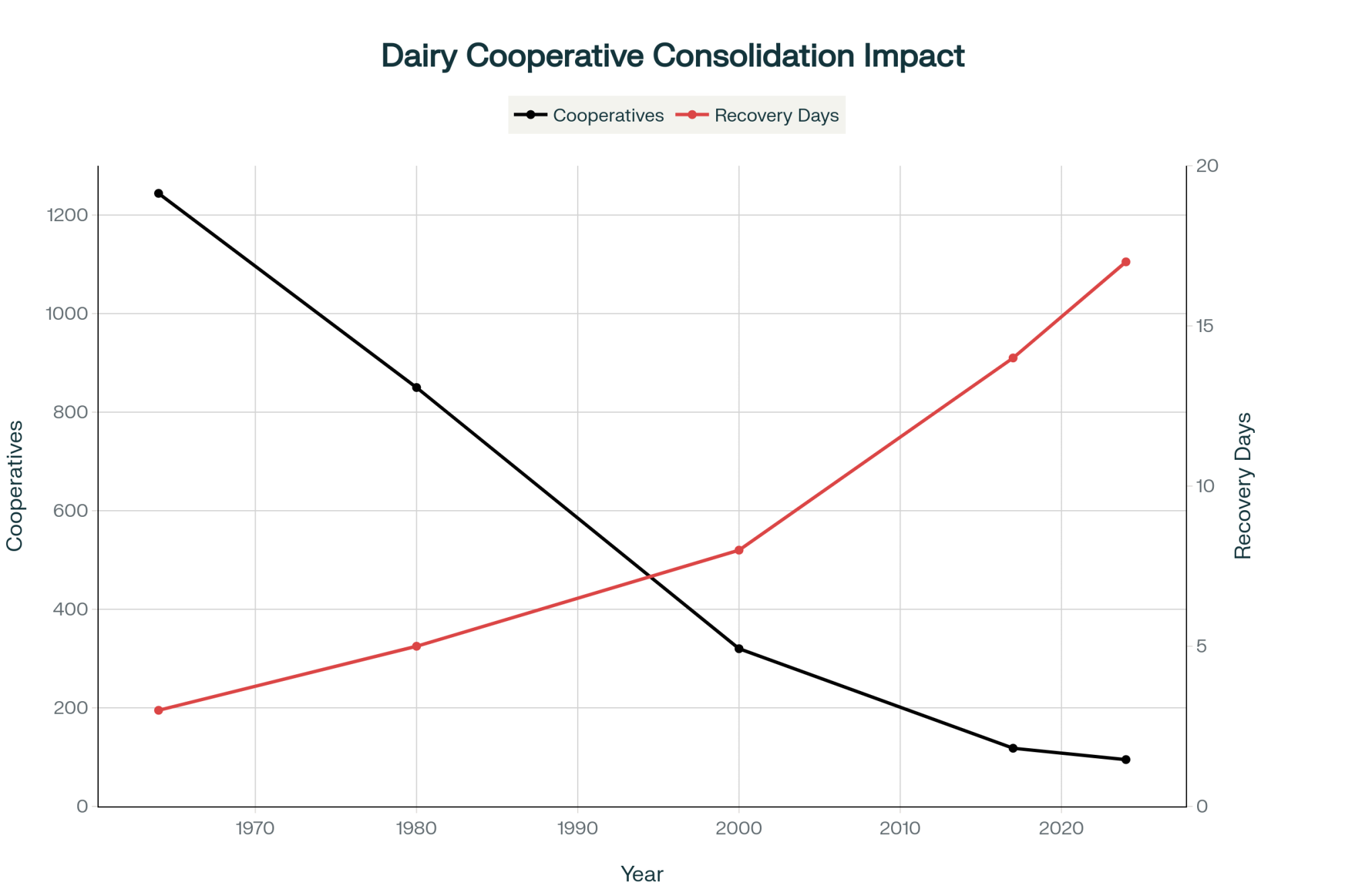
The transformation has been striking. According to USDA Rural Development’s 2024 Agricultural Cooperative Statistics report, the number of dairy cooperatives decreased from 1,244 in 1964 to 118 by 2017. However, what really matters is that the Government Accountability Office’s 2020 dairy cooperative analysis (GAO-20-366) found that the top four now manage 41% of U.S. milk marketing.

Each consolidation made solid business sense at the time. Enhanced bargaining power with retailers. Processing efficiencies through scale. Better positioning in global markets. On paper, it all looked great.

Economists at Cornell and other universities keep finding the same pattern, though. What do we called inefficiencies? They were redundancies. And redundancies provide resilience when things go sideways.

The math tells an interesting story. With 1,244 cooperatives, one organization’s challenges might affect less than 0.1% of the milk supply. Today? When a major cooperative experiences problems, thousands of farms feel the impact simultaneously.

Understanding the Critical 72-Hour Cash Flow Window

Farm Credit System advisors working with affected producers have identified what they call the “operational runway”—basically, how long you can continue to operate without incoming revenue.

“What surprises producers is how fast financial pressure compounds,” one advisor shared with me recently. “We’re typically looking at 72 hours before decisions become critical.”

Here’s the pattern I’ve seen repeatedly:

Day One: Checking systems, making calls, assuming things will normalize. Everyone stays relatively calm.

Day Two: Feed suppliers start asking about upcoming payments. Your banker expresses concern. Reality sets in.

72 Hours: You’re prioritizing payments. Which can wait? Which absolutely can’t? That’s when tough choices start.

Beyond That: Credit lines approach limits. You’re making operational adjustments—maybe delaying maintenance, adjusting feed quality, and making compromises that affect long-term productivity.

The USDA Economic Research Service’s 2025 Cost of Production data, combined with Farm Credit benchmarks, indicate that a typical 500-cow operation requires $14,000 to $18,000 per week for essentials. With most operations operating on 30- to 45-day payment cycles, even brief interruptions create significant pressure.

Protecting Your Own Farm’s Digital Infrastructure

Here’s something we need to talk about more—your farm’s own cybersecurity. While cooperative vulnerabilities grab headlines, many dairy operations are running sophisticated digital systems that also require protection.

A Vermont producer running 400 cows with robotic milkers learned this the hard way. “We had our parlor management system, feed monitoring software, and office computers all on the same network,” he explained. “When malware hit our office computer through a phishing email, it spread to everything.”

The fix wasn’t complicated, but it required planning. Working with their local IT consultant and following CISA’s agricultural cybersecurity guidelines, they:

Segmented their networks: The milking parlor runs on its own network, completely separate from the office systems. Feed monitoring has its own isolated connection. This way, if one system gets compromised, the others keep running.

Implemented Multi-Factor Authentication (MFA): Every system that touches financial data—from online banking to cooperative portals—now requires both a password and a code from their phone. According to Microsoft’s security research, MFA blocks 99.9% of automated attacks.

Created offline backups: Their herd management data gets backed up daily to an external drive that’s physically disconnected after each backup. Can’t encrypt what’s not connected.

Trained everyone: The biggest vulnerability? People. They now run quarterly training sessions—even for part-time milkers—on recognizing phishing attempts. One click on the wrong email attachment can compromise everything.

The total cost? About $3,500 for network segmentation hardware and initial setup, plus $150 monthly for managed firewall services. Compare that to losing access to your robotic milking data for even 48 hours.

International Perspectives: Learning from Canada

Here’s something encouraging. Lactanet in Canada faced a similar security challenge last year with markedly different outcomes. Most producers never knew because member services continued uninterrupted.

Their approach, documented in official incident reports filed with the Office of the Privacy Commissioner of Canada (PIPEDA filing 2024-05-15), involves investing over $150,000 annually in cybersecurity. Some board members initially questioned the expense until modeling showed potential downtime costs.

Their defense includes continuous monitoring, regular employee training (including simulated phishing attempts that redirect to educational content), and—crucially—triple-redundant backups with offline storage immune to remote encryption.

When unauthorized access occurred, their security team monitored the situation for three hours, gathering intelligence before terminating the access. Result? Two servers needed restoration. Member impact? None.

The lesson seems straightforward: prevention investment consistently costs less than incident recovery.

Navigating the Dairy Cooperative Insurance Coverage Gap

Agricultural insurance professionals from major carriers are observing something important that many producers don’t discover until they need it.

“There’s this assumption that business interruption insurance covers cooperative payment delays,” specialists explain. “Standard policies typically cover interruptions to YOUR operation, not your buyer’s systems.”

This distinction matters. If your farm’s systems get hit, coverage likely applies. When your cooperative’s payment infrastructure fails? Standard policies often provide no protection.

New products are filling this gap, though. Hartford Steam Boiler’s AgriRisk program includes coverage for supply chain disruptions. Based on 2025 agricultural insurance rate surveys from the American Farm Bureau Federation, premiums run $3,000 to $8,000 annually for meaningful protection on a 500-cow operation. Cowbell Cyber offers specialized agricultural policies; however, qualifying requires implementing security measures such as multi-factor authentication.

The products exist, but their cost leads many to accept the risk rather than pay premiums.

Regional Approaches to Building Milk Payment Security

What’s fascinating is seeing how different regions develop distinct strategies based on local conditions. And here’s something worth noting—robotic milking operations often have slightly different vulnerabilities, as their systems are already digitally integrated, making documentation easier but also creating additional cyber exposure points that require protection through network segmentation.

A Pennsylvania producer managing 750 cows shared his approach after witnessing neighbors’ struggles. “We keep 30 days of operating capital—roughly $72,000—in a completely separate credit union account,” he explained. The key? It’s not where his operating loans are held. He learned that from a neighbor whose bank exercised offset rights during payment delays.

His reserve-building strategy involves systematic culling. Those bottom-tier producers consuming 120 pounds of TMR daily while barely covering feed costs? “Converting them to cash reserves makes more sense than maintaining marginal production.”

Texas operations face different circumstances—drought pressures, longer hauls, and different processor options. Producers there often maintain multiple processor relationships as contingencies. Emergency pricing might drop to $14 per hundredweight, compared to the normal $19 blend prices, but that still beats disposal costs.

Florida’s specialty markets create unique opportunities. One producer converted 30% of their milk to A2A2 milk through direct specialty processor contracts in Miami. Managing dual production streams adds complexity but provides valuable optionality.

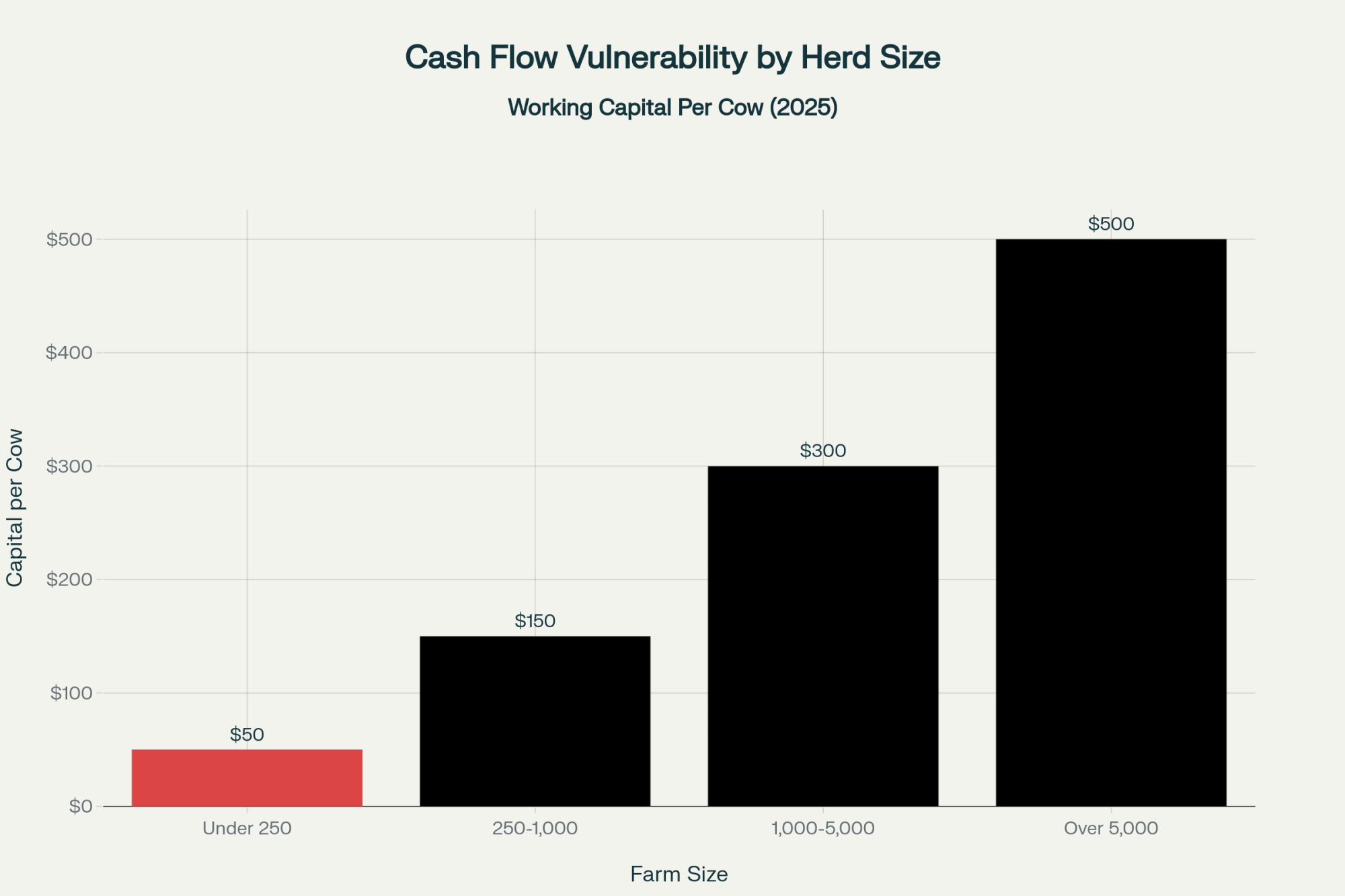
In my conversations with smaller operations—those milking under 200 cows—the challenges are even more acute. They often lack the volume to attract alternative buyers and the cash flow to support significant reserves. Several have formed informal cooperatives within the cooperatives, agreeing to provide short-term loans to one another during disruptions.

And here’s what’s interesting for organic producers: they often have slightly better backup options because organic processors actively seek suppliers, though the certification requirements mean you can’t just switch overnight.

Documentation: Building Your Defense Against Payment Disputes

A Central Valley producer shared an expensive lesson from several years back—losing $47,000 in arbitration over disputed deliveries.

“They claimed 15,000 pounds short over a month,” she recalled. “Their digital records versus my recollections didn’t end well.”

Her current system: triple documentation for every pickup. Digital entry with cloud backup. Duplicate paper logs, stored in a fireproof container. Smartphone photos of weight tickets to multiple cloud services.

Takes maybe three minutes per load. Since its implementation, it’s prevented two disputes from escalating.

“When databases face corruption or disputes arise, documentation becomes invaluable,” she notes. “Without proof of delivery, you’re negotiating from weakness.”

Market Structure: The Bigger Picture of Dairy Consolidation

Economists at Purdue and other universities have extensively studied the evolution of the dairy market, providing valuable context.

Their research, published in the Journal of Agricultural Economics and other peer-reviewed sources, consistently shows consolidation’s efficiency gains come with concentrated risk. We’ve optimized for normal operations—the 99% scenario—while potentially underestimating the need for preparation for disruptions.

Regional variations tell the story. Southeast operations, where smaller cooperatives like Maryland & Virginia (covering Virginia, Maryland, Delaware, and parts of Pennsylvania and North Carolina) maintain a presence, demonstrated greater flexibility during recent events. Alternative marketing options existed, albeit less favorable.

Contrast that with Upper Midwest dynamics, where mega-cooperative dominance leaves fewer alternatives when primary systems fail.

The vulnerability remains consistent whether you’re managing 100 cows or 10,000—dependence on payment systems beyond your control.

Global Lessons: Europe and New Zealand Cooperative Strategies

The 2017 NotPetya incident, which affected European food companies and resulted in confirmed global losses of $10 billion, according to White House economic assessments, prompted significant changes.

Industry reports and corporate disclosures suggest that companies like Arla Foods discovered that distributed processing creates resilience. They’ve structured operations so each country can function independently for up to two weeks if necessary.

New Zealand’s Fonterra adopted similar principles. Despite controlling most of the national milk supply, they’ve implemented regional segmentation, preventing localized issues from cascading nationally.

These examples offer valuable insights for considering our own system’s evolution.

Your Comprehensive Cybersecurity Action Plan

Farm SizeReserve/Cow ($)Total ReserveDays CoveredPriority
Under 250 cows$300$75k15High
250-1,000 cows$250$156k12High
1,000-5,000 cows$200$500k10Medium
Over 5,000 cows$150$1.12m8Low

Based on successful producer experiences navigating recent challenges, here’s what’s working:

This Week’s Priorities

Calculate your actual runway without incoming revenue. Not estimates—documented expenses. If coverage falls below 14 days, urgent action is needed.

Review your entire cooperative agreement, particularly force majeure provisions. Several producers discovered contract language permitting temporary marketing after specified non-performance periods. This knowledge proved invaluable. Generally, it takes about two weeks to establish alternative buyer agreements, so knowing your options matters.

For your farm’s cybersecurity: Check if your parlor management system and office computers are on the same network. If yes, that’s your first vulnerability to address.

This Month’s Improvements

Establish reserves at an institution separate from operating lenders. Credit unions often work well—they understand agriculture while avoiding potential conflicts of interest. Begin with any amount. Even modest reserves provide options.

Implement comprehensive documentation. Yes, it requires discipline. But consider potential savings in dispute resolution.

Strengthen your farm’s digital defenses: Enable multi-factor authentication on all financial accounts and cooperative portals. Back up critical data offline daily. If you’re running robotic milking or automated feeding systems, consider obtaining quotes for network segmentation, which typically ranges from $2,000 to $ 4,000 for proper setup.

Explore alternative buyer relationships—not to switch, but understanding emergency options. A Georgia producer discovered a craft processor nearby paying premiums for documented grass-fed production during emergencies. Such relationships, while hopefully never needed, provide contingency planning.

This Quarter’s Strategic Positioning

Obtain cyber insurance quotes from agricultural specialists. The American Farm Bureau Federation is collaborating with carriers on improved agricultural products. Annual premiums might reach $5,000 to $10,000 based on current rates. Compare that to weeks without milk revenue.

Invest in farm-level security training: The USDA and CISA offer free agricultural cybersecurity resources through their websites. Schedule quarterly 30-minute sessions with all employees to recognize phishing attempts and follow security protocols.

Consider establishing or joining producer communication networks. Wisconsin groups have created informal systems sharing payment updates and providing mutual assistance. Combined volume creates leverage that individual operations lack.

Looking Forward: The Farm and Food Cybersecurity Act

Congress reintroduced the Farm and Food Cybersecurity Act in 2025 (S. 774 in the Senate, H.R. 1573 in the House), potentially mandating security standards for operations controlling a significant market share. The bill is currently in the House Agriculture Committee’s Subcommittee on Livestock, Dairy, and Poultry, with hearings expected this fall. Until legislation advances, protection remains voluntary mainly.

USDA and FBI agricultural specialists indicate these challenges will likely intensify. Agricultural cooperatives present attractive targets—processing substantial volumes, often operating legacy systems, and unable to afford extended downtime.

“While we can’t reverse industry consolidation,” a Wisconsin producer observed thoughtfully, “operational security is ultimately on us—both at the cooperative level and on our own farms.”

Following recent events, she’s established 45-day cash reserves, maintains triple documentation, developed relationships with two alternative buyers, and invested $4,500 in segregating her farm’s networks. A neighboring operation without preparations? They faced foreclosure when equipment loans defaulted during payment delays.

“Is this the most efficient approach? Probably not. Does it require time and resources? Absolutely,” she reflected. “But efficiency becomes irrelevant if you can’t survive disruption.”

The key insight isn’t that cooperatives have failed or that technology creates problems; rather, it is that cooperatives have failed to address these issues effectively. It’s recognizing that concentration inherently creates vulnerabilities, and preparing for those vulnerabilities—both at the cooperative and farm level—becomes each operation’s responsibility.

After all, feed deliveries continue regardless of payment system status. Tuesday morning arrives, regardless of whether checks are being processed or not.

KEY TAKEAWAYS

  • Build your 30-day cash firewall now: Segregate $14,000-$18,000 per 100 cows in milk at a credit union separate from your operating lender—Pennsylvania producers who maintained these reserves continued operations through 17-day payment delays, while others defaulted on equipment loans
  • Protect your farm’s digital infrastructure for under $4,000: Network segmentation between parlor management and office systems (roughly $3,500 setup) plus multi-factor authentication on all financial accounts blocks 99.9% of automated attacks according to Microsoft security research—one Vermont robotic dairy learned this after malware spread from their office to milking systems
  • Document every load three ways starting tomorrow: Digital entry with cloud backup, duplicate paper logs (one fireproof), and smartphone photos of weight tickets—takes three minutes but saved a California producer $47,000 in disputed deliveries when cooperative databases corrupted
  • Establish alternative buyer relationships before you need them: Georgia producers with craft processor connections maintained $14/cwt emergency pricing versus dumping milk, while Texas operations leveraging multiple processor relationships avoided complete shutdowns despite longer haul distances
  • Know your cooperative contract’s force majeure provisions: Several Midwest producers discovered language permitting temporary marketing after 10-day non-performance periods, knowledge that proved invaluable when primary buyers couldn’t execute ACH transfers—generally takes two weeks to establish these agreements, so understanding your options now matters

This discussion draws on conversations with dairy producers nationwide and an analysis of agricultural cybersecurity developments, as documented by the FBI Internet Crime Complaint Center (IC3) reports and USDA sources. Producer experiences represent composite accounts from multiple operations, with identifying details modified to protect privacy while preserving operational accuracy. Financial benchmarks are derived from the USDA Economic Research Service’s 2025 data and Farm Credit System analysis. Insurance information reflects current carrier programs and American Farm Bureau Federation industry rate surveys as of October 2025. Cybersecurity recommendations align with the CISA’s guidance for the agricultural sector and Microsoft’s security research on the effectiveness of multi-factor authentication.

Complete references and supporting documentation are available upon request by contacting the editorial team at editor@thebullvine.com.

Learn More:

  • Strategies to Boost Cash Flow on Your Dairy Farm – This tactical guide reveals methods for optimizing production, managing feed costs, and diversifying revenue streams to proactively build the cash reserves discussed in the main article. Readers will gain actionable financial strategies to strengthen their operational runway before a crisis hits.
  • 2025 Dairy Market Reality Check: Why Everything You Think You Know About This Year’s Outlook is Wrong– This strategic analysis details policy volatility, component economics, and trade risks—the other external shocks that can compound cyber and payment disruptions. It provides a crucial, big-picture perspective on why multi-layered risk management is non-negotiable for modern dairy operations.
  • Is Your Herd Safe? Cybersecurity Essentials for Modern Dairy Farms – Expand your farm’s defense beyond financial firewalls with this technical deep-dive. It provides a practical checklist for securing robotic milkers and herd management software and explains the specific vulnerabilities of connected devices, including the need for multi-factor authentication and offline backups.

Join the Revolution!

Join over 30,000 successful dairy professionals who rely on Bullvine Weekly for their competitive edge. Delivered directly to your inbox each week, our exclusive industry insights help you make smarter decisions while saving precious hours every week. Never miss critical updates on milk production trends, breakthrough technologies, and profit-boosting strategies that top producers are already implementing. Subscribe now to transform your dairy operation’s efficiency and profitability—your future success is just one click away.

NewsSubscribe
First
Last
Consent

The Land Value Wake-Up Call Every Dairy Producer Needs to Hear

Everyone’s calling land values “stable” but your banker’s asking for more collateral. Something doesn’t add up.

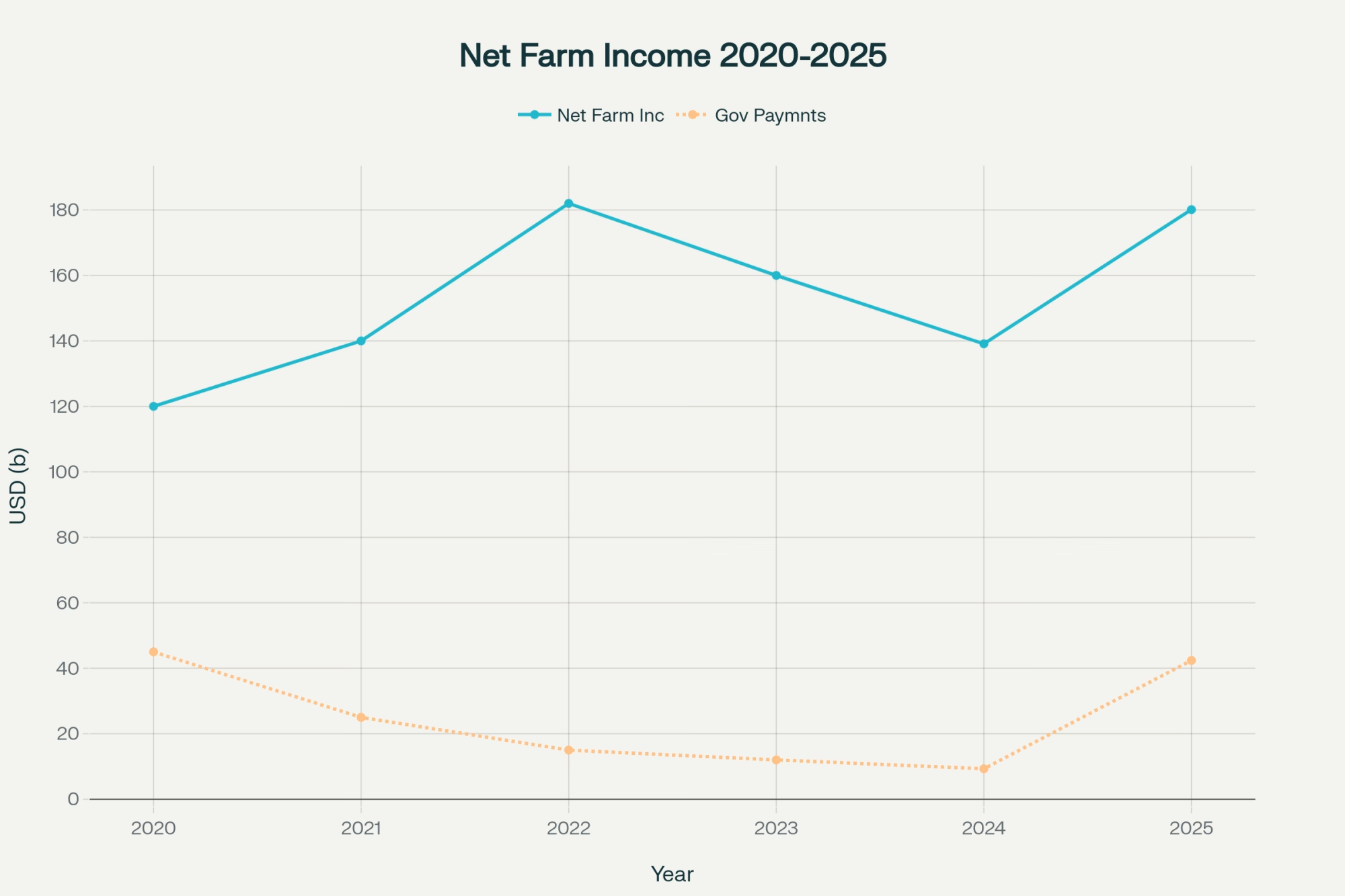
Executive Summary: Look, I’ve been watching this land market closely, and there’s a story here that affects every dairy operation in America. The “stable” farmland values everyone’s talking about are being propped up by one-time government disaster payments—not actual farm profitability. We’re talking about $33.1 billion in temporary support that won’t be there next year, while actual cash receipts from crops and livestock are dropping by $1.8 billion.Meanwhile, Federal Reserve surveys show loan repayment rates at their lowest since 2020, and bankers are demanding more collateral across all agricultural districts. For dairy producers, this means feed costs are climbing 5-7% while the land that grows your corn and hay is sitting on shaky financial ground. The smart money is already shifting—South Dakota’s up 11% while Iowa’s down 3% for the second straight year.Here’s what this means for your operation: now’s the time to shore up working capital and get real about your expansion plans before that 2026 “cliff effect” hits.

Key Takeaways

  • Credit’s Getting Tight—Act Now: Agricultural lenders are seeing their worst loan performance since 2020, with 60% reporting lower farm income than last year. Get ahead of this by having that honest conversation with your banker about your working capital without counting on government payments. Those who wait might find themselves scrambling for operating loans at higher rates.
  • Feed Cost Reality Check: With seed prices climbing 5-7% and fertilizer vulnerable to geopolitical shocks, your 2025 feed budget needs serious attention. Start locking in hay contracts now and consider diversifying your feed sourcing—operations in Wisconsin are seeing more stable costs than those in New York where alfalfa’s running $60-90 more per ton.
  • Regional Arbitrage Is Real: While Iowa corn ground drops 3%, livestock-heavy regions like South Dakota are up 11%. If you’re in a dairy-dense area, your land values might hold better than row-crop regions, but don’t count on it lasting. Use this window to refinance or consider strategic sales of non-core assets.
  • Technology Investment Window: With labor costs hitting $22/hour for milking and a 14% annual growth in robotic milking systems, now’s the time to evaluate automation. A $200,000 robot that eliminates 1.5 FTE positions pays for itself in 3.5 years—and that’s before you factor in the labor shortage getting worse.
  • The 2026 Cliff Effect: Those massive government payments propping up farm income disappear next year. Smart operators are using this temporary cash flow boost to pay down debt and build reserves, not fund expansion. Calculate your true cash flow without government support—that’s your real financial picture.

You know that feeling when you’re at a dairy conference and someone mentions land values, and suddenly everyone gets quiet? Well, I’ve been digging into what’s really happening with farmland prices, and… let’s just say the conversation we’re not having is the one we need to have.

Here’s the thing about farmland values right now—everyone keeps using that word “stable,” but when I look at the numbers, I’m seeing something that looks more like a house of cards than solid ground.

I was just talking to a producer from Iowa last week, and he mentioned something that really stuck with me. His neighbor’s land sold for about 15% less than what similar ground brought two years ago, yet the headlines still claim market stability. Made me wonder—what story are we actually telling ourselves about where this market is headed?

For us in the dairy business, this isn’t just another market story. It’s about understanding whether the ground under our feet—literally and figuratively—is as solid as everyone’s saying it is.

The Illusion of Stability

The thing about market stability is that it’s not always what it seems. When I began examining regional data, the picture became significantly more complex than the national averages suggest.

Take Iowa, for instance. This is supposed to be the bellwether for farmland values, right? According to Farm Credit Services of America’s latest benchmark data, Iowa land values have decreased by 3% year-over-year, marking the second consecutive year of declines. Meanwhile, if you’re up in South Dakota, you’re seeing a completely different story—values there are up over 11%, driven mostly by strong demand for pasture and ranch land.

What strikes me about this regional split is how much it mirrors what we’re seeing in the dairy industry itself. If you’re in a livestock-heavy area, you’re probably feeling pretty good about your position right now. Strong consumer demand for dairy products, combined with relatively tight supplies, is creating a financial cushion that crop-heavy regions simply don’t have.

But here’s where it gets interesting—and a little scary. The USDA’s Economic Research Service released its February 2025 farm income forecast, showing what appears to be good news on paper. However, when you break it down, it’s both fascinating and concerning.

Regional farmland value changes reveal stark differences across the Midwest and Plains states in 2025, with traditional corn belt states declining while livestock-focused regions surge ahead

Stronger farming operations aren’t driving the dramatic increase in projected farm income. According to the USDA data, actual market-based cash receipts from crops and livestock are expected to decline. The entire income boost stems from a massive surge in direct government payments—specifically, billions in ad hoc disaster assistance, primarily from the Emergency Relief Program (ERP), Supplemental Disaster Relief Program (SDRP), and other congressional disaster assistance programs covering prior-year losses.

Regional farmland value changes reveal stark differences across the Midwest and Plains states in 2025, with traditional corn belt states declining while livestock-focused regions surge ahead.

Now, I’m not saying these payments aren’t needed. Many producers have been severely impacted by weather and market conditions over the past couple of years. However, here’s what keeps me up at night thinking about it: these are one-time payments, not recurring income streams.

The Real-World Squeeze

Here’s what’s really squeezing today’s producers: a one-two punch that’s hitting operational cash flow from both sides.

First, let’s talk about input costs. Despite some easing from the record highs of 2022, we’re still dealing with elevated production expenses. Industry analysts are projecting that seed costs will continue their upward trend, with an expected increase of 5-7% in 2025. Fertilizer prices, while stabilized from their peak, remain vulnerable to geopolitical shocks. And natural gas prices—critical for nitrogen fertilizer production—are expected to see significant increases this year.

What’s interesting is how this plays out differently depending on where you’re farming. I recently spoke with a producer in Wisconsin, and he mentioned that their local feed costs have remained relatively competitive compared to other regions. But if you’re farming in upstate New York, you’re dealing with alfalfa costs that can run $60-90 per ton above Iowa levels, which really adds up when you’re feeding 1,500 head.

Then there’s the labor crisis. This isn’t just about finding seasonal help anymore—it’s become a structural problem. Industry surveys indicate that labor shortages are now impacting over 60% of large-scale agricultural producers. I was just at a farm in Pennsylvania where they’re paying $22 an hour for milking labor, when they can find it. That’s nearly double what they were paying five years ago.

The demographic trends driving this are unlikely to reverse anytime soon, either. Rural populations are declining, birth rates are lower, and we’re dealing with a more restrictive immigration policy environment that limits the flow of workers who have historically been essential to the agricultural workforce.

A producer I know in Nebraska put it this way: “When you can’t find help and feed costs keep climbing, something’s got to give. And usually, it’s your margins.”

The Financial Consequences

While land values are hanging in there—at least on paper—the credit markets are telling a completely different story. And this is where the rubber meets the road for dairy operations.

Federal Reserve agricultural credit surveys from multiple districts are reporting a consistent pattern: falling loan repayment rates, increasing loan renewals and extensions, and growing demand for operating loans at the highest levels since 2016.

The Chicago Fed’s latest AgLetter survey indicates that the index measuring loan repayment rates has fallen to its lowest level since the first quarter of 2020. The Kansas City Fed reported that 60% of lenders in their district observed lower farm income than a year prior, and the share of lenders requiring increased collateral has doubled.

What’s particularly troubling is what’s happening with working capital. In the Minneapolis Fed’s recent survey, one Wisconsin banker summed it up: “Working capital is stretched thin across the board. Many producers are carrying over debt they can’t comfortably service with current operational cash flow.”

For dairy operations specifically, this credit tightening is hitting at a time when we’re already dealing with elevated feed costs and labor shortages. When your banker starts asking for more collateral, that’s not a good sign for the underlying health of your operation.

I’ve been discussing this with lenders, and they’re noticing something interesting. The producer looks at their 2025 statements, sees those big government checks, and feels financially secure. But the banker? They’re examining the underlying operational cash flow, and they’re becoming nervous.

This creates a dangerous dynamic where farmers might feel optimistic about expanding or refinancing based on their temporarily improved balance sheets, but lenders are unwilling to underwrite loans based on non-recurring income. That’s a recipe for a credit crunch.

The Great Divide

As if the economic pressures weren’t enough, the adoption of technology is creating a growing gap in the dairy industry—and it’s accelerating due to the factors we’ve just discussed.

The global milking robot market is experiencing rapid growth, with a compound annual growth rate of approximately 14%. What’s driving this isn’t just convenience—it’s necessity. Research from dairy automation studies suggests that these robotic systems can reduce labor costs by 15-25% while enhancing milk quality and improving cow comfort.

I visited a farm in Wisconsin last month where they installed their third robot system. The owner told me something that really stuck: “It’s not about the technology being fancy—it’s about being able to maintain consistent milking schedules when good help is impossible to find.”

The economics are compelling. A modern robotic milking system, which costs $200,000 and eliminates 1.5 full-time positions paying $40,000 annually, breaks even in approximately 3.5 years, excluding the value of improved milk quality, reduced labor management stress, and operational flexibility.

However, what concerns me is that this technological shift is fundamentally altering farm balance sheets and increasing demand for specialized financing. The operations that can afford these investments are gaining competitive advantages that compound over time.

It’s not just about milking robots either. Automated feeding systems, environmental monitoring, and precision agriculture technologies—these are all becoming essential tools for competitive operations. The farms that can make these investments are pulling away from those that can’t.

Due to the financial pressure we discussed earlier, a clear divide is emerging between operations that have the capital to invest in labor-saving technology and those that’re struggling to maintain basic operations amid rising costs. This becomes a forward-looking analysis of who will win in the future.

Actionable Advice

So, where does this leave us? If you’re running a dairy operation, you’re probably wondering how to navigate all this uncertainty. Here’s what I think you need to do:

Immediate Actions (Next 90 Days):

  • Treat any recent government payments as windfalls, not recurring income
  • Calculate your working capital position without those government payments to see your true operational health
  • Have frank conversations with your banker about their outlook and requirements
  • Focus relentlessly on operational efficiency—optimize input usage, negotiate feed costs, maximize production per cow

Strategic Moves (Next 6-18 Months):

  • Evaluate automation investments seriously, especially if you’re well-capitalized
  • Consider strategic asset sales if you’re nearing retirement or own non-core assets
  • Build cash reserves and strengthen your balance sheet while the “stable” market window exists
  • Pay down high-interest debt using any available capital

Why This Urgency Matters—The 2026 Cliff Effect:

Here’s what really concerns me about the next 18 months: the “2026 cliff effect.” Those massive disaster payments propping up farm income in 2025 aren’t recurring. When that liquidity gets withdrawn from the system, the market will be forced to stand on the weakened foundation of its operational cash flows.

If there isn’t a significant improvement in commodity prices or a reduction in input costs, we could see a severe test of financial resilience that triggers a correction in land values. The trend of regional divergence is expected to continue and likely intensify.

The Bottom Line:

The dairy industry is at an inflection point, and the decisions we make in the next 18 months will determine who’s still farming in 2030.

Government payments and constrained supply prop up the “stable” land values we’re seeing. The underlying operational fundamentals—the ability to generate consistent cash flow from farming operations—are under pressure.

For dairy producers, this creates both risk and opportunity. Well-positioned operations will be able to expand through acquisition as less-efficient operations exit the industry.

I’ve seen too many sharp dairy producers caught off guard by transitions like this. The warning signs are there for those willing to look. The producers who thrive in the next five years won’t be the ones who got lucky—they’ll be the ones who saw the writing on the wall and acted with discipline.

What’s your plan when the government payments stop coming? How’s your working capital looking without those one-time checks? Can your operation generate positive cash flow based purely on milk sales?

These aren’t comfortable questions, but they’re the ones we need to be asking. The market is changing under our feet, and your readiness to adapt will determine whether you’re positioned for the opportunities ahead or caught off guard by the challenges.

Because when the dust settles—and it will—the operations that are prepared will be the ones that come out stronger. The question is: are you one of them?

Complete references and supporting documentation are available upon request by contacting the editorial team at editor@thebullvine.com.

Learn More:

  • Strategies to Boost Cash Flow on Your Dairy Farm – Reveals practical methods for optimizing feed management, maximizing milk production, and diversifying revenue streams to immediately strengthen your operation’s financial position before the 2026 cliff effect hits.
  • US Dairy Market in 2025: Butterfat Boom & Price Volatility – Demonstrates how to capitalize on record-high butterfat levels while protecting profits through strategic risk management tools, offering critical market insights that complement land value considerations for expansion decisions.
  • Embracing Technology to Save the Family Dairy Farm – Provides comprehensive analysis of robotic milking systems’ ROI potential and implementation strategies, showing how automation investments can deliver the 15-25% labor cost reductions discussed in the land value analysis.

Join the Revolution!

Join over 30,000 successful dairy professionals who rely on Bullvine Weekly for their competitive edge. Delivered directly to your inbox each week, our exclusive industry insights help you make smarter decisions while saving precious hours every week. Never miss critical updates on milk production trends, breakthrough technologies, and profit-boosting strategies that top producers are already implementing. Subscribe now to transform your dairy operation’s efficiency and profitability—your future success is just one click away.

NewsSubscribe
First
Last
Consent
Send this to a friend