Archive for dairy consolidation strategy

The $11 Billion Betrayal: Your Processor Is Building Your Replacement Right Now

If you can’t write a $3M check tomorrow, you’re already extinct. The industry just hasn’t told you yet.

Okay, so I’m at World Dairy Expo last week—you know, wandering around trying to avoid the robot salesmen—and I run into this producer from Iowa. Guy’s been milking for thirty years; it’s a good operation, with about 300 head. And he tells me something that just… it stopped me cold.

He says, “I just spent $650,000 on robots, and I think I just financed my own funeral.”

Look, we need to discuss what’s really going on here. Because while you’re trying to figure out how to make your milk check cover feed bills—corn’s what, $4.50 now if you can find a decent load?—the processors are playing a completely different game. The International Dairy Foods Association is tracking over $11 billion in new processing capacity through 2028. Eleven billion. Meanwhile, they’re quietly partnering with these lab-grown protein companies that want to make you obsolete.

But here’s what makes me want to throw my coffee mug at the wall… North Dakota had 1,810 dairy farms when I started covering this industry back in 1987. The Census just came out—they’ve got twenty-four left. Twenty-four! I knew some of those guys who quit. Good farmers, smart operators. Didn’t matter.

(Read more “1,810 Dairy Farms to 24: Inside North Dakota’s Collapse,” this isn’t just a regional problem—it’s coming for everyone.)

And you know what? Your banker made money on every one of those exits. So did your co-op. Your processor? They just consolidated their routes and kept rolling.

So About All These New Plants Going Up…

So I’ve been following the Fairlife Webster, New York project—the one Governor Hochul showed up for at the groundbreaking back in April. They’re spending $650 million on this thing. When you read the press releases, Coca-Cola executives are talking about innovation and efficiency, and… honestly, reading between the lines, it sounds like a funeral for small dairy.

Here’s the deal—and Multiple sources familiar with the project tell me, but he doesn’t want his name associated with it—these plants are designed for one thing: mega-dairies that can deliver tank after tank of identical milk. Same butterfat, same protein, day after day. Less than 2% variation, he said.

You running 300 cows like my Iowa friend? Maybe you’re testing components once a month if you’re lucky? Brother, you’re not even on their radar.

The math is what bothers me… (hold on, let me find my notes from that Wisconsin conference)… Okay, so these plants need to run at basically full capacity to make a profit. Below 75% utilization, and they’re hemorrhaging cash. But—and here’s the kicker—milk production is actually going DOWN. The USDA says we’re off by about a quarter of a percent this year.

So what happens when you build all this capacity but there’s no milk to fill it?

Actually, I know what happens. I was talking to Mike Guenther—dairy farmer up in Nebraska, good guy, been through hell with his processor—and he told me flat out: “My infrastructure would be worth almost nothing if I tried to sell.” That’s because when there’s only one buyer in your region… well, you do the math.

The Robot Scam (And Why My Neighbor’s Wife Won’t Talk to Me Anymore)

Alright, so… robots. God, where do I even start?

My neighbor just put in a Lely system. Beautiful thing, all bells and whistles. His wife won’t talk to me anymore because I asked him—at his open house, with the Lely rep standing right there—”So what’s your exit strategy when this thing doesn’t pencil out?”

Look, I’ve seen the actual numbers from Wisconsin’s dairy center. Best case—and I mean absolute fairy-tale best case—you might save $38,000 a year on labor. Might. That’s if nothing breaks, which… have you seen the maintenance bills on these things? My cousin in Minnesota; his robot has been down three times since August. Three times!
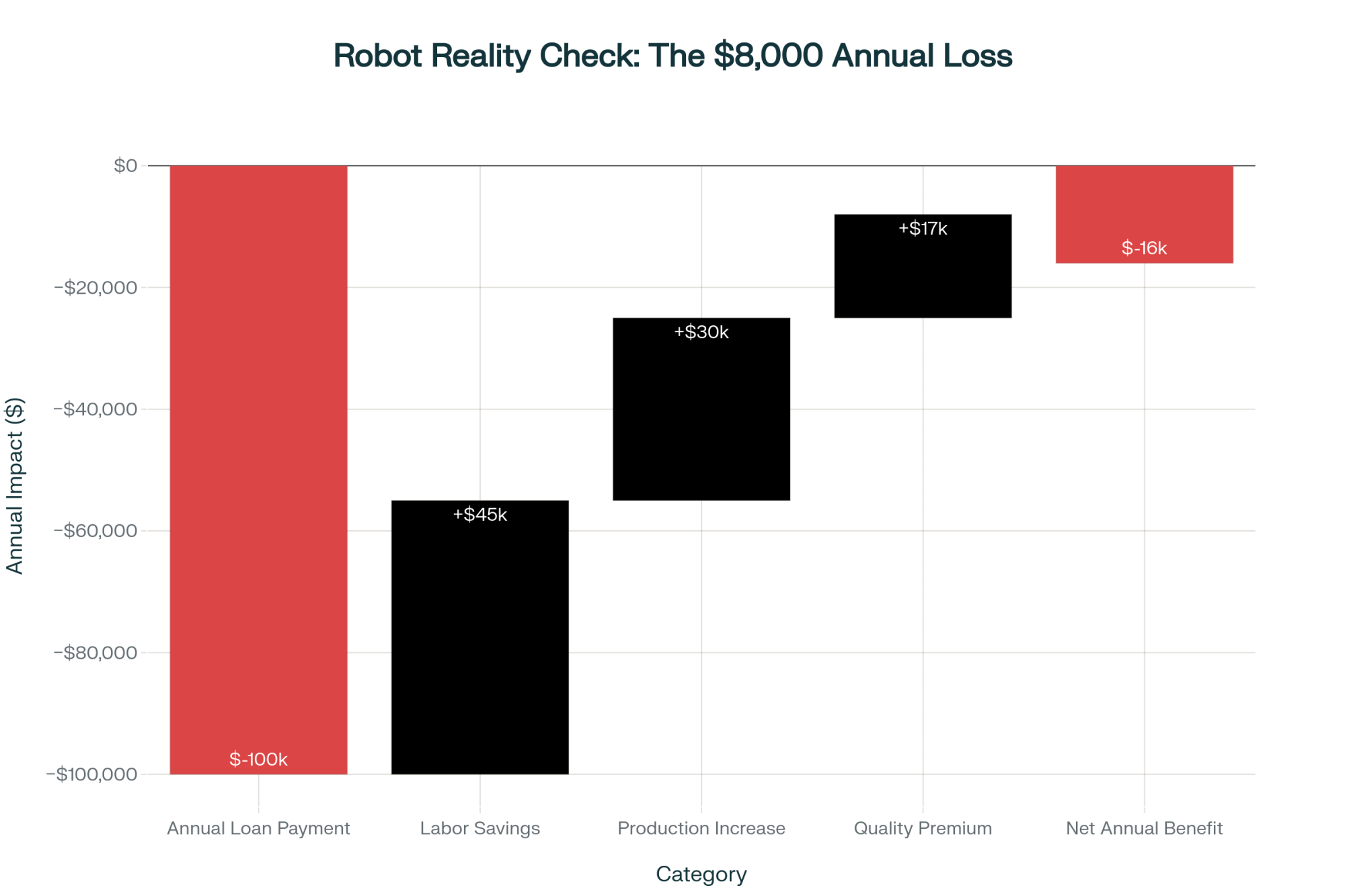
Your components might improve—the sales team loves to talk about this—maybe even get you another twenty thousand if you’re shipping to someone who actually pays quality premiums. (Good luck finding that unicorn this time of year.) Production bump? Sure, maybe 8%, call it fifty thousand in a good year.

But that loan payment? You’re looking at damn near a hundred grand annually on $650,000. And that’s if you got decent terms, which… with milk prices where they are?

The thing that really gets me—and I was just discussing this with some folks at Penn State—is that the 2,000-cow operations don’t need robots to achieve these efficiencies. They get them automatically through scale. You’re literally paying three-quarters of a million dollars to achieve what the big guys get for free.

But hey, at least the robot dealer got his commission, right?

The Organic Mess (Or: How to Lose Money Even Faster)

Speaking of bad decisions… let me tell you about organic.

I was at a meeting in Vermont last month—beautiful country up there, with the leaves just starting to turn—and Ed Maltby from the Northeast Organic Group got up and said something that made half the room go silent: “We’ve been underwater on cost of production since 2018.”

Since 2018! Can you believe that?

Here’s how the organic trap works, and I’ve watched too many good farmers fall for this… You decide to transition, right? Takes three years. Three years of paying organic feed prices—last time I checked, depending on your region, we’re talking something like three hundred, three-fifty a ton for corn—while still getting paid conventional prices for your milk.

This producer I know in Wisconsin—she’s a smart woman who really knows her stuff—just finished her transition last spring. Guess what? Organic Valley’s not taking new producers. Horizon? They told her maybe next year, if she can guarantee 30,000 pounds daily. She’s doing 18,000.

The UK recently reported (I was reading this on the plane back from California) that it lost 7% of its organic herds in one year. One year! The USDA’s tracking similar numbers here—we’ve lost about a fifth of our organic dairies in the past five years.

And it’s not because they can’t produce organic milk. They can. It’s because nobody will buy it at a price that covers costs. The processors cherry-pick who they want, when they want.

Meanwhile, the certification consultants received their fees—ten to fifty thousand dollars, depending on the operation. The feed companies locked you into those premium contracts. Everyone made money except the farmer. Sound familiar?

Your Co-op Isn’t Your Friend Anymore

This is gonna piss some people off, but… whatever. It needs saying.

You know that DFA antitrust case? The one they settled for $50 million back in 2015? (Dean Foods kicked in another $30 million, by the way.) I was covering those hearings in Tennessee—what a circus that was. The stuff that came out about market manipulation…

But here’s what really matters: The practices they were accused of? That’s basically standard operating procedure now. Your average milk supply contract—and I’ve read dozens of these—requires 12 to 24 months’ notice if you want to leave. Some have these “loyalty bonuses” that turn into penalties if you exit.

I was talking to this farmer in Ohio last week… he wanted to switch processors, found someone offering fifty cents more per hundredweight. You know what his co-op told him? The additional hauling would eat up seventy cents. Take it or leave it.

Look at your co-op board sometime. Really look at them. How many are running mega-operations? A colleague who covers DFA meetings in the Midwest told me that at one regional meeting in Kansas, eight of twelve board members were shipping over 50,000 pounds daily. You think they care about the guy milking 150 cows?

They’re not representing you anymore. They’re managing your decline while protecting their own operations.

The Precision Fermentation Thing Nobody Wants to Talk About

Okay, this is where it gets really interesting… or terrifying, depending on how you look at it.

So, Leprino Foods—and if you don’t know, they basically own the pizza cheese market, with a market share of around 85%—announced on July 16, 2024, that they’re partnering with a Dutch company, Fooditive, to produce lab-grown casein.

Not researching it. Not thinking about it. Actually producing it. Their president, Mike Durkin, said they’re planning hundreds of thousands of tons. Starting next year.

Now, I was just reading the Good Food Institute’s latest report (fascinating stuff if you can’t sleep)… these lab proteins still cost way more than real dairy. We’re talking two to five times more expensive. But—and this is the part that should scare you—costs are dropping fast. The projections indicate that they will capture approximately 15% of the high-value protein market by 2030.

Why does that matter? Because those specialty proteins, those functional ingredients… that’s what’s been subsidizing your commodity milk price all these years. When that goes away…

Industry analysts are saying, but they work for one of the big dairy investment firms—and they told me straight up: “Traditional dairy will keep the volume markets, the cheap commodity stuff. But is everything profitable? That’s going to fermentation.”

The processors aren’t stupid. They see this coming. That’s why they’re building $11 billion in infrastructure for maybe 300 mega-farms while letting everyone else twist in the wind.

Why Everyone Needs You to Keep Losing Money

You want to know something that’ll make you sick?

Cornell’s farm management people did this study—I actually know Wayne Knoblauch, good guy, tells it straight—and they found that if you’re living off equity (basically burning through your farm’s value to cover losses), every year you wait to exit costs you fifty to a hundred grand in destroyed wealth.

But nobody’s gonna tell you to quit. Know why?

Your lender needs active loans on their books. I was talking to a Farm Credit loan officer at a bar in Madison—after a few beers, he admitted it—they’d rather restructure a bad loan five times than have a foreclosure on their report.

Your processor? They need volume. Lose half of their suppliers, and their entire system falls apart. I’ve seen the efficiency studies from Wisconsin—it’s brutal what happens to their costs when volume drops.

Extension can’t tell you to quit either. Too political. I know extension agents who’ve been pulled aside and told to focus on “farm viability strategies” not “transition planning.” Can you believe that?

What’s Really Coming (And It Ain’t Pretty)

People keep asking me about the future of dairy. There are three possible scenarios, or something.

There’s not. There’s one. And we’re already most of the way there.

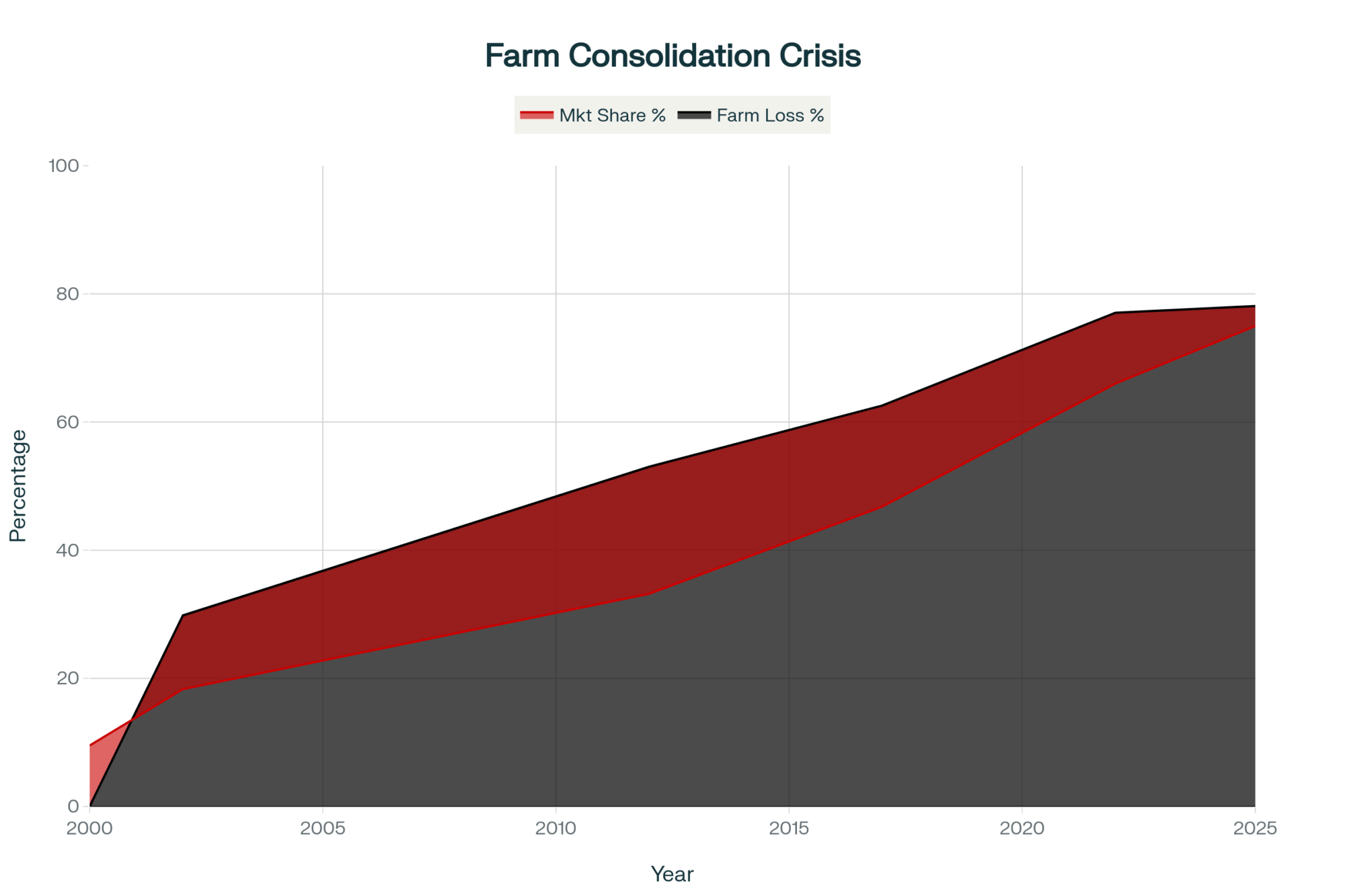
The USDA’s latest numbers, which I just pulled yesterday, show that operations with more than 1,000 cows control about two-thirds of production now. Back in 2017? It was barely over half. The Census shows farms with 2,500 or more cows went from 714 to 834.

(Read more: “Pick Your Lane or Perish: The 18-Month Ultimatum”—the middle is disappearing.)

We’re not “heading toward” consolidation. We’re in year 15 of a 25-year comprehensive restructuring. By 2030? The International Farm Comparison Network projects we’re down to maybe 18,000 total dairy farms. By 2035? We’re looking at something like the poultry industry—vertical integration, contract production, three or four companies controlling everything.

You’ve got maybe two years to figure out where you fit in this picture. After that? The decision gets made for you.

The Bird Flu Wild Card That Has Everyone Spooked

But just as the mega-dairies feel invincible, an entirely new risk has emerged—a biological one that turns their efficiency into a vulnerability. And then there’s this H5N1 thing…

Nobody wants to discuss this at industry meetings, but I was just reviewing USDA’s latest report—we now have infected herds in 17 states. California alone had 475 confirmed cases as of December, according to that Congressional Research Service report. Wisconsin’s been testing thousands of milk samples since April.

Here’s what scares me: CDC research indicates that this virus can spread through milking equipment. You know what that means for these 2,500-cow operations? They’re basically petri dishes. One infected cow, and it spreads to the whole herd within days.

Meanwhile, that 50-cow farm everyone says isn’t viable? Suddenly, their isolation looks pretty smart, doesn’t it?

I was talking to a veterinarian in Arizona—they’re modeling this stuff now—and she thinks if this escalates… I mean, imagine consumers finding out there’s viral material in milk. Even if pasteurization makes it safe, which it does, the demand hit could be catastrophic.

But hey, don’t count on bird flu to save small dairy. That’s not a business plan.

The Exit Math Nobody Will Show You

Alright, let’s talk about getting out. Because for a lot of you, that’s the smartest move, and I’m tired of pretending otherwise.

Wisconsin’s farm center won’t publish this directly—too controversial—but if you read between the lines… Say you’re running 200 cows and losing $75,000 a year after accounting for family living expenses. Pretty common scenario these days.

Keep going for five years? You burn through $375,000 in equity. By the time you finally quit, you’re down to maybe $1.1 million in assets. At 4% returns—if you’re lucky—that’s $45,000 a year in retirement.

But if you exit now with $1.5 million still intact? Same 4% gets you $60,000. That’s fifteen grand more every year for the rest of your life.

Signs You Should Exit Now

  • Losing more than $50,000 annually after family living expenses
  • Over 55 with no succession plan
  • Debt-to-asset ratio above 60%
  • Single processor within 50 miles
  • Can’t afford $500,000 in upgrades
  • Working 80+ hours weekly with no vacation in 3 years

I know appraisers who’ll tell you—off the record—selling separately gets you way more than selling as a complete dairy. Land to crop farmers, cows to other dairies, equipment at auction. You might get 30-50% more that way. Stage it over 18-24 months for tax purposes, and watch the Class III futures for timing.

But your banker won’t run these numbers for you. Your co-op sure as hell won’t. And extension? They can’t even have this conversation without risking their funding.

The Bottom Line (Or: What I’d Tell My Own Son)

Look… I’ve been covering this industry for almost forty years. I’ve seen good farmers, smart people, hardworking families get absolutely destroyed by forces beyond their control.

The consolidation we’re seeing? It’s 70% done already. The infrastructure being built isn’t for family farms—it’s for their replacement. Every “solution” they’re pushing—robots, organic, value-added—it’s designed to extract what value you have left before you’re forced out anyway.

If you’re under 500 cows without a clear path to premium markets? You need millions to scale up (good luck with that), or years of off-farm income to transition to specialty markets (also good luck), or… you need to think about exiting while you still have something to exit with.

If you’re my age—late 50s, early 60s—without someone to take over? Every day you wait is lighting money on fire. Simple as that.

Thinking about robots? That $650,000 might buy you five to seven years of life. Then what? If you don’t have a ten-year plan after the robot, you’re just financing your own extinction with interest.

The hardest truth—and I’ve looked at enough financial data to feel pretty confident about this—probably 60-70% of current dairy farmers would be better off financially by selling tomorrow. Not next year. Not after corn harvest. Tomorrow.

But nobody in this industry will tell you that. They need you operating, even at a loss. Your losses keep their system running.

You know what you are now? You’re not a dairy farmer. You’re an unwitting participant in your own wealth extraction. The only question is whether you’ll recognize it before it’s too late.

I’m not sure… maybe I’m wrong. Maybe there’s some miracle coming that’ll save small dairy. But I was at an auction last month—good family, who had farmed that land for four generations—and watching them sell off everything piece by piece… The old man was trying not to cry, and his son just looked angry…

That’s not how this is supposed to end. But for most of us, that’s exactly how it will end unless we face reality now.

Look, make your own decision. But make it with your eyes open. Because in about 24 months, maybe less, the decision gets made for you.

And trust me—you want to be the one making that call, not having it forced on you.

Share this with every dairy farmer you know. They deserve the truth.

The decision is coming. The only power you have left is to make it yourself.

Key Takeaways:

  • Your 24-Month Countdown Starts Now: $11B in processor overcapacity will crash prices by 2027—only 300 mega-farms survive the engineered consolidation
  • The $375,000 Decision: Exit today = $60k/year retirement. Bleed equity five more years = $45k/year. Your banker won’t show you this math
  • Robot Truth: You pay $100k annually to save $38k in labor—meanwhile, 2,000-cow operations get same efficiency free through scale
  • The Betrayal Is Complete: Processors partnered with lab-protein companies (Leprino/Fooditive, July 2024) while selling you “growth solutions”
  • Three Options Left: Find $3M to scale past 1,000 cows, secure premium markets with off-farm income, or exit while assets have value

Executive Summary:

An Iowa dairy farmer told me last week: “I spent $650,000 on robots and just financed my own funeral.” He’s absolutely right—and the betrayal runs deeper than you know. Processors are investing $11 billion in infrastructure designed exclusively for 300 mega-dairies while partnering with lab-protein companies (Leprino/Fooditive, July 2024) to replace traditional dairy’s profitable products. The math reveals everything: farmers losing $75,000 annually would save $375,000 by exiting today versus operating for five more years, yet every institution—your bank, co-op, processor—needs you to bleed equity to maintain their economics. With 24 months until processing overcapacity crashes milk prices and forces mass consolidation, you face three options: find $3 million to scale beyond 1,000 cows, secure premium markets with off-farm income support, or exit strategically while assets retain value. For 60-70% of current operations, immediate exit preserves the most family wealth—but nobody will tell you this because your losses subsidize their entire business model.

Join the Revolution!

Join over 30,000 successful dairy professionals who rely on Bullvine Weekly for their competitive edge. Delivered directly to your inbox each week, our exclusive industry insights help you make smarter decisions while saving precious hours every week. Never miss critical updates on milk production trends, breakthrough technologies, and profit-boosting strategies that top producers are already implementing. Subscribe now to transform your dairy operation’s efficiency and profitability—your future success is just one click away.

NewsSubscribe
First
Last
Consent

Learn More:

Complete references and supporting documentation are available upon request by contacting the editorial team at editor@thebullvine.com.
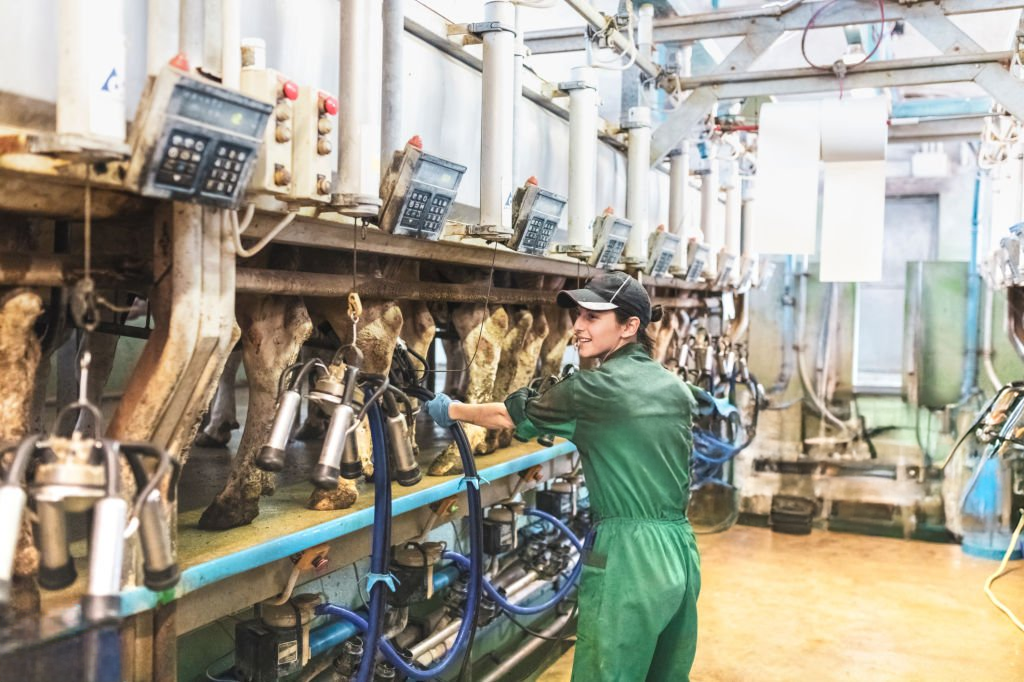
Same Cows, $15,000 Monthly Gap: Your Class III-IV Decision Window Closes Spring 2026

Your genetics are perfect for 2015’s market—but it’s 2025, and processors want different components

EXECUTIVE SUMMARY: What farmers are discovering across the country is that today’s unprecedented $2.47 per hundredweight spread between Class III and Class IV milk prices isn’t just another market cycle—it’s a structural shift that demands strategic action before spring 2026. The numbers tell a sobering story: a typical 500-cow dairy locked into Class IV pricing faces a $15,000 monthly disadvantage compared to neighbors shipping to cheese plants, according to October’s USDA pricing data and analysis from the University of Wisconsin’s dairy markets program. This spread, the widest we’ve sustained since 2011, stems from three converging factors that aren’t going away: our herds now average mid-four percent butterfat when processors desperately need protein, China’s dairy imports have declined significantly as they’ve built domestic capacity equivalent to Wisconsin’s entire annual production, and billions invested in cheese plants can’t process the butterfat surplus we’re creating. Research from Cornell’s dairy program and the Center for Farm Financial Management shows operations successfully navigating this transition fall into three clear paths—strategic expansion for those near cheese plants with strong succession plans, smart adaptation through component management and risk tools for those with moderate leverage, or planned exits that preserve 85-95% of asset value versus the 50-65% retained in forced sales. The window for action is narrowing, with historical consolidation patterns suggesting the best opportunities for expansion and the most favorable exit terms will close by spring 2026. Here’s what’s encouraging: producers who honestly assess their situation using clear decision frameworks and act decisively—regardless of which path they choose—consistently achieve better outcomes than those waiting for conditions to improve.

What farmers are discovering about today’s unprecedented Class III-IV differential—and how the smartest operations are turning crisis into opportunity while others prepare strategic exits

Tim Anderson was checking tank weights at 4:45 a.m. in his South Dakota parlor when the October milk statement arrived on his phone. The Federal Order changes that took effect in June had dropped his mailbox price again—another reminder that the reforms we’d hoped would help actually made things more challenging for many of us, particularly those shipping Class IV milk.

What struck me about Tim’s situation was this: while he was preparing to expand by acquiring a neighbor’s operation, a California producer I’d met at the Holstein convention was making equally prudent plans to exit the industry entirely. Same market conditions. Same unprecedented pricing spread between Class III and Class IV milk. Yet both were making the right decision for their particular circumstances.

TL;DR – THE 30-SECOND VERSION

  • The Crisis: $2.47/cwt Class III-IV spread—widest since 2011
  • The Impact: $15,000 monthly loss for 500-cow Class IV operations
  • The Choice: Expand, adapt, or exit by spring 2026

BY THE NUMBERS: KEY FACTS AT A GLANCE

  • $2.47/cwt – Current Class III-IV spread (October 2025)
  • 32,000 → 23,000 – Projected U.S. dairy farms by 2027
  • $15,000/month – Income gap for 500-cow Class IV operations
  • 85-95% – Asset value retained in planned exits vs. 50-65% in forced sales
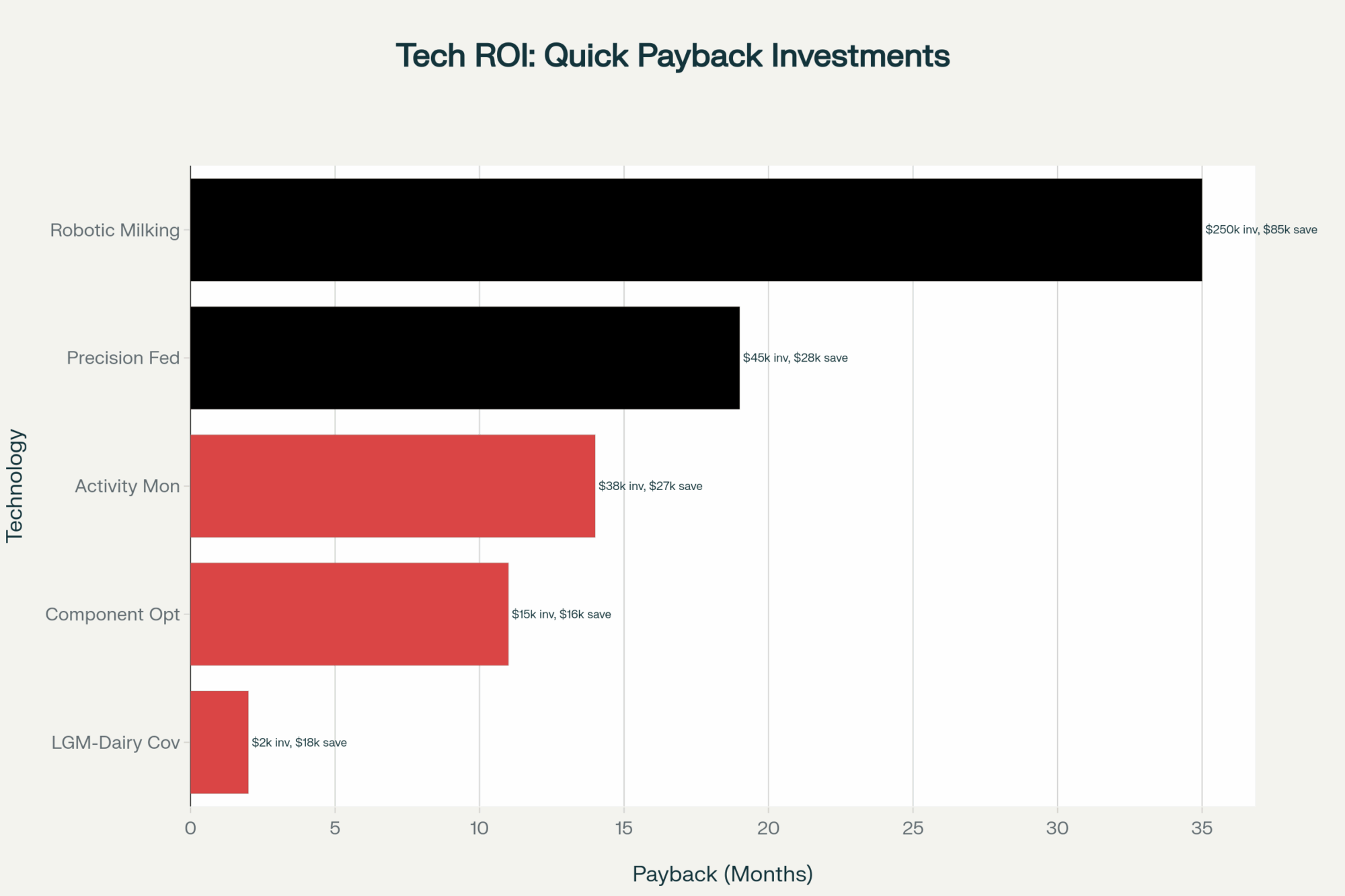
  • 14 months – Average technology payback period for smart investments

QUICK ACTION GUIDE: YOUR 90-DAY ROADMAP

Your SituationYour PathFirst Step This Week
✅ Under 45, near cheese plants, succession securedEXPANDCall the banker for acquisition credit
⚖️ Moderate debt, some flexibility, 5-10 year horizonADAPTSchedule a component optimization consult
🔄 No succession, burning equity, geographic disadvantagesTRANSITIONGet a professional valuation

Resources to get started:

  • LGM-Dairy information: Your local FSA office or check the RMA website
  • Component optimization: Talk to your nutritionist or extension dairy specialist
  • Market analysis: University of Wisconsin’s Understanding Dairy Markets program
  • Exit planning: The Center for Farm Financial Management has excellent resources

Understanding Today’s Market—It’s Different This Time

So you’ve probably noticed your milk check acting strange lately. If you’re fortunate enough to ship Class III milk for cheese production, October’s USDA pricing announcement puts you around seventeen dollars per hundredweight. But what about milk that goes to butter and powder production? You’re looking at about $14.50.

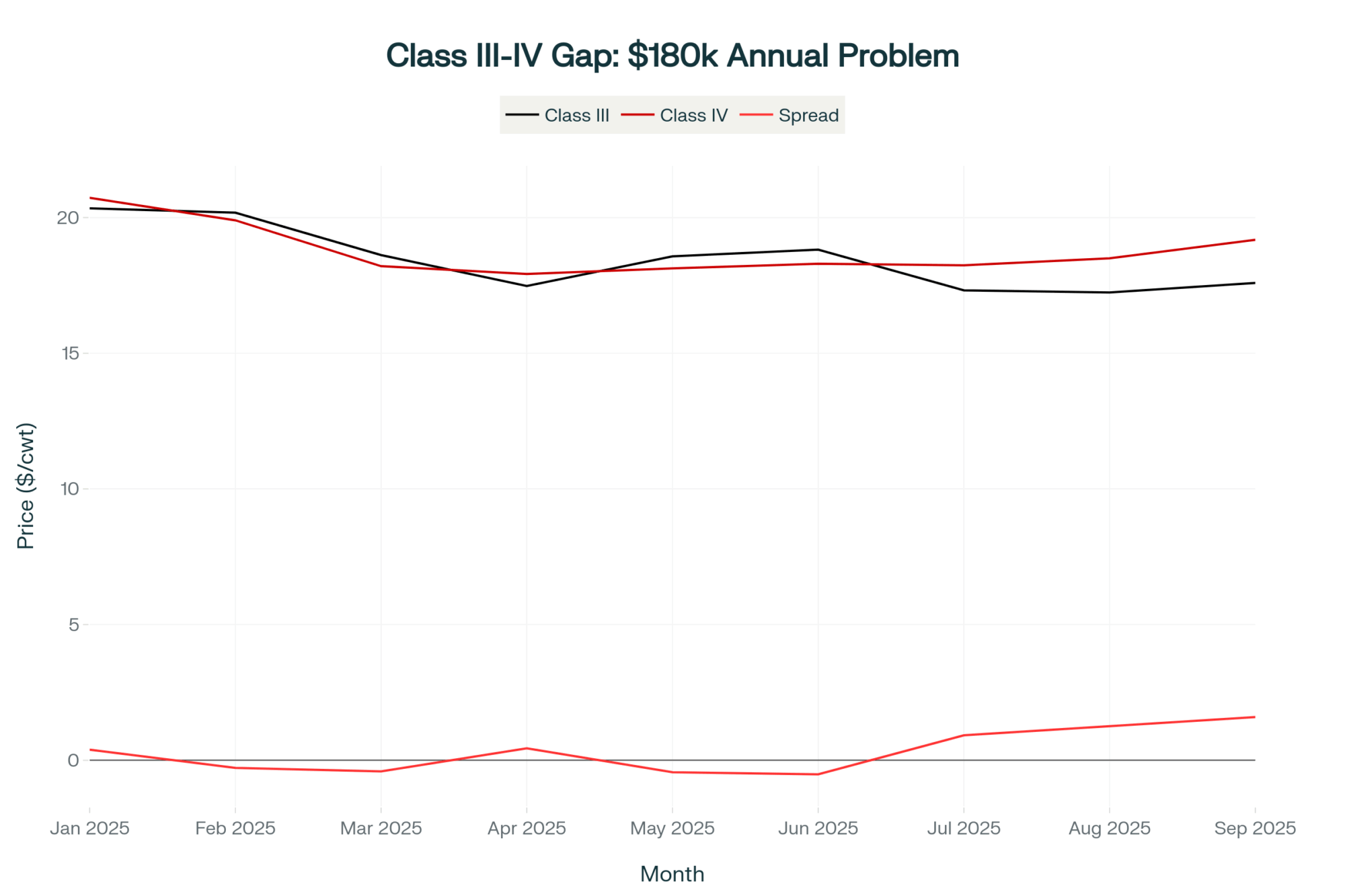
The unprecedented Class III-IV milk price spread hit $2.47/cwt in October 2025—the widest sustained gap since 2011, costing Class IV operations $15,000 monthly versus cheese plants. 

Now, here’s what’s interesting—this differential of roughly two dollars and forty-seven cents is something we haven’t seen sustained at this level since 2011. The folks at the University of Wisconsin’s dairy markets program have been tracking this, and historically, we’ve seen spreads average well below a dollar per hundredweight. When it gets this wide, it fundamentally changes the economics of dairy farming depending on what your milk is used for.

Why This Spread Hits Different

You know, I was reviewing the numbers last week, and for a typical 500-cow dairy, being locked into Class IV pricing versus Class III means you’re looking at roughly $15,000 less income every month. That’s real money—the difference between breaking even and burning equity.

Mark Stephenson, who runs UW-Madison’s dairy policy analysis program, made a point recently that really resonated with me. He’s saying this looks more like a structural market shift than the typical cycles we’re used to riding out. And I think he’s right.

What’s also worth noting is the international perspective here. A New Zealand producer I connected with online mentioned they’re dealing with similar component imbalances, though their cooperative structure handles it differently. Sometimes, examining how other countries address these challenges provides us with fresh insights.

The Component Balance Nobody Planned For

The dairy industry has made significant progress in genetic advancements over the past twenty years. Council on Dairy Cattle Breeding data shows most herds now average in the mid-four percent range for butterfat, while protein levels sit in the low threes. That’s remarkable progress, really.

But here’s the thing—I was at a Wisconsin Center for Dairy Research meeting last month, and John Lucey made this observation that stuck with me. He said we essentially optimized our genetics for a market that existed when China was buying everything we could produce. Those breeding decisions made sense at the time, but now…

A Wisconsin producer told me last week, “My DHI reports look fantastic—4.4% butterfat, 3.2% protein. Ten years ago, I’d be thrilled. Now my processor is penalizing me for excess butterfat.” And that’s the reality many of us are dealing with. Even if we completely changed our breeding strategy today—focused entirely on protein—we’re looking at five to seven years before those genetics fully express themselves in the milking herd.

The Export Picture Has Changed

What’s happened with exports is particularly sobering. USDA’s Foreign Agricultural Service has been tracking China’s dairy imports, and they’ve declined significantly from where they were just a few years back. The Chinese have made massive investments in domestic production—it’s a food security thing for them, and honestly, you can understand why.

I was speaking with a dairy economist from Cornell last month, who shared something that really puts this into perspective: China added more milk production capacity between 2020 and 2024 than Wisconsin produces in an entire year. That’s not a temporary blip—that’s a fundamental change in global dairy markets.

And Mexico—our biggest export market, taking about 30% of what we send overseas—they’re implementing their own expansion plans. The U.S. Dairy Export Council has been monitoring this closely, and it appears that our exports to this market could decline significantly over the next few years.

Down in the Southeast, producers are feeling this too. A Georgia dairyman I know said, “We used to count on steady growth in powder exports through Savannah. Now we’re planning for flat to declining volumes.”

Peter Vitaliano at National Milk made a point that I think deserves serious consideration. These aren’t the kind of temporary trade disputes that get resolved when administrations change. These are countries making long-term strategic decisions about food security.

Processing Capacity in the Wrong Places

Since 2020, the dairy industry has invested billions in new processing capacity—CoBank’s been documenting this, and it’s impressive. The problem is that we have a mismatch. Most of the investment went into cheese plants, but we’re producing more butterfat than those plants know what to do with.

A processing engineer explained it to me this way: “Converting a cheese plant to butter production would be like trying to turn a Toyota factory into a bakery. Everything about the process is different—the equipment, the workflows, everything.”

Making Sense of Your Options: A Framework

Through conversations with producers across the Midwest and lenders from various institutions, I’ve noticed successful operations tend to evaluate these factors honestly:

Eight Questions That Matter

What to ConsiderGood PositionChallenging Position
Cash FlowBreaking even or betterBurning over $40K monthly
SuccessionKids are committedNo clear plan
Your EnergyReady for big changesExhausted thinking about it
LocationNear cheese plantsStuck with Class IV
Debt LevelUnder 45% debt-to-assetOver 60% debt-to-asset
Your AgeUnder 45Over 58
Other OptionsDairy’s your best betBetter opportunities exist
Staying PowerCan handle 24 monthsLess than 12 months of runway

You know, if you’re scoring well on six or more of these, you might want to think about expansion or really pushing adaptation. If you’re only hitting a couple? Well, that’s a different conversation entirely.

There’s another factor worth considering—cooperative strategies. I’ve been hearing about groups of smaller producers pooling resources for shared technology investments or negotiating power. It’s not for everyone, but it’s an option some are exploring.

The Opportunities Hidden in This Market

Cornell’s dairy program has documented how consolidations like this historically create opportunities for those positioned to capture them. And we’re seeing that play out right now.

What’s Available If You’re Looking

The auction tracking services—Machinery Pete, Ritchie Brothers—they’re reporting some interesting numbers:

  • Complete dairy operations going for $1,200-1,500 per cow (replacement cost is easily double that)
  • Used equipment at 40-60% of new prices
  • Dairy-suitable land down 20-30% from recent peaks

I talked with a South Dakota producer last week who just acquired a 400-cow operation for $1,350 per cow. “Five years ago,” he said, “this would’ve cost me three grand per cow minimum. The math is completely different at these prices.”

However, and this is crucial, you must plan the integration carefully. Another producer I know rushed an acquisition and told me, “I got a great price on the cows, but I totally underestimated integration costs. It took 18 months before we saw positive cash flow from that expansion.”

How Processor Relationships Are Changing

As neighbors exit and milk supplies tighten in certain regions, the producers who remain are finding themselves in a different negotiating position. I’ve been hearing about some interesting deals in Wisconsin and Minnesota:

  • Protein premiums running $0.35-0.40/cwt
  • Volume commitment bonuses of $0.25-0.30/cwt
  • Quality bonuses for low somatic cells hitting $0.20-0.25/cwt

Add it all up, and some operations are getting close to a dollar per hundredweight above base prices. That’s significant money.

A procurement manager explained the processor’s perspective to me: “We’d rather pay premiums to secure a reliable supply than risk running our plant at 70% capacity. Empty vats don’t pay bills.”

The Economics of Exit—Let’s Be Honest About This

How You ExitWhat You KeepTimeline500-Cow Example
🟢 Planned Exit85-95% of valueYou control it$5.5M → $4.7-5.2M
🔴 Forced Sale50-65% of valueBank controls it$5.5M → $2.8-3.6M
🟡 Alternative UseSometimes, more than dairy value18-24 monthsVaries widely

These numbers come from the Center for Farm Financial Management’s analysis of recent dairy exits

When Getting Out Makes Sense

This is a difficult topic to discuss, but for some operations, planning an orderly exit can be the smartest business decision. I recently worked with a Pennsylvania producer who put it this way: “It wasn’t about giving up. It was recognizing I could preserve $3 million in equity by exiting now versus maybe $1 million if I waited until the bank forced it.”

Different Regions, Different Opportunities

In California’s Central Valley, water costs have reached $400-500 per acre-foot, according to the state’s water resources data. Combined with being locked into Class IV pricing, the math becomes challenging. Several producers I know are finding better returns with solar leases at $1,200-$ 1,500 per acre annually, or converting to almond production.

One California producer told me straight up: “Between water costs, regulations, and Class IV pricing, I’m basically paying for the privilege of milking cows. That’s not a business—that’s an expensive hobby.”

In the Northeast—specifically, Vermont, New York, and Pennsylvania—fluid premiums that used to be $0.35 are now under a dollar, according to Federal Order One data. But here’s the thing: development pressure means land values remain strong. A Vermont producer recently sold 200 acres for development at $18,000 per acre. “The irony,” he said, “is that the same development pressure that makes farming difficult also creates our exit opportunity.”

The Upper Midwest generally has more flexibility, though distance from cheese plants matters more than ever. Every ten miles from processing adds about ten cents per hundredweight in hauling costs. Beyond fifty miles? That becomes a real structural disadvantage.

Down South, the situation varies widely. A Tennessee producer shared, “We’re seeing opportunities in agritourism and direct sales that didn’t exist five years ago. Some of my neighbors are making more from farm tours than milk sales.”

There is a growing trend in North Carolina and Virginia, where producers are converting to grass-fed operations for premium markets. It’s not easy, but for some, it’s working.

Adaptation Strategies That Are Actually Working

For most of us—those neither expanding nor exiting—we need to make some significant adjustments. Here’s what I’m seeing work:

Getting Components Right

Mike Hutjens, the Illinois nutritionist many of you are likely familiar with, has been working with farms on this. In recent trials he supervised, producers saw:

  • Protein boost of about 0.18% at twenty cents per cow daily
  • Some fat reduction that actually saved money
  • Net improvement of thirty to forty-five cents per hundredweight

“We’re not trying to eliminate butterfat,” Mike explains. “The genetics won’t let us. We’re optimizing the ratio to match what processors want.”

Risk Management That Makes Sense

I talked with a Wisconsin producer running 500 cows who shared his approach: “I cover 60% with LGM-Dairy—costs about forty cents per hundredweight after subsidies. Another 25% with Class III puts. Leave 15% open for upside. Total cost? About five grand monthly. But it guarantees I can pay bills regardless of what the market does.”

What’s changed is how lenders view this. “It used to be seen as speculation,” a Minnesota producer told me. “Now my banker basically requires it.”

Technology Investments That Pay

Not every technology makes sense, but some really do. A Minnesota dairy with 600 cows shared their results with activity monitors:

  • Spent $38,000 on the system
  • Pregnancy rate went from 18% to 24%
  • Health treatment costs dropped $18 per cow annually
  • Saved an hour and a half daily on heat detection
  • Paid back in 14 months

“The key,” the owner said, “is choosing technology that solves a specific problem, not just buying the latest gadget.”

I’ve also seen good returns from robotic milking in certain situations. An Ohio producer with 180 cows installed robots last year: “It’s not just labor savings—our components improved, SCC dropped, and my knees don’t hurt anymore.”

However, there’s another aspect to consider—data management systems. A Michigan producer running 800 cows told me their investment in comprehensive herd management software paid back in eight months through better breeding decisions and health interventions alone.

How Federal Order Reform Actually Played Out

So the changes that took effect June 1st… they didn’t go quite as we’d hoped. USDA’s November announcement increased make allowances—what processors deduct for manufacturing costs—pretty substantially:

ProductOld RateNew RateImpact on Your Milk Check
Cheese$0.20/lb$0.25/lbDown about $0.52/cwt
Butter$0.17/lb$0.23/lbDown about $0.56/cwt
Powder$0.17/lb$0.24/lbDown about $0.72/cwt

The net effect? Most of us are down eighty-six to ninety-one cents per hundredweight through November. Component improvements are scheduled for December 1st, which should help—USDA estimates about fifty cents—but we’re still in the hole.

As Marin Bozic at the University of Minnesota put it, “Federal Order reform addressed how we calculate prices, but it can’t fix the fundamental supply-demand imbalance. We’re producing components the market doesn’t want at current levels.”

Looking Ahead—What This Industry Becomes

Based on what we’re seeing now and historical patterns from USDA’s Economic Research Service, if current trends continue—and that’s a big if—by 2027, we might see:

  • Total operations dropping to maybe 23,000-24,000 from today’s 32,000
  • Average herd size passing 500 cows nationally
  • The biggest 2,000 operations controlling half of all production
  • Smaller operations under 200 cows are becoming increasingly specialized or exiting

The growth appears to be occurring in areas such as South Dakota (three new cheese plants), Idaho (water and infrastructure), and the Texas Panhandle (feed availability and new processing facilities). Meanwhile, California, the Northeast, and remote areas of the Midwest are experiencing contraction.

What’s particularly interesting is how quickly certain things are becoming standard. A processor quality manager told me: “Five years ago, maybe 20% of our producers actively managed components. Now it’s 75% and growing. If you’re not adapting, you’re at a serious disadvantage.”

Looking internationally, the EU is facing similar consolidation pressures, although its subsidy structure creates different dynamics. Sometimes I think we focus so much on our own challenges that we miss that this is a global phenomenon.

Your Three Paths Forward

After looking at how different operations are navigating this, three strategies keep emerging:

Path 1: Strategic Expansion

If you’re under 45, near cheese plants, with succession secured

Your next 90 days:

  1. Weeks 1-2: Set up that acquisition credit line
  2. Weeks 3-4: Identify who might sell
  3. Month 2: Approach them privately
  4. Month 3: Do your homework thoroughly

A South Dakota producer who just expanded told me, “The cheap part was buying the cows. The expensive part was integrating them properly. Budget twice the time and money you think you’ll need.”

Path 2: Smart Adaptation

If you’ve got moderate debt, some flexibility, and 5-10 years left

Focus on these priorities:

  • Get your nutritionist working on components immediately
  • Set up LGM-Dairy coverage (seriously, do this)
  • Talk to your processor about premium programs
  • Only buy technology with a clear payback under 18 months

“The mistake I see,” a Wisconsin banker told me, “is producers trying to change everything at once. Pick two or three high-impact changes and execute them well.”

Path 3: Strategic Exit

If there’s no succession, you’re burning equity, or better opportunities exist

Protect what you’ve built:

  • Get a professional valuation now
  • Talk to your accountant about tax optimization
  • Explore all options—whole farm, parcels, alternative uses
  • Most importantly: control your timeline

A Pennsylvania dairyman who recently retired reflected: “I spent 40 years building this operation. Taking 18 months to exit properly preserved 40% more value than if I’d waited until the bank forced it.”

The Window Is Closing

Considering market dynamics and historical patterns, the window for capturing opportunities or avoiding worse outcomes likely extends through spring 2026. After that, options start getting limited.

What I’ve noticed is that producers who honestly assess their situation and act decisively—regardless of which path they choose—consistently outperform those who wait for conditions to improve.

As I finish writing this, I’m thinking about Tim Anderson in South Dakota, probably heading out for evening milking. And that California producer, maybe reviewing exit strategies with his accountant. Both are facing this with eyes wide open. Both are making the right call for their situation.

The dairy industry will get through this transition—it always does. The question is whether your operation will be part of what comes next, and if so, in what form.

Take the Next Step

The conversations I’ve had while researching this article convinced me of one thing: having a clear framework for decision-making is essential right now. That’s why we’ve been working on resources to help producers evaluate their situations objectively.

Here’s what can help:

  • Connect with other producers facing similar decisions through The Bullvine’s online forums
  • Access our collection of planning worksheets and calculators
  • Read detailed regional market analyses updated weekly
  • Join our monthly video discussions with industry experts

Have specific questions about your operation? Send them to us—we’re featuring reader questions in upcoming articles, and your situation might help others facing similar decisions.

Because in today’s dairy industry, none of us should have to figure this out alone.

KEY TAKEAWAYS

  • The $180,000 annual impact is real and measurable: Operations shipping Class IV milk to butter/powder plants face a $2.47/cwt disadvantage that translates to $15,000 monthly losses for a 500-cow dairy—money that determines whether you’re building equity or burning through it while neighbors with identical herds but different processors thrive.
  • Three proven paths emerged from producer experiences: Expand strategically if you’re under 45 with cheese plant access and can acquire operations at current valuations of $1,200-1,500 per cow (half of replacement cost), adapt through component optimization that delivers $0.30-0.45/cwt improvements and LGM-Dairy coverage costing $0.40/cwt after subsidies, or exit strategically while controlling timing to preserve 85-95% of asset value.
  • Component management pays immediate dividends: Wisconsin and Minnesota producers working with nutritionists report achieving 0.18% protein increases at $0.20/cow daily cost while reducing expensive butterfat supplements, netting $0.30-0.45/cwt improvements—that’s $36-54 more per cow monthly without genetic changes that take five to seven years.
  • Geography increasingly determines destiny: Every 10 miles from cheese processing adds $0.10/cwt in hauling costs, California’s Central Valley producers face $400-500/acre-foot water costs plus Class IV lock-in, while Northeast operations see fluid premiums drop from $3.50 to under $1.00/cwt—but development opportunities offer $15,000-25,000/acre exits.
  • Technology investments with 14-18 month paybacks make sense now: Activity monitoring systems ($38,000 for 600 cows) boost pregnancy rates from 18% to 24% while cutting health costs $18/cow annually, and smart producers focus on solving specific problems—heat detection, health intervention, component optimization—not buying the latest gadgets.

Complete references and supporting documentation are available upon request by contacting the editorial team at editor@thebullvine.com.
Learn More:

Join the Revolution!

Join over 30,000 successful dairy professionals who rely on Bullvine Weekly for their competitive edge. Delivered directly to your inbox each week, our exclusive industry insights help you make smarter decisions while saving precious hours every week. Never miss critical updates on milk production trends, breakthrough technologies, and profit-boosting strategies that top producers are already implementing. Subscribe now to transform your dairy operation’s efficiency and profitability—your future success is just one click away.

NewsSubscribe
First
Last
Consent
Send this to a friend