Archive for dairy checkoff

Hershey’s $121 Million Checkoff Bet: From TikTok Butter Boards to Your 15¢/cwt Milk Check

TikTok butter boards, protein lattes, a $500M cottage cheese brand — all funded by your 15¢/cwt. But does any of it hit your milk check?

Executive Summary: Every month, your milk check skims off 15¢/cwt into a $121.4 million Dairy Management Inc. budget that helped bankroll TikTok butter boards, protein lattes at Starbucks and Dunkin’, and a $500 million cottage cheese brand. This feature puts three real farmers at the center of the fight over that money: DMI chair and 800‑cow producer Marilyn Hershey, former Dairy Board member Sarah Lloyd, and Supreme Court challenger Brenda Cochran. DMI points to 18.5 billion extra pounds of dairy sold through McDonald’s, Taco Bell, and Domino’s, and research claiming a $3.50 return for every checkoff dollar, while Lloyd and Cochran argue the gains pool in processors and mega-herds as four U.S. farms a day still disappear. The article connects those big marketing wins straight to your breeding and milk check math, showing how a 0.1% protein test bump on a 300‑cow herd is worth roughly $17,900 a year — more than the same herd pays into checkoff. From there, it hands you a simple playbook: audit your last three milk checks for component payments, re-run your sire choices for protein-heavy markets, and press your checkoff reps to explain exactly how influencer and QSR spending shows up in your own numbers. It’s a story about who controls demand, who captures the margin, and whether your 15¢/cwt is a smart bet or just another line on the deduction list.
dairy checkoff ROI

Marilyn Hershey milks about 800 cows on 550 acres in Cochranville, Pennsylvania — about an hour west of Philadelphia. She’s also the chair of Dairy Management Inc., the organization that decides how to spend more than $200 million in annual checkoff collections from dairy farmers and milk processors nationwide. In a 2022 blog post, Hershey flagged what she saw as a massive untapped opportunity: 80% of the 2 billion chicken sandwiches sold in America each year lack a slice of cheese.

The checkoff, she wrote, was working with Chick-fil-A, Raising Cane’s, and McDonald’s to change that.
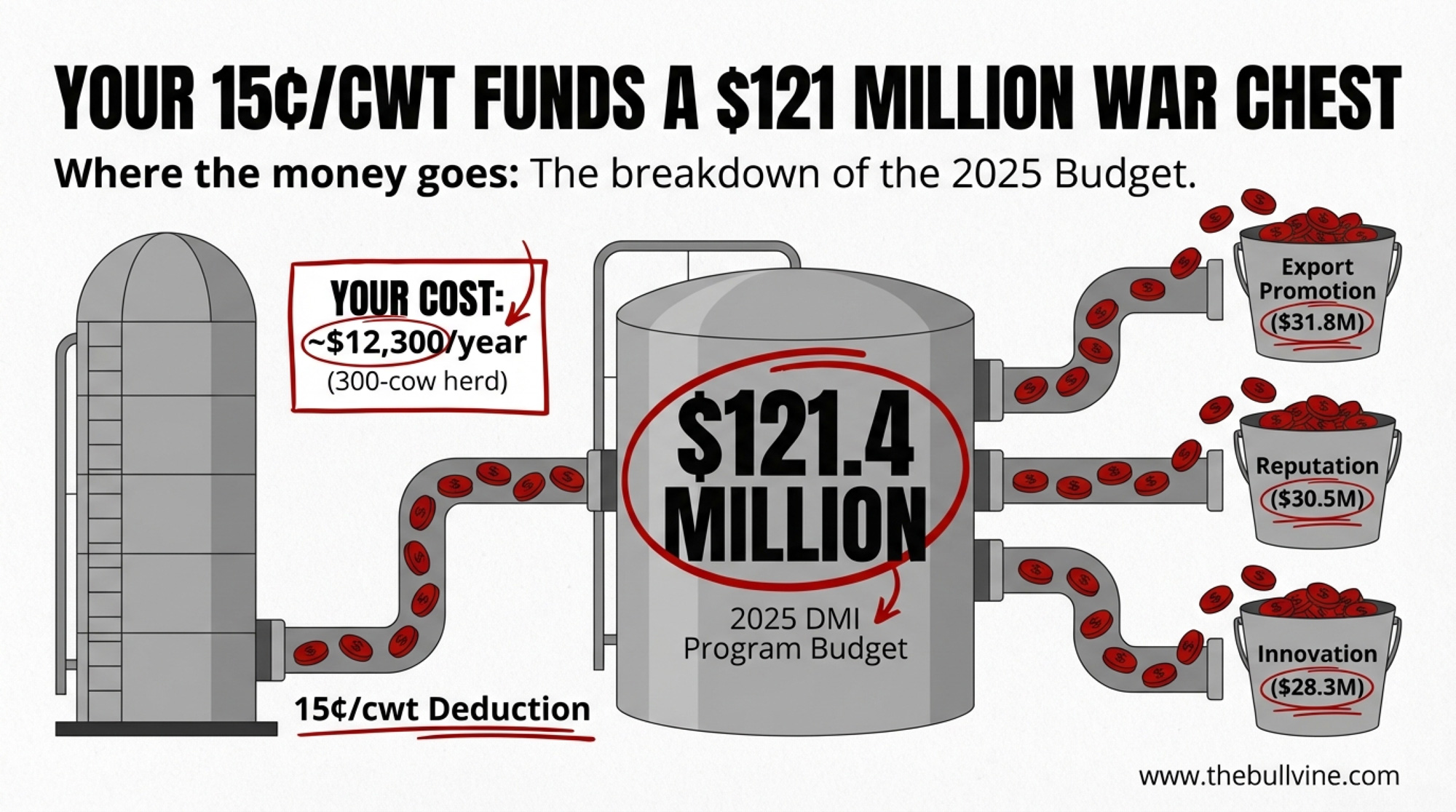
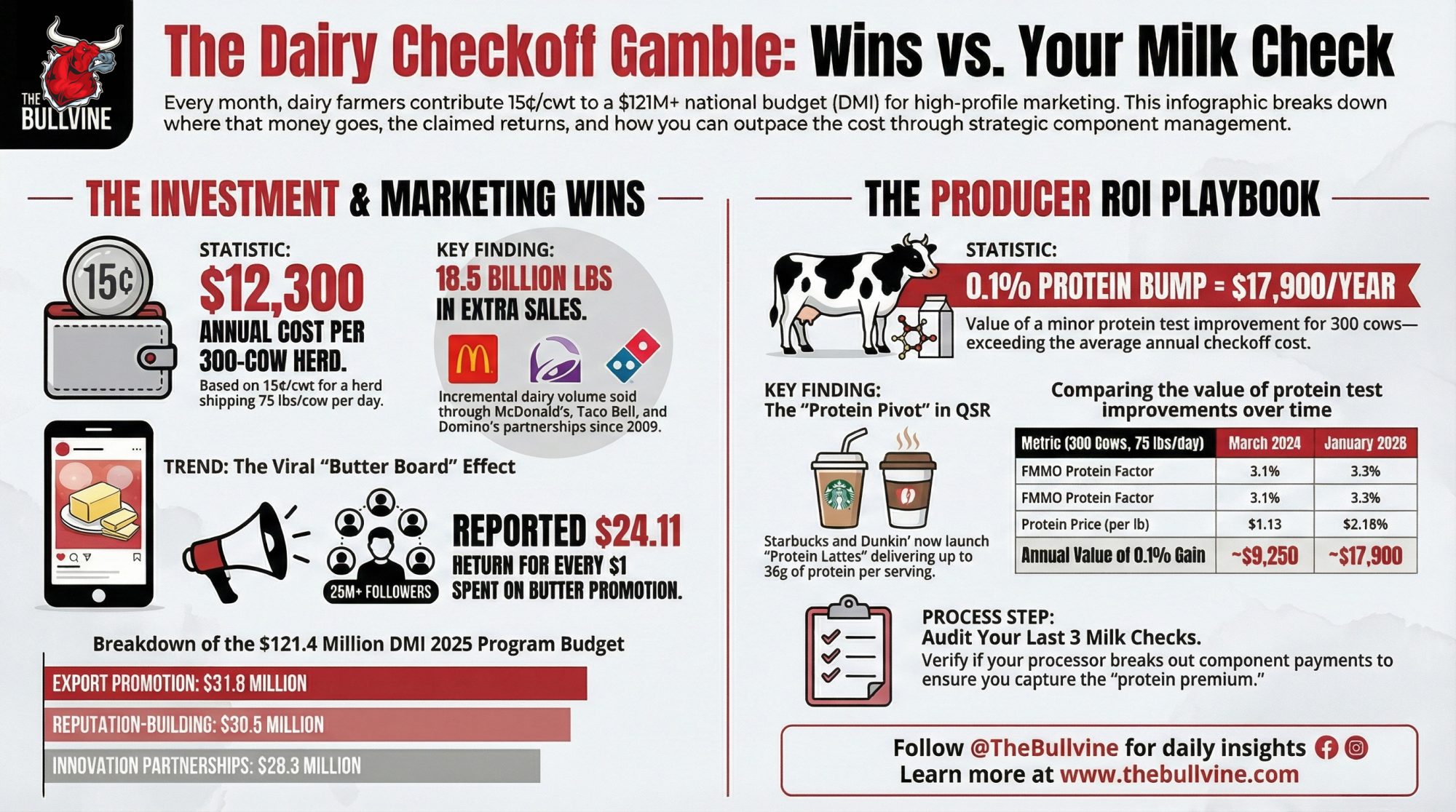
That’s the scale of ambition behind your 15¢/cwt. Mandated by Congress under the Dairy Production Stabilization Act, the assessment doesn’t just fund “Got Milk?” reruns. It bankrolls paid influencer networks, food scientists embedded inside fast-food headquarters, and QSR partnerships designed to bake more dairy into every menu in America. DMI’s 2025 program budget alone sits at $121.4 million (compared with $165.7 million in total organizational expenses in 2024, per the Ernst & Young audit filed May 8, 2025), with the largest shares going to export promotion ($31.8 million), reputation-building campaigns ($30.5 million), and innovation partnerships ($28.3 million). We broke down those audited financials — and what they reveal about where every cent goes — earlier this year.
On a 300-cow herd shipping about 75 lbs per cow per day — roughly 82,000 cwt of marketable milk annually — you’re sending approximately $12,300 per year into checkoff programs at 15¢/cwt. That’s real money. And it pools into a war chest that’s reshaping how the world eats dairy — often through channels you’d never expect.

The $24.11 Gamble: Did TikTok Really Sell Your Butter?

The butter board didn’t happen by accident.

In September 2022, influencer chef Justine Doiron posted a TikTok video of herself slathering two sticks of butter directly onto a wooden cheese board — seasoning the thick layer with flaky sea salt and lemon zest, arranging torn herbs and red onion across the surface, finishing with flower petals and a drizzle of honey. The video hit escape velocity. The New York Times, CNN, and the Today Show all covered it. High-end restaurants rolled out $38 tableside “butter service.”

DMI claimed credit in industry press almost immediately — and here’s why they could. Doiron was a member of DMI’s paid “Dairy Dream Team,” a network that, according to DMI, commands a combined 25 million social media followers, plus another 100-plus influencers working with state and regional checkoff teams. In 2026, that’s a larger promotional footprint than most cable networks deliver.

Doiron had posted a clearly labeled DMI advertisement just two days before the viral butter board video. DMI told Grist that the butter board itself wasn’t technically part of the paid partnership — and Doiron’s contract has since expired, according to DMI. That timeline raises a question the checkoff hasn’t fully answered: when an influencer on your roster goes viral with dairy content between paid posts, where exactly does the sponsorship end and the organic moment begin?

For producers, there’s a number worth knowing from USDA’s 2020 Report to Congress on the Dairy Promotion and Research Program: for every dollar spent on demand-enhancing activities for butter, the estimated return was $24.11. But here’s the asterisk. In 2019, less than 2% of total checkoff funds were spent on butter promotion — meaning the high return may reflect a fast-growing category that would have surged regardless of the spending. A prior evaluation using data through 2019 had calculated the fluid milk return at $3.26 per dollar — nearly double the $1.91 figure that emerged when pandemic-year data from 2020 were included. Whether those aggregate returns translate to your individual milk check is a different question. One we’ll come back to.

From Diet Food to a $500 Million Brand: The Cottage Cheese Comeback

If butter was the checkoff’s viral showpiece, cottage cheese is where the market data really moved.
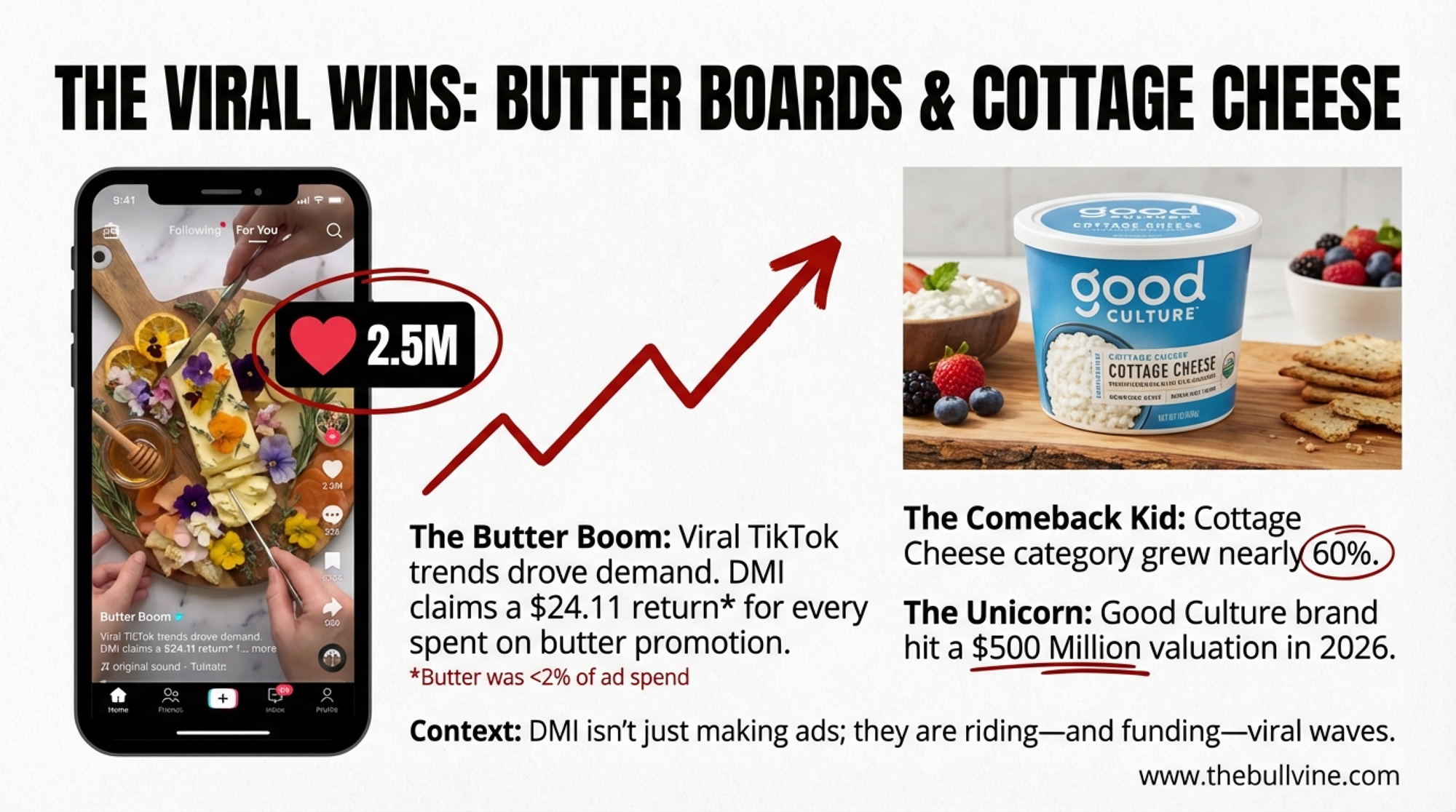
Good Culture — co-founded by Jesse Merrill and Anders Eisner in 2015, headquartered in Austin, Texas — bet on clean labels, modern branding, and higher-welfare sourcing through its partnership with Dairy Farmers of America’s Path to Pasture program. The brand hit $100 million in revenue in 2023 and nearly doubled that in 2024, according to Forbes. In January 2026, private equity firm L Catterton acquired a controlling stake for more than $500 million, with Good Culture raising an additional $55 million from SEMCAP Food & Nutrition the following month. The broader cottage cheese category grew nearly 60% over that same period.

The engine behind that growth? TikTok recipes that repositioned cottage cheese from frumpy 1970s diet food into a high-protein base ingredient — cottage cheese “ice cream,” high-protein pancakes, flatbreads. “It was about a $1.1 billion category when I entered the space… the category growth was kind of flat or in decline for decades,” Merrill told Fast Company. “I just saw that as a huge opportunity.” Each viral recipe effectively increased the serving size per use — exactly what drives volume growth for processors.

If your processor pays on components, that cottage cheese boom translates directly into demand pressure on the protein fraction of your milk check. We dug into why that protein shift matters for your breeding program in “The $97,500 Protein Shift.”

The Genetic Signal in the Checkoff Data

Here’s the part that connects DMI’s viral success to your breeding barn.

Every one of these demand wins — protein lattes, cottage cheese, ultra-filtered milk — rewards milk for what’s in it, not how much of it there is. If DMI is genuinely succeeding at repositioning dairy as a protein ingredient rather than a commodity fluid, that’s not just a marketing shift. It’s a direct economic challenge to the volume-first Holstein model that still dominates most North American breeding programs.

The math is blunt. Under the updated FMMO formula (effective with the FMMO reform final rule published in early 2025), the Class III skim milk price now uses a 3.3% protein factor — up from 3.1%. That change amplifies every tenth of a point in your protein test. And when you pair the factor change with where protein prices have actually been, the gap between volume-bred and component-bred herds widens fast:

Protein Revenue Impact: What 0.1% Protein Test Is Worth (300 cows, 75 lbs/day, component pricing)
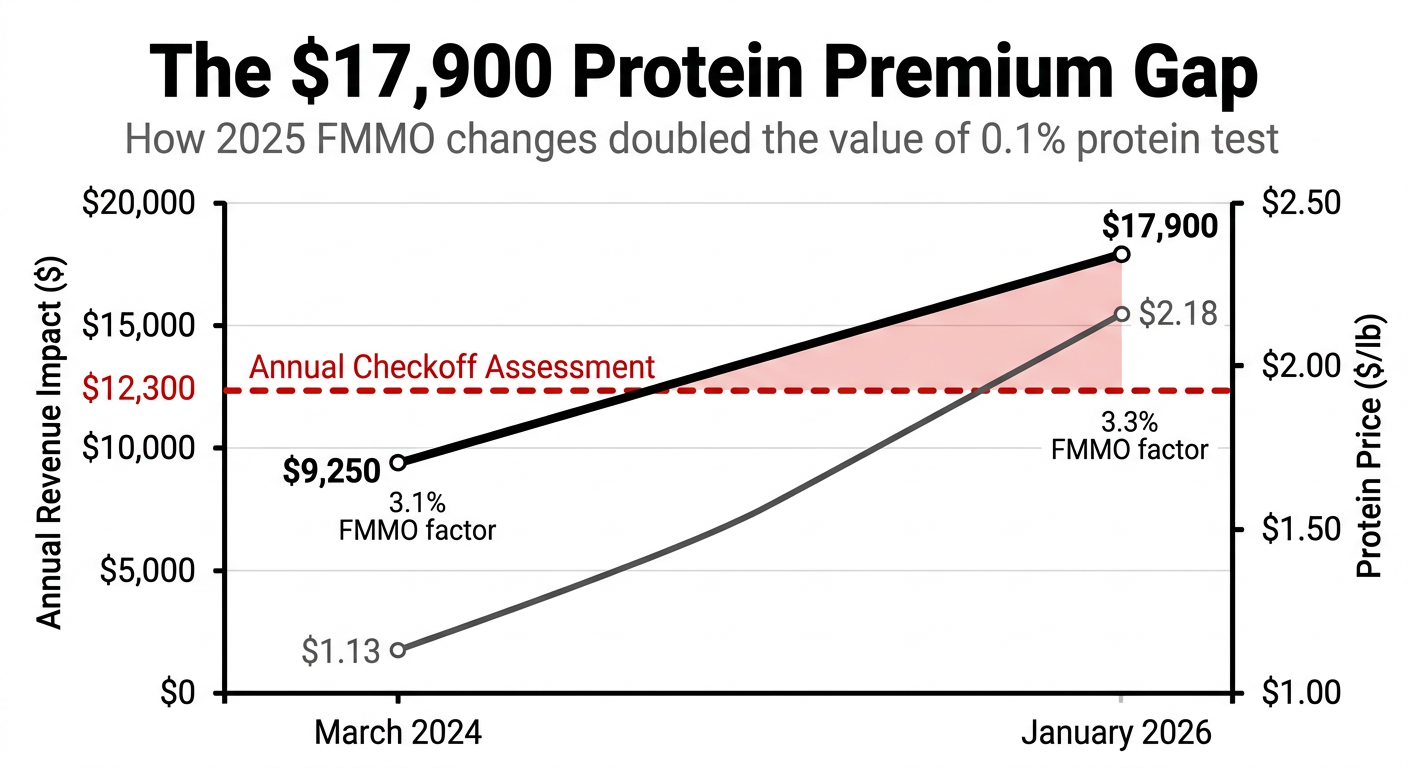
MetricMarch 2024January 2026
FMMO Protein Factor3.1%3.3%
Protein Price ($/lb)$1.13$2.18
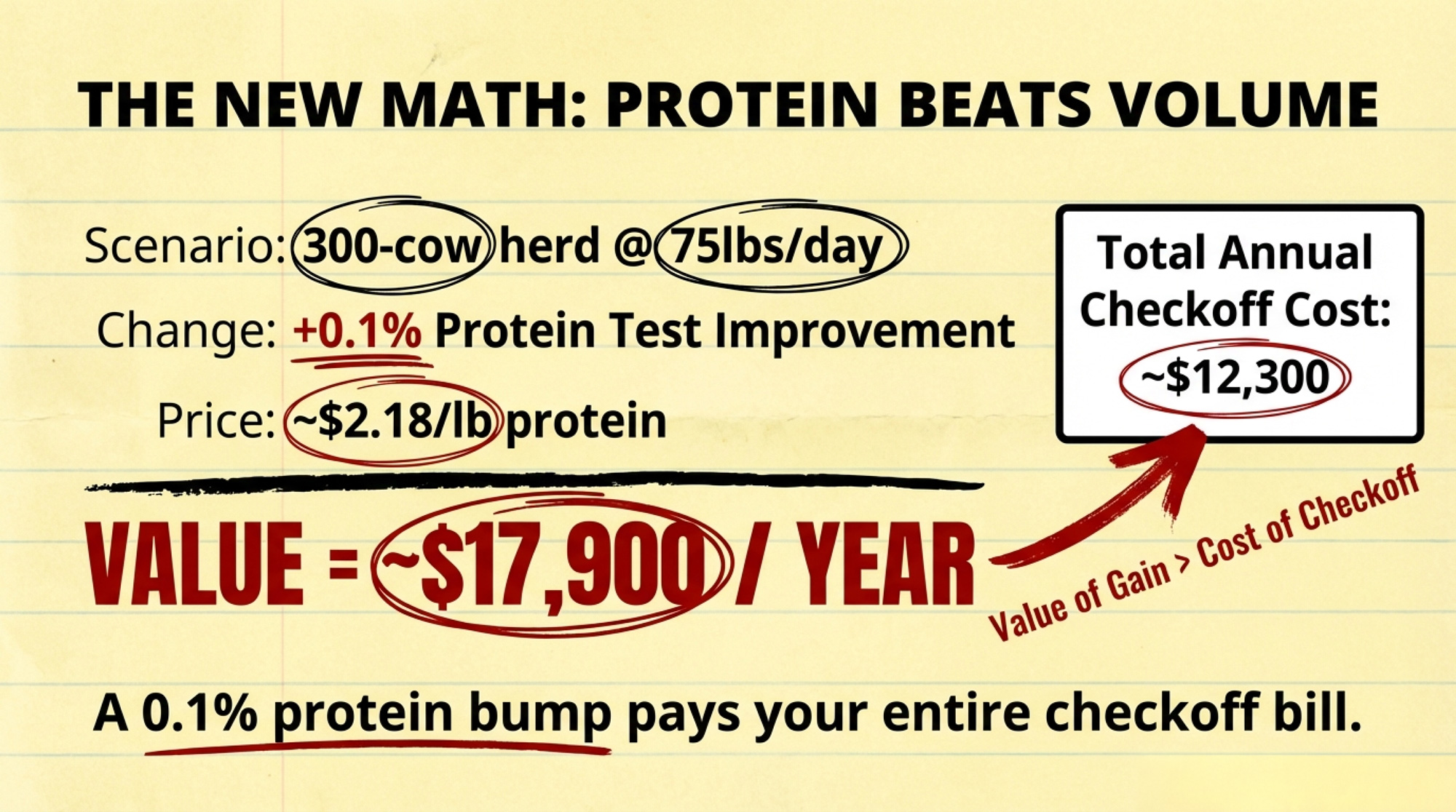
Annual value per 0.1% test (300 cows, 75 lb/day)$9,250$17,900
Annual checkoff assessment (300 cows)$12,300$12,300
Excess value above checkoff−$3,050+$5,600

Sources: USDA AMS Announcement of Class and Component Prices, FCPO-0324 (April 2024) and CLS-0126 (February 2026). Protein prices are volatile — the 2024 FMMO protein price ranged from $1.13/lb to a peak of $3.32/lb, and the 2025 average was $2.45/lb. The near-doubling in value shown here is driven primarily by the increase in protein prices; the change in the factor (3.1% → 3.3%) separately affects how protein value flows through Class III blend prices.

That’s not a rounding error. At January 2026 prices, $17,900 per year from a 0.1% protein test improvement exceeds your $12,300 annual checkoff assessment, from one-tenth of a percentage point. If you’re still selecting bulls primarily on milk volume and ignoring protein test, you’re breeding for yesterday’s market while DMI spends your checkoff dollars building tomorrow’s.

This doesn’t mean volume is irrelevant. A 300-cow herd that gains 2,000 lbs per cow on the next generation but drops 0.15% protein may still come out ahead — depending entirely on your federal order, your processor’s product mix, and your contract structure. The point is that you need to run both sides of that equation now, not five years from now.

Is Your Checkoff Actually Delivering?

Not every producer is convinced the math works out. And some of the sharpest critics have seen the program from the inside.

Sarah Lloyd farms in Columbia County, Wisconsin. She served on the national Dairy Board from 2013 to 2016, milking 350 to 400 cows on the Nelson family operation near Wisconsin Dells. She’s since begun transitioning that farm toward conservation and new agricultural enterprises — but her critique of the checkoff hasn’t softened.

“It’s set up to be entirely demand-side,” Lloyd told Grist. “You’re not allowed to talk about price, you’re not allowed to talk about supply. It’s a wasted effort.”

Lloyd told Grist she’d watched a neighboring dairy operation quadruple in size to supply mozzarella to a nearby frozen pizza factory — and that local water quality had suffered as a result. “It’s a real crisis right now on all the legs of sustainability: ecologically, socially, economically.” In a separate interview with the Milwaukee Journal Sentinel, she was more pointed about the structural problem: “I can’t do the wheeling and dealing to directly line up milk to the supply chain that is benefiting from the marketing dollars. I need to rely on the trickledown.”

Lloyd isn’t alone. Brenda Cochran milked in Tioga County, Pennsylvania, and took the checkoff fight all the way to the Supreme Court — arguing the mandatory assessment was compelled speech that violated her First Amendment rights. “For years, the forced deductions from our milk checks being used to finance the generic dairy checkoff program have exceeded $4,500 annually,” Cochran wrote for the Organization for Competitive Markets in 2017, “which is a huge financial loss from our already insufficient milk income.” We told Cochran’s full story — and the $352 million question it raises — last month.

Hershey sees it differently. Those chicken sandwiches without cheese, the Starbucks protein lattes — these are macro demand plays that individual farms can’t execute alone. At DMI’s November 2025 annual meeting, she emphasized that “national programs rely on local engagement, and local programs depend on unified national priorities that make every farmer dollar work harder.”

The tension among Lloyd, Cochran, and Hershey reflects something checkoff defenders rarely address head-on: growing total demand doesn’t necessarily protect the individual farm, especially when that demand is captured primarily by large-scale operations with processor relationships that smaller herds can’t access. That’s the rub: a mandatory, farmer‑funded checkoff grows its budget with milk volume, not milk price. So how, exactly, is it supposed to prove farm‑level return?

What Did $875 Million in QSR Partnerships Actually Build?

DMI’s answer to the skeptics lives inside fast-food headquarters — literally.

Since 2009, DMI has placed dairy food scientists directly inside McDonald’s corporate offices. By 2015, McDonald’s was using 14% more dairy (in milk-equivalent pounds) than at the start, according to DMI. Porter Myrick, one of those on-site scientists, described the arrangement in a 2018 Dairy Foods Magazine announcement: “We work here every day alongside the McDonald’s culinary staff, and we very much feel like one team.”

Their work has been specific and measurable: white cheddar cheese slices more than 30% larger rolled out across 14,000 restaurants, reformulated chocolate milk with 25% less sugar for Happy Meals, and the dairy-heavy menu infrastructure that was already in place when the Grimace Shake went viral in 2023. DMI CEO Barb O’Brien put it directly on a December 2023 podcast: “My hope is that farmers, when they see a new milkshake or a new McFlurry at McDonald’s, that they know that it’s their new product.”
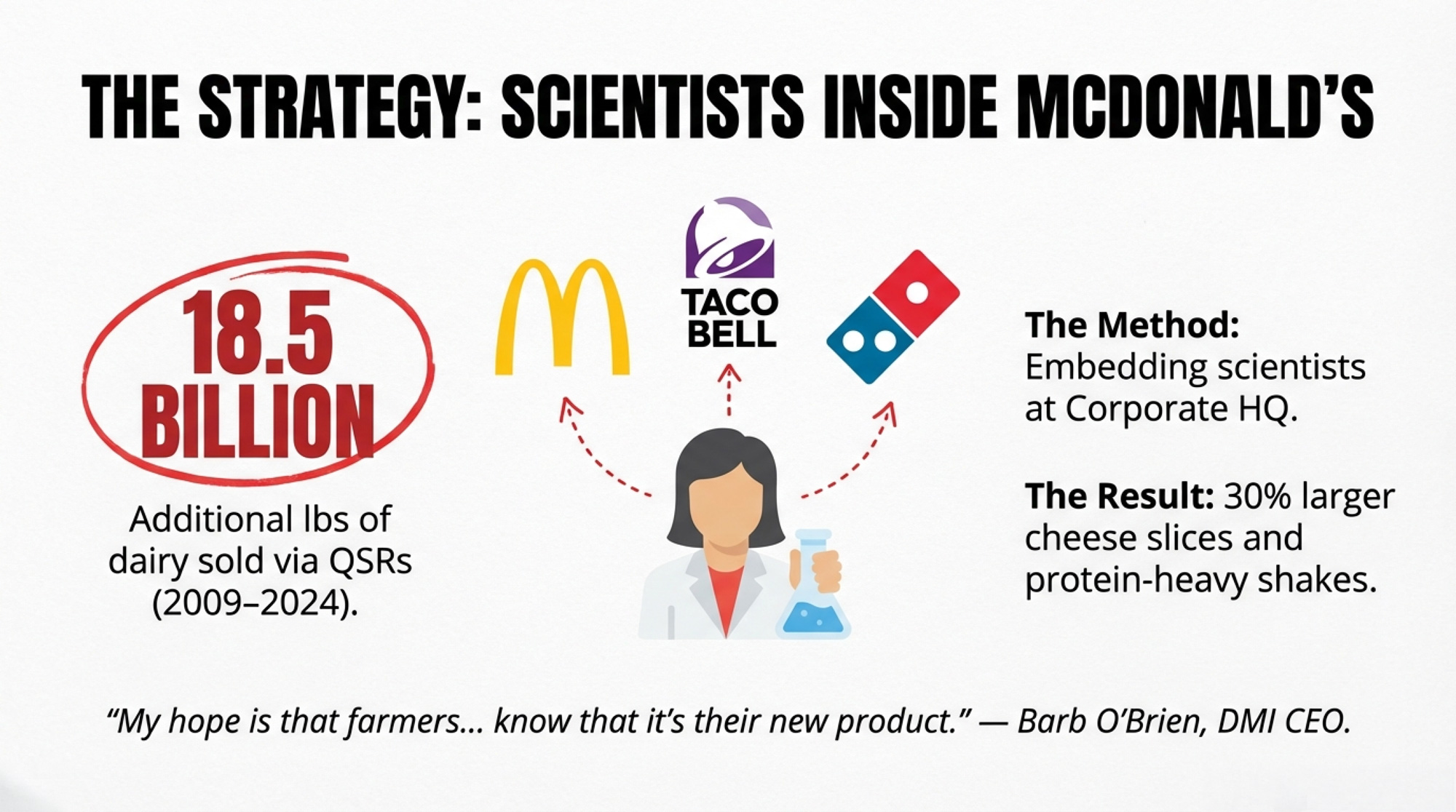
The most recent numbers back up the scale. According to DMI’s November 2025 economic impact report, the foodservice strategy across McDonald’s, Taco Bell, and Domino’s contributed 18.5 billion additional pounds of dairysold at retail between 2009 and 2024 — generating $875.9 million in incremental farmer revenue and a return of $3.49 for every dollar invested.

Why Are Starbucks and Dunkin’ Betting on Your Milk?

Protein has moved from the gym to the coffee counter. And dairy is winning.
QSR ChainProduct LaunchProtein ContentWhy It Matters to Your Breeding Strategy
StarbucksProtein Lattes & Cold Foam (Sept 2025)19–36 grams per grandeUltra-filtered/protein-boosted formulations require high-protein milk — processors will pay premiums for 3.3%+ test herds
Dunkin’“Protein Milk” Line (Jan 2026)15 grams per mediumPartnered with Megan Thee Stallion for launch; protein-forward menu expansion signals sustained QSR demand
McDonald’sWhite Cheddar Slices (rolled out 2015–present)N/A (solid cheese)DMI-embedded scientists upsized slices 30%+ across 14,000 restaurants — cheese demand directly rewards butterfat & casein
Taco BellOngoing Dairy Partnerships (DMI-supported)N/A (multi-product)Part of 18.5B-pound demand increase 2009–2024; volume plays favor mega-herds, but component premiums can level playing field
Raw Milk (Control Group)No checkoff supportN/A21–65% sales surge (2024) despite FDA warnings — consumer demand ≠ checkoff dependence

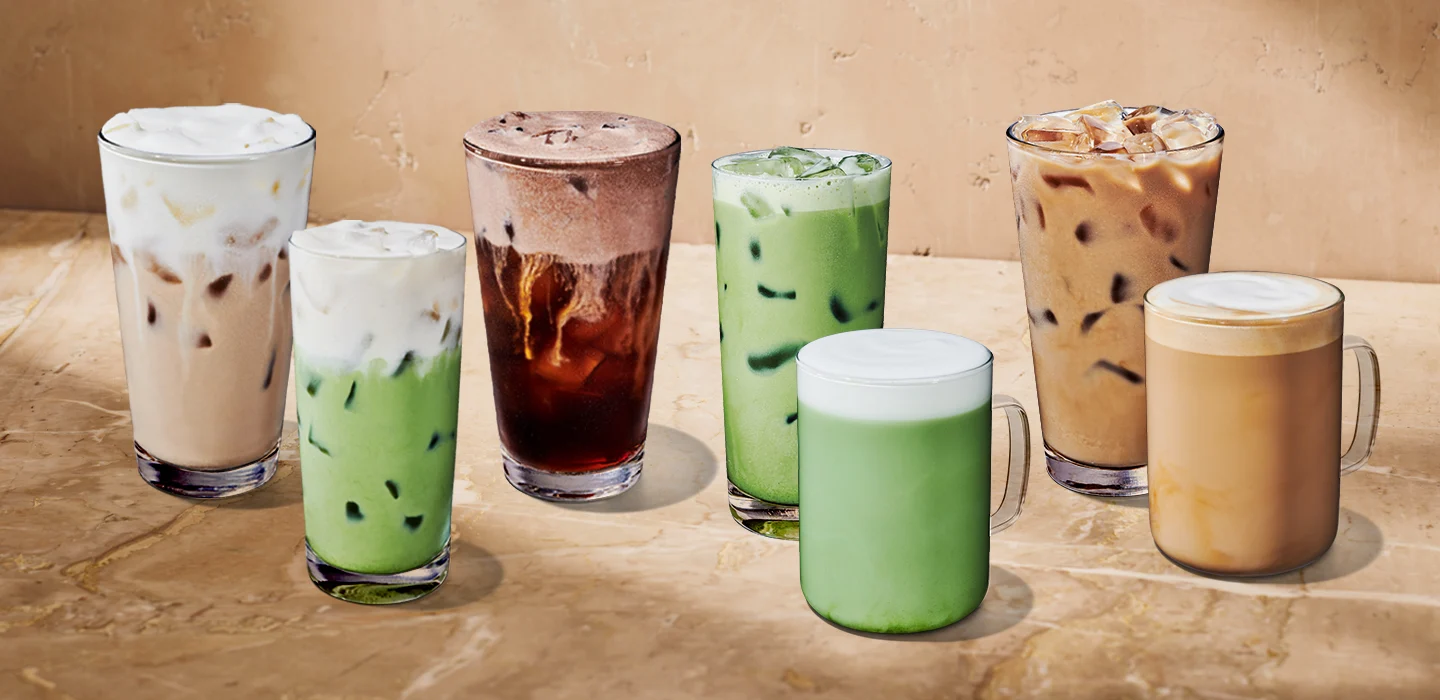
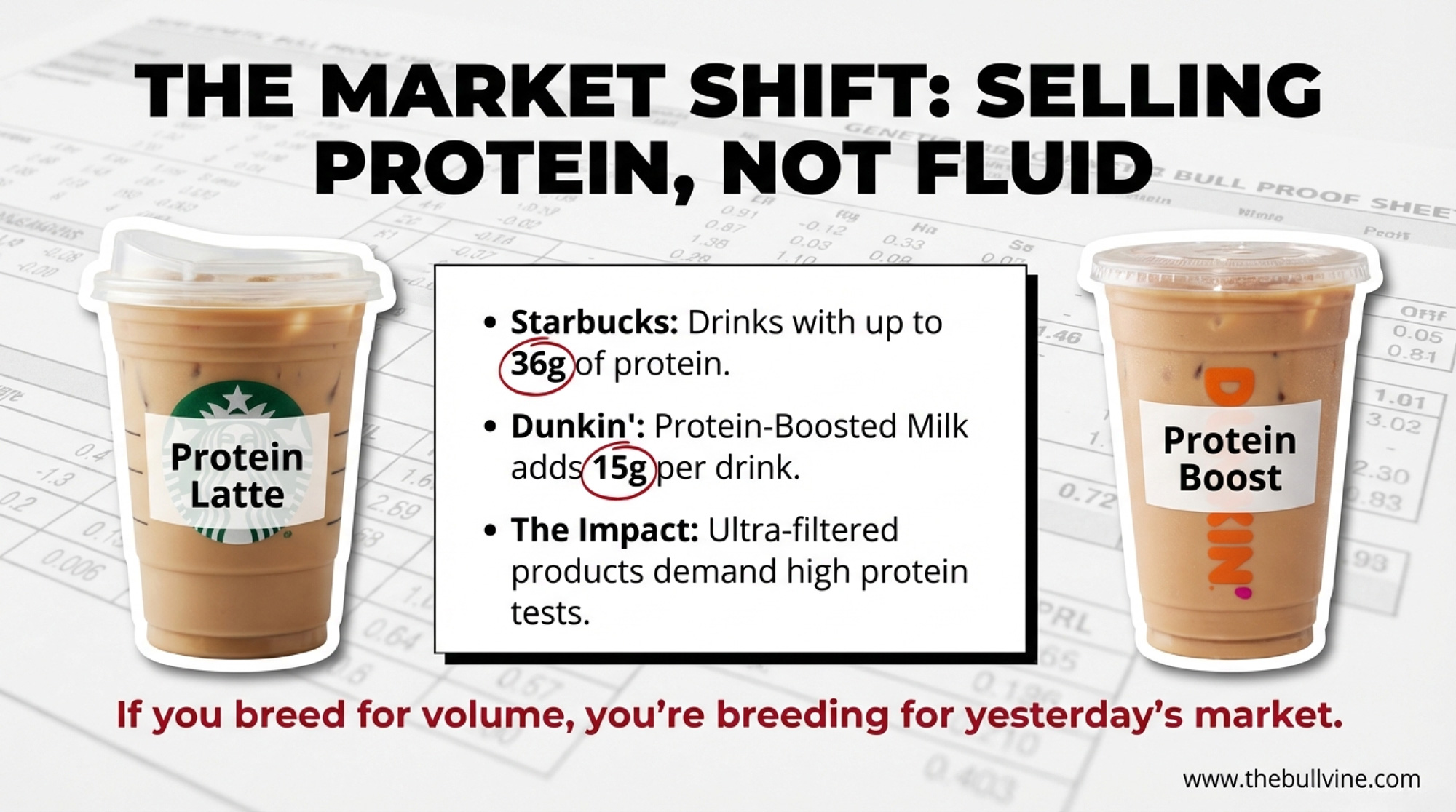
In late September 2025, Starbucks launched protein lattes and protein cold foam nationally, with some drinks delivering up to 36 grams of protein per grande using a “Protein-Boosted Milk” blend of 2% milk and unflavored dairy protein. CNBC reported that protein options would span both hot and iced beverages, with protein cold foam add-ons delivering 19 to 26 grams of protein per grande across the menu. On January 7, 2026, Dunkin’ followed with its own “Protein Milk” — adding 15 grams of protein per medium drink — alongside new Protein Refreshers and Protein Lattes, partnering with Megan Thee Stallion for the launch campaign.

Those protein lattes don’t make themselves. Ultra-filtered and protein-boosted formulations need milk that tests high on true protein — and processors are starting to pay accordingly. As more QSR volume shifts to protein-forward formulations, expect your processor to pay closer attention to your protein test. If you’re selecting genetics primarily for volume and fat right now, this demand shift is worth factoring into your breeding decisions over the next proof cycle.

That’s the case for the money working — 18.5 billion additional pounds through restaurant partnerships, a $500 million cottage cheese brand, influencers with 25 million followers turning butter into lifestyle content. But all those aggregate billions didn’t stop four farms from going under every day. Consider the raw milk market as a kind of control group: according to NielsenIQ data reported by PBS NewsHour, weekly raw cow’s milk sales surged 21% to 65% above the prior year during key weeks in 2024, even as the FDA ramped up H5N1 warnings, with zero checkoff dollars behind it. How much of the butter board boom and the cottage cheese comeback would have happened without DMI? Nobody has a clean answer. But it’s worth asking before you decide whether your $12,300 is money well spent.
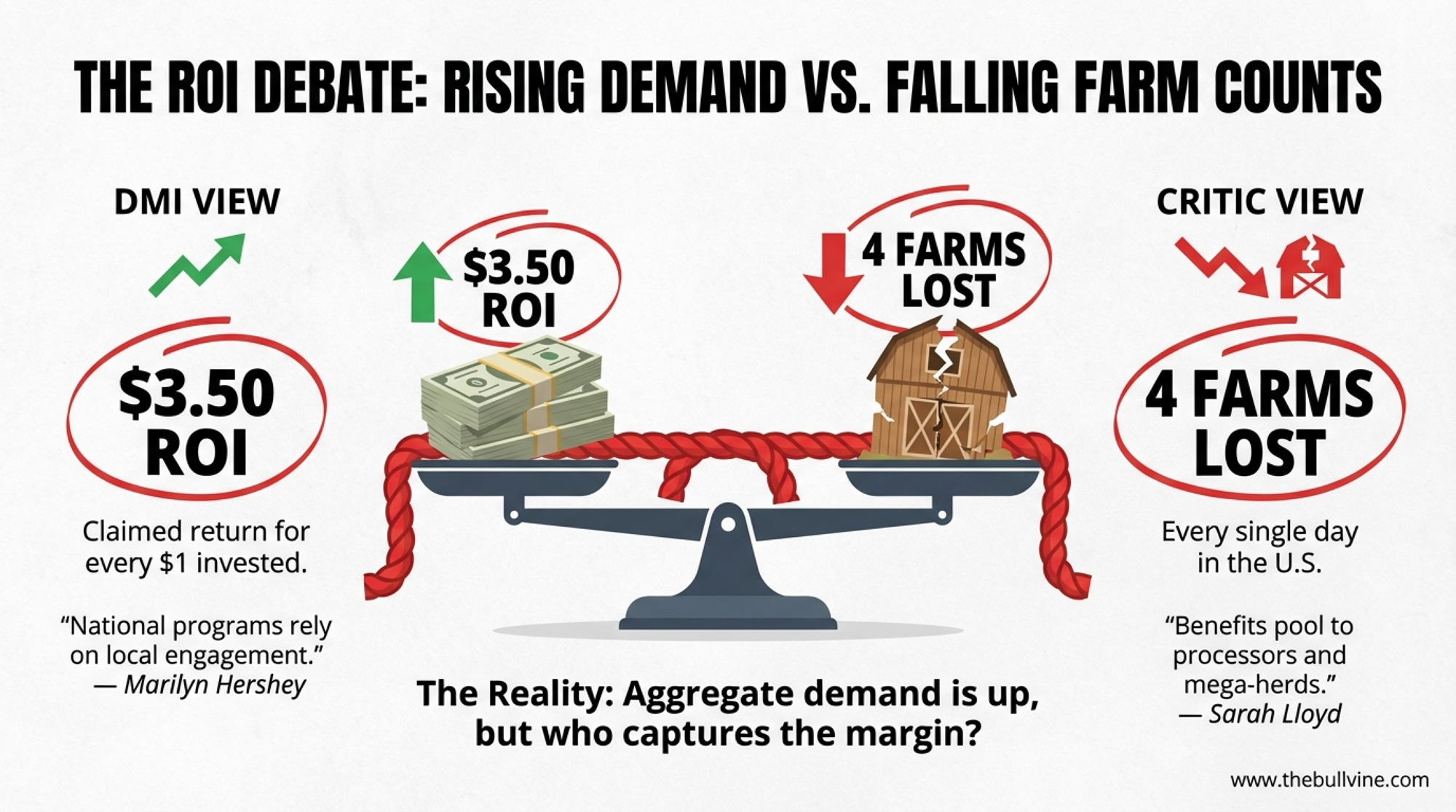
DMI’s counter-argument, supported by USDA-commissioned research led by Dr. Oral Capps Jr. at Texas A&M University, is that the return on investment is measurable: $1.91 per dollar on fluid milk promotion, $3.27 for cheese, and $24.11 for butter, according to the 2020 Report to Congress. The evaluation methodology was reviewed by the Government Accountability Office (GAO-17-188). A more recent DMI-commissioned analysis pegged the overall return at $3.50 per checkoff dollar invested, suggesting milk prices would be roughly $1 per hundredweight lower without the program. Both sides have data. What neither side has is a clean answer to the question that matters most to the 300-cow operator: does that $12,300 you send every year come back to your milk check, or does it come back to the industry’s aggregate numbers while your margins stay flat?

MetricDMI’s Aggregate Claim300-Cow Farm RealityThe Gap
ROI per dollar invested$3.50Unknown — not broken out by farm size or processor typeAggregate ≠ individual
Annual checkoff assessmentScales with volume (15¢/cwt)$12,300 (300 cows, 82,000 cwt/year)Fixed cost regardless of milk check stability
Claimed annual return (at $3.50 ROI)$43,050 total$43,050 theoreticallyWhere does it show up?
Actual milk check impact (Lloyd, Cochran)“Industry demand up 18.5B lbs”“Forced deductions exceed $4,500 annually” (Cochran, 2017)Trickledown doesn’t reach small/mid herds
Farm exits (2015–2025)~4 farms/day nationwideDemand growth didn’t stop consolidation
Protein premium shift (2024–2026)Positioned dairy as protein ingredient$17,900/year per 0.1% test (Jan 2026)Only realized if breeding strategy adjusted

That consolidation story — and what it means for how your processor’s product mix shapes your payday — runs deeper than any single checkoff campaign. And when you look at where 76% of checkoff spending actually lands — cheese and exports — the disconnect between the marketing and the milk check gets sharper.
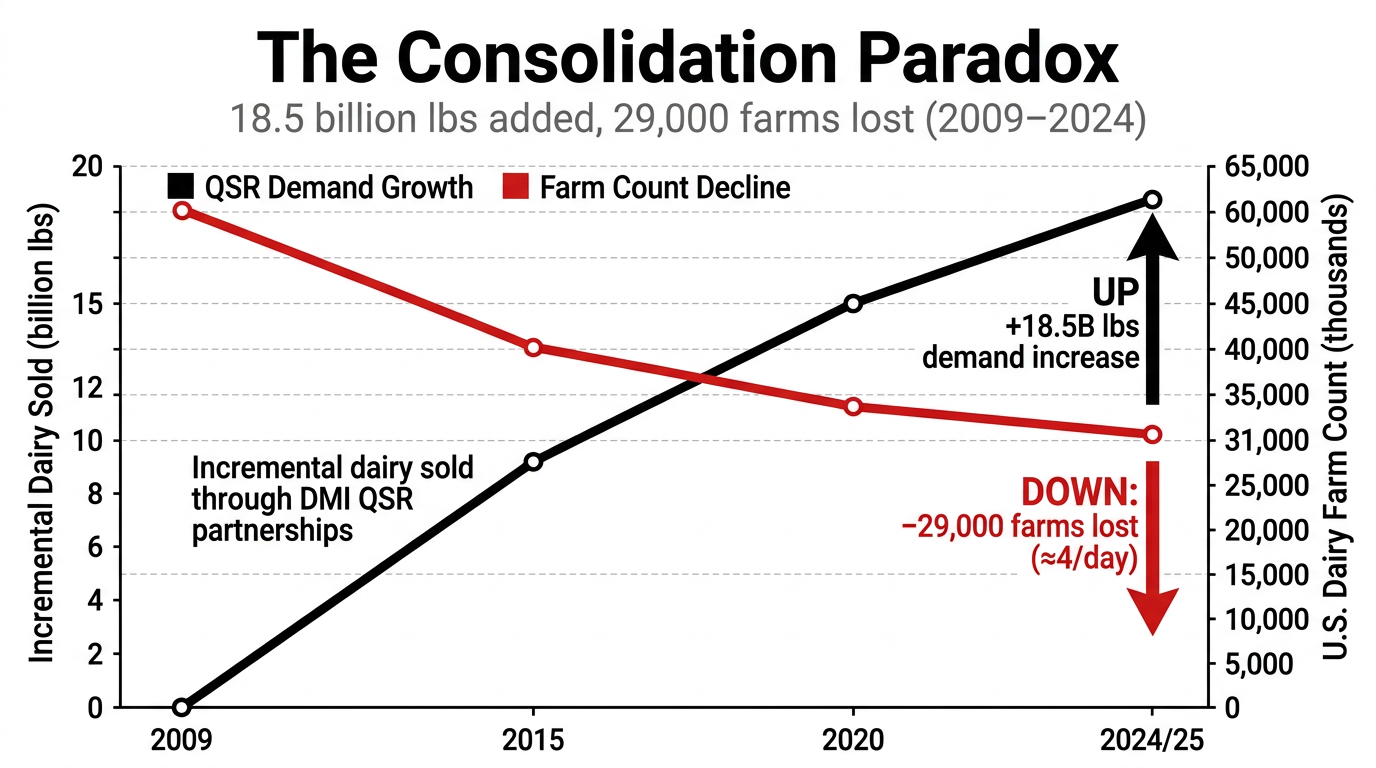
YearIncremental dairy sold (billion lbs)U.S. dairy farm count (thousands)
20090 (baseline)~60,000
2015~9.0 (estimated midpoint)~45,000
2020~15.0 (estimated)~35,000
2024/2518.5~31,000

Options and Trade-Offs for Producers

Is your processor even breaking out components? (30 days) Pull your last three milk checks and look at what you’re actually being paid for butterfat and protein separately. If those lines aren’t there — or if the breakdown isn’t clear — call your co-op or processor this week and ask. At January 2026’s FMMO protein price of $2.18/lb, a 0.1% improvement in your herd’s protein test on 300 cows shipping 75 lbs/day works out to roughly $17,900 per year in additional component value. That’s more than your annual checkoff assessment, from one-tenth of a percentage point.

$17,900 says your genetic strategy deserves a second look. (90 days) If your breeding program is optimized purely for volume, run the numbers on component-weighted selection before your next sire order. You might sacrifice some total pounds per cow, but the revenue per hundredweight could more than compensate — especially now that USDA’s updated FMMO formula uses a 3.3% protein factor (up from 3.1%), amplifying the revenue impact of every tenth of a point. We walked through that math in “Component Gold Rush.”

Good Culture didn’t need the checkoff to build a $500 million brand — but they needed a story. (6–12 months)The cottage cheese, artisan butter, and raw milk booms all show consumer willingness to pay premiums for products with narrative. If you’re within a reasonable distance of a metro market, co-packing partnerships or farm-branded products are worth penciling out. The risk is real: startup capital, regulatory compliance (which varies dramatically by state), and the reality that marketing requires a completely different skill set than dairy farming.

Can’t opt out? Then show up. (Ongoing) Whether you think DMI’s $121.4 million is well spent or not, it’s your money. Review their annual budget at dairycheckoff.com and attend a farmer relations meeting. Ask specifically how influencer and QSR partnership spending translates into demand that reaches your milk check — not just national consumption statistics. “I want farmers to know that I know who I work for,” O’Brien told Dairy Herd Management. Take her up on it.
Key Takeaways

  • If your processor pays component pricing, the butter/protein/cottage cheese demand surge matters directly to your revenue — check whether your fat and protein tests are trending in line with the market’s reward. At January 2026’s FMMO protein price of $2.18/lb, each 0.1% protein test improvement is worth roughly $60/cow/year.
  • If you’re selecting genetics primarily for volume, the protein-forward product boom is a signal to re-evaluate — run your component-weighted revenue per cow against your current selection index before your next breeding cycle.
  • If you’re considering raw milk or value-added as a revenue play, the consumer demand is real, but so is the liability — price your regulatory and insurance costs before you price your product.
  • If you can’t articulate what your $12,300/year bought this year, attend your next checkoff farmer relations meeting and ask. DMI publishes its full budget at dairycheckoff.com — the data is there. Whether the return reaches your operation is a question only your own numbers can answer.

The 30-Day Checkoff ROI Audit: 5 Questions to Ask Your Milk Check (and Your Co-op) This Month

Audit QuestionWhy It MattersWhere to Find the AnswerRed Flag / Green Flag
1. Does my processor pay component pricing?At $2.18/lb protein (Jan 2026), 0.1% test improvement = $17,900/year on 300 cowsLast 3 milk checks: look for separate butterfat & protein linesRed: No component breakdown → you’re subsidizing QSR protein demand without capturing premium
2. What’s my herd’s protein test trend (last 12 months)?DMI positioned dairy as protein ingredient; if your test is flat/declining, breeding strategy isn’t alignedHerd management software or DHI reportsRed: <3.2% protein average → leaving $17,900+ on table vs. 3.3% herds
3. How much did I pay into checkoff last year?15¢/cwt × annual marketable milk = your investment; need baseline to evaluate returnMilk check deduction line (usually labeled “Promotion & Research”)Red: Can’t find deduction amount → demand transparency from processor
4. Can my checkoff rep explain how QSR/influencer spending reaches my milk check?DMI claims $3.50 ROI, but aggregate ≠ individual; force explanation of trickledown mechanismAttend regional DMI farmer relations meeting or email state/regional checkoff contactRed: Answer is “industry-wide demand lifts all boats” → press for farm-size, processor-type ROI breakout
5. What’s my processor’s product mix (fluid vs. cheese vs. exports)?76% of checkoff goes to cheese & exports; if your processor is fluid-heavy, you’re funding demand for someone else’s productCall co-op/processor field rep directly or check annual reportsGreen: Cheese/export processor → your checkoff aligns with spending; Red:Fluid-heavy → structural mismatch

The Bottom Line

Your 15¢/cwt built the butter board moment, put scientists inside McDonald’s, and helped engineer protein into every Starbucks in America. Pull up your last milk check. Look at the checkoff line. Then look at your component premiums. Can you see the return?

Complete references and supporting documentation are available upon request by contacting the editorial team at editor@thebullvine.com.

Learn More

The Sunday Read Dairy Professionals Don’t Skip.

Every week, thousands of producers, breeders, and industry insiders open Bullvine Weekly for genetics insights, market shifts, and profit strategies they won’t find anywhere else. One email. Five minutes. Smarter decisions all week.
NewsSubscribe
First
Last
Consent

76% of Your Dairy Checkoff Funds Cheese and Exports. How Much ROI Hits Your Fluid Milk Check?

Fluid milk finally rose in 2024, then slipped again in 2025. This isn’t a comeback—it’s a math test for any herd that lives on Class I.

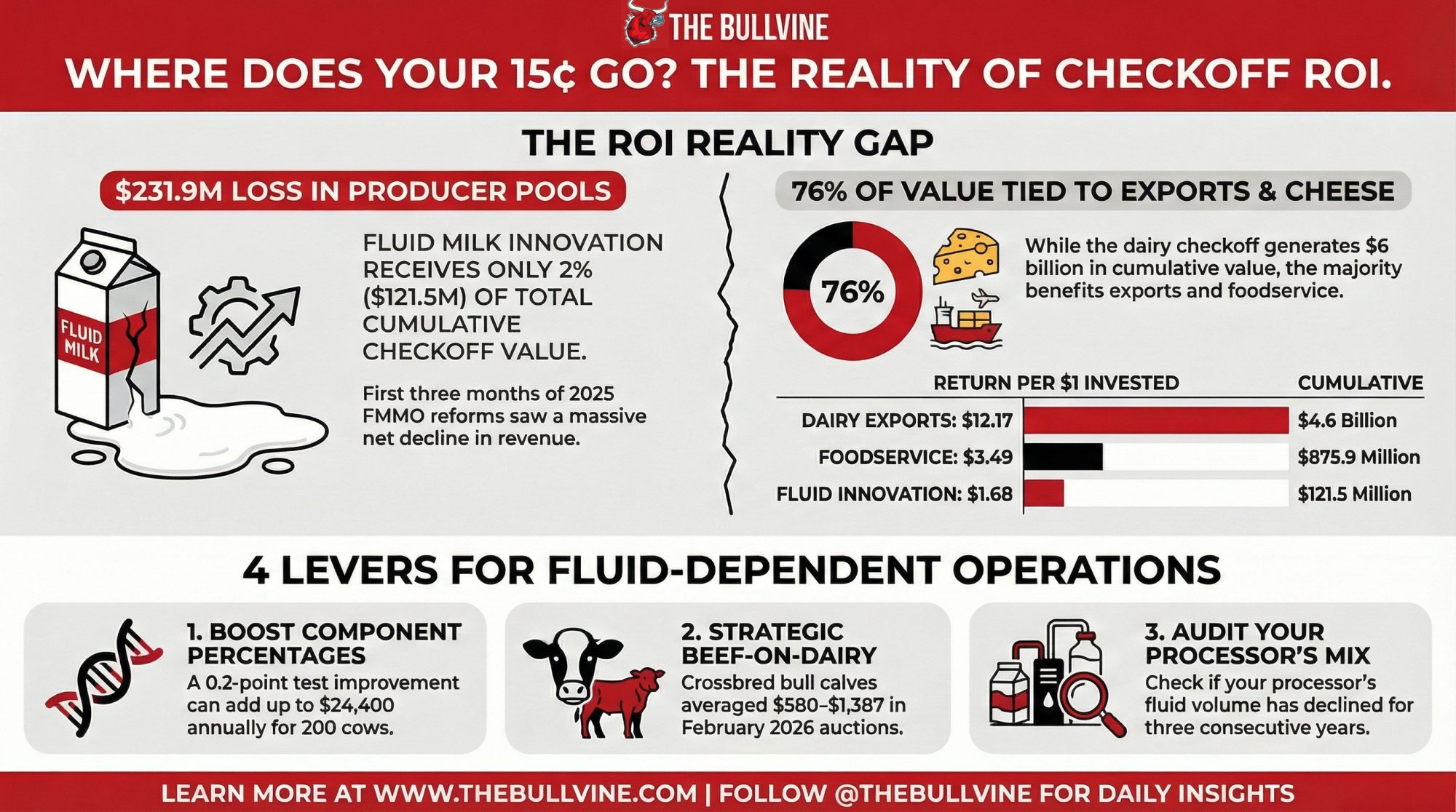
Executive Summary: U.S. dairy producers pay 15¢/cwt into the national checkoff. Texas A&M’s independent model says it adds about $1/cwt to the all‑milk price — but 76% of the $6 billion in cumulative value is tied to cheese exports and foodservice. In comparison, fluid milk innovation gets just $121.5 million and a $1.68 return per dollar. For a 275‑cow herd like Mike Yager’s in Wisconsin, that modelled uplift looks good on paper, yet the June 2025 FMMO reform yanked $231.9 million from producer pools in three months, with his Upper Midwest order losing $64 million to higher make allowances and gaining only $7 million back in differentials. The brief 2024 uptick in fluid sales was driven by higher‑priced whole, organic, and value‑added products, but it flipped negative again in 2025, so this is not a structural demand comeback for conventional Class I milk. At the same time, Coca‑Cola’s fairlife has grown into a $7 billion ultra‑filtered milk brand, showing how checkoff‑supported category growth can create huge value that mostly lands on corporate balance sheets rather than your milk statement. This analysis uses barn‑math walk‑throughs and four practical levers — boosting components, using beef‑on‑dairy strategically, reassessing your processor’s product mix, and tracking school milk and FMMO policy shifts — so you can see how much checkoff ROI actually hits your own fluid milk check and where you still have room to move.

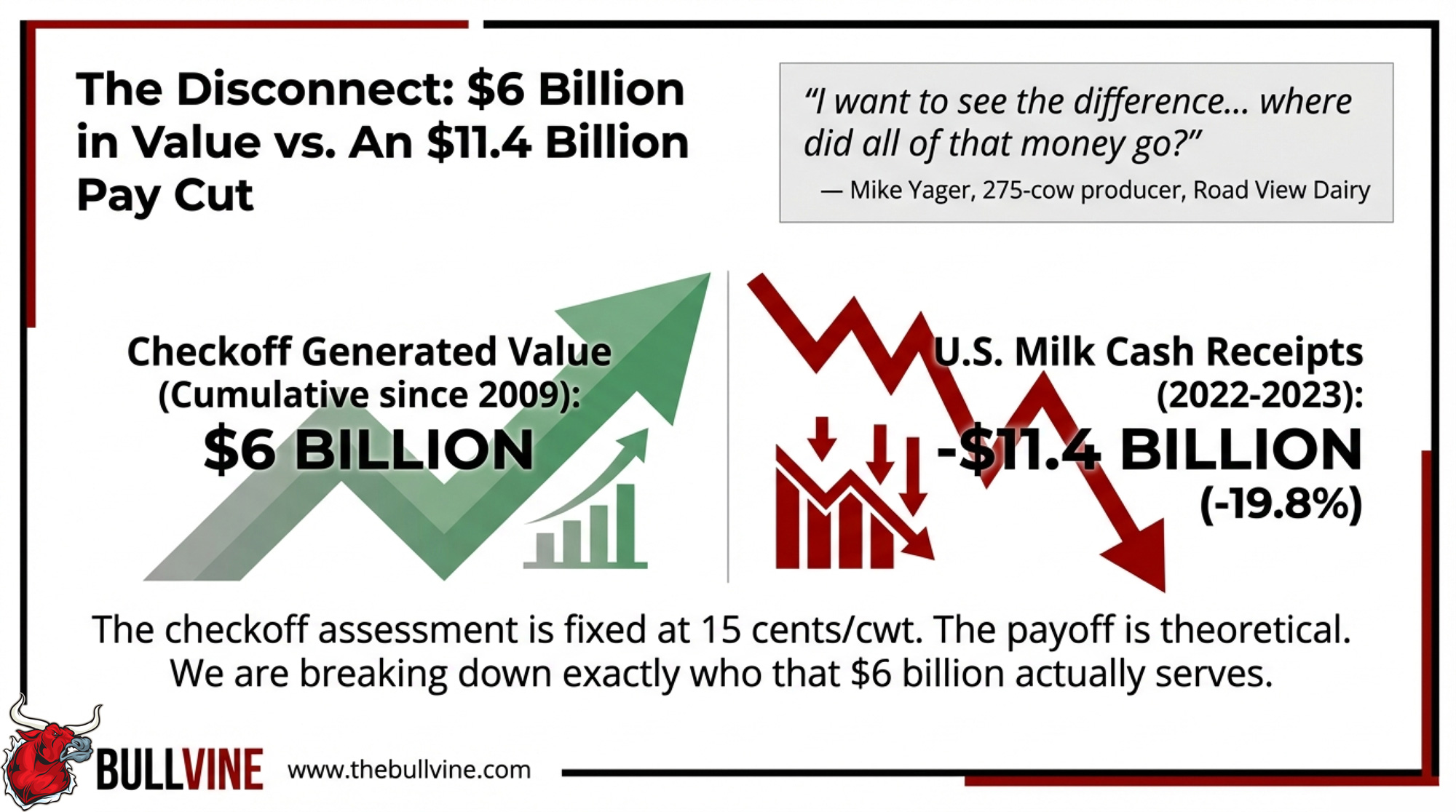
When Mike Yager spoke to Brownfield Ag News last November, he was milking 275 Holsteins at Road View Dairy near Mineral Point, Wisconsin. First-generation operation — he and his wife, Sherri, started it in 1992. He put a question on the air that every dairy checkoff contributor deserves an answer to: “I want to see the difference… the 13.3 billion less we received for the milk in income between those two years… but I’m pretty sure dairy prices were higher for the consumer, so where did all of that money go?” 

He’s asking where the money went. USDA NASS data show a $11.4 billion nominal decline in U.S. milk cash receipts — from $57.3 billion in 2022 to $45.9 billion in 2023 (USDA NASS, April 2024 and April 2023). That’s a 19.8% haircut in one year. Meanwhile, Yager and every other U.S. producer continued to pay 15 cents per hundredweight into the national dairy checkoff. For his 275-cow herd at the time, that’s roughly $7,500 a year. Dairy Management Inc. says those collective dollars generated $6 billion in cumulative farmer value since 2009. 

Six billion sounds like it’s working. Pull the number apart, and the story changes.

Where Your 15 Cents Actually Lands

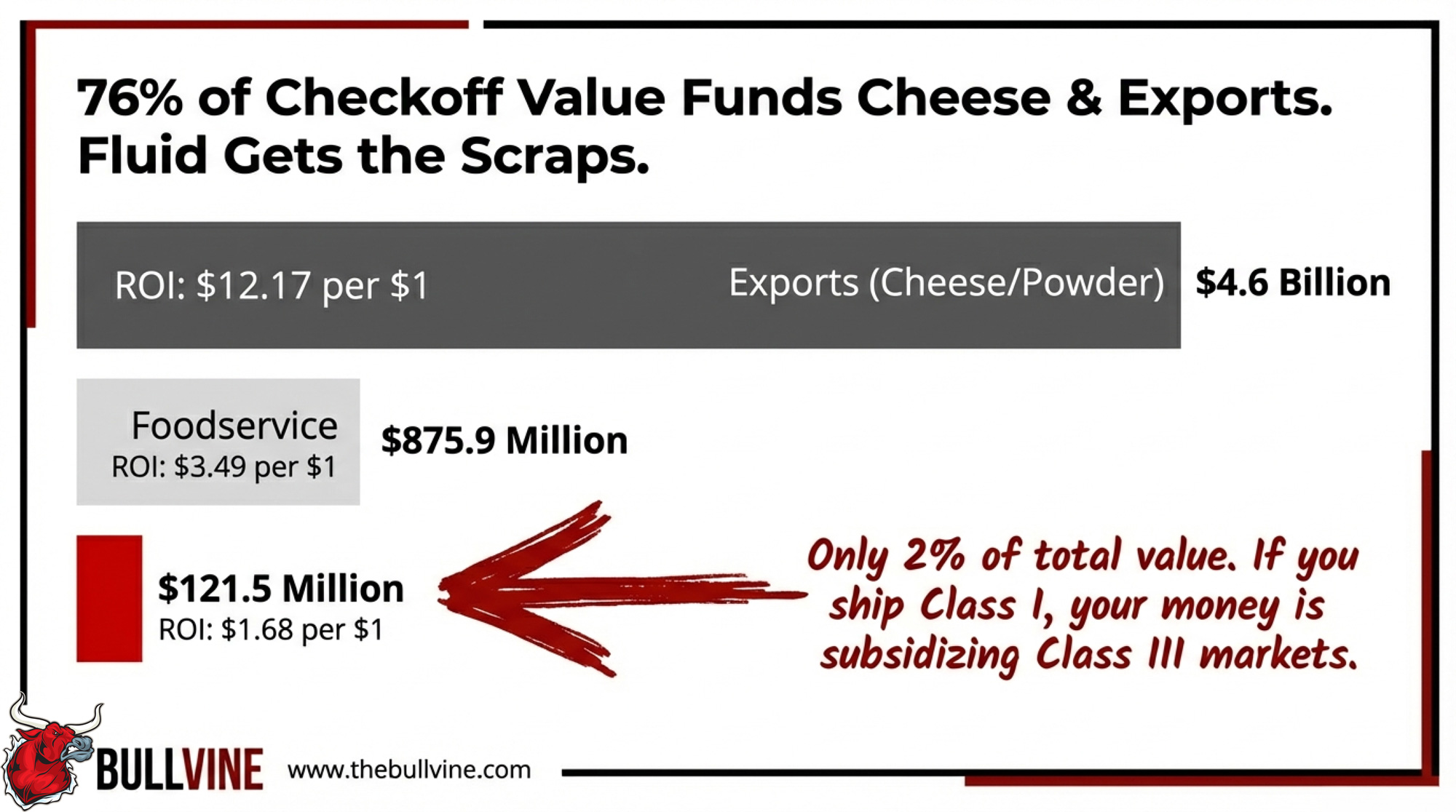
Dr. Oral Capps Jr. at Texas A&M has conducted the federally mandated independent checkoff evaluation since 2011. His breakdown of that $6 billion, presented at DMI’s joint annual meeting with MilkPEP in Arlington, Texas, last November, tells you everything about who benefits most: 

Program AreaPeriodCumulative ValueReturn per $1
Dairy exports2013–2024$4.6 billion$12.17
Foodservice (Domino’s, Taco Bell, McDonald’s, Raising Cane’s)2009–2024$875.9 million$3.49
Whole-fat dairy science2012–2024~$400 million$34.55
Fluid milk innovation2018–2024$121.5 million$1.68

Source: Capps/Texas A&M independent analysis, November 2025; DMI Economic Impact Report

Exports — overwhelmingly cheese, whey, and powder — account for 76% of total value. Foodservice is the checkoff’s most defensible win: DMI embeds dairy food scientists inside partner test kitchens with contractual volume commitments. Producers invested $195.3 million since 2009. That generated $875.9 million in incremental revenue. 

Here’s the structural catch that matters for your milk check: nearly all of this is cheese demand, which lifts Class III pricing. If you’re a fluid shipper, that value reaches you only through FMMO pool blending — diluted across every pound in the system.

The fluid milk innovation bucket? Smallest segment. $121.5 million over six years, returning $1.68 per dollar invested. Not nothing. But it’s 2% of the total cumulative value. 

What Does the Dairy Checkoff Actually Return to a 275-Cow Operation?

Capps’ simulations estimate the all-milk price would sit about $1/cwt lower without the checkoff. That’s a national econometric model — peer-reviewed, independently mandated, and the best available estimate we have. Here’s what it means in formal terms for a herd like Yager’s 275 cows:

Annual checkoff assessment:
(Cows × lbs per cow) ÷ 100 × $0.15Modeled revenue support:
(Cows × lbs per cow) ÷ 100 × $1.00 Theoretical net benefit:
[(Cows × lbs per cow) ÷ 100 × $1.00] − [(Cows × lbs per cow) ÷ 100 × $0.15]

That’s a 6.7-to-1 return at the national level. For a 200-cow herd at the same per-cow production, $50,000 in modeled support versus $7,500 in assessments. Same 6.7-to-1 ratio. Plug in your own numbers — the formula scales linearly.

The critical qualifier: this is a national model, not an individual farm measurement. It assumes the full all-milk price effect reaches every producer equally. It doesn’t. A Southeast fluid shipper and a Wisconsin cheese-country operation live in different economic universes — and the June 2025 FMMO reform made that gap wider.

How the FMMO Reform Changed the Checkoff Math

The reform that took effect June 1, 2025, raised allowances, restored the higher-of Class I mover, increased Class I differentials, removed 500-lb barrel cheese from pricing surveys, and — six months later — updated milk composition factors. 

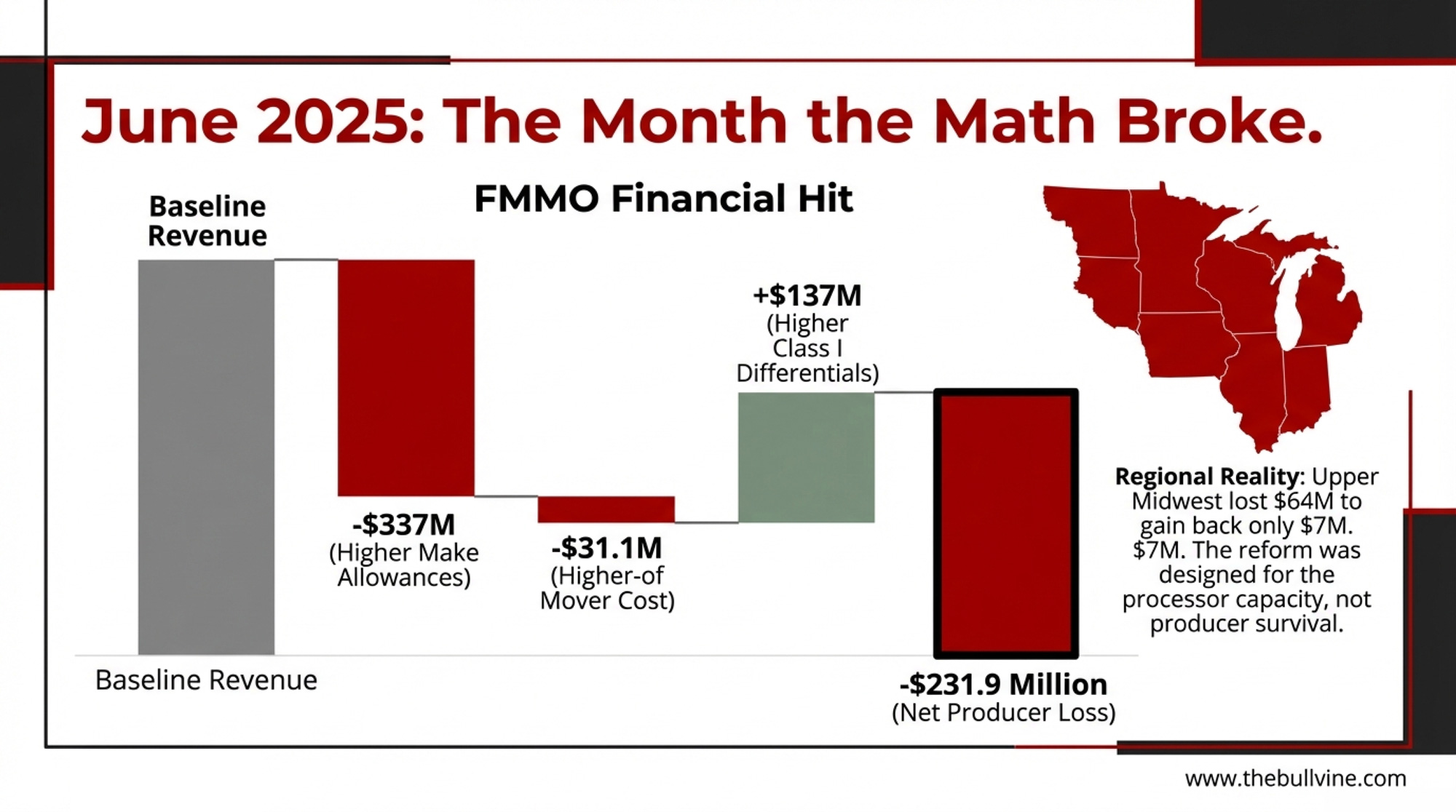
AFBF economist Daniel Munch scored the first three months in September 2025. Here’s the headline math: 

  • Make allowances, cut $337 million from pool revenues — class prices dropped 85 to 93 cents per hundredweight.
  • Higher Class I differentials clawed back $137 million — but the skew was sharply regional.
  • Higher-of mover costs $31.1 million versus the old formula in calm markets
  • Net result: $231.9 million less in producer pool revenues across all 11 orders

The regional breakdown is where this gets personal: The Upper Midwest lost $64 million in make allowance costs and recovered just $7 million in differentials — the widest gap of any order with complete data. California: $55 million out, $7 million back. The Northeast fared comparatively better — $62 million in losses but $34 million in differential recovery — because it carries the highest Class I utilization among the large orders. Cooperatives in the Northeast, where Class I utilization is highest, have pointed to the differential recovery as partial validation. The Mideast recovered $30 million in differentials, but AFBF didn’t break out its individual make allowance hit.

Federal OrderMake Allowance CostDifferential RecoveryNet ImpactPer-Cwt Effect
Upper Midwest-$64M+$7M-$57M-$0.86
California-$55M+$7M-$48M-$0.73
Northeast-$62M+$34M-$28M-$0.42
MideastNot disclosed+$30MUnknown
All Orders-$337M+$137M-$231.9M-$0.35 avg

Yager’s herd sits in that Upper Midwest order — where producers absorbed the largest make allowance hit of any region. Sixty-four million out, roughly a dime on the dollar back. The reform was designed to help processors invest in capacity. It wasn’t designed for a 275-cow Mineral Point operation.

Dairy economist Calvin Covington confirmed the Southeast will see the “majority of benefit” from updated differentials, with composition factors adding about 35 cents per cwt to Class I prices in the southeastern orders still using fat/skim pricing. 

University of Minnesota dairy economist Marin Bozic offered a contrarian read to Brownfield Ag News in January 2025: he expects more milk to be pooled under the new formulas, not less, because “the processors have stronger incentives to bring that milk to the pool to try to get a piece of the producer price differential and forward that to their patrons”. Over-order premiums, in his view, “will come back.” Worth watching — but not here yet. 

The 2024 Recovery That Wasn’t

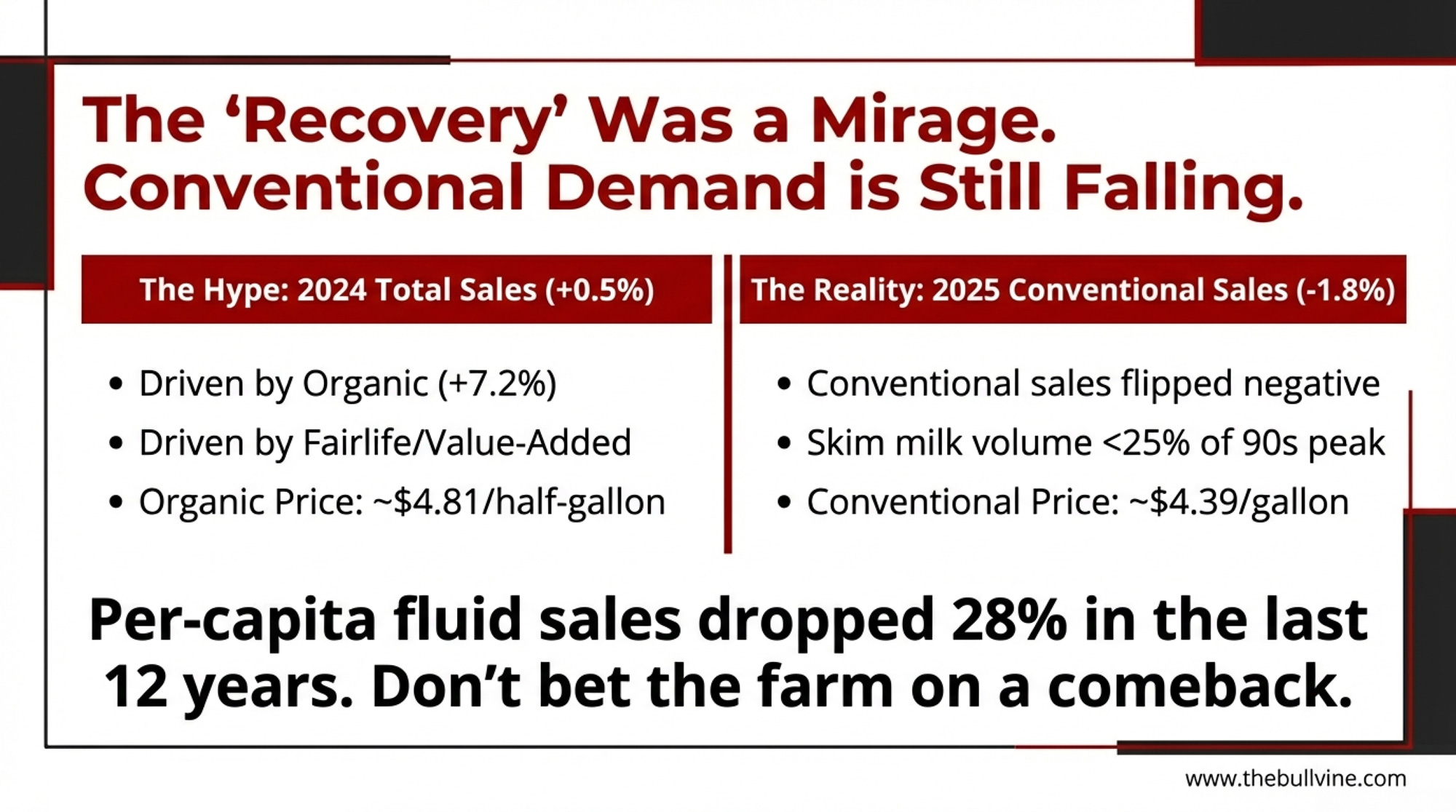
Total U.S. fluid milk sales rose in 2024 — the first year-over-year gain since 2009. USDA AMS in-area route sales showed roughly 0.5%; ERS total estimates ran closer to 0.6–0.8%. 

Dig into the segments, and the optimism fades. Whole milk topped 15 billion pounds, up 1.6% — first time since 2007 outside the COVID-era spike. Organic rose 7.2% to approximately 3 billion pounds. Value-added products like fairlife kept climbing. But reduced-fat (2%) fell 4.4%. Skim sits at less than a quarter of its late-1990s peak. 

None of those growth segments is cheap milk. Conventional whole averaged a record $4.39 per gallon in 2024 — up 5 cents from 2023, based on federal order market administrator surveys across 30 cities (Hoard’s Dairyman, January 22, 2025). Organic whole averaged $4.81 per half gallon. More than double conventional on a per-gallon basis. 

Karen Gefvert of Edge Dairy Farmer Cooperative called it: the increase “was not significant, and is likely just sort of a pause in the inevitable continuous decline in fluid milk sales”. 

She was right. By February 2025, USDA AMS monthly data showed total sales down 2.2%, year-to-date down 1.3%. First-half 2025: down 0.5% on a leap-day-adjusted basis, totaling 21.1 billion pounds. November 2025: total fluid down 1.8%, conventional down 1.5%, organic down 6.0% (USDA AMS, January 2026). 

Per-capita sales dropped 20% over 35 years from 1975 to 2010. Then fell another 28% in just the next 12 (from USDA data). The acceleration matters more than any single-year recovery. 

The $7 Billion Brand Your Checkoff Built — for Coca-Cola

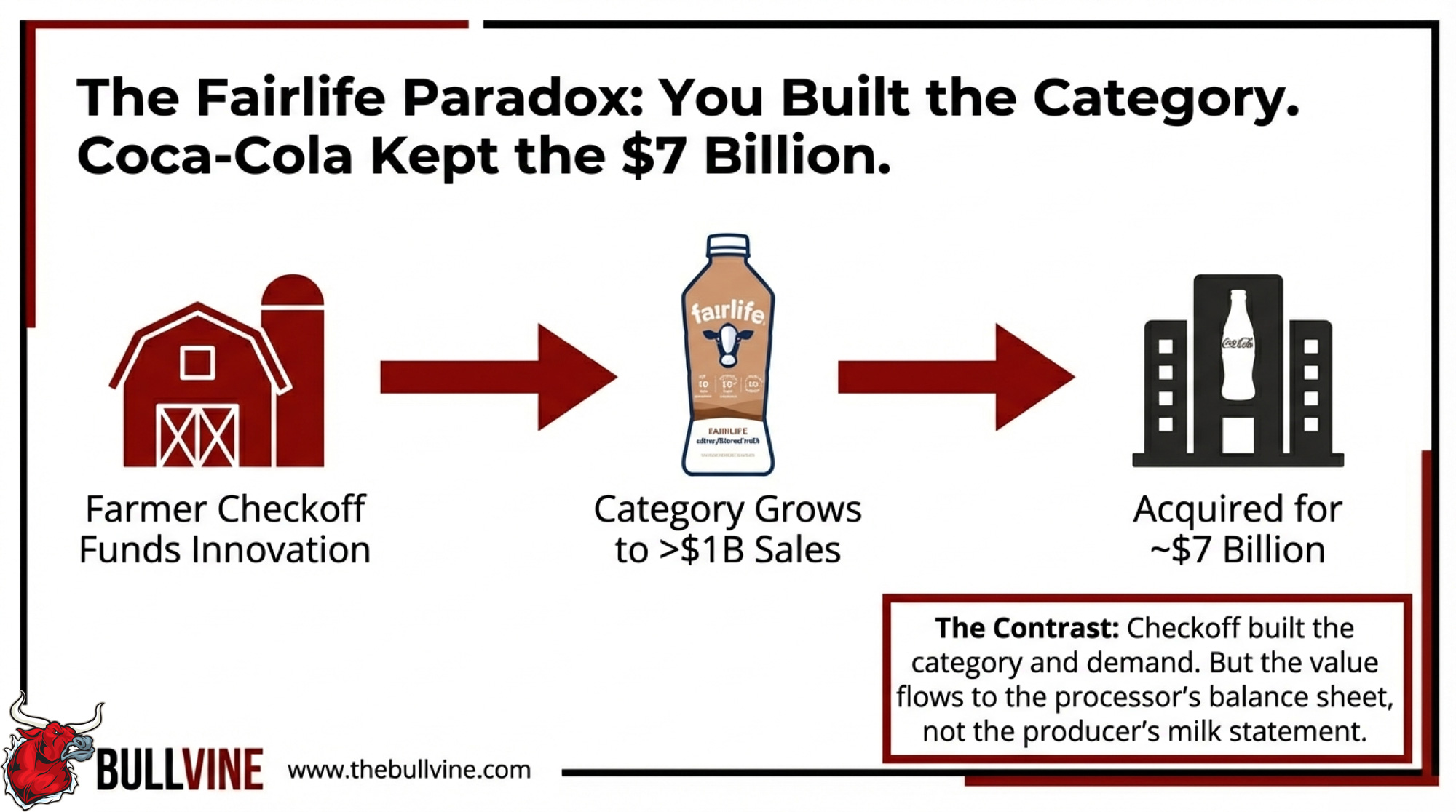
No brand illustrates the value-capture gap more clearly than fairlife. Mike and Sue McCloskey — dairy farmers who built Fair Oaks Farms in Indiana — co-developed ultrafiltration technology with Select Milk Producers in a joint venture with Coca-Cola. Launched nationally in 2014. Coca-Cola acquired full ownership in 2020. By early 2025, the total cost, including performance-based earnouts, reached approximately $7 billion. Fairlife surpassed $1 billion in annual retail sales by 2022. 

The new $650 million fairlife plant in Webster, New York creates real volume demand for area producers. But the brand premium that makes fairlife a multi-billion-dollar asset flows to Coca-Cola shareholders—not back to the producers whose assessments helped build the fluid milk innovation category. 

That’s by design. Commodity promotion builds the category. The market decides who captures margin. Understanding the difference isn’t cynicism — it’s information you need to make better decisions about where your own operation captures value.

Do Consumer Campaigns Actually Move Gallons?

The foodservice partnerships bypass consumer persuasion entirely — dairy gets engineered into products people already order. That mechanism has tight evidence behind it. 

Consumer-facing campaigns are a different story. DMI’s Dairy Diaries Roku series reported 52% of viewers left with a “very favorable” opinion of dairy. No purchase behavior data published. Got Milk? achieved massive awareness over three decades, while per capita consumption declined each year. Views aren’t gallons. 

DMI CEO Barbara O’Brien cited a 2025 back-to-school activation that “generated 1.5% sales growth in participating markets” (DMI, November 2025). If that comes with a published methodology and proves replicable, it’s genuinely meaningful. As of February 2026, DMI hasn’t released methodology, market definitions, or measurement periods for that claim. 

Four Moves for Fluid-Dependent Operations

The checkoff ROI conversation matters. But you can’t wait for Washington or Rosemont to fix your milk check. Here are four things within your control.

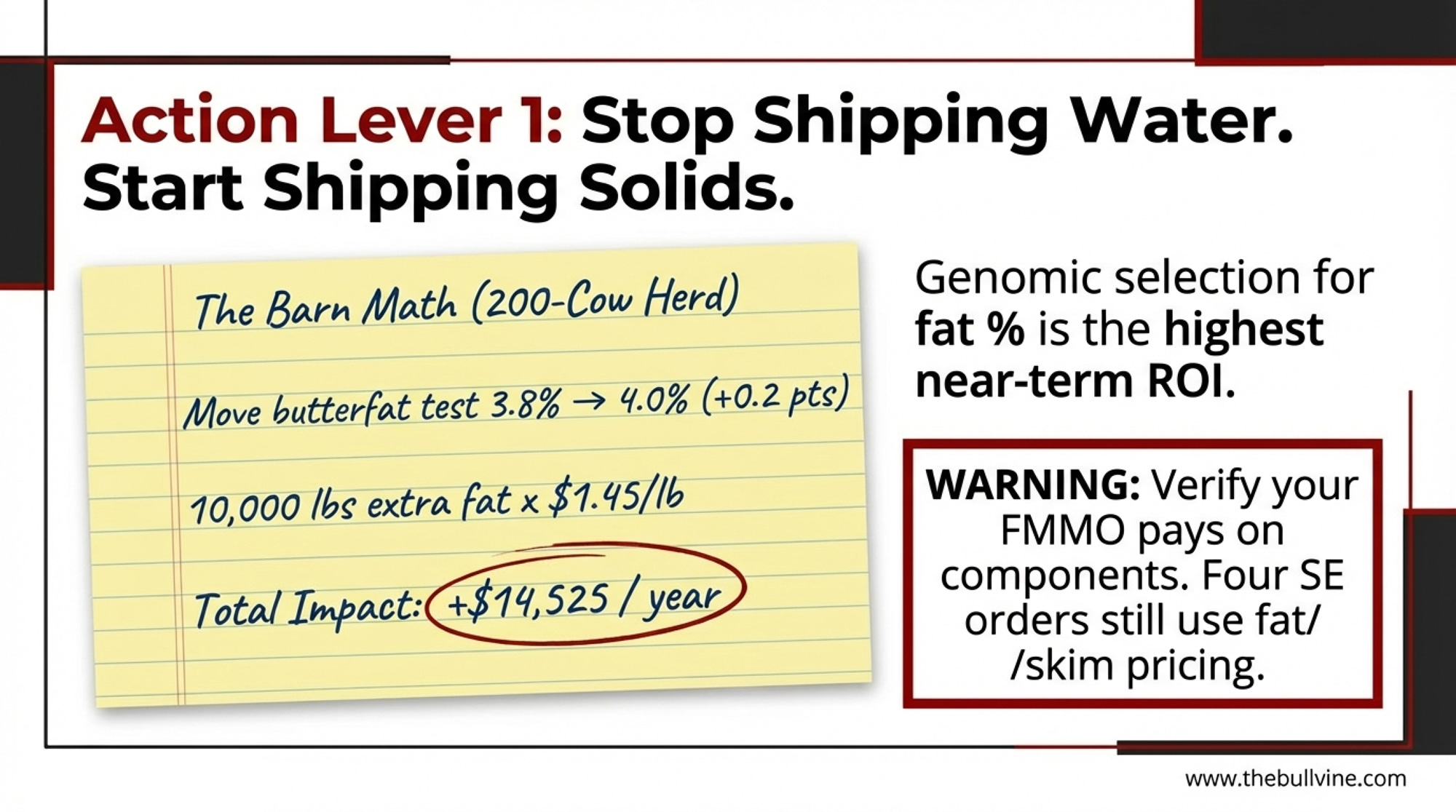
1. Push your components higher. The federal order butterfat price averaged $2.44/lb across 2025, though it dropped sharply from $2.95/lb in January to $1.58/lb by December (USDA AMS). Even at January 2026’s $1.4525/lb, the math on a 0.2-point test improvement is significant. Here’s the walkthrough for a 200-cow herd: 

Added butterfat (lbs):
Cows × lbs per cow × Butterfat test increase

At current prices:

200 cows × 24,000 lbs × 0.002 × $1.45 Annual value at 2025 average:
Added butterfat lbs × $2.44

Plug in your own test numbers. National test climbed from 3.8% to 4.33% between 2015 and March 2025 across FMMO-pooled milk. The genetics are already moving — but the dollar value swings hard with the commodity market. Butterfat dropped 46% in 12 months. 

ScenarioBaseline TestImproved TestAnnual Gain (200 cows)
Current BF Price ($1.45/lb)3.9%4.1%$14,525
2025 Avg BF Price ($2.44/lb)3.9%4.1%$24,400
Annual Production5M lbs (25,000 lbs/cow)
BF Increase (lbs)10,000 lbs+0.2 pts × 5M lbs

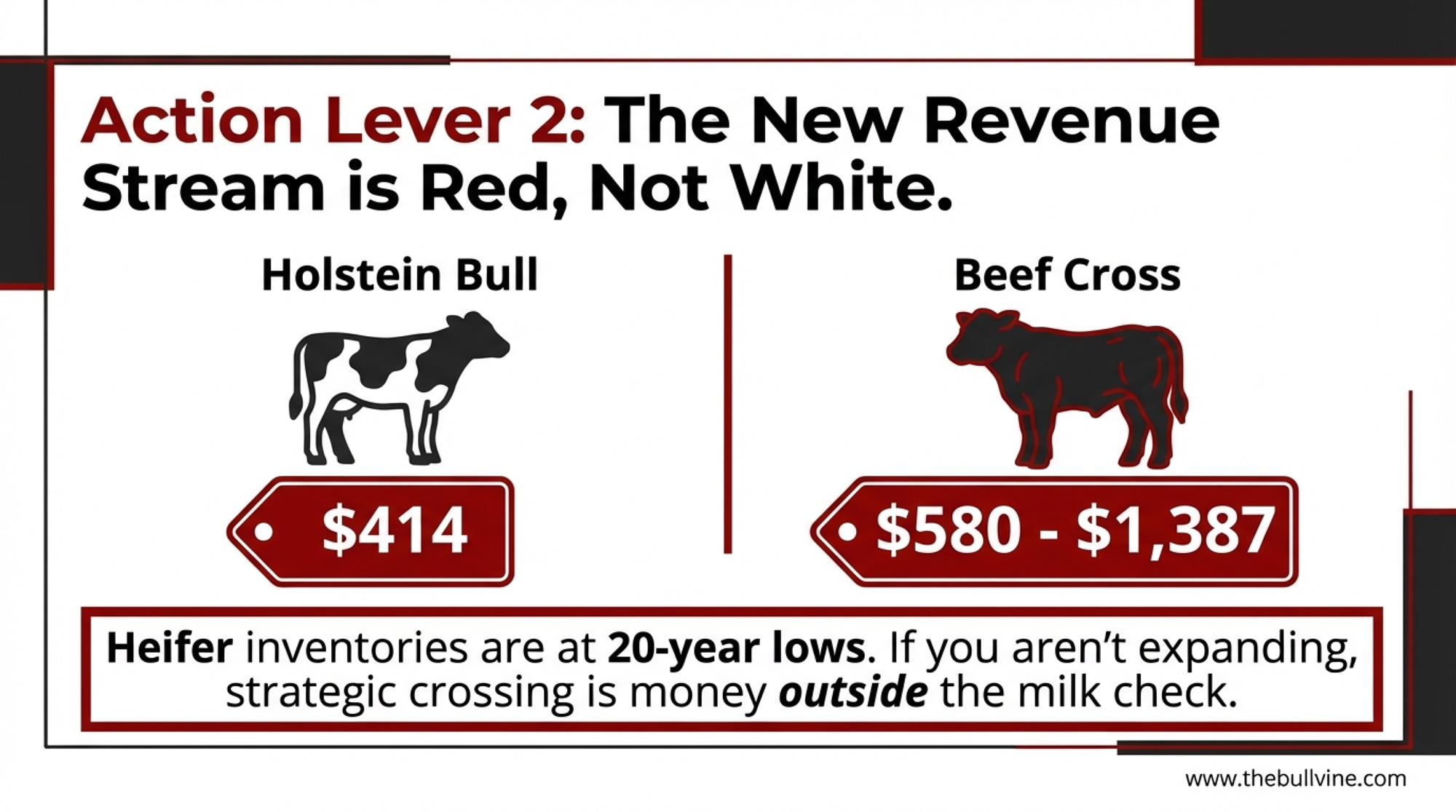
2. Run the beef-on-dairy math. Beef cow inventory has been down for six consecutive years since the 2019 peak (Hoard’s Dairyman, March 30, 2025). Dairy-beef crosses keep commanding wider premiums. New Holland in late January 2025: crosses at $675/head versus $414 for straight Holstein bulls — a $261 premium. By September average prices of $1,400. February 2026 auctions: crossbred bull calves at $7.75–$18.50/lb, meaning a 75-lb calf can clear $580–$1,387 (Edgewood Livestock, February 3, 2026). 

  • Trade-off: Dairy heifer inventories have fallen for six consecutive years to their lowest in 20 years. The crossbreeding trend “suggests that the heifer shortage will continue for years”. Only makes sense if you’re not expanding. 

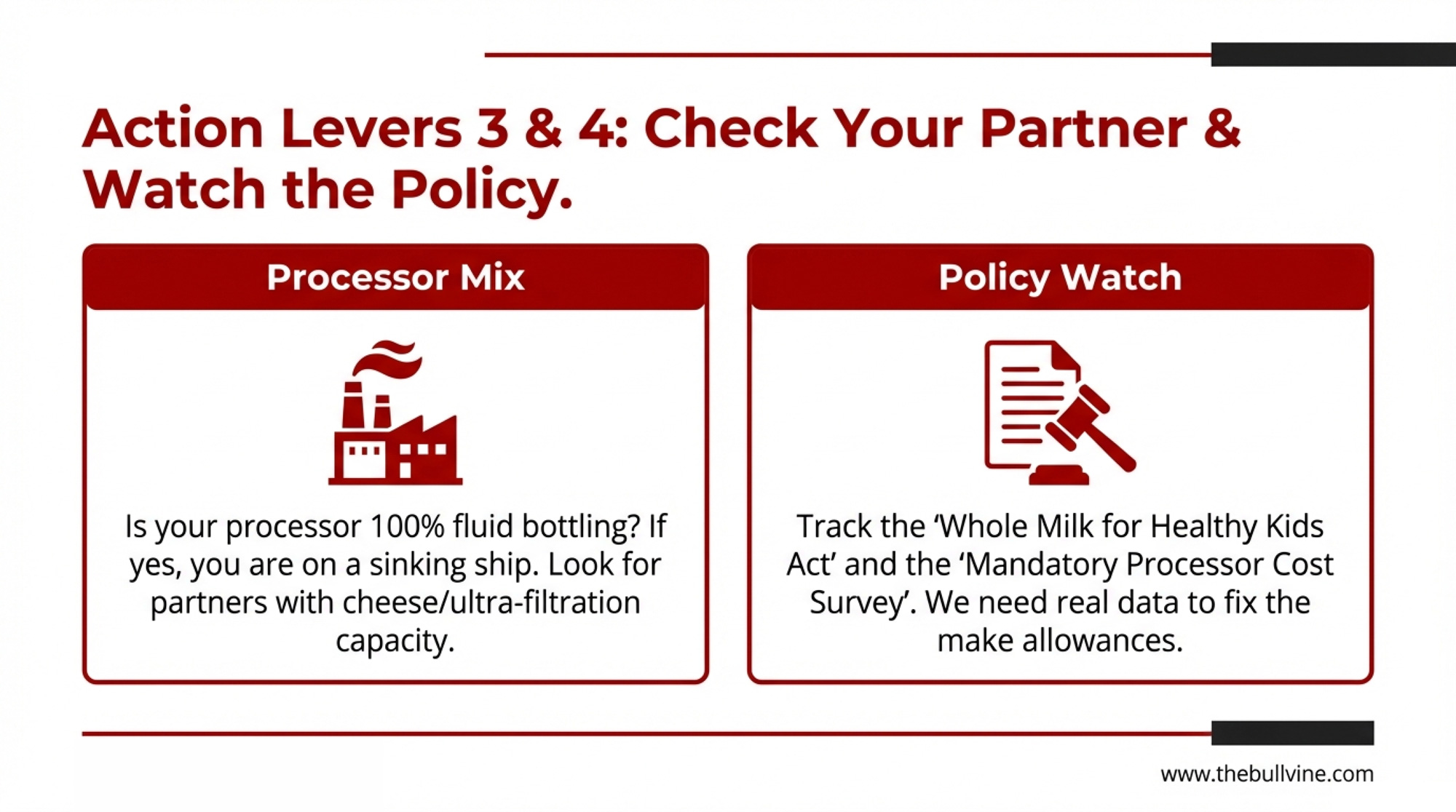
3. Know your processor’s product mix. New cheese and ultra-filtration capacity is expanding — Coca-Cola’s fairlife plant in Webster, plus investments by California Dairies Inc. and Darigold. The new make allowance structure “suggests that cheese production should pick up”. If your current processor is a fluid bottler with declining volumes, your milk market is shrinking regardless of what DMI does. Ask yourself: has your processor’s fluid volume declined for three consecutive years? Regardless of the percentage, that’s a trend, not a blip. Worth a conversation with your cooperative board. 

  • Trade-off: Switching cooperatives means potentially losing patronage dividends, equity credits, or hauling arrangements. Compare the full package — not just the base price on your stub.

4. Track the Whole Milk for Healthy Kids Act. Schools account for about 8% of U.S. fluid milk, amounting to roughly $1 billion per year (Dairy Reporter, April 2025). Real volume. But student consumption has been declining for years, and access alone doesn’t change habits. Watch the data as implementation rolls out. 

What This Means for Your Operation

  • If you ship more than 60% Class I and your cooperative’s utilization is declining, you’re on the wrong side of where checkoff value concentrates. The AFBF data shows the reform’s benefits are heavily skewed by region — California and the Upper Midwest gained just $6–$8 million in differentials, while $55–$64 million in make allowance losses were incurred. Run the net math for your order before assuming you came out ahead. 
  • If your herd butterfat averages below 3.9%, genomic selection for fat percentage likely offers the highest near-term ROI on this list. The walkthrough above shows a 200-cow herd gaining $14,525–$24,400 annually on just 0.2 points of test — but verify your cooperative pays component premiums. Four southeastern orders still don’t. And butterfat dropped from $2.95 to $1.45 in 12 months. 
  • If you’re evaluating organic, organic’s momentum stalled hard in 2025: after growing 7.2% in 2024, it edged up just 0.7% in the first half and, by November, was down 6.0% year-over-year. Run your three-year transition math against a stressed premium scenario, not just the current one. 
  • If you pay $7,500+ per year in checkoff, run Capps’ framework on your own herd: multiply your total hundredweights by $1.00 and compare to your annual assessment. That’s the best-case national model. Then ask what it looks like when Class I utilization drops another five points — because it’s heading that direction. 
  • If your cooperative votes on your behalf in FMMO proceedings, ask about the upcoming mandatory biennial processor cost survey required by the One Big Beautiful Bill Act. That survey could ground future make allowance decisions in verifiable data — the first structural fix to what AFBF called reliance on a self-selected sample of self-reported manufacturers’ cost data. 

📊 Your Accountability Dashboard

MetricSourceFrequencySomething’s WorkingRed Flag
Per-capita fluid decline rateUSDA ERSAnnuallySlows below 2%Holds above 2.5%
Conventional fluid salesUSDA AMSMonthlyStabilizes within -0.5%Keeps falling 1–3%+
DMI campaign sales liftDMI annual reportsAnnually1.5%+ lift replicated with methodologyOne-time claim, never verified
Class I utilizationFMMO market administratorMonthlyHolds above 25% nationallyDrops below 22%
FMMO reform net impactAFBF Market IntelQuarterlyComposition + differentials exceed make allowance lossesNet pool decline continues into 2026
Processor cost surveyUSDA (per OBBBA mandate)BiennialPublished with transparent methodologyDelayed or limited scope

If four or more flash red two years from now, the collaboration built awareness and trust — both valuable — but didn’t bend the structural curve.

Key Takeaways

  • An independent Texas A&M analysis verifies the checkoff’s $6 billion. But 76% is exports and foodservice — overwhelmingly cheese demand that lifts Class III. Fluid milk innovation returned $1.68 per dollar over six years. If your revenue depends on Class I, you’re funding a system that works better for someone else’s milk. The data exists for you to measure that gap. 
  • The 2024 fluid recovery was in the premium segments, pulling the total above zero. Conventional kept eroding. By November 2025, total fluid was down 1.8%, organic down 6.0%. Don’t plan around a trend that lasted 12 months. 
  • Your checkoff dollars helped build the landscape fairlife rides — a brand Coca-Cola values at $7 billion. Understanding that the value-capture gap isn’t a frustration. It’s the starting point for figuring out where your own operation captures margin. 
  • The June 2025 FMMO reform hit producers with a net $231.9 million decline in pool revenue over three months. Benefits skewed heavily by region — the Upper Midwest order, where Yager milks lost $64 million and recovered $7 million. Know your order’s net math. Don’t assume the national story is your story. 
  • Component optimization can add $14,525–$24,400/year for a 200-cow herd that moves 0.2 points of test. Beef-on-dairy crosses are clearing $580–$1,387 per calf at February 2026 auctions. Neither requires waiting on Washington or your checkoff board. You’ve got levers. Use them. 

The Bottom Line

Pull up your 2024 and 2025 year-end milk statements side by side. What changed? Where did your 15 cents go? When Yager asked that question on Brownfield last November, he was milking 275 cows and looking for answers. So are you. And here’s the thing — you’ve got the framework now. The math, the dashboard, the four strategies. The question isn’t whether the checkoff works in aggregate. It does. The question is whether it works for you, in your order, at your scale, with your product mix if the answer isn’t specific enough — from DMI, from your cooperative, from your own milk statement — that tells you exactly where to push next.

Complete references and supporting documentation are available upon request by contacting the editorial team at editor@thebullvine.com.

Learn More

The Sunday Read Dairy Professionals Don’t Skip.

Every week, thousands of producers, breeders, and industry insiders open Bullvine Weekly for genetics insights, market shifts, and profit strategies they won’t find anywhere else. One email. Five minutes. Smarter decisions all week.
NewsSubscribe
First
Last
Consent

Dairy Management’s $165 Million Checkoff Bet: $1.75 Billion Cottage Cheese Boom, $3.01/cwt Class II Drop

Your 15¢/cwt helped sell $1.75B of cottage cheese. Your Class II price went down $3.01/cwt. Explain that.

Executive Summary: Dairy farmers are still paying 15¢/cwt into a national checkoff that now bets big on TikTok creators and retail algorithms, even as the 2025 Class II price fell $3.01/cwt to $18.33 during the strongest cottage cheese demand year on record. The story opens in Andy and Sarah Lenkaitis’ Illinois barn, where influencers filmed cows and robots while milk from that 75‑cow herd headed to a plant making cottage cheese, a TikTok-helped category that’s now worth $1.75 billion. From there, it follows the money through Dairy Management Inc.’s $165.7 million 2024 budget and into campaigns DMI says returned $15.60 in retail dairy sales for every checkoff dollar, set against USDA data showing fluid milk finally up 0.8% while Class II sagged. Along the way, you get barn‑math you can actually use — from a 300‑cow herd’s roughly $12,319/year checkoff bill to a $484‑per‑cow protein price swing you can compare to your own component check. It all leads to one blunt question: if your money helped create the demand and your milk made the product, are you seeing enough of that margin in your mailbox price to call this checkoff bet a win?

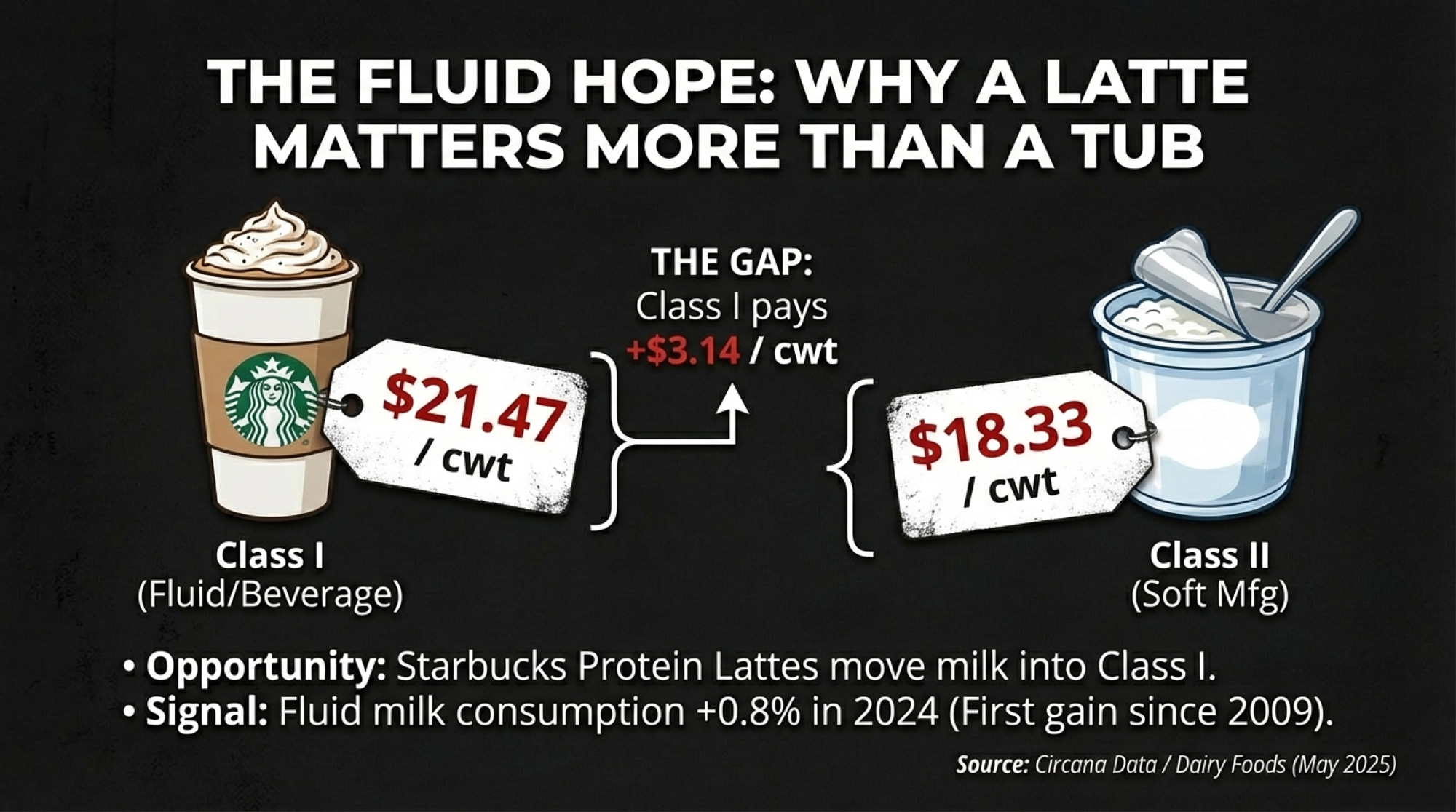
Starbucks launched its Protein Lattes and Protein Cold Foam nationwide on September 29, 2025, delivering 15 to 36 grams of protein per grande. Every cup is classified as Class I milk under federal orders — priced at $21.47/cwt in 2025, a $3.14 premium over the $18.33 Class II price on cottage cheese. For your blend price, every latte beats every yogurt cup.

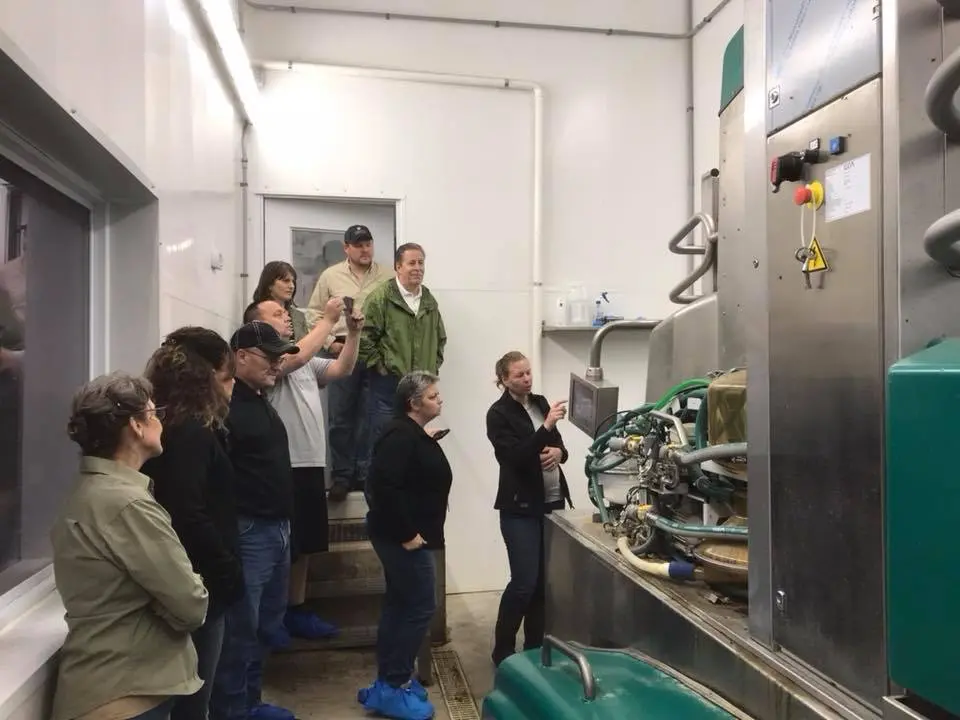
One day in early December 2024, parenting blogger Aneta Linko and her family walked into Andy and Sarah Lenkaitis’s dairy barn in Campton Hills, Illinois — one of three dairy farms left in all of Kane County. The Lenkaitis family milks about 75 Holsteins with robots, grows their own feed, and gives tours to the subdivision neighbors who now surround them on two sides. That day, though, the visitors weren’t neighbors. They were content creators, and the cameras were rolling.

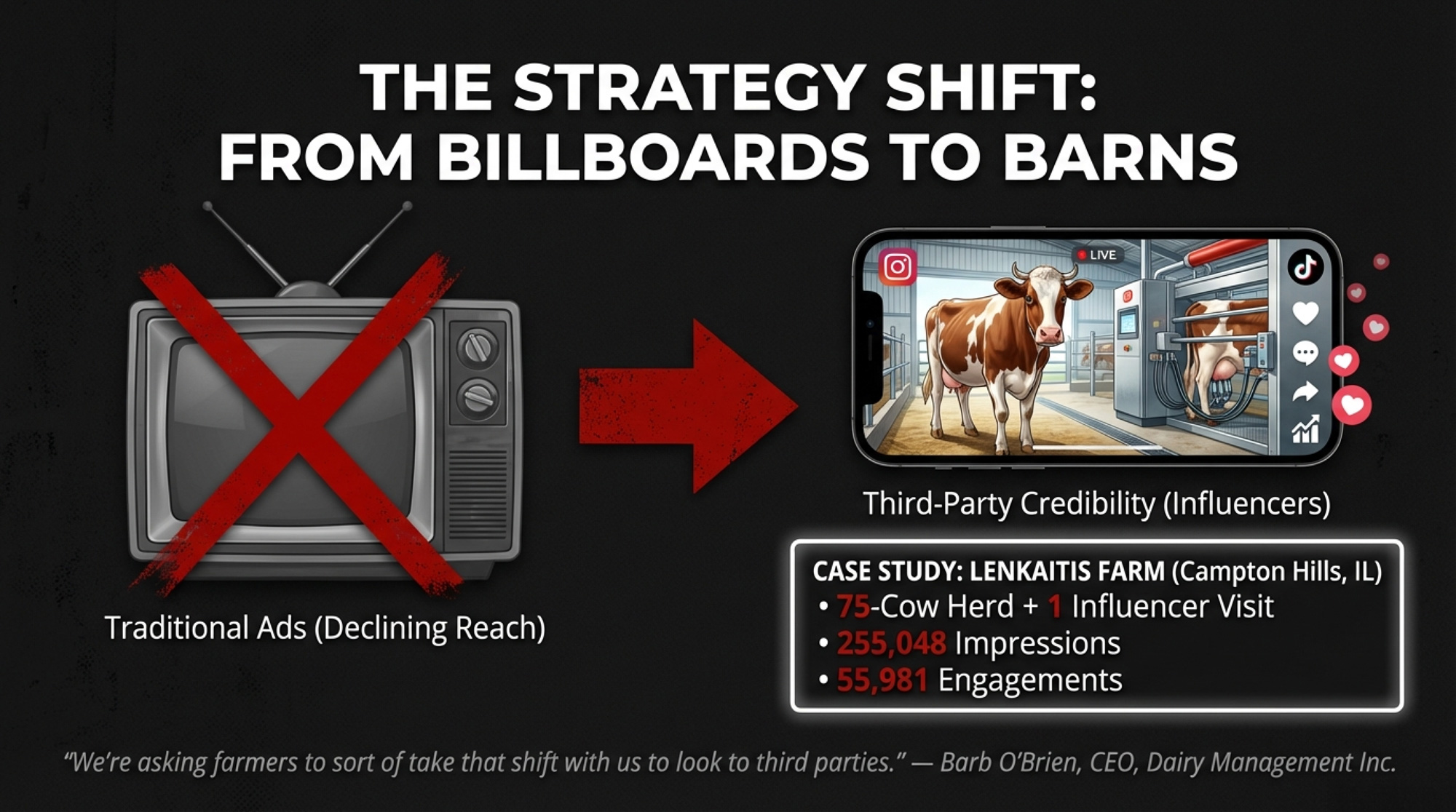
Midwest Dairy had arranged the visit. The resulting posts — Linko highlighting the family’s animal care, the robotic milking system, the quiet daily rhythms of a working farm 40 miles from downtown Chicago — generated 255,048 impressions and 55,981 engagements. One farm. One day. Quarter-million eyeballs. And every dollar that funded it came from the same place: your checkoff.

The strategy behind that visit didn’t originate in Campton Hills. It came from Barb O’Brien, President and CEO of Dairy Management Inc. On the Your Dairy Checkoff Podcast, O’Brien told producers the organization had fundamentally changed course. “We’re spending fewer dollars directly to consumer ourselves,” she said. “We’re asking farmers to sort of take that shift with us to look to third parties, who we think can bring more visibility, more credibility, and ultimately more sales.”

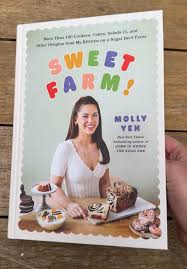
Food Network star and checkoff partner Molly Yeh — a New York Times bestselling author who lives on a sugar beet farm near the Minnesota–North Dakota border — was one of the influencers Midwest Dairy tapped for its late-2024 “Cheesy Season” campaign, which generated 10.1 million impressions. Her cookbook Sweet Farm! is built around dairy-heavy recipes from her farm kitchen. The question this article asks: does that kind of reach show up on your milk check?

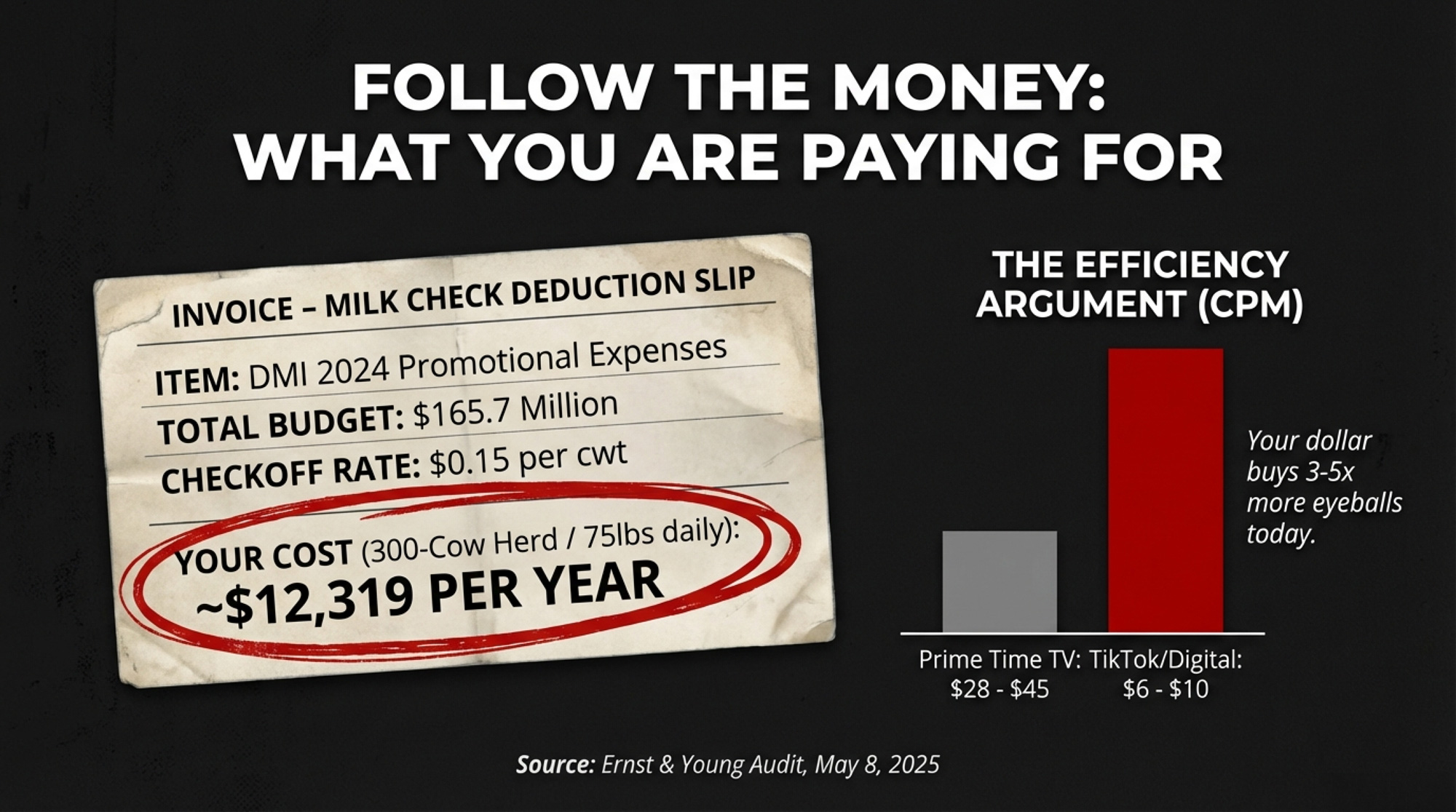
Those third parties are TikTok creators, Instagram food influencers, and names like Molly Yeh and Faith Enokian. DMI’s 2024 audited financials, filed by Ernst & Young on May 8, 2025, show the scale of the shift: $165.7 million in total expenses, $127.1 million directed toward domestic marketing programs, and $76.6 million specifically in promotional and professional services. Those figures come straight from the Ernst & Young audit — confirmed to the penny in DMI’s public filings at dairycheckoff.com.

The question isn’t whether these campaigns get eyeballs. They do. It’s whether those eyeballs translate into something you can measure at the farm gate.

Why Did DMI Abandon Billboards for TikTok?

You don’t blow up a marketing playbook that worked for decades unless you’re scared. And the fluid milk numbers were scary enough.

USDA’s Economic Research Service reported in June 2022 that U.S. per capita fluid milk consumption has been falling for over seven decades. But the 2010s accelerated the damage: daily per capita consumption dropped 20.7%, from 0.62 cups in 2010 to just 0.49 cups by 2019. Analysis of USDA data (August 2025), per capita milk sales fell 28% between 2011 and 2023, averaging a 2.2% decline annually — more than four times the pre-2010 rate.

USDA noted that plant-based milk alternatives explain “some, but not all” of that decline. The bigger problem was cultural: an entire generation grew up without dairy as a default part of their day. (For a deeper dive into the decade-long decline in fluid milk consumption, The Bullvine covered the trend and its implications last year.)

DMI and the regional checkoff organizations watched those trendlines and made a bet. And the economics of the shift made it easy to justify. A TikTok ad typically runs $6 to $10 CPM (cost per thousand impressions), according to DriftLead’s 2025 digital advertising analysis. Broadcast television primetime? Anywhere from $28 to $45 CPM, depending on network and daypart, per industry planning benchmarks.

Even at the conservative end of that range, every checkoff dollar buys roughly three to five times as many eyeballs on TikTok as it would have during a primetime “Got Milk?” spot — which means DMI’s $165.7 million stretches a lot further in the digital world than it ever could have on cable. The reach is real. Whether reach translates to revenue is a different question.

What Does $12,319 a Year Buy on TikTok?

If you’re running a 300-cow herd shipping 75 lbs/day — roughly the Lenkaitis operation scaled up four times — your annual checkoff contribution at $0.15 per hundredweight works out to roughly $12,319 per year. Of that, about $0.05/cwt goes to the National Dairy Board, which funds DMI directly. The remaining $0.10/cwt can be directed to qualified state and regional programs, such as Midwest Dairy or the American Dairy Association North East. The money splits — but it all feeds the same promotional machine.

“If you think about it, some of our food service partners are spending billions of dollars,” O’Brien said on the same podcast. “But it’s a shift. We’re asking farmers to sort of take that shift with us.”

What does that machine produce? Midwest Dairy’s 2024 annual report reads less like a dairy promotion document and more like a social media agency’s pitch deck. In late 2024, the organization launched a holiday campaign it branded “Cheesy Season,” partnering with influencers Faith Enokian, Molly Yeh, and content creators Jay and Channing to produce cheese-forward recipe videos for Instagram and TikTok. The result: 10.1 million impressions, 2.3 million of them organic, and a 5.74% average organic engagement rate that Midwest Dairy says surpassed industry benchmarks.

That wasn’t their only play. Midwest Dairy also ran a broader TikTok push, collaborating with 34 influencers to create 39 videos about dairy farming, cow care, and sustainability. Those videos generated more than 5.2 million impressions, comfortably exceeding the original 4-million target. A brand-lift study found an 11-point increase in viewers’ perception that dairy animals are treated humanely and a 5-point increase in the view of dairy farmers as environmentally responsible.

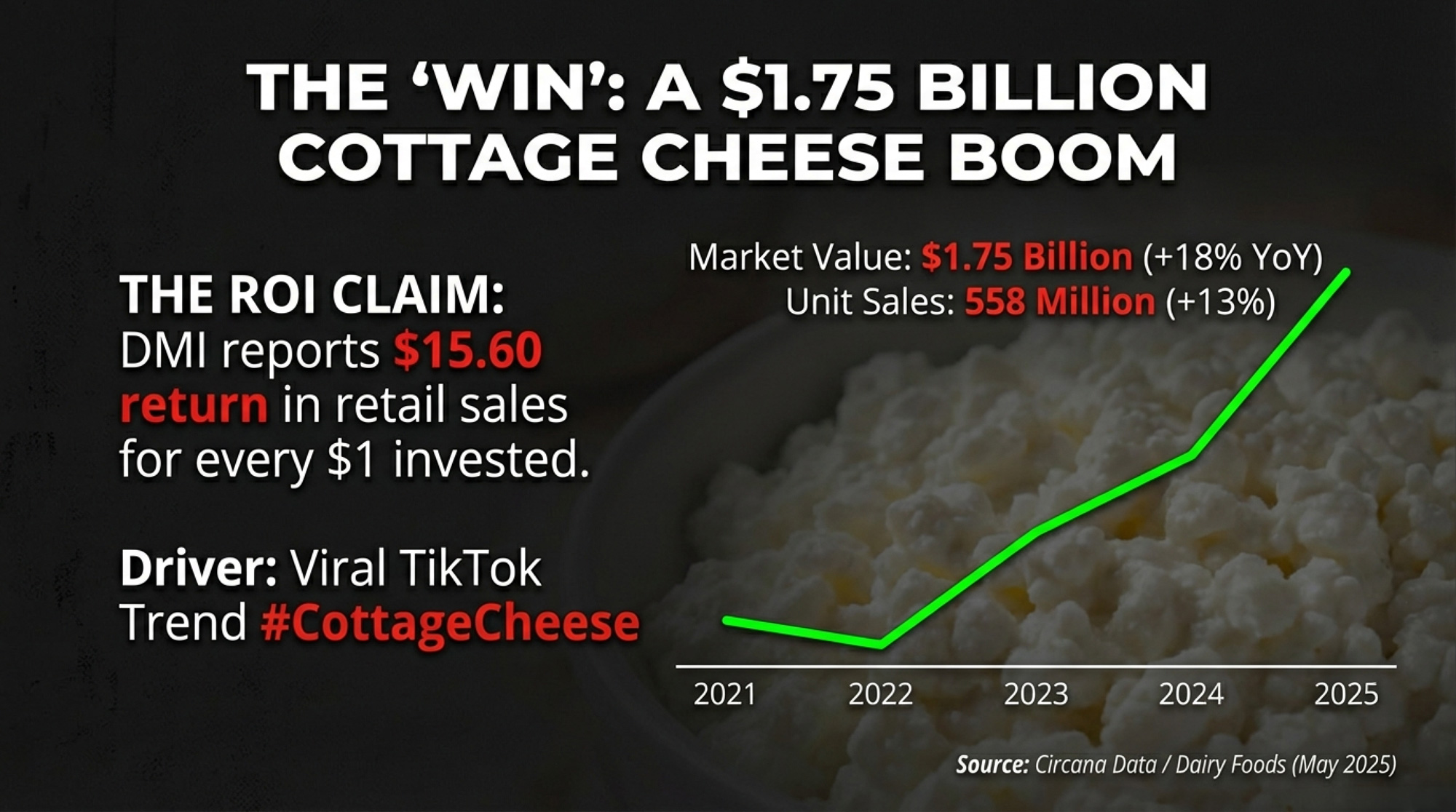
DMI reported another metric from its annual meeting in October 2024: an e-commerce strategy conducted with 14 state and regional checkoff organizations — running campaigns on Instacart, Walmart, and Dollar General — delivered a return of $15.60 in retail dairy sales for every dollar invested by the checkoff. But here’s the translator’s note on that number: $15.60 in retail sales is not $15.60 back to you.

If most of that margin stays with Walmart and the processor — and right now, nobody’s publishing the downstream split — then the gap between that $15.60 and what actually reaches your bulk tank could be a lot wider than that number suggests. It’s the right metric to start with. It’s just not the metric that answers the question producers are actually asking.

Did a TikTok Dance Actually Sell $1.75 Billion in Cottage Cheese?

The cottage cheese story is the one that makes the whole strategy look like genius—or at least very good timing.

U.S. cottage cheese retail sales had actually declined in 2021, according to Circana data reported by CNN in July 2025. Then TikTok creators discovered it as a high-protein, low-effort substitute for everything from ice cream to pizza dough. The sales response was rapid and sustained: 11% growth in 2022, roughly 17% in both 2023 and 2024, and a 20% surge in the 52-week period ending June 15, 2025.

For the 52 weeks ending February 23, 2025, cottage cheese hit $1.75 billion in total U.S. dollar sales — an 18% year-over-year increase — with unit sales up 13% to 558 million, per Circana data reported by Dairy Foods (May 2025).

The growth wasn’t limited to one brand. Good Culture, the Irvine, California-based challenger brand co-founded by Jesse Merrill, saw dollar sales jump 75% to $187 million. Daisy Brand’s cottage cheese line surged 32% to $352 million. And private label led the way overall at $612 million, up 14% year-over-year.

The feedback loop that made it self-sustaining was simple: creators chased engagement with cottage cheese hacks → brands and checkoff-funded programs amplified the best-performing content → more viewers saw cottage cheese as the default protein ingredient → more creators made cottage cheese content. Storyful’s narrative analysis found cottage cheese content generating around 4 million engagements in just a few weeks, turning what they called a “boring” 1970s diet food into a global trend.

It looks organic. And some of it genuinely was. But DMI’s own strategy explicitly calls for leveraging third-party voices rather than running direct-to-consumer campaigns. The line between an authentic TikTok trend and a checkoff-amplified one is blurrier than you’d think.

What Does a Protein Latte in Seattle Mean for a Farmer in Wisconsin?

The cottage cheese story is about cultured dairy, but the fluid milk side of this equation matters just as much — maybe more, given those decades of declining consumption.

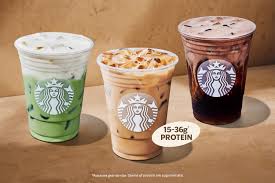
Starbucks launched its Protein Lattes and Protein Cold Foam nationwide on September 29, 2025, delivering 15 to 36 grams of protein per grande. Every cup is classified as Class I milk under federal orders — priced at $21.47/cwt in 2025, a $3.14 premium over the $18.33 Class II price on cottage cheese. For your blend price, every latte beats every yogurt cup.

In September 2025, Starbucks rolled out Protein Lattes and Protein Cold Foam drinks built on protein-enriched milk. A grande Protein Latte delivers 27-36 grams of protein. The protein cold foam alone adds 15 to 18 grams per beverage, depending on flavor, according to Starbucks’ own nutrition data. Customers can swap protein-boosted 2% milk into any hot or iced drink on the menu.

Here’s why that matters to your blend price. Standard milk in a latte — every grande, every venti, every carton in the grab-and-go cooler — is classified as Class I under the federal order system. In 2025, the Class I price averaged $21.47 per hundredweight across all federal orders, according to dairy market analyst William Pollock’s calculation from USDA advance pricing data. Class II — the category covering cottage cheese, yogurt, and other soft-manufactured products — averaged just $18.33/cwt for the full year, per USDA Agricultural Marketing Service data released February 4, 2026.

That’s a $3.14 gap per hundredweight. Every gallon of milk that flows across a Starbucks counter instead of into a cottage cheese vat is priced higher, pushing the blend price up for every producer pooled on that order. When the checkoff helps position dairy as a protein-forward performance beverage, it’s not just brand-building—it’s nudging milk toward the highest-value utilization class.

Milk Utilization Class2025 Avg Price ($/cwt)Premium vs. Class II
Class I (Fluid Milk)$21.47+$3.14/cwt
Class II (Cottage Cheese, Yogurt, Ice Cream)$18.33baseline
Class III (Cheese)$19.68+$1.35/cwt
Class IV (Butter, Powder)$19.21+$0.88/cwt

And there’s reason to think the broader fluid momentum is real. USDA data show total U.S. fluid milk sales were up about 0.8% in 2024 from the year prior — the first year-over-year gain since 2009, ending a 14-year streak of annual declines, according to the National Milk Producers Federation. Midwest Dairy board chair Charles Krause confirmed the significance in the organization’s spring 2025 newsletter: “For the first time since 2009, fluid milk consumption has shown a slight increase.”

That’s a genuine milestone. But one year of 0.8% growth doesn’t erase seven decades of structural decline — and Starbucks’ protein lattes launched too recently to have influenced 2024 numbers. They’re a forward-looking bet, not a proven demand driver yet. If protein-forward dairy gains traction in café and quick-service channels, the 2024 uptick could strengthen. That’s a big “if.”

Is Any of This Actually Reaching the Bulk Tank?

Now for the uncomfortable part.

The demand signals are undeniably strong. Cottage cheese is a $1.75 billion category growing at 18% annually. Starbucks is building protein milk into its core menu. DMI’s 2024 annual report states that consumer spending and volume sales increased across all domestic dairy categories — cheese, milk, yogurt, ice cream, frozen novelties, and butter. Every single one.

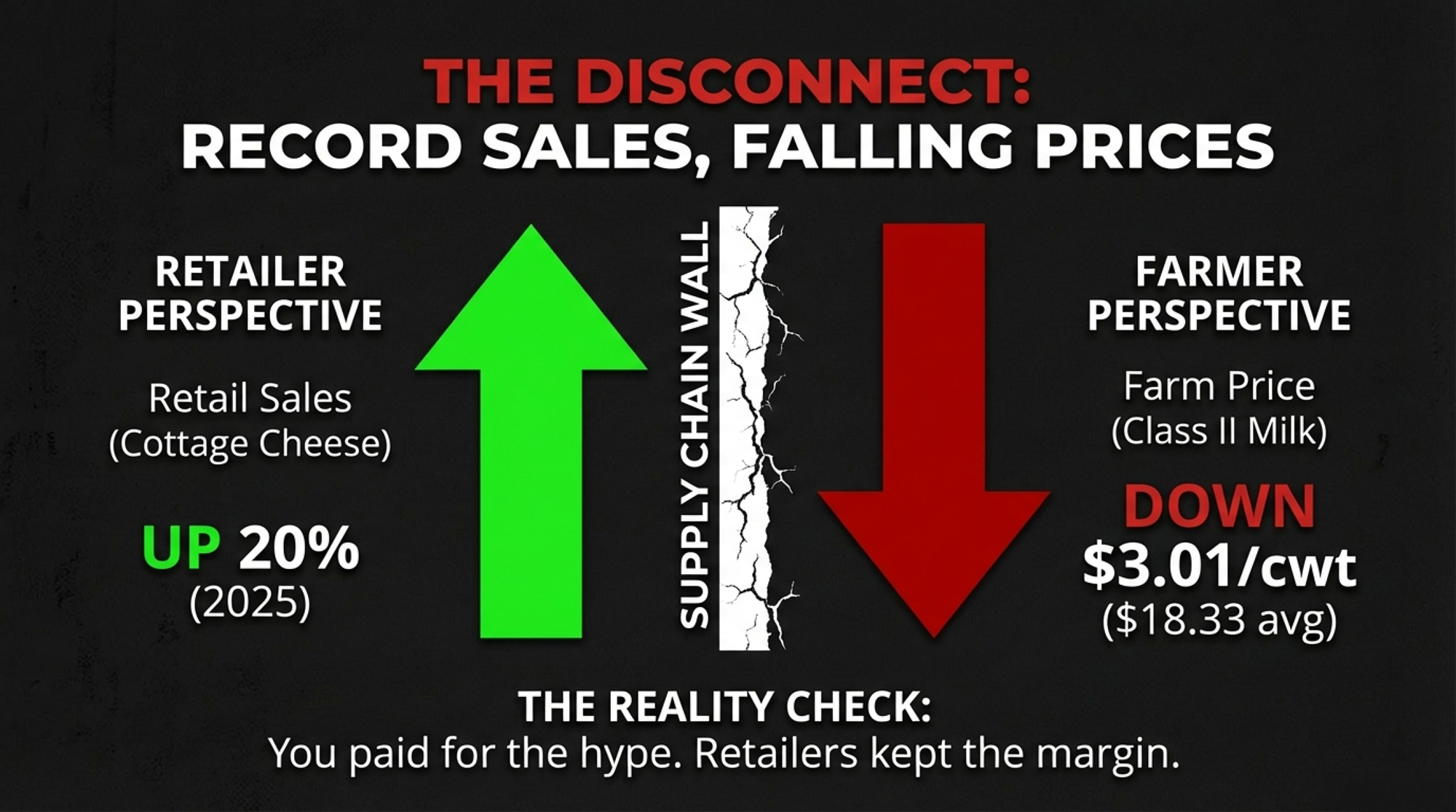
But look at this number. Cottage cheese is a Class II product under the Federal Milk Marketing Order system. And the average Class II price in 2024 was $21.34 per hundredweight, according to USDA’s Agricultural Marketing Service — a figure independently verified against Cheese Reporter’s monthly Class price data. In 2025 — while cottage cheese sales were surging 20% — the full-year average Class II price fell to $18.33 per hundredweight, per USDA AMS data released February 4, 2026. That’s a decline of $3.01/cwt during the single strongest cottage cheese growth year on record.

Metric20242025
Cottage Cheese Retail Sales$1.48 billion$1.75 billion
Year-Over-Year Retail Growth+17%+18%
Cottage Cheese Unit Sales477 million558 million
Average Class II Price ($/cwt)$21.34$18.33
Class II Price Change ($/cwt)–$3.01
DMI Marketing Expenses$165.7 million(not yet reported)

Think about what that means for the Lenkaitis farm specifically. Andy Lenkaitis told the DuPage County Farm Bureau that their milk ships to a plant in Rockford, Illinois, “where it’s made into cottage cheese and sour cream.” That plant — formerly Dean Foods, now operated by Dairy Farmers of America after DFA acquired 44 Dean facilities for $433 million in May 2020 — is still certified for cottage cheese and sour cream production today.

The Lenkaitis family’s checkoff dollars helped fund the influencer visit to their own barn. The resulting content drove a quarter-million impressions, telling consumers to trust dairy and buy dairy. Consumers apparently listened — cottage cheese sales are up 20%. And the Class II price on the product made from their own milk went down three bucks.

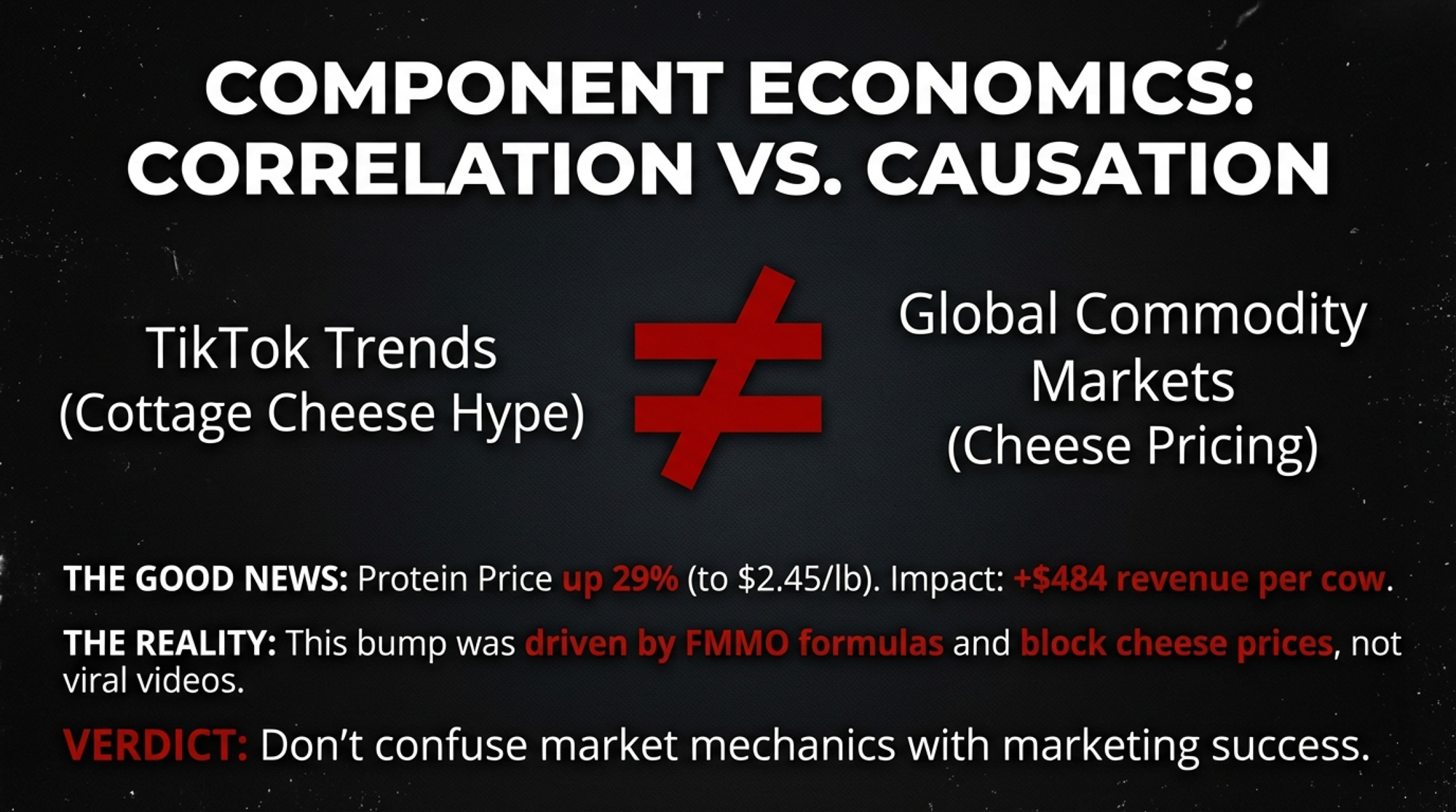
Run the quick math on protein, and the picture changes—but it’s still mixed. The federal order protein price averaged $1.8961 per pound in 2024 and rose to $2.4495 per pound for full-year 2025 — a 29% increase, per USDA AMS data. On a 300-cow herd shipping 75 lbs/day at 3.2% protein, that shift in protein price alone represents roughly $145,000 more in annual revenue, or about $484 per cow. But protein prices are driven by cheese commodity values and the FMMO pricing formulas, not directly by cottage cheese retail sales or TikTok impressions. (For a deep look at how FMMO component prices actually move your check, our March 2025 analysis breaks down the mechanics.)

MonthProtein Price ($/lb)Cottage Cheese Sales Growth (% YoY)
Jan 2024$1.85+12%
Apr 2024$1.92+14%
Jul 2024$1.98+16%
Oct 2024$2.12+17%
Jan 2025$2.28+18%
Apr 2025$2.41+19%
Jul 2025$2.47+20%
Oct 2025$2.52+19%
Dec 2025$2.49+18%

The connection between a viral recipe and your component check runs through layers of commodity pricing, processor margins, and utilization formulas that can muffle, delay, or redirect the demand signal entirely. Consumer demand for dairy products is stronger than it’s been in years. Possibly decades. But the distance between a $7.99 tub of Good Culture cottage cheese and your mailbox price is long, and much of the margin lives somewhere in between.

Options and Trade-Offs for Producers

Know what your checkoff is buying — within the next 30 days. Pull up your regional checkoff’s annual report. Midwest Dairy publishes theirs online. So do most others. Look at how contributions are split between influencer marketing, foodservice partnerships, nutrition education, and export.

DMI’s 2024 audited financials are public at dairycheckoff.com — $76.6 million went to “promotional and professional services” alone. You’re paying into this system. You should know what it’s producing, and you have every right to ask your regional board for specific ROI metrics, not just impression counts. The $15.60-per-dollar return DMI reported on its e-commerce campaigns is the kind of number you want to see across every major initiative — and remember, that’s a retail-sales metric. Push for data on what happens between the cash register and your bulk tank.

Track whether consumer demand is showing up in your component premiums. Compare your protein and butterfat premiums over the next 90 days against the 12-month trailing average. The federal protein price jumped from a $1.90/lb average in 2024 to $2.45/lb in 2025 — but that’s largely a cheese-price story, not a cottage-cheese-TikTok story. If your premiums are tracking commodity markets but not reflecting the surge in retail demand, that’s a conversation worth having with your processor or co-op: who’s capturing the margin between $1.75 billion in retail sales and what’s flowing back to your farm?

If you’re considering a direct-to-consumer approach, proceed with caution. Cottage cheese and artisan butter are the two cultured-dairy categories with the strongest consumer demand right now. If you’re within driving distance of a metro area and have the appetite for on-farm processing, the demand environment hasn’t been this favorable in years. But direct-to-consumer requires capital, permits, a completely different skill set, and patience.

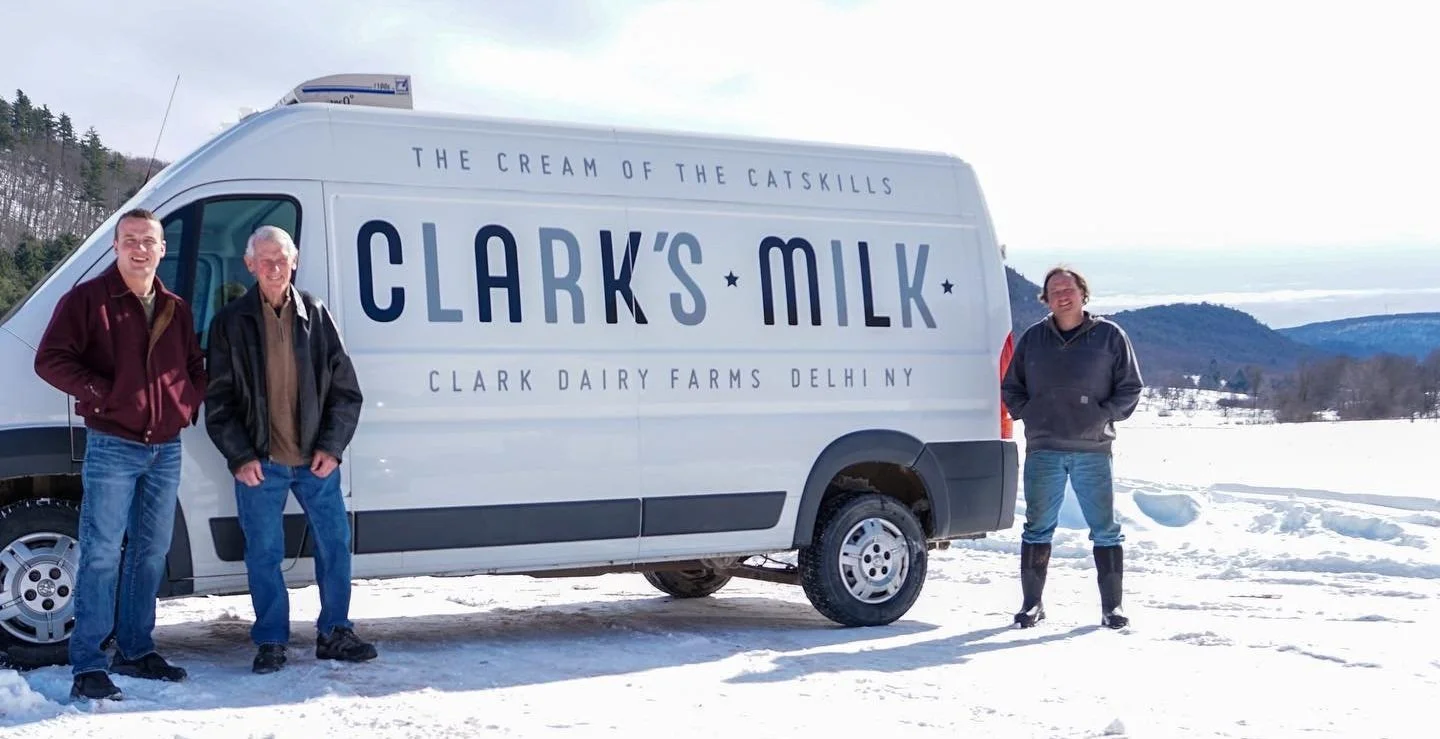
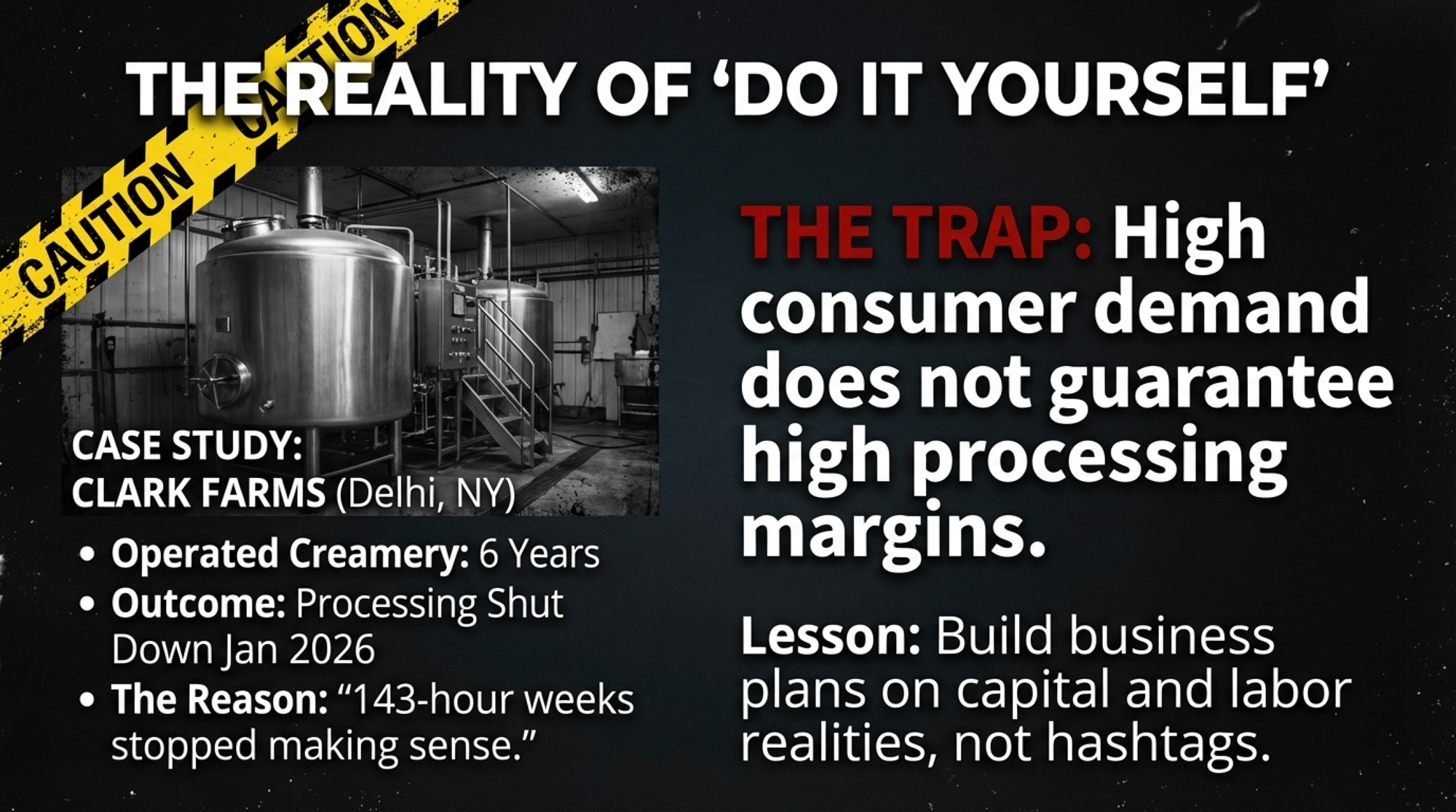
The Clark family — five generations on Elk Creek Road in Delhi, New York — beside the delivery van that carried “The Cream of the Catskills” to dozens of local accounts. On January 28, 2026, owner Kyle Clark shut the creamery down, citing 143-hour weeks and a staff of six doing the work of ten. The cows are still milking. Demand wasn’t the problem. Read More

Clark Farms in Delhi, New York, ran a creamery for six years with dozens of local accounts — then shut down the processing side in January 2026 while keeping the cows milking, because 143-hour weeks stopped making sense. Their story is a real-world case study in what on-farm processing actually costs and what it returns. Build your business plan around five-year demand projections, not this year’s trending hashtag.

Over the next 12 months, watch the fluid milk data closely if you’re in a heavy Class I order. Fluid milk sales grew 0.8% in 2024 — the first gain since 2009. And that $3.14/cwt gap between Class I and Class II in 2025 means every gallon that shifts from manufactured products back to fluid beverages carries real blend-price weight.

If the Starbucks protein-milk play gains traction across café and quick-service channels, it could nudge Class I utilization rates up in ways that haven’t been on the table since the fluid decline accelerated. Track the USDA monthly data. And if your FMMO is under review or reform discussion, factor these demand shifts into your analysis of pooling changes.

Key Takeaways

  • If your regional checkoff can’t show you ROI data from their influencer campaigns — not just impressions, but traceable sales lift — ask why. Midwest Dairy publishes theirs. DMI’s audited financials are available at dairycheckoff.com. The $15.60 return on e-commerce dollars is a starting benchmark—but demand to know how much of that $15.60 actually reaches milk checks.
  • If cottage cheese is growing at 18–20% annually while Class II prices dropped $3.01/cwt from $21.34 (2024) to $18.33 (2025), the margin is being captured between the retail shelf and your bulk tank. Find out where.
  • If protein premiums are up 29% year-over-year ($1.90/lb to $2.45/lb), verify whether that’s reaching your check — or whether it’s a commodity-driven move unrelated to the consumer trends the checkoff is funding. On a 300-cow herd, that gap represents roughly $484 per cow per year.
  • If fluid milk’s 0.8% uptick holds, the $3.14/cwt Class I premium over Class II means demand shifting back to beverages (think Starbucks protein lattes) carries real blend-price upside — especially in heavy Class I orders. Watch the monthly USDA data.
  • If you’re evaluating on-farm processing, cottage cheese and butter have the demand. But Clark Farms proved that demand alone doesn’t make the business case. Run real capital, labor, and regulatory numbers before committing.

The Bottom Line

Fourteen years of fluid milk decline. Then 2024 broke the streak — barely, at 0.8%, but it broke it. And somewhere in Campton Hills, Illinois, Andy and Sarah Lenkaitis are still milking their Holsteins with robots, still giving tours, still shipping milk to a DFA plant in Rockford that turns it into cottage cheese — the same product TikTok creators turned into a $1.75 billion category. Their checkoff dollars helped fund the influencer visit that brought a quarter-million eyeballs to their barn. Consumer demand for dairy, measured in retail dollars, has never been stronger.

What hasn’t been answered — and what no annual report, brand-lift study, or TikTok impression count can settle — is whether $12,319 a year from a 300-cow herd is money well spent if the demand it helps create flows to processors and retailers instead of the bulk tank. Your checkoff, your question. Pull up the numbers and decide.

Complete references and supporting documentation are available upon request by contacting the editorial team at editor@thebullvine.com.

Learn More

The Sunday Read Dairy Professionals Don’t Skip.

Every week, thousands of producers, breeders, and industry insiders open Bullvine Weekly for genetics insights, market shifts, and profit strategies they won’t find anywhere else. One email. Five minutes. Smarter decisions all week.
NewsSubscribe
First
Last
Consent

DOGE Review Reshapes Dairy: Conservation Cuts, Checkoff Scrutiny, and the WWF Connection

DOGE axes $132M in USDA DEIA/climate contracts and preserves core checkoff programs. WWF ties are scrutinized as the GOP-backed whole milk expansion gains bipartisan support. Fiscal focus meets farm priorities.

Summary:

The DOGE review slashed $132M in USDA contracts, with $100M targeting DEIA consulting and $8.2M from climate programs, per FOIA data. While on-farm conservation projects were spared, mid-sized dairies report payment delays, and checkoff ties to WWF ($36M since 2008) face scrutiny. Bipartisan wins like whole milk in schools contrast with industrial advantages: IRA-funded methane digesters remain untouched. Transparency demands grow as the details of 78 terminated contracts trickle out weekly.

Key Takeaways:

  • $132M in Cuts Target Bureaucracy: $100M was slashed from DEIA consulting contracts, $8.2M from climate programs, and $20M in conservation funds were temporarily frozen. Zero on-farm projects were terminated (USDA FOIA).
  • Checkoff-NGO Ties Exposed: Dairy checkoff programs have partnered with WWF on methane goals despite the latter receiving $36M in USDA funding since 2008. The 2023 Farm Bill already bars NGO checkoff funding.
  • Mid-Sized Farms Squeezed: NRCS payment delays for cover crops and conservation practices, while mega-dairies retain IRA-funded methane digesters (USDA FPACBC).
  • Bipartisan Bright Spot: Whole milk expansion in schools gains rare GOP/Democratic support. It is funded partly by DEIA cuts (USDA FNS).
  • Transparency Demands: Only 10/78 terminated contracts were detailed publicly. Weekly disclosures are to continue at doge.gov/savings.
  • Industrial Advantage: FMMO handler assessments (5¢/cwt) and methane digester subsidies remain untouched, favoring large operations (ERS Dairy Outlook).
DOGE review, USDA contracts, dairy checkoff, WWF scrutiny, bipartisan support

The Department of Government Efficiency’s (DOGE) unprecedented review of USDA contracts has triggered a seismic shift in dairy policy. The DOGE has terminated $132 million in agreements, exposing tensions between climate initiatives, checkoff partnerships with NGOs, and core agricultural priorities. Only 10 of the 78 terminated contracts—totaling $4.21 million—have been publicly disclosed. Farmers and lawmakers demand transparency as conservation reimbursements stall and mandatory checkoff ties to the World Wildlife Fund (WWF) face scrutiny.

The $132 Million Breakdown: DEIA Dominates Cuts

Table 1: Breakdown of USDA Contract Terminations (Source: USDA)
CategoryAmountDetails
DEIA Consulting Contracts$100MFour $25M contracts with Capitol-region firms for FNS assessments
Climate-Smart Commodities$8.2MVermont firm contract for environmental compliance services
Conservation Program Release$20MEQIP/CSP/ACEP funds unfrozen Feb 20 after initial pause

FOIA disclosures reveal $100 million of terminated funds stemmed from four USDA Food and Nutrition Service (FNS) contracts for “Diversity, Equity, Inclusion, and Accessibility (DEIA) Assessment and Training Services” with Capitol-region consulting firms. Climate programs also took hits:

  • An $8.2 million contract for “Climate-Smart Commodities Environmental Compliance” was axed
  • $20 million in Inflation Reduction Act (IRA) conservation funds remained frozen until February 20

“They’re cutting paperwork, not plows,” noted a Pennsylvania dairy producer who requested anonymity. “My NRCS payments came through after the pause lifted. This is about stopping DC’s social engineering, not harming farmers.”

Key Clarification: USDA confirmed zero on-farm conservation projects were terminated. All cuts targeted administrative or NGO-linked contracts.

Checkoff Programs Under Microscope: The WWF Web

Table 2: Federal Funding to World Wildlife Fund (2008-2025) (Source: USAspending.gov)
AgencyAmountPercentageKey Dairy Connections
USAID$310M62%Global sustainability certifications
Interior$149M30%Biodiversity initiatives
USDA$36M7%Checkoff partnerships, methane reduction plans
Other$5M1%Cross-agency collaborations
Total$500M100%Includes $36M from dairy checkoff oversight

The mandatory 15¢/cwt dairy checkoff—overseen by USDA’s Agricultural Marketing Service (AMS)—faces DOGE scrutiny over its partnerships:

  • $36 million: USDA grants to WWF since 2008
  • $1 million/year: USDA’s cost to oversee dairy checkoffs via AMS
  • 300–500 companies: WWF’s supply-chain leverage target to enforce sustainability standards

Documents show dairy checkoff groups (DMI, NDB) partnered with WWF as early as 2008 to develop methane-reduction frameworks—a move critics call contradictory:

“Checkoffs should promote milk, not police emissions,” argued Wisconsin Farm Bureau president Kevin Krentz. “WWF’s ‘Net Zero’ goals help processors, not producers.”

GOP Progress: The 2023 Farm Bill already barred checkoffs from funding NGOs, but DOGE’s review could accelerate reforms like Rep. GT Thompson’s proposed checkoff audit system.

Conservation Chaos? Data vs. Anecdotes

While USDA assures farmers that “contracts made directly to producers will be honored,” confusion persists:

  • EQIP/CSP/ACEP: $20 million released February 20 from farm bill programs
  • IRA projects: Remain under review, prioritizing “farmers over far-left climate schemes”
  • WWF exemptions: $36 million USDA contract untouched despite broader NGO cuts

Contradictory impacts emerge:

  • Industrial advantage: Mega-dairies retain IRA-funded methane digesters (exempt from pauses)
  • Mid-sized squeeze: Missouri farmers report delayed NRCS payments for cover crops

The Whole Milk Win: Bipartisan Bright Spot

Amid the turmoil, Secretary Rollins’ February 15 announcement expanding whole milk in school meals earned rare bipartisan praise:

“Finally, USDA promotes real dairy instead of plant-based imitations,” said Holstein Association CEO John Meyer. “This aligns with Rep. Mike Lawler’s Whole Milk for Healthy Kids Act.”

Financial context: The DEIA cuts freed up $100 million to buy 250 million school milk cartons annually at current FNS rates.

Path Forward: Transparency and Trade-Offs

As DOGE’s review expands, stakeholders demand:

  1. Full disclosure of all 78 terminated contracts (available weekly at doge.gov/savings)
  2. Preservation of FMMO handler assessments (5¢/cwt costs untouched)
  3. Audits of AMS’ $1.5 million annual checkoff oversight

Bottom line: 

While small farms face paperwork delays, industrial operations gain ground through preserved IRA exemptions. Texas A&M economist Dr. Mark Welch observed that “Efficiency reviews always have winners. Here, it’s those who need bureaucracy least.”

Learn more:

Join the Revolution!

Bullvine Daily is your essential e-zine for staying ahead in the dairy industry. With over 30,000 subscribers, we bring you the week’s top news, helping you manage tasks efficiently. Stay informed about milk production, tech adoption, and more, so you can concentrate on your dairy operations. 

NewsSubscribe
First
Last
Consent
Send this to a friend