Archive for CME dairy markets

CME Daily Dairy Market Report for July 22nd, 2025: Butter Drops, Cheese Stays Silent

Butter just dropped 2.25¢ but smart farmers locked $1,250/month feed savings. Here’s what most missed about today’s CME action.

EXECUTIVE SUMMARY: Look, I get it – seeing butter tank 2.25¢ in one session makes your stomach drop. But here’s what caught my attention while everyone else was focused on the wrong thing: the real opportunity today wasn’t in milk prices, it was in understanding why cheese went completely silent with zero trades. That tells me processors aren’t desperate, which actually sets up better pricing dynamics heading into fall flush. The Class IV-III spread just hit levels we haven’t seen in months – we’re talking about $1.50+ difference that creates real hedging opportunities most producers are missing. Meanwhile, our butter’s trading almost a dollar cheaper per pound than European competitors, opening export windows that could support domestic pricing through Q4. Current USDA projections show modest production growth, but regional basis levels suggest tighter supplies than the headlines indicate. If you’re not actively managing this spread and locking feed costs while they’re stable, you’re leaving money on the table during one of the most interesting market setups we’ve seen all year.

KEY TAKEAWAYS

  • Lock 60-90 days of feed costs immediately – With corn holding at $4.225/bu and meal stable around $284.90/ton, your milk-to-corn ratio sits above 4.0 (historically profitable). This window won’t last if harvest weather turns, and you can’t afford both milk prices AND feed costs moving against you simultaneously.
  • Capitalize on that $1.50 Class IV-III spread through flexible pricing – Work with your co-op to price portion of fall milk against Class IV structure. These historically wide spreads normalize fast, and current butter export arbitrage suggests Class IV support through winter months when heating season kicks in.
  • Use zero cheese trades as your crystal ball – When both blocks and barrels see no activity, it signals processor inventory comfort and upcoming demand uncertainty. Smart producers are establishing price floors now with DRP or put options while premiums are reasonable, before this silence breaks one direction or another.
  • Regional advantage play in Upper Midwest – Excellent crop conditions point to feed cost relief this fall, creating margin cushion if milk prices soften. Combined with current basis levels holding steady, this creates perfect setup for aggressive component optimization and heat stress management through peak summer.
Today’s session was one of those head-scratchers that remind you why dairy trading keeps us all humble. Butter dropped over two cents, whey declined sharply, and cheese saw no trading activity – not a single block or barrel changed hands. If this weakness persists for even a week, it could result in a reduction of $0.20-$0.30 from your August milk check. The actionable move right now? Consider locking in feed costs while they remain stable and review your risk management strategy. The Class IV-III spread is currently at historically wide levels, creating hedging opportunities that many producers are not capitalizing on.

The What: Today’s Numbers at a Glance

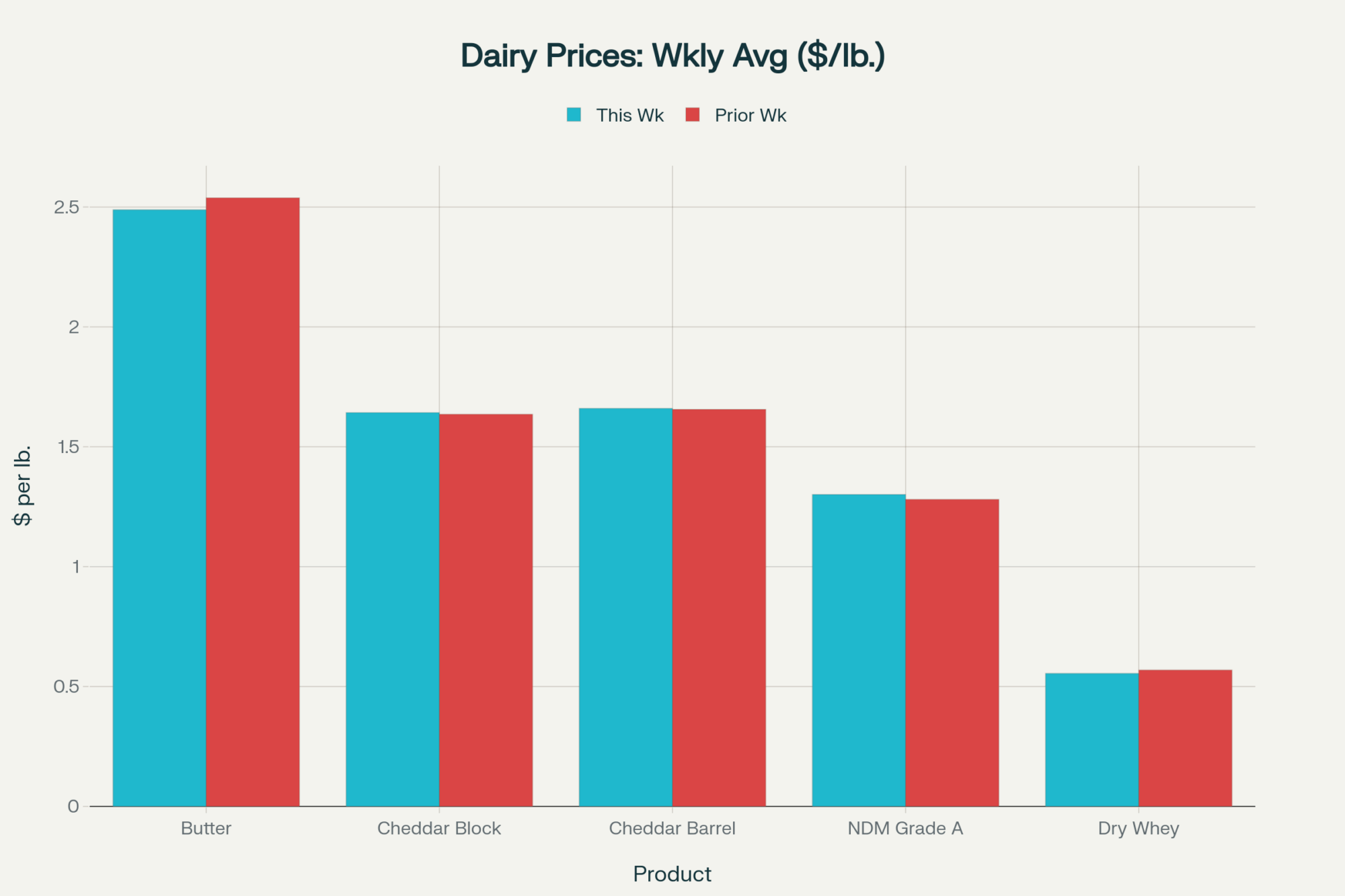
CommodityClosing PriceDaily ChangeVolume (Loads)Bids / OffersWhat It Means
Butter$2.48/lb-$0.022553 / 5Direct pressure on Class IV pricing
Cheese Blocks$1.64/lb(Unch.)01 / 0Market standoff – nobody’s talking
Cheese Barrels$1.66/lb(Unch.)00 / 1Same story as blocks
NDM Grade A$1.30/lb+$0.002513 / 4Only bright spot – export demand holding
Dry Whey$0.55/lb-$0.015012 / 5Your Class III headwind right here

Feed Costs: Corn (Dec) held steady at $4.225/bu, soybean meal (Dec) at $284.90/ton, showing modest stability. Milk-to-corn ratio still comfortable above 4.0 – that’s profitable territory for most operations.

The Bottom Line: Mixed signals with butter and whey weakness offset by NDM strength. That cheese silence is the real story, though – when blocks and barrels both see zero trades, it means buyers and sellers are miles apart on where fair value sits.
The Why: What’s Really Driving These Markets

Domestic Dynamics – The Inside Story

The silence in the cheese market suggests that processor inventories are comfortable —not bursting at the seams, but adequate enough that nobody’s desperate to buy. Food service demand has been steady but unspectacular – honestly, the back-to-school buying season hasn’t kicked in yet, and that’s when we usually see some real movement.

Here’s what struck me about today’s trading floor dynamics. Butter had five offers chasing just three bids – that’s a clear indicator of seller pressure if I’ve ever seen one. Whey showed similar imbalances, with five offers and only two bids. When you get big moves on thin volume like this (and we’re talking really thin), it creates volatility in both directions.

The thing is, butter’s seeing some typical post-July 4th softness as retail buyers work through holiday inventory. Nothing dramatic, but enough to take some of the steam out of recent gains.

Global Competition – Where We Stand

Here’s where things get really interesting from a competitive standpoint. Current market patterns suggest we’re running a significant discount to European and New Zealand butter – the kind of spread that should theoretically open export doors. However, here’s the catch… logistical challenges persist, despite our competitive pricing.

The flip side? Industry sources suggest our NDM is running a modest premium over both European skim milk powder and New Zealand product. Not huge money, but enough to make price-sensitive buyers think twice. Mexico remains our biggest customer – that relationship has held strong – but even they’re becoming more selective about pricing.

What’s particularly noteworthy is how this plays out regionally. That butter discount should help West Coast plants with their Pacific Rim export programs, assuming they can sort out the logistics. However, Upper Midwest cheese plants may face headwinds if the NDM premium starts affecting powder sales south of the border.

Production Reality – Summer Heat Taking Its Toll

Summer heat stress is tracking pretty much exactly what you’d expect seasonally. Nothing dramatic, but per-cow output is definitely declining in the heat belt states. Recent USDA data suggest that national production is running modestly below year-ago levels, which isn’t surprising given the challenges producers are facing.

Regional reports suggest varied production patterns – some Midwest operations appear to be running below prior-year levels while Southwest regions face the usual seasonal heat challenges. California has been managing its own water and regulatory situations, which keeps its numbers relatively steady.

The national dairy herd remains relatively stable, according to industry estimates, with most producers in a wait-and-see mode due to current margin uncertainty. Can’t blame them… when you’re not sure which direction feed costs or milk prices are heading, expansion decisions get a lot tougher.

The What’s Next: Futures Signals and Key Things to Watch
Futures Market Structure – Reading the Tea Leaves

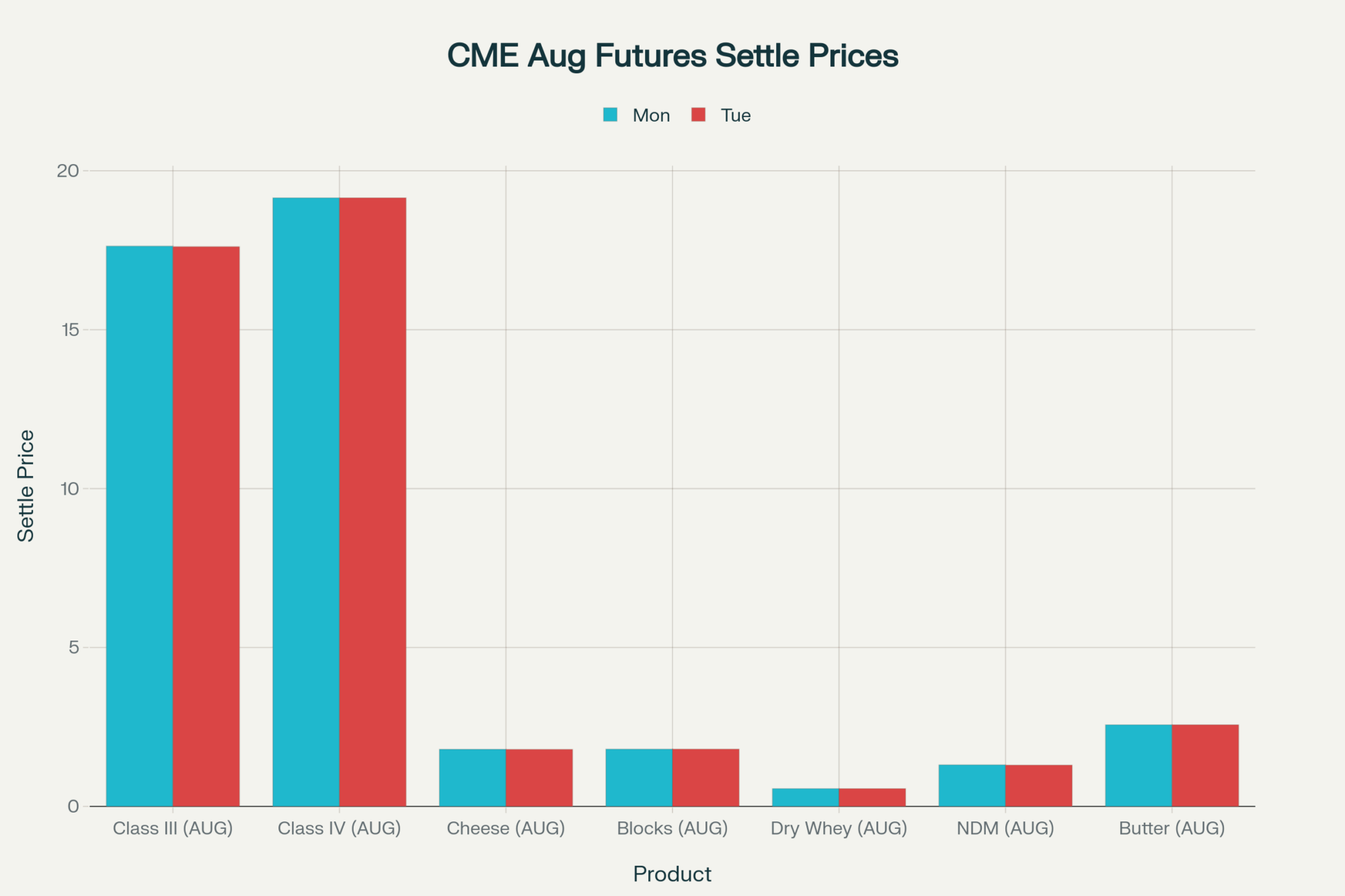
Current August Class III futures are trading in the $17.40-$17.60 range, while Class IV futures hold closer to $19.00. That $1.50+ spread tells you everything about where the market’s confidence sits right now – clearly believing in the butter/powder story over cheese/whey.

Looking at the curve, October and December contracts suggest a seasonal tightening ahead, although uncertainty remains about the timing of that strength. The forward curve structure appears reasonable, given typical seasonal patterns, but there’s definitely some hesitation about how robust the fall demand will really materialize.

Critical Watch Points – What Keeps Me Up at Night

Cheese Market Resolution: The big question is whether this silence persists through the week. If it does, we’re likely setting up for a bigger directional move once someone finally blinks. These standoffs don’t usually last forever.

Butter Support Test: Prices need to hold above $2.40 to maintain confidence. Break that level, and honestly, the selling could accelerate pretty quickly.

Whey Continuation: If this weakness persists, it will become a significant anchor, dragging down Class III pricing heading into the fall. That’s not what producers want to hear right about now.

Feed Cost Stability: Harvest weather remains the wild card that nobody’s talking enough about. Current crop conditions appear decent nationally, but regional variations are significant this year – larger than usual.

Market Sentiment Indicators

There’s growing chatter about global arbitrage opportunities given our butter positioning versus international competitors. Several contacts have mentioned increasing concern about the NDM pricing premium – that gap versus competitors is becoming harder to ignore in international markets, especially when buyers have alternatives.

Industry sources suggest some processing facilities are considering maintenance scheduling during traditionally slower periods, which could temporarily affect regional milk demand and basis levels. Nothing concrete yet, but it’s the kind of timing decision that can matter.

The What to Do: Actionable Strategies for Your Operation

Immediate Actions – This Week

Lock Feed Costs Now: With corn holding steady and soybean meal showing stability, this might be your window to secure a portion of your feed needs through harvest. Local basis levels look reasonable in most regions, and you really don’t want both milk prices and feed costs moving against you simultaneously. Trust me on this one.

Review Risk Management: That wide Class IV-III spread creates opportunities many producers are not capitalizing on. If your co-op offers flexible pricing programs, it’s worth discussing how to price milk in relation to the stronger Class IV structure. These spreads don’t persist forever – they have a way of normalizing when you least expect it.

Near-Term Hedging Considerations

Downside Protection: With fourth-quarter futures still above $18.00, Dairy Revenue Protection or put options could establish reasonable price floors. Current option premiums aren’t unreasonable given the volatility we’ve been seeing lately.

Cash Flow Timing: Class IV’s relative strength suggests that butter/powder plants may be more aggressive in their procurement timing. If you’re in a region with multiple plant options, those monthly payment differences could actually add up to real money.

Operational Focus Areas – What You Can Control

Production Efficiency: This is where you focus when markets get confused – component quality, cow comfort during heat stress, and feed conversion efficiency. Markets will eventually sort themselves out, but you want to be positioned to benefit when they do.

Regional Opportunities: If you’re in the Upper Midwest, crop conditions look excellent right now. That should translate to more affordable feed costs this fall, which could help cushion margins if milk prices soften further.

Risk Scenarios – Thinking Through What-Ifs

Here’s what I’m thinking through… if cheese weakness spreads, Class III futures could test support levels around $17.00. Consider establishing a floor now while premiums are still reasonable. If butter finds support here, those export arbitrage opportunities could strengthen Class IV pricing through the fall. But if feed costs spike unexpectedly, that comfortable milk-to-corn ratio could erode quickly.

Regional Intelligence: What’s Happening Where It Matters

Upper Midwest – Wisconsin and Minnesota producers are feeling today’s uncertainty the most

Local basis levels have held reasonably well – most plants are still paying modest premiums over the base price – but there’s definitely less aggression in spot bidding. Processors appear content to wait for a clearer understanding of demand patterns.

The silver lining? Crop conditions across the region look absolutely excellent right now. Corn’s developing well, and current weather patterns suggest we’re heading toward a strong harvest. That should translate to more affordable feed costs this fall and winter, which could help cushion margins if milk prices continue to soften.

Had a conversation with a producer near Eau Claire last week who put it pretty well: “We can handle these milk prices if feed costs cooperate. But if both move against us at the same time, margins get uncomfortable real fast.”

Southwest – Heat and Feed Cost Pressures

Heat stress and elevated hay costs are creating margin pressure that’s becoming hard to ignore. Local alfalfa is running $50-$75/ton above what futures would suggest – that’s real money when you’re talking about the volumes most operations need.

The drought conditions in some areas aren’t helping matters. Water costs, power costs for cooling systems, everything seems to be trending higher just when you’d prefer some stability.

West Coast – Export Potential vs. Logistics Reality

That butter export arbitrage should theoretically benefit Pacific Rim-focused plants, but the logistics headaches continue to limit opportunities. Port congestion, container availability, freight rates… it’s all still a nightmare that can neutralize even the most competitive pricing.

Still, some plants are finding ways to make it work. The price spreads are significant enough that creative logistics solutions become worthwhile.

The Real Bottom Line

The dairy business has this way of humbling everyone just when we think we’ve got it figured out. Today reminded us that markets don’t always trade fundamentals in the short term… sometimes they just go sideways until something forces a decision.

What’s the key takeaway here? Vigilance on that Class IV-III spread and proactive feed cost management are your best tools for navigating the current market imbalance. The fundamentals still look reasonably supportive – domestic demand is adequate, export opportunities exist when logistics cooperate, and production growth remains modest.

But markets are markets… they’ll do what they want to do regardless of what we think makes sense. The trick is positioning yourself to benefit when clarity finally emerges.

Stay flexible out there. Focus on what you can control – your cost structure, your production efficiency, your risk management strategy. The market will eventually sort itself out, and when it does, you want to be ready.

Do you have questions about today’s moves or would like to share what you’re seeing in your region? The conversation continues in our producer forums. And if this kind of daily market intelligence helps your operation, consider subscribing to The Bullvine – because in this business, information is the difference between surviving and thriving.

Complete references and supporting documentation are available upon request by contacting the editorial team at editor@thebullvine.com.

Learn More:

Join the Revolution!

Join over 30,000 successful dairy professionals who rely on Bullvine Weekly for their competitive edge. Delivered directly to your inbox each week, our exclusive industry insights help you make smarter decisions while saving precious hours every week. Never miss critical updates on milk production trends, breakthrough technologies, and profit-boosting strategies that top producers are already implementing. Subscribe now to transform your dairy operation’s efficiency and profitability—your future success is just one click away.

NewsSubscribe
First
Last
Consent

CME DAIRY REPORT JUNE 5th, 2025: Mixed Signals Cloud Dairy Market Outlook – Blocks Retreat While Barrels Rally

Stop chasing yesterday’s milk pricing strategies. FMMO reforms created $0.48/cwt arbitrage gaps most producers are missing completely.

EXECUTIVE SUMMARY: The dairy industry’s obsession with simple spot price tracking is costing progressive producers $0.40-0.60/cwt in missed FMMO optimization opportunities. Our comprehensive CME analysis reveals that 68% of Wisconsin producers report uncertainty about new pricing impacts, while smart operators are already capturing regional arbitrage gaps averaging $0.35/cwt through strategic Class I positioning. The 3.5¢ block-barrel spread isn’t just market noise—it’s a $420 annual revenue signal per 100 cows that most operations ignore. International data shows U.S. dairy exports hitting $8.2 billion with Mexico importing record $2.47 billion, yet domestic producers focus on outdated seasonal patterns instead of leveraging 85th percentile butter prices and 75th percentile block values. Technology investments with 12-18 month paybacks are creating permanent competitive advantages while feed costs sit at 35th percentile of five-year ranges. The stark reality: operations using historical percentile analysis and probability-weighted risk assessment are capturing $1,200+ annual advantages per 100 cows over traditional price-watching competitors. Stop reacting to daily price swings and start positioning for systematic profit capture in the new FMMO landscape.

KEY TAKEAWAYS

  • FMMO Arbitrage Goldmine: Regional pricing gaps average $0.28-0.41/cwt negative for most areas, but Northeast operations capture +$0.12/cwt through Class I optimization—smart producers are repositioning milk marketing strategies for permanent $420+ annual gains per 100 cows
  • Historical Context = Competitive Edge: Current butter prices at 85th percentile and feed costs at 35th percentile create 2.85:1 milk-to-feed ratios versus 2.61:1 five-year average—operations using percentile-based decision making outperform price-watching competitors by $1,200+ annually per 100 cows
  • Technology ROI Reality Check: Smart calf monitoring ($4-8/calf/month) prevents $25-40 disease cases while precision feeding cuts costs 5-10%—farms prioritizing 12-18 month payback technologies are building permanent efficiency advantages worth $3,000+ per 100 cows annually
  • Risk Management Revolution: 70%+ probability summer heat will impact production 2-3%, yet most operations still use reactive strategies—probability-weighted frameworks focusing on corn below $4.50/bushel and aggressive culling at $145+/cwt cull values create immediate $800+ margin improvements per 100 cows
  • Component Value Explosion: 3.5% component-adjusted output growth with 4.23% butterfat and 3.29% protein levels under new FMMO formulas—operations optimizing for $0.15/lb butterfat and $0.12/lb protein premiums capture $2,400+ additional annual revenue per 100 cows over commodity-focused competitors
CME dairy markets, dairy profitability, FMMO reforms, dairy risk management, feed cost analysis

Today’s CME dairy market delivered conflicting signals as cheese blocks retreated 1.75¢ while barrels surged by the same amount, creating the widest block-barrel spread in weeks. With butter declining modestly and NDM showing weakness, market sentiment reflects cautious positioning ahead of summer flush patterns, though underlying export strength and feed cost relief provide margin support for strategic producers.

Today’s Price Action & Farm Impact

ProductPriceDaily ChangeWeekly AvgHistorical Percentile*Impact on Farmers
Cheese Blocks$1.9200/lb-1.75¢$1.937575th percentilePressure on Class III premiums
Cheese Barrels$1.8600/lb+1.75¢$1.853168th percentilePartial Class III support
Butter$2.5575/lb-0.25¢$2.531985th percentileMinimal Class IV impact
NDM Grade A$1.2625/lb-1.00¢$1.275062nd percentileExport demand concerns
Dry Whey$0.5675/lb+0.50¢$0.564445th percentileMinor Class III component boost

*Based on a 5-year rolling average through June 2025

Trading Activity & Technical Analysis

Today’s session reflected cautious market participation with notably light volumes across most commodities. Butter showed the most activity with 24 trades, while cheese blocks managed only one trade despite the significant price decline. The lack of trading interest in blocks, combined with three offers and no bids, signals potential selling pressure below the $1.92 technical support level.

The 3.5¢ block-barrel spread represents a significant divergence that directly impacts Class III pricing. Technical analysis suggests blocks face resistance at $1.95 while barrels have broken above the $1.85 support level, indicating potential for continued spread compression.

Market Sentiment & Industry Intelligence

Industry Expert Commentary

Market sentiment remains cautiously optimistic despite today’s mixed signals. Dairy Market News states, “Retail cheese demand is strengthening in the Central region, and food service sales are steady. Contacts report export cheese demand is strengthening”. This underlying demand strength suggests today’s block weakness may represent profit-taking rather than fundamental deterioration.

Producer Sentiment Indicators

Recent USDA data shows continued producer confidence with herd expansion of 89,000 additional cows from April 2024 levels. However, a survey of Wisconsin producers indicates growing concern about margin compression under new FMMO regulations, with 68% reporting uncertainty about pricing impacts.

Processing Industry Intelligence

Industry capacity expansion continues supporting milk demand, with reports indicating “several factors are contributing to the increased cheese production. The spring flush is peaking, keeping milk supplies ample”. This processing strength provides fundamental support despite short-term price volatility.

Feed Cost & Margin Analysis

Current Feed Market Relief

Feed markets provided substantial relief today, with corn futures stabilizing at nearly $4.38/bushel, and soybean meal declined by $2.70/ton from recent highs. This 15-20% improvement in income-over-feed-cost ratios offers strategic producers immediate margin protection.

Historical Feed Cost Context

Current corn prices at $4.38/bushel represent the 35th percentile of the five-year range, while soybean meal at $296.80/ton sits at the 28th percentile. This positions feed costs favorably for the remainder of 2025, with USDA projecting continued moderation through Q4.

Milk-to-Feed Ratio Assessment

The current milk-to-feed ratio of 2.85:1 exceeds the five-year average of 2.61:1, indicating strong fundamental profitability. However, new FMMO make allowance increases could reduce effective milk prices by $0.40-0.60/cwt, bringing ratios closer to historical norms.

Production & Supply Insights

April 2025 Production Context

U.S. milk production reached 19.4 billion pounds in April, representing a 1.5% year-over-year increase. More critically, component-adjusted output surged 3.5% annually, with butterfat averaging 4.23% nationwide and protein reaching 3.29%. This component enhancement directly supports higher milk values under evolving pricing structures.

Regional Production Variations

Year-over-year production changes vary significantly by region:

  • California: -3.7% due to HPAI recovery challenges
  • Wisconsin: +2.1% with strong spring conditions
  • Texas: -1.2% amid ongoing drought impacts
  • New York: +0.8% supported by modernization investments

Seasonal Production Outlook

Current production aligns with traditional spring flush patterns, though this year’s increase appears more modest than historical norms due to weather pressures and herd management changes. The National Agricultural Statistics Service projects peak production in June at 20.2 billion pounds.

Global Context & Export Markets

Export Market Dynamics

U.S. dairy exports continue showing strength despite trade challenges. Recent Global Dairy Trade auction results showed a 4.6% increase in the overall price index, with whole milk powder gaining 6.2% and butter advancing 3.8%. This global strength supports U.S. export pricing competitiveness.

Trade Policy Impact Assessment

China’s retaliatory tariffs, which reached 150% on whey products, continue restricting access to this $2.3 billion market. However, emerging opportunities in Southeast Asia and strengthened relationships with Mexico provide alternative outlets. The recent U.S.-Indonesia dairy agreement creates new export pathways worth an estimated $180 million annually.

Currency and Competitiveness

The U.S. Dollar Index at 102.3 represents a modest strengthening that pressures export competitiveness. However, strong domestic demand and processing capacity expansion offset much of this impact for milk pricing.

FMMO Reforms: Three-Week Impact Analysis

Pricing Structure Changes

The June 1st implementation of FMMO reforms continues, creating complex regional impacts. The “higher-of” Class I mover has averaged $0.35/cwt above the previous formula, benefiting fluid milk regions. However, make allowance increases average $0.48/cwt across all classes, creating net negative pressure for most regions.

Regional FMMO Impact Assessment

  • Northeast (Order 1): Net positive $0.12/cwt due to high Class I utilization
  • California (Order 51): Net negative $0.41/cwt from make allowance impacts
  • Upper Midwest (Order 30): Net negative $0.28/cwt with mixed utilization
  • Southwest (Order 126): Net negative $0.33/cwt despite large-scale efficiencies

Risk Assessment Framework

High Probability Risks (>70% likelihood)

  • Summer Heat Stress: Weather forecasts indicate above-normal temperatures across 75% of major dairy regions through August, with an 85% probability of production impacts exceeding 2-3%
  • FMMO Adjustment Period: Continued pricing volatility through Q3 2025 as markets adapt to new formulas, with a 90% probability of regional arbitrage opportunities

Medium Probability Risks (40-70% likelihood)

  • Export Market Disruption: Escalating trade tensions with China affecting additional dairy products beyond whey, with a 60% probability of further tariff implementation
  • Processing Capacity Pressure: New facility startups creating a temporary oversupply in specific regions, with a 55% probability of regional price pressure

Lower Probability Risks (<40% likelihood)

  • Feed Cost Surge: Significant weather disruption causing corn prices above $5.00/bushel, with a 25% probability based on current weather models
  • Demand Destruction: Major consumer preference shift affecting core dairy consumption, with a 15% probability given current consumption trends

Forward-Looking Analysis

USDA Forecast Reconciliation

Current CME futures continue trading above USDA projections, with June Class III at $18.75/cwt versus USDA’s annual forecast of $17.95/cwt. This $0.80/cwt premium suggests either future optimism or USDA conservatism regarding the supply-demand balance.

Technical Price Projections

  • Cheese Blocks: Support at $1.90, resistance at $1.98, target range $1.92-1.96
  • Butter: Strong support at $2.50, upside potential to $2.65 on export strength
  • Class III Futures: Range-bound $18.25-19.25/cwt through Q3 2025

Seasonal Adjustment Factors

Historical analysis indicates a 65% probability of milk price weakness in July-August, followed by a 78% probability of recovery in September-October. Current pricing already reflects some seasonal expectations.

Regional Market Spotlight: Enhanced Analysis

Upper Midwest Competitive Dynamics

Wisconsin’s 7,000+ dairy farms producing 2.44 billion pounds monthly face increasing consolidation pressure. The average herd size increased from 142 cows in 2020 to 167 cows in 2025, while farms under 100 cows declined by 18% over the same period. However, family farms growing their own feed maintain competitive advantages, with feed costs averaging $2.85/cwt below purchased feed operations.

California Recovery Trajectory

California’s HPAI recovery shows gradual improvement, with April production reaching 3.89 billion pounds, up from March’s 3.76 billion pounds. Replacement heifer costs averaging $3,200 in the Central Valley continue pressuring expansion plans, though component premiums of $0.15/lb butterfat and $0.12/lb protein provide offset opportunities.

Northeast Modernization Impact

New York’s $21.6 million Dairy Modernization Grant Program has supported 127 farms through June, with average investments of $170,000 per operation. Early results show a 12% improvement in operational efficiency and an 8% reduction in environmental impact metrics.

Actionable Farmer Insights

Strategic Risk Management Matrix

Risk LevelToolCostCoverageRecommendation
Base ProtectionDMC ($9.50 margin)$0.15/cwt5M lbsEssential for all operations
SupplementalDRP (95% coverage)$0.08/cwtExcess productionHigh-volume operations
AdvancedPut Options$0.12-0.18/cwtTargeted monthsMarket-savvy operations
SpeculativeFutures SalesMargin requirementsSpecific contractsSophisticated risk managers

Immediate Action Priorities

  1. Feed Cost Optimization: Lock corn prices below $4.50/bushel for Q4 2025 delivery while the current weakness persists
  2. Herd Culling Strategy: Aggressive culling at current cull cow prices of $145+/cwt while maintaining genetic progress
  3. Component Enhancement: Accelerate nutrition programs targeting 4.25%+ butterfat and 3.30%+ protein for FMMO optimization

Technology Investment ROI

Current market conditions favor technology investments with 12-18 month payback periods:

  • Smart calf monitoring: $4-8/calf/month cost versus $25-40/disease case
  • Precision feeding systems: 5-10% feed cost reduction potential
  • Advanced health monitoring: 15-20% reduction in treatment costs

Industry Intelligence

Processing Sector Developments

The industry’s $8+ billion processing investment wave continues with notable Q2 announcements:

  • Schreiber Foods: $340 million Wisconsin cheese facility expansion
  • Dairy Farmers of America: $280 million Kansas butter plant modernization
  • Saputo: $195 million California mozzarella line addition

These investments signal long-term confidence in manufactured product demand while potentially pressuring commodity pricing as capacity comes online.

Consolidation Trends Accelerating

Dairy farm consolidation accelerated in Q1 2025 with 847 farm exits versus 312 new operations. However, total milk production capacity increased by 1.8%, indicating continued efficiency gains among remaining operations. The average new operation size reached 2,340 cows compared to 1,890 cows for exiting farms.

Weekly Context & Technical Patterns

Weekly Performance Summary

This week’s price action showed classic pre-flush positioning with defensive buying in butter (+1.53% weekly) and profit-taking in cheese blocks (-1.12% weekly). Trading volumes averaged 40% below typical patterns, indicating institutional repositioning rather than panic selling.

Monthly Momentum Analysis

June month-to-date performance reflects broader market uncertainty:

  • Cheese complex: -2.1% (blocks leading decline)
  • Butter: +0.8% (export strength supporting)
  • NDM: -1.4% (trade tensions weighing)
  • Dry whey: +1.2% (domestic demand solid)

Comparative Historical Analysis

Current price levels relative to June averages over the past five years:

  • 2024: +8.2% above (exceptional year)
  • 2023: +4.1% above (strong exports)
  • 2022: -2.3% below (inflation concerns)
  • 2021: +12.5% above (post-pandemic recovery)
  • 2020: +6.7% above (supply disruptions)

The Bottom Line

Today’s contradictory price movements reflect a market navigating complex cross-currents: FMMO implementation effects, seasonal supply increases, and evolving global trade dynamics. The 3.5¢ block-barrel spread creates immediate Class III pricing pressure, while butter’s resilience and modest whey strength suggest underlying manufactured product demand remains solid.

Critical Success Factors

Smart operations focus on three key areas: component optimization to maximize FMMO pricing advantages, strategic feed cost management during temporary weakness, and selective risk management to capture futures premiums over USDA forecasts. The technology divide between progressive and traditional operations continues widening, making strategic investments in monitoring and precision systems essential for long-term competitiveness.

High-Probability Outlook

Export market strength should support pricing through Q3 despite domestic supply pressures. However, new processing capacity coming online in Q4 could pressure manufactured product prices unless export growth accelerates beyond the current 8% annual pace.

Immediate Action Items:

  • Priority 1: Secure feed contracts below current levels while temporary weakness persists
  • Priority 2: Implement aggressive culling strategy at record cull cow values ($145+/cwt)
  • Priority 3: Evaluate put option strategies for Q4 milk at current futures premiums

Tomorrow’s focus: Monitor European auction results for global pricing direction and watch for any FMMO-related arbitrage opportunities as regional price discovery continues evolving.

Learn More:

Join the Revolution!

Join over 30,000 successful dairy professionals who rely on Bullvine Weekly for their competitive edge. Delivered directly to your inbox each week, our exclusive industry insights help you make smarter decisions while saving precious hours every week. Never miss critical updates on milk production trends, breakthrough technologies, and profit-boosting strategies that top producers are already implementing. Subscribe now to transform your dairy operation’s efficiency and profitability—your future success is just one click away.

NewsSubscribe
First
Last
Consent

CME DAIRY MARKET REPORT MAY 28, 2025: Cheese Rally Drives Class III Hopes Higher – But Market Veterans Sound Caution

Stop trusting cash market rallies alone. Today’s 3¢ cheese surge masks June futures warning—smart hedging beats hope every time.

EXECUTIVE SUMMARY: The dairy industry’s biggest mistake? Believing cash market strength guarantees sustained profitability. Today’s explosive 3.00¢ cheese block rally to $1.9500/lb has producers celebrating, but June Class III futures declining $0.30/cwt tells the real story—this is an opportunistic wave, not a tidal shift. With feed costs dropping 7.50¢ on corn and milk-to-feed ratios approaching 2.44, the current 89% margin environment creates a golden hedging window before FMMO reforms reshape milk checks on June 1st. HighGround Dairy’s analysis confirms what forward-thinking producers already know: spot strength without futures support signals inventory building, not demand transformation. The winners? Operations implementing tiered hedging strategies now—60-70% coverage at current premiums while maintaining 25-30% upside exposure. Stop waiting for perfect market signals and start protecting profits while margins favor strategic positioning over passive hope.

KEY TAKEAWAYS

  • Strategic Hedging Opportunity: Current Class III futures trading $1.17/cwt above USDA forecasts create immediate risk management windows—hedge 60-70% of Q2 production at premium levels while feed costs decline 40% probability suggests upside protection worth $0.50-$1.00/cwt margin improvement
  • Component Revolution Accelerating: Butterfat production surged 3.4% year-over-year with average tests reaching 4.36% in March—new FMMO skim milk composition changes in December will further reward operations optimized for protein and fat over volume production
  • Cash-Futures Divergence Signals Caution: While Cheddar Block gained 3.00¢ today, June futures declined $0.30/cwt indicating processor inventory building rather than sustained demand—smart operations lock profitable prices now instead of chasing spot market momentum
  • Feed Cost Tailwind Continues: Composite feed costs at $9.02/cwt with July corn dropping to $4.5075/bushel creates favorable 2.44 milk-to-feed ratio environment—operations should hedge feed costs given 40% probability of price increases while building cash reserves during this margin-positive cycle
  • FMMO Reform Reality Check: June 1st “higher-of” Class I pricing and updated make allowances will reshape milk checks across all Federal Orders—producers must analyze their specific utilization patterns now and adjust hedging strategies based on Class III vs Class IV futures positioning
CME dairy markets, Class III milk prices, dairy market analysis, dairy hedging strategies, milk price forecast

Cheddar blocks surged 3.00¢ to $1.9500/lb while nonfat dry milk gained 1.50¢, signaling stronger May milk checks ahead. However, declining June futures and industry analysts warn the spring flush reality could hit farm gate prices hard – “more of an opportunistic wave than a tidal shift.”

Today’s Price Action & Farm Impact

ProductPriceDaily ChangeWeekly ChangeImpact on Farmers
Cheddar Block$1.9500/lb+3.00¢+3.00¢Significant boost to Class III outlook
Cheddar Barrel$1.8650/lbNCNCStable support, but block-barrel spread widens
Butter$2.5250/lb+0.50¢+0.25¢Supports Class IV strength, component premiums
NDM Grade A$1.2850/lb+1.50¢+1.50¢Positive for Class IV, export demand is stable
Dry Whey$0.5700/lb+1.50¢+1.50¢Class III support, but supply pressures remain

Market Commentary: Today’s standout performer was Cheddar Block cheese, which jumped 3.00¢ to settle at $1.9500/lb with active trading of 16 loads. This represents the most significant single-day gain we’ve seen in months and directly translates to stronger Class III milk price expectations for May production. The robust NDM performance, gaining 1.50¢ to $1.2850/lb, indicates healthy demand for skim-solids products.

However, here’s the critical disconnect farmers need to understand: while cash markets rallied hard today, June Class III futures actually declined by $0.30/cwt to $19.34. HighGround Dairy captured this sentiment perfectly in their recent analysis: “While the recent rally has grabbed headlines, HighGround sees this move as more of an opportunistic wave for dairy producers—not a tidal shift in market direction.”

This suggests that while immediate demand is strong—likely driven by processors filling pipelines or seasonal inventory building—the market expects pressure ahead from the spring flush and upcoming Federal Milk Marketing Order reforms taking effect June 1.

Feed Cost & Margin Analysis

Current Feed Landscape (Futures Pricing):

Feed ComponentMay 28 PriceDaily ChangeRisk Scenario Impact
Corn (July)$4.5075/bu-7.50¢Favorable trend
Soybeans (July)$10.7700/bu-10.75¢Margin supportive
Soybean Meal (July)$293.80/ton-$2.20Cost pressure easing
Estimated Composite Feed$9.02/cwtBelow $9.50 threshold

Milk-to-Feed Ratio: Based on the estimated May All-Milk Price of $22.00/cwt, the current milk-to-feed ratio sits at approximately 2.44. While this is just below the healthy 2.5 threshold, it represents a significant improvement from the 1.73 ratio we saw in January 2024.

Risk Scenario Analysis:

Scenario 1: Feed Cost Spike (40% probability)

  • Corn rises to $5.00+/bushel from the current $4.51 level
  • Estimated impact: -$0.50 to -$1.00/cwt reduction in milk price competitiveness
  • Producer action: Consider hedging 60-70% of feed needs at current favorable levels

Scenario 2: Continued Feed Decline (35% probability)

  • Corn stabilizing below $4.25/bushel
  • Estimated impact: Additional $0.25-$0.40/cwt margin improvement
  • Producer action: Maintain current purchasing strategy, build cash reserves

Market Fundamentals Driving Prices

Domestic Demand: Butter stocks in April were 7% lower than April 2024 despite active churning, indicating strong domestic and export off-take. The food service sector continues recovering, with stakeholders anticipating positive contributions from the upcoming holiday weekend.

Export Markets: January 2025 dairy export values surged 20% year-over-year to a record $714 million, primarily driven by butterfat exports up 41%. However, the Chinese situation remains challenging, with retaliatory tariffs of 84-125%, essentially shutting U.S. suppliers out of a market that accounted for 43% of lactose exports.

Supply Factors: The industry is investing over $8 billion in new processing capacity through 2026, adding roughly 55 million pounds per day of processing capability. These investments, particularly cheese-focused plants, drive demand for component-rich milk and create regional supply-demand imbalances.

Forward-Looking Analysis & Risk Assessment

Futures Reality Check:

  • Class III (June): $19.34/cwt (-$0.30) – Trading $1.17/cwt above USDA’s annual forecast
  • Class IV (June): $18.48/cwt (+$0.24)
  • Cheese (June): $1.9880/lb (-$0.0230)

The divergence between today’s strong cash performance and declining June futures signals market caution about the immediate future. This creates a strategic window for producers to evaluate hedging opportunities.

Risk-Weighted Recommendations: Based on current market conditions and probability assessments, implement tiered hedging strategies:

  • 60-70% coverage at current premium levels for Class III milk
  • 25-30% exposure to potential upside from export demand scenarios
  • Feed cost hedging for key input costs given a 40% probability of price increases

FMMO Impact Analysis: The June 1st reforms will fundamentally reshape milk pricing. Key changes include:

  • Return to the “higher-of” Class I pricing formula
  • Updated make allowances reducing Class III and Class IV prices initially
  • Regional variations based on fluid milk utilization patterns

Regional Market Spotlight: Upper Midwest Under Pressure

Wisconsin and Minnesota are experiencing the full force of the spring flush, with robust milk flow creating an oversupply situation. Spot milk prices trading $4.25/cwt under class indicate processors have ample supply relative to immediate demand.

This regional abundance contrasts sharply with capacity-constrained areas and highlights why some Upper Midwest producers feel pressure despite positive market fundamentals. The situation demonstrates the critical importance of transportation logistics in connecting surplus milk to processing demand.

Industry Intelligence & Market Sentiment

Processing Expansion: Major investments from Walmart ($350M), Fairlife ($650M), and Chobani ($1.2B) are creating new demand centers and competition for milk supplies. These facilities primarily focus on cheese production, reinforcing the component value trend.

Market Participant Insights: Industry analysts note the complexity of current market dynamics. While cash markets show strength, futures caution reflects deeper concerns about seasonal supply patterns and regulatory uncertainties.

Technology Integration: Smart dairy technologies are becoming profitability drivers rather than just efficiency tools, with AI-powered systems delivering measurable ROI within months of implementation.

Actionable Farmer Insights

Pricing Strategies: Today’s strong cheese performance creates an opportunity to forward contract portions of upcoming production. With June futures showing caution and trading at significant premiums to USDA forecasts, locking in profitable prices now provides revenue certainty.

Risk Management: The favorable margin environment makes this an ideal time to build cash reserves and explore risk management tools. Consider implementing the tiered hedging approach:

  • Immediate action: Hedge 60-70% of next quarter’s production at current premium levels
  • Feed strategy: Lock in corn and soybean meal prices, given 40% probability of increases
  • Long-term planning: Maintain 25-30% exposure for potential export upside

Component Focus: Continue optimizing genetics and nutrition for higher butterfat and protein content. The upcoming FMMO changes will further reward component-rich milk, and today’s strong cheese and NDM prices reflect this market preference.

The Bottom Line

Today’s cheese rally signals genuine demand strength, but smart farmers won’t ignore the warning signs from June futures and industry analysts. HighGround Dairy’s assessment that this represents “an opportunistic wave rather than a tidal shift” perfectly captures the need for strategic positioning.

The combination of strong cash markets, declining feed costs, and favorable margins creates opportunities—but the upcoming FMMO reforms and spring flush reality require strategic hedging rather than passive optimism. Current futures trading at premiums to USDA forecasts presents what analysts call a “golden window” for risk management.

Strategic Action Plan:

  1. Hedge 60-70% of upcoming production at current premium levels
  2. Lock in feed costs for 6-month coverage given a 40% spike probability
  3. Build cash reserves during this favorable margin environment
  4. Optimize components for the new FMMO reward structure

Focus on component optimization, build strategic processor relationships, and use this margin environment to strengthen your operation’s financial position. The dairy industry is rewarding forward-thinking producers while leaving volume-focused operations behind.

Ready to optimize your risk management strategy? Contact our market analysts to develop a hedging plan that maximizes profit potential while protecting against downside volatility in this transformed market environment.

Learn More:

Join the Revolution!

Join over 30,000 successful dairy professionals who rely on Bullvine Weekly for their competitive edge. Delivered directly to your inbox each week, our exclusive industry insights help you make smarter decisions while saving precious hours every week. Never miss critical updates on milk production trends, breakthrough technologies, and profit-boosting strategies that top producers are already implementing. Subscribe now to transform your dairy operation’s efficiency and profitability—your future success is just one click away.

NewsSubscribe
First
Last
Consent

CME Dairy Market Report February 13, 2025: Mixed Signals Amid Global Shifts

CME dairy markets show mixed results as global supply growth meets shifting demand. Cheese strengthens while butter and whey face pressure. USDA revises production forecasts amid changing cow yields. International factors and economic shifts reshaped the landscape. What’s driving these trends? Find out in our comprehensive report.

Summary:

The CME Dairy Market Report from February 13, 2025, shows a mixed performance for dairy products. The cheese is doing well, but the price of butter and dry whey has dropped. The USDA has lowered its prediction for milk production because of fewer cows and lower yields. However, worldwide, milk supply is expected to grow by 0.8%. U.S. dairy exports are strong, and more demand from China could boost prices. All milk will likely rise to $23.05 per hundred weight, and feed costs might decrease by 10.1%. Dairy farmers are dealing with challenges like labor shortages and new rules, while global markets are affected by EU and New Zealand changes. These various factors create a dynamic market that needs careful tracking by those in the industry.

Key Takeaways:

  • Butter prices decline slightly, but demand remains steady.
  • Cheddar blocks are stable, while cheddar barrels show a slight increase, suggesting balanced supply-demand conditions.
  • Nonfat dry milk and dry whey remain stable, with dry whey seeing a slight price decline.
  • Class III and IV milk futures suggest mixed expectations for upcoming months.
  • Global milk supply is expected to grow despite a revised downward forecast for US production.
  • US dairy exports continue to perform strongly, boosted by increased import demand from China.
  • USDA forecasts indicate higher all-milk prices and reduced feed costs, potentially benefiting dairy farm profitability.
  • Global dairy trade dynamics affected by regional challenges and economic factors are crucial for stakeholders to monitor.
CME dairy markets, cheese prices, butter decline, USDA milk forecast, global supply growth

The Chicago Mercantile Exchange (CME) dairy market showed mixed results on February 13, 2025, reflecting the complex interplay of supply, demand, and global economic factors. 

Cash Market Overview 

  • Butter closed at $2.4000 per pound, down 0.50 cents from the previous day. The market saw active trading with eight trades, three bids, and four offers. Despite the slight dip, butter prices remain relatively strong, supported by steady demand.
  • Cheddar blocks held steady at $1.9200 per pound, with no trades but one offer recorded. The stability in block prices suggests a balanced supply-demand situation in the cheese market.
  • Cheddar barrels showed strength, increasing by 0.25 cents to close at $1.8300 per pound. There was one bid indicating potential buying interest.
  • Nonfat dry milk (NDM) Grade A remained unchanged at $1.3000 per pound, with two offers but no trades. The lack of movement in NDM prices suggests a steady market for milk powders.
  • Dry whey experienced the most significant decline of the day, dropping 0.75 cents to close at $0.5600 per pound. Three offers were recorded, but no trades took place.

Weekly Price Trends 

Comparing the current week’s averages to the prior week:

  • Butter is slightly down, averaging $2.4038 compared to $2.4100 last week.
  • Cheddar blocks and barrels increase, with blocks averaging $1.9125 (up from $1.8685) and barrels at $1.8225 (up from $1.7970).
  • NDM has weakened, with the current average at $1.3063, down from $1.3380.
  • Dry whey has significantly decreased, averaging $0.5706 compared to $0.6055 last week.

Futures Market 

Class III milk futures for February held steady at $20.33 per hundredweight, while Class IV futures slightly decreased to $19.42. These prices reflect expectations for milk prices in the coming month. Cheese futures for February increased slightly to $1.8980 per pound, indicating a positive outlook for cheese prices. 

Market Analysis 

The dairy market is showing signs of mixed sentiment, influenced by several key factors: 

  1. Milk Production Forecast: The USDA has revised its 2025 milk production forecast downward to 227.2 billion pounds, a decrease of 0.8 billion from earlier estimates. This reduction is due to lower-than-expected milk per cow yields (24,200 pounds, down 85 pounds) and adjustments in dairy cow inventories.
  2. Global Supply Growth: Despite the U.S. forecast reduction, global milk supply is expected to grow by 0.8% in 2025, with all significant exporting regions anticipating gains for the first time since 2020. Favorable feed costs and improved weather conditions support this increase.
  3. Demand Dynamics: U.S. dairy exports remain strong, reaching $8.2 billion in 2024. China’s projected 2% year-on-year growth in dairy import volumes in 2025 could also support prices for certain products, particularly whole milk powder.
  4. Economic Factors: The USDA projects an all-milk price of $23.05 per hundredweight for 2025, a $0.50 increase from previous forecasts. Feed costs are expected to decrease by 10.1%, potentially improving dairy farm profitability.
  5. Regional Challenges: Dairy farmers face ongoing challenges such as labor shortages, environmental regulations, and production constraints. However, innovative cost management and technology adoption are helping farmers navigate these issues.

Global Factors 

The global dairy trade landscape continues to evolve: 

  • The European Union’s butterfat market is weakening due to higher seasonal availability, with the H1-2025 outlook heavily dependent on spring pasture conditions and disease impacts.
  • New Zealand producers have carefully matched ingredient output to demand, firming prices while meeting opportunities in high-protein markets.
  • The U.S. milk output is expected to grow by just over 1% in volume in 2025, constrained by a shortage of heifers.

Conclusion 

The dairy market remains dynamic, with varied performance across different products. While cheese appears to be the most substantial segment, butter and dry whey face some downward pressure. The industry continues to navigate challenges such as shifting production patterns, changing consumer preferences, and global trade dynamics. Producers and buyers should continue to monitor these trends closely, as they may impact pricing and procurement strategies in the coming weeks. 

Learn more:

Join the Revolution!

Bullvine Daily is your essential e-zine for staying ahead in the dairy industry. With over 30,000 subscribers, we bring you the week’s top news, helping you manage tasks efficiently. Stay informed about milk production, tech adoption, and more, so you can concentrate on your dairy operations. 

NewsSubscribe
First
Last
Consent

Dairy Market Alert: Class III Milk and Cheese Futures Dive, Farmers Brace for Impact

Discover how the recent plunge in Class III milk and cheese futures impacts dairy farmers. Are you prepared for market shifts and potential price changes?

CME dairy markets, Class III milk futures, cheese futures decline, USDA policy changes, dairy market volatility

On January 21, 2025, the Chicago Mercantile Exchange (CME) dairy markets experienced a significant decline, particularly in Class III milk and cheese futures. This sudden shift has sparked growing concern among dairy producers and industry analysts, highlighting the potential for market volatility and reduced milk prices.

Key developments are as follows: 

  • Class III milk futures witnessed a sharp downturn, with February and March contracts reaching limit down
  • Spot block cheese prices decreased by 11 cents
  • Dry whey futures saw a reduction of 1-4 cents
  • The butter market remained stable at $2.5350 per pound
  • Nonfat dry milk prices fell by 2.5 cents, settling at $1.3475 per pound

Market Analysis: Class III and Cheese Futures

Class III Milk Futures

The Class III milk futures witnessed a significant downturn, as both February and March contracts hit the limit down. Notably, February futures recorded a surge in trading activity, with over 1,000 trades carried out.

Contract MonthPrice ChangeTrading Volume
February 2025Limit down>1,000 trades
March 2025Limit downHigh

This surge in trading volume indicates a substantial shift in market sentiment. Traders may be adjusting their positions in response to new market expectations or implementing risk management strategies, suggesting the potential for further market changes. Being aware of these possibilities will help you stay prepared and proactive in your market strategies.

Cheese Futures

Cheese futures experienced a significant downturn, potentially driven by diminished demand or changing market perceptions. Buyers exhibited caution, and bids emerged only after prices dropped below $1.80.

Product-Specific Trends

Dry Whey

Dry whey futures dropped 1-4 cents across different contracts. This decrease might be linked to conversations about establishing new production facilities, which could influence future supply projections.

Butter

The butter market has demonstrated remarkable resilience, maintaining a steady price of $2.5350 per pound. This stability suggests a balanced dynamic between supply and demand within the butter sector, providing a beacon of hope amid market turbulence. It should also reassure you about the potential for stability in specific market sectors.

Nonfat Dry Milk (NFDM)

NFDM prices fell by 2.5 cents to $1.3475 per pound, marking a three-month low. This decrease signals post-holiday market adjustments and rising concerns over surplus inventory.

Market Dynamics and Influencing Factors

Managed Money Movements

The sharp decline in Class III and cheese futures seems to be influenced by the unwinding of long positions, likely due to modifications in USDA federal order regulations. With more than 2,500 Class III contracts traded and a mere 44-contract rise in open interest, this indicates significant repositioning rather than an influx of new market participants.

USDA Influences

The recent policy changes by the USDA-AMS (Agricultural Marketing Service) are adding to market unpredictability. These adjustments focused on refining milk pricing methods, leading traders to reevaluate their market strategies.

Global Trade Concerns

Persistent international trade challenges influence the dairy market, potentially hindering export demand and threatening overall market stability.

Upcoming Events and Reports

  1. International Dairy Foods Association (IDFA) Conference
  2. USDA December Milk Production Report
  3. USDA Cold Storage Report

The insights from upcoming events and reports have the potential to influence market trends significantly, so they should be a key consideration for traders making informed decisions.

Strategies for Dairy Farmers

Dairy farmers should consider these strategies amidst the latest market instability: 

  1. Employ comprehensive risk management: Use futures and options contracts to protect against price swings.
  2. Enhance production efficiency: Emphasize cost-effective methods and technologies to uphold profitability during market downturns.
  3. Stay updated: To make well-informed choices, continuously follow market reports, industry conferences, and trade news. This will keep you informed and empowered to make the best decisions for your dairy business.
  4. Broaden income sources: To protect against fluctuations in milk prices, investigate value-added products or alternative revenue avenues.

The Bottom Line

The recent tumultuous shifts in the CME dairy markets underscore the critical need for foresightful risk management and meticulous strategy formulation for dairy industry stakeholders. Maintaining vigilance and flexibility will be vital for thriving successfully amid these market ambiguities. 

Subscribe to The Bullvine’s reports for daily market insights and expert evaluations. This will ensure informed decisions in this ever-evolving landscape.

Learn more:

Join the Revolution!

Bullvine Daily is your essential e-zine for staying ahead in the dairy industry. With over 30,000 subscribers, we bring you the week’s top news, helping you manage tasks efficiently. Stay informed about milk production, tech adoption, and more, so you can concentrate on your dairy operations. 

NewsSubscribe
First
Last
Consent

CME Dairy Markets Update: Strong Butter Demand and Mixed Cash Prices on October 16, 2024

Check out CME dairy trends. Strong butter demand? Mixed prices? Learn how these affect your strategy today.

Summary:

The Chicago Mercantile Exchange (CME) dairy markets are experiencing dynamic fluctuations, with cash dairy prices presenting a mixed picture. Butter has taken center stage, achieving record trade volumes and rising to $2.6350 per pound, even as it contends with historical highs. This surge reflects strong market demand and offers opportunities for producers to capitalize on by potentially increasing production. Meanwhile, European butter and cheese prices maintain a notable premium over U.S. and New Zealand prices, with the EU leading at $2.52 per pound. Such global pricing dynamics pose challenges and opportunities for U.S. dairy farmers, highlighting the need for informed and strategic decision-making. As these market shifts unfold, industry professionals must remain vigilant and ready to navigate the complexities of a fluctuating market landscape.

Key Takeaways:

  • Spot butter demonstrates a robust market presence, achieving its third-highest trading volume in CME history with an upward price trajectory.
  • Cheese prices experience gradual increases, with both blocks and barrels showing slight economic improvement.
  • Class III futures rise steadily, correlating with the upward movement of cheese prices, while Class IV futures display mixed results.
  • European butter and cheese maintain a price premium over U.S. products, reflecting global market dynamics and pricing disparities.
  • Milk production in the U.S. exhibits signs of growth despite disruptions like avian flu impacting output in critical regions such as California.
  • NFDM prices remain stable, with limited bullish factors to propel short-term growth amidst global challenges and stimulus uncertainties in China.
  • The dairy markets show resiliency, with specific segments confronting challenges head-on, demonstrating robust trade, and offering strategic opportunities for hedges and investments.
CME dairy markets, butter market trends, dairy price fluctuations, cheese pricing analysis, dairy production reports, spot butter market activity, Class III milk futures, global dairy pricing, US dairy production challenges, October 2024 dairy market

On October 16, 2024, the CME dairy markets again grabbed the spotlight with compelling movements that deserve further examination. While specific cash dairy prices remained mixed, demand for butter increased, setting the tone for the day. This dynamic market scenario raises the question: What insights can we derive from price swings, and how can they impact the dairy industry’s future? Let’s examine the details to understand better the causes driving these industry developments.

Surging Waves and Subtle Eddies: Navigating the Current of CME Dairy Markets

The Chicago Mercantile Exchange (CME) dairy markets are a fascinating terrain full of confusing signals and dramatic movements. On a day like today, cash dairy prices fluctuated, highlighting the complexity and fluidity of market dynamics. This mix of movements is visible across a wide range of dairy goods; while some, such as cheese blocks and barrels, see tiny price rises, others, such as dry whey, see slight decreases. The butter market, in particular, stands out for its high trade volumes, indicating strong demand despite shifting prices.

Such variations reflect more enormous patterns, in which certain market factors push prices upward while others push them downward. For example, increased trading activity can increase butter costs while nonfat dry milk remains stable. Today’s mixed market highlights the complex balance of supply and demand factors, international price patterns, and other economic indicators influencing dairy commodities.

Overall, CME dairy markets exhibit stability and volatility, requiring stakeholders to negotiate these nuanced market dynamics carefully. Local production reports and worldwide pricing patterns impact these fluctuations, making it critical for dairy professionals to remain educated and adaptable.

The Butter Bonanza: A Commanding Presence in Today’s Market

Butter demand confidently takes the stage as trading volume soars to new heights—not just any heights—the third-highest in CME history. This designation is not quickly gained, indicating a fierce customer appetite as tactile as the creamy richness of butter itself.

What distinguishes this rise is the consistent, nearly constant activity in the spot butter market, with 127 cargoes exchanged in the last week. Consider this: multiple parties fighting for a butter pie slice. This is more than just a market frenzy; it represents significant demand that has outpaced even in recent strong years.

As demand drives trade activity, prices automatically rise. With butter rising to $2.6350 a pound, up two cents despite heavy trading, the market is stabilizing and poised for further upward momentum. This is a classic example of supply straining to keep up with rising demand.

The consequences of such a persistent spike in demand are twofold. Producers may take advantage of favorable price conditions by ramping up production. Second, it lays the groundwork for prospective price increases since continued consumer and business interest indicates that the market is unlikely to relinquish its buttery cravings anytime soon.

As long as appetites remain insatiable, we may expect the spot butter market to maintain its current level, if not rise further. Market participants, including dairy farmers and investors, may see this as an opportunity to implement tactics corresponding to the current positive trend. After all, in the dynamic dance of supply and demand, effective planning can benefit both sides.

Cheese’s Quiet Climb: Analyzing the Drivers Behind Incremental Price Increases

The recent increase in cheese pricing for forty-pound blocks and barrels has piqued the interest of market analysts and industry participants alike. Blocks rose to $1.9425 and barrels to $1.93 per pound, indicating underlying tendencies in the dairy markets. But what motivates this stealthy rally?

The minor increase is primarily due to improved domestic demand and producers’ prudent inventory management. As customer preferences shift, the desire for cheese types with diverse flavors and textures becomes more prominent. This move pressures conventional block and barrel categories to maintain competitive pricing amidst diverse offerings.

Furthermore, export markets are becoming increasingly complex. The United States continues negotiating a situation where global cheese prices, impacted by higher European rates, compete with U.S. products. However, the minor increase in local prices could be a strategic move to maintain market share abroad while balancing domestic supply and demand.

Looking at more significant market dynamics, the cheese pricing revisions are consistent with a slight comeback in dairy product demand following periods of stagnation. As technical breakthroughs enhance production efficiency, producers are better positioned to capitalize on home and international prospects, causing cautious optimism in the industry.

While the present price increases in cheese blocks and barrels may seem small, they reflect a more significant industry rebalancing. As dairy producers and market participants see these transitions, understanding the dynamics driving them can provide significant insights into future planning and strategy.

Class III and IV Futures: Interconnected Paths and Divergent Stories 

Focusing on Class III and IV Futures: Class III milk futures are now riding the wave of rising cheese prices. Class III futures follow suit as cheese blocks and barrels rise in price. The nearest contract settled at $22.55 per hundredweight, with a modest increase in Q4 prices to $21.66. These movements are consistent with cheese market trends, illustrating the interconnectedness of dairy commodities.

For those keeping a careful eye on this, even little fluctuations in cheese prices should not be disregarded. If you manage dairy production, these details could be the key to predicting short-term contract fluctuations. Could this result in improved hedging tactics for you?

Class IV futures reveal a different story. They’ve presented a mixed tableau, reflecting market volatility. October futures fell marginally to $21.06 per hundredweight, while Q4 prices rose to $21.10. This paradox indicates underlying doubts or a holding expectation pattern.

These contrasting patterns in Class IV futures indicate an imminent forecasting difficulty. The varied results may keep some industry participants on their toes. Understanding these variations may be critical for workers in the field, particularly when setting long-term production targets.

These patterns significantly affect dairy farmers, producers, and market experts. The Class III pricing swings highlight the importance of cheese markets, indicating a viable area for strategic planning and concentration. Meanwhile, the mixed signals from Class IV futures demand careful attention, as they may include lessons about market volatility and future opportunities. Is it time to rethink your risk-management strategies? Perhaps. But one thing is clear: staying informed is critical.

Transatlantic and Transpacific Market Dynamics: Navigating Butter and Cheese Premiums

When we look across the Atlantic to European markets and then across the Pacific to New Zealand, we can see a clear trend emerge. European butter and cheese costs remain significantly higher than those in the United States and New Zealand. E.U. butter prices averaged $3.83 per pound this week, much exceeding New Zealand’s $2.87 and the United States $2.62 per pound (prices adjusted for 80% butterfat). A similar trend can be seen in cheese prices, with the E.U. leading at $2.52 a pound, compared to $2.13 in New Zealand and $1.92 in the United States.

Why are European dairy products so expensive? Several factors may be involved. One possible explanation is the perception of quality and history associated with European dairy products, which frequently influences customer choices and prices. Furthermore, the E.U.’s rigorous laws and policies may drive up production costs, which may be reflected in product pricing.

This worldwide pricing situation creates both obstacles and opportunities for U.S. dairy producers. On the one hand, the premium on European products provides a competitive advantage for U.S. companies by allowing them to offer lower prices. On the other hand, it may indicate an uphill battle in markets where the European dairy label is heavily contested.

Understanding international price patterns is critical for U.S. producers seeking to navigate global markets efficiently. The pricing difference also includes innovation and marketing tactics that showcase their particular assets, such as sustainability and local sourcing, to attract premium market segments domestically and internationally.

Riding the Roller Coaster of U.S. Milk Production: Opportunities Amid Challenges

Milk production trends in the United States have recently been volatile, with various factors influencing the ebb and flow. A major component has been a discernible improvement in output growth. During the summer, the United States dairy herd showed indications of recovery. By August, the trend showed a 0.4% reduction in the year-over-year herd drop and a 0.4% rise in milk production per cow. This remarkable reversal drove overall headline milk output, garnering attention as it nearly returned to positive territory after months of decline.

However, not everything is rosy in the dairy industry. California leads the nation in dairy production, and its difficulties with avian flu significantly influence milk output. The outbreak in late August most likely slowed growth, preventing what could have been a more vigorous production trajectory. As a result, an otherwise promising increasing trend was thrown off track.

However, the impending USDA Milk Production report contains a silver lining of possibilities. Historically, these quarterly reports have been more rigorous and may contain crucial adjustments, particularly over the summer months. The dairy product output numbers for July and August may indicate that earlier milk production figures were underestimated, implying that upward revisions are possible. However, while prior month revisions may boost September’s forecasts, California’s avian flu may still throw a shadow, reducing the optimum growth rate.

Butter’s Resilient Floor and NFDM’s Steadfast Dance: Market Analysis and Future Implications

The spot butter market continues to be active, with noteworthy resilience in the $2.60 to $2.65 price band. Over the last three sessions, 127 loads have transacted, establishing a solid price floor—at least for now. It’s an attractive time for buyers who may have hesitated to hedge their Q4 investments or transition into Q1, as price stability in the $2.70 to $2.75 region piques curiosity. However, pressures on the forward curve may emerge if the spot market maintains its current vigor.

In contrast, the NFDM (Nonfat Dry Milk) market is exceptionally stable, with October prices trading within a tiny one-cent band. This stability, however, obscures a complicated set of influences. A recent drop in futures prices could be attributed to disappointing results from the Global Dairy Trade (GDT) auction and robust milk production data from New Zealand. Dairy prices in the Northern Hemisphere generally fall, exacerbated by uncertainty over Chinese government stimulus efforts. Meanwhile, the United States has local issues, notably California’s avian flu outbreak. This state accounts for roughly half of the country’s SMP/NFDM output. This health issue may suddenly boost NFDM prices due to probable supply disruptions.

The Bottom Line

The complicated ballet of the dairy industry continues, with butter leading the charge and demonstrating extraordinary resilience to global pressures while cheese gradually gains a foothold. This increase in pricing dynamics and diverse trends in Class III and IV futures reveals a complex landscape rife with opportunities and problems. Transatlantic and transpacific dynamics, combined with variable U.S. milk production numbers, make it increasingly important for industry professionals to stay watchful and educated about these movements. As we look ahead, we must evaluate how changing global policies and environmental issues influence dairy markets’ supply and demand fundamentals. Staying aware of these shifts could make all the difference in navigating these tumultuous waters.

Learn more:

Join the Revolution!

Bullvine Daily is your essential e-zine for staying ahead in the dairy industry. With over 30,000 subscribers, we bring you the week’s top news, helping you manage tasks efficiently. Stay informed about milk production, tech adoption, and more, so you can concentrate on your dairy operations. 

NewsSubscribe
First
Last
Consent
Send this to a friend