Archive for beef-on-dairy breeding

438,000 Missing Heifers. $4,100 Price Tags. Beef-on-Dairy’s Reckoning Has Arrived.

Biology doesn’t negotiate. The heifers you didn’t breed in 2023 can’t freshen in 2026. $4,100 price tags are just the start of this reckoning.

A Wisconsin dairyman running 650 cows near Fond du Lac remembers the exact moment he knew something had shifted. It was September 2025, and he was on the phone with his heifer supplier, trying to secure replacements for his operation. The price quote stopped him cold: $4,100 per head.

“Two years ago, I was paying $1,800,” he shared, asking that his name not be used due to ongoing supplier negotiations. “I actually asked the guy to repeat himself. I thought maybe we had a bad connection.”

They didn’t. What he was hearing was the sound of breeding decisions made across thousands of farms in 2023 and 2024 finally hitting the replacement market. You probably remember how it played out—when dairy farmers embraced beef-on-dairy genetics, chasing $400-800 beef-cross calves instead of $50-150 dairy bull calves, the math looked irresistible. Premium beef semen ran $8-15 per straw versus $25-40 for sexed dairy genetics. The premiums were real and immediate.

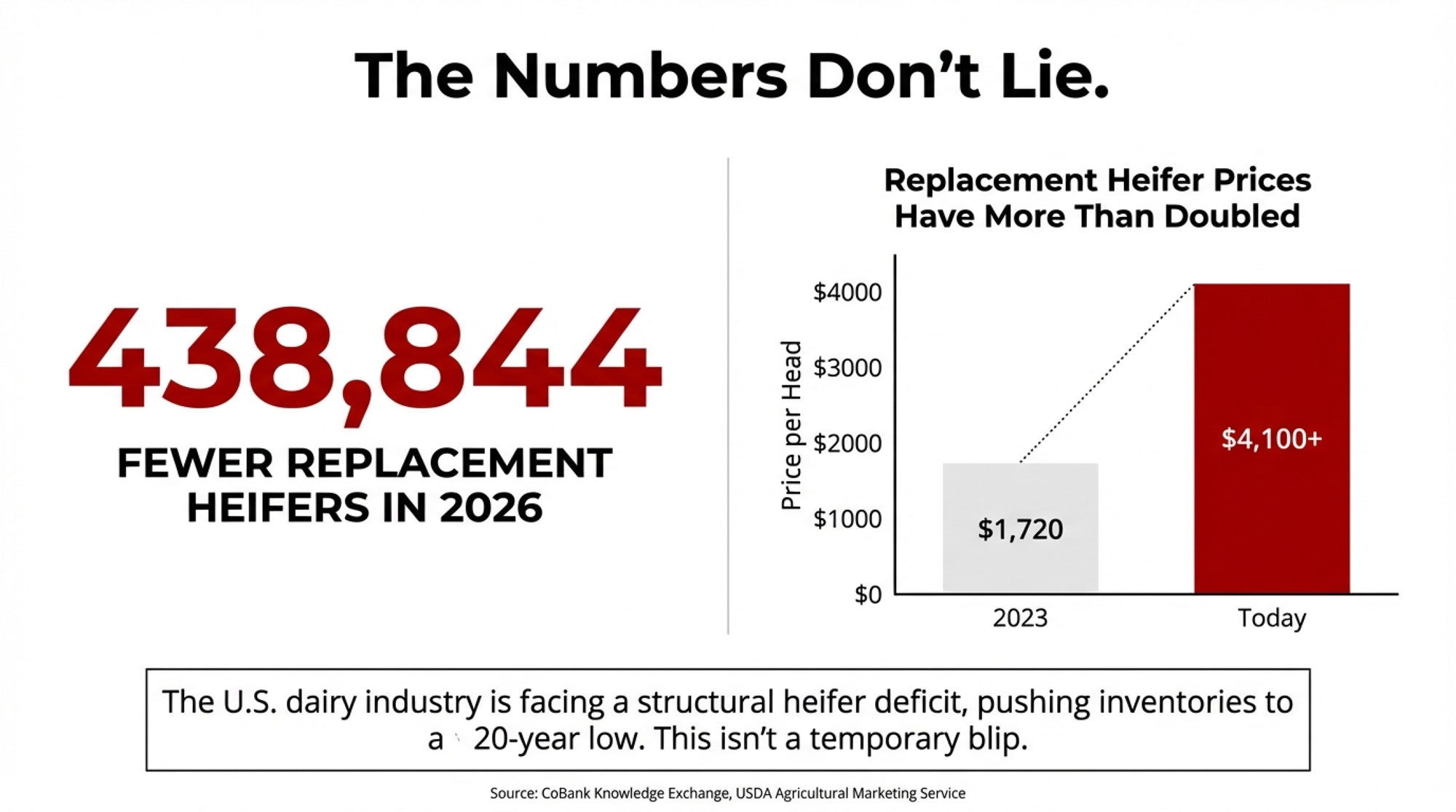
What wasn’t immediately visible was the 30-month lag hidden in those breeding choices. And here’s where it gets sobering. According to CoBank’s Knowledge Exchange report – Dairy Heifer Inventories to Shrink Further Before Rebounding in 2027, published this past August by lead dairy economist Corey Geiger and industry analyst Abbi Prins, the U.S. dairy industry faces 438,844 fewer replacement heifers in 2026 compared to 2025. We’re looking at heifer inventories hitting a 20-year low—territory we haven’t seen since the mid-2000s.

“We’re not talking about a temporary blip,” Geiger says. “The heifer deficit is structural. It reflects breeding decisions that were made two to three years ago, and those decisions can’t be unwound quickly.”

The farms that recognized this timeline early are positioning themselves for the decade ahead. Those that didn’t are facing some difficult choices. And the industry emerging on the other side? It’s going to look fundamentally different.
Biology Doesn’t Care About Your Cash Flow

Here’s what makes this situation so challenging—and you know this as well as anyone: the core constraint isn’t financial or managerial. It’s biological. And biology doesn’t negotiate.
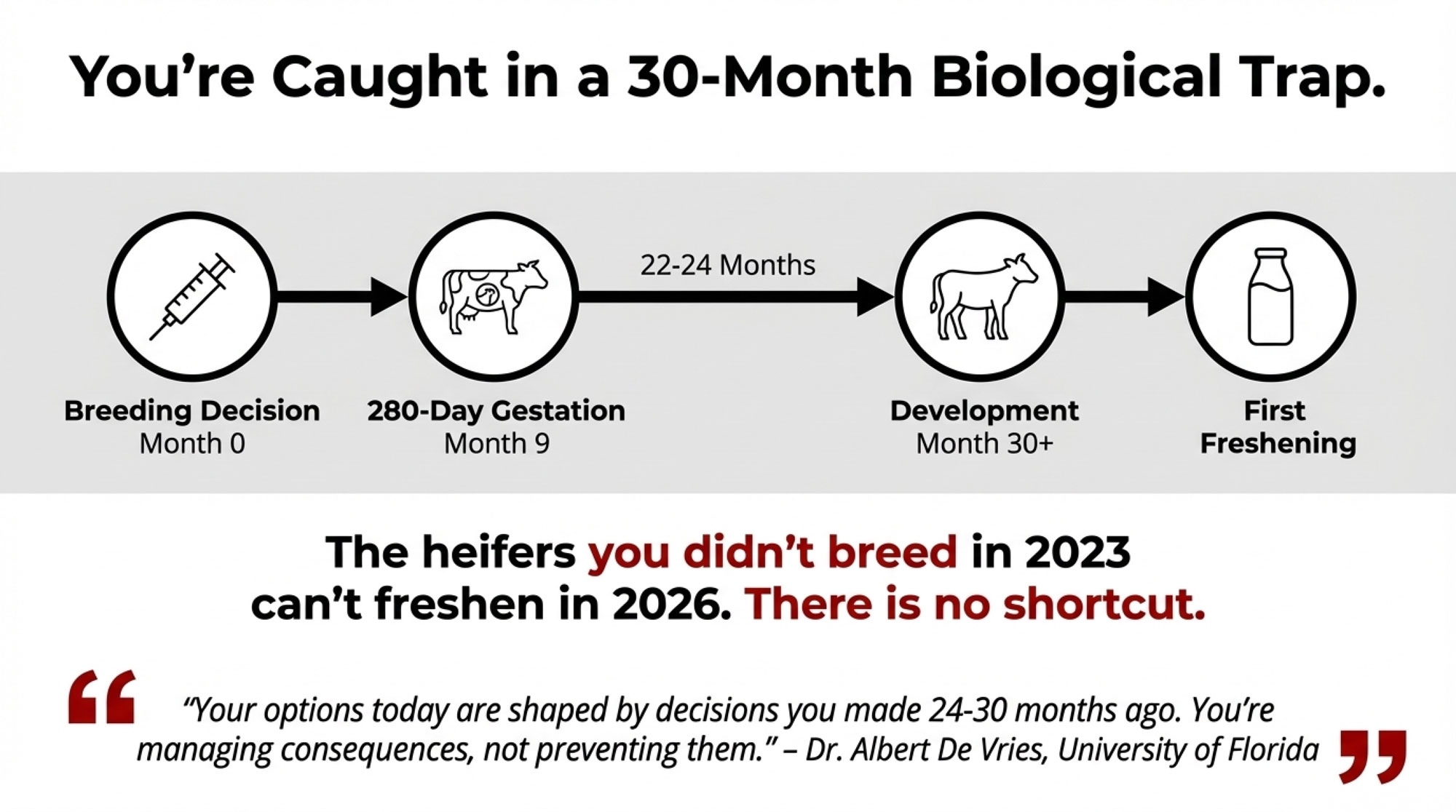
A breeding decision made today takes approximately 30 months to produce a milking cow. You’ve got 280 days of gestation, then 22-24 months of heifer development before that animal freshens and enters your milking string. There’s simply no shortcut through that timeline, regardless of what you’re willing to invest.

What this means, practically, is that the heifer shortage hitting farms in 2026-2027 was locked in by breeding decisions made in 2023-2024. Dr. Albert De Vries, professor of dairy management and economics at the University of Florida, has been modeling replacement dynamics for over two decades. His research on optimal replacement decisions, published in the Journal of Dairy Science, consistently shows that herd composition changes operate on multi-year cycles that can’t be compressed.

“Farmers sometimes ask me, ‘What can I do right now to fix my replacement situation?'” De Vries shared. “The honest answer is that your options today are shaped by decisions you made 24-30 months ago. You’re managing consequences, not preventing them.”

It’s a difficult message, but a necessary one.

The practical impact shows up across the board:

  • Replacement heifer prices have climbed from $1,720 in April 2023 to $3,800-4,200 currently—more than doubling in under 30 months, according to USDA Agricultural Marketing Service livestock reports
  • A 500-cow dairy requiring 140 annual replacements now faces $532,000-588,000 in heifer costs versus $241,000 two years ago
  • Custom heifer rearing operations across the Upper Midwest report being fully booked through the remainder of 2026, with limited capacity for new clients
Metric2023 Reality2026 ReckoningChange
Heifer Price (Per Head)$1,720$4,100+138%
Annual Cost (500-Cow Herd, 140 Replacements)$240,800$574,000+$333,200
Breeding Strategy60-80% Beef-on-Dairy40-50% Beef-on-DairyRecalibration
Beef Calf Premium$400-800 vs. $50-150 Dairy$350-700 vs. $40-120 DairyStill Positive
Custom Heifer CapacityAvailableFully Booked Through 2026Zero Slack
Processor LeverageBuyer’s MarketSeller’s Market (Q1-Q2 2026 Window)Historic Shift
Primary Strategy LeverMaximize Beef PremiumsExtended Lactation / PartnershipsSurvival Mode

One custom heifer operator running 400 head outside Lancaster, Pennsylvania, says he’s turned away 11 inquiries in just the past 3 months. “I’ve never seen demand like this,” he shared, asking that his name be withheld due to client confidentiality. “Guys who never called me before are suddenly very interested in long-term contracts. But I’m full. Everyone’s full.”

For operations that went heavily into beef breeding—we’re talking 60-80% of eligible matings, which wasn’t uncommon—the math creates a genuinely challenging scenario. Those heifers that should be entering the milking herd in 2026-2027? They were never conceived in the first place.

The North American Picture

It’s worth noting that this isn’t purely a U.S. phenomenon, though the dynamics differ by market structure. Canadian producers operating under supply management face a different calculus—quota values exceeding $40,000 per kg in many provinces mean heifer prices have always commanded premiums, but the beef-on-dairy trend has been more muted north of the border. The quota system creates built-in incentives to maintain replacement pipelines that open-market systems don’t.

In New Zealand and parts of the EU, seasonal calving patterns and grass-based systems create their own constraints on replacement. But the U.S. situation is unique in scale and severity—the combination of high beef-cross adoption rates and massive processing expansion has created a perfect storm that other markets haven’t experienced to the same degree.

What’s worth watching: The EU’s Green Deal and Farm to Fork Strategy—targeting a 30% reduction in agricultural emissions and 25% organic farmland by 2030—is adding regulatory pressure that’s expected to shrink EU dairy herds further in coming years. EU milk production already declined 0.2% in 2025 to 149.4 million metric tons, with environmental compliance costs straining smaller producers. According to UW-Madison Extension analysis , many EU dairy farmers are concerned these sustainability mandates will hurt their competitiveness in global markets. For U.S. exporters, this creates a potential opening—if domestic supply can keep pace with new processing capacity. The heifer shortage complicates that equation considerably.

Survival of the Smartest: Why Your 2023 Strategy Is Your 2026 Crisis

What’s encouraging is that rather than treating this as an insurmountable crisis, many progressive operations are discovering that the heifer shortage actually creates opportunities—if you adapt quickly enough. The key lies in understanding which strategies work within biological constraints and which ones amount to wishful thinking.
Extended Lactation: The Fastest Lever You Can Pull

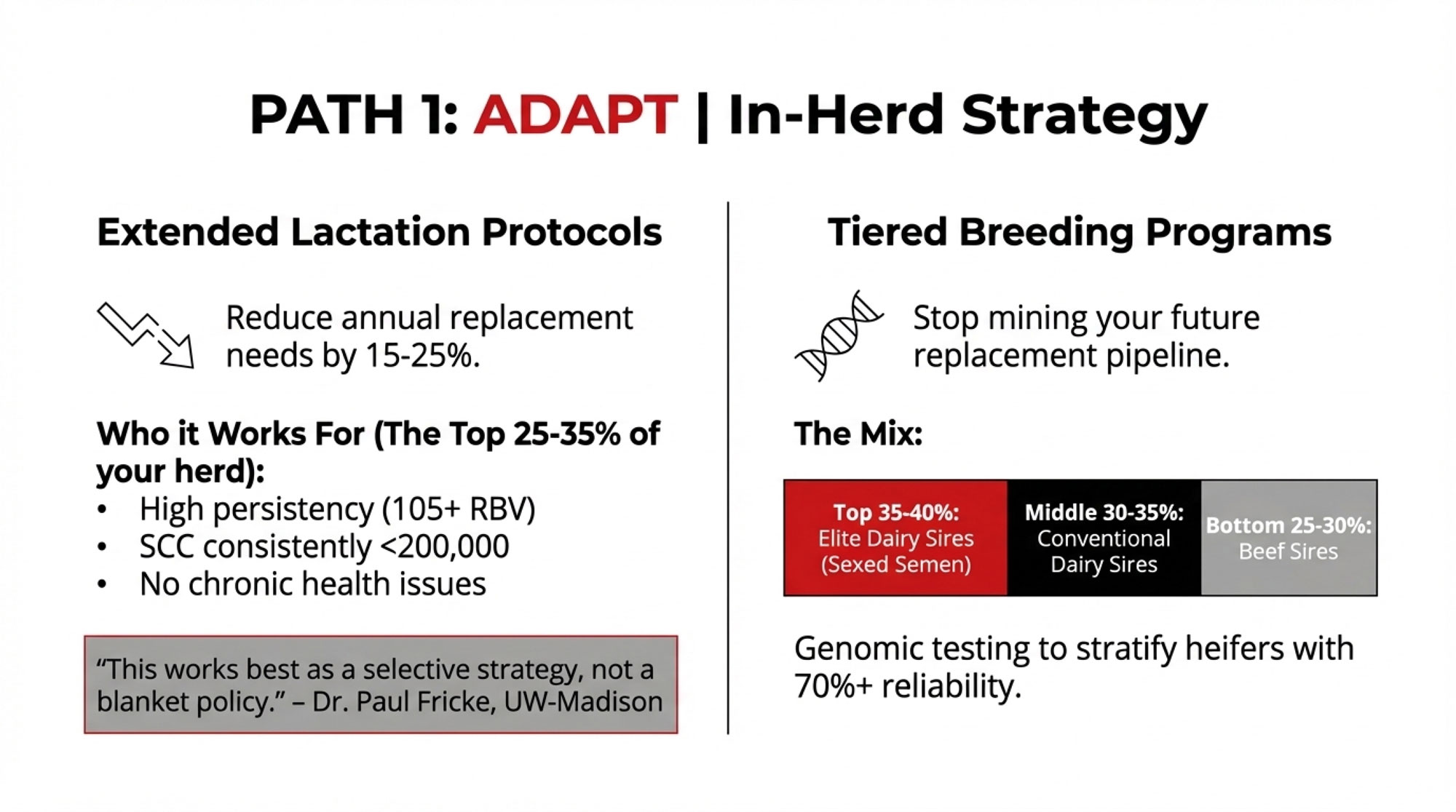
Extended lactation protocols—keeping cows milking 14-18 months instead of the traditional 12-month cycle—offer the quickest path to reducing replacement pressure. This isn’t a new concept, as many of us know, but it’s getting a serious second look given current heifer economics.

Research from the University of Wisconsin-Madison’s Dairy Science Department, led by Dr. Kent Weigel, shows that well-managed extended lactations can reduce replacement needs by 15-25% without sacrificing lifetime production. The key word there is “well-managed.” This isn’t about keeping every cow milking longer—it’s about identifying the right candidates.

Here’s how the economics generally work:

A cow producing 85 pounds daily at month 12 typically drops to 68-72 pounds by month 16. That’s a real decline in daily output, no question. But here’s what the daily production numbers miss: that cow isn’t generating replacement costs, breeding expenses, dry-period feed costs, or fresh cow health risks during transition. When you factor in the full cost of bringing a replacement into the herd—currently running $4,000+ just for the heifer purchase, plus another $800-1,200 in transition period costs—the extended lactation cow often comes out ahead on a total cost basis.

One central Wisconsin producer milking 850 Holsteins started implementing extended lactation protocols in early 2025. “We’re keeping about 130 cows on 16-month cycles now,” she explained, requesting anonymity to avoid drawing competitor attention to her cost structure. “My replacement purchases dropped from 240 last year to around 185 this year. At current prices, that’s real money—probably $220,000 in savings.”

The candidates that work best for extended lactation, based on research and field experience:

  • Persistency ratings above 105 RBV (these cows maintain production better through late lactation)
  • Somatic cell counts consistently below 200,000, because udder health has to be solid for this to work
  • No chronic lameness or recurring health issues
  • Body condition scores holding at 2.75-3.25 through mid-lactation

Now, here’s an important caveat that doesn’t always make it into the enthusiastic discussions of extended lactation. Dr. Paul Fricke, professor and extension specialist in dairy cattle reproduction at UW-Madison, notes: “There are real considerations around subsequent fertility and metabolic health. Cows that go significantly longer between calvings can have more difficulty conceiving on subsequent cycles. This works best as a selective strategy, not a blanket policy.”

That’s worth emphasizing. Extended lactation isn’t about keeping your whole herd milking longer. It’s about identifying the 25-35% of your cows that are genuinely good candidates and managing them differently. Your veterinarian can help develop monitoring protocols specific to your operation.

Tiered Breeding: Stop Mining Your Own Future

The operations handling this best are implementing what you might call tiered breeding—a systematic approach that captures beef premiums where it makes sense while ensuring adequate replacement supply.

Here’s where genomic testing has become genuinely transformative. Instead of relying on parent average or waiting for first-lactation data, farms using genomic evaluations can stratify their heifer calves at 2-3 months of age with 70%+ reliability on key traits. That precision matters when you’re deciding which animals get the $40 sexed dairy straw versus the $12 beef straw. The cost of genomic testing—typically $35-50 per head—pays for itself many times over when it prevents you from putting beef genetics on a heifer that should have been a herd-building dam.

Here’s how a typical protocol structures breeding decisions based on genetic merit:

Herd Segment% of HerdGenetic MeritBreeding StrategyCost Per StrawStrategic Purpose
Top Tier35-40%Top 1/3 Net Merit or TPISexed Dairy Semen (Elite Sires)$35-45Herd builders – next generation genetic improvement
Middle Tier30-35%Average geneticsConventional Dairy Semen (Solid Sires)$15-25Replacement pipeline – maintain herd numbers
Bottom Tier25-30%Lowest 1/3 production/healthBeef Semen$8-15Terminal value – cull candidates
Extended Lactation Candidates10-15%High persistency (>105 RBV), excellent healthSkip Breeding / Delay 4-6 months$0 initialReduce replacement pressure short-term
  • Top 35-40% of herd (highest genetic merit): These are your herd builders. Breed them to elite dairy sires using sexed semen. Yes, it costs more per straw—$35-45 versus $8-15 for conventional beef. But these matings produce your next generation of genetic improvement. They’re investments, not costs. If you’re using genomic testing, these are your animals with Net Merit or TPI in the top third of your herd.
  • Middle 30-35% (average genetics): Breed to conventional dairy sires—no sexing premium, solid genetics, predictable outcomes. These animals maintain your replacement numbers without straining the budget.
  • Bottom 25-30% (lowest merit): This is where beef genetics make sense. These animals should be transitioning out of your herd anyway based on their production and health profiles. Breeding them to beef sires maximizes their terminal value without compromising your replacement pipeline.

Many progressive operations have recalibrated their breeding mix after going heavy on beef genetics in 2023. The pattern emerging across Wisconsin and the Upper Midwest: farms that had 70% or more of matings going to beef are now pulling back to 40-50%, being much more deliberate about which cows get which service.

The key insight these producers have landed on: not every cow should leave genetic offspring in your herd—but enough of them have to, or you’re mining your own future.

The Processor Partnership Window: Leverage You Won’t See Again

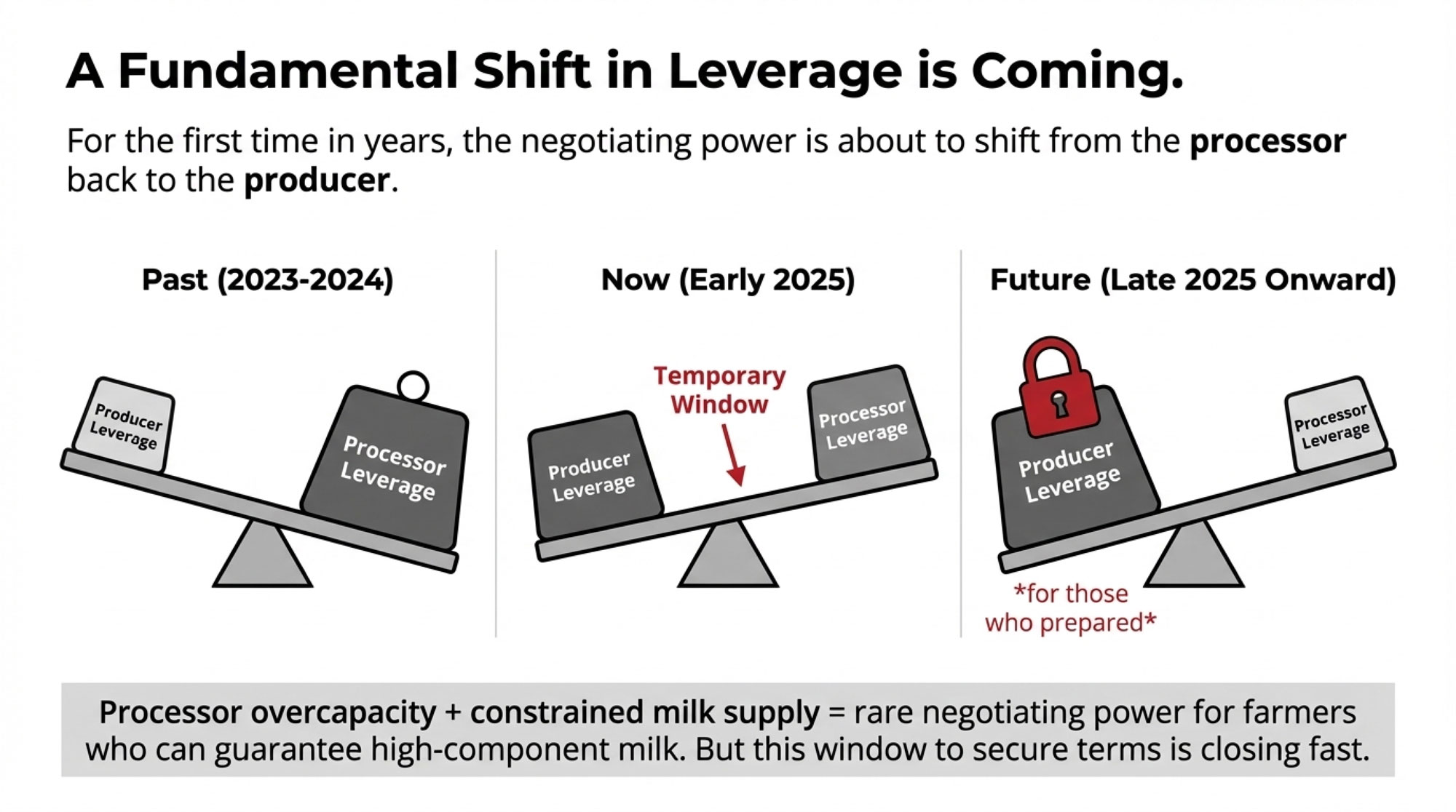
Now, here’s where things get genuinely interesting from a market-dynamics standpoint. Perhaps the most significant—and honestly, underreported—development of late 2025 is the shift in negotiating leverage between farms and processors.
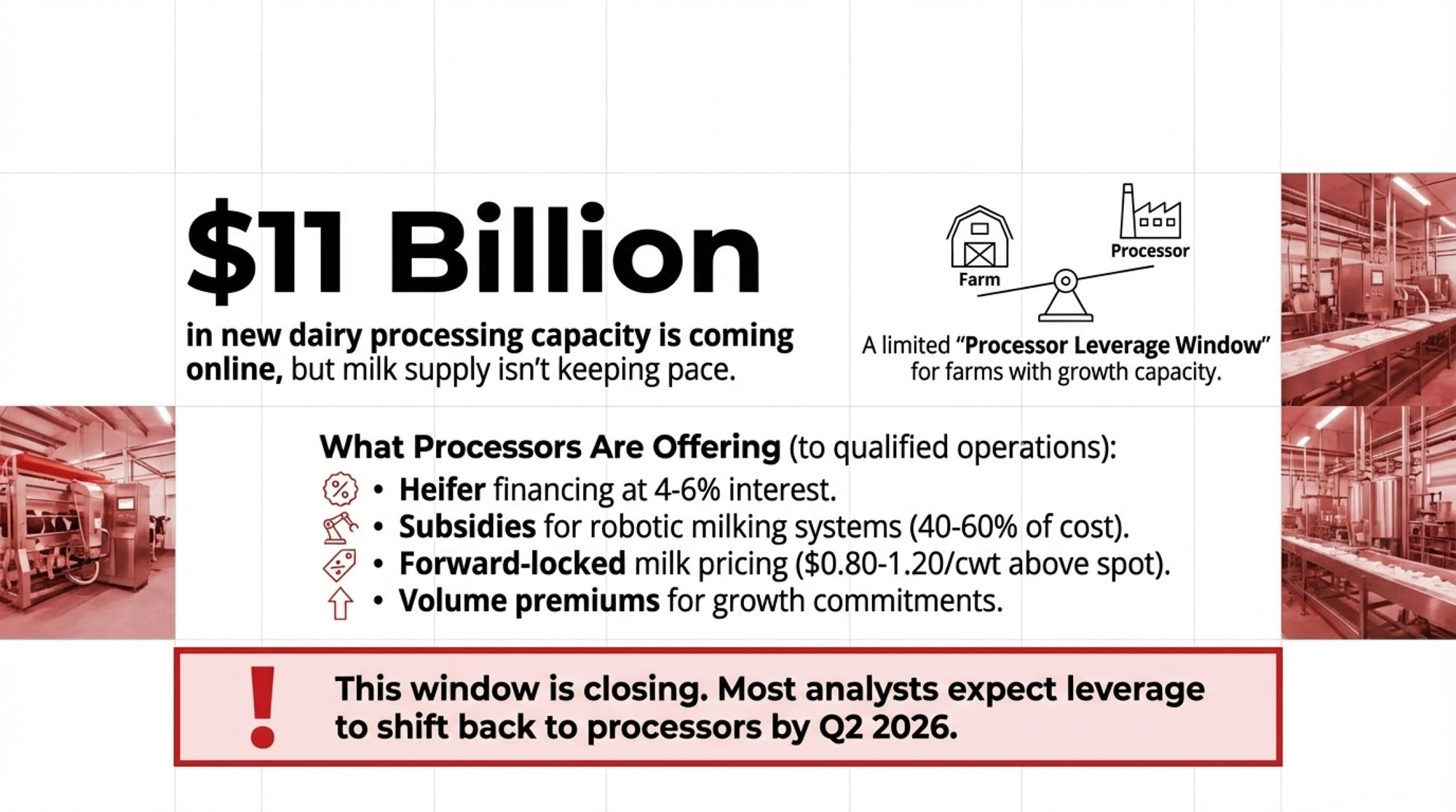
There’s roughly $11 billion in new dairy processing capacity coming online between 2025 and early 2028, according to IDFA data released this past October. These are major investments: Hilmar’s Texas expansion, Leprino’s new Texas facility, Glanbia’s recent Michigan expansion, plus a string of regional cheese and specialty product facilities across the Upper Midwest and Southwest.

Here’s the challenge these processors are facing: plants designed for 85-90% utilization are running at 60-70% because the milk supply growth they projected isn’t materializing. When you breed 60-70% of your herd to beef for two years, you don’t have the replacement heifers to expand production. The connection seems obvious in hindsight, but it caught many in the processing sector off guard.

“We planned capacity based on historical supply growth trends,” one Midwest cooperative procurement manager shared, speaking on background due to ongoing contract negotiations. “Nobody modeled what happens when a significant portion of the national herd stops producing dairy replacements for two years. We’re adjusting our assumptions now, but the capacity is already built.”

This creates what some industry observers are calling a “leverage window”—a period where farms with growth capacity can negotiate terms that would have been unthinkable three years ago.

What some processors are offering qualified operations:

  • Heifer financing at 4-6% interest, compared to 7-9% from traditional agricultural lenders
  • Equipment subsidies covering 40-60% of robotic milking system costs in exchange for supply commitments
  • Forward-locked milk pricing 12-36 months out, often $0.80-1.20/cwt above the current spot market
  • Volume premiums for farms that can commit to production growth trajectories

I’ve spoken with several farm operators in Wisconsin and Idaho who’ve signed or are negotiating agreements along these lines, though all requested anonymity given the competitive sensitivity. The common thread: processors are willing to put capital at risk to secure future milk supply because they’re genuinely concerned about where future growth will come from.

“They need us more than they’re used to needing us,” is how one central Wisconsin dairyman put it. “It’s a strange feeling after years of being told to take whatever price they offered.”

The qualification requirements typically include:

  • 500+ cows are currently milking
  • Component levels approaching 3.2% protein (this aligns with December 2025 FMMO pricing changes that increase protein’s value)
  • Debt-to-equity ratios below 50%
  • Willingness to sign 5-7 year exclusive supply agreements
  • Demonstrated ability to grow production 10-20% over the contract period

For farms meeting these criteria, the partnerships can genuinely reshape their economics. For those who don’t qualify for processor financing, traditional options remain available—FSA guaranteed loans, state dairy assistance programs, and Farm Credit services are all seeing increased demand as farmers look for ways to finance heifer purchases and facility upgrades during this tight market.

But these windows don’t stay open forever. As processor capacity fills and supply concerns ease, the negotiating dynamics will shift back toward buyers.

The realistic window, based on conversations with dairy economists and processor representatives? Probably through Q1 or Q2 of 2026. Maybe a bit longer in regions with less processing competition. But farms considering this path shouldn’t assume the current leverage environment persists indefinitely.

The Exit Ramp: When Walking Away Is the Smartest Play

Processor partnerships aren’t available everywhere, and they’re not the right fit for every operation. For some farms, the current market offers a different kind of opportunity—one that involves making a clear-eyed decision about the future rather than doubling down on growth.
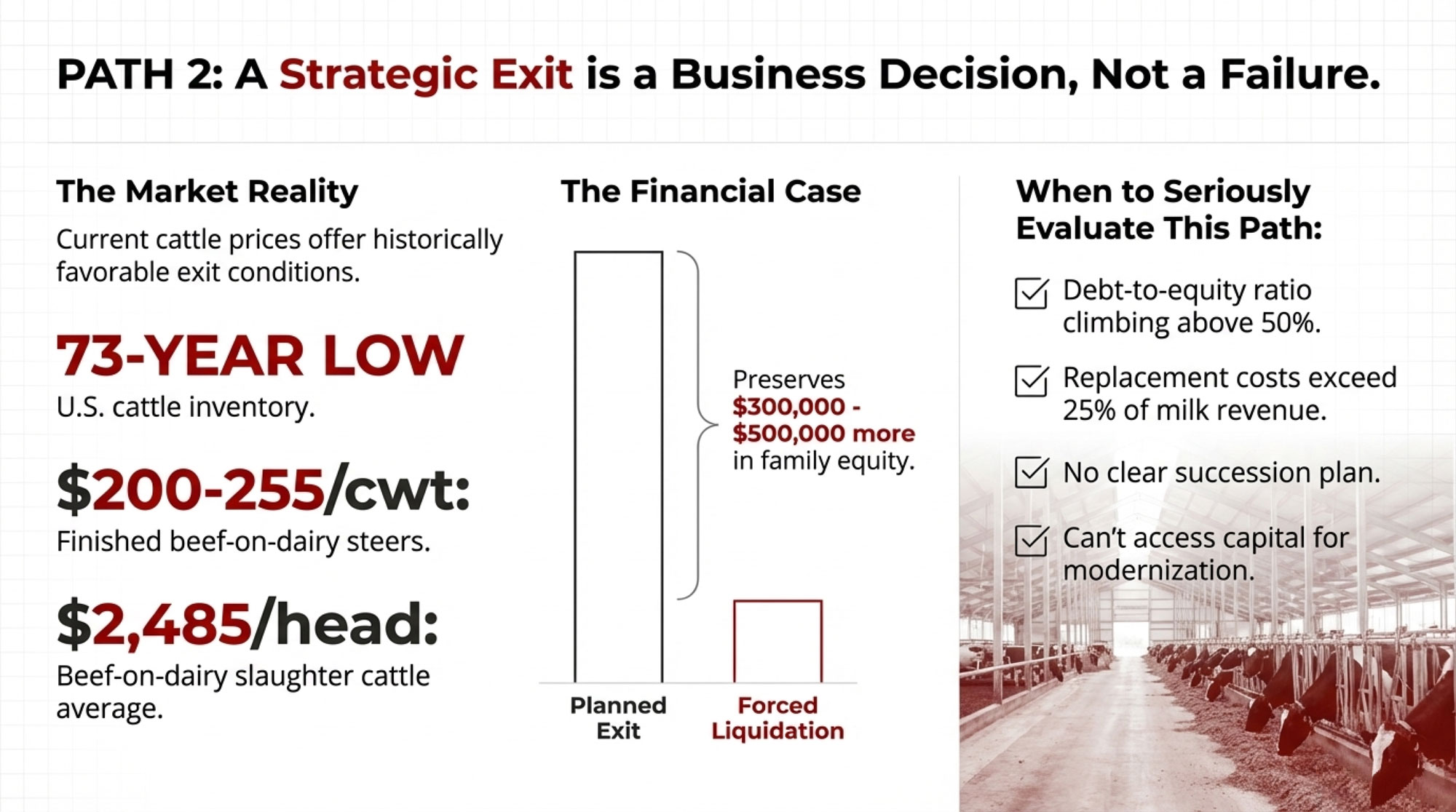
This is the part that’s hardest to write, honestly, but it would be dishonest to leave it out. For farms facing multiple stressors simultaneously, a strategic exit during the current cattle price peak may preserve more family wealth than continued operation.

I want to be clear about framing here: this isn’t a failure narrative. Cattle markets operate in cycles, as we’ve all seen over the years, and the current cycle offers historically favorable exit conditions. Making a clear-eyed decision to capture that value isn’t giving up—it’s recognizing market realities.

Consider the current market context:

  • Finished beef-on-dairy steers are bringing $200-255/cwt according to USDA Agricultural Marketing Service reports—near all-time highs
  • Beef-on-dairy slaughter cattle are averaging $2,485/head, outperforming native beef by roughly $100/head
  • U.S. cattle inventory sits at a 73-year low—the smallest since 1951 according to USDA data—supporting continued strong pricing through at least 2026-2027 per CattleFax projections

What farm transition data suggests—compiled by agricultural lenders, extension economists, and farm management associations—is that the timing difference between strategic exit and forced liquidation can be substantial. Operations that make planned exits in months 8-10 during financial stress typically preserve $300,000-500,000 more in family equity than those forced into distressed sales in months 16-18.

That gap represents college funds, retirement security, or capital to start something new. It’s not trivial.

Indicators that suggest seriously evaluating strategic exit:

  • Cash flow negative for 3+ consecutive months with no clear path to reversal
  • Debt-to-equity ratio above 50% and still climbing
  • No processor contract and fully exposed to spot market volatility
  • Replacement heifer costs are consuming more than 25% of milk revenue
  • Primary operator is 55-65 with no clear succession plan
  • Can’t access capital for necessary modernization

For families recognizing themselves in that list, the current window—Q4 2025 through Q2 2026—offers optimal timing. Cattle prices remain elevated, equipment values haven’t yet been depressed by consolidation-driven sales volume, and agricultural real estate markets in dairy regions remain relatively stable.

One southern Minnesota couple in their early 60s exited their 380-cow dairy this past August after running the numbers on replacement costs. “Our kids aren’t interested in the operation, and the heifer prices were the final straw,” the husband shared, asking that names be withheld to protect family privacy. “Once we did the math on replacing 110 heifers a year at $4,000-plus each, versus what we could get for the herd and equipment right now, the decision got a lot clearer.”

They netted roughly $1.4 million after debt payoff. “Ask me if I’m sad about it? Sure, some days. Ask me if it was the right call? Absolutely.”

A note on taxes: Livestock sale proceeds are taxable income—something that catches some exiting producers off guard. This family worked with an agricultural accountant to structure their sale across two tax years and take advantage of capital gains treatment where applicable. If you’re considering an exit, consult with a tax professional familiar with farm transitions before finalizing timing. The difference between a well-structured exit and an unplanned one can be substantial.

Two Models Will Dominate—Where Does Your Operation Fit?

Looking beyond the immediate heifer crunch, what we’re really watching is a structural transformation that will reshape dairy farming for the next generation. The numbers in various USDA and academic projections tell a consistent story: we’re likely moving from approximately 22,000 dairy farms today to 14,500-17,000 by 2028-2029, while total milk production increases modestly.

That’s not just “fewer farms.” It’s a fundamental restructuring around two viable models, with a shrinking middle ground between them.
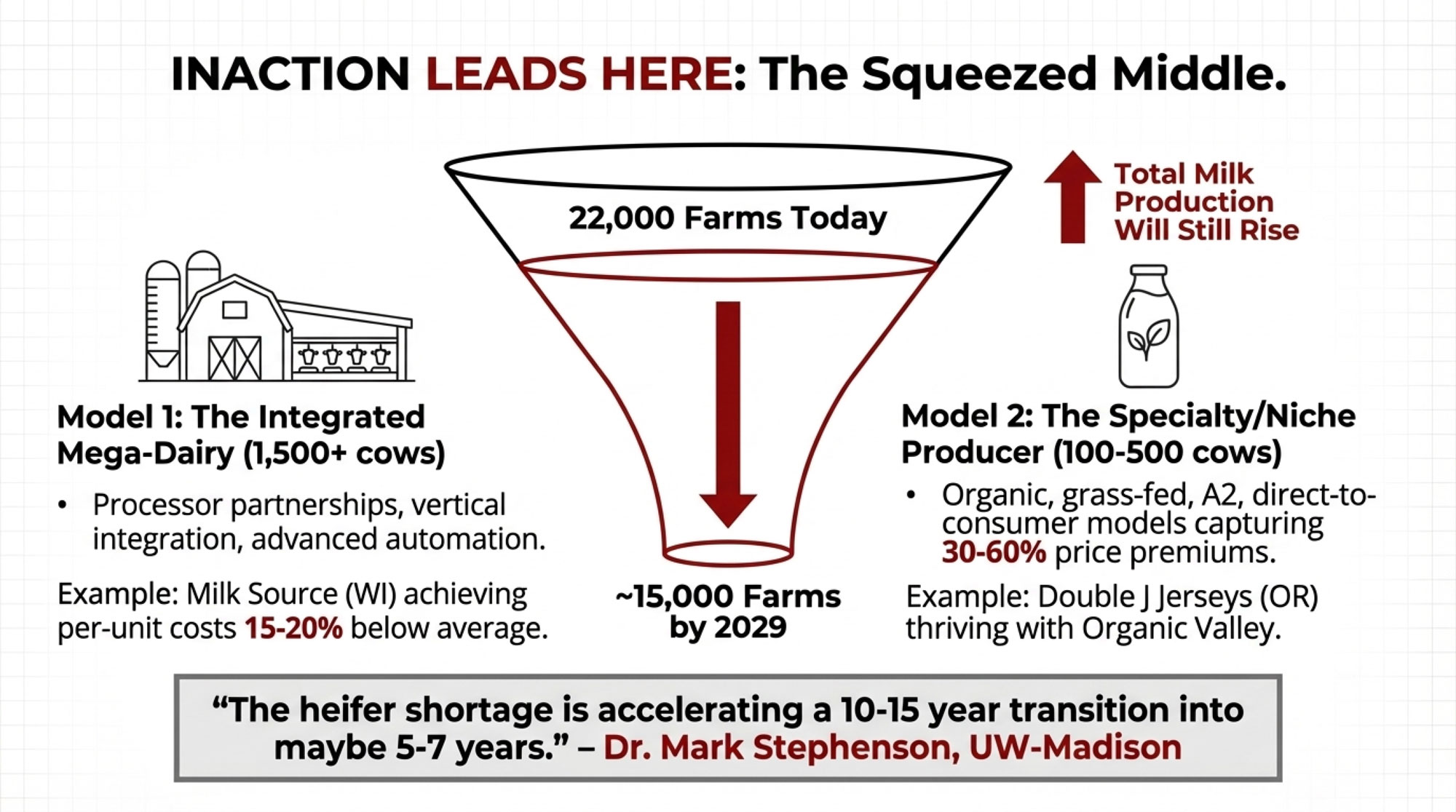
Model 1: The Integrated Mega-Dairy

Operations of 1,500+ cows with exclusive processor partnerships, advanced automation, and increasingly vertical supply chains. According to the USDA’s “Consolidation in U.S. Dairy Farming” report, these farms are projected to produce 55-60% of U.S. milk from just 4-5% of total operations by decade’s end.

Large integrated operations, such as Milk Source in Wisconsin, illustrate this model at scale. Co-founded in 1994 by Jim Ostrom, John Vosters, and Todd Willer—all UW-Madison graduates from multi-generational Wisconsin farm families—the operation traces its roots to 1965, when John’s parents started a small 30-cow dairy in Freedom. Today, Milk Source operates multiple facilities across Wisconsin and the Midwest, running their own feed mills, calf ranches, and cropping operations, achieving per-unit costs 15-20% below industry average through vertical integration. That’s the competitive advantage mega-dairies are building: not just size, but system control.

Model 2: The Specialty/Niche Producer

Operations of 100-500 cows focused on organic, grass-fed, A2, or direct-to-consumer markets. These farms capture significant price premiums—often 30-60% above conventional—that offset their smaller scale. Organic Valley, for instance, reports steady demand growth for its farmer-members’ milk, with farmgate prices well above those in conventional markets.

Jon Bansen operates Double J Jerseys, a grass-fed, organic dairy with approximately 150-200 cows near Monmouth, Oregon, that sells through the Organic Valley cooperative. A multi-generational dairy farmer, Bansen has built his operation around intensive rotational grazing and 100% grass-fed practices—even when it means leaving some acres unproductive for conservation. What’s encouraging about operations like Double J Jerseys is that grass-fed premiums and cooperative membership provide price stability that helps absorb cost increases, which might challenge conventional operations of their size.

What’s getting squeezed: The traditional mid-size commodity dairy—500-1,000 cows producing undifferentiated milk for spot markets without processor partnerships or specialty premiums. This segment faces pressure from both directions: too small for mega-dairy efficiencies, too large for niche positioning.

CharacteristicModel 1: Integrated Mega-DairyModel 2: Specialty/Niche ProducerThe Disappearing Middle
Herd Size1,500-10,000+ cows100-500 cows500-1,000 cows
Market PositionExclusive processor partnerships, vertical integrationOrganic, grass-fed, A2, direct-to-consumerUndifferentiated commodity milk
Price RealizationVolume efficiency: $0.40-0.80/cwt below market, profit on scalePremium pricing: 30-60% above conventionalSpot market exposure: full volatility
Competitive AdvantagePer-unit costs 15-20% below average via automation and vertical supply chainsDifferentiation premiums and brand loyaltyNone sustainable
Capital Requirements$15-40 million (barriers to entry)$500K-3 million (differentiation investment)$3-8 million (too big for niche, too small for efficiency)
Risk ProfileContract stability, but massive debt serviceMarket volatility, but loyal customer baseMaximum exposure: no contracts, no premiums
ExamplesMilk Source (WI), Riverview Dairy (SD)Double J Jerseys (OR), Organic Valley membersMost 500-1,000 cow operations without processor partnerships
2028 Projection55-60% of U.S. milk from 4-5% of farms8-12% of U.S. milk from 15-20% of farmsDeclining share, consolidation pressure

Dr. Mark Stephenson tracked these structural shifts throughout his career as Director of Dairy Policy Analysis at UW-Madison. “The middle hasn’t been comfortable for a while,” he notes. “What the heifer shortage is doing is accelerating a consolidation that was already underway. It’s compressing a 10-15 year transition into maybe 5-7 years.”

Regional Realities: One Size Doesn’t Fit All

The geographic impact isn’t uniform, and it’s worth factoring regional dynamics into your planning.

Upper Midwest (Wisconsin, Minnesota): High processor density creates more partnership options, but also more competition for those deals. Wisconsin’s strong cheese industry values high-component milk, which advantages operations that can hit 3.2%+ protein targets. The state may see farm numbers decline 35-40%, but surviving operations will likely have strong processor relationships.

Northeast (New York, Pennsylvania, Vermont): More fragmented processor landscape with significant organic and specialty opportunity. The decline in fluid milk continues to pressure conventional operations, but proximity to population centers supports direct-market strategies. Farms close to urban markets may find the niche model more viable here than elsewhere.

West/Southwest (California, Idaho, Texas, New Mexico): Where mega-dairy expansion is concentrated. Lower regulatory burden, available land, and new processing capacity are pulling production westward. Texas has seen particularly significant dairy expansion in recent years, according to USDA NASS data, with growth concentrated almost entirely in operations with 2,000 or more head.

Pacific Northwest (Washington, Oregon): Mixed picture—strong organic demand through Tillamook and similar cooperatives, but conventional operations face the same squeeze as elsewhere. Water availability is increasingly a factor in expansion decisions.

What This Means for Your Operation

I want to be careful about projecting too much certainty here. Markets are complicated, and anyone who claims to know exactly what heifer prices will be in 2027 is guessing. That said, there are patterns worth watching and principles that seem reasonably sound.

What seems fairly certain:

  • The heifer shortage is structural, not cyclical. It reflects breeding decisions already made and can’t be reversed quickly.
  • Replacement costs will remain elevated through at least 2027, with CoBank projecting meaningful recovery only in late 2027 or 2028.
  • The farms that position themselves now—whether for growth, for niche markets, or for strategic exit—will have more options than those who wait.

What’s less certain:

  • Exactly how high will heifer prices go. The $4,000-$4,500 range seems likely, but market dynamics could push it higher.
  • How long does the processor-leverage window stay open? Current estimates suggest Q1-Q2 2026, but this depends on how quickly supply concerns ease.
  • Whether export markets absorb the new processing capacity. Trade policy, currency movements, and global demand all factor in.

If You’re Planning to Continue and Grow

Take a serious look at processor partnership opportunities now, while the leverage window remains open. This may be your best chance in a decade to negotiate favorable terms. Think about extended lactation protocols for the right candidates—that 25-35% of your herd with strong persistency, good udder health, and solid body condition. Work with your veterinarian to develop monitoring protocols that fit your operation.

Restructure your breeding program so that at least 50-60% of matings produce dairy replacements. The beef premiums are real, but so is the replacement pipeline you’re building. And budget conservatively—plan for replacement heifer costs of $4,000-5,000 through 2027. Hope for lower, but don’t count on it.

If you’re not already genomic testing your heifer calves, now’s the time to start. The $40-50 investment per head pays for itself when you’re making $4,000 breeding decisions. Knowing which animals have the genetic merit to justify elite dairy genetics versus which should get beef semen isn’t guesswork anymore—it’s data.

If processor financing isn’t available in your area, explore FSA guaranteed loans and state dairy assistance programs. Demand is up, but funds remain available for qualified operations.

If You’re Uncertain About the Future

Start with an honest financial assessment. Debt-to-equity ratio, debt service coverage, cash flow trends, and family situation. These numbers tell you something. Understand that a strategic exit in 2025-2026, at peak cattle valuations, preserves substantially more equity than a forced exit in 2027-2028 when prices may be lower, and more farms are competing for buyers.

Talk to agricultural attorneys and accountants about transition planning. Good advice costs money; poor advice costs more. And consider partial strategies if full continuation isn’t viable—retaining real estate while liquidating livestock and equipment can provide ongoing income while preserving land wealth.

Don’t overlook risk management tools: The Dairy Margin Coverage (DMC) program , extended through 2031 under the recent budget legislation, offers coverage levels from $4.00 to $9.50 per cwt—and Tier 1 coverage has been increased to 6 million pounds of milk. Producers enrolling for multiple years through 2031 can lock in a 25% premium discount. For operations navigating uncertain margins, DMC provides a floor that can help with cash flow planning. LGM-Dairy insurance offers another option, protecting against both feed cost spikes and milk price drops on a rolling 11-month basis. Neither program solves the heifer shortage, but both can help stabilize income while you work through the transition.

For Everyone

Accept that the industry structure of 2028 will look different from today. Not worse, necessarily—but different. Planning for that difference beats hoping it doesn’t happen.

The 30-month biological constraint isn’t going away. Every quarter you wait to adjust breeding protocols is another quarter before those decisions produce results. The farms that feel most confident about their position are those that began adjusting 12-18 months ago. They’re not immune to the heifer shortage, but they’re managing it rather than being managed by it.

The Beef on Dairy Boom that Changed the Game

The beef-on-dairy boom of 2023-2024 revealed something important about dairy economics: optimizing for today can create constraints tomorrow. That’s not a criticism of the farmers who made those breeding decisions—the premiums were real, and the cash flow mattered. But it’s a reminder that agricultural systems operate on biological timelines that don’t align neatly with market cycles.

The farms discovering that lesson now still have time to adapt. The 30-month clock that started with those breeding decisions keeps running. What happens next depends on decisions being made right now.

As that Wisconsin dairyman still processing the $4,100 heifer quote put it: “I can’t go back and change what I bred in 2023. But I can sure change what I’m doing today. That’s gotta count for something.”

It does. The question is whether enough farms figure that out while they still have choices to make.

The Bullvine Bottom Line

If you’re waiting for heifer prices to drop before you change your breeding mix, you’ve already lost. The 438,844-heifer deficit hitting in 2026 was locked in by decisions made in 2023, and the clock started ticking the moment those beef straws went in. Biology doesn’t care about your cash flow projections. The only question left: Are you breeding for 2024’s market or 2028’s reality?
Key Takeaways 

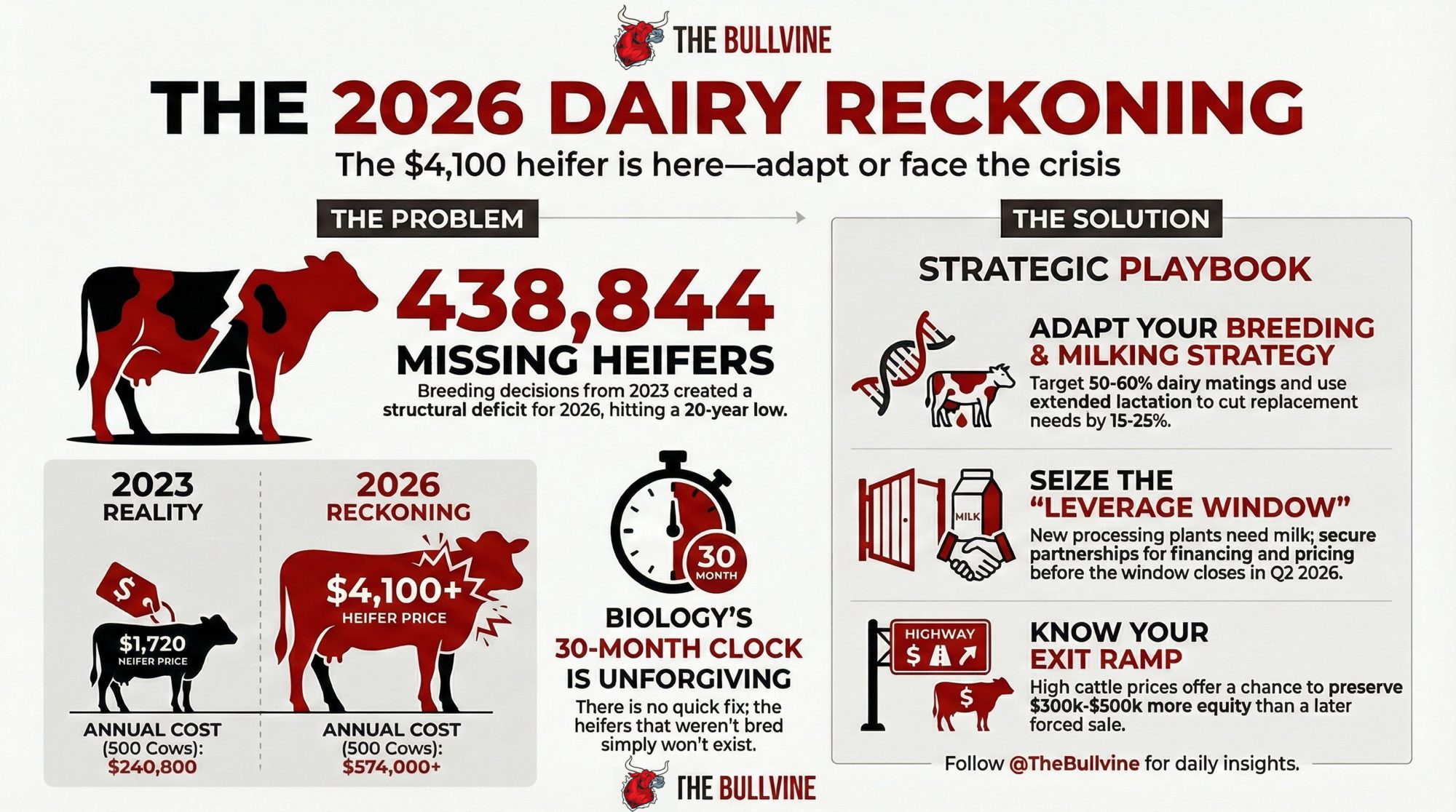
  • 438,844 Missing Heifers: The 2026 shortage was locked in by 2023 breeding decisions. Biology’s 30-month timeline means there’s no quick fix—only adaptation.
  • Replacement Costs Doubled: Heifers jumped from $1,720 to $4,100+. For a 500-cow dairy, that’s $300,000+ more per year in replacement costs alone.
  • The Leverage Window Closes Q2 2026: Processor partnerships, heifer financing at 4-6%, and forward pricing are available NOW. This window won’t reopen once capacity fills.
  • Restructure Your Breeding Mix: Target 50-60% dairy matings minimum. Extended lactation protocols on your top 25-35% of cows can reduce replacement needs by 15-25%.
  • Strategic Exit Beats Forced Liquidation: For operations under financial stress, exiting at peak cattle prices ($200-255/cwt for beef-on-dairy steers) preserves $300K-500K more in family equity.

Executive Summary: 

U.S. dairy is staring down a 438,844-heifer deficit in 2026—the unavoidable consequence of 2023’s beef-on-dairy breeding boom. Replacement prices have more than doubled, from $1,720 to over $4,100 per head, adding $300,000+ in annual replacement costs for a typical 500-cow operation. Biology’s 30-month timeline means there’s no quick fix; the heifers that weren’t bred can’t be milked. The farms adapting fastest are implementing extended lactation protocols, restructuring breeding programs to ensure 50-60% dairy matings, and locking in processor partnerships while the leverage window remains open through Q1-Q2 2026. For operations facing compounding stress, current cattle prices—with finished beef-on-dairy steers at $200-255/cwt—offer strategic exit conditions that preserve $300,000-500,000 more in family equity than forced liquidation later. The industry is accelerating toward two dominant models: integrated mega-dairies and specialty niche producers. Mid-size commodity operations without contracts or differentiation are getting squeezed from both directions—and what you decide in the next 6-12 months will determine which side of this reckoning you land on.

About the Data in This Article

Heifer inventory projections and pricing trends cited in this analysis come from CoBank’s August 2025 Knowledge Exchange report by Corey Geiger and Abbi Prins, USDA Agricultural Marketing Service livestock reports, and USDA NASS cattle inventory data. Replacement cost calculations assume 140 annual replacements for a 500-cow dairy (28% replacement rate) at current market pricing of $3,800-4,200 per head. Regional costs and individual farm economics vary significantly based on location, management practices, existing heifer inventory, and market access. Some farmer sources requested anonymity due to ongoing business negotiations or family privacy considerations. We welcome producer feedback and case studies for future reporting—contact editor@thebullvine.com.

For additional resources on replacement heifer management, breeding economics, and dairy transition planning, visit the University of Wisconsin-Madison Division of Extension dairy resources or contact your state extension dairy specialist.

Learn More

The Sunday Read Dairy Professionals Don’t Skip.

Every week, thousands of producers, breeders, and industry insiders open Bullvine Weekly for genetics insights, market shifts, and profit strategies they won’t find anywhere else. One email. Five minutes. Smarter decisions all week.
NewsSubscribe
First
Last
Consent

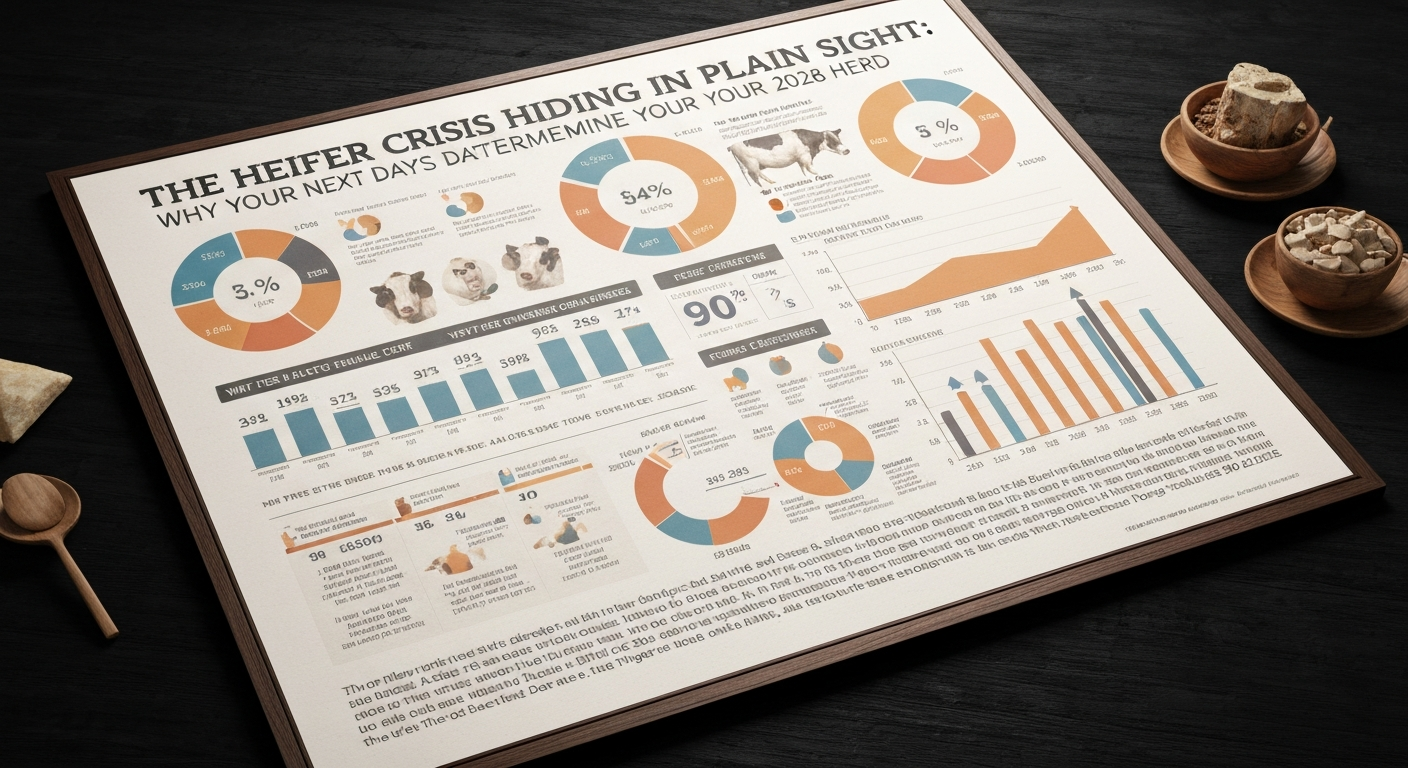
The Heifer Crisis Hiding in Plain Sight: Why Your Next 90 Days Determine Your 2028 Herd

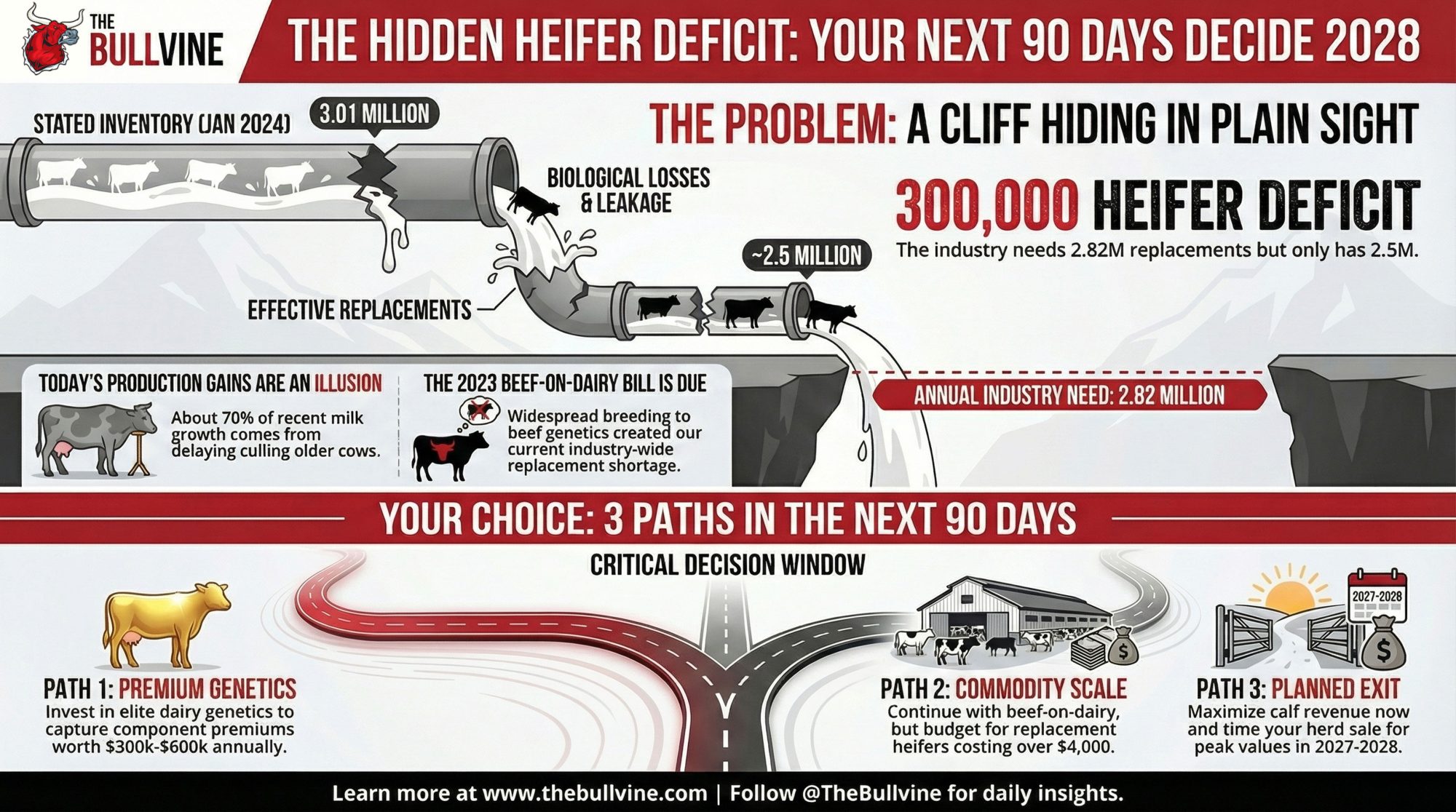
Here’s what USDA’s numbers aren’t saying: we’re producing 2% more milk by keeping older cows longer, not breeding better replacements. Heifer inventory: 3M. Effective after losses: 2.5M. Need: 2.8M. Q1 2025 contract negotiations may be your last window for leverage.

Dairy Heifer Inventory Crisis

Executive Summary: The U.S. dairy industry’s 3 million replacement heifers look adequate—until you run the math. Biological losses reduce effective replacements to 2.5 million against 2.82 million needed, creating a 300,000-head deficit that determines who’s milking cows in 2028. This shortage traces directly to 2023’s margin crisis, when 50-60% of operations made individually rational decisions to breed beef genetics, creating a collective supply constraint. Recent production gains (+2% component-adjusted) mask this reality through delayed culling—essentially borrowing from future herd health to meet current demand. Producers face a critical 90-day convergence: breeding decisions made through March 2025 determine 2028 herds (a 30-month development cycle), while Q1 contract negotiations lock in multi-year positioning before processor leverage shifts mid-year. Three strategic paths remain viable—premium genetics targeting $300K-600K component premiums, commodity-scale operations, or planned exits that maximize 2027-2028 peak values—but only for farms committing to strategy before leverage evaporates. Delay means accepting substantially weaker competitive positioning.

The dairy production numbers coming out of USDA through fall 2024 have been encouraging—milk production trending up around 1% year-over-year, with component-adjusted growth looking even better at close to 2%. For those of us who’ve weathered some brutal margin pressure, volatile feed costs, and the ongoing industry consolidation, those figures feel like validation that our strategic shifts toward higher per-cow productivity and better component yields are finally paying dividends.

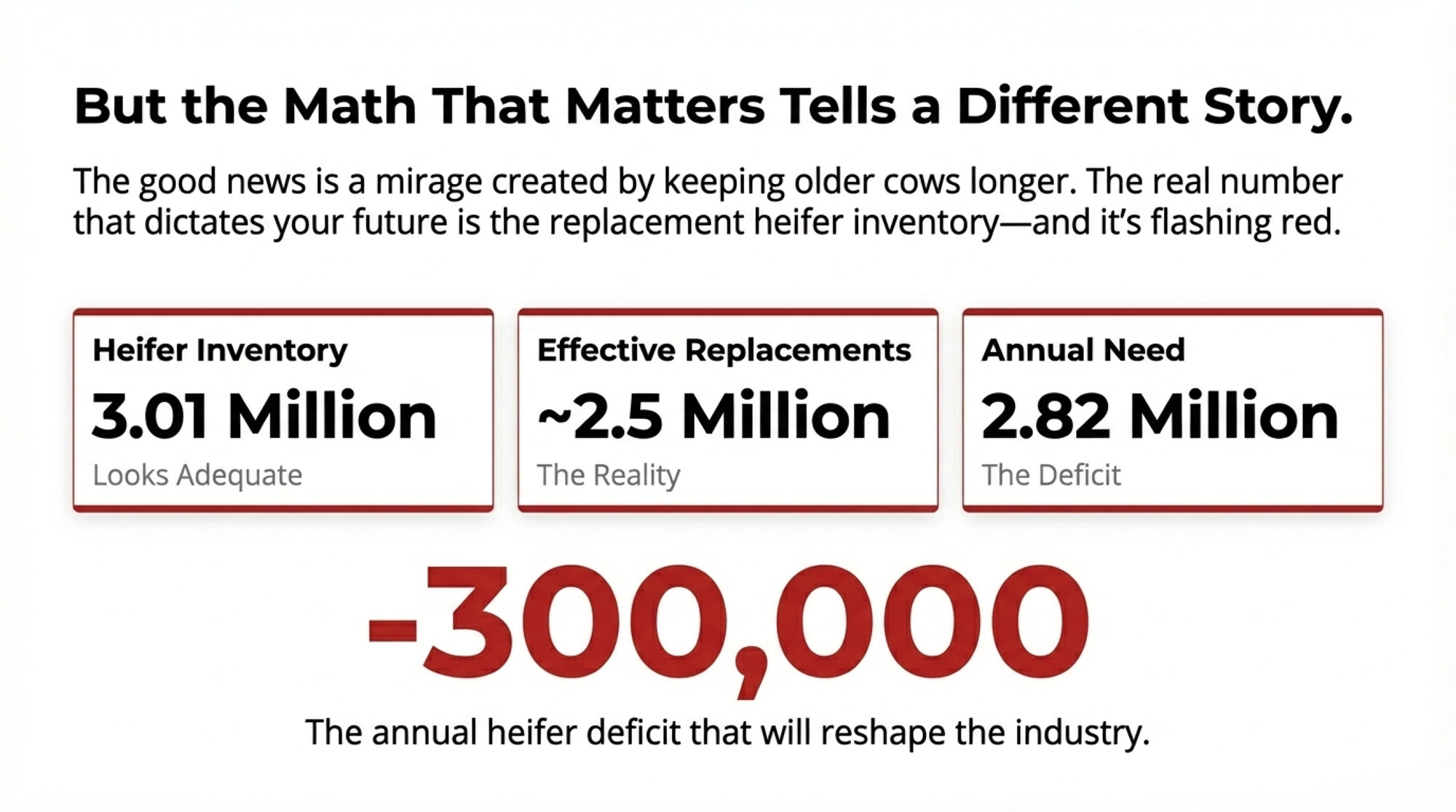
But there’s another number in those same USDA cattle inventory reports that tells a fundamentally different story about where we’re headed. And honestly, it’s the number that keeps me up at night more than any production statistic: we’re looking at around 3 million replacement heifers in the pipeline, and when you account for the biological realities of heifer development—the mortality, the breeding failures, the time lag—that number gets tight. Real tight.

Here’s what I mean by that.

The Fast Facts: Where We Stand Right Now

MetricCurrent EstimateRequired for StabilityStatus
Total US Dairy Herd9.4 Million Cows9.4 Million CowsNeutral
Replacement Heifer Inventory3.01 Million (Jan 2024)2.82 Million MinimumTight
Effective Replacements (After Losses)~2.5 Million2.82 MillionDeficit
Annual Heifer Mortality10-12% (300,000-360,000 head)Critical Loss
Breeding Failures5-8% (150,000-240,000 head)Critical Loss

Source: USDA NASS Cattle Inventory (January 2024); Penn State Extension; University of Wisconsin dairy economists

The Replacement Math Most Folks Aren’t Running

Let’s walk through the fundamentals here, because this is where the whole story starts to come together.

The U.S. dairy herd sits at roughly 9.4 million cows right now—that’s straight from USDA’s latest numbers. And if you’ve been in this business for any length of time, you know the biological reality: you need to replace somewhere between 25 and 30% of your herd annually just to maintain stable numbers.

That’s not bad management. That’s just dairy farming.

Cows age out, reproductive issues happen, injuries occur, and diseases strike. Penn State Extension puts typical culling rates at 25-35% annually, and Wisconsin Extension says 28-32% is common. It’s simply the nature of keeping a productive milking herd.

So do the math with me here: maintaining 9.4 million cows means you need somewhere between 2.35 and 2.82 million replacement heifers every year. Not to grow. Not to expand into new markets or add another parlor. Just to stay even.

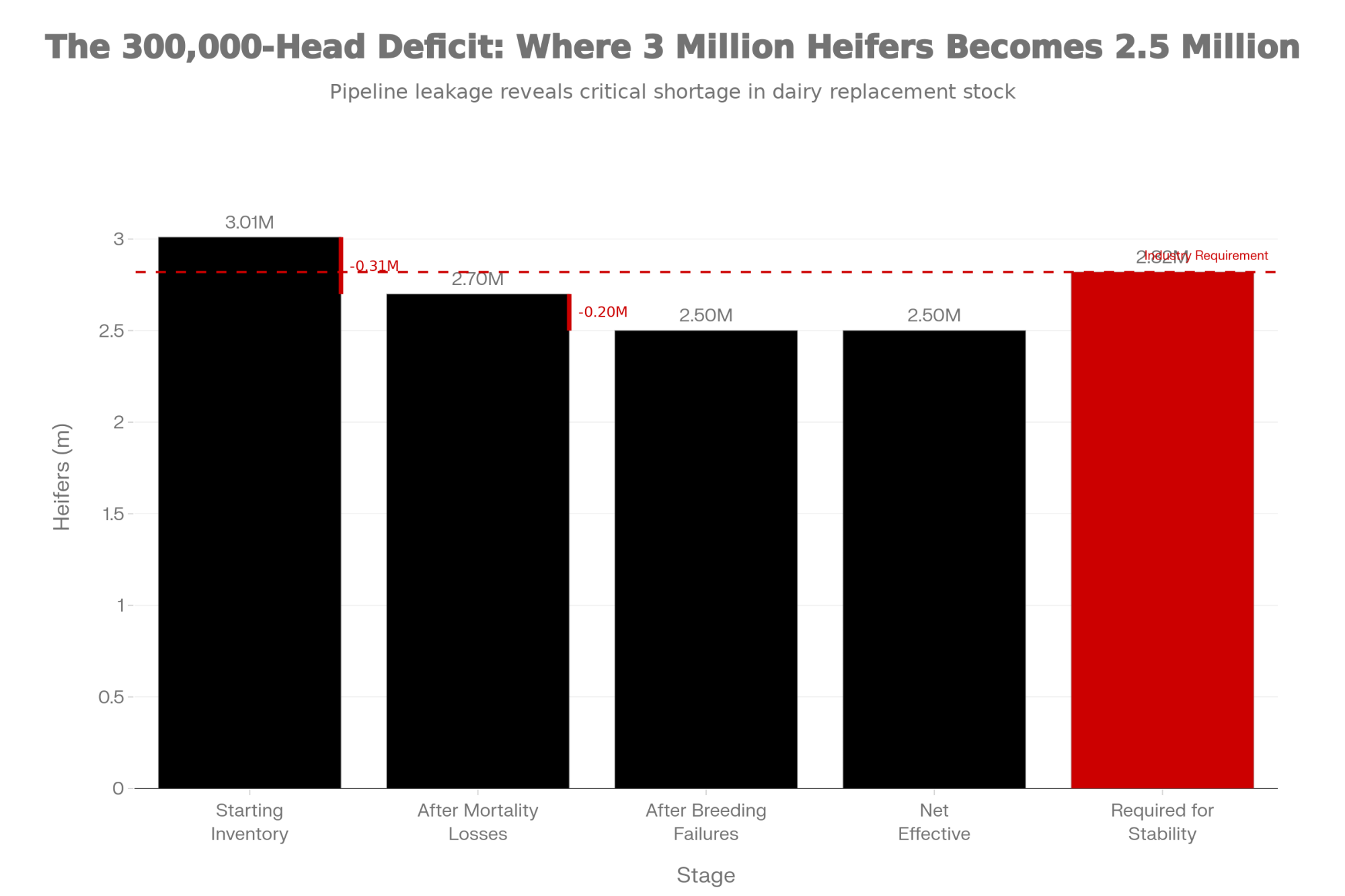
The Heifer Pipeline Leakage: Where 3 Million Becomes 2.5 Million

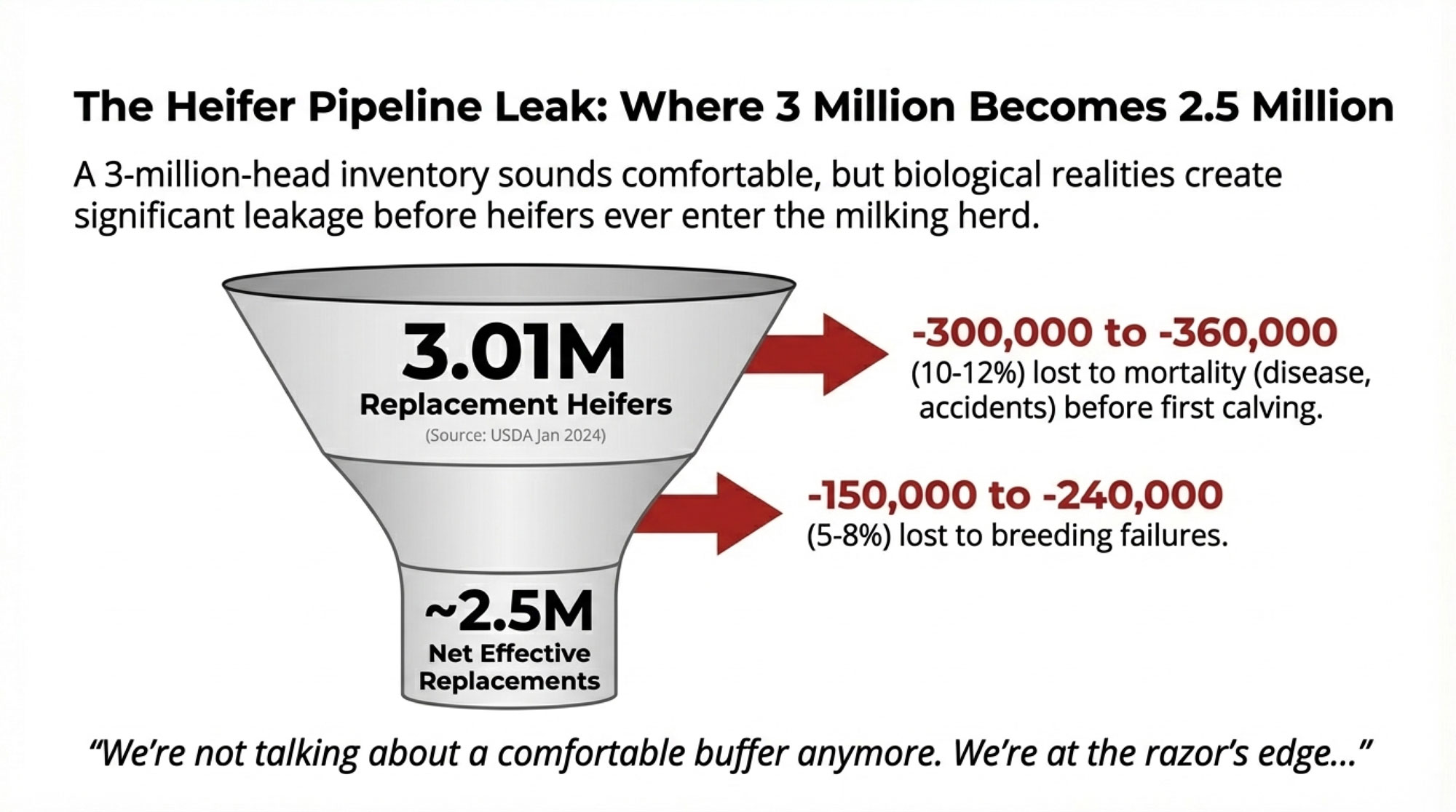
Now, looking at USDA’s January 2024 cattle inventory—the most recent complete data we’ve got—we’re seeing about 3.01 million dairy replacement heifers of all ages. That sounds comfortable at first glance. Maybe even pretty good compared to where we need to be.

But here’s where the biological constraints start biting us.

The Pipeline Breakdown:

  • Starting inventory: 3.01 million replacement heifers (USDA Jan 2024)
  • Minus mortality losses (10-12%): -300,000 to -360,000 heifers lost to disease, accidents, developmental issues before first calving
  • Minus breeding failures (5-8%): -150,000 to -240,000 heifers that never successfully breed within acceptable timeframes
  • Net effective replacements: ~2.5 million heifers actually entering milking herds
  • Industry requirement: 2.35 to 2.82 million for herd maintenance
  • Buffer remaining: Essentially zero

Research from Wisconsin, Penn State, Cornell—pretty much every land-grant university that studies this—consistently shows that 10-12% of heifers don’t make it to first calving. We lose them to scours as calves, respiratory disease as weanlings, accidents, and developmental issues. The USDA’s own National Animal Health Monitoring System studies peg pre-weaning mortality around 5%, with another 5 to 7% lost between weaning and first calving.

“We’re not talking about a comfortable buffer anymore. We’re at the razor’s edge, with very little room for regional variation, disease outbreaks, or any of the hundred other things that can go sideways in livestock production.”

Then you’ve got breeding failures. And this is where I think a lot of optimistic projections fall short. Heifer conception rates typically run 55 to 65% per service according to the research, and while most heifers get bred successfully within a couple of services, you’re still looking at 5 to 8% that never successfully breed within acceptable timeframes. That’s another 150,000 to 240,000 heifers gone from productive use.

The 2025-2026 Outlook Gets Tighter

And here’s what makes this particularly concerning: CoBank’s agricultural economists—folks who study dairy markets for a living—are projecting that the heifer pipeline will continue to drop through 2025 before we see any meaningful recovery. They’re not expecting things to turn around until late 2026 or even 2027.

When the January 2025 inventory numbers come out in a few weeks, most industry watchers I talk to expect to see that replacement heifer number down even further from where we were in 2024.

Where That Production Growth Really Came From

This brings us back to those encouraging production numbers, and I think it’s worth looking at what’s actually driving them. Because if the replacement heifer supply is this constrained, how are we still seeing production gains?

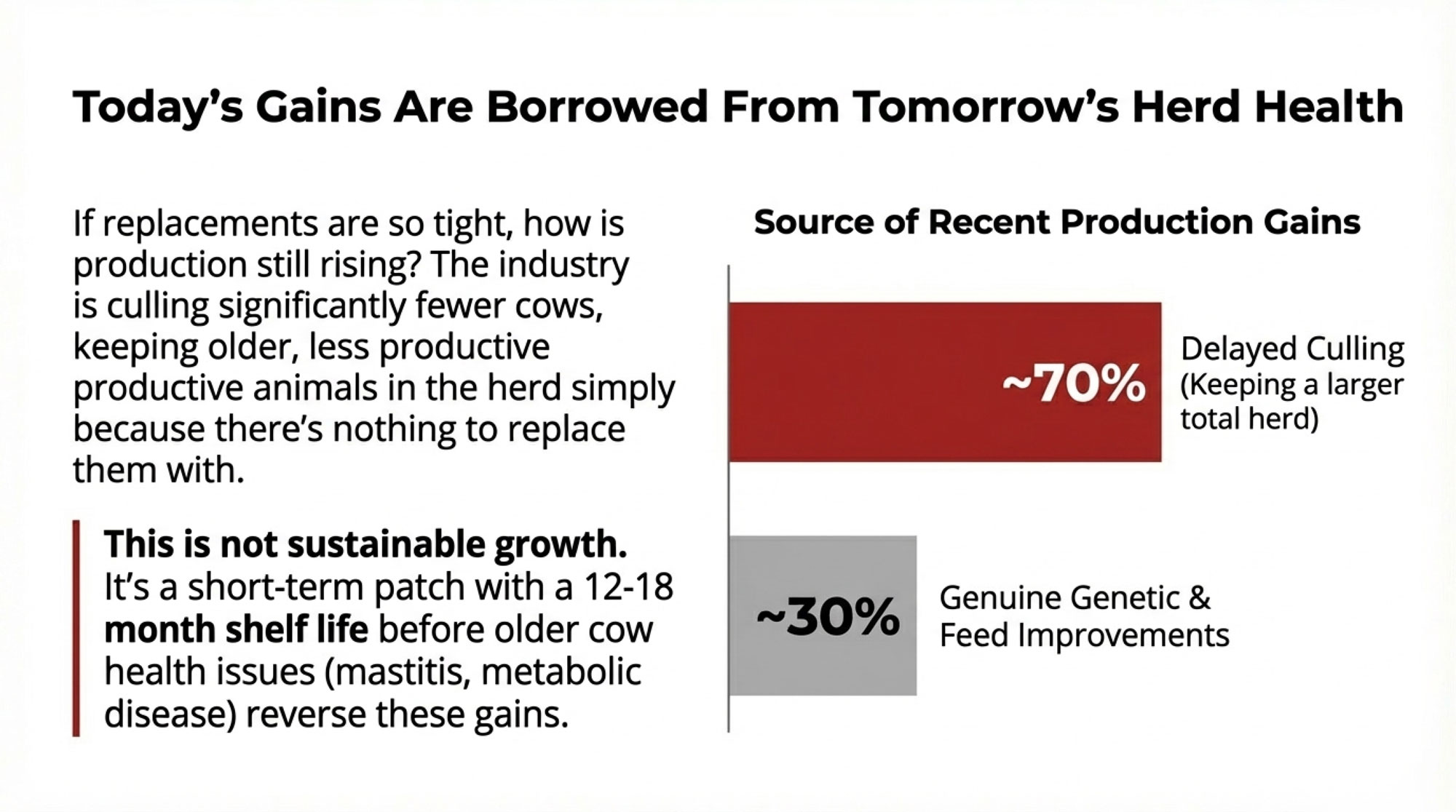
The answer—and you’ve probably noticed this on your own operation—is that we’re keeping older cows in production longer than we normally would. A lot longer, in some cases.

Delayed Culling: Borrowing From Tomorrow’s Herd Health

USDA’s data through 2024 shows dairy producers culled significantly fewer cows compared to 2023—we’re talking hundreds of thousands fewer culls across the industry. These are animals that, under normal circumstances, with adequate replacement availability, would’ve been sold or culled due to age, declining production, or health challenges. Instead, they’re staying in the barn because we simply don’t have enough young, high-producing replacements to take their place.

Dr. Marin Bozic—he’s a dairy economist many of you probably know from his market analysis work—has pointed out in his reports that this strategy has a definite shelf life. You can delay culling for a period, especially when milk prices justify keeping lower-producing cows. But eventually, and we’re seeing this now in some herds, the biological realities catch up. Older cows are more likely to develop metabolic disease, mastitis, and reproductive failure. Your herd’s overall efficiency starts degrading, and those production gains you achieved by maintaining more cows start reversing on you.

Production Gain Breakdown (Industry Analysis):

  • Economists estimate ~30% from genuine improvements (better component genetics, genomic selection, improved feed efficiency)
  • ~70% from delayed culling (maintaining larger total cow inventory by extending productive lives)

And that’s not sustainable growth. That’s borrowing from tomorrow’s herd health to hit today’s production targets.

How We Got Here: The Beef-on-Dairy Decision

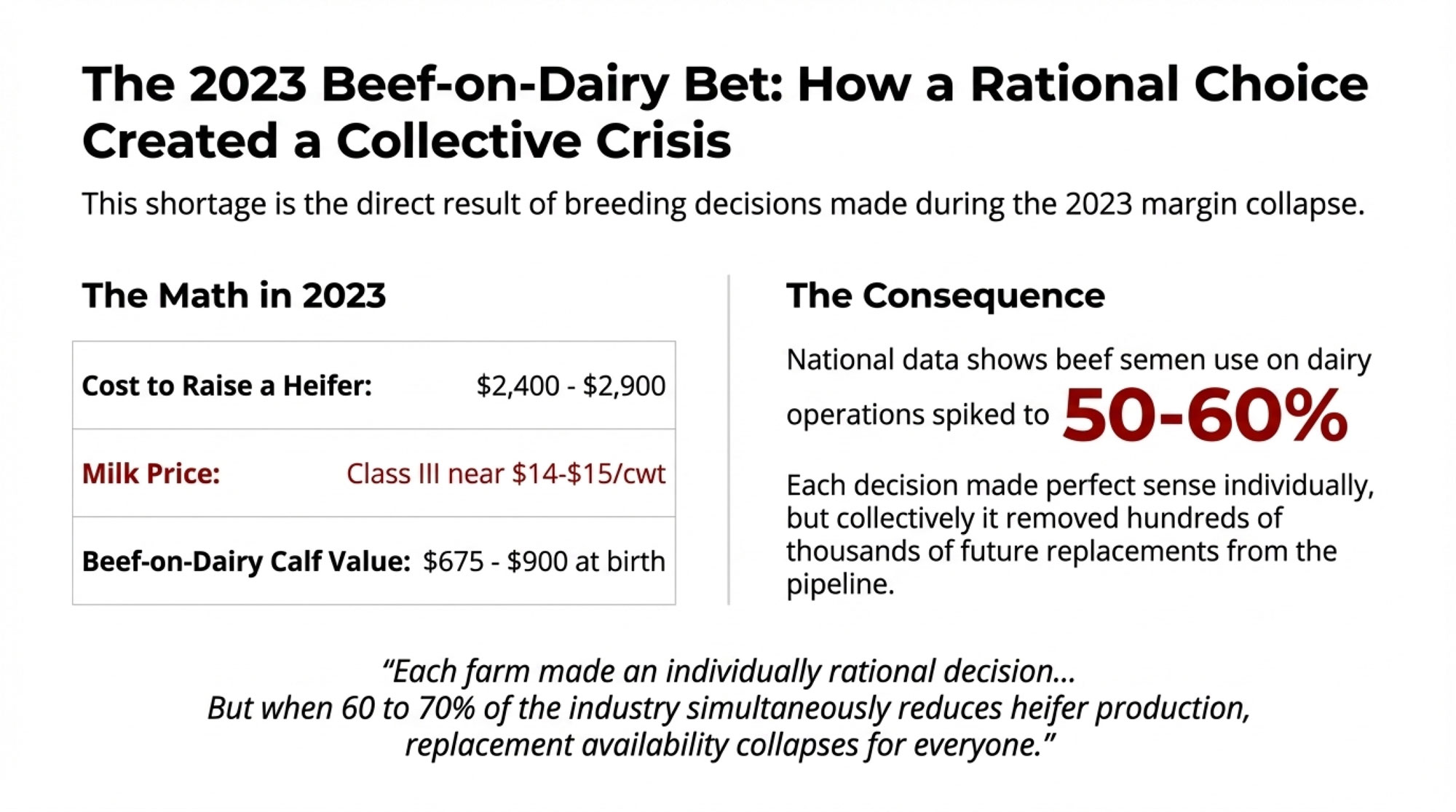
The heifer shortage we’re dealing with now didn’t just appear out of nowhere. It’s the direct consequence of the breeding decisions most of us made two to three years ago—decisions that made perfect economic sense at the time but created the industry-wide squeeze we’re feeling now.

When the Math Favored Beef Genetics

Do you remember where milk prices were in 2023? I mean, Class III hit lows near $14 to $15 per hundredweight in some months. Absolutely catastrophic margins for most operations. And at the same time, you’re looking at $2,400 to $2,900 to raise a replacement heifer from birth to first calving—that’s what the university budgets were showing. Penn State’s numbers, Wisconsin’s enterprise budgets, they all penciled out in that range.

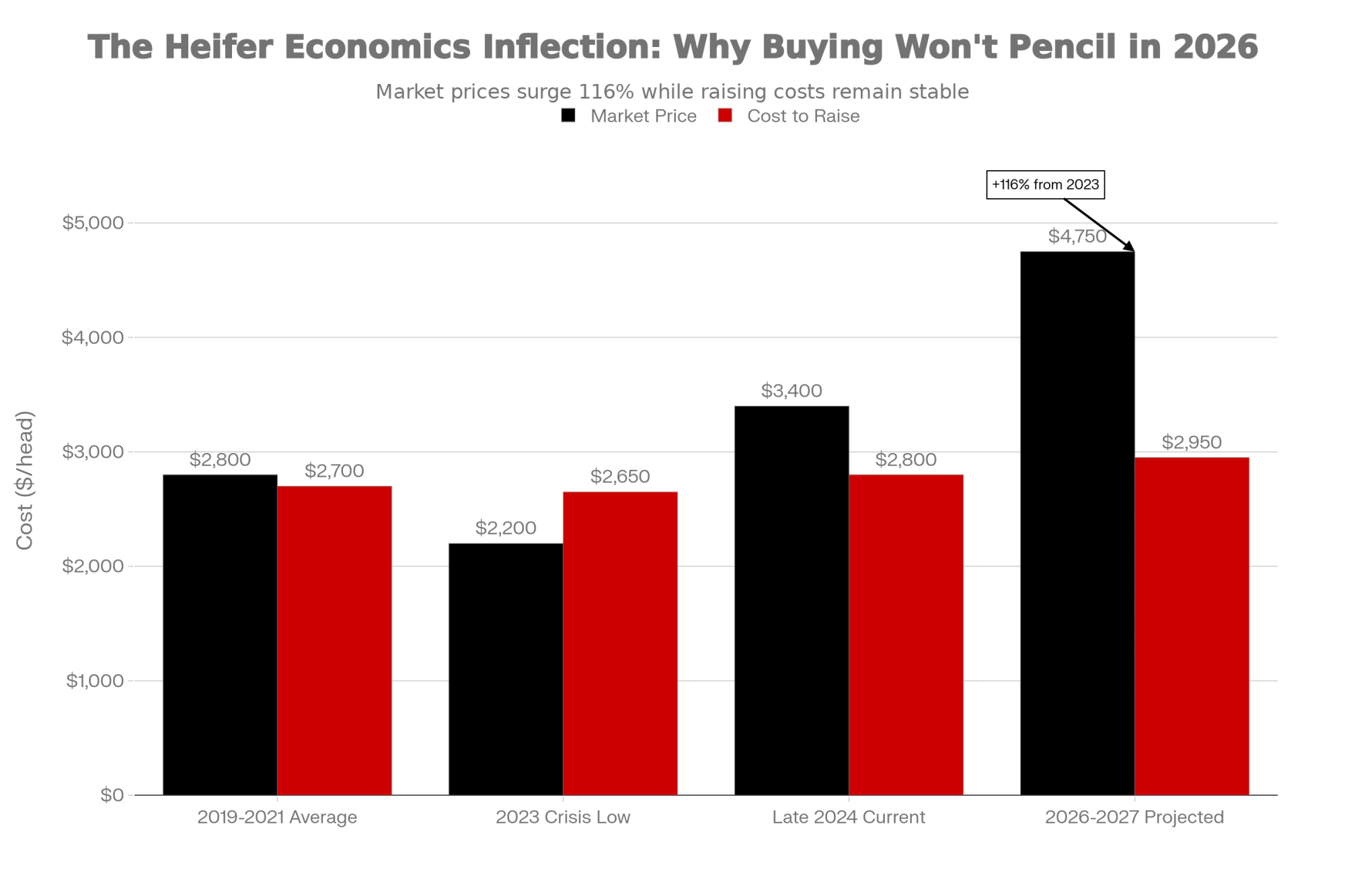
Economic Factor2023 Crisis PeriodLate 2024 Current2026-2027 Projected
Beef-Dairy Calf Sale Value$675-900 per calf$725-950 per calf$800-1,100 per calf
Dairy Heifer Replacement Cost (2023)$2,000-2,500 (buying cheaper)
Dairy Heifer Replacement Cost (2024)$2,800-4,000 (buying costly)$4,500-5,000 (prohibitive)
Cost to Raise Own Heifer$2,400-2,650$2,700-2,900$2,850-3,100
Annual Calf Revenue (500 cows, 75% beef)$160K-180K$165K-195K$180K-220K

Meanwhile, beef-on-dairy breeding was offering an attractive alternative that a lot of us took advantage of:

  • Breed lower-ranking dairy cows to beef semen
  • Sell calves for $675 to $900 within days of birth
  • Buy replacement heifers from the market when needed at $2,000 to $2,500 (2023 pricing)

The math clearly favored beef-breeding, especially if you were watching cash flow. And it worked. Really well, actually, in the short term.

The Collective Impact Nobody Was Tracking

But here’s what happened at the industry level, and this is where nobody was really tracking the collective impact: National Association of Animal Breeders data through 2023 shows beef semen usage on dairy operations increased to somewhere around 50 to 60% of total breedings.

That’s a massive shift from historical patterns where we were breeding maybe 80 to 90% dairy genetics. Each one of those breeding decisions—multiply it across thousands of farms all making similar calls—meant one fewer potential replacement heifer entering the pipeline 30 months later.

“Each farm made an individually rational decision based on their economics. But when 60 to 70% of the industry simultaneously reduces heifer production, replacement availability collapses for everyone.”

The cumulative effect is what we’re seeing now. Hundreds of thousands of additional beef-on-dairy calves were produced compared to historical patterns. Those are animals that would’ve been dairy replacements, now permanently out of our genetic pipeline.

And what’s interesting—Penn State Extension folks have pointed this out in their recent analyses—is that this represents what economists call a tragedy of the commons. Each farm made an individually rational decision based on their economics. But when 60 to 70% of the industry simultaneously reduces heifer production, replacement availability collapses for everyone. Including the farms that kept breeding dairy genetics through the tight times.

The Regional Story: Why Some Areas Kept Breeding Dairy

Not everyone followed the beef-on-dairy path, though, and the regional variation tells you a lot about the structural factors at play here.

USDA’s state-level data shows Pennsylvania maintained or slightly increased replacement heifer inventory through 2024, while most of the country was reducing numbers. Wisconsin held relatively stable. Meanwhile, the big Western dairies in California, Texas, and Idaho saw significant heifer reductions.

Scale Makes the Difference

I’ve been talking with lenders, extension specialists, and economists across different regions, trying to understand what explains this split, and a few things have become pretty clear.

Farm scale makes a real difference. Pennsylvania’s dairy sector—according to their Center for Dairy Excellence reports—averages around 90 to 100 cows per farm. Compare that to the national average, which is pushing 350 to 380 cows.

Capital Requirements by Herd Size:

  • 95-cow operation: $67,000 to $81,000 annually for heifer raising (manageable with multi-generational equity)
  • 500-cow operation: $360,000 to $435,000 annually for adequate replacement raising (became nearly impossible during the 2023 margin collapse)

The Pasture Advantage

Geography matters, too, and folks sometimes overlook this. Regions with established pasture systems—Pennsylvania, upstate New York, parts of Wisconsin—have what turns out to be a substantial cost advantage for heifer raising.

Heifer Raising Cost Comparison:

  • Pasture-based systems: ~$1,336 per head
  • Confinement systems: ~$1,919 per head
  • Cost advantage: 43% difference driven by reduced feed costs, lower facility investment, and less labor intensity

Source: Penn State Extension, University of Wisconsin, Cornell dairy management research

So Pennsylvania farmers could raise their own replacements for less than market purchase prices even when beef-breeding looked economically superior to everyone else. The pasture advantage is structural—it doesn’t go away when milk prices improve.

Custom Heifer Raising Infrastructure

Pennsylvania and Wisconsin also developed something most other regions just don’t have: sophisticated custom heifer-raising operations. These are specialized businesses that contract with dairy farmers to raise heifers through the non-productive phase. When cash got tight in 2023, being able to contract out heifer raising at $1,900 to $2,100 per animal provided flexibility that regions without this infrastructure simply couldn’t access.

Here’s an important point the Wisconsin specialists emphasize: this wasn’t necessarily Pennsylvania farmers being smarter or more strategic than everyone else. They had structural advantages—lower scale requirements, existing pasture systems, access to custom raising—that made maintaining dairy breeding economically feasible when others couldn’t justify it.

Region/SystemCost per HeadPrimary Cost DriverHeifer Inventory Trend (2023-24)
Pennsylvania (Pasture)$1,336Low feed costsStable/Up
Wisconsin (Pasture)$1,425Pasture + custom raisingStable
Midwest (Confinement)$1,850Facility investmentDown 8-12%
Western US (Confinement)$1,919Labor + facility costsDown 15-18%
Texas/Southwest (Confinement)$1,975Heat stress + facilityDown 12-15%

The Component Gains: Real Progress on a Narrowing Base

Those component numbers from USDA through 2024 deserve a closer look, especially given what’s happening with the genetic foundation underlying them.

The Impressive Gains Are Real

The gains are real. Absolutely real:

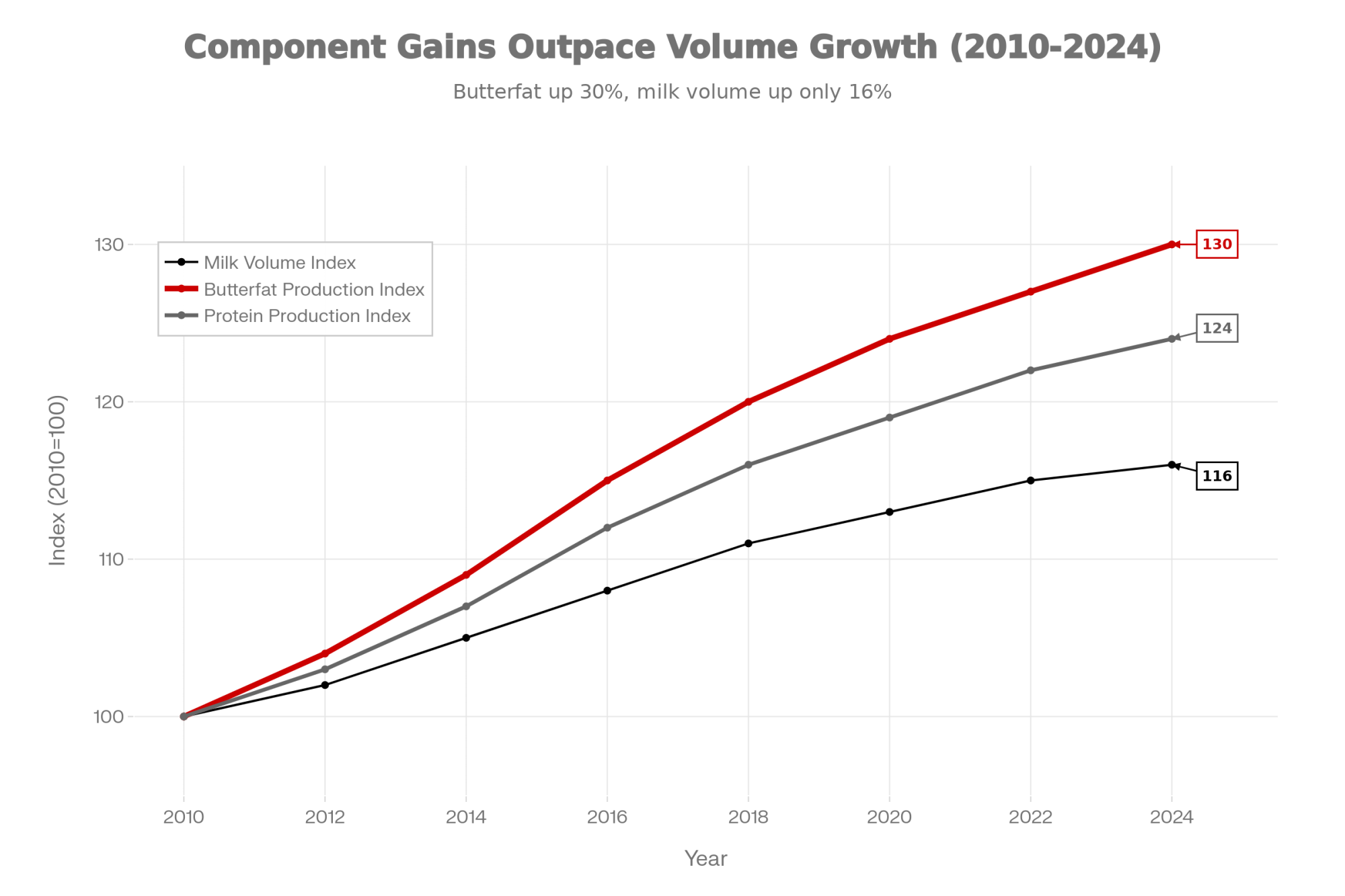
  • Butterfat production: Up ~30% since 2010 (milk volume grew only 15-16%)
  • Protein production: Up 23-24% over the same period
  • Current national averages: ~4.2% butterfat, ~3.3% protein (both record territory)

The Council on Dairy Cattle Breeding’s 2024 genetic evaluations show substantial base changes in butterfat in Holsteins compared to just five years ago. This represents genuine genetic progress driven by genomic selection, improved breeding strategies, and the industry’s intense focus on component traits.

And that focus makes economic sense—Multiple Component Pricing puts roughly 90% of your milk check value on butterfat and protein rather than volume.

But the Genetic Base Is Narrowing

But here’s what concerns the geneticists when you talk to them about long-term sustainability: the genetic base enabling this progress is simultaneously contracting because of those beef-on-dairy breeding patterns we just discussed.

When 50 to 60% of your dairy breedings are going to beef genetics, you’re systematically removing potential dairy females from the breeding population. Those aren’t just your bottom-tier animals, either. They’re your “genetically lower-ranking” cows within each herd, sure, but they’re still above-average dairy cattle compared to historical standards.

Dr. Kent Weigel at Wisconsin—he’s published extensively on breeding strategies over the years—has noted in his research that maintaining genetic diversity while pursuing component gains requires balancing selection intensity with population size. What we’re seeing now, with maybe 30% of farms maintaining intensive dairy genetics while 70% breed primarily to beef, creates what he calls a “two-tier genetic system” that could persist for years.

“Population geneticists call this ‘peak selection intensity.’ You get temporary acceleration in the traits you’re selecting for because you’re working with a smaller, more intensely selected population. But that acceleration isn’t indefinitely sustainable.”

The Processing Side: What Happens When Plants Realize Growth Isn’t Coming

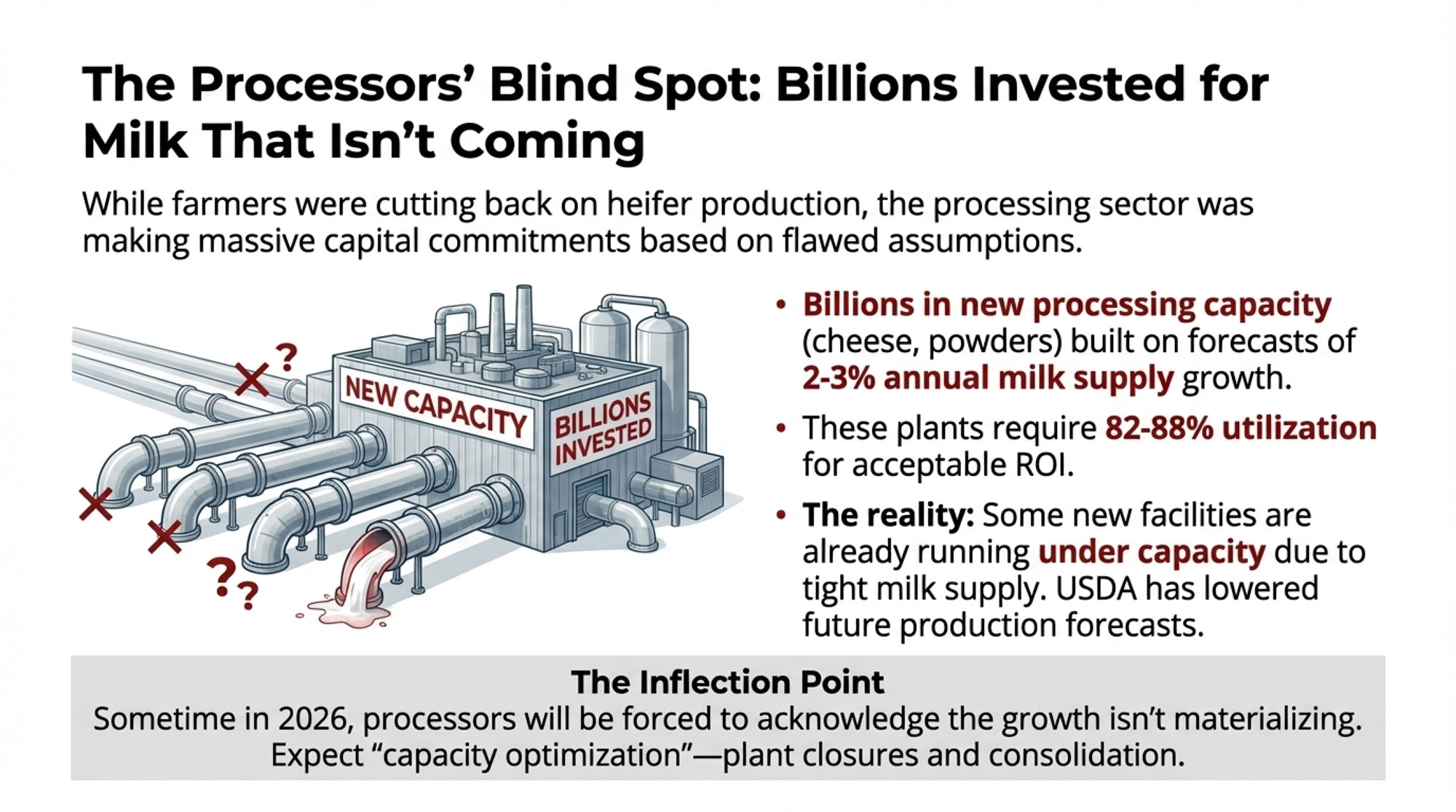
While we were all managing heifer inventories and breeding decisions based on individual farm economics, the processing sector was making massive capital commitments based on very different assumptions about future milk supply.

Billions Invested on 2-3% Growth Assumptions

Trade publications and industry reports through 2024 document several billion dollars in new dairy processing capacity either announced or under construction—most of it concentrated in cheese and milk powder production. You’ve got major projects in Kansas, Texas, Michigan, Wisconsin, and other core dairy regions.

These plants were financed through USDA Rural Development loans and private investment, based on forecasts of 2-3% annual growth in milk production. That’s been the historical assumption for feasibility studies.

Processing Plant Economics:

  • Required utilization: 82-88% of design capacity for acceptable ROI
  • Typical $500M cheese plant capacity: 1.8 billion pounds annually
  • Below-target utilization impact: Fixed costs spread across lower volume = compressed profitability per pound

The 2026 Inflection Point

Current reality appears to be telling a different story, though this isn’t widely published data. Industry observers watching the processing sector suggest some newer facilities are running at lower utilization rates than their models projected, constrained by available milk supply in their procurement areas.

And USDA’s most recent forecasts, released in late 2024, lowered its milk production expectations going forward despite projecting continued per-cow yield improvements. That’s essentially an admission that herd-size constraints are binding.

So what happens when processors start realizing the milk growth they financed their expansions around isn’t materializing? Industry folks watching processor earnings calls and capital markets are suggesting we might see an inflection point sometime in 2026. When you get multiple quarters showing milk production growth in the 0 to 2% range rather than the 3 to 4% that plant economics require, processor guidance is going to feature some significant adjustments.

Some analysts are already anticipating what they’re calling “capacity optimization”—industry-speak for plant closures, consolidation, and scaled-back operations.

Your Strategic Window: The Next 90 Days Matter

For producers reading these market signals, we’re looking at a compressed timeline for some critical decisions.

Why 90 Days? The Biology and the Contracts

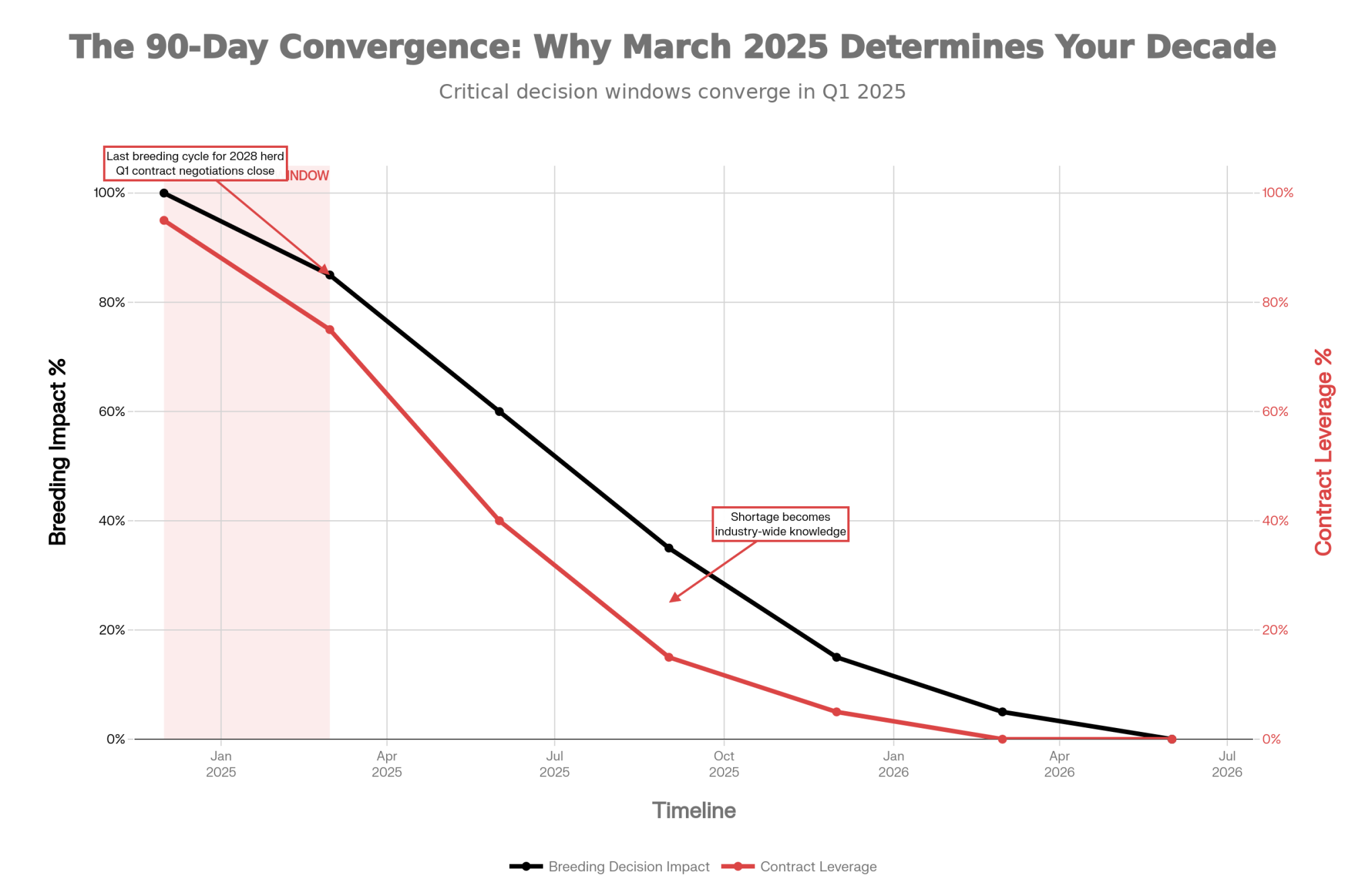
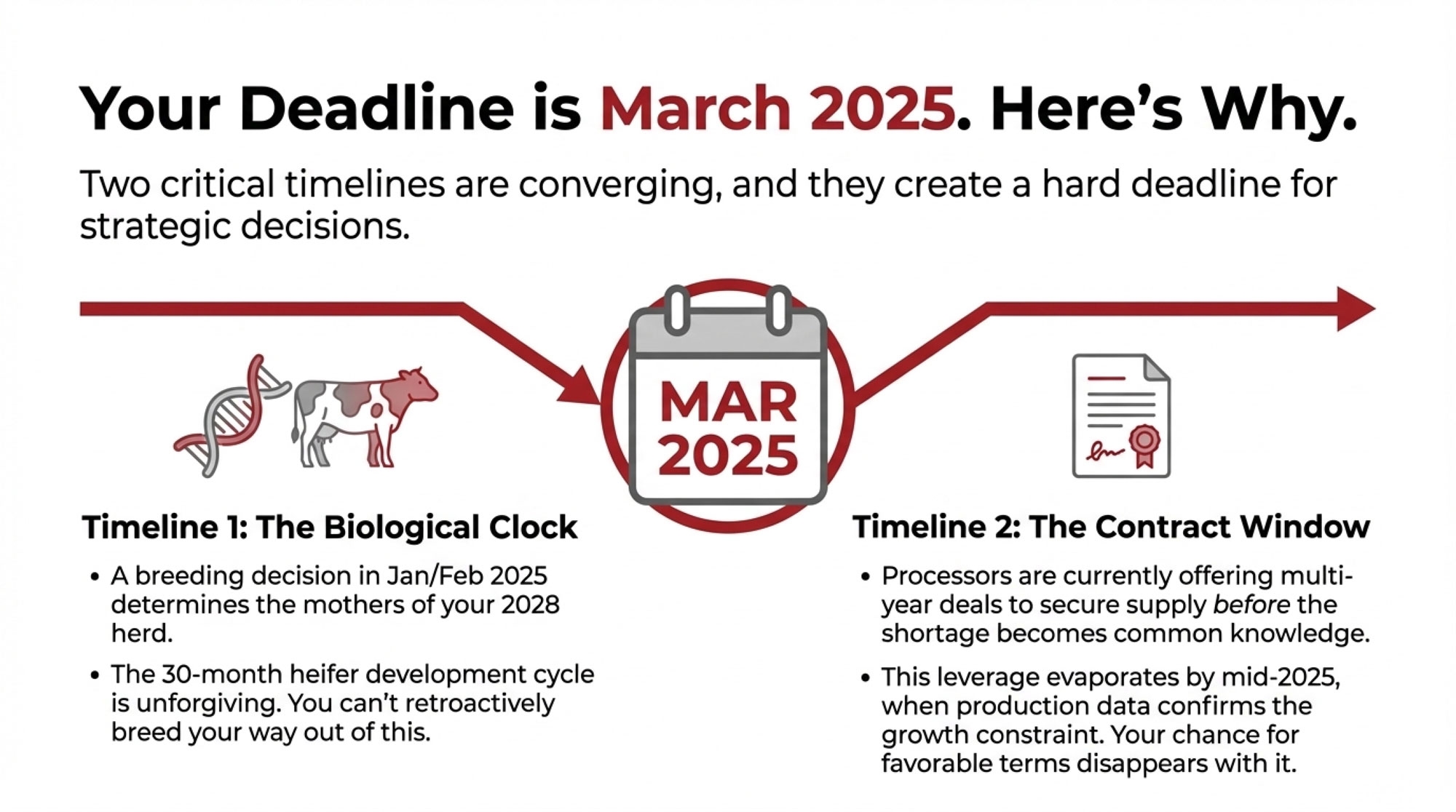
Here’s why the next 90 days—roughly late December 2024 through March 2025—are so critical:

The Biological Reality: The 30-month heifer development cycle means breeding decisions you make between now and spring 2025 determine which cows become the mothers of your 2028 replacement heifers. A heifer bred in January 2025 calves in October 2025, and her heifer calf (if you breed dairy genetics) doesn’t freshen until spring 2028.

The Contract Window: Milk contracts for 2025-2027 are currently being negotiated. Processors are offering multi-year deals with premium component pricing while they’re uncertain about future supply. That negotiating leverage shifts dramatically by mid-2025 when production data confirms the heifer shortage is constraining growth.

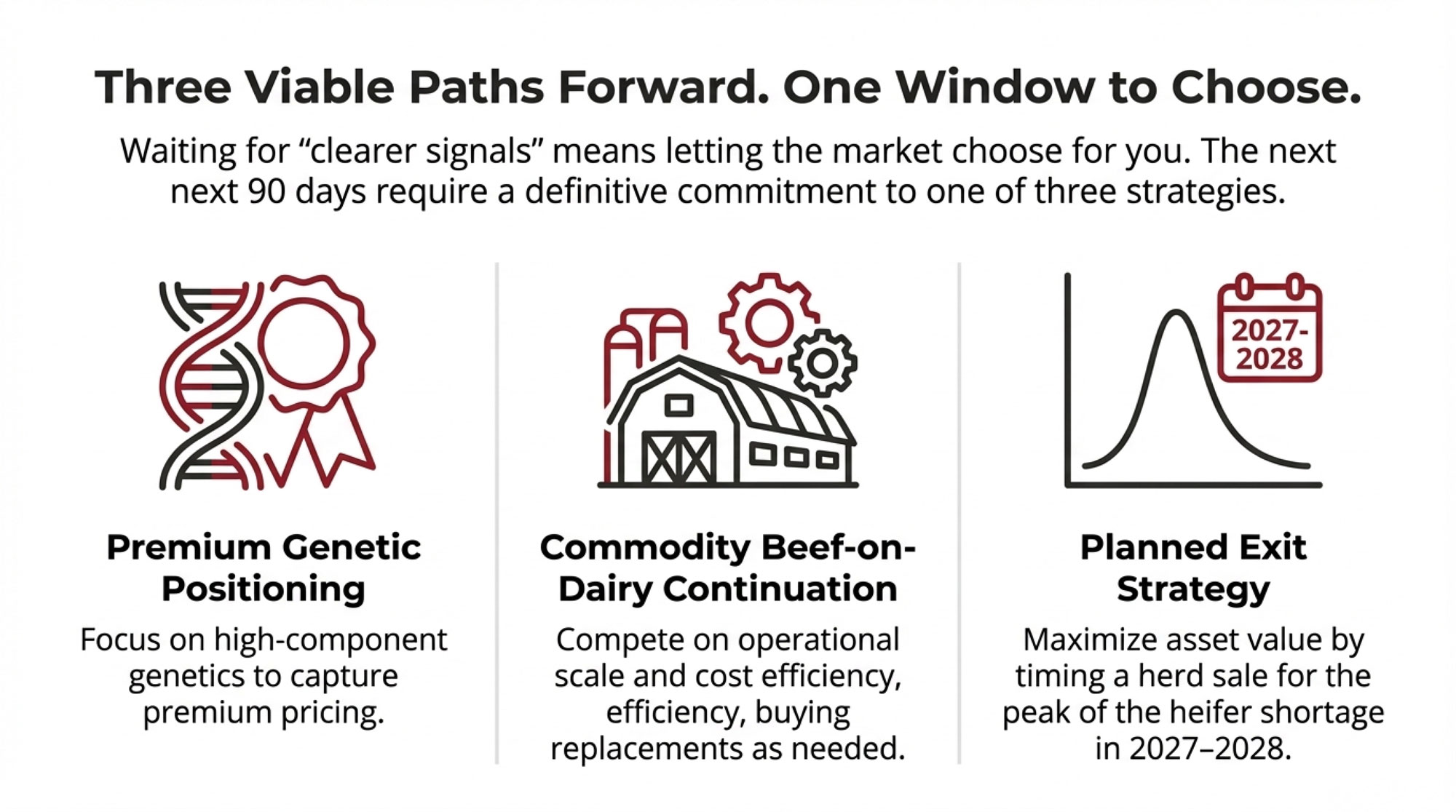
Three Viable Paths Forward

Let me walk through what I see as roughly three viable paths forward. Each requires some level of commitment in the next 90 days.

StrategyAnnual InvestmentReplacement Source2026-2028 Revenue ImpactRisk Level
Premium Genetic Positioning$25K-35K (semen + testing)Raise own (150-200/yr)+$300K-600K (component premiums)Medium (genetics execution)
Commodity Beef-on-Dairy$0-5K (maintaining current)Purchase market ($3,400-4,750)Commodity pricing (no premium)High (replacement cost escalation)
Planned Exit (Peak Value)$2K-8K (maximize beef revenue)Minimize/phase out+$450K-750K (peak herd sale)Low (planned timeline)

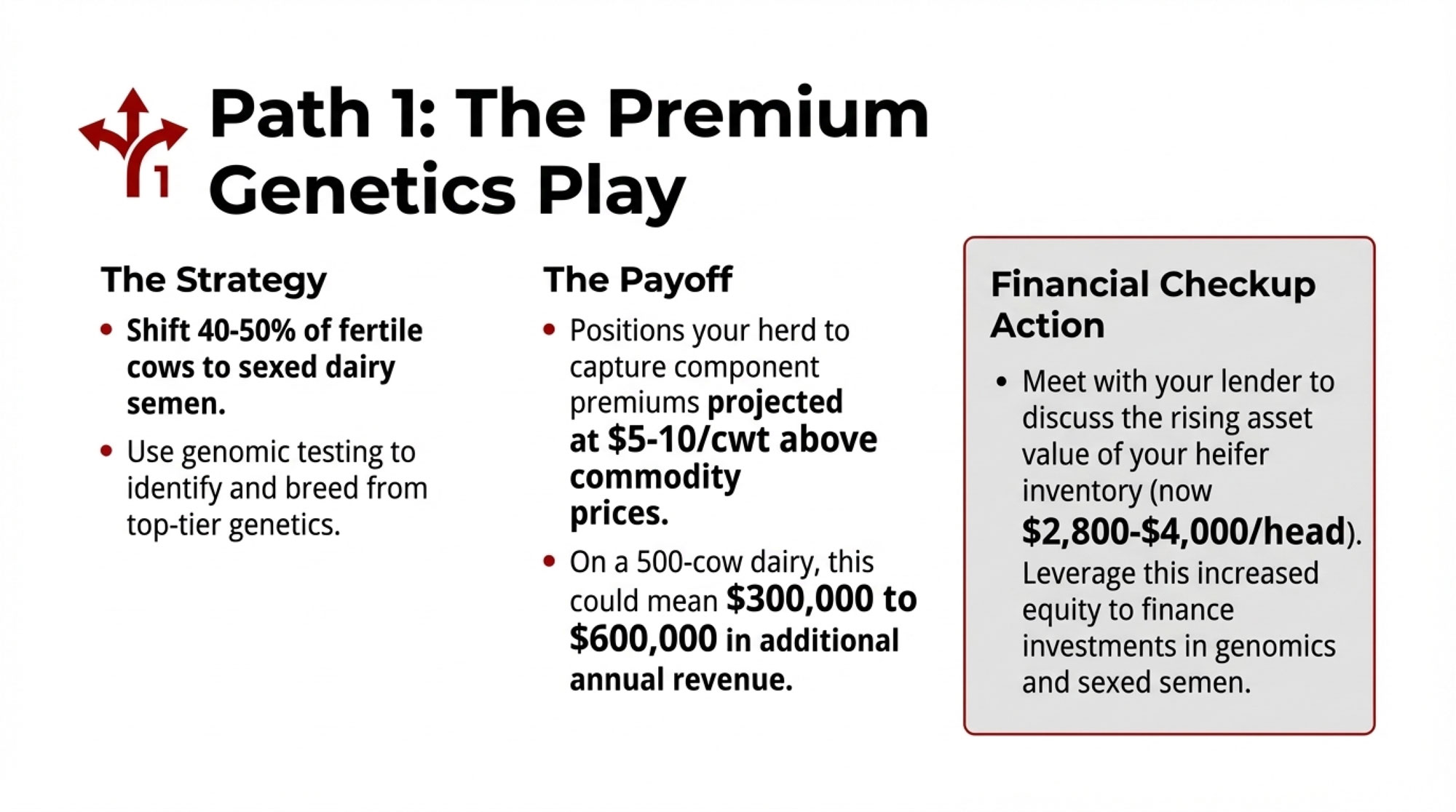
Path 1: Premium Genetic Positioning

The Strategy:

  • Shift 40-50% of fertile cows to sexed dairy semen
  • Implement genomic testing to identify the top genetics
  • Target 150-200 high-quality replacement heifers annually

The Investment:

  • Annual cost: $25,000 to $35,000 for semen and testing
  • Positions you for component premiums, analysts project could reach $5-10/cwt above commodity pricing in the coming years
  • On a 500-cow operation producing 12 million pounds: potential $300,000 to $600,000 additional annual revenue using conservative mid-range premium estimates

Financial Checkup Action: Meet with your lender specifically to discuss the rising asset value of your heifer inventory (currently $2,800-4,000 per head and climbing). Many operations can leverage this increased equity to finance genomic testing programs and investments in sexed semen without taking on significant additional debt.

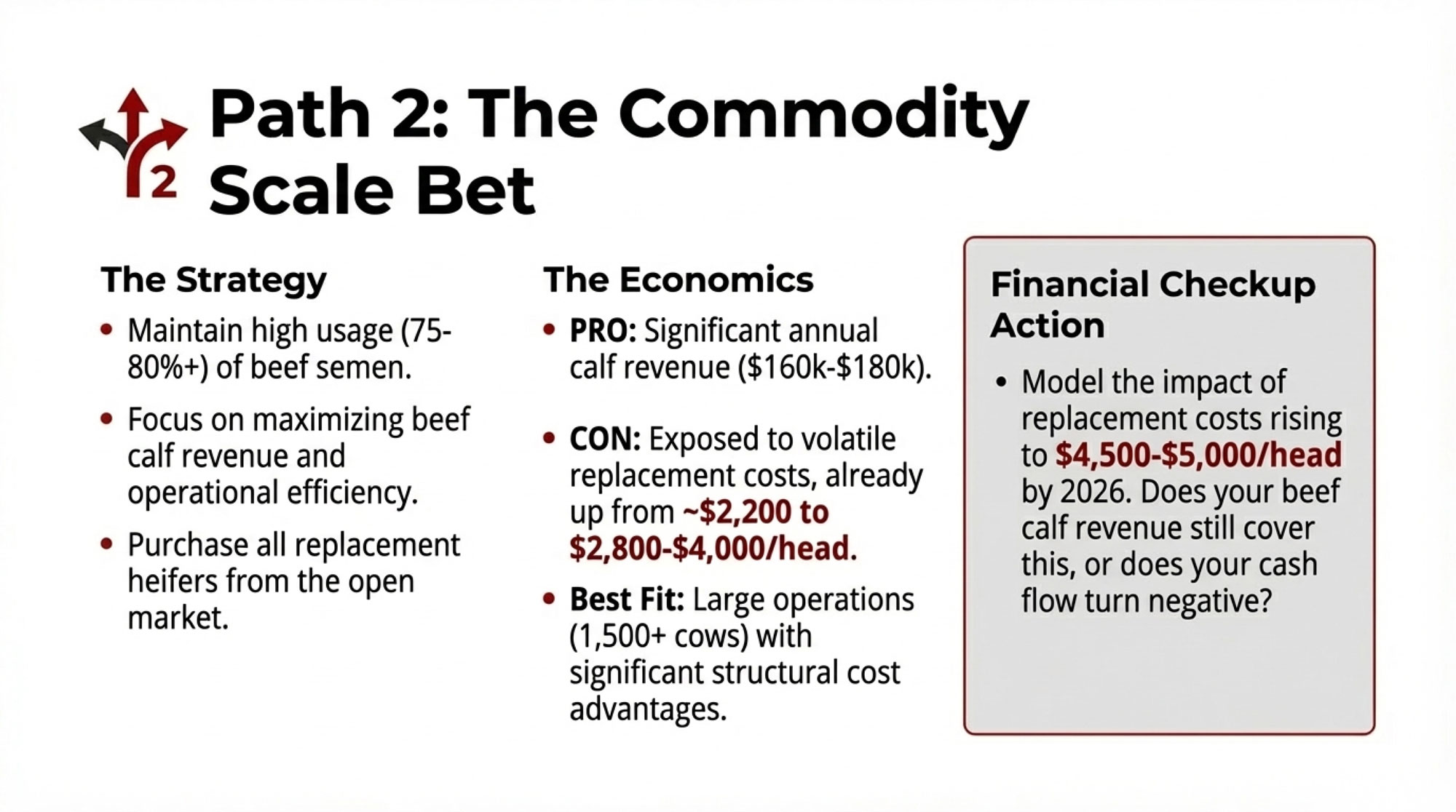
Path 2: Commodity Beef-on-Dairy Continuation

The Strategy:

  • Maintain current breeding patterns (75-80% beef semen)
  • Purchase replacements from the market as needed
  • Compete on cost efficiency and operational scale

The Economics:

  • Annual calf revenue: $160,000 to $180,000 based on current beef-dairy calf markets
  • Replacement purchase costs: $2,800-4,000 per head (current market, up from $2,000-2,500 in 2023)
  • Locks into commodity pricing structures without premium component access
  • Best fit: larger operations (1,500+ cows) with structural cost advantages

Financial Checkup Action: Work with your lender to model the impact of rising replacement heifer costs on your cash flow. If replacements continue climbing to $4,500-5,000 per head (as some project for 2026-2027), calculate whether beef calf revenue still pencils out favorably versus raising your own.

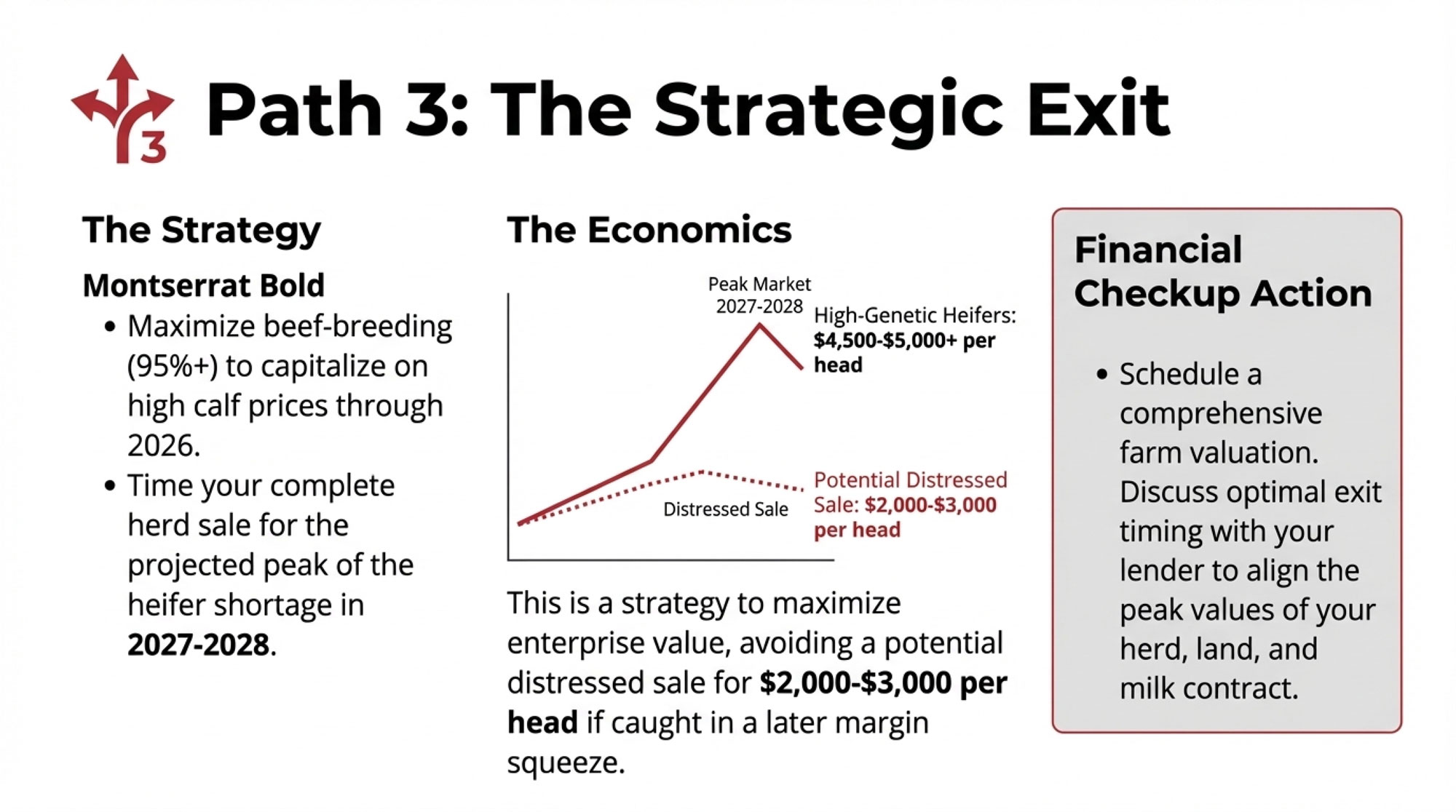
Path 3: Planned Exit Strategy

The Strategy:

  • Maximize beef-breeding (95%+ beef semen) through 2025-2026
  • Capitalize on elevated calf prices
  • Time herd sale for 2027-2028, when heifer genetics values are projected to peak

The Economics:

  • Current replacement heifer market: $2,800 to $4,000 per head, depending on genetics and stage
  • Projected 2027-2028 peak: Potentially $4,500-5,000+ per head as shortage intensifies
  • Compare to potential distressed sales if caught in a margin squeeze: $2,000-3,000 per head
  • Capital redeployment options: service businesses for dairy farmers, land development, genetics operations, agritourism

Financial Checkup Action: Schedule a comprehensive farm valuation with your lender and discuss optimal exit timing. Your heifer inventory, land, facilities, and milk contract all have peak value windows. Understanding when those align—likely 2027-2028 based on market projections—helps you maximize enterprise value rather than being forced into a distressed sale.

The Contract Negotiation Window Is Open Now

Milk contract negotiations matter more right now than they have in years. Processors are offering multi-year contracts—3 to 5 years—with locked base pricing and component premium structures. These offers are driven by processor uncertainty about future milk availability. They’re trying to secure supply commitments before the shortage becomes industry-wide common knowledge and their negotiating leverage disappears.

What Producers Are Negotiating (Q4 2024 – Q1 2025):

  • Base pricing: Contracts being offered in the $17.50 to $18.50 per hundredweight range
  • Component premiums: $1.25 to $1.50 per hundredweight for high-testing milk (varies by processor)
  • Liability caps: Negotiate caps at one year’s milk revenue or $2.5 million maximum (unlimited liability clauses are becoming standard; insurance runs $50,000+ annually for mid-size operations)

By mid-2026, when production data confirms the heifer shortage is constraining growth, that leverage shifts dramatically. Farms locking in favorable terms in early 2025 will have substantial advantages over those accepting spot pricing or shorter contracts six months later, when terms probably worsen.

Contract ElementQ1 2025 Window (NOW)Q3 2025 ProjectedAdvantage
Base Milk Price ($/cwt)$17.50-18.50$16.80-17.80$0.70-1.00/cwt HIGHER
Component Premium ($/cwt)$1.25-1.50$0.85-1.15$0.35-0.40/cwt HIGHER
Contract Length Available3-5 years1-2 years2-3 years LONGER
Liability Cap TermsNegotiable ($2.5M cap)Unlimited (standard)Caps still possible
Processor LeverageLOW – Need supply commitmentsHIGH – Shortage confirmedProducer has power NOW

What This Means Going Forward

The biological reality here is pretty unforgiving. You can’t breed your way out of a heifer shortage retroactively. A heifer born today doesn’t freshen for 30 months. Decisions you make in the next 90 days determine your herd composition through 2027 and 2028. Operations waiting for “better conditions” or “clearer signals” will find their strategic options have narrowed substantially by mid-2025.

The Industry Is Bifurcating

The industry is splitting into distinct segments:

  • Premium component producers accessing specialized markets
  • Mega-dairies (1,500+ cows) competing on cost efficiency
  • A shrinking middle ground (500-700 cows) with limited competitive advantages

Farms making intentional choices about which segment to compete in have better odds than those maintaining status quo operations, hoping market conditions improve on their own.

The Temporary Leverage Window

Processor dynamics are creating unusual leverage for producers right now, but it’s temporary. Processing overcapacity combined with a tight milk supply creates rare negotiating power for dairy farmers willing to commit supply. But that window is open for only a limited time. Multi-year contracts with component premiums locked at current rates may represent opportunities that won’t be available once market realities become widely understood.

Genetic Investment Pays Differently Now

Component pricing puts 90% of your milk check value on butterfat and protein. Farms maintaining or enhancing dairy genetics through this shortage period—even at higher short-term cost—are positioning for substantial premiums when processing demand exceeds available supply of high-component milk.

Resources to Help You Decide

If you’re working through these decisions, extension resources can help:

  • Penn State Extension: Heifer raising cost calculators, enterprise budgets
  • Wisconsin’s Center for Dairy Profitability: Genomic selection ROI tools, contract analysis templates
  • Cornell’s dairy management program: Financial modeling for strategic path comparison

These tools are generally free or low-cost, and they’re worth using before you commit to a direction.

The Bottom Line

Recent production numbers tell an encouraging story about where the industry has been. But the heifer inventory numbers reveal something different about where we can realistically go. For those of us making decisions that’ll determine our operations’ viability through the rest of this decade, understanding that difference—and acting on it in the next few months—probably matters more than any single month’s production data.

Key Takeaways:

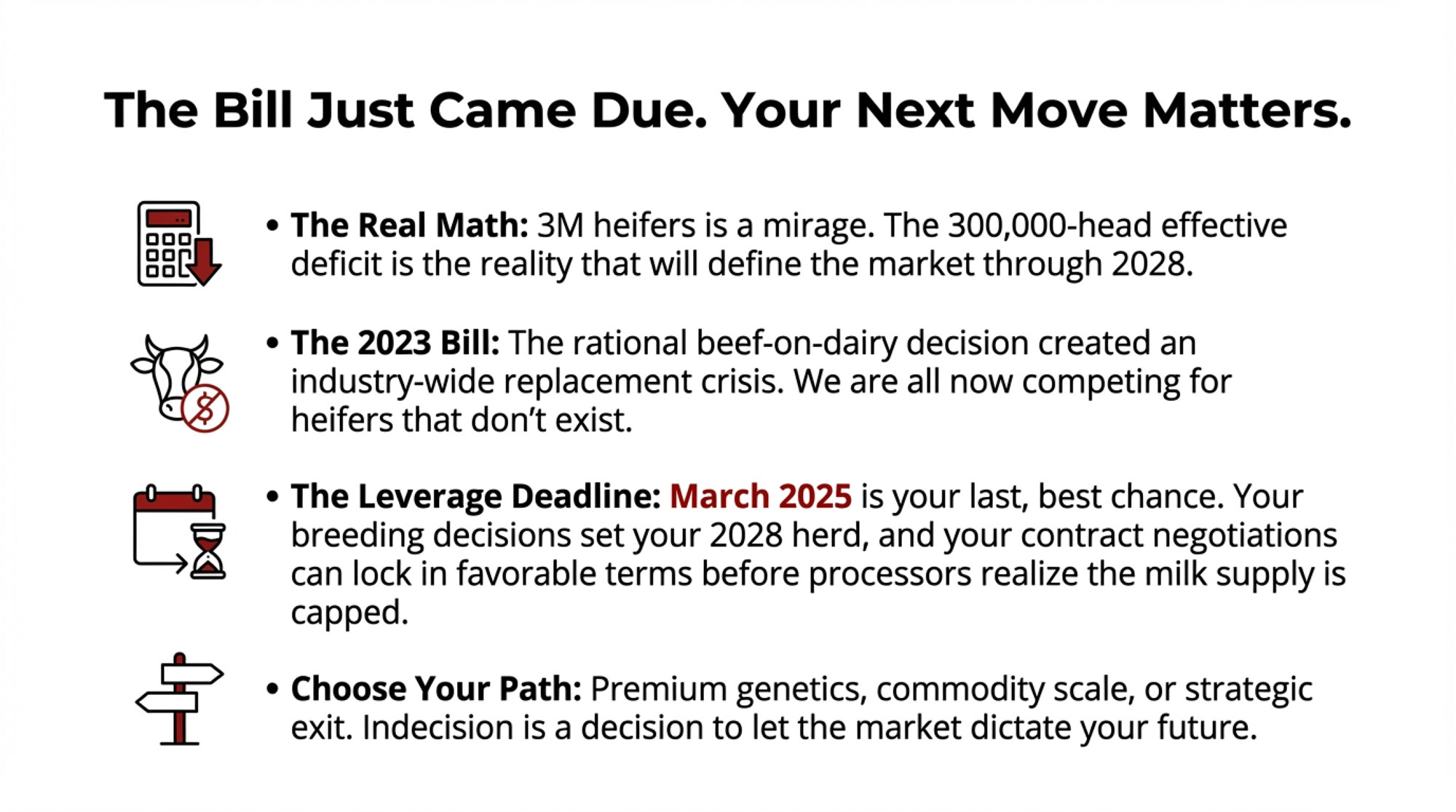
  • The Math That Matters: 3M Heifers → 2.5M Actual Replacements — Mortality and breeding failures eliminate 500,000 head before production. Industry needs 2.82M to maintain the current herd. That 300K shortfall determines who’s still milking in 2028.
  • The Beef-on-Dairy Bill Just Came Due — In 2023, 50-60% of farms made the rational call to breed beef genetics. That 30-month lag is now hitting—and we’re all competing for replacements that don’t exist.
  • Current Production Is Borrowed From Future Herd Health — Today’s 2% gains come from delaying culls, not improving genetics. This strategy has 12-18 months before older cow health issues force the reversal you can’t afford.
  • 90-Day Convergence: March 2025 Is Your Leverage Deadline — Breeding decisions now determine your 2028 herd composition. Contract negotiations now lock multi-year pricing. Both windows close when processors realize supply is tight—likely Q3 2025.
  • Three Paths Forward, One Window to Choose — Premium genetics: target $300K-600K in component premiums. Commodity scale: maximize beef calf revenue, buy replacements. Strategic exit: time sale for 2027-2028 peak. Decision deadline: March 2025.

Complete references and supporting documentation are available upon request by contacting the editorial team at editor@thebullvine.com.

Learn More

The Sunday Read Dairy Professionals Don’t Skip.

Every week, thousands of producers, breeders, and industry insiders open Bullvine Weekly for genetics insights, market shifts, and profit strategies they won’t find anywhere else. One email. Five minutes. Smarter decisions all week.
NewsSubscribe
First
Last
Consent

BLACK HIDE BLINDNESS: Why Breeding Only for Color is Destroying Your Dairy-Beef Profits

Black hide obsession is costing you thousands. Those cheap Angus straws? Economic suicide. Discover why color alone won’t save your beef-on-dairy profits.

You’re riding a fading trend, and your bottom line will pay the price. Since 2017, US beef semen sales have skyrocketed by 6.5 million units, while Holstein semen sales plummeted by 6.3 million units.

This massive shift has created a temporary market advantage, but those cheap black-hided beef semen straws aren’t the bargain you think they are.

While you’re patting yourself on the back for those black calves in the pen, the harsh truth remains: beef-on-dairy crosses that don’t deliver performance are just “Holstein steers in disguise,” and the premium you’re enjoying today could vanish faster than milk prices during a surplus.

MARKET REALITY: The Beef-on-Dairy Premium You’re About to Lose

The beef-on-dairy breeding trend exploded when three primary packers quit harvesting Holstein steers in 2017-2018, drastically devaluing the Holstein steer market.

From 2017 to 2022, beef-on-dairy cross calves replaced 70% of Holstein steers in the fed cattle harvest mix. Like moths to a flame, dairy producers flocked to what seemed easy money—breed for black calves and collect premium checks.

“It’s not likely you tell your semen rep, ‘Just give me Holstein semen that’s cheap,’ yet that’s what’s happening with a lot of beef-on-dairy breeding right now. We need to aim for more than just a black calf.”

Market Value Comparison (2023-2024 Data)

Calf TypeNewborn ValueFeeder Value (500-600 lbs)Discount vs. Beef
Holstein Bull$25-50$40/cwt below beef$200-240/head
Generic Black Cross$150-200$15-20/cwt below beef$75-120/head
Premium Beef Cross$225-250$5-12/cwt below beef$25-72/head

This stark economic reality shows why crossbred genetics matter. Holstein bull calves sell for little compared to beef-on-dairy cross calves, which can fetch four to six times more—up to $250 per head.

At 500-600 pounds feeder weights, beef-on-dairy crosses sell at only $12-15/cwt below straight beef calves, while Holstein steers lag far behind at $40/cwt below comparable weights.

The global market reflects this reality, too, with European auction data from 2021-2023 showing that beef × dairy calves are valued at 50%–200% more per kilogram than purebred Holstein or Brown Swiss calves.

“We love those calves. Their genetics have improved considerably in the past few years. They grade well and are a consistent, steady feeder cattle supply.”

Note: Market values fluctuate seasonally and regionally. Check with your local livestock markets for current pricing in your area.

HEALTH & WELFARE CONSIDERATIONS: Beyond Just Genetics

While this article focuses primarily on genetic selection, it’s critical to understand that quality beef-dairy crosses need proper health management to reach their potential. Respiratory disease is the second leading cause of death in beef-dairy calves during the first 60 days and the leading cause after 60 days.

“Just one respiratory episode can potentially damage a young calf’s lung capacity for life. Research by the beef industry shows these calves with lung damage have a lower carcass finished weight and quality grades than their non-affected pen mates.”

The increasing focus on beef-on-dairy breeding brings welfare considerations worth noting. A 2023 scientific review published in PMC found that certain beef breeds used on dairy cows can increase gestation length, dystocia (difficult calving), and stillbirth rates.

Recent research examining 75,256 lactations across 10 dairy herds from 2010-2023 found that calves sired by crossbred beef bulls had a higher probability of stillbirth (5%) than Holstein-sired calves (2%). All beef-sired calves increased gestation length compared to Holstein-sired (277 days), with Limousin (282 days) and Wagyu-sired calves (285 days) resulting in the most prolonged gestations.

These factors highlight why sire selection must go beyond black hide color to include calving ease traits, especially when breeding heifers.

THE PERFORMANCE GAP: Your Black Calves vs. True Beef Crossbreds

Let’s get brutally honest: many of today’s dairy-beef crosses are essentially “black Holsteins” with dairy frame characteristics that feedlots and packers don’t want.

The research doesn’t lie—dairy-type cattle typically have reduced feed efficiency, muscling, and dressing percentage compared to beef-type cattle. The premium crossbreds command exists because properly selected crosses dramatically outperform straight Holsteins:

“If you’re going to breed just for color, you might as well produce Holstein steers because at least there is a specific market for them. The tall, black crossbreds don’t fit well into any production or marketing system.”

Performance TraitHolstein BaselineQuality Beef CrossbredsEconomic Impact
Average Daily Gain1.40-1.50 kg/d1.62-1.76 kg/d8-25% improvement
Days on FeedBaseline5-26 fewer days$3.50/day/head savings
Dressing Percentage*<60%>61%Improved red meat yield
Feed EfficiencyBaselineSignificantly betterLower cost of gain
Grading PerformanceLower15-25% higher Prime/ChoiceSubstantial premium

*Dressing percentage: The percentage of carcass weight relative to the live animal weight, directly affecting the value packers receive from each animal.

These aren’t minor differences—they’re profit multipliers throughout the production chain.

Dairy-type carcasses receive more discounts than beef-type steers due to their reduced red meat yield. Your black calves might look different on the outside, but they need the right genetics underneath to deliver these performance gains.

BREED SELECTION: Choosing Bulls That Deliver Real Performance

When selecting beef genetics for your dairy herd, the data shows dramatic performance differences between breeds:

Beef Sire BreedAverage Daily GainDays on FeedDressing %Key Considerations
Angus1.76 kg/dFewest>61%Excellent marbling, moderate frame
Charolais1.73 kg/dLow>61%Superior muscling, larger frame
Simmental1.68 kg/dLow>61%Good growth, moderate frame
Limousin1.65 kg/dModerate>61%Excellent muscling, longest gestation

Research from Penn State University published in the Journal of Animal Science confirms that Angus-, Charolais-, and Simmental-sired beef-Holstein steers demonstrated the most significant average daily gain and spent the fewest days on feed compared to other crosses.

Recent scientific studies indicate that while all beef sires increase gestation length compared to Holstein-sired calves, Limousin crosses had among the most extended gestation periods, potentially increasing economic losses by $3-5 per day of extended gestation.

These aren’t theoretical numbers—they’re your profit potential in black and white.

“This is an amazing challenge to produce, in the F1 generation, progeny that meets the Certified Angus Beef standards. That’s a huge challenge in one generation.”

NEW RESEARCH: Data-Driven Breeding Decisions for Maximum Returns

Are you aware that groundbreaking research is being conducted that could reshape your breeding strategy right now?

The Iowa Beef Industry Council funded a comprehensive three-part project through the Iowa Beef Center that’s directly addressing the beef-on-dairy knowledge gap.

This project isn’t just theoretical—it’s tracking real animals from birth to harvest:

“The cattle portion of this project involves feeding three groups of beef x dairy calves from birth to harvest through the Iowa State Feed Intake Monitoring System by recording daily intakes, measuring growth and performance, and collecting carcass data,” explains the research team.

“Beef on dairy is such a new space, and we constantly learn new things. This resource will allow us to quickly provide the best and most current information to producers and allied industry as it becomes available.”

The first group of calves has already reached the finishing stage at the Armstrong Research Farm and should be marketed by now (as of March 2025), with two more groups in the pipeline for summer and fall harvest.

Meanwhile, other countries are developing specialized breeding indexes specifically for beef-on-dairy selection. Ireland has created a BoD index that ranks breeding bulls based on economic output from calves, emphasizing calving difficulty and carcass characteristics. Similarly, Scandinavian countries (Denmark, Sweden, and Finland) have introduced the Nordic Beef-on-Dairy Index (NBDI), which includes seven traits focused on calving difficulty, stillbirth, and carcass traits.

BALANCING COMPLEXITY: When Simpler Approaches Make Sense

While comprehensive genetic selection delivers optimal results, more straightforward approaches may work in specific situations:

When Just Color Works: For operations with minimal time/resources to evaluate complex genetic criteria, selecting reputable Angus genetics with essential calving ease is better than random black-hided bulls.

For Smaller Herds: If you’re breeding fewer than 25 cows to beef sires annually, the investment return in detailed genetic analysis may be limited. Focus on 2-3 key traits with a single, well-proven bull source.

Implementation Budget Reality: Comprehensive genetic strategies typically require $5-15 more per straw than budget black-hided options. For operations with severe cash flow limitations, phasing in better genetics gradually may make economic sense.

“We started small, breeding just our bottom quartile Holsteins to beef. Initially, we just used whatever Angus straws were on sale. The premium over straight Holsteins was nice, but when we switched to selecting specifically for moderate frame and superior muscling, our feeder calf prices jumped another $35-45 per head. The return on that $8 premium per straw is a no-brainer.”

PROFIT STRATEGIES: How Forward-Thinking Producers Are Winning

Knowledge Is Profit

Innovative producers are turning to new resources created explicitly for beef-on-dairy crossbreeding. The Iowa Beef Industry Council funded a comprehensive web resource library, now available through the Iowa Beef Center and Iowa State University Dairy Team websites.

Unlike generic breeding advice, “this resource list is specific to the beef on dairy crossbred and includes everything from simple fact sheets to major research results from all across the country,” according to Denise Schwab.

Expert Selection Criteria

Instead of asking your semen rep for “anything black and cheap,” demand genetic packages that address the following:

Genetic Selection Criteria for Beef-on-Dairy Sires

Selection TraitTarget EPD/PercentileImpact on Crossbred Calves
Calving EaseTop 30-50%Reduces calving difficulties
Birth WeightBottom 50%Manages calf size at birth
Weaning/Yearling WtTop 40-60%Balanced growth without excess frame
Ribeye AreaTop 25%Improves muscling & yield grade
MarblingTop 20-25%Enhances quality grade potential
BackfatModerate to lowReduces yield grade discounts

EPDs (Expected Progeny Differences): Genetic predictions estimate how a bull’s future calves will perform for specific traits compared to other animals in the same breed.

This table provides specific, actionable selection criteria that producers can immediately apply when purchasing semen. It transforms general advice into concrete targets while explaining why each trait matters economically.

GENETIC SELECTION TERMINOLOGY SIMPLIFIED

Key Terms for Beef-on-Dairy Success:

  • Frame Score: Numerical measurement (1-9) of skeletal size. Lower numbers (4-6) are preferable for beef-dairy crosses to avoid excessively tall animals.
  • Ribeye Area (REA): Measurement of the ribeye muscle between the 12th and 13th ribs. A larger REA indicates better muscling and meat yield.
  • Marbling Score: Measure of intramuscular fat that determines quality grade (Select, Choice, Prime). Higher marbling increases value.
  • Yield Grade: USDA system (1-5) measuring the amount of usable meat. Lower numbers (1-3) indicate higher yield and less waste.
  • Dressing Percentage: The carcass weight is divided by live weight and expressed as a percentage. Higher percentages mean more saleable meat per animal.
  • Dystocia: Difficult calving that may require assistance increases health risks for dams and calves.

GLOBAL TRENDS: International Lessons for Higher Crossbred Value

This isn’t just a North American trend. European dairy sectors show auction records from Italy with beef × dairy calves valued 50%–200% more per kilogram than purebred Holstein or Brown Swiss calves.

Meanwhile, New Zealand and Australian dairies have developed advanced genomic selection systems integrating beef breeding decisions with overall herd improvement strategies.

Canadian auction data indicate beef × dairy bull calves sold for $140 more than various dairy breed bull calves, depending on the dairy breed.

This international market alignment suggests robust regional demand transcending border differences, creating consistent marketing opportunities regardless of location.

A 2023 scientific review in PMC confirms that “meat from BoD crossbreds can be marketed along with meat from traditional beef breeds due to similar aesthetic and eating qualities.” The same study found that BoD animals produce “slightly less marketable meat quantity than beef breeds but were significantly higher than dairy animals.”

ADDRESSING HEALTH AND MARKETING CHALLENGES

Beyond Genetics: Health Considerations
Maximizing the potential of beef-dairy crosses requires excellent health management. Research shows that respiratory disease is the second leading cause of death in the first 60 days and the number one cause after 60 days. To protect your investment, focus on quality colostrum delivery, proper nutrition, and appropriate vaccination protocols.

“If anybody needs good quality colostrum, the calves leave the dairy. They’re the ones that will be the most challenged by respiratory disease and other potential health problems.”

“It’s too complicated.”
The learning curve may seem steep, but the economic benefit is substantial. Start with the essential selection criteria table and expand your knowledge gradually. Most major AI companies now offer specific beef-on-dairy genetic packages that have done the selection work for you.

“The premium semen costs too much.”
Consider the lifetime value difference when comparing a $15 random black bull straw versus a $25-30 straw for superior beef-on-dairy genetics. With a potential $35-75 premium per finished animal, the ROI on that extra $10-15 investment is substantial.

“My current program works fine.”
Current premiums for generic black calves may seem adequate, but market signals show increasing buyer sophistication. As more poor-quality crosses flood the market, price differentiation between generic black calves and premium crosses will widen further.

YOUR DECISION: Strategic Breeding or Shrinking Premiums?

The data is precise: from 2017 to 2022, beef-on-dairy cross calves replaced 70% of Holstein steers in the fed cattle harvest mix. This isn’t just a trend—it’s a fundamental market shift.

You can continue the shortsighted approach of breeding solely for black calves and watch your premiums gradually disappear, or you can implement comprehensive genetic selection strategies that create truly valuable crossbreds.

The research shows crossbred animals with the right genetics can achieve:

  • 8-25% improvement in average daily gain
  • 5-26 fewer days on feed
  • Significantly better dressing percentages
  • 15-25% higher quality grades than straight Holsteins

These aren’t minor differences—they’re the foundation of sustainable profit in the beef-on-dairy space.

Disclaimer: Market premiums for beef-on-dairy crosses vary by region and are subject to market fluctuations. While the general trend shows sustained premium values for quality crosses, producers should monitor local market conditions and adjust breeding strategies accordingly.

Ask yourself: Are you producing the next generation of problem calves that nobody wants, or are you creating crossbreds that will command premiums for years to come?

The semen catalog is open, and your next breeding decision will answer that question. Choose wisely—your future profitability depends on it.

Key Takeaways

  • Genetic selection matters: Quality beef crosses achieve 8-25% better daily gain, 5-26 fewer days on feed, and 15-25% higher quality grades than generic black crosses.
  • Target specific traits: Select beef sires in the top 25% for ribeye area, top 20-25% for marbling, and with moderate frame scores to maximize crossbred value
  • Health management is critical. Respiratory disease is the leading cause of death after 60 days, and quality colostrum and proper vaccination are essential for realizing genetic potential.
  • Economic reality: An additional $10-15 investment per straw for premium genetics can return $35-75 per animal in improved market value
  • Market evolution: As more poor-quality crosses flood the market, the price gap between generic black calves and premium crosses will continue to widen

Executive Summary

The widespread “black calf syndrome” — where dairy farmers select beef sires based solely on hide color — creates a generation of poor-performing crossbreds that threaten current market premiums. While properly selected beef-on-dairy crosses can command $175-200 more than Holstein calves, generic “black Holsteins” significantly underperform in crucial metrics like daily gain (8-25% less), feed efficiency, and dressing percentage. Performance data confirms that strategic sire selection focusing on moderate frame size, superior muscling, and carcass traits delivers substantial economic advantages throughout the production chain. International markets show similar patterns, with premium crosses commanding 50-200% higher values than dairy calves. As buyer sophistication increases, dairy farmers must transition from simplistic color-based selection to comprehensive genetic strategies to maintain long-term profitability in the beef-on-dairy space.


Download “The Ultimate Dairy Breeders Guide to Beef on Dairy Integration” Now!

Are you eager to discover the benefits of integrating beef genetics into your dairy herd? “The Ultimate Dairy Breeders Guide to Beef on Dairy Integration” is your key to enhancing productivity and profitability. This guide is explicitly designed for progressive dairy breeders, from choosing the best beef breeds for dairy integration to advanced genetic selection tips. Get practical management practices to elevate your breeding program. Understand the use of proven beef sires, from selection to offspring performance. Gain actionable insights through expert advice and real-world case studies. Learn about marketing, financial planning, and market assessment to maximize profitability. Dive into the world of beef-on-dairy integration. Leverage the latest genetic tools and technologies to enhance your livestock quality. By the end of this guide, you’ll make informed decisions, boost farm efficiency, and effectively diversify your business. Embark on this journey with us and unlock the full potential of your dairy herd with beef-on-dairy integration. Get Started!

Learn more

Join the Revolution!

Join over 30,000 successful dairy professionals who rely on Bullvine Daily for their competitive edge. Delivered directly to your inbox each week, our exclusive industry insights help you make smarter decisions while saving precious hours every week. Never miss critical updates on milk production trends, breakthrough technologies, and profit-boosting strategies that top producers are already implementing. Subscribe now to transform your dairy operation’s efficiency and profitability—your future success is just one click away.

NewsSubscribe
First
Last
Consent

GENETIC GIANTS DETHRONED: How Dairy Farmers and Beef Upstarts Hijacked 75% of the Beef-on-Dairy Gold Rush

Traditional genetics companies are caught sleeping while dairy farmers and beef upstarts steal 75% of the booming beef-on-dairy market. Who’s winning?

The titans of dairy genetics have been caught with their pants down, and they’re scrambling to cover up as a new breed of competitors eats their lunch. While most of the big dairy genetics companies were busy selling premium dairy semen and collecting awards for high TPI bulls, an entirely new market emerged right under their noses. Today, beef-on-dairy inseminations represent a staggering portion of the US market, with traditional genetics companies controlling only about 25% of this booming segment. The real winners? It was a scrappy collection of non-traditional players who saw an opportunity while the industry giants were asleep at the wheel. This massive market disruption has forced established dairy genetics providers  into multiple layoffs as they desperately try to adapt to a shifting landscape beneath their feet.

The Market Upheaval Traditional Companies Never Saw Coming

Let’s be brutally honest: the established genetics companies missed the boat. They spent decades perfecting their dairy genetic evaluation systems, building elaborate genomic indexes, and commanding premium prices while assuming their market dominance was untouchable. Meanwhile, innovative dairy producers and beef-focused upstarts quietly created a parallel genetic supply chain to capture three-quarters of the explosive beef-on-dairy market.

The shift happened with breathtaking speed. According to peer-reviewed research published in January 2023, the contribution of dairy steers to the U.S.-fed beef supply has increased from 6.9% to 16.3% over the last two decades. This dramatic rise is attributed partly to declining beef cow numbers and the increased use of sexed dairy semen to produce genetically superior replacement heifers from the best dairy cows. What was once a secondary market has become the primary breeding strategy for millions of dairy cows.

The economic drivers behind this transformation are clear. In 2016, Holstein bull calves had almost no value, and significant U.S. beef packers actively rejected Holstein-fed animals. Facing this economic reality, dairy farmers were forced to seek alternatives – beef semen provided the perfect solution.

The New Breed of Genetic Providers

While the genetics establishment was busy calculating genomic indexes and marketing premium dairy sires, a diverse group of entrepreneurs seized the beef-on-dairy opportunity.

Grimmius Cattle Company: From Cattle Feeder to Genetic Powerhouse

Once known primarily as a cattle-feeding operation that handled dairy steers and heifers since the 1960s, Grimmius has transformed itself into a genetic force by aggressively acquiring premium Angus genetics. Their strategy? Purchase high-selling bulls from elite breeders, including Hoover Angus Farm, Spring Cove Ranch, and Gardner Angus Ranch. Rather than trying to build a genomic program from scratch, they’ve gone straight to proven genetics that delivers in the feedlot—something they understand better than most dairy-focused genetic companies ever could.

Dairy Producers Turn Genetics Suppliers

The boldest move in this market revolution comes from giant dairy operations like Riverview and Faria that have completely bypassed traditional genetics providers. With thousands of cows under management, these operations have determined it’s more economical to develop their semen production facilities than to purchase from established companies.

Faria now produces all its beef semen, leveraging its massive scale to justify the investment in collection facilities and bull maintenance. The economics are simple and devastating for traditional dairy genetics providers: at a sufficient scale, in-house production eliminates markup, allows customized genetic selection, and creates potential for additional revenue by selling excess inventory to neighboring operations.

The Economic Bloodbath for Traditional Companies

The financial consequences for established genetics companies have been severe and are getting worse. As beef-on-dairy breeding has exploded, the market for conventional dairy semen has contracted significantly. This market evaporation coincided with inflationary pressures that increased operational costs.

The math doesn’t work for companies structured around high-volume sales with substantial overhead. Their business model was built around a specific blend of sales and volumes that the beef-on-dairy revolution has wholly undermined.

The brutal reality? Traditional genetics companies now face higher per-unit costs for dairy semen production because their fixed expenses must be spread across fewer units sold. Meanwhile, their beef programs lack the specialized expertise and market connections that give focused beef genetics providers their competitive edge.

The Fundamental Disconnect Fueling the Revolution

This market transformation is fascinating because of the vast disconnect between dairy and beef producers’ evaluation of genetic merit. Dairy producers have traditionally selected which cows to breed to beef based primarily on reproductive performance, lactation number, and milk production.

For many producers, the criteria for selecting beef semen are remarkably straightforward: cost, conception rate, calving ease, and solid black hair coat. This “black calf syndrome” represents both a market failure and an enormous opportunity.

Many dairy producers don’t fully appreciate the significant differences between dairy and beef cattle carcasses. Scientific research shows that dairy steers have lower dressing percentages and yield 2%—12% less red meat than beef steers due to a better ratio of bone to muscle, internal fat, organ size, and gastrointestinal tract weight. Also, Holstein carcasses are more extended, while Jersey carcasses are typically lighter than beef breeds.

Does this create unique challenges in the beef packing industry? Well-designed beef × dairy crossbreeding strategies can address these. Well-designed crossbreeding can improve feed efficiency (gain-to-feed ratio) and red meat yield from dairy-origin animals.

The Angus Association attempted to address this by developing specific indexes for beef-on-dairy. In contrast, a joint venture between the Holstein Association USA and the American Simmental Association has developed the HOLSim index for selecting Simmental, and Angus crossed bulls for use on Holstein females. These indexes emphasize calving ease, marbling, muscle conformation, and appropriate carcass length.

However, adoption has been limited as “dairy people don’t think like beef people.” This fundamental disconnect creates inefficiencies and opportunities for providers who can bridge this knowledge gap.

The Future Belongs to the Specialists

The genetics marketplace is undergoing a fundamental restructuring that traditional companies cannot ignore. Most beef-on-dairy crosses reported use Angus semen, demonstrating how concentrated this market has become.

For traditional genetics companies to survive, they must either dramatically downsize their operations or develop specialized beef genetics divisions that can compete with focused providers. Major genetics companies have already moved in this direction by expanding their beef operations, but they’re playing catch-up in a market where specialist providers have established significant advantages.

Meanwhile, innovative dairy producers will continue moving toward vertical integration for their dairy and beef genetics supply. The economics are too compelling to ignore – why pay premium prices for genetics when you can produce custom-tailored semen in-house at a fraction of the cost?

The opportunity is enormous for specialized beef genetics providers. By focusing exclusively on the beef-on-dairy segment and developing products optimized for this specific market niche, they can deliver superior economic outcomes compared to generic “black calf” programs. The real innovation will come from providers bringing dairy-style genomic evaluation to beef-on-dairy breeding decisions.

Understanding the Economics: Dairy vs. Beef Carcass Differences

CharacteristicDairy SteersBeef SteersPotential Improvement with Optimized Beef × Dairy Breeding
Dressing PercentageLowerHigher2-5% improvement
Red Meat Yield2-12% lessBaseline3-8% improvement
Carcass LengthLonger (Holstein)StandardCan be addressed with proper sire selection
Carcass WeightLighter (Jersey)StandardCan be addressed with proper sire selection
Quality GradeMore desirable on averageVariableMaintains advantage with proper genetics
Performance PredictabilityHigh uniformityMore variableMaintains advantage with proper genetics

Source: Based on peer-reviewed research published January 2023

Looking Ahead: Winners and Losers in the New Genetics Landscape

As this market transformation accelerates, clear winners and losers are emerging. The winners? Nimble, specialized beef genetics providers who understand both dairy production systems and beef quality requirements. These providers are both large dairy operations with sufficient scale to justify in-house semen production and innovative crossbreed specialists who can optimize results for both dairy and beef traits.

The losers are traditional genetics companies that fail to adapt quickly enough. The market share they’ve already lost is likely gone forever—the only question is whether they can stabilize their position or continue losing ground.

This transformation creates both opportunities and challenges for dairy producers. The proliferation of genetic sources provides more options but requires a more sophisticated evaluation of potential partners. Those who approach beef-on-dairy breeding with the same analytical rigor they apply to their dairy breeding program will capture significantly more value than those settling for commodity black calves.

5 Questions Dairy Farmers Should Ask When Evaluating Beef Genetics Providers

  1. Beyond black hide and calving ease, what specific genetic traits does your program select that will maximize my calves’ value in the beef chain?
  2. What data can you provide on feedlot performance and carcass characteristics of your sires’ progeny?
  3. When selecting bulls, do you use specific beef-on-dairy indexes like $AxH or HOLSim?
  4. What price premiums are your beef-on-dairy calves averaging compared to generic black calves?

Can you provide references from dairy producers who’ve seen measurable economic benefits from using your genetics?

Conclusion: The Revolution is Permanent

The beef-on-dairy revolution has permanently altered the genetics landscape. What was once a market dominated by a handful of large genetics companies has transformed into a diverse ecosystem where specialized providers and vertically integrated dairy operations play increasingly important roles.

The established genetic providers have been caught flat-footed by this transformation. While they’ve begun adjusting their strategies, the question remains whether they can adapt quickly enough to capture market share from the upstarts who first recognized this opportunity.

For The Bullvine readers, the message is clear: the genetic marketplace is more competitive and diverse than ever before. Whether you’re a large-scale operator considering vertical integration or a medium-sized producer evaluating breeding options, the days of defaulting to traditional genetics providers are likely over. The genetics industry has been disrupted, and innovative producers will leverage this disruption to capture more value from every breeding decision.

Key Takeaways

  • Beef-on-dairy has grown dramatically, with dairy steers increasing from 6.9% to 16.3% of the U.S.-fed beef supply over two decades.
  • Traditional genetics companies were caught unprepared for this market shift and now control only a minority share of the beef-on-dairy market.
  • Large-scale dairy operations like Riverview and Faria have vertically integrated by producing their beef semen, bypassing traditional providers entirely.
  • Many dairy producers select beef sires based primarily on simple criteria (black coat, calving ease) rather than comprehensive genetic merit that would maximize calf value.
  • Asking targeted questions about specific genetic traits, feedlot performance data, and specialized beef-on-dairy indexes can help producers capture significantly more value from crossbreeding programs.

Executive Summary

The dairy genetics industry is experiencing a seismic shift as beef-on-dairy breeding has exploded to approximately 40% of all dairy inseminations. Still, surprisingly, traditional genetics companies control only about 25% of this rapidly growing segment. While established players focused on high-value dairy genetics, innovative dairy operations and specialized beef providers recognized the opportunity and created alternative supply chains that now dominate the market. This transformation has permanently altered the competitive landscape, with large dairy operations developing semen production capabilities and specialized beef genetics providers delivering targeted solutions. This disruption means more options for dairy producers but requires more sophisticated evaluation when selecting genetic partners to maximize the value of beef-on-dairy crossbred calves.


Download “The Ultimate Dairy Breeders Guide to Beef on Dairy Integration” Now!

Are you eager to discover the benefits of integrating beef genetics into your dairy herd? “The Ultimate Dairy Breeders Guide to Beef on Dairy Integration” is your key to enhancing productivity and profitability. This guide is explicitly designed for progressive dairy breeders, from choosing the best beef breeds for dairy integration to advanced genetic selection tips. Get practical management practices to elevate your breeding program. Understand the use of proven beef sires, from selection to offspring performance. Gain actionable insights through expert advice and real-world case studies. Learn about marketing, financial planning, and market assessment to maximize profitability. Dive into the world of beef-on-dairy integration. Leverage the latest genetic tools and technologies to enhance your livestock quality. By the end of this guide, you’ll make informed decisions, boost farm efficiency, and effectively diversify your business. Embark on this journey with us and unlock the full potential of your dairy herd with beef-on-dairy integration. Get Started!

Learn more

Join the Revolution!

Join over 30,000 successful dairy professionals who rely on Bullvine Daily for their competitive edge. Delivered directly to your inbox each week, our exclusive industry insights help you make smarter decisions while saving precious hours every week. Never miss critical updates on milk production trends, breakthrough technologies, and profit-boosting strategies that top producers are already implementing. Subscribe now to transform your dairy operation’s efficiency and profitability—your future success is just one click away.

NewsSubscribe
First
Last
Consent

The Hidden Costs of Beef Breeding for Dairy Farmers

Is beef breeding derailing the U.S. dairy industry? Learn how beef-on-dairy affects milk production and the future of dairy farming.

Summary:

Beef-on-dairy breeding has recently surged in the U.S. cattle industry, promising immediate financial rewards but presenting potential pitfalls for the dairy sector. The lucrative payouts from beef-cross calves increasingly entice farmers, yet this shift may destabilize the dairy industry. Critical concerns include a dwindling supply of heifers, slowed removals, and declining milk production, which threaten the long-term sustainability of dairy operations. Addressing these challenges requires strategic solutions that balance immediate financial gains with long-term industry health, ensuring dairy farmers can sustain their operations while navigating the evolving market landscape. As dairy producers evaluate the short-term benefits of beef-on-dairy breeding, they must also consider the long-term consequences to ensure future profitability.

Key Takeaways:

  • Beef-on-dairy breeding offers significant short-term financial gains from beef-cross calves.
  • The practice is leading to a shortage of heifers, impacting long-term dairy productivity.
  • Extended retention of market cows is reducing overall efficiency in dairy operations.
  • Despite immediate revenue boosts, the practice risks sustainable milk production.
  • Addressing these challenges requires strategic solutions to balance beef and dairy priorities.
  • Careful analysis and planning are essential to mitigate the hidden costs of beef-on-dairy breeding.
beef-on-dairy breeding, dairy sector challenges, milk production decline, financial rewards dairy farming, heifer scarcity issues, long-term profitability dairy, breeding practices innovation, data-driven breeding decisions, dairy industry sustainability, technology in dairy farming

The United States dairy sector is at a critical juncture, grappling with forces that challenge its historical foundations. The rapid expansion of beef-on-dairy breeding, a profitable yet potentially perilous trend, has sparked a crucial question: Is this innovation leading to a brighter future or eroding the very essence of dairy farming? This post will meticulously examine the data on heifer scarcity, the impact on milk output, and the long-term implications of reducing cow removals. We’ll also delve into expert comments, including Heicker’s perspective on the inventory issue and its implications for the industry. Join us as we investigate whether the short-term profits from beef-cross calves outweigh the potential long-term drawbacks to the dairy industry.

The Rise of Beef-on-Dairy Breeding 

Beef-on-dairy breeding involves crossing dairy cows with beef bulls. This method has gained popularity owing to various economic motivations. By breeding beef-cross calves, dairy producers may get access to the lucrative beef market, which often produces better returns than regular dairy calves.

The primary driver of this trend is the significant financial rewards. According to industry analyst John Lancaster, ‘Beef-cross calves typically fetch prices 60-80% higher than purebred dairy calves.’ This pricing differential is considerable, particularly in a market where dairy producers confront volatile milk prices and increased operating expenses. According to industry statistics, the typical beef-cross calf may sell for around $500 more than a pure dairy calf. This financial advantage is undoubtedly worth exploring further.

Furthermore, the desire for beef-cross calves isn’t the sole financial incentive. By using cattle genetics, dairy producers may increase their animals’ quality and marketability. These crosses benefit beef farmers and processors due to improved carcass features such as increased muscle mass and saleable meat production. “The added value of crossbreeding with beef bulls can significantly increase profitability for dairy farmers,” states Sarah Heicker, a well-known agricultural economist.

Furthermore, beef-on-dairy breeding may bring strategic advantages such as multiple revenue streams and increased herd health. With the beef market being less unpredictable than the dairy market, having a part of the revenue from beef-cross calves might aid a farm’s financial situation. Furthermore, employing beef bulls may produce calves that are less prone to certain illnesses, resulting in cheaper healthcare expenses and improved survival rates. These strategic advantages offer a hopeful outlook for the future of dairy farming.

It’s no surprise that this tendency is gaining hold. As dairy producers continue to seek methods to improve their operations and increase profitability, beef-on-dairy breeding presents an appealing alternative. The main difficulty today is balancing the short-term financial rewards with the possible long-term effects on the dairy business.

The Immediate Gains vs. Long-Term Consequences 

When you consider the immediate financial gains, it’s easy to join the beef-on-dairy bandwagon. Who wouldn’t desire more cash from beef-cross calves? These calves may fetch up to 30-40% more than ordinary dairy calves. Dairy producers experiencing tight margins and changing milk prices may benefit from this fast cash infusion. This reassurance of immediate financial gains can instill confidence in the short-term benefits of beef-on-dairy breeding.

But does the short-term advantage outweigh the long-term consequences? Consider the increasing heifer scarcity. Heifer scarcity refers to the decreasing number of female calves or heifers born on dairy farms. As more dairy farms adopt beef-on-dairy breeding, fewer heifers are born, resulting in a considerable reduction in herd replacement rates. According to industry statistics, heifer inventories have decreased by approximately 500,000 head in the last year. This shortfall implies that dairy farms will encounter significant challenges sustaining high milk production levels.

Slowed deletions, or the process of removing older cows from the herd, aggravate the situation. Farmers are forced to retain their market cows for extended periods since fewer new heifers are available to replace aged ones. This method reduces total milk output and raises the expense of keeping older, less productive cows. The present inventory problem will prohibit dairies from capitalizing on increased milk prices since they need more animals.

Finally, let’s discuss milk production. The combined effects of heifer shortages and sluggish removals result in lower milk yield. This is not a theoretical worry; it is occurring right now. National milk output has fallen by around 2% yearly, directly influencing dairy producers’ profits.

The allure of high calf prices is unmistakable. Still, the consequent heifer shortage, delayed removals, and declining milk output pose significant hazards. Dairy producers must assess the long-term repercussions carefully. Is the temporary financial alleviation worth risking the long-term viability of their operations?

The Hidden Cost of Beef-on-Dairy: Heifer Supply at Risk 

The influence on heifer production cannot be emphasized. Beef-on-dairy breeding has significantly reduced the amount of dairy-specific heifers available. Heifers, as you know, are the foundation of milk production. They are the future milk producers, and their success is critical to sustaining herd size and production capacity.

When dairy producers mate their cows with beef sires, they give up the option to produce dairy heifers. This method may produce lucrative beef-cross calves in the near run, but it results in fewer replacement heifers. According to the USDA, the inventory of dairy heifers has been steadily dropping in recent years.

Why does this matter? Simply put, fewer heifers equals fewer future milk-producing cows. Dairy enterprises are, therefore, forced to choose between keeping older, less productive cows for extended periods or drastically reducing milk output. This immediately affects their bottom line and capacity to profit from increased milk costs.

Data reveal that the number of heifers per 100 cows fell by almost 10% between 2015 and 2021. This decline indicates a long-term viability concern rather than a short-term income problem. Rebuilding a herd to historical productivity levels takes years, and the farm may lose money and market share.

Furthermore, the cost of obtaining replacement heifers from other sources is increasing. The National Dairy Herd Information Association (NDHIA) states that the cost of replacement heifers has risen by around 15% over the previous five years. This makes it financially challenging for smaller farms to sustain their herds, resulting in industry consolidation.

Although beef-on-dairy breeding provides immediate financial advantages, it jeopardizes the availability of dairy heifers, which is critical to the long-term viability of milk production and farm profitability. Farmers must carefully consider the long-term ramifications to maintain future profitability for current advantages.

Milk Production Under Siege: The Unseen Impact of Beef-on-Dairy 

Let’s discuss a less evident but equally important issue: milk production issues. Have you observed a decrease in your milk output recently? You are not alone, and the reasons may surprise you.

The change to beef-on-dairy breeding is directly related to this slump. When farmers choose beef semen over dairy, the resultant calves, although lucrative initially as beef-cross, do little to replenish the heifer population. This diminishing heifer supply implies fewer replacement dairy cows in the long term.

According to John Newton, Chief Economist of the American Farm Bureau Federation, farmers trade between current revenue and long-term output potential. This tendency is concerning since it limits the availability of milking cows, eventually reducing milk yield and profitability in the long run” [American Farm Bureau, 2019].

The data backs this up. Research from 2021 found that dairy producers who used beef-on-dairy had a 10% decrease in calf replacements over two years. Without these replacements, each cow’s longer milking duration may result in lower milk output per cow as they age [Dairy News, 2021].

The effects are apparent: fewer heifers imply fewer cows to maintain or raise milk production levels. The short-term income increase from beef-cross calves is outweighed by the long-term drop in milk yield, which affects not just individual farms but the whole dairy sector. If we want dairy businesses to be sustainable in the long run, we must examine and solve this cycle.

The Broader Financial Impact: Beyond Immediate Gains 

The overall economic repercussions for dairy farmers and the industry are concerning. When dairy producers choose beef-on-dairy breeding, they may see an instant increase in calf earnings. However, this short-term advantage comes at a significant cost: diminished milk production capability. In a market where milk prices increase, producing less means losing money.

Consider this: According to the USDA, milk costs have risen by almost 10% in the last year. Due to a restricted number of heifers, dairy producers cannot swiftly scale up their milk output to take advantage of these increased prices. As a result, the opportunity cost increases significantly. Increasing milk output by 5% may result in higher income streams than selling beef-cross calves once.

Furthermore, long-term profitability is questioned. A farm’s financial stability is dependent on regular income from milk production. The USDA also predicts a consistent growth in global dairy consumption over the next decade. Suppose dairy farms are unprepared to satisfy this demand due to insufficient heifer production. In that case, they risk losing market share to better-prepared rivals.

These economic ramifications raise an essential question: Is the short-term income gain from beef-on-dairy breeding worth the long-term financial instability? Many industry experts, like Bob Heicker, feel the present inventory situation will limit dairies’ capacity to benefit from higher milk prices fully. He cautions: “The short-term increase in calf revenue is dwarfed by the fact that they will be forced to keep their market cows many months longer.”

Dairy producers must carefully balance current financial benefits with possible long-term costs. As companies navigate tough economic seas, today’s strategic choices will have long-term implications for their profitability and market position.

Strategic Solutions to Mitigate the Negative Impact 

So, what’s the way forward? How can dairy farmers balance the allure of beef-on-dairy breeding with the need to sustain milk production and heifer supply? Let’s dive into some actionable strategies and innovations: 

  1. Revise Breeding Practices: Using a hybrid breeding paradigm is one strategic strategy. Selectively incorporating beef-on-dairy into the herd rather than uniformly may help maintain consistent heifer replacement rates. This hybrid technique might sustain the financial gain from beef-cross calves while also ensuring the future of milk production.
  2. Data-Driven Breeding Decisions: Modern genetic and breeding algorithms may help farmers make more informed choices. Programs that forecast the optimum breeding combinations based on genetics and economics may assist farmers in striking the appropriate balance between beef and dairy qualities.
  3. Policy Support: Policy adjustments might be necessary to reduce negative consequences. Advocating for incentives or subsidies for farmers that keep a specified proportion of dairy-specific breeding will help ensure the dairy industry’s long-term survival. Policymakers must understand the dairy sector’s strategic significance and take appropriate action.
  4. Technological Innovations: Embracing technology may be a game changer. Artificial intelligence (AI) and machine learning (ML) can foresee market trends and provide predictive analytics, assisting farmers in making choices that balance short-term benefits with long-term viability.
  5. Improved Heifer Management: Improved heifer-raising procedures may help to alleviate shortages. Investing in improved nutrition, health monitoring, and general heifer care will result in healthier, more productive cows, perhaps mitigating the shortage caused by beef-on-dairy breeding schemes.

Summing It Up: Improved heifer-raising practices might help to relieve shortages. Investing in better nutrition, health monitoring, and overall heifer care will result in healthier, more productive cows, perhaps alleviating the scarcity created by beef-on-dairy breeding programs.

The Bottom Line

Beef-on-dairy breeding has resulted in immediate financial improvements for the US cattle sector. However, these short-term gains come at a long-term cost, such as reducing heifer supply and total milk output. The consequent consequences may prohibit dairies from adequately benefiting from increased milk prices due to a required cattle shortage.

This raises an important question: Is the present trend of beef-on-dairy breeding putting the dairy business on an unsustainable path? As dairy experts, we must consider whether these short-term rewards outweigh the possible long-term costs. How will this tendency impact the future of dairy farming, and what proactive efforts can we take now to safeguard the industry’s long-term viability and success?

Consider what part you wish to play in ensuring the dairy industry’s long-term viability and profitability.


Download “The Ultimate Dairy Breeders Guide to Beef on Dairy Integration” Now!

Are you eager to discover the benefits of integrating beef genetics into your dairy herd? “The Ultimate Dairy Breeders Guide to Beef on Dairy Integration” is your key to enhancing productivity and profitability. This guide is explicitly designed for progressive dairy breeders, from choosing the best beef breeds for dairy integration to advanced genetic selection tips. Get practical management practices to elevate your breeding program. Understand the use of proven beef sires, from selection to offspring performance. Gain actionable insights through expert advice and real-world case studies. Learn about marketing, financial planning, and market assessment to maximize profitability. Dive into the world of beef-on-dairy integration. Leverage the latest genetic tools and technologies to enhance your livestock quality. By the end of this guide, you’ll make informed decisions, boost farm efficiency, and effectively diversify your business. Embark on this journey with us and unlock the full potential of your dairy herd with beef-on-dairy integration. Get Started!

Learn more:

Join the Revolution!

Bullvine Daily is your essential e-zine for staying ahead in the dairy industry. With over 30,000 subscribers, we bring you the week’s top news, helping you manage tasks efficiently. Stay informed about milk production, tech adoption, and more, so you can concentrate on your dairy operations. 

NewsSubscribe
First
Last
Consent

Revolutionizing Beef Quality: How Dairy-Beef Crossbreeding Enhances Flavor, Appearance, and Tenderness for Consumers

Uncover the benefits of dairy-beef crossbreeding in improving beef quality. Have you ever wondered about enhanced flavor, appearance, and tenderness? Explore how this innovative practice elevates your dining experience.

Summary: Beef-on-dairy breeding is revolutionizing the beef industry by improving color stability, tenderness, and steak size and shape. This technique combines beef cattle’s rapid growth traits with dairy cows’ nutritional efficiencies, leading to superior meat quality and reduced environmental impacts. The main benefit is the creation of robust animals that can convert feed into muscle with remarkable efficiency, resulting in reduced feeding costs and a minimized carbon footprint for the beef industry. Dairy-beef crossbreeding also opens a new horizon in ethical farming practices, allowing the industry to optimize resources sustainably. Research from Washington State University reveals the critical relationship between meat appearance and marketability, with cherry red beef being a popular choice. Integrating dairy beef into traditional beef systems offers significant consumer satisfaction benefits, refining the quality and appeal of beef products and resolving industry issues like discoloration and tenderness.

  • Improved Meat Color: Dairy-beef steaks have better color stability, making them more appealing to consumers.
  • Enhanced Tenderness: The crossbreeding practice results in consistently tendered steaks, satisfying consumer preferences.
  • Optimal Steak Size and Shape: Dairy-beef crossbreeds produce steaks with a more desirable roundness and consistent shape, which is key for the retail and food service sectors.
  • Greater Sustainability: This practice promotes the efficient use of resources, reduces feeding costs, and minimizes the carbon footprint of beef production.

In the increasingly popular realm of beef-on-dairy breeding, meat scientist Blake Foraker stands at the vanguard, illuminating how this trend is revolutionizing the beef industry. Through meticulous study of the growth, development, and meat quality of these crossbred cattle, Foraker delivers pivotal insights that not only benefit producers but also aim to transform the consumer’s beef experience. He asserts, “Everything we are learning about how cattle raised for beef grow, develop, and create meat helps producers provide a better experience for the consumer.” His research reveals critical enhancements such as improved color stability, heightened tenderness, and refined steak size and shape, thereby establishing beef-on-dairy breeds as indispensable assets to the industry.

The Rise of Dairy-Beef Crossbreeding: A Game Changer

As the demand for premium beef and sustainable agricultural practices escalates, dairy-beef crossbreeding has emerged as a groundbreaking technique. This innovative method amalgamates the rapid growth traits of beef cattle with the nutritional efficiencies inherent in dairy cows. Key industry stakeholders like Blake Foraker assert that this crossbreeding paradigm not only refines beef production but also yields superior meat quality while alleviating environmental impacts

The principal benefit of beef-on-dairy crossbreeding is the creation of robust animals adept at converting feed into muscle with remarkable efficiency. This efficiency translates to reduced feeding costs and a minimized carbon footprint for the beef industry. Research initiatives like the Dairy Beef Accelerator underscore the advantages accruing to producers, consumers, and environmental sustainability. 

Consider the elevated meat quality: beef-on-dairy crossbreds are distinguished by their superior marbling and tenderness, which resonate well with consumer tastes. These qualities improve growth rates and carcass composition and benefit packers and retailers significantly. Consequently, this advancement enhances profitability and fosters a sustainable, responsibly managed beef supply chain. 

Beyond economic gains, dairy-beef crossbreeding heralds a new horizon in ethical farming practices. The industry can optimize resources more humanely and sustainably by harnessing the potential of animals traditionally seen as less valuable in the dairy sector. This transformation is poised to reshape consumer attitudes, tying purchasing behaviors to broader societal and environmental advantages. 

However, the shift to dairy-beef crossbreeding has its challenges. The distinct needs of these hybrid animals demand strategic adjustments by producers. Nevertheless, with persistent research and innovation, the beef industry stands well-positioned to elevate the quality and sustainability of beef products on a global scale.

Research Insights: Findings From Washington State University

The implications of this research delve deeply into consumer psychology and market dynamics, elucidating the critical relationship between meat appearance and marketability. The observed disparities in discoloration rates among native beef, dairy beef, and Holstein steaks highlight how significantly appearance influences consumer decisions. 

Consumer Perceptions and Buying Patterns 

Consumers underpin consumers’ preference for cherry red beef, perceived as a marker of freshness. andForaker’s The study reveals a marked decrease in consumer interest once 20% discoloration is evident, directly impacting purchasing behavior. Native beef stands out with its shelf-life longevity of up to 84 hours. 

Conversely, the swift discoloration of dairy steaks, reaching 20% in just 60 hours, presents a marketing challenge. This shelf-life discrepancy can potentially erode consumer confidence in various beef products. However, crossbreeding dairy and beef cattle provides a viable solution, effectively extending the consumer acceptability window to align with the 84-hour mark of native beef. 

Strategic Implications for Producers and Retailers 

These findings offer a robust, data-driven framework to enhance beef marketing strategies. Producers and retailers are urged to leverage the prolonged shelf-life of dairy beef steaks to minimize waste and boost consumer satisfaction. This study underscores the imperative for ongoing research to continually adapt to shifting consumer preferences and market trends, striving to deliver visually appealing, premium-quality meat.

Consumer Preferences: How Dairy-Beef Measures Up

Examining consumer acceptability through discoloration timelines uncovers significant distinctions. Native beef steaks preserve their cherry red appearance for up to 84 hours, unlike dairy steaks, which lose their visual appeal after approximately 60 hours. This 24-hour disparity notably influences purchasing decisions, as consumers commonly shun products once they surpass the 20% discoloration benchmark. 

Crossbreeding strategies have proven transformative. Dairy-beef steaks, bolstered by beef genetics, retain their desirable coloration for 84 hours, matching native beef and addressing the discoloration issues inherent in pure dairy steaks. 

These findings extend beyond mere consumer satisfaction. The improved color retention of dairy-beef steaks aids in minimizing food waste and enhancing sustainability. The increased marketability duration of these steaks facilitates efficient resource utilization in production and retail, underscoring the critical role of crossbreeding in achieving consumer appeal and promoting sustainable industry practices.

Tenderness and Texture: Why Dairy-Beef Steaks Shine

Examining the link between oxidation and meat tenderness is crucial in understanding sensory attributes and tenderness. Oxidation influences both visual appeal and textural quality. Dairy steaks, being the most oxidative, may benefit from enhanced tenderness due to increased enzymatic activity breaking down muscle fibers. 

The comparison of tenderness among different steaks provides valuable insights. Dairy-beef animals capitalize on the tenderness of dairy genetics while maintaining the structural integrity of beef.  Foraker’s Foraker animals scored higher on tenderness than native beef steaks. 

This understanding of oxidative factors and tenderness underlines the value of strategic crossbreeding. By blending desirable traits from dairy and beef genetics, producers can deliver tender, palatable meat, enhancing the beef experience.

Size and Shape: The Perfect Beef Steak

When evaluating beef’s market appeal, it’s crucial to address steak size and shape preferences within the retail and food service sectors. Crossbreeding effectively tackles the issue of inconsistent shapes in conventional dairy steaks, making them more uniform and aesthetically appealing. This consistency enhances consumer perception and improves operational efficiencies for retailers and food services. 

Introducing beef genetics into dairy herds results in rounder, more consistent steaks that meet industry standards. Retailers benefit from easier merchandising, while food services ensure consistent portion sizes and presentation, thus enhancing consumer experience. This alignment between production and market needs highlights the strategic importance of beef-on-dairy practices. 

These improvements enhance the commercial viability of dairy-beef products, blending efficiency with consumer-centric approaches. Embracing crossbreeding innovations promises a more profitable and sustainable future for the industry.

Challenges In Integrating Dairy-Beef Into Production Systems

Integrating dairy-beef hybrids into conventional beef production paradigms underscores unique challenges and promising opportunities distinct from traditional Holstein steers. While Holsteins presents a reliable model, they must catch up to the traits increasingly demanded by producers and consumers alike. 

A principal challenge lies in aligning dairy-beef crosses’ growth rates and feed efficiencies within existing operational blueprints. Dairy breeds necessitate specialized feeding strategies and distinct management practices. Furthermore, their unique physical attributes demand tailored handling and processing methodologies. 

Nevertheless, the adoption of dairy-beef crossbreeding brings considerable advantages. As Foraker’s research corroborates, these animals elevate meat quality, especially in terms of color stability and tendeForaker’slike Holsteins, whose meat succumbs to discoloration more rapidly, dairy-beef hybrids sustain a fresher appearance longer, enhancing their market appeal. 

Moreover, the consistency in size and shape of steaks from dairy-beef cattle aligns more closely with consumer preferences, offering uniformly round cuts that are highly favored in retail and food service settings. This ensures optimal carcass utilization and maximizes consumer satisfaction. 

Dairy-beef hybrids also exhibit superior feed efficiency and resilience to varied climatic conditions, reducing their environmental impact and bolstering sustainability. Packers and retailers increasingly acknowledge beef-on-dairy breeding practices’ enhanced profitability and ecological benefits. 

In summary, while integrating dairy-beef animals necessitates significant adjustments, the resultant improvements in meat quality, sustainability, and economic return articulate a forward-thinking advancement in the beef industry.

The Bottom Line

As the beef-on-dairy crossbreeding initiative progresses, the deliberate integration of dairy beef within traditional beef systems manifests significant consumer satisfaction benefits. Leveraging the beneficial traits from beef and dairy genetics, producers are refining the quality and appeal of beef products and resolving critical industry issues such as discoloration and tenderness. This forward-thinking strategy creates a more sustainable and attractive product, guaranteeing consumers access to premium beef selections. The strides made through rigorous research and cutting-edge breeding techniques highlight the potential for a more efficient and consumer-centric beef supply chain ready to meet the dynamic needs of the market.


Download “The Ultimate Dairy Breeders Guide to Beef on Dairy Integration” Now!

Are you eager to discover the benefits of integrating beef genetics into your dairy herd? “The Ultimate Dairy Breeders Guide to Beef on Dairy Integration” is your key to enhancing productivity and profitability.  This guide is explicitly designed for progressive dairy breeders, from choosing the best beef breeds for dairy integration to advanced genetic selection tips. Get practical management practices to elevate your breeding program.  Understand the use of proven beef sires, from selection to offspring performance. Gain actionable insights through expert advice and real-world case studies. Learn about marketing, financial planning, and market assessment to maximize profitability.  Dive into the world of beef-on-dairy integration. Leverage the latest genetic tools and technologies to enhance your livestock quality. By the end of this guide, you’ll make informed decisions, boost farm efficiency, and effectively diversify your business.  Embark on this journey with us and unlock the full potential of your dairy herd with beef-on-dairy integration. Get Started!

Learn more: 

Send this to a friend