Archive for agricultural risk management

Seven Sellers, No Buyers: The Dairy Market Signal Every Producer Must Understand Now

I’ve tracked dairy markets for 30 years. Today scared me. Not because prices fell—because buyers completely disappeared.

EXECUTIVE SUMMARY: Seven sellers, zero buyers—this morning’s milk powder market freeze signals something unprecedented: not a cycle, but permanent structural change. Every major dairy region is expanding while demand evaporates, heifer shortages lock in oversupply for three years, and processors just invested $11 billion betting on a future without most current farms. Your debt-to-asset ratio determines survival: under 45% should acquire distressed neighbors; 45-60% must cut costs by 15% and find partners; and over 60% need to exit now while equity remains. The window is 90 days, not the year most assume. This isn’t temporary pain—it’s the largest dairy restructuring in modern history, and your response today determines whether you exist in 2030.

Dairy Profitability Strategy

You know, I’ve been watching dairy markets for a long time, and what happened on the Chicago Mercantile Exchange this morning still has me shaking my head. Seven sellers showed up with nonfat dry milk priced at $1.14 per pound. Not a single buyer stepped forward.

Not one.

Here’s what’s interesting—in thirty years of tracking these markets, I’ve never seen anything quite like it. This isn’t just about powder prices being weak, which we’ve all lived through before. What we’re looking at is something deeper. For an industry built on the assumption that markets always clear, we just watched a market refuse to function. And if you’re milking cows anywhere in North America right now, that silence from the trading floor should be telling you something important about what’s coming.

Mark Stephenson, at the University of Wisconsin’s Center for Dairy Profitability, has been modeling these markets since the 1980s. When we talked yesterday, he said something that really stuck with me: “This is more like a structural market shift than the typical cycles we’re used to riding out.” Coming from someone who’s advised USDA on pricing policy for decades, that’s… well, that’s worth paying attention to.

Four Forces Creating Something We Haven’t Seen Before

Let me walk you through what’s actually happening out there. It’s the combination that’s unprecedented, not any single factor.

Everyone’s Making More Milk at the Same Time

Breaking the Pattern: For the first time in modern dairy history, every major milk-exporting region is expanding production simultaneously. Argentina’s explosive 9.9% growth leads the synchronized surge that’s flooding global markets while buyer demand evaporates—a structural shift that changes everything farmers thought they knew about supply cycles.

So the latest USDA National Agricultural Statistics Service report shows U.S. milk production jumped 3.3% year-over-year in August—we’re talking 18.8 billion pounds across the 24 major states. We’ve added 172,000 cows to the national herd. Production per cow averaged 2,068 pounds, which is 28 pounds above last August.

Now, normally, when we expand, somebody else contracts. That’s been the pattern, right? But here’s what caught my attention: New Zealand’s September milk collection hit 2.67 million tonnes, up 2.5%, with milk solids jumping 3.4% year-over-year. The Dairy Companies Association of New Zealand tracks all this. Argentina’s production? Their Ministry of Agriculture reports it rose 9.9% in September. The Netherlands is up 6.7% according to ZuivelNL. Europe’s August production across major exporters increased by 3.1%, according to the European Milk Board.

RaboBank’s latest global dairy quarterly—and they’ve been tracking this for decades—points out something we haven’t seen before: synchronized global expansion. In past cycles, when the U.S. expanded, Europe generally contracted. When New Zealand surged, Argentina pulled back. That regional offset gave us a natural market balance. But everyone is expanding together? That’s new territory.

And it’s not just weather luck either. Ireland’s dealing with one of their wettest autumns in years, according to Met Éireann, yet they’re still producing above year-ago levels. Australia’s coming off drought, expecting La Niña rains, and they’re expanding. Even producers in the Southeast U.S.—where heat stress usually limits summer production—are reporting gains. Everyone’s betting on the same hand, which… well, you know how that usually works out.

The Heifer Problem Nobody Wants to Talk About

According to the USDA’s January 2025 Cattle inventory report, we’re sitting at 3.914 million dairy heifers—that’s 500 pounds and over, ready to enter the milking string. Lowest since 1978.

Let that sink in for a minute.

What’s fascinating is how we got here. The National Association of Animal Breeders’ data shows beef semen sales to dairy farms reached 7.9 million units in 2023—that’s 31% of all semen sales to dairy farmers. CattleFax, which tracks these crossbred markets pretty closely, estimates we went from just 50,000 beef-dairy crossbred calves in 2014 to 3.22 million in 2024.

I get it—when Holstein bull calves are bringing $50 to $150 at local auctions and crossbreds are fetching $800 to $1,000, the math’s pretty simple. But here’s the kicker: even if milk hits $25 per hundredweight tomorrow, University of Wisconsin dairy management specialists show meaningful herd expansion now takes a minimum of three years. The old supply response mechanism that we all grew up with? It’s broken.

What I’ve found, talking to producers across Wisconsin and the Pacific Northwest, is that they’ve been breeding for beef for three, four years now. Even if they wanted to expand, where are the heifers coming from? And at what price? Local sale barns that used to have dozens of springing heifers might have three or four. Maybe.

Processors Are Betting Big While Farmers Bleed

The Industry’s Biggest Gamble: Processors wagered $11 billion on surging milk supply just as the heifer pipeline collapsed to 1978 levels. This chart shows why Mark Stephenson calls it “structural change”—the replacement heifers needed to fill those new plants won’t exist until 2028, and by then, thousands of farms will have already made irreversible exit decisions

This one really gets me. While we’re looking at Class IV at $13.75, against production costs, 2025 benchmarking data for Northeastern operations puts around $14.50 per hundredweight. The International Dairy Foods Association announced more than $11 billion flowing into 53 new or expanded dairy processing facilities across 19 states through 2028.

Michael Dykes, IDFA’s President and CEO, isn’t shy about it: “Investment follows demand. The scale of what’s happening is phenomenal.” Joe Doud, who was USDA’s Chief Economist under Secretary Perdue, goes even further—he calls this $10 billion investment surge unprecedented in U.S. agricultural history.

What’s happening here? These processors aren’t looking at October 2025 CME spot prices. They’re positioning for 2030 and beyond, based on the Food and Agriculture Organization’s 2024 Agricultural Outlook, which projects 1.8% annual global protein demand growth through 2034. Meanwhile, we’re trying to figure out how to make November’s feed payment.

You’ve got fairlife building a $650 million facility near Rochester, New York. Leprino Foods is constructing a $1 billion plant in Lubbock, Texas. They’re not stupid—they see something from their boardrooms that maybe we’re missing from the milk house.

China Changed the Game and Nobody Noticed
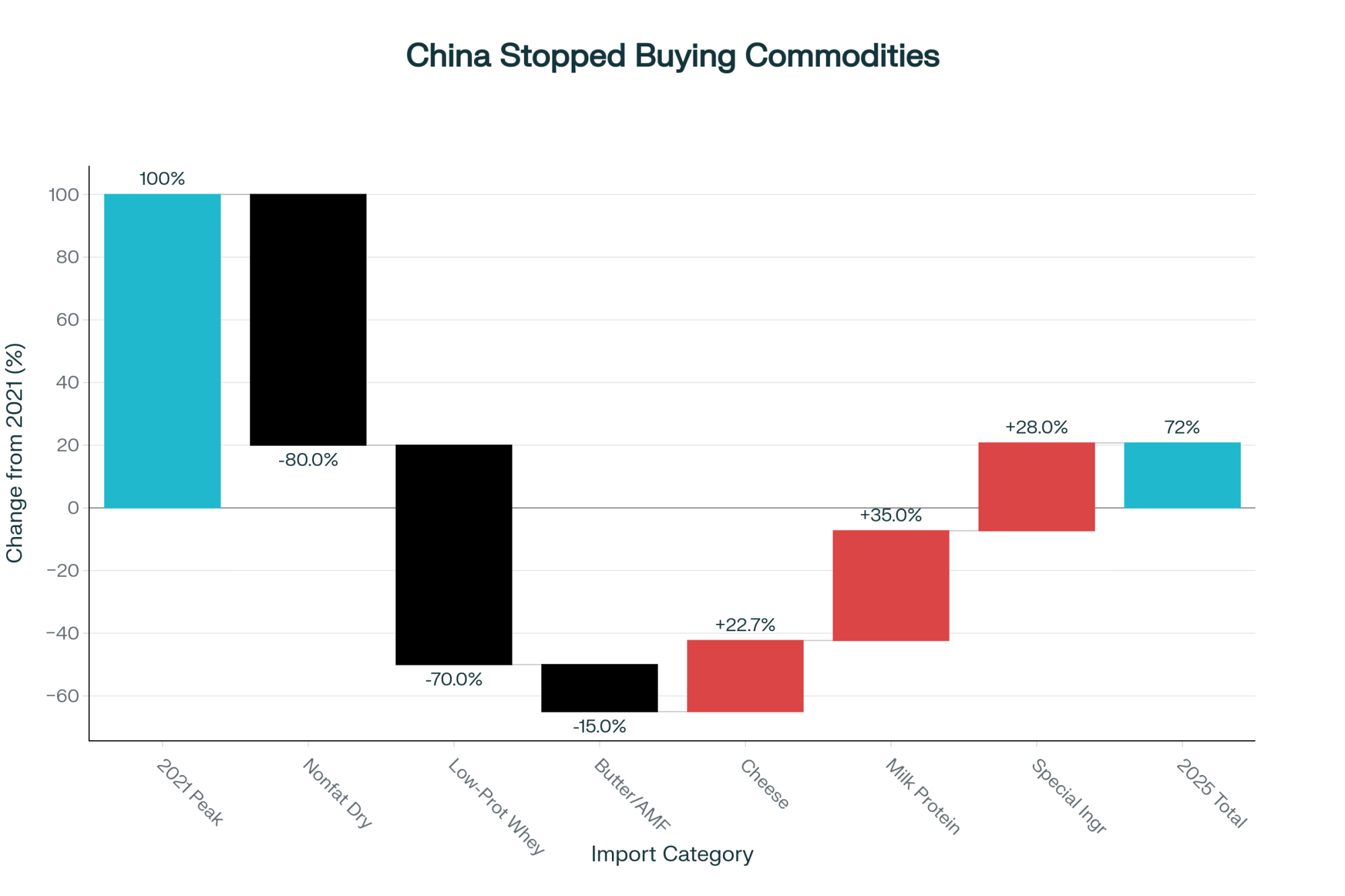
The Market That Vanished: China’s dairy strategy flip explains today’s seven-sellers-zero-buyers crisis. They’re not buying less dairy—they’re building domestic commodity powder plants while importing high-value cheese and specialized proteins. For U.S. farmers who built their businesses on Chinese powder demand, this isn’t a cycle—it’s permanent market restructuring.

U.S. Dairy Export Council data from May 2025 shows our nonfat dry milk exports to China are down nearly 80%. Low-protein whey? Down 70%. Through July, China’s General Administration of Customs reports total dairy imports reached 1.77 million tonnes—up 6% year-over-year but still 28% below the 2021 peak.

But here’s what I find really interesting when you dig into the trade data: they’re buying cheese—up 22.7%—and specialized ingredients like milk protein isolates while avoiding commodity powders. China’s shifting from volume to value, and we built all this powder capacity for demand that’s evaporating.

Texas A&M’s Agricultural Economics Department has been tracking this shift. Their analysis suggests that China’s building domestic capacity for elemental powders but is importing sophisticated products that its plants can’t make efficiently. It’s looking like a permanent shift, not a temporary one.

Understanding Your Real Options

Debt-to-Asset RatioYour RealityAction RequiredRevenue OpportunitiesTimelineEquity at StakeMonthly Impact (per 100 cows)
Under 45%Well-CapitalizedStrategic ExpansionForward contracts: $1.00-1.50/cwt premium
Acquire neighbors at 20-30% discount
90-120 days to lock contractsExpansion at favorable terms+$2,400 with premium contracts
45-60%Mid-Tier SqueezeCost Reduction + PartnersDairy Revenue Protection
15% cost cuts required
60 days to implement cutsSurvival: maintain current equity-$750 current bleeding
Over 60%DistressedStrategic Exit NOWExit while preserving equity30-60 days before options vanishProactive: 60-75% preserved
Forced: 40-45% preserved
-$1,500+ and accelerating

After talking with extension specialists and lenders across the country this week, what’s becoming clear is that waiting for “normal” isn’t a strategy anymore. The math doesn’t support it, and neither does the calendar.

Path 1: Strategic Expansion

For operations with debt-to-asset ratios below 45% and strong cash flow, this downturn presents acquisition opportunities. Farm Credit Services analysis shows distressed sales starting at 20-30% below replacement cost. But—and this is important—these deals require creativity.

What’s working, based on case studies from the University of Wisconsin’s Center for Dairy Profitability and Cornell’s PRO-DAIRY program, is seller-financed arrangements that preserve more equity for the seller than foreclosure would. You might offer 20% below market value, but with financing at reasonable rates over seven years, maybe include a management position. The seller preserves dignity and more equity, and you gain capacity at favorable terms.

This only works if you’ve got the balance sheet for it. Operations in this category can also negotiate forward supply commitments with processors building new capacity. We’re seeing premiums of $1.00 to $1.50 per hundredweight for multi-year contracts in some regions.

I’ve noticed that Southeast operations are particularly successful with this approach. One producer milking about 1,200 cows in Georgia just locked in a seven-year contract with a new processor at $1.35 over Class III. “Yeah, we might miss some price spikes,” they mentioned, “but I can budget, I can sleep at night, and I know I’ll still be here in 2030.”

Path 2: Find Your Niche

Penn State Extension has documented several successful transitions to organic production with on-farm processing. The numbers are tough initially—certification costs, learning curves, building customer bases. But producers who’ve made it through report premiums of $20 or more per hundredweight over conventional milk.

The catch? You need capital. Penn State’s business planning specialists say successful transitions require an upfront investment of $150,000 to $200,000 and 18 to 24 months to achieve positive cash flow. Plus, you need to be within a reasonable distance of affluent consumers.

Some Texas operations have gone a different route—100% grass-fed, certified by the American Grassfed Association, and selling direct to restaurants and farmers’ markets. It might be 40% of the previous volume, but at significantly higher prices. Feed bills drop dramatically—just hay in drought months.

In Minnesota, some mid-sized operations—we’re talking 400 to 500 cows—have locked in contracts with local cheese plants specializing in European-style aged cheeses. These plants need consistent butterfat over 4.0%, which Jersey and crossbred herds can deliver. The premium’s worth it.

What’s encouraging is that robotic milking systems are becoming viable for these mid-tier operations too. Michigan State University research shows that operations with 180-240 cows can justify two robots, especially when labor’s tight. The capital cost hurts—$150,000 to $200,000 per robot—but some producers are finding it lets them stay competitive without massive expansion.

Path 3: Strategic Exit

This is the hardest conversation, but it needs to be had. Farm Credit specialists and agricultural finance research consistently indicates that proactive sales generally preserve 60-75% of equity compared to 40-45% in forced liquidation scenarios.

What’s encouraging is that some larger neighbors need experienced managers and are offering employment as part of acquisition deals. You might sell your operation but stay on at $65,000 to $75,000 plus housing for two years. It’s not ideal, but it beats losing everything.

There’s also the generational transfer angle nobody likes discussing. If the next generation isn’t interested or capable, forcing succession can destroy both farm equity and family relationships. Sometimes the strategic exit is selling to a neighbor while you can still set terms, rather than leaving an impossible burden for your kids.

How Cooperatives Navigate Conflicting Interests

One thing that’s really striking me lately is how cooperative dynamics change during consolidation. That traditional one-member, one-vote structure assumes everyone’s interests align. But what happens when they don’t?

Most folks don’t realize how co-op equity actually works. Those capital retains—CoBank’s Knowledge Exchange program analysis puts them at $0.20 to $0.40 per hundredweight, typically—accumulate over decades. But here’s what nobody tells you: redemption timelines are stretching to 15-25 years as co-ops prioritize expansion over paying out equity.

Run the math with me. A 500-cow operation producing 11,000 pounds per cow monthly contributes roughly $118,800 annually in retained patronage at $0.30 per hundredweight average. Over 20 years, that’s $2.4 million accumulated. But with 2.5% annual inflation per Federal Reserve data, the real purchasing power of that equity drops nearly 40% over a 20-year redemption period.

Co-op board dynamics are shifting, too. The new plants being built require 4 million pounds per day. A 300-cow operation produces maybe 20,000 pounds. Operations with 5,000 cows? They’re producing 325,000. The voting structure might be democratic, but economic realities create different levels of influence.

Regional Realities: Where This Hits Hardest

Looking at how this plays out across different dairy regions, the impacts vary dramatically based on existing farm structure and local economics.

Wisconsin’s Challenge

Based on historical consolidation patterns analyzed by the University of Wisconsin-Madison’s Program on Agricultural Technology Studies, Wisconsin could see closure rates potentially affecting 30-40% of remaining operations over the next five years if current trends continue.

Wisconsin Agricultural Statistics Service data shows the average Wisconsin farm has 234 cows producing 24,883 pounds annually. They’re not inefficient—they’re just caught in scale economics that no longer work. Every service business in these rural towns depends on dairy. Lose the farms, and you lose the schools, the equipment dealers, the feed mills… everything that makes these communities work.

California’s Water-Driven Consolidation

Tulare County’s average herd size is already around 1,840 cows, according to California Department of Food and Agriculture data. Even here, consolidation continues. But it’s different—it’s about water more than milk prices.

Dr. Jennifer Heguy, who’s the UC Cooperative Extension Dairy Advisor for Merced, Stanislaus, and San Joaquin counties, points out that water rights are becoming more valuable than the dairy infrastructure itself. The implementation of the Sustainable Groundwater Management Act means that operations without secure water face impossible decisions. Farms are merging primarily to secure water portfolios—one farm with senior water rights can support three without.

Pennsylvania’s Plain Community Crisis

This situation is particularly complex. Lancaster County has about 1,480 dairy farms, averaging 65 cows each, most run by Amish and Mennonite families. Penn State Extension research indicates these smaller operations face severe economic pressure at current milk prices.

For Plain communities, the implications go way beyond economics. Farming isn’t just an occupation—it’s integral to their way of life and faith practice. When families can’t farm, they often have to relocate to areas with available land, which can mean leaving established communities entirely.

What Successful Producers Are Doing Right Now

CategoryValue ($/cwt or as noted)Implementation TimelineDifficulty Level
Class IV Milk Price (Oct 2025)$13.75 Current marketGiven
Production Cost (Northeastern avg)$14.50 Fixed costGiven
Current Loss per cwt($0.75)Immediate issueCrisis
REVENUE OPPORTUNITIES:
Forward Contract Premium+$1.00 to $1.5090-120 days to lockMedium – negotiation required
Carbon Credits (per cow/year)$400-450 total6-12 months to implementHigh – capital intensive
Component Premium (>3.3% protein)+$0.30 to $0.5030-60 days to optimizeLow – nutritionist consult
Dairy Margin Coverage ($9.50)Coverage variesImmediate enrollmentLow – paperwork only
POTENTIAL MONTHLY IMPACT (300 cows):
Base milk revenue (20,000 lbs/cow)$82,500 Baseline calculation
Forward contract bonus$6,000 If contracted by Jan 31
Carbon credits (monthly)$1,125 Annual avg, 6mo lag
Component premiums$1,800 Ration adjustment 60 days
DMC protection value$1,200 Policy dependent
Total potential monthly revenue$92,625 With all strategies
Current monthly cost$87,000 300 cow baseline
Net monthly margin (best case)$5,625 All strategies deployed
Net monthly margin (current)($4,500)No action taken

Here’s what’s actually working for farmers navigating this successfully—and I mean actually working, not theoretical strategies.

Financial scenario planning has become essential. Running spreadsheets with milk at $12, $14, $16 for the next 24 months shows you exactly when you hit critical triggers. As many producers are learning, hope isn’t a business plan.

The smart ones are approaching lenders proactively. If you know Class III staying below $16 through March means you’ll need to restructure, start that conversation now when you still have options. Waiting until February when you’re forced into it? That’s a different conversation entirely.

Carbon credits are becoming real money, too. Programs like those from Indigo Agriculture, implementing cover crops and manure management changes, can generate $400 to $450 per cow annually once fully implemented. On 600 cows, that’s $250,000—potentially the difference between surviving and not.

Don’t forget about Dairy Margin Coverage either. The program’s been recalibrated, and at current feed costs versus milk prices, even the $9.50 coverage level can provide meaningful protection. It’s not a complete solution, but combined with Dairy Revenue Protection for Class IV producers, it’s essential risk management.

Feed procurement matters enormously right now. With December corn at $4.28 per bushel on the Chicago Board of Trade, locking in winter needs makes sense. Nutritionists working with Pennsylvania dairies report clients who contracted 70% of their corn silage needs back in August are paying $10 to $12 less per ton than those buying now.

Component premiums deserve attention, too. At 3.3% protein or higher, most processors pay premiums of $0.30 to $0.50 per hundredweight, according to Federal Milk Market Administrator reports. Dr. Mike Hutjens, professor emeritus at the University of Illinois, has shown that reformulating rations to push protein might cost an extra $0.75 per cow per day but return $1.20 in premiums. That’s $165 net per cow annually.

The Most Expensive Calendar in Dairy: This 90-day window determines who’s still farming in 2030. Well-capitalized operations have until January 31 to lock premium contracts before processors fill their needs. Mid-tier farms need cost cuts implemented yesterday. And distressed operations? Every day past Day 60 costs 0.5% more equity. After 90 days, you’re not making decisions—your lender is.

Key Takeaways for Different Operations

Let me break this down by where you’re sitting financially, because your situation really does determine your options.

If you’re well-capitalized with a debt-to-asset ratio under 45%:

Now’s the time to move strategically. Forward contract with processors building new capacity. Those $1.00 to $1.50 per hundredweight premiums for five-year commitments can make a huge difference on cash flow. Consider geographic expansion across multiple sites rather than building massive single locations. Environmental permits, community relations, and disease risk all favor distributed operations under single management.

If you’re mid-tier with debt-to-asset between 45-60%:

You need immediate cost reduction—we’re talking 10-15%—to weather what’s coming. Dairy Revenue Protection isn’t optional anymore for Class IV producers. That coverage might cost $0.48 per hundredweight, but when you’re already losing $0.75, it’s survival insurance. Strategic partnerships might preserve independence better than going alone. Three 400-cow dairies sharing equipment, buying feed together, and negotiating milk premiums collectively have more leverage than individually.

If you’re stressed with a debt-to-asset ratio over 60%:

The hard truth? Make the difficult calls this week, not next month. Every week you wait, your equity erodes and options narrow. Agricultural financial counselors through Extension services or organizations like Farm Aid can help navigate this.

Looking Ahead: What This Industry Becomes

The seven NDM sellers facing zero buyers this morning wasn’t just a market anomaly. It was a signal that fundamental assumptions about dairy economics have shifted.

What’s becoming clear is that the industry emerging from this won’t look like the one we entered. It’ll be more concentrated, more integrated, more capital-intensive. That’s not a judgment—it’s just what the economics are driving toward.

Based on current trends and academic projections, we could see the U.S. dairy farm count drop significantly by 2030. The survivors won’t necessarily be the best farmers—they’ll be the ones who recognized structural change early and positioned accordingly. Some by expanding strategically, others by finding profitable niches, and yes, some by exiting while they still had equity to preserve.

I’ve been through several market cycles—’99, ’09, ’15. This feels different. Those were painful but temporary. This is structural—fundamental changes in how the industry organizes itself.

Your window for strategic decision-making? Based on what lenders are saying, it’s probably 90 to 120 days, not the year or more, most folks assume. Once you hit certain financial triggers—debt service coverage below 1.1, current ratio under 1.0—decisions start getting made for you rather than by you.

Understanding these dynamics—and more importantly, acting on them—will determine who’s still milking cows in 2030. We started today with seven sellers and zero buyers. That’s not the market failing. That’s the market telling us something important.

Question is, are we listening?

KEY TAKEAWAYS:

  • Market Breaking Point: October 31’s seven sellers/zero buyers at $1.14/lb wasn’t a bad day—it was the market refusing to function, signaling permanent structural change, not temporary correction
  • Your 90-Day Action Plan by Debt Level:
  • Under 45%: Acquire distressed neighbors at a 20-30% discount with seller financing
  • 45-60%: Cut costs 15%, add Dairy Revenue Protection, form strategic partnerships
  • Over 60%: Exit now, preserving 60-75% equity (vs 40% in forced liquidation)
  • Why This Time Is Different: Heifer inventory at 1978 lows means supply can’t adjust for 3+ years, while every major region expanded simultaneously—breaking the historic balance mechanism
  • Survival Revenue Streams: Forward contracts with new processors ($1.00-1.50/cwt premium), carbon credits ($400-450/cow/year), protein premiums ($165/cow/year), Dairy Margin Coverage at $9.50
  • The Bottom Line: This isn’t a cycle—it’s the largest restructuring in modern dairy history. Decisions you make by January 31, 2026, determine if you exist in 2030.

Complete references and supporting documentation are available upon request by contacting the editorial team at editor@thebullvine.com.

Learn More:

Join the Revolution!

Join over 30,000 successful dairy professionals who rely on Bullvine Weekly for their competitive edge. Delivered directly to your inbox each week, our exclusive industry insights help you make smarter decisions while saving precious hours every week. Never miss critical updates on milk production trends, breakthrough technologies, and profit-boosting strategies that top producers are already implementing. Subscribe now to transform your dairy operation’s efficiency and profitability—your future success is just one click away.
NewsSubscribe
First
Last
Consent

Argentina Beef Imports: The Immediate Stakes for Your Dairy Operation

Imports are rising. Futures are falling. Here’s what every dairy herd should know before the market moves again.

Executive Summary: A plan to import more Argentine beef may seem distant, but it’s already reshaping U.S. agriculture. The proposal to quadruple import quotas to 80,000 metric tons has dropped cattle futures nearly $100 per head and sparked tough conversations for dairies that now rely on beef‑on‑dairy calves for revenue. With 70 percent of large herds breeding to beef, and an average $250,000 in annual calf income at stake, every shift in the beef market touches the milk check. Farmers remember 1986 and 2020—years when fast policy moves caused lasting pain. What’s interesting now is how calmly producers are responding: adjusting breeding ratios, locking in forward contracts, and fine‑tuning rations instead of panicking. The broader reminder? Real stability in both beef and milk still starts in the barn, not the import ledger.

Beef on Dairy

Every so often, a government policy hits the headlines and you can almost feel it ripple across the countryside. The latest is a proposed White House plan to quadruple Argentine beef imports—from about 20,000 to 80,000 metric tons.

At first, that might sound like a beef industry story, but it’s quickly becoming a dairy conversation. The reason is simple: our operations are tied together through the beef‑on‑dairy market more than ever before. And as many farmers are noticing, market decisions made in Washington—or Buenos Aires—have a way of showing up in the calf barn faster than you’d expect.

11,000% Growth Story Dairy Can’t Ignore — From backyard experiment to industry game-changer: beef-on-dairy exploded from 50,000 head to potentially 5.5 million by 2026, reshaping American beef production forever.

Looking at What’s Behind the Policy

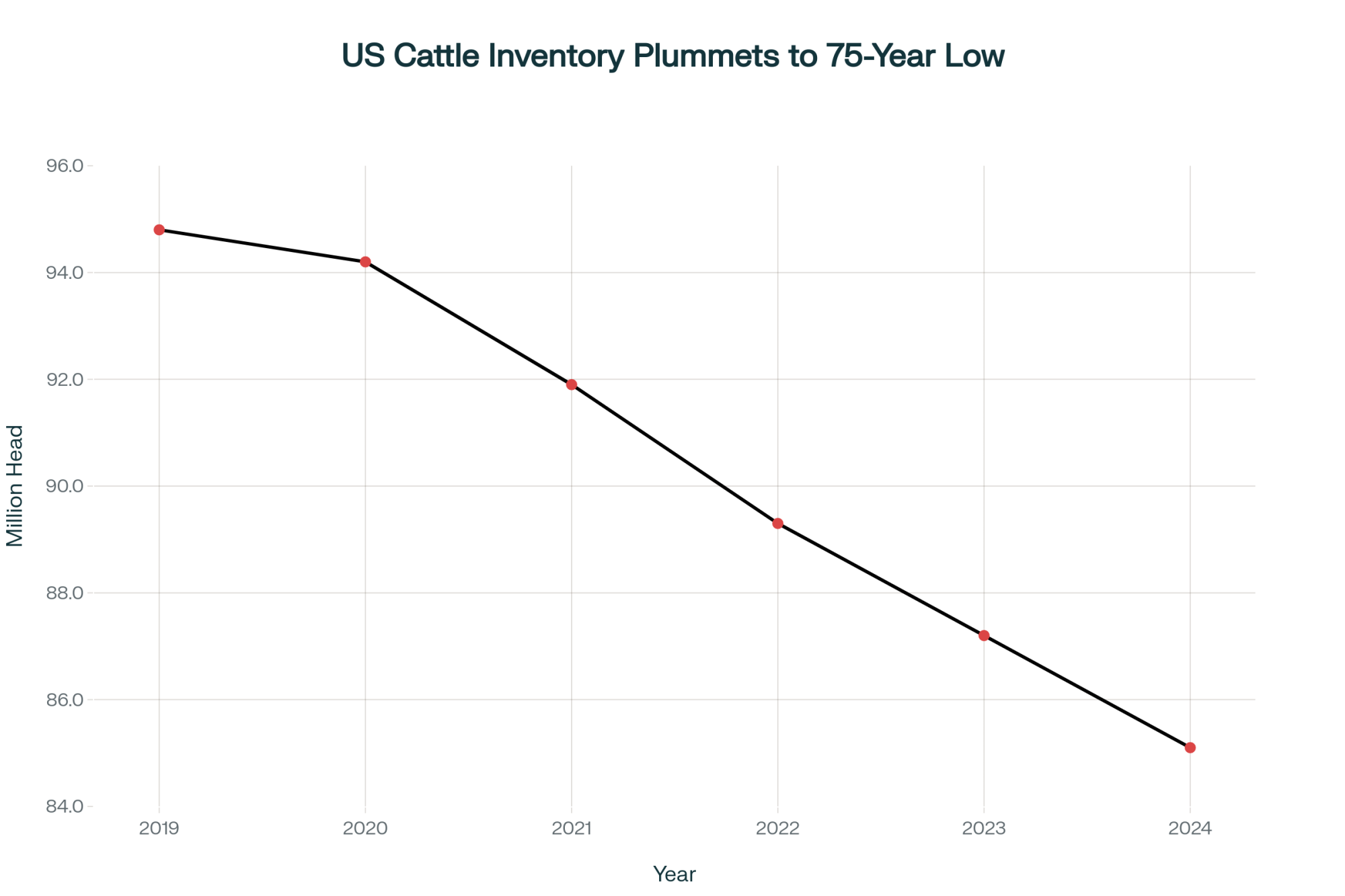
According to the USDA’s October Livestock, Dairy & Poultry Outlook, the U.S. cattle inventory now sits at its lowest level in 75 years. The causes aren’t new—multi‑year drought, high feed prices, and slower herd rebuilding across the Plains and West.

Crisis in Numbers: America’s Cattle Vanish — The steepest herd liquidation since World War II puts every dairy farm’s beef-on-dairy income at risk as supply fundamentals reshape decades of agricultural stability.

To ease those supply pressures, the administration is considering expanded beef imports to steady retail prices, which hit a record $6.30 per pound for ground beef this fall (Bureau of Labor Statistics).

On paper, that makes basic economic sense. But markets always react before the first kilogram of product moves. Just a week after the announcement, CME Group data showed futures prices down roughly $100 per head—or about 3 percent.

As Dr. Derrell Peel, livestock economist with Oklahoma State University Extension, put it: “You can’t rebuild a herd—or confidence—in a single policy cycle.”

And confidence is what sustains both cow‑calf ranches and dairies that depend on steady cross‑market signals.

The Beef‑on‑Dairy Link That’s Now Essential

Looking at this trend, it’s remarkable how fast beef‑on‑dairy has become a cornerstone of herd economics. In 2024, University of Wisconsin–Madison Extension researchers reported that nearly 70 percent of large dairies bred a portion of their cows to beef bulls.

The strategy significantly increased the average calf value. USDA AMS market data shows beef‑cross calves bringing $1,200 to $1,400 at birth, compared with $150 to $250 for pure Holstein bulls.

For a 1,500‑cow dairy breeding 40 percent to beef, that’s $240,000–260,000 in additional annual income. It’s the sort of capital that pays for genomic testing, sand bedding replacements, or that new holding pen upgrade.

A producer milking 1,200 cows in eastern Wisconsin told me recently, “Those beef calves have carried our barn loan for two years running. If prices fall much, we’ll need to rethink replacement plans.”

That’s real money—and real vulnerability—tied directly to policy decisions made thousands of miles from the farm.

What History Tells Us: The 1986 Buyout

What’s particularly interesting here is how this mirrors an earlier moment in ag policy—the 1986 Dairy Termination Program. Back then, USDA spent $1.8 billion to eliminate milk surpluses, buying out 14,000 farms and taking 1.5 million dairy cows off the grid.

It achieved its short‑term goal—but the cascade stunned markets. Surplus cows hit beef channels at once, and prices plunged 10–15 percent. Within two years, milk output had rebounded while much of the infrastructure serving small dairies had not.

The lesson still resonates today: market interventions can change prices quickly, but they rarely rebuild capacity at the same pace.

Psychology Trumps Physics in Cattle Markets — Import volumes climbed steadily while prices soared until policy psychology triggered the $7/cwt reality check, validating Andrew’s thesis about market sentiment over supply fundamentals

2020’s Big Reminder: When Efficiency Becomes Fragility

If 1986 was about overcorrection, then 2020 was about over‑efficiency. During the first months of COVID‑19, International Dairy Foods Association data showed 450–460 million pounds of milk dumped in April alone, while USDA ERS recorded beef and pork processing down more than 25 percent after plant shutdowns.

That period revealed how vulnerable “just‑in‑time” logistics can be. When processors or ports stall, milk and beef lose nearly all momentum.

Increasing reliance on imports—without parallel investment in domestic resilience—carries a similar risk. Once local capacity is allowed to wither, it’s slow and costly to bring back.

How Farmers Are Adjusting Already

Here’s what many Extension specialists and lenders are seeing so far:

  • Breeding Ratios Are Shifting. Herds that were 60 percent beef are easing down toward 35–40 percent to maintain heifer pipelines.
  • Feedlot Contracts Are Narrowing. Where buyers offered $1,300 per crossbred calf last spring, they’re now closer to $1,000 (USDA AMS Feeder Cattle Summary, October 2025). Forward contracting remains a critical stability tool.
  • Genomic Programs Are Staying Put.Dr. Heather Huson, associate professor of animal genomics at Cornell University, warns that cutting testing “saves pennies now but costs years of progress in herd performance and butterfat output.”
  • Ration Formulas Are Being Fine‑tuned. Nutritionists are rebalancing energy‑dense transition diets to maintain reproductive stability and milk components without increasing feed costs.

What’s encouraging is the tone—measured, thoughtful, and proactive. Dairies aren’t panicking; they’re preparing.

Regional Strategies, Shared Outlooks

Across the U.S., adaptation looks different but points to the same principle—resilience:

  • Western dry‑lot systems, stretched by feed and water constraints, are leaning back toward dairy genetics to maintain replacements.
  • Upper Midwest co‑ops, long integrated with beef‑on‑dairy programs, are renegotiating calf contracts to lock in 2026 pricing.
  • Northeast fluid dairies balancing organic quotas and beef‑cross sales are prioritizing efficiency rather than retreating from diversification.

Different regions, same balancing act—protect cash flow today while safeguarding production capacity tomorrow.

The Bigger Question: Can We Stay Self‑Sufficient?

The U.S. currently produces about 83 percent of its own beef supply, according to USDA ERS Trade Data (2025).Economists caution that, if herd recovery stays slow while imports increase, that number could slide toward 70 percent within ten years.

That’s not about politics—it’s about security. Kansas State University Extension specialists remind us that “food sovereignty” doesn’t mean cutting trade; it means keeping enough domestic capability to respond when global systems falter.

For dairy, the same applies. Once cull markets, local plants, or skilled herd labor disappear, rebuilding them isn’t a quick turnaround—it’s generational work.

Signs of Progress Worth Watching

The good news is, practical resilience efforts are underway. Wisconsin’s Dairy Innovation Hub and USDA’s Regional Food Business Centers are channeling new funding into herd research, small processor support, and cold‑chain infrastructure.

As Dr. Mark Stephenson, director of UW–Madison’s Center for Dairy Profitability, said during a recent producer panel, “Resilience isn’t about size—it’s about diversity. The more ways we move milk and beef through our systems, the better we weather volatility.”

The Bottom Line

What’s interesting here is that every generation faces its own version of policy shockwaves. This one just happens to merge global trade with a cow management strategy.

Markets shift overnight. Herds don’t. Successful farms are the ones that use these moments not to retreat, but to reinforce what already works.

If history has taught us anything—from 1986’s buyout to 2020’s pandemic fallout—it’s that capacity equals security.Protect the cows, the genetics, and the local systems, and the rest finds its balance.

Progress in agriculture has always moved at the cow’s pace—and that’s still the pace that feeds the world.

Key Takeaways:

  • A policy shift abroad can hit your milk check at home. Rising beef imports risk lowering calf values just as beef‑on‑dairy becomes vital to dairy income.
  • With 70% of dairies breeding to beef and nearly $250,000 a year on the line per farm, small price swings now carry outsized impact.
  • History is warning us: quick policy fixes in 1986 and 2020 show how capacity lost early takes decades to recover.
  • Smart dairies are preparing now—tweaking breeding ratios, securing forward contracts, and tightening transition nutrition to stay profitable.
  • Resilience beats reaction. Protect herd quality, diversify markets, and collaborate locally to keep your dairy strong through shifting trade winds.

Complete references and supporting documentation are available upon request by contacting the editorial team at editor@thebullvine.com.

Learn More:

Join the Revolution!

Join over 30,000 successful dairy professionals who rely on Bullvine Weekly for their competitive edge. Delivered directly to your inbox each week, our exclusive industry insights help you make smarter decisions while saving precious hours every week. Never miss critical updates on milk production trends, breakthrough technologies, and profit-boosting strategies that top producers are already implementing. Subscribe now to transform your dairy operation’s efficiency and profitability—your future success is just one click away.
NewsSubscribe
First
Last
Consent

Lessons from Greece’s Phantom Herds: Why Trust and Data Now Decide Dairy’s Future

When Greece’s ghost herds stole €20 million, they left every dairy farmer a hard truth: trust without proof costs real money.

Executive Summary: When news broke that Greek fraudsters had stolen €20 million using “ghost herds,” it did more than rattle regulators—it struck a chord with real farmers everywhere. The case proved what every dairy producer already knows: trust only works when it’s backed by proof. This story digs into how Greece’s oversights mirror the challenges in North America’s milk pricing and subsidy systems, where paperwork often outpaces technology. What’s encouraging is that solutions already exist—digital traceability, satellite verification, and data‑driven audits built to protect honest operations. The takeaway? Verification isn’t red tape—it’s the foundation that keeps integrity, transparency, and producer trust alive in modern dairying.

Dairy Data Verification

Every dairy farmer knows that our industry runs on trust. That trust sits quietly beneath the bulk tanks, market reports, and cooperative books we rely on every day. So when investigators in Europe uncovered a major subsidy scandal built on phony paperwork and nonexistent herds, it stirred something familiar.

The case out of Greece wasn’t about complex cybercrime—it was about paperwork getting ahead of proof. And that, in its simplest form, is a cautionary tale with lessons we should pay attention to.

Inside Greece’s “Phantom Herds” Scandal

Greece’s ghost herd scandal shows what happens when paperwork outpaces proof—7 years of fraud, €20M stolen, and 324 phantom farmers. The lesson for North American dairy: trust needs verification, not just forms.

The European Public Prosecutor’s Office (EPPO) reported earlier this year that fraudulent applications for agricultural subsidies had been filed in the years leading up to 2025, totaling more than €20 million in false claims. The scheme was run through OPEKEPE, Greece’s administrative body for EU farm payments, and linked to 324 fake recipients who allegedly invented livestock herds and falsified land records.

The fraud ran long enough to trigger major repercussions. The European Commission fined Greece €400 million for “systemic verification failures,” forcing the country’s Ministry of Rural Development to overhaul its subsidy application checks.

The fallout landed hardest, as it always does, on the honest operators. Many of Greece’s legitimate family dairies—those milking goats and sheep for the country’s Protected Designation of Origin feta—now face extra audits, slower payments, and reputational damage through no fault of their own.

Why This Story Resonates Beyond Europe

What’s interesting here is that while the fraud happened half a world away, the vulnerabilities it exposed look awfully familiar. From milk pooling to subsidy checks, North American dairy runs on systems just as dependent on accurate data—and just as fragile when complexity outweighs clarity.

1. When Paperwork Outpaces Practice

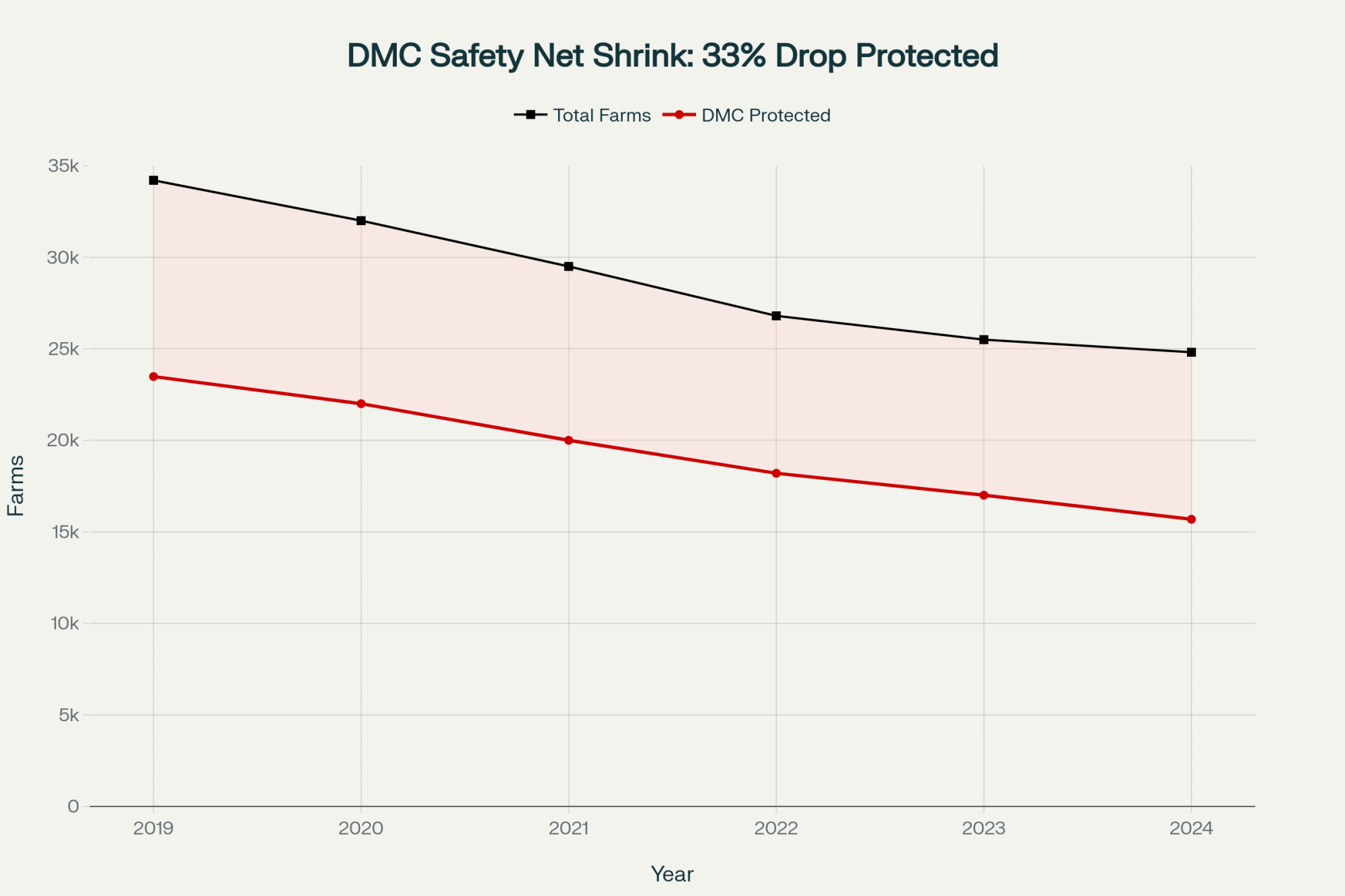
DMC enrollment dropped 33% (from 23,485 to 15,686 farms) even as margins collapsed in 2023. The safety net is shrinking faster than the industry—when complexity confuses farmers, they skip protection and bet the farm.

The Dairy Margin Coverage (DMC) program has been a financial lifeline for U.S. producers facing unpredictable feed costs. But much of it still depends on paper applications and self‑verified production data.

The USDA Farm Service Agency (FSA) has made digital reporting available in recent years, yet data integration between programs remains limited. University of Wisconsin research calls it a “trust‑based compliance model” that functions well under normal conditions but leaves room for error when information isn’t seamlessly shared.

Let’s be clear—nobody’s suggesting this is fraud. It’s inefficiency. And inefficiency creates opportunity—for mistakes, for misreporting, or simply for confusion that puts unnecessary strain on both farmers and regulators.

2. When Complexity Creates Confusion

Take the Federal Milk Marketing Order (FMMO) system. It’s designed to bring fairness and balance to milk markets, but even many seasoned operators will tell you that tracking, pooling, and pricing doesn’t always feel transparent.

The 2018 Farm Bill’s Class I pricing formula change cost dairy farmers over $1 billion in pool losses. When complexity outweighs clarity, handlers exploit gaps—leaving honest producers holding the bag.

Milk handlers can legally “de‑pool” their milk—temporarily removing it from the pool to optimize returns—during certain market shifts. According to the USDA Economic Research Service (ERS), de‑pooling between 2021 and 2023 shifted hundreds of millions of dollars across federal orders.

While perfectly legal, this complexity creates an information gap where trust can erode—the same kind of vacuum that allowed outright fraud in the Greek system. When producers can’t fully trace value movement, suspicion grows, even in legitimate markets.

Transparency, plain and simple, is the antidote.

3. Accountability Builds Resilience: The Checkoff Example

Funding mechanisms like national checkoff programs show how transparency can turn obligation into trust. Producer dollars drive research, market development, and promotion—but oversight matters.

Farm Action audit review in 2024 revealed missing USDA validations across several non‑dairy commodity boards, sparking an industry‑wide conversation about governance standards. Dairy programs weren’t directly involved, but the timing was valuable: it reminded everyone that trust grows where visibility exists.

Producers don’t oppose accountability—they just want assurance that the dollars they contribute continue to build consumer trust, sustain exports, and innovate products for the next generation.

The Broader Picture: Consolidation and Oversight Pressure

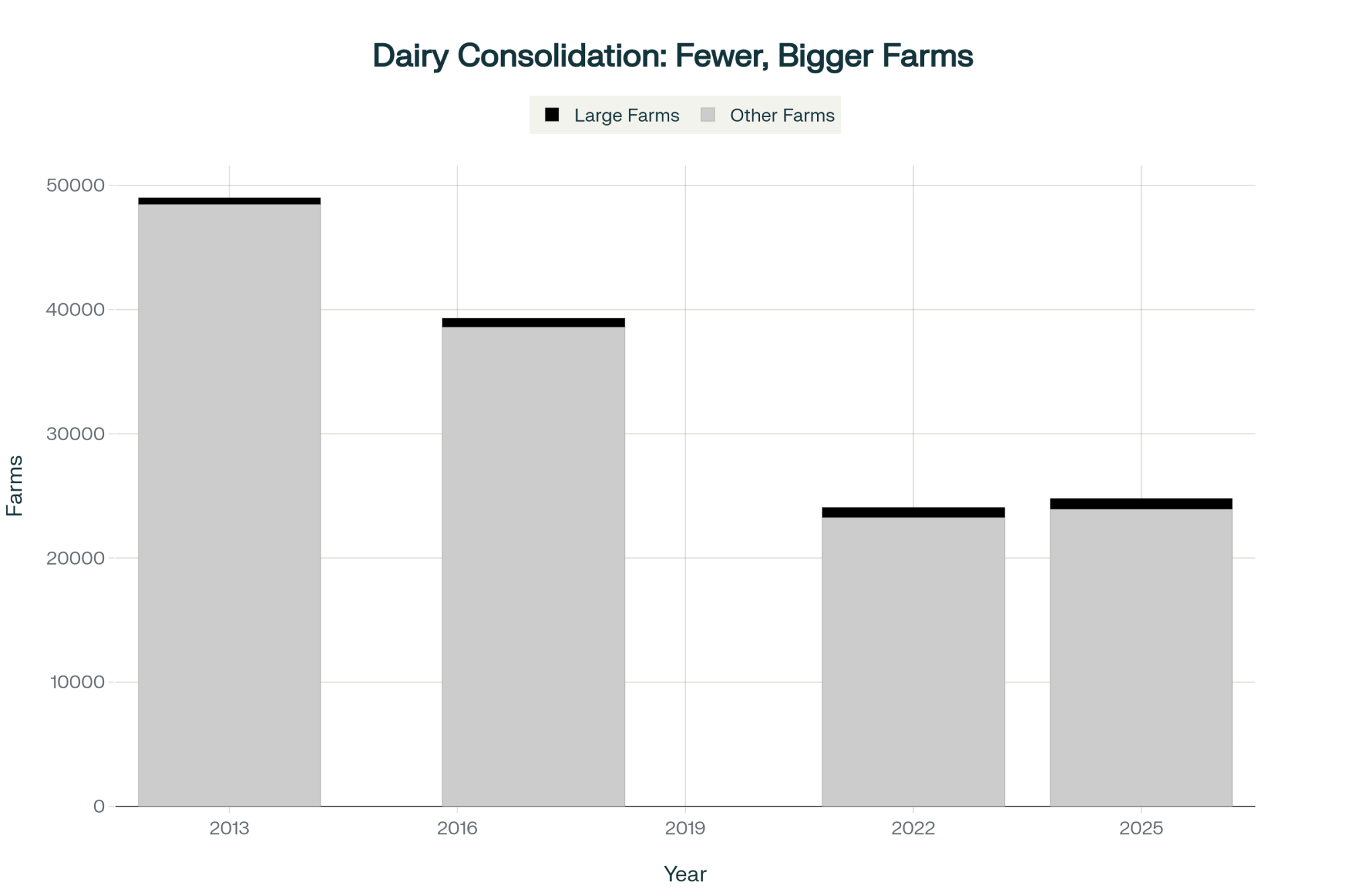
Half of U.S. dairy farms have disappeared since 2013, yet mega-dairies (1,000+ cows) now control 70% of milk production. The consolidation half-life shrunk from 12 to 10 years—adapt or join the 4% annual closure rate.

The USDA National Agricultural Statistics Service (NASS) estimates that the U.S. now has about 24,800 licensed herds, down from nearly 49,000 in 2013. Canada’s supply‑managed system counts 9,800 active quota‑holding farmsunder the Dairy Farmers of Canada (DFC).

Smaller farms, particularly those milking under 250 cows, shoulder nearly the same compliance burden as 3,000‑cow operations but without full‑time administrative help. It’s no wonder producers often say that paperwork feels heavier than feed costs.

In Ontario, for example, DFC’s ProAction program integrates animal care, milk quality, and traceability standards under one unified verification system. While not perfect, it exemplifies how structured oversight with predictable audits can reduce anxiety rather than increase it. ProAction is proof that structured transparency works when it strengthens—not slows—good farms.

That’s the irony lost in Greece’s cautionary tale: good verification shouldn’t slow down honest farms—it should set them free to focus on milk quality, breeding, and butterfat performance instead of bureaucracy.

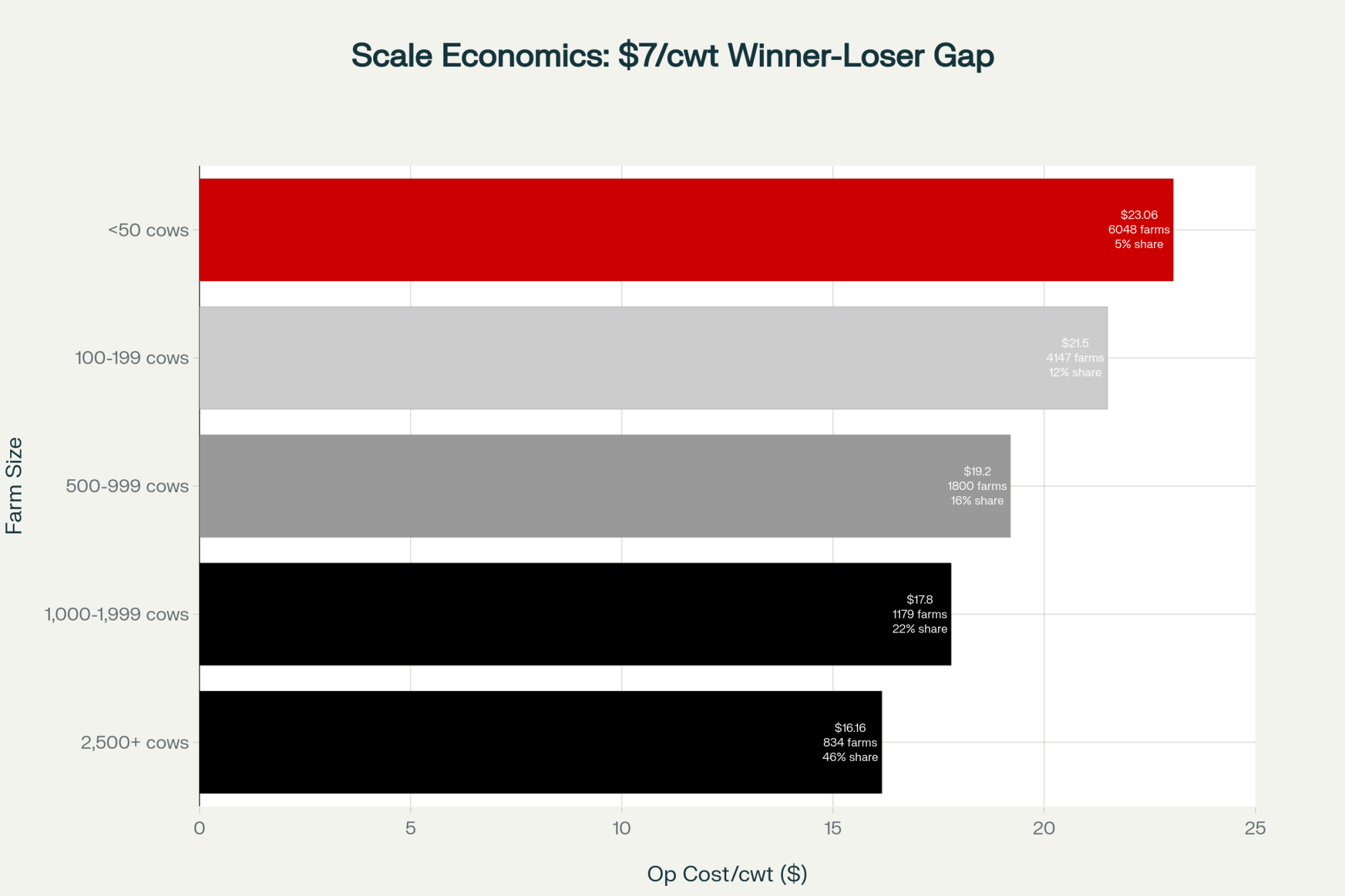
Small dairies (<50 cows) operate at $23.06/cwt while mega-farms (2,500+) run at $16.16/cwt. That $7 cost gap isn’t just economics—it’s an extinction event. Scale up or specialize, because the middle ground is quicksand.

Technology Is Catching Up

Across both continents, smarter verification is becoming the norm rather than the exception.

  • Digital traceability: European and North American cooperatives are piloting blockchain‑linked milk collection logs. Each load records location, timing, and solids data that can’t be altered—preventing both miscommunication and tampering.
  • Satellite audits: Agriculture and Agri‑Food Canada (AAFC) now uses satellite imagery to confirm environmental compliance, reducing site visits for farms with clean records.
  • Risk‑based oversight: USDA trials for targeted auditing focus on outlier data, lowering the frequency of reviews for consistently accurate producers.

The result? Stronger systems that reward accuracy instead of punishing transparency.

Farmers Taking the Lead

Producers themselves are proving that transparency works best when it starts from within.

Dairy Profit Teams in Wisconsin, Minnesota, and Michigan bring herds together to confidentially share cost and performance benchmarks. Meanwhile, sustainability benchmarking programs in British Columbia and Manitobaallow farms to compare nutrient efficiency and environmental metrics anonymously.

One producer from Manitoba summed it up perfectly: “Once you see objective numbers, you stop making assumptions about who’s ahead and who’s behind. We realized we were all fine—we just measured differently.”

That’s how farms thrive, not through secrecy but through collaboration supported by data.

The Bottom Line

Greece’s subsidy scandal didn’t happen because its farmers were dishonest—it happened because oversight systems lagged behind operational reality. In contrast, North American dairy has the chance to stay ahead by modernizing without losing what matters most: integrity.

Here’s what’s encouraging. Our farms already excel at measurement. From fresh‑cow management to feed conversion tracking, we live in data every day. The next step is ensuring that the data already being collected automatically backs the trust our industry deserves.

Because as Greece’s experience reminds us, trust without verification isn’t sustainable—and verification, when done right, doesn’t add work. It proves value.

In the end, the gap between compliance and corruption is only as wide as the space between trust and verification. Closing that gap isn’t just good governance—it’s how dairy protects its reputation, one verified record at a time.

Key Takeaways

  • Greece’s €20 million “ghost herd” scandal showed what happens when oversight trust outpaces proof—and real farmers pay the price.
  • Programs like DMC and milk pooling work best when transparency keeps pace with technology, not when paperwork piles up.
  • New tools—from blockchain milk traceability to AAFC satellite audits—are helping verify what good farms already do right.
  • Verification doesn’t add work; it protects yours. Solid data is today’s best defense against both fraud and doubt.
  • In the end, trust still drives dairy—but in 2025, trust needs evidence to stay strong.

Complete references and supporting documentation are available upon request by contacting the editorial team at editor@thebullvine.com.

Learn More

  • Unlocking Dairy Profitability: The Power of Financial Benchmarking – This guide provides a practical framework for financial benchmarking. It reveals how to use your farm’s own data to identify performance gaps, enhance profitability, and build the verifiable operational integrity discussed in the main article.
  • FMMO Reform: What’s Really on the Table for Dairy Producers? – This analysis breaks down the complex FMMO reform debate. It clarifies how proposed policy changes could directly impact your milk check, increase market transparency, and address the pricing confusion highlighted as a major industry vulnerability.
  • Beyond the Hype: Is Blockchain the Future of Dairy Traceability? – This piece moves past theory to explore blockchain’s real-world potential. It demonstrates how immutable digital ledgers can enhance supply chain traceability, guarantee product integrity, and provide the automated proof needed to prevent future fraud.

Join the Revolution!

Join over 30,000 successful dairy professionals who rely on Bullvine Weekly for their competitive edge. Delivered directly to your inbox each week, our exclusive industry insights help you make smarter decisions while saving precious hours every week. Never miss critical updates on milk production trends, breakthrough technologies, and profit-boosting strategies that top producers are already implementing. Subscribe now to transform your dairy operation’s efficiency and profitability—your future success is just one click away.

NewsSubscribe
First
Last
Consent

Your Milk Check Just Got Political: Why Trade Wars Are About to Hit Your Bank Account Harder Than Ever

The thing about global trade? It’s not happening “over there” anymore—it’s happening in your mailbox every single month, and most producers still don’t get it

dairy trade policy, farm profitability protection, milk price volatility, dairy export markets, agricultural risk management

EXECUTIVE SUMMARY: Look, I’ve been tracking this stuff for two decades, and here’s what’s keeping me up at night—most producers are treating trade policy like it’s someone else’s problem when it’s actually the biggest threat to their milk check they’ve never planned for. We’re shipping 18% of our production overseas worth $8.2 billion, which means every time China throws a tariff tantrum or Mexico changes import rules, it hits your bank account within weeks. That Wisconsin farmer I talked to? He’s watching his Class III futures like a hawk because he learned the hard way that a $2.33 per cwt swing from trade wars can cost a 500-cow operation about $65,000 annually. While everyone’s focused on feed efficiency and genomic gains, smart producers are already diversifying their processor relationships and positioning for the premium markets that’ll survive the next trade meltdown. You need to start treating trade policy like you treat your breeding program—as a core business strategy, not background noise.

KEY TAKEAWAYS

  • Know your export exposure by September 2025 — If 80% of your milk goes to one plant, you’re risking $27,000-$56,000 in potential income losses when trade disputes hit (ask your co-op about their market diversification before the 2026 planning cycle starts)
  • Quality premiums are your trade insurance — Organic certification started by December 2025 positions you for premium markets worth 15-20 cents extra per hundredweight; specialty products maintain pricing power even when commodity markets face 125% tariffs
  • Currency swings matter more than you think — A 10% dollar move can offset or amplify tariff impacts by 15-20 cents per cwt within months; some cooperatives now offer basic hedging tools to protect against exchange rate volatility
  • Feed efficiency still beats politics — While trade chaos rages, improving feed conversion by 0.1 kg dry matter per liter saves $0.35/cwt consistently; focus on what you can control while positioning for what you can’t
  • Information is your edge — Set up Google alerts for “dairy trade” and “agricultural tariffs” (takes 5 minutes); trade policy decisions now impact your bottom line faster than weather affects your feed costs

You know what’s been eating at me lately? I keep running into producers who got completely blindsided by trade policy changes they never saw coming. Just last week, I’m talking to this guy in Wisconsin—been milking for 30 years, solid operation, runs about 650 head. Never paid much attention to Washington politics, figured it was all background noise.

Now? He’s got tariff alerts on his phone like they’re weather warnings because they hit his milk check that hard. And honestly… it’s about time more producers started paying attention to this stuff.

Here’s what really gets me fired up about this whole mess—we’re shipping out roughly one-fifth of everything we produce these days. That’s massive when you think about it, and it still catches me off guard sometimes. According to recent data from the International Dairy Foods Association, we’re sending 18% of our total milk production overseas, worth about $8.2 billion annually. What’s particularly wild is how this export dependency has completely flipped the script on price discovery.

Think about it this way—when export markets sneeze, your milk price catches pneumonia. And right now? Some of these markets are flat-out in the ICU.

What’s Actually Happening Out There

The trade landscape has gotten… well, let’s just say it makes a fresh heifer look predictable. Just this past March, China slapped a 10% additional tariff on our dairy products starting March 10th—and man, the reaction was immediate. We’ve seen this movie before, though. Back in 2018, when tensions first escalated, our dairy exports to China dropped 43%, and Class III prices fell from $16.64 per hundredweight to $14.31 by year-end.

That’s real money walking out the barn door—we’re talking about roughly $2.33 per cwt that just… disappeared. For a 500-cow herd averaging 75 pounds per day, that’s about $65,000 less revenue annually. You can’t absorb that kind of hit without feeling it in your bones.

But here’s the thing, though—while we were losing ground in China, Mexico quietly became our absolute lifeline. According to CoBank’s latest analysis, bilateral trade with Mexico hit $2.47 billion last year, representing nearly 30% of everything we export. Mexico is now buying 4.5% of our total milk production. This relationship has been building since NAFTA, and it’s proven remarkably resilient.

What strikes me about this whole situation is how different regions are handling this shift. I was up in Minnesota a few months back, talking to guys whose plants were heavily focused on China for dry whey exports—they had to scramble fast. Some pivoted to cheese (which, honestly, given the plant investments, wasn’t easy), others found new Asian customers. Meanwhile, California operations with established Mexico relationships? They kept humming along like nothing happened.

The USMCA promised us better access to Canada… and here’s where things get really interesting. The US actually won a landmark USMCA dispute panel ruling in January 2022, finding that Canada was improperly restricting access to its market. But even after winning that case? Canadian market access remains limited. It’s bureaucratic protection disguised as administration—a persistent challenge that continues to frustrate exporters across the northern tier states.

The Direct Hit to Your Bottom Line—And It’s Getting Worse

What really gets my blood boiling is how directly this translates to farm-level economics. Recent modeling work from University of Wisconsin economist Charles Nicholson shows that significant tariff increases could reduce US dairy farm income by billions and milk prices by $0.80 to $1.20 per cwt, depending on the scenario. That’s not just numbers on a spreadsheet—that’s the difference between a decent year and struggling to make payments.

Now here’s the kicker—that’s roughly what separates breaking even from having breathing room for most operations. I keep hearing from producers in Pennsylvania, Ohio, even down in Virginia… they’re saying trade policy uncertainty is what keeps them staring at the ceiling at 3 AM instead of sleeping soundly.

Let me break this down in practical terms. If you’re running a 400-cow operation averaging 70 pounds per day, a $1.00 per cwt hit means you’re looking at roughly $102,000 less annual revenue. That’s… well, that’s your equipment payment, or your feed bill for two months, or your son’s college tuition.

The mechanism is pretty straightforward, but it’s brutal in its efficiency. Export markets have become the swing factor for milk pricing. Since 2005, more than 70% of our new skim production has been heading overseas. When export demand drops, we get domestic oversupply fast, and that shows up in your milk check within weeks, not months.

What strikes me about this whole situation is how vulnerable we’ve become without really thinking about it. We built this export dependency gradually… but when it unravels, it happens fast. And most producers don’t even realize how exposed they are until it’s too late.

Different Strategies, Different Outcomes

Here’s what’s fascinating about how different regions are handling this mess—and believe me, I’ve been watching this closely. Mexico’s success story really demonstrates what happens when trade relationships actually work. According to the latest USDA export data, Mexico purchased $2.47 billion in our dairy products last year, and we’ve grown from supplying 18% of their dairy imports in 1995 to 83% today. That’s sustained market access paying dividends over decades.

I was down in Texas a few months back, talking to guys who’ve been shipping cheese south for years. They’re not sweating the China situation nearly as much because they’ve got those established relationships. You can see it in their faces—they’re concerned, sure, but not panicked. Meanwhile, some Midwest operations that went all-in on Asian powder markets? They’re hurting, and it shows.

The EU’s taking a completely different approach—they’re going for premium positioning with their geographical indications strategy. Industry analysts note that European producers maintain premium pricing for specialty products even when commodity markets face pressure. Smart strategy, really… if you can’t compete on volume, compete on value.

What’s interesting is how this plays out at the farm level. European producers I’ve talked to aren’t necessarily more efficient than us—they’re just positioned differently. They’re getting paid for the story, for the origin, for the tradition. We’re getting paid for volume and efficiency.

But Canada? That’s the one that really gets under my skin. Even after winning that USMCA dispute panel ruling, their supply management system continues to limit meaningful market access through administrative barriers. Their quota allocation system requires 12-month market share calculations and different criteria based on who’s applying—it’s a maze designed to keep us out.

The Hidden Costs Nobody Talks About

What’s really eating into margins are these compliance costs that most producers never see directly. The facility registration requirements vary dramatically by market, and the paperwork alone can drive you crazy. I’ve talked to processors who have dedicated staff just to handle trade compliance—that’s overhead that wasn’t there 10 years ago.

These costs flow back to farmers through lower milk prices, even if you’re not directly exporting. Your cooperative or processor is dealing with this stuff, and it shows up in their cost structure… which means it shows up in your pay price. It’s death by a thousand cuts.

This trend is becoming more common across all our export markets—each one has its own hoops to jump through, its own bureaucratic maze to navigate. Even close trading partners need extensive negotiation just to simplify basic facility approvals. That’s overhead that ultimately comes out of everyone’s margins.

What This Means for Your Operation – And When You Need to Act

So what can you actually do about this? The producers who are navigating this successfully aren’t treating trade policy as something that happens to them—they’re managing it as a business variable. Let me give you some specific timelines and actions, because timing matters here…

First thing—know your processor’s export exposure by September 2025. If 80% of your milk is going to one plant, you need to understand their market mix before we get into the 2026 planning cycle. Here’s what to ask at your next board meeting or processor meeting:

  • What percentage of their production goes to which export markets?
  • Do they have long-term contracts or spot sales?
  • How are they hedging currency risk?
  • What’s their backup plan if major markets close?

This matters more than most producers realize, and it’s going to matter even more next year. I’m seeing some cooperatives starting to share more market intelligence with their members, finally. If yours isn’t, start asking pointed questions.

Step 2: Quality Systems Are Your Insurance Policy Second—quality systems are becoming your hedge, and the window’s closing fast. Higher-value products maintain pricing power even when commodity markets face trade pressure. Organic certification, specialty product streams, and functional ingredients create some insulation from trade volatility.

But here’s the thing—if you’re thinking about organic, you need to start the transition process by December 2025 to be positioned for the premium markets coming online in 2027. The three-year transition period means you’re looking at 2028 for full organic pricing if you start now.

Step 3: Information is Power Third—stay plugged into policy developments through multiple channels. I know it’s not fun reading trade policy updates, but these decisions directly impact your profitability. Set up Google alerts for “dairy trade” and “agricultural tariffs”—takes five minutes, could save you thousands.

Industry associations do a decent job, but you need to be paying attention to both domestic and international news. The Wall Street Journal, Reuters, even Bloomberg Agriculture—these aren’t just for traders anymore.

The Currency Wild Card—And Why It Matters More Than You Think

Here’s something that doesn’t get enough attention in the farm press—exchange rates can amplify or offset trade policy effects in ways that’ll make your head spin. Currency hedging is essentially locking in an exchange rate for a future transaction to protect against unfavorable currency swings. For a dairy exporter, this might mean securing today’s dollar-peso exchange rate for cheese shipments you’ll deliver to Mexico in six months.

What’s particularly noteworthy is how dairy price changes can actually impact exchange rates—it’s wild to watch. A strong dollar makes our exports less competitive, even without tariff changes. I’ve been tracking this since 2018, and currency swings can be worth 15-20 cents per hundredweight in either direction within a couple of months.

The scale of impact? A 10% currency move can completely offset or amplify a modest tariff change. Some of the bigger cooperatives are starting to offer basic hedging tools to their members… if yours doesn’t, that might be worth bringing up at the next board meeting.

Let me give you a practical example. Say you’re getting $18.50 per cwt for your milk today. If the dollar strengthens 10% against the peso, that Mexican cheese that was competitive at $18.50 might not be competitive at $19.50. Your processor either takes a margin hit or passes it back to you through a lower milk price.

Looking Ahead—What’s Coming Down the Pike

The WTO negotiations remain stuck on fundamental agricultural support issues that haven’t budged since I started covering this beat. Don’t expect multilateral solutions anytime soon—we’re looking at bilateral deals and regional agreements for the foreseeable future. That means more complexity, more uncertainty, more risk.

Climate policy integration is the emerging risk factor that’s got me really concerned. Environmental requirements are getting woven into trade agreements, potentially constraining production growth in major exporting regions. New compliance costs are coming… the question is how quickly and how much they’ll cost operations like yours.

But here’s what gives me hope—there’s still massive growth potential in global dairy markets, especially in Southeast Asia. That’s an opportunity for producers who position themselves strategically. Most US producers aren’t even thinking about these markets yet, which means there’s still a first-mover advantage available.

What’s particularly interesting is how technology is starting to play into this. Blockchain for supply chain transparency, IoT for quality tracking, AI for logistics optimization—these aren’t just buzzwords anymore. They’re becoming trade tools.

The Bottom Line—Where This Leaves You

Here’s what I keep coming back to after 20 years of covering this industry: trade policy isn’t background noise anymore. It’s a core business variable that requires active management, just like feed costs or breeding decisions. The math is pretty stark: producers who ignore this stuff are leaving money on the table, while those who engage are positioning themselves for opportunities.

The producers who recognize this are building resilience into their operations. I’m seeing farms that have diversified their processor relationships, invested in quality systems, and stayed informed about policy developments… they’re not just surviving this trade chaos, they’re finding ways to thrive.

Your milk check depends on decisions made in Washington, Beijing, and Brussels, but that doesn’t mean you’re powerless. Strategic positioning, quality focus, and staying informed about policy developments… these turn vulnerability into competitive advantage.

The question isn’t whether trade policy will keep disrupting dairy markets—it absolutely will. The question is whether you’re positioned to profit from the opportunities this creates while managing the risks through smart planning and diversification.

What strikes me most about successful operations I’ve visited recently is that they’re not waiting for trade policies to stabilize. They’re adapting to volatility as the new normal and building resilience into their business models. That’s the mindset that’s going to separate the winners from the survivors in this new trade environment.

And honestly? That’s exactly the kind of forward-thinking approach this industry needs right now. Because the alternative—hoping things go back to the way they were—just isn’t a business strategy anymore. The world’s changed, and we need to change with it.

The producers who get this… they’re going to be the ones still standing when this all shakes out.

Complete references and supporting documentation are available upon request by contacting the editorial team at editor@thebullvine.com.

Learn More:

Join the Revolution!

Join over 30,000 successful dairy professionals who rely on Bullvine Weekly for their competitive edge. Delivered directly to your inbox each week, our exclusive industry insights help you make smarter decisions while saving precious hours every week. Never miss critical updates on milk production trends, breakthrough technologies, and profit-boosting strategies that top producers are already implementing. Subscribe now to transform your dairy operation’s efficiency and profitability—your future success is just one click away.

NewsSubscribe
First
Last
Consent

The Great Drought Wake-Up Call: Why Australia’s Crisis Just Shattered Every Sacred Cow About “Smart” Farming

Australia’s worst drought in 125 years just destroyed every assumption about ‘smart’ farming. When $100k weekly feed costs become the new normal, the rules change!

EXECUTIVE SUMMARY: Australia’s unprecedented drought crisis is exposing the complete failure of traditional “drought planning” as farmers who followed every textbook rule are still drowning in $100,000 weekly feed costs and forced livestock liquidation. This isn’t just a regional disaster—it’s a preview of synchronized climate extremes that are breaking down traditional safety nets like inter-regional feed sourcing when multiple areas get hit simultaneously. The mental health crisis is as severe as the financial one, with 60% of farmers meeting criteria for depression while government response lags eight months behind farmer warnings. Traditional drought management assumes gradual deterioration allowing measured responses, but conditions now move from “tough to critical” in just two weeks, overwhelming all conventional coping mechanisms. The solution requires building “anti-fragile” systems that strengthen under stress through diversified infrastructure, redundant water sources, and technology investments that provide options during crisis rather than just efficiency during normal times. Smart farmers worldwide must abandon the myth that good management and conservative planning will see them through any challenge, because the climate has fundamentally changed and extreme events are becoming the new baseline rather than rare exceptions.

KEY TAKEAWAYS

  • Traditional drought planning is dead – Farmers who built reserves, planned conservatively, and managed risk properly are still facing bankruptcy when feed markets completely fail and basic inputs become unavailable regardless of price.
  • Mental health is now a business-critical issue – With 60% of farmers meeting depression criteria compared to 17% in the general population, psychological resilience becomes as important as financial resilience for making sound operational decisions during crisis.
  • Infrastructure investments are survival tools, not luxuries – Water security, feed storage, and monitoring systems provide the redundancy and optionality needed to maintain functionality when primary systems fail during extreme events.
  • Government response will always lag crisis reality – Relying on policy support during emergencies is a fatal strategy when bureaucratic timelines operate in months while farm crises escalate in weeks.
  • Climate extremes are becoming synchronized globally – The breakdown of traditional inter-regional support systems means every dairy operation needs to prepare for extended periods without external assistance when multiple regions face simultaneous stress.
Australian drought crisis, dairy farming resilience, climate change agriculture, farm mental health, agricultural risk management

Australia’s worst drought in 125 years isn’t just breaking farms—it’s obliterating every comfortable myth we’ve told ourselves about agricultural resilience. When three generations of farmers call current conditions unprecedented, and operations burning $100,000 weekly on hay are the new normal, it’s time to ask the hard question: Have we been planning for yesterday’s droughts while tomorrow’s climate reality was already here?

Let me be brutally honest with you. If you’re reading this thinking, “That’s an Australian problem,” you’re making the same mistake that’s currently destroying generational dairy operations across Victoria. This isn’t about one country’s bad weather—this is about the complete failure of traditional risk management in an era where “unprecedented” has become the most overused word in agriculture.

Stop Calling It “Planning” When It’s Really Just Hoping

Here’s the first sacred cow we must slaughter: the myth that good dairy producers simply “plan for drought.” President of Dairy Farmers Victoria, Mark Billing, destroyed this comfortable fiction with one devastating observation: “Most farming businesses in the southwest plan for drought and build a reserve, but two years of low rainfall had depleted reserves.”

Did you catch that? These aren’t hobby farmers or weekend warriors. These are multi-generational operations that did everything the textbooks told them to do. They built silage reserves like stacking inventory for market volatility. They planned conservatively, maintaining optimal body condition scores through the summer. They managed cash flow risk like rotating breeding groups. And they’re still drowning.

Bernie Free, United Dairyfarmers of Victoria president, delivers the knockout punch: “We’ve had other periods where it has been dry, but we’ve been able to buy hay; now we’re at the stage where we can’t buy hay.” When the market for basic inputs completely fails—like trying to source quality genetics during a disease outbreak—your drought plan becomes as worthless as a broken milk line during peak lactation.

Question: If your “drought plan” assumes you can always buy feed at some price, do you really have a plan or just an expensive form of wishful thinking?

The Global Reality: It’s Not Just Australia Anymore

Want to know how widespread this problem is becoming? Australia’s dairy sector has contracted by 62% in just 25 years—from 7,400 farms in Victoria to fewer than 2,800 today. Last year alone, 8% of Victorian dairy farmers quit the business, while 11 milk processing plants closed nationwide.

But here’s what should terrify dairy producers worldwide: Australia’s milk production has shrunk to its lowest level in 30 years, with current production nearly 3 billion liters below the industry’s peak of 11.2 billion liters in the early 2000s. Meanwhile, dairy imports have nearly tripled to 27% over the past 22 years.

This pattern isn’t unique to Australia. The European heat waves of 2022, California’s persistent drought conditions, and flooding across the American Midwest all point to the same reality: climate extremes are becoming more frequent, severe, and synchronized across multiple regions simultaneously.

Think about it: What’s your backup plan when traditional safety valves—like sourcing feed from unaffected regions—break down because multiple areas get hit at once?

The $100,000 Weekly Reality Check

Let’s talk numbers that should terrify every dairy producer worldwide. Brendan Rea, who has been farming for 45 years in Victoria, is purchasing “four B-double loads of hay a week at ,000 a load”. That’s burning through $100,000 every seven days just to maintain basic nutrition—like feeding a maintenance ration that costs more than your milk check.

But here’s what should really keep you awake at night: This isn’t just happening to one farm. Ben Bennett, president of Australian Dairy Farmers, confirms his operation relies “100 percent on bought-in feed” and warns that the “market was getting tight.” When multiple operations in the same region compete for the same limited feed supplies, we’re not talking about high operational expenses anymore—we’re witnessing market failure for critical input.

Research from Australian farming communities reveals that operations most impacted by drought share three critical vulnerabilities: lower levels of business management skills, inadequate pre-drought preparedness during non-drought periods, and slower responses when drought intensity increases.

Think about it: When was the last time you stress-tested your operation against feed costs that exceeded your milk revenue for six consecutive months?

The Mental Health Catastrophe Hidden in Plain Sight

Here’s a devastating statistic that should shock every agricultural leader: Research shows that 60% of both adult farmers and their adolescent children meet the criteria for at least mild depression, while 55% of adults and 45% of adolescents qualify for generalized anxiety disorder. Compare that to the general population’s depression rate of just 17-18%, and you’re looking at a mental health crisis of unprecedented proportions.

The most alarming finding? Farm debt shows a high correlation with depressed mood in adults, which directly correlates with adolescent depression and anxiety. This isn’t just about individual suffering—it’s about the complete breakdown of knowledge transfer to the next generation.

Bernie Free doesn’t sugarcoat the psychological reality: “Farmers are pretty depressed.” Brendan Rea captures the psychological torture: “It’s very difficult to look at another weather forecast and another feed bill and continue on with enthusiasm.”

The uncomfortable truth: Mental health support isn’t soft psychology—it’s hard economics. Farmers in a psychological crisis make poor decisions about culling, miss opportunities for financial assistance, and often wait too long to implement necessary herd management changes.

Building Anti-Fragile Systems: The Technical Solutions You Need

Australian drought research reveals that resilient farming operations follow specific technical protocols that go far beyond traditional “drought planning.” Here are the evidence-based strategies that separate survivors from casualties:

Feed Security Framework

Research indicates that truly resilient operations maintain one tonne of dry matter per hectare farmed or 30 days of feed reserves when the forage cycle is finished. But that’s just the baseline. Progressive operations are implemented:

  • Multi-source feed contracting: Forward contracts with suppliers in different geographic regions to prevent single-point-of-failure scenarios
  • Alternative feed identification: Pre-negotiated access to non-traditional feeds like cotton seeds and almond hulls that become available during grain shortages
  • Storage infrastructure investment: On-farm storage capacity for 60-90 days of feed, eliminating dependence on just-in-time delivery during crisis periods

Monitoring and Decision Support Systems

The research emphasizes systematic monitoring as essential: quantifying and measuring forage growth, crop yields year-to-year, current production versus requirements, and silage quality metrics. Smart operations are investing in:

  • Automated pasture monitoring: Satellite-based systems that track biomass production and predict shortfalls 2-3 weeks before visual confirmation
  • Feed quality testing: Regular nutritional analysis to optimize supplementation strategies and reduce waste
  • Financial threshold modeling: Predetermined decision points for culling, purchasing feed, and accessing emergency credit

Water Security Infrastructure

John Fahey’s observation that “We’re not as bad as farms east of the Curdies River because we have underground water” highlights the critical importance of secure water access. Research-backed investments include:

  • Diversified water sources: Combination of groundwater, surface water rights, and emergency storage capacity
  • Efficient irrigation systems: Precision irrigation technology that maximizes pasture production per unit of water
  • Water recycling systems: On-farm treatment and reuse systems for reducing dependency on external sources

The Economics of Survival vs. Thriving

Here’s the brutal economic reality: Australian milk production is forecast to recover to just 8.7 billion liters by 2024-2025 under optimistic scenarios but could fall below 8.2 billion liters under continued drought conditions. That represents a permanent contraction of production capacity as farms exit and processing infrastructure closes.

The Murray-Darling Basin water buyback program is simultaneously removing water access from agricultural production, creating a double squeeze of climate pressure and policy pressure that’s pushing operations beyond viability thresholds.

Investment ROI Analysis for Resilience Infrastructure:

Based on Australian farm data, here’s what smart resilience investments actually cost and return:

  • Emergency feed storage (90-day capacity): Initial investment of $150,000-$300,000 for 500-head operation, break-even after 2-3 drought events
  • Groundwater access development: $75,000-$200,000 investment, provides 15-20% production stability during drought years
  • Automated monitoring systems: $25,000-$50,000 investment, reduces feed waste by 8-12% annually while providing early warning capabilities

Question: If a single drought can cost you $100,000 weekly in emergency feed purchases, what’s the real cost of not investing in resilience infrastructure?

The Anti-Fragile Farm: Beyond Survival to Strength

Australia’s crisis forces us to move beyond traditional resilience toward what Nassim Taleb calls “anti-fragility”—dairy systems that strengthen under stress rather than merely surviving it. Research shows that the most successful operations don’t just survive droughts—they use crisis periods to gain competitive advantages while neighbors struggle.

Design principles for anti-fragile dairy operations:

  • Diversification is essential in revenue streams, production systems, and market access. Operations dependent on single production methods or markets become uniquely vulnerable when conditions change rapidly.
  • Redundancy in critical systems prevents single points of failure. Multiple water sources, diverse feed options, and flexible facility infrastructure allow continued operation when primary systems fail.
  • Optionality creates opportunities to benefit from volatility. Operations positioned to expand when competitors fail or pivot to different markets when conditions change can actually improve their position during crisis periods.

The Government Response Gap: What Every Farmer Should Expect

Want to know how unprepared our policy systems are for real crises? Ben Bennett delivers the most damning indictment of government responsiveness: “We provided significant evidence eight months ago, and we’ve just heard crickets, and things continue to go downhill.”

Eight months. That’s enough time for dairy operations to exhaust feed reserves, sell breeding stock, and accumulate crippling debt. When bureaucrats acknowledge a crisis, farmers have already made irreversible decisions about genetic lines that took decades to develop.

Here’s the hard truth: If your survival strategy depends on the government’s response, you’re already dead in the water.

The specific requests from Australian farmers reveal just how inadequate our support systems are:

  • Interest rate subsidies for young producers carrying expansion debt
  • Transport subsidies when trucking costs exceed commodity value
  • Formal drought declarations to unlock programs that should already exist
  • Protection from price gouging during crisis periods

Question: If these basic protections don’t exist before crisis hits, what makes you think they’ll appear when you need them most?

The Technology Gap That’s Creating Winners and Losers

While Australia’s farmers struggle with immediate survival, their crisis illuminates the growing importance of technological resilience in modern dairy operations. Operations with secure water access, efficient irrigation systems, and sophisticated monitoring capabilities survive. At the same time, neighbors fail—like herds with automated health monitoring systems that catch problems early versus those relying on visual observation alone.

The brutal reality: Traditional rain-fed pasture systems that worked reliably for generations are now potentially catastrophic vulnerabilities.

Ask yourself: How many single points of failure exist in your current production system?

The Youth Exodus: Losing the Next Generation

Hidden within Australia’s immediate crisis lies a longer-term catastrophe—the exodus of young farmers. Research shows strong correlations between adult depression and adolescent depression on farms, creating a psychological barrier to next-generation succession that compounds the economic barriers.

Young dairy farmers typically carry higher debt loads from facility modernization and expansion and have fewer accumulated reserves to weather extended crises. The current situation, where operations require $100,000 weekly just for basic feed, creates impossible financial pressures for beginning farmers—like asking a new graduate to manage a 2,000-cow facility during a market crash.

Each farm exit represents lost genetic material, infrastructure, and, most critically, accumulated knowledge about local conditions and optimal management practices.

Building the Future: Strategic Investments That Actually Work

Based on Australian research and farmer experience, here are the infrastructure investments that provide measurable returns during a crisis:

Water Security (Highest Priority)

  • Underground water access: $100,000-$250,000 investment provides 20-30% production stability during drought
  • Efficient irrigation systems: 15-25% improvement in water use efficiency, critical when water becomes scarce or expensive
  • Emergency water storage: 60–90-day capacity prevents catastrophic dehydration events

Feed Security (Second Priority)

  • On-farm storage facilities: Reduces emergency feed costs by 40-60% during shortage periods
  • Alternative feed processing capability: The ability to utilize non-traditional feeds reduces dependence on hay markets
  • Forward contracting systems: Locks in feed availability and pricing before crisis periods

Decision Support Technology (Third Priority)

  • Automated monitoring systems: Provides 2–3-week advance warning of pasture shortfalls
  • Financial modeling tools: Helps optimize culling and purchasing decisions under stress
  • Weather prediction integration: Links local conditions to management decision triggers

The Bottom Line: Time to Rewrite the Rules

Australia’s drought crisis isn’t just a regional disaster—it’s a preview of the new reality facing dairy operations worldwide. The speed and severity of the collapse should shatter any remaining illusions about traditional risk management approaches working in an era of climate extremes.

Here’s what the Australian farmers are really telling us:

  • Traditional drought planning becomes inadequate when extreme events exceed historical variability
  • Feed markets can fail completely under stress, making market-based solutions insufficient
  • Government response typically lags crisis reality by months or years
  • Mental health support becomes as critical as nutritional management during extended stress periods
  • Infrastructure and technology create competitive advantages during extreme events
  • The geographic concentration of production capacity creates systemic vulnerabilities

Your action plan starts now:

  1. Audit your vulnerability to extended extreme weather. Model scenarios that exceed your worst historical experience by 50%. If your current risk management plan fails under those conditions, it’s inadequate for the future.
  2. Invest in resilience infrastructure that provides options during stress. Water security, feed storage, and monitoring systems aren’t luxuries—they’re survival tools as essential as having backup systems for critical facility operations.
  3. Strengthen relationships with suppliers, lenders, and government officials before you need them. Crisis management begins during profitable years, not when disaster strikes.
  4. Build mental health and community support systems into your risk management plan. The Australian experience shows that psychological resilience becomes as important as financial resilience when facing unprecedented challenges.

The old assumption that good dairy management practices and conservative financial management would see you through any challenge is dead. Australia’s dairy farmers followed all the traditional rules and still found themselves fighting for survival.

The question isn’t whether extreme events will hit your region—it’s whether you’ll be prepared when they do. The farmers still fighting in drought-stricken areas of Australia aren’t just battling for their own survival. They’re providing intelligence about the future of milk production worldwide.

Are you listening?

Learn more:

Join the Revolution!

Join over 30,000 successful dairy professionals who rely on Bullvine Weekly for their competitive edge. Delivered directly to your inbox each week, our exclusive industry insights help you make smarter decisions while saving precious hours every week. Never miss critical updates on milk production trends, breakthrough technologies, and profit-boosting strategies that top producers are already implementing. Subscribe now to transform your dairy operation’s efficiency and profitability—your future success is just one click away.

NewsSubscribe
First
Last
Consent
Send this to a friend