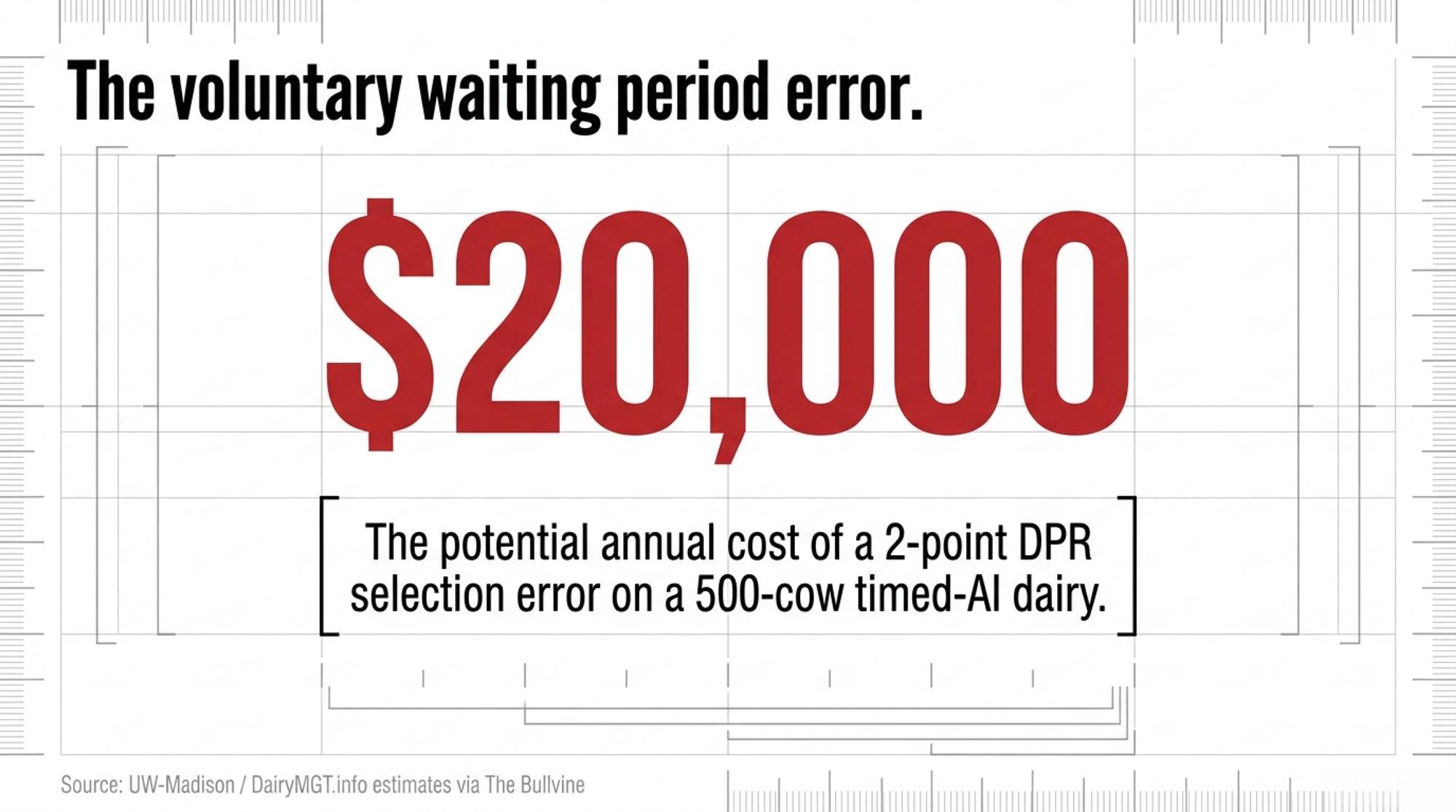
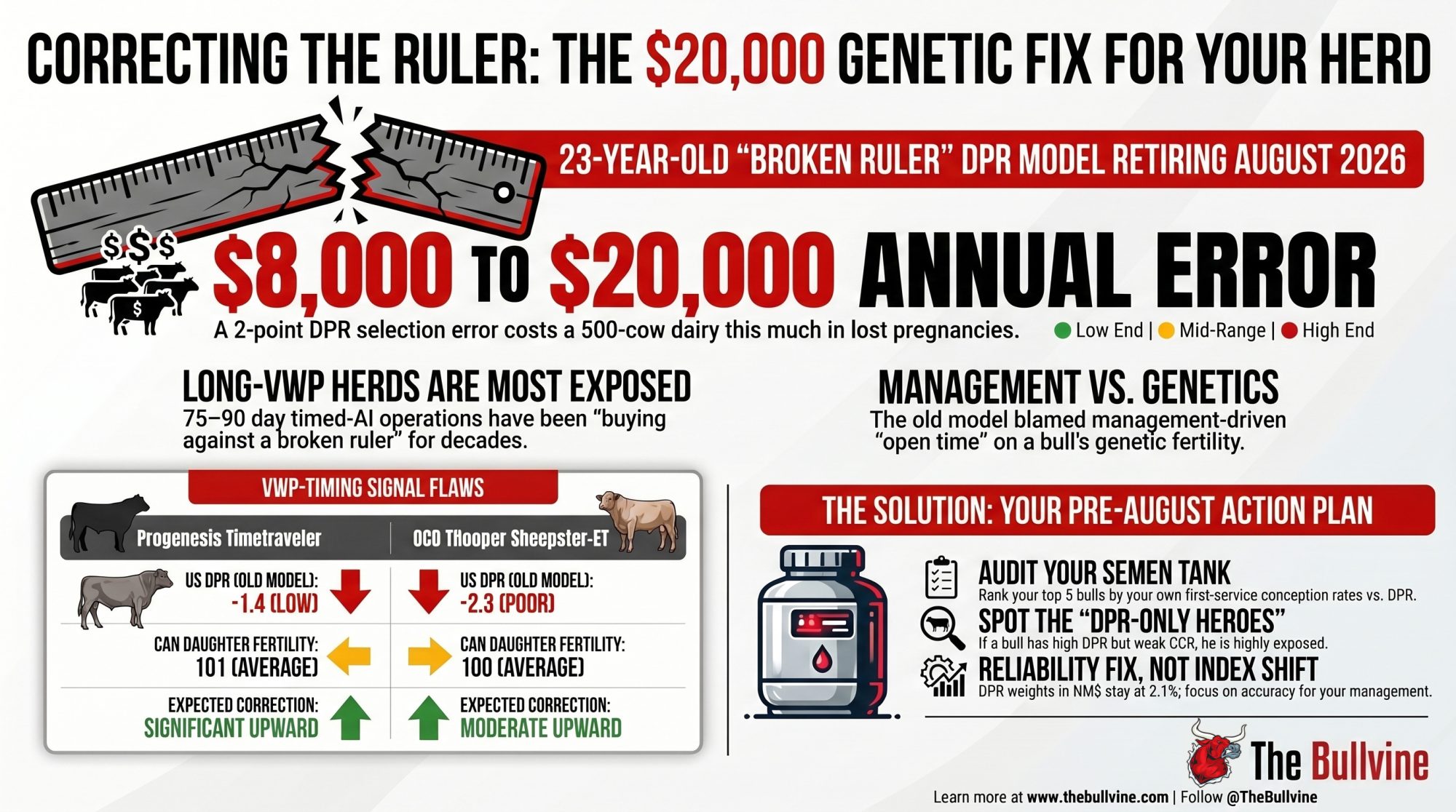
The August 12, 2026 evaluation retires a 23-year-old fixed voluntary waiting period and rebuilds Daughter Pregnancy Rate around how each herd actually breeds. On a 500-cow timed-AI dairy running a 90-day VWP, a 2-point DPR selection error under the old model conservatively sits in the $8,000–$20,000 range per year.
Executive Summary: CDCB’s August 12, 2026 evaluation retires the 23-year-old fixed voluntary waiting period inside Daughter Pregnancy Rate and rebuilds the trait around a herd-year and lactation-group-specific VWP — the biggest structural fix to US fertility genetics since DPR launched in 2003. On a 500-cow timed-AI dairy running a 90-day VWP, a 2-point DPR selection error under the old model conservatively costs $8,000 to $20,000 a year in lost pregnancies, reproductive culls, and extra protocols. Holstein genomic-bull DPR means rescale from −0.60 to +0.67, so bulls like Progenesis Timetraveler (DPR −1.4 US, Daughter Fertility 101 CAN) and OCD TRooper Sheepster-ET (DPR −2.3 US at 92% reliability, Daughter Fertility 100 CAN) are set for upward corrections the current US sheet can’t see yet. But Net Merit $ weights don’t move — DPR stays at 2.1% — so this is a reliability fix for your barn’s management style, not a top-ten reshuffle. The herds most exposed are 75–90 day VWP timed-AI operations that have been quietly buying against a broken ruler; 50–60 day heat-detection herds see marginal movement. Inside 30 days, pull first-service CR by sire from DC305, DairyComp, or PCDART and rank your top-five bulls against their legacy DPR — anywhere the orders disagree is where August will tell you something you should already be listening for. Lock in conception-biology bulls now, wait on DPR-only heroes, and hedge if your tank is heavy on production-first/weak-CCR pedigrees.
Picture a 500-cow Upper Midwest dairy. A 90-day voluntary waiting period. Fresh cows cycling on time. Presynch-Ovsynch shots going in on the chart. AI techs hitting their routes.
But the herd manager pulls first-service conception by sire out of DC305 — and one of last year’s “high fertility” bulls, bought on a strong Daughter Pregnancy Rate proof, is quietly dragging the pen down a couple of points. The cows aren’t lazy. The protocols aren’t sloppy. The problem has been the ruler. Since DPR was introduced in 2003, CDCB’s legacy model has run with a fixed-length VWP rather than one that reflects how each herd actually breeds. That ends with the August 2026 evaluation release, which rebuilds DPR around a herd-year and lactation-group-specific VWP — first lactation and later lactations modeled separately (Source: CDCB Trait-DPR Technical Document, April 2026). The 500-cow dairy above is a composite scenario used to illustrate the math, not a single named herd.
Why Does a 90-Day VWP Herd Pay More Than a 55-Day Herd?
The mechanics are straightforward. CDCB’s Trait-DPR technical document publishes the revised non-linear pregnancy-rate form as:

Take a later-lactation cow in a 90-day timed-AI program. She calves, cycles, moves through Presynch-Ovsynch, and gets bred the first time at day 90. She conceives on that service. Pregnancy confirmed at 120 days open.
Plug her into the August 2026 model and the floor is max(21, max(120, 71) − 90) = max(21, 30) = 30. That gives 21 / 30 = 70%. Same cow. Same days open. Same conception biology — now correctly credited to the sire who actually delivered it.
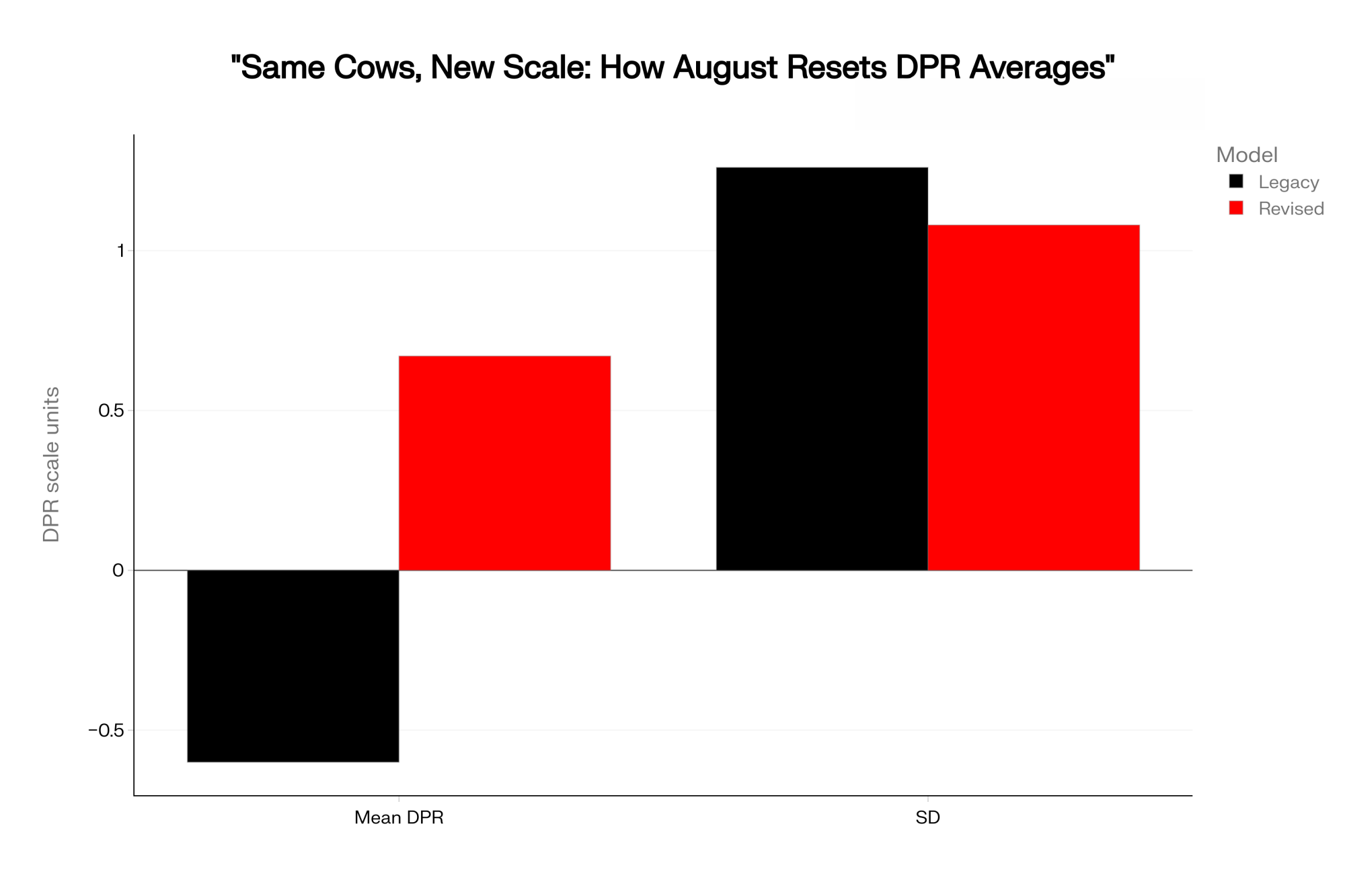
Under the legacy model, a long-VWP cow’s contribution to her sire’s DPR was shaped by a fixed-length management assumption she never matched. CDCB’s own pre-release analysis shows the scale of that rescale: Holstein genomic-bull DPR means shift from −0.60 (legacy) to +0.67 (revised), with the standard deviation tightening from 1.26 to 1.08 (Source: CDCB Trait-DPR Technical Document, April 2026).
CDCB has said it out loud. In the Trait-DPR FAQ, the Council explains that in the previous system “some long-term changes in herd management were not fully accounted for in the model,” and that “some of the effects of management choices could be incorrectly attributed to genetics” (Source: CDCB Trait-DPR Technical Document, April 2026). That’s an on-the-record admission that the legacy DPR trend wasn’t flat because cows got less fertile. It was flat because the model couldn’t see what producers had already changed.
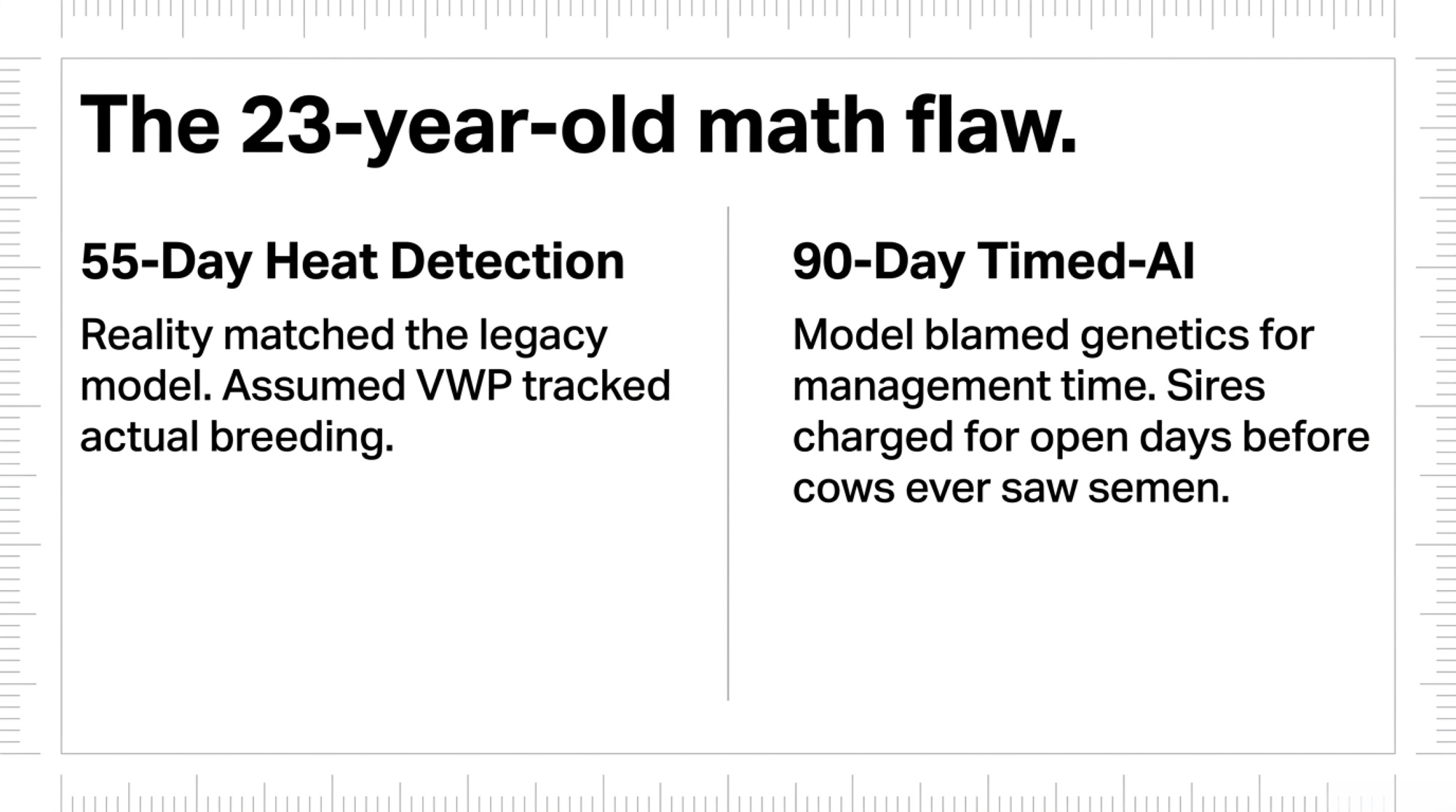
In a 55-day heat-detection herd, the gap between assumed VWP and actual VWP is small. The old math tracked reality closely. In a 90-day timed-AI program, the formula had been mechanically charging every sire for open time before daughters ever saw semen. That’s management time the model was blaming on genetics.
How the Flaw Shows Up in Real Bulls: Timetraveler and Sheepster
The correction isn’t landing in a vacuum. Bulls already in breeder tanks have been showing fertility patterns worth a second look for anyone reading the full fertility complex rather than DPR alone. Two current names make the point clean. For broader context on how today’s proof sheets got here, see the Bullvine’s coverage of the bulls whose names already rewrote the breed.
The Bull Split at a Glance
| Bull Name | US DPR (Legacy, April 2026) | CAN Daughter Fertility (April 2026) | Projected August 2026 Impact |
| Progenesis Timetraveler | −1.4 (Low) — CDCB Sire Summary, 200HO13678 | 101 (Avg) — Lactanet Genetic Evaluation | Significant Upward Correction (VWP-timing signal resolves) |
| OCD TRooper Sheepster-ET | −2.3 (Poor) — CDCB Sire Summary, 7HO16276 | 100 (Avg) — Lactanet Genetic Evaluation | Moderate Upward Correction (management-gap resolves; CCR drag remains) |
Timetraveler: When Only DPR Drops
Progenesis Timetraveler (200HO13678, Torchlight × Dominance × Dzunda) carries an April 2026 CDCB genomic summary of DPR −1.4, HCR +2.4, CCR −0.2 at 74% reliability, alongside NM$ +1108, TPI +3563, and Fertility Index +0.3 (Source: CDCB Sire Summary — Timetraveler 200HO13678, April 2026). Check his April 2026 Lactanet page and you get a Daughter Fertility rating of 101 — essentially breed average on the Canadian scale (Source: Lactanet Genetic Evaluation — Timetraveler, April 2026).
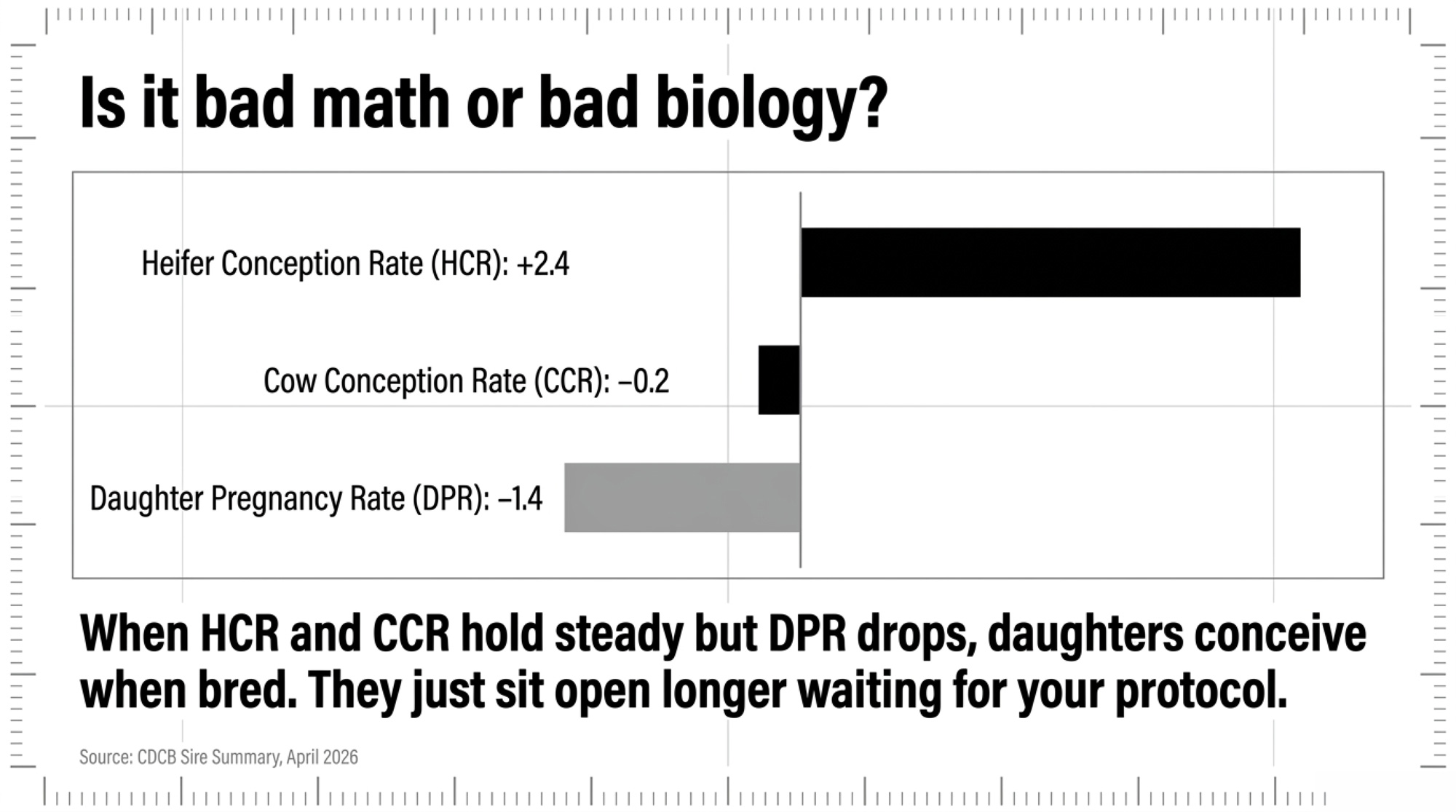
That’s the split. Heifer conception flags strongly positive. Cow conception sits near zero. And DPR alone drops.
The split isn’t random. Maiden heifers have no VWP and no post-calving metabolic load. A bull whose HCR is deeply positive while CCR sits near zero is telling you his daughters conceive — they just don’t show it in a DPR number parameterized to a herd management pattern that isn’t yours.
Read literally, that’s a VWP-timing signature, not automatic evidence of weak conception biology. When fertility is genuinely weak, HCR, CCR, and DPR tend to sag together. When only DPR drops, daughters conceive when bred. They just sit open longer before anyone inseminates them. In a 75–90 day VWP program, that’s the exact management signal the old model couldn’t see.
This is the part that matters most for a Timetraveler buyer. CDCB publishes a genetic correlation of +0.94 between DPR and CCR, and +0.96 between DPR and the new First Service to Conception trait (Source: CDCB Trait-DPR Technical Document, April 2026). When those are that tightly linked and Timetraveler’s DPR sits off from his CCR by more than a point, you’re looking at noise in the legacy model, not a biological split. The August release is expected to tighten the two toward each other.
Sheepster: A Proven Bull, a Proven DPR Drag
Sheepster isn’t a theoretical case. He’s a commercially important bull for Select Sires with real breeder commitments already in the tank — and the argument here isn’t that his daughters don’t settle. It’s that the legacy model has been telling a story about him his Canadian proof and his daughter count don’t fully support.
OCD TRooper Sheepster-ET (7HO16276, Select Sires; TRooper × Acura × Resolve) is a proven bull with 2,359 US daughters in 187 herds on the April 2026 CDCB MACE summary. His proof: DPR −2.3, HCR +0.8, CCR −0.7 at 92% reliability, with NM$ +1081, TPI +3480, Fertility Index −0.9 (Source: CDCB Sire Summary — Sheepster 7HO16276, April 2026).
On the Canadian side, his April 2026 Lactanet page returns a Daughter Fertility rating of 100 and Reproduction sub-index of 99 (Source: Lactanet Genetic Evaluation — Sheepster, April 2026). Both systems read his daughters as essentially breed-average for fertility. But the US DPR value pulls him visibly down the page, and the composite Fertility Index follows.
Select Sires and Lactanet aren’t running their own genetic evaluation models here. They’re distributors publishing the output of CDCB (US) and Lactanet’s Canadian Genetic Evaluation System, with Interbull MACE (the international sire-proof translator) converting between national bases. The models under the hood belong to those institutions; the studs layer commercial overlays on top.
The gap between Sheepster’s legacy US DPR and his Canadian Daughter Fertility read isn’t two studs arguing. It’s two national models correcting for management differently. At 92% DPR reliability and with 187 daughter herds feeding the number, this isn’t a reliability problem. On the read of the numbers CDCB and Lactanet have published, it’s a management-correction problem — exactly the case the August 2026 revision is designed to fix.
When It’s Biology, Not Math: The Negative Energy Balance Factor
Not every soft-fertility bull is a VWP victim. A separate category sits with sires whose production architecture leans heavily toward fat and energy-corrected milk. W.R. Butler’s Cornell work on nutrition, negative energy balance, and reproduction — the body of peer-reviewed research most US repro extension programs still cite — tied deeper early-lactation NEB to delayed ovarian cyclicity and suppressed conception.
The tell for this category isn’t just a soft DPR. It’s DPR and CCR both trending negative. Sheepster’s −2.3 / −0.7 split sits in the lighter end of that zone — his CCR is clearly negative but not deeply so. Bulls whose CCR drops well past −1.0 alongside a deeply negative DPR are the ones the August revision won’t rescue. For context on how component-heavy indexes continue to shape sire rank despite the fertility corrections, see the Bullvine’s coverage of the April 2026 TPI and NM$ rebalancing.
What’s the Actual Dollar Cost of a 2-Point DPR Selection Error?
Here’s where the correction shows up in the checkbook — conservatively.
Imagine two years ago you passed on a “true” high-fertility bull whose daughters mostly lived in 80–90 day VWP herds, and bought a bull whose data came mostly from 55-day programs. On the old proof sheet, the second bull looked like the fertility sire. Under variable VWP, he probably wasn’t.
Before the dollar math, two things worth stating plainly. A 2-point DPR PTA gap between bulls doesn’t translate into a 2-point shift in realized herd pregnancy rate. Daughter performance regresses, mate effects dilute the signal, and any single bull is diluted across the herd by his service share. A bull used on 25–40% of services in a 500-cow herd, carrying a 2-point PTA error, more realistically moves realized herd 21-day PR by roughly half a point to one full point over the window his daughters reach lactation. That’s the number the dollars should be run against.
UW-Madison Dairy Management extension work led by Victor Cabrera, published across the DairyMGT.info portal and Dairy Cattle Reproduction Council proceedings over the past decade, puts each 1-point improvement in 21-day pregnancy rate in the to per cow per year range, depending on milk price, feed cost, and replacement-heifer value. With heifers historically expensive through 2025–2026, the marginal value per point is real, but the working range is what belongs in a conservative calculation — not a single constant.
| PR gain (points) | Low value (US$/cow/yr) | High value (US$/cow/yr) |
|---|---|---|
| 0.5 | 7.5 | 12.5 |
| 1.0 | 15 | 25 |
| 1.5 | 22.5 | 37.5 |
| 2.0 | 30 | 50 |
Running the conservative end of that range against a realistic 0.5-to-1-point herd-PR shift on a 500-cow herd:
- Lost pregnancy rate, low end: 0.5 PR × $15 × 500 cows = $3,750 per year.
- Lost pregnancy rate, mid-range: 1.0 PR × $20 × 500 cows = $10,000 per year.
A sustained drop in realized PR tends to push additional reproductive culls onto the list over time. The exact count is heavily herd-specific — Cabrera and De Vries’ Journal of Dairy Science repro-culling work shows the relationship is non-linear and depends on existing cull policy, voluntary cull pressure, and DIM-to-cull threshold. As an illustrative lower-bound scenario, call it 3 to 6 additional reproductive culls per year on the 500-cow herd. At a net replacement cost in the $1,500 to $2,200 per head range — benchmark against current USDA ERS Milk Cost of Production values and USDA AMS cull-cow reporting for your own state and week — that’s roughly $4,500 to $13,200 per year.
Extra repro protocols and vet time on the resulting problem cows add a modest incremental line, realistically 0 to 0 per year on a handful of additional cows, scaling with protocol intensity.
The Conservative Cost of the Error
Three scenarios on a 500-cow herd carrying a 2-point DPR selection error:
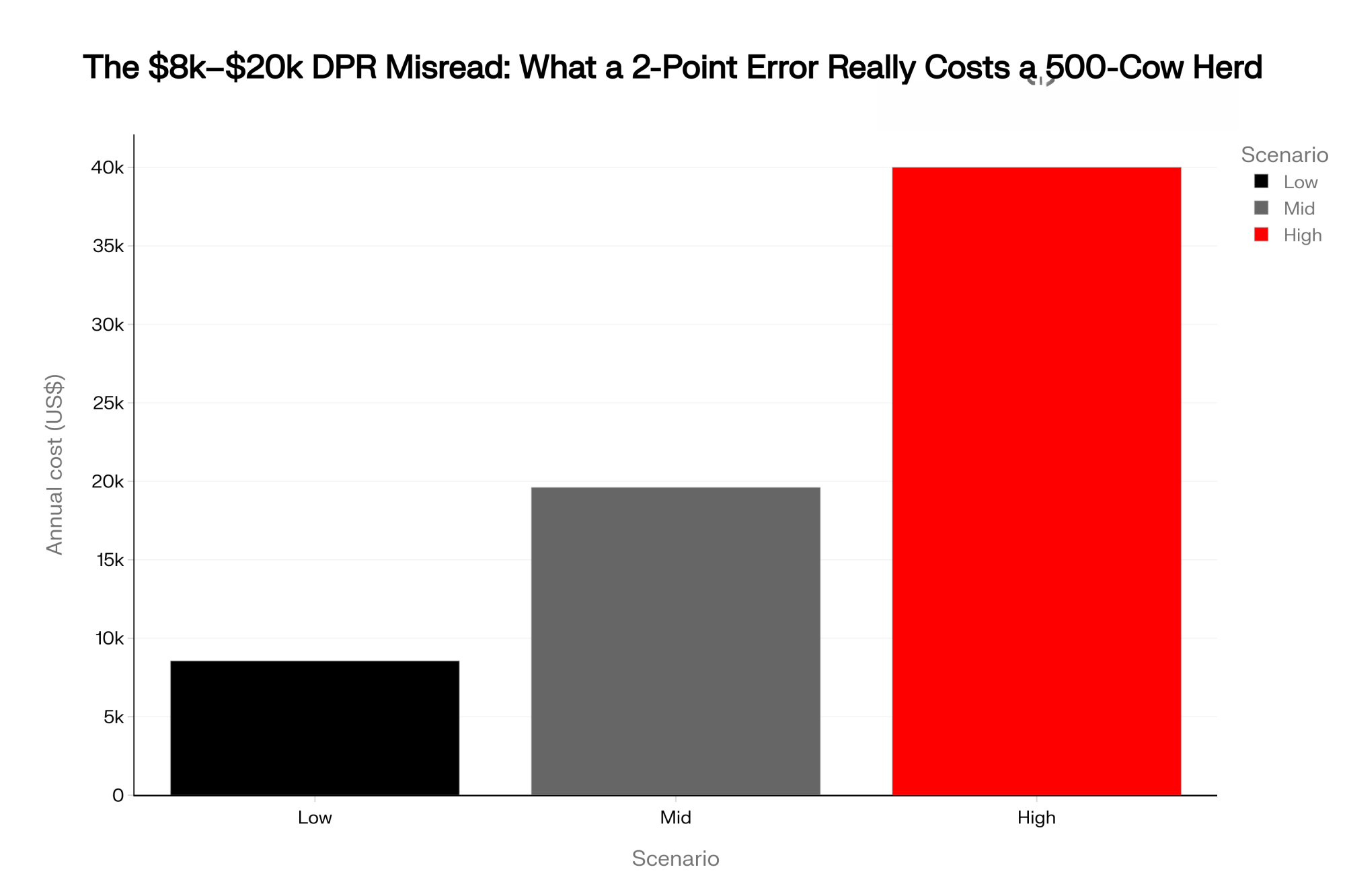
- 🟢 Low End — $8,550/year. 0.5-point PR shift + 3 extra culls at $1,500 net + $300 protocols. Defensible floor for most long-VWP timed-AI herds.
- 🟡 Mid-Range — $19,600/year. 1.0-point PR shift + 5 extra culls at $1,800 net + $600 protocols. Where most 75–90 day VWP herds will actually land.
- 🔴 Aggressive High End — Up to $40,000/year. Full $25/point extension figure, fuller PTA-to-herd-PR transmission, and heavier cull response. Upper bound of what the math supports, not a central estimate.
Call the conservative window ,000 to ,000 a year on a single 500-cow herd from a 2-point DPR selection error — a scenario built on transparent inputs at the floor of defensible ranges, not a bill anyone paid last month.
A 75-day VWP herd sits in the middle. Under a 0.5-point shift on a 1-point PTA error, the lost-PR component becomes 0.5 × $15 × 500 = $3,750, with roughly half the cull and protocol impact — call it $6,000 to $10,000 a year. Run the same 2-point PTA error through a 55-day heat-detection herd and the arithmetic collapses further: the lost-PR component becomes 0.25 × $15 × 500 = $1,875, with proportional culls and protocol spend bringing the total closer to $3,000 to $5,000 a year.
Your exposure scales with how far your real breeding protocol sits from the legacy assumption. The people who were going to feel this most have been running long VWPs with timed-AI for a decade. They’re the ones whose proofs will move hardest in August.
| VWP (days) | Conservative annual exposure (US$) |
|---|---|
| 55 | 4,000 (within $3,000–$5,000 range) |
| 75 | 8,000 (within $6,000–$10,000 range) |
| 90 | 15,000 (midpoint of $8k–$20k range) |
What August 2026 Fixes — And What It Doesn’t
The August 2026 release delivers three things CDCB has publicly committed to.
- Variable VWP in DPR. Herd-year and lactation-group-specific VWPs replace the single fixed assumption. A cow in a 90-day timed-AI program will no longer be judged against the same calendar as one in a 55-day heat-detection herd. First-lactation and later-lactation groups are modeled separately (Source: CDCB Trait-DPR Technical Document, April 2026).
- A new First Service to Conception (FSC) trait. Expressed in days, with positive PTAs desirable. FSC is “useful for producers who select VWPs on a cow basis and want cows to get pregnant as quickly as possible after the first breeding, without focusing on how many services it takes” (Source: CDCB Trait-DPR Technical Document, April 2026).
- Rescaled DPR distributions. Holstein genomic-bull mean DPR shifts from −0.60 to +0.67 and the SD tightens from 1.26 to 1.08. CDCB is explicit that the shift “reflects rescaling of the traits, rather than a true increase or decrease in underlying genetic variation” (Source: CDCB Trait-DPR Technical Document, April 2026).
📌 BREEDER’S NOTE: This Is a Reliability Fix, Not an Index Fix
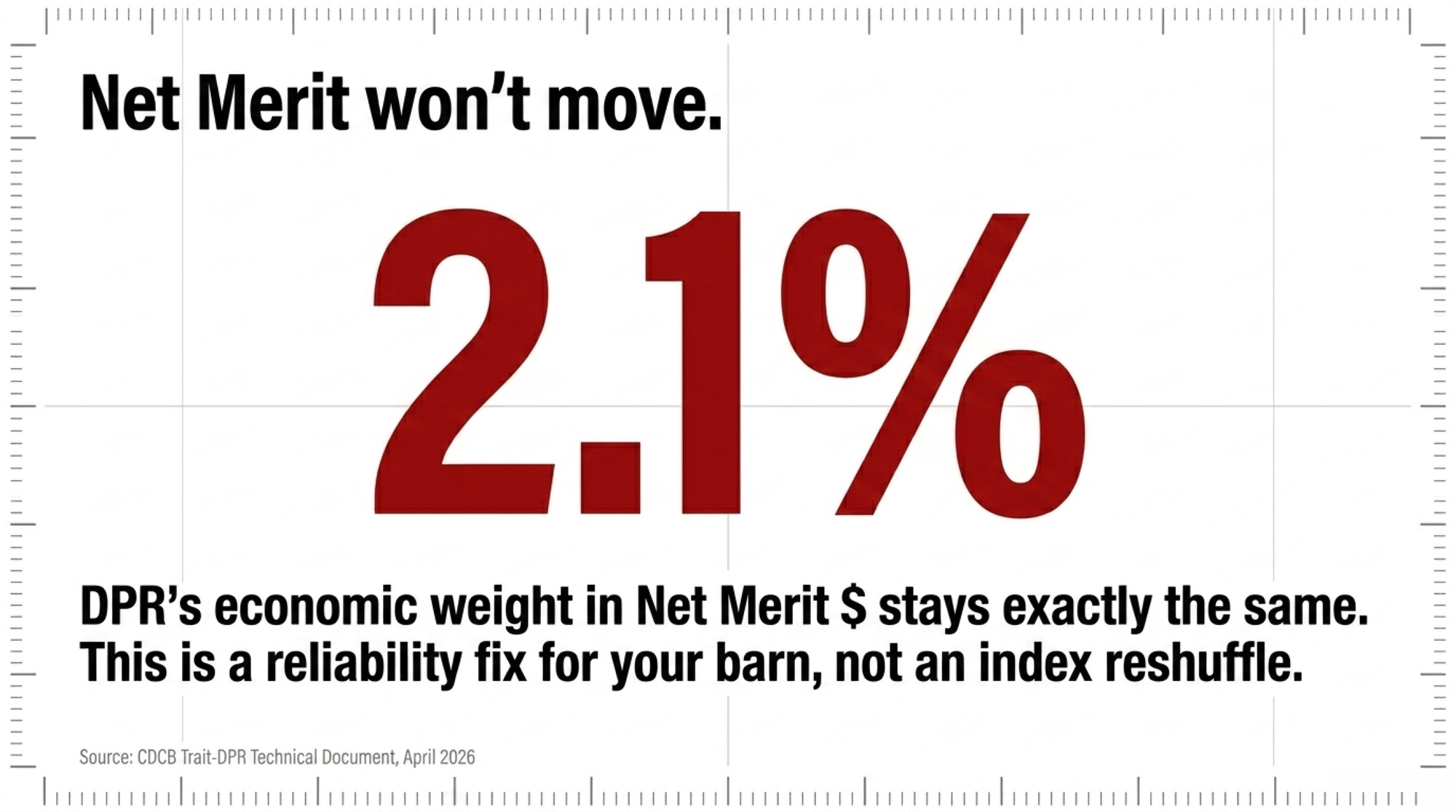
The August 2026 revision moves PTAs, not index weights. DPR’s economic emphasis in Net Merit $ stays at 2.1%, with Cheese Merit $ at 2.0%, Fluid Merit $ at 2.1%, and Grazing Merit $ at 5.6% — per CDCB’s April 2025 update to the indexes. CDCB has said directly that “the August 2026 modifications to DPR do not affect these emphases because the weights on traits in the lifetime merit indexes are based on economic values that are not being updated” (Source: CDCB Trait-DPR Technical Document, April 2026).
So-what for high-level breeders: Don’t expect every DPR-exposed bull to leap to the top of the NM$ list in August. Most won’t. What will happen is that each bull’s fertility reliability for your management style gets sharper — especially if you’re running 75–90 day VWPs. The top-line dollar indexes stay anchored to the same component-pricing economics they had last year. This is the model getting clearer about how your cows actually breed. It is not an index reshuffle.
Sorting Your Tank Before August: Lock In, Wait, or Hedge?
Stand over your semen tank this month and ask three questions about every bull you’ve got stored. For a broader read on how major studs are positioning their lineups, see the Bullvine’s Stud Wars April 2026 coverage.
First, what fertility type is this bull? Forget TPI for a minute. Sort each bull into one of three piles:
- Conception-biology bulls. Positive CCR, decent HCR, and/or a stud-backed fertility designation such as Select Sires’ FertilityPRO, Semex’s Repromax, or the fertility indices published by ABS and STgen. These sires tend to settle cows well regardless of VWP.
- DPR-only heroes. Sold mainly on a big DPR number, CCR near zero, no independent fertility flag. Most exposed to the August correction.
- Production-first, fertility-compromised. Big milk and components with clearly negative DPR and weak or negative CCR. Variable-VWP DPR won’t erase their biology.
Second, what’s your VWP and system? Running 75–90 day VWPs with timed-AI? The legacy DPR has been working against you. Bulls whose daughter data came from herds like yours are undervalued today; bulls built on short-VWP herds are overexposed. In a 50–60 day heat-detection program, the legacy DPR tracked your reality more closely. August is more cleanup than reshuffle.
Third, where do you lock in right now? Three paths, with real trade-offs on each.
- Lock in pre-August when the bull sits in the conception-biology pile, fits your component market, and is settling well in your own timed-AI cows. Risk: you commit inventory on legacy proofs, trusting the revision will validate him rather than demote him. Upside: you front-run breeders who’ll chase him after the new proofs drop.
- Wait for August when the bull is a DPR-only hero, your herd has felt a gap between sold fertility and real fertility, and you run a long VWP. Risk: you lose some breeding cycles, so push existing doses onto cows you’d breed anyway and pause new orders until variable-VWP DPR and FSC values are live. Upside: you avoid compounding an already-exposed bet.
- Hedge with something else when your tank is heavy on both DPR-heroes and production-first/weak-fertility pedigrees. Bring in one or two bulls with strong CCR and field-proven fertility as insurance. Aim your most vulnerable semen at cows with rock-solid repro histories. Ease back on beef-on-dairy enough that you’re not starved for replacements if the August release exposes more fertility drag than expected. For context on the replacement pipeline squeeze, see the Bullvine’s coverage of the beef-on-dairy replacement heifer squeeze.
Your Pre- and Post-August Action Plan
30-Day Action — Audit Your Tank Against Your Own Data
- Pull your last 12 months of first-service conception by sire group from DC305, DairyComp or PCDART.
- Rank your top five most-used bulls by your own CR.
- Rank the same five by their current DPR.
- Where the orders don’t match, flag those bulls. They’re the first five to reopen when the August 2026 variable-VWP DPR and FSC values go live.
90-Day Action — Listen, Then Re-Rank
- Drop Dr. Taylor McWhorter’s CDCB CowCast episode on the 2026 reproductive revisions — released May 12 on YouTube and podcast platforms — into your commute or parlor queue before August (Source: CDCB Trait-DPR Technical Document, April 2026).
- Rerun the same CR ranking against the new values after the August release.
- Where the August proof agrees with your own data, you’ve got your new fertility anchors.
- Where it still disagrees, you’ve got a bull worth a direct conversation with your stud rep.
What This Means for Your Operation
- Does your most-used sire carry a fertility story backed by CCR, HCR, or a stud fertility designation — or does it rest on a single DPR number from the legacy model?
- Do your own first-service CR and services-per-conception by bull line up with the order their proofs suggest? Where’s the biggest mismatch, and is that mismatch clustered in a single stud’s lineup?
- How far is your real VWP from the legacy fixed assumption? The farther out, the more August will change what the proofs are telling you about your cows.
- Can you sort your tank into conception-biology, DPR-only, and production-first/weak-fertility piles before August 2026 lands? If new semen orders froze for 90 days, would you be comfortable with the weighting you already own?
- Is your beef-on-dairy share leaving you enough heifer flow to be picky on fertility over the next two or three proof runs, or are you boxed in?
- Which three bulls in your tank will you re-evaluate first when the revised proofs land — and what would it take to change course on each of them?
Key Takeaways
- If a bull’s HCR trends strongly positive but his DPR is deep in the red — the Timetraveler shape — treat that gap as a VWP-timing flag, not automatic evidence of weak conception biology. The +0.94 correlation between DPR and CCR, and +0.96 between DPR and FSC, is what the August model will enforce (Source: CDCB Trait-DPR Technical Document, April 2026).
- If DPR and CCR are both clearly negative on the same bull, August won’t rescue him. That’s biology-driven exposure. Watch the depth of the CCR number, not just the DPR number.
- Proven bulls with high-reliability legacy proofs aren’t immune. Sheepster sits at 92% DPR reliability with 2,359 US daughters in 187 herds and still carries a −2.3 DPR on the legacy model. Reliability isn’t the issue; the model’s management correction is (Source: CDCB Sire Summary — Sheepster 7HO16276, April 2026).
- The conservative cost of a 2-point DPR selection error on a 500-cow timed-AI herd lands in the $8,000–$20,000 range most years. A real line item, not a catastrophe.
- DPR’s economic weight in Net Merit $ is 2.1%. August 2026 moves PTAs, not index weights. If you were selecting mostly on NM$, don’t expect your top ten to reshuffle dramatically. If you were selecting on Fertility Index or DPR directly, expect more movement (Source: CDCB Trait-DPR Technical Document, April 2026).
- Inside 30 days, your own first-service CR by sire will tell you more about your exposure than any catalog page — and it’s the fastest way to judge whether the August-release FSC and variable-VWP DPR values will actually work in your barn.
In August, CDCB’s new formulas will print a fresh set of numbers beside the bulls you’ve already committed to. The argument won’t be whether the legacy VWP was fair — it’s which straws to keep using, which to park, and which to stop buying. When the revised proofs drop, will you trust the glossy rank on the left side of the sheet, or the hard pregnancy-rate column you’ve already built in your own herd software?
Learn More
- Fertility Bulls Failing? Your PTAs Are 30% Inflated – Here’s the Fix — Details immediate selection protocols to bypass current PTA inflation while waiting for the 2026 fix. Reveals the $50-per-cow annual cost of VWP timing gaps and why shifting to proven sires restores reliability.
- CDCB’s 2025 Genetic Base and Merit Indices Update: Everything You Need To Know — Dismantles the 2025 Net Merit formula to show how fertility traits shifted before the August overhaul. Delivers the specific economic weights for butterfat and livability needed to position your herd’s multi-year genetic ROI.
- Beef-on-Dairy’s $3,000 Trap: 800,000 Missing Heifers and Who Pays the Bill — Verifies the 18% pregnancy rate threshold required to survive the nationwide replacement squeeze. Uncovers the $144,000 capital gap hidden in beef-on-dairy premiums and follows the money on who pays for missing inventory.