Archive for News – Page 136

2017 Holstein Distinguished Junior Member Semifinalists Announced

Holstein Association USA (HAUSA) is excited to announce the 2017 Distinguished Junior Member (DJM) semifinalists. The Distinguished Junior Member recognition is the highest honor given to Junior members of HAUSA ages 17 to 21 who demonstrate involvement in a variety of activities and who have excelled in preparing for their life’s work, while contributing to their local and state Holstein activities. 

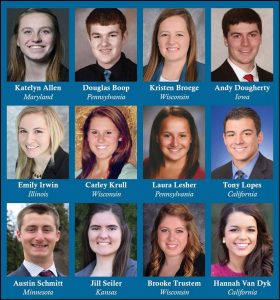
This year’s twelve semifinalists are: Katelyn Allen, Jefferson, Md.; Douglas Boop, Millmont, Pa.; Kristen Broege, Janesville, Wis.; Andy Dougherty, Epworth, Iowa; Emily Irwin, Belvidere, Ill.; Carley Krull, Lake Mills, Wis.; Laura Lesher, Bernville, Pa.; Tony Lopes, Gustine, Calif.; Austin Schmitt, Rice, Minn.; Jill Seiler, Valley Center, Kan.; Brooke Trustem, Evansville, Wis.; and Hannah Van Dyk, Tulare, Calif. 

Each of the semifinalists completed an entry book, detailing their Junior Holstein project work, program participation and school and community activities. 

The twelve semifinalists will be interviewed at the National Holstein Convention, June 27 – July 1 in Bellevue, Washington, vying to be named one of six finalists. Finalists receive complimentary annual renewed memberships to Holstein Association USA. 


U.S. dairymen could face trade challenges

American dairy producers benefited from a global drop in supply last year, but milk production is picking up now in other exporting countries.

 A sharp fall in global milk production in the second half of 2016 allowed U.S. exports to fill a large supply gap, increasing U.S. exports 25 percent year over year in the second half of 2016 despite a strengthening dollar and strong domestic demand.

But milk production is picking up in other exporting countries, driven by a rally in prices due to the decreasing global export surplus. That rally has run its course, but it set in motion global milk-production recovery against still weak demand, according to Rabobank analysts.

Those factors, as well as several others, could challenge U.S. exports in the future, the analysts stated in their latest dairy quarterly report.

While most of the world’s milk supply contracted in 2016, strong exports and domestic demand, cheap feed and favorable weather pushed U.S. milk production up 1.5 percent. That trend has continued in 2017, with February production up 2.3 percent year over year.

But U.S. consumption growth, which has driven the market since the second half of 2014, might be faltering — with some excess products being pushed into warehouses. A drop in the value of the peso has also reduced U.S. exports to Mexico, the top market for U.S. exports.

But there could be even more trade challenges ahead, the analysts stated.

“The U.S. withdrawal from TPP, which was generally seen as beneficial to the U.S. dairy sector, and talks of NAFTA renegotiations have generated significant unease in the dairy community,” they said.

Of the approximately 15 percent of U.S. dairy production exported, 55 percent goes to partners included in TPP. In terms of NAFTA, 26 percent of U.S. exports go to Mexico and 13 percent to Canada.

Mexico has already sought to differentiate imports away from the U.S., resulting in a 10 percent increase in EU dairy exports to Mexico in the three months to January, the analysts said.

“Risk for the U.S. to lose further share of Mexico and TPP buyers could potentially cause problems for U.S. dairy producers, creating downward pressure on U.S. product prices,” they stated.

Rabobank expects declines in U.S. dairy commodity prices to push many U.S. producers into negative margins, resulting in a slowing of milk production growth – from 1.6 percent in 2016 to just over 1 percent in 2017.

A large gap in available labor supply, if suggested immigration policy changes are executed by the current administration, could further exacerbate challenges on dairy farms, they said.

A modest expansion in U.S. milk supply, together with lower but still relatively strong domestic demand, should render the U.S. with little to no incremental exports through most of 2017, the analysts concluded.


Source: Capital Press

Canadian Dairy XPO draws thousands

Thousands streamed into Stratford on Wednesday for the start of the two-day Canadian Dairy XPO, the annual one-stop-shop for dairy producers that draws guests from around the world.

The show usually draws close to 15,000 guests, and CDX founder Jordan Underhill suspects the numbers will be up this year. He also noticed a lot of younger farmers – or potential future farmers – in the crowd.

[fbvideo link=”https://www.facebook.com/TheBullvine/photos/a.188640787913468.36881.180771858700361/1127486654028872/” width=”640″ height=”480″ onlyvideo=”1″]

“They work hard, but it’s also profitable. If it wasn’t profitable, the youth wouldn’t be here. They’d go to another industry,” he said.

New products are helping to foster an important shift in the life of dairy producers.

“Because of the innovation in the robotics category now – you can get a robot that milks your cows, feeds the cows, moves the manure for you – young people are looking for a different way of life. They want to farm, but they don’t necessarily want that 4:30 in the morning to midnight commitment. They want to be able to go to their kids’ soccer games,” Underhill said.

Family was another theme of the Canadian Dairy XPO. Hundreds of little ones enjoyed the event alongside their parents or grandparents.

The Mulders, from Embro, were one of the families who visited Stratford.

Martyn Mulder said he tries to come to the Canadian Dairy XPO at least every two years. Sometimes that’s enough, especially since he’s also close to Canada’s Outdoor Farm Show in Woodstock.

The Mulders two daughters, Haley and Natlie, had a blast playing in the dairy-fied version of a sandbox – a tire filled with corn.

Their dad was more interested in the equipment.

“I saw a nice automated pre and post-dip sprayer for a rotary parlour,” he said.

Another young visitor from Embro, four-year-old Kiara Lupton, was emphatic when asked about her favourite part of the XPO.

“Balloons!” she said with a smile.

Guests young and old enjoyed the “swag” that comes with the show. Everything from jelly beans to t-shirts was on offer.

Novus, an animal nutrition company, had cow-shaped stress balls up for grabs – and they were a highlight for more than just kids.

“(They’re popular) with the young, and the not-so-young,” said JP Lincourt from Novus.

Underhill said it’s great to see a younger demographic at the show. He thinks many parents identify the value of real-life education like the XPO.

“What we see each year is the family unit increasing. Rather than having one person from the family or two, it’s the whole family. The kids are pulled out of school, there’s lots for them to learn here – including our own two kids,” said Underhill.

Older tweens and teens were hard at work helping to direct guests around more than 350 exhibits.

Logan DeGroot from Perth County 4-H and Amy Gras from the Oxford County group were part of the “Ask Me” team stationed at one of the exit doors. They’re volunteering at the show to help raise money for a 4-H trip to Saskatchewan this summer.

“It’s really cool,” said Gras, who lives on a chicken farm. “It’s good to learn about different farm equipment and learn what all the different companies have to offer.”

Encouraging that kind of knowledge, especially for those outside the agriculture industry, is always Candace Hill’s goal.

She’s the manager of Agriculture More Than Ever, a cross-Canada support and advocacy organization for the agriculture industry. Hill travelled to Stratford from Regina to help spread the word at the Dairy XPO.

“There’s so many people who feel that food comes from the grocery store. We, in agriculture, have a big job to do,” Hill said, noting that there are so many misconceptions about farming practices and the products produced on a Canadian farm.

“A lot of times it’s around the nutrition of food. Is it healthy and is it nutritious?,” she said. “People are concerned about what they feed their kids and families. What it comes down to is that farmers and all of us in the industry are consumers, too.”

The Ag More Than Ever booth encouraged guests at the XPO to take a photo for social media and sign up to be an “agvocate.” The goal is for those within the industry to start conversations – whether online or in person – to educate consumers about agriculture, Hill said.

“We’re coming together for the greater good of agriculture, so everyone can see it and believe it,” she said.

Source: Stratford Beacon Harold

Canada’s dairy trade actions hurting rural America

U.S. dairy organizations today urged the Trump Administration to fight back against protectionist Canadian trade policies that are slamming the door to American dairy exports in violation of existing trade commitments between the two nations.

The National Milk Producers Federation (NMPF), the U.S. Dairy Export Council (USDEC) and the International Dairy Foods Association (IDFA) called on the federal government, and on governors in northern states, to take immediate action in response to Canada’s violation of its trade commitments to the United States.

Because of the new “Class 7” pricing policy, which is expressly designed to disadvantage U.S. exports to Canada and globally, multiple dairy companies in Wisconsin and New York have been forced to inform many of their supplying farmers that the Canadian market for their exports has dried up. For some farmers, this means that the company processing their milk and shipping it to Canada can no longer accept it starting in May. This is a direct consequence of Canada’s National Ingredients Strategy and new Class 7 milk pricing program.

“Canada’s protectionist dairy policies are having precisely the effect Canada intended: cutting off U.S. dairy exports of ultra-filtered milk to Canada despite long-standing contracts with American companies,” said Jim Mulhern, president and CEO of NMPF. “American companies have invested in new equipment and asked dairy farmers to supply the milk to meet demand in the Canadian dairy market. This export access has suddenly disappeared, not because the market is gone, but because the Canadian government has reneged on its commitments.”

“Our federal and state governments cannot abide by Canada’s disregard for its trade commitment to the United States and its intentional decision to pursue policies that are choking off sales of American-made milk to the detriment of U.S. dairy farmers,” said Tom Vilsack, president and CEO of USDEC “It is deeply concerning that Canada has chosen to continue down a ‘beggar thy neighbor’ path of addressing its internal issues by forcing the U.S. dairy industry to bear the harmful consequences.”

Vilsack noted that while farm families in the Northeast and Midwest are suffering the immediate consequences of the loss of Canadian markets, “thousands more will suffer if Canada persists in using its programs to distort the global milk powder markets so critical to tens of thousands of American dairy farmers.”

“The U.S. dairy industry is united on this issue because these restrictive policies effectively bar a significant U.S. export to Canada, with total losses estimated to hit $150 million worth of ultra-filtered milk exports from Wisconsin and New York. As we feared, these policies are now prohibiting our nation’s dairy processors from accessing the Canadian market,” said Michael Dykes, D.V.M., president and CEO of IDFA. “IDFA is speaking out against Canada’s protectionist policies on Capitol Hill, and asking the Trump Administration and state governors and legislators to insist that Canada honor its trade commitments and allow more market access for U.S. dairy products.”

Despite efforts by the U.S. government and dairy organizations to shed more light on the Canadian program, Canada is refusing to share sufficient details. For instance, limited information has been posted online by certain provinces, and some of that information has subsequently been removed from provincial milk authorities’ websites in what appears to be aimed at obfuscating how the program operates. Despite this lack of transparency, U.S. companies and their supplying farmers are already feeling its real-world consequences.

The United States is Canada’s largest export market, accounting for approximately three-fourths of Canada’s total exports. The organizations urged both federal and state governments to move swiftly to demonstrate to Canada that trade is a door that must swing two ways to have a functional relationship.

The National Milk Producers Federation (NMPF), based in Arlington, Va., develops and carries out policies that advance the well-being of U.S. dairy producers and the cooperatives they collectively own. The members of NMPF’s cooperatives produce the majority of the U.S, milk supply, making NMPF the voice of dairy producers on Capitol Hill and with government agencies. For more on NMPF’s activities.

The U.S. Dairy Export Council (USDEC) is a non-profit, independent membership organization that represents the global trade interests of U.S. dairy producers, proprietary processors and cooperatives, ingredient suppliers and export traders. Its mission is to enhance U.S. global competitiveness and assist the U.S. industry to increase its global dairy ingredient sales and exports of U.S. dairy products. USDEC accomplishes this through programs in market development that build global demand for U.S. dairy products, resolve market access barriers and advance industry trade policy goals. USDEC is supported by staff across the United States and overseas in Mexico, South America, Asia, Middle East and Europe.

The International Dairy Foods Association (IDFA), Washington, D.C., represents the nation’s dairy manufacturing and marketing industries and their suppliers with a membership of nearly 525 companies within a $125-billion a year industry. IDFA is composed of three constituent organizations: the Milk Industry Foundation (MIF), the National Cheese Institute (NCI) and the International Ice Cream Association (IICA). IDFA’s nearly 200 dairy processing members operate more than 600 manufacturing facilities and range from large multi-national organizations to single-plant companies. Together they represent more than 85 percent of the milk, cultured products, cheese, ice cream and frozen desserts produced and marketed in the United States. 


Source: Feed Stuff

Dairy farmer distraught not knowing river heights before cattle were swept away in Murwillumbah flood

A Murwillumbah dairy farmer has shed tears over losing some of his prized dairy herd in last week’s floods in New South Wales.

Veteran farmer Pat McDonald, from Kenarie Jersey Stud, is devastated to have lost 18 young pregnant heifers in floodwater.

Milk production has halved and animals are getting sick.

“We are starting to get mastitis. We have three cows with footrot and a lot of cows are foot sore,” Mr McDonald said.

The McDonalds’ milking shed and pasture paddocks were flooded late on Thursday.

“Our equipment was all under water, our motors, our pumps, every one one of them. We got them working temporarily, but have only been informed this morning that they will eventually fail,” Mr McDonald said.

“All that equipment will have to be replaced.”

Mr McDonald, 83, has spent his whole life on the land and said this flood had been a record-breaker.

“I think it’s worse than 1954. Here at our place we are about a metre higher than the previous record, and that’s a heck of a lot of water,” he said.

“The other thing was that it came so fast and there was so much flow in the water, something we have never experienced before.”
Dairy farmers in the district are frustrated that not enough notice was given to the quickly rising floodwater in the Tweed River system.

“I’ve had experience all my life with floods, shifting cattle out of floods all my life,” Mr McDonald said.

“This year we have been caught all because of insufficient knowledge, and it’s not just my story. Everyone else around the place can tell you this same story.”

The farmer is concerned there is too much reliance on providing information via the internet, which not everyone could access reliably.

“We don’t have enough information about the river heights upstream, so we can defend ourselves and our livelihoods,” he said.

With sodden dairy pastures a health risk for his herd, Mr McDonald has had to truck most of his herd away for agistment.

“Production will be slashed and we virtually don’t have any feed, just flooded pasture,” he said.

“The whole thing is not good at all.”


Source: ABC

Dairy Farmers of America and Sprint Announce Ag Tech Startups Selected as Part of 2017 Accelerator Program

Dairy Farmers of America (DFA), a national farmer-owned dairy cooperative, and Sprint (NYSE:S) recently announced the four ag tech startup companies participating in the 2017 Accelerator, an innovative program that helps accelerate and grow startup businesses, which launched this week and continues through June.

“We are very excited for the launch of our restructured program so that the 2017 Corporate Accelerator program can better position our entrepreneurs to meet the needs of our corporate sponsors and, hopefully, develop long-term partnerships,” said Kevin McGinnis, vice president of Pinsight Media+ and managing executive of the Sprint Accelerator.

The Corporate Accelerator is a 90-day, immersive program focusing on startups in two verticals — digital and ag tech. Each company will work directly with leaders from Sprint, DFA, Pinsight Media+, Virgin Mobile USA and Dairy One. This year’s participants come from cities around the United States and are working to develop both hardware- and software-based solutions.

“We’re thrilled to partner with Sprint on the 2017 Accelerator program,” said Kevin Strathman, senior vice president of finance at DFA. “There is tremendous innovation happening in the agriculture space, and we’re looking forward to collaborating with and helping mentor these startup companies.”

The 2017 ag tech companies selected in the Corporate Accelerator are:

  • AgVoice from Atlanta, Ga. – AgVoice is a mobile, voice-interaction service designed for food and agriculture professionals to capture insights on the go.
  • HerdDogg from Longmont, Colo. – HerdDogg builds state-of-the-art smart ear tags and readers for livestock ID and health monitoring.
  • My Dairy Dashboard from Frisco, Texas – My Dairy Dashboard helps producers gather insights and simplify their dairy decisions through a visual dashboard of aggregated herd, feed, milk and weather data.
  • TradeLanes from Miami, Fla. – TradeLanes digitizes and automates the supply chain for shippers, merchants and traders.

As a sponsoring company for the Accelerator, DFA will provide mentorship, connections and resources to help accelerate the growth of the ag tech startups selected. Highlights of the 90-day program include:

  • Targeted, strategic meetings with senior DFA team members to discuss business development, pilots and potential sponsorships;
  • Mentoring from DFA senior team members and their networks, as well as from the investor, business development and entrepreneurial communities; and
  • Business building sessions around product, brand and marketing

“Our goal is to deliver on strategic outcomes shared by both the corporation and the startup,” said McGinnis. “Together, we hope to bring innovation to market that will be transformational to agricultural businesses.”


Source: DFA

PETA Protests Nintendo’s Cow Milking Minigame on Nintendo Switch

PETA has a penchant for preposterous protests. Ingrid Newkirk, the president of the animal rights group, released an outraged statement deploring Nintendo for taking up the Billings Farm & Museum’s recent challenge to compete against them in the 1-2-Switch video game, which has a cow milking minigame.

The new complaint follows the release of a video calling milk the white supremacist drink of choice.

Last month, the Woodstock, Vt.-based educational dairy farm invited the Japanese video game company to learn about milking cows and to do battle against two of its employees to see whether the video game makers or the farmers could milk cows the fastest. Not one to turn down a challenge, Nintendo took them up on the offer.

Feeling left out, PETA issued a letter to cry about the event and expressed its disappointment with Nintendo for having “taken all the cruelty out of milking.” PETA maintains that dairy farming is a heinous practice where “cows are exploited for their milk,” and that it is “NEVER that pleasant for these animals.” We were unable to receive comment from any cows to validate or dispute PETA’s claims.

PETA is calling upon Nintendo to implement a “realistic simulation” of cow milking, stating that 1-2 Switch needs to show every aspect of dairy farming.

“To simulate cow milking accurately, 1-2-Switch would need to show all aspects of dairy farming, including the violent insemination of cows on what the dairy industry itself refers to as a ‘rape rack.’ Cows produce milk to feed their babies, but their young are torn away from them soon after birth so that human beings can use their milk instead,” PETA’s complaint reads.

“A mother cow will bellow for her calf for days after the baby is taken from her. Perhaps you could add these sounds to your game in order to remind players that by drinking milk, people support an industry that separates mothers from their babies.”

The organization also offered to provide Nintendo with video footage of the “filthy conditions” of dairy farms. PETA suggests that, should Nintendo find such things distressing, they ought to instead “switch to simulating activities in which no animals suffer” and provided an almond milk minigame in which players pick almonds as an alternative. Enthralling!

It’s worth noting that no cows are actually milked—much less harmed—in the video game. It’s not real, PETA.


Source: Heatstreet

NAAB Opens New Headquarters

The National Association of Animal Breeders (NAAB) board of directors and management are pleased to announce the opening of the new headquarters office located in Madison, Wisconsin.   The new office is closer to a large portion of the membership and is conveniently located for hosting association meetings and combining association activities with other industry events.   

NAAB business functions, including email and the NAAB website, will be fully operational during the transition process. No interruption of service is anticipated. 

Throughout the month of April you can continue to contact the staff at the Columbia office through the existing phone number (573-445-4406) or you can call the Madison office (608-827-0277) and follow the auto directory to be forwarded to the specific person in Columbia, MO.  Mail can be sent to the Madison office at any time however, by May 1, 2017 all phone calls and postal service will change to the new office in Madison.   Please update your records with the following information to reflect this change starting on May 1, 2017.


National Association of Animal Breeders, Inc.  (NAAB)
8413 Excelsior Drive, Suite 140
Madison, WI  53717, USA
Telephone:   (608) 827-0277 
Fax:                 (608) 827-1535
Email:             naab-css@naab-css.org
Website:        www.naab-css.org

Dutch consumers want milk produced from grazed grass

Consumers in the Netherlands have made it clear that they strongly prefer milk produced from cows that have extensive access to grazed grass, according to Dr. Theun Vellinga.

“There is also a growing public backlash to the practice of removing dairy calves from their mothers as day-olds.

“The milk industry in the Netherlands is also under severe pressure because of the perceived landscape damage it is causing,” the Dutch Livestock Research Scientist said.

Vellinga was a speaker at this week’s Agri-Food and Biosciences Institute (AFBI) Stakeholder Conference at the Dunadry Hotel, Co Antrim .

He confirmed that the Netherlands will undertake a radical dairy cow culling policy, in order to ensure the country can become compliant with the terms of the EU Nitrates’ Directive.

Dutch Phosphate Limit

According to Vellinga, a three-pronged approach has been proposed to the Dutch government to reduce phosphates from 2017.

At present, the Dutch phosphate limit is 172.9m kilograms, which has been exceeded for the past three years.

The plan would see a reduction in the dairy herd (with compensation), penalties for those producing more milk than a predetermined reference quantity and reducing the levels of phosphorus in compound animal feeds.

The combined effect of this is expected to lead to a total reduction of 8.2m kilograms.

A reduction in Dutch cattle numbers – in the order of 175,000 head – is envisaged. This would lead to an 11% reduction in annual milk output

“The pig and poultry sectors are not under the same level of scrutiny from Brussels at the present time,” he said.

However, we are now seeing a greater emphasis placed on the development of manure processing plants in many regions of the Netherlands.

“Phosphate extraction will be a clear focus for these businesses. There is also a greater requirement for the Dutch livestock sectors to export slurry and manures out of the country,” Vellinga said.

He added that growing environmental pressures were forcing the Dutch pig industry to re-think its business model.

“Increasingly, weaned pigs are being shipped to countries such as Romania in Eastern Europe for finishing.”


Source: Agri land

Award winning software keeps dairy farmers compliant

Agrismart automatically keeps track of the hours worked by staff on dairy farms to prevent them falling below the minimum wage.

A software system created to improve employment compliance in the dairy industry by a Morrinsville-based accounting firm has a won an national innovation contest.

Called Agrismart and developed by Imran Raza, Stu Mead and Mark Crarer, it automatically recorded staff hours and calculated leave entitlements on dairy farms.

The software beat 23 others across New Zealand to win the Activate 2.0 contest, which has contestants pitching technology solutions to help farmers increase sustainability, productivity, profitability, and efficiency.

The winner was judged by vote as being the most helpful for farmers and was awarded a prize package that included tickets to the Silicon Valley Forum for AgTech in the United States in April, a stand at the Tech Week Farming 2020 event in May and access to Fonterra and Livestock Improvement’s new Agrigate farm data platform.

“Winning this has been big for us, it’s an endorsement that there is a product that we have that is very useful for farmers in New Zealand,” Raza said.

The system had been running for more than a year and hundreds of farmers were using it. Agrismart tracked working hours and days off for dairy farmers after staff entered their hours using a phone app.

Farm owners were automatically alerted when salaried employees dipped below the minimum wage after working too many hours over a fortnightly pay period.

When employees fell below that rate, it automatically calculated how much extra pay the staff member had to be topped up.

Raza said they developed Agrismart as a tool to prevent dairy workers falling below the minimum hourly work rate while working long hours over the busy period of calving.

The complexity of roster systems on dairy farms meant it was difficult for employers to determine their staff’s annual leave entitlement and Agrismart automatically measured those entitlements, he said.

“It’s a big issue for employees. They work bloody long hours and the least they can do is pay them the right amount.”

Crarer said the Ministry of Business, Innovation and Employment had put the dairy industry on notice in the past few years over its employment obligations.

In Waikato last year, officials discovered that half of the 28 dairy farms they visited over a two month period were in breach of their employment obligations and have fined some farmers $2000 each.

Six farmers were served with infringement notices of $1000 or $2000 for not having written employment agreements and time records, and three received $1000 penalties for not having one or the other.

Agrismart was accessible by smart phones and tablets out in the field and it simplified the paperwork to remain compliant, Crarer said.

Stored records of employees’ hours could be used to supply the MBIE during inspections or provide evidence during disputes or if there was a health and safety issue on the farm.

“Our system is not just about time sheeting. It also calculates annual leave, sick leave and alternative leave,” Raza said.

Farm staff could use the system to see how many days holiday they had owing when applying for time off.

If used properly, it should prevent any issues with the MBIE or payment disputes with staff, but he stressed it was only as good as the data that was entered by the farmer and employee.

“We are providing the tool that can measure all of these things, but if they put crap in they’ll get crap out.”

As well as a time sheets, Agrismart also includes a roster builder, task calender to list farm jobs, and a health and safety module.

“Our vision is to be a full staff management platform for dairy farmers,” Crarer said.

Source: Stuff

Top Dairy Industry News Stories from March 24th to April 1st 2017

Feature Articles:

Top News Stories

DFA reports record profits

At the Cooperative’s annual meeting today, Dairy Farmers of America (DFA) officials reported net income of $131.8 million, compared to $94.1 million of net income for 2015. The increase was attributable to higher sales volumes, overall operating efficiencies and lower commodity input costs. The record earnings were also buoyed by the acquisition of the remaining 50 percent equity interest in DairiConcepts, a manufacturer of cheese, dairy ingredients and dairy flavor systems with eight facilities across the United States.

DFA’s net sales totaled $13.5 billion for 2016, compared to $13.8 billion in 2015. This decrease is primarily a result of lower milk prices. The U.S. annual average all milk price was $16.24 per hundredweight in 2016 compared with $17.12 per hundredweight in 2015.

“Being owned by dairy farmers, we are always working to strengthen our milk marketing business and to bring value to our dairy-farmer members,” said Rick Smith, president and chief executive officer. “While 2016 was a year of challenges for many of our farmers, DFA itself continues to grow, and remains focused on continuing our investments in new and existing plants, as well as progressing on our strategic initiatives.”

In 2016, DFA directed the marketing of 62.6 billion pounds of milk for both members and others through the Cooperative’s consolidated businesses, which represent approximately 29 percent of the total milk production in the United States. The average 2016 price paid to members per hundredweight of milk was $16.22 compared with $17.18 in 2015.

Cash distributed to members in 2016 totaled $42 million compared to $35 million in 2015. In 2016, members received $21 million in equity retirements and $21 million of allocated patronage dividends.

In 2016, DFA continued to expand its commercial investments. The Cooperative announced plans to construct a new cheese plant in Michigan with Glanbia PLC, the largest maker of American cheese in the world. This project is driven by Michigan’s growing milk supply and an increasing worldwide demand for dairy products. Joining DFA and Glanbia in this partnership are two other cooperatives, Foremost Farms USA and Michigan Milk Producers Association. DFA also broke ground on a premium cheddar cheese facility in Western New York, which is a joint venture between the Cooperative, DFA members from western New York and Arla Foods of Denmark. Additionally, progress continues on the construction of a new dairy ingredients plant in Garden City, Kan.

DFA’s Consumer Retail and Fluid Milk and Ice Cream divisions also had continued growth and success. Kemps® introduced a new line of frozen yogurt, Yo2, with a generational target: millennials. Borden® Cheese also launched a new campaign, “Love. Always an ingredient,” with an updated website and graphics that highlight the goodness that comes in every package.

—Dairy Farmers of America

Making Cows More Environmentally Friendly

Scientists at the Royal Botanic Gardens, Kew, Scotland’s Rural College (SRUC) and the Senckenberg Biodiversity and Climate Research Centre, Frankfurt have published a paper revealing an important discovery surrounding plants used to feed livestock; that plants growing in warmer conditions are tougher and have lower nutritional value to grazing livestock, potentially inhibiting milk and meat yields and raising the amount of methane released by the animals. Higher amounts of methane are produced when plants are tougher to digest — an effect of a warmer environment. Methane is a potent greenhouse gas, around 25 times better at trapping heat than carbon dioxide. More than 95% of the methane produced by cows comes from their breath through eructation (belching) as they “chew the cud.”

Dr Mark Lee, a research fellow in Natural Capital & Plant Health at the Royal Botanic Gardens, Kew who led the research says; “The vicious cycle we are seeing now is that ruminant livestock such as cattle produce methane which warms our planet. This warmer environment alters plants so they are tougher to digest, and so each mouthful spends more time in the animals’ stomach, producing more methane, further warming the planet, and the cycle continues. We need to make changes to livestock diets to make them more environmentally sustainable.”

There are several reasons why rising temperatures may make plants tougher for grazing livestock to digest. Plants have adaptations to prevent heat damage, they can flower earlier, have thicker leaves or in some cases, tougher plants can invade into new areas replacing more nutritious species — all of which makes grazing more difficult. This is a pressing concern, because climate change is likely to make plants tougher for grazing cattle, increasing the amount of methane that the animals breathe out into the atmosphere.

The researchers mapped the regions where methane produced by cattle will increase to the greatest extent as the result of reductions in plant nutritional quality. Methane production is generally expected to increase all around the world, with hotspots identified in North America, Central and Eastern Europe, and Asia, where the effects of climate change may be the most severe. Many of these regions are where livestock farming is growing most rapidly. For example, meat production has increased annually by around 3.4% across Asia, compared with a more modest 1% increase across Europe.

“Now is the time to act, because the demand for meat-rich diets is increasing around the world. Our research has shown that cultivating more nutritious plants may help us to combat the challenges of warmer temperatures. We are undertaking work at Kew to identify the native forage plants that are associated with high meat and milk production and less methane, attempting to increase their presence on the grazing landscape. We are also developing our models to identify regions where livestock are going to be exposed to reductions in forage quality with greater precision. It is going to be important to put plans in place to help those countries exposed to the most severe challenges from climate change to adapt to a changing world” said Dr Mark Lee.

Global meat production has increased rapidly in recent years to meet demand, from 71 million tonnes in 1961 to 318 million tonnes in 2014, a 78% increase in 53 years (FAOSTAT, 2016). Grazing lands have expanded to support this production, particularly across Asia and South America, and now cover 35 million km2; 30% of Earth’s ice-free surface. However, livestock are valuable. They are worth in excess of $1.4 trillion to the global economy and livestock farming sustains or employs 1.3 billion people around the world (Thornton, 2010). The upward trend in livestock production and associated GHG emissions are projected to continue in the future and global stocks of cattle, goats and sheep are expected to reach 6.3 billion by 2050 (Steinfeld et al. 2006). If these rises are to continue then the researchers say that it will be necessary to limit the growth of livestock farming in the most rapidly warming regions, if significant losses in livestock production efficiency and increases in methane emissions are to be avoided.

Regions in light grey are currently unsuitable for ruminant livestock, and regions beyond the range of the dataset are shaded dark grey.


Source: Science Daily

Migrant dairy workers and their bosses worry about Trump

The milk parlour inside a dairy farm in central Vermont is a frenzy of activity. The sound of hooves on the concrete floor mixes with the clang of pumps and hoses as farm workers hurry to milk this batch of cows before the next cycles through.

The workers yell out to each other in Spanish above the noise. There’s little downtime in their 14-hour day.

They are all from Mexico and are in the United States illegally. Some entered the country on temporary visas, but those have expired. Now they fear immigration enforcement officers are closing in.

“At first I didn’t think it would get to what it is now, but now I don’t feel safe,” says one of the workers, who didn’t want his name used. “Now we are just waiting to be deported any time.”

The fear has changed their routines. They go straight home after work. If they run errands, it’s at night, when they think it’s less likely that immigration agents will be out.

Vermont Dairy worker 2

A farm worker carries a calf. Some workers say fear of deportation has forced them to change their daily routines. They run errands less frequently, hoping to decrease the chance they’ll be detained. (Steven D’Souza/CBC)

“Before, I would go out more often. We would go and play soccer with friends from other farms, and you wouldn’t hear anything about immigration officers,” said another worker. “Things were calmer, until the new president was elected.”

Fear of deportation has always been part of the job for these workers, who came from Mexico in the last five years hoping for a better life. During Barack Obama’s administration more than 2.5 million people were deported nationwide.

But their fears have been heightened by President Donald Trump — first by his anti-immigrant campaign rhetoric and his threats to deport millions of illegal immigrants. then by his executive orders, which called for more Immigration and Customs Enforcement (ICE) officers and more aggressive enforcement of immigration laws.

‘There is no place where we can feel safe, because wherever we go there could be immigration officers.’ -— An illegal farm worker

“There is no place where we can feel safe, because wherever we go there could be immigration officers,” the second worker said.

While Trump has said his focus is on illegal immigrants with criminal records, workers’ rights groups say the new guidelines issued in February by the Department of Homeland Security expand the definition of criminality, to go beyond convictions and include suspicion of committing a crime.

Will Lambek Migrant Justice

Will Lambek, an activist with Migrant Justice, says new guidelines issued by the Department of Homeland Security expand the definition of criminal behaviour, widening the net that can be cast by immigration agents. (Steven D’Souza/CBC)

“The nominal protections that had existed under the Obama administration have pretty much been destroyed,” said Will Lambek of Migrant Justice, a human rights group.

In March alone, Lambek says, at least half a dozen farm workers were arrested in Vermont. In one case Migrant Justice says a worker was on his way to court to have a drunk driving charge dismissed when ICE agents picked him up.

“People are reading in the news every day about detentions and deportations, and that creates a climate where people are very reluctant to leave their farm or to leave their home,” Lambek said.

Farmers fear losing workers

Farmers fear the majority of their workforce could suddenly disappear. At the farm in central Vermont, the farmer also didn’t want to be identified, out of concern for his workers.

He said he would hire domestically if he could, but many Americans don’t want to do the work.

“We’ve been trained as a society that manual labour is looked down upon. so Americans have grown up thinking you can’t do manual labour, and won’t do it,” said the farmer, who we’ll call Scott.

According to a 2015 study by Texas A&M University for the National Milk Producers Federation, immigrant labour makes up 51 per cent of the dairy industry’s workforce. Removing those workers, the report says, would lead to milk prices increasing 90 per cent and cost the U.S. economy more than $32 billion.

‘Doing necessary work’

Scott says that economic picture is missing from the current debate.

“These people are here, working hard, doing necessary work, paying taxes and no recognition in them being labelled as criminals,” he said.

For farm worker Miguel Alcudia, arrest and deportation are not a figment of an anxious imagination. He was arrested in September and held for three weeks by ICE. He’s awaiting a deportation hearing.

While his arrest took place during Obama’s tenure, he says the fear has increased under Trump. 

Hans Vorsteveld

Dairy farmer Hans Vorsteveld says fears over mass deportations are overblown. He thinks the economic impact of deporting farm workers should outweigh the Trump administration’s desire to crack down on illegal immigration. (Steven D’Souza/CBC)

“The community is feeling intimidated and is going back to the shadows,” Alcudia said.

Alcudia works at Vorsteveld Farm, where the owner and farmer Hans Vorsteveld says, despite Alcudia’s situation, the concerns amongst workers and fellow farmers are unfounded.

“Because I don’t think it’s going to happen. I think it would disrupt the economy tremendously,” he said.

‘He’s not going to be stupid and kick everybody out.’ — Farmer Hans Vorsteveld has faith in the president

Vorsteveld is a Trump supporter, though as a non-citizen he wasn’t able to vote for him.

“I agree with him as far as upholding the law. I think (Trump) is humane enough, or he’s not going to be stupid and kick everybody out,” Vorsteveld said.

Many farmers say the solution is to offer work visas for dairy workers. While many agricultural workers are eligible for temporary visas under the H2-A program, that doesn’t work for the dairy industry, says Joe Tisbert, president of the Vermont Farm Bureau.

“Dairy is a year-round occupation so they need workers year-round, you can’t have them come for 10 months and then have no one here,” he said.

He’s been to Washington to lobby on the issue and says a balance must be struck between removing criminal illegal immigrants and protecting the economic interests of farmers.

“I would love to have secure borders that has real immigration reform and we can get the workers into our country that we need to help our farmers,” Tisbert said.

Vermont dairy farm worker

A worker milks a cow at a farm in central Vermont. The dairy industry in the state relies heavily on migrant labour and there are concerns a crackdown in illegal immigration could deplete the workforce. (Steven D’Souza/CBC)

For Lambek of Migrant Justice, work visas aren’t the panacea. He says many temporary worker programs are rife with abuse. Workers are exploited because their status is tied to their job.

“What we want to see is full and permanent legal protection for all immigrants in this country,” he said.

That’s what the workers here want too.

“Give us an opportunity to be here, to work, and if there is the possibility of doing it legally in any way, so that we don’t have to cross illegally, we just want to work” one worker said.

Trump puzzles another worker. “I don’t know, why is he against Mexicans when we are working for him?” the worker asked.

Source: CBC

Milking Showdown at Billings Farm: Nintendo Takes On Farm Team

Video games meet farming.  One of Vermont’s most historic farms sent a challenge out, to one of the world’s biggest gaming companies.  The challenge, who takes home the top spot in a cow-milking competition.  We’ve got the results of the virtual-showdown in Woodstock.

Watch Video

At the Billings Farm and Museum, each and everyday, twice a day, their team of farmers head out to milk their 35 jersey cows.  They admit it’s a lot of work, and on Wednesday, a few extra animals were added to that list.

“Cows will just always love you.  You walk into the barn and they’re willing to greet you every time you come in.  There’s no better life,” said Tyler Catterall.  He’s one of those farmers in charge of taking care of the animals on the 270 acre, historic, Billings Farm.  Wednesday, he had an extra chore to take care of.  In front of a packed milking parlor, Catterall squared off against his opponent in that virtual cow-milking competition.

‘I’m just so surprised to be honest, that everybody is here right now.  I’m still in shock,” said Tom Remp, of Billings Farm.  Their staff was up against folks from Nintendo America in some friendly gaming.  “I fired off quite an angry email, maybe a little snarky, to Nintendo and said I don’t think you guys could milk a real cow.  Lets see,” laughed Remp, recalling how the competition came to be.  He recently saw an ad for Nintendo’s new game 1-2-Switch, which features 28 different interactive experiences, includes a virtual cow milking experience.

Knowing the hard work his farmers put in everyday, Remp sent the company a message.  “Billings Farm wrote us a letter and challenged us to come down saying because of their milking experience, they could beat us at our own game.  So we accepted,” stated Nintendo’s David Young.  Young says his group jumped at the chance to come to Vermont, and learn about daily life on the farm.  Young says some of his team had never seen a real-life cow.  They each got the change to milk one for real.

Young, alongside Tim Kwong, showed off 1-2-Switch, as well as their recently released Switch console.  “1- 2-Switch is a game that came out with the Nintendo Switch.  We just launched and the system is so much fun,” said Young.  “The game was a lot different than milking a real cow, but I’ll give them props.  They definitely did a good job of making it as close to what it is.  You’ve got to hold the control and do the motion just right,” added Catterall.

The Nintendo team came away with the virtual-milking title.  They admit they have it easy compared to the real work of the Billings Farmers.

Young and Kwong say they’ve got a new appreciation for farming.  An industry with deep roots in Vermont.  “What we want to do at Billings is get the public to come by and learn more about their heritage.  And it’s the heritage of so many of us, especially if you’re from New England this is probably what your grandparents did, or your great grandparents,” stated Remp.

The Billings Farm and Museum opens for the season this Saturday, April 1st, at 10:00.

You can find the Nintendo Switch and 1-2-Switch game at most major gaming retailers.

Source: My Champlain Valley

Dairy association investigates after gruesome find in Fraser Valley

Calves in B.C. are normally identified by ear tags. The calf corpse found in Mission (not pictured) had its ears removed.

A rotting calf carcass found in Mission, B.C., is the latest of several animals that have been dumped in the Fraser Valley area in the same way, a spokesman for the B.C. Dairy Association said Wednesday.

Spokesman Trevor Hargreaves said the animal he found in a ditch Tuesday had its ears removed, making it difficult to trace the animal’s history, because most calves in the province are identified by ear tags.

A check of the area’s five commercial dairy producers confirmed the animal was not linked to those operations, Hargreaves said.

The dumping of animal remains is unacceptable and the Dairy Association was working with the Agriculture Ministry to investigate, while Hargreaves said the B.C. Society for Prevention of Cruelty to Animals was also watching the case.

Source: CBC

Canadian Dairy XPO To Feature Plenty Of Innovation

More than 15,000 dairy farmers from across the country are expected at the 5th annual Canadian Dairy XPO.

CDX general manager Jordon Underhill says farmers have come to expect a very specialized dairy-focused event, and that’s exactly what they’ll get.

He points that last year more than 45 per cent of those in attendance were between the ages of 20 and 35, which bodes well for the future of dairy in Canada.

“It’s imperative to the future of the industry and the sector and it shows opportunity and a future, that the youth are staying engaged on the dairy farm. There’s enough innovation to whet their appetite to keep them engaged and keep these farms efficient. That’s very encouraging.”

Underhill adds two new features this year include a genomics education centre and 360 virtual tour, in which farmers can instantly go check out innovations in various operations around the world.

The XPO will be held at the Stratford Rotary Complex on April 5th and 6th.

Underhill also points out the first night of the event will feature Cheese Fest from 4 to 7 pm.

He says it’s a free, family-friendly event which includes live entertainment and complimentary 100 per cent Canadian dairy products.

Source: Blackburn News

Holstein Canada National Convention April 5-8

Ontario’s York Region is all set to welcome Holstein breeders from coast to coast in Canada to the 2017 National Holstein Convention when it is held from April 5-8. “Experience the City Lights” is the theme for the convention which will be held on the outskirts of Canada’s largest city, Toronto, Ont. The headquarters hotel is the Sheraton Parkway Toronto North Hotel & Suites, 9005 Leslie Street, Richmond Hill, Ont. (tel: 905-881-2121).

Here is a brief reminder of what will be taking place:

Wednesday, April 5
* Visit to Canadian Dairy XPO, Stratford, Ont.
* Taste of Ontario National Convention Sale, 6 p.m. at Cranston Farms, Ancaster, Ont.

Thursday, April 6
* Ontario Spring Discovery Holstein Show, 9:30 a.m. at Ancaster Fairgrounds, Ancaster, Ont.
* Alternative tour to downtown Toronto.
* York Region Heritage Evening and Welcome Night, 7 p.m. at Sheraton Parkway Hotel, Richmond Hill, Ont.

Friday, April 7
* Farm Tours
* Holland Marsh Alternate Tour
* Bull Pen Sports Bar Evening and Dance, Sheraton Parkway Hotel, Richmond Hill, Ont.

Saturday, April 8
* Holstein Canada Annual Meeting, 9 a.m. at Sheraton Parkway Hotel, Richmond Hill, Ont.
* Master Breeder Gala, 6 p.m. at Sheraton Parkway Hotel, Richmond Hill, Ont.

For more information, go to Holstein Canada’s web site, www.holstein.ca.

Holstein Association USA Hires Regional Sales Representative

BRATTLEBORO, Vt., March 15, 2017- Holstein Association USA welcomes a new Regional Sales Representative to their team. Regional Sales Representatives are located throughout the country and are focused on helping dairy producers increase profitability by using the Association’s services.

Lacey Papageorge of Ogden, Utah, works with dairy producers in Colorado, Idaho and Utah. Papageorge, a 2016 graduate from Utah State University, holds a Bachelor of Science in Animal Science with emphasis in dairy, and a minor in Agriculture Business. Before joining the Association, she had interned in the dairy nutrition industry and at the Utah State 4-H office.

“Regional Sales Representatives provide support for products and services to our members and help to assist dairies in implementing new technologies on their farm. They are essential to our membership,” says Steve Peterson, National Sales Manager.

Along with Papageorge, there are eighteen other Regional Sales Representatives representing the Association in the field. These dairy experts help producers utilize Association programs to improve their herds and increase their bottom lines.


Nintendo accepts a cow-milking challenge from a century-old dairy museum

Yes, the dumbest headline I’ve ever written stems from a ridiculous war of words on the Internet between Nintendo and one of the United State’s old dairy farms. Over the weekend, the Billings Farm & Museum of Woodstock, VT, called out Nintendo’s “Milk” mini-game in 1-2 Switch, claiming that squeezing milk from a cow’s utters isn’t nearly as easy as the Nintendo mini-game makes it out to be.

An open tongue-in-cheek letter to Nintendo from the museum was picked up by NeoGAF, leading Nintendo to respond six minutes later.

“Booking flights now,” Nintendo said, and “we’ll be ready.”

“Good luck!” Billings Farm shot back. “We’ve been at this over a hundred years.”

“So have we,” Nintendo replied.

Nintendo confirmed with Polygon that it was indeed following up on the challenge, and it would report the results later this week. Please, PLEASE send Reggie for us, Nintendo!

HSUS bullies animal ag and hurts low-income families

Diane Sullivan, an anti-poverty and affordable food advocate, shares her story of standing up for agriculture while the Humane Society of the United States pushed for a ballot in Massachusetts that would hurt low-income families at the grocery store. 

Less than a year ago, I attended the 2016 Animal Agriculture Alliance Stakeholders Summit, my first real introduction to agriculture beyond labels on products in the grocery store. I had recently learned about a ballot initiative filed in my state that, despite efforts to legally challenge its certification, would become Question 3 on the Massachusetts 2016 ballot.

As I considered engaging in this food policy debate, I reflected on my own family’s experience with hunger, homelessness and poverty which drives me in my work for social justice. I recalled the times I would dig through my sofa for change just to purchase a dozen eggs to feed my children some protein for dinner. In deference to the real victims of Q3, I would later agree to become campaign manager for Citizens Against Food Tax Injustice.

In my work, I have always sought to break down the stereotypes we all know too well – that poor people are lazy and uninspired; that if we would just go to work, we can pull ourselves up by our bootstraps. Rather than focus on solutions to poverty, policies began to look more like punishments, as broad brushes of accusations of fraud, waste and abuse taint us all when one bad apple makes a new headline.

While attending last year’s summit, I quickly learned that those of you providing the gift of nutrition have your own unique, yet similar challenges. I noted to Brian Klippenstien of Protect the Harvest at the time that low income families and farmers have their respective stories to share, stories that left untold by us, would be told for us by others with self-serving interests.

My years in policy work have also shown me that when we start to solve for a problem that does not exist, there will be unintended consequences. More often than not, the poor will suffer the worst. Q3 is the very definition of social injustice, those elite with money and satisfied choices imposing burdens on those with neither.

On its surface, Q3 would appeal to the good-hearted voters in Massachusetts who want to prevent cruelty to animals. In reality, Q3 was a cruel indifference to those of us who struggle to feed our families in a state ranked 47th in housing affordability and where our food costs are already 26 percent higher than the national average. Like most everyone, I don’t want to be cruel to animals, but I refuse to be cruel to people.

The Humane Society of the United States and their supporters would ultimately spend $2.7 million on the passage of Q3, while ensuring that the good and truth of agriculture would be a story left untold in my state. HSUS would continue to ignore not only the economic impacts for some of our state’s most vulnerable citizens, but also the animal welfare trade-offs for the very livestock they claim to protect.

The politics is strange. Imagine if President Trump were to propose doubling the cost of the most affordable and accessible source of protein available to low income families. Outrage would ensue as advocates for the poor and the media would express their disdain for such a heartless and reckless act. Yet, when merchants of veganism do it, compassion for our fellow humans can simply be set aside, it seems.

Thankfully, Mr. Forrest Lucas and the National Pork Producers Council would provide enough funds for me to give voice to the voiceless in this debate. Sadly, we would ultimately be outspent 10:1 as funds directly from HSUS and their supporters in places like California, New York and DC poured into their campaign. Citizens for Farm Animal Protection rained down TV ads that portrayed animals in awful conditions, duping MA voters into thinking these conditions existed across farms in our state and were acceptable, normal agriculture practices across the country.

Walking into this debate, I had no idea how extraordinary our food producers and science partners are at providing healthy, affordable and sustainable nutrition. I am among the grateful who appreciate why your work is so critical and meaningful. I know why, going forward, the coalitions that I am accustomed to working in must be working in partnership with you all who feed us.

HSUS cleverly played on the emotions of voters in a progressive state where we, in general, know very little to nothing about agriculture. HSUS has bullied our local farmers into submission with direct threats to their livelihoods. HSUS lied about the cost, as they did in CA, selling their ‘penny-an-egg’ story to unsuspecting voters. HSUS claimed that consumers were driving their cause, not mentioning the consumers they were referring were retail executives who know about a good marketing plan, not your average shopper on a budget. HSUS called me as a pawn for big agriculture.

HSUS would soon learn that my supporters hadn’t just come to MA to randomly pick some low-income woman to be the face of this campaign. HSUS wasn’t certain how to handle me. This low income grandma, working 2 jobs to survive, with a solid record of 15 years in anti-poverty work, was on a crash course in agriculture. I found myself being the voice for not only those victimized by Q3, but also in defense of agriculture.

I created a unique challenge. HSUS couldn’t protest in front of my home: my neighbors would have had a field day with them. HSUS couldn’t threaten a boycott of my business: I don’t own one. HSUS couldn’t bully me out of this debate: though they tried. Their supporters suggested that I be locked in a cage. Some commented that my children should not exist if I ever struggled to feed them.

Despite our efforts, Q3 would pass overwhelmingly in MA, with a 2022 implementation date. As predicted, HSUS has moved along to another small, coastal state that, like my own, ranks among the very lowest in agriculture receipts in the country. HSUS is taking to state legislatures and ballots what they have been losing at the check-out counter where 90 percent of us purchase conventional eggs.

As I consider my next steps in this debate, I am reminded that HSUS did not happen overnight. Campaigns take time. Now, I know there has been an on-going food policy debate where those most impacted – and harmed – have been absent. I am here to take my seat at the table. HSUS is now pressing further, trying to bully big agriculture into producing slower growing broilers driving up the consumer price of chicken meat. That negotiation does not include the voice of those most adversely impacted. Any meaningful debate on these issues requires the presence of one of its major stakeholder groups –low income consumers.

In MA, nearly 800,000 residents rely on the federal government’s Supplemental Nutrition Assistance Program (SNAP, formerly known as Food Stamps). Nationwide, that number is 45.5 million. We know that these numbers only scratch the surface at what food insecurity in the United States really looks like.

We must be more united and assertive in protecting and distributing our abundance. We must have the victims of this debate join with those who produce. The voice of low-income consumers can no longer be excluded from the negotiating tables. It is critical we unite urban and rural partnerships to promote food security and protect our dinner plates from the self-appointed food police.

Source: Animal Ag Engage

Is lactose intolerance a myth? 1 in 5 have shunned dairy – but new research shows they may be reacting to another protein in milk

A staggering one in five people believe they are dairy intolerant. 

But new research is showing they may be reacting to a protein in milk, not lactose. 

Good news is, a new type of real cows’ milk may not cause any digestive symptoms at all.

‘I cut out dairy and all my bloating and wind and tummy pain disappeared.’ 

It’s a common utterance from people with digestive issues. 

The next step is often the same – they assume the problem is lactose intolerance, give up cows’ milk and join the one in five people who believe they can’t drink milk. 

Non-dairy milk alternatives are so popular now, they have been added to ‘the basket’ for the first time – an annual measure of UK inflation. 

According to the Office for National Statistics, this reflects a growing trend of dairy-free diets, with encouragement driven by campaigns such as Veganuary. 

Reports show that 20 percent of adults say they don’t get on with cows’ milk, suffering from digestive issues, bloating and skin problems. 

‘As a result people are turning to artificially modified or plant-based alternatives,’ says Rick Miller, a leading registered dietitian.

But, according to Miller, compelling scientific research suggests people may not be reacting to lactose, but to a protein found in milk called A1.

‘As cows’ milk protein allergy can be diagnosed relatively easily and doesn’t tend to last into adulthood, the traditional view is that people with continued problems with milk are lactose intolerant.’

‘There are two major proteins in milk, whey and casein. Within the latter, there are two subtypes called A1 and A2. These are natural genetic variants that occur in cows’ milk.’

‘While human breast milk, goat’s milk, sheep’s milk and all other mammalian milks only contain A2 type protein; the A1 protein seems to be only found in European dairy cows,’ says Miller. 

‘It is thought that A1 appeared approximately 5000 years ago; and this happened to be in conjunction with the start of intensive dairy farming. However, if you travel to places such as Africa and India, the local cows only produce A2 protein in their milks.’

‘If you drink regular cows’ milk, chances are you are consuming some A1 protein.’

Miller explains the A1 protein may be responsible for the symptoms we associate with lactose intolerance, from bloating to constipation and skin problems such as eczema.

If you’re not familiar with it yet, a2 Milk is a new milk on the block which comes from cows that only produce the A2 protein. 

It has been shown to cause none of the digestive discomfort, constipation or bloating that regular A1 protein containing cows’ milk can lead to.

Research from China – where reportedly up to 90 percent of the population cannot drink cows’ milk – shows it may be tolerable to those who think they can’t drink milk.

The study, published in the Nutrition Journal in April last year, took 45 people from Shanghai, which has some of the highest prevalence of milk intolerance and gave half a2 Milk and the other half regular cows’ milk for two weeks, without telling anyone which they were drinking. 

They consumed no other dairy products at this time.

‘All the participants in the study reported they didn’t drink cows’ milk because they had milk intolerance and 23 of the 45 were confirmed as lactose intolerant with further testing’ explains Miller. 

‘All of those who drank the A1-containing cows’ milk reported issues such as bloating and stomach pain but those who drank a2 Milk had no symptoms whatsoever.’

Moreover, the study subjects were also given a ‘smart pill’ to swallow, a tiny camera that photographed the gut for issues such as inflammation, they also measured for inflammation in the blood. 

Those drinking a2 Milk showed no signs of inflammation while those drinking the A1-containing cows’ milk did.

They also looked at how long it took for that pill to pass through the body, in order to measure ‘gut transit time’ of the two milks – this showed what effect the milk is having on their digestion time. 

Those drinking A1-containing cows’ milk took 6.6 hours longer than those drinking a2 Milk. 

‘This indicates that if regular cows’ milk causes constipation issues, a2 Milk is far less likely to do this’ Miller asserts.

More recently Dr Anthony Hobson, Clinical Director at The Functional Gut Clinic in Harley Street, conducted his own trial on 12 patients with Irritable Bowel Syndrome (IBS) to see if their symptoms might improve with a2 Milk. 

After an overnight fast, six were randomly assigned either A1-containing cows’ milk or a2 Milk. 

Those on the A1-containing cows’ milk described an increase in their typical symptoms such as bloating and abdominal pain. 

Those drinking the a2 Milk reported mild or no symptoms at all.

The British Dietetic Association acknowledges this difference in cows’ milk within its guidelines on IBS. 

‘The latest IBS guidelines acknowledge that there are differences in digestion with A1 and A2-containing milks’ continues Rick Miller. 

The BDA suggested that more research is definitely welcomed. 

‘People with IBS who think their problem is down to milk intolerance may see a difference in their symptoms if they try a2 Milk instead of regular cow’s milk,’ adds Miller.

Julie Thompson, registered dietitian with the British Dietetic Association and co-author of the new IBS guidelines said ‘this is a progressive time for research into the condition of IBS, and the growing evidence around the A1/A2 beta-casein proteins and their impact on digestion was deemed important enough to include in the discussion of the BDA’s recent report. 

Some people with IBS still report problems on consumption of lactose free milk, suggesting it could be a reaction to the A1 beta-casein protein in this group of individuals. We welcome further research into this topic, specifically in IBS.’

‘Increasingly, this research is showing that there are many people who may have been misdiagnosed and labelled as lactose intolerant, when in fact, they could simply switch to a new type of cows’ milk and see if their symptoms disappear,’ says Miller


Source: Daily Mail


Struggling family dairy farm seeks help after patriarch’s death


Robert Clark began operating the Milky Way Dairy Farm in 1984. It was work that he loved, but was taken from too soon. Low milk prices and Robert’s passing have put a strain on the family business, so they’re turning to the community for help.

Source: NBC5

Richard Branson suggests New Zealand gives up dairy farming and take up cannabis growing

Drop the cow and take up cannabis, Richard Branson has suggested

Billionaire businessman Sir Richard Branson has said that New Zealand farmers should grow cannabis instead of expanding dairy operations.

Branson was in the country over the weekend to speak at a charity event.

In an interview with New Zealand’s Newshub, he predicted cannabis would become more acceptable in the near future.

Branson urged the country to legalise and grow cannabis at the expense of slowing the dairy industry there down.

He said: “I think that would be wonderful because obviously the amount of dairy cows that New Zealand has is damaging the rivers, if you could put some of that land over into growing cannabis would be just as profitable for them, if not more profitable.”

‘Farmers welcome any opportunity’

Federated Farmers, New Zealand’s farming organisation which lobbies on behalf of its members, said they would look at it if it was legal and profitable.

National president William Rolleston told Newshub: “Farmers welcome any opportunity to add another string to their bow, and would look at that option only if it was legal and profitable to do so… But that is a long way down the track,” he said.

Agriculture is a big player in the New Zealand economy, and has recently been blamed for the increasing pollution of the country’s rivers and waterways.

However, it is reported that New Zealand’s dairy farmers have spent billions of dollars in combating river pollution.

Source:  Farming UK

Large Family Farms: Few In Number, Big Output

A quarter-century ago, small farms generated 46% of U.S. agricultural production. Today, the powerhouse of production is the large family farm with more than $1 million a year in gross cash farm income (GCFI). They represented 2.9% of the U.S. farm total in 2015 but were responsible for 42% of ag output, say USDA economists James MacDonald and Robert Hoppe. 

When all types of ownership are considered, there were 65,000 farms with $1 million or more GCFI. Some 90% were family owned. The remaining 6,300 farms included 1,760 corporations. Almost all of the rest were partnerships, cooperatives, or operated by managers on behalf of trusts, estates, families, or institutions. Most of the corporate farms had 10 or fewer shareholders. 

“Large corporations play important roles in setting procurement standards and organizing supply chains for farm products, but they directly operate very few U.S. farms,” say MacDonald and Hoppe. They total a few hundred farms out of more than 2 million.


Larger farms have higher operating profit margins and stronger financial performance, in general, than smaller operators. “The persistent gap in financial performance between large and small farms in 2015 indicates that consolidation is likely to continue,” say MacDonald and Hoppe. 

As an example, in 1982, half of U.S. cropland was on farms that operated more than 589 acres; half was on farms with less than 589 acres. In 2012, the midpoint size was more than double at 1,234 acres. 

“This shift was not only large and persistent but also ubiquitous, occurring in almost all states and for all crops,” say the economists.

Source: Agriculture.com

Raw milk still looking for wins as legislative season nears end

Legislatures in almost a dozen states this year are considering whether to permit sales in one form or another of raw milk, which public health officials say is dangerous because it has not been pasteurized to remove harmful pathogens. But as many of those sessions wind down, it doesn’t look like there will be many raw milk bill signings this spring.

Raw milk efforts this legislative season have mostly gone sour, politically speaking. One possibility for why state politicians are stepping away from these bills is the timing of the deadly and ongoing Listeria outbreak linked to Vulto Creamery’s raw milk cheese. At least six people have been sickened and two are dead from that raw experience, according to the Centers for Disease Control and Prevention.

A state-by-state analysis, however, shows lawmakers are usually mostly moved by their own legislative processes, which often turn on testimony by public health officials and the mainstream dairy industry. Both of those groups want to restrict access to unpasteurized milk.

Here’s a rundown of the raw action across the country:

ALASKA — Raw milk was dropped from House Bill 46 when a substitute was inserted in the place of the original language. HB 46 is now about state and municipal procurement of agricultural products, including fish, sold under the “Alaska Grown” trademark.

HAWAII — House Bill 257 to permit the retail sale of unpasteurized milk was killed in the Hawaii House on Jan. 27 by a committee vote that the measure be deferred.

ILLINOIS — The General Assembly is considered three bills addressing the cottage food industry and farmer’s markets. Two are House bills, HBs 2820 and 3063, and there is one in Senate, SB1469. They were earlier seen as possible vehicles for changing  the state’s recently adopted raw milk regulations, but that has not happened.

IOWA — While the Iowa General Assembly does not adjourn for another month, the two raw milk bills that were introduced in January appear to be dead if for no other reason that they’ve missed deadlines for advancement. Technically both are assigned to subcommittees of the Senate Agriculture Committee.

MONTANA — The life or death of House Bill 325 now awaits a vote of the Senate Agriculture, Livestock & Irrigation Committee after a lively public hearing on Tuesday in Helena. The raw milk bill passed the House on a 69-30 vote. Sponsored by Rep. Nancy Ballance, R-Hamilton, the Montana bill would create a new category of “small dairies,” meaning those with no more than five milk-producing cows or ten goats or sheep. It would exempt those small dairies from a requirement that all milk must be pasteurized before being sold.

During the public hearing one Montana resident asked why he cannot purchase raw milk at a local dairy when “most dairy people that I know drink their own raw.” Under current law, drinking raw milk in Montana is perfectly legal, you just cannot sell it.

Joseph Russell, public health officer for the Flathead City-County Health Department, called raw milk “an inherently high-risk food.” He said there should be more labeling on it, so health officials could investigate if a disease outbreak did occur.

“We need to know where this milk is from, when it was produced and how to get it out of market,” he said.

MASSACHUSETTS — In January, Food Safety News reported on a rambling 7,300 word bill about promoting agriculture in the Commonwealth because it contained 780 words to permit raw milk sales.  It’s been assigned to the Joint Committee on State Administration and Regulatory Oversight, which has no meetings scheduled.

NORTH DAKOTA — The North Dakota Senate held a March 17 hearing on House Bill 1433, a bill that would allow producers to sell unpasteurized, raw milk directly to consumers who will “assume the risks.” The committee has yet to make its recommendation on the measure. It has already passed the House 69-21. Testimony in North Dakota tracks almost identically with Montana’s debate.

VIRGINIA — As previously reported by Food Safety News, House Bill 2030 to permit the sale of raw milk was killed in the Committee for Agriculture, Chesapeake and Natural Resources by a two-to-one, bipartisan margin. The Virginia Department of Agriculture and Consumer Services and the Virginia Health Department both played prominent roles in helping defeat the raw milk bill.

RHODE ISLAND — Senate Bill 247 to permit the sale and handling of raw milk in Rhode Island was assigned to the Senate Environment and Agriculture Committee on Feb. 22nd. Since then, it does not appear to have seen any action. Food Safety News previously reported that the bill will be dead without committee action by April 13.


Source: Food Safety News

New technology a game changer for dairy industry

This technology is good news for the commercial dairy industry, and bad news for special interests that have been trying to shut down large-scale animal agriculture.

The Janicki Omniprocessor prototype in Sedro-Woolley, Wash.

Courtesy of Janicki Bioenergy

The Janicki Omniprocessor prototype in Sedro-Woolley, Wash.

Washington legislators last week were asked to invest in revolutionary technology that could distill cow manure into dry fertilizer and clean water, making polluted runoff from dairies a problem of the past.

To quote two legislators who heard the presentation, “Wow.” This could well be the innovation that takes care of huge physical and regulatory problems for the dairy industry.

Peter Janicki, CEO of Janicki Bioenergy in Sedro-Woolley, Wash., has worked with the Bill & Melinda Gates Foundation to convert sewage into drinking water in developing countries. That technology works.

The prototype of the Janicki Omni Processor was put in operation in Dakar, Senegal, in 2015. It is designed to process 4,000 tons of fecal waste a year. There’s a YouTube video that shows Bill Gates drinking water from the machine extracted minutes earlier from sewage sludge.

Now, there are differences between a human waste stream and what’s produced by the business end of a dairy cow. But Janicki says the basic technology can be adapted to the purpose.

“It makes the dairy farm a zero-discharge dairy,” he said. “You take the water coming out of the back end of the cow and feed it back into the front end of the cow. So there is nothing that ever leaves the barn.”

Janicki estimated that with $2 million he could build and install equipment to showcase purifying the manure from a 1,000-cow dairy. He predicted the cost would quickly drop to as low as $500,000 as the technology is developed.

It sounds like a game changer to us. Whether Washington taxpayers will or should provide the development funding is open to debate. But if they don’t, someone will, eventually. Janicki’s machine is a huge opportunity that someone will exploit.

Our larger concern is that regulators give the technology a fair examination.

This technology is good news for the commercial dairy industry, and bad news for special interests that have been trying to shut down large-scale animal agriculture on the grounds that it’s bad for the environment. Taking waste management issues off the table makes that a harder case to argue.

Source: Capital Press

A dairy-for-lumber deal? Think-tank paper proposes Canada-U. S. swap for NAFTA

The most common uses of Canadian dairy normally include milk, cream, yogurt, butter and cheese. Yet a new report suggests an altogether different purpose for the calcium-packed, bovine treat.

The idea — use it as a bargaining chip.

A free-market think-tank suggests offering American negotiators in upcoming NAFTA talks more open trade in dairy, in exchange for more predictable trade in softwood lumber to secure long-term peace in that perennially problematic file.

Squeezing some protectionism out of both industries would be good for consumers in the two countries, spur economic productivity and ultimately result in more successful businesses, says the report from the Montreal Economic Institute.

“Trade barriers have never made more than a small minority of people richer, at the expense of the vast majority,” says the paper, released Thursday.

“Eliminating those that persist in the agricultural sectors under supply management and in the softwood lumber sector … would be good both for consumers and for producers. …

“That opportunity should be seized without hesitation.”

American lawmakers have already indicated they will press the Trump administration to gain more dairy trade — while at the same time softwood lumber experiences its latest round of once-a-decade lawsuits and tariff threats.

The industries share similarities.

Both are shielded from open trade in the old NAFTA. Both employ more than 200,000 people in Canada. Both claim a similar economic value of $14-15 billion to Canada’s GDP. However, one industry — softwood — is heavily reliant on exports, and the other isn’t.

The paper proposes tossing them both open by dismantling the supply management system.

Supply management limits the amount of dairy and poultry Canada imports before a tariff kicks in. Thursday’s report says dismantling the system would mean lower prices at the supermarket, and a more internationally competitive, innovative industry.

It points to New Zealand’s experience with dairy liberalization, which nearly tripled production and made the country a global player.

But Canada’s dairy lobby vigorously disputes the supposed benefits of changing.

Dairy Farmers of Canada says supply management’s critics get several things wrong — starting with the price of milk. It cites statistics showing Canada in the middle of the international price range on milk, lower than New Zealand and France and higher than the U.S. and Germany.

It notes the system also keeps prices stable.

It also points out that eliminating it wouldn’t create free trade in agriculture. In the U.S. alone, research by the Congressional Budget Office has calculated that country will provide tens of billions in federal support for farm programs over the coming decade.

But the Montreal Economic Institute’s paper says the industry could use a jolt.

It says that dairy production levels compare to those of the 1960s; that it’s failing to innovate and tap the growing international demand for dairy; and that it’s being propped up by inflated prices that cost each Canadian $258 a year.

The paper says abolishing dairy quotas should be conditional on a reciprocal elimination of U.S. dairy subsidies — which also exist, although they are less significant than other types of U.S. agricultural subsidies like grain.

As for lumber, the paper says the benefits of a deal are obvious — preserving 24,300 direct and indirect forestry jobs, bolstering exports and avoiding a tariff-caused spike of $1,300 in the average price of a U.S. home.

There are two major obstacles to this idea ever happening.

The first is that all major Canadian political parties support supply management, which has vocal backing in rural areas, especially in Ontario and Quebec. The second is that there’s no guarantee U.S. negotiators would go for a logs-for-cheese deal.

Yet the idea has old roots.

A senior negotiator from the original 1987 Canada-U. S. free-trade agreement said he would have loved to trade away supply management.

In his memoir on the negotiations, Gordon Ritchie said the dairy system hurts Canadians at grocery stores, protects inefficient producers and keeps the industry from becoming an international player — like Canada’s vineyards did once liquor protections loosened.

So what happened?

Ritchie says the Americans never made a big offer, and Canada kept its cheese chit.

“We were, regrettably, successful in protecting those (dairy and poultry) restrictions,” he wrote in his memoir. “I for one would welcome the removal of these restrictions,” he wrote. “As a negotiator, however, I did not feel the Americans had paid us enough to be entitled to their removal.”

Source: The Record

Holstein Foundation welcomes new trustees

Holstein Foundation would like to introduce two new trustees to the board; Brett Barlass, Hilmar, Calif. and Marilyn Easter, Laurens, S.C. The board oversees the direction of the Holstein Foundation’s youth and young adult educational and leadership development programs

After graduating from Cornell University, Barlass started working for Yosemite Jersey Dairy in California as the dairy’s manager. His responsibilities include overseeing all aspects of the dairy including calves, cows, employees, farming, and feeding. Barlass is involved with the local 4-H Dairy Club. He serves as a member of the Jerseyland Sire, Young Sire Selection committee. He is a member of the Dairy Calf and Heifer Association Advisory Committee and the American Jersey Cattle Association Type Advisory Committee. Presently, Brett is the vice president of the California Jersey Cattle Association. He volunteers with the local high school wrestling program.

“I am honored to be joining the Holstein Foundation board of trustees. I know that its goal is to promote and support youth in all breeds across the dairy industry,” says Brett. “Young Dairy Leaders Institute (YDLI) was such a life changing program for me and I hope to help the Holstein Foundation continue to change lives in programs like YDLI.”

Easter and her husband, Glen, milk Registered Holstein and Jersey cows on their dairy, Eastglen Farm. She served on the YDLI committee from its inception in 1991 to 2011. Marilyn enjoys giving back to her community, serving as her county’s chairman of the Lauren’s County Registration and Elections Board and as the speaker of the Southeastern United Dairy Industry Association. She was recently inducted in the South Carolina Dairy Hall of Fame. Furthermore, Easter has been involved with many youth related activities, as the past chairman of the All-American Open and Junior shows, past president of the South Carolina Master Farm Homemakers Guild and past president of the South Carolina 4-H Volunteer Leaders Association and a leader since 1964.

“I am most humbled and honored to be asked to serve on the Holstein Foundation board of trustees which supports numerous programs that continue to develop the future leaders of the dairy industry,” states Marilyn. “Having been involved with the YDLI program for 20 years and seeing the results of this leadership program, it is inspiring to me to have the opportunity to work with the Foundation and have an impact on the future direction of Foundation programs.”

Source: Wisconsin State Farmer

Irish Study Finds Those Eating More Dairy Are Skinnier and Don’t Have Higher Cholesterol

A new study brings good news to those who love dairy – the results found those who ate more dairy on average (even high fat dairy products) had lower body fat percentages, and lower BMIs.

The research is counter-intuitive to what we all learn – higher fat dairy products such as butter, cheese, and cream are high in saturated fats and should be eaten as ‘sometimes foods‘ if you want to be healthy.

Plus, having too much LDL cholesterol in your blood increases the risk of heart disease and heart attacks – around 10,000 Irish people die from those diseases every year and the rates are similar around the world. 

But this new research, undertaken by the University of Dublin, Ireland, shows that cheese and other high fat dairy products might not be the culprit.

“What we saw was that in the high consumers [of cheese] they had a significantly higher intake of saturated fat than the non-consumers and the low consumers and yet there was no difference in their LDL Cholesterol levels,” said Emma Feeney, the lead researcher on the paper.

The study looked at 1,500 people in Ireland between 18 and 90-years-old over a four-day period.

The researchers looked at their level of dairy intake on those days, what type of dairy they were consuming, and whether it was low fat or full fat options.

“‘High’ consumers of total dairy, after adjustment for energy intake, gender, age, social class and smoking, had significantly lower BMI and percentage body fat, a lower waist circumference, and a higher insulin sensitivity score compared with ‘low’ consumers,” the researchers write in their paper.

The researchers also found that although those who consumed the most yogurt had the lowest body fat, the highest consumers of cheese didn’t have any differences in markers for metabolic health.

But as the cherry on the cake the researchers found that total cholesterol was “lower in the ‘Whole milk’ and ‘Butter and cream’ clusters than in the ‘Reduced milk and yogurt’ cluster”.

That means that those consuming the lower fat versions of their favourite dairy products had higher cholesterol.

So what the hell is going on here? Is it just the luck of the Irish, or should we all start sculling full cream milk and cheese for our health?

Well, probably not – but the truth is it’s really damn complicated.

Correlation doesn’t equal causation – so we might find that those eating lower-fat foods might also be eating something else that causes them to have higher cholesterol.

Plus the researchers had the participants keep food diaries, meaning that there was no real way to tell if foods could have been missed or excluded – and food diaries tend to make people change their eating habits.

And finally food science is incredibly complex – scientists are still not sure if fasting is the way to go, or if gluten free food increases your risk of diabetes.

“We have to consider not just the nutrients themselves but also the matrix in which we are eating them in and what the overall dietary pattern is, so not just about the food then, but the pattern of other foods we eat with them as well,” said Feeney.

So right now the jury is out. Scientists will need more studies over longer time frames and with more diverse groups to be able to get a better picture of exactly what is happening when we enjoy cheddar or some butter on our toast.

But for the moment, lets savour this, and enjoy a wedge of brie or gouda without feeling too guilty.

The research has been published in Nutrition & Diabetes.

Canadian Dairy XPO expects 15,000 people to attend fifth annual dairy producer show

Who said a farm expo can’t be fun?

The countdown is on until the Canadian Dairy XPO show takes over the Stratford Rotary Complex and this year the show is bringing virtual reality.

Exhibitors from close to 40 countries will be in Stratford on April 5 and 6 to share their products and ideas with dairy producers.

“The idea is to bring international innovation to Canadian dairy farmers to make them more efficient and competitive,” said Jordan Underhill, founder and general manager of the Canadian Dairy XPO.

But this year it will go one step further. Not only can attendees hear about dairy developments overseas, but they’ll also have the chance to transport to barns around the world.

“There’s 360 virtual farm tours that are going on. You put a headset on and you’re teleported to a dairy farm in another country and continent,” Underhill said.

“All of a sudden you’re in somebody else’s barn, you don’t have to worry about biosecurity because you’re not actually standing there. You can walk around the barn and see all the different features and everything is moving. Cows are being milked. It’s pretty fascinating technology.”

The Canadian Dairy XPO brings thousands to Perth County.

Last year the show drew close to 15,000 guests, the vast majority of them dairy producers. It makes sense for the county that boasts the largest concentration of dairy producers in Canada – but attendees come from across the country to take in the show.

It’s one reason that Underhill and company moved the show from a winter date to early April, to make travel easier for guests from out of the province.

This year buses will also be running between the National Holstein Convention in Markham and the Spring Discovery Show in Ancaster, both of which are also running in the first week of April. It’s a full week of dairy.

Stratford is the perfect place for the CDX, not just because of the plethora of dairy farmers in Perth County, but because of its location outside major urban centres, Underhill said.

“It’s easy to get to. Farmers are busy, they need to get in and get out. You don’t get the (traffic) backlogs that a major city would have,” he said. “It’s the right spot, and we proved that we’re here to stay with the investment in the building and pedestrian bridge.”

Last year the XPO built a new 5,000 square foot (465 square metre) cow coliseum and walkway to connect it to parking area.

Though the show appeals mainly to dairy producers, Underhill also encouraged community members to come out to the Cheesefest event, which features live entertainment and lots of Canadian dairy products to try for free. That takes place on the first night of the show.

“The idea is to make the three-way connection between producers, industry, and consumers. Last year…farmers really enjoyed the questions they got, and the fact that consumers are interested in where their food comes from,” Underhill said.

“It was a nice connection point.”

mstacey@postmedia.com

IF YOU GO

Canadian Dairy XPO

April 5 and 6

Stratford Rotary Complex

Admission $25

HOME PAGE

Source: Stratford Beacon Herald


Ed Carpenter gets early taste of Indianapolis 500 winner’s milk with trip to Kelsay Farms

IndyCar driver Ed Carpenter and son Cruz Carpenter, 4, learned how to milk a cow at Kelsay Farms in Whiteland, Ind., on Wednesday. (Jenna Watson/Indianapolis Star)

Doug Boles gave him an out.

You don’t have to drink the milk if you don’t want to, the president of Indianapolis Motor Speedway told Ed Carpenter in front of dozens of onlookers. You probably don’t want to tempt fate heading into May’s 101st running of the Indianapolis 500.

Nah, Carpenter said, throwing caution to the wind. “I’m not one of those superstitious drivers.”

And with the faces on the Borg-Warner trophy looking on, perhaps in horror, he drank.

“A lot of people think driving a green race car is bad luck,” the Verizon IndyCar Series team owner and driver said with a smile. “Eating peanuts at the race track, too. So I guess I just break the mold.”

Think he’s crazy? Maybe he is, but at least take some comfort in knowing he did it for a good cause.

The two-time Indianapolis 500 pole-sitter, along with his wife, Heather, and his four-year-old son, Cruz, ventured out to Kelsay Farms to help launch the “Winners Drink Milk” campaign, a partnership between Rev and the American Dairy Association Indiana.

The idea behind the campaign is to get people to celebrate victories, big and small, by drinking milk — just like drivers do after winning the 500 — and posting it on social media with the hashtag #WinnersDrinkMilk.

Dairy farmer Joseph Kelsay proudly shows his milk bottle at Kelsay Farms in Whiteland, Ind. (Jenna Watson, Indianapolis Star)

The American Dairy Association Indiana has promised to donate $100 per victory video or photo posted on social media, up to $25,000, to support trauma and emergency patients at Indiana University Health Methodist Hospital.

“The 500 is something that’s so important to myself, other drivers and our entire family,” said Carpenter, who makes his home in Indianapolis. “Obviously there’s a long history of winners drinking milk. A lot of guys are superstitious, but I don’t believe me honoring this tradition here today is going to affect how I perform on Memorial Day weekend.

“And I got Cruz here, who drinks about a gallon of milk every few days, so milk is something dear to our hearts.”

Carpenter met Joseph Kelsay, a sixth generation dairy farmer and the man who will hand the winner of this year’s 500 an ice-cold bottle of milk in Victory Circle.

“You think about the 500, that iconic race, that thing that really brings the world spotlight onto Indianapolis for that month of May,” Kelsay said. “You think about the event, and that trophy and the wreath and Victory Circle, but that glass and drink of milk — it’s just a really, really special way to celebrate a victory for the farm and a victory in (the 500).”

Milk and the 500 go way back. From Louis Meyer swigging some buttermilk after the race in 1933 to Alexander Rossi pouring 2 percent on his head in Victory Circle last year, milk has been a staple of the “Greatest Spectacle in Racing” for more than three quarters of a century.

Carpenter, who has been to every 500 since he was 8 and has long dreamed of winning North American open-wheel’s most prestigious race, said he hopes Wednesday was the beginning of a long friendship between Kelsay and himself.

“I’d love to see Joe again at the end of May,” Carpenter said.

Source: USA Today

Dairy Australia forum: Anger voiced on profit fall

Fears about the future of ryegrass use, concerns about young people entering the industry and frustrations with the dairy profitability were among issues raised at a Dairy Australia meeting at Camperdown last week.

The forum, attended by about 40 people including farmers and service providers, gave Dairy Australia and WestVic Dairy a chance to give an update on their activities and gather feedback.

At times the discussion was heated, with farmers saying leaving the farm to their children was “a form of child abuse” while others questioned Dairy Australia’s national milk volume forecasts and the promotion campaign Legendairy.

Others were frustrated Dairy Australia did not have a lobbying role and could not do anything about farmgate milk prices. There was also some venting about leadership in the dairy industry lobby groups and these groups’ reluctance to take the proposal of a 50c/litre levy on milk sales by Farmer Power to Federal Government.

Birregurra dairy farmer Elizabeth Ryan asked Dairy Australia what would be done about the blame attributed to ryegrass for the “thunderstorm asthma” outbreak. She said ryegrass was an important part of dairy farming.

Dairy Australia farm profit and innovation group manager Chris Murphy said the Dairy Futures CRC — now DairyBio — was working on low allergenic ryegrass, but that the challenge was finding a seed company wanting to market it.

It was something Dairy Australia would follow up.

Dairy Australia representatives also said they would follow up Ms Ryan’s other suggestion to hold the industry “cups on, cups off” training course in school holidays so children could receive a qualification.

Tyrendarra dairy farmer Bruce Knowles asked Dairy Australia what it was going to do about concerns on energy sustainability and climate change. Dairy Australia managing director Ian Halliday said it was about to “ramp up” analysis around electricity availability and price.

A few farmers questioned the relevance of Dairy Australia and if they were getting value from levies, and questions were raised on how Dairy Australia could help farmers diversify their businesses to cope with price volatility.

Noorat dairy farmer Geraldine Conheady asked about producers leaving the industry and if Dairy Australia had numbers and the reasons.

She asked the panel about a strategy to assist young people into the industry. Mr Halliday said Dairy Australia did not have accurate statistics for the past six months, but the annual national dairy farmer survey results would be due next month and he expected this to provide some insight.

In regards to youth, he pointed to support offered through the National Young Dairy Network and how this helped youth “hungry for information” as well as the school based program Cows Create Careers.

Boorcan dairy farmer Lou Wyss said if milk processors thought “you could farm at $4.50 (a kilogram of milk solids) on a progressive farm, they are bloody dreaming”.

He had farmed in New Zealand for 20 years and 20 years in Australia and said the “last two years had been the hardest time we have been through”.


Source: Weekly Times

Irish dairy farmers ‘face huge damage from new post-Brexit tariffs’

Irish beef and dairy exports could face tariffs of up to 60pc and 50pc respectively in the event of a hard Brexit, according to a study.

The Department of Agriculture has taken an initial study on the potential impact on trade between Ireland and the UK of Britain leaving the EU.

The initial results show that Irish beef and dairy exports to the UK could face tariffs of up to 60pc and 50pc respectively.

Approximately 40pc of Irish food exports go to the UK, while Ireland imports €2.8bn worth of food from the UK every year.

Some 50pc of Irish beef is currently exported to the UK and the UK is a net importer of beef – it imports 35pc of its beef requirement.

Further, Irish beef exports to the UK represent about 10pc of the intra-EU beef trade, figures from the IFA show.

Any displacement of Irish beef exports to the UK could, it says, destabilise the EU beef market.

Some 34pc of Irish dairy exports go to the UK, including 53pc of Irish cheese exports and 29pc of butter exports. Irish cheddar accounts for 82pc of all the UK’s cheddar imports.

It is highly unlikely the UK will negotiate its complete exit of Europe within a two-year timeframe once it triggers Article 50, which formally begins its exit from the EU.

If no trade deals are agreed, the UK and Europe will potentially fall back on World Trade Organisation (WTO) trade agreements which include trade tariffs of up to 60pc and 50pc on Irish beef and dairy exports.

Agriculture Minister Michael Creed has insisted the Government was fully committed to seeking a negotiated settlement between the EU and UK on Brexit, which would provide for continued unfettered access to the UK market, without tariffs and with minimal additional customs and administrative procedures.

However, both jurisdictions may have to apply the WTO tariff rates to their imports.

One expert in this area, Alan Matthews – who is Professor Emeritus of European Agricultural Policy – explained that we knew what UK exports to the EU would face if there was no trade deal. But he added that it was unclear what tariffs the UK might impose on Irish or EU exports to the UK.

Mr Matthews said no one knew what rate of tariffs the UK might apply to food imports.

It would be a “worst-case scenario” if the UK applied 60pc and 50pc tariffs, which were the maximum WTO tariffs it could apply.


Source: Farm Ireland

Court Rules Against State On Skim Milk Labeling

Most shoppers in the dairy aisle probably never give it a lot of thought.

But a battle over the labeling of skim milk led Monday to a federal appeals court siding with a small Calhoun County creamery in a First Amendment fight with the Florida Department of Agriculture and Consumer Services.

The ruling by a panel of the 11th U.S. Circuit Court of Appeals stemmed from Ocheesee Creamery, LLC, which produces all-natural dairy products, wanting to sell additive-free skim milk.

The problem: Florida law bars selling milk products that are not “Grade A,” which requires replacing Vitamin A that is lost in the process of skimming off cream — a process that leaves skim milk, according to the ruling. Because it is an all-natural dairy, Ocheesee Creamery did not want to fortify its skim milk with Vitamin A.

The state in 2012 moved to block sales of skim milk from the creamery, leading to negotiations about getting a permit under a law dealing with imitation milk. The ruling said various alternatives were proposed, such as describing the skim milk as a “milk product.”

The creamery filed a lawsuit in 2014, arguing that the state was violating its First Amendment rights by refusing to allow it to use the label “skim milk.” A federal district court last year granted summary judgment to the state, finding that “it is inherently misleading to call a product ‘skim milk’ if that product does not have the same vitamin content as whole milk,” the appeals court said.

But Monday’s 22-page decision overturned the lower court, saying the record of the case “makes clear that numerous less burdensome alternatives existed and were discussed by the state and the creamery during negotiations that would have involved additional disclosure without banning the term ‘skim milk.’ ” The ruling sent the case back to the district court.

“(The) state was unable to show that forbidding the creamery from using the term ‘skim milk’ was reasonable, and not more extensive than necessary to serve its interest. … The state’s mandate was clearly more extensive than necessary to serve its interest in preventing deception and ensuring adequate nutritional standards,” said the ruling, written by Judge Robin Rosenbaum and joined by Senior Judge Susan Black and Judge David Bryan Sentelle.

In a brief filed in August, attorneys for the state argued that “misbranding” the milk could cause nutritional harm.

“Ocheesee wants to label its product ‘skim milk’ even though it undisputedly fails to meet the standard requiring skim milk to be nutritionally the same as milk,” the state’s brief said. “This is a problem because the state’s unrefuted evidence shows that consumers expect skim milk to meet that standard of identity and would be nutritionally harmed and deceived if what they bought was an inferior product like Ocheesee’s. Maintaining consumer expectations and preventing nutritional harm were exactly why standards of identity were created in the first place, and why courts continually upheld bans on inferior milk products before there was a standard for milk.”

But in a brief filed earlier, attorneys for the creamery wrote that “prohibiting truthful commercial speech and mandating misleading commercial speech violates the First Amendment.”

“Under the First Amendment, the government has no power to require a company to call a product something that it is not,” the brief said. “Just as war is not peace, and freedom is not slavery, pure skim milk is not ‘imitation skim milk.’ ”

The News Service of Florida’s Jim Saunders contributed to this report.


Source: CBS Miami

Ayrshire Canada and the Quebec Ayrshire Society have joint AGMs

The Ayrshire Breeders’ Association of Canada and the Quebec Ayrshire Society held their Annual General Meetings on March 1 and 2, 2017 in Drummondville, Quebec.

Mr. Mario Lacerte of Yamachiche, Quebec, is now the head of Ayrshire Canada’s Board of Directors. He will be assisted by Duane Tolhurst of Vankleek Hill (ON) as Vice-President. Mr. Lacerte was also re-appointed as Chairman of the Board of Directors of the Quebec Ayrshire Society.

Members from across the country attended the three days of activities that accompanied these events. The farms Margot from Ste-Perpétue, RJM Demers Farm from Bethanie, Claude Larocque Inc. Farm from Upton and Lagacé & Fils from St-Hyacinthe received many visitors.

Four new Master-Breeders were presented at the banquet, the prefixes: Margot, Lessard, Lagacé and Marilie. The winners of the various conformation and production competitions were recognized. Note the performance of Kamouraska Zoya (VG-85) of Kamouraska Farm which obtained the highest combined BCA at 1426. The award of the best herd average classification with 88.28 pts was presented to the Vieux Village Farm from Piopolis and The “Ayrshire Dream Cow” at Forever Schoon Ping (EX-94) owned by Ferme De la Plaine of Ste-Françoise-de-Lotbinière. The award for the highest average BCA of herd was won by St-Clément Farm from Beauharnois with 277-304-287.

Ayrshire Canada would like to thank everyone who helped make this event a success, Bedford/St-Hyacinthe Ayrshire Club and all of our financial partners for their contributions.

Under Trump, Wisconsin dairies struggle to keep immigrant workers

Twenty-six-year-old Rosa Jiménez and her husband, Manuel, 36, used to do the grocery shopping together. They would take the kids and make a day of it. But, lately, Manuel goes alone.

“Imagine if they (immigration authorities) picked us up there. I won’t take the risk of them taking my children,” Jiménez says, bursting into tears as she sits in her kitchen on a recent afternoon.

The couple always planned on one day returning to Mexico when they came to the United States to find work on farms; she arrived 10 years ago, he has been here for 15. But negative depictions of immigrants by the president and the open hostility the family has experienced since the election accelerated those plans.

Now living with their two young children on a Pepin County dairy farm in northwestern Wisconsin where Manuel works, the couple — who asked that their real names not be used because of their immigration status — are making plans to leave their life in America’s Dairyland and go back across the border, much sooner than they had expected.

They are among the estimated 51 percent of all dairy workers in the United States who are immigrants. A significant portion — more than three-fourths of the workers at some dairy farms according to workers, farmers and industry experts — are undocumented after entering the country illegally or overstaying visas.

Like the Jiménez family, some now live in fear of deportation because of vows by President Donald Trump — who in November used a strong showing in rural areas to become thefirstRepublican presidentialcandidateto carry Wisconsin since 1984 — to crack down on undocumented immigrants. It’s unclear how many immigrants working on dairy farms in Wisconsin are here illegally.

Dairy producers in Wisconsin increasingly struggle to recruit and maintain the immigrant workforce on which the state’s $43 billion-a-year dairy industry relies, Wisconsin Public Radio and Wisconsin Center for Investigative Journalism found in interviews this month with farmers, workers and industry experts.

Farmers say deporting immigrants working here illegally could harm Wisconsin’s signature industry, which ranks second in the nation for milk production and first for cheese. Milking cows can be a dirty, physically demanding job that includes long, irregular work hours; farmers say few Americans are willing to do it.

Buffalo County dairy farmer Nora Gilles says her farm is 100 percent reliant on immigrants. Losing them would be her “worst nightmare,” she says.

“We definitely wouldn’t be able to farm. I mean you just couldn’t do it without them. Because you can’t get anybody else that wants to work,” says Gilles, whose farm has about 1,000 head of cattle.

John Holevoet, director of government affairs for the Dairy Business Association, which represents dairy farmers and milk processors, says the supply of immigrant workers has been tight for several years.

“Anxiety and people’s desire maybe to return home or leave the state or whatever else, well, that doesn’t help when you’re already facing what would be an already challenging labor market to begin with,” he says.

But it has become even more challenging since the election, University of Wisconsin-Extension agent Jennifer Blazek says.

“The agriculture labor market tended to be more fluid and flexible and I think recent political events have restricted that fluidity because of the fear it’s caused,” says Blazek, who is a dairy and livestock agent for Dane County.

Blazek said that immigrants “are not moving to different parts of the country, following jobs as they used to. It’s risky to move, especially to places you aren’t familiar with…plus you have the added risk of being ‘visible’ because immigrants often look different than established residents and ‘stick out.’ “

She added: “Some immigrants have expressed a desire to move back to Mexico, if they have that ability, to leave the current negative climate surrounding immigration and immigrants.”

Gilles and her brothers, co-owners of the farm, have had to raise pay in recent years by several dollars to a starting wage of about $10.50 an hour just to keep immigrant workers from leaving for higher pay at another farm. Pay has gone up over a dollar just in the past few months.

Meanwhile, the flow of workers has slowed. The number of immigrants entering the United States from Mexico has been in a slump since the recession.

In fact, in 2015, more people returned to Mexico than came into the United States, according to the Pew Research Center, which tracks Hispanic trends in America.

U.S. Customs and Border Protection reported that the number of people caught illegally attempting to cross the U.S.-Mexico border was down 40 percent from January to February, a period when apprehensions normally increase by 10 to 20 percent.

Adding to foreign workers’ uncertainty is ramped-up immigration enforcement like the 287(g) program, which enables local police to act as immigration enforcement; and broadening the scope of priorities for agencies like Immigration and Customs Enforcement (ICE) to include immigrants charged with low-level offenses. Plans to build a wall on the southern U.S. border have created additional anxiety.

Gilles says immigrant dairy workers used to show up every week at her farm looking for work. But not anymore.

“I think we’ve been short two or three people for like a year. Constantly, we’re just always short,” she says. “They’re not coming here like they were.”

The decreasing number of immigrants means farmers like Gilles have to work harder to attract them and keep them from leaving for better paying jobs at nearby farms.

“Just in the last year, turnover’s been crazy, just crazy. And I think that’s everywhere, I don’t think it’s just here,” she says. “Everybody that I know is emailing or calling, ‘Do you have anybody extra?’ I don’t know if it’s out of fear, or if it’s just that there’s less coming… I mean they’ll drop you and go somewhere else for a little bit more money.”

Jiménez says workers understand their value to the industry.

“Yes we need the work, but the farmers also need us because there are farms where 20, 25 or 30 people work, and nobody has papers,” she says. “Imagine if they got rid of all of them, if they did a raid and took everybody. What are the farmers going to do? The cows will die.”

Workers face ‘ugly’ remarks

Jiménez says she has also noticed a change in the way her family is treated in the community.

“There have always been racist people. That’s nothing new. They’ve always been there. But it’s like now people feel more free to be offensive or do things that aren’t right,” Jiménez says.

In a recent incident, Manuel was filling up his tank at a gas station when a group of men dressed in hunting gear stopped to insult him. His wife declined to repeat the remarks, which she described as “ugly.”

“Can you imagine what could happen to us? I’m scared that we’ll go out to eat somewhere and a crazy person will show up and shoot us or something like that because it can happen. Because people who are racist go to the extreme,” Jiménez says.

Recently, when President Trump addressed members of Congress, Jiménez watched as he acknowledged the father of a high school boy shot dead by a Latino undocumented gang member in California. She objected to the implication that immigrants are criminals.

“We just want them to let us work in peace, and to not be treated like criminals or terrorists because we’re not,” she says. “We aren’t rapists either. We are just people who want to work.”

As farms grow, need for immigrants increases

On a recent morning, Guillermo Ramos is in the barn of Gilles’ farm, where he has worked for 17 years. The air smells of feed and manure. Walking between two rows of cows that poke their heads out of metal headlocks to chew feed, he surveys the animals and the tags pinned to each of their ears, searching for a number that corresponds to the one on his clipboard.

Finally, he sees what he’s looking for. Taking a syringe filled with Salmonella vaccine, Ramos steps forward into a mound of hay and plunges it into the cow’s thigh.

The 40-year-old, Mexican-born farm manager started off here as a milker before working his way up to inseminating cows, administering medications and trimming hooves. Like many other workers on dairy farms in Wisconsin, Ramos entered the United States illegally.

After crossing the U.S.-Mexico border in 1999, he eventually traveled to Wisconsin where he heard dairy farms were in need of help. That need continues to grow, Ramos says.

“When I got here, I saw a farm that had 275 cows. Now they have 1,500. How many Mexicans, how many ‘illegals,’ work there? Around 15. When we started it was just two Mexicans. That’s how the farm started. I’ve seen these farms grow with illegal labor. Although many people don’t like it, or they don’t want to accept it, it’s the truth.”

Statistics show the size of Wisconsin farms has grown rapidly in recent years. In 2003, there were about16,000 farms. Today there are about 9,300. But the number of cows — about 1.3 million — remains roughly the same, which means farms are bigger and need a reliable workforce to run them.

But lately, Ramos has begun to question if he will be able to stay.

“Right now with the political situation, we’re scared. You can’t say, ‘Nothing’s going to happen!’ Because it happens. Even if you don’t want to accept it, it’s happening. We live in fear, especially those of us who have families.”

Regarding the rhetoric that immigrants are stealing jobs, Ramos says he and others like him are just doing work Americans don’t want to do.

“In 17 years, I have never seen a U.S.-born worker come here and say to my boss — ‘You know what? I’m looking for a job. I want to milk cows.’ In 17 years.”

Year-round work draws immigrants

For years, manual labor jobs in agriculture, construction and the service industry have drawn Mexican and Central American men and women to the United States. Many risk extortion, kidnapping and death crossing the U.S.-Mexico border for higher wages.

Dairy farms need a consistent year-round workforce to milk cows three times daily, seven days a week and often provide benefits such as paid vacation, housing and health insurance.

New employees in the United States are required to fill out an I-9 form and present documentation to verify their identity and authorization to work in the country, but as long as a new hire’s documents appear to be genuine, farmers are not required to further inspect their authenticity.

While farmers who grow seasonal crops such as blueberries and sweet potatoes can apply to bring workers from other countries temporarily under the H-2A visa program, there is no such program for year-round employment in agriculture, which makes it difficult for dairy employees to work and reside in the United States legally.

In a 2010 federal survey,85 percent of Wisconsin farmers with herds of 500 or more cows said the United States should create a guest worker program for the dairy industry.

A national survey in 2014 of dairy farms conducted by Texas A&M University and commissioned by the National Milk Producers Federation predicted severe losses for the industry if the flow of immigrant workers were to completely halt.

According to researchers, eliminating immigrant labor in the dairy industry would reduce production by 23 percent or 48 billion pounds of milk. The number of farms, currently at around 58,000, would decrease by 7,011. Retail milk prices would increase by 90 percent, meaning a $3 gallon of milk would cost consumers nearly $6, according to the study.

Without immigrants, U.S. economic output would also decrease by $32 billion, eliminating 208,208 jobs in the dairy industry and other businesses that rely on it, researchers predicted.

Crackdowns could shut down farms

John Rosenow, a farmer in Buffalo County, confirms that if his foreign-born employees were deported, or decided to look for work elsewhere, Americans would lose their jobs too, because the farm would be forced to shut down.

“If ICE came in here and checked my employees and found that they were undocumented and those 10 people left, my next option of course is to close down … and try to find a market for my cows and sell out. And I wouldn’t be able to farm anymore and it would just about kill me. I have no choice. I mean the cows have to be milked. I know no other source of labor.”

Rosenow says some dairy farmers in his part of the state are already talking about preemptively selling their cows while there is still a market for them.

“Before the election, there was a lot of discussion. Everybody was concerned about immigration reform, but most of the farmers that I talked to (said) ‘I can’t vote for Hillary (Clinton), I just can’t.’ … Now that Trump’s elected, they say that they have hope and that he didn’t really mean what he said. And so we’ll see.”

Amy, a dairy farmer in Clark County, says 80 percent of her workers are immigrants; she voted for Trump despite his stance on immigration. She feared Clinton would have implemented heavy regulations and high taxes that could put her farm out of business. Amy asked that her last name not be used because she feared her business could be targeted by immigration officials.

“I have to hope … that they’re going to look at all sides and come to a compromise because I believe that Donald Trump is a businessman and he’s not dumb,” she says. “He knows how much immigrant labor there is in our country and what it (mass deportation) would do to our country.”

Tim O’Harrow, a dairy farmer in Oconto Falls, says the biggest issue he worries about every day is having enough people to milk his 1,500 cows.

“This will put us out of business if we keep going down the road we’re going. I’ll lose everything I’ve worked for for 45 years,” O’Harrow says. “The reality is, we don’t have a backup plan.

“This country cannot produce enough food to feed its own people without foreign labor,” he adds. “It isn’t just dairy. It’s workers in slaughterhouses, it’s workers picking fruit. It’s all aspects of food is being supplemented by foreign labor. Because American citizens will not, will not do the work. It isn’t a matter of how much money. It’s a matter of they will not do it.”
Source: TCT

Bernier makes supply management an issue

The future of Canada’s supply management system for milk, eggs and poultry has been thrust onto the national political agenda like never before by leading candidate for the Conservative party leadership, Maxime Bernier.
Bernier is calling for the abolition of the system after a new levy on dairy products builds up enough funds to reimburse farmers for the investment they have made in quota.
Bernier isn’t the first leadership candidate for a major party to advocate dismantling supply management. Martha Hall Findlay, a candidate in the last Liberal leadership contents was a vociferous advocate for the end of supply management. She still is, as president and CEO of the Canada West Foundation. Hall Findlay finished a distant third to Justin Trudeau’s landslide win, but Bernier is considered one of the leaders of the Conservative contest.
It’s not surprising that Bernier, a Member of Parliament from Quebec, would target supply management. His policies are based on classical libertarian economics. He’s calling for flat taxes, reduction in government and so a system like supply management would be challenging for him to accept.
Dairy farmers, however, are unimpressed with the way that Bernier is portraying their pricing and themselves.
“When he starts, the guy in the $1000 suit, and tells me I’m a millionaire and part of a cartel… anyone can tell you how hard to it is to make payments when you started,” says Mike Bechtel, who dairy farms between Cambridge and Guelph. “We’re a long way from being millionaires.”
Bechtel is like other dairy farmers who have taken out Conservative party memberships in order to vote for someone other than Bernier.
Bernier has called these one-issue members “fake” Conservatives, which is something that dairy farmers like Pete Van Hemert of Belmont, Ont., who have taken out a Conservative party membership, find insulting.
Although he has never been a member of a political party before, Van Hemert says “I consider myself a Conservative. I’ve always voted conservative.
“He’s made it awfully public against supply management and ran us down the tube a lot of times.”
Bruce Sargent is concerned with Bernier’s description of supply management in his speeches and on social media. Sargent, the son of dairy farmers, who runs the video production company FarmBoy Productions, questioned Bernier on his ideas around supply management at a Bernier open house in Guelph, Ont.
Bernier says Canadians are paying two to three times the price of milk that they can buy across the border in the United States and as such, they will save $500 per year. Sargent says Bernier is picking and choosing numbers for his story, as larger research projects, such as the Nielsen Fresh Milk Price Report that shows at the end of November 2016 Canadian average milk price in between the commodity U.S. milk price and the milk price paid for no-added-hormones and antibiotic-free milk in the U.S. The Canadian price is also in the middle of the pack of a list of 13 countries. Sargent points to the fact that large supermarkets in the U.S. sell milk as a loss-leader, especially in the border areas in order to attract Canadians.
“You have stats, but I have the reality,” Bernier told Sargent. “You cross the border, you will see that a litre of milk will be half the price. I can prove that. It’s easy.”
The exchanges in the videos from the event show the broad philosophical gulf between supply management farmers and those opposing the system.
The difference versus past debates is that Maxime Bernier is a leading candidate for the Conservative leadership with the eventual potential power to make the changes.
Bernier also doesn’t believe that dairy and poultry and egg farmers have enough political clout anymore to make a difference.
“In my riding I have 5000 people under supply management,” he said at the Guelph meeting. (In the 2015 election) “I won with 60 per cent of the vote. Maybe half of them didn’t vote for me. Maybe I lost 3000 votes. But I will gain more vote with the population because they know they can cross the border from Beauce to Jackson, Maine in the U.S. and they do their grocery every weekend.”
Where farmers could have in influence is in the leadership voting process, where each riding gets equal weighting in voting for a new leader. In some ridings with few members, supply management farmers could have influence. What could work against dairy farmers is the fact that there are 14 candidates still running for leader and splitting their vote among the 14 will mean little impact.
That’s a concern for Bechtel who has been discussing voting strategically with colleagues and on Twitter. Not only he, but other family members have joined the Conservatives.
There have also been some farmers who have reportedly signed up to support Bernier due to his stance against supply management, but they aren’t being as public about it.
In order to vote for leader, a Conservative party membership needs to be purchased by March 28.


Source: The Western Producer

Milk: The new symbol of racism in Donald Trump’s America

If you drink milk, you may be a neo-Nazi racist.

No joke.

This week, in the Daily49er, California State University’s college paper staff writer Samantha Diaz wrote how milk has become the new symbol of hate.

 “You, along with the rest of the nation, have been so accustomed to hearing the benefits of milk that you probably didn’t even realize the subtle racism hidden in our health facts,” Ms. Diaz pens.

She continues: “It may not surprise you that the United States was founded on racism. That every institution we uphold has racist roots that are sometimes difficult to catch and even harder to fight against. This phenomenon affects our voter ID laws, state testing and, yes, even our federal dietary guidelines. But how can our health guidelines, a system meant to be built upon scientific fact alone, have racist messages? Where there is a deep-rooted tradition to suppress an entire race’s existence, there’s a way.”

And yes, it all comes down to milk.

“The federal endorsement of milk in American diets contributes to the problem by uncritically pushing people to drink milk, despite the potential detriment it has on non-white people’s health,” Ms. Diaz wrote. “Our current federal dietary guidelines urge people to drink three cups of milk a day, according to the 2015-2020 Dietary Guidelines for Americans. The main health benefit of milk is to guard against osteoporosis, a disease that weakens your bones — hence the ‘stronger bones’ rhetoric. While this is a very practical health benefit, osteoporosis affects Africans at a significantly lower rate than it does most Americans.”

Thereby, milk may do a white person’s body good, but it doesn’t a black body, thereby it’s racist.

If you think Ms. Diaz analysis comes out of left field, you’d be wrong. Last month, online news publication Mic.com wrote an article titled: “Milk is the new, creamy symbol of white racial purity in Donald Trump’s America.”

Why you may ask?

Well, because an anti-Trump installation at the Museum of the Moving Image in New York City featured a live-stream of neo-Nazis drinking milk by the gallon.

“Amid all the tattoos of Third Reich iconography bouncing around, one thing stood out: The neo-Nazis were all drinking milk,” Mic wrote. “They spat it out as they danced, letting it dribble down their chins.”

It continued: “Some white supremacists think white ethnic identity has a geographic, historical correlation with the body’s tolerance for milk — specifically, the production of the lactase enzyme that allows humans to break down lactose.

On 4chan, the internet’s hate speech hit factory, one anonymous poster laid this thesis out using the following graphic from a study in Nature, showing hotspots of where certain populations have higher milk tolerances,” the online magazine reported.

Oh wow.

But left-leaning news organizations are leaning in on this argument.

Last year, Mother Jones contemplated whether the U.S. dietary guidelines on milk were racist, concluding: “The medical community has yet to frame its questions in ways that investigate whether foods that have been culturally labeled as ‘good for you’ have deleterious consequences for minorities.”

And this month, in an interview with the Los Angeles Times, “Get Out” director Jordan Peele explained the link between milk and hate, and how he depicted it in his movie on racial bigotry in the modern age.

In the scene, an actress sits in her bedroom, with her headphones on listening to the theme from “Dirty Dancing,” snacking on Fruit Loops and drinking milk through a straw.

As the Times explains: “Milk, it has been argued of late, is the new symbol of white supremacy in America, owing to its hue and the notion that lactose intolerance in certain ethnicities means that milk-absorbing Caucasian genetics are superior.”

“There’s something kind of horrific about milk,” Mr. Peele told the Times. “Think about it! Think about what we’re doing. Milk is kind of gross.”

So there you have it. Got Milk? Then you’re probably a Nazi. LOL.


Source: The Washington Times

MSU researchers study in vitro fertilization using cows

Most women would agree it’s not the most flattering connection, but women actually have a lot in common with cattle.



Researchers at Michigan State University are using the similarities between cows and women to find out more about something that’s been making families complete for the last 40 years: in vitro fertilization.

Dr. James Ireland, an MSU researcher and professor of reproductive physiology, and his colleague Dr. Keith Latham were recently awarded a $1.65 million grant to take a closer look at one of the key techniques of IVF using cows at MSU’s Dairy Teaching and Research Center.

“The cow’s had a long history in biomedicine, if you will, not just from a reproductive standpoint,” said Ireland, who has been at MSU for 40 years.

The cows are more like humans than you might realize. They have a long reproductive cycle similar to that of women. All of the cows in Ireland’s study will have a low egg reserve — just like women who seek fertility treatments.

“One of the major objectives of the study is to find out whether or not the doses of hormones that are used during ovarian stimulation may themselves be detrimental to survival of the embryo,” Ireland explained. “There’s no real way a clinician knows whether the amount of hormone they’re giving is excessive or not for optimal outcomes, which would be the birth of a live child.”

Just like women undergoing IVF, the cows in the study will receive ovarian stimulation injections and have their eggs removed from their body. The eggs will be fertilized in a lab and eventually placed back inside the cow’s womb.

The research will happen over the next four to five years. The data collected could be applied to women for more efficient IVF treatments.

The grant funding the study is unique because it was jointly funded by the U.S. Department of Agriculture and the National Institutes of Health.


Source: Wood Tv

Send this to a friend