
Archive for News – Page 137

Dairy family finds strength in faith after farm accident

A Minnesota dairy family will share a story of finding God’s love in the midst of tragedy at the Central Plains Dairy Expo Ag Prayer Breakfast.

The featured speaker will be Rita Vander Kooi. She and her husband, Joe, operate the Ocheda Dairy in Worthington, Minn., where they raise their four children: Vince, 11; Liv, 8; Ava, 5; and Violet, 2.

Many people followed the family’s story through Vander Kooi’s blog, “So She Married a Farmer,” which became a source of support when her daughter was injured in an accident on a utility vehicle two years ago this spring.

The accident happened when the family was preparing for a picnic on a beautiful April day just before corn planting was to begin. Riding in the back seat of a utility vehicle, Ava somehow unbuckled herself and fell from the moving vehicle onto the gravel. The fall caused severe damage to a bundle of nerves that help her right arm operate.

Ava Vander Kooi, 5, has made progress in recovering from a fall from a moving utility vehicle almost two years ago.

Ava had just turned 4 at the time, and she has spent much time in surgery and therapy since then. Now, Ava is on the road to recovery, and life goes on at the Ocheda Dairy, where Rita and her husband farm with his dad and milk 1,300 cows.

Ahead of the Ag Prayer Breakfast, Vander Kooi answered some questions via email about her life on the dairy farm and how Ava’s accident has changed her family.

Tell us a bit about your operation.

My husband Joe and I farm with his dad, Dave. Ocheda Dairy began as a small FFA project about 50 years ago. It has grown steadily over the years, due in large part to some wonderful long-term employees.

I grew up on a dairy farm in the central Minnesota town of Pierz. Although there are very few dairy farms in Worthington, my hometown’s main economic driver was dairy farming. Joe and I met while we were studying dairy science at the University of Minnesota, St. Paul.

What is it that you appreciate most about being able to raise your kids on a farm?

I know that a work-family balance is a very difficult piece for a lot of young moms, but I am 100 percent comfortable in my role currently. Having the opportunity for my husband to really focus on our dairy business because he is certain I have things sailing smoothly at home is what works for us. My husband loves to have a child or two working beside him for a bit, and my flexibility with our lifestyle makes it possible. There truly is no better place to raise a family than on a farm!

You’re in the middle of a construction project. How will that change your operation?

We are renovating the very first free-stall barn built in 2001. This change includes moving from natural ventilation to forced ventilation. We will also have the opportunity to change out some headlocks and water fountains from the original barn. This building project also adds new pens for continued growth in our farm.

So many people have followed Ava’s journey through your blog. Were you ever hesitant to share something that must have been so difficult for the family?

I am often overwhelmed by the support for Ava and our entire family. When I began my blog, I wanted to reach out to people to share with them all of the goodness that goes on at our dairy farm. By God’s hand, it has morphed into an opportunity to minister to others about God’s love, even in the midst of tragedy. I didn’t contemplate my decision to share our story on social media – I simply knew we were in urgent need of prayers for our little girl.

What lasting affects is Ava still working through today?

When Ava avulsed four of the five nerves that operated her right arm and hand, she instantly lost all sensation and motor function. She had a nine-hour surgery at Cincinnati Children’s Hospital three months later, and we were told she would continue to make gains in nerve growth and function for 24 months. We are three-fourths of the way there!

She can now lift her hand up to her mouth, as well as apply enough pressure to keep a piece of paper in place as she is writing on a desk. She can also carry an item by securing it between her forearm and stomach.

There are only so many nerves that the surgeons can “steal.” A best-case scenario would be if she could gain enough hand function in the next half of a year that she could use it as a helper hand. Physical therapy and occupational therapy are huge parts of Ava’s life right now.

How has the event changed your family?

Ava’s accident has changed us for the better. It is hard to put my finger on the exact ways, but I know God has used a time of trial to strengthen us for his purposes.

What sort of message will you be sharing at the prayer breakfast?

I am hoping to hold back my emotions, stand strong and share how I know God is always at work, even in the midst of tragedy.

What do you hope people will take from it?

I’ll be honest – I’m not much for public speaking. I’m quite terrified of the thought of so many people listening intently to my part in the prayer breakfast. I’m just trusting that the Lord will use that morning in whatever ways he sees fit.

The breakfast buffet will take place at the Denny Sanford Premier Center in Sioux Falls at 7 a.m. Wednesday, March 29. Tickets are $25 per person.

Source: The Tri-State Neighbor

NAFTA showdown pits cars against cows

It’s cars versus cows.

The NAFTA showdown between Canada and the United States will pit the interests of the automotive industry and other exporters against protected sectors like dairy, telecommunications, airlines and banks, Carleton University Associate Professor Ian Lee said.

“You can bet that those four industries will shamelessly invoke Canadian nationalism to protect their own greed, their own private interests,” Lee said. “They’re going to wrap themselves in the flag and say they’re doing this for Canadian identity.

“The question is will the government if Canada, the Trudeau government, have the courage to take them on?”

The country’s dairy farmers, “12,000 multimillionaires” whose supply management system in the absence of American competition allows them to jack up prices, are most vulnerable to NAFTA renegotiations, he said.

The telecommunications industry employs more people than the dairy industry but far fewer than the auto sector, and it has used its protection to give Canadians the highest cellphone rates in the world, he said.

Despite what President Donald Trump said following a meeting with Prime Minister Justin Trudeau — that the Canada-U.S. portion of the deal would be “tweaked” — the revisions will be major, he said.

With about 5 million jobs dependant on exports, two-thirds of which are headed to the United States, Canadian negotiators will be determined to secure open access to American markets.

Giving up that access on behalf of 12,000 well-off farmers seems unlikely.

“I think it would be economic suicide for any Prime Minister to adopt such a position,” Lee said.

U.S. Commerce Secretary Wilbur Ross used more pointed language than his boss, telling reporters he wants “concessions” from Canada and Mexico.

Ross said he expects the renegotiation of NAFTA to begin in about three months and to take roughly a year to conclude.

It’s clear the U.S. wants to add some sectors that were not an issue when NAFTA came into effect in 1994, such as intellectual-property protection, as well as open the market to competition in those sectors that were purposefully excluded like dairy and telecoms, Lee said.

Isabelle Bouchard, a spokesman for Dairy Farmers of Canada (DFC), said in a statement that it is monitoring the NAFTA situation closely.

“If (the U.S) should inquire about dairy, we have no reason to doubt that our government will protect and defend the Canadian dairy industry,” Bouchard said. “Canada and the U.S. have a strong agriculture trading relationship…Our agriculture markets are highly integrated and our agriculture trade is balanced overall.”

The two countries do $47 billion U.S. in bilateral trade of agricultural products annually.

The U.S. had an agricultural trade surplus of more than $2.4 billion in 2015 and Canada is the top agricultural export market for 29 U.S. states, she said.

Lee noted there are 1.7 million dairy cows in Republican Speaker Paul Ryan’s home state of Wisconsin.

“It’s the second largest dairy milking cow state in the United States after California. That’s a lot of farmers who are really upset at us Canadians because they can’t export their stuff to us,” he said.

Source: The Toronto Sun

Top Dairy Industry News Stories from March 11th to March 17th 2017


Feature Articles:

Top News Stories:

High winds collapse Upstate NY barn, kill dairy cows

About 10 dairy cows were killed Tuesday night after high winds caused a Cherry Valley barn to collapse, officials said Wednesday.
A cover-all barn collapsed at about 6:40 p.m. at Howard and Deborah Young’s farm at 836 Dietsche Road, according to officials. There were roughly 250 cows inside, but most of them survived, according to Howard Young.

The collapse destroyed between 200 and 300 feet of building and trapped about 30 cows, according to the family. Several of the animals were killed instantly and several others had to be put down. No humans were hurt, they said.

The family said the Tuesday storm that dumped several feet of snow in the region brought strong wind shears to their property. The snow wasn’t a major factor in the collapse, they said, because it slid “pretty easily” off of the barn roof.

The Youngs are looking for a place to house their milking cows and heifers, they said. Someone has offered to take in about 100, but there are about 100 more that need housing.


Martin Field Jr., chief of the Cherry Valley Fire Department, said he is “so grateful” for the many community members who showed up at the scene to help.

“We had overwhelming support,” Field said Wednesday. “It was phenomenal.”

Source: NYup.com

Turkey-Netherlands spat continues as Dutch Dairy cows sent back

As Turkish anger at the refusal by the Netherlands to let the Turkish foreign minister speak at a Rotterdam rally escalates, 40 Dutch Holstein cows have been sent back from Ankara.

Members of the Ankara-based Beef and Lamb Producers Association decided to ship the cows back to their country they were bought and imported from.

Chairman of the Association, Bulent Tunc, said the move is only “symbolic”, but did add that President Erdogan’s stance on the diplomatic crisis holds widespread support among the Association’s 160,000 members.

Cattle farmers and traders and also reportedly considering halting the purchase of Dutch tractors, equipment, cattle feed and even bull semen. Some farmers and suppliers are also considering extending the possible boycott to Austria, who Tunc accused of sharing Amsterdam’s stance on Turkish political appearances.

Tunc added that there are plenty of alternatives for Turkish suppliers looking to import cattle and good, citing Brazil and Romania as possible alternative markets. “Turkey us a huge market for livestock imports and countries are dying to get in”, he said.

President Erdogan has reacted to the Dutch actions by accusing the Netherlands of being a “fascism capital”.

On Monday, supporters of Erdogan and his AK Party squeezed oranges to show their displeasure with Dutch actions.

Source: EuroNews

Removal of Heavy Snow Loads from Barn Roofs

The recent accumulation of snow in many areas throughout North East US and Eastern Canada has caused some agricultural buildings to fail. Failure can be the result of several items linked to the snow load present on the building. 

These items include but are not limited to:

  • Improper building design
  • Improper building construction
  • Actual snow load exceeds design snow load
  • Imbalance of snow load on roof
  • Failure of one key member causing others to fail as a
    result of load transfer (domino effect)

Pre-engineered post frame agricultural buildings are designed to withstand a certain level of wind and snow loading and should withstand any snow loads that are below the “design value.” For example, if the given snow load is 30 lbs. per square foot acting on the building and it was designed for a design load of 40 lbs. per square foot, then there should be no load carrying problem. (Read more: Barn Roofs: The Bigger the snow… the Harder the fall)

Unfortunately, there are agricultural buildings that have not been designed for any particular loading at all. These buildings have a much higher probability of failing as a result of the current snow accumulations we are seeing.

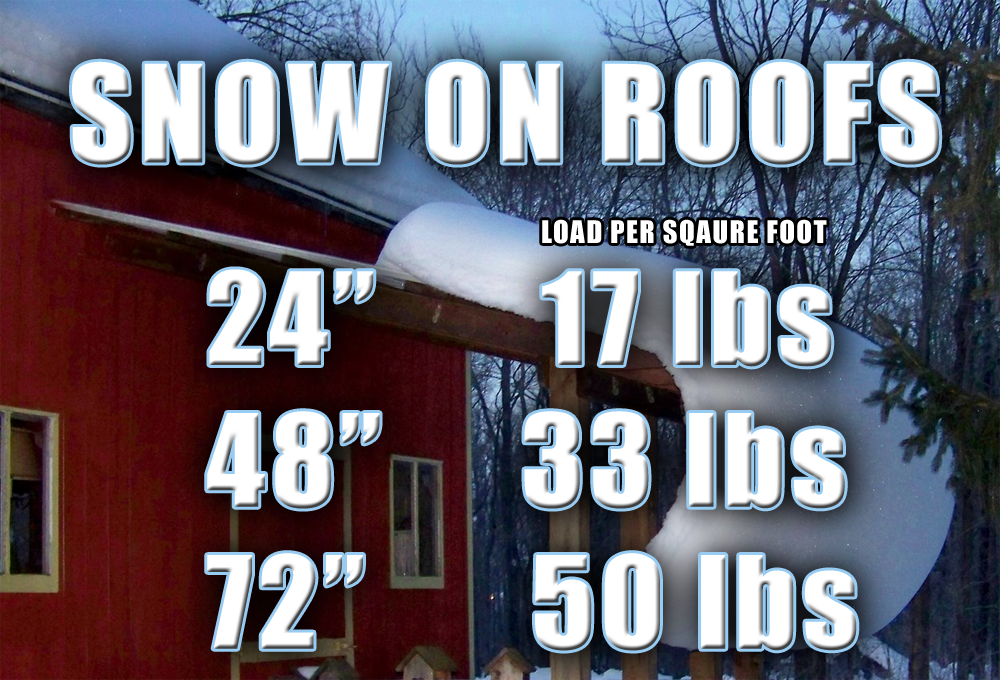
So, how do we know if a building is going to fail? For a pre-engineered building, we can check the actual snow load on the building against the design snow load. If the actual load is less then the design load, then failure is not eminent. Table 1 can be used as a guide to estimate the snow load on a barn.

snow table cvent
Compare the table value against the design value to see where you stand. The table cannot be used for a non-engineered structure.

Wood structures will show stress before they fail unlike metal structures that usually will not. For a wood structure, the following audible and or visual signs may be noticed prior to failure:

  • Creaking or moaning in the building
  • Bowing of truss bottom chords or web members
  • Bowing of rafters or purlins
  • Bowing of headers or columns

If these signs are present, consideration may be given to evacuating animals from the barn and it is certainly recommended to evacuate all humans from the structure.

One option commonly considered to relieve loading from the barn is to shovel the roof. Experienced individuals who are properly trained and protected should only do this. Attempting to save a barn is not worth risking lives over.

Shoveling the roof without the proper approach may actually cause more damage than good by creating an unbalanced load on the roof.


Removal of significant snow accumulations off of a barn roof is best performed in a systematic way to reduce the risk of injury or death to both barn occupants and those working on the roof. Removing roof snow without a proper approach may actually cause more damage than if left alone in some cases by creating an unbalanced and/or concentrated roof load.

Helpful resources from PRO-DAIRY:

For more information about PRO-DAIRY, go to: http://prodairy.cals.cornell.edu/

The Community Value of a Dairy Farm

I recently had the opportunity to make a short presentation to a mixed audience of local farmers and their neighbors in Perry County on the value of a dairy farm to a community. The organizers requested this topic primarily for the non-farm neighbors thinking it would give them a better appreciation of what a farm brings to the community and potentially “soften” some existing and future farm-urban conflicts. Based on the comments after my brief talk it became apparent that the farmers in the audience appreciated the information as much as their neighbors, reminding us once again that agriculture has a wonderful story to tell – but we must remember to tell it! With all the current bad news in the dairy industry, everyone appreciates hearing some positive things about the important work of producing dairy foods.

What a dairy farm brings to a community can be summarized into three main categories: Prosperity, People and the Planet.

Prosperity

Every farm is first and foremost a business. Typically when we think of local businesses we think car dealerships, grocery stores, manufacturing and maybe doctors’ offices, but probably not farms. The largest industry in Pennsylvania is agriculture and the same is true in Perry and most of our 67 counties. Statewide, dairy represents almost 45% of all farm income – collectively we are big business and important to the Commonwealth’s economy.

The farm we were visiting that day milks almost 500 cows and shipped over 10 million pounds of milk last year. It is estimated that every cow generates economic value to a community of over $13,700 per cow per year. That number includes not just the value of the milk she produces, but also the value of that money rolling through the community several times. For example, all the money from all the services the farm uses stays in the community, feeding the local economy. That includes money to the vet, to the local car dealer and feed supplier, health care for family and employees, school taxes – the list is almost endless This particular farm has a list of 40 vendors they typically make payments to during a month and close to 200 vendors a year. Their total expenses last year were over 2 million dollars!

As we drive down the road and see dairy farms, think of that $13,700 economic impact that each cow represents.  For a fairly typical 100-cow herd that is $1.3 million of economic impact; for a larger 300-cow herd it is $4.1 million and for a 500-cow dairy it is almost $7 million in economic impact to the community.

Dairy farms typically own a fair amount of land and in many rural communities the farms pay a large percentage of the property taxes. In a recent Pennsylvania study that compared various land uses and their respective use of tax supported services, farms and open space required from $0.02 to $0.91 per dollar of taxes paid, while residential use of services typically ranged from $1.02 to $1.48. Another reason to smile when you see a farm in your community.

The last “prosperity” or business issue is where dairy farm dollars come from and where they go.  Pennsylvania produces more milk that we consume – meaning a lot of milk is exported to other parts of the country. The dollars from that exported milk comes from outside Pennsylvania and returns to our local economy to become part of that $13,700 local economic impact. Compare that to many businesses where the profits and much of the economic activity exit the community. A dairy farm is a dollar pump – pumping dollars into the local economy.

Smith Parlor Paint September 2009

People

Dairy farms represent jobs. The 500-cow dairy we were visiting had 11 people on the payroll. In rural Perry County the estimate of dairy-related jobs is 856, and in Pennsylvania that number is over 40,000. Those are not all “on farm” jobs, but include all the dairy-related jobs such as sales and service, transportation, processing and retailing. By the way, about 85% of their income from these employees stays within a community.

Dairy farmers and their families and employees are also very involved in their communities – providing leadership and resources to many kinds of organizations and charities. We have a wonderful legacy of volunteerism in this country – and that is particularly true in our rural communities. Our rural youth who have been involved in their churches, and 4-H and FFA have tremendous leadership abilities that benefit all of society. This leadership is a true community asset.

Kulps Paint Sept 2009

Planet

Our third “P” is for the planet, or the environmental contributions of a dairy farm. The initial public reaction to agriculture is that we are part of the environmental problem rather than part of the solution, but that is generally not the case. Remember that land is a valuable resource to be productively used. In the case of a dairy farm, food is being produced on that land, while the alternatives could be houses, highways, or other kinds of businesses.

Farms provide huge areas for groundwater recharge because they cover large areas with very little impervious surface. Open space performs the critical function of absorbing, filtering and returning rain water to replenish ground and surface water supplies.

Today we hear a lot about carbon. A recent national newspaper article noted a scheme to plant thousands of acres of trees in the US to sequester carbon – our farms with their croplands and forests are already hard at work in that regard.

Farms are the original recyclers of nutrients and invest heavily in technology to keep those nutrients on the land. Agriculture has always been conscious of the need for effective stewardship of the land and water. Currently the dairy industry is investing heavily in not only determining our carbon footprint but also developing ways to reduce it from the cow to the consumer.

Farms provide vegetative buffers to reduce pollutant entry into waterways.  Farms provide open space that we all enjoy and value in our communities. Farms provide wildlife corridors and edge effect which are important for songbirds and other field and forest species. And, farms provide nursery habitat for amphibians and birds and support diverse insect populations that are essential to many natural processes from honey production to pest control.

Before we leave these subjects of prosperity, people and the planet which are all tied to our farms and communities, we need to think of the base of all agriculture – food.

Our image of agriculture is biased by our personal experiences. I challenge each of us to be open to a changing and evolving image of agriculture. To be successful and profitable farm, the business must change as any business must change to remain viable and profitable.  Recently I heard a speaker talk about three important numbers – 50, 100 and 70. His point was that within 50 years we will need 100% more food than we produce today to satisfy the world’s needs. Because of land restrictions, 70% of that additional food must come from the use of agricultural technologies.  We must therefore embrace the changes needed to not only make successful businesses and neighbors, but also necessary to feed our children and grandchildren – and to keep our communities economically healthy.

Source: N Blair – PennState

Late-season Snowstorm Weakens in the Northeast

A late-season snowstorm that swept the mid-Atlantic and northeastern United States began to weaken on Wednesday after closing schools, grounding flights and knocking out electricity supply to hundreds of thousands of consumers.
Snowfall brought by the rare mid-March “nor’easter” will slowly taper off over upstate New York and northern New England, a day after it dumped as much as a foot (30 cm) of snow and blew at gale force in some areas, the National Weather Service said.

Millions of people living along the East Coast will face temperatures 10 to 25 degrees below average, wind gusts of 30 mph (50 kph) and slick roads and sidewalks as they return to work and school on Wednesday, it added.

“Residual snow and slush will refreeze early this morning, resulting in hazardous conditions on roads and walkways,” the service said in an advisory, urging extra caution by those venturing out early.

As life returns to normal for many, students in Boston Public Schools will have the day off as the city and environs continue to dig out from heavy snowfall.

Tuesday’s storm capped an unusually mild winter that saw otherwise below-normal snowfall on much of the Atlantic Coast. Snow fell from the lower Great Lakes and central Appalachians to the eastern seaboard, as far south as North Carolina.

Some cities, such as Washington D.C. and New York, got just a few inches of snow, far less than the anticipated amounts that forced public officials to close schools, shut down commuter train routes and warn people to stay indoors on Tuesday.

Governors in New York, New Jersey, Pennsylvania and Virginia declared states of emergency at the outset of the storm.

“Mother Nature is an unpredictable lady sometimes,” New York Governor Andrew Cuomo told a news conference on Tuesday. “She was unpredictable today.”

Source: Reuters

Jersey Canada announces the recipients for the Top Performance Award

RJF REMAKE BECKY- SUP-EX 96-7E 14*

Jersey Canada members are eligible for awards that acknowledge leadership, successful breeding programs, top performing cows and astute management practices.  

We would like to announce the following awards that will be celebrated at the upcoming Jersey Canada AGM in New Brunswick. 

Presidents Cup:
Presented to the cow with the leading living lifetime milk, fat and protein production record.
Award for Butterfat & Protein
RJF REMAKE BECKY (110205395)
5382 kgs Fat & 4590 kgs Protein
Owner:  Robert Jarrell – Corbyville, ON 

Hall of Fame Trophy:
Honouring the Hall of Fame Cow with the highest composite BCA for protein and butterfat.

MENARDISE VINNIE JESSICA (108443635)
1-11, 13031 M, 744 @ 5.7% F, 534 @ 4.1% P
BCA: 503-539-545
Composite BCAs Fat & Protein: 1084
Owner:  Guillaume Menard – Verchères, QC

Master Breeder: Brent & Betty Butcher & Family (BRENBE), Ayr, ON  

Constructive Breeders:  

Marbro Farms (MARBRO), Woodstock, ON (Category 1: 5-9 registrations/year)
Oscar & Lucinda Weber and Jesse & Ellen Weber (WEBERLEA), St. Clements, ON (Category 2: 10-24 registrations/year)
Creek Edge Farms Inc. (HIDDEN DREAM), Elora, ON (Category 3: 25+ registrations/year)  

Jersey Young Achievers: 

Bobby & Jen Jarrell (RJF), Corbyville, ON
Glendon Graye (GRAYLANE), St-Pierre-Jolys, MB
Matt & Kerry Fraser (MAKER), Rockwood, ON  

Youth of Distinction: Michael Haeni, Didsbury, AB

Distinguished Service Award: Charlie Thomson (CBS), Rosedale, BC  

Honourary Life Members: 

Eric Thompson (PINE HAVEN), Oxford, NS
Fran Edwards (Bramville), Nokomis, SK
Wayne Boswell (Marshfield), Marshfield, PEI 

Award recipients will be featured in the May issue of the Canadian Jersey Breeder.

Kansas Wildfires: 4-H’ers, volunteers rally to save orphaned calves

A Kansas 4-H Club has rallied supporters in the state and surrounding states to take in orphaned calves whose mothers were victims of the wildfires that raced across several western counties last week.

Rachelle Schlochtermeier, one of the parent leaders of the Four Leaf Clover Club in Meade County, said the response to the club’s idea to “do something” for families affected by the fires has been overwhelming.

“We have been hearing from people all over the state of Kansas, even people from Michigan and Missouri and Oklahoma,” she said. “People want to make a donation or find out how they can help.”

Schlochtermeier and another parent, Erin Boggs, helped their 4-H Club get organized, and have seen clubs in Elkhart, Ness City and Russell join the effort to rescue orphaned calves and place them in good homes. More groups are joining in all the time, Schlochtermeier said.

The volunteers are spending their own time and money traveling to pick up calves, assess their condition and arrange for their care.

As of last weekend, the groups have saved 85 orphaned calves and placed them under care. Once the calves are healthy – and producers have rebuilt barns, fences and other facilities – the club members will return them to their original homes.

The fires came at a particularly difficult time for cattle producers, a time when many cows had just given birth. One rescued calf was just a few days old, Schlochtermeier said, and was still nursing. Fortunately for the calf, it was able to get colostrum from its mother, which will help its chances of future health.

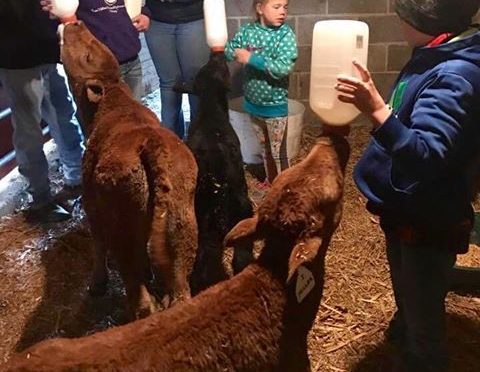
Many other calves are 2-3 months old. All of the rescued calves will receive an antibiotic and B12 vitamin, as well as milk replacement, often bottle fed by the volunteers. Schlochtermeier said the Hillsboro Veterinary Clinic has provided some medical care.

Most foster families have taken between two and six calves, Schlochtermeier said. Right now, they don’t know how long they’ll have to care for the animals.

“This is a huge undertaking,” she said. “The condition that some of these calves are coming in …”.

Gathering her emotions, she continued: “This is going to be a long-term thing. The farmers don’t have anywhere to go with their calves right now. There is a lot of work to be done and a lot of commitment needed to keep these babies alive.”

The group has established a Facebook page for people who want to get involved with the effort. On Facebook, search for “Orphan Calf Relief of SW Kansas.” Relief funds have also been set up at Ashland Feed and Seed, Meade Co-op, and Country Feeds in Montezuma.

Those interested in donating money, products or anything else may contact those businesses directly, or call Schlochtermeier at 785-483-0421.

Official figures for cows lost in the fires that affected parts of 21 counties are not available, but unofficial reports indicate that many ranchers lost hundreds from herds that they’ve spent many years building. The calves are an important connection to bloodlines that the ranchers have worked hard to establish.

“We’re trying to give them peace of mind that their calves are being taken care of while they get the rest of their farm back together,” Schlochtermeier said.

The clubs are part of Kansas 4-H in K-State Research and Extension. For more information about 4-H in Kansas go to http://www.kansas4-h.org/ or call 785-532-5800.

–K-State Extension

Get Ready to Ride the 2017 New York Spring Dairy Carousel

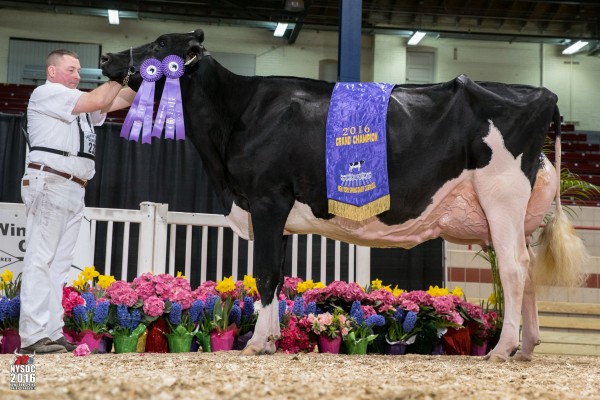
2016 GRAND CHAMPION: ROSIERS BLEXY GOLDWYN

Time to plan for the New York Spring Dairy Carousel April 7-10 in Syracuse at the New York State Fairgrounds. The 42nd edition, sponsored by the New York Holstein Association, will include shows for all major dairy breeds along with top-notch Holstein and Protein Breed sales.

In 2016, over 200 youth from the Northeast participated in the judging contest followed by eight different breed shows featuring 800 head of dairy cattle. Many of the animals have won their respective breed’s All-American contests as “The Carousel” has become known as, “the show of the spring.”  The Holstein Sale had an exciting line up of high genomic females, potential show winners, Red and Whites, and members of the Breed’s most distinguished cow families. The 76 lots in 2016 averaged $3,955.

The Carousel officially kicks off Friday, April 7, 9:00 a.m., with the Youth Showmanship Contest  followed at 12:30 p.m. with the third annual Richard Keene Memorial Youth Judging Contest. This event is sponsored by Farm Credit Northeast AgEnchancement.  At 6:00 p.m. will be the Protein Breeds Sale.

New York Junior Holstein members are center stage on Saturday morning, April 8, with the Junior Holstein Show judged by Carl Phoenix, Sunderland, Ontario. Saturday afternoon starting at Noon, Jeff Stephens, Troy, Ontario lines up the Ayrshires. In the other ring, Mike Berry, Albany, OR places the Guernseys. The day concludes with New York Spring Holstein Sale starting at 3:00 p.m. sponsored by the New York Holstein Association and managed by The Cattle Exchange of Delhi, NY.  The day concludes with the fun-filled Junior Olympics & Pizza Party for the juniors.

Sunday morning 8:00 a.m. finds the Red & Whites in the Coliseum for Phoenix’s evaluation.  At 9:00 a.m. Mike Deaver, Edgerton, WI places the Milking Shorthorns. In the afternoon, Mike Berry has the honor of evaluating the Jerseys while Stephens places the Brown Swiss.

The Carousel culminates on Monday, April 10 with the New York International Spring Holstein Show judged by Mike Deaver.

A complete schedule of events is included below. Cattle will again be released at the end of each breed show. A list of classes and the entry forms are available online at http://nyspringdairycarousel.fairentry.com OR by calling the New York Holstein Association office at 607-273-7591. The early deadline has passed, so next tier of entry fees are in effect until March 24 with entries from March 25 until show time facing the highest entry fees.

If you’re planning to attend, hotels in the area include: Best Western Fairgrounds, 315-484-0044; Clarion Fairgrounds, 315-457-8700; Comfort Inn Fairgrounds, 315-453-0045; Maplewood Inn, 315-451-1511; Red Mill Inn, 315-635-4871; and Western Ranch Motel, 315-457-9236. Make your reservations as soon as possible since rooms sell out quickly. Mention the New York Spring Dairy Carousel for special rates.

Camper/RV hookups are available at $30 per day. Reservations, camper license number, and pre-payment are required.

Food is available in the Coliseum and admission is free, so come one and all to the 2017 New York Spring Dairy Carousel.

For any other questions or for online entries & information go to  http://nyspringdairycarousel.fairentry.com or contact Cattle Superintendent Alan Danforth at 518-231-6597 or New York Holstein Association Executive Manager Kelly Reynolds at 920-728-1596.

Dairy Leaders Honored with World Dairy Expo® Recognition Awards

After a year hiatus – to celebrate the 50th Anniversary of World Dairy Expo – WDE is pleased to announce the return of Expo Recognition Awards and the four honorees selected this year. These individuals were nominated by their peers for their involvement and excellence in the dairy industry and their community.

The 2017 honorees are as follows:

Dairy Woman of the Year
Marilyn Hershey, Ar-Joy Farm, Cochranville, Pa.

Dairyman of the Year
Charles Ahlem, Charles Ahlem Ranch, Turlock, Calif.

Industry Person of the Year
Ben Brancel, Endeavor, Wis., Secretary of the Wisconsin Department of Agriculture, Trade and Consumer Protection

International Person of the Year
Derrick Frigot, Owner of JISEX International, Jersey, Channel Islands, United Kingdom

A formal awards presentation for these outstanding dairy leaders will take place during the Dinner with the Stars banquet on Wednesday evening, October 4, 2017, in the Exhibition Hall at the Alliant Energy Center. Anyone may purchase tickets to the banquet by contacting the Expo Office at 608-224-6455 or wde@wdexpo.com. Prior to the ticketed banquet, a complimentary reception featuring hors d’oeuvres and drinks will be held for all Expo stakeholders to celebrate, meet and greet the Expo honorees.

For over five decades, the global dairy industry has been meeting in Madison, Wis. for World Dairy Expo. Crowds of nearly 75,000 people from more than 100 countries attended the annual event in 2016. WDE will return Oct. 3-7, 2017 as attendees and exhibitors are encouraged to “Discover New Dairy Worlds.” Visit worlddairyexpo.com or follow us on Facebook and Twitter (@WDExpo or #WDE17) for more information.   

TB Confirmed in West Michigan

The Michigan Department of Agriculture has confirmed a two year old steer from Newago County positive for bovine tuberculosis (TB) after inspection during processing.

The department says the Newago Country farm that sent the steer to slaughter has been identified using the animal’s radio frequency identification. Through genome sequencing, officials have determined the steer was most likely exposed to white-tail deer in northeastern Lower Michigan with the disease. Farms within a three-mile surveillance area will be tested for bovine TB.

Beef and dairy cattle producers are invited to a meeting in Grant March 27th to learn how the discovery might impact their farms. Bovine TB is an infectious bacterial disease affecting cattle and white-tailed deer that can affect the lungs, lymph nodes, and other parts of the body.

Source: Brownfield

Applicants Sought for Holstein Association USA Junior Advisory Committee Adult Representatives

Holstein Association USA is currently seeking applications for adult representatives from Areas III and IV on the Junior Advisory Committee (JAC). The JAC serves as a sounding board for Junior members and advisors on Holstein youth programs. Applications must be submitted to Holstein Association USA by April 1st for consideration. 
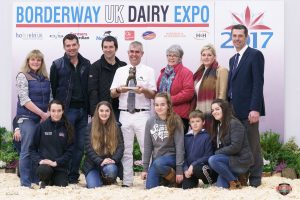
The current adult representatives from Areas III and IV will be completing their terms at the National Junior Holstein Convention this June. Area III is made up of Illinois, Iowa, Minnesota, North Dakota, South Dakota and Wisconsin.  Area IV covers Arkansas, Arizona, California, Colorado, Idaho, Kansas, Missouri, Montana, Nebraska, Nevada, New Mexico, Oklahoma, Oregon, Texas, Utah, Washington and Wyoming. 

Adult representatives bring valuable perspective and direction to the committee and are eligible to serve up to two two-year terms. The committee meets annually, via conference call or in-person, to discuss Junior Holstein Association matters, and attendance at the National Junior Holstein Convention is required, as the committee assists with coordinating events and carrying out activities. 

Ideal committee members will be knowledgeable about Junior Holstein programs; have a strong communication network with members in their designated area; must commit to attending JAC meetings and the National Holstein Convention; and must display the highest standards of ethics and commitment to youth programs. 

Mark Nutsford Wins the John Dennison Lifetime Achievement Award

The 2017 winner of the John Dennison Lifetime Achievement Award, Mark Nutsford from the Riverdane herd in Cheshire, England. This year’s winner did not start off with 250 acres and 150 pedigree cows and an already well-known prefix.  He began with a desire to learn about dairy cows by attending Agricultural College at Reaseheath in Yorkshire and quickly became obsessed.  Born in North Yorkshire on the outskirts of Middlesbrough this year’s John Dennison recipient truly embodies what this award is all about.  Over all the years I have known him, through success, failure, and hardship he has remained the same and always has time to speak with everyone whether you are the person running the scraper tractor or the person with the open checkbook wanting to buy that priceless animal.

The resounding feeling from the committee was that this year’s winner would go out of his way to help others.  If you ask him for his last flake of hay for your cow, you can have it over his own.  If you want advice on pre-show preparation that which will potentially see you win over him, he will freely give it.  His infectious PASSION for great dairy cattle is always a pleasure to be around.  His PASSION to help others and to improve the British Brand has been remarkable resulting in two very successful GB teams taking part in the last two European Shows.

A little history on this year award winner.  After college, he got a job at Northsea Holsteins and under the guidance of Harold Nicholson quickly fell in love with showing cows before traveling to Saudi Arabia to work on a large scale dairy operation.  While in Saudi he was asked to train in their Embryo Transfer division and returned to the UK to start working for Genus as an ET technician.    

The obsession to own and develop great cows continued to grow and the TOPMARK prefix was registered with cows in partnership with other breeders and housed in numerous locations around the UK, the most notable cow from this era being the 95 point Topmark Rudolph Beauty.  In 1999 our winner had the chance to buy Ravenscroft H  Hall Farm in Cheshire and along with his wife Sue the Riverdane prefix was established.  The rest I suppose is history – since then the Riverdane herd has bred or owned  63 All Britain nominations 3 EX97 pointed cows,  3 EX96, 8 EX95, 16 EX 2nd calvers & 12 VG89 two year olds.  Show ring success has been phenomenal for Mark and the Riverdane herd with household names such as Sara, Adeen, Ashlyn, Beauty, Rose and who could forget Mattia to name just a few of the stars.

Currently Mark runs the successful Celltech Embryo Transfer Company as well as being a partner in Kingstreet Sires and ActIVF.  His judging career has seen him travel around the world as well as judging most of the major shows in the UK & Ireland.  Without Sue of course none of this or a lot less of this success would have been possible.  Sue is his backbone.  The person who keeps the ship sailing in the right direction and I know Mark appreciates everything she does when he is on the road. 

I’m very confident if John Dennison was still with us that he would be proud to have Mark Nutsford’s name on this trophy.  Two inspirational men with so many similar qualities apart however for their taste in football but we will leave that for another day. 

I really think the words of the famous poem “IF” by Kipling are fitting and in so many ways describe Mark.

If you can keep your head when all about you 
Are losing theirs and blaming it on you,   
If you can trust yourself when all men doubt you, 
But make allowance for their doubting too;   
If you can wait and not be tired by waiting, 
Or being lied about, don’t deal in lies, 
Or being hated, don’t give way to hating, 
And yet don’t look too good, nor talk too wise: 

If you can dream—and not make dreams your master;   
If you can think—and not make thoughts your aim;   
If you can meet with Triumph and Disaster
And treat those two impostors just the same;   
If you can bear to hear the truth you’ve spoken 
Twisted by knaves to make a trap for fools, 
Or watch the things you gave your life to, broken, 
And stoop and build ’em up with worn-out tools: 

If you can make one heap of all your winnings 
And risk it on one turn of pitch-and-toss, 
And lose, and start again at your beginnings 
And never breathe a word about your loss; 
If you can force your heart and nerve and sinew
To serve your turn long after they are gone,   
And so hold on when there is nothing in you 
Except the Will which says to them: ‘Hold on!’ 

If you can talk with crowds and keep your virtue,
Or walk with Kings—nor lose the common touch,
If neither foes nor loving friends can hurt you, 
If all men count with you, but none too much; 
If you can fill the unforgiving minute 
With sixty seconds’ worth of distance run,
Yours is the Earth and everything that’s in it,
And—which is more—you’ll be a Man, my son! 

 This award is in honor of John Dennison who was a skilled dairy farmer, an excellent Holstein breeder, a marvelous motivator and an inspiration to all he came in contact with and above all his family came first.  He was a superb marketer and promoter of the Holstein cow, and his enthusiasm and friendliness attracted many new people into our business.  His legacy will live on through his sons Andrew, Michael and Stephen and his numerous grandchildren; some of whom have been competing at UK Dairy Expo this weekend.  This award is designed to honor those qualities.

Thousands of cattle lost in Kansas wildfires

Rancher David Bouziden lost his home, his ranch and nearly all his cattle in wildfires that swept through Kansas this week.
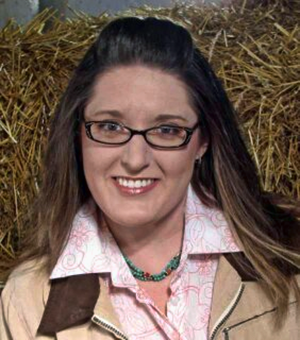
 
“I’d say personally we probably lost close to 150 head, maybe,” he said. “That’s probably 90% of our cattle.”
 
Bouziden barely escaped the blaze. On Monday, he was plowing a fireguard on his ranch in Clark County in Southwest Kansas when flames propelled by near-70 mph winds struck the pasture, he said. The smoke engulfed him, forcing him from his tractor to struggle through soot and ash. He could hardly see, he said, but managed to distinguish the outline of a hay shed where his pickup truck was parked.
 
Bouziden was able to drive to safety, but nearly all his cows were killed in the fire that also consumed his home, three outbuildings, hay barns and machinery sheds.
 
“It burned every acre of the ranch. There’s not a blade of grass standing out there.”
 
Bouziden’s family has been in ranching for nearly 100 years, since his grandfather bought a few cattle in the 1930s. “This is all I’ve ever done,” he said.
 
“It’s entirely devastating,” Bouziden said. “You’ve got a home there with all of your belongings and 40 years of living, and it’s gone.”
 
Bouziden’s experience is typical of ranchers in Kansas this week, where grass fires have scorched more than 650,000 acres, devastating farming and ranching communities.
 
That destruction has been particularly pronounced in Clark County, where ranchers are dealing with the loss of thousands of livestock.
 
Randall Spare, a veterinarian in Ashland, the county seat, said it was too early to make a guess as to how many cattle were lost in the blazes; ranchers are still trying to assess the damage.
 
“It’s probably at least 2,000. It could be 6 or 7,000,” he said.
 
With spring approaching, many of the cows were calving, Bouziden said, and if the calves are added to the count, the number of animals lost could nearly double.
 
‘The perfect storm’
 
The fires have been perpetuated by low humidity and heavy winds, conditions that have made the Kansas Plains a tinderbox. The state saw a particularly wet summer last year, said Todd Domer, spokesperson for the Kansas Livestock Association. According to Domer, the grass that it brought is now fueling the fires.
 
“We had the perfect storm,” he said. “We had a wet summer and then kind of a dry winter and then you get wind on top of that and then anything that’s flammable will spark.”
 
Domer spoke about the emotional toll an event like this takes on ranchers.
 
“They’re geared to take care of cattle and have cattle be healthy and grow and be productive,” Domer said. “When you have to switch gears mentally and deal with injuries and death on a massive scale, it can be pretty tough.”
 
Huge loss of infrastructure
 
The devastation for ranchers’ businesses is far reaching. Not only have they lost an unknown number of cattle, but the livestock that have survived have no grass or hay to feed on, most of it having been consumed by the flames.
 
“It looks like the moonscape,” Domer said. “It just looks like a big sand beach that’s endless.”
 
Kansas Emergency Management said in a news release on Wednesday night that this week’s grass fire burned 502,000 acres in Clark and Comanche Counties, “making it the most widespread single fire on record for the state.”
 
The last fire of that magnitude was last year’s Anderson Creek Fire, the release said, which burned 312,427 acres.
 
The fences that lined the edges of the pastures, they’re gone, too. “That’s a rancher’s infrastructure right there,” Domer said. “That’s a huge loss.”
 
He said early estimates have the cost of fencing at $10,000 per mile.
 
“There could be 100,000 miles of fence,” said Spare, some of whose clients have suffered huge losses. He’s been focused on helping them assess the damage. When asked how his clients were reacting, he said. “They care so deeply for their livestock. They’re more concerned with their livestock’s welfare than their own.”
 
“Nothing we’re doing is heroic. It’s just doing our daily job, serving people,” Spare said.
 
Serving folks like Bouziden, who, like many of his neighbors, is focused on dragging the dead cattle into a pile to get a physical count.
 
“It probably hasn’t all soaked in yet,” Bouziden said.
 
But the generosity and support of his community and groups like the livestock association, which is heading up relief efforts, is helping him through.
 
“It’s really heartwarming to see how your neighbors react in a disaster like this,” he said. “It’s that way all over the country. People want to help.”
Source: CNN

‘Dairy Carrie’ Named AgVocate of the Year at Women’s Summit

Attendees of the Wisconsin Ag Women’s Summit in Madison over the weekend had the opportunity to witness the naming of the 2017 AgVocate of the Year. Carrie Mess, known by most as ‘Dairy Carrie,’ earned the honor for her efforts in promoting awareness of agriculture to members of her community and beyond. (Read more: Dairy Carrie – Diary of a City Kid Gone Country)

Mess and her husband Patrick farm in partnership with his parents, where they milk 100 cows and grow crops on 300 acres near Lake Mills. She is a founding member of the Dairy Girl Network and serves on the organization’s board of directors. In addition, Carrie writes the popular Dairy Carrie Blog and is a professional speaker.

As the AgVocate of the Year, Mess received a $500 cash award and was able to designate another $500 to the agriculture charity of her choice.

The award was sponsored by Badgerland Financial, Wisconsin Farm Bureau Federation, the University of Wisconsin-Extension, and Farm Broadcaster Pam Jahnke.

Source: Wisconsin Ag Connection

Sri Lanka to Import 5,000 Dairy Cattle from Australia

Sri Lanka will import 5,000 heads of high yield cattle from Australia in May to boost local daily production, a minster said on Saturday.

Minister of Rural Economic Development P. Harrison told Xinhua that around 6,000 heads of cattle had been imported in the past.

“They are being reared at the government farms. We will get their offspring hopefully by next year. We will import another 5,000 in May to be distributed among farmers. We will plan for more imports of cattle from Australia depending on the success of this project, ” he said.

Sri Lanka produces only 40 percent of its dairy requirements. The rest is imported from the countries such as New Zealand.


Source: Xinhua News

Lely Is Focusing On Agricultural Robotics And Data And Intends To Sell The Forage Business To AGCO Corporation

Lely international, a family-owned company, intends to sell its Forage business, which produces forage harvesting machines to AGCO Corporation, recognized worldwide as a leading player in design, manufacture and distribution of agricultural machinery.

The intended sale of its Forage activity will allow Lely to fully concentrate, going forward, on the Dairy segment: the development of milking robots and other innovations for increasing the efficiency, sustainability and animal welfare at dairy farms. Thanks to its unique expertise with automated systems, Lely will be able to further strengthen its leading position as innovator in the Dairy sector worldwide.

The takeover allows AGCO Corporation to further broaden its range of forage harvesting machines. 

Market developments make choices necessary

The Lely business had, until now, focused on two totally different product categories and markets with its Dairy and Forage business units. Therefore, the company started a strategic reorganization some time ago. This analysis revealed that, to be able to continue operating successfully in the market, the organization must adapt to the increasingly wide range of requirements of its different product groups.

The result of the strategic reorganization is that Lely plans to focus on the development of robotics and other innovations in dairy farming. CEO Alexander van der Lely explains: “Lely intends to focus entirely on its role as innovator in the field of robotics, and sensor and data systems for use on dairy farms. Over the last 15 years, these product groups have grown into a successful activity for Lely, with a great deal of potential for the future. Besides the innovative milking robot, other products have also been developed that are primarily based on automation with the aid of robots.” The production of these Dairy machines will stay in Maassluis (The Netherlands), Pella (Unites States) and Leer (Germany).

At the same time AGCO’s CEO Martin Richenhagen is pleased with this strategic acquisition: “The integration of Lely’s industry leading competence in hay and forage harvesting will further strengthen our relationships with our dealers and customers worldwide”.

Effect on jobs

The intended sale of the Forage activities has an effect on jobs at Lely:

  • The Forage machines that are produced in Maassluis, The Netherlands (mowers, tedders and rakes) overlap with the AGCO Corporation’s range. The production in Maassluis will be reduced after sale. The expectation is that these activities will be discontinued as of 31 March 2018.
  • All employees in The Netherlands remain employed by Lely. Approximately 95 employees working in production will  be temporarily outsourced to AGCO Corporation. After that, a solution is sought for their future inside or outside the company.
  • The German factories in Wolfenbüttel (balers) and Waldstetten (loader wagons) will become the property of AGCO Corporation and the employees will be employed by AGCO Corporation. Lely’s vice-president Sales, Gijs Scholman, explains: “The sale of Forage offers these employees a chance of a better future with a company that fully concentrates on the manufacture of tractors and agricultural machinery”.
  • Some of the Forage employees of our international Lely Support Organizations (LSOs) will be employed by AGCO Corporation.

The Joint Works Council in The Netherlands is asked for its advice about the intended sale, and reorganization of the organization. The relevant trade unions have also been informed.

For the family-owned company Lely, that started in forage products, this is a big step that they want to take with care. Lely attaches a great deal of importance to the honest and respectful treatment of its employees. The point of departure for the intended plans is always to retain as much employment as possible and to work with the employees on building a healthy future for the company in Dairy.

About the Lely Group

Lely North America, based in Pella, Iowa is a part of the Lely Group. Lely, founded in 1948, directs all its efforts towards creating a sustainable, profitable and enjoyable future in farming for its customers. Lely works on business concepts to ensure energy-neutral operations in the dairy sector. Every day we inspire people to bring innovative solutions to our customers, from advice to support executing the choices they make.

For many years, Lely has been leading in automated milking systems. The Lely Group is active in more than 60 countries and employs around 2,000 people. 

For more information about Lely, its products and services visit: www.lely.com.

About AGCO

AGCO (NYSE: AGCO) is a global leader in the design, manufacture and distribution of agricultural solutions and supports more productive farming through its full line of equipment and related services. AGCO products are sold through five core brands, Challenger®, Fendt®, GSI®, Massey Ferguson® and Valtra®, supported by Fuse® precision technologies and farm optimization services, and are distributed globally through a combination of over 3,000 independent dealers and distributors in more than 150 countries.  Founded in 1990, AGCO is headquartered in Duluth, GA, USA. In 2016, AGCO had net sales of $7.4 billion.  For more information, visit http://www.AGCOcorp.com.

One Step Closer to Multimillion Dollar Alliant Energy Center Redesign (World Dairy Expo)

The Dane County Board moved one step closer to green lighting a multi-million renovation of the Alliant Center campus, Thursday.

The County Board got comprehensive look at the design plan. This plan doesn’t call for a complete tear down of the Coliseum, but still brings major changes, including about 1,700 more jobs to our area.

“We’ve lost a lot of shows,” Dane County Board Chair Sharon Corrigan said

The Coliseum, a once state-of-the-art facility known for bringing in iconic acts, has lost its draw.

“Maybe five shows a year versus 20 a year not too long ago,” Corrigan said.

Dane County officials don’t want the Aliant Energy Center to be overlooked any longer.

“It’s a real opportunity, that we’d hate to miss,” Corrigan said.

Thursday night, Hunden Strategic Partners, presented their redesign of the campus.

The redevelopment includes a $100 million renovation of the Coliseum. It will keep the iconic shape and house the same number of seats, but modernize it.

“We would reconfigure the bowl so that the seating is better and do some of the kind of essential things that you need for loading and unloading, and the types of things that a big show is going to require,” Corrigan said.

It also calls for a major expansion of the exhibition hall. The entire campus will get a more village-like feel, with additional restaurants, hotels, and walkways. 

“There would be many more resources for going to a meal, being able to walk around the whole campus and enjoy the whole campus more than just running into the expo hall and going into the event,” Corrigan said.

The current plan would cost taxpayers more than $200 million, but Corrigan said an update would be well worth it. 

“We’d be able to draw a lot more visitors and that brings dollars to Madison and that means we are a much more vibrant community,” she said.

This redesign still needs to go through a number of approvals, but construction could begin in the next couple of years.

Source: Channel 3000

Cheese is so addictive, one doctor calls it ‘dairy crack’

Can you break your cheese habit? A new book, called The Cheese Trap, makes the case for skipping dairy products altogether.
Cheese is “both fattening and addictive,” said author Dr. Neal Barnard, founder of the Physicians Committee for Responsible Medicine.

Cheese is addictive, Barnard said, because the dairy proteins inside can act as mild opiates. Fragments of cheese protein, called casomorphins, attach to the same brain receptors as heroin and other narcotics. As a result, each bite of cheese produces a tiny hit of dopamine.

He calls it “dairy crack.”

Cheddar cheese, Barnard said, has the most concentrated amount of cheese protein in the grocery store and it can pack more calories than Coca-Cola and more salt than potato chips.

At 149 calories, one cup of milk delivers more energy than a can of sugary soda. One cup of melted cheddar? You’re looking at 986 calories.

Think a typical 2-ounce snack of potato chips ranks high in salt at 350 milligrams? Two ounces of Velveeta knocks potato chips aside as a sodium villain, containing more than 800 milligrams of sodium, said Barnard, a noted vegan and animal rights activist.

“Cheese,” Barnard said “is not just tasty. It actually contains concentrated opiates, along with salt and grease, that tend to keep us hooked.”

Cheese consumption has risen steadily since the early 1970s, a trend that tracks alongside the rise in obesity.

According to the U.S. Department of Agriculture, Americans overall consumed 11 pounds of cheese per capita in 1970, a figure which has more than tripled to 35 pounds per person in 2015. Our cheese of choice? Mozzarella, topping out at 11 pounds per person, followed closely by cheddar at 10 pounds per person last year.

If you’ve been hearing more about how dairy products can harm your health, The Cheese Trap rounds up a growing chorus of anti-dairy perspectives, evidence and experiences.

And if you just want to drop some pounds, Barnard argues that skipping meat, cheese and dairy might be a way to accomplish that goal.

Research conducted by PCRM shows that animal fats tend to slow the metabolism down, which could mean increased dairy consumption is linked to weight gain trends across the nation.

Vegetarians who avoid dairy products weighed 15 pounds less, on average, than vegetarians who kept their ice cream and cheese consumption going. Amid a rising obesity epidemic, that’s enough evidence, he said, to avoid the “chubby cheddar.”

“We have done similar studies with hundreds of men and women and have found powerful weight loss in every study,” Barnard wrote.

At the helm of PCRM — a nonprofit that recently opened a clinical practice in Washington, D.C., that relies on plant-based medicine as a first step to combat chronic disease — Barnard has also authored texts like the 21-Day Weight Loss Kickstart, Power Foods For The Brain, and Dr. Neal Barnard’s Program for Reversing Diabetes.

The Cheese Trap is a contribution to the growing conversation and evidence that links food and health. As part of that evolution, Barnard details how his staff has taken federal nutrition experts to task. The Dietary Guidelines for Americans are recommendations compiled every five years, conclusions based on expert testimony and study that become blueprints for the school lunch program, dietitians and ordinary Americans who try to pay attention to what they eat.

Barnard details in the book how PCRM staff have lobbied in court to limit contributions to federal nutrition experts by industry groups like the National Dairy Promotion and Research Board, Nestle and Dannon. PCRM also battled the government to crack down on false claims in advertising by the dairy industry.

For readers intrigued by Barnard’s anti-dairy pitch, more than 65 recipes come inside The Cheese Trap. For identifying food problems linked to migraines, chronic pain, inflammation and other maladies the author talks about, an appendix discusses the concept of an elimination diet.


Source: UsaToday

Dairy farmers owed millions while owners of collapsed National Dairy Products led lavish lifestyle

Violetta and Tony Esposito lived a lavish lifestyle while their company, NDP, was collapsing. (Supplied: Facebook)

Dairy farmers who are collectively owed millions of dollars have accused the owner of a collapsed Victorian milk broking business of funding his “lavish lifestyle” from the company accounts rather than paying them for their milk.

Key points:

  • NDP bought milk from dairy farmers and sold it on to food producers
  • Company collapsed in 2016 and placed in administration
  • Dozens of dairy farmers claim they are collectively owed more than $6 million
  • NDP owner, Antonio Esposito maintained a lavish lifestyle while the company collapsed

Gippsland dairy farmer Fiona Plant says her family is owed more than half a million dollars.

“It’s not good enough that someone has a luxury boat on the Gold Coast and can have expensive holidays, lives in a multi-million-dollar mansion and can’t even pay farmers for their milk,” she told 7.30.

But Antonio ‘Tony’ Esposito, the owner of National Dairy Products (NDP), which went into liquidation in late February, said he was the victim.

Mr Esposito has vehemently denied any wrongdoing, saying that any money he withdrew was rightfully his.

“That was repayment of loans that I put into the business. I put in a total of about $8 million and I took back about $3 million. We are still owed just under $5 million,” he said.

‘Our intention was to pay the farmers’

NDP owes creditors as much as $6.8 million according to liquidator Deloitte Australia, which is investigating the company for possible insolvent trading.

Mr Esposito said he was “devastated” by the collapse of NDP, which bought milk from about two dozen farmers and then sold it to food manufacturers.

He said he never intended to “rip any farmers off”, and that he was a victim of the price crash in the dairy market last year.

“Our intention was to pay them [the farmers] as much as we could and make them sustainable, and that was even at our loss,” Mr Esposito said.

But the liquidator has told creditors the company may have been trading insolvent for 11 months, from December 2015 — well before Murray Goulburn’s price cut, which sent the local market into turmoil.

Mr Esposito and his partner Violetta — who took over as the sole director of NDP in April 2016 — live in a multi-million-dollar mansion in Melbourne’s upmarket seaside suburb of Brighton, and lead a lifestyle of luxury cars, yachting holidays and expensive parties.

Documents obtained by 7.30, including internal emails and bank statements, show that Mr Esposito was receiving payments of tens of thousands of dollars while some farmers were not being paid.

Lavish $90,000 birthday party apparently paid out of company account

Just weeks before it started falling behind on farmer payments, NDP appeared to have paid for Mr Esposito’s extravagant 50th birthday party held at the Plaza Ballroom in Melbourne on October 31, 2015.

7.30 has obtained an invoice made out to the company, which shows that the dairy company had paid $9,000 as a deposit and owed the remaining $81,000 for the party.

Mr Esposito said NDP “could” have paid for the party, but that if it did, it would have been in lieu of a loan repayment.

Speaking out for the first time against Mr Esposito, the former acting chief executive of NDP, Darryl Cardona, said that shortly after the party he began raising concerns that the company may have been trading insolvent.

“There was a shortfall of cash and we were unable to pay a supplier’s total amount,” Mr Cardona said.

“At that stage there was some money coming out of the business for personal expenses.”

Mr Cardona is in a bitter dispute with Mr Esposito over whether Mr Cardona’s family company loaned NDP half a million dollars.

$325,000 withdrawn in months leading up to collapse

Internal emails and company bank statements obtained by 7.30 show Mr Esposito withdrew $325,000 from the business over just four months between July and October 2016.

Again, the business owner said those transfers were repayments of a loan.

The ABC can reveal that the liquidator told creditors that the last remaining $20,000 in the company bank account was transferred to Mr Esposito just hours before he put NDP into administration.

Deloitte identified up to $4.3 million dollars in possible “voidable transactions”, which the Espositos may be liable for.

In response to the $20,000 withdrawal, Mr Esposito said he could not recall the transfer but would give back the money if required.

He conceded that the business had performed poorly from the start in April 2015.

“We experienced two odd million dollars of losses in those [first] two months alone,” he said.

Gippsland producer Alister Clyne, who is the brother of Fiona Plant, said he was owed $1.1 million, which makes him NDP’s largest farmer creditor.

He said Mr Esposito should have paid farmers before repaying himself.

“He is looking after number one; I am speechless over some of his conduct,” Mr Clyne said.

Mr Esposito also told 7.30 he planned to sell his Brighton mansion and one of his country properties to repay farmers.

However, he disputes the amounts they say they are owed.

Director’s cousin paid $100,000 but acting CEO ‘never met him’

Internal emails obtained by the ABC have also raised questions about salaries being paid to members of the Esposito family.

In March 2016, the company employed Violetta Esposito’s Macedonian cousin as the Business Development Manager on a 457 visa.

Internal emails from a migration lawyer showed he was on a $100,000 per year salary, which made him exempt from an English test requirement of the visa.

Mr Cardona said he was confused about the role Ms Esposito’s cousin played in the business, because he had never met him despite there being only nine staff.

“I know absolutely nothing about him,” Mr Cardona said.

“You’d expect to meet and know your staff back to front and point them in the right direction.”

Australian Border Force has threatened to take action against NDP because it failed to notify the agency of the company’s voluntary administration, which could invalidate the 457 visa.

Mr Esposito said that his partner Violetta had almost no involvement in the company, despite being the sole director.

The liquidators are also investigating whether Mr Esposito was a shadow director — a claim he denies.

Source: ABC

Holstein USA Member Update Meeting Videos Now Online

Holstein Association USA (HAUSA) invites all to view videos from the recent Member Update Meeting. The meeting was held in conjunction with the Pennsylvania Holstein Association State Convention.

This is the fourth year that HAUSA has recorded its Member Update Meeting and posted videos online. They can be viewed at www.youtube.com/HolsteinUSA or by visiting the Holstein USA website, www.holsteinusa.com and click on Meetings & Conventions in the main menu, then select Member Update Meeting.

The meeting is broken down into several sections for ease of viewing. See the following video presentations:
• John Meyer, HAUSA CEO – 2016 State of the Association Address
• John Burket, director – HAUSA Director Elections
• Jodi Hoynoski, HAUSA executive director of identification and member services – Holstein COMPLETE® and Holstein Tags
• John Meyer and Lindsey Worden, HAUSA executive director of genetic services – Promoting Policy for our Members
• Tom Thorbahn, Holstein Foundation board of trustees chairman; Frank Conyngham, former trustee and legacy society member and James Hoffman, Young Dairy Leaders Institute graduate – Why Support the Holstein Foundation
• Ashley Mohn, HAUSA communications coordinator – Calendar of Events


Source: Blodgett Communications Agricultural and Holstein News

Al Deming Elected to Second Term as WDE President

Members of the World Dairy Expo Board of Directors, Commercial Exhibitor Committee and Dairy Cattle Exhibitor Committee met for annual meetings and elections at the Alliant Energy Center, Madison, Wis., on March 6 and 7. These groups of industry representatives, dairy producers and Expo exhibitors offer input and leadership to World Dairy Expo as plans continue for the annual event, slated for Oct. 3 – 7, 2017.

The biennial election of officers resulted in Al Deming being re-elected as President, Bill Hageman, Jr., First Vice President; Debbie Crave, Second Vice President and Mike Hellenbrand, Secretary/Treasurer. Filling the remaining seats on the Executive Committee are Dave Bollig, Overall Dairy Cattle Show Superintendent; Bob Hagenow, At-Large Director; Dean Hermsdorf, Commercial Exhibitor Committee Chair; Jeff Lyon, Ex-Officio; Tom Morris, Dairy Cattle Exhibitor Committee Chair; Bryan Voegeli, Purebred Breeders of WDE; and Scott Bentley, WDE General Manager.

During the Monday morning meeting, the Commercial Exhibitor Committee re-elected Dean Hermsdorf, ABS Global, and Jane Griswold, Hoard’s Dairyman, Committee Chair and Vice-Chair, respectively. The committee also welcomed three new members, Brian and Yogi Brown, Sunburst Dairy, and Josh Hushon, Cargill Animal Nutrition, who were nominated and elected by the 2016 commercial exhibitors to each serve a three-year term.

The Dairy Cattle Exhibitor Committee met Monday afternoon and re-elected Committee Chair Tom Morris, Industry Representative and Vice-Chair Bryan Voegeli, Purebred Breeders of WDE. Joining the committee are five new geographical representatives, Christy Ratliff, Western United States and Western Canada; Bruce Gingerich, Midwestern United States; Terri Packard, Eastern United States; Chad Ryan, Wisconsin and Ysabel Jacobs, Eastern Canada. These individuals were selected by their fellow dairy cattle exhibitors to provide guidance for the Dairy Cattle Show for the next four years.

For over five decades, the global dairy industry has been meeting in Madison, Wis. for World Dairy Expo. Crowds of nearly 75,000 people from more than 100 countries attended the annual event in 2016. WDE will return Oct. 3-7, 2017 as attendees and exhibitors are encouraged to “Discover New Dairy Worlds.”

2017 Wisconsin Dairy Showcase set for April 27, 28 & 29 in Madison

The Wisconsin Holstein Association is excited to announce the second year of the Wisconsin Dairy Showcase, to be held in conjunction with the Midwest National Spring Holstein Show at the New Holland Pavilions in Madison, Wis., on April 27-29, 2017. This year’s Showcase will feature Ayrshire, Milking Shorthorn, Jersey, Red and White, and Black and White Holstein breeds.

 
“Wisconsin Holstein is providing a top-tier venue as we invite dairy breeders to join us for this national show,” said Darin Johnson, WHA Executive Director. “The Pavilions have enough space for all exhibitors and the show to be held under one roof, and we look forward to utilizing this facility for multiple breed shows.”
 
This year’s Midwest National Spring Holstein Show will be one of four breed shows that encompass the Wisconsin Dairy Showcase. New to this year’s event are the Ayrshire and Milking Shorthorn breeds, which will show Thursday afternoon starting at 4:00 p.m. The Midwest National Spring Jersey Show is in its second year, and will be held the same day and time as the Midwest National Red and White Show on Friday, April 28 at 10 am. The Midwest National Black and White Holstein Show will follow in its normal day and time slot, on Saturday, April 29 starting at 8:30 a.m. This event will showcase elite animals from numerous states around the United States.
 
The Wisconsin Holstein Association and its board of directors are excited to take advantage of these outstanding facilities and the opportunity to bring multiple breed shows to one location in Madison. Chad Ryan will judge this year’s Holstein and Jersey shows, while Paul Trapp will judge the Red and White show, and Joe Gibbs will serve as judge for the Ayrshire/MilkingShorthorn show.
 
Wisconsin Holstein invites all breeders and spectators to attend this year’s show. Exhibitors can enter online for all three shows, or print a form from the WHA website. The initial entry deadline for all the shows is April 1, 2017. Information for ordering supplies is also available on the web, and orders must be in by April 15, 2017.

Top Dairy Industry News Stories from March 4th to March 10th 2017


Feature Articles:

Top News Stories:

New Heat Sensor being created to help prevent Barn Fires

A Dundas company is teaming up with Farm & Food Care Ontario to help reduce one of the worst things that can happen to a farmer: a catastrophic barn fire.

The partnership between Farm & Food Care Ontario, Dundas-based Harvest Robotics and the province’s farm mutual insurance companies was announced in February. Harvest Robotics will create a heat sensor to give farmers advance warning of potential trouble zones.

“The heat sensing system is capable of identifying temperatures above preset limits, ideally identifying potential fire-sources before they start,” said Brent Royce, animal care consultant with Farm & Food Care Ontario.

“The idea is to produce something that’s both practical and cost effective for farmers.”

The system will make regular scans of specific areas within the barn, and compile data to map temperature. That mapping can be used to identify temperature irregularities, and notify farmers of changing conditions.

A prototype of the sensor is expected to be field tested this summer. The ultimate goal is to produce a device that’s affordable, commercially viable and easy to use. The project is expected to wrap up in the fall.

“We hope that research projects that utilize technology for fire prevention will result in reducing the toll that barn fires take each year,” said John Taylor of the Ontario Mutual Insurance Association, which represents the province’s farm mutual insurance companies.

Taylor said his organization’s members see the project as an opportunity to “partner with like-minded groups who have a deep concern on the safety of animals and the well-being of farm families.”

Niagara has been hit with a series of barn fires in recent years, including a devastating fire in Thorold last July that killed 80 dairy cattle. Officials pegged the cost of damages of that fire at more than $1 million.

Nearly $150,000 has been committed to the project, with $35,000 coming from Ontario’s farm mutual insurers and $108,000 from Growing Forward 2.

Source: Grimsby Lincoln News

Dairy farmer talks tech and innovation at South by Southwest

“When most people think of technology in Washington, they’re thinking Microsoft or Amazon, but I want them to start thinking about dairy,” says Michelle Schilter, third-generation dairy farmer from Chehalis, Washington.

“I use technology every day on the farm, and I’m excited to share that story with attendees at SXSW,” says Schilter. “I want people to feel comfortable about the relationship between technology and farming, and recognize the benefits it has on our food system and planet.” Schilter is one of 20 U.S. dairy farmers attending South by Southwest (SXSW) to bust food myths and discuss the benefits of technology in today’s food system at workshops and panels during the Austin, Texas, event.

Schilter and her husband, Lonny, run an organic dairy farm about 90 miles south of Seattle with their three kids, Zach, Cassy and Joey. While Schilter spends a lot of time in her barn boots, her off-farm responsibilities stretch much further than the pasture – they take her throughout Washington state and around the country. Schilter serves as a board member in a national dairy organization, Dairy Management Inc. (DMI), and chair of the Dairy Farmers of Washington board of directors, one of the state’s largest agricultural organizations. Both jobs keep her on the road weekly as she works to increase demand for Washington dairy products through research, innovation and education.

Food and nutrition are huge topics at this year’s conference, and dairy has a big voice in that discussion. Schilter was invited to SXSW by DMI to be one of these voices and share her dairy story.

“Consumers want to know the story of their food from farm to table, as well as the faces behind it,” Schilter says. “I’m eager to answer their questions and highlight the reasons why dairy is a perfect product – it’s local, responsibly produced and packed with nutrients.”

Schilter’s main objective at SXSW is to highlight all the exciting things happening in dairy and hopefully change a few attendees’ perceptions along the way.

“People think we wear overalls and a straw hat, but I’m ready to promote the advancements we’ve made and show what modern-day dairy farming is like,” she says. “From robotic milkers – which actually improve the cows’ quality of life – to climate-controlled barns to anaerobic digesters that can turn waste into electricity, we are becoming more sustainable and efficient every day.”  

—From Dairy Farmers of Washington news release

Oat milk the newest non-dairy milk contender

We’re well acquainted with soy, almond and even cashew beverages — but oat is fast becoming a non-dairy milk contender.
Drink your porridge, perhaps?

“It’s so soft and cleansing and makes you go to the bathroom nicely,” says oat milk entrepreneur Jackie Nguyen, 39, with a mischievous grin.

“It’s like soap for your innards.”

A mild, non abrasive, edible kind of cleanser, perhaps, which customers have been guzzling.

Since Christmas 2016 when first appeared on the shelves at a variety of small retailers around the city, Nguyen, a mother of three small children, has been in a commercial kitchen between 10 p.m. and 3 a.m. a couple of days a week making the oat milk. She blitzes and strains about 100 bottles a week.

Nguyen’s four flavours — oat, cinnamon, cinnamon cashew oat and chocolate cashew oat — are neutral-hued beverages, poured into slender, glass bottles with labels designed by a local artist.

They lure shoppers away from other boxed milk alternatives.

Good thing — this brand’s a newcomer on the market.

With three lactose-intolerant kids and a picky husband, Nguyen began tinkering with ingredients, such as oats, nuts and dates, in her Vitamix a couple of years ago.

She served some to a vegan employee at Stellar Cellular — the College St. cellphone repair company she’s owned for about six years — and got rave reviews.

Other testers loved it too, so Nguyen developed her recipes and started a tiny, new business. Her oat milks are all organic, she says, and made with top-notch ingredients, including non-alcoholic vanilla, plump cashews and dabs of fragrant cinnamon.

Every drop of Oatkey Dokey oat milk is fashioned with personal attention — Nguyen’s own hands wring the oat and date sediment from the liquid several times to ensure it is silky (about $11.50 for a 500 mL bottle at Fiesta Farms). And she obsesses over quality and pits the dates herself.

Watching Nguyen work, there’s no doubt this oat milk is full of passion. It’s also full of flavour. The liquid’s mild colour belies its complex taste — slightly oaty, slightly sweet, and not overpowering in any way. Just clear and clean and smooth and a perfect thirst quencher.

Throw in a banana and a scoop of peanut butter for an instant smoothie. Or, mash a banana, toss in some flour and you’ve got pancakes, says Nguyen.

Sounds tasty, but I’ll stick to the drink.

Source: The Star

PepsiCo bidding for Brazilian dairy company Vigor

PepsiCo Inc  has bid to acquire Brazilian dairy company Fábrica de Produtos Alimentícios Vigor SA, according to reports published in two Brazilian newspapers on Wednesday.

Valor Econômico cited unnamed industry sources in reporting that U.S.-based PepsiCo had made two bids, the second of which was about 6 billion reais ($1.9 billion). It said the current owner, J&F Investimentos Ltda, had not agreed on the value of a deal.

J&F, which also owns meatpacker JBS SA and wood pulp producer Eldorado Brasil Celulose SA, has sought competing bids from other companies such as French Group Lactalis, the controlling owner of Parmalat according to Valor.

Newspaper O Estado de S. Paulo reported Mexico’s Grupo Lala SAB also had eyed the possible acquisition.

PepsiCo told Reuters in an email that it did not comment on rumors or speculation. Representatives for J&F, Lactalis and Lala did not immediately respond to requests for comment.


Source: Reuters

Young Dairy Leaders Institute Concludes Phase I

Sixty young adults from the United States, Canada and Mexico came together in Phoenix, Ariz., February 8 – 11, as Class 10 of the Young Dairy Leaders Institute (YDLI) convened. YDLI is the cornerstone program of the Holstein Foundation.

Phase I Sessions
Phase I kicked off with a pre-conference tour of Danzeisen and Rijlaarsdam dairies, two operations local to the Phoenix area. The sessions were interactive and encouraged YDLIers to challenge themselves, think outside the box, develop their core story and learn how to engage with a diverse audience.

Phase I presenters included Kim Bremmer, motivational agriculture spokeswoman; Mark Mayfield, “The Corporate Comedian”; fairlife, LLC’s vice president of communications, Anders Porter; Michelle Ruby, communications consultant. Jill Tomac, business consultant and speaker; Paul Vitale, professional trainer and author; and YDLI advisory board members, Laura Daniels and Jolene Griffin, rounded out the outstanding lineup.

Learn more about the week’s sessions and the YDLI program with the official YDLI blog, http://ydli.blogspot.com.

The class put their newly learned skills to use in the field, talking to consumers on the Arizona State University campus. They visited with more than 200 people, to find out their perceptions about how food is produced in this country, how they believe animals are cared for by farmers, and more.

The Holstein Foundation also recognized Melissa Greenbacker Dziurgot, herdswoman for Greenbacker Farms and a graduate of YDLI Class 3, as 2017 Distinguished Alumni Leader.

Phase II is underway already—the class is working on community outreach projects.  Then, during Phase III, held in February 2018, each class member will give a presentation on their projects. Workshops will cover group leadership skills such as media training, conflict resolution, and influencing public policy.

Participant Feedback
After the class, members had plenty to say about YDLI in their feedback surveys:
·        “YDLI has reinvigorated my passion for the dairy industry and has given me the courage to stand up and stand out.”
·        “I have been pushed outside my comfort zone, but feel energized and more prepared to challenge the status quo and be an advocate for this great industry.”
·        “YDLI has given me a sense of community within the dairy industry with likeminded people that want to promote our passion.”
·        “This program is going to push me to be exactly where I always saw myself going, but never had the courage to go.”

Applications for YDLI Class 11 will be due August 1, 2018.  To sign-up for an email notification when applications are available, visit www.holsteinfoundation.org/YDLI/ydli.html.

For more information on other Holstein Foundation programs, go to www.holsteinfoundation.org or contact Jodi Hoynoski, 802.451.4261or by email, at jhoynoski@holstein.com.

Two dairy calves found bound and crammed in abandoned car along California Freeway

A bizarre scene played out for motorists traveling along a Southern California freeway on Saturday morning when they spotted a small calf struggling to climb out of the trunk of an abandoned car.

The spectacle sparked a flurry of calls along the 10 Freeway near Highland Spring Avenue in Banning, according to the California Highway Patrol.

But what officers discovered at the scene was even more unusual.

When officers arrived, they found the calf scrambling to free itself from the trunk of a white Honda Civic stopped on the eastbound shoulder of the freeway.

Inside the car, they spotted another calf crammed into the floorboard of the backseat.

The calves’ hooves had been tied together, officials said.

Officers freed the calves from their cramped quarters and moved them to a grassy area under an oak tree, according to the CHP. The driver was nowhere to be found, officials said.

It was unclear if the calves were stolen, officials said.

The calves were taken to a nearby ranch, where a brand inspector from the California Department of Food and Agriculture will determine if they were stolen.

The Honda had false vehicle registration tags, but it appeared to be registered to home in Tulare County, according to the CHP. The vehicle was impounded and has not been recovered by its owner.

According to the CHP, stealing livestock is a felony in California and could result in fines and a sentence of up to a year in jail.

Source: LA Times

Investigation continues in fatal fire at Ontario dairy farm

One man is dead after an early-morning fire Tuesday on a farm near St. Eugène, east of Hawkesbury, that still leaves many unanswered questions.

While police and fire officials say they have not officially identified the man’s body, he is believed to be Bertrand Villeneuve, 52, the owner of the dairy farm.

But there are no witnesses who saw how the fire began or why the victim was in the burning building.

Dominic Normand, the fire chief of East Hawkesbury, said Wednesday that the fire call came in around 6:45 a.m. Tuesday.

“When we got on scene about three-quarters of the building was fully involved,” he said.

“It’s only a machinery shed, so there is no damage to the actual farm,” he said. “But there is a lot of farm machinery in that building.”

East Hawkesbury Mayor Robert Kirby said the victim “played a big role in the (local) agricultural community.”

“He had a son who operated the farm with him, and neighbours who can help. This is a rural community. If there’s anything they need, the neighbours will step up.”

It’s possible Villeneuve tried to put out the fire, or tried to get machinery out of the garage in time, Kirby said, but no one really knows.

“There are a lot of maybes.”

No one else was hurt, and the cows were not harmed.

The Ontario Fire Marshall and Ontario Provincial Police are both investigating.

Police say there is no suspicion of foul play.

Source: Ottawa Sun

Thousands of Cattle In Path of Wildfires

Larry Konrade of Ashland likes hunting everything from doves to huge whitetail bucks.

But when he left his house Tuesday morning with a favored rifle, he was dreading the day. He felt even worse when it was over. (Photos and video can be found here)

“It’s horrible, just horrible. I left the house with (60) shells and used them all,” Konrade said. He said he probably killed 40 cows, “and in a lot of places there weren’t even very many left alive to put down.”

Konrade, an accountant by trade, had spent the day helping a local Clark County rancher destroy cattle maimed in the wildfire that he says burned almost the entire county.

“All in all, I’d guess I seen between 300 and 400 dead cattle,” he said. “It was just a matter of putting animals out of their misery, doing them a favor. They were going to die anyway.


“It’s horrible out there, the things I saw today. The fire was so big, and so much of Clark County burned, I don’t see how anything lived through it.”

Very few cattle did, according to Randall Spare, co-owner of Ashland Veterinary Center.

“Let me put it into perspective: If someone had 500 cattle on their ranch, I’d guess at least 80 to 90 percent were killed in the last day,” Spare said. “That’s not including the calves; we’re really getting into calving season and there was a lot of baby calves on the ground.”

Thinking of some of his customers, Spare estimated they lost at least 1,600 adult cattle and probably another 500 calves, or more. That could equate to losses well into the millions.


One fire came up from Oklahoma, endangering the tiny town of Englewood. Another started north of Ashland and eventually endangered the county seat. Both towns were evacuated.

Konrade talked of driving about 20 miles through Clark County and seeing nothing but burned areas for as far as he could see.

“Even those big old cottonwoods, the ones with the alligatory bark, they were burned bare about 15 feet up,” Konrade said.

Jets of flame erupt as fire crosses road

Fire pushed by 30 mph winds jumped a road just south of the Kiowa/Commanche county line Tuesday afternoon, March 7, 2017. Firefighters tried to keep up with the speed of the fire as it burned out of control.

Spare, the veterinarian, said conditions could not have been worse for endangering livestock.

“These cows were pretty comfortable, just starting to calve, and there was plenty of grass for them,” Spare said. “These ranchers out here are good stewards; they know how to take care of their pastures.


“But a lot of grass can be a double-edged sword. That’s a lot of fuel that can burn in a hurry.”

Konrade said local ranchers, and most area residents, knew there could be bad fires this year.

“Every time you come back in (from hunting or working in pastures) you knew how much fuel was there,” he said. “We’ve gotten good moisture the last three years.

“It’s been dry lately, so you know if you get 60 miles-per-hour winds and anything ignites it, it’s going to burn fast. Still, we never dreamed it could all burn up that fast, but it did.”

He spoke of a 22,000-acre ranch that was basically untouched at Monday’s sunset that was mostly ashes by Tuesday’s dawn. About any area that hadn’t burned Monday caught on fire Tuesday.

As of 6 p.m. Tuesday, he said volunteer crews were fighting the fire along the Cimarron River near the Oklahoma border south of Sitka.

“It’s burning hot, and it’s gotten down in all that tamarack and thick brush along the river,” he said. “God only knows when that might stop. It could burn all the way down to Stillwater, Oklahoma.”

Cattle weren’t the only things Konrade saw dead as he euthanized cattle on Tuesday. Wildlife also took a serious hit over much of the area.


“I saw a lot of dead deer, a lot,” he said. “I think I saw maybe 20 deer alive, one coyote, one quail and four rooster pheasants.

“We had so much, especially quail, before the fire,” said Konrade, who also runs a hunting guide service in the fall and winter. “I think the outfitting deal may be over, at least for a few years. I don’t see how anything could have survived through what just happened.

“I hope I’m wrong. It doesn’t look good. It’s horrible.”

 Source: The Witchita Eagle


Germany remains the Nr.1 in Europe for Exporting Animals

According to Germany’s Federal Statistical Office,  with 115,837 animals exported Germany remains the Nr.1 in Europe for the year 2016. The exports of cattle semen climbed to almost 5 million doses. Main buyer countries are Turkey, Austria, and the Netherlands.

Economists pare back Fonterra milk payout forecasts after dismal global dairy auction

Economists have pared back their forecasts for Fonterra Cooperative Group’s milk payout to its farmer shareholders for the current season after dairy prices tumbled in the overnight GlobalDairyTrade auction.

Last month, Fonterra kept its forecast farmgate payout at $6 a kilogram of milk solids, citing the rebalancing of demand and supply.

Overnight, the GDT price index, which covers a variety of products and contract periods, slid 6.3% from the previous auction two weeks ago to $US3512, its lowest level since early November last year. Whole milk powder, which makes up the bulk of the auction, sank 12.4% to $US2782 a tonne.

Global dairy prices have become increasingly volatile over recent years as government subsidies and schemes propping up prices have reduced, allowing prices for more products to be set by the market. For farmers, that has meant huge swings in prices, with Fonterra paying a record $8.40 a kilogram of milk solids in the 2013/14 season but just $3.90/kgMS for the 2015/16 season, below the level required by most dairy farmers to break even.

Economists had been more optimistic about the payout for the current season after milk prices recovered from their latest slump but have since lowered their expectations. Westpac Banking Corp economist Sarah Drought said the overnight decline and a weaker near-term outlook for prices led Westpac to lower its forecast to $5.90/kgMS versus a previous forecast of $6.20/kgMS.

“A few months back buyers were looking ahead to the New Zealand autumn, expecting a much tighter backdrop for supply and had been willing to pay a premium to secure product. But now, this has well and truly faded, with prices now firmly moving in the other direction,” Ms Drought said.

ASB Bank rural economist Nathan Penny said ASB revised down its forecast to $6/kgMS from $6.50/kgMS on the back of sliding dairy prices at the auction overnight. He noted the slide follows a partial turnaround in this season’s production and “this season’s weather risks have receded.” Recent rain in most parts of the country means the improvements in production are likely to be maintained over the remainder of the season. “As a result, we expect the price softness may remain over the coming auctions,” Mr Penny said.

Bank of New Zealand economist Doug Steel said milk powder prices have fallen as the supply outlook has improved. He said production declines in the EU and New Zealand are showing signs of abating, while rain in the New Zealand has improved the late season outlook.

Those factors “diminishes previous upside risk to Fonterra’s $6 milk price view.”

Mr Steel said BNZ lowered its milk price forecast to $6.10/kgMS from $6.40/kgMS earlier in the week.

AgriHQ dairy analyst Susan Kilsby said farmers will be disappointed with last night’s result. “To see prices falling again before the market has fully recovered will be a disappointment to farmers. While one poor result doesn’t have a huge impact on the milk price it will be difficult for prices to recover quickly while there is surplus product available.”

She says the drop in GDT prices shows Fonterra did the right think in holdings its forecast farmgate milk price at $6kg/ms and she doesn’t expect it to make a downwards revision unless the market continues to crash for the rest of the season.


Source: NBR

Northern Ireland dairy farmers asked to repay loans and leave banks

A number of dairy farmers in Northern Ireland have received ‘exit’ letters from their banks asking them to pay back their loans and leave the bank.

As the future of EU farm subsidies – which accounts for around £260m in Northern Ireland – is in doubt, banks are asking farmers to take a forensic look at their businesses to see if they could survive if the subsidies were removed.

Farmers are being told to take action to cut costs and think carefully about any major capital expenditure such as buying machinery or land unless the business cashflow can support it.

However, there is a growing concern among banks that some farmers are not aware of exactly how their farm businesses are performing and have no idea of their financial status.

Some of these farms have been on the radar of local banks for some time but now, ahead of any Brexit clarification, the banks are calling time on those farmers’ loans, asking them to pay them off in full and leave the bank.

If the farmers cannot pay back the loans, the worst case scenario is that they will lose their farms.

Danske Bank is one of the locally based banks that has issued some of these letters to farmers, but insists that this is standard with any bank no matter what the business is, if it is not performing or has to safeguard plans for the future.

Robert McCullough is the head of agribusiness at Danske Bank in Northern Ireland and said “a small number” of farmers would have received the letters.

He also said farmers should be realistic in accepting how they are currently performing.

“Some struggle at different levels to others and for a variety of reasons, which may not all be debt related,” he said.

“In relation to debt, I would suggest that there are a relatively small number of farmers across the dairy industry who will find recovery from the crisis challenging and without radical change will not be in a place to take their enterprise through the next downturn.”

When referring to farmers receiving exit letters the banker said: “Reality is that this is just business as usual with any bank.

“On the back of that there are a very small number who are not prepared to adjust their businesses to help future-proof them and hence will have received letters. The vast majority of farmers have commenced repayment plans at a level that should tie in with their cashflow.

“Primarily we supported farmers through our dairy support loans but in some cases where capital holidays were required on loans, these have all been reinstated back to capital and interest.”

With milk prices having recently increased, dairy farmers are starting to increase their cashflow.

“I believe the long term outlook for the dairy sector is good provided we can sort out market access and cross border issues post-Brexit,” the banker added.

Source: Belfast Telegraph

Chilliwack Cattle Sales and Cedarwal Farms Face Lawsuit Over Tainted Milk

A Chilliwack dairy farm, an Abbotsford dairy farm and the BC Milk Marketing Board face a lawsuit from dairy-producing giant Saputo over tainted milk shipments.
The lawsuit filed in BC Supreme Court in early February names the milk marketing board (the Board), Chilliwack Cattle Sales and Cedarwal Farms.

In the notice of civil claim, Saputo states that on Aug. 12, 2013, the Board provided 17,784 litres of raw milk to Saputo’s Burnaby plant. This milk was found to contain excess bacteria found to be caused by a breach of health regulations by the producer.

Before the company found out about the contaminated milk, it had been blended, which affected 223,240 litres of milk and 111,921 litres of packaged product.

This contaminated milk, found to have come from Chilliwack Cattle Sales, caused damages of $65,317.57, according to the claim.

Then between Feb. 4 and 20, 2015, 120,029 litres of organic milk was shipped to Saputo’s Burnaby and Abbotsford plant. This suspect milk was again co-mingled with milk in silos.

On or about Feb. 20, the Canadian Food Inspection Agency (CFIA) advised Saputo it was conducting a safety inspection to determine if the suspect milk was produced from cows whose feed was contaminated by aflatoxin, a potential human carcinogen produced by moulds.

Saputo claims the Board was aware of the situation prior to Feb. 20, but did not notify the company.

“If the Board had done so, Saputo could have rejected the suspect milk and averted the related loss,” according to the claim.

The CFIA later determined the organic milk not to be unsafe, but by the time Saputo was told this, much of the product was unusable.

This milk originated, according to the claim, at Cedar Valley Farms in Abbotsford. Cedar Valley is owned by Cedarwal.

Saputo deducted the $65,317.57 from the Chilliwack milk and $26,303.64 from the Abbotsford milk from payments to the Board. The company’s civil claim asks either for the Board to declare the company was allowed to make those deductions, or that Saputo be paid damages in those amounts against the Board, Chilliwack Cattle Sales and Cedarwal.

Saputo’s lawyers states that the Board is “a monopolistic distributor of milk on behalf of all producers” in B.C. and this arrangement “deprives Saputo of having any choice with respect to the Producers from whom they buy.”

The Board has not yet filed a response to the civil claim.

This isn’t the first time Saputo has come up against Chilliwack Cattle Sales. In 2014, and in response to a 100,000-plus name online petition asking Montreal-based Saputo to “adopt meaningful animal welfare policies for its dairy suppliers,” the company responded.

The petition came after a Mercy For Animals video emerged showing abuse of cattle at the Chilliwack dairy farm.

“Since Saputo learned of the animal abuse at the farm in British Columbia from which horrific images of cattle mistreatment were captured, the company has used its position as Canada’s largest milk processor to ensure the situation is being addressed and that such reprehensible behaviour . . . does not occur in the future,” Saputo said in a statement in June 2014.

Chilliwack Cattle Sales responded with an open invitation to Saputo to view the farm and the level of care.

“This is a family farm started in the 1950s and we care deeply for our animals,” co-owner Jeff Kooyman said in a statement. “We would love the opportunity to show this to Saputo and what measures have been put in place to ensure animal welfare.”

The cattle abuse did lead to charges and in December the company and one director were handed a total of $300,000 in fines after pleading guilty to animal cruelty.

“We deeply regret what has happened and we promise this will never happen again,” Kenneth Kooyman told the court.

The young men seen abusing cattle in the videos are still before the courts.

A number of the employees involved in the alleged abuse are set to go to trial in April 2017, with yet others scheduled to make a guilty plea that month.

Source: The Progress

Dairy Calves Try Escaping from a Civic on California Interstate

Officers with the California Highway Patrol responded to an unusual call on Saturday when 911 calls began coming in about a cow trying to climb out of the trunk of a Honda Civic on the shoulder of eastbound I-10 near Banning.
Officers said the Honda Civic was stopped east of Highland Springs Avenue.

When officers arrived to the strange scene, the found one calf attempting to climb out of the open Honda’s trunk and another calf wedged in the back seat. Both calves had their hooves tied.

A Riverside County Brand Inspector with the Bureau of Livestock Identification – California Department of Food and Agriculture, helped officers remove the calves from the Honda. They haltered them under a large oak tree at that time.

Officers said the Honda had false registration tags and was registered to a residence in Tulare County, California. The car was impounded for evidence. The driver left the scene before officers arrived and hasn’t tried to recover the car from the tow yard.


Both of the calves were taken to a local ranch where they will remain while the brand inspector determines if and when the cattle were stolen.

Authorities said stealing livestock is a felony in California, and a conviction could result in thousands of dollars in fines along with up to a year in county jail.

Source: CDOF&A

Wisconsin Family Farmers Struggle To Pass Operations On To The Next Generation

Steve and Kristin Pfaff milk around 150 cows on their family farm in Alma Center, Wisconsin. They bought the farm from Steve’s father in 1994 and hope to pass the business on to their son Casey in the future.

But Steve Pfaff expects that farm transition won’t be the same as it was two decades ago.

“For me, it’s going to be at an older age than what it was for my dad,” he said. “It’s just the way times are.”

According to the U.S. Department of Agriculture, the average age of a primary farm operator is 57 years old. That number has continued to rise for the last 30 years, as the baby boomer generation ages and fewer young people start their own operations.


Kristin and Steve Pfaff operate a dairy farm in Alma Center.Hope Kirwan/WPR

For producers like the Pfaffs, navigating a financial transition of the farm can be complicated. Steve Pfaff said profits in the last decade have not kept up with the increasing cost of equipment and other inputs, even in years when there are high commodity prices. So more producers have turned to loans to cover their expenses.

“Land values have increased, so banks are willing to lend farmers more money which in turn makes it difficult for the next generation to buy farmers out,” Kristin Pfaff said.

The Pfaffs are just starting to work toward a farm transition, so they have time to figure out their financial situation. But many of their farming neighbors in Jackson County aren’t so lucky.

“You could take a 20-mile radius of our farm here, of the kids that are wanting to take the family farm over or farm with their folks, it’s fewer and fewer,” Steve Pfaff said.

University of Wisconsin-Extension agriculture agent Trisha Wagner helps farmers in Jackson County plan for the future. She said if a farm doesn’t have a successor, it makes the future more uncertain for the land and for the owners.

“Many might be relying on selling their farm in order to fund aspects of their retirement or to supplement their retirement which has a lot of consequences,” Wagner said. “If they can’t find someone to carry on the business, what is the value of that farm?”

In the last 20 years, the number of primary operators in Wisconsin between the ages of 25 and 34 has decreased by more than half. Wagner said there isn’t a shortage of young people interested in the ag industry, but it has become more difficult for new farmers to get started.

“Land, facilities, machinery, not to mention livestock, all of that at once is, for many people, cost-prohibitive,” Wagner said. “Some might say, ‘Well, it was always challenging’ and I think that’s probably true but it’s clear that many people feel like it is more challenging today.”

If a farmer can’t find someone to continue their operation, Wagner said they may sell their land to a larger farm or take it out of agriculture completely. In Jackson County 1 in 8 jobs rely on the ag industry, so Wagner said losing farms is an unsettling possibility.

Meanwhile, the Pfaffs have already seen neighboring farms sell to large operations.

“They’re getting bigger and there are less and less of us smaller ones,” Kristin Pfaff said. “I don’t think we’re getting pushed out. I just think we have different ideas on how we want to succeed.”

That success means ensuring their son Casey can continue to milk cows on their family’s farm without the pressure to expand or sell out.

But for Steve Pfaff, success also means being able to support both generations until he’s actually ready to stop farming.

“At 80 years old, I don’t want to have to go to the farm but I enjoy what I do,” he said. “So as far as retirement, I don’t know. I don’t really think about that.”

Source: Wisconsin Public Radio

Send this to a friend