A Michigan State University researcher has received a $1.65 million grant that looks to bring a better understanding about fertility treatments in women by studying the effect of hormones on ovulation and reproduction in cows.
“Cattle are a useful model because they have a relatively long reproductive cycle similar to women and they ovulate a single egg at the end of each cycle,” said James Ireland, a professor of reproductive physiology. “Plus, a cow with a smaller egg reserve typically doesn’t respond to fertility methods as well as cattle who have more eggs stored, a phenomenon women often experience too.”
With funding from the National Institutes of Health and United States Department of Agriculture, Ireland will lead the five-year study with Keith Latham, co-director of the Reproductive and Developmental Sciences Program at MSU. Richard Leach, chair of MSU’s Department of Obstetrics, Gynecology and Reproductive Biology, will also contribute to the project.
Although many fertility techniques used today have been developed using cows as a model, Ireland and his research team are the first to try and establish how increased doses of a certain fertility hormone given to women during in vitro fertilization can positively or negatively affect live birth rates.
Follicle stimulating hormone, or FSH, is produced by the pituitary gland and controls the ovaries in women and testes in men. It’s essential for reproduction and physicians often use it to stimulate as many follicles as possible in a woman’s ovaries, so a larger number of eggs can be recovered for IVF treatment.
Ireland said that evaluating the impact and mechanisms of excess FSH levels on ovarian function and egg quality could lead to developing better, assisted reproductive technologies in the future, something the team will also try to accomplish as part of its research.
According to 2014 data reported by the Centers for Disease Control and Prevention, 33 percent of women who actually went through fertility treatments using their own eggs were able to get pregnant but only 27 percent had a live birth.
“If we can improve the fertility response rate of cows that have these small ovarian reserves, our findings could be useful for clinicians to use and may eventually lead to more successful pregnancies ending in live births in women,” Ireland said.
Donald Trump won big in Wisconsin farm country, but now large dairy farms that rely on immigrant labor are threatened by the president’s hardline stance on undocumented workers.
The realities of Trump’s presidency are sinking in, said John Rosenow, a Buffalo County dairy farmer who milks about 550 cows and has employees from Mexico.
Rosenow has become an outspoken advocate for comprehensive immigration reform nationally because it’s needed to provide a stable, secure dairy workforce.
He’s worried about the president’s call to deport millions of undocumented workers.
“Trump said in his campaign he was going to do all this stuff,” Rosenow said.
By some estimates, up to about 80% of the hired help on large Wisconsin dairy operations is immigrant labor — with a large percentage of those workers being undocumented.
Without the foreign-born help, many farmers say, they would be forced to quit milking cows because there aren’t enough other people willing to accept such physically demanding jobs for $13 an hour.
“If you remove Mexican labor, farms would go out of business. That’s a given,” Rosenow said.
Rosenow said a “significant number” of his western Wisconsin neighbors — who don’t employ immigrants — would probably want the government to deport undocumented workers, citing Trump’s pledge to end illegal immigration.
“But it’s not their business on the line,” Rosenow said.
Bracing for trouble, he said, one large dairy farm operator in northwest Wisconsin is seriously thinking about closing and selling off a herd of 1,000 cows before the market gets flooded with livestock that nobody wants.
“If they get out early, they might be able to salvage something from it,” Rosenow said.
Rural meatpacking and food processing plants also are threatened by Trump’s immigration policies, as are furniture factories, although nobody knows for sure how deep the deportations could go.
Immigrants, including undocumented workers, play an important role in the U.S. economy because they fill the jobs that most Americans won’t do.
Dairy farmers say they get almost “zero response” from native-born job applicants, even when the pay is comparable with nearby factories.
They say it’s difficult to find reliable help, even in areas where people were born and raised on farms.
And the rural labor shortage isn’t limited to dairy farms. Some manufacturers are running buses from Eau Claire and La Crosse, for instance, in order to attract workers.
Wisconsin’s workforce is now shrinking rather than growing, especially in some northern counties, said Mark Tyler, chairman of the Governor’s Council on Workforce Investment and president of OEM Fabricators Inc. in Woodville.
A few farmers say they’ve tried recruiting help from cities, thinking that a higher jobless rate in places like Milwaukee would be in their favor.
But that hasn’t worked, said Jason Vorpahl, owner of Rockland Dairy near Random Lake.
“We need some way to keep our (immigrant) labor force, that’s here, intact. I am OK with deporting the felons. And I am OK with deporting people who are looking for a handout and aren’t working. But I am not OK with deporting the hard-working, tax-paying immigrants who are here right now,” said Vorpahl, who employs about 26 people.
Erich Straub, a Milwaukee lawyer who handles immigration law cases, says it’s difficult to glean much from Trump’s statements on deportations and how they will affect the dairy industry.
“But if you want to know what the policy is, look at the people surrounding him that are making the policy. They are all adamantly in favor of rounding up people and deporting them,” Straub said.
Straub said he’s heard from dairy farmers who are worried that their workers will “just leave now” rather than wait for the government to come and arrest them.
“Their workers are terrified, based upon the executive orders that have been released, and the memos that are coming out of the Department of Homeland Security,” he said.
One undocumented worker, from Green Bay, said she’s very anxious.
She and her husband have been in Wisconsin for 17 years. They’ve bought a home, they have two cars and a comfortable life.
“We could lose everything. We have family in Mexico, but no place to stay, no job and no future there. If we have to go back, it will be very bad for us,” she said, speaking on the condition that her identity not be revealed.
Some Mexican immigrants say they came here thinking of dairy farm jobs as temporary work, hoping to make enough money so they could return home and do something like start a business.
But once they get to the United States, they often find that it’s tough to put away much money and pay off their debt from coming here.
“Expenses come up that they hadn’t anticipated,” said Julie Keller, an assistant professor of sociology at the University of Rhode Island and co-author of a report titled “Milking Workers, Breaking Bodies: Health Inequality in the Dairy Industry.”
While dairy farm jobs offer some stability as year-round positions, most are far from ideal, according to Keller.
“Immigrants are clustered in arduous, entry-level positions with low wages, late shifts, monotonous work, extreme temperatures and constant exposure to manure,” the report notes.
These are also some of the most dangerous jobs in America, with many injuries and a few deaths.
In 2010, a 17-year-old immigrant from Mexico was crushed while herding animals on a Wisconsin dairy farm and died from his injuries. A year later, a 23-year-old immigrant worker was fatally trampled by a bull on another Wisconsin dairy farm.
Although farm safety training is a critical issue for all workers, it is particularly important for immigrants who have a language barrier.
Fear of encounters with local law enforcement also nags foreign-born laborers.
Keller and her colleagues interviewed dozens of immigrants in rural Wisconsin and upstate New York.
“Some workers told us that their fear of law enforcement was so great that they only left the house to go to work and, twice per month, to buy groceries,” the report noted.
Some farms discouraged their immigrant laborers from leaving the property at all if there was on-farm housing.
“Driving became a double risk. Workers might be viewed as insubordinate, and they risked arrest,” the report said.
Keller said she met dairy farmers who were great employers and cared about their immigrant employees.
“You can have good bosses and bad bosses, just like in any job,” she said, but most of the employees she spoke with lacked health insurance and basic benefits.
Unlike migrant workers who can get a work permit for seasonal agricultural jobs, foreign workers on dairy farms can’t get the H-2A visa because their jobs are year-round rather than temporary.
That would change under one dairy industry proposal aimed at getting undocumented workers out of the shadows.
“A vast majority of these immigrant people aren’t concerned with becoming citizens. They just want to be able to come here and work,” said Paul Fetzer, a dairy farmer in Elmwood with 26 employees.
“Rather than leaving everything in limbo, like it’s been for the last decade at least, let’s just get something done that allows immigrants to come here legally and work. They also should be able to go home, when they want to, and come back again,” Fetzer said.
Clamoring for help, some big farms that milk cows 24 hours a day have raised wages to $15 per hour. More typically, it’s between $11 and $13, according to workers.
“Not long ago it was closer to $8,” said Scott Gunderson, a University of Wisconsin-Extension agent in Manitowoc County.
Some farms now offer health insurance, a 401(k) retirement plan and perks such as gasoline for employees’ cars and beef for the dinner table.
Wages aren’t likely to climb much higher as farmers are under pressure to make ends meet themselves.
“If we paid people $20 an hour, we may just price ourselves out of business. In fact, we would,” said Shelly Mayer, a dairy farmer from Slinger and executive director of Professional Dairy Producers of Wisconsin.
Getting to work is a problem for people seeking jobs at big farms located in some of the state’s most rural areas.
It’s difficult for some people to get across town for a job, let alone 40 miles to a dairy farm, said James Golembeski, executive director of the Bay Area Workforce Development Board in Green Bay.
A low unemployment rate complicates things, too.
“Even some of our really good jobs in this area have trouble filling second and third shifts,” Golembeski said.
Farmers say many immigrant laborers who come to them have little or no experience milking cows, but they do well if they’ve worked around livestock.
“If there isn’t a hint in someone’s résumé that they’ve been exposed to agriculture, in some fashion, then it just isn’t a good match,” said Tom Mickelson, president of AgJobs LLC in La Crosse.
One largely untapped source for dairy farm workers is an unlikely place: the state Department of Corrections farms near Waupun, Fox Lake and Oregon.
Combined, those farms have a herd of 1,093 cows.
Inmates in those operations learn valuable skills, including milking and animal health care. Upon release from prison, some of them have found jobs on dairy farms near Elmwood, Eagle River, Bayfield, Marshfield, Greenleaf, Reedsville, Pulaski and Randolph, according to the Department of Corrections.
They learn basic employment skills as well.
“They learn to get to work, to get through work, and to get work done,” said Wes Ray, director of the Bureau of Correctional Enterprises that oversees the farms.
Dairy farmers and makers of plant-based dairy alternatives are squaring off over a murky question: Legally, who’s got milk?
Dairymen are lobbying Congress to restrict use of the word “milk” to products derived from lactating animals like cows. Makers of increasingly popular soy, almond and coconut-based milk substitutes have pushed back, asking the US Food and Drug Administration to back a broader use of the term.
At stake is a $US16 billion ($21bn) milk market where cows no longer stand alone. Sales of plant-based milk substitutes have soared 76 per cent over the past five years while conventional milk sales dropped 18 per cent, according to market research firm IRI.
While the new substitutes still make up just 9 per cent of the refrigerated milk market, the rapid growth troubles dairy farmers because their industry is shrinking overall: US milk consumption is down nearly 40 per cent per capita since 1975, the US Agriculture Department says.
“These products are masquerading as milk,” said Jim Mulhern, chief executive of the National Milk Producers Federation. The Arlington, Virginia-based trade group, which helped draft the bills before Congress, calls its plant-based competitors “cow-nterfeits” that lack the nutritional value of milk. The dairy group promotes milk’s nine essential nutrients, including calcium, protein, potassium and vitamin D.
The Washington-based Good Food Institute, which lobbies on behalf of plant-based dairy and meat products, on Thursday filed a petition asking the FDA to affirm soybean and nut processors’ right to call their products milk.
“This (legislation) would be the government censoring plant-based milk and cheese companies in violation of the First Amendment,” said Bruce Friedrich, the institute’s executive director. “It would treat consumers like infants, suggesting that Americans can’t figure out what soy milk is.”
Mr Friedrich says consumers like plant-derived milks because they offer different nutritional benefits than conventional milk such as higher calcium content and lower fat.
An FDA spokeswoman said the agency would respond to the petition after reviewing it. She declined to comment on the proposed legislation.
A similar dispute prompted the European Union to rule in 2007 that plant-based versions of milk had to call themselves “drink” or “beverage” They are labelled similarly in Canada.
WhiteWave Foods, one of the biggest US marketers of soy, almond, cashew and coconut milks, said it believes consumers understand the difference between its products and conventional milk. Michael Lynch, head of marketing for plant-based dairy products maker Daiya Foods, said legislation wouldn’t reverse the slowing sales that dairy farmers are fighting.
Dairy farmers say the fight is more fundamental than that.
“I’m a believer that milk is milk, and milk needs to come from animals,” said Mitch Breunig, who operates a farm in Wisconsin.
Forty-nine students from four Western United States universities and one Canadian college traveled to Twin Falls, Idaho for the 12th annual Western Regional Dairy Challenge on February 23 – 25, 2017. The contest was hosted by the University of Idaho and headquartered at the College of Southern Idaho’s campus.
The Western Dairy Challenge is a three-day educational competition designed to prepare students for dairy careers. Working in mixed-university teams of four or five students, participants assessed all aspects of a working dairy farm, including facilities, nutrition, financials, reproduction, and animal health. Students collaborated on a 20-minute team presentation that detailed their observations and suggestions to a panel of judges. Teams were ranked based on how well their evaluations matched the judges’ evaluations of the dairy operation.
On Thursday, students listened to a session on immigration challenges and how that relates to the dairy industry’s needs for a ready and available workforce. They also kicked off the competition portion of the event where they assembled into aggregate teams (meeting their new teammates from other universities for the first time) and spent the evening diving into the host dairy’s records to assess the strengths and weaknesses that show up in the numbers.
West Point Farm, owned by Edwin Southfield, Tony Vander Hulst, and Jesse Koopman, graciously welcomed the teams to their dairy on Friday where students spent 3 1/2 hours walking the facility, observing the cows and the management aspects of the operation. Following the on-farm assessment, the students participated in a question and answer session with the management team of the dairy. Several sponsors attending the event networked with and mentored the students throughout the weekend.
On Saturday morning, students presented their findings to a panel of judges made up of a nutritionist, a veterinarian, a financer, and a dairy producer who ranked them on their conclusions and performance. Students also had the opportunity to hear the judging panel’s full critique of the dairy’s opportunities to round out this learning experience.
Platinum teams:
Team #3 – Pine Creek: Katelyn Petersen (University of Idaho), Nicholas Bauer (University of Idaho), Marilyn Van Beek (California Polytechnic State University), and Sarah Olsen (Utah State University)
Team #4 – Kirby: Marcy Bartelheimer (Washington State University), Erin Carlson (University of Alberta), Francesca Gambonini (California Polytechnic State University), and Colton Biedenbach (University of Idaho)
Team #6 – Granite: Andrew Papineau (University of Idaho), Willa Wang (University of Alberta), Grace Montgomery (Washington State University), and Camryn Spencer (California Polytechnic State University).
Gold teams:
Team #10 – North Fork: Emily Butner (California Polytechnic State University), Talia Letcher (University of Alberta), Elizabeth Russell (California Polytechnic State University), and Kaleb Bateman (Utah State University)
Team #11 – Snake River: Kelly Bjerke (Utah State University), Sarah Nowicki (University of Alberta), Emma Sills (California Polytechnic State University), and Katie Migliazzo (California Polytechnic State University)
Team #12 – Salmon: Tracy Nelson (California Polytechnic State University), Stephanie Gartner (University of Alberta), Cody McCary (Utah State University), Miranda McCurry (California Polytechnic State University), and Teresa Erwin (Washington State University)
A committee of dairy industry representatives organized the Challenge. A long list of volunteers was important to the competition’s success. To volunteer or become a sponsor for the 2018 contest, contact Cathy Myers at cathyd@dhiprovo.com or Renee Smith at rsmith@omegabalancer.com. All contributions are tax deductible to the full extent of the law. Contributing sponsor listings are available on the website.
The Western Dairy Challenge is under the guidance and support of the North American Intercollegiate Dairy Challenge (NAIDC), which was established in April 2002 as a management contest to incorporate evaluation of all aspects of a specific dairy business.
Rotterdam-based architects are coming up with plans to transform the city through the construction of a floating dairy farm which is expected to commence operation later this year.
The Floating Farm project team is led by Peter van Wingerden, Carel de Vries and Johan Bosman of property development company Beladon who see it as a way of bringing food production very close to the consumer when there is limited available space on land to do so. The designers aim to bring people into closer contact with the natural value of agriculture and horticulture, livestock farming and a healthy diet.
The farm pilot is being built for Rotterdam’s Merwe4Haven. The hold of the floating farm is transparent so that its operation can be viewed to boost education about healthy foods.
Production is circular on the farm, with cycles of nutrients, energy, and water closed as much as possible to reduce waste.
The pasture for the cattle is grown under LED light with seeds germinated on special beds in short cycles. This production can continue throughout the year, enabling the cattle to eat fresh food every day. Their diet can be supplemented with residual flows from the urban food and beverage industry, and, if necessary, with hay and straw from the nearby countryside.
The pasture floor is an essential component of the design and has been made to be as comfortable as a meadow. The animals can find shade beneath planted trees and vines, and the roof of the cow garden can be opened.
The cows themselves determine when they want to be milked by the milking robot. This creates a system of free choice, in which the cow herself determines whether she wants to be inside or outside, wishes to eat, wants to be milked or wants to lie under the trees.
The animals’ urine immediately sinks through the special pasture floor, while the (dried) manure remains. A special drainage system transports the urine to an air-tight storage facility, and the solid manure is continuously removed by a manure robot and stored separately.
The urine can be used in city farming as a liquid fertilizer. The solid manure can be used, after fermentation and collection of biogas, as compost for soil enrichment and fertilization in city farming and the production of food for the animals. Rain water is collected to supply drinking water.
In the long term, the designers of Floating Farm see it as a solution to changing trade patterns. Currently Rotterdam is an important port city and a container and oil shipment hub. However, with a global change in energy production, energy processing, 3D Printing and IT, Rotterdam cannot continue to solely depend on its harbor, they say.
Floating Farm is looking for opportunities globally and is currently in consultation with city council members of New York. The largest food distribution center in the world is Hunts Point, located in The Bronx. Fifteen hundred trucks drive in and out daily to deliver food products from all over the globe. However, the Bronx was in the flood zone when hurricane Sandy hit in 2012, and it became clear that, in precarious times, fresh food was not available on the shelf in stores. Floating Farm is hoping to offer a solution.
In an industrial kitchen in a leafy, residential suburb of central Shanghai, a quiet culinary evolution is taking place.
Beside shelves stacked with butter mounds the size of bread loaves and 5 kilogram cheese wheels, chefs are experimenting with exotic ingredients that their New Zealand supplier, Fonterra Cooperative Group, wants to become ubiquitous in China: dairy.
How Australia can invest in the new China
Milk and vitamins aren’t the only opportunities for Australians looking for investment opportunities in China.
While commonplace in Western diets, cream, cheese and butter are seldom used in commercial Chinese kitchens.
Dairy exporters are working to change that.
Fonterra sold the equivalent of 271 million litres of milk in consumer and food-service products to China in the quarter ended October 31. Photo: Bloomberg
Dutch dairy cooperative Royal FrieslandCampina opened a training kitchen in Shanghai in January, joining Fonterra in teaching Chinese cooks how to use milk-based products and incorporate them into popular dishes.
In Hong Kong, where more than a century of British rule helped inspire such dishes as cheese baked rice and butter pineapple buns, dairy accounts for about 5 per cent of the ingredients used in catering, according to FrieslandCampina. Matching that would create a $US7.5 billion-a-year market in China.
“We can see the rise of the middle class and the openness and adjustment to Western foods,” said Batthew Pang, FrieslandCampina’s vice president of foodservice in China.
“We haven’t had this scale of potential growth in foodservice anywhere else.”
Fonterra began training Chinese chefs in 2015 and now hosts workshops in Shanghai, Beijing, Guangzhou and Chengdu.
Chef training
At $US150 billion ($198 billion) a year, China’s foodservice industry is the largest in the world after the US and Japan, and Western-style cuisine is growing in popularity, says Sally Peng, senior account manager with research firm NPD Group in Shanghai.
Fonterra, the world’s biggest dairy exporter, began training Chinese chefs in 2015 and now hosts workshops in Shanghai, Beijing, Guangzhou and Chengdu for customers, which include the local chains of Hoililand bakery and Champion pizza.
While commonplace in Western diets, cream, cheese and butter are seldom used in commercial Chinese kitchens.
On a recent visit to Fonterra’s Shanghai kitchen, a food technician was comparing and contrasting the stretchiness of different lines of mozzarella on baked pizza, while another was slathering whipped cream onto a cake to evaluate its composure over time. The aim, the company says, is to help chefs become more confident working with dairy ingredients and, ultimately, to use them more.
Fonterra sold the equivalent of 271 million litres of milk in consumer and food-service products to China in the quarter ended October 31, a 36 per cent increase from a year earlier. The gross margin in China across both categories increased to 39 per cent from 32 per cent, the company said in November.
“A new generation of mainland Chinese has become more admiring of – or adapted to – Western culture, especially in eating,” FrieslandCampina’s Pang said.
Lactose intolerant
Studies have shown that a high proportion of Chinese people are unable to absorb lactose, the main carbohydrate in milk, causing them to develop bloating, flatulence, cramps and nausea. Intolerance to lactose though was becoming less of a problem as more people were exposed to milk products from a younger age, Pang said.
Even still, the Chinese population would not consume dairy on a per-capita basis to the extent that Americans did, said Jack Chuang, a partner for Greater China with OC&C Strategy Consultants.
“You would rarely see Chinese adults drinking milk,” Chuang said. “Alternative dairy products – like nut milks, which are now getting popular in the US – have always been a staple in China.”
Worthwhile target
Still, China’s foodservice industry is proving a worthwhile target for dairy companies.
Fonterra’s sales to caterers and restaurants there were increasing more than 10 per cent a year, said Christina Zhu, Fonterrra’s managing director in China. Sales of mozzarella cheese surged 66 per cent last year.
China now accounted for a quarter of the company’s foodservice business – a share that would expand as the company targeted $NZ5 billion ($4.6 billion) in global revenue from that segment by 2023, said Zhu.
It was a lower-value business, with a profit margin 20-to-50 per cent less than selling branded dairy products to consumers via supermarkets and retail stores, according to FrieslandCampina’s Pang.
Difficult to penetrate
China’s 360 billion yuan ($69 billion) consumer dairy market is dominated by local suppliers Inner Mongolia Yili Industrial Group and China Mengniu Dairy, and has proven difficult for overseas companies to penetrate, according to Euromonitor International.
Even Switzerland-based Nestle, which opened its first factory in the country in 1979, has only a 2 per cent share, Euromonitor data show.
Foodservice, on the other hand, has provided an easier way for overseas manufacturers, who have sought to build product and brand awareness. That’s resulted in concoctions like Beijing Duck pizza, and moon cakes filled with cheesecake, instead of the traditional lotus paste.
“When we first entered here, people didn’t know how to make cakes with the cream and butter we had, and we had to help them with that,” said Zhu at Fonterra, which says its cheese tops more than half of all pizzas in China.
“Now is the window to build your brand with this segment of customers. I think it’ll be a lot harder to compete in five years, when the market is more established.”
Due to the events of the past days, the organising committee decided to cancel the edition 2017 of EXPO Bulle.
After an incident occurred at the EXPO Holstein Sarine, it became known at the beginning of this week that certain breeders do not shrink from bypassing farm sequestrations due to BVD by means of apparently incorrect information and thus endanger other farms in a completely inacceptable and irresponsible way. The trust of many exhibitors is therefore seriously impaired.
EXPO Bulle must therefore assume that despite extensive measures to reduce the BVD risk, many breeders will not present any animals and that the participation will consequently be insufficient.
By cancelling the show, the organising committee acts according to reason and common sense, even if this decision is hard to take.
The organising committee is already looking forward to this great meeting of dairy breeding in 2018. Until then, the national champions of 2016, Holstein GALYS-VRAY and Red Holstein Bopi Talent LOTANIE, will keep their titles one year longer.
Powered by growth in core businesses and the unification with United Suppliers, Land O’Lakes, Inc. today reported record net earnings for the year ending Dec. 31, 2016.
The company reported a record $320 million in net earnings on $13.2 billion in sales and returned a record $187 million in cash to its member-owners. This compares to net earnings of $304 million and cash to its member-owners of $161 million in 2015.
“We are pleased with another record year, particularly under current market conditions, and appreciate the dedication of our workforce and the support of our farmer owners,” said Land O’Lakes, Inc. President and CEO Chris Policinski. “We attribute our continued strong performance to our ‘marketplace back’ approach to doing business, which is different from the production orientation of many of our competitors. Our strategy is based on deeply understanding what our consumers, customers and farmers need to be successful and developing innovative, value-added products–and increasingly services–to meet those needs. We know that our success depends on their success.”
Land O’Lakes, Inc. currently touches 50 percent of the harvested acres and 25 percent of the producers in the nation through its independent retail-owner network and strives to serve as the voice of the farmer for its farmer-owners.
For the fourth quarter ending Dec. 31, 2016, the company reported $3.3 billion in sales, which were even with 2015, and $73 million in net earnings, compared to a record $116 million in the fourth quarter of 2015.
Coming off a record year in 2015, the company also achieved record performance in 2016 with growth in each of its core businesses despite challenging market conditions. The company increased its size and scale of its Crop Inputs and Insights division through acquisitions and the integration of WinField United, accelerated the revitalization of its Animal Nutrition division and continued to grow in Dairy Foods.
In 2016, Land O’Lakes, Inc. expanded its commercial footprint in Africa and China, through a partnership with Bidco Africa to create BIDCO LAND O’LAKES LTD, a new joint venture that helps farmers in East Africa improve animal nutrition, and entered into an agreement with the intent to form a seed distribution joint venture in China.
The company also announced several new steps in its commitment to sustainability including the creation of Land O’Lakes SUSTAINTMduring the third quarter of 2016. Land O’Lakes SUSTAIN focuses on helping to ensure sustainable crop production by delivering insights, products and services and enhancing sustainability within the Dairy Foods and Animal Nutrition businesses. These efforts include working with other entities (including government) to improve efficiency and collaboration on conservation and sustainability programs. And in May, the company announced a public-private partnership with Minnesota Governor Mark Dayton designed to assist with water and soil conservation in the state by working with growers and producers to help protect waterways.
In the fall of 2016, the company also announced an expansion of its corporate headquarters in Arden Hills, growth that will add 200 jobs and allow all headquarters-based employees to work on one campus. Employees currently work on three campuses in Arden Hills, Shoreview and Roseville.
The company, through its business units, acquired Ceres, Inc., completed a new trait agreement through Forage Genetics International, entered into a supply agreement with Southern States Cooperative through Winfield United and also signed a letter of intent to acquire the Southern States Cooperative feed business and further enhance services for customers in those regions. These efforts further support a commitment to help customers compete with industry-leading products and services in an era of industry consolidation.
Business Segments Dairy Foods reported 2016 net sales of $3.8 billion compared to $4.0 billion in 2015. Pretax earnings for Dairy Foods totaled $70.1 million in 2016, down from $83.1 million in 2015. The business achieved record branded butter volume, record foodservice volume and strong earnings performance despite the impact of low commodity markets and record milk production in the East.
Against the backdrop of low commodity prices, Crop Inputs and Insights realized growth and scale through the 2015 unification of Winfield and United Suppliers crop protection unit. In its first full year as a combined entity, the company delivered sales of $5.5 billion with pretax earnings of $202.9 million. That compares with $4.8 billion in sales and $189.6 million in pretax earnings in 2015. The full unification with United Suppliers takes place on Oct. 1, 2017, adding Crop Nutrient products to our portfolio, providing our independent retailers a total agronomy solution.
Animal Nutrition reported 2016 net sales of $3.8 billion on pretax earnings of $72.9 million, compared to $4.2 billion in sales and $57.8 million in pretax earnings in 2015. The business experienced growth in all customer channels. The business reinvented itself and launched its Feed Greatness campaign leveraging its many years of industry leading research, delivering a complete solution for animals supporting our Purina brand driving growth and a richer mix of products, including record volume and earnings in its Milk Replacer business.
Italian National Champion, Hallow Atwood Twizzle, Advent Twizzle’s daughter by Atwood.
There was more success for Co. Wexford breeders, Philip and Linda Jones as their cow Hallow Advent Twizzle 3 ET took the first ever IHFA Champion Cow Award on Friday night.
In 2016, Hallow Advent Twizzle 3 ET won both the Glanbia Senior Cow Championship at Emerald Expo in Cavan and the Baileys Champion Cow, also held in Virginia, Co. Cavan.
The award was presented as part of the Irish Holstein Friesian Association’s annual awards ceremony, which took place in the Killeshin Hotel, Portlaoise, where the awards were presented by the new Executive Director of Agri-Aware, Deirdre O’Shea.
Other awards presented on the night included the All Ireland Awards, YMA awards, which included Club of the Year, President’s Medal, Hall of Fame and the photographic competition, while the IHFA Gold and Diamond awards were also presented.
About The All Ireland Awards
The All Ireland Awards were based on submitting photographic entries, showing animals exhibited at local or national shows.
The entries were scrutinised by a pre-selection panel of judges, who took into account the quality of the animals as photographed and their winning successes at various shows.
There was a final selection of six photographs, which were printed in the Winter Journal.
The winning entries were based on the combined placings of 17 judges who adjudicated on the photographs in each class, as they appeared in the Winter Journal.
Judges were selected from the IHFA judges panel, representing the broad geographical area of the country, and on the basis that they had no connections to entries in any of the classes.
Winners pictured on the night, having received their awards
Full Results Of The All Ireland Competition:
Class 1 – All Ireland Heifer Born After January 1, 2016
Champion – Dalevalley Dorman Embrace 2 ET, Roy Cromie, Carnone, Castlefin, Co. Donegal.
Cows don’t like drones. They’re loud, low-flying, and—in the hands of pranksters—dangerous.
But help is on the way after a unanimous vote in Utah’s House on Monday for a bill to make harassing livestock with unmanned aircraft a crime. If it passes the state senate, it might become America’s first law explicitly protecting animals from this remote-controlled menace. Cow harassment is no laughing matter, Utah lawmakers say; as drones become cheaper, the tiny aerial terrors are reportedly wreaking havoc on America’s pastures.
The bill’s sponsor, Utah Rep. Scott Chew is a rancher. But he first learned of his state’s drone problem when two constituents called to complain of drones crash-landing in their horse pastures.
“I’ve had two different individuals contact me in more urban areas,” Chew told The Daily Beast. “Their horses were frightened after a drone crashed through their fence.”
Sometimes a drone crash is just an accident, Chew said. As remote-control planes and unwieldy quadcopters become more popular, a few unmanned aircraft are bound to touch down among grazing animals. But a particular kind of malicious drone campaign is on the rise, in which troublemakers will unleash drones in “small, fenced-in areas” where animals have less room to run, Chew said. Corralled beneath the whirring blades of a teenager’s Christmas present, animals can panic or stampede.
Chew’s bill would make it a Class B misdemeanor to deliberately harass livestock with unmanned aircraft, all-terrain vehicles, or dogs. Repeat offenders could be found guilty of a Class A misdemeanor punishable by up to a year in jail and a $2,500 fine.
Utah’s Department of Agriculture doesn’t have hard numbers on livestock harassment by drone, but they suspect the cow crime is happening.
“We see people harassing livestock with all-terrain vehicles … People in four-wheelers have chased down and run over calves,” Larry Lewis, a spokesperson for Utah’s Department of Agriculture told The Daily Beast, adding that some trespassers have even shot at cows for sport.
He said the state lacks records on drone harassment because aggrieved livestock owners currently have no way to report drone crime.
“There’s no reporting of such instances now because there’s no laws on the books that would require it. We feel it’s going on, but it’s not being reported upstream to our agencies,” Lewis said. “We feel that if people are using ATVs to do this, it follows that they will start using drones.”
While a small drone might seem less dangerous than an ATV, the unmanned aircraft can seriously harm livestock.
“Chasing cows leads to stress,” Lewis said. “Cows don’t need to run much. [Doing so] can lead to death,” especially if the cow runs through a fence or another structure.
“A mama cow can end up on the opposite side of a fence as her baby, and then you’ve got an orphan,” Chew said. “Or the cow gets stuck on the other side of the fence and you’ve got trespassing livestock.”
Cows’ fear of drones is no secret on the internet, where a thriving genreof videos show famers using drones to herd cattle. The startled animals usually start stampeding away from the drone, leading some farmers to herald drones as the future of budget-friendly ranching.
Drones might one day have a place on the farm, in the hands of trained ranchers, Lewis said. But, “it depends on how you manipulate the drone. Drones can be used by livestock owners to do legitimate work for their herds in a way that doesn’t spook or stampede them.”
Widespread drone harassment might be “a couple steps down the road,” he said, but it’s a real concern in Utah.
“We see people harassing livestock with ATVs, with vehicles,” Lewis said. “It’s a sad state when people take technology and tools at their hands for mean and unnecessary purposes like harassing livestock.”
William “Terry” Howard, age 80, passed away on Sunday, Feb. 26, 2017.
Terry was born on April 14, 1936, in Pueblo, Colo., to the late George and Mary (Gause) Howard. He married Karen Boning on April 24, 1960, in Leigh, Neb. Terry is a graduate of the University of Nebraska. Terry was a professor in the Cooperative Extension Service in the Dairy Science Department at the University of Wisconsin-Madison for 31 years. A nationally known nutritionist who pioneered the use of computer balanced rations. He was also active for many years in the Madison West Kiwanis Club.
Terry was also very involved over the years at World Dairy Expo first serving as a superintendent of Holsteins and then as overall dairy show superintendent. He served on the WDE board of directors for over 25 years.
Terry is survived by his wife of 56 years, Karen; three children, Steven (Ember) Howard, Matthew Howard and Rachel Howard; five grandchildren, Patrick (Wendy) Wiltzus, Tavon Howard, Deon Howard, Jeffrey (Gabrielle) Howard, and Hailey (Ryan) Jenson; niece, Jennifer Moore, and nephew, Michael Moore.
Terry was preceded in death by his parents, and a sister, Mary Moore.
A memorial service will be held at 11 a.m. on Friday, March 3, 2017, at MOUNT OLIVE LUTHERAN CHURCH, 110 N. Whitney Way, Madison, with the Rev. Jason Zobel presiding. Visitation will be from 4 p.m. to 6 p.m. on Thursday, March 2, 2017, at CRESS FUNERAL HOME, 3610 Speedway Road, Madison, and also from 10 a.m. until the service at the church on Friday.
THESE NEWCOMERS TO U.S. AGRICULTURE BREAK THROUGH BOUNDARIES TO FARM OR MANAGE FARMS.
Remember when farming was a place where hard work and persistence paid off? You could build a business from scratch?
Well, don’t tell these four immigrants that anything’s changed. Saul Pineda, Nancy Alcala, Nacho Escamilla, and Segundo Gonzalez would beg to differ.
All are Hispanics (from Spanish-speaking countries) or Latinos (from Latin America) who came here to work, and have built thriving careers in agriculture, some even running their own farms. Some came to the U.S. without ag experience, but all chose agriculture as the place to build a better life for their families.
They aren’t alone. There are 1 million hired farmworkers in the U.S. and 42% are born outside our borders, according to the USDA Economic Research Service. An additional 100,000 farm operators are of Spanish, Hispanic, or Latino origin, according to the 2012 USDA census data.
From picking strawberries in California to managing dairy operations in Wisconsin, these farmworkers, managers, and owners work to ensure that crops are harvested and livestock are tended to across the country.
SEGUNDO GONZALEZ: DAIRY FARMER IN WAUPACA, WISCONSIN
Segundo Gonzalez with his wife, Maria, and their kids
The journey from Ecuador, a mountainous country on the northwestern corner of South America, to Waukapa, Wisconsin, is nearly 4,000 miles. But Segundo Gonzalez, four of his brothers, and a sister have made it, and surpassed obstacles far greater than the miles. Today, they’ve fulfilled a dream of owning their own dairy farm of 200 Holsteins.
Gonzalez’s father was a veterinarian and a farmer in Ecuador, he says, and his mother a nurse in their native village. “We are indigenous people to that area, and she was the first indigenous person to become a nurse,” he says proudly.
He followed his father’s footsteps and became a veterinarian in Ecuador. “But even as a veterinarian, we barely had enough to live on,” says Gonzalez.
A U.S. couple, Jim and Linda Belote, came to Ecuador in the Peace Corps and befriended the Gonzalez family, admiring the value they placed on education. The Belotes offered to sponsor Gonzalez in the U.S. at the University of Minnesota in a master’s degree program in animal science.
It took Gonzalez three tries to pass the English test, but he did it and got an assistantship working in the artificial insemination lab on the Minnesota campus. There, he learned the dairy A.I. business.
At graduation, he took a job on a dairy farm in Wisconsin, Jon-De Farm at Baldwin, working for the Dean Dornink family. “They were skeptical at first, but eventually they gave me a try,” says Gonzalez.
He started at Jon-De at the bottom – cow pusher. “I was moving cows up to be milked, cleaning, sweeping, and flushing manure out,” he says. “Looking back now, I’m really grateful for that beginning. It was a tremendous opportunity to learn how to find sick cows, or cows in heat, or spot mastitis. That’s where I learned all the practical things of a modern dairy farm. It was a lot more than just cleaning pens.
“And, I’m a quick learner!”
When his visa expired, Gonzalez and his family returned to Ecuador where he worked with small dairy farmers, teaching them what he had learned in the U.S. But the Dorninks wanted him back in Wisconsin, and helped work out the visa issues. Gonzalez returned to Wisconsin to manage an expanding dairy that was now hiring mostly Hispanic workers.
“Many of them had language problems, which I knew about from my own experience, so I could help them. Most were from Mexico and had a strong work ethic. Rather than call in sick, they would show up for work a half hour early.”
He also helped several of his siblings immigrate from Ecuador and join the farm. The first to come were brothers Marco and Lauro, but eventually a third brother, Jaime, and sister Silvia, came, too.
And, they soon started looking for a farm to buy to enter the diary business themselves. “We had acquired so much knowledge of and expertise in the dairy industry – milking, feeding, breeding, and housing. We kept thinking we needed to use it for ourselves. But we had no money to speak of,” says Gonzalez.
After a long search, they found the farm at Waupaca. The owner, Leroy Niemuth, wanted to retire and had no one to take it over. He was willing to make the Gonzalez family a land contract, limiting the cash they needed up front. The five siblings made the deal in 2011.
The Niemuth farm had 147 milking cows at the time of purchase. “They were pretty good cows then, averaging about 60 pounds of milk per day” Gonzalez says. “We have been breeding up ever since. We switched to 3X milking within a couple months, then we hired our first employee, Francisco, to help milk. He is still with us. My wife, Maria, takes care of calves.”
Now with 190 cows on 3X milking, the farm averages near 100 pounds of milk per cow per day.
There are 24 acres on the farm, so they have to buy most of the feed. “We’d like to change that someday; it’s a challenge buying feed,” says Gonzalez. “At first, nobody knew us and didn’t fully trust us, but now we have people calling us to sell us feed. Mostly, it’s alfalfa haylage and corn silage.”
Silvia, the Gonzalez sister, has a business management background, and she does all of the bookkeeping and other office chores for the farm. “We work as a team,” she says. “Marco is in charge of the nutrition and machinery, Lauro handles cow health and reproduction, and Jaime manages parlor and milk production.
“The purpose of having the farm is to keep the family together and maintain our traditions while we teach our kids the value of work,” she says.
NANCY ALCALA: SOW FARM MANAGER IN BEARDSTOWN, ILLINOIS
Nancy Alcala
Growing up in a small village south of Mexico City, nothing was further from Nancy Alcala’s mind than pigs. Now 33 years old, she’s a sow farm manager for Hi Power near Beardstown, Illinois. All day, she’s surrounded by 6,800 sows and 37 people – and they all report to her!
Fourteen years ago, she and her husband, Jorge, made the 36-hour car trip to Illinois, where two sisters were already living. “I wasn’t legal, I had no visa. We already had one child, 6-month-old Hugo. I had finished high school, got married, had a baby, and there was no opportunity for us in Mexico. We came here for our family’s future,” she says.
Her sisters worked for Excel meat packing in Beardstown, so she and Jorge got jobs there, too, stripping hog fat with an electric knife. “I did it for about six years and had three more babies,” says Nancy. “It was a hard life, but worth it being here. If I was in Mexico, and got a good job, I might make $100 a week. Here, I make about $800 a week.”
One day Nancy went to get a driver’s license, got led to the immigration office, and ended up in immigration detention in Chicago, with intent to deport her back to Mexico. “I was there for two months, in limbo, with Jorge taking care of my babies. I had no criminal record, and I had a job. So after those two months, they could have deported me. But they said they would work with me to get to legal status, and I was released.”
Even that release was a harrowing experience. She was alone in Chicago with no friends, and not even a phone. Eventually, a kind restaurant owner gave her something to eat, loaned her a phone, and Jorge was able to come get her.
Over the next few years, Alcala got her immigration issues resolved to permanent status. “Toward the end of that five-year process, the attorney told me we either get this resolved now, or I could still be deported. I cried over that, and told Jorge if they send me back, you and the kids are not going with me. There’s nothing there for us. We would have split our family up before I took the kids back. But that year, I got permanent status. I called Jorge and said, ‘We did it!’ ”
During this time, Alcala started working for High Power Pork. “I knew someone who worked there, and that got me in the door,” she says. “The first job was a pig processor. We get over 50 litters a day, so there’s a lot of processing.
“After a year, I was promoted to a farrowing supervisor, and got to help in other parts of the farm, like the breeding barn. I’m always looking to learn something new.”
The pig company had adopted a new computer system that involved a new way of entering sows into the program. There were five books in the farm office that were about this new system, and Alcala started taking them home at night, one at a time, until she’d read them all. “In the evenings, after I’d dealt with the kids and family things, I studied those books.”
One day, Alcala said to her boss, “Let me tag and enter a new group of sows. If I do it wrong, well, I’ll un-do it all myself, on my own time.” The boss agreed, and when Alcala got done tagging that day, he asked her, ‘How did you learn this?’ ”
That kind of initiative eventually got Alcala promoted to assistant manager of the farm. Then when the boss took a new job, Alcala was the easy choice to replace him as farm manager. “Since then, I’ve been in charge of 6,800 sows and 37 employees.” The employees are about 50-50 men and women, and 50-50 Hispanic and non-Hispanic. “We’re all equal here,” she says.
“I like the people at work; everything starts with them,” she says. “My favorite thing is communicating with people and learning about them. I use that knowledge to encourage them and get good work from them.”
Alcala coaxes some impressive production numbers from her staff, and her sows: 11.2 pigs weaned per litter and 96% conception rates.
She is salaried, and gets bonuses for good production. And recently, she was asked to step into a new role at High Power Pork, helping to start up a brand-new sow farm.
She and Jorge and their family live in the little town of Beardstown, Illinois. “We want the kids [Hugo, Charlie, George, and Kimberly] to go to college, that’s what I’m working for. They get good grades, and they know what we expect of them.
“Jorge and I don’t have everything we want, but we’re working for it. We try to teach that same lesson to the kids.”
SAUL PINEDA: ARONIA BERRY FARMER IN OLATHE, KANSAS
Saul Pineda (right) and his son, Jesse
Saul Pineda is the last guy you’d have guessed would be running his own farm. The 39-year-old fledgling aronia berry farmer, who grew up a couple hours south of Mexico City, had no farm connections when he came to the U.S. “My grandfather worked on a farm at one time, but that’s the only farming connection I had,” he says.
At age 18 and newly married, he moved to Chicago, where he had sisters and brothers already living. “There was nothing in Mexico for us – no jobs, no future,” he says. Eventually, he, Victoria, and their two children landed in the Omaha area, and he worked construction. Later, he added a second full-time night job in floor maintenance.
The construction job opened the door to farming. “The owner of that company asked me to help out on a piece of property he owned where he was planting aronia berry bushes [also called chokeberries].” The sour berries are used in many food products, including jams, wines, ice cream, and beer, and are said to have health benefits.
“I liked working with the plants and the soil, and a dream started to form in my head to have my own farm,” says Pineda. “It would be a business of our own, and to support our family down the road.”
Land near Omaha was expensive, so he went online and cast a broader search net about five years ago. “It took me seven months before I spotted 5 acres near Olathe, Kansas, for $3,000 an acre. I did the budgets, and bought it in 2013. The next year, I bought another 5 acres next to it.”
Then he went to work developing his new property for the aronia bushes. The little farm is south of Kansas City, and 3.5 hours south of Omaha, where Pineda still lives with his family and works the floor maintenance job.
His schedule since 2013 has been something like this: Monday through Friday, work two jobs, both full-time, in Omaha; get off work Friday night and sleep a few hours before heading to Kansas with his son, Jesse, arriving about sunrise; plant, water, mow, and tend the berry bushes all day Saturday and most of Sunday; drive back to Omaha Sunday evening to start the same schedule over.
Such a schedule may sound grueling, but it never seemed that way to Pineda. “I worked two full-time jobs for about 10 years,” he says, “and could make about $50,000 a year. Victoria works at a hotel. We saved enough to pay for the land outright, and to plant the farm.
“Victoria is a really good saver. We wouldn’t be where we are without her.”
Someday, when they can afford it, they hope to buy more land on the Kansas site, build a house, and live there. “When the aronia fruit gets closer to first harvest and producing income, I’ll get more serious about that,” he says.
For now, they have planted about 6.5 acres of the aronia plants, mostly using a 2-inch auger he rigged up on an electric drill hooked to a portable generator they pulled around the field. The first 5,000 plants are now four years old; 3,000 are three years old. They’ll start producing harvestable berries in a couple years.
“We’re building a future for our family,” Pineda says. “We’re not going back to Mexico.”
Jesse, now 20 years old, also works at the floor maintenance business in Omaha with his dad. Daughter Kimberly, 19, is a college student at Iowa Western Community College.
“It seems odd, even to me, that I’ve become a farmer,” Pineda says. “But I really like it. When I’m working here on the farm, I don’t even feel the hours.
“I hope I can encourage others. Work hard, and you can do good.”
IGNACIO ESCAMILLA: DAIRY FARMWORKER NEAR ALMA CENTER, WISCONSIN
From left to right: Ignacio Escamilla and his co-worker Jose Castillo
Ignacio Escamilla, called Nacho by his friends, is 39 years old and came to the U.S. in the early 1990s when he was just 16 years old from a town 10 hours south of the Texas border. Because he was underage, it was hard to get work, so he moved from Pennsylvania to Florida to Indiana working on horse and dairy farms, even though he had little experience in farming.
Eventually, the dairy work led him to the Heller Family Farm near Alma Center, Wisconsin.
“I started at the bottom, as a milker, and I had no experience with machine milking,” says Escamilla. “I did that for several years, then I moved to the crop part of the farm, mostly driving tractors and trucks. When an opening came up for me to move back to working with the cows, as the manager of the milking parlor, I took it. Now, I manage the cow barn, treating cows, and managing fresh cows.”
As such, Escamilla does all the hiring, and firing if needed, for the cow barn, and has full authority over the milking operation. That’s 1,500 cows and 12 employees he directly is in charge of. Through his journey, he has become a U.S. citizen, through help from Blake Heller.
Escamilla is married with two children, both now college age. One of them, Omar, age 18, is at Wisconsin-River Falls and wants to be a veterinarian, or a farmer, or maybe both.
“It’s in our long-range plans to have our own farm,” says Escamilla. “We have a few horses already. Now that the kids are where they are, things may change. Maybe there will be enough money to save for a farm.”
Escamilla’s first dream is that the kids will finish college. “I don’t want them to have to start on the bottom, like I did. I want a better life for them.”
Escamilla has developed a side business of helping other dairy farmers in Wisconsin find farm workers. He and a coworker at Hellers, Jose Castillo, teach new Hispanic dairy workers the skills they will need to work on farms. “We have a reputation for training them well,” says Escamilla.
He and Castillo also get called to other farms to help with employee issues such as language skills. “Sometimes they just need a translator,” Escamilla says. “On some farms, hardly anyone speaks English, and we can help. Or they may need to learn a new milking system. It’s a nice sideline job for us.”
Escamilla laughs when asked about his own English language skills. Much of it, he says, came from watching U.S. television. “I can read English decently, but my problem is in writing it,” he says. “When I went for my citizenship test, I had to write something, and that was the hardest part. But I passed, and I couldn’t be happier with my life here!”
To benefit veterinarians and their busy schedules amid the implementation of the new Veterinary Feed Directive (VFD) regulation, Zoetis has introduced a mobile application for use on smartphones, helping simplify the process of writing a VFD for AUREOMYCIN®(chlortetracycline) or AUREO S 700® (chlortetracycline/sulfamethazine) for their cattle clients.
“Veterinarians now have the important responsibility of providing oversight and issuing VFDs for the use of medicated feeds, including AUREOMYCIN and AUREO S 700,” said Lynn Godbersen, senior marketing manager, feed additives with Zoetis. “Our goal is to provide a convenient and mobile tool for veterinarians to help facilitate the process of successful VFD implementation.”
The free VFD mobile app from Zoetis allows veterinarians to:
• Easily download and register for the app at no charge.
• Enter client information.
• Ensure appropriate product indications based on animal health need, for seamless VFD development.
• Access product information and combination clearances.
• Quickly calculate drug levels per ton for the ration with a feed additive calculator.
• Easily access previously issued VFDs.
The mobile application generates a PDF that can be emailed to clients and feed distributors. Further enhancing convenience and reducing unnecessary time and paperwork, the app saves the VFD in the veterinarian’s account, should it need to be reissued for the same client in the future.
“In an effort to demonstrate our continued commitment to veterinarians, we’re excited to offer this unique tool that will simplify the process of creating a VFD and assist veterinarians with providing the appropriate oversight to their clients when they utilize AUREOMYCIN and AUREO S 700 in the feed,” said Dr. Mitch Blanding, associate director, Beef Technical Services at Zoetis.
The app is available now for iOS (iPhone®) or Android™ phone operating systems. The links, when opened on a mobile device, will take you directly to the app store for your device. Or you can also search for My VFD app in iTunes® or Zoetis VFD Management in Google Play™. For more information, please visit with your Zoetis representative.
About Zoetis
Zoetis is the leading animal health company, dedicated to supporting its customers and their businesses. Building on more than 60 years of experience in animal health, Zoetis discovers, develops, manufactures and markets veterinary vaccines and medicines, complemented by diagnostic products, genetic tests, biodevices and a range of services. Zoetis serves veterinarians, livestock producers and people who raise and care for farm and companion animals with sales of its products in more than 100 countries. In 2016, the company generated annual revenue of $4.9 billion with approximately 9,000 employees. For more information, visit www.zoetisUS.com.
The Irish trade mission to the Gulf states is taking in the 46,000-head dairy farm operated by Almarai in Saudi Arabia. Patrick Donohoe reports from Al Badiiah.
Welcome to the Almarai’s Al Badiiah dairy farm in the Saudi Arabian desert.
Almarai has six farms in total.
There are 46,000 animals on this one farm.
23,000 cows are calving in total this year on this farm.
600 cows will calve between 12 and 18 March.
All feed is imported.
The cows produce 960,000 litres every day.
A milk truck like this ones leaves the Almarai farm every 40 minutes.
2,600 calves are fed twice a day on milk.
The calves are weaned at 77 days.
Three years ago, the Irish Farmers Journal paid another visit to Almarai’s Al Badiiah farm. Watch the video below:
A recent study released by the Centers for Disease Control and Prevention showed that rural Americans are at a higher risk of dying from five major causes than those living in urban areas. The potentially preventable causes were: heart disease, cancer, unintentional injuries, chronic lower respiratory disease and stroke. The top five causes of death across the state of Kansas are the same, but in a slightly different order: cancer, heart disease, chronic lower respiratory diseases, stroke and unintentional injuries.
“We have seen increasing rural-urban disparities in life expectancy and mortality emerge in the past few years,” said Jim Macrae, acting administrator for the Health Resources and Services Administration in an announcement when the study was released. “CDC’s focus on these critical rural health issues comes at an important time.”
This latest study adds to considerable evidence that links poor health to low income, low educational attainment and poverty, which is higher in rural areas, according to Gayle Price, K-State Research and Extension family and consumer specialist.
“The poverty rate in rural Kansas is 15.1 percent compared to 13.1 percent in urban areas of the state,” she said, citing the Rural Health Information Hub. “Over 12 percent of the rural population has not completed high school compared to 8 percent of the population in urban Kansas. The average income per capita in rural Kansas was around $4,400 less than the state average.”
More than 900,000 Kansans call 89 rural counties home. That is more than 30 percent of the state’s population. Many factors, including demographic, environmental, economic and social factors put rural residents at risk. Residents in rural areas are often older and sicker. They also have higher rates of cigarette smoking, high blood pressure and obesity. They report having less leisure time, higher rates of poverty, less access to health care services and are less likely to have health insurance.
Price said, however, that there are more health inequalities experienced by rural residents than just poverty. They include getting an education, access to safe housing, foods that are both healthy and affordable and affordable transportation. The lack of affordable transportation could contribute to other issues such as access to employment and health services.
But help is available in every Kansas county: K-State Research and Extension has a network of trained professionals across the state whose job is to help residents connect to services and education that can help improve their lives.
“Local extension offices provide extension agents who are available to support individuals, families and communities as they address challenging issues around health,” Price said. “These examples may include workshops, training, educational sessions on a variety of health topics, working within a community to increase access to healthy foods, helping to promote and create healthier environments, community or school gardens or improve access to safe spaces so people are encouraged to be more physically active.”
The U.S. Department of Agriculture’s most recent statistics reports show the number of dairy cooperatives in Wisconsin continues to shrink, leaving dairy farmers in the state with fewer options for selling their milk.
The number of agriculture cooperatives in Wisconsin dropped from 180 in 2000 to more than 110 in 2015, the Milwaukee Journal Sentinel (http://bit.ly/2mdlE3Y ) reported. Of those, dairy cooperatives in Wisconsin dropped from 31 to 21 during that same period.
The explanation for the shrinkage is that cooperatives across the agricultural industry are consolidating, which is problematic for smaller dairy farms.
Darin Von Ruden, Westby dairy farmer and president of the Wisconsin Farmers Union, said he finds the increasing number of cooperative mergers worrisome.
“We have fewer and fewer places we can sell our products to,” Von Ruden said. “We’re lucky in southwest Wisconsin we have a few different places, but it’s a different story in the northwest.”
He said some cooperatives have become “marketing giants” in the southwest part of the U.S.
“If that’s the way they’re going to carry on their business around the rest of the country, that is a scary thought for the 50- to 100-cow operators,” Von Ruden said.
Jim Wadsworth, agricultural economist of cooperative statistics in the Policy & Research Branch of USDA Cooperative Programs, said the cooperative consolidation trend is expected to continue when the 2016 and 2017 USADA reports come out.
A large portion of their members must vote in favor of the merger, sometimes up to 60 percent, before cooperatives merge. Such a large percentage is needed because producers lose local autonomy when cooperatives become bigger, Wadsworth said.
“In many cases, it’s an emotional thing for farmers,” Wadsworth said. “It goes back to their grandparents. They’ve always had this cooperative down the street, and all of the sudden it’s headquartered somewhere else.”
National Association of Animal Breeders is pleased to announce that Chase Fritz has been selected to fill the position of Data Manager for NAAB and began fulfilling his duties on February 20, 2017.
Chase will work with NAAB staff and industry stakeholders to coordinate and manage the Dairy and Beef Cross Reference database along with the associated reports and communications. He will also be responsible for data integrity and will interact with industry stakeholders including all aspects of the process from the point of data entry through the distribution of genetic evaluation information.
Chase has industry experience with ABS Global where he worked as a Lab Technician and was involved in the implementation of their global database. Additionally, Chase recently worked at the Wisconsin Veterinary Diagnostic Laboratory as a Microbiologist and worked with their LIMS database. He was responsible for the initial processing of raw data and implemented an updated shipping program. Most recently, Chase worked with the Center for Comparative Oral and Maxillofacial Pathology lab as a Computer and Analytical Consultant. In that role he developed a database and analytics for the pathology lab.
“The genetics industry is dealing with an increasing volume of data from domestic and international sources for genomic evaluations and marketing. Chase’s familiarity with the industry and his experience with managing data and databases make this an excellent fit for NAAB. NAAB will be launching a “Real Time” dairy cross reference database so Chase will be very involved with the implementation of the new program along with providing support and training to members to enable the smooth flow of accurate and reliable data.” said Jay Weiker, NAAB President.
Chase received his Bachelors of Science in Biology and Entomology from the University of Wisconsin – Madison. Since graduation, Chase has lived in the Madison area and he will be based in the NAAB Madison office. In his spare time, Chase enjoys biking, tinkering with his computer or spending time with his sister who is an undergrad at UW-Madison.
Farmers of Canada (DFC) has partnered with the Tim Horton Children’s Foundation (THCF) to present the THCF Kilimanjaro Summit Climb, to raise funds in support of the more than 20,000 children and youth who benefit from THCF programs every year.
Pierre Lampron, member of DFC’s Board of Directors, will embark on the grueling task of summiting Mount Kilimanjaro, beginning February 16, 2017. Pierre will be joined by twenty-five climbers from five provinces across Canada who are participating in the Summit Climb and to date, together they have raised more than $500,000.
‘’I am honoured to represent Canadian dairy farmers at the Kilimanjaro Summit Climb with the Tim Horton Children’s Foundation,‘’ said Pierre Lampron. ‘’As a dairy farmer, tackling new challenges is something that goes with the job, and I am very pleased to take this on to help underprivileged Canadian youth. Dairy farmers are always looking for ways to help improve the quality of life for Canadians, and the work done by THCF gives Canada’s children and youth something vitally important-the opportunity to develop life skills so they can grow into accomplished adults.’’
Founded in 1974, the THCF has served over 250,000 children and youth from low-income families across North America, where one in six youth live in poverty. A Tim Horton Children’s Foundation camp experience is designed to provide underprivileged youth with the opportunity to build lasting strengths and life skills, which allow them to thrive at school, succeed in their future workplaces, and become positive, contributing members of their communities. As active members of their communities, Canadian dairy farmers are honored to be part of such an initiative.
“We are proud to partner with the THCF, which gives Canadian youth an extraordinary experience that will stay with them all their life,” said Wally Smith, DFC’s President. “On behalf of our organization, I want to thank Pierre for representing us and taking on this enormous challenge. I want to wish all the climbers the very best, and commend all of them on their dedication to our youth.”
Mount Kilimanjaro in Tanzania is the highest peak in Africa and one of the largest volcanoes in the world. Starting in the rainforests of Lemosho Glades, climbers will trek through five different eco-systems on their way to the 5895 meters high summit.
Operators of the Stanhope Dairy Farm say they look forward to continuing farming under an agreement that does not allow them to bring in food scraps and construction debris.
However, neighbours of the Central Saanich property are taking a wait-and-see approach.
Between April 1 and Sept. 12, 2013, there were 1,400 complaints, registered by more than 50 individuals, against the Foundation Organics composting plant that operated on the farm.
A suspension of its licence was upheld in October 2013 by the Capital Regional District.
In summer 2016, neighbours expressed concern about the amount of construction waste they said was being brought to the site, processed and sold.
A three-week trial was to start Monday over alleged bylaw contraventions on the Old East Road site, but discussions and a full day of mediation between representatives of the farm and Central Saanich led to a “consent order” that precludes the court proceeding.
Litigation concerning the farm has been going on for several years, said Central Saanich chief administrative officer Patrick Robins.
The consent order dictates that the farm operators can not bring in consumer waste such as food scraps.
The order also says construction debris cannot be brought to the property and limits wood waste to 6,000 tonnes per year.
The wood waste has to be used for bedding for the farm’s 320 cows.
Sales of 2,000 tonnes of manure per year will be allowed from the farm, Robins said.
“We believe that this brings to the end, obviously, a long-standing issue within the community.”
A number of neighbours concerned about the farm attended a B.C. Supreme Court hearing on the consent order Friday. Among them was Kevin Fry, who said he would have liked to have seen more controls.
“It is a step,” Fry said of the order. “It’s not nearly the step I would want to see, but it is a step.”
Dolores Bell said she is taking a wait-and-see approach to how the order works out.
She is part of the Tanner Ridge, Martindale and Hunt Valley Coalition, which has raised questions about the farm’s activities.
A statement issued by their lawyers said farm operators Gordon and Rod Rendle are pleased with the consent order “and look forward to continuing what they know best, farming.”
“The order protects and preserves the agricultural uses of Stanhope Farm lands,” the statement said.
The statement said the farm not only has cows, it also produces silage and hay for livestock around Vancouver Island.
Provisions of the order were acknowledged, including the ability to sell manure as part of “environmentally responsible manure-management practices.”
$8-billion class-action suit says Ottawa should have done more.
It’s been more than a decade since it started, but a class-action suit against the federal government for damages incurred as a result of BSE could be going to trial by the end of the year.
“We had the first round of discoveries for 2015 and various questions arose from that, that there were outstanding for the government to get back to us,” said Duncan Boswell, a senior partner with Gowling WLG in Toronto, and one of the lawyers in charge of the class-action suit.
The lawsuit is seeking $8 billion in damages stemming from the BSE crisis from 2003 to 2005. It has been filed in four provinces, but the legal battle will be first waged in an Ontario court.
“The thought process here is that if the class action proceeds, if it goes to trial in Ontario, the results of that would be influential across the other provinces,” said Boswell.
The lawsuit against the federal government centres around cattle imported from the U.K. and Ireland from 1982 to 1990, when Ottawa banned the importation of live cattle from countries with BSE. The suit alleges that despite promising to monitor an estimated 198 cattle imported during that time, at least 80 of those animals were “potentially rendered… and then entered the cattle feed system.” It was known that the prions that cause BSE could be transmitted via feed, the lawsuit says, and the federal government was negligent because it didn’t prevent the imported cattle from being used for feed ingredients.
“It comes down to basically 200 cows that had been imported into Canada prior to the ban in 1990,” said Boswell. “The government recognized the issue of BSE and recognized that it had an obligation to prevent BSE from coming to Canada, so it implemented a ban in 1990.”
But the government should have done much more, the suit alleges. It says Britain banned using bovine meat and bone meal in feed in 1988 to prevent the spread of BSE, but federal officials didn’t do the same until 1997 (even though a purebred cow imported from the U.K. in 1987 was diagnosed with BSE).
“Why that didn’t happen earlier — that’s up to the government to answer, which is the lawsuit,” said Boswell.
The suit alleges 80 of the 198 imported U.K. cattle — “at least 10 of which came from herds known to have BSE” — entered the animal food chain between 1990 and 1994 and were the “most likely source of the first generation of BSE in Canadian cattle.”
The government was negligent in allowing that to happen and for not warning producers about the risk of using feed containing meat and bone meal, it says.
The class-action suit has been dragging since April 2005 when lawyers from Alberta, Saskatchewan, Ontario, and Quebec filed class-action claims on behalf of all Canadian cattle producers. Boswell and another class-action specialist (Malcolm Ruby, also of Gowling WLG), were brought in by Ontario lawyer Cameron Pallett to manage the lawsuit for the original plaintiff, a cattle producer from Ontario.
Contaminated feed
The class action now includes all ranchers and dairy farmers from May 2003 (when the first case of BSE was confirmed and the U.S. border abruptly closed to Canadian cattle) until July 2005 (when export of live cattle under the age of 30 months to the U.S. was again allowed).
“We focused on damages in that time frame,” said Boswell. “It had a devastating impact on the farmers. There have been lost farms, tragic circumstances, and personal circumstances for a variety of these farmers. It was complete devastation to the industry.”
In a 2009 statement of defence, federal government lawyers argued the government consistently took appropriate steps over the years.
At first, there was only “minimal understanding” of BSE following its discovery in 1986.
“When BSE came to the world’s attention, the prevalent theory was that the vector for BSE transmission was contaminated sheep material in cattle feed,” the statement of defence says. “However, scientific experts working on the disease could not rule out the possibility that the original occurrence of the disease was spontaneous, or that the disease was spread by other means.”
Even when it was recognized that meat and bone meal used in cattle feed could be a means of transmitting BSE, it was believed that this “did not represent a risk of transmission if the animal did not show signs of being infected at the time it was slaughtered,” the lawyers argued in the statement of defence.
It was only in 1996 that the World Health Organization recommended banning the use of animal protein in livestock feed and Ottawa did just that the following year, despite opposition from cattle organizations, the statement says. However, the imported British cattle weren’t considered an issue because all but 10 had died, been exported, or came from herds with no history of BSE. Moreover, the feed-manufacturing system in North America is so complex, it would have been impossible to monitor everything and ensure there was zero cross-contamination, the statement adds.
“Even if a feed ban had gone into effect prior to 1997, it is likely there would have been an indigenous case of BSE of U.K. origin,” says the statement. “The only way the introduction of BSE from that source could have been prevented would have been to completely ban the import of U.K. cows in 1980 or earlier. There was no reason to do so, nor where (sic) there any grounds to do so.”
End in sight?
Dealing with the lawsuit has taken so long because there were a number of motions at the beginning of the process certifying it as a class action, and a number of appeals.
“By the time that all resolved itself, you had to deal with the heavy lifting of marshalling the facts and doing the discoveries and getting the documents from the government going forward,” said Boswell. “It took from 2015 to get the discoveries to occur. We’ve been told by the government that an extremely large volume of further documents will be coming our way.
“It is a very massive case and it takes a long time to gather the documents, review the documents, figure out questions you need to ask, and ask them.”
Although the class-action suit was filed on behalf of “representative ranchers” in Alberta, Saskatchewan, Ontario, and Quebec, all producers with beef or dairy cattle during the 2003-05 period will get a share of the proceeding if the suit is successful.
“Provided we are successful on the lawsuit, we will be involving and publicizing to the ranchers about how they would be able to come and collect,” said Boswell.
While the government is providing documents for the case, Boswell said he is hopeful either a trial or settlement will happen this year.
“I’ve had discussions with counsel for government and we have agreed it would be beneficial to try to complete the discoveries by early spring or summer if at all possible, with the game plan of trying to set the matter down for trial by the end of the year,” he said.
Feed maker Ridley Inc. was also named in the original suit, but the company settled in 2008. Ridley agreed to pay $6 million to a trust fund, which has been used to fund the case against the federal government. Ridley was sued for having manufactured infected feed fed to a cow later diagnosed with BSE.
2017 Board of Directors Seated L to R: Brad Lowry, Sandy O’Hara, Adrian Vander Wielen (Interim GM), David Johnston, Hank Hazeleger. Standing L to R: Cole Verburg, Gerald Schipper, Wilfred Strenzke, James Cranston, Tara Bullock, Hans Pfister
At their February 22, 2017 Ontario Holstein Branch Board of Directors meeting, Sandy O’Hara of Schomberg was elected as the new Ontario Holstein Branch President for the upcoming year with David Johnston of Listowel as the new Vice-President.
O’Hara and Johnston, along with Past President Hank Hazeleger and Brad Lowry of Almonte will make up the Executive Committee.
The 2017 Board of Directors includes the following members:
Eastern Ontario
Brad Lowry, Almonte, ON, Cole Verburg, Athens, ON
East-Central Ontario
Sandy O’Hara, Schomberg, ON, Tara Bullock, Lakefield, ON
West-Central Ontario
James Cranston, Ancaster, ON, Wilfred Strenzke, Breslau, ON
Western Ontario
Hank Hazeleger (Past President), Embro, ON; David Johnston, Listowel, ON, Hans Pfister, Mitchell, ON
National Holstein Canada Director appointed to Board – Gerald Schipper, Aylmer, ON
At a recent livestock auction at Central Livestock in Zumbrota, fed Holstein steers sold for about $30 less than fed beef steers.
This sudden drop is unpleasant and costly for Holstein producers.
Frank Sullivan, of Haas Livestock Auction in Cannon Falls, called the immediate cause a “decision that has had monumental and domino ramifications.” Tyson Foods, a company which had been processing Holstein carcasses, has stopped doing so.
“Basically there were three buyers for the cattle: American Foods, JBS Packer Land and Tyson Foods,” said Greg Matzke, owner of Haas Livestock. Tyson decided to pull out of the market around the beginning of the year.
The two plants that continue to purchase Holstein steers found it difficult to absorb the extra cattle so Tyson’s departure has depressed the market to the point where they’re bringing $30 back of the colored cattle live price, Matzke said.
Tyson Food declined to comment, citing it considers its buying practices proprietary. Overall, the change seems to be simply a fluctuation in the market, albeit an unfortunate one.
“We can’t specifically call out one processing plant when something like this happens,” said Ashley Kohls, executive director of the Minnesota State Cattlemen’s Association. “With Holsteins, there are a number of challenges that come with processing them. They’re larger, so they have to slow down processing plants.”
Kohls said Holsteins had been doing better in the market because the cattle industry was down. Now that the colored cattle herd population has increased again, Holsteins are less likely to be purchased.
“We’re encouraging producers to stay current on their marketings,” said Jeff Reed, of Central Livestock. “We’re doing whatever we can to generate interest in some other packers to see if they have need for Holstein carcasses. We think there’s a good chance that someone else will come into the market and see that they are an underpriced product and start buying them. Right now that has not happened.”
In addition to the extra work that goes into processing Holsteins, the beef market has shown more desire for beef made from colored cattle, according to Matzke.
“(Tyson’s) meat customers told them that they want a higher grade of beef, Certified Angus and that type of meat,” he said. “The reason they were killing Holsteins was that the cattle numbers were down so much. Now they have an adequate amount of colored cattle, and their customers are saying they want the beef meat rather than the Holstein.”
Unfortunately, there isn’t a lot that can be done now. As Reed said, there may be a while yet before another buyer is able to come in and increase competition for Holsteins. He has sympathy for producers.
“We’re responsible for generating the best price we can on any given day,” he said. “We’ve got these customers we’ve worked with for many years. We think our customers do a good job feeding these Holstein cattle, and it’s an excellent product. They’re not being paid full value right now, and we’re doing whatever we can to fix that.”
Kohls added this could be an opportunity for regional cattle processing plants to fill the void, if they have the ability to process dairy-influenced cattle.
“Minnesota and the northwest corner of Iowa feed a pretty high volume of dairy-influenced beef,” she said. “The markets have been good for them. The things that cattle producers need to be doing is calling some of these regional plants and asking if they can process Holstein cattle and keeping their relationship open with them and hope that the situation we’re in now is pretty short-lived.”
The American Guernsey Association Board of Directors are pleased to announce that Douglas L. Granitz has been hired as the new Chief Executive Officer of the organization. He will be responsible for leading the American Guernsey Association (AGA), and its subsidiaries, through an exciting future of transition and growth. His duties will include helping to develop business strategies and plans, lead and motivate member engagement, oversee all operations and business activities of the organization, review all financial and non-financial reports with the Board of Directors and make high-quality investing decisions to advance the organization and increase profits. He will also enforce policies and guidelines, promote the breed and identify and develop growth opportunities for the organizations.
David Trotter, AGA President said, “We are excited about the experiences that Doug Granitz brings to AGA and strongly believe that we are heading in the right direction for the future of the Guernsey breed and membership with the management and leadership expertise he brings to the organization.”
As a graduate of Taylor University and with a Master’s degree from Indiana University-Bloomington, he brings a wealth of leadership, management, business and strategic planning capabilities and experience to the AGA. He is a global executive with a proven track record of leading and delivering net revenue growth, net income, operating cash-flow, customer retention and satisfaction as well as organizational transformation, branding, and working with commercial operations both domestically and internationally. Doug has led companies in a multitude of management positions including Chief Executive Officer, Chief Operations Officer, General Manager and more. He has worked extensively within the food and dairy industry across the globe including Ourolac Food & Dairy Inc., Glanbia Foods, Inc./Southwest Cheese Inc., Ocean Spray and Schreiber Foods Brazil Inc. among others. He served as a Foreign Service Officer for the United States of America as well as an NC Officer in the U.S. Army.
Granitz has received the President’s Award for Achievement while at Schreiber Foods and two Army commendation medals. He also received the combat patch as an active participant in Operation Just Cause. He is fluent in Portuguese and Spanish.
Granitz will start with the AGA in mid-March. He will be responsible for leading both the AGA and its subsidiaries including Purebred Publishing, publishers of the Ayrshire Digest, Brown Swiss Bulletin, Guernsey Breeders’ Journal, HolsteinWorld Exclusive and Milking Shorthorn Journal.
He and his wife Camille and seven children currently reside in Walla Walla, Washington.
The American Guernsey Association is based in Columbus, Ohio, and is dedicated to the advancement and promotion of Guernsey dairy cows. The association serves over 500 active members nationwide.
The Ontario Ministry of Labour is investigating the death of a worker Tuesday at Wicketthorn Farms in Middlesex County, Ont.
A man whose body was pulled from manure tank at a London-area dairy farm had worked there for 16 years, the farm’s owner says.
Police were alerted after a worker at Wicketthorn Farms in southwest of London went missing Tuesday afternoon.
On Wednesday, Ontario Provincial Police confirmed that the body of Carl Gregg, 58, of Middlesex Centre, had been retrieved from the manure holding tank.
Staff at Wicketthorn Farms were grieving Gregg’s death.
“It’s a tragedy. He will be missed,” said Craig Connell, one of the owners of the dairy and cattle farm.
Gregg had worked at the farm for 16 years and was a valued employee, Connell added.
Police have turned over the investigation to Ontario’s Labour Ministry, which investigates workplace deaths.
“There’s no foul play suspected from our end,” said Middlesex OPP Const. Liz Melvin.
An employee was working alone when he fell through an opening into a manure pit, ministry spokesperson Janet Deline said. A ministry inspector issued a requirement to secure the scene.
“We’re still waiting for the cause of death from the coroner,” Deline said, adding that finding will determine whether the death is ruled a workplace fatality.
The number of farming-related deaths in Canada has been falling in recent decades, but between 2002 and 20012 still averaged about 85 a year, according to the Canadian Agricultural Safety Association, a non-profit organization. Ontario, with Canada’s largest farm population, typically accounts for the highest number of deaths.
Southwestern Ontario, home to one of the nation’s richest farm belts, with a wide variety of commercial and family farms, often accounts for many of Ontario’s deaths.
Dairy co-ops wanting to sell their dry milk powder have seen about a 10 percent decline in prices since the first of the year, apparently due to the impact of all the bluster over trade and Mexico including threats to ditch NAFTA, the end of TTP, talk of Mexico paying for a border wall and promises to enact a border tax on goods coming from Mexico.
Mr. Trump’s Press Secretary Sean Spicer says the president was thinking about financing his long-promised southern border wall with a 20 percent tax on “imports from deficit countries, like Mexico.”
Mexico is not waiting to react.
Dairy Market News reports some Mexican buyers now prefer to source their skim and nonfat dry milk “from other countries aside from the United States. In addition, Mexican skim milk powder production has been stronger compared to a couple weeks ago.” Mexico accounted for 43 percent of U.S. nonfat dry milk and skim milk powder exports in 2016.
Visalia-based California Dairies cooperative manufactures 724 million pounds (328,400 metric tons) of milk powder or 42 percent of all the milk powder produced in the United States. Almost all is exported.
Trade figures show as recently as October that Mexico was the buyer of about half of US dry milk exports – 28,537 tons – the most ever.
After the onslaught of presidential tweets, Mexican buyers will most likely look to Europe to meet their milk powder needs, fear some dairy farmers. The EU has plenty of product in storage.
A recent NPR report notes “Mexico is the No. 1 buyer of U.S. dairy products in the world,” according to John Wilson, senior vice president of Dairy Farmers of America, a cooperative with 14,000 dairy farmer members including here in the Valley. Wilson says the U.S. exports about $500 million worth of milk powder to Mexico annually – up more than 10 times from 20 years ago.
The NPR report says NAFTA allows products to enter Mexico duty-free and makes American commodities just slightly cheaper than the competition, such as milk powder from rival New Zealand.
“Pennies do matter in the milk business,” Wilson says. “It’s a very competitive business worldwide, and the presence or absence of a tariff can make or break a deal.”
“This is an issue that could come back to bite us” says Kings County dairyman Joaquin Contente. Contente suggests dairymen contact Congressman Devin Nunes since he seems to have a relationship with Trump. Both he and Congressman Valadao are dairymen.
“Otherwise this could develop into a real tit for tat” worries Contente. Mexico takes in about one-fourth of all U.S. milk exports including increased shipments of cheese.
Under threats to possibly taxing imports from Mexico or renegotiating NAFTA, Mexican officials have threatened to retaliate against American exports besides milk, including Texas beef, Iowa pork and Midwest corn and soybeans. Mexico imported 13.3 million metric tons of U.S. corn in 2015-16 – about 28 percent of U.S. corn exports. We export about a third of our pork to Mexico.
In addition, California fruit and vegetables growers who have set up farms in Mexico are concerned they will be caught up in any cross-border trade war. Production of fruit and vegetables in Mexico and shipped to the U.S. now tops $12 billion.
Last time there was a short-lived trade war with Mexico, the U.S. did not allow Mexican trucks into the country and Mexico slapped a tough tariff on U.S. tomatoes. Then the U.S. allowed the trucks in.
There is hope some back channel negotiating over NAFTA will help lower the political temperature that could help ease ag loses on this side of the border.
“We sure hope to avoid a trade war,” says Western United Dairymen leader Tom Barcellos. “Everyone needs to flex their muscle and then sit down and work it out.”
Kings River flood release underway
With the continuing series of storms over the past few weeks, Pine Flat Dam is releasing about 5,000 cubic feet per second from the three-quarters full reservoir this week but only about half of that water is being used for recharge within the district. That is according to Ed Dittenbir, hydrologist for the Kings River Water Association: ”We are spreading about 2,700 cfs, but the rest of the 5,000 cfs is heading out the north fork to Mendota Pool.”
There was a flood advisory last week over concerns there could be a break in a levee where the San Joaquin and Kings rivers meet in Fresno County.
Dittenbir says the district and farmers do not have the infrastructure to take more water even though “groundwater recharge is the future.”
Kaweah Delta Water Conservation District Mark Larsen says this year would be the first since 2011 that will allow some groundwater recovery after several years of intensive pumping by farmers.
In a wet year like this one, it is possible that parts of the district “could see a groundwater level recovery of 10 to 20 feet” estimates Larsen.
While some floodwater on the Kings is being lost to sea, in the old lakebed they are still taking Kaweah and Tule water and asking for more, says Larsen.
Water engineer Dennis Keller says the recovery happens over time not just because of all the rain but the expected delivery of surface water to the region allowing the groundwater to rest for a while.
With Shasta, Millerton, Pine Flat and San Luis reservoirs all full this year, there should be cheap and ample surface water over the hot summer that should help make up for years of drought.
“This is a great time to put water back in the bank,” adds Keller.
The good news is the storms are trending colder as we go forward so precipitation falls as snow instead of rain that threatens more flooding like we have seen in recent warm atmospheric river events, nine of them so far this year.
As far as recharge is concerned, Kings County tomato grower Brad Johns says he is “sinking 275 cfs today into the south fork of the Kings next to his land and it’s heading straight down.”
”We are recharging beyond everyone’s dreams right now.”
Dutch dairy farmers are queuing up for the ‘death subsidy’ for cows as part of plans to reduce the size of the national herd, Trouw reported on Wednesday. Some 60,000 cows, or 3% of the total number, have to be slaughtered this year to comply with European phosphate norms or the Dutch dairy industry will be hit with a hefty fine. This means dairy farmers will either have to give up their business or return to the number of cows they had prior to July 2, 2015. Junior economic affairs minister Martijn van Dam has earmarked €12m in compensation for the first 10,000 cows but the subsidy was oversubscribed by 30,000 within a day. Farmers who fail to get the subsidy, which will now be allocated by drawing lots, will have to wait until the next round of subsidies which are expected to be lower, the paper writes. Rules The apparent eagerness to quit the dairy business does not come as a surprise to farmers organisation LTO. ‘Fewer farmers stopped in the last few years because they didn’t know what the rules were going to be. It was to be expected that this group would come to the fore,’ LTO spokesman Dirk Bruins told the paper. ‘But quitting your business is a big decision, and how many farmers were going make an emotional decision such as this in such a short time has been hard to predict.’. Bruin wouldn’t hazard a guess as to what motivated dairy farmers to stop – environmental considerations or a good price for their cows. ‘You never know what the deciding factor is,’ the paper quotes him as saying.
Supply management controls levels of milk production by tying it to Canadian consumer demand and limiting foreign competition through high tariffs. Similar systems also regulate production of cheese, poultry and eggs.
Unthinking and ideological criticism of Canada’s system of supply management — covering regulated marketing in dairy, eggs and poultry and which matches domestic consumption with domestic supply — continues.
The latest is from Finance Minister Bill Morneau’s advisory panel, whose criticism of supply management is not accurate. Generally, the critic’s line links the ability to participate in the global market with being “free” to make one’s own choices. Over the medium term, that is always disastrous in agriculture.
I was recently in Australian states Queensland and Victoria interviewing dairy farmers following dairy deregulation in 2001. Their numbers have plummeted to 6,000 from about 13,000, and the volume of milk they produce is down to 9 billion litres from about 12 billion. Dairy exports have similarly declined.
The situation in Australia has deteriorated to where the federal government has been forced to pony up $555 million AUD as a subsidy, as much-heralded export markets failed to materialize. Hundreds of farmers are leaving the sector and prospects continue to look bleak.
These are the “freed” farmers critics want Canada to emulate. And Australia is the favourite example they use. Many lamented the power the new regulators, the supermarkets, have over them and pricing, and the fact their children would not be taking over the family farm.
Many told me that dairy farming without any protection or support is not sustainable. Theirs is an industry in steep decline.
A similar situation exists in free-market New Zealand, where I interviewed dairy farmers in January 2016. They control about 32 per cent of cross-border trade in milk products, making them almost entirely dependent on the export market. Many of them wonder how they will make ends meet, as global dairy prices on which they are dependent for their livelihood, are expected to remain depressed.
They dropped in 2016 to $3.90 US per kg of milk solids — the break-even point for the average New Zealand dairy farmer is $5.65 US/kg of milk solids. Though some rebound is forecast for 2017, many will not make the break-even point.
Debt per average farm has hit $7 million NZD, which has helped drive many to the wall. Big farmer-owned co-operative, Fonterra, is providing no-interest loans based on volume of milk production, but it is a finger in the dike. To top it off, dairy prices for consumers in New Zealand are more expensive than in Canada.
Is that the future we want for Canadian dairy? Exports, much touted by critics, don’t amount to much. Only between seven and nine per cent of total global production is traded internationally, a relatively small amount. The European Union, New Zealand and the U.S. control about 80 per cent of that 7-9 per cent, so where would we fit in? Whose market share would Canadians take?
In a non-supply managed environment, government would be forced to subsidize dairy farmers to the tune of billions of dollars annually as Washington does.
Getting rid of supply management would also destroy the family farm, encourage rural depopulation and depress rural wealth as many farmers would be forced out of business, as has happened in Australia, New Zealand and the U.S. The resulting wage farmers would be worse off, with negative implications for Canadian milk.
A mere three per cent of large U.S. dairies produce more than 50 per cent of that country’s milk. The number of U.S. dairy operations with 2,000 or more cows has grown faster than those of any other size.
It is go big or go home with nasty side-effects. One has been the creation of mountains of manure. A federal subsidy of $4 billion US per year helps with manure remediation alone. That ignores the ongoing government subsidies that U.S. dairy attracts.
Is that what we want in Canada? That could be the result without supply management where government provides no subsidy whatsoever.
We should celebrate our supply-managed farmers, and the food sovereignty, security and stability they represent. Our farmers are custodians of the countryside where they live and provide Canadians with well-priced, high-value, safe and nutritious food.
Bruce Muirhead is associate vice-president, external research, professor of history and Egg Farmers of Canada Chair in Public Policy at the University of Waterloo.
New Zealand’s economy would be hard hit if there is a retreat to protectionism in the global dairy sector, a report from the New Zealand Institute of Economic Research has found.
“In the current global trading system, the tide of protectionism is rising. Brexit and the initial trade policy proclamations by Donald Trump both point to a challenging environment for further trade liberalisation, at least in the short term,” said NZIER in the report for the Dairy Companies Association of New Zealand. Against this backdrop there is an increasing risk that tariffs could be lifted rather than reduced, it added.
NZIER used a series of models to explore what would happen if average global dairy tariffs increased from their current applied rates to their potential bound rates, and determined it would equate to a 28 percentage point increase in average global dairy tariffs.
Based on that modelling, increased tariffs would push up global dairy prices by around 0.5 percent making them relatively less attractive to global consumers and leading to a fall in global demand.
“The demand for New Zealand’s dairy exports drops sharply, which pushes export prices down. The result is a 7.4 percent decrease in dairy export volumes and a 10.2 percent drop in export prices, leading to an overall drop in dairy export revenue of $2.3 billion,” it said.
Based on that scenario, nominal GDP would fall by $1.66 billion, and nominal household consumption would fall by $958 million.
“These results outline how important previous tariff reductions have been for the New Zealand economy, and hence the potential costs of moving backwards from the status quo,” it said.
On the flip side, if all global dairy tariffs were eliminated, and New Zealand’s milk production is held constant, the value of New Zealand’s dairy exports would increase by $1.3 billion, generating a $1.03 billion increase in New Zealand’s nominal GDP, it said.
“Trade barriers are a significant cost to New Zealand. Tariffs alone are suppressing the value of our dairy products by around $1.3 billion annually,” said DCANZ chairman Malcolm Bailey. “On top of this, non-tariff measures add over $3 billion in costs to New Zealand dairy exports in the APEC region alone.”
The report also found the dairy sector contributes $7.8 billion, or 3.5 percent, to New Zealand’s total GDP. Despite the recent drop in global dairy prices it remains New Zealand’s largest good export sector accounting for more than one in four goods export dollars coming into New Zealand and dairy export growth has averaged 7.2 percent per year over the past 26 years.
“The dairy sector exports twice as much as the meat sector, almost four times as much as the wood and wood products sector and nine times as much as the wine sector. It generates almost four times as much export revenue as export education,” said NZIER.
Gene editing – one of the newest and most promising tools of biotechnology – enables animal breeders to make beneficial genetic changes, without bringing along unwanted genetic changes.
And, following in the footsteps of traditional breeding, gene editing has tremendous potential to boost the sustainability of livestock production, while also enhancing food-animal health and welfare, argues UC Davis animal scientist Alison Van Eenennaam.
She examined the potential benefits of genome editing last week (Friday, 17 February) at the annual meeting of the American Association for the Advancement of Science, held in Boston’s Hynes Convention Center. Her presentation was part of a session titled The Potential of Gene Editing to Revolutionize Agriculture, moderated by acclaimed molecular biologist Nina Federoff.
Dr Van Eenennaam also participated in a news briefing on this topic on Saturday, 18 February.
Lessons from the dairy industry
Thanks to improvements made in the dairy industry through traditional breeding, a glass of milk today is associated with just one third of the greenhouse gas emissions linked to producing a glass of milk in the 1940s, says Dr Van Eenennaam, a UC Cooperative Extension biotechnology specialist in the UC Davis Department of Animal Science.
That was accomplished as traditional selective breeding improved the productivity of dairy cows so much that the number of dairy cows in the United States dropped from a high of 25.6 million in 1944 to about 9 million today, even as the country experienced a 1.6 fold increase in total milk production, she says.
Potential of gene editing for food animals
“A number of breeding methods, including artificial insemination, embryo transfer, crossbreeding and, more recently, genomic selection, have been used to achieve these improvements,” Dr Van Eenennaam says. “Now, genome editing promises to complement traditional breeding programmes by precisely introducing desirable genetic variations into livestock breeding programmes.”
She notes that genome editing has already been used to prevent livestock disease, including making pigs resistant to porcine reproductive and respiratory virus, and to improve animal welfare by developing dairy cows that don’t require horn removal.
Research is underway to extend applications of gene editing in the future. Gene editing might, for example, make it possible to produce offspring of only one gender, such as only hens for egg-laying operations.
Regulatory process key for gene-edited food animals
The potential for applying gene-editing techniques to make improvements in food-animal production largely hinges on future regulatory processes, according to Van Eenennaam.
“It’s not yet clear what regulatory status food-animals produced with gene editing will have,” Van Eenennaam says, noting that gene editing does not transfer novel DNA into an animal, but can be used to make changes within the animal’s own genes.
“The resulting DNA sequence may be identical to existing, naturally-occurring DNA sequences,” she says. “The prospect that gene-edited animals would be subject to the same type of regulations that apply to an animal drug – even though their genetic modifications might be indistinguishable from those obtained through conventional breeding – is a concern for animal breeders who are eager to employ genome editing to complement traditional genetic improvement programmes.”
People from farming backgrounds in the study had a normal walking speed of 1.36m/s on average.
People from farming backgrounds walk faster than any other occupation group, a study of Irish people aged over 50 years old has found.
The study was conducted by researchers at Trinity College Dublin and surveyed 5,985 from a range of backgrounds to examine relationships between changes in occupation during their lifetimes and physical functionality later in life.
The study, published in the Journals of Gerontology, found that respondents from farming backgrounds walked 0.04m/s faster compared with other occupational groups.
This was found to apply for survey participants regardless of changes in social standing or occupation later in life. The study’s authors suggest that this points to factors early in life.
The authors point to historic evidence from the Irish National Nutrition Survey in the late 1940s, which indicates that children from farming backgrounds had higher intakes of potatoes, milk and eggs.
Other studies have also reported that childhood milk consumption was associated with faster walking speed in later life.
Nutrition
“It is not inconceivable therefore that better nutritional intake among the children of farmers would translate into a performance advantage on functional measures more than 50 years later,” the study states.
Walking speed was measured in the study on a computerised walkway with electronic sensors.
Another measure of physical functionality examined in the study was grip strength, with farmers again found to have grip strengths that were between 0.86kg and 1.5kg higher on average compared with the other occupational groups.
The study does not look at the physical fitness required from people from farming backgrounds who continue farming during their lifetime.
A new report from Development Economics says that for every £1 invested in farm support, farming delivers £7.40 back to the economy.
For the first time farming’s contribution to the country has been expressed in monetary value. The NFU President said this will highlight to Government the positive economic, social and environmental impact of the sector just weeks before Article 50 is triggered.
Steve Lucas, Managing Director of Development Economics, said: “This is an important moment in the debate around EU negotiations. For the first time we have calculated the total contribution of agriculture to the UK economy and society. This shows how critical farming is to the country and why the Government must prioritise the sector during Brexit negotiations.”
NFU President Meurig Raymond said: “This report demonstrates well that money invested by government into UK farming is money invested wisely. With the right trade and labour conditions, this sector could deliver an even greater return to the country.
“Farmers are proud to produce food for a growing population, but also go above and beyond this, playing a huge role in contributing to the wealth and prosperity of the country. Decision-makers in Government can take this important message to the formal post-Brexit negotiations.
“For centuries farms have been deeply rooted in the rural community, stimulating the wider economy. Today’s report shows farming spends £15.3 billion on goods and services. Businesses providing animal feed, crop seeds and vets, to name a few, all depend on productive and profitable farms for custom.
“The iconic British countryside which farmers manage provides the backdrop for visitors from across the world – this tourism is worth over £21 billion. With farms operating on 70 per cent of British land, we must ensure these farms are viable businesses in order to carry on delivering this.
“With this report, we can look at the economic impact agriculture has already made. But it’s clear that farming, and with that, food, could have a very different path carved for its future – and it will be up to Government to do this in the formal negotiations.
“To increase the vital contribution farming makes to the economic, social and environmental well-being of the UK, Government must ensure we have the best possible trade deals, access to a competent and reliable workforce and farm support that is fit for purpose.
“A future domestic agricultural policy has got to work for Britain.”
In 2017, four industry icons will be inducted into the Ontario Agricultural Hall of Fame. Robert (Bob) Lang, Arthur Loughton, John (Jack) Riddell and John (Jack) Charles Steckley have all been selected by the Ontario Agricultural Hall of Fame Association as worthy candidates based on their life-long commitments to agriculture.
To qualify for this prestigious recognition, inductees must have demonstrated visionary leadership, innovation, and entrepreneurship in the advancement of agriculture in Ontario.
“We are constantly impressed with the calibre of nominations we receive each year,” said Mary Lynn McPherson, President of the Ontario Agricultural Hall of Fame Association. “The four inductees for 2017 are indicative of this. They have all had a profound impact on the sectors of agriculture that they worked within and championed.”
Inductees for 2017 and their nominators include:
Robert (Bob) Lang, (1944 – ). Bob Lang is well recognized for the impact he has had in helping livestock farmers learn about programs and technologies that will improve their management skills, increase their efficiency and productivity. He has also travelled the globe speaking on genetic improvement and developing new markets for Canadian livestock. With a career spanning time at OMAFRA and Eastern Breeders Inc., Lang was also a key influencer in both the International Livestock Management School and Ontario Association of Animal Breeders. (Nominated by EastGen Incorporated.)
Arthur Loughton, (1931-2013) It’s not everyone that has a variety of cabbage named after them as recognition of their great contributions to the horticultural sector but the Loughton cabbage continues to be sold commercially to this day. Arthur Loughton was dedicated to horticultural crop research and investigating new technology that would benefit vegetable crop production in Ontario. As the long serving director of the Horticultural Research Station in Simcoe, Ontario, his research focused on a wide range of vegetable crops including seedless English cucumbers, asparagus, cabbage and broccoli. (Nominated by Ontario Fruit and Vegetable Growers Association, Ontario Institute of Agrologists, Stokes Seeds Ltd., Dr. Neil Miles and Byron Beeler.)
John (Jack) Riddell, (1931 – ) Known as a farmer, teacher, auctioneer, Member of Provincial Parliament and Minister of Agriculture, Food and Rural Affairs, Jack Riddell focused his many decades of service to the betterment of Ontario agriculture. While Minister of Agriculture, his innovative and long-term vision for agriculture led to the introduction of more than 30 new agriculture programs for farmers and his hands-on approach to the job gave him a deep understanding and appreciation of the agricultural sector. (Nominated by the Land Improvement Contractors of Ontario.)
John (Jack) Charles Steckley, (1887-1965). Anyone who has been part of the Junior Farmer Association of Ontario or who has attended Ridgetown College (now the Ridgetown campus of the University of Guelph) owes much of their experience to the leadership of Jack Steckley. Working as a Department of Agriculture employee more than a century ago, Steckley taught winter short courses each year for young farmers. Graduates then formed a group to continue the lessons that they had learned – now recognized as the first Junior Farmers club. Later, he championed the need for a Western Ontario Agricultural School in Ridgetown. It was the fulfillment of his long-time dream when the first class graduated in 1953. (Nominated by Junior Farmers’ Association of Ontario and the Westag Alumni Association.)
The 2017 induction ceremony will take place on Sunday, June 11, 2017 at Country Heritage Park in Milton. Details on how to purchase tickets are available on the Agricultural Hall of Fame’s website at www.oahf.on.c.
It is the mission of the Ontario Agricultural Hall of Fame Association to acknowledge, record, and preserve the contributions made by leaders to the growth and development of Ontario agriculture and agri-food industry. Currently 215 individuals have been inducted into the Hall of Fame gallery. The gallery is located in the Ontario AgriCentre, 100 Stone Road West, Guelph.
The number of farms in the U.S. for 2016 is estimated at 2.06 million, down 8,000 farms from 2015, according to USDA data released today.
Total land in farms, at 911 million acres, decreased 1 million acres from 2015.
The average farm size for 2016 is 442 acres, up 1 acre from the previous year.
The number of farms in sales class $250,000 – $499,999 increased, while all other sales classes declined slightly.
The data shows that 50% of all farms had less than $10,000 in sales; 80% of all farms had less than $100,000 in sales; and 8% of all farms had sales of $500,000 or more.
Land in farms, at 911 million acres, was down 1 million acres from 2015. The biggest changes for 2016 are that producers in Sales Class $250,000-$499,999 operated 1.29 million more acres, and those in Sales Class $1,000,000-or-more operated 1.01 million fewer acres.
Similar to the previous year, in 2016 nearly 31% of all farmland was operated by farms with less than $100,000 in sales; 41% of all farmland was operated by farms with sales of $500,000 or more.
The average farm size continued to increase in 2016 as the number of farms declined more than land in farms. The overall average size increased by 1 acre to 442 acres per farm. Average farm sizes increased in the $10,000 – $99,999; $250,000 – $499,999; and $500,000 – $999,999 sales classes and decreased in the others.
A LLYN couple who decided to take back control on their farm and launch their own milk brand are to star in a new BBC show on Monday night.
On the Llyn Peninsula, Nia and Sion Jones are taking back control of the dairy supply chain with their own Llaethdy Llyn milk brand and bottling plant – and they are one of the businesses featured in the final programme in the BBC Wales series Gareth Wyn Jones – Milk Man.
The series has shown that selling milk to the market leaves small producers vulnerable to powerful buyers, and hill farmer Gareth, from Llanfairfechan, is on the hunt for examples of ways Welsh dairy farmers can add value to their milk.
The far west of north Wales is seen as too far from the motorway system to try and win one of the supermarket milk contracts that guarantees a fair price to farmers.
As a small farm with 80 cows, the Jones family say they’ve been forced to find another way of working.
They believe they’ve spotted a gap in the market – and are literally betting the farm on the idea that people will buy local milk.
“There’s no local milk at all in north west Wales,” says Nia on the programme, “it’s all brought in – to an area which is full of dairy cattle. Absolutely mad. But that’s what we are aiming for – that’s our selling point. It’s fresh, it’s local and it’s out on the shelf in a day.”
The family decided to take back control of the whole supply chain and are milking, processing, bottling and delivering their milk to the local area.
Every week their plant can bottle almost 10,000 pints of milk – and it’s all done by hand.
Where most of the major retailers sell four pints for a pound, it costs around 50p more for four pints of Nia and Sion’s milk – but they think it’s worth every penny.
The programme also visits businesses such as Caws Cenarth near Newcastle Emlyn, Chilly Cow ice cream near Ruthin and Hafod Cheese, near Lampeter.
Last fall, 16-year-old Karagen Stone had to miss a couple of days of field hockey practice to take a special class.
It wasn’t driver’s ed or SAT prep or anything else that might be expected for a high school sophomore. Stone, though, is clearly not interested in doing the expected. The Belfast teen spent those two days learning how to artificially inseminate cows alongside a bunch of male, adult dairy farmers.
“There aren’t a lot of people who do this, let alone teenagers,” she said, adding that her classmates were surprised and a bit grossed out to learn what she’d been up to. “At first I was kind of hesitant to tell people. But this is what I do. This is what I have an interest in.”
Stone’s interest in cows and animals is longstanding. Her older brother used to work at Keene’s Dairy in Belfast when he was a teenager, and a few years ago she asked fourth-generation dairy farmer and family friend Travis Keene if she could help out, too.
“I’ve always loved animals,” said Stone, whose long hair was pulled back under a warm winter hat and who wore heavy-duty and well-worn Carhartt overalls on the cold day.
Before she learned how to inseminate the cows, she fed them and helped to milk the herd of black-and-white Holsteins. At Keene’s Dairy, a herd of about 100 cows provide nearly 6,000 pounds of creamy milk every day. Some of that is sold at the farm as raw milk, but the vast majority gets picked up every other day by a milk truck and delivered “wherever it’s needed,” Keene said. The farm belongs to the Dairy Farmers of America cooperative. Right now, most of its milk has been going to Garelick Farms dairy manufacturing company, he said.
As is the case with humans, in order for dairy cows to give milk they must get pregnant and give birth. In recent years, more dairy farmers have moved toward artificial insemination as an efficient way to impregnate cows with semen from bulls that have been selected for desirable qualities.
“Everybody does A.I. [artificial insemination] to advance genetics in your animals faster,” Keene said. “You can choose a certain bull for better traits.”
He flipped through the catalogue of available bulls and pointed out one named Stevie, whose semen was stored in a nitrogen canister in the farm’s office.
“He’s supposed to give daughters, and he’s supposed to give more milk,” he said. “We basically buy our bulls for a higher success rate.”
The Keenes have been purchasing the semen from a Wisconsin-based company that also has provided a traveling technician to inseminate the cows. But company officials told him a few months ago they were planning to halt the service portion of the program, because there just weren’t enough farms in the area to make it worth their while — the company has since relented its earlier stance and will still provide the technician to local farms, though at a more expensive per-cow cost. Still, that’s when Keene and Stone decided to take the two-day course in artificial insemination offered at the dairy farm in Knox.
“The first day we spent a lot of time in the classroom,” Stone said. “The second day it was a lot of out-in-the-barn work.”
There, they learned about the cow’s anatomy and how to successfully complete the steps necessary to do artificial insemination. Stone demonstrated what she had learned, pulling a straw of frozen semen out of the canister and loading it into a so-called AI gun that she had placed in her coveralls to warm up. Then she went to the part of the barn where a 1,200-pound Holstein was waiting. Cows ovulate every 21 days, and the farm uses a computer program and an old-school wheel to keep track of which cow is ready and when. The 4-year-old cow already had one calf, and Keene and Stone are hoping she’ll have another in roughly nine months.
Stone donned long blue plastic gloves for the next part, which is messy.
“Even though you’re in a barn, you want to try and keep everything as clean as possible,” she said.
She worked quickly, placing one arm deep into the cow’s rectum to feel through the rectum wall and find her cervix that way. Then Stone inserted the artificial insemination gun through the cow’s vulva with her other hand and tried her best to deposit the semen into the uterus.
“It takes a little bit to figure out where you are,” she said, adding that successful insemination is not that easy. “You can do it perfect. You can do everything right [and it still may not take.]”
The farm breeds about five cows per week. So far, Stone has made about 20 attempts at artificial insemination. She’s had one confirmed pregnancy to date.
“When I found out, I was pretty happy about it,” she said, adding that she’s still waiting to hear if some of the other cows have gotten pregnant, too.
Rick Kersbergen, a University of Maine Cooperative Extension professor, said a good success rate for artificial insemination is about 50 percent. He said it’s good to have more local farmers and others who know how to do it because timing really matters when it comes to breeding dairy cows. A technician driving from far away might not be able to get to the cow until eight or 10 hours after the farmer has realized she is ready.
“It gives them more control over how they breed the cow,” he said. “You can get the timing done perfectly.”
Kersbergen said he was happy to learn of Stone’s interest in learning how to do artificial insemination.
“I think it’s great that she’s doing it,” he said.
Stone said she’d like to keep practicing and improving her technique so her success rate is higher. When it is, she’d like to offer her services to other area farms that might need help. Later, Stone may go on to study animal biology in college and is considering what kind of career she wants. She’s not sure if she wants to be a veterinarian — though her mom would love her to go in that direction — but she’s quite sure she wants to work with animals. Stone, a three-sport athlete who doesn’t lack for confidence, said she’d like to tell other teenage girls that they shouldn’t limit their dreams based on what’s expected of them.
“Girls can get dirty,” she said. “If there’s something you want to do, do it.”
A panel of economists painted a dark picture of the U.S. farm sector during a House Agriculture Committee hearing, although they said indicators are not as dire as in the 1980s, when high interest rates, low commodity prices and a strong dollar combined to drive a wave of farm foreclosures.
Low commodity prices have driven farm income to a fourth straight annual decline, increasing financial stress among farmers who are increasingly turning to financing to cover operating costs. That is going to influence aid provisions in the next farm bill, the economists testified.
“Producers are going to need every bit of the safety net that you can provide them,” Dr. Joe Outlaw, co-director of the Agricultural and Food Policy Center at Texas A&M University, said. Outlaw said crop subsidy payments totaled $13.2 billion during 2015 and 2016, while cash receipts from crops fell by $23.7 billion. “In no way are commodity payments making producers whole,” said Outlaw. “There is a growing need to provide additional funding as adverse economic conditions are expected to continue.”
Farmland values have not yet plummeted and high crop yields are helping to prop up cash flow, Nathan Kauffman, assistant vice president at the Federal Reserve Bank of Kansas City, said. “Agricultural credit conditions have decreased somewhat over the past year, and financial stress in the US farm sector appears to have increased modestly as commodity prices and farm income remain low, but a farm crisis on the scale of the 1980s still does not appear imminent,” he said.
USDA currently forecasts a drop in net farm income by 8.7 percent to $62.3 billion in 2017. Accounting for inflation, the 2017 net farm income would be the lowest since 2002.
Farm debt-to-asset ratios, a key measure of the financial health of farm borrowers, have increased modestly over the past four years. The higher ratio is driven by increased borrowing to cover operating costs and a small but steady decline in farmland values, which make up more than 80 percent of total farm assets and are important loan collateral. USDA recently forecast a debt-to-asset ratio of 13.9, a slight uptick from the 13.1 in the previous year but far from the 20-plus levels seen in the mid-1980s.
Meanwhile, debt-to-asset ratios remain low, and the decline in farmland values has been “modest,” Kauffman said. That has helped keep the farm economy from a crisis like that of 30 years ago, he said. But if farm incomes remain low and farmland values decline while debt continues to pile up, it is possible that key indicators could return to 1980s levels, he said.
“With interest rates still low and farmland values declining relatively slowly, farm debt presents a lower risk to the sector than in the 1980s,” USDA Chief Economist Robert Johansson said. “Current data suggests interest payments on current debt relative to net farm income is about 20 percent; whereas in 1985 it exceeded 60 percent.”
The chairman speaks. “In the upcoming farm bill, we will measure our requirements first and then determine what kind of a budget we will need to meet those needs,” said House Agriculture Chairman Mike Conaway (R-Texas), who cited low commodity prices and “predatory trade practices of foreign countries.” As an example, he pointed to the U.S. complaints that Chinese wheat, corn and rice subsidies in 2015 were a cumulative $100 billion higher than allowed by WTO rules.
Conaway said Congress should “take to heart” the advice of former committee chairman Frank Lucas (R-Okla.), who said during the last farm bill debate “that a safety net is supposed to be there to help farmers in bad times – not in good times.” Conway added, “Every hole in the current safety net that now requires mending is the result of our not fully heeding that wisdom. Had we followed his counsel more closely, I doubt that there would be anywhere near the current urgency in writing a new farm bill.” Lucas said, “We don’t do farm bills for the good times but we do farm bills to address the bad times.” He predicted that his colleagues would find out how difficult their task is over the next two years.
The U.S. dairy program was a key focus of the hearing. Committee members discussed possible changes to price and profit margin supports in the next farm bill and talks a lot about dairy Margin Protection Program (MPP). The program, created as part of the 2014 Farm Bill, provides financial assistance to enrolled dairy farmers if profit margins fall below a threshold. Farmers pay an annual fee based on the level of coverage they want. The program has come under criticism from some dairy producers who say the method used to calculate profit margins does not reflect actual costs to the farmer, meaning farmers may not get a payout when the believe they should. Dairy farmer participation has declined each year since it began.
Committee ranking member Collin Peterson (D-Minn.) said the lack of participation meant that when prices do plummet, many dairy farmers would not be enrolled in the program, leaving them financially vulnerable. “I can tell you, talking to my producers and producers around the country, I think it’s going to be a tough sell, because they look at this thing as, ‘If I’m not going to get any money out of this, then I’m not going to do it,’ ” Peterson said.
Part of the issue is that the program uses the national average cost of feed to calculate profit margins, which some noted fails to consider higher transportation costs in some sections of the country. Rep. Vicky Hartzler (R-Mo.) suggested monthly feed price calculations rather than bimonthly adjustments. She also proposed allowing dairy producers to package participation in the dairy MPP with the livestock gross dairy margin protection program that covers animal feed costs with the dairy program.
Change to the dairy program is needed to attract more farmers, said Scott Brown, assistant professor of agricultural and applied sciences at the University of Missouri. “I think if we make no changes and continue with the current program we are certainly going to see less and less participation, unless we have a serious event similar to 2009, which was very low prices, or 2012, which was very high feed costs,” Brown said. Changes could include increasing the threshold for the lowest tier of coverage, which Brown said is inadequate. “Four dollars is about as good a safety net as a concrete floor,” Brown said. “It does not provide much protection.”
Peterson suggested another possible change: Make the dairy program a five-year enrollment instead of an annual one, adding that it is unlikely the program can be greatly expanded because of cost concerns. Brown said a five-year enrollment could help boost enrollment numbers. “If you have them in for a longer period of time, perhaps they would rethink that strategy and would pick a higher level of coverage,” Brown said. Peterson said another possibility might be to fine-tune the catastrophic insurance portion to make it more effective financial protection in tough market conditions.
Peterson has called addressing regional feed prices a “bad idea” and that “if you want to blow up the program, that’s the way to do it.”
Peterson said the panel would also look closely at the program for cotton farmers, who say income support designed for them in the current farm bill is inadequate.
Outlaw said the 2014 farm bill “has worked as intended for all crops except for cotton,”noting that the Stacked Income Protection Plan (STAX) “has not provided the protection producers were hoping for.” He added that, “Not having Title 1 programs to protect from the sustained drop in cotton prices has caused severe financial difficulties only overcome by the occasional record yields,” he told the committee. “There has to be some sort of price protection afforded to cotton producers,” Outlaw said. Johansson noted that only 29 percent of cotton acres insured in 2015 and 27 percent of cotton acres insured in 2017 carried STAX policies.
Peterson said the farm bill should be “based on what’s needed,” rather than a budget target set elsewhere in Congress. The 2018 Farm Bill should offer better protection to cotton and dairy producers, he said, and the Conservation Reserve Program (CRP), which pays landowners to idle fragile cropland for ten years or more, should be expanded to 35 million or 40 million from its current limit of 24 million acres.
On the trade policy front, Rep. Rick Crawford (R-Ark.) raised concerns about the effects of possible retaliation against U.S. agricultural goods as the Trump administration pushes a harder line on trading partners. He said Mexican lawmakers are threatening to file legislation that would require their country to stop buying U.S. corn and increase purchases from Brazil and Argentina, amid rising tensions between Mexico and the U.S. over President Donald Trump’s push for Mexican concessions in renegotiating the North American Free Trade Agreement (NAFTA).
Crawford said corn is the target now, but he could easily see Arkansas rice becoming another target. “Mexico is our number one [rice] market,” he said.
It would be a blow to U.S. agriculture if Mexico acted on the threat against corn, said Pat Westhoff, director of the University of Columbia’s Food and Agricultural Research Institute. However, he said US corn growers could probably recoup some losses by selling into markets left short of corn as Brazil stepped up sales to Mexico.
A leaked email has set Dairy Australia at odds with the farmers it represents, after it named a number of farmer-based social media accounts and the strategy for dealing with them.
Media player: “Space” to play, “M” to mute, “left” and “right” to seek.
A screenshot of the email, shared widely on social media, listed a number of areas where the organisation said misinformation about a key decision on the dairy industry’s future was being spread.
The Senate, an ACCC inquiry, and individual Facebook and Twitter groups were named in the email.
“[Dairy Australia] certainly did [send the email],” Dairy Australia managing director Ian Halliday said.
“But the screenshot that’s being talked about wasn’t the complete email.”
The email also mentioned the dairy levy poll.
Every three years farmers are given the option to vote on the level of compulsory fees they will pay for research and development for the industry.
The fees are the funding used at Dairy Australia.
This year, a 15-person committee agreed that a vote was not required and the fees farmers paid should remain the same.
That decision has been controversial.
No regrets from Dairy Australia
Dairy Australia has tried to distance itself from the issue, and the email told its staff not to engage in discussions on social media.
The email reads, “A number of Facebook pages (including Farmer Power and Dairy Farming Classified and Information Australia [a private group]) are chatting about the levy poll advisory committee’s process and decisions. Conversations are also taking place on the Senate and ACCC inquiries.
“A smaller group of farmers is also active on Twitter, eg @CMPA (the Concerned Milk Producers Association).
“A new group has appeared today called Dairy Live @livedairy (we’re not sure who is behind this group so please let me know if you have any information).”
Mr Halliday said he did not regret naming individual groups in the email.
“We monitor all media types whether it be social media, whether it’s newspapers, whether it’s radio,” he said.
Advice on using social media
Cam McIlveen runs the Concerned Milk Producers Assocation Twitter accounts and admitted he was surprised to be named in the email.
“I’m really a bit shocked actually,” he said.
Mr McIlveenn said the group he ran should be the lowest of priorities in the dairy industry.
“It’s nothing derogatory, hateful or spiteful. It’s more a parody account to have a laugh,” he said.
As for being monitored by Dairy Australia, Mr McIlveen had some advice for Dairy Australia on how to use social media.
“Maybe they should listen to the grassroots and interact a little bit more,” he said.
Police in a Connecticut town are reminding people to not open their doors to “any unfamiliar cattle” after a pair of cows escaped from their pen and were found near the front door of a home a couple of houses away.
Sgt. Geoffrey Miner tells WGGB/WSHM a driver reported seeing the cows walking on the side of a road and in yards in Suffield on Sunday morning.
Officers managed to take a photo of the cows before herding them back to their pen.
Police posted the photo on Facebook, saying two “suspicious males” were going door-to-door “trying to sell dairy products.” They were “apprehended after a short foot pursuit.”
Police say the cows were able to escape due to a faulty electrical wire fence.
The purpose of days like Day Without Latinos and Day Without Immigrants is to show the value of immigrant workers in our communities, which is especially true in the dairy industry, where immigrant workers make up more than 50 percent of farm employees.
“They are a significant impact on agriculture, especially the dairy industry,” Jennifer Blazek said.
Blazek, a dairy and livestock educator with the Dane County UW Extension Office, works closely with area dairy farmers.
“Having those people who are willing to work and who are hard workers, a lot of farmers have really enjoyed the work ethic of their employees,” Blazek said.
She said without them there could be significant impacts.
“I think the most prominent thing that we might see here locally is a lot of dairy farms going out of business,” Blazek said. “If you don’t have people to milk cows, initially, there will be a lot of milk dumping. We’re going to have cows that are very uncomfortable. For the most part, I just think farms are not going to be able to function.”
There is also the potential for the cost of dairy products to go up.
“Prices will go up. Most agriculture relies on immigrant labor and workers who are seasonal, moving through the states, so a lot of products will cost more,” Blazek said.
Blazek said they’re still determining what could happen if immigrant workers weren’t available to work for dairy farms, but added that using robots to milk the cows could be the way of the future.
Many area organizations are pushing to keep immigrants on the farms, and continue to grow throughout the community.
Karen Coller, executive director for Centro Hispano, said Latinos make up a large portion of immigrant dairy farm workers.
“That’s one of the most important links,” Coller said.
She said they add a large value not only to the dairy community, but Dane County as a whole.
“In Dane County, where a large chunk of the community is rural, it’s important for people to understand the Latinos are here and it’s important for them to understand that we’re contributing. We’re not part of this group that is taking away from others, but we’re, in fact, adding to a thriving economy,” Coller said.
To provide the best experiences, we use technologies like cookies to store and/or access device information. Consenting to these technologies will allow us to process data such as browsing behavior or unique IDs on this site. Not consenting or withdrawing consent, may adversely affect certain features and functions.
Functional
Always active
The technical storage or access is strictly necessary for the legitimate purpose of enabling the use of a specific service explicitly requested by the subscriber or user, or for the sole purpose of carrying out the transmission of a communication over an electronic communications network.
Preferences
The technical storage or access is necessary for the legitimate purpose of storing preferences that are not requested by the subscriber or user.
Statistics
The technical storage or access that is used exclusively for statistical purposes.The technical storage or access that is used exclusively for anonymous statistical purposes. Without a subpoena, voluntary compliance on the part of your Internet Service Provider, or additional records from a third party, information stored or retrieved for this purpose alone cannot usually be used to identify you.
Marketing
The technical storage or access is required to create user profiles to send advertising, or to track the user on a website or across several websites for similar marketing purposes.
To provide the best experiences, we and our partners use technologies like cookies to store and/or access device information. Consenting to these technologies will allow us and our partners to process personal data such as browsing behavior or unique IDs on this site and show (non-) personalized ads. Not consenting or withdrawing consent, may adversely affect certain features and functions.
Click below to consent to the above or make granular choices. Your choices will be applied to this site only. You can change your settings at any time, including withdrawing your consent, by using the toggles on the Cookie Policy, or by clicking on the manage consent button at the bottom of the screen.
Functional
Always active
The technical storage or access is strictly necessary for the legitimate purpose of enabling the use of a specific service explicitly requested by the subscriber or user, or for the sole purpose of carrying out the transmission of a communication over an electronic communications network.
Preferences
The technical storage or access is necessary for the legitimate purpose of storing preferences that are not requested by the subscriber or user.
Statistics
The technical storage or access that is used exclusively for statistical purposes.The technical storage or access that is used exclusively for anonymous statistical purposes. Without a subpoena, voluntary compliance on the part of your Internet Service Provider, or additional records from a third party, information stored or retrieved for this purpose alone cannot usually be used to identify you.
Marketing
The technical storage or access is required to create user profiles to send advertising, or to track the user on a website or across several websites for similar marketing purposes.







 A Michigan State University researcher has received a $1.65 million grant that looks to bring a better understanding about fertility treatments in women by studying the effect of hormones on ovulation and reproduction in cows.
 Donald Trump won big in Wisconsin farm country, but now large dairy farms that rely on immigrant labor are threatened by the president’s hardline stance on undocumented workers.
 Dairy farmers and makers of plant-based dairy alternatives are squaring off over a murky question: Legally, who’s got milk?
 Forty-nine students from four Western United States universities and one Canadian college traveled to Twin Falls, Idaho for the 12th annual Western Regional Dairy Challenge on February 23 – 25, 2017. The contest was hosted by the University of Idaho and headquartered at the College of Southern Idaho’s campus.


 Due to the events of the past days, the organising committee decided to cancel the edition 2017 of EXPO Bulle.
 Powered by growth in core businesses and the unification with United Suppliers, Land O’Lakes, Inc. today reported record net earnings for the year ending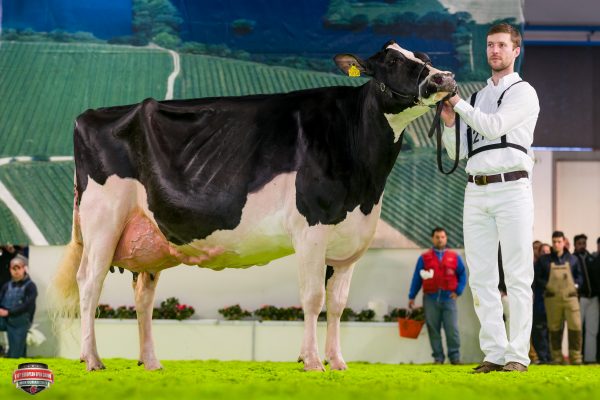

 Cows don’t like
  William “Terry” Howard, age 80, passed away on Sunday, Feb. 26, 2017.
 THESE NEWCOMERS TO U.S. AGRICULTURE BREAK THROUGH BOUNDARIES TO FARM OR MANAGE FARMS.


 A dairy in Gretna is a total loss after a fire this weekend.
 To benefit veterinarians and their busy schedules amid the implementation of the new Veterinary Feed Directive (VFD) regulation, Zoetis has introduced a mobile application for use on smartphones, helping simplify the process of writing a VFD for AUREOMYCIN®(chlortetracycline) or AUREO S 700® (chlortetracycline/sulfamethazine) for their cattle clients.


 A recent study released by the Centers for Disease Control and Prevention showed that rural Americans are at a higher risk of dying from five major causes than those living in urban areas. The potentially preventable causes were: heart disease, cancer, unintentional injuries, chronic lower respiratory disease and stroke. The top five causes of death across the state of Kansas are the same, but in a slightly different order: cancer, heart disease, chronic lower respiratory diseases, stroke and unintentional injuries.
 National Association of Animal Breeders is pleased to announce that Chase Fritz has been selected to fill the position of Data Manager for NAAB and began fulfilling his duties on February 20, 2017.
 Farmers of Canada (DFC) has partnered with the Tim Horton Children’s Foundation (THCF) to present the THCF Kilimanjaro Summit Climb, to raise funds in support of the more than 20,000 children and youth who benefit from THCF programs every year.
 Operators of the Stanhope Dairy Farm say they look forward to continuing farming under an agreement that does not allow them to bring in food scraps and construction debris.
 $8-billion class-action suit says Ottawa should have done more.
 The American Guernsey Association Board of Directors are pleased to announce that Douglas L. Granitz has been hired as the new Chief Executive Officer of the organization. He will be responsible for leading the American Guernsey Association (AGA), and its subsidiaries, through an exciting future of transition and growth. His duties will include helping to develop business strategies and plans, lead and motivate member engagement, oversee all operations and business activities of the organization, review all financial and non-financial reports with the Board of Directors and make high-quality investing decisions to advance the organization and increase profits. He will also enforce policies and guidelines, promote the breed and identify and develop growth opportunities for the organizations.

 “In the current global trading system, the tide of protectionism is rising. Brexit and the initial trade policy proclamations by Donald Trump both point to a challenging environment for further trade liberalisation, at least in the short term,” said NZIER in the report for the Dairy Companies Association of New Zealand. Against this backdrop there is an increasing risk that tariffs could be lifted rather than reduced, it added.
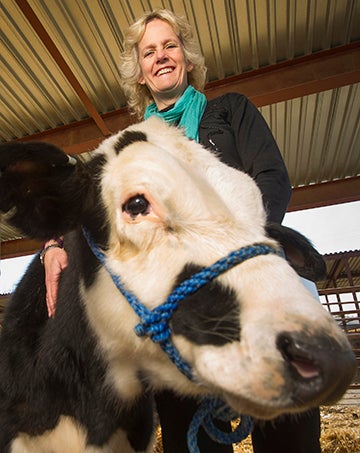 And, following in the footsteps of traditional breeding, gene editing has tremendous potential to boost the sustainability of livestock production, while also enhancing food-animal health and welfare, argues UC Davis animal scientist Alison Van Eenennaam.
 A new report from Development Economics says that for every £1 invested in farm support, farming delivers £7.40 back to the economy.
 A LLYN couple who decided to take back control on their farm and launch their own milk brand are to star in a new BBC show on Monday night.
 Last fall, 16-year-old Karagen Stone had to miss a couple of days of field hockey practice to take a special class.
 A panel of economists painted a dark picture of the U.S. farm sector during a House Agriculture Committee hearing, although they said indicators are not as dire as in the 1980s, when high interest rates, low commodity prices and a strong dollar combined to drive a wave of farm foreclosures.
 A leaked email has set Dairy Australia at odds with the farmers it represents, after it named a number of farmer-based social media accounts and the strategy for dealing with them.
 Police in a Connecticut town are reminding people to not open their doors to “any unfamiliar cattle” after a pair of cows escaped from their pen and were found near the front door of a home a couple of houses away.



