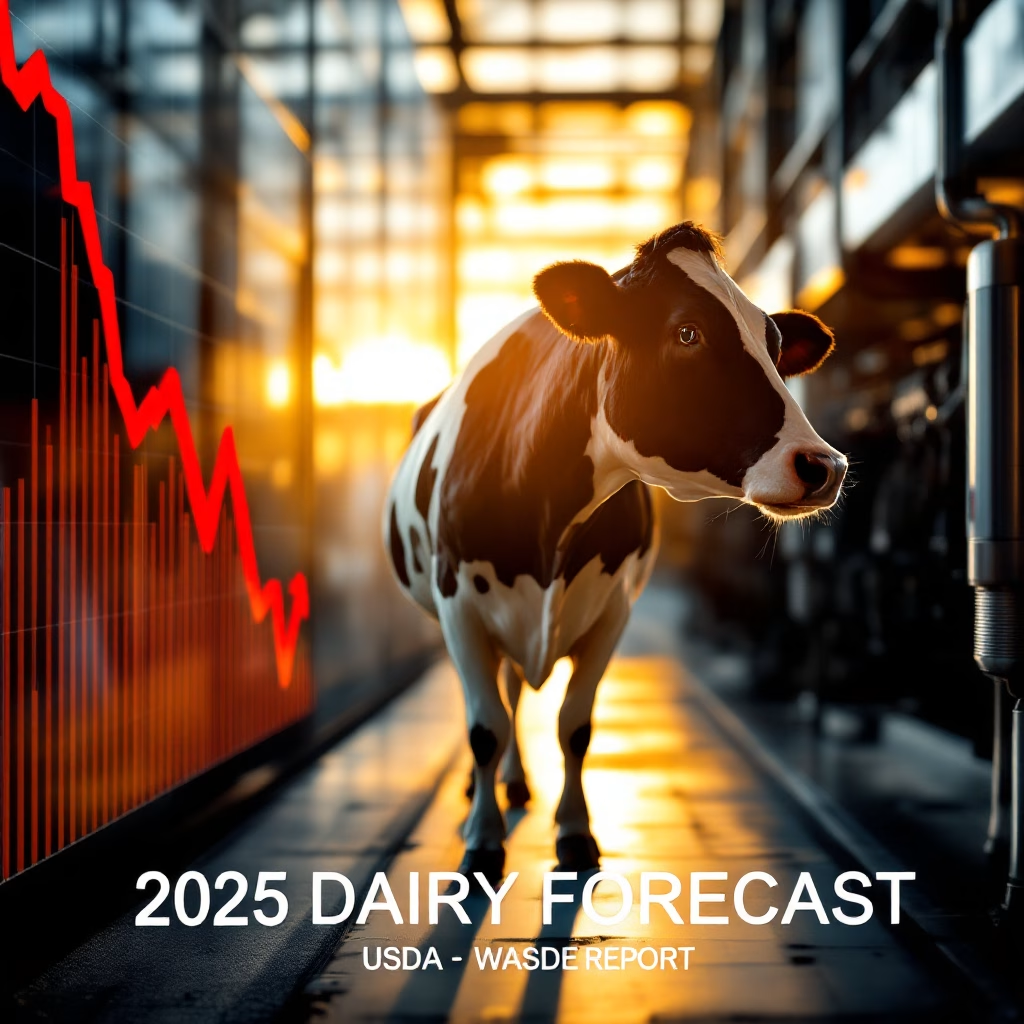
Archive for USDA milk price forecast

CME Dairy Market Report: April 16, 2025 – Cheddar Blocks Surge While Barrels Reverse Course; Butter Continues Decline Amid Stable Powder Markets

Cheese markets split as blocks surge and barrels tumble; butter slides further while global signals flash warning signs for US producers.

EXECUTIVE SUMMARY: The April 16th CME dairy markets revealed sharp divergence as cheddar blocks jumped 2.50¢ to $1.8250/lb while barrels dropped by the same amount to $1.8750/lb, dramatically narrowing their unusual price spread to just 5¢. Butter’s downward slide continued, falling another penny to $2.3400/lb despite significant premiums in international markets. Trading volumes remained subdued across most products, suggesting market uncertainty as participants digest USDA’s downgraded milk price forecasts for 2025, which now project Class III at .95/cwt and Class IV at .80/cwt. The global context presents mixed signals, with the GDT Price Index rising 1.6% despite forecasts of constrained milk production in key exporting regions, while US futures markets remain cautious about near-term price prospects amid ample domestic butter inventories and ongoing export challenges.

KEY TAKEAWAYS

  • Cheese Market Volatility Intensifies: The rapid correction in block-barrel spread (from a 10¢ to 5¢ barrel premium) highlights unstable dynamics between retail and processing channels, with block prices rising despite zero trades through strong bidding interest.
  • Butter Discount to Global Markets Persists: US butter continues trading at substantial discounts to international benchmarks ($2.34/lb vs. ~$3.48/lb for EU butter), yet domestic inventories continue weighing on prices despite potential export opportunities.
  • Low Trading Volumes Signal Uncertainty: Most products saw minimal trading activity, reflecting market hesitation as participants await clearer signals on seasonal demand trends and the impact of USDA’s lowered price forecasts.
  • Feed Costs Creating Margin Pressure: Recent strength in corn and soybean meal futures adds pressure to dairy producer margins already facing lowered milk price projections, increasing the importance of proactive risk management strategies.
  • Long-Term Supply Constraints Could Provide Support: Despite current bearish sentiment, forecasted production constraints in major exporting regions (EU and New Zealand) due to environmental regulations and structural factors could potentially support prices later in 2025 if global demand remains resilient.

CME dairy market report, cheese price volatility, butter price trends, USDA milk price forecast, global dairy market analysis

The dairy market showed significant divergence today, with cheddar blocks climbing while barrels retreated, dramatically narrowing their unusual price spread. Butter continued its downward slide while milk powders remained stable. Class III futures settled slightly below the USDA’s revised annual forecast, reflecting market uncertainty amid mixed global signals and domestic inventory concerns.

Key Price Changes & Market Trends

Today’s CME session revealed sharp contrasts across dairy products. Cheddar cheese prices moved opposite directions, correcting yesterday’s unusual spread dynamics, while butter extended its decline and milk powders held steady.

ProductClosing Price ($/lb)Change from Yesterday (¢/lb)
Cheese (Blocks)$1.8250+2.50¢
Cheese (Barrels)$1.8750-2.50¢
Butter$2.3400-1.00¢
Nonfat Dry Milk$1.1675Unchanged
Dry Whey$0.4750Unchanged

The cheese complex provided today’s most dramatic storyline. Cheddar blocks jumped 2.50 cents to $1.8250/lb, while barrels fell by the same amount to $1.8750/lb. This 5-cent swing narrowed the barrel premium over blocks to just 5 cents, correcting Tuesday’s unusual 10-cent spread. Tuesday’s barrel surge occurred on minimal volume (just one trade), making it vulnerable to today’s correction. The rapid shift highlights ongoing volatility in the relative valuation between cheese destined for retail/food service (blocks) versus processed cheese manufacturing (barrels).

Butter prices weakened further, dropping another penny to $2.3400/lb, continuing this week’s downward trend from Tuesday’s $2.3500/lb. Persistent concerns about abundant domestic inventories appear to be weighing on the market. The current CME cash price represents a substantial discount to global benchmarks, suggesting domestic supply factors dominate market dynamics.

NDM and Dry Whey prices remained unchanged at $1.1675/lb and $0.4750/lb respectively. This stability follows a period where NDM held steady while Dry Whey showed modest strength earlier in the week. The lack of movement could reflect balanced immediate supply/demand fundamentals or trader caution.

Volume and Trading Activity

FinalChange ¢/lb.TradesBidsOffers
Butter2.3400-1.00821
Cheddar Block1.8250+2.50030
Cheddar Barrel1.8750-2.50111
NDM Grade A1.1675NC012
Dry Whey0.4750NC200

Trading activity was generally subdued across dairy products today, particularly in cheese, with butter seeing the most transactions:

  • Butter: Moderate activity with eight loads traded. At close, two unfilled bids and one unfilled offer remained, suggesting relatively balanced interest near the settlement price.
  • Cheddar Block: No trades executed, but three unfilled bids and zero offers at close indicate significant unsatisfied buying interest at $1.8250/lb or higher. This reinforces the bullish price move despite the absence of transactions.
  • Cheddar Barrel: One trade was executed with one bid and one offer remaining close, indicating limited but balanced interest around the $1.8750/lb settlement.
  • NDM Grade A: No trades, with one bid and two offers at close, suggesting slight selling pressure but insufficient convergence for trades to materialize.
  • Dry Whey: Two trades were completed with no bids or offers remaining, indicating the trades satisfied available interest at the $0.4750/lb level.

The overall light volume could signal market uncertainty. Participants may hesitate to commit to significant positions while awaiting clearer signals from upcoming supply/demand reports, confirmation of seasonal demand trends, or further developments in global markets.

Weekly CME Cash Dairy Product Prices ($/lb.)

MonTueWedThurFriCurrent Avg.Prior Week Avg.Weekly Volume
Butter2.34752.35002.34002.34582.320527
Cheddar Block1.77001.80001.82501.79831.713011
Cheddar Barrel1.84001.90001.87501.87171.75857
NDM Grade A1.16751.16751.16751.16751.16050
Dry Whey0.46500.47500.47500.47170.48304

Global Context

International dairy markets present a mixed picture, influencing US price direction and sentiment.

The most recent Global Dairy Trade (GDT) auction on April 15 showed continued overall strength, with the GDT Price Index rising 1.6%. However, results varied significantly by product. Fats (Butter +1.5%, Anhydrous Milk Fat +2.1%) and Whole Milk Powder (+2.8%) showed gains, alongside strong increases in Mozzarella (+5.4%) and Lactose (+22.0%). Conversely, Skim Milk Powder (-2.3%) and Cheddar (-1.8%) registered declines.

European Union milk supply forecasts continue to point toward tightening conditions, with projections suggesting a decline in milk production of 0.2% to 0.3% for 2024/2025. This trend stems from shrinking dairy herds, significant environmental regulations under the EU Green Deal, disease pressures, and persistent cost pressures on producers. European butter prices remain significantly higher than the US, creating a substantial market price gap.

New Zealand milk production forecasts for the 2025 market year are generally stable to slightly lower. FAS/Wellington projects a modest decrease to 21.3 million metric tons, slightly below the recent five-year average. New Zealand continues its strategic shift from WMP toward value-added products like butter and cheese, increasing competition in these global markets.

The export outlook for US dairy products faces headwinds. Competitiveness concerns persist, and muted demand from China, particularly for milk powders, remains a recurring theme. The USDA’s April WASDE report lowered its 2025 export forecasts for US cheese, dry skim milk products, and lactose.

Forecasts and Analysis

Recent USDA forecasts provide critical context for current market conditions, though they paint a more cautious picture than earlier projections.

The USDA has revised its milk price forecasts downward for 2025. The latest all-milk price projection is $21.60 per hundredweight (cwt), significantly reduced from February’s $22.60/cwt forecast and January’s $23.05/cwt outlook. The Class III price forecast was lowered to $17.95/cwt, and Class IV was reduced to $18.80/cwt.

Today’s May Class III futures settlement at $17.87/cwt aligns closely with the USDA’s lowered forecast. However, May Class IV futures settled at $18.32/cwt, notably below the USDA’s $18.80/cwt annual projection. This divergence suggests the futures market is currently pricing in greater weakness for Class IV components (butter and NDM) than anticipated in the USDA’s latest annual average forecast.

Feed costs remain a critical factor for producer profitability. Today’s CME futures settlements saw May Corn rise 2.00 cents to $4.8550/bushel and May Soybean Meal increase $2.30 to $296.70/ton. The recent strength in grain and meal futures pressures margins, which are already facing lower milk price projections.

Market Sentiment

The prevailing mood in dairy markets appears mixed and cautious, reflecting conflicting price signals, recent downward revisions to USDA forecasts, and ongoing global uncertainties.

Recent commentary has highlighted the high volatility in the cheese complex, particularly the rapid shifts in the block-barrel spread, signaling uncertainty regarding demand strength between retail/food service and processing channels. Concerns about ample domestic butter inventories continue to surface, often cited as a key factor weighing prices despite reports of stable retail movement or strength in global benchmarks.

One market analyst noted, “Volatility in the cheese complex remains elevated, with the block-barrel relationship shifting rapidly, reflecting uncertainty between processing and retail demand channels.” Another observed, “Butter continues to search for a floor, as ample domestic supplies appear to outweigh global price signals for now.”

Overall, sentiment leans cautious; while some anticipate seasonal demand improvement, the lower USDA price forecasts and ongoing global market uncertainties temper bullish conviction. The contrast between the cautious-to-bearish sentiment prevalent in the US market and the relative strength in the recent overall GDT index indicates a potential disconnect or lag.

Closing Summary & Recommendations

CME dairy markets exhibited sharp divergence today, as Cheddar blocks rose significantly while barrels reversed lower, narrowing the recent spread. Butter prices declined amid moderate trading, while NDM and Dry Whey held steady. Overall market sentiment remains cautious following recent USDA forecast downgrades amidst ongoing global market uncertainties.

For Producers: The volatile cheese spread directly impacts Class III milk values and warrants close monitoring. Given the lower USDA price forecasts for 2025 and the recent uptick in feed futures, evaluating risk management strategies (hedging, forward contracts) is crucial. Continued focus on operational efficiency, cost control, and potentially optimizing milk components remains advisable.

For Traders: The thin trading volume behind some of today’s significant price moves, especially the Cheddar block increase on zero trades, warrants caution regarding the sustainability of these levels. Confirmation of underlying demand trends is needed. While the US butter price discount to global markets exists, the persistent inventory overhang remains a significant headwind that needs to be cleared before sustained rallies are likely.

Near-term uncertainty is expected to persist, particularly in the cheese markets, as they seek equilibrium after recent volatility. In the long term, the constrained milk production growth forecast in major exporting regions like the EU and New Zealand could support global dairy prices if demand remains resilient, offering a potential counterpoint to the current bearish domestic sentiment and forecasts.

Learn more:

Join the Revolution!

Join over 30,000 successful dairy professionals who rely on Bullvine Daily for their competitive edge. Delivered directly to your inbox each week, our exclusive industry insights help you make smarter decisions while saving precious hours every week. Never miss critical updates on milk production trends, breakthrough technologies, and profit-boosting strategies that top producers are already implementing. Subscribe now to transform your dairy operation’s efficiency and profitability—your future success is just one click away.

NewsSubscribe
First
Last
Consent

CME Daily Dairy Market Report – April 2, 2025 – Cheddar Barrel Prices Surge 3.75¢ While Blocks Edge Higher; Dry Whey Weakens Amid Mixed Market

Cheddar Barrels jump 3.75¢ as cheese demand surges; Dry Whey slumps 0.50¢. Mixed dairy markets show diverging trends amid global supply shifts.

Executive Summary: The April 2 CME dairy markets saw sharp gains in Cheddar Barrels (+3.75¢) and modest growth in Blocks (+0.75¢), driven by tight inventories and new processing capacity, while Dry Whey fell (-0.50¢) on weak global demand. Trading activity highlighted bullish cheese sentiment, with Cheddar Blocks seeing 11 trades and no offers at close. Globally, EU milk production declined (-0.2%) as U.S. herds expanded (+34k cows), while USDA forecasts project Q2 Class III milk at .50/cwt despite current futures lagging. Analysts warn of cheese oversupply risks as 2025 processing capacity grows 6%, urging producers to prioritize flexible pricing strategies.

Key Takeaways

  • Cheese divergence: Barrel prices surged 3.75¢ on tight supplies vs. Block’s 0.75¢ gain
  • Global split: EU milk output shrinks (-0.2%) as U.S./NZ herds expand (+34k cows; +3.1% production)
  • Forecast gap: USDA’s $18.50/cwt Class III outlook exceeds current $17.13 futures, signaling market skepticism
  • Strategic play: Producers advised to leverage cheese-driven pricing amid whey/butter uncertainty
CME dairy market report, cheese price trends, Class III milk futures, global dairy production, USDA milk price forecast

The Chicago Mercantile Exchange (CME) dairy markets showed significant strength in cheese prices today, with Cheddar Barrels leading gains at +3.75¢, while Dry Whey continued its downward trend. Butter and Nonfat Dry Milk prices remained stable today as market participants evaluated shifting supply and demand fundamentals across dairy commodities.

Key Price Changes & Market Trends

ProductClosing PriceChange from Yesterday
Cheddar Block$1.6650/lb+0.75¢
Cheddar Barrel$1.6975/lb+3.75¢
Butter$2.3400/lbUnchanged
NDM Grade A$1.1725/lbUnchanged
Dry Whey$0.4900/lb-0.50¢

Cheddar Barrel prices jumped significantly by 3.75¢, reflecting tightening cheese inventories and strong domestic demand. Cheddar Blocks moved more modestly upward by 0.75¢, continuing the price strength observed earlier this week. Butter prices remained unchanged at $2.3400/lb as the market balanced ample production against steady retail demand. Nonfat Dry Milk held steady at $1.1725/lb, while Dry Whey prices declined by 0.50¢ to $0.4900/lb amid continued pressure from global market conditions.

Volume and Trading Activity

Today’s CME dairy session saw varied trading activity across products, with cheese markets demonstrating the strongest participation:

ProductTradesBidsOffers
Cheddar Block1120
Butter724
Cheddar Barrel335
NDM Grade A364
Dry Whey230

Cheddar Blocks dominated trading activity with 11 trades completed, indicating strong buyer interest with no available offers at the close – a bullish signal for near-term market direction. Butter saw moderate activity with seven trades and a slight imbalance toward selling interest with four offers against two bids. NDM Grade A exhibited strong bidding interest with six bids against four offers, suggesting potential upward price pressure despite an unchanged settlement today. Dry Whey trading remained limited, with just two trades executed.

Global Context

The current dairy market dynamics reflect broader global trends that influence U.S. prices. The European Union’s dairy sector is experiencing contraction in 2025, with milk deliveries projected to decline by 0.2% year-over-year due to regulatory pressures, persistent margin compression, and accelerating herd reduction. This production ceiling in Europe creates potential opportunities for U.S. exporters.

In contrast to European constraints, the United States dairy sector demonstrates robust expansion through 2025, with producers adding 34,000 dairy cows between July and December 2024. New Zealand’s milk production is also showing positive momentum, with December 2024 collections increasing by 1.4% year-over-year and total seasonal production growth reaching 3.1%. This growth is driven by favorable weather conditions and improved farm profitability.

Global milk supply from the major exporting regions is forecast to grow by 0.8% in 2025, with gains anticipated in all significant areas for the first time since 2020. This broad-based production growth could pressure global dairy prices if not matched by corresponding demand.

Forecasts and Analysis

Current futures prices and USDA projections indicate divergent expectations for dairy markets in the coming months:

![Current Futures vs. USDA Q2 Projections – April 2, 2025](https://ppl-ai-code-interpreter-files.s3.amazonaws.com/web/direct-files/47701927/56f91267-229d-4db8-bdbe Class III milk futures settled at .13/cwt today, remaining significantly below the USDA Q2 projection of .50/cwt. Similarly, Class IV futures closed at $18.27/cwt, well below the USDA forecast of $19.10/cwt for Q2 2025. This gap suggests market participants hold a more bearish outlook than USDA analysts.

The USDA has recently adjusted its 2025 milk production forecast downward to 226.9 billion pounds in its February report, a reduction of 400 million pounds based on recent Milk Production and Cattle Inventory Reports that showed a tighter supply of dairy heifers than expected. Despite this reduction, milk production is projected to increase year-over-year, with cheese production expected to benefit from substantial new processing capacity coming online in 2025.

Market Sentiment

Market sentiment appears mixed across dairy products, with a notably bullish tone for cheese and more cautious outlooks for other commodities. The intense trading activity in Cheddar Blocks, which has no offers at close, signals confidence among holders and potentially tight supplies in the near term. Conversely, despite today’s significant price increase, the multiple offers for Cheddar Barrels suggest some sellers believe the current rally may be reaching its peak.

According to dairy market analysts, “The commissioning of new cheese plants across the U.S. is creating a two-sided market dynamic – increased processing capacity is supporting farmgate milk prices, while the potential for 6% growth in cheese manufacturing capacity could pressure cheese prices later in 2025 if domestic and export demand fails to keep pace with production”.

The butter market remains well-balanced, with one trader noting, “We’re seeing steady demand domestically, but the real question for Q2 will be whether export competitiveness improves given the current global price spread.” The continued weakness in Dry Whey reflects ongoing challenges in protein markets, with multiple industry sources expressing concern about limited export opportunities in the near term.

Closing Summary & Recommendations

In summary, today’s CME dairy market demonstrated significant strength in the cheese sector, with Cheddar Barrels surging 3.75¢ and Blocks gaining 0.75¢, while Butter and NDM remained stable and Dry Whey declined. The divergence between cheese strength and whey weakness reflects the interplay of domestic and international factors influencing different segments of the dairy complex.

For producers, the current market environment suggests maintaining flexibility in milk marketing strategies, with potential opportunities in cheese-heavy milk pricing formulas, given the relative strength in that sector. Processors should closely monitor the widening barrel-block spread, which could present operational advantages for those with flexible manufacturing capabilities. Given U.S. price competitiveness, exporters would be wise to focus on cheese and butter opportunities while recognizing that dry whey exports face continued headwinds due to global market conditions.

Market participants should pay particular attention to upcoming USDA reports for further insights on production trends while monitoring international demand – particularly from China- where early signs of import recovery could significantly impact global dairy prices in the coming months.

Learn more:

Join the Revolution!

Join over 30,000 successful dairy professionals who rely on Bullvine Daily for their competitive edge. Delivered directly to your inbox each week, our exclusive industry insights help you make smarter decisions while saving precious hours every week. Never miss critical updates on milk production trends, breakthrough technologies, and profit-boosting strategies that top producers are already implementing. Subscribe now to transform your dairy operation’s efficiency and profitability—your future success is just one click away.

NewsSubscribe
First
Last
Consent

USDA Slashes 2025 Milk Price Forecast By $1: What Dairy Farmers Need to Know

USDA just cut your 2025 milk check by $125,000. Find out why Washington’s forecasters are slashing prices while sending contradictory production signals.

EXECUTIVE SUMMARY: The USDA’s March WASDE report has dramatically cut the 2025 all-milk price forecast by a full dollar to $21.60 per hundredweight, potentially reducing annual revenue by $125,000 for a 500-cow dairy operation. This unexpected reduction coincides with puzzling production projections that predict higher cow inventories yet lower milk output per cow, contradicting basic dairy economics. Historical analysis reveals USDA has consistently revised forecasts downward mid-year in four of the past five years, suggesting a pattern of initial optimism followed by sobering corrections. While these projections create planning challenges, successful producers are focusing on controllable factors—implementing feed efficiency programs that can save $0.75-1.25/cwt, optimizing milk components for premium payments, and employing risk management strategies that blend contracted and cash market sales. The most resilient operations are questioning forecast assumptions while maintaining operational excellence to buffer against market volatility.

KEY TAKEAWAYS

  • USDA has cut the 2025 all-milk price forecast to $21.60/cwt, down $1.00 from February’s projection and $1.01 below the 2024 estimate.
  • For a 500-cow dairy producing 25,000 pounds per cow annually, this forecast reduction represents approximately $125,000 in lost revenue.
  • Operations with production below 24,000 pounds per cow annually will struggle to remain profitable if prices settle at or below $21.60/cwt.
  • Feed efficiency improvements can potentially reduce production costs by $0.75-1.25/cwt, helping offset lower milk prices.
  • The most successful producers blend price risk management (40% six-month contracts, 30% three-month contracts, 30% cash market) while focusing on operational excellence rather than forecast anxiety.

The USDA’s March World Agricultural Supply and Demand Estimates (WASDE) report has sent shockwaves through the dairy industry, cutting the 2025 all-milk price forecast by a whole dollar to $21.60 per hundredweight (cwt). This dramatic reduction comes alongside lowered projections for cheese, butter, nonfat dry milk (NDM), and whey prices, signaling potential financial strain for producers nationwide.

Adding to the confusion, the report predicts higher cow inventories but lower milk output per cow—a contradiction that has industry experts questioning the reliability of USDA’s forecasting methodology.

“The USDA’s March WASDE report has sent shockwaves through the dairy industry, cutting the 2025 all-milk price forecast by a full dollar to $21.60 per hundredweight.”

“This kind of whiplash in forecasting makes it impossible to plan,” says Wisconsin dairy producer Mike Johnson, who milks 350 cows. “We’re making feed purchasing and breeding decisions months in advance, and now USDA tells us our milk will be worth a dollar less? That’s the difference between profit and loss for many operations.”

For a 500-cow dairy producing 25,000 pounds per cow annually, this forecast reduction represents approximately $125,000 in reduced annual revenue—enough to cancel planned equipment upgrades or halt facility improvements that would have enhanced efficiency.

PRODUCTION PUZZLE: MORE COWS BUT LESS MILK?

The March WASDE report (USDA-OCE-2025-3, released March 8, 2025) revises the 2025 milk production forecast downward to 226.2 billion pounds—a 700-million-pound reduction from February’s estimate. The USDA attributes this adjustment to “lower expected milk output per cow more than offsetting slightly higher cow inventories.”

This puzzling scenario raises questions about why productivity per cow is expected to decline despite ongoing investments in genetics and management strategies aimed at increasing efficiency.

“The USDA attributes this adjustment to ‘lower expected milk output per cow more than offsetting slightly higher cow inventories’ — a puzzling scenario that raises questions.”

For context, the 2024 production estimate remains unchanged at 225.9 billion pounds, which is 400 million pounds less than the actual production total of 226.3 billion pounds in 2023. Despite the slight year-over-year increase projected for 2025, the downward revision creates uncertainty for producers planning herd expansions or capital investments based on earlier forecasts.

Milk Production Trends at a Glance

YearAnnual Production (Billion Pounds)Notes
2023226.3Actual production (USDA-NASS Annual Milk Production Report)
2024225.9Current estimate (unchanged from February WASDE)
2025226.2March forecast (down 700 million pounds from February)

This reduction represents approximately 0.3% of expected annual production—a seemingly minor adjustment but one with significant ripple effects throughout the supply chain.

“We’ve tracked USDA forecasts for the past five years, and they’ve revised production downward mid-year in four of those five years,” notes California producer Maria Sanchez, who manages a 1,200-cow operation. “We’ve learned to take the early-year optimism with a grain of salt and build in a buffer when setting our production targets.”

YOUR 2025 MILK CHECK: PREPARE FOR SMALLER DEPOSITS

The March WASDE report delivers sobering news for producers counting on strong returns in 2025. The all-milk price is now projected at $21.60 per cwt—down $1.00 from February’s forecast of $22.60 and $1.01 below the current estimate for 2024 ($22.61 per cwt).

This marks a year-over-year decline in expected milk check values, raising concerns about broader market trends.

USDA’s Dramatic Price Forecast Shift

CategoryFebruary 2025 ForecastMarch 2025 ForecastChange
All-Milk Price$22.60/cwt$21.60/cwt-$1.00
Class III Price$19.05/cwt*$17.95/cwt-$1.10
Class IV Price$19.75/cwt*$18.80/cwt-$0.95

*February Class III and IV forecasts derived from USDA Dairy Market News (Vol. 92, No. 7)

Cheese, butter, NDM, and whey prices have all been lowered based on recent market trends, directly impacting Class III and Class IV milk values:

  • Class III price is now forecasted at $17.95 per cwt—down from the 2024 estimate of $18.89.
  • Class IV price is projected at $18.80 per cwt—significantly lower than the unchanged 2024 estimate of $20.75.

“These aren’t minor adjustments—they represent substantial reductions directly affecting producer revenues.”

Dr. Peter Vitaliano, Chief Economist at the National Milk Producers Federation, expressed concern about these revisions: “These significant downward adjustments create planning challenges for dairy producers who rely on consistent projections for business decisions.”

BEHIND THE NUMBERS: WHY IS WASHINGTON CHANGING ITS TUNE?

The March WASDE report raises fundamental questions about how USDA forecasts are developed and what factors drive their frequent revisions. While official explanations focus on productivity adjustments, several market analysts suggest other factors may influence these projections.

Looking at historical data, USDA has revised its all-milk price forecast downward by an average of $0.85/cwt between January and March forecasts over the past four years, suggesting a pattern of initial optimism followed by reality adjustments.

“We often see a tendency toward optimism in early forecasts that gets tempered by market realities as the year progresses.” — Tanner Ehmke, lead economist at CoBank’s Knowledge Exchange.

Tanner Ehmke, lead economist at CoBank’s Knowledge Exchange division, notes: “We often see a tendency toward optimism in early forecasts that gets tempered by market realities as the year progresses.”

Sarah Williams, dairy futures analyst at Central States Commodities, adds: “The futures markets have reacted strongly to this forecast revision. We’re seeing significant repositioning in Class III and Class IV contracts.”

The contradiction between expanding herd sizes and reduced output expectations suggests either a shift in herd demographics or flaws in assessing productivity trends.

SURVIVAL STRATEGIES: PROTECTING YOUR DAIRY BUSINESS

With lower price projections and tighter margins ahead, dairy producers must reassess their strategies to effectively navigate this challenging environment.

Smart Moves for Small to Mid-Sized Dairies

  • Feed Efficiency: Prioritize programs that reduce feed costs while maintaining productivity. University of Wisconsin research shows a potential 10-15% feed cost reduction through precision ration formulation, saving $0.75-1.25/cwt in production costs.
  • Component Optimization: Focus on butterfat and protein levels to maximize revenue from processors offering premiums. Each 0.1% increase in butterfat can add $0.15-0.20/cwt to your milk check.
  • Direct Marketing: Explore specialty product arrangements that may offer higher pricing. Local cheese production partnerships can increase farm revenue by 20-30% compared to conventional milk sales.

Winning Tactics for Large Operations

  • Economies of Scale: Leverage bulk purchasing power to negotiate input pricing. Through forward contracting, volume discounts on feed ingredients can reduce costs by 5-8%.
  • Advanced Analytics: Use data-driven insights to identify operational efficiencies. Feed management software implementations show an ROI of 3:1 through reduced waste and optimized rations.
  • Processor Negotiations: Evaluate component premiums across multiple buyers. In the same region, component pricing differences between processors can vary by up to $0.30/cwt.

“Frequent revisions force us to readjust operations constantly.” — Michael Johnson, VP of Supply Chain at Great Lakes Dairy Processing.

CASE STUDY: Weathering the Forecast Storm

The Hilltop Dairy operation in Pennsylvania has implemented a comprehensive risk management strategy that combines milk price contracting, feed-forward purchasing, and production efficiency measures. Owner James Wilson explains their approach:

“We’ve calculated our breakeven all-milk price at different production levels: $19.75/cwt at current feed prices, dropping to $18.90/cwt if we achieve our efficiency targets. Based on USDA’s forecast history, we contract 40% of our production six months ahead, 30% three months ahead, and leave 30% exposed to cash markets. Despite volatile USDA forecasts, this blended approach has kept our milk revenue within 5% of our projected budget for three consecutive years.”

MARK THESE DATES: UPCOMING WASDE REPORTS TO WATCH

The following WASDE report will be released on April 10th at noon ET and will provide critical insights into whether March’s adjustments represent a new baseline or a temporary shift.

Critical WASDE Release Dates for Your Calendar

MonthRelease DateTime
AprilApril 1012:00 PM ET
MayMay 1212:00 PM ET
JuneJune 1212:00 PM ET

Producers should integrate these release dates into their planning calendars to stay ahead of market developments.

At current breakeven prices, operations producing below 24,000 pounds per cow annually will struggle to remain profitable if the all-milk price settles at or below $21.60/cwt. Those with higher debt loads face even more significant challenges as interest expenses consume an increasing percentage of milk revenue.

BOTTOM LINE: QUESTION WASHINGTON, TRUST YOUR INSTINCTS

The USDA’s March WASDE report underscores the importance of resilience and adaptability in navigating uncertain market conditions. While government forecasts provide valuable perspectives, successful producers complement these projections with diverse information sources and flexible management approaches.

“Your farm’s survival depends on questioning assumptions behind these projections and adapting your strategies accordingly.”

Your farm’s survival depends on questioning the assumptions behind these projections and adapting your strategies accordingly. What changes will you make based on this latest forecast?

“The most successful producers I work with don’t get caught up in forecast anxiety,” observes Iowa State Extension dairy specialist Thomas Reynolds. “They focus instead on what they can control—feed efficiency, reproduction, cow comfort, and cost management. The price will be what it will be, but operational excellence provides the buffer against forecast failures.”

Learn more:

Join the Revolution!

Join over 30,000 successful dairy professionals who rely on Bullvine Daily for their competitive edge. Delivered directly to your inbox each week, our exclusive industry insights help you make smarter decisions while saving precious hours every week. Never miss critical updates on milk production trends, breakthrough technologies, and profit-boosting strategies that top producers are already implementing. Subscribe now to transform your dairy operation’s efficiency and profitability—your future success is just one click away.

NewsSubscribe
First
Last
Consent

Cheese Holds Steady as Butter and NDM Decline; Trading Activity Subdued

Dairy markets end the week with mixed signals: cheese holds steady while butter and NDM decline. Low trading volume hints at potential volatility ahead. Global factors shape the landscape, including rising EU exports and Chinese demand. What’s next for dairy prices? Find out in our comprehensive market report.

Summary:

In the dairy market, cheese prices are stable, while butter and nonfat dry milk (NDM) prices have declined due to low trading activity. Cheddar blocks didn’t change from $1.9200/lb, but butter decreased by 2.25 cents. The subdued trading suggests possible price fluctuations soon. Global factors are significant, with more EU butter exports adding competition and rising Chinese demand supporting cheese prices. The USDA forecasts a slight rise in Q2 2025 Class III milk prices to $18.75/cwt. Despite mixed signals, market optimism persists, and stakeholders should watch global production trends and prepare for possible shifts.

Key Takeaways:

  • Cheese prices remained relatively stable, with blocks unchanged and barrels slightly declining.
  • Butter and nonfat dry milk (NDM) experienced notable price drops, indicating potential selling pressure.
  • Low trading volume across dairy markets could increase volatility the following week.
  • Rising EU butter exports and increased Chinese demand for cheese and whey are shaping global market dynamics.
  • USDA forecasts suggest a moderate upward trend in Class III milk prices, driven by steady cheese demand.
  • Mixed market sentiment highlights the importance of a diversified approach for stakeholders in navigating different product trends.
  • Dairy stakeholders are advised to monitor global production trends and consider strategic actions to optimize market opportunities.
dairy market trends, cheese prices stability, butter price decline, global dairy demand, USDA milk price forecast

Dairy commodity markets have seen notable price movements, with cheese holding steady as other products experience declines. Here’s a breakdown of the key price changes and trends impacting the market: 

Key Price Changes & Market Trends 

ProductClosing PriceChange from YesterdayWeekly AverageChange from Last Week
Cheese (Blocks)$1.9200/lbUnchanged$1.9140/lb+4.55¢
Cheese (Barrels)$1.8175/lb-1.25¢$1.8215/lb+2.45¢
Butter$2.3775/lb-2.25¢$2.3985/lb-1.15¢
Nonfat Dry Milk$1.2800/lb-2.00¢$1.3010/lb-3.70¢
Dry Whey$0.5550/lb-0.50¢$0.5675/lb-3.80¢

Cheddar block prices remained unchanged at $1.9200/lb, while barrels slightly decreased by 1.25 cents. Butterexperienced the most significant daily decline, dropping 2.25 cents to close at $2.3775/lb. Nonfat dry milk (NDM)also fell by 2 cents, settling at $1.2800/lb, while dry whey decreased by half a cent to $0.5550/lb. Despite today’s declines, weekly averages for cheese remain higher than last week, indicating overall strength in the cheese market. 

Volume and Trading Activity 

Trading activity was relatively quiet across most products, reflecting end-of-week positioning: 

  • Cheddar blocks: 1 trade, one bid, two offers
  • Cheddar barrels: 3 trades, zero bids, four offers
  • Butter: 0 trades, zero bids, four offers
  • NDM Grade A: 0 trades, one bid, six offers
  • Dry whey: 2 trades, seven bids, 1 offer

Cheddar barrels showed the most activity among cheese products, while dry whey saw the highest number of bids, suggesting some buying interest despite the price decline. The lack of trades in butter and NDM and multiple offers indicate potential selling pressure in these markets. 

Analysis of Low Trading Activity: The subdued trading volume today may be attributed to several factors:

  1. End-of-week positioning: Traders often reduce activity on Fridays to limit exposure over the weekend.
  2. Uncertainty in global markets: Recent fluctuations in international dairy prices may be causing buyers and sellers to hesitate.
  3. Anticipation of upcoming reports: Market participants might wait for next week’s USDA Milk Production report before making significant moves.

This low activity could increase volatility early next week as pent-up demand or supply is released into the market.

Weekly CME Cash Dairy Product Prices ($/lb.)

MonTueWedThurFriCurrent Avg.Prior Week Avg.Weekly Volume
Butter2.38002.43002.40502.40002.37752.39852.410051
Cheddar Block1.90251.90751.92001.92001.92001.91401.86858
Cheddar Barrel1.81501.81751.82751.83001.81751.82151.79708
NDM Grade A1.32501.30001.30001.30001.28001.30101.338015
Dry Whey0.58750.56750.56750.56000.55500.56750.60554

Global Context 

International dairy markets are exerting significant influence on U.S. prices: 

  1. Oceania Production: For the 2024/2025 season, New Zealand’s milk production increased by 1.5% yearly, putting downward pressure on global butter and whole milk powder prices.
  2. European Union Exports: EU butter exports have risen 8% in the last quarter, intensifying competition in key Asian markets and potentially limiting U.S. export opportunities.
  3. Chinese Demand: Recent data shows a 5% increase in Chinese dairy imports, primarily cheese and whey. This may explain the relative strength of U.S. cheese prices despite the weakness of other dairy commodities.
  4. South American Production: Drought conditions in parts of Brazil and Argentina have reduced milk output, potentially creating opportunities for U.S. exports to fill supply gaps in the region.

Forecasts and Analysis 

The USDA’s latest projections for Q2 2025 suggest a slight improvement in Class III milk prices, with an average of $18.75/cwt expected. The relative stability in cheese prices, a key component of the Class III formula, supports this forecast. 

Class III Milk Price Forecast
[Figure 1: Historical and Projected Class III Milk Prices (Q1 2024 - Q2 2025)]

    $19.50 |                                        *
    $19.00 |                              *        / \
    $18.50 |                    *        / \      /   \
    $18.00 |          *        / \      /   \    /     *
    $17.50 |         / \      /   \    /     *--*
    $17.00 |    *---*   \    /     *--*
    $16.50 |   /         *--*
    $16.00 |--*
           +-----+-----+-----+-----+-----+-----+ 
           Q1'24 Q2'24 Q3'24 Q4'24 Q1'25 Q2'25
               Historical    Projected

The chart above illustrates the USDA’s projected Class III milk prices compared to historical data. The forecast suggests a moderate upward trend, likely driven by expectations of steady cheese demand and potentially tighter milk supplies as we move into the summer months. 

Scenario Analysis: 

  1. Bullish Case: If Chinese demand continues to grow and South American production remains constrained, Class III prices could exceed $19.00/cwt.
  2. Bearish Case: A surge in EU or New Zealand production could pressure global prices, potentially pushing Class III below $18.00/cwt.
  3. Base Case: The current $18.75/cwt projection assumes stable domestic demand and moderate export growth.

Market Sentiment 

Market sentiment remains cautiously optimistic, with mixed signals across different dairy products. The stability in cheese prices, particularly blocks, is a positive sign for producers. However, the declines in butter and NDM warrant close monitoring as we approach the spring flush. We’re seeing increased hedging activity in cheese futures, suggesting market participants anticipate potential volatility in the coming months.

Overall, the market appears to be in a transitional phase, with cheese maintaining its strength while other products face some headwinds. The divergence between cheese and other dairy product prices suggests a complex market environment in which different factors influence various segments of the dairy industry. 

Closing Summary & Recommendations 

In summary, today’s dairy markets showed resilience in cheese prices, particularly blocks, while butter, NDM, and dry whey faced downward pressure. The mixed performance across products highlights the importance of a diversified approach for dairy stakeholders. 

Recommendations: 

  1. Producers:
    • Focus on optimizing cheese production given its relative market strength.
    • Consider locking in prices for a portion of future production using futures or forward contracts.
    • Monitor feed costs closely, as any increases could squeeze margins despite stable milk prices.
  2. Exporters:
    • Explore opportunities in the Asian cheese market, particularly China, where import demand is growing.
    • Be cautious with butter exports due to increased competition from the EU.
    • Investigate potential new markets in South America where drought has affected domestic production.
  3. Traders:
    • Watch for potential arbitrage opportunities between cheese and other dairy products given the current price divergence.
    • Keep an eye on upcoming USDA reports for any shifts in production forecasts that could impact this trend.
    • Consider the impact of low trading volume on potential price volatility early next week.
  4. All Stakeholders:
    • Closely monitor global production trends, especially in New Zealand and the EU, as they influence U.S. market dynamics.
    • Pay attention to upcoming spring flush data, which could significantly impact price directions across all dairy products.
    • Stay informed about developments in Chinese demand and South American production, as these could create unexpected market movements.

Learn more:

Join the Revolution!

Bullvine Daily is your essential e-zine for staying ahead in the dairy industry. With over 30,000 subscribers, we bring you the week’s top news, helping you manage tasks efficiently. Stay informed about milk production, tech adoption, and more, so you can concentrate on your dairy operations. 

NewsSubscribe
First
Last
Consent
Send this to a friend