



Archive for TMR management

Feed as Science: How the Penn State Particle Separator Turns TMR Consistency into Butterfat and Profit

Feed as Science: How the Penn State Box Turns TMR Consistency into Butterfat and Profit
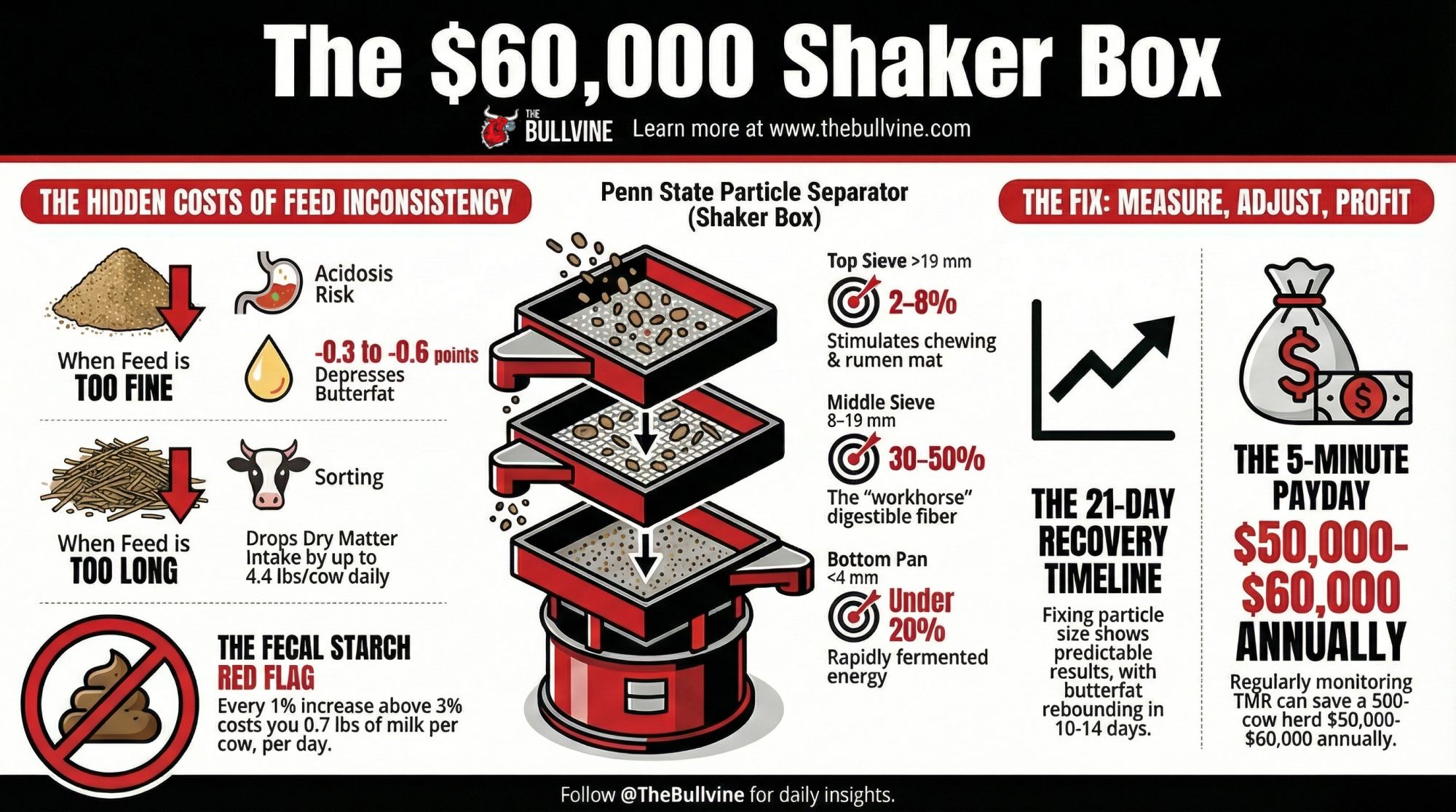
I was in a feed room on a Wisconsin dairy not long ago when I noticed something familiar—a brand-new Penn State Particle Separator, still in the box and tucked behind a stack of feed samples. The herd manager laughed when he saw me notice it. “We bought it last winter,” he admitted, “but we’ve been too busy to get into the routine.”

You know, that exchange says a lot about where we are as an industry. We’ve got tools that can unlock thousands of dollars in performance, but in the rush of day-to-day dairy life, the simplest ones often get sidelined. What’s interesting here is that this little plastic box—the Penn State Separator—is turning out to be one of the best pay-per-minute management tools we have.

Why Particle Size Still Deserves Attention

In recent years, research from Penn State Extension and the University of Wisconsin–Madison Department of Dairy Science has made one thing clear: physical feed structure drives both nutrition and profit. When TMR particle size drifts off target—either too fine or too coarse—milk output routinely dips 3–8 pounds (1.4–3.6 kg) per cow per day. Butterfat often falls 0.3–0.6 percentage points, especially when rumen function gets disrupted.

Those numbers add up quickly. For a 600-cow herd, that could easily amount to five figures in monthly component revenue left on the table.

Dr. Mike Hutjens, Professor Emeritus at the University of Illinois, puts it plainly: “Feed uniformity is your daily quality control system. Without it, you’re guessing.” And that’s the truth—consistency isn’t a luxury metric; it’s how high-performing dairies stay profitable year-round.

The Science Inside the Box

If you’ve handled a Penn State Particle Separator, you know it’s simple: four sieve trays stacked by particle size that literally show what cows are eating—not just what’s printed on the ration sheet.

For most lactating cows, Penn State guidelines suggest:

  • 2–8% retained on the top (>19 mm) sieve
  • 30–50% on the next (8–19 mm)
  • 20–30% on the third (4–8 mm)
  • Under 20% in the bottom pan (<4 mm)

What’s really fascinating is how this simple distribution tells us everything about the efficiency of rumen function. Too much fine material, and pH typically plummets below 5.8, kicking off subacute ruminal acidosis (SARA) (Krause & Oetzel, J. Dairy Sci., 2006). Too much long material, and cows start sorting, which restricts intake and upsets the delicate microbial balance that drives butterfat production.

Essentially, the Separator is a truth serum for TMR management—turning impressions into data.

When Feed Gets Too Fine – The Hidden Efficiency Leak

Overmixing is easy, especially in winter when forages dry out and mixing times stretch. The problem is subtle: rations start looking “fluffy,” but excessive blending breaks down fiber particles that cows need for natural buffering.

Mixing Time: The Goldilocks Zone for Particle Size – Seven to nine minutes hits the sweet spot for most operations: enough to blend thoroughly, not enough to pulverize fiber. Beyond 11 minutes, physically effective NDF drops below 60%, and fine particles spike—setting up acidosis risk. 

Research from Penn State (2023) and Dairyland Laboratories (2024) shows a consistent relationship—each 1% increase in fecal starch above 3% equals roughly 0.7 pounds (0.3 kg) of lost milk per cow per day. That drop traces directly back to reduced particle size and faster rumen passage.
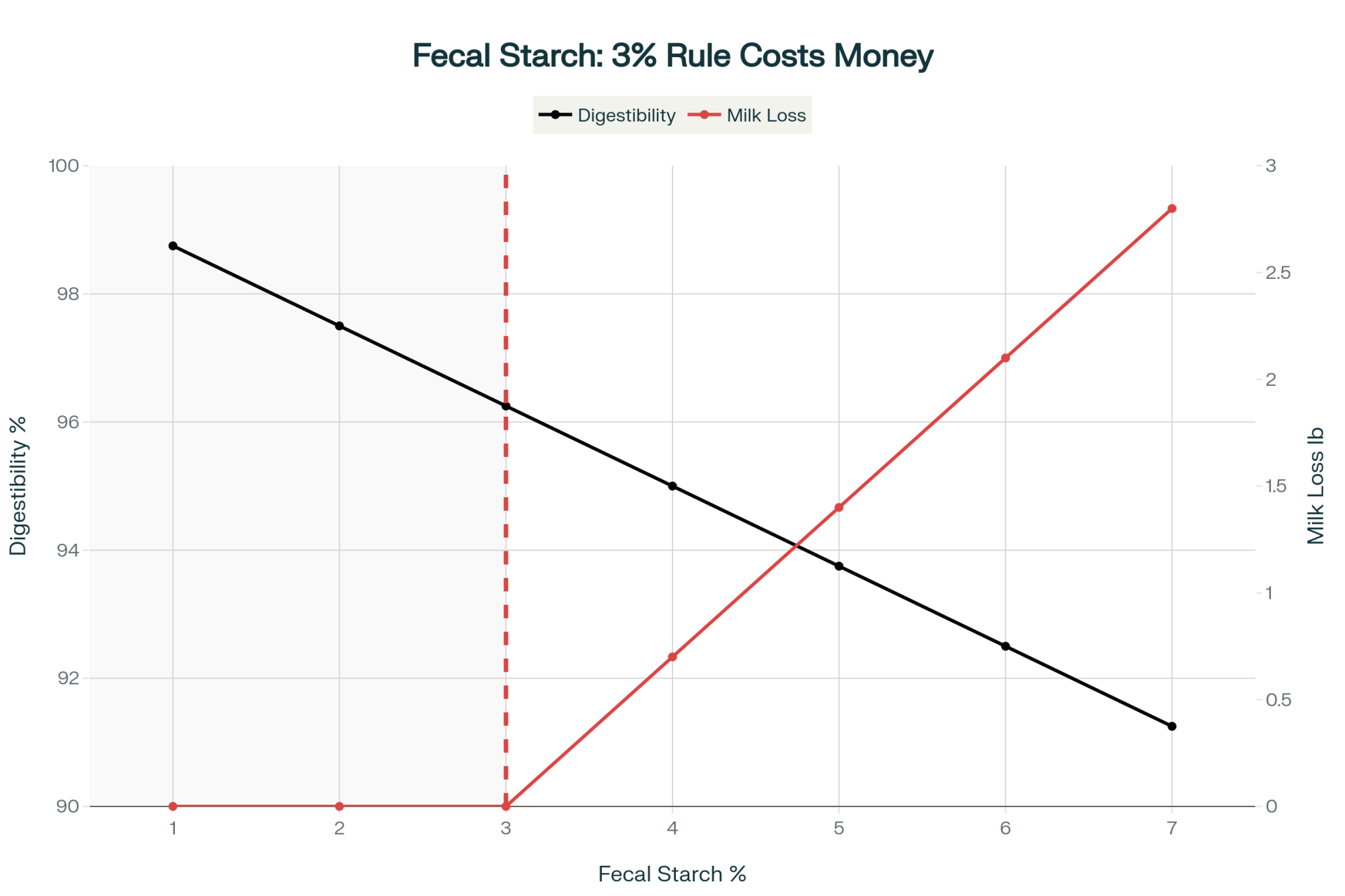
Fecal Starch: The 3% Rule That Costs Real Money – Every 1% above 3% fecal starch equals 0.7 lbs lost milk per cow daily. At 5%, a 600-cow herd loses $30,660 annually.

Once the feed texture is corrected, cows respond fast. Intake climbs within a few days, and butterfat tends to normalize within 10–14 days. That’s the rumen re-establishing equilibrium, and it happens predictably if consistency holds.

It’s worth noting that recovery isn’t instant because microbial populations need a full cycle—about three weeks—to rebuild. But when farms stick with the plan, the results speak for themselves.

When Feed Gets Too Long – Why “More Fiber” Can Backfire

Across the Midwest, it’s common to see the opposite: rations that are too coarse. Sometimes it’s due to harvest conditions, sometimes prolonged knife wear, or wet forages. But even 10–15% material on the top sieve can drop dry matter intake by 3.3–4.4 pounds (1.5–2 kg) per cow per day, according to Cornell Cooperative Extension (2023)and Kononoff et al. (J. Dairy Sci., 2003).

It’s easy to spot. Bunks show long refusals, feed sorting increases, and milk solids vary from cow to cow. That imbalance also stresses the fresh cow group, where consistent energy delivery is critical during the transition period.

The fix is often small—a sharper chop or added moisture—but the payoff is large. One Northeast producer told me, “We didn’t change the ration at all, just the chop setting—and our intakes stabilized in a week.”

Connecting Particle Size and Fecal Starch

Here’s where modern precision feeding really shines. When farms combine physical evaluation (via the separator) with digestion analytics (via fecal starch testing), they close the loop on total feed efficiency.

Research at the University of Guelph (2024) found that herds maintaining a balanced TMR structure consistently achieved fecal starch levels below 3%, aligning with about 96% total-tract starch digestibility. Anything over 5% points to feed passing too quickly—often because TMR is too fine, not because kernels are underprocessed.

Or, as Hutjens says in his workshops, “If the rumen can’t hold feed long enough, microbes can’t finish their job.” That line always sticks because it’s a simple truth: the rumen’s efficiency relies on physical structure first, chemistry second.

What Improvement Looks Like – The 21-Day Timeline

Now, many producers ask: once we fix it, how quickly do the cows show results? Based on consistent findings from Penn State, UW–Madison, and the Miner Institute, here’s what usually happens:

  • Days 1–2: Feed sorting drops; bunk refusals even out.
  • Days 3–5: DMI increases 2–4 pounds (0.9–1.8 kg) per cow.
  • Days 5–7: Milk production rises 3–5 pounds (1.4–2.3 kg) per cow.
  • Days 10–14: Butterfat lifts 0.2–0.3 points.
  • By Day 21: Rumen and microbial stability return to optimal levels.
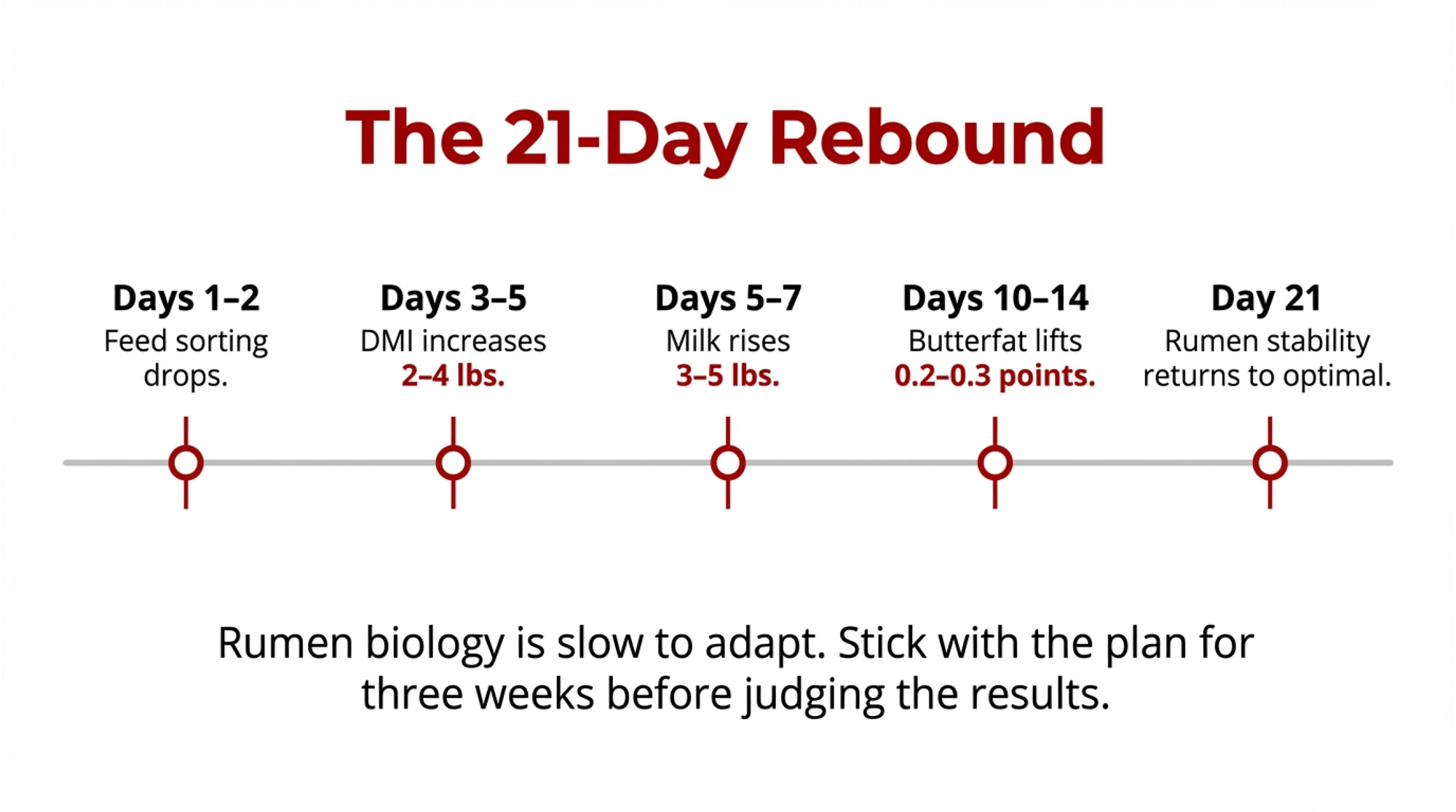
What’s interesting here is just how predictable the recovery is when particle size and feeding routine stay on target. Results don’t happen overnight—but give it three weeks, and the cows will show you why it’s worth sticking to the plan.

21-Day Recovery: From Feed Fix to Full Profit – Cows respond predictably when particle size is corrected. Milk rises within a week, butterfat follows by week two, and rumen stability locks in by day 21. 

Turning the Separator into a Habit

Producers who’ve made this work treat the Separator as part of weekly herd management, not a special task. I like to call it “Feed Quality Friday”—a fifteen-minute ritual where the feeder runs one test, records the numbers, and shares them with the nutritionist.

The payback for that small amount of time is remarkable. Field results from Penn State Extension (2024) show that farms that regularly monitor particle size reduced component volatility by nearly 30% across seasons, saving $50,000–$60,000 annually on a 500-cow herd.

But more importantly, it changes culture. Feeders begin catching drift before it shows up in milk tests. They start asking better questions about forage moisture, mixing time, and loading sequences. And that’s how farms shift from reactive to proactive management.

Building a Culture of Consistency

What’s encouraging is that this approach works everywhere—from 120-cow tiestalls in Ontario to 2,000-cow dry lot systems in California. The herds that succeed treat feed measurement with the same precision as fresh cow management or breeding records.

Across operations big and small, I’ve noticed that testing isn’t just about data—it builds accountability. Posting results weekly in the feed room, laminating target charts next to the mixer, or even color-coding sieves can transform an abstract concept into a visible, shared goal.

As Hutjens likes to emphasize, “Technology gives you options, but discipline delivers results.” That sentiment captures the heart of this discussion.

The Takeaway

Here’s what it all comes down to: the Penn State Separator isn’t flashy, and it doesn’t plug into an app—but it represents precision in its purest form. Measure, monitor, adjust, repeat. That process costs almost nothing and protects everything that matters: milk yield, butterfat performance, and cow health.

So if your separator is sitting in a corner, unopened, dust it off this week. Shake out one sample. It might just be the five most profitable minutes you’ll spend all month.

This feature draws on research and field data from Penn State Extension, University of Wisconsin–Madison, University of Guelph, Cornell Cooperative Extension, Dairyland Laboratories, and the William H. Miner Agricultural Research Institute, with expert perspective from Dr. Mike Hutjens, University of Illinois Professor Emeritus.

Key Takeaways:

  • The Penn State Particle Separator turns feed analysis into a five‑minute habit that can unlock five‑figure profits.
  • A simple metric—fecal starch over 3%—signals lost milk and missed feed efficiency worth hundreds daily.
  • “Feed Quality Fridays” pay off: just 15 minutes a week can protect up to $60,000 a year in butterfat returns.
  • Within 21 days of adjusting the feed structure, rumen health steadies, and milk fat rebounds naturally.
  • Across every region and herd size, the best dairies win on one thing: disciplined consistency—not fancy tools.

Executive Summary

Ask any successful dairy manager, and they’ll tell you—precision starts with the basics. This article reveals how the humble Penn State Particle Separator has become one of the most cost-effective tools for improving butterfat and overall feed efficiency. Backed by university and field research, it shows how something as simple as a five-minute TMR check can prevent $50,000 or more in yearly losses from feed inconsistency and poor fiber balance. Each 1% rise in fecal starch above 3% translates directly to milk left on the table, and yet, herds that make testing routine see full recovery in yield and butterfat within just 21 days. What’s interesting here is that the wins don’t come from expensive equipment—they come from habit, focus, and follow-through. It’s proof that on the best dairies, measurement has become a mindset, not just a task.

Complete references and supporting documentation are available upon request by contacting the editorial team at editor@thebullvine.com.

Learn More:

Join the Revolution!

Join over 30,000 successful dairy professionals who rely on Bullvine Weekly for their competitive edge. Delivered directly to your inbox each week, our exclusive industry insights help you make smarter decisions while saving precious hours every week. Never miss critical updates on milk production trends, breakthrough technologies, and profit-boosting strategies that top producers are already implementing. Subscribe now to transform your dairy operation’s efficiency and profitability—your future success is just one click away.


NewsSubscribe
First
Last
Consent

Are You Losing Silent Cash to Hemorrhagic Bowel Syndrome?

Think it’s the bugs causing cow deaths? Think again—it’s the feed, and here’s the fix.

EXECUTIVE SUMMARY: Folks, here’s the deal: the real cause of hemorrhagic bowel syndrome isn’t just bacteria—it’s microscopic damage to the cow’s gut lining from rough feed particles. Data from farms in North America and beyond show nearly 1% of cows are lost annually to this syndrome, costing $100K+ on big herds. Tighten up your feed particle size—cut the big bits to under 18% of the ration—and you’ll slash cases by roughly 30%. Pair that with feeding fresh more often and adding immune-boost supplements, and farms report payback within a year. This isn’t theory—it’s proven results you should try this season.

KEY TAKEAWAYS

  • Reducing particles >4 mm to under 18% of ration DM cuts HBS cases by 30%—an easy change you can make today.
  • Minnesota Extension’s simple scorecard spots high-risk cows early, boosting confirmation accuracy from <20% to >70%.
  • Push fresh feed every 2 hours to stabilize rumen pH and curb digestive upsets—low effort, proven by UC Davis.
  • Adding yeast-based products and trace minerals slashes gut health issues by up to 20%, backed by UK and KY trials.
  • Every cow saved is fewer replacements and ~1.2 tonnes CO₂e saved—vital for 2025 sustainability goals and compliance.

What makes hemorrhagic bowel syndrome (HBS) so dangerous is its stealth. I’ve talked to dairy folks from Wisconsin barns to New Zealand pastures, and the stories are the same. One moment, your top milker is chewing cud; the next, she’s down—and sometimes gone before breakfast.

Here’s the good news: HBS isn’t bad luck—it’s a risk you can manage. Here’s how to get ahead and keep your herd thriving.

What’s Happening With HBS?

Imagine a soggy spring in Ontario. Jerseys dropped unexpectedly. Baleage lab tests passed, but necropsies revealed over 20% of ration particles exceeded 4 mm—enough to scrape the gut lining. DairyNZ’s 2024 trials show trimming that below 18% cuts HBS incidence by roughly 32%.

In the U.S., about 15% of herds report HBS outbreaks annually, losing 0.5–1% of cows. It’s not chance—it’s risk you can reduce.

New Science: It’s More Than Bacteria

Clostridium perfringens was long blamed, but Ghent University’s ex vivo work challenges that. They found mucosal abrasion—tiny tears from coarse feed—as the real spark. Those abrasions let bacteria and toxins breach the gut wall, triggering fatal hemorrhaging.

Worried about low-mold silage? Even “clean” silage can hold rough particles that damage sensitive, high-producing fresh cows.

Spotting HBS Early

Minnesota Extension’s triage tool scores seven signs—sudden collapse, abdominal swelling, dark or bloody manure, cold extremities, recent diet shifts, and days in milk over 100. A score ≥6 means call the vet for a necropsy. Farms using this system improved necropsy confirmation from under 20% to over 70%.

Fighting Back

  • Particle control: Keep feed particles >4 mm under 18% of ration DM to cut cases by ~32%.
  • Frequent feed pushes: Every two hours steadies rumen function (UC Davis study).
  • Gentle transitions: Stretch diet changes over ≥7 days to avoid gut stress.
  • Silage face care: Remove 1–2 feet of silage daily; discard any mold to maintain a smooth, tight face.
  • Immune support: Yeast cell walls, zinc/selenium, and mycotoxin binders can reduce HBS risk by up to 20%.

Dollars & Sense

One 900-cow Minnesota dairy lost eight cows—$106,000 in losses—in six months. After adopting these measures, they had one case in the next half-year, saving over $90,000. Prevention investments typically pay off within a year.

Action Plan for Monday Morning

  1. Calibrate a forage sieve; set particle-size targets.
  2. Train staff on the necropsy scoring tool.
  3. Schedule feed pushes every two hours.
  4. Tighten silage face management—pitch mold daily.
  5. Begin immune-support supplementation for fresh and early-lactation cows.

Sustainability & Compliance

Fewer losses mean fewer replacements—each avoided heifer saves about 1.2 tonnes of CO₂e. Consumers and regulators are watching. “Managing HBS is a win for animal health, profitability, and environmental stewardship,” says Dr. Laura Schmidt, dairy health specialist at the University of Wisconsin–Madison.

Bottom Line

HBS isn’t a phantom—it’s treatable. Master feed particle size, vigilant cow monitoring, disciplined silage practices, and targeted immune support. Farms from Wisconsin to New Zealand are already reaping healthier herds and better profits—now it’s your turn.

Complete references and supporting documentation are available upon request by contacting the editorial team at editor@thebullvine.com.

Learn More:

Join the Revolution!

Join over 30,000 successful dairy professionals who rely on Bullvine Weekly for their competitive edge. Delivered directly to your inbox each week, our exclusive industry insights help you make smarter decisions while saving precious hours every week. Never miss critical updates on milk production trends, breakthrough technologies, and profit-boosting strategies that top producers are already implementing. Subscribe now to transform your dairy operation’s efficiency and profitability—your future success is just one click away.

NewsSubscribe
First
Last
Consent

Pellet-Free Robotic Milking: The $36,740 Decision Your Operation Needs to Make Now

Dairy producers: Your robot pellets cost $36K+ yearly while destroying butterfat. Data from three countries proves there’s a better way.

Robot pellets are costing your dairy thousands while potentially harming component percentages. Evidence from Wisconsin to California confirms that properly implemented pellet-free milking can slash feed costs by $36,740 annually per 200 cows while increasing butterfat by 0.2-0.4%. But this isn’t a simple flip-the-switch solution – it requires specific barn configurations, meticulous feed management, and disciplined protocols.

Your Robot Pellet Habit Is Draining Your Bank Account (And I Can Prove It)

What we’re all thinking: robot pellets are the dairy industry’s most expensive security blanket. I’ve had coffee in 37 different robot barns this year, and you know what keeps me up at night? Watching good operations flush $36,740 annually (per 200 cows!) down the drain on pellets that might hurt butterfat. That’s not pocket change – it’s a new truck every year, college tuition for your kid, or a significant bump in your operation’s bottom line during tight margin years.

Don’t believe me? Fair enough. I was skeptical, too, until I visited Heeg Bros in Wisconsin. These guys are hitting 4.55% butterfat and pumping 48.44 kg of milk per cow daily without feeding a single pellet in their robots. Not. One. Pellet. And they’re not alone. I just returned from a tiny 41-cow operation in Ontario, pushing 41 kg daily with three visits per cow per day, and a Jersey operation with 77 cows producing 22 kg daily with 2.35 trips per cow – all without robot pellets (University of Guelph Extension, 2024).

This isn’t some futuristic concept – it’s happening on real farms with real cows making real money. The economic impact is substantial, with pellet costs estimated at $0.23 per pound premium over standard TMR costs (Journal of Dairy Science, 2024). Doing the math on a 200-cow operation translates to approximately $31,500 annually in direct feed cost difference, so grab your coffee. We must discuss why your pellet habit might be the only thing between you and serious profitability.

The Physiological Reality Behind Your Butterfat Numbers

Before diving into implementation, let’s talk physiology for a minute. That robot pellet habit isn’t just expensive—it might be actively undermining your component percentages and cow health. Here’s why: When cows consume concentrated pellets during milking, they experience what nutritionists call “slug feeding”—rapid intake of high-starch feed that causes sudden drops in rumen pH.

According to research from UC Davis Veterinary Medicine (2024), these pH fluctuations shift rumen microbial populations away from fiber-digesting bacteria toward acid-producing species. The result? Reduced acetate production (the primary precursor for butterfat synthesis) and increased Sub-Acute Ruminal Acidosis (SARA) risk. It’s a physiological reality documented in multiple university studies—consistent TMR consumption supports steadier rumen function than the peaks and valleys created by robot pellet feeding.

This explains why operations transitioning to pellet-free consistently report 0.2-0.4% butterfat increases after adaptation (USDA-ARS, 2024). It’s not magic—it’s basic rumen physiology finally being allowed to function as nature intended. When you factor in today’s component pricing, that butterfat increase alone can contribute over $10,000 annually to your bottom line for a 200-cow herd.

Three Things You Absolutely Can’t Screw Up (Spoiler: You’re Probably Messing Up #2)

1. Your Barn Layout Makes or Breaks Everything

You can’t just yank pellets and pray. Free-flow barns crash and burn without them – I’ve seen it happen, which isn’t lovely. Research from Michigan State University (2024) indicates that free-flow barns need 3.2 times more pellets to maintain adequate visit frequency than guided traffic systems. Without the directional constraints of guided traffic, cow motivation becomes insufficient without concentrated feed rewards.

What works? Guided-flow traffic with short return alleys to feed (under 75 meters), functional pre-selection gates that work, and zero chance for cows to backtrack. In guided-flow systems, one-way and pre-selection gates direct cows through predetermined pathways, forcing them through the robot to access feed areas. This structured flow eliminates the need for pellet incentives by creating a physical environment where milking becomes necessary to access nutrition. The layout has to force them through the robot to reach fresh feed. No shortcuts, no exceptions.

Even the experienced team at Heeg Bros learned this lesson the hard way. Their first group of cows was moved to the new robot barn but initially brought back to the parlor for milking. The result? “They developed a habit and would go down the alley past robots, down the alley to the other barn to be milked,” according to Kelli Hutchings of DeLaval. Their second group started directly in the robots and performed substantially better. Layout and training coherence matters enormously.

2. Your TMR Has to Be Freaking Amazing

Oh boy, this is where most farms fall flat on their face. Those Ontario farmers I mentioned? They’re TMR fanatics. Feed quality and consistency represent a critical requirement for successful pellet-free implementation. Operations that have transitioned successfully demonstrate exceptional attention to TMR management, including daily variation under 2%, minimum NDF digestibility of 65%, and consistent feed push-up practices (UW-Madison Dairy Science, 2023).

TMR Quality ParameterMinimum Requirement for Pellet-Free Success
Physical consistency<3% day-to-day variation
NDF digestibilityMinimum 65%
Push-up frequencyMinimum 8 times daily
Moisture levels46-52% to minimize sorting
Daily variation in critical nutrients<2%
Particle length distributionConsistent across days with <5% variation

What does “amazing TMR” actually mean in practice? It means obsessive attention to the details listed in that table, plus strategic use of palatability enhancers like molasses during transition phases. As Fred Van Lith told me over lunch last month, “Skip one push-up? You’ll see 18% fewer robot visits by dinner.” The man isn’t joking. The consistency of the TMR becomes the primary driver of cow motivation within the system, replacing the concentrated incentive previously provided by robot pellets.

I walked to one barn where the feed looked like my kid’s dinner plate – all the good stuff picked out, the rest pushed aside. That farm failed spectacularly at going pellet-free. If your cows can separate your TMR into distinct layers within hours, you’re not ready for pellet-free milking. Full stop.

3. Your Labor Focus Shifts Completely

Here’s the part nobody wants to hear. Matt Strickland’s California transition needed more fetch labor initially. However, their experience aligns with the economic analysis, which shows that the net benefit remains substantial even with increased labor costs. For a 200-cow operation, fetch labor requirements typically increase from approximately 1.2 to 1.9 hours daily, resulting in additional costs of approximately $8,760 annually (Vita Plus Loyal, 2024). But when you factor in pellet savings and component bonuses, the net economic impact remains decidedly positive.

It’s not less work. It’s different work. You’re trading feed management for cow observation. Deal with it. The critical insight from successful implementers is establishing consistent fetch protocols that never vary – not by shift, not by day of the week, and not during busy seasons. The minute fetch discipline slips, your entire system starts unraveling.

Interestingly, Strickland’s operation has been gradually transitioning for over a year and is down to just seven cows that still need incentives to enter the robot. He bluntly says, “I didn’t invest in robots to feed my cows; I got the robots to milk my cows.” His experience demonstrates patience and persistence pay off, but perfection isn’t necessary for profitability.

The Math That Made Me a Believer (Even Though I Hated It)

I’ll be honest – I fought these numbers. Hard. More labor? In this economy? But the economic analysis from independent sources is brutally clear:

MetricPellet SystemPellet-FreeAnnual Difference (200 cows)
Feed Cost$0.23/lb premium$0.00-$31,500
Fetch Labor1.2 hrs/day1.9 hrs/day+$8,760
Component BonusBase+0.2% BF-$10,400
Feed WasteStandardReduced-$3,600
Net Impact -$36,740

What’s particularly interesting is data from a 32-herd survey conducted by Vita Plus Loyal (2024) that found robot pellet cost hurt income over feed cost and milk production per visit. Their research showed that herds feeding higher-cost PMRs (partial mixed rations) had more excellent milk production per robot visit, challenging the conventional wisdom that expensive robot pellets drive production.

That same survey found that herds with the highest income over feed cost often fed very low-cost robot pellets or simple combinations of ingredients. The data suggests that nutritional emphasis on feeding more nutrient-dense PMRs with less reliance on robot pellets improved milk production per visit—exactly what we’re seeing in fully pellet-free systems.

The Case Against Going Pellet-Free (Yes, There Is One)

I’m not here to tell you that pellet-free is for everyone. Some operations genuinely benefit from maintaining pellet feeding, particularly:

  1. Free-Flow Traffic Barns: The research is conclusive – free-flow barns need approximately 3.2 times more pellets to maintain adequate visit frequency (Michigan State University, 2024). Without guided traffic patterns, pellet-free implementation fails spectacularly in these configurations. If you’ve invested in a free-flow system, optimize your pellet strategy rather than eliminate it.
  2. High-Production, High-Genetic-Merit Herds: Some elite genetic lines appear more responsive to precision feeding through robots. The targeted nutrient delivery during milking may provide metabolic advantages that outweigh the rumen disruption for specific genetic profiles. Dr. Michael Overton (University of Georgia, 2023) argues that “high genetic merit animals may benefit from specific nutrient timing that pellet delivery provides.” Consistent delivery is critical – these herds still benefit from regular, smaller pellet allocations rather than large, inconsistent amounts.
  3. Transition Period Animals: Many pellet-free advocates maintain modest pellet allocations for transition cows to support energy needs during this critical period. Dr. Stephen LeBlanc (University of Guelph, 2024) notes that “fresh cows within 10 days post-calving show measurable metabolic benefits from strategic energy supplementation during milking.” The metabolic benefits may outweigh the rumen disruption for these specific animals.

This balance is precisely what Matt Strickland demonstrates. After over a year of transition, he still maintains seven cows on pellets because their individual needs make it economically sensible. The goal isn’t ideological purity—it’s profitability.

Your 90-Day Gameplan

Phase 1: Reality Check (Weeks 1-4)

First things first – are you a candidate for this? You need to:

  • Put pH sensors on 10% of your herd to establish baseline rumen health
  • Audit your TMR for consistency (if variance exceeds 5%, fix it first!)
  • Map out which cows are pellet junkies (you know, the ones)
  • Confirm your guided traffic system is functioning correctly (one-way gates, pre-selection)
  • Document current production, components, and health metrics for comparison

This preparatory phase provides critical baseline data to guide subsequent decision-making and identifies potential risk factors before significant system changes occur. If your pH data shows significant time below 5.8 or your TMR consistency is poor, address these issues before proceeding.

Phase 2: The Wean (Weeks 5-12)

This is the tricky part:

  • Cut pellets 5% weekly, replacing with molasses-enhanced TMR
  • Make sure your guided traffic is, you know, guiding
  • Check pH daily and abort if cows stay under 5.8 for more than 2 hours
  • Implement religious fetch protocols – every cow over 10 hours since the last milking gets fetched
  • Track incomplete milkings, kick-offs, and milk flow rates weekly
  • Increase TMR push-ups by 25% during the transition

The adaptation process needs to be gradual. Strickland’s experience shows this isn’t an overnight transition – it’s taken his operation over a year to get down to just seven cows needing pellets. Starting with fresh cows appears particularly effective, as these animals adapt approximately 40% faster than established lactating cows with ingrained behavioral patterns.

Phase 3: Show Me The Money (Month 4+)

If you’ve done the work, you’ll see:

  • Rumen pH stabilizing in the healthier 6.0-6.5 orange
  • Butterfat lifting about 0.2% by week 12
  • Fetch rates dropping under 5% by week 10
  • Feed sorting at the bunk dramatically reduced
  • More consistent manure scores across the herd

The key success metrics at this stage include robot visit frequency stabilizing above 2.4 visits per cow daily, fetch rates below 5% of the herd, and component percentages showing clear improvement. Maintain vigilance on TMR quality and push-up frequency – these have become your new critical management points replacing pellet delivery.

Global Perspectives: It’s Not Just a North American Thing

The pellet-free movement isn’t confined to North America – it’s gaining global momentum for different reasons in different markets. In the Netherlands, Wageningen University researchers (2025) report Dutch herds achieving 15% lower veterinary costs post-transition, attributed primarily to improved rumen health and reduced incidence of SARA. The European context adds regulatory incentives, as their methane reduction targets make SARA reduction financially advantageous. As one Dutch farmer explained, “The €120 per cow compliance savings alone justified our transition.”

New Zealand offers an entirely different twist on this concept. Their pasture-based systems traditionally use supplemental feeding primarily during milking, but several operations are experimenting with hybrid models. James Robertson, a Canterbury dairy farmer, shared that their 900-cow operation eliminated robot pellets during peak grass growth months while maintaining a modified pellet program during shoulder seasons. “We’ve found a 17% reduction in feeding costs with no impact on production during our October-February window,” Robertson reports. This seasonal adaptation illustrates the flexibility possible in different production models globally.

In Israel, where heat stress management creates unique challenges, pellet-free approaches are combined with cooling strategies. Despite the region’s extreme climate challenges, the Israeli Dairy Board reports three commercial operations successfully implementing pellet-free systems in 2024. Dr. Eyal Seroussi of the Agricultural Research Organization explains, “Consistent TMR consumption appears to moderate heat stress impacts by supporting more stable rumen function throughout high-temperature periods.” Their success suggests that pellet-free approaches offer climate resilience benefits beyond direct cost savings.

What’s Coming Down the Pipeline (You Heard It Here First)

I just got back from the significant equipment shows, and things are changing fast:

Industry sources suggest two major robotic milking equipment manufacturers are reconsidering their approach to pellet delivery systems for future models, potentially making pellet mechanisms optional upgrades rather than standard features. This equipment evolution would likely reduce barriers to implementation for new installations, as systems could be designed from inception without the cost and complexity of pellet delivery mechanisms.

Specialized consulting services focused on TMR-based motivation systems are emerging to support farms considering the transition to pellet-free approaches. These consultants specialize in specific nutritional and management requirements of pellet-free systems, demonstrating growing professional recognition of this management strategy.

Environmental and regulatory considerations may accelerate the adoption of pellet-free approaches in specific markets. European operations face intensifying methane regulations, and the improved rumen health associated with consistent TMR feeding offers potential compliance advantages. Research from Wageningen University (2025) suggests that reducing Sub-Acute Ruminal Acidosis (SARA) through more consistent feeding patterns could save approximately €120 per cow annually in compliance costs for European producers. As similar regulatory frameworks expand globally, this driver may also become increasingly significant in North American markets.

The Contrarian View: Why Some Experts Still Advocate for Pellets

Not everyone in the industry embraces pellet-free approaches. Dr. Thomas Overton, Professor of Dairy Management at Cornell University, maintains that “targeted nutrient delivery during milking remains valuable for high-producing animals, particularly in early lactation.” His research indicates that well-formulated robot pellets can support metabolic health during peak production periods when coordinated with base ration formulation.

Equipment manufacturers also present legitimate concerns about pellet-free implementations. Carlos Pereira, Product Development Manager at Lely, notes, “Our systems are designed with pellet delivery as a core motivation mechanism. While some farms succeed without them, we still see optimal performance with at least minimal pellet allocations.” This perspective acknowledges that robotic systems were initially engineered around the pellet delivery concept.

Nutritionist Dr. Bill Weiss of Ohio State University takes a middle-ground approach, suggesting that “the question isn’t pellets versus no pellets, but rather finding the optimal allocation for each operation’s specific conditions.” He advocates for reduced pellet feeding tailored to individual farm situations rather than complete elimination. This nuanced view acknowledges both the financial advantages of reduction and the potential benefits of strategic pellet use.

The Bottom Line: Evolve or Watch Your Margins Vanish

From Heeg Bros’ 450-cow Wisconsin operation to California’s Double Creek Dairy, from tiny Ontario setups to European innovators, the data is crystal clear – pellet-free isn’t some hippie fad. It’s essential profit physics. The economic case is compelling: savings exceeding $36,000 annually per 200 cows, improved butterfat percentages, and the potential for enhanced rumen health.

Your choice seems pretty straightforward:

  • Keep spending $37k annually on a system designed for 1990s cows
  • Invest 120 hours of training time for perpetual savings

The Heeg Bros proved what I suspected all along – cows don’t miss what they never had. The real question isn’t whether this approach works. It’s whether your operation has the management discipline to make the transition.

This Isn’t Just a North American Thing

You might be surprised (I was!) that Dutch herds are reporting 15% lower vet costs with pellet-free systems, according to Wageningen University’s recent study (2025). Even more shocking? New Zealand’s pasture-based operations are testing hybrid models.

With EU methane regulations coming soon, this transition is becoming urgent overseas. SARA reduction alone could save €120/cow/year in compliance costs. Sometimes, environmental and economic incentives actually align!

Three Things You Can Do Right Now

  • Today: Download UW-Madison’s free mixer evaluation toolkit and audit your TMR
  • This Month: Pick five balanced-temperament cows as pH monitoring candidates
  • This Year: If your metrics look good, start planning a phased pellet reduction

The revolution’s happening whether we like it or not. The question is, will you lead it or chase it?

Key Takeaways:

  • Economic Impact: $36,740 annual savings per 200 cows, combining $31,500 in direct feed cost reduction with improved component premiums, despite requiring approximately 0.7 additional labor hours daily.
  • Technical Requirements: Success demands guided-flow traffic systems, TMR with <3% daily variation, NDF digestibility >65%, and minimum 8× daily feed push-ups—operations failing these standards experience catastrophic results.
  • Physiological Benefits: Eliminating “slug feeding” of concentrated pellets stabilizes rumen pH (6.0-6.5), improving fiber digestion and acetate production that directly enhances butterfat synthesis.
  • Implementation Timeline: The validated 90-day transition protocol requires baseline monitoring, 5% weekly pellet reduction, and maintains about 17% more fetch labor initially, with component improvements typically visible by week 12.
  • Contraindications: Free-flow barns, operations with poor TMR consistency, and farms with irregular labor availability should NOT attempt pellet-free implementation.

Executive Summary:

Recent data from Wisconsin to New Zealand demonstrates that eliminating feed pellets from robotic milking systems can save operations approximately $36,740 annually per 200 cows while increasing butterfat by 0.2-0.4%. Success requires three critical elements: guided-flow barn configurations with short return alleys, exceptionally consistent TMR management with minimal daily variation, and disciplined fetch protocols. The approach isn’t universal—free-flow barns, specific high-genetic merit herds, and operations with poor feed management should maintain pellet feeding. With significant equipment manufacturers beginning to accommodate pellet-free designs and documented success across diverse operations globally, this represents a considerable shift in robotic dairy management with substantial profit implications.

Learn more

Join the Revolution!

Join over 30,000 successful dairy professionals who rely on Bullvine Weekly for their competitive edge. Delivered directly to your inbox each week, our exclusive industry insights help you make smarter decisions while saving precious hours every week. Never miss critical updates on milk production trends, breakthrough technologies, and profit-boosting strategies that top producers are already implementing. Subscribe now to transform your dairy operation’s efficiency and profitability—your future success is just one click away.

NewsSubscribe
First
Last
Consent
Send this to a friend


