Archive for stray voltage

Is Stray Voltage Stealing 20 Pounds Per Cow from Your Dairy?

Cows avoiding water? Nervous in the parlor? Production dropping? You’re not imagining it—20% of dairies have stray voltage that utilities can’t detect.

You know, I spoke with a producer from Minnesota who shared something that many of us might recognize: her best cow had died unexpectedly after a completely normal 70-pound milking. Every consultant she’d brought in confirmed her management was exemplary. Yet cows kept declining, and nobody could explain why.

This was Jill Nelson from Olmar Farms in Sleepy Eye, and her eight-year journey to discover what was affecting her elite registered Holstein herd reveals an issue that—honestly—deserves more attention than it gets. After installing an isolated transformer to separate her farm from utility electrical infrastructure (we’re talking about an investment approaching $100,000 here), production increased by nearly 20 pounds per cow per day. And this happened during summer 2017, when most of us are just trying to maintain production through heat stress.

What’s particularly noteworthy is that Nelson’s experience aligns with estimates from that old USDA Agriculture Handbook 696—you might have seen it referenced—suggesting that up to 20% of dairy operations may encounter some level of stray voltage issues. While the data is still developing on the exact prevalence, this potential scope… well, it merits serious consideration as we evaluate those unexplained herd health and production challenges we all see from time to time.

Here’s what’s interesting from an economics standpoint: With a 20-pound daily increase on 150 cows at current milk prices, Nelson’s investment paid for itself in approximately six months. Not many farm improvements deliver that kind of return, right?

Understanding the Technical Challenge

So here’s where things get a bit complicated—but stick with me because this matters.

The complexity of stray-voltage diagnosis begins with how we measure it. Standard utility testing protocols use a 500-ohm resistor to simulate your cow’s electrical resistance. This standard, believe it or not, was established in that 1991 USDA handbook I mentioned. And it’s still what utilities use when they come out to test your farm today.

The Testing Gap reveals why 20% of dairies struggle with hidden electrical issues—utilities test at 500 ohms, but real cows measure 109-400 ohms, experiencing double to quadruple the current that standard tests report as “safe.”

What makes this significant? Well, field research from agricultural electrical consultants has documented dairy cattle with actual body resistance ranging from approximately 100 to 400 ohms—substantially lower than what the testing standard assumes. Dr. Richard Norell, who’s the Extension dairy specialist up at the University of Idaho, has examined electrical resistance in dairy cattle as part of broader agricultural electrical research, and his work contributes to our understanding of this variation.

The practical implications… they deserve consideration. You probably remember Ohm’s Law from somewhere—current equals voltage divided by resistance, right? Well, if the testing equipment assumes 500 ohms but the actual cow resistance is closer to 200 ohms, the measured current significantly underestimates what your animals actually experience. It’s somewhat like calibrating feed measurements with equipment that doesn’t account for actual dry matter intake—the numbers look fine, but reality’s telling a different story.

When utilities measure, say, 1.0 volts using standard protocols, they calculate approximately two milliamperes of current flow—within accepted guidelines, according to veterinary references such as the Merck Manual. But here’s the thing: cattle with lower resistance are experiencing higher current levels proportionally. Norell’s research and data collected at UW–Madison showed cows reacted to current at the lowest tested levels—just 0.25 milliAmps, which is eight times lower than the standard utilities use to define possible harm to cattle. In fact, 25% of cows in those studies showed behavioral responses at only 0.25 mA, much lower than the traditional 2 mA threshold long reported in the industry.You can see the problem here.

Learning from Progressive Operations

What I find valuable about the Olmar Farms case is that they followed best management practices—and still got hammered.

Their operation, which received Holstein Association USA’s Elite Breeder Award in 2017, maintained a rolling herd average of 26,192 pounds before encountering these challenges. They’d invested in modern facilities, including equipotential planes (you know, those conductive grid systems designed to prevent electrical differentials), tunnel ventilation, sand-bedded freestalls—basically everything we’re told makes a difference.

Nelson brought in respected consultants. Dr. Tom Oldberg analyzed nutrition. Dr. Reid evaluated the milking systems. Dr. Gary Neubauer, a well-known dairy veterinarian, was also part of the diagnostic team. Each one confirmed management met or exceeded industry standards. As many of us have experienced, sometimes you can do everything right and still have problems.

Yet the herd exhibited concerning behavioral changes. Previously calm animals became difficult to handle during milking. Some cows required leg restraints for safe milking—and that’s unusual for well-managed herds, wouldn’t you say? Mastitis incidence increased despite proper protocols. Water consumption patterns changed dramatically, with cows hesitating at troughs or displaying unusual lapping behaviors rather than normal drinking.

⚠️ Warning Signs We Should All Watch For:

  • Cows hesitating or “dancing” at water troughs
  • Unusual lapping instead of normal drinking
  • Parlor nervousness is developing in previously calm animals
  • Drinking from puddles while avoiding standard waterers
  • Multiple health issues appearing simultaneously without a clear cause
  • High producers are dying unexpectedly without an obvious illness

Standard utility testing repeatedly showed “acceptable” voltage levels. The graphs looked normal, measurements within guidelines. This continued for eight years—eight years!—until 2016, when Nelson connected with an electrical specialist with specific experience in agricultural applications. Using equipment capable of millisecond-resolution recording (typically from manufacturers such as Fluke or Dranetz) and testing with more representative resistance values, this specialist documented electrical issues throughout the facility, including outdoor water systems.

Olmar Farms’ dramatic recovery after resolving stray voltage—production crashed 978 pounds during their 8-year battle, then surged 3,295 pounds above baseline after a $100,000 isolated transformer installation that paid for itself in just six months

Court records from July 2019 confirm the operation converted to three-phase power with an isolated transformer installation on May 1, 2017. There was a reported an 18-pound increase in production during the subsequent summer months, with current production exceeding 30,318 pounds rolling herd average as of March 2025. That’s quite a turnaround.

The Biological Response to Chronic Electrical Exposure

Here’s something that really fascinates me about this whole issue—the biology behind it.

Research from institutions like the University of Wisconsin-Madison helps explain what’s happening at the biological level. Doug Reinemann and co-researcher Dr. Louis Sheffield, both with Wisconsin’s biological systems engineering department, have published on how electrical stress affects dairy cattle biology. And what he’s found… it’s eye-opening.

This research shows that repeated low-level electrical exposure triggers cortisol release—the primary stress hormone. While acute stress responses serve important biological functions (we’ve all seen how a fresh cow reacts to a single stressor during transition), chronic exposure can maintain elevated baseline cortisol levels, which can affect multiple body systems. This builds on what we’ve learned about other chronic stressors in dairy production.

The cascade effects are fascinating… and concerning. We’re talking suppressed immune function, with reduced T-cell production and weakened antibody responses. This explains the varied symptoms Nelson observed: treatment-resistant mastitis in some cows, reproductive failures in others, sudden production crashes or unexpected mortality in high producers.

As Nelson put it—and I think this really captures the frustration—”It looked like we were failing at everything simultaneously. Nutrition problems AND health problems AND reproduction problems AND behavior problems all at once.” Makes perfect sense when you understand it’s all coming from the same electrical source, doesn’t it?

Research in veterinary literature also documents transgenerational effects, with calves from electrically stressed dams showing reduced immune competence, impaired vaccine responses, and various developmental issues. Nelson reported observing congenital disabilities and cardiac abnormalities during the most challenging period. That’s something that really makes you think about the long-term implications for your replacement program.

Distinguishing Source and Responsibility

Alright, so here’s where things get complicated—and expensive. The source of electrical issues fundamentally determines resolution approaches and costs.

On-farm sources (damaged motor insulation, corroded connections, inadequate grounding) typically cost between $800 and $10,000 to address, depending on scope. Any qualified agricultural electrician can handle these repairs. That’s manageable for most operations.

But utility-source issues? That’s a different story altogether.

Every North American farm connects to multi-grounded neutral systems—the National Electrical Safety Code requires it. The utility-neutral conductor is repeatedly grounded between the substation and your farm, with your farm’s electrical systems bonded to this neutral at the transformer. You probably know this already, but it’s worth reviewing.

Under ideal conditions, this system works well. But when utility neutrals can’t adequately carry return current—maybe due to undersized conductors for modern loads, deteriorated connections from age, or phase imbalances—that current seeks alternate paths through earth ground. And since your farm’s grounding system is bonded to theirs… well, that current can flow right through your agricultural facilities.

The primary solution is to install isolated transformers to create electrical separation between the farm and utility systems. Based on documented cases, these installations can cost $50,000 to $100,000 or more. The Nelson operation’s investment approached $100,000, including a three-phase power installation located more than 100 yards from the buildings. And despite the problem originating from utility infrastructure, farms often bear these costs themselves. That still frustrates me when I think about it.
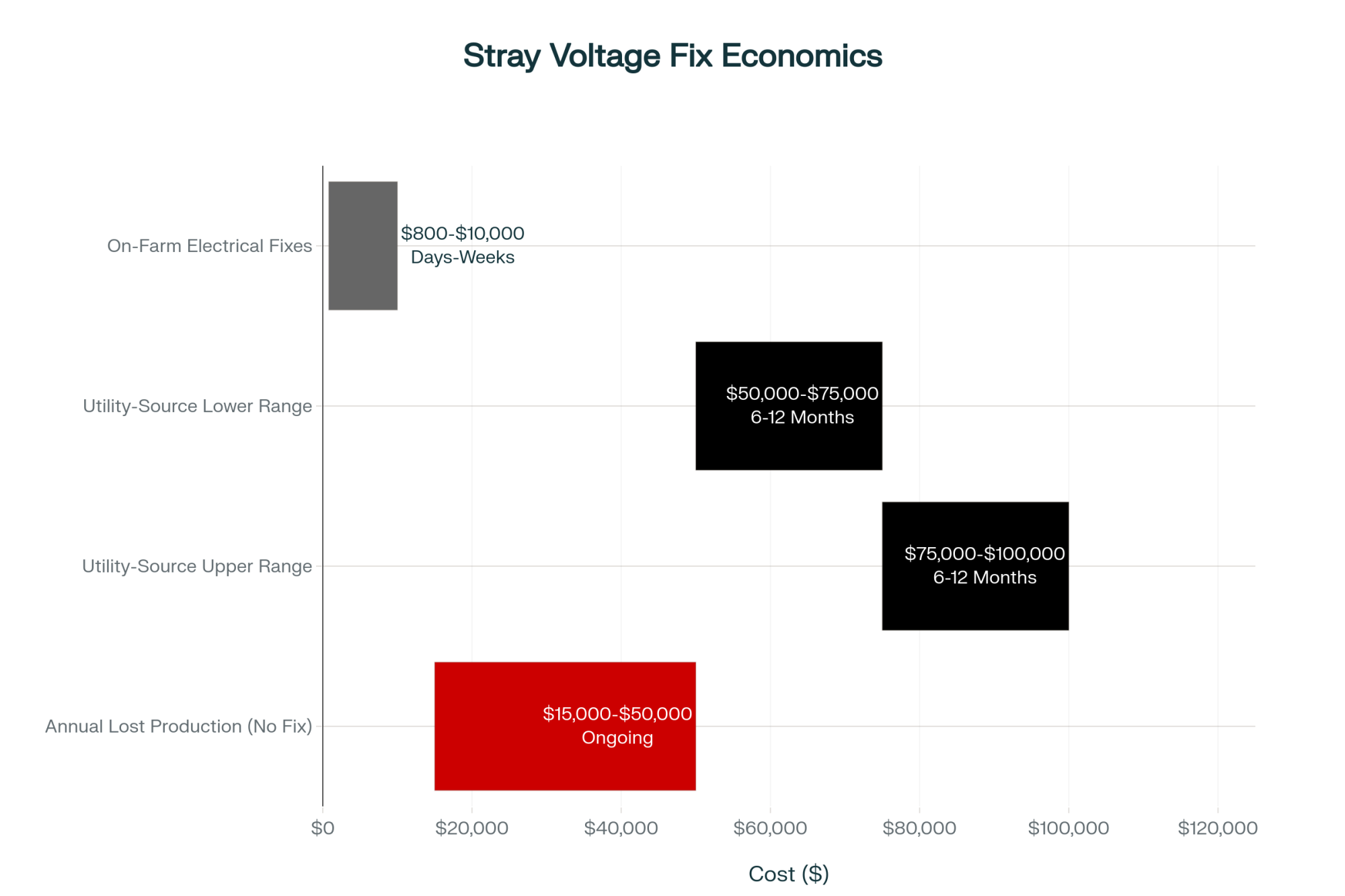
The financial fork in the road—on-farm electrical issues cost under $10K and resolve quickly, while utility-source stray voltage demands $50-100K investments that take months but pay back in 6-12 months through production recovery

What about insurance? Most standard farm policies generally don’t specifically address stray voltage losses, though some carriers now offer specialized riders. I always tell producers: verify coverage with your agent rather than assuming protection exists. Better to know before you need it.

Best Practices from Affected Operations

Looking at successful resolutions, I’m seeing consistent patterns that are worth sharing.

Documentation proves crucial. Producers who achieve resolution create comprehensive evidence before engaging utilities or consultants. This includes video documentation of behavioral changes—hesitation at water sources, unusual drinking patterns, and parlor nervousness. They maintain detailed production records showing systematic changes despite consistent management. Health events, treatments, mortality patterns—it all merits careful tracking.

Paul Halderson’s Wisconsin operation, which prevailed in litigation against Xcel Energy, maintained decades of documentation. This record proved invaluable when addressing utility claims about management deficiencies. The lesson here is clear: document everything, even if it seems minor at the time.

Independent testing before utility engagement often proves worthwhile. Specialists familiar with agricultural electrical systems, using appropriate protocols and resistance values, typically charge $3,000 to $5,000 for a comprehensive assessment. While that’s significant, this investment can prove valuable if negotiation or—God forbid—litigation becomes necessary.

Understanding state-specific standards helps producers navigate the system. Wisconsin and Minnesota use 1-volt or 2-milliamp action thresholds. Knowing these standards—and their basis in that 500-ohm testing protocol we discussed—helps you advocate for appropriate testing when utilities respond.

Regional Variations and Current Context

The 2025 dairy economy makes hidden production losses particularly challenging, doesn’t it? While feed costs have moderated from recent peaks (thankfully), maintaining production efficiency remains crucial for profitability. A 15% production loss from undiagnosed electrical issues—not uncommon based on documented cases—that can determine operational viability.

I’ve noticed regional patterns emerging from infrastructure age and agricultural practices. Wisconsin and Minnesota operations, particularly those served by infrastructure dating back 40-50 years, report more utility-source issues as equipment struggles with modern electrical loads. Similar patterns appear in Vermont and upstate New York, especially where utility consolidation has deferred infrastructure updates.

Newer dairy regions present different challenges. Texas and Idaho operations may have more modern infrastructure, but they face issues stemming from shared distribution lines used by center pivot irrigation systems. Seasonal voltage fluctuations during peak irrigation can affect nearby dairy facilities. And Southeastern operations? They contend with how seasonal variations in ground moisture affect current flow through the soil—I heard about this recently from a Georgia producer dealing with mysterious summer production drops.

California’s large-scale operations, with their substantial electrical loads for cooling and milk processing, sometimes encounter unique challenges when utility infrastructure hasn’t kept pace with dairy consolidation and expansion. It’s a different set of problems, but the underlying issue remains the same.

Recognition and Response Strategies

Based on documented cases and producer experiences, if you’re seeing behavioral changes at water sources—hesitation, unusual lapping behaviors, complete avoidance despite obvious thirst—that’s particularly telling. Same with parlor nervousness that develops in previously calm animals, especially during milking preparation.

For producers observing these patterns, here’s what works: Begin with thorough documentation using available technology—smartphones can capture behavioral evidence effectively these days. Engage independent testing through specialists who understand agricultural applications. Eliminate on-farm sources by systematically evaluating motors, connections, and grounding systems. Only then engage utilities, preferably in writing, with documentation already assembled.

Budget considerations should include $3,000-$5,000 for comprehensive independent testing. If utility infrastructure proves problematic, resolution costs can reach $50,000 to $100,000 or more for isolated transformer installation. Yes, that’s significant. But remember Nelson’s six-month payback period. Sometimes the investment, painful as it is, makes sense.

Industry Evolution and Future Considerations

Recent legal precedents suggest evolving recognition of these challenges. The Iowa Supreme Court’s June 2024 decision upholding Vagts Dairy’s verdict against Northern Natural Gas for pipeline-related electrical issues establishes important precedent for infrastructure liability. That’s encouraging, at least.

Most producers won’t pursue lengthy litigation—and shouldn’t have to. Practical solutions matter more than legal victories. That’s why farmers like Jill Nelson are developing resources to share knowledge. Her website, strayvoltagefacts.com, provides research and guidance based on her direct experience. It’s worth checking out if you’re dealing with unexplained issues.

What’s encouraging is how the industry conversation has evolved. A decade ago, debates centered on whether stray voltage even existed. Today’s discussions focus on identification and mitigation strategies. This represents meaningful progress, even if implementation remains inconsistent.

Nelson’s operation now maintains a rolling herd average of over 30,318 pounds on twice-daily milking, according to March 2025 data. While genetics were damaged during the affected period, the operation survived and recovered. As Nelson has shared in various forums, early recognition of testing limitations and documentation requirements might have shortened their eight-year challenge considerably.

Given the substantial number of operations potentially experiencing some level of electrical issues, it is important to acknowledge that “acceptable” testing results may not ensure the safety of sensitive animals. Just as we’ve embraced precision management for nutrition and reproduction, electrical safety may require similar individualized approaches.

Dairy farmers are winning big in court—$32+ million awarded across four major cases from 2010-2024, with the June 2024 Iowa Supreme Court ruling establishing critical precedent that negligence isn’t required to prove nuisance from stray voltage

This builds on what we’ve learned about variation in biological systems—what works for the average may not protect the sensitive. Until testing protocols better reflect this reality, those of us who combine careful observation with independent verification will be best positioned to protect our herds.

The Bottom Line

You know, the difference between management challenges and electrical issues can be subtle but significant. Understanding this distinction—and knowing how to investigate it properly—that’s valuable knowledge for any operation experiencing unexplained herd challenges.

Sometimes what appears to be a management problem stems from infrastructure issues that standard testing protocols weren’t designed to detect. And that’s not a failure of management—it’s a limitation of how we’ve been measuring things.

What’s your experience been with unexplained herd health or production challenges? Have you noticed behavioral changes that didn’t quite fit typical patterns? The conversation continues as we work together to understand and address the complex interactions between modern dairy operations and aging electrical infrastructure.

For more resources and to share experiences, visit strayvoltagefacts.com or reach out through The Bullvine’s producer network. Because sometimes the best solutions come from farmers sharing what they’ve learned the hard way. And that’s how we all get better at this business we’re in.

KEY TAKEAWAYS:

  • If cows are hesitating at water or dying unexpectedly, it’s likely stray voltage—affecting 1 in 5 dairy farms, not management failure
  • Standard utility testing misses the problem: They test at 500 ohms resistance when actual cow resistance is 200-400 ohms, underreporting exposure by half
  • Your documentation strategy determines your outcome: Video behavior changes, track production/health data, get independent testing ($3-5K) BEFORE calling utilities
  • Resolution costs vary wildly: On-farm electrical fixes are manageable (under $10K), but utility-source problems requiring isolated transformers can hit $100K—though payback can be swift (20 lbs/cow/day gains)
  • You’re not imagining it: Courts are awarding millions in stray voltage cases, proving this hidden problem is real and fixable when properly diagnosed

EXECUTIVE SUMMARY: 

Your cows avoiding water troughs and dying after perfect production days might not be a management problem—it’s likely stray voltage, a hidden electrical issue affecting up to 20% of dairy operations nationwide. The crisis stems from a fundamental testing flaw: utilities measure using 500-ohm resistance standards established in 1991, but research shows dairy cattle actually average 200-400 ohms, meaning your animals experience double the electrical current that standard tests report as “safe.” Jill Nelson’s award-winning Minnesota Holstein operation suffered eight years of mysterious losses before discovering this truth—her $100,000 investment in an isolated transformer delivered 20 pounds of milk per cow per day, paying for itself in six months. The difference between financial recovery and bankruptcy often comes down to recognizing symptoms early (behavioral changes at water sources, parlor nervousness, unexplained deaths) and getting independent testing with proper equipment. While on-farm electrical fixes typically cost under $10,000, utility-source problems can exceed $100,000, making documentation and proper diagnosis critical before accepting utility test results that miss what’s really happening to your herd.

Complete references and supporting documentation are available upon request by contacting the editorial team at editor@thebullvine.com.

Learn More:

Join the Revolution!

Join over 30,000 successful dairy professionals who rely on Bullvine Weekly for their competitive edge. Delivered directly to your inbox each week, our exclusive industry insights help you make smarter decisions while saving precious hours every week. Never miss critical updates on milk production trends, breakthrough technologies, and profit-boosting strategies that top producers are already implementing. Subscribe now to transform your dairy operation’s efficiency and profitability—your future success is just one click away.

NewsSubscribe
First
Last
Consent

Stray Voltage in Dairy Farming: Essential Insights Every Farmer Must Know

Learn how stray voltage affects dairy farming and how to protect your cows. Do you know about the hidden risks to your milk production?

Summary: Have you ever wondered if something more sinister is draining your dairy farm’s profits and productivity?  Dairy farmers have grappled with a hidden enemy for over five decades: stray voltage. This silent threat has devastating effects on livestock, yet its existence has been mired in lies, falsified research, and outright gaslighting. Stray voltage, undesired energy that escapes into the ground or conductive surfaces, can stem from poor wiring, insufficient grounding, and flaws in the power company’s electrical grid. For cows, it means stress, reduced milk output, lower feed intake, and a higher risk of illnesses like mastitis. Even at levels as low as 2 to 4 volts, this stress can lead cows to avoid water or feeding stations. The USDA estimates that up to 20% of dairy farms could be affected by stray voltage. Testing for stray voltage is crucial to protecting the herd and your livelihood.

  • Stray voltage can severely affect livestock, resulting in stress, reduced milk production, and higher illness incidents.
  • Causes of stray voltage include poor wiring, insufficient grounding, and flaws in the power company’s grid.
  • Even low levels of stray voltage (0.03-0.05 volts) can make cows avoid water or feeding stations.
  • The USDA estimates that up to 20% of dairy farms could be impacted by stray voltage.
  • Testing for stray voltage is essential to safeguard livestock and farm profitability.

Have you ever wondered why your cows are continuously upset or why milk output changes for no apparent reason? The solution might be more inconspicuous and unexpected than stray electricity. This hidden threat has plagued dairy farms for decades. Still, the amount of disinformation, fabricated data, and blatant falsehoods surrounding it is staggering. Stray voltage reduces milk output and directly influences herd health, resulting in higher veterinary expenditures and lower earnings. “Stray voltage influences dairy cow behavior, health, and milk output. It may cause lower milk output, higher somatic cell counts, and other health issues in cows.” [Stray Voltage Facts]. For over 50 years, dairy producers have been duped with falsified statistics, deceptive research, and testing that mask the hazards. The time to act is now. Can you afford to ignore this problem any longer? Join us as we delve into the dark realm of stray voltage, unraveling the deception and revealing the truth about this industry-wide disaster.

Electrical Nightmare: How Stray Voltage Could Be Sabotaging Your Dairy Farm 

Stray voltage is undesired energy that escapes into the ground or other conductive surfaces, resulting in low-level electrical currents that travel outside their intended paths. Imagine your farm’s electrical infrastructure as a garden hose. If the hose contains microscopic holes, water (or, in this instance, electricity) will leak out. This kind of leakage is known as stray voltage.

But how does it happen? Poor wiring, insufficient grounding, and malfunctioning electrical equipment are familiar sources of stray voltage. These issues allow electricity to leave its intended circuit. Another source is the power company’s electrical grid; currents may return via the ground rather than designated neutral lines, functional in rural regions with aging infrastructure.

This is very significant for dairy producers. Stray voltage may cause stress in cows, reducing milk output, lower feed intake, and greater susceptibility to illnesses like mastitis. Even at levels as low as 2 to 4 volts and 0.03 volts, the strain may lead cows to avoid water or feeding stations, jeopardizing their health and your farm’s profitability.

Stray Voltage: The Silent Saboteur of Dairy Farms 

Stray voltage is more than simply an electrical annoyance; it is a quiet adversary that progressively saps the vitality of your herd and the prosperity of your dairy enterprise. Imagine entering your barn expecting to see healthy, productive cows, only to discover anxious, diseased, or dead animals and declining milk output. Unfortunately, such is the harsh truth for many farmers who have unwittingly become victims of this unseen threat.

“Our cows started showing signs of stress and unnatural behaviors,” Allan from Bert-Mar Farms remembers. “We noticed a drastic drop in milk production, and it took us years to realize stray voltage was to blame” [source: DairyStar, Inc.]. Many in the industry share this attitude, having had similar situations but failed to identify the root.

Numerous research have established the harmful effects of stray voltage on dairy cows. According to research, even tiny levels of electrical current (below 0.25mAmp) may produce behavioral changes, reduced feed intake, higher somatic cell counts, and decreased milk production. A thorough evaluation of 46 research experiments found that cows exposed to voltages as low as 1 volt saw substantial decreases in milk output and general health [source: StrayVoltageFacts].

For instance, Mary Francque, a dairy farmer who witnessed the severe impacts of stray voltage firsthand, shared, “We saw a 20% drop in milk production almost overnight.” Trying to determine what was wrong until we checked for stray electricity [source: Iowa State University] was a nightmare. Such experiences underscore the tremendous impact of stray voltage and the critical need for awareness and mitigating actions.

Cows exhibiting signs of electrical exposure, such as reluctance to enter the milking parlor, unexpected aggression, or unusual hoof and joint issues, are most likely suffering from stray voltage effects, according to studies by the Agricultural Research Service and other organizations [source: Bovine Vet Online]. These signs are often misinterpreted, resulting in prolonged animal suffering and financial losses for producers.

Stray voltage has a significant financial impact on dairy farms. Farms affected by stray voltage often report a 15-30% drop in milk output, leading to yearly losses of thousands of dollars. Moreover, the cows’ health deteriorates, and reproduction suffers, resulting in higher veterinary bills and shorter herd lifetimes. These cumulative consequences can severely impact the financial viability of both large and small dairy enterprises.

Stray voltage is a widespread problem that has plagued dairy farms for decades. Farmers like Allan and Mary’s personal stories serve as a powerful call to action. Dairy producers must become more cautious, conduct frequent inspections, and seek expert reviews to protect their businesses from this hidden threat. The good news is that stray voltage is preventable. You can safeguard your farm and livelihood with the proper knowledge and proactive measures.

Stray Voltage: Not Just a Technical Glitch, But a Financial Catastrophe 

Let’s talk numbers; according to the literature review summarizing 46 research trials, groups of cows exposed to known voltage and current levels experienced significant reductions in milk yield and overall health. Lower productivity means fewer gallons shipped, which equates to lower profits. The hidden costs don’t stop there; sick cows lead to higher veterinary bills and increased labor costs to manage and mitigate these health issues. 

On another note, Steve and Mary Francque’s battle with stray voltage is a poignant example. The Francques reported spending over $100,000 over a few years in an attempt to diagnose and rectify the problem. What dairy farm can carry such an enormous unexpected expense without suffering? It became a choice between investing in necessary machinery upgrades or continuously addressing the detrimental effects of stray voltage.

It’s crucial to recognize the industry-wide scale of the stray voltage problem. The USDA has estimated that up to 20% of dairy farms in any area could be affected by stray voltage. This isn’t an isolated issue; it’s an industry-wide challenge that demands serious attention. The collective financial impact could exceed millions of dollars lost in productivity and increased operational costs [source: USDA]. 

These examples underscore that stray voltage isn’t just an abstract problem; it’s a tangible threat to a farm’s profitability and viability. The direct and indirect costs can compound quickly, creating a financial burden that many farms may find impossible.

Decades of Deception: Unmasking the Stray Voltage Scandal in Dairy Farming 

Since the 1970s, stray voltage has been a significant worry in dairy farming. The issue gained attention when farmers reported inexplicable declines in milk output and unusual behavioral changes in their herds. Based on anecdotal evidence from impacted farmers, initial inquiries were typically rejected as coincidence or owing to bad farm management techniques.

However, by the early 1980s, this contemptuous attitude had begun to shift. Studies, such as the extensive study conducted by recognized agricultural specialists (https://strayvoltagefacts.com/), have revealed a relationship between stray voltage and decreased dairy output. Despite the evidence accumulated, disinformation efforts and fraudulent studies obscured the reality. Powerful utility corporations often supported these deceptive studies to escape accountability and the financial consequences of dealing with the problem.

A famous example of such deception happened in pivotal research trials financed by the electrical industry, which controversially reduced the importance of stray voltage by altering data to indicate minor impacts on dairy cows. These trials, cited over the subsequent decades, played a significant role in shaping public perception and policy around stray voltage, effectively gaslighting the farming community (https://img1.wsimg.com/blobby/go/d719dd64-4767-4754-9681-480de02a93fe/downloads/Stray-Voltage-Injuries-in-Dairy-Farmers-A-Revi.pdf?ver=1721680466256).

By the 1990s, individual case studies and accumulating anecdotal evidence from farmers like the Burdicks, who reported devastating consequences on their cattle, had pushed the topic back into the scientific realm. Despite this, adequate identification of the problem was met with tremendous hostility, with many blaming cow health difficulties on less problematic factors.

In the past two decades, a renaissance of interest and more transparent studies have begun peeling back the obfuscation layers. Notable research, such as those reviewed in Spring 2018, has highlighted the adverse effects of stray voltage on dairy operations, supporting distressed farmers’ assertions [source](https://dairystar.com/stories/a-shock-to-the-system,24087).

The history of stray voltage awareness is rejection, disinformation, and a long march to realization. It emphasizes the necessity of openness and robust, impartial research in protecting the interests of those who feed the country.

Gaslighting in the Dairy Industry: The Hidden Truth About Stray Voltage

The dairy farming community has been subjected to unparalleled disinformation and gaslighting regarding stray voltage. How often have scientists and authorities dismissed your fears about stray voltage as “an overreaction” or “unlikely to affect your herd”? It isn’t enjoyable.

For decades, utility companies and other industry players have minimized stray voltage’s seriousness, dismissing it as a mere annoyance. Recognizing the facts would entail expensive mitigation efforts, probable responsibility, and a considerable loss to their financial line. Instead, they’ve brushed the data under the rug, leading farmers to mistrust their own experiences.

Consider the story of Mary Francque, a dairy farmer whose herd’s health deteriorated unexpectedly. “I was told repeatedly that it was all in my head, that stray voltage couldn’t possibly be causing the problems I was seeing,” she said with tears. It wasn’t until she completed her tests that she discovered the cold, hard facts: her cows had been exposed to dangerous quantities of electricity.

Falsified research and whitewashed studies are another layer of deceit. Many studies financed by utility corporations have concluded that stray voltage offers no substantial harm. However, independent research provides a different perspective. According to a comprehensive assessment in Dairy Star, “The lowest cow plus cow contact resistance has been tested below could be as low as 125 ohms in certain circumstances, making even minor currents extremely harmful.” Dairy industry proponents argue for using a 125 ohms resistor in stray voltage testing to more accurately represent the most significant % of cows in a given herd. [source: Stray Voltage Facts].

Utility firms and their friends have reaped enormous profits by ignoring the obligation to update infrastructure and adopt adequate safety measures. This neglect is appalling when you consider the consequences for dairy farmers—financial losses, mental anguish, and, most sadly, the degradation of their herd. The Burdicks, a farming family who sustained significant losses, revealed that the electric provider ignored several concerns until it was too late [source: Dairy Star].

To summarize, the concerted attempt to minimize stray voltage amounts to a violation of trust, leaving numerous dairy producers to deal with the terrible repercussions. Isn’t it time for a reckoning?

The Human Toll: How Stray Voltage Wreaks Havoc on Dairy Farmers’ Lives and Livelihoods

One cannot ignore the environmental and human costs that stray voltage exacts on dairy producers and their livelihoods. Consider Mary Francque, a dairy farmer who, with her husband Brian, fought the constant presence of stray electricity in their milking barn for an incredible nine years. The continuous tension and unknowns surrounding the unseen monster left them feeling demoralized and second-guessing every decision. Their milk supply decreased, and the health of their beloved cows deteriorated quickly, causing emotional and financial stress.

Nelson and her husband, Brian, ‘s predicament exemplifies how dangerous stray voltage may be. They bravely battled the illusive electrical burglar inside their barn. For over a decade, they had unexpected drops in milk output and strange health concerns with their cattle. Despite several attempts to identify and address the cause of the issue, their fight seemed to be never-ending, depleting their resources and motivation.

Another moving example is the Burdick family’s dairy farm, which was once a prosperous business. That was until stray voltage disrupted its functions. Livestock losses increased, and milk output fell, leaving the Burdicks with a severe economic crisis. The Burdicks, like many others, had the difficult task of recognizing the problem and persuading dubious utility corporations to fix it.

These are not simply anecdotes; they are the actual realities of dairy farmers who have seen their life’s work and passion eroded by an often-overlooked issue. The cumulative effect on their mental and financial well-being cannot be underestimated.

Scientific Evidence vs. Corporate Denial: The Battle Over Stray Voltage’s Impact on Dairy Farms

Stray voltage has long been acknowledged in scientific literature as negatively influencing dairy farms. A comprehensive literature review of 46 research trials reveals that cows exposed to specific voltage and current levels have significant behavioral and health issues, such as decreased milk production, increased stress, and decreased overall well-being [Stray Voltage Injuries in Dairy Farmers: A Review]. Research published in the Dairy Star supports these results, demonstrating a clear link between stray voltage exposure and lower dairy yield on impacted farms  [Rising from Tragedy]. 

In contrast, several research reports supported by electrical firms minimize these impacts, often claiming that stray voltage does not influence animals. However, these studies have repeatedly been criticized for methodological faults and skewed sampling. For example, a critical examination of industry-sponsored research reveals severe conflicts of interest and a lack of openness in experimental designs  [Stray Voltage Testing: Who Can You Trust?]. Such discrepancies highlight the need for independent and thorough scientific research to determine the natural effect of stray voltage on dairy production. As a result, although respectable, peer-reviewed studies continually confirm the negative consequences of stray voltage, industry-funded research seeks to obfuscate these results, indicating a concerning tendency of disinformation and gaslighting within the dairy sector.

Detecting and Mitigating Stray Voltage: A Farmer’s Guide to Protecting Livestock and Livelihoods 

Testing for stray voltage on dairy farms is more than a practical need; it is critical to protecting your herd and livelihood. But how can farmers go about detecting this unseen saboteur?

First and foremost, you must equip yourself with the proper tools. Experts propose using a digital voltmeter to determine the electrical potential difference between two places. Leading individuals in the subject, such as Mary Francque, highlight the need for “consistent and precise measurements” to assure accuracy.

One feasible option is to test voltage levels at several locations across the farm. Begin by evaluating the water bowls, metal stanchions, and other metal structures where cows commonly come into touch. Readings greater than 0.5 volts are often suggestive of stray voltage concerns. Francque says, “Routine testing can unearth problems before they escalate, making it easier to manage and mitigate risks.”

Grounding and bonding are two of the most effective ways of mitigation. Grounding connects electrical systems to the ground to neutralize stray currents. At the same time, bonding guarantees that all metal elements are electrically linked, decreasing voltage discrepancies. Chuck Burdicks, a seasoned farmer with expertise dealing with stray voltage, recommends that you test and repair your grounding systems regularly. Even little failures might lead to severe problems over time.”

Additionally, adding voltage filters may aid in the management and stabilization of electrical currents. These devices may separate equipment that produces a stray voltage from the rest of the farm, reducing its effect. According to a literature assessment of 46 research studies, these strategies may “significantly diminish the adverse effects on animal health and productivity.”

The main message is straightforward: continuous testing and aggressive mitigation are your most potent defenses against stray voltage. Francque says, “It’s about creating a safe, stable environment where your cows can thrive, and your profits can grow.” Farmers who use these measures can detect and control stray voltage, protecting their herds and livelihoods from its pernicious consequences.

The Bottom Line

Stray voltage is more than an irritation; it has been a massive threat to dairy farms hidden by misinformation and corporate denial for years. The implications for animal health, output, and farmers’ livelihoods are enormous. From fraudulent research to gaslighting tactics, the scale of deceit is staggering, and ignoring the issue is no longer an option. Can we afford to stay silent while our farms and futures are jeopardized? Equip yourself with the required knowledge and equipment, perform independent testing, engage with reliable experts, push for more limitations and responsibility from electrical providers, and share your experiences to increase awareness.

Learn more: 

Supreme Court Upholds $4.75 Million Verdict for Iowa Dairy in Stray Voltage Case

Find out why the Iowa Supreme Court upheld a $4.75 million award for a dairy farm harmed by stray electricity. What does this important case mean for the dairy industry?

The Iowa Supreme Court has upheld a $4.75 million verdict for Vagts Dairy, an Iowa farm impacted by stray voltage from a nearby gas pipeline. This landmark decision not only marks a pivotal win for the family, addressing years of losses in their dairy operations but also draws attention to infrastructure-induced problems for agricultural communities

“Sometimes you get to the point you don’t even want to get up in the morning because you don’t know what you’re going to find out there,” Mark Vagts testified, underscoring the family’s unwavering determination in the face of daily challenges.

The Price of Protection: How an Essential Pipeline System Became a Dairy’s Worst Nightmare

Vagts Dairy, run by Mark, Joan, and Andrew Vagts, faced severe challenges due to alleged stray voltage, which refers to the presence of unwanted electrical energy from Northern Natural Gas Company’s pipeline. This pipeline’s corrosion-prevention system reportedly caused electrical issues that impacted their dairy herd. The Vagts family filed a lawsuit in 2021, seeking compensation for their livestock and livelihood damage.

Decades of Protection Turned Enigma: The Historical Backdrop of a Landmark Case

This case involves a pipeline built 60 years ago, stretching about 14,000 miles from Texas to Michigan. It includes an electrical system, known as a cathodic protection system, required by federal regulations to prevent corrosion. This system uses a low-level electrical current to counteract the natural corrosion tendency of metals in a conductive environment.

2013: The Year of Unwanted Currents and Deepening Woes

The onset of issues can be traced back to 2013 when part of the electrical system was replaced. This marked the beginning of troubling times for the Vagts’ dairy farm. The cows started showing abnormal behavior and health problems, their milk production dropped, and mortality rates soared, plunging the dairy operators into distress and uncertainty.

2017: A Year of Ambitious Growth Met with Unforeseen Challenges

In 2017, the Vagts expanded their dairy, extending a barn closer to the electrical system. This move, part of their ambitious growth plan to increase milk production, worsened the stray voltage issue, severely affecting their herd. By 2022, over 17 percent of their cattle had died, far above the typical 5 percent mortality rate. The cows showed unusual behavior, like standing in waterers to avoid electric shocks and refusing milking equipment. The financial and physical toll was enormous, highlighting the devastation stray voltage can cause if unchecked.

Pain and Resilience: Heartfelt Testimonies Highlight the Human Cost of Stray Voltage 

During the January 2023 trial, Mark Vagts shared the toll the situation had on their dairy and personal lives. “Sometimes you don’t even want to get up in the morning because you don’t know what you’re going to find out there,” he said, highlighting the daily stress and uncertainty. 

Andrew Vagts added, “What sucks is telling my kids why their fair calf had to be shot or put down or sold.” His testimony illuminated the emotional burden on their family, particularly on the younger generation, emphasizing the personal cost of the stray voltage issue. This emotional toll, in addition to the financial and physical losses, underscores the severity of the issue.

Vindication and Remediation: Jury Awards $4.75 Million to Vagts Family

The jury awarded the Vagts family $4.75 million: $3 million for economic damages, $1.25 million for personal inconvenience and discomfort, which includes the emotional distress and disruption to their daily lives caused by the stray voltage issue, and $500,000 for loss of use and enjoyment of their property, which includes the impact on their ability to use and enjoy their farm due to the stray voltage issue.

An Acrimonious Battle Over Damages: The Company’s Counter-Arguments and Legal Maneuvering

Despite the jury’s decision, Northern Natural Gas Company disputed the claims, questioning the link between their electrical system and the cows’ ailments. They argued that the Vagts family didn’t definitively prove that the pipeline caused their dairy cows’ issues and economic losses. The company also challenged the damages awarded, claiming the amount lacked sufficient evidence. On appeal, they insisted negligence was necessary to establish liability for the nuisance.

Majority Opinion: Upholding Justice Through Established Records, Beyond Negligence Requirements

Justice Christopher McDonald, writing for the majority, upheld the jury’s verdict, confirming it was well-supported by the record. He clarified that proving negligence was unnecessary to establish a nuisance in this case.

In his separate opinion, Justice Edward Mansfield agreed with the majority on procedural grounds. Still, he emphasized that negligence should have been a critical consideration. He argued that the unique vulnerability of dairy cattle to electrical currents, which can cause significant health issues and even death, creates an unusual nuisance scenario. He believed this required reevaluating how negligence is factored into such cases.

The Tightrope of Tradition: Justice Mansfield’s Call for Caution in Expanding Nuisance Law

Justice Edward Mansfield cautioned against expanding the strict liability nuisance law, which holds a party liable for damages regardless of fault, stressing the importance of sticking to long-standing legal precedents. He argued that courts should balance fair compensation for significant damage with maintaining established legal frameworks. Mansfield warned that shifting from traditional precedents might necessitate considering negligence in future cases involving sensitive issues, such as those impacting dairy cattle.

The Bottom Line

The Iowa Supreme Court’s $4.75 million verdict for Vagts Dairy underscores how stray voltage impacts farms, particularly livestock health and productivity. This ruling vindicates the Vagts family after years of turmoil and highlights the complexities of nuisance law in agriculture. 

The Vagts, through testimonies and expert opinions, showed the connection between Northern Natural Gas Company’s pipeline and their dairy herd’s decline. The jury’s award highlights the contentious nature of liability and damages in environmental cases. 

The justices’ disagreement on proving negligence in nuisance claims signals a need for a balanced interpretation of strict liability principles versus legal precedents, setting a precedent for similar disputes in the future.

Key Takeaways:

  • The Iowa Supreme Court upheld a $4.75 million jury verdict for Vagts Dairy, affirming the significant impact of stray voltage from Northern Natural Gas Company’s pipeline.
  • Justice Christopher McDonald’s opinion emphasized that negligence was not a required finding for creating a nuisance in this case, highlighting the jury’s award as well-supported by evidence.
  • Justice Edward Mansfield concurred with the verdict but cautioned against expanding strict-liability nuisance law, arguing that negligence should have been considered.
  • The Vagts experienced severe disruptions to their dairy operations, including abnormal cattle behavior, elevated mortality rates, and reduced milk production.
  • The legal dispute centered around whether Northern Natural Gas Company’s corrosion-protection electrical system caused the stray voltage affecting the dairy farm.

Summary:

The Iowa Supreme Court has upheld a $4.75 million verdict for Vagts Dairy, an Iowa farm affected by stray voltage from a nearby gas pipeline. The Vagts family, run by Mark, Joan, and Andrew Vagts, faced severe challenges due to alleged stray voltage, which refers to the presence of unwanted electrical energy from Northern Natural Gas Company’s pipeline. The pipeline’s corrosion-prevention system reportedly caused electrical issues that impacted their dairy herd. The onset of issues can be traced back to 2013 when part of the electrical system was replaced, leading to abnormal behavior, health problems, decreased milk production, and soared mortality rates. In 2017, the Vagts expanded their dairy, extending a barn closer to the electrical system, which worsened the stray voltage issue. By 2022, over 17% of their cattle had died, exceeding the typical 5% mortality rate.

Send this to a friend