Every lame cow costs you $225. Genetics can fix it—in 10 years. Here’s what works NOW
EXECUTIVE SUMMARY: Lameness costs the average 500-cow dairy $28,000 annually, and while CDCB’s new genetic evaluations promise a 30% reduction, you won’t see meaningful savings for 10 years. The reality check: these evaluations rely on data from just six elite farms with $100,000 camera systems—not typical operations dealing with old concrete and tight margins. By year 10, genetics deliver $4,879 annual savings, reaching $8,160 by year 15, but European-style welfare markets will emerge by 2030, before genetics pay off. Smart producers aren’t waiting—they’re investing $40-60K in immediate flooring improvements while simultaneously selecting for lameness resistance. The winning strategy combines environmental fixes that work today with genetics that compound forever. Bottom line: this isn’t about choosing between short-term and long-term solutions, it’s about having the vision and patience to pursue both.

You know that sinking feeling when your trimmer shows up and the bill starts climbing? We’re all dealing with it—lameness affects about a quarter of our cows, and at $120 to $330 per case according to multiple studies in the Journal of Dairy Science, it’s hitting checkbooks hard.
Here’s what’s interesting, though: CDCB just presented at their 2025 Industry Meeting that they’re developing genetic evaluations that could reduce lameness by 20-30% over the next couple of decades. And I say “could” because, well… let’s talk about what that really means.
What caught my attention when I dug into the presentations from Dr. Kristen Gaddis and her team is that the timeline stretches much longer than you’d expect. The economics? More modest than the headlines suggest. And get this—the entire system currently depends on mobility data from just six farms with camera systems, plus trimmer records from about 686 herds. That’s from CDCB’s own numbers.
Click the link to view the presentation: Improving the Wheels on the Car: Hoof Health and Mobility
Ashley Ling, Ph.D., CDCB Support Scientist Slides
The Science: Two Very Different Traits
Here’s where it gets fascinating, and I think you’ll appreciate the biological difference between CDCB’s two strategies.
Traditional hoof health data from trimmer records? We’re looking at heritability of just 3-5%—that’s what the research consistently shows. So basically, 95-97% of what we see comes down to the environment. Your flooring, nutrition program, whether you’ve got digital dermatitis making the rounds… you probably know this already. Put most cows in bad enough conditions—wet concrete, poor ventilation, overcrowding—and they’ll develop problems no matter what their genetics look like.
But mobility scores tell a completely different story. The heritability ranges from 10% to 30% based on CDCB’s findings in their reference population of 63,000 cows. That’s getting into the range of moderately heritable production traits we’ve been successfully selecting for. What’s encouraging here is that mobility seems to capture those deeper genetic differences—skeletal structure, pain sensitivity, basic biomechanics—that persist regardless of housing.

The innovation piece that’s worth noting is these AI-powered camera systems from companies like CattleEye. They’ve captured over 14 million daily scores from those 63,000 cows, and research in Preventive Veterinary Medicine shows these systems agree with trained vets about 80% of the time. That’s precision you just can’t get when someone’s scribbling notes in the trim chute.
Your Bottom Line: The Real Economics
Let me walk you through the economics, because that’s what matters when you’re making breeding decisions today.
Based on USDA data and that 25% prevalence we’re all dealing with, you’re looking at about $56.25 per cow annually in lameness costs. For a 500-cow operation, that’s $28,125. Real money, absolutely.

But here’s what genetic selection actually delivers over time—and I’ve run these numbers based on CDCB’s genetic trend projections with standard 35% replacement rates:
- Years 0-2: Nothing. Zero. You’re breeding, but no change in your barn yet.
- Year 4: Maybe—and I mean maybe—you’ll notice three fewer lame cows in a 200-cow herd.
- Year 6: Now we’re seeing something. About nine fewer lame cows, saving around $2,070 annually.
- Year 10: Clear improvement. Twenty-two fewer lame cows, saving $4,879 annually.
- Year 15: This is when it really shows. Thirty-six fewer lame cows, saving $8,160 annually.
The moderate scenario suggests a lifetime value of about $19-24 per cow from lameness resistance. To put that in perspective—and this is interesting—that’s right between Productive Life at $24 and Daughter Pregnancy Rate at $12 in the current Net Merit index, according to Dr. Paul VanRaden’s team at USDA.
The 6-Farm Problem
This is where things get… well, uncomfortable. Those six farms generating mobility data with their 14 million observations—impressive, sure. But are they really representative of the diversity we have across U.S. dairy operations?
What I’ve found in the Foundation for Food & Agriculture Research grant documentation is that these aren’t your typical farms. We’re talking operations that can afford $50,000 to $100,000 camera installations. They’ve got IT staff, sophisticated management protocols—they’re probably in the top 5% of the industry by any measure.
Now, statistically speaking, 63,000 cows far exceeds the 3,000-5,000 that genetics researchers say you need for reliable predictions. That’s well-documented.
But here’s what concerns me—research in Genetics, Selection, Evolution consistently shows that genomic predictions developed in one environment can lose 30-50% of their accuracy when applied to different management systems.
Think about it: if these six farms all have pristine rubber matting, optimal nutrition designed by PhD nutritionists, and professional trimmers on schedule, will their genetic evaluations actually help that 200-cow operation in Wisconsin dealing with 30-year-old concrete and tight margins?
CDCB’s got a $2 million grant from FFAR to expand collection to 60,000 more cows over three years. That’s great, but even then, we’re talking about less than 1.5% of the national dairy cow population contributing lameness data. And DHI participation? Down to 43% of U.S. cows from over 50% a decade ago, according to USDA census data.
Regional Realities Matter
What’s particularly interesting when you look at regional differences is how implementation challenges vary—and as many of us have seen, what works in California doesn’t always work in Vermont.
California operations with dry lot systems face completely different lameness dynamics than Vermont grazing operations or Michigan freestall barns. Cornell’s PRO-DAIRY research shows prevalence ranging from 15% in well-managed pasture systems to over 40% in older confinement facilities in the Northeast.
Down South—and I’ve talked to several producers dealing with this—heat stress creates its own problems. University of Georgia extension work shows lameness spikes during summer when cows spend more time standing on concrete to access shade and cooling.
These regional realities mean genetic evaluations developed primarily from Midwest and Western mega-dairies might need serious recalibration elsewhere.
The European Warning We Can’t Ignore
Here’s what keeps me up at night—and should concern any producer thinking long-term. It’s not today’s milk check. It’s what’s already happening in Europe.

FrieslandCampina in the Netherlands has implemented welfare monitoring programs that incorporate lameness metrics into supplier requirements. Major UK retailers, such as Tesco, require welfare audits with lameness as a key metric. Germany passed animal welfare labeling legislation in 2023 that creates premium pricing tiers.
Based on typical lag patterns, we could see similar requirements in U.S. markets by 2030-2035. Several major processors here have already started supplier welfare assessments. Walmart and Costco are asking questions. Export markets to Europe increasingly require welfare documentation.
And here’s the catch nobody wants to discuss: genetic decisions you make today determine your herd composition a decade from now. If you wait for clear market signals—actual premiums or penalties—before emphasizing lameness resistance, your genetics will be 10 years behind when those payments show up. It’s like trying to turn a cruise ship, as they say.
The Consolidation Dynamic
I’ve been around this industry long enough to recognize patterns, and here’s one that deserves honest discussion. These early-stage evaluations will work best for operations that already look like the reference farms—large, well-capitalized, technology-forward.
The math is sobering. If large operations gain even a 3-5-year head start while these evaluations are validated across broader environments, they maintain permanent genetic superiority that smaller operations can never close. That’s just how genetics works—it compounds. Research from ag economists at Iowa State confirms this dynamic across multiple livestock sectors.
This isn’t CDCB’s fault or intention. But when you combine superior lameness genetics with all the other advantages large operations already have—purchasing power documented by USDA’s Agricultural Resource Management Survey, technical expertise, preferential genetics access—you’re looking at one more force driving consolidation. We’ve already lost 50% of dairy farms in the past two decades, according to the 2022 Census of Agriculture.
What Actually Works: Practical Strategies

After wading through all this research and talking with producers who’ve tried various approaches, here’s what’s clear:
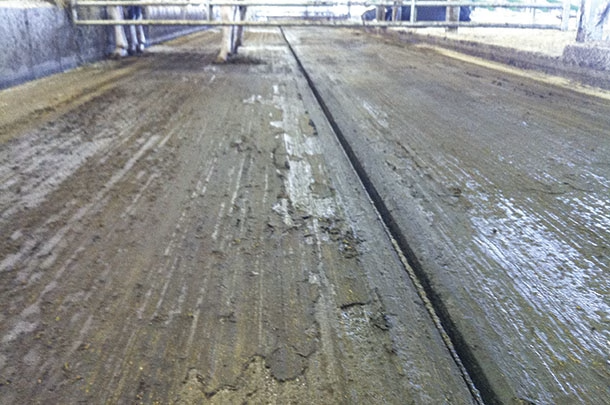
For immediate impact (Years 0-5): Environmental management still wins. University of Wisconsin’s Dairyland Initiative research shows that traction-milling concrete floors—that’ll run you $40,000-60,000—can immediately reduce lameness by 10 percentage points. That’s $11,250 in annual savings with a 3- to 5-year payback. Genetic selection won’t match this for 8-10 years.
For long-term positioning (Years 5-15): This is where genetics shines. It compounds permanently while that nice flooring depreciates. By year 10, genetic selection could deliver $12,000+ in annual savings with no additional capital required. And unlike flooring that needs to be redone every 6-15 years, genetic improvement continues to improve.
The optimal approach: Do both if you can. Fix critical environmental problems for immediate relief while shifting breeding emphasis toward lameness resistance. Year 10 projections show combined benefits of around $23,450 annually—way better than either approach alone.
Alternative Approaches for Smaller Operations
Something that didn’t make CDCB’s main presentations but came up in technical discussions—lower-tech options are being explored that might work for many of us.
University College Dublin researchers developed smartphone apps that can score mobility from short videos with a 64% correlation to camera systems. Penn State Extension is testing a simplified visual scoring that your herd vet could do during routine visits. DairyComp 305 and other software providers are working on integration—you know how they’re always adding features.
Research in the Irish Veterinary Journal shows human-assigned mobility scores correlate at 0.64 with camera scores and still show 10-15% heritability. Not as good as fancy cameras, but might be good enough if it means smaller operations can participate without massive investments.
AI organizations could explore subsidized phenotyping programs—similar to what happened with genomic testing adoption a decade ago—where they’d help cover costs for farms willing to share data.
Making the Right Decision for Your Operation

Not every operation should prioritize this the same way. Based on the economics and timeline, here’s how I see it breaking down:
Strong candidates for emphasis:
- Multi-generation family farms planning to be around 20+ years
- Operations with chronic lameness over 30%—you’ve got more room for improvement
- Farms that can’t afford major facility renovations—genetics might be your only option
- Producers are already thinking about welfare-premium markets
- Operations in regions where consumer pressure is strongest (California, Northeast)
Probably should focus elsewhere:
- Planning to sell or retire within 5-7 years? You won’t see the payoff
- Already under 15% lameness? Limited upside
- Need immediate cash flow improvements? Production traits deliver faster
- Got capital for facility upgrades? Environmental fixes give quicker returns
- Located where welfare pressure is minimal
Where the Industry Goes from Here
What strikes me most about CDCB’s lameness resistance development is how it highlights a broader challenge. Should genetic evaluation systems optimize for current conditions or anticipate where markets are heading? When breeding decisions take 10 years to play out but markets can shift in 5, who bears the risk?
We learned this lesson painfully with fertility. Spent decades emphasizing production while fertility tanked—USDA data shows it clearly. Then we scrambled when replacement costs exploded. Took 15+ years to dig out. Are we setting up for the same pattern with welfare traits?
Dr. Chad Dechow at Penn State has written extensively about needing anticipatory breeding strategies that position for probable future markets rather than just optimizing for today. But that’s easier said than done when you’re trying to make payroll next month.
What This Means for You
Looking at all this, here’s what I’d tell my neighbors:
- Adjust your timeline expectations. This isn’t a quick fix. If you need lameness relief in 3-5 years, invest in flooring, footbaths, and management. Genetics is your 10-year plan.
- Understand the real economics. That $19-24 lifetime value per cow is real but modest. Don’t abandon production traits in pursuit of lameness improvement—use balanced selection via Net Merit or TPI.
- Consider your market position. Selling commodity milk to the co-op? Current genetics might be fine. But if you’re eyeballing premium markets or brands like Organic Valley, starting selection now positions you for 2030-2035.
- Contribute data if you can. These evaluations only improve with broader participation. If you’re working with a good trimmer or thinking about mobility scoring, explore data sharing with CDCB or your breed association.
- Combine strategies. The successful producers I see aren’t choosing between genetics and management—they’re doing both with appropriate timeframes.
The promise of genetic selection for lameness resistance is real. We’re looking at a potential 30% reduction over 20 years according to CDCB projections, permanent benefits that compound, and positioning for evolving markets. But it’s not magic, won’t replace good management, and requires more patience than most of us naturally have.
What we’re discovering about lameness genetics is pretty much what we’ve learned with every other trait: biological systems change slowly, market signals arrive late, and success goes to those who position for tomorrow while managing today. The tools are coming—CDCB says April 2025 for initial implementation. Whether we have the patience and vision to use them effectively? Well, that’s the real question, isn’t it?
KEY TAKEAWAYS
- The 10-year reality: Lameness genetics save nothing initially, then compound to $4,879 (Year 10) and $8,160 (Year 15)—patience required
- Data disconnect warning: Six elite farms with $100K cameras shape genetics for 34,000 dairies—verify relevance to YOUR operation
- Win with both strategies: $40-60K flooring investment (immediate relief) + genetic selection (permanent gains) = $23K+ annual savings by Year 10
- Timeline mismatch alert: European welfare markets arrive by 2030, but genetics won’t deliver until 2035+—early adopters gain 5-year advantage
Complete references and supporting documentation are available upon request by contacting the editorial team at editor@thebullvine.com.
Learn More:
- The $7200 Lameness Fix That Beats $45000 Technology (40-50% Reduction Proven) – This article provides the immediate, tactical playbook for the main article’s “environmental fix.” It details a proven, low-cost prevention bundle of footbaths and strategic trimming that delivers a 4-6 month payback, directly contrasting it with high-cost tech.
- AI Eyes on Your Herd: Why Automated Lameness Detection Is Revolutionizing Dairy Farming – The main article discusses cameras as a genetic data source. This piece dives deep into their daily management value, revealing how AI systems spot lameness 23 days before the human eye and deliver a $13-$99/cow annual return through early intervention.
- CRV’s 2023-24 Financial Report: Challenges and Opportunities for Global Dairy Farmers – This strategic report broadens the main article’s “genetic selection” theme. It reveals how market pressures are forcing investment not just in lameness, but in other key welfare traits like methane reduction, feed efficiency, and polled genetics, showing the bigger picture.
 Join the Revolution!
 Join the Revolution!
Join over 30,000 successful dairy professionals who rely on Bullvine Weekly for their competitive edge. Delivered directly to your inbox each week, our exclusive industry insights help you make smarter decisions while saving precious hours every week. Never miss critical updates on milk production trends, breakthrough technologies, and profit-boosting strategies that top producers are already implementing. Subscribe now to transform your dairy operation’s efficiency and profitability—your future success is just one click away.