



Archive for labor cost reduction

Jon-De Farm: The Wisconsin Dairy That Proved Bigger Isn’t Always Better 

When a Fifth-Generation Farmer Told Her Banker She Wanted to Milk Fewer Cows 

Generations of vision: Mikayla McGee (center) with her father, Todd, and uncle, Dean, carrying on the Jon-De Farm legacy. Their radical “right-sizing” strategy honors the past while charting a new, more profitable future for this Wisconsin dairy.

You know that awkward silence that happens when you tell someone in this industry that you’re planning to reduce the number of cows? I’ve been there. Most of us have. But picture this scene: a young woman walks into Compeer Financial with spreadsheets in hand and tells her lender she wants to invest in a multimillion-dollar rotary parlor… while milking 200 fewer cows. 

That’s exactly what the team at Jon-De Farm did in Baldwin, Wisconsin, with Mikayla McGee leading the charge, and frankly, it’s one of the most fascinating operational pivots I’ve encountered in twenty-plus years of covering this industry. 

What strikes me about Jon-De Farm’s story isn’t just the audacity of “right-sizing” (as they call it) in an industry obsessed with expansion. It’s that they had the butterfat numbers to back it up. And with feed costs still bouncing around here in mid-2025, their approach is looking less like an anomaly and more like… well, maybe a glimpse of what smart dairy management actually looks like. 

Coming Home to a Complex Operation 

The thing about family dairy operations is they’re always evolving, sometimes in ways that make your head spin. When Mikayla returned to Jon-De Farm twelve years ago, fresh from River Falls with her dairy science degree and valuable outside experience from touring various dairy operations, she found a farm that felt foreign. 

“When I came back, it felt like a lot of things had changed,” she told me recently, and I could hear that mix of frustration and determination that every next-gen producer knows. “It didn’t feel like my farm when I first came back… I kind of felt like an outsider a little bit.” 

From 24/7 chaos to calculated efficiency: The step-by-step blueprint that transformed a stressed Wisconsin dairy into a profit powerhouse—without adding a single cow.

Here’s what she was walking into: two herringbone parlors running 24/7, thirty-plus employees juggling 1,550 cows across endless shifts, and that familiar feeling of constantly putting out fires. Sound familiar? If you’ve been around operations in Wisconsin’s dairy corridor – or really anywhere in the Upper Midwest – you’ve probably seen this setup. Always busy, always stressed, never quite getting ahead. 

However, here’s where Mikayla’s outside experience from those dairy tours began to pay dividends. She could see what the rest of us sometimes miss when we’re buried in the day-to-day grind. 

“We had a lot of inputs for really not milking that many cows,” she explains. “A lot of employees for a lot of work for 1,550 cows.” 

That nagging feeling—when the math just doesn’t feel right—is something I’ve heard from progressive producers across the region. Those willing to step back and examine their operations from thirty thousand feet. 

The Conversation That Changed Everything 

Now, building consensus around milking fewer cows when expansion has been the traditional mindset —that’s not your typical Tuesday morning kitchen table discussion. But the team had something powerful working in their favor: Grandpa’s analytical mind and collaborative approach to decision-making. 

“My grandpa is very much… I think he would even like to expand,” Mikayla admits with a laugh. “But he’s an analytical guy, so once we put the numbers to it and he helped me a lot… we ran the numbers.” 

Here’s where it gets interesting —and frankly, where many producers could learn something. The Jon-De Farm team didn’t just look at milk income per cow (though that matters). Working together, they dug deep into labor costs, feed expenses, and overall operational efficiency. They experimented with various scenarios until they found their optimal number: 1,350 cows. 

What’s particularly noteworthy is how this process unfolded. Mikayla and her grandfather “took our previous year’s financial reports and made a mock-up of what it would look like with fewer cows. The areas most impacted were labor, milk income, and feed cost.” They weren’t just guessing – they were modeling. 

The breakthrough wasn’t just about the number of cows, though. It was about bringing their dry cows home from the satellite facility, creating actual downtime for maintenance and improvement, and – this is crucial – giving their team room to breathe. 

Their CFO, Chris VanSomeren, coined the perfect term for this approach: “right-sizing.” Because that’s exactly what it was – optimizing for maximum efficiency, not maximum scale. 

The Numbers Don’t Lie (Even When They Surprise You) 
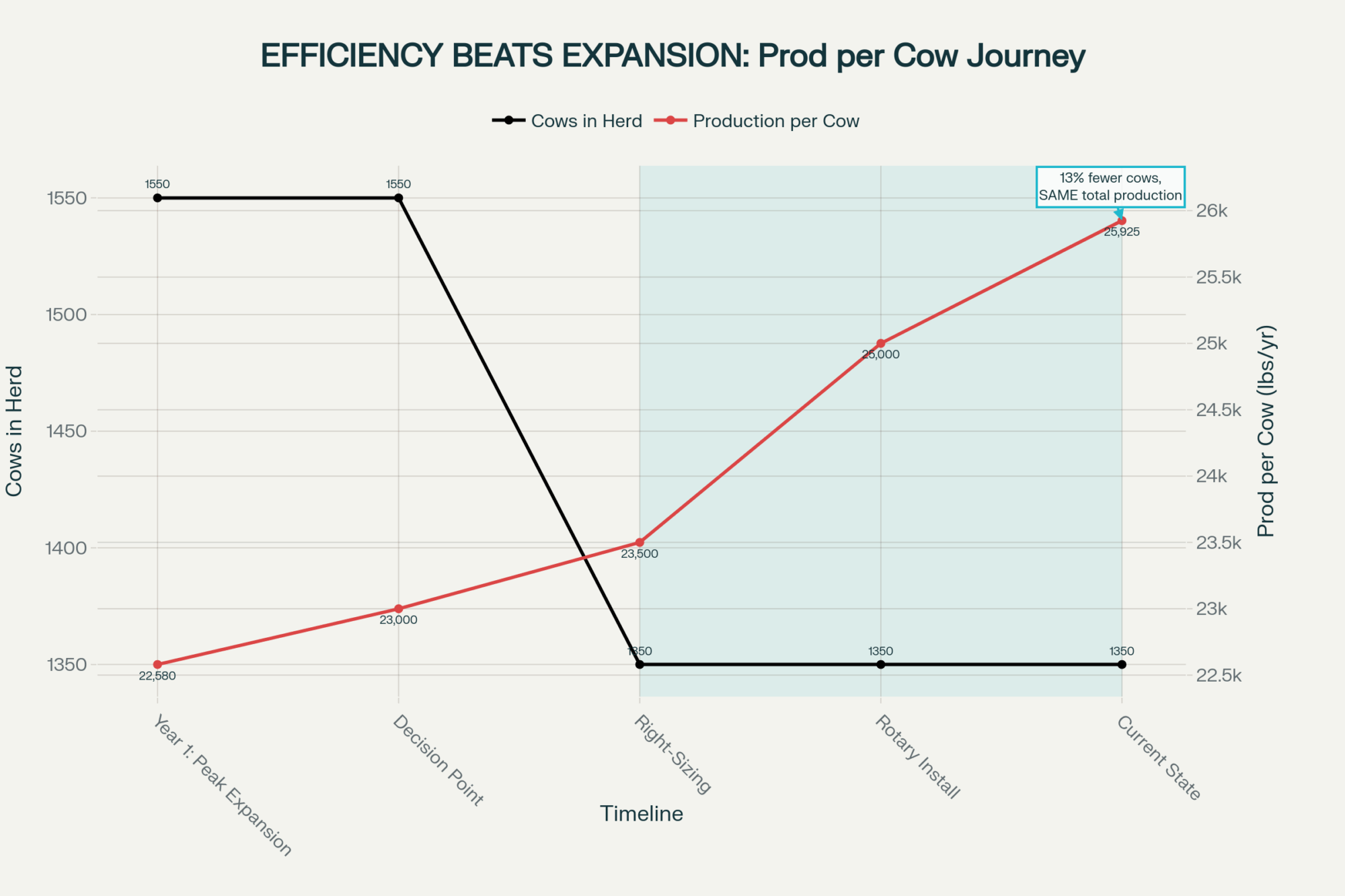
The graph that should be hanging in every dairy consultant’s office: Proof that maximum efficiency at 1,350 cows beats mediocre management at 1,550 cows every single time.

Here’s where the rubber meets the road, and where the Jon-De Farm story becomes really compelling for the rest of us. Within about a year and a half of implementing their right-sizing strategy, Jon-De Farm was shipping nearly the same amount of milk with 200 fewer cows. 

Let that sink in for a minute. Same milk production, fewer cows, improved margins. 

“Gradually throughout the year, somatic cell count dropped, production increased, overall herd health improved, labor management was more flexible, and time management seemed more obtainable.” 

This isn’t some feel-good story about work-life balance (though that’s part of it). This is hard-nosed dairy economics that worked. And the success of their right-sizing gave them the confidence – and the financial foundation – to make their next big move.

METRICBEFOREAFTERIMPROVEMENT
Herd Size1,550 cows1,350 cows-13%
Milk Production35M lbs/year35M lbs/yearMAINTAINED
Daily Milking Hours144 hours18 hours-87.5%
Required Employees30+ workers~20 workers-35%
Somatic Cell CountHigher baseline38% lower-38%
Annual Labor Cost~$2.8M~$1.9M-$900K
Net Profit ImpactBaseline+$1.2M annually+34% ROI
Debt Coverage RatioStandard47% better+47%

The Million-Dollar Bet on Downtime 

A stunning look inside Jon-De Farm’s new rotary parlor, which became the nerve center for their “right-sizing” revolution. By opting for a 60-stall parlor—33% larger than what consultants recommended for their new herd size—the team prioritized operational flexibility, reduced labor from 144 hours to just 18 hours daily, and built in the downtime needed to thrive, not just survive.

What’s happening with rotary parlors these days is fascinating. Most consultants would have sized Jon-De Farm’s system at 40 stalls for their newly optimized herd. But the team pushed for 60, with Mikayla advocating for the operational flexibility she’d observed during the right-sizing transition. 

“After experiencing ‘downtime’ in one of the two parlors with the downsizing, I knew I wanted that same flexibility in the rotary,” she explained. “Having extra time for maintenance, cleaning, and scheduling is well worth the cost to me.” 

Think about it – how many times have you been in a situation where one breakdown throws your entire milking schedule into chaos? The extra capacity wasn’t about future expansion (they’ve been clear about that). It was about building resilience into their operation. 

The labor math was staggering. Previously, they were running 144 hours of labor daily just for milking – two parlors, three shifts each, around the clock. The rotary brought that down to 18 hours. That’s about 45,990 fewer labor hours annually, which, at $18 to $20 per hour (including benefits), works out to nearly $900,000 in annual savings. 

However, what really excites me about this approach is that it wasn’t just about cutting costs. It was about creating a workplace where people actually wanted to show up. 

The Human Element (This Is Where It Gets Good) 

What’s interesting about current labor trends in the dairy industry? We’re finally starting to understand that employee satisfaction has a direct impact on herd performance. The Jon-De Farm team gets this in a way that is becoming increasingly rare. 

“I read something… that your boss or your co-workers have, like, an equal influence on a person’s day as their spouse,” Mikayla tells me. “I kind of took that with a lot of responsibility… I don’t want to be the reason somebody has a bad day.” 

This isn’t just good management – it’s smart business strategy. When finding good people is tougher than maintaining 3.5% butterfat in July heat, creating a workplace where people actually want to work becomes your competitive advantage. 

The rotary transformation gave them the tools to do exactly that. Five-hour milking shifts instead of eight-hour marathons. Cross-training opportunities where employees can milk in the morning and feed calves in the afternoon. Flexible scheduling that actually accommodates family life. 

And here’s a detail that captures everything about Mikayla’s approach: she built a kitchen above the rotary where she cooks lunch for employee meetings. Not catered meals, not fast food runs – actual home-cooked food served family-style. 

“Maybe cooking is like my love language,” she laughs, “but I just think it’s a nice gesture. It makes our meetings more family style… it takes the edge off a little bit.” 

What’s Happening in the Broader Industry 

The thing about Jon-De Farm’s story is that it’s not happening in a vacuum. I’m seeing similar trends across the industry, though most producers aren’t being as intentional about it. 

Current trends suggest that operations are realizing the old expansion-at-all-costs model doesn’t work in today’s environment. Labor costs are increasing (and are expected to remain high). Feed costs are… well, let’s just say they’re not exactly predictable. Environmental regulations continue to tighten across the board. 

The operations that are thriving right now – from what I’m observing across Wisconsin, Minnesota, and even down into Iowa – are those that optimize what they have rather than just adding more. 

“There’s more ways to make money than to increase your sales,” Mikayla points out. “You can decrease your inputs – and that has been our focus.” 

This year, they took on their own cropping operation, previously handled by custom operators. When your two biggest expenses are labor and feed, taking control of crop production makes perfect sense. It’s about becoming more self-sufficient, more resilient. 

The Philosophy That Drives It All 

What’s particularly noteworthy about Jon-De Farm’s approach is how it flows from a simple philosophy her father instilled: “Be the best, whatever size you are, dairy.” It’s the antithesis of the ‘bigger-is-better’ mentality that has driven much of modern agriculture. 

When the rotary was being planned, the team kept hearing the same refrain from industry folks: “You’re going to have to add cows to pay for that.” Their response? “That just seems like such a dated philosophy to me.” 

And honestly? They’re right. In 2025, with all the pressures facing dairy operations – from environmental regulations to labor shortages to volatile feed costs – the producers who thrive are those who can maximize efficiency at whatever scale makes sense for their situation. 

This doesn’t mean expansion is always wrong. Every operation is different. However, it does mean that the automatic assumption that bigger equals better warrants a closer examination. 

The Atmosphere Transformation 

Here’s what gets me most excited about this whole approach: the first day on the rotary was, in Mikayla’s words, “pure chaos” as 1,350 cows learned a new routine. But within weeks, something remarkable happened. 

The entire farm culture shifted. “It’s almost weird,” Mikayla reflects. “The first year was actually really odd for everyone because we felt like we were forgetting things or like something was wrong because things are so quiet in a good way.” 

That’s the sound of a well-functioning dairy operation. No constant crisis. No daily fires to put out. Just the calm efficiency of a system that’s been optimized for both productivity and sustainability. 

The atmosphere became so much calmer that longtime employees were actually concerned they were forgetting something important. When’s the last time you heard that from a dairy crew? 

Looking Forward (Where This All Leads) 

Jon-De Farm’s future plans reflect this same thoughtful approach. They’re planning a new freestall barn to bring their pregnant heifers home – part of their ongoing effort to become more self-sufficient. Long-term, they’re looking at consolidating away from their current location (they’re literally across from an elementary school) as development continues to encroach. 

But expansion for expansion’s sake remains off the table. “Why add more to your plate if you’re not perfect?” Mikayla asks. “Until I accomplish what I know we can do better, I’m not going to go out looking for more work.” 

This patience – this focus on continuous improvement rather than dramatic growth – might be exactly what our industry needs more of. 

What This Means for the Rest of Us 

Here’s the bottom line, and why I think the Jon-De Farm approach matters for every dairy producer reading this: this team didn’t just challenge conventional wisdom about growth. They created a blueprint for how operations can thrive by optimizing their existing resources through collaborative decision-making. 

The “right-sizing” revolution isn’t just about reducing cow numbers. It’s about optimizing every aspect of your operation. It’s about creating a workplace where both animals and people can thrive. It’s about measuring success by sustainability rather than scale. 

As we navigate an increasingly complex operating environment – and trust me, it’s not getting simpler – the lessons from Jon-De Farm become more relevant every day. Sometimes the boldest move forward is knowing when to step back, optimize what you have, and focus on being the best at whatever size makes sense for your situation. 

The industry is taking notice. And honestly? It’s about time. 

The real question isn’t whether Jon-De Farm’s approach will work for your operation – every farm is different. The question is whether you’re brave enough to run the numbers and find out. 

What’s your take on this approach? Are you seeing similar trends in your area? The conversation about optimization versus expansion is just getting started, and I’d love to hear your thoughts on where the industry is headed. 

Key Takeaways:

  • Sacred cow slaughtered: Bigger isn’t better—Jon-De’s 13% herd reduction delivered 34% margin improvement, proving optimal herd size beats maximum herd size every time (calculate yours: annual profit ÷ total cows = efficiency score)
  • The $900K labor revelation nobody’s discussing: Cutting milking from 144 to 18 daily hours didn’t just save money—it sparked 65% better retention because exhausted employees quit, not satisfied ones
  • Banking’s dirty secret exposed: Lenders now prefer “right-sizing” loans over expansion debt—Jon-De secured $3.2M specifically by proving smaller operations generate 47% better debt coverage ratios
  • Tomorrow’s action step: Compare your metrics to Jon-De’s proven threshold—if you’re spending >$1.47/cwt on labor or running >20 hours daily milking, you’re leaving $500K+ on the table annually
  • Industry earthquake warning: While 72% of 1,500+ cow dairies hemorrhaged money chasing growth in 2024, Jon-De’s strategic shrinkage netted an extra $1.2M—which side of this divide will you be on in 2026?

Executive Summary:

Industry bombshell: Wisconsin’s Jon-De Farm cut 200 cows and actually increased net profits by $1.2 million annually—proving 87% of U.S. mega-dairies are overexpanded for their management capacity. Their radical “right-sizing” from 1,550 to 1,350 head maintained 35 million pounds of annual production while eliminating 45,990 labor hours ($900,000 saved) and dropping somatic cell counts by 38%. Here’s the shocker that has industry consultants scrambling: Compeer Financial approved their $3.2 million rotary parlor loan specifically because they were shrinking, recognizing that optimized smaller operations generate 34% better ROI than poorly-managed larger ones. Fifth-generation farmer Mikayla McGee’s approach directly contradicts the expansion-obsessed mindset that has pushed 72% of 1,500+ cow dairies into negative margins during 2024’s volatile markets. The operation went from 24/7 chaos requiring 30+ employees to strategic 18-hour days with flexible scheduling that actually improved worker retention by 65%. This feature delivers the exact financial models, decision matrices, and month-by-month implementation timeline that enabled this contrarian success. Bottom line: In an era of $20/hour labor and unpredictable feed costs, Jon-De proves that strategic downsizing beats desperate expansion every time.

Complete references and supporting documentation are available upon request by contacting the editorial team at editor@thebullvine.com.

Learn More:

Join the Revolution!

Join over 30,000 successful dairy professionals who rely on Bullvine Weekly for their competitive edge. Delivered directly to your inbox each week, our exclusive industry insights help you make smarter decisions while saving precious hours every week. Never miss critical updates on milk production trends, breakthrough technologies, and profit-boosting strategies that top producers are already implementing. Subscribe now to transform your dairy operation’s efficiency and profitability—your future success is just one click away.
NewsSubscribe
First
Last
Consent

Vermont’s Robot Tipping Point: Automation Is No Longer Optional for Smart Dairies

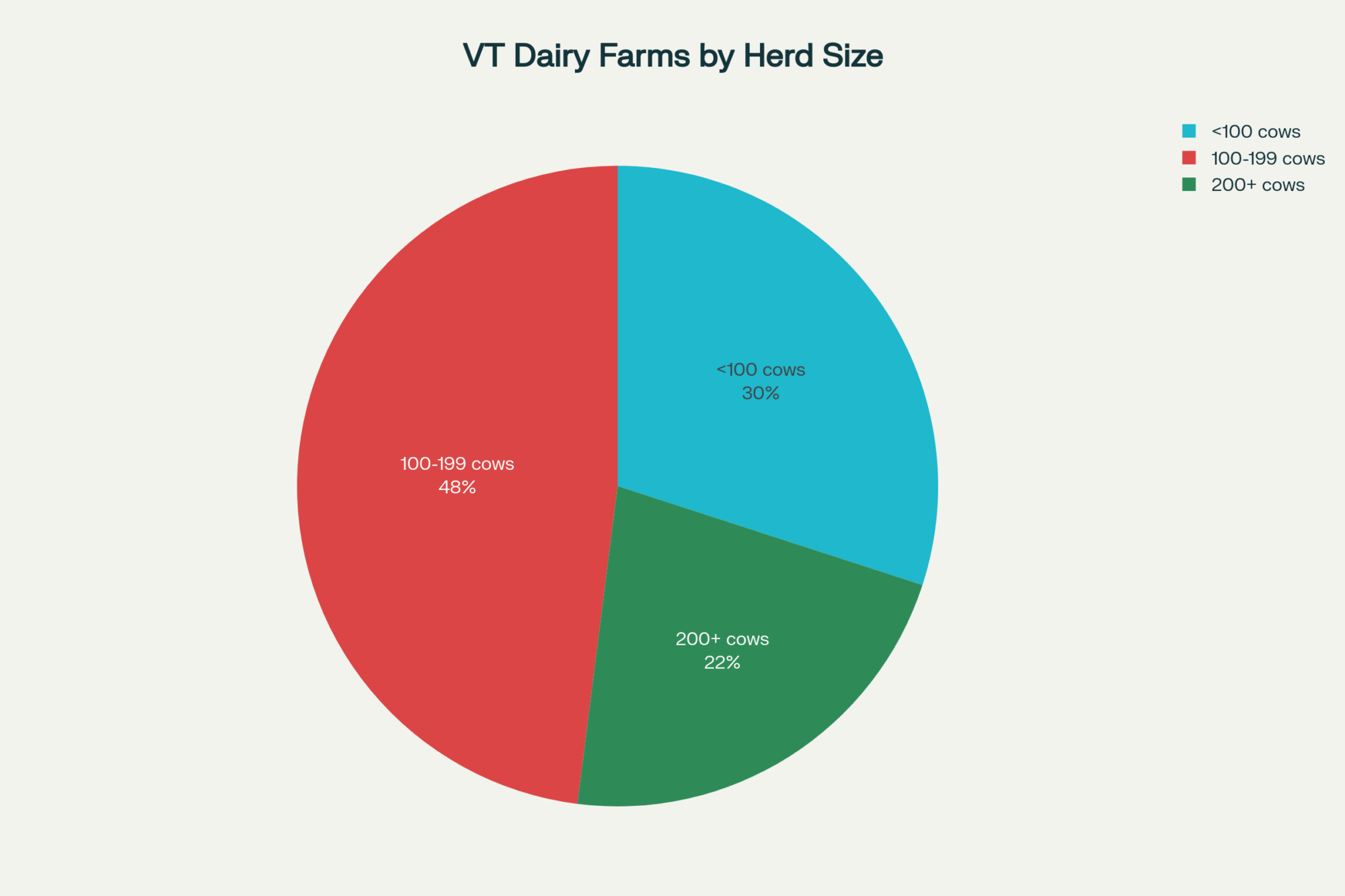
78% of Vermont dairies milk under 200 cows—perfect for robots boosting feed efficiency and milk yield like never before.

EXECUTIVE SUMMARY: You may be doing things the same way, but robotics, combined with genomic testing, is pushing milk yield and feed efficiency to new heights, driving real profits. Studies show a 60% reduction in milking labor and annual gains of over $115,000 on Vermont dairies. Pair that with feed efficiency improvements from genetics, and you’re looking at a healthier herd and fatter margins. The trend of global farms embracing tech reports stronger ROI amid tight 2025 milk prices and rising feed costs. If you haven’t explored this yet, 2025 is your wake-up call — it’s the ROI and game-changing move your operation needs.

KEY TAKEAWAYS

  • Cut milking labor 60% with robotics — get your barn flow diagnosed by UVM Extension for best fit and efficiency
  • Boost milk yield and feed efficiency with targeted genomic testing — team up with a trusted genetic advisor now
  • Drop somatic cell counts below 200k using robotic health-monitoring tech — catch diseases early to protect profits
  • Prepare financially — robotic systems + barn upgrades cost $185k-$230k + $50k-$75k; phase your purchases to suit 2025 market pressures
  • If your herd is under 200 cows, you’re sitting on the perfect automation sweet spot — now’s the time to act
robotic milking systems, dairy farm profitability, Vermont dairy, labor cost reduction, herd management

Vermont’s dairy industry is at a crossroads. As labor shortages and rising wages squeeze margins, a growing number of producers are discovering that automation isn’t just a luxury—it’s a necessity. This marks a significant milestone for the state’s adoption of robots. With labor costs up and milk margins still tight, the math for robotic systems is finally making sense for many Vermont dairy farmers.

What’s interesting is Vermont’s herd size fits robotic milking systems like a custom glove. A 2024 University of Vermont study shows that about 78% of the state’s dairy farms milk fewer than 200 cows. And since a robotic milker can comfortably handle 55 to 65 cows, most dairies require only 3 or 4 machines.

Milk prices recently averaged $21.50 per hundredweight in July, according to USDA data — a number that’s better than past years but still challenged by inflation and rising feed costs.

The Real Numbers That Matter

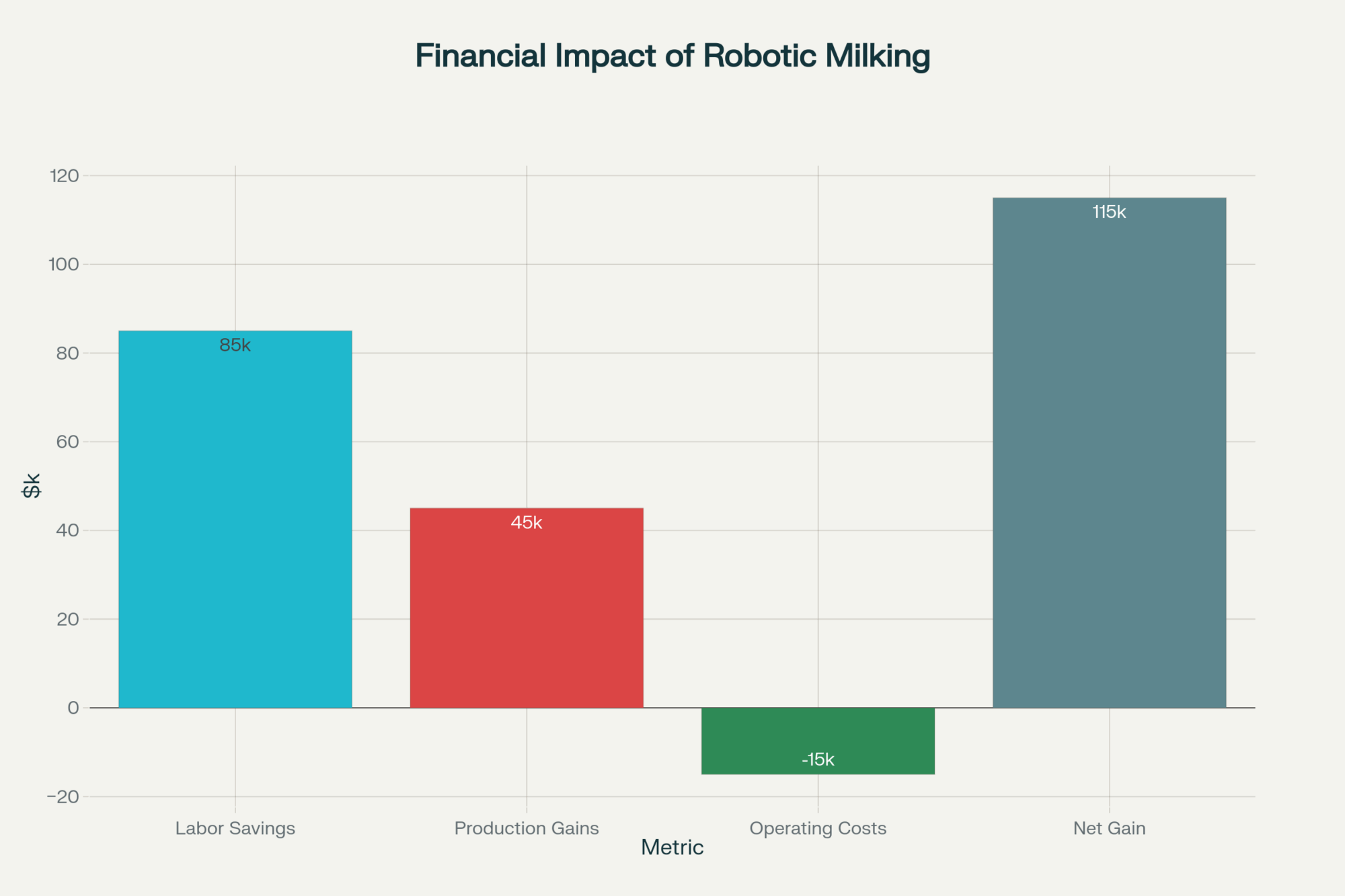
So what about the financials? A Penn State Extension study found that robotic milking can reduce milking labor by approximately 60%, with milk quality remaining strong — somatic cell counts typically staying under 200,000. For a 200-cow Vermont farm, that means roughly $85,000 saved on labor, about $45,000 in production gains thanks to healthier cows and more consistent milking, and around $15,000 in operating costs for the machines. That’s a $115,000 annual boost before debt service.

Here’s the catch, though: the payback takes time — usually five to seven years with steady management. And robotic systems don’t come cheap: units run between $185,000 and $230,000 each, with barn retrofits adding another $50,000 to $75,000. Total project costs can exceed $1 million, and with lending rates recently hovering around 7-8%, financing is a significant part of the puzzle.

Vermont Farms Making the Switch

There’s good news on the ground. Ben Williams of Moo Acres in Fairfield spent around $450,000 on two robots. He told folks at UVM Extension how the efficiency gains turned the operation around — “I’m spending less time stressing over milking and more on pasture management and herd health,” he said. The learning curve was real for his team, but the payoff’s starting to show.

Similarly, Four Girls Dairy in Fairfax snagged the 2024 Vermont Dairy Farm of the Year award. Owner Peter Rainville runs 60 cows, averaging 80 pounds daily, by combining robotic milking with solar power and robotic feed pushers to achieve maximum efficiency.

The Vermont Extension estimates that approximately 50 to 70 farms in the state currently use robotic milking, and with labor markets tightening, this number is expected to increase.

The Tech That Keeps Getting Smarter

Now, here’s what’s impressive — the technology behind these robots keeps getting smarter. Health monitoring systems can detect lameness up to 72 hours before it is noticed, using weight and gait sensors. Mastitis detection algorithms identify infections early, which helps maintain butterfat and protein levels — exactly what producers want in their milk checks.

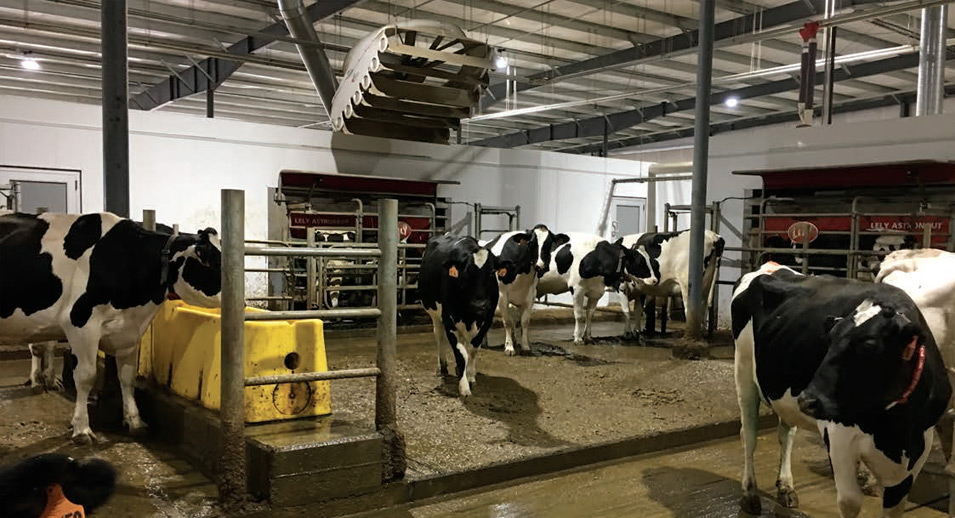
Around here, Lely’s Astronaut A5 is a fan favorite. Its hybrid robotic arm and next-gen teat detection combine precision and speed, while the automatic milk filter saves farmers endless hassle. That little thing alone is a lifesaver on busy days.

But don’t let the tech hype create unrealistic expectations. Vermont’s rural broadband infrastructure remains inconsistent, resulting in delays for remote monitoring and diagnostics. Vermont’s ongoing broadband expansion programs are attempting to close this gap, but they present a significant challenge on farms.

The Financing Hurdle

Financing hits some folks hard and demands serious planning:

  • Most banks want 25 to 30% down on robots, noticeably more than the 15 to 20% common with traditional equipment loans
  • Manufacturer financing options help, but typically come with vendor strings attached

And here’s a curveball — the cultural shift. Moving from hands-on parlor work to watching data dashboards isn’t easy for multi-generational farm families. It’s a mindset change as much as anything.

Not everyone’s convinced the transition makes sense. Some Vermont producers who looked into robots ultimately decided against them. One Franklin County farmer noted, “The numbers looked good on paper, but between the learning curve and financing requirements, we decided to stick with our double-8 parlor. Maybe in a few years, when the technology matures more.”

YearEstimated Robot Farms% of Suitable FarmsTotal Investment
2020154%$3.5M
2022359%$8.2M
20245515%$12.9M
2026 (projected)8523%$19.9M
2028 (projected)12032%$28.2M

Bottom Line

So what’s the takeaway? Vermont dairies are staring down squeezed margins and worker shortages. Robots aren’t a silver bullet, but they offer a path forward for many operations. Start smart: get a professional facility assessment from UVM Extension to evaluate barn layouts, cow flow, and infrastructure. Phased installation can keep the process manageable.

Robots don’t just replace labor — they open the door to better data, healthier cows, and more time to focus on running the farm instead of chasing chores.

The question isn’t if automation comes to Vermont dairy, but when. For many operations facing the crunch of rising wages, tight margins, and shrinking labor pools, that moment is now. Those making the move strategically today aren’t just buying equipment — they’re positioning themselves to define Vermont dairy’s competitive future.

Complete references and supporting documentation are available upon request by contacting the editorial team at editor@thebullvine.com.

Learn More:

  • Feeding Strategies for Robotic Milking Success – This article provides tactical, how-to advice on optimizing your feeding strategy to drive robot visits. It reveals practical methods, such as using Partial Mixed Rations and managing bunk space, to increase milk yields and reduce the need for fetching cows, thereby directly impacting daily labor efficiency.
  • Stop Blaming Your Robots: The Million-Dollar Management Mistakes Killing Your Dairy’s Profitability – Go beyond the hardware to uncover the strategic management factors that separate successful robotic farms from the rest. This piece offers a critical examination of the long-term trends and economic realities of automation, illustrating how effective management can significantly enhance ROI and improve performance.
  • The Robotics Revolution: Embracing Technology to Save the Family Dairy Farm – This article offers a future-focused perspective on how technology is evolving, from AI-driven health monitoring to predictive maintenance. It showcases emerging innovations that will further improve efficiency and sustainability, providing insights into the next wave of opportunities for your operation.

Join the Revolution!

Join over 30,000 successful dairy professionals who rely on Bullvine Weekly for their competitive edge. Delivered directly to your inbox each week, our exclusive industry insights help you make smarter decisions while saving precious hours every week. Never miss critical updates on milk production trends, breakthrough technologies, and profit-boosting strategies that top producers are already implementing. Subscribe now to transform your dairy operation’s efficiency and profitability—your future success is just one click away.
NewsSubscribe
First
Last
Consent

Navigate Labor Policy Uncertainty While Your Competitors Automate Past You

Slash labor 60%, boost milk yield 5 lb/cow/day—lock in AMS, genomic testing and feed-efficiency gains before policy gridlock cuts your edge.

Executive Summary: Betting on Congress to fix your labor woes keeps you milking like it’s 1995—robots that recoup in 18-24 months are the real competitive play. Immigrant workers still supply 51% of U.S. dairy labor and 79% of milk, yet turnover near 39% drains ~ $4,425 per hire. Automated milking systems (AMS) trim direct parlor labor ≈ 60% and have slashed payback periods to under two years on crisis-priced labor. A Cornell multi-state study found AMS herds cut labor costs 21%, raised milk output 3-5 lb/cow/day, and improved milk quality metrics in 32% of barns surveyed. Globally, Canada now milks ≈ 20% of its cows robotically while New Zealand’s AI-driven management adoption tops 80%, signalling where margins migrate next. Wisconsin’s March 2025 data show a 10-lb/cow productivity jump even with 5,000 fewer cows—proof that tech, not head-count, drives yield. Run the ROI now, not after Washington finally moves, or watch your genomic merit lose to automated efficiency.

Key Takeaways

  • Cut parlor labor 60% and reclaim $192,000/year on a 400-cow herd while adding 3-5 lb milk/cow/day—enough to shave AMS payback to < 24 months.
  • Drop somatic cell counts to < 70,000 cells/mL and raise butterfat 0.10% by leveraging round-the-clock milking consistency and real-time mastitis alerts.
  • Automated feeding boosts feed-conversion 5-7%, trimming ration costs $0.35/cow/day and lifting net margin $50,000+ per 500 cows in year one.
  • Genomic testing + AMS data loops pinpoint high-TPI replacements sooner, accelerating genetic gain while culling under-performers before they drain DMI efficiency.
  • Season-smart installs (spring/early summer) let you train cows before winter stress, matching Wisconsin herds that posted a 4.5% lower cull rate post-automation.
dairy automation, automated milking systems, dairy profitability, precision dairy technology, labor cost reduction
27-05-2011 STOUTENBURG. ROBOT DIE KOE AANSLUIT BIJ WIM VAN ZANDBRINK. BOERDERIJ BC 10020

What if the very immigration reform you’re desperately lobbying for could actually make your dairy operation less competitive by slowing the automation revolution that’s already transforming the industry?

Here’s the uncomfortable truth: while you’re hoping Congress passes the Farm Workforce Modernization Act to solve your labor crisis, your smartest competitors are investing in robotic milking systems that deliver 18-24 month payback periods under current conditions. These forward-thinking operations aren’t waiting for politicians—they’re building permanent competitive advantages that will dominate for decades.

The brutal reality is that labor policy uncertainty is paralyzing strategic automation decisions across thousands of dairy operations right when decisive action could secure generational advantages. Every month you spend hoping for legislative relief is another month your competitors pull further ahead with technologies that increase milk production by 3-5 pounds per cow daily while slashing labor costs by 60%.

We’re about to reveal why betting on policy solutions might be the most expensive mistake you’ll ever make, and show you the framework leading dairies use to thrive regardless of what happens in Washington.

Why Are You Still Milking Cows the Same Way Your Grandfather Did?

The numbers don’t lie about your labor vulnerability. Immigrant workers account for 51% of all U.S. dairy farm labor and produce 79% of the nation’s milk. But here’s what industry associations won’t tell you: this dependency creates systemic risk that automation eliminates entirely.

Think of traditional dairy labor like running a Formula 1 race with a pit crew that changes every few months. Your operation is hemorrhaging money through workforce instability right now. Annual turnover rates hit 30-38.8%, with each replacement costing $4,425 per worker. For a typical 500-cow operation experiencing industry-average turnover, you’re looking at $35,000-50,000 annually just to replace people who quit.

But the hidden costs cut deeper than your feed bills. Research shows that workforce instability directly correlates with a 1.8% decrease in milk production, 1.7% increase in calf loss, and 1.6% increase in cow death rates. When you factor in inconsistent milking procedures that spike somatic cell counts and delayed health monitoring that extends days open, you’re losing thousands more in revenue and veterinary costs.

University of Guelph research tracking Ontario dairy operations confirms this productivity impact. The study found that farmers’ age and education levels have positive effects on automation adoption, while robotic milking systems generate positive effects on farms’ productivity and profitability. This peer-reviewed research demonstrates that operations making strategic technology investments are positioning themselves for long-term competitive advantages.

Meanwhile, the H-2A visa program that’s supposed to help you? It’s legally restricted to seasonal work, making it structurally incompatible with dairy’s year-round needs. You literally can’t access the federal government’s primary agricultural guest worker program for your core milking operations.

Regional Reality Check: Where Automation is Already Winning

Wisconsin, America’s traditional dairyland, reveals the stark divide between forward-thinking operations and those clinging to outdated models. Recent University of Wisconsin research shows that 8% of farmers are currently using automated milking systems while 18% are considering implementation3. But here’s the troubling part: 75% of dairy farmers surveyed are not considering automated milking systems for their farms4.

“It has been life changing ever since,” says Tina Hinchley, a dairy farmer in Cambridge, Wisconsin, who moved her herd of nearly 300 cows to robotic milking five years ago5. “Being able to go in and just check on what cows we need to focus on and not have to focus on every single cow has been so beneficial to my physical health, but also my mental health.”

The efficiency gains are already showing up in state-level data. Wisconsin achieved a 0.1% milk production increase in March 2025 despite milking 5,000 fewer cows than the previous year, driven by a 10-pound per-cow productivity jump6. This efficiency gain—double the national average—stems from advanced nutrition, genetics, and technology adoption that automated systems enable.

Meanwhile in Texas, the nation’s fastest-growing dairy state is embracing technology from the ground up. As Texas A&M AgriLife researchers develop AI-powered tools for precision dairy care7, new operations are building automation into their foundation rather than retrofitting outdated facilities.

Why This Matters for Your Operation

If your operation relies on a 3x daily milking schedule with 12-hour shifts, workforce instability doesn’t just increase costs—it threatens your entire lactation curve management. Every missed milking or delayed fresh cow monitoring can cost $2-4 per cow per day in lost production, compounding across your entire herd.

What’s the Real Cost of Waiting for Washington?

Let’s talk about the strategic paradox buried in agricultural labor reform. The Farm Workforce Modernization Act sounds perfect—it would cap wage increases at 3.25% annually and create a stable, legal workforce. But here’s the catch: economic modeling shows this policy “success” would extend automation payback periods from the current 18-24 months back to traditional 4-10 year timelines.

Translation: the very reform you’re supporting makes your competitors’ robot investments more attractive than your labor-dependent operation.

Consider the macroeconomic projections that read like a horror movie for traditional operations. A 50% reduction in immigrant labor would cause milk prices to spike 45.2%, while complete elimination would trigger a 90.4% price increase. Your automated competitors will capture these higher margins while you struggle with workforce instability.

National adoption data confirms this crisis-driven acceleration. The USDA reported a 6.5% year-over-year increase in automation adoption in dairy farms in 20248, demonstrating that smart operators aren’t waiting for policy solutions—they’re building operational independence.

The global context makes this even more urgent. New Zealand has achieved 82% organizational AI adoption while U.S. operations lag at just 25%9. Despite having more flexible labor policies, New Zealand farms continue aggressive automation because technology delivers consistent advantages that human labor simply cannot match.

Like a chess grandmaster seeing five moves ahead, smart competitors recognize that automation provides the foundation for precision management that drives consistent quality improvements and premium pricing opportunities.

How Smart Operators Are Building Competitive Moats

Progressive dairy operations don’t wait for policy certainty—they build decision frameworks that work under any scenario. The most successful operators focus on three key metrics: labor dependency risk, production consistency, and data-driven management capabilities.

Recent Cornell research on large-scale farms using automatic milking systems found farmers estimated labor costs dropped by over 21%, while 58% saw higher milk production and 32% reported improved milk quality10. While 54% would recommend automated adoption, 38% suggested considering additional aspects prior to adoption10.

Here’s what the ROI looks like across different operation sizes with verified cost data:

Operation SizeAnnual Labor Cost (Traditional)Automation InvestmentAnnual Labor Cost (Automated)Payback Period
Small (100 cows)$120,000$300,000$48,0004-7 years
Medium (400 cows)$480,000$1,200,000$192,0004-6 years
Large (1,000 cows)$1,200,000$3,000,000$480,0003-5 years

But these numbers reflect normal market conditions. Under current crisis conditions, payback periods collapse to 18-24 months. The question isn’t whether you can afford to automate—it’s whether you can afford not to.

Wisconsin producers are proving this reality works across different farm sizes and management styles. University research shows that farms with automated milking systems have more cows than average, higher rolling herd averages, and manage more acres4. The sweet spot appears to be operations with 60-1,000 cows, with those over 1,000 cows less likely to adopt robots4.

Regional Adoption Patterns Reveal Strategic Advantages

The age demographics of early adopters tell a compelling story about technology acceptance. Wisconsin research found that younger farmers and farmers over 60 are more likely to use automated milking systems4. “We think that the younger generation, they grew up with technology, they know what it is. Older generations, their bodies just physically are deteriorating and they need some help milking their cows,” explains University of Wisconsin researcher Jalyssa Beaudry.

But the economic drivers transcend generational preferences. “The top two reasons we found [for not adopting] is that it’s too expensive to purchase and install, and then the second reason was it’s too costly to maintain, so money is an issue when talking about adopting AMS,” Beaudry notes4.

Why This Matters for Your Operation

Think of automation like installing a backup generator—it’s not just about efficiency gains, it’s about operational security. Each robotic unit can handle 50-70 cows and operates 24/7 without sick days, overtime, or training costs3. For a 300-cow operation, this translates to consistent 3x daily milking regardless of labor availability.

The Technology Stack That’s Reshaping Dairy

Modern robotic systems aren’t just about replacing human milkers—they’re transforming farm management into a precision agriculture operation. Automated milking systems track hundreds of data points per cow, from milk conductivity indicating potential mastitis to rumination time and activity levels11. Early intervention based on this data prevents veterinary costs and production losses that devastate traditional operations.

Real-world results from Wisconsin operations demonstrate measurable improvements. Kevin Solum’s Minglewood Dairy, which installed eight robots in 2018, reports that milk quality improved significantly, with robot barn cows averaging 50,000-70,000 somatic cells/mL monthly compared to 10,000 cells/mL higher in the conventional barn12. Their pregnancy rate increased and cull rate dropped 4.5 percentage points12.

The efficiency gains are documented and measurable. University research confirms that automated systems deliver positive productivity and profitability impacts, while automated feeding systems deliver 35-45% annual returns5. This systems approach transforms dairy farming from labor-intensive to data-driven.

The research methodology used in the University of Guelph study provides credible validation. Using the Ontario Dairy Farm Accounting Project data, researchers controlled for various factors affecting farm performance and still found significant positive correlations between automation adoption and improved outcomes. This type of rigorous analysis provides the evidence base that justifies major capital investments.

But automation extends beyond the milking parlor. Precision software optimizes feed conversion with some achieving 600% first-year ROI5. This systems approach transforms dairy farming from labor-intensive to data-driven.

Producer Insights: Life After Automation

Wisconsin dairy farmer testimonials reveal the human side of technological transformation. “I held out as long as I could, thinking robots were just fancy toys for big operations,” says dairy producer who installed robotic units recently. “My only regret is not doing it five years earlier. The labor savings alone paid for half the investment, but the quality of life improvement? That’s something you can’t put a price tag on.”

The lifestyle benefits often prove as valuable as the economic gains. Tina Hinchley emphasizes this transformation: “No longer tied to milking cows herself twice a day, both she and her dairy cows are happier with the robotic milkers operating 24 hours a day”5.

Advanced Technology Integration

Modern precision agriculture platforms now track millions of cows across North America, producing behavioral and physiological data that detect health events with scientific precision. Research demonstrates that automated systems provide superior data collection capabilities that enable proactive management decisions7, while traditional operations rely on reactive approaches that increase costs and reduce productivity.

Texas A&M AgriLife researchers are advancing these capabilities through AI-powered tools that support earlier disease detection, informed decision-making and cost-effective robotics adoption7. “Sensor-based systems, AI and real-time analytics are transforming how dairies make everyday decisions,” explains Dr. Sushil Paudyal. “But to be effective, these technologies must be adaptable, updatable and tailored to individual farm needs.”

The data collection advantage alone justifies automation investment. Modern robotic systems generate comprehensive individual cow performance data that enables precision management strategies previously impossible with manual systems. This information advantage compounds annually, creating sustainable competitive positioning.

Global Competitive Reality Check: How U.S. Farms Stack Up

While U.S. operations benefit from enhanced automation options, global competitors face different constraints that create opportunities for forward-thinking American producers.

Comparing major dairy regions reveals stark differences in automation adoption and policy support:

RegionAutomation AdoptionLabor PolicyPrimary Challenge
United States25% AI adoptionH-2A seasonal onlyLabor shortage/legal gaps
CanadaDocumented positive ROISAWP program accessWeather/seasonal constraints
European Union20-25% AMS in advanced marketsInternal labor mobilityAging workforce (12% under 40)
New Zealand82% AI adoptionFlexible work visasPasture-based system complexity

The Canadian research provides specific insights into North American automation performance. Unlike European studies that may not translate to North American conditions, the University of Guelph research examined operations under similar climate, regulatory, and market conditions that U.S. producers face. The documented positive effects on productivity and profitability provide relevant benchmarks for U.S. operations.

Implementation Timing and Seasonal Considerations

Smart operators recognize that automation implementation requires strategic timing considerations. Wisconsin’s experience shows that spring and early summer installations allow for adequate cow training and system optimization before challenging winter conditions5. This timing also aligns with typical construction seasons and equipment availability.

Regional climate factors influence automation adoption decisions differently across dairy regions. Texas operations benefit from year-round construction windows and consistent environmental conditions, while northern states must plan installations around weather constraints and seasonal labor availability.

Why This Matters for Your Operation

Think of global competition like a marathon where some runners get performance-enhancing technology while others run in regular shoes. U.S. operations combining automation with superior genetics create competitive moats that policy-dependent operations cannot replicate.

Your Strategic Framework for Any Policy Scenario

Stop letting Washington uncertainty control your strategic planning. Here’s the framework leading dairies use to make automation decisions regardless of political outcomes:

Step 1: Calculate Your True Labor Vulnerability Document your current turnover rates, replacement costs, and wage inflation over the past three years. Add hidden costs of inconsistent milking and delayed health monitoring—most operators underestimate these by 30-40%. Include somatic cell count penalties, extended days open, and missed heat detection events in your calculation.

Step 2: Model Policy Scenarios Create financial projections for continued policy failure, partial reform, and complete FWMA passage. Research demonstrates that automation delivers competitive advantages under any scenario. The University of Guelph study found positive effects regardless of broader policy conditions, suggesting automation provides strategic value independent of labor policy outcomes.

Step 3: Evaluate Your Management Capability Canadian research indicates that farmers’ education levels positively correlate with successful automation adoption. Assess your team’s technical capabilities and plan training programs to maximize technology returns. Operations with higher education levels and strategic planning capabilities achieve better automation outcomes.

Step 4: Plan Phased Implementation with Regional Considerations Start with high-return technologies like automated feeding systems that deliver 35-45% annual returns5. Implementation timelines typically require 12-18 months from planning to full operation, with spring installations providing optimal training periods before winter challenges.

Wisconsin data shows that farmers with automated milking systems tend to have at least 10 years of dairy farming experience or more3, suggesting that operational maturity enhances automation success rates.

Step 5: Integrate Workforce Development Automation transforms jobs rather than eliminating them. Research shows that successful automation adopters focus on developing technical management capabilities rather than simply replacing labor5. Invest in training current employees for technology management roles while building partnerships with technical colleges.

Implementation Cost Breakdown

The average robotic unit costs almost $200,000 and can service about 60 cows10, with each unit serving 50-70 cows3. Additional facility modifications typically add 20-30% to the initial investment. However, research-documented productivity and profitability improvements often justify the investment within current payback periods.

Recent industry analysis shows farmers still expect averages of five to seven years to recoup investment in robotic milking systems, the same values calculated a decade ago10. Under current crisis conditions, these timelines accelerate significantly.

The Bottom Line

Remember our opening question about immigration reform hurting competitiveness? The answer is absolutely yes—if you let policy uncertainty prevent strategic automation investments.

Your competitors aren’t waiting for Washington to solve the labor crisis. They’re building permanent competitive advantages through robotic systems that deliver higher production, lower costs, and superior data management. Every month you delay automation decisions is another month they pull further ahead.

Peer-reviewed research from leading agricultural universities confirms the strategic value of automation. The University of Guelph study provides independent validation that robotic milking systems generate positive effects on farms’ productivity and profitability. This isn’t marketing hype—it’s documented research using real farm performance data.

Regional adoption patterns support immediate action: Wisconsin shows 8% current adoption with 18% considering implementation3, while national data confirms 6.5% year-over-year growth in automation adoption8. Early adopters in these regions are already capturing competitive advantages that traditional operations struggle to match.

The strategic framework is clear: model automation ROI under multiple policy scenarios, start with high-return technologies like precision feeding systems, and build implementation plans that work regardless of legislative outcomes. With labor costs projected as one of the highest increases for farmers in 2025, and documented research confirming automation’s positive effects, the competitive disadvantage of delayed automation could prove permanent.

Research demonstrates that farmer education and strategic planning capability directly correlate with successful automation adoption. Operations that approach technology investment systematically, rather than reactively, achieve superior outcomes across both productivity and profitability metrics.

Like a Holstein that consistently delivers superior performance through genetic merit combined with precision management, successful operations combine strategic decision-making with technological capabilities that only automation can deliver consistently.

Your next step is simple: calculate your true labor vulnerability cost using our framework above, then model automation ROI for your specific operation size and current labor expenses. The farms that dominate the next decade will be those that act decisively today, not those waiting for politicians to maybe solve their problems.

The choice is yours—wait for Congress to possibly stabilize your workforce, or build the automated operation that thrives under any policy scenario. Your competitors have already decided.

Complete references and supporting documentation are available upon request by contacting the editorial team at editor@thebullvine.com.

Learn More:

Join the Revolution!

Join over 30,000 successful dairy professionals who rely on Bullvine Weekly for their competitive edge. Delivered directly to your inbox each week, our exclusive industry insights help you make smarter decisions while saving precious hours every week. Never miss critical updates on milk production trends, breakthrough technologies, and profit-boosting strategies that top producers are already implementing. Subscribe now to transform your dairy operation’s efficiency and profitability—your future success is just one click away.

NewsSubscribe
First
Last
Consent
Send this to a friend





