




NDM jumped 8 trades to $1.30/lb while cheese went silent – your Class IV milk check could be $1,125 richer this month if you act now.
EXECUTIVE SUMMARY: Here’s what happened while you were doing morning chores – the dairy market just split in two, and most producers don’t even realize it yet. Class IV milk is running $1.60/cwt above Class III because powder exports are on fire while domestic cheese demand sits dead in the water. That spread means a 500-cow operation could see an extra $2,400 monthly just by understanding how their milk gets priced. Meanwhile, heat stress is crushing butterfat numbers by 0.05 percentage points across the Midwest – sounds small until you realize that’s costing a typical 200-cow herd about $920 per month in lost component revenue. Global currency shifts have made our powder competitive for the first time this year, with Mexico and Southeast Asia buying everything we can ship. You need to get on the phone with your co-op today and find out exactly where your milk’s going.
KEY TAKEAWAYS
- Lock Your Feed Costs Before It’s Too Late – Corn at $4.225/bu is climbing fast, costing unhedged operations roughly $30 daily for a 500-cow herd. Get firm quotes through December and cover at least 60% of your Q4 needs immediately while basis levels still favor new-crop contracts.
- Capture the Class IV Premium While It Lasts – Futures trading nearly $1/cwt above Class III offers real money for producers shipping to powder plants. Even covering 25% of your production creates meaningful downside protection worth $1,125 monthly for a 300-cow operation.
- Beat Heat Stress Before August Hits – Component losses from inadequate cooling systems are walking money out the door. Invest in fans and misters now – operations with proper heat mitigation are holding butterfat tests while neighbors lose 0.05 percentage points worth real revenue per cow.
- Ride the Export Wave – U.S. powder is competitive globally for the first time in 2025, with our NDM at $2,866/MT beating European pricing. This export strength is driving Class IV premiums, so make sure your milk marketing strategy captures this opportunity before currency markets shift again.

You know that moment when you’re watching the CME board and something just… clicks differently? That was today’s session in a nutshell. NDM jumped a full cent to $1.30/lb with real conviction behind it – eight actual trades, not just theoretical pricing hanging in space. Meanwhile, cheese? Complete radio silence. Zero trades in blocks, zero in barrels.
Key Market Signals
- NDM Strength vs. Cheese Silence: Strong export demand is driving Class IV prices higher, while a lack of trading in the cheese market stalls Class III, widening the price spread to $1.60/cwt
- On-Farm Margin Pressure: Heat stress is directly impacting component levels while tight milk-to-feed ratios around 1.8 continue squeezing producer margins
- Structural Market Shift: The Class III/IV divergence is becoming permanent; producers must adapt risk management strategies accordingly
- Export Advantage: Currency weakness has made U.S. dairy products genuinely competitive globally for the first time this year
Here’s what’s really happening – and trust me, this isn’t just another sleepy summer Monday. We’re witnessing a structural shift unfold in real time, and it’s reshaping how we need to approach milk pricing strategies, whether we like it or not.
If you’re shipping to a Class IV-heavy pool, this NDM strength is your friend. Could mean real money in your August and September checks. But tied primarily to Class III? Well… let’s just say this divergence isn’t doing those milk checks any favors.
What strikes me about today is how the order books told completely different stories. NDM had genuine two-way interest – buyers stepping up at $1.30, sellers backing away. That’s real price discovery happening. Cheese had practically nothing. Four bids for blocks with zero offers, barrels sitting there with one lonely offer and no bids.
Today’s spot reality – powder strength meets cheese paralysis
The numbers tell the story, but the trading patterns reveal where this market is headed.
| Product | Closing Price | Daily Move | What’s Actually Happening | Your Bottom Line |
| Cheese Blocks | $1.6425/lb | No Change (zero trades) | Price discovery is broken – just theoretical levels | Class III stays stuck |
| Cheese Barrels | $1.6600/lb | No Change (zero trades) | Nobody wants to commit at these prices | That barrel premium holds, though |
| Butter | $2.5000/lb | -1.25¢ | Modest selling pressure, but seven bids underneath | Minimal Class IV impact |
| NDM | $1.3000/lb | +1.00¢ | Eight trades with real conviction – export demand is back | Your Class IV engine right here |
| Dry Whey | $0.5625/lb | +0.50¢ | Half-cent bounce, but still dragging on Class III | Every bit helps |
Look, when NDM’s trading that kind of volume while cheese sits completely idle, it tells me exactly where the real demand is coming from. Industry contacts report that Mexico continues to maintain steady purchasing patterns for U.S. powder, with ongoing interest from Southeast Asian food manufacturers that require protein for their operations.
The butter moved down to exactly $2.50? I’m reading that as profit-taking more than any fundamental weakness. Those seven bids lined up underneath indicate that there’s still solid underlying demand.
Trading floor intelligence – what the order books are really saying
Here’s the thing about today’s session that won’t make the headlines… the cheese market isn’t just quiet, it’s fundamentally broken from a price discovery standpoint. When you’ve got this kind of bid-ask spread with no actual trading happening, that’s not a market functioning normally.
Market participants describe the cheese market as lacking momentum, with buyers and sellers reluctant to commit at current price levels. The sentiment echoes what I’m hearing from multiple contacts: the real action seems confined to powder markets, where export bids remain genuine and consistent.
The NDM action was completely different. Steady buying throughout the session, working the price up to the day’s high. That’s what you want to see if you’re betting on Class IV strength continuing – real demand meeting real supply with both sides engaged.
What’s particularly telling is how the volume backed up the moves. Those eight NDM trades gave that penny rally real credibility. Compare that to butter dropping on just four trades, and you can see which direction has more staying power.
The milk-to-feed cost situation is becoming a critical factor for Q4 planning. Using the standard USDA formula, with corn at $4.225 per bushel and soybean meal at $284.90 per ton, we’re sitting right around 1.8 on that critical ratio. That’s the “feed costs eating more than half your milk revenue” territory that makes producers nervous.
Regional spotlight – California heat stress hitting where it hurts
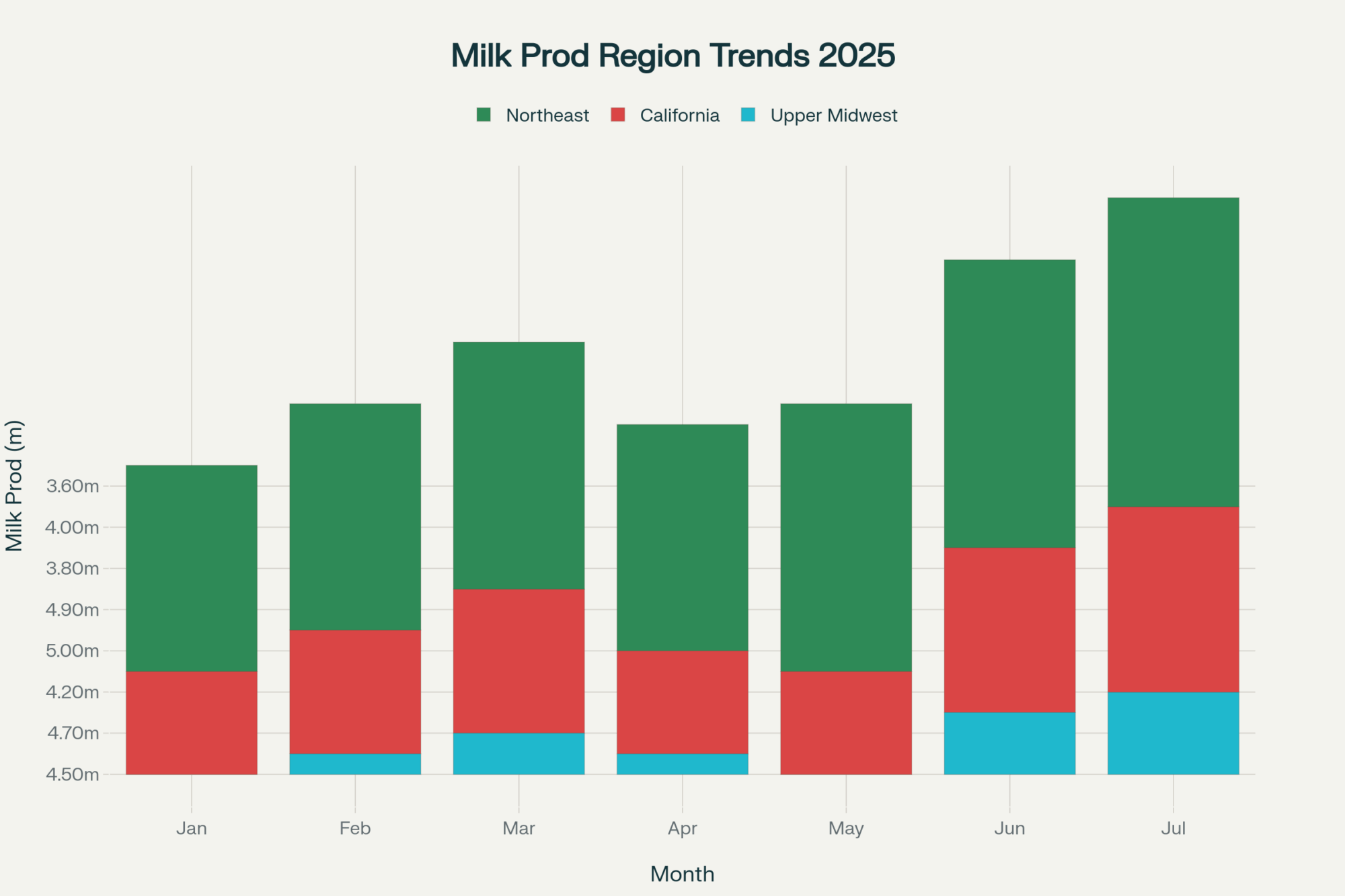
Let me focus on California this week because what’s happening there could ripple through national pricing patterns. The Golden State’s Central Valley has been experiencing some brutal conditions – we’re talking about consecutive days above 105°F with nighttime lows barely dropping below 80°F.
Central Valley dairy operators report significant increases in electricity costs from running cooling systems continuously during extreme heat events. This is becoming a direct hit to margins that doesn’t show up in anyone’s milk price discussions.
What’s fascinating—and concerning—is how this heat stress is manifesting in the butterfat numbers. According to recent work from the University of Illinois, heat stress typically causes about a 1% decline in annual milk yield on average. But what we’re seeing regionally is more nuanced. Smaller operations (under 100 cows) are getting hit with a 1.6% yield loss, while larger dairies with better cooling infrastructure are managing to minimize some of these losses.
Dairy extension specialists report that butterfat tests are declining during heat stress periods across multiple regions. Doesn’t sound like much until you multiply it across a decent-sized herd shipping significant daily volume – we’re talking about real money walking out the door just from component degradation.
The thing is, this isn’t hitting everyone equally. Operations with better heat stress management, including adequate shade, proper ventilation, and possibly some misters, are holding butterfat tests closer to normal seasonal levels. Farms that didn’t invest in cooling infrastructure? They’re feeling it hard.
Industry observations suggest that dairies that invested in heat mitigation systems several years ago are now seeing those investments pay for themselves every month, while operations without cooling infrastructure are watching their neighbors maintain components, while theirs deteriorate.
Global competitive positioning – and why our powder is moving
Something that doesn’t get discussed enough is that our competitive position internationally has shifted noticeably since early summer. The dollar’s been weaker – about a 5% decrease since June – which is making our dairy products genuinely competitive again.
Current International Price Landscape
| Product | U.S. Price | Competitive Position | Market Advantage |
| NDM/SMP | $1.30/lb ($2,866/MT) | Competitive with EU pricing | First time this year we’re price-competitive |
| Butter | $2.50/lb ($5,512/MT) | Significant advantage vs. Oceania | Massive pricing edge in key markets |
What’s happening in Europe is particularly interesting from a supply perspective. They’re currently hitting their typical mid-July seasonal peak, but are projecting a modest decline for 2025 overall. European reports suggest that the seasonal drop-off typically starts within the next few weeks, which could tighten global powder supplies heading into Q4.
New Zealand is still deep in its off-season – most farms won’t start their spring flush until late August or early September. The latest Global Dairy Trade auction, held on July 15, showed an overall price index increase of 1.1%, marking the first rise since May. Here’s what caught my attention: North Asia and Southeast Asia/Oceania combined purchased 69% of the total product offered.
Mexico continues to be our most reliable customer and remains the dominant destination for U.S. dairy exports, according to USDA trade data. They’re showing no signs of backing away from U.S. supplies, despite some trade policy uncertainties circulating.
Production reality check – the butterfat story nobody’s talking about
Summer dairy production… it’s always about the components as much as the volume, right? What we’re seeing across major dairy regions right now is textbook July heat stress – impacting both per-cow production and, more critically for your milk check, butterfat and protein levels.
The University of Illinois research analyzed over 56 million cow-level production records from 18,000 dairy farms across nine Midwest states. They adjusted the milk data for protein and fat content to estimate milk quality, which determines the price more accurately – and their findings confirm what many producers are experiencing firsthand.
The thing is, this isn’t hitting everyone equally. Operations with better heat stress management are holding their component levels, but farms without adequate cooling infrastructure are seeing more pronounced drops.
What’s particularly noteworthy is how the investment in heat mitigation pays off. Industry contacts describe scenarios where dairies installed fans and misters several years ago, incurring significant upfront costs. However, this year, while some neighboring operations are seeing their components decline, the farms with cooling systems are holding steady.
USDA forecasts and what those revision patterns really tell us
The official numbers paint an interesting picture if you know how to read between the lines. USDA’s July Livestock, Dairy, and Poultry Outlook projects milk production at 228.3 billion pounds for 2025, with 229.1 billion for 2026. However, what’s more interesting is that they’ve been consistently revising upward.
USDA Forecast Revision Pattern (2025 Milk Production)
- April: 226.9 billion lbs
- May: 227.3 billion lbs
- July: 228.3 billion lbs
That consistent upward revision pattern of 600-900 million pounds each time? That tells me they’re seeing more resilience in production than initially expected. The dairy cow forecast has been revised upward by 15,000 head to 9.435 million for 2025.
Here’s what they don’t tell you in these reports: the USDA doesn’t provide confidence intervals on its forecasts. Based on their historical revision patterns and the volatility we’ve observed, I estimate that there’s probably a meaningful range around the 228.3 billion pound forecast. But that’s reading between the lines.
Export projections appear solid, with 13.8 billion pounds on a milk-fat basis for 2025 and 45.3 billion pounds on a skim-solids basis. They’re specifically citing competitive U.S. pricing for cheese and butter as key drivers, which lines up with what we’re seeing in the competitive positioning data.
Risk scenarios – what could shake up this market
Alright, let me walk through what could go sideways… based on historical patterns and current market conditions, here’s how I see the major risks playing out:
Weather Disruption appears to be a moderate concern. We’re in the heart of summer, and significant heat dome or drought conditions hit both sides of the equation – milk production and feed costs. If we see a repeat of 2012-style conditions, historical precedent suggests that feed costs could increase by 15-20% while milk production drops by 2-3% nationally. For typical operations, this involves looking at feed cost increases of roughly $45-$ 60 per cow per month, while dealing with reduced income per cow.
The economic impact on Demand remains a legitimate concern. Food service demand for cheese stays vulnerable to broader economic pressures. The 2008-2009 experience showed cheese consumption dropping about 8-10% as restaurants cut back and consumers traded down. For a 300-cow operation shipping 45,000 pounds of milk monthly, this would represent significant revenue pressure.
Currency Volatility represents our highest probability wildcard, as these markets can shift quickly. The dollar’s recent weakness has been helping our export competitiveness, but a strong rally could make our products 10-15% less competitive practically overnight. Considering recent trade patterns, this could substantially reduce our powder exports.
Processing Capacity Issues keep me thinking at night. Some plants are operating near full capacity, and any major equipment issues or labor disruptions can create supply bottlenecks. Remember the 2019 situation in New Mexico? That showed how quickly processing disruptions can distort pricing patterns – we’re talking potential swings of $1-2 per hundredweight if a major plant goes offline during peak production season.
Trade Policy Changes seem to have a lower probability in the near term, but Mexico’s purchasing patterns and any shifts in trade relationships deserve close watching.
Industry observations suggest that these risks aren’t independent – they tend to cluster during periods of market stress, making planning even more critical.
Industry voices and market sentiment
I’ve been making calls around the industry this week, and the sentiment is, honestly, mixed.
Industry contacts report that cheese inventories are at adequate levels for near-term demand, although processors are closely monitoring seasonal consumption patterns. Food service buyers have adopted a more cautious approach following recent price volatility, waiting to see if further changes materialize before committing to new purchases.
Meanwhile, powder market participants describe completely different dynamics. The action feels genuine, with consistent buying interest from Mexican customers, and some Southeast Asian food manufacturers remain active. It’s a completely different dynamic than cheese right now.
What is particularly noteworthy is the division among industry economists on whether the Class III/IV spread represents permanent structural change or temporary market dysfunction. Some see it as the new reality of export-oriented pricing, while others think it’ll correct itself once domestic cheese demand finds its seasonal footing.
Historical context – how this July compares
Let me give you some perspective on where we stand. Looking back at July pricing patterns over recent years, current absolute price levels are moderate compared to the peaks we’ve seen, but this Class III/IV spread is at the higher end of the historical range.
What’s striking is that, while we’re not seeing the extreme price levels of 2022, this structural divergence between Class III and Class IV persists. That pattern we keep talking about? The data supports it.
What producers should be doing right now – and why timing matters
Look, I’ve been around this industry long enough to know that timing decisions is never easy. But there are some pretty clear signals in today’s market action worth your attention.
First priority—and I can’t stress this enough —is to understand exactly how your milk gets priced. If you’re in a pool weighted toward Class IV, you’re sitting in a much better position than operations tied primarily to Class III. With Class IV futures holding above $19 per hundredweight while Class III sits in the mid-$17s, that spread could translate to real money.
Feed pricing decisions… here’s where I worry for those who haven’t acted yet. December corn at $4.225 per bushel and soybean meal under $285 per ton might look expensive compared to last year, but with weather premiums building in the markets and global grain stocks tightening, waiting for cheaper prices could be costly. Consider covering at least 50-60% of your fall and winter needs now.
The risk management conversation gets more interesting every week. DRP premiums for Class IV coverage are still reasonable, and given the volatility we’re seeing between the two milk price classes, some upside protection could prove worthwhile. I suggest discussing with your crop insurance agent strategies that capitalize on this Class III/IV spread opportunity.
Don’t overlook operational fundamentals either. Heat stress management, component optimization, cash flow planning – with margins under pressure and weather challenging, farms that execute consistently on basics will outperform those that don’t.
The bigger picture – where this market is headed
What we witnessed today represents something larger than just another mixed trading session. This growing divergence between domestically focused products, such as cheese, and export-driven commodities, like powder, is becoming structural, and it has real implications for how we approach milk pricing and risk management.
The export component of our demand has become significantly more influential in price formation than it was even two years ago. Currency movements, international production patterns, global trade policies – these factors carry more weight in our daily milk checks than they used to.
Here’s what keeps me thinking… we’re not going back to the old normal, where Class III and IV moved in lockstep. Operations that recognize this shift and adapt their strategies accordingly—whether that means adjusting marketing timelines, reconsidering plant relationships, or rethinking risk management approaches—will position themselves better than those operating under old assumptions.
This isn’t temporary volatility we can wait out. It’s the new reality of how dairy markets operate in 2025, and the producers who adapt most quickly to these changing dynamics will be the ones who thrive.
Complete references and supporting documentation are available upon request by contacting the editorial team at editor@thebullvine.com.
Learn More:
- Feed Cost Revolution: Why 2025-26 Could Be Your Most Profitable Year Yet or Your Biggest Missed Opportunity – Reveals practical strategies for capitalizing on projected record corn crops while managing protein cost increases, with specific procurement tactics that could save operations $1,500+ monthly in feed expenses.
- Dairy Powder Prices Rally, But Are Your Margins Safe? – Demonstrates how to optimize feed conversion ratios and component production for sustainable profitability, showing methods some herds used to cut costs 26% while boosting yields during volatile market conditions.
- 5 Technologies That Will Make or Break Your Dairy Farm in 2025 – Explores game-changing precision feeding, robotic milking, and AI analytics technologies that early adopters are using to slash mortality 40% and boost efficiency, with ROI analysis for implementation decisions.
 Join the Revolution!
 Join the Revolution!
Join over 30,000 successful dairy professionals who rely on Bullvine Weekly for their competitive edge. Delivered directly to your inbox each week, our exclusive industry insights help you make smarter decisions while saving precious hours every week. Never miss critical updates on milk production trends, breakthrough technologies, and profit-boosting strategies that top producers are already implementing. Subscribe now to transform your dairy operation’s efficiency and profitability—your future success is just one click away.




